
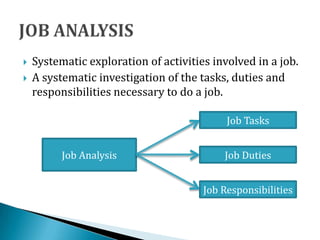



 Systematic exploration of activities involved in a job.
 A systematic investigation of the tasks, duties and
responsibilities necessary to do a job.
Job Analysis
Job Tasks
Job Duties
Job Responsibilities
 Identification of the job
 To identify the operations and tasks involved
 Characteristics of the job
 Duties involved in the job
 Materials , methods and equipments used in the job
 How the job is performed
 Relationships
 Personal Attributes
 Human resource planning
 Recruitment
 Selection
 Placement and orientation
 Training
 Counseling
 Employee safety
 Performance appraisal
 Job design and redesign
 Job evaluation
 Organizational Analysis
 Selection of representative jobs/position to be
analyzed
 Collection of job analysis data
 Preparation of job description
 Preparation of job specification
 Preparation of job evaluation
 Implementing and monitoring the development
 Observation method
 Interview method
◦ Individual Interview method
◦ Group Interview method
 Questionnaire method
 Technical conference method
 Diary method/log method
 Job performance method
 Critical incidence technique
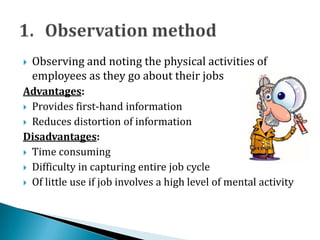
 Observing and noting the physical activities of
employees as they go about their jobs
Advantages:
 Provides first-hand information
 Reduces distortion of information
Disadvantages:
 Time consuming
 Difficulty in capturing entire job cycle
 Of little use if job involves a high level of mental activity
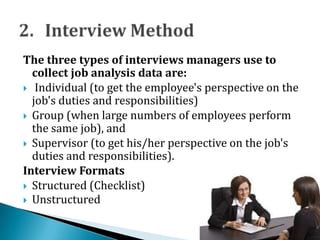
The three types of interviews managers use to
collect job analysis data are:
 Individual (to get the employee's perspective on the
job's duties and responsibilities)
 Group (when large numbers of employees perform
the same job), and
 Supervisor (to get his/her perspective on the job's
duties and responsibilities).
Interview Formats
 Structured (Checklist)
 Unstructured
Advantages :
Quick,
Direct way to find overlooked information required.
Disadvantages :
Exaggeration or depreciation of importance of job
In case of supervisor, he may not be interesting in the
JD of the subordinates.
Attitude may not be supportive.
Difference in perception, attitude and aptitude of the
interviewee.
Lack of communication.
Analyst’s caliber should match employee’s caliber.
 The job analyst and supervisor should work
together to identify the workers who know the job
best.
 It is advisable to quickly establish rapport with the
interviewee.
 Follow a structured guide or checklist, one that lists
open-ended questions and provides space for
answers.
 Ask the worker to list his or her duties in order of
importance and frequency of occurrence.
 After completing the interview, review and verify
the data.
Employees fill out questionnaires to describe their
job-related duties and responsibilities.
Questionnaires format:job analysis questionnaire
format.docx,Job Analysis -Questionnaire.docx
 Structured checklist.( to identify the task
performed)
 Open ended questions
Advantages
 Quick and efficient way to gather information from
large numbers of employees
Disadvantages
 Expensive and time is consumed in preparing and
testing the questionnaire.
 Becomes less useful where the employees lack
verbal skills.
A job analysis technique that involves extensive input
from the employee’s supervisor/ experts. The
method does not allow having the employee’s
perception of the task.
 Workers keep a chronological diary/ log of what
they do and the time spent on each activity.
Advantages:
 Produces a more complete picture of the job
 Employee participation
 Maintained on daily basis.
Disadvantages:
 Distortion of information
 Depends upon employees to accurately recall their
activities
The job analyst actually performs the job in question
thus giving a first hand information of the job in
terms of physical effort, hazards, emotional
pressures, social demands and mental
requirements.
Job analysis method by which job tasks are
identified that are critical to job success.
1. Job Description
2. Job Specification
3. Job Evaluation
 A written document of what the job holder does, how it
is done, under what conditions it is done and why it is
done.
 It gives the purpose and scope of the job
Contents of Job description
 Job Title
 Job Summary
 Job activities
 Tools, machinery and equipments needed if any
 Working condition
 Social environment
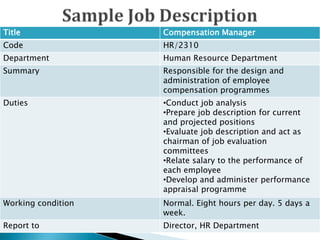
Title Compensation Manager
Code HR/2310
Department Human Resource Department
Summary Responsible for the design and
administration of employee
compensation programmes
Duties •Conduct job analysis
•Prepare job description for current
and projected positions
•Evaluate job description and act as
chairman of job evaluation
committees
•Relate salary to the performance of
each employee
•Develop and administer performance
appraisal programme
Working condition Normal. Eight hours per day. 5 days a
week.
Report to Director, HR Department
 helps the supervisors in assigning work to the
subordinates so that he can guide and monitor their
performances.
 It helps in recruitment and selection procedures.
 It assists in manpower planning.
 It is also helpful in performance appraisal.
 It is helpful in job evaluation in order to decide
about rate of remuneration for a specific job.
 It also helps in chalking out training and
development programmes
 A statement which tells us minimum acceptable
human qualities which helps to perform a job. Job
specification translates the job description into
human qualifications so that a job can be performed
in a better manner.
 Job specification helps in hiring an appropriate
person for an appropriate position.
The contents are :
 Job title and designation
 Educational qualifications for that title
 Physical and other related attributes
 Physique and mental health
 Special attributes and abilities
 Maturity and dependability
 Relationship of that job with other jobs in a concern.
 Job Specification of Compensation Manager.docx
Advantages of Job Specification
 It is helpful in preliminary screening in the selection
procedure.
 It helps in giving due justification to each job.
 It also helps in designing training and development
programmes.
 It helps the supervisors for counseling and monitoring
performance of employees.
 It helps in job evaluation.
 It helps the management to take decisions regarding
promotion, transfers and giving extra benefits to the
employees.
Job analysis is considered to be the
primary tool of personnel management.
 Job evaluation is the process of determining the
worth of one job in relation to that of the other jobs
in a company.
 Is a process of determining the relative worth of a
job.
 An effort to determine the relative value of every job
in an organization.
 A practical technique to judge the size of one job
relative to others.
 To gather data and information relating to JD, job
specification and employee specifications of various
jobs in an organization.
 To compare the duties, responsibilities and
demands of a job with that of other jobs.
 To determine the hierarchy /rank based on jobs in
an organization.
 To ensure equal wages are fixed to the jobs of equal
worth or value.
 To minimize wage discrimination based on sex, age,
caste, region, religion etc.
 Rate the job but not the employee.
 Elements / tasks selected should be easily understood,
defined clearly and properly selected.
 Employee concerned and supervisors should be educated
and convinced about the program.
 Supervisors should be encouraged to participate in rating
the jobs.
 Encourage employee cooperation to participate in the
rating program.
 Consensus with the supervisors and employees on rating.
 Should be a collective effort, chance for equal
representation from all departments
 Reduction in inequalities in salary structure
 Specialization
 Helps in selection of employees
 Harmonious relationship between employees and
manager
 Standardization
 Relevance of new jobs
Human resources planning is the process by which an
organization ensures that it has the right number &
right kind of people at the right place and at the
right time , capable of effectively and efficiently
completing those tasks that help the organization
achieve its overall objectives..
Human Resource Planning is ‘the process for ensuring
that the human resource requirements of an
organization are identified and plans are made for
satisfying those requirements’.
Bulla and Scott (1994),
HR Planning is also called Employment planning or
Man power planning
Important, since people are most important and the
most valuable asset of the organisation
 Forecast personnel requirements: determine
future manpower needs
 Cope with changes effectively: market conditions,
technology, products, government regulations etc.
 Use existing manpower productively
 Promote employees in a systematic manner.
 Reservoir of talent :
 Prepare people for future – employees trained and
motivated in advance to meet future requirements
 Meet the needs of expansion and downsizing
programmes
 Meet manpower shortages due to labour turnover.
 Cut cost- prevent over manning/ surplus employees
 Succession planning.
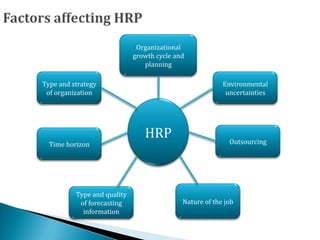
Nature of the job
Outsourcing
Environmental
uncertainties
Organizational
growth cycle and
planning
Type and quality
of forecasting
information
Time horizon
Type and strategy
of organization
HRP
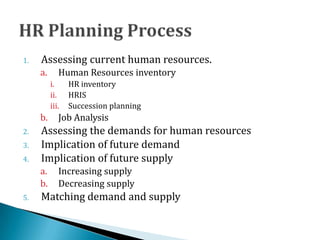
1. Assessing current human resources.
a. Human Resources inventory
i. HR inventory
ii. HRIS
iii. Succession planning
b. Job Analysis
2. Assessing the demands for human resources
3. Implication of future demand
4. Implication of future supply
a. Increasing supply
b. Decreasing supply
5. Matching demand and supply
HR planning starts – preparation of profile of current human
resources in an organization.
It includes
I. Human Resource Inventory & Job Analysis
Human Resource Inventory Includes
a) HR Inventory – Collecting and keeping the details of the
employees presently working in the organization utilizing
the computer technology.
c) HRIS – Human Resource Information System: A data base
system: A method by which an organization collects, analyses
and reports information about people and job.
c) Succession Planning: A type of inventory report:
It is a process for identifying and developing internal people
with the potential to fill key business leadership positions in
the company that may come in the future.
(retirement, death, resignation, promotion, transfer etc)
II. Job Analysis: Systematic exploration of activities involved
in a job.
 The future plans, direction of the organisation in
terms of revenue forecast etc
 Here projection of future human needs can be
developed.
 Heterogeneous group of people has to be identified
 Both the quality and quantity of demand is important
 Factors affecting the supply
Increasing Supply:
 Transfers in, returns from leave
Decreasing supply:
 Transfers out, retirement, death, dismissal, lay off.
i. Lack of understanding of rationale of planning
ii. Insufficient top management’s support
iii. Insufficient initial effort
iv. Lack of coordination with other functions
v. Lack of integration with organizational plans
vi. Non-cooperation of operating managers.
Process of locating and encouraging potential applicants to
apply for existing or anticipated job openings.
EDWIN FLIPPO,
“Recruitment is the process of searching for prospective
employees and stimulating them to apply for jobs in the
organization.”
Recruitment is a positive function in which publicity is given
to the jobs available in the organization and interested
candidates are encouraged to submit applications for the
purpose of selection
Need arises due to the following reasons / situation:
 Vacancies due to promotions, transfer, retirement,
termination, permanent disability, death and labour
turnover.
 Creation of new vacancies due to the growth, expansion
and diversification of business activities of an enterprise.
 Determine the present and future requirements of the organization.
 Increase the pool of job candidates at minimum cost.
 Help increase the success rate of the selection process - by reducing
under qualified or overqualified job applicants.
 reduce the probability that job applicants, once recruited and selected,
leaving the organization within a short period of time.
 Meet the organization’s legal and social obligations regarding the
composition of its work force.
 Identifying and preparing potential job applicants who will be
appropriate candidates.
 Increase organizational and individual effectiveness
 Evaluate the effectiveness of various recruiting techniques and
sources for all types of job applicants.
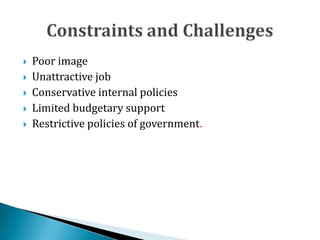
 Poor image
 Unattractive job
 Conservative internal policies
 Limited budgetary support
 Restrictive policies of government.
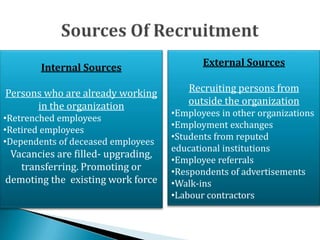
Internal Sources
Persons who are already working
in the organization
•Retrenched employees
•Retired employees
•Dependents of deceased employees
Vacancies are filled- upgrading,
transferring. Promoting or
demoting the existing work force
External Sources
Recruiting persons from
outside the organization
•Employees in other organizations
•Employment exchanges
•Students from reputed
educational institutions
•Employee referrals
•Respondents of advertisements
•Walk-ins
•Labour contractors
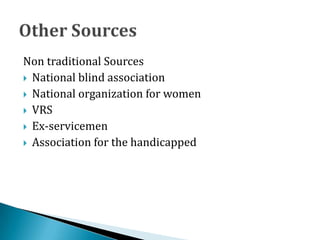
Non traditional Sources
 National blind association
 National organization for women
 VRS
 Ex-servicemen
 Association for the handicapped
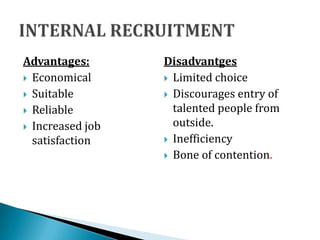
Advantages:
 Economical
 Suitable
 Reliable
 Increased job
satisfaction
Disadvantges
 Limited choice
 Discourages entry of
talented people from
outside.
 Inefficiency
 Bone of contention.
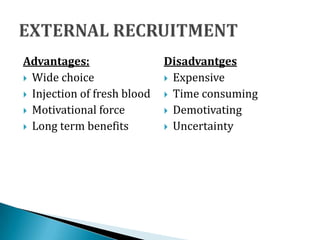
Advantages:
 Wide choice
 Injection of fresh blood
 Motivational force
 Long term benefits
Disadvantges
 Expensive
 Time consuming
 Demotivating
 Uncertainty
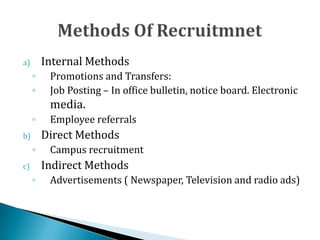
a) Internal Methods
◦ Promotions and Transfers:
◦ Job Posting – In office bulletin, notice board. Electronic
media.
◦ Employee referrals
b) Direct Methods
◦ Campus recruitment
c) Indirect Methods
◦ Advertisements ( Newspaper, Television and radio ads)
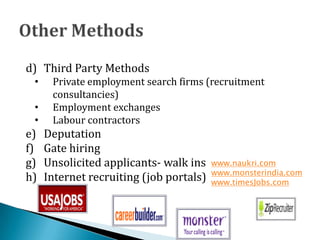
d) Third Party Methods
• Private employment search firms (recruitment
consultancies)
• Employment exchanges
• Labour contractors
e) Deputation
f) Gate hiring
g) Unsolicited applicants- walk ins
h) Internet recruiting (job portals)
www.naukri.com
www.monsterindia.com
www.timesJobs.com
 Overtime
 Sub contracting
 Temporary employees
 Employee leasing
 Outsourcing
 Outsourcing
 Poaching/raiding
 E-recruitment
 Dot jobs domain ( www.goto.jobs)
 virtual job fairs
 Legal Environment:
◦ The factories Act, 1948
◦ The Apprentices Act,1961
◦ The Employment Exchanges Act,1959
◦ The Contract labour Act,1970
◦ Bonded Labour System (Abolition) Act, 1976
◦ The Child Labour Act,1986
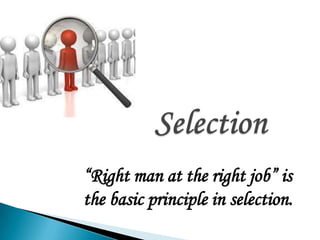
“Right man at the right job” is
the basic principle in selection.
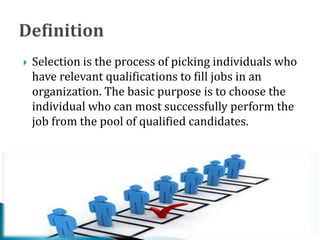
 Selection is the process of picking individuals who
have relevant qualifications to fill jobs in an
organization. The basic purpose is to choose the
individual who can most successfully perform the
job from the pool of qualified candidates.
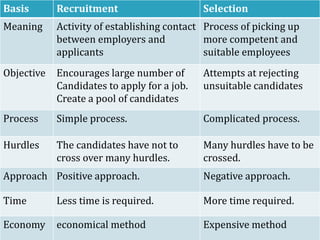
Basis Recruitment Selection
Meaning Activity of establishing contact
between employers and
applicants
Process of picking up
more competent and
suitable employees
Objective Encourages large number of
Candidates to apply for a job.
Create a pool of candidates
Attempts at rejecting
unsuitable candidates
Process Simple process. Complicated process.
Hurdles The candidates have not to
cross over many hurdles.
Many hurdles have to be
crossed.
Approach Positive approach. Negative approach.
Time Less time is required. More time required.
Economy economical method Expensive method
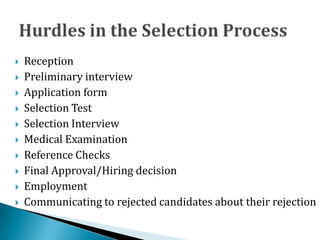
 Reception
 Preliminary interview
 Application form
 Selection Test
 Selection Interview
 Medical Examination
 Reference Checks
 Final Approval/Hiring decision
 Employment
 Communicating to rejected candidates about their rejection
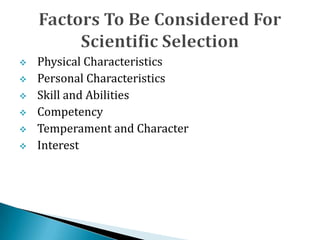
 Physical Characteristics
 Personal Characteristics
 Skill and Abilities
 Competency
 Temperament and Character
 Interest
1. Intelligence tests
2. Ability tests -determine
how well one can perform his
task
3. Aptitude Test - determine
a persons potential to learn
in a given area
4. Personality tests - To
measure an individual’s
activity preferences
◦ Projective tests
◦ Interest tests
◦ Preference tests
5. Achievement Test
6. Simulation tests
7. Assessment centre
7. Graphology test
8. Polygraph test- lie
detector
9. Integrity tests
 Objective-eliminate bias
 Helps to identify talents of individuals
 Reduce cost-large candidates at minimum time
 Measure aptitude and predict success
 Healthy basis for comparing applicants
 Analysis of job
 Selection of test procedure
 Preliminary tryout and refinement
 Validation of test procedure –experiment
 Combination of tests
 Administration of tests
 Reliability- Refers to the consistency – Reliability is
tested by giving the same test to the same person at
two different points in time
 Validity- the extend to which the test measures
what it intends to measure
 Suitability – Suitable for the group on which it is
applied
 Usefulness – Exclusive reliance on single test
should be avoided
 Preparation - Test should be well prepared
 Standardization - Should follow prescribed
methods and procedures for conducting the test
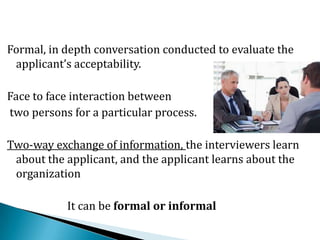
Formal, in depth conversation conducted to evaluate the
applicant’s acceptability.
Face to face interaction between
two persons for a particular process.
Two-way exchange of information, the interviewers learn
about the applicant, and the applicant learns about the
organization
It can be formal or informal
Interview is deliberate listening for the purpose of
drawing the other persons out to discover, what he
want to say and give him a chance to express
himself.
Purpose of interview
 Size up the interviewee’s agreeableness
 Ask questions that are not covered in tests
 Obtain as much relevant information as possible
 Make assessment on interviewee’s enthusiasm and
intelligence
 Pass information to candidate about the company
 Non – directive interview (Unstructured interview) – No
specific format followed, broad, open ended questions.
 Directive (Structured interview) – Uses predetermined
set of questions. Easy to compare two candidates, increased
reliability, eliminate biases but put restrictions on the
freedom of interviewer.
 Situational interview- applicants are confronted with a
hypothetical(imaginary) incident (situation)
 Behavioural Interview- Focuses on actual work incidents
in the applicants past.
 Stress Interview: to find response of candidates to
aggressive, embarrassing, rude and insulting questions and
putting them in a difficult situation.
 Panel interview: Interviewee meets with three or five
interviewers. Limits the chances of personal biases of any
individual interviewer.
 Depth interview: To evaluate the subject knowledge of the
candidate
 Phone Interviews - Interview conducted over the phone
 Video/Web Assisted Interviews – video conferencing
 Exit interview – Interview conducted at the the time of
leaving (resignation)the organization
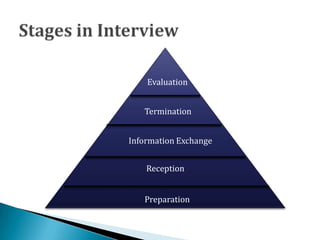
Reception
Preparation
Information Exchange
Termination
Evaluation
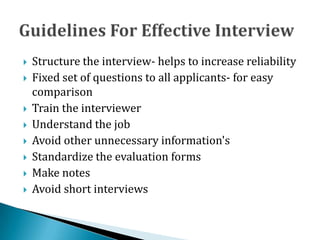
 Structure the interview- helps to increase reliability
 Fixed set of questions to all applicants- for easy
comparison
 Train the interviewer
 Understand the job
 Avoid other unnecessary information's
 Standardize the evaluation forms
 Make notes
 Avoid short interviews
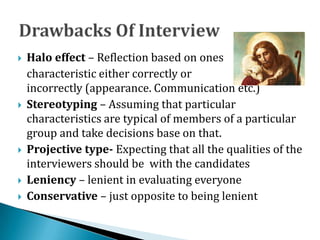
 Halo effect – Reflection based on ones
characteristic either correctly or
incorrectly (appearance. Communication etc.)
 Stereotyping – Assuming that particular
characteristics are typical of members of a particular
group and take decisions base on that.
 Projective type- Expecting that all the qualities of the
interviewers should be with the candidates
 Leniency – lenient in evaluating everyone
 Conservative – just opposite to being lenient
 Adjusting the HR policies (hiring freeze, salary freeze,
salary reduction, early retirement, mandatory holiday)
 Reducing Recruitment costs (Negotiating discount on
recruitment contracts with recruitment sites and agencies,
Approaching one stop career centers for all types of job
vacancies)
 Conducting the screening interviews over the
internet( Web cam conferencing)/telephonic
interviews.
 Sending employees to free training alternatives
 Cutting back salary increases and merit pay (high
performing employees- offered- long term equity grants
and retention bonuses)
 Extended health care benefits for separated
employees
 Preparing for lay offs
 Adopt Cost cutting Strategies (reducing accidents,
migrate from expensive training to less expensive online
training, diligently reviewing compensation claims, diligent
safety checks and audits)
 Managing effectively the overall compensation
spending

Module 2

  • 2.
     Systematic explorationof activities involved in a job.  A systematic investigation of the tasks, duties and responsibilities necessary to do a job. Job Analysis Job Tasks Job Duties Job Responsibilities
  • 3.
     Identification ofthe job  To identify the operations and tasks involved  Characteristics of the job  Duties involved in the job  Materials , methods and equipments used in the job  How the job is performed  Relationships  Personal Attributes
  • 4.
     Human resourceplanning  Recruitment  Selection  Placement and orientation  Training  Counseling  Employee safety  Performance appraisal  Job design and redesign  Job evaluation
  • 5.
     Organizational Analysis Selection of representative jobs/position to be analyzed  Collection of job analysis data  Preparation of job description  Preparation of job specification  Preparation of job evaluation  Implementing and monitoring the development
  • 6.
     Observation method Interview method ◦ Individual Interview method ◦ Group Interview method  Questionnaire method  Technical conference method  Diary method/log method  Job performance method  Critical incidence technique
  • 7.
     Observing andnoting the physical activities of employees as they go about their jobs Advantages:  Provides first-hand information  Reduces distortion of information Disadvantages:  Time consuming  Difficulty in capturing entire job cycle  Of little use if job involves a high level of mental activity
  • 8.
    The three typesof interviews managers use to collect job analysis data are:  Individual (to get the employee's perspective on the job's duties and responsibilities)  Group (when large numbers of employees perform the same job), and  Supervisor (to get his/her perspective on the job's duties and responsibilities). Interview Formats  Structured (Checklist)  Unstructured
  • 9.
    Advantages : Quick, Direct wayto find overlooked information required. Disadvantages : Exaggeration or depreciation of importance of job In case of supervisor, he may not be interesting in the JD of the subordinates. Attitude may not be supportive. Difference in perception, attitude and aptitude of the interviewee. Lack of communication. Analyst’s caliber should match employee’s caliber.
  • 10.
     The jobanalyst and supervisor should work together to identify the workers who know the job best.  It is advisable to quickly establish rapport with the interviewee.  Follow a structured guide or checklist, one that lists open-ended questions and provides space for answers.  Ask the worker to list his or her duties in order of importance and frequency of occurrence.  After completing the interview, review and verify the data.
  • 11.
    Employees fill outquestionnaires to describe their job-related duties and responsibilities. Questionnaires format:job analysis questionnaire format.docx,Job Analysis -Questionnaire.docx  Structured checklist.( to identify the task performed)  Open ended questions
  • 12.
    Advantages  Quick andefficient way to gather information from large numbers of employees Disadvantages  Expensive and time is consumed in preparing and testing the questionnaire.  Becomes less useful where the employees lack verbal skills.
  • 13.
    A job analysistechnique that involves extensive input from the employee’s supervisor/ experts. The method does not allow having the employee’s perception of the task.
  • 14.
     Workers keepa chronological diary/ log of what they do and the time spent on each activity. Advantages:  Produces a more complete picture of the job  Employee participation  Maintained on daily basis. Disadvantages:  Distortion of information  Depends upon employees to accurately recall their activities
  • 15.
    The job analystactually performs the job in question thus giving a first hand information of the job in terms of physical effort, hazards, emotional pressures, social demands and mental requirements.
  • 16.
    Job analysis methodby which job tasks are identified that are critical to job success.
  • 17.
    1. Job Description 2.Job Specification 3. Job Evaluation
  • 18.
     A writtendocument of what the job holder does, how it is done, under what conditions it is done and why it is done.  It gives the purpose and scope of the job Contents of Job description  Job Title  Job Summary  Job activities  Tools, machinery and equipments needed if any  Working condition  Social environment
  • 19.
    Title Compensation Manager CodeHR/2310 Department Human Resource Department Summary Responsible for the design and administration of employee compensation programmes Duties •Conduct job analysis •Prepare job description for current and projected positions •Evaluate job description and act as chairman of job evaluation committees •Relate salary to the performance of each employee •Develop and administer performance appraisal programme Working condition Normal. Eight hours per day. 5 days a week. Report to Director, HR Department
  • 20.
     helps thesupervisors in assigning work to the subordinates so that he can guide and monitor their performances.  It helps in recruitment and selection procedures.  It assists in manpower planning.  It is also helpful in performance appraisal.  It is helpful in job evaluation in order to decide about rate of remuneration for a specific job.  It also helps in chalking out training and development programmes
  • 21.
     A statementwhich tells us minimum acceptable human qualities which helps to perform a job. Job specification translates the job description into human qualifications so that a job can be performed in a better manner.  Job specification helps in hiring an appropriate person for an appropriate position.
  • 22.
    The contents are:  Job title and designation  Educational qualifications for that title  Physical and other related attributes  Physique and mental health  Special attributes and abilities  Maturity and dependability  Relationship of that job with other jobs in a concern.  Job Specification of Compensation Manager.docx
  • 23.
    Advantages of JobSpecification  It is helpful in preliminary screening in the selection procedure.  It helps in giving due justification to each job.  It also helps in designing training and development programmes.  It helps the supervisors for counseling and monitoring performance of employees.  It helps in job evaluation.  It helps the management to take decisions regarding promotion, transfers and giving extra benefits to the employees. Job analysis is considered to be the primary tool of personnel management.
  • 24.
     Job evaluationis the process of determining the worth of one job in relation to that of the other jobs in a company.  Is a process of determining the relative worth of a job.  An effort to determine the relative value of every job in an organization.  A practical technique to judge the size of one job relative to others.
  • 25.
     To gatherdata and information relating to JD, job specification and employee specifications of various jobs in an organization.  To compare the duties, responsibilities and demands of a job with that of other jobs.  To determine the hierarchy /rank based on jobs in an organization.  To ensure equal wages are fixed to the jobs of equal worth or value.  To minimize wage discrimination based on sex, age, caste, region, religion etc.
  • 26.
     Rate thejob but not the employee.  Elements / tasks selected should be easily understood, defined clearly and properly selected.  Employee concerned and supervisors should be educated and convinced about the program.  Supervisors should be encouraged to participate in rating the jobs.  Encourage employee cooperation to participate in the rating program.  Consensus with the supervisors and employees on rating.  Should be a collective effort, chance for equal representation from all departments
  • 27.
     Reduction ininequalities in salary structure  Specialization  Helps in selection of employees  Harmonious relationship between employees and manager  Standardization  Relevance of new jobs
  • 29.
    Human resources planningis the process by which an organization ensures that it has the right number & right kind of people at the right place and at the right time , capable of effectively and efficiently completing those tasks that help the organization achieve its overall objectives.. Human Resource Planning is ‘the process for ensuring that the human resource requirements of an organization are identified and plans are made for satisfying those requirements’. Bulla and Scott (1994),
  • 30.
    HR Planning isalso called Employment planning or Man power planning Important, since people are most important and the most valuable asset of the organisation
  • 31.
     Forecast personnelrequirements: determine future manpower needs  Cope with changes effectively: market conditions, technology, products, government regulations etc.  Use existing manpower productively  Promote employees in a systematic manner.
  • 32.
     Reservoir oftalent :  Prepare people for future – employees trained and motivated in advance to meet future requirements  Meet the needs of expansion and downsizing programmes  Meet manpower shortages due to labour turnover.  Cut cost- prevent over manning/ surplus employees  Succession planning.
  • 33.
    Nature of thejob Outsourcing Environmental uncertainties Organizational growth cycle and planning Type and quality of forecasting information Time horizon Type and strategy of organization HRP
  • 34.
    1. Assessing currenthuman resources. a. Human Resources inventory i. HR inventory ii. HRIS iii. Succession planning b. Job Analysis 2. Assessing the demands for human resources 3. Implication of future demand 4. Implication of future supply a. Increasing supply b. Decreasing supply 5. Matching demand and supply
  • 35.
    HR planning starts– preparation of profile of current human resources in an organization. It includes I. Human Resource Inventory & Job Analysis Human Resource Inventory Includes a) HR Inventory – Collecting and keeping the details of the employees presently working in the organization utilizing the computer technology.
  • 36.
    c) HRIS –Human Resource Information System: A data base system: A method by which an organization collects, analyses and reports information about people and job. c) Succession Planning: A type of inventory report: It is a process for identifying and developing internal people with the potential to fill key business leadership positions in the company that may come in the future. (retirement, death, resignation, promotion, transfer etc) II. Job Analysis: Systematic exploration of activities involved in a job.
  • 37.
     The futureplans, direction of the organisation in terms of revenue forecast etc  Here projection of future human needs can be developed.  Heterogeneous group of people has to be identified  Both the quality and quantity of demand is important
  • 38.
     Factors affectingthe supply Increasing Supply:  Transfers in, returns from leave Decreasing supply:  Transfers out, retirement, death, dismissal, lay off.
  • 39.
    i. Lack ofunderstanding of rationale of planning ii. Insufficient top management’s support iii. Insufficient initial effort iv. Lack of coordination with other functions v. Lack of integration with organizational plans vi. Non-cooperation of operating managers.
  • 41.
    Process of locatingand encouraging potential applicants to apply for existing or anticipated job openings. EDWIN FLIPPO, “Recruitment is the process of searching for prospective employees and stimulating them to apply for jobs in the organization.” Recruitment is a positive function in which publicity is given to the jobs available in the organization and interested candidates are encouraged to submit applications for the purpose of selection
  • 42.
    Need arises dueto the following reasons / situation:  Vacancies due to promotions, transfer, retirement, termination, permanent disability, death and labour turnover.  Creation of new vacancies due to the growth, expansion and diversification of business activities of an enterprise.
  • 43.
     Determine thepresent and future requirements of the organization.  Increase the pool of job candidates at minimum cost.  Help increase the success rate of the selection process - by reducing under qualified or overqualified job applicants.  reduce the probability that job applicants, once recruited and selected, leaving the organization within a short period of time.  Meet the organization’s legal and social obligations regarding the composition of its work force.  Identifying and preparing potential job applicants who will be appropriate candidates.  Increase organizational and individual effectiveness  Evaluate the effectiveness of various recruiting techniques and sources for all types of job applicants.
  • 45.
     Poor image Unattractive job  Conservative internal policies  Limited budgetary support  Restrictive policies of government.
  • 46.
    Internal Sources Persons whoare already working in the organization •Retrenched employees •Retired employees •Dependents of deceased employees Vacancies are filled- upgrading, transferring. Promoting or demoting the existing work force External Sources Recruiting persons from outside the organization •Employees in other organizations •Employment exchanges •Students from reputed educational institutions •Employee referrals •Respondents of advertisements •Walk-ins •Labour contractors
  • 47.
    Non traditional Sources National blind association  National organization for women  VRS  Ex-servicemen  Association for the handicapped
  • 48.
    Advantages:  Economical  Suitable Reliable  Increased job satisfaction Disadvantges  Limited choice  Discourages entry of talented people from outside.  Inefficiency  Bone of contention.
  • 49.
    Advantages:  Wide choice Injection of fresh blood  Motivational force  Long term benefits Disadvantges  Expensive  Time consuming  Demotivating  Uncertainty
  • 50.
    a) Internal Methods ◦Promotions and Transfers: ◦ Job Posting – In office bulletin, notice board. Electronic media. ◦ Employee referrals b) Direct Methods ◦ Campus recruitment c) Indirect Methods ◦ Advertisements ( Newspaper, Television and radio ads)
  • 51.
    d) Third PartyMethods • Private employment search firms (recruitment consultancies) • Employment exchanges • Labour contractors e) Deputation f) Gate hiring g) Unsolicited applicants- walk ins h) Internet recruiting (job portals) www.naukri.com www.monsterindia.com www.timesJobs.com
  • 52.
     Overtime  Subcontracting  Temporary employees  Employee leasing  Outsourcing
  • 53.
     Outsourcing  Poaching/raiding E-recruitment  Dot jobs domain ( www.goto.jobs)  virtual job fairs
  • 54.
     Legal Environment: ◦The factories Act, 1948 ◦ The Apprentices Act,1961 ◦ The Employment Exchanges Act,1959 ◦ The Contract labour Act,1970 ◦ Bonded Labour System (Abolition) Act, 1976 ◦ The Child Labour Act,1986
  • 55.
    “Right man atthe right job” is the basic principle in selection.
  • 56.
     Selection isthe process of picking individuals who have relevant qualifications to fill jobs in an organization. The basic purpose is to choose the individual who can most successfully perform the job from the pool of qualified candidates.
  • 57.
    Basis Recruitment Selection MeaningActivity of establishing contact between employers and applicants Process of picking up more competent and suitable employees Objective Encourages large number of Candidates to apply for a job. Create a pool of candidates Attempts at rejecting unsuitable candidates Process Simple process. Complicated process. Hurdles The candidates have not to cross over many hurdles. Many hurdles have to be crossed. Approach Positive approach. Negative approach. Time Less time is required. More time required. Economy economical method Expensive method
  • 58.
     Reception  Preliminaryinterview  Application form  Selection Test  Selection Interview  Medical Examination  Reference Checks  Final Approval/Hiring decision  Employment  Communicating to rejected candidates about their rejection
  • 59.
     Physical Characteristics Personal Characteristics  Skill and Abilities  Competency  Temperament and Character  Interest
  • 60.
    1. Intelligence tests 2.Ability tests -determine how well one can perform his task 3. Aptitude Test - determine a persons potential to learn in a given area 4. Personality tests - To measure an individual’s activity preferences ◦ Projective tests ◦ Interest tests ◦ Preference tests 5. Achievement Test 6. Simulation tests 7. Assessment centre 7. Graphology test 8. Polygraph test- lie detector 9. Integrity tests
  • 61.
     Objective-eliminate bias Helps to identify talents of individuals  Reduce cost-large candidates at minimum time  Measure aptitude and predict success  Healthy basis for comparing applicants
  • 62.
     Analysis ofjob  Selection of test procedure  Preliminary tryout and refinement  Validation of test procedure –experiment  Combination of tests  Administration of tests
  • 63.
     Reliability- Refersto the consistency – Reliability is tested by giving the same test to the same person at two different points in time  Validity- the extend to which the test measures what it intends to measure  Suitability – Suitable for the group on which it is applied  Usefulness – Exclusive reliance on single test should be avoided  Preparation - Test should be well prepared  Standardization - Should follow prescribed methods and procedures for conducting the test
  • 65.
    Formal, in depthconversation conducted to evaluate the applicant’s acceptability. Face to face interaction between two persons for a particular process. Two-way exchange of information, the interviewers learn about the applicant, and the applicant learns about the organization It can be formal or informal
  • 66.
    Interview is deliberatelistening for the purpose of drawing the other persons out to discover, what he want to say and give him a chance to express himself. Purpose of interview  Size up the interviewee’s agreeableness  Ask questions that are not covered in tests  Obtain as much relevant information as possible  Make assessment on interviewee’s enthusiasm and intelligence  Pass information to candidate about the company
  • 67.
     Non –directive interview (Unstructured interview) – No specific format followed, broad, open ended questions.  Directive (Structured interview) – Uses predetermined set of questions. Easy to compare two candidates, increased reliability, eliminate biases but put restrictions on the freedom of interviewer.  Situational interview- applicants are confronted with a hypothetical(imaginary) incident (situation)  Behavioural Interview- Focuses on actual work incidents in the applicants past.
  • 68.
     Stress Interview:to find response of candidates to aggressive, embarrassing, rude and insulting questions and putting them in a difficult situation.  Panel interview: Interviewee meets with three or five interviewers. Limits the chances of personal biases of any individual interviewer.  Depth interview: To evaluate the subject knowledge of the candidate  Phone Interviews - Interview conducted over the phone  Video/Web Assisted Interviews – video conferencing  Exit interview – Interview conducted at the the time of leaving (resignation)the organization
  • 69.
  • 70.
     Structure theinterview- helps to increase reliability  Fixed set of questions to all applicants- for easy comparison  Train the interviewer  Understand the job  Avoid other unnecessary information's  Standardize the evaluation forms  Make notes  Avoid short interviews
  • 71.
     Halo effect– Reflection based on ones characteristic either correctly or incorrectly (appearance. Communication etc.)  Stereotyping – Assuming that particular characteristics are typical of members of a particular group and take decisions base on that.  Projective type- Expecting that all the qualities of the interviewers should be with the candidates  Leniency – lenient in evaluating everyone  Conservative – just opposite to being lenient
  • 72.
     Adjusting theHR policies (hiring freeze, salary freeze, salary reduction, early retirement, mandatory holiday)  Reducing Recruitment costs (Negotiating discount on recruitment contracts with recruitment sites and agencies, Approaching one stop career centers for all types of job vacancies)  Conducting the screening interviews over the internet( Web cam conferencing)/telephonic interviews.  Sending employees to free training alternatives
  • 73.
     Cutting backsalary increases and merit pay (high performing employees- offered- long term equity grants and retention bonuses)  Extended health care benefits for separated employees  Preparing for lay offs  Adopt Cost cutting Strategies (reducing accidents, migrate from expensive training to less expensive online training, diligently reviewing compensation claims, diligent safety checks and audits)  Managing effectively the overall compensation spending