Department of Electronics and Communication Engineering, MIT, Manipal 1
Chapter-7: Fundamentals of analog
Communication
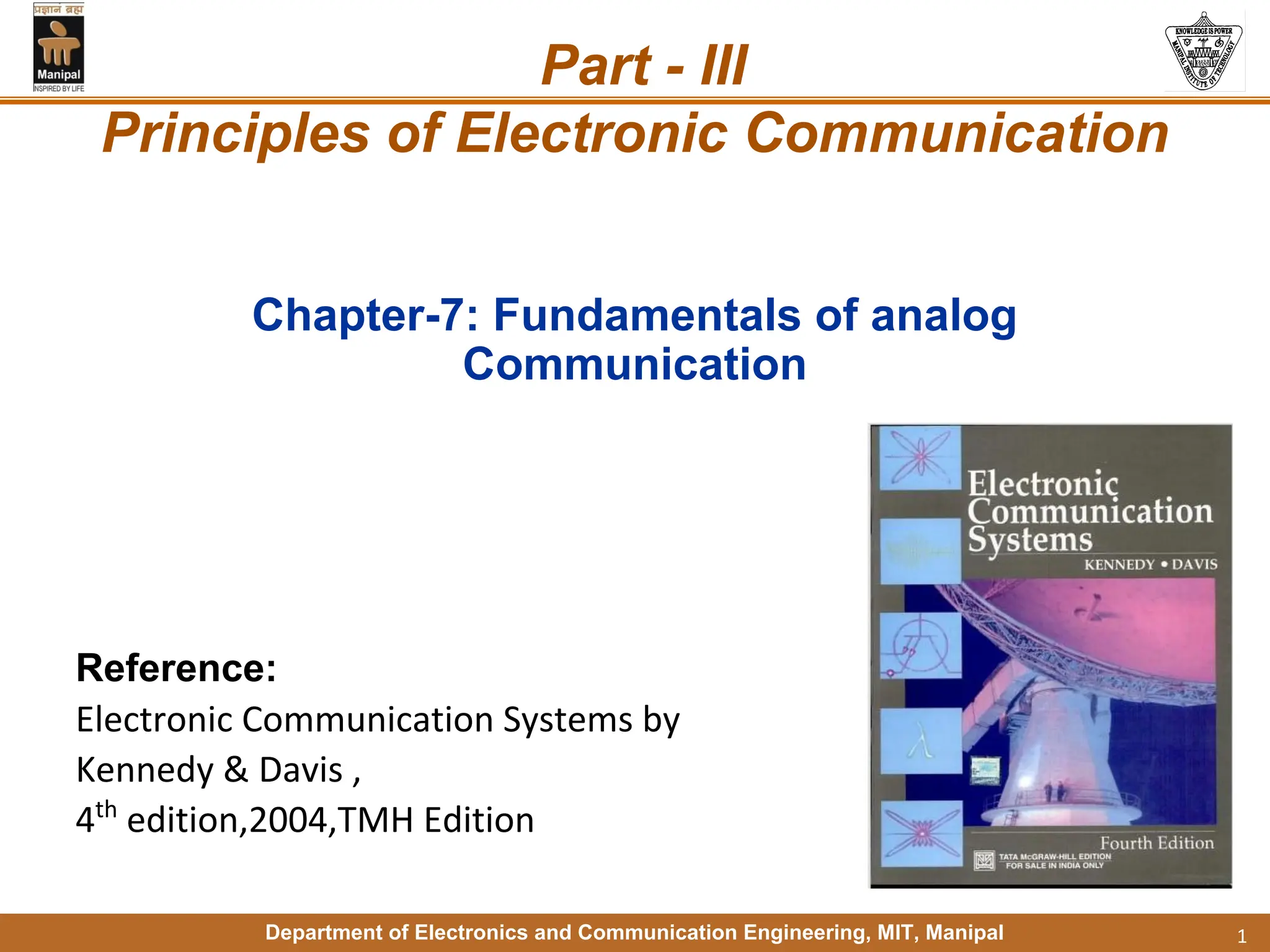
Reference:
Electronic Communication Systems by
Kennedy & Davis ,
4th
edition,2004,TMH Edition
Part - III
Principles of Electronic Communication
Department of Electronics and Communication Engineering, MIT, Manipal
Module 2 : Frequency Modulation
2
Department of Electronics and Communication Engineering, MIT, Manipal
Module 2: Frequency Modulation
▪ Objectives:
At the end of this module, students will be able to:
• Define Frequency Modulation(FM)
• Discuss the concept of FM using graphical illustration
and mathematical representation
• Determine the modulation index and bandwidth of FM
• Distinguish between AM and FM
• Identify the areas of application of AM and FM
3
Department of Electronics and Communication Engineering, MIT, Manipal
Department of Electronics and Communication Engineering, MIT, Manipal 2
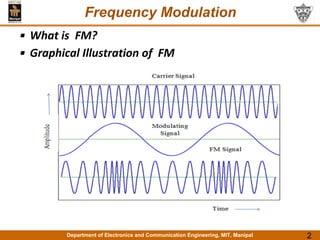
Frequency Modulation
▪ What is FM?
▪ Graphical Illustration of FM
Department of Electronics and Communication Engineering, MIT, Manipal
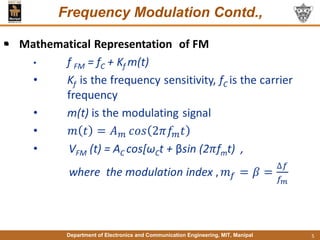
Frequency Modulation Contd.,
5
▪
Department of Electronics and Communication Engineering, MIT, Manipal
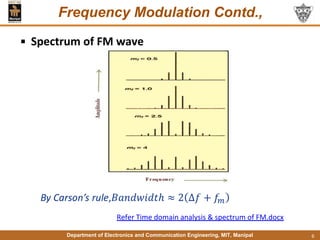
Frequency Modulation Contd.,
▪ Spectrum of FM wave
6
Refer Time domain analysis & spectrum of FM.docx
Department of Electronics and Communication Engineering, MIT, Manipal
Frequency Modulation Contd.,
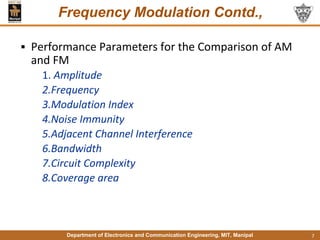
7
▪ Performance Parameters for the Comparison of AM
and FM
1. Amplitude
2.Frequency
3.Modulation Index
4.Noise Immunity
5.Adjacent Channel Interference
6.Bandwidth
7.Circuit Complexity
8.Coverage area
Department of Electronics and Communication Engineering, MIT, Manipal
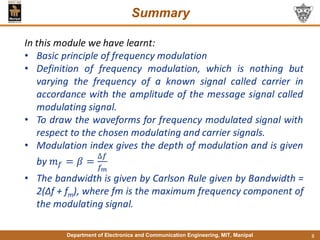
Summary
8
Department of Electronics and Communication Engineering, MIT, Manipal
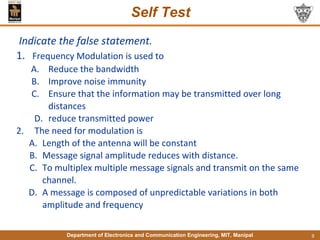
Self Test
Indicate the false statement.
1. Frequency Modulation is used to
A. Reduce the bandwidth
B. Improve noise immunity
C. Ensure that the information may be transmitted over long
distances
D. reduce transmitted power
2. The need for modulation is
A. Length of the antenna will be constant
B. Message signal amplitude reduces with distance.
C. To multiplex multiple message signals and transmit on the same
channel.
D. A message is composed of unpredictable variations in both
amplitude and frequency
9
Department of Electronics and Communication Engineering, MIT, Manipal
Frequency Modulation Contd.,
▪ Exercises
1. Given a FM equation VFM
(t) =10 cos [ 2 Π 108
t + 5 sin(2 Π 15000t) ] ,
Calculate Carrier frequency. Modulating frequency. Frequency deviation.
Bandwidth using Carson’s rule.
2. In an FM system when the audio frequency is 50Hz , modulating
voltage is 2.5V , the deviation produced is 5KHz. If the modulating voltage
is now increased to 7.5V, calculate the new value of frequency deviation. If
the AF voltage is raised to 10V while the modulating frequency is dropped
to 250Hz, what is the frequency deviation produced. Also calculate
modulation index in each case.
10

Basic Electronics - PPT Frequency Modulation.pdf

  • 1.
    Department of Electronicsand Communication Engineering, MIT, Manipal 1 Chapter-7: Fundamentals of analog Communication Reference: Electronic Communication Systems by Kennedy & Davis , 4th edition,2004,TMH Edition Part - III Principles of Electronic Communication
  • 2.
    Department of Electronicsand Communication Engineering, MIT, Manipal Module 2 : Frequency Modulation 2
  • 3.
    Department of Electronicsand Communication Engineering, MIT, Manipal Module 2: Frequency Modulation ▪ Objectives: At the end of this module, students will be able to: • Define Frequency Modulation(FM) • Discuss the concept of FM using graphical illustration and mathematical representation • Determine the modulation index and bandwidth of FM • Distinguish between AM and FM • Identify the areas of application of AM and FM 3
  • 4.
    Department of Electronicsand Communication Engineering, MIT, Manipal Department of Electronics and Communication Engineering, MIT, Manipal 2 Frequency Modulation ▪ What is FM? ▪ Graphical Illustration of FM
  • 5.
    Department of Electronicsand Communication Engineering, MIT, Manipal Frequency Modulation Contd., 5 ▪
  • 6.
    Department of Electronicsand Communication Engineering, MIT, Manipal Frequency Modulation Contd., ▪ Spectrum of FM wave 6 Refer Time domain analysis & spectrum of FM.docx
  • 7.
    Department of Electronicsand Communication Engineering, MIT, Manipal Frequency Modulation Contd., 7 ▪ Performance Parameters for the Comparison of AM and FM 1. Amplitude 2.Frequency 3.Modulation Index 4.Noise Immunity 5.Adjacent Channel Interference 6.Bandwidth 7.Circuit Complexity 8.Coverage area
  • 8.
    Department of Electronicsand Communication Engineering, MIT, Manipal Summary 8
  • 9.
    Department of Electronicsand Communication Engineering, MIT, Manipal Self Test Indicate the false statement. 1. Frequency Modulation is used to A. Reduce the bandwidth B. Improve noise immunity C. Ensure that the information may be transmitted over long distances D. reduce transmitted power 2. The need for modulation is A. Length of the antenna will be constant B. Message signal amplitude reduces with distance. C. To multiplex multiple message signals and transmit on the same channel. D. A message is composed of unpredictable variations in both amplitude and frequency 9
  • 10.
    Department of Electronicsand Communication Engineering, MIT, Manipal Frequency Modulation Contd., ▪ Exercises 1. Given a FM equation VFM (t) =10 cos [ 2 Π 108 t + 5 sin(2 Π 15000t) ] , Calculate Carrier frequency. Modulating frequency. Frequency deviation. Bandwidth using Carson’s rule. 2. In an FM system when the audio frequency is 50Hz , modulating voltage is 2.5V , the deviation produced is 5KHz. If the modulating voltage is now increased to 7.5V, calculate the new value of frequency deviation. If the AF voltage is raised to 10V while the modulating frequency is dropped to 250Hz, what is the frequency deviation produced. Also calculate modulation index in each case. 10