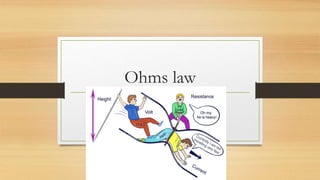
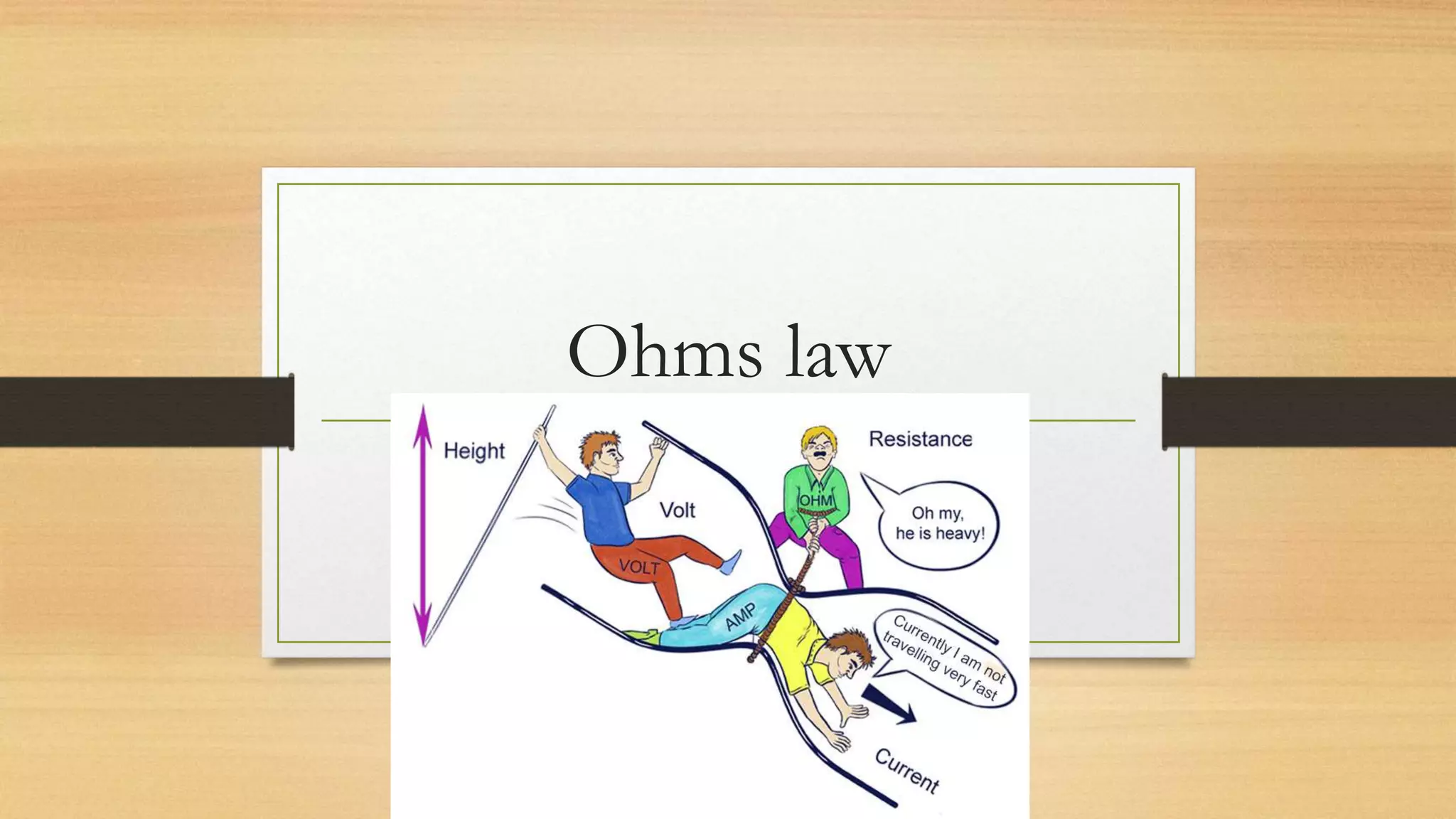
Ohms law
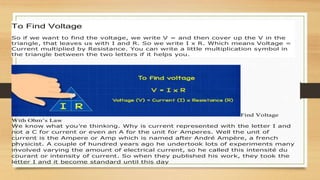
To Find Voltage
So if we want to find the voltage, we write V = and then cover up the V in the
triangle, that leaves us with I and R. So we write I x R. Which means Voltage =
Current multiplied by Resistance. You can write a little multiplication symbol in
the triangle between the two letters if it helps you.
Find Voltage
With Ohm’s Law
We know what you’re thinking. Why is current represented with the letter I and
not a C for current or even an A for the unit for Amperes. Well the unit of
current is the Ampere or Amp which is named after André Ampère, a french
physicist. A couple of hundred years ago he undertook lots of experiments many
involved varying the amount of electrical current, so he called this intensité du
courant or intensity of current. So when they published his work, they took the
letter I and it become standard until this day
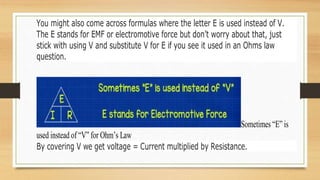
You might also come across formulas where the letter E is used instead of V.
The E stands for EMF or electromotive force but don’t worry about that, just
stick with using V and substitute V for E if you see it used in an Ohms law
question.
Sometimes “E” is
used instead of “V” for Ohm’s Law
By covering V we get voltage = Current multiplied by Resistance.
To Find Current
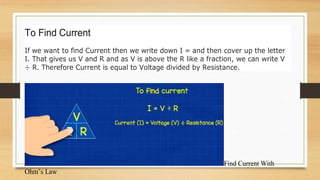
If we want to find Current then we write down I = and then cover up the letter
I. That gives us V and R and as V is above the R like a fraction, we can write V
÷ R. Therefore Current is equal to Voltage divided by Resistance.
Find Current With
Ohm’s Law
To Find Resistance
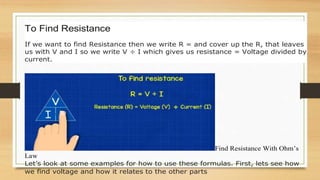
If we want to find Resistance then we write R = and cover up the R, that leaves
us with V and I so we write V ÷ I which gives us resistance = Voltage divided by
current.
Find Resistance With Ohm’s
Law
Let’s look at some examples for how to use these formulas. First, lets see how
we find voltage and how it relates to the other parts
Finding Voltage Example
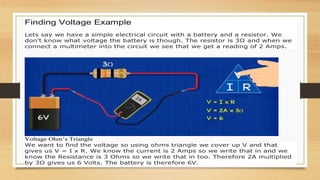
Lets say we have a simple electrical circuit with a battery and a resistor. We
don’t know what voltage the battery is though. The resistor is 3Ω and when we
connect a multimeter into the circuit we see that we get a reading of 2 Amps.
Voltage Ohm’s Triangle
We want to find the voltage so using ohms triangle we cover up V and that
gives us V = I x R. We know the current is 2 Amps so we write that in and we
know the Resistance is 3 Ohms so we write that in too. Therefore 2A multiplied
by 3Ω gives us 6 Volts. The battery is therefore 6V.
Finding Current Example
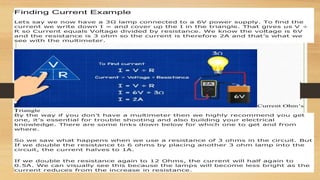
Lets say we now have a 3Ω lamp connected to a 6V power supply. To find the
current we write down I = and cover up the I in the triangle. That gives us V ÷
R so Current equals Voltage divided by resistance. We know the voltage is 6V
and the resistance is 3 ohm so the current is therefore 2A and that’s what we
see with the multimeter.
Current Ohm’s
Triangle
By the way if you don’t have a multimeter then we highly recommend you get
one, it’s essential for trouble shooting and also building your electrical
knowledge. There are some links down below for which one to get and from
where.
So we saw what happens when we use a resistance of 3 ohms in the circuit. But
If we double the resistance to 6 ohms by placing another 3 ohm lamp into the
circuit, the current halves to 1A.
If we double the resistance again to 12 Ohms, the current will half again to
0.5A. We can visually see this because the lamps will become less bright as the
current reduces from the increase in resistance.
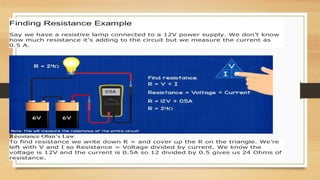
Finding Resistance Example
Say we have a resistive lamp connected to a 12V power supply. We don’t know
how much resistance it’s adding to the circuit but we measure the current as
0.5 A.
Resistance Ohm’s Law
To find resistance we write down R = and cover up the R on the triangle. We’re
left with V and I so Resistance = Voltage divided by current. We know the
voltage is 12V and the current is 0.5A so 12 divided by 0.5 gives us 24 Ohms of
resistance.

Ohms law by engineering mindset

  • 1.
  • 2.
    To Find Voltage Soif we want to find the voltage, we write V = and then cover up the V in the triangle, that leaves us with I and R. So we write I x R. Which means Voltage = Current multiplied by Resistance. You can write a little multiplication symbol in the triangle between the two letters if it helps you. Find Voltage With Ohm’s Law We know what you’re thinking. Why is current represented with the letter I and not a C for current or even an A for the unit for Amperes. Well the unit of current is the Ampere or Amp which is named after André Ampère, a french physicist. A couple of hundred years ago he undertook lots of experiments many involved varying the amount of electrical current, so he called this intensité du courant or intensity of current. So when they published his work, they took the letter I and it become standard until this day
  • 3.
    You might alsocome across formulas where the letter E is used instead of V. The E stands for EMF or electromotive force but don’t worry about that, just stick with using V and substitute V for E if you see it used in an Ohms law question. Sometimes “E” is used instead of “V” for Ohm’s Law By covering V we get voltage = Current multiplied by Resistance.
  • 4.
    To Find Current Ifwe want to find Current then we write down I = and then cover up the letter I. That gives us V and R and as V is above the R like a fraction, we can write V ÷ R. Therefore Current is equal to Voltage divided by Resistance. Find Current With Ohm’s Law
  • 5.
    To Find Resistance Ifwe want to find Resistance then we write R = and cover up the R, that leaves us with V and I so we write V ÷ I which gives us resistance = Voltage divided by current. Find Resistance With Ohm’s Law Let’s look at some examples for how to use these formulas. First, lets see how we find voltage and how it relates to the other parts
  • 6.
    Finding Voltage Example Letssay we have a simple electrical circuit with a battery and a resistor. We don’t know what voltage the battery is though. The resistor is 3Ω and when we connect a multimeter into the circuit we see that we get a reading of 2 Amps. Voltage Ohm’s Triangle We want to find the voltage so using ohms triangle we cover up V and that gives us V = I x R. We know the current is 2 Amps so we write that in and we know the Resistance is 3 Ohms so we write that in too. Therefore 2A multiplied by 3Ω gives us 6 Volts. The battery is therefore 6V.
  • 7.
    Finding Current Example Letssay we now have a 3Ω lamp connected to a 6V power supply. To find the current we write down I = and cover up the I in the triangle. That gives us V ÷ R so Current equals Voltage divided by resistance. We know the voltage is 6V and the resistance is 3 ohm so the current is therefore 2A and that’s what we see with the multimeter. Current Ohm’s Triangle By the way if you don’t have a multimeter then we highly recommend you get one, it’s essential for trouble shooting and also building your electrical knowledge. There are some links down below for which one to get and from where. So we saw what happens when we use a resistance of 3 ohms in the circuit. But If we double the resistance to 6 ohms by placing another 3 ohm lamp into the circuit, the current halves to 1A. If we double the resistance again to 12 Ohms, the current will half again to 0.5A. We can visually see this because the lamps will become less bright as the current reduces from the increase in resistance.
  • 8.
    Finding Resistance Example Saywe have a resistive lamp connected to a 12V power supply. We don’t know how much resistance it’s adding to the circuit but we measure the current as 0.5 A. Resistance Ohm’s Law To find resistance we write down R = and cover up the R on the triangle. We’re left with V and I so Resistance = Voltage divided by current. We know the voltage is 12V and the current is 0.5A so 12 divided by 0.5 gives us 24 Ohms of resistance.