UNIT-1
Fundamentals of D.C. circuits
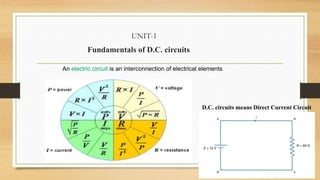
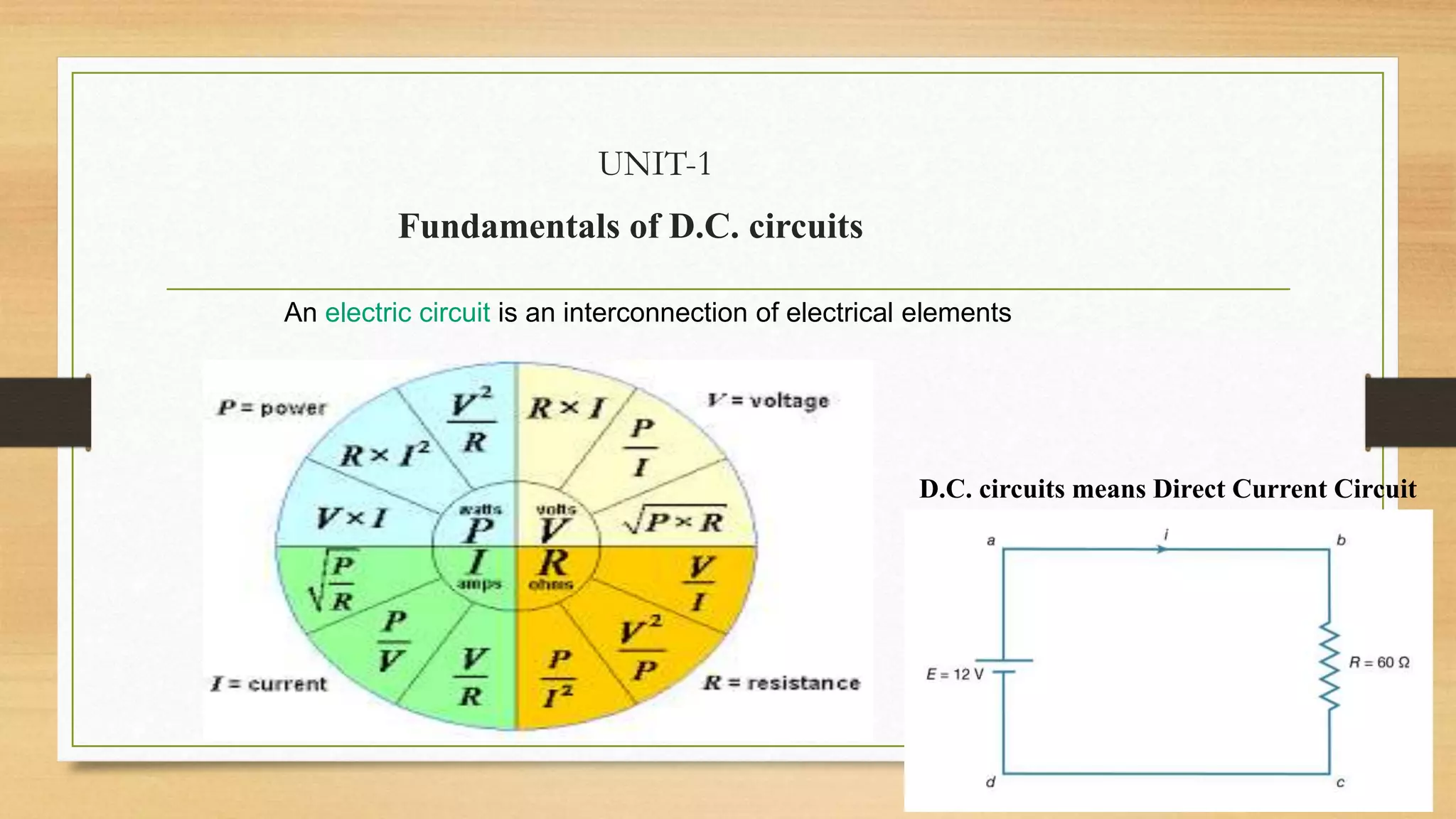
An electric circuit is an interconnection of electrical elements
D.C. circuits means Direct Current Circuit
Ohm’s Law
 Given by Georg Simon Ohm (1787–1854), a German physicist
 finding the relationship between current and voltage for a resistor. This
relationship is known as Ohm’s law.
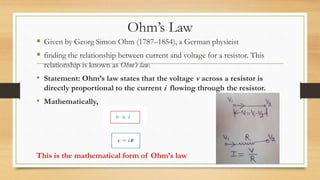
• Statement: Ohm’s law states that the voltage v across a resistor is
directly proportional to the current i flowing through the resistor.
• Mathematically,
This is the mathematical form of Ohm’s law
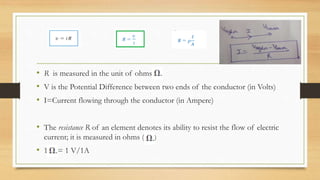
• R is measured in the unit of ohms
• V is the Potential Difference between two ends of the conductor (in Volts)
• I=Current flowing through the conductor (in Ampere)
• The resistance R of an element denotes its ability to resist the flow of electric
current; it is measured in ohms ( )
• 1 = 1 V/1A
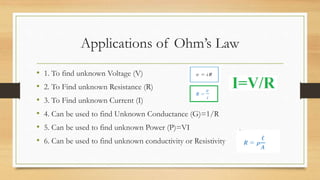
Applications of Ohm’s Law
• 1. To find unknown Voltage (V)
• 2. To Find unknown Resistance (R)
• 3. To Find unknown Current (I)
• 4. Can be used to find Unknown Conductance (G)=1/R
• 5. Can be used to find unknown Power (P)=VI
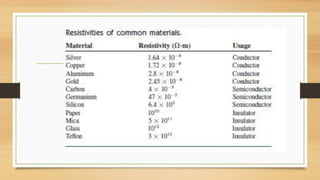
• 6. Can be used to find unknown conductivity or Resistivity
For Example
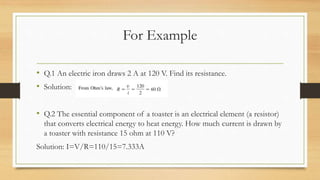
• Q.1 An electric iron draws 2 A at 120 V. Find its resistance.
• Solution:
• Q.2 The essential component of a toaster is an electrical element (a resistor)
that converts electrical energy to heat energy. How much current is drawn by
a toaster with resistance 15 ohm at 110 V?
Solution: I=V/R=110/15=7.333A
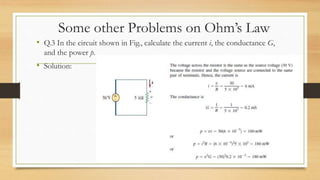
Some other Problems on Ohm’s Law
• Q.3 In the circuit shown in Fig., calculate the current i, the conductance G,
and the power p.
• Solution:
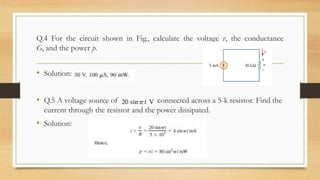
Q.4 For the circuit shown in Fig., calculate the voltage v, the conductance
G, and the power p.
• Solution:
• Q.5 A voltage source of is connected across a 5-k resistor. Find the
current through the resistor and the power dissipated.
• Solution:
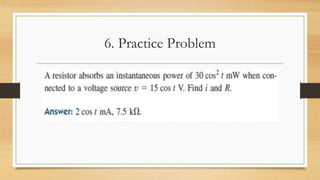
6. Practice Problem
DISADVANTAGES
• Ohm’s law by itself is not sufficient to analyze circuits.
• Unable to solve typical Numerical problems
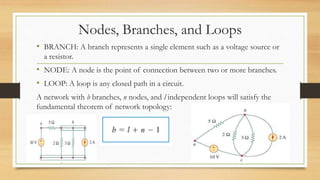
Nodes, Branches, and Loops
• BRANCH: A branch represents a single element such as a voltage source or
a resistor.
• NODE: A node is the point of connection between two or more branches.
• LOOP: A loop is any closed path in a circuit.
A network with b branches, n nodes, and l independent loops will satisfy the
fundamental theorem of network topology:
Kirchhoff’s Laws
• First introduced in 1847 by the German physicist Gustav Robert Kirchhoff
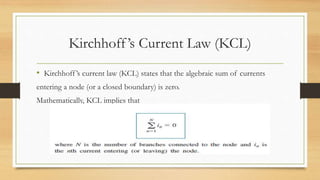
Kirchhoff’s Current Law (KCL)
• Kirchhoff’s current law (KCL) states that the algebraic sum of currents
entering a node (or a closed boundary) is zero.
Mathematically, KCL implies that
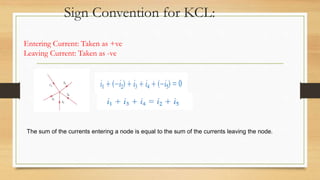
Sign Convention for KCL:
Entering Current: Taken as +ve
Leaving Current: Taken as -ve
The sum of the currents entering a node is equal to the sum of the currents leaving the node.
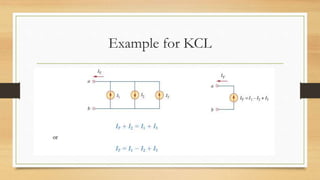
Example for KCL
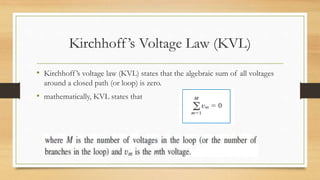
Kirchhoff’s Voltage Law (KVL)
• Kirchhoff’s voltage law (KVL) states that the algebraic sum of all voltages
around a closed path (or loop) is zero.
• mathematically, KVL states that
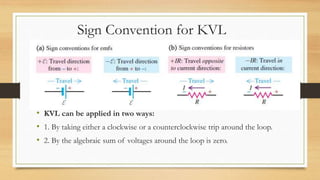
Sign Convention for KVL
• KVL can be applied in two ways:
• 1. By taking either a clockwise or a counterclockwise trip around the loop.
• 2. By the algebraic sum of voltages around the loop is zero.
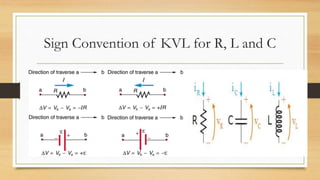
Sign Convention of KVL for R, L and C
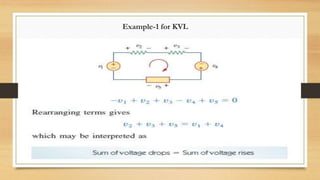
Example-1 for KVL
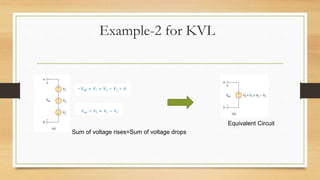
Example-2 for KVL
Sum of voltage rises=Sum of voltage drops
Equivalent Circuit
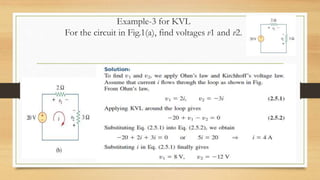
Example-3 for KVL
For the circuit in Fig.1(a), find voltages v1 and v2.
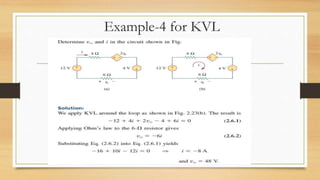
Example-4 for KVL
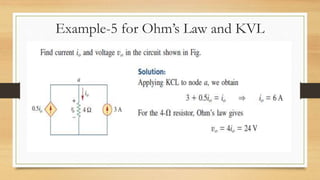
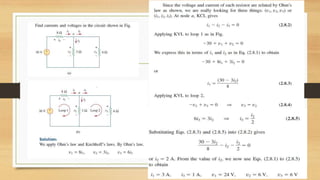
Example-5 for Ohm’s Law and KVL
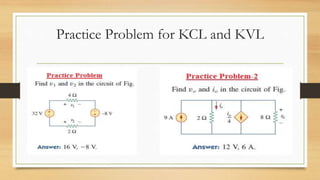
Practice Problem for KCL and KVL
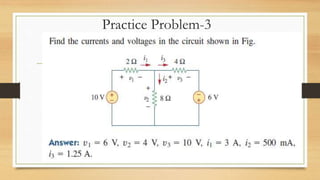
Practice Problem-3
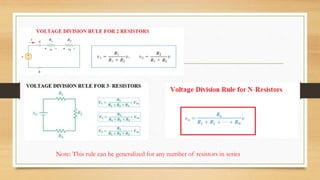
Note: This rule can be generalized for any number of resistors in series
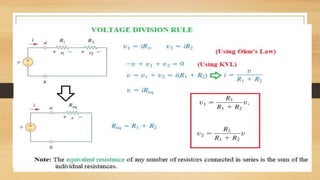
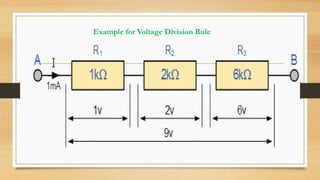
Example for Voltage Division Rule
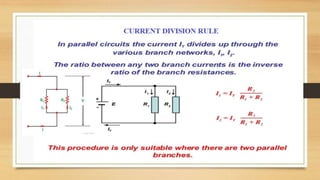
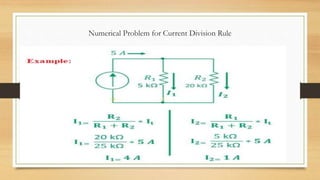
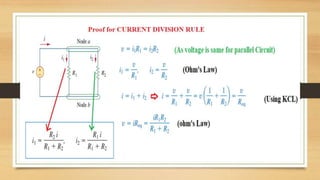
Numerical Problem for Current Division Rule
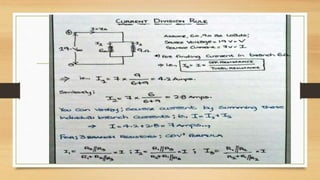
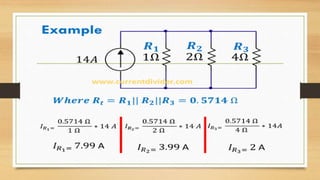
Example-2 for Current Division Rule
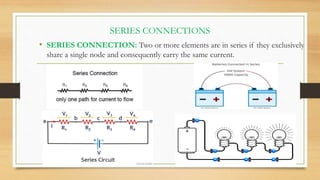
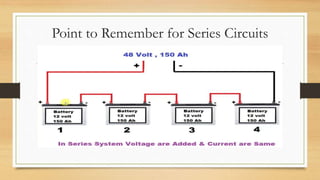
SERIES CONNECTIONS
• SERIES CONNECTION: Two or more elements are in series if they exclusively
share a single node and consequently carry the same current.
Point to Remember for Series Circuits
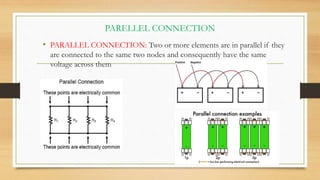
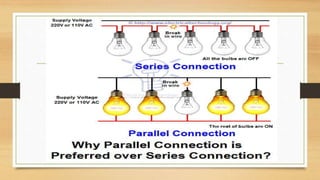
PARELLEL CONNECTION
• PARALLEL CONNECTION: Two or more elements are in parallel if they
are connected to the same two nodes and consequently have the same
voltage across them
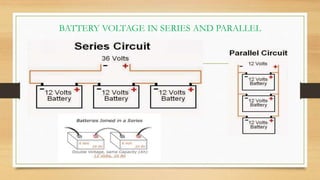
BATTERY VOLTAGE IN SERIES AND PARALLEL
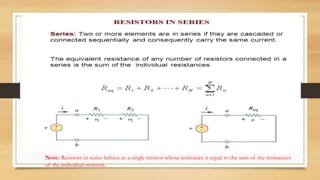
Note: Resistors in series behave as a single resistor whose resistance is equal to the sum of the resistances
of the individual resistors.
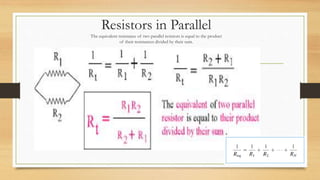
Resistors in Parallel
The equivalent resistance of two parallel resistors is equal to the product
of their resistances divided by their sum.
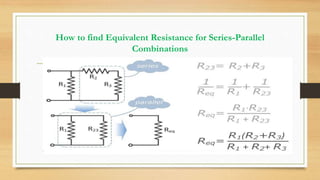
How to find Equivalent Resistance for Series-Parallel
Combinations
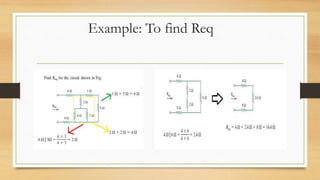
Example: To find Req
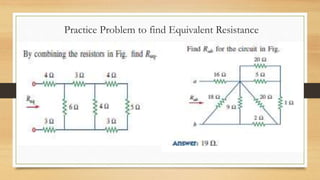
Practice Problem to find Equivalent Resistance
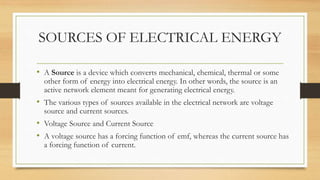
SOURCES OF ELECTRICAL ENERGY
• A Source is a device which converts mechanical, chemical, thermal or some
other form of energy into electrical energy. In other words, the source is an
active network element meant for generating electrical energy.
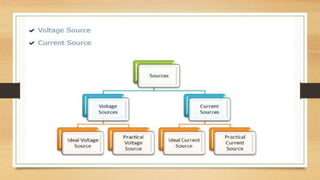
• The various types of sources available in the electrical network are voltage
source and current sources.
• Voltage Source and Current Source
• A voltage source has a forcing function of emf, whereas the current source has
a forcing function of current.
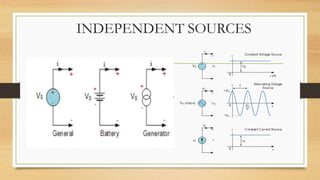
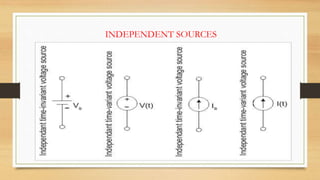
INDEPENDENT SOURCES
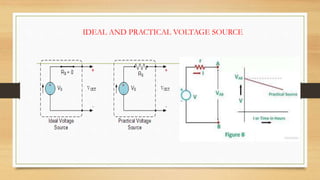
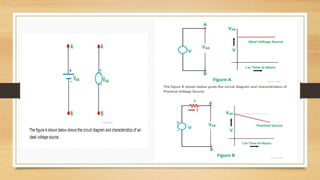
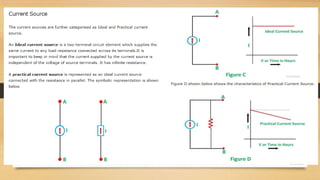
Ideal and non ideal
(Practical) energy sources
INDEPENDENT SOURCES
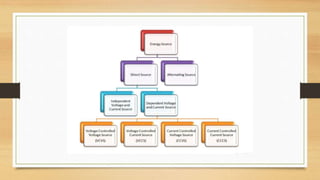
Independent Dependent Voltage and Current
Source
• The source which supplies the active power to the network is known as the
electrical source.
• The electrical source is of two types namely independent source and
dependent source.
• The Independent and Dependent source means, whether the voltage or
current sources are either depending upon some other source, or they are
acting independently.
Independent and Dependent Sources
Independent Voltage and Current Source
• Independent sources are that which does not depend on any other quantity in the circuit. They are two
terminal devices and has a constant value, i.e. the voltage across the two terminals remains constant
irrespective of all circuit conditions.
• The strength of voltage or current is not changed by any variation in the connected network the source
is said to be either independent voltage or independent current source. In this, the value of voltage or
current is fixed and is not adjustable
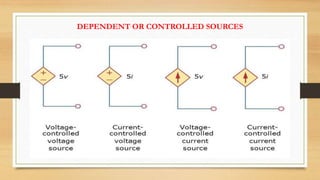
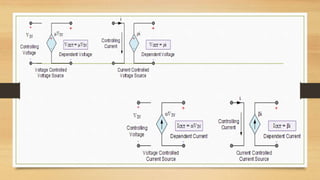
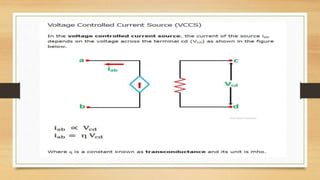
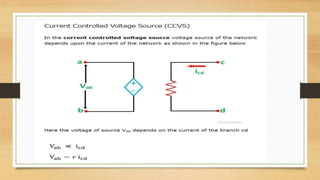
Dependent Voltage and Current Source
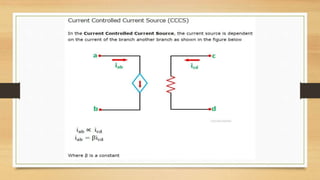
• The sources whose output voltage or current is not fixed but depends on the voltage or
current in another part of the circuit is called Dependent or Controlled source. They are four
terminal devices. When the strength of voltage or current changes in the source for any
change in the connected network, they are called dependent sources. The dependent sources
are represented by a diamond shape.
DEPENDENT OR CONTROLLED SOURCES
IDEAL AND PRACTICAL VOLTAGE SOURCE
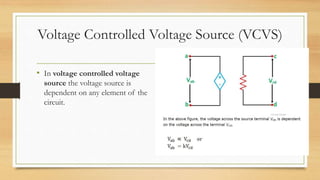
Voltage Controlled Voltage Source (VCVS)
• In voltage controlled voltage
source the voltage source is
dependent on any element of the
circuit.
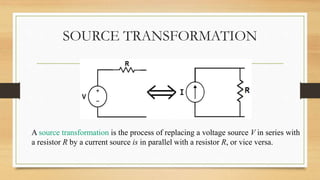
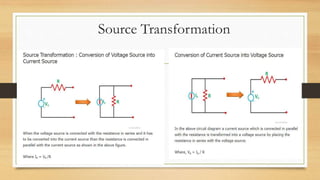
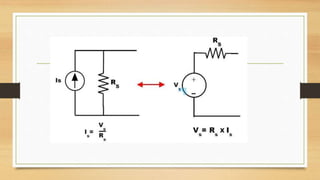
SOURCE TRANSFORMATION
A source transformation is the process of replacing a voltage source V in series with
a resistor R by a current source is in parallel with a resistor R, or vice versa.
Source Transformation
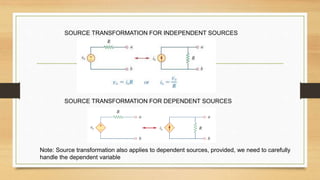
SOURCE TRANSFORMATION FOR INDEPENDENT SOURCES
SOURCE TRANSFORMATION FOR DEPENDENT SOURCES
Note: Source transformation also applies to dependent sources, provided, we need to carefully
handle the dependent variable
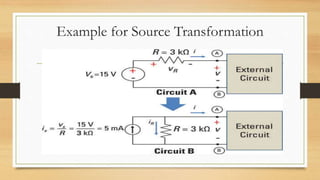
Example for Source Transformation
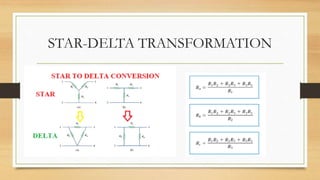
STAR-DELTA TRANSFORMATION
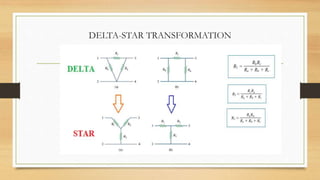
DELTA-STAR TRANSFORMATION
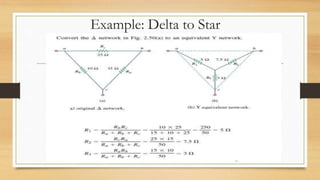
Example: Delta to Star
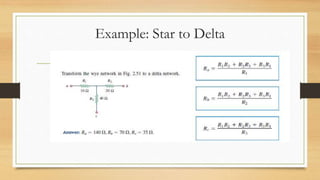
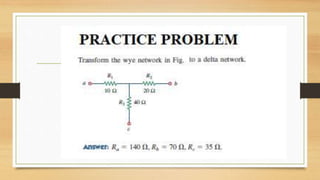
Example: Star to Delta
Nodal Analysis or Nodal Method
• Nodal analysis provides a general procedure for analyzing circuits using node
voltages as the circuit variables.
• Choosing node voltages instead of element voltages as circuit variables is
convenient and reduces the number of equations one must solve
simultaneously.
• Applicable to Nodes only.
• It is used to find the unknown node voltages.
• This Method is Application of KCL+Ohm’s Law Only
Steps to Determine Node Voltages
• 1. Select one nodes out of ‘n’ node as the reference node. Assign voltages to
the remaining nodes. The voltages are referenced with respect to the
reference node.
• 2. Apply KCL to each of the non-reference nodes. Use Ohm’s law to express
the branch currents in terms of node voltages.
• 3. Solve the resulting simultaneous equations to obtain the unknown node
voltages.
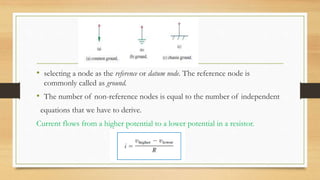
• selecting a node as the reference or datum node. The reference node is
commonly called as ground.
• The number of non-reference nodes is equal to the number of independent
equations that we have to derive.
Current flows from a higher potential to a lower potential in a resistor.
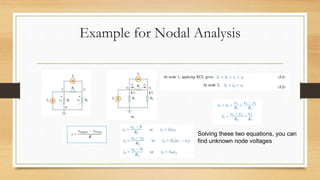
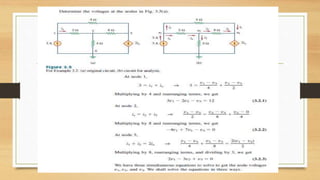
Example for Nodal Analysis
Solving these two equations, you can
find unknown node voltages
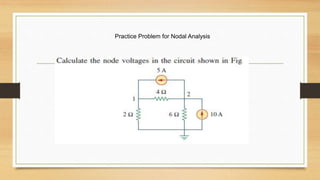
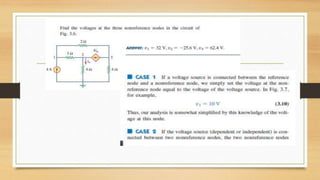
Practice Problem for Nodal Analysis
ECE131_UNIT1_Part1.ppt

ECE131_UNIT1_Part1.ppt

  • 1.
    UNIT-1 Fundamentals of D.C.circuits An electric circuit is an interconnection of electrical elements D.C. circuits means Direct Current Circuit
  • 2.
    Ohm’s Law  Givenby Georg Simon Ohm (1787–1854), a German physicist  finding the relationship between current and voltage for a resistor. This relationship is known as Ohm’s law. • Statement: Ohm’s law states that the voltage v across a resistor is directly proportional to the current i flowing through the resistor. • Mathematically, This is the mathematical form of Ohm’s law
  • 3.
    • R ismeasured in the unit of ohms • V is the Potential Difference between two ends of the conductor (in Volts) • I=Current flowing through the conductor (in Ampere) • The resistance R of an element denotes its ability to resist the flow of electric current; it is measured in ohms ( ) • 1 = 1 V/1A
  • 5.
    Applications of Ohm’sLaw • 1. To find unknown Voltage (V) • 2. To Find unknown Resistance (R) • 3. To Find unknown Current (I) • 4. Can be used to find Unknown Conductance (G)=1/R • 5. Can be used to find unknown Power (P)=VI • 6. Can be used to find unknown conductivity or Resistivity
  • 6.
    For Example • Q.1An electric iron draws 2 A at 120 V. Find its resistance. • Solution: • Q.2 The essential component of a toaster is an electrical element (a resistor) that converts electrical energy to heat energy. How much current is drawn by a toaster with resistance 15 ohm at 110 V? Solution: I=V/R=110/15=7.333A
  • 7.
    Some other Problemson Ohm’s Law • Q.3 In the circuit shown in Fig., calculate the current i, the conductance G, and the power p. • Solution:
  • 8.
    Q.4 For thecircuit shown in Fig., calculate the voltage v, the conductance G, and the power p. • Solution: • Q.5 A voltage source of is connected across a 5-k resistor. Find the current through the resistor and the power dissipated. • Solution:
  • 9.
  • 10.
    DISADVANTAGES • Ohm’s lawby itself is not sufficient to analyze circuits. • Unable to solve typical Numerical problems
  • 11.
    Nodes, Branches, andLoops • BRANCH: A branch represents a single element such as a voltage source or a resistor. • NODE: A node is the point of connection between two or more branches. • LOOP: A loop is any closed path in a circuit. A network with b branches, n nodes, and l independent loops will satisfy the fundamental theorem of network topology:
  • 12.
    Kirchhoff’s Laws • Firstintroduced in 1847 by the German physicist Gustav Robert Kirchhoff
  • 13.
    Kirchhoff’s Current Law(KCL) • Kirchhoff’s current law (KCL) states that the algebraic sum of currents entering a node (or a closed boundary) is zero. Mathematically, KCL implies that
  • 14.
    Sign Convention forKCL: Entering Current: Taken as +ve Leaving Current: Taken as -ve The sum of the currents entering a node is equal to the sum of the currents leaving the node.
  • 15.
  • 16.
    Kirchhoff’s Voltage Law(KVL) • Kirchhoff’s voltage law (KVL) states that the algebraic sum of all voltages around a closed path (or loop) is zero. • mathematically, KVL states that
  • 17.
    Sign Convention forKVL • KVL can be applied in two ways: • 1. By taking either a clockwise or a counterclockwise trip around the loop. • 2. By the algebraic sum of voltages around the loop is zero.
  • 18.
    Sign Convention ofKVL for R, L and C
  • 19.
  • 20.
    Example-2 for KVL Sumof voltage rises=Sum of voltage drops Equivalent Circuit
  • 21.
    Example-3 for KVL Forthe circuit in Fig.1(a), find voltages v1 and v2.
  • 22.
  • 23.
  • 24.
  • 26.
  • 28.
    Note: This rulecan be generalized for any number of resistors in series
  • 30.
    Example for VoltageDivision Rule
  • 32.
    Numerical Problem forCurrent Division Rule
  • 33.
    Example-2 for CurrentDivision Rule
  • 35.
    SERIES CONNECTIONS • SERIESCONNECTION: Two or more elements are in series if they exclusively share a single node and consequently carry the same current.
  • 36.
    Point to Rememberfor Series Circuits
  • 37.
    PARELLEL CONNECTION • PARALLELCONNECTION: Two or more elements are in parallel if they are connected to the same two nodes and consequently have the same voltage across them
  • 38.
    BATTERY VOLTAGE INSERIES AND PARALLEL
  • 40.
    Note: Resistors inseries behave as a single resistor whose resistance is equal to the sum of the resistances of the individual resistors.
  • 41.
    Resistors in Parallel Theequivalent resistance of two parallel resistors is equal to the product of their resistances divided by their sum.
  • 42.
    How to findEquivalent Resistance for Series-Parallel Combinations
  • 43.
  • 44.
    Practice Problem tofind Equivalent Resistance
  • 45.
    SOURCES OF ELECTRICALENERGY • A Source is a device which converts mechanical, chemical, thermal or some other form of energy into electrical energy. In other words, the source is an active network element meant for generating electrical energy. • The various types of sources available in the electrical network are voltage source and current sources. • Voltage Source and Current Source • A voltage source has a forcing function of emf, whereas the current source has a forcing function of current.
  • 48.
  • 49.
    Ideal and nonideal (Practical) energy sources
  • 50.
  • 51.
    Independent Dependent Voltageand Current Source • The source which supplies the active power to the network is known as the electrical source. • The electrical source is of two types namely independent source and dependent source. • The Independent and Dependent source means, whether the voltage or current sources are either depending upon some other source, or they are acting independently.
  • 52.
    Independent and DependentSources Independent Voltage and Current Source • Independent sources are that which does not depend on any other quantity in the circuit. They are two terminal devices and has a constant value, i.e. the voltage across the two terminals remains constant irrespective of all circuit conditions. • The strength of voltage or current is not changed by any variation in the connected network the source is said to be either independent voltage or independent current source. In this, the value of voltage or current is fixed and is not adjustable Dependent Voltage and Current Source • The sources whose output voltage or current is not fixed but depends on the voltage or current in another part of the circuit is called Dependent or Controlled source. They are four terminal devices. When the strength of voltage or current changes in the source for any change in the connected network, they are called dependent sources. The dependent sources are represented by a diamond shape.
  • 53.
  • 55.
    IDEAL AND PRACTICALVOLTAGE SOURCE
  • 58.
    Voltage Controlled VoltageSource (VCVS) • In voltage controlled voltage source the voltage source is dependent on any element of the circuit.
  • 62.
    SOURCE TRANSFORMATION A sourcetransformation is the process of replacing a voltage source V in series with a resistor R by a current source is in parallel with a resistor R, or vice versa.
  • 63.
  • 64.
    SOURCE TRANSFORMATION FORINDEPENDENT SOURCES SOURCE TRANSFORMATION FOR DEPENDENT SOURCES Note: Source transformation also applies to dependent sources, provided, we need to carefully handle the dependent variable
  • 66.
    Example for SourceTransformation
  • 67.
  • 68.
  • 69.
  • 70.
  • 72.
    Nodal Analysis orNodal Method • Nodal analysis provides a general procedure for analyzing circuits using node voltages as the circuit variables. • Choosing node voltages instead of element voltages as circuit variables is convenient and reduces the number of equations one must solve simultaneously. • Applicable to Nodes only. • It is used to find the unknown node voltages. • This Method is Application of KCL+Ohm’s Law Only
  • 73.
    Steps to DetermineNode Voltages • 1. Select one nodes out of ‘n’ node as the reference node. Assign voltages to the remaining nodes. The voltages are referenced with respect to the reference node. • 2. Apply KCL to each of the non-reference nodes. Use Ohm’s law to express the branch currents in terms of node voltages. • 3. Solve the resulting simultaneous equations to obtain the unknown node voltages.
  • 74.
    • selecting anode as the reference or datum node. The reference node is commonly called as ground. • The number of non-reference nodes is equal to the number of independent equations that we have to derive. Current flows from a higher potential to a lower potential in a resistor.
  • 75.
    Example for NodalAnalysis Solving these two equations, you can find unknown node voltages
  • 76.
    Practice Problem forNodal Analysis