
Basic Electric Circuits – © 2020 Mouli Sankaran Email: mouli.sankaran@yahoo.com
Basic Electric Circuits – © 2020 Mouli Sankaran Email: mouli.sankaran@yahoo.com 2
Session 6: Focus
 Some more KVL problems
 Simplification of Circuits
 Combining Sources
◦ In Series (independent voltage sources)
◦ In Parallel (independent current sources)
◦ Example problems
Basic Electric Circuits – © 2020 Mouli Sankaran Email: mouli.sankaran@yahoo.com
Some more KVL Problems
Basic Electric Circuits – © 2020 Mouli Sankaran Email: mouli.sankaran@yahoo.com 4
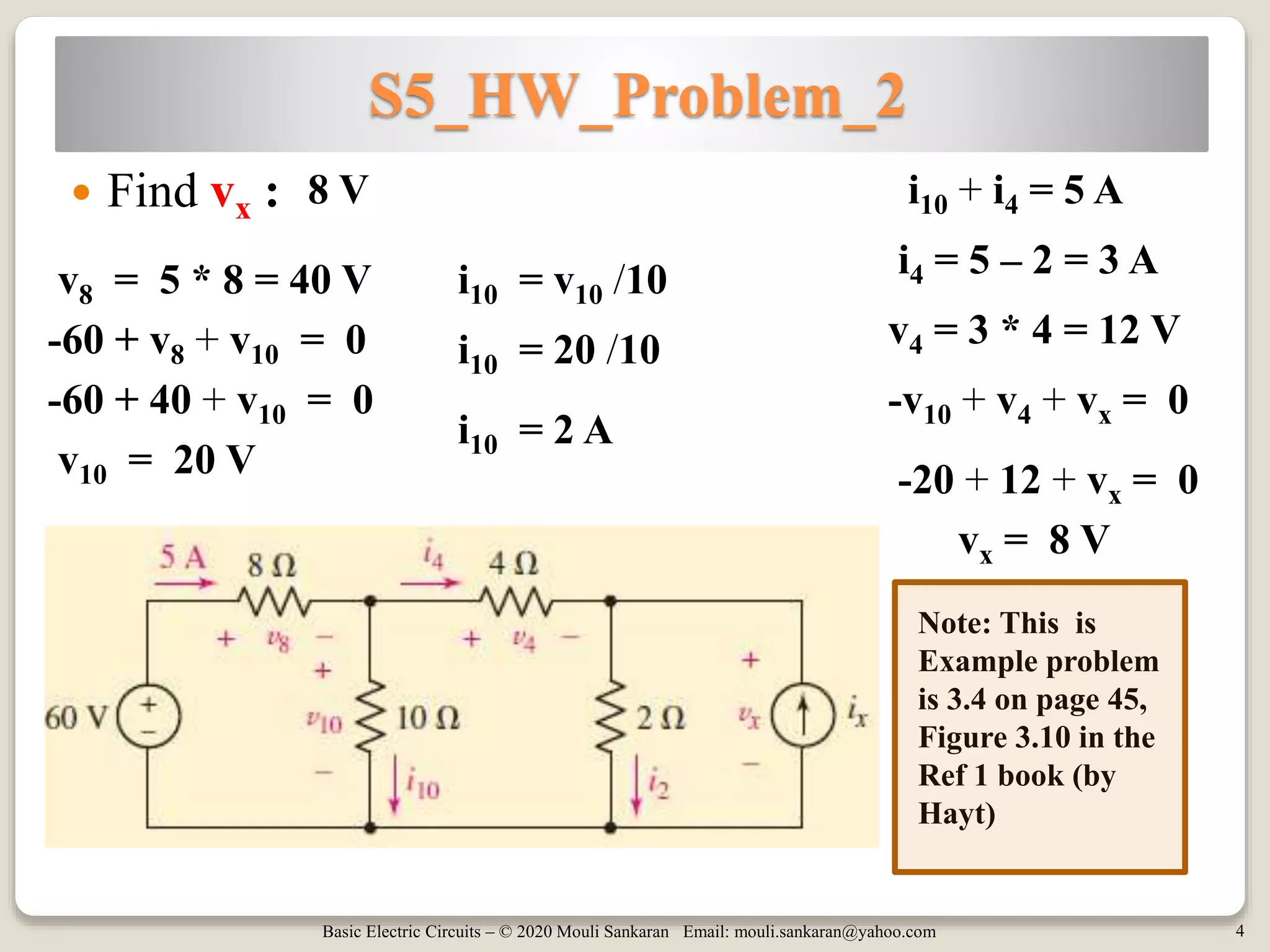
S5_HW_Problem_2
 Find vx : 8 V
Note: This is
Example problem
is 3.4 on page 45,
Figure 3.10 in the
Ref 1 book (by
Hayt)
-60 + v8 + v10 = 0
v8 = 5 * 8 = 40 V
-60 + 40 + v10 = 0
v10 = 20 V
-v10 + v4 + vx = 0
-20 + 12 + vx = 0
vx = 8 V
i10 = v10 /10
i10 = 20 /10
i10 = 2 A
i10 + i4 = 5 A
i4 = 5 – 2 = 3 A
v4 = 3 * 4 = 12 V
Basic Electric Circuits – © 2020 Mouli Sankaran Email: mouli.sankaran@yahoo.com
Simplification of Circuits
Basic Electric Circuits – © 2020 Mouli Sankaran Email: mouli.sankaran@yahoo.com 6
Simplification of Circuits
 While trying to find out unknown quantities in a given
circuit, some techniques could be used to simplify the
solution
 Based on the quantities to be found, the given circuit can
be simplified by combining various elements
◦ Independent Sources (both voltage and current)
◦ Resistors
Basic Electric Circuits – © 2020 Mouli Sankaran Email: mouli.sankaran@yahoo.com 7
Simplification of Circuits … contd.
 Note that dependent sources and the elements impacting
those dependent sources need to be untouched
 These simplifications still leave the functioning of the
rest of the circuit unaffected
Basic Electric Circuits – © 2020 Mouli Sankaran Email: mouli.sankaran@yahoo.com
Combining Sources in Series
Basic Electric Circuits – © 2020 Mouli Sankaran Email: mouli.sankaran@yahoo.com 9
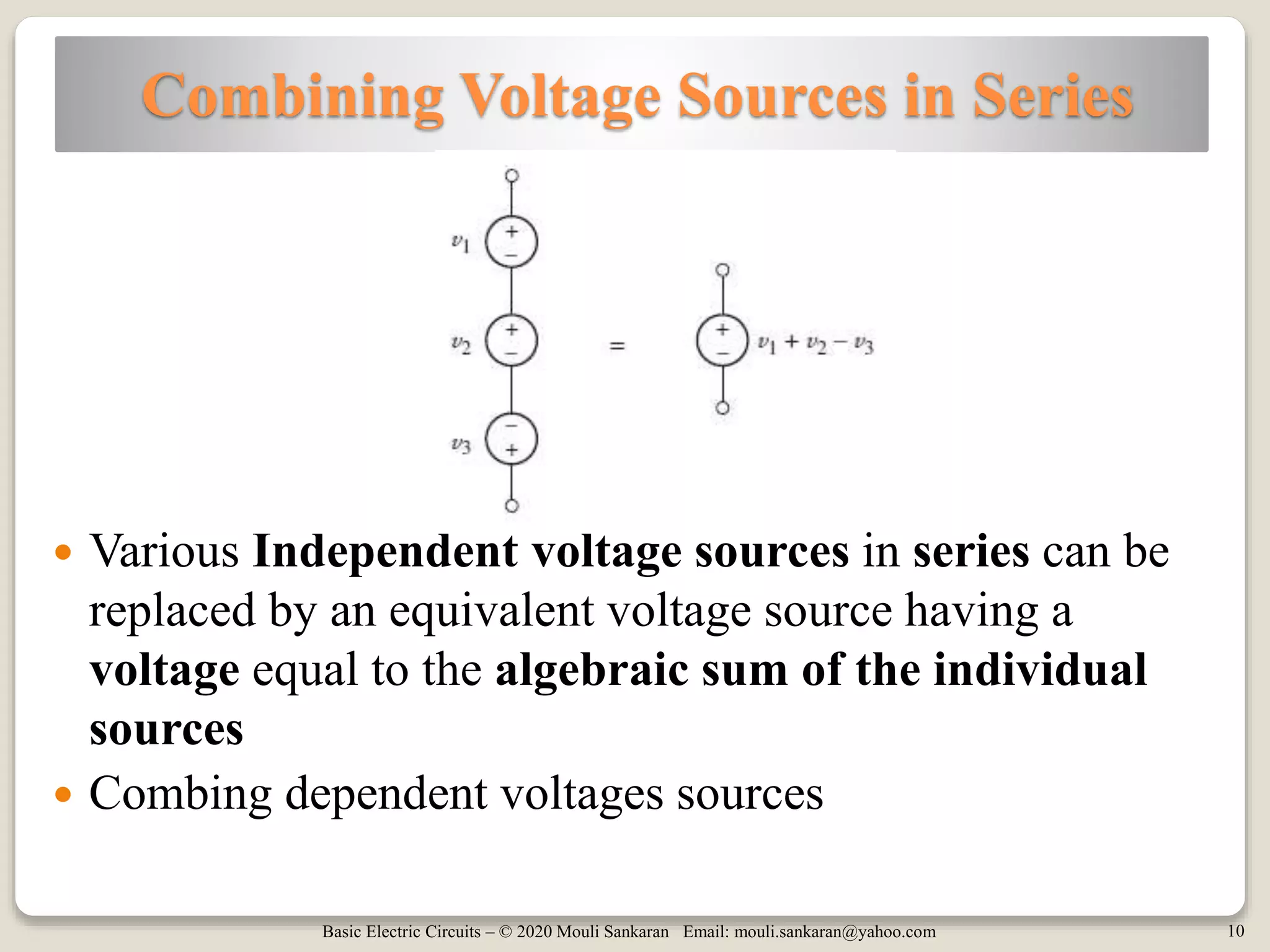
Combining Voltage Sources in Series
 Various Independent voltage sources in series can be
replaced by an equivalent voltage source having a
voltage equal to the algebraic sum of the individual
sources
◦ Note that dependent sources cannot be combined and they
need to be untouched
Basic Electric Circuits – © 2020 Mouli Sankaran Email: mouli.sankaran@yahoo.com 10
Combining Voltage Sources in Series
 Various Independent voltage sources in series can be
replaced by an equivalent voltage source having a
voltage equal to the algebraic sum of the individual
sources
 Combing dependent voltages sources
Basic Electric Circuits – © 2020 Mouli Sankaran Email: mouli.sankaran@yahoo.com 11
Combining Current Sources in Parallel
 Various Independent current sources in parallel can
be replaced by an equivalent current source having a
current equal to the algebraic sum of the individual
sources
 The order of the parallel elements may be rearranged
as desired
Basic Electric Circuits – © 2020 Mouli Sankaran Email: mouli.sankaran@yahoo.com 12
Example 1
 To be able to combine voltage sources, they must be in series.
 Since the same current (i) flows through each, this condition is
satisfied
 - 3 - 9 – 5 + 1 = -16 V (KVL starting from bottom left corner)
 -16 + 100 i + 220 * i = 0; i = 16/320 = 50 mA
 The right most diagram is also equivalent to the previous one.
Basic Electric Circuits – © 2020 Mouli Sankaran Email: mouli.sankaran@yahoo.com 13
Example 2
 The value of the voltage source is taken as –ve when a –ve
terminal is seen while traversing the circuit
◦ Here in the clockwise direction
 When the resultant voltage is computed after taking the
algebraic sum of the sources, follow the same convention
while constructing the circuit with resultant voltage source
◦ Here the -1 V source’s negative terminal will be down and its +ve
terminal will be connected to 47 Ohms
-3 + 1 + 5 -4 = -1 V
Combining the sources in series
from the top right corner:
i = 1/47 = 21.3 mA +
-1 V 47 Ω
i
Basic Electric Circuits – © 2020 Mouli Sankaran Email: mouli.sankaran@yahoo.com 14
Example 3
 Find v after combing current sources into one equivalent
current source: v =
3 = i1 + i2 = 2 i1
v = 5 (1.5) = 7.5 V
KCL at bottom node:
v = i1 5 = i2 5
7.5 V
i1 = i2
i1 = i2 = 3/2 = 1.5 A
i2i1
-
+
-
+
-
+
Basic Electric Circuits – © 2020 Mouli Sankaran Email: mouli.sankaran@yahoo.com 15
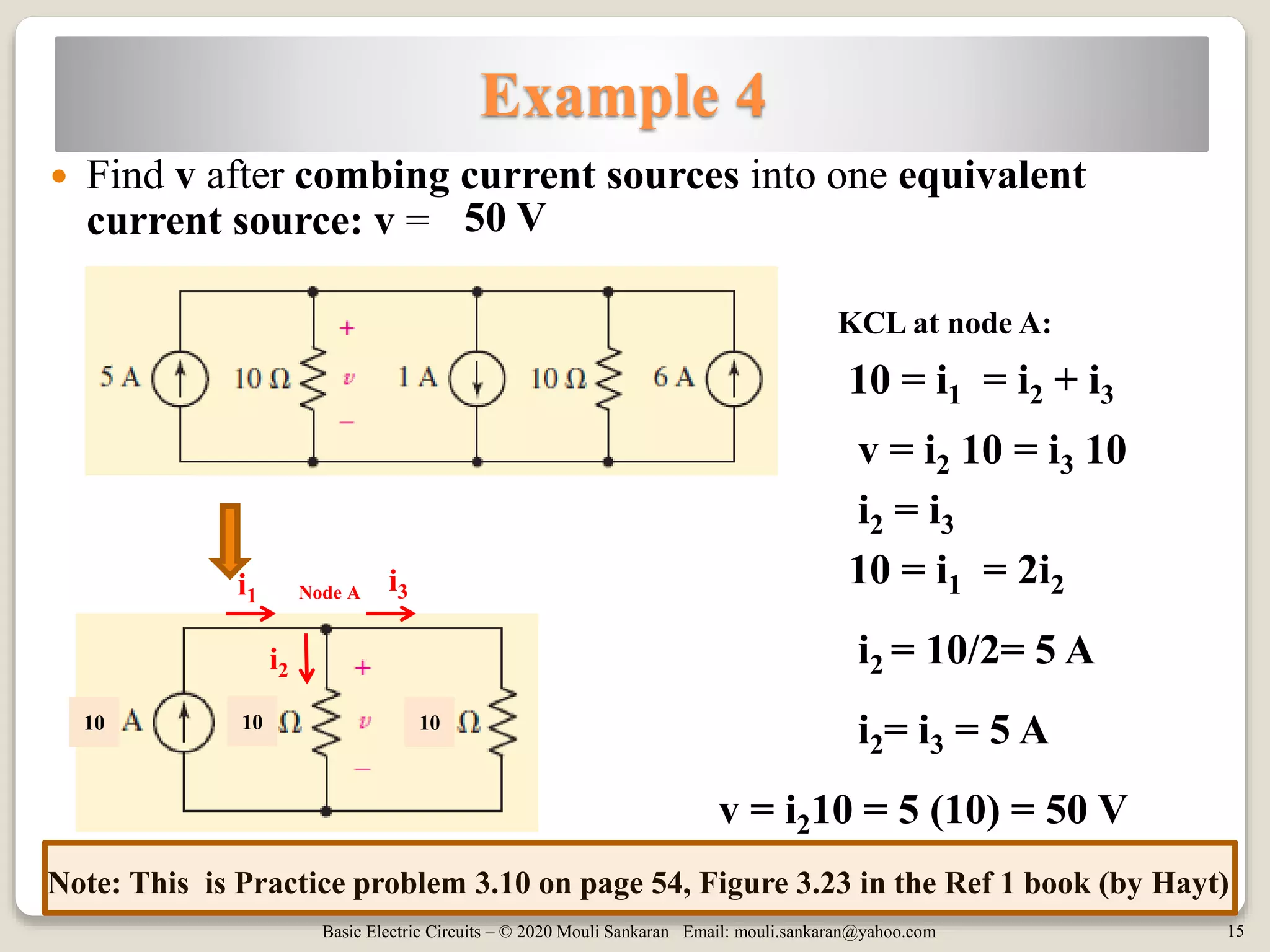
Example 4
 Find v after combing current sources into one equivalent
current source: v =
10 = i1 = i2 + i3
v = i210 = 5 (10) = 50 V
KCL at node A:
v = i2 10 = i3 10
50 V
i2 = 10/2= 5 A
i2 = i3
10 10 10
i2
i1
i3Node A
10 = i1 = 2i2
i2= i3 = 5 A
Note: This is Practice problem 3.10 on page 54, Figure 3.23 in the Ref 1 book (by Hayt)
Basic Electric Circuits – © 2020 Mouli Sankaran Email: mouli.sankaran@yahoo.com 16
Session 6: Summary
 Some more KVL problems
 Simplification of Circuits
 Combining Sources
◦ In Series (independent voltage sources)
◦ In Parallel (independent current sources)
◦ Example problems
Basic Electric Circuits – © 2020 Mouli Sankaran Email: mouli.sankaran@yahoo.com 17
References
Ref 1 Ref 2

Basic Electric Circuits Session 6

  • 1.
    Basic Electric Circuits– © 2020 Mouli Sankaran Email: mouli.sankaran@yahoo.com
  • 2.
    Basic Electric Circuits– © 2020 Mouli Sankaran Email: mouli.sankaran@yahoo.com 2 Session 6: Focus  Some more KVL problems  Simplification of Circuits  Combining Sources ◦ In Series (independent voltage sources) ◦ In Parallel (independent current sources) ◦ Example problems
  • 3.
    Basic Electric Circuits– © 2020 Mouli Sankaran Email: mouli.sankaran@yahoo.com Some more KVL Problems
  • 4.
    Basic Electric Circuits– © 2020 Mouli Sankaran Email: mouli.sankaran@yahoo.com 4 S5_HW_Problem_2  Find vx : 8 V Note: This is Example problem is 3.4 on page 45, Figure 3.10 in the Ref 1 book (by Hayt) -60 + v8 + v10 = 0 v8 = 5 * 8 = 40 V -60 + 40 + v10 = 0 v10 = 20 V -v10 + v4 + vx = 0 -20 + 12 + vx = 0 vx = 8 V i10 = v10 /10 i10 = 20 /10 i10 = 2 A i10 + i4 = 5 A i4 = 5 – 2 = 3 A v4 = 3 * 4 = 12 V
  • 5.
    Basic Electric Circuits– © 2020 Mouli Sankaran Email: mouli.sankaran@yahoo.com Simplification of Circuits
  • 6.
    Basic Electric Circuits– © 2020 Mouli Sankaran Email: mouli.sankaran@yahoo.com 6 Simplification of Circuits  While trying to find out unknown quantities in a given circuit, some techniques could be used to simplify the solution  Based on the quantities to be found, the given circuit can be simplified by combining various elements ◦ Independent Sources (both voltage and current) ◦ Resistors
  • 7.
    Basic Electric Circuits– © 2020 Mouli Sankaran Email: mouli.sankaran@yahoo.com 7 Simplification of Circuits … contd.  Note that dependent sources and the elements impacting those dependent sources need to be untouched  These simplifications still leave the functioning of the rest of the circuit unaffected
  • 8.
    Basic Electric Circuits– © 2020 Mouli Sankaran Email: mouli.sankaran@yahoo.com Combining Sources in Series
  • 9.
    Basic Electric Circuits– © 2020 Mouli Sankaran Email: mouli.sankaran@yahoo.com 9 Combining Voltage Sources in Series  Various Independent voltage sources in series can be replaced by an equivalent voltage source having a voltage equal to the algebraic sum of the individual sources ◦ Note that dependent sources cannot be combined and they need to be untouched
  • 10.
    Basic Electric Circuits– © 2020 Mouli Sankaran Email: mouli.sankaran@yahoo.com 10 Combining Voltage Sources in Series  Various Independent voltage sources in series can be replaced by an equivalent voltage source having a voltage equal to the algebraic sum of the individual sources  Combing dependent voltages sources
  • 11.
    Basic Electric Circuits– © 2020 Mouli Sankaran Email: mouli.sankaran@yahoo.com 11 Combining Current Sources in Parallel  Various Independent current sources in parallel can be replaced by an equivalent current source having a current equal to the algebraic sum of the individual sources  The order of the parallel elements may be rearranged as desired
  • 12.
    Basic Electric Circuits– © 2020 Mouli Sankaran Email: mouli.sankaran@yahoo.com 12 Example 1  To be able to combine voltage sources, they must be in series.  Since the same current (i) flows through each, this condition is satisfied  - 3 - 9 – 5 + 1 = -16 V (KVL starting from bottom left corner)  -16 + 100 i + 220 * i = 0; i = 16/320 = 50 mA  The right most diagram is also equivalent to the previous one.
  • 13.
    Basic Electric Circuits– © 2020 Mouli Sankaran Email: mouli.sankaran@yahoo.com 13 Example 2  The value of the voltage source is taken as –ve when a –ve terminal is seen while traversing the circuit ◦ Here in the clockwise direction  When the resultant voltage is computed after taking the algebraic sum of the sources, follow the same convention while constructing the circuit with resultant voltage source ◦ Here the -1 V source’s negative terminal will be down and its +ve terminal will be connected to 47 Ohms -3 + 1 + 5 -4 = -1 V Combining the sources in series from the top right corner: i = 1/47 = 21.3 mA + -1 V 47 Ω i
  • 14.
    Basic Electric Circuits– © 2020 Mouli Sankaran Email: mouli.sankaran@yahoo.com 14 Example 3  Find v after combing current sources into one equivalent current source: v = 3 = i1 + i2 = 2 i1 v = 5 (1.5) = 7.5 V KCL at bottom node: v = i1 5 = i2 5 7.5 V i1 = i2 i1 = i2 = 3/2 = 1.5 A i2i1 - + - + - +
  • 15.
    Basic Electric Circuits– © 2020 Mouli Sankaran Email: mouli.sankaran@yahoo.com 15 Example 4  Find v after combing current sources into one equivalent current source: v = 10 = i1 = i2 + i3 v = i210 = 5 (10) = 50 V KCL at node A: v = i2 10 = i3 10 50 V i2 = 10/2= 5 A i2 = i3 10 10 10 i2 i1 i3Node A 10 = i1 = 2i2 i2= i3 = 5 A Note: This is Practice problem 3.10 on page 54, Figure 3.23 in the Ref 1 book (by Hayt)
  • 16.
    Basic Electric Circuits– © 2020 Mouli Sankaran Email: mouli.sankaran@yahoo.com 16 Session 6: Summary  Some more KVL problems  Simplification of Circuits  Combining Sources ◦ In Series (independent voltage sources) ◦ In Parallel (independent current sources) ◦ Example problems
  • 17.
    Basic Electric Circuits– © 2020 Mouli Sankaran Email: mouli.sankaran@yahoo.com 17 References Ref 1 Ref 2