Basic Electric Circuits – © 2020 Mouli Sankaran Email: mouli.sankaran@yahoo.com
Basic Electric Circuits – © 2020 Mouli Sankaran Email: mouli.sankaran@yahoo.com 2
Session 9B: Focus
 Circuits with current sources
◦ On the perimeter of meshes
 Summary of Steps
◦ For Mesh Analysis
 Circuits with current sources
◦ In between meshes
 Supermesh
◦ Example with Supermesh
 Home Work Problems
Basic Electric Circuits – © 2020 Mouli Sankaran Email: mouli.sankaran@yahoo.com
Mesh Analysis:
Circuits with Current Sources
Basic Electric Circuits – © 2020 Mouli Sankaran Email: mouli.sankaran@yahoo.com 4
Mesh Analysis: With Current sources
 There are two possible types of current sources that
could be found in a circuit
◦ Dependent and independent current sources
 There are two possible positions that they could be
found
a) On the perimeter of the circuit
b) As a common element between two meshes
Basic Electric Circuits – © 2020 Mouli Sankaran Email: mouli.sankaran@yahoo.com 5
Current Source on Perimeter
 Where is the independent current source in each circuit?
i4
On the Perimeter of the circuit As a Common element between meshes
Basic Electric Circuits – © 2020 Mouli Sankaran Email: mouli.sankaran@yahoo.com 6
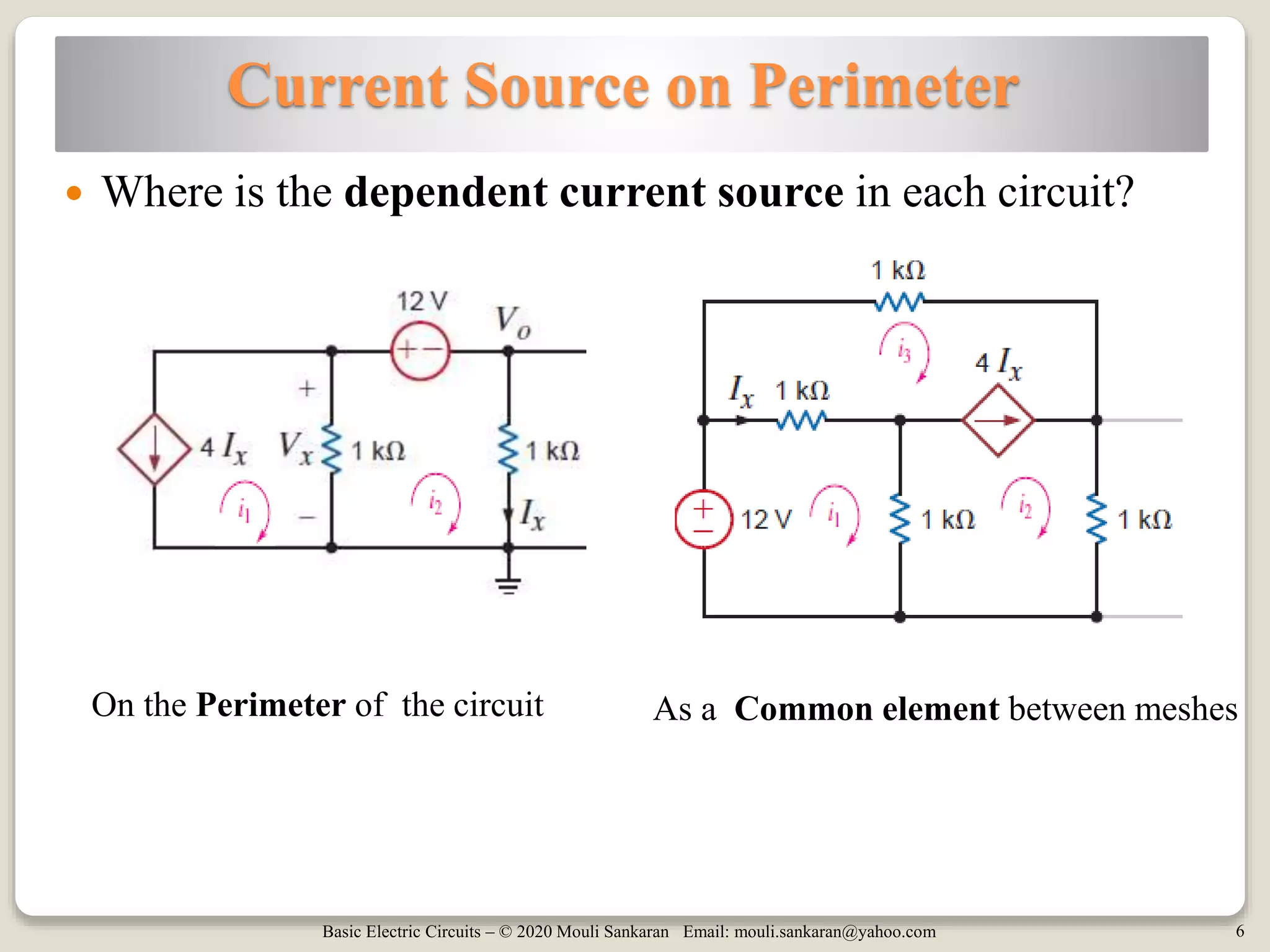
Current Source on Perimeter
 Where is the dependent current source in each circuit?
On the Perimeter of the circuit As a Common element between meshes
Basic Electric Circuits – © 2020 Mouli Sankaran Email: mouli.sankaran@yahoo.com 7
Mesh Analysis: Perimeter Current sources
 When the current source is appearing at the perimeter
of a circuit
 The mesh in which the current source is found, is
ignored, by making
◦ The mesh current of that mesh in which the current source is
found, is made equal to the value of the current source
 We thus reduce the number of mesh currents to be
evaluated by 1 for each current source present on the
perimeter
Basic Electric Circuits – © 2020 Mouli Sankaran Email: mouli.sankaran@yahoo.com 8
Example 1: Mesh Analysis with
Independent Current source on Perimeter
ix = i3 – i4
How many meshes are there? 4
What is ix in terms of mesh currents?
How much is the mesh current i4 ? 10 A
- 3+ 8i1 + 4(i1 -i2) = 0
4(i2 - i1) + 12i2 + 8(i2 - i3) = 0
KVL for the mesh with i1 :
KVL for the mesh with i2 :
KVL for the mesh with i3 :
Note: This is problem 36 on page 116, Figure 4.61 in the Ref 1 book (by Hayt)
12i1 - 4i2 = 3
-4i1 + 24i2 - 8i3 = 0
8(i3 - i2) + 20(i3 - i4) + 5i3 = 0
-8i2 + 33i3 - 20i4 = 0
-8i2 + 33i3 – (20* 10) = 0
-8i2 + 33i3 = 200
-i1 + 6i2 - 2i3 = 0
i3 = 6.639 A ix = i3 - 10 = -3.36 A
Solving these equations:
i4
How many KVL equs to be written ? 3
Basic Electric Circuits – © 2020 Mouli Sankaran Email: mouli.sankaran@yahoo.com 9
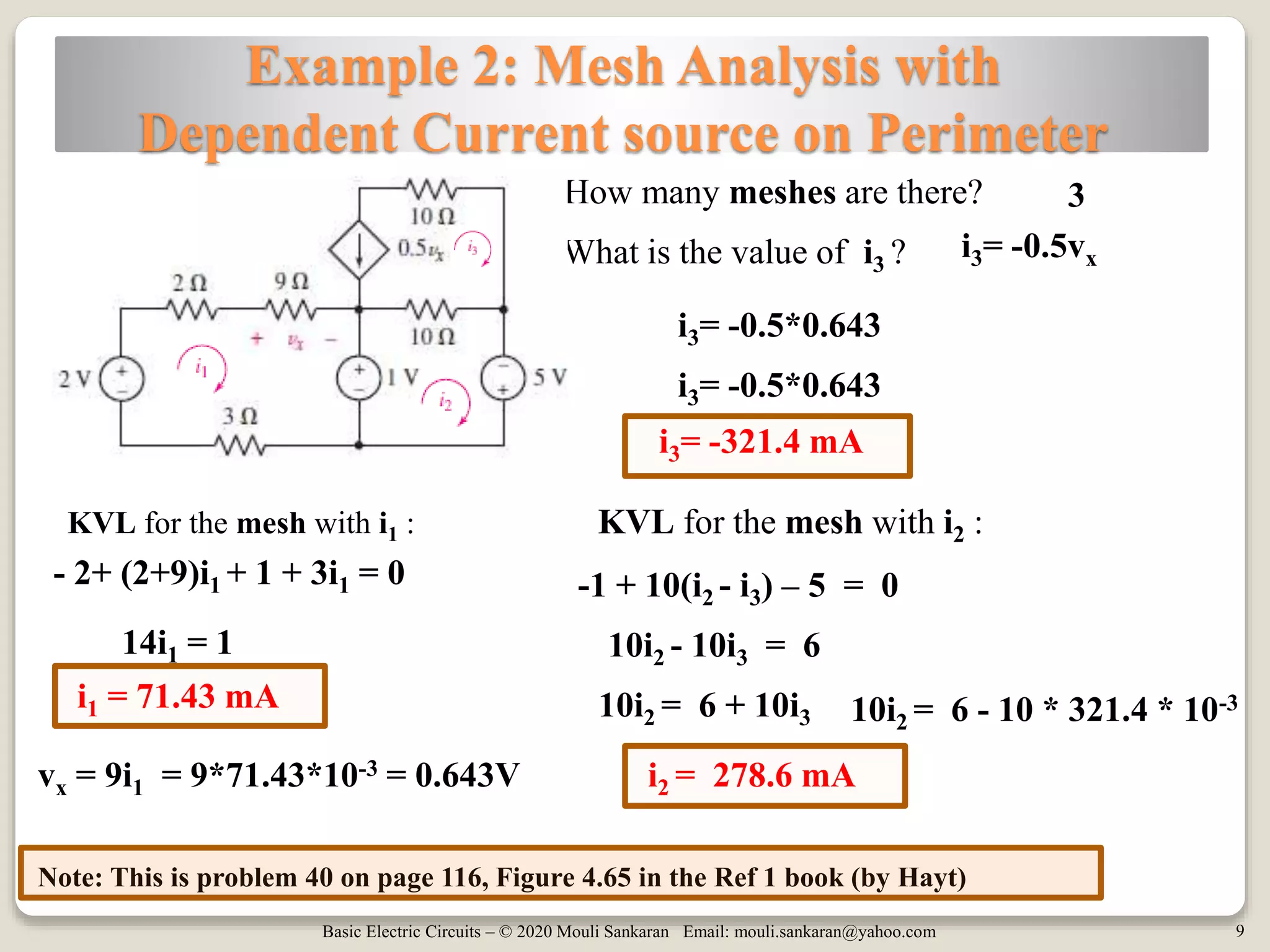
Example 2: Mesh Analysis with
Dependent Current source on Perimeter
i3= -0.5vx
How many meshes are there? 3
What is the value of i3 ?
- 2+ (2+9)i1 + 1 + 3i1 = 0 -1 + 10(i2 - i3) – 5 = 0
KVL for the mesh with i1 : KVL for the mesh with i2 :
Note: This is problem 40 on page 116, Figure 4.65 in the Ref 1 book (by Hayt)
14i1 = 1 10i2 - 10i3 = 6
i1 = 71.43 mA
vx = 9i1 = 9*71.43*10-3 = 0.643V
i3= -0.5*0.643
i3= -0.5*0.643
i3= -321.4 mA
10i2 = 6 + 10i3 10i2 = 6 - 10 * 321.4 * 10-3
i2 = 278.6 mA
Basic Electric Circuits – © 2020 Mouli Sankaran Email: mouli.sankaran@yahoo.com
Summary of Steps: Mesh Analysis
Basic Electric Circuits – © 2020 Mouli Sankaran Email: mouli.sankaran@yahoo.com 11
Summary of Basic Mesh Analysis Procedure
1. Determine if the circuit is a planar circuit. If not, perform
nodal analysis instead
2. Count the number of meshes (M). Redraw the circuit if
necessary.
3. Label each of the M mesh currents. Generally, defining all
mesh currents to flow clockwise results in a simpler analysis.
4. Write a KVL equation around each mesh. Begin with a
convenient node and proceed in the direction of the mesh
current.
a. Pay close attention to “−” signs. If a current source lies on the
periphery of a mesh, no KVL equation is needed and the mesh current
is determined by inspection.
Basic Electric Circuits – © 2020 Mouli Sankaran Email: mouli.sankaran@yahoo.com 12
Summary of Basic Nodal Analysis Procedure
5. Express any additional unknowns such as voltages or currents
other than mesh currents in terms of appropriate mesh
currents. This situation can occur if current sources or
dependent sources appear in our circuit.
6. Organize the equations. Group terms according to mesh
currents.
7. Solve the system of equations for the mesh currents (there will
be M of them).
Basic Electric Circuits – © 2020 Mouli Sankaran Email: mouli.sankaran@yahoo.com
Mesh Analysis: Supermesh
Basic Electric Circuits – © 2020 Mouli Sankaran Email: mouli.sankaran@yahoo.com 14
Mesh Analysis: When Current source is in
between two meshes
 Create a kind of “supermesh” from two meshes that have a current
source as a common element
 The current source is in the interior of the supermesh
 We thus reduce the number of meshes by 1 for each dependent
current source present
Basic Electric Circuits – © 2020 Mouli Sankaran Email: mouli.sankaran@yahoo.com 15
Mesh Analysis: Supermesh
 Two meshes are merged which are separated by a current source
 Mesh current I1 is given as:
 The KVL equation of the Supermesh is given below:
Basic Electric Circuits – © 2020 Mouli Sankaran Email: mouli.sankaran@yahoo.com 16
Example 3: Supermesh
 Find i1 :
Note: This is Practice problem 4.9 on page 99, Figure 4.25 in the Ref 1 book (by Hayt)
Supermesh is created
by merging meshes 1 and 3
Basic Electric Circuits – © 2020 Mouli Sankaran Email: mouli.sankaran@yahoo.com 17
Example 3: Supermesh
i3 - i1 = 3 A
Express 3A current in terms of mesh currents
- 10+ 4(i1 - i2) + 10(i3 - i2) + (1+7)i3 = 0
4(i2 - i1) +(5+9) i2 +10(i2 - i3) = 0
KVL for the supermesh:
KVL for the mesh with i2 :
Note: This is problem 40 on page 116, Figure 4.65 in the Ref 1 book (by Hayt)
i1 = -1.93A
4i1 - 14i2 + 18i3 = 10
4i1 – 14i2 + 18*(3 + i1) = 10
22i1 - 14i2 = -44
-4i1 + 28i2 - 10i3 = 0
-2i1 + 14i2 – 5i3 = 0
-2i1 + 14i2 – 5*(3 + i1) = 0
-7i1 + 14i2 = 15
i3 = 3 + i1
4i1 – 14i2 + 54 + 18i1 = 10 Solving these two equations:
Basic Electric Circuits – © 2020 Mouli Sankaran Email: mouli.sankaran@yahoo.com
Home Work Problems
Basic Electric Circuits – © 2020 Mouli Sankaran Email: mouli.sankaran@yahoo.com 19
S9B_Problem 1: Mesh Analysis
Note: This is problem 47 on page 118, Figure 4.72 in the Ref 1 book (by Hayt)
 Find the mesh currents:
i1 = 5 A
12i2 +11(i2 - i3) + 13(i2 - i1) = 0
i3 - i1 = vx/3
The mesh current i1 is:
KVL for the mesh with i2 :
-13i1+36i2 - 11i3 = 0
i2 = 1.35 A
vx = 13i3
i3 - i1 = 13i3/3
3i3 - 3i1 = 13i3
- 3i1 = 10i3 i3 = -1.5 A
Basic Electric Circuits – © 2020 Mouli Sankaran Email: mouli.sankaran@yahoo.com 20
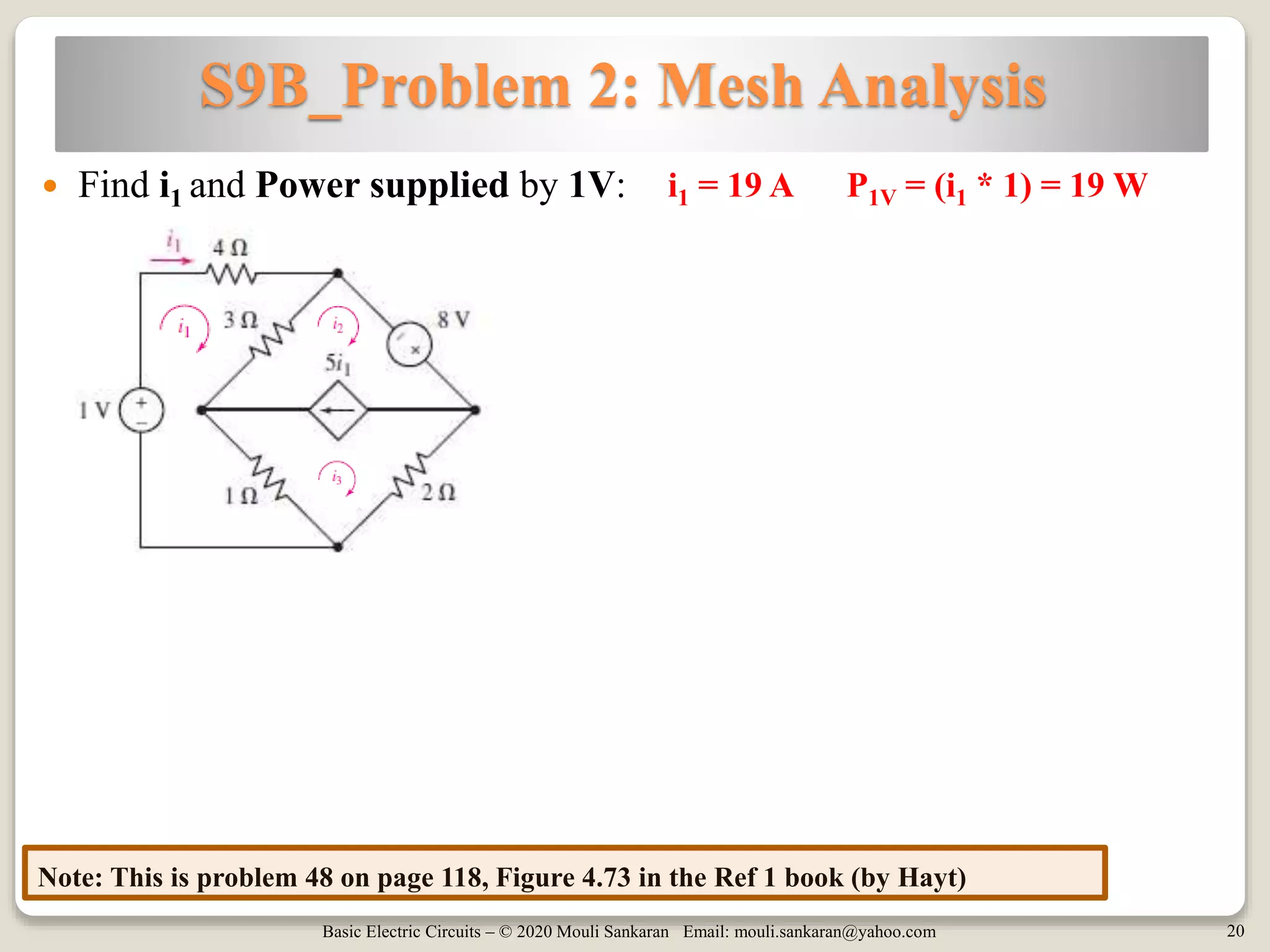
S9B_Problem 2: Mesh Analysis
Note: This is problem 48 on page 118, Figure 4.73 in the Ref 1 book (by Hayt)
 Find i1 and Power supplied by 1V: i1 = 19 A P1V = (i1 * 1) = 19 W
Basic Electric Circuits – © 2020 Mouli Sankaran Email: mouli.sankaran@yahoo.com 21
Session 9B: Summary
 Circuits with current sources
◦ On the perimeter of meshes
 Summary of Steps
◦ For Mesh Analysis
 Circuits with current sources
◦ In between meshes
 Supermesh
◦ Example with Supermesh
 Home Work Problems
Basic Electric Circuits – © 2020 Mouli Sankaran Email: mouli.sankaran@yahoo.com 22
References
Ref 1 Ref 2

Basic Electric Circuits Session 9B

  • 1.
    Basic Electric Circuits– © 2020 Mouli Sankaran Email: mouli.sankaran@yahoo.com
  • 2.
    Basic Electric Circuits– © 2020 Mouli Sankaran Email: mouli.sankaran@yahoo.com 2 Session 9B: Focus  Circuits with current sources ◦ On the perimeter of meshes  Summary of Steps ◦ For Mesh Analysis  Circuits with current sources ◦ In between meshes  Supermesh ◦ Example with Supermesh  Home Work Problems
  • 3.
    Basic Electric Circuits– © 2020 Mouli Sankaran Email: mouli.sankaran@yahoo.com Mesh Analysis: Circuits with Current Sources
  • 4.
    Basic Electric Circuits– © 2020 Mouli Sankaran Email: mouli.sankaran@yahoo.com 4 Mesh Analysis: With Current sources  There are two possible types of current sources that could be found in a circuit ◦ Dependent and independent current sources  There are two possible positions that they could be found a) On the perimeter of the circuit b) As a common element between two meshes
  • 5.
    Basic Electric Circuits– © 2020 Mouli Sankaran Email: mouli.sankaran@yahoo.com 5 Current Source on Perimeter  Where is the independent current source in each circuit? i4 On the Perimeter of the circuit As a Common element between meshes
  • 6.
    Basic Electric Circuits– © 2020 Mouli Sankaran Email: mouli.sankaran@yahoo.com 6 Current Source on Perimeter  Where is the dependent current source in each circuit? On the Perimeter of the circuit As a Common element between meshes
  • 7.
    Basic Electric Circuits– © 2020 Mouli Sankaran Email: mouli.sankaran@yahoo.com 7 Mesh Analysis: Perimeter Current sources  When the current source is appearing at the perimeter of a circuit  The mesh in which the current source is found, is ignored, by making ◦ The mesh current of that mesh in which the current source is found, is made equal to the value of the current source  We thus reduce the number of mesh currents to be evaluated by 1 for each current source present on the perimeter
  • 8.
    Basic Electric Circuits– © 2020 Mouli Sankaran Email: mouli.sankaran@yahoo.com 8 Example 1: Mesh Analysis with Independent Current source on Perimeter ix = i3 – i4 How many meshes are there? 4 What is ix in terms of mesh currents? How much is the mesh current i4 ? 10 A - 3+ 8i1 + 4(i1 -i2) = 0 4(i2 - i1) + 12i2 + 8(i2 - i3) = 0 KVL for the mesh with i1 : KVL for the mesh with i2 : KVL for the mesh with i3 : Note: This is problem 36 on page 116, Figure 4.61 in the Ref 1 book (by Hayt) 12i1 - 4i2 = 3 -4i1 + 24i2 - 8i3 = 0 8(i3 - i2) + 20(i3 - i4) + 5i3 = 0 -8i2 + 33i3 - 20i4 = 0 -8i2 + 33i3 – (20* 10) = 0 -8i2 + 33i3 = 200 -i1 + 6i2 - 2i3 = 0 i3 = 6.639 A ix = i3 - 10 = -3.36 A Solving these equations: i4 How many KVL equs to be written ? 3
  • 9.
    Basic Electric Circuits– © 2020 Mouli Sankaran Email: mouli.sankaran@yahoo.com 9 Example 2: Mesh Analysis with Dependent Current source on Perimeter i3= -0.5vx How many meshes are there? 3 What is the value of i3 ? - 2+ (2+9)i1 + 1 + 3i1 = 0 -1 + 10(i2 - i3) – 5 = 0 KVL for the mesh with i1 : KVL for the mesh with i2 : Note: This is problem 40 on page 116, Figure 4.65 in the Ref 1 book (by Hayt) 14i1 = 1 10i2 - 10i3 = 6 i1 = 71.43 mA vx = 9i1 = 9*71.43*10-3 = 0.643V i3= -0.5*0.643 i3= -0.5*0.643 i3= -321.4 mA 10i2 = 6 + 10i3 10i2 = 6 - 10 * 321.4 * 10-3 i2 = 278.6 mA
  • 10.
    Basic Electric Circuits– © 2020 Mouli Sankaran Email: mouli.sankaran@yahoo.com Summary of Steps: Mesh Analysis
  • 11.
    Basic Electric Circuits– © 2020 Mouli Sankaran Email: mouli.sankaran@yahoo.com 11 Summary of Basic Mesh Analysis Procedure 1. Determine if the circuit is a planar circuit. If not, perform nodal analysis instead 2. Count the number of meshes (M). Redraw the circuit if necessary. 3. Label each of the M mesh currents. Generally, defining all mesh currents to flow clockwise results in a simpler analysis. 4. Write a KVL equation around each mesh. Begin with a convenient node and proceed in the direction of the mesh current. a. Pay close attention to “−” signs. If a current source lies on the periphery of a mesh, no KVL equation is needed and the mesh current is determined by inspection.
  • 12.
    Basic Electric Circuits– © 2020 Mouli Sankaran Email: mouli.sankaran@yahoo.com 12 Summary of Basic Nodal Analysis Procedure 5. Express any additional unknowns such as voltages or currents other than mesh currents in terms of appropriate mesh currents. This situation can occur if current sources or dependent sources appear in our circuit. 6. Organize the equations. Group terms according to mesh currents. 7. Solve the system of equations for the mesh currents (there will be M of them).
  • 13.
    Basic Electric Circuits– © 2020 Mouli Sankaran Email: mouli.sankaran@yahoo.com Mesh Analysis: Supermesh
  • 14.
    Basic Electric Circuits– © 2020 Mouli Sankaran Email: mouli.sankaran@yahoo.com 14 Mesh Analysis: When Current source is in between two meshes  Create a kind of “supermesh” from two meshes that have a current source as a common element  The current source is in the interior of the supermesh  We thus reduce the number of meshes by 1 for each dependent current source present
  • 15.
    Basic Electric Circuits– © 2020 Mouli Sankaran Email: mouli.sankaran@yahoo.com 15 Mesh Analysis: Supermesh  Two meshes are merged which are separated by a current source  Mesh current I1 is given as:  The KVL equation of the Supermesh is given below:
  • 16.
    Basic Electric Circuits– © 2020 Mouli Sankaran Email: mouli.sankaran@yahoo.com 16 Example 3: Supermesh  Find i1 : Note: This is Practice problem 4.9 on page 99, Figure 4.25 in the Ref 1 book (by Hayt) Supermesh is created by merging meshes 1 and 3
  • 17.
    Basic Electric Circuits– © 2020 Mouli Sankaran Email: mouli.sankaran@yahoo.com 17 Example 3: Supermesh i3 - i1 = 3 A Express 3A current in terms of mesh currents - 10+ 4(i1 - i2) + 10(i3 - i2) + (1+7)i3 = 0 4(i2 - i1) +(5+9) i2 +10(i2 - i3) = 0 KVL for the supermesh: KVL for the mesh with i2 : Note: This is problem 40 on page 116, Figure 4.65 in the Ref 1 book (by Hayt) i1 = -1.93A 4i1 - 14i2 + 18i3 = 10 4i1 – 14i2 + 18*(3 + i1) = 10 22i1 - 14i2 = -44 -4i1 + 28i2 - 10i3 = 0 -2i1 + 14i2 – 5i3 = 0 -2i1 + 14i2 – 5*(3 + i1) = 0 -7i1 + 14i2 = 15 i3 = 3 + i1 4i1 – 14i2 + 54 + 18i1 = 10 Solving these two equations:
  • 18.
    Basic Electric Circuits– © 2020 Mouli Sankaran Email: mouli.sankaran@yahoo.com Home Work Problems
  • 19.
    Basic Electric Circuits– © 2020 Mouli Sankaran Email: mouli.sankaran@yahoo.com 19 S9B_Problem 1: Mesh Analysis Note: This is problem 47 on page 118, Figure 4.72 in the Ref 1 book (by Hayt)  Find the mesh currents: i1 = 5 A 12i2 +11(i2 - i3) + 13(i2 - i1) = 0 i3 - i1 = vx/3 The mesh current i1 is: KVL for the mesh with i2 : -13i1+36i2 - 11i3 = 0 i2 = 1.35 A vx = 13i3 i3 - i1 = 13i3/3 3i3 - 3i1 = 13i3 - 3i1 = 10i3 i3 = -1.5 A
  • 20.
    Basic Electric Circuits– © 2020 Mouli Sankaran Email: mouli.sankaran@yahoo.com 20 S9B_Problem 2: Mesh Analysis Note: This is problem 48 on page 118, Figure 4.73 in the Ref 1 book (by Hayt)  Find i1 and Power supplied by 1V: i1 = 19 A P1V = (i1 * 1) = 19 W
  • 21.
    Basic Electric Circuits– © 2020 Mouli Sankaran Email: mouli.sankaran@yahoo.com 21 Session 9B: Summary  Circuits with current sources ◦ On the perimeter of meshes  Summary of Steps ◦ For Mesh Analysis  Circuits with current sources ◦ In between meshes  Supermesh ◦ Example with Supermesh  Home Work Problems
  • 22.
    Basic Electric Circuits– © 2020 Mouli Sankaran Email: mouli.sankaran@yahoo.com 22 References Ref 1 Ref 2