Concepts of Measurement
E.Karolinekersin
Assistant professor
School of engineering
Avinashilingam institute for home science
and higher education for women.
Overview
• General Measuring System
• Standard Inputs
• Static & Dynamic Characteristics of Measuring
Instruments
• Errors in Measurements
• Signals & Noises
• Units & Standards
• Calibration of Instruments
2
Measurement
• Measurement is essentially the act or the result of a
quantitative comparison between a given quantity and
standard or a unit of same quantity.
• The result of measurement is expressed by a number.
• The physical embodiment of the unit of measurement is
called a standard.
3
Need of measurement
• Establish standards
• Interchangeability
• Physical parameters into a meaningful number
• Validate design
• To calculate the performance
4
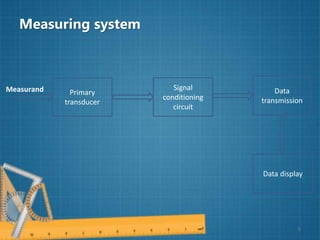
Measuring system
Measurand Primary
transducer
Data
transmission
Signal
conditioning
circuit
Data display
5
Standard inputs
• The measurement systems may be subjected to any type
of input.
• The input variable changes rapidly with time or held
constant.
Step input
Ramp input
Parabolic input
Impulse input
6
Static characteristics of instrument
• Accuracy
• Precision
• Bias
• Repeatability and
reproducibility
• Tolerance
• Reliabilty
• deviation
• Scale range and scale
span
• Scale readability
• Stability
• Resolution
• Responsiveness
• Drift
• uncertainity
7
contd…
• Static sensitivity
• Instrument efficiency
• Linearity
• Hysteresis
• Dead time
• Dead zone
• Friction
• Backlash
• overshoot
8
Dynamic characteristics
• Dynamic error
• Fidelity
• Bandwidth
• Speed of response
• Measuring lag
• Time constant
• Settling or response time
• Dynamic range
9
Errors in measurement
• The measurement error is defined as the difference
between the true or actual value and the measured
value.
• The true value is the average of the infinite number of
measurements and the measured value is the precise
value.
10
Source of errors
• Poor design
• Change in process parameters ,irregularities, upsets
• Poor maintenance
• Certain design limitations
• Insufficient knowledge of process parameters and design
conditions
• Errors caused by the operator of the instrument.
11
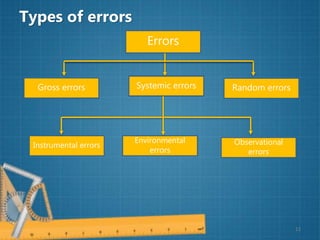
Types of errors
Gross errors
Environmental
errors
Observational
errors
Instrumental errors
Systemic errors Random errors
errors
Gross errors
Errors
12
Gross errors
• Errors occurs because of mistakes in reading or using
instruments and in recording and calculating
measurement results.
• Improper usage of measuring instrument.
• The reading should be taken very carefully.
• Two or more readings should be taken of the
measurement quantity
13
Systemic errors
• A constant uniform deviation of the operation of an
instrument .They are of three types
• Instrumental errors
• Environmental errors
• Observational errors
14
Instrumental Errors
• Inherent Shortcomings of Instruments
• Misuse of Instrument
• Loading Effect
Observational error
• wrong observation of the reading.
15
Environmental Errors
• These errors are due to the external condition of the
measuring devices.
• Such types of errors mainly occur due to the effect of
temperature, pressure, humidity, dust, vibration or
because of the magnetic or electrostatic field
16
Random errors
• This type of error is constantly there in a measurement,
which is occurred by essentially random oscillations in
the apparatus measurement analysis.
• The random error is minimized by measuring the given
quantity many times under the same conditions and
calculating the arithmetical mean values of the obtained.
17
Signals
• Dynamic response of a measuring system
• Common input signals are vibration signals, acoustic
signals, temperatures, and electric currents.
Step input function
Ramp input function
Sinusoidal input function
•
18
Noises
• Noise is any kind of unwanted signal that is not related
to the output.
• It may be defined as any signal that does not convey any
useful information but is superimposed on the desire
output.
19
Sources of noise
• Atmospheric interference
• Stray electrical and magnetic fields
• Mechanical shocks and vibrations
• Thermal or Johnson noise
• Vacuum tubes and transistors
20
Units and standards
• A unit of measurement is some specific quantity that has
been chosen as the standard against which other
measurements of the same kind are made.
• The term standard refers to the physical object on which
the unit of measurement is based.
21
Calibration of instruments
• Calibration of the measuring instrument is the process in
which the readings obtained from the instrument are
compared with the sub-standards.
• All the new instruments have to be calibrated against
some standard in the very beginning.
22
Reference
• A course in Electronics and electrical
measurements and instrumentation by J.b gupta
23
THANK YOU
24

Basic concepts of measurement

  • 1.
    Concepts of Measurement E.Karolinekersin Assistantprofessor School of engineering Avinashilingam institute for home science and higher education for women.
  • 2.
    Overview • General MeasuringSystem • Standard Inputs • Static & Dynamic Characteristics of Measuring Instruments • Errors in Measurements • Signals & Noises • Units & Standards • Calibration of Instruments 2
  • 3.
    Measurement • Measurement isessentially the act or the result of a quantitative comparison between a given quantity and standard or a unit of same quantity. • The result of measurement is expressed by a number. • The physical embodiment of the unit of measurement is called a standard. 3
  • 4.
    Need of measurement •Establish standards • Interchangeability • Physical parameters into a meaningful number • Validate design • To calculate the performance 4
  • 5.
  • 6.
    Standard inputs • Themeasurement systems may be subjected to any type of input. • The input variable changes rapidly with time or held constant. Step input Ramp input Parabolic input Impulse input 6
  • 7.
    Static characteristics ofinstrument • Accuracy • Precision • Bias • Repeatability and reproducibility • Tolerance • Reliabilty • deviation • Scale range and scale span • Scale readability • Stability • Resolution • Responsiveness • Drift • uncertainity 7
  • 8.
    contd… • Static sensitivity •Instrument efficiency • Linearity • Hysteresis • Dead time • Dead zone • Friction • Backlash • overshoot 8
  • 9.
    Dynamic characteristics • Dynamicerror • Fidelity • Bandwidth • Speed of response • Measuring lag • Time constant • Settling or response time • Dynamic range 9
  • 10.
    Errors in measurement •The measurement error is defined as the difference between the true or actual value and the measured value. • The true value is the average of the infinite number of measurements and the measured value is the precise value. 10
  • 11.
    Source of errors •Poor design • Change in process parameters ,irregularities, upsets • Poor maintenance • Certain design limitations • Insufficient knowledge of process parameters and design conditions • Errors caused by the operator of the instrument. 11
  • 12.
    Types of errors Grosserrors Environmental errors Observational errors Instrumental errors Systemic errors Random errors errors Gross errors Errors 12
  • 13.
    Gross errors • Errorsoccurs because of mistakes in reading or using instruments and in recording and calculating measurement results. • Improper usage of measuring instrument. • The reading should be taken very carefully. • Two or more readings should be taken of the measurement quantity 13
  • 14.
    Systemic errors • Aconstant uniform deviation of the operation of an instrument .They are of three types • Instrumental errors • Environmental errors • Observational errors 14
  • 15.
    Instrumental Errors • InherentShortcomings of Instruments • Misuse of Instrument • Loading Effect Observational error • wrong observation of the reading. 15
  • 16.
    Environmental Errors • Theseerrors are due to the external condition of the measuring devices. • Such types of errors mainly occur due to the effect of temperature, pressure, humidity, dust, vibration or because of the magnetic or electrostatic field 16
  • 17.
    Random errors • Thistype of error is constantly there in a measurement, which is occurred by essentially random oscillations in the apparatus measurement analysis. • The random error is minimized by measuring the given quantity many times under the same conditions and calculating the arithmetical mean values of the obtained. 17
  • 18.
    Signals • Dynamic responseof a measuring system • Common input signals are vibration signals, acoustic signals, temperatures, and electric currents. Step input function Ramp input function Sinusoidal input function • 18
  • 19.
    Noises • Noise isany kind of unwanted signal that is not related to the output. • It may be defined as any signal that does not convey any useful information but is superimposed on the desire output. 19
  • 20.
    Sources of noise •Atmospheric interference • Stray electrical and magnetic fields • Mechanical shocks and vibrations • Thermal or Johnson noise • Vacuum tubes and transistors 20
  • 21.
    Units and standards •A unit of measurement is some specific quantity that has been chosen as the standard against which other measurements of the same kind are made. • The term standard refers to the physical object on which the unit of measurement is based. 21
  • 22.
    Calibration of instruments •Calibration of the measuring instrument is the process in which the readings obtained from the instrument are compared with the sub-standards. • All the new instruments have to be calibrated against some standard in the very beginning. 22
  • 23.
    Reference • A coursein Electronics and electrical measurements and instrumentation by J.b gupta 23
  • 24.