INDIFFERENCE
CURVE AND
UTILITY
ANALYSIS
1/13/2017
DEMAND THEORY
1/13/2017
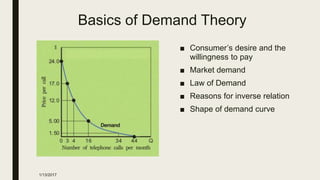
Basics of Demand Theory
■ Consumer’s desire and the
willingness to pay
■ Market demand
■ Law of Demand
■ Reasons for inverse relation
■ Shape of demand curve
1/13/2017
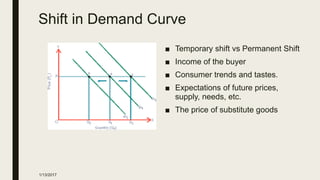
Shift in Demand Curve
■ Temporary shift vs Permanent Shift
■ Income of the buyer
■ Consumer trends and tastes.
■ Expectations of future prices,
supply, needs, etc.
■ The price of substitute goods
1/13/2017
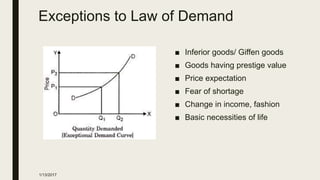
Exceptions to Law of Demand
■ Inferior goods/ Giffen goods
■ Goods having prestige value
■ Price expectation
■ Fear of shortage
■ Change in income, fashion
■ Basic necessities of life
1/13/2017
INDIFFERENCE
CURVE
PROPERTIES AND
APPLICATION
1/13/2017
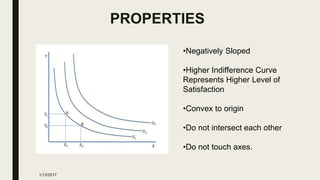
PROPERTIES
■
•Negatively Sloped
•Higher Indifference Curve
Represents Higher Level of
Satisfaction
•Convex to origin
•Do not intersect each other
•Do not touch axes.
1/13/2017
APPLICATIONS
■ The Problem of Exchange
■ Effects of Subsidy on Consumers
■ The Problem of Rationing
■ Index Numbers: Measuring Cost of Living
■ The Supply of Labour
■ The Effect of Income Tax vs. Excise Duty
■ The Saving Plan of an Individual
1/13/2017
DIFFERENT SHAPES OF
INDIFFERENCE CURVE
1/13/2017
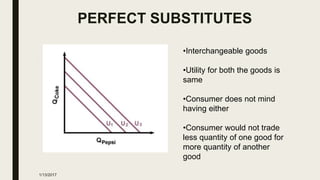
PERFECT SUBSTITUTES
■
•Interchangeable goods
•Utility for both the goods is
same
•Consumer does not mind
having either
•Consumer would not trade
less quantity of one good for
more quantity of another
good
1/13/2017
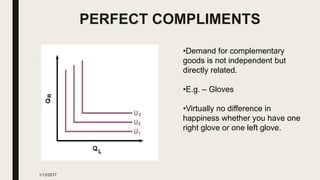
PERFECT COMPLIMENTS
■
•Demand for complementary
goods is not independent but
directly related.
•E.g. – Gloves
•Virtually no difference in
happiness whether you have one
right glove or one left glove.
1/13/2017
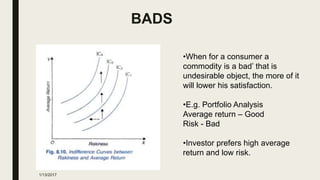
BADS
■
•When for a consumer a
commodity is a bad’ that is
undesirable object, the more of it
will lower his satisfaction.
•E.g. Portfolio Analysis
Average return – Good
Risk - Bad
•Investor prefers high average
return and low risk.
1/13/2017
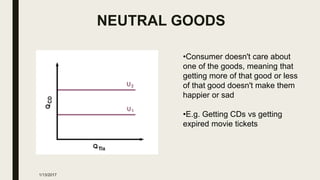
NEUTRAL GOODS
■
•Consumer doesn't care about
one of the goods, meaning that
getting more of that good or less
of that good doesn't make them
happier or sad
•E.g. Getting CDs vs getting
expired movie tickets
1/13/2017
INDIFFERENCE
CURVE AND
BUDGET LINE
1/13/2017
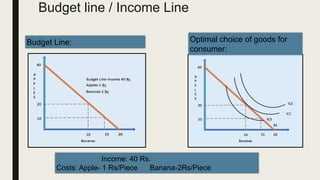
Budget line / Income Line
Budget Line: Optimal choice of goods for
consumer:
Income: 40 Rs.
Costs: Apple- 1 Rs/Piece Banana-2Rs/Piece
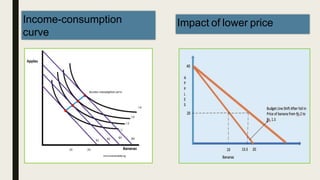
Income-consumption
curve
Impact of lower price
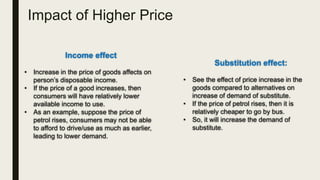
Impact of Higher Price
Income effect
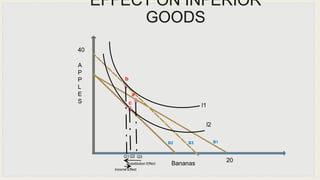
• Increase in the price of goods affects on
person’s disposable income.
• If the price of a good increases, then
consumers will have relatively lower
available income to use.
• As an example, suppose the price of
petrol rises, consumers may not be able
to afford to drive/use as much as earlier,
leading to lower demand.
Substitution effect:
• See the effect of price increase in the
goods compared to alternatives on
increase of demand of substitute.
• If the price of petrol rises, then it is
relatively cheaper to go by bus.
• So, it will increase the demand of
substitute.
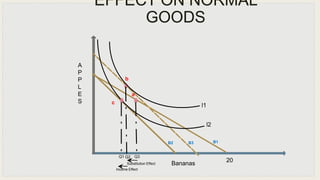
Substitution Effect
Q3
l1
20
Bananas
A
P
P
L
E
S
Q2Q1
c
a
b
B2 B3 B1
Income Effect
l2
EFFECT ON NORMAL
GOODS
40
Substitution Effect
Q3
l1
20
Bananas
A
P
P
L
E
S
Q2Q1
c
a
b
B2 B3 B1
Income Effect
l2
EFFECT ON INFERIOR
GOODS
40
Substitution Effect
Q3
l1
20
Bananas
A
P
P
L
E
S
Q2Q1
c
a
b
B2 B3 B1
Income Effect
l2
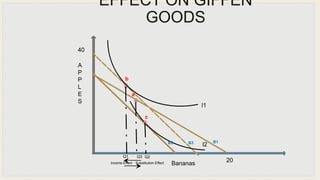
EFFECT ON GIFFEN
GOODS
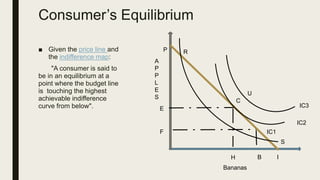
Consumer’s Equilibrium
■ Given the price line and
the indifference map:
"A consumer is said to
be in an equilibrium at a
point where the budget line
is touching the highest
achievable indifference
curve from below".
C
E
F
H B I
Bananas
A
P
P
L
E
S
IC2
IC3
IC1
P R
S
U
UTILITY ANALYSIS
1/13/2017
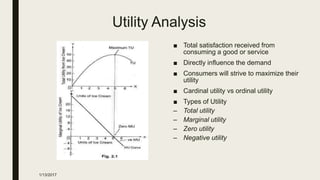
Utility Analysis
■ Total satisfaction received from
consuming a good or service
■ Directly influence the demand
■ Consumers will strive to maximize their
utility
■ Cardinal utility vs ordinal utility
■ Types of Utility
– Total utility
– Marginal utility
– Zero utility
– Negative utility
1/13/2017
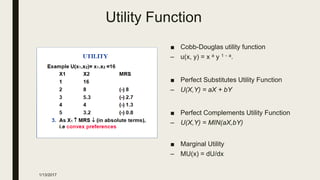
Utility Function
■ Cobb-Douglas utility function
– u(x, y) = x a y 1 - a.
■ Perfect Substitutes Utility Function
– U(X,Y) = aX + bY
■ Perfect Complements Utility Function
– U(X,Y) = MIN(aX,bY)
■ Marginal Utility
– MU(x) = dU/dx
1/13/2017
Utility Function
Perfect Substitutes
U(X,Y) = aX + bY
Perfect Complements
U(X,Y) = MIN(aX , bY)
1/13/2017
LAW OF
DIMINISHING
MARGINAL
UTILITY
1/13/2017
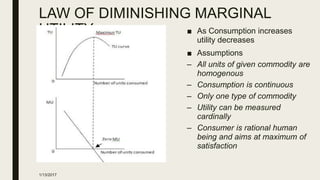
LAW OF DIMINISHING MARGINAL
UTILITY
1/13/2017
■ As Consumption increases
utility decreases
■ Assumptions
– All units of given commodity are
homogenous
– Consumption is continuous
– Only one type of commodity
– Utility can be measured
cardinally
– Consumer is rational human
being and aims at maximum of
satisfaction
Exceptions and Limitations
Exceptions
■ Rare collections
■ Not fully applicable to
money
■ Unreasonable quantity
■ Habitual goods
■ Durable and valuable goods
Limitations
■ Unrealistic assumptions -
homogeneity, continuity, and
constancy
■ Inapplicability to certain
goods
1/13/2017
Applications and Importance
■ Basic law of consumption
■ Reason for bringing variety in consumption and production
■ Diamond-water paradox
■ Progression in taxation
■ Socialist plea for an equitable distribution of wealth.
1/13/2017
LAW OF EQUI
MARGINAL
UTILITY
1/13/2017
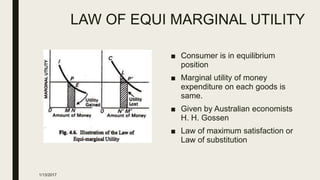
LAW OF EQUI MARGINAL UTILITY
■ Consumer is in equilibrium
position
■ Marginal utility of money
expenditure on each goods is
same.
■ Given by Australian economists
H. H. Gossen
■ Law of maximum satisfaction or
Law of substitution
1/13/2017
Assumption
■ No change in price of
goods.
■ Income of consumer is
fixed..
■ Marginal utility of money is
constant..
■ Consumer has perfect
knowledge of utility.
■ Consumer tries to seek
maximum satisfaction.
Applications
■ Helpful in the field of
production
■ Field of exchange
■ Public finance
1/13/2017
Summary
■ Demand Theory
■ Indifference Curve
– Properties
– Applications
– Different Shapes
■ Budget Line
■ Utility Analysis
■ Law of Diminishing Marginal Utility
■ Law of equi-marginal Utility
1/13/2017

Indifference curve and utility analysis

  • 1.
  • 2.
  • 3.
    Basics of DemandTheory ■ Consumer’s desire and the willingness to pay ■ Market demand ■ Law of Demand ■ Reasons for inverse relation ■ Shape of demand curve 1/13/2017
  • 4.
    Shift in DemandCurve ■ Temporary shift vs Permanent Shift ■ Income of the buyer ■ Consumer trends and tastes. ■ Expectations of future prices, supply, needs, etc. ■ The price of substitute goods 1/13/2017
  • 5.
    Exceptions to Lawof Demand ■ Inferior goods/ Giffen goods ■ Goods having prestige value ■ Price expectation ■ Fear of shortage ■ Change in income, fashion ■ Basic necessities of life 1/13/2017
  • 6.
  • 7.
    PROPERTIES ■ •Negatively Sloped •Higher IndifferenceCurve Represents Higher Level of Satisfaction •Convex to origin •Do not intersect each other •Do not touch axes. 1/13/2017
  • 8.
    APPLICATIONS ■ The Problemof Exchange ■ Effects of Subsidy on Consumers ■ The Problem of Rationing ■ Index Numbers: Measuring Cost of Living ■ The Supply of Labour ■ The Effect of Income Tax vs. Excise Duty ■ The Saving Plan of an Individual 1/13/2017
  • 9.
  • 10.
    PERFECT SUBSTITUTES ■ •Interchangeable goods •Utilityfor both the goods is same •Consumer does not mind having either •Consumer would not trade less quantity of one good for more quantity of another good 1/13/2017
  • 11.
    PERFECT COMPLIMENTS ■ •Demand forcomplementary goods is not independent but directly related. •E.g. – Gloves •Virtually no difference in happiness whether you have one right glove or one left glove. 1/13/2017
  • 12.
    BADS ■ •When for aconsumer a commodity is a bad’ that is undesirable object, the more of it will lower his satisfaction. •E.g. Portfolio Analysis Average return – Good Risk - Bad •Investor prefers high average return and low risk. 1/13/2017
  • 13.
    NEUTRAL GOODS ■ •Consumer doesn'tcare about one of the goods, meaning that getting more of that good or less of that good doesn't make them happier or sad •E.g. Getting CDs vs getting expired movie tickets 1/13/2017
  • 14.
  • 15.
    Budget line /Income Line Budget Line: Optimal choice of goods for consumer: Income: 40 Rs. Costs: Apple- 1 Rs/Piece Banana-2Rs/Piece
  • 16.
  • 17.
    Impact of HigherPrice Income effect • Increase in the price of goods affects on person’s disposable income. • If the price of a good increases, then consumers will have relatively lower available income to use. • As an example, suppose the price of petrol rises, consumers may not be able to afford to drive/use as much as earlier, leading to lower demand. Substitution effect: • See the effect of price increase in the goods compared to alternatives on increase of demand of substitute. • If the price of petrol rises, then it is relatively cheaper to go by bus. • So, it will increase the demand of substitute.
  • 18.
  • 19.
  • 20.
  • 21.
    Consumer’s Equilibrium ■ Giventhe price line and the indifference map: "A consumer is said to be in an equilibrium at a point where the budget line is touching the highest achievable indifference curve from below". C E F H B I Bananas A P P L E S IC2 IC3 IC1 P R S U
  • 22.
  • 23.
    Utility Analysis ■ Totalsatisfaction received from consuming a good or service ■ Directly influence the demand ■ Consumers will strive to maximize their utility ■ Cardinal utility vs ordinal utility ■ Types of Utility – Total utility – Marginal utility – Zero utility – Negative utility 1/13/2017
  • 24.
    Utility Function ■ Cobb-Douglasutility function – u(x, y) = x a y 1 - a. ■ Perfect Substitutes Utility Function – U(X,Y) = aX + bY ■ Perfect Complements Utility Function – U(X,Y) = MIN(aX,bY) ■ Marginal Utility – MU(x) = dU/dx 1/13/2017
  • 25.
    Utility Function Perfect Substitutes U(X,Y)= aX + bY Perfect Complements U(X,Y) = MIN(aX , bY) 1/13/2017
  • 26.
  • 27.
    LAW OF DIMINISHINGMARGINAL UTILITY 1/13/2017 ■ As Consumption increases utility decreases ■ Assumptions – All units of given commodity are homogenous – Consumption is continuous – Only one type of commodity – Utility can be measured cardinally – Consumer is rational human being and aims at maximum of satisfaction
  • 28.
    Exceptions and Limitations Exceptions ■Rare collections ■ Not fully applicable to money ■ Unreasonable quantity ■ Habitual goods ■ Durable and valuable goods Limitations ■ Unrealistic assumptions - homogeneity, continuity, and constancy ■ Inapplicability to certain goods 1/13/2017
  • 29.
    Applications and Importance ■Basic law of consumption ■ Reason for bringing variety in consumption and production ■ Diamond-water paradox ■ Progression in taxation ■ Socialist plea for an equitable distribution of wealth. 1/13/2017
  • 30.
  • 31.
    LAW OF EQUIMARGINAL UTILITY ■ Consumer is in equilibrium position ■ Marginal utility of money expenditure on each goods is same. ■ Given by Australian economists H. H. Gossen ■ Law of maximum satisfaction or Law of substitution 1/13/2017
  • 32.
    Assumption ■ No changein price of goods. ■ Income of consumer is fixed.. ■ Marginal utility of money is constant.. ■ Consumer has perfect knowledge of utility. ■ Consumer tries to seek maximum satisfaction. Applications ■ Helpful in the field of production ■ Field of exchange ■ Public finance 1/13/2017
  • 33.
    Summary ■ Demand Theory ■Indifference Curve – Properties – Applications – Different Shapes ■ Budget Line ■ Utility Analysis ■ Law of Diminishing Marginal Utility ■ Law of equi-marginal Utility 1/13/2017