


OSI MODEL AND ITS
PROTOCOL
By IKHLAS RAHMAN
DAFFODIL INTERNATIONAL
UNIVERSTY
Content
OSI MODEL
Physical LayerAND ITS PROTOCOL
Data Link Layer AND ITS PROTOCOL
Network LayerAND ITS PROTOCOL
Transport LayerAND ITS PROTOCOL
Session Layer AND ITS PROTOCOL
Presentation LayerAND ITS PROTOCOL
Application Layer AND ITS PROTOCOL
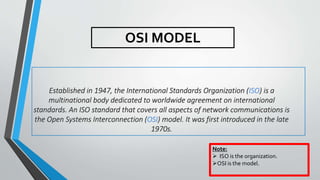
Established in 1947, the International Standards Organization (ISO) is a
multinational body dedicated to worldwide agreement on international
standards. An ISO standard that covers all aspects of network communications is
the Open Systems Interconnection (OSI) model. It was first introduced in the late
1970s.
OSI MODEL
Note:
 ISO is the organization.
OSI is the model.
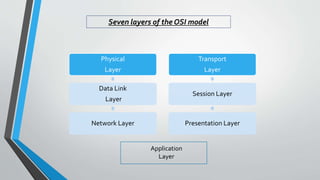
Physical
Layer
Data Link
Layer
Network Layer
Transport
Layer
Session Layer
Presentation Layer
Application
Layer
Seven layers of the OSI model
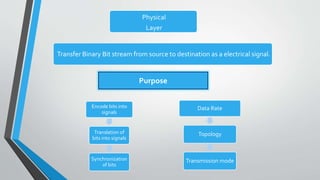
Physical
Layer
Transfer Binary Bit stream from source to destination as a electrical signal.
Encode bits into
signals
Translation of
bits into signals
Synchronization
of bits
Data Rate
Topology
Transmission mode
Purpose
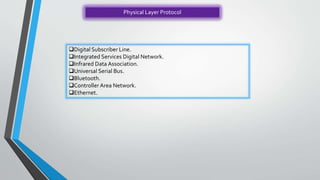
Physical Layer Protocol
Digital Subscriber Line.
Integrated Services Digital Network.
Infrared Data Association.
Universal Serial Bus.
Bluetooth.
Controller Area Network.
Ethernet.
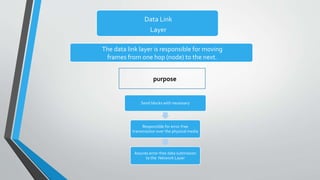
Data Link
Layer
Send blocks with necessary
Responsible for error-free
transmission over the physical media
Assures error-free data submission
to the Network Layer
purpose
The data link layer is responsible for moving
frames from one hop (node) to the next.
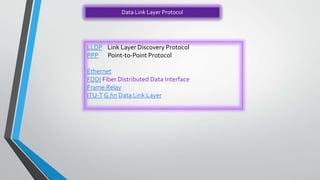
Data Link Layer Protocol
LLDP Link Layer Discovery Protocol
PPP Point-to-Point Protocol
Ethernet
FDDI Fiber Distributed Data Interface
Frame Relay
ITU-T G.hn Data Link Layer
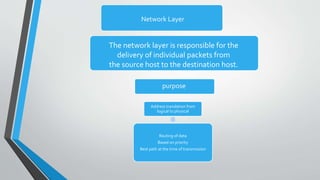
Network Layer
purpose
The network layer is responsible for the
delivery of individual packets from
the source host to the destination host.
Address translation from
logical to physical
Routing of data
Based on priority
Best path at the time of transmission
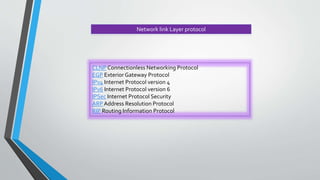
CLNP Connectionless Networking Protocol
EGP Exterior Gateway Protocol
IPv4 Internet Protocol version 4
IPv6 Internet Protocol version 6
IPSec Internet Protocol Security
ARPAddress Resolution Protocol
RIP Routing Information Protocol
Network link Layer protocol
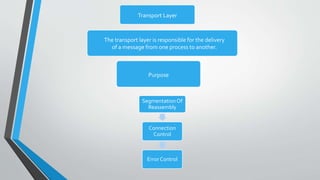
The transport layer is responsible for the delivery
of a message from one process to another.
Transport Layer
SegmentationOf
Reassembly
Connection
Control
Error Control
Purpose
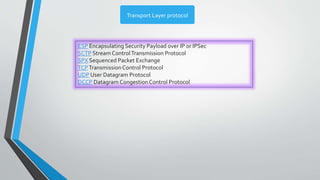
Transport Layer protocol
ESP Encapsulating Security Payload over IP or IPSec
SCTP Stream ControlTransmission Protocol
SPX Sequenced Packet Exchange
TCPTransmission Control Protocol
UDP User Datagram Protocol
DCCP Datagram Congestion Control Protocol
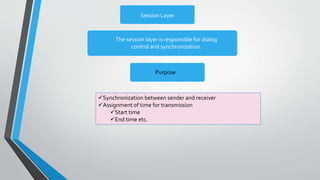
Session Layer
The session layer is responsible for dialog
control and synchronization.
Synchronization between sender and receiver
Assignment of time for transmission
Start time
End time etc.
Purpose
Session Layer protocol
NetBIOS, File Sharing and Name Resolution protocol - the
basis of file sharing with Windows.
NetBEUI, NetBIOS Enhanced User Interface
NCP NetWare Core Protocol
NFS Network File System
SMB Server Message Block
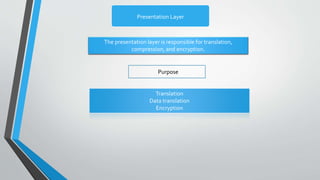
Presentation Layer
The presentation layer is responsible for translation,
compression, and encryption.
Translation
Data translation
Encryption
Purpose
TLSTransport Layer Security
Presentation Layer protocol
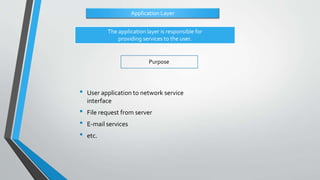
Application Layer
The application layer is responsible for
providing services to the user.
Purpose
• User application to network service
interface
• File request from server
• E-mail services
• etc.
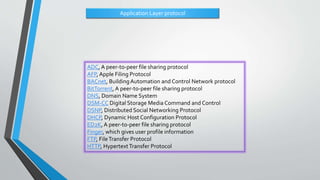
ADC, A peer-to-peer file sharing protocol
AFP,Apple Filing Protocol
BACnet, BuildingAutomation and Control Network protocol
BitTorrent, A peer-to-peer file sharing protocol
DNS, Domain Name System
DSM-CC Digital Storage Media Command and Control
DSNP, Distributed Social Networking Protocol
DHCP, Dynamic Host Configuration Protocol
ED2K,A peer-to-peer file sharing protocol
Finger, which gives user profile information
FTP, FileTransfer Protocol
HTTP, HypertextTransfer Protocol
Application Layer protocol
Thanks..
The End

OSI MODEL AND ITS PROTOCOL

  • 1.
    OSI MODEL ANDITS PROTOCOL By IKHLAS RAHMAN DAFFODIL INTERNATIONAL UNIVERSTY
  • 2.
    Content OSI MODEL Physical LayerANDITS PROTOCOL Data Link Layer AND ITS PROTOCOL Network LayerAND ITS PROTOCOL Transport LayerAND ITS PROTOCOL Session Layer AND ITS PROTOCOL Presentation LayerAND ITS PROTOCOL Application Layer AND ITS PROTOCOL
  • 3.
    Established in 1947,the International Standards Organization (ISO) is a multinational body dedicated to worldwide agreement on international standards. An ISO standard that covers all aspects of network communications is the Open Systems Interconnection (OSI) model. It was first introduced in the late 1970s. OSI MODEL Note:  ISO is the organization. OSI is the model.
  • 4.
    Physical Layer Data Link Layer Network Layer Transport Layer SessionLayer Presentation Layer Application Layer Seven layers of the OSI model
  • 5.
    Physical Layer Transfer Binary Bitstream from source to destination as a electrical signal. Encode bits into signals Translation of bits into signals Synchronization of bits Data Rate Topology Transmission mode Purpose
  • 6.
    Physical Layer Protocol DigitalSubscriber Line. Integrated Services Digital Network. Infrared Data Association. Universal Serial Bus. Bluetooth. Controller Area Network. Ethernet.
  • 7.
    Data Link Layer Send blockswith necessary Responsible for error-free transmission over the physical media Assures error-free data submission to the Network Layer purpose The data link layer is responsible for moving frames from one hop (node) to the next.
  • 8.
    Data Link LayerProtocol LLDP Link Layer Discovery Protocol PPP Point-to-Point Protocol Ethernet FDDI Fiber Distributed Data Interface Frame Relay ITU-T G.hn Data Link Layer
  • 9.
    Network Layer purpose The networklayer is responsible for the delivery of individual packets from the source host to the destination host. Address translation from logical to physical Routing of data Based on priority Best path at the time of transmission
  • 10.
    CLNP Connectionless NetworkingProtocol EGP Exterior Gateway Protocol IPv4 Internet Protocol version 4 IPv6 Internet Protocol version 6 IPSec Internet Protocol Security ARPAddress Resolution Protocol RIP Routing Information Protocol Network link Layer protocol
  • 11.
    The transport layeris responsible for the delivery of a message from one process to another. Transport Layer SegmentationOf Reassembly Connection Control Error Control Purpose
  • 12.
    Transport Layer protocol ESPEncapsulating Security Payload over IP or IPSec SCTP Stream ControlTransmission Protocol SPX Sequenced Packet Exchange TCPTransmission Control Protocol UDP User Datagram Protocol DCCP Datagram Congestion Control Protocol
  • 13.
    Session Layer The sessionlayer is responsible for dialog control and synchronization. Synchronization between sender and receiver Assignment of time for transmission Start time End time etc. Purpose
  • 14.
    Session Layer protocol NetBIOS,File Sharing and Name Resolution protocol - the basis of file sharing with Windows. NetBEUI, NetBIOS Enhanced User Interface NCP NetWare Core Protocol NFS Network File System SMB Server Message Block
  • 15.
    Presentation Layer The presentationlayer is responsible for translation, compression, and encryption. Translation Data translation Encryption Purpose
  • 16.
  • 17.
    Application Layer The applicationlayer is responsible for providing services to the user. Purpose • User application to network service interface • File request from server • E-mail services • etc.
  • 18.
    ADC, A peer-to-peerfile sharing protocol AFP,Apple Filing Protocol BACnet, BuildingAutomation and Control Network protocol BitTorrent, A peer-to-peer file sharing protocol DNS, Domain Name System DSM-CC Digital Storage Media Command and Control DSNP, Distributed Social Networking Protocol DHCP, Dynamic Host Configuration Protocol ED2K,A peer-to-peer file sharing protocol Finger, which gives user profile information FTP, FileTransfer Protocol HTTP, HypertextTransfer Protocol Application Layer protocol
  • 19.