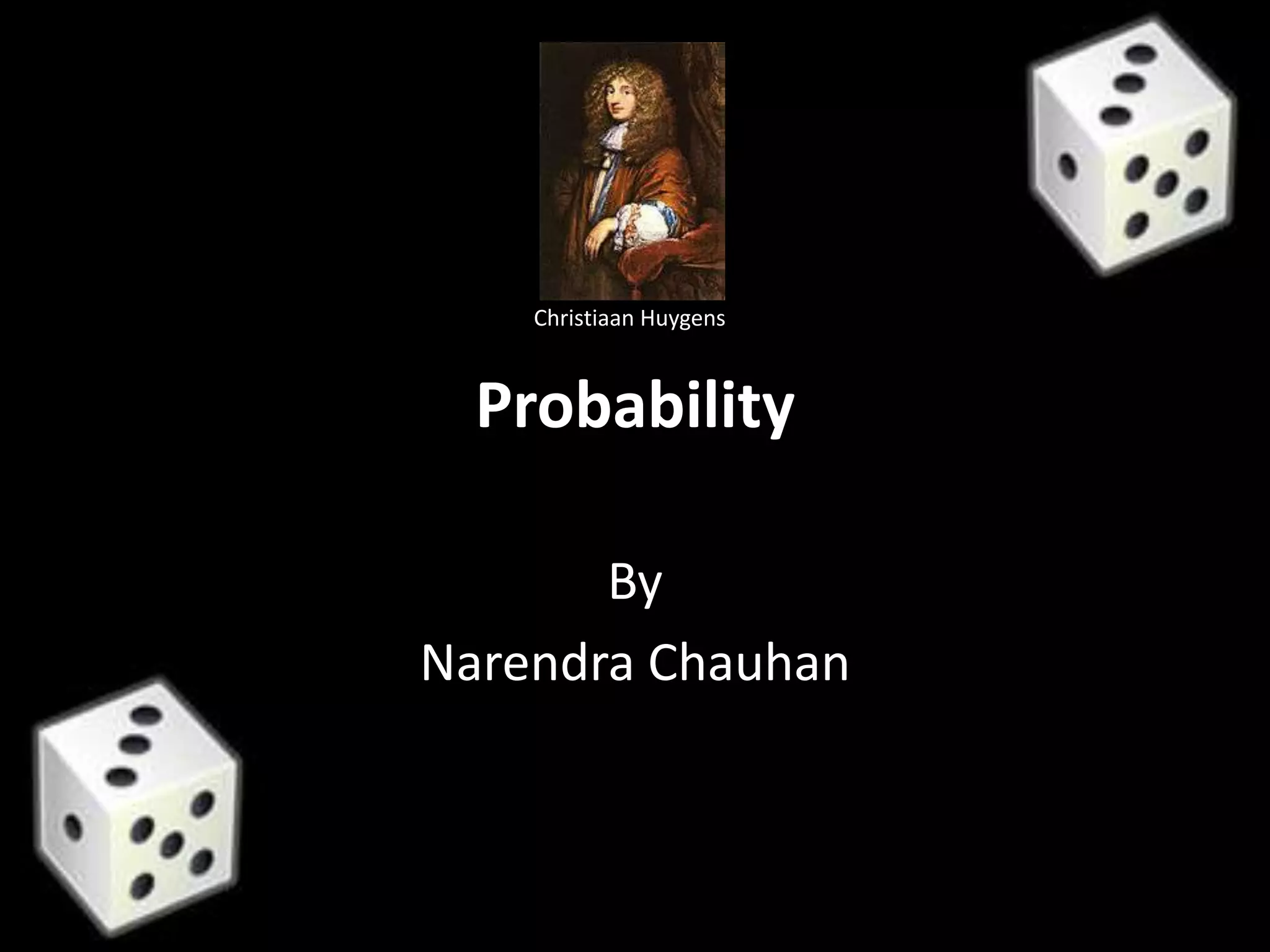
Christiaan Huygens


  Probability

       By
Narendra Chauhan
Probability

1.   Introduction to Probability
2.   Applications
3.    Experiments
4.   Counting Rules
5.   Assigning Probabilities
Introduction to Probability
Probability : - is a measure of the expectation
   that an event will occur or a statement is
   true. Probabilities are given a value between
   0 (will not occur) and 1 (will occur). The
   higher the probability of an event, the more
   certain we are that the event will occur.
Introduction to Probability
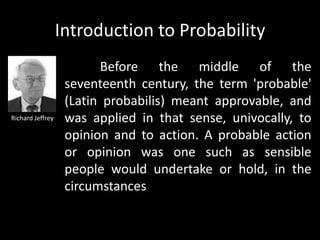
                         Before the middle of the
                   seventeenth century, the term 'probable'
                   (Latin probabilis) meant approvable, and
Richard Jeffrey    was applied in that sense, univocally, to
                   opinion and to action. A probable action
                   or opinion was one such as sensible
                   people would undertake or hold, in the
                   circumstances
Applications

     Probability theory is applied in
everyday life in risk assessment and in
trade on financial markets. Governments
apply    probabilistic    methods    in
environmental regulation
Experiments


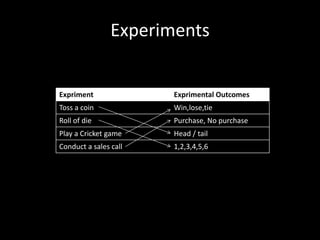
Expriment              Exprimental Outcomes
Toss a coin            Win,lose,tie
Roll of die            Purchase, No purchase
Play a Cricket game    Head / tail
Conduct a sales call   1,2,3,4,5,6
Counting

     Being able to identify and count
the experimental outcomes is a
necessary step in assigning probabilities.

Counting Rules.
1.Multiple-step experiment’s
2.Combinations
3.Permutations
Counting
1.Multiple-step experiment’s
  The Multiple – step experiment’s is first
  counting rule applies to multiple-step
  Experiment’s
Counting
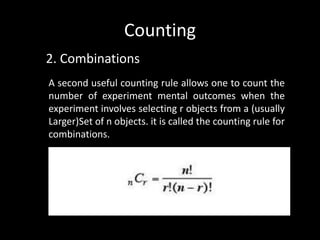
2. Combinations
A second useful counting rule allows one to count the
number of experiment mental outcomes when the
experiment involves selecting r objects from a (usually
Larger)Set of n objects. it is called the counting rule for
combinations.
Counting
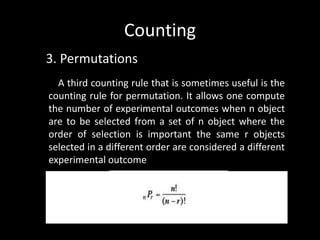
3. Permutations
  A third counting rule that is sometimes useful is the
counting rule for permutation. It allows one compute
the number of experimental outcomes when n object
are to be selected from a set of n object where the
order of selection is important the same r objects
selected in a different order are considered a different
experimental outcome
Assigning Probabilities

       Now let us see how probabilities can be
assigning to experimenat outcomes. The three
approaches most frequently

1.Classical Method
2.Relatvie frequency Method
3.Subjective Method
Assigning Probabilities


 1.Classical Method
The Classical Method of Assigning probabilities is
appropriate When all the experimental outcome are
equally
Assigning Probabilities

2.Relatvie frequency Method

     The Relative frequency Method of assigning
probabilities is appropriate when Data are available to
estimate the proportion of the time the experimental
outcome Will occur if the experiment is repeated a large
number of time
Thank you

Probability

  • 1.
    Christiaan Huygens Probability By Narendra Chauhan
  • 2.
    Probability 1. Introduction to Probability 2. Applications 3. Experiments 4. Counting Rules 5. Assigning Probabilities
  • 3.
    Introduction to Probability Probability: - is a measure of the expectation that an event will occur or a statement is true. Probabilities are given a value between 0 (will not occur) and 1 (will occur). The higher the probability of an event, the more certain we are that the event will occur.
  • 4.
    Introduction to Probability Before the middle of the seventeenth century, the term 'probable' (Latin probabilis) meant approvable, and Richard Jeffrey was applied in that sense, univocally, to opinion and to action. A probable action or opinion was one such as sensible people would undertake or hold, in the circumstances
  • 5.
    Applications Probability theory is applied in everyday life in risk assessment and in trade on financial markets. Governments apply probabilistic methods in environmental regulation
  • 6.
    Experiments Expriment Exprimental Outcomes Toss a coin Win,lose,tie Roll of die Purchase, No purchase Play a Cricket game Head / tail Conduct a sales call 1,2,3,4,5,6
  • 7.
    Counting Being able to identify and count the experimental outcomes is a necessary step in assigning probabilities. Counting Rules. 1.Multiple-step experiment’s 2.Combinations 3.Permutations
  • 8.
    Counting 1.Multiple-step experiment’s The Multiple – step experiment’s is first counting rule applies to multiple-step Experiment’s
  • 9.
    Counting 2. Combinations A seconduseful counting rule allows one to count the number of experiment mental outcomes when the experiment involves selecting r objects from a (usually Larger)Set of n objects. it is called the counting rule for combinations.
  • 10.
    Counting 3. Permutations A third counting rule that is sometimes useful is the counting rule for permutation. It allows one compute the number of experimental outcomes when n object are to be selected from a set of n object where the order of selection is important the same r objects selected in a different order are considered a different experimental outcome
  • 11.
    Assigning Probabilities Now let us see how probabilities can be assigning to experimenat outcomes. The three approaches most frequently 1.Classical Method 2.Relatvie frequency Method 3.Subjective Method
  • 12.
    Assigning Probabilities 1.ClassicalMethod The Classical Method of Assigning probabilities is appropriate When all the experimental outcome are equally
  • 13.
    Assigning Probabilities 2.Relatvie frequencyMethod The Relative frequency Method of assigning probabilities is appropriate when Data are available to estimate the proportion of the time the experimental outcome Will occur if the experiment is repeated a large number of time
  • 14.