

Sanjivani Rural Education Society's
Sanjivani College of Engineering, Kopargaon
-Department of Civil Engineering-
By
Prof. D. C. Dharwad (Assistant Professor)
Mail ID- danappadharwad@gmail.com
Classification Based On
StructureAccording to structure there are two types of buildings.
1. Load bearing Structure
2. Framed Structure
1. Load Bearing Structures:
 In this type of structures loads from roof slab or trusses and floors are
transmitted through walls to the firm soil below the ground .
 These types of structures are adopted where hard strata is available at shallow
depth.
 The structural elements like beams, slabs rest directly on the walls.
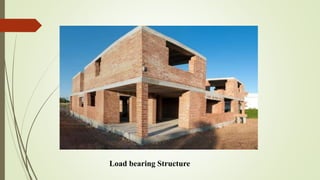
Load bearing Structure
 It has load bearing walls which receive the load and transmit the same to the
ground through their foundation.
 The load bearing walls supports R.C.C beams and slabs. Columns are avoided.
 20 , 30 , 40 cm thick walls are load bearing walls.
 Load bearing structure adopted for the buildings up to 3 storey construction.
 The walls on all the floors are provided one above the another.
 Thickness of walls can be reduce on first floor compare to ground floor.
 As the construction activity proceeds vertically floor by floor the thickness of the
wall reduces.
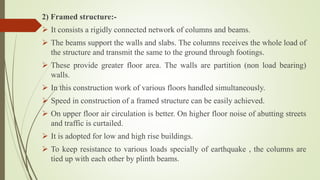
2) Framed structure:-
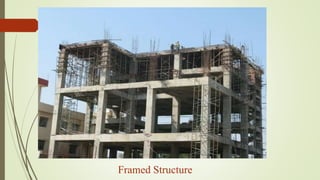
 It consists a rigidly connected network of columns and beams.
 The beams support the walls and slabs. The columns receives the whole load of
the structure and transmit the same to the ground through footings.
 These provide greater floor area. The walls are partition (non load bearing)
walls.
 In this construction work of various floors handled simultaneously.
 Speed in construction of a framed structure can be easily achieved.
 On upper floor air circulation is better. On higher floor noise of abutting streets
and traffic is curtailed.
 It is adopted for low and high rise buildings.
 To keep resistance to various loads specially of earthquake , the columns are
tied up with each other by plinth beams.
Framed Structure
Types of Framed Structures
1. Steel frame structure
2. Reinforced Cement Concrete Structures (R.C.C.)
 Reinforced concrete and Steel Frame Structure system have the same load
transfer method but the difference is in the material from which its members are
made i.e. In RCC Frame, the material used is Concrete while in Steel Frame,
the material used is Steel.
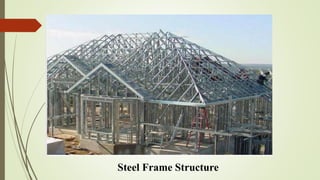
1. Steel Frame Structures
 A steel frame is one of the strongest structure that can be used for infrastructural
projects.
 It is not only strong, but also has the ease of application in construction.
 Additionally, its light weight makes the transportation process easy.
 Steel frame structures are the most constructed structures by engineers today.
Professional steel fabricators find it very convenient to use and purchase steel from
steel producers as steel has varied advantages.
 Steel building construction is of many types depending upon its utility. They are
conventional steel fabrication, light gauge steel, and bolted frame.
 Advantages of steel frame structures are Durability, Flexibility, Ductility, Temporary
Structures.
Steel Frame Structure
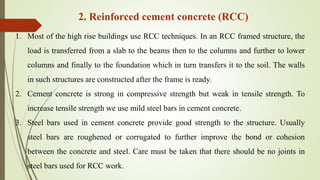
2. Reinforced cement concrete (RCC)
1. Most of the high rise buildings use RCC techniques. In an RCC framed structure, the
load is transferred from a slab to the beams then to the columns and further to lower
columns and finally to the foundation which in turn transfers it to the soil. The walls
in such structures are constructed after the frame is ready.
2. Cement concrete is strong in compressive strength but weak in tensile strength. To
increase tensile strength we use mild steel bars in cement concrete.
3. Steel bars used in cement concrete provide good strength to the structure. Usually
steel bars are roughened or corrugated to further improve the bond or cohesion
between the concrete and steel. Care must be taken that there should be no joints in
steel bars used for RCC work.
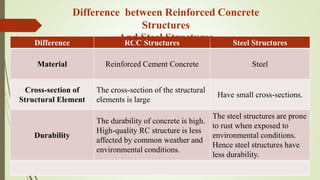
Difference RCC Structures Steel Structures
Material Reinforced Cement Concrete Steel
Cross-section of
Structural Element
The cross-section of the structural
elements is large
Have small cross-sections.
Durability
The durability of concrete is high.
High-quality RC structure is less
affected by common weather and
environmental conditions.
The steel structures are prone
to rust when exposed to
environmental conditions.
Hence steel structures have
less durability.
Difference between Reinforced Concrete
Structures
And Steel Structures
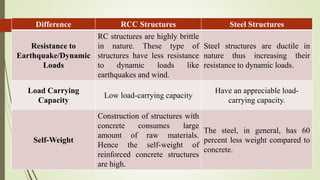
Difference RCC Structures Steel Structures
Resistance to
Earthquake/Dynamic
Loads
RC structures are highly brittle
in nature. These type of
structures have less resistance
to dynamic loads like
earthquakes and wind.
Steel structures are ductile in
nature thus increasing their
resistance to dynamic loads.
Load Carrying
Capacity
Low load-carrying capacity
Have an appreciable load-
carrying capacity.
Self-Weight
Construction of structures with
concrete consumes large
amount of raw materials.
Hence the self-weight of
reinforced concrete structures
are high.
The steel, in general, has 60
percent less weight compared to
concrete.
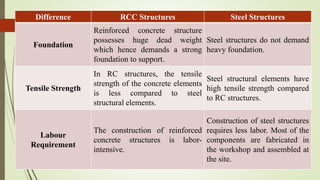
Difference RCC Structures Steel Structures
Foundation
Reinforced concrete structure
possesses huge dead weight
which hence demands a strong
foundation to support.
Steel structures do not demand
heavy foundation.
Tensile Strength
In RC structures, the tensile
strength of the concrete elements
is less compared to steel
structural elements.
Steel structural elements have
high tensile strength compared
to RC structures.
Labour
Requirement
The construction of reinforced
concrete structures is labor-
intensive.
Construction of steel structures
requires less labor. Most of the
components are fabricated in
the workshop and assembled at
the site.
Difference RCC Structures Steel Structures
Construction
Construction of RC structure
is simple.
Construction of steel
structure is tough.
Cost of construction Economical Costly
Construction Speed
Reinforced concrete structures
require time for concreting,
curing etc. which is a slow
process.
Steel structures are
constructed with high
speed.
Difference RCC Structures Steel Structures
Scrap Value
Concrete does not have any scrap
value.
The steel has a good scrap
value.
Corrosion
A properly designed and constructed
reinforced concrete structure is not
prone to corrosion.
The steel frame structure has
chances to deteriorate due to
corrosion.
Repair and
Maintenance
The repair and cost of maintenance
of the concrete structure are tough
and time taking.
Steel structures can be repaired
very easily and hence their
cost of maintenance is less.
Thank you

Classification based on structure

  • 1.
    Sanjivani Rural EducationSociety's Sanjivani College of Engineering, Kopargaon -Department of Civil Engineering- By Prof. D. C. Dharwad (Assistant Professor) Mail ID- danappadharwad@gmail.com
  • 2.
    Classification Based On StructureAccordingto structure there are two types of buildings. 1. Load bearing Structure 2. Framed Structure 1. Load Bearing Structures:  In this type of structures loads from roof slab or trusses and floors are transmitted through walls to the firm soil below the ground .  These types of structures are adopted where hard strata is available at shallow depth.  The structural elements like beams, slabs rest directly on the walls.
  • 3.
  • 4.
     It hasload bearing walls which receive the load and transmit the same to the ground through their foundation.  The load bearing walls supports R.C.C beams and slabs. Columns are avoided.  20 , 30 , 40 cm thick walls are load bearing walls.  Load bearing structure adopted for the buildings up to 3 storey construction.  The walls on all the floors are provided one above the another.  Thickness of walls can be reduce on first floor compare to ground floor.  As the construction activity proceeds vertically floor by floor the thickness of the wall reduces.
  • 5.
    2) Framed structure:- It consists a rigidly connected network of columns and beams.  The beams support the walls and slabs. The columns receives the whole load of the structure and transmit the same to the ground through footings.  These provide greater floor area. The walls are partition (non load bearing) walls.  In this construction work of various floors handled simultaneously.  Speed in construction of a framed structure can be easily achieved.  On upper floor air circulation is better. On higher floor noise of abutting streets and traffic is curtailed.  It is adopted for low and high rise buildings.  To keep resistance to various loads specially of earthquake , the columns are tied up with each other by plinth beams.
  • 6.
  • 7.
    Types of FramedStructures 1. Steel frame structure 2. Reinforced Cement Concrete Structures (R.C.C.)  Reinforced concrete and Steel Frame Structure system have the same load transfer method but the difference is in the material from which its members are made i.e. In RCC Frame, the material used is Concrete while in Steel Frame, the material used is Steel.
  • 8.
    1. Steel FrameStructures  A steel frame is one of the strongest structure that can be used for infrastructural projects.  It is not only strong, but also has the ease of application in construction.  Additionally, its light weight makes the transportation process easy.  Steel frame structures are the most constructed structures by engineers today. Professional steel fabricators find it very convenient to use and purchase steel from steel producers as steel has varied advantages.  Steel building construction is of many types depending upon its utility. They are conventional steel fabrication, light gauge steel, and bolted frame.  Advantages of steel frame structures are Durability, Flexibility, Ductility, Temporary Structures.
  • 9.
  • 10.
    2. Reinforced cementconcrete (RCC) 1. Most of the high rise buildings use RCC techniques. In an RCC framed structure, the load is transferred from a slab to the beams then to the columns and further to lower columns and finally to the foundation which in turn transfers it to the soil. The walls in such structures are constructed after the frame is ready. 2. Cement concrete is strong in compressive strength but weak in tensile strength. To increase tensile strength we use mild steel bars in cement concrete. 3. Steel bars used in cement concrete provide good strength to the structure. Usually steel bars are roughened or corrugated to further improve the bond or cohesion between the concrete and steel. Care must be taken that there should be no joints in steel bars used for RCC work.
  • 11.
    Difference RCC StructuresSteel Structures Material Reinforced Cement Concrete Steel Cross-section of Structural Element The cross-section of the structural elements is large Have small cross-sections. Durability The durability of concrete is high. High-quality RC structure is less affected by common weather and environmental conditions. The steel structures are prone to rust when exposed to environmental conditions. Hence steel structures have less durability. Difference between Reinforced Concrete Structures And Steel Structures
  • 12.
    Difference RCC StructuresSteel Structures Resistance to Earthquake/Dynamic Loads RC structures are highly brittle in nature. These type of structures have less resistance to dynamic loads like earthquakes and wind. Steel structures are ductile in nature thus increasing their resistance to dynamic loads. Load Carrying Capacity Low load-carrying capacity Have an appreciable load- carrying capacity. Self-Weight Construction of structures with concrete consumes large amount of raw materials. Hence the self-weight of reinforced concrete structures are high. The steel, in general, has 60 percent less weight compared to concrete.
  • 13.
    Difference RCC StructuresSteel Structures Foundation Reinforced concrete structure possesses huge dead weight which hence demands a strong foundation to support. Steel structures do not demand heavy foundation. Tensile Strength In RC structures, the tensile strength of the concrete elements is less compared to steel structural elements. Steel structural elements have high tensile strength compared to RC structures. Labour Requirement The construction of reinforced concrete structures is labor- intensive. Construction of steel structures requires less labor. Most of the components are fabricated in the workshop and assembled at the site.
  • 14.
    Difference RCC StructuresSteel Structures Construction Construction of RC structure is simple. Construction of steel structure is tough. Cost of construction Economical Costly Construction Speed Reinforced concrete structures require time for concreting, curing etc. which is a slow process. Steel structures are constructed with high speed.
  • 15.
    Difference RCC StructuresSteel Structures Scrap Value Concrete does not have any scrap value. The steel has a good scrap value. Corrosion A properly designed and constructed reinforced concrete structure is not prone to corrosion. The steel frame structure has chances to deteriorate due to corrosion. Repair and Maintenance The repair and cost of maintenance of the concrete structure are tough and time taking. Steel structures can be repaired very easily and hence their cost of maintenance is less.
  • 16.