


PROJECT APPRAISAL
By,
Prof. D. C. Dharwad
Asst. Prof., Civil Engg. Dept.
Sanjivani College of Engg. Kopargaon
Contents
 Definition
 Objectives
 Advantages
 Types
Definitions
 Appraisal is the analysis of a proposed project to
determine its merit and acceptability in
accordance with established criteria.
 It is a pre investment analysis of a project with a
view to determine the overall feasibility and
measures its investment worth which provides a
comprehensive assessment of all aspects of
project that lays the foundation for
implementation and evaluation after completion.
Defn. continues…
 Project Appraisal is a tool which is also used
by companies to review the project completed
by it.
 Project Appraisal is the structured process of
assessing the viability of a project or proposal.
Objectives
 To assess a project in terms of its economic,
social, and financial viability
 To decide to accept or reject a project
To extract relevant information for determining
the success or failure of project
To determine the expected costs & benefits of
the project
To arrive at specific conclusions about project.
Advantages
 It helps an organization in identifying the right
project to execute by analyzing, whether it is
viable in a given situation and place
 It helps an organization taking a firm decision
on acceptance of project
It scans the political, social, and legal
conditions surrounding the project to ascertain
its future success
Adv. continues
 It also looks at govt. policies and taxation
rules towards specific rules.
 It helps an organization to know the technical
capability required by the organization for the
successful execution of the project.
 It helps an organization in knowing its
financial aspects in terms of the investment
required and the rates of returns expected.
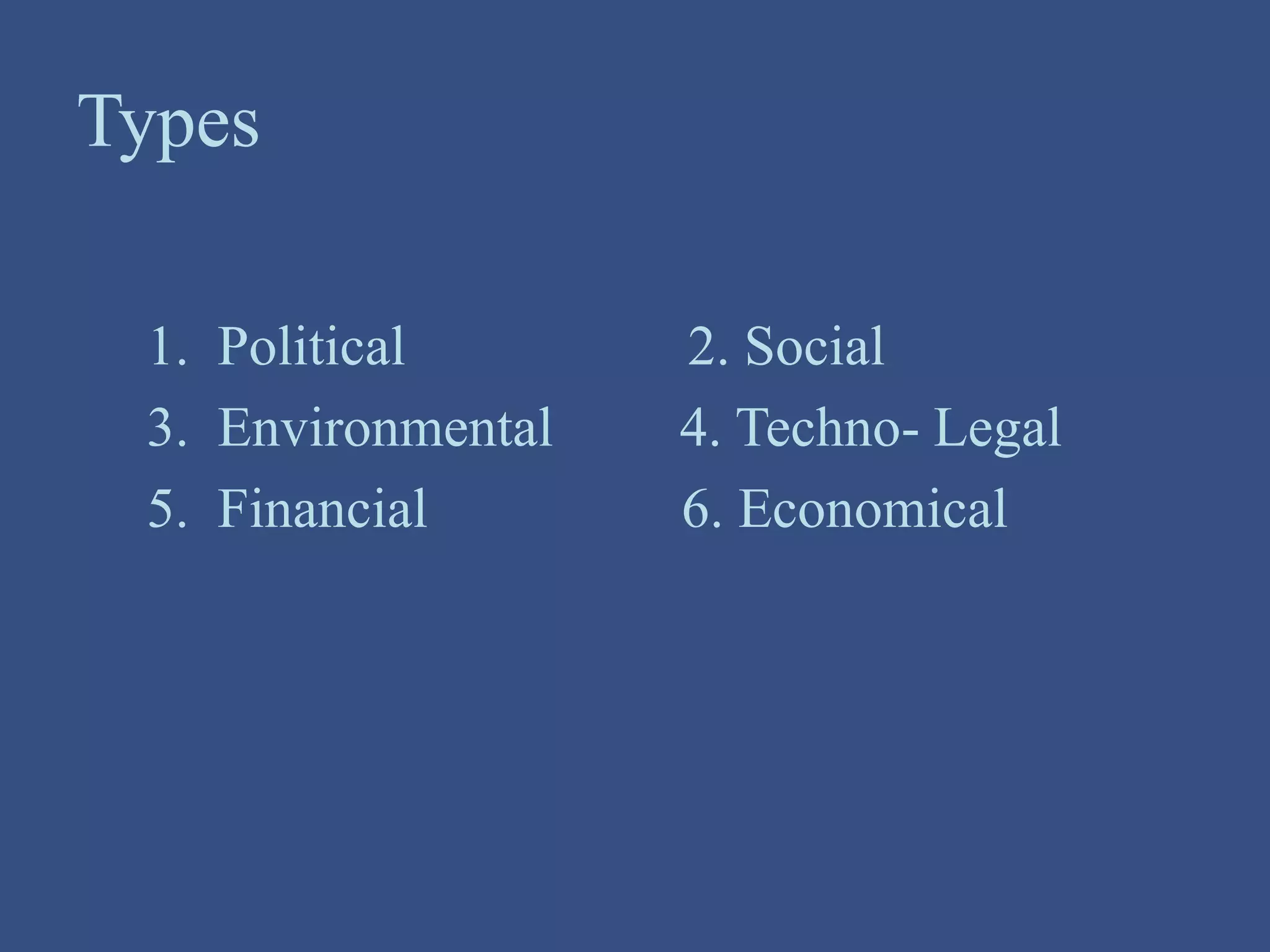
Types
1. Political 2. Social
3. Environmental 4. Techno- Legal
5. Financial 6. Economical
1. Political
 It is concerned with appraising the govt.
policies both at the central and state levels.
 In this appraisal , an organization considers
following related with a new project:
 Political stability
 Industrial Policy
 Subsidy
 Taxation Policy
 Financial and Technical Assistance
2. Social
 A social appraisal reviews the project design
and the process of project identification
through implementation and monitoring from
social perspective,
 Particular attention is paid to likely impact of
project on different stakeholders, their
opportunities for participation and the project’s
contribution to poverty reduction.
Social Appraisal Continues…
Stakeholder Analysis & Participation
It reviews:
1. Who comprise the different stake holders?
2. What are their interests?
3. How will they be affected by proposed project?
4. What are project priorities between different
groups?
5. What is their capacity to participate in the
project?
3. Environmental
 It is supposed to provide the project analyst
with a good qualification of the biophysical &
social impacts from developments.
It generally refers to broader system of
environmental analysis, including project-
specific Environmental Impact Assessment
(EIA).
4.Techno- Legal
 It implies to mean the adequacy of proposed
plant and equipment to produce the product
within the prescribed norms.
 As regards know- how , it denotes the availability
or otherwise of a fund of knowledge to run the
proposed plants and machinery.
While assessing the technical feasibility of the
project, the following inputs covered in the
project should also be taken into consideration:
Techno- Legal App Continues…
o Availability of Land & Site,
o Availability of water , power, transport,
communication facilities,
o Availability of serving facilities like machine
shops, electric repair shop, etc.
o Availability of work force as per required skill &
arrangements proposed for training in plant and
outside,
o Availability of raw material as per quantity &
quality.
5. Financial
 Finance is one of the most important pre-
requisites to establish an enterprise.
It is finance only that facilitates an
entrepreneur to bring together the labour of
one, machine of another & raw material of yet
another to combine them to produce goods.
Financial Appraisal Continues…
 In order to adjudge the financial viability of
project, some of the aspects need to analyzed
are:
i. Assessment of the financial requirements,
ii. Assessing the fixed capital requirements,
iii. Assessment of Working Capital,
iv. Break Even Analysis.
6. Economic
Under Economic Appraisal, the project aspects
highlighted include requirements for raw
material, level of capacity utilization, anticipated
sales, anticipated expenses and the probable
profits.
 It must be calculated how much sales would be
necessary to earn the targeted profit.
The govt. offers specific incentives & concessions
for setting up industries in notified backward
areas.
Thank
You

Project appraisal part 1

  • 1.
    PROJECT APPRAISAL By, Prof. D.C. Dharwad Asst. Prof., Civil Engg. Dept. Sanjivani College of Engg. Kopargaon
  • 2.
  • 3.
    Definitions  Appraisal isthe analysis of a proposed project to determine its merit and acceptability in accordance with established criteria.  It is a pre investment analysis of a project with a view to determine the overall feasibility and measures its investment worth which provides a comprehensive assessment of all aspects of project that lays the foundation for implementation and evaluation after completion.
  • 4.
    Defn. continues…  ProjectAppraisal is a tool which is also used by companies to review the project completed by it.  Project Appraisal is the structured process of assessing the viability of a project or proposal.
  • 5.
    Objectives  To assessa project in terms of its economic, social, and financial viability  To decide to accept or reject a project To extract relevant information for determining the success or failure of project To determine the expected costs & benefits of the project To arrive at specific conclusions about project.
  • 6.
    Advantages  It helpsan organization in identifying the right project to execute by analyzing, whether it is viable in a given situation and place  It helps an organization taking a firm decision on acceptance of project It scans the political, social, and legal conditions surrounding the project to ascertain its future success
  • 7.
    Adv. continues  Italso looks at govt. policies and taxation rules towards specific rules.  It helps an organization to know the technical capability required by the organization for the successful execution of the project.  It helps an organization in knowing its financial aspects in terms of the investment required and the rates of returns expected.
  • 8.
    Types 1. Political 2.Social 3. Environmental 4. Techno- Legal 5. Financial 6. Economical
  • 9.
    1. Political  Itis concerned with appraising the govt. policies both at the central and state levels.  In this appraisal , an organization considers following related with a new project:  Political stability  Industrial Policy  Subsidy  Taxation Policy  Financial and Technical Assistance
  • 10.
    2. Social  Asocial appraisal reviews the project design and the process of project identification through implementation and monitoring from social perspective,  Particular attention is paid to likely impact of project on different stakeholders, their opportunities for participation and the project’s contribution to poverty reduction.
  • 11.
    Social Appraisal Continues… StakeholderAnalysis & Participation It reviews: 1. Who comprise the different stake holders? 2. What are their interests? 3. How will they be affected by proposed project? 4. What are project priorities between different groups? 5. What is their capacity to participate in the project?
  • 12.
    3. Environmental  Itis supposed to provide the project analyst with a good qualification of the biophysical & social impacts from developments. It generally refers to broader system of environmental analysis, including project- specific Environmental Impact Assessment (EIA).
  • 13.
    4.Techno- Legal  Itimplies to mean the adequacy of proposed plant and equipment to produce the product within the prescribed norms.  As regards know- how , it denotes the availability or otherwise of a fund of knowledge to run the proposed plants and machinery. While assessing the technical feasibility of the project, the following inputs covered in the project should also be taken into consideration:
  • 14.
    Techno- Legal AppContinues… o Availability of Land & Site, o Availability of water , power, transport, communication facilities, o Availability of serving facilities like machine shops, electric repair shop, etc. o Availability of work force as per required skill & arrangements proposed for training in plant and outside, o Availability of raw material as per quantity & quality.
  • 15.
    5. Financial  Financeis one of the most important pre- requisites to establish an enterprise. It is finance only that facilitates an entrepreneur to bring together the labour of one, machine of another & raw material of yet another to combine them to produce goods.
  • 16.
    Financial Appraisal Continues… In order to adjudge the financial viability of project, some of the aspects need to analyzed are: i. Assessment of the financial requirements, ii. Assessing the fixed capital requirements, iii. Assessment of Working Capital, iv. Break Even Analysis.
  • 17.
    6. Economic Under EconomicAppraisal, the project aspects highlighted include requirements for raw material, level of capacity utilization, anticipated sales, anticipated expenses and the probable profits.  It must be calculated how much sales would be necessary to earn the targeted profit. The govt. offers specific incentives & concessions for setting up industries in notified backward areas.
  • 18.