Republic of the Philippines
Department of Education
REGION VII – CENTRAL VISAYAS
SCHOOLS DIVISION OF MANDAUE CITY
GENERAL
MATHEMATICS
Self Learning Kit
ROBERT P. ROM, Ma.Ed.
i
This learning resource was collaboratively developed and
reviewed by educators from public schools. We encourage teachers
and other education stakeholders to email their feedback,
comments and recommendations to the Department of Education
Mandaue City Division at mandaue.city001@deped.gov.ph.
We value your feedback and recommendation.
Table of Contents
Most Essential Learning Competencies…………………………………………………………………………………iv
Module 1: Functions……………………………………………………………………………………………………………..1
1. Representing Functions………………………………………………………………………………………………2
2. Evaluating Functions…………………………………………………………………………………………………..3
3. Four Operations and Composition of Function……………………………………………………………7
4. Problem Solving Involving Functions…………………………………………………………………………..8
Module 2: Rational Function, Equation and Inequality…………………………………………………………11
1. Representing Rational Functions………………………………………………………………………………12
2. Rational Function, Rational Equation and Rational Inequality……………………………………13
3. Solving Rational Equations and Inequalities………………………………………………………………14
4. Table of values, Graph, and Equation of Rational Function……………………………………….16
5. Domain and Range of a Rational Function…………………………………………………………………16
6. Intercepts, Zeroes and Asymptotes of Rational Functions…………………………………………16
7. Problem Solving Involving Rational Functions, Equations and Inequalities………………..20
Module 3: One-to-one Function and Inverse Function………………………………………………………..24
1. Representing One-to-one Functions…………………………………………………………………………25
2. Inverse of a One-to-one Function……………………………………………………………………………..26
3. Table of values and Graph of Inverse Function………………………………………………………….28
4. Domain and Range of an Inverse Function………………………………………………………………..28
5. Problem Solving involving inverse Function………………………………………………………………31
Module 4: Exponential Function………………………………………………………………………………………….34
1. Representing Exponential Function…………………………………………………………………………..35
2. Exponential Function, Exponential Equation, and Exponential Inequality………………….36
3. Solving Exponential Equations and Inequalities………………………………………………………..37
4. Table of values, Graph and Equation of Exponential Function…………………………………..39
5. Domain and Range of Exponential Function……………………………………………………………..39
6. Intercepts, Zeroes and Asymptotes of an Exponential Function………………………………..39
7. Problem Solving involving Exponential Functions, Equations and Inequalities…………..43
Module 5: Logarithmic Function………………………………………………………………………………………….47
1. Representing Logarithmic Function…………………………………………………………………………..49
2. Logarithmic Function, Logarithmic Equation, and Logarithmic Inequality………………….49
3. Solving Logarithmic Equations and Inequalities………………………………………………………..50
4. Table of values, Graph and Equation of Logarithmic Function…………………………………..53
5. Domain and Range of Logarithmic Function……………………………………………………………..53
6. Intercepts, Zeroes and Asymptotes of Logarithmic Function…………………………………….53
7. Problem Solving involving Logarithmic Functions, Equations and Inequalities…………..57
Module 6: Simple and Compound Interests…………………………………………………………………………61
1. Illustrating Simple and Compound Interest……………………………………………………………….62
2. Simple Interest vs. Compound Interest…………………………………………………………………….63
3. Computing interest, maturity value, future value and present value
in Simple Interest and Compound Interest Environment…………………………………………..64
4. Problem Solving involving Simple and Compound Interest……………………………………….67
ii
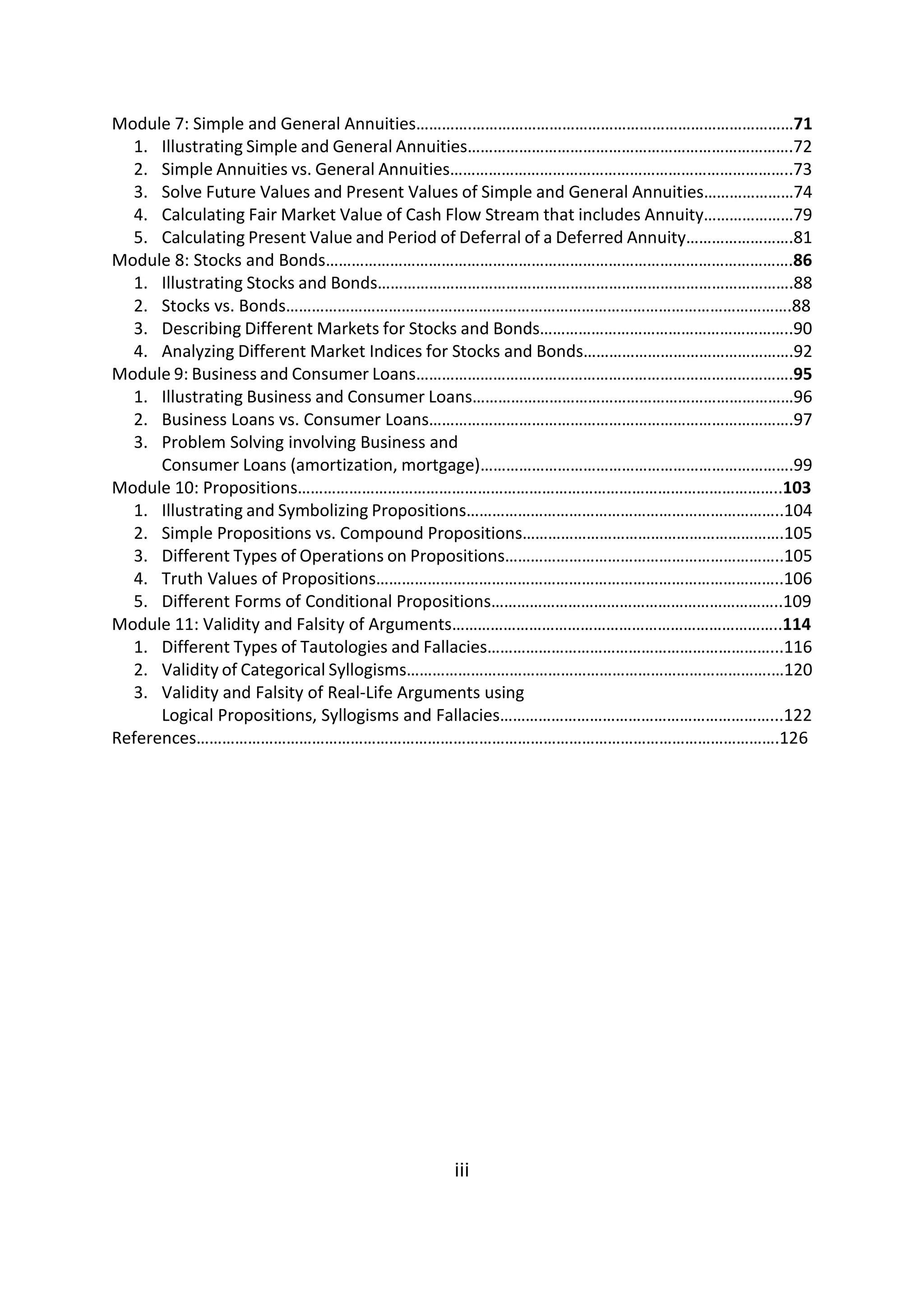
Module 7: Simple and General Annuities………….…………………………………………………………………71
1. Illustrating Simple and General Annuities………………………………………………………………….72
2. Simple Annuities vs. General Annuities……………………………………………………………………..73
3. Solve Future Values and Present Values of Simple and General Annuities…………………74
4. Calculating Fair Market Value of Cash Flow Stream that includes Annuity…………………79
5. Calculating Present Value and Period of Deferral of a Deferred Annuity…………………….81
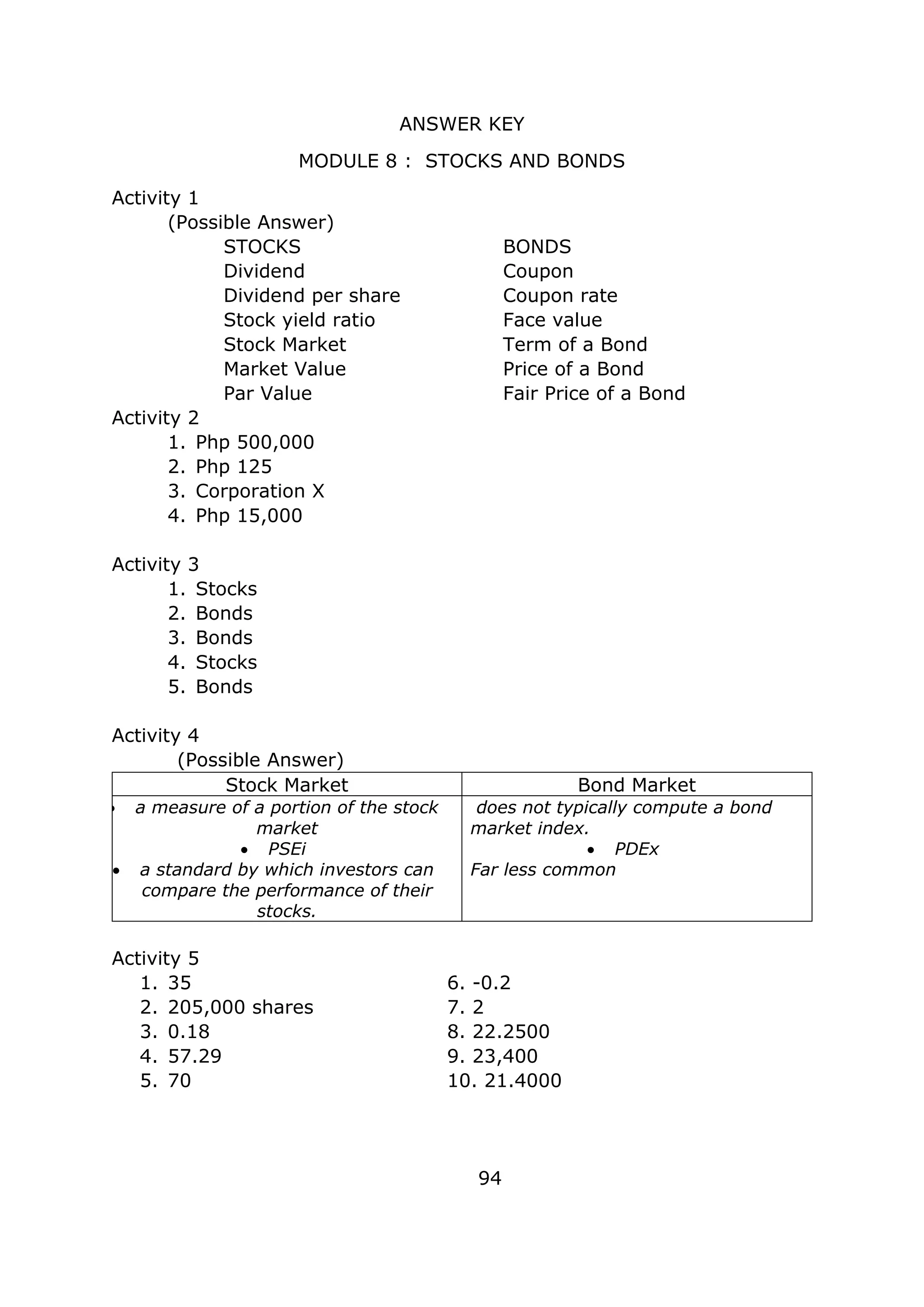
Module 8: Stocks and Bonds……………………………………………………………………………………………….86
1. Illustrating Stocks and Bonds…………………………………………………………………………………….88
2. Stocks vs. Bonds……………………………………………………………………………………………………….88
3. Describing Different Markets for Stocks and Bonds…………………………………………………..90
4. Analyzing Different Market Indices for Stocks and Bonds………………………………………….92
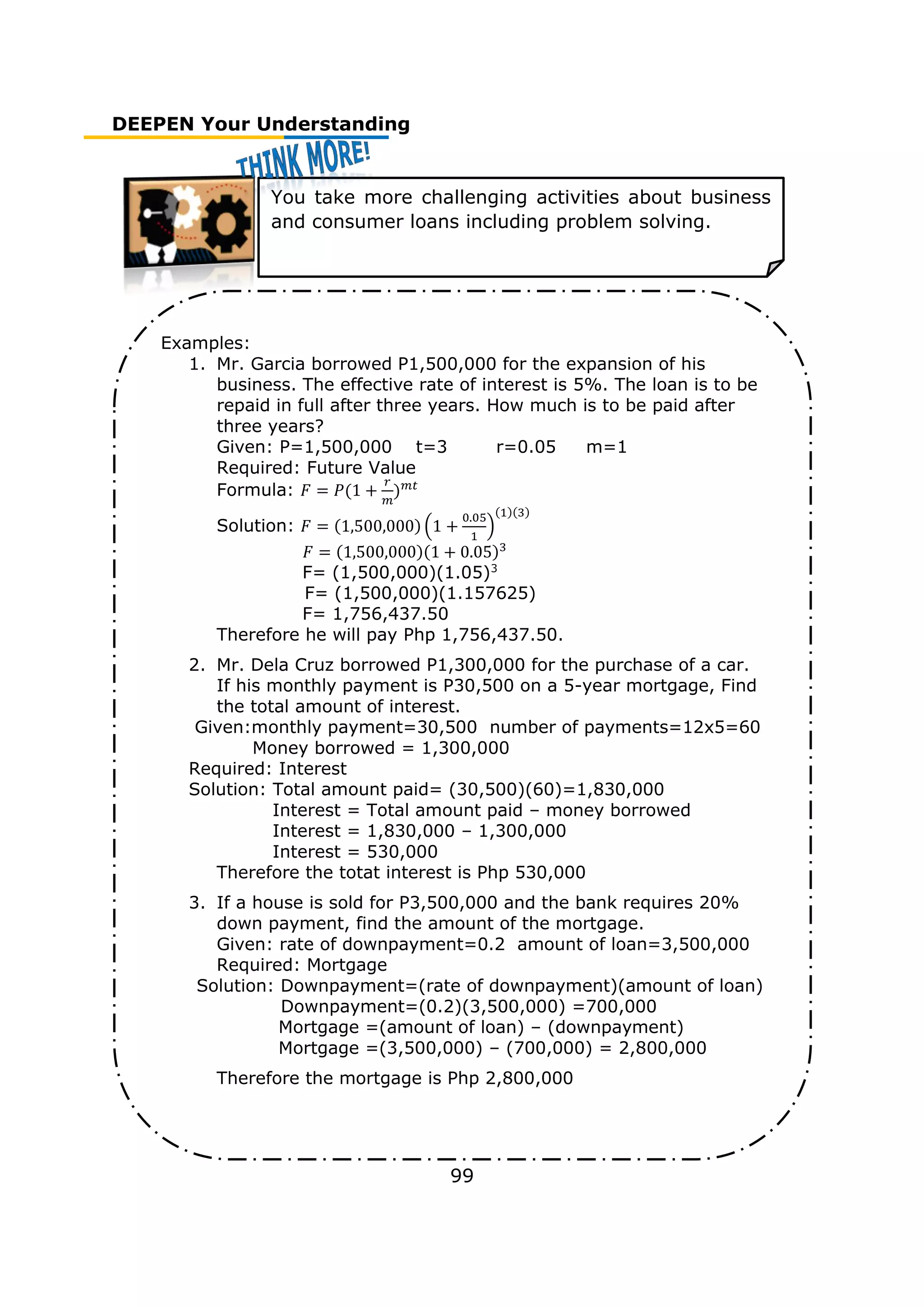
Module 9: Business and Consumer Loans…………………………………………………………………………….95
1. Illustrating Business and Consumer Loans…………………………………………………………………96
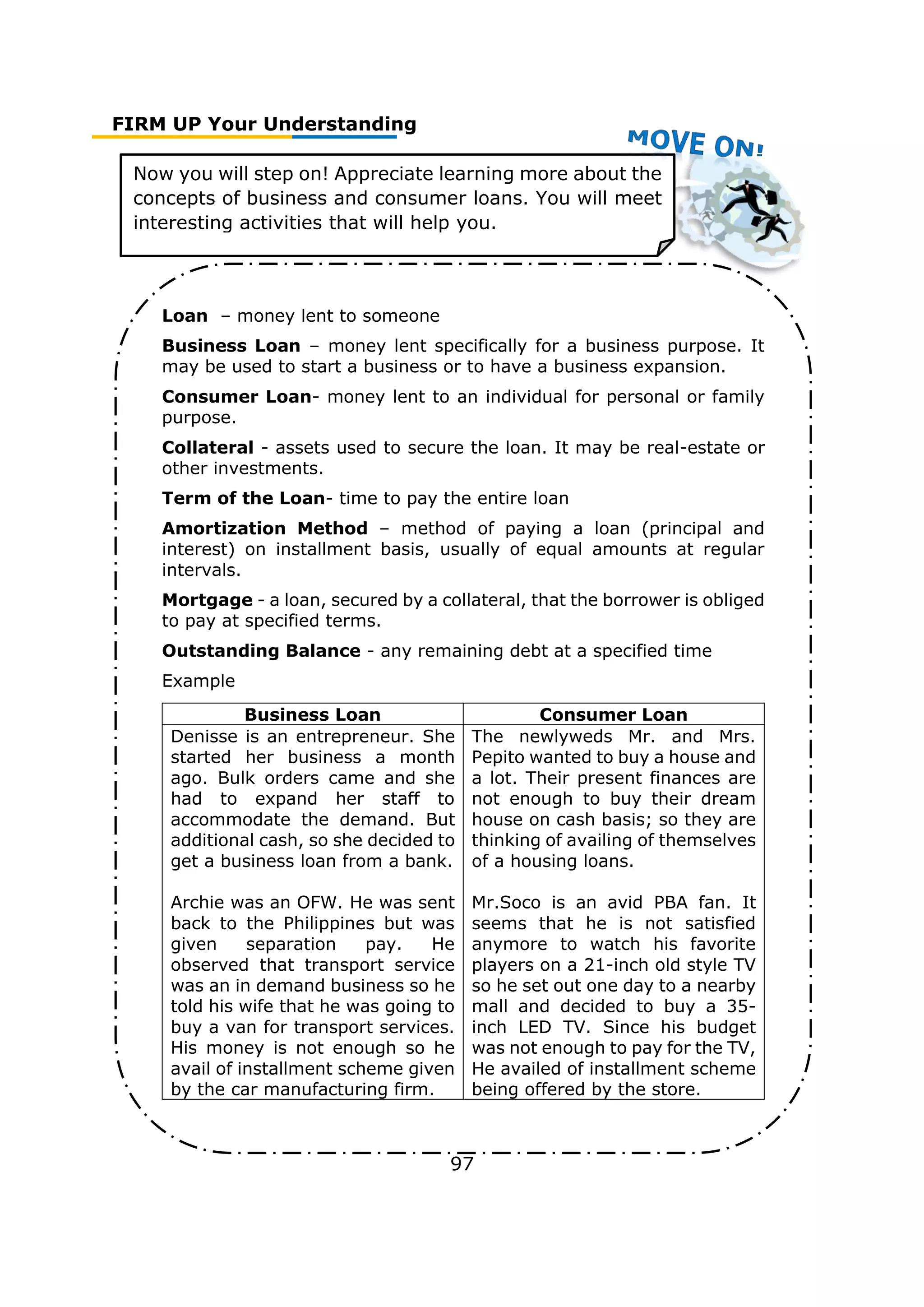
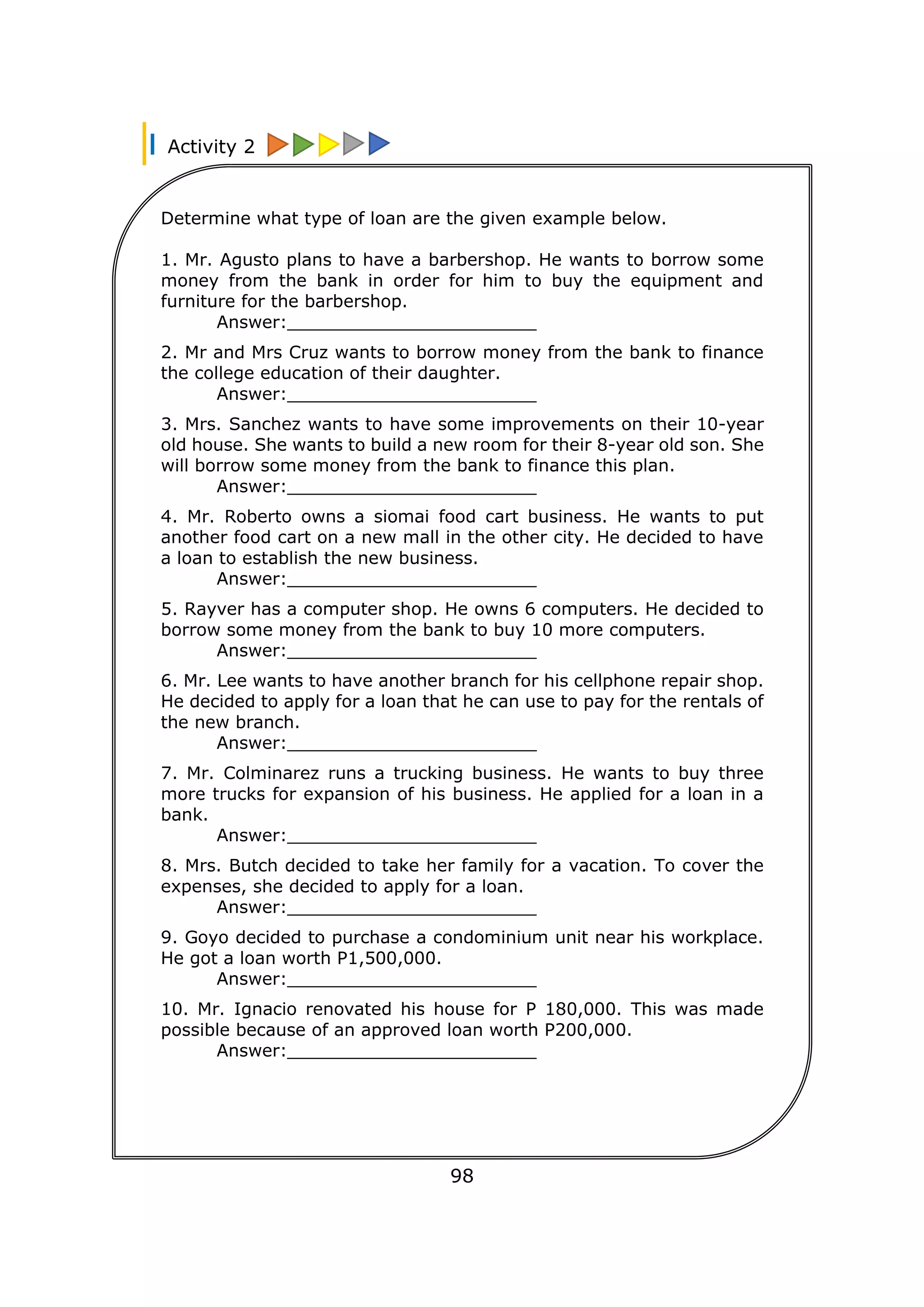
2. Business Loans vs. Consumer Loans………………………………………………………………………….97
3. Problem Solving involving Business and
Consumer Loans (amortization, mortgage)……………………………………………………………….99
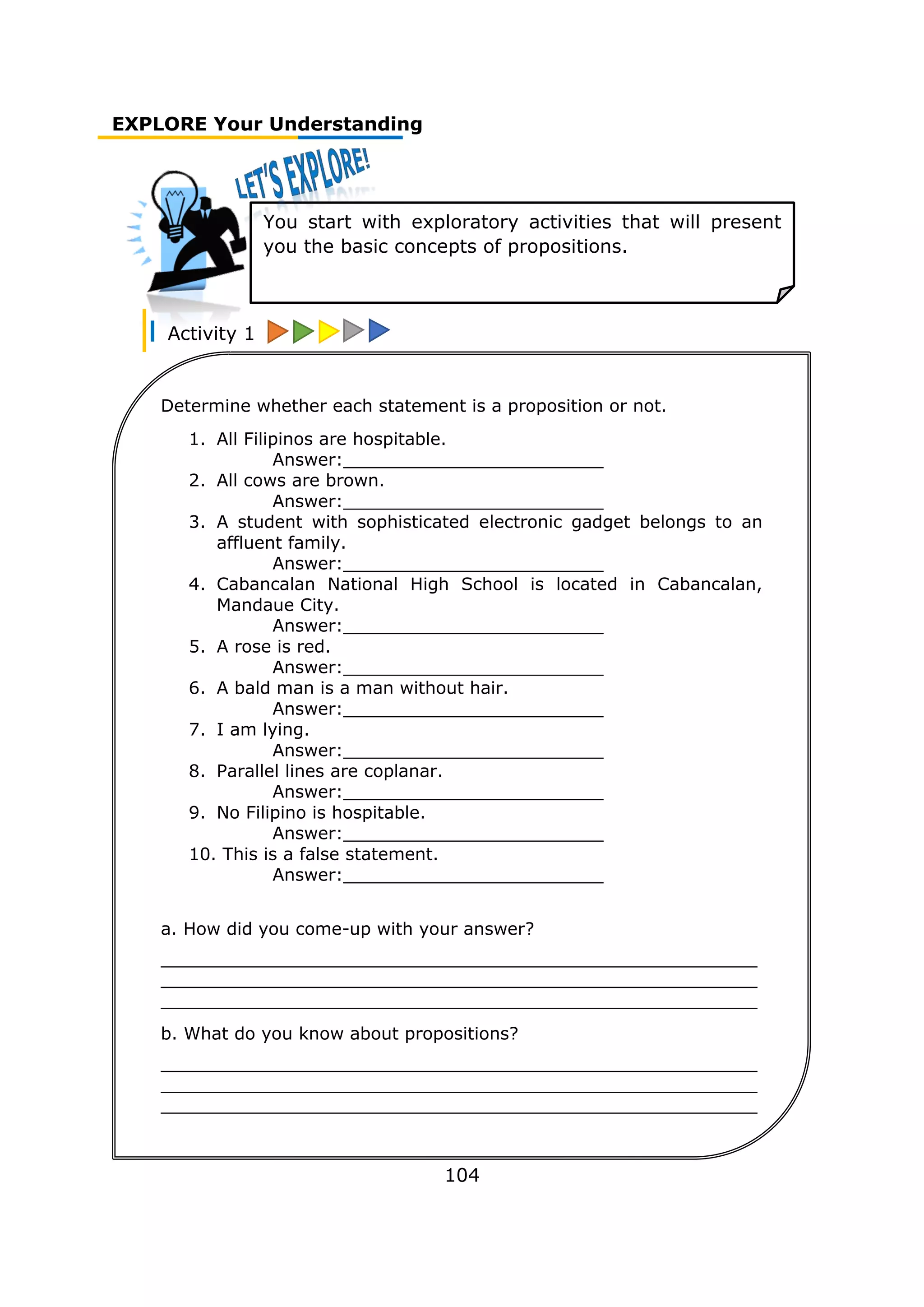
Module 10: Propositions…………………………………………………………………………………………………..103
1. Illustrating and Symbolizing Propositions………………………………………………………………..104
2. Simple Propositions vs. Compound Propositions…………………………………………………….105
3. Different Types of Operations on Propositions………………………………………………………..105
4. Truth Values of Propositions…………………………………………………………………………………..106
5. Different Forms of Conditional Propositions…………………………………………………………..109
Module 11: Validity and Falsity of Arguments…………………………………………………………………..114
1. Different Types of Tautologies and Fallacies…………………………………………………………...116
2. Validity of Categorical Syllogisms………………………………………………………………………….…120
3. Validity and Falsity of Real-Life Arguments using
Logical Propositions, Syllogisms and Fallacies………………………………………………………...122
References……………………………………………………………………………………………………………………….126
iii
General Mathematics
Most Essential
Learning
Competencies
iv
Grade Level: Grade 11
Subject: General Mathematics
Quarter Content
Standard
The learner
demonstrates
understanding
of
Performance
Standard
The learner is
able to
Most Essential Learning
Competencies
The learner
Duration K to 12 CG
Code
1st
Quarter
key concept
of functions
accurately
construct
mathematical
models to
represent
real-life
situations
using
functions
Represents real-life
situations using functions,
including piece-wise
functions
Week 1 M11GM-
Ia-1
Evaluate a function M11GM-
Ia-2
Perform addition, subtraction,
multiplication, division and
composition of functions
M11GM-
Ia-3
Solve problems involving
functions
M11GM-
Ia-4
key concepts
of rational
functions
accurately
formulate and
solve real-life
problems
involving
rational
functions
Represents real-life situation
using rational functions
Week 2 M11GM-
Ib-1
Distinguishes rational
function, rational equation,
and rational inequality
M11GM-
Ib-2
Solves rational equations and
inequalities
M11GM-
Ib-3
Represents a rational function
through its: (a) table of values,
(b) graph, and (c) equation
M11GM-
Ib-4
Finds the domain and range of
a rational function
M11GM-
Ib-5
Determines the : (a)
intercepts; (b) zeroes; (c)
asymptotes of rational
functions
Week 3 M11GM-
Ic-1
Solves problems involving
rational functions, equations,
and inequalities
M11GM-
Ic-3
key concepts
of inverse
functions,
exponential
functions,
and
logarithmic
functions
apply the
concepts of
inverse
functions,
exponential
functions, and
logarithmic
functions to
formulate and
solve real-life
problems with
precision and
accuracy
Represents real-life situations
using one-to-one functions
Week 4 M11GM-
Id-1
Determines the inverse of a
one-to-one function
M11GM-
Id-2
Represents an inverse
function through its: (a) table
of values , and (b) graph
M11GM-
Id-3
Finds the domain and range of
an inverse function
M11GM-
Id-4
Solves problems involving
inverse function
Week 5 M11GM-
Ie-2
Represents real-life situations
using exponential function
M11GM-
Ie-3
v
Distinguishes between
exponential function,
exponential equation, and
exponential inequality
M11GM-
Ie-4
Solves exponential equations
and inequalities
Week 6 M11GM-Ie-
f-1
Represents an exponential
function through its: (a) table
of values, (b) graph, and (c)
equation
M11GM-
If-2
Finds the domain and range of
an exponential function
M11GM-
If-3
Determines the intercepts,
zeroes, and asymptotes of an
exponential function
M11GM-
If-4
Solves problems involving
exponential functions,
equations and inequalities
Week 7 M11GM-
Ig-2
Represents real-life
situations using logarithmic
functions
Week 8 M11GM-
Ih-1
Distinguishes logarithmic
function, logarithmic equation
and logarithmic inequality
M11GM-
Ih-2
Solves logarithmic equations
and inequalities
M11GM-Ih-
i-1
Represents a logarithmic
function through its: (a) table
of values, (b) graph and (c)
equation
Week 9 M11GM-
Ii-2
Finds domain and range of a
logarithmic function
M11GM-
Ii-3
Determines the intercepts,
zeroes, and asymptotes of
logarithmic functions
M11GM-
Ii-4
Solves problems involving
logarithmic functions,
equations and inequalities
Week 10 M11GM-
Ij-2
2nd
Quarter
Key concepts
of simple and
compound
interests, and
simple and
general
annuities
investigate,
analyze and
solve
problems
involving
simple and
compound
interests and
simple and
general
annuities
using
Illustrates simple and
compound interest
Week 1
to 2
M11GM-
IIa-1
Distinguishes between simple
and compound interests
M11GM-
IIa-2
Computes interest, maturity
value, future value and
present value in simple
interest and compound
interest environment
M11GM-
IIb-1
Solves problems involving
simple and compound interest
M11GM-
IIb-2
Illustrates simple and general
annuities
Week 3
to 4
M11GM-
IIc-1
vi
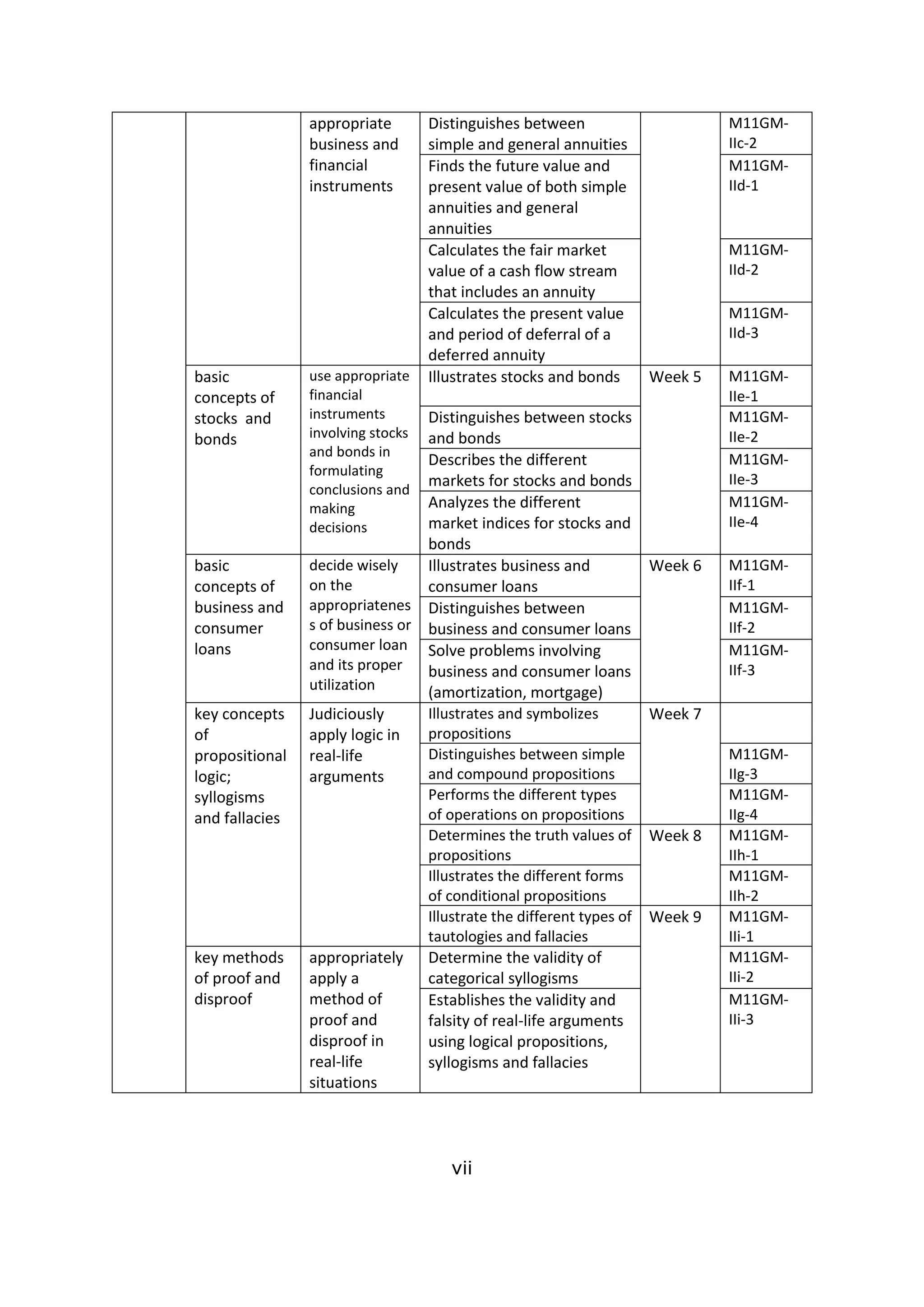
appropriate
business and
financial
instruments
Distinguishes between
simple and general annuities
M11GM-
IIc-2
Finds the future value and
present value of both simple
annuities and general
annuities
M11GM-
IId-1
Calculates the fair market
value of a cash flow stream
that includes an annuity
M11GM-
IId-2
Calculates the present value
and period of deferral of a
deferred annuity
M11GM-
IId-3
basic
concepts of
stocks and
bonds
use appropriate
financial
instruments
involving stocks
and bonds in
formulating
conclusions and
making
decisions
Illustrates stocks and bonds Week 5 M11GM-
IIe-1
Distinguishes between stocks
and bonds
M11GM-
IIe-2
Describes the different
markets for stocks and bonds
M11GM-
IIe-3
Analyzes the different
market indices for stocks and
bonds
M11GM-
IIe-4
basic
concepts of
business and
consumer
loans
decide wisely
on the
appropriatenes
s of business or
consumer loan
and its proper
utilization
Illustrates business and
consumer loans
Week 6 M11GM-
IIf-1
Distinguishes between
business and consumer loans
M11GM-
IIf-2
Solve problems involving
business and consumer loans
(amortization, mortgage)
M11GM-
IIf-3
key concepts
of
propositional
logic;
syllogisms
and fallacies
Judiciously
apply logic in
real-life
arguments
Illustrates and symbolizes
propositions
Week 7
Distinguishes between simple
and compound propositions
M11GM-
IIg-3
Performs the different types
of operations on propositions
M11GM-
IIg-4
Determines the truth values of
propositions
Week 8 M11GM-
IIh-1
Illustrates the different forms
of conditional propositions
M11GM-
IIh-2
Illustrate the different types of
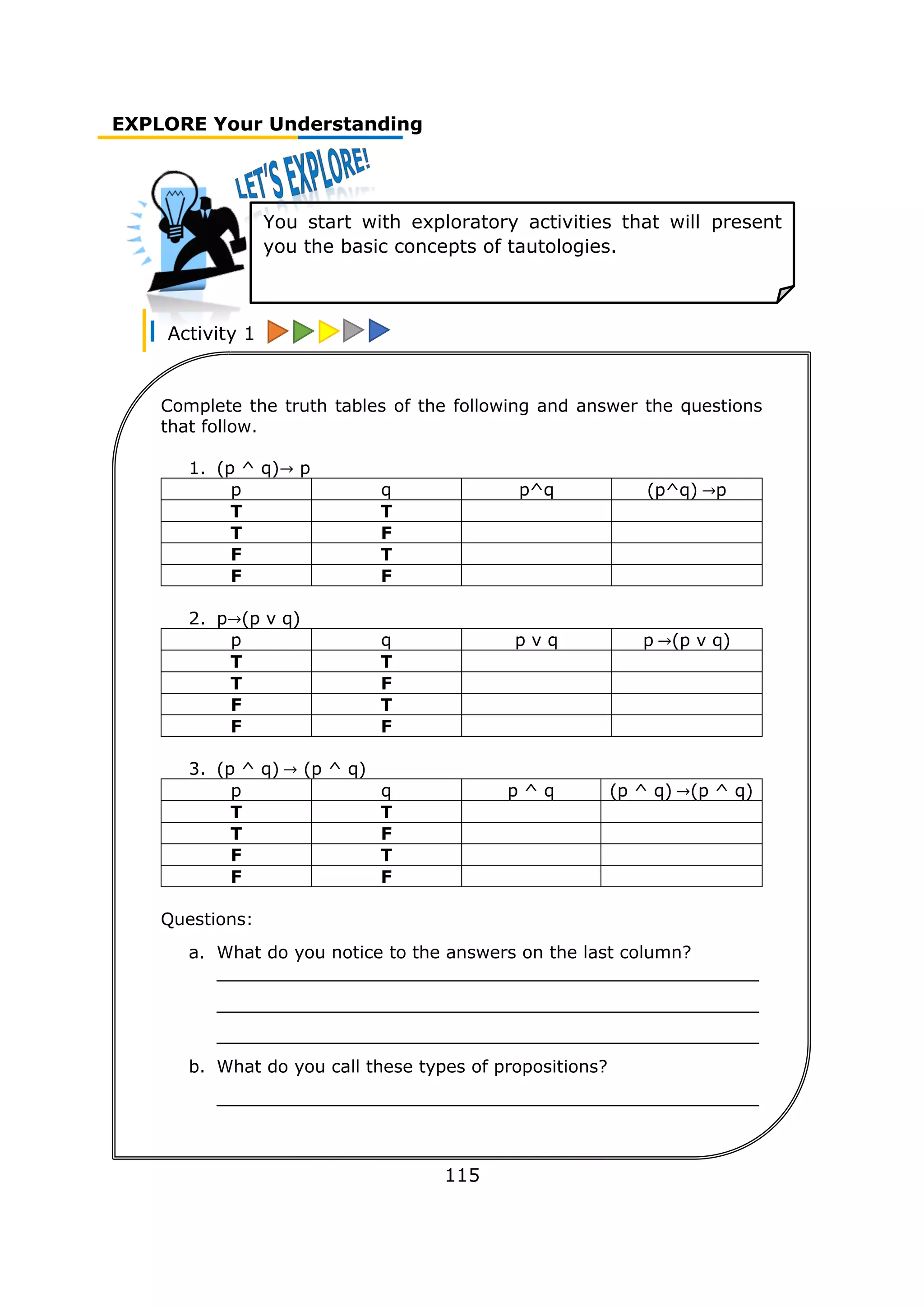
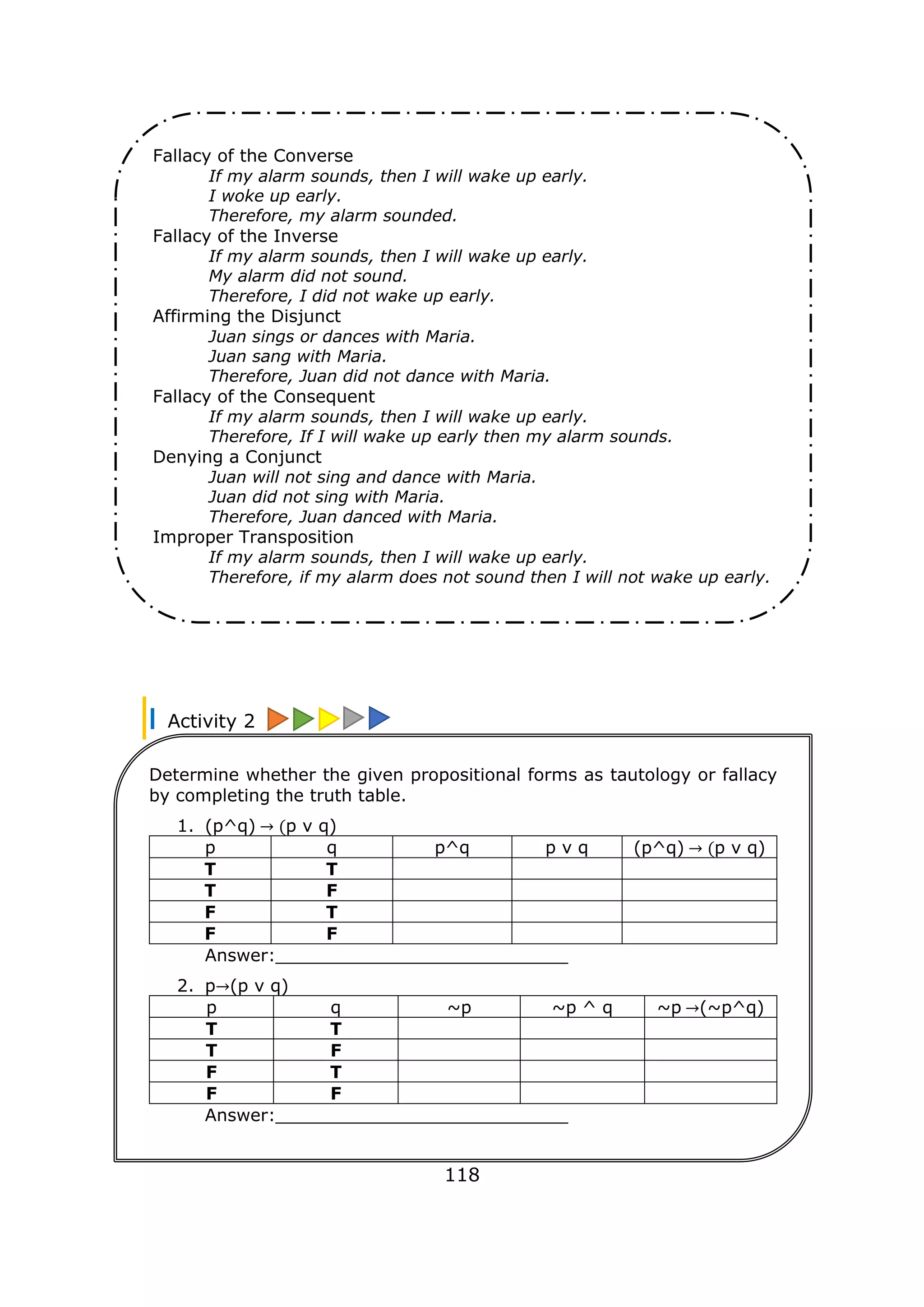
tautologies and fallacies
Week 9 M11GM-
IIi-1
key methods
of proof and
disproof
appropriately
apply a
method of
proof and
disproof in
real-life
situations
Determine the validity of
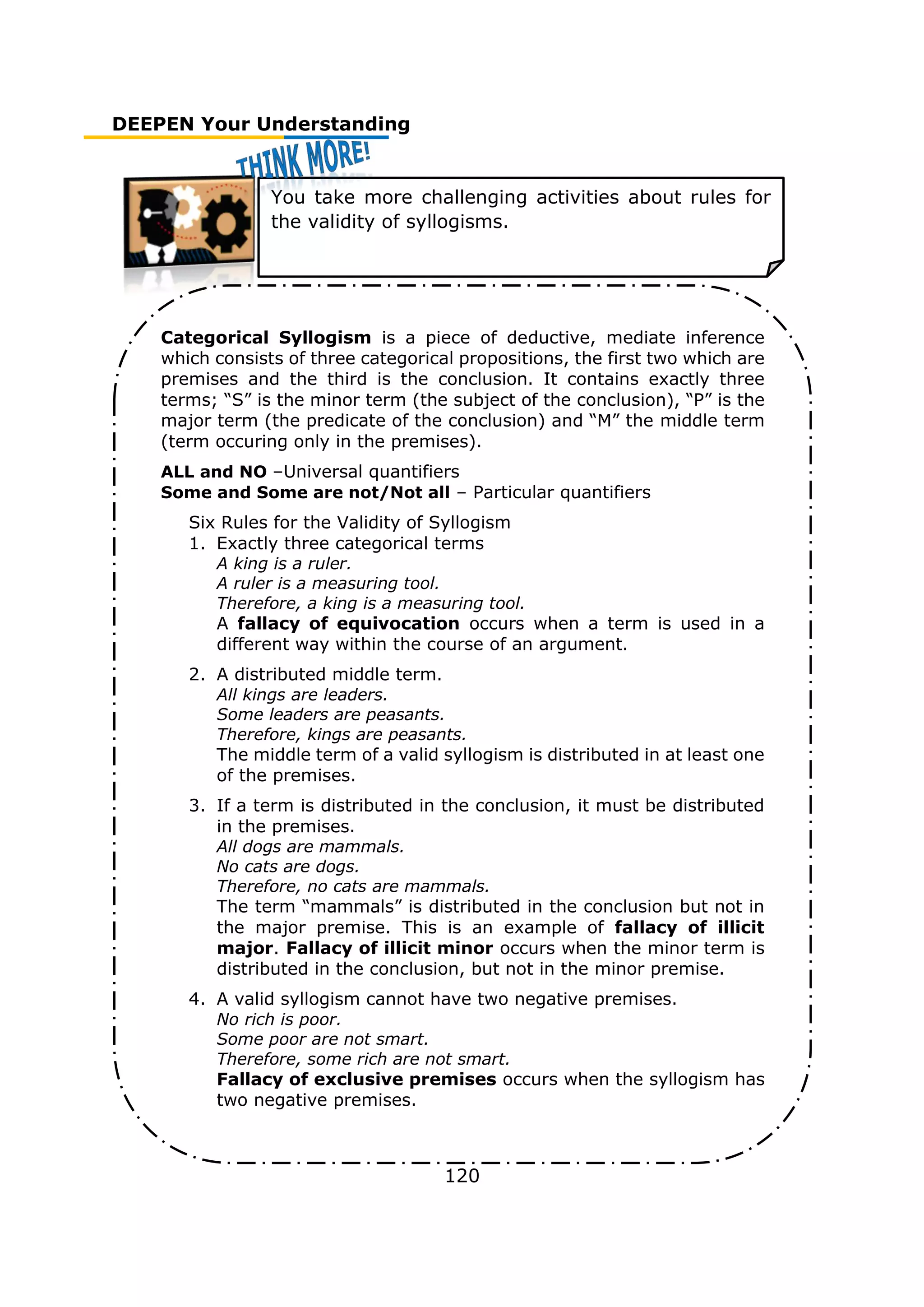
categorical syllogisms
M11GM-
IIi-2
Establishes the validity and
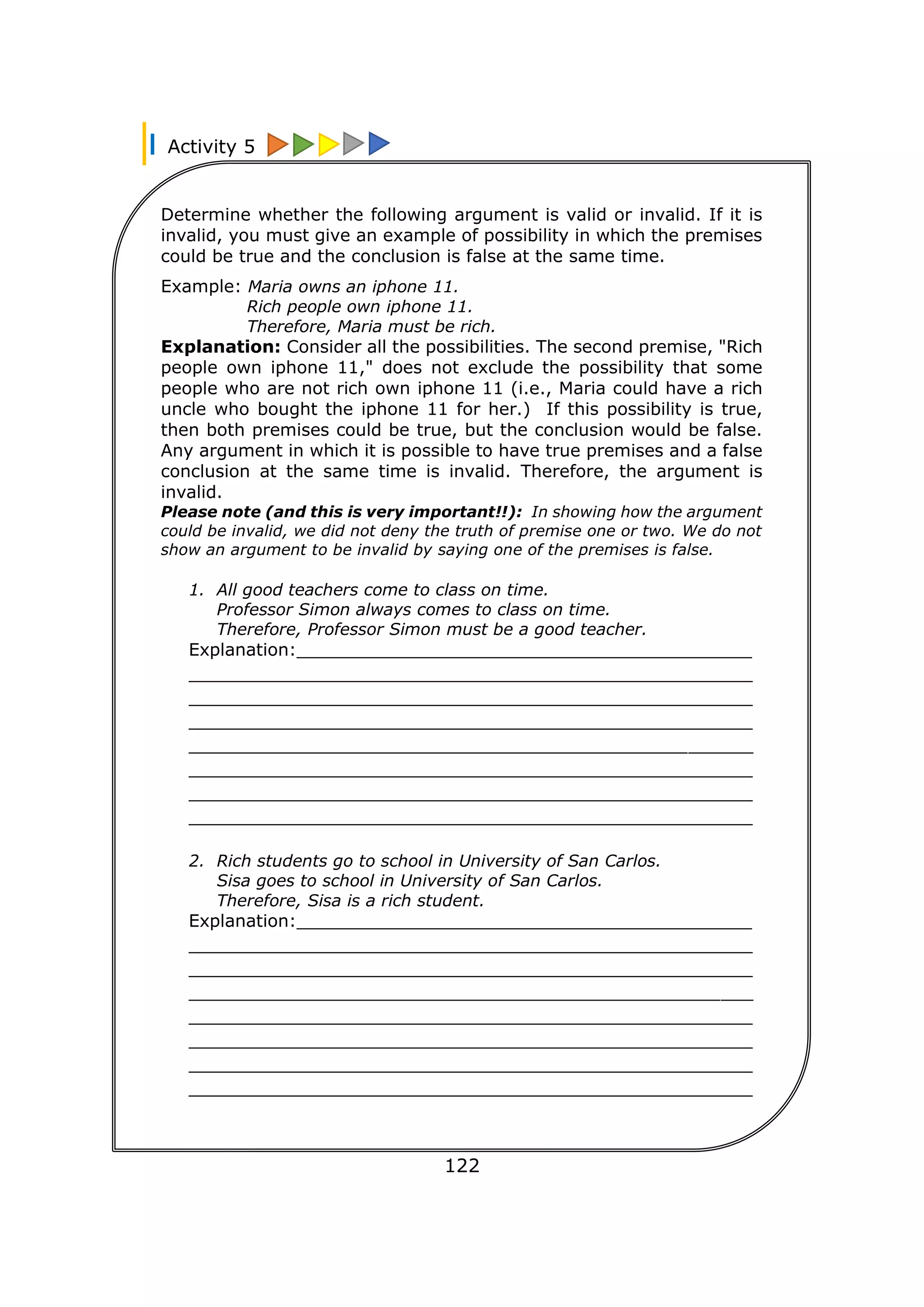
falsity of real-life arguments
using logical propositions,
syllogisms and fallacies
M11GM-
IIi-3
vii
A. Learning Outcome
Content Standard
The learner demonstrates understanding of key concepts of
functions.
Performance Standard
The learner is able to accurately construct mathematical
models to represent real-life situations using functions.
Learning Competencies
Essential Understanding
Learners will understand that the concepts of functions have
wide applications in real life and are useful tools to develop
critical thinking and problem solving skills.
Essential Question
How does the concepts on function facilitate in finding
solutions to real-life problems and develop critical thinking
skills?
1
MODULE 1
Functions
After using this module, you are expected to:
1. represent real-life situations using functions, including piece-
wise functions.
2. evaluate a function.
3. perform addition, subtraction, multiplication, division, and
composition of functions.
4. solve problems involving functions.
EXPLORE Your Understanding
Activity 1
2
You start with exploratory activities that will present you
the basic concepts of the functions and evaluate functions.
Given the following models, identify the kind of function being shown
on each item by choosing from the list in the box.
1) f(x) =
𝑥+1
2𝑥−1
Answer:___________________
Reason:___________________
2) g(x) = x2
Answer:___________________
Reason:___________________
3) h(x) = 𝑙𝑜𝑔3 2𝑥 Answer:___________________
Reason:___________________
4) {(1,2), (2,4),(3,9)} Answer:___________________
Reason:___________________
5) Answer:___________________
Reason:___________________
6) f(x) = 2x
Answer:___________________
Reason:___________________
7) Answer:___________________
Reason:___________________
8){
8 , 1 < 𝑥 ≤ 5
8 + 𝑥, 𝑥 > 5
Answer:___________________
Reason:__________________
Linear function Quadratic function Rational Function
Exponential Piecewise Function One-to-One
Many-to-One Logarithmic
Activity 2
3
Evaluate the following functions.
Example:
f(x) = x2
+ 2x – 1; if x= 2
solution: if x=2 means substitute x in f(x) = x2
+ 2x – 1 by 2
f(2) = (2)2
+ 2(2) – 1
f(2) = 4 + 4 -1
f(2) = 7 Answer: ___7__
1) f(x) = x2
– 3x + 5 ; if x = 4
Solution:______________________________
_____________________________________
_____________________________________
_____________________________________Answer:_____
2) f(x) =
𝒙+𝟐
𝟐𝒙−𝟏
, if x = 1
Solution:______________________________
_____________________________________
_____________________________________
_____________________________________Answer:_____
3) f(x) = 2x3
– 8, if x = -3
Solution:______________________________
_____________________________________
_____________________________________
_____________________________________Answer:_____
4) f(x) = 2x
– 2 , if x = 3
Solution:______________________________
_____________________________________
_____________________________________
_____________________________________Answer:_____
FIRM UP Your Understanding
4
Now you will step on! Appreciate learning more about
the concepts of function and conditions required for a
relationship to become a function. You will meet
interesting activities that will help you.
A relationship is a function if:
i. All elements of independent variable (x) has a unique pair
to elements of dependent variable (y).
A function can be presented in different ways like:
1. Ordered pairs {(1,2), (2,4), (3,6), (4,8)}
2. Table of values
X -1 0 1 2 3
Y 7 4 3 4 7
3. Mapping
4. Graph
Vertical line test is used to determine if the graph is a function
or not. If the vertical line touches only one point on the graph,
then it is a function.
5. Equation
y + 2x = 3; y= x2
– 2 ; f(x) = 3x
There are different types of functions like:
1. Polynomial Functions (linear, quadratic cubic)
2. Rational Functions
3. Radical Functions
4. Exponential Functions
5. Logarithmic Functions
6. Trigonometric Functions
7. Piece-wise Functions
and more…
Jomar
Gian
Josh
Athena
Erza
Marie
Activity 3
Activity 4
5
Determine whether the given as function or not a function.
1. {(-1,2), (1,2), (2,3), (4,8)} Answer:_____________
2. {(1,1), (2,3), (1,6), (3, 2)} Answer:_____________
3. x – y + 3 =0 Answer:_____________
4. Answer:_____________
5. x = y2
– 3 Answer:_____________
6. Answer:_____________
Give real-life situations of the following functions.
Examples:
linear function Answer: number of tickets sold
to revenue
piece-wise function Answer: taxifares
1. One to one function Answer:___________________
___________________
2. Linear function Answer:___________________
___________________
3. Quadratic function Answer:___________________
___________________
4. Piece-wise functions Answer:___________________
___________________
5. Many to one function Answer:___________________
___________________
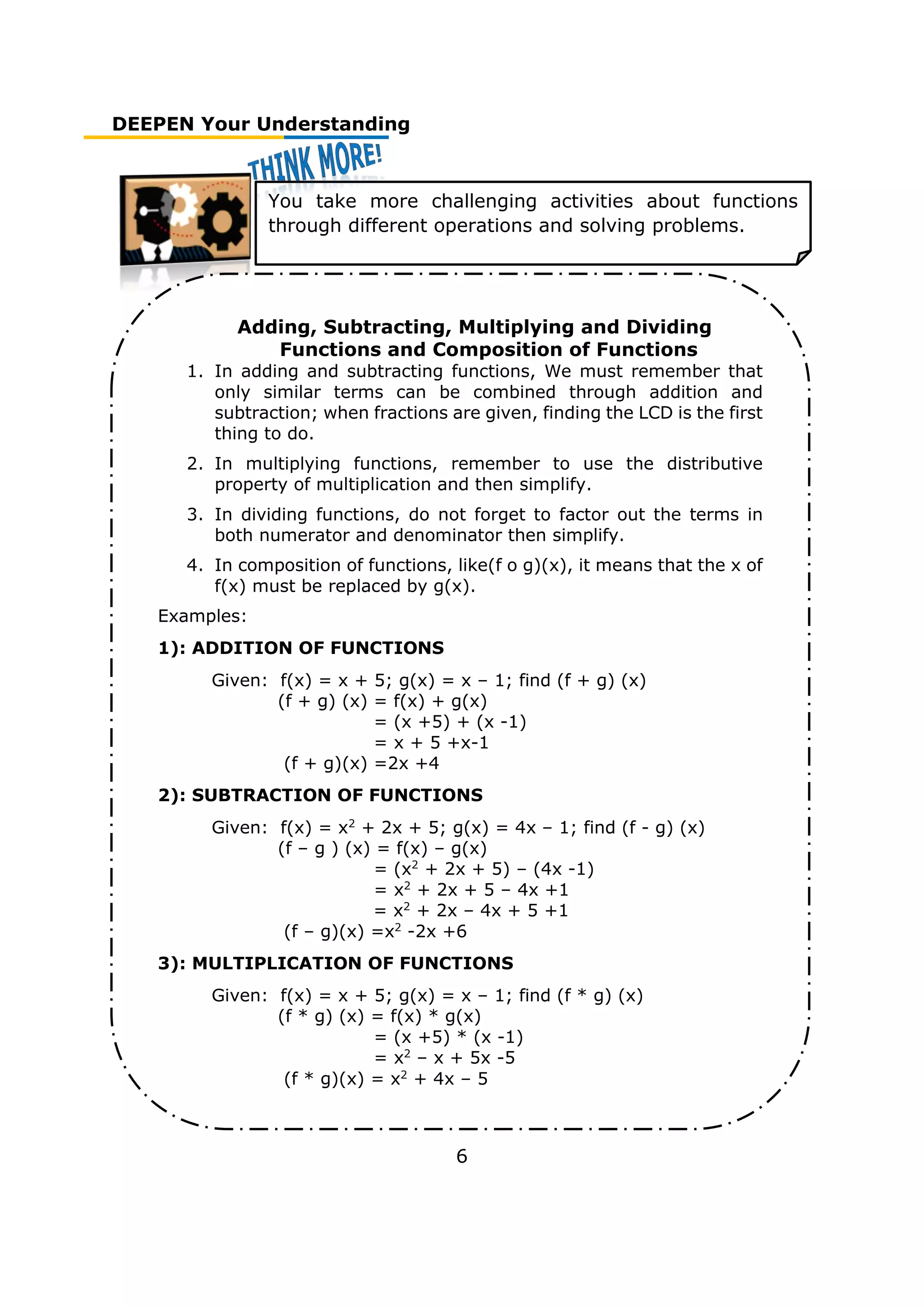
DEEPEN Your Understanding
6
Adding, Subtracting, Multiplying and Dividing
Functions and Composition of Functions
1. In adding and subtracting functions, We must remember that
only similar terms can be combined through addition and
subtraction; when fractions are given, finding the LCD is the first
thing to do.
2. In multiplying functions, remember to use the distributive
property of multiplication and then simplify.
3. In dividing functions, do not forget to factor out the terms in
both numerator and denominator then simplify.
4. In composition of functions, like(f o g)(x), it means that the x of
f(x) must be replaced by g(x).
Examples:
1): ADDITION OF FUNCTIONS
Given: f(x) = x + 5; g(x) = x – 1; find (f + g) (x)
(f + g) (x) = f(x) + g(x)
= (x +5) + (x -1)
= x + 5 +x-1
(f + g)(x) =2x +4
2): SUBTRACTION OF FUNCTIONS
Given: f(x) = x2
+ 2x + 5; g(x) = 4x – 1; find (f - g) (x)
(f – g ) (x) = f(x) – g(x)
= (x2
+ 2x + 5) – (4x -1)
= x2
+ 2x + 5 – 4x +1
= x2
+ 2x – 4x + 5 +1
(f – g)(x) =x2
-2x +6
3): MULTIPLICATION OF FUNCTIONS
Given: f(x) = x + 5; g(x) = x – 1; find (f * g) (x)
(f * g) (x) = f(x) * g(x)
= (x +5) * (x -1)
= x2
– x + 5x -5
(f * g)(x) = x2
+ 4x – 5
You take more challenging activities about functions
through different operations and solving problems.
Activity 5
7
Examples:
4): DIVISION OF FUNCTIONS
Given: f(x) = x2
+ 6x + 5; g(x) = x2
– 1 ; find (f / g) (x)
(f / g) (x) = f(x) / g(x)
= (x2
+ 6x + 5) / (x2
-1)
= [(x+1)(x+5)] / [(x+1)(x-1)]
(f / g)(x) =
𝒙+ 𝟓
𝒙−𝟏
5): COMPOSITION OF FUNCTIONS
Given: f(x) = x2
+ 2x – 3 ; g(x) = x – 1; find (f o g) (x)
(f o g) (x) = f(g(x))
= (x – 1)2
+ 2 (x – 1) – 3
= (x2
– x – x + 1) + (2x – 2) – 3
= x2
– 2x + 2x + 1 – 2 – 3
(f o g)(x) = x2
– 4
Given: f(x) = x2
+ 2x – 3 ; g(x) = x – 1; find (g o f) (x)
(g o f) (x) = g(f(x))
= (x2
+ 2x – 3) – 1
= x2
+ 2x – 3 – 1
(g o f)(x) = x2
+ 2x – 4
Given that f(x) = x2
– 2x – 8 and g(x) = x – 4, do the indicated task.
1. ( f + g ) (x) 5. ( f o g ) (x)
Answer:___________________ Answer:___________________
2. ( f – g ) (x) 6. ( g – f ) (x)
Answer:___________________ Answer:___________________
3. ( g * f ) (x) 7. ( g o f ) (x)
Answer: __________________ Answer:___________________
4. ( f / g ) (x) 8. (g / f ) (x)
Answer:__________________ Answer:___________________
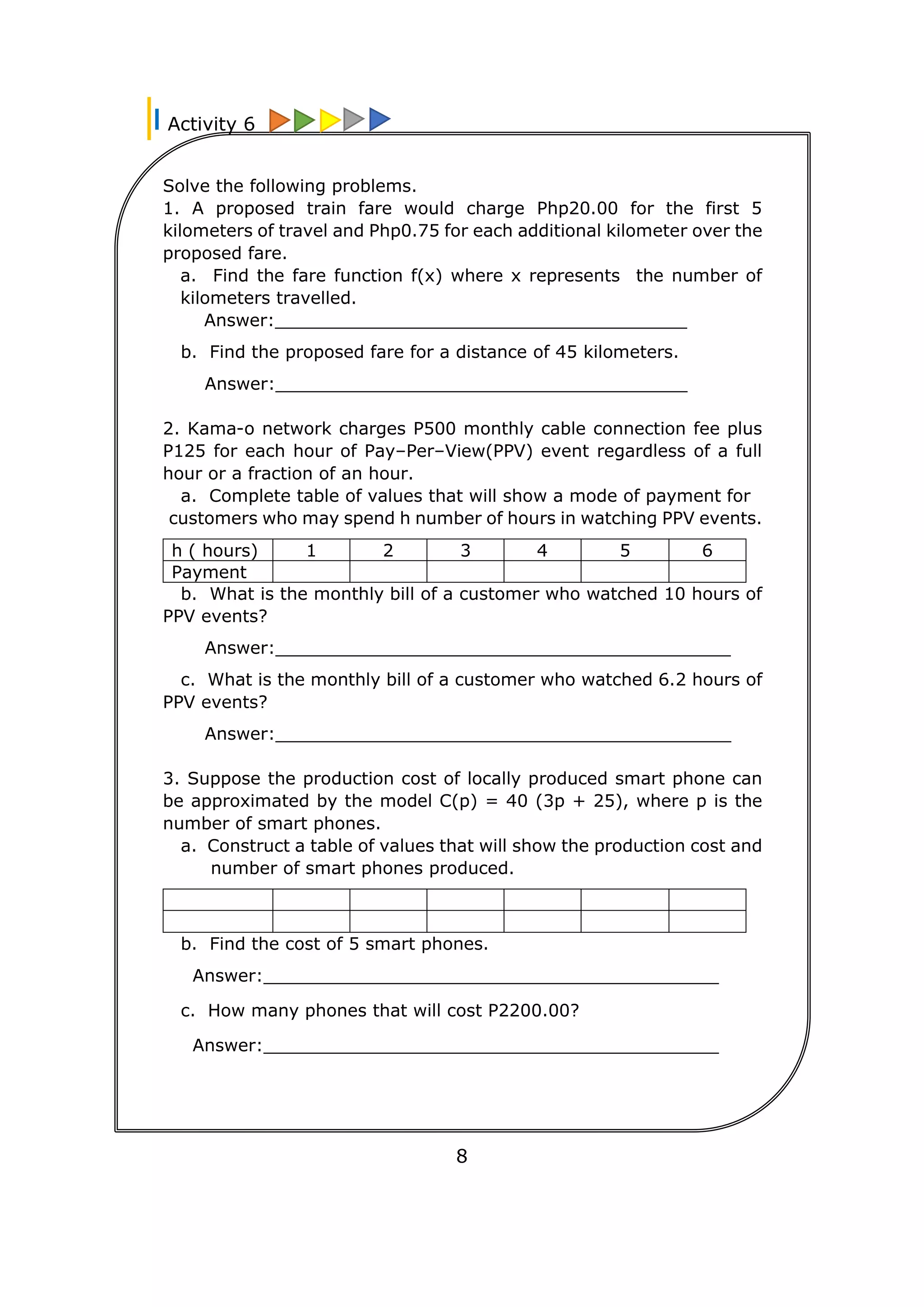
Solve the following problems.
1. A proposed train fare would charge Php20.00 for the first 5
kilometers of travel and Php0.75 for each additional kilometer over the
proposed fare.
a. Find the fare function f(x) where x represents the number of
kilometers travelled.
Answer:______________________________________
b. Find the proposed fare for a distance of 45 kilometers.
Answer:______________________________________
2. Kama-o network charges P500 monthly cable connection fee plus
P125 for each hour of Pay–Per–View(PPV) event regardless of a full
hour or a fraction of an hour.
a. Complete table of values that will show a mode of payment for
customers who may spend h number of hours in watching PPV events.
h ( hours) 1 2 3 4 5 6
Payment
b. What is the monthly bill of a customer who watched 10 hours of
PPV events?
Answer:__________________________________________
c. What is the monthly bill of a customer who watched 6.2 hours of
PPV events?
Answer:__________________________________________
3. Suppose the production cost of locally produced smart phone can
be approximated by the model C(p) = 40 (3p + 25), where p is the
number of smart phones.
a. Construct a table of values that will show the production cost and
number of smart phones produced.
b. Find the cost of 5 smart phones.
Answer:__________________________________________
c. How many phones that will cost P2200.00?
Answer:__________________________________________
Activity 6
8
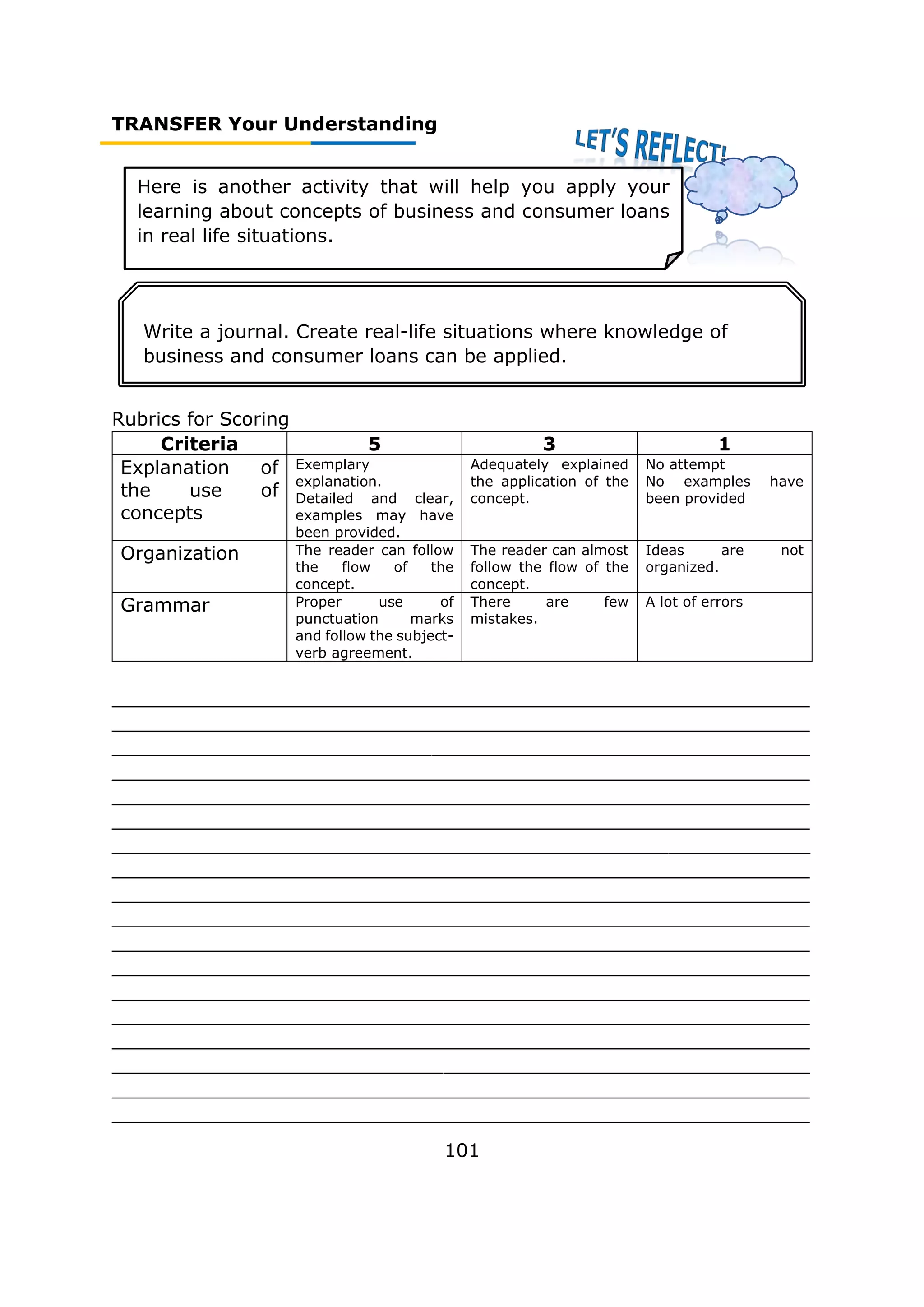
TRANSFER Your Understanding
Rubrics for Scoring
Criteria 5 3 1
Explanation of
the use of
concepts
Exemplary
explanation.
Detailed and clear,
examples may have
been provided.
Adequately explained
the application of the
concept.
No attempt
No examples have
been provided
Organization The reader can follow
the flow of the
concept.
The reader can almost
follow the flow of the
concept.
Ideas are not
organized.
Grammar Proper use of
punctuation marks
and follow the subject-
verb agreement.
There are few
mistakes.
A lot of errors
___________________________________________________________
___________________________________________________________
___________________________________________________________
___________________________________________________________
___________________________________________________________
___________________________________________________________
___________________________________________________________
___________________________________________________________
___________________________________________________________
___________________________________________________________
___________________________________________________________
___________________________________________________________
___________________________________________________________
___________________________________________________________
___________________________________________________________
___________________________________________________________
___________________________________________________________
___________________________________________________________
9
Here is another activity that will help you apply your
learning about concepts of functions in real life situations.
Write a journal. Create real-life situations where knowledge of
functions can be applied.
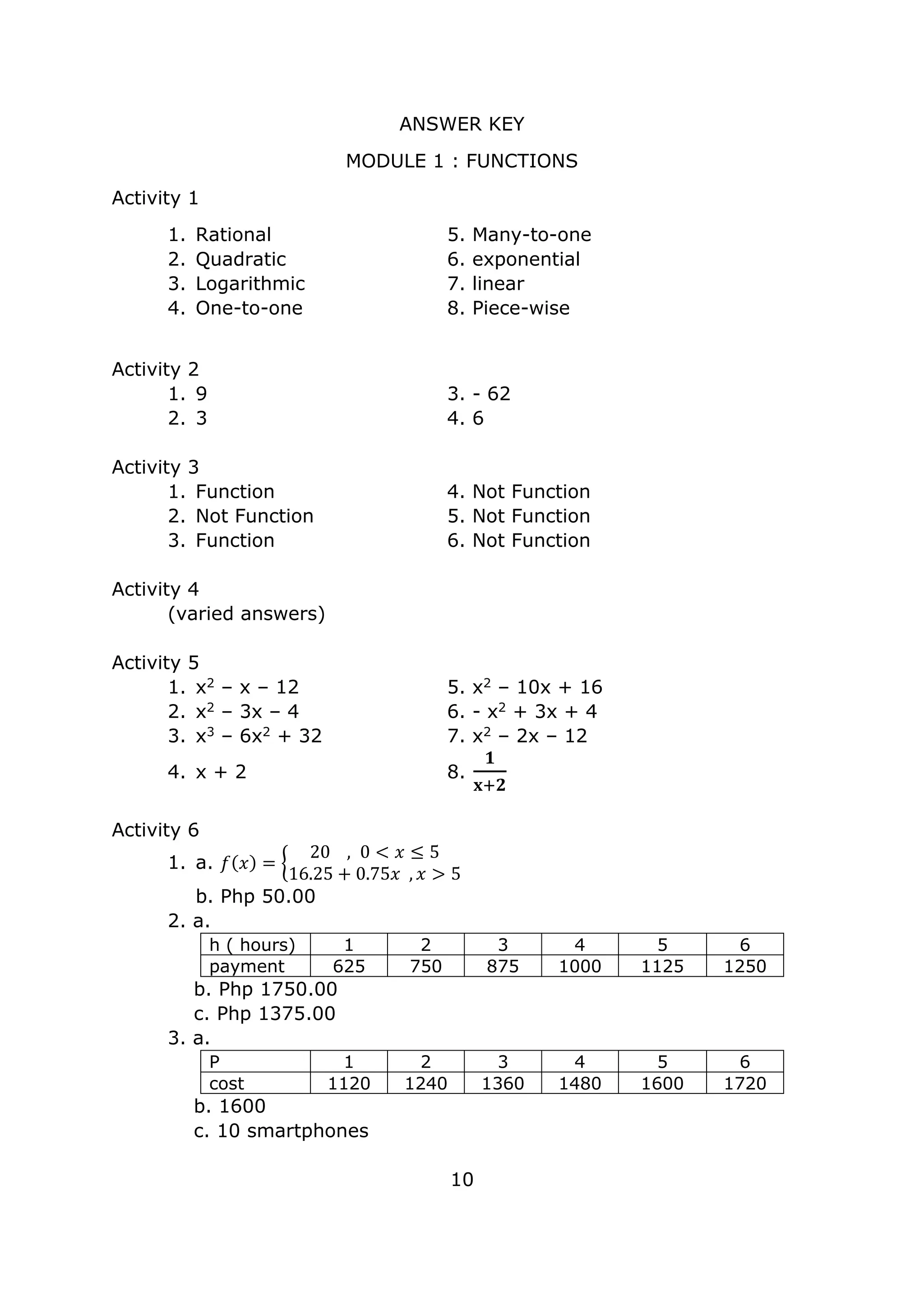
ANSWER KEY
MODULE 1 : FUNCTIONS
Activity 1
1. Rational 5. Many-to-one
2. Quadratic 6. exponential
3. Logarithmic 7. linear
4. One-to-one 8. Piece-wise
Activity 2
1. 9 3. - 62
2. 3 4. 6
Activity 3
1. Function 4. Not Function
2. Not Function 5. Not Function
3. Function 6. Not Function
Activity 4
(varied answers)
Activity 5
1. x2 – x – 12 5. x2 – 10x + 16
2. x2 – 3x – 4 6. - x2 + 3x + 4
3. x3 – 6x2 + 32 7. x2 – 2x – 12
4. x + 2 8.
𝟏
𝐱+𝟐
Activity 6
1. a. 𝑓(𝑥) = {
20 , 0 < 𝑥 ≤ 5
16.25 + 0.75𝑥 , 𝑥 > 5
b. Php 50.00
2. a.
h ( hours) 1 2 3 4 5 6
payment 625 750 875 1000 1125 1250
b. Php 1750.00
c. Php 1375.00
3. a.
P 1 2 3 4 5 6
cost 1120 1240 1360 1480 1600 1720
b. 1600
c. 10 smartphones
10
A. Learning Outcome
Content Standard
The learner demonstrates understanding of key concepts of
rational functions.
Performance Standard
The learner is able to accurately formulate and solve real-life
problems involving rational functions.
Learning Competencies
Essential Understanding
Learners will understand that the concepts of rational functions
have wide applications in real life and are useful tools to
develop critical thinking and problem solving skills.
Essential Question
How does the concepts on rational function facilitate in finding
solutions to real-life problems and develop critical thinking
skills?
11
MODULE 2
Rational Function, Equation and Inequality
After using this module, you are expected to:
1. represent real-life situations using rational functions.
2. distinguish rational function, rational equation and rational
inequality.
3. solve rational equations and inequalities.
4. represent a rational function through its: (a) table of values,
(b) graph, and (c) equation
5. find the domain and range of a rational function.
6. determine the (a) intercepts; (b) zeroes; (c) asymptotes of
rational functions.
7. solve problems involving rational functions, equations and
inequalities.
EXPLORE Your Understanding
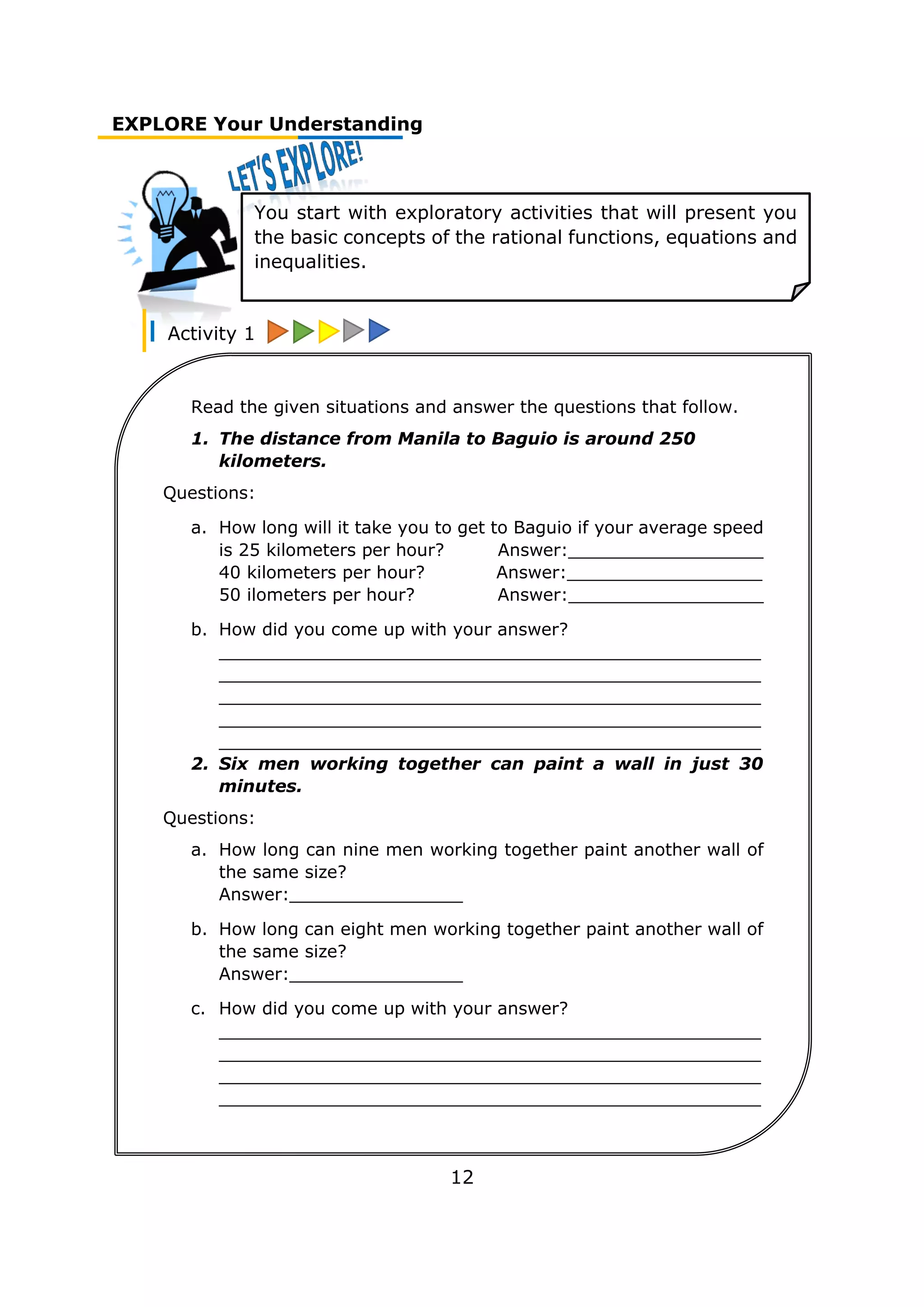
Activity 1
12
You start with exploratory activities that will present you
the basic concepts of the rational functions, equations and
inequalities.
Read the given situations and answer the questions that follow.
1. The distance from Manila to Baguio is around 250
kilometers.
Questions:
a. How long will it take you to get to Baguio if your average speed
is 25 kilometers per hour? Answer:__________________
40 kilometers per hour? Answer:__________________
50 ilometers per hour? Answer:__________________
b. How did you come up with your answer?
__________________________________________________
__________________________________________________
__________________________________________________
__________________________________________________
__________________________________________________
2. Six men working together can paint a wall in just 30
minutes.
Questions:
a. How long can nine men working together paint another wall of
the same size?
Answer:________________
b. How long can eight men working together paint another wall of
the same size?
Answer:________________
c. How did you come up with your answer?
__________________________________________________
__________________________________________________
__________________________________________________
__________________________________________________
__________________________________________________
______________________________
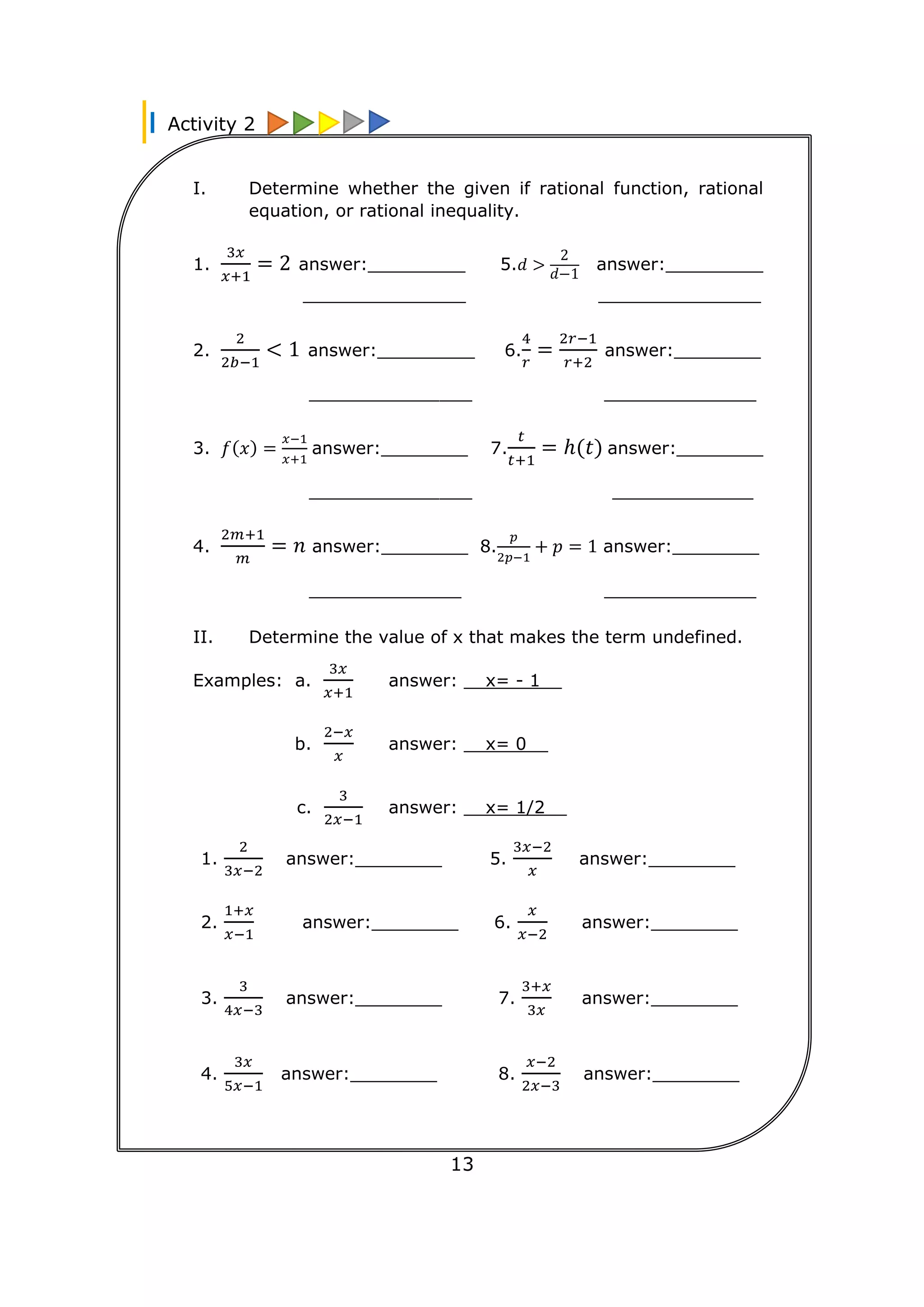
Activity 2
13
I. Determine whether the given if rational function, rational
equation, or rational inequality.
1.
3𝑥
𝑥+1
= 2 answer:_________ 5.𝑑 >
2
𝑑−1
answer:_________
_______________ _______________
2.
2
2𝑏−1
< 1 answer:_________ 6.
4
𝑟
=
2𝑟−1
𝑟+2
answer:________
_______________ ______________
3. 𝑓(𝑥) =
𝑥−1
𝑥+1
answer:________ 7.
𝑡
𝑡+1
= ℎ(𝑡) answer:________
_______________ _____________
4.
2𝑚+1
𝑚
= 𝑛 answer:________ 8.
𝑝
2𝑝−1
+ 𝑝 = 1 answer:________
______________ ______________
II. Determine the value of x that makes the term undefined.
Examples: a.
3𝑥
𝑥+1
answer: __x= - 1__
b.
2−𝑥
𝑥
answer: __x= 0__
c.
3
2𝑥−1
answer: __x= 1/2__
1.
2
3𝑥−2
answer:________ 5.
3𝑥−2
𝑥
answer:________
2.
1+𝑥
𝑥−1
answer:________ 6.
𝑥
𝑥−2
answer:________
3.
3
4𝑥−3
answer:________ 7.
3+𝑥
3𝑥
answer:________
4.
3𝑥
5𝑥−1
answer:________ 8.
𝑥−2
2𝑥−3
answer:________
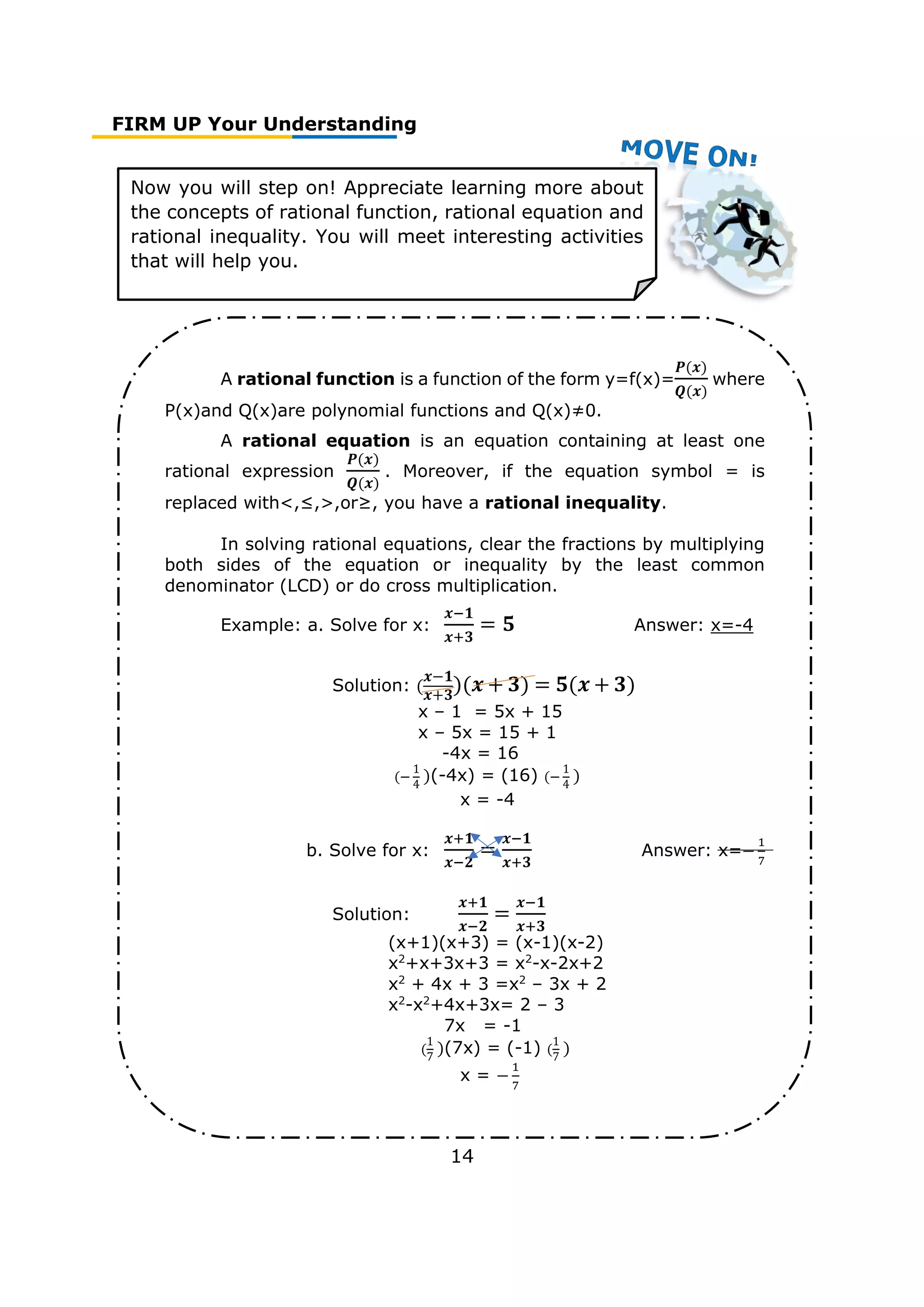
FIRM UP Your Understanding
14
Now you will step on! Appreciate learning more about
the concepts of rational function, rational equation and
rational inequality. You will meet interesting activities
that will help you.
A rational function is a function of the form y=f(x)=
𝑷(𝒙)
𝑸(𝒙)
where
P(x)and Q(x)are polynomial functions and Q(x)≠0.
A rational equation is an equation containing at least one
rational expression
𝑷(𝒙)
𝑸(𝒙)
. Moreover, if the equation symbol = is
replaced with<,≤,>,or≥, you have a rational inequality.
In solving rational equations, clear the fractions by multiplying
both sides of the equation or inequality by the least common
denominator (LCD) or do cross multiplication.
Example: a. Solve for x:
𝒙−𝟏
𝒙+𝟑
= 𝟓 Answer: x=-4
Solution: (
𝒙−𝟏
𝒙+𝟑
)(𝒙 + 𝟑) = 𝟓(𝒙 + 𝟑)
x – 1 = 5x + 15
x – 5x = 15 + 1
-4x = 16
(−
1
4
)(-4x) = (16) (−
1
4
)
x = -4
b. Solve for x:
𝒙+𝟏
𝒙−𝟐
=
𝒙−𝟏
𝒙+𝟑
Answer: x=−
1
7
Solution:
𝒙+𝟏
𝒙−𝟐
=
𝒙−𝟏
𝒙+𝟑
(x+1)(x+3) = (x-1)(x-2)
x2
+x+3x+3 = x2
-x-2x+2
x2
+ 4x + 3 =x2
– 3x + 2
x2
-x2
+4x+3x= 2 – 3
7x = -1
(
1
7
)(7x) = (-1) (
1
7
)
x = −
1
7
15
In solving rational inequality:
Determine over what intervals the rational expression takes on
positive and negative values.
i. Solve using the equal sign then locate the x value on the
number line.
ii. Determine the x values for which the rational expression is
undefined then locate the x value on the number line.
iii. Use a shaded circle to indicate that the value is included in
the solution set, and a hollow circle to indicate that the value is
excluded. These numbers partition the number line into
intervals.
iv. Select a test point and substitute to the given rational
inequality. If it makes the inequality true, then it is the solution.
v. Summarize the intervals containing the solutions.
Example: c. Solve for x:
𝒙−𝟏
𝒙+𝟑
> 𝟓 Answer: -4<x<-3
Solution: (
𝒙−𝟏
𝒙+𝟑
)(𝒙 + 𝟑) = 𝟓(𝒙 + 𝟑) 1st
solve using = sign, x=-4
x – 1 = 5x + 15 2nd
determine values of x
x – 5x = 15 + 1 makes the term undefined, x≠-3
-4x = 16 3rd
possible solutions are
(−
1
4
)(-4x) = (16) (−
1
4
) x<-4 or x>-3 and -4<x<-3
x = -4 4th
set test points, if it makes
inequality true, it is the solution
Try x <-4, lets have -5
(−𝟓)−𝟏
(−𝟓)+𝟑
> 𝟓
−𝟔
−𝟐
> 𝟓 so 3>5 is false therefore not the solution
Try x>-3, lets have -2
(−𝟐)−𝟏
(−𝟐)+𝟑
> 𝟓
−𝟑
𝟏
> 𝟓 so -3>5 is false therefore not the solution
Try -4<x<-3, lets have -3.5
(−𝟑.𝟓)−𝟏
(−𝟑.𝟓)+𝟑
> 𝟓
−𝟒.𝟓
−𝟎.𝟓
> 𝟓 so 9>5 is true therefore it is the solution
16
The domain of rational function f(x) is the set of real numbers
except those values of x that will make the denominator zero. In set
notation, Dom (f) = {x/x ∈ℝ, except x = a where q(a) = 0} or {x/x
∈ℝ,q(x)≠0}.
The range is the set of all values that f takes.
The intercepts of a rational function is a point where the graph
of the rational function intersects the x- or y-axis.
The zeroes of the rational function described by setting the
numerator equal to zero.
There are three types of asymptotes: vertical, horizontal and
oblique. A rational function will have a vertical asymptote where its
denominator equals zero. A rational function will have a horizontal
asymptote when:
a. If the degree of the numerator and denominator is equal, we
use y= ratio of leading coefficient;
b. if the degree of the numerator is lower than the degree of
the denominator, we use y=0;
c. If the degree of the numerator is higher, no horizontal
asymptote but an oblique asymptote.
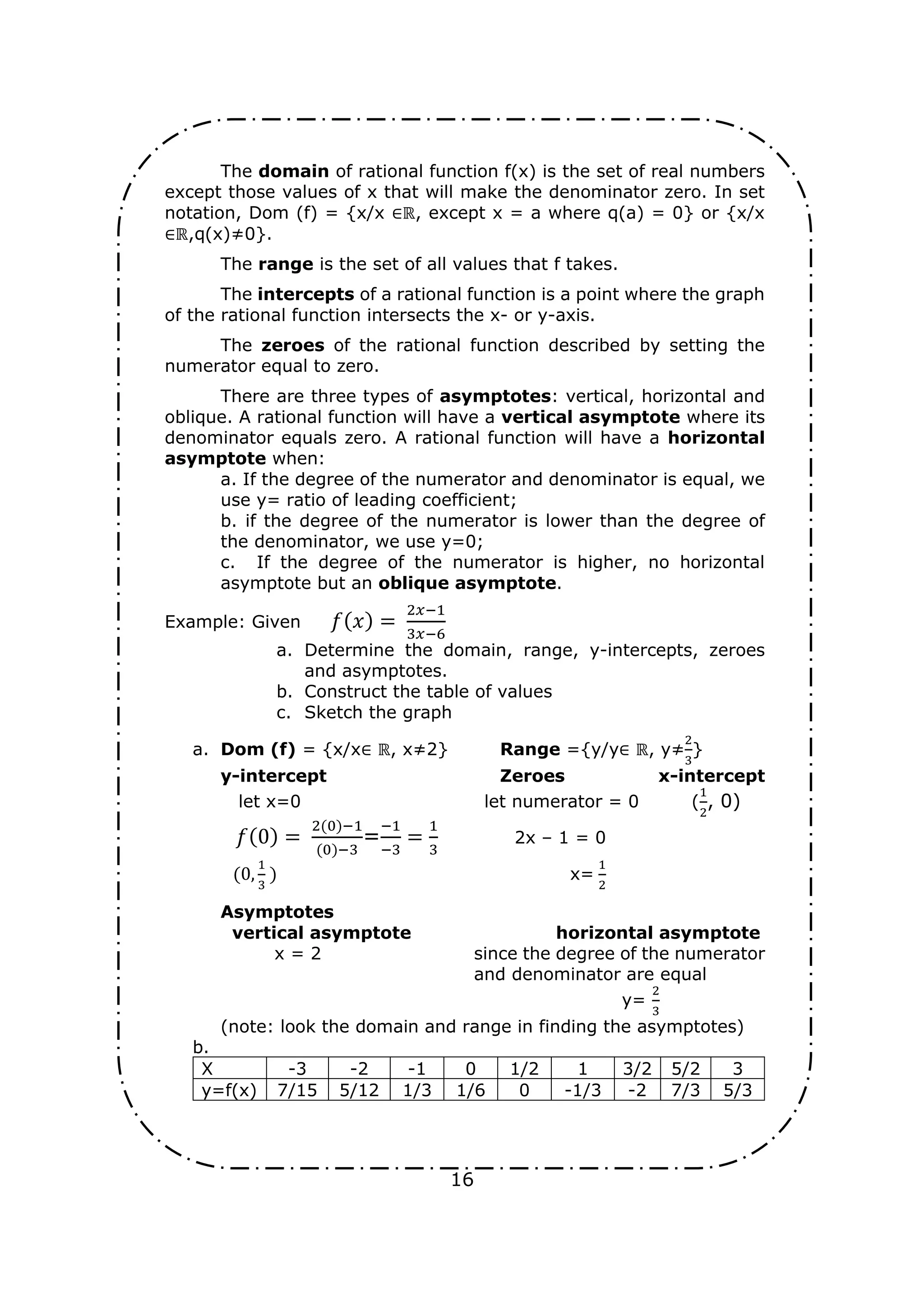
Example: Given 𝑓(𝑥) =
2𝑥−1
3𝑥−6
a. Determine the domain, range, y-intercepts, zeroes
and asymptotes.
b. Construct the table of values
c. Sketch the graph
a. Dom (f) = {x/x∈ ℝ, x≠2} Range ={y/y∈ ℝ, y≠
2
3
}
y-intercept Zeroes x-intercept
let x=0 let numerator = 0 (
1
2
, 0)
𝑓(0) =
2(0)−1
(0)−3
=
−1
−3
=
1
3
2x – 1 = 0
(0,
1
3
) x=
1
2
Asymptotes
vertical asymptote horizontal asymptote
x = 2 since the degree of the numerator
and denominator are equal
y=
2
3
(note: look the domain and range in finding the asymptotes)
b.
X -3 -2 -1 0 1/2 1 3/2 5/2 3
y=f(x) 7/15 5/12 1/3 1/6 0 -1/3 -2 7/3 5/3
Activity 3
17
c.
Solve the value of x.
I. Rational Equation
1.
𝟐𝒙−𝟏
𝒙+𝟐
= −𝟑 answer:________ 2.
𝒙+𝟏
𝒙+𝟐
=
𝒙−𝟏
𝒙−𝟒
answer:_________
Solution: Solution:
____________________________ __________________________
____________________________ __________________________
____________________________ __________________________
____________________________ __________________________
____________________________ __________________________
____________________________ __________________________
____________________________ __________________________
____________________________ __________________________
____________________________ __________________________
____________________________ __________________________
Activity 4
18
Do the indicated task.
1. Given 𝑓(𝑥) =
2
𝑥−1
a. Determine the domain, range, intercepts, zeroes and
asymptotes.
b. Construct the table of values
c. Sketch the graph
2. Given 𝑓(𝑥) =
𝑥+1
𝑥−2
a. Determine the domain, range, intercepts, zeroes and
asymptotes.
b. Construct the table of values
c. Sketch the graph
II. Rational Inequality
1.
𝒙−𝟏
𝒙−𝟑
> −𝟏 answer:_________ 2.
𝒙
𝟐𝒙−𝟏
<
𝟐
𝟑
answer:_________
Solution: Solution:
__________________________ _________________________
__________________________ _________________________
__________________________ _________________________
__________________________ _________________________
__________________________ _________________________
__________________________ _________________________
__________________________ _________________________
__________________________ _________________________
__________________________ _________________________
__________________________ _________________________
__________________________ _________________________
__________________________ _________________________
19
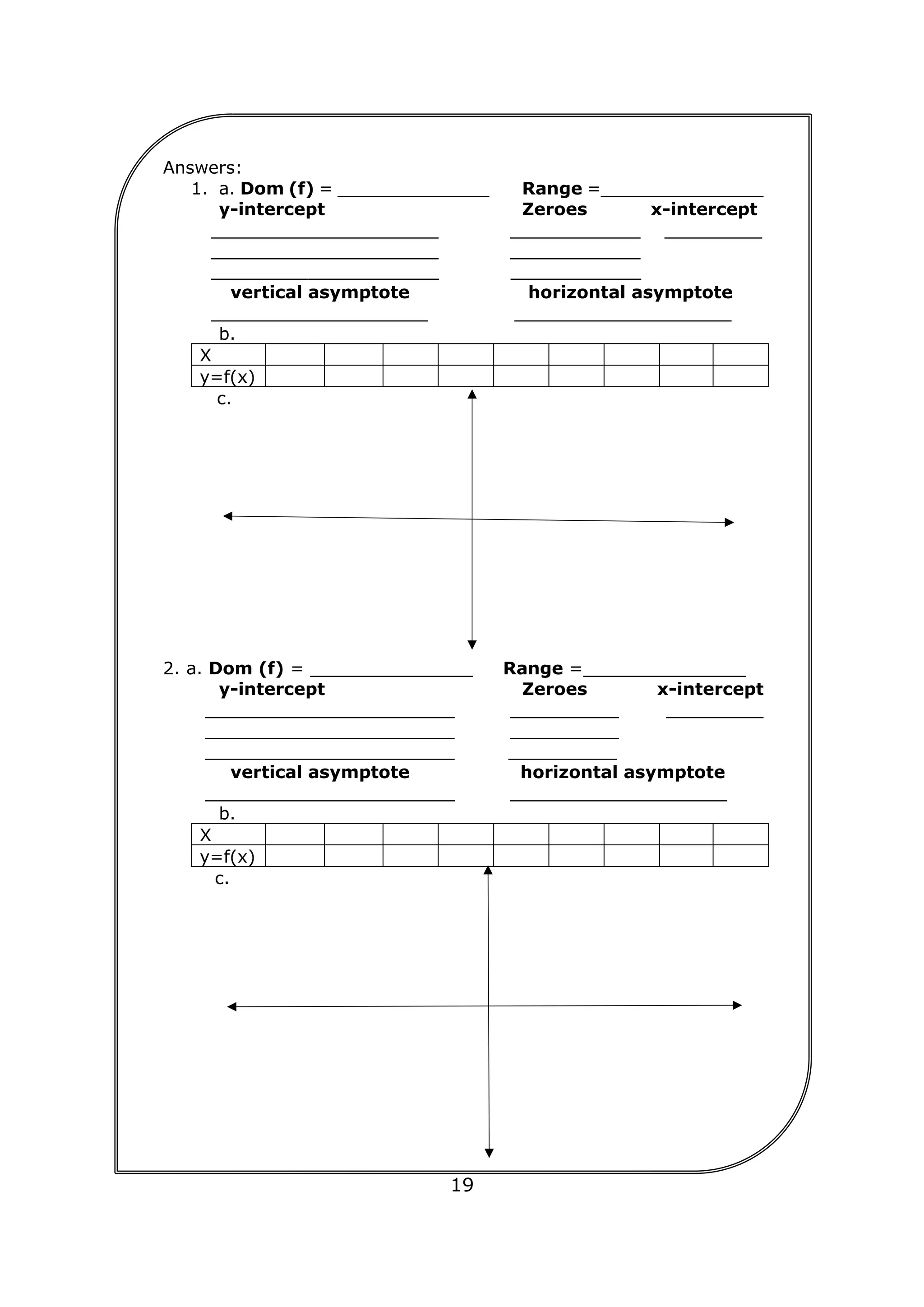
Answers:
1. a. Dom (f) = ______________ Range =_______________
y-intercept Zeroes x-intercept
_____________________ ____________ _________
_____________________ ____________
_____________________ ____________
vertical asymptote horizontal asymptote
____________________ ____________________
b.
X
y=f(x)
c.
2. a. Dom (f) = _______________ Range =_______________
y-intercept Zeroes x-intercept
_______________________ __________ _________
_______________________ __________
_______________________ __________
vertical asymptote horizontal asymptote
_______________________ ____________________
b.
X
y=f(x)
c.
DEEPEN Your Understanding
Activity 5
20
You take more challenging activities about rational
functions through solving problems.
Solve the following problems.
1. A Minibus travels 150 km in the same time that a Ceres bus
travels 100km. If the Minibus goes 20km/hr faster than Ceres ,
find the rate of each bus.
Solution: Answer:_____________
____________________________
____________________________
____________________________
____________________________
____________________________
____________________________
2. Ten students working together can clean a room in just 20
minutes.
a. How long can 4 students working together to clean a room?
Solution: Answer:_____________
____________________________
____________________________
____________________________
b. How many students are needed to clean the room and finish it
for 25 minutes?
Solution: Answer:_____________
____________________________
____________________________
____________________________
3. A box with a square base is to have a volume of 8 cubic meters.
Let x be the length of side of the square base and h be the height
of the box. What are the possible measurements of side of the
square base if the height should be longer than the side of the
square base?
Solution: Answer:_____________
___________________________
___________________________
___________________________
___________________________
___________________________
___________________________
___________________________
TRANSFER Your Understanding
Rubrics for Scoring
Criteria 5 3 1
Explanation of
the use of
concepts
Exemplary
explanation.
Detailed and clear,
examples may have
been provided.
Adequately explained
the application of the
concept.
No attempt
No examples have
been provided
Organization The reader can follow
the flow of the
concept.
The reader can almost
follow the flow of the
concept.
Ideas are not
organized.
Grammar Proper use of
punctuation marks
and follow the subject-
verb agreement.
There are few
mistakes.
A lot of errors
___________________________________________________________
___________________________________________________________
___________________________________________________________
___________________________________________________________
___________________________________________________________
___________________________________________________________
___________________________________________________________
___________________________________________________________
___________________________________________________________
___________________________________________________________
___________________________________________________________
___________________________________________________________
___________________________________________________________
___________________________________________________________
___________________________________________________________
___________________________________________________________
___________________________________________________________
___________________________________________________________
21
Here is another activity that will help you apply your
learning about concepts of rational function, equation and
inequality in real life situations.
Write a journal. Create real-life situations where knowledge of
rational function, equation and inequality can be applied.
ANSWER KEY
MODULE 2 : RATIONAL FUNCTION, EQUATION and INEQUALITY
Activity 1
1. a.10 hours, 6.25 hours, 5 hours b. varied answers
2. a. 20 minutes b. 22.5 minutes c. varied answers
Activity 2
I.
1. Rational equation 5. Rational
inequality
2. Rational inequality 6. Rational equation
3. Rational function 7. Rational function
4. Rational function 8. Rational equation
II.
1. 2/3 5. 0
2. 1 6. 2
3. ¾ 7. 0
4. 1/5 8. 3/2
Activity 3
I. 1. x = -1 2. x = -1/2
II. 1. x<2 or x>3 3. x<1/2 or x>2
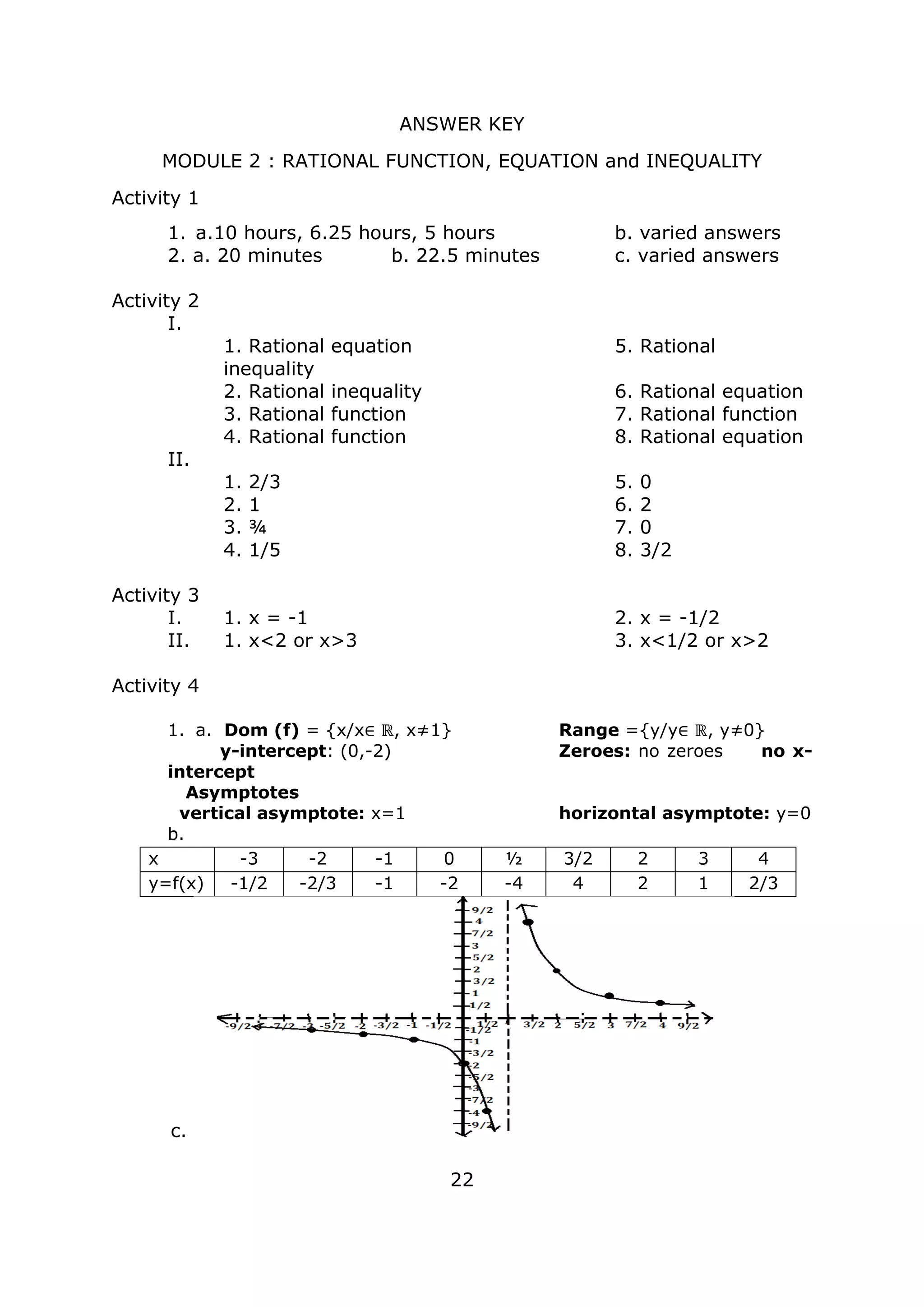
Activity 4
1. a. Dom (f) = {x/x∈ ℝ, x≠1} Range ={y/y∈ ℝ, y≠0}
y-intercept: (0,-2) Zeroes: no zeroes no x-
intercept
Asymptotes
vertical asymptote: x=1 horizontal asymptote: y=0
b.
x -3 -2 -1 0 ½ 3/2 2 3 4
y=f(x) -1/2 -2/3 -1 -2 -4 4 2 1 2/3
c.
22
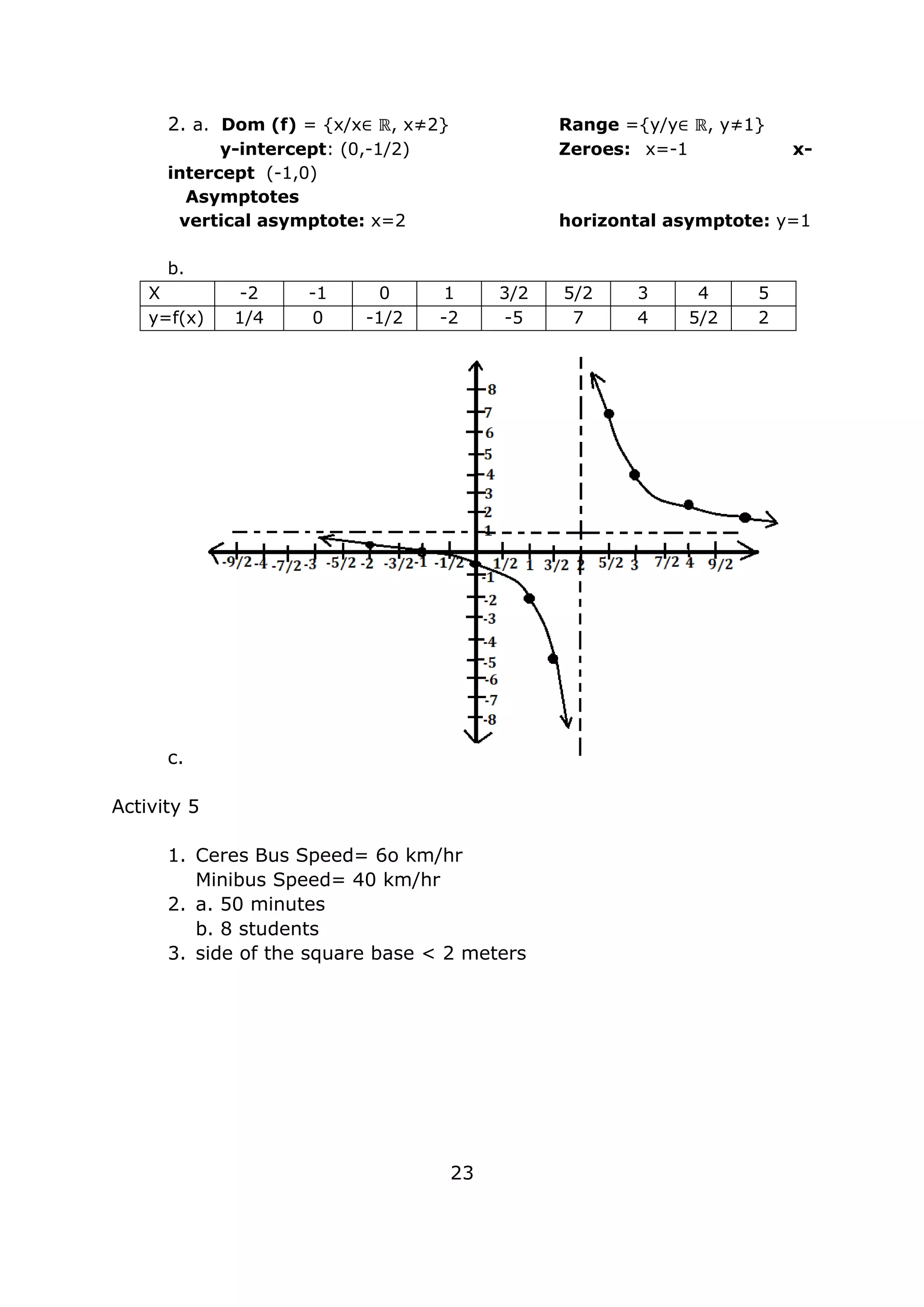
2. a. Dom (f) = {x/x∈ ℝ, x≠2} Range ={y/y∈ ℝ, y≠1}
y-intercept: (0,-1/2) Zeroes: x=-1 x-
intercept (-1,0)
Asymptotes
vertical asymptote: x=2 horizontal asymptote: y=1
b.
X -2 -1 0 1 3/2 5/2 3 4 5
y=f(x) 1/4 0 -1/2 -2 -5 7 4 5/2 2
c.
Activity 5
1. Ceres Bus Speed= 6o km/hr
Minibus Speed= 40 km/hr
2. a. 50 minutes
b. 8 students
3. side of the square base < 2 meters
23
A. Learning Outcome
Content Standard
The learner demonstrates understanding of key concepts of
inverse functions.
Performance Standard
The learner is able to apply the concepts of inverse functions
to formulate and solve real-life problems with precision and
accuracy
Learning Competencies
Essential Understanding
Learners will understand that the concepts of one-to-one
functions and inverse functions have wide applications in real
life and are useful tools to develop critical thinking and problem
solving skills.
Essential Question
How does the concepts on one-to-one function and inverse
function facilitate in finding solutions to real-life problems and
develop critical thinking skills?
24
MODULE 3
One-to-one Function and Inverse Function
After using this module, you are expected to:
1. represent real-life situations using one-to-one functions.
2. determine the inverse of a one-to-one function
3. represent an inverse function through its: (a) table of values,
and (b) graph
4. find the domain and range of an inverse function
5. solve problems involving inverse function
EXPLORE Your Understanding
Activity 1
25
You start with exploratory activities that will present you
the basic concepts of the one-to-one functions.
Determine whether the given is one-to-one function or not.
1. Student and LRN number Answer:_____________
2. Person and Citizenship Answer:_____________
3. f={(12,2), (15,4), (19,-4), (25,6)} Answer:_____________
4. h(x) = x2
+ 2 Answer:_____________
5. g= {(1,2), (5,4), (3,4), (2,6)} Answer:_____________
6. b(x) = 3x – 4 Answer:_____________
7. Answer:_____________
8. Answer:_____________
9. H = {(1,2), (2,4), (3,6), (2,8)} Answer:_____________
10. Answer:____________
FIRM UP Your Understanding
26
Now you will step on! Appreciate learning more about the
concepts of one-to-one function and inverse function.
You will meet interesting activities that will help you.
The function f is one-to-one if for any x1, x2 in the domain of f,
then f(x1)≠ f(x2). That is, the same y-value is never paired with two
different x-values.
Horizontal Line Test
A function is one-to-one if each horizontal line does not
intersect the graph at more than one point.
The Vertical and Horizontal Line Tests
All functions satisfy the vertical line test. All one-to-one
functions satisfy both the vertical and horizontal line tests.
Let f be a one-to-one function with domain A and range B.
Then, the inverse of f, denoted f -1
, is a function with domain B and
range A defined by f -1
(y)=x if and only if f(x)=y for any y in B.
A function has an inverse if and only if it is one-to-one.
Steps in finding the inverse of one-to-one function.
i. Write the function in the form y=f(x)
ii. Interchange the x and y variables
iii. Transform the equation in the form y=terms in x.
Examples:
a. Find the inverse of f(x) = 3x + 1
i. y=3x+1
ii. x=3y+1
iii. -3y = -x +1
y=
−𝑥+1
−3
y=
𝑥−1
3
Therefore the inverse of the given function is f-1
(x) =
𝑥−1
3
Activity 2
27
b. Find the inverse of f(x)=
3𝑥+1
2𝑥−1
i. y=
3𝑥+1
2𝑥−1
ii. x=
3𝑦+1
2𝑦−1
iii. x(2y-1)=3y+1
2xy – x =3y+1
2xy – 3y=x+1
(y)(2x-3) = x+1
y =
𝑥+1
2𝑥−3
Therefore the inverse of the given function is f-1
=
𝑥+1
2𝑥−3
.
c. Find the inverse of f(x) = x3
– 2
i. y= x3
– 2
ii. x = y3
– 2
iii. – y3
= -x – 2
y3
= x + 2
y = √𝑥 + 2
3
Therefore the inverse of the given function is f-1
= √𝑥 + 2
3
.
Determine the inverse of the following functions.
1. f(x)= 5x – 2 answer:_________ 3.f(x)=x3
+ 4 answer:_________
solution:__________________ solution:__________________
_________________________ _________________________
_________________________ _________________________
_________________________ _________________________
_________________________ _________________________
2. f(x) =
2𝑥−3
𝑥+4
answer:__________ 4.f(x)=4x + 3 answer:_________
solution:__________________ solution:__________________
_________________________ _________________________
_________________________ _________________________
_________________________ _________________________
_________________________ _________________________
_________________________ _________________________
DEEPEN Your Understanding
28
You take more challenging activities about inverse
functions through table of values, graph and solving
problems.
The domain of the inverse function is the range of the
original function and the range of the inverse function is the
domain of the original function. The graph of the inverse function
can be obtained by reflecting the graph of the original function about
the line y=x.
Examples: a. f = { (1,2), (2,4), (3,6), (4,8)}
f is a one-to-one function with domain ={1,2,3,4} and
range ={2,4,6,8}
The inverse of f is f-1
= {(2,1), (4,2), (6,3), (8,4)}
f-1
has domain = {2,4,6,8} and range={1,2,3,4}
b. f(x) = 3x – 2
Domain = {x/x∈ℝ} Range = {y/y∈ℝ}
x -3 -2 -1 0 1 2 3
f(x) -11 -8 -5 -2 1 4 7
The graph
While the inverse,
f-1
(x) =
𝑥+2
3
Domain of f-1
= {x/x∈ℝ} Range of f-1
= {y/y∈ℝ}
x -11 -8 -5 -2 1 4 7
f-1
(x) -3 -2 -1 0 1 2 3
The graph
Activity 3
29
c. f(x) =
𝑥+2
𝑥−3
Domain ={x/x∈ℝ , x≠3} Range = {y/y∈ℝ , y≠1}
Vertical asymptote x=3 horizontal asymptote y=1
x -1 0 1 2 5/2 7/2 4
f(x) -1/4 -2/3 -3/2 -4 -9 11 6
The graph
While the inverse
f-1
(x) =
3𝑥+2
𝑥−1
Domain of f-1
={x/x∈ℝ , x≠1} Range of f-1
={y/y∈ℝ , y≠3}
Vertical asymptote x=1 horizontal asymptote y=3
x -1/4 -2/3 -3/2 -4 -9 11 6
f-1
(x) -1 0 1 2 5/2 7/2 4
The graph
Construct the table of values of the inverse of the given functions.
1. f(x) = x+3
Table of values of the inverse f-1
(x)
x
f-1
(x)
2. f(x)= √𝑥 + 1 with domain={x/x∈ℝ , x≥ -1}
Table of values of the inverse f-1
(x)
x
f-1
(x)
3. f(x) =
2𝑥−1
𝑥+1
Table of values of the inverse f-1
(x)
x
f-1
(x)
Activity 4
30
Determine the domain and range of the inverse of the following
function and then sketch the graph of the inverse function.
1. f(x) = 2x – 5
Domain of f-1
= ________________________
Range of f-1
= ________________________
The graph
2. f(x) =
3
𝑥−1
Domain of f-1
= ________________________
Range of f-1
= ________________________
The graph
3. f(x)= √𝑥 − 2 with domain={x/x∈ℝ , x≥ 2}
Domain of f-1
= ________________________
Range of f-1
= ________________________
The graph
Activity 5
31
Solve the following problems.
1. The function defined by v(x)=3.8x converts a volume of x gallons
into v(x) liters.
a. Find the equivalent volume in liters of 20 gallons of water.
Solution:_____________________ Answer:___________
____________________________
____________________________
____________________________
____________________________
b. Find an equation defining y=v-1
(x).
Solution:_____________________ Answer:___________
____________________________
____________________________
____________________________
____________________________
2. You asked a friend to think of a nonnegative number, add two to
the number, square the number, multiply the result by 3 and
divide the result by 2. If the result is 54, what is the original
number?
Solution:____________________ Answer:___________
____________________________
____________________________
____________________________
____________________________
____________________________
3. Engineers have determined that the maximum force in tons that
a particular bridge can carry is related to the distance in meters
between it supports by the following function: t(d)= (
12.5
𝑑
)3
. How
far should the supports be if the bridge is to support 6.5 tons?
Solution:____________________ Answer:___________
___________________________
___________________________
___________________________
___________________________
___________________________
___________________________
___________________________
___________________________
TRANSFER Your Understanding
Rubrics for Scoring
Criteria 5 3 1
Explanation of
the use of
concepts
Exemplary
explanation.
Detailed and clear,
examples may have
been provided.
Adequately explained
the application of the
concept.
No attempt
No examples have
been provided
Organization The reader can follow
the flow of the
concept.
The reader can almost
follow the flow of the
concept.
Ideas are not
organized.
Grammar Proper use of
punctuation marks
and follow the subject-
verb agreement.
There are few
mistakes.
A lot of errors
___________________________________________________________
___________________________________________________________
___________________________________________________________
___________________________________________________________
___________________________________________________________
___________________________________________________________
___________________________________________________________
___________________________________________________________
___________________________________________________________
___________________________________________________________
___________________________________________________________
___________________________________________________________
___________________________________________________________
___________________________________________________________
___________________________________________________________
___________________________________________________________
___________________________________________________________
___________________________________________________________
32
Here is another activity that will help you apply your
learning about concepts of one-to-one functions and
inverse functions in real life situations.
Write a journal. Create real-life situations where knowledge of one-
to-one functions and inverse functions can be applied.
ANSWER KEY
MODULE 3 : ONE-TO-ONE FUNCTION and INVERSE FUNCTION
Activity 1
1. One-to-one 5. Not one-to-one 9. Not one-to-one
2. Not one-to-one 6. One-to-one 10. One-to-one
3. One-to-one 7. One-to-one
4. Not one-to-one 8. Not one-to-one
Activity 2
1. f -1(x)=
𝑥+2
5
3. f -1(x)=√𝑥 − 4
3
2. f -1(x)=
−4𝑥−3
𝑥−2
4. f -1(x)=
𝑥−3
4
Activity 3
1. possible answer
x 0 1 2 3 4 5 6
f-1 -3 -2 -1 0 1 2 3
2. possible answer
x 0 1 √2 √3 2 √5 √6
f-1 -3 -2 -1 0 1 2 3
3. possible answer
x 7/2 5 -4 -1 1/2 1 5/4
f-1 -3 -2 -1/2 0 1 2 3
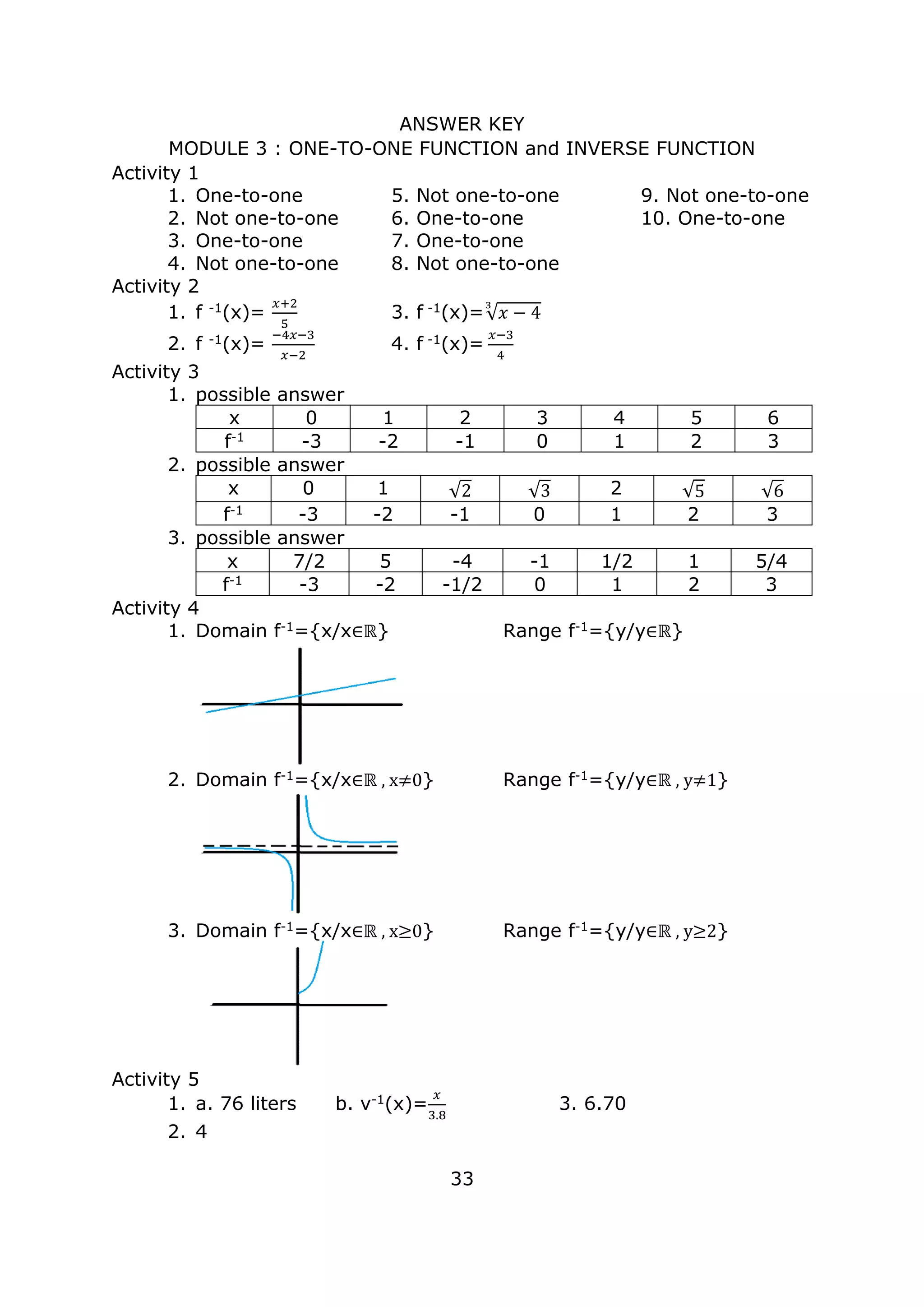
Activity 4
1. Domain f-1={x/x∈ℝ} Range f-1={y/y∈ℝ}
2. Domain f-1={x/x∈ℝ , x≠0} Range f-1={y/y∈ℝ , y≠1}
3. Domain f-1={x/x∈ℝ , x≥0} Range f-1={y/y∈ℝ , y≥2}
Activity 5
1. a. 76 liters b. v-1(x)=
𝑥
3.8
3. 6.70
2. 4
33
A. Learning Outcome
Content Standard
The learner demonstrates understanding of key concepts of
exponential functions.
Performance Standard
The learner is able to apply the concepts of exponential
functions to formulate and solve real-life problems with
precision and accuracy
Learning Competencies
Essential Understanding
Learners will understand that the concepts of exponential
functions have wide applications in real life and are useful tools
to develop critical thinking and problem solving skills.
Essential Question
How does the concepts on exponential function facilitate in
finding solutions to real-life problems and develop critical
thinking skills?
34
MODULE 4
Exponential Function
After using this module, you are expected to:
1. represent real-life situations using exponential function.
2. distinguish between exponential function, exponential equation,
and exponential inequality.
3. solve exponential equations and inequalities.
4. represent an exponential function through its:(a) table of
values, (b) graph, and (c) equation
5. find the domain and range of exponential function
6. determine the intercepts, zeroes and asymptotes of an
exponential function
7. solve problems involving exponential functions, equations and
inequalities.
EXPLORE Your Understanding
Activity 1
35
You start with exploratory activities that will present you
the basic concepts of exponential functions, equations
and inequalities.
Direction: This activity can help introduce the concept of an
exponential function. Prepare the materials, follow the procedure and
answer the question that follow.
Materials:
One 2-meter string, pair of scissors, pen
Procedure:
(a) At Step 0, there is 1 string.
(b) At Step 1, fold the string into two equal parts and then cut at the
middle. How many strings of equal length do you have? Enter your
answer in the table below.
(c) At Step 2, again fold each of the strings equally and then cut. How
many strings of equal length do you have? Enter your answer in the
table below.
(d) Continue the process until the table is completely filled-up.
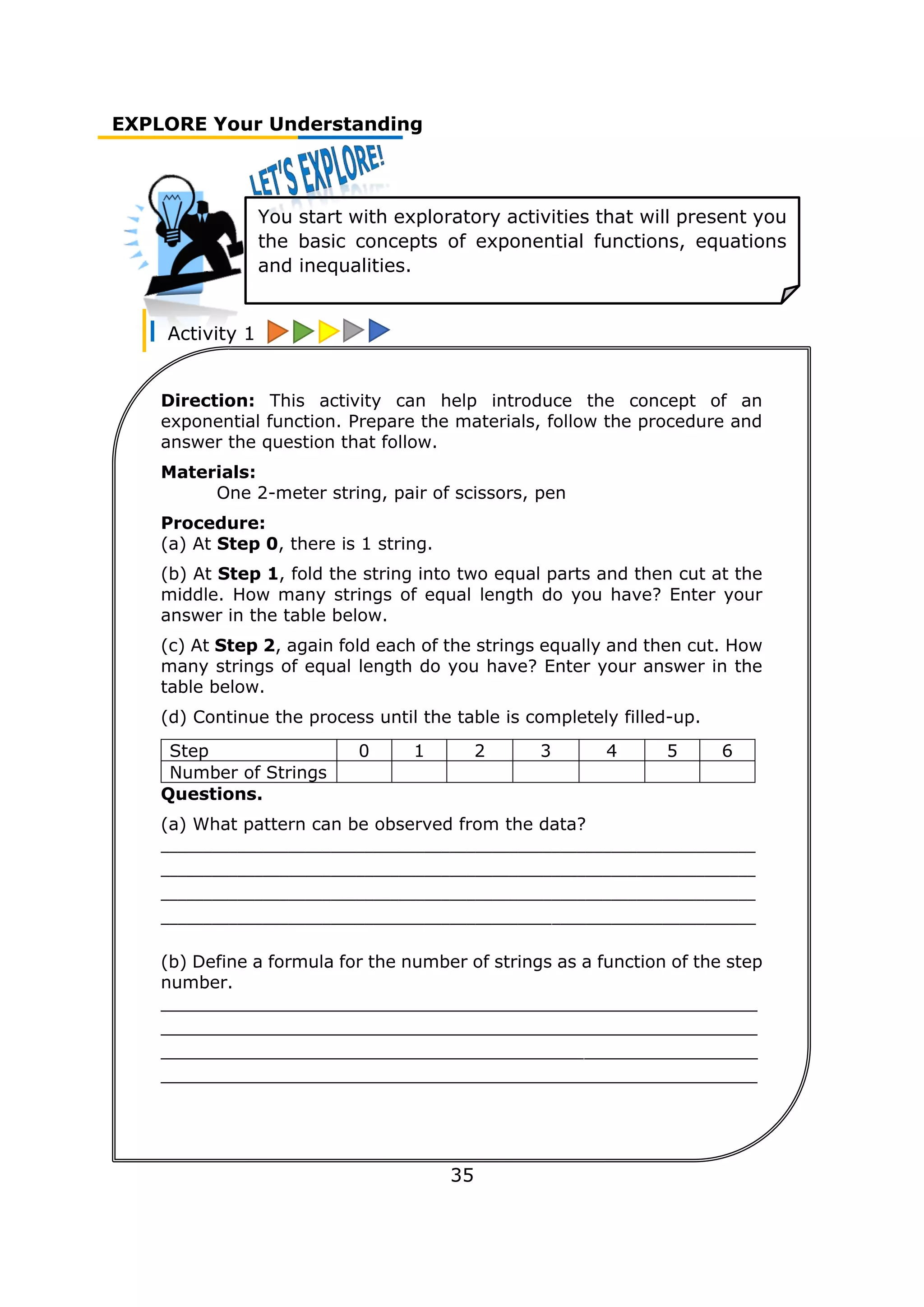
Step 0 1 2 3 4 5 6
Number of Strings
Questions.
(a) What pattern can be observed from the data?
______________________________________________________________________
______________________________________________________________________
______________________________________________________________________
______________________________________________________________________
(b) Define a formula for the number of strings as a function of the step
number.
_______________________________________________________
_______________________________________________________
_______________________________________________________
_______________________________________________________
Activity 2
36
I. Determine whether the given if exponential function,
exponential equation, or exponential inequality.
1. 2x-1
=16 answer:___________ 5. 27<3x+1
answer:__________
_________________ ________________
2. 3x
=y answer:___________ 6. 32x-1
+9=0 answer:__________
_________________ ________________
3. 4x
>22x-1
answer:__________ 7.g(x)=2x
+1 answer:_________
________________ _______________
4. h(x)=53x-2
answer:_________ 8. 32x
–9>3 answer:_________
_______________ _______________
II. Complete the table of values of the following functions.
Example:
a. y = 2x
when x=-2 when x=-1 when x=0
y=2-2
y= 2-1
y= 20
y = ¼ y= ½ y= 1
when x= 1 when x = 2
y= 21
y= 22
y= 2 y= 4
x -2 -1 0 1 2
y ¼ ½ 1 2 4
1. y= 3x
x -2 -1 0 1 2
y
2. y= 3x
+ 2
x -2 -1 0 1 2
y
3. y=3x+2
x -2 -1 0 1 2
y
4. y=32x
x -2 -1 0 1 2
y
FIRM UP Your Understanding
37
Now you will step on! Appreciate learning more about the
concepts of exponential function, equation and inequality.
You will meet interesting activities that will help you.
Exponential
Equation
Exponential
Inequality
Exponential
Function
Definition An equation
involving
exponential
expressions
Inequality
involving
exponential
expressions
Function of the
form 𝑓(𝑥) = 𝑏𝑥
or
𝑦 = 𝑏𝑥
, where
b>0 , 𝑏 ≠ 1.
Example 3x
= 27 3x
> 27 f(x)=3x
or y=3x
Exponential functions are used to model real-life situations
such as population growth, radioactive decay, carbon dating, growth
of an epidemic, loan interest rates, and investments.
In solving exponential equation and inequality, write both
sides of the equation as powers of the same base.
Example:
a. Solve 3x+1
= 81 c. Solve 125x-1
=252x+1
3x+1
= (3)(3)(3)(3) ((5)(5)(5))x-1
=((5)(5))2x+1
3x+1
=34
(53
)x-1
=(52
)2x+1
x+1 = 4 (3)(x-1)=(2)(2x+1)
x=4-1 3x – 3 = 4x + 2
x=3 3x – 4x = 2 + 3
x = -5
b. Solve 4x-1
>8x+2
d. Solve (
1
3
)𝑥+1
< (
1
9
)𝑥
((2)(2))x-1
>((2)(2)(2))x+2
(3-1
)x+1
<(9-1
)x
(22
)x-1
> (23
)x+2
(3-1
)x+1
<((3-2
)x
(2)(x-1)>(3)(x+2) (-1)(x+1)<(-2)(x)
2x – 2 > 3x + 6 -x – 1 < -2x
2x – 3x > 6+2 -x + 2x < 1
-x > 8 x < 1
x < -8
Property of Exponential Inequalities
If b>1, then the exponential function y=bx
is increading for all
x. This means that bx
<by
if and only if x<y.
If 0<b<1, then the exponential function y=bx
is decreasing for
all x. this means that bx
>by
if and only if x<y.
Activity 3
38
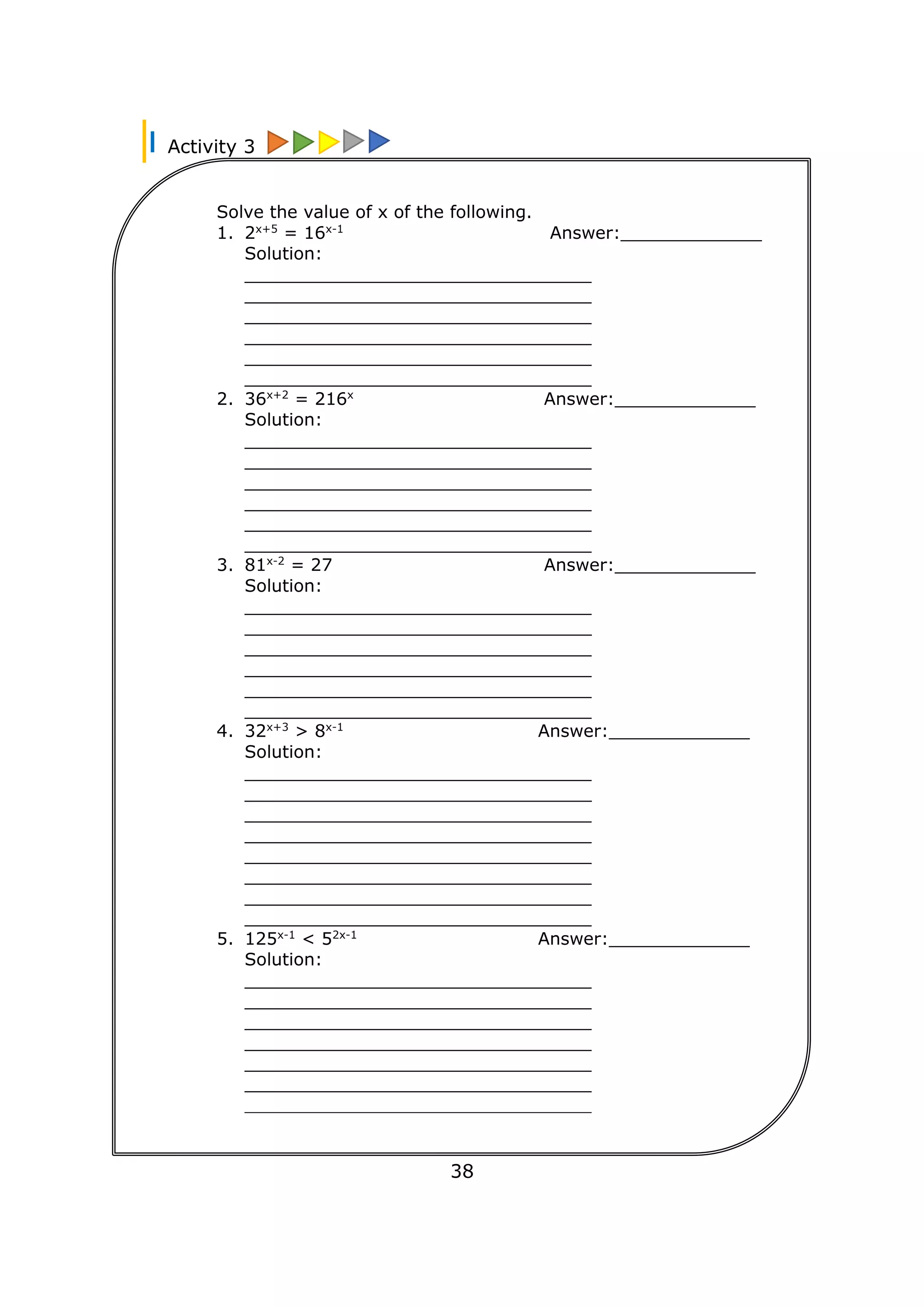
Solve the value of x of the following.
1. 2x+5
= 16x-1
Answer:_____________
Solution:
________________________________
________________________________
________________________________
________________________________
________________________________
________________________________
2. 36x+2
= 216x
Answer:_____________
Solution:
________________________________
________________________________
________________________________
________________________________
________________________________
________________________________
3. 81x-2
= 27 Answer:_____________
Solution:
________________________________
________________________________
________________________________
________________________________
________________________________
________________________________
4. 32x+3
> 8x-1
Answer:_____________
Solution:
________________________________
________________________________
________________________________
________________________________
________________________________
________________________________
________________________________
________________________________
5. 125x-1
< 52x-1
Answer:_____________
Solution:
________________________________
________________________________
________________________________
________________________________
________________________________
________________________________
________________________________
________________________________
DEEPEN Your Understanding
39
You take more challenging activities about exponential
functions through table of values, intercepts, zeroes,
asymptote, graph and solving problems.
The exponential function of the form 𝑓(𝑥) = 𝑏𝑥
or 𝑦 = 𝑏𝑥
,
where b>0, 𝑏 ≠ 1 has domain that is all real numbers, Dom (f) = {x/x
∈ ℝ}, and
The range is all real numbers greater than zero, {y/y ∈ ℝ, y>0}
The intercepts of an exponential function is a point where the
graph of the exponential function intersects the x- or y-axis.
The exponential function of the form 𝑓(𝑥) = 𝑏𝑥
or 𝑦 = 𝑏𝑥
, where
b>0, 𝑏 ≠ 1 will not have a zero. The graph will never cross the x-
axis. If the exponential function of the form 𝑓(𝑥) = 𝑏𝑥
− 𝑐 or 𝑦 = 𝑏𝑥
− 𝑐,
where b>0, 𝑏 ≠ 1 and c is any constant, then the zero is equal to
log 𝑐
log 𝑏
,
x=
log 𝑐
log 𝑏
.
The exponential function of the form 𝑓(𝑥) = 𝑏𝑥
or 𝑦 = 𝑏𝑥
, where
b>0, 𝑏 ≠ 1 generally has no vertical asymptote, only horizontal
asymptote.
Example: 1. Given f(x)= 2x+1
a. Determine the domain, range, intercepts, zeroes and asymptotes
b. Construct the table of values
c. Sketch the graph
a. Dom (f) = {x/x∈ ℝ} Range ={y/y∈ ℝ, y>0}
y-intercept No zero No x-intercept
let x=0
f(x) = 20+1
=21
=2 horizontal asymptote
(0, 2 ) y=0
b.
x -3 -2 -1 0 1 2 3
y=f(x) ¼ ½ 1 2 4 8 16
c.
40
Example: 2. Given f(x)= 2x
– 3
a. Determine the domain, range, intercepts, zeroes and asymptotes
b. Construct the table of values
c. Sketch the graph
a. Dom (f) = {x/x∈ ℝ} Range ={y/y∈ ℝ, y>-3}
y-intercept zero x-
intercept
let x=0 x=
log 3
log 2
= 1.59 (1.59,0)
f(x) = 20
– 3 =1–3 =-2 horizontal asymptote
(0, −2 ) y=-3
b.
X -3 -2 -1 0 1 2 3
y=f(x) -23/8 -11/4 -5/2 -2 -1 1 5
c.
Example: 3. Given f(x)= 2x
+ 3
a. Determine the domain, range, intercepts, zeroes and asymptotes
b. Construct the table of values
c. Sketch the graph
a. Dom (f) = {x/x∈ ℝ} Range ={y/y∈ ℝ, y> 3}
y-intercept No zero No x-intercept
let x=0
f(x) = 20
+3=1+3=4 horizontal asymptote
(0, 4 ) y=3
b.
x -3 -2 -1 0 1 2 3
y=f(x) 25/8 13/4 7/2 4 5 7 11
c.
Activity 4
18
41
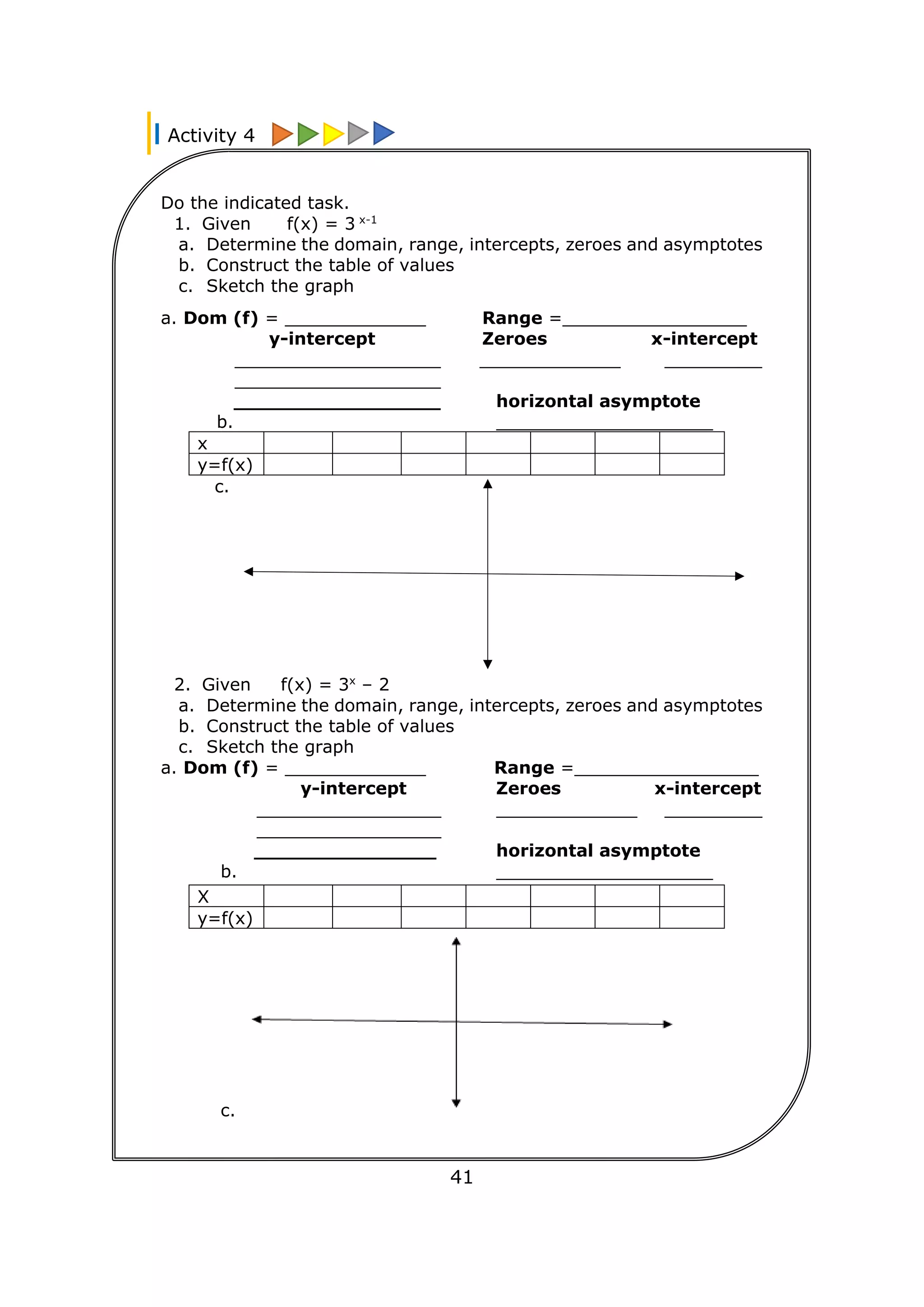
Do the indicated task.
1. Given f(x) = 3 x-1
a. Determine the domain, range, intercepts, zeroes and asymptotes
b. Construct the table of values
c. Sketch the graph
a. Dom (f) = _____________ Range =_________________
y-intercept Zeroes x-intercept
___________________ _____________ _________
___________________
_________________ horizontal asymptote
b. ____________________
x
y=f(x)
c.
2. Given f(x) = 3x
– 2
a. Determine the domain, range, intercepts, zeroes and asymptotes
b. Construct the table of values
c. Sketch the graph
a. Dom (f) = _____________ Range =_________________
y-intercept Zeroes x-intercept
_________________ _____________ _________
_________________
_______________ horizontal asymptote
b. ____________________
X
y=f(x)
c.
42
3. Given f(x) = 3x
+ 2
a. Determine the domain, range, intercepts, zeroes and asymptotes
b. Construct the table of values
c. Sketch the graph
a. Dom (f) = _____________ Range =_________________
y-intercept Zeroes x-intercept
___________________ _____________ _________
___________________
_________________ horizontal asymptote
b. ____________________
X
y=f(x)
c.
4. Given f(x) = 2x+1
– 3
a. Determine the domain, range, intercepts, zeroes and asymptotes
b. Construct the table of values
c. Sketch the graph
a. Dom (f) = _____________ Range =_________________
y-intercept Zeroes x-intercept
__________________ _____________ _________
__________________
________________ horizontal asymptote
b. ____________________
x
y=f(x)
c.
Activity 5
43
Solve the following problems.
1. Your father takes out a ₱20,000 loan at a 5% interest rate in
Banco De Oro (BDO). If the interest is compounded annually,
how much will he owe after 10 years? (Given the exponential
model A = P (1+r)t
where P= principal; r=rate; t=time)
Solution: Answer:______________
________________________________
________________________________
________________________________
________________________________
________________________________
________________________________
2. Mandaue City’s population starts with 15,000 and triples every
after 65 years. What is the size of the population after 130 years?
Solution: Answer:______________
________________________________
________________________________
________________________________
________________________________
________________________________
________________________________
3. Suppose that the half-life of a certain radioactive substance is 15
days and there are 10g initially, determine the amount of
substance remaining after 60 days.
Solution: Answer:______________
________________________________
________________________________
________________________________
________________________________
________________________________
________________________________
4. A cultured bacteria with a population of 20 bacteria doubles every
30 minutes. How many bacteria will there be after 3 hours?
Solution: Answer:______________
________________________________
________________________________
________________________________
________________________________
________________________________
________________________________
________________________________
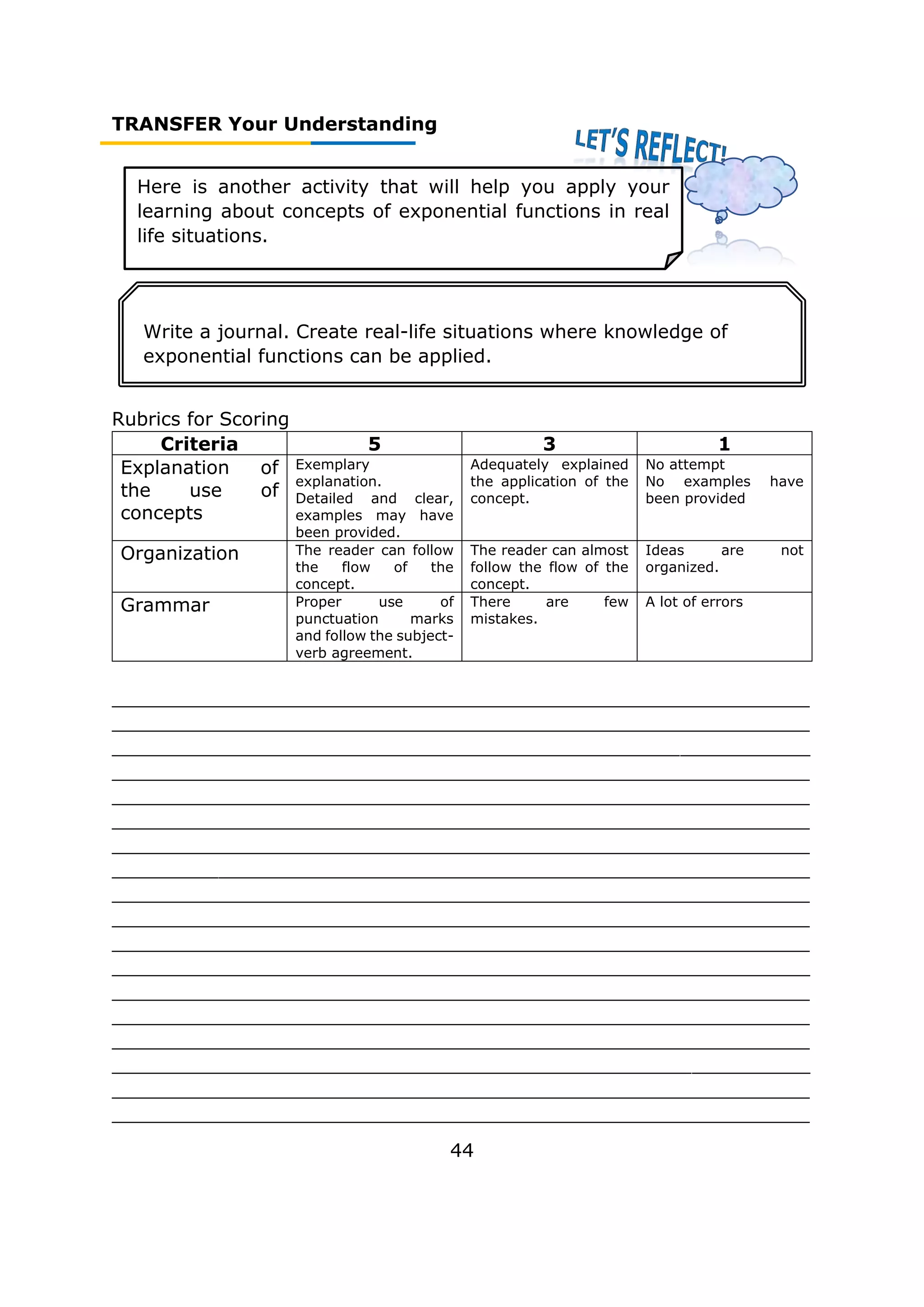
TRANSFER Your Understanding
Rubrics for Scoring
Criteria 5 3 1
Explanation of
the use of
concepts
Exemplary
explanation.
Detailed and clear,
examples may have
been provided.
Adequately explained
the application of the
concept.
No attempt
No examples have
been provided
Organization The reader can follow
the flow of the
concept.
The reader can almost
follow the flow of the
concept.
Ideas are not
organized.
Grammar Proper use of
punctuation marks
and follow the subject-
verb agreement.
There are few
mistakes.
A lot of errors
___________________________________________________________
___________________________________________________________
___________________________________________________________
___________________________________________________________
___________________________________________________________
___________________________________________________________
___________________________________________________________
___________________________________________________________
___________________________________________________________
___________________________________________________________
___________________________________________________________
___________________________________________________________
___________________________________________________________
___________________________________________________________
___________________________________________________________
___________________________________________________________
___________________________________________________________
___________________________________________________________
44
Here is another activity that will help you apply your
learning about concepts of exponential functions in real
life situations.
Write a journal. Create real-life situations where knowledge of
exponential functions can be applied.
ANSWER KEY
MODULE 4 : EXPONENTIAL FUNCTION
Activity 1
a. It can be observed that as the step number increases by one, the
number of strings doubles.
b. If n is the number of strings and s is the step number, then n = 2s.
Activity 2
I.
1. Exponential equation 5. Exponential inequality
2. Exponential function 6. Exponential equation
3. Exponential inequality 7. Exponential function
4. Exponential function 8. Exponential inequality
II.
1.
x -2 -1 0 1 2
y 1/9 1/3 1 3 9
2.
x -2 -1 0 1 2
y 19/9 7/3 3 5 11
3.
x -2 -1 0 1 2
y 1 3 9 27 81
4.
x -2 -1 0 1 2
y 1/81 1/9 1 9 81
Activity 3
1. x=3 3. x=11/4 5. x<2
2. x=4 4. x>-9
Activity 4
1. a. Dom (f) = {x/x∈ℝ} Range ={y/y∈ℝ , y>0)
y-intercept (0,1/3) No Zeroes No x-intercept
horizontal asymptote y=0
b.
c.
45
x -3 -2 -1 0 1 2 3
y=f(x) 1/81 1/27 1/9 1/3 1 3 9
2. a. Dom (f) = {x/x∈ℝ} Range ={y/y∈ℝ , y>-2)
y-intercept (0,-1) Zeroes x=0.63 x-intercept (0.63,0)
horizontal asymptote y=-2
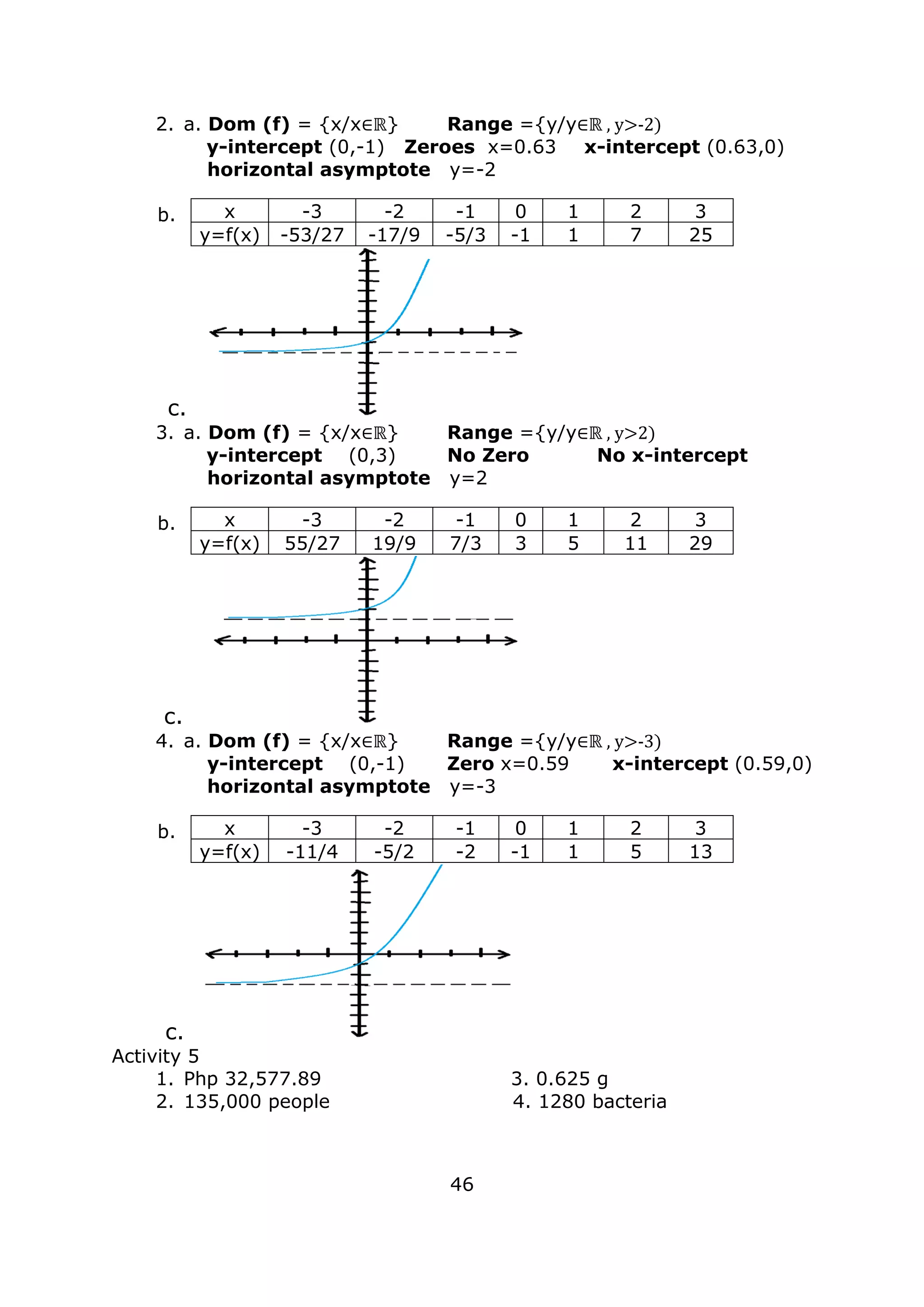
b.
c.
3. a. Dom (f) = {x/x∈ℝ} Range ={y/y∈ℝ , y>2)
y-intercept (0,3) No Zero No x-intercept
horizontal asymptote y=2
b.
c.
4. a. Dom (f) = {x/x∈ℝ} Range ={y/y∈ℝ , y>-3)
y-intercept (0,-1) Zero x=0.59 x-intercept (0.59,0)
horizontal asymptote y=-3
b.
c.
Activity 5
1. Php 32,577.89 3. 0.625 g
2. 135,000 people 4. 1280 bacteria
46
x -3 -2 -1 0 1 2 3
y=f(x) -53/27 -17/9 -5/3 -1 1 7 25
x -3 -2 -1 0 1 2 3
y=f(x) 55/27 19/9 7/3 3 5 11 29
x -3 -2 -1 0 1 2 3
y=f(x) -11/4 -5/2 -2 -1 1 5 13
A. Learning Outcome
Content Standard
The learner demonstrates understanding of key concepts of
logarithmic functions.
Performance Standard
The learner is able to apply the concepts of logarithmic
functions to formulate and solve real-life problems with
precision and accuracy
Learning Competencies
Essential Understanding
Learners will understand that the concepts of logarithmic
functions have wide applications in real life and are useful tools
to develop critical thinking and problem solving skills.
Essential Question
How does the concepts on logarithmic function facilitate in
finding solutions to real-life problems and develop critical
thinking skills?
47
MODULE 5
Logarithmic Function
After using this module, you are expected to:
1. represent real-life situations using logarithmic functions.
2. distinguish logarithmic function, logarithmic equation and
logarithmic inequality.
3. solve logarithmic equations and inequality.
4. represent a logarithmic function through its:(a) table of values,
(b) graph and (c) equation.
5. find the domain and range of a logarithmic function.
6. determine the intercepts, zeroes, and asymptotes of
logarithmic function.
7. solve problems involving logarithmic functions, equations and
inequalities.
EXPLORE Your Understanding
Activity 1
48
You start with exploratory activities that will present you
the basic concepts of logarithmic functions, equations
and inequalities.
I. Determine whether the given if logarithmic function, logarithmic
equation, or logarithmic inequality.
1. log3d=2 ans:___________ 6.log4(2t)2
=1 ans:___________
________________ ______________
2.log2(r+1)>3 ans:___________ 7.log(i)<log(2i) ans:___________
________________ ______________
3.log6(2x)=y ans:___________ 8.log2(1-m)=h ans:____________
________________ ______________
4.log3(g-2)<4 ans:___________ 9.b(x)=log5x2
ans:____________
________________ ______________
5.f(x)=log5x ans:___________ 10.log7(x-1)=2 ans:___________
________________ ______________
II. Transforming exponential equations to logarithmic.
Examples: a. 25
= 32 answer: __log232=5__
b. bx
= y answer: __logby=x___
1. 33
=27 answer: __________ 4.hc
=g answer: __________
2. 42
=16 answer: __________ 5.26
=64 answer: __________
3. dm
=n answer: __________ 6.72
=49 answer: __________
III. Transforming logarithmic equations to exponential.
Examples: a. log28 = 3 answer: __23
= 8___
b. logmx = n answer: __mn
= x___
1. log327=3 answer:_________ 4.log636=2 answer: _________
2. log216=4 answer:_________ 5.loghr = k answer: _________
3.logwz=y answer: _________ 6.log5125=3 answer: _________
FIRM UP Your Understanding
4
Now you will step on! Appreciate learning more about the
concepts of logarithmic function, equation and inequality.
You will meet interesting activities that will help you.
Logarithmic
Equation
Logarithmic
Inequality
Logarithmic
Function
Definition An equation
involving
logarithms
Inequality
involving
logarithms
Function of the form
f(x)=logbx or y=logbx,
where b>0 , 𝑏 ≠ 1.
Example logx2=4 logx2>4 f(x)= log3x or y=log3x
Logarithmic functions are used to model real-life situations
such as understanding the Richter Scale, Sound Intensity and also the
pH Levels, emphasizing in understanding very large or very small
numbers.
In solving logarithmic equation, you can use any of the
following:
1. If an equation can be rewritten in the form logbu = logbv for an
expression u and v, then it gives u=v. Solve this resulting
equation and check for extraneous solutions.
2. If an equation can be rewritten in the form logbA = C for an
expression A and a number C, then rewrite to bC
= A. Solve the
resulting equation and check for extraneous solutions.
3. Apply the logarithmic properties.
In solving logarithmic inequality, you can do the following
steps:
i. Solve the logarithmic inequality like solving the logarithmic
equation.
ii. Determine the values of x that will make the logarithmic
expression/s determined.
iii. Summarize the intervals containing the solutions.
Property of Logarithmic Inequalities
Given the logarithmic expression logbx
If o<b<1, then x1<x2 if and only if logbx1> logbx2.
If b>1, then x1<x2 if and only if logbx1< logbx2.
Laws of Logarithms
Let b>0, b≠1 and let n∈ℝ. for u>0,v>o, then
1. logbuv = logbu + logbv
2. logb
u
v
= logbu – logbv
3. logb(u)n
= n logbu
50
Example: Find the solution of the following.
a. log2(2x+2) = log2(x+4) f. log2(3x+2) > log2(x+4)
2x + 2 = x + 4 3x + 2 > x + 4
2x – x = 4 – 2 3x – x > 2
x = 2 2x > 2
x > 1
b. log3(x – 2) = 4 x > -3/2 so that the logarithmic
x – 2 = 34
expression will be determined
x – 2 = 81 Therefore the answer is x > 1.
x = 81 + 2
x = 83 g. log3(x – 4) < 3
x – 4 < 33
c. log2(x) + log2(x+2) = 3 x – 4 < 27
log2((x)(x+2) = 3 x < 31
log2(x2
+2x) = 3
x2
+ 2x = 23
x> 4 so that the logarithmic
x2
+ 2x = 8 expression will be determined
(x2
+ 2x)-8 = 8 – 8 Therefore the answer is 4<x<31
x2
+ 2x – 8 = 0
(x – 2 )(x + 4)=0 h. log3(x) + log3(x+2) > 1
x-2=0 x+4=0 log3((x)(x+2)) > 1
x=2 x=-4 log3 (x2
+ 2x) >1
Since negative value of x will make x2
+ 2x > 3
logarithmic expression undetermined, x2
+ 2x – 3 >0
therefore the answer is x= 2 only. (x+3)(x – 1) >0
x+3>0 x – 1>0
d. log2(3x+1)=log2(x+3) + 1 x>-3 x > 1
log2(3x+1)–log2(x+3)=1 x>0 so that the logartihmic
𝑙𝑜𝑔2
3𝑥+1
𝑥+3
=1 expression will be determined
3𝑥+1
𝑥+3
= 21
Therefore the answer is x>1.
3x + 1 = 2(x+3)
3x + 1 = 2x + 6 i. log2(x – 1)2
< 4
3x – 2x = 6 – 1 2log2(x – 1)<4
x = 5 log2(x – 1)<2
x – 1 < 22
e. log3x2
= 4 x – 1 < 4
2log3x = 4 x < 5
log3x=2
x = 32
x> 1 so that the logarithmic
x = 9 expression will be determined
Therefore the answer is 1<x<5.
Activity 2
51
Solve the value of x of the following logarithmic equations.
1. log3(3x – 2) = log3(2x-1) Answer:_____________
Solution:
________________________________
________________________________
________________________________
________________________________
________________________________
________________________________
2. log2(3x + 2) = 3 Answer:_____________
Solution:
________________________________
________________________________
________________________________
________________________________
________________________________
________________________________
3. log2(x) + log2(x – 6) = 4 Answer:_____________
Solution:
________________________________
________________________________
________________________________
________________________________
________________________________
________________________________
________________________________
________________________________
4. log3(2x+3)=log3(x – 2) + 2 Answer:_____________
Solution:
________________________________
________________________________
________________________________
________________________________
________________________________
________________________________
________________________________
5. log2(x+1)3
= 3 Answer:_____________
Solution:
________________________________
________________________________
________________________________
________________________________
________________________________
________________________________
Activity 3
52
Find the solution of the following logarithmic inequalities.
1. log2(4x) < log2(x+6) Answer:_____________
Solution:
________________________________
________________________________
________________________________
________________________________
________________________________
________________________________
2. log3(2x – 3) > 3 Answer:_____________
Solution:
________________________________
________________________________
________________________________
________________________________
________________________________
________________________________
________________________________
3. log3(x) + log3(x – 6) < 3 Answer:_____________
Solution:
________________________________
________________________________
________________________________
________________________________
________________________________
________________________________
________________________________
________________________________
________________________________
________________________________
________________________________
4. log3(x- 2)3
> 6 Answer:_____________
Solution:
________________________________
________________________________
________________________________
________________________________
________________________________
________________________________
________________________________
________________________________
________________________________
DEEPEN Your Understanding
53
You take more challenging activities about logarithmic
functions through table of values, intercepts, zeroes,
asymptote, graph and solving problems.
The logarithmic function of the form f(x)=logbx or y= logbx,
where b > 0 , 𝑏 ≠ 1 have a domain that is greater than zero, {x/x ∈
ℝ, x>0}.
The range is all real numbers, {y/y ∈ ℝ}
The intercepts of logarithmic function is a point where the
graph of the exponential function intersects the x- or y-axis.
The logarithmic function of the form f(x)=logbx or y= logbx,
where b > 0 , 𝑏 ≠ 1 will have 1 as zero, x=1.
The logarithmic function of the form 𝑓(𝑥) = 𝑏𝑥
or 𝑦 = 𝑏𝑥
, where
b>0, 𝑏 ≠ 1 generally has no horizontal asymptote, only vertical
asymptote.
Example: 1. Given f(x)= log2x
a. Determine the domain, range, intercepts, zeroes and
asymptotes.
b. Construct the table of values
c. Sketch the graph
a. Dom (f) = {x/x∈ ℝ , x>0} Range ={y/y∈ ℝ}
No y-intercept zero x-intercept
x=1 (1,0)
vertical asymptote
x=0
b.
X 1/8 1/4 ½ 1 2 4 8
y=f(x) -3 -2 -1 0 1 2 3
c.
54
Example: 2. Given f(x)= log2(x+3)
a. Determine the domain, range, intercepts, zeroes and asymptotes
b. Construct the table of values
c. Sketch the graph
a. Dom (f) = {x/x∈ ℝ, x>-3} Range ={y/y∈ ℝ,}
y-intercept zero x-intercept
let x=0 let f(x)=0 (-2,0)
f(x) = log2(0+3)=1.59 0=log2(x+3) vertical
(0, 1.59) 20
=x+3 asymptote
x=1-3=-2 x=-3
b.
X -23/8 -11/4 -5/2 -2 -1 1 5
y=f(x) -3 -2 -1 0 1 2 3
c.
Example: 3. Given f(x)= log2(x – 3)
a. Determine the domain, range, intercepts, zeroes and asymptotes.
b. Construct the table of values
c. Sketch the graph
a. Dom (f) = {x/x∈ ℝ , x>3} Range ={y/y∈ ℝ}
No y-intercept zero x-intercept
Let f(x) =0 (4,0)
vertical asymptote 0=log2(x-3)
x=3 20
=x-3
b. x=3+1=4
X 25/8 13/4 7/2 4 5 7 11
y=f(x) -3 -2 -1 0 1 2 3
c.
Activity 4
18
55
Do the indicated task.
1. Given f(x) = log3x
a. Determine the domain, range, intercepts, zeroes and asymptotes
b. Construct the table of values
c. Sketch the graph
a. Dom (f) = _____________ Range =_________________
y-intercept Zeroes x-intercept
___________________ _____________ ________
_________________ vertical asymptote
b. ____________________
x
y=f(x)
c.
2. Given f(x) = log3(x+2)
a. Determine the domain, range, intercepts, zeroes and asymptotes
b. Construct the table of values
c. Sketch the graph
a. Dom (f) = _____________ Range =_________________
y-intercept Zeroes x-intercept
____________________ ______________ _________
____________________ ______________
vertical asymptote ____________
________________
b.
X
y=f(x)
c.
56
3. Given f(x) = log2(2x)
a. Determine the domain, range, intercepts, zeroes and asymptotes.
b. Construct the table of values
c. Sketch the graph
a. Dom (f) = _____________ Range =_________________
y-intercept Zeroes x-intercept
___________________ _____________ ________
_________________ vertical asymptote
b. ____________________
X
y=f(x)
c.
4. Given f(x) = log2(2x-1)
a. Determine the domain, range, intercepts, zeroes and asymptotes.
b. Construct the table of values
c. Sketch the graph
a. Dom (f) = _____________ Range =_________________
y-intercept Zeroes x-intercept
__________________ _____________ _________
__________________ _____________
________________ ____________
vertical asymptote ____________
________________
b.
X
y=f(x)
c.
Activity 5
57
Solve the following problems.
1. Suppose that an earthquake released approximately 1012
joules
of energy. (A). What is its magnitude on a Richter scale? Use the
formula R=
2
3
log
𝐸
104.40
Solution: Answer:______________
________________________________
________________________________
________________________________
________________________________
________________________________
________________________________
________________________________
________________________________
2. Using the formula A= P(1+r)n
where A is the future value of the
investment, P is the principal, r is the fixed annual interest rate,
and n is the number of years, how many years will it take an
investment to double if the interest rate per annum is 2.5%?
Solution: Answer:______________
________________________________
________________________________
________________________________
________________________________
________________________________
________________________________
________________________________
________________________________
3. The decibel level of sound in a quite office is 10-6
watts/m2. (A)
What is the corresponding sound intensity in decibels? Use D=
10 log
𝐼
10−12.
Solution: Answer:______________
________________________________
________________________________
________________________________
________________________________
________________________________
________________________________
________________________________
________________________________
________________________________
TRANSFER Your Understanding
Rubrics for Scoring
Criteria 5 3 1
Explanation of
the use of
concepts
Exemplary
explanation.
Detailed and clear,
examples may have
been provided.
Adequately explained
the application of the
concept.
No attempt
No examples have
been provided
Organization The reader can follow
the flow of the
concept.
The reader can almost
follow the flow of the
concept.
Ideas are not
organized.
Grammar Proper use of
punctuation marks
and follow the subject-
verb agreement.
There are few
mistakes.
A lot of errors
___________________________________________________________
___________________________________________________________
___________________________________________________________
___________________________________________________________
___________________________________________________________
___________________________________________________________
___________________________________________________________
___________________________________________________________
___________________________________________________________
___________________________________________________________
___________________________________________________________
___________________________________________________________
___________________________________________________________
___________________________________________________________
___________________________________________________________
___________________________________________________________
___________________________________________________________
___________________________________________________________
58
Here is another activity that will help you apply your
learning about concepts of logarithmic functions in real
life situations.
Write a journal. Create real-life situations where knowledge of
logarithmic functions can be applied.
ANSWER KEY
MODULE 5 : LOGARITHMIC FUNCTION
Activity 1
I.
1. Logarithmic equation 6. Logarithmic equation
2. Logarithmic inequality 7. Logarithmic inequality
3. Logarithmic function 8. Logarithmic function
4. Logarithmic inequality 9. Logarithmic function
5. Logarithmic function 10. Logarithmic equation
II.
1. log327=3 3. logdn=m 5. log264=6
2. log416=2 4. logng=c 6. log749=2
III.
1. 33=27 3. wy=z 5. hk=r
2. 24=16 4. 62=36 6. 53=125
Activity 2
1. x=1 3. x=8 5. x=1
2. x=2 4. x=3
Activity 3
1. 0<x<2 3. 6<x<9
2. x>15 4. x>11
Activity 4
1. a. Dom (f) = {x/x∈ℝ, x>0} Range ={y/y∈ℝ}
No y-intercept Zeroes x=1 x-intercept (1,0)
vertical asymptote x=0
b.
X 1/27 1/9 1/3 1 3 9 27
y=f(x) -3 -2 -1 0 1 2 3
c.
59
2. a. Dom (f) = {x/x∈ℝ, x>-2} Range ={y/y∈ℝ}
y-intercept (0,0.63) Zeroes x=-1 x-intercept (-1,0)
vertical asymptote x=-2
b.
X -53/27 -17/9 -5/3 -1 1 7 25
y=f(x) -3 -2 -1 0 1 2 3
c.
3. a. Dom (f) = {x/x∈ℝ, x>0} Range ={y/y∈ℝ}
no y-intercept Zeroes x=1/2 x-intercept (1/2,0)
vertical asymptote x=0
b.
X 1/16 1/8 1/4 ½ 1 2 4
y=f(x) -3 -2 -1 0 1 2 3
c.
4. a. Dom (f) = {x/x∈ℝ, x>1/2} Range ={y/y∈ℝ}
no y-intercept Zeroes x=1 x-intercept (1,0)
vertical asymptote x=1/2
b.
x 9/16 5/8 3/4 1 3/2 5/2 9/2
y=f(x) -3 -2 -1 0 1 2 3
c.
Activity 5
1. 5.07
2. 28.07 years
3. 60 decibels
60
A. Learning Outcome
Content Standard
The learner demonstrates understanding of Key concepts of
simple and compound interests.
Performance Standard
The learner is able to investigate, analyze and solve problems
involving simple and compound interests using appropriate
business and financial instruments
Learning Competencies
Essential Understanding
Learners will understand that the concepts of simple and
compound interests have wide applications in real life and are
useful tools to develop critical thinking and problem solving
skills.
Essential Question
How does the concepts on simple and compound interests
facilitate in finding solutions to real-life problems and develop
critical thinking skills?
61
MODULE 6
Simple and Compound Interest
After using this module, you are expected to:
1. illustrate simple and compound interest.
2. distinguish between simple and compound interests.
3. compute interest, maturity value, future value and present
value in simple interest and compound interest environment.
4. solve problems involving simple and compound interest.
EXPLORE Your Understanding
Activity 1
62
You start with exploratory activities that will present you
the basic concepts of simple and compound interests.
Read the following situations and do the indicated tasks then answer
the questions that follow.
Gina invested her money worth Php 10,000.00 to a certain
financial company that gives her Php 200.00 interest per year.
Complete the table below
Number
of years
1 2 3 4 5 6
Amount
of money
10,200 10,400 10,600
Karen invested her money worth Php 10,000.00 to a bank that
gives 2% interest on the first year and 2% interest on
succeeding years plus the 2% of the interest of the previous
year.
Complete the table below
Number
of years
1 2 3 4 5 6
Amount
of money
10,200 10,404 10,612.08
Questions:
1. How much will be Gina’s money after ten years?
____________________________________________
2. How much will be Karen’s money after ten years?
____________________________________________
3. Whose investment is earning at a simple interest rate?
____________________________________________
4. Whose investment is earning at a compound interest rate?
____________________________________________
5. If given a chance to invest, which will you chose and why?
____________________________________________
____________________________________________
____________________________________________
FIRM UP Your Understanding
63
Now you will step on! Appreciate learning more about
the concepts of simple and compound interests. You will
meet interesting activities that will help you.
Simple Interest Compound Interest
Definition Interest that is computed
on the principal and
added to it
Interest is computed on the
principal and also on the
accumulated past interests
Interest
formula
I= Prt, where I=interest,
P=principal, r=rate,
t=term/time in years
I= F – P, where I= interest,
F=maturity/future value ,
P=principal
Maturity/
Future
Value
formula
F= P(1+rt)
where F=maturity/future
value, P=principal,
r=rate, t=term/time in
years
F=P(1+
𝑟
𝑚
)mt
where F=maturity/future
value, P=principal, r=rate,
m=frequency of conversion,
t=term/time in years
))
Time or term refers to the amount of time in years the money
is borrowed or invested.
Principal is the amount of money borrowed or invested on the
origin date.
Rate is the annual rate usually in percent, charged by the lender
or rate of increase of the investment.
Interest refers to the amount paid or earned for the use of
money.
Maturity/Future value is the amount after t years, that the
lender receives from the borrower on the maturity date.
Frequency of conversion is the number of times the interest
is compounded in a year.
The values of m or frequency of conversion
Compounded annually m=1 Compounded quarterly m=4
Compounded semi-annually m=2 Compounded daily m=360
Compounded monthly m=12
Examples:
1. A bank offers 2.5% annual simple interest rate for a
particular deposit.
a. How much interest will be earned if 1 million pesos is deposited
in this savings account for 3 years?
b. What is the future value if 1 million pesos is deposited in the bank
after 5 years?
c. How many years will it for the 1 million pesos deposted in the
bank to have a 100,000 interest?
64
Answers:
a. Given: P= 1,000,000 r=0.025 t=3
Required: interest
Formula to be used: I=Prt
Solution: I = (1,000,000)(0.025)(3)
I = 75,000
Therefore the interest of the savings with 1 million pesos in the
account after 3 years is Php 75,000.00.
b. Given: P= 1,000,000 r=0.025 t=5
Required: Future Value
Formula to be used: F=P(1+rt)
Solution: F = (1,000,000)(1+(0.025)(5))
F = (1,000,000)(1+0.125)
F = (1,000,000)(1.125)
F = 1,125,000
Therefore the future value of the savings with 1 million pesos in
the account after 5 years is Php 1,125,000.00
c. Given: P= 1,000,000 r=0.025 I=100,000
Required: Time or term
Formula to be used: I=Prt
Solution: 100,000 = (1,000,000)(0.025)(t)
100,000 = (25,000)(t)
4 = t
Therefore the time needed for the savings with 1 million pesos
in the account to have an interest of Php 100,000 is 4 years.
2. Juan Dela Cruz wants to borrow Php 50,000 and promises to
pay after 3 years. Three banks give an offer to him.
a. What is the maturity value of the borrowed money if bank A
gives 8% interest compounded annually?
b. What is the frequency of conversion given by bank B if the
maturity value is Php59,780.91 with 6% compounded interest?
c. What is the intest rate given by bank C if it gives a maturity
value of Php 58,080.55 that is compounded monthly?
d. Which bank Juan would choose? Why?
Answers:
a. Given: P=50,000 r=0.08 t=3 m=1
Required: Maturity Value
Formula to be used: F=P(1+
𝑟
𝑚
)mt
Solution: F=(50,000)(1+
0.08
1
)(1)(3)
F=(50,000)(1+0.08)3
F=(50,000)(1.08)3
65
F=(50,000)(1.259712)
F=62,985.60
Therefore the maturity value of the borrowed money worth Php
50,000 from bank A is Php 62,985.60
b. Given: P=50,000 r=0.06 t=3 F=59,780.91
Required: Frequency of conversion (m)
Formula to be used: F=P(1+
𝑟
𝑚
)mt
Solution: 59,780.91=(50,000)(1+
0.06
𝑚
)(m)(3)
59,780.91=(50,000)(
𝑚+ 0.06
𝑚
)3m
1.1956182=(
𝑚+ 0.06
𝑚
)3m
The possible values of m are 1,2,4,12 and 360
Lets try m=1 Lets try m=2
1.1956182=(
1+ 0.06
1
)(3)(1)
1.1956182=(
2+ 0.06
2
)(3)(2)
1.1956182=1.063
1.1956182= 1.036
1.1956182≠1.191016 1.1956182≠1.1940523
Lets try m=4
1.1956182=(
4+ 0.06
4
)(3)(4)
1.1956182=1.01512
1.1956182=1.1956182
Therefore the the borrowed money worth Php 50,000 from bank
B is with 6% interest compounded quarterly.
c. Given: P=50,000 t=3 m=12
F=58,080.55
Required: interest rate
Formula to be used: F=P(1+
𝑟
𝑚
)mt
Solution:
58,080.55 =(50,000)(1+
𝑟
12
)(12)(3)
1.161611 =(
12+𝑟
12
)36
√1.161611
36
=
12+𝑟
12
1.0041699991=
12+𝑟
12
12(1.0041699991) =12+r
12.05 = 12+r
0.05 =r
Therefore the interest rate given by the bank C to the borrowed
money worth Php 50,000 is 5%.
d. Juan Dela Cruz would choose Bank C. It is because it offers
the smallest interest among the three banks.
Activity 2
Activity 3
66
Read the given situation and answer the question that follow.
Juana would like to invest her money. Financial Company A
offers a simple interest of 5%. Financial Company B offers
5% interest compounded quarterly.
Questions:
1. What is the difference between the offer of Financial Company
A and Financial Company B?
_________________________________________________
_________________________________________________
_________________________________________________
_________________________________________________
2. Which do you believe give the better offer? Why?
_________________________________________________
_________________________________________________
_________________________________________________
_________________________________________________
I. SIMPLE INTEREST. Complete the table by finding the
unknowns.
Principal (P) Rate
(r)
Time
(t)
Interest (I) Maturity Value
(F)
50,000 5 10,000 60,000
120,000 5% 3 138,000
12% 4 38,400 118,400
210,000 6% 8 100,800
150,000 2.5% 37,500 187,500
II. COMPOUND INTEREST. Complete the table by finding the
unknowns.
Principal
(P)
Rate
(r)
Time
(t)
Maturity Value
(F)
Frequency of
conversion (m)
4% 3 112,616.24 Compounded semi-
annually
60,000 4 76,229.35 Compounded monthly
200,000 5% 2 220,897.22
40,000 2% 42,471.34 Compounded monthly
250,000 1.2% 8 Compounded quarterly
DEEPEN Your Understanding
Activity 4
67
I. Simple Interest. Solve the following problems.
1. What are the amounts of interest and maturity value of a loan for
Php 200,000 at 2.5% simple interest for 4 years?
Solution: Answers:
____________________________ interest:___________
____________________________ Maturity value:
____________________________ _________________
____________________________
____________________________
____________________________
2. How long will Php 50,000 amount to Php 51,500 if Banco De Oro
(BDO) gives a simple interest rate of 0.25% per annum?
Solution: Answer:___________
____________________________
____________________________
____________________________
____________________________
____________________________
____________________________
3. In order to have Php 206,795 in 4 years, how much should you
invest if Metrobank offered a simple interest of 4.5%?
Solution: Answer:____________
____________________________
____________________________
____________________________
____________________________
____________________________
4. At what simple interest rate per annum will Php 30,000
accumulate to Php 31,800 in 6 years?
Solution: Answer:____________
____________________________
____________________________
____________________________
____________________________
____________________________
____________________________
You take more challenging activities about simple and
compound interest by solving problems.
68
II. Compound Interest. Solve the follwong problems.
1. What are the amounts of interest and maturity value of a loan for
Php 50,000 at 5% compounded annually for 4 years?
Solution: Answers:
____________________________ interest:___________
____________________________ Maturity value:
____________________________ _________________
____________________________
____________________________
____________________________
2. A savings account in BPI yields 0.25% interest compounded
quarterly. Find the future value of Php 120,000 for 5 years in this
savings account. How much interest will be gained?
Solution: Answers:
____________________________ interest:___________
____________________________ Future value:
____________________________ _________________
____________________________
____________________________
____________________________
3. In Chinabank, Cardo invested Php 45,000 in a time deposit that
pays 0.5% interest compounded semi-annually. How much will
be his money after 7 years? How much interest will he gain?
Solution: Answers:
____________________________ interest:___________
____________________________ Future value:
____________________________ _________________
____________________________
____________________________
____________________________
____________________________
4. On the sixth birthday of her daughter, Amihan wants to
deposit an amount in a bank peso bond fund that pays 1.0%
interest compounded annually. How much should she
deposit if she wants to have Php 150,000 on her daughter’s
18th
birthday?
Solution: Answers:
____________________________ Principal:_________
____________________________
____________________________
____________________________
____________________________
____________________________
____________________________
____________________________
TRANSFER Your Understanding
Rubrics for Scoring
Criteria 5 3 1
Explanation of
the use of
concepts
Exemplary
explanation.
Detailed and clear,
examples may have
been provided.
Adequately explained
the application of the
concept.
No attempt
No examples have
been provided
Organization The reader can follow
the flow of the
concept.
The reader can almost
follow the flow of the
concept.
Ideas are not
organized.
Grammar Proper use of
punctuation marks
and follow the subject-
verb agreement.
There are few
mistakes.
A lot of errors
___________________________________________________________
___________________________________________________________
___________________________________________________________
___________________________________________________________
___________________________________________________________
___________________________________________________________
___________________________________________________________
___________________________________________________________
___________________________________________________________
___________________________________________________________
___________________________________________________________
___________________________________________________________
___________________________________________________________
___________________________________________________________
___________________________________________________________
___________________________________________________________
___________________________________________________________
___________________________________________________________
69
Here is another activity that will help you apply your
learning about concepts of simple and compound
interests in real life situations.
Write a journal. Create real-life situations where knowledge of
simple and compound interests can be applied.
ANSWER KEY
MODULE 6 : SIMPLE AND COMPOUND INTEREST
Activity 1
1. Gina will have Php 12,000.00 after ten years.
2. Karen will have Php 12,819.94 after ten years.
3. Gina’s investment is earning at a simple interet rate
4. Karen’s investment is earning at a compound interest rate
5. (possible answer) I will choose Karen’s investment because it gains greater
increase.
Activity 2
1. (possible answer) Financial Company A offers simple interest rate which
means only the principal money will be given interest. On the other hand,
Financial Company B offers compound interest rate which gives an interest
to both the principal and the interest itself.
2. (possible answer) I believe Financial Company B gives the better offer. It is
because Financial Company B offers greater gain.
Activity 3
Principal (P) Rate (r) Time (t) Interest (I) Maturity Value (F)
50,000 4% 5 10,000 60,000
120,000 5% 3 18,000 138,000
80,000 12% 4 38,400 118,400
210,000 6% 8 100,800 310,800
150,000 2.5% 10 37,500 187,500
Principal
(P)
Rate
(r)
Time
(t)
Maturity Value
(F)
Frequency of conversion
(m)
100,000 4% 3 112,616.24 Compounded semi-annually
60,000 6% 4 76,229.35 Compounded monthly
200,000 5% 2 220,897.22 Compounded quarterly
40,000 2% 3 42,471.34 Compounded monthly
250,000 1.2% 8 275,150.22 Compounded quarterly
Activity 4
I. 1. Interest: Php 20,000 Maturity Value: Php 220,000
2. 12 years
3. Php 175,250
4. 1%
II. 1. Interest: Php 10,775.31 Maturity Value: Php 60,775.31
2. Interest: Php 1,508.94 Future Value: Php 121,508.94
3. Interest: Php 1,600.85 Future Value: Php 46,600.85
4. Php 133,117.38
70
Number of years 1 2 3 4 5 6
Amount of
money
10,200 10,400 10,600 10,800 11,000 11,200
Number of
years
1 2 3 4 5 6
Amount of
money
10,200 10,404 10,612.08 10,824.32 11,040.81 11,261.62
A. Learning Outcome
Content Standard
The learner demonstrates understanding of key concepts of
simple and general annuities.
Performance Standard
The learner is able to investigate, analyze and solve problems
involving simple and general annuities using appropriate
business and financial instruments.
Learning Competencies
Essential Understanding
Learners will understand that the concepts of simple and
general annuities have wide applications in real life and are
useful tools to develop critical thinking and problem solving
skills.
Essential Question
How does the concepts on simple and general annuities
facilitate in finding solutions to real-life problems and develop
critical thinking skills?
71
MODULE 7
Simple and General Annuities
After using this module, you are expected to:
1. illustrate simple and general annuities.
2. distinguish between simple and general annuities.
3. find the future values and present values of both simple and
general annuities
4. calculate the fair market value of a cash flow stream that
includes an annuity.
5. calculate the present value and period of deferral of a deferred
annuity.
EXPLORE Your Understanding
Activity 1
72
You start with exploratory activities that will present you
the basic concepts of simple and general annuities.
Read the following situations and do the indicated tasks then
answer the questions that follow.
Angel saves Php 1,000 per month in her piggy bank.
Complete the table below
Number
of years
1 2 3 4 5 6 TOTAL
Amount
of
money
1,000 1,000 1,000 1,000
Chito saves Php 1,000 per month in a bank . The bank gives
.25% interest from previous balance.
Complete the table below
Number
of years
1 2 3 4 5 6 TOTAL
Amount
of
money
1,000 1,002.50 1,005.01 1,007.52
Questions:
1. How much will be Angel’s total savings after 6 months?
____________________________________________
2. How much will be Chito’s total savings after 6 months?
____________________________________________
3. If given a chance to save money, which will you chose to save?
Why?
____________________________________________
____________________________________________
____________________________________________
____________________________________________
FIRM UP Your Understanding
73
Now you will step on! Appreciate learning more about
the concepts of simple and general annuities. You will
meet interesting activities that will help you.
Annuity is a sequence of payments made at equal(fixed) intervals
or periods of time.
Simple Annuity General Annuity
According to
payment interval
and interest
period
It is an annuity where
the payment interval is
the same as the
interest period.
It is an annuity where
the payment interval is
not the same as the
interest period
Ordinary Annuity Annuity Due
According to
time of payment
It is an annuity in
which the payments
are made at the end of
each payment interval.
It is an annuity in which
the payments are made
at the beginning of each
payment interval.
Simple Ordinary Annuity is a simple annuity in which the payments
are made at the end of each payment interval.
Simple Annuity Due is a simple annuity in which the payments are
made at the beginning of each payment period.
Future Value of an annuity, F – sum of future values of all the
payments to be made during the entire term of the annuity.
Present value of an annuity, P – sum of present values of all the
payments to be made during the entire term of the annuity.
Formula of the Future Value of Formula of the Present Value
Simple Ordinary Annuity of Simple Ordinary Annuity
FV=R[
(1+
𝑟
𝑚
)𝑚𝑡−1
𝑟
𝑚
] PV=R[
1−(1+
𝑟
𝑚
)−𝑚𝑡
𝑟
𝑚
]
Formula of the Future Value of Formula of the Present Value
Simple Annuity Due of Simple Annuity Due
FV=R[
(1+
𝑟
𝑚
)𝑚𝑡−1
𝑟
𝑚
][1+
𝑟
𝑚
] PV=R+R[
1−(1+
𝑟
𝑚
)−(𝑚𝑡−1)
𝑟
𝑚
]
General Ordinary Annuity is general annuity in which the payments
are made at the end of each payment period.
Formula of the Future Value of Formula of the Present Value
General Ordinary Annuity of General Ordinary Annuity
FV=R[
(1+𝑗)𝑛𝑡−1
𝑗
] PV=R[
1−(1+𝑗)−𝑛𝑡
𝑗
]
where j=(1 +
𝑟
𝑚
)
𝑚
𝑛 − 1 where j=(1 +
𝑟
𝑚
)
𝑚
𝑛 − 1
where R=periodic payment, r=rate, m=frequency of conversion,
t= number of years j=equivalent interest rate per payment interval
converted from the interest rate per period, n= frequency of
payment
74
Examples:
Simple Annuity General Annuity
Pirena started paying Php 1,000
quarterly in a fund that pays 6%
compounded quarterly.
Monthly payments of Php 3,000
for 6 years with interest of 4%
compounded monthly.
Danaya started paying Php 1,000
monthly in a fund that pays 6%
compounded quarterly.
Quarterly payment of Php 5,000 for 3
years with interest of 3% compounded
semi-annually.
a. Jude started paying Php 2,000 every end of the quarter in a
bank that pays 2.5% coompounded quarterly that is good for
5 years. Determine the present value and future value.
Analyse the situation: This situation shows a simple ordinary annuity
since the payment interval and interest period are the same (both
quarterly) and the payment is always at the end of the period.
Given: R=2,000 m=4 r=0.025 t=5
Required: Present Value
Formula to be used: PV=R[
1−(1+
𝑟
𝑚
)−𝑚𝑡
𝑟
𝑚
]
Solution: PV=(2,000)[
1−(1+
0.025
4
)−(4)(5)
0.025
4
]
PV=(2,000)[
1−(1+0.00625)−20
0.00625
]
PV=(2,000)[
1−(1.00625)−20
0.00625
]
PV=(2,000)[
1−0.882840265061485
0.00625
]
PV=(2,000)[
0.117159734938515
0.00625
]
PV=(2,000)(18.74555759016237)
PV=37,491.12
Required: Future Value
Formula to be used: FV=R[
(1+
𝑟
𝑚
)𝑚𝑡−1
𝑟
𝑚
]
Solution: FV=(2,000)[
(1+
0.025
4
)(4)(5)−1
0.025
4
]
FV=(2,000)[
(1+0.00625)20−1
0.00625
]
FV=(2,000)[
(1.00625)20−1
0.00625
]
FV=(2,000)[
1.132707738392917−1
0.00625
]
FV=(2,000)[
0.132707738392917
0.00625
]
FV=(2,000)(21.23323814286672)
FV=42,466.48
Therefore the present value is Php 37,491.12 and the future
value is Php 42, 466.48.
75
b. Julius, a grade 8 student from Mandaue City, would like to
save Php 5,000 for his moving up ceremony. How much
should he deposit in a savings account every end of the
month for 2.5 years if the interest is at 0.25% compounded
monthly.
Analyse the situation: This situation shows a simple ordinary annuity
Given: FV=5,000 m=12 r=0.0025 t=2.5
Required: R, the periodic payment
Formula to be used: FV=R[
(1+
𝑟
𝑚
)𝑚𝑡−1
𝑟
𝑚
]
Solution: 5,000=R[
(1+
0.0025
12
)(12)(2.5)−1
0.0025
12
]
5,000=R[
(1+0.0002083)30−1
0.0002083
]
5,000=R[
(1.0002083)30−1
0.0002083
]
5,000=R[
1.006267910912696−1
0.0002083
]
5,000=R[
0.006267910912696
0.0002083
]
5,000=R(30.0907869068459)
5000
30.0907869068459
= R
R = 166.16
Therefore Julius needs to save Php 166.16 every end of the month.
c. The buyer of the car pays Php 15,000 every beginning of the
month for 4 years. If money is 6% compounded monthly,
how much is the price of the car?
Analyse the situation: This situation shows a simple annuity due since
the payment interval and interest period are the same (both monthly) and
the payment is always at the beginning of the period. It looks for present
value.
Given: R=15,000 m=12 r=0.06 t=4
Required: Present Value
Formula to be used: PV=R+R[
1−(1+
𝑟
𝑚
)−(𝑚𝑡−1)
𝑟
𝑚
]
Solution: PV=15,000+ (15,000)[
1−(1+
0.06
12
)−((12)(4)−1)
0.06
12
]
PV=15,000+(15,000)[
1−(1.005)−47
0.005
]
PV=15,000+(15,000)[
1−0.791033903141295
0.005
]
PV=15,000+(15,000)[
0.208966096858705
0.005
]
PV=15,000+(15,000)(41.79321937174105)
PV=15,000+626,898.29
PV= 641,898.29
Therefore the price of the car is Php 641,898.29.
Activity 2
76
d. Jason borrowed an amount of money from Landbank. He pays
Php 3,250 each quarter for 4 years. How much money did he
borrow if the interest is 2% compounded semi-annually?
Analyse the situation: This situation shows a general ordinary annuity
since the payment interval and interest period are not the same.
Given: R=3,250 m=2 r=0.02 t=4 n=4
Required: Present Value
Formula to be used: PV=R[
1−(1+𝑗)−𝑛𝑡
𝑗
] where j=(1 +
𝑟
𝑚
)
𝑚
𝑛 − 1
Solution: solve for j first
j=(1 +
0.02
2
)
2
4 − 1
j=(1+0.01)0.5
– 1
j=(1.01)0.5
– 1
j= 1.00499-1
j=0.00499 then solve for PV
PV=(3,250)[
1−(1+𝑗)−𝑛𝑡
𝑗
]
PV=(3,250)[
1−(1+0.00499)−(4)(4)
0.00499
]
PV=(3,250)[
1−(1.00499)−16
0.00499
]
PV=(3,250)[
1−0.923447380412246
0.00499
]
PV=(3,250)[
0.076552619587754
0.00499
]
PV=(3,250)(15.34120633021126)
PV= 49,858.92
Therefore Jason borrowed an amount of Php 49,858.92.
Determine whether the following as simple annuity or general annuity.
1. Quarterly payments of Php 3,000 for 4 years with interest rate of 3%
compounded quarterly.
Answer:_____________________________________
2. Semi-annually payments of Php 2,500 for 8 years with interest rate
of 2% compounded monthly.
Answer:_____________________________________
3. Juana started paying Php 3,000 quarterly in a fund that pays 3%
compounded annually.
Answer:_____________________________________
4. The buyer of the house pays Php 25,000 every beginning of the
month for 5 years with 6% compounded monthly.
Answer:_____________________________________
Activity 3
77
Solve the following.
1. Pamela started paying Php 4,000 every end of the quarter in a
bank that pays 3% coompounded quarterly that is good for 3
years. Determine the present value and future value.
Solution: Answer:
______________________________ PV=_______________
______________________________ FV=_______________
______________________________
______________________________
______________________________
______________________________
______________________________
______________________________
______________________________
______________________________
______________________________
______________________________
2. You would like to save Php 10,000 for for your debut birthday
party. How much should you deposit in a savings account every
end of the month for 3 years if the interest is at 0.12%
compounded monthly?
Solution: Answer:______________
______________________________
______________________________
______________________________
______________________________
______________________________
______________________________
______________________________
______________________________
______________________________
3. Monthly investment of Php 2,500 for 5 years with interest rate
of 2.5% compounded quarterly. Find the future value.
Solution: Answer:
______________________________ FV=_______________
______________________________
______________________________
______________________________
______________________________
______________________________
______________________________
______________________________
______________________________
________________________________
________________________________
________________________________
________________________________
78
4. The buyer of the cellphone pays Php 2,500 every beginning of
the month for 2 years. If money is 3% compounded monthly,
how much is the price of the cellphone?
Solution: Answer:_____________
______________________________
______________________________
______________________________
______________________________
______________________________
______________________________
______________________________
______________________________
______________________________
5. Annual payments of Php 1,500 at the end of each term for 6
years with interest rate of 5% compounded quarterly. Find the
present value.
Solution: Answer:
______________________________ PV:_________________
______________________________
______________________________
______________________________
______________________________
______________________________
______________________________
______________________________
______________________________
______________________________
______________________________
______________________________
6. Quarterly payment of Php 3,600 for 4 years with interest rate of
1.5% compounded quarterly. Find the present and future value.
Solution: Answer:
______________________________ PV=________________
______________________________ FV=________________
______________________________
______________________________
______________________________
______________________________
______________________________
______________________________
______________________________
______________________________
______________________________
______________________________
______________________________
DEEPEN Your Understanding
79
You take more challenging activities about annuity
including fair market value, cash flow stream and
deferred annuity.
A cash flow is a term that refers to payments received (cash
inflows) or payments or deposits made (cash outflows). Cash inflows
can be represented by positive numbers and cash outflows can be
represented by negative numbers.
The fair market value or economic value of a cash flow
(payment stream) on a particular date refers to a single amount that
is equivalent to the value of the payment stream at that date. This
particular date is called the focal date.
Example:
1. Ms. Everything received two offers on her lot that she wants to sell.
Mr. Remedio has offered ₱80,000 and ₱1.2 million lump sum
payment 6 years from now. On the other hand, Ms. Ceniza has
offered ₱80,000 plus ₱50,000 every quarter for six years. Compare
the fair market values of the two offers if money can earn 3%
compounded annually. Which offer has a higher market value?
Solution:
Mr. Remedio’s offer Ms. Ceniza’s offer
₱80,000 down payment
₱1,200,000 after 6 years
₱80,000 down payment
₱50,000 every quarter for 6 years
Mr. Remedio’s offer
80,000 1,200,000
_______________________________________________________________________________________________________
0 1 2 3 . . . 24
Ms. Ceniza’s offer
80,000 50,000 50,000 50,000 50,000
_____________________________________________________________________________________________________
0 1 2 3 . . . 24
Required: Fair market value of each offer
Mr. Remedio’s offer:
Since ₱80,000 is offered today, then its present value is still ₱80,000.
The present value of ₱1,200,000 offered six years from now is:
PV = FV(1 +
𝑟
𝑚
)-t
PV= 1,200,000(1 +
0.03
1
)-6
PV=₱1,004,981.11
Fair Market Value (FMV) = 80,000 + 1,004,981.11
= ₱1,084,981.11
Ms. Ceniza’s Offer:
Compute for the present value of a general annuity with quarterly
payments but with annual compounding at 3%.
80
Given: R=50,000 m=1 r=0.03 t=6 n=4
Formula to be used: PV=R[
1−(1+𝑗)−𝑛𝑡
𝑗
] where j=(1 +
𝑟
𝑚
)
𝑚
𝑛 − 1
solve for j first
j=(1 +
0.03
1
)
1
4 − 1
j=(1.03)0.25
– 1
j= 1.00742-1
j=0.00742 then solve for PV
PV=(50,000)[
1−(1+0.00742)−(4)(6)
0.00742
]
PV=(50,000)[
1−(1.00742)−24
0.00742
]
PV=(50,000)[
1−0.8374258359711481
0.00742
]
PV=(50,000)[
0.162574164028519
0.00742
]
PV=(50,000)(21.91026469387054)
PV= 1,095,513.23
Fair Market Value (FMV)=80,000+1,095,513.23=₱1,175,513.23
Hence, Ms. Ceniza’s offer has a higher market value.
2. Find the future value at the end of year 4 of the cash flow
stream given that the interest rate is 6%.
Lets list the payment in same periodic payment
First 100
Second 100 100
Third 100 100
Fourth 100 100 100
FV1 FV2 FV3
FV = FV1 + FV2 + FV3
Lets solve the FV1
Given: R=100 m=1 r=0.06 t=4
Formula: FV=R[
(1+
𝑟
𝑚
)𝑚𝑡−1
𝑟
𝑚
]
Solution: FV1=(100)[
(1+
0.06
1
)(1)(4)−1
0.06
1
] FV1=(100)[
0.26247696
0.06
]
FV1=(100)[
(1.06)4−1
0.06
] FV1=(100)(4.374616)
FV1=(100) [
1.26247696−1
0.06
] FV1=437.46
Lets solve the FV2
Given: R=100 m=1 r=0.06 t=3
Formula: FV=R[
(1+
𝑟
𝑚
)𝑚𝑡−1
𝑟
𝑚
]
81
Solution: FV2=(100)[
(1+
0.06
1
)(1)(3)−1
0.06
1
] FV2=(100)[
0.191016
0.06
]
FV2=(100)[
(1.06)3−1
0.06
] FV2=(100)(3.1836)
FV2=(100) [
1.191016−1
0.06
] FV2=318.36
FV3 = 100
So, FV= 437.46 + 318.36 + 100 = 855.82
Hence the future value at the end of year 4 is 855.82.
Deferred Annuity – an annuity that does not begin until a given
time interval has passed.
Period of Deferral, k – time between the purchase of an annuity
and the start of the payments for ,the deferred annuity.
Formula of the Present Value of Deferred Annuity
PV=R[
1−(1+
𝑟
𝑚
)−(𝑘+𝑝)
𝑟
𝑚
] – R[
1−(1+
𝑟
𝑚
)−𝑚𝑘
𝑟
𝑚
]
where R=periodic payments, r=rate, m=frequency of conversion
k=period of deferral, p=period of actual payments
Examples:
1. Determine the period of defferal and period of actual payments.
a. Monthly payments of ₱10,000 for 8 years that will start 6 months from
now.
Answer: k=5 months or 5 periods, p=96 months or 96 periods
b. Quarterly payments of ₱3,000 for 6 years that will start first quarter
after two years.
Answer: k=8 quarters or 8 periods, p=24 quarters or 24 periods
2. On the 30th
birhtday of Ms. Geronimo, she decided to buy a pension
plan. This plan will allow her claim Php 50,000 quarterly for 10 years
starting first quarter after her 55th
birthday. What one-time payment
should she make on her 30th
birthday, if the interest rate is 10%
compounded quarterly?
Given: R=50,000 m=4 r=0.1 k= 100 quarters p=40 quarters
Formula: PV=R[
1−(1+
𝑟
𝑚
)−(𝑘+𝑝)
𝑟
𝑚
] – R[
1−(1+
𝑟
𝑚
)−𝑘
𝑟
𝑚
]
Solution: PV=(50,000)[
1−(1+
0.1
4
)−(100+40)
0.1
4
] – (50,000)[
1−(1+
0.1
4
)−(100)
0.1
4
]
PV=(50,000)[
1−(1+0.025)−140
0.025
] – (50,000)[
1−(1+0.025)−100
0.025
]
PV=(50,000)[
1−(1.025)−140
0.025
] – (50,000)[
1−(1.025)−100
0.025
]
PV=(50,000)[
1−0.031525272203131
0.025
]–(50,000)[
1−0.084647368388026
0.025
]
PV=(50,000)[
0.968474727796869
0.025
] – (50,000)[
0.915352631611974
0.025
]
PV=(50,000)(38.73898911187)-(50,000)(36.61410526448)
PV=1,936,949.455593739 – 1,830,705.263223948
PV=106,244.19
Therefore, the one-time payment for this pension is
Php 106,244.19.
Activity 4
82
Solve problems involving fair market value and cash flow stream.
1. Sun Savings Bank offers ₱200,000 at the end of 3 years plus
₱300,000 at the end of 5 years. City Savings Bank offers
₱25,000 at the end of each quarter for the next 5 years. Assume
that money is worth 6% compounded annually. Which offer has
a better market value?
Solution: Answer:
______________________________ __________________
______________________________ _________________
______________________________ _________________
______________________________
______________________________
______________________________
______________________________
______________________________
______________________________
______________________________
______________________________
______________________________
______________________________
______________________________
______________________________
______________________________
______________________________
2. Find the future value at the end of year 4 of the cash flow stream
given that the interest rate is 4%.
Solution: Answer:
______________________________ _________________
______________________________ _________________
______________________________ _________________
______________________________
______________________________
______________________________
______________________________
______________________________
______________________________
______________________________
______________________________
______________________________
______________________________
______________________________
______________________________
______________________________
______________________________
Activity 5
83
Solve problems involving deferred annuity and period of deferral.
1. Determine the period of defferal and period of actual payments.
a. Monthly payments of ₱5,000 for 5 years that will start 8 months
from now.
Answer:___________________________________________
b. Quarterly payments of ₱10,000 for 8 years that will start first
quarter after three years.
Answer: ___________________________________________
2. Mr. and Mrs. Cortes decided to sell their house and to deposit the
fund in a bank. After computing the interest, they found out that
they may withdraw ₱300,000 yearly for 5 years starting at the
end of 10 years. How much is the fund deposited if the interest
rate is 2% compounded annually?
Solution: Answer:
______________________________ _________________
______________________________ _________________
______________________________ _________________
______________________________
______________________________
______________________________
______________________________
______________________________
______________________________
______________________________
______________________________
______________________________
______________________________
______________________________
3. A credit card company offers a deferred payment option for the
purchase of any appliance. Jose plans to buy a smart television
set with monthly payments of ₱3,000 for 2 years. The payments
will start 4 months from now. How much is the cash price of the
TV set if the interest rate is 6% compounded monthly?
Solution: Answer:
______________________________ _________________
______________________________ _________________
______________________________ _________________
______________________________
______________________________
______________________________
______________________________
______________________________
______________________________
______________________________
________________________________
________________________________
________________________________
________________________________
________________________________
________________________________
________________________________
TRANSFER Your Understanding
Rubrics for Scoring
Criteria 5 3 1
Explanation of
the use of
concepts
Exemplary
explanation.
Detailed and clear,
examples may have
been provided.
Adequately explained
the application of the
concept.
No attempt
No examples have
been provided
Organization The reader can follow
the flow of the
concept.
The reader can almost
follow the flow of the
concept.
Ideas are not
organized.
Grammar Proper use of
punctuation marks
and follow the subject-
verb agreement.
There are few
mistakes.
A lot of errors
___________________________________________________________
___________________________________________________________
___________________________________________________________
___________________________________________________________
___________________________________________________________
___________________________________________________________
___________________________________________________________
___________________________________________________________
___________________________________________________________
___________________________________________________________
___________________________________________________________
___________________________________________________________
___________________________________________________________
___________________________________________________________
___________________________________________________________
___________________________________________________________
___________________________________________________________
___________________________________________________________
84
Here is another activity that will help you apply your
learning about concepts of simple and general annuities
in real life situations.
Write a journal. Create real-life situations where knowledge of
simple and general annuities can be applied.
ANSWER KEY
MODULE 7 : SIMPLE AND GENERAL ANNUITIES
Activity 1
Complete the table below
Number
of years
1 2 3 4 5 6 TOTAL
Amount
of
money
1,000 1,000 1,000 1,000 1,000 1,000 6,000
Complete the table below
Numb
er of
years
1 2 3 4 5 6 TOTAL
Amou
nt of
money
1,00
0
1,002.
50
1,005.
01
1,007.
52
1,010.
04
1,012.
57
6,037.
64
1. Angel’s total savings after 6 months is Php 6,000.
2. Chito’s total savings after 6 months is Php 6,037.64.
3. (possible answer) I will save in a bank than in piggy bank. It is because
my money will gain an interest.
Activity 2
1. Simple Annuity 3. General Annuity
2. General Annuity 4. Simple Annuity
Activity 3
1. PV= Php 45,739.65 FV= Php 50, 030.34
2. Php 277.29
3. Php 159, 585.35
4. Php 58, 310.36
5. Php 7,590.46
6. PV= Php 56,992.56 FV= Php 58, 143.16
Activity 4
1. City Savings Bank gives better offer.
2. 1,457.29
Activity 5
1. a. k= 7 months or 7 periods
p= 60 months or 60 periods
b. k= 12 quarters or 12 periods
p= 32 quarters or 32 periods
2. Php 1,160,003.55
3. Php 66,683.34
85
A. Learning Outcome
Content Standard
The learner demonstrates understanding of basic concepts of
stocks and bonds.
Performance Standard
The learner is able to use appropriate financial instruments
involving stocks and bonds in formulating conclusions and
making conclusions.
Learning Competencies
Essential Understanding
Learners will understand that the concepts of stocks and bonds
have wide applications in real life and are useful tools to
develop critical thinking and problem solving skills.
Essential Question
How does the concepts on stocks and bonds facilitate in
finding solutions to real-life problems and develop critical
thinking skills?
86
MODULE 8
Stocks and Bonds
After using this module, you are expected to:
1. illustrate stocks and bonds.
2. distinguish between stocks and bonds.
3. describe the different markets for stocks and bonds.
4. analyze the different market indices for stocks and bonds.
EXPLORE Your Understanding
Activity 1
87
You start with exploratory activities that will present
you the basic concepts of stocks and bonds.
Given the words on the box, group them into 2 groups and give
a label name to each group. Answer the questions that follow.
Dividend Coupon Dividend per share
Coupon Rate Stock Yield Ratio Stock Market
Face Value Term of a Bond Price of a Bond
Fair Price of a Bond Market Value Par value
Questions:
1. How did you come up with your groupings?
__________________________________________________
__________________________________________________
__________________________________________________
2. What is your basic knowledge about stocks and bonds?
__________________________________________________
__________________________________________________
__________________________________________________
__________________________________________________
________________________
FIRM UP Your Understanding
88
Now you will step on! Appreciate learning more about the
concepts of stocks and bonds. You will meet interesting
activities that will help you.
Stocks – share in the ownership of a company
Dividend – share in the company’s profit
Dividend per share –ratio of the dividends to the number of shares
Stock Market – a place where stocks can be bought or sold.
Market Value – the current price of a stock at which it can be sold.
Stock Yield Ratio – ratio of the annual dividend per share and the
market value per share.
Par Value –per share amount as stated on the company certificate.
Bond – interest-bearing security which promises to pay (1) a stated
amount of money on the maturity date, and (2) regular
interest payments called coupons.
Coupon –periodic interest payment that bondholder receives during
the time between purchase date and maturity date;
usually received semi-annually
Coupon Rate – the rate per coupon payment period; denoted by r
Price of a Bond– price of bond at purchase time; denoted by P
Face Value – amount payable on the maturity date; denoted by F
Term of a Bond – fixed period of time (in years) at which the bond
is redeemable as stated in the bond certificate;
Fair Price of a Bond– value of all cash inflows to bondholder
STOCKS BONDS
An equity financing or raising
money by allowing investors to be
part owners of the company
A debt financing or raising money by
borrowing from investors
Stock prices vary every day.
These prices are reported in
various media.
Investors are guaranteed interest
payments and a return of their
money at the maturity date.
Investing in stock involves some
uncertainty. Investors can earn if
the stock prices increase but they
can lose money if the stock prices
decrease or worse, if company
goes bankrupt.
Uncertainty comes from the ability of
bond isuuer to pay the bondholders.
Government bonds pose less risk
than those by companies because
the government has guarnateed
funding (taxes) from which it can pay
its loans.
Higher risk but with possibilityof
higher returns
Lower risk lower yield
Can be appropriate if the
investment is for the long term
(10 years or more).
Can be appropriate for retirees and
for those who neeed money soon
Activity 2
Activity 3
89
Solve the following.
1. Company A has a total of 20,000 shares. Mr. Sanchez owns 10,000
shares in Company A. If Company A declared a ₱1,000,000
dividend, then how much is the dividend Mr. Sanchez will receive?
Answer:__________________________
2. A certain financial institution declared a ₱50,000,000 dividend for
the common stocks. If there are a total of 400,000 shares of
common stock, how much is the dividend per share?
Answer:__________________________
3. Corporation X, with a current market value of ₱62, gave a dividend
of ₱9 per share for its common stock. Corporation Y, with a current
market value of ₱90, gave a dividend of ₱11 per share. Which
company has higher stock yield ratio?
Answer:__________________________
4. Determine the amount of the semi-annual coupon for a bond with
a face value of ₱300,000 that pays 10%, payable semi-annually for
its coupons. (Hint: A=
(𝑓𝑎𝑐𝑒 𝑣𝑎𝑙𝑢𝑒)(𝑟)
𝑚
)
Answer: _________________________
Tell whether the following is a characteristic of stocks or bonds.
1. A form of equity financing or raising money by allowing investors to be
part owners of the company.
Answer:________________________
2. A form of debt financing, or raising money by borrowing from investors.
Answer:________________________
3. Investors are guaranteed interest payments and a return of their
money at the maturity date.
Answer:________________________
4. Investors can earn if the security prices increase, but they can lose
money if the security prices decrease or worse, if the company goes
bankrupt.
Answer:________________________
5. It can be appropriate for retirees (because of guaranteed fixed income)
or for those who need the money soon.
Answer:________________________
DEEPEN Your Understanding
90
You take more challenging activities about stock
markets, bond markets and market indices.
Stock market - a place where stocks can be bought or sold.
Stock market index - measure of a portion of the stock market.
PSEi – stock market in Philippines that is composed of 30
companies carefully selected
The up or down movement in percent change over time can
indicate how the index is performing.
Other indices are sector indices, each representing a particular
sector (financial institutions, industrial corporations, holding firms,
service corporations, mining/oil, property)
Bond market also called the debt market or credit market is a
financial market in which the participants are provided with the
issuance and trading of debt securities.
Main platform for bonds in the Philippines is the Philippine
Dealing and Exchange Corporation (PDEx)
Government bonds are auctioned out to banks and other brokers
and dealers every Monday by the Bureau of the Treasury.
Bonds are also called treasury bills (t-bills), treasury notes (t-
notes), or treasury bonds (t-bonds).
Bond prices fluctuate because they are traded among investors in
what is called the secondary market.
Example of Stock Tables
Index Val Chg %Chg
PSEi 7, 523.93 -14.20 -0.19
Financials 4,037.83 6.58 0.16
Holding Firms 6,513.37 2.42 0.037
Industrial 11,741.55 125.08 1.07
Property 2,973.52 -9.85 -0.33
Services 1,622.64 -16.27 -1.00
Mining and Oil 11,914.73 28.91 0.24
52-WK
HI
52-WK
LO
STOCK HI LO DIV VOL
(100s)
CLOSE NETCHG
94 44 AAA 60 35.5 .70 2050 57.29 0.10
88 25 BBB 45 32.7 .28 10700 45.70 -0.2
Bid Ask/Offer
Size Price Price Size
122 354,100 21.6000 21.8000 20,000 1
9 81,700 21.5500 21.9000 183,500 4
42 456,500 21.5000 22.1500 5,100 1
2 12,500 21.4500 22.2500 11, 800 4
9 14,200 21.4000 22.3000 23, 400 6
Activity 4
91
Bid Ask/Offer
Size Price Price Size
122 354,100 21.6000 21.8000 20,000 1
9 81,700 21.5500 21.9000 183,500 4
42 456,500 21.5000 22.1500 5,100 1
2 12,500 21.4500 22.2500 11, 800 4
9 14,200 21.4000 22.3000 23, 400 6
Val – value of the index
Chg – change of the index value from the previous trading day
%Chg – ratio of Chg to Val
52-WK HI/LO–highest/lowest selling price of stock in past 52 weeks
HI/LO –highest/lowest selling price of stock in the last trading day
STOCK - three –letter symbol the company is using for trading
DIV- dividend per share last year
VOL(100s)–number of shares (in hundreds) traded in the last
trading day (stock AAA sold 2,050 shares of 100 which is equal to
20,500 shares)
CLOSE- closing price on the last trading day
NETCHG – net change between the two last trading days
Bid Size- the number of individual buy orders and the total number
of shares they wish to buy
Bid Price- the price these buyers are willing to pay for the stock
Ask Price- price the sellers of the stock are willing to sell the stock
Ask Size- how many individual sell orders have been placed in the
online platform and total number of shares these sellers wish to sell.
Compare and contrast the stock market from bond market.
Stock Market Bond Market
Activity 5
92
Given the stock tables, answer the questions that follow.
52-WK
HI
52-WK
LO
STOCK HI LO DIV VOL
(100s)
CLOSE NETCHG
96 50 XXX 60 35.5 .70 2050 57.29 0.10
89 35 YYY 45 32.7 .28 10700 45.70 -0.2
70 25 ZZZ 50 25 .18 1200 36 0.3
Bid Ask/Offer
Size Price Price Size
122 354,100 21.6000 21.8000 20,000 1
9 81,700 21.5500 21.9000 183,500 4
42 456,500 21.5000 22.1500 5,100 1
2 12,500 21.4500 22.2500 11, 800 4
9 14,200 21.4000 22.3000 23, 400 6
Questions:
1. For stock YYY, what was the lowest price for the las 52 weeks?
Answer:__________________________
2. How many shares were traded by stock XXX in the last trading
day?
Answer:__________________________
3. What was the dividend per share last year for stock ZZZ?
Answer:__________________________
4. For stock XXX, what was the closing price in the last trading
day?
Answer:__________________________
5. For stock ZZZ, what was the highest price of stock for the last
52 weeks?
Answer:__________________________
6. What is the net change for stock YYY?
Answer:__________________________
7. How many individual wants to buy a stock with a Bid Price of
21.4500?
Answer:__________________________
8. What is the Ask Price of the stock with 11,800 shares to sell?
Answer:__________________________
9. How many shares will the seller wish to sell the stock with an
Ask Price of 22.3000?
Answer:__________________________
10.What is the Bid Price of the stock with 9 individuals who will buy
orders and wish to buy 14,200 shares?
Answer:__________________________
TRANSFER Your Understanding
Rubrics for Scoring
Criteria 5 3 1
Explanation of
the use of
concepts
Exemplary
explanation.
Detailed and clear,
examples may have
been provided.
Adequately explained
the application of the
concept.
No attempt
No examples have
been provided
Organization The reader can follow
the flow of the
concept.
The reader can almost
follow the flow of the
concept.
Ideas are not
organized.
Grammar Proper use of
punctuation marks
and follow the subject-
verb agreement.
There are few
mistakes.
A lot of errors
___________________________________________________________
___________________________________________________________
___________________________________________________________
___________________________________________________________
___________________________________________________________
___________________________________________________________
___________________________________________________________
___________________________________________________________
___________________________________________________________
___________________________________________________________
___________________________________________________________
___________________________________________________________
___________________________________________________________
___________________________________________________________
___________________________________________________________
___________________________________________________________
___________________________________________________________
___________________________________________________________
93
Here is another activity that will help you apply your
learning about concepts of stocks and bonds in real life
situations.
Write a journal. Create real-life situations where knowledge of
stocks and bonds can be applied.
ANSWER KEY
MODULE 8 : STOCKS AND BONDS
Activity 1
(Possible Answer)
STOCKS BONDS
Dividend Coupon
Dividend per share Coupon rate
Stock yield ratio Face value
Stock Market Term of a Bond
Market Value Price of a Bond
Par Value Fair Price of a Bond
Activity 2
1. Php 500,000
2. Php 125
3. Corporation X
4. Php 15,000
Activity 3
1. Stocks
2. Bonds
3. Bonds
4. Stocks
5. Bonds
Activity 4
(Possible Answer)
Stock Market Bond Market
• a measure of a portion of the stock
market
• PSEi
• a standard by which investors can
compare the performance of their
stocks.
• does not typically compute a bond
market index.
• PDEx
Far less common
Activity 5
1. 35 6. -0.2
2. 205,000 shares 7. 2
3. 0.18 8. 22.2500
4. 57.29 9. 23,400
5. 70 10. 21.4000
94
A. Learning Outcome
Content Standard
The learner demonstrates understanding of basic concepts of
business and consumer loans.
Performance Standard
The learner is able to decide wisely on the appropriateness of
business or consumer loan and its proper utilization.
Learning Competencies
Essential Understanding
Learners will understand that the concepts of business and
consumer loans have wide applications in real life and are
useful tools to develop critical thinking and problem solving
skills.
Essential Question
How does the concepts on business and consumer loans
facilitate in finding solutions to real-life problems and develop
critical thinking skills?
95
MODULE 9
Business and Consumer Loans
After using this module, you are expected to:
1. illustrate business and consumer loans.
2. distinguish between business and consumer loans.
3. Solve problems involving business and consumer loans
(amortization, mortgage)
EXPLORE Your Understanding
Activity 1
96
You start with exploratory activities that will present
you the basic concepts of business and consumer loans.
Determine the words being described by the following. Look for the
words inside the box. Encircle the word that you can find in the box.
W C T Y U D R I S C G A
C M O R T G A G E O R M
O S F L F F S R P N F O
L B D Y R T Y P R S T R
L A R M Q A P W A U Q T
A L O A N M T P R M W I
T A O N S U M E R E E Z
E N T G H S R W R R X A
R C E D D G L P A A H T
A E R A G W R S R E L I
L T M K L A W D Q P A O
M O B U S I N E S S O N
1. _____________ – money lent to someone
2. _______________ Loan – money lent specifically for a business
purpose. It may be used to start a business or to have a
business expansion.
3. _______________ Loan- money lent to an individual for
personal or family purpose.
4. _________________- assets used to secure the loan. It may
be real-estate or other investments.
5. _______ of the Loan- time to pay the entire loan
6. _______________ Method – method of paying a loan (principal
and interest) on installment basis, usually of equal amounts at
regular intervals.
7. _______________- a loan, secured by a collateral, that the
borrower is obliged to pay at specified terms.
8. Outstanding ___________- any remaining debt at a specified
time
FIRM UP Your Understanding
97
Now you will step on! Appreciate learning more about the
concepts of business and consumer loans. You will meet
interesting activities that will help you.
Loan – money lent to someone
Business Loan – money lent specifically for a business purpose. It
may be used to start a business or to have a business expansion.
Consumer Loan- money lent to an individual for personal or family
purpose.
Collateral - assets used to secure the loan. It may be real-estate or
other investments.
Term of the Loan- time to pay the entire loan
Amortization Method – method of paying a loan (principal and
interest) on installment basis, usually of equal amounts at regular
intervals.
Mortgage - a loan, secured by a collateral, that the borrower is obliged
to pay at specified terms.
Outstanding Balance - any remaining debt at a specified time
Example
Business Loan Consumer Loan
Denisse is an entrepreneur. She
started her business a month
ago. Bulk orders came and she
had to expand her staff to
accommodate the demand. But
additional cash, so she decided to
get a business loan from a bank.
Archie was an OFW. He was sent
back to the Philippines but was
given separation pay. He
observed that transport service
was an in demand business so he
told his wife that he was going to
buy a van for transport services.
His money is not enough so he
avail of installment scheme given
by the car manufacturing firm.
The newlyweds Mr. and Mrs.
Pepito wanted to buy a house and
a lot. Their present finances are
not enough to buy their dream
house on cash basis; so they are
thinking of availing of themselves
of a housing loans.
Mr.Soco is an avid PBA fan. It
seems that he is not satisfied
anymore to watch his favorite
players on a 21-inch old style TV
so he set out one day to a nearby
mall and decided to buy a 35-
inch LED TV. Since his budget
was not enough to pay for the TV,
He availed of installment scheme
being offered by the store.
Activity 2
98
Determine what type of loan are the given example below.
1. Mr. Agusto plans to have a barbershop. He wants to borrow some
money from the bank in order for him to buy the equipment and
furniture for the barbershop.
Answer:_______________________
2. Mr and Mrs Cruz wants to borrow money from the bank to finance
the college education of their daughter.
Answer:_______________________
3. Mrs. Sanchez wants to have some improvements on their 10-year
old house. She wants to build a new room for their 8-year old son. She
will borrow some money from the bank to finance this plan.
Answer:_______________________
4. Mr. Roberto owns a siomai food cart business. He wants to put
another food cart on a new mall in the other city. He decided to have
a loan to establish the new business.
Answer:_______________________
5. Rayver has a computer shop. He owns 6 computers. He decided to
borrow some money from the bank to buy 10 more computers.
Answer:_______________________
6. Mr. Lee wants to have another branch for his cellphone repair shop.
He decided to apply for a loan that he can use to pay for the rentals of
the new branch.
Answer:_______________________
7. Mr. Colminarez runs a trucking business. He wants to buy three
more trucks for expansion of his business. He applied for a loan in a
bank.
Answer:_______________________
8. Mrs. Butch decided to take her family for a vacation. To cover the
expenses, she decided to apply for a loan.
Answer:_______________________
9. Goyo decided to purchase a condominium unit near his workplace.
He got a loan worth P1,500,000.
Answer:_______________________
10. Mr. Ignacio renovated his house for P 180,000. This was made
possible because of an approved loan worth P200,000.
Answer:_______________________
DEEPEN Your Understanding
99
You take more challenging activities about business
and consumer loans including problem solving.
Examples:
1. Mr. Garcia borrowed P1,500,000 for the expansion of his
business. The effective rate of interest is 5%. The loan is to be
repaid in full after three years. How much is to be paid after
three years?
Given: P=1,500,000 t=3 r=0.05 m=1
Required: Future Value
Formula: 𝐹 = 𝑃(1 +
𝑟
𝑚
)𝑚𝑡
Solution: 𝐹 = (1,500,000) (1 +
0.05
1
)
(1)(3)
𝐹 = (1,500,000)(1 + 0.05)3
F= (1,500,000)(1.05)3
F= (1,500,000)(1.157625)
F= 1,756,437.50
Therefore he will pay Php 1,756,437.50.
2. Mr. Dela Cruz borrowed P1,300,000 for the purchase of a car.
If his monthly payment is P30,500 on a 5-year mortgage, Find
the total amount of interest.
Given:monthly payment=30,500 number of payments=12x5=60
Money borrowed = 1,300,000
Required: Interest
Solution: Total amount paid= (30,500)(60)=1,830,000
Interest = Total amount paid – money borrowed
Interest = 1,830,000 – 1,300,000
Interest = 530,000
Therefore the totat interest is Php 530,000
3. If a house is sold for P3,500,000 and the bank requires 20%
down payment, find the amount of the mortgage.
Given: rate of downpayment=0.2 amount of loan=3,500,000
Required: Mortgage
Solution: Downpayment=(rate of downpayment)(amount of loan)
Downpayment=(0.2)(3,500,000) =700,000
Mortgage =(amount of loan) – (downpayment)
Mortgage =(3,500,000) – (700,000) = 2,800,000
Therefore the mortgage is Php 2,800,000
Activity 3
100
I. Fill in the blanks with the correct term.
1. _____________is a mortgage on a movable property.
2. A ______________ is a loan secured by a collateral that the
borrower is obliged to pay at specified terms.
3. The ____________is the lender in a mortgage.
4. A______________is a mortgage with a fixed interest rate for its
entire term.
5. The ______________ is the borrower in a mortgage.
II. Solve the following.
1. A loan of Php 250,000 is to be repaid in full after 4 years. If the
interest rate is 6% per annum. How much should be paid after
4 years?
Solution: Answer:_____________
_____________________________
_____________________________
_____________________________
_____________________________
_____________________________
_____________________________
2. For a purchase of a house and lot worth Php 4,000,000 the bank
requires 25% down payment, find the mortgaged amount.
Solution: Answer:_____________
_____________________________
_____________________________
_____________________________
_____________________________
_____________________________
_____________________________
3. A car dealer offers a 12% down payment for the purchase a car.
How much is the mortgaged amount if the cash value of the car
is Php 1,250,000?
Solution: Answer:_____________
_____________________________
_____________________________
_____________________________
_____________________________
_____________________________
_____________________________
TRANSFER Your Understanding
Rubrics for Scoring
Criteria 5 3 1
Explanation of
the use of
concepts
Exemplary
explanation.
Detailed and clear,
examples may have
been provided.
Adequately explained
the application of the
concept.
No attempt
No examples have
been provided
Organization The reader can follow
the flow of the
concept.
The reader can almost
follow the flow of the
concept.
Ideas are not
organized.
Grammar Proper use of
punctuation marks
and follow the subject-
verb agreement.
There are few
mistakes.
A lot of errors
___________________________________________________________
___________________________________________________________
___________________________________________________________
___________________________________________________________
___________________________________________________________
___________________________________________________________
___________________________________________________________
___________________________________________________________
___________________________________________________________
___________________________________________________________
___________________________________________________________
___________________________________________________________
___________________________________________________________
___________________________________________________________
___________________________________________________________
___________________________________________________________
___________________________________________________________
___________________________________________________________
101
Here is another activity that will help you apply your
learning about concepts of business and consumer loans
in real life situations.
Write a journal. Create real-life situations where knowledge of
business and consumer loans can be applied.
ANSWER KEY
MODULE 9 : BUSINESS AND CONSUMER LOANS
Activity 1
W C T Y U D R I S C G A
C M O R T G A G E O R M
O S F L F F S R P N F O
L B D Y R T Y P R S T R
L A R M Q A P W A U Q T
A L O A N M T P R M W I
T A O N S U M E R E E Z
E N T G H S R W R R X A
R C E D D G L P A A H T
A E R A G W R S R E L I
L T M K L A W D Q P A O
M O B U S I N E S S O N
1. Loan 5. Term
2. Business 6. Amortization
3. Consumer 7. Mortgage
4. Collateral 8. Balance
Activity 2
1. Business loan 6. Business Loan
2. Consumer Loan 7. Business Loan
3. Consumer Loan 8. Consumer Loan
4. Business Loan 9. Consumer Loan
5. Business Loan 10. Consumer Loan
Activity 3
1. Php 315,619.24
2. Php 3,000,000
3. Php 1,100,000
102
A. Learning Outcome
Content Standard
The learner demonstrates understanding of key concepts of
propositional logic; syllogisms and fallacies.
Performance Standard
The learner is able to judiciously apply logic in real-life
arguments.
Learning Competencies
Essential Understanding
Learners will understand that the concepts of propositions have
wide applications in real life and are useful tools to develop
critical thinking and problem solving skills.
Essential Question
How does the concepts on propositions facilitate in finding
solutions to real-life problems and develop critical thinking
skills?
103
MODULE 10
Propositions
After using this module, you are expected to:
1. illustrate and symbolize propositions.
2. distinguish between simple and compound propositions
3. perform the different types of operations on propositions.
4. determine the truth values of propositions.
5. illustrate the different forms of conditional propositions.
EXPLORE Your Understanding
Activity 1
104
You start with exploratory activities that will present
you the basic concepts of propositions.
Determine whether each statement is a proposition or not.
1. All Filipinos are hospitable.
Answer:________________________
2. All cows are brown.
Answer:________________________
3. A student with sophisticated electronic gadget belongs to an
affluent family.
Answer:________________________
4. Cabancalan National High School is located in Cabancalan,
Mandaue City.
Answer:________________________
5. A rose is red.
Answer:________________________
6. A bald man is a man without hair.
Answer:________________________
7. I am lying.
Answer:________________________
8. Parallel lines are coplanar.
Answer:________________________
9. No Filipino is hospitable.
Answer:________________________
10. This is a false statement.
Answer:________________________
a. How did you come-up with your answer?
_______________________________________________________
_______________________________________________________
_______________________________________________________
b. What do you know about propositions?
_______________________________________________________
_______________________________________________________
_______________________________________________________
FIRM UP Your Understanding
105
Now you will step on! Appreciate learning more about the
concepts of propositions. You will meet interesting
activities that will help you.
Proposition is a declarative sentence that is either true or false, but
not both. If a proposition is true, then its truth value is true, which is
denoted by T;otherwise, its truth value is false, which is denoted by F.
Propositions are usually denoted by small letters. For example, the
proposition
p: Everyone should study logic
may be read as p is the proposition “Everyone should study logic.”
Symbols used to Symbolize Propositions
Negation (~)
Conjunction ( ^ )
Disjunction ( v )
Conditional (→ )
Examples:
p: Juan is lazy.
q: Juan keeps on sleeping.
Negation
~ p : Juan is not lazy.
~ q : Juan does not keep on sleeping.
Conjunction
p ^ q : Juan is lazy and he keeps on sleeping.
q ^ p : Juan keeps on sleeping and he is lazy.
Disjunction
p v q : Juan is lazy or he keeps on sleeping.
q v p : Juan keeps on sleeping or he is lazy.
Conditional
p → q: If Juan is lazy, then he keeps on sleeping.
q → p : If Juan keeps on sleeping, then he is lazy.
Simple Proposition Compound Proposition
It contains only one idea. It is composed of at least two
simple propositions joined
together by logical connectives.
Example
He studies very hard.
Mars has two satellites.
Example
If you study very hard, then you
will get good grades.
Mars has two satellites and it is
next to Earth.
106
Given: p: Gina eats at Japanese restaurant.
q: Gina orders sushi.
r: Gina has dessert.
1. Transform the following statements into symbols.
a. Gina order sushi but she does not have dessert.
b. If Gina eats at Japanese restaurant, then she orders suhi or
she has dessert.
c. If Gina eats at Japanese restaurant and she does not order
sushi, then she has dessert.
2. Translate the following symbols into statements
a. p ^ (q v r)
b. p → (q ^ r)
answers:
1. a. q ^ ( ~ r )
b. p → ( q v r )
c. (p ^ ~q) → r
2. a. Gina eats at Japanese restaurant and she orders sushi or she
has dessert.
b. If Gina eats at Japanese restaurant, then she orders sushi and
she has dessert.
Truth Table of Conjucntion Truth Table of Disjunction
P q p^q p q pvq
T T T T T T
T F F T F T
F T F F T T
F F F F F F
Conjunction is true if both Disjunction is true if either of
Both propositions are true. the proposition is true.
Truth Table of Conditional Truth Table of other propositions
P q p→q p q ~p ~p v q
T T T T T F T
T F F T F F F
F T T F T T T
F F T F F T T
Conditional is only false if hypothesis
is true while the conclusion is false.
Example: Are these implications true or false?
1. Philippines is in Europe or China is in Asia.
Answer: True (The proposition “China is in Asia” is true).
2. If 2+2=4, then 2 – 2 = 1.
Answer: False (The hypothesis is true while the conclusion is false)
3. Angle ABC is a right angle and it measures 900
.
Answer: True (both propostions are true)
4. If Earth is the center of solar system, Earth is the largest planet.
Answer: True (both propositions are false)
Activity 2
107
I. Determine whether each statement is a proposition or not.
1. Why are you bad?
Answer:________________________
2. The sun rises at the east.
Answer:________________________
3. Congratulations!
Answer:________________________
4. Feed the dogs.
Answer:________________________
5. Cory Aquino is the first lady president of the Philippines.
Answer:________________________
II. Determine whether the propositions as simple or compound.
1. Mindanao is an island in the Philippines.
Answer:________________________
2. 2 + 3 = 5
Answer:________________________
3. If you can drive then you have a driver’s license.
Answer:________________________
4. Grass is green.
Answer:________________________
5. Einstein is a physicist and Lorenz was his professor.
Answer:________________________
6. She watches tv or she plays tennis.
Answer:________________________
7. Juan likes apples and oranges.
Answer:________________________
8. If you live in Asia, then you are an Asian.
Answer:________________________
III. Construct 3 simple propositions and 3 compound propositions.
Simple Propositions
1._____________________________________________________
2._____________________________________________________
3._____________________________________________________
Compound Propositions
1._____________________________________________________
_______________________________________________________
2._____________________________________________________
_______________________________________________________
3._____________________________________________________
_______________________________________________________
Activity 3
108
I. Do the task indicated.
Given: p: Public storm signal number 1 strikes.
q: Elementary classes are suspended.
r: Students should stay at home.
1. Transform the following statements into symbols.
a. Students should not stay at home or elementary classes are
not suspended. Answer:_______________________
b. If public storm signal number 1 strikes, then elementary
classes are suspended and students should stay at home.
Answer:_______________________
c. Elementary classes are not suspended and students should
not stay at home. Answer:_______________________
2. Translate the following symbols into statements
a. (p v q) v r
Answer:_________________________________________
_______________________________________________
b. p → (q ^ ~r)
Answer:_________________________________________
_______________________________________________
c. (p v q) → r
Answer:_________________________________________
_______________________________________________
II. Complete the truth tables of the following.
1. p → ~ q
P q ~q p→ ~ q
T T
T F
F T
F F
2. ~p ^ (p v ~q)
P ~p q ~q p v ~q ~p ^ (p v ~q)
T T
T F
F T
F F
3. (p v q) → r
p q p v q r (p v q) → r
T T T
T T F
T F T
T F F
F T T
F T F
F F T
F F F
DEEPEN Your Understanding
109
You take more challenging activities about different
forms of conditional propositions.
Conditional statements are propositions in the form “if p then
q”. Conditionals can also be read as p implies q, p only if q, p is
sufficient for q, and q is necessary for p. To illustrate conditional
statements, the symbol “→” is used. It is true except in the case where
p is true and q is false.
The different forms of conditional statements
a. Conditional
If p, then q. p → q
b. Converse
If q, then p. q → p
c. Inverse
If not p, then not q ~ p → ~ q
d. Contrapositive
If not q, then not p ~ q → ~ p
Example:
Express the following as converse, inverse, and contrapositive.
1. If an angle is a right angle, then it measures 900
.
Converse
If an angle measures 900
, then it is a right angle.
Inverse
If an angle is not a right angle, then it does not measure 900
.
Contrapositive
If an angle doe not measure 900
, then it is not a right angle.
2. If you are 21 years old, then you are allowed to enter the bar.
Converse
If you are allowed to enter the bar, then you are 21 years old.
Inverse
If you are not 21 years old, then you are not allowed to enter
the bar.
Contrapositive
If you are not allowed to enter the bar, then you are not 21
years old.
Activity 4
110
Express the following as converse, inverse, and contrapositive.
1. If a triangle has 90-degree angle, then it is a right triangle.
Converse
__________________________________________________
__________________________________________________
Inverse
__________________________________________________
__________________________________________________
Contrapositive
__________________________________________________
__________________________________________________
2. If my alarm sounds, then I will wake up.
Converse
__________________________________________________
__________________________________________________
Inverse
__________________________________________________
__________________________________________________
Contrapositive
__________________________________________________
__________________________________________________
3. If h is even and p is odd, then hp is even.
Converse
__________________________________________________
__________________________________________________
Inverse
__________________________________________________
__________________________________________________
Contrapositive
__________________________________________________
__________________________________________________
4. If you study hard, then you will get good grades.
Converse
__________________________________________________
__________________________________________________
Inverse
__________________________________________________
__________________________________________________
Contrapositive
__________________________________________________
__________________________________________________
TRANSFER Your Understanding
Rubrics for Scoring
Criteria 5 3 1
Explanation of
the use of
concepts
Exemplary
explanation.
Detailed and clear,
examples may have
been provided.
Adequately explained
the application of the
concept.
No attempt
No examples have
been provided
Organization The reader can follow
the flow of the
concept.
The reader can almost
follow the flow of the
concept.
Ideas are not
organized.
Grammar Proper use of
punctuation marks
and follow the subject-
verb agreement.
There are few
mistakes.
A lot of errors
___________________________________________________________
___________________________________________________________
___________________________________________________________
___________________________________________________________
___________________________________________________________
___________________________________________________________
___________________________________________________________
___________________________________________________________
___________________________________________________________
___________________________________________________________
___________________________________________________________
___________________________________________________________
___________________________________________________________
___________________________________________________________
___________________________________________________________
___________________________________________________________
___________________________________________________________
___________________________________________________________
111
Here is another activity that will help you apply your
learning about concepts of propositions in real life
situations.
Write a journal. Create real-life situations where knowledge of
propositions can be applied.
ANSWER KEY
MODULE 10 : PROPOSITIONS
Activity 1
1. Proposition 6. Proposition
2. Proposition 7. Not a Proposition
3. Proposition 8. Proposition
4. Proposition 9. Proposition
5. Proposition 10. Not a Proposition
a. Answers may vary
b. Proposition is a declarative sentence that is either true or false.
Activity 2
I. 1. Not a Proposition 4. Not a Proposition
2. Proposition 5. Proposition
3. Not a Proposition
II. 1. Simple Proposition 5. Compound Proposition
2. Simple Proposition 6. Compound Proposition
3. Compound Proposition 7. Simple Proposition
4. Simple Proposition 8. Compound Proposition
III. Answers may vary
Activity 3
I. 1. a. ~r v ~q
b. p→(q^r)
c. ~q ^ ~r
2. a. Either public storm signal number 1 strikes or elementary
classes are suspended or students should stay at home.
b. If public storm number 1 strikes, then elementary classes
are suspended and students should stay at home.
c. If either public storm number 1 strikes or elementary
classes are suspended, then students should stay at home.
II. 1. p → ~ q
P q ~q p→ ~ q
T T F F
T F T T
F T F T
F F T T
2. ~p ^ (p v ~q)
P ~p q ~q p v ~q ~p ^ (p v ~q)
T F T F T F
T F F T T F
F T T F F F
F T F T T T
112
3. (p v q) → r
p q p v q r (p v q) → r
T T T T T
T T T F F
T F T T T
T F T F F
F T T T T
F T T F F
F F F T T
F F F F T
Activity 4
1. Converse
If a triangle is a right triangle, then it has 90-degree angle.
Inverse
If a triangle has no 90-degree angle, then it is not a right triangle.
Contrapositive
If a triangle is not a right triangle, then it has no 90-degree angle.
2. Converse
If I will wake up, then my alarm sounds.
Inverse
If my alarm does not sound, then I will not wake up.
Contrapositive
If I will not wake up, then my alarm does not sound.
3. Converse
If hp is even, then h is even and p is odd.
Inverse
If h is not even and p is not odd, then hp is not even.
Contrapositive
If hp is not even, then h is not even and p is not odd.
4. Converse
If you will get good grades, then you study hard.
Inverse
If you do not study hard, then you will not get good grades.
Contrapositive
If you will not get good grades, then you do not study hard.
113
A. Learning Outcome
Content Standard
The learner demonstrates understanding of key methods of
proof and disproof
Performance Standard
The learner is able to appropriately apply a method of proof
and disproof in real-life situations
Learning Competencies
Essential Understanding
Learners will understand that the concepts of validity and falsity
of arguments have wide applications in real life and are useful
tools to develop critical thinking and problem solving skills.
Essential Question
How does the concepts on validity and falsity of arguments
facilitate in finding solutions to real-life problems and develop
critical thinking skills?
114
MODULE 11
Validity and Falsity of Arguments
After using this module, you are expected to:
1. illustrate the different types of tautologies and fallacies.
2. determine the validity of categorical syllogisms.
3. establish the validity and falsity of real-life arguments using
logical propositions, syllogisms and fallacies
EXPLORE Your Understanding
Activity 1
115
You start with exploratory activities that will present
you the basic concepts of tautologies.
Complete the truth tables of the following and answer the questions
that follow.
1. (p ^ q)→ p
p q p^q (p^q) →p
T T
T F
F T
F F
2. p→(p v q)
p q p v q p →(p v q)
T T
T F
F T
F F
3. (p ^ q) → (p ^ q)
p q p ^ q (p ^ q) →(p ^ q)
T T
T F
F T
F F
Questions:
a. What do you notice to the answers on the last column?
__________________________________________________
__________________________________________________
__________________________________________________
b. What do you call these types of propositions?
__________________________________________________
FIRM UP Your Understanding
116
Now you will step on! Appreciate learning more about the
concepts of tautologies and fallacies. You will meet
interesting activities that will help you.
Tautology is a formula or assertion that is true in every possible
interpretation.
A valid argument satisfies the condition; that is, the conclusion q is
true whenever the premises p1, p2, …, pn are all true.
Different Tautologies or valid arguments. Let p,q, and r be propositions
Propositional Form Standard form
Rule of
Simplification
(p^q) → p _p^q_
∴ p
Rule of Addition p→(p v q) __p__
∴ p v q
Rule of
Conjunction
(p^q) →(p^q) p
__q__
∴ p^q
Modus Ponens [(p →q)^p] ) →q p→q
__p__
∴ q
Modus Tollens [(p→q)^(~q)] →(~p) p→q
__~q__
∴ ~p
Law of Syllogism [(p→q)^(q→r)] →(p→r) p→q
__q→r__
∴ p→r
Rule of Disjunctive
Syllogism
[(p v q)^(~p)] →q p v q
__~p__
∴ q
Rule of
Contradiction
[(~p) → ∅]→p _(~p) → ∅_
∴ p
Rule of Proof by
Cases
[(p→r)^(q→r)] →[(pvq) →r] p→r
__q→r__
∴ (p v q)→r
Rule of Simplification
Juan sings and dances with Maria.
Therefore, Juan sang with Maria.
Rule of Addition
Juan sings with Maria.
Therefore, Juan sang or danced with Maria.
Rule of Conjunction
Juan sings with Maria.
Juan dances with Maria.
Therefore, Juan sang and danced with Maria.
117
Modus Ponens
If my alarm sounds, then I will wake up early.
My alarm sounded.
Therefore, I woke up early.
Modus Tollens
If my alarm sounds, then I will wake up early.
I did not woke up early.
Therefore, I my alarm did not sound.
Laws of Syllogism
If my alarm sounds, then I will wake up early.
If will wake up early, then I will be early in school.
Therefore, if my alarm sounds then I will be early in school.
Rules of Disjunctive Syllogism
Juan sings or dances with Maria.
Juan did not sing with Maria.
Therefore, Juan danced with Maria.
Rules of Contradiction
If I will not do it, then no one will do it.
Therefore, I did it.
Rule of Proof by Cases
If my alarm sounds, then I will be early in school.
If I will wake up early, then I will be early in school.
Therefore, If my alarm sounds or I will wake up early then I will
be early in school.
Fallacy is an argument which is not valid. In fallacy, it is possible for
the premises to be true but the conclusion is false. Fallacy is not a
tautology.
Common Fallacies in Logic
Propositional Form Standard form
Fallacy of the
Converse
[(p →q)^q] → p p →q
__q__
∴ p
Fallacy of the
Inverse
[(p→q)^(~p)] →(~q) p →q
__~p__
∴ ~q
Affirming the
Disjunct
[(p vq)^p] →(~q) p v q
__p__
∴ ~q
Fallacy of the
Consequent
(p→q) →(q→p) _p→q_
∴ q→p
Denying a Conjunct [~(p^q)^(~p)] →q ~(p ^ q)
__~p__
∴ q
Improper
Transposition
(p→q) → [(~p) →(~q)] __ p→q __
∴ (~p) →(~q)
Activity 2
118
Fallacy of the Converse
If my alarm sounds, then I will wake up early.
I woke up early.
Therefore, my alarm sounded.
Fallacy of the Inverse
If my alarm sounds, then I will wake up early.
My alarm did not sound.
Therefore, I did not wake up early.
Affirming the Disjunct
Juan sings or dances with Maria.
Juan sang with Maria.
Therefore, Juan did not dance with Maria.
Fallacy of the Consequent
If my alarm sounds, then I will wake up early.
Therefore, If I will wake up early then my alarm sounds.
Denying a Conjunct
Juan will not sing and dance with Maria.
Juan did not sing with Maria.
Therefore, Juan danced with Maria.
Improper Transposition
If my alarm sounds, then I will wake up early.
Therefore, if my alarm does not sound then I will not wake up early.
Determine whether the given propositional forms as tautology or fallacy
by completing the truth table.
1. (p^q) → (p v q)
p q p^q p v q (p^q) → (p v q)
T T
T F
F T
F F
Answer:___________________________
2. p→(p v q)
p q ~p ~p ^ q ~p →(~p^q)
T T
T F
F T
F F
Answer:___________________________
Activity 3
119
Determine whether the argument is valid or not. If it is valid, identify
the rule of inference which justifies its validity. On the other hand, if it
is not valid identify what kind of fallacy it is.
1. Narda watches or plays volleyball game.
Narda did not watch volleyball game..
Therefore, Narda played volleyball game.
Answer:___________________________________________
2. If h is even, then hp is even.
It is found that hp is even.
Therefore, h is even.
Answer:___________________________________________
3. If x ≥ 0, then x2
≥ 0.
It holds that x < 0.
Therefore, x2
< 0.
Answer:___________________________________________
4. If Mario wins the election, then he will be the new Mayor.
Mario won the election.
Therefore, he is the new Mayor.
Answer:___________________________________________
5. If the product of two real numbers is zero, then at least one of the
two numbers is zero.
Both numbers are not zero.
Therefore, their product is not zero.
Answer:___________________________________________
6. Gina cooks or eats banana cue.
Gina cooked banana cue.
Therefore, Gina did not eat banana cue.
Answer:___________________________________________
7. If the plants are watered properly, then they will grow.
The plants were not watered properly.
Therefore, the plants will not grow.
Answer:___________________________________________
8. If x > 1, then x + 2 > 3.
It holds that x > 1.
Therefore, x + 2 > 3.
Answer:___________________________________________
DEEPEN Your Understanding
120
You take more challenging activities about rules for
the validity of syllogisms.
Categorical Syllogism is a piece of deductive, mediate inference
which consists of three categorical propositions, the first two which are
premises and the third is the conclusion. It contains exactly three
terms; “S” is the minor term (the subject of the conclusion), “P” is the
major term (the predicate of the conclusion) and “M” the middle term
(term occuring only in the premises).
ALL and NO –Universal quantifiers
Some and Some are not/Not all – Particular quantifiers
Six Rules for the Validity of Syllogism
1. Exactly three categorical terms
A king is a ruler.
A ruler is a measuring tool.
Therefore, a king is a measuring tool.
A fallacy of equivocation occurs when a term is used in a
different way within the course of an argument.
2. A distributed middle term.
All kings are leaders.
Some leaders are peasants.
Therefore, kings are peasants.
The middle term of a valid syllogism is distributed in at least one
of the premises.
3. If a term is distributed in the conclusion, it must be distributed
in the premises.
All dogs are mammals.
No cats are dogs.
Therefore, no cats are mammals.
The term “mammals” is distributed in the conclusion but not in
the major premise. This is an example of fallacy of illicit
major. Fallacy of illicit minor occurs when the minor term is
distributed in the conclusion, but not in the minor premise.
4. A valid syllogism cannot have two negative premises.
No rich is poor.
Some poor are not smart.
Therefore, some rich are not smart.
Fallacy of exclusive premises occurs when the syllogism has
two negative premises.
Activity 4
121
5. The conclusion of a syllogism must be negative, if either premise is
negative.
No man is perfect.
Some men are presidents.
Therefore, some presidents are not perfect.
This is an example of valid statement.
6. No partcular conclusion can be drawn from two universals.
All kings are rich.
No peasant is a king.
Therefore, some peasants are not kings.
An existential fallacy occurs whenever a particular conclusion appears
with two universal premises.
Determine whether the following are valid syllogism or not. Justify your
answer.
1. No oak trees bear fruits.
No maple trees bear fruits.
Therefore, no oak trees are maple.
Answer:_________________________________________________
2. All matter obeys wave equations.
All waves obey wave equations.
Therefore, all matter are waves.
Answer:_________________________________________________
3. No superhero is bad.
Some superheroes are ex-convict.
Therefore, some ex-convict are not bad.
Answer:_________________________________________________
4. All Filipinos are people.
All Cebuanos are Filipinos.
Therefore, all Cebuanos are people.
Answer:_________________________________________________
5. All that is good is pleasant.
All eating is pleasant.
Therefore, some eating is good.
Answer:_________________________________________________
6. Some students are gifted.
No gift is given to Joshua.
Therefore, Joshua is not gifted.
Answer:_________________________________________________
Activity 5
122
Determine whether the following argument is valid or invalid. If it is
invalid, you must give an example of possibility in which the premises
could be true and the conclusion is false at the same time.
Example: Maria owns an iphone 11.
Rich people own iphone 11.
Therefore, Maria must be rich.
Explanation: Consider all the possibilities. The second premise, "Rich
people own iphone 11," does not exclude the possibility that some
people who are not rich own iphone 11 (i.e., Maria could have a rich
uncle who bought the iphone 11 for her.) If this possibility is true,
then both premises could be true, but the conclusion would be false.
Any argument in which it is possible to have true premises and a false
conclusion at the same time is invalid. Therefore, the argument is
invalid.
Please note (and this is very important!!): In showing how the argument
could be invalid, we did not deny the truth of premise one or two. We do not
show an argument to be invalid by saying one of the premises is false.
1. All good teachers come to class on time.
Professor Simon always comes to class on time.
Therefore, Professor Simon must be a good teacher.
Explanation:__________________________________________
____________________________________________________
____________________________________________________
____________________________________________________
____________________________________________________
____________________________________________________
____________________________________________________
____________________________________________________
2. Rich students go to school in University of San Carlos.
Sisa goes to school in University of San Carlos.
Therefore, Sisa is a rich student.
Explanation:__________________________________________
____________________________________________________
____________________________________________________
____________________________________________________
____________________________________________________
____________________________________________________
____________________________________________________
____________________________________________________
TRANSFER Your Understanding
Rubrics for Scoring
Criteria 5 3 1
Explanation of
the use of
concepts
Exemplary
explanation.
Detailed and clear,
examples may have
been provided.
Adequately explained
the application of the
concept.
No attempt
No examples have
been provided
Organization The reader can follow
the flow of the
concept.
The reader can almost
follow the flow of the
concept.
Ideas are not
organized.
Grammar Proper use of
punctuation marks
and follow the subject-
verb agreement.
There are few
mistakes.
A lot of errors
___________________________________________________________
___________________________________________________________
___________________________________________________________
___________________________________________________________
___________________________________________________________
___________________________________________________________
___________________________________________________________
___________________________________________________________
___________________________________________________________
___________________________________________________________
___________________________________________________________
___________________________________________________________
___________________________________________________________
___________________________________________________________
___________________________________________________________
___________________________________________________________
___________________________________________________________
___________________________________________________________
123
Here is another activity that will help you apply your
learning about concepts of validity and falsity of
arguments in real life situations.
Write a journal. Create real-life situations where knowledge of
validity and falsity or arguments can be applied.
ANSWER KEY
MODULE 11 : VALIDITY AND FALSITY OF ARGUMENTS
Activity 1
1. (p ^ q)→ p
p Q p^q (p^q) →p
T T T T
T F F T
F T F T
F F F T
2. p→(p v q)
p Q p v q p →(p v q)
T T T T
T F T T
F T T T
F F F T
3. (p ^ q) → (p ^ q)
p Q p ^ q (p ^ q) →(p ^ q)
T T T T
T F F T
F T F T
F F F T
a. (possible answer) All the answers are true.
b. Tautology
Activity 2
1. (p^q) → (p v q)
p q p^q p v q (p^q) → (p v q)
T T T T T
T F F T T
F T F T T
F F F F T
Answer:Tautology
2. p→(p v q)
p q ~p ~p ^ q ~p →(~p^q)
T T F F T
T F F F T
F T T T T
F F T F F
Answer:Fallacy
Activity 3
1. Tautology, Rules of Disjunctive Syllogism
2. Fallacy, Fallacy of the Converse
3. Fallacy, Fallacy of the Inverse
4. Tautology, Modus Ponens
5. Tautology, Modus Tollens
6. Fallacy, Affirming the Disjunct
7. Fallacy, Fallacy of the Inverse
8. Tautology, Modus Ponens
124
Activity 4
1. Invalid, Undistributed Middle Term.
2. Invalid, Undistributed Middle Term
3. Valid
4. Valid
5. Invalid, Existential Fallacy
6. Invalid, Fallacy of Equivocation
Activity 5
1. Consider all the possibilities. The first premise, "All good teachers come to
class on time." does not exclude the possibility that some teachers who are
not good come to class on time. There are many traits and behaviors that
go into being a good teacher, i.e., knowing the subject matter, preparing
for class, giving fair tests, as well as coming to class on time. It is highly
possible that there are some teachers who come to class on time, but who
have none of the other traits of a good teacher. Perhaps one such teacher
is Professor Simon: He comes to class on time, but his knowledge of the
subject matter is minimal; he is never prepared for class; his tests are
unfair. The example of Professor Simon shows us how it would be possible
for the premises to be true and the conclusion false at the same time.
Therefore, the argument is invalid.
2. Consider all the possibilities. The first premise, "Rich students go to school
in University of San Carlos" does not exclude the possibility that some
people who are not rich can go to school in University of San Carlos (i.e.,
Sisa could be a scholar and have the privilege to go to University of San
Carlos even she is not rich.) If this possibility is true, then both premises
could be true, but the conclusion would be false. Any argument in which it
is possible to have true premises and a false conclusion at the same time is
invalid. Therefore, the argument is invalid.
125
REFERENCES
Dr. Debbie Marie B. Verzosa, e. (2016). General Mathematics Learner's
Material. Department of Education.
Dr. Debbie Marie B. Verzosa, e. (2016). Teaching Guide for Senior High
School General Mathematics Core Subject. Department of Education.
Lynie Dimasuay, J. A. (2016). General Mathematics. C&E Publishing.
Maricar Flores, e. (2016). Worktect in General Mathematics: Activity-based,
scaffolding of Student Learning Approach for Senior High School.
Quezon City: C&E Publishing.
Orines, F. B. (2016). Next Century Mathematics. Phoenix Publishing House,
Inc.
Oronce, O. (2016). General Mathematics. Quezon City: Rex Book Store Inc.
REX Knowledge Center, 109 .
Tautology. (n.d.). Retrieved from Wikipedia:
https://en.m.wikipedia.org/wiki/Tautology-(logic)
Valid or Invalid?- Six Rules for the Validity of Syllogisms. (n.d.). Retrieved
from Philosophy Experiments:
https://www.philosophyexperiments.com/validorinvalid/Default5.as
px
126

Genmath qi

  • 1.
    Republic of thePhilippines Department of Education REGION VII – CENTRAL VISAYAS SCHOOLS DIVISION OF MANDAUE CITY GENERAL MATHEMATICS Self Learning Kit ROBERT P. ROM, Ma.Ed. i This learning resource was collaboratively developed and reviewed by educators from public schools. We encourage teachers and other education stakeholders to email their feedback, comments and recommendations to the Department of Education Mandaue City Division at mandaue.city001@deped.gov.ph. We value your feedback and recommendation.
  • 2.
    Table of Contents MostEssential Learning Competencies…………………………………………………………………………………iv Module 1: Functions……………………………………………………………………………………………………………..1 1. Representing Functions………………………………………………………………………………………………2 2. Evaluating Functions…………………………………………………………………………………………………..3 3. Four Operations and Composition of Function……………………………………………………………7 4. Problem Solving Involving Functions…………………………………………………………………………..8 Module 2: Rational Function, Equation and Inequality…………………………………………………………11 1. Representing Rational Functions………………………………………………………………………………12 2. Rational Function, Rational Equation and Rational Inequality……………………………………13 3. Solving Rational Equations and Inequalities………………………………………………………………14 4. Table of values, Graph, and Equation of Rational Function……………………………………….16 5. Domain and Range of a Rational Function…………………………………………………………………16 6. Intercepts, Zeroes and Asymptotes of Rational Functions…………………………………………16 7. Problem Solving Involving Rational Functions, Equations and Inequalities………………..20 Module 3: One-to-one Function and Inverse Function………………………………………………………..24 1. Representing One-to-one Functions…………………………………………………………………………25 2. Inverse of a One-to-one Function……………………………………………………………………………..26 3. Table of values and Graph of Inverse Function………………………………………………………….28 4. Domain and Range of an Inverse Function………………………………………………………………..28 5. Problem Solving involving inverse Function………………………………………………………………31 Module 4: Exponential Function………………………………………………………………………………………….34 1. Representing Exponential Function…………………………………………………………………………..35 2. Exponential Function, Exponential Equation, and Exponential Inequality………………….36 3. Solving Exponential Equations and Inequalities………………………………………………………..37 4. Table of values, Graph and Equation of Exponential Function…………………………………..39 5. Domain and Range of Exponential Function……………………………………………………………..39 6. Intercepts, Zeroes and Asymptotes of an Exponential Function………………………………..39 7. Problem Solving involving Exponential Functions, Equations and Inequalities…………..43 Module 5: Logarithmic Function………………………………………………………………………………………….47 1. Representing Logarithmic Function…………………………………………………………………………..49 2. Logarithmic Function, Logarithmic Equation, and Logarithmic Inequality………………….49 3. Solving Logarithmic Equations and Inequalities………………………………………………………..50 4. Table of values, Graph and Equation of Logarithmic Function…………………………………..53 5. Domain and Range of Logarithmic Function……………………………………………………………..53 6. Intercepts, Zeroes and Asymptotes of Logarithmic Function…………………………………….53 7. Problem Solving involving Logarithmic Functions, Equations and Inequalities…………..57 Module 6: Simple and Compound Interests…………………………………………………………………………61 1. Illustrating Simple and Compound Interest……………………………………………………………….62 2. Simple Interest vs. Compound Interest…………………………………………………………………….63 3. Computing interest, maturity value, future value and present value in Simple Interest and Compound Interest Environment…………………………………………..64 4. Problem Solving involving Simple and Compound Interest……………………………………….67 ii
  • 3.
    Module 7: Simpleand General Annuities………….…………………………………………………………………71 1. Illustrating Simple and General Annuities………………………………………………………………….72 2. Simple Annuities vs. General Annuities……………………………………………………………………..73 3. Solve Future Values and Present Values of Simple and General Annuities…………………74 4. Calculating Fair Market Value of Cash Flow Stream that includes Annuity…………………79 5. Calculating Present Value and Period of Deferral of a Deferred Annuity…………………….81 Module 8: Stocks and Bonds……………………………………………………………………………………………….86 1. Illustrating Stocks and Bonds…………………………………………………………………………………….88 2. Stocks vs. Bonds……………………………………………………………………………………………………….88 3. Describing Different Markets for Stocks and Bonds…………………………………………………..90 4. Analyzing Different Market Indices for Stocks and Bonds………………………………………….92 Module 9: Business and Consumer Loans…………………………………………………………………………….95 1. Illustrating Business and Consumer Loans…………………………………………………………………96 2. Business Loans vs. Consumer Loans………………………………………………………………………….97 3. Problem Solving involving Business and Consumer Loans (amortization, mortgage)……………………………………………………………….99 Module 10: Propositions…………………………………………………………………………………………………..103 1. Illustrating and Symbolizing Propositions………………………………………………………………..104 2. Simple Propositions vs. Compound Propositions…………………………………………………….105 3. Different Types of Operations on Propositions………………………………………………………..105 4. Truth Values of Propositions…………………………………………………………………………………..106 5. Different Forms of Conditional Propositions…………………………………………………………..109 Module 11: Validity and Falsity of Arguments…………………………………………………………………..114 1. Different Types of Tautologies and Fallacies…………………………………………………………...116 2. Validity of Categorical Syllogisms………………………………………………………………………….…120 3. Validity and Falsity of Real-Life Arguments using Logical Propositions, Syllogisms and Fallacies………………………………………………………...122 References……………………………………………………………………………………………………………………….126 iii
  • 4.
  • 5.
    Grade Level: Grade11 Subject: General Mathematics Quarter Content Standard The learner demonstrates understanding of Performance Standard The learner is able to Most Essential Learning Competencies The learner Duration K to 12 CG Code 1st Quarter key concept of functions accurately construct mathematical models to represent real-life situations using functions Represents real-life situations using functions, including piece-wise functions Week 1 M11GM- Ia-1 Evaluate a function M11GM- Ia-2 Perform addition, subtraction, multiplication, division and composition of functions M11GM- Ia-3 Solve problems involving functions M11GM- Ia-4 key concepts of rational functions accurately formulate and solve real-life problems involving rational functions Represents real-life situation using rational functions Week 2 M11GM- Ib-1 Distinguishes rational function, rational equation, and rational inequality M11GM- Ib-2 Solves rational equations and inequalities M11GM- Ib-3 Represents a rational function through its: (a) table of values, (b) graph, and (c) equation M11GM- Ib-4 Finds the domain and range of a rational function M11GM- Ib-5 Determines the : (a) intercepts; (b) zeroes; (c) asymptotes of rational functions Week 3 M11GM- Ic-1 Solves problems involving rational functions, equations, and inequalities M11GM- Ic-3 key concepts of inverse functions, exponential functions, and logarithmic functions apply the concepts of inverse functions, exponential functions, and logarithmic functions to formulate and solve real-life problems with precision and accuracy Represents real-life situations using one-to-one functions Week 4 M11GM- Id-1 Determines the inverse of a one-to-one function M11GM- Id-2 Represents an inverse function through its: (a) table of values , and (b) graph M11GM- Id-3 Finds the domain and range of an inverse function M11GM- Id-4 Solves problems involving inverse function Week 5 M11GM- Ie-2 Represents real-life situations using exponential function M11GM- Ie-3 v
  • 6.
    Distinguishes between exponential function, exponentialequation, and exponential inequality M11GM- Ie-4 Solves exponential equations and inequalities Week 6 M11GM-Ie- f-1 Represents an exponential function through its: (a) table of values, (b) graph, and (c) equation M11GM- If-2 Finds the domain and range of an exponential function M11GM- If-3 Determines the intercepts, zeroes, and asymptotes of an exponential function M11GM- If-4 Solves problems involving exponential functions, equations and inequalities Week 7 M11GM- Ig-2 Represents real-life situations using logarithmic functions Week 8 M11GM- Ih-1 Distinguishes logarithmic function, logarithmic equation and logarithmic inequality M11GM- Ih-2 Solves logarithmic equations and inequalities M11GM-Ih- i-1 Represents a logarithmic function through its: (a) table of values, (b) graph and (c) equation Week 9 M11GM- Ii-2 Finds domain and range of a logarithmic function M11GM- Ii-3 Determines the intercepts, zeroes, and asymptotes of logarithmic functions M11GM- Ii-4 Solves problems involving logarithmic functions, equations and inequalities Week 10 M11GM- Ij-2 2nd Quarter Key concepts of simple and compound interests, and simple and general annuities investigate, analyze and solve problems involving simple and compound interests and simple and general annuities using Illustrates simple and compound interest Week 1 to 2 M11GM- IIa-1 Distinguishes between simple and compound interests M11GM- IIa-2 Computes interest, maturity value, future value and present value in simple interest and compound interest environment M11GM- IIb-1 Solves problems involving simple and compound interest M11GM- IIb-2 Illustrates simple and general annuities Week 3 to 4 M11GM- IIc-1 vi
  • 7.
    appropriate business and financial instruments Distinguishes between simpleand general annuities M11GM- IIc-2 Finds the future value and present value of both simple annuities and general annuities M11GM- IId-1 Calculates the fair market value of a cash flow stream that includes an annuity M11GM- IId-2 Calculates the present value and period of deferral of a deferred annuity M11GM- IId-3 basic concepts of stocks and bonds use appropriate financial instruments involving stocks and bonds in formulating conclusions and making decisions Illustrates stocks and bonds Week 5 M11GM- IIe-1 Distinguishes between stocks and bonds M11GM- IIe-2 Describes the different markets for stocks and bonds M11GM- IIe-3 Analyzes the different market indices for stocks and bonds M11GM- IIe-4 basic concepts of business and consumer loans decide wisely on the appropriatenes s of business or consumer loan and its proper utilization Illustrates business and consumer loans Week 6 M11GM- IIf-1 Distinguishes between business and consumer loans M11GM- IIf-2 Solve problems involving business and consumer loans (amortization, mortgage) M11GM- IIf-3 key concepts of propositional logic; syllogisms and fallacies Judiciously apply logic in real-life arguments Illustrates and symbolizes propositions Week 7 Distinguishes between simple and compound propositions M11GM- IIg-3 Performs the different types of operations on propositions M11GM- IIg-4 Determines the truth values of propositions Week 8 M11GM- IIh-1 Illustrates the different forms of conditional propositions M11GM- IIh-2 Illustrate the different types of tautologies and fallacies Week 9 M11GM- IIi-1 key methods of proof and disproof appropriately apply a method of proof and disproof in real-life situations Determine the validity of categorical syllogisms M11GM- IIi-2 Establishes the validity and falsity of real-life arguments using logical propositions, syllogisms and fallacies M11GM- IIi-3 vii
  • 8.
    A. Learning Outcome ContentStandard The learner demonstrates understanding of key concepts of functions. Performance Standard The learner is able to accurately construct mathematical models to represent real-life situations using functions. Learning Competencies Essential Understanding Learners will understand that the concepts of functions have wide applications in real life and are useful tools to develop critical thinking and problem solving skills. Essential Question How does the concepts on function facilitate in finding solutions to real-life problems and develop critical thinking skills? 1 MODULE 1 Functions After using this module, you are expected to: 1. represent real-life situations using functions, including piece- wise functions. 2. evaluate a function. 3. perform addition, subtraction, multiplication, division, and composition of functions. 4. solve problems involving functions.
  • 9.
    EXPLORE Your Understanding Activity1 2 You start with exploratory activities that will present you the basic concepts of the functions and evaluate functions. Given the following models, identify the kind of function being shown on each item by choosing from the list in the box. 1) f(x) = 𝑥+1 2𝑥−1 Answer:___________________ Reason:___________________ 2) g(x) = x2 Answer:___________________ Reason:___________________ 3) h(x) = 𝑙𝑜𝑔3 2𝑥 Answer:___________________ Reason:___________________ 4) {(1,2), (2,4),(3,9)} Answer:___________________ Reason:___________________ 5) Answer:___________________ Reason:___________________ 6) f(x) = 2x Answer:___________________ Reason:___________________ 7) Answer:___________________ Reason:___________________ 8){ 8 , 1 < 𝑥 ≤ 5 8 + 𝑥, 𝑥 > 5 Answer:___________________ Reason:__________________ Linear function Quadratic function Rational Function Exponential Piecewise Function One-to-One Many-to-One Logarithmic
  • 10.
    Activity 2 3 Evaluate thefollowing functions. Example: f(x) = x2 + 2x – 1; if x= 2 solution: if x=2 means substitute x in f(x) = x2 + 2x – 1 by 2 f(2) = (2)2 + 2(2) – 1 f(2) = 4 + 4 -1 f(2) = 7 Answer: ___7__ 1) f(x) = x2 – 3x + 5 ; if x = 4 Solution:______________________________ _____________________________________ _____________________________________ _____________________________________Answer:_____ 2) f(x) = 𝒙+𝟐 𝟐𝒙−𝟏 , if x = 1 Solution:______________________________ _____________________________________ _____________________________________ _____________________________________Answer:_____ 3) f(x) = 2x3 – 8, if x = -3 Solution:______________________________ _____________________________________ _____________________________________ _____________________________________Answer:_____ 4) f(x) = 2x – 2 , if x = 3 Solution:______________________________ _____________________________________ _____________________________________ _____________________________________Answer:_____
  • 11.
    FIRM UP YourUnderstanding 4 Now you will step on! Appreciate learning more about the concepts of function and conditions required for a relationship to become a function. You will meet interesting activities that will help you. A relationship is a function if: i. All elements of independent variable (x) has a unique pair to elements of dependent variable (y). A function can be presented in different ways like: 1. Ordered pairs {(1,2), (2,4), (3,6), (4,8)} 2. Table of values X -1 0 1 2 3 Y 7 4 3 4 7 3. Mapping 4. Graph Vertical line test is used to determine if the graph is a function or not. If the vertical line touches only one point on the graph, then it is a function. 5. Equation y + 2x = 3; y= x2 – 2 ; f(x) = 3x There are different types of functions like: 1. Polynomial Functions (linear, quadratic cubic) 2. Rational Functions 3. Radical Functions 4. Exponential Functions 5. Logarithmic Functions 6. Trigonometric Functions 7. Piece-wise Functions and more… Jomar Gian Josh Athena Erza Marie
  • 12.
    Activity 3 Activity 4 5 Determinewhether the given as function or not a function. 1. {(-1,2), (1,2), (2,3), (4,8)} Answer:_____________ 2. {(1,1), (2,3), (1,6), (3, 2)} Answer:_____________ 3. x – y + 3 =0 Answer:_____________ 4. Answer:_____________ 5. x = y2 – 3 Answer:_____________ 6. Answer:_____________ Give real-life situations of the following functions. Examples: linear function Answer: number of tickets sold to revenue piece-wise function Answer: taxifares 1. One to one function Answer:___________________ ___________________ 2. Linear function Answer:___________________ ___________________ 3. Quadratic function Answer:___________________ ___________________ 4. Piece-wise functions Answer:___________________ ___________________ 5. Many to one function Answer:___________________ ___________________
  • 13.
    DEEPEN Your Understanding 6 Adding,Subtracting, Multiplying and Dividing Functions and Composition of Functions 1. In adding and subtracting functions, We must remember that only similar terms can be combined through addition and subtraction; when fractions are given, finding the LCD is the first thing to do. 2. In multiplying functions, remember to use the distributive property of multiplication and then simplify. 3. In dividing functions, do not forget to factor out the terms in both numerator and denominator then simplify. 4. In composition of functions, like(f o g)(x), it means that the x of f(x) must be replaced by g(x). Examples: 1): ADDITION OF FUNCTIONS Given: f(x) = x + 5; g(x) = x – 1; find (f + g) (x) (f + g) (x) = f(x) + g(x) = (x +5) + (x -1) = x + 5 +x-1 (f + g)(x) =2x +4 2): SUBTRACTION OF FUNCTIONS Given: f(x) = x2 + 2x + 5; g(x) = 4x – 1; find (f - g) (x) (f – g ) (x) = f(x) – g(x) = (x2 + 2x + 5) – (4x -1) = x2 + 2x + 5 – 4x +1 = x2 + 2x – 4x + 5 +1 (f – g)(x) =x2 -2x +6 3): MULTIPLICATION OF FUNCTIONS Given: f(x) = x + 5; g(x) = x – 1; find (f * g) (x) (f * g) (x) = f(x) * g(x) = (x +5) * (x -1) = x2 – x + 5x -5 (f * g)(x) = x2 + 4x – 5 You take more challenging activities about functions through different operations and solving problems.
  • 14.
    Activity 5 7 Examples: 4): DIVISIONOF FUNCTIONS Given: f(x) = x2 + 6x + 5; g(x) = x2 – 1 ; find (f / g) (x) (f / g) (x) = f(x) / g(x) = (x2 + 6x + 5) / (x2 -1) = [(x+1)(x+5)] / [(x+1)(x-1)] (f / g)(x) = 𝒙+ 𝟓 𝒙−𝟏 5): COMPOSITION OF FUNCTIONS Given: f(x) = x2 + 2x – 3 ; g(x) = x – 1; find (f o g) (x) (f o g) (x) = f(g(x)) = (x – 1)2 + 2 (x – 1) – 3 = (x2 – x – x + 1) + (2x – 2) – 3 = x2 – 2x + 2x + 1 – 2 – 3 (f o g)(x) = x2 – 4 Given: f(x) = x2 + 2x – 3 ; g(x) = x – 1; find (g o f) (x) (g o f) (x) = g(f(x)) = (x2 + 2x – 3) – 1 = x2 + 2x – 3 – 1 (g o f)(x) = x2 + 2x – 4 Given that f(x) = x2 – 2x – 8 and g(x) = x – 4, do the indicated task. 1. ( f + g ) (x) 5. ( f o g ) (x) Answer:___________________ Answer:___________________ 2. ( f – g ) (x) 6. ( g – f ) (x) Answer:___________________ Answer:___________________ 3. ( g * f ) (x) 7. ( g o f ) (x) Answer: __________________ Answer:___________________ 4. ( f / g ) (x) 8. (g / f ) (x) Answer:__________________ Answer:___________________
  • 15.
    Solve the followingproblems. 1. A proposed train fare would charge Php20.00 for the first 5 kilometers of travel and Php0.75 for each additional kilometer over the proposed fare. a. Find the fare function f(x) where x represents the number of kilometers travelled. Answer:______________________________________ b. Find the proposed fare for a distance of 45 kilometers. Answer:______________________________________ 2. Kama-o network charges P500 monthly cable connection fee plus P125 for each hour of Pay–Per–View(PPV) event regardless of a full hour or a fraction of an hour. a. Complete table of values that will show a mode of payment for customers who may spend h number of hours in watching PPV events. h ( hours) 1 2 3 4 5 6 Payment b. What is the monthly bill of a customer who watched 10 hours of PPV events? Answer:__________________________________________ c. What is the monthly bill of a customer who watched 6.2 hours of PPV events? Answer:__________________________________________ 3. Suppose the production cost of locally produced smart phone can be approximated by the model C(p) = 40 (3p + 25), where p is the number of smart phones. a. Construct a table of values that will show the production cost and number of smart phones produced. b. Find the cost of 5 smart phones. Answer:__________________________________________ c. How many phones that will cost P2200.00? Answer:__________________________________________ Activity 6 8
  • 16.
    TRANSFER Your Understanding Rubricsfor Scoring Criteria 5 3 1 Explanation of the use of concepts Exemplary explanation. Detailed and clear, examples may have been provided. Adequately explained the application of the concept. No attempt No examples have been provided Organization The reader can follow the flow of the concept. The reader can almost follow the flow of the concept. Ideas are not organized. Grammar Proper use of punctuation marks and follow the subject- verb agreement. There are few mistakes. A lot of errors ___________________________________________________________ ___________________________________________________________ ___________________________________________________________ ___________________________________________________________ ___________________________________________________________ ___________________________________________________________ ___________________________________________________________ ___________________________________________________________ ___________________________________________________________ ___________________________________________________________ ___________________________________________________________ ___________________________________________________________ ___________________________________________________________ ___________________________________________________________ ___________________________________________________________ ___________________________________________________________ ___________________________________________________________ ___________________________________________________________ 9 Here is another activity that will help you apply your learning about concepts of functions in real life situations. Write a journal. Create real-life situations where knowledge of functions can be applied.
  • 17.
    ANSWER KEY MODULE 1: FUNCTIONS Activity 1 1. Rational 5. Many-to-one 2. Quadratic 6. exponential 3. Logarithmic 7. linear 4. One-to-one 8. Piece-wise Activity 2 1. 9 3. - 62 2. 3 4. 6 Activity 3 1. Function 4. Not Function 2. Not Function 5. Not Function 3. Function 6. Not Function Activity 4 (varied answers) Activity 5 1. x2 – x – 12 5. x2 – 10x + 16 2. x2 – 3x – 4 6. - x2 + 3x + 4 3. x3 – 6x2 + 32 7. x2 – 2x – 12 4. x + 2 8. 𝟏 𝐱+𝟐 Activity 6 1. a. 𝑓(𝑥) = { 20 , 0 < 𝑥 ≤ 5 16.25 + 0.75𝑥 , 𝑥 > 5 b. Php 50.00 2. a. h ( hours) 1 2 3 4 5 6 payment 625 750 875 1000 1125 1250 b. Php 1750.00 c. Php 1375.00 3. a. P 1 2 3 4 5 6 cost 1120 1240 1360 1480 1600 1720 b. 1600 c. 10 smartphones 10
  • 18.
    A. Learning Outcome ContentStandard The learner demonstrates understanding of key concepts of rational functions. Performance Standard The learner is able to accurately formulate and solve real-life problems involving rational functions. Learning Competencies Essential Understanding Learners will understand that the concepts of rational functions have wide applications in real life and are useful tools to develop critical thinking and problem solving skills. Essential Question How does the concepts on rational function facilitate in finding solutions to real-life problems and develop critical thinking skills? 11 MODULE 2 Rational Function, Equation and Inequality After using this module, you are expected to: 1. represent real-life situations using rational functions. 2. distinguish rational function, rational equation and rational inequality. 3. solve rational equations and inequalities. 4. represent a rational function through its: (a) table of values, (b) graph, and (c) equation 5. find the domain and range of a rational function. 6. determine the (a) intercepts; (b) zeroes; (c) asymptotes of rational functions. 7. solve problems involving rational functions, equations and inequalities.
  • 19.
    EXPLORE Your Understanding Activity1 12 You start with exploratory activities that will present you the basic concepts of the rational functions, equations and inequalities. Read the given situations and answer the questions that follow. 1. The distance from Manila to Baguio is around 250 kilometers. Questions: a. How long will it take you to get to Baguio if your average speed is 25 kilometers per hour? Answer:__________________ 40 kilometers per hour? Answer:__________________ 50 ilometers per hour? Answer:__________________ b. How did you come up with your answer? __________________________________________________ __________________________________________________ __________________________________________________ __________________________________________________ __________________________________________________ 2. Six men working together can paint a wall in just 30 minutes. Questions: a. How long can nine men working together paint another wall of the same size? Answer:________________ b. How long can eight men working together paint another wall of the same size? Answer:________________ c. How did you come up with your answer? __________________________________________________ __________________________________________________ __________________________________________________ __________________________________________________ __________________________________________________ ______________________________
  • 20.
    Activity 2 13 I. Determinewhether the given if rational function, rational equation, or rational inequality. 1. 3𝑥 𝑥+1 = 2 answer:_________ 5.𝑑 > 2 𝑑−1 answer:_________ _______________ _______________ 2. 2 2𝑏−1 < 1 answer:_________ 6. 4 𝑟 = 2𝑟−1 𝑟+2 answer:________ _______________ ______________ 3. 𝑓(𝑥) = 𝑥−1 𝑥+1 answer:________ 7. 𝑡 𝑡+1 = ℎ(𝑡) answer:________ _______________ _____________ 4. 2𝑚+1 𝑚 = 𝑛 answer:________ 8. 𝑝 2𝑝−1 + 𝑝 = 1 answer:________ ______________ ______________ II. Determine the value of x that makes the term undefined. Examples: a. 3𝑥 𝑥+1 answer: __x= - 1__ b. 2−𝑥 𝑥 answer: __x= 0__ c. 3 2𝑥−1 answer: __x= 1/2__ 1. 2 3𝑥−2 answer:________ 5. 3𝑥−2 𝑥 answer:________ 2. 1+𝑥 𝑥−1 answer:________ 6. 𝑥 𝑥−2 answer:________ 3. 3 4𝑥−3 answer:________ 7. 3+𝑥 3𝑥 answer:________ 4. 3𝑥 5𝑥−1 answer:________ 8. 𝑥−2 2𝑥−3 answer:________
  • 21.
    FIRM UP YourUnderstanding 14 Now you will step on! Appreciate learning more about the concepts of rational function, rational equation and rational inequality. You will meet interesting activities that will help you. A rational function is a function of the form y=f(x)= 𝑷(𝒙) 𝑸(𝒙) where P(x)and Q(x)are polynomial functions and Q(x)≠0. A rational equation is an equation containing at least one rational expression 𝑷(𝒙) 𝑸(𝒙) . Moreover, if the equation symbol = is replaced with<,≤,>,or≥, you have a rational inequality. In solving rational equations, clear the fractions by multiplying both sides of the equation or inequality by the least common denominator (LCD) or do cross multiplication. Example: a. Solve for x: 𝒙−𝟏 𝒙+𝟑 = 𝟓 Answer: x=-4 Solution: ( 𝒙−𝟏 𝒙+𝟑 )(𝒙 + 𝟑) = 𝟓(𝒙 + 𝟑) x – 1 = 5x + 15 x – 5x = 15 + 1 -4x = 16 (− 1 4 )(-4x) = (16) (− 1 4 ) x = -4 b. Solve for x: 𝒙+𝟏 𝒙−𝟐 = 𝒙−𝟏 𝒙+𝟑 Answer: x=− 1 7 Solution: 𝒙+𝟏 𝒙−𝟐 = 𝒙−𝟏 𝒙+𝟑 (x+1)(x+3) = (x-1)(x-2) x2 +x+3x+3 = x2 -x-2x+2 x2 + 4x + 3 =x2 – 3x + 2 x2 -x2 +4x+3x= 2 – 3 7x = -1 ( 1 7 )(7x) = (-1) ( 1 7 ) x = − 1 7
  • 22.
    15 In solving rationalinequality: Determine over what intervals the rational expression takes on positive and negative values. i. Solve using the equal sign then locate the x value on the number line. ii. Determine the x values for which the rational expression is undefined then locate the x value on the number line. iii. Use a shaded circle to indicate that the value is included in the solution set, and a hollow circle to indicate that the value is excluded. These numbers partition the number line into intervals. iv. Select a test point and substitute to the given rational inequality. If it makes the inequality true, then it is the solution. v. Summarize the intervals containing the solutions. Example: c. Solve for x: 𝒙−𝟏 𝒙+𝟑 > 𝟓 Answer: -4<x<-3 Solution: ( 𝒙−𝟏 𝒙+𝟑 )(𝒙 + 𝟑) = 𝟓(𝒙 + 𝟑) 1st solve using = sign, x=-4 x – 1 = 5x + 15 2nd determine values of x x – 5x = 15 + 1 makes the term undefined, x≠-3 -4x = 16 3rd possible solutions are (− 1 4 )(-4x) = (16) (− 1 4 ) x<-4 or x>-3 and -4<x<-3 x = -4 4th set test points, if it makes inequality true, it is the solution Try x <-4, lets have -5 (−𝟓)−𝟏 (−𝟓)+𝟑 > 𝟓 −𝟔 −𝟐 > 𝟓 so 3>5 is false therefore not the solution Try x>-3, lets have -2 (−𝟐)−𝟏 (−𝟐)+𝟑 > 𝟓 −𝟑 𝟏 > 𝟓 so -3>5 is false therefore not the solution Try -4<x<-3, lets have -3.5 (−𝟑.𝟓)−𝟏 (−𝟑.𝟓)+𝟑 > 𝟓 −𝟒.𝟓 −𝟎.𝟓 > 𝟓 so 9>5 is true therefore it is the solution
  • 23.
    16 The domain ofrational function f(x) is the set of real numbers except those values of x that will make the denominator zero. In set notation, Dom (f) = {x/x ∈ℝ, except x = a where q(a) = 0} or {x/x ∈ℝ,q(x)≠0}. The range is the set of all values that f takes. The intercepts of a rational function is a point where the graph of the rational function intersects the x- or y-axis. The zeroes of the rational function described by setting the numerator equal to zero. There are three types of asymptotes: vertical, horizontal and oblique. A rational function will have a vertical asymptote where its denominator equals zero. A rational function will have a horizontal asymptote when: a. If the degree of the numerator and denominator is equal, we use y= ratio of leading coefficient; b. if the degree of the numerator is lower than the degree of the denominator, we use y=0; c. If the degree of the numerator is higher, no horizontal asymptote but an oblique asymptote. Example: Given 𝑓(𝑥) = 2𝑥−1 3𝑥−6 a. Determine the domain, range, y-intercepts, zeroes and asymptotes. b. Construct the table of values c. Sketch the graph a. Dom (f) = {x/x∈ ℝ, x≠2} Range ={y/y∈ ℝ, y≠ 2 3 } y-intercept Zeroes x-intercept let x=0 let numerator = 0 ( 1 2 , 0) 𝑓(0) = 2(0)−1 (0)−3 = −1 −3 = 1 3 2x – 1 = 0 (0, 1 3 ) x= 1 2 Asymptotes vertical asymptote horizontal asymptote x = 2 since the degree of the numerator and denominator are equal y= 2 3 (note: look the domain and range in finding the asymptotes) b. X -3 -2 -1 0 1/2 1 3/2 5/2 3 y=f(x) 7/15 5/12 1/3 1/6 0 -1/3 -2 7/3 5/3
  • 24.
    Activity 3 17 c. Solve thevalue of x. I. Rational Equation 1. 𝟐𝒙−𝟏 𝒙+𝟐 = −𝟑 answer:________ 2. 𝒙+𝟏 𝒙+𝟐 = 𝒙−𝟏 𝒙−𝟒 answer:_________ Solution: Solution: ____________________________ __________________________ ____________________________ __________________________ ____________________________ __________________________ ____________________________ __________________________ ____________________________ __________________________ ____________________________ __________________________ ____________________________ __________________________ ____________________________ __________________________ ____________________________ __________________________ ____________________________ __________________________
  • 25.
    Activity 4 18 Do theindicated task. 1. Given 𝑓(𝑥) = 2 𝑥−1 a. Determine the domain, range, intercepts, zeroes and asymptotes. b. Construct the table of values c. Sketch the graph 2. Given 𝑓(𝑥) = 𝑥+1 𝑥−2 a. Determine the domain, range, intercepts, zeroes and asymptotes. b. Construct the table of values c. Sketch the graph II. Rational Inequality 1. 𝒙−𝟏 𝒙−𝟑 > −𝟏 answer:_________ 2. 𝒙 𝟐𝒙−𝟏 < 𝟐 𝟑 answer:_________ Solution: Solution: __________________________ _________________________ __________________________ _________________________ __________________________ _________________________ __________________________ _________________________ __________________________ _________________________ __________________________ _________________________ __________________________ _________________________ __________________________ _________________________ __________________________ _________________________ __________________________ _________________________ __________________________ _________________________ __________________________ _________________________
  • 26.
    19 Answers: 1. a. Dom(f) = ______________ Range =_______________ y-intercept Zeroes x-intercept _____________________ ____________ _________ _____________________ ____________ _____________________ ____________ vertical asymptote horizontal asymptote ____________________ ____________________ b. X y=f(x) c. 2. a. Dom (f) = _______________ Range =_______________ y-intercept Zeroes x-intercept _______________________ __________ _________ _______________________ __________ _______________________ __________ vertical asymptote horizontal asymptote _______________________ ____________________ b. X y=f(x) c.
  • 27.
    DEEPEN Your Understanding Activity5 20 You take more challenging activities about rational functions through solving problems. Solve the following problems. 1. A Minibus travels 150 km in the same time that a Ceres bus travels 100km. If the Minibus goes 20km/hr faster than Ceres , find the rate of each bus. Solution: Answer:_____________ ____________________________ ____________________________ ____________________________ ____________________________ ____________________________ ____________________________ 2. Ten students working together can clean a room in just 20 minutes. a. How long can 4 students working together to clean a room? Solution: Answer:_____________ ____________________________ ____________________________ ____________________________ b. How many students are needed to clean the room and finish it for 25 minutes? Solution: Answer:_____________ ____________________________ ____________________________ ____________________________ 3. A box with a square base is to have a volume of 8 cubic meters. Let x be the length of side of the square base and h be the height of the box. What are the possible measurements of side of the square base if the height should be longer than the side of the square base? Solution: Answer:_____________ ___________________________ ___________________________ ___________________________ ___________________________ ___________________________ ___________________________ ___________________________
  • 28.
    TRANSFER Your Understanding Rubricsfor Scoring Criteria 5 3 1 Explanation of the use of concepts Exemplary explanation. Detailed and clear, examples may have been provided. Adequately explained the application of the concept. No attempt No examples have been provided Organization The reader can follow the flow of the concept. The reader can almost follow the flow of the concept. Ideas are not organized. Grammar Proper use of punctuation marks and follow the subject- verb agreement. There are few mistakes. A lot of errors ___________________________________________________________ ___________________________________________________________ ___________________________________________________________ ___________________________________________________________ ___________________________________________________________ ___________________________________________________________ ___________________________________________________________ ___________________________________________________________ ___________________________________________________________ ___________________________________________________________ ___________________________________________________________ ___________________________________________________________ ___________________________________________________________ ___________________________________________________________ ___________________________________________________________ ___________________________________________________________ ___________________________________________________________ ___________________________________________________________ 21 Here is another activity that will help you apply your learning about concepts of rational function, equation and inequality in real life situations. Write a journal. Create real-life situations where knowledge of rational function, equation and inequality can be applied.
  • 29.
    ANSWER KEY MODULE 2: RATIONAL FUNCTION, EQUATION and INEQUALITY Activity 1 1. a.10 hours, 6.25 hours, 5 hours b. varied answers 2. a. 20 minutes b. 22.5 minutes c. varied answers Activity 2 I. 1. Rational equation 5. Rational inequality 2. Rational inequality 6. Rational equation 3. Rational function 7. Rational function 4. Rational function 8. Rational equation II. 1. 2/3 5. 0 2. 1 6. 2 3. ¾ 7. 0 4. 1/5 8. 3/2 Activity 3 I. 1. x = -1 2. x = -1/2 II. 1. x<2 or x>3 3. x<1/2 or x>2 Activity 4 1. a. Dom (f) = {x/x∈ ℝ, x≠1} Range ={y/y∈ ℝ, y≠0} y-intercept: (0,-2) Zeroes: no zeroes no x- intercept Asymptotes vertical asymptote: x=1 horizontal asymptote: y=0 b. x -3 -2 -1 0 ½ 3/2 2 3 4 y=f(x) -1/2 -2/3 -1 -2 -4 4 2 1 2/3 c. 22
  • 30.
    2. a. Dom(f) = {x/x∈ ℝ, x≠2} Range ={y/y∈ ℝ, y≠1} y-intercept: (0,-1/2) Zeroes: x=-1 x- intercept (-1,0) Asymptotes vertical asymptote: x=2 horizontal asymptote: y=1 b. X -2 -1 0 1 3/2 5/2 3 4 5 y=f(x) 1/4 0 -1/2 -2 -5 7 4 5/2 2 c. Activity 5 1. Ceres Bus Speed= 6o km/hr Minibus Speed= 40 km/hr 2. a. 50 minutes b. 8 students 3. side of the square base < 2 meters 23
  • 31.
    A. Learning Outcome ContentStandard The learner demonstrates understanding of key concepts of inverse functions. Performance Standard The learner is able to apply the concepts of inverse functions to formulate and solve real-life problems with precision and accuracy Learning Competencies Essential Understanding Learners will understand that the concepts of one-to-one functions and inverse functions have wide applications in real life and are useful tools to develop critical thinking and problem solving skills. Essential Question How does the concepts on one-to-one function and inverse function facilitate in finding solutions to real-life problems and develop critical thinking skills? 24 MODULE 3 One-to-one Function and Inverse Function After using this module, you are expected to: 1. represent real-life situations using one-to-one functions. 2. determine the inverse of a one-to-one function 3. represent an inverse function through its: (a) table of values, and (b) graph 4. find the domain and range of an inverse function 5. solve problems involving inverse function
  • 32.
    EXPLORE Your Understanding Activity1 25 You start with exploratory activities that will present you the basic concepts of the one-to-one functions. Determine whether the given is one-to-one function or not. 1. Student and LRN number Answer:_____________ 2. Person and Citizenship Answer:_____________ 3. f={(12,2), (15,4), (19,-4), (25,6)} Answer:_____________ 4. h(x) = x2 + 2 Answer:_____________ 5. g= {(1,2), (5,4), (3,4), (2,6)} Answer:_____________ 6. b(x) = 3x – 4 Answer:_____________ 7. Answer:_____________ 8. Answer:_____________ 9. H = {(1,2), (2,4), (3,6), (2,8)} Answer:_____________ 10. Answer:____________
  • 33.
    FIRM UP YourUnderstanding 26 Now you will step on! Appreciate learning more about the concepts of one-to-one function and inverse function. You will meet interesting activities that will help you. The function f is one-to-one if for any x1, x2 in the domain of f, then f(x1)≠ f(x2). That is, the same y-value is never paired with two different x-values. Horizontal Line Test A function is one-to-one if each horizontal line does not intersect the graph at more than one point. The Vertical and Horizontal Line Tests All functions satisfy the vertical line test. All one-to-one functions satisfy both the vertical and horizontal line tests. Let f be a one-to-one function with domain A and range B. Then, the inverse of f, denoted f -1 , is a function with domain B and range A defined by f -1 (y)=x if and only if f(x)=y for any y in B. A function has an inverse if and only if it is one-to-one. Steps in finding the inverse of one-to-one function. i. Write the function in the form y=f(x) ii. Interchange the x and y variables iii. Transform the equation in the form y=terms in x. Examples: a. Find the inverse of f(x) = 3x + 1 i. y=3x+1 ii. x=3y+1 iii. -3y = -x +1 y= −𝑥+1 −3 y= 𝑥−1 3 Therefore the inverse of the given function is f-1 (x) = 𝑥−1 3
  • 34.
    Activity 2 27 b. Findthe inverse of f(x)= 3𝑥+1 2𝑥−1 i. y= 3𝑥+1 2𝑥−1 ii. x= 3𝑦+1 2𝑦−1 iii. x(2y-1)=3y+1 2xy – x =3y+1 2xy – 3y=x+1 (y)(2x-3) = x+1 y = 𝑥+1 2𝑥−3 Therefore the inverse of the given function is f-1 = 𝑥+1 2𝑥−3 . c. Find the inverse of f(x) = x3 – 2 i. y= x3 – 2 ii. x = y3 – 2 iii. – y3 = -x – 2 y3 = x + 2 y = √𝑥 + 2 3 Therefore the inverse of the given function is f-1 = √𝑥 + 2 3 . Determine the inverse of the following functions. 1. f(x)= 5x – 2 answer:_________ 3.f(x)=x3 + 4 answer:_________ solution:__________________ solution:__________________ _________________________ _________________________ _________________________ _________________________ _________________________ _________________________ _________________________ _________________________ 2. f(x) = 2𝑥−3 𝑥+4 answer:__________ 4.f(x)=4x + 3 answer:_________ solution:__________________ solution:__________________ _________________________ _________________________ _________________________ _________________________ _________________________ _________________________ _________________________ _________________________ _________________________ _________________________
  • 35.
    DEEPEN Your Understanding 28 Youtake more challenging activities about inverse functions through table of values, graph and solving problems. The domain of the inverse function is the range of the original function and the range of the inverse function is the domain of the original function. The graph of the inverse function can be obtained by reflecting the graph of the original function about the line y=x. Examples: a. f = { (1,2), (2,4), (3,6), (4,8)} f is a one-to-one function with domain ={1,2,3,4} and range ={2,4,6,8} The inverse of f is f-1 = {(2,1), (4,2), (6,3), (8,4)} f-1 has domain = {2,4,6,8} and range={1,2,3,4} b. f(x) = 3x – 2 Domain = {x/x∈ℝ} Range = {y/y∈ℝ} x -3 -2 -1 0 1 2 3 f(x) -11 -8 -5 -2 1 4 7 The graph While the inverse, f-1 (x) = 𝑥+2 3 Domain of f-1 = {x/x∈ℝ} Range of f-1 = {y/y∈ℝ} x -11 -8 -5 -2 1 4 7 f-1 (x) -3 -2 -1 0 1 2 3 The graph
  • 36.
    Activity 3 29 c. f(x)= 𝑥+2 𝑥−3 Domain ={x/x∈ℝ , x≠3} Range = {y/y∈ℝ , y≠1} Vertical asymptote x=3 horizontal asymptote y=1 x -1 0 1 2 5/2 7/2 4 f(x) -1/4 -2/3 -3/2 -4 -9 11 6 The graph While the inverse f-1 (x) = 3𝑥+2 𝑥−1 Domain of f-1 ={x/x∈ℝ , x≠1} Range of f-1 ={y/y∈ℝ , y≠3} Vertical asymptote x=1 horizontal asymptote y=3 x -1/4 -2/3 -3/2 -4 -9 11 6 f-1 (x) -1 0 1 2 5/2 7/2 4 The graph Construct the table of values of the inverse of the given functions. 1. f(x) = x+3 Table of values of the inverse f-1 (x) x f-1 (x) 2. f(x)= √𝑥 + 1 with domain={x/x∈ℝ , x≥ -1} Table of values of the inverse f-1 (x) x f-1 (x) 3. f(x) = 2𝑥−1 𝑥+1 Table of values of the inverse f-1 (x) x f-1 (x)
  • 37.
    Activity 4 30 Determine thedomain and range of the inverse of the following function and then sketch the graph of the inverse function. 1. f(x) = 2x – 5 Domain of f-1 = ________________________ Range of f-1 = ________________________ The graph 2. f(x) = 3 𝑥−1 Domain of f-1 = ________________________ Range of f-1 = ________________________ The graph 3. f(x)= √𝑥 − 2 with domain={x/x∈ℝ , x≥ 2} Domain of f-1 = ________________________ Range of f-1 = ________________________ The graph
  • 38.
    Activity 5 31 Solve thefollowing problems. 1. The function defined by v(x)=3.8x converts a volume of x gallons into v(x) liters. a. Find the equivalent volume in liters of 20 gallons of water. Solution:_____________________ Answer:___________ ____________________________ ____________________________ ____________________________ ____________________________ b. Find an equation defining y=v-1 (x). Solution:_____________________ Answer:___________ ____________________________ ____________________________ ____________________________ ____________________________ 2. You asked a friend to think of a nonnegative number, add two to the number, square the number, multiply the result by 3 and divide the result by 2. If the result is 54, what is the original number? Solution:____________________ Answer:___________ ____________________________ ____________________________ ____________________________ ____________________________ ____________________________ 3. Engineers have determined that the maximum force in tons that a particular bridge can carry is related to the distance in meters between it supports by the following function: t(d)= ( 12.5 𝑑 )3 . How far should the supports be if the bridge is to support 6.5 tons? Solution:____________________ Answer:___________ ___________________________ ___________________________ ___________________________ ___________________________ ___________________________ ___________________________ ___________________________ ___________________________
  • 39.
    TRANSFER Your Understanding Rubricsfor Scoring Criteria 5 3 1 Explanation of the use of concepts Exemplary explanation. Detailed and clear, examples may have been provided. Adequately explained the application of the concept. No attempt No examples have been provided Organization The reader can follow the flow of the concept. The reader can almost follow the flow of the concept. Ideas are not organized. Grammar Proper use of punctuation marks and follow the subject- verb agreement. There are few mistakes. A lot of errors ___________________________________________________________ ___________________________________________________________ ___________________________________________________________ ___________________________________________________________ ___________________________________________________________ ___________________________________________________________ ___________________________________________________________ ___________________________________________________________ ___________________________________________________________ ___________________________________________________________ ___________________________________________________________ ___________________________________________________________ ___________________________________________________________ ___________________________________________________________ ___________________________________________________________ ___________________________________________________________ ___________________________________________________________ ___________________________________________________________ 32 Here is another activity that will help you apply your learning about concepts of one-to-one functions and inverse functions in real life situations. Write a journal. Create real-life situations where knowledge of one- to-one functions and inverse functions can be applied.
  • 40.
    ANSWER KEY MODULE 3: ONE-TO-ONE FUNCTION and INVERSE FUNCTION Activity 1 1. One-to-one 5. Not one-to-one 9. Not one-to-one 2. Not one-to-one 6. One-to-one 10. One-to-one 3. One-to-one 7. One-to-one 4. Not one-to-one 8. Not one-to-one Activity 2 1. f -1(x)= 𝑥+2 5 3. f -1(x)=√𝑥 − 4 3 2. f -1(x)= −4𝑥−3 𝑥−2 4. f -1(x)= 𝑥−3 4 Activity 3 1. possible answer x 0 1 2 3 4 5 6 f-1 -3 -2 -1 0 1 2 3 2. possible answer x 0 1 √2 √3 2 √5 √6 f-1 -3 -2 -1 0 1 2 3 3. possible answer x 7/2 5 -4 -1 1/2 1 5/4 f-1 -3 -2 -1/2 0 1 2 3 Activity 4 1. Domain f-1={x/x∈ℝ} Range f-1={y/y∈ℝ} 2. Domain f-1={x/x∈ℝ , x≠0} Range f-1={y/y∈ℝ , y≠1} 3. Domain f-1={x/x∈ℝ , x≥0} Range f-1={y/y∈ℝ , y≥2} Activity 5 1. a. 76 liters b. v-1(x)= 𝑥 3.8 3. 6.70 2. 4 33
  • 41.
    A. Learning Outcome ContentStandard The learner demonstrates understanding of key concepts of exponential functions. Performance Standard The learner is able to apply the concepts of exponential functions to formulate and solve real-life problems with precision and accuracy Learning Competencies Essential Understanding Learners will understand that the concepts of exponential functions have wide applications in real life and are useful tools to develop critical thinking and problem solving skills. Essential Question How does the concepts on exponential function facilitate in finding solutions to real-life problems and develop critical thinking skills? 34 MODULE 4 Exponential Function After using this module, you are expected to: 1. represent real-life situations using exponential function. 2. distinguish between exponential function, exponential equation, and exponential inequality. 3. solve exponential equations and inequalities. 4. represent an exponential function through its:(a) table of values, (b) graph, and (c) equation 5. find the domain and range of exponential function 6. determine the intercepts, zeroes and asymptotes of an exponential function 7. solve problems involving exponential functions, equations and inequalities.
  • 42.
    EXPLORE Your Understanding Activity1 35 You start with exploratory activities that will present you the basic concepts of exponential functions, equations and inequalities. Direction: This activity can help introduce the concept of an exponential function. Prepare the materials, follow the procedure and answer the question that follow. Materials: One 2-meter string, pair of scissors, pen Procedure: (a) At Step 0, there is 1 string. (b) At Step 1, fold the string into two equal parts and then cut at the middle. How many strings of equal length do you have? Enter your answer in the table below. (c) At Step 2, again fold each of the strings equally and then cut. How many strings of equal length do you have? Enter your answer in the table below. (d) Continue the process until the table is completely filled-up. Step 0 1 2 3 4 5 6 Number of Strings Questions. (a) What pattern can be observed from the data? ______________________________________________________________________ ______________________________________________________________________ ______________________________________________________________________ ______________________________________________________________________ (b) Define a formula for the number of strings as a function of the step number. _______________________________________________________ _______________________________________________________ _______________________________________________________ _______________________________________________________
  • 43.
    Activity 2 36 I. Determinewhether the given if exponential function, exponential equation, or exponential inequality. 1. 2x-1 =16 answer:___________ 5. 27<3x+1 answer:__________ _________________ ________________ 2. 3x =y answer:___________ 6. 32x-1 +9=0 answer:__________ _________________ ________________ 3. 4x >22x-1 answer:__________ 7.g(x)=2x +1 answer:_________ ________________ _______________ 4. h(x)=53x-2 answer:_________ 8. 32x –9>3 answer:_________ _______________ _______________ II. Complete the table of values of the following functions. Example: a. y = 2x when x=-2 when x=-1 when x=0 y=2-2 y= 2-1 y= 20 y = ¼ y= ½ y= 1 when x= 1 when x = 2 y= 21 y= 22 y= 2 y= 4 x -2 -1 0 1 2 y ¼ ½ 1 2 4 1. y= 3x x -2 -1 0 1 2 y 2. y= 3x + 2 x -2 -1 0 1 2 y 3. y=3x+2 x -2 -1 0 1 2 y 4. y=32x x -2 -1 0 1 2 y
  • 44.
    FIRM UP YourUnderstanding 37 Now you will step on! Appreciate learning more about the concepts of exponential function, equation and inequality. You will meet interesting activities that will help you. Exponential Equation Exponential Inequality Exponential Function Definition An equation involving exponential expressions Inequality involving exponential expressions Function of the form 𝑓(𝑥) = 𝑏𝑥 or 𝑦 = 𝑏𝑥 , where b>0 , 𝑏 ≠ 1. Example 3x = 27 3x > 27 f(x)=3x or y=3x Exponential functions are used to model real-life situations such as population growth, radioactive decay, carbon dating, growth of an epidemic, loan interest rates, and investments. In solving exponential equation and inequality, write both sides of the equation as powers of the same base. Example: a. Solve 3x+1 = 81 c. Solve 125x-1 =252x+1 3x+1 = (3)(3)(3)(3) ((5)(5)(5))x-1 =((5)(5))2x+1 3x+1 =34 (53 )x-1 =(52 )2x+1 x+1 = 4 (3)(x-1)=(2)(2x+1) x=4-1 3x – 3 = 4x + 2 x=3 3x – 4x = 2 + 3 x = -5 b. Solve 4x-1 >8x+2 d. Solve ( 1 3 )𝑥+1 < ( 1 9 )𝑥 ((2)(2))x-1 >((2)(2)(2))x+2 (3-1 )x+1 <(9-1 )x (22 )x-1 > (23 )x+2 (3-1 )x+1 <((3-2 )x (2)(x-1)>(3)(x+2) (-1)(x+1)<(-2)(x) 2x – 2 > 3x + 6 -x – 1 < -2x 2x – 3x > 6+2 -x + 2x < 1 -x > 8 x < 1 x < -8 Property of Exponential Inequalities If b>1, then the exponential function y=bx is increading for all x. This means that bx <by if and only if x<y. If 0<b<1, then the exponential function y=bx is decreasing for all x. this means that bx >by if and only if x<y.
  • 45.
    Activity 3 38 Solve thevalue of x of the following. 1. 2x+5 = 16x-1 Answer:_____________ Solution: ________________________________ ________________________________ ________________________________ ________________________________ ________________________________ ________________________________ 2. 36x+2 = 216x Answer:_____________ Solution: ________________________________ ________________________________ ________________________________ ________________________________ ________________________________ ________________________________ 3. 81x-2 = 27 Answer:_____________ Solution: ________________________________ ________________________________ ________________________________ ________________________________ ________________________________ ________________________________ 4. 32x+3 > 8x-1 Answer:_____________ Solution: ________________________________ ________________________________ ________________________________ ________________________________ ________________________________ ________________________________ ________________________________ ________________________________ 5. 125x-1 < 52x-1 Answer:_____________ Solution: ________________________________ ________________________________ ________________________________ ________________________________ ________________________________ ________________________________ ________________________________ ________________________________
  • 46.
    DEEPEN Your Understanding 39 Youtake more challenging activities about exponential functions through table of values, intercepts, zeroes, asymptote, graph and solving problems. The exponential function of the form 𝑓(𝑥) = 𝑏𝑥 or 𝑦 = 𝑏𝑥 , where b>0, 𝑏 ≠ 1 has domain that is all real numbers, Dom (f) = {x/x ∈ ℝ}, and The range is all real numbers greater than zero, {y/y ∈ ℝ, y>0} The intercepts of an exponential function is a point where the graph of the exponential function intersects the x- or y-axis. The exponential function of the form 𝑓(𝑥) = 𝑏𝑥 or 𝑦 = 𝑏𝑥 , where b>0, 𝑏 ≠ 1 will not have a zero. The graph will never cross the x- axis. If the exponential function of the form 𝑓(𝑥) = 𝑏𝑥 − 𝑐 or 𝑦 = 𝑏𝑥 − 𝑐, where b>0, 𝑏 ≠ 1 and c is any constant, then the zero is equal to log 𝑐 log 𝑏 , x= log 𝑐 log 𝑏 . The exponential function of the form 𝑓(𝑥) = 𝑏𝑥 or 𝑦 = 𝑏𝑥 , where b>0, 𝑏 ≠ 1 generally has no vertical asymptote, only horizontal asymptote. Example: 1. Given f(x)= 2x+1 a. Determine the domain, range, intercepts, zeroes and asymptotes b. Construct the table of values c. Sketch the graph a. Dom (f) = {x/x∈ ℝ} Range ={y/y∈ ℝ, y>0} y-intercept No zero No x-intercept let x=0 f(x) = 20+1 =21 =2 horizontal asymptote (0, 2 ) y=0 b. x -3 -2 -1 0 1 2 3 y=f(x) ¼ ½ 1 2 4 8 16 c.
  • 47.
    40 Example: 2. Givenf(x)= 2x – 3 a. Determine the domain, range, intercepts, zeroes and asymptotes b. Construct the table of values c. Sketch the graph a. Dom (f) = {x/x∈ ℝ} Range ={y/y∈ ℝ, y>-3} y-intercept zero x- intercept let x=0 x= log 3 log 2 = 1.59 (1.59,0) f(x) = 20 – 3 =1–3 =-2 horizontal asymptote (0, −2 ) y=-3 b. X -3 -2 -1 0 1 2 3 y=f(x) -23/8 -11/4 -5/2 -2 -1 1 5 c. Example: 3. Given f(x)= 2x + 3 a. Determine the domain, range, intercepts, zeroes and asymptotes b. Construct the table of values c. Sketch the graph a. Dom (f) = {x/x∈ ℝ} Range ={y/y∈ ℝ, y> 3} y-intercept No zero No x-intercept let x=0 f(x) = 20 +3=1+3=4 horizontal asymptote (0, 4 ) y=3 b. x -3 -2 -1 0 1 2 3 y=f(x) 25/8 13/4 7/2 4 5 7 11 c.
  • 48.
    Activity 4 18 41 Do theindicated task. 1. Given f(x) = 3 x-1 a. Determine the domain, range, intercepts, zeroes and asymptotes b. Construct the table of values c. Sketch the graph a. Dom (f) = _____________ Range =_________________ y-intercept Zeroes x-intercept ___________________ _____________ _________ ___________________ _________________ horizontal asymptote b. ____________________ x y=f(x) c. 2. Given f(x) = 3x – 2 a. Determine the domain, range, intercepts, zeroes and asymptotes b. Construct the table of values c. Sketch the graph a. Dom (f) = _____________ Range =_________________ y-intercept Zeroes x-intercept _________________ _____________ _________ _________________ _______________ horizontal asymptote b. ____________________ X y=f(x) c.
  • 49.
    42 3. Given f(x)= 3x + 2 a. Determine the domain, range, intercepts, zeroes and asymptotes b. Construct the table of values c. Sketch the graph a. Dom (f) = _____________ Range =_________________ y-intercept Zeroes x-intercept ___________________ _____________ _________ ___________________ _________________ horizontal asymptote b. ____________________ X y=f(x) c. 4. Given f(x) = 2x+1 – 3 a. Determine the domain, range, intercepts, zeroes and asymptotes b. Construct the table of values c. Sketch the graph a. Dom (f) = _____________ Range =_________________ y-intercept Zeroes x-intercept __________________ _____________ _________ __________________ ________________ horizontal asymptote b. ____________________ x y=f(x) c.
  • 50.
    Activity 5 43 Solve thefollowing problems. 1. Your father takes out a ₱20,000 loan at a 5% interest rate in Banco De Oro (BDO). If the interest is compounded annually, how much will he owe after 10 years? (Given the exponential model A = P (1+r)t where P= principal; r=rate; t=time) Solution: Answer:______________ ________________________________ ________________________________ ________________________________ ________________________________ ________________________________ ________________________________ 2. Mandaue City’s population starts with 15,000 and triples every after 65 years. What is the size of the population after 130 years? Solution: Answer:______________ ________________________________ ________________________________ ________________________________ ________________________________ ________________________________ ________________________________ 3. Suppose that the half-life of a certain radioactive substance is 15 days and there are 10g initially, determine the amount of substance remaining after 60 days. Solution: Answer:______________ ________________________________ ________________________________ ________________________________ ________________________________ ________________________________ ________________________________ 4. A cultured bacteria with a population of 20 bacteria doubles every 30 minutes. How many bacteria will there be after 3 hours? Solution: Answer:______________ ________________________________ ________________________________ ________________________________ ________________________________ ________________________________ ________________________________ ________________________________
  • 51.
    TRANSFER Your Understanding Rubricsfor Scoring Criteria 5 3 1 Explanation of the use of concepts Exemplary explanation. Detailed and clear, examples may have been provided. Adequately explained the application of the concept. No attempt No examples have been provided Organization The reader can follow the flow of the concept. The reader can almost follow the flow of the concept. Ideas are not organized. Grammar Proper use of punctuation marks and follow the subject- verb agreement. There are few mistakes. A lot of errors ___________________________________________________________ ___________________________________________________________ ___________________________________________________________ ___________________________________________________________ ___________________________________________________________ ___________________________________________________________ ___________________________________________________________ ___________________________________________________________ ___________________________________________________________ ___________________________________________________________ ___________________________________________________________ ___________________________________________________________ ___________________________________________________________ ___________________________________________________________ ___________________________________________________________ ___________________________________________________________ ___________________________________________________________ ___________________________________________________________ 44 Here is another activity that will help you apply your learning about concepts of exponential functions in real life situations. Write a journal. Create real-life situations where knowledge of exponential functions can be applied.
  • 52.
    ANSWER KEY MODULE 4: EXPONENTIAL FUNCTION Activity 1 a. It can be observed that as the step number increases by one, the number of strings doubles. b. If n is the number of strings and s is the step number, then n = 2s. Activity 2 I. 1. Exponential equation 5. Exponential inequality 2. Exponential function 6. Exponential equation 3. Exponential inequality 7. Exponential function 4. Exponential function 8. Exponential inequality II. 1. x -2 -1 0 1 2 y 1/9 1/3 1 3 9 2. x -2 -1 0 1 2 y 19/9 7/3 3 5 11 3. x -2 -1 0 1 2 y 1 3 9 27 81 4. x -2 -1 0 1 2 y 1/81 1/9 1 9 81 Activity 3 1. x=3 3. x=11/4 5. x<2 2. x=4 4. x>-9 Activity 4 1. a. Dom (f) = {x/x∈ℝ} Range ={y/y∈ℝ , y>0) y-intercept (0,1/3) No Zeroes No x-intercept horizontal asymptote y=0 b. c. 45 x -3 -2 -1 0 1 2 3 y=f(x) 1/81 1/27 1/9 1/3 1 3 9
  • 53.
    2. a. Dom(f) = {x/x∈ℝ} Range ={y/y∈ℝ , y>-2) y-intercept (0,-1) Zeroes x=0.63 x-intercept (0.63,0) horizontal asymptote y=-2 b. c. 3. a. Dom (f) = {x/x∈ℝ} Range ={y/y∈ℝ , y>2) y-intercept (0,3) No Zero No x-intercept horizontal asymptote y=2 b. c. 4. a. Dom (f) = {x/x∈ℝ} Range ={y/y∈ℝ , y>-3) y-intercept (0,-1) Zero x=0.59 x-intercept (0.59,0) horizontal asymptote y=-3 b. c. Activity 5 1. Php 32,577.89 3. 0.625 g 2. 135,000 people 4. 1280 bacteria 46 x -3 -2 -1 0 1 2 3 y=f(x) -53/27 -17/9 -5/3 -1 1 7 25 x -3 -2 -1 0 1 2 3 y=f(x) 55/27 19/9 7/3 3 5 11 29 x -3 -2 -1 0 1 2 3 y=f(x) -11/4 -5/2 -2 -1 1 5 13
  • 54.
    A. Learning Outcome ContentStandard The learner demonstrates understanding of key concepts of logarithmic functions. Performance Standard The learner is able to apply the concepts of logarithmic functions to formulate and solve real-life problems with precision and accuracy Learning Competencies Essential Understanding Learners will understand that the concepts of logarithmic functions have wide applications in real life and are useful tools to develop critical thinking and problem solving skills. Essential Question How does the concepts on logarithmic function facilitate in finding solutions to real-life problems and develop critical thinking skills? 47 MODULE 5 Logarithmic Function After using this module, you are expected to: 1. represent real-life situations using logarithmic functions. 2. distinguish logarithmic function, logarithmic equation and logarithmic inequality. 3. solve logarithmic equations and inequality. 4. represent a logarithmic function through its:(a) table of values, (b) graph and (c) equation. 5. find the domain and range of a logarithmic function. 6. determine the intercepts, zeroes, and asymptotes of logarithmic function. 7. solve problems involving logarithmic functions, equations and inequalities.
  • 55.
    EXPLORE Your Understanding Activity1 48 You start with exploratory activities that will present you the basic concepts of logarithmic functions, equations and inequalities. I. Determine whether the given if logarithmic function, logarithmic equation, or logarithmic inequality. 1. log3d=2 ans:___________ 6.log4(2t)2 =1 ans:___________ ________________ ______________ 2.log2(r+1)>3 ans:___________ 7.log(i)<log(2i) ans:___________ ________________ ______________ 3.log6(2x)=y ans:___________ 8.log2(1-m)=h ans:____________ ________________ ______________ 4.log3(g-2)<4 ans:___________ 9.b(x)=log5x2 ans:____________ ________________ ______________ 5.f(x)=log5x ans:___________ 10.log7(x-1)=2 ans:___________ ________________ ______________ II. Transforming exponential equations to logarithmic. Examples: a. 25 = 32 answer: __log232=5__ b. bx = y answer: __logby=x___ 1. 33 =27 answer: __________ 4.hc =g answer: __________ 2. 42 =16 answer: __________ 5.26 =64 answer: __________ 3. dm =n answer: __________ 6.72 =49 answer: __________ III. Transforming logarithmic equations to exponential. Examples: a. log28 = 3 answer: __23 = 8___ b. logmx = n answer: __mn = x___ 1. log327=3 answer:_________ 4.log636=2 answer: _________ 2. log216=4 answer:_________ 5.loghr = k answer: _________ 3.logwz=y answer: _________ 6.log5125=3 answer: _________
  • 56.
    FIRM UP YourUnderstanding 4 Now you will step on! Appreciate learning more about the concepts of logarithmic function, equation and inequality. You will meet interesting activities that will help you. Logarithmic Equation Logarithmic Inequality Logarithmic Function Definition An equation involving logarithms Inequality involving logarithms Function of the form f(x)=logbx or y=logbx, where b>0 , 𝑏 ≠ 1. Example logx2=4 logx2>4 f(x)= log3x or y=log3x Logarithmic functions are used to model real-life situations such as understanding the Richter Scale, Sound Intensity and also the pH Levels, emphasizing in understanding very large or very small numbers. In solving logarithmic equation, you can use any of the following: 1. If an equation can be rewritten in the form logbu = logbv for an expression u and v, then it gives u=v. Solve this resulting equation and check for extraneous solutions. 2. If an equation can be rewritten in the form logbA = C for an expression A and a number C, then rewrite to bC = A. Solve the resulting equation and check for extraneous solutions. 3. Apply the logarithmic properties. In solving logarithmic inequality, you can do the following steps: i. Solve the logarithmic inequality like solving the logarithmic equation. ii. Determine the values of x that will make the logarithmic expression/s determined. iii. Summarize the intervals containing the solutions. Property of Logarithmic Inequalities Given the logarithmic expression logbx If o<b<1, then x1<x2 if and only if logbx1> logbx2. If b>1, then x1<x2 if and only if logbx1< logbx2. Laws of Logarithms Let b>0, b≠1 and let n∈ℝ. for u>0,v>o, then 1. logbuv = logbu + logbv 2. logb u v = logbu – logbv 3. logb(u)n = n logbu
  • 57.
    50 Example: Find thesolution of the following. a. log2(2x+2) = log2(x+4) f. log2(3x+2) > log2(x+4) 2x + 2 = x + 4 3x + 2 > x + 4 2x – x = 4 – 2 3x – x > 2 x = 2 2x > 2 x > 1 b. log3(x – 2) = 4 x > -3/2 so that the logarithmic x – 2 = 34 expression will be determined x – 2 = 81 Therefore the answer is x > 1. x = 81 + 2 x = 83 g. log3(x – 4) < 3 x – 4 < 33 c. log2(x) + log2(x+2) = 3 x – 4 < 27 log2((x)(x+2) = 3 x < 31 log2(x2 +2x) = 3 x2 + 2x = 23 x> 4 so that the logarithmic x2 + 2x = 8 expression will be determined (x2 + 2x)-8 = 8 – 8 Therefore the answer is 4<x<31 x2 + 2x – 8 = 0 (x – 2 )(x + 4)=0 h. log3(x) + log3(x+2) > 1 x-2=0 x+4=0 log3((x)(x+2)) > 1 x=2 x=-4 log3 (x2 + 2x) >1 Since negative value of x will make x2 + 2x > 3 logarithmic expression undetermined, x2 + 2x – 3 >0 therefore the answer is x= 2 only. (x+3)(x – 1) >0 x+3>0 x – 1>0 d. log2(3x+1)=log2(x+3) + 1 x>-3 x > 1 log2(3x+1)–log2(x+3)=1 x>0 so that the logartihmic 𝑙𝑜𝑔2 3𝑥+1 𝑥+3 =1 expression will be determined 3𝑥+1 𝑥+3 = 21 Therefore the answer is x>1. 3x + 1 = 2(x+3) 3x + 1 = 2x + 6 i. log2(x – 1)2 < 4 3x – 2x = 6 – 1 2log2(x – 1)<4 x = 5 log2(x – 1)<2 x – 1 < 22 e. log3x2 = 4 x – 1 < 4 2log3x = 4 x < 5 log3x=2 x = 32 x> 1 so that the logarithmic x = 9 expression will be determined Therefore the answer is 1<x<5.
  • 58.
    Activity 2 51 Solve thevalue of x of the following logarithmic equations. 1. log3(3x – 2) = log3(2x-1) Answer:_____________ Solution: ________________________________ ________________________________ ________________________________ ________________________________ ________________________________ ________________________________ 2. log2(3x + 2) = 3 Answer:_____________ Solution: ________________________________ ________________________________ ________________________________ ________________________________ ________________________________ ________________________________ 3. log2(x) + log2(x – 6) = 4 Answer:_____________ Solution: ________________________________ ________________________________ ________________________________ ________________________________ ________________________________ ________________________________ ________________________________ ________________________________ 4. log3(2x+3)=log3(x – 2) + 2 Answer:_____________ Solution: ________________________________ ________________________________ ________________________________ ________________________________ ________________________________ ________________________________ ________________________________ 5. log2(x+1)3 = 3 Answer:_____________ Solution: ________________________________ ________________________________ ________________________________ ________________________________ ________________________________ ________________________________
  • 59.
    Activity 3 52 Find thesolution of the following logarithmic inequalities. 1. log2(4x) < log2(x+6) Answer:_____________ Solution: ________________________________ ________________________________ ________________________________ ________________________________ ________________________________ ________________________________ 2. log3(2x – 3) > 3 Answer:_____________ Solution: ________________________________ ________________________________ ________________________________ ________________________________ ________________________________ ________________________________ ________________________________ 3. log3(x) + log3(x – 6) < 3 Answer:_____________ Solution: ________________________________ ________________________________ ________________________________ ________________________________ ________________________________ ________________________________ ________________________________ ________________________________ ________________________________ ________________________________ ________________________________ 4. log3(x- 2)3 > 6 Answer:_____________ Solution: ________________________________ ________________________________ ________________________________ ________________________________ ________________________________ ________________________________ ________________________________ ________________________________ ________________________________
  • 60.
    DEEPEN Your Understanding 53 Youtake more challenging activities about logarithmic functions through table of values, intercepts, zeroes, asymptote, graph and solving problems. The logarithmic function of the form f(x)=logbx or y= logbx, where b > 0 , 𝑏 ≠ 1 have a domain that is greater than zero, {x/x ∈ ℝ, x>0}. The range is all real numbers, {y/y ∈ ℝ} The intercepts of logarithmic function is a point where the graph of the exponential function intersects the x- or y-axis. The logarithmic function of the form f(x)=logbx or y= logbx, where b > 0 , 𝑏 ≠ 1 will have 1 as zero, x=1. The logarithmic function of the form 𝑓(𝑥) = 𝑏𝑥 or 𝑦 = 𝑏𝑥 , where b>0, 𝑏 ≠ 1 generally has no horizontal asymptote, only vertical asymptote. Example: 1. Given f(x)= log2x a. Determine the domain, range, intercepts, zeroes and asymptotes. b. Construct the table of values c. Sketch the graph a. Dom (f) = {x/x∈ ℝ , x>0} Range ={y/y∈ ℝ} No y-intercept zero x-intercept x=1 (1,0) vertical asymptote x=0 b. X 1/8 1/4 ½ 1 2 4 8 y=f(x) -3 -2 -1 0 1 2 3 c.
  • 61.
    54 Example: 2. Givenf(x)= log2(x+3) a. Determine the domain, range, intercepts, zeroes and asymptotes b. Construct the table of values c. Sketch the graph a. Dom (f) = {x/x∈ ℝ, x>-3} Range ={y/y∈ ℝ,} y-intercept zero x-intercept let x=0 let f(x)=0 (-2,0) f(x) = log2(0+3)=1.59 0=log2(x+3) vertical (0, 1.59) 20 =x+3 asymptote x=1-3=-2 x=-3 b. X -23/8 -11/4 -5/2 -2 -1 1 5 y=f(x) -3 -2 -1 0 1 2 3 c. Example: 3. Given f(x)= log2(x – 3) a. Determine the domain, range, intercepts, zeroes and asymptotes. b. Construct the table of values c. Sketch the graph a. Dom (f) = {x/x∈ ℝ , x>3} Range ={y/y∈ ℝ} No y-intercept zero x-intercept Let f(x) =0 (4,0) vertical asymptote 0=log2(x-3) x=3 20 =x-3 b. x=3+1=4 X 25/8 13/4 7/2 4 5 7 11 y=f(x) -3 -2 -1 0 1 2 3 c.
  • 62.
    Activity 4 18 55 Do theindicated task. 1. Given f(x) = log3x a. Determine the domain, range, intercepts, zeroes and asymptotes b. Construct the table of values c. Sketch the graph a. Dom (f) = _____________ Range =_________________ y-intercept Zeroes x-intercept ___________________ _____________ ________ _________________ vertical asymptote b. ____________________ x y=f(x) c. 2. Given f(x) = log3(x+2) a. Determine the domain, range, intercepts, zeroes and asymptotes b. Construct the table of values c. Sketch the graph a. Dom (f) = _____________ Range =_________________ y-intercept Zeroes x-intercept ____________________ ______________ _________ ____________________ ______________ vertical asymptote ____________ ________________ b. X y=f(x) c.
  • 63.
    56 3. Given f(x)= log2(2x) a. Determine the domain, range, intercepts, zeroes and asymptotes. b. Construct the table of values c. Sketch the graph a. Dom (f) = _____________ Range =_________________ y-intercept Zeroes x-intercept ___________________ _____________ ________ _________________ vertical asymptote b. ____________________ X y=f(x) c. 4. Given f(x) = log2(2x-1) a. Determine the domain, range, intercepts, zeroes and asymptotes. b. Construct the table of values c. Sketch the graph a. Dom (f) = _____________ Range =_________________ y-intercept Zeroes x-intercept __________________ _____________ _________ __________________ _____________ ________________ ____________ vertical asymptote ____________ ________________ b. X y=f(x) c.
  • 64.
    Activity 5 57 Solve thefollowing problems. 1. Suppose that an earthquake released approximately 1012 joules of energy. (A). What is its magnitude on a Richter scale? Use the formula R= 2 3 log 𝐸 104.40 Solution: Answer:______________ ________________________________ ________________________________ ________________________________ ________________________________ ________________________________ ________________________________ ________________________________ ________________________________ 2. Using the formula A= P(1+r)n where A is the future value of the investment, P is the principal, r is the fixed annual interest rate, and n is the number of years, how many years will it take an investment to double if the interest rate per annum is 2.5%? Solution: Answer:______________ ________________________________ ________________________________ ________________________________ ________________________________ ________________________________ ________________________________ ________________________________ ________________________________ 3. The decibel level of sound in a quite office is 10-6 watts/m2. (A) What is the corresponding sound intensity in decibels? Use D= 10 log 𝐼 10−12. Solution: Answer:______________ ________________________________ ________________________________ ________________________________ ________________________________ ________________________________ ________________________________ ________________________________ ________________________________ ________________________________
  • 65.
    TRANSFER Your Understanding Rubricsfor Scoring Criteria 5 3 1 Explanation of the use of concepts Exemplary explanation. Detailed and clear, examples may have been provided. Adequately explained the application of the concept. No attempt No examples have been provided Organization The reader can follow the flow of the concept. The reader can almost follow the flow of the concept. Ideas are not organized. Grammar Proper use of punctuation marks and follow the subject- verb agreement. There are few mistakes. A lot of errors ___________________________________________________________ ___________________________________________________________ ___________________________________________________________ ___________________________________________________________ ___________________________________________________________ ___________________________________________________________ ___________________________________________________________ ___________________________________________________________ ___________________________________________________________ ___________________________________________________________ ___________________________________________________________ ___________________________________________________________ ___________________________________________________________ ___________________________________________________________ ___________________________________________________________ ___________________________________________________________ ___________________________________________________________ ___________________________________________________________ 58 Here is another activity that will help you apply your learning about concepts of logarithmic functions in real life situations. Write a journal. Create real-life situations where knowledge of logarithmic functions can be applied.
  • 66.
    ANSWER KEY MODULE 5: LOGARITHMIC FUNCTION Activity 1 I. 1. Logarithmic equation 6. Logarithmic equation 2. Logarithmic inequality 7. Logarithmic inequality 3. Logarithmic function 8. Logarithmic function 4. Logarithmic inequality 9. Logarithmic function 5. Logarithmic function 10. Logarithmic equation II. 1. log327=3 3. logdn=m 5. log264=6 2. log416=2 4. logng=c 6. log749=2 III. 1. 33=27 3. wy=z 5. hk=r 2. 24=16 4. 62=36 6. 53=125 Activity 2 1. x=1 3. x=8 5. x=1 2. x=2 4. x=3 Activity 3 1. 0<x<2 3. 6<x<9 2. x>15 4. x>11 Activity 4 1. a. Dom (f) = {x/x∈ℝ, x>0} Range ={y/y∈ℝ} No y-intercept Zeroes x=1 x-intercept (1,0) vertical asymptote x=0 b. X 1/27 1/9 1/3 1 3 9 27 y=f(x) -3 -2 -1 0 1 2 3 c. 59
  • 67.
    2. a. Dom(f) = {x/x∈ℝ, x>-2} Range ={y/y∈ℝ} y-intercept (0,0.63) Zeroes x=-1 x-intercept (-1,0) vertical asymptote x=-2 b. X -53/27 -17/9 -5/3 -1 1 7 25 y=f(x) -3 -2 -1 0 1 2 3 c. 3. a. Dom (f) = {x/x∈ℝ, x>0} Range ={y/y∈ℝ} no y-intercept Zeroes x=1/2 x-intercept (1/2,0) vertical asymptote x=0 b. X 1/16 1/8 1/4 ½ 1 2 4 y=f(x) -3 -2 -1 0 1 2 3 c. 4. a. Dom (f) = {x/x∈ℝ, x>1/2} Range ={y/y∈ℝ} no y-intercept Zeroes x=1 x-intercept (1,0) vertical asymptote x=1/2 b. x 9/16 5/8 3/4 1 3/2 5/2 9/2 y=f(x) -3 -2 -1 0 1 2 3 c. Activity 5 1. 5.07 2. 28.07 years 3. 60 decibels 60
  • 68.
    A. Learning Outcome ContentStandard The learner demonstrates understanding of Key concepts of simple and compound interests. Performance Standard The learner is able to investigate, analyze and solve problems involving simple and compound interests using appropriate business and financial instruments Learning Competencies Essential Understanding Learners will understand that the concepts of simple and compound interests have wide applications in real life and are useful tools to develop critical thinking and problem solving skills. Essential Question How does the concepts on simple and compound interests facilitate in finding solutions to real-life problems and develop critical thinking skills? 61 MODULE 6 Simple and Compound Interest After using this module, you are expected to: 1. illustrate simple and compound interest. 2. distinguish between simple and compound interests. 3. compute interest, maturity value, future value and present value in simple interest and compound interest environment. 4. solve problems involving simple and compound interest.
  • 69.
    EXPLORE Your Understanding Activity1 62 You start with exploratory activities that will present you the basic concepts of simple and compound interests. Read the following situations and do the indicated tasks then answer the questions that follow. Gina invested her money worth Php 10,000.00 to a certain financial company that gives her Php 200.00 interest per year. Complete the table below Number of years 1 2 3 4 5 6 Amount of money 10,200 10,400 10,600 Karen invested her money worth Php 10,000.00 to a bank that gives 2% interest on the first year and 2% interest on succeeding years plus the 2% of the interest of the previous year. Complete the table below Number of years 1 2 3 4 5 6 Amount of money 10,200 10,404 10,612.08 Questions: 1. How much will be Gina’s money after ten years? ____________________________________________ 2. How much will be Karen’s money after ten years? ____________________________________________ 3. Whose investment is earning at a simple interest rate? ____________________________________________ 4. Whose investment is earning at a compound interest rate? ____________________________________________ 5. If given a chance to invest, which will you chose and why? ____________________________________________ ____________________________________________ ____________________________________________
  • 70.
    FIRM UP YourUnderstanding 63 Now you will step on! Appreciate learning more about the concepts of simple and compound interests. You will meet interesting activities that will help you. Simple Interest Compound Interest Definition Interest that is computed on the principal and added to it Interest is computed on the principal and also on the accumulated past interests Interest formula I= Prt, where I=interest, P=principal, r=rate, t=term/time in years I= F – P, where I= interest, F=maturity/future value , P=principal Maturity/ Future Value formula F= P(1+rt) where F=maturity/future value, P=principal, r=rate, t=term/time in years F=P(1+ 𝑟 𝑚 )mt where F=maturity/future value, P=principal, r=rate, m=frequency of conversion, t=term/time in years )) Time or term refers to the amount of time in years the money is borrowed or invested. Principal is the amount of money borrowed or invested on the origin date. Rate is the annual rate usually in percent, charged by the lender or rate of increase of the investment. Interest refers to the amount paid or earned for the use of money. Maturity/Future value is the amount after t years, that the lender receives from the borrower on the maturity date. Frequency of conversion is the number of times the interest is compounded in a year. The values of m or frequency of conversion Compounded annually m=1 Compounded quarterly m=4 Compounded semi-annually m=2 Compounded daily m=360 Compounded monthly m=12 Examples: 1. A bank offers 2.5% annual simple interest rate for a particular deposit. a. How much interest will be earned if 1 million pesos is deposited in this savings account for 3 years? b. What is the future value if 1 million pesos is deposited in the bank after 5 years? c. How many years will it for the 1 million pesos deposted in the bank to have a 100,000 interest?
  • 71.
    64 Answers: a. Given: P=1,000,000 r=0.025 t=3 Required: interest Formula to be used: I=Prt Solution: I = (1,000,000)(0.025)(3) I = 75,000 Therefore the interest of the savings with 1 million pesos in the account after 3 years is Php 75,000.00. b. Given: P= 1,000,000 r=0.025 t=5 Required: Future Value Formula to be used: F=P(1+rt) Solution: F = (1,000,000)(1+(0.025)(5)) F = (1,000,000)(1+0.125) F = (1,000,000)(1.125) F = 1,125,000 Therefore the future value of the savings with 1 million pesos in the account after 5 years is Php 1,125,000.00 c. Given: P= 1,000,000 r=0.025 I=100,000 Required: Time or term Formula to be used: I=Prt Solution: 100,000 = (1,000,000)(0.025)(t) 100,000 = (25,000)(t) 4 = t Therefore the time needed for the savings with 1 million pesos in the account to have an interest of Php 100,000 is 4 years. 2. Juan Dela Cruz wants to borrow Php 50,000 and promises to pay after 3 years. Three banks give an offer to him. a. What is the maturity value of the borrowed money if bank A gives 8% interest compounded annually? b. What is the frequency of conversion given by bank B if the maturity value is Php59,780.91 with 6% compounded interest? c. What is the intest rate given by bank C if it gives a maturity value of Php 58,080.55 that is compounded monthly? d. Which bank Juan would choose? Why? Answers: a. Given: P=50,000 r=0.08 t=3 m=1 Required: Maturity Value Formula to be used: F=P(1+ 𝑟 𝑚 )mt Solution: F=(50,000)(1+ 0.08 1 )(1)(3) F=(50,000)(1+0.08)3 F=(50,000)(1.08)3
  • 72.
    65 F=(50,000)(1.259712) F=62,985.60 Therefore the maturityvalue of the borrowed money worth Php 50,000 from bank A is Php 62,985.60 b. Given: P=50,000 r=0.06 t=3 F=59,780.91 Required: Frequency of conversion (m) Formula to be used: F=P(1+ 𝑟 𝑚 )mt Solution: 59,780.91=(50,000)(1+ 0.06 𝑚 )(m)(3) 59,780.91=(50,000)( 𝑚+ 0.06 𝑚 )3m 1.1956182=( 𝑚+ 0.06 𝑚 )3m The possible values of m are 1,2,4,12 and 360 Lets try m=1 Lets try m=2 1.1956182=( 1+ 0.06 1 )(3)(1) 1.1956182=( 2+ 0.06 2 )(3)(2) 1.1956182=1.063 1.1956182= 1.036 1.1956182≠1.191016 1.1956182≠1.1940523 Lets try m=4 1.1956182=( 4+ 0.06 4 )(3)(4) 1.1956182=1.01512 1.1956182=1.1956182 Therefore the the borrowed money worth Php 50,000 from bank B is with 6% interest compounded quarterly. c. Given: P=50,000 t=3 m=12 F=58,080.55 Required: interest rate Formula to be used: F=P(1+ 𝑟 𝑚 )mt Solution: 58,080.55 =(50,000)(1+ 𝑟 12 )(12)(3) 1.161611 =( 12+𝑟 12 )36 √1.161611 36 = 12+𝑟 12 1.0041699991= 12+𝑟 12 12(1.0041699991) =12+r 12.05 = 12+r 0.05 =r Therefore the interest rate given by the bank C to the borrowed money worth Php 50,000 is 5%. d. Juan Dela Cruz would choose Bank C. It is because it offers the smallest interest among the three banks.
  • 73.
    Activity 2 Activity 3 66 Readthe given situation and answer the question that follow. Juana would like to invest her money. Financial Company A offers a simple interest of 5%. Financial Company B offers 5% interest compounded quarterly. Questions: 1. What is the difference between the offer of Financial Company A and Financial Company B? _________________________________________________ _________________________________________________ _________________________________________________ _________________________________________________ 2. Which do you believe give the better offer? Why? _________________________________________________ _________________________________________________ _________________________________________________ _________________________________________________ I. SIMPLE INTEREST. Complete the table by finding the unknowns. Principal (P) Rate (r) Time (t) Interest (I) Maturity Value (F) 50,000 5 10,000 60,000 120,000 5% 3 138,000 12% 4 38,400 118,400 210,000 6% 8 100,800 150,000 2.5% 37,500 187,500 II. COMPOUND INTEREST. Complete the table by finding the unknowns. Principal (P) Rate (r) Time (t) Maturity Value (F) Frequency of conversion (m) 4% 3 112,616.24 Compounded semi- annually 60,000 4 76,229.35 Compounded monthly 200,000 5% 2 220,897.22 40,000 2% 42,471.34 Compounded monthly 250,000 1.2% 8 Compounded quarterly
  • 74.
    DEEPEN Your Understanding Activity4 67 I. Simple Interest. Solve the following problems. 1. What are the amounts of interest and maturity value of a loan for Php 200,000 at 2.5% simple interest for 4 years? Solution: Answers: ____________________________ interest:___________ ____________________________ Maturity value: ____________________________ _________________ ____________________________ ____________________________ ____________________________ 2. How long will Php 50,000 amount to Php 51,500 if Banco De Oro (BDO) gives a simple interest rate of 0.25% per annum? Solution: Answer:___________ ____________________________ ____________________________ ____________________________ ____________________________ ____________________________ ____________________________ 3. In order to have Php 206,795 in 4 years, how much should you invest if Metrobank offered a simple interest of 4.5%? Solution: Answer:____________ ____________________________ ____________________________ ____________________________ ____________________________ ____________________________ 4. At what simple interest rate per annum will Php 30,000 accumulate to Php 31,800 in 6 years? Solution: Answer:____________ ____________________________ ____________________________ ____________________________ ____________________________ ____________________________ ____________________________ You take more challenging activities about simple and compound interest by solving problems.
  • 75.
    68 II. Compound Interest.Solve the follwong problems. 1. What are the amounts of interest and maturity value of a loan for Php 50,000 at 5% compounded annually for 4 years? Solution: Answers: ____________________________ interest:___________ ____________________________ Maturity value: ____________________________ _________________ ____________________________ ____________________________ ____________________________ 2. A savings account in BPI yields 0.25% interest compounded quarterly. Find the future value of Php 120,000 for 5 years in this savings account. How much interest will be gained? Solution: Answers: ____________________________ interest:___________ ____________________________ Future value: ____________________________ _________________ ____________________________ ____________________________ ____________________________ 3. In Chinabank, Cardo invested Php 45,000 in a time deposit that pays 0.5% interest compounded semi-annually. How much will be his money after 7 years? How much interest will he gain? Solution: Answers: ____________________________ interest:___________ ____________________________ Future value: ____________________________ _________________ ____________________________ ____________________________ ____________________________ ____________________________ 4. On the sixth birthday of her daughter, Amihan wants to deposit an amount in a bank peso bond fund that pays 1.0% interest compounded annually. How much should she deposit if she wants to have Php 150,000 on her daughter’s 18th birthday? Solution: Answers: ____________________________ Principal:_________ ____________________________ ____________________________ ____________________________ ____________________________ ____________________________ ____________________________ ____________________________
  • 76.
    TRANSFER Your Understanding Rubricsfor Scoring Criteria 5 3 1 Explanation of the use of concepts Exemplary explanation. Detailed and clear, examples may have been provided. Adequately explained the application of the concept. No attempt No examples have been provided Organization The reader can follow the flow of the concept. The reader can almost follow the flow of the concept. Ideas are not organized. Grammar Proper use of punctuation marks and follow the subject- verb agreement. There are few mistakes. A lot of errors ___________________________________________________________ ___________________________________________________________ ___________________________________________________________ ___________________________________________________________ ___________________________________________________________ ___________________________________________________________ ___________________________________________________________ ___________________________________________________________ ___________________________________________________________ ___________________________________________________________ ___________________________________________________________ ___________________________________________________________ ___________________________________________________________ ___________________________________________________________ ___________________________________________________________ ___________________________________________________________ ___________________________________________________________ ___________________________________________________________ 69 Here is another activity that will help you apply your learning about concepts of simple and compound interests in real life situations. Write a journal. Create real-life situations where knowledge of simple and compound interests can be applied.
  • 77.
    ANSWER KEY MODULE 6: SIMPLE AND COMPOUND INTEREST Activity 1 1. Gina will have Php 12,000.00 after ten years. 2. Karen will have Php 12,819.94 after ten years. 3. Gina’s investment is earning at a simple interet rate 4. Karen’s investment is earning at a compound interest rate 5. (possible answer) I will choose Karen’s investment because it gains greater increase. Activity 2 1. (possible answer) Financial Company A offers simple interest rate which means only the principal money will be given interest. On the other hand, Financial Company B offers compound interest rate which gives an interest to both the principal and the interest itself. 2. (possible answer) I believe Financial Company B gives the better offer. It is because Financial Company B offers greater gain. Activity 3 Principal (P) Rate (r) Time (t) Interest (I) Maturity Value (F) 50,000 4% 5 10,000 60,000 120,000 5% 3 18,000 138,000 80,000 12% 4 38,400 118,400 210,000 6% 8 100,800 310,800 150,000 2.5% 10 37,500 187,500 Principal (P) Rate (r) Time (t) Maturity Value (F) Frequency of conversion (m) 100,000 4% 3 112,616.24 Compounded semi-annually 60,000 6% 4 76,229.35 Compounded monthly 200,000 5% 2 220,897.22 Compounded quarterly 40,000 2% 3 42,471.34 Compounded monthly 250,000 1.2% 8 275,150.22 Compounded quarterly Activity 4 I. 1. Interest: Php 20,000 Maturity Value: Php 220,000 2. 12 years 3. Php 175,250 4. 1% II. 1. Interest: Php 10,775.31 Maturity Value: Php 60,775.31 2. Interest: Php 1,508.94 Future Value: Php 121,508.94 3. Interest: Php 1,600.85 Future Value: Php 46,600.85 4. Php 133,117.38 70 Number of years 1 2 3 4 5 6 Amount of money 10,200 10,400 10,600 10,800 11,000 11,200 Number of years 1 2 3 4 5 6 Amount of money 10,200 10,404 10,612.08 10,824.32 11,040.81 11,261.62
  • 78.
    A. Learning Outcome ContentStandard The learner demonstrates understanding of key concepts of simple and general annuities. Performance Standard The learner is able to investigate, analyze and solve problems involving simple and general annuities using appropriate business and financial instruments. Learning Competencies Essential Understanding Learners will understand that the concepts of simple and general annuities have wide applications in real life and are useful tools to develop critical thinking and problem solving skills. Essential Question How does the concepts on simple and general annuities facilitate in finding solutions to real-life problems and develop critical thinking skills? 71 MODULE 7 Simple and General Annuities After using this module, you are expected to: 1. illustrate simple and general annuities. 2. distinguish between simple and general annuities. 3. find the future values and present values of both simple and general annuities 4. calculate the fair market value of a cash flow stream that includes an annuity. 5. calculate the present value and period of deferral of a deferred annuity.
  • 79.
    EXPLORE Your Understanding Activity1 72 You start with exploratory activities that will present you the basic concepts of simple and general annuities. Read the following situations and do the indicated tasks then answer the questions that follow. Angel saves Php 1,000 per month in her piggy bank. Complete the table below Number of years 1 2 3 4 5 6 TOTAL Amount of money 1,000 1,000 1,000 1,000 Chito saves Php 1,000 per month in a bank . The bank gives .25% interest from previous balance. Complete the table below Number of years 1 2 3 4 5 6 TOTAL Amount of money 1,000 1,002.50 1,005.01 1,007.52 Questions: 1. How much will be Angel’s total savings after 6 months? ____________________________________________ 2. How much will be Chito’s total savings after 6 months? ____________________________________________ 3. If given a chance to save money, which will you chose to save? Why? ____________________________________________ ____________________________________________ ____________________________________________ ____________________________________________
  • 80.
    FIRM UP YourUnderstanding 73 Now you will step on! Appreciate learning more about the concepts of simple and general annuities. You will meet interesting activities that will help you. Annuity is a sequence of payments made at equal(fixed) intervals or periods of time. Simple Annuity General Annuity According to payment interval and interest period It is an annuity where the payment interval is the same as the interest period. It is an annuity where the payment interval is not the same as the interest period Ordinary Annuity Annuity Due According to time of payment It is an annuity in which the payments are made at the end of each payment interval. It is an annuity in which the payments are made at the beginning of each payment interval. Simple Ordinary Annuity is a simple annuity in which the payments are made at the end of each payment interval. Simple Annuity Due is a simple annuity in which the payments are made at the beginning of each payment period. Future Value of an annuity, F – sum of future values of all the payments to be made during the entire term of the annuity. Present value of an annuity, P – sum of present values of all the payments to be made during the entire term of the annuity. Formula of the Future Value of Formula of the Present Value Simple Ordinary Annuity of Simple Ordinary Annuity FV=R[ (1+ 𝑟 𝑚 )𝑚𝑡−1 𝑟 𝑚 ] PV=R[ 1−(1+ 𝑟 𝑚 )−𝑚𝑡 𝑟 𝑚 ] Formula of the Future Value of Formula of the Present Value Simple Annuity Due of Simple Annuity Due FV=R[ (1+ 𝑟 𝑚 )𝑚𝑡−1 𝑟 𝑚 ][1+ 𝑟 𝑚 ] PV=R+R[ 1−(1+ 𝑟 𝑚 )−(𝑚𝑡−1) 𝑟 𝑚 ] General Ordinary Annuity is general annuity in which the payments are made at the end of each payment period. Formula of the Future Value of Formula of the Present Value General Ordinary Annuity of General Ordinary Annuity FV=R[ (1+𝑗)𝑛𝑡−1 𝑗 ] PV=R[ 1−(1+𝑗)−𝑛𝑡 𝑗 ] where j=(1 + 𝑟 𝑚 ) 𝑚 𝑛 − 1 where j=(1 + 𝑟 𝑚 ) 𝑚 𝑛 − 1 where R=periodic payment, r=rate, m=frequency of conversion, t= number of years j=equivalent interest rate per payment interval converted from the interest rate per period, n= frequency of payment
  • 81.
    74 Examples: Simple Annuity GeneralAnnuity Pirena started paying Php 1,000 quarterly in a fund that pays 6% compounded quarterly. Monthly payments of Php 3,000 for 6 years with interest of 4% compounded monthly. Danaya started paying Php 1,000 monthly in a fund that pays 6% compounded quarterly. Quarterly payment of Php 5,000 for 3 years with interest of 3% compounded semi-annually. a. Jude started paying Php 2,000 every end of the quarter in a bank that pays 2.5% coompounded quarterly that is good for 5 years. Determine the present value and future value. Analyse the situation: This situation shows a simple ordinary annuity since the payment interval and interest period are the same (both quarterly) and the payment is always at the end of the period. Given: R=2,000 m=4 r=0.025 t=5 Required: Present Value Formula to be used: PV=R[ 1−(1+ 𝑟 𝑚 )−𝑚𝑡 𝑟 𝑚 ] Solution: PV=(2,000)[ 1−(1+ 0.025 4 )−(4)(5) 0.025 4 ] PV=(2,000)[ 1−(1+0.00625)−20 0.00625 ] PV=(2,000)[ 1−(1.00625)−20 0.00625 ] PV=(2,000)[ 1−0.882840265061485 0.00625 ] PV=(2,000)[ 0.117159734938515 0.00625 ] PV=(2,000)(18.74555759016237) PV=37,491.12 Required: Future Value Formula to be used: FV=R[ (1+ 𝑟 𝑚 )𝑚𝑡−1 𝑟 𝑚 ] Solution: FV=(2,000)[ (1+ 0.025 4 )(4)(5)−1 0.025 4 ] FV=(2,000)[ (1+0.00625)20−1 0.00625 ] FV=(2,000)[ (1.00625)20−1 0.00625 ] FV=(2,000)[ 1.132707738392917−1 0.00625 ] FV=(2,000)[ 0.132707738392917 0.00625 ] FV=(2,000)(21.23323814286672) FV=42,466.48 Therefore the present value is Php 37,491.12 and the future value is Php 42, 466.48.
  • 82.
    75 b. Julius, agrade 8 student from Mandaue City, would like to save Php 5,000 for his moving up ceremony. How much should he deposit in a savings account every end of the month for 2.5 years if the interest is at 0.25% compounded monthly. Analyse the situation: This situation shows a simple ordinary annuity Given: FV=5,000 m=12 r=0.0025 t=2.5 Required: R, the periodic payment Formula to be used: FV=R[ (1+ 𝑟 𝑚 )𝑚𝑡−1 𝑟 𝑚 ] Solution: 5,000=R[ (1+ 0.0025 12 )(12)(2.5)−1 0.0025 12 ] 5,000=R[ (1+0.0002083)30−1 0.0002083 ] 5,000=R[ (1.0002083)30−1 0.0002083 ] 5,000=R[ 1.006267910912696−1 0.0002083 ] 5,000=R[ 0.006267910912696 0.0002083 ] 5,000=R(30.0907869068459) 5000 30.0907869068459 = R R = 166.16 Therefore Julius needs to save Php 166.16 every end of the month. c. The buyer of the car pays Php 15,000 every beginning of the month for 4 years. If money is 6% compounded monthly, how much is the price of the car? Analyse the situation: This situation shows a simple annuity due since the payment interval and interest period are the same (both monthly) and the payment is always at the beginning of the period. It looks for present value. Given: R=15,000 m=12 r=0.06 t=4 Required: Present Value Formula to be used: PV=R+R[ 1−(1+ 𝑟 𝑚 )−(𝑚𝑡−1) 𝑟 𝑚 ] Solution: PV=15,000+ (15,000)[ 1−(1+ 0.06 12 )−((12)(4)−1) 0.06 12 ] PV=15,000+(15,000)[ 1−(1.005)−47 0.005 ] PV=15,000+(15,000)[ 1−0.791033903141295 0.005 ] PV=15,000+(15,000)[ 0.208966096858705 0.005 ] PV=15,000+(15,000)(41.79321937174105) PV=15,000+626,898.29 PV= 641,898.29 Therefore the price of the car is Php 641,898.29.
  • 83.
    Activity 2 76 d. Jasonborrowed an amount of money from Landbank. He pays Php 3,250 each quarter for 4 years. How much money did he borrow if the interest is 2% compounded semi-annually? Analyse the situation: This situation shows a general ordinary annuity since the payment interval and interest period are not the same. Given: R=3,250 m=2 r=0.02 t=4 n=4 Required: Present Value Formula to be used: PV=R[ 1−(1+𝑗)−𝑛𝑡 𝑗 ] where j=(1 + 𝑟 𝑚 ) 𝑚 𝑛 − 1 Solution: solve for j first j=(1 + 0.02 2 ) 2 4 − 1 j=(1+0.01)0.5 – 1 j=(1.01)0.5 – 1 j= 1.00499-1 j=0.00499 then solve for PV PV=(3,250)[ 1−(1+𝑗)−𝑛𝑡 𝑗 ] PV=(3,250)[ 1−(1+0.00499)−(4)(4) 0.00499 ] PV=(3,250)[ 1−(1.00499)−16 0.00499 ] PV=(3,250)[ 1−0.923447380412246 0.00499 ] PV=(3,250)[ 0.076552619587754 0.00499 ] PV=(3,250)(15.34120633021126) PV= 49,858.92 Therefore Jason borrowed an amount of Php 49,858.92. Determine whether the following as simple annuity or general annuity. 1. Quarterly payments of Php 3,000 for 4 years with interest rate of 3% compounded quarterly. Answer:_____________________________________ 2. Semi-annually payments of Php 2,500 for 8 years with interest rate of 2% compounded monthly. Answer:_____________________________________ 3. Juana started paying Php 3,000 quarterly in a fund that pays 3% compounded annually. Answer:_____________________________________ 4. The buyer of the house pays Php 25,000 every beginning of the month for 5 years with 6% compounded monthly. Answer:_____________________________________
  • 84.
    Activity 3 77 Solve thefollowing. 1. Pamela started paying Php 4,000 every end of the quarter in a bank that pays 3% coompounded quarterly that is good for 3 years. Determine the present value and future value. Solution: Answer: ______________________________ PV=_______________ ______________________________ FV=_______________ ______________________________ ______________________________ ______________________________ ______________________________ ______________________________ ______________________________ ______________________________ ______________________________ ______________________________ ______________________________ 2. You would like to save Php 10,000 for for your debut birthday party. How much should you deposit in a savings account every end of the month for 3 years if the interest is at 0.12% compounded monthly? Solution: Answer:______________ ______________________________ ______________________________ ______________________________ ______________________________ ______________________________ ______________________________ ______________________________ ______________________________ ______________________________ 3. Monthly investment of Php 2,500 for 5 years with interest rate of 2.5% compounded quarterly. Find the future value. Solution: Answer: ______________________________ FV=_______________ ______________________________ ______________________________ ______________________________ ______________________________ ______________________________ ______________________________ ______________________________ ______________________________ ________________________________ ________________________________ ________________________________ ________________________________
  • 85.
    78 4. The buyerof the cellphone pays Php 2,500 every beginning of the month for 2 years. If money is 3% compounded monthly, how much is the price of the cellphone? Solution: Answer:_____________ ______________________________ ______________________________ ______________________________ ______________________________ ______________________________ ______________________________ ______________________________ ______________________________ ______________________________ 5. Annual payments of Php 1,500 at the end of each term for 6 years with interest rate of 5% compounded quarterly. Find the present value. Solution: Answer: ______________________________ PV:_________________ ______________________________ ______________________________ ______________________________ ______________________________ ______________________________ ______________________________ ______________________________ ______________________________ ______________________________ ______________________________ ______________________________ 6. Quarterly payment of Php 3,600 for 4 years with interest rate of 1.5% compounded quarterly. Find the present and future value. Solution: Answer: ______________________________ PV=________________ ______________________________ FV=________________ ______________________________ ______________________________ ______________________________ ______________________________ ______________________________ ______________________________ ______________________________ ______________________________ ______________________________ ______________________________ ______________________________
  • 86.
    DEEPEN Your Understanding 79 Youtake more challenging activities about annuity including fair market value, cash flow stream and deferred annuity. A cash flow is a term that refers to payments received (cash inflows) or payments or deposits made (cash outflows). Cash inflows can be represented by positive numbers and cash outflows can be represented by negative numbers. The fair market value or economic value of a cash flow (payment stream) on a particular date refers to a single amount that is equivalent to the value of the payment stream at that date. This particular date is called the focal date. Example: 1. Ms. Everything received two offers on her lot that she wants to sell. Mr. Remedio has offered ₱80,000 and ₱1.2 million lump sum payment 6 years from now. On the other hand, Ms. Ceniza has offered ₱80,000 plus ₱50,000 every quarter for six years. Compare the fair market values of the two offers if money can earn 3% compounded annually. Which offer has a higher market value? Solution: Mr. Remedio’s offer Ms. Ceniza’s offer ₱80,000 down payment ₱1,200,000 after 6 years ₱80,000 down payment ₱50,000 every quarter for 6 years Mr. Remedio’s offer 80,000 1,200,000 _______________________________________________________________________________________________________ 0 1 2 3 . . . 24 Ms. Ceniza’s offer 80,000 50,000 50,000 50,000 50,000 _____________________________________________________________________________________________________ 0 1 2 3 . . . 24 Required: Fair market value of each offer Mr. Remedio’s offer: Since ₱80,000 is offered today, then its present value is still ₱80,000. The present value of ₱1,200,000 offered six years from now is: PV = FV(1 + 𝑟 𝑚 )-t PV= 1,200,000(1 + 0.03 1 )-6 PV=₱1,004,981.11 Fair Market Value (FMV) = 80,000 + 1,004,981.11 = ₱1,084,981.11 Ms. Ceniza’s Offer: Compute for the present value of a general annuity with quarterly payments but with annual compounding at 3%.
  • 87.
    80 Given: R=50,000 m=1r=0.03 t=6 n=4 Formula to be used: PV=R[ 1−(1+𝑗)−𝑛𝑡 𝑗 ] where j=(1 + 𝑟 𝑚 ) 𝑚 𝑛 − 1 solve for j first j=(1 + 0.03 1 ) 1 4 − 1 j=(1.03)0.25 – 1 j= 1.00742-1 j=0.00742 then solve for PV PV=(50,000)[ 1−(1+0.00742)−(4)(6) 0.00742 ] PV=(50,000)[ 1−(1.00742)−24 0.00742 ] PV=(50,000)[ 1−0.8374258359711481 0.00742 ] PV=(50,000)[ 0.162574164028519 0.00742 ] PV=(50,000)(21.91026469387054) PV= 1,095,513.23 Fair Market Value (FMV)=80,000+1,095,513.23=₱1,175,513.23 Hence, Ms. Ceniza’s offer has a higher market value. 2. Find the future value at the end of year 4 of the cash flow stream given that the interest rate is 6%. Lets list the payment in same periodic payment First 100 Second 100 100 Third 100 100 Fourth 100 100 100 FV1 FV2 FV3 FV = FV1 + FV2 + FV3 Lets solve the FV1 Given: R=100 m=1 r=0.06 t=4 Formula: FV=R[ (1+ 𝑟 𝑚 )𝑚𝑡−1 𝑟 𝑚 ] Solution: FV1=(100)[ (1+ 0.06 1 )(1)(4)−1 0.06 1 ] FV1=(100)[ 0.26247696 0.06 ] FV1=(100)[ (1.06)4−1 0.06 ] FV1=(100)(4.374616) FV1=(100) [ 1.26247696−1 0.06 ] FV1=437.46 Lets solve the FV2 Given: R=100 m=1 r=0.06 t=3 Formula: FV=R[ (1+ 𝑟 𝑚 )𝑚𝑡−1 𝑟 𝑚 ]
  • 88.
    81 Solution: FV2=(100)[ (1+ 0.06 1 )(1)(3)−1 0.06 1 ] FV2=(100)[ 0.191016 0.06 ] FV2=(100)[ (1.06)3−1 0.06 ]FV2=(100)(3.1836) FV2=(100) [ 1.191016−1 0.06 ] FV2=318.36 FV3 = 100 So, FV= 437.46 + 318.36 + 100 = 855.82 Hence the future value at the end of year 4 is 855.82. Deferred Annuity – an annuity that does not begin until a given time interval has passed. Period of Deferral, k – time between the purchase of an annuity and the start of the payments for ,the deferred annuity. Formula of the Present Value of Deferred Annuity PV=R[ 1−(1+ 𝑟 𝑚 )−(𝑘+𝑝) 𝑟 𝑚 ] – R[ 1−(1+ 𝑟 𝑚 )−𝑚𝑘 𝑟 𝑚 ] where R=periodic payments, r=rate, m=frequency of conversion k=period of deferral, p=period of actual payments Examples: 1. Determine the period of defferal and period of actual payments. a. Monthly payments of ₱10,000 for 8 years that will start 6 months from now. Answer: k=5 months or 5 periods, p=96 months or 96 periods b. Quarterly payments of ₱3,000 for 6 years that will start first quarter after two years. Answer: k=8 quarters or 8 periods, p=24 quarters or 24 periods 2. On the 30th birhtday of Ms. Geronimo, she decided to buy a pension plan. This plan will allow her claim Php 50,000 quarterly for 10 years starting first quarter after her 55th birthday. What one-time payment should she make on her 30th birthday, if the interest rate is 10% compounded quarterly? Given: R=50,000 m=4 r=0.1 k= 100 quarters p=40 quarters Formula: PV=R[ 1−(1+ 𝑟 𝑚 )−(𝑘+𝑝) 𝑟 𝑚 ] – R[ 1−(1+ 𝑟 𝑚 )−𝑘 𝑟 𝑚 ] Solution: PV=(50,000)[ 1−(1+ 0.1 4 )−(100+40) 0.1 4 ] – (50,000)[ 1−(1+ 0.1 4 )−(100) 0.1 4 ] PV=(50,000)[ 1−(1+0.025)−140 0.025 ] – (50,000)[ 1−(1+0.025)−100 0.025 ] PV=(50,000)[ 1−(1.025)−140 0.025 ] – (50,000)[ 1−(1.025)−100 0.025 ] PV=(50,000)[ 1−0.031525272203131 0.025 ]–(50,000)[ 1−0.084647368388026 0.025 ] PV=(50,000)[ 0.968474727796869 0.025 ] – (50,000)[ 0.915352631611974 0.025 ] PV=(50,000)(38.73898911187)-(50,000)(36.61410526448) PV=1,936,949.455593739 – 1,830,705.263223948 PV=106,244.19 Therefore, the one-time payment for this pension is Php 106,244.19.
  • 89.
    Activity 4 82 Solve problemsinvolving fair market value and cash flow stream. 1. Sun Savings Bank offers ₱200,000 at the end of 3 years plus ₱300,000 at the end of 5 years. City Savings Bank offers ₱25,000 at the end of each quarter for the next 5 years. Assume that money is worth 6% compounded annually. Which offer has a better market value? Solution: Answer: ______________________________ __________________ ______________________________ _________________ ______________________________ _________________ ______________________________ ______________________________ ______________________________ ______________________________ ______________________________ ______________________________ ______________________________ ______________________________ ______________________________ ______________________________ ______________________________ ______________________________ ______________________________ ______________________________ 2. Find the future value at the end of year 4 of the cash flow stream given that the interest rate is 4%. Solution: Answer: ______________________________ _________________ ______________________________ _________________ ______________________________ _________________ ______________________________ ______________________________ ______________________________ ______________________________ ______________________________ ______________________________ ______________________________ ______________________________ ______________________________ ______________________________ ______________________________ ______________________________ ______________________________ ______________________________
  • 90.
    Activity 5 83 Solve problemsinvolving deferred annuity and period of deferral. 1. Determine the period of defferal and period of actual payments. a. Monthly payments of ₱5,000 for 5 years that will start 8 months from now. Answer:___________________________________________ b. Quarterly payments of ₱10,000 for 8 years that will start first quarter after three years. Answer: ___________________________________________ 2. Mr. and Mrs. Cortes decided to sell their house and to deposit the fund in a bank. After computing the interest, they found out that they may withdraw ₱300,000 yearly for 5 years starting at the end of 10 years. How much is the fund deposited if the interest rate is 2% compounded annually? Solution: Answer: ______________________________ _________________ ______________________________ _________________ ______________________________ _________________ ______________________________ ______________________________ ______________________________ ______________________________ ______________________________ ______________________________ ______________________________ ______________________________ ______________________________ ______________________________ ______________________________ 3. A credit card company offers a deferred payment option for the purchase of any appliance. Jose plans to buy a smart television set with monthly payments of ₱3,000 for 2 years. The payments will start 4 months from now. How much is the cash price of the TV set if the interest rate is 6% compounded monthly? Solution: Answer: ______________________________ _________________ ______________________________ _________________ ______________________________ _________________ ______________________________ ______________________________ ______________________________ ______________________________ ______________________________ ______________________________ ______________________________ ________________________________ ________________________________ ________________________________ ________________________________ ________________________________ ________________________________ ________________________________
  • 91.
    TRANSFER Your Understanding Rubricsfor Scoring Criteria 5 3 1 Explanation of the use of concepts Exemplary explanation. Detailed and clear, examples may have been provided. Adequately explained the application of the concept. No attempt No examples have been provided Organization The reader can follow the flow of the concept. The reader can almost follow the flow of the concept. Ideas are not organized. Grammar Proper use of punctuation marks and follow the subject- verb agreement. There are few mistakes. A lot of errors ___________________________________________________________ ___________________________________________________________ ___________________________________________________________ ___________________________________________________________ ___________________________________________________________ ___________________________________________________________ ___________________________________________________________ ___________________________________________________________ ___________________________________________________________ ___________________________________________________________ ___________________________________________________________ ___________________________________________________________ ___________________________________________________________ ___________________________________________________________ ___________________________________________________________ ___________________________________________________________ ___________________________________________________________ ___________________________________________________________ 84 Here is another activity that will help you apply your learning about concepts of simple and general annuities in real life situations. Write a journal. Create real-life situations where knowledge of simple and general annuities can be applied.
  • 92.
    ANSWER KEY MODULE 7: SIMPLE AND GENERAL ANNUITIES Activity 1 Complete the table below Number of years 1 2 3 4 5 6 TOTAL Amount of money 1,000 1,000 1,000 1,000 1,000 1,000 6,000 Complete the table below Numb er of years 1 2 3 4 5 6 TOTAL Amou nt of money 1,00 0 1,002. 50 1,005. 01 1,007. 52 1,010. 04 1,012. 57 6,037. 64 1. Angel’s total savings after 6 months is Php 6,000. 2. Chito’s total savings after 6 months is Php 6,037.64. 3. (possible answer) I will save in a bank than in piggy bank. It is because my money will gain an interest. Activity 2 1. Simple Annuity 3. General Annuity 2. General Annuity 4. Simple Annuity Activity 3 1. PV= Php 45,739.65 FV= Php 50, 030.34 2. Php 277.29 3. Php 159, 585.35 4. Php 58, 310.36 5. Php 7,590.46 6. PV= Php 56,992.56 FV= Php 58, 143.16 Activity 4 1. City Savings Bank gives better offer. 2. 1,457.29 Activity 5 1. a. k= 7 months or 7 periods p= 60 months or 60 periods b. k= 12 quarters or 12 periods p= 32 quarters or 32 periods 2. Php 1,160,003.55 3. Php 66,683.34 85
  • 93.
    A. Learning Outcome ContentStandard The learner demonstrates understanding of basic concepts of stocks and bonds. Performance Standard The learner is able to use appropriate financial instruments involving stocks and bonds in formulating conclusions and making conclusions. Learning Competencies Essential Understanding Learners will understand that the concepts of stocks and bonds have wide applications in real life and are useful tools to develop critical thinking and problem solving skills. Essential Question How does the concepts on stocks and bonds facilitate in finding solutions to real-life problems and develop critical thinking skills? 86 MODULE 8 Stocks and Bonds After using this module, you are expected to: 1. illustrate stocks and bonds. 2. distinguish between stocks and bonds. 3. describe the different markets for stocks and bonds. 4. analyze the different market indices for stocks and bonds.
  • 94.
    EXPLORE Your Understanding Activity1 87 You start with exploratory activities that will present you the basic concepts of stocks and bonds. Given the words on the box, group them into 2 groups and give a label name to each group. Answer the questions that follow. Dividend Coupon Dividend per share Coupon Rate Stock Yield Ratio Stock Market Face Value Term of a Bond Price of a Bond Fair Price of a Bond Market Value Par value Questions: 1. How did you come up with your groupings? __________________________________________________ __________________________________________________ __________________________________________________ 2. What is your basic knowledge about stocks and bonds? __________________________________________________ __________________________________________________ __________________________________________________ __________________________________________________ ________________________
  • 95.
    FIRM UP YourUnderstanding 88 Now you will step on! Appreciate learning more about the concepts of stocks and bonds. You will meet interesting activities that will help you. Stocks – share in the ownership of a company Dividend – share in the company’s profit Dividend per share –ratio of the dividends to the number of shares Stock Market – a place where stocks can be bought or sold. Market Value – the current price of a stock at which it can be sold. Stock Yield Ratio – ratio of the annual dividend per share and the market value per share. Par Value –per share amount as stated on the company certificate. Bond – interest-bearing security which promises to pay (1) a stated amount of money on the maturity date, and (2) regular interest payments called coupons. Coupon –periodic interest payment that bondholder receives during the time between purchase date and maturity date; usually received semi-annually Coupon Rate – the rate per coupon payment period; denoted by r Price of a Bond– price of bond at purchase time; denoted by P Face Value – amount payable on the maturity date; denoted by F Term of a Bond – fixed period of time (in years) at which the bond is redeemable as stated in the bond certificate; Fair Price of a Bond– value of all cash inflows to bondholder STOCKS BONDS An equity financing or raising money by allowing investors to be part owners of the company A debt financing or raising money by borrowing from investors Stock prices vary every day. These prices are reported in various media. Investors are guaranteed interest payments and a return of their money at the maturity date. Investing in stock involves some uncertainty. Investors can earn if the stock prices increase but they can lose money if the stock prices decrease or worse, if company goes bankrupt. Uncertainty comes from the ability of bond isuuer to pay the bondholders. Government bonds pose less risk than those by companies because the government has guarnateed funding (taxes) from which it can pay its loans. Higher risk but with possibilityof higher returns Lower risk lower yield Can be appropriate if the investment is for the long term (10 years or more). Can be appropriate for retirees and for those who neeed money soon
  • 96.
    Activity 2 Activity 3 89 Solvethe following. 1. Company A has a total of 20,000 shares. Mr. Sanchez owns 10,000 shares in Company A. If Company A declared a ₱1,000,000 dividend, then how much is the dividend Mr. Sanchez will receive? Answer:__________________________ 2. A certain financial institution declared a ₱50,000,000 dividend for the common stocks. If there are a total of 400,000 shares of common stock, how much is the dividend per share? Answer:__________________________ 3. Corporation X, with a current market value of ₱62, gave a dividend of ₱9 per share for its common stock. Corporation Y, with a current market value of ₱90, gave a dividend of ₱11 per share. Which company has higher stock yield ratio? Answer:__________________________ 4. Determine the amount of the semi-annual coupon for a bond with a face value of ₱300,000 that pays 10%, payable semi-annually for its coupons. (Hint: A= (𝑓𝑎𝑐𝑒 𝑣𝑎𝑙𝑢𝑒)(𝑟) 𝑚 ) Answer: _________________________ Tell whether the following is a characteristic of stocks or bonds. 1. A form of equity financing or raising money by allowing investors to be part owners of the company. Answer:________________________ 2. A form of debt financing, or raising money by borrowing from investors. Answer:________________________ 3. Investors are guaranteed interest payments and a return of their money at the maturity date. Answer:________________________ 4. Investors can earn if the security prices increase, but they can lose money if the security prices decrease or worse, if the company goes bankrupt. Answer:________________________ 5. It can be appropriate for retirees (because of guaranteed fixed income) or for those who need the money soon. Answer:________________________
  • 97.
    DEEPEN Your Understanding 90 Youtake more challenging activities about stock markets, bond markets and market indices. Stock market - a place where stocks can be bought or sold. Stock market index - measure of a portion of the stock market. PSEi – stock market in Philippines that is composed of 30 companies carefully selected The up or down movement in percent change over time can indicate how the index is performing. Other indices are sector indices, each representing a particular sector (financial institutions, industrial corporations, holding firms, service corporations, mining/oil, property) Bond market also called the debt market or credit market is a financial market in which the participants are provided with the issuance and trading of debt securities. Main platform for bonds in the Philippines is the Philippine Dealing and Exchange Corporation (PDEx) Government bonds are auctioned out to banks and other brokers and dealers every Monday by the Bureau of the Treasury. Bonds are also called treasury bills (t-bills), treasury notes (t- notes), or treasury bonds (t-bonds). Bond prices fluctuate because they are traded among investors in what is called the secondary market. Example of Stock Tables Index Val Chg %Chg PSEi 7, 523.93 -14.20 -0.19 Financials 4,037.83 6.58 0.16 Holding Firms 6,513.37 2.42 0.037 Industrial 11,741.55 125.08 1.07 Property 2,973.52 -9.85 -0.33 Services 1,622.64 -16.27 -1.00 Mining and Oil 11,914.73 28.91 0.24 52-WK HI 52-WK LO STOCK HI LO DIV VOL (100s) CLOSE NETCHG 94 44 AAA 60 35.5 .70 2050 57.29 0.10 88 25 BBB 45 32.7 .28 10700 45.70 -0.2 Bid Ask/Offer Size Price Price Size 122 354,100 21.6000 21.8000 20,000 1 9 81,700 21.5500 21.9000 183,500 4 42 456,500 21.5000 22.1500 5,100 1 2 12,500 21.4500 22.2500 11, 800 4 9 14,200 21.4000 22.3000 23, 400 6
  • 98.
    Activity 4 91 Bid Ask/Offer SizePrice Price Size 122 354,100 21.6000 21.8000 20,000 1 9 81,700 21.5500 21.9000 183,500 4 42 456,500 21.5000 22.1500 5,100 1 2 12,500 21.4500 22.2500 11, 800 4 9 14,200 21.4000 22.3000 23, 400 6 Val – value of the index Chg – change of the index value from the previous trading day %Chg – ratio of Chg to Val 52-WK HI/LO–highest/lowest selling price of stock in past 52 weeks HI/LO –highest/lowest selling price of stock in the last trading day STOCK - three –letter symbol the company is using for trading DIV- dividend per share last year VOL(100s)–number of shares (in hundreds) traded in the last trading day (stock AAA sold 2,050 shares of 100 which is equal to 20,500 shares) CLOSE- closing price on the last trading day NETCHG – net change between the two last trading days Bid Size- the number of individual buy orders and the total number of shares they wish to buy Bid Price- the price these buyers are willing to pay for the stock Ask Price- price the sellers of the stock are willing to sell the stock Ask Size- how many individual sell orders have been placed in the online platform and total number of shares these sellers wish to sell. Compare and contrast the stock market from bond market. Stock Market Bond Market
  • 99.
    Activity 5 92 Given thestock tables, answer the questions that follow. 52-WK HI 52-WK LO STOCK HI LO DIV VOL (100s) CLOSE NETCHG 96 50 XXX 60 35.5 .70 2050 57.29 0.10 89 35 YYY 45 32.7 .28 10700 45.70 -0.2 70 25 ZZZ 50 25 .18 1200 36 0.3 Bid Ask/Offer Size Price Price Size 122 354,100 21.6000 21.8000 20,000 1 9 81,700 21.5500 21.9000 183,500 4 42 456,500 21.5000 22.1500 5,100 1 2 12,500 21.4500 22.2500 11, 800 4 9 14,200 21.4000 22.3000 23, 400 6 Questions: 1. For stock YYY, what was the lowest price for the las 52 weeks? Answer:__________________________ 2. How many shares were traded by stock XXX in the last trading day? Answer:__________________________ 3. What was the dividend per share last year for stock ZZZ? Answer:__________________________ 4. For stock XXX, what was the closing price in the last trading day? Answer:__________________________ 5. For stock ZZZ, what was the highest price of stock for the last 52 weeks? Answer:__________________________ 6. What is the net change for stock YYY? Answer:__________________________ 7. How many individual wants to buy a stock with a Bid Price of 21.4500? Answer:__________________________ 8. What is the Ask Price of the stock with 11,800 shares to sell? Answer:__________________________ 9. How many shares will the seller wish to sell the stock with an Ask Price of 22.3000? Answer:__________________________ 10.What is the Bid Price of the stock with 9 individuals who will buy orders and wish to buy 14,200 shares? Answer:__________________________
  • 100.
    TRANSFER Your Understanding Rubricsfor Scoring Criteria 5 3 1 Explanation of the use of concepts Exemplary explanation. Detailed and clear, examples may have been provided. Adequately explained the application of the concept. No attempt No examples have been provided Organization The reader can follow the flow of the concept. The reader can almost follow the flow of the concept. Ideas are not organized. Grammar Proper use of punctuation marks and follow the subject- verb agreement. There are few mistakes. A lot of errors ___________________________________________________________ ___________________________________________________________ ___________________________________________________________ ___________________________________________________________ ___________________________________________________________ ___________________________________________________________ ___________________________________________________________ ___________________________________________________________ ___________________________________________________________ ___________________________________________________________ ___________________________________________________________ ___________________________________________________________ ___________________________________________________________ ___________________________________________________________ ___________________________________________________________ ___________________________________________________________ ___________________________________________________________ ___________________________________________________________ 93 Here is another activity that will help you apply your learning about concepts of stocks and bonds in real life situations. Write a journal. Create real-life situations where knowledge of stocks and bonds can be applied.
  • 101.
    ANSWER KEY MODULE 8: STOCKS AND BONDS Activity 1 (Possible Answer) STOCKS BONDS Dividend Coupon Dividend per share Coupon rate Stock yield ratio Face value Stock Market Term of a Bond Market Value Price of a Bond Par Value Fair Price of a Bond Activity 2 1. Php 500,000 2. Php 125 3. Corporation X 4. Php 15,000 Activity 3 1. Stocks 2. Bonds 3. Bonds 4. Stocks 5. Bonds Activity 4 (Possible Answer) Stock Market Bond Market • a measure of a portion of the stock market • PSEi • a standard by which investors can compare the performance of their stocks. • does not typically compute a bond market index. • PDEx Far less common Activity 5 1. 35 6. -0.2 2. 205,000 shares 7. 2 3. 0.18 8. 22.2500 4. 57.29 9. 23,400 5. 70 10. 21.4000 94
  • 102.
    A. Learning Outcome ContentStandard The learner demonstrates understanding of basic concepts of business and consumer loans. Performance Standard The learner is able to decide wisely on the appropriateness of business or consumer loan and its proper utilization. Learning Competencies Essential Understanding Learners will understand that the concepts of business and consumer loans have wide applications in real life and are useful tools to develop critical thinking and problem solving skills. Essential Question How does the concepts on business and consumer loans facilitate in finding solutions to real-life problems and develop critical thinking skills? 95 MODULE 9 Business and Consumer Loans After using this module, you are expected to: 1. illustrate business and consumer loans. 2. distinguish between business and consumer loans. 3. Solve problems involving business and consumer loans (amortization, mortgage)
  • 103.
    EXPLORE Your Understanding Activity1 96 You start with exploratory activities that will present you the basic concepts of business and consumer loans. Determine the words being described by the following. Look for the words inside the box. Encircle the word that you can find in the box. W C T Y U D R I S C G A C M O R T G A G E O R M O S F L F F S R P N F O L B D Y R T Y P R S T R L A R M Q A P W A U Q T A L O A N M T P R M W I T A O N S U M E R E E Z E N T G H S R W R R X A R C E D D G L P A A H T A E R A G W R S R E L I L T M K L A W D Q P A O M O B U S I N E S S O N 1. _____________ – money lent to someone 2. _______________ Loan – money lent specifically for a business purpose. It may be used to start a business or to have a business expansion. 3. _______________ Loan- money lent to an individual for personal or family purpose. 4. _________________- assets used to secure the loan. It may be real-estate or other investments. 5. _______ of the Loan- time to pay the entire loan 6. _______________ Method – method of paying a loan (principal and interest) on installment basis, usually of equal amounts at regular intervals. 7. _______________- a loan, secured by a collateral, that the borrower is obliged to pay at specified terms. 8. Outstanding ___________- any remaining debt at a specified time
  • 104.
    FIRM UP YourUnderstanding 97 Now you will step on! Appreciate learning more about the concepts of business and consumer loans. You will meet interesting activities that will help you. Loan – money lent to someone Business Loan – money lent specifically for a business purpose. It may be used to start a business or to have a business expansion. Consumer Loan- money lent to an individual for personal or family purpose. Collateral - assets used to secure the loan. It may be real-estate or other investments. Term of the Loan- time to pay the entire loan Amortization Method – method of paying a loan (principal and interest) on installment basis, usually of equal amounts at regular intervals. Mortgage - a loan, secured by a collateral, that the borrower is obliged to pay at specified terms. Outstanding Balance - any remaining debt at a specified time Example Business Loan Consumer Loan Denisse is an entrepreneur. She started her business a month ago. Bulk orders came and she had to expand her staff to accommodate the demand. But additional cash, so she decided to get a business loan from a bank. Archie was an OFW. He was sent back to the Philippines but was given separation pay. He observed that transport service was an in demand business so he told his wife that he was going to buy a van for transport services. His money is not enough so he avail of installment scheme given by the car manufacturing firm. The newlyweds Mr. and Mrs. Pepito wanted to buy a house and a lot. Their present finances are not enough to buy their dream house on cash basis; so they are thinking of availing of themselves of a housing loans. Mr.Soco is an avid PBA fan. It seems that he is not satisfied anymore to watch his favorite players on a 21-inch old style TV so he set out one day to a nearby mall and decided to buy a 35- inch LED TV. Since his budget was not enough to pay for the TV, He availed of installment scheme being offered by the store.
  • 105.
    Activity 2 98 Determine whattype of loan are the given example below. 1. Mr. Agusto plans to have a barbershop. He wants to borrow some money from the bank in order for him to buy the equipment and furniture for the barbershop. Answer:_______________________ 2. Mr and Mrs Cruz wants to borrow money from the bank to finance the college education of their daughter. Answer:_______________________ 3. Mrs. Sanchez wants to have some improvements on their 10-year old house. She wants to build a new room for their 8-year old son. She will borrow some money from the bank to finance this plan. Answer:_______________________ 4. Mr. Roberto owns a siomai food cart business. He wants to put another food cart on a new mall in the other city. He decided to have a loan to establish the new business. Answer:_______________________ 5. Rayver has a computer shop. He owns 6 computers. He decided to borrow some money from the bank to buy 10 more computers. Answer:_______________________ 6. Mr. Lee wants to have another branch for his cellphone repair shop. He decided to apply for a loan that he can use to pay for the rentals of the new branch. Answer:_______________________ 7. Mr. Colminarez runs a trucking business. He wants to buy three more trucks for expansion of his business. He applied for a loan in a bank. Answer:_______________________ 8. Mrs. Butch decided to take her family for a vacation. To cover the expenses, she decided to apply for a loan. Answer:_______________________ 9. Goyo decided to purchase a condominium unit near his workplace. He got a loan worth P1,500,000. Answer:_______________________ 10. Mr. Ignacio renovated his house for P 180,000. This was made possible because of an approved loan worth P200,000. Answer:_______________________
  • 106.
    DEEPEN Your Understanding 99 Youtake more challenging activities about business and consumer loans including problem solving. Examples: 1. Mr. Garcia borrowed P1,500,000 for the expansion of his business. The effective rate of interest is 5%. The loan is to be repaid in full after three years. How much is to be paid after three years? Given: P=1,500,000 t=3 r=0.05 m=1 Required: Future Value Formula: 𝐹 = 𝑃(1 + 𝑟 𝑚 )𝑚𝑡 Solution: 𝐹 = (1,500,000) (1 + 0.05 1 ) (1)(3) 𝐹 = (1,500,000)(1 + 0.05)3 F= (1,500,000)(1.05)3 F= (1,500,000)(1.157625) F= 1,756,437.50 Therefore he will pay Php 1,756,437.50. 2. Mr. Dela Cruz borrowed P1,300,000 for the purchase of a car. If his monthly payment is P30,500 on a 5-year mortgage, Find the total amount of interest. Given:monthly payment=30,500 number of payments=12x5=60 Money borrowed = 1,300,000 Required: Interest Solution: Total amount paid= (30,500)(60)=1,830,000 Interest = Total amount paid – money borrowed Interest = 1,830,000 – 1,300,000 Interest = 530,000 Therefore the totat interest is Php 530,000 3. If a house is sold for P3,500,000 and the bank requires 20% down payment, find the amount of the mortgage. Given: rate of downpayment=0.2 amount of loan=3,500,000 Required: Mortgage Solution: Downpayment=(rate of downpayment)(amount of loan) Downpayment=(0.2)(3,500,000) =700,000 Mortgage =(amount of loan) – (downpayment) Mortgage =(3,500,000) – (700,000) = 2,800,000 Therefore the mortgage is Php 2,800,000
  • 107.
    Activity 3 100 I. Fillin the blanks with the correct term. 1. _____________is a mortgage on a movable property. 2. A ______________ is a loan secured by a collateral that the borrower is obliged to pay at specified terms. 3. The ____________is the lender in a mortgage. 4. A______________is a mortgage with a fixed interest rate for its entire term. 5. The ______________ is the borrower in a mortgage. II. Solve the following. 1. A loan of Php 250,000 is to be repaid in full after 4 years. If the interest rate is 6% per annum. How much should be paid after 4 years? Solution: Answer:_____________ _____________________________ _____________________________ _____________________________ _____________________________ _____________________________ _____________________________ 2. For a purchase of a house and lot worth Php 4,000,000 the bank requires 25% down payment, find the mortgaged amount. Solution: Answer:_____________ _____________________________ _____________________________ _____________________________ _____________________________ _____________________________ _____________________________ 3. A car dealer offers a 12% down payment for the purchase a car. How much is the mortgaged amount if the cash value of the car is Php 1,250,000? Solution: Answer:_____________ _____________________________ _____________________________ _____________________________ _____________________________ _____________________________ _____________________________
  • 108.
    TRANSFER Your Understanding Rubricsfor Scoring Criteria 5 3 1 Explanation of the use of concepts Exemplary explanation. Detailed and clear, examples may have been provided. Adequately explained the application of the concept. No attempt No examples have been provided Organization The reader can follow the flow of the concept. The reader can almost follow the flow of the concept. Ideas are not organized. Grammar Proper use of punctuation marks and follow the subject- verb agreement. There are few mistakes. A lot of errors ___________________________________________________________ ___________________________________________________________ ___________________________________________________________ ___________________________________________________________ ___________________________________________________________ ___________________________________________________________ ___________________________________________________________ ___________________________________________________________ ___________________________________________________________ ___________________________________________________________ ___________________________________________________________ ___________________________________________________________ ___________________________________________________________ ___________________________________________________________ ___________________________________________________________ ___________________________________________________________ ___________________________________________________________ ___________________________________________________________ 101 Here is another activity that will help you apply your learning about concepts of business and consumer loans in real life situations. Write a journal. Create real-life situations where knowledge of business and consumer loans can be applied.
  • 109.
    ANSWER KEY MODULE 9: BUSINESS AND CONSUMER LOANS Activity 1 W C T Y U D R I S C G A C M O R T G A G E O R M O S F L F F S R P N F O L B D Y R T Y P R S T R L A R M Q A P W A U Q T A L O A N M T P R M W I T A O N S U M E R E E Z E N T G H S R W R R X A R C E D D G L P A A H T A E R A G W R S R E L I L T M K L A W D Q P A O M O B U S I N E S S O N 1. Loan 5. Term 2. Business 6. Amortization 3. Consumer 7. Mortgage 4. Collateral 8. Balance Activity 2 1. Business loan 6. Business Loan 2. Consumer Loan 7. Business Loan 3. Consumer Loan 8. Consumer Loan 4. Business Loan 9. Consumer Loan 5. Business Loan 10. Consumer Loan Activity 3 1. Php 315,619.24 2. Php 3,000,000 3. Php 1,100,000 102
  • 110.
    A. Learning Outcome ContentStandard The learner demonstrates understanding of key concepts of propositional logic; syllogisms and fallacies. Performance Standard The learner is able to judiciously apply logic in real-life arguments. Learning Competencies Essential Understanding Learners will understand that the concepts of propositions have wide applications in real life and are useful tools to develop critical thinking and problem solving skills. Essential Question How does the concepts on propositions facilitate in finding solutions to real-life problems and develop critical thinking skills? 103 MODULE 10 Propositions After using this module, you are expected to: 1. illustrate and symbolize propositions. 2. distinguish between simple and compound propositions 3. perform the different types of operations on propositions. 4. determine the truth values of propositions. 5. illustrate the different forms of conditional propositions.
  • 111.
    EXPLORE Your Understanding Activity1 104 You start with exploratory activities that will present you the basic concepts of propositions. Determine whether each statement is a proposition or not. 1. All Filipinos are hospitable. Answer:________________________ 2. All cows are brown. Answer:________________________ 3. A student with sophisticated electronic gadget belongs to an affluent family. Answer:________________________ 4. Cabancalan National High School is located in Cabancalan, Mandaue City. Answer:________________________ 5. A rose is red. Answer:________________________ 6. A bald man is a man without hair. Answer:________________________ 7. I am lying. Answer:________________________ 8. Parallel lines are coplanar. Answer:________________________ 9. No Filipino is hospitable. Answer:________________________ 10. This is a false statement. Answer:________________________ a. How did you come-up with your answer? _______________________________________________________ _______________________________________________________ _______________________________________________________ b. What do you know about propositions? _______________________________________________________ _______________________________________________________ _______________________________________________________
  • 112.
    FIRM UP YourUnderstanding 105 Now you will step on! Appreciate learning more about the concepts of propositions. You will meet interesting activities that will help you. Proposition is a declarative sentence that is either true or false, but not both. If a proposition is true, then its truth value is true, which is denoted by T;otherwise, its truth value is false, which is denoted by F. Propositions are usually denoted by small letters. For example, the proposition p: Everyone should study logic may be read as p is the proposition “Everyone should study logic.” Symbols used to Symbolize Propositions Negation (~) Conjunction ( ^ ) Disjunction ( v ) Conditional (→ ) Examples: p: Juan is lazy. q: Juan keeps on sleeping. Negation ~ p : Juan is not lazy. ~ q : Juan does not keep on sleeping. Conjunction p ^ q : Juan is lazy and he keeps on sleeping. q ^ p : Juan keeps on sleeping and he is lazy. Disjunction p v q : Juan is lazy or he keeps on sleeping. q v p : Juan keeps on sleeping or he is lazy. Conditional p → q: If Juan is lazy, then he keeps on sleeping. q → p : If Juan keeps on sleeping, then he is lazy. Simple Proposition Compound Proposition It contains only one idea. It is composed of at least two simple propositions joined together by logical connectives. Example He studies very hard. Mars has two satellites. Example If you study very hard, then you will get good grades. Mars has two satellites and it is next to Earth.
  • 113.
    106 Given: p: Ginaeats at Japanese restaurant. q: Gina orders sushi. r: Gina has dessert. 1. Transform the following statements into symbols. a. Gina order sushi but she does not have dessert. b. If Gina eats at Japanese restaurant, then she orders suhi or she has dessert. c. If Gina eats at Japanese restaurant and she does not order sushi, then she has dessert. 2. Translate the following symbols into statements a. p ^ (q v r) b. p → (q ^ r) answers: 1. a. q ^ ( ~ r ) b. p → ( q v r ) c. (p ^ ~q) → r 2. a. Gina eats at Japanese restaurant and she orders sushi or she has dessert. b. If Gina eats at Japanese restaurant, then she orders sushi and she has dessert. Truth Table of Conjucntion Truth Table of Disjunction P q p^q p q pvq T T T T T T T F F T F T F T F F T T F F F F F F Conjunction is true if both Disjunction is true if either of Both propositions are true. the proposition is true. Truth Table of Conditional Truth Table of other propositions P q p→q p q ~p ~p v q T T T T T F T T F F T F F F F T T F T T T F F T F F T T Conditional is only false if hypothesis is true while the conclusion is false. Example: Are these implications true or false? 1. Philippines is in Europe or China is in Asia. Answer: True (The proposition “China is in Asia” is true). 2. If 2+2=4, then 2 – 2 = 1. Answer: False (The hypothesis is true while the conclusion is false) 3. Angle ABC is a right angle and it measures 900 . Answer: True (both propostions are true) 4. If Earth is the center of solar system, Earth is the largest planet. Answer: True (both propositions are false)
  • 114.
    Activity 2 107 I. Determinewhether each statement is a proposition or not. 1. Why are you bad? Answer:________________________ 2. The sun rises at the east. Answer:________________________ 3. Congratulations! Answer:________________________ 4. Feed the dogs. Answer:________________________ 5. Cory Aquino is the first lady president of the Philippines. Answer:________________________ II. Determine whether the propositions as simple or compound. 1. Mindanao is an island in the Philippines. Answer:________________________ 2. 2 + 3 = 5 Answer:________________________ 3. If you can drive then you have a driver’s license. Answer:________________________ 4. Grass is green. Answer:________________________ 5. Einstein is a physicist and Lorenz was his professor. Answer:________________________ 6. She watches tv or she plays tennis. Answer:________________________ 7. Juan likes apples and oranges. Answer:________________________ 8. If you live in Asia, then you are an Asian. Answer:________________________ III. Construct 3 simple propositions and 3 compound propositions. Simple Propositions 1._____________________________________________________ 2._____________________________________________________ 3._____________________________________________________ Compound Propositions 1._____________________________________________________ _______________________________________________________ 2._____________________________________________________ _______________________________________________________ 3._____________________________________________________ _______________________________________________________
  • 115.
    Activity 3 108 I. Dothe task indicated. Given: p: Public storm signal number 1 strikes. q: Elementary classes are suspended. r: Students should stay at home. 1. Transform the following statements into symbols. a. Students should not stay at home or elementary classes are not suspended. Answer:_______________________ b. If public storm signal number 1 strikes, then elementary classes are suspended and students should stay at home. Answer:_______________________ c. Elementary classes are not suspended and students should not stay at home. Answer:_______________________ 2. Translate the following symbols into statements a. (p v q) v r Answer:_________________________________________ _______________________________________________ b. p → (q ^ ~r) Answer:_________________________________________ _______________________________________________ c. (p v q) → r Answer:_________________________________________ _______________________________________________ II. Complete the truth tables of the following. 1. p → ~ q P q ~q p→ ~ q T T T F F T F F 2. ~p ^ (p v ~q) P ~p q ~q p v ~q ~p ^ (p v ~q) T T T F F T F F 3. (p v q) → r p q p v q r (p v q) → r T T T T T F T F T T F F F T T F T F F F T F F F
  • 116.
    DEEPEN Your Understanding 109 Youtake more challenging activities about different forms of conditional propositions. Conditional statements are propositions in the form “if p then q”. Conditionals can also be read as p implies q, p only if q, p is sufficient for q, and q is necessary for p. To illustrate conditional statements, the symbol “→” is used. It is true except in the case where p is true and q is false. The different forms of conditional statements a. Conditional If p, then q. p → q b. Converse If q, then p. q → p c. Inverse If not p, then not q ~ p → ~ q d. Contrapositive If not q, then not p ~ q → ~ p Example: Express the following as converse, inverse, and contrapositive. 1. If an angle is a right angle, then it measures 900 . Converse If an angle measures 900 , then it is a right angle. Inverse If an angle is not a right angle, then it does not measure 900 . Contrapositive If an angle doe not measure 900 , then it is not a right angle. 2. If you are 21 years old, then you are allowed to enter the bar. Converse If you are allowed to enter the bar, then you are 21 years old. Inverse If you are not 21 years old, then you are not allowed to enter the bar. Contrapositive If you are not allowed to enter the bar, then you are not 21 years old.
  • 117.
    Activity 4 110 Express thefollowing as converse, inverse, and contrapositive. 1. If a triangle has 90-degree angle, then it is a right triangle. Converse __________________________________________________ __________________________________________________ Inverse __________________________________________________ __________________________________________________ Contrapositive __________________________________________________ __________________________________________________ 2. If my alarm sounds, then I will wake up. Converse __________________________________________________ __________________________________________________ Inverse __________________________________________________ __________________________________________________ Contrapositive __________________________________________________ __________________________________________________ 3. If h is even and p is odd, then hp is even. Converse __________________________________________________ __________________________________________________ Inverse __________________________________________________ __________________________________________________ Contrapositive __________________________________________________ __________________________________________________ 4. If you study hard, then you will get good grades. Converse __________________________________________________ __________________________________________________ Inverse __________________________________________________ __________________________________________________ Contrapositive __________________________________________________ __________________________________________________
  • 118.
    TRANSFER Your Understanding Rubricsfor Scoring Criteria 5 3 1 Explanation of the use of concepts Exemplary explanation. Detailed and clear, examples may have been provided. Adequately explained the application of the concept. No attempt No examples have been provided Organization The reader can follow the flow of the concept. The reader can almost follow the flow of the concept. Ideas are not organized. Grammar Proper use of punctuation marks and follow the subject- verb agreement. There are few mistakes. A lot of errors ___________________________________________________________ ___________________________________________________________ ___________________________________________________________ ___________________________________________________________ ___________________________________________________________ ___________________________________________________________ ___________________________________________________________ ___________________________________________________________ ___________________________________________________________ ___________________________________________________________ ___________________________________________________________ ___________________________________________________________ ___________________________________________________________ ___________________________________________________________ ___________________________________________________________ ___________________________________________________________ ___________________________________________________________ ___________________________________________________________ 111 Here is another activity that will help you apply your learning about concepts of propositions in real life situations. Write a journal. Create real-life situations where knowledge of propositions can be applied.
  • 119.
    ANSWER KEY MODULE 10: PROPOSITIONS Activity 1 1. Proposition 6. Proposition 2. Proposition 7. Not a Proposition 3. Proposition 8. Proposition 4. Proposition 9. Proposition 5. Proposition 10. Not a Proposition a. Answers may vary b. Proposition is a declarative sentence that is either true or false. Activity 2 I. 1. Not a Proposition 4. Not a Proposition 2. Proposition 5. Proposition 3. Not a Proposition II. 1. Simple Proposition 5. Compound Proposition 2. Simple Proposition 6. Compound Proposition 3. Compound Proposition 7. Simple Proposition 4. Simple Proposition 8. Compound Proposition III. Answers may vary Activity 3 I. 1. a. ~r v ~q b. p→(q^r) c. ~q ^ ~r 2. a. Either public storm signal number 1 strikes or elementary classes are suspended or students should stay at home. b. If public storm number 1 strikes, then elementary classes are suspended and students should stay at home. c. If either public storm number 1 strikes or elementary classes are suspended, then students should stay at home. II. 1. p → ~ q P q ~q p→ ~ q T T F F T F T T F T F T F F T T 2. ~p ^ (p v ~q) P ~p q ~q p v ~q ~p ^ (p v ~q) T F T F T F T F F T T F F T T F F F F T F T T T 112
  • 120.
    3. (p vq) → r p q p v q r (p v q) → r T T T T T T T T F F T F T T T T F T F F F T T T T F T T F F F F F T T F F F F T Activity 4 1. Converse If a triangle is a right triangle, then it has 90-degree angle. Inverse If a triangle has no 90-degree angle, then it is not a right triangle. Contrapositive If a triangle is not a right triangle, then it has no 90-degree angle. 2. Converse If I will wake up, then my alarm sounds. Inverse If my alarm does not sound, then I will not wake up. Contrapositive If I will not wake up, then my alarm does not sound. 3. Converse If hp is even, then h is even and p is odd. Inverse If h is not even and p is not odd, then hp is not even. Contrapositive If hp is not even, then h is not even and p is not odd. 4. Converse If you will get good grades, then you study hard. Inverse If you do not study hard, then you will not get good grades. Contrapositive If you will not get good grades, then you do not study hard. 113
  • 121.
    A. Learning Outcome ContentStandard The learner demonstrates understanding of key methods of proof and disproof Performance Standard The learner is able to appropriately apply a method of proof and disproof in real-life situations Learning Competencies Essential Understanding Learners will understand that the concepts of validity and falsity of arguments have wide applications in real life and are useful tools to develop critical thinking and problem solving skills. Essential Question How does the concepts on validity and falsity of arguments facilitate in finding solutions to real-life problems and develop critical thinking skills? 114 MODULE 11 Validity and Falsity of Arguments After using this module, you are expected to: 1. illustrate the different types of tautologies and fallacies. 2. determine the validity of categorical syllogisms. 3. establish the validity and falsity of real-life arguments using logical propositions, syllogisms and fallacies
  • 122.
    EXPLORE Your Understanding Activity1 115 You start with exploratory activities that will present you the basic concepts of tautologies. Complete the truth tables of the following and answer the questions that follow. 1. (p ^ q)→ p p q p^q (p^q) →p T T T F F T F F 2. p→(p v q) p q p v q p →(p v q) T T T F F T F F 3. (p ^ q) → (p ^ q) p q p ^ q (p ^ q) →(p ^ q) T T T F F T F F Questions: a. What do you notice to the answers on the last column? __________________________________________________ __________________________________________________ __________________________________________________ b. What do you call these types of propositions? __________________________________________________
  • 123.
    FIRM UP YourUnderstanding 116 Now you will step on! Appreciate learning more about the concepts of tautologies and fallacies. You will meet interesting activities that will help you. Tautology is a formula or assertion that is true in every possible interpretation. A valid argument satisfies the condition; that is, the conclusion q is true whenever the premises p1, p2, …, pn are all true. Different Tautologies or valid arguments. Let p,q, and r be propositions Propositional Form Standard form Rule of Simplification (p^q) → p _p^q_ ∴ p Rule of Addition p→(p v q) __p__ ∴ p v q Rule of Conjunction (p^q) →(p^q) p __q__ ∴ p^q Modus Ponens [(p →q)^p] ) →q p→q __p__ ∴ q Modus Tollens [(p→q)^(~q)] →(~p) p→q __~q__ ∴ ~p Law of Syllogism [(p→q)^(q→r)] →(p→r) p→q __q→r__ ∴ p→r Rule of Disjunctive Syllogism [(p v q)^(~p)] →q p v q __~p__ ∴ q Rule of Contradiction [(~p) → ∅]→p _(~p) → ∅_ ∴ p Rule of Proof by Cases [(p→r)^(q→r)] →[(pvq) →r] p→r __q→r__ ∴ (p v q)→r Rule of Simplification Juan sings and dances with Maria. Therefore, Juan sang with Maria. Rule of Addition Juan sings with Maria. Therefore, Juan sang or danced with Maria. Rule of Conjunction Juan sings with Maria. Juan dances with Maria. Therefore, Juan sang and danced with Maria.
  • 124.
    117 Modus Ponens If myalarm sounds, then I will wake up early. My alarm sounded. Therefore, I woke up early. Modus Tollens If my alarm sounds, then I will wake up early. I did not woke up early. Therefore, I my alarm did not sound. Laws of Syllogism If my alarm sounds, then I will wake up early. If will wake up early, then I will be early in school. Therefore, if my alarm sounds then I will be early in school. Rules of Disjunctive Syllogism Juan sings or dances with Maria. Juan did not sing with Maria. Therefore, Juan danced with Maria. Rules of Contradiction If I will not do it, then no one will do it. Therefore, I did it. Rule of Proof by Cases If my alarm sounds, then I will be early in school. If I will wake up early, then I will be early in school. Therefore, If my alarm sounds or I will wake up early then I will be early in school. Fallacy is an argument which is not valid. In fallacy, it is possible for the premises to be true but the conclusion is false. Fallacy is not a tautology. Common Fallacies in Logic Propositional Form Standard form Fallacy of the Converse [(p →q)^q] → p p →q __q__ ∴ p Fallacy of the Inverse [(p→q)^(~p)] →(~q) p →q __~p__ ∴ ~q Affirming the Disjunct [(p vq)^p] →(~q) p v q __p__ ∴ ~q Fallacy of the Consequent (p→q) →(q→p) _p→q_ ∴ q→p Denying a Conjunct [~(p^q)^(~p)] →q ~(p ^ q) __~p__ ∴ q Improper Transposition (p→q) → [(~p) →(~q)] __ p→q __ ∴ (~p) →(~q)
  • 125.
    Activity 2 118 Fallacy ofthe Converse If my alarm sounds, then I will wake up early. I woke up early. Therefore, my alarm sounded. Fallacy of the Inverse If my alarm sounds, then I will wake up early. My alarm did not sound. Therefore, I did not wake up early. Affirming the Disjunct Juan sings or dances with Maria. Juan sang with Maria. Therefore, Juan did not dance with Maria. Fallacy of the Consequent If my alarm sounds, then I will wake up early. Therefore, If I will wake up early then my alarm sounds. Denying a Conjunct Juan will not sing and dance with Maria. Juan did not sing with Maria. Therefore, Juan danced with Maria. Improper Transposition If my alarm sounds, then I will wake up early. Therefore, if my alarm does not sound then I will not wake up early. Determine whether the given propositional forms as tautology or fallacy by completing the truth table. 1. (p^q) → (p v q) p q p^q p v q (p^q) → (p v q) T T T F F T F F Answer:___________________________ 2. p→(p v q) p q ~p ~p ^ q ~p →(~p^q) T T T F F T F F Answer:___________________________
  • 126.
    Activity 3 119 Determine whetherthe argument is valid or not. If it is valid, identify the rule of inference which justifies its validity. On the other hand, if it is not valid identify what kind of fallacy it is. 1. Narda watches or plays volleyball game. Narda did not watch volleyball game.. Therefore, Narda played volleyball game. Answer:___________________________________________ 2. If h is even, then hp is even. It is found that hp is even. Therefore, h is even. Answer:___________________________________________ 3. If x ≥ 0, then x2 ≥ 0. It holds that x < 0. Therefore, x2 < 0. Answer:___________________________________________ 4. If Mario wins the election, then he will be the new Mayor. Mario won the election. Therefore, he is the new Mayor. Answer:___________________________________________ 5. If the product of two real numbers is zero, then at least one of the two numbers is zero. Both numbers are not zero. Therefore, their product is not zero. Answer:___________________________________________ 6. Gina cooks or eats banana cue. Gina cooked banana cue. Therefore, Gina did not eat banana cue. Answer:___________________________________________ 7. If the plants are watered properly, then they will grow. The plants were not watered properly. Therefore, the plants will not grow. Answer:___________________________________________ 8. If x > 1, then x + 2 > 3. It holds that x > 1. Therefore, x + 2 > 3. Answer:___________________________________________
  • 127.
    DEEPEN Your Understanding 120 Youtake more challenging activities about rules for the validity of syllogisms. Categorical Syllogism is a piece of deductive, mediate inference which consists of three categorical propositions, the first two which are premises and the third is the conclusion. It contains exactly three terms; “S” is the minor term (the subject of the conclusion), “P” is the major term (the predicate of the conclusion) and “M” the middle term (term occuring only in the premises). ALL and NO –Universal quantifiers Some and Some are not/Not all – Particular quantifiers Six Rules for the Validity of Syllogism 1. Exactly three categorical terms A king is a ruler. A ruler is a measuring tool. Therefore, a king is a measuring tool. A fallacy of equivocation occurs when a term is used in a different way within the course of an argument. 2. A distributed middle term. All kings are leaders. Some leaders are peasants. Therefore, kings are peasants. The middle term of a valid syllogism is distributed in at least one of the premises. 3. If a term is distributed in the conclusion, it must be distributed in the premises. All dogs are mammals. No cats are dogs. Therefore, no cats are mammals. The term “mammals” is distributed in the conclusion but not in the major premise. This is an example of fallacy of illicit major. Fallacy of illicit minor occurs when the minor term is distributed in the conclusion, but not in the minor premise. 4. A valid syllogism cannot have two negative premises. No rich is poor. Some poor are not smart. Therefore, some rich are not smart. Fallacy of exclusive premises occurs when the syllogism has two negative premises.
  • 128.
    Activity 4 121 5. Theconclusion of a syllogism must be negative, if either premise is negative. No man is perfect. Some men are presidents. Therefore, some presidents are not perfect. This is an example of valid statement. 6. No partcular conclusion can be drawn from two universals. All kings are rich. No peasant is a king. Therefore, some peasants are not kings. An existential fallacy occurs whenever a particular conclusion appears with two universal premises. Determine whether the following are valid syllogism or not. Justify your answer. 1. No oak trees bear fruits. No maple trees bear fruits. Therefore, no oak trees are maple. Answer:_________________________________________________ 2. All matter obeys wave equations. All waves obey wave equations. Therefore, all matter are waves. Answer:_________________________________________________ 3. No superhero is bad. Some superheroes are ex-convict. Therefore, some ex-convict are not bad. Answer:_________________________________________________ 4. All Filipinos are people. All Cebuanos are Filipinos. Therefore, all Cebuanos are people. Answer:_________________________________________________ 5. All that is good is pleasant. All eating is pleasant. Therefore, some eating is good. Answer:_________________________________________________ 6. Some students are gifted. No gift is given to Joshua. Therefore, Joshua is not gifted. Answer:_________________________________________________
  • 129.
    Activity 5 122 Determine whetherthe following argument is valid or invalid. If it is invalid, you must give an example of possibility in which the premises could be true and the conclusion is false at the same time. Example: Maria owns an iphone 11. Rich people own iphone 11. Therefore, Maria must be rich. Explanation: Consider all the possibilities. The second premise, "Rich people own iphone 11," does not exclude the possibility that some people who are not rich own iphone 11 (i.e., Maria could have a rich uncle who bought the iphone 11 for her.) If this possibility is true, then both premises could be true, but the conclusion would be false. Any argument in which it is possible to have true premises and a false conclusion at the same time is invalid. Therefore, the argument is invalid. Please note (and this is very important!!): In showing how the argument could be invalid, we did not deny the truth of premise one or two. We do not show an argument to be invalid by saying one of the premises is false. 1. All good teachers come to class on time. Professor Simon always comes to class on time. Therefore, Professor Simon must be a good teacher. Explanation:__________________________________________ ____________________________________________________ ____________________________________________________ ____________________________________________________ ____________________________________________________ ____________________________________________________ ____________________________________________________ ____________________________________________________ 2. Rich students go to school in University of San Carlos. Sisa goes to school in University of San Carlos. Therefore, Sisa is a rich student. Explanation:__________________________________________ ____________________________________________________ ____________________________________________________ ____________________________________________________ ____________________________________________________ ____________________________________________________ ____________________________________________________ ____________________________________________________
  • 130.
    TRANSFER Your Understanding Rubricsfor Scoring Criteria 5 3 1 Explanation of the use of concepts Exemplary explanation. Detailed and clear, examples may have been provided. Adequately explained the application of the concept. No attempt No examples have been provided Organization The reader can follow the flow of the concept. The reader can almost follow the flow of the concept. Ideas are not organized. Grammar Proper use of punctuation marks and follow the subject- verb agreement. There are few mistakes. A lot of errors ___________________________________________________________ ___________________________________________________________ ___________________________________________________________ ___________________________________________________________ ___________________________________________________________ ___________________________________________________________ ___________________________________________________________ ___________________________________________________________ ___________________________________________________________ ___________________________________________________________ ___________________________________________________________ ___________________________________________________________ ___________________________________________________________ ___________________________________________________________ ___________________________________________________________ ___________________________________________________________ ___________________________________________________________ ___________________________________________________________ 123 Here is another activity that will help you apply your learning about concepts of validity and falsity of arguments in real life situations. Write a journal. Create real-life situations where knowledge of validity and falsity or arguments can be applied.
  • 131.
    ANSWER KEY MODULE 11: VALIDITY AND FALSITY OF ARGUMENTS Activity 1 1. (p ^ q)→ p p Q p^q (p^q) →p T T T T T F F T F T F T F F F T 2. p→(p v q) p Q p v q p →(p v q) T T T T T F T T F T T T F F F T 3. (p ^ q) → (p ^ q) p Q p ^ q (p ^ q) →(p ^ q) T T T T T F F T F T F T F F F T a. (possible answer) All the answers are true. b. Tautology Activity 2 1. (p^q) → (p v q) p q p^q p v q (p^q) → (p v q) T T T T T T F F T T F T F T T F F F F T Answer:Tautology 2. p→(p v q) p q ~p ~p ^ q ~p →(~p^q) T T F F T T F F F T F T T T T F F T F F Answer:Fallacy Activity 3 1. Tautology, Rules of Disjunctive Syllogism 2. Fallacy, Fallacy of the Converse 3. Fallacy, Fallacy of the Inverse 4. Tautology, Modus Ponens 5. Tautology, Modus Tollens 6. Fallacy, Affirming the Disjunct 7. Fallacy, Fallacy of the Inverse 8. Tautology, Modus Ponens 124
  • 132.
    Activity 4 1. Invalid,Undistributed Middle Term. 2. Invalid, Undistributed Middle Term 3. Valid 4. Valid 5. Invalid, Existential Fallacy 6. Invalid, Fallacy of Equivocation Activity 5 1. Consider all the possibilities. The first premise, "All good teachers come to class on time." does not exclude the possibility that some teachers who are not good come to class on time. There are many traits and behaviors that go into being a good teacher, i.e., knowing the subject matter, preparing for class, giving fair tests, as well as coming to class on time. It is highly possible that there are some teachers who come to class on time, but who have none of the other traits of a good teacher. Perhaps one such teacher is Professor Simon: He comes to class on time, but his knowledge of the subject matter is minimal; he is never prepared for class; his tests are unfair. The example of Professor Simon shows us how it would be possible for the premises to be true and the conclusion false at the same time. Therefore, the argument is invalid. 2. Consider all the possibilities. The first premise, "Rich students go to school in University of San Carlos" does not exclude the possibility that some people who are not rich can go to school in University of San Carlos (i.e., Sisa could be a scholar and have the privilege to go to University of San Carlos even she is not rich.) If this possibility is true, then both premises could be true, but the conclusion would be false. Any argument in which it is possible to have true premises and a false conclusion at the same time is invalid. Therefore, the argument is invalid. 125
  • 133.
    REFERENCES Dr. Debbie MarieB. Verzosa, e. (2016). General Mathematics Learner's Material. Department of Education. Dr. Debbie Marie B. Verzosa, e. (2016). Teaching Guide for Senior High School General Mathematics Core Subject. Department of Education. Lynie Dimasuay, J. A. (2016). General Mathematics. C&E Publishing. Maricar Flores, e. (2016). Worktect in General Mathematics: Activity-based, scaffolding of Student Learning Approach for Senior High School. Quezon City: C&E Publishing. Orines, F. B. (2016). Next Century Mathematics. Phoenix Publishing House, Inc. Oronce, O. (2016). General Mathematics. Quezon City: Rex Book Store Inc. REX Knowledge Center, 109 . Tautology. (n.d.). Retrieved from Wikipedia: https://en.m.wikipedia.org/wiki/Tautology-(logic) Valid or Invalid?- Six Rules for the Validity of Syllogisms. (n.d.). Retrieved from Philosophy Experiments: https://www.philosophyexperiments.com/validorinvalid/Default5.as px 126