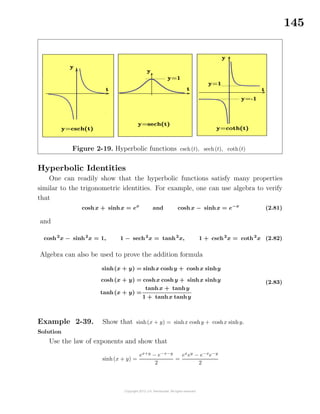
Introduction to Calculus
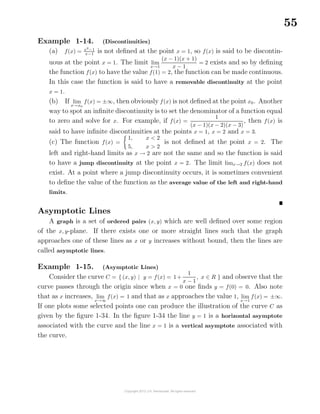
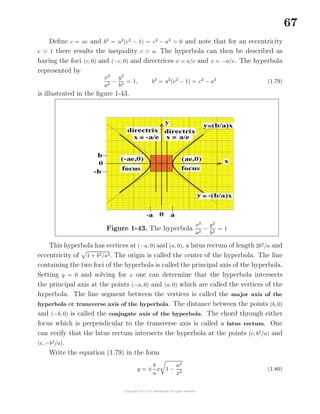
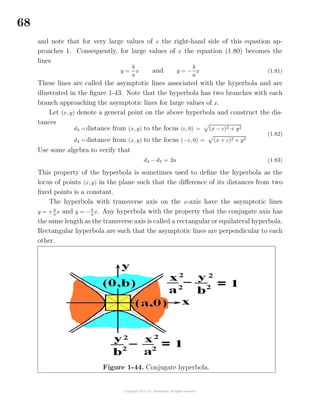
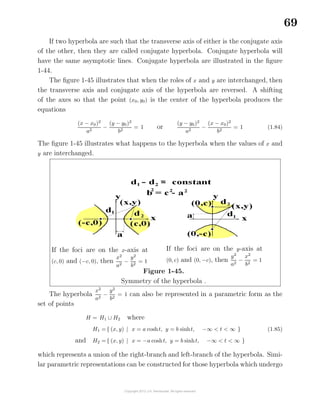
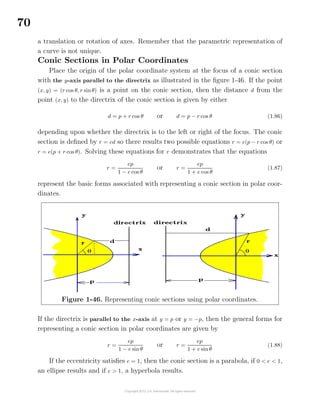
Volume I
by J.H. Heinbockel
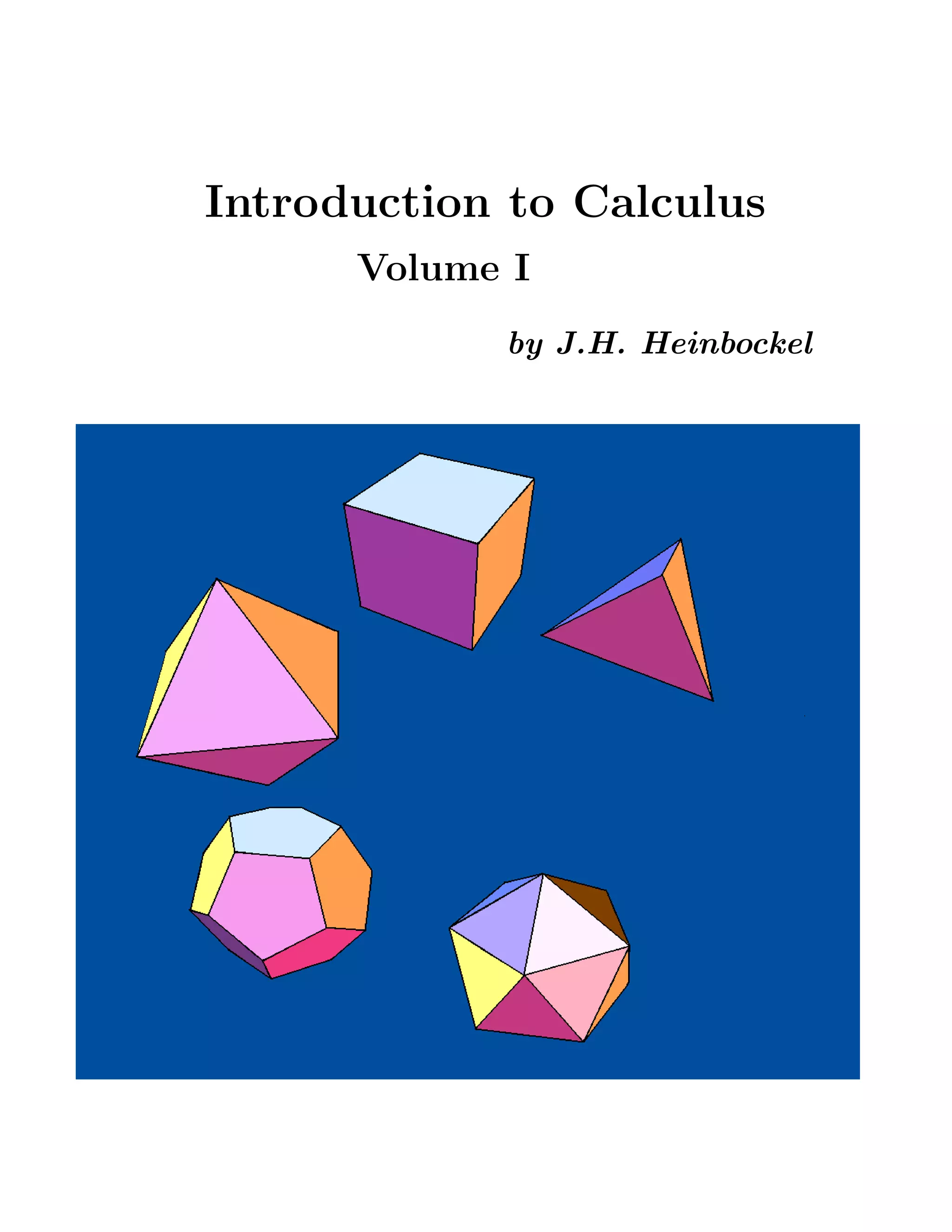
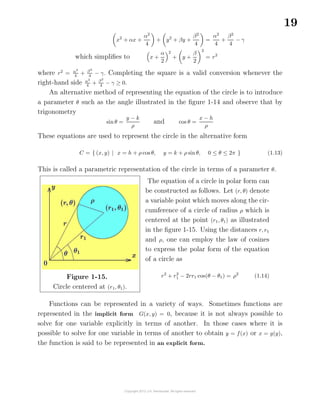
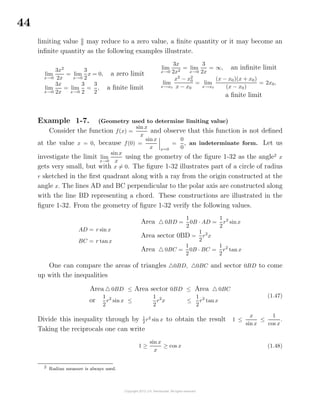
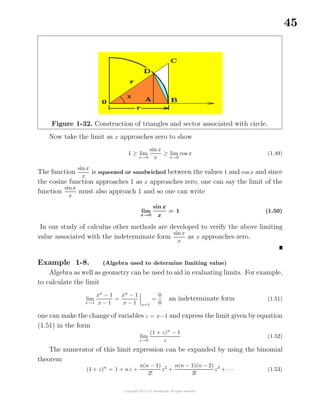
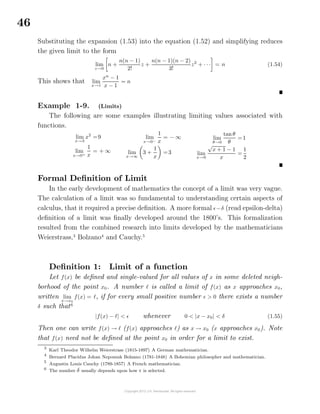
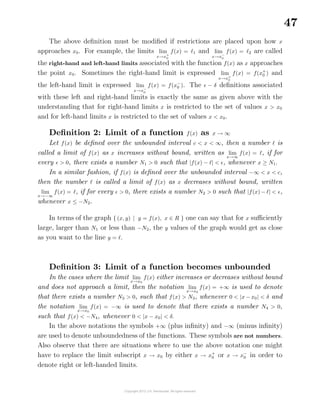
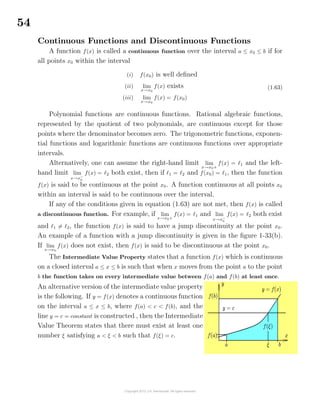
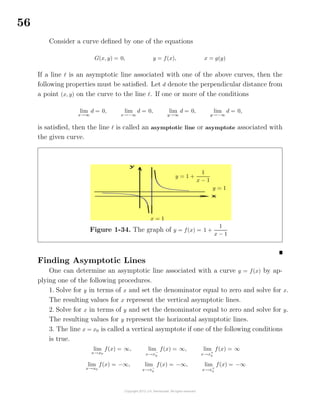
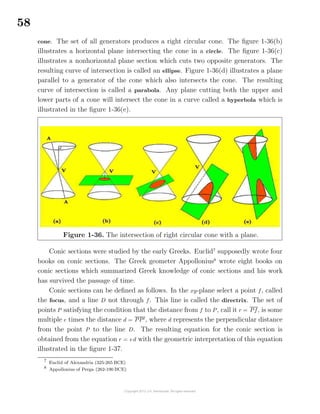
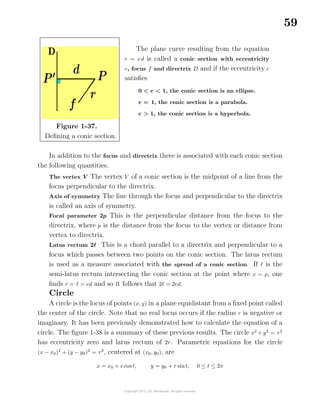
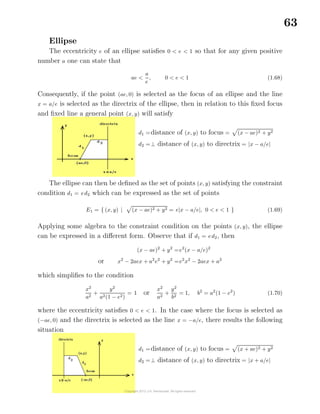
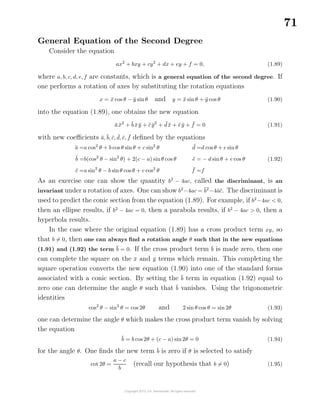
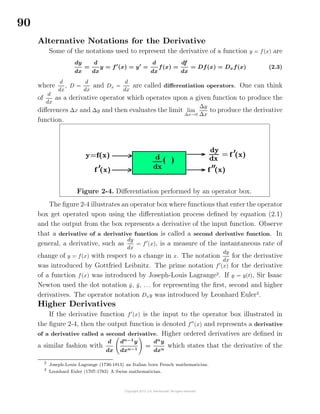
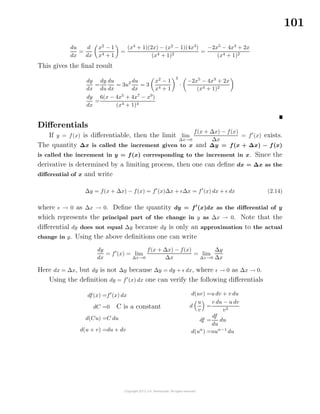
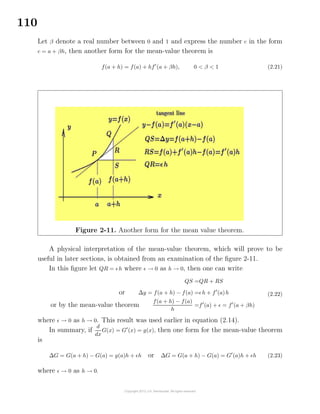
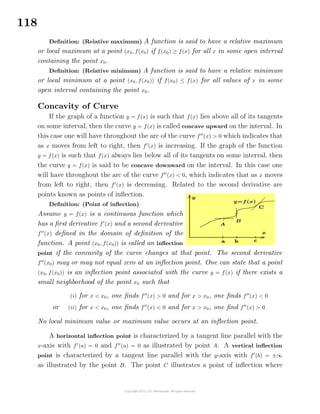
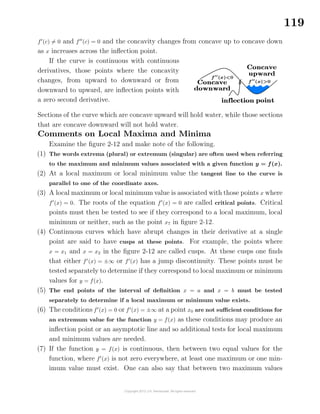
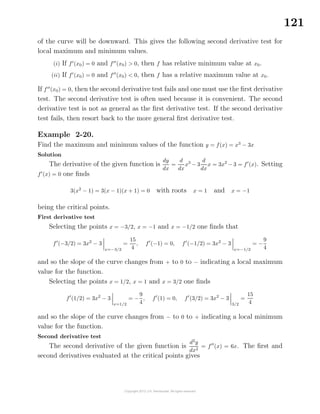
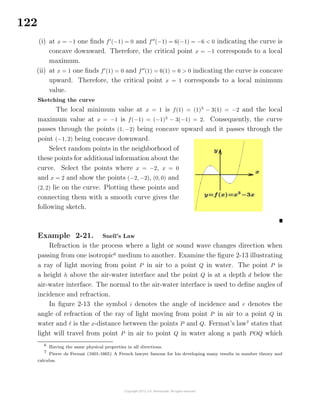
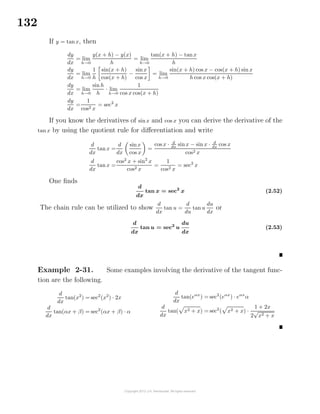
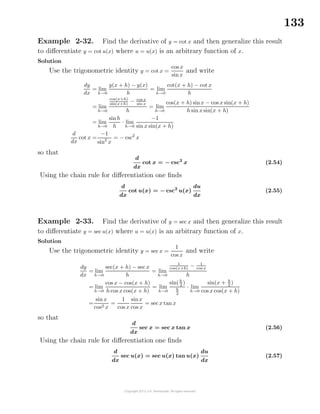
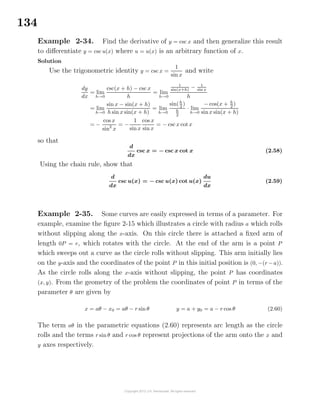
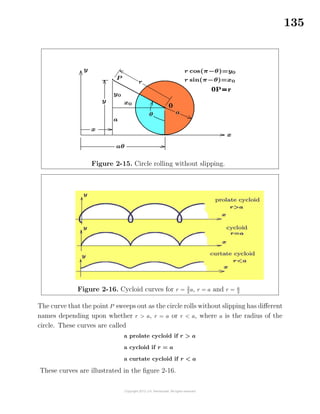
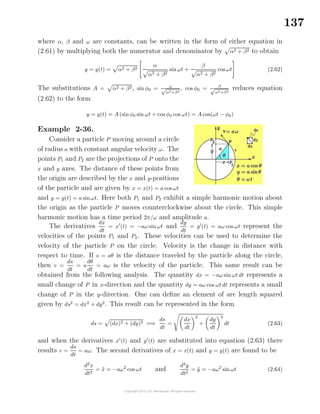
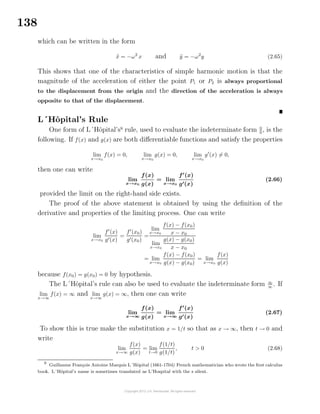
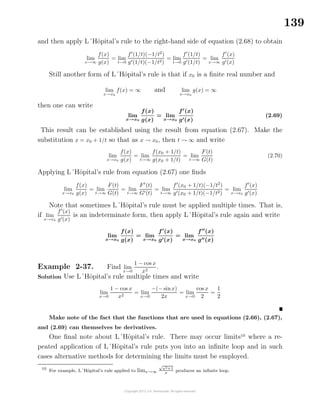
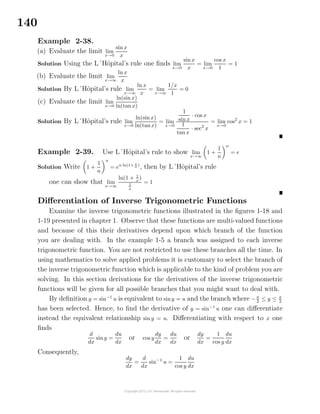
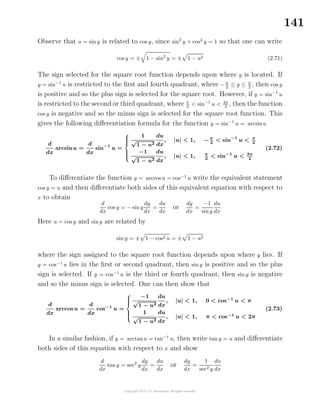
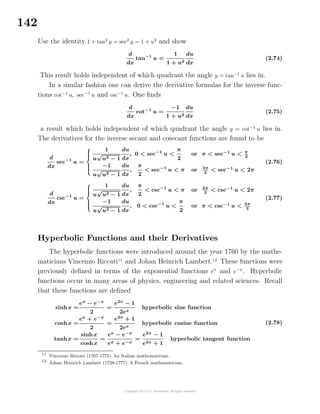
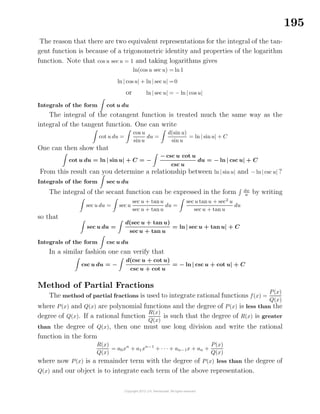
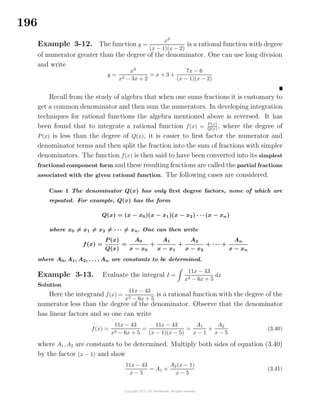
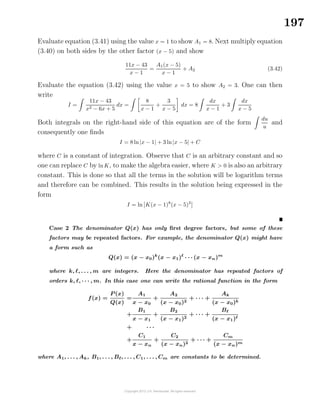
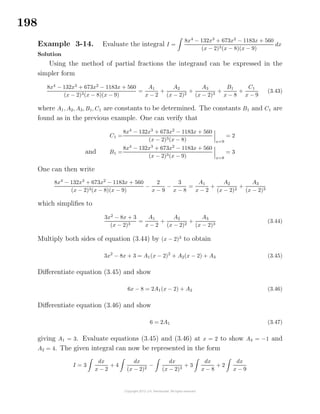
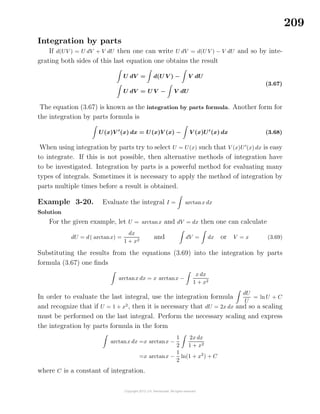
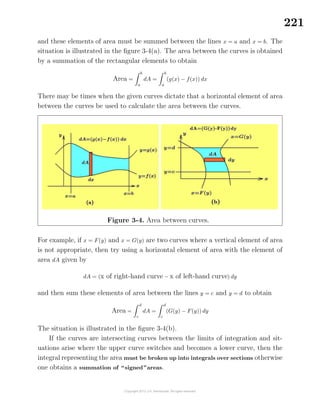
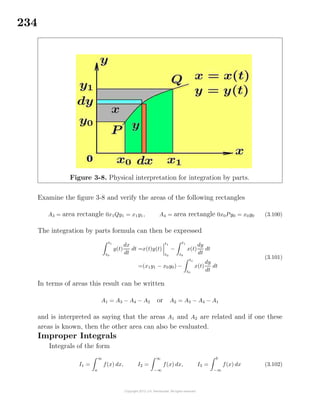
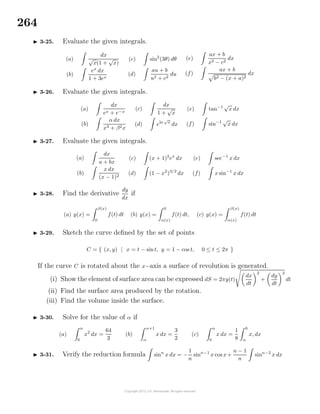
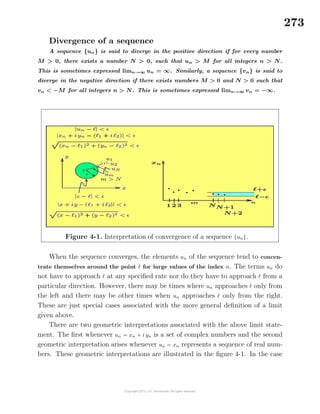
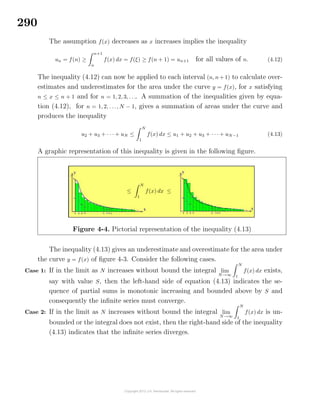
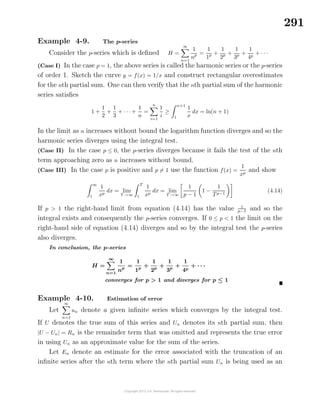
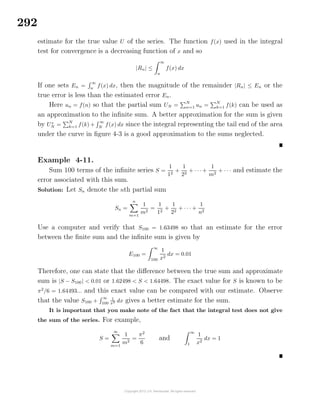
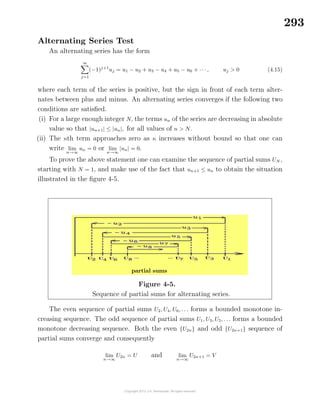
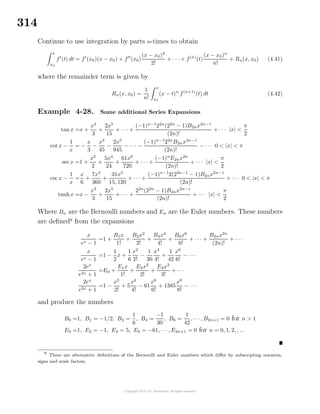
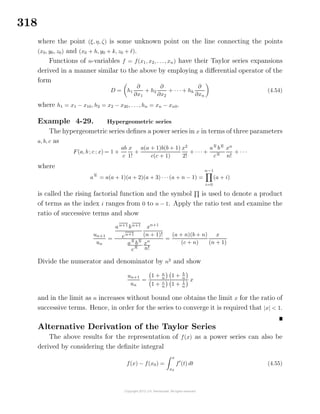
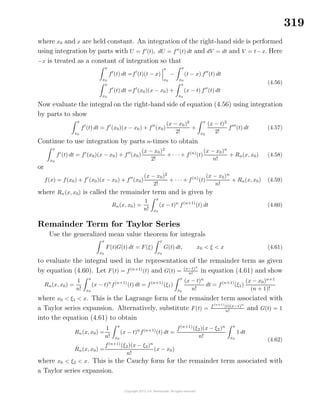
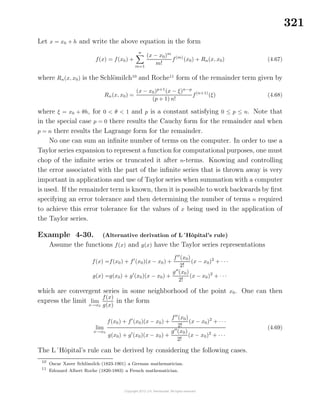
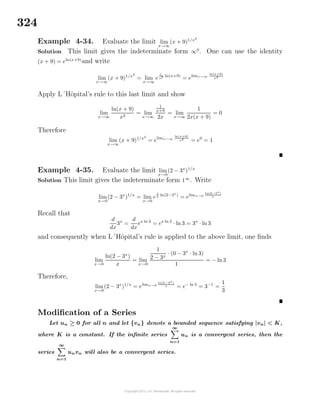
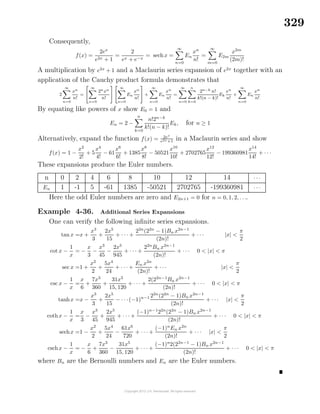
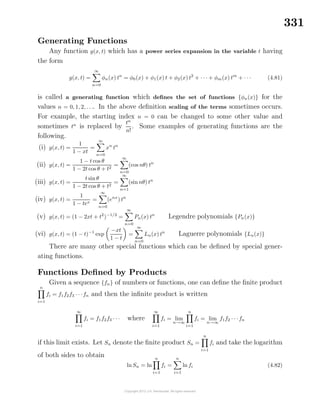
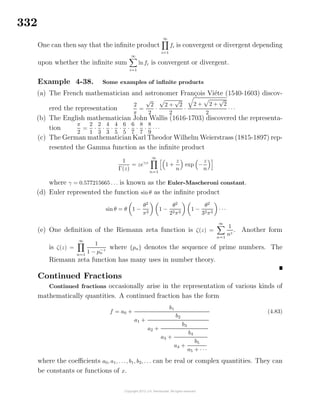
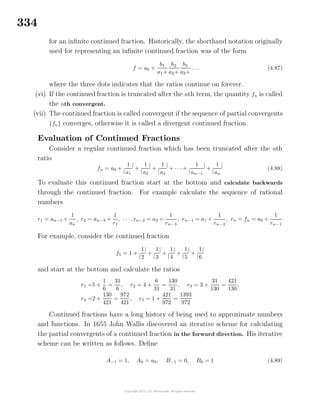
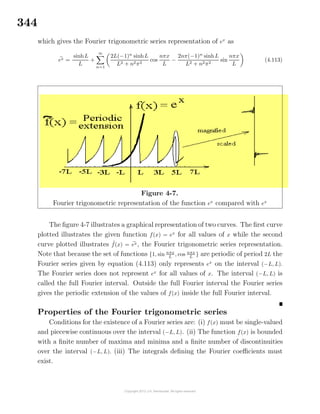
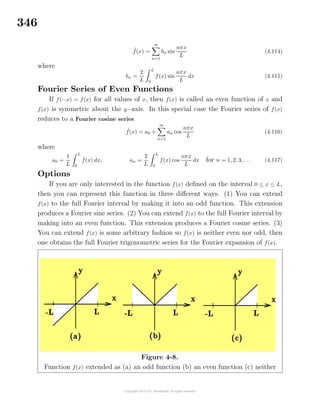
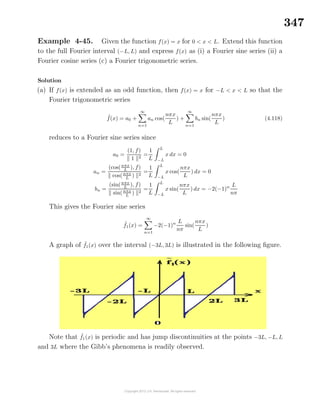
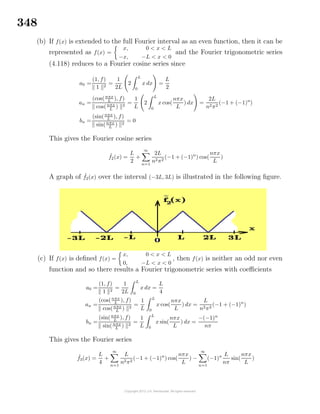
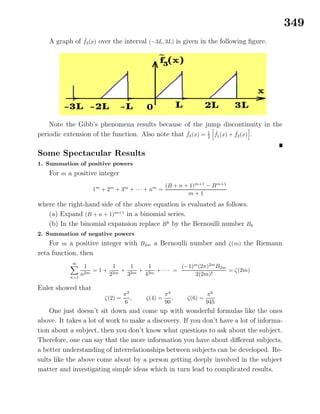
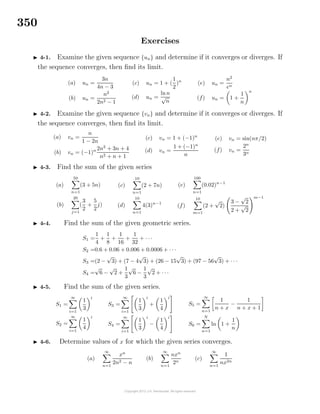
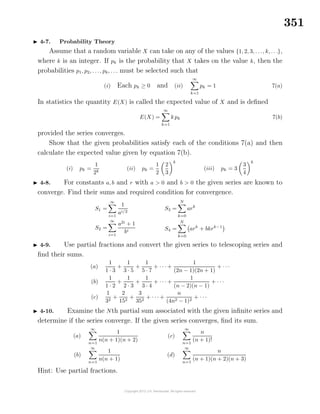
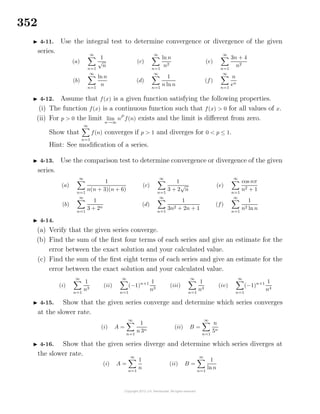
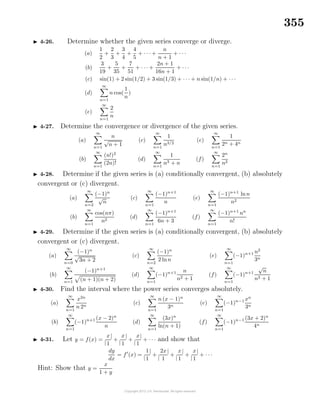
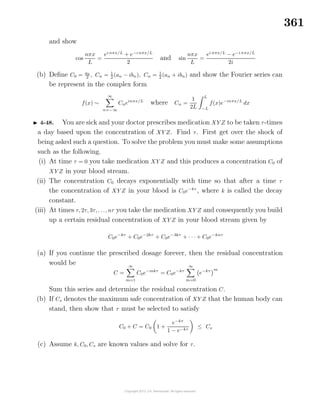
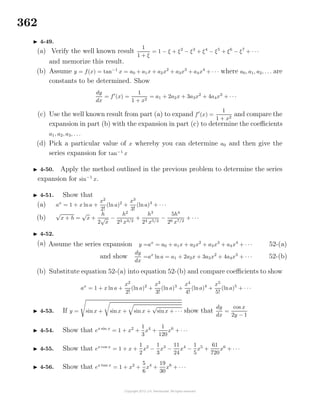
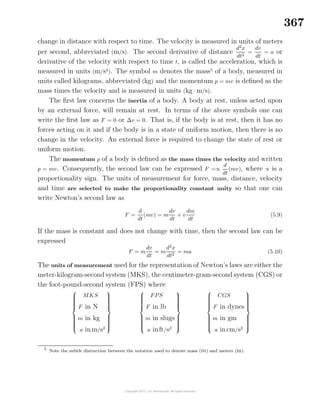
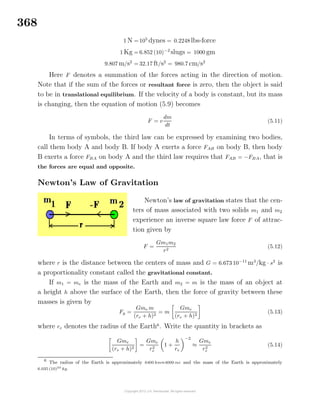
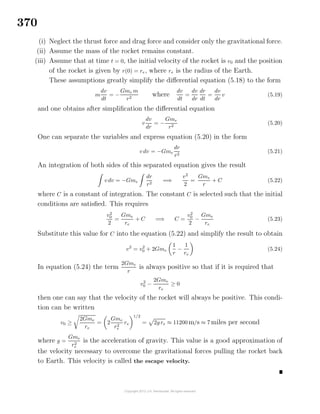
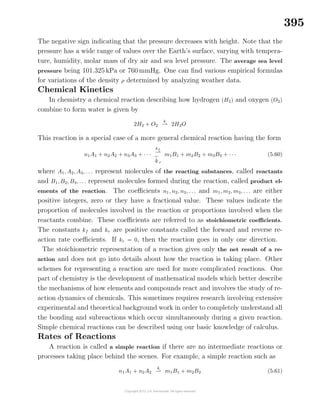
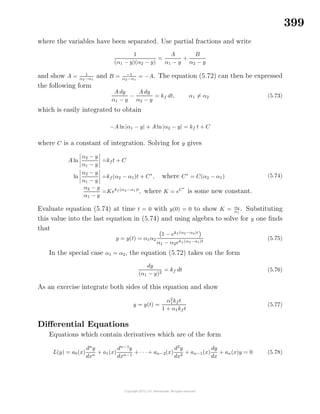
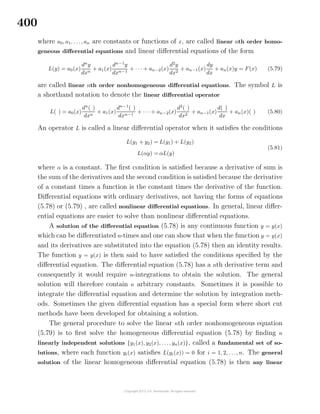
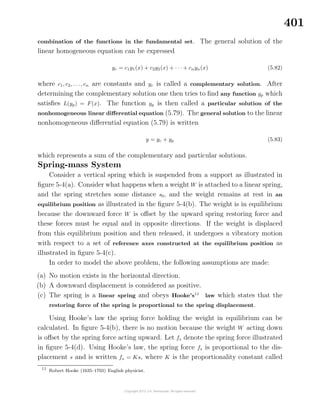
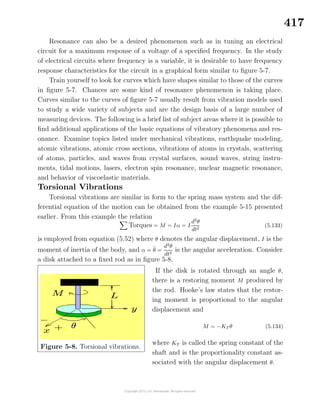
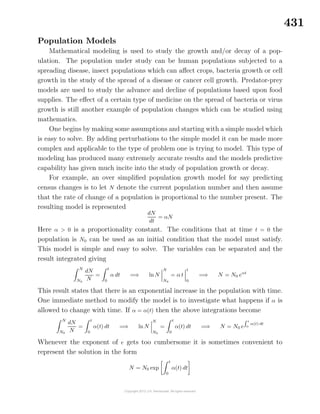
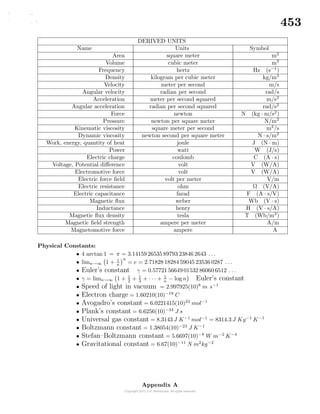
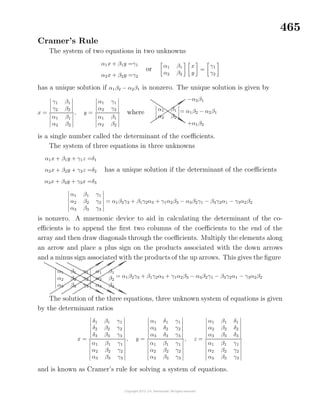
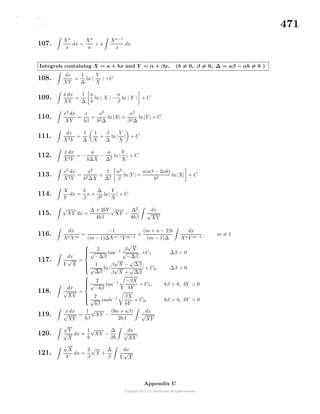
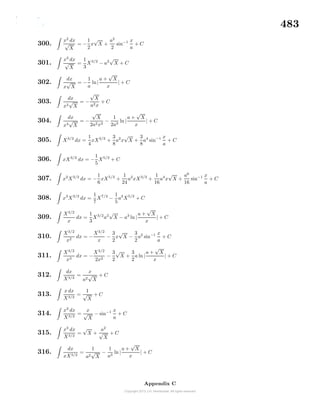
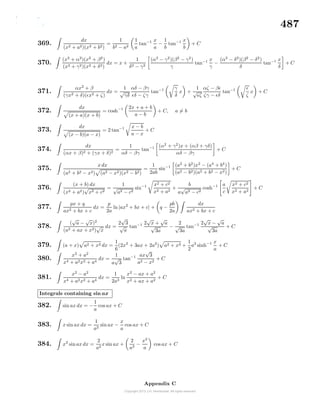
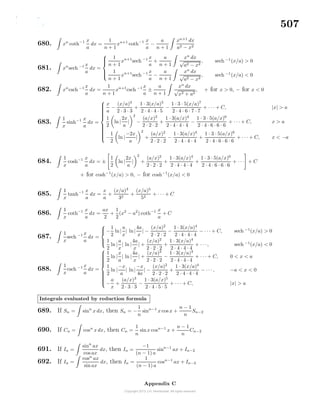
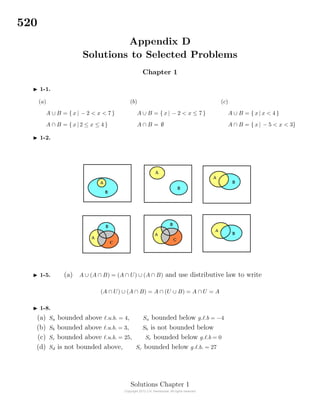
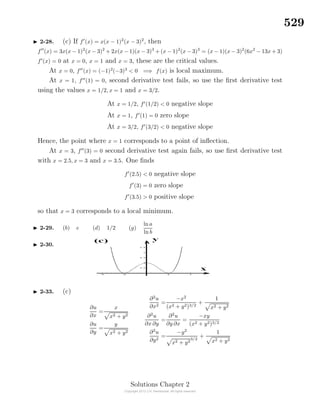
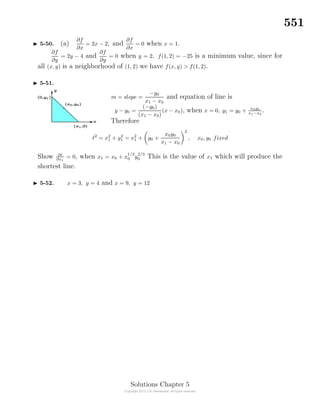
The regular solids or regular polyhedra are solid geometric figures with the same identical regular
polygon on each face. There are only five regular solids discovered by the ancient Greek mathematicians.
These five solids are the following.
the tetrahedron (4 faces)
the cube or hexadron (6 faces)
the octahedron (8 faces)
the dodecahedron (12 faces)
the icosahedron (20 faces)
Each figure follows the Euler formula
Number of faces + Number of vertices = Number of edges + 2
F + V = E + 2
Introduction to Calculus
Volume I
by J.H. Heinbockel
Emeritus Professor of Mathematics
Old Dominion University
c Copyright 2012 by John H. Heinbockel All rights reserved
Paper or electronic copies for noncommercial use may be made freely without explicit
permission of the author. All other rights are reserved.
This Introduction to Calculus is intended to be a free ebook where portions of the text
can be printed out. Commercial sale of this book or any part of it is strictly forbidden.
ii
Preface
This is the first volume of an introductory calculus presentation intended for
future scientists and engineers. Volume I contains five chapters emphasizing funda-
mental concepts from calculus and analytic geometry and the application of these
concepts to selected areas of science and engineering. Chapter one is a review of
fundamental background material needed for the development of differential and
integral calculus together with an introduction to limits. Chapter two introduces
the differential calculus and develops differentiation formulas and rules for finding
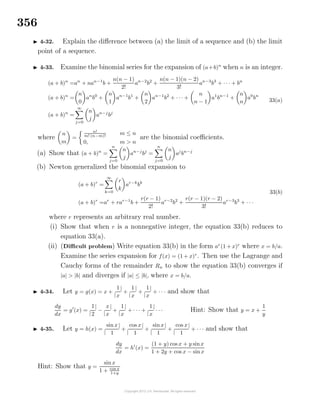
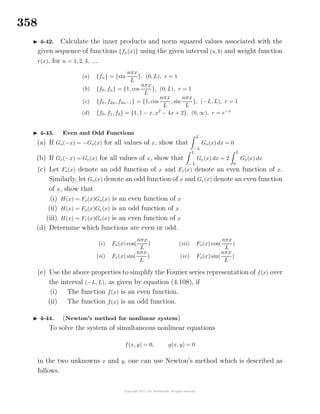
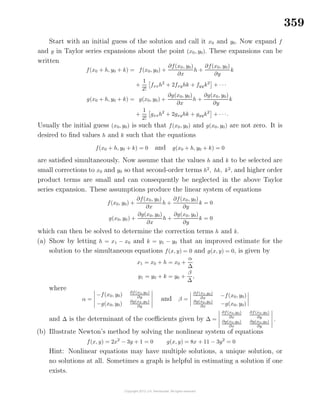
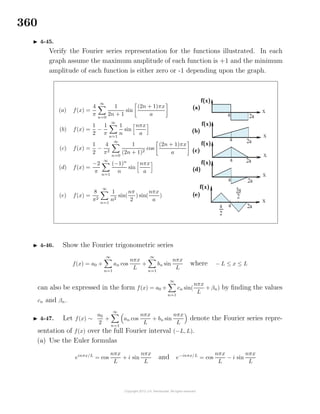
the derivatives associated with a variety of basic functions. Chapter three intro-
duces the integral calculus and develops indefinite and definite integrals. Rules
for integration and the construction of integral tables are developed throughout
the chapter. Chapter four is an investigation of sequences and numerical sums
and how these quantities are related to the functions, derivatives and integrals of
the previous chapters. Chapter five investigates many selected applications of the
differential and integral calculus. The selected applications come mainly from the
areas of economics, physics, biology, chemistry and engineering.
The main purpose of these two volumes is to (i) Provide an introduction to
calculus in its many forms (ii) Give some presentations to illustrate how power-
ful calculus is as a mathematical tool for solving a variety of scientific problems,
(iii) Present numerous examples to show how calculus can be extended to other
mathematical areas, (iv) Provide material detailed enough so that two volumes
of basic material can be used as reference books, (v) Introduce concepts from a
variety of application areas, such as biology, chemistry, economics, physics and en-
gineering, to demonstrate applications of calculus (vi) Emphasize that definitions
are extremely important in the study of any mathematical subject (vii) Introduce
proofs of important results as an aid to the development of analytical and critical
reasoning skills (viii) Introduce mathematical terminology and symbols which can
be used to help model physical systems and (ix) Illustrate multiple approaches to
various calculus subjects.
If the main thrust of an introductory calculus course is the application of cal-
culus to solve problems, then a student must quickly get to a point where he or
she understands enough fundamentals so that calculus can be used as a tool for
solving the problems of interest. If on the other hand a deeper understanding of
calculus is required in order to develop the basics for more advanced mathematical
iii
efforts, then students need to be exposed to theorems and proofs. If the calculus
course leans toward more applications, rather than theory, then the proofs pre-
sented throughout the text can be skimmed over. However, if the calculus course
is for mathematics majors, then one would want to be sure to go into the proofs
in greater detail, because these proofs are laying the groundwork and providing
background material for the study of more advanced concepts.
If you are a beginner in calculus, then be sure that you have had the appro-
priate background material of algebra and trigonometry. If you don’t understand
something then don’t be afraid to ask your instructor a question. Go to the li-
brary and check out some other calculus books to get a presentation of the subject
from a different perspective. The internet is a place where one can find numerous
help aids for calculus. Also on the internet one can find many illustrations of
the applications of calculus. These additional study aids will show you that there
are multiple approaches to various calculus subjects and should help you with the
development of your analytical and reasoning skills.
J.H. Heinbockel
September 2012
iv
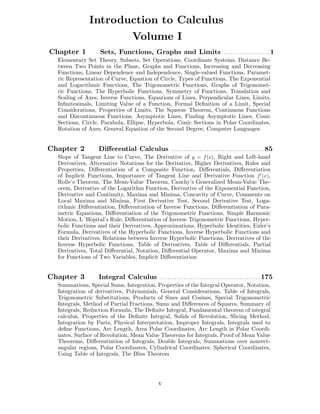
Introduction to Calculus
Volume I
Chapter 1 Sets, Functions, Graphs and Limits . . . . . . . . . . . . . . . . . . . . 1
Elementary Set Theory, Subsets, Set Operations, Coordinate Systems, Distance Be-
tween Two Points in the Plane, Graphs and Functions, Increasing and Decreasing
Functions, Linear Dependence and Independence, Single-valued Functions, Paramet-
ric Representation of Curve, Equation of Circle, Types of Functions, The Exponential
and Logarithmic Functions, The Trigonometric Functions, Graphs of Trigonomet-
ric Functions, The Hyperbolic Functions, Symmetry of Functions, Translation and
Scaling of Axes, Inverse Functions, Equations of Lines, Perpendicular Lines, Limits,
Infinitesimals, Limiting Value of a Function, Formal Definition of a Limit, Special
Considerations, Properties of Limits, The Squeeze Theorem, Continuous Functions
and Discontinuous Functions, Asymptotic Lines, Finding Asymptotic Lines, Conic
Sections, Circle, Parabola, Ellipse, Hyperbola, Conic Sections in Polar Coordinates,
Rotation of Axes, General Equation of the Second Degree, Computer Languages
Chapter 2 Differential Calculus . . . . . . . . . . . . . . . . . . . . . . . . . . . . . . . . . . . . . . . . 85
Slope of Tangent Line to Curve, The Derivative of y = f(x), Right and Left-hand
Derivatives, Alternative Notations for the Derivative, Higher Derivatives, Rules and
Properties, Differentiation of a Composite Function, Differentials, Differentiation
of Implicit Functions, Importance of Tangent Line and Derivative Function f (x),
Rolle’s Theorem, The Mean-Value Theorem, Cauchy’s Generalized Mean-Value The-
orem, Derivative of the Logarithm Function, Derivative of the Exponential Function,
Derivative and Continuity, Maxima and Minima, Concavity of Curve, Comments on
Local Maxima and Minima, First Derivative Test, Second Derivative Test, Loga-
rithmic Differentiation, Differentiation of Inverse Functions, Differentiation of Para-
metric Equations, Differentiation of the Trigonometric Functions, Simple Harmonic
Motion, L´Hˆopital’s Rule, Differentiation of Inverse Trigonometric Functions, Hyper-
bolic Functions and their Derivatives, Approximations, Hyperbolic Identities, Euler’s
Formula, Derivatives of the Hyperbolic Functions, Inverse Hyperbolic Functions and
their Derivatives, Relations between Inverse Hyperbolic Functions, Derivatives of the
Inverse Hyperbolic Functions, Table of Derivatives, Table of Differentials, Partial
Derivatives, Total Differential, Notation, Differential Operator, Maxima and Minima
for Functions of Two Variables, Implicit Differentiation
Chapter 3 Integral Calculus . . . . . . . . . . . . . . . . . . . . . . . . . . . . . . . . . . . . . . . . . . . 175
Summations, Special Sums, Integration, Properties of the Integral Operator, Notation,
Integration of derivatives, Polynomials, General Considerations, Table of Integrals,
Trigonometric Substitutions, Products of Sines and Cosines, Special Trigonometric
Integrals, Method of Partial Fractions, Sums and Differences of Squares, Summary of
Integrals, Reduction Formula, The Definite Integral, Fundamental theorem of integral
calculus, Properties of the Definite Integral, Solids of Revolution, Slicing Method,
Integration by Parts, Physical Interpretation, Improper Integrals, Integrals used to
define Functions, Arc Length, Area Polar Coordinates, Arc Length in Polar Coordi-
nates, Surface of Revolution, Mean Value Theorems for Integrals, Proof of Mean Value
Theorems, Differentiation of Integrals, Double Integrals, Summations over nonrect-
angular regions, Polar Coordinates, Cylindrical Coordinates, Spherical Coordinates,
Using Table of Integrals, The Bliss Theorem
v
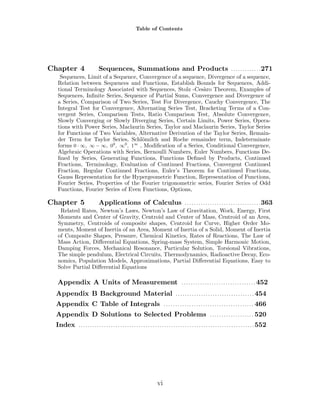
Table of Contents
Chapter 4 Sequences, Summations and Products . . . . . . . . . . . . .271
Sequences, Limit of a Sequence, Convergence of a sequence, Divergence of a sequence,
Relation between Sequences and Functions, Establish Bounds for Sequences, Addi-
tional Terminology Associated with Sequences, Stolz -Ces`aro Theorem, Examples of
Sequences, Infinite Series, Sequence of Partial Sums, Convergence and Divergence of
a Series, Comparison of Two Series, Test For Divergence, Cauchy Convergence, The
Integral Test for Convergence, Alternating Series Test, Bracketing Terms of a Con-
vergent Series, Comparison Tests, Ratio Comparison Test, Absolute Convergence,
Slowly Converging or Slowly Diverging Series, Certain Limits, Power Series, Opera-
tions with Power Series, Maclaurin Series, Taylor and Maclaurin Series, Taylor Series
for Functions of Two Variables, Alternative Derivation of the Taylor Series, Remain-
der Term for Taylor Series, Schl¨omilch and Roche remainder term, Indeterminate
forms 0 · ∞, ∞ − ∞, 00
, ∞0
, 1∞
, Modification of a Series, Conditional Convergence,
Algebraic Operations with Series, Bernoulli Numbers, Euler Numbers, Functions De-
fined by Series, Generating Functions, Functions Defined by Products, Continued
Fractions, Terminology, Evaluation of Continued Fractions, Convergent Continued
Fraction, Regular Continued Fractions, Euler’s Theorem for Continued Fractions,
Gauss Representation for the Hypergeometric Function, Representation of Functions,
Fourier Series, Properties of the Fourier trigonometric series, Fourier Series of Odd
Functions, Fourier Series of Even Functions, Options,
Chapter 5 Applications of Calculus . . . . . . . . . . . . . . . . . . . . . . . . . . . . . . . . .363
Related Rates, Newton’s Laws, Newton’s Law of Gravitation, Work, Energy, First
Moments and Center of Gravity, Centroid and Center of Mass, Centroid of an Area,
Symmetry, Centroids of composite shapes, Centroid for Curve, Higher Order Mo-
ments, Moment of Inertia of an Area, Moment of Inertia of a Solid, Moment of Inertia
of Composite Shapes, Pressure, Chemical Kinetics, Rates of Reactions, The Law of
Mass Action, Differential Equations, Spring-mass System, Simple Harmonic Motion,
Damping Forces, Mechanical Resonance, Particular Solution, Torsional Vibrations,
The simple pendulum, Electrical Circuits, Thermodynamics, Radioactive Decay, Eco-
nomics, Population Models, Approximations, Partial Differential Equations, Easy to
Solve Partial Differential Equations
Appendix A Units of Measurement . . . . . . . . . . . . . . . . . . . . . . . . . . . . . . . . 452
Appendix B Background Material . . . . . . . . . . . . . . . . . . . . . . . . . . . . . . . . . . 454
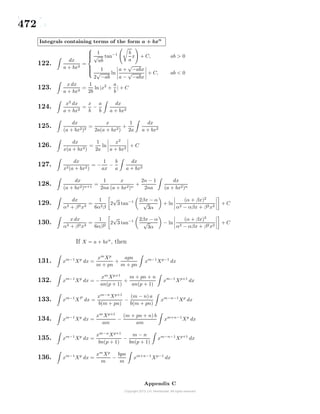
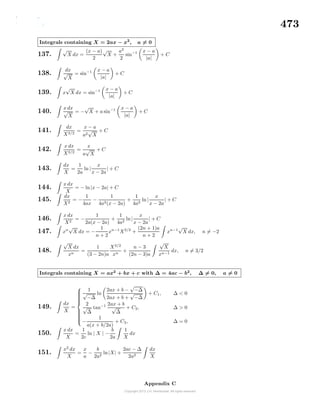
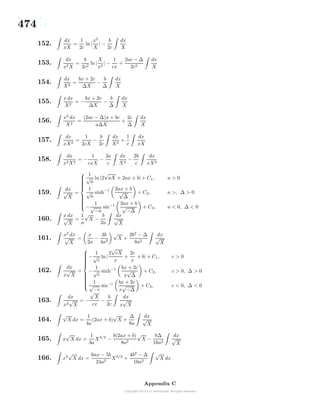
Appendix C Table of Integrals . . . . . . . . . . . . . . . . . . . . . . . . . . . . . . . . . . . . . . . 466
Appendix D Solutions to Selected Problems . . . . . . . . . . . . . . . . . . . 520
Index . . . . . . . . . . . . . . . . . . . . . . . . . . . . . . . . . . . . . . . . . . . . . . . . . . . . . . . . . . . . . . . . . . . . . . . . . . . . 552
vi
1
Chapter 1
Sets, Functions, Graphs and Limits
The study of different types of functions, limits associated with these functions
and how these functions change, together with the ability to graphically illustrate
basic concepts associated with these functions, is fundamental to the understanding
of calculus. These important issues are presented along with the development of
some additional elementary concepts which will aid in our later studies of more ad-
vanced concepts. In this chapter and throughout this text be aware that definitions
and their consequences are the keys to success for the understanding of calculus and
its many applications and extensions. Note that appendix B contains a summary of
fundamentals from algebra and trigonometry which is a prerequisite for the study
of calculus. This first chapter is a preliminary to calculus and begins by introducing
the concepts of a function, graph of a function and limits associated with functions.
These concepts are introduced using some basic elements from the theory of sets.
Elementary Set Theory
A set can be any collection of objects. A set of objects can be represented using
the notation
S = { x | statement about x}
and is read,“S is the set of objects x which make the statement about x true”.
Alternatively, a finite number of objects within S can be denoted by listing the
objects and writing
S = {S1, S2, . . ., Sn}
For example, the notation
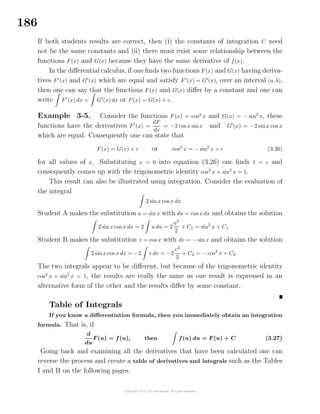
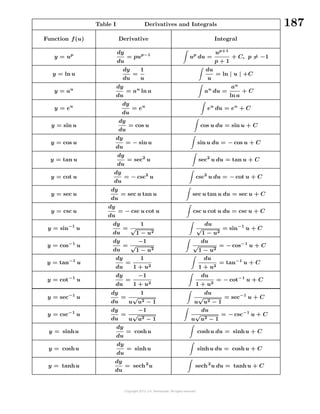
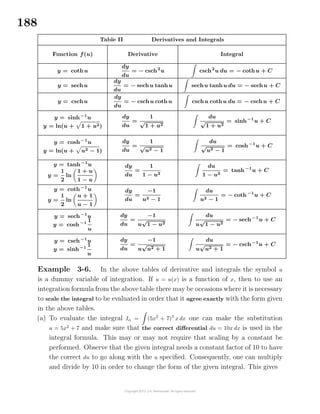
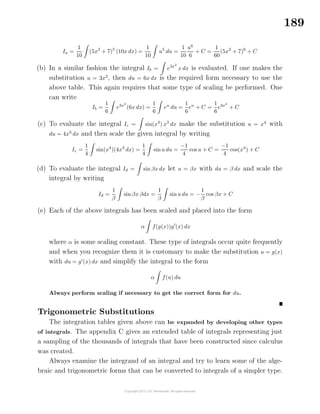
S = { x | x − 4 > 0}
can be used to denote the set of points x which are greater than 4 and the notation
T = {A, B, C, D, E}
can be used to represent a set containing the first 5 letters of the alphabet.
A set with no elements is denoted by the symbol ∅ and is known as the empty set.
The elements within a set are usually selected from some universal set U associated
with the elements x belonging to the set. When dealing with real numbers the
universal set U is understood to be the set of all real numbers. The universal set is
2
usually defined beforehand or is implied within the context of how the set is being
used. For example, the universal set associated with the set T above could be the
set of all symbols if that is appropriate and within the context of how the set T is
being used.
The symbol ∈ is read “belongs to” or “is a member of” and the symbol /∈ is
read “not in” or “is not a member of”. The statement x ∈ S is read “x is a member
of S ” or “x belongs to S ”. The statement y /∈ S is read “y does not belong to S”
or “y is not a member of S”.
Let S denote a non-empty set containing real numbers x. This set is said to be
bounded above if one can find a number b such that for each x ∈ S, one finds x ≤ b.
The number b is called an upper bound of the set S. In a similar fashion the set S
containing real numbers x is said to be bounded below if one can find a number
such that ≤ x for all x ∈ S. The number is called a lower bound for the set S.
Note that any number greater than b is also an upper bound for S and any number
less than can be considered a lower bound for S. Let B and C denote the sets
B = { x | x is an upper bound of S} and C = { x | x is a lower bound of S},
then the set B has a least upper bound ( .u.b.) and the set C has a greatest lower
bound (g. .b.). A set which is bounded both above and below is called a bounded set.
Some examples of well known sets are the following.
The set of natural numbers N = {1, 2, 3, . . .}
The set of integers Z = {. . ., −3, −2, −1, 0, 1, 2, 3, . . .}
The set of rational numbers Q = { p/q | p is an integer, q is an integer, q = 0}
The set of prime numbers P = {2, 3, 5, 7, 11, . . .}
The set of complex numbers C = { x + i y | i2
= −1, x, y are real numbers}
The set of real numbers R = {All decimal numbers}
The set of 2-tuples R2
= { (x, y) | x, y are real numbers }
The set of 3-tuples R3
= { (x, y, z) | x, y, z are real numbers }
The set of n-tuples Rn
= { (ξ1, ξ2, . . ., ξn) | ξ1, ξ2, . . ., ξn are real numbers }
where it is understood that i is an imaginary unit with the property i2
= −1 and
decimal numbers represent all terminating and nonterminating decimals.
3
Example 1-1. Intervals
When dealing with real numbers a, b, x it is customary to use the following no-
tations to represent various intervals of real numbers.
Set Notation Set Definition Name
[a, b] {x | a ≤ x ≤ b} closed interval
(a, b) {x | a < x < b} open interval
[a, b) {x | a ≤ x < b} left-closed, right-open
(a, b] {x | a < x ≤ b} left-open, right-closed
(a, ∞) {x | x > a} left-open, unbounded
[a, ∞) {x | x ≥ a} left-closed,unbounded
(−∞, a) {x | x < a} unbounded, right-open
(−∞, a] {x | x ≤ a} unbounded, right-closed
(−∞, ∞) R = {x | −∞ < x < ∞} Set of real numbers
Subsets
If for every element x ∈ A one can show that x is also an element of a set B,
then the set A is called a subset of B or one can say the set A is contained in the
set B. This is expressed using the mathematical statement A ⊂ B, which is read “A
is a subset of B ”. This can also be expressed by saying that B contains A, which is
written as B ⊃ A. If one can find one element of A which is not in the set B, then A
is not a subset of B. This is expressed using either of the notations A ⊂ B or B ⊃ A.
Note that the above definition implies that every set is a subset of itself, since the
elements of a set A belong to the set A. Whenever A ⊂ B and A = B, then A is called
a proper subset of B.
Set Operations
Given two sets A and B, the union of these sets is written A ∪ B and defined
A ∪ B = { x | x ∈ A or x ∈ B, or x ∈ both A and B}
The intersection of two sets A and B is written A ∩ B and defined
A ∩ B = { x | x ∈ both A and B }
If A ∩ B is the empty set one writes A ∩ B = ∅ and then the sets A and B are said to
be disjoint.
4
The difference1
between two sets A and B is written A − B and defined
A − B = { x | x ∈ A and x /∈ B }
The equality of two sets is written A = B and defined
A = B if and only if A ⊂ B and B ⊂ A
That is, if A ⊂ B and B ⊂ A, then the sets A and B must have the same elements
which implies equality. Conversely, if two sets are equal A = B, then A ⊂ B and
B ⊂ A since every set is a subset of itself.
A ∪ B A ∩ B A − B
Ac
A ∪ (B ∩ C) (A ∪ B)c
Figure 1-1. Selected Venn diagrams.
The complement of set A with respect to the universal set U is written Ac
and
defined
Ac
= { x | x ∈ U but x /∈ A }
Observe that the complement of a set A satisfies the complement laws
A ∪ Ac
= U, A ∩ Ac
= ∅, ∅c
= U, Uc
= ∅
The operations of union ∪ and intersection ∩ satisfy the distributive laws
A ∪ (B ∩ C) = (A ∪ B) ∩ (A ∪ C) A ∩ (B ∪ C) = (A ∩ B) ∪ (A ∩ C)
1
The difference between two sets A and B in some texts is expressed using the notation A  B.
5
and the identity laws
A ∪ ∅ = A, A ∪ U = U, A ∩ U = A, A ∩ ∅ = ∅
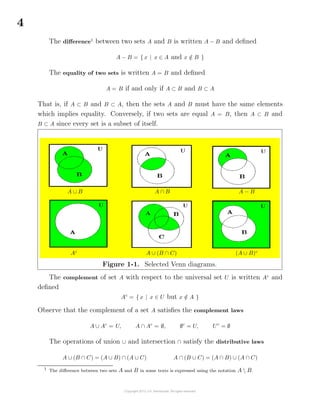
The above set operations can be illustrated using circles and rectangles, where
the universal set is denoted by the rectangle and individual sets are denoted by
circles. This pictorial representation for the various set operations was devised by
John Venn2
and are known as Venn diagrams. Selected Venn diagrams are illustrated
in the figure 1-1.
Example 1-2. Equivalent Statements
Prove that the following statements are equivalent A ⊂ B and A ∩ B = A
Solution To show these statements are equivalent one must show
(i) if A ⊂ B, then A ∩ B = A and (ii) if A ∩ B = A, then it follows that A ⊂ B.
(i) Assume A ⊂ B, then if x ∈ A it follows that x ∈ B since A is a subset of B.
Consequently, one can state that x ∈ (A ∩ B), all of which implies A ⊂ (A ∩ B).
Conversely, if x ∈ (A ∩ B), then x belongs to both A and B and certainly one can
say that x ∈ A. This implies (A ∩ B) ⊂ A. If A ⊂ (A ∩ B) and (A ∩ B) ⊂ A, then it
follows that (A ∩ B) = A.
(ii) Assume A ∩ B = A, then if x ∈ A, it must also be in A ∩ B so that one can say
x ∈ A and x ∈ B, which implies A ⊂ B.
Coordinate Systems
There are many different kinds of coordinate systems most of which are created
to transform a problem or object into a simpler representation. The rectangular
coordinate system3
with axes labeled x and y provides a way of plotting number
pairs (x, y) which are interpreted as points within a plane.
2
John Venn (1834-1923) An English mathematician who studied logic and set theory.
3
Also called a cartesian coordinate system and named for Ren´e Descartes (1596-1650) a French philosopher who
applied algebra to geometry problems.
6
rectangular coordinates polar coordinates
x2
+ y2
= ρ2 x = r cos θ,
tan θ = y
x
y = r sin θ
x2 + y2 = r
r = ρ
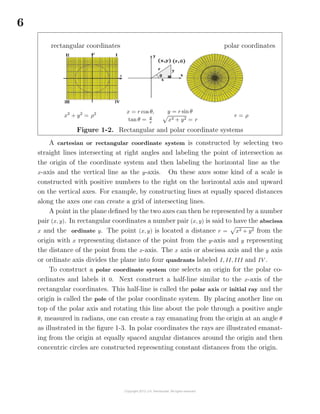
Figure 1-2. Rectangular and polar coordinate systems
A cartesian or rectangular coordinate system is constructed by selecting two
straight lines intersecting at right angles and labeling the point of intersection as
the origin of the coordinate system and then labeling the horizontal line as the
x-axis and the vertical line as the y-axis. On these axes some kind of a scale is
constructed with positive numbers to the right on the horizontal axis and upward
on the vertical axes. For example, by constructing lines at equally spaced distances
along the axes one can create a grid of intersecting lines.
A point in the plane defined by the two axes can then be represented by a number
pair (x, y). In rectangular coordinates a number pair (x, y) is said to have the abscissa
x and the ordinate y. The point (x, y) is located a distance r = x2 + y2 from the
origin with x representing distance of the point from the y-axis and y representing
the distance of the point from the x-axis. The x axis or abscissa axis and the y axis
or ordinate axis divides the plane into four quadrants labeled I, II, III and IV .
To construct a polar coordinate system one selects an origin for the polar co-
ordinates and labels it 0. Next construct a half-line similar to the x-axis of the
rectangular coordinates. This half-line is called the polar axis or initial ray and the
origin is called the pole of the polar coordinate system. By placing another line on
top of the polar axis and rotating this line about the pole through a positive angle
θ, measured in radians, one can create a ray emanating from the origin at an angle θ
as illustrated in the figure 1-3. In polar coordinates the rays are illustrated emanat-
ing from the origin at equally spaced angular distances around the origin and then
concentric circles are constructed representing constant distances from the origin.
7
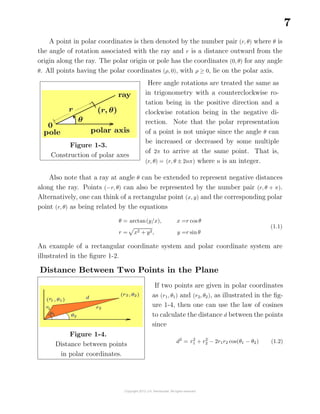
A point in polar coordinates is then denoted by the number pair (r, θ) where θ is
the angle of rotation associated with the ray and r is a distance outward from the
origin along the ray. The polar origin or pole has the coordinates (0, θ) for any angle
θ. All points having the polar coordinates (ρ, 0), with ρ ≥ 0, lie on the polar axis.
Figure 1-3.
Construction of polar axes
Here angle rotations are treated the same as
in trigonometry with a counterclockwise ro-
tation being in the positive direction and a
clockwise rotation being in the negative di-
rection. Note that the polar representation
of a point is not unique since the angle θ can
be increased or decreased by some multiple
of 2π to arrive at the same point. That is,
(r, θ) = (r, θ ± 2nπ) where n is an integer.
Also note that a ray at angle θ can be extended to represent negative distances
along the ray. Points (−r, θ) can also be represented by the number pair (r, θ + π).
Alternatively, one can think of a rectangular point (x, y) and the corresponding polar
point (r, θ) as being related by the equations
θ = arctan(y/x),
r = x2 + y2,
x =r cos θ
y =r sinθ
(1.1)
An example of a rectangular coordinate system and polar coordinate system are
illustrated in the figure 1-2.
Distance Between Two Points in the Plane
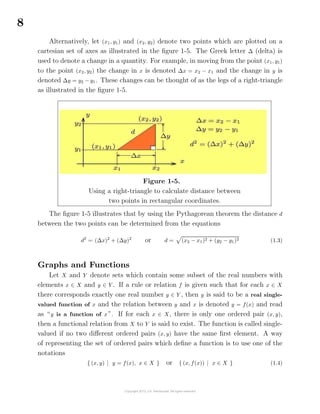
Figure 1-4.
Distance between points
in polar coordinates.
If two points are given in polar coordinates
as (r1, θ1) and (r2, θ2), as illustrated in the fig-
ure 1-4, then one can use the law of cosines
to calculate the distance d between the points
since
d2
= r2
1 + r2
2 − 2r1r2 cos(θ1 − θ2) (1.2)
8
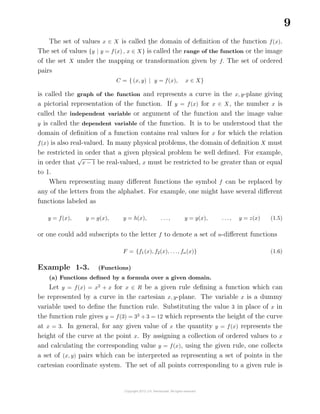
Alternatively, let (x1, y1) and (x2, y2) denote two points which are plotted on a
cartesian set of axes as illustrated in the figure 1-5. The Greek letter ∆ (delta) is
used to denote a change in a quantity. For example, in moving from the point (x1, y1)
to the point (x2, y2) the change in x is denoted ∆x = x2 − x1 and the change in y is
denoted ∆y = y2 − y1. These changes can be thought of as the legs of a right-triangle
as illustrated in the figure 1-5.
Figure 1-5.
Using a right-triangle to calculate distance between
two points in rectangular coordinates.
The figure 1-5 illustrates that by using the Pythagorean theorem the distance d
between the two points can be determined from the equations
d2
= (∆x)2
+ (∆y)2
or d = (x2 − x1)2 + (y2 − y1)2 (1.3)
Graphs and Functions
Let X and Y denote sets which contain some subset of the real numbers with
elements x ∈ X and y ∈ Y . If a rule or relation f is given such that for each x ∈ X
there corresponds exactly one real number y ∈ Y , then y is said to be a real single-
valued function of x and the relation between y and x is denoted y = f(x) and read
as “y is a function of x”. If for each x ∈ X, there is only one ordered pair (x, y),
then a functional relation from X to Y is said to exist. The function is called single-
valued if no two different ordered pairs (x, y) have the same first element. A way
of representing the set of ordered pairs which define a function is to use one of the
notations
{ (x, y) | y = f(x), x ∈ X } or { (x, f(x)) | x ∈ X } (1.4)
9
The set of values x ∈ X is called t
¯
he domain of definition of the function f(x).
The set of values {y | y = f(x) , x ∈ X} is called the range of the function or the image
of the set X under the mapping or transformation given by f. The set of ordered
pairs
C = { (x, y) | y = f(x), x ∈ X}
is called the graph of the function and represents a curve in the x, y-plane giving
a pictorial representation of the function. If y = f(x) for x ∈ X, the number x is
called the independent variable or argument of the function and the image value
y is called the dependent variable of the function. It is to be understood that the
domain of definition of a function contains real values for x for which the relation
f(x) is also real-valued. In many physical problems, the domain of definition X must
be restricted in order that a given physical problem be well defined. For example,
in order that
√
x − 1 be real-valued, x must be restricted to be greater than or equal
to 1.
When representing many different functions the symbol f can be replaced by
any of the letters from the alphabet. For example, one might have several different
functions labeled as
y = f(x), y = g(x), y = h(x), . . ., y = y(x), . . ., y = z(x) (1.5)
or one could add subscripts to the letter f to denote a set of n-different functions
F = {f1(x), f2(x), . . ., fn(x)} (1.6)
Example 1-3. (Functions)
(a) Functions defined by a formula over a given domain.
Let y = f(x) = x2
+ x for x ∈ R be a given rule defining a function which can
be represented by a curve in the cartesian x, y-plane. The variable x is a dummy
variable used to define the function rule. Substituting the value 3 in place of x in
the function rule gives y = f(3) = 32
+ 3 = 12 which represents the height of the curve
at x = 3. In general, for any given value of x the quantity y = f(x) represents the
height of the curve at the point x. By assigning a collection of ordered values to x
and calculating the corresponding value y = f(x), using the given rule, one collects
a set of (x, y) pairs which can be interpreted as representing a set of points in the
cartesian coordinate system. The set of all points corresponding to a given rule is
10
called the locus of points satisfying the rule. The graph illustrated in the figure 1-6
is a pictorial representation of the given rule.
x y = f(x) = x2 + x
-2.0 2.00
-1.8 1.44
-1.6 0.96
-1.4 0.56
-1.2 0.24
-1.0 0.00
-0.8 -0.16
-0.6 -0.24
-0.4 -0.24
-0.2 -0.16
0.0 0.00
0.2 0.24
0.4 0.56
0.6 0.96
0.8 1.44
1.0 2.00
1.2 2.64
1.4 3.36
1.6 4.16
1.8 5.04
2.0 6.00
Figure 1-6. A graph of the function y = f(x) = x2
+ x
Note that substituting x + h in place of x in the function rule gives
f(x + h) = (x + h)2
+ (x + h) = x2
+ (2h + 1)x + (h2
+ h).
If f(x) represents the height of the curve at the point x, then f(x + h) represents the
height of the curve at x + h.
(b) Let r = f(θ) = 1 + θ for 0 ≤ θ ≤ 2π be a given rule defining a function which
can be represented by a curve in polar coordinates (r, θ). One can select a set
of ordered values for θ in the interval [0, 2π] and calculate the corresponding
values for r = f(θ). The set of points (r, θ) created can then be plotted on polar
graph paper to give a pictorial representation of the function rule. The graph
illustrated in the figure 1-7 is a pictorial representation of the given function
over the given domain.
Note in dealing with polar coordinates a radial distance r and polar angle θ can
have any of the representations
((−1)n
r, θ + nπ)
11
and consequently a functional relation like r = f(θ) can be represented by one of the
alternative equations r = (−1)n
f(θ + nπ)
θ r = f(θ) = 1 + θ
0 1 + 0
π/4 1 + π/4
2π/4 1 + 2π/4
3π/4 1 + 3π/4
4π/4 1 + 4π/4
5π/4 1 + 5π/4
6π/4 1 + 6π/4
7π/4 1 + 7π/4
8π/4 1 + 8π/4
Figure 1-7.
A polar plot of the function r = f(θ) = 1 + θ
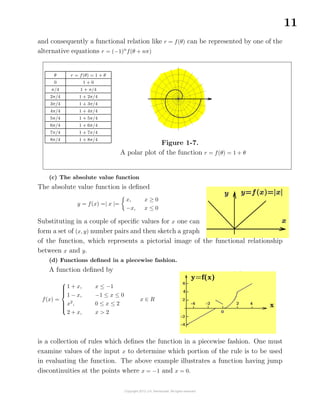
(c) The absolute value function
The absolute value function is defined
y = f(x) =| x |=
x, x ≥ 0
−x, x ≤ 0
Substituting in a couple of specific values for x one can
form a set of (x, y) number pairs and then sketch a graph
of the function, which represents a pictorial image of the functional relationship
between x and y.
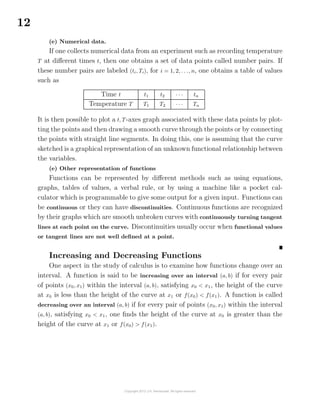
(d) Functions defined in a piecewise fashion.
A function defined by
f(x) =



1 + x, x ≤ −1
1 − x, −1 ≤ x ≤ 0
x2
, 0 ≤ x ≤ 2
2 + x, x > 2
x ∈ R
is a collection of rules which defines the function in a piecewise fashion. One must
examine values of the input x to determine which portion of the rule is to be used
in evaluating the function. The above example illustrates a function having jump
discontinuities at the points where x = −1 and x = 0.
12
(e) Numerical data.
If one collects numerical data from an experiment such as recording temperature
T at different times t, then one obtains a set of data points called number pairs. If
these number pairs are labeled (ti, Ti), for i = 1, 2, . . ., n, one obtains a table of values
such as
Time t t1 t2 · · · tn
Temperature T T1 T2 · · · Tn
It is then possible to plot a t, T-axes graph associated with these data points by plot-
ting the points and then drawing a smooth curve through the points or by connecting
the points with straight line segments. In doing this, one is assuming that the curve
sketched is a graphical representation of an unknown functional relationship between
the variables.
(e) Other representation of functions
Functions can be represented by different methods such as using equations,
graphs, tables of values, a verbal rule, or by using a machine like a pocket cal-
culator which is programmable to give some output for a given input. Functions can
be continuous or they can have discontinuities. Continuous functions are recognized
by their graphs which are smooth unbroken curves with continuously turning tangent
lines at each point on the curve. Discontinuities usually occur when functional values
or tangent lines are not well defined at a point.
Increasing and Decreasing Functions
One aspect in the study of calculus is to examine how functions change over an
interval. A function is said to be increasing over an interval (a, b) if for every pair
of points (x0, x1) within the interval (a, b), satisfying x0 < x1, the height of the curve
at x0 is less than the height of the curve at x1 or f(x0) < f(x1). A function is called
decreasing over an interval (a, b) if for every pair of points (x0, x1) within the interval
(a, b), satisfying x0 < x1, one finds the height of the curve at x0 is greater than the
height of the curve at x1 or f(x0) > f(x1).
13
Linear Dependence and Independence
A linear combination of a set of functions {f1, f2, . . ., fn} is formed by taking
arbitrary constants c1, c2, . . ., cn and forming the sum
y = c1f1 + c2f2 + · · · + cnfn (1.7)
One can then say that y is a linear combination of the set of functions {f1, f2, . . ., fn}.
If a function f1(x) is some constant c times another function f2(x), then one can
write f1(x) = cf2(x) and under this condition the function f1 is said to be linearly
dependent upon f2. If no such constant c exists, then the functions are said to
be linearly independent. Another way of expressing linear dependence and linear
independence applied to functions f1 and f2 is as follows. One can say that, if there
are nonzero constants c1, c2 such that the linear combination
c1f1(x) + c2f2(x) = 0 (1.8)
for all values of x, then the set of functions {f1, f2} is called a set of dependent
functions. This is due to the fact that if c1 = 0, then one can divided by c1 and
express the equation (1.8) in the form f1(x) = −c2
c1
f2(x) = cf2(x). If the only constants
which make equation (1.8) a true statement are c1 = 0 and c2 = 0, then the set of
functions {f1, f2} is called a set of linearly independent functions.
An immediate generalization of the above is the following. If there exists con-
stants c1, c2, . . ., cn, not all zero, such that the linear combination
c1f1(x) + c2f2(x) + · · ·cnfn(x) = 0, (1.9)
for all values of x, then the set of functions {f1, f2, . . ., fn} is called a linearly dependent
set of functions. If the only constants, for which equation (1.9) is true, are when
c1 = c2 = · · · = cn = 0, then the set of functions {f1, f2, . . ., fn} is called a linearly
independent set of functions. Note that if the set of functions are linearly dependent,
then one of the functions can be made to become a linear combination of the other
functions. For example, assume that c1 = 0 in equation (1.9). One can then write
f1(x) = −
c2
c1
f2(x) − · · · −
cn
c1
fn(x)
which shows that f1 is some linear combination of the other functions. That is, f1
is dependent upon the values of the other functions.
14
Single-valued Functions
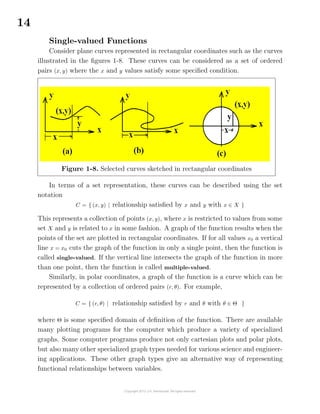
Consider plane curves represented in rectangular coordinates such as the curves
illustrated in the figures 1-8. These curves can be considered as a set of ordered
pairs (x, y) where the x and y values satisfy some specified condition.
Figure 1-8. Selected curves sketched in rectangular coordinates
In terms of a set representation, these curves can be described using the set
notation
C = { (x, y) | relationship satisfied by x and y with x ∈ X }
This represents a collection of points (x, y), where x is restricted to values from some
set X and y is related to x in some fashion. A graph of the function results when the
points of the set are plotted in rectangular coordinates. If for all values x0 a vertical
line x = x0 cuts the graph of the function in only a single point, then the function is
called single-valued. If the vertical line intersects the graph of the function in more
than one point, then the function is called multiple-valued.
Similarly, in polar coordinates, a graph of the function is a curve which can be
represented by a collection of ordered pairs (r, θ). For example,
C = { (r, θ) | relationship satisfied by r and θ with θ ∈ Θ }
where Θ is some specified domain of definition of the function. There are available
many plotting programs for the computer which produce a variety of specialized
graphs. Some computer programs produce not only cartesian plots and polar plots,
but also many other specialized graph types needed for various science and engineer-
ing applications. These other graph types give an alternative way of representing
functional relationships between variables.
15
Example 1-4. Rectangular and Polar Graphs
Plotting the same function in both rectangular coordinates and polar coordinates
gives different shaped curves and so the graphs of these functions have different
properties depending upon the coordinate system used to represent the function.
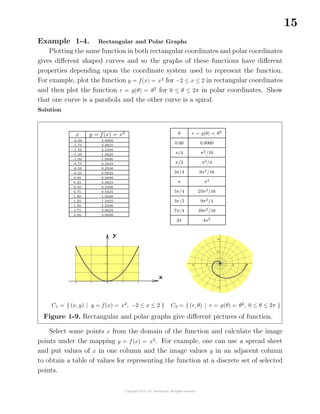
For example, plot the function y = f(x) = x2
for −2 ≤ x ≤ 2 in rectangular coordinates
and then plot the function r = g(θ) = θ2
for 0 ≤ θ ≤ 2π in polar coordinates. Show
that one curve is a parabola and the other curve is a spiral.
Solution
x y = f(x) = x2
-2.00 4.0000
-1.75 3.0625
-1.50 2.2500
-1.25 1.5625
-1.00 1.0000
-0.75 0.5625
-0.50 0.2500
-0.25 0.0625
0.00 0.0000
0.25 0.0625
0.50 0.2500
0.75 0.5625
1.00 1.0000
1.25 1.5625
1.50 2.2500
1.75 3.0625
2.00 4.0000
θ r = g(θ) = θ2
0.00 0.0000
π/4 π2/16
π/2 π2/4
3π/4 9π2/16
π π2
5π/4 25π2/16
3π/2 9π2/4
7π/4 49π2/16
2π 4π2
C1 = { (x, y) | y = f(x) = x2
, −2 ≤ x ≤ 2 } C2 = { (r, θ) | r = g(θ) = θ2
, 0 ≤ θ ≤ 2π }
Figure 1-9. Rectangular and polar graphs give different pictures of function.
Select some points x from the domain of the function and calculate the image
points under the mapping y = f(x) = x2
. For example, one can use a spread sheet
and put values of x in one column and the image values y in an adjacent column
to obtain a table of values for representing the function at a discrete set of selected
points.
16
Similarly, select some points θ from the domain of the function to be plotted in
polar coordinates and calculate the image points under the mapping r = g(θ) = θ2
.
Use a spread sheet and put values of θ in one column and the image values r in an
adjacent column to obtain a table for representing the function as a discrete set of
selected points. Using an x spacing of 0.25 between points for the rectangular graph
and a θ spacing of π/4 for the polar graph, one can verify the table of values and
graphs given in the figure 1-9.
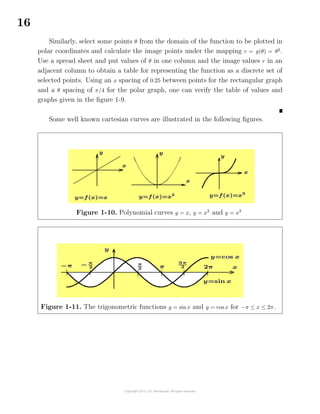
Some well known cartesian curves are illustrated in the following figures.
Figure 1-10. Polynomial curves y = x, y = x2
and y = x3
Figure 1-11. The trigonometric functions y = sinx and y = cos x for −π ≤ x ≤ 2π.
17
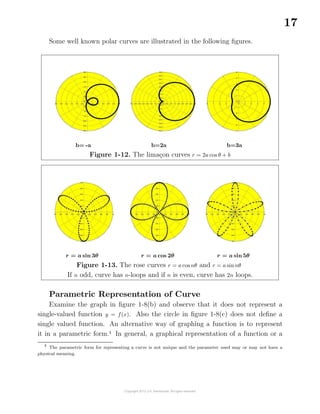
Some well known polar curves are illustrated in the following figures.
b= -a b=2a b=3a
Figure 1-12. The lima¸con curves r = 2a cos θ + b
r = a sin 3θ r = a cos 2θ r = a sin 5θ
Figure 1-13. The rose curves r = a cos nθ and r = a sin nθ
If n odd, curve has n-loops and if n is even, curve has 2n loops.
Parametric Representation of Curve
Examine the graph in figure 1-8(b) and observe that it does not represent a
single-valued function y = f(x). Also the circle in figure 1-8(c) does not define a
single valued function. An alternative way of graphing a function is to represent
it in a parametric form.4
In general, a graphical representation of a function or a
4
The parametric form for representing a curve is not unique and the parameter used may or may not have a
physical meaning.
18
section of a function, be it single-valued or multiple-valued, can be defined by a
parametric representation
C = {(x, y) | x = x(t), y = y(t), a ≤ t ≤ b} (1.10)
where both x(t) and y(t) are single-valued functions of the parameter t. The re-
lationship between x and y is obtained by eliminating the parameter t from the
representation x = x(t) and y = y(t). For example, the parametric representation
x = x(t) = t and y = y(t) = t2
, for t ∈ R, is one parametric representation of the
parabola y = x2
.
The Equation of a Circle
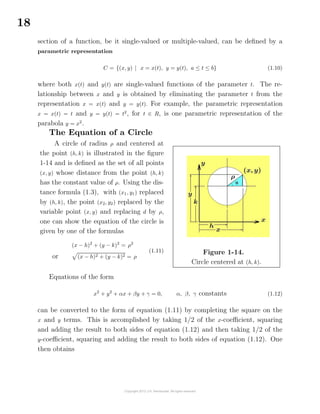
A circle of radius ρ and centered at
the point (h, k) is illustrated in the figure
1-14 and is defined as the set of all points
(x, y) whose distance from the point (h, k)
has the constant value of ρ. Using the dis-
tance formula (1.3), with (x1, y1) replaced
by (h, k), the point (x2, y2) replaced by the
variable point (x, y) and replacing d by ρ,
one can show the equation of the circle is
given by one of the formulas
(x − h)2
+ (y − k)2
= ρ2
or (x − h)2 + (y − k)2 = ρ
(1.11) Figure 1-14.
Circle centered at (h, k).
Equations of the form
x2
+ y2
+ αx + βy + γ = 0, α, β, γ constants (1.12)
can be converted to the form of equation (1.11) by completing the square on the
x and y terms. This is accomplished by taking 1/2 of the x-coefficient, squaring
and adding the result to both sides of equation (1.12) and then taking 1/2 of the
y-coefficient, squaring and adding the result to both sides of equation (1.12). One
then obtains
19
x2
+ αx +
α2
4
+ y2
+ βy +
β2
4
=
α2
4
+
β2
4
− γ
which simplifies to x +
α
2
2
+ y +
β
2
2
= r2
where r2
= α2
4
+ β2
4
− γ. Completing the square is a valid conversion whenever the
right-hand side α2
4
+ β2
4
− γ ≥ 0.
An alternative method of representing the equation of the circle is to introduce
a parameter θ such as the angle illustrated in the figure 1-14 and observe that by
trigonometry
sin θ =
y − k
ρ
and cos θ =
x − h
ρ
These equations are used to represent the circle in the alternative form
C = { (x, y) | x = h + ρ cos θ, y = k + ρ sinθ, 0 ≤ θ ≤ 2π } (1.13)
This is called a parametric representation of the circle in terms of a parameter θ.
Figure 1-15.
Circle centered at (r1, θ1).
The equation of a circle in polar form can
be constructed as follows. Let (r, θ) denote
a variable point which moves along the cir-
cumference of a circle of radius ρ which is
centered at the point (r1, θ1) as illustrated
in the figure 1-15. Using the distances r, r1
and ρ, one can employ the law of cosines
to express the polar form of the equation
of a circle as
r2
+ r2
1 − 2rr1 cos(θ − θ1) = ρ2
(1.14)
Functions can be represented in a variety of ways. Sometimes functions are
represented in the implicit form G(x, y) = 0, because it is not always possible to
solve for one variable explicitly in terms of another. In those cases where it is
possible to solve for one variable in terms of another to obtain y = f(x) or x = g(y),
the function is said to be represented in an explicit form.
20
For example, the circle of radius ρ can be represented by any of the relations
G(x, y) =x2
+ y2
− ρ2
= 0,
y = f(x) =
+ ρ2 − x2, −ρ ≤ x ≤ ρ
− ρ2 − x2, −ρ ≤ x ≤ ρ
, x = g(y) =
+ ρ2 − y2, −ρ ≤ y ≤ ρ
− ρ2 − y2, −ρ ≤ y ≤ ρ
(1.15)
Note that the circle in figure 1-8(c) does not define a single valued function. The
circle can be thought of as a graph of two single-valued functions y = + ρ2 − x2
and y = − ρ2 − x2 for −ρ ≤ x ≤ ρ if one treats y as a function of x. The other
representation in equation (1.15) results if one treats x as a function of y.
Types of functions
One can define a functional relationships between the two variables x and y in
different ways.
A polynomial function in the variable x has the form
y = pn(x) = a0xn
+ a1xn−1
+ a2xn−2
+ · · · + an−1x + an (1.16)
where a0, a1, . . ., an represent constants with a0 = 0 and n is a positive integer. The
integer n is called the degree of the polynomial function. The fundamental theorem
of algebra states that a polynomial of degree n has n-roots. That is, the polynomial
equation pn(x) = 0 has n-solutions called the roots of the polynomial equation. If
these roots are denoted by x1, x2, . . ., xn, then the polynomial can also be represented
in the form
pn(x) = a0(x − x1)(x − x2) · · ·(x − xn)
If xi is a number, real or complex, which satisfies pn(xi) = 0, then (x−xi) is a factor of
the polynomial function pn(x). Complex roots of a polynomial function must always
occur in conjugate pairs and one can say that if α + iβ is a root of pn(x) = 0, then
α− iβ is also a root. Real roots xi of a polynomial function give rise to linear factors
(x − xi), while complex roots of a polynomial function give rise to quadratic factors
of the form (x − α)2
+ β2
, α, β constant terms.
A rational function is any function of the form
y = f(x) =
P(x)
Q(x)
(1.17)
where both P(x) and Q(x) are polynomial functions in x and Q(x) = 0. If y = f(x) is
a root of an equation of the form
b0(x)yn
+ b1(x)yn−1
+ b2(x)yn−2
+ · · · + bn−1(x)y + bn(x) = 0 (1.18)
21
where b0(x), b1(x), . . ., bn(x) are polynomial functions of x and n is a positive integer,
then y = f(x) is called an algebraic function. Note that polynomial functions and
rational functions are special types of algebraic functions. Functions which are built
up from a finite number of operations of the five basic operations of addition, sub-
traction, multiplication, division and extraction of integer roots, usually represent
algebraic functions. Some examples of algebraic functions are
1. Any polynomial function.
2. f1(x) = (x3
+ 1)
√
x + 4
3. f2(x) =
x2
+ 3
√
6 + x2
(x − 3)4/3
The function f(x) =
√
x2 is an example of a function which is not an algebraic func-
tion. This is because the square root of x2
is the absolute value of x and represented
f(x) =
√
x2 = |x| =
x, if x ≥ 0
−x, if x < 0
and the absolute value operation is not one of the five basic operations mentioned
above.
A transcendental function is any function which is not an algebraic function.
The exponential functions, logarithmic functions, trigonometric functions, inverse
trigonometric functions, hyperbolic functions and inverse hyperbolic functions are
examples of transcendental functions considered in this calculus text.
The Exponential and Logarithmic Functions
The exponential functions have the form y = bx
, where b > 0 is a positive constant
and the variable x is an exponent. If x = n is a positive integer, one defines
bn
= b · b · · ·b
n factors
and b−n
=
1
bn
(1.19)
By definition, if x = 0, then b0
= 1. Note that if y = bx
, then y > 0 for all real values
of x.
Logarithmic functions and exponential functions are related. By definition,
if y = bx
then x = logb y (1.20)
and x, the exponent, is called the logarithm of y to the base b. Consequently, one
can write
logb(bx
) = x for every x ∈ R and blogb x
= x for every x > 0 (1.21)
22
Recall that logarithms satisfy the following properties
logb(xy) = logb x + logb y, x > 0 and y > 0
logb
x
y
= logb x − logb y, x > 0 and y > 0
logb(yx
) = x logb y, x can be any real number
(1.22)
Of all the numbers b > 0 available for use as a base for the logarithm function
the base b = 10 and base b = e = 2.71818 · · · are the most often seen in engineering
and scientific research. The number e is a physical constant5
like π. It can not be
represented as the ratio of two integer so is an irrational number. It can be defined
as the limiting sum of the infinite series
e =
1
0!
+
1
1!
+
1
2!
+
1
3!
+
1
4!
+
1
5!
+ · · · +
1
n!
+ · · ·
Using a computer6
one can verify that the numerical value of e to 50 decimal places
is given by
e = 2.7182818284590452353602874713526624977572470936999 . . .
The irrational number e can also be determined from the limit e = lim
h→0
(1 + h)
1/h
.
In the early part of the seventeenth century many mathematicians dealt with
and calculated the number e, but it was Leibnitz7
in 1690 who first gave it a name
and notation. His notation for the representation of e didn’t catch on. The value of
the number represented by the limit lim
h→0
(1 + h)
1/h
is used so much in mathematics
it was represented using the symbol e by Leonhard Euler8
sometime around 1731
and his notation for representing this number has been used ever since. The number
e is sometimes referred to as Euler’s number, the base of the natural logarithms.
The number e and the exponential function ex
will occur frequently in our study of
calculus.
5
There are many physical constants in mathematics. Some examples are e, π, i,(imaginary component), γ
(Euler-Mascheroni constant). For a listing of additional mathematical constants go to the web site
http : //en.wikipedia.org/wiki/Mathematical constant.
6
One can go to the web site
http : //www.numberworld.org/misc runs/e − 500b.html to see that over 500 billion digits of this number have
been calculated.
7
Gottfried Wilhelm Leibnitz (1646-1716) a German physicist, mathematician.
8
Leonhard Euler (1707-1783) a famous Swiss mathematician.
23
The logarithm to the base e, is called the natural logarithm and its properties
are developed in a later chapter. The natural logarithm is given a special notation.
Whenever the base b = e one can write either
y = loge x = ln x or y = log x (1.23)
That is, if the notation ln is used or whenever the base is not specified in using
logarithms, it is to be understood that the base b = e is being employed. In this
special case one can show
y = ex
= exp(x) ⇐⇒ x = ln y (1.24)
which gives the identities
ln(ex
) = x, x ∈ R and eln x
= x, x > 0 (1.25)
In our study of calculus it will be demonstrated that the natural logarithm has the
special value ln(e) = 1.
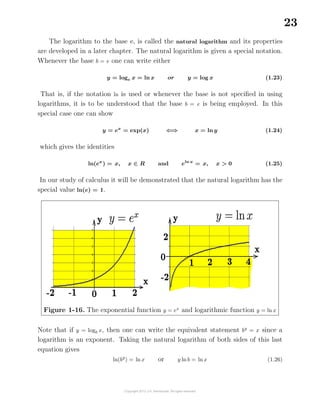
Figure 1-16. The exponential function y = ex
and logarithmic function y = ln x
Note that if y = logb x, then one can write the equivalent statement by
= x since a
logarithm is an exponent. Taking the natural logarithm of both sides of this last
equation gives
ln(by
) = ln x or y ln b = ln x (1.26)
24
Consequently, for any positive number b different from one
y = logb x =
ln x
ln b
, b = 1 (1.27)
The exponential function y = ex
, together with the natural logarithm function can
then be used to define all exponential functions by employing the identity
y = bx
= (eln b
)x
= ex ln b
(1.28)
Graphs of the exponential function y = ex
= exp(x) and the natural logarithmic
function y = ln(x) = log(x) are illustrated in the figure 1-16.
The Trigonometric Functions
The ratio of sides of a right triangle are used to define the six trigonometric
functions associated with one of the acute angles of a right triangle. These definitions
can then be extended to apply to positive and negative angles associated with a point
moving on a unit circle.
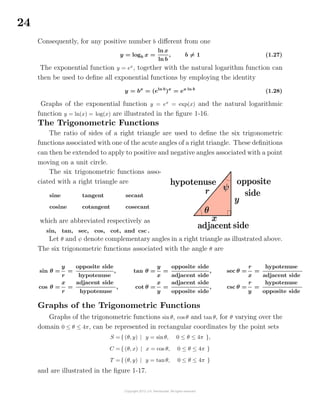
The six trigonometric functions asso-
ciated with a right triangle are
sine
cosine
tangent
cotangent
secant
cosecant
which are abbreviated respectively as
sin, tan, sec, cos, cot, and csc .
Let θ and ψ denote complementary angles in a right triangle as illustrated above.
The six trigonometric functions associated with the angle θ are
sin θ =
y
r
=
opposite side
hypotenuse
,
cos θ =
x
r
=
adjacent side
hypotenuse
,
tan θ =
y
x
=
opposite side
adjacent side
,
cot θ =
x
y
=
adjacent side
opposite side
,
sec θ =
r
x
=
hypotenuse
adjacent side
csc θ =
r
y
=
hypotenuse
opposite side
Graphs of the Trigonometric Functions
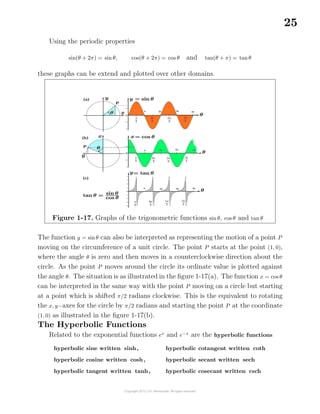
Graphs of the trigonometric functions sin θ, cos θ and tan θ, for θ varying over the
domain 0 ≤ θ ≤ 4π, can be represented in rectangular coordinates by the point sets
S ={ (θ, y) | y = sinθ, 0 ≤ θ ≤ 4π },
C ={ (θ, x) | x = cos θ, 0 ≤ θ ≤ 4π }
T ={ (θ, y) | y = tanθ, 0 ≤ θ ≤ 4π }
and are illustrated in the figure 1-17.
25
Using the periodic properties
sin(θ + 2π) = sin θ, cos(θ + 2π) = cos θ and tan(θ + π) = tanθ
these graphs can be extend and plotted over other domains.
Figure 1-17. Graphs of the trigonometric functions sinθ, cos θ and tan θ
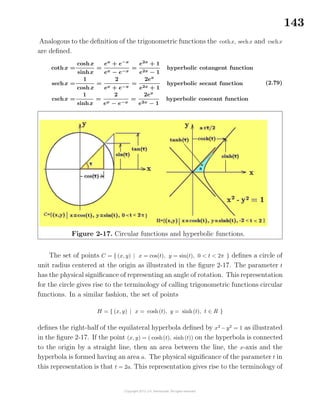
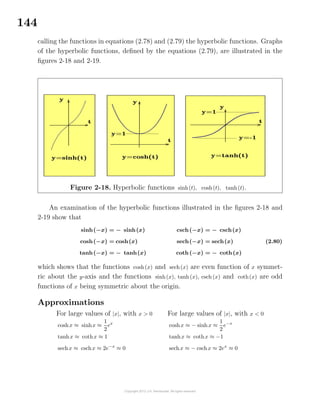
The function y = sinθ can also be interpreted as representing the motion of a point P
moving on the circumference of a unit circle. The point P starts at the point (1, 0),
where the angle θ is zero and then moves in a counterclockwise direction about the
circle. As the point P moves around the circle its ordinate value is plotted against
the angle θ. The situation is as illustrated in the figure 1-17(a). The function x = cos θ
can be interpreted in the same way with the point P moving on a circle but starting
at a point which is shifted π/2 radians clockwise. This is the equivalent to rotating
the x, y−axes for the circle by π/2 radians and starting the point P at the coordinate
(1, 0) as illustrated in the figure 1-17(b).
The Hyperbolic Functions
Related to the exponential functions ex
and e−x
are the hyperbolic functions
hyperbolic sine written sinh,
hyperbolic cosine written cosh,
hyperbolic tangent written tanh,
hyperbolic cotangent written coth
hyperbolic secant written sech
hyperbolic cosecant written csch
26
These functions are defined
sinhx =
ex
− e−x
2
,
coshx =
ex
+ e−x
2
,
tanhx =
sinhx
coshx
,
cschx =
1
sinhx
sechx =
1
coshx
cothx =
1
tanhx
(1.29)
As the trigonometric functions are related to the circle and are sometimes referred
to as circular functions, it has been found that the hyperbolic functions are related
to equilateral hyperbola and hence the name hyperbolic functions. This will be
explained in more detail in the next chapter.
Symmetry of Functions
The expression y = f(x) is the representation of a function in an explicit form
where one variable is expressed in terms of a second variable. The set of values given
by
S = {(x, y) | y = f(x), x ∈ X}
where X is the domain of the function, represents a graph of the function. The
notation f(x), read “f of x”, has the physical interpretation of representing y which
is the height of the curve at the point x. Given a function y = f(x), one can replace
x by any other argument. For example, if f(x) is a periodic function with least
period T, one can write f(x) = f(x + T) for all values of x. One can interpret the
equation f(x) = f(x + T) for all values of x as stating that the height of the curve at
any point x is the same as the height of the curve at the point x + T. As another
example, if the notation y = f(x) represents the height of the curve at the point x,
then y + ∆y = f(x + ∆x) would represent the height of the given curve at the point
x+∆x and ∆y = f(x+∆x)−f(x) would represent the change in the height of the curve
y in moving from the point x to the point x+∆x. If the argument x of the function
is replaced by −x, then one can compare the height of the curve at the points x and
−x. If f(x) = f(−x) for all values of x, then the height of the curve at x equals the
height of the curve at −x and when this happens the function f(x) is called an even
function of x and one can state that f(x) is a symmetric function about the y-axis.
If f(x) = −f(−x) for all values of x, then the height of the curve at x equals the
negative of the height of the curve at −x and in this case the function f(x) is called
an odd function of x and one can state that the function f(x) is symmetric about the
origin. By interchanging the roles of x and y and shifting or rotation of axes, other
27
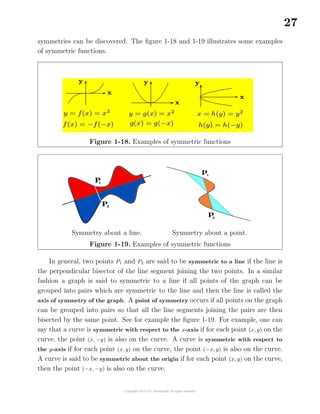
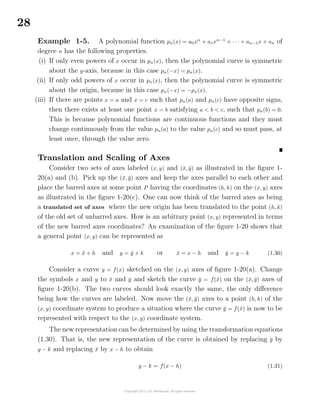
symmetries can be discovered. The figure 1-18 and 1-19 illustrates some examples
of symmetric functions.
Figure 1-18. Examples of symmetric functions
Symmetry about a line. Symmetry about a point.
Figure 1-19. Examples of symmetric functions
In general, two points P1 and P2 are said to be symmetric to a line if the line is
the perpendicular bisector of the line segment joining the two points. In a similar
fashion a graph is said to symmetric to a line if all points of the graph can be
grouped into pairs which are symmetric to the line and then the line is called the
axis of symmetry of the graph. A point of symmetry occurs if all points on the graph
can be grouped into pairs so that all the line segments joining the pairs are then
bisected by the same point. See for example the figure 1-19. For example, one can
say that a curve is symmetric with respect to the x-axis if for each point (x, y) on the
curve, the point (x, −y) is also on the curve. A curve is symmetric with respect to
the y-axis if for each point (x, y) on the curve, the point (−x, y) is also on the curve.
A curve is said to be symmetric about the origin if for each point (x, y) on the curve,
then the point (−x, −y) is also on the curve.
28
Example 1-5. A polynomial function pn(x) = a0xn
+ a1xn−1
+ · · · + an−1x + an of
degree n has the following properties.
(i) If only even powers of x occur in pn(x), then the polynomial curve is symmetric
about the y-axis, because in this case pn(−x) = pn(x).
(ii) If only odd powers of x occur in pn(x), then the polynomial curve is symmetric
about the origin, because in this case pn(−x) = −pn(x).
(iii) If there are points x = a and x = c such that pn(a) and pn(c) have opposite signs,
then there exists at least one point x = b satisfying a < b < c, such that pn(b) = 0.
This is because polynomial functions are continuous functions and they must
change continuously from the value pn(a) to the value pn(c) and so must pass, at
least once, through the value zero.
Translation and Scaling of Axes
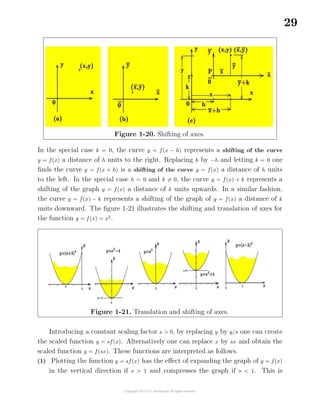
Consider two sets of axes labeled (x, y) and (¯x, ¯y) as illustrated in the figure 1-
20(a) and (b). Pick up the (¯x, ¯y) axes and keep the axes parallel to each other and
place the barred axes at some point P having the coordinates (h, k) on the (x, y) axes
as illustrated in the figure 1-20(c). One can now think of the barred axes as being
a translated set of axes where the new origin has been translated to the point (h, k)
of the old set of unbarred axes. How is an arbitrary point (x, y) represented in terms
of the new barred axes coordinates? An examination of the figure 1-20 shows that
a general point (x, y) can be represented as
x = ¯x + h and y = ¯y + k or ¯x = x − h and ¯y = y − k (1.30)
Consider a curve y = f(x) sketched on the (x, y) axes of figure 1-20(a). Change
the symbols x and y to ¯x and ¯y and sketch the curve ¯y = f(¯x) on the (¯x, ¯y) axes of
figure 1-20(b). The two curves should look exactly the same, the only difference
being how the curves are labeled. Now move the (¯x, ¯y) axes to a point (h, k) of the
(x, y) coordinate system to produce a situation where the curve ¯y = f(¯x) is now to be
represented with respect to the (x, y) coordinate system.
The new representation can be determined by using the transformation equations
(1.30). That is, the new representation of the curve is obtained by replacing ¯y by
y − k and replacing ¯x by x − h to obtain
y − k = f(x − h) (1.31)
29
Figure 1-20. Shifting of axes.
In the special case k = 0, the curve y = f(x − h) represents a shifting of the curve
y = f(x) a distance of h units to the right. Replacing h by −h and letting k = 0 one
finds the curve y = f(x + h) is a shifting of the curve y = f(x) a distance of h units
to the left. In the special case h = 0 and k = 0, the curve y = f(x) + k represents a
shifting of the graph y = f(x) a distance of k units upwards. In a similar fashion,
the curve y = f(x) − k represents a shifting of the graph of y = f(x) a distance of k
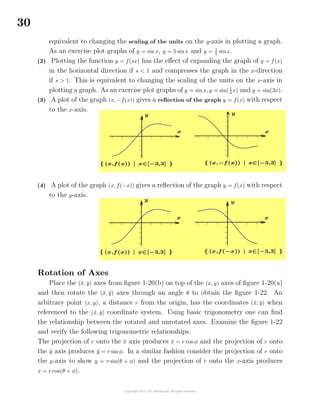
units downward. The figure 1-21 illustrates the shifting and translation of axes for
the function y = f(x) = x2
.
Figure 1-21. Translation and shifting of axes.
Introducing a constant scaling factor s > 0, by replacing y by y/s one can create
the scaled function y = sf(x). Alternatively one can replace x by sx and obtain the
scaled function y = f(sx). These functions are interpreted as follows.
(1) Plotting the function y = sf(x) has the effect of expanding the graph of y = f(x)
in the vertical direction if s > 1 and compresses the graph if s < 1. This is
30
equivalent to changing the scaling of the units on the y-axis in plotting a graph.
As an exercise plot graphs of y = sin x, y = 5 sinx and y = 1
5
sinx.
(2) Plotting the function y = f(sx) has the effect of expanding the graph of y = f(x)
in the horizontal direction if s < 1 and compresses the graph in the x-direction
if s > 1. This is equivalent to changing the scaling of the units on the x-axis in
plotting a graph. As an exercise plot graphs of y = sin x, y = sin(1
3
x) and y = sin(3x).
(3) A plot of the graph (x, −f(x)) gives a reflection of the graph y = f(x) with respect
to the x-axis.
(4) A plot of the graph (x, f(−x)) gives a reflection of the graph y = f(x) with respect
to the y-axis.
Rotation of Axes
Place the (¯x, ¯y) axes from figure 1-20(b) on top of the (x, y) axes of figure 1-20(a)
and then rotate the (¯x, ¯y) axes through an angle θ to obtain the figure 1-22. An
arbitrary point (x, y), a distance r from the origin, has the coordinates (¯x, ¯y) when
referenced to the (¯x, ¯y) coordinate system. Using basic trigonometry one can find
the relationship between the rotated and unrotated axes. Examine the figure 1-22
and verify the following trigonometric relationships.
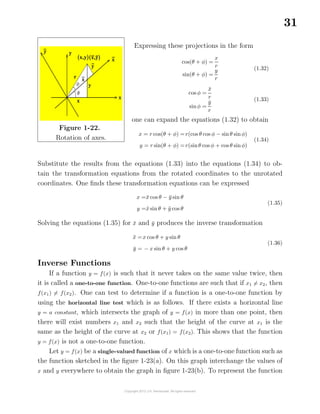
The projection of r onto the ¯x axis produces ¯x = r cos φ and the projection of r onto
the ¯y axis produces ¯y = r sin φ. In a similar fashion consider the projection of r onto
the y-axis to show y = r sin(θ + φ) and the projection of r onto the x-axis produces
x = r cos(θ + φ).
31
Figure 1-22.
Rotation of axes.
Expressing these projections in the form
cos(θ + φ) =
x
r
sin(θ + φ) =
y
r
(1.32)
cos φ =
¯x
r
sinφ =
¯y
r
(1.33)
one can expand the equations (1.32) to obtain
x = r cos(θ + φ) =r(cos θ cos φ − sinθ sinφ)
y = r sin(θ + φ) =r(sinθ cos φ + cos θ sinφ)
(1.34)
Substitute the results from the equations (1.33) into the equations (1.34) to ob-
tain the transformation equations from the rotated coordinates to the unrotated
coordinates. One finds these transformation equations can be expressed
x =¯x cos θ − ¯y sin θ
y =¯x sin θ + ¯y cos θ
(1.35)
Solving the equations (1.35) for ¯x and ¯y produces the inverse transformation
¯x =x cos θ + y sin θ
¯y = − x sin θ + y cos θ
(1.36)
Inverse Functions
If a function y = f(x) is such that it never takes on the same value twice, then
it is called a one-to-one function. One-to-one functions are such that if x1 = x2, then
f(x1) = f(x2). One can test to determine if a function is a one-to-one function by
using the horizontal line test which is as follows. If there exists a horizontal line
y = a constant, which intersects the graph of y = f(x) in more than one point, then
there will exist numbers x1 and x2 such that the height of the curve at x1 is the
same as the height of the curve at x2 or f(x1) = f(x2). This shows that the function
y = f(x) is not a one-to-one function.
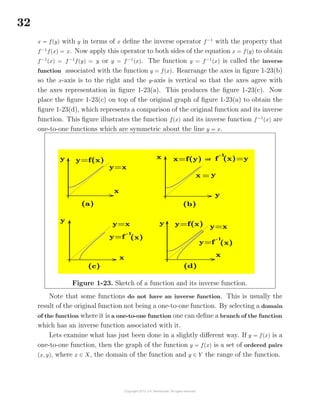
Let y = f(x) be a single-valued function of x which is a one-to-one function such as
the function sketched in the figure 1-23(a). On this graph interchange the values of
x and y everywhere to obtain the graph in figure 1-23(b). To represent the function
32
x = f(y) with y in terms of x define the inverse operator f−1
with the property that
f−1
f(x) = x. Now apply this operator to both sides of the equation x = f(y) to obtain
f−1
(x) = f−1
f(y) = y or y = f−1
(x). The function y = f−1
(x) is called the inverse
function associated with the function y = f(x). Rearrange the axes in figure 1-23(b)
so the x-axis is to the right and the y-axis is vertical so that the axes agree with
the axes representation in figure 1-23(a). This produces the figure 1-23(c). Now
place the figure 1-23(c) on top of the original graph of figure 1-23(a) to obtain the
figure 1-23(d), which represents a comparison of the original function and its inverse
function. This figure illustrates the function f(x) and its inverse function f−1
(x) are
one-to-one functions which are symmetric about the line y = x.
Figure 1-23. Sketch of a function and its inverse function.
Note that some functions do not have an inverse function. This is usually the
result of the original function not being a one-to-one function. By selecting a domain
of the function where it is a one-to-one function one can define a branch of the function
which has an inverse function associated with it.
Lets examine what has just been done in a slightly different way. If y = f(x) is a
one-to-one function, then the graph of the function y = f(x) is a set of ordered pairs
(x, y), where x ∈ X, the domain of the function and y ∈ Y the range of the function.
33
Now if the function f(x) is such that no two ordered pairs have the same second
element, then the function obtained from the set
S = { (x, y) | y = f(x), x ∈ X}
by interchanging the values of x and y is called the inverse function of f and it is
denoted by f−1
. Observe that the inverse function has the domain of definition Y
and its range is X and one can write
y = f(x) ⇐⇒ f−1
(y) = x (1.32)
Still another way to approach the problem is as follows. Two functions f(x)
and g(x) are said to be inverse functions of one another if f(x) and g(x) have the
properties that
g(f(x)) = x and f(g(x)) = x (1.33)
If g(x) is an inverse function of f(x), the notation f−1
, (read f-inverse), is used to
denote the function g. That is, an inverse function of f(x) is denoted f−1
(x) and has
the properties
f−1
(f(x)) = x and f(f−1
(x)) = x (1.34)
Given a function y = f(x), then by interchanging the symbols x and y there results
x = f(y). This is an equation which defines the inverse function. If the equation
x = f(y) can be solved for y in terms of x, to obtain a single valued function, then
this function is called the inverse function of f(x). One then obtains the equivalent
statements
x = f(y) ⇐⇒ y = f−1
(x) (1.35)
The process of interchanging x and y in the representation y = f(x) to obtain
x = f(y) implies that geometrically the graphs of f and f−1
are mirror images of
each other about the line y = x. In order that the inverse function be single valued
and one-to-one, it is necessary that there are no horizontal lines, y = constant, which
intersect the graph y = f(x) more than once. Observe that one way to find the inverse
function is the following.
34
(1.) Write y = f(x) and then interchange x and y to obtain x = f(y)
(2.) Solve x = f(y) for the variable y to obtain y = f−1
(x)
(3.) Note the inverse function f−1
(x) sometimes turns out to be a multiple-valued
function. Whenever this happens it is customary to break the function up into
a collection of single-valued functions, called branches, and then one of these
branches is selected to be called the principal branch of the function. That is,
if multiple-valued functions are involved, then select a branch of the function
which is single-valued such that the range of y = f(x) is the domain of f−1
(x).
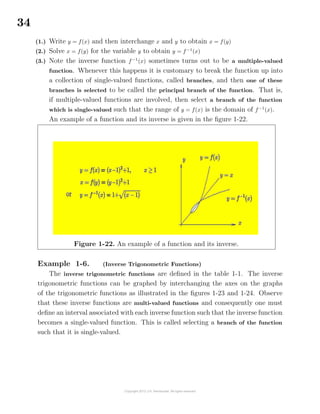
An example of a function and its inverse is given in the figure 1-22.
Figure 1-22. An example of a function and its inverse.
Example 1-6. (Inverse Trigonometric Functions)
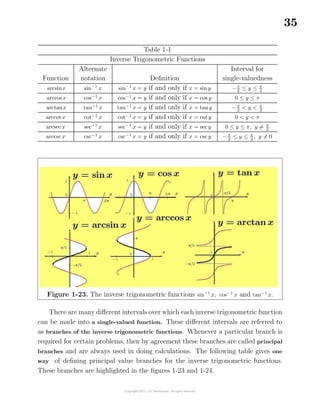
The inverse trigonometric functions are defined in the table 1-1. The inverse
trigonometric functions can be graphed by interchanging the axes on the graphs
of the trigonometric functions as illustrated in the figures 1-23 and 1-24. Observe
that these inverse functions are multi-valued functions and consequently one must
define an interval associated with each inverse function such that the inverse function
becomes a single-valued function. This is called selecting a branch of the function
such that it is single-valued.
35
Table 1-1
Inverse Trigonometric Functions
Alternate Interval for
Function notation Definition single-valuedness
arcsinx sin−1
x sin−1
x = y if and only if x = sin y −π
2
≤ y ≤ π
2
arccosx cos−1
x cos−1
x = y if and only if x = cos y 0 ≤ y ≤ π
arctanx tan−1
x tan−1
x = y if and only if x = tany −π
2
< y < π
2
arccot x cot−1
x cot−1
x = y if and only if x = cot y 0 < y < π
arcsec x sec−1
x sec−1
x = y if and only if x = sec y 0 ≤ y ≤ π, y = π
2
arccsc x csc−1
x csc−1
x = y if and only if x = csc y −π
2
≤ y ≤ π
2
, y = 0
Figure 1-23. The inverse trigonometric functions sin−1
x, cos−1
x and tan−1
x.
There are many different intervals over which each inverse trigonometric function
can be made into a single-valued function. These different intervals are referred to
as branches of the inverse trigonometric functions. Whenever a particular branch is
required for certain problems, then by agreement these branches are called principal
branches and are always used in doing calculations. The following table gives one
way of defining principal value branches for the inverse trigonometric functions.
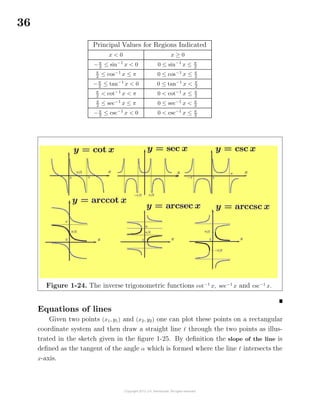
These branches are highlighted in the figures 1-23 and 1-24.
36
Principal Values for Regions Indicated
x < 0 x ≥ 0
−π
2
≤ sin−1
x < 0 0 ≤ sin−1
x ≤ π
2
π
2
≤ cos−1
x ≤ π 0 ≤ cos−1
x ≤ π
2
−π
2
≤ tan−1
x < 0 0 ≤ tan−1
x < π
2
π
2
< cot−1
x < π 0 < cot−1
x ≤ π
2
π
2 ≤ sec−1
x ≤ π 0 ≤ sec−1
x < π
2
−π
2 ≤ csc−1
x < 0 0 < csc−1
x ≤ π
2
Figure 1-24. The inverse trigonometric functions cot−1
x, sec−1
x and csc−1
x.
Equations of lines
Given two points (x1, y1) and (x2, y2) one can plot these points on a rectangular
coordinate system and then draw a straight line through the two points as illus-
trated in the sketch given in the figure 1-25. By definition the slope of the line is
defined as the tangent of the angle α which is formed where the line intersects the
x-axis.
37
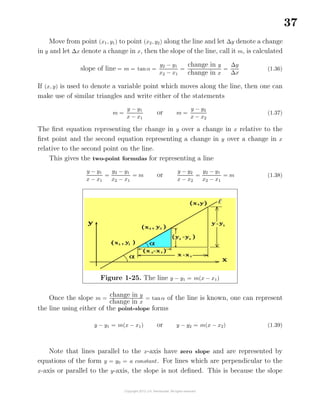
Move from point (x1, y1) to point (x2, y2) along the line and let ∆y denote a change
in y and let ∆x denote a change in x, then the slope of the line, call it m, is calculated
slope of line = m = tanα =
y2 − y1
x2 − x1
=
change in y
change in x
=
∆y
∆x
(1.36)
If (x, y) is used to denote a variable point which moves along the line, then one can
make use of similar triangles and write either of the statements
m =
y − y1
x − x1
or m =
y − y2
x − x2
(1.37)
The first equation representing the change in y over a change in x relative to the
first point and the second equation representing a change in y over a change in x
relative to the second point on the line.
This gives the two-point formulas for representing a line
y − y1
x − x1
=
y2 − y1
x2 − x1
= m or
y − y2
x − x2
=
y2 − y1
x2 − x1
= m (1.38)
Figure 1-25. The line y − y1 = m(x − x1)
Once the slope m =
change in y
change in x
= tanα of the line is known, one can represent
the line using either of the point-slope forms
y − y1 = m(x − x1) or y − y2 = m(x − x2) (1.39)
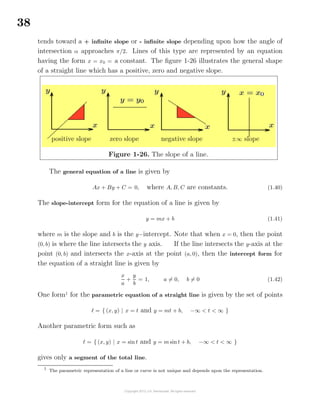
Note that lines parallel to the x-axis have zero slope and are represented by
equations of the form y = y0 = a constant. For lines which are perpendicular to the
x-axis or parallel to the y-axis, the slope is not defined. This is because the slope
38
tends toward a + infinite slope or - infinite slope depending upon how the angle of
intersection α approaches π/2. Lines of this type are represented by an equation
having the form x = x0 = a constant. The figure 1-26 illustrates the general shape
of a straight line which has a positive, zero and negative slope.
Figure 1-26. The slope of a line.
positive slope zero slope negative slope ±∞ slope
The general equation of a line is given by
Ax + By + C = 0, where A, B, C are constants. (1.40)
The slope-intercept form for the equation of a line is given by
y = mx + b (1.41)
where m is the slope and b is the y−intercept. Note that when x = 0, then the point
(0, b) is where the line intersects the y axis. If the line intersects the y-axis at the
point (0, b) and intersects the x-axis at the point (a, 0), then the intercept form for
the equation of a straight line is given by
x
a
+
y
b
= 1, a = 0, b = 0 (1.42)
One form1
for the parametric equation of a straight line is given by the set of points
= { (x, y) | x = t and y = mt + b, −∞ < t < ∞ }
Another parametric form such as
= { (x, y) | x = sin t and y = m sint + b, −∞ < t < ∞ }
gives only a segment of the total line.
1
The parametric representation of a line or curve is not unique and depends upon the representation.
39
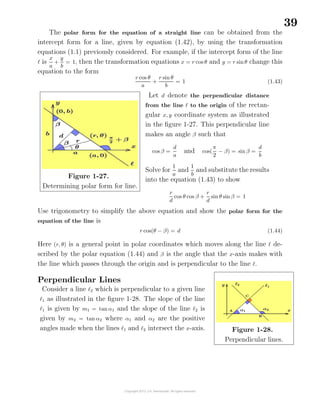
The polar form for the equation of a straight line can be obtained from the
intercept form for a line, given by equation (1.42), by using the transformation
equations (1.1) previously considered. For example, if the intercept form of the line
is
x
a
+
y
b
= 1, then the transformation equations x = r cos θ and y = r sinθ change this
equation to the form
r cos θ
a
+
r sin θ
b
= 1 (1.43)
Figure 1-27.
Determining polar form for line.
Let d denote the perpendicular distance
from the line to the origin of the rectan-
gular x, y coordinate system as illustrated
in the figure 1-27. This perpendicular line
makes an angle β such that
cos β =
d
a
and cos(
π
2
− β) = sinβ =
d
b
Solve for
1
a
and
1
b
and substitute the results
into the equation (1.43) to show
r
d
cos θ cos β +
r
d
sin θ sin β = 1
Use trigonometry to simplify the above equation and show the polar form for the
equation of the line is
r cos(θ − β) = d (1.44)
Here (r, θ) is a general point in polar coordinates which moves along the line de-
scribed by the polar equation (1.44) and β is the angle that the x-axis makes with
the line which passes through the origin and is perpendicular to the line .
Perpendicular Lines
Consider a line 2 which is perpendicular to a given line
1 as illustrated in the figure 1-28. The slope of the line
1 is given by m1 = tan α1 and the slope of the line 2 is
given by m2 = tan α2 where α1 and α2 are the positive
angles made when the lines 1 and 2 intersect the x-axis. Figure 1-28.
Perpendicular lines.
40
Two lines are said to intersect orthogonally when they intersect to form two right
angles. Note that α2 is an exterior angle to a right triangle ABC and so one can
write α2 = α1 +π/2. If the two lines are perpendicular, then the product of the slopes
m1 and m2 must satisfy
m1m2 = tanα1 tanα2 =
sinα1
cos α1
sin(α1 + π/2)
cos(α1 + π/2)
=
sin α1
cos α1
·
cos α1
(− sinα1)
= −1 (1.45)
which shows that if the two lines are perpendicular, then the product of their slopes
must equal -1, or alternatively, one slope must be the negative reciprocal of the other
slope. This relation breaks down if one of the lines is parallel to the x-axis, because
then a zero slope occurs.
In general, if line 1 with slope m1 = tan θ1 inter-
sects line 2 with slope m2 = tanθ2 and θ denotes the
angle of intersection as measured from line 1 to 2,
then θ = θ2 − θ1 and
tan θ = tan(θ2 − θ1) =
tan θ2 − tan θ1
1 + tan θ1 tan θ2
tan θ =
m2 − m1
1 + m1m2
Note that as m2 approaches −1/m1, then the angle θ approaches π/2.
Limits
The notation x → ∞ is used to denote the value x increasing without bound
in the positive direction and the notation x → −∞ is used to denote x increasing
without bound in the negative direction. The limits lim
x→∞
f(x) and lim
x→−∞
f(x), if they
exist, are used to denote the values of a function f(x) as the variable x is allowed
to increase without bound in the positive and negative directions. For example one
can write
lim
x→∞
(2 +
1
x
) = 2 and lim
x→−∞
(2 +
1
x2
) = 2
The notation x → x0 denotes the variable x approaching the finite value x0, but
it never gets there. If x and x0 denote real numbers, then x can approach x0 from
any direction and get as close to x0 as you desire, but it cannot equal the value x0.
For > 0 a small real number, sketch on a piece of paper the difference between the
x-values defined by the sets
N = {x | | x − x0| < } and N0 = {x | 0 < |x − x0| < } (1.46)
41
Observe that the set N contains all the points between x0 − and x0 + together with
the point x0 ∈ N, while the set N0 is the same as N but has the point x0 excluded so
one can write x0 /∈ N0. The set N is called a neighborhood of the point x0 while the set
N0 is called a deleted neighborhood of the point x0. The notation x → x0 emphasizes
the requirement that x approach the value x0, but x is restricted to taking on the
values in the set N0. The situation is illustrated in the figures 1-29(a) and 1-29(b).
The notation x → x+
0 is used to denote x approaching x0 from the right-hand side of
x0, where x is restricted such that x > x0. The notation x → x−
0 is used to denote x
approaching x0 from the left-hand side of x0, where x is restricted such that x < x0.
In general, the notation x → x0 means x can approach x0 from any direction, but x
can never equal x0.
Figure 1-29. Left and right-hand approaches of x to the value x0.
Infinitesimals
You cannot compare two quantities which are completely different in every way.
To measure related quantities you must have
(i) A basic unit of measurement applicable to the quantity being measured.
(ii) A number representing the ratio of the measured quantity to the basic unit.
The concept of largeness or smallness of a quantity is relative to the basic unit
selected for use in the measurement. For example, if a quantity Q is divided up
into some fractional part f, then fQ is smaller than Q because the ratio fQ/Q = f
is small. For f < 1, quantities like fQ, f2
Q, f3
Q, . . . are called small quantities of
the first, second, third orders of smallness, since each quantity is a small fraction
f of the previous quantity. If the fraction f is allowed to approach zero, then the
quantities fQ, f2
Q, f3
Q, . . . are very, very small and are called infinitesimals of the
first, second, third, . . ., orders. Thus, if ∆x is a small change in x, then (∆x)2
would
be an infinitesimal of the second order, (∆x)3
would be an infinitesimal of the third
order, etc.
42
In terms of limits, if α and β are infinitesimals and lim
α→0
β
α
is some constant
different from zero, then α and β are called infinitesimals of the same order. However,
if lim
α→0
β
α
= 0, then β is called an infinitesimal of higher order than α.
If you are dealing with an equation involving infinitesimals of different
orders, you only need to retain those infinitesimals of lowest order, since the higher
order infinitesimals are significantly smaller and will not affect the results
when these infinitesimals approach zero .
This concept is often used in comparing the ratio of two small quantities which
approach zero. Consider the problem of finding the volume of a hollow cylinder, as
illustrated in the figure 1-30, as the thickness of the cylinder sides approaches zero.
Figure 1-30. Volume of hollow cylinder.
Let ∆V denote the volume of the hollow cylinder with r the inner radius of the
hollow cylinder and r + ∆r the outer radius. One can write
∆V =Volume of outer cylinder − Volume of inner cylinder
∆V =π(r + ∆r)2
h − πr2
h = π[r2
+ 2r∆r + (∆r)2
]h − πr2
h
∆V =2πrh∆r + πh(∆r)2
This relation gives the exact volume of the hollow cylinder. If one takes the limit
as ∆r tends toward zero, then the ∆r and (∆r)2
terms become infinitesimals and
the infinitesimal of the second order can be neglected since one is only interested in
comparison of ratios when dealing with small quantities. For example
lim
∆r→0
∆V
∆r
= lim
∆r→0
(2πrh + πh∆r) = 2πrh
43
Limiting Value of a Function
The notation lim
x→x0
f(x) = is used to denote the limiting value of a function f(x)
as x approaches the value x0, but x = x0. Note that the limit statement lim
x→x0
f(x) is
dependent upon values of f(x) for x near x0, but not for x = x0. One must examine
the values of f(x) both for x+
0 values (values of x slightly greater than x0) and for
x−
0 values (values of x slightly less than x0). These type of limiting statements are
written
lim
x→x+
0
f(x) and lim
x→x−
0
f(x)
and are called right-hand and left-hand limits respectively. There may be situations
where (a) f(x0) is not defined (b) f(x0) is defined but does not equal the limiting
value (c) the limit lim
x→x0
f(x) might become unbounded, in which case one can write
a statement stating that “no limit exists as x → x0 ”.
Some limits are easy to calculate, for example lim
x→2
(3x + 1) = 7, is a limit of the
form lim
x→x0
f(x) = f(x0), where f(x0) is the value of f(x) at x = x0, if the value f(x0)
exists. This method is fine if the graph of the function f(x) is a smooth unbroken
curve in the neighborhood of the point x0.
Figure 1-31.
Sectionally-continuous
function
The limiting value lim
x→x0
f(x) cannot be calculated by eval-
uating the function f(x) at the point x0 if the function is
not defined at the point x0. A function f(x) is called a
sectionally continuous function if its graph can be repre-
sented by sections of unbroken curves. The function f(x)
defined
f(x) =
2 − (x − x0), x < x0
5 + 2(x − x0), x > x0
is an example of a sectionally continuous function. Note this function is not defined
at the point x0 and the left-hand limit lim
x→x−
0
f(x) = 2 and the right-hand limit given
by lim
x→x+
0
f(x) = 5 are not equal and f(x0) is not defined. The graph of f(x) is sketched
in the figure 1-31. The function f(x) is said to have a jump discontinuity at the point
x = x0 and one would write lim
x→x0
f(x) does not exit.
Some limiting values produce the indeterminate forms 0
0
or ∞
∞
and these resulting
forms must be analyzed further to determine their limiting value. For example, the
44
limiting value 0
0 may reduce to a zero value, a finite quantity or it may become an
infinite quantity as the following examples illustrate.
lim
x→0
3x2
2x
= lim
x→0
3
2
x = 0, a zero limit
lim
x→0
3x
2x
= lim
x→0
3
2
=
3
2
, a finite limit
lim
x→0
3x
2x2
= lim
x→0
3
2x
= ∞, an infinite limit
lim
x→x0
x2
− x2
0
x − x0
= lim
x→x0
(x − x0)(x + x0)
(x − x0)
= 2x0,
a finite limit
Example 1-7. (Geometry used to determine limiting value)
Consider the function f(x) =
sin x
x
and observe that this function is not defined
at the value x = 0, because f(0) =
sinx
x x=0
=
0
0
, an indeterminate form. Let us
investigate the limit lim
x→0
sinx
x
using the geometry of the figure 1-32 as the angle2
x
gets very small, but with x = 0. The figure 1-32 illustrates part of a circle of radius
r sketched in the first quadrant along with a ray from the origin constructed at the
angle x. The lines AD and BC perpendicular to the polar axis are constructed along
with the line BD representing a chord. These constructions are illustrated in the
figure 1-32. From the geometry of figure 1-32 verify the following values.
AD = r sin x
BC = r tanx
Area 0BD =
1
2
0B · AD =
1
2
r2
sinx
Area sector 0BD =
1
2
r2
x
Area 0BC =
1
2
0B · BC =
1
2
r2
tan x
One can compare the areas of triangles 0BD, 0BC and sector 0BD to come
up with the inequalities
Area 0BD ≤ Area sector 0BD ≤ Area 0BC
or
1
2
r2
sin x ≤
1
2
r2
x ≤
1
2
r2
tanx
(1.47)
Divide this inequality through by 1
2
r2
sin x to obtain the result 1 ≤
x
sin x
≤
1
cos x
.
Taking the reciprocals one can write
1 ≥
sin x
x
≥ cos x (1.48)
2
Radian measure is always used.
45
Figure 1-32. Construction of triangles and sector associated with circle.
Now take the limit as x approaches zero to show
1 ≥ lim
x→0
sin x
x
≥ lim
x→0
cos x (1.49)
The function
sinx
x
is squeezed or sandwiched between the values 1 and cos x and since
the cosine function approaches 1 as x approaches zero, one can say the limit of the
function
sinx
x
must also approach 1 and so one can write
lim
x→0
sin x
x
= 1 (1.50)
In our study of calculus other methods are developed to verify the above limiting
value associated with the indeterminate form
sinx
x
as x approaches zero.
Example 1-8. (Algebra used to determine limiting value)
Algebra as well as geometry can be used to aid in evaluating limits. For example,
to calculate the limit
lim
x→1
xn
− 1
x − 1
=
xn
− 1
x − 1 x=1
=
0
0
an indeterminate form (1.51)
one can make the change of variables z = x−1 and express the limit given by equation
(1.51) in the form
lim
z→0
(1 + z)n
− 1
z
(1.52)
The numerator of this limit expression can be expanded by using the binomial
theorem
(1 + z)n
= 1 + nz +
n(n − 1)
2!
z2
+
n(n − 1)(n − 2)
3!
z3
+ · · · (1.53)
46
Substituting the expansion (1.53) into the equation (1.52) and simplifying reduces
the given limit to the form
lim
z→0
n +
n(n − 1)
2!
z +
n(n − 1)(n − 2)
3!
z2
+ · · · = n (1.54)
This shows that lim
x→1
xn
− 1
x − 1
= n
Example 1-9. (Limits)
The following are some examples illustrating limiting values associated with
functions.
lim
x→3
x2
=9
lim
x→0+
1
x
= + ∞
lim
x→0−
1
x
= − ∞
lim
x→∞
3 +
1
x
=3
lim
θ→0
tanθ
θ
=1
lim
x→0
√
x + 1 − 1
x
=
1
2
Formal Definition of Limit
In the early development of mathematics the concept of a limit was very vague.
The calculation of a limit was so fundamental to understanding certain aspects of
calculus, that it required a precise definition. A more formal −δ (read epsilon-delta)
definition of a limit was finally developed around the 1800’s. This formalization
resulted from the combined research into limits developed by the mathematicians
Weierstrass,3
Bolzano4
and Cauchy.5
Definition 1: Limit of a function
Let f(x) be defined and single-valued for all values of x in some deleted neigh-
borhood of the point x0. A number is called a limit of f(x) as x approaches x0,
written lim
x→x0
f(x) = , if for every small positive number > 0 there exists a number
δ such that6
|f(x) − | < whenever 0 < |x − x0| < δ (1.55)
Then one can write f(x) → (f(x) approaches ) as x → x0 (x approaches x0). Note
that f(x) need not be defined at the point x0 in order for a limit to exist.
3
Karl Theodor Wilhelm Weierstrass (1815-1897) A German mathematician.
4
Bernard Placidus Johan Nepomuk Bolzano (1781-1848) A Bohemian philosopher and mathematician.
5
Augustin Louis Cauchy (1789-1857) A French mathematician.
6
The number δ usually depends upon how is selected.
47
The above definition must be modified if restrictions are placed upon how x
approaches x0. For example, the limits lim
x→x+
0
f(x) = 1 and lim
x→x−
0
f(x) = 2 are called
the right-hand and left-hand limits associated with the function f(x) as x approaches
the point x0. Sometimes the right-hand limit is expressed lim
x→x+
0
f(x) = f(x+
0 ) and
the left-hand limit is expressed lim
x→x−
0
f(x) = f(x−
0 ). The − δ definitions associated
with these left and right-hand limits is exactly the same as given above with the
understanding that for right-hand limits x is restricted to the set of values x > x0
and for left-hand limits x is restricted to the set of values x < x0.
Definition 2: Limit of a function f(x) as x → ∞
Let f(x) be defined over the unbounded interval c < x < ∞, then a number is
called a limit of f(x) as x increases without bound, written as lim
x→∞
f(x) = , if for
every > 0, there exists a number N1 > 0 such that |f(x) − | < , whenever x ≥ N1.
In a similar fashion, if f(x) is defined over the unbounded interval −∞ < x < c,
then the number is called a limit of f(x) as x decreases without bound, written
lim
x→−∞
f(x) = , if for every > 0, there exists a number N2 > 0 such that |f(x) − | < ,
whenever x ≤ −N2.
In terms of the graph { (x, y) | y = f(x), x ∈ R } one can say that for x sufficiently
large, larger than N1 or less than −N2, the y values of the graph would get as close
as you want to the line y = .
Definition 3: Limit of a function becomes unbounded
In the cases where the limit lim
x→x0
f(x) either increases or decreases without bound
and does not approach a limit, then the notation lim
x→x0
f(x) = +∞ is used to denote
that there exists a number N3 > 0, such that f(x) > N3, whenever 0 < |x − x0| < δ and
the notation lim
x→x0
f(x) = −∞ is used to denote that there exists a number N4 > 0,
such that f(x) < −N4, whenever 0 < |x − x0| < δ.
In the above notations the symbols +∞ (plus infinity) and −∞ (minus infinity)
are used to denote unboundedness of the functions. These symbols are not numbers.
Also observe that there are situations where to use the above notation one might
have to replace the limit subscript x → x0 by either x → x+
0 or x → x−
0 in order to
denote right or left-handed limits.
48
In using the − δ methods to prove limit statements, observe that the statement
“f(x) is near ” is expressed mathematically by the statement |f(x) − | < where
> 0 is very small. By selecting very small you can force f(x) to be very near ,
but what must δ be in order that f(x) be that close to ? The selection of δ, in most
cases, will depend upon how is specified. The statement that “x is near x0, but x
is not equal to x0 ” is expressed mathematically by the statement 0 < |x − x0| < δ.
The real number δ which is selected to achieve the smallness specified by , is not
a unique number. Once one value of δ is found, then any other value δ1 < δ would
also satisfy the definition.
Figure 1-33.
(a) Graphical sketch of − δ limit.
(b) Function having jump discontinuity at the point x0
A sketch of the − δ definition of a limit is given in the figure 1-33(a). Here
x0, , > 0, δ > 0 are all real numbers and the given function y = f(x) is understood to
be well defined for both x < x0 and for x > x0, while the function value f(x0) may or
may not be defined. That portion of the graph inside the shaded rectangle is given
by the set of values
G = { (x, y) | 0 < |x − x0| < δ and y = f(x) }
which is a subset of all the points inside the shaded rectangle.
49
The shaded rectangle consists of the set of values
S = { (x, y) | 0 < |x − x0| < δ and |y − | < }
Note that the line where x = x0 and − < y < + is excluded from the set. The
problem is that for every > 0 that is specified, one must know how to select the
δ to insure the curve stays within the shaded rectangle. If this can be done then
is defined to be the lim
x→x0
f(x). In order to make |f(x) − | small, as x → x0, one must
restrict the values of x to some small deleted neighborhood of the point x0. If only
points near x0 are to be considered, it is customary to always select δ to be less than
or equal to 1. Thus if |x − x0| < 1, then x is restricted to the interval [x0 − 1, x0 + 1].
Example 1-10. ( − δ proof)
Use the − δ definition of a limit to prove that lim
x→3
x2
= 9
Solution
Here f(x) = x2
and = 9 so that
|f(x) − | = |x2
− 9| = |(x + 3)(x − 3)| = |x + 3| · |x − 3| (1.56)
To make |f(x) − | small one must control the size of |x − 3|. Recall that by agreement
δ is to be selected such that δ < 1 and as a consequence of this the statement “x is
near 3” is to mean x is restricted to the interval [2, 4]. This information allows us to
place bounds upon the factor (x + 3). That is, |x + 3| < 7, since x is restricted to the
interval [2, 4]. One can now use this information to change equation (1.56) into an
inequality by noting that if |x − 3| < δ, one can then select δ such that
|f(x) − | = |x2
− 9| = |x + 3| · |x − 3| < 7δ < (1.57)
where > 0 and less than 1, is as small as you want it to be. The inequality (1.57)
tells us that if δ < /7, then it follows that
|x2
− 9| < whenever |x − 3| < δ
Special Considerations
1. The quantity used in the definition of a limit is often replaced by some scaled
value of , such as α , 2
,
√
, etc. in order to make the algebra associated with
some theorem or proof easier.
50
2. The limiting process has the property that for f(x) = c, a constant, for all values
of x, then
lim
x→x0
c = c (1.58)
This is known as the constant function rule for limits.
3. The limiting process has the property that for f(x) = x, then lim
x→x0
x = x0.
This is sometimes called the identity function rule for limits.
Properties of Limits
If f(x) and g(x) are functions and the limits lim
x→x0
f(x) = 1 and lim
x→x0
g(x) = 2 both
exist and are finite, then
(a) The limit of a constant times a function equals the constant times the limit of
the function.
lim
x→x0
cf(x) = c lim
x→x0
f(x) = c 1 for all constants c
(b) The limit of a sum is the sum of the limits.
lim
x→x0
[f(x) + g(x)] = lim
x→x0
f(x) + lim
x→x0
g(x) = 1 + 2
(c) The limit of a difference is the difference of the limits.
lim
x→x0
[f(x) − g(x)] = lim
x→x0
f(x) − lim
x→x0
g(x) = 1 − 2
(d) The limit of a product of functions equals the product of the function limits.
lim
x→x0
[f(x) · g(x)] = lim
x→x0
f(x) · lim
x→x0
g(x) = 1 · 2
(e) The limit of a quotient is the quotient of the limits provided that the denom-
inator limit is nonzero.
lim
x→x0
f(x)
g(x)
=
lim
x→x0
f(x)
lim
x→x0
g(x)
=
1
2
, provided 2 = 0
(f) The limit of an nth root is the nth root of the limit.
lim
x→x0
n
f(x) = n lim
x→x0
f(x) =
n
√
1
if n is an odd positive integer or
if n is an even positive integer and 1 > 0
(g) Repeated applications of the product rule with g(x) = f(x) gives the extended
product rule.
lim
x→x0
f(x)n
= lim
x→x0
f(x)
n
(h) The limit theorem for composite functions is as follows.
If lim
x→x0
g(x) = , then lim
x→x0
f(g(x)) = f lim
x→x0
g(x) = f( )
51
Example 1-11. (Limit Theorem)
Use the − δ definition of a limit to prove the limit of a sum is the sum of the
limits lim
x→x0
(f(x) + g(x)) = lim
x→x0
f(x) + lim
x→x0
g(x) = 1 + 2
Solution By hypothesis, lim
x→x0
f(x) = 1 and lim
x→x0
g(x) = 2, so that for a small number
1 > 0, there exists numbers δ1 and δ2 such that
|f(x) − 1| < 1 when 0 < |x − x0| < δ1
|g(x) − 2| < 1 when 0 < |x − x0| < δ2
where 1 > 0 is a small quantity to be specified at a later time. Select δ to be the
smaller of δ1 and δ2, then using the triangle inequality, one can write
|(f(x) + g(x)) − ( 1 + 2)| =|(f(x) − 1) + (g(x) − 2)|
≤ |f(x) − 1| + |g(x) − 2|
≤ 1 + 1 = 2 1 when 0 < |x − x0| < δ
Consequently, if 1 is selected as /2, then one can say that
|(f(x) + g(x)) − ( 1 + 2)| < when 0 < |x − x0| < δ
which implies
lim
x→x0
(f(x) + g(x)) = lim
x→x0
f(x) + lim
x→x0
g(x) = 1 + 2
Example 1-12. (Limit Theorem)
Use the − δ definition of a limit to prove the limit of a product of functions
equals the product of the function limits. That is, if lim
x→x0
f(x) = 1 and lim
x→x0
g(x) = 2,
then lim
x→x0
f(x)g(x) = lim
x→x0
f(x) lim
x→x0
g(x) = 1 2.
Solution
By hypothesis, lim
x→x0
f(x) = 1 and lim
x→x0
g(x) = 2, so that for every small number
1, there exists numbers 1, δ1 and 1, δ2 such that
|f(x) − 1| < 1, whenever 0 < |x − x0| < δ1
and |g(x) − 2| < 1 whenever 0 < |x − x0| < δ2
where 1 > 0 is some small number to be specified later. Let δ equal the smaller of
the numbers δ1 and δ2 so that one can write
|f(x) − 1| < 1, |g(x) − 2| < 1, whenever 0 < |x − x0| < δ
52
To prove the above limit one must specify how to select δ associated with a given
value of such that
|f(x)g(x) − 1 2| < whenever |x − x0| < δ
One can select 1 above as a small number which is some scaled version of . Observe
that the function f(x) is bounded, since by the triangle inequality one can write
|f(x)| = |f(x) − 1 + 1| < |f(x) − 1| + | 1| < 1 + | 1| < 1 + | 1|
where 1 is assumed to be less than unity. Also note that one can write
|f(x)g(x) − 1 2| =|f(x)g(x) − 2f(x) + 2f(x) − 1 2|
≤|f(x)(g(x) − 2)| + | 2(f(x) − 1)|
≤|f(x)||g(x) − 2| + | 2||f(x) − 1|
≤(1 + | 1|) 1 + | 2| 1 = (1 + | 1| + | 2|) 1
Consequently, if the quantity 1 is selected to satisfy the inequality (1+| 1|+| 2|) 1 < ,
then one can say that
|f(x)g(x) − 1 2| < whenever |x − x0| < δ
so that
lim
x→x0
f(x)g(x) = lim
x→x0
f(x) lim
x→x0
g(x) = 1 2
Example 1-13. (Limit Theorem)
If 2 = 0, prove that if lim
x→x0
g(x) = 2, then lim
x→x0
1
g(x)
=
1
lim
x→x0
g(x)
=
1
2
Solution By hypothesis lim
x→x0
g(x) = 2, with 2 = 0. This means that for every 1 > 0
there exists a δ1 such that |g(x) − 2| < 1 whenever |x − x0| < δ1. How can this
information be used to show that for every > 0 there exists a δ such that
1
g(x)
−
1
2
< whenever |x − x0| < δ ? (1.59)
The left-hand side of the inequality (1.59) can be expressed
1
g(x)
−
1
2
=
| 2 − g(x)|
|g(x) 2|
=
|g(x) − 2|
| 2|
·
1
|g(x)|
(1.60)
53
For a given 1, one can find a δ1 such that the quantity |g(x) − 2| < 1 whenever
|x − x0| < δ1. What can be constructed as an inequality concerning the quantity
1
|g(x)|
? If 2 = 0 one can employ the triangle inequality and write
| 2| = | 2 − g(x) + g(x)| ≤ | 2 − g(x)| + |g(x)|
By the definition of a limit, one can select values 3 and δ3 such that
|g(x) − 2| < 3 when |x − x0| < δ3
This gives the inequalities
| 2| < 3 + |g(x)| or | 2| − 3 < |g(x)| or
1
|g(x)|
<
1
| 2| − 3
(1.61)
provided | 2| − 3 is not zero. Recall that the values of 1 and 3 have not been
specified and their values can be selected to have any small values that we desire.
The inequality given by equation (1.60) can be expressed in the form
1
g(x)
−
1
2
<
|g(x) − 2|
| 2|
·
1
|g(x)|
<
1
| 2|
·
1
| 2| − 3
(1.62)
and is valid for all x values satisfying |x − x0| < δ, where δ is selected as the smaller of
the values δ1 and δ3. Let us now specify an 1 and 3 value so that with some algebra
the right-hand side of equation (1.62) can be made less than for |x − x0| < δ. One
way to accomplish this is as follows. After is selected, one can select δ1 above to go
with 1 = (1 − β)| 2|2
and select δ3 above to go with 3 = β| 2|, where β is some small
fraction less than 1. Then δ is selected as the smaller of the values δ1 and δ3 and the
product on the right-hand side of equation (1.62) is less than for |x − x0| < δ.
The above result can now be combined with the limit of a product rule
lim
x→x0
f(x)h(x) = lim
x→x0
f(x) · lim
x→x0
h(x) with h(x) = 1
g(x) to establish the quotient rule
lim
x→x0
f(x)
g(x)
= lim
x→x0
f(x) lim
x→x0
1
g(x)
=
lim
x→x0
f(x)
lim
x→x0
g(x)
=
1
2
, provided 2 = 0
The Squeeze Theorem
Assume that for x near x0 there exists three functions f(x), g(x) and h(x) which
can be shown to satisfy the inequalities f(x) ≤ g(x) ≤ h(x). If one can show that
lim
x→x0
f(x) = and lim
x→x0
h(x) = ,
then one can conclude
lim
x→x0
g(x) =
This result is known as the squeeze theorem.
54
Continuous Functions and Discontinuous Functions
A function f(x) is called a continuous function over the interval a ≤ x0 ≤ b if for
all points x0 within the interval
(i) f(x0) is well defined
(ii) lim
x→x0
f(x) exists
(iii) lim
x→x0
f(x) = f(x0)
(1.63)
Polynomial functions are continuous functions. Rational algebraic functions,
represented by the quotient of two polynomials, are continuous except for those
points where the denominator becomes zero. The trigonometric functions, exponen-
tial functions and logarithmic functions are continuous functions over appropriate
intervals.
Alternatively, one can assume the right-hand limit lim
x→x0+
f(x) = 1 and the left-
hand limit lim
x→x−
0
f(x) = 2 both exist, then if 1 = 2 and f(x0) = 1, then the function
f(x) is said to be continuous at the point x0. A function continuous at all points x0
within an interval is said to be continuous over the interval.
If any of the conditions given in equation (1.63) are not met, then f(x) is called
a discontinuous function. For example, if lim
x→x0+
f(x) = 1 and lim
x→x−
0
f(x) = 2 both exist
and 1 = 2, the function f(x) is said to have a jump discontinuity at the point x0.
An example of a function with a jump discontinuity is given in the figure 1-33(b).
If lim
x→x0
f(x) does not exist, then f(x) is said to be discontinuous at the point x0.
The Intermediate Value Property states that a function f(x) which is continuous
on a closed interval a ≤ x ≤ b is such that when x moves from the point a to the point
b the function takes on every intermediate value between f(a) and f(b) at least once.
An alternative version of the intermediate value property
is the following. If y = f(x) denotes a continuous function
on the interval a ≤ x ≤ b, where f(a) < c < f(b), and the
line y = c = constant is constructed , then the Intermediate
Value Theorem states that there must exist at least one
number ξ satisfying a < ξ < b such that f(ξ) = c.
55
Example 1-14. (Discontinuities)
(a) f(x) = x2
−1
x−1
is not defined at the point x = 1, so f(x) is said to be discontin-
uous at the point x = 1. The limit lim
x→1
(x − 1)(x + 1)
x − 1
= 2 exists and so by defining
the function f(x) to have the value f(1) = 2, the function can be made continuous.
In this case the function is said to have a removable discontinuity at the point
x = 1.
(b) If lim
x→x0
f(x) = ±∞, then obviously f(x) is not defined at the point x0. Another
way to spot an infinite discontinuity is to set the denominator of a function equal
to zero and solve for x. For example, if f(x) =
1
(x − 1)(x − 2)(x − 3)
, then f(x) is
said to have infinite discontinuities at the points x = 1, x = 2 and x = 3.
(c) The function f(x) =
1, x < 2
5, x > 2
is not defined at the point x = 2. The
left and right-hand limits as x → 2 are not the same and so the function is said
to have a jump discontinuity at the point x = 2. The limit limx→2 f(x) does not
exist. At a point where a jump discontinuity occurs, it is sometimes convenient
to define the value of the function as the average value of the left and right-hand
limits.
Asymptotic Lines
A graph is a set of ordered pairs (x, y) which are well defined over some region
of the x, y-plane. If there exists one or more straight lines such that the graph
approaches one of these lines as x or y increases without bound, then the lines are
called asymptotic lines.
Example 1-15. (Asymptotic Lines)
Consider the curve C = { (x, y) | y = f(x) = 1+
1
x − 1
, x ∈ R } and observe that the
curve passes through the origin since when x = 0 one finds y = f(0) = 0. Also note
that as x increases, lim
x→∞
f(x) = 1 and that as x approaches the value 1, lim
x→1
f(x) = ±∞.
If one plots some selected points one can produce the illustration of the curve C as
given by the figure 1-34. In the figure 1-34 the line y = 1 is a horizontal asymptote
associated with the curve and the line x = 1 is a vertical asymptote associated with
the curve.
56
Consider a curve defined by one of the equations
G(x, y) = 0, y = f(x), x = g(y)
If a line is an asymptotic line associated with one of the above curves, then the
following properties must be satisfied. Let d denote the perpendicular distance from
a point (x, y) on the curve to the line . If one or more of the conditions
lim
x→∞
d = 0, lim
x→−∞
d = 0, lim
y→∞
d = 0, lim
y→−∞
d = 0,
is satisfied, then the line is called an asymptotic line or asymptote associated with
the given curve.
Figure 1-34. The graph of y = f(x) = 1 +
1
x − 1
y = 1 +
1
x − 1
y = 1
x = 1
Finding Asymptotic Lines
One can determine an asymptotic line associated with a curve y = f(x) by ap-
plying one of the following procedures.
1. Solve for y in terms of x and set the denominator equal to zero and solve for x.
The resulting values for x represent the vertical asymptotic lines.
2. Solve for x in terms of y and set the denominator equal to zero and solve for y.
The resulting values for y represent the horizontal asymptotic lines.
3. The line x = x0 is called a vertical asymptote if one of the following conditions
is true.
lim
x→x0
f(x) = ∞, lim
x→x−
0
f(x) = ∞, lim
x→x+
0
f(x) = ∞
lim
x→x0
f(x) = −∞, lim
x→x−
0
f(x) = −∞, lim
x→x+
0
f(x) = −∞
57
4. The line y = y0 is called a horizontal asymptote if one of the following condi-
tions is true.
lim
x→∞
f(x) = y0, lim
x→−∞
f(x) = y0
5. The line y = mx + b is called a slant asymptote or oblique asymptote if
lim
x→∞
[f(x) − (mx + b)] = 0
Example 1-16. Asymptotic Lines
Consider the curve y = f(x) = 2x + 1 +
1
x
, where x ∈ R. This function has the
properties that
lim
x→∞
[f(x) − (2x + 1)] = lim
x→∞
1
x
= 0 and lim
x→0
f(x) = ±∞
so that one can say the line y = 2x + 1 is an oblique asymptote and the line x = 0 is
a vertical asymptote. A sketch of this curve is given in the figure 1-35.
Figure 1-35. Sketch of curve y = f(x) = 2x + 1 +
1
x
y = 2x + 1
x = 0
Conic Sections
A general equation of the second degree has the form
Ax2
+ Bxy + Cy2
+ Dx + Ey + F = 0 (1.64)
where A, B, C, D, E, F are constants. All curves which have the form of equation (1.64)
can be obtained by cutting a right circular cone with a plane. The figure 1-36(a)
illustrates a right circular cone obtained by constructing a circle in a horizontal plane
and then moving perpendicular to the plane to a point V above or below the center
of the circle. The point V is called the vertex of the cone. All the lines through the
point V and points on the circumference of the circle are called generators of the
58
cone. The set of all generators produces a right circular cone. The figure 1-36(b)
illustrates a horizontal plane intersecting the cone in a circle. The figure 1-36(c)
illustrates a nonhorizontal plane section which cuts two opposite generators. The
resulting curve of intersection is called an ellipse. Figure 1-36(d) illustrates a plane
parallel to a generator of the cone which also intersects the cone. The resulting
curve of intersection is called a parabola. Any plane cutting both the upper and
lower parts of a cone will intersect the cone in a curve called a hyperbola which is
illustrated in the figure 1-36(e).
Figure 1-36. The intersection of right circular cone with a plane.
Conic sections were studied by the early Greeks. Euclid7
supposedly wrote four
books on conic sections. The Greek geometer Appollonius8
wrote eight books on
conic sections which summarized Greek knowledge of conic sections and his work
has survived the passage of time.
Conic sections can be defined as follows. In the xy-plane select a point f, called
the focus, and a line D not through f. This line is called the directrix. The set of
points P satisfying the condition that the distance from f to P, call it r = Pf, is some
multiple e times the distance d = PP , where d represents the perpendicular distance
from the point P to the line D. The resulting equation for the conic section is
obtained from the equation r = ed with the geometric interpretation of this equation
illustrated in the figure 1-37.
7
Euclid of Alexandria (325-265 BCE)
8
Appollonius of Perga (262-190 BCE)
59
Figure 1-37.
Defining a conic section.
The plane curve resulting from the equation
r = ed is called a conic section with eccentricity
e, focus f and directrix D and if the eccentricity e
satisfies
0 < e < 1, the conic section is an ellipse.
e = 1, the conic section is a parabola.
e > 1, the conic section is a hyperbola.
In addition to the focus and directrix there is associated with each conic section
the following quantities.
The vertex V The vertex V of a conic section is the midpoint of a line from the
focus perpendicular to the directrix.
Axis of symmetry The line through the focus and perpendicular to the directrix
is called an axis of symmetry.
Focal parameter 2p This is the perpendicular distance from the focus to the
directrix, where p is the distance from the focus to the vertex or distance from
vertex to directrix.
Latus rectum 2 This is a chord parallel to a directrix and perpendicular to a
focus which passes between two points on the conic section. The latus rectum
is used as a measure associated with the spread of a conic section. If is the
semi-latus rectum intersecting the conic section at the point where x = p, one
finds r = = ed and so it follows that 2 = 2ed.
Circle
A circle is the locus of points (x, y) in a plane equidistant from a fixed point called
the center of the circle. Note that no real locus occurs if the radius r is negative or
imaginary. It has been previously demonstrated how to calculate the equation of a
circle. The figure 1-38 is a summary of these previous results. The circle x2
+ y2
= r2
has eccentricity zero and latus rectum of 2r. Parametric equations for the circle
(x − x0)2
+ (y − y0)2
= r2
, centered at (x0, y0), are
x = x0 + r cos t, y = y0 + r sint, 0 ≤ t ≤ 2π
60
When dealing with second degree equations of the form x2
+ y2
+ αx + βy = γ,
where α, β and γ are constants, it is customary to complete the square on the x and
y terms to obtain
(x2
+ αx +
α2
4
) + (y2
+ βy +
β2
4
) = γ +
α2
4
+
β2
4
=⇒ (x +
α
2
)2
+ (y +
β
2
)2
= r2
where it is assumed that r2
= γ + α2
4
+ β2
4
> 0. This produces the equation of a circle
with radius r which is centered at the point −α
2 , −β
2 .
Figure 1-38.
Circle about origin and circle translated to point (x0, y0)
Parabola
The parabola can be defined as the locus of points (x, y) in a plane, such that
(x, y) moves to remain equidistant from a fixed point (x0, y0) and fixed line . The fixed
point is called the focus of the parabola and the fixed line is called the directrix of
the parabola. The midpoint of the perpendicular line from the focus to the directrix
is called the vertex of the parabola.
In figure 1-39(b), let the point (0, p) denote the focus of the parabola symmetric
about the y-axis and let the line y = −p denote the directrix of the parabola. If (x, y)
is a general point on the parabola, then
d1 =distance from (x, y) to focus = x2 + (y − p)2
d2 =distance from (x, y) to directrix = y + p
61
If d1 = d2 for all values of x and y, then
x2 + (y − p)2 = y + p or x2
= 4py, p = 0 (1.65)
This parabola has its vertex at the origin, an eccentricity of 1, a semi-latus rectum
of length 2p, latus rectum of 2 = 4p and focal parameter of 2p.
Figure 1-39.
Parabolas symmetric about the x and y axes.
Other forms for the equation of a parabola are obtained by replacing p by −p
and interchanging the variables x and y. For p > 0, other standard forms for the
equation of a parabola are illustrated in the figure 1-40. In the figure 1-40 observe
the upward/downward and left/right opening of the parabola depend upon the sign
before the parameter p, where p > 0 represents the distance from the origin to the
focus. By replacing x by −x and y by −y one can verify the various symmetries
associated with these shapes.
Using the translation of axes equations (1.30), the vertex of the parabolas in the
figure 1-40 can be translated to a point (h, k). These translated equations have the
representations
(x − h)2
=4p(y − k)
(x − h)2
= − 4p(y − k)
(y − k)2
=4p(x − h)
(y − k)2
= − 4p(x − h)
(1.66)
Also note that the lines of symmetry are also shifted.
62
Figure 1-40.
Other forms for representing a parabola.
One form for the parametric representation of the parabola (x − h)2
= 4p(y − k) is
given by
P = { (x, y) | x = h + t, y = k + t2
/4p, −∞ < t < ∞ } (1.67)
with similar parametric representations for the other parabolas.
Use of determinants
The equation of the parabola passing through the three distinct points (x1, y1),
(x2, y2) and (x3, y3) can be determined by evaluating the determinant9
y x2
x 1
y1 x2
1 x1 1
y2 x2
2 x2 1
y3 x2
3 x3 1
= 0
provided the following determinants are different from zero.
x2
1 x1 1
x2
2 x2 1
x2
3 x3 1
= 0, and
x1 y1 1
x2 y2 1
x3 y3 1
= 0
9
Determinants and their properties are discussed in chapter 10.
63
Ellipse
The eccentricity e of an ellipse satisfies 0 < e < 1 so that for any given positive
number a one can state that
ae <
a
e
, 0 < e < 1 (1.68)
Consequently, if the point (ae, 0) is selected as the focus of an ellipse and the line
x = a/e is selected as the directrix of the ellipse, then in relation to this fixed focus
and fixed line a general point (x, y) will satisfy
d1 =distance of (x, y) to focus = (x − ae)2 + y2
d2 =⊥ distance of (x, y) to directrix = |x − a/e|
The ellipse can then be defined as the set of points (x, y) satisfying the constraint
condition d1 = ed2 which can be expressed as the set of points
E1 = { (x, y) | (x − ae)2 + y2 = e|x − a/e|, 0 < e < 1 } (1.69)
Applying some algebra to the constraint condition on the points (x, y), the ellipse
can be expressed in a different form. Observe that if d1 = ed2, then
(x − ae)2
+ y2
=e2
(x − a/e)2
or x2
− 2aex + a2
e2
+ y2
=e2
x2
− 2aex + a2
which simplifies to the condition
x2
a2
+
y2
a2(1 − e2)
= 1 or
x2
a2
+
y2
b2
= 1, b2
= a2
(1 − e2
) (1.70)
where the eccentricity satisfies 0 < e < 1. In the case where the focus is selected as
(−ae, 0) and the directrix is selected as the line x = −a/e, there results the following
situation
d1 =distance of (x, y) to focus = (x + ae)2 + y2
d2 =⊥ distance of (x, y) to directrix = |x + a/e|
64
The condition that d1 = ed2 can be represented as the set of points
E2 = { (x, y) | (x + ae)2 + y2 = e|x + a/e|, 0 < e < 1 } (1.71)
As an exercise, show that the simplification of the constraint condition for the set
of points E2 also produces the equation (1.70).
Figure 1-41. The ellipse
x2
a2
+
y2
b2
= 1
Define the constants
c = ae and b2
= a2
(1 − e2
) = a2
− c2
(1.72)
and note that b2
< a2
, then from the above discussion one can conclude that an
ellipse is defined by the equation
x2
a2
+
y2
b2
= 1, 0 < e < 1, b2
= a2
(1 − e2
), c = ae (1.73)
and has the points (ae, 0) and (−ae, 0) as foci and the lines x = −a/e and x = a/e as
directrices. The resulting graph for the ellipse is illustrated in the figure 1-41. This
65
ellipse has vertices at (−a, 0) and (a, 0), a latus rectum of length 2b2
/a and eccentricity
given by 1 − b2/a2.
In the figure 1-41 a right triangle has been constructed as a mnemonic device to
help remember the relations given by the equations (1.72). The distance 2a between
(−a, 0) and (a, 0) is called the major axis of the ellipse and the distance 2b from (0, −b)
to (0, b) is called the minor axis of the ellipse. The origin (0, 0) is called the center of
the ellipse.
Figure 1-42. Symmetry of the ellipse.
Some algebra can verify the following property satisfied by a general point (x, y)
on the ellipse. Construct the distances
d3 =distance of (x, y) to focus (c, 0) = (x − c)2 + y2
d4 =distance of (x, y) to focus (−c, 0) = (x + c)2 + y2
(1.74)
and show
d3 + d4 = (x − c)2 + y2 + (x + c)2 + y2 = 2a (1.75)
One can use this property to define the ellipse as the locus of points (x, y) such
that the sum of its distances from two fixed points equals a constant.
The figure 1-42 illustrates that when the roles of x and y are interchanged, then
the major axis and minor axis of the ellipse are reversed. A shifting of the axes so
that the point (x0, y0) is the center of the ellipse produces the equations
(x − x0)2
a2
+
(y − y0)2
b2
= 1 or
(y − y0)2
a2
+
(x − x0)2
b2
= 1 (1.76)
These equations represent the ellipses illustrated in the figure 1-42 where the centers
are shifted to the point (x0, y0).
66
The ellipse given by
(x − h)2
a2
+
(y − k)2
b2
= 1 which is centered at the point (h, k)
can be represented in a parametric form10
. One parametric form is to represent the
ellipse as the set of points
E = { (x, y) | x = h + a cos θ, y = k + b sinθ, 0 ≤ θ ≤ 2π } (1.77)
involving the parameter θ which varies from 0 to 2π.
Hyperbola
Let e > 1 denote the eccentricity of a hyperbola. Again let (ae, 0) denote the focus
of the hyperbola and let the line x = a/e denote the directrix of the hyperbola. The
hyperbola is defined such that points (x, y) on the hyperbola satisfy d1 = ed2 where
d1 is the distance from (x, y) to the focus and d2 is the perpendicular distance from
the point (x, y) to the directrix. The hyperbola can then be represented by the set
of points
H1 = { (x, y) | (x − ae)2 + y2 = e|x−a/e|, e > 1 }
A simplification of the constraint condition on the set of points (x, y) produces
the alternative representation of the hyperbola
x2
a2
−
y2
a2(e2 − 1)
= 1, e > 1 (1.78)
Placing the focus at the point (−ae, 0) and using as the directrix the line x = −a/e,
one can verify that the hyperbola is represented by the set of points
H2 = { (x, y) | (x + ae)2 + y2 = e|x + a/e|, e > 1 }
and it can be verified that the constraint con-
dition on the points (x, y) also simplifies to the
equation (1.78).
10
The parametric representation of a curve or part of a curve is not unique.
67
Define c = ae and b2
= a2
(e2
− 1) = c2
− a2
> 0 and note that for an eccentricity
e > 1 there results the inequality c > a. The hyperbola can then be described as
having the foci (c, 0) and (−c, 0) and directrices x = a/e and x = −a/e. The hyperbola
represented by
x2
a2
−
y2
b2
= 1, b2
= a2
(e2
− 1) = c2
− a2
(1.79)
is illustrated in the figure 1-43.
Figure 1-43. The hyperbola
x2
a2
−
y2
b2
= 1
This hyperbola has vertices at (−a, 0) and (a, 0), a latus rectum of length 2b2
/a and
eccentricity of 1 + b2/a2. The origin is called the center of the hyperbola. The line
containing the two foci of the hyperbola is called the principal axis of the hyperbola.
Setting y = 0 and solving for x one can determine that the hyperbola intersects
the principal axis at the points (−a, 0) and (a, 0) which are called the vertices of the
hyperbola. The line segment between the vertices is called the major axis of the
hyperbola or transverse axis of the hyperbola. The distance between the points (b, 0)
and (−b, 0) is called the conjugate axis of the hyperbola. The chord through either
focus which is perpendicular to the transverse axis is called a latus rectum. One
can verify that the latus rectum intersects the hyperbola at the points (c, b2
/a) and
(c, −b2
/a).
Write the equation (1.79) in the form
y = ±
b
a
x 1 −
a2
x2
(1.80)
68
and note that for very large values of x the right-hand side of this equation ap-
proaches 1. Consequently, for large values of x the equation (1.80) becomes the
lines
y =
b
a
x and y = −
b
a
x (1.81)
These lines are called the asymptotic lines associated with the hyperbola and are
illustrated in the figure 1-43. Note that the hyperbola has two branches with each
branch approaching the asymptotic lines for large values of x.
Let (x, y) denote a general point on the above hyperbola and construct the dis-
tances
d3 =distance from (x, y) to the focus (c, 0) = (x − c)2 + y2
d4 =distance from (x, y) to the focus (−c, 0) = (x + c)2 + y2
(1.82)
Use some algebra to verify that
d4 − d3 = 2a (1.83)
This property of the hyperbola is sometimes used to define the hyperbola as the
locus of points (x, y) in the plane such that the difference of its distances from two
fixed points is a constant.
The hyperbola with transverse axis on the x-axis have the asymptotic lines
y = + b
a
x and y = − b
a
x. Any hyperbola with the property that the conjugate axis has
the same length as the transverse axis is called a rectangular or equilateral hyperbola.
Rectangular hyperbola are such that the asymptotic lines are perpendicular to each
other.
Figure 1-44. Conjugate hyperbola.
69
If two hyperbola are such that the transverse axis of either is the conjugate axis
of the other, then they are called conjugate hyperbola. Conjugate hyperbola will
have the same asymptotic lines. Conjugate hyperbola are illustrated in the figure
1-44.
The figure 1-45 illustrates that when the roles of x and y are interchanged, then
the transverse axis and conjugate axis of the hyperbola are reversed. A shifting
of the axes so that the point (x0, y0) is the center of the hyperbola produces the
equations
(x − x0)2
a2
−
(y − y0)2
b2
= 1 or
(y − y0)2
a2
−
(x − x0)2
b2
= 1 (1.84)
The figure 1-45 illustrates what happens to the hyperbola when the values of x and
y are interchanged.
If the foci are on the x-axis at
(c, 0) and (−c, 0), then
x2
a2
−
y2
b2
= 1
If the foci are on the y-axis at
(0, c) and (0, −c), then
y2
a2
−
x2
b2
= 1
Figure 1-45.
Symmetry of the hyperbola .
The hyperbola
x2
a2
−
y2
b2
= 1 can also be represented in a parametric form as the
set of points
H = H1 ∪ H2 where
H1 ={ (x, y) | x = a cosht, y = b sinht, −∞ < t < ∞ }
and H2 ={ (x, y) | x = −a cosht, y = b sinht, −∞ < t < ∞ }
(1.85)
which represents a union of the right-branch and left-branch of the hyperbola. Simi-
lar parametric representations can be constructed for those hyperbola which undergo
70
a translation or rotation of axes. Remember that the parametric representation of
a curve is not unique.
Conic Sections in Polar Coordinates
Place the origin of the polar coordinate system at the focus of a conic section
with the y-axis parallel to the directrix as illustrated in the figure 1-46. If the point
(x, y) = (r cos θ, r sinθ) is a point on the conic section, then the distance d from the
point (x, y) to the directrix of the conic section is given by either
d = p + r cos θ or d = p − r cos θ (1.86)
depending upon whether the directrix is to the left or right of the focus. The conic
section is defined by r = ed so there results two possible equations r = e(p − r cos θ) or
r = e(p + r cos θ). Solving these equations for r demonstrates that the equations
r =
ep
1 − e cos θ
or r =
ep
1 + e cos θ
(1.87)
represent the basic forms associated with representing a conic section in polar coor-
dinates.
Figure 1-46. Representing conic sections using polar coordinates.
If the directrix is parallel to the x-axis at y = p or y = −p, then the general forms for
representing a conic section in polar coordinates are given by
r =
ep
1 − e sin θ
or r =
ep
1 + e sin θ
(1.88)
If the eccentricity satisfies e = 1, then the conic section is a parabola, if 0 < e < 1,
an ellipse results and if e > 1, a hyperbola results.
71
General Equation of the Second Degree
Consider the equation
ax2
+ bxy + cy2
+ dx + ey + f = 0, (1.89)
where a, b, c, d, e, f are constants, which is a general equation of the second degree. If
one performs a rotation of axes by substituting the rotation equations
x = ¯x cos θ − ¯y sinθ and y = ¯x sinθ + ¯y cos θ (1.90)
into the equation (1.89), one obtains the new equation
¯a ¯x2
+ ¯b ¯x ¯y + ¯c ¯y2
+ ¯d ¯x + ¯e ¯y + ¯f = 0 (1.91)
with new coefficients ¯a,¯b, ¯c, ¯d, ¯e, ¯f defined by the equations
¯a =a cos2
θ + b cos θ sinθ + c sin2
θ
¯b =b(cos2
θ − sin2
θ) + 2(c − a) sinθ cos θ
¯c =a sin2
θ − b sinθ cos θ + c cos2
θ
¯d =d cos θ + e sin θ
¯e = − d sinθ + e cos θ
¯f =f
(1.92)
As an exercise one can show the quantity b2
− 4ac, called the discriminant, is an
invariant under a rotation of axes. One can show b2
−4ac = ¯b2
−4¯a¯c. The discriminant is
used to predict the conic section from the equation (1.89). For example, if b2
−4ac < 0,
then an ellipse results, if b2
− 4ac = 0, then a parabola results, if b2
− 4ac > 0, then a
hyperbola results.
In the case where the original equation (1.89) has a cross product term xy, so
that b = 0, then one can always find a rotation angle θ such that in the new equations
(1.91) and (1.92) the term ¯b = 0. If the cross product term ¯b is made zero, then one
can complete the square on the ¯x and ¯y terms which remain. This completing the
square operation converts the new equation (1.90) into one of the standard forms
associated with a conic section. By setting the ¯b term in equation (1.92) equal to
zero one can determine the angle θ such that ¯b vanishes. Using the trigonometric
identities
cos2
θ − sin2
θ = cos 2θ and 2 sin θ cos θ = sin 2θ (1.93)
one can determine the angle θ which makes the cross product term vanish by solving
the equation
¯b = b cos 2θ + (c − a) sin 2θ = 0 (1.94)
for the angle θ. One finds the new term ¯b is zero if θ is selected to satisfy
cot 2θ =
a − c
b
(recall our hypothesis that b = 0) (1.95)
72
Example 1-17. (Conic Section) Sketch the curve 4xy − 3y2
= 64
Solution
To remove the product term xy from the general equation
ax2
+ bxy + cy2
+ dx + ey+ f = 0 of a conic, the axes must be rotated through an angle θ
determined by the equation cot 2θ = a−c
b
= 3
4
. For the given conic a = 0, b = 4, c = −3.
This implies that cos 2θ = 3/5 = 1 − 2 sin2
θ or
2 sin2
θ = 2/5 giving sin θ = 1/
√
5 and cos θ = 2/
√
5.
The rotation equations (1.90) become
x =
1
√
5
(2¯x − ¯y) and y =
1
√
5
(¯x + 2¯y)
The given equation then becomes
4
2¯x − ¯y
√
5
¯x + 2¯y
√
5
− 3
¯x + 2¯y
√
5
2
= 64
which simplifies to the hyperbola
¯x2
82
−
¯y2
42
= 1 with
respect to the ¯x and ¯y axes.
Example 1-18. The parametric forms for representing conic sections are not
unique. For a, b constants and θ, t used as parameters, the following are some repre-
sentative parametric equations which produce conic sections.
Parametric form for conic sections
Conic Section x y parameter
Circle a cos θ a sinθ θ
Parabola at2
2at t
Ellipse a cos θ b sinθ θ
Hyperbola a sec θ b tanθ θ
Rectangular Hyperbola at a/t t
The symbol a > 0 denotes a nonzero constant.
The shape of the curves depends upon the range of values assigned to the pa-
rameters representing the curve. Because of this restriction, the parametric repre-
sentation usually only gives a portion of the total curve. Sample graphs using the
parameter values indicated are given below.
73
Computer Languages
There are many computer languages and apps that can do graphics and math-
ematical computations to aid in the understanding of calculus. Many of these pro-
gramming languages can be used to perform specific functions on a computing device
such as a desk-top computer, a lap-top computer, a touch-pad, or hand held calcu-
lator. The following is a partial list11
of some computer languages that you might
want to investigate. In alphabetical order:
Ada, APL, C, C++, C#, Cobol, Fortran, Java, Javascript, Maple, Mathcad, Math-
ematica, Matlab, Pascal, Perl, PHP, Python, Visual Basic.
11
For a more detailed list of programming languages go to
en.Wikipedia.org/wiki/List of programming Languages
74
Exercises
1-1. Find the union A ∪ B and intersection A ∩ B if
(a) A = {x| − 2 < x ≤ 4} and B = {x| 2 ≤ x < 7}
(b) A = {x| − 2 < x ≤ 4} and B = {x| 4 < x ≤ 7}
(c) A = {x| x3
< 8} and B = {x| x2
< 16}
1-2. Sketch a Venn diagram to illustrate the following statements.
(a) A ⊂ B
(b) A ∩ B = φ
(c) B − A
(d) A ∩ (B ∪ C)
(e) (A ∩ B) ∪ (A ∩ C)
(f) A ∩ Bc
1-3. If any set operation involving ∅, U, ∩, ∪ is an identity, then the principle of
duality states that the replacements ∅ → U, U → ∅, ∩ → ∪, ∪ → ∩ in the identity
produces a dual statement which is also an identity. Determine the dual statements
associated with the given identities.
(a) (U ∩ A) ∪ (B ∩ A) = A (b) (B ∪ A) ∩ (∅ ∪ A) = A (c) A ∪ (A ∩ B) = A
1-4. Show that the following are equivalent.
(a) A ⊂ B if and only if A ∪ B = B
(b) A ⊂ B if and only if A ∩ Bc
= ∅
(c) A ⊂ B if and only ifAc
∪ B = U
1-5. Prove the absorption laws
(a) A ∪ (A ∩ B) = A (b) A ∩ (A ∪ B) = A
1-6. Shade the Venn diagram to represent the statement underneath.
A ∩ B ∩ C A ∪ (B ∩ C) Ac
∩ Bc
∩ C
75
1-7. Sketch a Venn diagram to illustrate the following set operations.
(a) A ∪ (B ∩ C) (b) (A ∪ B)c
(c) (A ∪ B ∪ C)c
1-8. Determine if the given sets are bounded. If a set is bounded above find the
least upper bound ( .u.b.), if the set is bounded below, find its greatest lower bound
(g. .b.).
(a) Sa = {x| x2
< 16}
(b) Sb = {x|x3
< 27}
(c) Sc = {x|
√
x < 5}
(d) Sd = {x| 3
√
x > 3}
1-9. Find the general equation of the line satisfying the given conditions.
(a) The line passes through the point (2, 4) with slope -2.
(b) The line has zero slope and passes through the point (2, 4)
(c) The line is parallel to 2x + 3y = 4 and passes through the point (2, 4)
(d) The line is parallel to the y-axis and passes through the point (2, 4)
1-10. Express the line 3x + 4y = 12 in the following forms.
(a) The slope-intercept form and then find the slope and y-intercept.
(b) The intercept form and then find the x-intercept and y-intercept.
(c) Polar form.
(d) The point-slope form using the point (1, 1)
1-11. Determine conditions that x must satisfy if the following inequalities are to
be satisfied.
(a) αx − β < 0
(b)
2x + 3
x + 4
< 0
(c) x + 1 −
12
x
< 0
(d)
x + 2
x − 3
≤ 0
1-12. For each function state how the domain of the function is to be restricted?
(a) y = f(x) =
√
8 − x
(b) y = f(x) =
1
(x − a)(x − b)(x − c)
, a, b, c are real constants.
(c) Area of a circle is given by A = f(r) = π r2
(d) y = f(x) =
x − 1
√
x3 + 1
(e) Volume of a sphere V = f(r) =
4
3
π r3
76
1-13. Sketch a graph of the given functions.
(a) y =
1
2
x, y = x, y = 2x, −4 ≤ x ≤ 4
(b) y =
1
4
x2
, y = x2
, y = 4x2
, −4 ≤ x ≤ 4
(c) y =
1
2
sin x, y = sinx, y = 2 sinx, 0 ≤ x ≤ 2π
(d) y =
1
2
cos x, y = cos x, y = 2 cos x, 0 ≤ x ≤ 2π
1-14. Sketch the graphs defined by the parametric equations.
(a) Ca = { (x, y) | x = t2
, y = 2t + 1, 0 ≤ t ≤ 4 }
(b) Cb = { (x, y) | x = t, y = 2t + 1, −2 ≤ t ≤ 2 }
(c) Cc = { (x, y) | x = cos t, y = sin t,
π
2
≤ t ≤
3π
2
}
(d) Cd = { (x, y) | x = sint, y = cos t, 0 ≤ t ≤ π }
(e) Ce = { (x, y) | x = t, y = − 9 − t2, −3 ≤ t ≤ 3 }
Note that the part of the curve represented depends on (i) the form of the parametric
representation and (ii) the values assigned to the parameters.
1-15. Sketch a graph of the given polynomial functions for x ∈ R.
(a) y = x − 1 (b) y = x2
− 2x − 3 (c) y = (x − 1)(x − 2)(x − 3)
(d) Show the function y = (x−1)(x−2)(x−3) is skew-symmetric about the line x = 2.
1-16. The Heaviside12
step function is defined
H(ξ) =
0, ξ < 0
1, ξ > 0
Sketch the following functions.
(a) y = H(x)
(b) y = H(x − 1)
(c) y = H(x − 2)
(d) y = H(x − 1) − H(x − 2)
(e) y = H(x) + H(x − 1) − 2H(x − 2)
(f) y =
1
[H(x − x0) − H(x − (x0 + ))], > 0 is small.
12
Oliver Heaviside (1850-1925) An English engineer.
77
1-17. Sketch the given curves.
(a) { (x, y) | y = x2
, −2 ≤ x ≤ 2}
(b) { (x, y) | y = 1 + x2
, −2 ≤ x ≤ 2}
(c) { (x, y) | y = −1 + x2
, −2 ≤ x ≤ 2}
(d) { (x, y) | y = (x − 1)2
, −1 ≤ x ≤ 3}
(e) { (x, y) | y = (x + 1)2
, −3 ≤ x ≤ 1}
(f) { (x, y) | y = 1 + (x − 1)2
, −1 ≤ x ≤ 3}
1-18. In polar coordinates the equation of a circle with radius ρ and center at the
point (r1, θ1) is given by
r2
+ r2
1 − 2rr1 cos(θ − θ1) = ρ2
Write the equation of the circle and sketch its graph in polar coordinates for the
following special cases.
(a) r1 = ρ, θ1 = 0
(b) r1 = ρ, θ1 = π/2
(c) r1 = ρ, θ1 = π
(d) r1 = ρ, θ1 = 3π/2
(e) r1 = 0, θ1 = 0
(f) r1 = 3, θ1 = π/4 in the cases ρ < 3, ρ = 3, ρ > 3
1-19. In rectangular coordinates the equation of a circle with radius ρ > 0 and
center (h, k) is given by the equation
(x − h)2
+ (y − k)2
= ρ2
Write the equation of the circle and sketch its graph in the following special cases.
(a) h = ρ, k = 0
(b) h = 0, k = ρ
(c) h = −ρ, k = 0
(d) h = 0, k = −ρ
(e) h = 3, k = 4, in the cases ρ < 5, ρ = 5 and ρ > 5
1-20. Show that each trigonometric function of an acute angle θ is equal to the
co-function of the complementary angle ψ = π
2
− θ.
sin θ = cos ψ
cos θ = sin ψ
tan θ = cot ψ
cot θ = tan ψ
sec θ = csc ψ
csc θ = sec ψ
1-21. If f(x) = x, 0 ≤ x < 1, and f(x + 1) = f(x) for all values of x, sketch a graph of
this function over the domain X = { x | 0 ≤ x < 5 }.
78
1-22. If f(x) = x2
and g(x) = 3 − 2x, calculate each of the following quantities.
(a) f(3)
(b) g(3)
(c) f(x + h)
(d) g(x + h)
(e)
f(x + h) − f(x)
h
(f)
g(x + h) − g(x)
h
(g) f(g(x))
(h) g(f(x))
1-23. Sketch the given curves.
(a) { (x, y) | y = sin x, 0 ≤ x ≤ 2π }
(b) { (x, y) | y = sin
1
2
x , 0 ≤ x ≤ 2π }
(c) { (x, y) | y = sin(2x), 0 ≤ x ≤ 2π }
(d) { (x, y) | y = sin(x − π), 0 ≤ x ≤ 2π }
1-24. Sketch the given curves.
(a) { (x, y) | y = cos x, 0 ≤ x ≤ 2π }
(b) { (x, y) | y = cos
1
2
x , 0 ≤ x ≤ 2π }
(c) { (x, y) | y = cos(2x), 0 ≤ x ≤ 2π }
(d) { (x, y) | y = cos(x − π), 0 ≤ x ≤ 2π }
1-25. Graph the functions and then find the inverse functions.
(a) y = f1(x) = x2
,
(b) y = f2(x) = x3
(c) y = f3(x) = 5x − 1
(d) y = f4(x) = 3
√
x + 4
(e) y = f5(x) =
2x − 3
5x − 2
1-26. Test for symmetry, asymptotes and intercepts and then sketch the given
curve.
(a) y = 1 −
1
x2
(b) y = 1 +
1
(x − 1)(x − 3)2
(c) x2
y = 1
(d) y2
− x2
y2
= 1
(e) x2
y − 2y = 1
(f) xy = x2
− 1
1-27. Sketch the given curves.
(a) { (x, y) | x = 3 cosht, y = 4 sinht, 0 ≤ t ≤ 3 }
(b) { (x, y) | x = 3 cos t, y = 4 sint, 0 ≤ t ≤ 2π }
(c) { (x, y) | x = 3 + t, y = 4 + t2
/4, −3 ≤ t ≤ 3 }
(d) { (r, θ) | r =
4
1 + 2 cos θ
, 0 ≤ θ ≤ 2π }
1-28. Test for symmetry and sketch the given curves.
(a) y = x2
(b) x = y2
(c) y2
= −x
(d)
x2
9
+
y2
16
= 1
(e)
y2
4
+
x2
16
= 1
(f) x2
+ y2
= 25
(g)
x2
9
−
y2
16
= 1
(h)
y2
4
−
x2
16
= 1
(i)
y2
9
−
x2
4
= 1
79
1-29. Translate axes, then sketch the given curves.
(a) (x − 2)2
= 4(y − 1)
(b) (y − 2)2
= −4(x − 1)
(c) (x − 3)2
= −8(y − 2)
(a)
(x − 1)2
9
+
(y − 2)2
16
= 1
(b)
(x − 1)2
9
−
(x − 2)2
16
= 1
(c)
(y − 1)2
9
+
(x − 2)2
16
= 1
1-30. The number e
Consider two methods for estimating the limit e = lim
h→0
(1 + h)
1/h
Method 1
(a) Make the substitution n = 1/h and show e = lim
n→∞
1 +
1
n
n
and then use the
binomial theorem to show
e = lim
n→∞
1 +
1
1!
+
1 − 1
n
2!
+
(1 − 1
n
)(1 − 2
n
)
3!
+
(1 − 1
n
)(1 − 2
n
)(1 − 3
n
)
4!
+ · · ·
(b) Show that as n increases without bound that
e = 1 +
1
1!
+
1
2!
+
1
3!
+ · · · +
1
n!
+ · · ·
Find the sum of 5,6 and 7 terms of the series to estimate the number e.
Method 2
Use a calculator to fill in the given
table to estimate both (1 + h)1/h
and
1
h
ln(1 + h) for small values of h. Your
results should show
e = lim
h→0
(1 + h)1/h
and ln e = lim
h→0
1
h
ln(1 + h) = 1
h e ≈ (1 + h)
1/h
1 ≈ 1
h ln(1 + h)
1.0
0.5
0.1
0.01
0.001
0.0001
0.00001
0.000001
1-31. If lim
x→∞
1 +
1
x
x
= e, then make appropriate substitutions and find the fol-
lowing limits.
(a) lim
x→∞
1 +
α
x
x
(b) lim
x→−∞
1 +
β
x
x
where α and β are positive constants.
1-32. Use the − δ definition of a limit to prove that lim
x→3
(4x + 2) = 14
80
1-33. Sketch a graph of the following straight lines. State the slope of each line
and specify the x or y-intercept if it exists.
(a) x = 5
(b) y = 5
(c) y = x + 1
(d) 3x + 4y + 5 = 0
(e)
x
3
+
y
4
= 1
(f) = { (x, y) | x = t + 2, y = 2t + 3 }
(g) r cos(θ − π/4) = 2
(h) 3x + 4y = 0
1-34. For each line in the previous problem construct the perpendicular bisector
which passes through the origin.
1-35. Consider the function y = f(x) =
x2
− 1
x − 1
, for −2 ≤ x ≤ 2.
(a) Is f(1) defined?
(b) Is the function continuous over the interval −2 ≤ x ≤ 2?
(c) Find lim
x→1
f(x)
(d) Can f(x) be made into a continuous function?
(e) Sketch the function f(x).
1-36. Assume lim
x→x0
f(x) = 1 and lim
x→x0
g(x) = 2. Use the − δ proof to show that
lim
x→x0
[f(x) − g(x)] = 1 − 2
1-37.
(a) Find the equation of the line with slope 2 which passes through the point (3, 4).
(b) Find the equation of the line perpendicular to the line in part (a) which passes
through the point (3, 4).
1-38. Find the following limits if the limit exists.
(a) lim
x→1
x2
+
1
x
(b) lim
x→0
2x
+
1
2x
(c) lim
h→0
√
x + h −
√
x
h x(x + h)
, x = 0
(d) lim
h→0
f(x + h) − f(x)
h
, f(x) = x2
(e) lim
x→2
x − 2
x2 + x − 6
(f) lim
x→2
x − 2
x2 − 4
81
1-39. Find the following limits if the limit exists.
(a) lim
x→∞
3x2
+ 2x + 1
x2 + 3x + 2
(b) lim
x→∞
sinx
x
(c) lim
x→0
sin
1
x
(d) lim
x→0
x sin
1
x
(e) lim
x→4−
7
x − 4
(f) lim
x→1
x3
− 1
x − 1
1-40. Show that
lim
x→0
1 − cos x
x
= lim
x→0
sin2
x
x(1 + cos x)
= lim
x→0
sinx
x
lim
x→0
sin x
1 + cos x
= 0
1-41. Evaluate the following limits.
(a) lim
h→0
sin 4h
h
(b) lim
h→0
sin2
(2h)
h2
(c) lim
h→0
1 − cos h
h2
(d) lim
h→0
sin(h/2)
h
(e) lim
x→0
tan x
x
(f) lim
x→0
√
1 + x − 1
x
1-42. Evaluate the limit lim
h→0
f(x + h) − f(x)
h
, if f(x) =
√
x and x = 0.
1-43. Determine if the following limits exist. State why they exist or do not exist.
(a) lim
x→∞
sin x
(b) lim
x→0
sin(mx)
sin(nx)
(c) lim
x→0
x sin(
1
x
)
(d) lim
x→∞
1 − cos(mx)
sin(nx)
(e) lim
x→0
sin2
x
1 − cos x
(f) lim
x→0
x sinx
1 − cos x
1-44. Given the line 3x + 4y + 5 = 0
(a) Find the slope of the line.
(b) Find the x and y-intercepts.
(c) Write the equation of the line in intercept form.
(d) Find the line perpendicular to the given line which passes through the point (0, 1).
1-45.
(a) Show that if p > 0, and r =
1
1 + p
, then r is such that 0 < r < 1.
(b) Write rn
=
1
(1 + p)n
and use the binomial theorem to show that if 0 < r < 1, then
lim
n→∞
rn
= 0.
(c) Show that if p > 0, and x = (1 + p), then x is such that x > 1.
(d) Write xn
= (1 + p)n
and use the binomial theorem to show that if x > 1, then
lim
n→∞
xn
= ∞
82
1-46. Use the − δ method to prove that if lim
x→x0
f(x) = f(x0), then
lim
x→x0
cf(x) = c lim
x→x0
f(x) = cf(x0) where c is a constant.
1-47. The equation of a line passing through two points on a curve is called a
secant line.
(a) Given the parabola y = x2
find the equation of the secant line passing through
the points (1, 1) and (2, 4). Sketch a graph of the curve and the secant line.
(b) Find the equation of the secant line which passes through the points (1, 1) and
(3/2, 9/4). Sketch this secant line on your graph from part (a).
(c) Discuss how one can determine the equation of the tangent line to the curve
y = x2
at the point (1, 1).
(d) Can you find the equation of the tangent line to the curve y = x2
at the point
(1, 1)?
1-48. Sketch the given parabola and find (i) the focus (ii) the vertex (iii) the
directrix and (iv) the latus rectum.
(a) y2
− 8y − 8x + 40 = 0
(b) x2
= 12y
(c) y2
− 8y + 4x + 8 = 0
(d) y2
− 6y + 12x − 3 = 0
(e) y2
= −8x
(f) x2
− 6x + 12y − 15 = 0
1-49. Sketch the given ellipse and find (i) the foci (ii) the directrices (iii) the latus
rectum and (iv) the eccentricity and (v) center.
(a) 4y2
+ 9x2
− 16y − 18x − 11 = 0
(b)
x2
25
+
y2
9
= 1
(c) 16y2
+ 25x2
− 64y − 150x − 111 = 0
(d) 25y2
+ 16x2
− 150y − 64x − 689 = 0
(e)
x2
4
+
y2
9
= 1
(f) 4y2
+ 9x2
+ 8y + 18x − 23 = 0
1-50. Sketch the given hyperbola and find (i) the foci (ii) the vertices (iii) the
directrices (iv) the eccentricity and (v) the asymptotes.
(a) 9x2
− 4y2
− 36x + 24y − 36 = 0
(b)
x2
4
−
y2
9
= 1
(c) 4y2
− 9x2
− 16y + 54x − 101 = 0
(d) x2
− 4y2
+ 32y − 2x − 67 = 0
(e)
y2
4
−
x2
9
= 1
(f) 4x2
− y2 + 4y − 24x + 28 = 0
1-51. Given the parabola y2
= 4x and the line y = x + b. What condition(s) must
be satisfied in order for the line to be a tangent line to the parabola?
83
1-52. Examine the general equation of the second degree, given by equation (1.89).
When this equation is transformed using a rotation of axes there results the equation
(1.91) with coefficients defined by equation (1.92).
(a) Show that the quantity a + c is an invariant. That is, show a + c = ¯a + ¯c.
(b) Show that the discriminant is an invariant. That is, show b2
− 4ac = ¯b2
− 4¯a¯c
Note that these two invariants are used as a check for numerical errors when one
performs the algebra involved in the rotation of axes.
1-53. Show that the equation xy = a2
, with a constant is a hyperbola.
1-54. Find the parabola symmetric about the x-axis which passes through the
points (−1, 0), (0, 1) and (0, −1).
1-55.
(a) Sketch the hyperbola
y2
4
−
x2
9
= 1 and label the y-intercepts, and the asymptotes.
(b) Find the equation of the conjugate hyperbola.
1-56. Normal form for equation of line
Let p = 0N > 0 denote the perpendicular distance
of the line from the origin. Assume the line 0N makes
an angle α with the x-axis and let (x, y) denote a
variable point on the line. Write p = p1 + p2, where
p1 = projection of x on ON and p2 = projection of y
on ON.
(a) Show p1 + p2 = p =⇒ x cos α + y sinα − p = 0 which is called the normal form for
the equation of a line.
(b) Show that the line Ax + By + C = 0 has the normal form
Ax + By + C
±
√
A2 + B2
= 0 where
the correct sign is selected so that p > 0.
(c) Find the normal form for the line 3x + 4y − 5 = 0
(d) Show that the distance d of a point (x0, y0) from the line described by
Ax + By + C = 0 is given by d =
Ax0 + By0 + C
√
A2 + B2
1-57. The boiling point of water is 100◦
Celsius or 212◦
Fahrenheit and the freezing
point of water is 32◦
Fahrenheit and 0◦
Celsius. If there is a linear relationship
between degrees Celsius and degrees Fahrenheit, then find this relationship.
84
1-58. Graph the given equations by selecting θ such that r is well defined.
(a) r cos θ = 3 (b) r sin θ = 3 (c) r = 4 cos θ (d) r = 4 sinθ
1-59. Graph the given equations by selecting θ so that r is well defined.
(a) r =
3
1 − cos θ
(b) r =
3
1 + cos θ
(c) r =
6
2 − cos θ
1-60. Graph the following equations by selecting θ so that r is well defined.
(a) r =
3
1 − sin θ
(b) r =
3
2 − 3 cos θ
(c) r =
3
2 − cos θ
1-61. Find the horizontal and vertical asymptotes of the curve
xy − 3x + 2y − 10 = 0
1-62. Verify the following graphs by any method you wish.
Witch of Agnesi
x2
y + 4a2
y − 8a3
= 0
Folium of Descartes
x3
+ y3
− 3axy = 0
Conchoid of Nicomedes with b > a
(x − a)2
(x2
+ y2
) = b2
x2
Trisectrix of Maclaurin
y2
(a − x) = x2
(3a + x)
Lima¸con of Pascal with a = b
(x2
+ y2
− 2ax)2
− b2
(x2
+ y2
)
Limnescate of Bernoulli
(x2
+ y2
)2
= 2a2
(x2
− y2
)
Hints: Try substitutions r2
= x2
+ y2
or x = r cos θ, y = r sin θ or let y = tx and try to
obtain a parametric representation of the given curves.
85
Chapter 2
Differential Calculus
The history of mathematics presents the development of calculus as being ac-
credited to Sir Isaac Newton (1642-1727) an English physicist, mathematician and
Gottfried Wilhelm Leibnitz (1646-1716) a German physicist, mathematician. Por-
traits of these famous individuals are given in the figure 2-1. The introduction of
calculus created an explosion in the development of the physical sciences and other
areas of science as calculus provided a way of describing natural and physical laws
in a mathematical format which is easily understood. The development of calculus
also opened new areas of mathematics and science as individuals sought out new
ways to apply the techniques of calculus.
Figure 2-1. Joint developers of the calculus.
Calculus is the study of things that change and finding ways to represent these
changes in a mathematical way. The symbol ∆ will be used to represent change.
For example, the notation ∆y is to be read “The change in y”.
Slope of Tangent Line to Curve
Consider a continuous smooth1
curve y = f(x), defined over a closed interval
defined by the set of points X = { x | x ∈ [a, b] }. Here x is the independent variable, y
1
A continuous smooth curve is an unbroken curve defined everywhere over the domain of definition of the
function and is a curve which has no sharp edges. If P is a point on the curve and is the tangent line to the point
P, then a smooth curve is said to have a continuously turning tangent line as P moves along the curve.
86
is the dependent variable and the function can be represented graphically as a curve
defined by the set of points
{ (x, y) | x ∈ X, y = f(x) }
The slope of the curve at some given point P on the curve is defined to be the same
as the slope of the tangent line to the curve at the point P.
Figure 2-2. Secant line approaching tangent line as Q → P
One can construct a tangent line to any point P on the curve as follows. On
the curve y = f(x) consider two neighboring points P and Q with coordinates (x, f(x))
and (x + ∆x, f(x + ∆x)), as illustrated in the figure 2-2. In this figure ∆x represents
some small change in x and ∆y = f(x + ∆x) − f(x) denotes the change in y in moving
from point P to Q. In the figure 2-2, the near points P and Q on the curve define a
straight line called a secant line of the curve. In the limit as the point Q approaches
the point P the quantity ∆x tends toward zero and the secant line approaches the
tangent line. The quantity ∆y also tends toward zero while the slope of the secant
line ms approaches the slope of the tangent line mt to the curve at the point P.
The slope of the secant line ms is given by ms =
∆y
∆x
and the slope of the tangent
line mt at the point P with coordinates (x, f(x)) is given by the derived function f (x)
calculated from the limiting process
mt =
dy
dx
= f (x) = lim
∆x→0
∆y
∆x
= lim
∆x→0
f(x + ∆x) − f(x)
∆x
(2.1)
if this limit exists.
87
The Derivative of y = f(x)
The secant line through the near points P and Q approaches the tangent line in
the limit as ∆x tends toward zero. The slope of the secant line ms =
∆y
∆x
represents
the average change of the height of the curve y with respect to changes in x over
the interval ∆x. The derived function f (x) =
dy
dx
represents the slope of the tangent
line mt at the point P and is obtained from equation (2.1) as a limiting process. The
derived function f (x) is called the derivative of y = f(x) with respect to x and
represents the slope of the curve y = f(x) at the point (x, f(x)). It also represents
the instantaneous rate of change of y = f(x) with respect to x at the point (x, f(x)) on
the curve y = f(x). The derived function f (x) or derivative represents the slope mt
of the tangent line constructed through the point (x, f(x)) on the curve. The limit,
defined by the equation (2.1), represents a process, called differentiation, for finding
the derivative
dy
dx
= f (x). A function y = f(x), where the differentiation process
is successful, is called a differentiable function. The derived function
dy
dx
= f (x)
obtained from the differentiation process is called the derivative function associated
with the given function y = f(x). By agreement, when referencing the derivative of
an explicit function y = f(x), it is understood to represent the ratio of changes of the
dependent variable y, with respect to changes of the independent variable x, as these
changes tend toward zero. There are alternative equivalent methods for calculating
the derivative of a function y = f(x). One alternative method is the following
dy
dx
= f (x) = lim
∆x→0
∆y
∆x
= lim
h→0
f(x + h) − f(x)
h
= lim
ξ→x
f(ξ) − f(x)
ξ − x
(2.2)
if these limits exist. If y = f(x) for x ∈ X, then the domain of definition of the
derivative f (x) is the set X defined by X = { x | f (x) exists }. In general X ⊆ X.
Example 2-1. Tangent line to curve
Given the parabola y = f(x) = 16 − x2
. Find the tangent lines which touch this
curve at the points (−2, 12) , (3, 7) and at a general point (x0, y0) on the curve.
Solution The derivative function
dy
dx
= f (x) associated with the parabolic function
y = f(x) = 16 − x2
represents the slope of the tangent line to the curve at the point
(x, f(x)) on the curve. The derivative function is calculated using the limiting process
defined by equation (2.1) or equation (2.2). One finds using the equation (2.1)
dy
dx
= f (x) = lim
h→0
f(x + h) − f(x)
h
= lim
h→0
16 − (x + h)2
− (16 − x2
)
h
= lim
h→0
16 − (x2
+ 2xh + h2
) − (16 − x2
)
h
= lim
h→0
−(2x + h) = −2x
or if one uses equation (2.2)
88
dy
dx
= f (x) = lim
ξ→x
f(ξ) − f(x)
ξ − x
= lim
ξ→x
16 − ξ2
− (16 − x2
)
ξ − x
= lim
ξ→x
(x − ξ)(x + ξ)
(ξ − x)
= lim
ξ→x
−(ξ + x) = −2x
Here the derivative function is f (x) = −2x and from the derivative function
the slope of the tangent line at (−2, 12) is mt = f (−2) = −2(−2) = 4
the slope of the tangent line at (3, 7) is mt = f (3) = −2(3) = −6
Using the point-slope formula y − y0 = m(x − x0) for representing the equation of a
line, one finds
tangent line through point (−2, 12) is y − 12 = 4(x + 2)
tangent line through point (3, 7) is y − 7 = −6(x − 3)
Knowing that a function y = f(x) has a derivative function
dy
dx
= f (x) which is
defined and continuous for all values of the independent variable x ∈ (a, b) implies
that the given function y = f(x) is a continuous function for x ∈ (a, b). This is because
the tangent line to a point P on the curve is a continuous turning tangent line as
the point P moves along the curve. This is illustrated in the figure 2-3 where the
tangent line to the curve is continuously turning without any interruptions, the slope
moving continuously from a positive value, through zero to a negative value.
Figure 2-3.
Tangent lines to curve y = 16 − x2
In general, at each point (x0, y0), where
y0 = f(x0) = 16−x2
0, the slope of the curve at that
point is also the slope of the tangent line at that
point and this slope is given by f (x0) = −2x0.
The equation of the tangent line to the curve
y = f(x) = 16−x2
which passes through the point
(x0, y0) is given by the point-slope formula
y−y0 = (−2x0)(x−x0), where y0 = f(x0) = 16−x2
0
and x0 is some fixed abscissa value within the
domain of definition of the function. The
parabolic curve and tangent lines are illustrated
in the figure 2-3.
89
Also note that for x < 0, the slope of the curve is positive and indicates that as x
increases, y increases. For x > 0, the slope of the curve is negative and indicates that
as x increases, y decreases. If the derivative function changes continuously from a
positive value to a negative value, then it must pass through zero. Here the zero
slope occurs where the function y = f(x) = 16 − x2
has a maximum value.
Example 2-2. If y = f(x) = sinx, then show
dy
dx
= f (x) =
d
dx
sin x = cos x
Solution By definition
dy
dx
= f (x) = lim
∆x→0
sin(x + ∆x) − sinx
∆x
. Use the results from
example 1-7 together with the trigonometric identity for the difference of two sine
functions to obtain
dy
dx
= f (x) = lim
∆x→0
cos(x +
∆x
2
) lim
∆x→0
sin(∆x
2 )
∆x
2
= cos x
Example 2-3. If y = g(x) = cos x, then show
dy
dx
= g (x) =
d
dx
cos x = − sinx
Solution By definition
dy
dx
= g (x) = lim
∆x→0
cos(x + ∆x) − cos x
∆x
. Use the results from
example 1-7 together with the trigonometric identity for the difference of two cosine
functions to obtain
dy
dx
= g (x) = lim
∆x→0
− sin(x +
∆x
2
) lim
∆x→0
sin(∆x
2
)
∆x
2
= − sinx
Right and Left-hand Derivatives
If a function y = f(x) has a jump
discontinuity at the point x = x0, then
one can define the right-hand derivative
of f(x) at the point x = x0 as the following
limit
f (x+
0 ) = lim
h→0+
f(x+
0 + h) − f(x+
0 )
h
, h > 0
if this limit exists.
The left-hand derivative of f(x) at the point x = x0 is defined as the limit
f (x−
0 ) = lim
h→0−
f(x−
0 + h) − f(x−
0 )
h
, where h is restricted such that h < 0
if this limit exists. If the left-hand derivative is different from the right-hand deriva-
tive, then there exists a tangent line through the point (x+
0 , f(x+
0 )) and a different
tangent line through the point (x−
0 , f(x−
0 )). If the left-hand derivative equals the
right-hand derivative then f(x) is said to have a derivative at the point x = x0.
90
Alternative Notations for the Derivative
Some of the notations used to represent the derivative of a function y = f(x) are
dy
dx
=
d
dx
y = f (x) = y =
d
dx
f(x) =
df
dx
= Df(x) = Dxf(x) (2.3)
where
d
dx
, D =
d
dx
and Dx =
d
dx
are called differentiation operators. One can think
of
d
dx
as a derivative operator which operates upon a given function to produce the
differences ∆x and ∆y and then evaluates the limit lim
∆x→0
∆y
∆x
to produce the derivative
function.
Figure 2-4. Differentiation performed by an operator box.
The figure 2-4 illustrates an operator box where functions that enter the operator
box get operated upon using the differentiation process defined by equation (2.1)
and the output from the box represents a derivative of the input function. Observe
that a derivative of a derivative function is called a second derivative function. In
general, a derivative, such as
dy
dx
= f (x), is a measure of the instantaneous rate of
change of y = f(x) with respect to a change in x. The notation
dy
dx
for the derivative
was introduced by Gottfried Leibnitz. The prime notation f (x) for the derivative
of a function f(x) was introduced by Joseph-Louis Lagrange2
. If y = y(t), Sir Isaac
Newton used the dot notation ˙y, ¨y, . . . for representing the first, second and higher
derivatives. The operator notation Dxy was introduced by Leonhard Euler3
.
Higher Derivatives
If the derivative function f (x) is the input to the operator box illustrated in
the figure 2-4, then the output function is denoted f (x) and represents a derivative
of a derivative called a second derivative. Higher ordered derivatives are defined in
a similar fashion with
d
dx
dn−1
y
dxn−1
=
dn
y
dxn
which states that the derivative of the
2
Joseph-Louis Lagrange (1736-1813) an Italian born French mathematician.
3
Leonhard Euler (1707-1783) A Swiss mathematician.
91
(n − 1)st derivative is the nth derivative. The function f (x) =
dy
dx
is called a first
derivative, f (x) =
d2
y
dx2
is called a second derivative, f (x) =
d3
y
dx3
is called a third
derivative,. . . f(n)
(x) =
dn
y
dxn
is called a n-th derivative. Other notations for higher
ordered derivatives are as follows.
The first derivative of y = f(x) is denoted
dy
dx
= f (x) or Dxy or Dy or y
The second derivative of y = f(x) is denoted
d2
y
dx2
=
d
dx
dy
dx
= f (x) or D2
xy or D2
y or y
The third derivative of y = f(x) is denoted
d3
y
dx3
=
d
dx
d2
y
dx2
= f (x) or D3
xy or D3
y or y
The n-th derivative of y = f(x) is denoted
dn
y
dxn
=
d
dx
dn−1
y
dxn−1
= f(n)
(x) or Dn
x y or Dn
y or y(n)
Rules and Properties
The following sections cover fundamental material associated with the introduc-
tion of different kinds of functions and developing techniques to find the derivatives
associated with these functions. The following list contains fundamental rules and
properties associated with the differentiation of sums, products and quotients of
functions. These fundamental properties should be memorized and recognized in
applications. Note that most proofs of a differentiation property use one of the pre-
vious definitions of differentiation given above and so the student should memorize
the definitions of a derivative as given by equations (2.2).
The derivative of a constant C is zero or
d
dx
C = 0. That is, if
y = f(x) = C = constant, then
dy
dx
= f (x) =
d
dx
C = 0
Proof
Sketch the curve y = f(x) = C = constant and observe that it has a zero slope
everywhere. The derivative function represents the slope of the curve y = C at the
92
point with abscissa x and consequently
d
dx
C = 0 for all values of x since the slope is
zero at every point on the curve and the height of the curve is not changing. Using
the definition of a derivative one finds
dy
dx
= f (x) = lim
h→0
f(x + h) − f(x)
h
= lim
h→0
C − C
h
= lim
h→0
0
h
= 0
The converse statement that if f (x) = 0 for all values of x, then y = f(x) = C is a
constant also holds and will be proven later in this chapter.
The derivative of the function y = f(x) = x, is
dy
dx
= f (x) =
d
dx
x = 1
Proof
Sketch the curve y = f(x) = x and observe that it is a line which passes through
the origin making an angle of π/4 with the x-axis. The slope of this line is given by
m = tan
π
4
= 1 for all values of x. Consequently, f (x) =
d
dx
x = 1 for all values of x
since the derivative function represents the slope of the curve at the point x. Using
the definition of a derivative one finds
dy
dx
= f (x) =
d
dx
x = lim
h→0
f(x + h) − f(x)
h
= lim
h→0
x + h − x
h
= 1
for all values of x.
The derivative of the function y = f(x) = xn
, where n is a nonzero integer, is
given by
dy
dx
= f (x) =
d
dx
xn
= nxn−1
or in words one can say the derivative of x to
an integer power n equals the power n times x to the (n − 1)st power.
Proof
Using the limiting process which defines a derivative one finds
dy
dx
= f (x) =
d
dx
xn
= lim
h→0
f(x + h) − f(x)
h
= lim
h→0
(x + h)n
− xn
h
One can employ the binomial theorem to expand the numerator and obtain
dy
dx
= f (x) =
d
dx
xn
= lim
h→0
xn
+ nxn−1
h +
n(n−1)
2! xn−2
h2
+ · · · + hn
− xn
h
= lim
h→0
nxn−1
+
n(n − 1)
2!
xn−2
h + · · · + hn−1
= nxn−1
Consequently, one can write
d
dx
xn
= nxn−1
where n is an integer.
93
Later it will be demonstrated that
d
dx
xr
= rxr−1
for all real numbers r which
are different from zero.
The derivative of a constant times a function equals the constant times the deriva-
tive of the function or
d
dx
[Cf(x)] = C
d
dx
f(x) = Cf (x)
Proof
Use the definition of a derivative applied to the function g(x) = Cf(x) and show
that
d
dx
g(x) = lim
h→0
g(x + h) − g(x)
h
= lim
h→0
Cf(x + h) − Cf(x)
h
= lim
h→0
C
f(x + h) − f(x)
h
It is known that the limit of a constant times a function is the constant times the
limit of the function and so one can write
d
dx
g(x) = C lim
h→0
f(x + h) − f(x)
h
= Cf (x)
or
d
dx
[Cf(x)] = C
d
dx
f(x) = Cf (x)
The derivative of a sum is the sum of the derivatives or
d
dx
[u(x) + v(x)] =
d
dx
u(x) +
d
dx
v(x) =
du
dx
+
dv
dx
= u (x) + v (x) (2.4)
This result can be extended to include n-functions
d
dx
[u1(x) + u2(x) + · · · + un(x)] =
d
dx
u1(x) +
d
dx
u2(x) + · · · +
d
dx
un(x)
Proof
If y(x) = u(x) + v(x), then
dy
dx
= lim
h→0
y(x + h) − y(x)
h
= lim
h→0
u(x + h) + v(x + h) − [u(x) + v(x)]
h
= lim
h→0
u(x + h) − u(x)
h
+ lim
h→0
v(x + h) − v(x)
h
or
dy
dx
=
d
dx
[u(x) + v(x)] =
d
dx
u(x) +
d
dx
v(x) = u (x) + v (x)
This result follows from the limit property that the limit of a sum is the sum of
the limits. The above proof can be extended to larger sums by breaking the larger
sums into smaller groups of summing two functions.
94
Example 2-4. The above properties are combined into the following examples.
(a) If y = F(x) is a function which is differentiable and C is a nonzero constant, then
d
dx
[CF(x)] =C
dF(x)
dx
d
dx
[F(x) + C] =
dF(x)
dx
+
d
dx
C =
dF(x)
dx
d
dx
5x3
=5
d
dx
x3
= 5(3x2
) = 15x2
d
dx
x3
+ 8 =
d
dx
x3
+
d
dx
8 = 3x2
since the derivative of a constant times a function equals the constant times
the derivative of the function and the derivative of a sum is the sum of the
derivatives.
(b) If S = {f1(x), f2(x), f3(x), . . ., fn(x), . . . } is a set of functions, define the set of deriva-
tives
dS
dx
= {
df1
dx
,
df2
dx
,
df3
dx
, . . .,
dfn
dx
, . . . }. To find the derivatives of each of the func-
tions in the set S = {1, x, x2
, x3
, x4
, x5
, . . ., x100
, . . ., xm
, . . . }, where m is a very large
integer, one can use properties 1 , 2 and 3 above to write
dS
dx
= {0, 1, 2x, 3x2
, 4x3
, 5x4
, . . ., 100x99
, . . ., mxm−1
, . . . }
(c) Consider the polynomial function y = x6
+ 7x4
+ 32x2
− 17x + 33. To find the
derivative of this function one can combine the properties 1, 2, 3, 4 to show
dy
dx
=
d
dx
(x6
+ 7x4
+ 32x2
− 17x + 33)
dy
dx
=
d
dx
x6
+ 7
d
dx
x4
+ 32
d
dx
x2
− 17
d
dx
x +
d
dx
(33)
dy
dx
=6x5
+ 7(4x3
) + 32(2x) − 17(1) + 0
dy
dx
=6x5
+ 28x3
+ 64x − 17
This result follows from use of the properties (i) the derivative of a sum is the
sum of the derivatives (ii) the derivative of a constant times a function is that
constant times the derivative of the function (iii) the derivative of x to a power
is the power times x to the one less power and (iv) the derivative of a constant
is zero.
(d) To find the derivative of a polynomial function
y = pn(x) = a0xn
+ a1xn−1
+ a2xn−2
+ · · · + an−2x2
+ an−1x + an, (2.5)
where a0, a1, . . ., an are constants,with a0 = 0, one can use the first four proper-
ties above to show that by differentiating each term one obtains the derivative
function
dy
dx
= a0 nxn−1
+ a1 (n − 1)xn−2
+ a2 (n − 2)xn−3
+ · · ·an−2 [2x] + an−1[1] + 0
95
(e) The polynomial function pn(x) of degree n given by equation (2.5) is a linear
combination of terms involving x to a power. The first term a0xn
, with a0 = 0,
being the term containing the largest power of x. Make note of the higher
derivatives associated with the function xn
. These derivatives are
d
dx
(xn
) =nxn−1
d2
dx2
(xn
) =n(n − 1)xn−2
d3
dx3
(xn
) =n(n − 1)(n − 2)xn−3
...
...
dn
dxn
(xn
) =n(n − 1)(n − 2) · · ·(3)(2)(1)x0
= n! Read n-factorial.
dn+1
dxn+1
(xn
) =0
This result demonstrates that the (n+1)st and higher derivatives of a polynomial
of degree n will all be zero.
(f) One can readily verify the following derivatives
d3
dx3
(x3
) =3! = 3 · 2 · 1 = 6
d4
dx4
(x3
) =0
d5
x5
(x5
) =5! = 5 · 4 · 3 · 2 · 1 = 120
d6
dx6
(x5
) =0
The derivative of a product of two functions is the first function times the deriva-
tive of the second function plus the second function times the derivative of the first
function or
d
dx
[u(x)v(x)] =u(x)
dv
dx
+ v(x)
du
dx
= u(x)v (x) + v(x)u (x)
or
d
dx
[u(x)v(x)] =u(x)v(x)
u (x)
u(x)
+
v (x)
v(x)
(2.6)
Proof
Use the properties of limits along with the definition of a derivative to show that if
y(x) = u(x)v(x), then
dy
dx
= lim
h→0
y(x + h) − y(x)
h
= lim
h→0
u(x + h)v(x + h) − u(x)v(x)
h
= lim
h→0
u(x + h)v(x + h) − u(x)v(x + h) + u(x)v(x + h) − u(x)v(x)
h
96
Where the term u(x)v(x + h) has been added and subtracted to the numerator.
Now rearrange terms and use the limit properties to write
dy
dx
= lim
h→0
u(x + h) − u(x)
h
v(x + h) + lim
h→0
u(x)
v(x + h) − v(x)
h
dy
dx
= lim
h→0
u(x) lim
h→0
v(x + h) − v(x)
h
+ lim
h→0
v(x + h) lim
h→0
u(x + h) − u(x)
h
or
dy
dx
=
d
dx
[u(x)v(x)] = u(x)
dv
dx
+ v(x)
du
dx
= u(x)v (x) + v(x)u (x)
The result given by equation (2.6) is known as the product rule for differentiation.
Example 2-5.
(a) To find the derivative of the function y = (3x2
+2x+1)(8x+3) one should recognize
the function is defined as a product of polynomial functions and consequently
the derivative is given by
dy
dx
=
d
dx
(3x2
+ 2x + 1)(8x + 3)
dy
dx
=(3x2
+ 2x + 1)
d
dx
(8x + 3) + (8x + 3)
d
dx
(3x2
+ 2x + 1)
dy
dx
=(3x2
+ 2x + 1)(8) + (8x + 3)(6x + 2)
dy
dx
=72x2
+ 50x + 14
(b) The second derivative is by definition a derivative of the first derivative so that
differentiating the result in part(a) gives
d2
y
dx2
=
d
dx
dy
dx
=
d
dx
72x2
+ 50x + 14 = 144x + 50
Similarly, the third derivative is
d3
y
dx3
=
d
dx
d2
y
dx2
=
d
dx
(144x + 50) = 144
and the fourth derivative and higher derivatives are all zero.
Example 2-6.
Consider the problem of differentiating the function y = u(x)v(x)w(x) which is a
product of three functions. To differentiate this function one can apply the product
rule to the function y = [u(x)v(x)] · w(x) to obtain
97
dy
dx
=
d
dx
([u(x)v(x)] · w(x)) = [u(x)v(x)]
dw(x)
dx
+ w(x)
d
dx
[u(x)v(x)]
Applying the product rule to the last term one finds
dy
dx
=
d
dx
[u(x)v(x)w(x)] = u(x)v(x)
dw(x)
dx
+ u(x)
dv(x)
dx
w(x) +
du(x)
dx
v(x)w(x)
dy
dx
=
d
dx
[u(x)v(x)w(x)] = u(x)v(x)w (x) + u(x)v (x)w(x) + u (x)v(x)w(x)
A generalization of the above procedure produces the generalized product rule for
differentiating a product of n-functions
d
dx
[u1(x)u2(x)u3(x) · · · un−1(x)un(x)] =u1(x)u2(x)u3(x) · · · un−1(x)
dun(x)
dx
+u1(x)u2(x)u3(x) · · ·
dun−1(x)
dx
un(x)
+ · · ·
+u1(x)u2(x)
du3(x)
dx
· · · un−1(x)un(x)
+u1(x)
du2(x)
dx
u3(x) · · · un−1(x)un(x)
+
du1(x)
dx
u2(x)u3(x) · · · un−1(x)un(x)
This result can also be expressed in the form
d
dx
[u1u2u3 · · · un−1un] = u1u2u3 · · · un
u1
u1
+
u2
u2
+
u3
u3
+ · · · +
un
un
and is obtained by a repeated application of the original product rule for two
functions.
The derivative of a quotient of two functions is the denominator times the deriva-
tive of the numerator minus the numerator times the derivative of the denominator
all divided by the denominator squared or
d
dx
u(x)
v(x)
=
v(x)
du
dx
− u(x)
dv
dx
v2
(x)
=
v(x)u (x) − u(x)v (x)
v2
(x)
(2.7)
98
Proof
Let y(x) =
u(x)
v(x)
and write
dy
dx
= lim
h→0
y(x + h) − y(x)
h
= lim
h→0
u(x + h)
v(x + h)
−
u(x)
v(x)
h
= lim
h→0
v(x)u(x + h) − u(x)v(x) + u(x)v(x) − u(x)v(x + h)
v(x + h)v(x)
h
= lim
h→0
v(x)
u(x + h) − u(x)
h
− u(x)
v(x + h) − v(x)
h
v(x + h)v(x)
=
v(x) lim
h→0
u(x + h) − u(x)
h
− u(x) lim
h→0
v(x + h) − v(x)
h
lim
h→0
v(x + h)v(x)
or
dy
dx
=
d
dx
u(x)
v(x)
=
v(x)u (x) − u(x)v (x)
v2(x)
, where v2
(x) = [v(x)]2
This result is known as the quotient rule for differentiation.
A special case of the above result is the differentiation formula
d
dx
v(x)−1
=
d
dx
1
v(x)
=
−1
[v(x)]2
dv
dx
=
−1
[v(x)]2
v (x) (2.8)
Example 2-7. If y =
3x2
+ 8
x3 − x2 + x
, then find
dy
dx
Solution
Using the derivative of a quotient property one finds
dy
dx
=
d
dx
3x2
+ 8
x3 − x2 + x
=
(x3
− x2
+ x) d
dx (3x2
+ 8) − (3x2
+ 8) d
dx (x3
− x2
+ x)
(x3 − x2 + x)2
=
(x3
− x2
+ x)(6x) − (3x2
+ 8)(3x2
− 2x + 1)
(x3 − x2 + x)2
=
−3x4
− 21x2
+ 16x − 8
(x3 − x2 + x)2
Differentiation of a Composite Function
If y = y(u) is a function of u and u = u(x) is a function of x, then the derivative
of y with respect to x equals the derivative of y with respect to u times the derivative
of u with respect to x or
dy
dx
=
d
dx
y(u) =
dy
du
du
dx
= y (u)u (x) (2.9)
99
This is known as the composite function rule for differentiation or the chain rule
for differentiation. Note that the prime notation always denotes differentiation with
respect to the argument of the function. For example z (ξ) =
dz
dξ
.
Proof
If y = y(u) is a function of u and u = u(x) is a function of x, then make note of
the fact that if x changes to x + ∆x, then u changes to u + ∆u and ∆u → 0 as ∆x → 0.
Hence, if ∆u = 0, one can use the identity
∆y
∆x
=
∆y
∆u
·
∆u
∆x
together with the limit theorem for products of functions, to obtain
dy
dx
= lim
∆x→0
∆y
∆x
= lim
∆u→0
∆y
∆u
· lim
∆x→0
∆u
∆x
=
dy
du
·
du
dx
= y (u)u (x)
which is known as the chain rule for differentiation.
An alternative derivation of this rule makes use of the definition of a derivative
given by equation (2.2). If y = y(u) is a function of u and u = u(x) is a function of x,
then one can write
dy
dx
= lim
h→0
y(x + h) − y(x)
h
= lim
h→0
y(u(x + h)) − y(u(x))
h
(2.10)
In equation (2.10) make the substitutions u = u(x) and ξ = u(x+h) and write equation
(2.10) in the form
dy
dx
= lim
ξ→u
y(ξ) − y(u)
(ξ − u)
·
(ξ − u)
h
dy
dx
= lim
ξ→u
y(ξ) − y(u)
ξ − u
· lim
h→0
u(x + h) − u(x)
h
dy
dx
=
dy
du
·
du
dx
= y (u)u (x)
Here the chain rule is used to differentiate a function of a function. For example, if
y = f(g(x)) is a function of a function, then make the substitution u = g(x) and write
y = f(u), then by the chain rule
dy
dx
=
dy
du
du
dx
= f (u)u (x) = f (u)g (x) (2.11)
The derivative of a function u = u(x) raised to a power n, n an integer, equals the
power times the function to the one less power times the derivative of the function or
d
dx
[u(x)n
] = nu(x)n−1 du
dx
= nu(x)n−1
u (x) (2.12)
100
This result is known as the power rule for differentiation.
Proof
This is a special case of the previous property. If y = y(u) = un
is a function of
u and u = u(x) is a function of x, then differentiation of these functions with respect
to their independent variables gives the derivatives
dy
du
=
d
du
un
= nun−1
and
du
dx
=
d
dx
u(x) = u (x)
Using the chain rule for differentiation one finds
dy
dx
=
d
dx
u(x)n
=
dy
du
du
dx
= nun−1 du
dx
= nun−1
u (x)
or
d
dx
u(x)n
= nu(x)n−1 du
dx
= nu(x)n−1
u (x)
The general power rule for differentiation is
d
dx
u(x)r
= ru(x)r−1 du
dx
(2.13)
where r is any real number. Here it is understood that for the derivative to exist,
then u(x) = 0 and the function u(x)r
is well defined everywhere. A proof of the general
power rule is given later in this chapter.
Example 2-8. Find the derivative
dy
dx
of the function y =
3
x2 + x
Solution Let u = x2
+ x and write y = u1/3
. These functions have the derivatives
du
dx
=
d
dx
(x2
+ x) = 2x + 1 and
dy
du
=
d
du
u1/3
=
1
3
u−2/3
By the chain rule for differentiation
dy
dx
=
dy
du
du
dx
=
1
3u2/3
(2x + 1) =
2x + 1
3(x2 + x)2/3
Using the general power rule one can write
dy
dx
=
d
dx
(x2
+ x)1/3
=
1
3
(x2
+ x)−2/3
(2x + 1) =
2x + 1
3(x2 + x)2/3
Example 2-9. Find the derivative
dy
dx
of the function y =
x2
− 1
x4 + 1
3
Solution Let u =
x2
− 1
x4 + 1
and write y = u3
so that by the chain rule for differentiation
one has
dy
dx
=
dy
du
du
dx
where
dy
du
=
d
du
u3
= 3u2
and
101
du
dx
=
d
dx
x2
− 1
x4 + 1
=
(x4
+ 1)(2x) − (x2
− 1)(4x3
)
(x4 + 1)2
=
−2x5
− 4x3
+ 2x
(x4 + 1)2
This gives the final result
dy
dx
=
dy
du
du
dx
= 3u2 du
dx
= 3
x2
− 1
x4 + 1
2
·
−2x5
− 4x3
+ 2x
(x4 + 1)2
dy
dx
=
6(x − 4x5
+ 4x7
− x9
)
(x4 + 1)4
Differentials
If y = f(x) is differentiable, then the limit lim
∆x→0
f(x + ∆x) − f(x)
∆x
= f (x) exists.
The quantity ∆x is called the increment given to x and ∆y = f(x + ∆x) − f(x)
is called the increment in y = f(x) corresponding to the increment in x. Since the
derivative is determined by a limiting process, then one can define dx = ∆x as the
differential of x and write
∆y = f(x + ∆x) − f(x) = f (x)∆x + ∆x = f (x) dx + dx (2.14)
where → 0 as ∆x → 0. Define the quantity dy = f (x)dx as the differential of y
which represents the principal part of the change in y as ∆x → 0. Note that the
differential dy does not equal ∆y because dy is only an approximation to the actual
change in y. Using the above definitions one can write
dy
dx
= f (x) = lim
∆x→0
f(x + ∆x) − f(x)
∆x
= lim
∆x→0
∆y
∆x
Here dx = ∆x, but dy is not ∆y because ∆y = dy + dx, where → 0 as ∆x → 0.
Using the definition dy = f (x) dx one can verify the following differentials
df(x) =f (x) dx
dC =0 C is a constant
d(Cu) =C du
d(u + v) =du + dv
d(uv) =u dv + v du
d
u
v
=
v du − u dv
v2
df =
df
du
du
d(un
) =nun−1
du
102
Differentiation of Implicit Functions
A function defined by an equation of the form F(x, y) = 0, where one of the
variables x or y is not explicitly solved for in terms of the other variable, then one
says that y is defined as an implicit function of x. For example, the equation of the
circle given by
F(x, y) = x2
+ y2
− ρ2
= 0, ρ is a constant
is an example of an implicit function, where a dependent variable has not been
defined explicitly in terms of an independent variable. In general, when given an
implicit function F(x, y) = 0, there are times where it is possible to solve for one
variable in terms of another and thereby convert the implicit form into an explicit
form for representing the function. Note also that there are times where the implicit
functions F(x, y) = 0 cannot be converted into an explicit form. Given an implicit
function F(x, y) = 0, where it is not possible to solve for y in terms of x, it is still
possible to calculate the derivative
dy
dx
by treating the function F(x, y) = 0 as a function
F(x, y(x)) = 0, where it is to be understood, that theoretically the implicit function
defines y as a function of x. One can then differentiate every part of the implicit
function with respect to x and then solve the resulting equation for the derivative
term
dy
dx
.
Example 2-10. Given the implicit function F(x, y) = x3
+ xy2
+ y3
= 0, find the
derivative
dy
dx
.
Solution
Differentiate each term of the given implicit function with respect to x to obtain
d
dx
(x3
) +
d
dx
(xy2
) +
d
dx
(y3
) =
d
dx
0 (2.15)
The derivative of the first term in equation (2.15) represents the derivative of x to
a power. The second term in equation (2.15) represents the derivative of a product
of two functions (the function x times the function y2
(x)). The third term in equa-
tion (2.15) represents the derivative of a function to a power (the function y3
(x)).
Remember, that when dealing with implicit functions, it is understood that y is to
be treated as a function of x. Calculate the derivatives in equation (2.15) using the
product rule and general power rule and show there results
103
3x2
+ x
d
dx
(y2
) + y2 d
dx
(x) + 3y2 dy
dx
=0
3x2
+ x · 2y
dy
dx
+ y2
(1) + 3y2 dy
dx
=0
(3x2
+ y2
) + (2xy + 3y2
)
dy
dx
=0
Solving this last equation for the derivative term gives
dy
dx
=
−(3x2
+ y2
)
2xy + 3y2
Make note that once the derivative is solved for, then the form for representing the
derivative can be changed by using some algebra along with the given original implicit
form y3
= −x3
− xy2
. For example, one can write
dy
dx
=
−(3x2
+ y2
)
2xy + 3y2
=
−3x2
y − y3
2xy2 + 3y3
=
−3x2
y − (−xy2
− x3
)
2xy2 + 3(−xy2 − x3)
=
3xy − x2
− y2
3x2 + y2
An alternative method to solve the above problem is to use differentials and find
the differential of each term to obtain
3x2
dx + x · 2y dy + dx · y2
+ 3y2
dy = 0
Divide each term by dx and combine like terms to obtain
(2xy + 3y2
)
dy
dx
= −(3x2
+ y2
)
and solving for dy
dx obtain the same result as above.
Example 2-11.
Find the equation of the tangent line to the circle x2
+ 2x + y2
− 6y − 15 = 0 which
passes through the point (2, 7).
Solution
The given equation is an implicit equation defining the circle. By completing
the square on the x and y terms one can convert this equation to the form
(x2
+ 2x + 1) + (y2
− 6y + 9) = 15 + 10 =⇒ (x + 1)2
+ (y − 3)2
= 25
which represents a circle centered at the point (−1, 3) with radius 5.
104
Figure 2-5.
Circle centered at (−1, 3)
with radius 5.
This circle is illustrated in the figure 2-5. One
can verify that the point (2, 7) is on the circle by
substituting the values x = 2 and y = 7 into the
given equation to show that these values do indeed
satisfy the equation. Use implicit differentiation
and show
2x + 2 + 2y
dy
dx
− 6
dy
dx
= 0 or (2y − 6)
dy
dx
= −(2x + 2)
and so the derivative is given by
dy
dx
= −
(x + 1)
y − 3
This derivative represents the slope of the circle at a point (x0, y0) on the circle
which is the same as the slope of the tangent line to the point (x0, y0) on the circle.
Therefore, the slope of the tangent line to the circle at the point (2, 7) is obtained by
evaluating the derivative at this point. The notation used to denote a derivative
dy
dx
being evaluated at a point (x0, y0) is
dy
dx (x0,y0)
. For example, one can say the slope of
the tangent line to the circle at the point (2, 7) is given by
mt =
dy
dx (2,7)
=
−(x + 1)
(y − 3) (2,7)
=
−(2 + 1)
(7 − 3)
= −
3
4
The equation of the tangent line to the circle which passed through the point (2, 7)
is obtained from the point-slope formula y − y0 = mt(x − x0) for the equation of a line.
One finds the equation of the tangent line which passes through the point (2, 7) on
the circle is given by
y − 7 = −(3/4)(x − 2)
Example 2-12.
(a) Consider two lines 1 and 2 which intersect
to form supplementary angles α and β as illus-
trated in the figure 2-6. Let α equal the coun-
terclockwise angle from line 1 to line 2. One
could define either angle α or β as the angle
of intersection between the two lines. To avoid
confusion as to which angle to use, define the
point of intersection of the two lines as a point
of rotation.
Figure 2-6.
Intersection of two lines.
105
One can think of line 1 as being rotated about this point to coincide with the
line 2 or line 2 as being rotated to coincide with line 1. The smaller angle of
rotation, either counterclockwise or clockwise, is defined as the angle of intersection
between the two lines.
Assume the lines 1 and 2 have slopes m1 = tanθ1 and m2 = tan θ2 which are well
defined. We know the exterior angle of a triangle must equal the sum of the two
opposite interior angles so one can write α = θ2 − θ1 and consequently,
tan α = tan(θ2 − θ1) =
tan θ2 − tan θ1
1 + tan θ1 tan θ2
=
m2 − m1
1 + m1m2
(2.16)
Here α denotes the counterclockwise angle from line 1 to line 2. If the lines are
perpendicular, then they are said to intersect orthogonally. In this case the for-
mula given by equation (2.16) becomes meaningless because when the lines intersect
orthogonally then the slopes satisfy m1m2 = −1.
(b) If two curves C1 and C2 intersect at a point
P, the angle of intersection of the two curves is
defined as the angle of intersection of the tan-
gent lines to the curves C1 and C2 at the in-
tersection point P. Two curves are said to in-
tersect orthogonally when their intersection is
such that the tangent lines at the point of in-
tersection form right angles.
Figure 2-7.
Intersection of two curves.
(c) Find the angle of intersection between the circles
x2
+ 2x + y2
− 4y = 0 and x2
− 4x + y2
− 6y + 8 = 0
Figure 2-8.
Intersection of two circles.
Solution First find the points where the two cir-
cles intersect. Eliminating the terms x2
and y2
by subtracting the equations of the circle shows
that the two circles must intersect at points
which lie on the line y = 4 − 3x. Substitute
this value for y into either of the equations for
the circle and eliminate y to obtain a quadratic
equation in x and show the points of intersec-
tion are (0, 4) and (1, 1). As a check, show that
these values satisfy both the given equations.
106
To find the slopes of the tangent lines at these two points of intersection, use
implicit differentiation to differentiate the given equations for the circles. These
differentiations produce the following equations.
x2
+ 2x + y2
− 4y =0
d
dx
(x2
+ 2x + y2
− 4y) =
d
dx
(0)
2x + 2 + 2y
dy
dx
− 4
dy
dx
=0
dy
dx
=
−(2x + 2)
(2y − 4)
x2
− 4x + y2
− 6y + 8 =0
d
dx
(x2
− 4x + y2
− 6y + 8) =
d
dx
(0)
2x − 4 + 2y
dy
dx
− 6
dy
dx
=0
dy
dx
=
−(2x − 4)
(2y − 6)
The slopes of the tangent lines at the point (0, 4) are given by
For the first circle m1 =
dy
dx (0,4)
=
−(2x + 2)
(2y − 4) (0,4)
=
−1
2
and for the second circle m2 =
dy
dx (0,4)
=
−(2x − 4)
(2y − 6) (0,4)
= 2
This gives the equations of the tangent lines to the point (0, 4) as y − 4 = (−1/2)x and
y − 4 = 2x. Note that the product of the slopes gives m1m2 = −1 indicating the curves
intersect orthogonally.
Similarly, the slopes of the tangent lines at the point (1, 1) are given by
m1 =
dy
dx (1,1)
=
−(2x + 2)
2y − 4) (1,1)
= 2
and m2 =
dy
dx (1,1)
=
−(2x − 4)
(2y − 6) 1,1)
=
−1
2
This gives the equations of the tangent lines to the point (1, 1) as y − 1 = 2(x − 1) and
y − 1 = (−1/2)(x − 1). The product of the slopes gives m1m2 = −1 indicating the curves
intersect orthogonally. The situation is illustrated in the figure 2-8.
Importance of Tangent Line and Derivative Function f (x)
Given a curve C defined by the set of points { (x, y) | y = f(x), a ≤ x ≤ b } where
y = f(x) is a differentiable function for a < x < b. The following is a short list of
things that can be said about the curve C, the function f(x) defining the curve and
the derivative function f (x) associated with f(x).
1. If P is a point on the curve C, having coordinates (x0, f(x0)), the slope of the curve
at the point P is given by f (x0), where f (x) is the derivative function associated
with the function rule y = f(x) defining the ordinate of the curve.
107
2. The tangent line to the curve C at the point P is given by the point-slope formula
y − f(x0) = f (x0)(x − x0) the point (x0, f(x0)) is a fixed point on the curve.
3. The curve C is called a smooth curve over the interval a ≤ x ≤ b if it has a
continuously turning tangent line as the point P moves from (a, f(a) to (b, f(b)).
4. If the continuously turning tangent line suddenly changes at a point (x1, f(x1)),
then the derivative function f (x) is said to have a jump discontinuity at the point
x = x1. See figure 2-9(a).
Figure 2-9. Analysis of the derivative function f (x).
5. If as x increases, the tangent line to the curve continuously changes from a positive
slope to a zero slope followed by a negative slope, the curve C is said to have a
local maximum or relative maximum at the point where the slope is zero. If this
local maximum occurs at the point (x1, f(x1)),then f(x1) ≥ f(x) for all points x
near x1. Similarly, if as x increases the tangent line continuously changes from a
negative slope to a zero slope followed by a positive slope, the curve C is said to
have a local minimum or relative minimum at the point where the slope is zero. If
the local minimum occurs at the point (x2, f(x2)), then f(x2) ≤ f(x) for all points
x near x2. See figure 2-9(b)
6. If f (x) > 0 for all values of x as x moves from a to b, the continuously turning
tangent line always has a positive slope which indicates that the function y = f(x)
is an increasing function of x over the interval (a, b). Functions with this property
are called monotone increasing functions. See figure 2-9(c).
7. If f (x) < 0 for all values of x as x moves from a to b, the continuously turning
tangent line always has a negative slope which indicates that the function y = f(x)
is a decreasing function of x over the interval (a, b). Functions with this property
are called monotone decreasing functions. See figure 2-9(d)
108
Rolle’s Theorem4
If y = f(x) is a function satisfying (i) it is continuous
for all x ∈ [a, b] (ii) it is differentiable for all x ∈ (a, b) and
(iii) f(a) = f(b), then there exists a number c ∈ (a, b) such
that f (c) = 0.
This result is known as Rolle’s theorem. If y = f(x) is a
constant, the theorem is true so assume y = f(x) is different
from a constant. If the slope f (x) is always positive or
always negative for a ≤ x ≤ b, then f(x) would be either
continuously increasing or continuously decreasing between
the endpoints x = a and x = b and so it would be impossible
for y = f(x) to have the same value at both endpoints.
This implies that in order for f(a) = f(b) the derivative function f (x) must change
sign as x moves from a to b. If the derivative function changes sign it must pass
through zero and so one can say there exists at least one number x = c where f (c) = 0.
The Mean-Value Theorem
If y = f(x) is a continuous function for x ∈ [a, b] and is differentiable so that
f (x) exists for x ∈ (a, b), then there exists at least one number x = c ∈ (a, b) such that
the slope mt of the tangent line at (c, f(c)) is the same as the slope ms of the secant
line passing through the points (a, f(a)) and (b, f(b)) or
mt = f (c) =
f(b) − f(a)
b − a
= ms a < c < b
This result is known as the mean-value theorem and its implications are illustrated
in the figure 2-10.
Proof
A sketch showing the secant line and tangent line having the same slope is given
in the figure 2-10. In this figure note the secant line passing through the points
(a, f(a)) and (b, f(b)) and verify that the equation of this secant line is given by the
point-slope formula
y − f(a) =
f(b) − f(a)
b − a
(x − a)
4
Michel Rolle (1652-1719) A French mathematician. His name is pronounced “Roll”.
109
Also construct the vertical line x = ξ, where a < ξ < b. This line intersects the curve
y = f(x) at the point P with coordinates (ξ, f(ξ)) and it intersects the secant line at
point Q with coordinates (ξ, f(a) + f(b)−f(a)
b−a
(ξ − a)). Denote the distance from Q to
P as h(ξ) and verify that
h(ξ) = f(ξ) − f(a) −
f(b) − f(a)
b − a
(ξ − a) (2.17)
Figure 2-10. Construction of secant line to curve y = f(x)
Note that h(ξ) varies with ξ and satisfies h(a) = h(b) = 0. The function h(ξ) satisfies
all the conditions of Rolle’s theorem so one can say there exists at least one point
x = c where h (c) = 0. Differentiate the equation (2.17) with respect to ξ and show
h (ξ) =
dh
dξ
= f (ξ) −
f(b) − f(a)
b − a
(2.18)
If there is a value ξ = c such that h (c) = 0, then equation (2.18) reduces to
mt = f (c) =
f(b) − f(a)
b − a
= ms (2.19)
which shows that there must exist a point x = c such that the slope of the tangent
line at the point (c, f(c)) is the same as the slope of the secant line through the points
(a, f(a)) and (b, f(b)) as illustrated in the figure 2-10.
The mean-value theorem can be expressed in a slightly different form if in equa-
tion (2.19) one makes the substitution b − a = h, so that b = a + h. This produces the
form
f(a + h) = f(a) + hf (c) where a < c < a + h (2.20)
110
Let β denote a real number between 0 and 1 and express the number c in the form
c = a + βh, then another form for the mean-value theorem is
f(a + h) = f(a) + hf (a + βh), 0 < β < 1 (2.21)
Figure 2-11. Another form for the mean value theorem.
A physical interpretation of the mean-value theorem, which will prove to be
useful in later sections, is obtained from an examination of the figure 2-11.
In this figure let QR = h where → 0 as h → 0, then one can write
QS =QR + RS
or ∆y = f(a + h) − f(a) = h + f (a)h
or by the mean-value theorem
f(a + h) − f(a)
h
=f (a) + = f (a + βh)
(2.22)
where → 0 as h → 0. This result was used earlier in equation (2.14).
In summary, if
d
dx
G(x) = G (x) = g(x), then one form for the mean-value theorem
is
∆G = G(a + h) − G(a) = g(a)h + h or ∆G = G(a + h) − G(a) = G (a)h + h (2.23)
where → 0 as h → 0.
111
Cauchy’s Generalized Mean-Value Theorem
Let f(x) and g(x) denote two functions which are continuous on the interval [a, b].
Assume the derivatives f (x) and g (x) exist and do not vanish simultaneously for all
x ∈ [a, b] and that g(b) = g(a). Construct the function
y(x) = f(x)[g(b) − g(a)] − g(x)[f(b) − f(a)] (2.24)
and note that y(a) = y(b) = f(a)g(b) − f(b)g(a) and so all the conditions exist such that
Rolle’s theorem can be applied to this function. The derivative of the function given
by equation (2.24) is
y (x) = f (x)[g(b) − g(a)] − g (x)[f(b) − f(a)]
and Rolle’s theorem states that there must exist a value x = c satisfying a < c < b
such that
y (c) = f (c)[g(b) − g(a)] − g (c)[f(b) − f(a)] = 0 (2.25)
By hypothesis the quantity g(b) − g(a) = 0 and g (c) = 0, for if g (c) = 0, then equation
(2.25) would require that f (c) = 0, which contradicts our assumption that the deriva-
tives f (x) and g (x) cannot be zero simultaneously. Rearranging terms in equation
(2.25) gives Cauchy’s generalized mean-value theorem that f(x) and g(x) must satisfy
f(b) − f(a)
g(b) − g(a)
=
f (c)
g (c)
, a < c < b (2.26)
Note the special case g(x) = x reduces equation (2.26) to the form of equation (2.19).
Derivative of the Logarithm Function
Assume b > 0 is constant and y = y(x) = logb x. Use the definition of a derivative
and write
dy
dx
= y (x) = lim
∆x→0
y(x + ∆x) − y(x)
∆x
dy
dx
= y (x) = lim
∆x→0
logb(x + ∆x) − logb(x)
∆x
and use the properties of logarithms to write
112
dy
dx
= y (x) = lim
∆x→0
1
∆x
logb
x + ∆x
x
dy
dx
= y (x) = lim
∆x→0
1
x
x
∆x
logb 1 +
∆x
x
dy
dx
= y (x) = lim
∆x→0
1
x
logb 1 +
∆x
x
x/∆x
(2.27)
In equation (2.27) make the substitution h =
∆x
x
and make note of the fact that
h → 0 as ∆x → 0 to obtain
dy
dx
= y (x) =
1
x
lim
h→0
logb (1 + h)
1/h
(2.28)
Recall from chapter 1 that lim
h→0
(1+h)1/h
= e and use this result to simplify the equation
(2.28) to the form
dy
dx
= y (x) =
d
dx
logb x =
1
x
(logb e) (2.29)
Observe that in the special case b = e one can use the result loge e = ln e = 1 to
simplify the equation (2.29) to the following result.
If y = ln x, x > 0, then
dy
dx
=
d
dx
ln x =
1
x
, x = 0 (2.30)
If y = logb u, where u = u(x) > 0, the chain rule for differentiation can be employed
to obtain the results
d
dx
logb u =
d
du
logb u ·
du
dx
or
d
dx
logb u = (logb e) ·
1
u
·
du
dx
(2.31)
and in the special case y = ln u, u = u(x) > 0, then
d
dx
ln u =
d
du
ln u ·
du
dx
or
d
dx
ln u =
1
u
du
dx
(2.32)
The more general situation is that for
y = ln |x|, then
dy
dx
=
d
dx
ln |x| =
1
x
, x = 0 (2.33)
and if
y = ln |u|, then
dy
dx
=
d
dx
ln |u| =
1
u(x)
du
dx
, u(x) = 0 (2.34)
In differential notation one can write
d ln |u| =
du
u
(2.35)
113
Example 2-13. Find the derivatives of the following functions
(a) y = ln| cos x|, (b) y = log10 |x|, (c) y = logb |u(x)|
Solution
(a)
dy
dx
=
d
dx
ln | cos x| =
1
cos x
d
dx
cos x = −
sin x
cos x
= − tanx
(b)
dy
dx
=
d
dx
log10 |x| = (log10 e)
1
x
, x = 0
(c)
dy
dx
=
d
dx
logb |u(x)| = (logb e)
1
u(x)
du
dx
, u(x) = 0
Derivative of the Exponential Function
Let y = y(x) = bx
, with b > 0 denote a general exponential function. Knowing
how to differentiate the logarithm function can be used to find a derivative formula
for the exponential function. Recall that
y = bx
if and only if x = logb y (2.36)
Make use of the chain rule for differentiation and differentiate both sides of the
equation x = logb y with respect to x to obtain
d
dx
x =
d
dx
logb y
d
dx
x =
d
dy
logb y ·
dy
dx
1 =
1
y
logb e ·
dy
dx
(2.37)
This result can be expressed in the alternative form
dy
dx
=
1
logb e
y or
d
dx
(bx
) =
1
logb e
bx
(2.38)
Using the identity5
logb e =
1
ln b
the equation (2.38) can be expressed in the alternative
form
d
dx
(bx
) = (ln b) · bx
(2.39)
In the special case b = e there results logb e = ln e = 1, so that the equations (2.38)
and (2.39) simplify to the result
d
dx
ex
= ex
(2.40)
5
Use the change of base relation logb a =
logb x
loga x
in the special case a = e and x = b.
114
Note the exponential function y = ex
is the only function equal to its own derivative.
Often times the exponential function y = ex
is expressed using the notation y = exp(x).
This is usually done whenever the exponent x is replaced by some expression difficult
to typeset as an exponent. Also note that the functions y = ex
and y = lnx are inverse
functions having the property that
eln x
= x for x > 0 and ln(ex
) = x for all values of x
If u = u(x), then a generalization of the above results is obtained using the chain
rule for differentiation. These generalizations are
d
dx
(bu
) =
d
du
(bu
) ·
du
dx
or
d
dx
(bu
) = (ln b) · bu
·
du
dx
and
d
dx
(eu
) =
d
du
(eu
) ·
du
dx
or
d
dx
(eu
) = eu
·
du
dx
(2.41)
Because the exponential function y = eu
is easy to differentiate, many differentiation
problems are converted to this form. For example, writing y = bx
= ex ln b
, then
dy
dx
=
d
dx
(bx
) =
d
dx
ex ln b
= ex ln b d
dx
[x ln b]
which simplifies to the result given by equation (2.39).
In differential notation, one can write
d eu
=eu
du
d au
=au
ln a du
d
au
ln a
=au
du, 0 < a < 1 or a > 1
(2.42)
Example 2-14. The differentiation formula
d
dx
xn
= nxn−1
was derived for n an
integer. Show that for x > 0 and r any real number one finds that
d
dx
xr
= rxr−1
Solution Use the exponential function and write y = xr
as y = er ln x
, then
dy
dx
=
d
dx
er ln x
= er ln x d
dx
(r ln x) = xr r
x
= rxr−1
115
Example 2-15. If y = | sinx|, find dy
dx
Solution Use the exponential function and write y = | sinx| = eln | sin x|
, then
dy
dx
=
d
dx
eln | sin x|
=eln | sin x| d
dx
ln| sinx|
=| sinx|
1
sin x
d
dx
sin x =
| sinx|
sinx
cos x =
cos x if sin x > 0
− cos x if sin x < 0
Example 2-16. If y = xcos x
with x > 0, find dy
dx
Solution Write y = xcos x
as y = e(cos x) ln x
, then
dy
dx
=
d
dx
e(cos x) ln x
=e(cos x) ln x d
dx
[(cos x) lnx]
=xcos x
cos x ·
1
x
+ ln x · (− sinx)
=xcos x cos x
x
− (ln x)(sinx)
Example 2-17. The general power rule for differentiation is expressed
d
dx
u(x)r
= ru(x)r−1
du
dx
(2.43)
where r can be any real number. This is sometimes written as
d
dx
u(x)r
=
d
dx
er ln u(x)
=er ln u(x) d
dx
[r ln u(x)]
=u(x)r
· r
1
u(x)
du
dx
=ru(x)r−1 du
dx
(2.44)
which is valid whenever u(x) = 0 with ln | u(x) | and u(x)r
well defined.
116
Example 2-18. The exponential function can be used to differentiate the
general power function y = y(x) = u(x)v(x)
, where u = u(x) > 0 and u(x)v(x)
is well
defined. One can write y = u(x)v(x)
= ev(x) ln u(x)
and by differentiation obtain
dy
dx
=
d
dx
ev(x) ln u(x)
=ev(x) ln u(x)
·
d
dx
[v(x) lnu(x)]
=u(x)v(x)
· v(x)
1
u(x)
du
dx
+
dv
dx
· ln u(x)
Derivative and Continuity
If a function y = f(x) is such that both the function f(x) and its derivative f (x)
are continuous functions for all values of x over some interval [a, b], then the function
y = f(x) is called a smooth function and its graph is called a smooth curve. A smooth
function is characterized by an unbroken curve with a continuously turning tangent .
Example 2-19.
(a) The function y = f(x) = x2
− 4 has the deriva-
tive dy
dx
= f (x) = 2x which is everywhere contin-
uous and so the graph is called a smooth curve.
(b) The function
y = f(x) = 2 + exp
1
3
ln | 2x − 3 | = 2 + (|2x − 3|)1/3
has the derivative
dy
dx
= e
1
3 ln|2x−3|
·
2
3(2x − 3)
which has a discontinuity in its derivative at the point x = 3/2 and so the curve is
not a smooth curve.
Maxima and Minima
Examine the curve y = f(x) illustrated in the figure 2-12 which is defined and
continuous for all values of x satisfying a ≤ x ≤ b. Start at the point x = a and move
along the x-axis to the point b examining the heights of the curve y = f(x) as you
move left to right.
117
Figure 2-12. Curve y = f(x) with horizontal line indicating critical points.
A local maximum or relative maximum value for f(x) is said to occur at those
points where in moving from left to right the height of the curve increases, then stops
and begins to decrease. A local minimum or relative minimum value of f(x) is said
to occur at those points where in moving from left to right the height of the curve
decreases, then stops and begins to increase. In figure 2-12 the points x1, x3, x5, x8 are
where the function f(x) has local maximum values. The points x2, x4, x6 are where
f(x) has local minimum values. The end points where x = a and x = b are always
tested separately for the existence of a local maximum or minimum value.
Definition: (Absolute maximum) A function is said to have an absolute max-
imum M or global maximum M at a point (x0, f(x0)) if f(x0) ≥ f(x) for all x ∈ D,
where D is the domain of definition of the function and M = f(x0).
Definition: (Absolute minimum) A function is said to have an absolute min-
imum m or global minimum m at a point (x0, f(x0)) if f(x0) ≤ f(x) for all x ∈ D,
where D is the domain of definition of the function and m = f(x0).
For x ∈ D one can write m ≤ f(x) ≤ M where m and M are referred to as extreme
values of the function y = f(x). In the figure 2-12 the point where x = x5 gives
M = f(x5) and the point where x = x2 gives m = f(x2).Note that for functions defined
on a closed interval, the end points x = a and x = b must be tested separately for a
maximum or minimum value.
118
Definition: (Relative maximum) A function is said to have a relative maximum
or local maximum at a point (x0, f(x0) if f(x0) ≥ f(x) for all x in some open interval
containing the point x0.
Definition: (Relative minimum) A function is said to have a relative minimum
or local minimum at a point (x0, f(x0)) if f(x0) ≤ f(x) for all values of x in some
open interval containing the point x0.
Concavity of Curve
If the graph of a function y = f(x) is such that f(x) lies above all of its tangents
on some interval, then the curve y = f(x) is called concave upward on the interval. In
this case one will have throughout the arc of the curve f (x) > 0 which indicates that
as x moves from left to right, then f (x) is increasing. If the graph of the function
y = f(x) is such that f(x) always lies below all of its tangents on some interval, then
the curve y = f(x) is said to be concave downward on the interval. In this case one
will have throughout the arc of the curve f (x) < 0, which indicates that as x moves
from left to right, then f (x) is decreasing. Related to the second derivative are
points known as points of inflection.
Definition: (Point of inflection)
Assume y = f(x) is a continuous function which
has a first derivative f (x) and a second derivative
f (x) defined in the domain of definition of the
function. A point (x0, f(x0)) is called an inflection
point if the concavity of the curve changes at that point. The second derivative
f (x0) may or may not equal zero at an inflection point. One can state that a point
(x0, f(x0)) is an inflection point associated with the curve y = f(x) if there exists a
small neighborhood of the point x0 such that
(i) for x < x0, one finds f (x) > 0 and for x > x0, one finds f (x) < 0
or (ii) for x < x0, one finds f (x) < 0 and for x > x0, one find f (x) > 0
No local minimum value or maximum value occurs at an inflection point.
A horizontal inflection point is characterized by a tangent line parallel with the
x-axis with f (a) = 0 and f (a) = 0 as illustrated by point A. A vertical inflection
point is characterized by a tangent line parallel with the y-axis with f (b) = ±∞
as illustrated by the point B. The point C illustrates a point of inflection where
119
f (c) = 0 and f (c) = 0 and the concavity changes from concave up to concave down
as x increases across the inflection point.
If the curve is continuous with continuous
derivatives, those points where the concavity
changes, from upward to downward or from
downward to upward, are inflection points with
a zero second derivative.
Sections of the curve which are concave upward will hold water, while those sections
that are concave downward will not hold water.
Comments on Local Maxima and Minima
Examine the figure 2-12 and make note of the following.
(1) The words extrema (plural) or extremum (singular) are often used when referring
to the maximum and minimum values associated with a given function y = f(x).
(2) At a local maximum or local minimum value the tangent line to the curve is
parallel to one of the coordinate axes.
(3) A local maximum or local minimum value is associated with those points x where
f (x) = 0. The roots of the equation f (x) = 0 are called critical points. Critical
points must then be tested to see if they correspond to a local maximum, local
minimum or neither, such as the point x7 in figure 2-12.
(4) Continuous curves which have abrupt changes in their derivative at a single
point are said to have cusps at these points. For example, the points where
x = x1 and x = x2 in the figure 2-12 are called cusps. At these cusps one finds
that either f (x) = ±∞ or f (x) has a jump discontinuity. These points must be
tested separately to determine if they correspond to local maximum or minimum
values for y = f(x).
(5) The end points of the interval of definition x = a and x = b must be tested
separately to determine if a local maximum or minimum value exists.
(6) The conditions f (x) = 0 or f (x) = ±∞ at a point x0 are not sufficient conditions for
an extremum value for the function y = f(x) as these conditions may produce an
inflection point or an asymptotic line and so additional tests for local maximum
and minimum values are needed.
(7) If the function y = f(x) is continuous, then between two equal values for the
function, where f (x) is not zero everywhere, at least one maximum or one min-
imum value must exist. One can also say that between two maximum values
120
there is at least one minimum value or between two minimum values there is at
least one maximum value.
(8) In the neighborhood of a local maximum value, as x increases the function in-
creases, then stops changing and starts to decrease. Similarly, in the neighbor-
hood of a local minimum value, as x increases the function decreases, then stops
changing and starts to increase. In terms of a particle moving along the curve,
one can say that the particle change becomes stationary at a local maximum or
minimum value of the function. The terminology of finding stationary values of
a function is often used when referring to maximum and minimum problems.
First Derivative Test
The first derivative test for extreme values of a function tests the slope of the
curve at near points on either side of a critical point. That is, to test a given func-
tion y = f(x) for maximum and minimum values, one first calculates the derivative
function f (x) and then solves the equation f (x) = 0 to find the critical points. If x0
is a root of the equation f (x) = 0, then f (x0) = 0 and then one must examine how
f (x) changes as x moves from left to right across the point x0.
Slope Changes in Neighborhood of Critical Point
If the slope f (x) changes from
(i) + to 0 to −, then a local maximum occurs at the critical point.
(ii) − to 0 to +, then a local minimum occurs at the critical point.
(iii) + to 0 to +, then a point of inflection is said to exist at the critical point.
(iv) − to 0 to −, then a point of inflection is said to exist at the critical point.
Given a curve y = f(x) for x ∈ [a, b], the values of f(x) at the end points where
x = a and x = b must be tested separately to determine if they represents relative or
absolute extreme values for the function. Also points where the slope of the curve
changes abruptly, such as the point where x = x1 in figure 2-12, must also be tested
separately for local extreme values of the function.
Second Derivative Test
The second derivative test for extreme values of a function y = f(x) assumes that
the second derivative f (x) is continuous in the neighborhood of a critical point.
One can then say in the neighborhood of a local minimum value the curve will be
concave upward and in the neighborhood of a local maximum value the concavity
121
of the curve will be downward. This gives the following second derivative test for
local maximum and minimum values.
(i) If f (x0) = 0 and f (x0) > 0, then f has relative minimum value at x0.
(ii) If f (x0) = 0 and f (x0) < 0, then f has a relative maximum value at x0.
If f (x0) = 0, then the second derivative test fails and one must use the first derivative
test. The second derivative test is often used because it is convenient. The second
derivative test is not as general as the first derivative test. If the second derivative
test fails, then resort back to the more general first derivative test.
Example 2-20.
Find the maximum and minimum values of the function y = f(x) = x3
− 3x
Solution
The derivative of the given function is
dy
dx
=
d
dx
x3
− 3
d
dx
x = 3x2
− 3 = f (x). Setting
f (x) = 0 one finds
3(x2
− 1) = 3(x − 1)(x + 1) = 0 with roots x = 1 and x = −1
being the critical points.
First derivative test
Selecting the points x = −3/2, x = −1 and x = −1/2 one finds that
f (−3/2) = 3x2
− 3
x=−3/2
=
15
4
, f (−1) = 0, f (−1/2) = 3x2
− 3
x=−1/2
= −
9
4
and so the slope of the curve changes from + to 0 to − indicating a local maximum
value for the function.
Selecting the points x = 1/2, x = 1 and x = 3/2 one finds
f (1/2) = 3x2
− 3
x=1/2
= −
9
4
, f (1) = 0, f (3/2) = 3x2
− 3
3/2
=
15
4
and so the slope of the curve changes from − to 0 to + indicating a local minimum
value for the function.
Second derivative test
The second derivative of the given function is
d2
y
dx2
= f (x) = 6x. The first and
second derivatives evaluated at the critical points gives
122
(i) at x = −1 one finds f (−1) = 0 and f (−1) = 6(−1) = −6 < 0 indicating the curve is
concave downward. Therefore, the critical point x = −1 corresponds to a local
maximum.
(ii) at x = 1 one finds f (1) = 0 and f (1) = 6(1) = 6 > 0 indicating the curve is concave
upward. Therefore, the critical point x = 1 corresponds to a local minimum
value.
Sketching the curve
The local minimum value at x = 1 is f(1) = (1)3
− 3(1) = −2 and the local
maximum value at x = −1 is f(−1) = (−1)3
− 3(−1) = 2. Consequently, the curve
passes through the points (1, −2) being concave upward and it passes through the
point (−1, 2) being concave downward.
Select random points in the neighborhood of
these points for additional information about the
curve. Select the points where x = −2, x = 0
and x = 2 and show the points (−2, −2), (0, 0) and
(2, 2) lie on the curve. Plotting these points and
connecting them with a smooth curve gives the
following sketch.
Example 2-21. Snell’s Law
Refraction is the process where a light or sound wave changes direction when
passing from one isotropic6
medium to another. Examine the figure 2-13 illustrating
a ray of light moving from point P in air to a point Q in water. The point P is
a height h above the air-water interface and the point Q is at a depth d below the
air-water interface. The normal to the air-water interface is used to define angles of
incidence and refraction.
In figure 2-13 the symbol i denotes the angle of incidence and r denotes the
angle of refraction of the ray of light moving from point P in air to a point Q in
water and is the x-distance between the points P and Q. Fermat’s law7
states that
light will travel from point P in air to point Q in water along a path POQ which
6
Having the same physical properties in all directions.
7
Pierre de Fermat (1601-1665) A French lawyer famous for his developing many results in number theory and
calculus.
123
minimizes the time travel. If c1 denotes the speed of light in air and c2 denotes the
speed of light in water one can find from tables the approximate values
c1 ≈ 2.99 (10)10
cm/sec c2 ≈ 2.26 (10)10
cm/sec
Find the relation between the angles i and r such that Fermat’s law is satisfied.
Figure 2-13. Light ray moving from point P in air to point Q in water.
Solution
Use the formula Distance = (V elocity) (Time) to obtain the following values.
The time of travel for light in air to move from point P to O is
Tair =
PO
c1
=
√
x2 + h2
c1
The time of travel for light in water to move from point O to Q is
Twater =
OQ
c2
=
( − x)2 + d2
c2
The total time to travel from point P to Q is therefore
T = T(x) = Tair + Twater =
√
x2 + h2
c1
+
( − x)2 + d2
c2
124
Calculating the derivative one finds
dT
dx
=
1
c1
x
√
x2 + h2
−
1
c2
( − x)
( − x)2 + d2
If the time T has an extreme value, then dT
dx
= 0 and x is required to satisfy the
equation
1
c1
x
√
x2 + h2
=
1
c2
( − x)
( − x)2 + d2
and from this equation one can theoretically solve for the value of x which makes
T = T(x) have a critical value. This result can be expressed in a slightly different
form. Examine the geometry in the figure 2-13 and verify that
sin i =
x
√
x2 + h2
and sinr =
( − x)
( − x)2 + d2
so the condition for an extreme value can be written in the form
sin i
c1
=
sin r
c2
(2.45)
This result is known as Snell’s law.8
Show that the second derivative simplifies to
d2
T
dx2
=
1
c1
h2
(h2 + x2)3/2
+
1
c2
d2
(( − x)2 + d2)3/2
> 0
By the second derivative test the critical point corresponds to a minimum value for
T = T(x)
Example 2-22. Consider the function y = f(x) =
x2
− x + 1
x2 + x + 1
and ask the question
“Is this function defined for all values of x?” If the denominator is not zero, then one
can answer yes to this question. If x2
+x+1 = 0, then x = −1±
√
1−4
2 = 1
2 (−1±i
√
3) which
is a complex number and so for real values of x the denominator is never zero. One
can then say the domain of definition for the function is D = R. To determine the
range for the function, rewrite the function in the form x2
(1 − y) − x(1 + y) + (1 − y) = 0
8
This law was discovered by Willebrord Snell (1591-1526) a Dutch astronomer. Let c denote the speed of light
in vacuum and cm the speed of light in medium m. The ratio nm = c/cm is called the absolute index of refraction
and the more general form of Snell’s law is n1 sini = n2 sin r.
125
In order that x be a real quantity it is necessary for
(1 + y)2
>4(1 − y)2
1 + 2y + y2
>4(1 − 2y + y2
)
−3y2
+ 10y − 3 >0
−(3y − 1)(y − 3) >0
This requires that 1
3
< y < 3 which determines the range for the function.
Figure 2-14. Sketch of y =
x2
− x + 1
x2 + x + 1
As x increases without bound one can write
lim
x→∞
x2
− x + 1
x2 + x + 1
= lim
x→∞
1 − 1/x + 1/x2
1 + 1/x + 1/x2
= 1
so that y = 1 is an asymptotic line.
Differentiating the given function one finds
dy
dx
= f (x) =
(x2
+ x + 1)(2x − 1) − (x2
− x + 1)(2x + 1)
(x2 + x + 1)2
=
2(x2
− 1)
(x2 + x + 1)2
The slope of the curve f (x) is zero when x = 1 or x = −1. These are the critical
points to be tested. One finds that at x = 1 the height of the curve is y = f(1) = 1/3
and when x = −1, the height of the curve is y = f(−1) = 3. A sketch of the function
is given in the figure 2-14. By the first derivative test for x < −1, f (x) > 0 and for
x > −1, f (x) < 0 so that x = −1 corresponds to an absolute maximum value. It is
similarly demonstrated that the point x = 1 corresponds to an absolute minimum
value.
126
Example 2-23.
Find the largest rectangle that can be in-
scribed in a given triangle, where the base
of the rectangle lies on the base of the trian-
gle. Let b denote the base of the triangle and
let h denote the height of the triangle.
Solution
Let x denote the base of the rectangle and y the height of the rectangle, then the
area of the rectangle to be maximized is given by A = xy. This expresses the area as
a function of two variables. If y can be related to x, then the area can be expressed
in terms of a single variable and the area can be differentiated. In this way one can
apply the previous max-min methods for analyzing this problem. To begin, observe
that the triangles ABC and ADE are similar triangles so one can write
h − y
h
=
x
b
or x = b
h − y
h
or y = h −
h
b
x
This gives a relationship between the values of x and y. Note that as y varies from
y = 0 to the value y = h, the area A = xy will vary from 0 to a maximum value and
then back to 0. The area of the rectangle can now be expressed as either a function
of x or as a function of y. For example, if A = xy, then one can write either
A =x h −
h
b
x = hx −
h
b
x2
, 0 ≤ x ≤ b
or A =b
h − y
h
y =
b
h
(hy − y2
), 0 ≤ y ≤ h
These representation for the area can be differentiated to determine maximum and
minimum values for the area A. Differentiating with respect to x one finds
dA
dx
= h − 2
h
b
x
and a critical value occurs when dA
dx
= 0 or h − 2h
b
x = 0, which requires x = b/2 with
y = h/2. Alternatively, if one differentiates with respect to y one finds
dA
dy
=
b
h
(h − 2y)
and a critical value occurs when dA
dy
= 0, or when y = h/2 which then gives x = b/2.
In both cases one find the maximum area as A = hb/4. Note that there is only
127
one critical point as y varies from 0 to h, since the area is zero at the end points
where y = 0 and y = h, the Rolle’s theorem implies there must be a maximum value
somewhere between. That is, if the area is a continuous function of y and A increases
as y increases from 0, then the only way for A to return to zero is for it to reach a
maximum value, stop and then return to zero.
Logarithmic Differentiation
Whenever one is confronted with functions which are represented by complicated
products and quotients such as
y = f(x) =
x2
√
3 + x2
(x + 4)1/3
or functions of the form y = f(x) = u(x)v(x)
, where u = u(x) and v = v(x) are complicated
functions, then it is recommended that you take logarithms before starting the
differentiation process. For example, to differentiate the function y = f(x) = u(x)v(x)
,
first take logarithms to obtain
ln y = ln u(x)v(x)
which simplifies to ln y = v(x) lnu(x)
The right-hand side of the resulting equation is a product function which can then
be differentiated. Differentiating both sides of the resulting equation, one finds
d
dx
lny =
d
dx
[v(x) lnu(x)] = v(x)
d
dx
ln u(x) + lnu(x)
d
dx
v(x)
1
y
·
dy
dx
=v(x)
1
u(x)
du(x)
dx
+ ln u(x) ·
dv(x)
dx
Solve this equation for the derivative term to obtain
dy
dx
= y · v(x)
1
u(x)
du(x)
dx
+ ln u(x) ·
dv(x)
dx
(2.46)
where y can be replaced by u(x)v(x)
.
128
Differentiation of Inverse Functions
Assume that y = f(x) is a single-valued function of x in an interval (a, b) and the
derivative function dy
dx
= f (x) exists and is different from zero in this interval. If the
inverse function x = f−1
(y) exists, then it has the derivative
dx
dy
=
1
dy
dx
Proof
By hypothesis the function y = f(x) is differentiable and the derivative is nonzero
in an interval (a, b) and so one can use implicit differentiation and differentiate both
sides of y = f(x) with respect to y to obtain
d
dy
y =
d
dy
f(x) which by the chain rule
becomes
d
dy
y =
d
dx
f(x) ·
dx
dy
or 1 = f (x) ·
dx
dy
Consequently, if f (x) = 0, then one can write
dx
dy
=
1
f (x)
=
1
dy
dx
An alternative way to view this result is as follows. If y = f(x), then one can
interchange x and y and write
x = f(y) and solving for y obtain y = f−1
(x)
Observe that by employing the chain rule there results
dx
dy
= f (y) and
d
dy
y =
d
dy
f−1
(x) =
d
dx
f−1
(x) ·
dx
dy
This last equation reduces to
1 =
d
dx
f−1
(x) ·
dx
dy
or
1
dx
dy
=
1
f (y)
=
1
f (f−1(x))
=
d
dx
f−1
(x) = f−1
(x)
which gives the result
d
dx
f−1
(x) = f−1
(x) =
1
f (f−1(x))
(2.47)
provided that the denominator is different from zero.
129
Example 2-24. If y = f(x) =
x + 1
x
, show that
dy
dx
= f (x) =
−1
x2
. Solving for x
one finds x = f−1
(y) =
1
y − 1
with derivative
dx
dy
=
d
dy
f−1
(y) =
−1
(y − 1)2
. Note that
dx
dy
=
d
dy
f−1
(y) =
−1
(y − 1)2
=
1
dy
dx
=
1
−1
x2
= −x2
=
−1
(y − 1)2
Approached from a different point of view one finds that by interchanging x and
y in the given function gives x = f(y) =
y + 1
y
and solving for y gives the inverse
function y = f−1
(x) =
1
x − 1
. This function has the derivative
d
dx
f−1
(x) = f−1
(x) =
d
dx
(x − 1)−1
=
−1
(x − 1)2
Using the equation (2.47) one can write
d
dx
f−1
(x) = f−1
(x) =
1
f (f−1(x))
=
1
−1
(f−1(x))
2
= − f−1
(x)
2
=
−1
(x − 1)2
Example 2-25. If y = f(x) = ex
, then interchanging x and y gives x = f(y) = ey
and solving for y one obtains y = f−1
(x) = lnx. Here the functions ex
and lnx are
inverse functions of one another. Differentiate y = f−1
(x) = ln x to obtain
dy
dx
=
d
dx
f−1
(x) = f−1
(x) =
d
dx
lnx =
1
x
Here f (x) = ex
and f (f−1
(x)) = eln x
= x and
d
dx
f−1
(x) =
d
dx
ln x =
1
x
= f−1
(x) =
1
f (f−1(x))
=
1
x
Differentiation of Parametric Equations
If x = x(t) and y = y(t) are a given set of parametric equations which define y as
a function of x by eliminating the parameter t and the functions x(t) and y(t) are
continuous and differentiable, then by the chain rule one can write
dy
dt
=
dy
dx
dx
dt
or
dy
dx
=
dy
dt
dx
dt
=
y (t)
x (t)
provided x (t) = 0.
130
Differentiation of the Trigonometric Functions
To derive the derivatives associated with the trigonometric functions one can
utilize the trigonometric identities
sin(A + B) − sin(A − B) = 2 cos A sin B
cos(A + B) − cos(A − B) = − 2 sinA sin B
sin A cos B − cos A sinB = sin(A − B)
as well as the limit relation lim
θ→0
sin θ
θ
= 1 previously derived in the example 1-6.
Example 2-26. Find the derivative of y = sin x and then generalize this result
to differentiate y = sinu(x) where u = u(x) is an arbitrary function of x.
Solution
Using the definition of a derivative, if y = sinx, then
dy
dx
= lim
h→0
y(x + h) − y(x)
h
= lim
h→0
sin(x + h) − sin x
h
dy
dx
= lim
h→0
2 sin(h
2
) cos(x + h
2
)
h
= lim
h→0
sin(h
2
)
h
2
lim
h→0
cos(x +
h
2
) = cos x
Therefore, the derivative of the sine function is the cosine function and one can write
d
dx
sin x = cos x (2.48)
Using the chain rule for differentiation this result can be generalized. If y = sin u,
then
dy
dx
=
dy
du
du
dx
or
d
dx
sinu =
d
du
sinu
du
dx
or
d
dx
sin u = cos u
du
dx
(2.49)
Example 2-27. Some examples involving differentiation of the sine function
are the following.
d
dx
sin(x2
) = cos(x2
) · 2x
d
dx
sin(αx + β) = cos(αx + β) · α
d
dx
sin(e3x
) = cos(e3x
) · 3e3x
d
dx
sin( x2 + 1) = cos( x2 + 1) ·
x
√
x2 + 1
131
Example 2-28. Find the derivative of y = cos x and then generalize this result
to differentiate y = cos u(x) where u = u(x) is an arbitrary function of x.
Solution
Using the definition of a derivative, if y = cos x, then
dy
dx
= lim
h→0
y(x + h) − y(x)
h
= lim
h→0
cos(x + h) − cos(x)
h
dy
dx
= lim
h→0
−2 sin(h
2 ) sin(x + h
2 )
h
= − lim
h→0
sin(h
2 )
h
2
· lim
h→0
sin(x +
h
2
)
dy
dx
= − sinx
One finds that the derivative of the cosine function is the negative of the sine function
giving
d
dx
cos x = − sin x (2.50)
This result can be generalized using the chain rule for differentiation to obtain the
result
d
dx
cos u =
d
du
cos u
du
dx
or
d
dx
cos u = − sin u
du
dx
(2.51)
Example 2-29. Some examples involving the derivative of the cosine function
are the following.
d
dx
cos(x2
) = − sin(x2
) · 2x
d
dx
cos(αx + β) = − sin(αx + β) · α
d
dx
cos(eαx
) = − sin(eαx
) · eαx
α
d
dx
cos( x3 + 1) = − sin( x3 + 1) ·
3x2
2
√
x3 + 1
Example 2-30. Find the derivative of y = tan x and then generalize this result
to differentiate y = tanu(x) where u = u(x) is an arbitrary function of x.
Solution
Until you get to a point where you memorize all the rules for differentiating a
function and learn how to combine all these results you are restricted to using the
definition of a derivative.
132
If y = tanx, then
dy
dx
= lim
h→0
y(x + h) − y(x)
h
= lim
h→0
tan(x + h) − tanx
h
dy
dx
= lim
h→0
1
h
sin(x + h)
cos(x + h)
−
sinx
cos x
= lim
h→0
sin(x + h) cos x − cos(x + h) sin x
h cos x cos(x + h)
dy
dx
= lim
h→0
sin h
h
· lim
h→0
1
cos x cos(x + h)
dy
dx
=
1
cos2 x
= sec2
x
If you know the derivatives of sinx and cos x you can derive the derivative of the
tan x by using the quotient rule for differentiation and write
d
dx
tanx =
d
dx
sinx
cos x
=
cos x · d
dx
sinx − sin x · d
dx
cos x
cos2 x
d
dx
tanx =
cos2
x + sin2
x
cos2 x
=
1
cos2 x
= sec2
x
One finds
d
dx
tan x = sec2
x (2.52)
The chain rule can be utilized to show
d
dx
tan u =
d
du
tan u
du
dx
or
d
dx
tan u = sec2
u
du
dx
(2.53)
Example 2-31. Some examples involving the derivative of the tangent func-
tion are the following.
d
dx
tan(x2
) = sec2
(x2
) · 2x
d
dx
tan(αx + β) = sec2
(αx + β) · α
d
dx
tan(eαx
) = sec2
(eαx
) · eαx
α
d
dx
tan( x2 + x) = sec2
( x2 + x) ·
1 + 2x
2
√
x2 + x
133
Example 2-32. Find the derivative of y = cot x and then generalize this result
to differentiate y = cot u(x) where u = u(x) is an arbitrary function of x.
Solution
Use the trigonometric identity y = cot x =
cos x
sinx
and write
dy
dx
= lim
h→0
y(x + h) − y(x)
h
= lim
h→0
cot(x + h) − cot x
h
= lim
h→0
cos(x+h)
sin(x+h)
− cos x
sin x
h
= lim
h→0
cos(x + h) sinx − cos x sin(x + h)
h sin x sin(x + h)
= lim
h→0
sinh
h
· lim
h→0
−1
sin x sin(x + h)
d
dx
cot x =
−1
sin2
x
= − csc2
x
so that
d
dx
cot x = − csc2
x (2.54)
Using the chain rule for differentiation one finds
d
dx
cot u(x) = − csc2
u(x)
du
dx
(2.55)
Example 2-33. Find the derivative of y = sec x and then generalize this result
to differentiate y = sec u(x) where u = u(x) is an arbitrary function of x.
Solution
Use the trigonometric identity y = sec x =
1
cos x
and write
dy
dx
= lim
h→0
sec(x + h) − sec x
h
= lim
h→0
1
cos(x+h)
− 1
cos x
h
= lim
h→0
cos x − cos(x + h)
h cos x cos(x + h)
= lim
h→0
sin(h
2 )
h
2
· lim
h→0
sin(x + h
2 )
cos x cos(x + h)
=
sin x
cos2 x
=
1
cos x
sinx
cos x
= sec x tan x
so that
d
dx
sec x = sec x tan x (2.56)
Using the chain rule for differentiation one finds
d
dx
sec u(x) = sec u(x) tan u(x)
du
dx
(2.57)
134
Example 2-34. Find the derivative of y = csc x and then generalize this result
to differentiate y = csc u(x) where u = u(x) is an arbitrary function of x.
Solution
Use the trigonometric identity y = csc x =
1
sin x
and write
dy
dx
= lim
h→0
csc(x + h) − csc x
h
= lim
h→0
1
sin(x+h)
− 1
sin x
h
= lim
h→0
sin x − sin(x + h)
h sin x sin(x + h)
= lim
h→0
sin(h
2
)
h
2
· lim
h→0
− cos(x + h
2
)
sinx sin(x + h)
= −
cos x
sin2
x
= −
1
sinx
cos x
sin x
= − cscx cot x
so that
d
dx
csc x = − csc x cot x (2.58)
Using the chain rule, show that
d
dx
csc u(x) = − csc u(x) cot u(x)
du
dx
(2.59)
Example 2-35. Some curves are easily expressed in terms of a parameter. For
example, examine the figure 2-15 which illustrates a circle with radius a which rolls
without slipping along the x-axis. On this circle there is attached a fixed arm of
length 0P = r, which rotates with the circle. At the end of the arm is a point P
which sweeps out a curve as the circle rolls without slipping. This arm initially lies
on the y-axis and the coordinates of the point P in this initial position is (0, −(r −a)).
As the circle rolls along the x-axis without slipping, the point P has coordinates
(x, y). From the geometry of the problem the coordinates of point P in terms of the
parameter θ are given by
x = aθ − x0 = aθ − r sin θ y = a + y0 = a − r cos θ (2.60)
The term aθ in the parametric equations (2.60) represents arc length as the circle
rolls and the terms r sin θ and r cos θ represent projections of the arm onto the x and
y axes respectively.
135
Figure 2-15. Circle rolling without slipping.
Figure 2-16. Cycloid curves for r = 3
2 a, r = a and r = a
2
The curve that the point P sweeps out as the circle rolls without slipping has different
names depending upon whether r > a, r = a or r < a, where a is the radius of the
circle. These curves are called
a prolate cycloid if r > a
a cycloid if r = a
a curtate cycloid if r < a
These curves are illustrated in the figure 2-16.
136
To construct a tangent line to some point (x0, y0) on one of the cycloids, one must
be able to find the slope of the curve at this point. Using chain rule differentiation
one finds
dy
dθ
=
dy
dx
dx
dθ
or
dy
dx
=
dy
dθ
dx
dθ
, where
dx
dθ
= a − r cos θ and
dy
dθ
= r sin θ
The point (x0, y0) on the cycloid corresponds to some value θ0 of the parameter. The
slope of the tangent line at this point is given by
mt =
dy
dx
=
r sin θ
a − r cos θ θ=θ0
and the equation of the tangent line at this point is y − y0 = mt(x − x0).
Simple Harmonic Motion
If the motion of a particle or center of mass of a body can be described by either
of the equations
y = y(t) = A cos(ωt − φ0) or y = y(t) = A sin(ωt − φ0) (2.61)
where A, ω and φ0 are constants, then the particle or body is said to undergo a
simple harmonic motion. This motion is periodic with least period T = 2π/|ω|. The
amplitude of the motion is |A| and the quantity φ0 is called a phase constant or phase
angle.
Note 1: By changing the phase constant, one of the equations (2.61) can be trans-
formed into the other. For example,
A sin(ωt − φ0) = A cos [(ωt − φ0) − π/2] = A cos(ωt − θ0), θ0 = φ0 + π/2
and similarly
A cos(ωt − φ0) = A sin [(ωt − φ0) − π/2] = A sin(ωt − θ0), θ0 = φ0 + π/2
Note 2: Particles having the equation of motion
y = y(t) = α sinωt + β cos ωt
137
where α, β and ω are constants, can be written in the form of either equation in
(2.61) by multiplying both the numerator and denominator by α2 + β2 to obtain
y = y(t) = α2 + β2
α
α2 + β2
sin ωt +
β
α2 + β2
cos ωt (2.62)
The substitutions A = α2 + β2, sin φ0 = α√
α2+β2
, cos φ0 = β
√
α2+β2
reduces equation
(2.62) to the form
y = y(t) = A (sin φ0 sin ωt + cos φ0 cos ωt) = A cos(ωt − φ0)
Example 2-36.
Consider a particle P moving around a circle
of radius a with constant angular velocity ω. The
points P1 and P2 are the projections of P onto the
x and y axes. The distance of these points from
the origin are described by the x and y-positions
of the particle and are given by x = x(t) = a cos ωt
and y = y(t) = a sinωt. Here both P1 and P2 exhibit a simple harmonic motion about
the origin as the particle P moves counterclockwise about the circle. This simple
harmonic motion has a time period 2π/ω and amplitude a.
The derivatives
dx
dt
= x (t) = −aω sin ωt and
dy
dt
= y (t) = aω cos ωt represent the
velocities of the points P1 and P2. These velocities can be used to determine the
velocity of the particle P on the circle. Velocity is the change in distance with
respect to time. If s = aθ is the distance traveled by the particle along the circle,
then v =
ds
dt
= a
dθ
dt
= aω is the velocity of the particle. This same result can be
obtained from the following analysis. The quantity dx = −aω sin ωt dt represents a
small change of P in x-direction and the quantity dy = aω cos ωt dt represents a small
change of P in the y-direction. One can define an element of arc length squared
given by ds2
= dx2
+ dy2
. This result can be represented in the form
ds = (dx)2 + (dy)2 =⇒
ds
dt
=
dx
dt
2
+
dy
dt
2
dt (2.63)
and when the derivatives x (t) and y (t) are substituted into equation (2.63) there
results v =
ds
dt
= aω. The second derivatives of x = x(t) and y = y(t) are found to be
d2
x
dt2
= ¨x = −aω2
cos ωt and
d2
y
dt2
= ¨y = −aω2
sin ωt (2.64)
138
which can be written in the form
¨x = −ω2
x and ¨y = −ω2
y (2.65)
This shows that one of the characteristics of simple harmonic motion is that the
magnitude of the acceleration of either the point P1 or P2 is always proportional
to the displacement from the origin and the direction of the acceleration is always
opposite to that of the displacement.
L´Hˆopital’s Rule
One form of L´Hˆopital’s9
rule, used to evaluate the indeterminate form 0
0
, is the
following. If f(x) and g(x) are both differentiable functions and satisfy the properties
lim
x→x0
f(x) = 0, lim
x→x0
g(x) = 0, lim
x→x0
g (x) = 0,
then one can write
lim
x→x0
f(x)
g(x)
= lim
x→x0
f (x)
g (x)
(2.66)
provided the limit on the right-hand side exists.
The proof of the above statement is obtained by using the definition of the
derivative and properties of the limiting process. One can write
lim
x→x0
f (x)
g (x)
=
f (x0)
g (x0)
=
lim
x→x0
f(x) − f(x0)
x − x0
lim
x→x0
g(x) − g(x0)
x − x0
= lim
x→x0
f(x) − f(x0)
g(x) − g(x0)
= lim
x→x0
f(x)
g(x)
because f(x0) = g(x0) = 0 by hypothesis.
The L´Hˆopital’s rule can also be used to evaluate the indeterminate form ∞
∞
. If
lim
x→∞
f(x) = ∞ and lim
x→∞
g(x) = ∞, then one can write
lim
x→∞
f(x)
g(x)
= lim
x→∞
f (x)
g (x)
(2.67)
To show this is true make the substitution x = 1/t so that as x → ∞, then t → 0 and
write
lim
x→∞
f(x)
g(x)
= lim
t→0
f(1/t)
g(1/t)
, t > 0 (2.68)
9
Guillaume Fran¸cois Antoine Marquis L´Hˆopital (1661-1704) French mathematician who wrote the first calculus
book. L´Hˆopital’s name is sometimes translated as L’Hospital with the s silent.
139
and then apply L´Hˆopital’s rule to the right-hand side of equation (2.68) to obtain
lim
x→∞
f(x)
g(x)
= lim
t→0
f (1/t)(−1/t2
)
g (1/t)(−1/t2)
= lim
t→0
f (1/t)
g (1/t)
= lim
x→∞
f (x)
g (x)
Still another form of L´Hˆopital’s rule is that if x0 is a finite real number and
lim
x→x0
f(x) = ∞ and lim
x→x0
g(x) = ∞
then one can write
lim
x→x0
f(x)
g(x)
= lim
x→x0
f (x)
g (x)
(2.69)
This result can be established using the result from equation (2.67). Make the
substitution x = x0 + 1/t so that as x → x0, then t → ∞ and write
lim
x→x0
f(x)
g(x)
= lim
t→∞
f(x0 + 1/t)
g(x0 + 1/t)
= lim
t→∞
F(t)
G(t)
(2.70)
Applying L´Hˆopital’s rule from equation (2.67) one finds
lim
x→x0
f(x)
g(x)
= lim
t→∞
F(t)
G(t)
= lim
t→∞
F (t)
G (t)
= lim
t→∞
f (x0 + 1/t)(−1/t2
)
g (x0 + 1/t)(−1/t2)
= lim
x→x0
f (x)
g (x)
Note that sometimes L´Hˆopital’s rule must be applied multiple times. That is,
if lim
x→x0
f (x)
g (x)
is an indeterminate form, then apply L´Hˆopital’s rule again and write
lim
x→x0
f(x)
g(x)
= lim
x→x0
f (x)
g (x)
= lim
x→x0
f (x)
g (x)
Example 2-37. Find lim
x→0
1 − cos x
x2
.
Solution Use L´Hˆopital’s rule multiple times and write
lim
x→0
1 − cos x
x2
= lim
x→0
−(− sinx)
2x
= lim
x→0
cos x
2
=
1
2
Make note of the fact that the functions that are used in equations (2.66), (2.67),
and (2.69) can themselves be derivatives.
One final note about L´Hˆopital’s rule. There may occur limits10
where a re-
peated application of L´Hˆopital’s rule puts you into an infinite loop and in such
cases alternative methods for determining the limits must be employed.
10
For example, L´Hˆopital’s rule applied to limx→∞
√
x2+1
x produces an infinite loop.
140
Example 2-38.
(a) Evaluate the limit lim
x→0
sin x
x
Solution Using the L´Hˆopital’s rule one finds lim
x→0
sin x
x
= lim
x→0
cos x
1
= 1
(b) Evaluate the limit lim
x→∞
ln x
x
Solution By L´Hˆopital’s rule lim
x→∞
ln x
x
= lim
x→∞
1/x
1
= 0
(c) Evaluate the limit lim
x→0
ln(sin x)
ln(tanx)
Solution By L´Hˆopital’s rule lim
x→0
ln(sinx)
ln(tanx)
= lim
x→0
1
sin x
· cos x
1
tan x
· sec2
x
= lim
x→0
cos2
x = 1
Example 2-39. Use L´Hˆopital’s rule to show lim
x→∞
1 +
1
n
n
= e
Solution Write 1 +
1
n
n
= en ln(1+ 1
n )
, then by L´Hˆopital’s rule
one can show that lim
x→∞
ln(1 + 1
x
)
1
x
= 1
Differentiation of Inverse Trigonometric Functions
Examine the inverse trigonometric functions illustrated in the figures 1-18 and
1-19 presented in chapter 1. Observe that these functions are multi-valued functions
and because of this their derivatives depend upon which branch of the function
you are dealing with. In the example 1-5 a branch was assigned to each inverse
trigonometric function. You are not restricted to use these branches all the time. In
using mathematics to solve applied problems it is customary to select the branch of
the inverse trigonometric function which is applicable to the kind of problem you are
solving. In this section derivations for the derivatives of the inverse trigonometric
functions will be given for all possible branches that you might want to deal with.
By definition y = sin−1
u is equivalent to siny = u and the branch where −π
2
≤ y ≤ π
2
has been selected. Hence, to find the derivative of y = sin−1
u one can differentiate
instead the equivalent relationship siny = u. Differentiating with respect to x one
finds
d
dx
sin y =
du
dx
or cos y
dy
dx
=
du
dx
or
dy
dx
=
1
cos y
du
dx
Consequently,
dy
dx
=
d
dx
sin−1
u =
1
cos y
du
dx
141
Observe that u = sin y is related to cos y, since sin2
y + cos2
y = 1 so that one can write
cos y = ± 1 − sin2
y = ± 1 − u2 (2.71)
The sign selected for the square root function depends upon where y is located. If
y = sin−1
u is restricted to the first and fourth quadrant, where −π
2
≤ y ≤ π
2
, then cos y
is positive and so the plus sign is selected for the square root. However, if y = sin−1
u
is restricted to the second or third quadrant, where π
2
< sin−1
u < 3π
2
, then the function
cos y is negative and so the minus sign is selected for the square root function. This
gives the following differentiation formula for the function y = sin−1
u = arcsinu
d
dx
arcsinu =
d
dx
sin−1
u =



1
√
1 − u2
du
dx
, |u| < 1, −π
2
< sin−1
u < π
2
−1
√
1 − u2
du
dx
, |u| < 1, π
2
< sin−1
u < 3π
2
(2.72)
To differentiate the function y = arccosu = cos−1
u write the equivalent statement
cos y = u and then differentiate both sides of this equivalent equation with respect to
x to obtain
d
dx
cos y = − siny
dy
dx
=
du
dx
or
dy
dx
=
−1
siny
du
dx
Here u = cos y and siny are related by
sin y = ± 1 − cos2 u = ± 1 − u2
where the sign assigned to the square root function depends upon where y lies. If
y = cos−1
u lies in the first or second quadrant, then sin y is positive and so the plus
sign is selected. If y = cos−1
u is the third or fourth quadrant, then sin y is negative
and so the minus sign is selected. One can then show that
d
dx
arccosu =
d
dx
cos−1
u =



−1
√
1 − u2
du
dx
, |u| < 1, 0 < cos−1
u < π
1
√
1 − u2
du
dx
, |u| < 1, π < cos−1
u < 2π
(2.73)
In a similar fashion, if y = arctanu = tan−1
u, then write tan y = u and differentiate
both sides of this equation with respect to x and show
d
dx
tany = sec2
y
dy
dx
=
du
dx
or
dy
dx
=
1
sec2 y
du
dx
142
Use the identity 1 + tan2
y = sec2
y = 1 + u2
and show
d
dx
tan−1
u =
1
1 + u2
du
dx
(2.74)
This result holds independent of which quadrant the angle y = tan−1
u lies in.
In a similar fashion one can derive the derivative formulas for the inverse func-
tions cot−1
u, sec−1
u and csc−1
u. One finds
d
dx
cot−1
u =
−1
1 + u2
du
dx
(2.75)
a result which holds independent of which quadrant the angle y = cot−1
u lies in.
The derivatives for the inverse secant and cosecant functions are found to be
d
dx
sec−1
u =



1
u
√
u2 − 1
du
dx
, 0 < sec−1
u <
π
2
or π < sec−1
u < π
2
−1
u
√
u2 − 1
du
dx
,
π
2
< sec−1
u < π or 3π
2
< sec−1
u < 2π
(2.76)
d
dx
csc−1
u =



1
u
√
u2 − 1
du
dx
,
π
2
< csc−1
u < π or 3π
2
< csc−1
u < 2π
−1
u
√
u2 − 1
du
dx
, 0 < csc−1
u <
π
2
or π < csc−1
u < 3π
2
(2.77)
Hyperbolic Functions and their Derivatives
The hyperbolic functions were introduced around the year 1760 by the mathe-
maticians Vincenzo Riccati11
and Johan Heinrich Lambert.12
These functions were
previously defined in terms of the exponential functions ex
and e−x
. Hyperbolic
functions occur in many areas of physics, engineering and related sciences. Recall
that these functions are defined
sinhx =
ex
− e−x
2
=
e2x
− 1
2ex
hyperbolic sine function
coshx =
ex
+ e−x
2
=
e2x
+ 1
2ex
hyperbolic cosine function
tanhx =
sinhx
coshx
=
ex
− e−x
ex + e−x
=
e2x
− 1
e2x + 1
hyperbolic tangent function
(2.78)
11
Vincenzo Riccati (1707-1775) An Italian mathematician.
12
Johan Heinrich Lambert (1728-1777) A French mathematician.
143
Analogous to the definition of the trigonometric functions the cothx, sechx and cschx
are defined.
cothx =
coshx
sinhx
=
ex
+ e−x
ex − e−x
=
e2x
+ 1
e2x − 1
hyperbolic cotangent function
sechx =
1
coshx
=
2
ex + e−x
=
2ex
e2x + 1
hyperbolic secant function
cschx =
1
sinhx
=
2
ex − e−x
=
2ex
e2x − 1
hyperbolic cosecant function
(2.79)
Figure 2-17. Circular functions and hyperbolic functions.
The set of points C = { (x, y) | x = cos(t), y = sin(t), 0 < t < 2π } defines a circle of
unit radius centered at the origin as illustrated in the figure 2-17. The parameter t
has the physical significance of representing an angle of rotation. This representation
for the circle gives rise to the terminology of calling trigonometric functions circular
functions. In a similar fashion, the set of points
H = { (x, y) | x = cosh(t), y = sinh(t), t ∈ R }
defines the right-half of the equilateral hyperbola defined by x2
−y2
= 1 as illustrated
in the figure 2-17. If the point (x, y) = ( cosh(t), sinh(t)) on the hyperbola is connected
to the origin by a straight line, then an area between the line, the x-axis and the
hyperbola is formed having an area a. The physical significance of the parameter t in
this representation is that t = 2a. This representation gives rise to the terminology of
144
calling the functions in equations (2.78) and (2.79) the hyperbolic functions. Graphs
of the hyperbolic functions, defined by the equations (2.79), are illustrated in the
figures 2-18 and 2-19.
Figure 2-18. Hyperbolic functions sinh(t), cosh(t), tanh(t).
An examination of the hyperbolic functions illustrated in the figures 2-18 and
2-19 show that
sinh(−x) = − sinh(x)
cosh(−x) = cosh(x)
tanh(−x) = − tanh(x)
csch(−x) = − csch(x)
sech(−x) = sech(x)
coth(−x) = − coth(x)
(2.80)
which shows that the functions cosh(x) and sech(x) are even function of x symmet-
ric about the y-axis and the functions sinh(x), tanh(x), csch(x) and coth(x) are odd
functions of x being symmetric about the origin.
Approximations
For large values of |x|, with x > 0
coshx ≈ sinhx ≈
1
2
ex
tanhx ≈ cothx ≈ 1
sechx ≈ cschx ≈ 2e−x
≈ 0
For large values of |x|, with x < 0
coshx ≈ − sinhx ≈
1
2
e−x
tanhx ≈ cothx ≈ −1
sechx ≈ − cschx ≈ 2ex
≈ 0
145
Figure 2-19. Hyperbolic functions csch(t), sech(t), coth(t)
Hyperbolic Identities
One can readily show that the hyperbolic functions satisfy many properties
similar to the trigonometric identities. For example, one can use algebra to verify
that
coshx + sinhx = ex
and coshx − sinhx = e−x
(2.81)
and
cosh2
x − sinh2
x = 1, 1 − sech2
x = tanh2
x, 1 + csch2
x = coth2
x (2.82)
Algebra can also be used to prove the addition formula
sinh(x + y) = sinhx coshy + coshx sinhy
cosh(x + y) = coshx coshy + sinhx sinhy
tanh(x + y) =
tanhx + tanhy
1 + tanhx tanhy
(2.83)
Example 2-39. Show that sinh(x + y) = sinhx coshy + coshx sinhy.
Solution
Use the law of exponents and show that
sinh(x + y) =
ex+y
− e−x−y
2
=
ex
ey
− e−x
e−y
2
146
Now use the results from the equations (2.81) to show
sinh(x + y) =
1
2
[( coshx + sinhx)( coshy + sinhy) − ( coshx − sinhx)( coshy − sinhy)]
which when expanded simplifies to the desired result.
Replacing y by −y in the equations (2.83) produces the difference expansions
sinh(x − y) = sinhx coshy − coshx sinhy
cosh(x − y) = coshx coshy − sinhx sinhy
tanh(x − y) =
tanhx − tanhy
1 − tanhx tanhy
(2.84)
Substituting y = x in the equations (2.83) produces the results
sinh(2x) =2 sinhx coshx
cosh(2x) = cosh2
x + sinh2
y = 2 cosh2
x − 1 = 1 + 2 sinh2
x
tanh(2x) =
2 tanhx
1 + tanh2x
(2.85)
It is left for the exercises to verify the additional relations
sinhx + sinhy =2 sinh
x + y
2
cosh
x − y
2
coshx + coshy =2 cosh
x + y
2
cosh
x − y
2
tanhx + tanhy =
sinh(x + y)
coshx coshy
(2.86)
sinhx − sinhy =2 cosh
x + y
2
sinh
x − y
2
coshx − coshy =2 sinh
x + y
2
sinh
x − y
2
tanhx − tanhy =
sinh(x − y)
coshx coshy
(2.87)
sinh
x
2
=
1
2
( coshx − 1)
cosh
x
2
=
1
2
( coshx + 1)
tanh
x
2
=
coshx − 1
sinhx
=
sinhx
coshx + 1
(2.88)
147
Euler’s Formula
Sometime around the year 1790 the mathematician Leonhard Euler13
discovered
the following relation
eix
= cos x + i sin x (2.89)
where i is an imaginary unit with the property i2
= −1. This formula is known as
Euler’s formula and is one of the most important formulas in all of mathematics.
The Euler formula can be employed to make a connection between the trigonometric
functions and the hyperbolic functions.
In order to prove the Euler formula given by equation (2.89) the following result
is needed.
If a function f(x) has a derivative f (x) which is everywhere zero within an
interval, then the function f(x) must be a constant for all values of x within the
interval.
The above result can be proven using the mean-value theorem considered earlier.
If f (c) = 0 for all values c in an interval and x1 = x2 are arbitrary points within the
interval, then the mean-value theorem requires that
f (c) =
f(x2) − f(x1)
x2 − x1
= 0
This result implies that f(x1) = f(x2) for all values x1 = x2 in the interval and hence
f(x) must be a constant throughout the interval.
To prove the Euler formula examine the function
F(x) = (cos x − i sinx)eix
, i2
= −1 (2.90)
where i is an imaginary unit, which is treated as a constant. Differentiate this
product and show
d
dx
F(x) = F (x) =(cos x − i sinx)eix
i + (− sinx − i cos x)eix
F (x) = [i cos x + sin x − sinx − i cos x] eix
= 0
(2.91)
Since F (x) = 0 for all values of x, then one can conclude that F(x) must equal a
constant for all values of x. Substituting the value x = 0 into equation (2.90) gives
F(0) = (cos 0 − i sin0)ei0
= 1
13
Leonhard Euler (1707-1783) A famous Swiss mathematician.
148
so that the constant value is 1 and consequently
1 = (cos x − i sinx)eix
(2.92)
Multiply both sides of equation (2.92) by (cos x + i sinx) and show
cos x + i sinx =(cos x + i sinx)(cos x − i sinx)eix
cos x + i sinx =(cos2
x + sin2
x)eix
cos x + i sinx =eix
which is the Euler formula given by equation (2.89).
Note that if
eix
= cos x + i sin x (2.93)
then e−ix
= cos x − i sin x (2.94)
since cos(−x) = cos x and sin(−x) = − sinx. Adding and subtracting the above equa-
tions produces the results
sin x =
eix
− e−ix
2i
and cos x =
eix
+ e−ix
2
(2.95)
Examine the equations (2.95) and then examine the definitions of the hyperbolic
sine and hyperbolic cosine functions to obtain the immediate result that
i sin x = sinh(ix) and cos x = cosh(ix) (2.96)
which states that complex values of the hyperbolic sine and cosine functions give
relations involving the trigonometric functions sine and cosine. Replacing x by ix in
the equations (2.96) produces the results
sinhx = −i sin(ix) and coshx = cos(ix) (2.97)
The results from equations (2.96) and (2.97) together with the definition of the
hyperbolic functions gives the additional relations
tanhx = −i tan(ix) and tanh(ix) = i tan x (2.98)
Properties of these complex functions are examined in more detail in a course
dealing with complex variables and their applications.
149
Example 2-40. Using the above definitions one can show that an alternative
form of de Moivre’s theorem is
( coshx ± sinhx)n
= coshnx ± sinhnx
Derivatives of the Hyperbolic Functions
For u = u(x) an arbitrary function of x, the derivatives of the exponential func-
tions
d
dx
eu
= eu
·
du
dx
and
d
dx
e−u
= −e−u
·
du
dx
(2.99)
can be used to calculate the derivatives of the hyperbolic functions, since they are
all defined in terms of exponential functions.
Example 2-41. Find the derivatives of the functions sinhu and coshu where
u = u(x) is a function of x.
Solution
Use the definitions of the hyperbolic sine and cosine functions and write
d
dx
sinhu =
d
dx
eu
− e−u
2
=
eu
+ e−u
2
·
du
dx
= coshu ·
du
dx
d
dx
coshu =
d
dx
eu
+ e−u
2
=
eu
− e−u
2
·
du
dx
= sinhu ·
du
dx
Following the above example, the derivatives of all the hyperbolic functions can
be calculated. One can verify that the following results are obtained.
d
dx
sinhu = coshu ·
du
dx
d
dx
coshu = sinhu ·
du
dx
d
dx
tanhu = sech2
u ·
du
dx
d
dx
cschu = − cschu cothu ·
du
dx
d
dx
sechu = − sechu tanhu ·
du
dx
d
dx
cothu = − csch2
u ·
du
dx
(2.100)
Inverse Hyperbolic Functions and their Derivatives
One can define the inverse hyperbolic functions14
in a manner analogous to how
the inverse trigonometric functions were defined. For example,
14
Sometimes the inverse hyperbolic functions are represented using the notations, arcsinh, arccosh, arctanh,
arccoth, arcsech, arccsch
150
y = sinh−1
x if and only if sinhy = x
y = cosh−1
x if and only if coshy = x
y = tanh−1
x if and only if tanhy = x
y = coth −1
x if and only if coth y = x
y = sech−1
x if and only if sechy = x
y = csch−1
x if and only if cschy = x
(2.101)
Figure 2-20. Inverse Hyperbolic functions sinh−1
(t), cosh−1
(t), tanh−1
(t).
Graphs of the inverse hyperbolic functions can be obtained from the graphs of
the hyperbolic functions by interchanging x and y on the graphs and axes and then
re-orienting the graph. The sketches given in the figures 2-20 and 2-21 illustrate the
inverse hyperbolic functions.
Examine the figures 2-20 and 2-21 and note the functions cosh−1
t and sech−1
t are
multi-valued functions. The other inverse functions are single-valued. The branches
where cosh−1
t and sech−1
t are positive are selected as the principal branches. If you
want the negative values of these functions, then use the functions − cosh−1
t and
− sech−1
t.
151
Figure 2-21. Inverse Hyperbolic functions csch−1
(t), sech−1
(t), coth−1
(t)
The hyperbolic functions are defined in terms of exponential functions. The
inverse hyperbolic functions can be expressed in terms of logarithm functions, which
is the inverse function associated with the exponential functions.
Example 2-42. Express y = sinh−1
x in terms of logarithms.
Solution
If y = sinh−1
x, then sinhy = x or
sinhy =
ey
− e−y
2
= x or ey
− e−y
= 2x
This last equation can be converted to a quadratic equation in the unknown ey
. This
is accomplished by a multiplication of the equation ey
− e−y
= 2x by ey
to obtain
(ey
)2
− 2x(ey
) − 1 = 0
Solving this quadratic equation for the unknown ey
one finds
ey
= x ± x2 + 1 (2.102)
Observe that ey
is always positive for real values of y and
√
x2 + 1 > x. Hence, in
order that ey
remain positive, one must select the positive square root in equation
(2.102). Then solving the equation (2.102) for y one obtains the result
y = sinh−1
x = ln(x + x2 + 1), −∞ < x < ∞
152
Example 2-43. Express y = tanh−1
x in terms of logarithms.
Solution
If y = tanh−1
x, then tanhy = x, which implies −1 < x < 1. Use the definition of
the hyperbolic tangent to write
tanhy =
ey
− e−y
ey + e−y
= x or ey
− e−y
= xey
+ xe−y
Multiply the last equation through by ey
and then solve for e2y
to obtain
(1 − x)e2y
= (1 + x) giving ey
=
1 + x
1 − x
Solving for y gives
y =
1
2
ln
1 + x
1 − x
, −1 < x < 1
Example 2-44. Find the derivative of y = cosh−1
u where u = u(x) is a function
of x.
Solution One can write coshy = u and then differentiate both side with respect to x
and obtain
sinhy
dy
dx
=
du
dx
and then solve for
dy
dx
to obtain
dy
dx
=
1
sinhy
du
dx
=
1
± cosh2y − 1
du
dx
= ±
1
√
u2 − 1
du
dx
where one uses the + sign in the principal value region where y > 0.
The previous examples demonstrate how one can establish the representations
sinh−1
x = ln x + x2 + 1 , −∞ < x < ∞
cosh−1
x = ln(x + x2 − 1), x ≥ 1
tanh−1
x =
1
2
ln
1 + x
1 − x
, −1 < x < 1
coth−1
x =
1
2
ln
x + 1
x − 1
, x > 1 or x < −1
sech−1
x = ln
1
x
+
1
x2
− 1 , 0 < x < 1
csch−1
x = ln
1
x
+
1
x2
+ 1 , x = 0
(2.103)
153
Relations between Inverse Hyperbolic Functions
In the previous equations (2.103) replace x by 1
x
and show
sinh−1 1
x
= csch−1
x
cosh−1 1
x
= sech−1
x
tanh−1 1
x
= coth−1
x
(2.104)
Example 2-45.
(a) Examine the logarithm of the product (x +
√
x2 + 1)(−x +
√
x2 + 1) = 1 and observe
that ln(x + x2 + 1) = − ln(−x + x2 + 1). This result can be used to show
sinh−1
(−x) = ln(−x + x2 + 1) = − sinh−1
x
(b) If tanh−1
x =
1
2
ln
1 + x
1 − x
, then
tanh−1
(−x) =
1
2
ln
1 − x
1 + x
= −
1
2
ln
1 + x
1 − x
= − tanh−1
x
(c) If y = sech−1
x, with y > 0 and 0 < x < 1, then x = sechy. By definition
sechy =
1
coshy
, so that one can write
1
x
= coshy or y = cosh−1 1
x
= sech−1
x
are equivalent statements.
Using the techniques illustrated in the previous example one can verify the
following identities
sinh−1
(−x) = − sinh−1
x
tanh−1
(−x) = − tanh−1
x
coth−1
(−x) = − coth−1
x
csch−1
(−x) = − csch−1
x
(2.105)
154
Derivatives of the Inverse Hyperbolic Functions
To obtain the derivatives of the inverse hyperbolic functions one can differentiate
the functions given by the equations (2.103). For example, if
y = sinh−1
x = ln x + x2 + 1
then
dy
dx
=
d
dx
sinh−1
x =
d
dx
ln x + x2 + 1
=
1
x +
√
x2 + 1
d
dx
x + (x2
+ 1)1/2
=
1
x +
√
x2 + 1
1 +
x
√
x2 + 1
=
x +
√
x2 + 1
x +
√
x2 + 1
√
x2 + 1
d
dx
sinh−1
x =
1
√
x2 + 1
One can use the chain rule for differentiation to generalize this result and obtain
d
dx
sinh−1
u =
1
√
u2 + 1
du
dx
where u = u(x) is a function of x. In a similar fashion all the inverse hyperbolic
functions can be differentiated and one can verify that
d
dx
sinh−1
u =
1
√
u2 + 1
du
dx
, −∞ < u < ∞
d
dx
cosh−1
u =
1
√
u2 − 1
du
dx
, u > 1
d
dx
tanh−1
u =
1
1 − u2
du
dx
, −1 < u < 1
(2.106)
Example 2-46. Find the derivative of y = sech−1
x with y > 0.
Solution
If y = sech−1
x = ln
1 +
√
1 − x2
x
then
dy
dx
=
d
dx
sech−1
x =
d
dx
ln
1 +
√
1 − x2
x
, 0 < x < 1
=
1
1 +
√
1 − x2
x
·


−x2
√
1−x2 − 1 −
√
1 − x2
x2


=
−1
x
√
1 − x2
, 0 < x < 1
155
The chain rule for differentiation can be used to generalize this result to
d
dx
sech−1
u =
−1
u
√
1 − u2
du
dx
, 0 < u < 1
If the lower half of the hyperbolic secant curve is used, then the sign of the above
result must be changed.
Differentiation of the logarithmic functions which define the inverse hyperbolic
functions, one obtains the results
d
dx
coth−1
u =
−1
u2 − 1
du
dx
, u2
> 1
d
dx
sech−1
u =



−1
u 1 + u2
du
dx
, sech−1
u > 0, 0 < u < 1
1
u 1 + u2
du
dx
, sech−1
u < 0, 0 < u < 1
d
dx
csch−1
u =



−1
u 1 + u2
du
dx
, u > 0
1
u 1 + u2
du
dx
, u < 0
(2.107)
Some additional relations involving the inverse hyperbolic functions are the fol-
lowing.
sinh−1
x = tanh−1 x
√
x2 + 1
sinh−1
x = ± cosh−1
x2 + 1
tanh−1
x = sinh−1 x
√
1 − x2
, |x| < 1
sinh−1
x = − i sin−1
(ix)
cosh−1
x = ± i cos−1
x
tanh−1
x = − i tan−1
(ix)
Example 2-47. As an exercise study Mercator pro-
jections and conformal mappings and show projections of
point P using line from 0 to A gives y2 latitude which dis-
torts map shape and distances and projections of point P
using the line C to B also distorts shapes and distances.
Show the correct conformal projection is y between y1 and
y2 such that dy
dθ
= sec θ and
y = ln[sec θ + tan θ] = tanh−1
[sin θ]
156
Table of Derivatives
Function f(x) Derivative
df
dx
y = xm dy
dx
= mxm−1
y = ax dy
dx
= ax
ln a
y = ex dy
dx
= ex
y = sin x dy
dx
= cos x
y = cos x dy
dx
= − sin x
y = tan x dy
dx
= sec2
x
y = cot x dy
dx
= − csc2
x
y = sec x dy
dx
= sec x tan x
y = csc x dy
dx
= − csc x cot x
y = sin−1
x dy
dx
= 1
√
1−x2
y = cos−1
x dy
dx
= −1
√
1−x2
y = tan−1
x dy
dx
= 1
1+x2
y = cot−1
x dy
dx
= −1
1+x2
y = sec−1
x dy
dx
= 1
x
√
x2−1
y = csc−1
x dy
dx
= −1
x
√
x2−1
y = sinhx dy
dx
= coshx
y = coshx dy
dx
= sinhx
y = tanhx dy
dx
= sech2
x
y = cothx dy
dx
= − csch2
x
y = sechx dy
dx
= − sechx tanhx
y = cschx dy
dx
= − cschx cothx
y = sinh−1
x = ln(x +
√
1 + x2) dy
dx
= 1
√
1+x2
y = cosh−1
x = ln(x +
√
x2 − 1) dy
dx
= 1
√
x2−1
y = tanh−1
x = 1
2
ln 1+x
1−x
dy
dx
= 1
1−x2
y = coth−1
x = 1
2
ln x+1
x−1
dy
dx
= −1
x2−1
y = sech−1
x = cosh−1
(1
x
) dy
dx
= −1
x
√
1−x2
y = csc−1
x = sinh−1
(1
x
) dy
dx
= −1
x
√
x2+1
157
Table of Differentials
d(c u) = c du
d(u + v) = du + dv
d(u + v + w) = du + dv + dw
d(u v) = u dv + v du
d(u v w) = u v dw + u dv w + du v w
d
u
v
=
v du − u dv
v2
d (un
) = nun−1
du
d sin u = cos u du
d cos u = − sin u du
d tan u = sec2
u du
d cot u = − csc2
u du
d sec u = sec u tan u du
d csc u = − csc u cot u du
d (uv
) = v uv−1
du + un
(ln u) dv
d (uu
) = uu
(1 + ln u) du
d (eu
) = eu
du
d (bu
) = bu
(ln b) du
d(ln u) =
1
u
du
d(logb u) =
1
u
(logb e) du
d sin−1
u = (1 − u2
)−1/2
du
d cos−1
u = − (1 − u2
)−1/2
du
d tan−1
u = (1 + u2
)−1
du
d cot−1
u = − (1 + u2
)−1
du
d sec−1
u =
1
u
(u2
− 1)1/2
du
d csc−1
u = −
1
u
(u2
− 1)−1/2
du
All angles in first quadrant.
d sinhu = coshu du
d coshu = sinhu du
d tanhu = sech2
u du
d cothu = − csch2
u du
d sechu = − sechu tanhu du
d cschu = − cschu cothu du
d sinh−1
u = (u2
+ 1)−1/2
du
d cosh−1
u = (u2
− 1)−1/2
du
d tanh−1
u = (1 − u2
)−1
du
d coth−1
u = − (u2
− 1)−1
du
d sech−1
u = −
1
u
(1 − u2
)−1/2
du
d csch−1
u = −
1
u
(u2
+ 1)−1/2
du
d(xy) =xdy + y dx
d(
x
y
) =
y dx − xdy
y2
d(
x2
+ y2
2
) =xdx + y dy
d(
y
x
) =
xdy − y dx
x2
d[tan−1
(
y
x
)] =
xdy − y dx
x2 + y2
158
Partial Derivatives
If u = u(x1, x2, x3, . . ., xn) is a function of several independent variables, the dif-
ferentiation with respect to one of the variables is done by treating all the other
variables as constants. The notations
∂
∂x1
,
∂
∂x2
,
∂
∂x3
, . . . ,
∂
∂xn
are used to denote
these differentiations. The partial derivative symbol
∂
∂xi
indicates all variables dif-
ferent from xi are being held constant. For example, if u = u(x, y) is a function of
two real variables x and y, then the partial derivatives of u with respect to x and y
are defined
∂u
∂x
= lim
∆x→0
u(x + ∆x, y) − u(x, y)
∆x
,
∂u
∂y
= lim
∆y→0
u(x, y + ∆y) − u(x, y)
∆y
,
provided these limits exist. The partial derivative operator
∂
∂x
is used to indicate
a differentiation with respect to x holding all other variables constant during the
differentiation processes. So treat the partial derivative operator just like an ordinary
derivative, except all other variables are held constant during the differentiation with
respect to x. Similarly, the partial differential operator
∂
∂y
is just like an ordinary
derivative with respect to y while holding all other variables constant during the
differentiation with respect to y.
Example 2-48. If u = u(x, y) = x3
y2
− siny + cos x, then find
∂u
∂x
and
∂u
∂y
Solution
Treating y as a constant one finds
∂u
∂x
=
∂
∂x
(x3
y2
− sin y + cos x)
=
∂(x3
y2
)
∂x
−
∂(sin y)
∂x
+
∂(cos x)
∂x
∂u
∂x
=y2 ∂(x3
)
∂x
− 0 +
∂(cos x)
∂x
If y constant, then sin y is constant.
=y2
(3x2
) − sin x
In a similar fashion, if x is held constant, then
∂u
∂y
=
∂
∂y
(x3
y2
− sin y + cos x)
∂u
∂y
=
∂(x3
y2
)
∂y
−
∂(sin y)
∂y
+
∂(cos x)
∂y
=x3 ∂(y2
)
∂y
−
∂(sin y)
∂y
+ 0 If x is constant, cos x is constant.
∂u
∂y
=x3
(2y) − cos y
159
Higher partial derivatives are defined as a derivative of a lower ordered derivative.
For example, The second partial derivatives of u = u(x, y) are defined
∂2
u
∂x2
=
∂
∂x
∂u
∂x
,
∂2
u
∂y2
=
∂
∂y
∂u
∂y
The second derivatives
∂2
u
∂x ∂y
=
∂
∂x
∂u
∂y
,
∂2
u
∂y ∂x
=
∂
∂y
∂u
∂x
are called
mixed partial derivatives. If both the function u = u(x, y) and its first ordered partial
derivatives are continuous functions, then the mixed partial derivatives are equal to
one another, in which case it doesn’t matter as to the order of the differentiation
and consequently
∂2
u
∂x ∂y
=
∂2
u
∂y ∂x
.
Total Differential
If u = u(x, y) is a continuous function of two variables, then as x and y change,
the change in u is written
∆u = u(x + ∆x, y + ∆y) − u(x, y)
Add and subtract the term u(x, y + ∆y) to the change in u and write
∆u = [u(x + ∆x, y + ∆y] − u(x, y + ∆y)] + [u(x, y + ∆y) − u(x, y)]
which can also be expressed in the form
∆u =
u(x + ∆x, y + ∆y) − u(x, y + ∆y)
∆x
∆x +
u(x, y + ∆y) − u(x, y)
∆y
∆y (2.108)
Now use the mean-value theorem on the terms in brackets to show
u(x + ∆x, y + ∆y) − u(x, y + ∆y)
∆x
=
∂u
∂x
+ 1
u(x, y + ∆y) − u(x, y)
∆y
=
∂u
∂y
+ 2
(2.109)
where 1 approaches zero as ∆x → 0 and 2 approaches zero as ∆y → 0. One can then
express the change in u as
∆u =
∂u
∂x
∆x +
∂u
∂y
∆y + 1 ∆x + 2 ∆y (2.110)
Define the differentials dx = ∆x and dy = ∆y and write the change in u as
∆u =
∂u
∂x
dx +
∂u
∂y
dy + 1 dx + 2 dy (2.111)
160
Define the total differential of u as
du =
∂u
∂x
dx +
∂u
∂y
dy (2.112)
and note the total differential du differs from ∆u by an infinitesimal of higher order
than dx or dy because 1 and 2 approach zero as ∆x → 0 and ∆y → 0. The total
differential du, given by equation (2.112) is sometimes called the principal part in
the change in u.
Notation
Partial derivatives are sometimes expressed using a subscript notation. Some
examples of this notation are the following.
∂u
∂x
=ux
∂u
∂y
=uy
∂2
u
∂x2
=uxx
∂2
u
∂x ∂y
=uxy
∂2
u
∂y2
=uyy
∂3
u
∂x3
=uxxx
∂3
u
∂x2∂y
=uxxy
∂3
u
∂x∂y2
=uxyy
∂3
u
∂y3
=uyyy
In general, if f = f(x, y) is a function of x and y and m = i + j is an integer, then
∂m
f
∂xi∂yj
is the representation of a mixed partial derivative of f.
Differential Operator
If u = u(x, y) is a function of two variables, then the differential of u is defined
du =
∂u
∂x
dx +
∂u
∂y
dy (2.113)
and if the variables x = x(t) and y = y(t) are functions of t, then u becomes a function
of t with derivative
du
dt
=
∂u
∂x
dx
dt
+
∂u
∂y
dy
dt
(2.114)
This is obtained by dividing both sides of equation (2.113) by dt. One can think of
equation (2.114) as defining the differential operator
d[ ]
dt
=
∂[ ]
∂x
dx
dt
+
∂[ ]
∂y
dy
dt
(2.115)
where the quantity to be substituted inside the brackets can be any function of x
and y where both x and y are functions of another variable t.
161
By definition a second derivative is the derivative of a first derivative and so one
can write
d2
u
dt2
=
d
dt
du
dt
=
d
dt
∂u
∂x
dx
dt
+
∂u
∂y
dy
dt
=
d
dt
∂u
∂x
dx
dt
+
d
dt
∂u
∂y
dy
dt
(2.116)
since the derivative of a sum is the sum of derivatives. The quantities inside the
parentheses represents a product of functions which can be differentiated using the
product rule for differentiation. Applying the product rule one obtains
d2
u
dt2
=
∂u
∂x
d
dt
dx
dt
+
dx
dt
d
dt
∂u
∂x
+
∂u
∂y
d
dt
dy
dt
+
dy
dt
d
dt
∂u
∂y
d2
u
dt
=
∂u
∂x
d2
x
dt2
+
dx
dt
d
dt
∂u
∂x
+
∂u
∂y
d2
y
dt2
+
dy
dt
d
dt
∂u
∂y
(2.117)
The equation (2.115) tells us how to differentiate the terms inside the brackets. Here
both
∂u
∂x
and
∂u
∂y
are some functions of x and y and so using the equation (2.115) one
finds
d2
u
dt2
=
∂u
∂x
d2
x
dt2
+
dx
dt
∂
∂x
∂u
∂x
dx
dt
+
∂
∂y
∂u
∂x
dy
dt
+
∂u
∂y
d2
y
dt2
+
dy
dt
∂
∂x
∂u
∂y
dx
dt
+
∂
∂y
∂u
∂y
dy
dt
d2
u
dt2
=
∂u
∂x
d2
x
dt2
+
dx
dt
∂2
u
∂x2
dx
dt
+
∂2
u
∂x ∂y
dy
dt
+
∂u
∂y
d2
y
dt2
+
dy
dt
∂2
u
∂y ∂x
dx
dt
+
∂2
u
∂y2
dy
dt
(2.118)
Functions of more than two variables are treated in a similar fashion.
Maxima and Minima for Functions of Two Variables
Given that f = f(x, y) and its partial derivatives fx and fy are all continuous
and well defined in some domain D of the x, y-plane. For R > 0, the set of points
N = { (x, y) | (x − x0)2
+ (y − y0)2
≤ R2
} is called a neighborhood of the fixed point
(x0, y0), where it is assumed that the point (x0, y0) and the neighborhood N are in the
domain D. The function f = f(x, y) can be thought of as defining a surface S over
the domain D with the set of points S = { (x, y, f) | x, y ∈ D, and f = f(x, y) } defining
the surface. The function f is said to have
a relative or local minimum value at (x0, y0) if f(x, y) ≥ f(x0, y0) for (x, y) ∈ N.
a relative or local maximum value at (x0, y0) if f(x, y) ≤ f(x0, y0) for (x, y) ∈ N.
Determining relative maximum and minimum values of a function of two variables
can be examined by reducing the problem to a one dimensional problem. Note that
162
the planes x = x0 = a constant and y = y0 = a constant cut the surface f = f(x, y) in
one-dimensional curves. One can examine these one-dimensional curves for local
maximum and minimum values. For example, consider the curves defined by
Cx = { (x, y0, f) | f = f(x, y0) } Cy = { (x0, y, f) | f = f(x0, y)}
These curves have tangent lines with the slope of the tangent line to the curve Cx
given by ∂f
∂x
y=y0
= fx(x, y0) and the slope of the tangent line to the curve Cy given
by ∂f
∂y
x=x0
= fy(x0, y). At a local maximum or minimum value these slopes must be
zero. Consequently, one can say that a necessary condition for the point (x0, y0) to
corresponds to a local maximum or minimum value for f is that the conditions
∂f
∂x (x0,y0)
= fx(x0, y0) = 0 and
∂f
∂y (x0,y0)
= fy(x0, y0) = 0 simultaneously.
These are necessary conditions for an extreme value but they are not sufficient
conditions. The problem of determining a sufficient condition for an extreme value
will be considered in a later chapter and it will be shown that
If the function f = f(x, y) and its derivatives fx, fy, fxx, fxy, fyy exist and are
continuous at the point (x0, y0), then for f = f(x, y) to have an extreme value at
the point (x0, y0) the conditions
∂f
∂x (x0,y0)
= fx(x0, y0) = 0 and
∂f
∂y (x0,y0)
= fy(x0, y0) = 0
together with the condition fxx(x0, y0)fyy(x0, y0) − [fxy(x0, y0)]2
> 0 that must be
satisfied. One can then say
f(x0, y0) is a relative maximum value if fxx(x0, y0) < 0
f(x0, y0) is a relative minimum value if fxx(x0, y0) > 0
Implicit Differentiation
If F(x, y, . . ., z) is a continuous function of n−variables with continuous partial
derivatives, then the total differential of F is given by
dF =
∂F
∂x
dx +
∂F
∂y
dy + · · · +
∂F
∂z
dz (2.119)
163
In two dimensions, if F(x, y) = 0 is an implicit function defining y as a function
of x, then by taking the total differential one obtains
dF =
∂F
∂x
dx +
∂F
∂y
dy = 0
and solving for
dy
dx
the derivative is calculated as
dy
dx
= −
∂F
∂x
/
∂F
∂y
=
Fx
Fy
,
provided that ∂F
∂y = Fy = 0.
In three dimensions, if F(x, y, z) = 0, is an implicit function of three variables
which defines z as a function of x and y, then one can write the total differential as
dF =
∂F
∂x
dx +
∂F
∂y
dy +
∂F
∂z
dx = 0 (2.120)
Solving for dz in the equation (2.120) one finds
dz = −
∂F
∂x
/
∂F
∂z
dx + −
∂F
∂y
/
∂F
∂z
dy =
−Fx
Fz
dx +
−Fy
Fz
dy (2.121)
Note that if the implicit function F(x, y, z) = 0 defines z as a function of independent
variables x and y, then one can write z = z(x, y) and the total differential of z would
be given by
dz =
∂z
∂x
dx +
∂z
∂y
dy (2.122)
Comparing the equations (2.122) and (2.121), there results the relations
∂z
∂x
= −
∂F
∂x
/
∂F
∂z
=
−Fx
Fz
and
∂z
∂y
= −
∂F
∂y
/
∂F
∂z
=
−Fy
Fz
(2.123)
provided that ∂F
∂z
= 0.
Given an implicit equation F(x, y, z) = 0, one could assume one of the following.
(a) x and y are independent variables.
(b) x and z are independent variables.
(c) y and z are independent variables.
The derivatives in these various cases all give results similar to equations (2.123)
and (2.122) derived above.
164
Exercises
2-1.
(a) Sketch the curve y = x2
(b) Find the equation of the tangent line to this curve which passes through the
point (2, 4).
(c) Find the equation of the tangent line to this curve which passes through the
point (−2, 4)
(d) Find the equation of the tangent line to this curve which passes through the
point (0, 0)
2-2. Find the derivatives of the following functions.
(a) y = 3x5
+ 2x2
− x + 4
(b) y = 4x3
− x2
+ x + 1
(c) y = ax2
+ bx + c
(d) y =
1
ax2 + bx + c
(e) y =
1
3x2 − x + 1
(f) y =
1
x2 + x
(g) y = x2 + 1
(h) y = (2x + 1)3
(3x2
− x)2
(i) y =
x − 1
x + 1
2
2-3. Find the derivatives of the given functions.
(a) y =
1
x3
(b) y = 3
√
x
(c) y = x3/2
(d) y =
1
√
x
(e) y =
3
√
t2
(f) y =
1
t
+ t
(g) y = 3 + 4t + 5t2
(h) y =
2x2
+ x
x + 1
(i) y =
√
x +
1
√
2t
(j) y = x lnx
(k) y = ex
lnx
(l) y = n
√
a + x
2-4. Find the derivatives of the given functions.
(a) y =
3
x
+
4
x2
(b) y =
√
x
1 + x
(c) y =
√
x(1 + x)
(d) y = (x2
+ 4)3
(e) y =
x + 1
√
x
(f) y = x x3 − x2
(g) y = e3x
(h) y = ln(3x)
(i) y = esin x
(j) y = tan−1
( tanh3x)
(k) y = sin−1 1
√
1 + x2
(l) y = tan−1
(ln x)
2-5. Find the derivatives of the following functions.
(a) A = πr2
(b) V =
4
3
πr3
(c) S = 4πr2
(d) y = sin(3θ)
(e) y = cos(3θ)
(f) y = tan(3θ)
(g) y = sin2
(3θ)
(h) y = cos2
(3θ)
(i) y = tan2
(3θ)
(j) y = sin(a + bxn
)
(k) y = cos−1
(ax − bx2
)
(l) y = xx
+ x1/x
165
2-6. Find the derivatives of the following functions.
(a) y = 3x
(b) y =
1
a
tan−1 x
a
(c) y = e3x
(d) y = e3x2
(e) y = sin(ex
)
(f) y = cos(tanx)
(g) y = 3
√
1 + sint
(h) y = t2 − 3t
(i) y = e
√
t
(j) y =
1 − x2
1 + x2
(k) y = sec(ln( a + bx + cx2))
(l) y = exx
2-7. Find the derivative dy
dx
= y (x) if y = y(x) is defined by the equation
(a) x2
+ y2
= 24
(b) x3
− y2
= 1
(c) xy + x3
y3
= 1
(d) x3
+ y3
= 6x
(e) x3
+ y3
= 6y
(f) x3
+ y3
= 6xy
(g) x2
− y2
= 1
(h)
x2
a2
+
y2
b2
= 1
(i) x2
= 4py
(j) xy = (x + y)3
(k) y = x ln
y
1 + x
(l) y = xy
2-8. Find the derivative dy
dx
associated with the given functions.
(a) y = sin−1
(3x)
(b) y = cos−1
(3x)
(c) y = tan−1
(3x)
(d) y = sin−1
(x2
)
(e) y = cos−1
(x2
)
(f) y = tan−1
(x2
)
(g) y = (1 + x) sin−1
x
(h) y = (1 + x) cos−1
x
(i) y = (1 + x) tan−1
x
(j) y = (cos 3x)x
(k) y = 1 +
1
x
x
(l) xy = x2
y3
+ x + 3
2-9. Differentiate the given functions.
(a) y = ln(3x)
(b) y = ln(ax)
(c) y = ln
x
x + 1
(d) y = (3 + x)x
, x > 0
(e) (3 + x)x2
(f) (3 + x)x3
(g) y = ln(ax + b)
(h) y = eax+b
(i) y = xx
(j) y =
1
√
x2 + x
(k) y = x +
1
x2
(l) y = x sin3
(4x)
2-10. Find the derivative of the given functions.
(a) y = sin−1
(ax2
)
(b) y = cos−1
(ax2
)
(c) y = tan−1
(ax2
)
(d) y = sinh(3x)
(e) y = cosh(3x)
(f) y = tanh(3x)
(g) y = sinh−1
(3x)
(h) y = cosh−1
(3x)
(i) y = tanh−1
(3x)
(j) y =
a + bx + c2
x + 1
(k) y = ln( cosh3x)
(l) y = sin−1
x3
2-11. Show the derivative of a function f(x) at a fixed point x0 can be written
lim
x→x0
f(x) − f(x0)
x − x0
= f (x0) Hint: Make a substitution.
2-12. Use the quotient rule to differentiate the functions
(a) y = cot x =
cos x
sinx
, (b) y = sec x =
1
cos x
, (c) y = csc x =
1
sinx
166
2-13. Find the first and second derivatives of the following functions.
(a) y =
1
t
e−3t
(b) y =
1
x
1 − x2
(c) y = te−3t
(d) y = x
√
4 + 3 sinx
(e) y =
x
(x − a)(x − b)
(f) y =
1
x2 + a2
2-14. Find the first derivative dy
dx
and second derivative d2
y
dx2 associated with the
given parametric curve.
(a) x = a cos t, y = b sint
(b) x = 4 cos t, y = 4 sint
(c) x = 3t2
, y = 2t
(d) x = at, y = bt2
(e) x = a cosht, y = b sinht
(f) x = sin(3t + 4), y = cos(5t + 2)
2-15. Differentiate the given functions.
(a) y = x sin(4x2
)
(b) y = x2
e−3x
(c) y = xe−x
(d) y = cos(4x2
)
(e) y = x2
ln(3x), x > 0
(f) y = x2
tan(3x)
(g) y = ln(3x + 4) sin(x2
)
(h) y = ln(x2
+ x) cos(x2
)
(i) y = tan x sec x
2-16. Differentiate the given functions.
(a) y =
sin x
x
(b) y =
cos x
x
(c) y =
√
x + 1
x
(d) y =
x
√
x + 1
(e) y =
x
(1 + x2)3/2
(f) y =
(1 + x2
)3/2
x
(g) y = x2
ln(x2
)
(h) y = sin(x2
) ln(x3
)
(i) y = sin(x2
) cos(x2
)
2-17. Find the first and second derivatives of the given functions.
(a) y = x +
1
x
(b) y = sin2
(3x)
(c) y =
x
x + 1
(d) y = x2
+ 2x + 3 +
4
x
(e) y = cos2
(3x)
(f) y = tan(2x)
(g) y = x sin x
(h) y = x2
cos x
(i) y = x cos(x2
)
2-18. Find the tangent line to the given curve at the specified point.
(a) y = x +
1
x
, at (1, 2) (b) y = sinx, at (π/4, 1/
√
2) (c) y = x3
, at (2, 8)
2-19. Show that Rolle’s theorem can be applied to the given functions. Find all
values x = c such that Rolle’s theorem is satisfied.
(a) f(x) = 2 + sin(2πx), x ∈ [0, 1] (b) f(x) = x +
1
x
, x ∈ [1/2, 2]
167
2-20. Sketch the given curves and where appropriate describe the domain of the
function, symmetry properties, x and y−intercepts, asymptotes, relative maximum
and minimum points, points of inflection and how the concavity changes.
(a) y = x +
1
x
(b) y =
x
x + 1
(c) y = x4
− 6x2
(d) y = (x − 1)2
(x − 4)
(e) y = sinx + cos x
(f) y = x4
+ 12x3
+ 1
2-21. If f (x) = lim
h→0
f(x + h) − f(x)
h
(a) Show that f (x) = lim
h→0
f(x + 2h) − 2f(x + h) + f(x)
h2
(b) Substitute f(x) = x3
into the result from part (a) and show both sides of the
equation give the same result.
(c) Substitute f(x) = cos x into the result from part (a) and show both sides of the
equation give the same result. Hint: Use L´Hˆopital’s rule with respect to the
variable h.
2-22. Find the local maximum and minimum values associated with the given
curves.
(a) y = x2
− 4x + 3
(b) y =
x2
− x + 1
x2 + 1
(c) y =
2
x2 + 4
(d) y = −5 − 48x + x3
(e) y = sin x, all x
(f) y = cos x, all x
(g) y = sin(2πx), all x
(h) y = cos(2πx), all x
(i) y =
3
5 − 4 cos x
, x ∈ [−16, 16]
2-23. Find the absolute maximum and absolute minimum value of the given
functions over the domain D.
(a) y = f(x) = x2
+
2
x
, D = { x | x ∈ [1/2, 2] }
(b) y = f(x) =
x
x + 1
, D = { x | x ∈ [1, 2] }
(c) y = f(x) = sinx + cos x, D = { x | x ∈ [0, 2π] }
(d) y = f(x) =
x
1 + x2
, D = { x | x ∈ [−2, 2] }
2-24. Show that the given functions satisfy the conditions of the mean-value
theorem. Find all values x = c such that the mean-value theorem is satisfied.
(a) f(x) = −4 + (x − 2)2
, x ∈ [2, 6] (b) f(x) = 4 − x2
, x ∈ [0, 2]
2-25. A wire of length = 4 + π is to be cut into two parts. One part is bent into
the shape of a square and the other part is bent into the shape of a circle. Determine
how to cut the wire so that the area of the square plus the area of the circle has a
minimum value?
168
2-26. A wire of length = 9 + 4
√
3 is to be cut into two parts. One part is bent
into the shape of a square and the other part is bent into the shape of an equilateral
triangle. Show how the wire is to be cut if the area of the square plus the area of
the triangle is to have a minimum value?
2-27. A wire of length = 9 +
√
3 is to be cut into two parts. One part is bent into
the shape of an equilateral triangle and the other part is bent into the shape of a
circle. Show how the wire is to be cut if the area of the triangle plus the area of the
circle is to have a minimum value?
2-28. Find the critical values and determine if the critical values correspond to a
maximum value, minimum value or neither.
(a) y = (x − 1)(x − 2)2
(b) y =
x2
− 7x + 10
x − 10
(c) y = f(x), where f (x) = x(x − 1)2
(x − 3)3
(d) y = f(x), where f (x) = x2
(x − 1)2
(x − 3)
2-29. Evaluate the given limits.
(a) lim
x→1
xn
− 1
x − 1
(b) lim
x→∞
1 +
1
x
x
(c) lim
x→0
ax2
+ bx
bx2 + ax
(d) lim
x→0
√
1 + x − 1
x
(e) lim
x→1
ln x
x2 − 1
(f) lim
x→0
ex
− e−x
sin x
(g) lim
x→0
ax
− 1
bx − 1
(h) lim
x→1
sinπx
x − 1
(i) lim
x→0
x − sinx
x2
2-30. Determine where the graph of the given functions are (a) increasing and
(b) decreasing. Sketch the graph.
(a) y = 8 − 10x + x2
(b) y = 3x2
− 5x + 2 (c) y = (x2
− 1)2
2-31. Verify the Leibnitz differentiation rule for the nth derivative of a product
of two functions, for the cases n = 1, n = 2, n = 3 and n = 4.
Dn
[u(x)v(x)] = Dn
[uv] =
n
i=0
n
i
Dn−i
u Di
v
Dn
[uv] =
n
0
(Dn
u) v +
n
1
Dn−1
u Dv +
n
2
Dn−2
u D2
v + · · · +
n
n
uDn
v
where
n
m
=
n!
m!(n − m)!
are the binomial coefficients. The general case can be
proven using mathematical induction.
169
2-32. Use Euler’s formula and show
(a) ei (θ+2nπ)
= ei θ
where n is an integer.
(b) The polar form of the complex number x + iy = rei θ
(c) Show de Moivre’s theorem can be expressed (rei θ
)n
= rn
ei nθ
2-33. Find the partial derivatives
∂u
∂x
,
∂u
∂y
,
∂2
u
∂x2
,
∂2
u
∂x ∂y
,
∂2
u
∂y2
(a) u = x2
y + xy3
(b) u = (x2
+ y2
)3
(c) u = x2 + y2
(d) u = x2 − y2
(e) u = xyexy
(f) u = xey
+ yex
2-34.
(a) Show cosh−1
x = ln(x + x2 − 1), x ≥ 1
(b) Show sech−1
x = ln
1
x
+
1
x2
− 1 , 0 < x < 1
(c) Show sinh−1
(−x) = − sinh−1
x
(d) Show
d
dx
cosh−1
x =
1
√
x2 − 1
, x > 1
2-35. Define the operators D =
d
dx
, D2
=
d2
dx2
, . . ., Dn
=
dn
dxn
, with Dn
f(x) =
dn
f(x)
dxn
representing the nth derivative of f(x). Find a formula for the indicated derivatives.
(a) Dn
(eαx
)
(b) Dn
(ax
)
(c) Dn
(lnx), x > 0
(d) Dm
(xn
), m < n
(e) Dn
(sin x)
(f) Dn
(cos x)
(g) Dn
(sin3
x)
(h) Dn
(
1
x2 − a2
)
(i) Dn
(sin(ax + b))
(j) Dn
(cos(ax + b))
(k) Dn
(ln(x + a))
(l) Dn
(
1
x + a
)
2-36. Find the first and second derivatives
dy
dx
and
d2
y
dx2
if x2
y + y2
x = 1
2-37. Find the partial derivatives
∂φ
∂x
,
∂φ
∂y
,
∂2
φ
∂x2
,
∂2
φ
∂x ∂y
,
∂2
φ
∂y2
(a) φ = x3
+ yx2
− 3axy
(b) φ = x2
+ y2
+ xy
(c) φ = sin(xy)
(d) φ = ax +
b
y
+ cxy
(e) φ = ax + by + cxy + dx2
y
(f) φ = 3
x2
y
+ 4
y2
x
2-38. Sketch the ellipse
x2
4
+
y2
9
= 1 and then find the tangent lines to this ellipse
at the following points (a) (0, −3) (b) (
√
3, −3/2) (c) (2, 0) (d) (
√
3, 3/2) (e) (0, 3)
170
2-39. The area of a circle is given by A = πr2
. If the radius r = r(t) changes with
time, then how does the area change with time?
2-40. If s describes the displacement of a particle from some fixed point, as mea-
sured along a straight line, and s = s(t) is a function of time t, then the velocity v
of the particle is given by the change in the displacement with respect to time or
v = v(t) =
ds
dt
. The acceleration a of the particle is defined as the rate of change
of the velocity with respect to time and so one can write a = a(t) =
dv
dt
=
d2
s
dt2
. If
s = s(t) =
t4
4
− 2t3
+
11t2
2
− 6t, find the velocity and acceleration as a function of time.
Find where s increases and decreases.
2-41.
Let z = z(x, y) denote a function representing a surface
in three-dimensional space. Let P denote a point on this
surface with coordinates (x0, y0, z(x0, y0)).
(a) If
∂z
∂x (x0,y0)
= lim
∆x→0
z(x0 + ∆x, y0) − z(x0, y0)
∆x
and
∂z
∂y (x0,y0)
= lim
∆y→0
z(x0, y0 + ∆y) − z(x0, y0)
∆y
are the partial derivatives
∂z
∂x
and
∂z
∂y
evaluated at the point P, then what is the
geometric interpretation of these partial derivatives?
(b) Let the planes x = x0 = a constant, and y = y0 = a constant, intersect the surface
z = z(x, y) in curves C1 and C2 as illustrated. Find the equations of the tangent
lines AA and BB to the curves C1 and C2 at their point of intersection P.
2-42. Derive the absolute value rule
d
dx
| u |=
u
| u |
du
dx
, where u = u(x) is a function
of x and test this rule using the function u = u(x) = x. Hint: |u| =
√
u2
2-43. Determine the sign of the slope to the left and right of the given critical
point.
171
2-44.
(a) Semi-log graph paper has two perpendicular axes with a logarithmic scale on
one axis and an ordinary scale on the other axis. Show curves of the form
y = αβx
, α > 0, β > 0 are straight lines when plotted on semi-log graph paper.
(b) Log-Log graph paper has two perpendicular axes with a logarithmic scale on
both axes. Show curves of the form y = αxβ
, α > 0 are straight lines when
plotted on log-log graph paper.
2-45.
Let s denote the distance between a fixed point
(x0, y0) and an arbitrary point (x, y) lying on the line
ax + by + c = 0
(a) Show that the quantity s2
is a minimum when
the line through the points (x0, y0) and (x, y) is per-
pendicular to the line ax + by + c = 0.
(b) Show the minimum distance d from the point
(x0, y0) to the line ax + by + c = 0 is given by d =
|ax0 + by0 + c|
√
a2 + b2
2-46.
If r = f(θ) is the polar equation of a curve, then this
curve can be represented in cartesian coordinates as a set
of parametric equations
x = r cos θ = f(θ) cos θ y = r sinθ = f(θ) sin θ
Show the slope of the curve can be represented
dy
dx
=
f (θ) sinθ + f(θ) cos θ
f (θ) cos θ − f(θ) sinθ
172
2-47. The volume of a sphere is given by V = 4
3 πr3
. If the radius r = r(t) changes
with time, then how does the volume change with time?
2-48. A pool is constructed 15 meters long, 8 meters wide and 4 meters deep.
When completed, water is pumped into the pool at the rate of 2 cubic meters per
minute.
(i) At what rate is the water level rising?
(ii) How long does it take to fill the pool?
2-49.
A box having a lid is to be constructed from a
square piece of cardboard having sides of length .
The box is to be constructed by cutting squares with
sides x from two corners and then cutting rectangles
with sides of length x and y from the opposite corners
as illustrated in the figure. The sides are folded up
and the lid folded over with the sides to be taped.
Find the dimensions of the box having the largest volume.
2-50.
Determine the right circular cone of maximum volume
that can be inscribed inside a given sphere having a radius R.
The situation is illustrated in the figure where
AC = r = base radius of cone.
AB = h = altitude of cone.
0B = R = radius of sphere.
0C = R = radius of sphere.
2-51. Sketch the function y =
x
2
+ sin x and determine where the maximum and
minimum values are.
2-52. A cylindrical can is to be made such that it
has a fixed volume V . Show that the can using the
least amount of material has its height equal to its
diameter.
173
2-53. Consider a rectangle inscribed inside a circle of radius R. Find the dimen-
sions of the rectangle with maximum perimeter.
2-54. Find the first and second derivatives if
(a) y = cos(x3
+ x)
(b) y =x2
+
1
x3
(c) y =
x
√
x2 + 1
(d) y = sin(x2
+ x)
(e) y = tan(3x)
(f) y =e3x
+ cosh(2x)
2-55. Find the first and second derivatives
dy
dx
,
d2
y
dx2
if
(a) x = sin(2t), y = cos(2t)
(b) x =t2
, y = t3
(c) y =t2
sin(2t)e3t
(d) y =u3
, u = x2
+ x
(e) y = sin u, u = x2
+ x
(f) y = sinh(3x2
) + cosh(3x)
2-56. Sketch the curve y = 9
x2+3
(a) Find regions where the slope is positive.
(b) Find regions where the slope is negative.
(c) Find where the slope is zero.
(d) Find regions where the curve is concave up.
(e) Find regions where the curve is concave down.
2-57. Find the first and second derivatives of the given functions.
(a) y = sin−1
(3x)
(b) y = cos−1
(1 − x2
)
(c) y = tan−1
(
√
x)
(d) y = cot−1
(x2
+ x)
(e) y = sec−1
(3x2
)
(f) y = csc−1
(
x
3
)
2-58. Find the derivatives of the given functions.
(a) y = ln(x + 1 + x2)
(b) y = sin2
(ex
)
(c) y = αx2
+ βx ln |αx + β|
(d) y = cos xesin x
(e) y = sin(3x) cos(2x)
(f) y =
1
x
tan x
2-59. Use derivative information to sketch the curve over the domain specified.
(a) y = −1 + 3x2
− x3
for −1 ≤ x ≤ 4
(b) y = 1 + (x − 1)3
(x − 5) for −1 ≤ y ≤ 6
2-60. Determine the following limits
(a) lim
x→α
xm
− αm
xn − αn
(b) lim
x→0
(1 + ax)1/x
(c) lim
x→0
sinmx
sin nx
2-61. Given the function F(x, y, z) = ax2
+by2
+cxyz−d = 0, where a, b, c, d are nonzero
constants. Assume x and y are independent variables and find the following partial
derivatives. (a)
∂z
∂x
(b)
∂z
∂y
174
2-62. Given the function F(x, y, z) = ax2
+by2
+cxyz−d = 0, where a, b, c, d are nonzero
constants. Assume x and z are independent variables and find the following partial
derivatives. (a)
∂y
∂x
(b)
∂y
∂z
2-63. Given the function F(x, y, z) = ax2
+by2
+cxyz−d = 0, where a, b, c, d are nonzero
constants. Assume y and z are independent variables and find the following partial
derivatives. (a)
∂x
∂y
(b)
∂x
∂z
2-64.
The Heaviside15
step function H(ξ) is defined
H(ξ) =
0, ξ < 0
1, ξ > 0
The figure illustrates the step function H(x − x0)
(i) Sketch the functions y1(x) = H(x − x0) and y2(x) = H(x − (x0 + ))
(ii) Sketch the function y(x) = y1(x) − y2(x)
(ii) Define the Dirac Delta function δ(x − x0) = lim
→0
y1(x) − y2(x)
and give a physical
interpretation as to the meaning of this function.
2-65.
The crank arm 0P, of length r (cm), revolves with constant angular velocity ω
(radians/sec). The connecting rod PQ, of length (cm), moves the point Q back
and forth driving a piston. Show that point Q has the velocity (cm/sec), given by
dS
dt
= V = −ωr sin ωt −
r2
ω sinωt cos ωt
2 − r2 sin2
ωt
Hint: Use law of cosines
2-66. Find the global maximum of the function y(x) = x
√
x, 0 < x < 10 illustrated.
15
Oliver Heaviside (1850-1925) An English engineer and mathematician.
175
Chapter 3
Integral Calculus
The integral calculus is closely related to the differential calculus presented in
the previous chapter. One of the fundamental uses for the integral calculus is the
construction of methods for finding areas, arc lengths, surface areas and volumes
associated with plane curves and solid figures. Many of the applications of the dif-
ferential and integral calculus are also to be found in selected areas of engineering,
physics, business, chemistry and the health sciences. These application areas re-
quire additional background material and so investigation into these applied areas
are presented in a later chapter after certain fundamental concepts are developed.
Various concepts related to the integral calculus requires some preliminary back-
ground material concerning summations.
Summations
The mathematical symbol (Greek letter sigma) is used to denote a summation
of terms. If f = f(x) is a function whose domain contains all the integers and m is
an integer, then the notation
m
j=1
f(j) = f(1) + f(2) + f(3) + · · · + f(m) (3.1)
is used to denote the summation of the terms f(j) as j varies from 1 to m. Here j = 1
is called the starting index for the sum and the m above the sigma sign is used to
denote the ending index for the sum. The quantity j is called the dummy summation
index because the letter j does not occur in the answer and j can be replaced by
some other index if one desires to do so.
The following are some examples illustrating how the summation notation is
employed.
(a) If m, n are integers satisfying 1 < m < n, then a summation from 1 to n of the
f(j) terms can be broken up and written as a sum of m terms followed by a
summation of (n − m) terms by writing
n
j=1
f(j) =
m
j=1
f(j) +
n
j=m+1
f(j) (3.2)
(b) The summation index can be shifted to represent summations in different forms.
For example, the representation S =
n
j=1
(j − 1)2
can be modified by making the
176
substitution k = j − 1 and noting that when j = 1, then k = 0 and when j = n,
then k = n − 1, so that the sum S can also be expressed S =
n−1
k=0
k2
.
As another example, the sum
n
j=m+1
f(j) can be expressed in the form
n−m
k=1
f(m+k).
This is called shifting the summation index. This result is obtained by making the
substitution j = m + k and then finding the summation range for the index k. For
example, when j = m + 1, then k = 1 and when j = n, then k = n − m giving the above
result.
(c) If c1, c2 are constants and f(x) and g(x) are functions, then one can write
n
k=1
(c1f(k) + c2g(k)) = c1
n
k=1
f(k) + c2
n
k=1
g(k) (3.3)
where the constant terms can be placed in front of the summation signs.
(d) If f(x) = c = constant, for all values of x, then
n
j=m
f(j) =f(m) + f(m + 1) + f(m + 2) + · · · + f(n)
= c + c + c + · · · + c
(n−m+1) values of c
=c(n − m + 1)
(3.4)
The special sum
n
j=1
1 = 1 + 1 + 1 + · · · + 1
n ones
= n occurs quite often.
(e) The notation
∞
j=1
f(j) is used to denote the limiting process lim
n→∞
n
j=1
f(j) if this
limit exists. These summations are sometimes referred to as infinite sums.
(f) Summations can be combined. For example,
m−2
j=1
f(j) + f(m − 1) + f(m) =
m
j=1
f(j) (3.5)
Special Sums
If f(x) = a + xd, then the sum S =
n−1
j=0
f(j) =
n−1
j=0
(a + jd) or
S =
n−1
j=0
f(j) = a + (a + d) + (a + 2d) + (a + 3d) + · · · + (a + (n − 1)d) (3.6)
177
is known as an arithmetic series with a called the first term, d called the common
difference between successive terms, = a + (n − 1)d is the last term and n is the
number of terms. Reverse the order of the terms in equation (3.6) and write
S = (a + (n − 1)d) + (a + (n − 2)d) + · · · + (a + d) + a (3.7)
and then add the equations (3.6) and (3.7) on a term by term basis to show
2S = n[a + a + (n − 1)d] = n(a + ) (3.8)
Solving equation (3.8) for S one finds the sum of an arithmetic series is given by
S =
n−1
j=0
(a + jd) =
n
2
(a + ) = n
a +
2
(3.9)
which says the sum of an arithmetic series is given by the number of terms multiplied
by the average of the first and last terms of the sum.
If f(x) = arx
, with a and r nonzero constants, the sum S =
n−1
j=0
f(j) =
n−1
j=0
arj
or
S =
n−1
j=0
f(j) =
n−1
j=0
arj
= a + ar + ar2
+ ar3
+ · · · + arn−1
(3.10)
is known as a geometric series, where a is the first term of the sum, r is the common
ratio of successive terms and n is the number of terms in the summation. Multiply
equation (3.10) by r to obtain
rS = ar + ar2
+ ar3
+ · · · + arn−1
+ arn
(3.11)
and then subtract equation (3.11) from equation (3.10) to show
(1 − r)S = a − arn
or S =
a − arn
1 − r
(3.12)
If |r| < 1, then rn
→ 0 as n → ∞ and in this special case one can write
S∞ = lim
n→∞
n−1
j=0
arj
= lim
n→∞
a − arn
1 − r
=
a
1 − r
, |r| < 1 (3.13)
178
Archimedes of Syracuse, (287-212 BCE), used infinite summation processes to find
the areas under plane curves and to find the volume of solids. In addition to the
arithmetic and geometric series, Archimedes knew the following special sums
n
j=1
1 = 1 + 1 + 1 + · · · + 1
n terms
= n
n
j=1
j =1 + 2 + 3 + · · · + n =
1
2
n(n + 1)
n
j=1
j2
=12
+ 22
+ 32
+ · · · + n2
=
1
6
(2n3
+ 3n2
+ n)
n
j=1
j3
=13
+ 23
+ 33
+ · · · + n3
=
1
4
(n4
+ 2n3
+ n2
)
(3.14)
Modern day mathematicians now know how to generalize these results to obtain
sums of the form
Sn =
n
j=1
jp
= 1p
+ 2p
+ 3p
+ · · · + np
(3.15)
where p is any positive integer. They have found that the sum Sn of the series given
by equation (3.15) must be a polynomial of degree p + 1 of the form
Sn = a0np+1
+ a1np
+ a2np−1
+ · · · + apn (3.16)
where n is the number of terms in the series and a0, a1, a2, . . ., ap are constants to be
determined. A more general representation for the sum (3.15) can be found on page
349.
Example 3-1. Sum the series
n
j=1
j4
= 14
+ 24
+ 34
+ 44
+ · · · + n4
Solution Let Sn denote the sum of the series and make use of the fact that Sn
must be a polynomial of degree 5 having the form
Sn = a0n5
+ a1n4
+ a2n3
+ a3n2
+ a4n (3.17)
where a0, a1, a2, a3, a4 are constants to be determined and n is the number of terms to
be summed. The sums S1, S2, S3, S4, S5 give the five conditions
179
S1 =
1
j=1
j4
= 14
= 1
S2 =
2
j=1
j4
= 14
+ 24
= 1 + 16 = 17
S3 =
3
j=1
j4
= 14
+ 24
+ 34
= 1 + 16 + 81 = 98
S4 =
4
j=1
j4
= 14
+ 24
+ 34
+ 44
= 1 + 16 + 81 + 256 = 354
S5 =
5
j=1
j4
= 14
+ 24
+ 34
+ 44
+ 54
= 1 + 16 + 81 + 256 + 625 = 979
to determine the constants a0, a1, a2, a3, a4. That is, if Sn has the form given by
equation (3.17), then
S1 = a0 + a1 + a2 + a3 + a4 =1
S2 = a0(2)5
+ a1(2)4
+ a2(2)3
+ a3(2)2
+ a4(2) =17
S3 = a0(3)5
+ a1(3)4
+ a2(3)3
+ a3(3)2
+ a4(3) =98
S4 = a0(4)5
+ a1(4)4
+ a2(4)3
+ a3(4)2
+ a4(4) =354
S5 = a0(5)5
+ a1(5)4
+ a2(5)3
+ a3(5)2
+ a4(5) =979
(3.18)
The equations (3.18) represent 5-equations in 5-unknowns which can be solved using
algebra. After a lot of work one finds the solutions
a0 =
1
5
=
6
30
, a1 =
1
2
=
15
30
, a2 =
1
3
=
10
30
, a3 = 0, a4 =
−1
30
This gives the result Sn =
n
j=1
j4
= 14
+ 24
+ 34
+ · · · + n4
=
1
30
(6n5
+ 15n4
+ 10n3
− n)
Integration
The mathematical process which represents the inverse of differentiation is known
as integration. In the differential calculus the differential operator
d
dx
, which per-
formed differentiation, was employed as a shorthand notation for the limiting process
required for differentiation. Define the integral symbol ( ) dx as an operator that
performs the inverse of differentiation which is called integration.
180
Figure 3-1. Differential and integral operators.
Examine the operator boxes illustrated in the figure 3-1 where one box represents
a differential operator and the other box represents an integral operator. If f(x) is
an input to the differential operator box, then the output is denoted
d
dx
f(x) = f (x).
Suppose it is required to undo what has just been done. To reverse the differentiation
process, insert the derivative function into the integral operator box. The output
from the integral operator box is called an indefinite integral and is written
f (x) dx = f(x) + C (3.19)
and the equation (3.19) is sometimes read as “The indefinite integral of f (x) dx is
equal to f(x)+C ”. Here f (x) is called the integrand, f(x) is called a particular integral
and f(x) + C is called the general integral of the indefinite integral of f (x) dx and C
is called the constant of integration. Recall that two functions f(x) and f(x) + C, C
constant, both have the same derivative f (x), this is because the derivative of a sum
is the sum of the derivatives and the derivative of a constant is zero. It is customary
when performing an indefinite integral to always add a constant of integration in
order to get the more general result.
Examine the notation for the inputs and outputs associated with the operator
boxes illustrated in the figure 3-1. One can state that if
d
dx
G(x) = g(x) then by
definition one can express the indefinite integral in any of the forms
dG(x)
dx
dx = G(x) + C or g(x) dx = G(x) + C, or dG(x) = G(x) + C (3.20)
because G(x) + C is the more general function which has the derivative g(x) =
dG(x)
dx
.
181
The symbol is called an integral sign and is sometimes replaced by the words,
“The function whose differential is”. The symbol x used in the indefinite integral
given by equation (3.20) is called a dummy variable of integration. It can be replaced
by some other symbol. For example,
if
d
dξ
G(ξ) = g(ξ) then g(ξ) dξ = G(ξ) + C (3.21)
where C is called a constant of integration.
Example 3-2.
The following integrals occur quite often and should be memorized.
If
d
dx
x = 1, then 1 dx = x + C
If
d
dx
x2
= 2x, then 2x dx = x2
+ C
If
d
dx
x3
= 3x2
, then 3x2
dx = x3
+ C
If
d
dx
xn
= nxn−1
, then nxn−1
dx = xn
+ C
If
d
du
um+1
m + 1
= um
, then um
du =
um+1
m + 1
+ C
If
d
dt
sint = cos t, then cos t dt = sin t + C
If
d
dt
cos t = − sint, then sin t dt = − cos t + C
or dx = x + C
or d(x2
) = x2
+ C
or d(x3
) = x3
+ C
or d(xn
) = xn
+ C
or d
um+1
m + 1
=
um+1
m + 1
+ C
or d(sint) = sin t + C
or − d(cos t) = − cos t + C
Properties of the Integral Operator
If f(x) dx = F(x) + C, then
d
dx
F(x) = f(x)
That is, to check that the integration performed is accurate, observe that one must
have the derivative of the particular integral F(x) always equal to the integrand
function f(x).
If f(x) dx = F(x) + C, then
αf(x) dx = α f(x) dx = α [F(x) + C] = αF(x) + K
for all constants α. Here K = αC is just some new constant of integration. This
property is read, “The integral of a constant times a function equals the constant
times the integral of the function.”
182
If f(x) dx = F(x) + C and g(x) dx = G(x) + C, then
[f(x) + g(x)] dx = f(x) dx + g(x) dx = F(x) + G(x) + C
This property states that the integral of a sum is the sum of the integrals. The
constants C in each of the above integrals are not the same constants. The symbol
C represents an arbitrary constant and all C s are not the same. That is, the sum of
arbitrary constants is still an arbitrary constant. For example, examine the state-
ment that the integral of a sum is the sum of the integrals. If for i = 1, 2, . . ., m you
know fi(x) dx = Fi(x) + Ci, where each Ci is an arbitrary constant, then one could
add a constant of integration to each integral and write
[f1(x) + f2(x) + · · · + fm(x)] dx = f1(x) dx + f2(x) dx + · · · + fm(x) dx
=[F1(x) + C1] + [F2(x) + C2] + · · · + [Fm(x) + Cm]
=F1(x) + F2(x) + · · · + Fm(x) + C
All the arbitrary constants of integration can be combined to form just one arbitrary
constant of integration.
Notation
There are different notations for representing an integral. For example, if
d
dx
F(x) = f(x), then dF(x) = f(x) dx and dF(x) = f(x) dx = F(x) + C or
f(x) dx =
d
dx
F(x) dx = dF(x) = F(x) + C (3.22)
Examine equation (3.22) and observe dF(x) = F(x) + C. One can think of the
differential operator d and the integral operator as being inverse operators of each
other where the product of operators d produces unity. These operators are
commutative so that d also produces unity. For example,
d f(x) dx = d[F(x) + C] = dF(x) + dC = f(x) dx
Some additional examples of such integrals are the following.
183
If d(uv) = u dv + v du, then u
dv
dx
+ v
du
dx
dx = d(uv) = uv + C
If d
u
v
=
v du − u dv
v2
, then




v
du
dx
− u
dv
dx
v2



 dx = d
u
v
=
u
v
+ C
In general, if dw =
dw
dx
dx, then
dw
dx
dx = dw = w + C
Integration of derivatives
If
d
dx
dy
dx
=
d2
y
dx2
, or
d
dx
(f (x)) = f (x), then multiplying both sides of this equa-
tion by dx and integrating both sides of the equation gives
d
dx
dy
dx
dx =
d2
y
dx2
dx
d
dy
dx
=
d2
y
dx2
dx
or
d
dx
(f (x)) dx = f (x) dx
d (f (x)) = f (x) dx
Since dw = w + C, one finds
d2
y
dx2
dx = d
dy
dx
=
dy
dx
+ C or f (x) dx = d(f (x)) = f (x) + C (3.23)
In a similar fashion one can demonstrate that in general
dn+1
y
dxn+1
dx =
dn
y
dxn
+ C or f(n+1)
(x) dx = f(n)
(x) + C (3.24)
for n = 1, 2, 3, . . ..
Polynomials
Use the result xn
dx =
xn+1
n + 1
+ C obtained from example 3-2 to evaluate the
integral of a polynomial function
pn(x) = a0xn
+ a1xn−1
+ · · · + an−2x2
+ an−1x + an
where a0, a1, . . ., an−1, an are constants. Also use the result that the integral of a
sum is the sum of the integrals and the integral of a constant times a function is
that constant times the integral of a function. One can then integrate the given
polynomial function to obtain
pn(x) dx = a0xn
+ a1xn−1
+ · · · + an−2x2
+ an−1x + an dx
=a0 xn
dx + a1 xn−1
dx + · · · + an−2 x2
dx + an−1 x dx + an dx
=a0
xn+1
n + 1
+ a1
xn
n
+ · · · + an−2
x3
3
+ an−1
x2
2
+ anx + C
184
Example 3-3. Recall that if functions are scaled, then the chain rule for
differentiation is used to find the derivative of the scaled function. If you know
d
dx
F(x) = f(x), then you know
d
du
F(u) = f(u), no matter what u is, so long as it
is different from zero and well behaved. Say for example that you are required to
differentiate the function y = F(ax), where a is a constant different from zero, then
you would use the chain rule for differentiation. Make the substitution u = ax and
write y = F(u), then
dy
dx
=
dy
du
du
dx
=
d
du
F(u) ·
du
dx
= f(u) a = f(ax) a
In a similar fashion integrals must be adjusted when a scaling occurs. If you
know f(x) dx = F(x) + C, then you know f(u) du = F(u) + C, no matter what u
is, so long as it is different from zero and well behaved. Consequently, to evaluate
the integral f(ax) dx you would make the substitution u = ax with du = a dx and
then multiply and divide the given integral by the required scale factor and write
the integral in the form
f(ax) dx =
1
a
f(ax) a dx =
1
a
f(u) du =
1
a
F(u) + C =
1
a
F(ax) + C
As another example, if you know x2
dx =
x3
3
+ C, then you know u2
du =
u3
3
+ C
since x is a dummy variable of integration and can be replaced by some other symbol.
To find the integral given by I = (3x+7)2
dx you would make a substitution u = 3x+7
with du = 3 dx and then perform the necessary scaling to write
I =
1
3
(3x + 7)2
3 dx =
1
3
u2
du =
1
3
u3
3
+ C =
1
3
(3x + 7)3
3
+ C =
1
9
(3x + 7)3
+ C
Example 3-4. If cos u du = sinu + C, then to find cos(ax) dx one can scale
the integral by letting u = ax with du = a dx to obtain
1
a
cos u du =
1
a
sinu + C =
1
a
sin(ax) + C
General Considerations
If you plot the functions
d2
y
dx2
,
dy
dx
, y, y(x) dx, y(x) dx dx you will find that
differentiation is a roughening process and integration is a smoothing process.
185
If you are given a function, say y = y(x) = x3
e5x
, then you can use the rules for
differentiation of a product of two functions to obtain
dy
dx
= y (x) = x3
(5e5x
) + (3x2
)e5x
= (5x3
+ 3x2
) e5x
One topic in integral calculus develops ways that enable one to reverse the steps
used in differentiation and work backwards to obtain the original function which was
differentiated plus a constant of integration representing the more general function
yg = yg(x) = x3
e5x
+ C. In the study of integral calculus one develops integration
methods whereby the integral
(5x3
+ 3x2
) e5x
dx = x3
e5x
+ C
can be obtained. This result can also be expressed in the form
d
dx
(x3
e5x
) dx = x3
e5x
+ C
and illustrates the basic relation between differentiation and integration, that if you
know a derivative
dF(x)
dx
= f(x), then you can immediately write down the integral
dF(x)
dx
dx = F (x) dx = f(x) dx = F(x) + C (3.25)
Many integrals can be simplified by making a change of variable within the
integral. For example, if it is required to evaluate an integral I = f(x) dx, then
sometimes one can find a change of variables x = g(u) with dx = g (u) du which
changes the integration to I = f(g(u))g (u) du which may or may not be an easier
integral to evaluate. In the sections that follow we will investigate various methods
which will aid in evaluating difficult integrals.
Another thing to look for in performing integrations, is that an integration
might produce two results which appear to be different. For example, student A
might perform an integration and get the result
f(x) dx = F(x) + C
and student B might perform the same integration and get the result
f(x) dx = G(x) + C
186
If both students results are correct, then (i) the constants of integration C need
not be the same constants and (ii) there must exist some relationship between the
functions F(x) and G(x) because they have the same derivative of f(x).
In the differential calculus, if one finds two functions F(x) and G(x) having deriva-
tives F (x) and G (x) which are equal and satisfy F (x) = G (x), over an interval (a, b),
then one can say that the functions F(x) and G(x) differ by a constant and one can
write F (x) dx = G (x) dx or F(x) = G(x) + c.
Example 3-5. Consider the functions F(x) = cos2
x and G(x) = − sin2
x, these
functions have the derivatives F (x) =
dF
dx
= −2 cos x sinx and G (x) = −2 sinx cos x
which are equal. Consequently one can state that
F(x) = G(x) + c or cos2
x = − sin2
x + c (3.26)
for all values of x. Substituting x = 0 into equation (3.26) one finds 1 = c and
consequently comes up with the trigonometric identity cos2
x + sin2
x = 1.
This result can also be illustrated using integration. Consider the evaluation of
the integral
2 sinx cos x dx
Student A makes the substitution u = sin x with du = cos x dx and obtains the solution
2 sinx cos x dx = 2 u du = 2
u2
2
+ C1 = sin2
x + C1
Student B makes the substitution v = cos x with dv = − sinx and obtains the solution
2 sinx cos x dx = −2 v dv = −2
v2
2
+ C2 = − cos2
x + C2
The two integrals appear to be different, but because of the trigonometric identity
cos2
x + sin2
x = 1, the results are really the same as one result is expressed in an
alternative form of the other and the results differ by some constant.
Table of Integrals
If you know a differentiation formula, then you immediately obtain an integration
formula. That is, if
d
du
F(u) = f(u), then f(u) du = F(u) + C (3.27)
Going back and examining all the derivatives that have been calculated one can
reverse the process and create a table of derivatives and integrals such as the Tables
I and II on the following pages.
187Table I Derivatives and Integrals
Function f(u) Derivative Integral
y = up dy
du
= pup−1
up
du =
up+1
p + 1
+ C, p = −1
y = ln u
dy
du
=
1
u
du
u
= ln | u | +C
y = au
dy
du
= au
ln a au
du =
au
ln a
+ C
y = eu dy
du
= eu
eu
du = eu
+ C
y = sin u
dy
du
= cos u cos u du = sin u + C
y = cos u
dy
du
= − sin u sin u du = − cos u + C
y = tan u
dy
du
= sec2
u sec2
u du = tan u + C
y = cot u
dy
du
= − csc2
u csc2
u du = − cot u + C
y = sec u
dy
du
= sec u tan u sec u tan u du = sec u + C
y = csc u
dy
du
= − csc u cot u csc u cot u du = csc u + C
y = sin−1
u
dy
du
=
1
√
1 − u2
du
√
1 − u2
= sin−1
u + C
y = cos−1
u
dy
du
=
−1
√
1 − u2
du
√
1 − u2
= − cos−1
u + C
y = tan−1
u
dy
du
=
1
1 + u2
du
1 + u2
= tan−1
u + C
y = cot−1
u
dy
du
=
−1
1 + u2
du
1 + u2
= − cot−1
u + C
y = sec−1
u
dy
du
=
1
u
√
u2 − 1
du
u
√
u2 − 1
= sec−1
u + C
y = csc−1
u
dy
du
=
−1
u
√
u2 − 1
du
u
√
u2 − 1
= − csc−1
u + C
y = sinhu
dy
du
= coshu coshu du = sinhu + C
y = coshu
dy
du
= sinhu sinhu du = coshu + C
y = tanhu
dy
du
= sech2
u sech2
u du = tanhu + C
188
Table II Derivatives and Integrals
Function f(u) Derivative Integral
y = cothu
dy
du
= − csch2
u csch2
u du = − cothu + C
y = sechu
dy
du
= − sechu tanhu sechu tanhu du = − sechu + C
y = cschu
dy
du
= − cschu cothu cschu cothu du = − cschu + C
y = sinh−1
u dy
du
=
1
√
1 + u2
du
√
1 + u2
= sinh−1
u + C
y = ln(u + 1 + u2)
y = cosh−1
u dy
du
=
1
√
u2 − 1
du
√
u2 − 1
= cosh−1
u + C
y = ln(u + u2 − 1)
y = tanh−1
u dy
du
=
1
1 − u2
du
1 − u2
= tanh−1
u + C
y =
1
2
ln
1 + u
1 − u
y = coth−1
u dy
du
=
−1
u2 − 1
du
u2 − 1
= − coth−1
u + C
y =
1
2
ln
u + 1
u − 1
y = sech−1
u dy
du
=
−1
u
√
1 − u2
du
u
√
1 − u2
= − sech−1
u + C
y = cosh−1 1
u
y = csch−1
u dy
du
=
−1
u
√
u2 + 1
du
u
√
u2 + 1
= − csch−1
u + C
y = sinh−1
1
u
Example 3-6. In the above tables of derivative and integrals the symbol u
is a dummy variable of integration. If u = u(x) is a function of x, then to use an
integration formula from the above table there may be occasions where it is necessary
to scale the integral to be evaluated in order that it agree exactly with the form given
in the above tables.
(a) To evaluate the integral Ia = (5x2
+ 7)5
x dx one can make the substitution
u = 5x2
+ 7 and make sure that the correct differential du = 10x dx is used in the
integral formula. This may or may not require that scaling by a constant be
performed. Observe that the given integral needs a constant factor of 10 to have
the correct du to go along with the u specified. Consequently, one can multiply
and divide by 10 in order to change the form of the given integral. This gives
189
Ia =
1
10
(5x2
+ 7)5
(10x dx) =
1
10
u5
du =
1
10
u6
6
+ C =
1
60
(5x2
+ 7)6
+ C
(b) In a similar fashion the integral Ib = e3x2
x dx is evaluated. If one makes the
substitution u = 3x2
, then du = 6x dx is the required form necessary to use the
above table. This again requires that some type of scaling be performed. One
can write
Ib =
1
6
e3x2
(6x dx) =
1
6
eu
du =
1
6
eu
+ C =
1
6
e3x2
+ C
(c) To evaluate the integral Ic = sin(x4
) x3
dx make the substitution u = x4
with
du = 4x3
dx and then scale the given integral by writing
Ic =
1
4
sin(x4
)(4x3
dx) =
1
4
sinu du =
−1
4
cos u + C =
−1
4
cos(x4
) + C
(d) To evaluate the integral Id = sin βx dx let u = βx with du = β dx and scale the
integral by writing
Id =
1
β
sinβx βdx =
1
β
sinu du = −
1
β
cos βx + C
(e) Each of the above integrals has been scaled and placed into the form
α f(g(x))g (x) dx
where α is some scaling constant. These type of integrals occur quite frequently
and when you recognize them it is customary to make the substitution u = g(x)
with du = g (x) dx and simplify the integral to the form
α f(u) du
Always perform scaling if necessary to get the correct form for du.
Trigonometric Substitutions
The integration tables given above can be expanded by developing other types
of integrals. The appendix C gives an extended table of integrals representing just
a sampling of the thousands of integrals that have been constructed since calculus
was created.
Always examine the integrand of an integral and try to learn some of the alge-
braic and trigonometric forms that can be converted to integrals of a simpler type.
190
All of the trigonometric identities that you have learned are available and can be
thought of as possible aids for evaluating integrals where the integrand involves
trigonometric functions.
One type of integrand to look for is the powers of the trigonometric functions.
Recall the de Moivre1
theorem that states
(cos x + i sin x)n
= cos nx + i sin nx (3.28)
where i is an imaginary unit satisfying i2
= −1. Let cos x + i sin x = y and then
multiply both sides of this equation by cos x − i sinx to obtain
(cos x − i sin x)(cos x + i sinx) = y(cos x − i sinx)
and then expand the left-hand side to show that if
cos x + i sin x = y then cos x − i sin x =
1
y
(3.29)
An addition and subtraction of the equations (3.29) produces the relations
2 cos x = y +
1
y
and 2i sin x = y −
1
y
(3.30)
Apply de Moivre’s theorem to the quantities y and 1/y from equation (3.29) to show
cos nx + i sin nx = yn
and cos nx − i sin nx =
1
yn
(3.31)
Adding and subtracting the equations (3.31) gives the relations
2 cos nx = yn
+
1
yn
and 2i sin nx = yn
−
1
yn
(3.32)
where n is an integer. The above relations can now be employed to calculate trigono-
metric identities for powers of sin x and cos x. Recall the powers of the imaginary unit
i are represented i2
= −1, i3
= −i, i4
= −i2
= 1, i5
= i, etc, so that the mth power
of either 2i sin x or 2 cos x can be calculated by employing the binomial expansion to
expand the terms y −
1
y
m
or y +
1
y
m
and then using the relations from equations
(3.32) to simplify the results.
1
Abraham de Moivre (1667-1754) a French mathematician.
191
Using the results from the equations (3.30) one can verify the following algebraic
operations
22
i2
sin2
x = y −
1
y
2
= y2
+
1
y2
− 2 = 2 cos 2x − 2
or sin2
x =
1
2
(1 − cos 2x)
(3.33)
In a similar fashion show that
23
i3
sin3
x = y −
1
y
3
= y3
− 3y +
3
y
−
1
y3
8(−i) sin3
x = y3
−
1
y3
− 3 y −
1
y
= 2i sin 3x − 3(2i sinx)
or sin3
x =
3
4
sin x −
1
4
sin 3x
(3.34)
To calculate the fourth power of sin x write
24
i4
sin4
x = y −
1
y
4
= y4
− 4y3
+ 6 −
4
y2
+
1
y4
16 sin4
x = y4
+
1
y4
− 4 y2
+
1
y2
+ 6 = 2 cos 4x − 4(2 cos 2x) + 6
or sin4
x =
3
8
−
1
2
cos 2x +
1
8
cos 4x
(3.35)
In summary, the use of de Moivre’s theorem together with some algebra produced
the trigonometric identities
sin2
x =
1
2
(1 − cos 2x)
sin3
x =
3
4
sin x −
1
4
sin 3x
sin4
x =
3
8
−
1
2
cos 2x +
1
8
cos 4x
(3.36)
In a similar fashion one can use the results from equation (3.30) and establish
the following identities
22
cos2
x = y +
1
y
2
=⇒ cos2
x =
1
2
(1 + cos 2x)
23
cos3
x = y +
1
y
3
=⇒ cos3
x =
3
4
cos x +
1
4
cos 3x
24
cos4
x = y +
1
y
4
=⇒ cos4
x =
3
8
+
1
2
cos 2x +
1
8
cos 4x
(3.37)
Verifying the above results is left as an exercise. The calculation of representations
for higher powers of sin x and cos x are obtained using an expansion similar to the
above examples.
192
Example 3-7. Evaluate the integrals sin2
x dx and cos2
x dx
Solution Using the trigonometric identities for sin2
x and cos2
x from equations (3.36)
and (3.37) one can write
sin2
x dx =
1
2
(1 − cos 2x) dx
sin2
x dx =
1
2
dx −
1
4
cos 2x 2dx
sin2
x dx =
1
2
x −
1
4
sin 2x + C
cos2
x dx =
1
2
(1 + cos 2x) dx
cos2
x dx =
1
2
dx +
1
4
cos 2x 2dx
cos2
x dx =
1
2
x +
1
4
sin 2x + C
where C represents an arbitrary constant of integration.
Example 3-8. Evaluate the integrals sin3
x dx and cos3
x dx
Solution Using the trigonometric identities for sin3
x and cos3
x from equations (3.36)
and (3.37) one can write
sin3
x dx =
3
4
sinx −
1
4
sin3x dx
sin3
x dx =
3
4
sin x dx −
1
12
sin 3x 3dx
sin3
x dx = −
3
4
cos x +
1
12
cos 3x + C
cos3
x dx = (
3
4
cos x +
1
4
cos 3x) dx
cos3
x dx =
3
4
cos x +
1
12
cos 3x 3dx
cos3
x dx =
3
4
sin x +
1
12
sin3x + C
Example 3-9. Using the substitutions for sin4
x and cos4
x from the equation
(3.36) and (3.37) one can verify the integrals
sin4
x dx =
3
8
x −
1
4
sin 2x +
1
32
sin 4x + C
cos4
x dx =
3
8
x +
1
4
sin 2x +
1
32
sin 4x + C
Trigonometric substitution is just one of many methods which can be applied
to aid in the evaluation of an integral where the integrand contains trigonometric
functions.
193
Example 3-10. Alternative methods for the integration of odd powers of sin x
and cos x involve using the trigonometric identity sin2
x+cos2
x = 1 as illustrated below.
(a) Integral of odd power of sinx
sin2n+1
x dx = (sin2
x)n
sin x dx = (1 − cos2
x)n
sinx dx
Make the substitution ξ = cos x with dξ = − sinx dx and express the above integral
in the form
sin2n+1
x dx = − (1 − ξ2
)n
dξ, ξ = cos x
The quantity (1 − ξ2
)n
can be expanded by the binomial expansion. This creates
a sum of integrals, each of the form ξm
dξ = ξm+1
m+1
where m is some constant
integer.
(b) Integral of odd power of cos x
cos2n+1
x dx = (cos2
x)n
cos x dx = (1 − sin2
x)n
cos x dx
Make the substitution ξ = sin x with dξ = cos x dx and express the above integral
in the form
cos2n+1
x dx = (cos2
x)n
cos x dx = (1 − ξ2
)n
dξ, ξ = sin x
Expand the quantity (1 − ξ2
)n
using the binomial theorem and then like the
previous example integrate each term of the expansion. Note that each term is
again an integral of the form ξm
dξ = ξm+1
m+1
.
Products of Sines and Cosines
To evaluate integrals which are products of the sine and cosine functions such
as
sin mx sinnx dx, sin mx cos nx dx, cos mx cos nx dx
one can use the addition and subtraction formulas from trigonometry
sin(A + B) = sinA cos B + cos A sin B
sin(A − B) = sinA cos B − cos A sin B
cos(A + B) = cos A cos B − sinA sin B
cos(A − B) = cos A cos B + sinA sin B
(3.38)
194
to obtain the product relations
sinmx sin nx =
1
2
[cos(m − n)x − cos(m + n)x]
sinmx cos nx =
1
2
[sin(m − n)x + sin(m + n)x]
cos mx cos nx =
1
2
[cos(m − n)x + cos(m + n)x]
(3.39)
which, with proper scaling, reduce the above integrals to forms involving simple
integration of sine and cosine functions.
Example 3-11. Evaluate the integral I = sin 5x sin 3x dx
Solution Using the above trigonometric substitution one can write
I =
1
2
[cos 2x − cos 8x] dx =
1
4
cos 2x 2dx −
1
16
cos 8x 8dx
to obtain, after proper scaling of the integrals,
I = sin 5x sin 3x dx =
1
4
sin 2x −
1
16
sin 8x + C
Special Trigonometric Integrals
Examining the previous tables of derivatives and integrals one finds that integrals
of the trigonometric functions tan x, cot x, sec x and csc x are missing. Let us examine
the integration of each of these functions.
Integrals of the form tan u du
To evaluate this integral express it in the form dw
w
as this is a form which can
be found in the previous tables. Note that
tan u du =
sin u
cos u
du = −
d(cos u)
cos u
= − ln| cos u| + C
An alternative approach is to write
tanu du =
sec u tanu
sec u
du =
d(sec u)
sec u
= ln | secu| + C
Therefore one can write
tan u du = − ln | cos u| + C = ln | sec u| + C
195
The reason that there are two equivalent representations for the integral of the tan-
gent function is because of a trigonometric identity and properties of the logarithm
function. Note that cos u sec u = 1 and taking logarithms gives
ln(cos u sec u) = ln 1
ln | cos u| + ln | sec u| =0
or ln | sec u| = − ln | cos u|
Integrals of the form cot u du
The integral of the cotangent function is treated much the same way as the
integral of the tangent function. One can write
cot u du =
cos u
sinu
du =
d(sin u)
sin u
= ln | sinu| + C
One can then show that
cot u du = ln | sin u| + C = −
− csc u cot u
csc u
du = − ln | csc u| + C
From this result can you determine a relationship between ln | sinu| and − ln| csc u| ?
Integrals of the form sec u du
The integral of the secant function can be expressed in the form dw
w by writing
sec u du = sec u
sec u + tanu
sec u + tanu
du =
sec u tanu + sec2
u
sec u + tan u
du
so that
sec u du =
d(sec u + tan u)
sec u + tan u
= ln | sec u + tan u| + C
Integrals of the form csc u du
In a similar fashion one can verify that
csc u du = −
d(csc u + cot u)
csc u + cot u
= − ln | csc u + cot u| + C
Method of Partial Fractions
The method of partial fractions is used to integrate rational functions f(x) =
P(x)
Q(x)
where P(x) and Q(x) are polynomial functions and the degree of P(x) is less than the
degree of Q(x). If a rational function
R(x)
Q(x)
is such that the degree of R(x) is greater
than the degree of Q(x), then one must use long division and write the rational
function in the form
R(x)
Q(x)
= a0xn
+ a1xn−1
+ · · · + an−1x + an +
P(x)
Q(x)
where now P(x) is a remainder term with the degree of P(x) less than the degree of
Q(x) and our object is to integrate each term of the above representation.
196
Example 3-12. The function y =
x3
(x − 1)(x − 2)
is a rational function with degree
of numerator greater than the degree of the denominator. One can use long division
and write
y =
x3
x2 − 3x + 2
= x + 3 +
7x − 6
(x − 1)(x − 2)
Recall from the study of algebra that when one sums fractions it is customary to
get a common denominator and then sum the numerators. In developing integration
techniques for rational functions the algebra mentioned above is reversed. It has
been found that to integrate a rational function f(x) = P(x)
Q(x)
, where the degree of
P(x) is less than the degree of Q(x), it is easier to first factor the numerator and
denominator terms and then split the fraction into the sum of fractions with simpler
denominators. The function f(x) is then said to have been converted into its simplest
fractional component form and these resulting fractions are called the partial fractions
associated with the given rational function. The following cases are considered.
Case 1 The denominator Q(x) has only first degree factors, none of which are
repeated. For example, Q(x) has the form
Q(x) = (x − x0)(x − x1)(x − x2) · · · (x − xn)
where x0 = x1 = x2 = · · · = xn. One can then write
f(x) =
P (x)
Q(x)
=
A0
x − x0
+
A1
x − x1
+
A2
x − x2
+ · · · +
An
x − xn
where A0, A1, A2, . . . , An are constants to be determined.
Example 3-13. Evaluate the integral I =
11x − 43
x2 − 6x + 5
dx
Solution
Here the integrand f(x) =
11x − 43
x2 − 6x + 5
is a rational function with the degree of the
numerator less than the degree of the denominator. Observe that the denominator
has linear factors and so one can write
f(x) =
11x − 43
x2 − 6x + 5
=
11x − 43
(x − 1)(x − 5)
=
A1
x − 1
+
A2
x − 5
(3.40)
where A1, A2 are constants to be determined. Multiply both sides of equation (3.40)
by the factor (x − 1) and show
11x − 43
x − 5
= A1 +
A2(x − 1)
x − 5
(3.41)
197
Evaluate equation (3.41) using the value x = 1 to show A1 = 8. Next multiply equation
(3.40) on both sides by the other factor (x − 5) and show
11x − 43
x − 1
=
A1(x − 5)
x − 1
+ A2 (3.42)
Evaluate the equation (3.42) using the value x = 5 to show A2 = 3. One can then
write
I =
11x − 43
x2 − 6x + 5
dx =
8
x − 1
+
3
x − 5
dx = 8
dx
x − 1
+ 3
dx
x − 5
Both integrals on the right-hand side of this equation are of the form
du
u
and
consequently one finds
I = 8 ln|x − 1| + 3 ln|x − 5| + C
where C is a constant of integration. Observe that C is an arbitrary constant and so
one can replace C by lnK, to make the algebra easier, where K > 0 is also an arbitrary
constant. This is done so that all the terms in the solution will be logarithm terms
and therefore can be combined. This results in the solution being expressed in the
form
I = ln K(x − 1)8
(x − 5)3
Case 2 The denominator Q(x) has only first degree factors, but some of these
factors may be repeated factors. For example, the denominator Q(x) might have
a form such as
Q(x) = (x − x0)k
(x − x1) · · · (x − xn)m
where k, , . . . , m are integers. Here the denominator has repeated factors of
orders k, , · · · , m. In this case one can write the rational function in the form
f(x) =
P (x)
Q(x)
=
A1
x − x0
+
A2
(x − x0)2
+ · · · +
Ak
(x − x0)k
+
B1
x − x1
+
B2
(x − x1)2
+ · · · +
B
(x − x1)
+ · · ·
+
C1
x − xn
+
C2
(x − xn)2
+ · · · +
Cm
(x − xn)m
where A1, . . . , Ak, B1, . . . , B , . . . , C1, . . . , Cm are constants to be determined.
198
Example 3-14. Evaluate the integral I =
8x4
− 132x3
+ 673x2
− 1183x + 560
(x − 2)3(x − 8)(x − 9)
dx
Solution
Using the method of partial fractions the integrand can be expressed in the
simpler form
8x4
− 132x3
+ 673x2
− 1183x + 560
(x − 2)3(x − 8)(x − 9)
=
A1
x − 2
+
A2
(x − 2)2
+
A3
(x − 2)3
+
B1
x − 8
+
C1
x − 9
(3.43)
where A1, A2, A3, B1, C1 are constants to be determined. The constants B1 and C1 are
found as in the previous example. One can verify that
C1 =
8x4
− 132x3
+ 673x2
− 1183x + 560
(x − 2)3(x − 8) x=9
= 2
and B1 =
8x4
− 132x3
+ 673x2
− 1183x + 560
(x − 2)3(x − 9) x=8
= 3
One can then write
8x4
− 132x3
+ 673x2
− 1183x + 560
(x − 2)3(x − 8)(x − 9)
−
2
x − 9
−
3
x − 8
=
A1
x − 2
+
A2
(x − 2)2
+
A3
(x − 2)3
which simplifies to
3x2
− 8x + 3
(x − 2)3
=
A1
x − 2
+
A2
(x − 2)2
+
A3
(x − 2)3
(3.44)
Multiply both sides of equation (3.44) by (x − 2)3
to obtain
3x2
− 8x + 3 = A1(x − 2)2
+ A2(x − 2) + A3 (3.45)
Differentiate equation (3.45) and show
6x − 8 = 2A1(x − 2) + A2 (3.46)
Differentiate equation (3.46) and show
6 = 2A1 (3.47)
giving A1 = 3. Evaluate equations (3.45) and (3.46) at x = 2 to show A3 = −1 and
A2 = 4. The given integral can now be represented in the form
I = 3
dx
x − 2
+ 4
dx
(x − 2)2
−
dx
(x − 2)3
+ 3
dx
x − 8
+ 2
dx
x − 9
199
where each term can be integrated to obtain
I = 3 ln|x − 2| −
4
x − 2
+
1
2
1
(x − 2)2
+ 3 ln|x − 8| + 2 ln|x − 9| + C
or
I = ln (x − 2)3
(x − 8)3
(x − 9)2
+
1
2
1
(x − 2)2
−
4
x − 2
+ C
Case 3 The denominator Q(x) has one or more quadratic factors of the form
ax2
+ bx + c none of which are repeated. In this case, for each quadratic factor
there corresponds a partial fraction of the form
A0x + B0
ax2 + bx + c
where A0 and B0 are constants to be determined.
Example 3-15. Evaluate the integral I =
11x2
+ 18x + 43
(x − 1)(x2 + 2x + 5)
dx
Solution
Use partial fractions and express the integrand in the form
11x2
+ 18x + 43
(x − 1)(x2 + 2x + 5)
=
A
x − 1
+
Bx + C
x2 + 2x + 5
where A, B, C are constants to be determined. As in the previous example, the
constant A is given by
A =
11x2
+ 18x + 43
(x2 + 2x + 5) x=1
= 9
One can then write
11x2
+ 18x + 43
(x − 1)(x2 + 2x + 5)
−
9
x − 1
=
Bx + C
x2 + 2x + 5
Simplify the left-hand side of this last equation and show
2x + 2
x2 + 2x + 5
=
Bx + C
x2 + 2x + 5
giving B = 2 and C = 2. Here partial fractions were use to convert the given integral
to the form
I =
8
x − 1
dx +
2x + 2
x2 + 2x + 5
dx
200
which can be easily integrated to obtain I = 9 ln|x − 1| + ln |x2
+ 2x + 5| + lnK. This
result can be further simplified and one finds I = ln K(x − 1)9
(x2
+ 2x + 5) where K
is an arbitrary constant.
Case 4 The denominator Q(x) has one or more quadratic factors, some of which
are repeated quadratic factors. In this case, for each repeated quadratic factor
(ax2
+ bx + c)k
there corresponds a sum of partial fractions of the form
A1x + B1
ax2 + bx + c
+
A2x + B2
(ax2 + bx + c)2
+ · · · +
Akx + Bk
(ax2 + bx + c)k
where A1, B1, . . . , Ak, Bk are constants to be determined.
Before giving an example of this last property let us investigate the use of partial
fractions to evaluate special integrals which arise during the application of case 4
above. These special integrals will then be summarized in a table for later reference.
Integrals of the form
dx
β2 − x2
, where x < β.
Use partial fractions and write
dx
β2 − x2
=
1
2β
1
β + x
+
1
β − x
dx
=
1
2β
[ln|β + x| − ln|β − x|] + C
so that
dx
β2 − x2
=
1
2β
ln
β + x
β − x
+ C = −
1
β
tanh−1 x
β
+ C, x < β
See for example the previous result of equation (2.103) with x replaced by x/β.
Integrals of the form
dx
x2 − β2
, where x > β.
Use partial fractions and show
dx
x2 − β2
=
1
2β
1
x − β
−
1
x + β
dx
=
1
2β
[ln|x − β| − ln|x + β|] + C
This can be simplified to one of the forms
dx
x2 − β2
=
1
2β
ln
x − β
x + β
+C = −
1
β
coth−1
x
β
+C = −
1
β
tanh−1
β
x
+C, x > β
Here the previous results from equation (2.103) have been used to produce the
alternative form above.
201
Integrals of the form
dx
x2 + β2
Make the substitution x = β tan u with dx = β sec2
u du to obtain
dx
x2 + β2
=
β sec2
u du
β2(tan2
u + 1)
=
1
β
du =
1
β
u + C
where u = tan−1 x
β
. Therefore one can write
dx
x2 + β2
=
1
β
tan−1 x
β
+ C
or by constructing a right triangle representing the substitution, one can write the
equivalent forms
dx
x2 + β2
=
1
β
cos−1 β
x2 + β2
+ C =
1
β
sec−1 x2 + β2
β
+ C
Integrals of the form
dx
(x2 + β2)2
Make the trigonometric substitution x = β tanθ with dx = β sec2
θ dθ and show
dx
(x2 + β2)2
=
β sec2
θ dθ
β4(tan2
θ + 1)2
=
1
β3
sec2
θ
sec4 θ
dθ =
1
β3
cos2
θ dθ
=
1
2β3
(1 + cos 2θ) dθ =
1
2β3
θ +
1
2
sin2θ =
1
2β3
[θ + sin θ cos θ]
Using back substitution representing θ in terms of x one finds
dx
(x2 + β2)2
=
1
2β3
tan−1 x
β
+
βx
x2 + β2
+ C
where C is a general constant of integration added to make the result more general.
Integrals of the form
dx
ax2 + bx + c
Integrals having the form I =
dx
Q(x)
, where Q(x) = ax2
+ bx + c is a quadratic
factor, can be evaluated if one first performs a completing the square operation on
the quadratic term. One finds that either
ax2
+ bx + c =a x +
b
2a
2
+
4ac − b2
4a2
where 4ac − b2
> 0
or ax2
+ bx + c =a x +
b
2a
2
−
b2
− 4ac
4a2
where b2
− 4ac > 0
202
Case 1 If 4ac − b2
> 0, make the substitution β2
=
4ac − b2
4a2
so that
dx
ax2 + bx + c
=
dx
a x + b
2a
2
+ β2
and then make the additional substitution X = x + b
2a
with dX = dx. One then
obtains
dx
ax2 + bx + c
=
1
a
dX
X2 + β2
=
1
a
·
1
β
tan−1 X
β
+ C
Back substitution and simplifying gives the result
dx
ax2 + bx + c
=
2
√
4ac − b2
tan−1 2ax + b
√
4ac − b2
+ C, 4ac − b2
> 0
Case 2 If b2
− 4ac > 0, make the substitution β2
=
b2
− 4ac
4a2
and write
dx
ax2 + bx + c
=
dx
a x + b
2a
2
− β2
and then make the additional substitution X = x+ b
2a
with dX = dx. This produces
the simplified form
dx
ax2 + bx + c
=
1
a
dX
X2 − β2
=
1
a
·
1
β
ln
X − β
X + β
+ C
Back substitution and simplifying then gives the final result
dx
ax2 + bx + c
=
1
√
b2 − 4ac
ln
2ax + b −
√
b2 − 4ac
2ax + b +
√
b2 − 4ac
+ C, b2
− 4ac > 0
Sums and Differences of Squares
Use the Pythagorean theorem and the defi-
nitions of the trigonometric functions as follows.
In the right triangle illustrated one finds
x2
+ y2
= r2
(3.48)
Divide each term of equation (3.48) by r2
and write
x2
r2
+
y2
r2
= 1 =⇒ cos2
θ + sin2
θ = 1 (3.49)
203
Divide each term of equation (3.48) by x2
and write
1 +
y2
x2
=
r2
x2
=⇒ 1 + tan2
θ = sec2
θ (3.50)
Divide each term of equation (3.48) by y2
and write
x2
y2
+ 1 =
r2
y2
=⇒ cot2
θ + 1 = csc2
θ (3.51)
The above identities are known as the Pythagorean identities and can be used
when one recognizes sums and differences of squared quantities in the integrand of
an integral. Sometimes the integrand is simplified by using one of these identities.
Integrals of the form
dx
β2 − x2
Make the substitution x = β sinθ with dx = β cos θ dθ to obtain
dx
β2 − x2
=
β cos θ
β2 − β2 sin2
θ
dθ =
cos θ
1 − sin2
θ
dθ = dθ = θ + C = sin−1 x
β
+ C
This gives the general result
du
β2 − u2
= sin−1 u
β
+ C (3.52)
Integrals of the form
dx
x2 + β2
Let x = β tan u with dx = β sec2
u du and then form a right triangle with one angle
u and appropriate sides of x and β. One can then show
dx
x2 + β2
=
β sec2
u du
β
√
tan2
u + 1
= sec u du
= ln | secu + tan u| + C1
= ln |
x
β
+
x2 + β2
β
| + C1 = ln |x + x2 + β2| + C
where C = C1 − lnβ is just some new constant. In general one can write
du
u2 + β2
= ln |u + u2 + β2| + C
Integrals of the form
dx
x2 − β2
Let x = β sec u with dx = β sec u tanu du and form a right triangle with one angle u
and appropriate sides x and β. One can then show
204
dx
x2 − β2
=
β sec u tan u du
β
√
sec2 u − 1
= sec u du = ln| sec u + tanu| + C1
= ln|
x
β
+
x2 − β2
β
| + C1 = ln |x + x2 − β2| + C
where C = C1 − lnβ is some new constant of integration. In general, one can write
du
u2 − β2
= ln |u + u2 − β2| + C
Example 3-16. Evaluate the integral I =
du
u4 + 18x2 + 81
Solution Recognize the denominator is the square of (u2
+9) and write I =
du
(u2 + 9)2
This is an integral of the form
dx
(x2 + β2)2
previously investigated, so that one can
write
I =
1
2β3
tan−1 x
β
+
βx
x2 + β2
+ C
where β = 3.
Example 3-17. The Pythagorean identities can be employed when one rec-
ognizes the integrand has sums or differences of squared quantities. Sometimes it
is necessary to complete the square on quadratic terms in order to obtain a sum or
difference of squared terms. For example, to evaluate the integral
I =
dx
36x2 + 48x + 41
one can write
I =
1
36
dx
x2 + 48
36
x + 41
36
=
1
36
dx
x2 + 4
3
x + 2
3
2
+ 41
36
− 2
3
2
=
1
36
dx
(x + 2
3
)2 + 25
36
One can now make the substitution u = x + 2/3 with du = dx to obtain
I =
1
36
du
u2 + β2
, where β = 5/6
One then finds
I =
1
36
1
β
tan−1 u
β
+ C =
1
36
1
5/6
tan−1 x + 2/3
5/6
+ C =
1
30
tan−1 6x + 4
5
+ C
205
Example 3-18. Evaluate the integral I =
4x5
− 15x4
+ 13x3
− 4x2
+ 13x + 89
(x − 3)2(x2 + 1)2
dx
Solution The denominator of the integrand has a repeated linear factor and a re-
peated quadratic factor and so by the properties of partial fractions one can write
4x5
− 15x4
+ 13x3
− 4x2
+ 13x + 89
(x − 3)2(x2 + 1)2
=
A
x − 3
+
B
(x − 3)2
+
Cx + D
x2 + 1
+
Ex + F
(x2 + 1)2
(3.53)
where A, B, C, D, E, F are constants to be determined. Multiply both sides of equa-
tion(3.53) by (x − 3)2
and show
4x5
− 15x4
+ 13x3
− 4x2
+ 13x + 89
(x2 + 1)2
= A(x − 3) + B + (x − 3)2 Cx + D
x2 + 1
+
Ex + F
(x2 + 1)2
(3.54)
Evaluate equation (3.54) using the value x = 3 to find
B =
4x5
− 15x4
+ 13x3
− 4x2
+ 13x + 89
(x2 + 1)2
x=3
= 2
The equation (3.53) can therefore be written as
4x5
− 15x4
+ 13x3
− 4x2
+ 13x + 89
(x − 3)2(x2 + 1)2
−
2
(x − 3)2
=
A
x − 3
+
Cx + D
x2 + 1
+
Ex + F
(x2 + 1)2
(3.55)
The left-hand side of equation (3.55) simplifies to the form
4x4
− 5x3
− 3x2
− 14x − 29
(x − 3)(x2 + 1)2
=
A
x − 3
+
Cx + D
x2 + 1
+
Ex + F
(x2 + 1)2
(3.56)
Multiply both sides of equation (3.56) by the factor (x − 3) and show
4x4
− 5x3
− 3x2
− 14x − 29
(x2 + 1)2
= A + (x − 3)
Cx + D
x2 + 1
+
Ex + F
(x2 + 1)2
(3.57)
Evaluating equation (3.57) using the value x = 3 gives the result
A =
4x4
− 5x3
− 3x2
− 14x − 29
(x2 + 1)2
x=3
= 1
Consequently, the equation (3.56) can be written in the form
4x4
− 5x3
− 3x2
− 14x − 29
(x − 3)(x2 + 1)2
−
1
x − 3
=
Cx + D
x2 + 1
+
Ex + F
(x2 + 1)2
(3.58)
The left-hand side of equation (3.58) simplifies to give the result
3x3
+ 4x2
+ 8x + 10
(x2 + 1)2
=
Cx + D
x2 + 1
+
Ex + F
(x2 + 1)2
(3.59)
206
Multiply equation (3.59) on both sides by the factor (x2
+ 1)2
and then expand the
right-hand side of the equation to obtain
3x3
+ 4x2
+ 8x + 10 =(Cx + D)(x2
+ 1) + (Ex + F)
or 3x3
+ 4x2
+ 8x + 10 =Cx3
+ Dx2
+ (E + C)x + (F + D)
(3.60)
Comparing the left and right-hand sides of equation (3.60) one finds
C = 3, D = 4, E + C = 8, F + D = 10
From the last two equations one finds E = 5 and F = 6. All this algebra reduces the
integrand of the given integral to a summation of simpler terms where each term
can be easily integrated using a table of integrals if necessary.2
One finds
I =
1
x − 3
+
2
(x − 3)2
+
3x + 4
x2 + 1
+
5x + 6
(x2 + 1)2
dx (3.61)
The first integral in equation (3.61) is
dx
x − 3
= ln |x − 3| (3.62)
and the second integral in equation (3.61) is
2
dx
(x − 3)2
=
−2
(x − 3)
(3.63)
The third integral in equation (3.61) needs to be scaled to get part of it in the form
du
u
which can then be integrated. One can write
3
(x + 4/3)
x2 + 1
dx =
3
2
(2x + 8/3)
x2 + 1
dx =
3
2
2x dx
x2 + 1
+ 4
dx
x2 + 1
Evaluating these integrals gives the result
3x + 4
x2 + 1
dx =
3
2
ln(x2
+ 1) + 4 tan−1
x (3.64)
The last integral in equation (3.61) can be scaled and written
5x + 6
(x2 + 1)2
dx = 5
(x + 6/5)
(x2 + 1)2
dx =
5
2
2x + 12/5
(x2 + 1)2
dx =
5
2
2x dx
(x2 + 1)2
+ 6
dx
(x2 + 1)2
2
A table of integrals is given in the appendix C.
207
and then integrated to obtain
5x + 6
(x2 + 1)2
dx =
5
2
−1
x2 + 1
+ 3 tan−1
x +
x
x2 + 1
=
6x − 5
2(x2 + 1)
+ 3 tan−1
x (3.65)
Combining the above results gives
I = ln |x − 3| −
2
x − 3
+
3
2
ln(x2
+ 1) + 4 tan−1
x +
6x − 5
2(x2 + 1)
+ 3 tan−1
x + C (3.66)
where C is a constant of integration. To check that what has been done is correct one
should note that the final result should satisfy
dI
dx
= f(x), where f(x) is the integrand
of the original integral. This check is left as an exercise.
Note that in the case the denominator has a single linear factor (x − a), then one
can write
f(x)
(x − a)g(x)
=
A
x − a
+
α(x)
β(x)
where A is a constant which can be determined
from the relation
f(x)
g(x)
= A + (x − a)
α(x)
β(x)
evaluated at x = a.
Example 3-19. Find the partial fraction expansion for representing a function
having the form
f(x) =
ax6
+ bx5
+ cx4
+ dx3
+ ex2
+ fx + g
(x − 1)(x − 2)(x − 3)3(x2 + x + 1)(x2 + 3x + 1)4
where a, b, c, d, e, f, g are known constants.
Solution Here the denominator has the unrepeated linear factors (x − 1) and (x − 2).
The linear factor (x − 3) is repeated three times. The quadratic factor (x2
+ x + 1) is
unrepeated and the quadratic factor (x2
+ 3x + 1) is repeated four times. Using the
properties of partial fractions, represented by the previous cases 1 through 4, the
form for the partial fraction representation of the given function is
f(x) =
A0
x − 1
+
B0
x − 2
+
C0
x − 3
+
D0
(x − 3)2
+
E0
(x − 3)3
+
F0x + G0
x2 + x + 1
+
A1x + B1
x2 + 3x + 1
+
A2x + B2
(x2 + 3x + 1)2
+
A3x + B3
(x2 + 3x + 1)3
+
A4x + B4
(x2 + 3x + 1)4
where A0, B0, . . ., A4, B4 are constants to be determined.
The following table III is a summary of previous results.
208 Table III Summary of Integrals
sin2
u du =
1
2
u −
1
4
sin 2u + C
cos2
u du =
1
2
u +
1
4
sin 2u + C
sin3
u du = −
3
4
cos u +
1
12
cos 3u + C
cos3
u du =
3
4
sin u +
1
12
sin 3u + C
sin4
u du =
3
8
−
1
4
sin 2u +
1
32
sin4u + C
cos4
u du =
3
8
u +
1
4
sin2u +
1
32
sin 4u + C
tanu du = − ln | cos u | +C
cot u du = ln | sinu | +C
sec u du = ln | sec u + tanu | +C
csc u du = ln | csc u + cot u | +C
du
β2 − u2
=
1
2β
ln
β + u
β − u
+ C
du
u2 − β2
=
1
2β
ln
u − β
u + β
+ C
du
u2 + β2
=
1
β
tan−1 u
β
+ C
du
(u2 + β2)2
=
1
2β3
tan−1 u
β
+
βu
u2 + β2
+ C
du
au2 + bu + c
=
2
√
4ac − b2
tan−1 2au + b
√
4ac − b2
+ C, 4ac − b2
> 0
du
au2 + bu + c
=
1
√
b2 − 4ac
ln
2au + b −
√
b2 − 4ac
2au + b +
√
b2 − 4ac
+ C, b2
− 4ac > 0
du
β2 − u2
= sin−1 u
β
+ C
du
β2 + u2
= ln u + u2 + β2 + C
du
u2 − β2
= ln u + u2 − β2 + C
209
Integration by parts
If d(UV ) = U dV + V dU then one can write U dV = d(U V ) − V dU and so by inte-
grating both sides of this last equation one obtains the result
U dV = d(U V ) − V dU
U dV = U V − V dU
(3.67)
The equation (3.67) is known as the integration by parts formula. Another form for
the integration by parts formula is
U(x)V (x) dx = U(x)V (x) − V (x)U (x) dx (3.68)
When using integration by parts try to select U = U(x) such that V (x)U (x) dx is easy
to integrate. If this is not possible, then alternative methods of integration have
to be investigated. Integration by parts is a powerful method for evaluating many
types of integrals. Sometimes it is necessary to apply the method of integration by
parts multiple times before a result is obtained.
Example 3-20. Evaluate the integral I = arctanx dx
Solution
For the given example, let U = arctanx and dV = dx then one can calculate
dU = d( arctanx) =
dx
1 + x2
and dV = dx or V = x (3.69)
Substituting the results from the equations (3.69) into the integration by parts
formula (3.67) one finds
arctanx dx = x arctanx −
x dx
1 + x2
In order to evaluate the last integral, use the integration formula
dU
U
= lnU + C
and recognize that if U = 1 + x2
, then it is necessary that dU = 2x dx and so a scaling
must be performed on the last integral. Perform the necessary scaling and express
the integration by parts formula in the form
arctanx dx =x arctanx −
1
2
2x dx
1 + x2
=x arctanx −
1
2
ln(1 + x2
) + C
where C is a constant of integration.
210
Note when using integration by parts and you perform an integration to find V ,
it is not necessary to add the constant of integration for if V is replaced by V + C in
equation (3.67) one would obtain
U dV = U (V + C) − (V + C) dU = U V + C U − V dU − C U
and the constant would disappear. You can always add a general constant of integra-
tion after performing the last integral. This is usually done to make the final result
more general.
The integration by parts formula can be written in different ways. Using the
rule for differentiation of a product, write
d
dx
(UV ) = U
dV
dx
+ V
dU
dx
and consequently UV = U
dV
dx
dx + V
dU
dx
dx
or
U
dV
dx
dx = UV − V
dU
dx
dx (3.70)
which is the form for integration by parts previously presented. In equation (3.70)
make the substitution
dV
dx
= W(x) with V (x) = W(x) dx, then equation (3.70) takes
on the form
U(x)W (x) dx = U(x) W (x) dx −
dU
dx
W (x) dx dx (3.71)
and interchanging the functions U(x) and W(x) gives the alternative result
U(x)W (x) dx = W (x) U(x) dx −
dW
dx
U(x) dx dx (3.72)
The above two integration by parts formulas tells us that to integrate a product
of two functions one can select either of the equations (3.71) or (3.72) to aid in the
evaluation of the integral. One usually selects from the above two formulas that
formula which produces an easy to obtain result, if this is at all possible.
Example 3-21. Evaluate the integral x2
sin nx dx
Solution The integration by parts formula may be repeated many times to evaluate
an integral. For the given integral one can employ integration by parts, with U = x2
and dV = sinnx dx to obtain
211
x2
sin nx dx = x2 − cos nx
n
− 2x
− cosnx
n
dx
Use scaling and apply integration by parts on the last integral, with U = 2x and
dV = −cos nx
n dx, to obtain
2x
− cos nx
n
dx = 2x
− sinnx
n2
− 2
− sinnx
n2
dx
The last integral can be scaled and integrated. One finds that the last integral
becomes
2
− sinnx
n2
dx =
2
n3
cos nx
Back substitution gives the results
x2
sinnx dx = x2 − cosnx
n
− 2x
− sinnx
n2
+
2
n3
cos nx + C
where C is a general constant of integration which can be added at the end of any
indefinite integral.
Reduction Formula
The use of the integration by parts formula U dV = UV − V dU to evaluate
an integral gives a representation of a first integral in terms of a second integral.
Sometimes, when an integration by parts is performed on the second integral, one
finds that it can be reduced to a form of the first integral. When this happens one
can usually obtain a general formula, known as a reduction formula, for evaluating
the first and sometimes the second integral.
Example 3-22. Evaluate the integral Im = sinm
x dx where m is a positive
integer.
Solution Write the integral as Im = sinm−1
x sin x dx and use integration by parts
with
U = sinm−1
x
dU =(m − 1) sinm−2
x cos x dx
dV = sin x dx
V = − cos x
to obtain
Im = − sinm−1
x cos x + (m − 1) sinm−2
x cos2
x dx
Im = − sinm−1
x cos x + (m − 1) sinm−2
x(1 − sin2
x) dx
Im = − sinm−1
x cos x + (m − 1) [Im−2 − Im]
and using algebra one can solve for Im to obtain
212
Im =
−1
m
sinm−1
x cos x +
(m − 1)
m
Im−2
or
sinm
x dx =
−1
m
sinm−1
x cos x +
(m − 1)
m
sinm−2
x dx (3.73)
This result is known as a reduction formula where the integral of a higher power of
sin x is expressed in terms of an integral involving a lower power of sin x.
Substitute m = 2 into the reduction formula (3.73) and show
sin2
x dx =
−1
2
sin x cos x +
1
2
dx =
x
2
−
1
2
sin x cos x + C (3.74)
where a general constant of integration has been added to the final result.
Substitute m = 3 into the reduction formula (3.73) gives
sin3
x dx =
−1
3
sin2
x cos x +
2
3
sin x dx =
−1
3
sin2
x cos x −
2
3
cos x + C (3.75)
where C is some general constant of integration that has been added to obtain a more
general result. It is left as an exercise to show that the results given by equations
(3.74) and (3.75) are alternative forms of the results obtained in the examples 3-5
and 3-6.
Example 3-23. Using integration by parts on the integral Jm = cosm
x dx one
can verify the reduction formula
Jm =
1
m
cosm−1
x sinx +
(m − 1)
m
Jm−2
or
cosm
x dx =
1
m
cosm−1
x sin x +
(m − 1)
m
cosm−2
x dx
Example 3-24. For m and n integers and held constant during the integration
process, evaluate the integrals
Sm = xm
sin nx dx and Cm = xm
cos nx dx
Solution Use integration by parts on the Sm integral with U = xm
and dV = sin nx dx.
One finds dU = mxm−1
dx and V =
− cos nx
n
so that
Sm = −xm cos nx
n
+
m
n
xm−1
cos nx dx or Sm = −xm cos nx
n
+
m
n
Cm−1 (3.76)
213
An integration by parts applied to the Cm integral with U = xm
and dV = cos nx dx
produces dU = mxm−1
dx and V =
1
n
sin nx. The Cm integral then can be represented
Cm = xm sin nx
n
−
m
n
xm−1
sin nx dx or Cm = xm sinnx
n
−
m
n
Sm−1 (3.77)
In the equations (3.76) and (3.77) replace m by m−1 everywhere and use the resulting
equations to show
Sm = − xm cos nx
n
+
m
n
xm−1 sinnx
n
−
m − 1
n
Sm−2
Cm =xm sin nx
n
−
m
n
−xm−1 cos nx
n
+
m − 1
n
Cm−2
which simplify to the reduction formulas
Sm = − xm cos nx
n
+ mxm−1 sin nx
n2
−
m(m − 1)
n2
Sm−2 (3.78)
Cm =xm
sin nx
n
+ mxm−1
cos nx
n2
−
m(m − 1)
n2
Cm−2 (3.79)
These reduction formula can be used as follows. First show that
S0 = sin nx dx = −
cos nx
n
and C0 = cos nx dx =
sinnx
n
and then use integration by parts to show
S1 = x sinnx dx,
S1 = − x
cos nx
n
+
sin nx
n2
,
C1 = x cos nx dx
C1 =x
sin nx
n
+
cos nx
n2
where the general constants of integration have been omitted. Knowing S0, S1, C0, C1
the reduction equations (3.78) and (3.79) can be used to calculate
S2, C2, S3, C3, S4, C4, . . .
The Definite Integral
Consider the problem of finding the area bounded by a given curve y = f(x), the
lines x = a and x = b and the x-axis. The area to be determined is illustrated in the
figure 3-2.
214
Figure 3-2. Area under curve and partitioning the interval [a, b] into n-parts.
The curve y = f(x) is assumed to be such that y > 0 and continuous for all x ∈ [a, b].
To find an approximation to the area desired, construct a series of rectangles as
follows.
(1) Divide the interval [a, b] into n-parts by defining a step size ∆x =
b − a
n
and then
define the points
x0 =a
x1 =a + ∆x = x0 + ∆x
x2 =a + 2∆x = x1 + ∆x
...
...
xi =a + i∆x = xi−1 + ∆x
...
...
xn =a + n∆x = a + n
(b − a)
n
= b = xn−1 + ∆x
(3.80)
This is called partitioning the interval (a, b) into n-parts.
(2) Select arbitrary points ti, within each ∆x interval, such that xi−1 ≤ ti ≤ xi for all
values of i ranging from i = 1 to i = n. Then for all values of i ranging from 1 to
n construct rectangles of height f(ti) with the bottom corners of the rectangle
touching the x-axis at the points xi−1 and xi as illustrated in the figure 3-2.
(3) The area of the ith rectangle is denoted Ai=(height)(base), where the height of
the rectangle is f(ti) and its base is ∆xi = xi − xi−1. The sum of all the rectangles
is given by St
n =
n
i=1
Ai =
n
i=1
f(ti) ∆xi which is called the Riemann3
sum for the
3
Georg Friedrich Bernhard Riemann (1826-1866) A German mathematician.
215
function y = f(x). The resulting sum is determined by the partition constructed.
This Riemannian sum represents an approximation to the area under the curve.
This approximation gets better as each ∆xi gets smaller.
Define the limit of the Riemann sum
lim
n→∞
St
n = lim
n→∞
n
i=1
Ai = lim
∆x→0
n→∞
n
i=1
f(ti)∆xi =
b
a
f(x) dx, xi−1 ≤ ti ≤ xi (3.81)
where the quantity on the right-hand side of equation (3.81) is called the definite
integral from a to b of f(x) dx and the quantity on the left-hand side of equation (3.81)
is the limit of the sum of rectangles as ∆x tends toward zero. The notation for the
definite integral from a to b of f(x) dx has the physical interpretation illustrated in
the figure 3-3.
Figure 3-3. Mnemonic device for determining area under curve.
The quantity f(x) dx = dA is to represent an element of area which is a rectangle
positioned a distance x from the origin, having height f(x) and base dx. The integral
sign is an elongated S to remind you that rectangles are being summed and
the lower limit a and upper limit b on the integral sign is to remind you that the
summation of rectangles is a limiting process taking place between the limits x = a
and x = b.
Observe that if F(x) is a differentiable function which is continuous over the
interval [a, b] and F(x) is selected as a particular integral of f(x), then one can write
dF(x)
dx
= F (x) = f(x), or one can write the indefinite integral
f(x) dx =
dF(x)
dx
dx = dF(x) = F(x) + C
216
It will now be demonstrated that any function F(x) which is a particular integral
of f(x) can be used to evaluate the definite integral
b
a
f(x) dx. To accomplish this
graph the function y = F(x), satisfying F (x) = f(x), between the values x = a and
x = b and then partition the interval [a, b] into n-parts in the same way as for the
original function y = f(x). Apply the mean-value theorem for derivatives to the points
(xi−1, F(xi−1)) and (xi, F(xi)) associated with the ith ∆x interval of the curve y = F(x).
In using the mean-value theorem make special note that the function F(x) is related
to f(x) by way of differentiation so that F (x) = f(x) is the slope of the curve y = F(x)
at the point x. One can then calculate the slope of the secant line through the points
(xi−1, F(xi−1)) and (xi, F(xi)) as
ms =
∆F
∆x
=
F(xi) − F(xi−1)
xi − xi−1
The mean-value theorem says there must exist a point ci satisfying xi−1 ≤ ci ≤ xi,
such that the slope of the tangent line to the curve y = F(x), at the point x = ci,
is the same as the slope of the secant line. By our choice of F(x), the slope of the
tangent line to F(x) at the point x = ci is given by f(ci) since F (x) = f(x). Therefore,
one can write
F(xi) − F(xi−1)
xi − xi−1
= f(ci) or F(xi) − F(xi−1) = f(ci)∆xi, ∆xi = xi − xi−1 (3.82)
This mean-value relationship can be applied to each ∆x interval for all values of i
ranging from 1 to n.
Make note of the fact the points ti, i = 1, . . ., n, used to evaluate the definite
integral in equation (3.81) were not specified. They were arbitrary points satisfying
xi−1 ≤ ti ≤ xi for each value of the index i ranging from 1 to n. Note the values ci,
i = 1, . . ., n which satisfy the mean-value equation (3.82) are special values. Suppose
one selects for equation (3.81) the values ti = ci as i ranges from 1 to n. In this
special case the summation given by equation (3.81) becomes
Sc
n =
n
i=1
f(ci)∆xi = [F(x1) − F(x0)] + [F(x2) − F(x1)] + · · · + [F(xn) − F(xn−1)]
n
i=1
f(ci)∆xi =F(xn) − F(x0) = F(b) − F(a)
(3.83)
Observe that the summation of terms on the right-hand side of equation (3.83) is a
telescoping sum and can be written as
217
[F(x1) − F(x0)] + [F(x2) − F(x1)]
+ [F(x3) − F(x2)] + [F(x4) − F(x3)]
...
+ [F(xn−1) − F(xn−2)] + [F(xn) − F(xn−1)] = F(xn) − F(x0) = F(b) − F(a)
where as i ranges from 1 to n − 1, for each term F(xi) there is a −F(xi) and so these
terms always add to zero and what is left is just the last term minus the first term.
This result still holds as ∆x → 0 and so one can state that the area bounded by the
curve y = f(x), the x-axis, the lines x = a and x = b is given by the definite integral
b
a
f(x) dx = F(x)
b
a
= F(b) − F(a) (3.84)
where F(x) is any particular integral of f(x).
Observe that the constant of integration associated with the indefinite integral
can be omitted when dealing with definite integrals. If this constant were used,
then equation (3.84) would become [F(b) + C] − [F(a) + C] = F(b) − F(a) which is
the same result as given in equation (3.84). Also note that the name “definite
integral” indicates that the integral has a definite value of F(b) − F(a), which does
not contain the symbol x or the constant C. The symbol x is called a dummy variable
of integration in the definite integral and can be replaced by some other symbol.
The above result is a special case of the fundamental theorem of integral calculus.
Fundamental theorem of integral calculus
Let f(x) > 0 denote a continuous function over the interval a ≤ x ≤ b. Partition
the interval (a, b) into n subintervals [x0, x1], [x1, x2], . . ., [xi−1, xi], . . ., [xn−1, xn] which
may or may not be of equal length. Select an arbitrary point ti ∈ [xi−1, xi] for
i = 1, 2, . . ., n and construct the rectangles of height f(ti) and base ∆xi = xi −xi−1 with
Ai = f(ti)∆xi the area of the ith rectangle. A special case of the above situation is
illustrated in the figure 3-2.
Let An =
n
i=1 Ai =
n
i=1 f(ti)∆xi denote the Riemannian sum which equals the
sum of the areas of these rectangles and let F(x) denote any function which is
an integral of f(x) with the property F(x) = f(x) dx or
dF(x)
dx
= f(x). Then the
fundamental theorem of integral calculus can be expressed
lim
n→∞
An = limn→∞
∆x→0
n
k=1
f(tk)∆x =
b
a
f(x) dx = F(x)
b
a
= F(b) − F(a)
218
Since F (x) = f(x), the fundamental theorem of integral calculus is sometimes ex-
pressed in the form
b
a
F (x) dx = F(x)
x=b
x=a
= F(b) − F(a)
Note that the limiting summation of rectangles that represents the definite in-
tegral of f(x) from x = a to x = b has the same value no matter how the points ti are
selected inside the interval [xi−1, xi], for i = 1, 2, . . ., n. This is because of the continuity
of f(x) over the interval [a, b]. Recall that f(x) is a continuous function if for every 1
there exists a positive number δ1 such that
|f(ti) − f(ci)| < 1 whenever |ti − ci| < δ1 (3.85)
Suppose it is required that the condition given by (3.85) be satisfied for each value
i = 1, 2, . . ., n. If 1 =
(b − a)
, with as small as desired, and n is selected large enough
such that ∆x =
b − a
n
< δ1, then one can compare the two summations
St
n =
n
i=1
f(ti)∆xi and Sc
n =
n
i=1
f(ci)∆xi
One finds the absolute value of the difference of these sums satisfies
|St
n − Sc
n| =
n
i=1
[f(ti)∆xi − f(ci)∆xi] ≤
n
i=1
|f(ti) − f(ci)| ∆xi
For n large enough such that each ∆xi =
b − a
n
< δ1 for all values of the index i and
|f(ti) − f(ci)| < 1 for all values of the index i, then St
n − Sc
n ≤ n 1∆x = n
b − a
b − a
n
=
This states that the difference between the two sums St
n and Sc
n can be made as small
as desired for n large enough and in the limit these sums are the same. A similar
type of argument can be made for an arbitrary, unequally spaced, partitioning of
the interval [a, b].
Properties of the Definite Integral
1. If F (x) =
dF(x)
dx
= f(x), then the definite
integral
A(x) = F(x) − F(a) =
x
a
f(t) dt
represents the area under the curve y = f(t) be-
tween the limits t = a and t = x. Whenever the
upper or lower limit of integration involves the symbol x, then the dummy variable
of integration in the definite integral is usually replaced by a different symbol.
219
2. Differentiate the above result to show
dA(x)
dx
=
dF(x)
dx
=
d
dx
x
a
f(t) dt = f(x) (3.86)
This shows that to differentiate a definite integral with respect to x, where the
upper limit of integration is x and the lower limit of integration is a constant,
one obtains the integrand evaluated at the upper limit x.
3. If the direction of integration is changed, then the sign of the integral changes
a
b
f(x) dx = −
b
a
f(x) dx (3.87)
4. The interval of integration [a, b] can be broken up into smaller subintervals, say,
[a, ξ1], [ξ1, ξ2], [ξ2, b] and the integral written
b
a
f(x) dx =
ξ1
a
f(x) dx +
ξ2
ξ1
f(x) dx +
b
ξ2
f(x) dx (3.88)
5. Assume the curve y = f(x) crosses the x-axis at some point x = c between the
lines x = a and x = b, such that f(x) is positive for a ≤ x ≤ c and f(x) is negative
for c ≤ x ≤ b, then
c
a
f(x) dx represents a positive area
and the integral
b
c
f(x) dx represents a negative area.
The definite integral
b
a
f(x) dx represents the summation of the signed areas
above and below the x-axis. The integral
b
a
|f(x)| dx represents a summation of
positive areas.
6. The summation
n
i=1
f(ti) represents the sum of the heights associated with the
rectangles constructed in the figure 3-2, and the sum ¯y =
1
n
n
i=1
f(ti) represents
the average height of these rectangles. Using the equation (3.81) show that in
the limit as ∆x → 0 and using ∆xi =
b − a
n
, this average height can be represented
¯y = lim
∆x→0
n→∞
1
n
n
i=1
f(ti) = lim
∆x→0
n→∞
1
b − a
n
i=1
f(ti)∆xi =
1
b − a
b
a
f(x) dx
220
This states that the average value for the height of the curve y = f(x) between
the limits x = a and x = b is given by
Average height of curve = ¯y =
1
b − a
b
a
f(x) dx (3.89)
7. The integral of a constant times a function equals the constant times the integral
of the function or b
a
cf(x) dx = c
b
a
f(x) dx
8. Change of variables in a definite integral
Given an integral of the form I =
b
a
f(g(x)) g (x) dx it is customary to make the
substitution u = g(x) with du = g (x) dx. When this is done in a definite integral, then
the limits of integration must also be changed. Thus, when x = a, then u = g(a) and
when x = b, then u = g(b) so that if f(u) is well defined on the interval [g(a), g(b)], then
the given integral can be reduced to the form
I =
b
a
f(g(x)) g (x) dx =
g(b)
g(a)
f(u) du
9. Area between curves
Let y = f(x) and y = g(x) denote two curves which are continuous on the interval
[a, b] and assume that f(x) ≤ g(x) for all x ∈ [a, b], then one can state that
b
a
f(x) dx ≤
b
a
g(x) dx or
b
a
g(x) dx ≥
b
a
f(x) dx
Sketch the curves y = f(x), y = g(x), the lines x = a and x = b and sketch in a
rectangular element of area dA representative of all the rectangular elements being
summed to find the area bounded by the curves and the lines x = a and x = b. Note
that the element of area is given by
dA = (y of upper curve − y of lower curve) dx
221
and these elements of area must be summed between the lines x = a and x = b. The
situation is illustrated in the figure 3-4(a). The area between the curves is obtained
by a summation of the rectangular elements to obtain
Area =
b
a
dA =
b
a
(g(x) − f(x)) dx
There may be times when the given curves dictate that a horizontal element of area
between the curves be used to calculate the area between the curves.
Figure 3-4. Area between curves.
For example, if x = F(y) and x = G(y) are two curves where a vertical element of area
is not appropriate, then try using a horizontal element of area with the element of
area dA given by
dA = (x of right-hand curve − x of left-hand curve) dy
and then sum these elements of area between the lines y = c and y = d to obtain
Area =
d
c
dA =
d
c
(G(y) − F(y)) dy
The situation is illustrated in the figure 3-4(b).
If the curves are intersecting curves between the limits of integration and sit-
uations arise where the upper curve switches and becomes a lower curve, then the
integral representing the area must be broken up into integrals over sections otherwise
one obtains a summation of “signed”areas.
222
Example 3-25. Consider the definite integral I =
π/6
0
sin 2x cos4
2x dx
Make the change of variable u = cos 2x with du = −2 sin2x dx. The new limits of
integration are found by substituting x = 0 and x = π/6 into the equation u = cos 2x
to obtain ua = cos 2x
x=0
= 1 and ub = cos 2x
x=π/6
=
1
2
. Here du = −2 sin2x dx
and so the given integral must be scaled. The scaled integral can then be written
I =
−1
2
π/6
0
(cos 2x)4
(−2 sin2x dx)
where now the substitutions for u, du and new limits on integrations can be performed
to obtain
I =
−1
2
1/2
1
u4
du =
1
2
1
1/2
u4
du =
1
2
u5
5
1
1/2
=
1
10
1 −
1
32
=
31
320
Example 3-26. Find the area between the curves y = sin x and y = cos x for
0 ≤ x ≤ π.
Solution
Sketch the given curves over the domain specified and show the curves intersect
where x = π/4. The given integral can then be broken up into two parts and one can
write
A1 =
π/4
0
[cos x − sin x] dx = sinx + cos x
π/4
0
=
√
2 − 1
A2 =
π
π/4
[sin x − cos x] dx = − cos x − sin x
π
π/4
= 1 +
√
2
The total area is then A1 + A2 = 2
√
2
A summation of the signed areas is given by
π
0
[cos x − sin x] dx = (
√
2 − 1) − (1 +
√
2) = −2 = A1 − A2
Example 3-27. Find the area of the triangle bounded by the x-axes, the line
y = h
b1
x and the line y = h − h
b2
(x − b1), where b = b1 + b2.
223
Solution
Get into the habit of
(i) Sketching the curve y = f(x) to be integrated.
(ii) Sketching in an element of area dA = f(x) dx or dA = y dx
(iii) Labeling the height and base of the rectangular element of area.
(iv) Sketching the lines x = a and x = b for the limits of integration.
Sketching the above lines one obtains the figure 3-5 illustrated below.
Figure 3-5. Triangle defined by x-axis, y = h
b1
x and y = h − h
b2
(x − b1)
The big triangle is built up of two smaller right triangles and an element of area
has been constructed inside each of the smaller right triangles. The area of the left
smaller right triangle is given by
A1 =
b1
0
y1 dx =
b1
0
h
b1
x dx =
h
b1
b1
0
x dx =
h
b1
x2
2
x=b1
x=0
=
h
b1
b2
1
2
=
1
2
hb1
where the element of rectangular area y1 dx is summed from x = 0 to x = b1. This
result says the area of a right triangle is one-half the base times the height. The
area of the other right triangle is given by
A2 =
b
b1
y2 dx =
b
b1
h −
h
b2
(x − b1) dx =
b
b1
h dx −
b
b1
h
b2
(x − b1) dx
=h
b
b1
dx −
h
b2
b
b1
(x − b1) dx = h x
x=b
x=b1
−
h
b2
(x − b1)2
2
x=b
x=b1
=h(b − b1) −
h
b2
(b − b1)2
2
= hb2 −
h
b2
b2
2
2
=
1
2
hb2
224
where the rectangular element of area y2 dx was summed from x = b1 to x = b = b1 +b2.
Adding the areas A1 and A2 gives the total area A where
A = A1 + A2 =
1
2
hb1 +
1
2
hb2 =
1
2
h(b1 + b2) =
1
2
hb
That is, the area of a general triangle is one-half the base times the height.
Example 3-28.
The curve
{ (x, y) | x = r cos θ, y = r sin θ, 0 ≤ θ ≤ π }
is the set of points (x, y) defined by the para-
metric equations x = r cos θ and y = r sinθ as
θ varies from 0 to π. Sketch this curve and
show it represents the upper half of a circle
with radius r centered at the origin as illustrated in the figure. An element of rect-
angular area dA = y dx is constructed at a general point (x, 0), where the height of the
rectangle is y and the base of the rectangle is dx. The area between the semi-circle
and the x-axis is given by A =
r
−r
y dx which says the elements of area are to be
summed between the limits x = −r and x = r. Make the substitutions y = r sin θ and
dx = −r sin θ dθ and note that when x = −r, then θ = π and when x = r, then θ = 0.
This gives the integral for the area as
A =
r
−r
y dx =
0
π
r sinθ(−r sinθ dθ) = r2
π
0
sin2
θ dθ
Make the trigonometric substitution sin2
θ = 1
2
(1 − cos 2θ) and then perform the inte-
grations, after appropriate scaling, by using the previous table of integrals to show
A =
r2
2
π
0
(1 − cos 2θ) dθ =
r2
2
π
0
dθ −
1
2
π
0
cos 2θ(2dθ)
A =
r2
2
θ
π
0
−
1
2
sin 2θ
π
0
=
πr2
2
This shows the area of the semi-circle is πr2
/2 and so the area of the full circle is πr2
.
As an alternative, one can construct an element of area in the shape of a rectangle
which is parallel to the x-axis as illustrated in the figure below. Due to symmetry
225
this element of area is represented dA = 2x dy and summing these elements of area
in the y-direction from 0 to r gives the total area as
A =
r
0
dA =
r
0
2x dy
Substituting in the values x = r cos θ and dy = r cos θ dθ and noting that y = 0, cor-
responds to θ = 0 and the value y = r, corresponds to θ = π/2, one obtains the
representation
A =
π/2
0
2(r cos θ)(r cos θ dθ) = 2r2
π/2
0
cos2
θ dθ
Using the trigonometric identity cos2
θ =
1
2
(1 + cos 2θ) the above integral for the area
becomes
A = 2r2
π/2
0
1
2
(1+cos 2θ) dθ = r2
π/2
0
dθ +
1
2
π/2
0
cos 2θ (2 dθ)
where the integral of cos 2θ has been appropri-
ately scaled. Performing the integrations one
finds
A =r2
θ
π/2
0
+
1
2
sin 2θ
π/2
0
A =
πr2
2
which is the same as our previous answer.
Solids of Revolution
Examine the shaded areas in each of the figures 3-6(a),(b),(c) and (d). These
areas are going to be rotated about some axis to create a solid of revolution. The
solid of revolution created depends upon what line is selected for the axis of rotation.
Figure 3-6(a)
Examine rotation of element of area about lines x = 0, y = 0, x = x0 and y = y0.
Consider a general curve y1 = y1(x) for a ≤ x ≤ b such as the curve illustrated in
the figure 3-6(a). To find the area bounded by the curve, the x−axis, and the lines
x = a and x = b one would construct an element of area dA = y1(x) dx and then sum
these elements from a to b to obtain the area
A =
b
a
y1(x) dx (3.90)
226
If this area is rotated about the x−axis a solid of revolution is created. To find
the volume of this solid the element of area is rotated about the x−axis to create a
volume element in the shape of a disk with thickness dx. The radius of the disk is
y1(x) and the volume element is given by
dV = πy2
1(x) dx
Figure 3-6.
Area element to be rotated about an axis to create volume element.
A summation of these volume elements from a to b gives the volume of the solid as
V = π
b
a
y2
1 (x) dx (3.91)
If the shaded area of figure 3-6(a) is rotated about the y−axis one can create a
cylindrical shell volume element with inner radius x, outer radius x + dx and height
y1(x). The cylindrical shell volume element is given by
227
dV =(Volume of outer cylinder − Volume of inner cylinder)(height)
dV =π (x + dx)2
− x2
y1(x) = π 2x dx + (dx)2
y1(x)
The term π (dx)2
y1(x) is an infinitesimal of second order and can be neglected so that
the volume of the cylindrical shell element is given by
dV = 2πxy1(x) dx (3.92)
A summation of these cylindrical shell volume elements gives the total volume
V = 2π
b
a
xy1(x) dx (3.93)
If the element of area dA = y1 dx is rotated about the line x = x0 one obtains the
volume element in the shape of a cylindrical shell with the volume element given by
dV = 2π(x0 − x)y1(x) dx
and the volume of the solid of revolution is obtained from the integral
V = 2π
b
a
(x0 − x)y1(x) dx
which represents a summation of these volume elements to generate the volume of
revolution.
If the element of area is rotated about the line y = y0 one obtains a volume
element in the shape of a washer with the volume element represented
dV = Area outer circle − Area of inner circle (Thickness)
dV =π y2
0 − (y0 − y1(x))2
dx
228
The total volume is then given by a summation of these volume elements
V = π
b
a
[y2
0 − (y0 − y1(x))2
] dx
Figure 3-6(b)
Examine rotation of element of area about lines x = 0, y = 0, x = x0 and y = y0.
Examine the figure 3-6(b) and show that to determined the area bounded by the
curve x1 = x1(y), the y−axis and the lines y = α, y = β is obtained by a summation of
the area element dA = x1(y) dy from α to β. The total area is given by
A =
β
α
x1(y) dy
If the area is rotated about a line, then a solid of revolution is created. To find
the volume of the solid one can rotate the element of area about the line to create
an element of volume which can then be summed. Consider the element of area
illustrated as being rotated about the axes (i) the x−axis, (ii) the y−axis, (iii) the
line x = x0 and (iv) the line y = y0 to obtain respectively elements of volumes in the
shapes of (i)a cylindrical shell element, (ii) a disk element, (iii) a washer element and
(iv) another cylindrical shell element. Show these volume elements are given by
(i) dV = 2πyx1(y) dy
(ii) dV = πx2
1(y) dy
(iii) dV = π x2
0 − (x0 − x1(y))2
dy
(iv) dV = 2π(y0 − y)x1(y) dy
Figure 3-6(c)
Examine rotation of element of area about lines x = 0, y = 0, x = x0 and y = y0.
Examine the figure 3-6(c) and show the area bounded by the curves y1 = y1(x),
y2 = y2(x) and the lines x = a, x = b, is obtained by a summation of the area element
dA = [y1(x) − y2(x)] dx from a to b. This summation gives the total area as
A =
b
a
(y1(x) − y2(x)) dx
If this area is rotated about a line, then a solid of revolution is created. To find the
volume of the solid one can rotate the element of area about the same axis to create
an element of volume which can then be summed. Consider the element of area
being rotated about the axes (i) the x−axis, (ii) the y−axis, (iii) the line x = x0 and
(iv) the line y = y0 to obtain respectively elements of volumes in the shapes of (i) a
washer element, (ii) a cylindrical shell element, (iii) another cylindrical shell element
and (iv) another washer element. Show these volume elements can be represented
as follows.
229
(i) dV = π y2
2 (x) − y2
1 (x) dx
(ii) dV = 2πx[y1(x) − y2(x)] dx
(iii) dV = 2π(x0 − x)[y1(x) − y2(x)] dx
(iv) dV = π (y0 − y2(x))2
− (y0 − y1(x))2
dx
Figure 3-6(d)
Examine rotation of element of area about lines x = 0, y = 0, x = x0 and y = y0.
Examine the figure 3-6(d) and show the area bounded by the curves x1 = x1(y),
x2 = x2(y) and the lines y = α, y = β, is obtained by a summation of the area element
dA = [x1(y) − x2(y)] dy from α to β. This summation gives the total area
A =
β
α
[x1(y) − x2(y)] dy
If this area is rotated about a line, then a solid of revolution is created. The volume
associated with this solid is determined by a summation of an appropriate volume
elements. These volume elements can be determined by rotating the element of area
about the same line from which the solid was created.
Consider the element of area rotated about the lines (i) the x−axis, (ii) the
y−axis, (iii) the line x = x0 and (iv) the line y = y0 to obtain respectively elements
of volumes in the shapes of (i) a cylindrical shell element, (ii) a washer element,
(iii) another washer element and (iv) another cylindrical shell element. Show these
volume elements can be represented as follows.
(i) dV = 2πy[x1(y) − x2(y)] dy
(ii) dV = π x2
1(y) − x2
2(y) dy
(iii) dV = π (x0 − x2(y))2
− (x0 − x1(y))2
dy
(iv) dV = 2π(y0 − y)(x1(y) − x2(y)) dy
Example 3-29. Take the semi-circle
{ (x, y) | x = r cos θ, y = r sin θ, 0 ≤ θ ≤ π }
as defined in the previous example and rotate it about the x-axis to form a sphere.
The figure 3-7 will aid in visualizing this experiment.
Note that the vertical element of area when rotated becomes an element of
volume dV in the shape of a disk with radius y and thickness dx. The volume of this
disk is given by dV = πy2
dx and a summation of these volume elements from x = −r
to x = r gives
V =
r
−r
dV =
r
−r
πy2
dx
230
Making the same substitutions as in the previous example one finds
V =
0
π
π(r sinθ)2
(−r sin θ) dθ = πr3
π
0
sin3
θ dθ
Figure 3-7.
Semi-circle rotated about x-axis creating the volume element in shape of a disk.
Now use the trigonometric identity
sin3
θ =
1
4
(3 sinθ − sin 3θ)
and express the volume integral in the form of an integration of trigonometric func-
tions. After appropriate scaling, make use of the integration table to show that
V =
πr3
4
π
0
(3 sinθ − sin3θ) dθ =
πr3
4
3
π
0
sin θ dθ −
1
3
π
0
sin 3θ(3dθ)
V =
πr3
4
3(− cos θ)
π
0
−
1
3
(− cos 3θ)
π
0
=
πr3
4
−3(−1 − 1)] +
1
3
(−1 − 1)
V =
4
3
πr3
This shows the volume of the sphere of radius r is 4/3 times π times the radius cubed.
If the horizontal element of area illustrated in the example 3-24, is rotated about
the x-axis a cylindrical shell element results, like the one illustrated by equation
(3.92), but with x and y interchanged. The inner radius of the cylinder is y and the
outer radius is y + dy and the length of the cylinder is 2x. The element of volume is
given by
dV =π(length)[(outer radius)2
− (inner radius)2
]
dV =π(2x)[(y + dy)2
− y2
] = π(2x)[y2
+ 2y dy + (dy)2
− y2
]
dV =2π(2x)y dy + π(2x)(dy)2
231
This is an example of an equation where (dy)2
is a higher ordered infinitesimal which
can be neglected. Neglecting this higher ordered infinitesimal gives
dV = 2π(2x)y dy
Summation on dy from 0 to r gives the total volume
V = 4π
r
0
xy dy
Substituting x = r cos θ, y = r sin θ and dy = r cos θ dθ and changing the limits of inte-
gration to θ ranging from 0 to π/2, one finds
V =4π
π/2
0
(r cos θ)(r sinθ)(r cos θ dθ)
V =4πr3
π/2
0
cos2
θ sinθ dθ
This last integral is recognized as being of the form u2
du =
1
3
u3
where u = cos θ and
du = − sinθ dθ. Perform the necessary scaling and then integrate to obtain
V = 4πr3 −1
3
(cos θ)3
π/2
0
=
4
3
πr3
for the volume of the sphere.
Sometimes one can place axes associated with a solid such that plane sections
at x and x + dx create a known cross sectional area which can be represented by a
function A = A(x) and consequently the plane sections produce a slab shaped volume
element given by dV = A(x) dx. The resulting volume
between the planes x0 and x1 can then expressed as a
summation of these sandwich slices
V =
x1
x0
A(x) dx (3.94)
One can also check cross sections at y and y+dy to see if
there results a known area A = A(y). If this is the case,
then the volume element associated with these plane
232
slices are written dV = A(y) dy and the total volume between the planes y0 and y1 is
expressed as the summation
V =
y1
y0
A(y) dy (3.95)
Integration by Parts
Integration by parts associated with a definite integral has the form
b
a
u(x)v (x) dx =
b
a
d(u(x)v(x)) dx −
b
a
v(x)u (x) dx
b
a
u(x)v (x) dx =u(x)v(x)
x=b
x=a
−
b
a
v(x)u (x) dx
b
a
u(x)v (x) dx =u(b)v(b) − u(a)v(a) −
b
a
v(x)u (x) dx
(3.96)
Example 3-30. To integrate I =
T
0
te−st
dt let u = t with du = dt and dv = e−st
dt
with v = −1
s
e−st
, then the integration by parts formula gives
I =
T
0
te−st
dt =
−t
s
e−st
T
0
−
T
0
−1
s
e−st
dt =
−T
s
e−sT
−
1
s2
e−st
T
0
=
−T
s
e−sT
−
1
s2
[e−sT
− 1]
Example 3-31. Evaluate the integral J =
π/2
−π/2
x sin x dx
Solution Let U = x and dV = sin x dx giving dU = dx and V = − cos x, so that integration
by parts produces the result
J = −x cos x
π/2
−π/2
−
π/2
−π/2
− cos x dx = −
π
2
cos
π
2
+
−π
2
cos
−π
2
+ sinx
π/2
−π/2
= 2
Example 3-32. Evaluate the integral I =
b
a
x2
√
b − x dx, where a, b are constants
satisfying a < b.
Solution Use integration by parts with
u =x2
du =2x dx
dv =(b − x)1/2
dx
v = −
2
3
(b − x)3/2
233
to obtain
I =uv
x=b
x=a
−
b
a
v du = −
2
3
x2
(b − x)3/2
b
a
+
4
3
b
a
x(b − x)3/2
dx
I =
2
3
a2
(b − a)3/2
+
4
3
b
a
x(b − x)3/2
dx
One can now apply integration by parts again on the last integral using
u =x
du =dx
dv =(b − x)3/2
dx
v = −
2
5
(b − x)5/2
to obtain
I =
2
3
a2
(b − a)3/2
+
4
3
−
2
5
x(b − x)5/2
b
a
+
2
5
b
a
(b − x)5/2
dx
I =
2
3
a2
(b − a)3/2
+
4
3
2
5
a(b − a)5/2
+
2
5
−
2
7
(b − x)7/2
b
a
I =
2
3
a2
(b − a)3/2
+
8
15
a(b − a)5/2
+
16
105
(b − a)7/2
I =
2
105
(b − a)3/2
(15a2
+ 12ab + 8b2
)
Physical Interpretation
When using definite integrals the integration by parts formula has the following
physical interpretation. Consider the section of a curve C between points P and Q
on the curve which can be defined by
C = { (x, y) | x = x(t), y = y(t), t0 ≤ t ≤ t1 } (3.97)
Here the section of the curve C is defined by a set of parametric equations x = x(t)
and y = y(t) for t0 ≤ t ≤ t1 with the point P having the coordinates (x0, y0) where
x0 = x(t0) and y0 = y(t0). Similarly, the point Q has the coordinates (x1, y1) where
x1 = x(t1) and y1 = y(t1). A general curve illustrating the situation is sketched in the
figure 3-8.
Examine the element of area dA1 = y dx and sum these elements of area from x0
to x1 to obtain
A1 =
x1
x0
y dx =
t1
t0
y(t)
dx
dt
dt = Area x0PQx1 (3.98)
Similarly, if one sums the element of area dA2 = x dy from y0 to y1 there results
A2 =
y1
y0
x dy =
t1
t0
x(t)
dy
dt
dt = Area y0PQy1 (3.99)
234
Figure 3-8. Physical interpretation for integration by parts.
Examine the figure 3-8 and verify the areas of the following rectangles
A3 = area rectangle 0x1Qy1 = x1y1, A4 = area rectangle 0x0Py0 = x0y0 (3.100)
The integration by parts formula can then be expressed
t1
t0
y(t)
dx
dt
dt =x(t)y(t)
t1
t0
−
t1
t0
x(t)
dy
dt
dt
=(x1y1 − x0y0) −
t1
t0
x(t)
dy
dt
dt
(3.101)
In terms of areas this result can be written
A1 = A3 − A4 − A2 or A2 = A3 − A4 − A1
and is interpreted as saying that the areas A1 and A2 are related and if one these
areas is known, then the other area can also be evaluated.
Improper Integrals
Integrals of the form
I1 =
∞
a
f(x) dx, I2 =
∞
−∞
f(x) dx, I3 =
b
−∞
f(x) dx (3.102)
235
are called improper integrals and are defined by the limiting processes
I1 = lim
b→∞
b
a
f(x) dx, I2 = lim
a→−∞
b→∞
b
a
f(x) dx, I3 = lim
a→−∞
b
a
f(x) dx (3.103)
if these limits exist. In general an integral of the form
I =
b
a
f(x) dx (3.104)
is called an improper integral if
(i) The lower limit a is allowed to increase or decrease without bound.
(ii) The upper limit b is allowed to increase or decrease without bound.
(iii) The lower limit a decreases without bound and the upper limit b increases with-
out bound.
(iv) The integrand f(x) is not defined at some point c between the end points a and
b, then the integral is called an improper integral and one must write
I =
b
a
f(x) dx = lim
ξ→c−
ξ<c
ξ
a
f(x) dx + lim
ξ→c+
ξ>c
b
ξ
f(x) dx (3.105)
if these limits exist.
Improper integrals occur in a variety of forms in advanced mathematics courses
involving integral transforms. For example,
The Laplace transform of a function is written as the improper integral
L{F(t)} = L{F(t); t → s} =
∞
0
F(t)e−st
dt = f(s) (3.106)
and represents a transformation of a function F(t) into a function f(s), if the improper
integral exists. Other transforms frequently encountered are
The Fourier exponential transform is written as the improper integral
Fe{f(x); x → ω} =
1
2π
∞
−∞
f(ξ)eiωξ
dξ = Fe(ω) (3.107)
The Fourier sine transform is written as the improper integral
Fs{f(x); x → ω} =
2
π
∞
0
f(x) sinωx dx = Fs(ω) (3.108)
The Fourier cosine transform is written as the improper integral
Fc{f(x); x → ω} =
2
π
∞
0
f(x) cos ωx dx = Fc(ω) (3.109)
236
if the above integrals exist. Numerous other transforms similar to those mentioned
above can be found in many advanced mathematics, physics and engineering texts.
Integrals used to define Functions
Definite integrals are frequently used to define special functions. For example,
the natural logarithm function can be defined
ln x =
x
1
1
t
dt
d
dx
ln x =
d
dx
x
1
1
t
dt =
1
x
(3.110)
The natural logarithm of x is represented as the area bounded by the curve 1/t, the
lines t = 1, t = x and the t-axis.
Properties of the natural logarithm function can be obtained from the defining
integral. For example, one finds
(i) ln 1 = 0
(ii) ln(a · b) =
ab
1
1
t
dt =
a
1
1
t
dt +
ab
a
1
t
dt In the last integral make the substitution
t = au with dt = a du, so that when t = a, u = 1 and when t = ab, u = b and obtain
ln(a · b) =
a
1
1
t
dt +
b
1
1
u
du
giving ln(a · b) = ln a + ln b
(iii) ln
1
b
=
1/b
1
1
t
dt Make the substitution t = u
b
with dt = du
b
with new limits on u
from b to 1 and show
ln
1
b
=
1
b
du
b
u
b
= −
b
1
du
u
giving ln
1
b
= − ln b
(iv) Using the result from (iii) it follows that ln
a
b
= ln a ·
1
b
= lna+ ln
1
b
giving the
result ln
a
b
= ln a − ln b
(v) ln (ar
) =
ar
1
1
t
dt Make the substitution t = ur
with dt = rur−1
du with new limits
of integration u ranging from 1 to a to show
ln (ar
) =
ar
1
1
t
dt = r
a
1
1
u
du
showing that ln (ar
) = r ln a
237
Other functions defined by integrals
There are many special functions which are defined as a definite integral or im-
proper integral. For example, three functions defined by integrals which occur quite
frequently are the following.
The Gamma function is defined
Γ(z) =
∞
0
tz−1
e−t
dt (3.111)
and integration by parts shows that
Γ(z + 1) = zΓ(z) (3.112)
Use limits to show Γ(1) = 1 and then use equation
(3.112) to show
Γ(1) = 1, Γ(2) = 1!, Γ(3) = 2Γ(2) = 2!, . . .
and when z = n is an integer the Gamma function reduces to the factorial function
Γ(n) = (n − 1)! = (n − 1)(n − 2)(n − 3) · · ·3 · 2 · 1 or Γ(n + 1) = n!
The values Γ(0), Γ(−1), Γ(−2), . . . are not defined.
The error function is defined
erf (x) =
2
√
π
x
0
e−t2
dt (3.113)
The complementary error function is defined
erfc (x) = 1 − erf (x) =
2
√
π
∞
x
e−t2
dt (3.114)
The error function4
erf (x) occurs in the study of the normal probability dis-
tribution and represents the area under the curve 2√
π
e−t2
from 0 to x, while the
complementary error function is the area under the same curve from x to ∞.
The above is just a very small sampling of the many special functions which are
defined by integrals.
4
Note alternative forms for the definition of the error function are due to scaling.
238
Arc Length
Let y = f(x) denote a continuous curve for x ∈ [a, b] and consider the problem
of assigning a length to the curve y = f(x) between the points (a, f(a)) = P0 and
(b, f(b)) = Pn. Partition the interval [a, b] into n-parts by defining ∆x =
b − a
n
and
labeling the points
a = x0, x1 = x0 + ∆x, x2 = x1 + ∆x, . . ., xi = xi−1 + ∆x, . . ., xn = xn−1 + ∆x = b
as illustrated in the figure 3-9.
Label the points (xi, f(xi)) = Pi for i = 0, 1, 2, . . ., n and construct the line segments
Pi−1Pi for i = 1, 2, . . ., n. These line segments connect the points
(x0, f(x0)), (x1, f(x1)), (x2, f(x2)), . . ., (xi, f(xi)), . . ., (xn−1, f(xn−1)), (xn, f(xn))
in succession and form a polygonal line connecting the points (a, f(a)) and (b, f(b)).
Figure 3-9.
Approximation of arc length by summation of straight line segments.
The sum of these line segments can be represented
sn =
n
i=1
(xi − xi−1)2 + [f(xi) − f(xi−1)]2 =
n
i=1
1 +
f(xi) − f(xi−1)
∆xi
2
∆xi (3.115)
where ∆xi = xi −xi−1. This sum is an approximation to the length of the curve y = f(x)
between the points (a, f(a)) and (b, f(b)). This arc length approximation gets better
as ∆xi gets smaller or as n gets larger. If in the limit as n → ∞, the above sum exists
239
so that one can write s = lim
n→∞
sn, then the curve y = f(x) is said to be rectifiable.
The limiting value s is defined to be the arc length of the curve y = f(x) between the
end points (a, f(a)) and (b, f(b)). Here lim
∆x→0
f(xi) − f(xi−1)
∆xi
= f (xi) and the infinite sum
becomes a definite integral and so one can express the limiting value of the above
sum as
s =
b
a
1 + [f (x)]2 dx =
b
a
1 +
dy
dx
2
dx (3.116)
If x ∈ [a, b], then define the arc length s = s(x) of the curve y = f(x) between the points
(a, f(a)) and (x, f(x)) as
s = s(x) =
x
a
1 + [f (t)]2 dt (3.117)
and define the differential of arc length ds = s (x) dx. The element of arc length ds
can be determined from any of the following forms
ds = dx2 + dy2 = 1 +
dy
dx
2
dx =
dx
dy
2
+ 1 dy
ds =
dx
dt
2
+
dy
dt
2
dt = [x (t)]2 + [y (t)]2 dt
(3.118)
Example 3-33. Find the circumference of the circle defined by x = r cos θ,
y = r sin θ for 0 ≤ θ ≤ 2π, where r is a constant.
Solution
The element of arc length squared can be written
ds2
=dx2
+ dy2
or
ds = [x (θ)]2 + [y (θ)]2] dθ
Substituting in the derivatives
dx
dθ
= x (θ) = −r sin θ and
dy
dθ
= y (θ) = r cos θ, the element
of arc length is
ds = [−r sinθ]2 + [r cos θ]2 dθ = r sin2
θ + cos2 θ dθ = r dθ
and the total arc length is a summation of these elements
s = r
2π
0
dθ = r θ
2π
0
= 2π r
240
Example 3-34. Find the length of the line segment connecting the points
(x1, y1) and (x2, y2) where x1 = x2.
Solution
The slope of the line through these points is m =
y2 − y1
x2 − x1
and the equation of the
line through these points is y − y1 = m(x − x1). The arc length is given by
s =
x2
x1
1 +
dy
dx
2
dx =
x2
x1
1 + m2 dx = ( 1 + m2) x
x2
x1
= ( 1 + m2)(x2 − x1)
This simplifies to the well known result s = (x2 − x1)2 + (y2 − y1)2
Area Polar Coordinates
The equation of a curve in polar coordinates is given by r = f(θ). To find the
area bounded by the curve r = f(θ), the rays θ = α and θ = β, divide the angle β − α
into n-parts by defining ∆θ = β−α
n and then defining the rays
θ0 = α, θ1 = θ0 + ∆θ, . . ., θi = θi−1 + ∆θ, . . ., θn = θn−1 + ∆θ = β
The area between the rays θ = θi−1 , θ = θi and the curve r = f(θ), illustrated in the
figure 3-10, is approximated by a circular sector with area element
dAi =
1
2
r2
i ∆θi =
1
2
f2
(θi) ∆θi (3.119)
where ∆θi = θi − θi−1 and ri = f(θi). A summation of these elements of area between
the rays θ = α and θ = β gives the approximate area
n
i=1
dAi =
n
i=1
1
2
r2
i ∆θi =
n
i=1
1
2
f2
(θi) ∆θi (3.120)
Figure 3-10.
Approximation of area by summation of circular sectors.
241
This approximation gets better as ∆θi gets smaller. Using the fundamental
theorem of integral calculus, it can be shown that in the limit as n → ∞, the equation
(3.119) defines the element of area dA =
1
2
r2
dθ. A summation of these elements of
area gives
Polar Area =
β
α
dA =
1
2
β
α
r2
dθ =
1
2
β
α
f2
(θ) dθ (3.121)
Example 3-35. Find the area bounded by the polar curve
r = 2r0 cos θ for 0 ≤ θ ≤ π.
Solution
One finds that the polar curve r = 2r0 cos θ, for 0 ≤ θ ≤ π, is a circle of radius r0
which has its center at the point (r0, 0) in polar coordinates. Using the area formula
given by equation (3.121) one obtains
Area =
1
2
π
0
(2r0 cos θ)2
dθ = 2r2
0
π
0
cos2
θ dθ = r2
0
π
0
(cos 2θ + 1) dθ = r2
0
sin 2θ
2
+ θ
π
0
= πr2
0
Make note of the fact that polar curves sometimes sweep out a repetitive curve. For
example, in the polar equation r = 2r0 cos θ, if θ varied from 0 to 2π, then the polar
distance r would sweep over the circle twice. Consequently, if one performed the
integration
1
2
2π
0
(2r0 cos θ)2
dθ
one would obtain twice the area or 2πr2
0. Therefore, one should always check polar
curves to see if some portions of the curve are being repeated as the independent
variable θ varies.
Arc Length in Polar Coordinates
In rectangular coordinates, ds2
= dx2
+ dy2
represents the element of arc length
squared. If one changes to polar coordinates using the transformation equations
x = x(r, θ) = r cos θ and y = y(r, θ) = r sin θ (3.122)
then the total differentials dx and dy are given by
dx =
∂x
∂r
dr +
∂x
∂θ
dθ
dx = cos θ dr − r sin θ dθ
and
dy =
∂y
∂r
dr +
∂y
∂θ
dθ
dy = sinθ dr + r cos θ dθ
242
and represent the total differentials in terms of the variables r and θ. Squaring and
adding these differentials one finds
ds2
= dx2
+ dy2
= dr2
+ r2
dθ2
(3.123)
as the representation for the arc length squared in polar coordinates. Other forms
for representing the element of arc length in polar coordinates are
ds =
dr
dθ
2
+ r2 dθ = 1 + r2
dθ
dr
2
dr = [r (t)]2 + r2[t][θ (t)]2 dt (3.124)
Example 3-36. Find the circumference of the circle r = 2r0 cos θ given in the
previous example.
Solution Here an element of arc length is given by the polar coordinate representation
ds =
dr
dθ
2
+ r2 dθ, where
dr
dθ
= −2r0 sinθ. Integration of the element of arc length
from 0 to π gives
s =
π
0
4r2
0 sin2
θ + 4r2
0 cos2 θ dθ = 2r0
π
0
dθ = 2r0θ
π
0
= 2πr0
Surface of Revolution
When a curve is revolved about the x or y-
axis a surface of revolution results. The problem
of determining the surface area of the resulting
surface of revolution is approached using the fol-
lowing arguments. First consider a right circular cone where the top has been cut
off. The resulting figure is called the frustum of a right circular cone. The top sur-
face is the shape of a circle with radius r1 and the bottom surface is a circle with
radius r2 > r1. The side surface has a slant height of length as illustrated in the
accompanying figure. The surface area associated with the side of this figure is given
by5
Side surface area = π(r1 + r2) (3.125)
5
How this result is derived can be found in example 3-38
243
Figure 3-11.
Arc length ds rotated about x-axis to form frustum of right circular cone.
Consider next the surface of revolution obtained when a curve y = f(x) is rotated
about the x-axis as illustrated in the figure 3-11. Let ds denote an element of arc
length in cartesian coordinates connecting the points (x, y) and (x + dx, y + dy) on the
curve and observe that when this element is rotated about the x-axis a frustum of
a right circular cone results. The radius of one circle is y and radius of the other
circle is y + dy. The element of surface area dS is the side surface area of the frustum
and given by equation (3.125) and so one can write
dS = π[y + (y + dy)] ds (3.126)
The product dy ds is an infinitesimal of the second order and can be neglected so
that the element of surface area can be written in the form
dS = 2πy ds (3.127)
By the fundamental theorem of integral calculus a summation of these surface el-
ements gives the total surface area of the surface of revolution. This total surface
area can be expressed in different forms depending upon the representation of the
arc length ds (See equations (3.118).) If y = y(x), then one can write
S =
b
a
2πy ds = 2π
b
a
y 1 +
dy
dx
2
dx (3.128)
In a similar fashion, a curve x = F(y), for c ≤ y ≤ d, rotated about the y-axis
would created a surface of revolution with surface area given by
S = 2π
d
c
x 1 +
dx
dy
2
dy (3.129)
244
In general, if a curve is rotated about a line, one can express the element of surface
area associated with a surface of revolution as dS = 2πρ ds where ds is an element
of arc length on the curve expressed in an appropriate form and ρ represents the
distance from the arc length element ds to the axis of revolution.
Example 3-37. Consider the upper half of the circle x2
+ y2
= r2
rotated about
the x-axis to form a sphere. Here 2x + 2y
dy
dx
= 0 or
dy
dx
= −x/y so that the surface area
of the sphere is given by
S = 2π
r
−r
y 1 +
x2
y2
dx = 2π
r
−r
x2 + y2 dx = 2πr
r
−r
dx = 2πrx
r
−r
= 4πr2
Example 3-38.
The line y = −
h
b
(x − b), 0 ≤ x ≤ b is rotated about
the y-axis to form a cone. An element of arc length
ds on the line is rotated about the y-axis to form an
element of surface area dS given by dS = 2πx ds Using
ds2
= dx2
+ dy2
in the form ds = 1 + dy
dx
2
dx, the total
surface area of a cone with height h and base radius b
is given by
S = 2π
b
0
x 1 +
dy
dx
2
dx
Perform the integration and show the total surface area of the cone is given by
S = πb where 2
= b2
+ h2
, (3.130)
with = 1 + 2 representing the slant height of the cone.
As an exercise, use the above results to obtain the surface area of a frustum
associated with the given right circular cone as follows. If a is the base radius of
cone associated with slant height 1 and b is the base radius associated with cone
of the slant height 1 + 2, then show, Area of frustum = πb( 2 + 1) − πa 1. Then use
similar triangles and simplify this result and show, Area of frustum = π 2(b+a) which
agrees with equation (3.125).
245
Mean Value Theorems for Integrals
There are several mean value theorems associated with definite integrals which
can be found under the following names.
(i) The first mean value theorem for integrals. If f(x) is a continuous function for
a ≤ x ≤ b, then there is a point x = ξ1 ∈ [a, b] such that
b
a
f(x) dx = (b − a) f(ξ1) = (b − a)f(a + θ1(b − a)), 0 < θ1 < 1 (3.131)
(ii) The generalized first mean value theorem for integrals.
If both f(x) and g(x) are continuous functions for a ≤ x ≤ b and the function
g(x) does not change sign for x ∈ [a, b], then there exists a point x = ξ2 ∈ [a, b] such
that
b
a
f(x)g(x) dx = f(ξ2)
b
a
g(x) dx = f(a + θ2(b − a))
b
a
g(x) dx, 0 < θ2 < 1 (3.132)
(iii) Bonnet’s second mean value theorem for integrals.
If both f(x) and g(x) are continuous functions for a ≤ x ≤ b and the function g(x)
is a positive monotonic6
decreasing function, then there exists a point x = ξ3 ∈ [a, b]
such that b
a
f(x)g(x) dx = g(a)
ξ3
a
f(x) dx (3.133)
where ξ3 = a + θ3(b − a), for 0 < θ3 < 1. Alternatively, if g(x) is a positive monotonic
increasing function, then there exists a point x = ξ4 ∈ [a, b] such that
b
a
f(x)g(x) dx = g(b)
b
ξ4
f(x) dx (3.134)
where ξ4 = a + θ4(b − a), for 0 < θ4 < 1.
(iv) The generalized second mean value theorem for integrals.
If both f(x) and g(x) are continuous functions for a ≤ x ≤ b and the function
g(x) is a monotone increasing or monotone decreasing over the interval [a, b], then
there exists a point x = ξ5 ∈ [a, b] such that
b
a
f(x)g(x) dx = g(a)
ξ5
a
f(x) dx + g(b)
b
ξ5
f(x) dx (3.135)
where ξ5 = a + θ5(b − a), for 0 < θ5 < 1.
6
If f(x) is defined on an interval [a, b] and if f is such that whenever a < x1 < x2 < b, there results
f(x1) ≤ f(x2), then f is called a monotone increasing function over the interval [a, b]. If the inequality above is
reversed so that f(x1) ≥ f(x2), then f is called a monotone decreasing function over the interval [a, b].
246
Proof of Mean Value Theorems
If f(x) > 0 is a continuous function over the interval a ≤ x ≤ b, define the functions
G(x) =
x
a
g(t) dt,
G (x) =g(x),
H(x) =
x
a
f(t)g(t) dt,
H (x) =f(x)g(x),
P(x) =G(x)H(b) − G(b)H(x)
P (x) =G (x)H(b) − G(b)H (x)
and observe that P(a) = P(b) = 0 because G(a) = H(a) = 0 and the way P(x) is defined.
Consequently, it is possible to apply Rolle’s7
theorem which states that there must
exist a value x = ξ, for a < ξ < b, such that P (ξ) = 0. This requires
g(ξ)
b
a
f(t)g(t) dt − f(ξ)g(ξ)
b
a
g(t) dt = 0
which simplifies to give the generalized first mean value theorem for integrals
b
a
f(x)g(x) dx = f(ξ)
b
a
g(x) dx
Note the special case g(x) = 1 produces the first mean value theorem for integrals.
To prove Bonnet’s second mean value theorem, assume f(x) > 0 is a continuous
function for a ≤ x ≤ b and consider the cases where g(x) is monotone decreasing and
monotone increasing over the interval [a, b].
Case 1: Assume that g(x) is positive and monotone decreasing over the inter-
val [a, b]. Define the function φ(x) = g(a)
x
a
f(x) dx which is continuous over the
interval [a, b] and demonstrate φ(a) = 0 ≤
b
a
f(x)g(x) dx ≤ φ(b). An application
of the intermediate value theorem shows there exists a value x = ξ such that
φ(ξ) = g(a)
ξ
a
f(x) dx =
b
a
f(x)g(x) dx.
Case 2: Assume that g(x) is positive and monotone increasing over the interval
[a, b]. Define the function ψ(x) = g(b)
b
x
f(x) dx which is continuous over the in-
terval [a, b] and demonstrate ψ(b) = 0 ≤
b
a
f(x)g(x) dx ≤ ψ(a). An application of
the intermediate value theorem shows that there exists a value x = ξ such that
ψ(ξ) = g(b)
b
ξ
f(x) dx =
b
a
f(x)g(x) dx.
To prove the generalized second mean value theorem for integrals consider the
function F(x) =
x
a
f(u) du and then evaluate the integral
b
a
f(x)g(x) dx using integra-
tion by parts to show
b
a
f(x)g(x) dx = g(x)F(x)
b
a
−
b
a
F(x)g (x) dx = g(b)F(b) −
b
a
F(x)g (x) dx (3.136)
7
Michel Rolle (1652-1719) a French mathematician.
247
The last integral in equation (3.136) can be evaluated as follows. The assumption
that g(x) is a monotonic function implies that the derivative g (x) is of a constant
sign for x ∈ [a, b] so that by the generalized first mean value theorem for integrals the
equation (3.136) can be expressed in the form
b
a
f(x)g(x) dx =g(b)F(b) − F(ξ)
b
a
g (x) dx = g(b)F(b) − F(ξ)[g(b) − g(a)]
=g(a)F(ξ) + g(b)[F(b) − F(ξ)] = g(a)
ξ
a
f(x) dx + g(b)
b
ξ
f(x) dx
(3.137)
Differentiation of Integrals
The general Leibnitz formula for the differentiation of a general integral, where
both the lower and upper limits of integration are given by functions α(t) and β(t),
is given by the relation
d
dt
β(t)
α(t)
f(t, τ) dτ =
β(t)
α(t)
∂f(t, τ)
∂t
dτ + f(t, β(t))
dβ
dt
− f(t, α(t))
dα
dt
(3.138)
To derive the Leibnitz differentiation formula consider the following simpler exam-
ples.
Example 3-39. Show that
d
dx
x
a
f(t) dt = f(x) where a is a constant.
Solution Let F(x) =
x
a
f(t) dt and use the definition of a derivative to obtain
dF(x)
dx
= lim
∆x→0
F(x + ∆x) − F(x)
∆x
= lim
∆x→0
x+∆x
a
f(t) dt −
x
a
f(t) dt
∆x
= lim
∆x→0
1
∆x
x+∆x
x
f(t) dt
Apply the mean value theorem for integrals and show the above reduces to
dF(x)
dx
= F (x) = lim
∆x→0
1
∆x
f(x + θ ∆x) ∆x = f(x), where 0 < θ < 1
Consequently, one can write
d
dx
x
a
f(t) dt = f(x),
d
dβ
β
0
f(t) dt = f(β),
d
dα
α
0
f(t) dt = f(α)
Note that the above results imply that
d
dx
a
x
f(t) dt = −
d
dx
x
a
f(t) dt = −f(x).
248
Example 3-40. Show that
d
dx
β(x)
α(x)
f(t) dt = f(β(x))
dβ
dx
− f(α(x))
dα
dx
Solution Write the given integral in the form
d
dx
β(x)
α(x)
f(t) dt =
d
dx
0
α(x)
f(t) dt +
β(x)
0
f(t) dt =
d
dx
β(x)
0
f(t) dt −
α(x)
0
f(t) dt
and use chain rule differentiation employing the results from the previous example
to show
d
dx
β(x)
α(x)
f(t) dt =
d
dx
β(x)
0
f(t) dt −
α(x)
0
f(t) dt
=
d
dβ
β
0
f(t) dt
dβ
dx
−
d
dα
α
0
f(t) dt
dα
dx
d
dx
β(x)
α(x)
f(t) dt =f(β(x))
dβ
dx
− f(α(x))
dα
dx
Example 3-41.
Consider the function I = I(x, g(x), h(x)) defined by the integral
I = I(x, g, h) =
h(x)
g(x)
f(x, t) dt (3.139)
where the integrand is a function of both the variables x and t and the limits of
integration g and h are also functions of x. The integration is with respect to the
variable t and it is assumed that the integrand f is both continuous and differentiable
with respect to x. The differentiation of a function defined by an integral containing
a parameter x is given by the Leibnitz rule
dI
dx
= I (x) =
h(x)
g(x)
∂f(x, t)
∂x
dt + f(x, h(x))
dh
dx
− f(x, g(x))
dg
dx
. (3.140)
The above result follows from the definition of a derivative together with the use of
chain rule differentiation.
Consider first the special case of the integral I1(x) =
h
g
f(x, t) dt where g and h
are constants. Calculate the difference
I1(x + ∆x) − I1(x) =
h
g
[f(x + ∆x, t) − f(x, t)] dt
and then employ the mean value theorem with respect to the x-variable and write
249
f(x + ∆x, t) − f(x, t) =
∂f(x + θ∆x, t)
∂x
∆x, 0 < θ < 1
to write
I1(x + ∆x) − I1(x) =
h
g
∂f(x + θ∆x, t)
∂x
∆x dt where 0 < θ < 1.
Dividing both sides by ∆x and letting ∆x → 0 gives the derivative
dI1
dx
= I1(x) = lim
∆x→0
I1(x + ∆x) − I1(x)
∆x
= lim
∆x→0
h
g
∂f(x + θ∆x, t)
∂x
dt =
h
g
∂f(x, t)
∂x
dt
In the special case that both the upper and lower limits of integration are functions
of x, one can employ chain rule differentiation for functions of more than one variable
and express the derivative of I = I(x, g, h) as
dI
dx
=
∂I
∂x
+
∂I
∂g
dg
dx
+
∂I
∂h
dh
dx
. (3.141)
where
∂I
∂x
=
h(x)
g(x)
∂f(x, t)
∂x
dt,
∂I
∂h
= f(x, h(x)),
∂I
∂g
= −f(x, g(x))
The equation (3.141) then simplifies to the result given by equation (3.140).
Double Integrals
Integrals of the form
I1 =
b
a
d
c
f(x, y) dy dx or I2 =
d
c
b
a
f(x, y) dx dy
are called double integrals of the function z = f(x, y) over the rectangular region R
defined by
R = { (x, y) | a ≤ x ≤ b, c ≤ y ≤ d }
These double integrals are evaluated from the inside out and can be given the fol-
lowing physical interpretation. The function z = f(x, y), for (x, y) ∈ R, can be thought
of as a smooth surface over the rectangle as illustrated in the figure 3-12.
Figure 3-12.
Planes x = a constant and y = a constant intersecting surface z = f(x, y).
250
Figure 3-13.
Elements of volume in the shape of slabs.
In the left figure, the plane, y = a constant, intersects the surface z = f(x, y) in the
curve
z = f(x, y) y = a constant
and the integral
b
a
f(x, y) dx y = a constant
represents the area under this curve. If this area is multiplied by dy, one obtains an
element of volume dV in the shape of a slab with thickness dy as illustrated in the
figure 3-13. This element of volume dV can be expressed as an area times a thickness
to obtain
dV =
b
a
f(x, y) dx dy
If the element of volume is summed from y = c to y = d, there results the total volume
V =
d
c
b
a
f(x, y) dx dy
Here the inner integral is integrated first while holding y constant and then the result
is integrated with respect to y from c to d to perform a summation representing
the volume under the surface z = f(x, y). Double integrals and multiple integrals in
general are sometimes referred to as iterated or repeated integrals. When confronted
with multiple integrals always perform the inner integral first and the outside integral
last.
251
In a similar fashion, the plane, x = a constant, intersects the surface z = f(x, y) in
the curve
z = f(x, y) x = a constant
so that the integral
d
c
f(x, y) dy x = a constant
represents the plane area under the curve. If the resulting area is multiplied by dx,
one obtains a volume element dV in the shape of a slab times a thickness dx. This
slab is given by
dV =
d
c
f(x, y) dy dx
If these volume elements are summed from x = a to x = b, then the resulting volume
under the surface is given by
V =
b
a
d
c
f(x, y) dy dx
Another way to interpret the previous double integrals is to first partition the
interval [a, b] into n parts by defining ∆x = b−a
n
and then partition the interval [c, d]
into m parts by defining ∆y = d−c
m
. One can then define the points
a =x0, . . ., xi = a + i∆x, . . .xn = a + n∆x = a + n
b − a
n
= b
c =y0, . . ., yj = c + j∆y, . . .ym = c + m∆y = c + m
d − c
m
= d
where i and j are integers satisfying 0 ≤ i ≤ n and 0 ≤ j ≤ m. One can then move to a
point (xi, yj) located within the rectangle R and construct a parallelepiped of height
f(xi, yj) and base with sides ∆xi = xi+1 − xi and ∆yj = yj+1 − yj as illustrated in the
figure 3-14.
Figure 3-14. Element of volume dV = f(x, y) dy dx
252
A summation over the rectangle of these parallelepiped volume elements gives an
approximation to the volume bounded by the surface z = f(x, y), and the planes
x = a, x = b, y = c, y = d and z = 0. This approximation gets better and better as
∆xi → 0 and ∆yj → 0. One finds that
lim
∆xi→0
∆yj →0
n
i=1
m
j=1
f(xi, yj) ∆xi ∆yj =
d
c
b
a
f(x, y) dx dy =
b
a
d
c
f(x, y) dx dy
where the inner integrals produce a slab, either in the x or y directions and the outer
integrals then represents a summation of these slabs giving the volume under the
surface. Note that if the surface z = f(x, y) oscillates above and below the plane z = 0,
then the result of the double integral gives a summation of the “signed”volumes.
The orientation of the surface might be such that it is represented in the form
x = g(y, z), in which case the height of the surface is the distance x above the plane
x = 0. If the surface is represented y = h(x, z), then the height of the surface is
the distance y above the plane y = 0. Hence volume integrals can be represented
as double integrals having one of the forms V1 =
b1
a1
d1
c1
f(x, y) dy dx if z = f(x, y)
describes the surface, or V2 =
b2
a2
d2
c2
g(y, z) dzdy if x = g(y, z) describes the surface or
V3 =
b3
a3
d3
c3
h(x, z) dz dx if y = h(x, z) describes the surface.
Summations over nonrectangular regions
If the smooth surface z = f(x, y) is defined over some nonrectangular region R
where the region R can be defined
(i) by a lower curve y = g1(x) and upper curve y = g2(x) between the limits
a ≤ x ≤ b
(ii) or by a left curve x = h1(y) and a right curve x = h2(y) between the limits
c ≤ y ≤ d
as illustrated in the figure 3-15, then the volume is still obtained by a limiting
summation of the parallelepipeds constructed with base area dx dy and height f(x, y).
253
Figure 3-15. Summation of dx dy over region R
The volume under the surface is similar to the case where the region R is a
rectangle, but instead the summations of the parallelepipeds are from one curve to
another curve. One can write either of the volume summations
R
f(x, y) dy dx =
x=b
x=a
y=g2(x)
y=g1(x)
f(x, y) dy dx
R
f(x, y) dx dy =
y=d
y=c
x=h2(y)
x=h1(y)
f(x, y) dx dy
The first inner integral sums in the vertical direction to create a slab and the outer
integral sums these slabs from a to b. The second inner integral sums in the horizontal
direction to form a slab and the outer integral sums these slabs from c to d.
Example 3-42.
If the surface (x − x0)2
+ (y − y0)2
= r2
is a
cylinder in three-dimensions. If this cylinder is
cut by the planes z = 0 and z = h, a finite cylinder
is formed by the bounding surfaces. It is known
that the total volume V of this finite cylinder is
the area of the base times the height or V = πr2
h.
Derive this result using double integrals.
Solution Here the region R is a circle of radius r centered at the point (x0, y0) and
bounded by the upper semi-circle y = y0 + r2 − (x − x0)2 and the lower semi-circle
y = y0 − r2 − (x − x0)2. The parallelepiped element of volume is located at position
(x, y) where the base area dx dy is constructed. The height of the parallelepiped to
be summed is h and so the parallelepiped element of volume is given by dV = h dy dx
where the element dy is written first because the inner integral is to be summed in
254
the y−direction from the lower semi-circle to the upper semi-circle. Summing these
volume elements first in the y-direction and then summing in the x−direction gives
V =
x=x0+r
x=x0−r
y=y0+
√
r2−(x−x0)2
y=y0−
√
r2−(x−x0)2
h dy dx (3.142)
Here the inner integral produces a slab and then these slab elements are summed
from x0 − r to x0 + r. Perform the inner integration to obtain
V = h
x0+r
x0−r
y
y0+
√
r2−(x−x0)2
y0−
√
r2−(x−x0)2
dx = 2h
x0+r
x0−r
r2 − (x − x0)2 dx (3.143)
Here the integrand involves a difference of squares and suggests that one make the
trigonometric substitution x − x0 = r cos θ with dx = −r sinθ dθ to obtain
V =2h
0
π
r 1 − cos2 θ (−r sin θ dθ) = 2hr2
π
0
sin2
θ dθ = 2hr2
π
0
1
2
(1 − cos 2θ) dθ
V =hr2
π
0
dθ −
1
2
π
0
cos 2θ 2dθ = hr2
θ −
1
2
sin 2θ
π
0
= πr2
h
It is left as an exercise to perform the inner summation in the x−direction first, fol-
lowed by a summation in the y−direction and show that the same result is obtained.
Example 3-43. Evaluate the iterated integral of the function f(x, y) = xy2
over
the region between the parabola x = 2y2
and the line x = 2y.
Solution
Sketch the region over which the integration
is to be performed and then move to a general
point (x, y) within the region and construct an
element of area dx dy and determine which di-
rection is “best” for the inner integral. For
this problem the given curves intersect where
x = 2y2
= 2y giving the points of intersection
(0, 0) and (2, 1). One can then construct the fig-
ure illustrated. Let us examine the integrals
V =
x=2
x=0
y=
√
x/2
y=x/2
xy2
dy dx and V =
y=1
y=0
x=2y
x=2y2
xy2
dx dy (3.144)
where the top inner integral is a summation in the y−direction and the bottom inner
integral represents a summation in the x−direction. Now select the iterated integral
255
which you think is easiest to integrate. For this problem, both integrals are about
the same degree of difficulty. For the first double integral in equation (3.144) one
finds
V =
x=2
x=0
y=
√
x/2
y=x/2
xy2
dy dx =
x=2
x=0
x
y3
3
y=
√
x/2
y=x/2
dx
V =
x=2
x=0
x
3
√
x
2
3
−
x
2
3
dx
V =
2
0
1
6
√
2
x5/2
−
1
24
x4
dx =
1
6
√
2
x7/2
7/2
−
1
24
x5
5
2
0
=
4
35
For the second double integral in equation (3.144) the inner integral is evaluated
first followed by an integration with respect to the outer integral to obtain
V =
y=1
y=0
x=2y
x=2y2
xy2
dx dy =
1
0
y2 x2
2
x=2y
x=2y2
dy =
1
0
y2
2
(2y)2
− (2y2
)2
dy
V =
1
0
2y4
− 2y6
dy = 2
y5
5
− 2
y7
7
y=1
y=0
=
4
35
Polar Coordinates
An element of area in polar coordinates can
be constructed by sketching the arbitrary rays θ
and θ+dθ together with the circular arcs of radius
r and r+dr as illustrated in the figure given. The
element of area dA can then be expressed as the
area of the sector with radius r + dr minus the
area of the sector with radius r. This can be
represented
dA =
1
2
(r + dr)2
dθ −
1
2
r2
dθ =
1
2
r2
+ 2r dr + dr2
− r2
dθ = r dr dθ +
1
2
dr2
dθ
The last term is 1
2
dr2
dθ is an infinitesimal of higher order and so this term can
be neglected. One then finds the element of area in polar coordinates is given by
dA = r dr dθ.
To find an area associated with a region bounded by given curves one can use
cartesian coordinates and write dA = dxdy as an element of area and perform sum-
mations in the x−direction and then the y−direction and express the total area as
256
A = dxdy with appropriate limits on the integrals. Alternatively, one can represent
the element of area in polar coordinates as dA = r dr dθ and perform summations in
the r−direction and then the θ−direction to express the total area as A = r dr dθ
with appropriate limits on the integrals.
Example 3-44. Find the area bounded by the lemniscate r2
= 2a2
cos 2θ.
Solution
Construct an element of area dA = r dr dθ in-
side the lemniscate and then make use of sym-
metry by calculating only the area in the first
quadrant. One can then represent the area in
the first quadrant by the double integral
A =
θ=π/4
θ=0
r=
√
2a2 cos 2θ
r=0
r dr dθ =
π/4
0
1
2
r2
√
2a2 cos 2θ
0
dθ
A =a2
π/4
0
cos 2θ dθ =
a2
2
sin2θ
π/4
0
=
a2
2
The total area under the lemniscate is therefore Atotal = 4
a2
2
= 2a2
.
Cylindrical Coordinates
The coordinate transformation from carte-
sian coordinates (x, y, z) to cylindrical coordi-
nates (r, θ, z) is given by
x =ρ cos θ
y =ρ sinθ
z =z
or
ρ = x2 + y2
θ = tan−1
(y/x)
z =z
where ρ is a radial distance from the z−axis, θ
is an angular displacement measured from the
x−axis and is called the azimuth or azimuthal
angle and z is the height above the plane z = 0.
The element of volume in cylindrical coordinates
is given by dV = ρ dρdθdz
257
Example 3-45. Find the volume of a cylinder of radius R and height H.
Solution Use the volume element in cylindrical coordinates and express the volume
as the triple integral
V =
z=H
z=0
θ=2π
θ=0
ρ=R
ρ=0
ρ dρdθdz
Evaluating this integral from the inside-outward gives
V =
z=H
z=0
θ=2π
θ=0
ρ2
2
ρ=R
ρ=0
dθ dz =
R2
2
z=H
z=0
θ=2π
θ=0
dθ dz =
R2
2
z=H
z=0
θ
θ=2π
θ=0
dz
V =πR2
z=H
z=0
dz = πR2
z
z=H
z=0
= πR2
H
Spherical Coordinates
The coordinate transformation from cartesian coordi-
nates (x, y, z) to spherical coordinates (r, θ, φ) is given by
x = r sin θ cos φ, y = r sin θ cos φ, z = r cos θ
for 0 ≤ θ ≤ π and 0 ≤ φ ≤ 2π, where r is called the radial
distance from the origin, θ is called the inclination from
the z−axis and φ is called the azimuth or azimuthal angle.
The element of volume in spherical coordinates is given
by
dV = (r sin θ dφ)(r dθ) dr = r2
sinθ dr dθdφ
Example 3-46. Find the volume of a sphere having a radius R.
Solution Using the element of volume for spherical coordinates, the volume of a
sphere is given by the triple integral
V =
φ=2π
φ=0
θ=π
θ=0
r=R
r=0
r2
dr sin θdθdφ
Evaluating the triple integral from the inside-outward gives
V =
φ=2π
φ=0
θ=π
θ=0
r3
3
r=R
r=0
sinθdθdφ
V =
R3
3
φ=2π
φ=0
θ=π
θ=0
sin θ dθdφ =
R3
3
φ=2π
φ=0
(− cosθ)
θ=π
θ=0
dφ
V =
2
3
R3
φ=2π
φ=0
dφ =
2
3
R3
φ
φ=2π
φ=0
=
4
3
πR3
258
Using Table of Integrals
The appendix C contains a table of integrals. In order to use these tables one
must sometimes make appropriate substitutions in order to convert an integral into
the proper form as given in the tables. For example, if it is required to evaluate the
integral
I =
e3x
dx
a + bex
where a and b are constants and you look for this integral in the table, you will not
find it. This is because the integral is listed under a different form. If you make the
substitution u = ex
with du = ex
dx The above integral can be written in the form
I =
u2
du
a + bu
where u = ex
which is a form that you can locate in the tables. One finds under the listing for
integrals containing X = a+bx, the listing number 78 for
x2
dx
X
. Here the variable x
in the table of integrals is just a dummy variable of integration and you can replace
x by u and write
I =
u2
du
a + bu
=
1
2b3
(a + bu)2
− 4a(a + bu) + 2a2
ln(a + bu) + C
Use back substitution to express the integral in terms of ex
.
The Bliss Theorem
In the previous pages there were times when summations were replaced by inte-
grals because of the fundamental theorem of integral calculus. The replacement of
summations by integrals can be also be justified by using the Bliss’ theorem. Gilbert
Ames Bliss (1876-1961) was an American mathematician who studied mathematics
his whole life. One of the results he discovered is known as Bliss’ theorem8
. This
theorem relates summations and integrations and has the following geometric in-
terpretation. Consider an interval (a, b) which is partitioned into n-subintervals by
defining points
a = x0 < x1 < x2 < . . . < xi−1 < xi < . . . < xn = b
and intervals ∆xi = xi − xi−1 for i = 1, . . ., n. The spacing for the points xi need not
be uniform. Define
δ = maximum[∆x1, ∆x2, . . ., ∆xi, . . ., ∆xn ]
8
Bliss,G.A., A substitute for Duhamel’s Theorem, Annals of Mathematics, Vol. 16 (1914-15), Pp 45-49.
259
as the largest subinterval associated with the selected partition. Bliss showed that if
f(x) and g(x) are single-valued and continuous functions defined in the interval (a, b),
then for each subinterval ∆xi one can select arbitrary points ξi and ηi inside or at
the ends of the subinterval (xi−1, xi) such that for each value i = 1, . . ., n one can write
xi−1 < ξi < xi and xi−1 < ηi < xi
One can then form the sum n
i=1
f(ξi)g(ηi)∆xi
and one can also form the integral
b
a
f(x)g(x) dx.
Bliss’ theorem states that as n → ∞ and δ → 0, then
lim
δ→0
n→∞
n
i=1
f(ξi)g(ηi)∆xi =
b
a
f(x)g(x) dx (3.145)
Note that this important theorem allows one to replace summations over an
interval by integrations over the interval and the fundamental theorem of integral
calculus is a special case of this theorem. The above result is used quite often in
developing methods for finding answers to physical problems where discrete sum-
mations become continuous integrals as the number of summations increase.
Example 3-47.
A right circular cone is obtained by revolving the line y = r
h
x,
0 ≤ x ≤ h, about the x-axis. Divide the interval 0 ≤ x ≤ h into
n-parts each of length ∆x = h
n
and then form circular disks at position xi = i∆x = ih
n
having radius yi = r
hxi = ir
n , for i = 1, 2, 3, . . ., n. Find the total volume V of the disks
in the limit as n → ∞.
Solution 1 Use the result from page 178, n
i=1 i2
= 1
6
(2n3
+ 3n2
+ n) and write
V = lim
n→∞
n
i=1
πy2
i ∆x = lim
n→∞
n
i=1
π
r2
n2
i2 h
n
= lim
n→∞
π
r2
h
n3
n
i=1
i2
= πr2
h lim
n→∞
2n3
+ 3n2
+ n
6n3
=
π
3
r2
h
Solution 2 Write
V =
h
0
πy2
dx =
h
0
π
r2
h2
x2
dx =
π
3
r2
h
260
Exercises
3-1. Evaluate the given integrals.
(a) (2x + 1)3
dx
(b) sin 4x dx
(c)
cos t
sin2
t
dt
(d) (
√
4 − sin 2t) cos 2t dt
(e) (sin x)(cos x) dx
(f) (ax2
+ bx + c) dx
3-2. Evaluate the given integrals.
(a) (2 + sin2t)4
cos 2t dt
(b)
(3 + 2x)
4 + 3x + x2
dx
(c) x 4x2
dx
(d) e3x
dx
(e) sin(3x + 1) dx
(f) x cos(3x2
+ 1) dx
3-3. Evaluate the given integrals.
(a) sec2
(3x + 4) dx
(b) csc2
(3x + 4) dx
(c) sec(3x + 4) tan(3x + 4) dx
(d) (2x + 1) csc(x2
+ x) cot(x2
+ x) dx
(e)
cos(3x2
)
sin(3x2)
x dx
(f) xex2
dx
3-4. Evaluate the given integrals.
(a)
x dx
√
1 − x4
(b)
x dx
1 + x2
(c)
x dx
√
1 − x2
(d) x sinh(x2
) dx
(e) x cosh(x2
) dx
(f) x sech2
(x2
) dx
3-5. Evaluate the given integrals.
(a) csch(3x + 1) coth(3x + 1) dx
(b) sech(3x + 1) tanh(3x + 1) dx
(c) csch2
(3x + 1) dx
(d)
(3x + 1) dx
1 − (3x + 1)2
(e)
(3x + 1) dx
(3x + 1)2 − 1
(f)
(3x + 1) dx
1 − (3x + 1)2
3-6. Evaluate the given integrals.
(a)
1
x2
+
1
x
+ 5 dx
(b) x x2 + 25 dx
(c) a + b
√
t +
c
√
t
dt
(d) z
√
2z dz
(e) u a + bu2 du
(f)
√
a + budu
3-7. Evaluate the definite integrals and give a physical interpretation of what the
integral represents.
(a)
3
1
x2
dx (b)
π
0
sin x dx (c)
B
0
H
B
x dx
261
3-8. If necessary use trigonometric substitution to evaluate the given integrals.
(a)
dx
(3x + 1) (3x + 1)2 + 1
(b)
dx
(3x + 1) 1 − (3x + 1)2
(c)
dx
(3x + 1)2 − 1
(d)
dx
9 − (2x + 1)2
(e) a2 − u2 du
(f)
√
a2 − t2
t2
dt
3-9. For C1, C2 constants, explain why the following integrals are equivalent.
(a)
du
√
1 − u2
= sin−1
u + C1,
du
√
1 − u2
= − cos−1
u + C2
(b)
du
1 + u2
= tan−1
u + C1,
du
1 + u2
= − cot−1
u + C2
(c)
du
u
√
u2 − 1
= sec−1
u + C1,
du
u
√
u2 − 1
= − csc−1
u + C2
(d) tanu du = − ln | cos u | +C1, tan u du = ln | sec u | +C2
(e) cot u du = ln | sin u | +C1, cot u du = − ln | csc u | +C2
3-10. Evaluate the given integrals.
(a) sin2
(3x + 1) dx
(b) cos2
(3x + 1) dx
(c) sin3
(3x + 1) dx
(d) cos3
(3x + 1) dx
(e) sin4
(3x + 1) dx
(f) cos4
(3x + 1) dx
3-11. Use partial fractions to evaluate the given integrals.
(a)
3x2
− 12x + 11
(x − 1)(x − 2)(x − 3)
dx
(b)
4x2
− 8x + 3
(x − 1)2(x − 2)
dx
(c)
3x2
+ 3x + 2
(x + 1)(x2 + 1)
dx
(d)
x dx
x2 + 4x − 5
(e)
2x8
+ 5x7
+ 8x6
+ 5x5
− 5x3
− 2x2
− 3x − 1
(x − 1)(x2 + x + 1)2
dx
(f) 2
x3
+ x2
+ x
(x2 − 1)(x + 2)
dx
3-12. Find the function y = y(x) passing through the given point (x0, y0) whose
derivative satisfies
dy
dx
= f(x), if
(a) f(x) = x, (x0, y0) = (1, 3)
(b) f(x) = x + 1, (x0, y0) = (1, 2)
(c) f(x) = sin3x, (x0, y0) = (0, 1)
(d) f(x) = tan2
(3x), (x0, y0) = (0, 1)
(e) f(x) = sin2
(3x), (x0, y0) = (0, 1)
(f) f(x) = cos2
(3x), (x0, y0) = (0, 1)
Note: An equation which contains a derivative, like
dy
dx
= f(x), is called a differential
equation. The above problem can be restated as, “Solve the first order differential
equation
dy
dx
= f(x) subject to the initial condition y(x0) = y0.”
262
3-13. If necessary use partial fractions to evaluate the given integrals.
(a)
x2
− x − 1
(x − 2)(x − 1)2
dx
(b)
x2
dx
x2 + 1
(c)
dx
x(x2 + x + 1)
(d)
x2
dx
(x + 1)2
(e)
dx
x(x − 1)2
(f)
dx
x(a − x)
3-14. Use partial fractions to evaluate the given integrals.
(a)
dx
(x − a)(x − b)
(b)
dx
(x − a)2(x − b)
(c)
dx
(x − a)2(x − b)2
(d)
dx
(x − a)(x2 − b2)
(e)
dx
(x − a)(x2 + b2)
(f)
dx
(x2 − a2)(x2 + b2)
3-15. Use integration by parts to evaluate the given integrals.
(a)
1
0
sin−1
x dx
(b)
π/2
0
x sinx dx
(c)
π/2
0
x cos x dx
(d)
e
1
x lnx dx
(e)
π
0
x sin3x dx
(f)
16
1
x
√
x − 1 dx
3-16. Use integration by parts to evaluate the given integrals.
(a) xex
dx
(b) x2
ex
dx
(c) x2
sinx dx
(d) ex
sin x dx
(e) ex
cos x dx
(f) sec3
x dx
3-17. Use integration by parts to evaluate the given integrals.
(a) eαx
sin βx dx
(b) lnx dx
(c) x ln(x + 1) dx
(d) eαx
cos βx dx
(e)
1
0
x2
ex
dx
(f)
1
0
x3
e−x
dx
3-18. Use the fundamental theorem of integral calculus and express the given sums
as a definite integral.
(a) lim
n→∞
1
n
f(
1
n
) + f(
2
n
) + · · · + f(
n
n
)
(b) lim
n→∞
1
n
sin(
π
n
) + sin(
2π
n
) + · · · + sin(
nπ
n
)
(c) lim
n→∞
1
n
1
n
+
2
n
+ · · · +
n
n
3-19. Sketch the curves x = y2
− 6 and x = 4y − 1. Find the area enclosed by these
curves.
263
3-20. It has been found that to integrate rational functions of the sine and cosine
functions, the change of variables u =
sinx
1 + cos x
= tan
x
2
sometimes simplifies the
integration problem.
(a) Show that if u = tan
x
2
, then one obtains
(i) dx =
2du
1 + u2
, (ii) sin x =
2u
1 + u2
, (iii) cos x =
1 − u2
1 + u2
(b) Evaluate the integral
dx
1 + cos x
(c) Evaluate the integral
dx
sinx − cos x
3-21.
The intersection of the curves y = x2
− 4, y = −x2
+ 4, y = 4 and y = −4 are
illustrated in the figure.
(a) Find the area with vertices ABH
(b) Find the area with vertices BDFH
(c) Find the area with vertices HABFGH
(d) Find the area with vertices ABDEFHA
3-22. If
d
dx
tan−1
(3x2
) + ln(x4
+ x2
) =
6x
1 + 9x4
+
2 + 4x2
x + x3
, then find
6x
1 + 9x4
+
2 + 4x2
x + x3
dx
3-23. Evaluate the given integrals.
(a)
dx
√
16 + 6x − x2
(b) x2
+
1
√
1 − x2
dx
(c) ex
sinex
dx
(d) x a2 − x2 dx
(e) (lnx)2
dx
(f) xeαx
dx
3-24. Evaluate the given integrals.
(a)
dt
√
t2 + 4t − 3
(b)
dx
9 − x2
(c)
dx
(x2 + 9)2
(d)
dx
(3x)2 + 9
(e)
dx
(3x)2 − 9
(f)
dx
9 − (3x)2
264
3-25. Evaluate the given integrals.
(a)
dx
√
x(1 +
√
x)
(b)
ex
dx
1 + 3ex
(c) sin2
(3θ) dθ
(d)
au + b
u2 + c2
du
(e)
ax + b
x2 − c2
dx
(f)
ax + b
b2 − (x + a)2
dx
3-26. Evaluate the given integrals.
(a)
dx
ex + e−x
(b)
α dx
x3 + β2x
(c)
dx
1 +
√
x
(d) eln
√
x
dx
(e) tan−1
√
x dx
(f) sin−1
√
x dx
3-27. Evaluate the given integrals.
(a)
dx
a + bx
(b)
x dx
(x − 1)2
(c) (x + 1)2
ex
dx
(d) (1 − x2
)3/2
dx
(e) sec−1
x dx
(f) x sin−1
x dx
3-28. Find the derivative
dy
dx
if
(a) y(x) =
β(x)
0
f(t) dt (b) y(x) =
0
α(x)
f(t) dt, (c) y(x) =
β(x)
α(x)
f(t) dt
3-29. Sketch the curve defined by the set of points
C = { (x, y) | x = t − sint, y = 1 − cos t, 0 ≤ t ≤ 2π }
If the curve C is rotated about the x−axis a surface of revolution is generated.
(i) Show the element of surface area can be expressed dS = 2πy(t)
dx
dt
2
+
dy
dt
2
dt
(ii) Find the surface area produced by the rotation.
(iii) Find the volume inside the surface.
3-30. Solve for the value of α if
(a)
α
0
x2
dx =
64
3
(b)
α+1
α
x dx =
3
2
(c)
α
0
x dx =
1
8
6
α
x, dx
3-31. Verify the reduction formula sinn
x dx = −
1
n
sinn−1
x cos x+
n − 1
n
sinn−2
x dx
265
3-32.
(a) Let In = xn
eαx
dx and derive the reduction formula In =
1
α
xn
eαx
−
n
α
In−1
(b) Evaluate the integral xeαx
dx
3-33.
(a) Find the arc length of the curve y = 2
3
x3/2
between the values x = 0 and x = 3.
(b) Find the arc length of the curve y = 1
4
x3
+ 1
3x
between the values x = 1 and x = 4.
(c) Find the arc length of the curve defined by
the parametric equations
x =
t3
3
and y =
t2
2
between the values t = 0 and t = 1.
3-34.
(a) Let Jn = (ln | αx |)
n
dx and derive the reduction formula Jn = x (ln | αx |)
n
−nJn−1
(b) Evaluate the integral ln | αx | dx
3-35.
(a) Let In,m = xm
(ln x)
n
dx and derive the reduction formula
Im,n =
1
m + 1
xm+1
(ln x)n
−
n
m + 1
Im,n−1
(b) Evaluate the integral x lnx dx
3-36.
(a) Consider the area bounded by the x−axis, the curve y =
√
2x + 1 and the lines
x = 0 and x = 3. This area is revolved about the x−axis.
(i) Find the surface area of the solid generated.
(ii) Find the volume bounded by the surface generated.
3-37. Consider the area bounded by the x-axis, the lines x = 1 and x = 8 and the
curve y = x1/3
. This area is revolved about the y−axis.
(i) Find the surface area of the solid generated.
(ii) Find the volume enclosed by the surface.
266
3-38. The average value of a function y = y(x) over the interval [a, b] is given by
¯y =
1
b − a
b
a
y(x) dx and the weighted average of the function y = y(x) is given by
¯yw =
b
a
w(x)y(x) dx
b
a
w(x) dx
where w = w(x) is called the weight function.
(a) Find the average value of y = y(x) = sinx over the interval [0, π].
(b) Find the weighted average of y = y(x) = sin x over the interval [0, π] with respect
to the weight function w = w(x) = x.
(c) Find the weighted average of y = y(x) = sin x over the interval [0, π] with respect
to the weight function w = w(x) = cos2
x
(d) Where does the weight function place the most emphasis in calculating the
weighted average in parts (b) and (c)?
3-39. Find the area under the given curves from x0 to x1.
(a) y = x x2 + 1, x0 = 0, x1 = 2
(b) y =
x
√
x2 + 1
, x0 = 0, x1 = 2
(c) y = ln x, x0 = 1, x1 = e
(d) y = sin x, x0 = 0, x1 = π
(e) y = cos x, x0 = 0, x1 = π/2
(f) y = tan x, x0 = 0, x1 = π/4
3-40. Consider the triangular area bounded by the x−axis, the line y = x, 0 ≤ x ≤ 1
and the line y = 2 − x, 1 ≤ x ≤ 2. This area is revolved about the line x = 6 to form a
solid of revolution.
(i) Find the surface area of the solid generated.
(ii) Find the volume of the solid generated.
3-41. The line y = r = a constant, for 0 ≤ x ≤ h is rotated about the x−axis to form
a right circular cylinder of base radius r and height h.
(a) Use calculus and find the volume of the cylinder.
(b) Use calculus and find the lateral surface area of the cylinder.
3-42. Sketch the region of integration for the double integral
I =
1
0
4−x
x
f(x, y) dy dx.
3-43. The line y = r
h
x for 0 ≤ x ≤ h is rotated about the x−axis to form a right
circular cone of base r and height h.
(a) Use calculus and find the volume of the cone.
(b) Use calculus and find the lateral surface area of the cone.
267
3-44.
The radius r of a circle is divided into n−parts by
defining a distance ∆x = r/n and then constructing the
points
x0 = 0, x1 = ∆r, x2 = 2∆r, . . ., xi = i∆r, . . ., xn = n∆r = r
The large circle can then be thought of as being com-
posed as a series of concentric circles. The figure on
the right shows the concentric circles constructed with
radii xi and xi+1.
(a) Use calculus to find the circumference of a circle with radius r.
(b) Use calculus to sum the areas between concentric circles and find the area of a
circle. Hint: Show dA = 2πx dx
(c) Use polar coordinates and double integrals to find the area of a circle.
3-45.
(a) Find common area of intersection associated with the
circles x2
+ y2
= r2
0 and (x − r0)2
+ y2
= r2
0
(b) Find the volume of the solid of revolution if this area
is rotated about the x−axis.
Hint: Make use of symmetry.
3-46. Sketch the region R over which the integration is to be performed
(a)
1
0
y
y2
f(x, y) dx dy (b)
π
0
3 cos θ
0
f(r, θ) r dr dθ (c)
4
1
x2
1
f(x, y) dy dx
3-47. Sketch the region of integration, change the order of integration and evaluate
the integral.
(a)
3
1
2
y−1
12xy dx dy (b)
4
0
√
x
x/2
3xy dy dx (c)
b
a
d
c
xy dx dy,
a ≤ x ≤ b
c ≤ y ≤ d
3-48. Integrate the function f(x, y) = 3
2
xy over the region R bounded by the curves
y = x and y2
= 4x
(a) Sketch the region of integration.
(b) Integrate with respect to x first and y second.
(c) Integrate with respect to y first and x second.
268
3-49. Evaluate the double integral and sketch the region of integration.
I =
1
0
x
0
2(x + y) dy dx.
3-50. For f(x) = x and b > a > 0, find the number c such that the mean value
theorem
b
a
f(x) dx = f(c)(b − a) is satisfied. Illustrate with a sketch the geometrical
interpretation of your result.
3-51. Make appropriate substitutions and show
dx
α2 + x2
=
1
α
tan−1 x
α
+ C
dx
α2 − x2
=
1
α
tanh−1 x
α
+ C, x < α
dx
b2 + (x + a)2
=
1
b
tan−1 x + a
b
+ C
dx
b2 − (x + a)2
=
1
b
tanh−1 x + a
b
+ C, x + a < b
3-52.
(a) If f(x) = f(x + T) for all values of x, show that
nT
0
f(x) dx = n
T
0
f(x) dx
(b) If f(x) = −f(T − x) for all values of x, show that
T
a
f(x) dx = −
a
0
f(x) dx
3-53.
(a) Use integration by parts to show
eax
sin bx dx =
1
a
eax
sinbx−
b
a
eax
cos bx dx and eax
cos bx dx =
1
a
eax
cos bx+
b
a
eax
sin bx dx
(b) Show that
eax
sinbx dx = eax a sinbx − b cos bx
a2 + b2
+ C
eax
cos bx dx = eax b sinbx + a cos bx
a2 + b2
+ C
3-54. Make an appropriate substitution to evaluate the given integrals
(a) (e2x
+ 3)m
e2x
dx (b)
e4x
+ e3x
ex + e−x
dx (c) (ex
+ 1)2
ex
dx
3-55. Evaluate the given integrals
(a)
x + a
x3
dx (b)
(x + a)(x + b)
x3
dx (c)
(x + a)(x + b)(x + c)
x3
dx
3-56. Evaluate the given integrals
(a) ln(1 + x) dx (b)
x4
+ 1
x − 1
dx (c) (a + bx)(x + c)m
dx
269
3-57. Use a limiting process to evaluate the given integrals
(a)
∞
0
e−st
dt, s > 0 (b)
x
−∞
et
dt (c)
∞
0
te−st
dt, s > 0
3-58. Consider a function Jn(x) defined by an infinite series of terms and having
the representation
Jn(x) =
xn
2n
1
n!
−
x2
221!(n + 1)!
+
x4
242!(n + 2)!
+ · · · +
(−1)m
x2m
22mm!(n + m)!
+ · · ·
where n is a fixed integer and m represents the mth term of the series. Here m takes
on the values m = 0, 1, 2, . . .. Show that
x
0
J1(x) dx = 1 − J0(x)
The function Jn(x) is called the Bessel function of the first kind of order n.
3-59. Determine a general integration formula for In = xn
ex
dx and then evaluate
the integral I4 = x4
ex
dx
3-60. Show that if g(x) is a continuous function, then
a
0
g(x) dx =
a
0
g(a − x) dx
3-61. Let h(x) = −h(2T − x) for all values of x. Show that
2T
b
h(x) dx = −
b
0
h(x) dx
3-62. If for m, n positive integers one has Im,n = cosm
x sinnx dx, then derive the
reduction formula
(m + n)Im,n = − cosm
x cos nx + m Im−1,n−1
3-63. If f(−x) = f(x) for all values of x, then f(x) is called an even function. Show
that if f(x) is an even function, then
a
−a
f(x) dx = 2
a
0
f(x) dx
3-64. If g(−x) = −g(x) for all values of x, then g(x) is called an odd function. Show
that if g(x) is an odd function, then
a
−a
g(x) dx = 0
3-65. If f(2T − x) = f(x) for all values of x, then show
2T
0
f(x) dx = 2
T
0
f(x) dx
270
3-66. Let A = A(y) denote the cross-sectional area of a pond at height y measured
from the bottom of the pond. If the maximum depth of the pond is h, then set up
an integral to represent volume of water in the pond.
3-67. Determine if the given improper integral exists. If the integral exists, then
evaluate the integral. Assume β > 0 in parts (e) and (f).
(a)
1
−1
dx
x2
(b)
1
0
dx
√
1 − x2
(c)
1
0
dx
√
x
(d)
∞
−∞
dx
x2 + 1
(e)
β
0
dx
(β − x)p
if p < 1
if p ≥ 1
(f)
∞
0
dx
(β + x)p
if p > 1
if p ≤ 1
3-68. A particle moves around the circle x2
+y2
= r2
0 with constant angular velocity
of ω cm/s. Find the amplitude and period of the simple harmonic motion described
by (a) the projection of the particles position on the x-axis. (b) the projection of
the particles position on the y-axis.
3-69. Find the angle of intersection associated with the curves r = sinθ and r = cos θ
which occurs in the region r > 0 and 0 < θ < π
2
3-70. Make use of symmetry when appropriate and sketch a graph of the following
curves.
(a) y =
a2
a2 − x2
(b) y =
x
x2 + a2
(c) y =
x2
x2 − a2
3-71. Let A1 =
b
0
sin πx
2b
dx and A2 =
b
0
sin πx
b
dx
(a) Sketch the representation of the area A1 and evaluate the integral to find the
area A1.
(b) Sketch the representation of the area A2 and evaluate the integral to find the
area A2.
(c) Which area is larger?
3-72. A plane cuts a sphere of radius r forming a spherical cap of height h. Show
the volume of the spherical cap is V =
π
3
h2
(3r − h)
3-73. A solid sphere x2
+y2
+z2
= r2
is placed in a drill press and a cylindrical hole
is drilled through the center of the sphere. Find the volume of the resulting solid if
the diameter of the drill is αr, where 0 < α < 1/4
3-74. Show that
dx
x(a − x)
= 2 sin−1 x
a
= 2 cos−1 a − x
a
= 2 tan−1 x
a − x
271
Chapter 4
Sequences, Summations and Products
There are many different types of functions that arise in the application of
mathematics to real world problems. In chapter two many of the basic functions used
in mathematics were investigated and derivatives of these functions were calculated.
In chapter three integration was investigated and it was demonstrated that definite
integrals can be used to define and represent functions. Many of the functions
previously introduced can be represented in a variety of ways. An infinite series is
just one of the ways that can be used to represent functions. Some of the functions
previously introduced are easy to represent as a series while others functions are very
difficult to represent. In this chapter we investigate selected methods for representing
functions. We begin by examining summation methods and multiplication methods
to represent functions because these methods are easy to understand. In order to
investigate summation and product methods to represent functions, one must know
about sequences.
Sequences
A sequence is defined as a one-to-one correspondence between the set of positive
integers n = 1, 2, 3, . . . and a set of real or complex quantities u1, u2, u3, . . ., which are
given or defined in some specific way. Such a sequence of terms is often expressed
as {un}, n = 1, 2, 3, . . . or alternatively by {un}∞
n=1 or for short just by {un}. The set of
real or complex quantities {un}, for n = 1, 2, 3, . . . is called an infinite sequence. The
indexing or numbering for the terms in the sequence can be selected to begin with
any convenient number. For example, there may be times when it is convenient to
examine sequences such as
{un}, n = 0, 1, 2, 3, . . . or {un}, n = ν, ν + 1, ν + 2, . . .
where ν is some convenient starting index.
A sequence of real numbers can be represented as a function or mapping from the
set of integers to the set of real numbers f : N → R and is sometimes represented as
f(1), f(2), . . . or f1, f2, . . .. Similarly, a sequence of complex numbers can be represented
as a function or mapping from the set of integers to the set of complex numbers
f : N → C.
272
Example 4-1. The following are some examples of sequences.
(a)
1
n
∞
n=1
, un =
1
n
, 1,
1
2
,
1
3
,
1
4
, . . .,
1
n
, . . .
(b)
1
n!
∞
n=0
, un =
1
n!
, 1, 1,
1
2
,
1
6
, . . .,
1
n!
, . . .
(c)
4n
n − 2
∞
n=3
, un =
4n
n − 2
, 12, 8,
20
3
, 6, . . .,
4n
n − 2
, . . .
(d) (−1)n
sin
nπ
6
∞
n=1
, un = (−1)n
sin
nπ
6
, −
1
2
,
√
3
3
, −1,
√
3
2
, . . ., (−1)n
sin
nπ
6
, . . .
Limit of a Sequence
The limit of a sequence, if it exists, is the problem of determining the value
of the sequence {un} as the index n increases without bound. A sequence such as
un = 3 + 4
n
for n = 1, 2, 3, . . . has the values
u1 = 7, u2 = 5, u3 = 13/3, u4 = 4, u5 = 19/5, u6 = 11/3, . . .
and as n increases without bound one can write
lim
n→∞
un = lim
n→∞
3 +
4
n
= 3
This limit statement means that for n sufficiently large the values un are as close as
desired to the value 3.
Some sequences {un} do not have a limit as the index n increases without bound.
For example, the sequence un = (−1)n
for n = 1, 2, 3, . . . oscillates between the values
+1 and −1 and does not have a limit. Another example of a sequence which does
not have a limit is the sequence {vn} where vn = 3n
for n = 1, 2, 3, . . .. Here the values
vn increase without bound as n increases.
Convergence of a sequence
A sequence {un}, n = 1, 2, 3, . . ., where un can be a real or complex number, is
said to converge to a number or have a limit , if to each small positive number
> 0 there exists an integer N such that
|un − | < for every integer n > N (4.1)
If the sequence converges, then the limit is written
lim
n→∞
un = (4.2)
If the sequence does not converge it is said to diverge.
273
Divergence of a sequence
A sequence {un} is said to diverge in the positive direction if for every number
M > 0, there exists a number N > 0, such that un > M for all integers n > N.
This is sometimes expressed limn→∞ un = ∞. Similarly, a sequence {vn} is said to
diverge in the negative direction if there exists numbers M > 0 and N > 0 such that
vn < −M for all integers n > N. This is sometimes expressed limn→∞ vn = −∞.
Figure 4-1. Interpretation of convergence of a sequence {un}.
When the sequence converges, the elements un of the sequence tend to concen-
trate themselves around the point for large values of the index n. The terms un do
not have to approach at any specified rate nor do they have to approach from a
particular direction. However, there may be times where un approaches only from
the left and there may be other times when un approaches only from the right.
These are just special cases associated with the more general definition of a limit
given above.
There are two geometric interpretations associated with the above limit state-
ment. The first whenever un = xn + i yn is a set of complex numbers and the second
geometric interpretation arises whenever un = xn represents a sequence of real num-
bers. These geometric interpretations are illustrated in the figure 4-1. In the case
274
the sequence {un} is a sequence of complex numbers, the quantity |z − | < repre-
sents an open disk centered at the point = 1 + i 2 and the statement lim
n→∞
un =
can be interpreted to mean that there exists an integer N, such that for all integers
m > N, the terms um are trapped inside the circular disk of radius centered at . In
the case where the terms un = xn, n = 1, 2, 3, . . . are real quantities, the interpretation
of convergence is that for all integers m > N, the terms um are trapped inside the
interval ( − , + ). These regions of entrapment can be made arbitrarily small by
making the quantity > 0 small. In either case, there results an infinite number of
terms inside the disk or interval illustrated in the figure 4-1. A sequence which is
not convergent is called divergent or non-convergent.
Relation between Sequences and Functions
There is a definite relation associated with limits of sequences and limits of
functions. For example, if {un} is a sequence and f = f(x) is a continuous function
defined for all x ≥ 1 with the property that un = f(n) for all integers n ≥ 1, then if
exists, the following limit statements are equivalent
lim
n→∞
un = , and lim
x→∞
f(x) =
One can make use of this property to find the limits of certain sequences.
Example 4-2. Evaluate the limit lim
n→∞
un where un =
lnn
√
n
Solution
Let f(x) =
lnx
√
x
and use L´Hˆopital’s rule to show
lim
x→∞
f(x) = lim
x→∞
ln x
√
x
= lim
x→∞
1/x
1/2
√
x
= lim
x→∞
2
√
x
= 0
The limit properties for functions also apply to sequences. For example, if the
sequences {un} and {vn} are convergent sequences and lim
n→∞
vn = 0, then one can write
lim
n→∞
(un ± vn) = lim
n→∞
un ± lim
n→∞
vn
lim
n→∞
(un vn) = lim
n→∞
un lim
n→∞
vn
lim
n→∞
(
un
vn
) =
lim
n→∞
un
lim
n→∞
vn
If k is a constant and lim
n→∞
un = U exists, then the limit lim
n→∞
k un = k U also exists.
275
Establish Bounds for Sequences
A real sequence {un}, n = 1, 2, 3, . . . is said to be bounded if there exists numbers
m and M such that m ≤ un ≤ M for all integers n. The number M is called an upper
bound and the number m is called a lower bound for the sequence.
The previous squeeze theorem1
from chapter 1 can be employed if there exists
three sequences {fj}, {gj}, {hj}, j = 1, 2, 3, . . . where the sequences {fj } and {hj} have
the same limit so that
lim
j→∞
fj = and lim
j→∞
hj =
If one can verify the inequalities fj ≤ gj ≤ hj, for all values of the index j, then the
terms gj are sandwiched in between the values for fj and hj for all values j and
consequently one must have lim
j→∞
gj = .
Example 4-3. Evaluate the limit lim
n→∞
un where un =
n!
nn
, where n! is n-factorial.
Solution
An examination of un for n = 1, 2, 3, . . ., m, . . . shows that
u1 = 1, u2 =
2 · 1
22
, u3 =
3 · 2 · 1
33
, · · · um =
m · (m − 1) · · ·3 · 2 · 1
mm
, · · ·
Observe that the um term is positive and can be written as
um =
m · (m − 1) · · ·3 · 2 · 1
m · m · m · · ·m
m times
=
m
m
(m − 1)
m
· · ·
3
m
2
m
1
m
where the term within the parentheses is less than 1. Consequently, one can say um
is bounded with
0 < um ≤
1
m
Here 1
m
→ 0 as m increases without bound and so by the sandwich principle one can
say that um → 0 as m increases without bound.
Every convergent sequence {un} is bounded. If lim
n→∞
un = , then there exists
neighborhoods N given by
(i) A circular neighborhood about given by |z − | < . This occurs when the values
un are complex numbers and there are an infinite number of values un from the
sequence inside the circle and a finite number of points un outside the circle.
1
Also known as the pinching lemma or the sandwich lemma
276
(ii) An interval neighborhood given by − < un < + . Here the values un are real
numbers where there is an infinite number of points un inside the interval and
only a finite number of points outside the interval.
These neighborhoods N represent bounded sets. By increasing the radius of the
bounded sets N to encompass the finite number of points outside N , a new set can
be constructed which will still be bounded and contain all the terms of the sequence.
If the real sequence {xj}, j = 1, 2, 3, . . . is a convergent sequence, then
(i) The sequence must be bounded and
(ii) The limit of the sequence is unique.
Make note that it is sometimes convenient to replace the small quantity used
in the definition of convergence by some other small quantity such as 2
, 2
, or
M
, (M > 0 constant). The small quantity used is usually selected so that when
many applications of the inequality (4.1) are made, the final results add up to some
convenient number.
To show the sequence must be bounded, use the definition of convergence of a
sequence with a fixed value for . If the limit of the sequence is , then there exists
an integer N such that for integers n satisfying n > N
|xn| = |xn − + | ≤ |xn − | + | | < + | | = M1 for n > N
That is, if the sequence has a limit, then there exists a value N such that each term of
the sequence xN+1, xN+2, . . . are less then M1 in absolute value. Let us now examine the
terms x1, x2, . . ., xN . Let M2 = max{|x1|, |x2|, . . ., |xN |}. By selecting M = max{M1, M2},
it follows that |xj| < M for all values of j and so the sequence is bounded. If the
sequence is not bounded, then it diverges.
To show the limit of the sequence is unique, assume that there are two limits,
say and . Now use the method of reductio ad absurdum to show this assumption
is false. The assumption of convergence of the sequence insures that for every > 0,
there exists a value N1 such that for all integers n > N1 there results |xn − | < 2
. If
is also a limit, then there must exist an integer N2 such that for all n > N2 there
results |xn − | < 2
. Here the selection /2 has been used as the small quantity in the
definition of convergence rather than . The reason for this change is to make the
final answer come out in terms of the quantity . Define, N = max{N1, N2}, then for
all integers n > N it follows that
| − | = | − xn + xn − | ≤ | − xn| + |xn − | <
2
+
2
=
and since can be made arbitrarily small, then must equal . Hence our original
assumption was false.
277
Additional Terminology Associated with Sequences
1. A real sequence u1, u2, u3, . . . is said to be monotone increasing
if u1 ≤ u2 ≤ u3 ≤ . . .. Alternatively, define a monotone increasing sequence {un}
as one where un+1 ≥ un for all values of n greater than some fixed integer N.
2. A real sequence u1, u2, u3, . . . is said to be monotone decreasing
if u1 ≥ u2 ≥ u3 ≥ . . .. An alternative definition of a monotone decreasing sequence
{un} is that un+1 ≤ un for all values of n greater than some fixed integer N.
3. Consider an infinite sequence u1, . . ., uj1
, . . ., uj2
, . . ., uj3
, . . ., un−1, un, un+1, . . . where
j1 < j2 < j3 < · · · < jn < · · · represent a selected subset from the real numbers N.
The sequence of numbers uj1
, uj2
, uj3
, . . . or {ujk
}∞
k=1 is called a subsequence of the
given sequence.
4. A sequence is called oscillating, either finite oscillatory or infinitely oscillatory,
depending upon whether the terms are bounded or unbounded. For example, the
sequence {cos nπ
3
}, for n = 1, 2, 3, . . ., is said to oscillate finitely, because the terms
remain bounded. In contrast, consider the sequence of terms {(−1)n
n2
} for the
values n = 1, 2, 3, . . . This sequence is said to oscillate infinitely, because the terms
become unbounded. In either case the sequence is called a nonconvergent se-
quence. A finite oscillatory sequence {xn}, n = 1, 2, 3, . . . is a sequence of real num-
bers which bounce around between finite limits and does not converge. An ex-
ample of a finite oscillatory sequence are the numbers {−1, 0, 1, −1, 0, 1, −1, 0, 1, . . .}
with the pattern repeating forever. Oscillatory sequences occur in certain ap-
plied mathematics problems quite frequently.
5. A number L is called a limit point of the sequence {un}, n = 1, 2, 3, . . ., if for every
> 0, | un − L |< for infinitely may values of n. A sequence may have more than
one limit point. For example, the sequence 1, 2, 3, 1, 2, 3, 1, 2, 3, . . . with the pattern
1, 2, 3 repeating forever, has the limit points 1, 2, 3. Note the following special
cases. (i) A finite set cannot have a limit point. (ii) An infinite set may or may
not have a limit point.
6. A real sequence {un}, n = 1, 2, 3, . . ., is called a null sequence if for every small
quantity > 0 there exists an integer N such that |un| < for all values of n > N.
7. Every bounded, monotonic sequence converges. That is, if the sequence is in-
creasing and bounded above, it must converge. Similarly, if the sequence is
decreasing and bounded below, it must converge. Another way of examining
these situations is as follows.
278
If {un} is an increasing sequence and the un are bounded above, then the set
SL = { un | n ≥ 1 } has a least upper bound L. Similarly, if {vn} is a decreasing
sequence and the vn are bounded below, the set of values SG = { vn | n ≥ 1 } has
greatest lower bound G. One can then show
lim
n→∞
un = L and lim
n→∞
vn = G
since the sequences are monotonic.
8. Cauchy’s convergence criteria
The existence of a limit for the sequence lim
n→∞
un, can be established by using
the Cauchy condition for convergence. A sequence {uj}, j = 1, 2, 3, . . ., is said to be
Cauchy convergent or to satisfy the Cauchy convergence criteria if for every small
quantity > 0, there exists an integer N > 0, such that if one selects any two terms
from the sequence, say um and un, where n > N and m > n > N, then |um − un| < .
The Cauchy criteria is another way of saying that for large values of m and n the
terms of the sequence will always stay close together. Also observe that in using the
Cauchy criteria it is not necessary to know the exact limit in order to demonstrate
convergence.
There are alternative ways for expressing the Cauchy convergence condition.
Some of these representations are the following.
(i) A sequence of points u1 = (x1, y1), u2 = (x2, y2), . . ., um = (xm, ym), . . ., un = (xn, yn)
tends to a limit point if and only if, for every > 0 there exists an integer N = N( )
such that (xm − xn)2 + (ym − yn)2 < whenever m > N and n > N. That is, the
distance between the points um and un can be made as small as desired if m and
n are selected large enough.
(ii) A necessary condition for the existence of the limit lim
n→∞
un, is for every > 0,
there exists an integer N such that for all integers n > N and for every integer
k > 0, the condition |un+k − un| < is satisfied.
The Cauchy condition follows from the following argument. If the limit of the
sequence {un} is , then for every > 0 one can find an integer N such that for
integers n and m both greater than N one will have
|un − | <
2
and |um − | <
2
and consequently one can add and subtract to obtain
279
|un − um| = |(un − ) + ( − um)| ≤ |un − | + |um − | <
2
+
2
=
In more advanced mathematics courses one can show that the Cauchy conver-
gence condition is both a necessary and sufficient condition for the existence of a
limit for the sequence {un}.
Example 4-4. If {un} is a monotone increasing sequence with
u1 ≤ u2 ≤ u3 ≤ · · · ≤ un ≤ · · ·
and for each value of the index n one can show un ≤ K where K is some constant,
then one can state that the sequence {un} is a convergent sequence and is such that
lim
n→∞
un ≤ K.
To prove the above statement let SL = { x | x = un } and select for the set
SL a least upper bound and call it L so that one can state un ≤ L for all values
n = 1, 2, 3, . . .. Note that if L is the least upper bound, then every number K > L is
also an upper bound to the set SL. If > 0 is a small positive number, then one can
state that L − is not an upper bound of SL, but L + is an upper bound of the set
SL. Let N denote an integer such that L − < uN . Such an integer N exists since the
infinite set {un} is monotone increasing. Once N is found, one can write that for all
integers n > N one must have L − < uN < un < L + , which can also be written as
the statement
for all integers n > N the inequality |un − L| <
is satisfied. But this is the meaning of the limit statement lim
n→∞
un = L. Consequently,
one can state that the sequence is convergent and if each un ≤ K, then lim
n→∞
un ≤ K.
Stolz -Ces`aro Theorem
Let {an}∞
n=1 and {bn}∞
n=1 denote sequences of real numbers such that the terms
bn are strictly increasing and unbounded. The Stolz2
-Ces`aro3
theorem states that if
the limit
lim
n→∞
an+1 − an
bn+1 − bn
=
2
Otto Stolz (1842-1905) an Austrian mathematician.
3
Ernesto Ces`aro (1859-1906) an Italian mathematician.
280
exits, then the limit
lim
n→∞
an
bn
=
will also exists with the limit . This result is sometimes referred to as the L’Hˆopital’s
rule for sequences.
A proof of the Stolz -Ces`aro theorem is along the following lines. If the limit
lim
n→∞
an+1 − an
bn+1 − bn
= exists, then for every > 0 there must exists an integer N such
that for all n > N there results the inequality
an+1 − an
bn+1 − bn
− < or − <
an+1 − an
bn+1 − bn
< +
By hypothesis, {bn} is strictly increasing so that bn+1 − bn = 0 and consequently one
can write
( − )(bn+1 − bn) < an+1 − an < ( + )(bn+1 − bn) (4.3)
Let K denote a large number satisfying K > N and then sum each term in equation
(4.3) from N to K and show
( − )
K
n=N
(bn+1 − bn) <
K
n=N
(an+1 − an) < ( + )
K
n=N
(bn+1 − bn)
which simplifies to
( − )(bK+1 − bN ) < aK+1 − aN < ( + )(bK+1 − bN )
By dividing each term by bK+1 one obtains
( − ) 1 −
bN
bK+1
<
aK+1
bK+1
−
aN
bK+1
< ( + ) 1 −
bN
bK+1
For N fixed and large enough values of K, the above inequality reduces to
( − ) <
aK+1
bK+1
< ( + ) (4.4)
because the other sequences are null sequences. The final equation (4.4) implies that
lim
n→∞
an
bn
= .
281
Examples of Sequences
The following table gives some examples of sequences.
Table 4.1 Example of Sequences
Example Sequence Comments
1 1, 0, 1, 0, 1, 0, 1, 0, . . . Divergent sequence with limit points 0 and 1
A bounded oscillating sequence
2 1
4
, 3
4
, 1
5
, 4
5
, . . ., 1
n
, n−1
n
, . . . Divergent sequence with limit points 0 and 1.
3 1, 2, 3, 4, . . . Divergent sequence.
4 0, 1
2 , 2
3 , 3
4 , 4
5 , 5
6 , 6
7 , . . . Convergent sequence with limit 1.
5 0, 2
3 , 4
5 , 6
7 , 8
9 . . . Convergent subsequence of previous sequence.
6 1, 1
2
, 1
3
, 1
4
, . . . A null sequence.
If | r |< 1, sequence converges.
7 {rn
}∞
n=0 If r = 1, constant sequence with limit 1.
If r > 1 or r ≤ −1, sequence diverges.
Infinite Series
Consider the infinite series
∞
n=1
un = u1 + u2 + u3 + · · · + um + · · · (4.5)
where the terms u1, u2, u3, . . . are called the first, second, third,. . . terms of the series.
The set of terms {un} usually represents a set of real numbers, complex numbers or
functions. In the discussions that follow it is assumed that the terms of the series
are represented by one of the following cases.
(i) um are real numbers um = αm
(ii) um are complex numbers um = αm + i βm
(iii) um are functions of a real variable um = um(x)
(iv) um are functions of a complex variable um = um(z) for z = x + i y
for m = 1, 2, 3, . . .. Examine the cases (i) and (ii) above, where the terms of the infinite
series are constants.
282
The infinite series given by equation (4.5) is sometimes represented in the forms
un or
n∈N
un, where N denotes the set of integers {1, 2, 3, . . .}. This is done as a
shorthand representation of the series and is a way of referring to the formal series
after it has been properly defined and no confusion arises as to its meaning. In
equation (4.5) the index n is called a dummy summation index. This summation
index can be changed to any other symbol and it is sometimes shifted by making
a change of variable. For example, by making the substitution n = k − m, where m
is some constant, the summation index is shifted so that when n = 1, k takes on
the value m + 1 and the series given by equation (4.5) can be represented in the
alternative form
∞
k=m+1
uk−m. Because k is a dummy index it is possible to replace k
by the original index n to obtain the equivalent representation
∞
n=m+1
un−m = u1 + u2 + u3 + · · ·, m is a constant integer. (4.6)
The indexing for an infinite series can begin with any convenient indexing. For
example, it is sometimes more advantages to consider series of the form
∞
n=0
un = u0 + u1 + u2 + · · ·, or
∞
n=ν
un = uν + uν+1 + uν+2 + · · · (4.7)
where ν is some convenient starting index.
Sequence of Partial Sums
Given an infinite series
∞
j=1
uj = u1 + u2 + u3 + · · ·, form the sequence of terms
U1, U2, U3, . . . defined by
U1 = u1, U2 = u1 + u2, · · · Un = u1 + u2 + u3 + · · · + un
where the finite sum Um =
m
j=1
uj = u1 + u2 + · · · + um represents the summation of
the first m terms from the infinite series. The sequence of terms {Um}, m = 1, 2, 3, . . .
is called the sequence of partial sums associated with the infinite series given by
equation (4.5). The notation of capital letters with subscripts or Greek letters with
subscripts is used to denote partial sums. For example, if the given infinite series
is ∞
j=1 aj , then the sequence of partial sums is denoted by the sequence {An} where
An = a1 + a2 + · · · + an =
n
j=1 aj for n = 1, 2, . . . or alternatively use the notation
αn =
n
j=1 aj .
283
Convergence and Divergence of a Series
The infinite series
∞
j=1
uj is said to converge to a limit U, or is said to have a
sum U, whenever the sequence of partial sums {Un}, has a finite limit, in which
case one can write lim
n→∞
Un = U. If the sequence of partial sums {Un} becomes
unbounded, is oscillatory or the limit lim
n→∞
Un does not exist, then the infinite
series is said to diverge.
Example 4-5. Divergent finite oscillatory and infinite oscillatory
Consider the series
∞
n=0
(−1)n
= 1 − 1 + 1 − 1 + 1 − 1 + · · · which has the partial sums
U1 = 1, U2 = 0, U3 = 1, U4 = 0, · · ·. These partial sums oscillate between the finite values
of 0 and 1 and so the sequence of partial sums is called a finite oscillatory sequence.
In this case the series is said to diverge.
In contrast consider the series
∞
n=0
(−1)n
2n
= 1−2+4−8+16−32+· · · which has the
partial sums U1 = 1, U2 = −1, U3 = 3, U4 = −5, U5 = 11, · · ·. Here the sequence of partial
sums become infinite oscillatory and so the series is said to diverge.
Example 4-6. Harmonic series
Consider the harmonic series H =
∞
m=1
1
m
which has the nth partial sum4
Hn = 1 +
1
2
+
1
3
+
1
4
+ · · · +
1
n
Nicole Oresme (1323-1382), a French mathematician and scholar who studied infinite
series, examined this series. His analysis considers the above finite sum, using the
value n = 2m
, where he demonstrated that the terms within the partial sum Hn can
be grouped together and expressed in the form
Hn = 1 +
1
2
+ (
1
3
+
1
4
) + (
1
5
+
1
6
+
1
7
+
1
8
) + · · · +
1
2m−1 + 1
+
1
2m−1 + 2
+ · · · +
1
2m
4
The nth partial sum of the harmonic series occurs in numerous areas of mathematics, statistics and probability
theory and no simple formula has been found to represent the sum Hn. The sums Hn are also known as harmonic
numbers, with H0 = 0. A complicated formula for Hn is given by Hn = γ + d
dz
Log [Γ(z)] where γ is the
Euler-Mascheroni constant and Γ(z) is the Gamma function.
284
Observe that using a term by term comparison of the above finite sums one can state
Hn > hn, where n = 2m
. The finite sum hn, becomes unbounded and so the harmonic
series diverges5
. Express the nth partial sum of harmonic series as Hn =
n
m=1
1
m
and
express the harmonic series using the partial sums H2, H4, H8, H16, . . . by writing
H =1 +
1
2
+
1
3
+
1
4
+
1
5
+
1
6
+
1
7
+
1
8
+
1
9
+ · · · +
1
16
+
1
17
+ · · · +
1
32
+ · · ·
H = H2 + (H4 − H2) + (H8 − H4) + (H16 − H8) + · · · + (H2n − Hn) + · · ·
where
H2n − Hn =
1
n + 1
+
1
n + 2
+ · · · +
1
2n
>
1
2n
+
1
2n
+ · · · +
1
2n
n terms
=
1
2
Hence, the 2n
th partial sum can be written
H2n =H2 + (H4 − H2) + (H8 − H4) + · · · + (H2n − H2n−1 )
H2n >
3
2
+
1
2
+
1
2
+ · · · +
1
2
n terms
H2n >
3
2
+
1
2
(n − 1) = 1 +
1
2
n
and 1
2
n increases without bound with increasing n and by comparison H2n also in-
creases without bound as n increases.
Note that the harmonic mean of two numbers n1 and n2 is defined as ¯n =
2
1
n1
+ 1
n2
.
The harmonic series gets its name from the fact that every term of the series, after
the first term, is the harmonic mean of its neighboring terms. For example, examining
the three consecutive sums
1
m − 1
+
1
m
+
1
m + 1
from the harmonic series, one can show
that the harmonic mean of n1 = 1
m−1
and n2 = 1
m+1
is given by ¯n = 1
m
.
Example 4-7. Convergent Series
Triangular numbers, illustrated in the figure 4-2, were known to the Greeks.
The first few triangular numbers are 1, 3, 6, 10, . . . and one can verify that the nth
triangular number is given by the formula
n(n + 1)
2
.
5
The harmonic series is a very slowly diverging series. For example, it would take a summation of over
1.509(10)43
terms before the sum reached 100.
285
Figure 4-2. Triangular numbers.
Consider the infinite sum
∞
n=1
2
n(n + 1)
=
2
1 · 2
+
2
2 · 3
+
2
3 · 4
+ · · · +
2
m(m + 1)
+ · · · which
represents the sum of the reciprocal of the triangular numbers. The mth partial sum
of this series is given by
Um =
2
1 · 2
+
2
2 · 3
+
2
3 · 4
+ · · · +
2
m(m + 1)
Observe that by partial fractions one can write
2
m(m + 1)
=
2
m
−
2
m + 1
so that
Um = (2 − 1) + (1 −
2
3
) + (
2
3
−
2
4
) + · · · + (
2
m
−
2
m + 1
)
This is called a telescoping series because of the way the terms add up. The resulting
sum is
Um = 2 −
2
m + 1
with limit lim
m→∞
Um = lim
m→∞
(2 −
2
m + 1
) = 2
Consequently, the infinite series converges with sum equal to 2.
In general, one should examine the nth partial sum Un =
n
j=1
uj of a given series
such as (4.5) to determine if the limit of the sequence of partial sums lim
n→∞
Un is
infinite, becomes finite oscillatory or infinite oscillatory or the limit does not exist,
then the series un is said to be a divergent series. Whenever the limit lim
n→∞
Un
exists with a value U, then U is called the sum of the series and the series is called
convergent. The convergence of the series can be represented in one of the forms
∞
n=0
un = lim
n→∞
Un = U = lim
N→∞
N
j=0
uj
286
Comparison of Two Series
Consider two infinite series which differ only in their starting values
∞
m=1
um = u1 + u2 + · · · + uν + uν+1 + · · · and
∞
n=ν
un = uν + uν+1 + · · · (4.8)
where ν > 1 is an integer. Observe that it follows from the above definition for
convergence that if one of the series in equation (4.8) converges, then the other
series must also converge. Similarly, if one of the series from equation (4.8) diverges,
then the other series must also diverge. In dealing with an infinite series there are
many times where it is convenient to chop off or truncate the series after a finite
number of terms counted from the beginning of the series. One can then deal with
the remaining part. This is because the portion chopped off is a finite number of
terms representing some constant being added to the series. Consequently, it is
possible to add or remove a finite number of terms to or from the beginning of an
infinite series without affecting the convergence or divergence of the series.
Test For Divergence
If the infinite series
∞
n=1
un converges to a sum U, then a necessary condition for
convergence is that the nth term of the series approach zero as n increases without
bound. This necessary condition is expressed lim
n→∞
un = 0. This requirement follows
from the following arguments.
If Un =
n
i=1
ui is the nth partial sum, and Un−1 =
n−1
i=1
ui is the (n − 1)st partial
sum, then for convergence, both of these partial sums must approach a limit U as n
increases without bound and so
lim
n→∞
Un = U and lim
n→∞
Un−1 = U (4.9)
By subtracting the nth and (n − 1)st partial sums one obtains Un − Un−1 = un and
consequently
lim
n→∞
un = lim
n→∞
(Un − Un−1) = U − U = 0 (4.10)
The condition limn→∞ un = 0 is a necessary condition for convergence of the infinite
series
∞
i=1
ui. If this condition is not satisfied, then one can say the infinite series
∞
i=1
ui
diverges. The nth term of a series approaching zero as n increases without bound is
a necessary condition for any series to converge, but it doesn’t guarantee convergence
of the series. If the nth term of the series approaches zero, then additional testing
287
must be done to determine if the series converges or diverges. Take for example the
harmonic series
H =
∞
k=1
1
k
= 1 +
1
2
+
1
3
+
1
4
+
1
5
+ · · · +
1
n
+ · · ·
considered earlier, one can observe that the nth term 1
n
approaches zero, but further
investigation shows that the series diverges
Cauchy Convergence
The Cauchy convergence condition associated with an infinite series examines
the sequence of partial sums {Uj} for j = 1, 2, 3, . . . and requires for convergence that
for every given small number > 0, there exists an integer N such that for any two
integers m and n satisfying n > m > N, one can show that |Un − Um| < . Observe that
the sequence of partial sums Un and Um are written
Un =
n
j=1
uj and Um =
m
j=1
uj, n > m
so that for Cauchy convergence of the sequence of partial sums it is required that
|Un − Um| = |um+1 + um+2 + · · · + un| be less than the given small quantity > 0. This
test holds because if lim
n→∞
Un = and limm→∞ Um = , then by definition of a limit one
can select integer values for n and m so large that one can write
| Un − |<
2
and | Um − |<
2
where > 0 is any small positive quantity and m and n are sufficiently large, say
both m and n are greater than N. It follows then that
| Un − Um |=| (Un − ) − (Um − ) |≤| |Un − | + | Um − |<
2
+
2
=
The Cauchy test is an important test for convergence because it allows one to test
for convergence without actually finding the limit of the sequence.
Example 4-8. Geometric series
Consider the geometric series a + a r + a r2
+ a r3
+ · · · + a rn
+ · · · where a and r are
nonzero constants. The sequence of partial sums is given by
A1 =a
A2 =a + a r
...
...
An =a + a r + a r2
+ a r3
+ · · · + a rn−1
288
Recall that by multiplying An by r and subtracting the result from An one obtains
(1 − r)An = a − a rn
or An =
a
1 − r
−
a rn
1 − r
(4.11)
The convergence or divergence of the sequence {An} depends upon the sequence {rn
}.
Skipping the trivial case where r = 0, the sequence {An} converges if the sequence
{rn
} converges. Consider the sequence {rn
}, for n = 0, 1, 2, 3, . . . in the following cases
|r| < 1, r > 1, r = 1, r < −1 and r = −1.
(i) If |r| < 1, write |r| = 1
1+α
where α > 0. Using the binomial expansion show
1
rn
= (1 + α)n
> 1 + nα for n > 2, or rn
=
1
(1 + α)n
<
1
1 + nα
and consequently for a
given > 0, with 0 < < 1, write
|rn
| = |r|n
=
1
(1 + α)n
<
1
1 + nα
< for all n > N >
1 −
α
Here 1
1+nα → 0 as n → ∞. This is an example of the sandwich theorem and
demonstrates limn→∞ rn
= 0.
(ii) If r > 1, then rn
for n = 1, 2, 3, . . . increases without bound. Consequently, for any
given positive number M, rn
> M for all integers n >
ln M
lnr
and so the sequence
{rn
} diverges.
(iii) If r = 1, then rn
= 1 for all integers n and the sequence for {An} diverges.
(iv) If r < −1 the sequence {rn
} diverges since it becomes infinitely oscillatory with
r2n
→ +∞ and r2n+1
→ −∞.
(v) The special case r = −1 also gives a finite oscillating sequence since r2n
= 1 and
r2n+1
= −1 for n = 1, 2, 3, . . . and so in this case the sequence {rn
} diverges.
In summary, the geometric series has the finite sum given by equation (4.11)
and the infinite sum
A = lim
n→∞
An = a + a r + a r2
+ a r3
+ · · · + a rn
+ · · · =
a
1 − r
, for |r| < 1
otherwise, the geometric series diverges.
The Integral Test for Convergence
Assume f(x) is a given function satisfying the following properties.
(i) f(x) is defined and continuous for x ≥ M for some positive integer M.
(ii) f(x) has the property that f(n) = un for all integers n ≥ M.
(iii) f(x) decreases as x increases which implies un = f(n) is a monotonic decreasing
function.
(iv) f(x) satisfies lim
x→∞
f(x) = 0.
289
One can then say that the infinite series
∞
n=1 un
(a) converges if the integral
∞
M
f(x) dx converges.
(b) diverges if the integral
∞
M
f(x) dx diverges.
where
∞
M
f(x) dx = lim
T →∞
T
M
f(x) dx is an improper integral.
The integral test for convergence of an infinite series compares the area under the
curve y = f(x) with overestimates and underestimates for this area. The following is
a proof of the integral test in the case M = 1. Given the infinite series ∞
n=1 un, with
un > 0 for all values of n, one tries to find a continuous function y = f(x) for 1 ≤ x < ∞
which decreases as x increases and is such that f(n) = un for all values of n. It is
then possible to compare the summation of the infinite series with the area under
the curve y = f(x) using rectangles. This comparison is suggested by examining the
rectangles sketched in the figure 4-3.
Figure 4-3.
Overestimates and underestimates for area under curve y = f(x).
Assume there exists a function f(x) > 0 which decreases as x increases with the
property f(n) = un and that limx→∞ f(x) = 0. The integral
n+1
n
f(x) dx represents
the area under the curve y = f(x) bounded by the x-axis and the lines x = n and
x = n + 1. Using the mean value theorem for integrals the value of this integral is
f(ξ) for n < ξ < n + 1.
290
The assumption f(x) decreases as x increases implies the inequality
un = f(n) ≥
n+1
n
f(x) dx = f(ξ) ≥ f(n + 1) = un+1 for all values of n. (4.12)
The inequality (4.12) can now be applied to each interval (n, n+ 1) to calculate over-
estimates and underestimates for the area under the curve y = f(x), for x satisfying
n ≤ x ≤ n + 1 and for n = 1, 2, 3, . . .. A summation of the inequalities given by equa-
tion (4.12), for n = 1, 2, . . ., N − 1, gives a summation of areas under the curve and
produces the inequality
u2 + u3 + · · · + uN ≤
N
1
f(x) dx ≤ u1 + u2 + u3 + · · · + uN−1 (4.13)
A graphic representation of this inequality is given in the following figure.
≤
N
1
f(x) dx ≤
Figure 4-4. Pictorial representation of the inequality (4.13)
The inequality (4.13) gives an underestimate and overestimate for the area under
the curve y = f(x) of figure 4-3. Consider the following cases.
Case 1: If in the limit as N increases without bound the integral lim
N→∞
N
1
f(x) dx exists,
say with value S, then the left-hand side of equation (4.13) indicates the se-
quence of partial sums is monotonic increasing and bounded above by S and
consequently the infinite series must converge.
Case 2: If in the limit as N increases without bound the integral lim
N→∞
N
1
f(x) dx is un-
bounded or the integral does not exist, then the right-hand side of the inequality
(4.13) indicates that the infinite series diverges.
291
Example 4-9. The p-series
Consider the p-series which is defined H =
∞
n=1
1
np =
1
1p +
1
2p +
1
3p +
1
4p
+ · · ·
(Case I) In the case p = 1, the above series is called the harmonic series or the p-series
of order 1. Sketch the curve y = f(x) = 1/x and construct rectangular overestimates
for the nth partial sum. One can then verify that the nth partial sum of the harmonic
series satisfies
1 +
1
2
+
1
3
+ · · · +
1
n
=
n
i=1
1
i
≥
n+1
1
1
x
dx = ln(n + 1)
In the limit as n increases without bound the logarithm function diverges and so the
harmonic series diverges using the integral test.
(Case II) In the case p ≤ 0, the p-series diverges because it fails the test of the nth
term approaching zero as n increases without bound.
(Case III) In the case p is positive and p = 1 use the function f(x) =
1
xp
and show
∞
1
1
xp
dx = lim
T →∞
T
1
1
xp
dx = lim
T →∞
1
p − 1
1 −
1
Tp−1
(4.14)
If p > 1 the right-hand limit from equation (4.14) has the value 1
p−1 and so the
integral exists and consequently the p-series converges. If 0 ≤ p < 1 the limit on the
right-hand side of equation (4.14) diverges and so by the integral test the p-series
also diverges.
In conclusion, the p-series
H =
∞
n=1
1
np
=
1
1p
+
1
2p
+
1
3p
+
1
4p
+ · · ·
converges for p > 1 and diverges for p ≤ 1
Example 4-10. Estimation of error
Let
∞
n=1
un denote a given infinite series which converges by the integral test.
If U denotes the true sum of this series and Un denotes its nth partial sum, then
|U − Un| = Rn is the remainder term that was omitted and represents the true error
in using Un as an approximate value for the sum of the series.
Let En denote an estimate for the error associated with the truncation of an
infinite series after the nth term where the nth partial sum Un is being used as an
292
estimate for the true value U of the series. The function f(x) used in the integral
test for convergence is a decreasing function of x and so
|Rn| ≤
∞
n
f(x) dx
If one sets En =
∞
n
f(x) dx, then the magnitude of the remainder |Rn| ≤ En or the
true error is less than the estimated error En.
Here un = f(n) so that the partial sum UN =
N
n=1 un =
N
k=1 f(k) can be used as
an approximation to the infinite sum. A better approximation for the sum is given
by U∗
N =
N
k=1 f(k) +
∞
N
f(x) dx since the integral representing the tail end of the area
under the curve in figure 4-3 is a good approximation to the sums neglected.
Example 4-11.
Sum 100 terms of the infinite series S =
1
12
+
1
22
+ · · · +
1
m2
+ · · · and estimate the
error associated with this sum.
Solution: Let Sn denote the nth partial sum
Sn =
n
m=1
1
m2
=
1
12
+
1
22
+ · · · +
1
n2
Use a computer and verify that S100 = 1.63498 so that an estimate for the error
between the finite sum and the infinite sum is given by
E100 =
∞
100
1
x2
dx = 0.01
Therefore, one can state that the difference between the true sum and approximate
sum is |S − S100| < 0.01 or 1.62498 < S < 1.64498. The exact value for S is known to be
π2
/6 = 1.64493... and this exact value can be compared with our estimate. Observe
that the value S100 +
∞
100
1
x2 dx gives a better estimate for the sum.
It is important that you make note of the fact that the integral test does not give
the sum of the series. For example,
S =
∞
m=1
1
m2
=
π2
6
and
∞
1
1
x2
dx = 1
293
Alternating Series Test
An alternating series has the form
∞
j=1
(−1)j+1
uj = u1 − u2 + u3 − u4 + u5 − u6 + · · ·, uj > 0 (4.15)
where each term of the series is positive, but the sign in front of each term alter-
nates between plus and minus. An alternating series converges if the following two
conditions are satisfied.
(i) For a large enough integer N, the terms un of the series are decreasing in absolute
value so that |un+1| ≤ |un|, for all values of n > N.
(ii) The nth term approaches zero as n increases without bound so that one can
write lim
n→∞
un = 0 or lim
n→∞
|un| = 0.
To prove the above statement one can examine the sequence of partial sums UN ,
starting with N = 1, and make use of the fact that un+1 ≤ un to obtain the situation
illustrated in the figure 4-5.
Figure 4-5.
Sequence of partial sums for alternating series.
partial sums
The even sequence of partial sums U2, U4, U6, . . . forms a bounded monotone in-
creasing sequence. The odd sequence of partial sums U1, U3, U5, . . . forms a bounded
monotone decreasing sequence. Both the even {U2n} and odd {U2n+1} sequence of
partial sums converge and consequently
lim
n→∞
U2n = U and lim
n→∞
U2n+1 = V
294
Note also that for n large, the term u2n+1 of the series must approach zero and
consequently
lim
n→∞
u2n+1 = lim
n→∞
(U2n+1 − U2n) = lim
n→∞
U2n+1 − lim
n→∞
U2n = V − U = 0
which implies that U = V and the alternating series converges.
Example 4-12. Alternating series
Consider the series
∞
n=2
(−1)n
lnn
. For n+ 1 > n, then ln(n+ 1) > lnn and consequently
1
ln(n + 1)
<
1
ln n
indicating the terms un =
1
lnn
decrease as n increases or equivalently,
the sequence {un} is monotonic decreasing. In addition, lim
n→∞
1
ln n
= 0. These two
conditions guarantee the convergence of the given alternating series.
Example 4-13. Estimation of error
Denote by Um the mth partial sum of a convergent alternating series and let U
denote the true sum of the series. For n > m examine the difference between the nth
partial sum and mth partial sum by writing
|Un − Um| =
n
i=1
(−1)i+1
ui −
m
i=1
(−1)i+1
ui =
n
i=m+1
(−1)i+1
ui
Using an appropriate selection of the value n (i.e. being either even or odd and
greater than m) one can write
n
i=m+1
(−1)i+1
ui = um+1 − (um+2 − um+3) − (um+4 − um+5) − · · · − (un−1 − un) < um+1
This inequality is independent of the value of n so that
|U − Un| =
∞
i=1
(−1)i+1
ui −
n
i=1
(−1)i+1
ui < un+1
This last inequality is sometimes referred to as the Leibniz condition and implies that
by selecting an error En as the absolute value of the (n + 1) st term of an alternating
series, then one can write |Rn| = |U − Un| ≤ En. Hence, to obtain the sum of an
alternating series accurate to within some small error > 0, one must find an integer
value n such that |un+1| = En+1 < , then it can be stated with confidence that the nth
partial sum Un and the true sum U of the alternating series satisfies the inequality
Un − < U < Un + .
295
Bracketing Terms of a Convergent Series
Let A = a0 + a1 + a2 + · · · + am + · · · =
∞
n=0
an denote a convergent series and define
the sequence of terms {jν}∞
ν=1 which is a strictly increasing sequence of nonnegative
integers. That is the terms j1, j2, . . . are positive integers satisfying
j1 < j2 < · · · < jn < jn+1 < · · ·
The series for A can then be bracketed into nonoverlapping groups or partitions as
follows
A = (a0 + · · · + aj1
) + (aj1+1 + · · · + aj2
) + (aj2+1 + · · · + aj3
) + · · · + (ajn+1 + · · · + ajn+1
) + · · ·
where there is a finite number of terms in each group. This is equivalent to defining
the infinite series
B =
∞
n=0
bn where
b0 =a0 + a1 + · · · + aj1
b1 =aj1+1 + aj1+2 + · · · + aj2
...
...
bn =ajn+1 + ajn+2 + · · · + ajn+1
...
...
The partial sums Bn = b0 + b1 + · · · + bn of the bracketed series, by definition, must
equal the partial sum Ajn+1
of the original series and consequently the sequence of
partial sum {Bn} is a subsequence of the partial sums {An}. In advanced calculus it
is shown that every subsequence of a convergent sequence converges and from this
result it can be concluded that
If a convergent series A has its terms bracketed into nonoverlapping groups to
form a new series B, then the series B converges to the sum of the original series.
The converse of the above statement is not true. For example, the bracketed
series (1 − 1) + (1 − 1) + (1 − 1) + · · · converges, but the unbracketed series has partial
sums which oscillate and hence is divergent.
296
Example 4-14.
Consider the infinite series
A =
∞
n=1
(−1)n−1
n
= 1 −
1
2
+
1
3
−
1
4
+ · · · + (−1)m−1 1
m
+ · · ·
and say this series is bracketed into groups of two terms as follows
B = 1 −
1
2
+
1
3
−
1
4
+
1
5
−
1
6
+ · · · =
∞
n=1
1
(2n − 1)(2n)
Here both series converge to the same value as the bracketing does not effect the
convergence of a converging series.
Comparison Tests
Consider two infinite series, say
∞
n=1
un and
∞
n=1
vn where the terms of the series
un and vn are nonnegative. Let M denote a positive integer, then
(i) if un ≤ vn for all integers n > M and the infinite series
∞
n=1 vn converges, then
the infinite series
∞
n=1 un is also convergent.
(ii) if un ≥ vn ≥ 0 for all integers n > M and if the infinite series
∞
n=1
vn diverges,
then the infinite series
∞
n=1
un must also diverge.
To prove statement (i) above, let ∞
n=1 vn denote a convergent series with sum
V and let
Un = u1 + u2 + · · · + un, and Vn = v1 + v2 + · · · + vn
denote the nth partial sums associated with the infinite series un and vn respec-
tively. If un ≤ vn and V is the value of the converging series, then the sequence of
partial sums {Un} and {Vn} satisfy Un ≤ Vn ≤ V and consequently the sequence {Un}
is an increasing bounded sequence which must converge.
If the series
∞
n=1
vn diverges, then the sequence of partial sums {Vn} increases
without bound. If un ≥ vn for all n, then Un ≥ Vn for all n and so Un must also
increase without bound, indicating that the series
∞
n=1
un must also diverge.
297
Ratio Comparison Test
If
∞
n=1
un is a series to be compared with a known convergent series
∞
n=1
cn, then
if the ratios of the (n + 1)st term to the nth term satisfies
un+1
un
≤
cn+1
cn
, (4.16)
then the series
∞
n=1
un is a convergent series.
If
∞
n=1
un is a series to be compared with a known divergent series
∞
n=1
dn, then if
the ratios of the (n + 1)st term to the nth term satisfies
un+1
un
≥
dn+1
dn
, (4.17)
then the series
∞
n=1
un is a divergent series.
To prove the above statements, make the assumption that the inequalities hold
for all integers n ≥ 0. The proofs can then be modified to consider the cases where
the inequalities hold for all integers n ≥ N. The proof of the above statements follows
by listing the inequalities (4.16) and (4.17) for the values n = 0, 1, 2, . . ., (m − 1). This
produces the listings
u1
u0
≤
c1
c0
u2
u1
≤
c2
c1
u3
u2
≤
c3
c2
...
...
um
um−1
≤
cm
cm−1
u1
u0
≥
d1
d0
u2
u1
≥
d2
d1
u3
u2
≥
d3
d2
...
...
um
um−1
≥
dm
dm−1
(4.18)
Multiply the terms on the left-hand sides and right-hand sides of the above listings
and then simplify the result to show
um ≤
u0
c0
cm, and um ≥
u0
d0
dm (4.19)
A summation of the terms on both sides of the above inequalities produces a com-
parison of the given series with known convergent or divergent series multiplied by
some constant.
298
Example 4-15. Comparison test (set up an inequality)
Two known series used quite frequently for comparison with other series are the
geometric series
∞
n=0
arn
and the p-series
∞
n=1
1
np
. These series are used in comparison
tests because inequalities involving powers of known quantities are easy to construct.
For example, to test the series
∞
n=1
1
n2 + 1
for convergence or divergence, use the
comparison test with the known p-series. The inequality n2
+ 1 > n2
implies that
1
n2 + 1
<
1
n2
and consequently by summing both sides of this inequality one finds
∞
n=1
1
n2 + 1
<
∞
n=1
1
n2
. It is known that the p-series, with p = 2, converges and so by
comparison the given series converges.
As another example, consider the series
∞
n=1
a
3n + b
where a > 0 and b > 0 are
constants and compare this series with the geometric series
∞
n=1
1
3n
. Since 3n
+ b > 3n
,
then
a
3n + b
<
a
3n
and consequently,
∞
n=1
a
3n
converges, so that the given series must
also converge.
Example 4-16. Estimation of error
Let
∞
n=1
un denote a convergent infinite series, then use the nth partial sum Un to
estimate the true value U of the series. The true error in using the nth partial sum
as an estimated value for the sum is given by
Rn = |U − Un| =
∞
i=n+1
un
where Rn is the remainder after the summation of n-terms of the series.
If there exists a known comparison series
∞
n=1
vn such that for all integers n greater
than some fixed integer N there results the inequality |un| ≤ vn, then it follows that
|un+1 + un+2 + · · · + un+m| ≤|un+1| + |un+2| + · · · + |un+m|
≤vn+1 + vn+2 + · · · + vn+m ≤
∞
i=n+1
vi
299
which implies that for all n > N, |Rn| = |U − Un| = lim
m→∞
n+m
i=n=1
ui ≤
∞
i=n+1
vi. Conse-
quently if one selects En =
∞
i=n+1
vi as an error estimate for the series sum, then write
|Rn| ≤ En which says the true error must be less than the estimated error En obtained
by summation of terms greater than vn from the known comparison series.
Absolute Convergence
Consider the two series
∞
n=1
an and
∞
n=1
| an | where the second series has terms
which are the absolute value of the corresponding terms in the first series. By
definition the series
∞
n=1
an is called an absolutely convergent series if the series of
absolute values
∞
n=1
| an | is a convergent series.
Example 4-17.
(a) The series S1 = 1−
1
2
+
1
3
−
1
4
+· · · is called the alternating harmonic series. By the
alternating series test it is a convergent series. It is not an absolutely convergent
series because the series of absolute values is the harmonic series which is a
known divergent series.
(b) The series S2 =
1
12
−
1
22
+
1
32
−
1
42
+ · · · is an absolutely convergent series because
the corresponding series of absolute values is the p-series or order 2 which is a
known convergent series.
Example 4-18.
If
∞
j=1
|uj| is an absolutely convergent series, then the series
∞
j=1
uj must also be
a convergent series.
To prove the above statement examine the sequence {Un} where Un denotes the
nth partial sum associated with the series of absolute values
Un = |u1| + |u2| + · · · + |un| =
n
j=1
|uj| for n = 1, 2, 3, . . .
For convergence of the series of absolute values the Cauchy convergence criteria
requires that there exist an integer N such that for all integers n and m satisfying,
n > m > N, one has
300
|Un − Um| = ||um+1| + |um+2| + · · · + |un|| < (4.20)
where > 0 is any small number. Select the value N large enough that one can apply
the Cauchy convergence criteria to the infinite series
∞
j=1
uj for the same given value
of > 0 using the same values of m and n. For Cauchy convergence of the series
∞
j=1
uj, it is required that the difference of the mth partial sum Um =
m
j=1
uj and nth
partial sum, Un =
n
j=1
uj, for n > m, must satisfy |Un − Um| = |um+1 + um+2 + · · ·+ un| < .
Using the generalized triangle inequality, the absolute value of a sum is less than or
equal to the sum of the absolute values. That is,
|um+1 + um+2 + · · · + un| ≤ ||um+1| + |um+2| + · · · + |un|| < . (4.21)
But this is the Cauchy condition which is required for convergence of the infinite
series
∞
j=1
|uj|.
Another proof is to consider the two series
∞
n=1
un and
∞
n=1
|un| with partial sums
Un =u1 + u2 + u3 + · · · + un
and Un =|u1| + |u2| + |u3| + · · ·|un|
Our hypothesis is that the sequence of partial sums {Un} converges. Our problem
is to show that the sequence of partial sums {Un} also converges. Assume the series
∞
n=1 un has both positive and negative terms so that the partial sum {Un} can be
written as Un = Pn − Nn where Pn is the sum of the positive terms and Nn is the
sum of the absolute values of the negative terms within the nth partial sum. This
implies that the partial sum Un can be expressed Un = Pn + Nn. Here the sequence
{Un} is a bounded increasing sequence with some limit limn→∞ Un = U which implies
the inequalities
Pn ≤ Un ≤ U and Nn ≤ Un ≤ U
so that the limit U is an upper bound for the sequences {Pn} and {Nn}. Both the
sequences {Pn} and {Nn} are monotone increasing and bounded sequences and must
301
converge to some limiting values. If these limiting values are called P and N, then
one can employ the limit theorem from calculus to write
lim
n→∞
Un = lim
n→∞
(Pn − Nn) = lim
n→∞
Pn − lim
n→∞
Nn = P − N
which shows the infinite series ∞
n=1 un is a convergent series.
If ∞
n=1 an is an absolutely convergent series, then write
lim
N→∞
N
n=1
an ≤ lim
N→∞
N
n=1
|an|
as this is just a limit associated with the generalized triangle inequality.
Also note the terms within an absolutely convergent series can be rearranged
with the resulting series also being absolutely convergent with the same sum as the
original series.
Slowly Converging or Slowly Diverging Series
In using the comparison test to determine whether a series converges or diverges,
one should be aware that some series converge very slowly while other series diverge
very slowly. To estimate the value of a very slowly convergent series to within some
error bound, it is sometimes necessary to sum an excessive number of terms.
If an and bn are two convergent series, one says that the series an con-
verges at a slower rate than the series bn if the condition lim
n→∞
bn
an
= 0 is
satisfied.
In a similar fashion
If an and bn are two divergent series, one says that the series an diverges
at a slower rate than the series bn if the condition lim
n→∞
an
bn
= 0 is satisfied.
Example 4-19.
The series
∞
n=2
an =
∞
n=2
1
n(ln n)2
will converge at a slower rate than the series
∞
n=2
bn =
∞
n=2
1
n2
because lim
n→∞
bn
an
= lim
n→∞
1
n2
1
n(ln n)2
= lim
n→∞
(lnn)2
n
= 0
This result follows by using L’Hˆopital’s rule to evaluate
lim
x→∞
(lnx)2
x
= lim
x→∞
2(lnx) · x−1
1
= lim
x→∞
2x−1
1
= 0
302
Example 4-20.
The series
∞
n=2
an =
∞
n=2
1
n lnn
diverges at a slower rate than the comparison series
∞
n=2
bn =
∞
n=2
1
n
, because lim
n→∞
an
bn
= lim
n→∞
1
n ln n
1
n
= lim
n→∞
1
lnn
= 0.
As an exercise estimate how many terms of each series needs to be summed for the
result to be greater than 3. Verify that the answer is 8718
n=2 an > 3 and 31
n=2 bn > 3
Ratio Test
The following tests investigate the ratio of certain terms in an infinite series
as the index of the terms increases without bound. The ratio test is sometimes
referred to as the d’Alembert’s test, after Jean Le Rond d’Alembert (1717-1783) a
French mathematician. The ratio test examines the absolute value of the ratio of
the (n+ 1)st term divided by the nth term of the series
∞
i=1
ui as the index n increases
without bound.
d’Alembert ratio test
If the terms un are different from zero for n = 1, 2, 3, . . . and the limit
lim
n→∞
un+1
un
= q exists6
, then
(i) The series
∞
n=1 un is absolutely convergent if q < 1.
(ii) The series
∞
n=1 un diverges if q > 1.
(iii) The test fails if q = 1.
The above result can be proven using the geometric series. Assume that for all
values of n greater than some value N it is possible to show that
un+1
un
≤ r < 1, (4.22)
Define the quantities
v0 =uN+1
, v1 = uN+2
, v2 = uN+3
, · · ·
and use the inequality given by equation (4.22) to show |vm| ≤ r|vm−1|. This is
accomplished by setting n = N+1, N+2, . . . in equation (4.22) to obtain the inequalities
6
If all the terms of the series are nonnegative, then the absolute value sign can be removed
303
|v1| ≤ r|v0|
|v2| ≤ r|v1| ≤ r2
v0
...
...
|vm| ≤ r|vm−1| ≤ rm
v0
(4.23)
The original series can then be split into two parts. The first part N
j=1 |uj| is a
finite series leaving the series ∞
j=N+1 |uj| representing the second part which can be
compared with a geometric series. The second part satisfies the inequality
∞
j=N+1
|uj| ≤
∞
i=0
|vi| ≤ |v0|(1 + r + r2
+ r3
+ · · ·) ≤
|v0|
1 − r
, |r| < 1 (4.24)
and so the series is absolutely convergent by the comparison test.
If for all values of n greater than some value N it is possible to show
un+1
un
= q > 1 (4.25)
then the terms of the series un become a monotonic increasing sequence of positive
numbers and consequently the nth term cannot approach zero as n increases without
bound. Under these conditions the given series is divergent.
Example 4-21. Ratio test
Consider the series
∞
m=1
m + 1
2m
=
2
2
+
3
22
+
4
23
+ · · · +
n + 1
2n
+ · · ·
Using the ratio test one finds lim
n→∞
un+1
un
= lim
n→∞
n + 2
2n+1
n + 1
2n
= lim
n→∞
1
2
n + 2
n + 1
=
1
2
< 1 and so
the given series is absolutely convergent.
Example 4-22. Ratio test
Test the harmonic series
∞
n=1
1
n
for convergence using the ratio test. The ratio test
produces the limit lim
n→∞
un+1
un
= lim
n→∞
1
n+1
1
n
= lim
n→∞
n
n + 1
= lim
n→∞
1
1 + 1/n
= 1 and so the
ratio test fails and so some other test must be used to investigate convergence or
divergence of the series.
Example 4-23. Ratio test
Test the series
∞
n=1
en
n!
to determine if the series converges. Using the ratio test
one finds lim
n→∞
un+1
un
= lim
n→∞
en+1
(n+1)!
en
n!
= lim
n→∞
e
n + 1
= 0 < 1 and so the given series converges.
304
Root Test
If the limit lim
n→∞
n
|un| = L exists, then the series
∞
n=1
un is
(i) absolutely convergent if L < 1
(ii) is divergent if L > 1
(iii) The test fails if L = 1
Note that if n
|un| < q < 1 for all n > N, the |un| < qn
< 1 so that the series
∞
i=N
|ui|
converges by comparison with the geometric series. If n
|un| > q > 1, the nth term of
the series does not approach zero and so the series diverges.
Certain Limits
Three limits that prove to be very useful are the following.
1. If α > 0 and β is any real number, then lim
n→∞
nβ
(1 + α)n
= 0. This limit follows by
examining the function f(x) =
xβ
(1 + α)x
=
xβ
ex ln(1+α)
=
x
e
x
β ln(1+α)
β
.
2. If β is any real number and α > 0 is real, then lim
n→∞
(ln n)β
nα
= 0. This limit follows
by examining the function g(x) =
(lnx)β
xα
=
lnx
xα/β
β
.
3. A consequence of the ratio test is that if all the terms of the sequence {un} are
such that un = 0 and the limit limn→∞
un+1
un
< 1, then the series un is absolutely
convergent, which implies that limn→∞ un = 0 as this is a necessary condition for
convergence. Hence, the ratio test can be used to investigate certain limits which
approach zero.
Example 4-24. Limits
If un =
n1000
(1 + )n
, investigate the infinite series
∞
n=1
un and find the limit lim
n→∞
n1000
(1 + )n
where > 0 is a constant.
Solution: If one tests the ratio
un+1
un
=
(n + 1)1000
(1 + )n+1
n1000
(1 + )n
=
n + 1
n
1000
·
1
(1 + )
= 1 +
1
n
1000
·
1
(1 + )
in the limit as n increases without bound, one finds lim
n→∞
un+1
un
=
1
(1 + )
< 1 and so
the sum un converges. The convergence of the series implies that the nth term
approaches zero, so that lim
n→∞
n1000
(1 + )n
= 0, provided > 0.
305
Power Series
A series of the form
∞
n=1
cnxn
= c0 + c1x + c2x2
+ c3x3
+ · · · + cmxm
+ · · ·
is called a power series centered at the origin. Here x is a variable and the terms
c0, c1, . . ., cm, . . . are constants called the coefficients of the power series. If x is assigned
a constant value, the power series then becomes a series of constant terms and it
can be tested for convergence or divergence. One finds that in general power series
converge for some values of x and diverge for other values of x. If the power series
converges for |x| < R, then R is called the radius of convergence of the power series.
A series having the form
∞
n=1
cn(x − x0)n
= c0 + c1(x − x0) + c2(x − x0)2
+ c3(x − x0)3
+ · · · + cm(x − x0)m
+ · · ·
is called a power series in (x − x0) centered at the point x0 with coefficients cm for
m = 0, 1, 2, . . ..
Example 4-25. Power series
Consider the power series
∞
n=0
an(x − x0)n
= a0 + a1(x − x0) + a2(x − x0)2
+ · · ·
where the coefficients an, for n = 0, 1, 2, . . . are constants and independent of the
value selected for x. This series converges for certain values of x and diverges for
other values of x. For convergence, the ratio test is required to satisfy the limiting
condition
lim
n→∞
un
un−1
= lim
n→∞
an(x − x0)n
an−1(x − x0)n−1
= lim
n→∞
an(x − x0)
an−1
=
|x − x0|
R
< 1
where R = lim
n→∞
an−1
an
. Consequently, the power series is absolutely convergent when-
ever |x−x0| < R and is divergent whenever x satisfies |x−x0| > R. For real variables, the
power series converges for x satisfying −R < x−x0 < R and the interval (x0 −R, x0 +R)
is called the interval of convergence for the power series and R is called the radius
of convergence of the power series. For complex variables the region of convergence
is the interior of the circle |z − z0| < R in the complex plane.
306
A power series
f(x) =
∞
n=0
an(x − x0)n
= a0 + a1(x − x0) + a2(x − x0)2
+ · · · + am(x − x0)m
+ · · · (4.26)
will satisfy one of the following conditions.
(i) If lim
n→∞
an−1
an
= 0, then the infinite series (4.26) converges only for x = x0 and
diverges for all other values of x.
(ii) If lim
n→∞
an−1
an
= ∞, then the infinite series (4.26) converges absolutely for all
values of x.
(iii) If lim
n→∞
an−1
an
= R exists and is nonzero, then the infinite series (4.26) converges
for | x − x0 |< R and diverges for | x − x0 |> R.
In general, if a power series
f(x) =
∞
i=0
ai(x − x0)i
= a0 + a1(x − x0) + a2(x − x0)2
+ · · · + an(x − x0)n
+ · · ·
exists and converges for | x − x0 |< R, then one can say
(i) The function f(x) is a continuous function on the interval |x − x0| < R.
(ii) The function f(x) has the derivative
f (x) = a1 + 2a2(x − x0) + 3a3(x − x0)2
+ · · · + nan(x − x0)n−1
+ · · ·
and this series for the derivative converges over the same interval |x − x0| < R.
(iii) The function f(x) has the integral given by
f(x) dx = a0(x − x0) +
a1
2
(x − x0)2
+
a2
3
(x − x0)3
+ · · · +
an
n + 1
(x − x0)n+1
+ · · ·
plus some arbitrary constant of integration can be added to this result. The
series for the integral also converges over the interval |x − x0| < R.
Operations with Power Series
Two power series given by f(x) =
∞
n=0
fn(x − x0)n
with radius of convergence Rf
and g(x) =
n
n=0
gn(x − x0)n
with radius of convergence Rg can be added
a(x) = f(x) + g(x) =
∞
n=0
fn(x − x0)n
+
∞
n=0
gn(x − x0)n
307
or they can be subtracted
b(x) = f(x) − g(x) =
∞
n=0
fn(x − x0)n
−
∞
n=0
gn(x − x0)n
by adding or subtracting like powers of (x − x0). The resulting series has a radius of
converge R = smaller of{ Rf , Rg }.
The product of the power series for f(x) and g(x) can be expressed
f(x)g(x) =
∞
n=0
fn(x − x0)n
∞
n=0
gn(x − x0)n
=
∞
n=0
∞
k=0
fngk(x − x0)n+k
=
∞
n=0


n
j=0
fjgn−j

 (x − x0)n
=
∞
n=0
cn(x − x0)n
where cn =
n
j=0
fj gn−j is the Cauchy product, sometimes referred to as the convolution
of the sequences fn and gn.
The two power series for f(x) and g(x) can be divided and written
f(x)
g(x)
=
∞
n=0
fn(x − x0)n
∞
n=0
gn(x − x0)n
=
∞
n=0
hn(x − x0)n
where the coefficients hn are related to the coefficients fn and gn by comparison of
the coefficients of like powers of (x − x0) on both sides of the expression
∞
n=0
fn(x − x0)n
=
∞
n=0
gn(x − x0)n
∞
n=0
hn(x − x0)n
Maclaurin Series
Let f(x) denote a function which has derivatives of all orders and assume the
function and each of its derivatives has a value at x = 0. Also assume that the
function f(x) can be represented within some interval of convergence by an infinite
series of the form
f(x) = c0 + c1x + c2x2
+ c3x3
+ · · · + cnxn
+ · · ·
308
where c0, c1, c2, . . ., cn, . . . are constants to be determined. If the above equation is to
be an identity, then it must be true for all values of x. Substituting x = 0 into the
equation gives f(0) = c0. The series can be differentiated on a term by term basis as
many times as desired. For example, one can write
f (x) =c1 + 2c2x + 3c3x2
+ 4c4x3
+ · · ·
f (x) =2!c2 + 3!c3x + 4 · 3c4x2
+ 5 · 4x3
+ · · ·
f (x) =3!c3 + 4!c4x + 5 · 4 · 3x2
+ · · ·
...
...
f(n)
(x) =n!cn + (n + 1)!cn+1x + · · ·
...
Substituting x = 0 into each of the above derivative equations gives the results
c1 = f (0), c2 =
f (0)
2!
, c3 =
f (0)
3!
, · · · , cn =
f(n)
(0)
n!
, · · ·
This shows that f(x) can be represented in the form
f(x) = f(0) + f (0)x +
f (0)
2!
x2
+
f (0)
3!
x3
+ · · · +
f(n)
(x)
n!
xn
+ · · · (4.27)
or
f(x) =
∞
m=0
f(m)
(0)
m!
xm
(4.28)
where f(0)
(0) = f(0) and 0! = 1 by definition. The series (4.27) is known as a Maclau-
rin7
series expansion of the function f(x) in powers of x. This type of series is useful
in determining values of f(x) in the neighborhood of the point x = 0 since if |x| is less
than 1, then the successive powers xn
get very small for large values of n.
In the special case f(x) = g(x + h) one finds, for h constant, the derivatives
f (x) = g (x + h), f (x) = g (x + h), etc. Evaluating these derivatives at x = 0 gives
f(0) = g(h), f (0) = g (h), f (0) = g (h), etc., so that the equation (4.27) takes on the
form
g(x + h) = g(h) + g (h)x + g (h)
x2
2!
+ g (h)
x3
3!
+ · · · + g(n)
(h)
xn
n!
+ · · · (4.29)
which is called Taylor’s form for Maclaurin’s results.
7
Colin Maclaurin (1698-1746) a Scottish mathematician.
309
Example 4-26. Some well known Maclaurin series expansions are the following.
sinx =x −
x3
3!
+
x5
5!
−
x7
7!
+
x9
9!
−
x11
11!
+ · · · |x| < ∞
cos x =1 −
x2
2!
+
x4
4!
−
x6
6!
+
x8
8!
−
x10
10!
+ · · · |x| < ∞
sinhx =x +
x3
3!
+
x5
5!
+
x7
7!
+
x9
9!
+
x11
11!
+ · · · |x| < ∞
coshx =1 +
x2
2!
+
x4
4!
+
x6
6!
+
x8
8!
+
x10
10!
+ · · · |x| < ∞
ex
= Exp(x) =1 + x +
x2
2!
+
x3
3!
+
x4
4!
+
x5
5!
+
x6
6!
+ · · · |x| < ∞
ax
= ex ln a
=1 + x lna +
(x lna)2
2!
+
(x lna)3
3!
+ · · · − ∞ < x < ∞
ln(1 + x) =x −
x2
2
+
x3
3
−
x4
4
+
x5
5
−
x6
6
+ · · · − 1 ≤ x < 1
1
1 − x
=1 + x + x2
+ x3
+ x4
+ · · · |x| < 1
(1 + x)β
=1 + βx + β(β − 1)
x2
2!
+ β(β − 1)(β − 2)
x3
3!
+ · · · |x| < 1
sin−1
x =x +
1
2
x3
3
+
1 · 3
2 · 4
x5
5
+
1 · 3 · 5
2 · 4 · 6
x7
7
+ · · · − 1 < x < 1
cos−1
x =
π
2
− sin−1
x =
π
2
− x +
1
2
x3
3
+
1 · 3
2 · 4
x5
5
+
1 · 3 · 5
2 · 4 · 6
x7
7
+ · · · − 1 < x < 1
Note that many functions do not have a Maclaurin series expansion. This occurs
whenever the function f(x) or one of its derivatives cannot be evaluated at x = 0.
For example, the functions ln x, x3/2
, cot x are examples of functions which do not
have a Maclaurin series expansion.
Example 4-27. The following are series expansions of selected special func-
tions occurring in advanced mathematics, engineering, mathematical physics and
the sciences.
Jν(x) The Bessel function of the first kind of order ν
Jν(x) =
x
2
ν
∞
k=0
(−1)k
x2k
22k k!Γ(ν + k + 1)
where Γ(x) is the gamma function.
Yν(x) The Bessel function of the second kind of order ν
Yν(x) =
Jν(x) cos(νπ) − J−ν(x)
sin(νπ)
310
Figure 4-6. The Bessel functions J0(x), Y0(x), J1(x), Y1(x)
The sine integral Si(x) =
x
0
sin t
t
dt
Si(x) =
∞
n=0
(−1)n
x2n+1
(2n + 1)(2n + 1)!
The cosine integral
Ci(x) = γ + ln x +
x
0
cos t−1
t
dt, | arg x| < π
Ci(x) = γ + ln x +
∞
n=1
(−1)n
x2n
2n(2n)!
where γ = limn→∞ 1 + 1
2 + 1
3 + · · · + 1
n − lnn =
0.57721 . . . is called the Euler-Mascheroni con-
stant.
The error function erf(x) = 2
√
π
x
0
e−t2
dt
erf(x) =
2
√
π
∞
n=0
(−1)n
x2n+1
n!(2n + 1)
311
The hypergeometric function F(α, β ; γ ; x)
F(α, β ; γ ; x) =
∞
k=0
αk
β k
γ k
xk
k!
where a0
= 1 and ak
= a(a + 1)(a + 2) · · ·(a + k − 1) for k a nonnegative integer,
is called the factorial rising function8
or upper factorial. In expanded form the
hypergeometric function is written
F(α, β ; γ ; x) =1 +
αβ
γ
x
1!
+
α(α + 1)β(β + 1)
γ(γ + 1)
x2
2!
+ · · ·
+
α(α + 1) · · ·(α + n − 1)β(β + 1) · · ·(β + n − 1)
γ(γ + 1) · · ·(γ + n − 1)
xn
n!
+ · · ·
The hypergeometric function is related to many other functions. Some example
relationships are the following.
F(1, 1 ; 2 ; x) = −
ln(1 − x)
x
F(
1
2
, 1 ;
3
2
; x) =
tan−1
x
x
F(−α, α;
1
2
; sin2
x) = cos(2αx)
F(α, β ; β ; x) =
1
(1 − x)α
lim
α→∞
F(α, β ; β ;
x
α
) =ex
F(
1
2
, −1 ;
1
2
; x2
) =1 − x2
Taylor and Maclaurin Series
Brook Taylor (1685-1731) an English mathematician and Colin Maclaurin (1698-
1746) a Scottish mathematician both studied the representation of functions f(x) in
terms of a series expansion in powers of the independent variable x. If f(x) is a real
or complex function which is infinitely differentiable in the neighborhood of a fixed
point x0, then f(x) can be represented in the form
f(x) = Pn(x, x0) + Rn(x, x0) (4.30)
where Pn(x, x0) is called a nth degree Taylor polynomial centered at x0 and Rn(x, x0)
is called a remainder term. The Taylor polynomial of degree n has the form
Pn(x, x0) = f(x0) +
f (x0)
1!
(x − x0) +
f (x0)
2!
(x − x0)2
+ · · · +
f(n)
(x0)
n!
(x − x0)n
(4.31)
8
There is a factorial falling function or lower factorial defined by ak
= a(a− 1)(a− 2) · · ·(a− (k − 1)) for
k a nonnegative integer. There are alternative notations to represent the factorial rising and falling functions. Some
texts use the notation x(n)
for the rising factorial function and the notation (x)n for the falling factorial function.
In terms of gamma functions one can write x(n)
= xn
=
Γ(x + n)
Γ(x)
and (x)n = xn
=
Γ(x + 1)
Γ(x − n + 1)
.
312
and the remainder term is represented
Rn(x, x0) =
1
n!
x
x0
(x − t)n
f(n+1)
(t) dt (4.32)
If the point x0 = 0, then the series is called a Maclaurin series.
One method of deriving the above series expansion is to assume that a given
function f(x) has derivatives of all orders and these derivatives all have a finite value
at some point x0. Also assume the function f(x) can be represented by a convergent
infinite series of the form
f(x) = c0 + c1(x − x0) + c2(x − x0)2
+ · · · + cn(x − x0)n
+ · · · (4.33)
where c0, c1, . . . are constants to be determined. Substituting x = x0 into this equation
gives f(x0) = c0. The assumed series representation can be differentiated on a term
by term basis as many times as desired. The first n-derivatives are
f (x) =c1 + 2c2(x − x0) + 3c3(x − x0)2
+ 4c4(x − x0)3
+ · · ·
f (x) =2!c2 + 3!c3(x − x0) + 4 · 3c4(x − x0)2
+ · · ·
f (x) =3!c3 + 4!c4(x − x0) + · · ·
...
...
f(n)
(x) =n!cn + (n + 1)!cn+1(x − x0) + · · ·
Substituting the value x = x0 into each of the above derivatives produces the results
c1 = f (x0), c2 =
f (x0)
2!
, c3 =
f (x0)
3!
, · · · , cn =
f(n)
(x0)
n!
, · · ·
This shows that f(x) can be represented in the form
f(x) = f(x0) + f (x0)(x − x0) +
f (x0)
2!
(x − x0)2
+ · · · +
f(n)
(x0)
n!
(x − x0)n
+ · · · (4.34)
or
f(x) =
∞
m=0
f(m)
(x0)
m!
(x − x0)m
(4.35)
which is known as a Taylor series expansion of f(x) about the point x0. Note that
when x0 = 0 the Taylor series expansion reduces to the Maclaurin series expansion.
The validity of the infinite series expansions given by the Maclaurin and Taylor
series is related to the convergence properties of the resulting infinite series. In
general, the Taylor series given by equation (4.33) will satisfy one of the following
313
conditions (i) The infinite series converges for all values of x (ii) the series converges
only when x = x0 or (iii) The infinite series converges for x satisfying | x−x0 |< R and
diverges for | x−x0 |> R, where R > 0 is a real number called the radius of convergence
of the power series. Note that in the case where there is a radius of convergence R
and x is an endpoint of the interval (x0 − R, x0 + R), then the infinite series may or
may not converge. Usually the ratio test, and the root test are used to determine
the radius of convergence of the infinite series. The endpoints of the interval of
convergence must be tested separately to determine convergence or divergence of
the series.
Using the mean value theorem for integrals the remainder term can be reduced
to one of the forms
Rn(x, x0) =f(n+1)
(ξ1)
(x − x0)n+1
(n + 1)!
, (4.36)
or Rn(x, x0) =
f(n+1)
(ξ2)(x − ξ2)n
(x − x0)
n!
(4.37)
where ξ1, ξ2 are constants satisfying x0 < ξ1 < x and x0 < ξ2 < x. The equation (4.36)
is known as the Lagrange form of the remainder term and equation (4.37) is known
as the Cauchy form for the remainder term.
Another method to derived the above results involves integration by parts. Con-
sider the integral
f(x) − f(x0) =
x
x0
f (t) dt (4.38)
where x0 and x are held constant. An integration of the right-hand side is performed
using integration by parts with U = f (t), dU = f (t) dt and dV = dt and V = t−x. Here
−x is treated as a constant of integration so that
x
x0
f (t) dt =f (t)(t − x)
x
x0
−
x
x0
(t − x) f (t) dt
x
x0
f (t) dt =f (x0)(x − x0) +
x
x0
(x − t) f (t) dt
(4.39)
Now evaluate the integral on the right-hand side of equation (4.39) using integration
by parts to show
x
x0
f (t) dt = f (x0)(x − x0) + f (x0)
(x − x0)2
2!
+
x
x0
(x − t)2
2!
f (t) dt (4.40)
314
Continue to use integration by parts n-times to obtain
x
x0
f (t) dt = f (x0)(x − x0) + f (x0)
(x − x0)2
2!
+ · · · + f(n)
(t)
(x − x0)n
n!
+ Rn(x, x0) (4.41)
where the remainder term is given by
Rn(x, x0) =
1
n!
x
x0
(x − t)n
f(n+1)
(t) dt (4.42)
Example 4-28. Some additional Series Expansions
tan x =x +
x3
3
+
2x5
15
+ · · · +
(−1)n−1
22n
(22n
− 1)B2nx2n−1
(2n)!
+ · · · |x| <
π
2
cot x −
1
x
= −
x
3
−
x3
45
−
2x5
945
− · · · −
(−1)n−1
22n
B2nx2n−1
(2n)!
− · · · 0 < |x| < π
sec x =1 +
x2
2
+
5x4
24
+
61x6
720
+ · · · +
(−1)n
E2nx2n
(2n)!
+ · · · |x| <
π
2
csc x −
1
x
=
x
6
+
7x3
360
+
31x5
15, 120
+ · · · +
(−1)n−1
2(22n−1
− 1)B2nx2n−1
(2n)!
+ · · · 0 < |x| < π
tanhx =x −
x3
3
+
2x5
15
+ · · · +
22n
(22n
− 1)B2nx2n−1
(2n)!
+ · · · |x| <
π
2
Where Bn are the Bernoulli numbers and En are the Euler numbers. These numbers
are defined9
from the expansions
x
ex − 1
=1 +
B1x
1!
+
B2x2
2!
+
B4x4
4!
+
B6x6
6!
+ · · · +
B2nx2n
(2n)!
+ · · ·
x
ex − 1
=1 −
1
2
x +
1
6
x2
2!
−
1
30
x4
4!
+
1
42
x6
6!
− · · ·
2ex
e2x + 1
=E0 +
E1x
1!
+
E2x2
2!
+
E3x3
3!
+ · · ·
2ex
e2x + 1
=1 −
x2
2!
+ 5
x4
4!
− 61
x6
6!
+ 1385
x8
8!
− · · ·
and produce the numbers
B0 =1, B1 = −1/2, B2 =
1
6
, B4 =
−1
30
, B6 =
1
42
, · · ·, B2n+1 = 0 for n > 1
E0 =1, E2 = −1, E4 = 5, E6 = −61, · · ·, E2n+1 = 0 for n = 0, 1, 2, . . .
9
There are alternative definitions of the Bernoulli and Euler numbers which differ by subscripting notation,
signs and scale factors.
315
Taylor Series for Functions of Two Variables
Using the above results it is possible to derive a Taylor series expansion asso-
ciated with a function of two variables f = f(x, y). Assume the function f(x, y) is
defined in a region about a fixed point (x0, y0), where the points (x0, y0) and (x, y) can
be connected by a straight line. Such regions are called connected regions. Further,
let f(x, y) possess nth-order partial derivatives which also exist in the region which
surrounds the fixed point (x0, y0). The Taylor’s series expansion of f(x, y) about the
point (x0, y0) is given by
f(x0 + h, y0 + k) =f(x0, y0) +
∂f(x0, y0)
∂x
h +
∂f(x0, y0)
∂y
k
+
1
2!
∂2
f(x0, y0)
∂x2
h2
+ 2
∂2
f(x0, y0)
∂x∂y
hk +
∂2
f(x0, y0)
∂y2
k2
+ · · ·
(4.43)
where h = x − x0 and k = y − y0. This expansion can be represented in a simpler form
by defining the differential operator
D = h
∂
∂x
+ k
∂
∂y
, h and k are constants.
The Taylor series can then be represented in the form
f(x0 + h, y0 + k) =
n
j=0
1
j!
Dj
f(x, y) + Rn+1, (4.44)
where all the derivatives are evaluated at the point (x0, y0). The remainder term can
be expressed as
Rn+1 =
1
(n + 1)!
D(n+1)
f(x, y), to be evaluated at (x, y) = (ξ, η) (4.45)
where the point (ξ, η), lies somewhere on the straight line connecting the points
(x0 + h, y0 + k) and (x0, y0).
The equation (4.43) or (4.44) is derived by introducing a new independent vari-
able t which is the parameter for the straight line defined by the equations
x = x0 + ht, y = y0 + kt, with
dx
dt
= h, and
dy
dt
= k
where h and k are constants and 0 ≤ t ≤ 1. Consider the function of the single variable
t defined by
F(t) = f(x, y) = f(x0 + ht, y0 + kt)
which is a composite function of the single variable t. The composite function can
be expanded in a Maclaurin series about t = 0 to obtain
F(t) = F(0) + F (0)t + F (0)
t2
2!
+ · · · + F(n)
(0)
tn
n!
+ F(n+1)
(ξ)
t(n+1)
(n + 1)!
, 0 < ξ < t. (4.46)
Evaluation of equation (4.46) at t = 1 gives f(x0 + h, y0 + k).
316
The first n derivatives of the function F(t) are calculated using chain rule differ-
entiation. The first derivative is
F (t) =
∂f(x, y)
∂x
dx
dt
+
∂f(x, y)
∂y
dy
dt
=
∂f(x, y)
∂x
h +
∂f(x, y)
∂y
k.
(4.47)
By differentiating this expression, the second derivative can be determined as
F (t) =
∂2
f(x, y)
∂x2
h +
∂2
f(x, y)
∂y ∂x
k
dx
dt
+
∂2
f(x, y)
∂x ∂y
h +
∂2
f(x, y)
∂y2
k
dy
dt
or
F (t) =
∂2
f(x, y)
∂x2
h2
+ 2
∂2
f(x, y)
∂x ∂y
hk +
∂2
f(x, y)
∂y2
k2
. (4.48)
Continuing in this manner, higher derivatives of F(t) can be calculated. For
example, the third derivative is
F (t) =
∂ 3
f
∂x3
h2
+ 2
∂ 3
f
∂x2∂y
hk +
∂ 3
f
∂x∂y 2
k2 dx
dt
+
∂ 3
f
∂x2∂y
h2
+ 2
∂ 3
f
∂x∂y 2
hk +
∂ 3
f
∂y 3
k2 dy
dt
or
F (t) =
∂ 3
f
∂x3
h3
+ 3
∂ 3
f
∂x2∂y
h2
k + 3
∂ 3
f
∂x∂y 2 hk2
+
∂ 3
f
∂y3
k3
, (4.49)
Using the operator D = h
∂
∂x
+ k
∂
∂y
a pattern to these derivatives can be constructed
F (t) = Df(x, y) = h
∂
∂x
+ k
∂
∂y
f(x, y)
F (t) = D2
f(x, y) = h
∂
∂x
+ k
∂
∂y
2
f(x, y)
F (t) = D3
f(x, y) = h
∂
∂x
+ k
∂
∂y
3
f(x, y)
...
...
F(n)
(t) = Dn
f(x, y) = h
∂
∂x
+ k
∂
∂y
n
f(x, y).
317
Here the operator Dn
= h
∂
∂x
+ k
∂
∂y
n
can be expanded just like the binomial ex-
pansion and
F(n)
(t) = Dn
f(x, y) = hn ∂n
f
∂xn
+
n
1
hn−1
k
∂n
f
∂xn−1∂y
+
n
2
hn−2
k2 ∂n
f
∂xn−2∂y2
+ · · · +
n
n − 1
hkn−1 ∂n
f
∂x∂yn−1
+ kn ∂n
f
∂yn
,
(4.50)
where
n
m
=
n!
m!(n − m)!
are the binomial coefficients.
In order to calculate the Maclaurin series about t = 0, each of the derivatives
must be evaluated at the value t = 0 which corresponds to the point (x0, y0) on the
line. Substituting these derivatives into the Maclaurin series produces the result
given by equation (4.43), where all derivatives are understood to be evaluated at
the point (x0, y0).
In order for the Taylor series to exist, all the partial derivatives of f through
the nth order must exist at the point (x0, y0). In this case, write f ∈ Cn
over the
connected region containing the points (x0, y0) and (x, y). The notation f ∈ Cn
is
read, “f belongs to the class of functions which have all partial derivatives through
the nth order, and further, these partial derivatives are continuous functions in the
connected region surrounding the point (x0, y0). ”
In a similar fashion it is possible to derive the Taylor series expansion of a
function f = f(x, y, z) of three variables. Assume the Taylor series expansion is to be
about the point (x0, y0, z0), then show the Taylor series expansion has the form
f(x0 + h, y0 + k, z0 + ) =
n
j=0
1
j!
Dj
f(x, y, z) + Rn+1 (4.51)
where
Df = h
∂
∂x
+ k
∂
∂y
+
∂
∂x
f = h
∂f
∂x
+ k
∂f
∂y
+
∂f
∂x
(4.52)
is a differential operator and h = x − x0, k = y − y0 and = z − z0. After expanding the
derivative operator Dj
f for j = 0, 1, 2, . . ., each of the derivatives are to be evaluated
at the point (x0, y0, z0). The term Rn+1 is the remainder term given by
Rn+1 =
1
(n + 1)!
D(n+1)
f(x, y, z)
(x,y,z)=(ξ,η,ζ)
(4.53)
318
where the point (ξ, η, ζ) is some unknown point on the line connecting the points
(x0, y0, z0) and (x0 + h, y0 + k, z0 + ).
Functions of n-variables f = f(x1, x2, . . ., xn) have their Taylor series expansions
derived in a manner similar to the above by employing a differential operator of the
form
D = h1
∂
∂x1
+ h2
∂
∂x2
+ · · · + hh
∂
∂xn
(4.54)
where h1 = x1 − x10, h2 = x2 − x20, . . ., hn = xn − xn0.
Example 4-29. Hypergeometric series
The hypergeometric series defines a power series in x in terms of three parameters
a, b, c as
F(a, b ; c ; x) = 1 +
ab
c
x
1!
+
a(a + 1)b(b + 1)
c(c + 1)
x2
2!
+ · · · +
an
bn
cn
xn
n!
+ · · ·
where
an
= a(a + 1)(a + 2)(a + 3) · · ·(a + n − 1) =
n−1
i=0
(a + i)
is called the rising factorial function and the symbol is used to denote a product
of terms as the index i ranges from 0 to n − 1. Apply the ratio test and examine the
ratio of successive terms and show
un+1
un
=
an+1
bn+1
cn+1
xn+1
(n + 1)!
an
bn
cn
xn
n!
=
(a + n)(b + n)
(c + n)
x
(n + 1)
Divide the numerator and denominator by n2
and show
un+1
un
=
1 + a
n
1 + b
n
1 + c
n 1 + 1
n
x
and in the limit as n increases without bound one obtains the limit x for the ratio of
successive terms. Hence, in order for the series to converge it is required that |x| < 1.
Alternative Derivation of the Taylor Series
The above results for the representation of f(x) as a power series can also be
derived by considering the definite integral
f(x) − f(x0) =
x
x0
f (t) dt (4.55)
319
where x0 and x are held constant. An integration of the right-hand side is performed
using integration by parts with U = f (t), dU = f (t) dt and dV = dt and V = t−x. Here
−x is treated as a constant of integration so that
x
x0
f (t) dt =f (t)(t − x)
x
x0
−
x
x0
(t − x) f (t) dt
x
x0
f (t) dt =f (x0)(x − x0) +
x
x0
(x − t) f (t) dt
(4.56)
Now evaluate the integral on the right-hand side of equation (4.56) using integration
by parts to show
x
x0
f (t) dt = f (x0)(x − x0) + f (x0)
(x − x0)2
2!
+
x
x0
(x − t)2
2!
f (t) dt (4.57)
Continue to use integration by parts n-times to obtain
x
x0
f (t) dt = f (x0)(x − x0) + f (x0)
(x − x0)2
2!
+ · · · + f(n)
(t)
(x − x0)n
n!
+ Rn(x, x0) (4.58)
or
f(x) = f(x0) + f (x0)(x − x0) + f (x0)
(x − x0)2
2!
+ · · · + f(n)
(t)
(x − x0)n
n!
+ Rn(x, x0) (4.59)
where Rn(x, x0) is called the remainder term and is given by
Rn(x, x0) =
1
n!
x
x0
(x − t)n
f(n+1)
(t) dt (4.60)
Remainder Term for Taylor Series
Use the generalized mean value theorem for integrals
x
x0
F(t)G(t) dt = F(ξ)
x
x0
G(t) dt, x0 < ξ < x (4.61)
to evaluate the integral used in the representation of the remainder term as given
by equation (4.60). Let F(t) = f(n+1)
(t) and G(t) = (x−t)n
n! in equation (4.61) and show
Rn(x, x0) =
1
n!
x
x0
(x − t)n
f(n+1)
(t) dt = f(n+1)
(ξ1)
x
x0
(x − t)n
n!
dt = f(n+1)
(ξ1)
(x − x0)n+1
(n + 1)!
where x0 < ξ1 < x. This is the Lagrange form of the remainder term associated with
a Taylor series expansion. Alternatively, substitute F(t) = f(n+1)
(t)(x−t)n
n!
and G(t) = 1
into the equation (4.61) to obtain
Rn(x, x0) =
1
n!
x
x0
(x − t)n
f(n+1)
(t) dt =
f(n+1)
(ξ2)(x − ξ2)n
n!
x
x0
1 dt
Rn(x, x0) =
f(n+1)
(ξ2)(x − ξ2)n
n!
(x − x0)
(4.62)
where x0 < ξ2 < x. This is the Cauchy form for the remainder term associated with
a Taylor series expansion.
320
Sch¨omilch and Roche Remainder Term
Still another form for the remainder term associated with the Taylor series ex-
pansion is obtained from the following arguments. Let f(x), f (x), . . ., f(n+1)
(x) all be
defined and continuous on the interval [x0, x0 + h] and construct the function
F(x) = f(x) +
n
m=1
(x0 + h − x)m
m!
f(m)
(x) + (x0 + h − x)p+1
A (4.63)
where A and p are nonzero constants. Select the constant A such that
F(x0 + h) =f(x0 + h)
and F(x0) =f(x0) +
n
m=1
hm
m!
f(m)
(x) + hp+1
A = f(x0 + h),
(4.64)
then F(x) satisfies all the conditions of Rolle’s theorem so there must exist a point
x = ξ = x0 + θh, 0 < θ < 1, such that F (ξ) = 0. Differentiate the equation (4.63) and
show
F (x) = f (x)+
n
m=1
(x0 + h − x)m
m!
f(m+1)
(x) −
m(x0 + h − x)m−1
m!
f(m)
(x) −(p+1)(x0+h−x)p
A
which can be simplified as follows.
F (x) =
n
m=1
(x0 + h − x)m
m!
f(m+1)
(x) −
n
m=2
m(x0 + h − x)m−1
m!
f(m)
(x) − (p + 1)(x0 + h − x)p
A
F (x) =
n
m=1
(x0 + h − x)m
m!
f(m+1)
(x) −
n−1
i=1
(x0 + h − x)i
i!
f(i+1)
(x) − (p + 1)(x0 + h − x)p
A
F (x) =
(x0 + h − x)n
n!
f(n+1)
(x) − (p + 1)(x0 + h − x)p
A
(4.65)
At x = ξ = x0 + θh it follows that
F (ξ) =
(h − θh)n
n!
f(n+1)
(ξ) − (p + 1)(h − θh)p
A = 0
a condition which requires that
A =
[h(1 − θ)]n−p
(p + 1) n!
f(n+1)
(ξ) (4.66)
Substituting A from equation (4.66) into the equation (4.64) produces the result
f(x0 + h) = f(x0) +
n
m=1
hm
m!
f(m)
(x0) +
hp+1
[h(1 − θ)]n−p
(p + 1) n!
f(n+1)
(ξ)
321
Let x = x0 + h and write the above equation in the form
f(x) = f(x0) +
n
m=1
(x − x0)m
m!
f(m)
(x0) + Rn(x, x0) (4.67)
where Rn(x, x0) is the Schl¨omilch10
and Roche11
form of the remainder term given by
Rn(x, x0) =
(x − x0)p+1
(x − ξ)n−p
(p + 1) n!
f(n+1)
(ξ) (4.68)
where ξ = x0 + θh, for 0 < θ < 1 and p is a constant satisfying 0 ≤ p ≤ n. Note that
in the special case p = 0 there results the Cauchy form for the remainder and when
p = n there results the Lagrange form for the remainder.
No one can sum an infinite number of terms on the computer. In order to use a
Taylor series expansion to represent a function for computational purposes, one must
chop of the infinite series or truncated it after n-terms. Knowing and controlling
the error associated with the part of the infinite series that is thrown away is very
important in applications and use of Taylor series when summation with a computer
is used. If the remainder term is known, then it is possible to work backwards by first
specifying an error tolerance and then determining the number of terms n required
to achieve this error tolerance for the values of x being used in the application of
the Taylor series.
Example 4-30. (Alternative derivation of L´Hˆopital’s rule)
Assume the functions f(x) and g(x) have the Taylor series representations
f(x) =f(x0) + f (x0)(x − x0) +
f (x0)
2!
(x − x0)2
+ · · ·
g(x) =g(x0) + g (x0)(x − x0) +
g (x0)
2!
(x − x0)2
+ · · ·
which are convergent series in some neighborhood of the point x0. One can then
express the limit lim
x→x0
f(x)
g(x)
in the form
lim
x→x0
f(x0) + f (x0)(x − x0) +
f (x0)
2!
(x − x0)2
+ · · ·
g(x0) + g (x0)(x − x0) +
g (x0)
2!
(x − x0)2
+ · · ·
(4.69)
The L´Hˆopital’s rule can be derived by considering the following cases.
10
Oscar Xaver Schl¨omilch (1823-1901) a German mathematician.
11
Edouard Albert Roche (1820-1883) a French mathematician.
322
Case 1 If f(x0) = 0 and g(x0) = 0 but g (x0) = 0, then equation (4.69) reduces to
lim
x→x0
f (x0) +
f (x0)
2!
(x − x0) +
f (x0)
3!
(x − x0)2
+ · · ·
g (x0) +
g (x0)
2!
(x − x0) +
g (x0)
3!
(x − x0)2
+ · · ·
=
f (x0)
g (x0)
= lim
x→x0
f (x)
g (x)
(4.70)
and so L´Hˆopital’s rule takes on the form
lim
x→x0
f(x)
g(x)
= lim
x→x0
f (x)
g (x)
Case 2 If f(x0) = 0, f (x0) = 0, g(x0) = 0 and g (x0) = 0, but g (x0) = 0, then equation (4.69)
reduces to the form
lim
x→x0
f (x0)
2!
+
f (x0)
3!
(x − x0) + · · ·
g (x0)
2!
+
g (x0)
3!
(x − x0) + · · ·
=
f (x0)
g (x0)
= lim
x→x0
f (x)
g (x)
(4.71)
and so in this case the L´Hˆopital’s rule takes on the form
lim
x→x0
f(x)
g(x)
= lim
x→x0
f (x)
g (x)
= lim
x→x0
f (x)
g (x)
The above examples illustrate that one can reapply L´Hˆopital’s rule whenever
the ratio of derivatives gives an indeterminate form.
Indeterminate forms 0 · ∞, ∞ − ∞, 00
, ∞0
, 1∞
If the limit lim
x→x0
f(x)
g(x)
=
0
0
or lim
x→x0
f(x)
g(x)
=
∞
∞
, then the limits are said to have
indeterminate forms and are calculated using the L´Hˆopital’s rule
lim
x→x0
f(x)
g(x)
= lim
x→x0
f (x)
g (x)
if the limit exists.
Other indeterminate forms are
lim
x→x0
f(x)g(x) = 0 · ∞ or lim
x→x0
f(x)g(x) = ∞ · 0
lim
x→x0
[f(x) − g(x)] = ∞ − ∞
lim
x→x0
f(x)g(x)
= 00
lim
x→x0
f(x)g(x)
= ∞0
lim
x→x0
f(x)g(x)
= 1∞
The general procedure used to investigate these other indeterminate forms is
to use some algebraic or trigonometric transformation that reduces these other in-
determinate forms to the basic forms 0
0
or ∞
∞
so that L´Hˆopital’s rule can then be
applied. The following examples illustrate some of these techniques.
323
Example 4-31. Evaluate the limit lim
x→0
[csc x · ln(1 + x)]
Solution If x = 0 is substituted into the functions given one obtains ∞ · 0 which is
an indeterminate form. Products of functions can be written in alternative forms
using algebra. For example,
f(x) · g(x) =
f(x)
1
g(x)
or f(x) · g(x) =
g(x)
1
f(x)
If the given limit is expressed in the form lim
x→0
ln(1 + x)
sin x
, then one can use L´Hˆopital’s
rule to investigate the limit. One finds
lim
x→0
ln(1 + x)
sin x
= lim
x→0
1
1 + x
cos x
= 1
Example 4-32. Evaluate the limit lim
x→π/2
(sec x − tanx)
Solution Investigating this limit one finds that it depends upon how x approaches
π/2. One finds lim
x→π/2
(sec x − tan x) = lim
x→π/2
sec x − lim
x→π/2
tan x = ±(∞ − ∞) which is an
indeterminate form. Using appropriate trigonometric identities the given limit can
be expressed in an alternative form where L´Hˆopital’s rule applies. One can write
lim
x→π/2
(sec x − tanx) = lim
x→π/2
1
cos x
−
sin x
cos x
= lim
x→π/2
1 − sinx
cos x
= lim
x→π/2
− cos x
− sinx
=
0
−1
= 0
Example 4-33. Evaluate the limit lim
x→0
|x|x
Solution This limit gives the indeterminate form 00
. One can use the identity
|x| = eln |x|
and write
lim
x→0
|x|x
= lim
x→0
ex·ln |x|
= elimx→0 x·ln |x|
Here limx→0 x · ln |x| gives the indeterminate form 0 · (−∞). Writing
lim
x→0
x · ln |x| = lim
x→0
ln |x|
1
x
one can apply L´Hˆopital’s rule and show
lim
x→0
x · ln|x| = lim
x→0
ln |x|
1
x
= lim
x→0
1
x
−1
x2
= lim
x→0
(−x) = 0
Consequently, one can write lim
x→0
|x|x
= lim
x→0
ex·ln |x|
= e0
= 1
324
Example 4-34. Evaluate the limit lim
x→∞
(x + 9)1/x2
Solution This limit gives the indeterminate form ∞0
. One can use the identity
(x + 9) = eln(x+9)
and write
lim
x→∞
(x + 9)1/x2
= lim
x→∞
e
1
x2 ln(x+9)
= elimx→∞
ln(x+9)
x2
Apply L´Hˆopital’s rule to this last limit and show
lim
x→∞
ln(x + 9)
x2
= lim
x→∞
1
x+9
2x
= lim
x→∞
1
2x(x + 9)
= 0
Therefore
lim
x→∞
(x + 9)1/x2
= elimx→∞
ln(x+9)
x2
= e0
= 1
Example 4-35. Evaluate the limit lim
x→0
(2 − 3x
)1/x
Solution This limit gives the indeterminate form 1∞
. Write
lim
x→0
(2 − 3x
)1/x
= lim
x→0
e
1
x ln(2−3x
)
= elimx→0
ln(2−3x)
x
Recall that
d
dx
3x
=
d
dx
ex ln 3
= ex ln 3
· ln 3 = 3x
· ln 3
and consequently when L´Hˆopital’s rule is applied to the above limit, one finds
lim
x→0
ln(2 − 3x
)
x
= lim
x→0
1
2 − 3x
· (0 − 3x
· ln 3)
1
= − ln3
Therefore,
lim
x→0
(2 − 3x
)1/x
= elimx→0
ln(2−3x)
x = e− ln 3
= 3−1
=
1
3
Modification of a Series
Let un ≥ 0 for all n and let {vn} denote a bounded sequence satisfying |vn| < K,
where K is a constant. If the infinite series
∞
n=1
un is a convergent series, then the
series
∞
n=1
unvn will also be a convergent series.
325
This follows from an analysis of the Cauchy condition for convergence. Select an
integer value N so large that for all integer values n > m > N the Cauchy convergence
condition satisfies
|Un − Um| = |um+1 + um+2 + · · · + un| ≤
n
i=m+1
|ui| <
K
then write
n
i=m+1
uivi ≤
n
i=m+1
|uivi| and since the terms vi are bounded, it follows that
|uivi| = ui|vi| ≤ uiK so that the Cauchy condition for convergence becomes
n
i=1
uivi −
m
i=1
uivi ≤
n
i=m+1
|uivi| ≤ K
n
i=m+1
|ui| < K
K
=
so that the infinite series
∞
i=1
uivi is convergent.
Conditional Convergence
An infinite series
∞
n=1 un is called a conditionally convergent series or semi-
convergent series, if the given series is convergent but the series of absolute values
is not convergent.
As an example, consider the alternating series given by
1 −
1
2
+
1
3
−
1
4
+
1
5
− · · ·
This alternating series converges, however it is not absolutely convergent because
the series of absolute values turns into the harmonic series which diverges. The
series is therefore said to be conditionally convergent.
In dealing with an absolutely convergent series, the rearrangement of terms does
not affect the sum of the series. However, in dealing with a conditionally convergent
series, the value of the sum can be changed by using some special rearrangement of
terms and some rearrangements of terms can even make the series diverge. Condi-
tionally convergent series are very sensitive to any changes made to the summation
process.
Algebraic Operations with Series
Examine the series operations of addition, subtraction and multiplying a series
by a constant term together with the operation of multiplying two infinite series as
these are operations that occur quite frequently when dealing with infinite series.
326
Addition and Subtraction
Two convergent series can be added or subtracted if one is careful to maintain
parenthesis. That is, given two series A =
∞
n=0 an and B =
∞
n=0 bn then these series
can be added or subtracted on a term by term basis to obtain
S =
∞
n=0
an +
∞
n=0
bn =
∞
n=0
(an + bn) =(a0 + b0) + (a1 + b1) + (a2 + b2) + (a3 + b3) + · · ·
D =
∞
n=0
an −
∞
n=0
bn =
∞
n=0
(an − bn) =(a0 − b0) + (a1 − b1) + (a2 − b2) + (a3 − b3) + · · ·
The use of parentheses is important because the bn terms may be negative and
in such cases the removal of parenthesis is not allowed. That is, the addition or
subtraction of two infinite series is on a term by term basis with parenthesis being
used to group terms. The partial sums are given by An =
n
m=0 am and Bn =
n
m=0 bm
so that the sum S and difference D can be expressed
lim
n→∞
Sn = lim
n→∞
n
m=0
(am + bm)
S = lim
n→∞
An + lim
n→∞
Bn
S = A + B
lim
n→∞
Dn = lim
n→∞
n
m=0
(an − bn)
D = lim
n→∞
An − lim
n→∞
Bn
D = A − B
Multiplication by a Constant
A series ∞
n=0 an can be multiplied by a nonzero constant c to obtain the series
c
∞
n=0
an =
∞
n=0
(c an) = c a0 + c a1 + c a2 + c a3 + · · ·
The multiplication of each term by a nonzero constant does not affect the conver-
gence or divergence of the series.
Cauchy Product
If the infinite series
∞
n=0
an = a0 + a1 + a2 + a3 + · · · and the infinite series
∞
n=0
bn = b0 + b1 + b2 + b3 + · · · are multiplied, then the product series can be written
327
a0b0 + a0b1 + a0b2 + a0b3 + · · · + a0bn + · · ·
+ a1b0 + a1b1 + a1b2 + a1b3 + · · · + a1bn + · · ·
+ a2b0 + a2b1 + a2b2 + a2b3 + · · · + a2bn + · · ·
+ a3b0 + a3b1 + a3b2 + a3b3 + · · · + a3bn + · · ·
+ · · ·
+ anb0 + anb1 + anb2 + anb3 + · · · + anbn + · · ·
+ · · ·
(4.72)
and this result can be grouped into a summation in any convenient way. The Cauchy
method of grouping is to use a summation of terms on a diagonal starting in the
upper left corner of the sum given by (4.72) and drawing diagonal lines from column
n to row n and then summing the results. This gives the elements {cn} from the
double array defined as the diagonal elements
c0 =a0b0
c1 =a1b0 + a0b1
c2 =a2b0 + a1b1 + a0b2
c3 =a3b0 + a2b1 + a1b2 + a0b3
...
...
cn =anb0 + an−1b1 + an−2b2 + · · · + a1bn−1 + a0bn =
n
i=0
aibn−i
and consequently the product series, called the Cauchy product, can be represented
∞
n=0
an
∞
n=0
bn =
∞
n=0
cn =
∞
n=0
n
i=0
aibn−i (4.73)
The Cauchy product is often used in multiplying power series because the result
is also a power series. The Cauchy product is just one of several different definitions
which can be used for the representation of a multiplication of two infinite series.
If the summation of the series begins with the index 1, instead of 0, then
∞
n=1
an
∞
n=1
bn =
∞
n=1
cn =
∞
n=1
n
i=1
aibn+1−i (4.74)
328
Bernoulli Numbers
The sequence of numbers {Bn} defined by the coefficients of the Maclaurin series
expansion
x
ex − 1
=
∞
n=0
Bn
xn
n!
, |x| < 2π
are called Bernoulli12
numbers. Multiply by ex
− 1 and use the Maclaurin series for
the exponential function along with the Cauchy product to show
x =
∞
n=0
xn
n!
∞
n=0
Bn
xn
n!
−
∞
n=0
Bn
xn
n!
=
∞
n=0
n
j=0
Bj
xn
j!(n − j)!
−
∞
n=0
Bn
xn
n!
Now equate coefficients of like powers of x above and show B0 = 1 and
Bn =
n
j=0
n!
j!(n − j)!
Bj =
n
j=0
n
j
Bj for n ≥ 2 (4.75)
Verify that B0 = 1, B1 = −1
2 , B2 = 1
6 , B3 = 0, B4 = − 1
30 , . . . Alternatively, expand the
function
x
ex − 1
in a Maclaurin series about x = 0 and show
x
ex − 1
= 1 −
1
2
x +
1
6
x2
2!
−
1
30
x4
4!
+
1
42
x6
6!
−
1
30
x8
8!
+
5
66
x10
10!
−
691
2730
x12
12!
+
7
6
x14
14!
−
3617
510
x16
16!
+
43867
798
x18
18!
− · · ·
These expansions produce the Bernoulli numbers
n 0 1 2 4 6 8 10 12 14 16 · · ·
Bn 1 −1
2
1
6
− 1
30
1
42
− 1
30
5
66
− 691
2730
7
6
−3617
510
· · ·
Here the odd Bernoulli numbers are given by B2n+1 = 0 for n ≥ 1.
Euler Numbers
The sequence of numbers {En} defined by the coefficients of the Maclaurin series
expansion
f(x) =
2ex
e2x + 1
=
∞
n=0
En
xn
n!
, |x| <
π
2
are called Euler13
numbers. The function f(x) is an even function of x which implies
that the odd Euler numbers satisfy E2n+1 = 0 for all n ≥ 0.
12
Named after Jakob Bernoulli (1654-1705) a Swiss mathematician. Due to scaling, indexing and sign conven-
tions, there are alternative definitions for the Bernoulli numbers, sometimes denoted Bn (see table of integrals).
13
Named after Leonhard Euler (1701-1783) a Swiss mathematician. Due to scaling, indexing and sign con-
ventions, there are alternative definitions for the Euler numbers, sometimes denoted En (see table of integrals).
329
Consequently,
f(x) =
2ex
e2x + 1
=
2
ex + e−x
= sechx =
∞
n=0
En
xn
n!
=
∞
m=0
E2m
x2m
(2m)!
A multiplication by e2x
+ 1 and a Maclaurin series expansion of e2x
together with an
application of the Cauchy product formula demonstrates that
2
∞
n=0
xn
n!
=
∞
n=0
2nxn
n!
∞
n=0
En
xn
n!
+
∞
n=0
En
xn
n!
=
∞
n=0
n
k=0
2n−k n!
k!(n − k)!
Ek
xn
n!
+
∞
n=0
En
xn
n!
By equating like powers of x show E0 = 1 and
En = 2 −
n
k=0
n!2n−k
k!(n − k)!
Ek, for n ≥ 1
Alternatively, expand the function f(x) = 2ex
e2x+1 in a Maclaurin series and show
f(x) = 1 −
x2
2!
+ 5
x4
4!
− 61
x6
6!
+ 1385
x8
8!
− 50521
x10
10!
+ 2702765
x12
12!
− 199360981
x14
14!
+ · · ·
These expansions produce the Euler numbers.
n 0 2 4 6 8 10 12 14 · · ·
En 1 -1 5 -61 1385 -50521 2702765 -199360981 · · ·
Here the odd Euler numbers are zero and E2n+1 = 0 for n = 0, 1, 2, . . ..
Example 4-36. Additional Series Expansions
One can verify the following infinite series expansions.
tan x =x +
x3
3
+
2x5
15
+ · · · +
22n
(22n
− 1)Bn x2n−1
(2n)!
+ · · · |x| <
π
2
cot x −
1
x
= −
x
3
−
x3
45
−
2x5
945
+ · · · +
22n
Bn x2n−1
(2n)!
+ · · · 0 < |x| < π
sec x =1 +
x2
2
+
5x4
24
+ · · · +
En x2n
(2n)!
+ · · · |x| <
π
2
csc x −
1
x
=
x
6
+
7x3
360
+
31x5
15, 120
+ · · · +
2(22n−1
Bn x2n−1
(2n)!
+ · · · 0 < |x| < π
tanhx =x −
x3
3
+
2x5
15
− · · ·(−1)n−1 22n
(22n
− 1)Bn x2n−1
(2n)!
+ · · · |x| <
π
2
cothx −
1
x
=
x
3
−
x3
45
+
2x5
945
+ · · · +
(−1)n−1
22n
(22n
− 1)Bn x2n−1
(2n)!
+ · · · 0 < |x| < π
sechx =1 −
x2
2
+
5x4
24
−
61x6
720
+ · · · +
(−1)n
En x2n
(2n)!
+ · · · |x| <
π
2
cschx −
1
x
= −
x
6
+
7x3
360
−
31x5
15, 120
+ · · · +
(−1)n
2(22n−1
− 1)Bn x2n−1
(2n)!
+ · · · 0 < |x| < π
where Bn are the Bernoulli numbers and En are the Euler numbers.
330
Functions Defined by Series
If {fn(x)} , n = 0, 1, 2, . . ., denotes an infinite sequence of functions defined over an
interval [a, b], then other functions can be constructed from these functions.
Many functions F(x) are defined by an infinite series having the form
F(x) =
∞
j=0
cjfj(x) (4.76)
where c0, c1, c2, . . . are constants. To study the convergence or divergence of such
series one should consider the sequence of finite sums {Fn(x)} where
Fn(x) =
n
j=0
cjfj(x) = c0f0(x) + c1f1(x) + · · · + cnfn(x) (4.77)
for n = 0, 1, 2, . . .. The sequence {Fn(x)} is called the sequence of partial sums asso-
ciated with the infinite series (4.76). The infinite series is said to converge if the
sequence of partial sums converges. If the sequence of partial sums diverges, then
the infinite series (4.76) is said to diverge.
The sequence is said to converge uniformly on an interval a ≤ x ≤ b to a function
F(x), if for every > 0 there exists an integer N such that
|Fn(x) − F(x)| < , for all n > N and for all x ∈ [a, b] (4.78)
Example 4-37.
(a) From the sequence of functions {sin nx} one can define the Fourier sine series
expansions
F(x) =
∞
n=1
bn sin nx (4.79)
where the bn coefficients are constants.
(b) From the sequence of functions {cos nx} one can define the Fourier cosine series
expansions
G(x) = a0 +
∞
n=1
an cos nx (4.80)
where the an coefficients are constants. The study of Fourier series expansions
has many applications in advanced mathematics courses.
331
Generating Functions
Any function g(x, t) which has a power series expansion in the variable t having
the form
g(x, t) =
∞
n=0
φn(x) tn
= φ0(x) + φ1(x) t + φ2(x) t2
+ · · · + φm(x) tm
+ · · · (4.81)
is called a generating function which defines the set of functions {φn(x)} for the
values n = 0, 1, 2, . . .. In the above definition scaling of the terms sometimes occurs.
For example, the starting index n = 0 can be changed to some other value and
sometimes tn
is replaced by
tn
n!
. Some examples of generating functions are the
following.
(i) g(x, t) =
1
1 − xt
=
∞
n=0
xn
tn
(ii) g(x, t) =
1 − t cos θ
1 − 2t cos θ + t2
=
∞
n=0
(cos nθ) tn
(iii) g(x, t) =
t sin θ
1 − 2t cos θ + t2
=
∞
n=1
(sin nθ) tn
(iv) g(x, t) =
1
1 − tex
=
∞
n=0
(enx
) tn
(v) g(x, t) = (1 − 2xt + t2
)−1/2
=
∞
n=0
Pn(x) tn
Legendre polynomials {Pn(x)}
(vi) g(x, t) = (1 − t)−1
exp
−xt
1 − t
=
∞
n=0
Ln(x) tn
Laguerre polynomials {Ln(x)}
There are many other special functions which can be defined by special gener-
ating functions.
Functions Defined by Products
Given a sequence {fn} of numbers or functions, one can define the finite product
n
i=1
fi = f1f2f3 · · ·fn and then the infinite product is written
∞
i=1
fi = f1f2f3 · · · where
∞
i=1
fi = lim
n→∞
n
i=1
fi = lim
n→∞
f1f2 · · ·fn
if this limit exists. Let Sn denote the finite product Sn =
n
i=1
fi and take the logarithm
of both sides to obtain
ln Sn = ln
n
i=1
fi =
n
i=1
ln fi (4.82)
332
One can then say that the infinite product
∞
i=1
fi is convergent or divergent depending
upon whether the infinite sum
∞
i=1
lnfi is convergent or divergent.
Example 4-38. Some examples of infinite products
(a) The French mathematician and astronomer Fran¸cois Vi´ete (1540-1603) discov-
ered the representation
2
π
=
√
2
2
·
2 +
√
2
2
·
2 + 2 +
√
2
2
· · ·
(b) The English mathematician John Wallis (1616-1703) discovered the representa-
tion
π
2
=
2
1
·
2
3
·
4
3
·
4
5
·
6
5
·
6
7
·
8
7
·
8
9
· · ·
(c) The German mathematician Karl Theodor Wilhelm Weierstrass (1815-1897) rep-
resented the Gamma function as the infinite product
1
Γ(z)
= zeγz
∞
n=1
1 +
z
n
exp −
z
n
where γ = 0.577215665 . . . is known as the Euler-Mascheroni constant.
(d) Euler represented the function sinθ as the infinite product
sin θ = θ 1 −
θ2
π2
1 −
θ2
22π2
1 −
θ2
32π2
· · ·
(e) One definition of the Riemann zeta function is ζ(z) =
∞
n=1
1
nz
. Another form
is ζ(z) =
∞
n=1
1
1 − p−z
n
where {pn} denotes the sequence of prime numbers. The
Riemann zeta function has many uses in number theory.
Continued Fractions
Continued fractions occasionally arise in the representation of various kinds of
mathematically quantities. A continued fraction has the form
f = a0 +
b1
a1 +
b2
a2 +
b3
a3 +
b4
a4 +
b5
a5 + · · ·
(4.83)
where the coefficients a0, a1, . . ., b1, b2, . . . can be real or complex quantities. They can
be constants or functions of x.
333
In general, when using the continued fraction representation14
given by equation
(4.83) the coefficients a0, {ai} and {bi}, i = 1, 2, 3, . . . can be constants or functions of
x and these coefficients can be finite in number or infinite in number. The pattern
of numerator over denominator can go on forever or the ratios can terminate after
a finite number of terms. A finite continued fraction has the form
fn = a0 +
b1
a1 +
b2
a2 +
b3
a3 +
b4
a4 + · · · +
bn
an
(4.84)
which terminates with the ratio
bn
an
.
Terminology
(i) The numbers b1, b2, b3, . . . are called the partial numerators.
(ii) The numbers a1, a2, a3, . . . are called the partial denominators.
(iii) If the partial numerators bi, for i = 1, 2, 3, . . . are all equal to 1 and all the ai
coefficients have integer values, then the continued fraction is called a simple or
regular continued fraction. A simple continued fraction is sometimes represented
using the shorthand list notation f = [a0 ; a1, a2, a3, . . .] where the ai, i = 0, 1, 2, . . .
are called the quotients of the regular continued fraction.
(iv) The continued fraction is called generalized if the terms ai and bi for i = 1, 2, 3, . . .
do not have any restrictions as to their form.
(v) The ratio of terms notation as illustrated by the equations (4.83) and (4.84) is
awkward and takes up too much space in typesetting and is often abbreviated
to the shorthand Pringsheim15
notation
fn = a0 +
|
b1
a1
|
+
|
b2
a2
|
+ · · · +
|
bn
an
|
(4.85)
for a finite continued fraction terminating with the bn
an
term and in the form
f = a0 +
|
b1
a1
|
+
|
b2
a2
|
+ · · · +
|
bn
an
|
+ · · · (4.86)
14
Take note that the starting index is zero. Some notations use a different starting index which can lead to
confusion at times.
15
Alfred Israel Pringsheim (1850-1941) a German mathematician.
334
for an infinite continued fraction. Historically, the shorthand notation originally
used for representing an infinite continued fraction was of the form
f = a0 +
b1
a1+
b2
a2+
b3
a3+
. . . (4.87)
where the three dots indicates that the ratios continue on forever.
(vi) If the continued fraction is truncated after the nth term, the quantity fn is called
the nth convergent.
(vii) The continued fraction is called convergent if the sequence of partial convergents
{fn} converges, otherwise it is called a divergent continued fraction.
Evaluation of Continued Fractions
Consider a regular continued fraction which has been truncated after the nth
ratio
fn = a0 +
|
1
a1
|
+
|
1
a2
|
+
|
1
a3
|
+ · · · +
|
1
an−1
|
+
|
1
an
|
(4.88)
To evaluate this continued fraction start at the bottom and calculate backwards
through the continued fraction. For example calculate the sequence of rational
numbers
r1 = an−1 +
1
an
, r2 = an−2 +
1
r1
, · · ·, rn−2 = a2 +
1
rn−3
, rn−1 = a1 +
1
rn−2
, rn = fn = a0 +
1
rn−1
For example, consider the continued fraction
f5 = 1 +
|
1
2
|
+
|
1
3
|
+
|
1
4
|
+
|
1
5
|
+
|
1
6
|
and start at the bottom and calculate the ratios
r1 =5 +
1
6
=
31
6
, r2 = 4 +
6
31
=
130
31
, r3 = 3 +
31
130
=
421
130
,
r4 =2 +
130
421
=
972
421
, r5 = 1 +
421
972
=
1393
972
Continued fractions have a long history of being used to approximate numbers
and functions. In 1655 John Wallis discovered an iterative scheme for calculating
the partial convergents of a continued fraction in the forward direction. His iterative
scheme can be written as follows. Define
A−1 = 1, A0 = a0, B−1 = 0, B0 = 1 (4.89)
335
and for j = 1, 2, 3, 4, . . . define the recursion relations
Aj = aj Aj−1 + bjAj−2, Bj = ajBj−1 + bjBj−2 (4.90)
or the matrix equivalent
Aj
Bj
=
Aj−1 Aj−2
Bj−1 Bj−2
aj
bj
(4.91)
then the ratio fn =
An
Bn
is the nth partial convergent and represents the continued
fraction after having been truncated after the
bn
an
term. A proof of
the above assertion is a proof by mathematical induction. For j = 1 one obtains
A1 =a1A0 + b1A−1 = a1a0 + b1
B1 =a1B0 + b1B−1 = a1
so that the ratio f1 is given by
f1 =
A1
B1
=
a1a0 + b1
a1
= a0 +
b1
a1
Similarly, for j = 2 one finds
A2 =a2A1 + B2A0 = a2(a1a0 + b1) + b2a0
B2 =a2B1 + b2B0 = a2a1 + b2
so that the second partial convergent is written
f2 =
A2
B2
=
a0a1a2 + a0b2 + a2b1
a1a2 + b2
= a0 +
a2b1
a1a2 + b2
= a0 +
b1
a1 +
b2
a2
Hence, the recursion relations hold for j = 1 and j = 2. Assume the recursion relations
holds for j = n such that
fn =
An
Bn
=
anAn−1 + bnAn−2
anBn−1 + bnBn−2
(4.92)
Observe that the partial convergent for fn+1 is obtained from the partial convergent
for fn by replacing an by an +
bn+1
an+1
. Making this substitution in equation (4.92) one
obtains
an +
bn+1
an+1
An−1 + bnAn−2
an + bn+1
an+1
Bn−1 + bnBn−2
=
anAn−1 + bnAn−2 + bn+1
an+1
An−1
anBn−1 + bnBn−2 +
bn+1
an+1
Bn−1
=
An + bn+1
an+1
An−1
Bn +
bn+1
an+1
Bn−1
=
an+1An + bn+1An−1
an+1Bn + bn+1Bn−1
= fn+1
and so the truth of the nth proposition implies the truth of the (n+ 1)st proposition.
336
Convergent Continued Fraction
Examine the sequence of partial convergents fn =
An
Bn
associated with a given
continued fraction. If the limit lim
n→∞
fn = lim
n→∞
An
Bn
= f exists, then the continued
fraction is called convergent. Otherwise, it is called a divergent continued fraction.
Regular Continued Fractions
Regular continued fractions of the form
f = a0 +
|
1
a1
|
+
|
1
a2
|
+ · · · +
|
1
an
|
+ · · · (4.93)
are the easiest to work with and are sometimes represented using the list notation
f = [a0 ; a1, a2, a3, . . ., an, . . .] (4.94)
Example 4-39. (Continued fraction)
The representation of a number x as a regular continued fraction of the form
of equation (4.93) is accomplished using the following algorithm to calculate the
partial denominators ai for i = 1, 2, 3, . . ., n.
a0 =[x], x1 =
1
x − a0
a1 =[x1], x2 =
1
x1 − a1
...
...
an =[xn], xn+1 =
1
xn − an
(4.95)
where [x] is the greatest integer in x function. For example, to represent the number
x = π = 3.1415926535897932385 . . . as a continued fraction one finds
a0 =[x] = 3, x1 =
1
π − 3
= 7.0625133059310457698 . . .
a1 =[x1] = 7, x2 =
1
x1 − 7
= 15.9965944066857199 . . .
a2 =[x2] = 15, x3 =
1
x2 − a2
= 1.0034172310133726 . . .
a3 =[x3] = 1, x4 =
1
x3 − a3
= 292.63459101440 . . .
and so one representation of π as a continued fraction has the list form given by
f = π = [3 ; 7, 15, 1, 292, . . .] which gives the following rational number approximations
for π.
f1 = 3, f2 =
22
7
, f3 =
333
106
, f4 =
355
113
, f5 =
103993
33102
, · · ·
337
Continue the above algorithm and show
f = π = [3 ; 7, 15, 1, 292, 1, 1, 1, 2, 1, 3, 1, 14, . . .]
A generalized continued fraction expansion for π can be obtained from the arctanx
function evaluated at x = 1 to obtain the representation
π
4
=
|
1
1
|
+
|
1
3
|
+
|
4
5
|
+
|
9
7
|
+
|
16
9
|
+
|
25
11
|
+
|
36
13
|
+ · · ·
where all the partial numerators after the first term are squares and the partial
denominators are all odd numbers.
Other examples of mathematical constants represented by regular continued
fractions are
e =[2 ; 1, 2, 1, 1, 4, 1, 1, 6, 1, 1, 8, 1, 1, 10, 1, 1, 12, 1, . . .]
γ =[0 ; 1, 1, 2, 1, 2, 1, , 4, 3, 13, 5, 1, 1, 8, 1, 2, 4, 40, 1, . . .]
Euler’s Theorem for Continued Fractions
Euler showed that the infinite series U = u1 + u2 + u3 + · · · can be represented by
the continued fraction
U =
|
u1
1
|
−
|
u2
u1 + u2
|
−
|
u1u3
u2 + u3
|
−
|
u2u4
u3 + u4
|
−
|
u3u5
u4 + u5
|
− · · · −
|
unun+2
un+1 + un+2
|
− · · · (4.96)
The convergence or divergence of this continued fraction is then closely related to
the convergence or divergence of the infinite series which it represents.
Gauss Representation for the Hypergeometric Function
Carl Fredrich Gauss (1777-1855) a famous German mathematician showed that
the hypergeometric function could be represented by the continued fraction
2F1(a + 1, b ; c + 1 ; z)
2F1(a, b ; c ; z)
=
|
1
1
|
+
|
(a−c)b
c(c+1)
z
1
|
+
|
(b−c−1)(a+1)
(c+1)(c+2)
z
1
|
+
|
(a−c−1)(b+1)
(c+2)(c+3)
z
1
|
+
|
(b−c−2)(a+2)
(c+3)(c+4)
z
1
|
+ · · ·
Representation of Functions
There are many areas of mathematics where functions f(x) are represented in
the form of an infinite generalized continued fraction having the form
f(x) = a0(x) +
b1(x)
a1(x) +
b2(x)
a2(x) +
b3(x)
a3(x) + · · · +
bn(x)
an(x) + rn+1(x)
(4.97)
338
where rn+1(x) =
bn+1(x)
an+1(x) + rn+2(x)
. This continued fraction is often expressed in the
more compact form
f(x) = a0(x) +
|
b1(x)
a1(x)
|
+
|
b2(x)
a2(x)
|
+
|
b3(x)
a3(x)
|
+ · · · +
|
bn(x)
an(x)
|
+ · · · (4.98)
in order to conserve space in typesetting. It is customary to select the functions
a0(x), ai(x) and bi(x), i = 1, 2, 3, . . . as simple functions such as some linear function of
x or a constant, but this is not a requirement for representing a function. If one
selects the functions bi(x) and ai(x), for i = 1, 2, 3, . . . as polynomials, then whenever
the continued fraction is truncated, the resulting function fn(x) becomes a rational
function of x. The converse of this statement is that if f(x) is a rational function of
x, then it is always possible to construct an equivalent continued fraction.
Observe also that the reciprocal function is given by
1
f(x)
=
|
1
a0(x)
|
+
|
b1(x)
a1(x)
|
+
|
b2(x)
a2(x)
|
+
|
b3(x)
a3(x)
|
+ · · · +
|
bn(x)
an(x)
|
+ · · · (4.99)
Example 4-40. (Arctangent function)
Assume the function arctanx has the continued fraction expansion
arctanx =
x
a1 +
x2
a2 +
4x2
a3 +
9x2
a4 +
16x2
a5 +
25x2
a6 + · · ·
(4.100)
where a1, a2, . . . are constants to be determined. Note
1
a1
= lim
x→0
arctanx
x
= 1
and the continued fraction (4.100) has the form
arctanx =
x
a1 + r1
=⇒ r1 =
x
arctanx
− 1 =
1
3
x2
−
4
45
x4
+ · · ·
r1 =
x2
a2 + r2
=⇒ r2 =
x2
r1
− 3 =
4
5
x2
−
36
175
x4
+ · · ·
Continuing this iterative processes one obtains
339
r2 =
4x2
a3 + r3
=⇒ r3 =
4x2
r2
− 5 =
9
7
x2
−
16
49
x4
+ · · ·
r3 =
9x2
a4 + r4
=⇒ r4 =
9x2
r3
− 7 =
16
9
x2
−
400
891
x4
+ · · ·
...
...
rn =
(nx)2
an+1 + rn+1
=⇒ rn+1 =
(nx)2
rn
− [2(n + 1) − 1] =
(n + 1)2
2(n + 1) + 1
x2
+ · · ·
Observe that lim
x→0
ri(x) = 0 so it is possible to calculate the coefficients ai, i = 1, 2, 3, . . .
and show
(a1, a2, a3, a4, a5, . . ., an, . . .) = (1, 3, 5, 7, 9, . . ., 2n + 1, . . .)
Evaluating the arctangent function at x = 1 gives the continued fraction
π
4
=
|
1
1
|
+
|
1
3
|
+
|
4
5
|
+
|
9
7
|
+
|
16
9
|
+
|
25
11
|
+
|
36
13
|
+ · · ·
given in the previous example 4-29.
Fourier Series
Consider two functions f = f(x) and g = g(x) which are continuous over the
interval a ≤ x ≤ b. The inner product of f and g with respect to a weight function
r = r(x) > 0 is written (f, g) or (g, f) and is defined
(f, g) = (g, f) =
b
a
r(x)f(x)g(x) dx (4.101)
The inner product of a function f with itself is called a norm squared and written
f 2
. The norm squared is defined
f 2
= (f, f) =
b
a
r(x)f2
(x) dx (4.102)
with norm given by f = (f, f). If the inner product of two functions f and g
with respect to a weight function r is zero, then the functions f and g are said to be
orthogonal functions.
340
Example 4-41. The set of functions {1, sinx, cos x} are orthogonal functions over
the interval (0, π) with respect to the weight functions r = r(x) = 1. This is because
the various combinations of inner products satisfy
(1, sinx) =
π
0
(1) sinx dx = 0
(1, cos x) =
π
0
(1) cos x dx = 0
(sinx, cos x) =
π
0
sin x cos x dx = 0
The given functions have the norm squared values
(1, 1) = 1 2
=
π
0
(1)2
dx = π
(sin x, sinx) = sin x 2
=
π
0
sin2
x dx =
π
2
(cos x, cos x) = cos x 2
=
π
0
cos2
x dx =
π
2
A set or sequence of functions {f1(x), f2(x), . . ., fn(x), . . ., fm(x), . . .} is said to be
orthogonal over an interval (a, b) with respect to a weight function r(x) > 0 if for all
integer values of n and m, with n = m, the inner product of fm with fn satisfies
(fm, fn) = (fn, fm) =
b
a
r(x)fm(x)fn(x) dx = 0 m = n. (4.103)
Here the inner product is zero for all combinations of m and n values with m = n.
If the sequence of functions {fn(x)}, n = 0, 1, 2, . . . is an orthogonal sequence one can
write for integers m and n that the inner product satisfies the relations
(fm, fn) = (fn, fm) =
b
a
r(x)fn(x)fm(x) dx =
0, m = n
fn
2
, m = n
This result can be expressed in the more compact form
(fm, fn) = ||fn||2
δmn =
0 m = n
||fn||2
m = n
(4.104)
where ||fn||2
is the norm squared and δmn is the Kronecker delta defined to have a
value of unity when m and n are equal and to have a value of zero when m and n are
unequal.
δmn =
0, m = n
1, m = n
(4.105)
In the special case where ||fn||2
= 1, for all values of n, the sequence of functions
{fn(x)} is said to be orthonormal over the interval (a, b).
341
Example 4-42. If the set of functions {gn(x)} is an orthogonal set of functions
over the interval (a, b) with respect to some given weight function r(x) > 0, then the
set of functions fn(x) = gn(x)
gn
is an orthonormal set. This result follows since
(fn, fm) = (fm, fn) =
b
a
r(x)
gn(x)
gn
·
gm(x)
gm
dx =
1
gn · gm
(gn, gm)
since the norm squared values are constants. The above inner product representing
(fn, fm) is zero if m = n and has the value 1 if m = n.
Example 4-43. Show the set of functions {1, sin nπx
L
, cos nπx
L
} is an orthogonal
set over the interval −L ≤ x ≤ L with respect to the weight function r = r(x) = 1.
Solution Using the definition of an inner product one can show
(1, sin
nπx
L
) =
L
−L
sin
nπx
L
dx = 0 for n = 1, 2, 3, . . .
(1, cos
nπx
L
) =
L
−L
cos
nπx
L
dx = 0 for n = 1, 2, 3, . . .
(sin
nπx
L
, sin
mπx
L
) =
L
−L
sin
nπx
L
sin
mπx
L
dx = 0 n = m
(cos
nπx
L
, cos
mπx
L
) =
L
−L
cos
nπx
L
cos
mπx
L
dx = 0 n = m
(cos
nπx
L
, sin
mπx
L
) =
L
−L
cos
nπx
L
sin
mπx
L
dx = 0 for all n, m values.
(4.106)
The given set of functions have the norm-squared values
(1, 1) = ||1||2
=
L
−L
dx = 2L
(sin
nπx
L
, sin
nπx
L
) =|| sin
nπx
L
||2
=
L
−L
sin2 nπx
L
dx = L for all values of n
(cos
nπx
L
, cos
nπx
L
) =|| cos
nπx
L
||2
=
L
−L
cos2 nπx
L
dx = L for all values of n
(4.107)
A Fourier16
trigonometric series representation of a function f(x) is expressing
f(x) in a series having the form
f(x) = a0 +
∞
n=1
an cos
nπx
L
+
∞
n=1
bn sin
nπx
L
where − L ≤ x ≤ L (4.108)
16
Jean Baptgiste Joseph Fourier (1768-1830) A French mathematician.
342
with a0 and an, bn for n = 1, 2, 3, . . . are constants called the Fourier coefficients. If the
Fourier coefficients are properly defined, then f(x) is said be represented in the form
of a trigonometric Fourier series expansion over the interval (−L, L). The interval
(−L, L) is called the full Fourier interval associated with the series expansion.
One can make use of the orthogonality properties of the set {1, sin nπx
L
, cos nπx
L
} to
obtain formulas for determining the Fourier coefficients of the Fourier trigonometric
expansion. For example, if one integrates both sides of equation (4.108) from −L to
L one finds
L
−L
f(x) dx = a0
L
−L
dx +
∞
n=1
an
L
−L
cos
nπx
L
dx +
∞
n=1
bn
L
−L
sin
nπx
L
dx
and this result can be expressed in terms of inner products as
(1, f(x)) = a0 1 2
+
∞
n=1
an(1, cos
nπx
L
) +
∞
n=1
bn(1, cos
nπx
L
)
By the above orthogonality properties one finds
a0 =
(1, f(x))
1 2
=
L
−L
f(x) dx
L
−L
dx
=
1
2L
L
−L
f(x) dx (4.109)
If one multiplies both sides of equation (4.108) by sin mπx
L
and then integrates
both sides of the resulting equation from −L to L, the result can be expressed in
terms of inner products as
(f(x), sin
mπx
L
) =
a0
2
(1, sin
mπx
L
) +
∞
n=1
an(cos
nπx
L
, sin
mπx
L
) +
∞
n=1
bn(sin
nπx
L
, sin
mπx
L
)
and by the orthogonality of these functions one finds the above equation reduces to
(f(x), sin
mπx
L
) = bm sin
mπx
L
2
because the only nonzero inner product occurs when the summation index n takes on
the value m. This shows that the coefficients bm, for m = 1, 2, 3, . . . can be determined
from the relations
bm =
(f(x), sin mπx
L
)
sin mπx
L
2
=
1
L
L
−L
f(x) sin
mπx
L
dx for m = 1, 2, 3, . . . (4.110)
343
Similarly, if one multiplies both sides of equation (4.108) by cos mπx
L and then
integrates both sides of the resulting equation from −L to L, one can make use of
inner products and orthogonality properties to show
am =
(f(x), cos mπx
L )
cos mπx
L
2
=
1
L
L
−L
f(x) cos
mπx
L
dx for m = 1, 2, 3, . . . (4.111)
In summary, the equations (4.109), (4.110), (4.111) demonstrate that the Fourier
coefficients can be determined from an appropriate inner product divided by a norm
squared
a0 =
(1, f)
1 2
, an =
(cos(nπx
L
), f)
cos(nπx
L ) 2
, bn =
(sin(nπx
L
), f)
sin(nπx
L ) 2
(4.112)
Note that the set of functions {1, sin nπx
L
, cos nπx
L
} are periodic functions with period
2L and consequently the Fourier trigonometric series will produce a periodic function
for all values of x. The notation ˜f(x) is introduced to define the periodic extension
of f(x) outside the full Fourier interval (−L, L). One can write
f(x) = a0 +
∞
n=1
an cos
nπx
L
+
∞
n=1
bn sin
nπx
L
where − L ≤ x ≤ L
or
˜f(x) = a0 +
∞
n=1
an cos
nπx
L
+
∞
n=1
bn sin
nπx
L
where − ∞ < x < ∞
The above definitions are introduced due to the fact that f(x) = ˜f(x) because the
original function f(x) need only be defined over the full Fourier interval and f(x) is
not necessarily a periodic function, whereas the function ˜f(x) is periodic and satisfies
˜f(x + 2L) = ˜f(x) for all values of x.
Example 4-44. (Fourier Series.)
Represent the exponential function as a Fourier series
ex
= a0 +
∞
n=1
an cos
nπx
L
+ bn sin
nπx
L
over the interval (−L, L)
Solution
One must find the Fourier coefficients a0, an, bn, n = 1, 2, 3, . . . associated with the
exponential function ex
. The Fourier coefficients are calculated from the relations
(4.109), (4.110) and (4.111). One finds
a0 =
(ex
, 1)
||1||2
=
1
2L
L
−L
ex
dx =
1
L
sinhL
an =
(ex
, cos nπx
L )
|| cos nπx
L
||2
=
1
L
L
−L
ex
cos
nπx
L
dx =
2L(−1)n
sinhL
L2 + n2π2
bn =
(ex
, sin nπx
L )
sin nπx
L
2
=
1
L
L
−L
ex
sin
nπx
L
dx =
−2nπ(−1)n
sinhL
L2 + n2π2
344
which gives the Fourier trigonometric series representation of ex
as
ex =
sinhL
L
+
∞
n=1
2L(−1)n
sinhL
L2 + n2π2
cos
nπx
L
−
2nπ(−1)n
sinhL
L2 + n2π2
sin
nπx
L
(4.113)
Figure 4-7.
Fourier trigonometric representation of the function ex
compared with ex
The figure 4-7 illustrates a graphical representation of two curves. The first curve
plotted illustrates the given function f(x) = ex
for all values of x while the second
curve plotted illustrates ˜f(x) = ex, the Fourier trigonometric series representation.
Note that because the set of functions {1, sin nπx
L
, cos nπx
L
} are periodic of period 2L the
Fourier series given by equation (4.113) only represents ex
on the interval (−L, L).
The Fourier series does not represent ex
for all values of x. The interval (−L, L) is
called the full Fourier interval. Outside the full Fourier interval the Fourier series
gives the periodic extension of the values of f(x) inside the full Fourier interval.
Properties of the Fourier trigonometric series
Conditions for the existence of a Fourier series are: (i) f(x) must be single-valued
and piecewise continuous over the interval (−L, L). (ii) The function f(x) is bounded
with a finite number of maxima and minima and a finite number of discontinuities
over the interval (−L, L). (iii) The integrals defining the Fourier coefficients must
exist.
345
The Fourier series, when it exists, represents f(x) on the interval (−L, L) which is
called the full Fourier interval. The Fourier series evaluated at points x outside the
full Fourier interval gives the periodic extension of f(x) defined over the full Fourier
interval.
In order for a function f(x) to have a Fourier series representation one must
be able to calculate the Fourier coefficients a0, an, bn given by the equations (4.109),
(4.110)and (4.111). Consequently, some functions will not have a Fourier series.
For example, the functions 1
x
, 1
x2 are examples of functions which do not have a
Fourier trigonometric series representation over the interval (−L, L). Note that these
functions are unbounded over the interval.
If the functions f(x) and f (x) are piecewise continuous over the interval (−L, L)
then the Fourier series representation for f(x) (a) Converges to f(x) at points where
f(x) is continuous. (b) Converges to the periodic extension of f(x) if x is outside the
full Fourier interval (−L, L). (c) At points x0 where there is a finite jump discontinu-
ity, the Fourier trigonometric series converges to 1
2
f(x+
0 ) + f(x−
0 ) which represents
the average of the left and right-hand limits associated with the jump discontinuity.
The function SN (x) = a0 +
N
n=1 an cos nπx
L + bn sin nπx
L is called the Nth partial
sum associated with the Fourier series and represents a truncation of the series
after N terms of both the sine and cosine terms are summed. One usually plots
the approximating function SN (x) when representing the Fourier series ˜f(x) graph-
ically. Whenever the function f(x) being approximated has a point where a jump
discontinuity occurs, then the approximating function SN (x) has oscillations in the
neighborhood of the jump discontinuity as well as an “overshoot” of the jump in
the function. These effects are known as the Gibb’s17
phenomenon. The Gibb’s
phenomenon always occurs whenever one attempts to use a series of continuous
functions to represent a discontinuous function. The Gibb’s phenomenon is illus-
trated in the figure 4-7. These effects are not eliminated by increasing the value of
N in the partial sum.
Fourier Series of Odd Functions
If f(−x) = −f(x) for all values of x, then f(x) is called an odd function of x and
f(x) is symmetric about the origin. In this special case the Fourier series of f(x)
reduces to the Fourier sine series
17
Josiah Willard Gibbs (1839-1903) An American mathematician.
346
˜f(x) =
∞
n=1
bn sin
nπx
L
(4.114)
where
bn =
2
L
L
0
f(x) sin
nπx
L
dx (4.115)
Fourier Series of Even Functions
If f(−x) = f(x) for all values of x, then f(x) is called an even function of x and
f(x) is symmetric about the y−axis. In this special case the Fourier series of f(x)
reduces to a Fourier cosine series
˜f(x) = a0 +
∞
n=1
an cos
nπx
L
(4.116)
where
a0 =
1
L
L
0
f(x) dx, an =
2
L
L
0
f(x) cos
nπx
L
dx for n = 1, 2, 3, . . . (4.117)
Options
If you are only interested in the function f(x) defined on the interval 0 ≤ x ≤ L,
then you can represent this function in three different ways. (1) You can extend
f(x) to the full Fourier interval by making it into an odd function. This extension
produces a Fourier sine series. (2) You can extend f(x) to the full Fourier interval by
making into an even function. This extension produces a Fourier cosine series. (3)
You can extend f(x) is some arbitrary fashion so f(x) is neither even nor odd, then
one obtains the full Fourier trigonometric series for the Fourier expansion of f(x).
Figure 4-8.
Function f(x) extended as (a) an odd function (b) an even function (c) neither
347
Example 4-45. Given the function f(x) = x for 0 < x < L. Extend this function
to the full Fourier interval (−L, L) and express f(x) as (i) a Fourier sine series (ii) a
Fourier cosine series (c) a Fourier trigonometric series.
Solution
(a) If f(x) is extended as an odd function, then f(x) = x for −L < x < L so that the
Fourier trigonometric series
˜f(x) = a0 +
∞
n=1
an cos(
nπx
L
) +
∞
n=1
bn sin(
nπx
L
) (4.118)
reduces to a Fourier sine series since
a0 =
(1, f)
1 2
=
1
L
L
−L
x dx = 0
an =
(cos(nπx
L
), f)
cos(nπx
L
) 2
=
1
L
L
−L
x cos(
nπx
L
) dx = 0
bn =
(sin(nπx
L
), f)
sin(nπx
L
) 2
=
1
L
L
−L
x sin(
nπx
L
) dx = −2(−1)n L
nπ
This gives the Fourier sine series
˜f1(x) =
∞
n=1
−2(−1)n L
nπ
sin(
nπx
L
)
A graph of ˜f1(x) over the interval (−3L, 3L) is illustrated in the following figure.
Note that ˜f1(x) is periodic and has jump discontinuities at the points −3L, −L, L
and 3L where the Gibb’s phenomena is readily observed.
348
(b) If f(x) is extended to the full Fourier interval as an even function, then it can be
represented as f(x) =
x, 0 < x < L
−x, −L < x < 0
and the Fourier trigonometric series
(4.118) reduces to a Fourier cosine series since
a0 =
(1, f)
1 2
=
1
2L
2
L
0
x dx =
L
2
an =
(cos(nπx
L
), f)
cos(nπx
L
) 2
=
1
L
2
L
0
x cos(
nπx
L
) dx =
2L
n2π2
(−1 + (−1)n
)
bn =
(sin(nπx
L ), f)
sin(nπx
L
) 2
= 0
This gives the Fourier cosine series
˜f2(x) =
L
2
+
∞
n=1
2L
n2π2
(−1 + (−1)n
) cos(
nπx
L
)
A graph of ˜f2(x) over the interval (−3L, 3L) is illustrated in the following figure.
(c) If f(x) is defined f(x) =
x, 0 < x < L
0, −L < x < 0
, then f(x) is neither an odd nor even
function and so there results a Fourier trigonometric series with coefficients
a0 =
(1, f)
1 2
=
1
2L
L
0
x dx =
L
4
an =
(cos(nπx
L
), f)
cos(nπx
L
) 2
=
1
L
L
0
x cos(
nπx
L
) dx =
L
n2π2
(−1 + (−1)n
)
bn =
(sin(nπx
L
), f)
sin(nπx
L
) 2
=
1
L
L
0
x sin(
nπx
L
) dx =
−(−1)n
nπ
This gives the Fourier series
˜f3(x) =
L
4
+
∞
n=1
L
n2π2
(−1 + (−1)n
) cos(
nπx
L
) −
∞
n=1
(−1)n L
nπ
sin(
nπx
L
)
349
A graph of ˜f3(x) over the interval (−3L, 3L) is given in the following figure.
Note the Gibb’s phenomena results because of the jump discontinuity in the
periodic extension of the function. Also note that ˜f3(x) = 1
2
˜f1(x) + ˜f2(x) .
Some Spectacular Results
1. Summation of positive powers
For m a positive integer
1m
+ 2m
+ 3m
+ · · · + nm
=
(B + n + 1)m+1
− Bm+1
m + 1
where the right-hand side of the above equation is evaluated as follows.
(a) Expand (B + n + 1)m+1
in a binomial series.
(b) In the binomial expansion replace Bk
by the Bernoulli number Bk
2. Summation of negative powers
For m a positive integer with B2m a Bernoulli number and ζ(m) the Riemann
zeta function, then
∞
n=1
1
n2m
= 1 +
1
22m
+
1
32m
+
1
42m
+ · · · =
(−1)m
(2π)2m
B2m
2(2m)!
= ζ(2m)
Euler showed that
ζ(2) =
π2
6
, ζ(4) =
π4
90
, ζ(6) =
π6
945
One just doesn’t sit down and come up with wonderful formulas like the ones
above. It takes a lot of work to make a discovery. If you don’t have a lot of informa-
tion about a subject, then you don’t know what questions to ask about the subject.
Therefore, one can say that the more information you have about different subjects,
a better understanding of interrelationships between subjects can be developed. Re-
sults like the above come about by a person getting deeply involved in the subject
matter and investigating simple ideas which in turn lead to complicated results.
350
Exercises
4-1. Examine the given sequence {un} and determine if it converges or diverges. If
the sequence converges, then find its limit.
(a) un =
3n
4n − 3
(b) un =
n2
2n2 − 1
(c) un = 1 + (
1
2
)n
(d) un =
lnn
√
n
(e) un =
n2
en
(f) un = 1 +
1
n
n
4-2. Examine the given sequence {vn} and determine if it converges or diverges. If
the sequence converges, then find its limit.
(a) vn =
n
1 − 2n
(b) vn = (−1)n 2n2
+ 3n + 4
n2 + n + 1
(c) vn = 1 + (−1)n
(d) vn =
1 + (−1)n
n
(e) vn = sin(nπ/2)
(f) vn =
2n
3n
4-3. Find the sum of the given series
(a)
50
n=1
(3 + 5n)
(b)
20
j=1
(
3
2
+
5
2
j)
(c)
10
n=1
(2 + 7n)
(d)
10
n=1
4(3)n−1
(e)
100
n=1
(0.02)n−1
(f)
10
m=1
(2 +
√
2)
3 −
√
2
2 +
√
2
m−1
4-4. Find the sum of the given geometric series.
S1 =
1
4
+
1
8
+
1
16
+
1
32
+ · · ·
S2 =0.6 + 0.06 + 0.006 + 0.0006 + · · ·
S3 =(2 −
√
3) + (7 − 4
√
3) + (26 − 15
√
3) + (97 − 56
√
3) + · · ·
S4 =
√
6 −
√
2 +
1
3
√
6 −
1
3
√
2 + · · ·
4-5. Find the sum of the given series.
S1 =
∞
i=1
1
3
i
S2 =
∞
i=1
1
4
i
S3 =
∞
i=1
1
3
i
+
1
4
i
S4 =
∞
i=1
1
3
i
−
1
4
i
S5 =
∞
n=1
1
n + x
−
1
n + x + 1
S6 =
N
n=1
ln 1 +
1
n
4-6. Determine values of x for which the given series converges.
(a)
∞
n=1
xn
2n2 − n
(b)
∞
n=1
nxn
2n
(c)
∞
n=1
1
nx2n
351
4-7. Probability Theory
Assume that a random variable X can take on any of the values {1, 2, 3, . . ., k, . . .},
where k is an integer. If pk is the probability that X takes on the value k, then the
probabilities p1, p2, . . ., pk, . . . must be selected such that
(i) Each pk ≥ 0 and (ii)
∞
k=1
pk = 1 7(a)
In statistics the quantity E(X) is called the expected value of X and is defined
E(X) =
∞
k=1
k pk 7(b)
provided the series converges.
Show that the given probabilities satisfy each of the conditions 7(a) and then
calculate the expected value given by equation 7(b).
(i) pk =
1
2k
(ii) pk =
1
2
2
3
k
(iii) pk = 3
3
4
k
4-8. For constants a, b and r with a > 0 and b > 0 the given series are known to
converge. Find their sums and required condition for convergence.
S1 =
∞
i=1
1
ai/2
S2 =
∞
i=1
a2i
+ 1
bi
S3 =
N
k=0
ark
S4 =
N
k=0
ark
+ bkrk−1
4-9. Use partial fractions and convert the given series to telescoping series and
find their sums.
(a)
1
1 · 3
+
1
3 · 5
+
1
5 · 7
+ · · · +
1
(2n − 1)(2n + 1)
+ · · ·
(b)
1
1 · 2
+
1
2 · 3
+
1
3 · 4
+ · · · +
1
(n − 2)(n − 1)
+ · · ·
(c)
1
32
+
2
152
+
3
352
+ · · · +
n
(4n2 − 1)2
+ · · ·
4-10. Examine the Nth partial sum associated with the given infinite series and
determine if the series converge. If the given series converges, find its sum.
(a)
∞
n=1
1
n(n + 1)(n + 2)
(b)
∞
n=1
1
n(n + 1)
(c)
∞
n=1
n
(n + 1)!
(d)
∞
n=1
n
(n + 1)(n + 2)(n + 3)
Hint: Use partial fractions.
352
4-11. Use the integral test to determine convergence or divergence of the given
series.
(a)
∞
n=1
1
√
n
(b)
∞
n=1
ln n
n
(c)
∞
n=1
ln n
n2
(d)
∞
n=1
1
n ln n
(e)
∞
n=1
3n + 4
n2
(f)
∞
n=1
n
en
4-12. Assume that f(x) is a given function satisfying the following properties.
(i) The function f(x) is a continuous function such that f(x) > 0 for all values of x.
(ii) For p > 0 the limit lim
n→∞
nP
f(n) exists and the limit is different from zero.
Show that
∞
n=1
f(n) converges if p > 1 and diverges for 0 < p ≤ 1.
Hint: See modification of a series.
4-13. Use the comparison test to determine convergence or divergence of the given
series.
(a)
∞
n=1
1
n(n + 3)(n + 6)
(b)
∞
n=1
1
3 + 2n
(c)
∞
n=1
1
3 + 2
√
n
(d)
∞
n=1
1
3n2 + 2n + 1
(e)
∞
n=1
cos nπ
n2 + 1
(f)
∞
n=1
1
n2 ln n
4-14.
(a) Verify that the given series converge.
(b) Find the sum of the first four terms of each series and give an estimate for the
error between the exact solution and your calculated value.
(c) Find the sum of the first eight terms of each series and give an estimate for the
error between the exact solution and your calculated value.
(i)
∞
n=1
1
n3
(ii)
∞
n=1
(−1)n+1 1
n3
(iii)
∞
n=1
1
n4
(iv)
∞
n=1
(−1)n+1 1
n4
4-15. Show that the given series converge and determine which series converges
at the slower rate.
(i) A =
∞
n=1
1
n 3n
(ii) B =
∞
n=1
n
5n
4-16. Show that the given series diverge and determine which series diverges at
the slower rate.
(i) A =
∞
n=1
1
n
(ii) B =
∞
n=1
1
lnn
353
4-17. Newton’s root finding method To deter-
mine where a given curve y = f(x) crosses the
x-axis one can select an initial guess x0 and if
f(x0) = 0 one can then calculate f (x0). From
the values f(x0) and f (x0) one can construct the
tangent line to the curve y = f(x) at the point
(x0, f(x0)). This tangent line given by y − f(x0) = f (x0)(x − x0).
(a) Show the tangent line intersects the x-axis at the point x1 = x0 − f(x0)/f (x0)
(b) Form the sequence {xn} where xn = xn−1 − f(xn−1)/f (xn−1) for n = 1, 2, 3, . . .
(c) Give a geometric interpretation to what this sequence is doing. Hint: What has
been done once can be done again.
(d) If y = f(x) = x2
− 3x + 1 and x0 = 1, find using a calculator x1, x2, x3 and x4
(e) If y = f(x) = x2
− 3x + 1 and x0 = 2, find using a calculator x1, x2, x3 and x4
(f) Sketch the curve y = f(x) = x2
− 3x + 1 and find the roots of the equation f(x) = 0.
(g) What happens if the initial guess x0 is bad? Say x0 = 3/2 for the above example.
4-18. Let fn(x) =
xn
n(n + 1)
(a) Show that
∞
n=1
fn(9/10) converges. (b) Show that
∞
n=1
fn(10/9) diverges.
4-19. Given the infinite series
∞
n=2
1
n [lnn]p
, with p > 0.
(a) Show the series converges for p > 1.
(b) Show the series diverges for p ≤ 1.
Hint: Let f0(t) = t, f1(t) = lnf0(t), f2(t) = ln f1(t), . . ., fn+1(t) = ln fn(t) and show
dt
f0(t)f1(t)f2(t) · · ·fm−1(t) [fm(t)]
p =
fm+1(t), p = 1
−1
(p−1)
[fm(t)]
p−1
, p = 1
and then examine
∞
n=2
1
n [lnn]p
=
∞
n=2
1
f0(n)[f1(n)]p
4-20. Show that if the series
∞
n=1
un converges, then the series
∞
n=1
1
un
diverges.
4-21. If Un = 1
3
n3
= 1
3
n(n + 1)(n + 2), show ∆Uk = Uk+1 − Uk = (k + 1)(k + 2) and find
the sum of the series Sn = 1 · 2 + 2 · 3 + 3 · 4 + · · · + n · (n + 1) =
n−1
k=0
(k + 1)(k + 2) =
n−1
k−0
∆Uk
354
4-22. Reversion of series
(a) Given the series
y = y(x) = 1 − (x − 1) +
(x − 1)2
2!
−
(x − 1)3
3!
+ · · · 22(a)
and it is required that you solve for x − 1 in terms of y to obtain a series of the
form
(x − 1) = A1(y − 1) + A2(y − 1)2
+ A3(y − 1)3
+ A4(y − 1)4
+ · · · 22(b)
where A1, A2, A3, A4 . . . are constants to be determined. Substitute equation 22(b)
into equation 22(a) and expand all terms. Equate like powers of (y − 1) and
obtain a system of equations from which the constants A1, A2, A3, A4, . . . can be
determined.
(b) If the original series in part(a) is y = e−(x−1)
and the series obtained by reversion
is the function (x − 1) = − lny, expanded in a series about y = 1, then examine
the approximation for x − 1 by truncation of your series after the A4 term. Let
E = E(y) denote the error in using this truncated series to solve for x − 1. Plot a
graph of the error E = E(y) for 1 ≤ y < 2.
4-23. Examine the given alternating series to determine if they converge.
(a)
∞
n=1
1
(−3)n−1
(b)
∞
n=2
(−1)n 1
lnn
(c)
∞
n=1
(−1)n−1
n!
(d)
∞
n=1
(−1)n
√
n
(e)
∞
n=1
(−1)n+1
n
(f)
∞
n=1
(−1)n+1
n
n2 + 1
4-24. Use the root test to determine if the given series converge.
(a)
∞
n=2
1
[ln n]n
(b)
∞
n=1
nn
24n
(c)
∞
n=1
n2
2n
(d)
∞
n=1
n
n2 + 1
n
(e)
∞
n=1
1
nn
(f)
∞
n=1
1
n + 1
n
4-25. Test the following series to determine convergence or divergence.
(a)
∞
n=1
(−1)n
n!
(b)
∞
n=1
n10
(1.001)n
(c)
∞
n=1
sinn
(π/3)
(d)
∞
n=1
n
2n
(e)
∞
n=1
n3
3n
(f)
∞
n=1
3n
n!
355
4-26. Determine whether the given series converge or diverge.
(a)
1
2
+
2
3
+
3
4
+
4
5
+ · · · +
n
n + 1
+ · · ·
(b)
3
19
+
5
35
+
7
51
+ · · · +
2n + 1
16n + 1
+ · · ·
(c) sin(1) + 2 sin(1/2) + 3 sin(1/3) + · · · + n sin(1/n) + · · ·
(d)
∞
n=1
n cos(
1
n
)
(e)
∞
n=1
2
n
4-27. Determine the convergence or divergence of the given series.
(a)
∞
n=1
n
√
n + 1
(b)
∞
n=1
(n!)2
(2n)!
(c)
∞
n=1
1
n3/2
(d)
∞
n=1
1
n3 + n
(e)
∞
n=1
1
2n + 4n
(f)
∞
n=1
2n
n2
4-28. Determine if the given series is (a) conditionally convergent, (b) absolutely
convergent or (c) divergent.
(a)
∞
n=2
(−1)n
√
n
(b)
∞
n=1
cos(nπ)
n2
(c)
∞
n=1
(−1)n+1
n
(d)
∞
n=1
(−1)n+1
6n + 3
(e)
∞
n=1
(−1)n+1
lnn
n2
(f)
∞
n=1
(−1)n+1
nn
n!
4-29. Determine if the given series is (a) conditionally convergent, (b) absolutely
convergent or (c) divergent.
(a)
∞
n=0
(−1)n
√
3n + 2
(b)
∞
n=1
(−1)n+1
(n + 1)(n + 2)
(c)
∞
n=2
(−1)n
2 lnn
(d)
∞
n=1
(−1)n+1 n
n2 + 1
(e)
∞
n=1
(−1)n+1 n2
3n
(f)
∞
n=1
(−1)n+1
√
n
n2 + 1
4-30. Find the interval where the power series converges absolutely.
(a)
∞
n=1
x2n
n 2n
(b)
∞
n=1
(−1)n+1 (x − 2)n
n
(c)
∞
n=1
n (x − 1)n
3n
(d)
∞
n=1
(3x)n
ln(n + 1)
(e)
∞
n=1
(−1)n−1 xn
3n
(f)
∞
n=1
(−1)n−1 (3x + 2)n
4n
4-31. Let y = f(x) =
|
x
1
|
+
|
x
1
|
+
|
x
1
|
+ · · · and show that
dy
dx
= f (x) =
|
1
1
|
+
|
2x
1
|
+
|
x
1
|
+
|
x
1
|
+ · · ·
Hint: Show that y =
x
1 + y
356
4-32. Explain the difference between (a) the limit of a sequence and (b) the limit
point of a sequence.
4-33. Examine the binomial series for the expansion of (a+b)n
when n is an integer.
(a + b)n
=an
+ nan−1
b +
n(n − 1)
2!
an−2
b2
+
n(n − 1)(n − 2)
3!
an−3
b3
+ · · · + bn
(a + b)n
=
n
0
an
b0
+
n
1
an−1
b1
+
n
2
an−1
b2
+ · · · +
n
n − 1
a1
bn−1
+
n
n
a0
bn
(a + b)n
=
∞
j=0
n
j
an−j
bj
33(a)
where
n
m
=
n!
m! (n−m)!
m ≤ n
0, m > n
are the binomial coefficients.
(a) Show that (a + b)n
=
n
j=0
n
j
an−j
bj
=
n
j=0
n
j
aj
bn−j
(b) Newton generalized the binomial expansion to
(a + b)r
=
∞
k=0
r
k
ar−k
bk
(a + b)r
=ar
+ rar−1
b +
r(r − 1)
2!
ar−2
b2
+
r(r − 1)(r − 2)
3!
ar−3
b3
+ · · ·
33(b)
where r represents an arbitrary real number.
(i) Show that when r is a nonnegative integer, the equation 33(b) reduces to
equation 33(a).
(ii) (Difficult problem) Write equation 33(b) in the form ar
(1 + x)r
where x = b/a.
Examine the series expansion for f(x) = (1 + x)r
. Then use the Lagrange and
Cauchy forms of the remainder Rn to show the equation 33(b) converges if
|a| > |b| and diverges if |a| ≤ |b|, where x = b/a.
4-34. Let y = g(x) = x +
|
1
x
|
+
|
1
x
|
+
|
1
x
|
+ · · · and show that
dy
dx
= g (x) =
|
1
2
|
−
|
x
x
|
+
|
1
x
|
+ · · · +
|
1
x
|
· · · Hint: Show that y = x +
1
y
4-35. Let y = h(x) =
|
sin x
1
|
+
|
cos x
1
|
+
|
sin x
1
|
+
|
cos x
1
|
+ · · · and show that
dy
dx
= h (x) =
(1 + y) cos x + y sinx
1 + 2y + cos x − sinx
Hint: Show that y =
sin x
1 + cos x
1+y
357
4-36. The continued fraction function
yn = yn(x) =
Pn(x)
Qn(x)
= α0 +
|
1
α1
|
+
|
1
α2
|
+ · · · +
|
1
αn
|
+
|
1
x
|
where α0, α1, α2, . . ., αn are constants, represents a rational function of x.
(a) Show that
dy1
dx
=
1
[Q1(x)]2
(b) Show that
dy2
dx
=
−1
[Q2(x)]2
(c) Show that
dy3
dx
=
1
[Q3(x)]2
(d) Can you show that in general
dyn
dx
= (−1)n 1
[Qn(x)]2
4-37. Euler used the product formula sin θ = θ 1 −
θ
π
2
1 −
θ
2π
2
· · · 1 −
θ
nπ
2
· · ·
to represent sine of θ. Differentiate this relation and show θ cot θ = 1+2θ2
∞
n=1
1
θ2 − n2π2
4-38. Assume that un and vn are two infinite series of positive terms and that
there exists an integer N such that for all n > N the inequality un ≤ Kvn for some
positive constant K.
(i) If the series vn converges, prove the series un converges.
(ii) If the series un diverges, prove the series vn diverges.
4-39. Show that the alternating p-series
∞
n=1
(1)n+1 1
np
converges if p > 0.
4-40. Consider the geometric series
1
1 − z
= 1 + z + z2
+ z3
+ · · · + zn
+ · · · where
z = reiθ
, |z| < 1 and i2
= −1. Show that by equating real and imaginary parts
1 − r cos θ
1 − 2r cos θ + r2
=1 + r cos θ + r2
cos 2θ + · · · + rn
cos nθ + · · ·
r sin θ
1 − 2r cos θ + r2
=r sin θ + r2
sin 2θ + · · · + rn
sinnθ + · · ·
Hint: Use Euler identity eiθ
= cos θ + i sin θ
4-41.
(a) Show {sin nx}, n = 1, 2, 3, . . . is an orthogonal sequence over the interval (0, π) with
respect to the weight function r = 1.
(b) Scale the above sequence to construct an orthonormal sequence over the given
interval.
358
4-42. Calculate the inner products and norm squared values associated with the
given sequence of functions {fn(x)} using the given interval (a, b) and weight function
r(x), for n = 1, 2, 3, . . ..
(a) {fn} = {sin
nπx
L
}, (0, L), r = 1
(b) {f0, fn} = {1, cos
nπx
L
}, (0, L), r = 1
(c) {f0, f2n, f2n−1} = {1, cos
nπx
L
, sin
nπx
L
}, (−L, L), r = 1
(d) {f0, f1, f2} = {1, 1 − x, x2
− 4x + 2}, (0, ∞), r = e−x
4-43. Even and Odd Functions
(a) If Go(−x) = −Go(x) for all values of x, show that
L
−L
Go(x) dx = 0
(b) If Ge(−x) = Ge(x) for all values of x, show that
L
−L
Ge(x) dx = 2
L
0
Ge(x) dx
(c) Let Fo(x) denote an odd function of x and Fe(x) denote an even function of x.
Similarly, let Go(x) denote an odd function of x and Ge(x) denote an even function
of x, show that
(i) H(x) = Fo(x)Go(x) is an even function of x
(ii) H(x) = Fo(x)Ge(x) is an odd function of x
(iii) H(x) = Fe(x)Ge(x) is an even function of x
(d) Determine which functions are even or odd.
(i) Fe(x) cos(
nπx
L
)
(ii) Fe(x) sin(
nπx
L
)
(iii) Fo(x) cos(
nπx
L
)
(iv) Fo(x) sin(
nπx
L
)
(e) Use the above properties to simplify the Fourier series representation of f(x) over
the interval (−L, L), as given by equation (4.108), if
(i) The function f(x) is an even function.
(ii) The function f(x) is an odd function.
4-44. (Newton’s method for nonlinear system)
To solve the system of simultaneous nonlinear equations
f(x, y) = 0, g(x, y) = 0
in the two unknowns x and y, one can use Newton’s method which is described as
follows.
359
Start with an initial guess of the solution and call it x0 and y0. Now expand f
and g in Taylor series expansions about the point (x0, y0). These expansions can be
written
f(x0 + h, y0 + k) = f(x0, y0) +
∂f(x0, y0)
∂x
h +
∂f(x0, y0)
∂y
k
+
1
2!
fxxh2
+ 2fxyhk + fyyk2
+ · · ·
g(x0 + h, y0 + k) = g(x0, y0) +
∂g(x0, y0)
∂x
h +
∂g(x0, y0)
∂y
k
+
1
2!
gxxh2
+ 2gxyhk + gyyk2
+ · · ·.
Usually the initial guess (x0, y0) is such that f(x0, y0) and g(x0, y0) are not zero. It is
desired to find values h and k such that the equations
f(x0 + h, y0 + k) = 0 and g(x0 + h, y0 + k) = 0
are satisfied simultaneously. Now assume that the values h and k to be selected are
small corrections to x0 and y0 so that second-order terms h2
, hk, k2
, and higher order
product terms are small and can consequently be neglected in the above Taylor
series expansion. These assumptions produce the linear system of equations
f(x0, y0) +
∂f(x0, y0)
∂x
h +
∂f(x0, y0)
∂y
k = 0
g(x0, y0) +
∂g(x0, y0)
∂x
h +
∂g(x0, y0)
∂y
k = 0
which can then be solved to determine the correction terms h and k.
(a) Show by letting h = x1 − x0 and k = y1 − y0 that an improved estimate for the
solution to the simultaneous equations f(x, y) = 0 and g(x, y) = 0, is given by
x1 = x0 + h = x0 +
α
∆
y1 = y0 + k = y0 +
β
∆
,
where
α =
−f(x0, y0) ∂f(x0,y0)
∂y
−g(x0, y0) ∂g(x0 ,y0)
∂y
and β =
∂f(x0,y0)
∂x
−f(x0, y0)
∂g(x0,y0)
∂x
−g(x0, y0)
and ∆ is the determinant of the coefficients given by ∆ =
∂f(x0,y0)
∂x
∂f(x0,y0)
∂y
∂g(x0,y0)
∂x
∂g(x0 ,y0)
∂y
.
(b) Illustrate Newton’s method by solving the nonlinear system of equations
f(x, y) = 2x2
− 3y + 1 = 0 g(x, y) = 8x + 11 − 3y2
= 0
Hint: Nonlinear equations may have multiple solutions, a unique solution, or
no solutions at all. Sometimes a graph is helpful in estimating a solution if one
exists.
360
4-45.
Verify the Fourier series representation for the functions illustrated. In each
graph assume the maximum amplitude of each function is +1 and the minimum
amplitude of each function is either zero or -1 depending upon the graph.
(a) f(x) =
4
π
∞
n=0
1
2n + 1
sin
(2n + 1)πx
a
(b) f(x) =
1
2
−
1
π
∞
n=1
1
n
sin
nπx
a
(c) f(x) =
1
2
−
4
π2
∞
n=0
1
(2n + 1)2
cos
(2n + 1)πx
a
(d) f(x) =
−2
π
∞
n=1
(−1)n
n
sin
nπx
a
(e) f(x) =
8
π2
∞
n=1
1
n2
sin(
nπ
2
) sin(
nπx
a
)
4-46. Show the Fourier trigonometric series
f(x) = a0 +
∞
n=1
an cos
nπx
L
+
∞
n=1
bn sin
nπx
L
where − L ≤ x ≤ L
can also be expressed in the form f(x) = a0 +
∞
n=1
cn sin(
nπx
L
+ βn) by finding the values
cn and βn.
4-47. Let f(x) ∼
a0
2
+
∞
n=1
an cos
nπx
L
+ bn sin
nπx
L
denote the Fourier series repre-
sentation of f(x) over the full Fourier interval (−L, L).
(a) Use the Euler formulas
einπx/L
= cos
nπx
L
+ i sin
nπx
L
and e−inπx/L
= cos
nπx
L
− i sin
nπx
L
361
and show
cos
nπx
L
=
ei nπx/L
+ e−i nπx/L
2
and sin
nπx
L
=
ei nπx/L
− e−i nπx/L
2i
(b) Define C0 = a0
2 , Cn = 1
2 (an − ibn), Cn = 1
2 (an + ibn) and show the Fourier series can
be represent in the complex form
f(x) ∼
∞
n=−∞
Cneinπx/L
where Cn =
1
2L
L
−L
f(x)e−inπx/L
dx
4-48. You are sick and your doctor prescribes medication XY Z to be taken τ-times
a day based upon the concentration of XY Z. Find τ. First get over the shock of
being asked such a question. To solve the problem you must make some assumptions
such as the following.
(i) At time τ = 0 you take medication XY Z and this produces a concentration C0 of
XY Z in your blood stream.
(ii) The concentration C0 decays exponentially with time so that after a time τ
the concentration of XY Z in your blood is C0e−kτ
, where k is called the decay
constant.
(iii) At times τ, 2τ, 3τ, . . ., nτ you take the medication XY Z and consequently you build
up a certain residual concentration of XY Z in your blood stream given by
C0e−kτ
+ C0e−2kτ
+ C0e−3kτ
+ · · · + C0e−knτ
(a) If you continue the prescribed dosage forever, then the residual concentration
would be
C =
∞
m=1
C0e−mkτ
= C0e−kτ
∞
m=0
e−kτ m
Sum this series and determine the residual concentration C.
(b) If Cs denotes the maximum safe concentration of XY Z that the human body can
stand, then show that τ must be selected to satisfy
C0 + C = C0 1 +
e−kτ
1 − e−kτ
≤ Cs
(c) Assume k, C0, Cs are known values and solve for τ.
362
4-49.
(a) Verify the well known result
1
1 + ξ
= 1 − ξ + ξ2
− ξ3
+ ξ4
− ξ5
+ ξ6
− ξ7
+ · · ·
and memorize this result.
(b) Assume y = f(x) = tan−1
x = a0 + a1x + a2x2
+ a3x3
+ a4x4
+ · · · where a0, a1, a2, . . . are
constants to be determined. Show
dy
dx
= f (x) =
1
1 + x2
= a1 + 2a2x + 3a3x2
+ 4a4x3
+ · · ·
(c) Use the well known result from part (a) to expand f (x) =
1
1 + x2
and compare the
expansion in part (b) with the expansion in part (c) to determine the coefficients
a1, a2, a3, . . .
(d) Pick a particular value of x whereby you can determine a0 and then give the
series expansion for tan−1
x
4-50. Apply the method outlined in the previous problem to determine the series
expansion for sin−1
x.
4-51. Show that
(a) ax
= 1 + x lna +
x2
2!
(ln a)2
+
x3
3!
(lna)3
+ · · ·
(b)
√
x + h =
√
x +
h
2
√
x
−
h2
23 x3/2
+
h3
24 x5/2
−
5h4
26 x7/2
+ · · ·
4-52.
(a) Assume the series expansion y =ax
= a0 + a1x + a2x2
+ a3x3
+ a4x4
+ · · · 52-(a)
and show
dy
dx
=ax
lna = a1 + 2a2x + 3a3x2
+ 4a4x3
+ · · · 52-(b)
(b) Substitute equation 52-(a) into equation 52-(b) and compare coefficients to show
ax
= 1 + x ln a +
x2
2!
(ln a)2
+
x3
3!
(ln a)3
+
x4
4!
(lna)4
+
x5
5!
(lna)5
+ · · ·
4-53. If y = sin x + sinx + sin x +
√
sinx + · · · show that
dy
dx
=
cos x
2y − 1
4-54. Show that ex sin x
= 1 + x2
+
1
3
x4
+
1
120
x6
+ · · ·
4-55. Show that ex cos x
= 1 + x +
1
2
x2
−
1
3
x3
−
11
24
x4
−
1
5
x5
+
61
720
x6
+ · · ·
4-56. Show that ex tan x
= 1 + x2
+
5
6
x4
+
19
30
x6
+ · · ·
363
Chapter 5
Applications of Calculus
Selected problems from various areas of physics, chemistry, engineering and the
sciences are presented to illustrate applications of the differential and integral calcu-
lus. Many of these selected topics require knowledge of basic background material,
such as terminology and fundamentals, associated with the area of application. Con-
sequently, much of this chapter gives a presentation of selected basic material from
areas of engineering, physics, chemistry and the sciences which is required knowledge
for the understanding of many scientific applications of the differential and integral
calculus.
Related Rates
The rate of change of a quantity Q = Q(t) with respect to time t is denoted by the
derivative
dQ
dt
. Problems which involve rates of change of two or more time dependent
variables are referred to as “related rate problems”. The general procedure for
solving related rate problems is something like the following.
1. If necessary, define the variables of the problem and make note of the units of
measurement being used. For example, one could write [Q] = cubic centimeters
which is read1
“The dimension of Q is cubic centimeters”.
2. Find how the variables of the problem are related for all values of time t being
considered.
3. Determine if the variables of the problem, or their derivatives, have known values
at some particular instant of time.
4. Find the rate of change relation between the variables by differentiating the
relation or relations found in step 2 above.
5. Evaluate the results in step 4 at the particular instant of time specified.
Example 5-1. Consider a large inverted right circular cone with altitude H
and base radius R where water runs into the cone at the rate of 3 cubic feet per
second. How fast is the water level rising when the water level, as measured from
the vertex of the cone, is 4 feet? Here the base radius R and height H of the cone
are considered as fixed constants.
1
Notation introduced by J.B.J. Fourier, theorie analytique de la chaleur, Paris 1822.
364
Solution Let r = r(t), [r] = feet, denote the radius of the water level at time t and let
h = h(t), [h] = feet, denote the height of the water level at time t, [t] = minutes. One
can then express the volume V of water in the cone at time t as
V = V (t) =
π
3
r2
h, [V ] = cubic feet (5.1)
Using similar triangles one finds that there is
a relation between the variables r and h given by
r
h
=
R
H
or r =
R
H
h (5.2)
The given problem states that
dV
dt
= 3, where
[
dV
dt
] = ft3
/min and it is required to find
dh
dt
, when
h = 4 feet. Differentiating equation (5.1) with
respect to time t gives
dV
dt
=
π
3
r2 dh
dt
+ 2r
dr
dt
h (5.3)
and differentiating equation (5.2) with respect to t gives
dr
dt
=
R
H
dh
dt
(5.4)
since R and H are constants. Substituting the results from the equations (5.2) and
(5.4) into the equation (5.3) gives
dV
dt
=
π
3
R2
H2
h2 dh
dt
+ 2
R
H
h
R
H
dh
dt
h
which simplifies to
dV
dt
= π
R2
H2
h2 dh
dt
(5.5)
Now one can evaluate the equation (5.5) when h = 4 to obtain
3 = π
R2
H2
(4)2 dh
dt
or
dh
dt
=
3
16π
H2
R2
,
dh
dt
= ft/min (5.6)
Alternatively, one could have substituted the equation (5.2) into the equation (5.1)
to obtain
V =
π
3
R2
H2
h3
(5.7)
and then differentiate the equation (5.7) with respect to time t to obtain
dV
dt
=
π
3
R2
H2
3h2 dh
dt
and evaluating this last equation when h = 4 gives the same result as equation (5.6).
365
Example 5-2. Two roads intersect at point 0 at an angle of 60 degrees. Assume
car A moves away from 0 on one road at a speed of 50 miles per hour and a second
car B moves away from point 0 at 60 miles per hour on the other road. Let a denote
the distance from point 0 for car A and let b denote the distance from point 0 for
car B. How fast is the distance between the cars changing when a = 1 mile and b = 2
miles.
Solution
Let r denote the distance between the cars A and B
and use the law of cosines to show
r2
= a2
+ b2
− 2ab cos θ
Differentiate this relation with respect to time t and show
2r
dr
dt
= 2a
da
dt
+ 2b
db
dt
− 2 a
db
dt
+
da
dt
b cos θ, θ is a constant
and then solve for the rate of change
dr
dt
to obtain
dr
dt
=
a
da
dt
+ b
db
dt
− a
db
dt
+
da
dt
b cos θ
√
a2 + b2 − 2ab cos θ
Substitute into this equation the values
a =1 mi
da
dt
=50 mi/hr
b =2 mi
db
dt
=60 mi/hr
θ =
π
3
and show
dr
dt
= 30
√
3 miles per hour.
Example 5-3. Boyle’s2
law resulted from a study of an ideal compressed gas
at a constant temperature. Boyle discovered the relation PV = C = constant, where P
represents pressure, [P] = Pascal, abbreviated Pa, and V represents volume, [V ] = cm3
and C is a constant. If at some instant the pressure is P0 and the volume of the gas
has the value V0 and the pressure is increasing at the rate r0, [r0] = Pa/min, then at
what rate is the volume decreasing at this instant?
2
Robert Boyle (1627-1691) an Irish born chemist/mathematician.
366
Solution Here Boyle’s law is P V = P0V0 = constant, where the pressure and volume
are changing with respect to time. Differentiating this relation with respect to time
t gives the relation
P
dV
dt
+
dP
dt
V =
d
dt
(P0V0) = 0 (5.8)
Evaluating the equation (5.8) at the instant where
dP
dt
= r0, P = P0 and V = V0, one
finds
P0
dV
dt
+ r0V0 = 0 or
dV
dt
= −r0
V0
P0
The minus sign indicates that the volume is decreasing and the volume rate of change
has dimension, [
dV
dt
] = cm3
/min.
Note that Boyle’s law is a special case of the more general gas law given by
PV
T
= C = Constant relating pressure P, volume V and temperature T all having
appropriate units of measurements.
Newton’s Laws
Isaac Newton used his new mathematical knowledge of calculus to formulate
basic principles of physics in studying the motion of objects and particles. The
following are known as Newton’s laws of motion.
(i) Newton’s First Law
A body at rest tends to stay at rest or a body in a uniform straight line
motion tends to stay in motion unless acted upon by an external force.
(ii) Newton’s Second Law
The time rate of change of momentum3
of a body is proportional to the
resultant force that acts upon it.
(iii) Newton’s Third Law
For every action there is an equal and opposite reaction.
In the following discussions the symbols F, x, v, a, m, p, t are used to denote force,
distance, velocity, acceleration, mass, momentum and time. Time t is measured
in units of seconds, abbreviated (s). The symbol F is to denote force, measured
in units of Newton’s abbreviated4
(N). The quantity x denotes distance, measured
in meters, abbreviated (m). The velocity is denoted v =
dx
dt
and represents the
3
Momentum is defined as mass times velocity.
4
If a unit of measurement is named after a person, then the unit is capitalized, otherwise it is lower case.
367
change in distance with respect to time. The velocity is measured in units of meters
per second, abbreviated (m/s). The second derivative of distance
d2
x
dt2
=
dv
dt
= a or
derivative of the velocity with respect to time t, is called the acceleration, which is
measured in units (m/s2
). The symbol m denotes the mass5
of a body, measured in
units called kilograms, abbreviated (kg) and the momentum p = mv is defined as the
mass times the velocity and is measured in units (kg · m/s).
The first law concerns the inertia of a body. A body at rest, unless acted upon
by an external force, will remain at rest. In terms of the above symbols one can
write the first law as F = 0 or ∆v = 0. That is, if the body is at rest, then it has no
forces acting on it and if the body is in a state of uniform motion, then there is no
change in the velocity. An external force is required to change the state of rest or
uniform motion.
The momentum p of a body is defined as the mass times the velocity and written
p = mv. Consequently, the second law can be expressed F =∝
d
dt
(mv), where ∝ is a
proportionality sign. The units of measurement for force, mass, distance, velocity
and time are selected to make the proportionality constant unity so that one can
write Newton’s second law as
F =
d
dt
(mv) = m
dv
dt
+ v
dm
dt
(5.9)
If the mass is constant and does not change with time, then the second law can be
expressed
F = m
dv
dt
= m
d2
x
dt2
= ma (5.10)
The units of measurement used for the representation of Newton’s laws are either the
meter-kilogram-second system (MKS), the centimeter-gram-second system (CGS) or
the foot-pound-second system (FPS) where



MKS
F in N
m in kg
a inm/s2






FPS
F in lb
m in slugs
a inft/s2






CGS
F in dynes
m in gm
a incm/s2



5
Note the subtle distinction between the notation used to denote mass (m) and meters (m).
368
1 N = 105
dynes = 0.2248 lbs-force
1 Kg = 6.852 (10)−2
slugs = 1000 gm
9.807 m/s2
= 32.17 ft/s2
= 980.7 cm/s2
Here F denotes a summation of the forces acting in the direction of motion.
Note that if the sum of the forces or resultant force is zero, then the object is said
to be in translational equilibrium. If the velocity of a body is constant, but its mass
is changing, then the equation of motion (5.9) becomes
F = v
dm
dt
(5.11)
In terms of symbols, the third law can be expressed by examining two bodies,
call them body A and body B. If body A exerts a force FAB on body B, then body
B exerts a force FBA on body A and the third law requires that FAB = −FBA, that is
the forces are equal and opposite.
Newton’s Law of Gravitation
Newton’s law of gravitation states that the cen-
ters of mass associated with two solids m1 and m2
experience an inverse square law force F of attrac-
tion given by
F =
Gm1m2
r2
(5.12)
where r is the distance between the centers of mass and G = 6.673 10−11
m3
/kg · s2
is
a proportionality constant called the gravitational constant.
If m1 = me is the mass of the Earth and m2 = m is the mass of an object at
a height h above the surface of the Earth, then the force of gravity between these
masses is given by
Fg =
Gme m
(re + h)2
= m
Gme
(re + h)2
(5.13)
where re denotes the radius of the Earth6
. Write the quantity in brackets as
Gme
(re + h)2
=
Gme
r2
e
1 +
h
re
−2
≈
Gme
r2
e
(5.14)
6
The radius of the Earth is approximately 6400 km≈4000 mi and the mass of the Earth is approximately
6.035 (10)24
kg.
369
since h is much less than the radius of the Earth re. The equation (5.14) can be used
to define the following terms.
The acceleration of gravity g is defined
g =
Gme
r2
e
(5.15)
and the weight W of an object of mass m due to gravity is defined
W = Fg = mg (5.16)
That is, the weight of an object is the force (force of gravity), by which an
object of mass m is pulled vertically downward toward the center of the Earth.
The dimensions of g and W are given by [g] = m/s2
, and [W] = kg·m/s2
= N. The
acceleration of gravity varies slightly over the surface of the Earth because the
radius of the Earth is not constant everywhere. If re is assumed to be constant,
then the acceleration of gravity is found to have the following values in the MKS,
FPS and CGS system of units
g = 9.807 m/s2
, g = 32.17 ft/s2
, g = 980.7 cm/s2
(5.17)
Example 5-4. Approximating Value of Escape Velocity
A rocket launched straight upward from the surface of the Earth will fall back
down if it doesn’t achieve the correct velocity. Let r = r(t) denote the distance of
the rocket measured from the center of the Earth and let m = m(t) denote the mass
of the rocket which changes with time. The forces acting on the rocket as it moves
upward are the thrust from the engines, the pull of gravity and resistance due to air
friction called a drag force. By Newton’s second law one can write
d
dt
(mv) =
d
dt
m
dr
dt
= Ftotal = Fthrust − Fgravity − Fdrag (5.18)
where v = v(t) =
dr
dt
is the velocity of the rocket. This is an equation, called a
differential equation, which describes the motion of the rocket. When you learn
more about aerodynamics you will learn how to represent the thrust force and drag
forces on the rocket and then you can solve the resulting differential equation.
Instead, let us solve a much simpler problem created by making assumptions
which will reduce the equation (5.18) to a form which is tractable7
7
When confronted with a very difficult problem to solve, one can always make assumptions to simplify the
problem to a form which can be solved. Many times an analysis of the simplified solution produces an incite into
how to go about solving the more difficult original problem.
370
(i) Neglect the thrust force and drag force and consider only the gravitational force.
(ii) Assume the mass of the rocket remains constant.
(iii) Assume that at time t = 0, the initial velocity of the rocket is v0 and the position
of the rocket is given by r(0) = re, where re is the radius of the Earth.
These assumptions greatly simplify the differential equation (5.18) to the form
m
dv
dt
= −
Gme m
r2
where
dv
dt
=
dv
dr
dr
dt
=
dv
dr
v (5.19)
and one obtains after simplification the differential equation
v
dv
dr
= −
Gme
r2
(5.20)
One can separate the variables and express equation (5.20) in the form
vdv = −Gme
dr
r2
(5.21)
An integration of both sides of this separated equation gives the result
vdv = −Gme
dr
r2
=⇒
v2
2
=
Gme
r
+ C (5.22)
where C is a constant of integration. The constant C is selected such that the initial
conditions are satisfied. This requires
v2
0
2
=
Gme
re
+ C =⇒ C =
v2
0
2
−
Gme
re
(5.23)
Substitute this value for C into the equation (5.22) and simplify the result to obtain
v2
= v2
0 + 2Gme
1
r
−
1
re
(5.24)
In equation (5.24) the term
2Gme
r
is always positive so that if it is required that
v2
0 −
2Gme
re
≥ 0
then one can say that the velocity of the rocket will always be positive. This condi-
tion can be written
v0 ≥
2Gme
re
= 2
Gme
r2
e
re
1/2
= 2g re ≈ 11200 m/s ≈ 7 miles per second
where g =
Gme
r2
e
is the acceleration of gravity. This value is a good approximation of
the velocity necessary to overcome the gravitational forces pulling the rocket back
to Earth. This velocity is called the escape velocity.
371
Work
Let W denote the work done by a constant force F, which has moved an object
in a straight line a distance x in the direction of the force. Here W is defined8
as the
scalar quantity
Work = Force times distance W = F x (5.25)
If the force F = F(x) varies continuously as the distance x changes, then if the
object is moved in a straight line an increment dx, the increment of work done dW
is expressed
dW = F(x) dx
and the total work done in moving an object from x1 to x2 in a straight line is given
by the integral
W =
x2
x1
F(x) dx (5.26)
The equation (5.26) tells us that the work done is nothing more than the area under
the curve F = F(x) between the values x1 and x2.
Example 5-5.
If the constant force F acts at an angle to
the direction of motion, then the component of
force in the direction of motion is F cos θ and the
work done in moving an object is the component
of force in direction of the displacement times the displacement or W = (F cos θ) s
If the force F = F(s) varies as a function of displacement s, then the increment
of work done in moving an object the incremented distance ds is
dW = (F(s) cos θ) ds
and the total work done moving an object from s1 to s2 is
W =
s2
s1
F(s) cos θ ds
8
If there are many discrete forces acting on a body at different times, then one can define the work as the
average force times the displacement.
372
Recall that force is measured in units called Newtons, where 1 N = 1 kg · m/s2
. Dis-
placement is measured in meters (m) so that work is force times distance and is
measured in units of Newton-meters or (N · m) and one can write [W] = N · m, which
is read, “The dimension of work is Newton-meter”. By definition 1 N · m = 1 Joule,
where Joule is abbreviated (J).
Energy
In the language of science the term energy is a scalar measure of a physical
systems ability to do work. There are many different kinds of energy. A few selected
types of energy you might have heard of are chemical energy, kinetic energy, various
kinds of potential energy, internal energy, elastic energy due to stretching or twisting,
heat energy, light energy and nuclear energy.
Kinetic Energy Ek
The energy associated with a body in motion is called kinetic energy and is
denoted by Ek. The kinetic energy is defined Ek =
1
2
mv2
, where m is the mass of
the body, [m] = kg and v is the velocity of the body, [v] = m/s. Kinetic energy is a
positive scalar quantity measured in the same units as work. One can verify that
[Ek] = kg · m2
/s2
= kg · m/s2
· m = N · m = J
Example 5-6. The work done by a constant force F moving an object in a
straight line through a distance s during a time t is given by the integral
W =
s
0
F ds (5.27)
Let s denote distance traveled during a time t with
ds
dt
= v denoting the velocity
and a =
dv
dt
=
d2
s
dt2
denoting the acceleration. Using Newton’s second law of motion
one can write
F = ma = m
dv
dt
= m
d2
s
dt2
, where
ds
dt
= v and
d2
s
dt2
=
dv
dt
= a (5.28)
Substituting the equation (5.28) into the equation (5.27) gives
W =
s
0
m
dv
dt
ds =
s
0
m
d2
s
dt2
ds =
t
0
m
d2
s
dt2
ds
dt
dt (5.29)
Observe the equation (5.29) is written as an integration with respect to time by
using the relations v =
ds
dt
and
dv
dt
=
d2
s
dt2
. If the object has an initial velocity v0 at
time t = 0, then the integration (5.29) can be expressed in the form
W =
t
0
m
dv
dt
v dt = m
t
0
d
1
2
v2
=
1
2
mv2
t
0
=
1
2
mv2
−
1
2
mv2
0 (5.30)
373
The equation (5.30) is a representation of the work-energy relation
“The work done by forces acting on a body
equals the change in kinetic energy of the body”
Potential Energy Ep
The energy associated with a body as a result of its position with respect to
some reference line is called the potential energy and is defined Ep = mg h, where m
is the mass of the body, [m] = kg, g is the acceleration of gravity, [g] = m/s2
and h
is the height of the body above the reference line, [h] = m. The potential energy is
sometimes called the gravitational potential energy. The potential energy is measured
in units of kg· m/s2
· m = N· m = J and has the same units of measurement as work.
The work done against gravity in lifting a weight from a height h1 to a height h2 is
given by
W =
h2
h1
−Fg dx =
h2
h1
−mg dx = −mg x
h2
h1
= −(mg h2 − mg h1) = −∆Ep
where −Fg = −W is the weight acting downward. One can say the work done equals
the change in potential energy.
Example 5-7. Consider a ball of mass m which is thrown vertically
upward with an initial velocity v0. Neglect air resistance
so that the only force acting on the ball is the force due
to gravity and construct a coordinate system with the
origin placed at the point where the ball is released.
Here the upward direction is taken as positive and by
Newton’s second law one can write
m
dv
dt
= −mg (5.31)
since the weight of the ball is mg and this force is acting downward. Separate the
variables in equation (5.31) and then integrate to obtain
v
v0
m dv = −mg
t
0
dt or mv − mv0 = −mgt (5.32)
374
If y denotes the distance of the ball above the reference axis, then the velocity of
the ball is given by v =
dy
dt
. The equation (5.32) can now be expressed in the form
m
dy
dt
= mv0 − mgt (5.33)
since the velocity v =
dy
dt
represents the change in the height of the ball as a function
of time. Multiply equation (5.33) by dt and integrate to obtain
m
y
0
dy =
t
0
[mv0 − mgt] dt or my = mv0t −
1
2
mgt2
(5.34)
Solve equation (5.32) for the variable t and substitute for t in equation (5.34) and
then simplify to show
1
2
mv2
+ mgy =
1
2
mv2
0 (5.35)
which can be interpreted as stating that the sum of the kinetic energy plus the
potential energy of the ball always has a constant value. Note that when the ball
reaches its maximum height, where y = h, the velocity of the ball is zero, and at this
time the equation (5.35) shows that the initial kinetic energy of the ball equals the
potential energy of the ball at its maximum height.
There are many more types of energy and all these energy types obey the law
of conservation of energy which states that there is no change in the total energy in
the Universe. Another way of saying this is to state that energy can be transformed,
but it cannot be created or destroyed.
First Moments and Center of Gravity
Consider a force F acting perpendicular to a
plane containing a line 0 − 0. The first moment
of a force F, also called a torque, is defined
Moment =(Force)(Lever arm distance)
M =F
(5.36)
where the lever arm is understood to represent
the shortest perpendicular distance from the line
0 − 0 to the line of action of the force F. The moment is a measure of the ability of
the force to produce a rotation about the line 0 − 0. In general a quantity times a
distance to a point, or times a distance to a line, or times a distance to a plane, is
called a moment of that quantity with respect to a point, line or plane.
375
Centroid and Center of Mass
In the figure 5-1 the x-axis is considered as a see-saw with weights W1 and
W2 placed at the positions (x1, 0) and (x2, 0) respectively. Consider the problem of
determining where one would place a fulcrum so that the see-saw would balance.
Let (¯x, 0) denote the point where the fulcrum is placed and let 2 = x2 − ¯x denote
a lever arm associated with the weight W2 and let 1 = ¯x − x1 denote the lever arm
associated with the weight W1. The see-saw will balance if ¯x is selected such that
the sum of the moments9
about the fulcrum equals zero. This requires that
M1 = 1 W1 = 2 W2 = M2 or (¯x − x1)W1 = (x2 − ¯x)W2 (5.37)
Figure 5-1. Balancing of weights using moments.
Another way to express the balancing of the see-saw is to examine the distances
¯x − x1 and ¯x − x2. One distance is positive and the other is negative and the product
(¯x − x1)W1 gives a positive moment and the product (¯x − x2)W2 gives a negative
moment. One can then say that the moments produced by the weights balance if ¯x
is selected such that the sum of the moments is zero or
2
i=1
(¯x − xi)Wi = 0 or ¯x =
W1x1 + W2x2
W1 + W2
(5.38)
The point (¯x, 0) is then called the center of gravity or centroid of the system.
9
By placing the fingers of the right-hand in the direction of the force and letting the fingers move in the direction
of rotation produced by the force, then the thumb points in a positive or negative direction. If the z-axis comes
out of the page toward you, then this is the positive direction assigned to the moment. The moment M1 = 1 W1
is then said to be a positive moment and the moment M2 = 2 W2 is called a negative moment. The sum of the
moments equal to zero is then written − 2W2 + 1W1 = 0.
376
If there are n-weights W1, W2, . . ., Wn placed at the positions (x1, 0), (x2, 0), . . ., (xn, 0)
respectively, then the centroid of the system is defined as that point (¯x, 0) where the
sum of the moments produces zero or
n
i=1
(¯x − xi)Wi = 0 or ¯x =
W1x1 + W2x2 + · · · + Wnxn
W1 + W2 + · · · + Wn
=
n
i=1 Wixi
n
i=1 Wi
(5.39)
If W =
n
i=1 Wi is the total sum of the weights, then equation (5.39) can be written
as
W ¯x = W1x1 + W2x2 + · · · + Wnxn (5.40)
and this equation has the following interpretation. Imagine a three-dimensional
right-handed xyz Cartesian system of axes with the z-axis in figure 5-1 coming out
of the page. Each weight Wi then produces a moment Mi = Wixi about the z-axis.
That is, for each value i = 1, 2, . . ., n, the distance xi denotes the lever arm and Wi
denotes the force. The total sum of these moments gives the right-hand side of
equation (5.40). The left-hand side of equation (5.40) is then interpreted as stating
that if the sum of the weights W was placed at the position (¯x, 0), it would create
a moment M = W ¯x equivalent to summing each individual moment produced by all
the weights. The position ¯x is then called the center of gravity or centroid of the
system. Another interpretation given to equation (5.39) is that the numerator is a
weighted sum of the x-values and the denominator is the sum of the weights so that
¯x is then a weighted average of the x-values.
One can generalize the definition of a first moment by defining a first moment
associated with just about any quantity. For example, one can define first moments
such as
Mf =(force)(lever arm)
Mm =(mass)(lever arm)
Ma =(area)(lever arm)
Mv =(volume)(lever arm)
...
...
Mq =(quantity)(lever arm)
(5.41)
where the lever arm is understood to represent the shortest perpendicular distance
from some reference point, line or plane to the quantity.
Example 5-8. Let m1, m2, . . ., mn denote n point masses located respectively at
the points (x1, y1), (x2, y2), . . ., (xn, yn). Find the center of mass (¯x, ¯y) of this system of
masses.
377
Solution
Use the x and y-axes as the lines about which
one can take first moments associated with the
given point masses. If m =
n
i=1 mi is the total
sum of all the point masses, then if this mass
were placed at the point (¯x, ¯y) it would produce
first moments about these axes given by
Mx = m ¯y and My = m ¯x
These moments must be equivalent to the sum of the first moments produced by
each individual mass so that one can write
My = m ¯x =
n
i=1
mixi and Mx = m ¯y =
n
i=1
miyi
The center of mass of the system then has the coordinates (¯x, ¯y) where
¯x =
n
i=1 mixi
n
i=1 mi
=
My
m
and ¯y =
n
i=1 miyi
n
i=1 mi
=
Mx
m
Here the center of mass of the system of masses has coordinates (¯x, ¯y) where ¯x is a
weighted sum of the xi values and ¯y is a weighted sum of the yi values for positions
ranging from i = 1, 2, . . ., n
Centroid of an Area
Moments can be used to find the centroid of an area bounded by the curve
y = f(x) > 0, the x-axis and the lines x = a and x = b. Partition the interval [a, b] into
n equal parts with
a = x0, x1 = x0 + ∆x, x2 = x0 + 2∆x, . . ., xn = x0 + n∆x = b where ∆x =
b − a
n
Consider the center of the rectangular element of area illustrated in the figure 5-2
which has the coordinates (ξi, yi), where ξi = xi−1 + ∆x
2
and yi = 1
2
f(ξi). The center of
this element of area has a first moment about the y-axis given by
∆My = (lever arm)(area) = (ξi)[f(ξi) ∆xi]
and it also has a first moment about the x-axis given by
∆Mx = (lever arm)(area) =
1
2
f(ξi) [f(ξi) ∆xi]
378
A summation of the first moments associated with each rectangle produces a sum
from 1 to n giving the total moments
My =
n
i=1
ξif(ξi)∆xi Mx =
n
i=1
1
2
[f(ξi)]2
∆xi
Figure 5-2. Moments for Centroid of an area.
Neglecting infinitesimals of higher order and using the fundamental theorem of in-
tegral calculus one finds that in the limit as ∆xi → 0, the above sums become the
definite integrals
My =
b
a
xf(x) dx Mx =
b
a
1
2
[f(x)]2
dx (5.42)
The total area under the curve y = f(x) is given by the definite integral
A =
b
a
f(x) dx
and if this total area were concentrated and placed at the point (¯x, ¯y) it would produce
moments about the x and y-axes given by Mx = A ¯y and My = A ¯x. The centroid is
that point (¯x, ¯y) where
Mx = A ¯y =
b
a
1
2
[f(x)]2
dx and My = A ¯x =
b
a
xf(x) dx (5.43)
from which one can solve for ¯x and ¯y to obtain ¯y =
Mx
A
and ¯x =
My
A
.
In a similar fashion one can use the fundamental theorem of integral calculus
to show the lever arms associated with the first moments of the center point of an
element of area can be expressed in terms of the x and y coordinates associated
with the element of area. One can then verify the following lever arm equations
associated with the elements of area illustrated.
379
1.) For the center point of the element of area
dA = y dx
lever arm to y-axis is x
lever arm to x-axis is y/2
2.) For the center point of the element of area
dA = (y2 − y1) dx
lever arm to y-axis is x
lever arm to x-axis is 1
2
(y1 + y2)
3.) For the center point of the element of area
dA = x dy
lever arm to y-axis is x/2
lever arm to x-axis is y
4.) For the center point of the element of area
dA = (x2 − x1) dy
lever arm to y-axis is 1
2
(x1 + x2)
lever arm to x-axis is y
Note that in determining the above lever arm distances the infinitesimals of
higher order have been neglected.
For example, associated with the last figure there is an element of area given by
dA = (x2 − x1) dy = [g(y) − f(y)] dy and the total area is given by
A =
d
c
[g(y) − f(y)] dy
This element of area has a moment about the x-axis given by
dMx = (lever arm)(area) = y dA = y[g(y) − f(y)] dy
and a moment about the y-axis given by
dMy = (lever arm)(area) =
1
2
[g(y) + f(y)][g(y) − f(y)] dy =
1
2
g2
(y) − f2
(y) dy
Summing these moments one finds
Mx =
d
c
y[g(y) − f(y)] dy and My =
d
c
[g2
(y) − f2
(y)] dy
with the centroid (¯x, ¯y) found from the relations
¯x =
My
A
and ¯y =
Mx
A
380Symmetry
If an object has an axis of symmetry, then
the centroid of the object must lie on this line.
For example, if an area has a line of symmetry,
then when the area is rotated 180◦
about this
line the area has its same shape. Examine the
rectangle when rotated about a line through its center and find out the rectangle is
unchanged. One can say the centroid for the rectangle is at its geometric center.
Example 5-9. Use the equations (5.43) and find the centroid of a rectangle of
height h and base b.
Solution
Here y = f(x) = h is a constant and so one
can write
My =
b
0
xf(x) dx =
b
0
xh dx =
1
2
hb2
Mx =
b
0
1
2
[f(x)]2
dx =
b
0
1
2
h2
dx =
1
2
bh2
The total area of the rectangle is A = bh and so the centroid (¯x, ¯y) is determined by
the equations
¯x =
My
A
=
b
2
and ¯y =
Mx
A
=
h
2
Example 5-10. Find the centroid of the area bounded by the x-axis, the y-
axis and the ellipse defined by the parametric equations x = a cos θ, y = b sinθ, for
0 ≤ θ ≤ π/2 and a > b > 0 constants.
Solution
The area to be inves-
tigated is the upper quad-
rant of an ellipse. Move out
a distance x from the origin
and construct an element of area dA = y dx. and substitute y = b sinθ, x = a cos θ with
dx = −a sinθ dθ and show the total area is
A =
a
0
y dx =
0
π/2
b sinθ (−a sinθ) dθ = ab
π/2
0
sin2
θ dθ
A =ab
π/2
0
1
2
[1 − cos 2θ] dθ =
π
4
ab
381
The element of area dA has a moment about the y-axis given by
My =
a
0
xy dx =
0
π/2
(a cos θ)(b sinθ)(−a sinθ) dθ = a2
b
π/2
0
sin2
θ cos θ dθ =
1
3
a2
b
The element of area has a moment about the x-axis given by
Mx =
a
0
1
2
y(y dx) =
0
π/2
1
2
b2
sin2
θ (−a sinθ) dθ
Mx =
ab2
2
π/2
0
sin3
θ dθ =
ab2
2
π/2
0
3
4
sin θ −
1
4
sin 3θ dθ =
1
3
ab2
The centroid (¯x, ¯y) is given by ¯x =
My
A
=
4
3
a
π
and ¯y =
My
A
=
4
3
b
π
Example 5-11. Find the centroid of the triangle with vertices (0, 0), (b, 0), (c, h)
The equation of the line 1 with slope h/c is
given by y = (h/c)x. The equation of the line 2
with slope h/(c−b) is given by y = [h/(c − b)] (x−b)
Construct a horizontal element of area
dA = (x2 − x1) dy
and show
dA = b +
(c − b)
h
y −
c
h
y dy = b −
b
h
y dy
and after summing these elements of area one finds
A =
h
0
b −
b
h
y dy =
1
2
bh
This element of area has a moment about the x-axis given by
Mx =
h
0
y b −
b
h
y dy =
1
6
bh2
and moment about the y-axis given by
My =
h
0
1
2
b +
(c − b)
h
y
2
−
c2
h2
y2
dy =
1
6
hb(b + c)
The centroid for the given triangle is (¯x, ¯y) where
¯x =
My
A
=
1
3
(b + c) and ¯y =
Mx
A
=
h
3
382
Table 5-1 Centroids of Some Simple Shapes
Shape Area ¯x ¯y
Triangle
1
2
bh
1
3
(1 + α)b
1
3
h
Rectangle bh
b
2
h
2
Quadrant
of circle
π
4
r2
4r
3π
4r
3π
Quadrant
of ellipse
π
4
ab
4a
3π
4b
3π
Wedge θ r2 2
3
r
sin θ
θ
0
383
Centroids of composite shapes
If an area is composed of some combination of simple shapes such as triangles,
rectangles, circles or some other shapes where the centroids of each shape have
known centroids, then the resultant moment about an axis is the algebraic sum of
the moments of the component shapes and the centroid of the composite shape is
given by ¯x =
My
A
and ¯y = Mx
A
, where A is the total area of the composite shape.
Whenever the centroids of all the individual shapes which make up the total shape
are known, then integration is not required.
Example 5-12. If the composite shape is composed of n known shapes having
area A1 with centroid (¯x1, ¯y1)
area A2 with centroid (¯x2, ¯y2)
...
area An with centroid (¯xn, ¯yn)
then the total area of the composite shape is
A = A1 + A2 + A3 + · · · + An
The total moment produced about the y−axis from each area is
My = A1 ¯x1 + A2 ¯x2 + A3 ¯x3 + · · · + An ¯xn
The total moment produced about the x−axis from each area is
Mx = A1 ¯y1 + A2 ¯y2 + A3 ¯y3 + · · · + An ¯yn
The centroid of the composite shape is therefore
¯x =
My
A
and ¯y =
Mx
A
Centroid for Solid of Revolution
Consider the area bounded by the curve y = f(x) > 0 and the lines x = a, x = b > a
and the x-axis which is revolved about the x-axis to form a solid of revolution. One
can construct an element of volume dV for this solid using the disk generated when
dA is rotated about the x-axis. The volume element associated with this disk is
dV = πy2
dx with V =
b
a
πy2
dx
384
where the integral represents a summation of the volume elements. The moment of
the disk about the plane perpendicular to the axis of rotation which passes through
the origin is
dM = x dV = πx y2
dx and M =
b
a
πxy2
dx
where x is the lever arm distance from the plane to the volume element and M is a
summation of these moments. The above integral is called the first moment of the
solid of revolution with respect to the plane through the origin and perpendicular
to the axis of rotation. The centroid ¯x is then defined as
¯x =
M
V
=
b
a
xy2
dx
b
a
y2
dx
(5.44)
and by symmetry the position of ¯x is on the axis of rotation.
Centroid for Curve
Let y = f(x) define a smooth continuous
curve for a ≤ x ≤ b. At the position (x, y) on
the curve construct the element of arc length
ds = dx2 + dy2.
The first moments about the x and y-axes associated with the curve
C = { (x, y) | y = f(x), a ≤ x ≤ b }
are defined as a summation of the first moments associated with the element of arc
length ds. One can define
dMx = (lever arm)(element of arc length) = y ds
dMy = (lever arm)(element of arc length) = x ds
A summation of these first moments gives
Mx =
b
a
y ds and My =
b
a
x ds
If the given curve C has an arc length s given by
s =
b
a
1 +
dy
dx
2
dx,
385
then the centroid of the curve C is defined as the point (¯x, ¯y) where
¯x =
My
s
and ¯y =
Mx
s
(5.45)
That is, if the arc length s could be concentrated and placed at a point (¯x, ¯y) called
the centroid, then the centroid is selected so that the first moment ¯xs is the same
as that produced by the summation of individual moments about the y-axis and
the first moment ¯ys is the same as that produced by the summation of individual
moments about the x-axis.
Example 5-13. Consider the arc of a circle which lies in the first quadrant.
This curve is defined C = { (x, y) | x = r cos θ, y = r sin θ, 0 ≤ θ ≤ π/2 } where r is the
radius of the circle. Find the centroid associated with this curve.
Solution
The element of arc length squared is given
by ds2
= dx2
+ dy2
so that one can write
s =
π/2
0
ds =
π/2
0
dx
dθ
2
+
dy
dθ
2
dθ
s =
π/2
0
ds =
π/2
0
r dθ = r θ
π/2
0
=
1
2
π r
Use the equations (5.45) and calculate the first moments of the curve about the
x and y-axes to obtain
Mx =
π/2
0
y ds =
π/2
0
r sin θ r dθ = r2
(− cos θ)
π/2
0
= r2
My =
π/2
0
x ds =
π/2
0
r cos θ r dθ = r2
(sinθ)
π/2
0
= r2
The centroid (¯x, ¯y) is then ¯x =
My
s
=
2
π
r and ¯y =
Mx
s
=
2
π
r
Higher Order Moments
The various first moments defined by the relation (5.41) can be further general-
ized to second moments by replacing the lever arm by the lever arm squared. Second
moments about a line are denoted I and one can write
I =(force)(lever arm)2
I =(mass)(lever arm)2
I =(area)(lever arm)2
I =(volume)(lever arm)2
...
...
I =(quantity)(lever arm)2
(5.46)
386
where the lever arm is understood to represent a perpendicular distance from some
reference line . Second moments are referred to as moments of inertia. In the
study of rotational motion of rigid bodies it is found that the moment of inertia is
a measure of how mass distribution affects changes to the angular motion of a body
as it rotates about an axis.
Third order moments would involve the lever arm cubed and nth order moments
would involve the lever arm raised to the nth power. Third order and higher order
moments arise in the study of statistics, mechanics and physics.
Example 5-14.
Given a region R one can construct at a general
point (x, y) ∈ R an element of area dA. This element
of area has a second moment of inertia about the
y−axis given by
dIyy = x2
dA
and summing these second moments of inertia over
the region R gives the total second moment about
the y-axis as
Iyy =
R
x2
dA
In a similar fashion, the second moment of inertia of the element dA about the x−axis
is given by
dIxx = y2
dA
and a summation of these second moments over the region R gives the total second
moment about the x-axis as
Ixx =
R
y2
dA
If the moment axis is perpendicular to the plane in which the region R lies, say
a line through the origin and perpendicular to the x and y axes, then the second
moment with respect to this line is called a polar moment of inertia and is written
J00 =
R
r2
dA =
R
(x2
+ y2
) dA =
R
x2
dA +
R
y2
dA = Iyy + Ixx
which shows the polar moment of inertia about the line through the origin is the
sum of the moments of inertia about the x and y axes.
387
An examination of the Figure 5-3 shows that if y is the line x = x0 parallel to
the y−axis, then an element of area dA has a second moment with respect to the
line y given by
I y y
=
R
|x − x0|2
dA =
R
(x − x0)2
dA (5.47)
If x is the line y = y0 which is parallel to the x−axis, then the element of area dA
has the second moment with respect to line x given by
I x x
=
R
|y − y0|2
dA =
R
(y − y0)2
dA (5.48)
Figure 5-3.
Second moments with respect to lines parallel to the x and y axes.
Expanding equation (5.47) one finds
I y y
=
R
(x2
− 2xx0 + x2
0) dA
=
R
x2
dA − 2x0
R
x dA + x2
0
R
dA
I y y
=Iyy − 2x0My + x2
0A
(5.49)
Similarly, if one expands the equation (5.48) one finds that
I x x
= Ixx − 2y0Mx + y2
0 A (5.50)
The results given by the equations (5.49) and (5.50) are known as the basic equations
for representing the parallel axes theorem from mechanics. This theorem states that
if you know the area of a region and the first and second moments of the region
about one of the coordinate axes, then you can find the second moment about any
axis parallel to the coordinate axes by using one of the above results.
388
Example 5-15. Let dτ = dx dy dz denote an element of volume and ρ dτ = dm
denote an element of mass, where ρ is the density of the solid. The second moments
of mass with respect to the x, y and z axes are given by
Ixx = (y2
+ z2
)ρ dτ
Iyy = (x2
+ z2
)ρ dτ
Izz = (x2
+ y2
)ρ dτ
where integrations are over the volume defining the solid.
Example 5-16.
Consider a particle P with constant mass m
rotating in a circle of radius r about the origin
having a tangential force F producing the mo-
tion. Let θ denote the angular displacement of
the particle, ω =
dθ
dt
the angular velocity of the
particle,
dω
dt
=
d2
θ
dt2
= α, the angular acceleration
of the particle. Newton’s second law of motion
can then be expressed F = m
dv
dt
.
If s = rθ is the distance traveled by the particle, then
ds
dt
= v = r
dθ
dt
= rω is the
change in distance with respect to time or speed10
of the particle, so that Newton’s
second law can be expressed
F = m
dv
dt
= m
d
dt
r
dθ
dt
= mr
d2
θ
dt2
(5.51)
Note that if F is the tangential force acting on the particle, then M = Fr is the torque
or first moment of the force about the origin. Consequently, multiplying equation
(5.51) on both sides by r one finds Fr = mr2 d2
θ
dt2
. Here Fr = M is the first moment or
torque about the origin, mr2
= I is the mass times the lever arm squared or moment
of inertia of the mass about the origin. The Newton’s law for rotational motion can
therefore be expressed in the form
M = Iα or M = I
d2
θ
dt2
(5.52)
10
Speed is a scalar quantity representing the magnitude of velocity which is a vector quantity.
389
Example 5-17. Find the centroid and moments of inertia about the x and y−
axes associated with the semi-circle x2
+ y2
= R2
for x > 0.
Solution The area inside the semi-circle is A = π
2 R2
. At
a general point (x, y) within the semi-circle construct an
element of area dA = dxdy, then the first moment about the
y−axis is given by
dMy = xdA = xdxdy
and a summation over all elements dA within the semi-circle gives the first moment
My =
x=R
x=0
y=
√
R2−x2
y=−
√
R2−x2
x dydx My =
R
0
2x R2 − x2 dx
Make the substitution u = R2
− x2
with du = −2x dx and show the integration
produces the result My =
2
3
R3
, so that ¯x =
My
A
=
2R3
/3
πR2/2
=
4R
3π
. By symmetry, the
centroid must lie on the line y = 0 so that the centroid of the semi-circle lies at the
point (¯x, ¯y) = (
4R
3π
, 0).
The second moments of the area element about the x and y−axes gives
dIxx = y2
dA = y2
dydx and dIyy = x2
dA = x2
dxdy
A summation over the area of the semi-circle gives the integrals
Ixx =
x=R
x=0
y=
√
R2−x2
y=−
√
R2−x2
y2
dydx =
2
3
R
0
(R2
− x2
)3/2
dx =
π
8
R4
Iyy =
x=R
x=0
y=
√
R2−x2
y=−
√
R2−x2
x2
dydx =
R
0
2x2
(R2
− x2
)1/2
dx =
π
8
R4
where the substitution x = R sinθ can be used to aid in evaluating the above integrals.
Let Icc denote the moment of inertia about the line x = x0 = 4R
3π
through the
centroid. The parallel axis theorem shows that Icc =
π
8
−
8
9π
R4
.
390
Example 5-18. Find the centroid and moments of inertia about the x and
y−axes associated with the circular sector bounded by the rays θ = −θ0 and θ = θ0
and the circle r = R.
Solution The area inside the circular sector is given by
A = θ0R2
. Move to a general point (x, y) within the sector
and construct an element of area dA = r drdθ. The x and y
lever arms are given by x = r cos θ and y = r sin θ. The first
moment of this area element about the y−axis is given by
dMy = xdA = (r cos θ)r drdθ
and a summation of these elements over the area of the sector gives
My =
r=R
r=0
θ0
−θ0
cos θ dθ r2
dr =
2
3
R3
sin θ0
The ¯x value for this area is given by ¯x =
My
A
=
2
3
R
sinθ0
θ0
. By symmetry, the
centroid lies on the ray θ = 0 where (¯x, ¯y) = (2
3
Rsin θ0
θ0
, 0).
The elements for the second moments about the x and y−axes are given by
dIxx = y2
dA = (r2
sin2
θ) r drdθ and dIyy = x2
dA = (r2
cos2
θ) r drdθ
and summing these elements over the area of the sector gives the moments of inertia
Ixx =
R
0
θ0
−θ0
r3
sin2
θ dθ dr = (2θ0 − sin2θ0)
R4
8
Iyy =
r
0
θ0
−θ0
r3
cos2
θ dθ dr = (2θ0 + sin2θ0)
R4
8
Moment of Inertia of an Area
The moment of inertia of a general plane area
with respect to an axis can be calculated as fol-
lows. Construct elements of area dA all in the
shape of a rectangle within the plane area and
which are parallel to the axis not passing through
the area. By definition, the element of moment
of inertia associated with an element of area dA
391
Table 5-2 Moments of Inertia of Some Simple Shapes
Shape Area Ixx Iyy
Triangle
1
2
bh
1
12
bh3 1
12
b3
h(1 + α + α2
)
Rectangle bh
1
3
bh3 1
12
b3
h
Quadrant
of circle
π
4
r2
1
16
πr4
1
16
πr4
Quadrant
of ellipse
π
4
ab
1
16
πab3 1
16
πa3
b
Wedge θ r2
(2θ0 − sin 2θ0)
r4
8
(2θ0 + sin 2θ0)
r4
8
392
is the lever arm squared times the element of area or dI = ξ2
dA, where ξ represents
the distance from the axis to an element of area dA. The total moment of inertia is
then a summation over all rectangular elements. If α and β are values denoting the
extreme distances of the plane area from the axis, then the moment of inertia of the
plane area is determined by evaluating the integral
I =
ξ=β
ξ=α
ξ2
dA (5.53)
Here it is assumed that the element of area dA can be expressed in terms of the
distance ξ.
Moment of Inertia of a Solid
In the study of mechanics one fre-
quently encounters the necessity to cal-
culate the moment of inertia of a solid
which is generated by revolving a plane
area about an axis. If a rectangular ele-
ment of area is construct within the plane
area and is rotated about an axis not
passing through the area, then a cylindrical shell shaped volume element dV is
generated. Multiplying this volume element by the density ρ of the solid creates an
element of mass dm = ρ dV . The element of the moment of inertia is then given by
dI = ξ2
dm = ξ2
ρ dV (5.54)
where ξ is the distance of dm from the axis of rotation. If the extreme distances
of the plane area from the axis of rotation have the values a and b, then the total
moment of inertia about the rotation axis is
I =
ξ=b
ξ=a
ξ2
dm =
ξ=b
ξ=a
ξ2
ρ dV (5.55)
If the solid is homogeneous, then the density ρ is a constant so that the moment of
inertia can be expressed
I = ρ
ξ=b
ξ=a
ξ2
dV (5.56)
393
Moment of Inertia of Composite Shapes
To calculate the moment of inertia of a composite area about a selected axis
(i) Calculate the moment of inertia of each component about the selected axis.
(ii) Next one need only sum the moments of inertia calculated in step (i) to calculate
the moment of inertia of the given composite area.
That is, the moment of inertia of a composite area about an axis is equal to the
sum of the moments of the component areas with respect to the same axis. Note that
if a component of the shape is removed, then this places a hole in the composite
shape and in this case the moment of inertia of the component removed is then
subtracted from the total sum.
Pressure
The average density ρ of a substance is defined as its mass m divided by its
volume V or ρ = m
V
, where [ρ] = kg/m3
, [m] = kg, [V ] = m3
. The relative density of a
substance is defined as the ratio of density of substance divided by the density of
water. Pressure is a scalar quantity defined as the average force per unit of area and
its unit of measurement is the Pascal, abbreviated (Pa), where 1 Pa = 1 Nm−2
.
Liquid Pressure
Integration can be used to determine the forces acting on submerged objects.
Pressure at a point is p = lim
∆A→0
∆F
∆A
, and represents a derivative of the force with
respect to area. An area submerged in water experiences only a pressure normal to
its surface and there are no forces parallel to the area. This is known as Pascal’s
law. Knowing the pressure at a point, one can use integration to calculate the total
force acting on a submerged object. The pressure p representing force per unit of
area must be known when constructing water-towers, dams, locks, reservoirs, ships,
submarines, under-water vessels as the total force acting on a submerged object
must be known for certain design considerations.
Consider two points P1 and P2 beneath a fluid having a constant density ρ. If
∆h = |P1 − P2| is the distance between the points and ρ is the constant density of the
liquid, then the change in pressure between the points P1 and P2 is given by
∆p = ρ g ∆h (5.57)
where h, [h] = m, is measured positive in the downward direction, ρ, [ρ] = kg/m3
,
is the density and g, [g] = m/s2
is the acceleration of gravity so that [p] = N/m2
.
Defining w = ρ g, [w] = N/m3
as the weight of the liquid per unit volume, one can
394
write ∆p = w ∆h. Note the pressure increases with depth and depends only on the
quantities vertical distance, density and acceleration of gravity. The pressure is then
the same at all points of a submerged area lying on a horizontal line of constant
depth within the liquid.
Consider a vertical plane area submerged in
a liquid. Using the fact that the pressure is
the same at all point lying on a horizontal
line at constant depth, one can construct an
element of area dA = (h) dh on the submerged
area as illustrated, where = (h) is the hor-
izontal dimension of the element of area.
The element of force exerted by the liquid on one side of the submerged element
of area is given by
dF = p dA = w h dA = w h (h) dh
and so the total force acting on the submerged area is given by the summation of
forces
F =
h2
h1
w h (h) dh (5.58)
The representation for the total force given by equation (5.58) assumes that the
element of area can be expressed in terms of the depth h. If one selects a different
way of representing the position of the submerged object, say by constructing an
x, y-axes somewhere, then the above quantities have to be modified accordingly.
Gas Pressure
The equation (5.57) is valid for the change in gas pressure between two points P1
and P2 for small volumes. However, for small volumes the gas pressure is very small
and ∆p remains small unless h is very large. One usually makes use of the fact that
the gas pressure is essentially constant at all points within a volume of reasonable
size. When dealing with volumes of a very large size, like the Earth’s atmosphere,
the equation (5.57) is no longer valid. Instead, one usually uses the fact that (i)
the pressure decreases as the height h above the Earth increases and (ii) the density
of the air varies widely over the surface of the Earth. Under these conditions one
uses the approximate relation that the change in pressure with respect to height is
proportional to ρ g and one writes
dp
dh
= −ρ g (5.59)
395
The negative sign indicating that the pressure decreases with height. Note that the
pressure has a wide range of values over the Earth’s surface, varying with tempera-
ture, humidity, molar mass of dry air and sea level pressure. The average sea level
pressure being 101.325 kPa or 760 mmHg. One can find various empirical formulas
for variations of the density ρ determined by analyzing weather data.
Chemical Kinetics
In chemistry a chemical reaction describing how hydrogen (H2) and oxygen (O2)
combine to form water is given by
2H2 + O2
k
2H2O
This reaction is a special case of a more general chemical reaction having the form
n1A1 + n2A2 + n3A3 + · · ·
kf
k r
m1B1 + m2B2 + m3B3 + · · · (5.60)
where A1, A2, A3, . . . represent molecules of the reacting substances, called reactants
and B1, B2, B3, . . . represent molecules formed during the reaction, called product el-
ements of the reaction. The coefficients n1, n2, n3, . . . and m1, m2, m3, . . . are either
positive integers, zero or they have a fractional value. These values indicate the
proportion of molecules involved in the reaction or proportions involved when the
reactants combine. These coefficients are referred to as stoichiometric coefficients.
The constants kf and kr are positive constants called the forward and reverse re-
action rate coefficients. If kr = 0, then the reaction goes in only one direction.
The stoichiometric representation of a reaction gives only the net result of a re-
action and does not go into details about how the reaction is taking place. Other
schemes for representing a reaction are used for more complicated reactions. One
part of chemistry is the development of mathematical models which better describe
the mechanisms of how elements and compounds react and involves the study of re-
action dynamics of chemicals. This sometimes requires research involving extensive
experimental and theoretical background work in order to completely understand all
the bonding and subreactions which occur simultaneously during a given reaction.
Simple chemical reactions can be described using our basic knowledge of calculus.
Rates of Reactions
A reaction is called a simple reaction if there are no intermediate reactions or
processes taking place behind the scenes. For example, a simple reaction such as
n1A1 + n2A2
k
m1B1 + m2B2 (5.61)
396
states that n1 molecules of A1 and n2 molecules of A2 combined to form m1 molecules
of B1 and m2 molecules of B2. Let [A1], [A2], [B1], [B2] denote respectively the concen-
trations of the molecules A1, A2, B1, B2 with the concentration measured in units of
moles/liter. The stoichiometric reaction (5.61) states that as the concentrations of
A1 and A2 decrease, then the concentrations of B1 and B2 increase. It is assumed
that A1 and A2 decrease at the same rate so that
−
1
n1
d[A1]
dt
= −
1
n2
d[A2]
dt
(5.62)
and the concentrations of B1 and B2 increase at the same rate so that
1
m1
d[B1]
dt
=
1
m2
d[B2]
dt
(5.63)
Equating the equations (5.62) and (5.63) gives
−
1
n1
d[A1]
dt
= −
1
n2
d[A2]
dt
=
1
m1
d[B1]
dt
=
1
m2
d[B2]
dt
(5.64)
Here a standard rate of reaction is achieved by taking the rate of change of each
substance and dividing by its stoichiometric coefficient. Also note that the minus
signs are used to denote a decrease in concentration and a plus sign is used to denote
an increase in concentration.
The Law of Mass Action
There are numerous and sometimes complicated rate laws for describing the
chemical kinetics of a reaction. These complicated rate laws are avoided in presenting
this introduction to chemical kinetics. For simple chemical reactions at a constant
temperature which have the form of equation (5.60), let x = x(t) denote the number
of molecules per liter which have reacted after a time t. Many of these simple
equations obey the law of mass action which states that the rate of change of x = x(t)
with respect to time t can be represented
dx
dt
= k[A1]n1
[A2]n2
[A3]n3
· · · (5.65)
Each of the superscripts n1, n2, n3, . . . have known values and k is a rate or velocity
coefficient having units of 1/time. The order of the chemical reaction is represented
by the sum n1 + n2 + n3 + · · · of these exponents. If the sum is one, the reaction is
called a first-order reaction or unimolecular reaction. If the sum is two, the reaction
is called a second-order reaction or bimolecular. If the sum is three, the reaction is
397
called a third-order reaction or trimolecular, etc. Note that trimolecular and higher
order reactions are rare.
An example of a unimolecular reaction is a substance disintegrating and this
type of reaction can be represented
−
d[A]
dt
= k[A], [A] = [A](t) (5.66)
and this equation is a way of stating that the rate of change of a decaying substance
is proportional to the amount present. The proportionality constant k being called
the rate coefficient. Separate the variables in equation (5.66) and write
d[A]
[A]
= −k dt
and then integrate both sides from 0 to t, assuming that at time t = 0, [A](0) = [A]0
is the initial concentration. One can then write
[A]
[A]0
d[A]
[A]
= −k
t
0
dt
and then these equations can be integrated to obtain
ln [A] − ln [A]0 = −kt =⇒ [A] = [A](t) = [A]0 e−kt
(5.67)
where the reaction rate k has dimensions of 1/time. Use equation (5.67) and plot
[A](t) versus t one finds the result is a straight line on semi-log paper. A second-order
reaction or bimolecular reaction has the form
A1 + A2
kf
k r
B1 (5.68)
and represents a reversible bimolecular reaction. Here kf is the forward rate constant
and kr is the reverse rate constant. One can alternatively write the forward and
reverse reactions as two separate equations. If kr = 0, then there is no reverse
reaction. Apply the law of mass action to the stoichiometric reaction (5.68) gives
the differential equations
d[A1]
dt
=kr[B1] − kf [A1][A2]
d[A2]
dt
=kr[B1] − kf [A1][A2]
d[B1]
dt
= − kr[B1] + kf [A1][A2]
(5.69)
Note that the rate coefficients kr and kf can have very large differences in magnitudes
thus driving the reaction more in one direction than the other and for the reaction
398
(5.68) the rate coefficients kf and kr do not have the same units of measurements.
To show this one should perform a dimensional analysis on each of the terms in the
equations (5.69). Each group of terms in equation (5.69) must have the same units of
measurements so that by examining the dimensions of each term in a group one can
show the reaction rates kf and kr do not have the same dimensions. For example, if
the concentrations are measured in units of mol/liter, then the terms on the left-hand
side of the equations (5.69) all have units of mol/liter per second and consequently
each group of terms on the right-hand side of the equations (5.69) must also have this
same unit of measurement. This requires that kr have units of 1/second and kf have
units of 1
mol
liter
· second
. If different units of measurement are used one must perform
a similar type of analysis of the dimensions associated with each group of terms.
The requirement that each group of terms have the same dimensions is known as
requiring that the equations be homogeneous in their dimensions. If an equation is
not dimensionally homogeneous, then you know it is wrong.
In the equations (5.69) let kr = 0 to obtain
d[A1]
dt
= − kf [A1][A2]
d[A2]
dt
= − kf [A1][A2]
d[B1]
dt
= kf [A1][A2]
(5.70)
Let y = y(t) = [B1] denote the concentration of B1 as a function of time t. If at time
t = 0 the concentrations of A1 and A2 are denoted by [A1]0 and [A2]0, then after a
time t one can express the amount of A1 and A2 by using the equations
[A1] = [A1](t) = [A1]0 − y and [A2] = [A2](t) = [A2]0 − y
Substituting these values into the last of the equations (5.70) gives the result
dy
dt
= kf ([A1]0 − y)([A2]0 − y) (5.71)
Let α1 = [A1]0 and α2 = [A2]0 and assume α1 = α2 so that equation (5.71) can be
expressed in the form
dy
(α1 − y)(α2 − y)
= kf dt (5.72)
399
where the variables have been separated. Use partial fractions and write
1
(α1 − y)(α2 − y)
=
A
α1 − y
+
B
α2 − y
and show A = 1
α2−α1
and B = −1
α2−α1
= −A. The equation (5.72) can then be expressed
the following form
A dy
α1 − y
−
A dy
α2 − y
= kf dt, α1 = α2 (5.73)
which is easily integrated to obtain
−A ln|α1 − y| + A ln|α2 − y| = kf t + C
where C is a constant of integration. Solving for y gives
A ln
α2 − y
α1 − y
=kf t + C
ln
α2 − y
α1 − y
=kf (α2 − α1)t + C∗
, where C∗
= C(α2 − α1)
α2 − y
α1 − y
=Kekf (α2−α1)t
, where K = eC∗
is some new constant.
(5.74)
Evaluate equation (5.74) at time t = 0 with y(0) = 0 to show K = α2
α1
. Substituting
this value into the last equation in (5.74) and using algebra to solve for y one finds
that
y = y(t) = α1α2
1 − ekf (α2−α2)t
α1 − α2ekf (α2−α1)t
(5.75)
In the special case α1 = α2, the equation (5.72) takes on the form
dy
(α1 − y)2
= kf dt (5.76)
As an exercise integrate both sides of this equation and show
y = y(t) =
α2
1kf t
1 + α1kf t
(5.77)
Differential Equations
Equations which contain derivatives which are of the form
L(y) = a0(x)
dn
y
dxn
+ a1(x)
dn−1
y
dxn−1
+ · · · + an−2(x)
d2
y
dx2
+ an−1(x)
dy
dx
+ an(x)y = 0 (5.78)
400
where a0, a1, . . ., an are constants or functions of x, are called linear nth order homo-
geneous differential equations and linear differential equations of the form
L(y) = a0(x)
dn
y
dxn
+ a1(x)
dn−1
y
dxn−1
+ · · · + an−2(x)
d2
y
dx2
+ an−1(x)
dy
dx
+ an(x)y = F(x) (5.79)
are called linear nth order nonhomogeneous differential equations. The symbol L is
a shorthand notation to denote the linear differential operator
L( ) = a0(x)
dn
( )
dxn
+ a1(x)
dn−1
( )
dxn−1
+ · · · + an−2(x)
d2
( )
dx2
+ an−1(x)
d( )
dx
+ an(x)( ) (5.80)
An operator L is called a linear differential operator when it satisfies the conditions
L(y1 + y2) = L(y1) + L(y2)
L(αy) = αL(y)
(5.81)
where α is a constant. The first condition is satisfied because a derivative of sum is
the sum of the derivatives and the second condition is satisfied because the derivative
of a constant times a function is the constant times the derivative of the function.
Differential equations with ordinary derivatives, not having the forms of equations
(5.78) or (5.79) , are called nonlinear differential equations. In general, linear differ-
ential equations are easier to solve than nonlinear differential equations.
A solution of the differential equation (5.78) is any continuous function y = y(x)
which can be differentiated n-times and one can show that when the function y = y(x)
and its derivatives are substituted into the equation (5.78) then an identity results.
The function y = y(x) is then said to have satisfied the conditions specified by the
differential equation. The differential equation (5.78) has a nth derivative term and
consequently it would require n-integrations to obtain the solution. The general
solution will therefore contain n arbitrary constants. Sometimes it is possible to
integrate the differential equation and determine the solution by integration meth-
ods. Sometimes the given differential equation has a special form where short cut
methods have been developed for obtaining a solution.
The general procedure to solve the linear nth order nonhomogeneous equation
(5.79) is to first solve the homogeneous differential equation (5.78) by finding n
linearly independent solutions {y1(x), y2(x), . . ., yn(x)}, called a fundamental set of so-
lutions, where each function yi(x) satisfies L(yi(x)) = 0 for i = 1, 2, . . ., n. The general
solution of the linear homogeneous differential equation (5.78) is then any linear
401
combination of the functions in the fundamental set. The general solution of the
linear homogeneous equation can be expressed
yc = c1y1(x) + c2y2(x) + · · · + cnyn(x) (5.82)
where c1, c2, . . ., cn are constants and yc is called a complementary solution. After
determining the complementary solution one then tries to find any function yp which
satisfies L(yp) = F(x). The function yp is then called a particular solution of the
nonhomogeneous linear differential equation (5.79). The general solution to the linear
nonhomogeneous differential equation (5.79) is written
y = yc + yp (5.83)
which represents a sum of the complementary and particular solutions.
Spring-mass System
Consider a vertical spring which is suspended from a support as illustrated in
figure 5-4(a). Consider what happens when a weight W is attached to a linear spring,
and the spring stretches some distance s0, and the weight remains at rest in an
equilibrium position as illustrated in the figure 5-4(b). The weight is in equilibrium
because the downward force W is offset by the upward spring restoring force and
these forces must be equal and in opposite directions. If the weight is displaced
from this equilibrium position and then released, it undergoes a vibratory motion
with respect to a set of reference axes constructed at the equilibrium position as
illustrated in figure 5-4(c).
In order to model the above problem, the following assumptions are made:
(a) No motion exists in the horizontal direction.
(b) A downward displacement is considered as positive.
(c) The spring is a linear spring and obeys Hooke’s11
law which states that the
restoring force of the spring is proportional to the spring displacement.
Using Hooke’s law the spring force holding the weight in equilibrium can be
calculated. In figure 5-4(b), there is no motion because the weight W acting down
is offset by the spring force acting upward. Let fs denote the spring force illustrated
in figure 5-4(d). Using Hooke’s law, the spring force fs is proportional to the dis-
placement s and is written fs = Ks, where K is the proportionality constant called
11
Robert Hooke (1635–1703) English physicist.
402
the spring constant. The graph of fs versus displacement s is therefore a straight
line with slope K.
Figure 5-4. Spring-mass system.
Summation of the forces in equilibrium is represented in figure 5-4(b) which illus-
trates the spring force equal to the weight acting down or fs = Ks0 = W. This
determines the spring constant K as
K =
W
s0
. (5.84)
In figure 5-4(c), the spring force acting on the weight is given by fs = K(s0 +y) where
y is the displacement from the equilibrium position. The vibratory motion can be
describe by using Newton’s second law that the sum of the forces acting on the mass
must equal the mass times acceleration. The motion of the weight is thus modeled
by summing the forces in the y direction and writing Newton’s second law as
m
d2
y
dt2
= W − fs = W − Ks0 − Ky = −Ky, or m
d2
y
dt2
+ Ky = 0 (5.85)
or
d2
y
dt2
+ ω2
y = 0, ω2
= K/m (5.86)
403
Here the substitution ω2
= K/m or ω = K/m has been made to simply the
representation of the differential equation describing the motion of the spring-mass
system. The quantity ω is called the natural frequency of the undamped system.
Simple Harmonic Motion
Consider the spring illustrated which is stretched
a distance y. Hooke’s law states the for a linear
spring, the restoring force Fs is proportional to the
displacement y and one can write Fs = −Ky, where K
is the proportionality constant called the spring constant. The negative sign indicat-
ing that the restoring force is in the opposite direction of the spring displacement.
The elastic potential energy of the spring is defined as follows. The work done
in stretching a spring a distance y is given by
W =(average force)(displacement)
W =
1
2
K y (y) =
1
2
K y2
In stretching the spring using a force Ky, the spring exerts an opposite force −Ky
which does negative work. This negative work is called the elastic potential energy
of the spring and it is denoted by
Ep =
1
2
Ky2
Multiply equation (5.85) by
dy
dt
dt to obtain
m
dy
dt
d2
y
dt2
dt + K y
dy
dt
dt = 0 (5.87)
Note that the integration of each term in equation (5.87) is of the form u du for
an appropriate value of u. One can verify that an integration of equation (5.87)
produces the result that the kinetic energy plus spring potential energy is a constant
and represented
1
2
m
dy
dt
2
+
1
2
Ky2
= E (5.88)
404
where E is a constant of integration. Observe that the terms in equation (5.88)
represent
Ek =
1
2
mv2
=
1
2
m
dy
dt
2
= Kinetic energy of system
Ep =
1
2
K y2
= Spring potential energy
E =Total energy of the system
Equation (5.88) can be integrated to obtain the displacement y = y(t) as a function
of time t. Write equation (5.88) as
dy
dt
2
=
2E
m
−
K
m
y2
= ω2
A2
− y2
, where A2
=
2E
K
and ω2
=
K
m
(5.89)
Take the square root of both sides to obtain the differential equation
dy
dt
= ω A2 − y2
This is a differential equation where the variables can be separated to obtain
dy
A2 − y2
= ω dt
and then integrated by making the substitution
y = A sin θ, dy = A cos θ dθ to obtain
A cos θdθ
A cos θ
= dθ = ω dt
where another integration produces
θ = ω t + θ0 or θ = sin−1 y
A
= ω t + θ0 or y = y(t) = A sin(ωt + θ0) (5.90)
where θ0 is a constant of integration. Any periodic motion y = y(t) represented by
either of the equations
y = A sin(ωt + θ0) or y = A cos(ωt + θ0) (5.91)
is said to be a simple harmonic motion with amplitude A. The period P associated
with the oscillation is the time taken to complete one oscillation. The period of
the motion described by equation (5.90) or (5.91) is P = 2π
ω
. The frequency of the
motion is f = 1
P = ω
2π and represents the number of oscillation performed in one
second, where 1 unit cycle per second is called a Hertz. The angle θ0 in equation
(5.91) is called the phase angle or phase shift associated with the oscillations.
405
Note that equations (5.91) differ only by a phase constant, since one can write
A sin(ωt + θ0) =A cos(ωt + θ0 − π/2) = A cos(ωt + φ0), φ0 = θ0 − π/2
A cos(ωt + θ0) =A sin(ωt + θ0 + π/2) = A sin(ωt + ψ0), ψ0 = θ0 + π/2
In general, given an equation of the form
y = y(t) = A1 cos ωt + A2 sinωt
one can multiply both the numerator and denominator by A2
1 + A2
2 to obtain
y = y(t) = A2
1 + A2
2
A1
A2
1 + A2
2
cos ωt +
A2
A2
1 + A2
2
sin ωt
so that the oscillatory motion can be expressed in the following form.
y =y(t) = A [sin θ0 cos ωt + cos θ0 sin ωt]
y =y(t) = A sin(ωt + θ0)
Simple harmonic motion can be characterized by observing that the acceleration
d2
y
dt2
satisfies the conditions
(i) It is always proportional to its distance from a fixed point
d2
y
dx2
= −ω2
y .
(ii) It is always directed toward the fixed point.
Damping Forces
Observe the sign of the spring force in equation (5.85). If y > 0, the restoring force
is in the negative direction. If y < 0, the restoring force is in the positive direction.
The directions of the forces are important because forces are vector quantities and
must have both a magnitude and a direction. The direction of the forces is one check
that the problem is correctly modeled.
If additional forces are added to the spring mass system, such as damping forces
and external forces, then equation (5.85) must be modified to include these addi-
tional forces. In figure 5-5, assume a damper and an external force are attached to
the spring as illustrated.
406
Figure 5-5. Spring mass system with additional forces.
If there is a damping force FD which opposes the motion of the mass and the
magnitude of the damping force is proportional to the velocity12
, then this can be
represented by
FD = −β
dy
dt
(5.92)
where β > 0 is the proportionality constant called the damping coefficient. The sign
of the damping force is determined by the sign of the derivative
dy
dt
. Note that if y
is increasing and dy
dt
> 0, the damping force is in the negative direction, whereas, if y
is decreasing and dy
dt
< 0, the damping force acts in the positive direction. In figure
5-5, the quantity F(t) denotes an external force applied to drive the mass.
The use of Newton’s second law of motion, together with the summation of
forces, one can construct a mathematical model describing the motion of the spring
mass system with damping and external force. The illustration in the figure 5-5 can
be used as an aid to understanding the following equation
m
d2
y
dt2
= − Ky − β
dy
dt
+ F(t) (5.93)
or m¨y + β ˙y + Ky = F(t) ˙ =
d
dt
, ¨ =
d2
dt2
(5.94)
where the right-hand side of equation (5.93) represents a summation of the forces
acting on the spring-mass system. Each term in equation (5.94) represents a force
12
Various assumptions can be made to model other types of damping.
407
term and for the equation to be dimensionally homogeneous, every term must have
dimensions of force. The quantity m¨y is called the inertial force, β ˙y is the damping
force, Ky is the spring force and F(t) is an external force. Here m, β and K are all
positive constants with dimensions [m] =
[W]
[g] = lbs
ft/sec2
, [β] = lbs
ft/sec
, [K] = lbs
ft
with
y and t having the dimensions [y] = ft and [t] = seconds. It is left as an exercise to
verify that the equation (5.94) is dimensionally homogeneous.13
To solve the differential equation (5.94) one first solves the homogeneous equa-
tion
m
d2
y
dt2
+ β
dy
dt
+ Ky = 0 (5.95)
by finding a set of two independent solutions {y1(t), y2(t)} called a fundamental set
of solutions to the homogeneous differential equation. The general solution to the
homogeneous differential equation is then any linear combination of the solutions
from the fundamental set. The general solution to equation (5.95) can be expressed
yc = c1y1(t) + c2y2(t) where c1, c2 are arbitrary constants. (5.96)
This general solution is called the complementary solution and is usually denoted
using the notation yc. Any solution of the nonhomogeneous differential equation
(5.94) is denoted using the notation yp and is called a particular solution. The general
solution to the differential equation (5.94) can then be expressed as y = yc + yp.
If the homogeneous differential equation has constant coefficients, one can assume
an exponential solution y = exp(γt) = eγt
, γ constant, to obtain the fundamental set
of solutions.
Example 5-19. Solve the differential equation
d2
y
dt2
+ 3
dy
dt
+ 2y = 2e−3t
Solution Assume an exponential solution y = eγt
to the homogeneous differential
equation
d2
y
dt2
+ 3
dy
dt
+ 2y = 0 (5.97)
and substitute y = eγt
, dy
dt
= γeγt
, d2
y
dt2 = γ2
eγt
into the homogeneous differential equa-
tion (5.97) to obtain the algebraic equation
γ2
+ 3γ + 2 = (γ + 2)(γ + 1) = 0 (5.98)
13
The word homogeneous is used quite frequently in the study of differential equations and its meaning depends
upon the context in which it is used.
408
called the characteristic equation. The roots of this equation γ = −2 and γ = −1
are called the characteristic roots. Substituting these characteristic roots into the
assumed solution produces the fundamental set {e−2t
, e−t
}. The complementary solu-
tion is then a linear combination of the functions in the fundamental set. This gives
the complementary solution
yc = c1e−2t
+ c2e−t
(5.99)
where c1, c2 are arbitrary constants.
The right-hand side of the given nonhomogeneous equation is an exponen-
tial function and since it is known that derivatives of exponential functions give
exponential functions, one can assume that a particular solution yp must have
the form yp = Ae−3t
where A is a constant to be determined. The processes of
examining the derivatives of the right-hand side of the nonhomogeneous equa-
tion and forming a linear combination of the basic terms associated with the
right-hand side function and all its derivatives, is called the method of undeter-
mined coefficients for obtaining a particular solution. Substituting the functions
yp = Ae−3t
,
dyp
dt
= −3Ae−3t
,
d2
yp
dt2 = 9Ae−3t
into the given nonhomogeneous differential
equation one finds
9Ae−3t
− 9Ae−3t
+ 2Ae−3t
= 2e−3t
(5.100)
Simplify equation (5.100) and solving for the constant A one finds A = 1, so that
yp = e−3t
is a particular solution. The general solution is then given by
y = yc + yp = c1e−2t
+ c2e−t
+ e−3t
(5.101)
Example 5-20. (Representation of solution)
Obtain a general solution to the linear homogeneous differential equation
d2
y
dt2
+ ω2
y = 0, ω is a constant (5.159)
which represents simple harmonic motion.
Solution When dealing with homogeneous linear differential equations with constant
coefficients one should assume an exponential solution y = eγt
having derivatives
dy
dt
= γ eγt
and
d2
y
dt2
= γ2
eγt
. Substitute the assumed exponential solution into the
given differential equation to obtain the characteristic equation
γ2
eγt
+ ω2
eγt
= 0 =⇒ γ2
+ ω2
= (γ − i ω)(γ + i ω) = 0 (5.104)
409
The characteristic roots are the complex numbers γ = i ω and γ = −i ω, where i is an
imaginary unit satisfying i2
= −1. These characteristic roots are substituted back
into the assumed exponential solution to produce the fundamental set of solutions
{ ei ω t
, e−i ω t
} (5.104)
Observe that any linear combination of the solutions from the fundamental set is also
a solution of the differential equation (5.159), so that one can express the general
solution to the homogeneous differential equation as14
y = c1ei ω t
+ c2e−i ω t
(5.105)
where c1, c2 are arbitrary constants. Use Euler’s identity ei θ
= cos θ + i sin θ and
consider the following special cases of equation (5.105).
(i) If c1 = 1
2
and c2 = 1
2
, the general solution becomes the real solution
y1 = y1(t) =
1
2
ei ω t
+
1
2
e−i ω t
= cos ωt
(ii) If c1 = 1
2i
and c2 = −1
2i
, the general solution becomes the real solution
y2 = y2(t) =
1
2i
ei ω t
−
1
2i
e−i ω t
= sin ωt
The functions cos ωt and sinωt are real linearly independent solutions to the
differential equation (5.159) and consequently one can state that the set of solutions
{ cos ωt, sinωt } (5.106)
is a fundamental set of solutions to the equation (5.159), and
y = k1 cos ωt + k2 sinωt (5.107)
is a general solution15
to the given differential equation (5.159), where k1 and k2 are
arbitrary constants.
Multiply and divide equation (5.107) by k2
1 + k2
2 to obtain
y = k2
1 + k2
2
k1
k2
1 + k2
2
cos ωt +
k2
k2
1 + k2
2
sinωt (5.108)
14
Electrical engineers prefer to use this form for the solution.
15
Mechanical engineers prefer this form for the solution.
410
The substitutions
A = k2
1 + k2
2, sin θ0 =
k1
k2
1 + k2
2
, cos θ0 =
k2
k2
1 + k2
2
allow one to express the general solution in the form
y = A sin(ωt + θ0)
The substitutions
A = k2
1 + k2
2, sin φ0 =
k2
k2
1 + k2
2
, cos φ0 =
k1
k2
1 + k2
2
allows one to express the general solution in the form
y = A cos(ωt − φ0)
This example illustrates that one has many options available in representing the
form for the general solution to a linear homogeneous differential equation with
constant coefficients. The resulting form is closely associated with the selection of
the two independent functions which make up the fundamental set of solutions.
Example 5-21. (Representation of solution)
Solve the linear homogeneous differential equation
d2
y
dt2
− β2
y = 0, β is a constant (5.109)
Solution The given differential equation is a linear homogeneous second order dif-
ferential equation with constant coefficients and so one can assume an exponential
solution of the form y = y(t) = eγ t
which has the derivatives
dy
dt
= γ eγ t
and
d2
y
dt2
= γ2
eγ t
.
Substitute the assumed solution and its derivatives into the above differential equa-
tion to obtain the characteristic equation
γ2
eγ t
− β2
eγ t
= 0 =⇒ γ2
− β2
= (γ − β)(γ + β) = 0 (5.110)
giving the characteristic roots γ = β and γ = −β from which one can construct the
fundamental set of solutions
{ eβ t
, e−β t
} (5.111)
411
A general solution is then any linear combination of the functions in the fundamental
set and so can be represented in the form
y = y(t) = c1eβ t
+ c2e−β t
(5.112)
where c1, c2 are arbitrary constants. A special case of equation (5.112) occurs when
c1 = 1
2 and c2 = 1
2 and one finds the special solution
y1 = y1(t) =
1
2
eβ t
+
1
2
e−β t
= coshβt (5.113)
The special case where c1 = 1
2
and c2 = −1
2
produces the solution
y2 = y2(t) =
1
2
eβ t
−
1
2
e−β t
= sinhβt (5.114)
The functions coshβt and sinhβt are linearly independent solutions to the differential
equation (5.109) and therefore one can construct the fundamental set of solutions
{ coshβt, sinhβt } (5.115)
and from this fundamental set one can construct the general solution in the form
y = y(t) = k1 coshβt + k2 sinhβt (5.116)
where k1 and k2 are arbitrary constants.
If one selects the constants k1 and k2 such that
k1 = A coshβt0 and k2 = −A sinhβt0 t0 is a constant
then the general solution can be expressed in the form
y = y(t) = A ( coshβt coshβt0 − sinhβt sinhβt0) = A coshβ(t − t0)
Alternatively, one can select the constants
k1 = −A sinhβt0 and k2 = A coshβt0
and express the general solution in the alternative form
y = y(t) = A ( sinhβt coshβt0 − coshβt sinhβt0) = A sinhβ(t − t0)
This is another example, where the form selected for the fundamental set of
solutions can lead to representing the general solution to the differential equation
in a variety of forms. In selecting a particular form for representing the solution
one should select a form where the representation of the solution and any required
auxiliary conditions are easily handled.
412
Mechanical Resonance
In equation (5.94), let F(t) = F0 cos λt, with λ is a constant, and then construct
the general solution to equation (5.94) for this special case. To solve
L(y) = m¨y + β ˙y + Ky = F0 cos λt (5.117)
it is customary to first solve the homogeneous equation
L(y) = m¨y + β ˙y + Ky = 0. (5.118)
This is an ordinary differential equation with constant coefficients and this type of
equation can be solved by assuming an exponential solution y = exp(γt) = eγt
. Sub-
stituting this assumed value for y into the differential equation (5.118) one obtains
an equation for determining the constant(s) γ. This resulting equation is called the
characteristic equation associated with the homogeneous differential equation and
the roots of this equation are called the characteristic roots. One finds the charac-
teristic equation
mγ2
+ βγ + K = 0
with characteristic roots
γ =
−β ± β2 − 4mK
2m
= −
β
2m
±
β
2m
2
−
K
m
. (5.119)
(i) If the characteristic roots are denoted by γ1, γ2 and these roots are distinct,
then the set of solutions {eγ1t
, eγ2t
} is called a fundamental set of solutions to the
homogeneous differential equation and the general solution is denoted by the
linear combination
y = c1eγ1t
+ c2eγ2t
, c1, c2 are arbitrary constants (5.120)
(ii) If the characteristic roots are equal and γ1 = γ2, then one member of the funda-
mental set is eγ1t
. It has been found that each time a characteristic root repeats
itself, then one must multiply the first solution by t. This rule gives the sec-
ond member of the fundamental set as teγ1 t
The fundamental set is then given
by {eγ1t
, teγ1t
} and produces the general solution as a linear combination of the
solutions in the fundamental set. The general solution can be written
y = c1eγ1t
+ c2teγ1 t
, c1, c2 are arbitrary constants. (5.121)
413
(iii) If the characteristic roots are imaginary and of the form γ1 = α+i β and γ2 = α−i β,
then one can use the Euler formula eix
= cos x + i sin x to express the general
solution in either of the forms
y =c1e(α+i β)t
+ c2e(α−i β)t
, complex form for the solution
y =eαt
(C1 cos βt + C2 sinβt) , real form for the solution
(5.122)
where c1, c2, C1, C2 represent arbitrary constants.
The general solution to the homogeneous differential equation (5.118) is called
the complementary solution. In equation (5.119), the discriminant (β/2m)2
−K/m > 0,
determines the type of motion that results. The following cases are considered.
CASE I (Homogeneous Equation and Overdamping)
If (β/2m)2
−K/m > 0, equation (5.119) has two distinct roots γ1 and γ2 where both
γ1 and γ2 are negative, then the corresponding complementary solution of equation
(5.118) has transient terms eγ1t
and eγ2 t
and the general solution is of the form
yc = c1eγ1t
+ c2eγ2t
, γ1 < 0, γ2 < 0 (5.123)
where c1, c2 are arbitrary constants. This type of solution illustrates that if the
damping constant β is too large, then no oscillatory motion can exist. In such a
situation, the system is said to be overdamped.
CASE II (Homogeneous equation and underdamping)
For the condition (β/2m)2
− K/m < 0, let ω2
0 = K/m − (β/2m)2
and obtain from the
characteristic equation (5.119) the two complex characteristic roots
γ1 = −β/2m + iω0 and γ2 = −β/2m − iω0.
These characteristic roots produce a complementary solution of the form
yc = e−βt/2m
(c1 sin ω0t + c2 cos ω0t)
or
yc = c2
1 + c2
2e−βt/2m
cos(ω0t − φ) (5.124)
with c1, c2 arbitrary constants. Here ω0 represents the damped natural frequency of
the system. If β is small, ω0 is approximately the natural frequency of the undamped
system given by ω = K/m.
414
Figure 5-6. Damped oscillations.
The solution equation (5.124) denotes a
damped oscillatory solution which can be vi-
sualized by plotting the curves
y1 = c2
1 + c2
2 e−βt/2m
and y2 = −y1
as envelopes of the oscillation cos(ω0t − φ) as
is illustrated in figure 5-6. The term −β/2m
is called the damping constant or damping
factor.
CASE III (Homogeneous equation and critical damping) If (β/2m)2
−K/m = 0, equation
(5.119) has the repeated roots γ1 = γ2 = −β/2m which produces the solution
yc = (c1 + c2t)e−βt/2m
. (5.125)
By reducing the damping constant β one gets to a point where oscillations begin
to occur. The motion is then said to be critically damped. The critical value for
the damping constant β in this case is denoted by βc and is determined by setting
the discriminant equal to zero to obtain βc = 2mω where ω = K/m is the natural
frequency of the undamped system.
Particular Solution
Associated with the complementary solution from one of the cases I, II, or III,
is the particular solution of the nonhomogeneous equation (5.117). The particular
solution can be determined by the method of undetermined coefficients. Examine the
function(s) on the right-hand side of the differential equation and all the derivatives
associated with these function(s). Select the basic terms which keep occurring in the
function and all of its derivatives and form a linear combination of these basic terms.
For the equation (5.117) the basic terms which occur by continued differentiation
of the right-hand side are the functions {cos λt, sin λt} multiplied by some constant.
One can then assume that the particular solution is of the form
yp = A cos λt + B sinλt (5.126)
with A and B unknown constants to be determined. Substituting this assumed par-
ticular solution into the differential equation (5.117) produces the equation
[(K − mλ2
)A + βλB] cos λt + [−βλA + (K − mλ2
)B] sinλt = F0 cos λt (5.127)
415
Now equate the coefficients of like terms to obtain the system of equations
(K − mλ2
)A + βλB = F0
−βλA + (K − mλ2
)B = 0,
(5.128)
which are equations used to determine the constants A and B. Solving equations
(5.128) gives
A =
(K − mλ2
)F0
∆
and B =
βλF0
∆
(5.129)
where
∆ = (K − mλ2
)2
+ β2
λ2
.
The particular solution16
can then be expressed as
yp =
(K − mλ2
)F0
∆
cos λt +
βλF0
∆
sinλt =
F0
√
∆
cos(λt − φ) (5.130)
where φ is a phase angle defined by tanφ = βλ/(K − mλ2
) for mλ2
= K. The general
solution to equation (5.119) can then be written y = yc + yp. In the general solution,
the complementary solutions are transient solutions, and the particular solution rep-
resents the steady state oscillations. The amplitude of the steady state oscillations
is given by
Amp =
F0
√
∆
=
F0
(K − mλ2)2 + β2λ2
=
F0
m (ω2 − λ2)2 + 4λ2ω2(β/βc)2
(5.131)
where ω is the natural frequency of the undamped system and βc = 2mω is the critical
value of the damping. For β = 0 (no damping), the denominator in equation (5.131)
becomes m|ω2
−λ2
| and approaches zero as λ tends toward ω. Thus, with no damping,
as the angular frequency λ of the forcing term approaches the natural frequency ω
of the system, the denominator in equation (5.119) approaches zero, which in turn
causes the amplitude of the oscillations to increase without bound. This is known
as the phenomenon of resonance. For β = 0, there can still be a resonance-type
behavior whereby the amplitude of the oscillations become large for some specific
value of the forcing frequency λ.
Define the resonance frequency as the value of λ which produces the maximum
amplitude of the oscillation, if an oscillation exists.
16
Recall that A cos λt + B sin λt =
√
A2 + B2 A√
A2 +B2
cos λt + B√
A2+B2
sin λt =
√
A2 + B2 cos(λt − φ)
416
Figure 5-7. Amplitude versus frequency for a forced system.
This amplitude, given by equation (5.131), has a maximum value when the
denominator is a minimum. Let
H = (ω2
− λ2
)2
+ 4λ2
ω2
(β/βc)2
denote this denominator. The quantity H has a minimum value with respect to λ
when the derivative of H with respect to λ is zero. Calculating this derivative gives
dH
dλ
= 2(ω2
− λ2
)(−2λ) + 8λω2
(β/βc)2
= 0
when
λ2
= ω2
1 − 2(β/βc)2
. (5.132)
The phenomenon of resonance is illustrated graphically in figure 5-7 by plotting the
amplitude, as given by equation (5.131), versus λ for various values of the ratio β/βc.
In practical problems, it is important to be able to design vibratory structures to
avoid resonance. For example, printing presses vibrating at the correct frequency can
act as forcing functions to cause large vibrations and even collapse of the supporting
floor. High winds can act as forcing functions to cause resonance oscillations of
structures. Flutter of aircraft wings, if not controlled properly, can result in dynamic
instability of an aircraft.
417
Resonance can also be a desired phenomenon such as in tuning an electrical
circuit for a maximum response of a voltage of a specified frequency. In the study
of electrical circuits where frequency is a variable, it is desirable to have frequency
response characteristics for the circuit in a graphical form similar to figure 5-7.
Train yourself to look for curves which have shapes similar to those of the curves
in figure 5-7. Chances are some kind of resonance phenomenon is taking place.
Curves similar to the curves of figure 5-7 usually result from vibration models used
to study a wide variety of subjects and are the design basis of a large number of
measuring devices. The following is a brief list of subject areas where it is possible to
find additional applications of the basic equations of vibratory phenomena and res-
onance. Examine topics listed under mechanical vibrations, earthquake modeling,
atomic vibrations, atomic cross sections, vibrations of atoms in crystals, scattering
of atoms, particles, and waves from crystal surfaces, sound waves, string instru-
ments, tidal motions, lasers, electron spin resonance, nuclear magnetic resonance,
and behavior of viscoelastic materials.
Torsional Vibrations
Torsional vibrations are similar in form to the spring mass system and the dif-
ferential equation of the motion can be obtained from the example 5-15 presented
earlier. From this example the relation
Torques = M = Iα = I
d2
θ
dt2
(5.133)
is employed from equation (5.52) where θ denotes the angular displacement, I is the
moment of inertia of the body, and α = ¨θ =
d2
θ
dt2
is the angular acceleration. Consider
a disk attached to a fixed rod as in figure 5-8.
Figure 5-8. Torsional vibrations.
If the disk is rotated through an angle θ,
there is a restoring moment M produced by
the rod. Hooke’s law states that the restor-
ing moment is proportional to the angular
displacement and
M = −KT θ (5.134)
where KT is called the spring constant of the
shaft and is the proportionality constant as-
sociated with the angular displacement θ.
418
From the relation in equation (5.133) there results
M = −KT θ = I
d2
θ
dt2
or I
d2
θ
dt2
+ KT θ = 0 (5.135)
as the equation of motion describing the angular displacement θ.
By adding a linear damper and external force to equation (5.135), a more general
equation results
I
d2
θ
dt2
+ β
dθ
dt
+ KT θ = F(t). (5.136)
From strength of materials, the constant KT is given by the relation KT = GJ/L,
where G is called the shearing modulus of the rod material, J is the polar moment
of inertia of the rod cross section, and L is the length of the shaft.
The simple pendulum
For the pendulum illustrated the forces about 0 are the weight
of the mass and the radial force along the string. The radial
force passes through the origin and so does not produce a mo-
ment about the origin. The moment of inertia of the mass m
about 0 is given by I = m 2
and the torque about 0 is given by
T = −(mg)( sinθ)and consequently the equation of motion can
be expressed T = −mg sinθ = m 2 d2
θ
dt2
Simplification reduces the equation of motion to the form
d2
θ
dt2
+ ω2
sin θ = 0, ω2
=
g
For small oscillations one can make the approximation sinθ ≈ θ and write the equation
for the oscillating pendulum in the form
d2
θ
dt2
+ ω2
θ = 0
which is the equation of a simple harmonic oscillator.
Electrical Circuits
The basic elements needed to study electrical circuits are as follows:
(a) Resistance R is denoted by the symbol
The dimension of resistance is ohms17
and written [R] = ohms.
17
George Simon Ohm (1787–1854), German physicist.
419
(b) Inductance L is denoted by the symbol
The dimension of inductance is henries18
and written [L] = henries.
(c) Capacitance C denoted by the symbol
The dimension of capacitance is farads19
and written [C] = farads.
(d) Electromotive force (emf) E or V denoted by the symbols or
The dimensions of electromotive force is volts20
and written [E] = [V ] = volts.
(e) Current I is a function of time, denoted I = I(t), with dimensions of amperes21
and written [I] = amperes.
(f) Charge Q on the capacitance is a function of time and written Q = Q(t),
with dimensions [Q] = coulombs.
The basic laws associated with electrical circuits are as follows: The current is
the time rate of change of charge. This can be represented with the above notation
as
I =
dQ
dt
with [I] = amperes, [
dQ
dt
] = coulombs/second (5.137)
Figure 5-9.
Voltage drop VR across a resistor.
Figure 5-10.
Voltage drop VL across inductor.
The voltage drop VR across a resistance, see figure 5-9, is proportional to the
current through the resistance. This is known as Ohm’s law. The proportionality
18
Joseph Henry (1797–1878), American physicist.
19
Michael Faraday (1791– 1867) English physicist.
20
Alessandro Volta (1745–1827) Italian scientist.
21
Andr´e Marie Amp´ere (1775–1836) French physicist.
420
constant is called the resistance R. In symbols this can be represented as VR = RI
where
[VR] = volts = [R][I] = (ohm) (ampere) (5.138)
The voltage drop VL across an inductance, see figure 5-10, is proportional to the
time rate of change of current through the inductance. The proportionality constant
is called the inductance L. In symbols this can be represented as
VL = L
dI
dt
where [VL] = volts = [L] [
dI
dt
] = (henry)(ampere/second) (5.139)
Figure 5-11.
Voltage drop VC across capacitor.
The voltage drop VC across a capacitance, see
figure 5-11, is proportional to the charge Q of
the capacitance. The proportionality constant
is denoted 1/C. In symbols this is represented
as
VC =
Q
C
(5.140)
where [VC ] = volts =
1
C
[Q] = coulombs/farad
The Kirchoff laws for an electric circuit are.
Kirchhoff’s22
first law :
The sum of the voltage drops around a closed circuit must equal zero.
Kirchhoff’s second law:
The amount of current into a junction must equal the current leaving the junc-
tion.
The place in an electrical circuit where two or more circuit elements are joined
together is called a junction. A closed circuit or loop occurs whenever a path con-
structed through connected elements within a circuit closes upon itself. Voltage
drops are selected as positive, whereas voltage rises are selected as negative.
Example 5-22. For the RC-circuit illustrated in figure 5-12, set up the differ-
ential equation describing the rate of change of the charge Q on the capacitor. Make
the assumption that Q(0) = 0.
22
Gustav Robert Kirchhoff (1924–1887) German physicist.
421
Figure 5-12. An RC-series circuit.
Solution For a path around the circuit illustrated in figure 5-12, the Kirchhoff’s
voltage law would be written
VR + VC − E = 0.
Let I = I(t) = dQ
dt denote the current in the circuit at any time t. By Kirchhoff’s first
law:
V oltage drop
across R
+ V oltage drop
across C
= Applied
emf
VR + VC = E
RI + Q
C
= E.
This gives the differential equation
L(Q) = R
dQ
dt
+
1
C
Q = E (5.141)
where R, C and E are constants. The solution of the homogeneous differential equa-
tion
R
dQ
dt
+
1
C
Q = 0
can be determined by separating the variables and integrating to obtain
dQ
Q
=
−1
RC
dt and
dQ
Q
=
−1
RC
dt =⇒ lnQ =
−t
RC
+ α
where α is a constant of integration. Solving for Q one finds is Qc = c1 exp(−t/RC)
where c1 = eα
is just some new constant. Since the right-hand side of the nonho-
mogeneous differential equation is a constant, one can assume a particular solution
of the form Qp = c2E where c2 is a constant to be determined. Substituting this
assumed solution into the nonhomogeneous differential equation and solving for c2
one finds c2 = C and so the particular solution can be written Qp = CE. The general
422
solution of equation (5.141) is represented by the sum Q = Qc + Qp and the solution
satisfying Q(0) = 0 is given by
Q = Q(t) = EC(1 − e−t/RC
) (5.142)
The relation (5.142) is employed to determine the current I and voltages VC and VR
as
I = I(t) =
dQ
dt
=
E
R
e−t/RC
VC =
Q
C
= E(1 − e−t/RC
)
VR = RI = E e−t/RC
(5.143)
In equations (5.142) and (5.143) the term exp(−t/RC) is called a transient term
and the constant τ = RC is called the time constant for the circuit. In general,
terms of the form exp (−t/α) are transient terms, and such terms are short lived and
quickly or slowly decay, depending upon the magnitude of the time constant τ = α.
The following table illustrates values of exp(−t/α) for t equal to various values of the
time constant.
Time t exp(−t/α)
α 0.3679
2α 0.1353
3α 0.0498
4α 0.0183
5α 0.0067
The values in the above table gives us valuable information concerning equations
such as (5.142) and (5.143). The table shows that decaying exponential terms are es-
sentially zero after five time constants. This is because the values of the exponential
terms are less than 1 percent of their initial values.
Solutions to circuit problems are usually divided into two parts, called transient
terms and steady state terms. Transient terms eventually decay and disappear and
do not contribute to the solution after about 5 time constants. The steady state
terms are the part of the solution which remains after the transient terms become
negligible.
423
Example 5-23. For the parallel circuit illustrated in figure 5-13, apply Kirch-
hoff’s first law to each of the three closed circuits.
Figure 5-13. A parallel circuit.
Note that each closed circuit has the same voltage drop. This produces the
following equations.
E = RI1
E = L
dI2
dt
E =
1
C
I3 dt.
(5.144)
Kirchhoff’s second law applied to the given circuit tells us
I = I1 + I2 + I3. (5.145)
If the impressed current I is given, the above four equations can be reduced to one
ordinary differential equation from which the impressed voltage E can be found.
Write equation (5.145) in the form
I =
E
R
+
1
L
E dt + C
dE
dt
.
called a differential–integral equation. By differentiation of this equation there re-
sults an ordinary linear second-order differential equation
dI
dt
=
1
R
dE
dt
+
E
L
+ C
d2
E
dt2
,
where E is the dependent variable to be determined.
Conversely, if E is given and I is unknown, then equations (5.144) give us I1, I2,
and I3, and equation (5.145) can be used to determine the current I.
424
Thermodynamics
Experiments on a fixed mass of gas has established the following gas laws which
relate the pressure P, volume V and absolute temperature T.
Boyle’s Law If T is held constant, then pV = constant.
Charles’s Law If P is held constant, then
V
T
= constant.
Gay-Lussac Law If V is held constant, then
P
T
= constant.
These laws are summarized using the gas equation
P1V1
T1
=
P2V2
T2
where pressure P can be measured in units [N/m2
], volume V can be measured in
units [m3
] and absolute temperature T is measured in units [K].
The ideal gas absolute temperature is defined using Boyles law which states
PV ∝ T which produces the equation of state for an ideal gas, which can be expressed
in the form
PV =nRT
[
N
m2
][m3
] =[mol]
J
mol K
[K]
where n is the number of moles of gas and R = 8.314472 J
mol K is the ideal gas constant
or universal molar gas constant. Note that real gases may or may not obey the ideal
gas law. For gases which are imperfect, there are many other proposed equations of
state. Some of these proposed equations are valid over selected ranges and conditions
and can be found under such names as Van der Waals equation, Berthelot equation,
Dieterici equation, Beattie-Bridgeman equation, Virial equation.
The zeroth law of thermodynamics states that if two bodies are in thermal equi-
librium with a third body, then the two bodies must be in thermal equilibrium with
each other. The zeroth law is used to develop the concept of temperature. Here
thermodynamic equilibrium infers that the system is (i) in chemical equilibrium and
(ii) there are no pressure or temperature gradients which would cause the system
to change with time. The first law of thermodynamics is an energy conservation
principle which can be expressed dQ = dU + dW where dQ is the heat supplied to
a gas, dU is the change in internal energy of the gas and dW is the external work
done. The second law of thermodynamics examines processes that can happen in
an isolated system and states that the only processes which can occur are those for
which the entropy either increases or remains constant. Here entropy S is related
425
to the ability or inability of a systems energy to do work. The change in entropy is
defined as dS = dQ/T where dQ is the heat absorbed in an isothermal and reversible
process and T denotes the absolute temperature.
Recall that the ability of gases to change when subjected to pressure and tem-
perature variations can be described by the equation of state of an ideal gas
PV = nRT, (5.146)
where P is the pressure [N/m2
], V is the volume [m3
], n is the amount of gas [moles], R
is the universal gas constant [J/mol · K], and T is the temperature [K]. For an ideal
gas, the gas constant R can also be expressed in terms of the specific heat at constant
pressure Cp, [J/mol · K] and the specific heat at constant volume Cv, [J/mol · K] by
Mayer’s equation R = Cp − Cv. Equation (5.146) is illustrated in the pressure-volume
diagram of figure 5-14.
The curves where T is a constant are called isothermal curves and are the hy-
perbolas labeled (b) and (c) illustrated in figure 5-14. These curves correspond to
the temperature values T1 and T2. When a gas undergoes changes of state it can do
so by an isobaric process (P is a constant) illustrated by line (a) in figure 5-14, an
isovolumetric process (V is a constant) illustrated by the line (e) in figure 5-14, an
isothermal process (T is a constant) illustrated by the hyperbolas with T = T1 and
T = T2 in figure 5-14, or an adiabatic process (no heat is transferred) represented by
the curve (d) in figure 5-14.
Figure 5-14. Pressure-Volume diagram.
426
The first law of thermodynamics states that when a gas undergoes a change,
the equation dU = dQ + dW must be satisfied, where dU is the change in internal
energy, dQ is the change in heat supplied to the gas, and dW is the work done. An
adiabatic process is one in which dQ = 0. For an adiabatic process, the first law
of thermodynamics requires dU = dW. The work done dW is related to the volume
change by the relation dW = −PdV, and the change in internal energy is related to
the temperature change by the relation dU = µCpdT. For an adiabatic process
dP
P
+ γ
dV
V
= 0 (5.147)
Integrate the equations (5.147) and show the adiabatic curve (d) in figure 5-14 can
be described by any of the equations
TV γ−1
= Constant, TP
1−γ
γ = Constant, or PV γ
= Constant,
where γ = Cp/Cv is the ratio of the specific heat at constant pressure to the specific
heat at constant volume. Also note that during an adiabatic process dQ = 0 so that
the work done by the system undergoing a change in volume is given by the integral
of dW which is represented by the shaded area in the figure 5-14. This shaded area
is represented by the integral
work done =
v2
v1
P dV
Radioactive Decay
The periodic table of the chemical elements lists all 118 known chemical elements
using the notation α
η A, where A represents a shorthand notation used to signify the
name of an element, α is the atomic mass number or total number of protons and
neutrons in the nucleus of the element and η is the atomic number or number of
protons in the nucleus of the element. Isotopes of an element all have the same
number of protons in the nucleus, but a different number of neutrons. For example,
carbon is denoted 12
6 C and the elements 13
6 C, 14
6 C are isotopes of carbon. Many of the
isotopes experience a process known as nuclear decay or radioactive decay, where an
isotope will emit some particles in a continuous way and lose some of its mass over
time.
Let A denote the quantity of a radioactive substance, measured in grams, with
the derivative dA
dt
denoting the rate of disintegration or amount of mass lost as a
427
function of time t. In general, the amount of mass lost during radioactive decay is
proportional to the amount present and so can be represented by the mathematical
statement
dA
dt
= −kA (5.148)
where k is a proportionality constant and the minus sign indicates mass being lost.
The proportionality constant k is referred to as the decay constant.
If A = A0 at time t = 0 one can separate the variables in equation (5.148) and
write
dA
A
= −kdt (5.149)
Integrate both sides of equation (5.149) and show
A
A0
dA
A
= −k
t
0
dt (5.150)
Here the limits of integration indicate that at time t = 0, A = A0 and at time t, then
A = A(t). After integrating equation (5.150) one obtains
ln A
A
A0
= −kt
t
0
=⇒ ln
A
A0
= −kt =⇒ A = A0e−kt
(5.151)
If, by experiment, it is found that p percent of A0 disappears in T years, then
1 − p
100
A0 is the amount remaining after T years and so this information can be
used to determine the decay constant k. At time T one has the equation
1 −
p
100
A0 = A0e−kT
(5.152)
which implies ln 1 −
p
100
= −kT and so one can solve for the decay constant k and
find
k = −
1
T
ln 1 −
p
100
(5.153)
The half-life of a radioactive material is the time τ it takes for 50-percent of the
material to disappear. Consequently, if A = 1
2
A0 at time t = τ, the equation (5.151)
requires that
1
2
A0 = A0e−kτ
=⇒ ln
1
2
= −kτ =⇒ τ =
1
k
ln(2) (5.154)
The table below gives the half-life of some selected elements from the periodic table.
428
Element Isotope Half-Life
Silver (Ag) 105
Ag 41.29 days
111
Ag 7.45 days
107
Ag 44 seconds
Gold (Au) 197
Au 7.4 seconds
Iodine (I) 125
I 59 days
123
I 13 hours
131
I 8 days
Cesium (Ce) 137
Ce 30 years
Uranium (U) 238
U 4.46 (10)9
years
Thorium (Th) 232
Th 14.05 (10)9
years
Using the results from equa-
tion (5.154) one can express the
radioactive decay curve given by
equation (5.151) in the form
A
A0
= e−(ln 2) t/τ
=
1
2
t/τ
(5.155)
The figure 5-15 is a sketch of
y =
A
A0
versus x = t/τ. Examine
this figure and note the values of
A for the values t = τ, 2τ, 3τ, 4τ, . . ..
One can then construct the table
of values illustrated.
The figure 5-15 illustrates that after a time of one half-life, then one-half of the
material is gone. After another time span of one half-life, half of the remaining
material is gone.
Figure 5-15. Radioactive decay curve A = A0e−(ln 2) t/τ
429
t/τ A/A0
0 1
1 1/2
2 1/4
3 1/8
4 1/16
...
...
The reduction in the amount of material by one-half is
illustrated by the scaling of the A and t axis of the radioac-
tive decay curve given by equation (5.155). If one uses the
axes A/A0 and t/τ, then for each span of one half-life there
is a decrease in the amount of material by one-half.
Different radioactive substances are used for scientific
research in many disciplines. For example, archaeology uses
14
C for dating of ancient artifacts.
Carbon-12 is a stable element and its isotope carbon-14 is radioactive with a
half-life of 5730 years. All living organisms contain both 12
C and 14
C in known
ratios. However, after an organism dies, the carbon-12 amount remains the same
but the carbon-14 begins to decay. By measuring the proportions of 12
C and 14
C in
dead organisms one can estimate the elapsed time since death.
Geologist use 238
U, 206
Pb, 232
Th, and 208
Pb to determine the age of rocks. They
measure the relative amounts of these radioactive substances and compare ratios of
these amounts with rocks from an earlier age.
Radioactive substances are used for tracers and imaging in chemistry, biology
and medicine.
Economics
Suppose that it cost C = C(ξ) dollars to produce ξ number of units of a certain
product. The function C(x) is called the cost function for production of x items. Let
r = r(x) denote the price received from the sale of 1 unit of the item and let P = P(x)
denote the profit from the sale of x items. This profit can be represented
P = P(x) =(number of items sold)(selling price of 1 unit) − cost of production
P = P(x) =x · r(x) − C(x)
where the function x · r(x) is called the revenue function.
As a first approximation for the representations of r(x) and C(x) one can assume
that they are linear functions of x and one can write
r = α − βx and C(x) = a + bx
These assumptions have the following interpretations for α, β, a, b all constants.
430
(i) The minus sign in the representation for r indicates that an increase in the
selling price will cause a decrease in sales. This can be seen by plotting the
curve x = α
β
− 1
β
r versus r which is a straight line with slope −1/β. This line tells
one that as r increases (price increases), then the number of sales x decreases.
(ii) The constant α has to be large enough such that α − βx remains positive as you
don’t want to give away the product.
(iii) In the cost function, the constant a represents the overhead for the maintenance
of the production facilities and the variable term bx represent the additional cost
of production associated with producing x units. The units of measurements for
each term must be in dollars so [a] = $ and [b] = $/unit and [x] = number of units.
Hence, one can interpret b as the cost to produce 1 unit.
Using the above assumptions the profit from the sale of x items is given by
P = P(x) = x(α − βx) − (a + bx)
and if a profit is to be made from the sale of just one item, then it is required that
α > β + a + b. The derivative of the profit with respect to x is
dP
dx
= x(−β) + (α − βx) − b
The profit is a maximum when
dP
dx
= 0 or x =
α − b
2β
is a critical point to be investi-
gated. The second derivative gives
d2
P
dx2
= −2β < 0 indicating that the critical point
produces a maximum value. These results are interpreted
(i) x =
α − b
2β
items should be produced for a maximum profit.
(ii) The sale price for each item should be r =
α + b
2
dollars per unit.
In economics the term R(x) = x·r(x) is called the revenue function and its deriva-
tive dR
dx
is called the marginal revenue. The term P(x) is called the profit function
and its derivative dP
dx
is called the marginal profit. The term C(x) is called the cost
function and its derivative dC
dx
is called the marginal cost function.
By collecting data from production costs and sales over a period of time one can
construct better approximations for the price function and cost function and other
models similar to the above can be constructed and analyzed.
431
Population Models
Mathematical modeling is used to study the growth and/or decay of a pop-
ulation. The population under study can be human populations subjected to a
spreading disease, insect populations which can affect crops, bacteria growth or cell
growth in the study of the spread of a disease or cancer cell growth. Predator-prey
models are used to study the advance and decline of populations based upon food
supplies. The effect of a certain type of medicine on the spread of bacteria or virus
growth is still another example of population changes which can be studied using
mathematics.
One begins by making some assumptions and starting with a simple model which
is easy to solve. By adding perturbations to the simple model it can be made more
complex and applicable to the type of problem one is trying to model. This type of
modeling has produced many extremely accurate results and the models predictive
capability has given much incite into the study of population growth or decay.
For example, an over simplified population growth model for say predicting
census changes is to let N denote the current population number and then assume
that the rate of change of a population is proportional to the number present. The
resulting model is represented
dN
dt
= αN
Here α > 0 is a proportionality constant. The conditions that at time t = 0 the
population is N0 can be used as an initial condition that the model must satisfy.
This model is simple and easy to solve. The variables can be separated and the
result integrated giving
N
N0
dN
N
=
t
0
α dt =⇒ lnN
N
N0
= α t
t
0
=⇒ N = N0 eαt
This result states that there is an exponential increase in the population with time.
One immediate method to modify the model is to investigate what happens if α is
allowed to change with time. If α = α(t) then the above integrations become
N
N0
dN
N
=
t
0
α(t) dt =⇒ ln N
N
N0
=
t
0
α(t) dt =⇒ N = N0 e
t
0
α(t) dt
Whenever the exponent of e gets too cumbersome it is sometimes convenient to
represent the solution in the form
N = N0 exp
t
0
α(t) dt
432
To try and make the census population model more accurate one can make
assumptions that include the rate of births and rate of deaths associated with the
current population. If one makes the assumptions that the birth rate is proportional
to N, say βN and the death rate is proportional to N2
, say δ N2
, where β and δ are
positive constants. The population model then has the form
dN
dt
= βN − δN2
= (β − δN)N (5.156)
which states the rate of change of the population with time is determine by the birth
rate minus the death rate. Analyze this differential equation to see if it makes sense
by
(i) Determining conditions for when dN
dt
> 0 which would indicate the population is
increasing.
(ii) Determining conditions for when dN
dt
< 0 which would indicate the population is
decreasing.
(iii) Determining conditions for when dN
dt
= 0 which would indicate no change in the
population.
Setting the equation (5.156) equal to zero, implies that N = N(t) is a constant,
since dN
dt
= 0. One finds the constant solutions N = N(t) = 0 and N = N(t) = β/δ, are
constant solutions for all values of time t. These solutions are called steady-state
solutions and they do not change with time.
In order for dN
dt
> 0, one must require that N > 0 and (β − δN) > 0 or β/δ > N. In
order for dN
dt
< 0, one must require that either N < 0 and (β − δN) > 0 or N > 0 and
(β − δN) < 0 as these conditions would indicate the population was decreasing.
One can add additional assumptions such as (i) N is never zero and (ii) either
N0 < N < β/δ for t > 0 producing an increasing population or (iii) N0 > N > β/δ
producing a decreasing population. In either of the cases where dN
dt
is different from
zero, one can separate the variables in equation (5.156) and write
dN
(β − δN)N
= dt
An integration of this equation gives
N
N0
dN
(β − δN)N
=
t
0
dt
433
To integrate the left-hand side of the above equation use partial fractions and show
the above integral reduces to
N
N0
δ/β
β − δN
+
1/β
N
dN =
t
0
dt
Scaling the integral properly, one can integrate this equation to obtain
ln
N
β − δN
N
N0
= β t
t
0
=⇒ ln
N
β − δN
− ln
N0
β − δN0
= β t
Solving for N gives the solution
N = N(t) =
βN0eβt
b − δN0 + δN0 eβt
=
βN0
δN0 + (β − δN0)e−βt
(5.157)
The equation (5.156) is called the logistic equation. The solution of this equation is
given by equation (5.157) which gives the limiting value lim
t→∞
N(t) = β/δ. A graphical
representation of the logistic equation solutions are given in the figure 5-16.
Figure 5-16. Solutions to the logistic equation.
There are many more population models which are much more complicated than
the simple ones considered in this introduction.
Approximations
If the Greek letter epsilon is positive and very small, then this is expressed by
writing 0 < | | << 1. For very small one can truncate certain Taylor series expan-
sions to obtain the following formulas to approximate f(x0 + ). These approximate
expansions are denoted using the symbol ≈ to represent approximation.
434
(1 + )n
≈ 1 + n
1
1 +
≈ 1 −
1
√
1 +
≈ 1 −
2
sin ≈ −
3
3!
cos ≈ 1 −
2
2!
tan ≈ +
3
3
a ≈ 1 + lna
e ≈ 1 +
ln(x + ) ≈ ln x +
x
It is left as an exercise to verify the above approximations.
Partial Differential Equations
Examples of partial differential equations can be found in just about all of the
scientific disciplines. For example, partial differential equations are employed to
describe such things as fluid motion, quantum mechanical interactions, diffusion
processes, wave motion and electric and magnetic phenomena. The following are
some examples of partial differential equations. The derivation of these well known
partial differential equations are presented in more advanced courses.
The vibrating string
Let u = u(x, t) denote the displacement of a
string at position x and time t, where the string
is stretched between the points (0, 0) and (L, 0).
The assumption that T, the tension in the string,
is much greater than the weight of the string,
produces the equation describing the vibrations of the string. The partial differential
equation describing the vibrations of the string is given by
∂2
u
∂t2
= ω2 ∂2
u
∂x2
, u = u(x, t), ω2
=
Tg
ρ
where T is the string tension, g the acceleration of gravity and ρ is the weight per
unit length of string. This equation is called the one-dimensional wave equation and
is subject to boundary conditions u(0, t) = 0 and u(L, t) = 0 and initial conditions
u(x, 0) =f(x) = the initial shape of the string
and
∂u(x, 0)
∂t
=g(x) = the initial velocity of the string
The above quantities have the following dimensions [x] = cm, [t] = s, [u] = cm,
[ρ] = gm/cm, [T] = dynes/cm and [g] = cm/sec2
.
The above one-dimensional wave equation is a special case of a more general
three-dimensional wave equation.
435
One-dimensional heat flow
The partial differential equation describing the one-dimensional heat flow in a
rod along the x-axis is given by
k
∂2
T
∂x2
= cρ
∂T
∂t
, T = T(x, t)
where T = T(x, t) is the temperature at position x and time t in an insulated rod of
length L, where k is called the thermal conductivity of the solid, ρ is the volume
density of the solid and c is the specific heat of the solid. The above quantities have
the following dimensions [x] = cm, [t] = s, [T] = ◦
C, [c] = cal/gm◦
C , [ρ] = gm/cm3
and
[k] = cal/seccm2 ◦
C/cm.
The one-dimensional heat equation is a special case of the more general three-
dimensional diffusion equation.
Easy to Solve Partial Differential Equations
Partial differential equations of the form
∂u
∂x
= f(x, y)
can be integrated partially with respect to x to obtain
∂u
∂x
dx = f(x, y) dx =⇒ u(x, y) = f(x, y) dx + φ(y)
Here, y is held constant during the integration process and so the constant of inte-
gration can be any arbitrary function of y, represented here by φ(y).
Similarly, the partial differential equation
∂u
∂y
= g(x, y)
can be integrated partially with respect to y to obtain
∂u
∂y
dy = g(x, y) dy =⇒ u(x, y) = g(x, y) dy + ψ(x)
Here x is held constant during the integration process and so any arbitrary func-
tion of x is considered as a constant of integration. This constant of integration is
represented by ψ(x).
436
Partial differential equations of the form
∂2
u
∂x ∂y
= h(x, y)
can be integrated with respect to y to obtain
∂u
∂x
= h(x, y) dy + ψ(x)
where ψ(x) is an arbitrary function of x representing the constant of integration
during a partial integration with respect to y. One can then integrate with respect
to x and obtain the solution in the form
u(x, y) = h(x, y) dy dx + ψ(x) dx + φ(y)
where φ(y) is the constant of integration associated with a partial integration with
respect to x. Note if ψ(x) is arbitrary, then ψ(x) dx is just some new arbitrary
function of x.
If you use partial differentiation to differentiate each of the above solutions,
holding the appropriate variables constant, you wind up with the integrand that
you started with. These partial differentiations are left as an exercise.
Example 5-24. Determine by integration the solution u = u(x, y) of the given
partial differential equations. Remember, that when dealing with functions of more
than one variable, you are going to be holding one of the variables constant during
a partial differentiation or partial integration.
(i) The solution to the partial differential equation ∂u
∂x
= 0 is
u = u(x, y) = φ(y) where φ(y) is an arbitrary function of y.
(ii) The solution to the partial differential equation ∂u
∂y = 0 is u = u(x, y) = ψ(x) where
ψ(x) is an arbitrary function of x.
(iii) The solution to the partial differential equation ∂u
∂x
= x + y is given by
u = u(x, y) = x2
2
+ xy + φ(y) where φ(y) is an arbitrary function of y.
(iv) The solution to the partial differential equation ∂u
∂y
= x + y is given by
u = u(x, y) = xy + y2
2 + ψ(x) where ψ(x) is an arbitrary function of x.
Note that if a variable is held constant during a partial integration, then an
arbitrary function of that variable can be considered as a constant of integration.
437
Example 5-25. Show that for f, g arbitrary functions which are continuous
and differential, then the function u = u(x, t) = f(x − ct) + g(x + ct) is a solution to the
one-dimensional wave equation
∂2
u
∂t2
= c2 ∂2
u
∂x2
, u = u(x, t), c is a constant
Solution Use the chain rule for differentiation and show
∂u
∂t
= f (x − ct)(−c) + g (x + ct)(c)
∂2
u
∂t2
= f (x − ct)(c2
) + g (x + ct)(c2
)
∂u
∂x
= f (x − ct) + g (x + ct)
∂2
u
∂x2
= f (x − ct) + g (x + ct)
Substitute the derivatives in the one-dimensional wave equation and obtain the
identity
c2
f + c2
g = c2
f + c2
g
Maximum and Minimum for Functions of Two Variables
Finding the maximum and minimum values associated with a function z = f(x, y),
which is defined and continuous over a domain D, is similar to what has been done for
functions of one variable. A function z = f(x, y) is said to have a relative maximum
value at a point (x0, y0) ∈ D if f(x, y) ≤ f(x0, y0) is satisfied for all points (x, y) in some
δ-neighborhood of the point (x0, y0). Here a δ-neighborhood of the point (x0, y0) is
defined at the set of points
Nδ = { (x, y) | (x − x0)2
+ (y − y0)2
≤ δ2
} (5.158)
A function z = f(x, y) is said to have a relative minimum at a point (x0, y0) if the
condition f(x, y) ≥ f(x0, y0) is satisfied for all (x, y) in some δ-neighborhood of the
point (x0, y0). If (x0, y0) is a critical point to be tested for a relative maximum or
minimum point, then one can reduce the test to a study of one-dimensional problems.
Construct the three-dimensional curves
z = f(x0, y) and z = f(x, y0)
438
This is equivalent to letting the plane x = x0 cut the surface z = f(x, y) in the curve
z = f(x0, y) and then letting the plane y = y0 cut the surface z = f(x, y) to produce
the curve z = f(x, y0). If the curve z = f(x0, y) has a relative maximum or minimum
value, then ∂z
∂y = 0. If the curve z = f(x, y0) has a relative maximum or minimum
value, then ∂z
∂x
= 0. Hence, a necessary condition that the point (x0, y0) have relative
maximum or minimum value is for
∂z
∂x
= 0 and
∂z
∂y
= 0 simultaneously (5.159)
Note that if one of the functions f(x0, y) or f(x, y0) has a maximum at (x0, y0)
and the other function has a minimum at the point (x0, y0), then the point (x0, y0)
is called a saddle point. A surface with saddle point is illustrated in the following
figure.
Figure 5-17. Surface in the shape of a saddle.
The study of maximum and minimum values are investigated in more detail in
the next volume.
439
Exercises
5-1. Consider a spherical balloon at the instant when the radius of the balloon is
r0 [cm]. If air is entering the balloon at the rate of α [cm3
/s], then at what rate is
the radius of the balloon changing at this instant?
5-2. Air expands adiabatically (no heat loss or gain) according to the gas law
pv1.4
= constant, where p is the pressure [dyne/cm2
] and v is the volume [cm3
].
(a) If the volume is increasing at a rate α [cm3
/s], then find the corresponding rate
of change in pressure.
(b) If the pressure is decreasing at a rate β [dyne/cm2
s] then find the corresponding
rate of change in the volume.
5-3. A women who is 5.5 feet tall walks away from a street lamp, where the lamp
is 10 feet above the ground. She walks at a rate of 4 ft/s
(a) At what rate is her shadow changing when she is 4 feet from the lamp post?
(b) Is the length of shadow increasing or decreasing as she walks away from the
lamp?
(c) At what instant is the shadow 5.5 feet long?
5-4. For a thin lens in air, let x denote the distance of the object from the lens
and let y denote the distance of the image from the lens. The distances x and y are
related by the thin lens formula
1
x
+
1
y
=
1
f
where f is a constant representing the
focal length of the lens.
(a) Show the thin lens formula can be written
in the Newtonian form S1S2 = f2
where
S1 = x − f > 0 and S2 = y − f > 0.
(b) If x changes at a rate
dx
dt
= r0, then find a
formula for the rate of change of y.
5-5. The sides of an equilateral triangle increase at the rate of r0 cm/hr. Find a
formula for the rate of change of the area of an equilateral triangle when the length
of a side is x0 cm.
440
5-6. A meteorologist, at a secret location, collects data and comes up with an
atmospheric pressure formula p = p0 e−α0h
where [p] = lbs/ft2
, h has dimensions of feet
and represents the altitude above sea-level. In the atmospheric pressure formula the
quantities p0 and α0 are known constants.
(a) Find the dimensions of the constants p0 and α0.
(b) If the meteorologist gets into a balloon which rises at a rate of 10 ft/s, then find
a formula representing the rate of change in the pressure when the altitude is h0
feet.
5-7. Given the parabola y − y0 = −(x − x0)2
where x0, y0
are known constants.
(a) At the point (ξ, η) on the curve a tangent line is
constructed. Find the equation of the tangent
line.
(b) The tangent line makes an angle θ with the x-
axis as illustrated. If ξ changes at the rate of 1/2
cm/s, then at what rate does θ change?
5-8. Charles23
law, sometimes referred to as the law of volumes, states that at a
constant pressure the volume V of a gas and gas temperature T satisfy the relation
V
T
= C = constant, where V is the volume of the gas in cubic centimeters and T
is the absolute temperature in degrees Kelvin. If at a certain instant when V has
the volume V0 and T has the temperature T0, it is know that the volume of gas is
changing at the rate
dV
dt
= r0, then find how the temperature is changing.
5-9. The Gay-Lussac24
law states that if the mass and volume of an ideal gas
are held constant, then the pressure of the gas varies directly with the gas absolute
temperature. If P denotes pressure measured in Pascals and T is the absolute temper-
ature in degrees Kelvin, then the Gay-Lussac law can be expressed
P
T
= C = constant.
If at some instant when P has the value P0 and T has the value T0, it is known that
the temperature is change at the rate
dT
dt
= r0, then find how the pressure is changing
at this instant.
23
Jacques Charles (1746-1823) French physicist and physical chemist as well as a balloonist.
24
Joseph Louis Gay-Lussac (1778-1850) A French chemist who studied the expansion of gases.
441
5-10. A rock is thrown off a cliff so that after a time t its height above the ground
is h = h(t) = 200 − 16t2
.
(a) Find a formula representing the velocity of the rock.
(b) Find a formula representing the acceleration of the rock.
(c) What is the rocks velocity when it hits the ground?
5-11.
A spherical water tank has a radius of r = 12 feet. As-
sume h = h(t) is the depth of the water in the spherical
tank. The empty space above the water level inside
the tank defines a spherical cap whose volume is given
by Vcap = π
3
(2r − h)2
(r + h)
(a) Show the volume of water in the spherical tank is given by V = V (h) = π
3
(3rh2
−h3
)
(b) If water is entering the tank at 10 gallons per minute, then how fast is the water
level rising when h = 10 feet? Hint: Use 1 gallon =0.1336 cubic feet.
5-12. A spherical water tank has radius of r = 12 feet. Assume that h = h(t) is the
depth of the water in the spherical water tank and R = R(t) is the radius of the top
surface of the water. Find a relationship between dh
dt
and dR
dt
.
5-13. A ball is shot from an air gun inclined at an angle θ with the horizontal.
The height of the ball as a function of time is given by y = y(t) = −16t2
+ 50
√
3t and
the horizontal distance traveled is given by x = x(t) = 50t.
Answer the following questions.
(a) Find the maximum height of the ball.
(b) Find the time when the maximum height is achieved.
(c) Find the time when the ball hits the ground.
(d) Find the x position where the maximum height is achieved.
(e) Eliminate time t from x = x(t) and y = y(t) to obtain y as a function of x.
5-14. Empirical data obtained by shooting bullets into maple wood blocks pro-
duces the formula
v = v(x) = K
√
1 − 2x, 0 < x < 1/2, (K is a constant )
for the speed [ft/s] of the bullet after it has penetrated the wood a distance x feet.
Find the rate at which the speed of the bullet is decreasing after it enters the wood.
442
5-15. Use the results from table 5-1 to find the centroid of the given composite
shapes.
5-16. Find the centroid of the area bounded by the curves
(a) The parabola y = x2
and the line y = y0 > 0
(b) The parabola y = x2
and the lines x = x0 > 0 and y = 0
(c) The parabola y = x2
and the lines x = x0 > 0, x = x1 > x0 > 0 and y = 0
5-17. Find the centroid of the area bounded by the curves
(a) The parabola x = 6y − y2
and the line x = 0
(b) The parabola x = 6y − y2
and the line x = 1
(c) The parabola x = 6y − y2
and the line 2y + x = 0
5-18. Find the centroid of the solid produced by rotation of the given area about
the axis specified.
Area defined by bounding curves Axis of rotation
(a) by − hx = 0, x = b, y = 0 x-axis
(b) by − hx = 0, x = b, y = 0 y-axis
(c) by − hx = 0, x = b, y = 0 The line y = −2
(d) y2
= 4x, x = 0, y = y0 > 0 y-axis
(e) y2
= 4x, x = 0, y = y0 > 0 x-axis
(f) y2
= 4x, x = 0, y = y0 > 0 The line x = −1
b, h, y0 are all positive constants.
5-19. The curve y = 4 − x2
, 0 ≤ x ≤ 2, is revolved about the y-axis to form a solid
of revolution. Find the centroid of this solid.
(a) Use disk shaped volume elements.
(b) Us cylindrical shell shaped volume elements.
443
5-20. Newton’s law of cooling states that the temperature T of a body cools with
time t at a rate proportional to the temperature difference T −Tenv between the body
temperature T and the temperature of the environment Tenv. Newton’s law of cooling
can therefore be expressed by the differential equation
dT
dt
= −k(T − Tenv), where
k > 0 is a proportionality constant and the negative sign indicates the temperature
is decreasing. (a) Use integration techniques to obtain the general solution to this
differential equation. (b) If the body initially has a temperature T = 100◦
C and is
cooling in an environment at 0◦
C, find T = T(t). (c) If the body cools to 80◦
C in
20 minutes, find the proportionality constant k. (d) Find the time it takes for the
body to cool from 90◦
C to 70◦
C. (e) Give units of measurement for each term in the
solution to part (a).
5-21. It has been found that under certain conditions, the number density N
(#/cm3
) of a certain bacteria increases at a rate proportional to the amount N
present. If at time t = 0, N = N0 is the initial number of bacteria per cubic centimeter
and if after 5 hours, the value of N has been found to increase to 3N0, then find the
equation representing N = N(t) as a function of time t. Give units of measurement
for all terms in your equation.
5-22. Pappus’s Theorem
Pappus’s25
theorem states that if a region
R is rotated about a line which does not pass
through the region, then the volume of the solid
of revolution equals the area of the region R mul-
tiplied by the distance traveled by the centroid
of the region R. Assume the region R illustrated
is rotated about the y-axis.
(a) Show the volume of the solid formed is V = 2π
x1
x0
xh(x) dx
(b) Show the x-position of the centroid is ¯x =
1
A
x1
x0
xh(x) dx, where A is the area of
the region R.
(c) Prove Pappus’s theorem.
(d) Prove Pappus’s theorem if the region R is rotated about the x-axis.
25
Pappus of Alexandria (290-350) A Greek geometer.
444
5-23. Use the Pappus theorem from the previous example
(a) to find the volume of a right circular cone obtained by revolving the line y = r
h
x,
0 ≤ x ≤ h about the x-axis
(b) to find the volume of a sphere obtained by revolving the semi-circle x2
+ y2
= r2
−r ≤ x ≤ r, y > 0 about the x-axis.
5-24. Solve the given differential equations using integration techniques.
(a)
dy
dx
= 0
(b)
dy
dx
= 1
(c)
dy
dx
= x
(d)
dy
dx
= ex
(e)
dy
dx
= y
(f)
d2
y
dx2
=
dy
dx
(g)
dy
dx
= y2
(h)
dy
dx
= sin x
(i)
dy
dx
= cos x
5-25. Solve each of the given differential equations by separating the variables
and applying integration techniques.
(a)
dy
dx
=
1 + x
1 + y
(b)
dy
dx
=
1 + x2
1 + y2
(c)
dy
dx
=
1 + x3
1 + y3
5-26.
(a) Solve the differential equation
d2
y
dt2
+ ω2
y = cos λt, where ω and λ are constants.
(b) For what value λ does resonance occur?
5-27.
Use a plane to cut the regular pyramid with height h and
square base having sides of length b and form an element of
volume which can then be summed to determine the volume
of the pyramid. (a) Find the volume of this pyramid. (b) Find
the volume of a frustum of this pyramid.
5-28. A piece of cardboard having length = 1
2 (15+
√
33) and width w = 1
2 (15−
√
33)
is to be made into a box by cutting squares of length x from each corner and then
turning up the sides followed by reinforcing the sides with tape. Find the box that
can be constructed which has the maximum volume.
5-29. Find the centroid of the region bounded by the following curves.
(a) y = x2
and y = 2x (b) y = x2
and y = mx, m > 0 (c) y2
= x and y = 2(x−1)
445
5-30.
The face of a dam is a rectangular plate of
width w and length . The plate is inclined at
an angle θ so that the longer side is at the water
level. Let ρ = 62.4 lbs/ft3
denote the water density and construct an x, y-axis lying
on the plate with origin at one corner as illustrated in the sketch.
(i) Show the distance y along the plate, measured from the water surface, corre-
sponds to a water depth h = y sin θ
(ii) Show a rectangular element of area dA on the plate is given by dA = dy
(iii) At depth h, the pressure p acting on the element of area dA is given by p = ρh.
(iv) Show the element of force dF acting on the element of area is dF = p dA = p dy
(v) Find the total force acting normal to the face of the dam.
5-31. Assume a body falls from rest from a height of 100 meters in air and the
body experiences a drag force proportional to its velocity.
(i) Show that Newton’s law of motion is represented
m
dv
dt
= mg − kv
where k is a proportionality constant.
(ii) Separate the variables and then integrate to determine the velocity as a function
of time.
(iii) When does the body hit the ground? What is its velocity when is hits the
ground.
(iv) Give units of measurement for all terms in the equations you used to obtain your
answer.
5-32. For each of the given differential equations assume an exponential solution
eγx
and find
(a) The characteristic equation
(b) The characteristic roots
(c) A fundamental set of solutions
(d) The general solution
(a)
dy
dx
− αy = 0
(b)
d2
y
dx2
+ ω2
y = 0
(c)
d2
y
dx2
− ω2
y = 0
(d)
d2
y
dx2
+ 3
dy
dx
+ 2y = 0
(e)
d2
y
dx2
−
dy
dx
+ 6y = 0
(f)
d3
y
dx3
+ 6
d2
y
dx2
+ 11
dy
dx
+ 6y = 0
446
5-33.
For the RLC circuit illustrated Kirchhoff’s
law produces the differential equation
L
di
dt
+ Ri +
q
C
= E, i =
dq
dt
(a) Set L = 0 and i =
dq
dt
and then solve the initial-value problem that q = 0 when t = 0
and show q = q(t) = CE 1 − e−t/RC
and then find the current i in the circuit.
(b) Set E = 0, R = 0 to find the discharge of a condenser through an inductance L.
Assume the initial-values q = q0 and i = 0 at time t = 0
Hint: One method is to let i = dq
dt
and write d2
q
dt2 = di
dt
= di
dq
dq
dt
= i di
dq
and then
separate variables.
(c) Set C = 0, E = 0 to find the decay of current in the circuit containing a resistance
and inductance. Assume the initial-value i = i0 at time t = 0 and show the
current decays according to the law i = i0e−(R/L)t
. Find the current at the times
t = L/R, t = 2L/R, t = 3L/R, t = 4/R and t = 5L/R
5-34. A Paradox
The curve y =
1
x
for 1 ≤ x ≤ T is revolved about the x-axis to form a surface.
(a) Find the volume V = V (T) bounded by the surface and the planes x = 1 and
x = T. (b) Find the surface area S = S(T) and show S(T) > 2π ln T. (c) Show that in
the limit as T → ∞ that V (T) is finite, but S(T) becomes infinite.
The above results shows that you can take paint and fill up the infinite volume,
but you can’t paint the surface of this volume. Question: If you fill up the volume
with paint and then pour it out, does this count as painting the outside surface?
5-35. Assume y1 = y1(x) is a solution of the differential equation
L(y) =
d2
y
dx2
+ P(x)
dy
dx
+ Q(x)y = 0
What condition must u = u(x) satisfy, if y2(x) = u(x)y1(x) is also a solution to the
same differential equation?
(a) Determine the general solution to the differential equation
d2
y
dx2
+ 2
dy
dx
+ y = 0
if it is known that y1 = y1(x) = e−x
is a solution of this equation.
(b) Determine the general solution to the differential equation
x2 d2
y
dx2
− 2x
dy
dx
+ 2y = 0 if it is know that y1 = y1(x) = x is a solution of this
equation.
447
5-36. Use partial integration to solve the given partial differential equations for
the most general representation of the unknown function u = u(x, y).
(a)
∂u
∂x
= 6x2
+ y
(b) x
∂u
∂x
+ u = y + x
(c) y
∂u
∂y
+ u = x + y
(d) y
∂2
u
∂x ∂y
= x + y
(e)
∂2
u
∂y2
= x + y
(f)
∂u
∂x
+
∂2
u
∂x2
= 1 + y
(g)
∂u
∂y
= x2
+ y
(h)
∂u
∂x
= xy
(i)
∂2
u
∂x ∂y
= xy
Hint for (f): After one integration, multiply through by ex
.
5-37. Assume f(x + iy) = u(x, y) + i v(x, y) is such that u = u(x, y) and v = v(x, y) are
real continuous functions with partial derivatives of the first and second order which
satisfy the Cauchy-Riemann conditions
∂u
∂x
=
∂v
∂y
and
∂u
∂y
= −
∂v
∂x
(a) Show that
∂2
u
∂x2
+
∂2
u
∂y2
= 0 (b) Show that
∂2
v
∂x2
+
∂2
v
∂y2
= 0
5-38. Find the largest rectangle that can be inscribed inside a circle of radius r.
5-39. Find the length of each of the given curves.
(a) y = x2
from x = 0 to x = 1
(b) y2
= 4x from x = 0 to x = 1
(c) y = coshx from x = 0 to x = 1
(d) y = ex
from x = 0 to x = 1
5-40. A cylindrical can is to be constructed to hold πV0 cubic meters of material.
The cost of construction for the sides of the cylinder is c0 dollars per square meter
and the cost of constructing the top and bottom is 3c0 dollars per square meter.
This is because the side of the cylinder can be considered as a rectangle with height
h and width 2πr, where h is the height of the cylinder and r is the radius of the
cylinder. The top and bottom of the cylinder are circles and consequently more
manufacturing techniques and waste of material occurs in their construction. Find
the dimensions of the cylinder requiring minimum cost of construction. Hint: The
volume of the cylinder is V = πr2
h = πV0.
5-41. Evaluate the following limits
(a) lim
h→0
u(x + h, y) − u(x, y)
h
(b) lim
k→0
u(x, y + k) − u(x, y)
k
assuming these limits exist.
448
5-42.
(a) (Resistors in Series) Show that Ohm’s
law requires the voltage drop in moving around
the series circuit requires V = iR1 + iR2 + · · · + iRn
and so one can replace the sum of the resistors
by an equivalent resistance Req given by
Req = R1 + R2 + · · · + Rn.
(b) (Resistors in Parallel) Use Kirchhoff’s law
and show the current i in the parallel circuit
must satisfy i = i1 + i2 + · · ·+ in and that V = i1R1,
V = i2R2, . . ., V = inRn.
(c) Show an equivalent resistance Req must satisfy V = Reqi and from this result show
1
Req
=
1
R1
+
1
R2
+ · · · +
1
Rn
5-43. Assume an open container with vertical sides where the bottom of the
container has the same shape as the top of the container. If water evaporates from
this open container at a rate which is directly proportional to the exposed surface
area, use calculus to show that the depth of water in the container changes at a
constant rate and it doesn’t matter what shape the top and bottom have as long as
they are the same.
5-44. Evaluate the integral I = tan4
x dx for 0 < x < π
2
(a) Use the substitution z = tanx and show dx = dz
1+z2 so that the integral becomes
I =
z4
1 + z2
dz =
z4
+ z2
− (z2
+ 1) + 1
z2 + 1
dz = z2
− 1 +
1
1 + z2
dz
(b) Integrate the result from part (a) and then use back substitution to express the
integral I in terms of x.
5-45. Show that integrals of the type I = f(sin x, cos x) dx where f(u, v) is a rational
function of u, v, can be simplified by making the substitution z = tan
x
2
(a) Show sin x =
2z
1 + z2
, cos x =
1 − z2
1 + z2
, dx =
2dz
1 + z2
Hint: Show cos2 x
2
=
1
1 + tan2 x
2
(b) Evaluate the integral I =
1 + cos2
x
cos4 x
dx
449
5-46. The Trapezoidal Rule
Given a curve y = f(x), a ≤ x ≤ b, one can
partition the interval [a, b] into n-parts by defin-
ing a step size h = ∆x = (b−a)
n
and then labeling
the points
a = x0, x1 = x0+h, . . ., xn−1 = x0+(n−1)h, xn = x0+nh
Next construct trapezoids, the ith trapezoid has
the vertices xi−1, yi−1, xi, yi as illustrated in the
figure, where yi−1 = f(xi−1) and yi = f(xi).
(a) Show the area of the ith trapezoid is given by
Ai =
1
2
(yi−1 + yi)h =
h
2
[f(xi−1) + f(xi)]
(b) Show the area of all the trapezoids is
A = total area =
n
i=1
Ai =
n
i=1
1
2
(yi−1 + yi)h =
h
2
(y0 + yn) + 2
n−1
i=1
yi
(c) Computer Problem
For the functions given over the interval specified compare the area under
the curve using the definite integral
b
a
f(x) dx, with the trapezoidal rule for
approximating the area. Fill in the following table for values of n = 10, 50 and
100 associated with each function.
Area under curve y = f(x) for a ≤ x ≤ b
Function Interval Trapezoidal Integration
n= f(x) a ≤ x ≤ b
n
i=1 Ai
b
a
f(x) dx
x 0 ≤ x ≤ 2
x2
0 ≤ x ≤ 2
x3
0 ≤ x ≤ 2
sin x 0 ≤ x ≤ π
cos x π
2
≤ x ≤ 3π
2
(d) If the theoretical error of approximation using the trapezoidal rule is
E =
(b − a)3
12n2
f (ξ) , where a < ξ < b, compare your errors with the maximum
theoretical error.
450
5-47. For a > 0, verify the improper integrals
(a)
∞
0
e−ax
sin bx dx =
b
a2 + b2
(b)
∞
0
e−ax
cos bx dx =
1
a2 + b2
5-48. If the Gamma function is defined by the improper integral
Γ(x) =
∞
0
e−t
tx−1
dx
(a) Use integration by parts to show Γ(x + 1) = xΓ(x)
(b) Show for n an integer Γ(n + 1) = n!
5-49. Consider two particles starting at the origin at the same time and moving
along the x-axis such that their positions at any time t are given by
s1(t) = 2t2
+ t and s2(t) = 11t − 3t2
(a) At what time will the particles have the same position and what will be their
velocities at this position?
(b) Find the particles positions when they have the same speed? What is this same
speed?
(c) Describe the motion of each particle.
5-50. Find the maximum and minimum values for the given functions
(a) f(x, y) = x2
+ y2
− 2x − 4y − 20 (b) g(x, y) = 4x2
+ 9y2
− 16x − 54y + 61
5-51. Given a point (x0, y0) = (0, 0) lying in the first quadrant. Pick a point x1 > x0
on the x-axis and draw a line from (x1, 0) through (x0, y0) which intersects the y-axis.
Find the shortest line from the x-axis, through the point (x0, y0) which intersects the
y-axis Hint: If is the length of the line segment, then minimize 2
.
5-52. Find the maximum and minimum distances from the origin to points on
the circle (x − 6)2
+ (y − 8)2
= 25
5-53. A particle undergoes simple harmonic motion on the x-axis according to
the law x = x0 + a cos ωt + b sinωt, where x0, a, b, ω are given constant values.
(a) Find the center and amplitude of the motion.
(b) Find the period and frequency associated with the motion.
(c) Find the maximum acceleration.
451
5-54.
A right circular conical water tank, as illus-
trated has a top radius R and height H. As-
sume water is in the tank at a depth h0. Let
ω = 62.5 lbs/ft3
denote the density of water.
(a) Show weight of disk at height h produces
force dF = ωπr2
dh
(b) Show element of work done in lifting disk a
distance H − h is
dW = (ωπr2
dh)(H − h)
(c) Show the work done in pumping the water out over the top of the tank is
W =
R
H
2
π ω
h0
0
h2
(H − h) dh
and then evaluate this integral.
5-55. For p pressure and v volume, the integral W =
v2
v1
p dv occurs in the study
of thermodynamics and represents work done by a gas.
(a) Evaluate this integral for an isothermal expansion where pv = c = constant.
(b) Evaluate this integral for an adiabatic expansion where pvγ
= c = constant, where
γ = 1.41 is also a constant.
5-56.
A botanical gardens is planning the construction of flower
beds to display their hosta plants. The flower beds are to be
rectangular and constructed inside a rectangular area having
a known perimeter P. There is to be a walk surrounding each
flower bed having dimensions of s-feet on each side and e-feet
on each end. Design studies are to begin where the exact values
of P,s and e are to be supplied for each flower bed. For a given
value of P, s and e find the dimensions of the flower bed if the
area of the flower bed is to be a maximum.
452
APPENDIX A
Units of Measurement
The following units, abbreviations and prefixes are from the
Syst`eme International d’Unit`es (designated SI in all Languages.)
Prefixes.
Abbreviations
Prefix Multiplication factor Symbol
exa 1018
W
peta 1015
P
tera 1012
T
giga 109
G
mega 106
M
kilo 103
K
hecto 102
h
deka 10 da
deci 10−1
d
centi 10−2
c
milli 10−3
m
micro 10−6
µ
nano 10−9
n
pico 10−12
p
femto 10−15
f
atto 10−18
a
Basic Units.
Basic units of measurement
Unit Name Symbol
Length meter m
Mass kilogram kg
Time second s
Electric current ampere A
Temperature degree Kelvin ◦
K
Luminous intensity candela cd
Supplementary units
Unit Name Symbol
Plane angle radian rad
Solid angle steradian sr
Appendix A
453
DERIVED UNITS
Name Units Symbol
Area square meter m2
Volume cubic meter m3
Frequency hertz Hz (s−1
)
Density kilogram per cubic meter kg/m3
Velocity meter per second m/s
Angular velocity radian per second rad/s
Acceleration meter per second squared m/s2
Angular acceleration radian per second squared rad/s2
Force newton N (kg · m/s2
)
Pressure newton per square meter N/m2
Kinematic viscosity square meter per second m2/s
Dynamic viscosity newton second per square meter N · s/m2
Work, energy, quantity of heat joule J (N · m)
Power watt W (J/s)
Electric charge coulomb C (A · s)
Voltage, Potential difference volt V (W/A)
Electromotive force volt V (W/A)
Electric force field volt per meter V/m
Electric resistance ohm Ω (V/A)
Electric capacitance farad F (A · s/V)
Magnetic flux weber Wb (V · s)
Inductance henry H (V · s/A)
Magnetic flux density tesla T (Wb/m2
)
Magnetic field strength ampere per meter A/m
Magnetomotive force ampere A
Physical Constants:
• 4 arctan 1 = π = 3.14159 26535 89793 23846 2643 . . .
• limn→∞ 1 + 1
n
n
= e = 2.71828 18284 59045 23536 0287 . . .
• Euler’s constant γ = 0.57721 56649 01532 86060 6512 . . .
• γ = limn→∞ 1 + 1
2 + 1
3 + · · · + 1
n − log n Euler’s constant
• Speed of light in vacuum = 2.997925(10)8
m s−1
• Electron charge = 1.60210(10)−19
C
• Avogadro’s constant = 6.0221415(10)23
mol−1
• Plank’s constant = 6.6256(10)−34
J s
• Universal gas constant = 8.3143 J K−1
mol−1
= 8314.3 J Kg−1
K−1
• Boltzmann constant = 1.38054(10)−23
J K−1
• Stefan–Boltzmann constant = 5.6697(10)−8
W m−2
K−4
• Gravitational constant = 6.67(10)−11
N m2
kg−2
Appendix A
454
APPENDIX B
Background Material
Geometry
Rectangle
Area = (base)(height) = bh
Perimeter = 2b + 2h
Right Triangle
Area =
1
2
(base)(height) =
1
2
bh
Perimeter = b + h + r
where r2
= b2
+ h2
is the Pythagorean theorem
Triangle with sides a, b, c and angles A, B, C
Area =
1
2
(base)(height) =
1
2
bh =
1
2
b(a sinC)
Perimeter = a + b + c
Law of Sines
a
sin A
=
b
sin B
=
c
sinC
Law of Cosines c2
= a2
+ b2
− 2ab cos C
Trapezoid
Area =
1
2
(b1 + b2)h
Perimeter = b1 + b2 + c1 + c2
c1 =
h
sin θ1
c2 =
h
sin θ2
Circle
Area = πρ2
Perimeter = 2πρ
Equation x2
+ y2
= ρ2
455
Sector of Circle
Area =
1
2
r2
θ, θ in radians
s = arclength = rθ, θ in radians
Perimeter = 2r + s
Rectangular Parallelepiped
V = Volume = abh
S = Surface area = 2(ab + ah + bh)
Parallelepiped
Composed of 6 parallelograms
V = Volume = (Area of base)(height)
A = Area of base = bc sinβ
height = h = a cos α
Sphere of radius ρ
V = Volume =
4
3
πρ3
S = Surface area = 4πρ2
Frustum of right circular cone
V = Volume =
π
3
(a2
+ ab + b2
)h
Lateral surface area = π (a + b)
456
Chord Theorem for circle
a2
= x(2R − x)
Right Circular Cylinder
V = Volume = (Area of base)(height) = (πr2
)h
Lateral surface area = 2πrh
Total surface area = 2πrh + 2(πr2
)
Right Circular Cone
V = Volume =
1
3
πr2
h
Lateral surface area = πr = πr h2 + r2
height = h, base radius r
Algebra
Products and Factors
(x + a)(x + b) = x2
+ (a + b)x + ab
(x + a)2
= x2
+ 2ax + a2
(x − b)2
= x2
− 2bx + b2
(x + a)(x + b)(x + c) = x3
+ (a + b + c)x2
+ (ac + bc + ab)x + abc
x2
− y2
= (x − y)(x + y)
x3
− y3
= (x − y)(x2
+ xy + y2
)
x3
+ y3
= (x + y)(x2
− xy + y2
)
x4
− y4
= (x − y)(x + y)(x2
+ y2
)
If ax2
+ bx + c = 0, then x =
−b ±
√
b2 − 4ac
2a
457
Binomial Expansion
For n = 1, 2, 3, . . . an integer, then
(x + y)n
= xn
+ nxn−1
y +
n(n − 1)
2!
xn−2
y2
+
n(n − 1)(n − 2)
3!
xn−3
y3
+ · · · + yn
where n! is read n factorial and is defined
n! = n(n − 1)(n − 2) · · ·3 · 2 · 1 and 0! = 1 by definition.
Binomial Coefficients
The binomial coefficients can also be defined by the expression
n
k
=
n!
k!(n − k)!
where n! = n(n − 1)(n − 2) · · ·3 · 2 · 1
where for n = 1, 2, 3, . . . is an integer. The binomial expansion has the alternative
representation
(x + y)n
=
n
0
xn
+
n
1
xn−1
y +
n
2
xn−2
y2
+
n
3
xn−3
y3
· · · +
n
n
yn
Laws of Exponents
Let s and t denote real numbers and let m and n denote positive integers.
For nonzero values of x and y
x0
= 1, x = 0
xs
xt
=xs+t
xs
xt
=xs−t
(xs
)t
=xst
(xy)s
=xs
ys
x−s
=
1
xs
x1/n
= n
√
x
xm/n
= n
√
xm
x
y
1/n
=
x1/n
y1/n
=
n
√
x
n
√
y
Laws of Logarithms
If x = by
and b = 0, then one can write y = logb x, where y is called the logarithm
of x to the base b. For P > 0 and Q > 0, logarithms satisfy the following properties
logb(PQ) = logb P + logb Q
logb
P
Q
= logb P − logb Q
logb QP
=P logb Q
458
Trigonometry
Pythagorean identities
Using the Pythagorean theorem x2
+ y2
= r2
associated with a right triangle with
sides x, y and hypotenuse r, there results the following trigonometric identities,
known as the Pythagorean identities.
x
r
2
+
y
r
2
=1,
cos2
θ + sin2
θ =1,
1 +
y
x
2
=
r
x
2
,
1 + tan2
θ = sec2
θ,
x
y
2
+ 1 =
r
y
2
,
cot2
θ + 1 = csc2
θ,
Angle Addition and Difference Formulas
sin(A + B) = sin A cos B + cos A sin B,
cos(A + B) = cos A cos B − sin A sin B,
tan(A + B) =
tan A + tan B
1 − tanA tan B
,
sin(A − B) = sinA cos B − cos A sin B
cos(A − B) = cos A cos B + sinA sin B
tan(A − B) =
tanA − tan B
1 + tan A tanB
Double angle formulas
sin2A =2 sin A cos A =
2 tanA
1 + tan2
A
cos 2A = cos2
A − sin2
A = 1 − 2 sin2
A = 2 cos2
A − 1 =
1 − tan2
A
1 + tan2
A
tan2A =
2 tanA
1 − tan2
A
=
2 cot A
cot2
A − 1
Half angle formulas
sin
A
2
= ±
1 − cos A
2
cos
A
2
= ±
1 + cos A
2
tan
A
2
= ±
1 − cos A
1 + cos A
=
sinA
1 + cos A
=
1 − cos A
sin A
The sign depends upon the quadrant A/2 lies in.
Multiple angle formulas
sin 3A =3 sinA − 4 sin3
A,
cos 3A =4 cos3
A − 3 cos A,
tan 3A =
3 tanA − tan3
A
1 − 3 tan2
A
,
sin4A =4 sinA cos A − 8 sin3
A cos A
cos 4A =8 cos4
A − 8 cos2
A + 1
tan4A =
4 tanA − 4 tan3
A
1 − 6 tan2
A + tan4
A
459
Multiple angle formulas
sin 5A =5 sinA − 20 sin3
A + 16 sin5
A
cos 5A =16 cos5
A − 20 cos3
A + 5 cos A
tan 5A =
tan5
A − 10 tan3
A + 5 tanA
1 − 10 tan2
A + 5 tan4
A
sin 6A =6 cos5
A sinA − 20 cos3
A sin3
A + 6 cos A sin5
A
cos 6A = cos6
A − 15 cos4
A sin2
A + 15 cos2
A sin4
A − sin6
A
tan 6A =
6 tanA − 20 tan3
A + 6 tan5
A
1 − 15 tan2
A + 15 tan4
A − tan6
A
Summation and difference formula
sinA + sinB =2 sin(
A + B
2
) cos(
A − B
2
),
cos A + cos B =2 cos(
A + B
2
) cos(
A − B
2
),
tan A + tanB =
sin(A + B)
cos A cos B
,
sinA − sin B =2 sin(
A − B
2
) cos(
A + B
2
)
cos A − cos B = − 2 sin(
A − B
2
) sin(
A + B
2
)
tanA − tan B =
sin(A − B)
cos A cos B
Product formula
sin A sinB =
1
2
cos(A − B) −
1
2
cos(A + B)
cos A cos B =
1
2
cos(A − B) +
1
2
cos(A + B)
sin A cos B =
1
2
sin(A − B) +
1
2
sin(A + B)
Additional relations
sin(A + B) sin(A − B) = sin2
A − sin2
B,
− sin(A + B) sin(A − B) = cos2
A − cos2
B,
cos(A + B) cos(A − B) = cos2
A − sin2
B,
sinA ± sinB
cos A + cos B
= tan(
A ± B
2
)
sinA ± sinB
cos A − cos B
= − cot(
A B
2
)
sin A + sinB
sin A − sinB
=
tan(
A + B
2
)
tan(
A − B
2
)
460
Powers of trigonometric functions
sin2
A =
1
2
−
1
2
cos 2A,
sin3
A =
3
4
sinA −
1
4
sin 3A,
sin4
A =
3
8
−
1
2
cos 2A +
1
8
cos 4A,
cos2
A =
1
2
+
1
2
cos 2A
cos3
A =
3
4
cos A +
1
4
cos 3A
cos4
A =
3
8
+
1
2
cos 2A +
1
8
cos 4A
Inverse Trigonometric Functions
sin−1
x =
π
2
− cos−1
x
cos−1
x =
π
2
− sin−1
x
tan−1
x =
π
2
− cot−1
x
sin−1 1
x
= csc−1
x
cos−1 1
x
= sec−1
x
tan−1 1
x
= cot−1
x
Symmetry properties of trigonometric functions
sinθ = − sin(−θ) = cos(π/2 − θ) = − cos(π/2 + θ) = + sin(π − θ) = − sin(π + θ)
cos θ = + cos(−θ) = sin(π/2 − θ) = + sin(π/2 + θ) = − cos(π − θ) = − cos(π + θ)
tanθ = − tan(−θ) = cot(π/2 − θ) = − cot(π/2 + θ) = − tan(π − θ) = + tan(π + θ)
cot θ = − cot(−θ) = tan(π/2 − θ) = − tan(π/2 + θ) = − cot(π − θ) = + cot(π + θ)
sec θ = + sec(−θ) = csc(π/2 − θ) = + csc(π/2 + θ) = − sec(π − θ) = − sec(π + θ)
csc θ = − csc(−θ) = sec(π/2 − θ) = + sec(π/2 + θ) = + csc(π − θ) = − csc(π + θ)
Transformations
The following transformations are sometimes useful in simplifying expressions.
1. If tan
u
2
= A, then
sin u =
2A
1 + A2
, cos u =
1 − A2
1 + A2
, tan u =
2A
1 − A2
2. The transformation sin v = y, requires cos v = 1 − y2, and tan v =
y
1 − y2
Law of sines
a
sin A
=
b
sin B
=
c
sin C
Law of cosines
a2
=b2
+ c2
− 2bc cos A
b2
=c2
+ a2
− 2ac cos B
c2
=a2
+ b2
− 2ab cos C
461
Special Numbers
Rational Numbers
All those numbers having the form p/q, where p and q are integers and q is
understood to be different from zero, are called rational numbers.
Irrational Numbers
Those numbers that cannot be written as the ratio of two numbers are called
irrational numbers.
The Number π
The Greek letter π (pronounced pi) is an irrational number and can be defined
as the limiting sum1
of the infinite series
π = 4 1 −
1
3
+
1
5
−
1
7
+
1
9
−
1
11
+ · · · +
(−1)n
2n + 1
+ · · ·
Using a computer one can verify that the numerical value of π to 50 decimal places
is given by
π = 3.1415926535897932384626433832795028841971693993751 . . .
The number π has the physical significance of representing the circumference C of
a circle divided by its diameter D. The symbol π for the ratio C/D was introduced
by William Jones (1675-1749), a Welsh mathematician. It became a standard nota-
tion for representing C/D after Euler also started using the symbol π for this ratio
sometime around 1737.
The Number e
The limiting sum
1 +
1
2!
+
1
3!
+ · · · +
1
n!
+ · · ·
is an irrational number which by agreement is called the number e. Using a computer
this number, to 50 decimal places, has the numerical value
e = 2.71828182845904523536028747135266249775724709369996 . . .
The number e is referred to as the base of the natural logarithm and the function
f(x) = ex
is called the exponential function.
1
Limits are very important in the study of calculus.
462
Greek Alphabet
Letter Name
A α alpha
B β beta
Γ γ gamma
∆ δ delta
E epsilon
Z ζ zeta
H η eta
Θ θ theta
I ι iota
K κ kappa
Λ λ lambda
M µ mu
Letter Name
N ν nu
Ξ ξ xi
O o omicron
Π π pi
P ρ rho
Σ σ sigma
T τ tau
Υ υ upsilon
Φ φ phi
X χ chi
Ψ ψ psi
Ω ω omega
Notation
By convention letters from the beginning of an alphabet, such as a, b, c, . . . or the
Greek letters α, β, γ, . . . are often used to denote quantities which have a constant
value. Subscripted quantities such as x0, x1, x2, . . . or y0, y1, y2, . . . can also be used to
represent constant quantities. A variable is a quantity which is allowed to change
its value. The letters u, v, w, x, y, z or the Greek letters ξ, η, ζ are most often used to
denote variable quantities.
Inequalities
The mathematical symbols = (equals), = (not equal), < (less than), << (much
less than), ≤ (less than or equal), > (greater than), >> (much greater than) ≥
(greater than or equal), and | | (absolute value) occur frequently in mathematics to
compare real numbers a, b, c, . . .. The law of trichotomy states that if a and b are real
numbers, then exactly one of the following must be true. Either a equals b, a is less
than b or a is greater than b. These statements are expressed using the mathematical
notations2
a = b, a < b, a > b
2
In mathematical notation, the statement b > a, read “b is greater than a”, can also be represented a < b or
“a is less than b”depending upon your way of looking at things.
463
Inequalities can be defined in terms of addition or subtraction. For example, one
can define
a < b if and only if a − b < 0
a > b if and only if a − b > 0, or alternatively
a > b if and only if there exists a positive number x such that b + x = a.
In dealing with inequalities be sure to observe the following properties associated
with real numbers a, b, c, . . .
1. A constant can be added to both sides of an inequality without changing the
inequality sign.
If a < b, then a + c < b + c for all numbers c
2. Both sides of an inequality can be multiplied or divided by a positive constant
without changing the inequality sign.
If a < b and c > 0, then ac < bc or a/c < b/c
3. If both sides of an inequality are multiplied or divided by a negative quantity,
then the inequality sign changes.
If b > a and c < 0, then bc < ac or b/c < a/c
4. The transitivity law
If a < b, and b < c, then a < c
If a = b and b = c, then a = c
If a > b, and b > c, then a > c
5. If a > 0 and b > 0, then ab > 0
6. If a < 0 and b < 0, then ab > 0 or 0 < ab
7. If a > 0 and b > 0 with a < b, then
√
a <
√
b
A negative times a negative is a positive
To prove that a real negative number multiplied by another real negative number
gives a positive number start by assuming a and b are real numbers satisfying a < 0
and b < 0, then one can write
−a + a < −a or 0 < −a and − b + b < −b or 0 < −b
464
since equals can be added to both sides of an inequality without changing the in-
equality sign. Using the fact that both sides of an inequality can be multiplied by a
positive number without changing the inequality sign, one can write
0 < (−a)(−b) or (−a)(−b) > 0
Another way to show a negative times a negative
is a positive is as follows. Think of a number line
with the number 0 separating the positive num-
bers and negative numbers. By agreement, if a
number on this number line is multiplied by -1,
then the number is to be rotated counterclockwise 180 degrees. If the positive num-
ber x is multiplied by -1, then it is rotated counterclockwise 180 degrees to produce
the number −x. If the number −x is multiplied by -1, then it is to be rotated 180
degrees counterclockwise to produce the positive number x. If a > 0 and b > 0, then
the product a(−b) scales the number −b to produce the negative number −ab. If the
number −ab is multiplied by −1, which is equivalent to the product (−a)(−b), one
obtains by rotation the number +ab.
Absolute Value
The absolute value of a number x is defined
|x| =
x, if x ≥ 0
−x, if x < 0
The symbol ⇐⇒ is often used to represent equivalence of two equations. For example,
if a and b are real numbers the statements
|x − a| ≤ b ⇐⇒ −b ≤ x − a ≤ b ⇐⇒ a − b ≤ x ≤ a + b
are all equivalent statements involving restrictions on the real number x.
An important inequality known as the triangle inequality is written
|x + y| ≤ |x| + |y| (1.1)
where x and y are real numbers. To prove this inequality observe that |x| satisfies
−|x| ≤ x ≤ |x| and also −|y| ≤ y ≤ |y|, so that by adding these results one obtains
−(|x| + |y|) ≤ x + y ≤ |x| + |y| or |x + y| ≤ |x| + |y| (1.2)
Related to the inequality (1.2) is the reverse triangle inequality
|x − y| ≥ |x| − |y| (1.3)
a proof of which is left as an exercise.
465
Cramer’s Rule
The system of two equations in two unknowns
α1x + β1y =γ1
α2x + β2y =γ2
or α1 β1
α2 β2
x
y
=
γ1
γ2
has a unique solution if α1β2 − α2β1 is nonzero. The unique solution is given by
x =
γ1 β1
γ2 β2
α1 β1
α2 β2
, y =
α1 γ1
α2 γ2
α1 β1
α2 β2
where α1 β1
α2 β2
..............................................................................................................................................................................................................................
......................................
..............................................................................................................................................................................................................................
......................................
−α2β1
+α1β2
= α1β2 − α2β1
is a single number called the determinant of the coefficients.
The system of three equations in three unknowns
α1x + β1y + γ1z =δ1
α2x + β2y + γ2z =δ2
α3x + β3y + γ3x =δ3
has a unique solution if the determinant of the coefficients
α1 β1 γ1
α2 β2 γ2
α3 β3 γ3
= α1β2γ3 + β1γ2α3 + γ1α2β3 − α3β2γ1 − β3γ2α1 − γ3α2β2
is nonzero. A mnemonic device to aid in calculating the determinant of the co-
efficients is to append the first two columns of the coefficients to the end of the
array and then draw diagonals through the coefficients. Multiply the elements along
an arrow and place a plus sign on the products associated with the down arrows
and a minus sign associated with the products of the up arrows. This gives the figure
α1 β1 γ1
α2 β2 γ2
α3 β3 γ3
α1 β1
α2 β2
α3 β3
.........................................................................................................................................................................................................................................................................................................................
......................................
.........................................................................................................................................................................................................................................................................................................................
......................................
.........................................................................................................................................................................................................................................................................................................................
......................................
..........................................................................................................................................................................................................................................................................................................................................
......................................
..........................................................................................................................................................................................................................................................................................................................................
......................................
..........................................................................................................................................................................................................................................................................................................................................
......................................
= α1β2γ3 + β1γ2α3 + γ1α2β3 − α3β2γ1 − β3γ2α1 − γ3α2β2
The solution of the three equations, three unknown system of equations is given
by the determinant ratios
x =
δ1 β1 γ1
δ2 β2 γ2
δ3 β3 γ3
α1 β1 γ1
α2 β2 γ2
α3 β3 γ3
, y =
α1 δ1 γ1
α2 δ2 γ2
α3 δ3 γ3
α1 β1 γ1
α2 β2 γ2
α3 β3 γ3
, z =
α1 β1 δ1
α2 β2 δ2
α3 β3 δ3
α1 β1 γ1
α2 β2 γ2
α3 β3 γ3
and is known as Cramer’s rule for solving a system of equations.
466
Appendix C
Table of Integrals
Indefinite Integrals
General Integration Properties
1. If
dF (x)
dx
= f(x) , then f(x) dx = F (x) + C
2. If f(x) dx = F (x) + C , then the substitution x = g(u) gives f(g(u)) g (u) du = F (g(u)) + C
For example, if
dx
x2 + β2
=
1
β
tan−1 x
β
+ C, then
du
(u + α)2 + β2
=
1
β
tan−1 u + α
β
+ C
3. Integration by parts. If v1(x) = v(x) dx, then u(x)v(x) dx = u(x)v1(x) − u (x)v1(x) dx
4. Repeated integration by parts or generalized integration by parts.
If v1(x) = v(x) dx, v2(x) = v1(x) dx, . . ., vn(x) = vn−1(x) dx, then
u(x)v(x) dx = uv1 − u v2 + u v3 − u v4 + · · · + (−1)n−1
un−1
vn + (−1)n
u(n)
(x)vn(x) dx
5. If f−1
(x) is the inverse function of f(x) and if f(x) dx is known, then
f−1
(x) dx = zf(z) − f(z) dz, where z = f−1
(x)
6. Fundamental theorem of calculus.
If the indefinite integral of f(x) is known, say
f(x) dx = F (x) + C, then the definite integral
b
a
dA =
b
a
f(x) dx = F (x)]
b
a = F (b) − F (a)
represents the area bounded by the x-axis, the curve
y = f(x) and the lines x = a and x = b.
7. Inequalities.
(i) If f(x) ≤ g(x) for all x ∈ (a, b), then
b
a
f(x) dx ≤
b
a
g(x) dx
(ii) If |f(x) ≤ M| for all x ∈ (a, b) and b
a f(x) dx exists, then
b
a
f(x) dx ≤
b
a
f(x) dx ≤ M(b − a)
Appendix C
467
8.
u (x) dx
u(x)
= ln |u(x)| + C
9. (αu(x) + β)n
u (x) dx =
(αu(x) + β)n+1
α(n + 1)
+ C
10.
u (x)v(x) − v (x)u(x)
v2(x)
dx =
u(x)
v(x)
+ C
11.
u (x)v(x) − u(x)v (x)
u(x)v(x)
dx = ln|
u(x)
v(x)
| + C
12.
u (x)v(x) − u(x)v (x)
u2(x) + v2(x)
dx = tan−1 u(x)
v(x)
+ C
13.
u (x)v(x) − u(x)v (x)
u2(x) − v2(x)
dx =
1
2
ln |
u(x) − v(x)
u(x) + v(x)
| + C
14.
u (x) dx
u2(x) + α
= ln |u(x) + u2(x) + α| + C
15.
u(x) dx
(u(x) + α)(u(x) + β)
=



α
α − β
dx
u(x) + α
−
β
α − β
dx
u(x) + β
, α = β
dx
u(x) + α
− α
dx
(u(x) + α)2
, β = α
16.
u (x) dx
αu2(x) + βu(x)
=
1
β
ln|
u(x)
αu(x) + β
| + C
17.
u (x) dx
u(x) u2(x) − α2
=
1
α
sec−1 u(x)
α
+ C
18.
u (x) dx
α2 + β2u2(x)
=
1
αβ
tan−1 βu(x)
α
+ C
19.
u (x) dx
α2u2(x) − β2
=
1
2αβ
ln|
αu(x) − β
αu(x) + β
| + C
20. f(sin x) dx = 2 f
2u
1 + u2
du
1 + u2
, u = tan
x
2
21. f(sin x) dx = f(u)
du
√
1 − u2
, u = sin x
22. f(cos x) dx = 2 f
1 − u2
1 + u2
du
1 + u2
, u = tan
x
2
23. f(cos x) dx = − f(u)
du
√
1 − u2
, u = cos x
24. f(sin x, cos x) dx = f(u, 1 − u2)
du
√
1 − u2
, u = sin x
25. f(sin x, cos x) dx = 2 f
2u
1 + u2
,
1 − u2
1 + u2
du
1 + u2
, u = tan
x
2
26. f(x, α + βx) dx =
2
β
f
u2
− α
β
, u udu, u2
= α + βx
27. f(x, α2 − x2) dx = α f(α sin u, a cosu) cos u du, x = α sin u
Appendix C
468
General Integrals
28. c u(x) dx = c u(x) dx 29. [u(x) + v(x)] dx = u(x) dx + v(x) dx
30. u(x) u (x) dx =
1
2
| u(x) |2
+C 31. [u(x) − v(x)] dx = u(x) dx − v(x) dx]
32. un
(x) u (x) dx =
[u(x)]n+1
n + 1
+ C 33. u(x) v (x) dx = u(x) v(x) − u (x) v(x) dx
34. F [u(x)] u (x)dx = F [u(x)] + C 35.
u (x)
u(x)
dx = ln | u(x) | +C
36.
u
2
√
u
dx =
√
u + C 37. 1 dx = x + C
38. xn
dx =
xn+1
n + 1
+ C 39.
1
x
dx = ln | x | +C
40. eau
u dx =
1
a
eau
+ C 41. au
u dx =
1
lna
au
+ C
42. sin u u dx = cos u + C 43. cos u u dx = − sin u + C
44. tan u u dx = ln | sec u | +C 45. cot u u dx = ln | sin u | +C
46. sec u u dx = ln | sec u + tan u | +C 47. csc u u dx = ln | csc u − cot u | +C
48. sinh u u dx = cosh u + C 49. cosh u u dx = sinh u + C
50. tanh u u dx = lncosh u + C 51. coth u u dx = ln sinhu + C
52. sech u u dx = sin−1
(tanh u) + C 53. csch u u dx = lntanh
u
2
+ C
54. sin2
u u dx =
1
2
u −
1
4
sin 2u + C 55. cos2
u u dx =
u
2
+
1
4
sin 2u + C
56. tan2
u u dx = tan u − u + C 57. cot2
u u dx = − cot u − u + C
58. sec2
u u dx = tan u + C 59. csc2
u u dx = − cot u + C
60. sinh2
u u dx =
1
4
sinh 2u −
1
2
u + C 61. cosh2
u u dx =
1
4
sinh2u +
1
2
u + C
62. tanh2
u u dx = u − tanh u + C 63. coth2
u u dx = u − coth u + C
64. sech 2
u u dx = tanh u + C 65. csch 2
u u dx = − coth u + C
66. sec u tan u u dx = sec u + C 67. csc u cot u u dx = − csc u + C
68. sech u tanh u u dx = −sech u + C 69. csch u coth u u dx = −csch u + C
Integrals containing X = a + bx, a = 0 and b = 0
70. Xn
dx =
Xn+1
b(n + 1)
+ C, n = −1
71. xXn
dx =
Xn+2
b2(n + 2)
−
aXn+1
b2(n + 1)
+ C, n = −1, n = −2
72. X(x + c)n
dx =
b
n + 2
(x + c)n+2
+
a − bc
n + 1
(x + c)n+1
+ C
Appendix C
469
73. x2
Xn
dx =
1
b3
Xn+3
n + 3
−
2aXn+2
n + 2
+
a2
Xn+1
n + 1
+ C
74. xn−1
Xm
dx =
1
n + m
xn
Xm
+
am
m + n
xn−1
Xm−1
dx
75.
Xm
xn+1
dx = −
1
na
Xm+1
xn
+
m − n + 1
n
b
a
Xm
xn
dx
76.
dx
X
=
1
b
lnX + C
77.
x dx
X
=
1
b2
(X − a ln | X |) + C
78.
x2
dx
X
=
1
2b3
X2
− 4aX + 2a2
ln | X | + C
79.
dx
xX
=
1
a
ln |
x
X
| +C
80.
dx
x3X
= −
a + 2bx
a2xX
+
2b
a3
ln |
X
x
| + C
81.
dx
X2
= −
1
bX
+ C
82.
x dx
X2
=
1
b2
ln | X | +
a
X
+ C
83.
x2
dx
X2
=
1
b3
X − 2a ln | X | −
a2
X
+ C
84.
dx
xX2
=
1
aX
−
1
a2
ln |
X
x
| +C
85.
dx
x2X2
= −
a + 2bx
a2xX
+
2b
a3
ln |
X
x
| +C
86.
dx
X3
= −
1
2bX2
+ C
87.
x dx
X3
=
1
b2
−1
X
+
a
2X2
+ C
88.
x2
dx
X3
=
1
b3
ln | X | +
2a
X
−
a2
2X2
+ C
89.
dx
xX3
=
1
2aX2
+
1
aX
− ln |
X
x
| +C
Appendix C
470
90.
dx
x2X3
=
−b
2a2X
−
2b
a3X
−
1
a3x
+
3b
a4
ln |
X
x
|
91.
x dx
Xn
=
1
b2
−1
(n − 2)Xn−2
+
a
(n − 1)Xn−1
+ C, n = 1, 2
92.
x2
dx
Xn
=
1
b3
−1
(n − 3)Xn−3
+
2a
(n − 2)Xn−2
−
a2
(n − 1)Xn−1
+ C, n = 1, 2, 3
93.
√
X dx =
2
3b
X3/2
+ C
94. x
√
X dx =
2
15b2
(3bx − 2a)X3/2
+ C
95. x2
√
X dx =
2
105b3
(8a2
− 12abx + 15b2
x2
)X3/2
+ C
96.
√
X
x
dx = 2
√
X + a
dx
x
√
X
97.
√
X
x2
dx = −
√
X
x
+
b
2
dx
x
√
X
98.
dx
√
X
=
2
b
√
X + C
99.
x dx
√
X
=
2
3b2
(bx − 2a)
√
X + C
100.
x2
dx
√
X
=
2
15b3
(8a2
− 4abx + 3b2
x2
)
√
X + C
101.
dx
x
√
X
=



1
√
a
ln |
√
X −
√
a
√
X +
√
a
| +C1, a > 0
2
√
−a
tan−1 X
−a
+ C2, a < 0
102.
dx
x2
√
X
= −
√
X
ax
−
b
2a
dx
x
√
X
103. xn
√
X dx =
2
(2n + 3)b
xn
X3/2
−
2na
(2n + 3)b
xn−1
√
X dx
104.
√
X
xn
dx =
−1
(n − 1)a
X3/2
xn−1
−
(2n − 5)b
2(n − 1)a
√
X
xn−1
dx
105. xm−1
Xn
dx =
xm
Xn
m + n
+
an
m + n
xm−1
Xn−1
dx + C
106.
Xn
xm+1
dx = −
Xn+1
ma xm
+
n − m + 1
m
b
a
Xn
xm
dx
Appendix C
471
107.
Xn
x
dx =
Xn
n
+ a
Xn−1
x
dx
Integrals containing X = a + bx and Y = α + βx, (b = 0, β = 0, ∆ = aβ − αb = 0 )
108.
dx
XY
=
1
∆
ln |
Y
X
| +C
109.
x dx
XY
=
1
∆
a
b
ln | X | −
α
β
ln | Y | + C
110.
x2
dx
XY
=
x
bβ
=
a2
b2∆
ln|X| +
α2
β2∆
ln|Y | + C
111.
dx
X2Y
=
1
∆
1
X
+
β
∆
ln |
Y
X
| + C
112.
x dx
X2Y
= −
a
b∆X
−
α
∆2
ln |
Y
X
| + C
113.
x2
dx
X2Y
=
a2
b2∆X
+
1
∆2
α2
β
ln|Y | +
a(aβ − 2αb)
b2
ln |X| + C
114.
X
Y
dx =
b
β
x +
∆
β2
ln|
Y
X
| + C
115.
√
XY dx =
∆ + 2bY
4bβ
√
XY −
∆2
8bβ
dx
√
XY
116.
dx
XnY m
=
−1
(m − 1)∆Xn−1Y m−1
+
(m + n − 2)b
(m − 1)∆
dx
XnY m−1
, m = 1
117.
dx
Y
√
X
=



2
√
−∆β
tan−1 β
√
X
√
−∆β
, +C1 ∆β < 0
1
√
∆β
ln|
β
√
X −
√
∆β
β
√
X +
√
∆β
| + C2, ∆β > 0
118.
dx
√
XY
=



2
√
−bβ
tan−1 −βX
bY
+ C1, bβ < 0, bY > 0
2
√
bβ
tanh−1 βX
bY
+ C2, bβ > 0, bY > 0
119.
x dx
√
XY
=
1
bβ
√
XY −
(bα + aβ)
2bβ
dx
√
XY
120.
√
Y
√
X
dx =
1
b
√
XY −
∆
2b
dx
√
XY
121.
√
X
Y
dx =
2
β
√
X +
∆
β
dx
Y
√
X
Appendix C
472
Integrals containing terms of the form a + bxn
122.
dx
a + bx2
=



1
√
ab
tan−1 b
a
x + C, ab > 0
1
2
√
−ab
ln
a +
√
−abx
a −
√
−abx
+ C, ab < 0
123.
x dx
a + bx2
=
1
2b
ln|x2
+
a
b
| + C
124.
x2
dx
a + bx2
=
x
b
−
a
b
dx
a + bx2
125.
dx
(a + bx2)2
=
x
2a(a + bx2)
+
1
2a
dx
a + bx2
126.
dx
x(a + bx2)
=
1
2a
ln
x2
a + bx2
+ C
127.
dx
x2(a + bx2)
= −
1
ax
−
b
a
dx
a + bx2
128.
dx
(a + bx2)n+1
=
1
2na
x
(a + bx2)n
+
2n − 1
2na
dx
(a + bx2)n
129.
dx
α3 + β3x3
=
1
6α2β
2
√
3 tan−1 2βx − α
√
3α
+ ln
(α + βx)2
α2 − αβx + β2x2
+ C
130.
x dx
α3 + β3x3
=
1
6αβ2
2
√
3 tan−1 2βx − α
√
3α
− ln
(α + βx)2
α2 − αβx + β2x2
+ C
If X = a + bxn
, then
131. xm−1
Xp
dx =
xm
Xp
m + pn
+
apn
m + pn
xm−1
Xp−1
dx
132. xm−1
Xp
dx = −
xm
Xp+1
an(p + 1)
+
m + pn + n
an(p + 1)
xm−1
Xp+1
dx
133. xm−1
XP
dx =
xm−n
Xp+1
b(m + pn)
−
(m − n) a
b(m + pn)
xm−n−1
Xp
dx
134. xm−1
Xp
dx =
xm
Xp+1
am
−
(m + pn + n) b
am
xm+n−1
Xp
dx
135. xm−1
Xp
dx =
xm−n
Xp+1
bn(p + 1)
−
m − n
bn(p + 1)
xm−n−1
Xp+1
dx
136. xm−1
Xp
dx =
xm
Xp
m
−
bpn
m
xm+n−1
Xp−1
dx
Appendix C
473
Integrals containing X = 2ax − x2
, a = 0
137.
√
X dx =
(x − a)
2
√
X +
a2
2
sin−1 x − a
|a|
+ C
138.
dx
√
X
= sin−1 x − a
|a|
+ C
139. x
√
X dx = sin−1 x − a
|a|
+ C
140.
x dx
√
X
= −
√
X + a sin−1 x − a
|a|
+ C
141.
dx
X3/2
=
x − a
a2
√
X
+ C
142.
x dx
X3/2
=
x
a
√
X
+ C
143.
dx
X
=
1
2a
ln |
x
x − 2a
| + C
144.
x dx
X
= − ln|x − 2a| + C
145.
dx
X2
= −
1
4ax
−
1
4a2(x − 2a)
+
1
4a2
ln|
x
x − 2a
| + C
146.
x dx
X2
= −
1
2a(x − 2a)
+
1
4a2
ln|
x
x − 2a
| + C
147. xn
√
X dx = −
1
n + 2
xn−1
X3/2
+
(2n + 1)a
n + 2
xn−1
√
X dx, n = −2
148.
√
X dx
xn
=
1
(3 − 2n)a
X3/2
xn
+
n − 3
(2n − 3)a
√
X
xn−1
dx, n = 3/2
Integrals containing X = ax2
+ bx + c with ∆ = 4ac − b2
, ∆ = 0, a = 0
149.
dx
X
=



1
√
−∆
ln
2ax + b −
√
−∆
2ax + b +
√
−∆
+ C1, ∆ < 0
2
√
∆
tan−1 2ax + b
√
∆
+ C2, ∆ > 0
−
1
a(x + b/2a)
+ C3, ∆ = 0
150.
x dx
X
=
1
2c
ln | X | −
b
2a
1
X
dx
151.
x2
dx
X
=
x
a
−
b
2a2
ln|X| +
2ac − ∆
2a2
dx
X
Appendix C
474
152.
dx
xX
=
1
2c
ln|
x2
X
| −
b
2c
dx
X
153.
dx
x2X
=
b
2c2
ln|
X
x2
| −
1
cx
+
2ac − ∆
2c2
dx
X
154.
dx
X2
=
bx + 2c
∆X
−
b
∆
dx
X
155.
x dx
X2
= −
bx + 2c
∆X
−
b
∆
dx
X
156.
x2
dx
X2
=
(2ac − ∆)x + bc
a∆X
+
2c
∆
dx
X
157.
dx
xX2
=
1
2cX
−
b
2c
dx
X2
+
1
c
dx
xX
158.
dx
x2X2
= −
1
cxX
−
3a
c
dx
X2
−
2b
c
dx
xX2
159.
dx
√
X
=



1
√
a
ln |2
√
aX + 2ax + b| + C1, a > 0
1
√
a
sinh−1 2ax + b
√
∆
+ C2, a >, ∆ > 0
−
1
√
−a
sin−1 2ax + b
√
−∆
+ C3, a < 0, ∆ < 0
160.
x dx
√
X
=
1
a
√
X −
b
2a
dx
√
X
161.
x2
dx
√
X
=
x
2a
−
3b
4a2
√
X +
2b2
− ∆
8a2
dx
√
X
162.
dx
x
√
X
=



−
1
√
c
ln |
2
√
cX
x
+
2c
x
+ b| + C1, c > 0
−
1
√
c
sinh−1 bx + 2c
x
√
∆
+ C2, c > 0, ∆ > 0
1
√
−c
sin−1 bx + 2c
x
√
−∆
+ C3, c < 0, ∆ < 0
163.
dx
x2
√
X
= −
√
X
cx
−
b
2c
dx
x
√
X
164.
√
X dx =
1
4a
(2ax + b)
√
X +
∆
8a
dx
√
X
165. x
√
X dx =
1
3a
X3/2
−
b(2ax + b)
8a2
√
X −
b∆
16a2
dx
√
X
166. x2
√
X dx =
6ax − 5b
24a2
X3/2
+
4b2
− ∆
16a2
√
X dx
Appendix C
475
167.
√
X
x
dx =
√
X +
b
2
dx
√
X
+ c
dx
x
√
X
168.
√
X
x2
dx = −
√
X
x
+ a
dx
√
X
+
b
2
dx
x
√
X
169.
dx
X3/2
=
2(2ax + b)
∆
√
X
+ C
170.
x dx
X3/2
=
−2(bx + 2c)
∆
√
X
+ C
171.
x2
dx
X3/2
=
(b2
− ∆)x + 2bc
a∆
√
X
+
1
a
dx
√
X
172.
dx
xX3/2
=
1
x
√
X
+
1
c
dx
x
√
X
−
b
2c
dx
X3/2
173.
dx
x2X3/2
= −
ax2
+ 2bx + c
c2x
√
X
+
b2
− 2ac
2c2
dx
X3/2
−
3b
2c2
dx
x
√
X
174.
dx
X
√
X
=
2(2ax + b)
∆
√
X
+ C
175.
dx
X2
√
X
=
2(2ax + b)
3∆
√
X
1
X
+
8a
∆
+ C
176. X
√
X dx =
(2ax + b)
8a
√
X X +
3∆
8a
+
3∆2
128a2
dx
√
X
177. X2
√
X dx =
(2ax + b)
8a
√
X X2
+
5∆
16a
X +
15∆2
128a2
+
5∆3
1024a3
dx
√
X
178.
x dx
X
√
X
= −
2(bx + 2c)
∆
√
X
+ C
179.
x2
dx
X
√
X
=
(b2
− ∆)x + 2bc
a∆
√
X
+
1
a
dx
√
X
180. xX
√
X dx =
X2
√
X
5a
−
b
2a
X
√
X dx
181. f(x, ax2 + bx + c) dx Try substitutions (i) ax2 + bx + c =
√
a(x + z)
(ii) ax2 + bx + c = xz+
√
c and if ax2
+bx+c = a(x−x1)(x−x2), then (iii) let (x−x2) = z2
(x−x1)
Integrals containing X = x2
+ a2
182.
dx
X
=
1
a
tan−1 x
a
+ C or
1
a
cos−1 a
√
x2 + a2
+ C or
1
a
sec−1
√
x2 + a2
a
+ C
183.
x dx
X
=
1
2
ln X + C
Appendix C
476
184.
x2
dx
X
= x − a tan−1 x
a
+ C
185.
x3
dx
X
=
x2
2
−
a2
2
ln|x2
+ a2
| + C
186.
dx
xX
=
1
2a2
ln |
x2
X
| + C
187.
dx
x2X
= −
1
a2x
−
1
a3
tan−1 x
a
+ C
188.
dx
x3X
= −
1
2a2x2
−
1
2a4
ln |
x2
X
| + C
189.
dx
X2
=
x
2a2X
+
1
2a3
tan−1 x
a
+ C
190.
x dx
X2
= −
1
2X
+ C
191.
x2
dx
X2
= −
x
2X
+
1
2a
tan−1 x
a
+ C
192.
x3
dx
X2
=
a2
2X
+
1
2
ln|X| + C
193.
dx
xX2
=
1
2a2X
+
1
2a4
ln |
x
X
| + C
194.
dx
x2X2
= −
1
a4X
−
x
2a4X
−
3
2a5
tan−1 x
a
+ C
195.
dx
x3X2
= −
1
2a4x2
−
1
2a4X
−
1
a6
ln|
x2
X
| + C
196.
dx
X3
=
x
4a2X2
+
3x
8a4X
+
3
8a5
tan−1 x
a
+ C
197.
dx
Xn
=
x
2(n − 1)a2Xn−1
+
2n − 3
(2(n − 1)a2
dx
Xn−1
, n > 1
198.
x dx
Xn
= −
1
2(n − 1)Xn−1
+ C
199.
dx
xXn
=
1
2(n − 1)a2Xn−1
+
1
a2
dx
xXn−1
Integrals containing the square root of X = x2
+ a2
200.
√
X dx =
1
2
xX +
a2
2
ln |x +
√
X| + C
Appendix C
477
201. x
√
X dx =
1
3
X3/2
+ C
202. x2
√
X dx =
1
4
xX3/2
−
1
8
a2
x
√
X −
a2
8
ln|x +
√
X| + C
203. x3
√
X dx =
1
5
X5/2
−
a2
3
X3/2
+ C
204.
√
X
x
dx =
√
X − a ln|
a +
√
X
x
| + C
205.
√
X
x2
dx = −
√
X
x
+ ln |x +
√
X| + C
206.
√
X
x3
dx = −
√
X
2x2
−
1
2a
ln|
a +
√
X
x
| + C
207.
dx
√
X
= ln|x +
√
X| + C or sinh−1 x
a
+ C
208.
x dx
√
X
=
√
X + C
209.
x2
dx
√
X
=
x
2
√
X −
a2
2
ln |x +
√
X| + C
210.
x3
dx
√
X
=
1
3
X3/2
− a2
√
X + C
211.
dx
x
√
X
= −
1
a
ln|
a +
√
X
x
| + C
212.
dx
x2
√
X
= −
√
X
a2x
+ C
213.
dx
x3
√
X
= −
√
X
2a2x2
+
1
2a3
ln |
a +
√
X
x
| + C
214. X3/2
dx =
1
4
X3/2
+
3
8
a2
x
√
X +
3
8
a4
ln |x +
√
X| + C
215. xX3/2
dx =
1
5
X5/2
+ C
216. x2
X3/2
dx =
1
6
X5/2
−
1
24
a2
xX3/2
−
1
16
a4
x
√
X −
1
16
a6
ln |x +
√
X| + C
217. x3
X3/2
dx =
1
7
X7/2
−
1
5
a2
X5/2
+ C
Appendix C
478
218.
X3/2
x
dx =
1
3
X3/2
+ a2
√
X − a3
ln|
a +
√
X
x
| + C
219.
X3/2
x2
dx = −
X3/2
x
+
3
2
x
√
X +
3
2
a2
ln |x +
√
X| + C
220.
X3/2
x3
dx = −
X3/2
2x2
+
3
2
√
X −
3
2
a ln|
a +
√
x
x
| + C
221.
dx
X3/2
=
x
a2
√
X
+ C
222.
x dx
X3/2
=
−1
√
X
+ C
223.
x2
dx
X3/2
=
−x
√
X
+ ln |x +
√
X| + C
224.
x3
dx
X3/2
=
√
X +
a2
√
X
+ C
225.
dx
xX3/2
=
1
a2
√
X
−
1
a3
ln |
a +
√
X
x
| + C
226.
dx
x2X3/2
= −
√
X
a4x
−
x
a4
√
X
+ C
227.
dx
x3X3/2
=
−1
2a2x2
√
X
−
3
2a4
√
X
+
3
2a5
ln|
a +
√
X
x
| + C
228. f(x,
√
X) dx = a f(a tan u, a sec u) sec2
u du, x = a tan u
Integrals containing X = x2
− a2
with x2
> a2
229.
dx
X
=
1
2a
ln
x − a
x + a
+ C or −
1
a
coth−1 x
a
+ C or −
1
a
tanh−1 a
x
+ C
230.
x dx
X
=
1
2
ln X + C
231.
x2
dx
X
= x +
a
2
ln |
x − a
x + a
| + C
232.
x3
dx
X
=
x2
2
+
a2
2
ln|X| + C
233.
dx
xX
=
1
2a2
ln |
X
x2
| + C
234.
dx
x2X
=
1
a2x
+
1
2a3
ln|
x − a
x + a
| + C
Appendix C
479
235.
dx
x3X
=
1
2a2x
−
1
2a4
ln |
x2
X
| + C
236.
dx
X2
=
−x
2a2X
−
1
4a3
ln|
x − a
x + a
| + C
237.
x dx
X2
=
−1
2X
+ C
238.
x2
dx
X2
=
−x
2X
+
1
4a
ln|
x − a
x + a
| + C
239.
x3
dx
X2
=
−a2
2X
+
1
2
ln |X| + C
240.
dx
xX2
=
−1
2a2X
+
1
2a4
ln |
x2
X
| + C
241.
dx
x2X2
= −
1
a4x
−
x
2a4X
−
3
4a5
ln |
x − a
x + a
| + C
242.
dx
x3X2
= −
1
2a4x2
−
1
2a4X
+
1
a6
ln|
x2
X
| + C
243.
dx
Xn
=
−x
2(n − 1)a2Xn−1
−
2n − 3
2(n − 1)a2
dx
Xn−1
, n > 1
244.
x dx
Xn
=
−1
2(n − 1)Xn−1
+ C
245.
dx
xXn
=
−1
2(n − 1)a2Xn−1
−
1
a2
dx
xXn−1
Integrals containing the square root of X = x2
− a2
with x2
> a2
246.
√
X dx =
1
2
x
√
X −
a2
2
ln|x +
√
X| + C
247. x
√
X dx =
1
3
X3/2
+ C
248. x2
√
X dx =
1
4
xX3/2
+
1
8
a2
x
√
X −
a4
8
ln|x +
√
X| + C
249. x3
√
X dx =
1
5
X5/2
+
1
3
a2
X3/2
+ C
250.
X
x
dx =
√
X − a sec−1
|
x
a
| + C
Appendix C
480
251.
X
x2
dx = −
√
X
x
+ ln |x +
√
X| + C
252.
X
x3
dx = −
√
X
2x2
+
1
2a
sec−1
|
x
a
| + C
253.
dx
√
X
= ln|x +
√
X| + C
254.
x dx
√
X
=
√
X + C
255.
x2
dx
√
X
=
1
2
x
√
X +
a2
2
ln |x +
√
X| + C
256.
x3
dx
√
X
=
1
3
X3/2
+ a2
√
X + C
257.
dx
x
√
X
=
1
a
sec−1
|
x
a
| + C
258.
dx
x2
√
X
=
√
X
a2x
+ C
259.
dx
x3
√
X
=
√
X
2a2x2
+
1
2a3
sec−1
|
x
a
| + C
260. X3/2
dx =
x
4
X3/2
−
3
8
a2
x
√
X +
3
8
a4
ln |x +
√
X| + C
261. xX3/2
dx =
1
5
X5/2
+ C
262. x2
X3/2
dx =
1
6
xX5/2
+
1
24
a2
xX3/2
−
1
16
a4
x
√
X +
a6
16
ln |x +
√
X| + C
263. x3
X3/2
dx =
1
7
X7/2
+
1
5
a2
X5/2
+ C
264.
X3/2
x
dx =
1
3
X3/2
− a2
√
X + a3
sec−1
|
x
a
| + C
265.
X3/2
x2
dx = −
X3/2
x
+
3
2
x
√
X −
3
2
a2
ln |x +
√
X| + C
266.
X3/2
x3
dx = −
X3/2
2x2
+
3
2
√
X −
3
2
a sec−1
|
x
a
| + C
267.
dx
X3/2
= −
x
a2
√
X
+ C
Appendix C
481
268.
x dx
X3/2
=
−1
√
X
+ C
269.
x2
dx
X3/2
= −
x
√
X
−
a2
√
X
+ C
270.
x3
dx
X3/2
=
√
X + ln |x +
√
X| + C
271.
dx
xX3/2
=
−1
a2
√
X
−
1
a3
sec−1
|
x
a
| + C
272.
dx
x2X3/2
= −
√
X
a4x
−
x
a4
√
X
+ C
273.
dx
x3X3/2
=
1
2a2x2
√
X
−
3
2a4
√
X
−
3
2a5
sec−1
|
x
a
| + C
Integrals containing X = a2
− x2
with x2
< a2
274.
dx
X
=
1
2a
ln
a + x
a − x
+ C or
1
a
tanh−1 x
a
+ C
275.
x dx
X
= −
1
2
ln X + C
276.
x2
dx
X
= −x +
a
2
ln|
a + x
a − x
| + C
277.
x3
dx
X
= −
1
2
x2
−
a2
2
ln|X| + C
278.
d
xX
=
1
2a2
ln |
x2
X
| + C
279.
dx
x2X
= −
1
a2x
+
1
2a3
ln |
a + x
a − x
| + C
280.
dx
x3X
= −
1
2a2x2
+
1
2a4
ln |
x2
X
| + C
281.
dx
X2
=
x
2a2X
+
1
4a3
ln|
a + x
a − x
| + C
282.
x dx
X2
=
1
2X
+ C
283.
x2
dx
X2
=
x
2X
−
1
4a
ln|
a + x
a − x
| + C
Appendix C
482
284.
x3
dx
X2
=
a2
2X
+
1
2
ln|X| + C
285.
dx
xX2
=
1
2a2X
+
1
2a4
ln |
x2
X
| + C
286.
dx
x2X2
= −
1
a4x
+
x
2a4X
+
3
4a5
ln |
a + x
a − x
| + C
287.
dx
x3X2
= −
1
2a4x2
+
1
2a4X
+
1
a6
ln|
x2
X
| + C
288.
dx
Xn
=
x
2(n − 1)a2Xn−1
+
2n − 3
2(n − 1)a2
dx
Xn−1
289.
x dx
Xn
=
1
2(n − 1)Xn−1
+ C
290.
dx
xXn
=
1
2(n − 1)a2Xn−1
+
1
a2
dx
xXn−1
Integrals containing the square root of X = a2
− x2
with x2
< a2
291.
√
X dx =
1
2
x
√
X +
a2
2
sin−1 x
a
+ C
292. x
√
X dx = −
1
3
X3/2
+ C
293. x2
√
X dx = −
1
4
xX3/2
+
1
8
a2
x
√
X +
1
8
a4
sin−1 x
a
+ C
294. x3
√
X dx =
1
5
X5/2
−
1
3
a2
X3/2
+ C
295.
√
X
x
dx =
√
X − a ln|
a +
√
X
x
| + C
296.
√
X
x2
dx = −
√
X
x
− sin−1 x
a
+ C
297.
√
X
x3
dx = −
√
X
2x2
+
1
2a
ln|
a +
√
X
x
| + C
298.
dx
√
X
= sin−1 x
a
+ C
299.
x dx
√
X
= −
√
X + C
Appendix C
483
300.
x2
dx
√
X
= −
1
2
x
√
X +
a2
2
sin−1 x
a
+ C
301.
x3
dx
√
X
=
1
3
X3/2
− a2
√
X + C
302.
dx
x
√
X
= −
1
a
ln|
a +
√
X
x
| + C
303.
dx
x2
√
X
= −
√
X
a2x
+ C
304.
dx
x3
√
X
= −
√
X
2a2x2
−
1
2a3
ln |
a +
√
X
x
| + C
305. X3/2
dx =
1
4
xX3/2
+
3
8
a2
x
√
X +
3
8
a4
sin−1 x
a
+ C
306. xX3/2
dx = −
1
5
X5/2
+ C
307. x2
X3/2
dx = −
1
6
xX5/2
+
1
24
a2
xX3/2
+
1
16
a4
x
√
X +
a6
16
sin−1 x
a
+ C
308. x3
X3/2
dx =
1
7
X7/2
−
1
5
a2
X5/2
+ C
309.
X3/2
x
dx =
1
3
X3/2
a2
√
X − a3
ln |
a +
√
X
x
| + C
310.
X3/2
x2
dx = −
X3/2
x
−
3
2
x
√
X −
3
2
a2
sin−1 x
a
+ C
311.
X3/2
x3
dx = −
X3/2
2x2
−
3
2
√
X +
3
2
a ln|
a +
√
X
x
| + C
312.
dx
X3/2
=
x
a2
√
X
+ C
313.
x dx
X3/2
=
1
√
X
+ C
314.
x2
dx
X3/2
=
x
√
X
− sin−1 x
a
+ C
315.
x3
dx
X3/2
=
√
X +
a2
√
X
+ C
316.
dx
xX3/2
=
1
a2
√
X
−
1
a3
ln |
a +
√
X
x
| + C
Appendix C
484
317.
dx
x2X3/2
= −
√
X
a4x
+
x
a4
√
X
+ C
318.
dx
x3X3/2
= −
1
2a2x2
√
X
+
3
2a4
√
X
−
3
2a5
ln |
a +
√
X
x
| + C
Integrals Containing X = x3
+ a3
319.
dx
X
=
1
6a2
ln |
(x + a)3
X
| +
1
√
3a2
tan−1 2x − a
√
3a
+ C
320.
x dx
X
=
1
6a
ln |
X
(x + a)3
| +
1
√
3a
tan−1 2x − a
√
3a
+ C
321.
x2
dx
X
=
1
2
ln|X| + C
322.
dx
xX
=
1
3a3
ln |
x3
X
| + C
323.
dx
x2X
= −
1
a2x
−
1
6a4
ln |
X
(x + a)3
| −
1
√
3a4
tan−1 2x − a
√
3a
+ C
324.
dx
X2
=
x
3a3X
+
1
9a5
ln|
(x + a)3
X
| +
2
3
√
3a5
tan−1 2x − a
√
3a
+ C
325.
x dx
X2
=
x2
3a3X
+
1
18a4
ln |
X
(x + a)3
| +
1
3
√
3a4
tan−1 2x − a
√
3a
+ C
326.
x2
dx
X2
= −
1
3X
+ C
327.
dx
xX2
=
1
3a2X
+
1
3a6
ln |
x3
X
| + C
328.
dx
x2X2
= −
1
a6x
−
x2
3a6X
−
4
3a6
x dx
X
329.
dx
X3
=
1
54a3
9a5
x
X2
+
15a2
x
X
+ 10
√
3 tan−1
(
2x − a
√
3a
) + 10 ln|x + a| − 5 ln|x2
− ax + a2
| + C
Integrals containing X = x4
+ a4
330.
dx
X
=
1
4
√
2a3
ln |
X
(x2 −
√
2ax + a2)2
| −
1
2
√
2a3
tan−1
√
2ax
x2 − a2
+ C
331.
x dx
X
=
1
2a2
tan−1 x2
a2
+ C
332.
x2
dx
X
=
1
4
√
2a
ln |
X
(x2 +
√
2ax + a2)2
| −
1
2
√
2a
tan−1
√
2ax
x2 − a2
+ C
333.
x3
dx
X
=
1
4
ln|X| + C
334.
dx
xX
=
1
4a4
ln |
x4
X
| + C
335.
dx
x2X
= −
1
a4x
−
1
√
24a5
ln |
(x2
−
√
2ax + a2
)2
X
| +
1
2
√
2a5
tan−1
√
2ax
x2 − a2
+ C
336.
dx
x3X
= −
1
2a4x2
−
1
2a6
tan−1 x2
a2
+ C
Appendix C
485
Integrals containing X = x4
− a4
337.
dx
X
=
1
4a3
ln |
x − a
x + a
| −
1
2a3
tan−1 x
a
+ C
338.
x dx
X
=
1
4a2
ln|
x2
− a2
x2 + a2
| + C
339.
x2
dx
X
=
1
4a
ln|
x − a
x + a
| +
1
2a
tan−1 x
a
+ C
340.
x3
dx
X
=
1
4
ln|X| + C
341.
dx
xX
=
1
4a4
ln |
X
x4
| + C
342.
dx
x2X
=
1
a4x
+
1
4a5
ln|
x − a
x + a
| +
1
2a5
tan−1 x
a
+ C
343.
dx
x3X
=
1
2a4x2
+
1
4a6
ln |
x2
− a2
x2 + a2
| + C
Miscelaneous algebraic integrals
344.
dx
b2 + (x + a)2
=
1
b
tan−1 x + a
b
+ C
345.
dx
b2 − (x + a)2
=
1
b
tanh−1 x + a
b
+ C
346.
dx
(x + a)2 − b2
= −
1
b
coth−1 x + a
b
+ C
347.
dx
x(a − x)
= 2 sin−1 x
a
+ C
348.
dx
x(a + x)
= 2 sinh−1 x
a
+ C
349.
dx
x(x − a)
= 2 cosh−1 x
a
+ C
350.
dx
(b + x)(a − x)
= 2 tan−1 b + x
a − x
+ C, a > x
351.
dx
(x − b)(a − x)
= 2 tan−1 x − b
a − x
+ C, a > x > b
352.
dx
(x + b)(x + a)
=



2 tanh−1 x+b
x+a + C1, a > b
2 tanh−1 x+a
x+b + C2, a < b
Appendix C
486
353.
dx
x
√
x2n − a2n
= −
1
nan
sin−1 an
xn
+ C
354.
x + a
x − a
dx = x2 − a2 + a cosh−1 x
a
+ C
355.
a + x
a − x
dx = a sin−1 x
a
− a2 − x2 + C
356. x
a − x
a + x
dx =
a2
2
cos−1 x
a
+
(x − 2a)
2
a2 − x2 + C, a > x
357. x
a + x
a − x
dx =
a2
2
sin−1 x
a
−
x + 2a
2
a2 − x2 + C
358. (x + a)
x + b
x − b
dx = (x + a + b) x2 − b2 +
b
2
(2a + b) cosh−1 x
b
+ C
359.
dx
√
2ax + x2
= ln|x + a + 2ax + x2| + C
360. ax2 + c dx =



1
2
x ax2 + c +
c
2
√
a
ln |
√
ax + ax2 + c| + c, a > 0
1
2 x
√
ax2 + c + c
2
√
−a
sin−1 −a
c x + C, a < 0
361.
1 + ax
1 − ax
dx =
1
a
sin−1
x −
1
a
1 − x2 + C
362.
dx
(ax + b)2 + (cx + d)2
=
1
ad − bc
tan−1 (a2
+ c2
)x + (ab + cd)
ad − bc
+ C, ad − bc = 0
363.
dx
(ax + b)2 − (cx + d)2
=
1
2(bc − ad)
ln
(a + c)x + (b + d)
(a − c)x + (b − d)
+ C, ad − bc = 0
364.
x dx
(ax2 + b)2 + (cx2 + d)2
=
1
2(ad − bc)
tan−1 (a2
+ c2
)x2
+ (ab + cd)
ad − bc
+ C, ad − bc = 0
365.
dx
(x2 + a2)(x2 + b2)
=
1
b2 − a2
1
a
tan−1 x
a
−
1
b
tan−1 x
b
+ C
366.
(x2
+ a2
)(x2
+ b2
)
(x2 + c2)(x2 + d2)
dx = x +
1
d2 − c2
(a2
− c2
)(b2
− c2
)
c
tan−1 x
c
−
(a2
− d2
)(b2
− d2
)
d
tan−1 x
d
+ C
367.
ax2
+ b
(cx2 + d)(ex2 + f)
dx =
1
√
cd
ad − bc
ed − fc
tan−1 c
d
x +
1
√
ef
af − be
fc − ed
tan−1 e
f
x + C
368.
x dx
(ax2 + bx + c)2 + (ax2 − bx + c)2
=
1
4b
√
b2 + 4ac
ln
2a2
x2
+ 2ac + b2
− b
√
b2 + 4ac
2a2x2 + 2ac + b2 + b
√
b2 + 4ac
+ C, b2
+ 4ac > 0
Appendix C
487
369.
dx
(x2 + a2)(x2 + b2)
=
1
b2 − a2
1
a
tan−1 x
a
−
1
b
tan−1 x
b
+ C
370.
(x2
+ α2
)(x2
+ β2
)
(x2 + γ2)(x2 + δ2)
dx = x +
1
δ2 − γ2
(α2
− γ2
)(β2
− γ2
)
γ
tan−1 x
γ
−
(α2
− δ2
)(β2
− δ2
)
δ
tan−1 x
δ
+ C
371.
αx2
+ β
(γx2 + δ)( x2 + ζ)
dx =
1
√
γδ
αδ − βγ
δ − ζγ
tan−1 γ
δ
x +
1
√
ζ
αζ − β
ζγ − δ
tan−1
ζ
x + C
372.
dx
(x + a)(x + b)
= cosh−1 2x + a + b
a − b
+ C, a = b
373.
dx
(x − b)(a − x)
= 2 tan−1 x − b
a − x
+ C
374.
dx
(αx + β)2 + (γx + δ)2
=
1
αδ − βγ
tan−1 (α2
+ γ2
)x + (αβ + γδ)
αδ − βγ
+ C
375.
x dx
(a2 + b2 − x2) (a2 − x2)(x2 − b2)
=
1
2ab
sin−1 (a2
+ b2
)x2
− (a4
+ b4
)
(a2 − b2)(a2 + b2 − x2)
+ C
376.
(x + b) dx
(x2 + a2)
√
x2 + c2
=
1
√
a2 − c2
sin−1 x2 + c2
x2 + a2
+
b
a
√
a2 − c2
cosh−1 a
c
x2 + c2
x2 + a2
+ C
377.
px + q
ax2 + bx + c
dx =
p
2a
ln|ax2
+ bx + c| + q −
pb
2a
dx
ax2 + bx + c
378.
(
√
a −
√
x)2
(a2 + ax + x2)
√
x
dx =
2
√
3
√
a
tan−1 2
√
x +
√
a
√
3a
−
2
√
3a
tan−1 2
√
x −
√
a
√
3a
+ C
379. (a + x) a2 + x2 dx =
1
6
(2x2
+ 3ax + 2a2
) a2 + x2 +
1
2
a2
sinh−1 x
a
+ C
380.
x2
+ a2
x4 + a2x2 + a4
dx =
1
a
√
3
tan−1 ax
√
3
a2 − x2
+ C
381.
x2
− a2
x4 + a2x2 + a4
dx =
1
2a3
ln
x2
− ax + a2
x2 + ax + a2
+ C
Integrals containing sin ax
382. sin ax dx = −
1
a
cos ax + C
383. x sin ax dx =
1
a2
sin ax −
x
a
cos ax + C
384. x2
sinax dx =
2
a2
x sin ax +
2
a3
−
x2
a
cos ax + C
Appendix C
488
385. x3
sinax dx =
3x2
a2
−
6
a4
sin ax +
6x
a
−
x3
a
cos ax + C
386. xn
sin ax dx = −
1
a
xn
cos ax +
n
a2
xn−1
sin ax −
n(n − 1)
a2
xn−2
sin ax dx
387.
sin ax
x
dx = ax −
a3
x3
3 · 3!
+
a5
x5
5 · 5!
−
a7
x7
7 · 7!
+ · · · +
(−1)n
x2n+1
x2n+1
(2n + 1) · (2n + 1)!
+ · · ·
388.
sin ax
x2
dx = −
1
a
sin ax + a
cos ax
x
dx
389.
sin ax
x3
dx = −
a
2x
cos ax −
1
2x2
sin ax −
a2
2
sin ax
x
dx
390.
sin ax
xn
dx = −
sinax
(n − 1)xn−1
+
a
n − 1
cos ax
xn−1
dx
391.
dx
sin ax
=
1
a
ln| csc as − cot ax| + C
392.
x dx
sin ax
=
1
a2
ax +
a3
x3
18
+
7a5
x5
1800
+ · · · +
2(22n−1
− 1)Bna2n+1
x2n+1
(2n + 1)!
+ · · · + C
where Bn is the nth Bernoulli number B1 = 1/6, B2 = 1/30, . . . Note scaling and shifting
393.
dx
x sin ax
= −
1
ax
+
ax
6
+
7a3
x3
1080
+ · · · +
2(22n−1
− 1)Bna2n+1
x2n+1
(2n − 1)(2n)!
+ · · · + C
394. sin2
ax dx =
x
2
−
sin 2ax
4a
+ C
395. x sin2
ax dx =
x2
4
−
x sin2ax
4a
−
cos 2ax
8a2
+ C
396. x2
sin2
ax dx =
1
6a
−
1
4a2
cos 2ax +
1
24a3
(3 − 6a2
x2
) sin 2ax + C
397. sin3
ax dx = −
cos ax
a
+
cos2
ax
3a
+ C
398. x sin3
ax dx =
1
12a
x cos 3ax −
1
36a2
sin 3ax −
3
4a
x cos ax +
3
4a2
sin ax + C
399. sin4
ax dx =
3
8
x −
sin 2ax
4a
+
sin 4ax
32a
+ C
400.
dx
sin2
ax
= −
1
a
cot ax + C
Appendix C
489
401.
x dx
sin2
ax
= −
x
a
cot ax +
1
a2
ln| sin ax| + C
402.
dx
sin3
ax
= −
cos ax
2a sin2
ax
+
1
2a
ln | tan
ax
2
| + C
403.
dx
sinn
ax
=
− cos ax
(n − 1)a sinn−1
ax
+
n − 2
n − 1
dx
sinn−2
ax
404.
dx
1 − sin ax
=
1
a
tan
π
4
−
ax
2
+ C
405.
dx
a − sin ax
=
2
a
√
a2 − 1
tan−1 a tan(ax/2) − 1
√
a2 − 1
+ C, a > 1
406.
x dx
1 − sin ax
=
x
a
tan
π
4
−
ax
2
+
2
a2
ln | sin
π
4
−
ax
2
| + C
407.
dx
1 + sin ax
= −
1
a
tan
π
4
−
ax
2
+ C
408.
dx
a + sin ax
=
2
a
√
a2 − 1
tan−1 1 + a tan(ax/2)
√
a2 − 1
+ C, a > 1
409.
x dx
1 + sin ax
=
x
a
tan
π
4
−
ax
2
+
2
a2
ln | sin
π
4
−
ax
2
| + C
410.
dx
1 + sin2
x
=
1
√
2
tan−1
(
√
2tan x) + C
411.
dx
1 − sin2
x
= tan x + C
412.
dx
(1 − sin ax)2
=
1
2a
tan
π
4
−
ax
2
+
1
6a
tan3 π
4
−
ax
2
+ C
413.
dx
(1 + sin ax)2
= −
1
2a
tan
π
4
−
ax
2
−
1
6a
tan3 π
4
−
ax
2
+ C
414.
dx
α + β sin ax
=



2
a α2 − β2
tan−1
α tan
ax
2
+ β + C, α2
> β2
1
a β2 − α2
ln
α tan ax
2
+ β − β2 − α2
α tan ax
2 + β + β2 − α2
+ C, α2
< β2
1
aα
tan
ax
2
±
π
4
+ C, β = ±α
415.
dx
α2 + β2 sin2
ax
=
1
aα β2 + α2
tan−1 β2 + α2
α
tan ax + C
Appendix C
490
416.
dx
α2 − β2 sin2
ax
=



1
aα α2 − β2
tan−1 α2 − β2
α
tan ax + C, α2
> β2
1
2aα β2 − α2
ln
β2 − α2 tan ax + α
β2 − α2 tan ax − α
+ C, α2
< β2
417. sinn
ax dx = −
1
an
sinn−1
ax cos ax +
n − 1
n
sinn−2
ax dx
418.
dx
sinn
ax
=
− cos ax
(n − 1)a sinn−1
ax
+
n − 2
n − 1
dx
sinn−2
ax
419. xn
sin ax dx = −
1
a
xn
cos ax +
n
a
xn−1
cos ax dx
420.
α + β sin ax
1 ± sin ax
dx = βx +
α β
a
tan
π
4
ax
2
+ C
421.
α + β sin ax
a + b sin ax
dx =
β
b
x +
αb − aβ
b
dx
a + b sin ax
422.
dx
α + β
sin ax
=
x
α
−
β
α
dx
β + α sin ax
Integrals containing cos ax
423. cos ax dx =
1
a
sin ax + C
424. x cos ax dx =
1
a2
cos ax +
x
a
sinax + C
425. x2
cos ax dx =
2x
a2
cos ax +
x2
a
−
2
a3
sin ax + C
426. xn
cos ax dx =
1
a
xn
sin ax +
n
a2
xn−1
cos ax −
n(n − 1)
a2
xn−2
cos ax dx
427.
cos ax
x
dx = ln|x| −
a2
x2
2 · 2!
+
a4
x4
4 · 4!
−
a6
x6
6 · 6!
+ · · · +
(−1)n
a2n
x2n
(2n) · (2n)!
+ · · · + C
428.
cos ax dx
xn
= −
cos ax
(n − 1)xn−1
−
a
n − 1
sin ax
xn−1
dx
429.
dx
cos ax
=
1
a
ln| sec ax + tan ax| + C
430.
x dx
cos ax
=
1
a2
a2
x2
2
+
a4
x4
4 · 2!
+
5a6
x6
6 · 4!
+ · · · +
Ena2n+2
x2n+2
(2n + 2) · (2n)!
+ · · · + C
431.
dx
x cos ax
= ln |x| +
a2
x2
4
+
5a4
x4
96
+ · · · +
Ena2n
x2n
2n(2n)!
+ · · · + C
where En is the nth Euler number E1 = 1, E2 = 5, E3 = 61, . . . Note scaling and shifting
Appendix C
491
432.
dx
1 + cos ax
=
1
a
tan
ax
2
+ C
433.
dx
1 − cos ax
= −
1
a
cot
ax
2
+ C
434.
√
1 − cos ax dx = −2
√
2cos
ax
2
+ C
435.
√
1 + cos ax dx = 2
√
2 sin
ax
2
+ C
436. cos2
ax dx =
x
2
+
sin 2ax
4a
+ C
437. x cos2
ax dx =
x2
4
+
1
4a
x sin 2ax +
1
8a2
cos 2ax + C
438. cos3
ax dx =
sinax
a
−
sin3
ax
3a
+ C
439. cos4
ax dx =
3
8
x +
1
4a
sin 2ax +
1
32a
sin 4ax + C
440.
dx
cos2 ax
=
1
a
tan ax + C
441.
x dx
cos2 ax
=
x
a
tan ax +
1
a2
ln| cos ax| + C
442.
dx
cos3 ax
=
1
2a
sinax
cos2 ax
+
1
2a
ln | tan
π
4
+
ax
2
| + C
443.
dx
1 − cos ax
= −
1
a
cot
ax
2
+ C
444.
x dx
1 − cos ax
= −
x
a
cot
ax
2
+
2
a2
ln | sin
ax
2
| + C
445.
dx
1 + cos ax
=
1
a
tan
ax
2
+ C
446.
x dx
1 + cos ax
=
x
a
tan
ax
2
+
2
a2
ln| cos
ax
2
| + C
447.
dx
1 + cos2 ax
= −
1
√
2a
tan−1
(
√
2cot ax) + C
448.
dx
1 − cos2 ax
= −
1
a
cot ax + C
Appendix C
492
449.
dx
(1 − cos ax)2
= −
1
2a
cot
ax
2
−
1
6a
cot3 ax
2
+ C
450.
dx
(1 + cos ax)2
=
1
2a
tan
ax
2
+
1
6a
tan2 ax
2
+ C
451.
dx
α + β cos ax
=



2
a α2 − β2
tan−1 α − β
α + β
tan
ax
2
+ C, α2
> β2
1
a β2 − α2
ln
√
β + α +
√
β − α tan ax
2
√
β + α −
√
β − α tan ax
2
+ C, α2
< β2
452.
dx
α +
β
cos ax
=
x
α
−
β
α
dx
β + α cos ax
453.
dx
(α + β cos ax)2
=
α sin ax
a(β2 − α2)(α + β cos ax)
−
α
β2 − α2
dx
α + β cos ax
, α = β
454.
dx
α2 + β2 cos2 ax
=
1
aα α2 + β2
tan−1 α tan ax
α2 + β2
+ C
455.
dx
α2 − β2 cos2 ax
=



1
aα α2 − β2
tan−1 α tanax
α2 − β2
+ C, α2
> β2
1
2aα β2 − α2
ln
α tanax − β2 − α2
α tanax + β2 − α2
+ C, α2
< β2
456.
dx
cosn ax
=
sec(n−2)
ax tanax
(n − 1)a
+
n − 2
n − 1
secn−2
ax dx + C
Integrals containing both sine and cosine functions
457. sin ax cos ax dx =
1
2a
sin2
ax + C
458.
dx
sin ax cos ax
= −
1
a
ln | cot ax| + C
459. sin ax cos bx dx = −
cos(a − b)x
2(a − b)
−
cos(a + b)x
2(a + b)
+ C, a = b
460. sin ax sin bx dx =
sin(a − b)x
2(a − b)
−
sin(a + b)x
2(a + b)
+ C
461. cos ax cos bx dx =
sin(a − b)x
2(a − b)
+
sin(a + b)x
2(a + b)
+ C
462. sinn
ax cos ax dx =
sinn+1
ax
(n + 1)a
+ C
463. cosn
ax sin ax dx = −
cosn+1
ax
(n + 1)a
+ C
Appendix C
493
464.
sin ax dx
cos ax
=
1
a
ln | sec ax| + C
465.
cos ax dx
sin ax
=
1
a
ln| sin ax| + C
466.
x sin ax dx
cos ax
=
1
a2
a3
x3
3
+
a5
x5
5
+
2a7
x7
105
+ · · · +
22n
(22n
− 1)Bna2n+1
x2n+1
(2n + 1)!
+ C
467.
x cos ax dx
sin ax
=
1
a2
ax −
a3
x3
9
−
a5
x5
225
− · · · −
22n
Bna2n+1
x2n+1
(2n + 1)!
− · · · + C
468.
cos ax dx
x sin ax
= −
1
ax
−
ax
2
−
a3
x3
135
− · · · −
22n
Bna2n−1
x2n−1
(2n − 1)(2n)!
− · · · + C
469.
sin ax
x cos ax
dx = ax +
a3
x3
9
+
2a5
x5
75
+ · · · +
22n
(22n
− 1)Bna2n−1
x2n−1
(2n − 1)(2n)!
+ · · · + C
470.
sin2
ax
cos2 ax
dx =
1
a
tan ax − x + C
471.
cos2
ax
sin2
ax
dx = −
1
a
cot ax − x + C
472.
x sin2
ax
cos2 ax
dx =
1
a
x tanax +
1
a2
ln| cos ax| −
1
2
x2
+ C
473.
x cos2
ax
sin2
ax
dx = −
1
a
x cot ax +
1
a2
ln | sinax| −
1
2
x2
+ C
474.
cos ax
sin ax
dx =
1
a
ln| sin ax| + C
475.
sin3
ax
cos3 ax
dx =
1
2a
tan2
ax +
1
a
ln| cos ax| + C
476.
cos3
ax
sin3
ax
dx = −
1
2a
cot2
ax −
1
a
ln| sinax| + C
477. sin(ax + b) sin(ax + β) dx =
x
2
cos(b − β) −
1
4a
sin(2ax + b + β) + C
478. sin(ax + b) cos(ax + β) dx =
x
2
sin(b − β) −
1
4a
cos(2ax + b + β) + C
479. cos(ax + b) cos(ax + β) dx =
x
2
cos(b − β) +
1
4a
sin(2ax + b + β) + C
480. sin2
ax cos2
bx dx =



x
4
−
sin 2ax
8a
+
sin 2bx
8b
−
sin 2(a − b)x
16(a − b)
−
sin2(a + b)x
16(a + b)
+ C, b = a
x
8
−
sin 4ax
32a
+ C, b = a
Appendix C
494
481.
dx
sin ax cos ax
=
1
a
ln | tanax| + C
482.
dx
sin2
ax cos ax
=
1
a
ln| tan
π
4
+
ax
2
| −
1
a sinax
+ C
483.
dx
sin ax cos2 ax
=
1
a
ln| tan
ax
2
| +
1
a cos ax
+ C
484.
dx
sin2
ax cos2 ax
= −
2 cos 2ax
a
+ C
485.
sin2
ax
cos ax
dx = −
sin ax
a
+
1
a
ln | tan
ax
2
+
π
4
| + C
486.
cos2
ax
sin ax
dx =
cos ax
a
+
1
a
ln | tan
ax
2
| + C
487.
dx
cos ax (1 + sin ax)
=
1
2a(1 + sin ax)
−1 + (1 + sin ax) ln
cos ax
2 + sin ax
2
cos ax
2 − sin ax
2
+ C
488.
dx
sin ax (1 + cos ax)
=
1
4a
sec2 ax
2
+
1
2a
ln | tan
ax
2
| + C
489.
dx
sin ax (α + β sin ax)
=
1
aα
ln | tan
ax
2
| −
β
α
dx
α + β sin ax
490.
dx
cos ax (α + β sin ax
=
1
α2 − β2
α
a
ln | tan
π
4
+
ax
2
| −
β
α
ln
α + β sin ax
cos ax
+ C, β = α
491.
dx
sin ax (α + β cos ax)
=
1
α2 − β2
α
a
ln | tan
ax
2
| +
β
a
ln|
α + β cos ax
sin ax
| + C, β = α
492.
dx
cos ax (α + β cos ax)
=
1
aα
ln| tan
π
4
+
ax
2
| −
β
α
dx
α + β cos ax
493.
dx
α + β cos ax + γ sin ax
=



2
a
√
−R
tan−1 γ + (α − β) tan ax
2
√
−R
+ C,
α2
> β2
+ γ2
R = β2
+ γ2
− α2
1
a
√
R
ln
γ −
√
R + (α − β) tan ax
2
γ +
√
R + (α − β) tan ax
2
+ C, α2
< β2
+ γ2
1
aβ
ln β + γ tan
ax
2
+ C, α = β
1
aβ
ln
cosax
2 + sin ax
2
(β + γ) cos ax
2 + (γ − β) sin ax
2
+ C, α = γ
1
aγ
ln |1 + tan
ax
2
| + C, α = β = γ
494.
dx
sin ax ± cos ax
=
1
√
2a
ln | tan
ax
2
±
π
8
| + C
Appendix C
495
495.
sinax dx
sin ax ± cos ax
=
x
2
ln | sinax ± cos ax| + C
496.
cos ax dx
sin ax ± cos ax
= ±
x
2
+
1
2a
ln | sinaxx ± cos ax| + C
497.
sin ax dx
α + β sin ax
=
1
aβ
ln|α + β sin ax| + C
498.
cos ax dx
α + β sin ax
=
1
aβ
ln|α + β sin ax| + C
499.
sin ax cos ax dx
α2 cos2 ax + β2ax
=
1
2a(β2 − α2)
ln|α2
cos2
ax + β2
sin2
ax| + C, β = α
500.
dx
α2 sin2
ax + β2 cos2 ax
=
1
aαβ
tan−1 α
β
tanax + C
501.
dx
α2 sin2
ax − β2 cos2 ax
=
1
2aαβ
ln
α tan ax − β
α tan ax + β
+ C
502.
sinn
ax
cos(n+2 ax
dx =
tann+1
ax
(n + 1)a
+ C
503.
cosn
ax
sin(n+2)
ax
dx = −
cot(n+1)
ax
(n + 1)a
+ C
504.
dx
α + β sin ax
cos ax
=
αx
α2 + β2
+
β
a(α2 + β2)
ln|β sinax + α cos ax| + C
505.
dx
α + β cos ax
sin ax
=
αx
α2 + β2
−
β
a(α2 + β2)
ln|α sin ax + β cos ax| + C
506.
cosn
ax
sinn
ax
dx = −
cot(n−1)
ax
(n − 1)a
− cot(n−2)
ax dx
507.
sinn
ax
cosn ax
dx =
tann−1
ax
(n − 1)a
−
sinn−2
ax
cosn−2 ax
dx
508.
sin ax
cos(n+1) ax
dx =
1
na
secn
ax + C
509.
α sin x + β cos x
γ sin x + δ cos x
dx =
[(αγ + βδ)x + (βγ − αγ) ln |γ sin x + δ cos x|]
γ2 + δ2
+ C
510.
α + β sin x
a + b cos x
dx =



2α
√
a2 − b2
tan−1 a − b
a + b
tan
x
2
−
β
b
ln|a + b cos x| + C, a > b
2α
√
b2 − a2
tanh−1 b − a
b + a
tan
x
2
−
β
b
ln|a + b cos x| + C, a < b
Appendix C
496
511.
dx
a2 − b2 cos2 x
=



1
a
√
a2 − b2
tan−1 a
√
a2 − b2
tan x + C, a > b
−1
a
√
b2−a2 tanh−1 a√
b2−a2 tan x + C, b > a
512.
dx
(a cos x + b sin x)2
=
1
a2 + b2
tan x − tan−1 b
a
+ C
513.
sin x dx
√
a cos2 x + 2b cos x + c
=



−1
√
−a
sin−1 −a(a cos2 x + 2b cos x + c)
√
b2 − ac
+ C, b2
> ac, a < 0
−1
√
a
sinh−1 a(a cos2 x + 2b cos x + c)
√
b2 − ac
+ C, b2
> ac, a > 0
−1
√
a
cosh−1 a(a cos2 x + 2b cos x + c)
√
ac − b2
+ C, b2
< ac, a > 0
514.
cos x dx
a sin2
x + 2b sinx + c
=



1
√
−a
sin−1


−a(a sin2
x + 2b sinx + c)
√
b2 − ac

 + C, b2
> ac, a < 0
1
√
a
sinh−1


a(a sin2
x + 2b sin x + c)
√
b2 − ac

 + C, b2
> ac, a > 0
1
√
a
cosh−1


a(a sin2
x + 2b sinx + c)
√
ac − b2

 + C, b2
< ac, a > 0
Integrals containing tan ax, cot ax, sec ax, csc ax
Write integrals in terms of sin ax and cos ax and see previous listings.
Integrals containing inverse trigonmetric functions
515. sin−1 x
a
dx = x sin−1 x
a
+ a2 − x2 + C
516. cos−1 x
a
dx = x cos−1 x
a
− a2 − x2 + C
517. tan−1 x
a
dx = x tan−1 x
a
−
a
2
ln |x2
+ a2
| + C
518. cot−1 x
a
dx = x cot−1 x
a
+
a
2
ln |x2
+ a2
| + C
519. sec−1 x
a
dx =



x sec−1 x
a
− a ln|x + x2 − a2| + C, 0 < sec−1 x
a < π/2
x sec−1 x
a
+ a ln|x + x2 − a2 + C, π/2 < sec−1 x
a < π
520. csc−1 x
a
dx =



x csc−1 x
a
+ a ln|x + x2 − a2| + C, 0 < csc−1 x
a < π/2
x csc−1 x
a
− a ln|x + x2 − a2| + C, −π/2 < csc−1 x
a < 0
521. x sin−1 x
a
dx =
x2
2
−
a2
4
sin−1 x
a
+
1
4
x a2 − x2 + C
522. x cos−1 x
a
dx =
x2
2
−
a2
4
cos−1 x
a
−
1
4
x a2 − x2 + C
Appendix C
497
523. x tan−1 x
a
dx =
1
2
(x2
+ a2
) tan−1 x
a
−
a
2
ln|x2
+ a2
| + C
524. x cot−1 x
a
dx =
1
2
(x2
+ a2
) cot−1 x
a
+
a
2
x + C
525. x sec−1 x
a
dx =



1
2
x2
sec−1 x
a
−
a
2
x2 − a2 + C, 0 < sec−1 x
a < π/2
1
2
x2
sec−1 x
a
+
a
2
x2 − a2 + C, π/2 < sec−1 x
a < π
526. x csc−1 x
a
dx =



1
2
x2
csc−1 x
a
+
a
2
x2 − a2 + C, 0 < csc−1 x
a < π/2
1
2
x2
csc−1 x
a
−
a
2
x2 − a2 + C, −π/2 < csc−1 x
a < 0
527. x2
sin−1 x
a
dx =
1
3
x3
sin−1 x
a
+
1
9
(x2
+ 2a2
) a2 − x2 + C
528. x2
cos−1 x
a
dx =
1
3
x3
cos−1 x
a
−
1
9
(x2
+ 2a2
) a2 − x2 + C
529. x2
tan−1 x
a
dx =
1
3
tan−1 x
a
−
a
6
x2
+
a3
6
ln |x2
+ a2
| + C
530. x2
cot−1 x
a
dx =
1
3
cot−1 x
a
+
a
6
x2
−
a3
6
ln|a2
+ x2
| + C
531. x2
sec−1 x
a
dx =



1
3
x3
sec−1 x
a
−
a
6
x x2 − a2 −
a3
6
ln|x + x2 − a2| + C, 0 < sec−1 x
a < π/2
1
3
x3
sec−1 x
a
+
a
6
x x2 − a2 +
a3
6
ln|x + x2 − a2| + c, π/2 < sec−1 x
a < π
532. x2
csc−1 x
a
dx =



1
3
x3
csc−1 x
a
+
a
6
x x2 − a2 +
a3
6
ln|x + x2 − a2| + C, 0 < csc−1 x
a
< π/2
1
3
x3
csc−1 x
a
−
a
6
x x2 − a2 −
a3
6
ln|x + x2 − a2| + C, −π/2 < csc−1 x
a
< 0
533.
1
x
sin−1 x
a
dx =
x
a
+
1
2 · 3 · 3
x
a
3
+
1 · 3
2 · 4 · 5 · 5
x
a
5
+
1 · 3 · 5
2 · 4 · 6 · 7 · 7
+ · · · + C
534.
1
x
cos−1 x
a
dx =
π
2
ln |x| + −
1
x
sin−1 x
a
dx
535.
1
x
tan−1 x
a
dx =
x
a
−
1
32
x
a
3
+
1
52
x
a
5
−
1
72
x
a
7
+ · · · + C
536.
1
x
cot−1 x
a
dx =
π
2
ln |x| −
1
x
tan−1 x
a
dx
537.
1
x
sec−1 x
a
dx =
π
2
ln|x| +
a
x
+
1
2 · 3 · 3
x
a
3
+
1 · 3
2 · 4 · 5 · 5
x
a
5
+
1 · 3 · 5
2 · 4 · 6 · 7 · 7
x
a
7
+ · · · + C
Appendix C
498
538.
1
x
csc−1 x
a
dx = −
a
x
+
1
2 · 3 · 3
x
a
3
+
1 · 3
2 · 4 · 5 · 5
x
a
5
+
1 · 3 · 5
2 · 4 · 6 · 7 · 7
x
a
7
+ · · · + C
539.
1
x2
sin−1 x
a
dx = −
1
x
sin−1 x
a
−
1
a
ln|
a +
√
a2 − x2
a
| + C
540.
1
x2
cos−1 x
a
dx = −
1
x
cos−1 x
a
+
1
a
ln |
a +
√
a2 − x2
a
| + C
541.
1
x2
tan−1 x
a
dx = −
1
x
tan−1 x
a
−
1
2a
ln|
x2
+ a2
a2
| + C
542.
1
x2
cot−1 x
a
dx = −
1
x
cot−1 x
a
+
1
2a
1
x
tan−1 x
a
dx
543.
1
x2
sec−1 x
a
dx =



−
1
x
sec−1 x
a
+
1
ax
x2 − a2 + C, 0 < sec−1 x
a < π/2
−
1
x
sec−1 x
a
−
1
ax
x2 − a2 + C, π/2 < sec−1 x
a < π
544.
1
x2
csc−1 x
a
dx =



−
1
x
csc−1 x
a
−
1
ax
x2 − a2 + C, 0 < csc−1 x
a
< π/2
−
1
x
csc−1 x
a
+
1
ax
x2 − a2 + C, −π/2 < csc−1 x
a
< 0
545. sin−1 x
a + x
dx = (a + x) tan−1 x
a
−
√
ax + C
546. cos−1 x
a + x
dx = (2a + x) tan−1 x
2a
−
√
2ax + C
Integrals containing the exponential function
547. eax
dx =
1
a
eax
+ C
548. xeax
dx =
x
a
−
1
a2
eax
+ C
549. x2
eax
dx =
x2
a
−
2x
a2
+
2
a3
eax
+ C
550. xn
eax
dx =
1
a
xn
eax
−
n
a
xn−1
eax
dx
551.
1
x
eax
dx = ln|x| +
ax
1 · 1!
+
(ax)2
2 · 2!
+
(ax)3
3 · 3!
+ · · · + C
552.
1
xn
eax
dx = −
1
(n − 1)xn−1
eax
+
a
n − 1
1
xn−1
eax
dx
553.
eax
α + βeax
dx =
1
aβ
ln|α + βeax
| + C
Appendix C
499
554. eax
sin bx dx =
a sin bx − b cos bx
a2 + b2
eax
+ C
555. eax
cos bx dx =
a cos bx + b sin bx
a2 + b2
eax
+ C
556. eax
sinn
bx dx =
a sinbx − nb cos bx
a2 + n2b2
eax
sinn−1
bx +
n(n − 1)b2
a2 + n2b2
eax
sinn−2
bx dx
557. eax
cosn
bx dx =
a cos bx + nb sinbx
a2 + n2b2
eax
cosn−1
bx +
n(n − 1)b2
a2 + n2b2
eax
cosn−2
bx dx
Another way to express the above integrals is to define
Cn = eax
cosn
bx dx and Sn = eax
sinn
bx dx, then one can write the reduction formulas
Cn =
a cos bx + nb sin bx
a2 + n2b2
eax
cosn−1
bx +
n(n − 1)b2
a2 + n2b2
Cn−2
Sn =
a sin bx − nb cos bx
a2 + n2b2
eax
sinn−1
bx +
n(n − 1)b2
a2 + n2b2
Sn−2
558. xeax
sin bx dx =
[2ab − b(a2
+ b2
)x] cos bx + [a(a2
+ b2
)x − a2
+ b2
] sinbx
(a2 + b2)2
eax
+ C
559. xeax
cos bx dx =
[a(a2
+ b2
)x − a2
+ b2
] cos bx + [b(a2
+ b2
)x − 2ab] sinbx
(a2 + b2)2
eax
+ C
560. eax
ln x dx =
1
a
eax
ln x −
1
a
1
x
eax
dx
561. eax
sinh bx dx =
a sinh bx − b cosh bx
(a − b)(a + b)
eax
+ C, a = b
562. eax
sinh ax dx =
1
4a
e2ax
−
x
2
+ C
563. eax
cosh bx dx =
a cosh bx − b sinhbx
(a − b)(a + b)
eax
+ C, a = b
564. eax
cosh ax dx =
1
4a
e2ax
+
x
2
+ C
565.
dx
α + βeax
=
x
α
−
1
aα
ln|α + βeax
| + C
566.
dx
(α + βeax)2
=
x
α2
+
1
aα(α + βeax)
−
1
aα2
ln|α + βeax
| + C
567.
dx
αeax + βe−ax
=



1
a
√
αβ
tan−1 α
β
eax
+ C, αβ > 0
1
2a
√
−αβ
ln
eax
− −β/α
eax + −β/α
+ C, αβ < 0
Appendix C
500
568. eax
sin2
bx dx =
a2
+ 4b2
− a2
cos(2bx) − 2ab sin(2bx)
2a(a2 + 4b2
eax
+ C
569. eax
cos2
bx dx =
a2
+ 4b2
+ a2
cos(2bx) + 2ab sin(2bx)
2a(a2 + 4b2
eax
+ C
Integrals containing the logarithmic function
570. ln x dx = x ln|x| + C
571. x lnx dx =
1
2
x2
ln|x| −
1
4
x2
+ C
572. xn
ln x dx =
1
(n + 1)2
xn+1
+
1
n + 1
xn+1
ln |x| + C, n = −1
573.
1
x
lnx dx =
1
2
(ln |x|)2
+ C
574.
dx
x lnx
= ln | ln|x|| + C
575.
1
x2
ln x dx = −
1
x
−
1
x
ln|x| + C
576. (ln |x|)2
dx = x(ln|x|)2
− 2x ln|x| + 2x + C
577.
1
x
(ln |x|)
n
dx =
1
n + 1
(ln|x|)
n+1
+ C, n = −1
578. (ln |x|)n
dx = x(ln|x|)n
− n (ln |x|)n−1
dx
579. ln |x2
+ a2
| dx = x ln|x2
+ a2
| − 2x + 2a tan−1 x
a
+ C
580. ln |x2
− a2
| dx = x ln|x2
− a2
| − 2x + a ln|
x + a
x − a
| + C
581. (ax + b) ln(βx + γ) dx =
β2
(ax + b)2
− (bβ − aγ)2
2aβ2
ln(βx + γ) −
a
4β2
(βx + γ)2
−
1
β
(bβ − aγ)x + C
582. (ln ax)2
dx = x(lnax)2
− 2x lnax + 2x + C
Integrals containing the hyperbolic function sinh ax
583. sinh ax dx =
1
a
cosh ax + C
Appendix C
501
584. x sinh ax dx =
1
a
x cosh ax −
1
a2
sinh ax + C
585. x2
sinhax dx =
x2
a
+
2
a3
cosh ax −
2x
a2
sinh ax + C
586. xn
sinh ax dx =
1
a
xn
cosh ax −
n
a
xn−1
cosh ax dx
587.
1
x
sinh ax dx = ax +
(ax)3
3 · 3!
+
(ax)5
4 · 5!
+ · · · + C
588.
1
x2
sinh ax dx = −
1
x
sinh ax + a
1
x
cosh ax dx
589.
1
xn
sinh ax dx = −
sinh ax
(n − 1)xn−1
+
a
n − 1
1
xn−1
cosh ax dx
590.
dx
sinh ax
=
1
a
ln | tanh
ax
2
| + C
591.
x dx
sinh ax
=
1
a2
ax −
(ax)3
18
+ frac7(ax)5
1800 + · · · + (−1)n 2(22n
− 1)Bn a2n+1
x2n+1
(2n + 1)!
+ · · · + C
592. sinh2
ax dx =
1
2a
x sinh2ax −
1
2
x + C
593. sinhn
ax dx =
1
na
sinhn−1
ax cosh ax −
n − 1
n
sinhn−2
ax dx
594. x sinh2
ax dx =
1
4a
x sinh 2ax −
1
8a2
cosh 2ax −
1
4
x2
+ C
595.
dx
sinh2
ax
= −
1
a
coth ax + C
596.
dx
sinh3
ax
= −
1
2a
csch ax coth ax −
1
2a
ln| tanh
ax
2
| + C
597.
x dx
sinh2
ax
= −
1
a
x coth ax +
1
a2
ln| sinh ax| + C
598. sinh ax sinh bx dx =
1
2(a + b)
sinh(a + b)x −
1
2(a − b)
sinh(a − b)x + C
599. sinh ax sin bx dx =
1
a2 + b2
[a cosh ax sin bx − b sinh ax cos bx] + C
600. sinh ax cos bx dx =
1
a2 + b2
[a cosh ax cos bx + b sinh ax sinbx] + C
Appendix C
502
601.
dx
α + β sinh ax
=
1
α2 + β2
ln
βeax
+ α − α2 + β2
βeax + α + α2 + β2
+ C
602.
dx
(α + β sinh ax)2
=
−β
a(α2 + β2)
cosh ax
α + β sinh ax
+
α
α2 + β2
dx
α + β sinh ax
603.
dx
α2 + β2 sinh2
ax
=



1
aα β2 − α2
tan−1 β2 − α2 tanh ax
α
+ C, β2
> α2
1
2aα α2 − β2
ln
α + α2 − β2 tanh ax
α − α2 − β2 tanh ax
+ C, β2
< α2
604.
dx
α2 − β2 sinh2
ax
=
1
2aα α2 + β2
ln
α + α2 + β2 tanh ax
α − α2 + β2 tanh ax
+ C
Integrals containing the hyperbolic function cosh ax
605. cosh ax dx =
1
a
sinh ax + C
606. x cosh ax dx =
1
a
x sinhax −
1
a2
cosh ax + C
607. x2
cosh ax dx = −
2
a2
x cosh ax +
x2
a
+
2
a3
sinh ax + C
608. xn
cosh ax dx =
1
a
xn
sinh ax −
n
a
xn−1
sinh ax dx
609.
1
x
cosh ax dx = ln|x| +
(ax)2
2 · 2!
+
(ax)4
4 · 4!
+
(ax)6
6 · 6!
+ · · · + C
610.
1
x2
cosh ax dx = −
1
x
cosh ax + a
1
x
sinh ax dx
611.
1
xn
cosh ax dx = −
1
n − 1
cosh ax
xn−1
+
a
n − 1
sinhax
xn−1
dx, n > 1
612.
dx
cosh ax
=
2
a
tan−1
eax
+ C
613.
x dx
cosh ax
=
1
a2
a2
x2
2
−
a4
x4
8
+
5a6
x6
144
+ · · · + (−1)n Ena2n+2
x2n+2
(2n + 2) · (2n)!
+ · · · + C
614. cosh2
ax dx =
1
2
x +
1
2
sinhax cosh ax + C
615. coshn
ax dx =
1
na
coshn−1
ax sinh ax +
n − 1
n
coshn−2
ax dx
616. x cosh2
ax dx =
1
4
x2
+
1
4a
x sinh2ax −
1
8a2
cosh 2ax + C
Appendix C
503
617.
dx
cosh2
ax
=
1
a
tanh ax + C
618.
x dx
cosh2
ax
=
1
a
x tanh ax −
1
a2
ln| cosh ax| + C
619.
dx
coshn
ax
=
1
(n − 1)a
x sinh ax
coshn−1
ax
+
n − 2
n − 1
dx
coshn−2
ax, n > 1
620. cosh ax cosh bx dx =
1
2(a − b)
sinh(a − b)x +
1
2(a + b)
sinh(a + b)x + C
621. cosh ax sinbx dx =
1
a2 + b2
[a sinhax sin bx − b cosh ax cos bx] + C
622. cosh ax cos bx dx =
1
a2 + b2
[a sinh ax cos bx + b cosh ax sinbx] + C
623.
dx
α + β cosh ax
=



2
β2 − α2
tan−1 βeax
+ α
β2 − α2
+ C, β2
> α2
1
a α2 − β2
ln
βeax
+ α − α2 − β2
βeax + α + α2 − β2
+ C, β2
< α2
624.
dx
1 + cosh ax
=
1
a
tanh ax + C
625.
x dx
1 + cosh ax
=
x
a
tanh
ax
2
−
2
a2
ln| cosh
ax
2
| + C
626.
dx
−1 + cosh ax
= −
1
a
coth
ax
2
+ C
627.
dx
(α + β cosh ax)2
=
β sinh ax
a(β2 − α2)(α + β cosh ax)
−
α
β2 − α2
dx
α + β cosh ax
628.
dx
α2 − β2 cosh2
ax
=



1
2aα α2 − β2
ln
α tanh ax + α2 − β2
α tanh ax − α2 − β2
+ C, α2
> β2
−1
aα β2 − α2
tan−1 α tanh ax
β2 − α2
+ C, α2
< β2
629.
dx
α2 + β2 cosh2
ax
=
1
aα α2 + β2
tanh−1 α tanh ax
α2 + β2
+ C
Integrals containing the hyperbolic functions sinh ax and cosh ax
630. sinh ax cosh ax dx =
1
2a
sinh2
ax + C
631. sinh ax cosh bx dx =
1
2(a + b)
cosh(a + b)x +
1
2(a − b)
cosh(a − b)x + C
Appendix C
504
632. sinh2
ax cosh2
ax dx =
1
32a
sinh 4ax −
1
8
x + C
633. sinhn
ax cosh ax dx =
1
(n + 1)a
sinhn+1
ax + C, n = −1
634. coshn
ax sinh ax dx =
1
(n + 1)a
coshn+1
ax + C, n = −1
635.
sinhax
cosh ax
dx =
1
a
ln| cosh ax| + C
636.
cosh ax
sinh ax
dx =
1
a
ln| sinh ax| + C
637.
dx
sinh ax cosh ax
=
1
a
ln | tanhax| + C
638.
x sinh ax
cosh ax
dx =
1
a2
a3
x3
3
−
a5
x5
15
+ · · · + (−1)n 22n
(22n
− 1)Bna2n+1
x2n+1
(2n + 1)!
+ · · · + C
639.
x cosh ax
sinh ax
dx =
1
a2
ax +
a3
x3
9
−
a5
x5
225
+ · · · + (−1)n−1 22n
Bna2n+1
x2n+1
(2n + 1)!
+ · · · + C
640.
sinh2
ax
cosh2
ax
dx = x −
1
a
tanh ax + C
641.
cosh2
ax
sinh2
ax
dx = x −
1
a
coth ax + C
642.
x sinh2
ax
cosh2
ax
dx =
1
2
x2
−
1
a
x tanh ax +
1
a2
ln| cosh ax| + C
643.
x cosh2
ax
sinh2
ax
dx =
1
2
x2
−
1
a
x coth ax +
1
a2
ln| sinh ax| + C
644.
sinh ax
x cosh ax
dx = ax −
a3
x3
9
+ · · · + (−1)n−1 22n
(22n
− 1)Bna2n−1
x2n−1
(2n − 1)(2n)!
+ · · · + C
645.
cosh ax
x sinh ax
dx = −
1
ax
+
ax
3
−
a3
x3
135
+ · · · + (−1)n 22n
Bna2n−1
x2n−1
(2n − 1)(2n)!
+ · · · + C
646.
sinh3
ax
cosh3
ax
dx =
1
a
ln | cosh ax| −
1
2a
tanh2
ax + C
647.
cosh3
ax
sinh3
ax
dx =
1
a
ln | sinhax| −
1
2a
coth2
ax + C
648.
dx
sinh ax cosh2
ax
=
1
a
sech ax +
1
a
ln tanh
ax
2
| + C
Appendix C
505
649.
dx
sinh2
ax cosh ax
= −
1
a
tan−1
(sinh ax) −
1
a
csch ax + C
650.
dx
sinh2
ax cosh2
ax
= −
2
a
coth ax + C
651.
sinh2
ax
cosh ax
dx =
1
a
sinh ax −
1
a
tan−1
(sinh ax) + C
652.
cosh2
ax
sinh ax
dx =
1
a
cosh ax +
1
a
ln | tanh
ax
2
| + C
653.
dx
cosh ax (1 + sinh ax)
=
1
2a
ln
1 + sinh ax
cosh ax
+
1
a
tan−1
eax
+ C
654.
dx
sinh ax (cosh ax + 1)
=
1
2a
ln| tanh
ax
2
| +
1
2a(cosh ax + 1)
+ C
655.
dx
sinh ax (cosh ax − 1)
= −
1
2a
ln| tanh
ax
2
| −
1
2a(cosh ax − 1)
+ C
656.
dx
α + β sinhax
cosh ax
=
αx
α2 − β2
−
β
a(α2 − β2)
ln |β sinh ax + α cosh ax| + C
657.
dx
α + β cosh ax
sinh ax
=
αx
α2 − β2
+
β
a(α2 − β2)
ln |α sinh ax + β cosh ax| + C
658.
dx
b cosh ax + c sinh ax
=



1
a
√
b2 − c2
sec−1 b cosh ax + c sinh ax
√
b2 − c2
+ C, b2
> c2
−1
a
√
c2 − b2
csch −1 b cosh ax + c sinh ax
√
c2 − b2
+ C, b2
< c2
Integrals containing the hyperbolic functions tanh ax, coth ax, sech ax, csch ax
Express integrals in terms of sinh ax and cosh ax and see previous listings.
Integrals containing inverse hyperbolic functions
659. sinh−1 x
a
dx = x sinh−1 x
a
− x2 + a2 + C
660. cosh−1 x
a
dx =
x cosh−1
(x/a) − x2 − a2, cosh−1
(x/a) > 0
x cosh−1
(x/a) + x2 − a2, cosh−1
(x/a) < 0
661. tanh−1 x
a
dx = x tanh−1 x
a
+
a
2
ln |a2
− x2
| + C
662. coth−1 x
a
dx = x coth−1 x
a
+
a
2
ln |x2
− a2
| + C
663. sech −1 x
a
dx =



xsech −1 x
a
+ a sin−1 x
a
+ C, sech −1
(x/a) > 0
xsech −1 x
a
− a sin−1 x
a
+ C, sech −1
(x/a) < 0
Appendix C
506
664. csch −1 x
a
dx = xcsch −1 x
a
± a sinh−1 x
a
, + for x > 0 and − for x < 0
665. x sinh−1 x
a
dx =
x2
2
+
a2
4
sinh−1 x
a
−
1
4
xx x2 + a2 + C
666. x cosh−1 x
a
dx =



1
4
(2x2
− a2
) cosh−1 x
a
−
1
4
x x2 − a2 + C, cosh−1
(x/a) > 0
1
4
(2x2
− a2
) cosh−1 x
a
+
1
4
x x2 − a2 + C, cosh−1
(x/a) < 0
667. x tanh−1 x
a
dx =
ax
2
+
1
2
(x2
− a2
) tanh−1 x
a
+ C
668. x coth−1 x
a
dx =
ax
2
+
1
2
(x2
− a2
) coth−1 x
a
+ C
669. xsech −1 x
a
dx =



1
2
x2
sech −1 x
a
−
1
2
a a2 − x2, sech −1
(x/a) > 0
1
2
xsech −1 x
a
+
1
2
a a2 − x2 + C, sech −1
(x/a) < 0
670. xcsch −1 x
a
dx =
1
2
x2
csch −1 x
a
±
a
2
x2 + a2 + C, + for x > 0 and − for x < 0
671. x2
sinh−1 x
a
dx =
1
3
x3
sinh−1 x
a
+
1
9
(2a2
− x2
) x2 + a2 + C
672. x2
cosh−1 x
a
dx =



1
3
x3
cosh−1 x
a
−
1
9
(x2
+ 2a2
) x2 − a2 + C, cosh−1
(x/a) > 0
1
3
x3
cosh−1 x
a
+
1
9
(x2
+ 2a2
) x2 − a2 + C, cosh−1
(x/a) < 0
673. x2
tanh−1 x
a
dx =
a
6
x2
+
1
3
x3
tanh−1 x
a
+
1
6
a3
ln |a2
− x2
| + C
674. x2
coth−1 x
a
dx =
a
6
x2
+
1
3
x3
coth−1 x
a
+
1
6
a3
ln |x2
− a2
| + C
675. x2
sech −1 x
a
dx =
1
3
x3
sech −1 x
a
−
1
3
x3
dx
√
x2 + a2
676. x2
csch −1 x
a
dx =
1
3
x3
csch −1 x
a
±
a
3
x2
dx
√
x2 + a2
677. xn
sinh−1 x
a
dx =
1
n + 1
xn+1
sinh−1 x
a
−
1
n + 1
xn+1
dx
√
x2 − a2
678. xn
cosh−1 x
a
dx =



1
n + 1
xn+1
cosh−1 x
a
−
1
n + 1
xn+1
√
x2 − a2
, cosh−1
(x/a) > 0
1
n + 1
xn+1
cosh−1 x
a
+
1
n + 1
xn+1
dx
√
x2 − a2
, cosh−1
(x/a) < 0
679. xn
tanh−1 x
a
dx =
1
n + 1
xn+1
tanh−1 x
a
−
a
n + 1
xn+1
dx
a2 − x2
Appendix C
507
680. xn
coth−1 x
a
dx =
1
n + 1
xn+1
coth−1 x
a
−
a
n + 1
xn+1
dx
a2 − x2
681. xn
sech −1 x
a
dx =



1
n + 1
xn+1
sech −1 x
a
+
a
n + 1
xn
dx
√
a2 − x2
, sech −1
(x/a) > 0
1
n + 1
xn+1
sech −1 x
a
−
a
n + 1
xn
dx
√
a2 − x2
, sech −1
(x/a) < 0
682. xn
csch −1 x
a
dx =
1
n + 1
xn+1
csch −1 x
a
±
a
n + 1
xn
dx
√
x2 + a2
, + for x > 0, − for x < 0
683.
1
x
sinh−1 x
a
dx =



x
a
−
(x/a)3
2 · 3 · 3
+
1 · 3(x/a)5
2 · 4 · 4 · 5
−
1 · 3 · 5(x/a)7
2 · 4 · 6 · 7 · 7
+ · · · + C, |x| > a
1
2
ln |
2x
a
|
2
−
(a/x)2
2 · 2 · 2
+
1 · 3(a/x)4
2 · 4 · 4 · 4
−
1 · 3 · 5(a/x)6
2 · 4 · 6 · 6 · 6
+ · · · + C, x > a
−
1
2
ln |
−2x
a
|
2
+
(a/x)2
2 · 2 · 2
−
1 · 3(a/x)4
2 · 4 · 4 · 4
+
1 · 3 · 5(a/x)6
2 · 4 · 6 · 6 · 6
+ · · · + C, x < −a
684.
1
x
cosh−1 x
a
dx = ±
1
2
ln|
2x
a
|
2
+
(a/x)2
2 · 2 · 2
+
1 · 3(a/x)4
2 · 4 · 4 · 4
+
1 · 3 · 5(a/x)6
2 · 4 · 6 · 6 · 6
+ · · · + C
+ for cosh−1
(x/a) > 0, − for cosh−1
(x/a) < 0
685.
1
x
tanh−1 x
a
dx =
x
a
+
(x/a)3
32
+
(x/a)5
52
+ · · · + C
686.
1
x
coth−1 x
a
dx =
ax
2
+
1
2
(x2
− a2
) coth−1 x
a
+ C
687.
1
x
sech −1 x
a
dx =



−
1
2
ln|
a
x
| ln|
4a
x
| −
(x/a)2
2 · 2 · 2
−
1 · 3(x/a)4
2 · 4 · 4 · 4
− · · · + C, sech −1
(x/a) > 0
1
2
ln |
a
x
| ln |
4a
x
| +
(x/a)2
2 · 2 · 2
+
1 · 3(x/a)4
2 · 4 · 4 · 4
+ · · ·, sech −1
(x/a) < 0
688.
1
x
csch −1 x
a
dx =



1
2
ln |
x
a
| ln |
4a
x
| +
(x/a)2
2 · 2 · 2
−
1 · 3(x/a)4
2 · 4 · 4 · 4
+ · · · + C, 0 < x < a
1
2
ln |
−x
a
| ln|
−x
4a
| −
(x/a)2
2 · 2 · 2
+
1 · 3(x/a)4
2 · 4 · 4 · 4
− · · · , −a < x < 0
−
a
x
+
(a/x)3
2 · 3 · 3
−
1 · 3(a/x)5
2 · 4 · 5 · 5
+ · · · + C, |x| > a
Integrals evaluated by reduction formula
689. If Sn = sinn
x dx, then Sn = −
1
n
sinn−1
x cos x +
n − 1
n
Sn−2
690. If Cn = cosn
x dx, then Cn =
1
n
sinx cosn−1
x +
n − 1
n
Cn−2
691. If In =
sinn
ax
cos ax
dx, then In =
−1
(n − 1) a
sinn−1
ax + In−2
692. If In =
cosn
ax
sin ax
dx, then In =
1
(n − 1) a
cosn−1
ax + In−2
Appendix C
508
693. If Sm = xm
sin nx dx and Cm = xm
cos nx dx, then
Sm =
−1
n
xm
cos nx +
m
n
Cm−1 and Cm =
1
n
xm
sin nx −
m
n
Sm−1
694. If I1 = tan x dx, and In = tann
x dx, then In =
1
n − 1
tann−1
x − In−2, n = 2, 3, 4, . . .
695. If In =
sinn
ax
cos ax
dx, then In = −
sinn−1
ax
(n − 1)a
+ In−2
696. If In =
cosn
ax
sin ax
dx, then In =
cosn−1
ax
(n − 1)a
+ In−2
697. If In,m = sinn
x cosm
x dx, then
In,m =
−1
n + m
sinn−1
x cosm+1
x +
n − 1
n + m
In−2,m
In,m =
1
n + 1
sinn+1
x cosm+1
x +
n + m + 2
n + 1
In+2,m
In,m =
1
n + m
sinn+1
x cosm−1
x +
m − 1
n + m
In,m+2
In,m =
−1
m + 1
sinn+1
x cosm+1
x +
n + m + 2
m + 1
In,m+2
In,m =
−1
m + 1
sinn−1
x cosm+1
x +
n − 1
m + 1
In−2,m+2
In,m =
1
n + 1
sinn+1
x cosm−1
x +
m − 1
n + 1
In+2,m−2
698. If Sn = eax
sinn
bx dx and Cn = eax
cosn
bx dx, then
Cn =eax
cosn−1
bx
a cos bx + nb sinbx
a2 + n2b2
+
n(n − 1) b2
a2 + n2b2
Cn−2
Sn =eax
sinn−1
ax
a sin bx − nb cos nx
a2 + n2b2
+
n(n − 1) b2
a2 + n2b2
Sn−2
699. If In = xm
(ln x)n
dx, then In =
1
m + 1
xm+1
(lnx)n
−
n
m + 1
In−1
Integrals involving Bessel functions
700. J1(x) dx = −J0(x) + C
701. xJ1(x) dx = −xJ0(x) + J0(x) dx
702. xn
J1(x) dx = −xn
J0(x) + n xn−1
J0(x) dx
Appendix C
509
703.
J1(x)
x
dx = −J1(x) + J0(x) dx
704. xν
Jν−1(x) dx = xν
Jν(x) + C
705. x−ν
Jν+1(x) dx = x−ν
Jν(x) + C
706.
J1(x)
xn
dx =
−1
n
J1(x)
xn−1
+
1
n
J0(x)
xn−1
dx
707. xJ0(x) dx = xJ1(x) + C
708. x2
J0(x) dx = x2
J1(x) + xJ0(x) − J0(x) dx
709. xn
J0(x) dx = xn
J1(x) + (n − 1)xn−1
J0(x) − (n − 1)2
xn−2
J0(x) dx
710.
J0(x)
xn
dx =
J1(x)
(n − 1)2xn−2
−
J0(x)
(n − 1)xn−1
−
1
(n − 1)2
J0(x)
xn−2
dx
711. Jn+1(x) dx = Jn−1(x) dx − 2Jn(x)
712. xJn(αx)Jn(βx) dx =
x
β2 − α2
[αJn(αx)Jn(βx) − βJn(βx)Jn(αx)] + C
713. If Im,n = xm
Jn(x) dx, m ≥ −n, then
Im,n = −xm
Jn−1(x) + (m + n − 1) Im−1,n−1
714. If In,0 = xn
J0(x) dx, then In,0 = xn
J1(x) + (n − 1)xn−1
J0(x) − (n − 1)2
In−2,0 Note that
I1,0 = xJ0(x) dx = xJ1(x) + C and I0,1 = J1(x) dx = −J0(x) + C Note also that the integral
I0,0 = J0(x) dx cannot be given in closed form.
Appendix C
510
Definite integrals
General integration properties
1. If
dF (x)
dx
= f(x), then
b
a
f(x) dx = F (x)|
b
a = F (b) − F (a)
2.
∞
0
f(x) dx = lim
b→∞
b
0
f(x) dx,
∞
−∞
f(x) dx = lim
b→∞
a→−∞
b
a
f(x) dx
3. If f(x) has a singular point at x = b, then
b
a
f(x) dx = lim
→0
b−
a
f(x) dx
4. If f(x) has a singular point at x = a, then
b
a
f(x) dx = lim
→0
b
a+
f(x) dx
5. If f(x) has a singular point at x = c, a < c < b, then
b
a
f(x) dx =
c−
a
f(x) dx +
b
c+
f(x) dx
6.
b
a
cf(x) dx =c
b
a
f(x) dx, c constant
a
a
f(x) dx =0,
b
0
f(x) dx =
b
0
f(b − x) dx
b
a
f(x) dx = −
a
b
f(x) dx,
b
a
f(x) dx =
c
a
f(x) dx +
b
c
f(x) dx
7. Mean value theorems
b
a
f(x) dx =f(c)(b − a), a ≤ c ≤ b
b
a
f(x)g(x) dx =f(c)
b
a
g(x) dx, g(x) ≥ 0, a ≤ c ≤ b
b
a
f(x)g(x) dx = f(a)
ξ
a
g(x) dx
b
a
f(x)g(x) dx = f(b)
b
η
g(x) dx
a < ξ < b a < η < b
The last mean value theorem requires that f(x) be monotone increasing and nonnegative
throughout the interval (a, b)
8. Numerical integration
Divide the interval (a, b) into n equal parts by defining a step size h = b−a
n .
Two numerical integration schemes are
(a) Trapezoidal rule with global error −(b−a)
12
h2
f (ξ) for a < ξ < b.
b
a
f(x) dx =
h
2
[f(x0) + 2f(x1) + 2f(x2) + · · ·2f(xn−1) + f(xn)]
(b) Simpson’s 1/3 rule with global error −(b−a)
90
h4
f(iv)
(ξ) for a < ξ < b.
b
a
f(x) dx =
2h
3
[f(x0) + 4f(x1) + 2f(x2) + 4f(x3) + 2f(x4) + · · · + 2f(xn−2) + 4f(xn−1) + f(xn)]
Appendix C
511
9. If f(x) is periodic with period L, then f(x+L) = f(x) for all x and
nL
0
f(x) dx = n
L
0
f(x) dx,
for integer values of n.
10.
x
0
dx
x
0
dx · · ·
x
0
n integration signs
dx f(x) =
1
(n − 1)!
x
0
(x − u)n−1
f(u) du
Integrals containing algebraic terms
11.
1
0
xm−1
(1 − x)n−1
dx = B(m, n) =
Γ(m)Γ(n)
Γ(m + n)
, m > 0, n > 0
12.
1
0
dx
√
1 − x4
=
1
4
√
2π
Γ(
1
4
)
2
13.
1
0
dx
(1 − x2n)n/2
=
π
2n sin π
2n
14.
1
0
1
β − αx
dx
x(1 − x)
=
π
β(β − α)
15.
1
0
xp
− x−p
xq − x−q
dx
x
=
π
2q
tan
pπ
2q
, |p| < q
16.
1
0
xp
+ x−p
xq + x−q
dx
x
=
π
2q
sec
pπ
2q
, |p| < q
17.
1
0
xp−1
− x1−p
1 − x2
dx =
π
2
cot
pπ
2
, 0 < p < 2
18.
a
0
dx
√
a2 − x2
=
π
2
19.
a
0
a2 − x2 dx =
π
4
a2
20.
∞
0
dx
x2 + a2
=
π
2a
21.
∞
0
xα−1
1 + x
dx =
π
sin απ
, 0 < α < 1
22.
1
0
xα−1
+ x−α
1 + x
dx =
π
sin απ
, 0 < α < 1
23.
∞
0
xm
dx
1 + x2
=
π
2
sec
mπ
2
24.
∞
0
xα−1
1 − x2
dx =
π
2
cot
απ
2
Appendix C
512
25.
∞
0
dx
1 − xn
=
π
n
cot
π
n
26.
∞
0
dx
(a2x2 + c2)(x2 + b2)
=
π
2bc
1
c + ab
27.
∞
0
dx
(a2 + x2)(b2 + x2)
=
π
2
1
ab (a + b)
28.
∞
0
dx
(a2 − x2)(x2 + p2)
=
π
2p
1
a2 + p2
29.
∞
0
x2
dx
(a2 − x2)(x2 + p2)
=
π
2
p
a2 + p2
30.
∞
0
x2
dx
(x2 + a2)(x2 + b2)(x2 + c2)
=
π
2(a + b)(b + c)(c + a)
31.
∞
0
√
x dx
1 + x2
=
π
√
2
32.
∞
0
x dx
(1 + x)(1 + x2)
=
π
4
Integrals containing trigonometric terms
33.
1
0
sin−1
x
x
dx =
π
2
ln 2
34.
π/2
0
tan−1
( b
a tanθ) dθ
tan θ
=
π
2
ln|1 +
b
a
|
35.
π/2
0
sin2
x dx =
π
4
36.
π/2
0
cos2
x dx =
π
4
37.
π/2
0
dx
a + b cos x
=
cos−1
(b/a)
√
a2 − b2
38.
π/2
0
sin2m−1
x cos2n−1
x dx = B(m, n) =
Γ(m)Γ(n)
Γ(m + n)
, m > 0, n > 0
39.
π/2
0
sinp
x cosq
x dx =
Γ(p+1
2 )Γ(q+1
2 )
2Γ(p+q
2 + 1)
40.
π/2
0
dx
1 + tanm
x
=
π
4
41.
π
0
cos pθ cos qθ dθ =
0, p = q
π
2
, p = q
Appendix C
513
42.
π
0
sinpθ sin qθ dθ =
0, p = q
π
2
, p = q
43.
π
0
sinpθ cos qθ dθ =



0, p + q even
2p
p2 − q2
, p + q odd
44.
π
0
x dx
a2 − cos2 x
=
π2
2a
√
a2 − 1
45.
π
0
dx
a + b cos x
=
π
√
a2 − b2
46.
π
0
sin θ dθ
1 − 2a cos θ + a2
=
2
a
tanh−1
a
47.
π
0
sin 2θ dθ
1 − 2a cos θ + a2
=
2
a2
(1 + a2
) tanh−1
a −
2
a
48.
π
0
x sinx dx
1 − 2a cos x + a2
=



π
a
ln(1 + a), |a| < 1
π ln 1 +
1
a
, |a| > 1
49.
π
0
cos pθ dθ
1 − 2a cos θ + a2
=



πap
1 − a2
, a2
< 1
πa−p
a2 − 1
, a2
> 1
50.
π
0
cos pθ dθ
(1 − 2a cos θ + a2)2
=



πap
(1 − a2)3
[(p + 1) − (p − 1)a2
], a2
< 1
πa−p
(a2 − 1)3
[(1 − p) + (1 + p)a2
], a2
> 1
51.
π
0
cos pθ dθ
(1 − 2a cos θ + a2)3
=



πap
2(1 − a2)5
(p + 2)(p + 1) + 2(p + 2)(p − 2)a2
+ (p − 2)(p − 1)a4
, a2
< 1
πa−p
2(a2 − 1)5
(1 − p)(2 − p) + 2(2 − p)(2 + p)a2
+ (2 + p)(1 + p)a4
, a2
> 1
52.
2π
0
dx
(a + b sinx)2
=
2πa
(a2 − b2)3/2
53.
2π
0
dx
a + b sinx
=
2π
√
a2 − b2
54.
2π
0
dx
a + b cos x
=
2π
√
a2 − b2
55.
2π
0
dx
(a + b sinx)2
=
2πa
(a2 − b2)3/2
56.
2π
0
dx
(a + b cos x)2
=
2πa
(a2 − b2)3/2
57.
L
−L
sin
mπx
L
sin
nπx
L
dx =
0, m = n, m, n integers
L
2
, m = n
Appendix C
514
58.
L
−L
cos
mπx
L
sin
nπx
L
dx = 0 for all integer m, n values
59.
L
−L
cos
mπx
L
cos
nπx
L
dx =



0, m = n
L
2 , m = n = 0
L, m = n = 0
60.
∞
0
xm
dx
1 + 2x cos β + x2
=
π
sinmπ
sin mβ
sin β
61.
∞
0
sin αx
x
dx =



π/2, α > 0
0, α = 0
−π/2, α < 0
62.
∞
0
sin αx sinβx
x
dx =



0, α > β > 0
π/2, 0 < α < β
π/4, α = β > 0
63.
∞
0
sin αx sinβx
x2
dx =
πα
2 , 0 < α ≤ β
πβ
2
, α ≥ β > 0
64.
∞
0
sin2
αx
x2
dx =
πα
2
65.
∞
0
1 − cos αx
x2
dx =
πα
2
66.
∞
0
cos αx
x2 + a2
dx =
π
2a
e−αa
67.
∞
0
x sin αx
x(x2 + a2)
dx =
π
2
e−αa
68.
∞
0
sin x
xp
dx =
π
2Γ(p) sin(pπ/2)
69.
∞
0
cos x
xp
dx =
π
2Γ(p) cos(pπ/2)
70.
∞
0
tan x
x
dx =
π
2
71.
∞
0
sin αx
x(x2 + a2)
dx =
π
2a2
(1 − e−αa
)
72.
∞
0
sin2
x
x2
dx =
π
2
73.
∞
0
sin3
x
x3
dx =
3π
8
74.
∞
0
sin4
x
x4
dx =
π
3
Appendix C
515
75.
∞
0
sin ax2
cos 2bx dx =
1
2
π
2a
cos
b2
a
− sin
b2
a
76.
∞
0
cos ax2
cos 2bx dx =
1
2
π
2a
cos
b2
a
+ sin
b2
a
77.
∞
0
dx
x4 + 2a2x2 cos 2β + a4
=
π
4a3 cos β
78.
∞
0
cos x2
+
a2
x2
dx =
√
π
2
cos(
π
4
+ 2a)
79.
∞
0
sin x2
+
a2
x2
dx =
√
π
2
sin(
π
4
+ 2a)
80.
∞
0
tan bx dx
x(p2 + x2)
=
π
2p2
tanh bp
81.
∞
0
x tan bx dx
p2 + x2
=
π
2
−
π
2
tanh bp
82.
∞
0
x cot bx dx
p2 + x2
=
π
2
coth bp
83.
∞
0
sin ax
sin bx
dx
(p2 + x2)
=
π
2p
sinh ap
sinh bp
, a < b
84.
∞
0
cos ax
cos bx
dx
(p2 + x2)
=
π
2p
cosh ap
cosh bp
, a < b
85.
∞
0
sin ax
cos bx
dx
(p2 + x2)
=
π
2p2
sinh ap
cosh bp
, a < b
86.
∞
0
sin ax
cos bx
x dx
(x2 + p2)
= −
π
2
sinh ap
cosh bp
, a < b
87.
∞
0
cos ax
sin bx
x dx
(p2 + x2)
=
π
2
cosh ap
sinh bp
, a < b
Integrals containing exponential and logarithmic terms
88.
1
0
ln 1
x
1 + x
dx =
π2
12
89.
1
0
ln 1
x
(1 − x)
dx =
π2
6
90.
1
0
ln 1
x
3
1 − x
dx =
π4
15
91.
1
0
ln(1 + x)
x
dx =
π2
12
Appendix C
516
92.
1
0
ln(1 − x)
x
dx = −
π2
6
93.
1
0
(ax2
+ bx + c)
ln 1
x
1 − x
dx = (a + b + c)
π2
6
− (a + b) −
a
4
94.
1
0
ln 1
x
√
1 − x2
dx =
π
2
ln2
95.
1
0
1 − xp−1
(1 − x)(1 − xp)
(ln
1
x
)2n−1
dx =
1
4n
(1 −
1
p2n
)(2π)2n
B2n−1
96.
1
0
xm
− xn
ln x
dx = ln
1 + m
1 + n
97.
1
0
xp
(lnx)n
dx =



(−1)n n!
(p + 1)n+1
, n an integer
(−1)n Γ(n + 1)
(p + 1)n+1
, n noninteger
98.
π/4
0
ln(1 + tan x) dx =
π
8
ln2
99.
π/2
0
ln sinθ dθ =
π
2
ln(
1
2
)
100.
π
0
ln(a + b cos x) dx = π ln
a +
√
a2 + b2
2
101.
2π
0
ln(a + b cos x) dx = 2π ln|a + a2 − b2|
102.
2π
0
ln(a + b sin x) dx = 2i ln |a + a2 − b2|
103.
∞
0
e−ax
dx =
1
a
104.
∞
0
xn
e−ax
dx =
Γ(n + 1
an+1
105.
∞
0
e−a2
x2
dx =
1
2a
√
π =
1
2a
Γ(
1
2
)
106.
∞
0
xn
e−a2
x2
dx =
Γ(m+1
2 )
2am+1
107.
∞
0
e−ax
cos bx dx =
a
a2 + b2
108.
∞
0
e−ax
sin bx dx =
b
a2 + b2
Appendix C
517
109.
∞
0
e−ax sin bx
x
dx = tan−1 b
a
110.
∞
0
e−ax
− e−bx
x
dx = ln
b
a
111.
∞
0
e−a2
x2
cos bx dx =
√
π
2a
e−b2
/4a2
112.
∞
0
e−(ax2
+b/x2
)
dx =
1
2
π
a
e−2
√
ab
113.
∞
0
x2n
e−βx2
dx =
(2n − 1)(2n − 3) · · ·5 · 3 · 1
2n+1βn
π
β
114.
∞
0
e
−k x2
a2 + b2
x2
dx =
√
π
2
a
√
k
e−2kb/a
115.
∞
0
sin rx dx
x(x4 + 2a2x2 cos 2β + a4)
=
π
2a4
1 −
sin(ar sinβ + 2β)
sin 2β
e−βr cos β
116.
∞
0
cos rx dx
x4 + 2a2x2 cos 2β + a4
=
π
2a3
sin(β + ar sin β)
sin 2β
e−ar cos β
117.
∞
0
sin rx dx
x(x6 + a6)
=
π
6a6
3 − e−ar
− 2e−ar/2
cos
ar
√
3
2
118.
∞
0
cos rx dx
x6 + a6
=
π
6a5
e−ar
− 2e−ar/2
cos(
ar
√
3
2
+
2π
3
)
119.
∞
0
sin πx dx
x(1 − x2)
= π
120.
∞
0
e−qx
− e−px
x
cos bx dx =
1
2
ln
p2
+ b2
q2 + b2
121.
∞
0
e−qx
− e−px
x
sin bx dx = tan−1 p
b
− tan−1 q
b
122.
∞
0
e−ax sin px − sin qx
x
dx = tan−1 p
a
− tan−1 q
b
123.
∞
0
e−ax cos px − cos qx
x
dx =
1
2
ln
a2
+ a2
a2 + p2
124.
∞
0
xe−x2
sin ax dx =
a
√
π
4
e−a2
/4
125.
∞
0
x2
e−x2
cos ax dx =
√
π
4
1 −
a2
2
e−a2
/4
126.
∞
0
x3
e−x2
sinax dx =
√
π
8
3a −
a3
2
e−a2
/4
Appendix C
518
127.
∞
0
x4
e−x2
cos ax dx =
√
π
8
3 − 3a2
+
a4
4
e−a2
/4
128.
∞
0
ln x
x − 1
3
dx = π2
129.
∞
−∞
x sin rx dx
(x − b)2 + a2
=
π
a
(a cos br + b sin br) e−ar
130.
∞
−∞
sin rx dx
x[(x − b)2 + a2]
=
π
a(a2 + b2)
a − (cos br − b sin br) e−ar
131.
∞
−∞
cos rx dx
(x − b)2 + a2
=
π
a
e−ar
cos br
132.
∞
−∞
sin rx dx
(x − b)2 + a2
=
π
a
e−ar
sin br
133.
∞
−∞
e−x2
cos 2nx dx =
√
π e−n2
134.
∞
0
xp−1
ln x
1 + x
dx =
−π2
sin pπ
cot pπ, 0 < p < 1
135.
∞
0
e−x
ln x dx = −γ
136.
∞
0
e−x2
ln x dx = −
√
π
4
(γ + 2 ln2)
137.
∞
0
ln
ex
+ 1
ex − 1
dx =
π2
4
138.
∞
0
x dx
ex − 1
=
π2
6
139.
∞
0
x dx
ex + 1
=
π2
12
Integrals containing hyperbolic terms
140.
1
0
sinh(m ln x)
sinh(ln x)
dx =
π
2
tan
mπ
2
, |m| < 1
141.
∞
0
sin ax
sinh bx
dx =
π
2b
tanh(
πa
2b
)
142.
∞
0
cos ax
cosh bx
dx =
π
2b
sech (
πa
2b
)
143.
∞
0
x dx
sinh ax
=
π2
4a2
Appendix C
519
144.
∞
0
sinh px
sinh qx
dx =
π
2q
tan(
πp
2q
), |p| < q
145.
∞
0
cosh ax − cosh bx
sinh πx
dx = ln
cos b
2
cos a
2
, −π < b < a < π
146.
∞
0
sinh px
sinh qx
cos mx dx =
π
2q
sin πp
q
cos πp
q
+ cosh πm
q
, q > 0, p2
< q2
147.
∞
0
sinh px
cosh qx
sin mx dx =
π
q
sin pπ
2q
sinh mπ
2q
cos pπ
q + cosh mπ
q
148.
∞
0
cosh px
cosh qx
cos mx dx =
π
q
cos pπ
2q cosh mπ
2q
cos pπ
q + cosh mπ
q
Miscellaneous Integrals
149.
x
0
ξλ−1
[1 − ξµ
]ν
dξ =
xλ
λ
F (−ν,
λ
µ
;
λ
µ
+ 1; xµ
) See hypergeometric function
150.
π
0
cos(nφ − x sin φ) dφ = π Jn(x)
151.
a
−a
(a + x)m−1
(a − x)n−1
dx = (2a)m+n−1 Γ(m)Γ(n)
Γ(m + n)
152. If f (x) is continuous and
∞
1
f(x) − f(∞)
x
dx converges, then
∞
0
f(ax) − f(bx)
x
dx = [f(0) − f(∞)] ln
b
a
153. If f(x) = f(−x) so that f(x) is an even function, then
∞
0
f x −
1
x
dx =
∞
0
f(x) dx
154. Elliptic integral of the first kind
θ
0
dθ
1 − k2 sin2
θ
= F (θ, k), 0 < k < 1
155. Elliptic integral of the second kind
θ
0
1 − k2 sin2
θ dθ = E(θ, k)
156. Elliptic integral of the third kind
θ
0
dθ
(1 + n sin2
θ) 1 − k2 sin2
θ
= Π(θ, k, n)
Appendix C
520
Appendix D
Solutions to Selected Problems
Chapter 1
1-1.
(a)
A ∪ B = { x | − 2 < x < 7 }
A ∩ B = { x | 2 ≤ x ≤ 4 }
(b)
A ∪ B = { x | − 2 < x ≤ 7 }
A ∩ B = ∅
(c)
A ∪ B = { x | x < 4 }
A ∩ B = { x | − 5 < x < 3}
1-2.
1-5. (a) A ∪ (A ∩ B) = (A ∩ U) ∪ (A ∩ B) and use distributive law to write
(A ∩ U) ∪ (A ∩ B) = A ∩ (U ∪ B) = A ∩ U = A
1-8.
(a) Sa bounded above .u.b. = 4, Sa bounded below g. .b = −4
(b) Sb bounded above .u.b. = 3, Sb is not bounded below
(c) Sc bounded above .u.b. = 25, Sc bounded below g. .b = 0
(d) Sd is not bounded above, Sc bounded below g. .b. = 27
Solutions Chapter 1
521
1-9.
(a) y − 4 = −2(x − 2)
(c) y − 4 = −
2
3
(x − 2)
1-10.
(a) y = −(3/4)x + 7/4, m = −3/4, b = 7/4
(c) Polar form of 3x + 4y = 7 is r cos(θ − β) = d, where d = 7/5 and tanβ = 4/3
1-12.
(b) x = a, x = b, x = c
(c) r ≥ 0
(d) x3
+ 1 > 0 =⇒ x > −1
1-13.
1-14.
1-15.
Solutions Chapter 1
522
1-16.
1-18.
1-21.
1-22.
(e)
(x + h)2
− x2
h
(g) f(g(x)) = g2
(x) = (3 − 2x)2
1-24. (d) f−1
(x) = x3
− 4
1-26.
1-27.
Solutions Chapter 1
523
1-31. (a) eα
(b) eβ
1-34. (c) y = −x, (d) y =
4
3
x, (e) y =
3
4
x, (f) y =
−1
2
x, (g) y = x, (h)
y =
4
3
x
1-37. (b) y − 4 =
−1
2
(x − 3)
1-38. (c) Multiply numerator and denominator by
√
x + h +
√
x and simplify.
(d) 2x
(f)
1
4
1-39. (c) Limit does not exist.
(e) Limit does not exist.
All other limits have finite values.
1-41. (a) 4
(c) Multiply numerator and denominator by (1 + cos h)
(e) 1
1-42.
1
2
√
x
1-43. (a) sinx oscillates between -1 and +1.
(b) sin( 1
x ) oscillates between -1 and +1.
(c) Put in form sin θ
θ
1-44. (d) 3y − 4x = 1
Solutions Chapter 1
524
1-45. (b) Show (1 + p)n
> 1 + np and
1
(1 + p)n
<
1
1 + np
(d) Show (1 + p)n
> 1 + np and 1 + np → ∞ as n → ∞
1-47. (c) Let the point (3/2, 9/4) approach the point (1, 1), then secant line ap-
proaches the tangent line.
(d) y − 1 = 2(x − 1)
1-48. (d) Complete the square y2
−6y+9+12x−3−9 = 0 and then simplify to obtain
(y − 3)2
= −12(x − 1) From this equation show the focus is at (-2,3), the vertex is at
(1,3), the directrix is the line x = 4 ant the latus rectum is 12.
1-49. (d) Complete the square on the x and y terms to obtain
25(y2
− 6y + 9) + 16(x2
− 4x + 4) = 689 − 4(25) − 4(16) = 400
which simplifies to
(y − 3)2
42
+
(x − 2)2
52
= 1
representing an ellipse. Here the foci are at (5,3) and (-1,3), the directrices are at
x = 31/3 and x = −19/3, the latus rectum is 32/5, the eccentricity is 3/5 and the
center is (2,3).
1-50. (d) Complete the square (x2
− 2x + 1) − 4(y2
− 8y + 16) = 67 + 1 − 64 = 4 which
simplifies to
(x − 1)2
22
−
(y − 4)2
12
= 1
which is a hyperbola centered at (1,4). The foci are at (1−2
√
5, 4) and (1+2
√
5, 4), the
verticies are at (-1,0) and (3,0, the directrices are at x = 1 −
√
5 and x = 1 +
√
5, the
eccentricity is 2
√
5
5
and the asymptotic lines are y − 4 = −1
2
(x − 1) and y − 4 = 1
2
(x − 1).
1-51. If yline = yparabola, then x + b = 2
√
x so that x must satisfy x2
+ 2xb + b2
= 4x or
x2
+ (2b − 4)x + b2
= 0. This is quadratic equation with roots
x =
4 − 2b ± (2b − 4)2 − 4b2
2
The discriminant is (2b − 4)2 − 4b2 = 16(1 − b) which tells one that
b = 1, one point of intersection
b < 1, two points of intersection
b > 1, no points of intersection
Solutions Chapter 1
525
1-52. (a) If ¯a,¯b, ¯c, ¯d, ¯e, ¯f are defined by equations (1.97), then
¯a + ¯c = a(cos2
θ + sin2
θ) + c(sin2
θ + cos2
θ) = a + c
1-53. Rotate axes π/4 radians and show that for x = ¯x 1√
2
− ¯y 1√
2
and y = ¯x 1√
2
+ ¯y 1√
2
,
then
xy =
¯x2
2
−
¯y2
2
= a2
1-54. (x + 1)2
= y2
1-57. F =
9
5
C + 32
1-58. (a) line x = 3 (c) circle (x − 2)2
+ y2
= 22
1-59. (a) parabola opens to right < θ < 2π − (c) ellipse centered at (2,0)
intersecting x-axis at (-2,0) and (6,0).
1-60. (a) parabola opens upward π
2
+ < θ < 5π
2
− (c) ellipse centered at (1, 0)
intersecting x-axis at (3,0) and (-1,0).
1-62. y = 3 and x = −2
Solutions Chapter 1
526
Chapter 2
2-1. (b) y − 4 = 4(x − 2) (c) y − 4 = −4(x + 2)
2-2. (d)
dy
dx
= −
b + 2ax
(ax2 + bx + c)2
(h)
dy
dx
= 3(2x + 1)2
(2)(3x2
− x)2
+ (2x + 1)3
2(3x2
− x)(6x − 1)
which can also be expressed in the form
dy
dx
= 2x(3x − 1)(1 + 2x)2
(−1 + x + 21x2
)
2-3. (d)
dy
dx
=
−1
2x3/2
(j)
dy
dx
= 1 + ln x (l)
dy
dx
=
1
n
(a + x)
1
n −1
2-4. (b)
dy
dx
= −
√
x
(1 + x)2
+
1
2
√
x(1 + x)
(f)
dy
dx
=
x(3x2
− 2x)
2
√
x3 − x2
+ x3 − x2
(k)
dy
dx
=
−x
(1 + x2)3/2 1 − 1
1+x2
2-5. (g)
dy
dθ
= 6 cos(3θ) sin(3θ) = 3 sin(6θ)
(k)
dy
dx
= −
a − 2bx
1 − (ax − bx2)2
(l)
dy
dx
= xx
(1 + lnx) + x1/x 1
x2
−
ln x
x2
2-6. (j) y =
−2x
(1 + x2)2 1−x2
1+x2
(k) y =
(b + 2cx) sec[ln(a + bx + cx2
)] tan[ln(a + bx + cx2
)]
a + bx + cx2
2-7. (e) y =
−x
y2 − 2
(j) y =
3x2
− y + 6xy + 3y2
x − 3x2 − 6xy − 3y2
(l) y =
yxy−1
1 − x4 ln x
2-8. (d) y =
2x
√
1 − x4
(g) y =
1 + x
√
1 − x2
+sin−1
x (j) y = (cos(3x))x
(ln | cos 3x| − 3x tan(3x))
2-9. (d) y = (3 + x)x x
3 + x
+ ln(3 + x) (i) y = xx
(1 + ln x)
(l) y =
6x cos(4x) sin2
(4x)
sin3
(4x)
+ sin3
(4x)
2-10. (b) y =
−2ax
√
1 − a2x4
(h) y =
3
√
3x − 1
√
1 + 3x
=
3
√
9x2 − 1
(l) y =
3x2
√
1 − x6
Solutions Chapter 2
527
2-11. lim
∆x→0
f(x0 + ∆x) − f(x0)
∆x
, let x = x0 + ∆x
2-13. (d) y =
3x cos x
2
√
4 + 3 sin x
+
√
4 + 3 sinx
y =
−9x cos2
x
4(4 + 3 sinx)3/2
+
3 cos x
√
4 + 3 sinx
−
3x sinx
2
√
4 + 3 sinx
(e) y =
ab − x2
(a − x)2(b − x)2
y = −
2(a2
b + ab(b − 3x) + x2
)
(a − x)3(x − b)3
2-14.
dy
dx
dx
dt
=
dy
dt
=⇒
dy
dx
=
dy
dt
dx
dt
Note that
d
dt
dy
dx
=
d
dx
dy
dx
dx
dt
=
d2
y
dx2
dx
dt
so differentiating the above with respect to t gives
dy
dx
d2
x
dt2
+
d2
y
dx2
dx
dt
2
=
d2
y
dt2
=⇒
d2
y
dx2
=
d2
y
dt2 − dy
dx
d2
x
dt2
dx
dt
2
(b)
x = 4 cos t y = 4 sint with
dx
dt
= −4 sint
dy
dt
= 4 cos t and
d2
x
dt2
= −4 cos t
d2
y
dt2
= −4 sint
so that
dy
dx
=
4 cos t
−4 sint
= −
x
y
and
d2
y
dx2
=
−4 sint − (−x/y)(−4 sint)
(−4 sint)2
= −
y2
+ x2
y3
Another method. x2
+ y2
= 16 so that 2x + 2yy = 0 =⇒ y = −x/y
and 2 + 2yy + 2(y )2
= 0 =⇒ y = −
x2
+ y2
y3
2-15. (e) y = x + 2x ln(3x) (h) y =
1 + 2x
x + x2
cos(x2
) − 2x ln(x + x2
) sin(x2
)
2-16. (e) y =
1
(1 + x2)3/2
−
3x2
(1 + x2)5/2
(h) y = 2x cos(x2
) ln(x3
) +
3 sin(x2
)
x
2-17. (e)
y = − 6 cos(3x) sin(3x)
y = − 18 cos2
(3x) + 18 sin2
(3x)
Solutions Chapter 2
528
2-18. (b) y = cos x so that m = cos π
4 = 1√
2
and therefore
(y −
1
√
2
) =
1
√
2
(x −
π
4
)
2-20. (d)
2-21.
f (x) = lim
h→0
f (x + h) − f (x)
h
but f (x) = lim
h→0
f(x + h) − f(x)
h
therefor, f (x) = lim
h→0
f(x+2h)−f(x+h)
h − f(x+h)−f(x)
h
h2
f (x) =
f(x + 2h) − 2f(x + h) + f(x)
h2
2-22. (b) y = x2
−1
(x2+1)2 critical points at x = ±1
(e) local maximums at x = (2n + 1)π/2
local minimums at x = (2n + 3)π/2 where n is an integer.
2-23. (d) Critical points at x = ±1 and curve symmetric about origin.
2-26. Let x + y = with x used for square and y used for triangle, then area of
square is As = (x/4)(x/4) = x2
/16 and the area of the triangle is At =
1
2
sin
π
3
(y/3)2
.
The sum of these areas can be expressed
A =
x2
16
+
√
3
36
y2
A =
x2
16
+
√
3
36
( − x)2
Show x = 4
√
3 and y = 9 when A is a minimum.
Solutions Chapter 2
529
2-28. (c) If f (x) = x(x − 1)2
(x − 3)2
, then
f (x) = 3x(x − 1)2
(x − 3)2
+ 2x(x − 1)(x − 3)3
+ (x − 1)2
(x − 3)3
= (x − 1)(x − 3)2
(6x2
− 13x + 3)
f (x) = 0 at x = 0, x = 1 and x = 3, these are the critical values.
At x = 0, f (x) = (−1)2
(−3)3
< 0 =⇒ f(x) is local maximum.
At x = 1, f (1) = 0, second derivative test fails, so use the first derivative test
using the values x = 1/2, x = 1 and x = 3/2.
At x = 1/2, f (1/2) < 0 negative slope
At x = 1, f (1) = 0 zero slope
At x = 3/2, f (3/2) < 0 negative slope
Hence, the point where x = 1 corresponds to a point of inflection.
At x = 3, f (3) = 0 second derivative test again fails, so use first derivative test
with x = 2.5, x = 3 and x = 3.5. One finds
f (2.5) < 0 negative slope
f (3) = 0 zero slope
f (3.5) > 0 positive slope
so that x = 3 corresponds to a local minimum.
2-29. (b) e (d) 1/2 (g)
ln a
ln b
2-30.
2-33. (c)
∂u
∂x
=
x
x2 + y2
∂u
∂y
=
y
x2 + y2
∂2
u
∂x2
=
−x2
(x2 + y2)3/2
+
1
x2 + y2
∂2
u
∂x ∂y
=
∂2
u
∂y ∂x
=
−xy
(x2 + y2)3/2
∂2
u
∂y2
=
−y2
x2 + y2
3/2
+
1
x2 + y2
Solutions Chapter 2
530
2-35.
(a) D eαx
=αeαx
D2
eαx
=α2
eαx
...
...
Dn
eαx
=αn
eαx
(b) D(ax
) =D(ex ln a
) = ln a ax
D2
(ax
) =(lna)2
ax
...
...
Dn
(ax
) =(lna)n
ax
(c) D(ln x) =
1
x
D2
(ln x) =
−1
x2
D3
(ln x) =
(−1)(−2)
x3
...
...
Dn
(ln x) =
(−1)(−2)(−3) · · ·(−n + 1)
xn
=
(−1)n−1
(n − 1)!
xn
(d) D(xn
) =nxn−1
D2
(xn
) =n(n − 1)xn−2
D3
(xn
) =n(n − 1)(n − 2)xn−3
...
...
Dm
(xn
) =n(n − 1)(n − 2) · · ·(n − (m − 1))xn−m
, m < n
or one can write Dm
(xn
) =
n!
(n − m)!
xn−m
, m < n
(e) D(sinx) = cos x = sin(x +
π
2
)
D2
(sinx) = − sinx = sin(x + 2
π
2
)
D3
(sinx) = − cos x = sin(x + 3
π
2
)
...
...
Dn
(sinx) = sin(x + n
π
2
)
Solutions Chapter 2
531
2-35.
(f) D(cos x) = − sinx = cos(x +
π
2
)
D2
(cos x) = − cos x = cos(x + 2
π
2
)
D3
(cos x) = sin x = cos(x + 3
π
2
)
...
...
Dn
(cos x) = cos(x + n
π
2
)
(g) Express problem so that the results from parts (e) and (f) can be employed.
Use sin3
x =
3
4
sinx −
1
4
sin(3x), then
D(sin3
x) =
3
4
D(sinx) −
3
4
sin(3x +
π
2
)
D2
(sin3
x) =
3
4
D2
(sin x) −
32
4
sin(3x + 2
π
2
)
...
...
Dn
(sin3
x) =
3
4
Dn
(sin x) −
3n
4
sin(3x + n
π
2
) or
Dn
(sin3
x) =
3
4
sin(x + n
π
2
) −
3n
4
sin(3x + n
π
2
)
2-40. v = t3
− 6t2
+ 11t − t and a = 3t2
− 12t + 11
Hint: Show v =
ds
dt
= (t − 1)(t − 2)(t − 3)
2-42.
d
dx
|u| =
d
dx
√
u2 =
1
2
(u2
)−1/2
2u
du
dx
=
u
|u|
du
dx
2-44.
(a) ln y = ln α + x ln β =⇒ Y = mx + b where Y = lny, m = ln β, b = ln α
(b) ln y = ln α + β ln x =⇒ Y = βX + b where Y = ln y, X = ln x, b = lnα
Solutions Chapter 2
532
2-45.
Let y = y(x) = s2
=(x − x0)2
+
(−c − ax)
b
− y0
2
dy
dx
=2 ax2
+ b2
(x − x0) + a(c + by0) = 0 at the point where
(a2
+ b2
)x − b2
x0 + ac + aby0 = 0
or x = x∗
=
b2
x0 − ac − aby0
a2 + b2
Show that ymin = y(x∗
) = smin2
=
(c + ax0 + by0)2
a2 + b2
and that
Smin = d =
|c + ax0 + by0|
√
a2 + b2
2-46. Chain rule differentiation requires
dy
dx
dx
dθ
=
dy
dθ
or
dy
dx
=
dy
dθ
dx
dθ
2-50. Cone with maximum volume has base radius r = 2
√
2
3
R and height h = 4
3
R.
2-53. A square with side
√
2R.
2-56.
2-60. (a)
m
n
αm−n
2-65. By the law of cosines 2
= r2
+ s2
− 2rs cos ωt. Differentiate this relation and
show
ds
dt
= −ωr sin ωt −
ωr2
cos ωt sin ωt
s − r cos ωt
From the law of cosines show s − r cos ωt = 2 − r2 sin2
ωt
Solutions Chapter 2
533
Chapter 3
3-1. (a) 4
3
x3
+ 2x2
+ x + C or 1
6
(2x + 1)3
+ C1
(b) − csc(t) + C
(c) − 1
2
cos2
x + C1 or 1
2
sin2
x + C2
3-2. (a) 1
10 sin5
(2t) + sin4
(2t) + 4 sin3
(2t) + 8 sin2
(2t) + 8 sin(2t) + C1 or 1
10 [2 + sin(2t)]5
+ C2
(c) 4x2
4 ln 2
+ C
(e) − 1
3
cos(3x + 1) + C
3-3. (a) 1
3
tan(3x + 4) + C (c) 1
3
sec(3x + 4) + C (e) 1
6
ln| sin(3x2
)| + C
3-4. (a) 1
2
sin−1
(x2
) + C (c) −
√
1 − x2 (e) 1
2
sinh(x2
) + C
3-5. (a) − 1
3 sinh(3x+1)
+ C (c) − 1
3
coth(3x + 1) + C (e) 1
3
(3x + 1)2 − 1
3-6. (a) − 1
x + 5x + lnx + C (c) 2c
√
t + at + 2
3 bt3/2
+ C (e) 1
3b (a + bu2
)
√
a + bu2
3-7. (a) 26
3
Area under parabola
(b) 2 Area under sine curve
(c) 1
2
BH Area of triangle
3-8. (a) Let u = 3x + 1 = tan θ with du = 3 dx = sec2
θ dθ
then
1
3
csc θ dθ = −
1
3
ln| csc θ + cot θ| = −
1
3
ln
√
1 + u2
u
+
1
u
= −
1
3
ln |1 + 1 + u2| +
1
3
lnu + C where u = 3x + 1
3-9. Two functions with the same derivative differ by some constant value.
3-10. Use table III with appropriate scaling.
3-11. (a) ln|x − 3| + ln |x − 2| + ln|x − 1| + C
(c) tan−1
x + ln(x + 1) + ln(x2
+ 1) + C
(e) x +
3
2
x2
+ x3
+
1
2
x4
−
1
1 + x + x2
+ ln |x − 1| + C
Solutions Chapter 3
534
3-12. (a) dy = x dx
y
1
dy =
x
1
x dx =⇒ y − 3 =
1
2
(x2
− 1) or y =
1
2
x2
+
5
2
(c) dy = sin(3x) dx
y
1
dy =
1
3
x
0
sin(3x) 3dx =⇒ y − 1 =
1
3
[1 − cos(3x)]
or y =
4
3
−
1
3
cos(3x)
(e) dy = sin2
(3x) dx
y
1
dy =
1
3
x
0
sin2
(3x) 3 dx =⇒ y − 1 =
1
12
[6x − sin(6x)]
or y = 1 −
1
2
x −
1
12
sin(6x)
3-13. (b) x − tan−1
x + C (d) x −
1
x + 1
− 2 ln(x + 1) + C (f)
1
a
ln x −
1
a
ln(x − a) + C
3-14. (b)
1
(b − a)(x − a)
+
1
(a − b)2
[ln(x − b) − ln(x − a)] + C
(d)
ln(x2
− b2
)
2(b2 − a2)
+
ln(x − a)
a2 − b2
−
a
b(b2 − a2)
tan−1 x
b
+ C
(f)
−1
a2 + b2
1
b
tan−1 x
b
+
1
a
tan−1 x
b
+ C
3-15. (b) 1 (d)
1
4
+
e2
4
(f) 100
√
15
3-16. (b) (x2
−2x+2)ex
+C (d)
1
2
(sin x−cos x)ex
+C (f)
1
2
sec x tanx+
1
2
ln | secx+tan x|+C
3-17. (a)
eax
a2 + b2
(a sinbx − b cos bx)+C (c)
x
2
−
x2
4
−
1
2
ln(x+1)+
x2
2
ln(x+1)+C (e) e−2
3-18. (a)
1
0
f(x) dx
3-19. A =
5
−1
[(4y − 1) − (y2
− 6)] dy, =⇒ A = 36
3-21. (a) Use symmetry to find
area ABH = area BCD =
4
0
( y + 4 − 4 − y) dy =
32
3
(
√
2 − 1)
3-23. (d) −
1
3
(a2
− x2
)3/2
+ C (e) 2x − 2x lnx + x(lnx)2
+ C (f)
x
a
−
1
a2
eax
+ C
3-24. (a) ln[t + 2 + t2 + 4t − 3] + C (d)
1
9
tan−1
x + C (e)
1
18
[ln(x − 1) − ln(x + 1)] + C
3-25. (a) 2 ln(1+
√
x)+C (f) −a b2 − (x + a)2+(b−a2
) tan−1 (a + x) b2 − (a + x)2
b2 − a2 − 2ax − x2
+C
Solutions Chapter 3
535
3-26. (c) 2
√
x − 2 ln(1 +
√
x) + C (f)
1
2
x − x2 + (2x − 1) sin−1
√
x + C
3-27. (c) (x2
+ 1) ex
(d) 1 − x2
5
8
x −
1
4
x2
+
3
8
sin−1
x + C
3-28. Surface S =
64
3
π and volume V = 5π2
3-29. (b) α = 1
3-32. (b)arc lengths = 16
3-35. (i) Surface area S =
28
√
2
3
π (ii) volume V = 12π
3-36. (i) Surface area S =
π
27
(145)3/2
− (10)3/2
(ii) Volume V =
762
7
π
3-37. (a)
2
π
(b)
2
π
(c)
4
3π
3-38. (d) 2 (f)
1
2
ln2
3-39. The area of three sides need to be calculated. Call these surface areas S1, S2
and S3. Show S = S1 + S2 + S3 = 11
√
2π + 9
√
2π + 20π
3-44. (a) A =
2π
0
r dθ (b) A = 2π
r
0
x dx (c) A =
2π
0
r
0
r drdθ
3-45. The figure illustrated in the problem 3-45, without the axes, is known as the
symbol the Pythagoreans use to represent their society.
(a) Divide area into four symmetric parts and show the area of one of these parts
is A1 = r2
0
π
6
−
√
3
8
and the total area is A = 4A1 = r2
0
2
3
π −
√
3
2
(b) Volume is given by V =
5
12
π r3
0
3-47. (a) 80 (b) 8 (c)
1
4
[ a2
c2
− b2
c2
− a2
d2
+ b2
d2
]
3-50. c = 1
2 (a + b)
Solutions Chapter 3
536
3-52. The function f(x) is periodic so that
f(x) = f(x + T) = f(x + 2T) = · · · = f(x + (m − 1)T) = f(x + T) = · · ·
Write
I =
nT
0
=
T
0
f(x) dx +
2T
T
f(x) dx + · · · +
mT
(m−1)T
f(x) dx + · · · +
T
(n−1)T
f(x) dx
or I =
n
m=1
mT
(m−1)T
f(x) dx Let x = u + (m − 1)T with dx = du and note that when
x = (m − 1)T, then u = 0 and when x = mT, then u = T, so that
I =
n
m=1
T
0
f(u + (m − 1)T) du =
n
m=1
T
0
f(u) du = n
T
0
f(u) du
3-54.
(a) let u = e2x
, du = 2e2x
dx then interal has value
1
2
(u + 3)m+1
m + 1
+ C
(b) let u = ex
, du = ex
dx and show integral is
u4
+ u3
u2 + 1
du
Show
u4
+ u3
u2 + 1
= −1 + u + u2
+
1 − u
1 + u2
and integral is
− u +
u2
2
+
u3
3
+ tan−1
u −
1
2
ln(1 + u2
) + C
(c) let u = ex
, du = ex
dx with integral
1
3
(u + 1)3
+ C
3-55.
(a) −
a
2x2
−
1
x
+ C
(b) −
ab
2x2
−
(a + b)
x
+ ln x + C
(c) −
abc
x
−
(bc + ab + ac)
x
+ x + (a + b + c) lnx + C
3-56.
(a) − x + ln(1 + x) + x ln(1 + x) + C
(b) Hint :
x4
+ 1
x − 1
= 1 + x + x2
+ x3
+
2
x − 1
1
12
12x + 6x2
+ 4x3
+ 3x4
+ 24 ln(x − 1) + C
(c)
(m + 2)a + b(m + 1) − c
m2 + 3m + 2
(x + c)m+1
+ C
3-57. (a)
1
s
(b) ex
(c)
1
s2
Solutions Chapter 3
537
3-58. Integrate term by term and show
J0(x) =1 −
x2
221!1!
+
x4
242!2!
+ · · ·(−1)m x2m
22mm!m!
+ · · ·
J1(x) =
x
2
−
x3
231!2!
+
x5
252!3!
+ · · · + (−1)m−1 x2m−1
22m−1(m − 1)!m!
+ · · ·
3-59. In = xn
ex
− nIn−1, I4 = (x4
− 4x3
+ 12x2
− 24x + 24) ex
3-60. Let u = a − x, with du = −dx, then when x = 0, u = a and when x = a, u = 0 so
that a
0
g(a − x) dx =
0
a
g(u)(−du) =
a
0
g(u) du =
a
0
g(x) dx
3-65. Write
2T
0
f(x) dx =
T
0
f(x) dx +
2T
T
f(x) dx and in the second integral let
x = 2T − u with dx = −du, so that when x = T, u = T and when x = 2T, u = 0, then use
f(2T − x) = f(x) and write
2T
0
f(x) dx =
T
0
f(ξ) dξ +
0
T
f(2T − u)(−du) =
T
0
f(ξ) dξ +
T
0
f(u) du = 2
T
0
f(x) dx
Note—Definite integrals have dummy variables of integration.
3-66. V =
h
0
A(y) dy
3-67.
(e)
β
0
dx
(β − x)p
=
β1−p
1−p
if p < 1
Doesn’t exist if p ≥ 1
(f)
∞
0
dx
(β + x)p
=
β1−p
p−1
if p > 1
Doesn’t exist if p ≤ 1
3-73. Material removed is cylinder with spherical end caps of height h = r − r0
where r0 = r 1 − α2/4. Diameter of drill is αr implies radius of cylinder is αr/2.
V0 =volume sphere before drilling =
4
3
πr3
V1 =volume of cylinder without spherical caps = π(
αr
2
)2
(2r0)
V2 =volume of 2 spherical caps = 2
π
3
h2
(3r − h)
V3 =volume removed by drill = V1 + V2
V4 =Volume remaining after drilling = V0 − V3 = V0 − (V1 + V2)
Solutions Chapter 3
538
Chapter 4
4-1. (a) 3/4 (c) 1 (e) 0
4-2. (a) − 1/2 (d) 0 (f) 0
4-3. S =
m
n=0
rn
= 1 + r + r2
+ · · · + rm
, S =
rm+1
− 1
r − 1
(d) 4
310
− 1
2
= 118, 096
(e)
1 − (.02)100
1 − .02
= 1.02041
(f) (2 +
√
2)
3−
√
2
2+
√
2
10
− 1
3−
√
2
2+
√
2
− 1
= 6.37237
4-4. For S3 use r =
7 − 4
√
3
2 −
√
3
and show S3 =
r
1 − r
=
1
2
(
√
3 − 1)
4-5. S3 = 0.83333 . . . and S4 = 0.16666 . . .
4-6. (b) Use ratio test and show convergence for |x| < 2
4-7. (ii) E(X) =
∞
k=1
kpk = 3
4-8. S2 =
∞
i=1 ri
1 + ri
2 r1 = a2
/b r2 = 1/b
Show for a, b real and b > a2
> 1, then series converges to
a2
b − a2
+
1
b − 1
Note if S = 1 + r + r2
+ · · · converges, then
dS
dr
= 1 + 2r + 3r2
+ 4r3
+ · · · =
∞
k=0
krk−1
=
d
dr
(1 − r)
−1
=
1
(1 − r)2
Consequently, one can show S4 =
a
1 − r
+
b
(1 − r)2
4-9. (b)
∞
n=3
1
(n − 2)(n − 1)
=
∞
n=3
1
n − 2
−
1
n − 1
S =
1
1
−
1
2
+
1
2
−
1
3
+
1
3
−
1
4
+ · · · which converges to S = 1.
Solutions Chapter 4
539
4-10. (d) un =
n
(n + 1)(n + 2)(n + 3)
=
1/2
n + 1
−
1
n + 2
+
1/2
n + 3
so that the Nth partial
sum can be written
UN =
N
n=1
un =
5N + N2
12(6 + 5N + N2)
Divide numerator and denominator by N2
and show lim
N→∞
UN =
1
12
4-11. (d) If f(x) = 1
x ln x
, then T
M
f(x) dx =
T
M
1
x ln x
dx
Let u = lnx with du = 1
x dx and show T
M
f(x) dx = ln[ln x]T
M = ln[lnT] − ln[lnM]
Show this result increases without bound as T → ∞ so the integral diverges and
series diverges.
4-12. Let un =
1
np
, where
∞
n=1
1
np
is the p-series which converges p > 1 and diverges
p ≤ 1. Now select vn = np
f(n) and follow results for modification of a series.
4-13. (d) Since 3n2
+2n+1 > n2
, then
1
3n2 + 2n + 1
<
1
n2
and we know the p-series,
with p = 2 converges.
4-14. (iv)
4
n=1
(−1)n+1 1
n4
= 0.945939 with error E <
1
54
= 0.0016
8
n=1
(−1)n+1 1
n4
= 0.94694 with error E| <
1
94
= 0.000152416
4-15. (A) converges slower than (B)
4-17. xn = xn−1 −
x2
n − 3xn + 1
2xn − 3
x0 = 2, . . ., x4 = 2.61803
Exact roots are x =
3 ±
√
5
2
Convergence to desired root depends upon position
of initial guess.
4-18. Converges |x| < 1 and diverges for |x| > 1
4-20. Assume
∞
n=1
un converges by ratio test so that lim
n→∞
un+1
un
= p < 1. Let vn = 1
un
and examine
∞
n=1
vn using the ratio test to show series diverges.
Solutions Chapter 4
540
4-21. This is a telescoping series with
Sn =
n−1
k=0
(Uk+1 − Uk) = (U1 − U0) + (U2 − U1) + (U3 − U2) + · · · + (Un − Un−1)
so that Sn = Un − U0 =
1
3
n(n + 1)(n + 2)
Note that this result can be generalized. If one is given a Uk and calculates the
difference ∆Uk = Uk+1 − Uk, then one can write
N
k=1
∆Uk =
N
k=1
(Uk+1 − Uk) = UN+1 − U1
What would
m
k=
∆Uk produce for the answer?
4-22.
x − 1 = − ln(y) = −(y − 1) +
1
2
(y − 1)2
−
1
3
(y − 1)3
+
1
4
(y − 1)4
−
1
5
(y − 1)5
+ · · ·
Error = E = E(y) = − ln(y) − −(y − 1) +
1
2
(y − 1)2
−
1
3
(y − 1)3
+
1
4
(y − 1)4
Over the interval 1 ≤ y ≤ 2 the error curve is as illustrated
4-23. (b) (c) (e) all converge
4-24. (a) limn→∞
n
√
un = limn→∞
1
ln n
= 0 hence converges.
4-25. (c) sin(π/3) =
√
3
2 gives geometric series with sum 3 + 2
√
3
4-26. Use the nth term test → 0 and note (e) is a form of the harmonic series.
4-27. (f) divergent
4-28. (f)
nn
n!
=
n · n · n · · ·n
n(n − 1)(n − 2) · 1
> n divergent
4-29. (f)
√
n < n and
√
n
n2+1
< n
n2+1
. The series
∞
n=1
√
n
n2 + 1
can be compared with the
p-series
∞
n=1
1
np
to show absolute convergence.
Solutions Chapter 4
541
4-30. Use ratio test
4-33. Write (a+ b)r
= [a(1 + b/a)]r
= ar
(1 + b/a)r
and let x = b/a and then examine the
series f(x) = (1 + x)r
. Here
f (x) =r(1 + x)r−1
f (x) =r(r − 1)(1 + x)r−2
...
...
f(n)
(x) =r(r − 1)(r − 2) · · ·(r − (n − 1)(1 + x)r−n
This series has the power series expansion
f(x) = (1 + x)r
= 1 +
r
1
x +
r
2
x2
+
r
3
x3
+ · + Rn
Using the Lagrange form of the remainder
Rn =
xn
n!
f(n)
(θx) =
r
n
xn
(1 + θx)r−n
where 0 < θ < 1. For 0 ≤ x < 1 and n > r, then one can show (1 + θx)r−n
< 1 and
r
n
xn
→ 0 as n → ∞ The Lagrange form for the remainder doesn’t aid in the analysis
of the region −1 < x ≤ 0 and so one can use the Cauchy form of the remainder to
analyze the remainder in this region.
The Cauchy form of the remainder is
Rn =
r(r − 1)(r − 2) · · ·(r − n + 1)
(n − 1)!
(1 − θ)n−1
xn
(
1 + θx)n−m
, 0 < θ < 1
If |x| < 1, then 1−θx
1+θx
< 1 so that
(1 − θ)n−1
(1 + θx)n−1 · 1
1+θx
1−m
<
1
(1 + θx)1−m
For −1 < x ≤ 0 the term 1
(1+θx)1−m = K is some constant independent of the index n
and the term
r(r − 1) · · ·(r − n + 1)
(n − 1)!
= r
(r − 1)!
(n − 1)!(r − n)!
= r
r − 1
n − 1
Therefore,
|Rn| < K|r|
r − 1
n − 1
|x|n
→ 0 as n → ∞
So the binomial series converges as |Rn| → 0 for |x| < 1
Solutions Chapter 4
542
4-36. y1 = α0 + 1
α1+ 1
x
= α0 + x
α1x+1 Here Q1 = α1x + 1 and
dy1
dx
=
(α1x + 1)(1) − x(α1)
(α1x + 1)2
=
1
[Q1(x)]2
4-41. For n, m integers and n = m
(sinnx, sin mx) =
π
0
sin nx sin mx dx =
sin[(m − n)x]
2(m − n)
−
sin[(m + n)x]
2(m + n)
π
0
= 0, m = n
sin nx 2
= (sinnx, sinnx) =
π
0
sin2
(nx) dx =
x
2
−
sin 2nx
4n
π
0
=
π
2
or sinnx =
π
2
. The set of functions
2
π
sin nx is therefore an orthonormal set
with norm-squared equal to unity.
4-42. (c)
(1, cos
nπx
L
) =
L
−L
cos
nπx
L
dx = 0
(1, sin
nπx
L
) =
L
−L
sin
nπx
L
dx = 0
(cos
nπx
L
, cos
mπx
L
) =
L
−L
cos
nπx
L
sin
mπx
L
dx = 0, m = n
(cos
nπx
L
, cos
mπx
L
) =
L
−L
cos
nπx
L
cos
mπx
L
dx = 0
(sin
nπx
L
, sin
mπx
L
) =
L
−L
sin
nπx
L
sin
mπx
L
dx = 0 m = n
(1, 1) = 1 2
= 2L
(sin
nπx
L
, sin
nπx
L
) = sin
nπx
L
2
= L
(cos
nπx
L
, cos
nπx
L
) = cos
nπx
L
2
= L
4-43. (e) (i) If f(x) is even, bn = 0 and a0 =
1
L
L
0
f(x) dx, an =
2
L
L
0
f(x) cos
nπx
L
dx
(ii) If f(x) is odd, a0 = an = 0 and bn =
2
L
L
0
f(x) sin
nπx
L
dx
Solutions Chapter 4
543
4-44. Roots are (2, 3) and (−1, 1)
4-48. (a) C =
C0e−kτ
1 − e−kτ
(c) kτ = − ln




Cs
C0
− 1
Cs
C0




4-53. y = sin x + y =⇒ y2
= sinx + y Differentiate this relation to obtain given
answer.
4-55. If ex cos x
= a0 + a1x + a2x2
+ a3x3
+ · · ·, then its derivative is
ex cos x
[cos x − x sinx] = a1 + 2a2x + 3a3x2
+ 4a4x3
+ · · ·
Show
cos x − x sin x = 1 −
3
2
x2
+
5
24
x4
−
7
720
x6
+
1
4480
x8
+ · · ·
and substitute the top line equation and third line equation into the second line
equation to obtain
(a0 + a1x + a2x2
+ · · ·)(1 −
3
2
x2
+
5
24
x4
+ · · ·) = a1 + 2a2x + 3a3x2
+ · · ·
Expanding the left-hand side of this equation gives
a0 + a1x + (a2 −
3
2
a0)x2
+ (a3 −
3
2
a1)x3
+ · · · = a1 + 2a2x + 3a3x2
+ · · ·
Equate like powers of x to find a relation between the coefficients. Use top line
equation to show at x = 0 that a0 = 1 and from equating like powers of x one finds
a1 = 1, a2 = 1/2, a3 = −1/3, a4 = −11/24, etc
Solutions Chapter 4
544
Chapter 5
5-1. V =
4
3
πr3
,
dV
dt
= 4πr2 dr
dt
, α = 4πr2
0
dr
dt
=⇒
dr
dt
=
α
4πr2
0
5-2. pv1.4
= c,
dp
dt
v1.4
+ p(1.4)v0.4 dv
dt
= 0 or
dp
dt
= −1.4
p
v
dv
dt
(a) dp
dt
= −1.4p
v
α
(b) dv
dt
= β
1.4
v
p
5-3.
+ s
10
=
s
5.5
, if d
dt
= 4 ft/s, then show
ds
dt
=
22
4.5
ft/s.
5-4. (a) Let S1 = x − f > 0 and S2 = y − f > 0, then
1
x − f + f
+
1
y − f + f
=
1
f
or
1
S1 + f
+
1
S2 + f
=
1
f
Simplify this expression and show f2
= S1S2
(b) Differentiate the lens law and show
dy
dt
= −
y2
x2
r0
5-5. Area of equilateral triangle with side x is A =
√
3
8
x2
so that
dA
dt
=
2
√
3
8
x
dx
dt
Now substitute x = x0 and dx
dt
= r0
5-6. p = p0e−α0h
(a) [p0] = lbs/ft2
, [α0] = 1/ft
(b)
dh
dt
= 10 ft/s
dp
dt
= p0e−α0h
(−α0
dh
dt
) Substitute for dh
dt
and find the pressure
decreases with height.
5-7. y−y0 = α(x−x0)2
has the derivative
dy
dx
= 2α(x−x0). When x = ξ, the slope of the
tangent is m = 2α(ξ −x0) and the equation of the tangent line is y−η = 2α(ξ −x0)(x−ξ).
Here tan θ = m = 2α(ξ−x0) and if dξ
dt
= 1/2 cm/s, then sec2
θ
dθ
dt
= 2α
dξ
dt
or
dθ
dt
=
2α
1 + tan2
θ
dξ
dt
or
dθ
dt
=
2α
1 + 4α2(ξ − x0)2
1
2
5-8.
dT
dt
=
r0
c0
where c0 = V0/T0.
5-9.
dP
dt
= c0r0 where c0 = P0/T0.
Solutions Chapter 5
545
5-10.
h =200 − 16t2
ft
v =
dh
dt
= − 32 t ft/s
a =
dv
dt
=
d2
h
dt2
= − 32 ft/s2
When h = 0, then t =
√
210/4 and v = −80
√
2 ft/s
5-11.
(a) V =
4
3
πr3
−
pi
3
(2r−h)2
(r+h) =
π
3
(3rh2
−h3
) and
dV
dt
=
π
3
(3r 2h
dh
dt
−3h2 dh
dt
), ris a constant
(b)
dh
dt
= 30/(π 420)
5-12. (h − r)2
+ R2
= r2
Differentiate this relation and show
R
dR
dt
= − (h − r)
dh
dt
r < h < 2r
R
dR
dt
=(r − h)
dh
dt
0 < h < r
5-13. (a) 1125/16 ft (b) 50
√
3/2 (c) 50
√
3/16 (d) 625
√
3/8 (e) parabola
5-14.
dv
dx
=
−K
√
1 − 2x
5-15. (a) My = 60 Mx = 44 ¯x =
My
A
=
60
20
= 3, ¯y =
Mx
A
=
44
20
=
11
5
5-16. (b) ¯x =
My
A
=
3
4
x0 ¯y =
Mx
A
=
3
10
x2
0
5-17. (b) ¯x =
21
5
¯y = 3
5-18. (c) ¯x =
b
4
(
3h + 16
h + 6
)
5-19. ¯y = 4/3
5-20. (a) T −Tenv = T0e−kt
, T0 constant (b) T = 100e−kt
(c) k = −
1
20
ln(4/5) (d)
∆t = 20 ln(9/7)/ln(5/4)
5-21. N = N0e
t
5 ln 3
Solutions Chapter 5
546
5-22.
(a) dV = 2πxh(x) dx V =
x1
x0
2πxh(x) dx
(b) dA = h(x) dx A =
x1
x0
h(x) dx
(c) dM = x dA = xh(x) dx M =
x1
x0
xh(x) dx ¯x =
1
A
x1
x0
xh(x) dx
(d) (Area)(distance traveled by centroid)=A · 2π¯x=(volume)= x1
x0
2πxh(x) dx
A · 2π 1
A
x1
x0
xh(x) dx = 2π
x1
x0
xh(x) dx reduces to an identity.
5-23. (a) ¯y =
1
3
r ¯x =
2
3
h A =
1
2
hr Volume=V=2π¯yA =
π
3
r2
h
(b) ¯y =
4
3π
r, A =
π
2
r2
Volume=2π¯yA =
4
3
πr3
5-24. (e)
dy
y
= dx,
dy
y
= dx, lny = x + C or y = y0ex
, y0 = eC
(f)
d2
y
dx2
dx =
dy
dx
dx gives
dy
dx
= y + C
Now separate the variables and write
dy
y + C
= dx with
dy
y + C
= dx giving ln(y + C) = x + C2
which can also be expressed in the form y+C = y0ex
where y0 = eC2 is a new constant.
5-25. (b) (1 + y2
) dy = (1 + x2
) dx gives y +
y3
3
= x +
x3
3
+ C
5-26. Assume solution y = eγt
to the homogeneous equation y + ω2
y = 0 and show
γ = i ω and γ = −i ω are characteristic roots which lead to the real fundamental set
{cos ωt, sinωt} and complementary solution yc = c1 cos ωt + c2 sin ωt.
Examine the right-hand side and its derivative to find basic terms needed for
assumed solution. The terms cos λt and sin λt (multiplied by some constants) are the
only basic terms and so one can assume a particular solution yp = A cos λt + B sin λt
where A and B are constants to be determined. Substitute this solution and its
derivatives into the nonhomogeneous equation and equate coefficients of like terms
and show A, B must be selected to satisfy
−Aλ2
+ ω2
A =1
−Bλ2
+ ω2
B =0
Solutions Chapter 5
547
giving B = 0 and A = 1
ω2−λ2 . This gives the particular solution yp = 1
ω2−λ2 cos λt.
The general solution is therefore
y = yc + yp = c1 cos ωt + c2 sin ωt +
1
ω2 − λ2
cos λt
Resonance occurs as λ → ω.
5-27.
Use similar triangles and write
h
b/2
=
h − y
x
or x =
h − y
h
b
2
This gives element of volume dV = 4x2
dy = 4
h − y
h
2
b2
4
dy
Sum these elements from 0 to h and show volume of pyramid is V = 1
3
b2
h.
5-28.
The box has volume V = x(w − 2x)( − 2x) = 4x3
− 2(w + )x2
+ wlx
Here
dV
dx
= 12x2
− 4(w + )x + w = 12x2
− 60x + 48 = (2x − 8)(6x − 6)
The second derivative is
d2
V
dx2
= 24x − 60. When x = 1, d2
V
dx2 < 0 hence maximum box
achieved. If x = 4, solution is meaningless as the volume becomes negative.
5-29.
(a) Area =
1
6
Mx =
1
15
My =
1
12
(b) Area =
m3
6
Mx =
m5
15
My =
m4
12
5-30. F = ρ sinθ
ω2
2
5-32. (d) y +3y2y = 0 assume solution y = eγt
get characteristic equation (γ +2)(γ+
1) = 0 with characteristic roots γ = −2 and γ = −1. This gives the fundamental set
{e−2x
, e−x
} and general solution y = c1e−2x
+ c2e−x
, with c1, c2 arbitray constants.
5-33. (b) L
di
dt
+
q
C
= 0 or L
di
dq
dq
dt
+
q
C
= 0 =⇒ i
di
dq
= −
1
LC
q Separate the variables
and write i di = − 1
LC
q dq and then integrate to obtain
i2
2
= −
1
LC
q2
2
+
K
2
Here K/2 is selected as the constant of integration to help simplify the algebra. If
i = 0, q = q0 at t = 0, then K = 1
LC q2
0 . This gives
dq
dt
=
1
√
LC
q0
0 − q2 =⇒
dq
q2
0 − q2
=
1
√
LC
dt
Solutions Chapter 5
548
Integrate this equation and show
q = q0 cos
t
√
LC
and i =
dq
dt
= −
q0
√
LC
sin
t
√
LC
5-35. Hypothesis, y1 = y1(x) satisfies the given differential equation so that y +
P(x)y + Q(x)y = 0. If y2 = uy1 = u(x)y1(x), then by differentiation
y2 =uy1 + u y1
y2 =uy1 + 2u y1 + u y1
We desire to select u = u(x) such that y2 = y2(x) is also a function which satisfies the
differential equation. If y2 + P(x)y2 + Q(x)y2 = 0, the u = u(x) must be selected such
that
uy1 + 2u y1 + P(x)[uy1 + u y1] + Q(x)[uy1] = 0
Rearrange terms and show
y2 + P(x)y2 + Q(x)y2 = u [y1 + P(x)y1 + Q(x)y1]
zero by hypothesis
+u [2y1 + P(x)y1 + u y1 = 0
Therefore u = u(x) must be selected to satisfy
u [2y1 + P(x)y1] + u y1 = 0
Make the substitution u = v and u = dv
dx and show
v =
1
y2
1
e− P(x) dx
then another integration gives u.
5-36. (e) Integrate with respect to y and show
∂u
∂y
= xy +
y2
2
+ f(x), f(x) arbitrary function
Integrate again with respect to y holding x constant to obtain
u =
xy2
2
+
y3
6
+ yf(x) + g(x) where g(x) is another arbitrary function
(f) Integrate with respect to x and show
∂u
∂x
+ u = x + xy + f(y) f(y) arbitrary function
Solutions Chapter 5
549
Now multiply by ex
and show
∂u
∂x
ex
+ uex
=
∂
∂x
(uex
) = xex
+ xyex
+ f(y)ex
Integrate with respect to x and show
uex
= ex
(x − 1) + yex
(x − 1) + f(y)ex
+ g(y), g(y) arbitrary
5-37. (a) If ∂u
∂x
= ∂v
∂y
and ∂u
∂y
= −∂v
∂x
, then differentiate the first equation with respect
to x and differentiate the second equation with respect to y and show
∂2
u
∂x2
=
∂2
v
∂y ∂x
and
∂2
u
∂y2
= −
∂2
v
∂x ∂y
then by addition of these equations one obtains
∂2
u
∂x2
+
∂2
u
∂y2
= 0.
5-38.
Area= A = (2x)(2y) = 4xy = 4x
√
r2 − x2 since x2
+ y2
= r2
dA
dx
=
−4x2
√
r2 − x2
+ 4 r2 − x2
Show the derivative is zero when x = r/
√
2 and y = r/
√
2 and a
square is the maximum inscribed rectangle. To show it is a maxi-
mum examine dA
dx
for x < r/
√
2 and dA
dx
for x > r/
√
2
5-39. y = ex
for 0 ≤ x ≤ 1 use ds2
= dx2
+ dy2
and write ds = 1 + dy
dx
2
dx so
that s =
1
0
1 + e2x dx To evaluate this integral make the substitution u = ex
with
du = ex
dx and show s =
e
1
1 + u2
du
u
Make another substitution w2
= 1 + u2
with
2w dw = 2u du and show
s =
√
1+e2
√
2
w ·
w dw
√
w2 − 1
1
√
w2 − 1
s =
√
1+e2
√
2
w2
− 1 + 1
w2 − 1
dw
s =
√
1+e2
√
2
dw −
dw
1 − w2
= w]
√
1+e2
√
2
− tanh−1
w
√
1+e2
√
2
s = 1 + e2 −
√
2 + tanh−1
√
2 − tanh−1
( 1 + e2)
5-40. The side area is As = 2πrh and the ends (top and bottom) have area Ae = 2πr2
where πr2
h = πV0 is to be satisfied. The cost of construction is
C = c0 (2πrh) + 3c0 2πr2
Substitute into this equation h = V0
r2 to express C = C(r) as a function of r. Show
dC
dr
= 0 when r = 3
√
V 0/6 and h = 62/3 3
√
V 0. Show curve for C = C(r) is concave up at
this point and hence a minimum is achieved.
Solutions Chapter 5
550
5-41. (a) ∂u
∂x (b) ∂u
∂y
5-43. V = AH so that if dV
dt
= kA and A is a constant, then dV
dt
= Adh
dt
= kA which
implies
dh
dt
= k is a constant. Here k is the proportionality constant.
5-44. I = x −
4
3
tan x +
1
3
sec2
x tanx + C
5-45. (b) I = 5
3
tanx + 1
3
sec2
x tanx + C
5-46. For n = 50
f(x)
50
i=1
b
a
f(x) dx
x 2 2
x2
2.6672 8/3
x3
4.0016 4
sin x 1.99934 2
cos x -1.99934 2
5-48. Γ(x) =
∞
0
e−t
tx−1
dx, Integrate by parts with U = tx−1
and dV = e−t
dt to
obtain Γ(x) = (x − 1)Γ(x − 1) Now replace x by x + 1 to obtain Γ(x + 1) = xΓ(x)
Γ(1) =
∞
0
e−t
dt = 1
Γ(2) =1Γ(1) = 1
Γ(3) =2Γ(2) = 2 · 1 = 2!
Γ(4) =3Γ(3) = 3 · 2! = 3!
...
...
Γ(n + 1) =nΓ(n) = n · (n − 1)! = n!
5-49. (a) s1(t) = s2(t) when 2t2
+ t = 11t − 3t2
or t = 0 and t = 2.
ds1
dt
= v1 = 4t + 1
ds2
dt
= v2 = 11 − 6t
At t = 0, v1 = 1 and v2 = 11. At t = 2, v1 = 9 and v2 = −1.
(b) v1 = v2 when t = 1 at positions s1(1) = 3 and s2(1) = 8.
(c) v1 = ds1
dt
> 0 steadily increases, while v2 = ds2
dt
> 0 for t < 11/6, s2 increases and
ds2
dt
< 0 for t > 11/6, then s2 decreases.
Solutions Chapter 5
551
5-50. (a)
∂f
∂x
= 2x − 2, and
∂f
∂x
= 0 when x = 1.
∂f
∂y
= 2y − 4 and
∂f
∂y
= 0 when y = 2. f(1, 2) = −25 is a minimum value, since for
all (x, y) is a neighborhood of (1, 2) we have f(x, y) > f(1, 2).
5-51.
m = slope =
−y0
x1 − x0
and equation of line is
y − y0 =
(−y0)
(x1 − x0)
(x − x0), when x = 0, y1 = y0 + x0y0
x1−x0
.
Therefore
2
= x2
1 + y2
1 = x2
1 + y0 +
x0y0
x1 − x0
2
, x0, y0 fixed
Show ∂
∂x1
= 0, when x1 = x0 + x
1/3
0 y
2/3
0 This is the value of x1 which will produce the
shortest line.
5-52. x = 3, y = 4 and x = 9, y = 12
Solutions Chapter 5
552
Index
A
abscissa 6
absolute maximum 117
absolute value function 11
acceleration of gravity 369
addition 325
addition of series 326
adiabatic process 425
algebraic function 20
algebraic operations 325
alternating series test 293
amplitude 403
amplitude versus frequency 416
analysis of derivative 106
angle of intersection 104, 105
angle of intersection for lines 40
arc length 238
Archimedes 178
arctangent function 338
area between curves 220
area polar coordinates 240, 256
Area under a curve 215
arithmetic series 176
asymptotic lines 55, 68
axis of symmetry 59, 380
B
belongs to 2
Bernoulli numbers 314, 328
Bessel functions 309
bimolecular reaction 397
binomial coefficients 356
binomial series 356
binomial theorem 92
Bonnet’s second mean value theorem 245
bounded increasing sequence 300
bounded sequence 324
bounded set 2
bounds for sequence 275
Boyle’s law 365, 424
bracketing terms 295
C
capacitance 419
cartesian coordinates 5
Cauchy convergence 278, 287
Cauchy form for the remainder 313
Cauchy product 326
Cauchy’s mean-value theorem 111
center of gravity 374
center of mass 374
centroid 375, 380
centroid of area 377
centroid of curve 384
centroid of composite shapes 383
chain rule differentiation 99
change of variables 220
characteristic equation 407
characteristic roots 407, 412
charge 419
Charles’s law 424
chemical kinetics 395
chemical reaction 395
circle 18, 59
circular functions 142
circular neighborhood 275
circumference of circle 239
closed interval 3
comparison test 296, 298
complementary error function 237
complementary solution 414
composite function 98, 315
concavity 118
conditional convergence 325
conic sections 57
conic sections polar coordinates 70
conjugate hyperbola 69
conservation of energy 374
constant of integration 181
contained in 3
continued fraction 332
continuity 116
continuous function 54, 88
convergence of a sequence 272
convergence of series 283
convergent continued fraction 336
coordinate systems 5
cosine function 24
critical damping 414
current 419
curves 16
cycles per second 403
cycloid 134
cylindrical coordinates 256
Index
553
D
d’Alembert ratio test 302
damped oscillations 413
damping force 405
de Moivre’s theorem 149, 168, 190
decreasing functions 12
definite integrals 213
derivative 87
derivative notation 90
derivative of a product 95
derivative of a quotient 97
derivative of the logarithm 111
derivative of triple product 96
derivatives of inverse hyperbolic functions 149
derivatives of trigonometric functions 131
determinants and parabola 62
difference between sets 3
differential equations 399
differentials 101
differentiation of composite function 98
differentiation of implicit functions 102
differentiation of integrals 247
differentiation operators 90
differentiation rules 91
Dirac delta function 174
direction of integration 219
directrix 59
discontinuous function 54
disjoint sets 3
distance between points 8
distance from point to line 171
divergence of a sequence 273
divergence of series 283
domain of definition 33
double integrals 249
dummy summation index 282
dummy variable of integration 184
E
elastic potential energy 403
electrical circuits 418
electromotive force 419
element of volume 226, 249
ellipse 63
empty set 1
energy 372
epsilon-delta definition of limit 46
equality of sets 3
equation of line 36
equation of state 425
equations for line 36
equivalence 5
error function 237, 310
escape velocity 369
estimation of error 291, 294, 298
Euler numbers 328
Euler-Mascheroni constant 310
Euler’s formula 147
Euler’s identity 409
evaluation of continued fraction 334
even and odd functions 358
even function of x 26
existence of the limit 278
exponential function 21, 113
exterior angle 40
extrema 119
extreme value 162
extremum 119
F
finite oscillatory 277, 283
finite oscillatory sequence 277
finite sum 282
first derivative test 120
first law of thermodynamics 424
first mean value theorem for integrals 245
first moment 374
focal parameter 59
focus 59
Fourier cosine transform 235
Fourier exponential transform 235
Fourier series 339
Fourier sine transform 235
frequency of motion 403
full Fourier interval 345
function 271
function changes sign 108
functions 8, 20
functions defined by products 330
functions defined by series 330
functions of two variables 159
fundamental theorem of integral calculus 217
G
Gamma function 237
gas pressure 394
Gay-Lussac law 424
general equation of line 38
general equation of second degree 71
generalized mean value theorem for integrals 245
generalized mean-value theorem 111
Index
554
generalized second mean value theorem 245
generalized triangle inequality 300
geometric interpretations 273
geometric series 177, 287, 350, 357
graph compression 29
graph expansion 29
graph scaling 29
graphic compression 29
graphs 8
graphs of trigonometric functions 24
H
half-life 427
harmonic series 283
harmonic series of order p 291
Heaviside 174
higher derivatives 90
higher order moments 385
higher partial derivatives 159
Hooke’s law 401
horizontal inflection point 118
horizontal line test 31
hyperbola 66
hyperbolic functions 25, 142, 149
hyperbolic identities 145
hypergeometric function 311
hypergeometric series 318
I
implicit differentiation 106, 162
improper integrals 234
increasing functions 12
indefinite integral 180
indeterminate forms 43, 322
inductance 419
infinite oscillatory 283
infinite series 281
infinitesimals 41
inner product 339
integral notation 182
integral sign 181
integral test 288
integral used to define functions 236, 248
integration 179
integration by parts 209, 232
integration of derivatives 183
integration of polynomials 183
intercept form for line 38
intercepts 38
intermediate value property 54
intersecting lines 40, 104
intersection 3
intersection of circles 105
intersection of two curves 105
interval neighborhood 275
interval notation 3
interval of convergence 305
inverse functions 31, 128
inverse hyperbolic functions 153
inverse of differentiation 179
inverse operator 31
inverse trigonometric functions 34, 140
isothermal curves 425
iterative scheme 334
J
jump discontinuity 43, 89, 107
K
kinetic energy 372
Kirchoff’s laws 420
Kronecker delta 340
L
L´Hˆopital’s rule 138, 321
Lagrange form of the remainder 313
Laplace transform 235
latus rectum 59, 67
law of exponents 145
law of mass action 396
left-hand limits 40
left-handed derivative 89
Leibnitz 85
Leibnitz differentiation rule 168
Leibnitz formula 247
Leibnitz rule 248
length of curve 238
limit 46, 272
limit of a sequence 272
limit of function 42
limit point of sequence 277
limit theorem 50
limiting value 43
limits 40, 46, 304
linear dependence 13
linear homogeneous differential equation 410
linear independence 13
linear spring 403
lines 36
liquid pressure 393
local maximum 107, 117, 161
Index
555
local minimum 107, 117, 161
logarithm base e 23
logarithmic differentiation 127
logarithmic function 21, 111
log-log paper 171
lower bound 2, 275
M
Maclaurin Series 311, 315
mapping 271
maxima 107, 116, 161
mean value theorem for integrals 245, 289
mean value theorem 108, 245
mechanical resonance 412
method of undetermined coefficients 414
minima 107, 116, 161
mirror image 33
modification of series 324
moment of force 374
moment of inertia of solid 392
moment of inertial of area 390
moment of inertia of composite shapes 393
moments of inertia 385
momentum 367
monotone decreasing 107, 245, 277
monotone increasing 107, 245, 277
multiple-valued functions 14
multiplication 325
N
natural logarithm 23
natural logarithm function 236
necessary condition for convergence 286
negative slope 37
neighborhoods 275
Newton 85
Newton root finding 353
Newton’s law of gravitation 368
Newton’s laws 366
nonconvergence 277
nonrectangular regions 252
not in 2
notation for limits 40, 42
notations for derivatives 90
nth term test 286
n-tuples 2
null sequence 277
number pairs 5
O
odd function of x 26
one-to-one correspondence 271
one-to-one function 31, 33
open interval 3
operator 90
operator box 90, 180
order of reaction 396
ordered pairs 33, 55
ordinate 6
orientation of the surface 252
orthogonal intersection 40
orthogonal intersection 104
orthogonal lines 105
orthogonal sequence 340
orthonormal 340
oscillating sequence 277
overdamping 413
P
parabola 60
parallel circuit 423
parallelepiped volume elements 252
parametric equations 129
parametric equation for line 38
parametric representation 17, 134
partial denominators 333
partial derivatives 158, 160
partial fractions 195, 284
partial numerators 333
partial sums 282
particular solution 414
period of oscillation 403
periodic motion 403
perpendicular distance 39
perpendicular lines 39
phase shift 403
piecewise continuous 345
piecewise continuous functions 11
piston 174
plane curves 14
plotting programs 14
point of inflection 118
point-slope formula 37, 88
polar coordinates 5
polar coordinates 240, 255
polar form for line 39
polar graph 14
polynomial function 20, 95
positive monotonic 245
positive slope 37
Index
556
potential energy 373
power rule 100
power rule for differentiation 99
power series 305
pressure 393
pressure-volume diagram 425
principal branches 35
product rule 95
products of sines and cosines 193
Proof of Mean Value Theorems 246
proper subsets 3
properties of definite integrals 218
properties of integrals 181
properties of limits 50
p-series 291
Pythagorean identities 203
Pythagorean theorem 8
Q
quadrants 6
quotient rule 97
R
radioactive decay 426
radius of convergence 305
radius of Earth 369
range of function 33
rate of reaction 395
ratio comparison test 297
ratio test 302
rational function 20
ray from origin 7
rectangular coordinates 6
rectangular graph 14
reductio ad absurdum 276
reduction formula 211
reflection 29
refraction 123
regular continued fractions 336
related rates 363
relative maximum 107, 117, 161
relative minimum 107, 117, 161
remainder term 313, 319
Remainder Term for Taylor Series 319
representation of functions 337
resistance 419
resonance 412
resonance frequency 416
restoring force 403
reverse reaction rate 395
reversion of series 354
Riemann sum 215
right circular cone 172
right-hand limits 40
right-handed derivative 89
Rolle’s theorem 107, 246
rotation of axes 30
rules for differentiation 91
S
scale factors 29
scaling for integration 183
scaling of axes 28
Schl¨omilch and Roche remainder term” 320
secant line 85
second derivative test 120
second derivatives 90
second law of thermodynamics 424
second moments 385
sectionally continuous 43
semi-convergent series 325
semi-log paper 171
sequence of partial sums 282
sequence of real numbers 271
sequences and functions 274
series 281, 325
series circuit 421
set complement 4
set operations 3
set theory 1
sets 1
shearing modulus 418
shift of index 282
shifting of axes 28
shorthand representation 282
signed areas 220
simple harmonic motion 136, 403
simple pendulum 418
sine function 24
sine integral function 310
single-valued function 14, 31
slicing method 231
slope 37, 85
slope changes 120
slope condition for orthogonality 104
slope of line 36
slope-intercept form for line 38
slowly converging series 301
slowly diverging series 301
smooth curve 107
smooth function 116
Snell’s law 122
solids of revolution 225
Index
557
special functions 309
special limit 304
special sums 176
special trigonometric integrals 194
spherical coordinates 257
spring-mass system 401
squeeze theorem 53, 275
Stolz -Ces´aro theorem 279
subscript notation 160
subsequence 277
subsets 3
subtraction 325
subtraction of series 326
summation notation 175
summation of forces 401
sums and differences of squares 202
surface area 242
surface of revolution 242
symmetric functions 26
symmetry 26, 31, 380
T
table of centroids 382
table of derivatives 156
table of differentials 157
table of integrals 186, 208
table of moments of inertia 390
tangent function 24
tangent line 86
Taylor series 311, 315, 318
Taylor series two variables 315
telescoping series 284, 351
terminology for sequences 277
thermodynamics 424
torque 374
torsional vibrations 417
total derivative 160
total differential 159
transcendental function 21
transformation equations 28
translation of axes 28
transverse axis 67
triangular numbers 284
trigonometric functions 24, 129
trigonometric substitutions 189
truncation of series 286
two point equations of line 36
two-point formula 37
U
union 3
units of measurement 367
universal set 1
upper bound 2, 275
using table of integrals 258
V
Venn diagram 4
vertex 59
voltage drop 419
volume of sphere 172
volume under a surface 253
W
weight function 340
weight of an object 369
work 371
work done 403
Z
zero slope 37
zeroth law of thermodynamics 424
Index
Public Domain Images
Courtesy of Wikimedia.Commons

Calculus volume 1

  • 1.
    Introduction to Calculus VolumeI by J.H. Heinbockel
  • 2.
    The regular solidsor regular polyhedra are solid geometric figures with the same identical regular polygon on each face. There are only five regular solids discovered by the ancient Greek mathematicians. These five solids are the following. the tetrahedron (4 faces) the cube or hexadron (6 faces) the octahedron (8 faces) the dodecahedron (12 faces) the icosahedron (20 faces) Each figure follows the Euler formula Number of faces + Number of vertices = Number of edges + 2 F + V = E + 2
  • 3.
    Introduction to Calculus VolumeI by J.H. Heinbockel Emeritus Professor of Mathematics Old Dominion University
  • 4.
    c Copyright 2012by John H. Heinbockel All rights reserved Paper or electronic copies for noncommercial use may be made freely without explicit permission of the author. All other rights are reserved. This Introduction to Calculus is intended to be a free ebook where portions of the text can be printed out. Commercial sale of this book or any part of it is strictly forbidden. ii
  • 5.
    Preface This is thefirst volume of an introductory calculus presentation intended for future scientists and engineers. Volume I contains five chapters emphasizing funda- mental concepts from calculus and analytic geometry and the application of these concepts to selected areas of science and engineering. Chapter one is a review of fundamental background material needed for the development of differential and integral calculus together with an introduction to limits. Chapter two introduces the differential calculus and develops differentiation formulas and rules for finding the derivatives associated with a variety of basic functions. Chapter three intro- duces the integral calculus and develops indefinite and definite integrals. Rules for integration and the construction of integral tables are developed throughout the chapter. Chapter four is an investigation of sequences and numerical sums and how these quantities are related to the functions, derivatives and integrals of the previous chapters. Chapter five investigates many selected applications of the differential and integral calculus. The selected applications come mainly from the areas of economics, physics, biology, chemistry and engineering. The main purpose of these two volumes is to (i) Provide an introduction to calculus in its many forms (ii) Give some presentations to illustrate how power- ful calculus is as a mathematical tool for solving a variety of scientific problems, (iii) Present numerous examples to show how calculus can be extended to other mathematical areas, (iv) Provide material detailed enough so that two volumes of basic material can be used as reference books, (v) Introduce concepts from a variety of application areas, such as biology, chemistry, economics, physics and en- gineering, to demonstrate applications of calculus (vi) Emphasize that definitions are extremely important in the study of any mathematical subject (vii) Introduce proofs of important results as an aid to the development of analytical and critical reasoning skills (viii) Introduce mathematical terminology and symbols which can be used to help model physical systems and (ix) Illustrate multiple approaches to various calculus subjects. If the main thrust of an introductory calculus course is the application of cal- culus to solve problems, then a student must quickly get to a point where he or she understands enough fundamentals so that calculus can be used as a tool for solving the problems of interest. If on the other hand a deeper understanding of calculus is required in order to develop the basics for more advanced mathematical iii
  • 6.
    efforts, then studentsneed to be exposed to theorems and proofs. If the calculus course leans toward more applications, rather than theory, then the proofs pre- sented throughout the text can be skimmed over. However, if the calculus course is for mathematics majors, then one would want to be sure to go into the proofs in greater detail, because these proofs are laying the groundwork and providing background material for the study of more advanced concepts. If you are a beginner in calculus, then be sure that you have had the appro- priate background material of algebra and trigonometry. If you don’t understand something then don’t be afraid to ask your instructor a question. Go to the li- brary and check out some other calculus books to get a presentation of the subject from a different perspective. The internet is a place where one can find numerous help aids for calculus. Also on the internet one can find many illustrations of the applications of calculus. These additional study aids will show you that there are multiple approaches to various calculus subjects and should help you with the development of your analytical and reasoning skills. J.H. Heinbockel September 2012 iv
  • 7.
    Introduction to Calculus VolumeI Chapter 1 Sets, Functions, Graphs and Limits . . . . . . . . . . . . . . . . . . . . 1 Elementary Set Theory, Subsets, Set Operations, Coordinate Systems, Distance Be- tween Two Points in the Plane, Graphs and Functions, Increasing and Decreasing Functions, Linear Dependence and Independence, Single-valued Functions, Paramet- ric Representation of Curve, Equation of Circle, Types of Functions, The Exponential and Logarithmic Functions, The Trigonometric Functions, Graphs of Trigonomet- ric Functions, The Hyperbolic Functions, Symmetry of Functions, Translation and Scaling of Axes, Inverse Functions, Equations of Lines, Perpendicular Lines, Limits, Infinitesimals, Limiting Value of a Function, Formal Definition of a Limit, Special Considerations, Properties of Limits, The Squeeze Theorem, Continuous Functions and Discontinuous Functions, Asymptotic Lines, Finding Asymptotic Lines, Conic Sections, Circle, Parabola, Ellipse, Hyperbola, Conic Sections in Polar Coordinates, Rotation of Axes, General Equation of the Second Degree, Computer Languages Chapter 2 Differential Calculus . . . . . . . . . . . . . . . . . . . . . . . . . . . . . . . . . . . . . . . . 85 Slope of Tangent Line to Curve, The Derivative of y = f(x), Right and Left-hand Derivatives, Alternative Notations for the Derivative, Higher Derivatives, Rules and Properties, Differentiation of a Composite Function, Differentials, Differentiation of Implicit Functions, Importance of Tangent Line and Derivative Function f (x), Rolle’s Theorem, The Mean-Value Theorem, Cauchy’s Generalized Mean-Value The- orem, Derivative of the Logarithm Function, Derivative of the Exponential Function, Derivative and Continuity, Maxima and Minima, Concavity of Curve, Comments on Local Maxima and Minima, First Derivative Test, Second Derivative Test, Loga- rithmic Differentiation, Differentiation of Inverse Functions, Differentiation of Para- metric Equations, Differentiation of the Trigonometric Functions, Simple Harmonic Motion, L´Hˆopital’s Rule, Differentiation of Inverse Trigonometric Functions, Hyper- bolic Functions and their Derivatives, Approximations, Hyperbolic Identities, Euler’s Formula, Derivatives of the Hyperbolic Functions, Inverse Hyperbolic Functions and their Derivatives, Relations between Inverse Hyperbolic Functions, Derivatives of the Inverse Hyperbolic Functions, Table of Derivatives, Table of Differentials, Partial Derivatives, Total Differential, Notation, Differential Operator, Maxima and Minima for Functions of Two Variables, Implicit Differentiation Chapter 3 Integral Calculus . . . . . . . . . . . . . . . . . . . . . . . . . . . . . . . . . . . . . . . . . . . 175 Summations, Special Sums, Integration, Properties of the Integral Operator, Notation, Integration of derivatives, Polynomials, General Considerations, Table of Integrals, Trigonometric Substitutions, Products of Sines and Cosines, Special Trigonometric Integrals, Method of Partial Fractions, Sums and Differences of Squares, Summary of Integrals, Reduction Formula, The Definite Integral, Fundamental theorem of integral calculus, Properties of the Definite Integral, Solids of Revolution, Slicing Method, Integration by Parts, Physical Interpretation, Improper Integrals, Integrals used to define Functions, Arc Length, Area Polar Coordinates, Arc Length in Polar Coordi- nates, Surface of Revolution, Mean Value Theorems for Integrals, Proof of Mean Value Theorems, Differentiation of Integrals, Double Integrals, Summations over nonrect- angular regions, Polar Coordinates, Cylindrical Coordinates, Spherical Coordinates, Using Table of Integrals, The Bliss Theorem v
  • 8.
    Table of Contents Chapter4 Sequences, Summations and Products . . . . . . . . . . . . .271 Sequences, Limit of a Sequence, Convergence of a sequence, Divergence of a sequence, Relation between Sequences and Functions, Establish Bounds for Sequences, Addi- tional Terminology Associated with Sequences, Stolz -Ces`aro Theorem, Examples of Sequences, Infinite Series, Sequence of Partial Sums, Convergence and Divergence of a Series, Comparison of Two Series, Test For Divergence, Cauchy Convergence, The Integral Test for Convergence, Alternating Series Test, Bracketing Terms of a Con- vergent Series, Comparison Tests, Ratio Comparison Test, Absolute Convergence, Slowly Converging or Slowly Diverging Series, Certain Limits, Power Series, Opera- tions with Power Series, Maclaurin Series, Taylor and Maclaurin Series, Taylor Series for Functions of Two Variables, Alternative Derivation of the Taylor Series, Remain- der Term for Taylor Series, Schl¨omilch and Roche remainder term, Indeterminate forms 0 · ∞, ∞ − ∞, 00 , ∞0 , 1∞ , Modification of a Series, Conditional Convergence, Algebraic Operations with Series, Bernoulli Numbers, Euler Numbers, Functions De- fined by Series, Generating Functions, Functions Defined by Products, Continued Fractions, Terminology, Evaluation of Continued Fractions, Convergent Continued Fraction, Regular Continued Fractions, Euler’s Theorem for Continued Fractions, Gauss Representation for the Hypergeometric Function, Representation of Functions, Fourier Series, Properties of the Fourier trigonometric series, Fourier Series of Odd Functions, Fourier Series of Even Functions, Options, Chapter 5 Applications of Calculus . . . . . . . . . . . . . . . . . . . . . . . . . . . . . . . . .363 Related Rates, Newton’s Laws, Newton’s Law of Gravitation, Work, Energy, First Moments and Center of Gravity, Centroid and Center of Mass, Centroid of an Area, Symmetry, Centroids of composite shapes, Centroid for Curve, Higher Order Mo- ments, Moment of Inertia of an Area, Moment of Inertia of a Solid, Moment of Inertia of Composite Shapes, Pressure, Chemical Kinetics, Rates of Reactions, The Law of Mass Action, Differential Equations, Spring-mass System, Simple Harmonic Motion, Damping Forces, Mechanical Resonance, Particular Solution, Torsional Vibrations, The simple pendulum, Electrical Circuits, Thermodynamics, Radioactive Decay, Eco- nomics, Population Models, Approximations, Partial Differential Equations, Easy to Solve Partial Differential Equations Appendix A Units of Measurement . . . . . . . . . . . . . . . . . . . . . . . . . . . . . . . . 452 Appendix B Background Material . . . . . . . . . . . . . . . . . . . . . . . . . . . . . . . . . . 454 Appendix C Table of Integrals . . . . . . . . . . . . . . . . . . . . . . . . . . . . . . . . . . . . . . . 466 Appendix D Solutions to Selected Problems . . . . . . . . . . . . . . . . . . . 520 Index . . . . . . . . . . . . . . . . . . . . . . . . . . . . . . . . . . . . . . . . . . . . . . . . . . . . . . . . . . . . . . . . . . . . . . . . . . . . 552 vi
  • 9.
    1 Chapter 1 Sets, Functions,Graphs and Limits The study of different types of functions, limits associated with these functions and how these functions change, together with the ability to graphically illustrate basic concepts associated with these functions, is fundamental to the understanding of calculus. These important issues are presented along with the development of some additional elementary concepts which will aid in our later studies of more ad- vanced concepts. In this chapter and throughout this text be aware that definitions and their consequences are the keys to success for the understanding of calculus and its many applications and extensions. Note that appendix B contains a summary of fundamentals from algebra and trigonometry which is a prerequisite for the study of calculus. This first chapter is a preliminary to calculus and begins by introducing the concepts of a function, graph of a function and limits associated with functions. These concepts are introduced using some basic elements from the theory of sets. Elementary Set Theory A set can be any collection of objects. A set of objects can be represented using the notation S = { x | statement about x} and is read,“S is the set of objects x which make the statement about x true”. Alternatively, a finite number of objects within S can be denoted by listing the objects and writing S = {S1, S2, . . ., Sn} For example, the notation S = { x | x − 4 > 0} can be used to denote the set of points x which are greater than 4 and the notation T = {A, B, C, D, E} can be used to represent a set containing the first 5 letters of the alphabet. A set with no elements is denoted by the symbol ∅ and is known as the empty set. The elements within a set are usually selected from some universal set U associated with the elements x belonging to the set. When dealing with real numbers the universal set U is understood to be the set of all real numbers. The universal set is
  • 10.
    2 usually defined beforehandor is implied within the context of how the set is being used. For example, the universal set associated with the set T above could be the set of all symbols if that is appropriate and within the context of how the set T is being used. The symbol ∈ is read “belongs to” or “is a member of” and the symbol /∈ is read “not in” or “is not a member of”. The statement x ∈ S is read “x is a member of S ” or “x belongs to S ”. The statement y /∈ S is read “y does not belong to S” or “y is not a member of S”. Let S denote a non-empty set containing real numbers x. This set is said to be bounded above if one can find a number b such that for each x ∈ S, one finds x ≤ b. The number b is called an upper bound of the set S. In a similar fashion the set S containing real numbers x is said to be bounded below if one can find a number such that ≤ x for all x ∈ S. The number is called a lower bound for the set S. Note that any number greater than b is also an upper bound for S and any number less than can be considered a lower bound for S. Let B and C denote the sets B = { x | x is an upper bound of S} and C = { x | x is a lower bound of S}, then the set B has a least upper bound ( .u.b.) and the set C has a greatest lower bound (g. .b.). A set which is bounded both above and below is called a bounded set. Some examples of well known sets are the following. The set of natural numbers N = {1, 2, 3, . . .} The set of integers Z = {. . ., −3, −2, −1, 0, 1, 2, 3, . . .} The set of rational numbers Q = { p/q | p is an integer, q is an integer, q = 0} The set of prime numbers P = {2, 3, 5, 7, 11, . . .} The set of complex numbers C = { x + i y | i2 = −1, x, y are real numbers} The set of real numbers R = {All decimal numbers} The set of 2-tuples R2 = { (x, y) | x, y are real numbers } The set of 3-tuples R3 = { (x, y, z) | x, y, z are real numbers } The set of n-tuples Rn = { (ξ1, ξ2, . . ., ξn) | ξ1, ξ2, . . ., ξn are real numbers } where it is understood that i is an imaginary unit with the property i2 = −1 and decimal numbers represent all terminating and nonterminating decimals.
  • 11.
    3 Example 1-1. Intervals Whendealing with real numbers a, b, x it is customary to use the following no- tations to represent various intervals of real numbers. Set Notation Set Definition Name [a, b] {x | a ≤ x ≤ b} closed interval (a, b) {x | a < x < b} open interval [a, b) {x | a ≤ x < b} left-closed, right-open (a, b] {x | a < x ≤ b} left-open, right-closed (a, ∞) {x | x > a} left-open, unbounded [a, ∞) {x | x ≥ a} left-closed,unbounded (−∞, a) {x | x < a} unbounded, right-open (−∞, a] {x | x ≤ a} unbounded, right-closed (−∞, ∞) R = {x | −∞ < x < ∞} Set of real numbers Subsets If for every element x ∈ A one can show that x is also an element of a set B, then the set A is called a subset of B or one can say the set A is contained in the set B. This is expressed using the mathematical statement A ⊂ B, which is read “A is a subset of B ”. This can also be expressed by saying that B contains A, which is written as B ⊃ A. If one can find one element of A which is not in the set B, then A is not a subset of B. This is expressed using either of the notations A ⊂ B or B ⊃ A. Note that the above definition implies that every set is a subset of itself, since the elements of a set A belong to the set A. Whenever A ⊂ B and A = B, then A is called a proper subset of B. Set Operations Given two sets A and B, the union of these sets is written A ∪ B and defined A ∪ B = { x | x ∈ A or x ∈ B, or x ∈ both A and B} The intersection of two sets A and B is written A ∩ B and defined A ∩ B = { x | x ∈ both A and B } If A ∩ B is the empty set one writes A ∩ B = ∅ and then the sets A and B are said to be disjoint.
  • 12.
    4 The difference1 between twosets A and B is written A − B and defined A − B = { x | x ∈ A and x /∈ B } The equality of two sets is written A = B and defined A = B if and only if A ⊂ B and B ⊂ A That is, if A ⊂ B and B ⊂ A, then the sets A and B must have the same elements which implies equality. Conversely, if two sets are equal A = B, then A ⊂ B and B ⊂ A since every set is a subset of itself. A ∪ B A ∩ B A − B Ac A ∪ (B ∩ C) (A ∪ B)c Figure 1-1. Selected Venn diagrams. The complement of set A with respect to the universal set U is written Ac and defined Ac = { x | x ∈ U but x /∈ A } Observe that the complement of a set A satisfies the complement laws A ∪ Ac = U, A ∩ Ac = ∅, ∅c = U, Uc = ∅ The operations of union ∪ and intersection ∩ satisfy the distributive laws A ∪ (B ∩ C) = (A ∪ B) ∩ (A ∪ C) A ∩ (B ∪ C) = (A ∩ B) ∪ (A ∩ C) 1 The difference between two sets A and B in some texts is expressed using the notation A B.
  • 13.
    5 and the identitylaws A ∪ ∅ = A, A ∪ U = U, A ∩ U = A, A ∩ ∅ = ∅ The above set operations can be illustrated using circles and rectangles, where the universal set is denoted by the rectangle and individual sets are denoted by circles. This pictorial representation for the various set operations was devised by John Venn2 and are known as Venn diagrams. Selected Venn diagrams are illustrated in the figure 1-1. Example 1-2. Equivalent Statements Prove that the following statements are equivalent A ⊂ B and A ∩ B = A Solution To show these statements are equivalent one must show (i) if A ⊂ B, then A ∩ B = A and (ii) if A ∩ B = A, then it follows that A ⊂ B. (i) Assume A ⊂ B, then if x ∈ A it follows that x ∈ B since A is a subset of B. Consequently, one can state that x ∈ (A ∩ B), all of which implies A ⊂ (A ∩ B). Conversely, if x ∈ (A ∩ B), then x belongs to both A and B and certainly one can say that x ∈ A. This implies (A ∩ B) ⊂ A. If A ⊂ (A ∩ B) and (A ∩ B) ⊂ A, then it follows that (A ∩ B) = A. (ii) Assume A ∩ B = A, then if x ∈ A, it must also be in A ∩ B so that one can say x ∈ A and x ∈ B, which implies A ⊂ B. Coordinate Systems There are many different kinds of coordinate systems most of which are created to transform a problem or object into a simpler representation. The rectangular coordinate system3 with axes labeled x and y provides a way of plotting number pairs (x, y) which are interpreted as points within a plane. 2 John Venn (1834-1923) An English mathematician who studied logic and set theory. 3 Also called a cartesian coordinate system and named for Ren´e Descartes (1596-1650) a French philosopher who applied algebra to geometry problems.
  • 14.
    6 rectangular coordinates polarcoordinates x2 + y2 = ρ2 x = r cos θ, tan θ = y x y = r sin θ x2 + y2 = r r = ρ Figure 1-2. Rectangular and polar coordinate systems A cartesian or rectangular coordinate system is constructed by selecting two straight lines intersecting at right angles and labeling the point of intersection as the origin of the coordinate system and then labeling the horizontal line as the x-axis and the vertical line as the y-axis. On these axes some kind of a scale is constructed with positive numbers to the right on the horizontal axis and upward on the vertical axes. For example, by constructing lines at equally spaced distances along the axes one can create a grid of intersecting lines. A point in the plane defined by the two axes can then be represented by a number pair (x, y). In rectangular coordinates a number pair (x, y) is said to have the abscissa x and the ordinate y. The point (x, y) is located a distance r = x2 + y2 from the origin with x representing distance of the point from the y-axis and y representing the distance of the point from the x-axis. The x axis or abscissa axis and the y axis or ordinate axis divides the plane into four quadrants labeled I, II, III and IV . To construct a polar coordinate system one selects an origin for the polar co- ordinates and labels it 0. Next construct a half-line similar to the x-axis of the rectangular coordinates. This half-line is called the polar axis or initial ray and the origin is called the pole of the polar coordinate system. By placing another line on top of the polar axis and rotating this line about the pole through a positive angle θ, measured in radians, one can create a ray emanating from the origin at an angle θ as illustrated in the figure 1-3. In polar coordinates the rays are illustrated emanat- ing from the origin at equally spaced angular distances around the origin and then concentric circles are constructed representing constant distances from the origin.
  • 15.
    7 A point inpolar coordinates is then denoted by the number pair (r, θ) where θ is the angle of rotation associated with the ray and r is a distance outward from the origin along the ray. The polar origin or pole has the coordinates (0, θ) for any angle θ. All points having the polar coordinates (ρ, 0), with ρ ≥ 0, lie on the polar axis. Figure 1-3. Construction of polar axes Here angle rotations are treated the same as in trigonometry with a counterclockwise ro- tation being in the positive direction and a clockwise rotation being in the negative di- rection. Note that the polar representation of a point is not unique since the angle θ can be increased or decreased by some multiple of 2π to arrive at the same point. That is, (r, θ) = (r, θ ± 2nπ) where n is an integer. Also note that a ray at angle θ can be extended to represent negative distances along the ray. Points (−r, θ) can also be represented by the number pair (r, θ + π). Alternatively, one can think of a rectangular point (x, y) and the corresponding polar point (r, θ) as being related by the equations θ = arctan(y/x), r = x2 + y2, x =r cos θ y =r sinθ (1.1) An example of a rectangular coordinate system and polar coordinate system are illustrated in the figure 1-2. Distance Between Two Points in the Plane Figure 1-4. Distance between points in polar coordinates. If two points are given in polar coordinates as (r1, θ1) and (r2, θ2), as illustrated in the fig- ure 1-4, then one can use the law of cosines to calculate the distance d between the points since d2 = r2 1 + r2 2 − 2r1r2 cos(θ1 − θ2) (1.2)
  • 16.
    8 Alternatively, let (x1,y1) and (x2, y2) denote two points which are plotted on a cartesian set of axes as illustrated in the figure 1-5. The Greek letter ∆ (delta) is used to denote a change in a quantity. For example, in moving from the point (x1, y1) to the point (x2, y2) the change in x is denoted ∆x = x2 − x1 and the change in y is denoted ∆y = y2 − y1. These changes can be thought of as the legs of a right-triangle as illustrated in the figure 1-5. Figure 1-5. Using a right-triangle to calculate distance between two points in rectangular coordinates. The figure 1-5 illustrates that by using the Pythagorean theorem the distance d between the two points can be determined from the equations d2 = (∆x)2 + (∆y)2 or d = (x2 − x1)2 + (y2 − y1)2 (1.3) Graphs and Functions Let X and Y denote sets which contain some subset of the real numbers with elements x ∈ X and y ∈ Y . If a rule or relation f is given such that for each x ∈ X there corresponds exactly one real number y ∈ Y , then y is said to be a real single- valued function of x and the relation between y and x is denoted y = f(x) and read as “y is a function of x”. If for each x ∈ X, there is only one ordered pair (x, y), then a functional relation from X to Y is said to exist. The function is called single- valued if no two different ordered pairs (x, y) have the same first element. A way of representing the set of ordered pairs which define a function is to use one of the notations { (x, y) | y = f(x), x ∈ X } or { (x, f(x)) | x ∈ X } (1.4)
  • 17.
    9 The set ofvalues x ∈ X is called t ¯ he domain of definition of the function f(x). The set of values {y | y = f(x) , x ∈ X} is called the range of the function or the image of the set X under the mapping or transformation given by f. The set of ordered pairs C = { (x, y) | y = f(x), x ∈ X} is called the graph of the function and represents a curve in the x, y-plane giving a pictorial representation of the function. If y = f(x) for x ∈ X, the number x is called the independent variable or argument of the function and the image value y is called the dependent variable of the function. It is to be understood that the domain of definition of a function contains real values for x for which the relation f(x) is also real-valued. In many physical problems, the domain of definition X must be restricted in order that a given physical problem be well defined. For example, in order that √ x − 1 be real-valued, x must be restricted to be greater than or equal to 1. When representing many different functions the symbol f can be replaced by any of the letters from the alphabet. For example, one might have several different functions labeled as y = f(x), y = g(x), y = h(x), . . ., y = y(x), . . ., y = z(x) (1.5) or one could add subscripts to the letter f to denote a set of n-different functions F = {f1(x), f2(x), . . ., fn(x)} (1.6) Example 1-3. (Functions) (a) Functions defined by a formula over a given domain. Let y = f(x) = x2 + x for x ∈ R be a given rule defining a function which can be represented by a curve in the cartesian x, y-plane. The variable x is a dummy variable used to define the function rule. Substituting the value 3 in place of x in the function rule gives y = f(3) = 32 + 3 = 12 which represents the height of the curve at x = 3. In general, for any given value of x the quantity y = f(x) represents the height of the curve at the point x. By assigning a collection of ordered values to x and calculating the corresponding value y = f(x), using the given rule, one collects a set of (x, y) pairs which can be interpreted as representing a set of points in the cartesian coordinate system. The set of all points corresponding to a given rule is
  • 18.
    10 called the locusof points satisfying the rule. The graph illustrated in the figure 1-6 is a pictorial representation of the given rule. x y = f(x) = x2 + x -2.0 2.00 -1.8 1.44 -1.6 0.96 -1.4 0.56 -1.2 0.24 -1.0 0.00 -0.8 -0.16 -0.6 -0.24 -0.4 -0.24 -0.2 -0.16 0.0 0.00 0.2 0.24 0.4 0.56 0.6 0.96 0.8 1.44 1.0 2.00 1.2 2.64 1.4 3.36 1.6 4.16 1.8 5.04 2.0 6.00 Figure 1-6. A graph of the function y = f(x) = x2 + x Note that substituting x + h in place of x in the function rule gives f(x + h) = (x + h)2 + (x + h) = x2 + (2h + 1)x + (h2 + h). If f(x) represents the height of the curve at the point x, then f(x + h) represents the height of the curve at x + h. (b) Let r = f(θ) = 1 + θ for 0 ≤ θ ≤ 2π be a given rule defining a function which can be represented by a curve in polar coordinates (r, θ). One can select a set of ordered values for θ in the interval [0, 2π] and calculate the corresponding values for r = f(θ). The set of points (r, θ) created can then be plotted on polar graph paper to give a pictorial representation of the function rule. The graph illustrated in the figure 1-7 is a pictorial representation of the given function over the given domain. Note in dealing with polar coordinates a radial distance r and polar angle θ can have any of the representations ((−1)n r, θ + nπ)
  • 19.
    11 and consequently afunctional relation like r = f(θ) can be represented by one of the alternative equations r = (−1)n f(θ + nπ) θ r = f(θ) = 1 + θ 0 1 + 0 π/4 1 + π/4 2π/4 1 + 2π/4 3π/4 1 + 3π/4 4π/4 1 + 4π/4 5π/4 1 + 5π/4 6π/4 1 + 6π/4 7π/4 1 + 7π/4 8π/4 1 + 8π/4 Figure 1-7. A polar plot of the function r = f(θ) = 1 + θ (c) The absolute value function The absolute value function is defined y = f(x) =| x |= x, x ≥ 0 −x, x ≤ 0 Substituting in a couple of specific values for x one can form a set of (x, y) number pairs and then sketch a graph of the function, which represents a pictorial image of the functional relationship between x and y. (d) Functions defined in a piecewise fashion. A function defined by f(x) =    1 + x, x ≤ −1 1 − x, −1 ≤ x ≤ 0 x2 , 0 ≤ x ≤ 2 2 + x, x > 2 x ∈ R is a collection of rules which defines the function in a piecewise fashion. One must examine values of the input x to determine which portion of the rule is to be used in evaluating the function. The above example illustrates a function having jump discontinuities at the points where x = −1 and x = 0.
  • 20.
    12 (e) Numerical data. Ifone collects numerical data from an experiment such as recording temperature T at different times t, then one obtains a set of data points called number pairs. If these number pairs are labeled (ti, Ti), for i = 1, 2, . . ., n, one obtains a table of values such as Time t t1 t2 · · · tn Temperature T T1 T2 · · · Tn It is then possible to plot a t, T-axes graph associated with these data points by plot- ting the points and then drawing a smooth curve through the points or by connecting the points with straight line segments. In doing this, one is assuming that the curve sketched is a graphical representation of an unknown functional relationship between the variables. (e) Other representation of functions Functions can be represented by different methods such as using equations, graphs, tables of values, a verbal rule, or by using a machine like a pocket cal- culator which is programmable to give some output for a given input. Functions can be continuous or they can have discontinuities. Continuous functions are recognized by their graphs which are smooth unbroken curves with continuously turning tangent lines at each point on the curve. Discontinuities usually occur when functional values or tangent lines are not well defined at a point. Increasing and Decreasing Functions One aspect in the study of calculus is to examine how functions change over an interval. A function is said to be increasing over an interval (a, b) if for every pair of points (x0, x1) within the interval (a, b), satisfying x0 < x1, the height of the curve at x0 is less than the height of the curve at x1 or f(x0) < f(x1). A function is called decreasing over an interval (a, b) if for every pair of points (x0, x1) within the interval (a, b), satisfying x0 < x1, one finds the height of the curve at x0 is greater than the height of the curve at x1 or f(x0) > f(x1).
  • 21.
    13 Linear Dependence andIndependence A linear combination of a set of functions {f1, f2, . . ., fn} is formed by taking arbitrary constants c1, c2, . . ., cn and forming the sum y = c1f1 + c2f2 + · · · + cnfn (1.7) One can then say that y is a linear combination of the set of functions {f1, f2, . . ., fn}. If a function f1(x) is some constant c times another function f2(x), then one can write f1(x) = cf2(x) and under this condition the function f1 is said to be linearly dependent upon f2. If no such constant c exists, then the functions are said to be linearly independent. Another way of expressing linear dependence and linear independence applied to functions f1 and f2 is as follows. One can say that, if there are nonzero constants c1, c2 such that the linear combination c1f1(x) + c2f2(x) = 0 (1.8) for all values of x, then the set of functions {f1, f2} is called a set of dependent functions. This is due to the fact that if c1 = 0, then one can divided by c1 and express the equation (1.8) in the form f1(x) = −c2 c1 f2(x) = cf2(x). If the only constants which make equation (1.8) a true statement are c1 = 0 and c2 = 0, then the set of functions {f1, f2} is called a set of linearly independent functions. An immediate generalization of the above is the following. If there exists con- stants c1, c2, . . ., cn, not all zero, such that the linear combination c1f1(x) + c2f2(x) + · · ·cnfn(x) = 0, (1.9) for all values of x, then the set of functions {f1, f2, . . ., fn} is called a linearly dependent set of functions. If the only constants, for which equation (1.9) is true, are when c1 = c2 = · · · = cn = 0, then the set of functions {f1, f2, . . ., fn} is called a linearly independent set of functions. Note that if the set of functions are linearly dependent, then one of the functions can be made to become a linear combination of the other functions. For example, assume that c1 = 0 in equation (1.9). One can then write f1(x) = − c2 c1 f2(x) − · · · − cn c1 fn(x) which shows that f1 is some linear combination of the other functions. That is, f1 is dependent upon the values of the other functions.
  • 22.
    14 Single-valued Functions Consider planecurves represented in rectangular coordinates such as the curves illustrated in the figures 1-8. These curves can be considered as a set of ordered pairs (x, y) where the x and y values satisfy some specified condition. Figure 1-8. Selected curves sketched in rectangular coordinates In terms of a set representation, these curves can be described using the set notation C = { (x, y) | relationship satisfied by x and y with x ∈ X } This represents a collection of points (x, y), where x is restricted to values from some set X and y is related to x in some fashion. A graph of the function results when the points of the set are plotted in rectangular coordinates. If for all values x0 a vertical line x = x0 cuts the graph of the function in only a single point, then the function is called single-valued. If the vertical line intersects the graph of the function in more than one point, then the function is called multiple-valued. Similarly, in polar coordinates, a graph of the function is a curve which can be represented by a collection of ordered pairs (r, θ). For example, C = { (r, θ) | relationship satisfied by r and θ with θ ∈ Θ } where Θ is some specified domain of definition of the function. There are available many plotting programs for the computer which produce a variety of specialized graphs. Some computer programs produce not only cartesian plots and polar plots, but also many other specialized graph types needed for various science and engineer- ing applications. These other graph types give an alternative way of representing functional relationships between variables.
  • 23.
    15 Example 1-4. Rectangularand Polar Graphs Plotting the same function in both rectangular coordinates and polar coordinates gives different shaped curves and so the graphs of these functions have different properties depending upon the coordinate system used to represent the function. For example, plot the function y = f(x) = x2 for −2 ≤ x ≤ 2 in rectangular coordinates and then plot the function r = g(θ) = θ2 for 0 ≤ θ ≤ 2π in polar coordinates. Show that one curve is a parabola and the other curve is a spiral. Solution x y = f(x) = x2 -2.00 4.0000 -1.75 3.0625 -1.50 2.2500 -1.25 1.5625 -1.00 1.0000 -0.75 0.5625 -0.50 0.2500 -0.25 0.0625 0.00 0.0000 0.25 0.0625 0.50 0.2500 0.75 0.5625 1.00 1.0000 1.25 1.5625 1.50 2.2500 1.75 3.0625 2.00 4.0000 θ r = g(θ) = θ2 0.00 0.0000 π/4 π2/16 π/2 π2/4 3π/4 9π2/16 π π2 5π/4 25π2/16 3π/2 9π2/4 7π/4 49π2/16 2π 4π2 C1 = { (x, y) | y = f(x) = x2 , −2 ≤ x ≤ 2 } C2 = { (r, θ) | r = g(θ) = θ2 , 0 ≤ θ ≤ 2π } Figure 1-9. Rectangular and polar graphs give different pictures of function. Select some points x from the domain of the function and calculate the image points under the mapping y = f(x) = x2 . For example, one can use a spread sheet and put values of x in one column and the image values y in an adjacent column to obtain a table of values for representing the function at a discrete set of selected points.
  • 24.
    16 Similarly, select somepoints θ from the domain of the function to be plotted in polar coordinates and calculate the image points under the mapping r = g(θ) = θ2 . Use a spread sheet and put values of θ in one column and the image values r in an adjacent column to obtain a table for representing the function as a discrete set of selected points. Using an x spacing of 0.25 between points for the rectangular graph and a θ spacing of π/4 for the polar graph, one can verify the table of values and graphs given in the figure 1-9. Some well known cartesian curves are illustrated in the following figures. Figure 1-10. Polynomial curves y = x, y = x2 and y = x3 Figure 1-11. The trigonometric functions y = sinx and y = cos x for −π ≤ x ≤ 2π.
  • 25.
    17 Some well knownpolar curves are illustrated in the following figures. b= -a b=2a b=3a Figure 1-12. The lima¸con curves r = 2a cos θ + b r = a sin 3θ r = a cos 2θ r = a sin 5θ Figure 1-13. The rose curves r = a cos nθ and r = a sin nθ If n odd, curve has n-loops and if n is even, curve has 2n loops. Parametric Representation of Curve Examine the graph in figure 1-8(b) and observe that it does not represent a single-valued function y = f(x). Also the circle in figure 1-8(c) does not define a single valued function. An alternative way of graphing a function is to represent it in a parametric form.4 In general, a graphical representation of a function or a 4 The parametric form for representing a curve is not unique and the parameter used may or may not have a physical meaning.
  • 26.
    18 section of afunction, be it single-valued or multiple-valued, can be defined by a parametric representation C = {(x, y) | x = x(t), y = y(t), a ≤ t ≤ b} (1.10) where both x(t) and y(t) are single-valued functions of the parameter t. The re- lationship between x and y is obtained by eliminating the parameter t from the representation x = x(t) and y = y(t). For example, the parametric representation x = x(t) = t and y = y(t) = t2 , for t ∈ R, is one parametric representation of the parabola y = x2 . The Equation of a Circle A circle of radius ρ and centered at the point (h, k) is illustrated in the figure 1-14 and is defined as the set of all points (x, y) whose distance from the point (h, k) has the constant value of ρ. Using the dis- tance formula (1.3), with (x1, y1) replaced by (h, k), the point (x2, y2) replaced by the variable point (x, y) and replacing d by ρ, one can show the equation of the circle is given by one of the formulas (x − h)2 + (y − k)2 = ρ2 or (x − h)2 + (y − k)2 = ρ (1.11) Figure 1-14. Circle centered at (h, k). Equations of the form x2 + y2 + αx + βy + γ = 0, α, β, γ constants (1.12) can be converted to the form of equation (1.11) by completing the square on the x and y terms. This is accomplished by taking 1/2 of the x-coefficient, squaring and adding the result to both sides of equation (1.12) and then taking 1/2 of the y-coefficient, squaring and adding the result to both sides of equation (1.12). One then obtains
  • 27.
    19 x2 + αx + α2 4 +y2 + βy + β2 4 = α2 4 + β2 4 − γ which simplifies to x + α 2 2 + y + β 2 2 = r2 where r2 = α2 4 + β2 4 − γ. Completing the square is a valid conversion whenever the right-hand side α2 4 + β2 4 − γ ≥ 0. An alternative method of representing the equation of the circle is to introduce a parameter θ such as the angle illustrated in the figure 1-14 and observe that by trigonometry sin θ = y − k ρ and cos θ = x − h ρ These equations are used to represent the circle in the alternative form C = { (x, y) | x = h + ρ cos θ, y = k + ρ sinθ, 0 ≤ θ ≤ 2π } (1.13) This is called a parametric representation of the circle in terms of a parameter θ. Figure 1-15. Circle centered at (r1, θ1). The equation of a circle in polar form can be constructed as follows. Let (r, θ) denote a variable point which moves along the cir- cumference of a circle of radius ρ which is centered at the point (r1, θ1) as illustrated in the figure 1-15. Using the distances r, r1 and ρ, one can employ the law of cosines to express the polar form of the equation of a circle as r2 + r2 1 − 2rr1 cos(θ − θ1) = ρ2 (1.14) Functions can be represented in a variety of ways. Sometimes functions are represented in the implicit form G(x, y) = 0, because it is not always possible to solve for one variable explicitly in terms of another. In those cases where it is possible to solve for one variable in terms of another to obtain y = f(x) or x = g(y), the function is said to be represented in an explicit form.
  • 28.
    20 For example, thecircle of radius ρ can be represented by any of the relations G(x, y) =x2 + y2 − ρ2 = 0, y = f(x) = + ρ2 − x2, −ρ ≤ x ≤ ρ − ρ2 − x2, −ρ ≤ x ≤ ρ , x = g(y) = + ρ2 − y2, −ρ ≤ y ≤ ρ − ρ2 − y2, −ρ ≤ y ≤ ρ (1.15) Note that the circle in figure 1-8(c) does not define a single valued function. The circle can be thought of as a graph of two single-valued functions y = + ρ2 − x2 and y = − ρ2 − x2 for −ρ ≤ x ≤ ρ if one treats y as a function of x. The other representation in equation (1.15) results if one treats x as a function of y. Types of functions One can define a functional relationships between the two variables x and y in different ways. A polynomial function in the variable x has the form y = pn(x) = a0xn + a1xn−1 + a2xn−2 + · · · + an−1x + an (1.16) where a0, a1, . . ., an represent constants with a0 = 0 and n is a positive integer. The integer n is called the degree of the polynomial function. The fundamental theorem of algebra states that a polynomial of degree n has n-roots. That is, the polynomial equation pn(x) = 0 has n-solutions called the roots of the polynomial equation. If these roots are denoted by x1, x2, . . ., xn, then the polynomial can also be represented in the form pn(x) = a0(x − x1)(x − x2) · · ·(x − xn) If xi is a number, real or complex, which satisfies pn(xi) = 0, then (x−xi) is a factor of the polynomial function pn(x). Complex roots of a polynomial function must always occur in conjugate pairs and one can say that if α + iβ is a root of pn(x) = 0, then α− iβ is also a root. Real roots xi of a polynomial function give rise to linear factors (x − xi), while complex roots of a polynomial function give rise to quadratic factors of the form (x − α)2 + β2 , α, β constant terms. A rational function is any function of the form y = f(x) = P(x) Q(x) (1.17) where both P(x) and Q(x) are polynomial functions in x and Q(x) = 0. If y = f(x) is a root of an equation of the form b0(x)yn + b1(x)yn−1 + b2(x)yn−2 + · · · + bn−1(x)y + bn(x) = 0 (1.18)
  • 29.
    21 where b0(x), b1(x),. . ., bn(x) are polynomial functions of x and n is a positive integer, then y = f(x) is called an algebraic function. Note that polynomial functions and rational functions are special types of algebraic functions. Functions which are built up from a finite number of operations of the five basic operations of addition, sub- traction, multiplication, division and extraction of integer roots, usually represent algebraic functions. Some examples of algebraic functions are 1. Any polynomial function. 2. f1(x) = (x3 + 1) √ x + 4 3. f2(x) = x2 + 3 √ 6 + x2 (x − 3)4/3 The function f(x) = √ x2 is an example of a function which is not an algebraic func- tion. This is because the square root of x2 is the absolute value of x and represented f(x) = √ x2 = |x| = x, if x ≥ 0 −x, if x < 0 and the absolute value operation is not one of the five basic operations mentioned above. A transcendental function is any function which is not an algebraic function. The exponential functions, logarithmic functions, trigonometric functions, inverse trigonometric functions, hyperbolic functions and inverse hyperbolic functions are examples of transcendental functions considered in this calculus text. The Exponential and Logarithmic Functions The exponential functions have the form y = bx , where b > 0 is a positive constant and the variable x is an exponent. If x = n is a positive integer, one defines bn = b · b · · ·b n factors and b−n = 1 bn (1.19) By definition, if x = 0, then b0 = 1. Note that if y = bx , then y > 0 for all real values of x. Logarithmic functions and exponential functions are related. By definition, if y = bx then x = logb y (1.20) and x, the exponent, is called the logarithm of y to the base b. Consequently, one can write logb(bx ) = x for every x ∈ R and blogb x = x for every x > 0 (1.21)
  • 30.
    22 Recall that logarithmssatisfy the following properties logb(xy) = logb x + logb y, x > 0 and y > 0 logb x y = logb x − logb y, x > 0 and y > 0 logb(yx ) = x logb y, x can be any real number (1.22) Of all the numbers b > 0 available for use as a base for the logarithm function the base b = 10 and base b = e = 2.71818 · · · are the most often seen in engineering and scientific research. The number e is a physical constant5 like π. It can not be represented as the ratio of two integer so is an irrational number. It can be defined as the limiting sum of the infinite series e = 1 0! + 1 1! + 1 2! + 1 3! + 1 4! + 1 5! + · · · + 1 n! + · · · Using a computer6 one can verify that the numerical value of e to 50 decimal places is given by e = 2.7182818284590452353602874713526624977572470936999 . . . The irrational number e can also be determined from the limit e = lim h→0 (1 + h) 1/h . In the early part of the seventeenth century many mathematicians dealt with and calculated the number e, but it was Leibnitz7 in 1690 who first gave it a name and notation. His notation for the representation of e didn’t catch on. The value of the number represented by the limit lim h→0 (1 + h) 1/h is used so much in mathematics it was represented using the symbol e by Leonhard Euler8 sometime around 1731 and his notation for representing this number has been used ever since. The number e is sometimes referred to as Euler’s number, the base of the natural logarithms. The number e and the exponential function ex will occur frequently in our study of calculus. 5 There are many physical constants in mathematics. Some examples are e, π, i,(imaginary component), γ (Euler-Mascheroni constant). For a listing of additional mathematical constants go to the web site http : //en.wikipedia.org/wiki/Mathematical constant. 6 One can go to the web site http : //www.numberworld.org/misc runs/e − 500b.html to see that over 500 billion digits of this number have been calculated. 7 Gottfried Wilhelm Leibnitz (1646-1716) a German physicist, mathematician. 8 Leonhard Euler (1707-1783) a famous Swiss mathematician.
  • 31.
    23 The logarithm tothe base e, is called the natural logarithm and its properties are developed in a later chapter. The natural logarithm is given a special notation. Whenever the base b = e one can write either y = loge x = ln x or y = log x (1.23) That is, if the notation ln is used or whenever the base is not specified in using logarithms, it is to be understood that the base b = e is being employed. In this special case one can show y = ex = exp(x) ⇐⇒ x = ln y (1.24) which gives the identities ln(ex ) = x, x ∈ R and eln x = x, x > 0 (1.25) In our study of calculus it will be demonstrated that the natural logarithm has the special value ln(e) = 1. Figure 1-16. The exponential function y = ex and logarithmic function y = ln x Note that if y = logb x, then one can write the equivalent statement by = x since a logarithm is an exponent. Taking the natural logarithm of both sides of this last equation gives ln(by ) = ln x or y ln b = ln x (1.26)
  • 32.
    24 Consequently, for anypositive number b different from one y = logb x = ln x ln b , b = 1 (1.27) The exponential function y = ex , together with the natural logarithm function can then be used to define all exponential functions by employing the identity y = bx = (eln b )x = ex ln b (1.28) Graphs of the exponential function y = ex = exp(x) and the natural logarithmic function y = ln(x) = log(x) are illustrated in the figure 1-16. The Trigonometric Functions The ratio of sides of a right triangle are used to define the six trigonometric functions associated with one of the acute angles of a right triangle. These definitions can then be extended to apply to positive and negative angles associated with a point moving on a unit circle. The six trigonometric functions asso- ciated with a right triangle are sine cosine tangent cotangent secant cosecant which are abbreviated respectively as sin, tan, sec, cos, cot, and csc . Let θ and ψ denote complementary angles in a right triangle as illustrated above. The six trigonometric functions associated with the angle θ are sin θ = y r = opposite side hypotenuse , cos θ = x r = adjacent side hypotenuse , tan θ = y x = opposite side adjacent side , cot θ = x y = adjacent side opposite side , sec θ = r x = hypotenuse adjacent side csc θ = r y = hypotenuse opposite side Graphs of the Trigonometric Functions Graphs of the trigonometric functions sin θ, cos θ and tan θ, for θ varying over the domain 0 ≤ θ ≤ 4π, can be represented in rectangular coordinates by the point sets S ={ (θ, y) | y = sinθ, 0 ≤ θ ≤ 4π }, C ={ (θ, x) | x = cos θ, 0 ≤ θ ≤ 4π } T ={ (θ, y) | y = tanθ, 0 ≤ θ ≤ 4π } and are illustrated in the figure 1-17.
  • 33.
    25 Using the periodicproperties sin(θ + 2π) = sin θ, cos(θ + 2π) = cos θ and tan(θ + π) = tanθ these graphs can be extend and plotted over other domains. Figure 1-17. Graphs of the trigonometric functions sinθ, cos θ and tan θ The function y = sinθ can also be interpreted as representing the motion of a point P moving on the circumference of a unit circle. The point P starts at the point (1, 0), where the angle θ is zero and then moves in a counterclockwise direction about the circle. As the point P moves around the circle its ordinate value is plotted against the angle θ. The situation is as illustrated in the figure 1-17(a). The function x = cos θ can be interpreted in the same way with the point P moving on a circle but starting at a point which is shifted π/2 radians clockwise. This is the equivalent to rotating the x, y−axes for the circle by π/2 radians and starting the point P at the coordinate (1, 0) as illustrated in the figure 1-17(b). The Hyperbolic Functions Related to the exponential functions ex and e−x are the hyperbolic functions hyperbolic sine written sinh, hyperbolic cosine written cosh, hyperbolic tangent written tanh, hyperbolic cotangent written coth hyperbolic secant written sech hyperbolic cosecant written csch
  • 34.
    26 These functions aredefined sinhx = ex − e−x 2 , coshx = ex + e−x 2 , tanhx = sinhx coshx , cschx = 1 sinhx sechx = 1 coshx cothx = 1 tanhx (1.29) As the trigonometric functions are related to the circle and are sometimes referred to as circular functions, it has been found that the hyperbolic functions are related to equilateral hyperbola and hence the name hyperbolic functions. This will be explained in more detail in the next chapter. Symmetry of Functions The expression y = f(x) is the representation of a function in an explicit form where one variable is expressed in terms of a second variable. The set of values given by S = {(x, y) | y = f(x), x ∈ X} where X is the domain of the function, represents a graph of the function. The notation f(x), read “f of x”, has the physical interpretation of representing y which is the height of the curve at the point x. Given a function y = f(x), one can replace x by any other argument. For example, if f(x) is a periodic function with least period T, one can write f(x) = f(x + T) for all values of x. One can interpret the equation f(x) = f(x + T) for all values of x as stating that the height of the curve at any point x is the same as the height of the curve at the point x + T. As another example, if the notation y = f(x) represents the height of the curve at the point x, then y + ∆y = f(x + ∆x) would represent the height of the given curve at the point x+∆x and ∆y = f(x+∆x)−f(x) would represent the change in the height of the curve y in moving from the point x to the point x+∆x. If the argument x of the function is replaced by −x, then one can compare the height of the curve at the points x and −x. If f(x) = f(−x) for all values of x, then the height of the curve at x equals the height of the curve at −x and when this happens the function f(x) is called an even function of x and one can state that f(x) is a symmetric function about the y-axis. If f(x) = −f(−x) for all values of x, then the height of the curve at x equals the negative of the height of the curve at −x and in this case the function f(x) is called an odd function of x and one can state that the function f(x) is symmetric about the origin. By interchanging the roles of x and y and shifting or rotation of axes, other
  • 35.
    27 symmetries can bediscovered. The figure 1-18 and 1-19 illustrates some examples of symmetric functions. Figure 1-18. Examples of symmetric functions Symmetry about a line. Symmetry about a point. Figure 1-19. Examples of symmetric functions In general, two points P1 and P2 are said to be symmetric to a line if the line is the perpendicular bisector of the line segment joining the two points. In a similar fashion a graph is said to symmetric to a line if all points of the graph can be grouped into pairs which are symmetric to the line and then the line is called the axis of symmetry of the graph. A point of symmetry occurs if all points on the graph can be grouped into pairs so that all the line segments joining the pairs are then bisected by the same point. See for example the figure 1-19. For example, one can say that a curve is symmetric with respect to the x-axis if for each point (x, y) on the curve, the point (x, −y) is also on the curve. A curve is symmetric with respect to the y-axis if for each point (x, y) on the curve, the point (−x, y) is also on the curve. A curve is said to be symmetric about the origin if for each point (x, y) on the curve, then the point (−x, −y) is also on the curve.
  • 36.
    28 Example 1-5. Apolynomial function pn(x) = a0xn + a1xn−1 + · · · + an−1x + an of degree n has the following properties. (i) If only even powers of x occur in pn(x), then the polynomial curve is symmetric about the y-axis, because in this case pn(−x) = pn(x). (ii) If only odd powers of x occur in pn(x), then the polynomial curve is symmetric about the origin, because in this case pn(−x) = −pn(x). (iii) If there are points x = a and x = c such that pn(a) and pn(c) have opposite signs, then there exists at least one point x = b satisfying a < b < c, such that pn(b) = 0. This is because polynomial functions are continuous functions and they must change continuously from the value pn(a) to the value pn(c) and so must pass, at least once, through the value zero. Translation and Scaling of Axes Consider two sets of axes labeled (x, y) and (¯x, ¯y) as illustrated in the figure 1- 20(a) and (b). Pick up the (¯x, ¯y) axes and keep the axes parallel to each other and place the barred axes at some point P having the coordinates (h, k) on the (x, y) axes as illustrated in the figure 1-20(c). One can now think of the barred axes as being a translated set of axes where the new origin has been translated to the point (h, k) of the old set of unbarred axes. How is an arbitrary point (x, y) represented in terms of the new barred axes coordinates? An examination of the figure 1-20 shows that a general point (x, y) can be represented as x = ¯x + h and y = ¯y + k or ¯x = x − h and ¯y = y − k (1.30) Consider a curve y = f(x) sketched on the (x, y) axes of figure 1-20(a). Change the symbols x and y to ¯x and ¯y and sketch the curve ¯y = f(¯x) on the (¯x, ¯y) axes of figure 1-20(b). The two curves should look exactly the same, the only difference being how the curves are labeled. Now move the (¯x, ¯y) axes to a point (h, k) of the (x, y) coordinate system to produce a situation where the curve ¯y = f(¯x) is now to be represented with respect to the (x, y) coordinate system. The new representation can be determined by using the transformation equations (1.30). That is, the new representation of the curve is obtained by replacing ¯y by y − k and replacing ¯x by x − h to obtain y − k = f(x − h) (1.31)
  • 37.
    29 Figure 1-20. Shiftingof axes. In the special case k = 0, the curve y = f(x − h) represents a shifting of the curve y = f(x) a distance of h units to the right. Replacing h by −h and letting k = 0 one finds the curve y = f(x + h) is a shifting of the curve y = f(x) a distance of h units to the left. In the special case h = 0 and k = 0, the curve y = f(x) + k represents a shifting of the graph y = f(x) a distance of k units upwards. In a similar fashion, the curve y = f(x) − k represents a shifting of the graph of y = f(x) a distance of k units downward. The figure 1-21 illustrates the shifting and translation of axes for the function y = f(x) = x2 . Figure 1-21. Translation and shifting of axes. Introducing a constant scaling factor s > 0, by replacing y by y/s one can create the scaled function y = sf(x). Alternatively one can replace x by sx and obtain the scaled function y = f(sx). These functions are interpreted as follows. (1) Plotting the function y = sf(x) has the effect of expanding the graph of y = f(x) in the vertical direction if s > 1 and compresses the graph if s < 1. This is
  • 38.
    30 equivalent to changingthe scaling of the units on the y-axis in plotting a graph. As an exercise plot graphs of y = sin x, y = 5 sinx and y = 1 5 sinx. (2) Plotting the function y = f(sx) has the effect of expanding the graph of y = f(x) in the horizontal direction if s < 1 and compresses the graph in the x-direction if s > 1. This is equivalent to changing the scaling of the units on the x-axis in plotting a graph. As an exercise plot graphs of y = sin x, y = sin(1 3 x) and y = sin(3x). (3) A plot of the graph (x, −f(x)) gives a reflection of the graph y = f(x) with respect to the x-axis. (4) A plot of the graph (x, f(−x)) gives a reflection of the graph y = f(x) with respect to the y-axis. Rotation of Axes Place the (¯x, ¯y) axes from figure 1-20(b) on top of the (x, y) axes of figure 1-20(a) and then rotate the (¯x, ¯y) axes through an angle θ to obtain the figure 1-22. An arbitrary point (x, y), a distance r from the origin, has the coordinates (¯x, ¯y) when referenced to the (¯x, ¯y) coordinate system. Using basic trigonometry one can find the relationship between the rotated and unrotated axes. Examine the figure 1-22 and verify the following trigonometric relationships. The projection of r onto the ¯x axis produces ¯x = r cos φ and the projection of r onto the ¯y axis produces ¯y = r sin φ. In a similar fashion consider the projection of r onto the y-axis to show y = r sin(θ + φ) and the projection of r onto the x-axis produces x = r cos(θ + φ).
  • 39.
    31 Figure 1-22. Rotation ofaxes. Expressing these projections in the form cos(θ + φ) = x r sin(θ + φ) = y r (1.32) cos φ = ¯x r sinφ = ¯y r (1.33) one can expand the equations (1.32) to obtain x = r cos(θ + φ) =r(cos θ cos φ − sinθ sinφ) y = r sin(θ + φ) =r(sinθ cos φ + cos θ sinφ) (1.34) Substitute the results from the equations (1.33) into the equations (1.34) to ob- tain the transformation equations from the rotated coordinates to the unrotated coordinates. One finds these transformation equations can be expressed x =¯x cos θ − ¯y sin θ y =¯x sin θ + ¯y cos θ (1.35) Solving the equations (1.35) for ¯x and ¯y produces the inverse transformation ¯x =x cos θ + y sin θ ¯y = − x sin θ + y cos θ (1.36) Inverse Functions If a function y = f(x) is such that it never takes on the same value twice, then it is called a one-to-one function. One-to-one functions are such that if x1 = x2, then f(x1) = f(x2). One can test to determine if a function is a one-to-one function by using the horizontal line test which is as follows. If there exists a horizontal line y = a constant, which intersects the graph of y = f(x) in more than one point, then there will exist numbers x1 and x2 such that the height of the curve at x1 is the same as the height of the curve at x2 or f(x1) = f(x2). This shows that the function y = f(x) is not a one-to-one function. Let y = f(x) be a single-valued function of x which is a one-to-one function such as the function sketched in the figure 1-23(a). On this graph interchange the values of x and y everywhere to obtain the graph in figure 1-23(b). To represent the function
  • 40.
    32 x = f(y)with y in terms of x define the inverse operator f−1 with the property that f−1 f(x) = x. Now apply this operator to both sides of the equation x = f(y) to obtain f−1 (x) = f−1 f(y) = y or y = f−1 (x). The function y = f−1 (x) is called the inverse function associated with the function y = f(x). Rearrange the axes in figure 1-23(b) so the x-axis is to the right and the y-axis is vertical so that the axes agree with the axes representation in figure 1-23(a). This produces the figure 1-23(c). Now place the figure 1-23(c) on top of the original graph of figure 1-23(a) to obtain the figure 1-23(d), which represents a comparison of the original function and its inverse function. This figure illustrates the function f(x) and its inverse function f−1 (x) are one-to-one functions which are symmetric about the line y = x. Figure 1-23. Sketch of a function and its inverse function. Note that some functions do not have an inverse function. This is usually the result of the original function not being a one-to-one function. By selecting a domain of the function where it is a one-to-one function one can define a branch of the function which has an inverse function associated with it. Lets examine what has just been done in a slightly different way. If y = f(x) is a one-to-one function, then the graph of the function y = f(x) is a set of ordered pairs (x, y), where x ∈ X, the domain of the function and y ∈ Y the range of the function.
  • 41.
    33 Now if thefunction f(x) is such that no two ordered pairs have the same second element, then the function obtained from the set S = { (x, y) | y = f(x), x ∈ X} by interchanging the values of x and y is called the inverse function of f and it is denoted by f−1 . Observe that the inverse function has the domain of definition Y and its range is X and one can write y = f(x) ⇐⇒ f−1 (y) = x (1.32) Still another way to approach the problem is as follows. Two functions f(x) and g(x) are said to be inverse functions of one another if f(x) and g(x) have the properties that g(f(x)) = x and f(g(x)) = x (1.33) If g(x) is an inverse function of f(x), the notation f−1 , (read f-inverse), is used to denote the function g. That is, an inverse function of f(x) is denoted f−1 (x) and has the properties f−1 (f(x)) = x and f(f−1 (x)) = x (1.34) Given a function y = f(x), then by interchanging the symbols x and y there results x = f(y). This is an equation which defines the inverse function. If the equation x = f(y) can be solved for y in terms of x, to obtain a single valued function, then this function is called the inverse function of f(x). One then obtains the equivalent statements x = f(y) ⇐⇒ y = f−1 (x) (1.35) The process of interchanging x and y in the representation y = f(x) to obtain x = f(y) implies that geometrically the graphs of f and f−1 are mirror images of each other about the line y = x. In order that the inverse function be single valued and one-to-one, it is necessary that there are no horizontal lines, y = constant, which intersect the graph y = f(x) more than once. Observe that one way to find the inverse function is the following.
  • 42.
    34 (1.) Write y= f(x) and then interchange x and y to obtain x = f(y) (2.) Solve x = f(y) for the variable y to obtain y = f−1 (x) (3.) Note the inverse function f−1 (x) sometimes turns out to be a multiple-valued function. Whenever this happens it is customary to break the function up into a collection of single-valued functions, called branches, and then one of these branches is selected to be called the principal branch of the function. That is, if multiple-valued functions are involved, then select a branch of the function which is single-valued such that the range of y = f(x) is the domain of f−1 (x). An example of a function and its inverse is given in the figure 1-22. Figure 1-22. An example of a function and its inverse. Example 1-6. (Inverse Trigonometric Functions) The inverse trigonometric functions are defined in the table 1-1. The inverse trigonometric functions can be graphed by interchanging the axes on the graphs of the trigonometric functions as illustrated in the figures 1-23 and 1-24. Observe that these inverse functions are multi-valued functions and consequently one must define an interval associated with each inverse function such that the inverse function becomes a single-valued function. This is called selecting a branch of the function such that it is single-valued.
  • 43.
    35 Table 1-1 Inverse TrigonometricFunctions Alternate Interval for Function notation Definition single-valuedness arcsinx sin−1 x sin−1 x = y if and only if x = sin y −π 2 ≤ y ≤ π 2 arccosx cos−1 x cos−1 x = y if and only if x = cos y 0 ≤ y ≤ π arctanx tan−1 x tan−1 x = y if and only if x = tany −π 2 < y < π 2 arccot x cot−1 x cot−1 x = y if and only if x = cot y 0 < y < π arcsec x sec−1 x sec−1 x = y if and only if x = sec y 0 ≤ y ≤ π, y = π 2 arccsc x csc−1 x csc−1 x = y if and only if x = csc y −π 2 ≤ y ≤ π 2 , y = 0 Figure 1-23. The inverse trigonometric functions sin−1 x, cos−1 x and tan−1 x. There are many different intervals over which each inverse trigonometric function can be made into a single-valued function. These different intervals are referred to as branches of the inverse trigonometric functions. Whenever a particular branch is required for certain problems, then by agreement these branches are called principal branches and are always used in doing calculations. The following table gives one way of defining principal value branches for the inverse trigonometric functions. These branches are highlighted in the figures 1-23 and 1-24.
  • 44.
    36 Principal Values forRegions Indicated x < 0 x ≥ 0 −π 2 ≤ sin−1 x < 0 0 ≤ sin−1 x ≤ π 2 π 2 ≤ cos−1 x ≤ π 0 ≤ cos−1 x ≤ π 2 −π 2 ≤ tan−1 x < 0 0 ≤ tan−1 x < π 2 π 2 < cot−1 x < π 0 < cot−1 x ≤ π 2 π 2 ≤ sec−1 x ≤ π 0 ≤ sec−1 x < π 2 −π 2 ≤ csc−1 x < 0 0 < csc−1 x ≤ π 2 Figure 1-24. The inverse trigonometric functions cot−1 x, sec−1 x and csc−1 x. Equations of lines Given two points (x1, y1) and (x2, y2) one can plot these points on a rectangular coordinate system and then draw a straight line through the two points as illus- trated in the sketch given in the figure 1-25. By definition the slope of the line is defined as the tangent of the angle α which is formed where the line intersects the x-axis.
  • 45.
    37 Move from point(x1, y1) to point (x2, y2) along the line and let ∆y denote a change in y and let ∆x denote a change in x, then the slope of the line, call it m, is calculated slope of line = m = tanα = y2 − y1 x2 − x1 = change in y change in x = ∆y ∆x (1.36) If (x, y) is used to denote a variable point which moves along the line, then one can make use of similar triangles and write either of the statements m = y − y1 x − x1 or m = y − y2 x − x2 (1.37) The first equation representing the change in y over a change in x relative to the first point and the second equation representing a change in y over a change in x relative to the second point on the line. This gives the two-point formulas for representing a line y − y1 x − x1 = y2 − y1 x2 − x1 = m or y − y2 x − x2 = y2 − y1 x2 − x1 = m (1.38) Figure 1-25. The line y − y1 = m(x − x1) Once the slope m = change in y change in x = tanα of the line is known, one can represent the line using either of the point-slope forms y − y1 = m(x − x1) or y − y2 = m(x − x2) (1.39) Note that lines parallel to the x-axis have zero slope and are represented by equations of the form y = y0 = a constant. For lines which are perpendicular to the x-axis or parallel to the y-axis, the slope is not defined. This is because the slope
  • 46.
    38 tends toward a+ infinite slope or - infinite slope depending upon how the angle of intersection α approaches π/2. Lines of this type are represented by an equation having the form x = x0 = a constant. The figure 1-26 illustrates the general shape of a straight line which has a positive, zero and negative slope. Figure 1-26. The slope of a line. positive slope zero slope negative slope ±∞ slope The general equation of a line is given by Ax + By + C = 0, where A, B, C are constants. (1.40) The slope-intercept form for the equation of a line is given by y = mx + b (1.41) where m is the slope and b is the y−intercept. Note that when x = 0, then the point (0, b) is where the line intersects the y axis. If the line intersects the y-axis at the point (0, b) and intersects the x-axis at the point (a, 0), then the intercept form for the equation of a straight line is given by x a + y b = 1, a = 0, b = 0 (1.42) One form1 for the parametric equation of a straight line is given by the set of points = { (x, y) | x = t and y = mt + b, −∞ < t < ∞ } Another parametric form such as = { (x, y) | x = sin t and y = m sint + b, −∞ < t < ∞ } gives only a segment of the total line. 1 The parametric representation of a line or curve is not unique and depends upon the representation.
  • 47.
    39 The polar formfor the equation of a straight line can be obtained from the intercept form for a line, given by equation (1.42), by using the transformation equations (1.1) previously considered. For example, if the intercept form of the line is x a + y b = 1, then the transformation equations x = r cos θ and y = r sinθ change this equation to the form r cos θ a + r sin θ b = 1 (1.43) Figure 1-27. Determining polar form for line. Let d denote the perpendicular distance from the line to the origin of the rectan- gular x, y coordinate system as illustrated in the figure 1-27. This perpendicular line makes an angle β such that cos β = d a and cos( π 2 − β) = sinβ = d b Solve for 1 a and 1 b and substitute the results into the equation (1.43) to show r d cos θ cos β + r d sin θ sin β = 1 Use trigonometry to simplify the above equation and show the polar form for the equation of the line is r cos(θ − β) = d (1.44) Here (r, θ) is a general point in polar coordinates which moves along the line de- scribed by the polar equation (1.44) and β is the angle that the x-axis makes with the line which passes through the origin and is perpendicular to the line . Perpendicular Lines Consider a line 2 which is perpendicular to a given line 1 as illustrated in the figure 1-28. The slope of the line 1 is given by m1 = tan α1 and the slope of the line 2 is given by m2 = tan α2 where α1 and α2 are the positive angles made when the lines 1 and 2 intersect the x-axis. Figure 1-28. Perpendicular lines.
  • 48.
    40 Two lines aresaid to intersect orthogonally when they intersect to form two right angles. Note that α2 is an exterior angle to a right triangle ABC and so one can write α2 = α1 +π/2. If the two lines are perpendicular, then the product of the slopes m1 and m2 must satisfy m1m2 = tanα1 tanα2 = sinα1 cos α1 sin(α1 + π/2) cos(α1 + π/2) = sin α1 cos α1 · cos α1 (− sinα1) = −1 (1.45) which shows that if the two lines are perpendicular, then the product of their slopes must equal -1, or alternatively, one slope must be the negative reciprocal of the other slope. This relation breaks down if one of the lines is parallel to the x-axis, because then a zero slope occurs. In general, if line 1 with slope m1 = tan θ1 inter- sects line 2 with slope m2 = tanθ2 and θ denotes the angle of intersection as measured from line 1 to 2, then θ = θ2 − θ1 and tan θ = tan(θ2 − θ1) = tan θ2 − tan θ1 1 + tan θ1 tan θ2 tan θ = m2 − m1 1 + m1m2 Note that as m2 approaches −1/m1, then the angle θ approaches π/2. Limits The notation x → ∞ is used to denote the value x increasing without bound in the positive direction and the notation x → −∞ is used to denote x increasing without bound in the negative direction. The limits lim x→∞ f(x) and lim x→−∞ f(x), if they exist, are used to denote the values of a function f(x) as the variable x is allowed to increase without bound in the positive and negative directions. For example one can write lim x→∞ (2 + 1 x ) = 2 and lim x→−∞ (2 + 1 x2 ) = 2 The notation x → x0 denotes the variable x approaching the finite value x0, but it never gets there. If x and x0 denote real numbers, then x can approach x0 from any direction and get as close to x0 as you desire, but it cannot equal the value x0. For > 0 a small real number, sketch on a piece of paper the difference between the x-values defined by the sets N = {x | | x − x0| < } and N0 = {x | 0 < |x − x0| < } (1.46)
  • 49.
    41 Observe that theset N contains all the points between x0 − and x0 + together with the point x0 ∈ N, while the set N0 is the same as N but has the point x0 excluded so one can write x0 /∈ N0. The set N is called a neighborhood of the point x0 while the set N0 is called a deleted neighborhood of the point x0. The notation x → x0 emphasizes the requirement that x approach the value x0, but x is restricted to taking on the values in the set N0. The situation is illustrated in the figures 1-29(a) and 1-29(b). The notation x → x+ 0 is used to denote x approaching x0 from the right-hand side of x0, where x is restricted such that x > x0. The notation x → x− 0 is used to denote x approaching x0 from the left-hand side of x0, where x is restricted such that x < x0. In general, the notation x → x0 means x can approach x0 from any direction, but x can never equal x0. Figure 1-29. Left and right-hand approaches of x to the value x0. Infinitesimals You cannot compare two quantities which are completely different in every way. To measure related quantities you must have (i) A basic unit of measurement applicable to the quantity being measured. (ii) A number representing the ratio of the measured quantity to the basic unit. The concept of largeness or smallness of a quantity is relative to the basic unit selected for use in the measurement. For example, if a quantity Q is divided up into some fractional part f, then fQ is smaller than Q because the ratio fQ/Q = f is small. For f < 1, quantities like fQ, f2 Q, f3 Q, . . . are called small quantities of the first, second, third orders of smallness, since each quantity is a small fraction f of the previous quantity. If the fraction f is allowed to approach zero, then the quantities fQ, f2 Q, f3 Q, . . . are very, very small and are called infinitesimals of the first, second, third, . . ., orders. Thus, if ∆x is a small change in x, then (∆x)2 would be an infinitesimal of the second order, (∆x)3 would be an infinitesimal of the third order, etc.
  • 50.
    42 In terms oflimits, if α and β are infinitesimals and lim α→0 β α is some constant different from zero, then α and β are called infinitesimals of the same order. However, if lim α→0 β α = 0, then β is called an infinitesimal of higher order than α. If you are dealing with an equation involving infinitesimals of different orders, you only need to retain those infinitesimals of lowest order, since the higher order infinitesimals are significantly smaller and will not affect the results when these infinitesimals approach zero . This concept is often used in comparing the ratio of two small quantities which approach zero. Consider the problem of finding the volume of a hollow cylinder, as illustrated in the figure 1-30, as the thickness of the cylinder sides approaches zero. Figure 1-30. Volume of hollow cylinder. Let ∆V denote the volume of the hollow cylinder with r the inner radius of the hollow cylinder and r + ∆r the outer radius. One can write ∆V =Volume of outer cylinder − Volume of inner cylinder ∆V =π(r + ∆r)2 h − πr2 h = π[r2 + 2r∆r + (∆r)2 ]h − πr2 h ∆V =2πrh∆r + πh(∆r)2 This relation gives the exact volume of the hollow cylinder. If one takes the limit as ∆r tends toward zero, then the ∆r and (∆r)2 terms become infinitesimals and the infinitesimal of the second order can be neglected since one is only interested in comparison of ratios when dealing with small quantities. For example lim ∆r→0 ∆V ∆r = lim ∆r→0 (2πrh + πh∆r) = 2πrh
  • 51.
    43 Limiting Value ofa Function The notation lim x→x0 f(x) = is used to denote the limiting value of a function f(x) as x approaches the value x0, but x = x0. Note that the limit statement lim x→x0 f(x) is dependent upon values of f(x) for x near x0, but not for x = x0. One must examine the values of f(x) both for x+ 0 values (values of x slightly greater than x0) and for x− 0 values (values of x slightly less than x0). These type of limiting statements are written lim x→x+ 0 f(x) and lim x→x− 0 f(x) and are called right-hand and left-hand limits respectively. There may be situations where (a) f(x0) is not defined (b) f(x0) is defined but does not equal the limiting value (c) the limit lim x→x0 f(x) might become unbounded, in which case one can write a statement stating that “no limit exists as x → x0 ”. Some limits are easy to calculate, for example lim x→2 (3x + 1) = 7, is a limit of the form lim x→x0 f(x) = f(x0), where f(x0) is the value of f(x) at x = x0, if the value f(x0) exists. This method is fine if the graph of the function f(x) is a smooth unbroken curve in the neighborhood of the point x0. Figure 1-31. Sectionally-continuous function The limiting value lim x→x0 f(x) cannot be calculated by eval- uating the function f(x) at the point x0 if the function is not defined at the point x0. A function f(x) is called a sectionally continuous function if its graph can be repre- sented by sections of unbroken curves. The function f(x) defined f(x) = 2 − (x − x0), x < x0 5 + 2(x − x0), x > x0 is an example of a sectionally continuous function. Note this function is not defined at the point x0 and the left-hand limit lim x→x− 0 f(x) = 2 and the right-hand limit given by lim x→x+ 0 f(x) = 5 are not equal and f(x0) is not defined. The graph of f(x) is sketched in the figure 1-31. The function f(x) is said to have a jump discontinuity at the point x = x0 and one would write lim x→x0 f(x) does not exit. Some limiting values produce the indeterminate forms 0 0 or ∞ ∞ and these resulting forms must be analyzed further to determine their limiting value. For example, the
  • 52.
    44 limiting value 0 0may reduce to a zero value, a finite quantity or it may become an infinite quantity as the following examples illustrate. lim x→0 3x2 2x = lim x→0 3 2 x = 0, a zero limit lim x→0 3x 2x = lim x→0 3 2 = 3 2 , a finite limit lim x→0 3x 2x2 = lim x→0 3 2x = ∞, an infinite limit lim x→x0 x2 − x2 0 x − x0 = lim x→x0 (x − x0)(x + x0) (x − x0) = 2x0, a finite limit Example 1-7. (Geometry used to determine limiting value) Consider the function f(x) = sin x x and observe that this function is not defined at the value x = 0, because f(0) = sinx x x=0 = 0 0 , an indeterminate form. Let us investigate the limit lim x→0 sinx x using the geometry of the figure 1-32 as the angle2 x gets very small, but with x = 0. The figure 1-32 illustrates part of a circle of radius r sketched in the first quadrant along with a ray from the origin constructed at the angle x. The lines AD and BC perpendicular to the polar axis are constructed along with the line BD representing a chord. These constructions are illustrated in the figure 1-32. From the geometry of figure 1-32 verify the following values. AD = r sin x BC = r tanx Area 0BD = 1 2 0B · AD = 1 2 r2 sinx Area sector 0BD = 1 2 r2 x Area 0BC = 1 2 0B · BC = 1 2 r2 tan x One can compare the areas of triangles 0BD, 0BC and sector 0BD to come up with the inequalities Area 0BD ≤ Area sector 0BD ≤ Area 0BC or 1 2 r2 sin x ≤ 1 2 r2 x ≤ 1 2 r2 tanx (1.47) Divide this inequality through by 1 2 r2 sin x to obtain the result 1 ≤ x sin x ≤ 1 cos x . Taking the reciprocals one can write 1 ≥ sin x x ≥ cos x (1.48) 2 Radian measure is always used.
  • 53.
    45 Figure 1-32. Constructionof triangles and sector associated with circle. Now take the limit as x approaches zero to show 1 ≥ lim x→0 sin x x ≥ lim x→0 cos x (1.49) The function sinx x is squeezed or sandwiched between the values 1 and cos x and since the cosine function approaches 1 as x approaches zero, one can say the limit of the function sinx x must also approach 1 and so one can write lim x→0 sin x x = 1 (1.50) In our study of calculus other methods are developed to verify the above limiting value associated with the indeterminate form sinx x as x approaches zero. Example 1-8. (Algebra used to determine limiting value) Algebra as well as geometry can be used to aid in evaluating limits. For example, to calculate the limit lim x→1 xn − 1 x − 1 = xn − 1 x − 1 x=1 = 0 0 an indeterminate form (1.51) one can make the change of variables z = x−1 and express the limit given by equation (1.51) in the form lim z→0 (1 + z)n − 1 z (1.52) The numerator of this limit expression can be expanded by using the binomial theorem (1 + z)n = 1 + nz + n(n − 1) 2! z2 + n(n − 1)(n − 2) 3! z3 + · · · (1.53)
  • 54.
    46 Substituting the expansion(1.53) into the equation (1.52) and simplifying reduces the given limit to the form lim z→0 n + n(n − 1) 2! z + n(n − 1)(n − 2) 3! z2 + · · · = n (1.54) This shows that lim x→1 xn − 1 x − 1 = n Example 1-9. (Limits) The following are some examples illustrating limiting values associated with functions. lim x→3 x2 =9 lim x→0+ 1 x = + ∞ lim x→0− 1 x = − ∞ lim x→∞ 3 + 1 x =3 lim θ→0 tanθ θ =1 lim x→0 √ x + 1 − 1 x = 1 2 Formal Definition of Limit In the early development of mathematics the concept of a limit was very vague. The calculation of a limit was so fundamental to understanding certain aspects of calculus, that it required a precise definition. A more formal −δ (read epsilon-delta) definition of a limit was finally developed around the 1800’s. This formalization resulted from the combined research into limits developed by the mathematicians Weierstrass,3 Bolzano4 and Cauchy.5 Definition 1: Limit of a function Let f(x) be defined and single-valued for all values of x in some deleted neigh- borhood of the point x0. A number is called a limit of f(x) as x approaches x0, written lim x→x0 f(x) = , if for every small positive number > 0 there exists a number δ such that6 |f(x) − | < whenever 0 < |x − x0| < δ (1.55) Then one can write f(x) → (f(x) approaches ) as x → x0 (x approaches x0). Note that f(x) need not be defined at the point x0 in order for a limit to exist. 3 Karl Theodor Wilhelm Weierstrass (1815-1897) A German mathematician. 4 Bernard Placidus Johan Nepomuk Bolzano (1781-1848) A Bohemian philosopher and mathematician. 5 Augustin Louis Cauchy (1789-1857) A French mathematician. 6 The number δ usually depends upon how is selected.
  • 55.
    47 The above definitionmust be modified if restrictions are placed upon how x approaches x0. For example, the limits lim x→x+ 0 f(x) = 1 and lim x→x− 0 f(x) = 2 are called the right-hand and left-hand limits associated with the function f(x) as x approaches the point x0. Sometimes the right-hand limit is expressed lim x→x+ 0 f(x) = f(x+ 0 ) and the left-hand limit is expressed lim x→x− 0 f(x) = f(x− 0 ). The − δ definitions associated with these left and right-hand limits is exactly the same as given above with the understanding that for right-hand limits x is restricted to the set of values x > x0 and for left-hand limits x is restricted to the set of values x < x0. Definition 2: Limit of a function f(x) as x → ∞ Let f(x) be defined over the unbounded interval c < x < ∞, then a number is called a limit of f(x) as x increases without bound, written as lim x→∞ f(x) = , if for every > 0, there exists a number N1 > 0 such that |f(x) − | < , whenever x ≥ N1. In a similar fashion, if f(x) is defined over the unbounded interval −∞ < x < c, then the number is called a limit of f(x) as x decreases without bound, written lim x→−∞ f(x) = , if for every > 0, there exists a number N2 > 0 such that |f(x) − | < , whenever x ≤ −N2. In terms of the graph { (x, y) | y = f(x), x ∈ R } one can say that for x sufficiently large, larger than N1 or less than −N2, the y values of the graph would get as close as you want to the line y = . Definition 3: Limit of a function becomes unbounded In the cases where the limit lim x→x0 f(x) either increases or decreases without bound and does not approach a limit, then the notation lim x→x0 f(x) = +∞ is used to denote that there exists a number N3 > 0, such that f(x) > N3, whenever 0 < |x − x0| < δ and the notation lim x→x0 f(x) = −∞ is used to denote that there exists a number N4 > 0, such that f(x) < −N4, whenever 0 < |x − x0| < δ. In the above notations the symbols +∞ (plus infinity) and −∞ (minus infinity) are used to denote unboundedness of the functions. These symbols are not numbers. Also observe that there are situations where to use the above notation one might have to replace the limit subscript x → x0 by either x → x+ 0 or x → x− 0 in order to denote right or left-handed limits.
  • 56.
    48 In using the− δ methods to prove limit statements, observe that the statement “f(x) is near ” is expressed mathematically by the statement |f(x) − | < where > 0 is very small. By selecting very small you can force f(x) to be very near , but what must δ be in order that f(x) be that close to ? The selection of δ, in most cases, will depend upon how is specified. The statement that “x is near x0, but x is not equal to x0 ” is expressed mathematically by the statement 0 < |x − x0| < δ. The real number δ which is selected to achieve the smallness specified by , is not a unique number. Once one value of δ is found, then any other value δ1 < δ would also satisfy the definition. Figure 1-33. (a) Graphical sketch of − δ limit. (b) Function having jump discontinuity at the point x0 A sketch of the − δ definition of a limit is given in the figure 1-33(a). Here x0, , > 0, δ > 0 are all real numbers and the given function y = f(x) is understood to be well defined for both x < x0 and for x > x0, while the function value f(x0) may or may not be defined. That portion of the graph inside the shaded rectangle is given by the set of values G = { (x, y) | 0 < |x − x0| < δ and y = f(x) } which is a subset of all the points inside the shaded rectangle.
  • 57.
    49 The shaded rectangleconsists of the set of values S = { (x, y) | 0 < |x − x0| < δ and |y − | < } Note that the line where x = x0 and − < y < + is excluded from the set. The problem is that for every > 0 that is specified, one must know how to select the δ to insure the curve stays within the shaded rectangle. If this can be done then is defined to be the lim x→x0 f(x). In order to make |f(x) − | small, as x → x0, one must restrict the values of x to some small deleted neighborhood of the point x0. If only points near x0 are to be considered, it is customary to always select δ to be less than or equal to 1. Thus if |x − x0| < 1, then x is restricted to the interval [x0 − 1, x0 + 1]. Example 1-10. ( − δ proof) Use the − δ definition of a limit to prove that lim x→3 x2 = 9 Solution Here f(x) = x2 and = 9 so that |f(x) − | = |x2 − 9| = |(x + 3)(x − 3)| = |x + 3| · |x − 3| (1.56) To make |f(x) − | small one must control the size of |x − 3|. Recall that by agreement δ is to be selected such that δ < 1 and as a consequence of this the statement “x is near 3” is to mean x is restricted to the interval [2, 4]. This information allows us to place bounds upon the factor (x + 3). That is, |x + 3| < 7, since x is restricted to the interval [2, 4]. One can now use this information to change equation (1.56) into an inequality by noting that if |x − 3| < δ, one can then select δ such that |f(x) − | = |x2 − 9| = |x + 3| · |x − 3| < 7δ < (1.57) where > 0 and less than 1, is as small as you want it to be. The inequality (1.57) tells us that if δ < /7, then it follows that |x2 − 9| < whenever |x − 3| < δ Special Considerations 1. The quantity used in the definition of a limit is often replaced by some scaled value of , such as α , 2 , √ , etc. in order to make the algebra associated with some theorem or proof easier.
  • 58.
    50 2. The limitingprocess has the property that for f(x) = c, a constant, for all values of x, then lim x→x0 c = c (1.58) This is known as the constant function rule for limits. 3. The limiting process has the property that for f(x) = x, then lim x→x0 x = x0. This is sometimes called the identity function rule for limits. Properties of Limits If f(x) and g(x) are functions and the limits lim x→x0 f(x) = 1 and lim x→x0 g(x) = 2 both exist and are finite, then (a) The limit of a constant times a function equals the constant times the limit of the function. lim x→x0 cf(x) = c lim x→x0 f(x) = c 1 for all constants c (b) The limit of a sum is the sum of the limits. lim x→x0 [f(x) + g(x)] = lim x→x0 f(x) + lim x→x0 g(x) = 1 + 2 (c) The limit of a difference is the difference of the limits. lim x→x0 [f(x) − g(x)] = lim x→x0 f(x) − lim x→x0 g(x) = 1 − 2 (d) The limit of a product of functions equals the product of the function limits. lim x→x0 [f(x) · g(x)] = lim x→x0 f(x) · lim x→x0 g(x) = 1 · 2 (e) The limit of a quotient is the quotient of the limits provided that the denom- inator limit is nonzero. lim x→x0 f(x) g(x) = lim x→x0 f(x) lim x→x0 g(x) = 1 2 , provided 2 = 0 (f) The limit of an nth root is the nth root of the limit. lim x→x0 n f(x) = n lim x→x0 f(x) = n √ 1 if n is an odd positive integer or if n is an even positive integer and 1 > 0 (g) Repeated applications of the product rule with g(x) = f(x) gives the extended product rule. lim x→x0 f(x)n = lim x→x0 f(x) n (h) The limit theorem for composite functions is as follows. If lim x→x0 g(x) = , then lim x→x0 f(g(x)) = f lim x→x0 g(x) = f( )
  • 59.
    51 Example 1-11. (LimitTheorem) Use the − δ definition of a limit to prove the limit of a sum is the sum of the limits lim x→x0 (f(x) + g(x)) = lim x→x0 f(x) + lim x→x0 g(x) = 1 + 2 Solution By hypothesis, lim x→x0 f(x) = 1 and lim x→x0 g(x) = 2, so that for a small number 1 > 0, there exists numbers δ1 and δ2 such that |f(x) − 1| < 1 when 0 < |x − x0| < δ1 |g(x) − 2| < 1 when 0 < |x − x0| < δ2 where 1 > 0 is a small quantity to be specified at a later time. Select δ to be the smaller of δ1 and δ2, then using the triangle inequality, one can write |(f(x) + g(x)) − ( 1 + 2)| =|(f(x) − 1) + (g(x) − 2)| ≤ |f(x) − 1| + |g(x) − 2| ≤ 1 + 1 = 2 1 when 0 < |x − x0| < δ Consequently, if 1 is selected as /2, then one can say that |(f(x) + g(x)) − ( 1 + 2)| < when 0 < |x − x0| < δ which implies lim x→x0 (f(x) + g(x)) = lim x→x0 f(x) + lim x→x0 g(x) = 1 + 2 Example 1-12. (Limit Theorem) Use the − δ definition of a limit to prove the limit of a product of functions equals the product of the function limits. That is, if lim x→x0 f(x) = 1 and lim x→x0 g(x) = 2, then lim x→x0 f(x)g(x) = lim x→x0 f(x) lim x→x0 g(x) = 1 2. Solution By hypothesis, lim x→x0 f(x) = 1 and lim x→x0 g(x) = 2, so that for every small number 1, there exists numbers 1, δ1 and 1, δ2 such that |f(x) − 1| < 1, whenever 0 < |x − x0| < δ1 and |g(x) − 2| < 1 whenever 0 < |x − x0| < δ2 where 1 > 0 is some small number to be specified later. Let δ equal the smaller of the numbers δ1 and δ2 so that one can write |f(x) − 1| < 1, |g(x) − 2| < 1, whenever 0 < |x − x0| < δ
  • 60.
    52 To prove theabove limit one must specify how to select δ associated with a given value of such that |f(x)g(x) − 1 2| < whenever |x − x0| < δ One can select 1 above as a small number which is some scaled version of . Observe that the function f(x) is bounded, since by the triangle inequality one can write |f(x)| = |f(x) − 1 + 1| < |f(x) − 1| + | 1| < 1 + | 1| < 1 + | 1| where 1 is assumed to be less than unity. Also note that one can write |f(x)g(x) − 1 2| =|f(x)g(x) − 2f(x) + 2f(x) − 1 2| ≤|f(x)(g(x) − 2)| + | 2(f(x) − 1)| ≤|f(x)||g(x) − 2| + | 2||f(x) − 1| ≤(1 + | 1|) 1 + | 2| 1 = (1 + | 1| + | 2|) 1 Consequently, if the quantity 1 is selected to satisfy the inequality (1+| 1|+| 2|) 1 < , then one can say that |f(x)g(x) − 1 2| < whenever |x − x0| < δ so that lim x→x0 f(x)g(x) = lim x→x0 f(x) lim x→x0 g(x) = 1 2 Example 1-13. (Limit Theorem) If 2 = 0, prove that if lim x→x0 g(x) = 2, then lim x→x0 1 g(x) = 1 lim x→x0 g(x) = 1 2 Solution By hypothesis lim x→x0 g(x) = 2, with 2 = 0. This means that for every 1 > 0 there exists a δ1 such that |g(x) − 2| < 1 whenever |x − x0| < δ1. How can this information be used to show that for every > 0 there exists a δ such that 1 g(x) − 1 2 < whenever |x − x0| < δ ? (1.59) The left-hand side of the inequality (1.59) can be expressed 1 g(x) − 1 2 = | 2 − g(x)| |g(x) 2| = |g(x) − 2| | 2| · 1 |g(x)| (1.60)
  • 61.
    53 For a given1, one can find a δ1 such that the quantity |g(x) − 2| < 1 whenever |x − x0| < δ1. What can be constructed as an inequality concerning the quantity 1 |g(x)| ? If 2 = 0 one can employ the triangle inequality and write | 2| = | 2 − g(x) + g(x)| ≤ | 2 − g(x)| + |g(x)| By the definition of a limit, one can select values 3 and δ3 such that |g(x) − 2| < 3 when |x − x0| < δ3 This gives the inequalities | 2| < 3 + |g(x)| or | 2| − 3 < |g(x)| or 1 |g(x)| < 1 | 2| − 3 (1.61) provided | 2| − 3 is not zero. Recall that the values of 1 and 3 have not been specified and their values can be selected to have any small values that we desire. The inequality given by equation (1.60) can be expressed in the form 1 g(x) − 1 2 < |g(x) − 2| | 2| · 1 |g(x)| < 1 | 2| · 1 | 2| − 3 (1.62) and is valid for all x values satisfying |x − x0| < δ, where δ is selected as the smaller of the values δ1 and δ3. Let us now specify an 1 and 3 value so that with some algebra the right-hand side of equation (1.62) can be made less than for |x − x0| < δ. One way to accomplish this is as follows. After is selected, one can select δ1 above to go with 1 = (1 − β)| 2|2 and select δ3 above to go with 3 = β| 2|, where β is some small fraction less than 1. Then δ is selected as the smaller of the values δ1 and δ3 and the product on the right-hand side of equation (1.62) is less than for |x − x0| < δ. The above result can now be combined with the limit of a product rule lim x→x0 f(x)h(x) = lim x→x0 f(x) · lim x→x0 h(x) with h(x) = 1 g(x) to establish the quotient rule lim x→x0 f(x) g(x) = lim x→x0 f(x) lim x→x0 1 g(x) = lim x→x0 f(x) lim x→x0 g(x) = 1 2 , provided 2 = 0 The Squeeze Theorem Assume that for x near x0 there exists three functions f(x), g(x) and h(x) which can be shown to satisfy the inequalities f(x) ≤ g(x) ≤ h(x). If one can show that lim x→x0 f(x) = and lim x→x0 h(x) = , then one can conclude lim x→x0 g(x) = This result is known as the squeeze theorem.
  • 62.
    54 Continuous Functions andDiscontinuous Functions A function f(x) is called a continuous function over the interval a ≤ x0 ≤ b if for all points x0 within the interval (i) f(x0) is well defined (ii) lim x→x0 f(x) exists (iii) lim x→x0 f(x) = f(x0) (1.63) Polynomial functions are continuous functions. Rational algebraic functions, represented by the quotient of two polynomials, are continuous except for those points where the denominator becomes zero. The trigonometric functions, exponen- tial functions and logarithmic functions are continuous functions over appropriate intervals. Alternatively, one can assume the right-hand limit lim x→x0+ f(x) = 1 and the left- hand limit lim x→x− 0 f(x) = 2 both exist, then if 1 = 2 and f(x0) = 1, then the function f(x) is said to be continuous at the point x0. A function continuous at all points x0 within an interval is said to be continuous over the interval. If any of the conditions given in equation (1.63) are not met, then f(x) is called a discontinuous function. For example, if lim x→x0+ f(x) = 1 and lim x→x− 0 f(x) = 2 both exist and 1 = 2, the function f(x) is said to have a jump discontinuity at the point x0. An example of a function with a jump discontinuity is given in the figure 1-33(b). If lim x→x0 f(x) does not exist, then f(x) is said to be discontinuous at the point x0. The Intermediate Value Property states that a function f(x) which is continuous on a closed interval a ≤ x ≤ b is such that when x moves from the point a to the point b the function takes on every intermediate value between f(a) and f(b) at least once. An alternative version of the intermediate value property is the following. If y = f(x) denotes a continuous function on the interval a ≤ x ≤ b, where f(a) < c < f(b), and the line y = c = constant is constructed , then the Intermediate Value Theorem states that there must exist at least one number ξ satisfying a < ξ < b such that f(ξ) = c.
  • 63.
    55 Example 1-14. (Discontinuities) (a)f(x) = x2 −1 x−1 is not defined at the point x = 1, so f(x) is said to be discontin- uous at the point x = 1. The limit lim x→1 (x − 1)(x + 1) x − 1 = 2 exists and so by defining the function f(x) to have the value f(1) = 2, the function can be made continuous. In this case the function is said to have a removable discontinuity at the point x = 1. (b) If lim x→x0 f(x) = ±∞, then obviously f(x) is not defined at the point x0. Another way to spot an infinite discontinuity is to set the denominator of a function equal to zero and solve for x. For example, if f(x) = 1 (x − 1)(x − 2)(x − 3) , then f(x) is said to have infinite discontinuities at the points x = 1, x = 2 and x = 3. (c) The function f(x) = 1, x < 2 5, x > 2 is not defined at the point x = 2. The left and right-hand limits as x → 2 are not the same and so the function is said to have a jump discontinuity at the point x = 2. The limit limx→2 f(x) does not exist. At a point where a jump discontinuity occurs, it is sometimes convenient to define the value of the function as the average value of the left and right-hand limits. Asymptotic Lines A graph is a set of ordered pairs (x, y) which are well defined over some region of the x, y-plane. If there exists one or more straight lines such that the graph approaches one of these lines as x or y increases without bound, then the lines are called asymptotic lines. Example 1-15. (Asymptotic Lines) Consider the curve C = { (x, y) | y = f(x) = 1+ 1 x − 1 , x ∈ R } and observe that the curve passes through the origin since when x = 0 one finds y = f(0) = 0. Also note that as x increases, lim x→∞ f(x) = 1 and that as x approaches the value 1, lim x→1 f(x) = ±∞. If one plots some selected points one can produce the illustration of the curve C as given by the figure 1-34. In the figure 1-34 the line y = 1 is a horizontal asymptote associated with the curve and the line x = 1 is a vertical asymptote associated with the curve.
  • 64.
    56 Consider a curvedefined by one of the equations G(x, y) = 0, y = f(x), x = g(y) If a line is an asymptotic line associated with one of the above curves, then the following properties must be satisfied. Let d denote the perpendicular distance from a point (x, y) on the curve to the line . If one or more of the conditions lim x→∞ d = 0, lim x→−∞ d = 0, lim y→∞ d = 0, lim y→−∞ d = 0, is satisfied, then the line is called an asymptotic line or asymptote associated with the given curve. Figure 1-34. The graph of y = f(x) = 1 + 1 x − 1 y = 1 + 1 x − 1 y = 1 x = 1 Finding Asymptotic Lines One can determine an asymptotic line associated with a curve y = f(x) by ap- plying one of the following procedures. 1. Solve for y in terms of x and set the denominator equal to zero and solve for x. The resulting values for x represent the vertical asymptotic lines. 2. Solve for x in terms of y and set the denominator equal to zero and solve for y. The resulting values for y represent the horizontal asymptotic lines. 3. The line x = x0 is called a vertical asymptote if one of the following conditions is true. lim x→x0 f(x) = ∞, lim x→x− 0 f(x) = ∞, lim x→x+ 0 f(x) = ∞ lim x→x0 f(x) = −∞, lim x→x− 0 f(x) = −∞, lim x→x+ 0 f(x) = −∞
  • 65.
    57 4. The liney = y0 is called a horizontal asymptote if one of the following condi- tions is true. lim x→∞ f(x) = y0, lim x→−∞ f(x) = y0 5. The line y = mx + b is called a slant asymptote or oblique asymptote if lim x→∞ [f(x) − (mx + b)] = 0 Example 1-16. Asymptotic Lines Consider the curve y = f(x) = 2x + 1 + 1 x , where x ∈ R. This function has the properties that lim x→∞ [f(x) − (2x + 1)] = lim x→∞ 1 x = 0 and lim x→0 f(x) = ±∞ so that one can say the line y = 2x + 1 is an oblique asymptote and the line x = 0 is a vertical asymptote. A sketch of this curve is given in the figure 1-35. Figure 1-35. Sketch of curve y = f(x) = 2x + 1 + 1 x y = 2x + 1 x = 0 Conic Sections A general equation of the second degree has the form Ax2 + Bxy + Cy2 + Dx + Ey + F = 0 (1.64) where A, B, C, D, E, F are constants. All curves which have the form of equation (1.64) can be obtained by cutting a right circular cone with a plane. The figure 1-36(a) illustrates a right circular cone obtained by constructing a circle in a horizontal plane and then moving perpendicular to the plane to a point V above or below the center of the circle. The point V is called the vertex of the cone. All the lines through the point V and points on the circumference of the circle are called generators of the
  • 66.
    58 cone. The setof all generators produces a right circular cone. The figure 1-36(b) illustrates a horizontal plane intersecting the cone in a circle. The figure 1-36(c) illustrates a nonhorizontal plane section which cuts two opposite generators. The resulting curve of intersection is called an ellipse. Figure 1-36(d) illustrates a plane parallel to a generator of the cone which also intersects the cone. The resulting curve of intersection is called a parabola. Any plane cutting both the upper and lower parts of a cone will intersect the cone in a curve called a hyperbola which is illustrated in the figure 1-36(e). Figure 1-36. The intersection of right circular cone with a plane. Conic sections were studied by the early Greeks. Euclid7 supposedly wrote four books on conic sections. The Greek geometer Appollonius8 wrote eight books on conic sections which summarized Greek knowledge of conic sections and his work has survived the passage of time. Conic sections can be defined as follows. In the xy-plane select a point f, called the focus, and a line D not through f. This line is called the directrix. The set of points P satisfying the condition that the distance from f to P, call it r = Pf, is some multiple e times the distance d = PP , where d represents the perpendicular distance from the point P to the line D. The resulting equation for the conic section is obtained from the equation r = ed with the geometric interpretation of this equation illustrated in the figure 1-37. 7 Euclid of Alexandria (325-265 BCE) 8 Appollonius of Perga (262-190 BCE)
  • 67.
    59 Figure 1-37. Defining aconic section. The plane curve resulting from the equation r = ed is called a conic section with eccentricity e, focus f and directrix D and if the eccentricity e satisfies 0 < e < 1, the conic section is an ellipse. e = 1, the conic section is a parabola. e > 1, the conic section is a hyperbola. In addition to the focus and directrix there is associated with each conic section the following quantities. The vertex V The vertex V of a conic section is the midpoint of a line from the focus perpendicular to the directrix. Axis of symmetry The line through the focus and perpendicular to the directrix is called an axis of symmetry. Focal parameter 2p This is the perpendicular distance from the focus to the directrix, where p is the distance from the focus to the vertex or distance from vertex to directrix. Latus rectum 2 This is a chord parallel to a directrix and perpendicular to a focus which passes between two points on the conic section. The latus rectum is used as a measure associated with the spread of a conic section. If is the semi-latus rectum intersecting the conic section at the point where x = p, one finds r = = ed and so it follows that 2 = 2ed. Circle A circle is the locus of points (x, y) in a plane equidistant from a fixed point called the center of the circle. Note that no real locus occurs if the radius r is negative or imaginary. It has been previously demonstrated how to calculate the equation of a circle. The figure 1-38 is a summary of these previous results. The circle x2 + y2 = r2 has eccentricity zero and latus rectum of 2r. Parametric equations for the circle (x − x0)2 + (y − y0)2 = r2 , centered at (x0, y0), are x = x0 + r cos t, y = y0 + r sint, 0 ≤ t ≤ 2π
  • 68.
    60 When dealing withsecond degree equations of the form x2 + y2 + αx + βy = γ, where α, β and γ are constants, it is customary to complete the square on the x and y terms to obtain (x2 + αx + α2 4 ) + (y2 + βy + β2 4 ) = γ + α2 4 + β2 4 =⇒ (x + α 2 )2 + (y + β 2 )2 = r2 where it is assumed that r2 = γ + α2 4 + β2 4 > 0. This produces the equation of a circle with radius r which is centered at the point −α 2 , −β 2 . Figure 1-38. Circle about origin and circle translated to point (x0, y0) Parabola The parabola can be defined as the locus of points (x, y) in a plane, such that (x, y) moves to remain equidistant from a fixed point (x0, y0) and fixed line . The fixed point is called the focus of the parabola and the fixed line is called the directrix of the parabola. The midpoint of the perpendicular line from the focus to the directrix is called the vertex of the parabola. In figure 1-39(b), let the point (0, p) denote the focus of the parabola symmetric about the y-axis and let the line y = −p denote the directrix of the parabola. If (x, y) is a general point on the parabola, then d1 =distance from (x, y) to focus = x2 + (y − p)2 d2 =distance from (x, y) to directrix = y + p
  • 69.
    61 If d1 =d2 for all values of x and y, then x2 + (y − p)2 = y + p or x2 = 4py, p = 0 (1.65) This parabola has its vertex at the origin, an eccentricity of 1, a semi-latus rectum of length 2p, latus rectum of 2 = 4p and focal parameter of 2p. Figure 1-39. Parabolas symmetric about the x and y axes. Other forms for the equation of a parabola are obtained by replacing p by −p and interchanging the variables x and y. For p > 0, other standard forms for the equation of a parabola are illustrated in the figure 1-40. In the figure 1-40 observe the upward/downward and left/right opening of the parabola depend upon the sign before the parameter p, where p > 0 represents the distance from the origin to the focus. By replacing x by −x and y by −y one can verify the various symmetries associated with these shapes. Using the translation of axes equations (1.30), the vertex of the parabolas in the figure 1-40 can be translated to a point (h, k). These translated equations have the representations (x − h)2 =4p(y − k) (x − h)2 = − 4p(y − k) (y − k)2 =4p(x − h) (y − k)2 = − 4p(x − h) (1.66) Also note that the lines of symmetry are also shifted.
  • 70.
    62 Figure 1-40. Other formsfor representing a parabola. One form for the parametric representation of the parabola (x − h)2 = 4p(y − k) is given by P = { (x, y) | x = h + t, y = k + t2 /4p, −∞ < t < ∞ } (1.67) with similar parametric representations for the other parabolas. Use of determinants The equation of the parabola passing through the three distinct points (x1, y1), (x2, y2) and (x3, y3) can be determined by evaluating the determinant9 y x2 x 1 y1 x2 1 x1 1 y2 x2 2 x2 1 y3 x2 3 x3 1 = 0 provided the following determinants are different from zero. x2 1 x1 1 x2 2 x2 1 x2 3 x3 1 = 0, and x1 y1 1 x2 y2 1 x3 y3 1 = 0 9 Determinants and their properties are discussed in chapter 10.
  • 71.
    63 Ellipse The eccentricity eof an ellipse satisfies 0 < e < 1 so that for any given positive number a one can state that ae < a e , 0 < e < 1 (1.68) Consequently, if the point (ae, 0) is selected as the focus of an ellipse and the line x = a/e is selected as the directrix of the ellipse, then in relation to this fixed focus and fixed line a general point (x, y) will satisfy d1 =distance of (x, y) to focus = (x − ae)2 + y2 d2 =⊥ distance of (x, y) to directrix = |x − a/e| The ellipse can then be defined as the set of points (x, y) satisfying the constraint condition d1 = ed2 which can be expressed as the set of points E1 = { (x, y) | (x − ae)2 + y2 = e|x − a/e|, 0 < e < 1 } (1.69) Applying some algebra to the constraint condition on the points (x, y), the ellipse can be expressed in a different form. Observe that if d1 = ed2, then (x − ae)2 + y2 =e2 (x − a/e)2 or x2 − 2aex + a2 e2 + y2 =e2 x2 − 2aex + a2 which simplifies to the condition x2 a2 + y2 a2(1 − e2) = 1 or x2 a2 + y2 b2 = 1, b2 = a2 (1 − e2 ) (1.70) where the eccentricity satisfies 0 < e < 1. In the case where the focus is selected as (−ae, 0) and the directrix is selected as the line x = −a/e, there results the following situation d1 =distance of (x, y) to focus = (x + ae)2 + y2 d2 =⊥ distance of (x, y) to directrix = |x + a/e|
  • 72.
    64 The condition thatd1 = ed2 can be represented as the set of points E2 = { (x, y) | (x + ae)2 + y2 = e|x + a/e|, 0 < e < 1 } (1.71) As an exercise, show that the simplification of the constraint condition for the set of points E2 also produces the equation (1.70). Figure 1-41. The ellipse x2 a2 + y2 b2 = 1 Define the constants c = ae and b2 = a2 (1 − e2 ) = a2 − c2 (1.72) and note that b2 < a2 , then from the above discussion one can conclude that an ellipse is defined by the equation x2 a2 + y2 b2 = 1, 0 < e < 1, b2 = a2 (1 − e2 ), c = ae (1.73) and has the points (ae, 0) and (−ae, 0) as foci and the lines x = −a/e and x = a/e as directrices. The resulting graph for the ellipse is illustrated in the figure 1-41. This
  • 73.
    65 ellipse has verticesat (−a, 0) and (a, 0), a latus rectum of length 2b2 /a and eccentricity given by 1 − b2/a2. In the figure 1-41 a right triangle has been constructed as a mnemonic device to help remember the relations given by the equations (1.72). The distance 2a between (−a, 0) and (a, 0) is called the major axis of the ellipse and the distance 2b from (0, −b) to (0, b) is called the minor axis of the ellipse. The origin (0, 0) is called the center of the ellipse. Figure 1-42. Symmetry of the ellipse. Some algebra can verify the following property satisfied by a general point (x, y) on the ellipse. Construct the distances d3 =distance of (x, y) to focus (c, 0) = (x − c)2 + y2 d4 =distance of (x, y) to focus (−c, 0) = (x + c)2 + y2 (1.74) and show d3 + d4 = (x − c)2 + y2 + (x + c)2 + y2 = 2a (1.75) One can use this property to define the ellipse as the locus of points (x, y) such that the sum of its distances from two fixed points equals a constant. The figure 1-42 illustrates that when the roles of x and y are interchanged, then the major axis and minor axis of the ellipse are reversed. A shifting of the axes so that the point (x0, y0) is the center of the ellipse produces the equations (x − x0)2 a2 + (y − y0)2 b2 = 1 or (y − y0)2 a2 + (x − x0)2 b2 = 1 (1.76) These equations represent the ellipses illustrated in the figure 1-42 where the centers are shifted to the point (x0, y0).
  • 74.
    66 The ellipse givenby (x − h)2 a2 + (y − k)2 b2 = 1 which is centered at the point (h, k) can be represented in a parametric form10 . One parametric form is to represent the ellipse as the set of points E = { (x, y) | x = h + a cos θ, y = k + b sinθ, 0 ≤ θ ≤ 2π } (1.77) involving the parameter θ which varies from 0 to 2π. Hyperbola Let e > 1 denote the eccentricity of a hyperbola. Again let (ae, 0) denote the focus of the hyperbola and let the line x = a/e denote the directrix of the hyperbola. The hyperbola is defined such that points (x, y) on the hyperbola satisfy d1 = ed2 where d1 is the distance from (x, y) to the focus and d2 is the perpendicular distance from the point (x, y) to the directrix. The hyperbola can then be represented by the set of points H1 = { (x, y) | (x − ae)2 + y2 = e|x−a/e|, e > 1 } A simplification of the constraint condition on the set of points (x, y) produces the alternative representation of the hyperbola x2 a2 − y2 a2(e2 − 1) = 1, e > 1 (1.78) Placing the focus at the point (−ae, 0) and using as the directrix the line x = −a/e, one can verify that the hyperbola is represented by the set of points H2 = { (x, y) | (x + ae)2 + y2 = e|x + a/e|, e > 1 } and it can be verified that the constraint con- dition on the points (x, y) also simplifies to the equation (1.78). 10 The parametric representation of a curve or part of a curve is not unique.
  • 75.
    67 Define c =ae and b2 = a2 (e2 − 1) = c2 − a2 > 0 and note that for an eccentricity e > 1 there results the inequality c > a. The hyperbola can then be described as having the foci (c, 0) and (−c, 0) and directrices x = a/e and x = −a/e. The hyperbola represented by x2 a2 − y2 b2 = 1, b2 = a2 (e2 − 1) = c2 − a2 (1.79) is illustrated in the figure 1-43. Figure 1-43. The hyperbola x2 a2 − y2 b2 = 1 This hyperbola has vertices at (−a, 0) and (a, 0), a latus rectum of length 2b2 /a and eccentricity of 1 + b2/a2. The origin is called the center of the hyperbola. The line containing the two foci of the hyperbola is called the principal axis of the hyperbola. Setting y = 0 and solving for x one can determine that the hyperbola intersects the principal axis at the points (−a, 0) and (a, 0) which are called the vertices of the hyperbola. The line segment between the vertices is called the major axis of the hyperbola or transverse axis of the hyperbola. The distance between the points (b, 0) and (−b, 0) is called the conjugate axis of the hyperbola. The chord through either focus which is perpendicular to the transverse axis is called a latus rectum. One can verify that the latus rectum intersects the hyperbola at the points (c, b2 /a) and (c, −b2 /a). Write the equation (1.79) in the form y = ± b a x 1 − a2 x2 (1.80)
  • 76.
    68 and note thatfor very large values of x the right-hand side of this equation ap- proaches 1. Consequently, for large values of x the equation (1.80) becomes the lines y = b a x and y = − b a x (1.81) These lines are called the asymptotic lines associated with the hyperbola and are illustrated in the figure 1-43. Note that the hyperbola has two branches with each branch approaching the asymptotic lines for large values of x. Let (x, y) denote a general point on the above hyperbola and construct the dis- tances d3 =distance from (x, y) to the focus (c, 0) = (x − c)2 + y2 d4 =distance from (x, y) to the focus (−c, 0) = (x + c)2 + y2 (1.82) Use some algebra to verify that d4 − d3 = 2a (1.83) This property of the hyperbola is sometimes used to define the hyperbola as the locus of points (x, y) in the plane such that the difference of its distances from two fixed points is a constant. The hyperbola with transverse axis on the x-axis have the asymptotic lines y = + b a x and y = − b a x. Any hyperbola with the property that the conjugate axis has the same length as the transverse axis is called a rectangular or equilateral hyperbola. Rectangular hyperbola are such that the asymptotic lines are perpendicular to each other. Figure 1-44. Conjugate hyperbola.
  • 77.
    69 If two hyperbolaare such that the transverse axis of either is the conjugate axis of the other, then they are called conjugate hyperbola. Conjugate hyperbola will have the same asymptotic lines. Conjugate hyperbola are illustrated in the figure 1-44. The figure 1-45 illustrates that when the roles of x and y are interchanged, then the transverse axis and conjugate axis of the hyperbola are reversed. A shifting of the axes so that the point (x0, y0) is the center of the hyperbola produces the equations (x − x0)2 a2 − (y − y0)2 b2 = 1 or (y − y0)2 a2 − (x − x0)2 b2 = 1 (1.84) The figure 1-45 illustrates what happens to the hyperbola when the values of x and y are interchanged. If the foci are on the x-axis at (c, 0) and (−c, 0), then x2 a2 − y2 b2 = 1 If the foci are on the y-axis at (0, c) and (0, −c), then y2 a2 − x2 b2 = 1 Figure 1-45. Symmetry of the hyperbola . The hyperbola x2 a2 − y2 b2 = 1 can also be represented in a parametric form as the set of points H = H1 ∪ H2 where H1 ={ (x, y) | x = a cosht, y = b sinht, −∞ < t < ∞ } and H2 ={ (x, y) | x = −a cosht, y = b sinht, −∞ < t < ∞ } (1.85) which represents a union of the right-branch and left-branch of the hyperbola. Simi- lar parametric representations can be constructed for those hyperbola which undergo
  • 78.
    70 a translation orrotation of axes. Remember that the parametric representation of a curve is not unique. Conic Sections in Polar Coordinates Place the origin of the polar coordinate system at the focus of a conic section with the y-axis parallel to the directrix as illustrated in the figure 1-46. If the point (x, y) = (r cos θ, r sinθ) is a point on the conic section, then the distance d from the point (x, y) to the directrix of the conic section is given by either d = p + r cos θ or d = p − r cos θ (1.86) depending upon whether the directrix is to the left or right of the focus. The conic section is defined by r = ed so there results two possible equations r = e(p − r cos θ) or r = e(p + r cos θ). Solving these equations for r demonstrates that the equations r = ep 1 − e cos θ or r = ep 1 + e cos θ (1.87) represent the basic forms associated with representing a conic section in polar coor- dinates. Figure 1-46. Representing conic sections using polar coordinates. If the directrix is parallel to the x-axis at y = p or y = −p, then the general forms for representing a conic section in polar coordinates are given by r = ep 1 − e sin θ or r = ep 1 + e sin θ (1.88) If the eccentricity satisfies e = 1, then the conic section is a parabola, if 0 < e < 1, an ellipse results and if e > 1, a hyperbola results.
  • 79.
    71 General Equation ofthe Second Degree Consider the equation ax2 + bxy + cy2 + dx + ey + f = 0, (1.89) where a, b, c, d, e, f are constants, which is a general equation of the second degree. If one performs a rotation of axes by substituting the rotation equations x = ¯x cos θ − ¯y sinθ and y = ¯x sinθ + ¯y cos θ (1.90) into the equation (1.89), one obtains the new equation ¯a ¯x2 + ¯b ¯x ¯y + ¯c ¯y2 + ¯d ¯x + ¯e ¯y + ¯f = 0 (1.91) with new coefficients ¯a,¯b, ¯c, ¯d, ¯e, ¯f defined by the equations ¯a =a cos2 θ + b cos θ sinθ + c sin2 θ ¯b =b(cos2 θ − sin2 θ) + 2(c − a) sinθ cos θ ¯c =a sin2 θ − b sinθ cos θ + c cos2 θ ¯d =d cos θ + e sin θ ¯e = − d sinθ + e cos θ ¯f =f (1.92) As an exercise one can show the quantity b2 − 4ac, called the discriminant, is an invariant under a rotation of axes. One can show b2 −4ac = ¯b2 −4¯a¯c. The discriminant is used to predict the conic section from the equation (1.89). For example, if b2 −4ac < 0, then an ellipse results, if b2 − 4ac = 0, then a parabola results, if b2 − 4ac > 0, then a hyperbola results. In the case where the original equation (1.89) has a cross product term xy, so that b = 0, then one can always find a rotation angle θ such that in the new equations (1.91) and (1.92) the term ¯b = 0. If the cross product term ¯b is made zero, then one can complete the square on the ¯x and ¯y terms which remain. This completing the square operation converts the new equation (1.90) into one of the standard forms associated with a conic section. By setting the ¯b term in equation (1.92) equal to zero one can determine the angle θ such that ¯b vanishes. Using the trigonometric identities cos2 θ − sin2 θ = cos 2θ and 2 sin θ cos θ = sin 2θ (1.93) one can determine the angle θ which makes the cross product term vanish by solving the equation ¯b = b cos 2θ + (c − a) sin 2θ = 0 (1.94) for the angle θ. One finds the new term ¯b is zero if θ is selected to satisfy cot 2θ = a − c b (recall our hypothesis that b = 0) (1.95)
  • 80.
    72 Example 1-17. (ConicSection) Sketch the curve 4xy − 3y2 = 64 Solution To remove the product term xy from the general equation ax2 + bxy + cy2 + dx + ey+ f = 0 of a conic, the axes must be rotated through an angle θ determined by the equation cot 2θ = a−c b = 3 4 . For the given conic a = 0, b = 4, c = −3. This implies that cos 2θ = 3/5 = 1 − 2 sin2 θ or 2 sin2 θ = 2/5 giving sin θ = 1/ √ 5 and cos θ = 2/ √ 5. The rotation equations (1.90) become x = 1 √ 5 (2¯x − ¯y) and y = 1 √ 5 (¯x + 2¯y) The given equation then becomes 4 2¯x − ¯y √ 5 ¯x + 2¯y √ 5 − 3 ¯x + 2¯y √ 5 2 = 64 which simplifies to the hyperbola ¯x2 82 − ¯y2 42 = 1 with respect to the ¯x and ¯y axes. Example 1-18. The parametric forms for representing conic sections are not unique. For a, b constants and θ, t used as parameters, the following are some repre- sentative parametric equations which produce conic sections. Parametric form for conic sections Conic Section x y parameter Circle a cos θ a sinθ θ Parabola at2 2at t Ellipse a cos θ b sinθ θ Hyperbola a sec θ b tanθ θ Rectangular Hyperbola at a/t t The symbol a > 0 denotes a nonzero constant. The shape of the curves depends upon the range of values assigned to the pa- rameters representing the curve. Because of this restriction, the parametric repre- sentation usually only gives a portion of the total curve. Sample graphs using the parameter values indicated are given below.
  • 81.
    73 Computer Languages There aremany computer languages and apps that can do graphics and math- ematical computations to aid in the understanding of calculus. Many of these pro- gramming languages can be used to perform specific functions on a computing device such as a desk-top computer, a lap-top computer, a touch-pad, or hand held calcu- lator. The following is a partial list11 of some computer languages that you might want to investigate. In alphabetical order: Ada, APL, C, C++, C#, Cobol, Fortran, Java, Javascript, Maple, Mathcad, Math- ematica, Matlab, Pascal, Perl, PHP, Python, Visual Basic. 11 For a more detailed list of programming languages go to en.Wikipedia.org/wiki/List of programming Languages
  • 82.
    74 Exercises 1-1. Find theunion A ∪ B and intersection A ∩ B if (a) A = {x| − 2 < x ≤ 4} and B = {x| 2 ≤ x < 7} (b) A = {x| − 2 < x ≤ 4} and B = {x| 4 < x ≤ 7} (c) A = {x| x3 < 8} and B = {x| x2 < 16} 1-2. Sketch a Venn diagram to illustrate the following statements. (a) A ⊂ B (b) A ∩ B = φ (c) B − A (d) A ∩ (B ∪ C) (e) (A ∩ B) ∪ (A ∩ C) (f) A ∩ Bc 1-3. If any set operation involving ∅, U, ∩, ∪ is an identity, then the principle of duality states that the replacements ∅ → U, U → ∅, ∩ → ∪, ∪ → ∩ in the identity produces a dual statement which is also an identity. Determine the dual statements associated with the given identities. (a) (U ∩ A) ∪ (B ∩ A) = A (b) (B ∪ A) ∩ (∅ ∪ A) = A (c) A ∪ (A ∩ B) = A 1-4. Show that the following are equivalent. (a) A ⊂ B if and only if A ∪ B = B (b) A ⊂ B if and only if A ∩ Bc = ∅ (c) A ⊂ B if and only ifAc ∪ B = U 1-5. Prove the absorption laws (a) A ∪ (A ∩ B) = A (b) A ∩ (A ∪ B) = A 1-6. Shade the Venn diagram to represent the statement underneath. A ∩ B ∩ C A ∪ (B ∩ C) Ac ∩ Bc ∩ C
  • 83.
    75 1-7. Sketch aVenn diagram to illustrate the following set operations. (a) A ∪ (B ∩ C) (b) (A ∪ B)c (c) (A ∪ B ∪ C)c 1-8. Determine if the given sets are bounded. If a set is bounded above find the least upper bound ( .u.b.), if the set is bounded below, find its greatest lower bound (g. .b.). (a) Sa = {x| x2 < 16} (b) Sb = {x|x3 < 27} (c) Sc = {x| √ x < 5} (d) Sd = {x| 3 √ x > 3} 1-9. Find the general equation of the line satisfying the given conditions. (a) The line passes through the point (2, 4) with slope -2. (b) The line has zero slope and passes through the point (2, 4) (c) The line is parallel to 2x + 3y = 4 and passes through the point (2, 4) (d) The line is parallel to the y-axis and passes through the point (2, 4) 1-10. Express the line 3x + 4y = 12 in the following forms. (a) The slope-intercept form and then find the slope and y-intercept. (b) The intercept form and then find the x-intercept and y-intercept. (c) Polar form. (d) The point-slope form using the point (1, 1) 1-11. Determine conditions that x must satisfy if the following inequalities are to be satisfied. (a) αx − β < 0 (b) 2x + 3 x + 4 < 0 (c) x + 1 − 12 x < 0 (d) x + 2 x − 3 ≤ 0 1-12. For each function state how the domain of the function is to be restricted? (a) y = f(x) = √ 8 − x (b) y = f(x) = 1 (x − a)(x − b)(x − c) , a, b, c are real constants. (c) Area of a circle is given by A = f(r) = π r2 (d) y = f(x) = x − 1 √ x3 + 1 (e) Volume of a sphere V = f(r) = 4 3 π r3
  • 84.
    76 1-13. Sketch agraph of the given functions. (a) y = 1 2 x, y = x, y = 2x, −4 ≤ x ≤ 4 (b) y = 1 4 x2 , y = x2 , y = 4x2 , −4 ≤ x ≤ 4 (c) y = 1 2 sin x, y = sinx, y = 2 sinx, 0 ≤ x ≤ 2π (d) y = 1 2 cos x, y = cos x, y = 2 cos x, 0 ≤ x ≤ 2π 1-14. Sketch the graphs defined by the parametric equations. (a) Ca = { (x, y) | x = t2 , y = 2t + 1, 0 ≤ t ≤ 4 } (b) Cb = { (x, y) | x = t, y = 2t + 1, −2 ≤ t ≤ 2 } (c) Cc = { (x, y) | x = cos t, y = sin t, π 2 ≤ t ≤ 3π 2 } (d) Cd = { (x, y) | x = sint, y = cos t, 0 ≤ t ≤ π } (e) Ce = { (x, y) | x = t, y = − 9 − t2, −3 ≤ t ≤ 3 } Note that the part of the curve represented depends on (i) the form of the parametric representation and (ii) the values assigned to the parameters. 1-15. Sketch a graph of the given polynomial functions for x ∈ R. (a) y = x − 1 (b) y = x2 − 2x − 3 (c) y = (x − 1)(x − 2)(x − 3) (d) Show the function y = (x−1)(x−2)(x−3) is skew-symmetric about the line x = 2. 1-16. The Heaviside12 step function is defined H(ξ) = 0, ξ < 0 1, ξ > 0 Sketch the following functions. (a) y = H(x) (b) y = H(x − 1) (c) y = H(x − 2) (d) y = H(x − 1) − H(x − 2) (e) y = H(x) + H(x − 1) − 2H(x − 2) (f) y = 1 [H(x − x0) − H(x − (x0 + ))], > 0 is small. 12 Oliver Heaviside (1850-1925) An English engineer.
  • 85.
    77 1-17. Sketch thegiven curves. (a) { (x, y) | y = x2 , −2 ≤ x ≤ 2} (b) { (x, y) | y = 1 + x2 , −2 ≤ x ≤ 2} (c) { (x, y) | y = −1 + x2 , −2 ≤ x ≤ 2} (d) { (x, y) | y = (x − 1)2 , −1 ≤ x ≤ 3} (e) { (x, y) | y = (x + 1)2 , −3 ≤ x ≤ 1} (f) { (x, y) | y = 1 + (x − 1)2 , −1 ≤ x ≤ 3} 1-18. In polar coordinates the equation of a circle with radius ρ and center at the point (r1, θ1) is given by r2 + r2 1 − 2rr1 cos(θ − θ1) = ρ2 Write the equation of the circle and sketch its graph in polar coordinates for the following special cases. (a) r1 = ρ, θ1 = 0 (b) r1 = ρ, θ1 = π/2 (c) r1 = ρ, θ1 = π (d) r1 = ρ, θ1 = 3π/2 (e) r1 = 0, θ1 = 0 (f) r1 = 3, θ1 = π/4 in the cases ρ < 3, ρ = 3, ρ > 3 1-19. In rectangular coordinates the equation of a circle with radius ρ > 0 and center (h, k) is given by the equation (x − h)2 + (y − k)2 = ρ2 Write the equation of the circle and sketch its graph in the following special cases. (a) h = ρ, k = 0 (b) h = 0, k = ρ (c) h = −ρ, k = 0 (d) h = 0, k = −ρ (e) h = 3, k = 4, in the cases ρ < 5, ρ = 5 and ρ > 5 1-20. Show that each trigonometric function of an acute angle θ is equal to the co-function of the complementary angle ψ = π 2 − θ. sin θ = cos ψ cos θ = sin ψ tan θ = cot ψ cot θ = tan ψ sec θ = csc ψ csc θ = sec ψ 1-21. If f(x) = x, 0 ≤ x < 1, and f(x + 1) = f(x) for all values of x, sketch a graph of this function over the domain X = { x | 0 ≤ x < 5 }.
  • 86.
    78 1-22. If f(x)= x2 and g(x) = 3 − 2x, calculate each of the following quantities. (a) f(3) (b) g(3) (c) f(x + h) (d) g(x + h) (e) f(x + h) − f(x) h (f) g(x + h) − g(x) h (g) f(g(x)) (h) g(f(x)) 1-23. Sketch the given curves. (a) { (x, y) | y = sin x, 0 ≤ x ≤ 2π } (b) { (x, y) | y = sin 1 2 x , 0 ≤ x ≤ 2π } (c) { (x, y) | y = sin(2x), 0 ≤ x ≤ 2π } (d) { (x, y) | y = sin(x − π), 0 ≤ x ≤ 2π } 1-24. Sketch the given curves. (a) { (x, y) | y = cos x, 0 ≤ x ≤ 2π } (b) { (x, y) | y = cos 1 2 x , 0 ≤ x ≤ 2π } (c) { (x, y) | y = cos(2x), 0 ≤ x ≤ 2π } (d) { (x, y) | y = cos(x − π), 0 ≤ x ≤ 2π } 1-25. Graph the functions and then find the inverse functions. (a) y = f1(x) = x2 , (b) y = f2(x) = x3 (c) y = f3(x) = 5x − 1 (d) y = f4(x) = 3 √ x + 4 (e) y = f5(x) = 2x − 3 5x − 2 1-26. Test for symmetry, asymptotes and intercepts and then sketch the given curve. (a) y = 1 − 1 x2 (b) y = 1 + 1 (x − 1)(x − 3)2 (c) x2 y = 1 (d) y2 − x2 y2 = 1 (e) x2 y − 2y = 1 (f) xy = x2 − 1 1-27. Sketch the given curves. (a) { (x, y) | x = 3 cosht, y = 4 sinht, 0 ≤ t ≤ 3 } (b) { (x, y) | x = 3 cos t, y = 4 sint, 0 ≤ t ≤ 2π } (c) { (x, y) | x = 3 + t, y = 4 + t2 /4, −3 ≤ t ≤ 3 } (d) { (r, θ) | r = 4 1 + 2 cos θ , 0 ≤ θ ≤ 2π } 1-28. Test for symmetry and sketch the given curves. (a) y = x2 (b) x = y2 (c) y2 = −x (d) x2 9 + y2 16 = 1 (e) y2 4 + x2 16 = 1 (f) x2 + y2 = 25 (g) x2 9 − y2 16 = 1 (h) y2 4 − x2 16 = 1 (i) y2 9 − x2 4 = 1
  • 87.
    79 1-29. Translate axes,then sketch the given curves. (a) (x − 2)2 = 4(y − 1) (b) (y − 2)2 = −4(x − 1) (c) (x − 3)2 = −8(y − 2) (a) (x − 1)2 9 + (y − 2)2 16 = 1 (b) (x − 1)2 9 − (x − 2)2 16 = 1 (c) (y − 1)2 9 + (x − 2)2 16 = 1 1-30. The number e Consider two methods for estimating the limit e = lim h→0 (1 + h) 1/h Method 1 (a) Make the substitution n = 1/h and show e = lim n→∞ 1 + 1 n n and then use the binomial theorem to show e = lim n→∞ 1 + 1 1! + 1 − 1 n 2! + (1 − 1 n )(1 − 2 n ) 3! + (1 − 1 n )(1 − 2 n )(1 − 3 n ) 4! + · · · (b) Show that as n increases without bound that e = 1 + 1 1! + 1 2! + 1 3! + · · · + 1 n! + · · · Find the sum of 5,6 and 7 terms of the series to estimate the number e. Method 2 Use a calculator to fill in the given table to estimate both (1 + h)1/h and 1 h ln(1 + h) for small values of h. Your results should show e = lim h→0 (1 + h)1/h and ln e = lim h→0 1 h ln(1 + h) = 1 h e ≈ (1 + h) 1/h 1 ≈ 1 h ln(1 + h) 1.0 0.5 0.1 0.01 0.001 0.0001 0.00001 0.000001 1-31. If lim x→∞ 1 + 1 x x = e, then make appropriate substitutions and find the fol- lowing limits. (a) lim x→∞ 1 + α x x (b) lim x→−∞ 1 + β x x where α and β are positive constants. 1-32. Use the − δ definition of a limit to prove that lim x→3 (4x + 2) = 14
  • 88.
    80 1-33. Sketch agraph of the following straight lines. State the slope of each line and specify the x or y-intercept if it exists. (a) x = 5 (b) y = 5 (c) y = x + 1 (d) 3x + 4y + 5 = 0 (e) x 3 + y 4 = 1 (f) = { (x, y) | x = t + 2, y = 2t + 3 } (g) r cos(θ − π/4) = 2 (h) 3x + 4y = 0 1-34. For each line in the previous problem construct the perpendicular bisector which passes through the origin. 1-35. Consider the function y = f(x) = x2 − 1 x − 1 , for −2 ≤ x ≤ 2. (a) Is f(1) defined? (b) Is the function continuous over the interval −2 ≤ x ≤ 2? (c) Find lim x→1 f(x) (d) Can f(x) be made into a continuous function? (e) Sketch the function f(x). 1-36. Assume lim x→x0 f(x) = 1 and lim x→x0 g(x) = 2. Use the − δ proof to show that lim x→x0 [f(x) − g(x)] = 1 − 2 1-37. (a) Find the equation of the line with slope 2 which passes through the point (3, 4). (b) Find the equation of the line perpendicular to the line in part (a) which passes through the point (3, 4). 1-38. Find the following limits if the limit exists. (a) lim x→1 x2 + 1 x (b) lim x→0 2x + 1 2x (c) lim h→0 √ x + h − √ x h x(x + h) , x = 0 (d) lim h→0 f(x + h) − f(x) h , f(x) = x2 (e) lim x→2 x − 2 x2 + x − 6 (f) lim x→2 x − 2 x2 − 4
  • 89.
    81 1-39. Find thefollowing limits if the limit exists. (a) lim x→∞ 3x2 + 2x + 1 x2 + 3x + 2 (b) lim x→∞ sinx x (c) lim x→0 sin 1 x (d) lim x→0 x sin 1 x (e) lim x→4− 7 x − 4 (f) lim x→1 x3 − 1 x − 1 1-40. Show that lim x→0 1 − cos x x = lim x→0 sin2 x x(1 + cos x) = lim x→0 sinx x lim x→0 sin x 1 + cos x = 0 1-41. Evaluate the following limits. (a) lim h→0 sin 4h h (b) lim h→0 sin2 (2h) h2 (c) lim h→0 1 − cos h h2 (d) lim h→0 sin(h/2) h (e) lim x→0 tan x x (f) lim x→0 √ 1 + x − 1 x 1-42. Evaluate the limit lim h→0 f(x + h) − f(x) h , if f(x) = √ x and x = 0. 1-43. Determine if the following limits exist. State why they exist or do not exist. (a) lim x→∞ sin x (b) lim x→0 sin(mx) sin(nx) (c) lim x→0 x sin( 1 x ) (d) lim x→∞ 1 − cos(mx) sin(nx) (e) lim x→0 sin2 x 1 − cos x (f) lim x→0 x sinx 1 − cos x 1-44. Given the line 3x + 4y + 5 = 0 (a) Find the slope of the line. (b) Find the x and y-intercepts. (c) Write the equation of the line in intercept form. (d) Find the line perpendicular to the given line which passes through the point (0, 1). 1-45. (a) Show that if p > 0, and r = 1 1 + p , then r is such that 0 < r < 1. (b) Write rn = 1 (1 + p)n and use the binomial theorem to show that if 0 < r < 1, then lim n→∞ rn = 0. (c) Show that if p > 0, and x = (1 + p), then x is such that x > 1. (d) Write xn = (1 + p)n and use the binomial theorem to show that if x > 1, then lim n→∞ xn = ∞
  • 90.
    82 1-46. Use the− δ method to prove that if lim x→x0 f(x) = f(x0), then lim x→x0 cf(x) = c lim x→x0 f(x) = cf(x0) where c is a constant. 1-47. The equation of a line passing through two points on a curve is called a secant line. (a) Given the parabola y = x2 find the equation of the secant line passing through the points (1, 1) and (2, 4). Sketch a graph of the curve and the secant line. (b) Find the equation of the secant line which passes through the points (1, 1) and (3/2, 9/4). Sketch this secant line on your graph from part (a). (c) Discuss how one can determine the equation of the tangent line to the curve y = x2 at the point (1, 1). (d) Can you find the equation of the tangent line to the curve y = x2 at the point (1, 1)? 1-48. Sketch the given parabola and find (i) the focus (ii) the vertex (iii) the directrix and (iv) the latus rectum. (a) y2 − 8y − 8x + 40 = 0 (b) x2 = 12y (c) y2 − 8y + 4x + 8 = 0 (d) y2 − 6y + 12x − 3 = 0 (e) y2 = −8x (f) x2 − 6x + 12y − 15 = 0 1-49. Sketch the given ellipse and find (i) the foci (ii) the directrices (iii) the latus rectum and (iv) the eccentricity and (v) center. (a) 4y2 + 9x2 − 16y − 18x − 11 = 0 (b) x2 25 + y2 9 = 1 (c) 16y2 + 25x2 − 64y − 150x − 111 = 0 (d) 25y2 + 16x2 − 150y − 64x − 689 = 0 (e) x2 4 + y2 9 = 1 (f) 4y2 + 9x2 + 8y + 18x − 23 = 0 1-50. Sketch the given hyperbola and find (i) the foci (ii) the vertices (iii) the directrices (iv) the eccentricity and (v) the asymptotes. (a) 9x2 − 4y2 − 36x + 24y − 36 = 0 (b) x2 4 − y2 9 = 1 (c) 4y2 − 9x2 − 16y + 54x − 101 = 0 (d) x2 − 4y2 + 32y − 2x − 67 = 0 (e) y2 4 − x2 9 = 1 (f) 4x2 − y2 + 4y − 24x + 28 = 0 1-51. Given the parabola y2 = 4x and the line y = x + b. What condition(s) must be satisfied in order for the line to be a tangent line to the parabola?
  • 91.
    83 1-52. Examine thegeneral equation of the second degree, given by equation (1.89). When this equation is transformed using a rotation of axes there results the equation (1.91) with coefficients defined by equation (1.92). (a) Show that the quantity a + c is an invariant. That is, show a + c = ¯a + ¯c. (b) Show that the discriminant is an invariant. That is, show b2 − 4ac = ¯b2 − 4¯a¯c Note that these two invariants are used as a check for numerical errors when one performs the algebra involved in the rotation of axes. 1-53. Show that the equation xy = a2 , with a constant is a hyperbola. 1-54. Find the parabola symmetric about the x-axis which passes through the points (−1, 0), (0, 1) and (0, −1). 1-55. (a) Sketch the hyperbola y2 4 − x2 9 = 1 and label the y-intercepts, and the asymptotes. (b) Find the equation of the conjugate hyperbola. 1-56. Normal form for equation of line Let p = 0N > 0 denote the perpendicular distance of the line from the origin. Assume the line 0N makes an angle α with the x-axis and let (x, y) denote a variable point on the line. Write p = p1 + p2, where p1 = projection of x on ON and p2 = projection of y on ON. (a) Show p1 + p2 = p =⇒ x cos α + y sinα − p = 0 which is called the normal form for the equation of a line. (b) Show that the line Ax + By + C = 0 has the normal form Ax + By + C ± √ A2 + B2 = 0 where the correct sign is selected so that p > 0. (c) Find the normal form for the line 3x + 4y − 5 = 0 (d) Show that the distance d of a point (x0, y0) from the line described by Ax + By + C = 0 is given by d = Ax0 + By0 + C √ A2 + B2 1-57. The boiling point of water is 100◦ Celsius or 212◦ Fahrenheit and the freezing point of water is 32◦ Fahrenheit and 0◦ Celsius. If there is a linear relationship between degrees Celsius and degrees Fahrenheit, then find this relationship.
  • 92.
    84 1-58. Graph thegiven equations by selecting θ such that r is well defined. (a) r cos θ = 3 (b) r sin θ = 3 (c) r = 4 cos θ (d) r = 4 sinθ 1-59. Graph the given equations by selecting θ so that r is well defined. (a) r = 3 1 − cos θ (b) r = 3 1 + cos θ (c) r = 6 2 − cos θ 1-60. Graph the following equations by selecting θ so that r is well defined. (a) r = 3 1 − sin θ (b) r = 3 2 − 3 cos θ (c) r = 3 2 − cos θ 1-61. Find the horizontal and vertical asymptotes of the curve xy − 3x + 2y − 10 = 0 1-62. Verify the following graphs by any method you wish. Witch of Agnesi x2 y + 4a2 y − 8a3 = 0 Folium of Descartes x3 + y3 − 3axy = 0 Conchoid of Nicomedes with b > a (x − a)2 (x2 + y2 ) = b2 x2 Trisectrix of Maclaurin y2 (a − x) = x2 (3a + x) Lima¸con of Pascal with a = b (x2 + y2 − 2ax)2 − b2 (x2 + y2 ) Limnescate of Bernoulli (x2 + y2 )2 = 2a2 (x2 − y2 ) Hints: Try substitutions r2 = x2 + y2 or x = r cos θ, y = r sin θ or let y = tx and try to obtain a parametric representation of the given curves.
  • 93.
    85 Chapter 2 Differential Calculus Thehistory of mathematics presents the development of calculus as being ac- credited to Sir Isaac Newton (1642-1727) an English physicist, mathematician and Gottfried Wilhelm Leibnitz (1646-1716) a German physicist, mathematician. Por- traits of these famous individuals are given in the figure 2-1. The introduction of calculus created an explosion in the development of the physical sciences and other areas of science as calculus provided a way of describing natural and physical laws in a mathematical format which is easily understood. The development of calculus also opened new areas of mathematics and science as individuals sought out new ways to apply the techniques of calculus. Figure 2-1. Joint developers of the calculus. Calculus is the study of things that change and finding ways to represent these changes in a mathematical way. The symbol ∆ will be used to represent change. For example, the notation ∆y is to be read “The change in y”. Slope of Tangent Line to Curve Consider a continuous smooth1 curve y = f(x), defined over a closed interval defined by the set of points X = { x | x ∈ [a, b] }. Here x is the independent variable, y 1 A continuous smooth curve is an unbroken curve defined everywhere over the domain of definition of the function and is a curve which has no sharp edges. If P is a point on the curve and is the tangent line to the point P, then a smooth curve is said to have a continuously turning tangent line as P moves along the curve.
  • 94.
    86 is the dependentvariable and the function can be represented graphically as a curve defined by the set of points { (x, y) | x ∈ X, y = f(x) } The slope of the curve at some given point P on the curve is defined to be the same as the slope of the tangent line to the curve at the point P. Figure 2-2. Secant line approaching tangent line as Q → P One can construct a tangent line to any point P on the curve as follows. On the curve y = f(x) consider two neighboring points P and Q with coordinates (x, f(x)) and (x + ∆x, f(x + ∆x)), as illustrated in the figure 2-2. In this figure ∆x represents some small change in x and ∆y = f(x + ∆x) − f(x) denotes the change in y in moving from point P to Q. In the figure 2-2, the near points P and Q on the curve define a straight line called a secant line of the curve. In the limit as the point Q approaches the point P the quantity ∆x tends toward zero and the secant line approaches the tangent line. The quantity ∆y also tends toward zero while the slope of the secant line ms approaches the slope of the tangent line mt to the curve at the point P. The slope of the secant line ms is given by ms = ∆y ∆x and the slope of the tangent line mt at the point P with coordinates (x, f(x)) is given by the derived function f (x) calculated from the limiting process mt = dy dx = f (x) = lim ∆x→0 ∆y ∆x = lim ∆x→0 f(x + ∆x) − f(x) ∆x (2.1) if this limit exists.
  • 95.
    87 The Derivative ofy = f(x) The secant line through the near points P and Q approaches the tangent line in the limit as ∆x tends toward zero. The slope of the secant line ms = ∆y ∆x represents the average change of the height of the curve y with respect to changes in x over the interval ∆x. The derived function f (x) = dy dx represents the slope of the tangent line mt at the point P and is obtained from equation (2.1) as a limiting process. The derived function f (x) is called the derivative of y = f(x) with respect to x and represents the slope of the curve y = f(x) at the point (x, f(x)). It also represents the instantaneous rate of change of y = f(x) with respect to x at the point (x, f(x)) on the curve y = f(x). The derived function f (x) or derivative represents the slope mt of the tangent line constructed through the point (x, f(x)) on the curve. The limit, defined by the equation (2.1), represents a process, called differentiation, for finding the derivative dy dx = f (x). A function y = f(x), where the differentiation process is successful, is called a differentiable function. The derived function dy dx = f (x) obtained from the differentiation process is called the derivative function associated with the given function y = f(x). By agreement, when referencing the derivative of an explicit function y = f(x), it is understood to represent the ratio of changes of the dependent variable y, with respect to changes of the independent variable x, as these changes tend toward zero. There are alternative equivalent methods for calculating the derivative of a function y = f(x). One alternative method is the following dy dx = f (x) = lim ∆x→0 ∆y ∆x = lim h→0 f(x + h) − f(x) h = lim ξ→x f(ξ) − f(x) ξ − x (2.2) if these limits exist. If y = f(x) for x ∈ X, then the domain of definition of the derivative f (x) is the set X defined by X = { x | f (x) exists }. In general X ⊆ X. Example 2-1. Tangent line to curve Given the parabola y = f(x) = 16 − x2 . Find the tangent lines which touch this curve at the points (−2, 12) , (3, 7) and at a general point (x0, y0) on the curve. Solution The derivative function dy dx = f (x) associated with the parabolic function y = f(x) = 16 − x2 represents the slope of the tangent line to the curve at the point (x, f(x)) on the curve. The derivative function is calculated using the limiting process defined by equation (2.1) or equation (2.2). One finds using the equation (2.1) dy dx = f (x) = lim h→0 f(x + h) − f(x) h = lim h→0 16 − (x + h)2 − (16 − x2 ) h = lim h→0 16 − (x2 + 2xh + h2 ) − (16 − x2 ) h = lim h→0 −(2x + h) = −2x or if one uses equation (2.2)
  • 96.
    88 dy dx = f (x)= lim ξ→x f(ξ) − f(x) ξ − x = lim ξ→x 16 − ξ2 − (16 − x2 ) ξ − x = lim ξ→x (x − ξ)(x + ξ) (ξ − x) = lim ξ→x −(ξ + x) = −2x Here the derivative function is f (x) = −2x and from the derivative function the slope of the tangent line at (−2, 12) is mt = f (−2) = −2(−2) = 4 the slope of the tangent line at (3, 7) is mt = f (3) = −2(3) = −6 Using the point-slope formula y − y0 = m(x − x0) for representing the equation of a line, one finds tangent line through point (−2, 12) is y − 12 = 4(x + 2) tangent line through point (3, 7) is y − 7 = −6(x − 3) Knowing that a function y = f(x) has a derivative function dy dx = f (x) which is defined and continuous for all values of the independent variable x ∈ (a, b) implies that the given function y = f(x) is a continuous function for x ∈ (a, b). This is because the tangent line to a point P on the curve is a continuous turning tangent line as the point P moves along the curve. This is illustrated in the figure 2-3 where the tangent line to the curve is continuously turning without any interruptions, the slope moving continuously from a positive value, through zero to a negative value. Figure 2-3. Tangent lines to curve y = 16 − x2 In general, at each point (x0, y0), where y0 = f(x0) = 16−x2 0, the slope of the curve at that point is also the slope of the tangent line at that point and this slope is given by f (x0) = −2x0. The equation of the tangent line to the curve y = f(x) = 16−x2 which passes through the point (x0, y0) is given by the point-slope formula y−y0 = (−2x0)(x−x0), where y0 = f(x0) = 16−x2 0 and x0 is some fixed abscissa value within the domain of definition of the function. The parabolic curve and tangent lines are illustrated in the figure 2-3.
  • 97.
    89 Also note thatfor x < 0, the slope of the curve is positive and indicates that as x increases, y increases. For x > 0, the slope of the curve is negative and indicates that as x increases, y decreases. If the derivative function changes continuously from a positive value to a negative value, then it must pass through zero. Here the zero slope occurs where the function y = f(x) = 16 − x2 has a maximum value. Example 2-2. If y = f(x) = sinx, then show dy dx = f (x) = d dx sin x = cos x Solution By definition dy dx = f (x) = lim ∆x→0 sin(x + ∆x) − sinx ∆x . Use the results from example 1-7 together with the trigonometric identity for the difference of two sine functions to obtain dy dx = f (x) = lim ∆x→0 cos(x + ∆x 2 ) lim ∆x→0 sin(∆x 2 ) ∆x 2 = cos x Example 2-3. If y = g(x) = cos x, then show dy dx = g (x) = d dx cos x = − sinx Solution By definition dy dx = g (x) = lim ∆x→0 cos(x + ∆x) − cos x ∆x . Use the results from example 1-7 together with the trigonometric identity for the difference of two cosine functions to obtain dy dx = g (x) = lim ∆x→0 − sin(x + ∆x 2 ) lim ∆x→0 sin(∆x 2 ) ∆x 2 = − sinx Right and Left-hand Derivatives If a function y = f(x) has a jump discontinuity at the point x = x0, then one can define the right-hand derivative of f(x) at the point x = x0 as the following limit f (x+ 0 ) = lim h→0+ f(x+ 0 + h) − f(x+ 0 ) h , h > 0 if this limit exists. The left-hand derivative of f(x) at the point x = x0 is defined as the limit f (x− 0 ) = lim h→0− f(x− 0 + h) − f(x− 0 ) h , where h is restricted such that h < 0 if this limit exists. If the left-hand derivative is different from the right-hand deriva- tive, then there exists a tangent line through the point (x+ 0 , f(x+ 0 )) and a different tangent line through the point (x− 0 , f(x− 0 )). If the left-hand derivative equals the right-hand derivative then f(x) is said to have a derivative at the point x = x0.
  • 98.
    90 Alternative Notations forthe Derivative Some of the notations used to represent the derivative of a function y = f(x) are dy dx = d dx y = f (x) = y = d dx f(x) = df dx = Df(x) = Dxf(x) (2.3) where d dx , D = d dx and Dx = d dx are called differentiation operators. One can think of d dx as a derivative operator which operates upon a given function to produce the differences ∆x and ∆y and then evaluates the limit lim ∆x→0 ∆y ∆x to produce the derivative function. Figure 2-4. Differentiation performed by an operator box. The figure 2-4 illustrates an operator box where functions that enter the operator box get operated upon using the differentiation process defined by equation (2.1) and the output from the box represents a derivative of the input function. Observe that a derivative of a derivative function is called a second derivative function. In general, a derivative, such as dy dx = f (x), is a measure of the instantaneous rate of change of y = f(x) with respect to a change in x. The notation dy dx for the derivative was introduced by Gottfried Leibnitz. The prime notation f (x) for the derivative of a function f(x) was introduced by Joseph-Louis Lagrange2 . If y = y(t), Sir Isaac Newton used the dot notation ˙y, ¨y, . . . for representing the first, second and higher derivatives. The operator notation Dxy was introduced by Leonhard Euler3 . Higher Derivatives If the derivative function f (x) is the input to the operator box illustrated in the figure 2-4, then the output function is denoted f (x) and represents a derivative of a derivative called a second derivative. Higher ordered derivatives are defined in a similar fashion with d dx dn−1 y dxn−1 = dn y dxn which states that the derivative of the 2 Joseph-Louis Lagrange (1736-1813) an Italian born French mathematician. 3 Leonhard Euler (1707-1783) A Swiss mathematician.
  • 99.
    91 (n − 1)stderivative is the nth derivative. The function f (x) = dy dx is called a first derivative, f (x) = d2 y dx2 is called a second derivative, f (x) = d3 y dx3 is called a third derivative,. . . f(n) (x) = dn y dxn is called a n-th derivative. Other notations for higher ordered derivatives are as follows. The first derivative of y = f(x) is denoted dy dx = f (x) or Dxy or Dy or y The second derivative of y = f(x) is denoted d2 y dx2 = d dx dy dx = f (x) or D2 xy or D2 y or y The third derivative of y = f(x) is denoted d3 y dx3 = d dx d2 y dx2 = f (x) or D3 xy or D3 y or y The n-th derivative of y = f(x) is denoted dn y dxn = d dx dn−1 y dxn−1 = f(n) (x) or Dn x y or Dn y or y(n) Rules and Properties The following sections cover fundamental material associated with the introduc- tion of different kinds of functions and developing techniques to find the derivatives associated with these functions. The following list contains fundamental rules and properties associated with the differentiation of sums, products and quotients of functions. These fundamental properties should be memorized and recognized in applications. Note that most proofs of a differentiation property use one of the pre- vious definitions of differentiation given above and so the student should memorize the definitions of a derivative as given by equations (2.2). The derivative of a constant C is zero or d dx C = 0. That is, if y = f(x) = C = constant, then dy dx = f (x) = d dx C = 0 Proof Sketch the curve y = f(x) = C = constant and observe that it has a zero slope everywhere. The derivative function represents the slope of the curve y = C at the
  • 100.
    92 point with abscissax and consequently d dx C = 0 for all values of x since the slope is zero at every point on the curve and the height of the curve is not changing. Using the definition of a derivative one finds dy dx = f (x) = lim h→0 f(x + h) − f(x) h = lim h→0 C − C h = lim h→0 0 h = 0 The converse statement that if f (x) = 0 for all values of x, then y = f(x) = C is a constant also holds and will be proven later in this chapter. The derivative of the function y = f(x) = x, is dy dx = f (x) = d dx x = 1 Proof Sketch the curve y = f(x) = x and observe that it is a line which passes through the origin making an angle of π/4 with the x-axis. The slope of this line is given by m = tan π 4 = 1 for all values of x. Consequently, f (x) = d dx x = 1 for all values of x since the derivative function represents the slope of the curve at the point x. Using the definition of a derivative one finds dy dx = f (x) = d dx x = lim h→0 f(x + h) − f(x) h = lim h→0 x + h − x h = 1 for all values of x. The derivative of the function y = f(x) = xn , where n is a nonzero integer, is given by dy dx = f (x) = d dx xn = nxn−1 or in words one can say the derivative of x to an integer power n equals the power n times x to the (n − 1)st power. Proof Using the limiting process which defines a derivative one finds dy dx = f (x) = d dx xn = lim h→0 f(x + h) − f(x) h = lim h→0 (x + h)n − xn h One can employ the binomial theorem to expand the numerator and obtain dy dx = f (x) = d dx xn = lim h→0 xn + nxn−1 h + n(n−1) 2! xn−2 h2 + · · · + hn − xn h = lim h→0 nxn−1 + n(n − 1) 2! xn−2 h + · · · + hn−1 = nxn−1 Consequently, one can write d dx xn = nxn−1 where n is an integer.
  • 101.
    93 Later it willbe demonstrated that d dx xr = rxr−1 for all real numbers r which are different from zero. The derivative of a constant times a function equals the constant times the deriva- tive of the function or d dx [Cf(x)] = C d dx f(x) = Cf (x) Proof Use the definition of a derivative applied to the function g(x) = Cf(x) and show that d dx g(x) = lim h→0 g(x + h) − g(x) h = lim h→0 Cf(x + h) − Cf(x) h = lim h→0 C f(x + h) − f(x) h It is known that the limit of a constant times a function is the constant times the limit of the function and so one can write d dx g(x) = C lim h→0 f(x + h) − f(x) h = Cf (x) or d dx [Cf(x)] = C d dx f(x) = Cf (x) The derivative of a sum is the sum of the derivatives or d dx [u(x) + v(x)] = d dx u(x) + d dx v(x) = du dx + dv dx = u (x) + v (x) (2.4) This result can be extended to include n-functions d dx [u1(x) + u2(x) + · · · + un(x)] = d dx u1(x) + d dx u2(x) + · · · + d dx un(x) Proof If y(x) = u(x) + v(x), then dy dx = lim h→0 y(x + h) − y(x) h = lim h→0 u(x + h) + v(x + h) − [u(x) + v(x)] h = lim h→0 u(x + h) − u(x) h + lim h→0 v(x + h) − v(x) h or dy dx = d dx [u(x) + v(x)] = d dx u(x) + d dx v(x) = u (x) + v (x) This result follows from the limit property that the limit of a sum is the sum of the limits. The above proof can be extended to larger sums by breaking the larger sums into smaller groups of summing two functions.
  • 102.
    94 Example 2-4. Theabove properties are combined into the following examples. (a) If y = F(x) is a function which is differentiable and C is a nonzero constant, then d dx [CF(x)] =C dF(x) dx d dx [F(x) + C] = dF(x) dx + d dx C = dF(x) dx d dx 5x3 =5 d dx x3 = 5(3x2 ) = 15x2 d dx x3 + 8 = d dx x3 + d dx 8 = 3x2 since the derivative of a constant times a function equals the constant times the derivative of the function and the derivative of a sum is the sum of the derivatives. (b) If S = {f1(x), f2(x), f3(x), . . ., fn(x), . . . } is a set of functions, define the set of deriva- tives dS dx = { df1 dx , df2 dx , df3 dx , . . ., dfn dx , . . . }. To find the derivatives of each of the func- tions in the set S = {1, x, x2 , x3 , x4 , x5 , . . ., x100 , . . ., xm , . . . }, where m is a very large integer, one can use properties 1 , 2 and 3 above to write dS dx = {0, 1, 2x, 3x2 , 4x3 , 5x4 , . . ., 100x99 , . . ., mxm−1 , . . . } (c) Consider the polynomial function y = x6 + 7x4 + 32x2 − 17x + 33. To find the derivative of this function one can combine the properties 1, 2, 3, 4 to show dy dx = d dx (x6 + 7x4 + 32x2 − 17x + 33) dy dx = d dx x6 + 7 d dx x4 + 32 d dx x2 − 17 d dx x + d dx (33) dy dx =6x5 + 7(4x3 ) + 32(2x) − 17(1) + 0 dy dx =6x5 + 28x3 + 64x − 17 This result follows from use of the properties (i) the derivative of a sum is the sum of the derivatives (ii) the derivative of a constant times a function is that constant times the derivative of the function (iii) the derivative of x to a power is the power times x to the one less power and (iv) the derivative of a constant is zero. (d) To find the derivative of a polynomial function y = pn(x) = a0xn + a1xn−1 + a2xn−2 + · · · + an−2x2 + an−1x + an, (2.5) where a0, a1, . . ., an are constants,with a0 = 0, one can use the first four proper- ties above to show that by differentiating each term one obtains the derivative function dy dx = a0 nxn−1 + a1 (n − 1)xn−2 + a2 (n − 2)xn−3 + · · ·an−2 [2x] + an−1[1] + 0
  • 103.
    95 (e) The polynomialfunction pn(x) of degree n given by equation (2.5) is a linear combination of terms involving x to a power. The first term a0xn , with a0 = 0, being the term containing the largest power of x. Make note of the higher derivatives associated with the function xn . These derivatives are d dx (xn ) =nxn−1 d2 dx2 (xn ) =n(n − 1)xn−2 d3 dx3 (xn ) =n(n − 1)(n − 2)xn−3 ... ... dn dxn (xn ) =n(n − 1)(n − 2) · · ·(3)(2)(1)x0 = n! Read n-factorial. dn+1 dxn+1 (xn ) =0 This result demonstrates that the (n+1)st and higher derivatives of a polynomial of degree n will all be zero. (f) One can readily verify the following derivatives d3 dx3 (x3 ) =3! = 3 · 2 · 1 = 6 d4 dx4 (x3 ) =0 d5 x5 (x5 ) =5! = 5 · 4 · 3 · 2 · 1 = 120 d6 dx6 (x5 ) =0 The derivative of a product of two functions is the first function times the deriva- tive of the second function plus the second function times the derivative of the first function or d dx [u(x)v(x)] =u(x) dv dx + v(x) du dx = u(x)v (x) + v(x)u (x) or d dx [u(x)v(x)] =u(x)v(x) u (x) u(x) + v (x) v(x) (2.6) Proof Use the properties of limits along with the definition of a derivative to show that if y(x) = u(x)v(x), then dy dx = lim h→0 y(x + h) − y(x) h = lim h→0 u(x + h)v(x + h) − u(x)v(x) h = lim h→0 u(x + h)v(x + h) − u(x)v(x + h) + u(x)v(x + h) − u(x)v(x) h
  • 104.
    96 Where the termu(x)v(x + h) has been added and subtracted to the numerator. Now rearrange terms and use the limit properties to write dy dx = lim h→0 u(x + h) − u(x) h v(x + h) + lim h→0 u(x) v(x + h) − v(x) h dy dx = lim h→0 u(x) lim h→0 v(x + h) − v(x) h + lim h→0 v(x + h) lim h→0 u(x + h) − u(x) h or dy dx = d dx [u(x)v(x)] = u(x) dv dx + v(x) du dx = u(x)v (x) + v(x)u (x) The result given by equation (2.6) is known as the product rule for differentiation. Example 2-5. (a) To find the derivative of the function y = (3x2 +2x+1)(8x+3) one should recognize the function is defined as a product of polynomial functions and consequently the derivative is given by dy dx = d dx (3x2 + 2x + 1)(8x + 3) dy dx =(3x2 + 2x + 1) d dx (8x + 3) + (8x + 3) d dx (3x2 + 2x + 1) dy dx =(3x2 + 2x + 1)(8) + (8x + 3)(6x + 2) dy dx =72x2 + 50x + 14 (b) The second derivative is by definition a derivative of the first derivative so that differentiating the result in part(a) gives d2 y dx2 = d dx dy dx = d dx 72x2 + 50x + 14 = 144x + 50 Similarly, the third derivative is d3 y dx3 = d dx d2 y dx2 = d dx (144x + 50) = 144 and the fourth derivative and higher derivatives are all zero. Example 2-6. Consider the problem of differentiating the function y = u(x)v(x)w(x) which is a product of three functions. To differentiate this function one can apply the product rule to the function y = [u(x)v(x)] · w(x) to obtain
  • 105.
    97 dy dx = d dx ([u(x)v(x)] · w(x))= [u(x)v(x)] dw(x) dx + w(x) d dx [u(x)v(x)] Applying the product rule to the last term one finds dy dx = d dx [u(x)v(x)w(x)] = u(x)v(x) dw(x) dx + u(x) dv(x) dx w(x) + du(x) dx v(x)w(x) dy dx = d dx [u(x)v(x)w(x)] = u(x)v(x)w (x) + u(x)v (x)w(x) + u (x)v(x)w(x) A generalization of the above procedure produces the generalized product rule for differentiating a product of n-functions d dx [u1(x)u2(x)u3(x) · · · un−1(x)un(x)] =u1(x)u2(x)u3(x) · · · un−1(x) dun(x) dx +u1(x)u2(x)u3(x) · · · dun−1(x) dx un(x) + · · · +u1(x)u2(x) du3(x) dx · · · un−1(x)un(x) +u1(x) du2(x) dx u3(x) · · · un−1(x)un(x) + du1(x) dx u2(x)u3(x) · · · un−1(x)un(x) This result can also be expressed in the form d dx [u1u2u3 · · · un−1un] = u1u2u3 · · · un u1 u1 + u2 u2 + u3 u3 + · · · + un un and is obtained by a repeated application of the original product rule for two functions. The derivative of a quotient of two functions is the denominator times the deriva- tive of the numerator minus the numerator times the derivative of the denominator all divided by the denominator squared or d dx u(x) v(x) = v(x) du dx − u(x) dv dx v2 (x) = v(x)u (x) − u(x)v (x) v2 (x) (2.7)
  • 106.
    98 Proof Let y(x) = u(x) v(x) andwrite dy dx = lim h→0 y(x + h) − y(x) h = lim h→0 u(x + h) v(x + h) − u(x) v(x) h = lim h→0 v(x)u(x + h) − u(x)v(x) + u(x)v(x) − u(x)v(x + h) v(x + h)v(x) h = lim h→0 v(x) u(x + h) − u(x) h − u(x) v(x + h) − v(x) h v(x + h)v(x) = v(x) lim h→0 u(x + h) − u(x) h − u(x) lim h→0 v(x + h) − v(x) h lim h→0 v(x + h)v(x) or dy dx = d dx u(x) v(x) = v(x)u (x) − u(x)v (x) v2(x) , where v2 (x) = [v(x)]2 This result is known as the quotient rule for differentiation. A special case of the above result is the differentiation formula d dx v(x)−1 = d dx 1 v(x) = −1 [v(x)]2 dv dx = −1 [v(x)]2 v (x) (2.8) Example 2-7. If y = 3x2 + 8 x3 − x2 + x , then find dy dx Solution Using the derivative of a quotient property one finds dy dx = d dx 3x2 + 8 x3 − x2 + x = (x3 − x2 + x) d dx (3x2 + 8) − (3x2 + 8) d dx (x3 − x2 + x) (x3 − x2 + x)2 = (x3 − x2 + x)(6x) − (3x2 + 8)(3x2 − 2x + 1) (x3 − x2 + x)2 = −3x4 − 21x2 + 16x − 8 (x3 − x2 + x)2 Differentiation of a Composite Function If y = y(u) is a function of u and u = u(x) is a function of x, then the derivative of y with respect to x equals the derivative of y with respect to u times the derivative of u with respect to x or dy dx = d dx y(u) = dy du du dx = y (u)u (x) (2.9)
  • 107.
    99 This is knownas the composite function rule for differentiation or the chain rule for differentiation. Note that the prime notation always denotes differentiation with respect to the argument of the function. For example z (ξ) = dz dξ . Proof If y = y(u) is a function of u and u = u(x) is a function of x, then make note of the fact that if x changes to x + ∆x, then u changes to u + ∆u and ∆u → 0 as ∆x → 0. Hence, if ∆u = 0, one can use the identity ∆y ∆x = ∆y ∆u · ∆u ∆x together with the limit theorem for products of functions, to obtain dy dx = lim ∆x→0 ∆y ∆x = lim ∆u→0 ∆y ∆u · lim ∆x→0 ∆u ∆x = dy du · du dx = y (u)u (x) which is known as the chain rule for differentiation. An alternative derivation of this rule makes use of the definition of a derivative given by equation (2.2). If y = y(u) is a function of u and u = u(x) is a function of x, then one can write dy dx = lim h→0 y(x + h) − y(x) h = lim h→0 y(u(x + h)) − y(u(x)) h (2.10) In equation (2.10) make the substitutions u = u(x) and ξ = u(x+h) and write equation (2.10) in the form dy dx = lim ξ→u y(ξ) − y(u) (ξ − u) · (ξ − u) h dy dx = lim ξ→u y(ξ) − y(u) ξ − u · lim h→0 u(x + h) − u(x) h dy dx = dy du · du dx = y (u)u (x) Here the chain rule is used to differentiate a function of a function. For example, if y = f(g(x)) is a function of a function, then make the substitution u = g(x) and write y = f(u), then by the chain rule dy dx = dy du du dx = f (u)u (x) = f (u)g (x) (2.11) The derivative of a function u = u(x) raised to a power n, n an integer, equals the power times the function to the one less power times the derivative of the function or d dx [u(x)n ] = nu(x)n−1 du dx = nu(x)n−1 u (x) (2.12)
  • 108.
    100 This result isknown as the power rule for differentiation. Proof This is a special case of the previous property. If y = y(u) = un is a function of u and u = u(x) is a function of x, then differentiation of these functions with respect to their independent variables gives the derivatives dy du = d du un = nun−1 and du dx = d dx u(x) = u (x) Using the chain rule for differentiation one finds dy dx = d dx u(x)n = dy du du dx = nun−1 du dx = nun−1 u (x) or d dx u(x)n = nu(x)n−1 du dx = nu(x)n−1 u (x) The general power rule for differentiation is d dx u(x)r = ru(x)r−1 du dx (2.13) where r is any real number. Here it is understood that for the derivative to exist, then u(x) = 0 and the function u(x)r is well defined everywhere. A proof of the general power rule is given later in this chapter. Example 2-8. Find the derivative dy dx of the function y = 3 x2 + x Solution Let u = x2 + x and write y = u1/3 . These functions have the derivatives du dx = d dx (x2 + x) = 2x + 1 and dy du = d du u1/3 = 1 3 u−2/3 By the chain rule for differentiation dy dx = dy du du dx = 1 3u2/3 (2x + 1) = 2x + 1 3(x2 + x)2/3 Using the general power rule one can write dy dx = d dx (x2 + x)1/3 = 1 3 (x2 + x)−2/3 (2x + 1) = 2x + 1 3(x2 + x)2/3 Example 2-9. Find the derivative dy dx of the function y = x2 − 1 x4 + 1 3 Solution Let u = x2 − 1 x4 + 1 and write y = u3 so that by the chain rule for differentiation one has dy dx = dy du du dx where dy du = d du u3 = 3u2 and
  • 109.
    101 du dx = d dx x2 − 1 x4 +1 = (x4 + 1)(2x) − (x2 − 1)(4x3 ) (x4 + 1)2 = −2x5 − 4x3 + 2x (x4 + 1)2 This gives the final result dy dx = dy du du dx = 3u2 du dx = 3 x2 − 1 x4 + 1 2 · −2x5 − 4x3 + 2x (x4 + 1)2 dy dx = 6(x − 4x5 + 4x7 − x9 ) (x4 + 1)4 Differentials If y = f(x) is differentiable, then the limit lim ∆x→0 f(x + ∆x) − f(x) ∆x = f (x) exists. The quantity ∆x is called the increment given to x and ∆y = f(x + ∆x) − f(x) is called the increment in y = f(x) corresponding to the increment in x. Since the derivative is determined by a limiting process, then one can define dx = ∆x as the differential of x and write ∆y = f(x + ∆x) − f(x) = f (x)∆x + ∆x = f (x) dx + dx (2.14) where → 0 as ∆x → 0. Define the quantity dy = f (x)dx as the differential of y which represents the principal part of the change in y as ∆x → 0. Note that the differential dy does not equal ∆y because dy is only an approximation to the actual change in y. Using the above definitions one can write dy dx = f (x) = lim ∆x→0 f(x + ∆x) − f(x) ∆x = lim ∆x→0 ∆y ∆x Here dx = ∆x, but dy is not ∆y because ∆y = dy + dx, where → 0 as ∆x → 0. Using the definition dy = f (x) dx one can verify the following differentials df(x) =f (x) dx dC =0 C is a constant d(Cu) =C du d(u + v) =du + dv d(uv) =u dv + v du d u v = v du − u dv v2 df = df du du d(un ) =nun−1 du
  • 110.
    102 Differentiation of ImplicitFunctions A function defined by an equation of the form F(x, y) = 0, where one of the variables x or y is not explicitly solved for in terms of the other variable, then one says that y is defined as an implicit function of x. For example, the equation of the circle given by F(x, y) = x2 + y2 − ρ2 = 0, ρ is a constant is an example of an implicit function, where a dependent variable has not been defined explicitly in terms of an independent variable. In general, when given an implicit function F(x, y) = 0, there are times where it is possible to solve for one variable in terms of another and thereby convert the implicit form into an explicit form for representing the function. Note also that there are times where the implicit functions F(x, y) = 0 cannot be converted into an explicit form. Given an implicit function F(x, y) = 0, where it is not possible to solve for y in terms of x, it is still possible to calculate the derivative dy dx by treating the function F(x, y) = 0 as a function F(x, y(x)) = 0, where it is to be understood, that theoretically the implicit function defines y as a function of x. One can then differentiate every part of the implicit function with respect to x and then solve the resulting equation for the derivative term dy dx . Example 2-10. Given the implicit function F(x, y) = x3 + xy2 + y3 = 0, find the derivative dy dx . Solution Differentiate each term of the given implicit function with respect to x to obtain d dx (x3 ) + d dx (xy2 ) + d dx (y3 ) = d dx 0 (2.15) The derivative of the first term in equation (2.15) represents the derivative of x to a power. The second term in equation (2.15) represents the derivative of a product of two functions (the function x times the function y2 (x)). The third term in equa- tion (2.15) represents the derivative of a function to a power (the function y3 (x)). Remember, that when dealing with implicit functions, it is understood that y is to be treated as a function of x. Calculate the derivatives in equation (2.15) using the product rule and general power rule and show there results
  • 111.
    103 3x2 + x d dx (y2 ) +y2 d dx (x) + 3y2 dy dx =0 3x2 + x · 2y dy dx + y2 (1) + 3y2 dy dx =0 (3x2 + y2 ) + (2xy + 3y2 ) dy dx =0 Solving this last equation for the derivative term gives dy dx = −(3x2 + y2 ) 2xy + 3y2 Make note that once the derivative is solved for, then the form for representing the derivative can be changed by using some algebra along with the given original implicit form y3 = −x3 − xy2 . For example, one can write dy dx = −(3x2 + y2 ) 2xy + 3y2 = −3x2 y − y3 2xy2 + 3y3 = −3x2 y − (−xy2 − x3 ) 2xy2 + 3(−xy2 − x3) = 3xy − x2 − y2 3x2 + y2 An alternative method to solve the above problem is to use differentials and find the differential of each term to obtain 3x2 dx + x · 2y dy + dx · y2 + 3y2 dy = 0 Divide each term by dx and combine like terms to obtain (2xy + 3y2 ) dy dx = −(3x2 + y2 ) and solving for dy dx obtain the same result as above. Example 2-11. Find the equation of the tangent line to the circle x2 + 2x + y2 − 6y − 15 = 0 which passes through the point (2, 7). Solution The given equation is an implicit equation defining the circle. By completing the square on the x and y terms one can convert this equation to the form (x2 + 2x + 1) + (y2 − 6y + 9) = 15 + 10 =⇒ (x + 1)2 + (y − 3)2 = 25 which represents a circle centered at the point (−1, 3) with radius 5.
  • 112.
    104 Figure 2-5. Circle centeredat (−1, 3) with radius 5. This circle is illustrated in the figure 2-5. One can verify that the point (2, 7) is on the circle by substituting the values x = 2 and y = 7 into the given equation to show that these values do indeed satisfy the equation. Use implicit differentiation and show 2x + 2 + 2y dy dx − 6 dy dx = 0 or (2y − 6) dy dx = −(2x + 2) and so the derivative is given by dy dx = − (x + 1) y − 3 This derivative represents the slope of the circle at a point (x0, y0) on the circle which is the same as the slope of the tangent line to the point (x0, y0) on the circle. Therefore, the slope of the tangent line to the circle at the point (2, 7) is obtained by evaluating the derivative at this point. The notation used to denote a derivative dy dx being evaluated at a point (x0, y0) is dy dx (x0,y0) . For example, one can say the slope of the tangent line to the circle at the point (2, 7) is given by mt = dy dx (2,7) = −(x + 1) (y − 3) (2,7) = −(2 + 1) (7 − 3) = − 3 4 The equation of the tangent line to the circle which passed through the point (2, 7) is obtained from the point-slope formula y − y0 = mt(x − x0) for the equation of a line. One finds the equation of the tangent line which passes through the point (2, 7) on the circle is given by y − 7 = −(3/4)(x − 2) Example 2-12. (a) Consider two lines 1 and 2 which intersect to form supplementary angles α and β as illus- trated in the figure 2-6. Let α equal the coun- terclockwise angle from line 1 to line 2. One could define either angle α or β as the angle of intersection between the two lines. To avoid confusion as to which angle to use, define the point of intersection of the two lines as a point of rotation. Figure 2-6. Intersection of two lines.
  • 113.
    105 One can thinkof line 1 as being rotated about this point to coincide with the line 2 or line 2 as being rotated to coincide with line 1. The smaller angle of rotation, either counterclockwise or clockwise, is defined as the angle of intersection between the two lines. Assume the lines 1 and 2 have slopes m1 = tanθ1 and m2 = tan θ2 which are well defined. We know the exterior angle of a triangle must equal the sum of the two opposite interior angles so one can write α = θ2 − θ1 and consequently, tan α = tan(θ2 − θ1) = tan θ2 − tan θ1 1 + tan θ1 tan θ2 = m2 − m1 1 + m1m2 (2.16) Here α denotes the counterclockwise angle from line 1 to line 2. If the lines are perpendicular, then they are said to intersect orthogonally. In this case the for- mula given by equation (2.16) becomes meaningless because when the lines intersect orthogonally then the slopes satisfy m1m2 = −1. (b) If two curves C1 and C2 intersect at a point P, the angle of intersection of the two curves is defined as the angle of intersection of the tan- gent lines to the curves C1 and C2 at the in- tersection point P. Two curves are said to in- tersect orthogonally when their intersection is such that the tangent lines at the point of in- tersection form right angles. Figure 2-7. Intersection of two curves. (c) Find the angle of intersection between the circles x2 + 2x + y2 − 4y = 0 and x2 − 4x + y2 − 6y + 8 = 0 Figure 2-8. Intersection of two circles. Solution First find the points where the two cir- cles intersect. Eliminating the terms x2 and y2 by subtracting the equations of the circle shows that the two circles must intersect at points which lie on the line y = 4 − 3x. Substitute this value for y into either of the equations for the circle and eliminate y to obtain a quadratic equation in x and show the points of intersec- tion are (0, 4) and (1, 1). As a check, show that these values satisfy both the given equations.
  • 114.
    106 To find theslopes of the tangent lines at these two points of intersection, use implicit differentiation to differentiate the given equations for the circles. These differentiations produce the following equations. x2 + 2x + y2 − 4y =0 d dx (x2 + 2x + y2 − 4y) = d dx (0) 2x + 2 + 2y dy dx − 4 dy dx =0 dy dx = −(2x + 2) (2y − 4) x2 − 4x + y2 − 6y + 8 =0 d dx (x2 − 4x + y2 − 6y + 8) = d dx (0) 2x − 4 + 2y dy dx − 6 dy dx =0 dy dx = −(2x − 4) (2y − 6) The slopes of the tangent lines at the point (0, 4) are given by For the first circle m1 = dy dx (0,4) = −(2x + 2) (2y − 4) (0,4) = −1 2 and for the second circle m2 = dy dx (0,4) = −(2x − 4) (2y − 6) (0,4) = 2 This gives the equations of the tangent lines to the point (0, 4) as y − 4 = (−1/2)x and y − 4 = 2x. Note that the product of the slopes gives m1m2 = −1 indicating the curves intersect orthogonally. Similarly, the slopes of the tangent lines at the point (1, 1) are given by m1 = dy dx (1,1) = −(2x + 2) 2y − 4) (1,1) = 2 and m2 = dy dx (1,1) = −(2x − 4) (2y − 6) 1,1) = −1 2 This gives the equations of the tangent lines to the point (1, 1) as y − 1 = 2(x − 1) and y − 1 = (−1/2)(x − 1). The product of the slopes gives m1m2 = −1 indicating the curves intersect orthogonally. The situation is illustrated in the figure 2-8. Importance of Tangent Line and Derivative Function f (x) Given a curve C defined by the set of points { (x, y) | y = f(x), a ≤ x ≤ b } where y = f(x) is a differentiable function for a < x < b. The following is a short list of things that can be said about the curve C, the function f(x) defining the curve and the derivative function f (x) associated with f(x). 1. If P is a point on the curve C, having coordinates (x0, f(x0)), the slope of the curve at the point P is given by f (x0), where f (x) is the derivative function associated with the function rule y = f(x) defining the ordinate of the curve.
  • 115.
    107 2. The tangentline to the curve C at the point P is given by the point-slope formula y − f(x0) = f (x0)(x − x0) the point (x0, f(x0)) is a fixed point on the curve. 3. The curve C is called a smooth curve over the interval a ≤ x ≤ b if it has a continuously turning tangent line as the point P moves from (a, f(a) to (b, f(b)). 4. If the continuously turning tangent line suddenly changes at a point (x1, f(x1)), then the derivative function f (x) is said to have a jump discontinuity at the point x = x1. See figure 2-9(a). Figure 2-9. Analysis of the derivative function f (x). 5. If as x increases, the tangent line to the curve continuously changes from a positive slope to a zero slope followed by a negative slope, the curve C is said to have a local maximum or relative maximum at the point where the slope is zero. If this local maximum occurs at the point (x1, f(x1)),then f(x1) ≥ f(x) for all points x near x1. Similarly, if as x increases the tangent line continuously changes from a negative slope to a zero slope followed by a positive slope, the curve C is said to have a local minimum or relative minimum at the point where the slope is zero. If the local minimum occurs at the point (x2, f(x2)), then f(x2) ≤ f(x) for all points x near x2. See figure 2-9(b) 6. If f (x) > 0 for all values of x as x moves from a to b, the continuously turning tangent line always has a positive slope which indicates that the function y = f(x) is an increasing function of x over the interval (a, b). Functions with this property are called monotone increasing functions. See figure 2-9(c). 7. If f (x) < 0 for all values of x as x moves from a to b, the continuously turning tangent line always has a negative slope which indicates that the function y = f(x) is a decreasing function of x over the interval (a, b). Functions with this property are called monotone decreasing functions. See figure 2-9(d)
  • 116.
    108 Rolle’s Theorem4 If y= f(x) is a function satisfying (i) it is continuous for all x ∈ [a, b] (ii) it is differentiable for all x ∈ (a, b) and (iii) f(a) = f(b), then there exists a number c ∈ (a, b) such that f (c) = 0. This result is known as Rolle’s theorem. If y = f(x) is a constant, the theorem is true so assume y = f(x) is different from a constant. If the slope f (x) is always positive or always negative for a ≤ x ≤ b, then f(x) would be either continuously increasing or continuously decreasing between the endpoints x = a and x = b and so it would be impossible for y = f(x) to have the same value at both endpoints. This implies that in order for f(a) = f(b) the derivative function f (x) must change sign as x moves from a to b. If the derivative function changes sign it must pass through zero and so one can say there exists at least one number x = c where f (c) = 0. The Mean-Value Theorem If y = f(x) is a continuous function for x ∈ [a, b] and is differentiable so that f (x) exists for x ∈ (a, b), then there exists at least one number x = c ∈ (a, b) such that the slope mt of the tangent line at (c, f(c)) is the same as the slope ms of the secant line passing through the points (a, f(a)) and (b, f(b)) or mt = f (c) = f(b) − f(a) b − a = ms a < c < b This result is known as the mean-value theorem and its implications are illustrated in the figure 2-10. Proof A sketch showing the secant line and tangent line having the same slope is given in the figure 2-10. In this figure note the secant line passing through the points (a, f(a)) and (b, f(b)) and verify that the equation of this secant line is given by the point-slope formula y − f(a) = f(b) − f(a) b − a (x − a) 4 Michel Rolle (1652-1719) A French mathematician. His name is pronounced “Roll”.
  • 117.
    109 Also construct thevertical line x = ξ, where a < ξ < b. This line intersects the curve y = f(x) at the point P with coordinates (ξ, f(ξ)) and it intersects the secant line at point Q with coordinates (ξ, f(a) + f(b)−f(a) b−a (ξ − a)). Denote the distance from Q to P as h(ξ) and verify that h(ξ) = f(ξ) − f(a) − f(b) − f(a) b − a (ξ − a) (2.17) Figure 2-10. Construction of secant line to curve y = f(x) Note that h(ξ) varies with ξ and satisfies h(a) = h(b) = 0. The function h(ξ) satisfies all the conditions of Rolle’s theorem so one can say there exists at least one point x = c where h (c) = 0. Differentiate the equation (2.17) with respect to ξ and show h (ξ) = dh dξ = f (ξ) − f(b) − f(a) b − a (2.18) If there is a value ξ = c such that h (c) = 0, then equation (2.18) reduces to mt = f (c) = f(b) − f(a) b − a = ms (2.19) which shows that there must exist a point x = c such that the slope of the tangent line at the point (c, f(c)) is the same as the slope of the secant line through the points (a, f(a)) and (b, f(b)) as illustrated in the figure 2-10. The mean-value theorem can be expressed in a slightly different form if in equa- tion (2.19) one makes the substitution b − a = h, so that b = a + h. This produces the form f(a + h) = f(a) + hf (c) where a < c < a + h (2.20)
  • 118.
    110 Let β denotea real number between 0 and 1 and express the number c in the form c = a + βh, then another form for the mean-value theorem is f(a + h) = f(a) + hf (a + βh), 0 < β < 1 (2.21) Figure 2-11. Another form for the mean value theorem. A physical interpretation of the mean-value theorem, which will prove to be useful in later sections, is obtained from an examination of the figure 2-11. In this figure let QR = h where → 0 as h → 0, then one can write QS =QR + RS or ∆y = f(a + h) − f(a) = h + f (a)h or by the mean-value theorem f(a + h) − f(a) h =f (a) + = f (a + βh) (2.22) where → 0 as h → 0. This result was used earlier in equation (2.14). In summary, if d dx G(x) = G (x) = g(x), then one form for the mean-value theorem is ∆G = G(a + h) − G(a) = g(a)h + h or ∆G = G(a + h) − G(a) = G (a)h + h (2.23) where → 0 as h → 0.
  • 119.
    111 Cauchy’s Generalized Mean-ValueTheorem Let f(x) and g(x) denote two functions which are continuous on the interval [a, b]. Assume the derivatives f (x) and g (x) exist and do not vanish simultaneously for all x ∈ [a, b] and that g(b) = g(a). Construct the function y(x) = f(x)[g(b) − g(a)] − g(x)[f(b) − f(a)] (2.24) and note that y(a) = y(b) = f(a)g(b) − f(b)g(a) and so all the conditions exist such that Rolle’s theorem can be applied to this function. The derivative of the function given by equation (2.24) is y (x) = f (x)[g(b) − g(a)] − g (x)[f(b) − f(a)] and Rolle’s theorem states that there must exist a value x = c satisfying a < c < b such that y (c) = f (c)[g(b) − g(a)] − g (c)[f(b) − f(a)] = 0 (2.25) By hypothesis the quantity g(b) − g(a) = 0 and g (c) = 0, for if g (c) = 0, then equation (2.25) would require that f (c) = 0, which contradicts our assumption that the deriva- tives f (x) and g (x) cannot be zero simultaneously. Rearranging terms in equation (2.25) gives Cauchy’s generalized mean-value theorem that f(x) and g(x) must satisfy f(b) − f(a) g(b) − g(a) = f (c) g (c) , a < c < b (2.26) Note the special case g(x) = x reduces equation (2.26) to the form of equation (2.19). Derivative of the Logarithm Function Assume b > 0 is constant and y = y(x) = logb x. Use the definition of a derivative and write dy dx = y (x) = lim ∆x→0 y(x + ∆x) − y(x) ∆x dy dx = y (x) = lim ∆x→0 logb(x + ∆x) − logb(x) ∆x and use the properties of logarithms to write
  • 120.
    112 dy dx = y (x)= lim ∆x→0 1 ∆x logb x + ∆x x dy dx = y (x) = lim ∆x→0 1 x x ∆x logb 1 + ∆x x dy dx = y (x) = lim ∆x→0 1 x logb 1 + ∆x x x/∆x (2.27) In equation (2.27) make the substitution h = ∆x x and make note of the fact that h → 0 as ∆x → 0 to obtain dy dx = y (x) = 1 x lim h→0 logb (1 + h) 1/h (2.28) Recall from chapter 1 that lim h→0 (1+h)1/h = e and use this result to simplify the equation (2.28) to the form dy dx = y (x) = d dx logb x = 1 x (logb e) (2.29) Observe that in the special case b = e one can use the result loge e = ln e = 1 to simplify the equation (2.29) to the following result. If y = ln x, x > 0, then dy dx = d dx ln x = 1 x , x = 0 (2.30) If y = logb u, where u = u(x) > 0, the chain rule for differentiation can be employed to obtain the results d dx logb u = d du logb u · du dx or d dx logb u = (logb e) · 1 u · du dx (2.31) and in the special case y = ln u, u = u(x) > 0, then d dx ln u = d du ln u · du dx or d dx ln u = 1 u du dx (2.32) The more general situation is that for y = ln |x|, then dy dx = d dx ln |x| = 1 x , x = 0 (2.33) and if y = ln |u|, then dy dx = d dx ln |u| = 1 u(x) du dx , u(x) = 0 (2.34) In differential notation one can write d ln |u| = du u (2.35)
  • 121.
    113 Example 2-13. Findthe derivatives of the following functions (a) y = ln| cos x|, (b) y = log10 |x|, (c) y = logb |u(x)| Solution (a) dy dx = d dx ln | cos x| = 1 cos x d dx cos x = − sin x cos x = − tanx (b) dy dx = d dx log10 |x| = (log10 e) 1 x , x = 0 (c) dy dx = d dx logb |u(x)| = (logb e) 1 u(x) du dx , u(x) = 0 Derivative of the Exponential Function Let y = y(x) = bx , with b > 0 denote a general exponential function. Knowing how to differentiate the logarithm function can be used to find a derivative formula for the exponential function. Recall that y = bx if and only if x = logb y (2.36) Make use of the chain rule for differentiation and differentiate both sides of the equation x = logb y with respect to x to obtain d dx x = d dx logb y d dx x = d dy logb y · dy dx 1 = 1 y logb e · dy dx (2.37) This result can be expressed in the alternative form dy dx = 1 logb e y or d dx (bx ) = 1 logb e bx (2.38) Using the identity5 logb e = 1 ln b the equation (2.38) can be expressed in the alternative form d dx (bx ) = (ln b) · bx (2.39) In the special case b = e there results logb e = ln e = 1, so that the equations (2.38) and (2.39) simplify to the result d dx ex = ex (2.40) 5 Use the change of base relation logb a = logb x loga x in the special case a = e and x = b.
  • 122.
    114 Note the exponentialfunction y = ex is the only function equal to its own derivative. Often times the exponential function y = ex is expressed using the notation y = exp(x). This is usually done whenever the exponent x is replaced by some expression difficult to typeset as an exponent. Also note that the functions y = ex and y = lnx are inverse functions having the property that eln x = x for x > 0 and ln(ex ) = x for all values of x If u = u(x), then a generalization of the above results is obtained using the chain rule for differentiation. These generalizations are d dx (bu ) = d du (bu ) · du dx or d dx (bu ) = (ln b) · bu · du dx and d dx (eu ) = d du (eu ) · du dx or d dx (eu ) = eu · du dx (2.41) Because the exponential function y = eu is easy to differentiate, many differentiation problems are converted to this form. For example, writing y = bx = ex ln b , then dy dx = d dx (bx ) = d dx ex ln b = ex ln b d dx [x ln b] which simplifies to the result given by equation (2.39). In differential notation, one can write d eu =eu du d au =au ln a du d au ln a =au du, 0 < a < 1 or a > 1 (2.42) Example 2-14. The differentiation formula d dx xn = nxn−1 was derived for n an integer. Show that for x > 0 and r any real number one finds that d dx xr = rxr−1 Solution Use the exponential function and write y = xr as y = er ln x , then dy dx = d dx er ln x = er ln x d dx (r ln x) = xr r x = rxr−1
  • 123.
    115 Example 2-15. Ify = | sinx|, find dy dx Solution Use the exponential function and write y = | sinx| = eln | sin x| , then dy dx = d dx eln | sin x| =eln | sin x| d dx ln| sinx| =| sinx| 1 sin x d dx sin x = | sinx| sinx cos x = cos x if sin x > 0 − cos x if sin x < 0 Example 2-16. If y = xcos x with x > 0, find dy dx Solution Write y = xcos x as y = e(cos x) ln x , then dy dx = d dx e(cos x) ln x =e(cos x) ln x d dx [(cos x) lnx] =xcos x cos x · 1 x + ln x · (− sinx) =xcos x cos x x − (ln x)(sinx) Example 2-17. The general power rule for differentiation is expressed d dx u(x)r = ru(x)r−1 du dx (2.43) where r can be any real number. This is sometimes written as d dx u(x)r = d dx er ln u(x) =er ln u(x) d dx [r ln u(x)] =u(x)r · r 1 u(x) du dx =ru(x)r−1 du dx (2.44) which is valid whenever u(x) = 0 with ln | u(x) | and u(x)r well defined.
  • 124.
    116 Example 2-18. Theexponential function can be used to differentiate the general power function y = y(x) = u(x)v(x) , where u = u(x) > 0 and u(x)v(x) is well defined. One can write y = u(x)v(x) = ev(x) ln u(x) and by differentiation obtain dy dx = d dx ev(x) ln u(x) =ev(x) ln u(x) · d dx [v(x) lnu(x)] =u(x)v(x) · v(x) 1 u(x) du dx + dv dx · ln u(x) Derivative and Continuity If a function y = f(x) is such that both the function f(x) and its derivative f (x) are continuous functions for all values of x over some interval [a, b], then the function y = f(x) is called a smooth function and its graph is called a smooth curve. A smooth function is characterized by an unbroken curve with a continuously turning tangent . Example 2-19. (a) The function y = f(x) = x2 − 4 has the deriva- tive dy dx = f (x) = 2x which is everywhere contin- uous and so the graph is called a smooth curve. (b) The function y = f(x) = 2 + exp 1 3 ln | 2x − 3 | = 2 + (|2x − 3|)1/3 has the derivative dy dx = e 1 3 ln|2x−3| · 2 3(2x − 3) which has a discontinuity in its derivative at the point x = 3/2 and so the curve is not a smooth curve. Maxima and Minima Examine the curve y = f(x) illustrated in the figure 2-12 which is defined and continuous for all values of x satisfying a ≤ x ≤ b. Start at the point x = a and move along the x-axis to the point b examining the heights of the curve y = f(x) as you move left to right.
  • 125.
    117 Figure 2-12. Curvey = f(x) with horizontal line indicating critical points. A local maximum or relative maximum value for f(x) is said to occur at those points where in moving from left to right the height of the curve increases, then stops and begins to decrease. A local minimum or relative minimum value of f(x) is said to occur at those points where in moving from left to right the height of the curve decreases, then stops and begins to increase. In figure 2-12 the points x1, x3, x5, x8 are where the function f(x) has local maximum values. The points x2, x4, x6 are where f(x) has local minimum values. The end points where x = a and x = b are always tested separately for the existence of a local maximum or minimum value. Definition: (Absolute maximum) A function is said to have an absolute max- imum M or global maximum M at a point (x0, f(x0)) if f(x0) ≥ f(x) for all x ∈ D, where D is the domain of definition of the function and M = f(x0). Definition: (Absolute minimum) A function is said to have an absolute min- imum m or global minimum m at a point (x0, f(x0)) if f(x0) ≤ f(x) for all x ∈ D, where D is the domain of definition of the function and m = f(x0). For x ∈ D one can write m ≤ f(x) ≤ M where m and M are referred to as extreme values of the function y = f(x). In the figure 2-12 the point where x = x5 gives M = f(x5) and the point where x = x2 gives m = f(x2).Note that for functions defined on a closed interval, the end points x = a and x = b must be tested separately for a maximum or minimum value.
  • 126.
    118 Definition: (Relative maximum)A function is said to have a relative maximum or local maximum at a point (x0, f(x0) if f(x0) ≥ f(x) for all x in some open interval containing the point x0. Definition: (Relative minimum) A function is said to have a relative minimum or local minimum at a point (x0, f(x0)) if f(x0) ≤ f(x) for all values of x in some open interval containing the point x0. Concavity of Curve If the graph of a function y = f(x) is such that f(x) lies above all of its tangents on some interval, then the curve y = f(x) is called concave upward on the interval. In this case one will have throughout the arc of the curve f (x) > 0 which indicates that as x moves from left to right, then f (x) is increasing. If the graph of the function y = f(x) is such that f(x) always lies below all of its tangents on some interval, then the curve y = f(x) is said to be concave downward on the interval. In this case one will have throughout the arc of the curve f (x) < 0, which indicates that as x moves from left to right, then f (x) is decreasing. Related to the second derivative are points known as points of inflection. Definition: (Point of inflection) Assume y = f(x) is a continuous function which has a first derivative f (x) and a second derivative f (x) defined in the domain of definition of the function. A point (x0, f(x0)) is called an inflection point if the concavity of the curve changes at that point. The second derivative f (x0) may or may not equal zero at an inflection point. One can state that a point (x0, f(x0)) is an inflection point associated with the curve y = f(x) if there exists a small neighborhood of the point x0 such that (i) for x < x0, one finds f (x) > 0 and for x > x0, one finds f (x) < 0 or (ii) for x < x0, one finds f (x) < 0 and for x > x0, one find f (x) > 0 No local minimum value or maximum value occurs at an inflection point. A horizontal inflection point is characterized by a tangent line parallel with the x-axis with f (a) = 0 and f (a) = 0 as illustrated by point A. A vertical inflection point is characterized by a tangent line parallel with the y-axis with f (b) = ±∞ as illustrated by the point B. The point C illustrates a point of inflection where
  • 127.
    119 f (c) =0 and f (c) = 0 and the concavity changes from concave up to concave down as x increases across the inflection point. If the curve is continuous with continuous derivatives, those points where the concavity changes, from upward to downward or from downward to upward, are inflection points with a zero second derivative. Sections of the curve which are concave upward will hold water, while those sections that are concave downward will not hold water. Comments on Local Maxima and Minima Examine the figure 2-12 and make note of the following. (1) The words extrema (plural) or extremum (singular) are often used when referring to the maximum and minimum values associated with a given function y = f(x). (2) At a local maximum or local minimum value the tangent line to the curve is parallel to one of the coordinate axes. (3) A local maximum or local minimum value is associated with those points x where f (x) = 0. The roots of the equation f (x) = 0 are called critical points. Critical points must then be tested to see if they correspond to a local maximum, local minimum or neither, such as the point x7 in figure 2-12. (4) Continuous curves which have abrupt changes in their derivative at a single point are said to have cusps at these points. For example, the points where x = x1 and x = x2 in the figure 2-12 are called cusps. At these cusps one finds that either f (x) = ±∞ or f (x) has a jump discontinuity. These points must be tested separately to determine if they correspond to local maximum or minimum values for y = f(x). (5) The end points of the interval of definition x = a and x = b must be tested separately to determine if a local maximum or minimum value exists. (6) The conditions f (x) = 0 or f (x) = ±∞ at a point x0 are not sufficient conditions for an extremum value for the function y = f(x) as these conditions may produce an inflection point or an asymptotic line and so additional tests for local maximum and minimum values are needed. (7) If the function y = f(x) is continuous, then between two equal values for the function, where f (x) is not zero everywhere, at least one maximum or one min- imum value must exist. One can also say that between two maximum values
  • 128.
    120 there is atleast one minimum value or between two minimum values there is at least one maximum value. (8) In the neighborhood of a local maximum value, as x increases the function in- creases, then stops changing and starts to decrease. Similarly, in the neighbor- hood of a local minimum value, as x increases the function decreases, then stops changing and starts to increase. In terms of a particle moving along the curve, one can say that the particle change becomes stationary at a local maximum or minimum value of the function. The terminology of finding stationary values of a function is often used when referring to maximum and minimum problems. First Derivative Test The first derivative test for extreme values of a function tests the slope of the curve at near points on either side of a critical point. That is, to test a given func- tion y = f(x) for maximum and minimum values, one first calculates the derivative function f (x) and then solves the equation f (x) = 0 to find the critical points. If x0 is a root of the equation f (x) = 0, then f (x0) = 0 and then one must examine how f (x) changes as x moves from left to right across the point x0. Slope Changes in Neighborhood of Critical Point If the slope f (x) changes from (i) + to 0 to −, then a local maximum occurs at the critical point. (ii) − to 0 to +, then a local minimum occurs at the critical point. (iii) + to 0 to +, then a point of inflection is said to exist at the critical point. (iv) − to 0 to −, then a point of inflection is said to exist at the critical point. Given a curve y = f(x) for x ∈ [a, b], the values of f(x) at the end points where x = a and x = b must be tested separately to determine if they represents relative or absolute extreme values for the function. Also points where the slope of the curve changes abruptly, such as the point where x = x1 in figure 2-12, must also be tested separately for local extreme values of the function. Second Derivative Test The second derivative test for extreme values of a function y = f(x) assumes that the second derivative f (x) is continuous in the neighborhood of a critical point. One can then say in the neighborhood of a local minimum value the curve will be concave upward and in the neighborhood of a local maximum value the concavity
  • 129.
    121 of the curvewill be downward. This gives the following second derivative test for local maximum and minimum values. (i) If f (x0) = 0 and f (x0) > 0, then f has relative minimum value at x0. (ii) If f (x0) = 0 and f (x0) < 0, then f has a relative maximum value at x0. If f (x0) = 0, then the second derivative test fails and one must use the first derivative test. The second derivative test is often used because it is convenient. The second derivative test is not as general as the first derivative test. If the second derivative test fails, then resort back to the more general first derivative test. Example 2-20. Find the maximum and minimum values of the function y = f(x) = x3 − 3x Solution The derivative of the given function is dy dx = d dx x3 − 3 d dx x = 3x2 − 3 = f (x). Setting f (x) = 0 one finds 3(x2 − 1) = 3(x − 1)(x + 1) = 0 with roots x = 1 and x = −1 being the critical points. First derivative test Selecting the points x = −3/2, x = −1 and x = −1/2 one finds that f (−3/2) = 3x2 − 3 x=−3/2 = 15 4 , f (−1) = 0, f (−1/2) = 3x2 − 3 x=−1/2 = − 9 4 and so the slope of the curve changes from + to 0 to − indicating a local maximum value for the function. Selecting the points x = 1/2, x = 1 and x = 3/2 one finds f (1/2) = 3x2 − 3 x=1/2 = − 9 4 , f (1) = 0, f (3/2) = 3x2 − 3 3/2 = 15 4 and so the slope of the curve changes from − to 0 to + indicating a local minimum value for the function. Second derivative test The second derivative of the given function is d2 y dx2 = f (x) = 6x. The first and second derivatives evaluated at the critical points gives
  • 130.
    122 (i) at x= −1 one finds f (−1) = 0 and f (−1) = 6(−1) = −6 < 0 indicating the curve is concave downward. Therefore, the critical point x = −1 corresponds to a local maximum. (ii) at x = 1 one finds f (1) = 0 and f (1) = 6(1) = 6 > 0 indicating the curve is concave upward. Therefore, the critical point x = 1 corresponds to a local minimum value. Sketching the curve The local minimum value at x = 1 is f(1) = (1)3 − 3(1) = −2 and the local maximum value at x = −1 is f(−1) = (−1)3 − 3(−1) = 2. Consequently, the curve passes through the points (1, −2) being concave upward and it passes through the point (−1, 2) being concave downward. Select random points in the neighborhood of these points for additional information about the curve. Select the points where x = −2, x = 0 and x = 2 and show the points (−2, −2), (0, 0) and (2, 2) lie on the curve. Plotting these points and connecting them with a smooth curve gives the following sketch. Example 2-21. Snell’s Law Refraction is the process where a light or sound wave changes direction when passing from one isotropic6 medium to another. Examine the figure 2-13 illustrating a ray of light moving from point P in air to a point Q in water. The point P is a height h above the air-water interface and the point Q is at a depth d below the air-water interface. The normal to the air-water interface is used to define angles of incidence and refraction. In figure 2-13 the symbol i denotes the angle of incidence and r denotes the angle of refraction of the ray of light moving from point P in air to a point Q in water and is the x-distance between the points P and Q. Fermat’s law7 states that light will travel from point P in air to point Q in water along a path POQ which 6 Having the same physical properties in all directions. 7 Pierre de Fermat (1601-1665) A French lawyer famous for his developing many results in number theory and calculus.
  • 131.
    123 minimizes the timetravel. If c1 denotes the speed of light in air and c2 denotes the speed of light in water one can find from tables the approximate values c1 ≈ 2.99 (10)10 cm/sec c2 ≈ 2.26 (10)10 cm/sec Find the relation between the angles i and r such that Fermat’s law is satisfied. Figure 2-13. Light ray moving from point P in air to point Q in water. Solution Use the formula Distance = (V elocity) (Time) to obtain the following values. The time of travel for light in air to move from point P to O is Tair = PO c1 = √ x2 + h2 c1 The time of travel for light in water to move from point O to Q is Twater = OQ c2 = ( − x)2 + d2 c2 The total time to travel from point P to Q is therefore T = T(x) = Tair + Twater = √ x2 + h2 c1 + ( − x)2 + d2 c2
  • 132.
    124 Calculating the derivativeone finds dT dx = 1 c1 x √ x2 + h2 − 1 c2 ( − x) ( − x)2 + d2 If the time T has an extreme value, then dT dx = 0 and x is required to satisfy the equation 1 c1 x √ x2 + h2 = 1 c2 ( − x) ( − x)2 + d2 and from this equation one can theoretically solve for the value of x which makes T = T(x) have a critical value. This result can be expressed in a slightly different form. Examine the geometry in the figure 2-13 and verify that sin i = x √ x2 + h2 and sinr = ( − x) ( − x)2 + d2 so the condition for an extreme value can be written in the form sin i c1 = sin r c2 (2.45) This result is known as Snell’s law.8 Show that the second derivative simplifies to d2 T dx2 = 1 c1 h2 (h2 + x2)3/2 + 1 c2 d2 (( − x)2 + d2)3/2 > 0 By the second derivative test the critical point corresponds to a minimum value for T = T(x) Example 2-22. Consider the function y = f(x) = x2 − x + 1 x2 + x + 1 and ask the question “Is this function defined for all values of x?” If the denominator is not zero, then one can answer yes to this question. If x2 +x+1 = 0, then x = −1± √ 1−4 2 = 1 2 (−1±i √ 3) which is a complex number and so for real values of x the denominator is never zero. One can then say the domain of definition for the function is D = R. To determine the range for the function, rewrite the function in the form x2 (1 − y) − x(1 + y) + (1 − y) = 0 8 This law was discovered by Willebrord Snell (1591-1526) a Dutch astronomer. Let c denote the speed of light in vacuum and cm the speed of light in medium m. The ratio nm = c/cm is called the absolute index of refraction and the more general form of Snell’s law is n1 sini = n2 sin r.
  • 133.
    125 In order thatx be a real quantity it is necessary for (1 + y)2 >4(1 − y)2 1 + 2y + y2 >4(1 − 2y + y2 ) −3y2 + 10y − 3 >0 −(3y − 1)(y − 3) >0 This requires that 1 3 < y < 3 which determines the range for the function. Figure 2-14. Sketch of y = x2 − x + 1 x2 + x + 1 As x increases without bound one can write lim x→∞ x2 − x + 1 x2 + x + 1 = lim x→∞ 1 − 1/x + 1/x2 1 + 1/x + 1/x2 = 1 so that y = 1 is an asymptotic line. Differentiating the given function one finds dy dx = f (x) = (x2 + x + 1)(2x − 1) − (x2 − x + 1)(2x + 1) (x2 + x + 1)2 = 2(x2 − 1) (x2 + x + 1)2 The slope of the curve f (x) is zero when x = 1 or x = −1. These are the critical points to be tested. One finds that at x = 1 the height of the curve is y = f(1) = 1/3 and when x = −1, the height of the curve is y = f(−1) = 3. A sketch of the function is given in the figure 2-14. By the first derivative test for x < −1, f (x) > 0 and for x > −1, f (x) < 0 so that x = −1 corresponds to an absolute maximum value. It is similarly demonstrated that the point x = 1 corresponds to an absolute minimum value.
  • 134.
    126 Example 2-23. Find thelargest rectangle that can be in- scribed in a given triangle, where the base of the rectangle lies on the base of the trian- gle. Let b denote the base of the triangle and let h denote the height of the triangle. Solution Let x denote the base of the rectangle and y the height of the rectangle, then the area of the rectangle to be maximized is given by A = xy. This expresses the area as a function of two variables. If y can be related to x, then the area can be expressed in terms of a single variable and the area can be differentiated. In this way one can apply the previous max-min methods for analyzing this problem. To begin, observe that the triangles ABC and ADE are similar triangles so one can write h − y h = x b or x = b h − y h or y = h − h b x This gives a relationship between the values of x and y. Note that as y varies from y = 0 to the value y = h, the area A = xy will vary from 0 to a maximum value and then back to 0. The area of the rectangle can now be expressed as either a function of x or as a function of y. For example, if A = xy, then one can write either A =x h − h b x = hx − h b x2 , 0 ≤ x ≤ b or A =b h − y h y = b h (hy − y2 ), 0 ≤ y ≤ h These representation for the area can be differentiated to determine maximum and minimum values for the area A. Differentiating with respect to x one finds dA dx = h − 2 h b x and a critical value occurs when dA dx = 0 or h − 2h b x = 0, which requires x = b/2 with y = h/2. Alternatively, if one differentiates with respect to y one finds dA dy = b h (h − 2y) and a critical value occurs when dA dy = 0, or when y = h/2 which then gives x = b/2. In both cases one find the maximum area as A = hb/4. Note that there is only
  • 135.
    127 one critical pointas y varies from 0 to h, since the area is zero at the end points where y = 0 and y = h, the Rolle’s theorem implies there must be a maximum value somewhere between. That is, if the area is a continuous function of y and A increases as y increases from 0, then the only way for A to return to zero is for it to reach a maximum value, stop and then return to zero. Logarithmic Differentiation Whenever one is confronted with functions which are represented by complicated products and quotients such as y = f(x) = x2 √ 3 + x2 (x + 4)1/3 or functions of the form y = f(x) = u(x)v(x) , where u = u(x) and v = v(x) are complicated functions, then it is recommended that you take logarithms before starting the differentiation process. For example, to differentiate the function y = f(x) = u(x)v(x) , first take logarithms to obtain ln y = ln u(x)v(x) which simplifies to ln y = v(x) lnu(x) The right-hand side of the resulting equation is a product function which can then be differentiated. Differentiating both sides of the resulting equation, one finds d dx lny = d dx [v(x) lnu(x)] = v(x) d dx ln u(x) + lnu(x) d dx v(x) 1 y · dy dx =v(x) 1 u(x) du(x) dx + ln u(x) · dv(x) dx Solve this equation for the derivative term to obtain dy dx = y · v(x) 1 u(x) du(x) dx + ln u(x) · dv(x) dx (2.46) where y can be replaced by u(x)v(x) .
  • 136.
    128 Differentiation of InverseFunctions Assume that y = f(x) is a single-valued function of x in an interval (a, b) and the derivative function dy dx = f (x) exists and is different from zero in this interval. If the inverse function x = f−1 (y) exists, then it has the derivative dx dy = 1 dy dx Proof By hypothesis the function y = f(x) is differentiable and the derivative is nonzero in an interval (a, b) and so one can use implicit differentiation and differentiate both sides of y = f(x) with respect to y to obtain d dy y = d dy f(x) which by the chain rule becomes d dy y = d dx f(x) · dx dy or 1 = f (x) · dx dy Consequently, if f (x) = 0, then one can write dx dy = 1 f (x) = 1 dy dx An alternative way to view this result is as follows. If y = f(x), then one can interchange x and y and write x = f(y) and solving for y obtain y = f−1 (x) Observe that by employing the chain rule there results dx dy = f (y) and d dy y = d dy f−1 (x) = d dx f−1 (x) · dx dy This last equation reduces to 1 = d dx f−1 (x) · dx dy or 1 dx dy = 1 f (y) = 1 f (f−1(x)) = d dx f−1 (x) = f−1 (x) which gives the result d dx f−1 (x) = f−1 (x) = 1 f (f−1(x)) (2.47) provided that the denominator is different from zero.
  • 137.
    129 Example 2-24. Ify = f(x) = x + 1 x , show that dy dx = f (x) = −1 x2 . Solving for x one finds x = f−1 (y) = 1 y − 1 with derivative dx dy = d dy f−1 (y) = −1 (y − 1)2 . Note that dx dy = d dy f−1 (y) = −1 (y − 1)2 = 1 dy dx = 1 −1 x2 = −x2 = −1 (y − 1)2 Approached from a different point of view one finds that by interchanging x and y in the given function gives x = f(y) = y + 1 y and solving for y gives the inverse function y = f−1 (x) = 1 x − 1 . This function has the derivative d dx f−1 (x) = f−1 (x) = d dx (x − 1)−1 = −1 (x − 1)2 Using the equation (2.47) one can write d dx f−1 (x) = f−1 (x) = 1 f (f−1(x)) = 1 −1 (f−1(x)) 2 = − f−1 (x) 2 = −1 (x − 1)2 Example 2-25. If y = f(x) = ex , then interchanging x and y gives x = f(y) = ey and solving for y one obtains y = f−1 (x) = lnx. Here the functions ex and lnx are inverse functions of one another. Differentiate y = f−1 (x) = ln x to obtain dy dx = d dx f−1 (x) = f−1 (x) = d dx lnx = 1 x Here f (x) = ex and f (f−1 (x)) = eln x = x and d dx f−1 (x) = d dx ln x = 1 x = f−1 (x) = 1 f (f−1(x)) = 1 x Differentiation of Parametric Equations If x = x(t) and y = y(t) are a given set of parametric equations which define y as a function of x by eliminating the parameter t and the functions x(t) and y(t) are continuous and differentiable, then by the chain rule one can write dy dt = dy dx dx dt or dy dx = dy dt dx dt = y (t) x (t) provided x (t) = 0.
  • 138.
    130 Differentiation of theTrigonometric Functions To derive the derivatives associated with the trigonometric functions one can utilize the trigonometric identities sin(A + B) − sin(A − B) = 2 cos A sin B cos(A + B) − cos(A − B) = − 2 sinA sin B sin A cos B − cos A sinB = sin(A − B) as well as the limit relation lim θ→0 sin θ θ = 1 previously derived in the example 1-6. Example 2-26. Find the derivative of y = sin x and then generalize this result to differentiate y = sinu(x) where u = u(x) is an arbitrary function of x. Solution Using the definition of a derivative, if y = sinx, then dy dx = lim h→0 y(x + h) − y(x) h = lim h→0 sin(x + h) − sin x h dy dx = lim h→0 2 sin(h 2 ) cos(x + h 2 ) h = lim h→0 sin(h 2 ) h 2 lim h→0 cos(x + h 2 ) = cos x Therefore, the derivative of the sine function is the cosine function and one can write d dx sin x = cos x (2.48) Using the chain rule for differentiation this result can be generalized. If y = sin u, then dy dx = dy du du dx or d dx sinu = d du sinu du dx or d dx sin u = cos u du dx (2.49) Example 2-27. Some examples involving differentiation of the sine function are the following. d dx sin(x2 ) = cos(x2 ) · 2x d dx sin(αx + β) = cos(αx + β) · α d dx sin(e3x ) = cos(e3x ) · 3e3x d dx sin( x2 + 1) = cos( x2 + 1) · x √ x2 + 1
  • 139.
    131 Example 2-28. Findthe derivative of y = cos x and then generalize this result to differentiate y = cos u(x) where u = u(x) is an arbitrary function of x. Solution Using the definition of a derivative, if y = cos x, then dy dx = lim h→0 y(x + h) − y(x) h = lim h→0 cos(x + h) − cos(x) h dy dx = lim h→0 −2 sin(h 2 ) sin(x + h 2 ) h = − lim h→0 sin(h 2 ) h 2 · lim h→0 sin(x + h 2 ) dy dx = − sinx One finds that the derivative of the cosine function is the negative of the sine function giving d dx cos x = − sin x (2.50) This result can be generalized using the chain rule for differentiation to obtain the result d dx cos u = d du cos u du dx or d dx cos u = − sin u du dx (2.51) Example 2-29. Some examples involving the derivative of the cosine function are the following. d dx cos(x2 ) = − sin(x2 ) · 2x d dx cos(αx + β) = − sin(αx + β) · α d dx cos(eαx ) = − sin(eαx ) · eαx α d dx cos( x3 + 1) = − sin( x3 + 1) · 3x2 2 √ x3 + 1 Example 2-30. Find the derivative of y = tan x and then generalize this result to differentiate y = tanu(x) where u = u(x) is an arbitrary function of x. Solution Until you get to a point where you memorize all the rules for differentiating a function and learn how to combine all these results you are restricted to using the definition of a derivative.
  • 140.
    132 If y =tanx, then dy dx = lim h→0 y(x + h) − y(x) h = lim h→0 tan(x + h) − tanx h dy dx = lim h→0 1 h sin(x + h) cos(x + h) − sinx cos x = lim h→0 sin(x + h) cos x − cos(x + h) sin x h cos x cos(x + h) dy dx = lim h→0 sin h h · lim h→0 1 cos x cos(x + h) dy dx = 1 cos2 x = sec2 x If you know the derivatives of sinx and cos x you can derive the derivative of the tan x by using the quotient rule for differentiation and write d dx tanx = d dx sinx cos x = cos x · d dx sinx − sin x · d dx cos x cos2 x d dx tanx = cos2 x + sin2 x cos2 x = 1 cos2 x = sec2 x One finds d dx tan x = sec2 x (2.52) The chain rule can be utilized to show d dx tan u = d du tan u du dx or d dx tan u = sec2 u du dx (2.53) Example 2-31. Some examples involving the derivative of the tangent func- tion are the following. d dx tan(x2 ) = sec2 (x2 ) · 2x d dx tan(αx + β) = sec2 (αx + β) · α d dx tan(eαx ) = sec2 (eαx ) · eαx α d dx tan( x2 + x) = sec2 ( x2 + x) · 1 + 2x 2 √ x2 + x
  • 141.
    133 Example 2-32. Findthe derivative of y = cot x and then generalize this result to differentiate y = cot u(x) where u = u(x) is an arbitrary function of x. Solution Use the trigonometric identity y = cot x = cos x sinx and write dy dx = lim h→0 y(x + h) − y(x) h = lim h→0 cot(x + h) − cot x h = lim h→0 cos(x+h) sin(x+h) − cos x sin x h = lim h→0 cos(x + h) sinx − cos x sin(x + h) h sin x sin(x + h) = lim h→0 sinh h · lim h→0 −1 sin x sin(x + h) d dx cot x = −1 sin2 x = − csc2 x so that d dx cot x = − csc2 x (2.54) Using the chain rule for differentiation one finds d dx cot u(x) = − csc2 u(x) du dx (2.55) Example 2-33. Find the derivative of y = sec x and then generalize this result to differentiate y = sec u(x) where u = u(x) is an arbitrary function of x. Solution Use the trigonometric identity y = sec x = 1 cos x and write dy dx = lim h→0 sec(x + h) − sec x h = lim h→0 1 cos(x+h) − 1 cos x h = lim h→0 cos x − cos(x + h) h cos x cos(x + h) = lim h→0 sin(h 2 ) h 2 · lim h→0 sin(x + h 2 ) cos x cos(x + h) = sin x cos2 x = 1 cos x sinx cos x = sec x tan x so that d dx sec x = sec x tan x (2.56) Using the chain rule for differentiation one finds d dx sec u(x) = sec u(x) tan u(x) du dx (2.57)
  • 142.
    134 Example 2-34. Findthe derivative of y = csc x and then generalize this result to differentiate y = csc u(x) where u = u(x) is an arbitrary function of x. Solution Use the trigonometric identity y = csc x = 1 sin x and write dy dx = lim h→0 csc(x + h) − csc x h = lim h→0 1 sin(x+h) − 1 sin x h = lim h→0 sin x − sin(x + h) h sin x sin(x + h) = lim h→0 sin(h 2 ) h 2 · lim h→0 − cos(x + h 2 ) sinx sin(x + h) = − cos x sin2 x = − 1 sinx cos x sin x = − cscx cot x so that d dx csc x = − csc x cot x (2.58) Using the chain rule, show that d dx csc u(x) = − csc u(x) cot u(x) du dx (2.59) Example 2-35. Some curves are easily expressed in terms of a parameter. For example, examine the figure 2-15 which illustrates a circle with radius a which rolls without slipping along the x-axis. On this circle there is attached a fixed arm of length 0P = r, which rotates with the circle. At the end of the arm is a point P which sweeps out a curve as the circle rolls without slipping. This arm initially lies on the y-axis and the coordinates of the point P in this initial position is (0, −(r −a)). As the circle rolls along the x-axis without slipping, the point P has coordinates (x, y). From the geometry of the problem the coordinates of point P in terms of the parameter θ are given by x = aθ − x0 = aθ − r sin θ y = a + y0 = a − r cos θ (2.60) The term aθ in the parametric equations (2.60) represents arc length as the circle rolls and the terms r sin θ and r cos θ represent projections of the arm onto the x and y axes respectively.
  • 143.
    135 Figure 2-15. Circlerolling without slipping. Figure 2-16. Cycloid curves for r = 3 2 a, r = a and r = a 2 The curve that the point P sweeps out as the circle rolls without slipping has different names depending upon whether r > a, r = a or r < a, where a is the radius of the circle. These curves are called a prolate cycloid if r > a a cycloid if r = a a curtate cycloid if r < a These curves are illustrated in the figure 2-16.
  • 144.
    136 To construct atangent line to some point (x0, y0) on one of the cycloids, one must be able to find the slope of the curve at this point. Using chain rule differentiation one finds dy dθ = dy dx dx dθ or dy dx = dy dθ dx dθ , where dx dθ = a − r cos θ and dy dθ = r sin θ The point (x0, y0) on the cycloid corresponds to some value θ0 of the parameter. The slope of the tangent line at this point is given by mt = dy dx = r sin θ a − r cos θ θ=θ0 and the equation of the tangent line at this point is y − y0 = mt(x − x0). Simple Harmonic Motion If the motion of a particle or center of mass of a body can be described by either of the equations y = y(t) = A cos(ωt − φ0) or y = y(t) = A sin(ωt − φ0) (2.61) where A, ω and φ0 are constants, then the particle or body is said to undergo a simple harmonic motion. This motion is periodic with least period T = 2π/|ω|. The amplitude of the motion is |A| and the quantity φ0 is called a phase constant or phase angle. Note 1: By changing the phase constant, one of the equations (2.61) can be trans- formed into the other. For example, A sin(ωt − φ0) = A cos [(ωt − φ0) − π/2] = A cos(ωt − θ0), θ0 = φ0 + π/2 and similarly A cos(ωt − φ0) = A sin [(ωt − φ0) − π/2] = A sin(ωt − θ0), θ0 = φ0 + π/2 Note 2: Particles having the equation of motion y = y(t) = α sinωt + β cos ωt
  • 145.
    137 where α, βand ω are constants, can be written in the form of either equation in (2.61) by multiplying both the numerator and denominator by α2 + β2 to obtain y = y(t) = α2 + β2 α α2 + β2 sin ωt + β α2 + β2 cos ωt (2.62) The substitutions A = α2 + β2, sin φ0 = α√ α2+β2 , cos φ0 = β √ α2+β2 reduces equation (2.62) to the form y = y(t) = A (sin φ0 sin ωt + cos φ0 cos ωt) = A cos(ωt − φ0) Example 2-36. Consider a particle P moving around a circle of radius a with constant angular velocity ω. The points P1 and P2 are the projections of P onto the x and y axes. The distance of these points from the origin are described by the x and y-positions of the particle and are given by x = x(t) = a cos ωt and y = y(t) = a sinωt. Here both P1 and P2 exhibit a simple harmonic motion about the origin as the particle P moves counterclockwise about the circle. This simple harmonic motion has a time period 2π/ω and amplitude a. The derivatives dx dt = x (t) = −aω sin ωt and dy dt = y (t) = aω cos ωt represent the velocities of the points P1 and P2. These velocities can be used to determine the velocity of the particle P on the circle. Velocity is the change in distance with respect to time. If s = aθ is the distance traveled by the particle along the circle, then v = ds dt = a dθ dt = aω is the velocity of the particle. This same result can be obtained from the following analysis. The quantity dx = −aω sin ωt dt represents a small change of P in x-direction and the quantity dy = aω cos ωt dt represents a small change of P in the y-direction. One can define an element of arc length squared given by ds2 = dx2 + dy2 . This result can be represented in the form ds = (dx)2 + (dy)2 =⇒ ds dt = dx dt 2 + dy dt 2 dt (2.63) and when the derivatives x (t) and y (t) are substituted into equation (2.63) there results v = ds dt = aω. The second derivatives of x = x(t) and y = y(t) are found to be d2 x dt2 = ¨x = −aω2 cos ωt and d2 y dt2 = ¨y = −aω2 sin ωt (2.64)
  • 146.
    138 which can bewritten in the form ¨x = −ω2 x and ¨y = −ω2 y (2.65) This shows that one of the characteristics of simple harmonic motion is that the magnitude of the acceleration of either the point P1 or P2 is always proportional to the displacement from the origin and the direction of the acceleration is always opposite to that of the displacement. L´Hˆopital’s Rule One form of L´Hˆopital’s9 rule, used to evaluate the indeterminate form 0 0 , is the following. If f(x) and g(x) are both differentiable functions and satisfy the properties lim x→x0 f(x) = 0, lim x→x0 g(x) = 0, lim x→x0 g (x) = 0, then one can write lim x→x0 f(x) g(x) = lim x→x0 f (x) g (x) (2.66) provided the limit on the right-hand side exists. The proof of the above statement is obtained by using the definition of the derivative and properties of the limiting process. One can write lim x→x0 f (x) g (x) = f (x0) g (x0) = lim x→x0 f(x) − f(x0) x − x0 lim x→x0 g(x) − g(x0) x − x0 = lim x→x0 f(x) − f(x0) g(x) − g(x0) = lim x→x0 f(x) g(x) because f(x0) = g(x0) = 0 by hypothesis. The L´Hˆopital’s rule can also be used to evaluate the indeterminate form ∞ ∞ . If lim x→∞ f(x) = ∞ and lim x→∞ g(x) = ∞, then one can write lim x→∞ f(x) g(x) = lim x→∞ f (x) g (x) (2.67) To show this is true make the substitution x = 1/t so that as x → ∞, then t → 0 and write lim x→∞ f(x) g(x) = lim t→0 f(1/t) g(1/t) , t > 0 (2.68) 9 Guillaume Fran¸cois Antoine Marquis L´Hˆopital (1661-1704) French mathematician who wrote the first calculus book. L´Hˆopital’s name is sometimes translated as L’Hospital with the s silent.
  • 147.
    139 and then applyL´Hˆopital’s rule to the right-hand side of equation (2.68) to obtain lim x→∞ f(x) g(x) = lim t→0 f (1/t)(−1/t2 ) g (1/t)(−1/t2) = lim t→0 f (1/t) g (1/t) = lim x→∞ f (x) g (x) Still another form of L´Hˆopital’s rule is that if x0 is a finite real number and lim x→x0 f(x) = ∞ and lim x→x0 g(x) = ∞ then one can write lim x→x0 f(x) g(x) = lim x→x0 f (x) g (x) (2.69) This result can be established using the result from equation (2.67). Make the substitution x = x0 + 1/t so that as x → x0, then t → ∞ and write lim x→x0 f(x) g(x) = lim t→∞ f(x0 + 1/t) g(x0 + 1/t) = lim t→∞ F(t) G(t) (2.70) Applying L´Hˆopital’s rule from equation (2.67) one finds lim x→x0 f(x) g(x) = lim t→∞ F(t) G(t) = lim t→∞ F (t) G (t) = lim t→∞ f (x0 + 1/t)(−1/t2 ) g (x0 + 1/t)(−1/t2) = lim x→x0 f (x) g (x) Note that sometimes L´Hˆopital’s rule must be applied multiple times. That is, if lim x→x0 f (x) g (x) is an indeterminate form, then apply L´Hˆopital’s rule again and write lim x→x0 f(x) g(x) = lim x→x0 f (x) g (x) = lim x→x0 f (x) g (x) Example 2-37. Find lim x→0 1 − cos x x2 . Solution Use L´Hˆopital’s rule multiple times and write lim x→0 1 − cos x x2 = lim x→0 −(− sinx) 2x = lim x→0 cos x 2 = 1 2 Make note of the fact that the functions that are used in equations (2.66), (2.67), and (2.69) can themselves be derivatives. One final note about L´Hˆopital’s rule. There may occur limits10 where a re- peated application of L´Hˆopital’s rule puts you into an infinite loop and in such cases alternative methods for determining the limits must be employed. 10 For example, L´Hˆopital’s rule applied to limx→∞ √ x2+1 x produces an infinite loop.
  • 148.
    140 Example 2-38. (a) Evaluatethe limit lim x→0 sin x x Solution Using the L´Hˆopital’s rule one finds lim x→0 sin x x = lim x→0 cos x 1 = 1 (b) Evaluate the limit lim x→∞ ln x x Solution By L´Hˆopital’s rule lim x→∞ ln x x = lim x→∞ 1/x 1 = 0 (c) Evaluate the limit lim x→0 ln(sin x) ln(tanx) Solution By L´Hˆopital’s rule lim x→0 ln(sinx) ln(tanx) = lim x→0 1 sin x · cos x 1 tan x · sec2 x = lim x→0 cos2 x = 1 Example 2-39. Use L´Hˆopital’s rule to show lim x→∞ 1 + 1 n n = e Solution Write 1 + 1 n n = en ln(1+ 1 n ) , then by L´Hˆopital’s rule one can show that lim x→∞ ln(1 + 1 x ) 1 x = 1 Differentiation of Inverse Trigonometric Functions Examine the inverse trigonometric functions illustrated in the figures 1-18 and 1-19 presented in chapter 1. Observe that these functions are multi-valued functions and because of this their derivatives depend upon which branch of the function you are dealing with. In the example 1-5 a branch was assigned to each inverse trigonometric function. You are not restricted to use these branches all the time. In using mathematics to solve applied problems it is customary to select the branch of the inverse trigonometric function which is applicable to the kind of problem you are solving. In this section derivations for the derivatives of the inverse trigonometric functions will be given for all possible branches that you might want to deal with. By definition y = sin−1 u is equivalent to siny = u and the branch where −π 2 ≤ y ≤ π 2 has been selected. Hence, to find the derivative of y = sin−1 u one can differentiate instead the equivalent relationship siny = u. Differentiating with respect to x one finds d dx sin y = du dx or cos y dy dx = du dx or dy dx = 1 cos y du dx Consequently, dy dx = d dx sin−1 u = 1 cos y du dx
  • 149.
    141 Observe that u= sin y is related to cos y, since sin2 y + cos2 y = 1 so that one can write cos y = ± 1 − sin2 y = ± 1 − u2 (2.71) The sign selected for the square root function depends upon where y is located. If y = sin−1 u is restricted to the first and fourth quadrant, where −π 2 ≤ y ≤ π 2 , then cos y is positive and so the plus sign is selected for the square root. However, if y = sin−1 u is restricted to the second or third quadrant, where π 2 < sin−1 u < 3π 2 , then the function cos y is negative and so the minus sign is selected for the square root function. This gives the following differentiation formula for the function y = sin−1 u = arcsinu d dx arcsinu = d dx sin−1 u =    1 √ 1 − u2 du dx , |u| < 1, −π 2 < sin−1 u < π 2 −1 √ 1 − u2 du dx , |u| < 1, π 2 < sin−1 u < 3π 2 (2.72) To differentiate the function y = arccosu = cos−1 u write the equivalent statement cos y = u and then differentiate both sides of this equivalent equation with respect to x to obtain d dx cos y = − siny dy dx = du dx or dy dx = −1 siny du dx Here u = cos y and siny are related by sin y = ± 1 − cos2 u = ± 1 − u2 where the sign assigned to the square root function depends upon where y lies. If y = cos−1 u lies in the first or second quadrant, then sin y is positive and so the plus sign is selected. If y = cos−1 u is the third or fourth quadrant, then sin y is negative and so the minus sign is selected. One can then show that d dx arccosu = d dx cos−1 u =    −1 √ 1 − u2 du dx , |u| < 1, 0 < cos−1 u < π 1 √ 1 − u2 du dx , |u| < 1, π < cos−1 u < 2π (2.73) In a similar fashion, if y = arctanu = tan−1 u, then write tan y = u and differentiate both sides of this equation with respect to x and show d dx tany = sec2 y dy dx = du dx or dy dx = 1 sec2 y du dx
  • 150.
    142 Use the identity1 + tan2 y = sec2 y = 1 + u2 and show d dx tan−1 u = 1 1 + u2 du dx (2.74) This result holds independent of which quadrant the angle y = tan−1 u lies in. In a similar fashion one can derive the derivative formulas for the inverse func- tions cot−1 u, sec−1 u and csc−1 u. One finds d dx cot−1 u = −1 1 + u2 du dx (2.75) a result which holds independent of which quadrant the angle y = cot−1 u lies in. The derivatives for the inverse secant and cosecant functions are found to be d dx sec−1 u =    1 u √ u2 − 1 du dx , 0 < sec−1 u < π 2 or π < sec−1 u < π 2 −1 u √ u2 − 1 du dx , π 2 < sec−1 u < π or 3π 2 < sec−1 u < 2π (2.76) d dx csc−1 u =    1 u √ u2 − 1 du dx , π 2 < csc−1 u < π or 3π 2 < csc−1 u < 2π −1 u √ u2 − 1 du dx , 0 < csc−1 u < π 2 or π < csc−1 u < 3π 2 (2.77) Hyperbolic Functions and their Derivatives The hyperbolic functions were introduced around the year 1760 by the mathe- maticians Vincenzo Riccati11 and Johan Heinrich Lambert.12 These functions were previously defined in terms of the exponential functions ex and e−x . Hyperbolic functions occur in many areas of physics, engineering and related sciences. Recall that these functions are defined sinhx = ex − e−x 2 = e2x − 1 2ex hyperbolic sine function coshx = ex + e−x 2 = e2x + 1 2ex hyperbolic cosine function tanhx = sinhx coshx = ex − e−x ex + e−x = e2x − 1 e2x + 1 hyperbolic tangent function (2.78) 11 Vincenzo Riccati (1707-1775) An Italian mathematician. 12 Johan Heinrich Lambert (1728-1777) A French mathematician.
  • 151.
    143 Analogous to thedefinition of the trigonometric functions the cothx, sechx and cschx are defined. cothx = coshx sinhx = ex + e−x ex − e−x = e2x + 1 e2x − 1 hyperbolic cotangent function sechx = 1 coshx = 2 ex + e−x = 2ex e2x + 1 hyperbolic secant function cschx = 1 sinhx = 2 ex − e−x = 2ex e2x − 1 hyperbolic cosecant function (2.79) Figure 2-17. Circular functions and hyperbolic functions. The set of points C = { (x, y) | x = cos(t), y = sin(t), 0 < t < 2π } defines a circle of unit radius centered at the origin as illustrated in the figure 2-17. The parameter t has the physical significance of representing an angle of rotation. This representation for the circle gives rise to the terminology of calling trigonometric functions circular functions. In a similar fashion, the set of points H = { (x, y) | x = cosh(t), y = sinh(t), t ∈ R } defines the right-half of the equilateral hyperbola defined by x2 −y2 = 1 as illustrated in the figure 2-17. If the point (x, y) = ( cosh(t), sinh(t)) on the hyperbola is connected to the origin by a straight line, then an area between the line, the x-axis and the hyperbola is formed having an area a. The physical significance of the parameter t in this representation is that t = 2a. This representation gives rise to the terminology of
  • 152.
    144 calling the functionsin equations (2.78) and (2.79) the hyperbolic functions. Graphs of the hyperbolic functions, defined by the equations (2.79), are illustrated in the figures 2-18 and 2-19. Figure 2-18. Hyperbolic functions sinh(t), cosh(t), tanh(t). An examination of the hyperbolic functions illustrated in the figures 2-18 and 2-19 show that sinh(−x) = − sinh(x) cosh(−x) = cosh(x) tanh(−x) = − tanh(x) csch(−x) = − csch(x) sech(−x) = sech(x) coth(−x) = − coth(x) (2.80) which shows that the functions cosh(x) and sech(x) are even function of x symmet- ric about the y-axis and the functions sinh(x), tanh(x), csch(x) and coth(x) are odd functions of x being symmetric about the origin. Approximations For large values of |x|, with x > 0 coshx ≈ sinhx ≈ 1 2 ex tanhx ≈ cothx ≈ 1 sechx ≈ cschx ≈ 2e−x ≈ 0 For large values of |x|, with x < 0 coshx ≈ − sinhx ≈ 1 2 e−x tanhx ≈ cothx ≈ −1 sechx ≈ − cschx ≈ 2ex ≈ 0
  • 153.
    145 Figure 2-19. Hyperbolicfunctions csch(t), sech(t), coth(t) Hyperbolic Identities One can readily show that the hyperbolic functions satisfy many properties similar to the trigonometric identities. For example, one can use algebra to verify that coshx + sinhx = ex and coshx − sinhx = e−x (2.81) and cosh2 x − sinh2 x = 1, 1 − sech2 x = tanh2 x, 1 + csch2 x = coth2 x (2.82) Algebra can also be used to prove the addition formula sinh(x + y) = sinhx coshy + coshx sinhy cosh(x + y) = coshx coshy + sinhx sinhy tanh(x + y) = tanhx + tanhy 1 + tanhx tanhy (2.83) Example 2-39. Show that sinh(x + y) = sinhx coshy + coshx sinhy. Solution Use the law of exponents and show that sinh(x + y) = ex+y − e−x−y 2 = ex ey − e−x e−y 2
  • 154.
    146 Now use theresults from the equations (2.81) to show sinh(x + y) = 1 2 [( coshx + sinhx)( coshy + sinhy) − ( coshx − sinhx)( coshy − sinhy)] which when expanded simplifies to the desired result. Replacing y by −y in the equations (2.83) produces the difference expansions sinh(x − y) = sinhx coshy − coshx sinhy cosh(x − y) = coshx coshy − sinhx sinhy tanh(x − y) = tanhx − tanhy 1 − tanhx tanhy (2.84) Substituting y = x in the equations (2.83) produces the results sinh(2x) =2 sinhx coshx cosh(2x) = cosh2 x + sinh2 y = 2 cosh2 x − 1 = 1 + 2 sinh2 x tanh(2x) = 2 tanhx 1 + tanh2x (2.85) It is left for the exercises to verify the additional relations sinhx + sinhy =2 sinh x + y 2 cosh x − y 2 coshx + coshy =2 cosh x + y 2 cosh x − y 2 tanhx + tanhy = sinh(x + y) coshx coshy (2.86) sinhx − sinhy =2 cosh x + y 2 sinh x − y 2 coshx − coshy =2 sinh x + y 2 sinh x − y 2 tanhx − tanhy = sinh(x − y) coshx coshy (2.87) sinh x 2 = 1 2 ( coshx − 1) cosh x 2 = 1 2 ( coshx + 1) tanh x 2 = coshx − 1 sinhx = sinhx coshx + 1 (2.88)
  • 155.
    147 Euler’s Formula Sometime aroundthe year 1790 the mathematician Leonhard Euler13 discovered the following relation eix = cos x + i sin x (2.89) where i is an imaginary unit with the property i2 = −1. This formula is known as Euler’s formula and is one of the most important formulas in all of mathematics. The Euler formula can be employed to make a connection between the trigonometric functions and the hyperbolic functions. In order to prove the Euler formula given by equation (2.89) the following result is needed. If a function f(x) has a derivative f (x) which is everywhere zero within an interval, then the function f(x) must be a constant for all values of x within the interval. The above result can be proven using the mean-value theorem considered earlier. If f (c) = 0 for all values c in an interval and x1 = x2 are arbitrary points within the interval, then the mean-value theorem requires that f (c) = f(x2) − f(x1) x2 − x1 = 0 This result implies that f(x1) = f(x2) for all values x1 = x2 in the interval and hence f(x) must be a constant throughout the interval. To prove the Euler formula examine the function F(x) = (cos x − i sinx)eix , i2 = −1 (2.90) where i is an imaginary unit, which is treated as a constant. Differentiate this product and show d dx F(x) = F (x) =(cos x − i sinx)eix i + (− sinx − i cos x)eix F (x) = [i cos x + sin x − sinx − i cos x] eix = 0 (2.91) Since F (x) = 0 for all values of x, then one can conclude that F(x) must equal a constant for all values of x. Substituting the value x = 0 into equation (2.90) gives F(0) = (cos 0 − i sin0)ei0 = 1 13 Leonhard Euler (1707-1783) A famous Swiss mathematician.
  • 156.
    148 so that theconstant value is 1 and consequently 1 = (cos x − i sinx)eix (2.92) Multiply both sides of equation (2.92) by (cos x + i sinx) and show cos x + i sinx =(cos x + i sinx)(cos x − i sinx)eix cos x + i sinx =(cos2 x + sin2 x)eix cos x + i sinx =eix which is the Euler formula given by equation (2.89). Note that if eix = cos x + i sin x (2.93) then e−ix = cos x − i sin x (2.94) since cos(−x) = cos x and sin(−x) = − sinx. Adding and subtracting the above equa- tions produces the results sin x = eix − e−ix 2i and cos x = eix + e−ix 2 (2.95) Examine the equations (2.95) and then examine the definitions of the hyperbolic sine and hyperbolic cosine functions to obtain the immediate result that i sin x = sinh(ix) and cos x = cosh(ix) (2.96) which states that complex values of the hyperbolic sine and cosine functions give relations involving the trigonometric functions sine and cosine. Replacing x by ix in the equations (2.96) produces the results sinhx = −i sin(ix) and coshx = cos(ix) (2.97) The results from equations (2.96) and (2.97) together with the definition of the hyperbolic functions gives the additional relations tanhx = −i tan(ix) and tanh(ix) = i tan x (2.98) Properties of these complex functions are examined in more detail in a course dealing with complex variables and their applications.
  • 157.
    149 Example 2-40. Usingthe above definitions one can show that an alternative form of de Moivre’s theorem is ( coshx ± sinhx)n = coshnx ± sinhnx Derivatives of the Hyperbolic Functions For u = u(x) an arbitrary function of x, the derivatives of the exponential func- tions d dx eu = eu · du dx and d dx e−u = −e−u · du dx (2.99) can be used to calculate the derivatives of the hyperbolic functions, since they are all defined in terms of exponential functions. Example 2-41. Find the derivatives of the functions sinhu and coshu where u = u(x) is a function of x. Solution Use the definitions of the hyperbolic sine and cosine functions and write d dx sinhu = d dx eu − e−u 2 = eu + e−u 2 · du dx = coshu · du dx d dx coshu = d dx eu + e−u 2 = eu − e−u 2 · du dx = sinhu · du dx Following the above example, the derivatives of all the hyperbolic functions can be calculated. One can verify that the following results are obtained. d dx sinhu = coshu · du dx d dx coshu = sinhu · du dx d dx tanhu = sech2 u · du dx d dx cschu = − cschu cothu · du dx d dx sechu = − sechu tanhu · du dx d dx cothu = − csch2 u · du dx (2.100) Inverse Hyperbolic Functions and their Derivatives One can define the inverse hyperbolic functions14 in a manner analogous to how the inverse trigonometric functions were defined. For example, 14 Sometimes the inverse hyperbolic functions are represented using the notations, arcsinh, arccosh, arctanh, arccoth, arcsech, arccsch
  • 158.
    150 y = sinh−1 xif and only if sinhy = x y = cosh−1 x if and only if coshy = x y = tanh−1 x if and only if tanhy = x y = coth −1 x if and only if coth y = x y = sech−1 x if and only if sechy = x y = csch−1 x if and only if cschy = x (2.101) Figure 2-20. Inverse Hyperbolic functions sinh−1 (t), cosh−1 (t), tanh−1 (t). Graphs of the inverse hyperbolic functions can be obtained from the graphs of the hyperbolic functions by interchanging x and y on the graphs and axes and then re-orienting the graph. The sketches given in the figures 2-20 and 2-21 illustrate the inverse hyperbolic functions. Examine the figures 2-20 and 2-21 and note the functions cosh−1 t and sech−1 t are multi-valued functions. The other inverse functions are single-valued. The branches where cosh−1 t and sech−1 t are positive are selected as the principal branches. If you want the negative values of these functions, then use the functions − cosh−1 t and − sech−1 t.
  • 159.
    151 Figure 2-21. InverseHyperbolic functions csch−1 (t), sech−1 (t), coth−1 (t) The hyperbolic functions are defined in terms of exponential functions. The inverse hyperbolic functions can be expressed in terms of logarithm functions, which is the inverse function associated with the exponential functions. Example 2-42. Express y = sinh−1 x in terms of logarithms. Solution If y = sinh−1 x, then sinhy = x or sinhy = ey − e−y 2 = x or ey − e−y = 2x This last equation can be converted to a quadratic equation in the unknown ey . This is accomplished by a multiplication of the equation ey − e−y = 2x by ey to obtain (ey )2 − 2x(ey ) − 1 = 0 Solving this quadratic equation for the unknown ey one finds ey = x ± x2 + 1 (2.102) Observe that ey is always positive for real values of y and √ x2 + 1 > x. Hence, in order that ey remain positive, one must select the positive square root in equation (2.102). Then solving the equation (2.102) for y one obtains the result y = sinh−1 x = ln(x + x2 + 1), −∞ < x < ∞
  • 160.
    152 Example 2-43. Expressy = tanh−1 x in terms of logarithms. Solution If y = tanh−1 x, then tanhy = x, which implies −1 < x < 1. Use the definition of the hyperbolic tangent to write tanhy = ey − e−y ey + e−y = x or ey − e−y = xey + xe−y Multiply the last equation through by ey and then solve for e2y to obtain (1 − x)e2y = (1 + x) giving ey = 1 + x 1 − x Solving for y gives y = 1 2 ln 1 + x 1 − x , −1 < x < 1 Example 2-44. Find the derivative of y = cosh−1 u where u = u(x) is a function of x. Solution One can write coshy = u and then differentiate both side with respect to x and obtain sinhy dy dx = du dx and then solve for dy dx to obtain dy dx = 1 sinhy du dx = 1 ± cosh2y − 1 du dx = ± 1 √ u2 − 1 du dx where one uses the + sign in the principal value region where y > 0. The previous examples demonstrate how one can establish the representations sinh−1 x = ln x + x2 + 1 , −∞ < x < ∞ cosh−1 x = ln(x + x2 − 1), x ≥ 1 tanh−1 x = 1 2 ln 1 + x 1 − x , −1 < x < 1 coth−1 x = 1 2 ln x + 1 x − 1 , x > 1 or x < −1 sech−1 x = ln 1 x + 1 x2 − 1 , 0 < x < 1 csch−1 x = ln 1 x + 1 x2 + 1 , x = 0 (2.103)
  • 161.
    153 Relations between InverseHyperbolic Functions In the previous equations (2.103) replace x by 1 x and show sinh−1 1 x = csch−1 x cosh−1 1 x = sech−1 x tanh−1 1 x = coth−1 x (2.104) Example 2-45. (a) Examine the logarithm of the product (x + √ x2 + 1)(−x + √ x2 + 1) = 1 and observe that ln(x + x2 + 1) = − ln(−x + x2 + 1). This result can be used to show sinh−1 (−x) = ln(−x + x2 + 1) = − sinh−1 x (b) If tanh−1 x = 1 2 ln 1 + x 1 − x , then tanh−1 (−x) = 1 2 ln 1 − x 1 + x = − 1 2 ln 1 + x 1 − x = − tanh−1 x (c) If y = sech−1 x, with y > 0 and 0 < x < 1, then x = sechy. By definition sechy = 1 coshy , so that one can write 1 x = coshy or y = cosh−1 1 x = sech−1 x are equivalent statements. Using the techniques illustrated in the previous example one can verify the following identities sinh−1 (−x) = − sinh−1 x tanh−1 (−x) = − tanh−1 x coth−1 (−x) = − coth−1 x csch−1 (−x) = − csch−1 x (2.105)
  • 162.
    154 Derivatives of theInverse Hyperbolic Functions To obtain the derivatives of the inverse hyperbolic functions one can differentiate the functions given by the equations (2.103). For example, if y = sinh−1 x = ln x + x2 + 1 then dy dx = d dx sinh−1 x = d dx ln x + x2 + 1 = 1 x + √ x2 + 1 d dx x + (x2 + 1)1/2 = 1 x + √ x2 + 1 1 + x √ x2 + 1 = x + √ x2 + 1 x + √ x2 + 1 √ x2 + 1 d dx sinh−1 x = 1 √ x2 + 1 One can use the chain rule for differentiation to generalize this result and obtain d dx sinh−1 u = 1 √ u2 + 1 du dx where u = u(x) is a function of x. In a similar fashion all the inverse hyperbolic functions can be differentiated and one can verify that d dx sinh−1 u = 1 √ u2 + 1 du dx , −∞ < u < ∞ d dx cosh−1 u = 1 √ u2 − 1 du dx , u > 1 d dx tanh−1 u = 1 1 − u2 du dx , −1 < u < 1 (2.106) Example 2-46. Find the derivative of y = sech−1 x with y > 0. Solution If y = sech−1 x = ln 1 + √ 1 − x2 x then dy dx = d dx sech−1 x = d dx ln 1 + √ 1 − x2 x , 0 < x < 1 = 1 1 + √ 1 − x2 x ·   −x2 √ 1−x2 − 1 − √ 1 − x2 x2   = −1 x √ 1 − x2 , 0 < x < 1
  • 163.
    155 The chain rulefor differentiation can be used to generalize this result to d dx sech−1 u = −1 u √ 1 − u2 du dx , 0 < u < 1 If the lower half of the hyperbolic secant curve is used, then the sign of the above result must be changed. Differentiation of the logarithmic functions which define the inverse hyperbolic functions, one obtains the results d dx coth−1 u = −1 u2 − 1 du dx , u2 > 1 d dx sech−1 u =    −1 u 1 + u2 du dx , sech−1 u > 0, 0 < u < 1 1 u 1 + u2 du dx , sech−1 u < 0, 0 < u < 1 d dx csch−1 u =    −1 u 1 + u2 du dx , u > 0 1 u 1 + u2 du dx , u < 0 (2.107) Some additional relations involving the inverse hyperbolic functions are the fol- lowing. sinh−1 x = tanh−1 x √ x2 + 1 sinh−1 x = ± cosh−1 x2 + 1 tanh−1 x = sinh−1 x √ 1 − x2 , |x| < 1 sinh−1 x = − i sin−1 (ix) cosh−1 x = ± i cos−1 x tanh−1 x = − i tan−1 (ix) Example 2-47. As an exercise study Mercator pro- jections and conformal mappings and show projections of point P using line from 0 to A gives y2 latitude which dis- torts map shape and distances and projections of point P using the line C to B also distorts shapes and distances. Show the correct conformal projection is y between y1 and y2 such that dy dθ = sec θ and y = ln[sec θ + tan θ] = tanh−1 [sin θ]
  • 164.
    156 Table of Derivatives Functionf(x) Derivative df dx y = xm dy dx = mxm−1 y = ax dy dx = ax ln a y = ex dy dx = ex y = sin x dy dx = cos x y = cos x dy dx = − sin x y = tan x dy dx = sec2 x y = cot x dy dx = − csc2 x y = sec x dy dx = sec x tan x y = csc x dy dx = − csc x cot x y = sin−1 x dy dx = 1 √ 1−x2 y = cos−1 x dy dx = −1 √ 1−x2 y = tan−1 x dy dx = 1 1+x2 y = cot−1 x dy dx = −1 1+x2 y = sec−1 x dy dx = 1 x √ x2−1 y = csc−1 x dy dx = −1 x √ x2−1 y = sinhx dy dx = coshx y = coshx dy dx = sinhx y = tanhx dy dx = sech2 x y = cothx dy dx = − csch2 x y = sechx dy dx = − sechx tanhx y = cschx dy dx = − cschx cothx y = sinh−1 x = ln(x + √ 1 + x2) dy dx = 1 √ 1+x2 y = cosh−1 x = ln(x + √ x2 − 1) dy dx = 1 √ x2−1 y = tanh−1 x = 1 2 ln 1+x 1−x dy dx = 1 1−x2 y = coth−1 x = 1 2 ln x+1 x−1 dy dx = −1 x2−1 y = sech−1 x = cosh−1 (1 x ) dy dx = −1 x √ 1−x2 y = csc−1 x = sinh−1 (1 x ) dy dx = −1 x √ x2+1
  • 165.
    157 Table of Differentials d(cu) = c du d(u + v) = du + dv d(u + v + w) = du + dv + dw d(u v) = u dv + v du d(u v w) = u v dw + u dv w + du v w d u v = v du − u dv v2 d (un ) = nun−1 du d sin u = cos u du d cos u = − sin u du d tan u = sec2 u du d cot u = − csc2 u du d sec u = sec u tan u du d csc u = − csc u cot u du d (uv ) = v uv−1 du + un (ln u) dv d (uu ) = uu (1 + ln u) du d (eu ) = eu du d (bu ) = bu (ln b) du d(ln u) = 1 u du d(logb u) = 1 u (logb e) du d sin−1 u = (1 − u2 )−1/2 du d cos−1 u = − (1 − u2 )−1/2 du d tan−1 u = (1 + u2 )−1 du d cot−1 u = − (1 + u2 )−1 du d sec−1 u = 1 u (u2 − 1)1/2 du d csc−1 u = − 1 u (u2 − 1)−1/2 du All angles in first quadrant. d sinhu = coshu du d coshu = sinhu du d tanhu = sech2 u du d cothu = − csch2 u du d sechu = − sechu tanhu du d cschu = − cschu cothu du d sinh−1 u = (u2 + 1)−1/2 du d cosh−1 u = (u2 − 1)−1/2 du d tanh−1 u = (1 − u2 )−1 du d coth−1 u = − (u2 − 1)−1 du d sech−1 u = − 1 u (1 − u2 )−1/2 du d csch−1 u = − 1 u (u2 + 1)−1/2 du d(xy) =xdy + y dx d( x y ) = y dx − xdy y2 d( x2 + y2 2 ) =xdx + y dy d( y x ) = xdy − y dx x2 d[tan−1 ( y x )] = xdy − y dx x2 + y2
  • 166.
    158 Partial Derivatives If u= u(x1, x2, x3, . . ., xn) is a function of several independent variables, the dif- ferentiation with respect to one of the variables is done by treating all the other variables as constants. The notations ∂ ∂x1 , ∂ ∂x2 , ∂ ∂x3 , . . . , ∂ ∂xn are used to denote these differentiations. The partial derivative symbol ∂ ∂xi indicates all variables dif- ferent from xi are being held constant. For example, if u = u(x, y) is a function of two real variables x and y, then the partial derivatives of u with respect to x and y are defined ∂u ∂x = lim ∆x→0 u(x + ∆x, y) − u(x, y) ∆x , ∂u ∂y = lim ∆y→0 u(x, y + ∆y) − u(x, y) ∆y , provided these limits exist. The partial derivative operator ∂ ∂x is used to indicate a differentiation with respect to x holding all other variables constant during the differentiation processes. So treat the partial derivative operator just like an ordinary derivative, except all other variables are held constant during the differentiation with respect to x. Similarly, the partial differential operator ∂ ∂y is just like an ordinary derivative with respect to y while holding all other variables constant during the differentiation with respect to y. Example 2-48. If u = u(x, y) = x3 y2 − siny + cos x, then find ∂u ∂x and ∂u ∂y Solution Treating y as a constant one finds ∂u ∂x = ∂ ∂x (x3 y2 − sin y + cos x) = ∂(x3 y2 ) ∂x − ∂(sin y) ∂x + ∂(cos x) ∂x ∂u ∂x =y2 ∂(x3 ) ∂x − 0 + ∂(cos x) ∂x If y constant, then sin y is constant. =y2 (3x2 ) − sin x In a similar fashion, if x is held constant, then ∂u ∂y = ∂ ∂y (x3 y2 − sin y + cos x) ∂u ∂y = ∂(x3 y2 ) ∂y − ∂(sin y) ∂y + ∂(cos x) ∂y =x3 ∂(y2 ) ∂y − ∂(sin y) ∂y + 0 If x is constant, cos x is constant. ∂u ∂y =x3 (2y) − cos y
  • 167.
    159 Higher partial derivativesare defined as a derivative of a lower ordered derivative. For example, The second partial derivatives of u = u(x, y) are defined ∂2 u ∂x2 = ∂ ∂x ∂u ∂x , ∂2 u ∂y2 = ∂ ∂y ∂u ∂y The second derivatives ∂2 u ∂x ∂y = ∂ ∂x ∂u ∂y , ∂2 u ∂y ∂x = ∂ ∂y ∂u ∂x are called mixed partial derivatives. If both the function u = u(x, y) and its first ordered partial derivatives are continuous functions, then the mixed partial derivatives are equal to one another, in which case it doesn’t matter as to the order of the differentiation and consequently ∂2 u ∂x ∂y = ∂2 u ∂y ∂x . Total Differential If u = u(x, y) is a continuous function of two variables, then as x and y change, the change in u is written ∆u = u(x + ∆x, y + ∆y) − u(x, y) Add and subtract the term u(x, y + ∆y) to the change in u and write ∆u = [u(x + ∆x, y + ∆y] − u(x, y + ∆y)] + [u(x, y + ∆y) − u(x, y)] which can also be expressed in the form ∆u = u(x + ∆x, y + ∆y) − u(x, y + ∆y) ∆x ∆x + u(x, y + ∆y) − u(x, y) ∆y ∆y (2.108) Now use the mean-value theorem on the terms in brackets to show u(x + ∆x, y + ∆y) − u(x, y + ∆y) ∆x = ∂u ∂x + 1 u(x, y + ∆y) − u(x, y) ∆y = ∂u ∂y + 2 (2.109) where 1 approaches zero as ∆x → 0 and 2 approaches zero as ∆y → 0. One can then express the change in u as ∆u = ∂u ∂x ∆x + ∂u ∂y ∆y + 1 ∆x + 2 ∆y (2.110) Define the differentials dx = ∆x and dy = ∆y and write the change in u as ∆u = ∂u ∂x dx + ∂u ∂y dy + 1 dx + 2 dy (2.111)
  • 168.
    160 Define the totaldifferential of u as du = ∂u ∂x dx + ∂u ∂y dy (2.112) and note the total differential du differs from ∆u by an infinitesimal of higher order than dx or dy because 1 and 2 approach zero as ∆x → 0 and ∆y → 0. The total differential du, given by equation (2.112) is sometimes called the principal part in the change in u. Notation Partial derivatives are sometimes expressed using a subscript notation. Some examples of this notation are the following. ∂u ∂x =ux ∂u ∂y =uy ∂2 u ∂x2 =uxx ∂2 u ∂x ∂y =uxy ∂2 u ∂y2 =uyy ∂3 u ∂x3 =uxxx ∂3 u ∂x2∂y =uxxy ∂3 u ∂x∂y2 =uxyy ∂3 u ∂y3 =uyyy In general, if f = f(x, y) is a function of x and y and m = i + j is an integer, then ∂m f ∂xi∂yj is the representation of a mixed partial derivative of f. Differential Operator If u = u(x, y) is a function of two variables, then the differential of u is defined du = ∂u ∂x dx + ∂u ∂y dy (2.113) and if the variables x = x(t) and y = y(t) are functions of t, then u becomes a function of t with derivative du dt = ∂u ∂x dx dt + ∂u ∂y dy dt (2.114) This is obtained by dividing both sides of equation (2.113) by dt. One can think of equation (2.114) as defining the differential operator d[ ] dt = ∂[ ] ∂x dx dt + ∂[ ] ∂y dy dt (2.115) where the quantity to be substituted inside the brackets can be any function of x and y where both x and y are functions of another variable t.
  • 169.
    161 By definition asecond derivative is the derivative of a first derivative and so one can write d2 u dt2 = d dt du dt = d dt ∂u ∂x dx dt + ∂u ∂y dy dt = d dt ∂u ∂x dx dt + d dt ∂u ∂y dy dt (2.116) since the derivative of a sum is the sum of derivatives. The quantities inside the parentheses represents a product of functions which can be differentiated using the product rule for differentiation. Applying the product rule one obtains d2 u dt2 = ∂u ∂x d dt dx dt + dx dt d dt ∂u ∂x + ∂u ∂y d dt dy dt + dy dt d dt ∂u ∂y d2 u dt = ∂u ∂x d2 x dt2 + dx dt d dt ∂u ∂x + ∂u ∂y d2 y dt2 + dy dt d dt ∂u ∂y (2.117) The equation (2.115) tells us how to differentiate the terms inside the brackets. Here both ∂u ∂x and ∂u ∂y are some functions of x and y and so using the equation (2.115) one finds d2 u dt2 = ∂u ∂x d2 x dt2 + dx dt ∂ ∂x ∂u ∂x dx dt + ∂ ∂y ∂u ∂x dy dt + ∂u ∂y d2 y dt2 + dy dt ∂ ∂x ∂u ∂y dx dt + ∂ ∂y ∂u ∂y dy dt d2 u dt2 = ∂u ∂x d2 x dt2 + dx dt ∂2 u ∂x2 dx dt + ∂2 u ∂x ∂y dy dt + ∂u ∂y d2 y dt2 + dy dt ∂2 u ∂y ∂x dx dt + ∂2 u ∂y2 dy dt (2.118) Functions of more than two variables are treated in a similar fashion. Maxima and Minima for Functions of Two Variables Given that f = f(x, y) and its partial derivatives fx and fy are all continuous and well defined in some domain D of the x, y-plane. For R > 0, the set of points N = { (x, y) | (x − x0)2 + (y − y0)2 ≤ R2 } is called a neighborhood of the fixed point (x0, y0), where it is assumed that the point (x0, y0) and the neighborhood N are in the domain D. The function f = f(x, y) can be thought of as defining a surface S over the domain D with the set of points S = { (x, y, f) | x, y ∈ D, and f = f(x, y) } defining the surface. The function f is said to have a relative or local minimum value at (x0, y0) if f(x, y) ≥ f(x0, y0) for (x, y) ∈ N. a relative or local maximum value at (x0, y0) if f(x, y) ≤ f(x0, y0) for (x, y) ∈ N. Determining relative maximum and minimum values of a function of two variables can be examined by reducing the problem to a one dimensional problem. Note that
  • 170.
    162 the planes x= x0 = a constant and y = y0 = a constant cut the surface f = f(x, y) in one-dimensional curves. One can examine these one-dimensional curves for local maximum and minimum values. For example, consider the curves defined by Cx = { (x, y0, f) | f = f(x, y0) } Cy = { (x0, y, f) | f = f(x0, y)} These curves have tangent lines with the slope of the tangent line to the curve Cx given by ∂f ∂x y=y0 = fx(x, y0) and the slope of the tangent line to the curve Cy given by ∂f ∂y x=x0 = fy(x0, y). At a local maximum or minimum value these slopes must be zero. Consequently, one can say that a necessary condition for the point (x0, y0) to corresponds to a local maximum or minimum value for f is that the conditions ∂f ∂x (x0,y0) = fx(x0, y0) = 0 and ∂f ∂y (x0,y0) = fy(x0, y0) = 0 simultaneously. These are necessary conditions for an extreme value but they are not sufficient conditions. The problem of determining a sufficient condition for an extreme value will be considered in a later chapter and it will be shown that If the function f = f(x, y) and its derivatives fx, fy, fxx, fxy, fyy exist and are continuous at the point (x0, y0), then for f = f(x, y) to have an extreme value at the point (x0, y0) the conditions ∂f ∂x (x0,y0) = fx(x0, y0) = 0 and ∂f ∂y (x0,y0) = fy(x0, y0) = 0 together with the condition fxx(x0, y0)fyy(x0, y0) − [fxy(x0, y0)]2 > 0 that must be satisfied. One can then say f(x0, y0) is a relative maximum value if fxx(x0, y0) < 0 f(x0, y0) is a relative minimum value if fxx(x0, y0) > 0 Implicit Differentiation If F(x, y, . . ., z) is a continuous function of n−variables with continuous partial derivatives, then the total differential of F is given by dF = ∂F ∂x dx + ∂F ∂y dy + · · · + ∂F ∂z dz (2.119)
  • 171.
    163 In two dimensions,if F(x, y) = 0 is an implicit function defining y as a function of x, then by taking the total differential one obtains dF = ∂F ∂x dx + ∂F ∂y dy = 0 and solving for dy dx the derivative is calculated as dy dx = − ∂F ∂x / ∂F ∂y = Fx Fy , provided that ∂F ∂y = Fy = 0. In three dimensions, if F(x, y, z) = 0, is an implicit function of three variables which defines z as a function of x and y, then one can write the total differential as dF = ∂F ∂x dx + ∂F ∂y dy + ∂F ∂z dx = 0 (2.120) Solving for dz in the equation (2.120) one finds dz = − ∂F ∂x / ∂F ∂z dx + − ∂F ∂y / ∂F ∂z dy = −Fx Fz dx + −Fy Fz dy (2.121) Note that if the implicit function F(x, y, z) = 0 defines z as a function of independent variables x and y, then one can write z = z(x, y) and the total differential of z would be given by dz = ∂z ∂x dx + ∂z ∂y dy (2.122) Comparing the equations (2.122) and (2.121), there results the relations ∂z ∂x = − ∂F ∂x / ∂F ∂z = −Fx Fz and ∂z ∂y = − ∂F ∂y / ∂F ∂z = −Fy Fz (2.123) provided that ∂F ∂z = 0. Given an implicit equation F(x, y, z) = 0, one could assume one of the following. (a) x and y are independent variables. (b) x and z are independent variables. (c) y and z are independent variables. The derivatives in these various cases all give results similar to equations (2.123) and (2.122) derived above.
  • 172.
    164 Exercises 2-1. (a) Sketch thecurve y = x2 (b) Find the equation of the tangent line to this curve which passes through the point (2, 4). (c) Find the equation of the tangent line to this curve which passes through the point (−2, 4) (d) Find the equation of the tangent line to this curve which passes through the point (0, 0) 2-2. Find the derivatives of the following functions. (a) y = 3x5 + 2x2 − x + 4 (b) y = 4x3 − x2 + x + 1 (c) y = ax2 + bx + c (d) y = 1 ax2 + bx + c (e) y = 1 3x2 − x + 1 (f) y = 1 x2 + x (g) y = x2 + 1 (h) y = (2x + 1)3 (3x2 − x)2 (i) y = x − 1 x + 1 2 2-3. Find the derivatives of the given functions. (a) y = 1 x3 (b) y = 3 √ x (c) y = x3/2 (d) y = 1 √ x (e) y = 3 √ t2 (f) y = 1 t + t (g) y = 3 + 4t + 5t2 (h) y = 2x2 + x x + 1 (i) y = √ x + 1 √ 2t (j) y = x lnx (k) y = ex lnx (l) y = n √ a + x 2-4. Find the derivatives of the given functions. (a) y = 3 x + 4 x2 (b) y = √ x 1 + x (c) y = √ x(1 + x) (d) y = (x2 + 4)3 (e) y = x + 1 √ x (f) y = x x3 − x2 (g) y = e3x (h) y = ln(3x) (i) y = esin x (j) y = tan−1 ( tanh3x) (k) y = sin−1 1 √ 1 + x2 (l) y = tan−1 (ln x) 2-5. Find the derivatives of the following functions. (a) A = πr2 (b) V = 4 3 πr3 (c) S = 4πr2 (d) y = sin(3θ) (e) y = cos(3θ) (f) y = tan(3θ) (g) y = sin2 (3θ) (h) y = cos2 (3θ) (i) y = tan2 (3θ) (j) y = sin(a + bxn ) (k) y = cos−1 (ax − bx2 ) (l) y = xx + x1/x
  • 173.
    165 2-6. Find thederivatives of the following functions. (a) y = 3x (b) y = 1 a tan−1 x a (c) y = e3x (d) y = e3x2 (e) y = sin(ex ) (f) y = cos(tanx) (g) y = 3 √ 1 + sint (h) y = t2 − 3t (i) y = e √ t (j) y = 1 − x2 1 + x2 (k) y = sec(ln( a + bx + cx2)) (l) y = exx 2-7. Find the derivative dy dx = y (x) if y = y(x) is defined by the equation (a) x2 + y2 = 24 (b) x3 − y2 = 1 (c) xy + x3 y3 = 1 (d) x3 + y3 = 6x (e) x3 + y3 = 6y (f) x3 + y3 = 6xy (g) x2 − y2 = 1 (h) x2 a2 + y2 b2 = 1 (i) x2 = 4py (j) xy = (x + y)3 (k) y = x ln y 1 + x (l) y = xy 2-8. Find the derivative dy dx associated with the given functions. (a) y = sin−1 (3x) (b) y = cos−1 (3x) (c) y = tan−1 (3x) (d) y = sin−1 (x2 ) (e) y = cos−1 (x2 ) (f) y = tan−1 (x2 ) (g) y = (1 + x) sin−1 x (h) y = (1 + x) cos−1 x (i) y = (1 + x) tan−1 x (j) y = (cos 3x)x (k) y = 1 + 1 x x (l) xy = x2 y3 + x + 3 2-9. Differentiate the given functions. (a) y = ln(3x) (b) y = ln(ax) (c) y = ln x x + 1 (d) y = (3 + x)x , x > 0 (e) (3 + x)x2 (f) (3 + x)x3 (g) y = ln(ax + b) (h) y = eax+b (i) y = xx (j) y = 1 √ x2 + x (k) y = x + 1 x2 (l) y = x sin3 (4x) 2-10. Find the derivative of the given functions. (a) y = sin−1 (ax2 ) (b) y = cos−1 (ax2 ) (c) y = tan−1 (ax2 ) (d) y = sinh(3x) (e) y = cosh(3x) (f) y = tanh(3x) (g) y = sinh−1 (3x) (h) y = cosh−1 (3x) (i) y = tanh−1 (3x) (j) y = a + bx + c2 x + 1 (k) y = ln( cosh3x) (l) y = sin−1 x3 2-11. Show the derivative of a function f(x) at a fixed point x0 can be written lim x→x0 f(x) − f(x0) x − x0 = f (x0) Hint: Make a substitution. 2-12. Use the quotient rule to differentiate the functions (a) y = cot x = cos x sinx , (b) y = sec x = 1 cos x , (c) y = csc x = 1 sinx
  • 174.
    166 2-13. Find thefirst and second derivatives of the following functions. (a) y = 1 t e−3t (b) y = 1 x 1 − x2 (c) y = te−3t (d) y = x √ 4 + 3 sinx (e) y = x (x − a)(x − b) (f) y = 1 x2 + a2 2-14. Find the first derivative dy dx and second derivative d2 y dx2 associated with the given parametric curve. (a) x = a cos t, y = b sint (b) x = 4 cos t, y = 4 sint (c) x = 3t2 , y = 2t (d) x = at, y = bt2 (e) x = a cosht, y = b sinht (f) x = sin(3t + 4), y = cos(5t + 2) 2-15. Differentiate the given functions. (a) y = x sin(4x2 ) (b) y = x2 e−3x (c) y = xe−x (d) y = cos(4x2 ) (e) y = x2 ln(3x), x > 0 (f) y = x2 tan(3x) (g) y = ln(3x + 4) sin(x2 ) (h) y = ln(x2 + x) cos(x2 ) (i) y = tan x sec x 2-16. Differentiate the given functions. (a) y = sin x x (b) y = cos x x (c) y = √ x + 1 x (d) y = x √ x + 1 (e) y = x (1 + x2)3/2 (f) y = (1 + x2 )3/2 x (g) y = x2 ln(x2 ) (h) y = sin(x2 ) ln(x3 ) (i) y = sin(x2 ) cos(x2 ) 2-17. Find the first and second derivatives of the given functions. (a) y = x + 1 x (b) y = sin2 (3x) (c) y = x x + 1 (d) y = x2 + 2x + 3 + 4 x (e) y = cos2 (3x) (f) y = tan(2x) (g) y = x sin x (h) y = x2 cos x (i) y = x cos(x2 ) 2-18. Find the tangent line to the given curve at the specified point. (a) y = x + 1 x , at (1, 2) (b) y = sinx, at (π/4, 1/ √ 2) (c) y = x3 , at (2, 8) 2-19. Show that Rolle’s theorem can be applied to the given functions. Find all values x = c such that Rolle’s theorem is satisfied. (a) f(x) = 2 + sin(2πx), x ∈ [0, 1] (b) f(x) = x + 1 x , x ∈ [1/2, 2]
  • 175.
    167 2-20. Sketch thegiven curves and where appropriate describe the domain of the function, symmetry properties, x and y−intercepts, asymptotes, relative maximum and minimum points, points of inflection and how the concavity changes. (a) y = x + 1 x (b) y = x x + 1 (c) y = x4 − 6x2 (d) y = (x − 1)2 (x − 4) (e) y = sinx + cos x (f) y = x4 + 12x3 + 1 2-21. If f (x) = lim h→0 f(x + h) − f(x) h (a) Show that f (x) = lim h→0 f(x + 2h) − 2f(x + h) + f(x) h2 (b) Substitute f(x) = x3 into the result from part (a) and show both sides of the equation give the same result. (c) Substitute f(x) = cos x into the result from part (a) and show both sides of the equation give the same result. Hint: Use L´Hˆopital’s rule with respect to the variable h. 2-22. Find the local maximum and minimum values associated with the given curves. (a) y = x2 − 4x + 3 (b) y = x2 − x + 1 x2 + 1 (c) y = 2 x2 + 4 (d) y = −5 − 48x + x3 (e) y = sin x, all x (f) y = cos x, all x (g) y = sin(2πx), all x (h) y = cos(2πx), all x (i) y = 3 5 − 4 cos x , x ∈ [−16, 16] 2-23. Find the absolute maximum and absolute minimum value of the given functions over the domain D. (a) y = f(x) = x2 + 2 x , D = { x | x ∈ [1/2, 2] } (b) y = f(x) = x x + 1 , D = { x | x ∈ [1, 2] } (c) y = f(x) = sinx + cos x, D = { x | x ∈ [0, 2π] } (d) y = f(x) = x 1 + x2 , D = { x | x ∈ [−2, 2] } 2-24. Show that the given functions satisfy the conditions of the mean-value theorem. Find all values x = c such that the mean-value theorem is satisfied. (a) f(x) = −4 + (x − 2)2 , x ∈ [2, 6] (b) f(x) = 4 − x2 , x ∈ [0, 2] 2-25. A wire of length = 4 + π is to be cut into two parts. One part is bent into the shape of a square and the other part is bent into the shape of a circle. Determine how to cut the wire so that the area of the square plus the area of the circle has a minimum value?
  • 176.
    168 2-26. A wireof length = 9 + 4 √ 3 is to be cut into two parts. One part is bent into the shape of a square and the other part is bent into the shape of an equilateral triangle. Show how the wire is to be cut if the area of the square plus the area of the triangle is to have a minimum value? 2-27. A wire of length = 9 + √ 3 is to be cut into two parts. One part is bent into the shape of an equilateral triangle and the other part is bent into the shape of a circle. Show how the wire is to be cut if the area of the triangle plus the area of the circle is to have a minimum value? 2-28. Find the critical values and determine if the critical values correspond to a maximum value, minimum value or neither. (a) y = (x − 1)(x − 2)2 (b) y = x2 − 7x + 10 x − 10 (c) y = f(x), where f (x) = x(x − 1)2 (x − 3)3 (d) y = f(x), where f (x) = x2 (x − 1)2 (x − 3) 2-29. Evaluate the given limits. (a) lim x→1 xn − 1 x − 1 (b) lim x→∞ 1 + 1 x x (c) lim x→0 ax2 + bx bx2 + ax (d) lim x→0 √ 1 + x − 1 x (e) lim x→1 ln x x2 − 1 (f) lim x→0 ex − e−x sin x (g) lim x→0 ax − 1 bx − 1 (h) lim x→1 sinπx x − 1 (i) lim x→0 x − sinx x2 2-30. Determine where the graph of the given functions are (a) increasing and (b) decreasing. Sketch the graph. (a) y = 8 − 10x + x2 (b) y = 3x2 − 5x + 2 (c) y = (x2 − 1)2 2-31. Verify the Leibnitz differentiation rule for the nth derivative of a product of two functions, for the cases n = 1, n = 2, n = 3 and n = 4. Dn [u(x)v(x)] = Dn [uv] = n i=0 n i Dn−i u Di v Dn [uv] = n 0 (Dn u) v + n 1 Dn−1 u Dv + n 2 Dn−2 u D2 v + · · · + n n uDn v where n m = n! m!(n − m)! are the binomial coefficients. The general case can be proven using mathematical induction.
  • 177.
    169 2-32. Use Euler’sformula and show (a) ei (θ+2nπ) = ei θ where n is an integer. (b) The polar form of the complex number x + iy = rei θ (c) Show de Moivre’s theorem can be expressed (rei θ )n = rn ei nθ 2-33. Find the partial derivatives ∂u ∂x , ∂u ∂y , ∂2 u ∂x2 , ∂2 u ∂x ∂y , ∂2 u ∂y2 (a) u = x2 y + xy3 (b) u = (x2 + y2 )3 (c) u = x2 + y2 (d) u = x2 − y2 (e) u = xyexy (f) u = xey + yex 2-34. (a) Show cosh−1 x = ln(x + x2 − 1), x ≥ 1 (b) Show sech−1 x = ln 1 x + 1 x2 − 1 , 0 < x < 1 (c) Show sinh−1 (−x) = − sinh−1 x (d) Show d dx cosh−1 x = 1 √ x2 − 1 , x > 1 2-35. Define the operators D = d dx , D2 = d2 dx2 , . . ., Dn = dn dxn , with Dn f(x) = dn f(x) dxn representing the nth derivative of f(x). Find a formula for the indicated derivatives. (a) Dn (eαx ) (b) Dn (ax ) (c) Dn (lnx), x > 0 (d) Dm (xn ), m < n (e) Dn (sin x) (f) Dn (cos x) (g) Dn (sin3 x) (h) Dn ( 1 x2 − a2 ) (i) Dn (sin(ax + b)) (j) Dn (cos(ax + b)) (k) Dn (ln(x + a)) (l) Dn ( 1 x + a ) 2-36. Find the first and second derivatives dy dx and d2 y dx2 if x2 y + y2 x = 1 2-37. Find the partial derivatives ∂φ ∂x , ∂φ ∂y , ∂2 φ ∂x2 , ∂2 φ ∂x ∂y , ∂2 φ ∂y2 (a) φ = x3 + yx2 − 3axy (b) φ = x2 + y2 + xy (c) φ = sin(xy) (d) φ = ax + b y + cxy (e) φ = ax + by + cxy + dx2 y (f) φ = 3 x2 y + 4 y2 x 2-38. Sketch the ellipse x2 4 + y2 9 = 1 and then find the tangent lines to this ellipse at the following points (a) (0, −3) (b) ( √ 3, −3/2) (c) (2, 0) (d) ( √ 3, 3/2) (e) (0, 3)
  • 178.
    170 2-39. The areaof a circle is given by A = πr2 . If the radius r = r(t) changes with time, then how does the area change with time? 2-40. If s describes the displacement of a particle from some fixed point, as mea- sured along a straight line, and s = s(t) is a function of time t, then the velocity v of the particle is given by the change in the displacement with respect to time or v = v(t) = ds dt . The acceleration a of the particle is defined as the rate of change of the velocity with respect to time and so one can write a = a(t) = dv dt = d2 s dt2 . If s = s(t) = t4 4 − 2t3 + 11t2 2 − 6t, find the velocity and acceleration as a function of time. Find where s increases and decreases. 2-41. Let z = z(x, y) denote a function representing a surface in three-dimensional space. Let P denote a point on this surface with coordinates (x0, y0, z(x0, y0)). (a) If ∂z ∂x (x0,y0) = lim ∆x→0 z(x0 + ∆x, y0) − z(x0, y0) ∆x and ∂z ∂y (x0,y0) = lim ∆y→0 z(x0, y0 + ∆y) − z(x0, y0) ∆y are the partial derivatives ∂z ∂x and ∂z ∂y evaluated at the point P, then what is the geometric interpretation of these partial derivatives? (b) Let the planes x = x0 = a constant, and y = y0 = a constant, intersect the surface z = z(x, y) in curves C1 and C2 as illustrated. Find the equations of the tangent lines AA and BB to the curves C1 and C2 at their point of intersection P. 2-42. Derive the absolute value rule d dx | u |= u | u | du dx , where u = u(x) is a function of x and test this rule using the function u = u(x) = x. Hint: |u| = √ u2 2-43. Determine the sign of the slope to the left and right of the given critical point.
  • 179.
    171 2-44. (a) Semi-log graphpaper has two perpendicular axes with a logarithmic scale on one axis and an ordinary scale on the other axis. Show curves of the form y = αβx , α > 0, β > 0 are straight lines when plotted on semi-log graph paper. (b) Log-Log graph paper has two perpendicular axes with a logarithmic scale on both axes. Show curves of the form y = αxβ , α > 0 are straight lines when plotted on log-log graph paper. 2-45. Let s denote the distance between a fixed point (x0, y0) and an arbitrary point (x, y) lying on the line ax + by + c = 0 (a) Show that the quantity s2 is a minimum when the line through the points (x0, y0) and (x, y) is per- pendicular to the line ax + by + c = 0. (b) Show the minimum distance d from the point (x0, y0) to the line ax + by + c = 0 is given by d = |ax0 + by0 + c| √ a2 + b2 2-46. If r = f(θ) is the polar equation of a curve, then this curve can be represented in cartesian coordinates as a set of parametric equations x = r cos θ = f(θ) cos θ y = r sinθ = f(θ) sin θ Show the slope of the curve can be represented dy dx = f (θ) sinθ + f(θ) cos θ f (θ) cos θ − f(θ) sinθ
  • 180.
    172 2-47. The volumeof a sphere is given by V = 4 3 πr3 . If the radius r = r(t) changes with time, then how does the volume change with time? 2-48. A pool is constructed 15 meters long, 8 meters wide and 4 meters deep. When completed, water is pumped into the pool at the rate of 2 cubic meters per minute. (i) At what rate is the water level rising? (ii) How long does it take to fill the pool? 2-49. A box having a lid is to be constructed from a square piece of cardboard having sides of length . The box is to be constructed by cutting squares with sides x from two corners and then cutting rectangles with sides of length x and y from the opposite corners as illustrated in the figure. The sides are folded up and the lid folded over with the sides to be taped. Find the dimensions of the box having the largest volume. 2-50. Determine the right circular cone of maximum volume that can be inscribed inside a given sphere having a radius R. The situation is illustrated in the figure where AC = r = base radius of cone. AB = h = altitude of cone. 0B = R = radius of sphere. 0C = R = radius of sphere. 2-51. Sketch the function y = x 2 + sin x and determine where the maximum and minimum values are. 2-52. A cylindrical can is to be made such that it has a fixed volume V . Show that the can using the least amount of material has its height equal to its diameter.
  • 181.
    173 2-53. Consider arectangle inscribed inside a circle of radius R. Find the dimen- sions of the rectangle with maximum perimeter. 2-54. Find the first and second derivatives if (a) y = cos(x3 + x) (b) y =x2 + 1 x3 (c) y = x √ x2 + 1 (d) y = sin(x2 + x) (e) y = tan(3x) (f) y =e3x + cosh(2x) 2-55. Find the first and second derivatives dy dx , d2 y dx2 if (a) x = sin(2t), y = cos(2t) (b) x =t2 , y = t3 (c) y =t2 sin(2t)e3t (d) y =u3 , u = x2 + x (e) y = sin u, u = x2 + x (f) y = sinh(3x2 ) + cosh(3x) 2-56. Sketch the curve y = 9 x2+3 (a) Find regions where the slope is positive. (b) Find regions where the slope is negative. (c) Find where the slope is zero. (d) Find regions where the curve is concave up. (e) Find regions where the curve is concave down. 2-57. Find the first and second derivatives of the given functions. (a) y = sin−1 (3x) (b) y = cos−1 (1 − x2 ) (c) y = tan−1 ( √ x) (d) y = cot−1 (x2 + x) (e) y = sec−1 (3x2 ) (f) y = csc−1 ( x 3 ) 2-58. Find the derivatives of the given functions. (a) y = ln(x + 1 + x2) (b) y = sin2 (ex ) (c) y = αx2 + βx ln |αx + β| (d) y = cos xesin x (e) y = sin(3x) cos(2x) (f) y = 1 x tan x 2-59. Use derivative information to sketch the curve over the domain specified. (a) y = −1 + 3x2 − x3 for −1 ≤ x ≤ 4 (b) y = 1 + (x − 1)3 (x − 5) for −1 ≤ y ≤ 6 2-60. Determine the following limits (a) lim x→α xm − αm xn − αn (b) lim x→0 (1 + ax)1/x (c) lim x→0 sinmx sin nx 2-61. Given the function F(x, y, z) = ax2 +by2 +cxyz−d = 0, where a, b, c, d are nonzero constants. Assume x and y are independent variables and find the following partial derivatives. (a) ∂z ∂x (b) ∂z ∂y
  • 182.
    174 2-62. Given thefunction F(x, y, z) = ax2 +by2 +cxyz−d = 0, where a, b, c, d are nonzero constants. Assume x and z are independent variables and find the following partial derivatives. (a) ∂y ∂x (b) ∂y ∂z 2-63. Given the function F(x, y, z) = ax2 +by2 +cxyz−d = 0, where a, b, c, d are nonzero constants. Assume y and z are independent variables and find the following partial derivatives. (a) ∂x ∂y (b) ∂x ∂z 2-64. The Heaviside15 step function H(ξ) is defined H(ξ) = 0, ξ < 0 1, ξ > 0 The figure illustrates the step function H(x − x0) (i) Sketch the functions y1(x) = H(x − x0) and y2(x) = H(x − (x0 + )) (ii) Sketch the function y(x) = y1(x) − y2(x) (ii) Define the Dirac Delta function δ(x − x0) = lim →0 y1(x) − y2(x) and give a physical interpretation as to the meaning of this function. 2-65. The crank arm 0P, of length r (cm), revolves with constant angular velocity ω (radians/sec). The connecting rod PQ, of length (cm), moves the point Q back and forth driving a piston. Show that point Q has the velocity (cm/sec), given by dS dt = V = −ωr sin ωt − r2 ω sinωt cos ωt 2 − r2 sin2 ωt Hint: Use law of cosines 2-66. Find the global maximum of the function y(x) = x √ x, 0 < x < 10 illustrated. 15 Oliver Heaviside (1850-1925) An English engineer and mathematician.
  • 183.
    175 Chapter 3 Integral Calculus Theintegral calculus is closely related to the differential calculus presented in the previous chapter. One of the fundamental uses for the integral calculus is the construction of methods for finding areas, arc lengths, surface areas and volumes associated with plane curves and solid figures. Many of the applications of the dif- ferential and integral calculus are also to be found in selected areas of engineering, physics, business, chemistry and the health sciences. These application areas re- quire additional background material and so investigation into these applied areas are presented in a later chapter after certain fundamental concepts are developed. Various concepts related to the integral calculus requires some preliminary back- ground material concerning summations. Summations The mathematical symbol (Greek letter sigma) is used to denote a summation of terms. If f = f(x) is a function whose domain contains all the integers and m is an integer, then the notation m j=1 f(j) = f(1) + f(2) + f(3) + · · · + f(m) (3.1) is used to denote the summation of the terms f(j) as j varies from 1 to m. Here j = 1 is called the starting index for the sum and the m above the sigma sign is used to denote the ending index for the sum. The quantity j is called the dummy summation index because the letter j does not occur in the answer and j can be replaced by some other index if one desires to do so. The following are some examples illustrating how the summation notation is employed. (a) If m, n are integers satisfying 1 < m < n, then a summation from 1 to n of the f(j) terms can be broken up and written as a sum of m terms followed by a summation of (n − m) terms by writing n j=1 f(j) = m j=1 f(j) + n j=m+1 f(j) (3.2) (b) The summation index can be shifted to represent summations in different forms. For example, the representation S = n j=1 (j − 1)2 can be modified by making the
  • 184.
    176 substitution k =j − 1 and noting that when j = 1, then k = 0 and when j = n, then k = n − 1, so that the sum S can also be expressed S = n−1 k=0 k2 . As another example, the sum n j=m+1 f(j) can be expressed in the form n−m k=1 f(m+k). This is called shifting the summation index. This result is obtained by making the substitution j = m + k and then finding the summation range for the index k. For example, when j = m + 1, then k = 1 and when j = n, then k = n − m giving the above result. (c) If c1, c2 are constants and f(x) and g(x) are functions, then one can write n k=1 (c1f(k) + c2g(k)) = c1 n k=1 f(k) + c2 n k=1 g(k) (3.3) where the constant terms can be placed in front of the summation signs. (d) If f(x) = c = constant, for all values of x, then n j=m f(j) =f(m) + f(m + 1) + f(m + 2) + · · · + f(n) = c + c + c + · · · + c (n−m+1) values of c =c(n − m + 1) (3.4) The special sum n j=1 1 = 1 + 1 + 1 + · · · + 1 n ones = n occurs quite often. (e) The notation ∞ j=1 f(j) is used to denote the limiting process lim n→∞ n j=1 f(j) if this limit exists. These summations are sometimes referred to as infinite sums. (f) Summations can be combined. For example, m−2 j=1 f(j) + f(m − 1) + f(m) = m j=1 f(j) (3.5) Special Sums If f(x) = a + xd, then the sum S = n−1 j=0 f(j) = n−1 j=0 (a + jd) or S = n−1 j=0 f(j) = a + (a + d) + (a + 2d) + (a + 3d) + · · · + (a + (n − 1)d) (3.6)
  • 185.
    177 is known asan arithmetic series with a called the first term, d called the common difference between successive terms, = a + (n − 1)d is the last term and n is the number of terms. Reverse the order of the terms in equation (3.6) and write S = (a + (n − 1)d) + (a + (n − 2)d) + · · · + (a + d) + a (3.7) and then add the equations (3.6) and (3.7) on a term by term basis to show 2S = n[a + a + (n − 1)d] = n(a + ) (3.8) Solving equation (3.8) for S one finds the sum of an arithmetic series is given by S = n−1 j=0 (a + jd) = n 2 (a + ) = n a + 2 (3.9) which says the sum of an arithmetic series is given by the number of terms multiplied by the average of the first and last terms of the sum. If f(x) = arx , with a and r nonzero constants, the sum S = n−1 j=0 f(j) = n−1 j=0 arj or S = n−1 j=0 f(j) = n−1 j=0 arj = a + ar + ar2 + ar3 + · · · + arn−1 (3.10) is known as a geometric series, where a is the first term of the sum, r is the common ratio of successive terms and n is the number of terms in the summation. Multiply equation (3.10) by r to obtain rS = ar + ar2 + ar3 + · · · + arn−1 + arn (3.11) and then subtract equation (3.11) from equation (3.10) to show (1 − r)S = a − arn or S = a − arn 1 − r (3.12) If |r| < 1, then rn → 0 as n → ∞ and in this special case one can write S∞ = lim n→∞ n−1 j=0 arj = lim n→∞ a − arn 1 − r = a 1 − r , |r| < 1 (3.13)
  • 186.
    178 Archimedes of Syracuse,(287-212 BCE), used infinite summation processes to find the areas under plane curves and to find the volume of solids. In addition to the arithmetic and geometric series, Archimedes knew the following special sums n j=1 1 = 1 + 1 + 1 + · · · + 1 n terms = n n j=1 j =1 + 2 + 3 + · · · + n = 1 2 n(n + 1) n j=1 j2 =12 + 22 + 32 + · · · + n2 = 1 6 (2n3 + 3n2 + n) n j=1 j3 =13 + 23 + 33 + · · · + n3 = 1 4 (n4 + 2n3 + n2 ) (3.14) Modern day mathematicians now know how to generalize these results to obtain sums of the form Sn = n j=1 jp = 1p + 2p + 3p + · · · + np (3.15) where p is any positive integer. They have found that the sum Sn of the series given by equation (3.15) must be a polynomial of degree p + 1 of the form Sn = a0np+1 + a1np + a2np−1 + · · · + apn (3.16) where n is the number of terms in the series and a0, a1, a2, . . ., ap are constants to be determined. A more general representation for the sum (3.15) can be found on page 349. Example 3-1. Sum the series n j=1 j4 = 14 + 24 + 34 + 44 + · · · + n4 Solution Let Sn denote the sum of the series and make use of the fact that Sn must be a polynomial of degree 5 having the form Sn = a0n5 + a1n4 + a2n3 + a3n2 + a4n (3.17) where a0, a1, a2, a3, a4 are constants to be determined and n is the number of terms to be summed. The sums S1, S2, S3, S4, S5 give the five conditions
  • 187.
    179 S1 = 1 j=1 j4 = 14 =1 S2 = 2 j=1 j4 = 14 + 24 = 1 + 16 = 17 S3 = 3 j=1 j4 = 14 + 24 + 34 = 1 + 16 + 81 = 98 S4 = 4 j=1 j4 = 14 + 24 + 34 + 44 = 1 + 16 + 81 + 256 = 354 S5 = 5 j=1 j4 = 14 + 24 + 34 + 44 + 54 = 1 + 16 + 81 + 256 + 625 = 979 to determine the constants a0, a1, a2, a3, a4. That is, if Sn has the form given by equation (3.17), then S1 = a0 + a1 + a2 + a3 + a4 =1 S2 = a0(2)5 + a1(2)4 + a2(2)3 + a3(2)2 + a4(2) =17 S3 = a0(3)5 + a1(3)4 + a2(3)3 + a3(3)2 + a4(3) =98 S4 = a0(4)5 + a1(4)4 + a2(4)3 + a3(4)2 + a4(4) =354 S5 = a0(5)5 + a1(5)4 + a2(5)3 + a3(5)2 + a4(5) =979 (3.18) The equations (3.18) represent 5-equations in 5-unknowns which can be solved using algebra. After a lot of work one finds the solutions a0 = 1 5 = 6 30 , a1 = 1 2 = 15 30 , a2 = 1 3 = 10 30 , a3 = 0, a4 = −1 30 This gives the result Sn = n j=1 j4 = 14 + 24 + 34 + · · · + n4 = 1 30 (6n5 + 15n4 + 10n3 − n) Integration The mathematical process which represents the inverse of differentiation is known as integration. In the differential calculus the differential operator d dx , which per- formed differentiation, was employed as a shorthand notation for the limiting process required for differentiation. Define the integral symbol ( ) dx as an operator that performs the inverse of differentiation which is called integration.
  • 188.
    180 Figure 3-1. Differentialand integral operators. Examine the operator boxes illustrated in the figure 3-1 where one box represents a differential operator and the other box represents an integral operator. If f(x) is an input to the differential operator box, then the output is denoted d dx f(x) = f (x). Suppose it is required to undo what has just been done. To reverse the differentiation process, insert the derivative function into the integral operator box. The output from the integral operator box is called an indefinite integral and is written f (x) dx = f(x) + C (3.19) and the equation (3.19) is sometimes read as “The indefinite integral of f (x) dx is equal to f(x)+C ”. Here f (x) is called the integrand, f(x) is called a particular integral and f(x) + C is called the general integral of the indefinite integral of f (x) dx and C is called the constant of integration. Recall that two functions f(x) and f(x) + C, C constant, both have the same derivative f (x), this is because the derivative of a sum is the sum of the derivatives and the derivative of a constant is zero. It is customary when performing an indefinite integral to always add a constant of integration in order to get the more general result. Examine the notation for the inputs and outputs associated with the operator boxes illustrated in the figure 3-1. One can state that if d dx G(x) = g(x) then by definition one can express the indefinite integral in any of the forms dG(x) dx dx = G(x) + C or g(x) dx = G(x) + C, or dG(x) = G(x) + C (3.20) because G(x) + C is the more general function which has the derivative g(x) = dG(x) dx .
  • 189.
    181 The symbol iscalled an integral sign and is sometimes replaced by the words, “The function whose differential is”. The symbol x used in the indefinite integral given by equation (3.20) is called a dummy variable of integration. It can be replaced by some other symbol. For example, if d dξ G(ξ) = g(ξ) then g(ξ) dξ = G(ξ) + C (3.21) where C is called a constant of integration. Example 3-2. The following integrals occur quite often and should be memorized. If d dx x = 1, then 1 dx = x + C If d dx x2 = 2x, then 2x dx = x2 + C If d dx x3 = 3x2 , then 3x2 dx = x3 + C If d dx xn = nxn−1 , then nxn−1 dx = xn + C If d du um+1 m + 1 = um , then um du = um+1 m + 1 + C If d dt sint = cos t, then cos t dt = sin t + C If d dt cos t = − sint, then sin t dt = − cos t + C or dx = x + C or d(x2 ) = x2 + C or d(x3 ) = x3 + C or d(xn ) = xn + C or d um+1 m + 1 = um+1 m + 1 + C or d(sint) = sin t + C or − d(cos t) = − cos t + C Properties of the Integral Operator If f(x) dx = F(x) + C, then d dx F(x) = f(x) That is, to check that the integration performed is accurate, observe that one must have the derivative of the particular integral F(x) always equal to the integrand function f(x). If f(x) dx = F(x) + C, then αf(x) dx = α f(x) dx = α [F(x) + C] = αF(x) + K for all constants α. Here K = αC is just some new constant of integration. This property is read, “The integral of a constant times a function equals the constant times the integral of the function.”
  • 190.
    182 If f(x) dx= F(x) + C and g(x) dx = G(x) + C, then [f(x) + g(x)] dx = f(x) dx + g(x) dx = F(x) + G(x) + C This property states that the integral of a sum is the sum of the integrals. The constants C in each of the above integrals are not the same constants. The symbol C represents an arbitrary constant and all C s are not the same. That is, the sum of arbitrary constants is still an arbitrary constant. For example, examine the state- ment that the integral of a sum is the sum of the integrals. If for i = 1, 2, . . ., m you know fi(x) dx = Fi(x) + Ci, where each Ci is an arbitrary constant, then one could add a constant of integration to each integral and write [f1(x) + f2(x) + · · · + fm(x)] dx = f1(x) dx + f2(x) dx + · · · + fm(x) dx =[F1(x) + C1] + [F2(x) + C2] + · · · + [Fm(x) + Cm] =F1(x) + F2(x) + · · · + Fm(x) + C All the arbitrary constants of integration can be combined to form just one arbitrary constant of integration. Notation There are different notations for representing an integral. For example, if d dx F(x) = f(x), then dF(x) = f(x) dx and dF(x) = f(x) dx = F(x) + C or f(x) dx = d dx F(x) dx = dF(x) = F(x) + C (3.22) Examine equation (3.22) and observe dF(x) = F(x) + C. One can think of the differential operator d and the integral operator as being inverse operators of each other where the product of operators d produces unity. These operators are commutative so that d also produces unity. For example, d f(x) dx = d[F(x) + C] = dF(x) + dC = f(x) dx Some additional examples of such integrals are the following.
  • 191.
    183 If d(uv) =u dv + v du, then u dv dx + v du dx dx = d(uv) = uv + C If d u v = v du − u dv v2 , then     v du dx − u dv dx v2     dx = d u v = u v + C In general, if dw = dw dx dx, then dw dx dx = dw = w + C Integration of derivatives If d dx dy dx = d2 y dx2 , or d dx (f (x)) = f (x), then multiplying both sides of this equa- tion by dx and integrating both sides of the equation gives d dx dy dx dx = d2 y dx2 dx d dy dx = d2 y dx2 dx or d dx (f (x)) dx = f (x) dx d (f (x)) = f (x) dx Since dw = w + C, one finds d2 y dx2 dx = d dy dx = dy dx + C or f (x) dx = d(f (x)) = f (x) + C (3.23) In a similar fashion one can demonstrate that in general dn+1 y dxn+1 dx = dn y dxn + C or f(n+1) (x) dx = f(n) (x) + C (3.24) for n = 1, 2, 3, . . .. Polynomials Use the result xn dx = xn+1 n + 1 + C obtained from example 3-2 to evaluate the integral of a polynomial function pn(x) = a0xn + a1xn−1 + · · · + an−2x2 + an−1x + an where a0, a1, . . ., an−1, an are constants. Also use the result that the integral of a sum is the sum of the integrals and the integral of a constant times a function is that constant times the integral of a function. One can then integrate the given polynomial function to obtain pn(x) dx = a0xn + a1xn−1 + · · · + an−2x2 + an−1x + an dx =a0 xn dx + a1 xn−1 dx + · · · + an−2 x2 dx + an−1 x dx + an dx =a0 xn+1 n + 1 + a1 xn n + · · · + an−2 x3 3 + an−1 x2 2 + anx + C
  • 192.
    184 Example 3-3. Recallthat if functions are scaled, then the chain rule for differentiation is used to find the derivative of the scaled function. If you know d dx F(x) = f(x), then you know d du F(u) = f(u), no matter what u is, so long as it is different from zero and well behaved. Say for example that you are required to differentiate the function y = F(ax), where a is a constant different from zero, then you would use the chain rule for differentiation. Make the substitution u = ax and write y = F(u), then dy dx = dy du du dx = d du F(u) · du dx = f(u) a = f(ax) a In a similar fashion integrals must be adjusted when a scaling occurs. If you know f(x) dx = F(x) + C, then you know f(u) du = F(u) + C, no matter what u is, so long as it is different from zero and well behaved. Consequently, to evaluate the integral f(ax) dx you would make the substitution u = ax with du = a dx and then multiply and divide the given integral by the required scale factor and write the integral in the form f(ax) dx = 1 a f(ax) a dx = 1 a f(u) du = 1 a F(u) + C = 1 a F(ax) + C As another example, if you know x2 dx = x3 3 + C, then you know u2 du = u3 3 + C since x is a dummy variable of integration and can be replaced by some other symbol. To find the integral given by I = (3x+7)2 dx you would make a substitution u = 3x+7 with du = 3 dx and then perform the necessary scaling to write I = 1 3 (3x + 7)2 3 dx = 1 3 u2 du = 1 3 u3 3 + C = 1 3 (3x + 7)3 3 + C = 1 9 (3x + 7)3 + C Example 3-4. If cos u du = sinu + C, then to find cos(ax) dx one can scale the integral by letting u = ax with du = a dx to obtain 1 a cos u du = 1 a sinu + C = 1 a sin(ax) + C General Considerations If you plot the functions d2 y dx2 , dy dx , y, y(x) dx, y(x) dx dx you will find that differentiation is a roughening process and integration is a smoothing process.
  • 193.
    185 If you aregiven a function, say y = y(x) = x3 e5x , then you can use the rules for differentiation of a product of two functions to obtain dy dx = y (x) = x3 (5e5x ) + (3x2 )e5x = (5x3 + 3x2 ) e5x One topic in integral calculus develops ways that enable one to reverse the steps used in differentiation and work backwards to obtain the original function which was differentiated plus a constant of integration representing the more general function yg = yg(x) = x3 e5x + C. In the study of integral calculus one develops integration methods whereby the integral (5x3 + 3x2 ) e5x dx = x3 e5x + C can be obtained. This result can also be expressed in the form d dx (x3 e5x ) dx = x3 e5x + C and illustrates the basic relation between differentiation and integration, that if you know a derivative dF(x) dx = f(x), then you can immediately write down the integral dF(x) dx dx = F (x) dx = f(x) dx = F(x) + C (3.25) Many integrals can be simplified by making a change of variable within the integral. For example, if it is required to evaluate an integral I = f(x) dx, then sometimes one can find a change of variables x = g(u) with dx = g (u) du which changes the integration to I = f(g(u))g (u) du which may or may not be an easier integral to evaluate. In the sections that follow we will investigate various methods which will aid in evaluating difficult integrals. Another thing to look for in performing integrations, is that an integration might produce two results which appear to be different. For example, student A might perform an integration and get the result f(x) dx = F(x) + C and student B might perform the same integration and get the result f(x) dx = G(x) + C
  • 194.
    186 If both studentsresults are correct, then (i) the constants of integration C need not be the same constants and (ii) there must exist some relationship between the functions F(x) and G(x) because they have the same derivative of f(x). In the differential calculus, if one finds two functions F(x) and G(x) having deriva- tives F (x) and G (x) which are equal and satisfy F (x) = G (x), over an interval (a, b), then one can say that the functions F(x) and G(x) differ by a constant and one can write F (x) dx = G (x) dx or F(x) = G(x) + c. Example 3-5. Consider the functions F(x) = cos2 x and G(x) = − sin2 x, these functions have the derivatives F (x) = dF dx = −2 cos x sinx and G (x) = −2 sinx cos x which are equal. Consequently one can state that F(x) = G(x) + c or cos2 x = − sin2 x + c (3.26) for all values of x. Substituting x = 0 into equation (3.26) one finds 1 = c and consequently comes up with the trigonometric identity cos2 x + sin2 x = 1. This result can also be illustrated using integration. Consider the evaluation of the integral 2 sinx cos x dx Student A makes the substitution u = sin x with du = cos x dx and obtains the solution 2 sinx cos x dx = 2 u du = 2 u2 2 + C1 = sin2 x + C1 Student B makes the substitution v = cos x with dv = − sinx and obtains the solution 2 sinx cos x dx = −2 v dv = −2 v2 2 + C2 = − cos2 x + C2 The two integrals appear to be different, but because of the trigonometric identity cos2 x + sin2 x = 1, the results are really the same as one result is expressed in an alternative form of the other and the results differ by some constant. Table of Integrals If you know a differentiation formula, then you immediately obtain an integration formula. That is, if d du F(u) = f(u), then f(u) du = F(u) + C (3.27) Going back and examining all the derivatives that have been calculated one can reverse the process and create a table of derivatives and integrals such as the Tables I and II on the following pages.
  • 195.
    187Table I Derivativesand Integrals Function f(u) Derivative Integral y = up dy du = pup−1 up du = up+1 p + 1 + C, p = −1 y = ln u dy du = 1 u du u = ln | u | +C y = au dy du = au ln a au du = au ln a + C y = eu dy du = eu eu du = eu + C y = sin u dy du = cos u cos u du = sin u + C y = cos u dy du = − sin u sin u du = − cos u + C y = tan u dy du = sec2 u sec2 u du = tan u + C y = cot u dy du = − csc2 u csc2 u du = − cot u + C y = sec u dy du = sec u tan u sec u tan u du = sec u + C y = csc u dy du = − csc u cot u csc u cot u du = csc u + C y = sin−1 u dy du = 1 √ 1 − u2 du √ 1 − u2 = sin−1 u + C y = cos−1 u dy du = −1 √ 1 − u2 du √ 1 − u2 = − cos−1 u + C y = tan−1 u dy du = 1 1 + u2 du 1 + u2 = tan−1 u + C y = cot−1 u dy du = −1 1 + u2 du 1 + u2 = − cot−1 u + C y = sec−1 u dy du = 1 u √ u2 − 1 du u √ u2 − 1 = sec−1 u + C y = csc−1 u dy du = −1 u √ u2 − 1 du u √ u2 − 1 = − csc−1 u + C y = sinhu dy du = coshu coshu du = sinhu + C y = coshu dy du = sinhu sinhu du = coshu + C y = tanhu dy du = sech2 u sech2 u du = tanhu + C
  • 196.
    188 Table II Derivativesand Integrals Function f(u) Derivative Integral y = cothu dy du = − csch2 u csch2 u du = − cothu + C y = sechu dy du = − sechu tanhu sechu tanhu du = − sechu + C y = cschu dy du = − cschu cothu cschu cothu du = − cschu + C y = sinh−1 u dy du = 1 √ 1 + u2 du √ 1 + u2 = sinh−1 u + C y = ln(u + 1 + u2) y = cosh−1 u dy du = 1 √ u2 − 1 du √ u2 − 1 = cosh−1 u + C y = ln(u + u2 − 1) y = tanh−1 u dy du = 1 1 − u2 du 1 − u2 = tanh−1 u + C y = 1 2 ln 1 + u 1 − u y = coth−1 u dy du = −1 u2 − 1 du u2 − 1 = − coth−1 u + C y = 1 2 ln u + 1 u − 1 y = sech−1 u dy du = −1 u √ 1 − u2 du u √ 1 − u2 = − sech−1 u + C y = cosh−1 1 u y = csch−1 u dy du = −1 u √ u2 + 1 du u √ u2 + 1 = − csch−1 u + C y = sinh−1 1 u Example 3-6. In the above tables of derivative and integrals the symbol u is a dummy variable of integration. If u = u(x) is a function of x, then to use an integration formula from the above table there may be occasions where it is necessary to scale the integral to be evaluated in order that it agree exactly with the form given in the above tables. (a) To evaluate the integral Ia = (5x2 + 7)5 x dx one can make the substitution u = 5x2 + 7 and make sure that the correct differential du = 10x dx is used in the integral formula. This may or may not require that scaling by a constant be performed. Observe that the given integral needs a constant factor of 10 to have the correct du to go along with the u specified. Consequently, one can multiply and divide by 10 in order to change the form of the given integral. This gives
  • 197.
    189 Ia = 1 10 (5x2 + 7)5 (10xdx) = 1 10 u5 du = 1 10 u6 6 + C = 1 60 (5x2 + 7)6 + C (b) In a similar fashion the integral Ib = e3x2 x dx is evaluated. If one makes the substitution u = 3x2 , then du = 6x dx is the required form necessary to use the above table. This again requires that some type of scaling be performed. One can write Ib = 1 6 e3x2 (6x dx) = 1 6 eu du = 1 6 eu + C = 1 6 e3x2 + C (c) To evaluate the integral Ic = sin(x4 ) x3 dx make the substitution u = x4 with du = 4x3 dx and then scale the given integral by writing Ic = 1 4 sin(x4 )(4x3 dx) = 1 4 sinu du = −1 4 cos u + C = −1 4 cos(x4 ) + C (d) To evaluate the integral Id = sin βx dx let u = βx with du = β dx and scale the integral by writing Id = 1 β sinβx βdx = 1 β sinu du = − 1 β cos βx + C (e) Each of the above integrals has been scaled and placed into the form α f(g(x))g (x) dx where α is some scaling constant. These type of integrals occur quite frequently and when you recognize them it is customary to make the substitution u = g(x) with du = g (x) dx and simplify the integral to the form α f(u) du Always perform scaling if necessary to get the correct form for du. Trigonometric Substitutions The integration tables given above can be expanded by developing other types of integrals. The appendix C gives an extended table of integrals representing just a sampling of the thousands of integrals that have been constructed since calculus was created. Always examine the integrand of an integral and try to learn some of the alge- braic and trigonometric forms that can be converted to integrals of a simpler type.
  • 198.
    190 All of thetrigonometric identities that you have learned are available and can be thought of as possible aids for evaluating integrals where the integrand involves trigonometric functions. One type of integrand to look for is the powers of the trigonometric functions. Recall the de Moivre1 theorem that states (cos x + i sin x)n = cos nx + i sin nx (3.28) where i is an imaginary unit satisfying i2 = −1. Let cos x + i sin x = y and then multiply both sides of this equation by cos x − i sinx to obtain (cos x − i sin x)(cos x + i sinx) = y(cos x − i sinx) and then expand the left-hand side to show that if cos x + i sin x = y then cos x − i sin x = 1 y (3.29) An addition and subtraction of the equations (3.29) produces the relations 2 cos x = y + 1 y and 2i sin x = y − 1 y (3.30) Apply de Moivre’s theorem to the quantities y and 1/y from equation (3.29) to show cos nx + i sin nx = yn and cos nx − i sin nx = 1 yn (3.31) Adding and subtracting the equations (3.31) gives the relations 2 cos nx = yn + 1 yn and 2i sin nx = yn − 1 yn (3.32) where n is an integer. The above relations can now be employed to calculate trigono- metric identities for powers of sin x and cos x. Recall the powers of the imaginary unit i are represented i2 = −1, i3 = −i, i4 = −i2 = 1, i5 = i, etc, so that the mth power of either 2i sin x or 2 cos x can be calculated by employing the binomial expansion to expand the terms y − 1 y m or y + 1 y m and then using the relations from equations (3.32) to simplify the results. 1 Abraham de Moivre (1667-1754) a French mathematician.
  • 199.
    191 Using the resultsfrom the equations (3.30) one can verify the following algebraic operations 22 i2 sin2 x = y − 1 y 2 = y2 + 1 y2 − 2 = 2 cos 2x − 2 or sin2 x = 1 2 (1 − cos 2x) (3.33) In a similar fashion show that 23 i3 sin3 x = y − 1 y 3 = y3 − 3y + 3 y − 1 y3 8(−i) sin3 x = y3 − 1 y3 − 3 y − 1 y = 2i sin 3x − 3(2i sinx) or sin3 x = 3 4 sin x − 1 4 sin 3x (3.34) To calculate the fourth power of sin x write 24 i4 sin4 x = y − 1 y 4 = y4 − 4y3 + 6 − 4 y2 + 1 y4 16 sin4 x = y4 + 1 y4 − 4 y2 + 1 y2 + 6 = 2 cos 4x − 4(2 cos 2x) + 6 or sin4 x = 3 8 − 1 2 cos 2x + 1 8 cos 4x (3.35) In summary, the use of de Moivre’s theorem together with some algebra produced the trigonometric identities sin2 x = 1 2 (1 − cos 2x) sin3 x = 3 4 sin x − 1 4 sin 3x sin4 x = 3 8 − 1 2 cos 2x + 1 8 cos 4x (3.36) In a similar fashion one can use the results from equation (3.30) and establish the following identities 22 cos2 x = y + 1 y 2 =⇒ cos2 x = 1 2 (1 + cos 2x) 23 cos3 x = y + 1 y 3 =⇒ cos3 x = 3 4 cos x + 1 4 cos 3x 24 cos4 x = y + 1 y 4 =⇒ cos4 x = 3 8 + 1 2 cos 2x + 1 8 cos 4x (3.37) Verifying the above results is left as an exercise. The calculation of representations for higher powers of sin x and cos x are obtained using an expansion similar to the above examples.
  • 200.
    192 Example 3-7. Evaluatethe integrals sin2 x dx and cos2 x dx Solution Using the trigonometric identities for sin2 x and cos2 x from equations (3.36) and (3.37) one can write sin2 x dx = 1 2 (1 − cos 2x) dx sin2 x dx = 1 2 dx − 1 4 cos 2x 2dx sin2 x dx = 1 2 x − 1 4 sin 2x + C cos2 x dx = 1 2 (1 + cos 2x) dx cos2 x dx = 1 2 dx + 1 4 cos 2x 2dx cos2 x dx = 1 2 x + 1 4 sin 2x + C where C represents an arbitrary constant of integration. Example 3-8. Evaluate the integrals sin3 x dx and cos3 x dx Solution Using the trigonometric identities for sin3 x and cos3 x from equations (3.36) and (3.37) one can write sin3 x dx = 3 4 sinx − 1 4 sin3x dx sin3 x dx = 3 4 sin x dx − 1 12 sin 3x 3dx sin3 x dx = − 3 4 cos x + 1 12 cos 3x + C cos3 x dx = ( 3 4 cos x + 1 4 cos 3x) dx cos3 x dx = 3 4 cos x + 1 12 cos 3x 3dx cos3 x dx = 3 4 sin x + 1 12 sin3x + C Example 3-9. Using the substitutions for sin4 x and cos4 x from the equation (3.36) and (3.37) one can verify the integrals sin4 x dx = 3 8 x − 1 4 sin 2x + 1 32 sin 4x + C cos4 x dx = 3 8 x + 1 4 sin 2x + 1 32 sin 4x + C Trigonometric substitution is just one of many methods which can be applied to aid in the evaluation of an integral where the integrand contains trigonometric functions.
  • 201.
    193 Example 3-10. Alternativemethods for the integration of odd powers of sin x and cos x involve using the trigonometric identity sin2 x+cos2 x = 1 as illustrated below. (a) Integral of odd power of sinx sin2n+1 x dx = (sin2 x)n sin x dx = (1 − cos2 x)n sinx dx Make the substitution ξ = cos x with dξ = − sinx dx and express the above integral in the form sin2n+1 x dx = − (1 − ξ2 )n dξ, ξ = cos x The quantity (1 − ξ2 )n can be expanded by the binomial expansion. This creates a sum of integrals, each of the form ξm dξ = ξm+1 m+1 where m is some constant integer. (b) Integral of odd power of cos x cos2n+1 x dx = (cos2 x)n cos x dx = (1 − sin2 x)n cos x dx Make the substitution ξ = sin x with dξ = cos x dx and express the above integral in the form cos2n+1 x dx = (cos2 x)n cos x dx = (1 − ξ2 )n dξ, ξ = sin x Expand the quantity (1 − ξ2 )n using the binomial theorem and then like the previous example integrate each term of the expansion. Note that each term is again an integral of the form ξm dξ = ξm+1 m+1 . Products of Sines and Cosines To evaluate integrals which are products of the sine and cosine functions such as sin mx sinnx dx, sin mx cos nx dx, cos mx cos nx dx one can use the addition and subtraction formulas from trigonometry sin(A + B) = sinA cos B + cos A sin B sin(A − B) = sinA cos B − cos A sin B cos(A + B) = cos A cos B − sinA sin B cos(A − B) = cos A cos B + sinA sin B (3.38)
  • 202.
    194 to obtain theproduct relations sinmx sin nx = 1 2 [cos(m − n)x − cos(m + n)x] sinmx cos nx = 1 2 [sin(m − n)x + sin(m + n)x] cos mx cos nx = 1 2 [cos(m − n)x + cos(m + n)x] (3.39) which, with proper scaling, reduce the above integrals to forms involving simple integration of sine and cosine functions. Example 3-11. Evaluate the integral I = sin 5x sin 3x dx Solution Using the above trigonometric substitution one can write I = 1 2 [cos 2x − cos 8x] dx = 1 4 cos 2x 2dx − 1 16 cos 8x 8dx to obtain, after proper scaling of the integrals, I = sin 5x sin 3x dx = 1 4 sin 2x − 1 16 sin 8x + C Special Trigonometric Integrals Examining the previous tables of derivatives and integrals one finds that integrals of the trigonometric functions tan x, cot x, sec x and csc x are missing. Let us examine the integration of each of these functions. Integrals of the form tan u du To evaluate this integral express it in the form dw w as this is a form which can be found in the previous tables. Note that tan u du = sin u cos u du = − d(cos u) cos u = − ln| cos u| + C An alternative approach is to write tanu du = sec u tanu sec u du = d(sec u) sec u = ln | secu| + C Therefore one can write tan u du = − ln | cos u| + C = ln | sec u| + C
  • 203.
    195 The reason thatthere are two equivalent representations for the integral of the tan- gent function is because of a trigonometric identity and properties of the logarithm function. Note that cos u sec u = 1 and taking logarithms gives ln(cos u sec u) = ln 1 ln | cos u| + ln | sec u| =0 or ln | sec u| = − ln | cos u| Integrals of the form cot u du The integral of the cotangent function is treated much the same way as the integral of the tangent function. One can write cot u du = cos u sinu du = d(sin u) sin u = ln | sinu| + C One can then show that cot u du = ln | sin u| + C = − − csc u cot u csc u du = − ln | csc u| + C From this result can you determine a relationship between ln | sinu| and − ln| csc u| ? Integrals of the form sec u du The integral of the secant function can be expressed in the form dw w by writing sec u du = sec u sec u + tanu sec u + tanu du = sec u tanu + sec2 u sec u + tan u du so that sec u du = d(sec u + tan u) sec u + tan u = ln | sec u + tan u| + C Integrals of the form csc u du In a similar fashion one can verify that csc u du = − d(csc u + cot u) csc u + cot u = − ln | csc u + cot u| + C Method of Partial Fractions The method of partial fractions is used to integrate rational functions f(x) = P(x) Q(x) where P(x) and Q(x) are polynomial functions and the degree of P(x) is less than the degree of Q(x). If a rational function R(x) Q(x) is such that the degree of R(x) is greater than the degree of Q(x), then one must use long division and write the rational function in the form R(x) Q(x) = a0xn + a1xn−1 + · · · + an−1x + an + P(x) Q(x) where now P(x) is a remainder term with the degree of P(x) less than the degree of Q(x) and our object is to integrate each term of the above representation.
  • 204.
    196 Example 3-12. Thefunction y = x3 (x − 1)(x − 2) is a rational function with degree of numerator greater than the degree of the denominator. One can use long division and write y = x3 x2 − 3x + 2 = x + 3 + 7x − 6 (x − 1)(x − 2) Recall from the study of algebra that when one sums fractions it is customary to get a common denominator and then sum the numerators. In developing integration techniques for rational functions the algebra mentioned above is reversed. It has been found that to integrate a rational function f(x) = P(x) Q(x) , where the degree of P(x) is less than the degree of Q(x), it is easier to first factor the numerator and denominator terms and then split the fraction into the sum of fractions with simpler denominators. The function f(x) is then said to have been converted into its simplest fractional component form and these resulting fractions are called the partial fractions associated with the given rational function. The following cases are considered. Case 1 The denominator Q(x) has only first degree factors, none of which are repeated. For example, Q(x) has the form Q(x) = (x − x0)(x − x1)(x − x2) · · · (x − xn) where x0 = x1 = x2 = · · · = xn. One can then write f(x) = P (x) Q(x) = A0 x − x0 + A1 x − x1 + A2 x − x2 + · · · + An x − xn where A0, A1, A2, . . . , An are constants to be determined. Example 3-13. Evaluate the integral I = 11x − 43 x2 − 6x + 5 dx Solution Here the integrand f(x) = 11x − 43 x2 − 6x + 5 is a rational function with the degree of the numerator less than the degree of the denominator. Observe that the denominator has linear factors and so one can write f(x) = 11x − 43 x2 − 6x + 5 = 11x − 43 (x − 1)(x − 5) = A1 x − 1 + A2 x − 5 (3.40) where A1, A2 are constants to be determined. Multiply both sides of equation (3.40) by the factor (x − 1) and show 11x − 43 x − 5 = A1 + A2(x − 1) x − 5 (3.41)
  • 205.
    197 Evaluate equation (3.41)using the value x = 1 to show A1 = 8. Next multiply equation (3.40) on both sides by the other factor (x − 5) and show 11x − 43 x − 1 = A1(x − 5) x − 1 + A2 (3.42) Evaluate the equation (3.42) using the value x = 5 to show A2 = 3. One can then write I = 11x − 43 x2 − 6x + 5 dx = 8 x − 1 + 3 x − 5 dx = 8 dx x − 1 + 3 dx x − 5 Both integrals on the right-hand side of this equation are of the form du u and consequently one finds I = 8 ln|x − 1| + 3 ln|x − 5| + C where C is a constant of integration. Observe that C is an arbitrary constant and so one can replace C by lnK, to make the algebra easier, where K > 0 is also an arbitrary constant. This is done so that all the terms in the solution will be logarithm terms and therefore can be combined. This results in the solution being expressed in the form I = ln K(x − 1)8 (x − 5)3 Case 2 The denominator Q(x) has only first degree factors, but some of these factors may be repeated factors. For example, the denominator Q(x) might have a form such as Q(x) = (x − x0)k (x − x1) · · · (x − xn)m where k, , . . . , m are integers. Here the denominator has repeated factors of orders k, , · · · , m. In this case one can write the rational function in the form f(x) = P (x) Q(x) = A1 x − x0 + A2 (x − x0)2 + · · · + Ak (x − x0)k + B1 x − x1 + B2 (x − x1)2 + · · · + B (x − x1) + · · · + C1 x − xn + C2 (x − xn)2 + · · · + Cm (x − xn)m where A1, . . . , Ak, B1, . . . , B , . . . , C1, . . . , Cm are constants to be determined.
  • 206.
    198 Example 3-14. Evaluatethe integral I = 8x4 − 132x3 + 673x2 − 1183x + 560 (x − 2)3(x − 8)(x − 9) dx Solution Using the method of partial fractions the integrand can be expressed in the simpler form 8x4 − 132x3 + 673x2 − 1183x + 560 (x − 2)3(x − 8)(x − 9) = A1 x − 2 + A2 (x − 2)2 + A3 (x − 2)3 + B1 x − 8 + C1 x − 9 (3.43) where A1, A2, A3, B1, C1 are constants to be determined. The constants B1 and C1 are found as in the previous example. One can verify that C1 = 8x4 − 132x3 + 673x2 − 1183x + 560 (x − 2)3(x − 8) x=9 = 2 and B1 = 8x4 − 132x3 + 673x2 − 1183x + 560 (x − 2)3(x − 9) x=8 = 3 One can then write 8x4 − 132x3 + 673x2 − 1183x + 560 (x − 2)3(x − 8)(x − 9) − 2 x − 9 − 3 x − 8 = A1 x − 2 + A2 (x − 2)2 + A3 (x − 2)3 which simplifies to 3x2 − 8x + 3 (x − 2)3 = A1 x − 2 + A2 (x − 2)2 + A3 (x − 2)3 (3.44) Multiply both sides of equation (3.44) by (x − 2)3 to obtain 3x2 − 8x + 3 = A1(x − 2)2 + A2(x − 2) + A3 (3.45) Differentiate equation (3.45) and show 6x − 8 = 2A1(x − 2) + A2 (3.46) Differentiate equation (3.46) and show 6 = 2A1 (3.47) giving A1 = 3. Evaluate equations (3.45) and (3.46) at x = 2 to show A3 = −1 and A2 = 4. The given integral can now be represented in the form I = 3 dx x − 2 + 4 dx (x − 2)2 − dx (x − 2)3 + 3 dx x − 8 + 2 dx x − 9
  • 207.
    199 where each termcan be integrated to obtain I = 3 ln|x − 2| − 4 x − 2 + 1 2 1 (x − 2)2 + 3 ln|x − 8| + 2 ln|x − 9| + C or I = ln (x − 2)3 (x − 8)3 (x − 9)2 + 1 2 1 (x − 2)2 − 4 x − 2 + C Case 3 The denominator Q(x) has one or more quadratic factors of the form ax2 + bx + c none of which are repeated. In this case, for each quadratic factor there corresponds a partial fraction of the form A0x + B0 ax2 + bx + c where A0 and B0 are constants to be determined. Example 3-15. Evaluate the integral I = 11x2 + 18x + 43 (x − 1)(x2 + 2x + 5) dx Solution Use partial fractions and express the integrand in the form 11x2 + 18x + 43 (x − 1)(x2 + 2x + 5) = A x − 1 + Bx + C x2 + 2x + 5 where A, B, C are constants to be determined. As in the previous example, the constant A is given by A = 11x2 + 18x + 43 (x2 + 2x + 5) x=1 = 9 One can then write 11x2 + 18x + 43 (x − 1)(x2 + 2x + 5) − 9 x − 1 = Bx + C x2 + 2x + 5 Simplify the left-hand side of this last equation and show 2x + 2 x2 + 2x + 5 = Bx + C x2 + 2x + 5 giving B = 2 and C = 2. Here partial fractions were use to convert the given integral to the form I = 8 x − 1 dx + 2x + 2 x2 + 2x + 5 dx
  • 208.
    200 which can beeasily integrated to obtain I = 9 ln|x − 1| + ln |x2 + 2x + 5| + lnK. This result can be further simplified and one finds I = ln K(x − 1)9 (x2 + 2x + 5) where K is an arbitrary constant. Case 4 The denominator Q(x) has one or more quadratic factors, some of which are repeated quadratic factors. In this case, for each repeated quadratic factor (ax2 + bx + c)k there corresponds a sum of partial fractions of the form A1x + B1 ax2 + bx + c + A2x + B2 (ax2 + bx + c)2 + · · · + Akx + Bk (ax2 + bx + c)k where A1, B1, . . . , Ak, Bk are constants to be determined. Before giving an example of this last property let us investigate the use of partial fractions to evaluate special integrals which arise during the application of case 4 above. These special integrals will then be summarized in a table for later reference. Integrals of the form dx β2 − x2 , where x < β. Use partial fractions and write dx β2 − x2 = 1 2β 1 β + x + 1 β − x dx = 1 2β [ln|β + x| − ln|β − x|] + C so that dx β2 − x2 = 1 2β ln β + x β − x + C = − 1 β tanh−1 x β + C, x < β See for example the previous result of equation (2.103) with x replaced by x/β. Integrals of the form dx x2 − β2 , where x > β. Use partial fractions and show dx x2 − β2 = 1 2β 1 x − β − 1 x + β dx = 1 2β [ln|x − β| − ln|x + β|] + C This can be simplified to one of the forms dx x2 − β2 = 1 2β ln x − β x + β +C = − 1 β coth−1 x β +C = − 1 β tanh−1 β x +C, x > β Here the previous results from equation (2.103) have been used to produce the alternative form above.
  • 209.
    201 Integrals of theform dx x2 + β2 Make the substitution x = β tan u with dx = β sec2 u du to obtain dx x2 + β2 = β sec2 u du β2(tan2 u + 1) = 1 β du = 1 β u + C where u = tan−1 x β . Therefore one can write dx x2 + β2 = 1 β tan−1 x β + C or by constructing a right triangle representing the substitution, one can write the equivalent forms dx x2 + β2 = 1 β cos−1 β x2 + β2 + C = 1 β sec−1 x2 + β2 β + C Integrals of the form dx (x2 + β2)2 Make the trigonometric substitution x = β tanθ with dx = β sec2 θ dθ and show dx (x2 + β2)2 = β sec2 θ dθ β4(tan2 θ + 1)2 = 1 β3 sec2 θ sec4 θ dθ = 1 β3 cos2 θ dθ = 1 2β3 (1 + cos 2θ) dθ = 1 2β3 θ + 1 2 sin2θ = 1 2β3 [θ + sin θ cos θ] Using back substitution representing θ in terms of x one finds dx (x2 + β2)2 = 1 2β3 tan−1 x β + βx x2 + β2 + C where C is a general constant of integration added to make the result more general. Integrals of the form dx ax2 + bx + c Integrals having the form I = dx Q(x) , where Q(x) = ax2 + bx + c is a quadratic factor, can be evaluated if one first performs a completing the square operation on the quadratic term. One finds that either ax2 + bx + c =a x + b 2a 2 + 4ac − b2 4a2 where 4ac − b2 > 0 or ax2 + bx + c =a x + b 2a 2 − b2 − 4ac 4a2 where b2 − 4ac > 0
  • 210.
    202 Case 1 If4ac − b2 > 0, make the substitution β2 = 4ac − b2 4a2 so that dx ax2 + bx + c = dx a x + b 2a 2 + β2 and then make the additional substitution X = x + b 2a with dX = dx. One then obtains dx ax2 + bx + c = 1 a dX X2 + β2 = 1 a · 1 β tan−1 X β + C Back substitution and simplifying gives the result dx ax2 + bx + c = 2 √ 4ac − b2 tan−1 2ax + b √ 4ac − b2 + C, 4ac − b2 > 0 Case 2 If b2 − 4ac > 0, make the substitution β2 = b2 − 4ac 4a2 and write dx ax2 + bx + c = dx a x + b 2a 2 − β2 and then make the additional substitution X = x+ b 2a with dX = dx. This produces the simplified form dx ax2 + bx + c = 1 a dX X2 − β2 = 1 a · 1 β ln X − β X + β + C Back substitution and simplifying then gives the final result dx ax2 + bx + c = 1 √ b2 − 4ac ln 2ax + b − √ b2 − 4ac 2ax + b + √ b2 − 4ac + C, b2 − 4ac > 0 Sums and Differences of Squares Use the Pythagorean theorem and the defi- nitions of the trigonometric functions as follows. In the right triangle illustrated one finds x2 + y2 = r2 (3.48) Divide each term of equation (3.48) by r2 and write x2 r2 + y2 r2 = 1 =⇒ cos2 θ + sin2 θ = 1 (3.49)
  • 211.
    203 Divide each termof equation (3.48) by x2 and write 1 + y2 x2 = r2 x2 =⇒ 1 + tan2 θ = sec2 θ (3.50) Divide each term of equation (3.48) by y2 and write x2 y2 + 1 = r2 y2 =⇒ cot2 θ + 1 = csc2 θ (3.51) The above identities are known as the Pythagorean identities and can be used when one recognizes sums and differences of squared quantities in the integrand of an integral. Sometimes the integrand is simplified by using one of these identities. Integrals of the form dx β2 − x2 Make the substitution x = β sinθ with dx = β cos θ dθ to obtain dx β2 − x2 = β cos θ β2 − β2 sin2 θ dθ = cos θ 1 − sin2 θ dθ = dθ = θ + C = sin−1 x β + C This gives the general result du β2 − u2 = sin−1 u β + C (3.52) Integrals of the form dx x2 + β2 Let x = β tan u with dx = β sec2 u du and then form a right triangle with one angle u and appropriate sides of x and β. One can then show dx x2 + β2 = β sec2 u du β √ tan2 u + 1 = sec u du = ln | secu + tan u| + C1 = ln | x β + x2 + β2 β | + C1 = ln |x + x2 + β2| + C where C = C1 − lnβ is just some new constant. In general one can write du u2 + β2 = ln |u + u2 + β2| + C Integrals of the form dx x2 − β2 Let x = β sec u with dx = β sec u tanu du and form a right triangle with one angle u and appropriate sides x and β. One can then show
  • 212.
    204 dx x2 − β2 = βsec u tan u du β √ sec2 u − 1 = sec u du = ln| sec u + tanu| + C1 = ln| x β + x2 − β2 β | + C1 = ln |x + x2 − β2| + C where C = C1 − lnβ is some new constant of integration. In general, one can write du u2 − β2 = ln |u + u2 − β2| + C Example 3-16. Evaluate the integral I = du u4 + 18x2 + 81 Solution Recognize the denominator is the square of (u2 +9) and write I = du (u2 + 9)2 This is an integral of the form dx (x2 + β2)2 previously investigated, so that one can write I = 1 2β3 tan−1 x β + βx x2 + β2 + C where β = 3. Example 3-17. The Pythagorean identities can be employed when one rec- ognizes the integrand has sums or differences of squared quantities. Sometimes it is necessary to complete the square on quadratic terms in order to obtain a sum or difference of squared terms. For example, to evaluate the integral I = dx 36x2 + 48x + 41 one can write I = 1 36 dx x2 + 48 36 x + 41 36 = 1 36 dx x2 + 4 3 x + 2 3 2 + 41 36 − 2 3 2 = 1 36 dx (x + 2 3 )2 + 25 36 One can now make the substitution u = x + 2/3 with du = dx to obtain I = 1 36 du u2 + β2 , where β = 5/6 One then finds I = 1 36 1 β tan−1 u β + C = 1 36 1 5/6 tan−1 x + 2/3 5/6 + C = 1 30 tan−1 6x + 4 5 + C
  • 213.
    205 Example 3-18. Evaluatethe integral I = 4x5 − 15x4 + 13x3 − 4x2 + 13x + 89 (x − 3)2(x2 + 1)2 dx Solution The denominator of the integrand has a repeated linear factor and a re- peated quadratic factor and so by the properties of partial fractions one can write 4x5 − 15x4 + 13x3 − 4x2 + 13x + 89 (x − 3)2(x2 + 1)2 = A x − 3 + B (x − 3)2 + Cx + D x2 + 1 + Ex + F (x2 + 1)2 (3.53) where A, B, C, D, E, F are constants to be determined. Multiply both sides of equa- tion(3.53) by (x − 3)2 and show 4x5 − 15x4 + 13x3 − 4x2 + 13x + 89 (x2 + 1)2 = A(x − 3) + B + (x − 3)2 Cx + D x2 + 1 + Ex + F (x2 + 1)2 (3.54) Evaluate equation (3.54) using the value x = 3 to find B = 4x5 − 15x4 + 13x3 − 4x2 + 13x + 89 (x2 + 1)2 x=3 = 2 The equation (3.53) can therefore be written as 4x5 − 15x4 + 13x3 − 4x2 + 13x + 89 (x − 3)2(x2 + 1)2 − 2 (x − 3)2 = A x − 3 + Cx + D x2 + 1 + Ex + F (x2 + 1)2 (3.55) The left-hand side of equation (3.55) simplifies to the form 4x4 − 5x3 − 3x2 − 14x − 29 (x − 3)(x2 + 1)2 = A x − 3 + Cx + D x2 + 1 + Ex + F (x2 + 1)2 (3.56) Multiply both sides of equation (3.56) by the factor (x − 3) and show 4x4 − 5x3 − 3x2 − 14x − 29 (x2 + 1)2 = A + (x − 3) Cx + D x2 + 1 + Ex + F (x2 + 1)2 (3.57) Evaluating equation (3.57) using the value x = 3 gives the result A = 4x4 − 5x3 − 3x2 − 14x − 29 (x2 + 1)2 x=3 = 1 Consequently, the equation (3.56) can be written in the form 4x4 − 5x3 − 3x2 − 14x − 29 (x − 3)(x2 + 1)2 − 1 x − 3 = Cx + D x2 + 1 + Ex + F (x2 + 1)2 (3.58) The left-hand side of equation (3.58) simplifies to give the result 3x3 + 4x2 + 8x + 10 (x2 + 1)2 = Cx + D x2 + 1 + Ex + F (x2 + 1)2 (3.59)
  • 214.
    206 Multiply equation (3.59)on both sides by the factor (x2 + 1)2 and then expand the right-hand side of the equation to obtain 3x3 + 4x2 + 8x + 10 =(Cx + D)(x2 + 1) + (Ex + F) or 3x3 + 4x2 + 8x + 10 =Cx3 + Dx2 + (E + C)x + (F + D) (3.60) Comparing the left and right-hand sides of equation (3.60) one finds C = 3, D = 4, E + C = 8, F + D = 10 From the last two equations one finds E = 5 and F = 6. All this algebra reduces the integrand of the given integral to a summation of simpler terms where each term can be easily integrated using a table of integrals if necessary.2 One finds I = 1 x − 3 + 2 (x − 3)2 + 3x + 4 x2 + 1 + 5x + 6 (x2 + 1)2 dx (3.61) The first integral in equation (3.61) is dx x − 3 = ln |x − 3| (3.62) and the second integral in equation (3.61) is 2 dx (x − 3)2 = −2 (x − 3) (3.63) The third integral in equation (3.61) needs to be scaled to get part of it in the form du u which can then be integrated. One can write 3 (x + 4/3) x2 + 1 dx = 3 2 (2x + 8/3) x2 + 1 dx = 3 2 2x dx x2 + 1 + 4 dx x2 + 1 Evaluating these integrals gives the result 3x + 4 x2 + 1 dx = 3 2 ln(x2 + 1) + 4 tan−1 x (3.64) The last integral in equation (3.61) can be scaled and written 5x + 6 (x2 + 1)2 dx = 5 (x + 6/5) (x2 + 1)2 dx = 5 2 2x + 12/5 (x2 + 1)2 dx = 5 2 2x dx (x2 + 1)2 + 6 dx (x2 + 1)2 2 A table of integrals is given in the appendix C.
  • 215.
    207 and then integratedto obtain 5x + 6 (x2 + 1)2 dx = 5 2 −1 x2 + 1 + 3 tan−1 x + x x2 + 1 = 6x − 5 2(x2 + 1) + 3 tan−1 x (3.65) Combining the above results gives I = ln |x − 3| − 2 x − 3 + 3 2 ln(x2 + 1) + 4 tan−1 x + 6x − 5 2(x2 + 1) + 3 tan−1 x + C (3.66) where C is a constant of integration. To check that what has been done is correct one should note that the final result should satisfy dI dx = f(x), where f(x) is the integrand of the original integral. This check is left as an exercise. Note that in the case the denominator has a single linear factor (x − a), then one can write f(x) (x − a)g(x) = A x − a + α(x) β(x) where A is a constant which can be determined from the relation f(x) g(x) = A + (x − a) α(x) β(x) evaluated at x = a. Example 3-19. Find the partial fraction expansion for representing a function having the form f(x) = ax6 + bx5 + cx4 + dx3 + ex2 + fx + g (x − 1)(x − 2)(x − 3)3(x2 + x + 1)(x2 + 3x + 1)4 where a, b, c, d, e, f, g are known constants. Solution Here the denominator has the unrepeated linear factors (x − 1) and (x − 2). The linear factor (x − 3) is repeated three times. The quadratic factor (x2 + x + 1) is unrepeated and the quadratic factor (x2 + 3x + 1) is repeated four times. Using the properties of partial fractions, represented by the previous cases 1 through 4, the form for the partial fraction representation of the given function is f(x) = A0 x − 1 + B0 x − 2 + C0 x − 3 + D0 (x − 3)2 + E0 (x − 3)3 + F0x + G0 x2 + x + 1 + A1x + B1 x2 + 3x + 1 + A2x + B2 (x2 + 3x + 1)2 + A3x + B3 (x2 + 3x + 1)3 + A4x + B4 (x2 + 3x + 1)4 where A0, B0, . . ., A4, B4 are constants to be determined. The following table III is a summary of previous results.
  • 216.
    208 Table IIISummary of Integrals sin2 u du = 1 2 u − 1 4 sin 2u + C cos2 u du = 1 2 u + 1 4 sin 2u + C sin3 u du = − 3 4 cos u + 1 12 cos 3u + C cos3 u du = 3 4 sin u + 1 12 sin 3u + C sin4 u du = 3 8 − 1 4 sin 2u + 1 32 sin4u + C cos4 u du = 3 8 u + 1 4 sin2u + 1 32 sin 4u + C tanu du = − ln | cos u | +C cot u du = ln | sinu | +C sec u du = ln | sec u + tanu | +C csc u du = ln | csc u + cot u | +C du β2 − u2 = 1 2β ln β + u β − u + C du u2 − β2 = 1 2β ln u − β u + β + C du u2 + β2 = 1 β tan−1 u β + C du (u2 + β2)2 = 1 2β3 tan−1 u β + βu u2 + β2 + C du au2 + bu + c = 2 √ 4ac − b2 tan−1 2au + b √ 4ac − b2 + C, 4ac − b2 > 0 du au2 + bu + c = 1 √ b2 − 4ac ln 2au + b − √ b2 − 4ac 2au + b + √ b2 − 4ac + C, b2 − 4ac > 0 du β2 − u2 = sin−1 u β + C du β2 + u2 = ln u + u2 + β2 + C du u2 − β2 = ln u + u2 − β2 + C
  • 217.
    209 Integration by parts Ifd(UV ) = U dV + V dU then one can write U dV = d(U V ) − V dU and so by inte- grating both sides of this last equation one obtains the result U dV = d(U V ) − V dU U dV = U V − V dU (3.67) The equation (3.67) is known as the integration by parts formula. Another form for the integration by parts formula is U(x)V (x) dx = U(x)V (x) − V (x)U (x) dx (3.68) When using integration by parts try to select U = U(x) such that V (x)U (x) dx is easy to integrate. If this is not possible, then alternative methods of integration have to be investigated. Integration by parts is a powerful method for evaluating many types of integrals. Sometimes it is necessary to apply the method of integration by parts multiple times before a result is obtained. Example 3-20. Evaluate the integral I = arctanx dx Solution For the given example, let U = arctanx and dV = dx then one can calculate dU = d( arctanx) = dx 1 + x2 and dV = dx or V = x (3.69) Substituting the results from the equations (3.69) into the integration by parts formula (3.67) one finds arctanx dx = x arctanx − x dx 1 + x2 In order to evaluate the last integral, use the integration formula dU U = lnU + C and recognize that if U = 1 + x2 , then it is necessary that dU = 2x dx and so a scaling must be performed on the last integral. Perform the necessary scaling and express the integration by parts formula in the form arctanx dx =x arctanx − 1 2 2x dx 1 + x2 =x arctanx − 1 2 ln(1 + x2 ) + C where C is a constant of integration.
  • 218.
    210 Note when usingintegration by parts and you perform an integration to find V , it is not necessary to add the constant of integration for if V is replaced by V + C in equation (3.67) one would obtain U dV = U (V + C) − (V + C) dU = U V + C U − V dU − C U and the constant would disappear. You can always add a general constant of integra- tion after performing the last integral. This is usually done to make the final result more general. The integration by parts formula can be written in different ways. Using the rule for differentiation of a product, write d dx (UV ) = U dV dx + V dU dx and consequently UV = U dV dx dx + V dU dx dx or U dV dx dx = UV − V dU dx dx (3.70) which is the form for integration by parts previously presented. In equation (3.70) make the substitution dV dx = W(x) with V (x) = W(x) dx, then equation (3.70) takes on the form U(x)W (x) dx = U(x) W (x) dx − dU dx W (x) dx dx (3.71) and interchanging the functions U(x) and W(x) gives the alternative result U(x)W (x) dx = W (x) U(x) dx − dW dx U(x) dx dx (3.72) The above two integration by parts formulas tells us that to integrate a product of two functions one can select either of the equations (3.71) or (3.72) to aid in the evaluation of the integral. One usually selects from the above two formulas that formula which produces an easy to obtain result, if this is at all possible. Example 3-21. Evaluate the integral x2 sin nx dx Solution The integration by parts formula may be repeated many times to evaluate an integral. For the given integral one can employ integration by parts, with U = x2 and dV = sinnx dx to obtain
  • 219.
    211 x2 sin nx dx= x2 − cos nx n − 2x − cosnx n dx Use scaling and apply integration by parts on the last integral, with U = 2x and dV = −cos nx n dx, to obtain 2x − cos nx n dx = 2x − sinnx n2 − 2 − sinnx n2 dx The last integral can be scaled and integrated. One finds that the last integral becomes 2 − sinnx n2 dx = 2 n3 cos nx Back substitution gives the results x2 sinnx dx = x2 − cosnx n − 2x − sinnx n2 + 2 n3 cos nx + C where C is a general constant of integration which can be added at the end of any indefinite integral. Reduction Formula The use of the integration by parts formula U dV = UV − V dU to evaluate an integral gives a representation of a first integral in terms of a second integral. Sometimes, when an integration by parts is performed on the second integral, one finds that it can be reduced to a form of the first integral. When this happens one can usually obtain a general formula, known as a reduction formula, for evaluating the first and sometimes the second integral. Example 3-22. Evaluate the integral Im = sinm x dx where m is a positive integer. Solution Write the integral as Im = sinm−1 x sin x dx and use integration by parts with U = sinm−1 x dU =(m − 1) sinm−2 x cos x dx dV = sin x dx V = − cos x to obtain Im = − sinm−1 x cos x + (m − 1) sinm−2 x cos2 x dx Im = − sinm−1 x cos x + (m − 1) sinm−2 x(1 − sin2 x) dx Im = − sinm−1 x cos x + (m − 1) [Im−2 − Im] and using algebra one can solve for Im to obtain
  • 220.
    212 Im = −1 m sinm−1 x cosx + (m − 1) m Im−2 or sinm x dx = −1 m sinm−1 x cos x + (m − 1) m sinm−2 x dx (3.73) This result is known as a reduction formula where the integral of a higher power of sin x is expressed in terms of an integral involving a lower power of sin x. Substitute m = 2 into the reduction formula (3.73) and show sin2 x dx = −1 2 sin x cos x + 1 2 dx = x 2 − 1 2 sin x cos x + C (3.74) where a general constant of integration has been added to the final result. Substitute m = 3 into the reduction formula (3.73) gives sin3 x dx = −1 3 sin2 x cos x + 2 3 sin x dx = −1 3 sin2 x cos x − 2 3 cos x + C (3.75) where C is some general constant of integration that has been added to obtain a more general result. It is left as an exercise to show that the results given by equations (3.74) and (3.75) are alternative forms of the results obtained in the examples 3-5 and 3-6. Example 3-23. Using integration by parts on the integral Jm = cosm x dx one can verify the reduction formula Jm = 1 m cosm−1 x sinx + (m − 1) m Jm−2 or cosm x dx = 1 m cosm−1 x sin x + (m − 1) m cosm−2 x dx Example 3-24. For m and n integers and held constant during the integration process, evaluate the integrals Sm = xm sin nx dx and Cm = xm cos nx dx Solution Use integration by parts on the Sm integral with U = xm and dV = sin nx dx. One finds dU = mxm−1 dx and V = − cos nx n so that Sm = −xm cos nx n + m n xm−1 cos nx dx or Sm = −xm cos nx n + m n Cm−1 (3.76)
  • 221.
    213 An integration byparts applied to the Cm integral with U = xm and dV = cos nx dx produces dU = mxm−1 dx and V = 1 n sin nx. The Cm integral then can be represented Cm = xm sin nx n − m n xm−1 sin nx dx or Cm = xm sinnx n − m n Sm−1 (3.77) In the equations (3.76) and (3.77) replace m by m−1 everywhere and use the resulting equations to show Sm = − xm cos nx n + m n xm−1 sinnx n − m − 1 n Sm−2 Cm =xm sin nx n − m n −xm−1 cos nx n + m − 1 n Cm−2 which simplify to the reduction formulas Sm = − xm cos nx n + mxm−1 sin nx n2 − m(m − 1) n2 Sm−2 (3.78) Cm =xm sin nx n + mxm−1 cos nx n2 − m(m − 1) n2 Cm−2 (3.79) These reduction formula can be used as follows. First show that S0 = sin nx dx = − cos nx n and C0 = cos nx dx = sinnx n and then use integration by parts to show S1 = x sinnx dx, S1 = − x cos nx n + sin nx n2 , C1 = x cos nx dx C1 =x sin nx n + cos nx n2 where the general constants of integration have been omitted. Knowing S0, S1, C0, C1 the reduction equations (3.78) and (3.79) can be used to calculate S2, C2, S3, C3, S4, C4, . . . The Definite Integral Consider the problem of finding the area bounded by a given curve y = f(x), the lines x = a and x = b and the x-axis. The area to be determined is illustrated in the figure 3-2.
  • 222.
    214 Figure 3-2. Areaunder curve and partitioning the interval [a, b] into n-parts. The curve y = f(x) is assumed to be such that y > 0 and continuous for all x ∈ [a, b]. To find an approximation to the area desired, construct a series of rectangles as follows. (1) Divide the interval [a, b] into n-parts by defining a step size ∆x = b − a n and then define the points x0 =a x1 =a + ∆x = x0 + ∆x x2 =a + 2∆x = x1 + ∆x ... ... xi =a + i∆x = xi−1 + ∆x ... ... xn =a + n∆x = a + n (b − a) n = b = xn−1 + ∆x (3.80) This is called partitioning the interval (a, b) into n-parts. (2) Select arbitrary points ti, within each ∆x interval, such that xi−1 ≤ ti ≤ xi for all values of i ranging from i = 1 to i = n. Then for all values of i ranging from 1 to n construct rectangles of height f(ti) with the bottom corners of the rectangle touching the x-axis at the points xi−1 and xi as illustrated in the figure 3-2. (3) The area of the ith rectangle is denoted Ai=(height)(base), where the height of the rectangle is f(ti) and its base is ∆xi = xi − xi−1. The sum of all the rectangles is given by St n = n i=1 Ai = n i=1 f(ti) ∆xi which is called the Riemann3 sum for the 3 Georg Friedrich Bernhard Riemann (1826-1866) A German mathematician.
  • 223.
    215 function y =f(x). The resulting sum is determined by the partition constructed. This Riemannian sum represents an approximation to the area under the curve. This approximation gets better as each ∆xi gets smaller. Define the limit of the Riemann sum lim n→∞ St n = lim n→∞ n i=1 Ai = lim ∆x→0 n→∞ n i=1 f(ti)∆xi = b a f(x) dx, xi−1 ≤ ti ≤ xi (3.81) where the quantity on the right-hand side of equation (3.81) is called the definite integral from a to b of f(x) dx and the quantity on the left-hand side of equation (3.81) is the limit of the sum of rectangles as ∆x tends toward zero. The notation for the definite integral from a to b of f(x) dx has the physical interpretation illustrated in the figure 3-3. Figure 3-3. Mnemonic device for determining area under curve. The quantity f(x) dx = dA is to represent an element of area which is a rectangle positioned a distance x from the origin, having height f(x) and base dx. The integral sign is an elongated S to remind you that rectangles are being summed and the lower limit a and upper limit b on the integral sign is to remind you that the summation of rectangles is a limiting process taking place between the limits x = a and x = b. Observe that if F(x) is a differentiable function which is continuous over the interval [a, b] and F(x) is selected as a particular integral of f(x), then one can write dF(x) dx = F (x) = f(x), or one can write the indefinite integral f(x) dx = dF(x) dx dx = dF(x) = F(x) + C
  • 224.
    216 It will nowbe demonstrated that any function F(x) which is a particular integral of f(x) can be used to evaluate the definite integral b a f(x) dx. To accomplish this graph the function y = F(x), satisfying F (x) = f(x), between the values x = a and x = b and then partition the interval [a, b] into n-parts in the same way as for the original function y = f(x). Apply the mean-value theorem for derivatives to the points (xi−1, F(xi−1)) and (xi, F(xi)) associated with the ith ∆x interval of the curve y = F(x). In using the mean-value theorem make special note that the function F(x) is related to f(x) by way of differentiation so that F (x) = f(x) is the slope of the curve y = F(x) at the point x. One can then calculate the slope of the secant line through the points (xi−1, F(xi−1)) and (xi, F(xi)) as ms = ∆F ∆x = F(xi) − F(xi−1) xi − xi−1 The mean-value theorem says there must exist a point ci satisfying xi−1 ≤ ci ≤ xi, such that the slope of the tangent line to the curve y = F(x), at the point x = ci, is the same as the slope of the secant line. By our choice of F(x), the slope of the tangent line to F(x) at the point x = ci is given by f(ci) since F (x) = f(x). Therefore, one can write F(xi) − F(xi−1) xi − xi−1 = f(ci) or F(xi) − F(xi−1) = f(ci)∆xi, ∆xi = xi − xi−1 (3.82) This mean-value relationship can be applied to each ∆x interval for all values of i ranging from 1 to n. Make note of the fact the points ti, i = 1, . . ., n, used to evaluate the definite integral in equation (3.81) were not specified. They were arbitrary points satisfying xi−1 ≤ ti ≤ xi for each value of the index i ranging from 1 to n. Note the values ci, i = 1, . . ., n which satisfy the mean-value equation (3.82) are special values. Suppose one selects for equation (3.81) the values ti = ci as i ranges from 1 to n. In this special case the summation given by equation (3.81) becomes Sc n = n i=1 f(ci)∆xi = [F(x1) − F(x0)] + [F(x2) − F(x1)] + · · · + [F(xn) − F(xn−1)] n i=1 f(ci)∆xi =F(xn) − F(x0) = F(b) − F(a) (3.83) Observe that the summation of terms on the right-hand side of equation (3.83) is a telescoping sum and can be written as
  • 225.
    217 [F(x1) − F(x0)]+ [F(x2) − F(x1)] + [F(x3) − F(x2)] + [F(x4) − F(x3)] ... + [F(xn−1) − F(xn−2)] + [F(xn) − F(xn−1)] = F(xn) − F(x0) = F(b) − F(a) where as i ranges from 1 to n − 1, for each term F(xi) there is a −F(xi) and so these terms always add to zero and what is left is just the last term minus the first term. This result still holds as ∆x → 0 and so one can state that the area bounded by the curve y = f(x), the x-axis, the lines x = a and x = b is given by the definite integral b a f(x) dx = F(x) b a = F(b) − F(a) (3.84) where F(x) is any particular integral of f(x). Observe that the constant of integration associated with the indefinite integral can be omitted when dealing with definite integrals. If this constant were used, then equation (3.84) would become [F(b) + C] − [F(a) + C] = F(b) − F(a) which is the same result as given in equation (3.84). Also note that the name “definite integral” indicates that the integral has a definite value of F(b) − F(a), which does not contain the symbol x or the constant C. The symbol x is called a dummy variable of integration in the definite integral and can be replaced by some other symbol. The above result is a special case of the fundamental theorem of integral calculus. Fundamental theorem of integral calculus Let f(x) > 0 denote a continuous function over the interval a ≤ x ≤ b. Partition the interval (a, b) into n subintervals [x0, x1], [x1, x2], . . ., [xi−1, xi], . . ., [xn−1, xn] which may or may not be of equal length. Select an arbitrary point ti ∈ [xi−1, xi] for i = 1, 2, . . ., n and construct the rectangles of height f(ti) and base ∆xi = xi −xi−1 with Ai = f(ti)∆xi the area of the ith rectangle. A special case of the above situation is illustrated in the figure 3-2. Let An = n i=1 Ai = n i=1 f(ti)∆xi denote the Riemannian sum which equals the sum of the areas of these rectangles and let F(x) denote any function which is an integral of f(x) with the property F(x) = f(x) dx or dF(x) dx = f(x). Then the fundamental theorem of integral calculus can be expressed lim n→∞ An = limn→∞ ∆x→0 n k=1 f(tk)∆x = b a f(x) dx = F(x) b a = F(b) − F(a)
  • 226.
    218 Since F (x)= f(x), the fundamental theorem of integral calculus is sometimes ex- pressed in the form b a F (x) dx = F(x) x=b x=a = F(b) − F(a) Note that the limiting summation of rectangles that represents the definite in- tegral of f(x) from x = a to x = b has the same value no matter how the points ti are selected inside the interval [xi−1, xi], for i = 1, 2, . . ., n. This is because of the continuity of f(x) over the interval [a, b]. Recall that f(x) is a continuous function if for every 1 there exists a positive number δ1 such that |f(ti) − f(ci)| < 1 whenever |ti − ci| < δ1 (3.85) Suppose it is required that the condition given by (3.85) be satisfied for each value i = 1, 2, . . ., n. If 1 = (b − a) , with as small as desired, and n is selected large enough such that ∆x = b − a n < δ1, then one can compare the two summations St n = n i=1 f(ti)∆xi and Sc n = n i=1 f(ci)∆xi One finds the absolute value of the difference of these sums satisfies |St n − Sc n| = n i=1 [f(ti)∆xi − f(ci)∆xi] ≤ n i=1 |f(ti) − f(ci)| ∆xi For n large enough such that each ∆xi = b − a n < δ1 for all values of the index i and |f(ti) − f(ci)| < 1 for all values of the index i, then St n − Sc n ≤ n 1∆x = n b − a b − a n = This states that the difference between the two sums St n and Sc n can be made as small as desired for n large enough and in the limit these sums are the same. A similar type of argument can be made for an arbitrary, unequally spaced, partitioning of the interval [a, b]. Properties of the Definite Integral 1. If F (x) = dF(x) dx = f(x), then the definite integral A(x) = F(x) − F(a) = x a f(t) dt represents the area under the curve y = f(t) be- tween the limits t = a and t = x. Whenever the upper or lower limit of integration involves the symbol x, then the dummy variable of integration in the definite integral is usually replaced by a different symbol.
  • 227.
    219 2. Differentiate theabove result to show dA(x) dx = dF(x) dx = d dx x a f(t) dt = f(x) (3.86) This shows that to differentiate a definite integral with respect to x, where the upper limit of integration is x and the lower limit of integration is a constant, one obtains the integrand evaluated at the upper limit x. 3. If the direction of integration is changed, then the sign of the integral changes a b f(x) dx = − b a f(x) dx (3.87) 4. The interval of integration [a, b] can be broken up into smaller subintervals, say, [a, ξ1], [ξ1, ξ2], [ξ2, b] and the integral written b a f(x) dx = ξ1 a f(x) dx + ξ2 ξ1 f(x) dx + b ξ2 f(x) dx (3.88) 5. Assume the curve y = f(x) crosses the x-axis at some point x = c between the lines x = a and x = b, such that f(x) is positive for a ≤ x ≤ c and f(x) is negative for c ≤ x ≤ b, then c a f(x) dx represents a positive area and the integral b c f(x) dx represents a negative area. The definite integral b a f(x) dx represents the summation of the signed areas above and below the x-axis. The integral b a |f(x)| dx represents a summation of positive areas. 6. The summation n i=1 f(ti) represents the sum of the heights associated with the rectangles constructed in the figure 3-2, and the sum ¯y = 1 n n i=1 f(ti) represents the average height of these rectangles. Using the equation (3.81) show that in the limit as ∆x → 0 and using ∆xi = b − a n , this average height can be represented ¯y = lim ∆x→0 n→∞ 1 n n i=1 f(ti) = lim ∆x→0 n→∞ 1 b − a n i=1 f(ti)∆xi = 1 b − a b a f(x) dx
  • 228.
    220 This states thatthe average value for the height of the curve y = f(x) between the limits x = a and x = b is given by Average height of curve = ¯y = 1 b − a b a f(x) dx (3.89) 7. The integral of a constant times a function equals the constant times the integral of the function or b a cf(x) dx = c b a f(x) dx 8. Change of variables in a definite integral Given an integral of the form I = b a f(g(x)) g (x) dx it is customary to make the substitution u = g(x) with du = g (x) dx. When this is done in a definite integral, then the limits of integration must also be changed. Thus, when x = a, then u = g(a) and when x = b, then u = g(b) so that if f(u) is well defined on the interval [g(a), g(b)], then the given integral can be reduced to the form I = b a f(g(x)) g (x) dx = g(b) g(a) f(u) du 9. Area between curves Let y = f(x) and y = g(x) denote two curves which are continuous on the interval [a, b] and assume that f(x) ≤ g(x) for all x ∈ [a, b], then one can state that b a f(x) dx ≤ b a g(x) dx or b a g(x) dx ≥ b a f(x) dx Sketch the curves y = f(x), y = g(x), the lines x = a and x = b and sketch in a rectangular element of area dA representative of all the rectangular elements being summed to find the area bounded by the curves and the lines x = a and x = b. Note that the element of area is given by dA = (y of upper curve − y of lower curve) dx
  • 229.
    221 and these elementsof area must be summed between the lines x = a and x = b. The situation is illustrated in the figure 3-4(a). The area between the curves is obtained by a summation of the rectangular elements to obtain Area = b a dA = b a (g(x) − f(x)) dx There may be times when the given curves dictate that a horizontal element of area between the curves be used to calculate the area between the curves. Figure 3-4. Area between curves. For example, if x = F(y) and x = G(y) are two curves where a vertical element of area is not appropriate, then try using a horizontal element of area with the element of area dA given by dA = (x of right-hand curve − x of left-hand curve) dy and then sum these elements of area between the lines y = c and y = d to obtain Area = d c dA = d c (G(y) − F(y)) dy The situation is illustrated in the figure 3-4(b). If the curves are intersecting curves between the limits of integration and sit- uations arise where the upper curve switches and becomes a lower curve, then the integral representing the area must be broken up into integrals over sections otherwise one obtains a summation of “signed”areas.
  • 230.
    222 Example 3-25. Considerthe definite integral I = π/6 0 sin 2x cos4 2x dx Make the change of variable u = cos 2x with du = −2 sin2x dx. The new limits of integration are found by substituting x = 0 and x = π/6 into the equation u = cos 2x to obtain ua = cos 2x x=0 = 1 and ub = cos 2x x=π/6 = 1 2 . Here du = −2 sin2x dx and so the given integral must be scaled. The scaled integral can then be written I = −1 2 π/6 0 (cos 2x)4 (−2 sin2x dx) where now the substitutions for u, du and new limits on integrations can be performed to obtain I = −1 2 1/2 1 u4 du = 1 2 1 1/2 u4 du = 1 2 u5 5 1 1/2 = 1 10 1 − 1 32 = 31 320 Example 3-26. Find the area between the curves y = sin x and y = cos x for 0 ≤ x ≤ π. Solution Sketch the given curves over the domain specified and show the curves intersect where x = π/4. The given integral can then be broken up into two parts and one can write A1 = π/4 0 [cos x − sin x] dx = sinx + cos x π/4 0 = √ 2 − 1 A2 = π π/4 [sin x − cos x] dx = − cos x − sin x π π/4 = 1 + √ 2 The total area is then A1 + A2 = 2 √ 2 A summation of the signed areas is given by π 0 [cos x − sin x] dx = ( √ 2 − 1) − (1 + √ 2) = −2 = A1 − A2 Example 3-27. Find the area of the triangle bounded by the x-axes, the line y = h b1 x and the line y = h − h b2 (x − b1), where b = b1 + b2.
  • 231.
    223 Solution Get into thehabit of (i) Sketching the curve y = f(x) to be integrated. (ii) Sketching in an element of area dA = f(x) dx or dA = y dx (iii) Labeling the height and base of the rectangular element of area. (iv) Sketching the lines x = a and x = b for the limits of integration. Sketching the above lines one obtains the figure 3-5 illustrated below. Figure 3-5. Triangle defined by x-axis, y = h b1 x and y = h − h b2 (x − b1) The big triangle is built up of two smaller right triangles and an element of area has been constructed inside each of the smaller right triangles. The area of the left smaller right triangle is given by A1 = b1 0 y1 dx = b1 0 h b1 x dx = h b1 b1 0 x dx = h b1 x2 2 x=b1 x=0 = h b1 b2 1 2 = 1 2 hb1 where the element of rectangular area y1 dx is summed from x = 0 to x = b1. This result says the area of a right triangle is one-half the base times the height. The area of the other right triangle is given by A2 = b b1 y2 dx = b b1 h − h b2 (x − b1) dx = b b1 h dx − b b1 h b2 (x − b1) dx =h b b1 dx − h b2 b b1 (x − b1) dx = h x x=b x=b1 − h b2 (x − b1)2 2 x=b x=b1 =h(b − b1) − h b2 (b − b1)2 2 = hb2 − h b2 b2 2 2 = 1 2 hb2
  • 232.
    224 where the rectangularelement of area y2 dx was summed from x = b1 to x = b = b1 +b2. Adding the areas A1 and A2 gives the total area A where A = A1 + A2 = 1 2 hb1 + 1 2 hb2 = 1 2 h(b1 + b2) = 1 2 hb That is, the area of a general triangle is one-half the base times the height. Example 3-28. The curve { (x, y) | x = r cos θ, y = r sin θ, 0 ≤ θ ≤ π } is the set of points (x, y) defined by the para- metric equations x = r cos θ and y = r sinθ as θ varies from 0 to π. Sketch this curve and show it represents the upper half of a circle with radius r centered at the origin as illustrated in the figure. An element of rect- angular area dA = y dx is constructed at a general point (x, 0), where the height of the rectangle is y and the base of the rectangle is dx. The area between the semi-circle and the x-axis is given by A = r −r y dx which says the elements of area are to be summed between the limits x = −r and x = r. Make the substitutions y = r sin θ and dx = −r sin θ dθ and note that when x = −r, then θ = π and when x = r, then θ = 0. This gives the integral for the area as A = r −r y dx = 0 π r sinθ(−r sinθ dθ) = r2 π 0 sin2 θ dθ Make the trigonometric substitution sin2 θ = 1 2 (1 − cos 2θ) and then perform the inte- grations, after appropriate scaling, by using the previous table of integrals to show A = r2 2 π 0 (1 − cos 2θ) dθ = r2 2 π 0 dθ − 1 2 π 0 cos 2θ(2dθ) A = r2 2 θ π 0 − 1 2 sin 2θ π 0 = πr2 2 This shows the area of the semi-circle is πr2 /2 and so the area of the full circle is πr2 . As an alternative, one can construct an element of area in the shape of a rectangle which is parallel to the x-axis as illustrated in the figure below. Due to symmetry
  • 233.
    225 this element ofarea is represented dA = 2x dy and summing these elements of area in the y-direction from 0 to r gives the total area as A = r 0 dA = r 0 2x dy Substituting in the values x = r cos θ and dy = r cos θ dθ and noting that y = 0, cor- responds to θ = 0 and the value y = r, corresponds to θ = π/2, one obtains the representation A = π/2 0 2(r cos θ)(r cos θ dθ) = 2r2 π/2 0 cos2 θ dθ Using the trigonometric identity cos2 θ = 1 2 (1 + cos 2θ) the above integral for the area becomes A = 2r2 π/2 0 1 2 (1+cos 2θ) dθ = r2 π/2 0 dθ + 1 2 π/2 0 cos 2θ (2 dθ) where the integral of cos 2θ has been appropri- ately scaled. Performing the integrations one finds A =r2 θ π/2 0 + 1 2 sin 2θ π/2 0 A = πr2 2 which is the same as our previous answer. Solids of Revolution Examine the shaded areas in each of the figures 3-6(a),(b),(c) and (d). These areas are going to be rotated about some axis to create a solid of revolution. The solid of revolution created depends upon what line is selected for the axis of rotation. Figure 3-6(a) Examine rotation of element of area about lines x = 0, y = 0, x = x0 and y = y0. Consider a general curve y1 = y1(x) for a ≤ x ≤ b such as the curve illustrated in the figure 3-6(a). To find the area bounded by the curve, the x−axis, and the lines x = a and x = b one would construct an element of area dA = y1(x) dx and then sum these elements from a to b to obtain the area A = b a y1(x) dx (3.90)
  • 234.
    226 If this areais rotated about the x−axis a solid of revolution is created. To find the volume of this solid the element of area is rotated about the x−axis to create a volume element in the shape of a disk with thickness dx. The radius of the disk is y1(x) and the volume element is given by dV = πy2 1(x) dx Figure 3-6. Area element to be rotated about an axis to create volume element. A summation of these volume elements from a to b gives the volume of the solid as V = π b a y2 1 (x) dx (3.91) If the shaded area of figure 3-6(a) is rotated about the y−axis one can create a cylindrical shell volume element with inner radius x, outer radius x + dx and height y1(x). The cylindrical shell volume element is given by
  • 235.
    227 dV =(Volume ofouter cylinder − Volume of inner cylinder)(height) dV =π (x + dx)2 − x2 y1(x) = π 2x dx + (dx)2 y1(x) The term π (dx)2 y1(x) is an infinitesimal of second order and can be neglected so that the volume of the cylindrical shell element is given by dV = 2πxy1(x) dx (3.92) A summation of these cylindrical shell volume elements gives the total volume V = 2π b a xy1(x) dx (3.93) If the element of area dA = y1 dx is rotated about the line x = x0 one obtains the volume element in the shape of a cylindrical shell with the volume element given by dV = 2π(x0 − x)y1(x) dx and the volume of the solid of revolution is obtained from the integral V = 2π b a (x0 − x)y1(x) dx which represents a summation of these volume elements to generate the volume of revolution. If the element of area is rotated about the line y = y0 one obtains a volume element in the shape of a washer with the volume element represented dV = Area outer circle − Area of inner circle (Thickness) dV =π y2 0 − (y0 − y1(x))2 dx
  • 236.
    228 The total volumeis then given by a summation of these volume elements V = π b a [y2 0 − (y0 − y1(x))2 ] dx Figure 3-6(b) Examine rotation of element of area about lines x = 0, y = 0, x = x0 and y = y0. Examine the figure 3-6(b) and show that to determined the area bounded by the curve x1 = x1(y), the y−axis and the lines y = α, y = β is obtained by a summation of the area element dA = x1(y) dy from α to β. The total area is given by A = β α x1(y) dy If the area is rotated about a line, then a solid of revolution is created. To find the volume of the solid one can rotate the element of area about the line to create an element of volume which can then be summed. Consider the element of area illustrated as being rotated about the axes (i) the x−axis, (ii) the y−axis, (iii) the line x = x0 and (iv) the line y = y0 to obtain respectively elements of volumes in the shapes of (i)a cylindrical shell element, (ii) a disk element, (iii) a washer element and (iv) another cylindrical shell element. Show these volume elements are given by (i) dV = 2πyx1(y) dy (ii) dV = πx2 1(y) dy (iii) dV = π x2 0 − (x0 − x1(y))2 dy (iv) dV = 2π(y0 − y)x1(y) dy Figure 3-6(c) Examine rotation of element of area about lines x = 0, y = 0, x = x0 and y = y0. Examine the figure 3-6(c) and show the area bounded by the curves y1 = y1(x), y2 = y2(x) and the lines x = a, x = b, is obtained by a summation of the area element dA = [y1(x) − y2(x)] dx from a to b. This summation gives the total area as A = b a (y1(x) − y2(x)) dx If this area is rotated about a line, then a solid of revolution is created. To find the volume of the solid one can rotate the element of area about the same axis to create an element of volume which can then be summed. Consider the element of area being rotated about the axes (i) the x−axis, (ii) the y−axis, (iii) the line x = x0 and (iv) the line y = y0 to obtain respectively elements of volumes in the shapes of (i) a washer element, (ii) a cylindrical shell element, (iii) another cylindrical shell element and (iv) another washer element. Show these volume elements can be represented as follows.
  • 237.
    229 (i) dV =π y2 2 (x) − y2 1 (x) dx (ii) dV = 2πx[y1(x) − y2(x)] dx (iii) dV = 2π(x0 − x)[y1(x) − y2(x)] dx (iv) dV = π (y0 − y2(x))2 − (y0 − y1(x))2 dx Figure 3-6(d) Examine rotation of element of area about lines x = 0, y = 0, x = x0 and y = y0. Examine the figure 3-6(d) and show the area bounded by the curves x1 = x1(y), x2 = x2(y) and the lines y = α, y = β, is obtained by a summation of the area element dA = [x1(y) − x2(y)] dy from α to β. This summation gives the total area A = β α [x1(y) − x2(y)] dy If this area is rotated about a line, then a solid of revolution is created. The volume associated with this solid is determined by a summation of an appropriate volume elements. These volume elements can be determined by rotating the element of area about the same line from which the solid was created. Consider the element of area rotated about the lines (i) the x−axis, (ii) the y−axis, (iii) the line x = x0 and (iv) the line y = y0 to obtain respectively elements of volumes in the shapes of (i) a cylindrical shell element, (ii) a washer element, (iii) another washer element and (iv) another cylindrical shell element. Show these volume elements can be represented as follows. (i) dV = 2πy[x1(y) − x2(y)] dy (ii) dV = π x2 1(y) − x2 2(y) dy (iii) dV = π (x0 − x2(y))2 − (x0 − x1(y))2 dy (iv) dV = 2π(y0 − y)(x1(y) − x2(y)) dy Example 3-29. Take the semi-circle { (x, y) | x = r cos θ, y = r sin θ, 0 ≤ θ ≤ π } as defined in the previous example and rotate it about the x-axis to form a sphere. The figure 3-7 will aid in visualizing this experiment. Note that the vertical element of area when rotated becomes an element of volume dV in the shape of a disk with radius y and thickness dx. The volume of this disk is given by dV = πy2 dx and a summation of these volume elements from x = −r to x = r gives V = r −r dV = r −r πy2 dx
  • 238.
    230 Making the samesubstitutions as in the previous example one finds V = 0 π π(r sinθ)2 (−r sin θ) dθ = πr3 π 0 sin3 θ dθ Figure 3-7. Semi-circle rotated about x-axis creating the volume element in shape of a disk. Now use the trigonometric identity sin3 θ = 1 4 (3 sinθ − sin 3θ) and express the volume integral in the form of an integration of trigonometric func- tions. After appropriate scaling, make use of the integration table to show that V = πr3 4 π 0 (3 sinθ − sin3θ) dθ = πr3 4 3 π 0 sin θ dθ − 1 3 π 0 sin 3θ(3dθ) V = πr3 4 3(− cos θ) π 0 − 1 3 (− cos 3θ) π 0 = πr3 4 −3(−1 − 1)] + 1 3 (−1 − 1) V = 4 3 πr3 This shows the volume of the sphere of radius r is 4/3 times π times the radius cubed. If the horizontal element of area illustrated in the example 3-24, is rotated about the x-axis a cylindrical shell element results, like the one illustrated by equation (3.92), but with x and y interchanged. The inner radius of the cylinder is y and the outer radius is y + dy and the length of the cylinder is 2x. The element of volume is given by dV =π(length)[(outer radius)2 − (inner radius)2 ] dV =π(2x)[(y + dy)2 − y2 ] = π(2x)[y2 + 2y dy + (dy)2 − y2 ] dV =2π(2x)y dy + π(2x)(dy)2
  • 239.
    231 This is anexample of an equation where (dy)2 is a higher ordered infinitesimal which can be neglected. Neglecting this higher ordered infinitesimal gives dV = 2π(2x)y dy Summation on dy from 0 to r gives the total volume V = 4π r 0 xy dy Substituting x = r cos θ, y = r sin θ and dy = r cos θ dθ and changing the limits of inte- gration to θ ranging from 0 to π/2, one finds V =4π π/2 0 (r cos θ)(r sinθ)(r cos θ dθ) V =4πr3 π/2 0 cos2 θ sinθ dθ This last integral is recognized as being of the form u2 du = 1 3 u3 where u = cos θ and du = − sinθ dθ. Perform the necessary scaling and then integrate to obtain V = 4πr3 −1 3 (cos θ)3 π/2 0 = 4 3 πr3 for the volume of the sphere. Sometimes one can place axes associated with a solid such that plane sections at x and x + dx create a known cross sectional area which can be represented by a function A = A(x) and consequently the plane sections produce a slab shaped volume element given by dV = A(x) dx. The resulting volume between the planes x0 and x1 can then expressed as a summation of these sandwich slices V = x1 x0 A(x) dx (3.94) One can also check cross sections at y and y+dy to see if there results a known area A = A(y). If this is the case, then the volume element associated with these plane
  • 240.
    232 slices are writtendV = A(y) dy and the total volume between the planes y0 and y1 is expressed as the summation V = y1 y0 A(y) dy (3.95) Integration by Parts Integration by parts associated with a definite integral has the form b a u(x)v (x) dx = b a d(u(x)v(x)) dx − b a v(x)u (x) dx b a u(x)v (x) dx =u(x)v(x) x=b x=a − b a v(x)u (x) dx b a u(x)v (x) dx =u(b)v(b) − u(a)v(a) − b a v(x)u (x) dx (3.96) Example 3-30. To integrate I = T 0 te−st dt let u = t with du = dt and dv = e−st dt with v = −1 s e−st , then the integration by parts formula gives I = T 0 te−st dt = −t s e−st T 0 − T 0 −1 s e−st dt = −T s e−sT − 1 s2 e−st T 0 = −T s e−sT − 1 s2 [e−sT − 1] Example 3-31. Evaluate the integral J = π/2 −π/2 x sin x dx Solution Let U = x and dV = sin x dx giving dU = dx and V = − cos x, so that integration by parts produces the result J = −x cos x π/2 −π/2 − π/2 −π/2 − cos x dx = − π 2 cos π 2 + −π 2 cos −π 2 + sinx π/2 −π/2 = 2 Example 3-32. Evaluate the integral I = b a x2 √ b − x dx, where a, b are constants satisfying a < b. Solution Use integration by parts with u =x2 du =2x dx dv =(b − x)1/2 dx v = − 2 3 (b − x)3/2
  • 241.
    233 to obtain I =uv x=b x=a − b a vdu = − 2 3 x2 (b − x)3/2 b a + 4 3 b a x(b − x)3/2 dx I = 2 3 a2 (b − a)3/2 + 4 3 b a x(b − x)3/2 dx One can now apply integration by parts again on the last integral using u =x du =dx dv =(b − x)3/2 dx v = − 2 5 (b − x)5/2 to obtain I = 2 3 a2 (b − a)3/2 + 4 3 − 2 5 x(b − x)5/2 b a + 2 5 b a (b − x)5/2 dx I = 2 3 a2 (b − a)3/2 + 4 3 2 5 a(b − a)5/2 + 2 5 − 2 7 (b − x)7/2 b a I = 2 3 a2 (b − a)3/2 + 8 15 a(b − a)5/2 + 16 105 (b − a)7/2 I = 2 105 (b − a)3/2 (15a2 + 12ab + 8b2 ) Physical Interpretation When using definite integrals the integration by parts formula has the following physical interpretation. Consider the section of a curve C between points P and Q on the curve which can be defined by C = { (x, y) | x = x(t), y = y(t), t0 ≤ t ≤ t1 } (3.97) Here the section of the curve C is defined by a set of parametric equations x = x(t) and y = y(t) for t0 ≤ t ≤ t1 with the point P having the coordinates (x0, y0) where x0 = x(t0) and y0 = y(t0). Similarly, the point Q has the coordinates (x1, y1) where x1 = x(t1) and y1 = y(t1). A general curve illustrating the situation is sketched in the figure 3-8. Examine the element of area dA1 = y dx and sum these elements of area from x0 to x1 to obtain A1 = x1 x0 y dx = t1 t0 y(t) dx dt dt = Area x0PQx1 (3.98) Similarly, if one sums the element of area dA2 = x dy from y0 to y1 there results A2 = y1 y0 x dy = t1 t0 x(t) dy dt dt = Area y0PQy1 (3.99)
  • 242.
    234 Figure 3-8. Physicalinterpretation for integration by parts. Examine the figure 3-8 and verify the areas of the following rectangles A3 = area rectangle 0x1Qy1 = x1y1, A4 = area rectangle 0x0Py0 = x0y0 (3.100) The integration by parts formula can then be expressed t1 t0 y(t) dx dt dt =x(t)y(t) t1 t0 − t1 t0 x(t) dy dt dt =(x1y1 − x0y0) − t1 t0 x(t) dy dt dt (3.101) In terms of areas this result can be written A1 = A3 − A4 − A2 or A2 = A3 − A4 − A1 and is interpreted as saying that the areas A1 and A2 are related and if one these areas is known, then the other area can also be evaluated. Improper Integrals Integrals of the form I1 = ∞ a f(x) dx, I2 = ∞ −∞ f(x) dx, I3 = b −∞ f(x) dx (3.102)
  • 243.
    235 are called improperintegrals and are defined by the limiting processes I1 = lim b→∞ b a f(x) dx, I2 = lim a→−∞ b→∞ b a f(x) dx, I3 = lim a→−∞ b a f(x) dx (3.103) if these limits exist. In general an integral of the form I = b a f(x) dx (3.104) is called an improper integral if (i) The lower limit a is allowed to increase or decrease without bound. (ii) The upper limit b is allowed to increase or decrease without bound. (iii) The lower limit a decreases without bound and the upper limit b increases with- out bound. (iv) The integrand f(x) is not defined at some point c between the end points a and b, then the integral is called an improper integral and one must write I = b a f(x) dx = lim ξ→c− ξ<c ξ a f(x) dx + lim ξ→c+ ξ>c b ξ f(x) dx (3.105) if these limits exist. Improper integrals occur in a variety of forms in advanced mathematics courses involving integral transforms. For example, The Laplace transform of a function is written as the improper integral L{F(t)} = L{F(t); t → s} = ∞ 0 F(t)e−st dt = f(s) (3.106) and represents a transformation of a function F(t) into a function f(s), if the improper integral exists. Other transforms frequently encountered are The Fourier exponential transform is written as the improper integral Fe{f(x); x → ω} = 1 2π ∞ −∞ f(ξ)eiωξ dξ = Fe(ω) (3.107) The Fourier sine transform is written as the improper integral Fs{f(x); x → ω} = 2 π ∞ 0 f(x) sinωx dx = Fs(ω) (3.108) The Fourier cosine transform is written as the improper integral Fc{f(x); x → ω} = 2 π ∞ 0 f(x) cos ωx dx = Fc(ω) (3.109)
  • 244.
    236 if the aboveintegrals exist. Numerous other transforms similar to those mentioned above can be found in many advanced mathematics, physics and engineering texts. Integrals used to define Functions Definite integrals are frequently used to define special functions. For example, the natural logarithm function can be defined ln x = x 1 1 t dt d dx ln x = d dx x 1 1 t dt = 1 x (3.110) The natural logarithm of x is represented as the area bounded by the curve 1/t, the lines t = 1, t = x and the t-axis. Properties of the natural logarithm function can be obtained from the defining integral. For example, one finds (i) ln 1 = 0 (ii) ln(a · b) = ab 1 1 t dt = a 1 1 t dt + ab a 1 t dt In the last integral make the substitution t = au with dt = a du, so that when t = a, u = 1 and when t = ab, u = b and obtain ln(a · b) = a 1 1 t dt + b 1 1 u du giving ln(a · b) = ln a + ln b (iii) ln 1 b = 1/b 1 1 t dt Make the substitution t = u b with dt = du b with new limits on u from b to 1 and show ln 1 b = 1 b du b u b = − b 1 du u giving ln 1 b = − ln b (iv) Using the result from (iii) it follows that ln a b = ln a · 1 b = lna+ ln 1 b giving the result ln a b = ln a − ln b (v) ln (ar ) = ar 1 1 t dt Make the substitution t = ur with dt = rur−1 du with new limits of integration u ranging from 1 to a to show ln (ar ) = ar 1 1 t dt = r a 1 1 u du showing that ln (ar ) = r ln a
  • 245.
    237 Other functions definedby integrals There are many special functions which are defined as a definite integral or im- proper integral. For example, three functions defined by integrals which occur quite frequently are the following. The Gamma function is defined Γ(z) = ∞ 0 tz−1 e−t dt (3.111) and integration by parts shows that Γ(z + 1) = zΓ(z) (3.112) Use limits to show Γ(1) = 1 and then use equation (3.112) to show Γ(1) = 1, Γ(2) = 1!, Γ(3) = 2Γ(2) = 2!, . . . and when z = n is an integer the Gamma function reduces to the factorial function Γ(n) = (n − 1)! = (n − 1)(n − 2)(n − 3) · · ·3 · 2 · 1 or Γ(n + 1) = n! The values Γ(0), Γ(−1), Γ(−2), . . . are not defined. The error function is defined erf (x) = 2 √ π x 0 e−t2 dt (3.113) The complementary error function is defined erfc (x) = 1 − erf (x) = 2 √ π ∞ x e−t2 dt (3.114) The error function4 erf (x) occurs in the study of the normal probability dis- tribution and represents the area under the curve 2√ π e−t2 from 0 to x, while the complementary error function is the area under the same curve from x to ∞. The above is just a very small sampling of the many special functions which are defined by integrals. 4 Note alternative forms for the definition of the error function are due to scaling.
  • 246.
    238 Arc Length Let y= f(x) denote a continuous curve for x ∈ [a, b] and consider the problem of assigning a length to the curve y = f(x) between the points (a, f(a)) = P0 and (b, f(b)) = Pn. Partition the interval [a, b] into n-parts by defining ∆x = b − a n and labeling the points a = x0, x1 = x0 + ∆x, x2 = x1 + ∆x, . . ., xi = xi−1 + ∆x, . . ., xn = xn−1 + ∆x = b as illustrated in the figure 3-9. Label the points (xi, f(xi)) = Pi for i = 0, 1, 2, . . ., n and construct the line segments Pi−1Pi for i = 1, 2, . . ., n. These line segments connect the points (x0, f(x0)), (x1, f(x1)), (x2, f(x2)), . . ., (xi, f(xi)), . . ., (xn−1, f(xn−1)), (xn, f(xn)) in succession and form a polygonal line connecting the points (a, f(a)) and (b, f(b)). Figure 3-9. Approximation of arc length by summation of straight line segments. The sum of these line segments can be represented sn = n i=1 (xi − xi−1)2 + [f(xi) − f(xi−1)]2 = n i=1 1 + f(xi) − f(xi−1) ∆xi 2 ∆xi (3.115) where ∆xi = xi −xi−1. This sum is an approximation to the length of the curve y = f(x) between the points (a, f(a)) and (b, f(b)). This arc length approximation gets better as ∆xi gets smaller or as n gets larger. If in the limit as n → ∞, the above sum exists
  • 247.
    239 so that onecan write s = lim n→∞ sn, then the curve y = f(x) is said to be rectifiable. The limiting value s is defined to be the arc length of the curve y = f(x) between the end points (a, f(a)) and (b, f(b)). Here lim ∆x→0 f(xi) − f(xi−1) ∆xi = f (xi) and the infinite sum becomes a definite integral and so one can express the limiting value of the above sum as s = b a 1 + [f (x)]2 dx = b a 1 + dy dx 2 dx (3.116) If x ∈ [a, b], then define the arc length s = s(x) of the curve y = f(x) between the points (a, f(a)) and (x, f(x)) as s = s(x) = x a 1 + [f (t)]2 dt (3.117) and define the differential of arc length ds = s (x) dx. The element of arc length ds can be determined from any of the following forms ds = dx2 + dy2 = 1 + dy dx 2 dx = dx dy 2 + 1 dy ds = dx dt 2 + dy dt 2 dt = [x (t)]2 + [y (t)]2 dt (3.118) Example 3-33. Find the circumference of the circle defined by x = r cos θ, y = r sin θ for 0 ≤ θ ≤ 2π, where r is a constant. Solution The element of arc length squared can be written ds2 =dx2 + dy2 or ds = [x (θ)]2 + [y (θ)]2] dθ Substituting in the derivatives dx dθ = x (θ) = −r sin θ and dy dθ = y (θ) = r cos θ, the element of arc length is ds = [−r sinθ]2 + [r cos θ]2 dθ = r sin2 θ + cos2 θ dθ = r dθ and the total arc length is a summation of these elements s = r 2π 0 dθ = r θ 2π 0 = 2π r
  • 248.
    240 Example 3-34. Findthe length of the line segment connecting the points (x1, y1) and (x2, y2) where x1 = x2. Solution The slope of the line through these points is m = y2 − y1 x2 − x1 and the equation of the line through these points is y − y1 = m(x − x1). The arc length is given by s = x2 x1 1 + dy dx 2 dx = x2 x1 1 + m2 dx = ( 1 + m2) x x2 x1 = ( 1 + m2)(x2 − x1) This simplifies to the well known result s = (x2 − x1)2 + (y2 − y1)2 Area Polar Coordinates The equation of a curve in polar coordinates is given by r = f(θ). To find the area bounded by the curve r = f(θ), the rays θ = α and θ = β, divide the angle β − α into n-parts by defining ∆θ = β−α n and then defining the rays θ0 = α, θ1 = θ0 + ∆θ, . . ., θi = θi−1 + ∆θ, . . ., θn = θn−1 + ∆θ = β The area between the rays θ = θi−1 , θ = θi and the curve r = f(θ), illustrated in the figure 3-10, is approximated by a circular sector with area element dAi = 1 2 r2 i ∆θi = 1 2 f2 (θi) ∆θi (3.119) where ∆θi = θi − θi−1 and ri = f(θi). A summation of these elements of area between the rays θ = α and θ = β gives the approximate area n i=1 dAi = n i=1 1 2 r2 i ∆θi = n i=1 1 2 f2 (θi) ∆θi (3.120) Figure 3-10. Approximation of area by summation of circular sectors.
  • 249.
    241 This approximation getsbetter as ∆θi gets smaller. Using the fundamental theorem of integral calculus, it can be shown that in the limit as n → ∞, the equation (3.119) defines the element of area dA = 1 2 r2 dθ. A summation of these elements of area gives Polar Area = β α dA = 1 2 β α r2 dθ = 1 2 β α f2 (θ) dθ (3.121) Example 3-35. Find the area bounded by the polar curve r = 2r0 cos θ for 0 ≤ θ ≤ π. Solution One finds that the polar curve r = 2r0 cos θ, for 0 ≤ θ ≤ π, is a circle of radius r0 which has its center at the point (r0, 0) in polar coordinates. Using the area formula given by equation (3.121) one obtains Area = 1 2 π 0 (2r0 cos θ)2 dθ = 2r2 0 π 0 cos2 θ dθ = r2 0 π 0 (cos 2θ + 1) dθ = r2 0 sin 2θ 2 + θ π 0 = πr2 0 Make note of the fact that polar curves sometimes sweep out a repetitive curve. For example, in the polar equation r = 2r0 cos θ, if θ varied from 0 to 2π, then the polar distance r would sweep over the circle twice. Consequently, if one performed the integration 1 2 2π 0 (2r0 cos θ)2 dθ one would obtain twice the area or 2πr2 0. Therefore, one should always check polar curves to see if some portions of the curve are being repeated as the independent variable θ varies. Arc Length in Polar Coordinates In rectangular coordinates, ds2 = dx2 + dy2 represents the element of arc length squared. If one changes to polar coordinates using the transformation equations x = x(r, θ) = r cos θ and y = y(r, θ) = r sin θ (3.122) then the total differentials dx and dy are given by dx = ∂x ∂r dr + ∂x ∂θ dθ dx = cos θ dr − r sin θ dθ and dy = ∂y ∂r dr + ∂y ∂θ dθ dy = sinθ dr + r cos θ dθ
  • 250.
    242 and represent thetotal differentials in terms of the variables r and θ. Squaring and adding these differentials one finds ds2 = dx2 + dy2 = dr2 + r2 dθ2 (3.123) as the representation for the arc length squared in polar coordinates. Other forms for representing the element of arc length in polar coordinates are ds = dr dθ 2 + r2 dθ = 1 + r2 dθ dr 2 dr = [r (t)]2 + r2[t][θ (t)]2 dt (3.124) Example 3-36. Find the circumference of the circle r = 2r0 cos θ given in the previous example. Solution Here an element of arc length is given by the polar coordinate representation ds = dr dθ 2 + r2 dθ, where dr dθ = −2r0 sinθ. Integration of the element of arc length from 0 to π gives s = π 0 4r2 0 sin2 θ + 4r2 0 cos2 θ dθ = 2r0 π 0 dθ = 2r0θ π 0 = 2πr0 Surface of Revolution When a curve is revolved about the x or y- axis a surface of revolution results. The problem of determining the surface area of the resulting surface of revolution is approached using the fol- lowing arguments. First consider a right circular cone where the top has been cut off. The resulting figure is called the frustum of a right circular cone. The top sur- face is the shape of a circle with radius r1 and the bottom surface is a circle with radius r2 > r1. The side surface has a slant height of length as illustrated in the accompanying figure. The surface area associated with the side of this figure is given by5 Side surface area = π(r1 + r2) (3.125) 5 How this result is derived can be found in example 3-38
  • 251.
    243 Figure 3-11. Arc lengthds rotated about x-axis to form frustum of right circular cone. Consider next the surface of revolution obtained when a curve y = f(x) is rotated about the x-axis as illustrated in the figure 3-11. Let ds denote an element of arc length in cartesian coordinates connecting the points (x, y) and (x + dx, y + dy) on the curve and observe that when this element is rotated about the x-axis a frustum of a right circular cone results. The radius of one circle is y and radius of the other circle is y + dy. The element of surface area dS is the side surface area of the frustum and given by equation (3.125) and so one can write dS = π[y + (y + dy)] ds (3.126) The product dy ds is an infinitesimal of the second order and can be neglected so that the element of surface area can be written in the form dS = 2πy ds (3.127) By the fundamental theorem of integral calculus a summation of these surface el- ements gives the total surface area of the surface of revolution. This total surface area can be expressed in different forms depending upon the representation of the arc length ds (See equations (3.118).) If y = y(x), then one can write S = b a 2πy ds = 2π b a y 1 + dy dx 2 dx (3.128) In a similar fashion, a curve x = F(y), for c ≤ y ≤ d, rotated about the y-axis would created a surface of revolution with surface area given by S = 2π d c x 1 + dx dy 2 dy (3.129)
  • 252.
    244 In general, ifa curve is rotated about a line, one can express the element of surface area associated with a surface of revolution as dS = 2πρ ds where ds is an element of arc length on the curve expressed in an appropriate form and ρ represents the distance from the arc length element ds to the axis of revolution. Example 3-37. Consider the upper half of the circle x2 + y2 = r2 rotated about the x-axis to form a sphere. Here 2x + 2y dy dx = 0 or dy dx = −x/y so that the surface area of the sphere is given by S = 2π r −r y 1 + x2 y2 dx = 2π r −r x2 + y2 dx = 2πr r −r dx = 2πrx r −r = 4πr2 Example 3-38. The line y = − h b (x − b), 0 ≤ x ≤ b is rotated about the y-axis to form a cone. An element of arc length ds on the line is rotated about the y-axis to form an element of surface area dS given by dS = 2πx ds Using ds2 = dx2 + dy2 in the form ds = 1 + dy dx 2 dx, the total surface area of a cone with height h and base radius b is given by S = 2π b 0 x 1 + dy dx 2 dx Perform the integration and show the total surface area of the cone is given by S = πb where 2 = b2 + h2 , (3.130) with = 1 + 2 representing the slant height of the cone. As an exercise, use the above results to obtain the surface area of a frustum associated with the given right circular cone as follows. If a is the base radius of cone associated with slant height 1 and b is the base radius associated with cone of the slant height 1 + 2, then show, Area of frustum = πb( 2 + 1) − πa 1. Then use similar triangles and simplify this result and show, Area of frustum = π 2(b+a) which agrees with equation (3.125).
  • 253.
    245 Mean Value Theoremsfor Integrals There are several mean value theorems associated with definite integrals which can be found under the following names. (i) The first mean value theorem for integrals. If f(x) is a continuous function for a ≤ x ≤ b, then there is a point x = ξ1 ∈ [a, b] such that b a f(x) dx = (b − a) f(ξ1) = (b − a)f(a + θ1(b − a)), 0 < θ1 < 1 (3.131) (ii) The generalized first mean value theorem for integrals. If both f(x) and g(x) are continuous functions for a ≤ x ≤ b and the function g(x) does not change sign for x ∈ [a, b], then there exists a point x = ξ2 ∈ [a, b] such that b a f(x)g(x) dx = f(ξ2) b a g(x) dx = f(a + θ2(b − a)) b a g(x) dx, 0 < θ2 < 1 (3.132) (iii) Bonnet’s second mean value theorem for integrals. If both f(x) and g(x) are continuous functions for a ≤ x ≤ b and the function g(x) is a positive monotonic6 decreasing function, then there exists a point x = ξ3 ∈ [a, b] such that b a f(x)g(x) dx = g(a) ξ3 a f(x) dx (3.133) where ξ3 = a + θ3(b − a), for 0 < θ3 < 1. Alternatively, if g(x) is a positive monotonic increasing function, then there exists a point x = ξ4 ∈ [a, b] such that b a f(x)g(x) dx = g(b) b ξ4 f(x) dx (3.134) where ξ4 = a + θ4(b − a), for 0 < θ4 < 1. (iv) The generalized second mean value theorem for integrals. If both f(x) and g(x) are continuous functions for a ≤ x ≤ b and the function g(x) is a monotone increasing or monotone decreasing over the interval [a, b], then there exists a point x = ξ5 ∈ [a, b] such that b a f(x)g(x) dx = g(a) ξ5 a f(x) dx + g(b) b ξ5 f(x) dx (3.135) where ξ5 = a + θ5(b − a), for 0 < θ5 < 1. 6 If f(x) is defined on an interval [a, b] and if f is such that whenever a < x1 < x2 < b, there results f(x1) ≤ f(x2), then f is called a monotone increasing function over the interval [a, b]. If the inequality above is reversed so that f(x1) ≥ f(x2), then f is called a monotone decreasing function over the interval [a, b].
  • 254.
    246 Proof of MeanValue Theorems If f(x) > 0 is a continuous function over the interval a ≤ x ≤ b, define the functions G(x) = x a g(t) dt, G (x) =g(x), H(x) = x a f(t)g(t) dt, H (x) =f(x)g(x), P(x) =G(x)H(b) − G(b)H(x) P (x) =G (x)H(b) − G(b)H (x) and observe that P(a) = P(b) = 0 because G(a) = H(a) = 0 and the way P(x) is defined. Consequently, it is possible to apply Rolle’s7 theorem which states that there must exist a value x = ξ, for a < ξ < b, such that P (ξ) = 0. This requires g(ξ) b a f(t)g(t) dt − f(ξ)g(ξ) b a g(t) dt = 0 which simplifies to give the generalized first mean value theorem for integrals b a f(x)g(x) dx = f(ξ) b a g(x) dx Note the special case g(x) = 1 produces the first mean value theorem for integrals. To prove Bonnet’s second mean value theorem, assume f(x) > 0 is a continuous function for a ≤ x ≤ b and consider the cases where g(x) is monotone decreasing and monotone increasing over the interval [a, b]. Case 1: Assume that g(x) is positive and monotone decreasing over the inter- val [a, b]. Define the function φ(x) = g(a) x a f(x) dx which is continuous over the interval [a, b] and demonstrate φ(a) = 0 ≤ b a f(x)g(x) dx ≤ φ(b). An application of the intermediate value theorem shows there exists a value x = ξ such that φ(ξ) = g(a) ξ a f(x) dx = b a f(x)g(x) dx. Case 2: Assume that g(x) is positive and monotone increasing over the interval [a, b]. Define the function ψ(x) = g(b) b x f(x) dx which is continuous over the in- terval [a, b] and demonstrate ψ(b) = 0 ≤ b a f(x)g(x) dx ≤ ψ(a). An application of the intermediate value theorem shows that there exists a value x = ξ such that ψ(ξ) = g(b) b ξ f(x) dx = b a f(x)g(x) dx. To prove the generalized second mean value theorem for integrals consider the function F(x) = x a f(u) du and then evaluate the integral b a f(x)g(x) dx using integra- tion by parts to show b a f(x)g(x) dx = g(x)F(x) b a − b a F(x)g (x) dx = g(b)F(b) − b a F(x)g (x) dx (3.136) 7 Michel Rolle (1652-1719) a French mathematician.
  • 255.
    247 The last integralin equation (3.136) can be evaluated as follows. The assumption that g(x) is a monotonic function implies that the derivative g (x) is of a constant sign for x ∈ [a, b] so that by the generalized first mean value theorem for integrals the equation (3.136) can be expressed in the form b a f(x)g(x) dx =g(b)F(b) − F(ξ) b a g (x) dx = g(b)F(b) − F(ξ)[g(b) − g(a)] =g(a)F(ξ) + g(b)[F(b) − F(ξ)] = g(a) ξ a f(x) dx + g(b) b ξ f(x) dx (3.137) Differentiation of Integrals The general Leibnitz formula for the differentiation of a general integral, where both the lower and upper limits of integration are given by functions α(t) and β(t), is given by the relation d dt β(t) α(t) f(t, τ) dτ = β(t) α(t) ∂f(t, τ) ∂t dτ + f(t, β(t)) dβ dt − f(t, α(t)) dα dt (3.138) To derive the Leibnitz differentiation formula consider the following simpler exam- ples. Example 3-39. Show that d dx x a f(t) dt = f(x) where a is a constant. Solution Let F(x) = x a f(t) dt and use the definition of a derivative to obtain dF(x) dx = lim ∆x→0 F(x + ∆x) − F(x) ∆x = lim ∆x→0 x+∆x a f(t) dt − x a f(t) dt ∆x = lim ∆x→0 1 ∆x x+∆x x f(t) dt Apply the mean value theorem for integrals and show the above reduces to dF(x) dx = F (x) = lim ∆x→0 1 ∆x f(x + θ ∆x) ∆x = f(x), where 0 < θ < 1 Consequently, one can write d dx x a f(t) dt = f(x), d dβ β 0 f(t) dt = f(β), d dα α 0 f(t) dt = f(α) Note that the above results imply that d dx a x f(t) dt = − d dx x a f(t) dt = −f(x).
  • 256.
    248 Example 3-40. Showthat d dx β(x) α(x) f(t) dt = f(β(x)) dβ dx − f(α(x)) dα dx Solution Write the given integral in the form d dx β(x) α(x) f(t) dt = d dx 0 α(x) f(t) dt + β(x) 0 f(t) dt = d dx β(x) 0 f(t) dt − α(x) 0 f(t) dt and use chain rule differentiation employing the results from the previous example to show d dx β(x) α(x) f(t) dt = d dx β(x) 0 f(t) dt − α(x) 0 f(t) dt = d dβ β 0 f(t) dt dβ dx − d dα α 0 f(t) dt dα dx d dx β(x) α(x) f(t) dt =f(β(x)) dβ dx − f(α(x)) dα dx Example 3-41. Consider the function I = I(x, g(x), h(x)) defined by the integral I = I(x, g, h) = h(x) g(x) f(x, t) dt (3.139) where the integrand is a function of both the variables x and t and the limits of integration g and h are also functions of x. The integration is with respect to the variable t and it is assumed that the integrand f is both continuous and differentiable with respect to x. The differentiation of a function defined by an integral containing a parameter x is given by the Leibnitz rule dI dx = I (x) = h(x) g(x) ∂f(x, t) ∂x dt + f(x, h(x)) dh dx − f(x, g(x)) dg dx . (3.140) The above result follows from the definition of a derivative together with the use of chain rule differentiation. Consider first the special case of the integral I1(x) = h g f(x, t) dt where g and h are constants. Calculate the difference I1(x + ∆x) − I1(x) = h g [f(x + ∆x, t) − f(x, t)] dt and then employ the mean value theorem with respect to the x-variable and write
  • 257.
    249 f(x + ∆x,t) − f(x, t) = ∂f(x + θ∆x, t) ∂x ∆x, 0 < θ < 1 to write I1(x + ∆x) − I1(x) = h g ∂f(x + θ∆x, t) ∂x ∆x dt where 0 < θ < 1. Dividing both sides by ∆x and letting ∆x → 0 gives the derivative dI1 dx = I1(x) = lim ∆x→0 I1(x + ∆x) − I1(x) ∆x = lim ∆x→0 h g ∂f(x + θ∆x, t) ∂x dt = h g ∂f(x, t) ∂x dt In the special case that both the upper and lower limits of integration are functions of x, one can employ chain rule differentiation for functions of more than one variable and express the derivative of I = I(x, g, h) as dI dx = ∂I ∂x + ∂I ∂g dg dx + ∂I ∂h dh dx . (3.141) where ∂I ∂x = h(x) g(x) ∂f(x, t) ∂x dt, ∂I ∂h = f(x, h(x)), ∂I ∂g = −f(x, g(x)) The equation (3.141) then simplifies to the result given by equation (3.140). Double Integrals Integrals of the form I1 = b a d c f(x, y) dy dx or I2 = d c b a f(x, y) dx dy are called double integrals of the function z = f(x, y) over the rectangular region R defined by R = { (x, y) | a ≤ x ≤ b, c ≤ y ≤ d } These double integrals are evaluated from the inside out and can be given the fol- lowing physical interpretation. The function z = f(x, y), for (x, y) ∈ R, can be thought of as a smooth surface over the rectangle as illustrated in the figure 3-12. Figure 3-12. Planes x = a constant and y = a constant intersecting surface z = f(x, y).
  • 258.
    250 Figure 3-13. Elements ofvolume in the shape of slabs. In the left figure, the plane, y = a constant, intersects the surface z = f(x, y) in the curve z = f(x, y) y = a constant and the integral b a f(x, y) dx y = a constant represents the area under this curve. If this area is multiplied by dy, one obtains an element of volume dV in the shape of a slab with thickness dy as illustrated in the figure 3-13. This element of volume dV can be expressed as an area times a thickness to obtain dV = b a f(x, y) dx dy If the element of volume is summed from y = c to y = d, there results the total volume V = d c b a f(x, y) dx dy Here the inner integral is integrated first while holding y constant and then the result is integrated with respect to y from c to d to perform a summation representing the volume under the surface z = f(x, y). Double integrals and multiple integrals in general are sometimes referred to as iterated or repeated integrals. When confronted with multiple integrals always perform the inner integral first and the outside integral last.
  • 259.
    251 In a similarfashion, the plane, x = a constant, intersects the surface z = f(x, y) in the curve z = f(x, y) x = a constant so that the integral d c f(x, y) dy x = a constant represents the plane area under the curve. If the resulting area is multiplied by dx, one obtains a volume element dV in the shape of a slab times a thickness dx. This slab is given by dV = d c f(x, y) dy dx If these volume elements are summed from x = a to x = b, then the resulting volume under the surface is given by V = b a d c f(x, y) dy dx Another way to interpret the previous double integrals is to first partition the interval [a, b] into n parts by defining ∆x = b−a n and then partition the interval [c, d] into m parts by defining ∆y = d−c m . One can then define the points a =x0, . . ., xi = a + i∆x, . . .xn = a + n∆x = a + n b − a n = b c =y0, . . ., yj = c + j∆y, . . .ym = c + m∆y = c + m d − c m = d where i and j are integers satisfying 0 ≤ i ≤ n and 0 ≤ j ≤ m. One can then move to a point (xi, yj) located within the rectangle R and construct a parallelepiped of height f(xi, yj) and base with sides ∆xi = xi+1 − xi and ∆yj = yj+1 − yj as illustrated in the figure 3-14. Figure 3-14. Element of volume dV = f(x, y) dy dx
  • 260.
    252 A summation overthe rectangle of these parallelepiped volume elements gives an approximation to the volume bounded by the surface z = f(x, y), and the planes x = a, x = b, y = c, y = d and z = 0. This approximation gets better and better as ∆xi → 0 and ∆yj → 0. One finds that lim ∆xi→0 ∆yj →0 n i=1 m j=1 f(xi, yj) ∆xi ∆yj = d c b a f(x, y) dx dy = b a d c f(x, y) dx dy where the inner integrals produce a slab, either in the x or y directions and the outer integrals then represents a summation of these slabs giving the volume under the surface. Note that if the surface z = f(x, y) oscillates above and below the plane z = 0, then the result of the double integral gives a summation of the “signed”volumes. The orientation of the surface might be such that it is represented in the form x = g(y, z), in which case the height of the surface is the distance x above the plane x = 0. If the surface is represented y = h(x, z), then the height of the surface is the distance y above the plane y = 0. Hence volume integrals can be represented as double integrals having one of the forms V1 = b1 a1 d1 c1 f(x, y) dy dx if z = f(x, y) describes the surface, or V2 = b2 a2 d2 c2 g(y, z) dzdy if x = g(y, z) describes the surface or V3 = b3 a3 d3 c3 h(x, z) dz dx if y = h(x, z) describes the surface. Summations over nonrectangular regions If the smooth surface z = f(x, y) is defined over some nonrectangular region R where the region R can be defined (i) by a lower curve y = g1(x) and upper curve y = g2(x) between the limits a ≤ x ≤ b (ii) or by a left curve x = h1(y) and a right curve x = h2(y) between the limits c ≤ y ≤ d as illustrated in the figure 3-15, then the volume is still obtained by a limiting summation of the parallelepipeds constructed with base area dx dy and height f(x, y).
  • 261.
    253 Figure 3-15. Summationof dx dy over region R The volume under the surface is similar to the case where the region R is a rectangle, but instead the summations of the parallelepipeds are from one curve to another curve. One can write either of the volume summations R f(x, y) dy dx = x=b x=a y=g2(x) y=g1(x) f(x, y) dy dx R f(x, y) dx dy = y=d y=c x=h2(y) x=h1(y) f(x, y) dx dy The first inner integral sums in the vertical direction to create a slab and the outer integral sums these slabs from a to b. The second inner integral sums in the horizontal direction to form a slab and the outer integral sums these slabs from c to d. Example 3-42. If the surface (x − x0)2 + (y − y0)2 = r2 is a cylinder in three-dimensions. If this cylinder is cut by the planes z = 0 and z = h, a finite cylinder is formed by the bounding surfaces. It is known that the total volume V of this finite cylinder is the area of the base times the height or V = πr2 h. Derive this result using double integrals. Solution Here the region R is a circle of radius r centered at the point (x0, y0) and bounded by the upper semi-circle y = y0 + r2 − (x − x0)2 and the lower semi-circle y = y0 − r2 − (x − x0)2. The parallelepiped element of volume is located at position (x, y) where the base area dx dy is constructed. The height of the parallelepiped to be summed is h and so the parallelepiped element of volume is given by dV = h dy dx where the element dy is written first because the inner integral is to be summed in
  • 262.
    254 the y−direction fromthe lower semi-circle to the upper semi-circle. Summing these volume elements first in the y-direction and then summing in the x−direction gives V = x=x0+r x=x0−r y=y0+ √ r2−(x−x0)2 y=y0− √ r2−(x−x0)2 h dy dx (3.142) Here the inner integral produces a slab and then these slab elements are summed from x0 − r to x0 + r. Perform the inner integration to obtain V = h x0+r x0−r y y0+ √ r2−(x−x0)2 y0− √ r2−(x−x0)2 dx = 2h x0+r x0−r r2 − (x − x0)2 dx (3.143) Here the integrand involves a difference of squares and suggests that one make the trigonometric substitution x − x0 = r cos θ with dx = −r sinθ dθ to obtain V =2h 0 π r 1 − cos2 θ (−r sin θ dθ) = 2hr2 π 0 sin2 θ dθ = 2hr2 π 0 1 2 (1 − cos 2θ) dθ V =hr2 π 0 dθ − 1 2 π 0 cos 2θ 2dθ = hr2 θ − 1 2 sin 2θ π 0 = πr2 h It is left as an exercise to perform the inner summation in the x−direction first, fol- lowed by a summation in the y−direction and show that the same result is obtained. Example 3-43. Evaluate the iterated integral of the function f(x, y) = xy2 over the region between the parabola x = 2y2 and the line x = 2y. Solution Sketch the region over which the integration is to be performed and then move to a general point (x, y) within the region and construct an element of area dx dy and determine which di- rection is “best” for the inner integral. For this problem the given curves intersect where x = 2y2 = 2y giving the points of intersection (0, 0) and (2, 1). One can then construct the fig- ure illustrated. Let us examine the integrals V = x=2 x=0 y= √ x/2 y=x/2 xy2 dy dx and V = y=1 y=0 x=2y x=2y2 xy2 dx dy (3.144) where the top inner integral is a summation in the y−direction and the bottom inner integral represents a summation in the x−direction. Now select the iterated integral
  • 263.
    255 which you thinkis easiest to integrate. For this problem, both integrals are about the same degree of difficulty. For the first double integral in equation (3.144) one finds V = x=2 x=0 y= √ x/2 y=x/2 xy2 dy dx = x=2 x=0 x y3 3 y= √ x/2 y=x/2 dx V = x=2 x=0 x 3 √ x 2 3 − x 2 3 dx V = 2 0 1 6 √ 2 x5/2 − 1 24 x4 dx = 1 6 √ 2 x7/2 7/2 − 1 24 x5 5 2 0 = 4 35 For the second double integral in equation (3.144) the inner integral is evaluated first followed by an integration with respect to the outer integral to obtain V = y=1 y=0 x=2y x=2y2 xy2 dx dy = 1 0 y2 x2 2 x=2y x=2y2 dy = 1 0 y2 2 (2y)2 − (2y2 )2 dy V = 1 0 2y4 − 2y6 dy = 2 y5 5 − 2 y7 7 y=1 y=0 = 4 35 Polar Coordinates An element of area in polar coordinates can be constructed by sketching the arbitrary rays θ and θ+dθ together with the circular arcs of radius r and r+dr as illustrated in the figure given. The element of area dA can then be expressed as the area of the sector with radius r + dr minus the area of the sector with radius r. This can be represented dA = 1 2 (r + dr)2 dθ − 1 2 r2 dθ = 1 2 r2 + 2r dr + dr2 − r2 dθ = r dr dθ + 1 2 dr2 dθ The last term is 1 2 dr2 dθ is an infinitesimal of higher order and so this term can be neglected. One then finds the element of area in polar coordinates is given by dA = r dr dθ. To find an area associated with a region bounded by given curves one can use cartesian coordinates and write dA = dxdy as an element of area and perform sum- mations in the x−direction and then the y−direction and express the total area as
  • 264.
    256 A = dxdywith appropriate limits on the integrals. Alternatively, one can represent the element of area in polar coordinates as dA = r dr dθ and perform summations in the r−direction and then the θ−direction to express the total area as A = r dr dθ with appropriate limits on the integrals. Example 3-44. Find the area bounded by the lemniscate r2 = 2a2 cos 2θ. Solution Construct an element of area dA = r dr dθ in- side the lemniscate and then make use of sym- metry by calculating only the area in the first quadrant. One can then represent the area in the first quadrant by the double integral A = θ=π/4 θ=0 r= √ 2a2 cos 2θ r=0 r dr dθ = π/4 0 1 2 r2 √ 2a2 cos 2θ 0 dθ A =a2 π/4 0 cos 2θ dθ = a2 2 sin2θ π/4 0 = a2 2 The total area under the lemniscate is therefore Atotal = 4 a2 2 = 2a2 . Cylindrical Coordinates The coordinate transformation from carte- sian coordinates (x, y, z) to cylindrical coordi- nates (r, θ, z) is given by x =ρ cos θ y =ρ sinθ z =z or ρ = x2 + y2 θ = tan−1 (y/x) z =z where ρ is a radial distance from the z−axis, θ is an angular displacement measured from the x−axis and is called the azimuth or azimuthal angle and z is the height above the plane z = 0. The element of volume in cylindrical coordinates is given by dV = ρ dρdθdz
  • 265.
    257 Example 3-45. Findthe volume of a cylinder of radius R and height H. Solution Use the volume element in cylindrical coordinates and express the volume as the triple integral V = z=H z=0 θ=2π θ=0 ρ=R ρ=0 ρ dρdθdz Evaluating this integral from the inside-outward gives V = z=H z=0 θ=2π θ=0 ρ2 2 ρ=R ρ=0 dθ dz = R2 2 z=H z=0 θ=2π θ=0 dθ dz = R2 2 z=H z=0 θ θ=2π θ=0 dz V =πR2 z=H z=0 dz = πR2 z z=H z=0 = πR2 H Spherical Coordinates The coordinate transformation from cartesian coordi- nates (x, y, z) to spherical coordinates (r, θ, φ) is given by x = r sin θ cos φ, y = r sin θ cos φ, z = r cos θ for 0 ≤ θ ≤ π and 0 ≤ φ ≤ 2π, where r is called the radial distance from the origin, θ is called the inclination from the z−axis and φ is called the azimuth or azimuthal angle. The element of volume in spherical coordinates is given by dV = (r sin θ dφ)(r dθ) dr = r2 sinθ dr dθdφ Example 3-46. Find the volume of a sphere having a radius R. Solution Using the element of volume for spherical coordinates, the volume of a sphere is given by the triple integral V = φ=2π φ=0 θ=π θ=0 r=R r=0 r2 dr sin θdθdφ Evaluating the triple integral from the inside-outward gives V = φ=2π φ=0 θ=π θ=0 r3 3 r=R r=0 sinθdθdφ V = R3 3 φ=2π φ=0 θ=π θ=0 sin θ dθdφ = R3 3 φ=2π φ=0 (− cosθ) θ=π θ=0 dφ V = 2 3 R3 φ=2π φ=0 dφ = 2 3 R3 φ φ=2π φ=0 = 4 3 πR3
  • 266.
    258 Using Table ofIntegrals The appendix C contains a table of integrals. In order to use these tables one must sometimes make appropriate substitutions in order to convert an integral into the proper form as given in the tables. For example, if it is required to evaluate the integral I = e3x dx a + bex where a and b are constants and you look for this integral in the table, you will not find it. This is because the integral is listed under a different form. If you make the substitution u = ex with du = ex dx The above integral can be written in the form I = u2 du a + bu where u = ex which is a form that you can locate in the tables. One finds under the listing for integrals containing X = a+bx, the listing number 78 for x2 dx X . Here the variable x in the table of integrals is just a dummy variable of integration and you can replace x by u and write I = u2 du a + bu = 1 2b3 (a + bu)2 − 4a(a + bu) + 2a2 ln(a + bu) + C Use back substitution to express the integral in terms of ex . The Bliss Theorem In the previous pages there were times when summations were replaced by inte- grals because of the fundamental theorem of integral calculus. The replacement of summations by integrals can be also be justified by using the Bliss’ theorem. Gilbert Ames Bliss (1876-1961) was an American mathematician who studied mathematics his whole life. One of the results he discovered is known as Bliss’ theorem8 . This theorem relates summations and integrations and has the following geometric in- terpretation. Consider an interval (a, b) which is partitioned into n-subintervals by defining points a = x0 < x1 < x2 < . . . < xi−1 < xi < . . . < xn = b and intervals ∆xi = xi − xi−1 for i = 1, . . ., n. The spacing for the points xi need not be uniform. Define δ = maximum[∆x1, ∆x2, . . ., ∆xi, . . ., ∆xn ] 8 Bliss,G.A., A substitute for Duhamel’s Theorem, Annals of Mathematics, Vol. 16 (1914-15), Pp 45-49.
  • 267.
    259 as the largestsubinterval associated with the selected partition. Bliss showed that if f(x) and g(x) are single-valued and continuous functions defined in the interval (a, b), then for each subinterval ∆xi one can select arbitrary points ξi and ηi inside or at the ends of the subinterval (xi−1, xi) such that for each value i = 1, . . ., n one can write xi−1 < ξi < xi and xi−1 < ηi < xi One can then form the sum n i=1 f(ξi)g(ηi)∆xi and one can also form the integral b a f(x)g(x) dx. Bliss’ theorem states that as n → ∞ and δ → 0, then lim δ→0 n→∞ n i=1 f(ξi)g(ηi)∆xi = b a f(x)g(x) dx (3.145) Note that this important theorem allows one to replace summations over an interval by integrations over the interval and the fundamental theorem of integral calculus is a special case of this theorem. The above result is used quite often in developing methods for finding answers to physical problems where discrete sum- mations become continuous integrals as the number of summations increase. Example 3-47. A right circular cone is obtained by revolving the line y = r h x, 0 ≤ x ≤ h, about the x-axis. Divide the interval 0 ≤ x ≤ h into n-parts each of length ∆x = h n and then form circular disks at position xi = i∆x = ih n having radius yi = r hxi = ir n , for i = 1, 2, 3, . . ., n. Find the total volume V of the disks in the limit as n → ∞. Solution 1 Use the result from page 178, n i=1 i2 = 1 6 (2n3 + 3n2 + n) and write V = lim n→∞ n i=1 πy2 i ∆x = lim n→∞ n i=1 π r2 n2 i2 h n = lim n→∞ π r2 h n3 n i=1 i2 = πr2 h lim n→∞ 2n3 + 3n2 + n 6n3 = π 3 r2 h Solution 2 Write V = h 0 πy2 dx = h 0 π r2 h2 x2 dx = π 3 r2 h
  • 268.
    260 Exercises 3-1. Evaluate thegiven integrals. (a) (2x + 1)3 dx (b) sin 4x dx (c) cos t sin2 t dt (d) ( √ 4 − sin 2t) cos 2t dt (e) (sin x)(cos x) dx (f) (ax2 + bx + c) dx 3-2. Evaluate the given integrals. (a) (2 + sin2t)4 cos 2t dt (b) (3 + 2x) 4 + 3x + x2 dx (c) x 4x2 dx (d) e3x dx (e) sin(3x + 1) dx (f) x cos(3x2 + 1) dx 3-3. Evaluate the given integrals. (a) sec2 (3x + 4) dx (b) csc2 (3x + 4) dx (c) sec(3x + 4) tan(3x + 4) dx (d) (2x + 1) csc(x2 + x) cot(x2 + x) dx (e) cos(3x2 ) sin(3x2) x dx (f) xex2 dx 3-4. Evaluate the given integrals. (a) x dx √ 1 − x4 (b) x dx 1 + x2 (c) x dx √ 1 − x2 (d) x sinh(x2 ) dx (e) x cosh(x2 ) dx (f) x sech2 (x2 ) dx 3-5. Evaluate the given integrals. (a) csch(3x + 1) coth(3x + 1) dx (b) sech(3x + 1) tanh(3x + 1) dx (c) csch2 (3x + 1) dx (d) (3x + 1) dx 1 − (3x + 1)2 (e) (3x + 1) dx (3x + 1)2 − 1 (f) (3x + 1) dx 1 − (3x + 1)2 3-6. Evaluate the given integrals. (a) 1 x2 + 1 x + 5 dx (b) x x2 + 25 dx (c) a + b √ t + c √ t dt (d) z √ 2z dz (e) u a + bu2 du (f) √ a + budu 3-7. Evaluate the definite integrals and give a physical interpretation of what the integral represents. (a) 3 1 x2 dx (b) π 0 sin x dx (c) B 0 H B x dx
  • 269.
    261 3-8. If necessaryuse trigonometric substitution to evaluate the given integrals. (a) dx (3x + 1) (3x + 1)2 + 1 (b) dx (3x + 1) 1 − (3x + 1)2 (c) dx (3x + 1)2 − 1 (d) dx 9 − (2x + 1)2 (e) a2 − u2 du (f) √ a2 − t2 t2 dt 3-9. For C1, C2 constants, explain why the following integrals are equivalent. (a) du √ 1 − u2 = sin−1 u + C1, du √ 1 − u2 = − cos−1 u + C2 (b) du 1 + u2 = tan−1 u + C1, du 1 + u2 = − cot−1 u + C2 (c) du u √ u2 − 1 = sec−1 u + C1, du u √ u2 − 1 = − csc−1 u + C2 (d) tanu du = − ln | cos u | +C1, tan u du = ln | sec u | +C2 (e) cot u du = ln | sin u | +C1, cot u du = − ln | csc u | +C2 3-10. Evaluate the given integrals. (a) sin2 (3x + 1) dx (b) cos2 (3x + 1) dx (c) sin3 (3x + 1) dx (d) cos3 (3x + 1) dx (e) sin4 (3x + 1) dx (f) cos4 (3x + 1) dx 3-11. Use partial fractions to evaluate the given integrals. (a) 3x2 − 12x + 11 (x − 1)(x − 2)(x − 3) dx (b) 4x2 − 8x + 3 (x − 1)2(x − 2) dx (c) 3x2 + 3x + 2 (x + 1)(x2 + 1) dx (d) x dx x2 + 4x − 5 (e) 2x8 + 5x7 + 8x6 + 5x5 − 5x3 − 2x2 − 3x − 1 (x − 1)(x2 + x + 1)2 dx (f) 2 x3 + x2 + x (x2 − 1)(x + 2) dx 3-12. Find the function y = y(x) passing through the given point (x0, y0) whose derivative satisfies dy dx = f(x), if (a) f(x) = x, (x0, y0) = (1, 3) (b) f(x) = x + 1, (x0, y0) = (1, 2) (c) f(x) = sin3x, (x0, y0) = (0, 1) (d) f(x) = tan2 (3x), (x0, y0) = (0, 1) (e) f(x) = sin2 (3x), (x0, y0) = (0, 1) (f) f(x) = cos2 (3x), (x0, y0) = (0, 1) Note: An equation which contains a derivative, like dy dx = f(x), is called a differential equation. The above problem can be restated as, “Solve the first order differential equation dy dx = f(x) subject to the initial condition y(x0) = y0.”
  • 270.
    262 3-13. If necessaryuse partial fractions to evaluate the given integrals. (a) x2 − x − 1 (x − 2)(x − 1)2 dx (b) x2 dx x2 + 1 (c) dx x(x2 + x + 1) (d) x2 dx (x + 1)2 (e) dx x(x − 1)2 (f) dx x(a − x) 3-14. Use partial fractions to evaluate the given integrals. (a) dx (x − a)(x − b) (b) dx (x − a)2(x − b) (c) dx (x − a)2(x − b)2 (d) dx (x − a)(x2 − b2) (e) dx (x − a)(x2 + b2) (f) dx (x2 − a2)(x2 + b2) 3-15. Use integration by parts to evaluate the given integrals. (a) 1 0 sin−1 x dx (b) π/2 0 x sinx dx (c) π/2 0 x cos x dx (d) e 1 x lnx dx (e) π 0 x sin3x dx (f) 16 1 x √ x − 1 dx 3-16. Use integration by parts to evaluate the given integrals. (a) xex dx (b) x2 ex dx (c) x2 sinx dx (d) ex sin x dx (e) ex cos x dx (f) sec3 x dx 3-17. Use integration by parts to evaluate the given integrals. (a) eαx sin βx dx (b) lnx dx (c) x ln(x + 1) dx (d) eαx cos βx dx (e) 1 0 x2 ex dx (f) 1 0 x3 e−x dx 3-18. Use the fundamental theorem of integral calculus and express the given sums as a definite integral. (a) lim n→∞ 1 n f( 1 n ) + f( 2 n ) + · · · + f( n n ) (b) lim n→∞ 1 n sin( π n ) + sin( 2π n ) + · · · + sin( nπ n ) (c) lim n→∞ 1 n 1 n + 2 n + · · · + n n 3-19. Sketch the curves x = y2 − 6 and x = 4y − 1. Find the area enclosed by these curves.
  • 271.
    263 3-20. It hasbeen found that to integrate rational functions of the sine and cosine functions, the change of variables u = sinx 1 + cos x = tan x 2 sometimes simplifies the integration problem. (a) Show that if u = tan x 2 , then one obtains (i) dx = 2du 1 + u2 , (ii) sin x = 2u 1 + u2 , (iii) cos x = 1 − u2 1 + u2 (b) Evaluate the integral dx 1 + cos x (c) Evaluate the integral dx sinx − cos x 3-21. The intersection of the curves y = x2 − 4, y = −x2 + 4, y = 4 and y = −4 are illustrated in the figure. (a) Find the area with vertices ABH (b) Find the area with vertices BDFH (c) Find the area with vertices HABFGH (d) Find the area with vertices ABDEFHA 3-22. If d dx tan−1 (3x2 ) + ln(x4 + x2 ) = 6x 1 + 9x4 + 2 + 4x2 x + x3 , then find 6x 1 + 9x4 + 2 + 4x2 x + x3 dx 3-23. Evaluate the given integrals. (a) dx √ 16 + 6x − x2 (b) x2 + 1 √ 1 − x2 dx (c) ex sinex dx (d) x a2 − x2 dx (e) (lnx)2 dx (f) xeαx dx 3-24. Evaluate the given integrals. (a) dt √ t2 + 4t − 3 (b) dx 9 − x2 (c) dx (x2 + 9)2 (d) dx (3x)2 + 9 (e) dx (3x)2 − 9 (f) dx 9 − (3x)2
  • 272.
    264 3-25. Evaluate thegiven integrals. (a) dx √ x(1 + √ x) (b) ex dx 1 + 3ex (c) sin2 (3θ) dθ (d) au + b u2 + c2 du (e) ax + b x2 − c2 dx (f) ax + b b2 − (x + a)2 dx 3-26. Evaluate the given integrals. (a) dx ex + e−x (b) α dx x3 + β2x (c) dx 1 + √ x (d) eln √ x dx (e) tan−1 √ x dx (f) sin−1 √ x dx 3-27. Evaluate the given integrals. (a) dx a + bx (b) x dx (x − 1)2 (c) (x + 1)2 ex dx (d) (1 − x2 )3/2 dx (e) sec−1 x dx (f) x sin−1 x dx 3-28. Find the derivative dy dx if (a) y(x) = β(x) 0 f(t) dt (b) y(x) = 0 α(x) f(t) dt, (c) y(x) = β(x) α(x) f(t) dt 3-29. Sketch the curve defined by the set of points C = { (x, y) | x = t − sint, y = 1 − cos t, 0 ≤ t ≤ 2π } If the curve C is rotated about the x−axis a surface of revolution is generated. (i) Show the element of surface area can be expressed dS = 2πy(t) dx dt 2 + dy dt 2 dt (ii) Find the surface area produced by the rotation. (iii) Find the volume inside the surface. 3-30. Solve for the value of α if (a) α 0 x2 dx = 64 3 (b) α+1 α x dx = 3 2 (c) α 0 x dx = 1 8 6 α x, dx 3-31. Verify the reduction formula sinn x dx = − 1 n sinn−1 x cos x+ n − 1 n sinn−2 x dx
  • 273.
    265 3-32. (a) Let In= xn eαx dx and derive the reduction formula In = 1 α xn eαx − n α In−1 (b) Evaluate the integral xeαx dx 3-33. (a) Find the arc length of the curve y = 2 3 x3/2 between the values x = 0 and x = 3. (b) Find the arc length of the curve y = 1 4 x3 + 1 3x between the values x = 1 and x = 4. (c) Find the arc length of the curve defined by the parametric equations x = t3 3 and y = t2 2 between the values t = 0 and t = 1. 3-34. (a) Let Jn = (ln | αx |) n dx and derive the reduction formula Jn = x (ln | αx |) n −nJn−1 (b) Evaluate the integral ln | αx | dx 3-35. (a) Let In,m = xm (ln x) n dx and derive the reduction formula Im,n = 1 m + 1 xm+1 (ln x)n − n m + 1 Im,n−1 (b) Evaluate the integral x lnx dx 3-36. (a) Consider the area bounded by the x−axis, the curve y = √ 2x + 1 and the lines x = 0 and x = 3. This area is revolved about the x−axis. (i) Find the surface area of the solid generated. (ii) Find the volume bounded by the surface generated. 3-37. Consider the area bounded by the x-axis, the lines x = 1 and x = 8 and the curve y = x1/3 . This area is revolved about the y−axis. (i) Find the surface area of the solid generated. (ii) Find the volume enclosed by the surface.
  • 274.
    266 3-38. The averagevalue of a function y = y(x) over the interval [a, b] is given by ¯y = 1 b − a b a y(x) dx and the weighted average of the function y = y(x) is given by ¯yw = b a w(x)y(x) dx b a w(x) dx where w = w(x) is called the weight function. (a) Find the average value of y = y(x) = sinx over the interval [0, π]. (b) Find the weighted average of y = y(x) = sin x over the interval [0, π] with respect to the weight function w = w(x) = x. (c) Find the weighted average of y = y(x) = sin x over the interval [0, π] with respect to the weight function w = w(x) = cos2 x (d) Where does the weight function place the most emphasis in calculating the weighted average in parts (b) and (c)? 3-39. Find the area under the given curves from x0 to x1. (a) y = x x2 + 1, x0 = 0, x1 = 2 (b) y = x √ x2 + 1 , x0 = 0, x1 = 2 (c) y = ln x, x0 = 1, x1 = e (d) y = sin x, x0 = 0, x1 = π (e) y = cos x, x0 = 0, x1 = π/2 (f) y = tan x, x0 = 0, x1 = π/4 3-40. Consider the triangular area bounded by the x−axis, the line y = x, 0 ≤ x ≤ 1 and the line y = 2 − x, 1 ≤ x ≤ 2. This area is revolved about the line x = 6 to form a solid of revolution. (i) Find the surface area of the solid generated. (ii) Find the volume of the solid generated. 3-41. The line y = r = a constant, for 0 ≤ x ≤ h is rotated about the x−axis to form a right circular cylinder of base radius r and height h. (a) Use calculus and find the volume of the cylinder. (b) Use calculus and find the lateral surface area of the cylinder. 3-42. Sketch the region of integration for the double integral I = 1 0 4−x x f(x, y) dy dx. 3-43. The line y = r h x for 0 ≤ x ≤ h is rotated about the x−axis to form a right circular cone of base r and height h. (a) Use calculus and find the volume of the cone. (b) Use calculus and find the lateral surface area of the cone.
  • 275.
    267 3-44. The radius rof a circle is divided into n−parts by defining a distance ∆x = r/n and then constructing the points x0 = 0, x1 = ∆r, x2 = 2∆r, . . ., xi = i∆r, . . ., xn = n∆r = r The large circle can then be thought of as being com- posed as a series of concentric circles. The figure on the right shows the concentric circles constructed with radii xi and xi+1. (a) Use calculus to find the circumference of a circle with radius r. (b) Use calculus to sum the areas between concentric circles and find the area of a circle. Hint: Show dA = 2πx dx (c) Use polar coordinates and double integrals to find the area of a circle. 3-45. (a) Find common area of intersection associated with the circles x2 + y2 = r2 0 and (x − r0)2 + y2 = r2 0 (b) Find the volume of the solid of revolution if this area is rotated about the x−axis. Hint: Make use of symmetry. 3-46. Sketch the region R over which the integration is to be performed (a) 1 0 y y2 f(x, y) dx dy (b) π 0 3 cos θ 0 f(r, θ) r dr dθ (c) 4 1 x2 1 f(x, y) dy dx 3-47. Sketch the region of integration, change the order of integration and evaluate the integral. (a) 3 1 2 y−1 12xy dx dy (b) 4 0 √ x x/2 3xy dy dx (c) b a d c xy dx dy, a ≤ x ≤ b c ≤ y ≤ d 3-48. Integrate the function f(x, y) = 3 2 xy over the region R bounded by the curves y = x and y2 = 4x (a) Sketch the region of integration. (b) Integrate with respect to x first and y second. (c) Integrate with respect to y first and x second.
  • 276.
    268 3-49. Evaluate thedouble integral and sketch the region of integration. I = 1 0 x 0 2(x + y) dy dx. 3-50. For f(x) = x and b > a > 0, find the number c such that the mean value theorem b a f(x) dx = f(c)(b − a) is satisfied. Illustrate with a sketch the geometrical interpretation of your result. 3-51. Make appropriate substitutions and show dx α2 + x2 = 1 α tan−1 x α + C dx α2 − x2 = 1 α tanh−1 x α + C, x < α dx b2 + (x + a)2 = 1 b tan−1 x + a b + C dx b2 − (x + a)2 = 1 b tanh−1 x + a b + C, x + a < b 3-52. (a) If f(x) = f(x + T) for all values of x, show that nT 0 f(x) dx = n T 0 f(x) dx (b) If f(x) = −f(T − x) for all values of x, show that T a f(x) dx = − a 0 f(x) dx 3-53. (a) Use integration by parts to show eax sin bx dx = 1 a eax sinbx− b a eax cos bx dx and eax cos bx dx = 1 a eax cos bx+ b a eax sin bx dx (b) Show that eax sinbx dx = eax a sinbx − b cos bx a2 + b2 + C eax cos bx dx = eax b sinbx + a cos bx a2 + b2 + C 3-54. Make an appropriate substitution to evaluate the given integrals (a) (e2x + 3)m e2x dx (b) e4x + e3x ex + e−x dx (c) (ex + 1)2 ex dx 3-55. Evaluate the given integrals (a) x + a x3 dx (b) (x + a)(x + b) x3 dx (c) (x + a)(x + b)(x + c) x3 dx 3-56. Evaluate the given integrals (a) ln(1 + x) dx (b) x4 + 1 x − 1 dx (c) (a + bx)(x + c)m dx
  • 277.
    269 3-57. Use alimiting process to evaluate the given integrals (a) ∞ 0 e−st dt, s > 0 (b) x −∞ et dt (c) ∞ 0 te−st dt, s > 0 3-58. Consider a function Jn(x) defined by an infinite series of terms and having the representation Jn(x) = xn 2n 1 n! − x2 221!(n + 1)! + x4 242!(n + 2)! + · · · + (−1)m x2m 22mm!(n + m)! + · · · where n is a fixed integer and m represents the mth term of the series. Here m takes on the values m = 0, 1, 2, . . .. Show that x 0 J1(x) dx = 1 − J0(x) The function Jn(x) is called the Bessel function of the first kind of order n. 3-59. Determine a general integration formula for In = xn ex dx and then evaluate the integral I4 = x4 ex dx 3-60. Show that if g(x) is a continuous function, then a 0 g(x) dx = a 0 g(a − x) dx 3-61. Let h(x) = −h(2T − x) for all values of x. Show that 2T b h(x) dx = − b 0 h(x) dx 3-62. If for m, n positive integers one has Im,n = cosm x sinnx dx, then derive the reduction formula (m + n)Im,n = − cosm x cos nx + m Im−1,n−1 3-63. If f(−x) = f(x) for all values of x, then f(x) is called an even function. Show that if f(x) is an even function, then a −a f(x) dx = 2 a 0 f(x) dx 3-64. If g(−x) = −g(x) for all values of x, then g(x) is called an odd function. Show that if g(x) is an odd function, then a −a g(x) dx = 0 3-65. If f(2T − x) = f(x) for all values of x, then show 2T 0 f(x) dx = 2 T 0 f(x) dx
  • 278.
    270 3-66. Let A= A(y) denote the cross-sectional area of a pond at height y measured from the bottom of the pond. If the maximum depth of the pond is h, then set up an integral to represent volume of water in the pond. 3-67. Determine if the given improper integral exists. If the integral exists, then evaluate the integral. Assume β > 0 in parts (e) and (f). (a) 1 −1 dx x2 (b) 1 0 dx √ 1 − x2 (c) 1 0 dx √ x (d) ∞ −∞ dx x2 + 1 (e) β 0 dx (β − x)p if p < 1 if p ≥ 1 (f) ∞ 0 dx (β + x)p if p > 1 if p ≤ 1 3-68. A particle moves around the circle x2 +y2 = r2 0 with constant angular velocity of ω cm/s. Find the amplitude and period of the simple harmonic motion described by (a) the projection of the particles position on the x-axis. (b) the projection of the particles position on the y-axis. 3-69. Find the angle of intersection associated with the curves r = sinθ and r = cos θ which occurs in the region r > 0 and 0 < θ < π 2 3-70. Make use of symmetry when appropriate and sketch a graph of the following curves. (a) y = a2 a2 − x2 (b) y = x x2 + a2 (c) y = x2 x2 − a2 3-71. Let A1 = b 0 sin πx 2b dx and A2 = b 0 sin πx b dx (a) Sketch the representation of the area A1 and evaluate the integral to find the area A1. (b) Sketch the representation of the area A2 and evaluate the integral to find the area A2. (c) Which area is larger? 3-72. A plane cuts a sphere of radius r forming a spherical cap of height h. Show the volume of the spherical cap is V = π 3 h2 (3r − h) 3-73. A solid sphere x2 +y2 +z2 = r2 is placed in a drill press and a cylindrical hole is drilled through the center of the sphere. Find the volume of the resulting solid if the diameter of the drill is αr, where 0 < α < 1/4 3-74. Show that dx x(a − x) = 2 sin−1 x a = 2 cos−1 a − x a = 2 tan−1 x a − x
  • 279.
    271 Chapter 4 Sequences, Summationsand Products There are many different types of functions that arise in the application of mathematics to real world problems. In chapter two many of the basic functions used in mathematics were investigated and derivatives of these functions were calculated. In chapter three integration was investigated and it was demonstrated that definite integrals can be used to define and represent functions. Many of the functions previously introduced can be represented in a variety of ways. An infinite series is just one of the ways that can be used to represent functions. Some of the functions previously introduced are easy to represent as a series while others functions are very difficult to represent. In this chapter we investigate selected methods for representing functions. We begin by examining summation methods and multiplication methods to represent functions because these methods are easy to understand. In order to investigate summation and product methods to represent functions, one must know about sequences. Sequences A sequence is defined as a one-to-one correspondence between the set of positive integers n = 1, 2, 3, . . . and a set of real or complex quantities u1, u2, u3, . . ., which are given or defined in some specific way. Such a sequence of terms is often expressed as {un}, n = 1, 2, 3, . . . or alternatively by {un}∞ n=1 or for short just by {un}. The set of real or complex quantities {un}, for n = 1, 2, 3, . . . is called an infinite sequence. The indexing or numbering for the terms in the sequence can be selected to begin with any convenient number. For example, there may be times when it is convenient to examine sequences such as {un}, n = 0, 1, 2, 3, . . . or {un}, n = ν, ν + 1, ν + 2, . . . where ν is some convenient starting index. A sequence of real numbers can be represented as a function or mapping from the set of integers to the set of real numbers f : N → R and is sometimes represented as f(1), f(2), . . . or f1, f2, . . .. Similarly, a sequence of complex numbers can be represented as a function or mapping from the set of integers to the set of complex numbers f : N → C.
  • 280.
    272 Example 4-1. Thefollowing are some examples of sequences. (a) 1 n ∞ n=1 , un = 1 n , 1, 1 2 , 1 3 , 1 4 , . . ., 1 n , . . . (b) 1 n! ∞ n=0 , un = 1 n! , 1, 1, 1 2 , 1 6 , . . ., 1 n! , . . . (c) 4n n − 2 ∞ n=3 , un = 4n n − 2 , 12, 8, 20 3 , 6, . . ., 4n n − 2 , . . . (d) (−1)n sin nπ 6 ∞ n=1 , un = (−1)n sin nπ 6 , − 1 2 , √ 3 3 , −1, √ 3 2 , . . ., (−1)n sin nπ 6 , . . . Limit of a Sequence The limit of a sequence, if it exists, is the problem of determining the value of the sequence {un} as the index n increases without bound. A sequence such as un = 3 + 4 n for n = 1, 2, 3, . . . has the values u1 = 7, u2 = 5, u3 = 13/3, u4 = 4, u5 = 19/5, u6 = 11/3, . . . and as n increases without bound one can write lim n→∞ un = lim n→∞ 3 + 4 n = 3 This limit statement means that for n sufficiently large the values un are as close as desired to the value 3. Some sequences {un} do not have a limit as the index n increases without bound. For example, the sequence un = (−1)n for n = 1, 2, 3, . . . oscillates between the values +1 and −1 and does not have a limit. Another example of a sequence which does not have a limit is the sequence {vn} where vn = 3n for n = 1, 2, 3, . . .. Here the values vn increase without bound as n increases. Convergence of a sequence A sequence {un}, n = 1, 2, 3, . . ., where un can be a real or complex number, is said to converge to a number or have a limit , if to each small positive number > 0 there exists an integer N such that |un − | < for every integer n > N (4.1) If the sequence converges, then the limit is written lim n→∞ un = (4.2) If the sequence does not converge it is said to diverge.
  • 281.
    273 Divergence of asequence A sequence {un} is said to diverge in the positive direction if for every number M > 0, there exists a number N > 0, such that un > M for all integers n > N. This is sometimes expressed limn→∞ un = ∞. Similarly, a sequence {vn} is said to diverge in the negative direction if there exists numbers M > 0 and N > 0 such that vn < −M for all integers n > N. This is sometimes expressed limn→∞ vn = −∞. Figure 4-1. Interpretation of convergence of a sequence {un}. When the sequence converges, the elements un of the sequence tend to concen- trate themselves around the point for large values of the index n. The terms un do not have to approach at any specified rate nor do they have to approach from a particular direction. However, there may be times where un approaches only from the left and there may be other times when un approaches only from the right. These are just special cases associated with the more general definition of a limit given above. There are two geometric interpretations associated with the above limit state- ment. The first whenever un = xn + i yn is a set of complex numbers and the second geometric interpretation arises whenever un = xn represents a sequence of real num- bers. These geometric interpretations are illustrated in the figure 4-1. In the case
  • 282.
    274 the sequence {un}is a sequence of complex numbers, the quantity |z − | < repre- sents an open disk centered at the point = 1 + i 2 and the statement lim n→∞ un = can be interpreted to mean that there exists an integer N, such that for all integers m > N, the terms um are trapped inside the circular disk of radius centered at . In the case where the terms un = xn, n = 1, 2, 3, . . . are real quantities, the interpretation of convergence is that for all integers m > N, the terms um are trapped inside the interval ( − , + ). These regions of entrapment can be made arbitrarily small by making the quantity > 0 small. In either case, there results an infinite number of terms inside the disk or interval illustrated in the figure 4-1. A sequence which is not convergent is called divergent or non-convergent. Relation between Sequences and Functions There is a definite relation associated with limits of sequences and limits of functions. For example, if {un} is a sequence and f = f(x) is a continuous function defined for all x ≥ 1 with the property that un = f(n) for all integers n ≥ 1, then if exists, the following limit statements are equivalent lim n→∞ un = , and lim x→∞ f(x) = One can make use of this property to find the limits of certain sequences. Example 4-2. Evaluate the limit lim n→∞ un where un = lnn √ n Solution Let f(x) = lnx √ x and use L´Hˆopital’s rule to show lim x→∞ f(x) = lim x→∞ ln x √ x = lim x→∞ 1/x 1/2 √ x = lim x→∞ 2 √ x = 0 The limit properties for functions also apply to sequences. For example, if the sequences {un} and {vn} are convergent sequences and lim n→∞ vn = 0, then one can write lim n→∞ (un ± vn) = lim n→∞ un ± lim n→∞ vn lim n→∞ (un vn) = lim n→∞ un lim n→∞ vn lim n→∞ ( un vn ) = lim n→∞ un lim n→∞ vn If k is a constant and lim n→∞ un = U exists, then the limit lim n→∞ k un = k U also exists.
  • 283.
    275 Establish Bounds forSequences A real sequence {un}, n = 1, 2, 3, . . . is said to be bounded if there exists numbers m and M such that m ≤ un ≤ M for all integers n. The number M is called an upper bound and the number m is called a lower bound for the sequence. The previous squeeze theorem1 from chapter 1 can be employed if there exists three sequences {fj}, {gj}, {hj}, j = 1, 2, 3, . . . where the sequences {fj } and {hj} have the same limit so that lim j→∞ fj = and lim j→∞ hj = If one can verify the inequalities fj ≤ gj ≤ hj, for all values of the index j, then the terms gj are sandwiched in between the values for fj and hj for all values j and consequently one must have lim j→∞ gj = . Example 4-3. Evaluate the limit lim n→∞ un where un = n! nn , where n! is n-factorial. Solution An examination of un for n = 1, 2, 3, . . ., m, . . . shows that u1 = 1, u2 = 2 · 1 22 , u3 = 3 · 2 · 1 33 , · · · um = m · (m − 1) · · ·3 · 2 · 1 mm , · · · Observe that the um term is positive and can be written as um = m · (m − 1) · · ·3 · 2 · 1 m · m · m · · ·m m times = m m (m − 1) m · · · 3 m 2 m 1 m where the term within the parentheses is less than 1. Consequently, one can say um is bounded with 0 < um ≤ 1 m Here 1 m → 0 as m increases without bound and so by the sandwich principle one can say that um → 0 as m increases without bound. Every convergent sequence {un} is bounded. If lim n→∞ un = , then there exists neighborhoods N given by (i) A circular neighborhood about given by |z − | < . This occurs when the values un are complex numbers and there are an infinite number of values un from the sequence inside the circle and a finite number of points un outside the circle. 1 Also known as the pinching lemma or the sandwich lemma
  • 284.
    276 (ii) An intervalneighborhood given by − < un < + . Here the values un are real numbers where there is an infinite number of points un inside the interval and only a finite number of points outside the interval. These neighborhoods N represent bounded sets. By increasing the radius of the bounded sets N to encompass the finite number of points outside N , a new set can be constructed which will still be bounded and contain all the terms of the sequence. If the real sequence {xj}, j = 1, 2, 3, . . . is a convergent sequence, then (i) The sequence must be bounded and (ii) The limit of the sequence is unique. Make note that it is sometimes convenient to replace the small quantity used in the definition of convergence by some other small quantity such as 2 , 2 , or M , (M > 0 constant). The small quantity used is usually selected so that when many applications of the inequality (4.1) are made, the final results add up to some convenient number. To show the sequence must be bounded, use the definition of convergence of a sequence with a fixed value for . If the limit of the sequence is , then there exists an integer N such that for integers n satisfying n > N |xn| = |xn − + | ≤ |xn − | + | | < + | | = M1 for n > N That is, if the sequence has a limit, then there exists a value N such that each term of the sequence xN+1, xN+2, . . . are less then M1 in absolute value. Let us now examine the terms x1, x2, . . ., xN . Let M2 = max{|x1|, |x2|, . . ., |xN |}. By selecting M = max{M1, M2}, it follows that |xj| < M for all values of j and so the sequence is bounded. If the sequence is not bounded, then it diverges. To show the limit of the sequence is unique, assume that there are two limits, say and . Now use the method of reductio ad absurdum to show this assumption is false. The assumption of convergence of the sequence insures that for every > 0, there exists a value N1 such that for all integers n > N1 there results |xn − | < 2 . If is also a limit, then there must exist an integer N2 such that for all n > N2 there results |xn − | < 2 . Here the selection /2 has been used as the small quantity in the definition of convergence rather than . The reason for this change is to make the final answer come out in terms of the quantity . Define, N = max{N1, N2}, then for all integers n > N it follows that | − | = | − xn + xn − | ≤ | − xn| + |xn − | < 2 + 2 = and since can be made arbitrarily small, then must equal . Hence our original assumption was false.
  • 285.
    277 Additional Terminology Associatedwith Sequences 1. A real sequence u1, u2, u3, . . . is said to be monotone increasing if u1 ≤ u2 ≤ u3 ≤ . . .. Alternatively, define a monotone increasing sequence {un} as one where un+1 ≥ un for all values of n greater than some fixed integer N. 2. A real sequence u1, u2, u3, . . . is said to be monotone decreasing if u1 ≥ u2 ≥ u3 ≥ . . .. An alternative definition of a monotone decreasing sequence {un} is that un+1 ≤ un for all values of n greater than some fixed integer N. 3. Consider an infinite sequence u1, . . ., uj1 , . . ., uj2 , . . ., uj3 , . . ., un−1, un, un+1, . . . where j1 < j2 < j3 < · · · < jn < · · · represent a selected subset from the real numbers N. The sequence of numbers uj1 , uj2 , uj3 , . . . or {ujk }∞ k=1 is called a subsequence of the given sequence. 4. A sequence is called oscillating, either finite oscillatory or infinitely oscillatory, depending upon whether the terms are bounded or unbounded. For example, the sequence {cos nπ 3 }, for n = 1, 2, 3, . . ., is said to oscillate finitely, because the terms remain bounded. In contrast, consider the sequence of terms {(−1)n n2 } for the values n = 1, 2, 3, . . . This sequence is said to oscillate infinitely, because the terms become unbounded. In either case the sequence is called a nonconvergent se- quence. A finite oscillatory sequence {xn}, n = 1, 2, 3, . . . is a sequence of real num- bers which bounce around between finite limits and does not converge. An ex- ample of a finite oscillatory sequence are the numbers {−1, 0, 1, −1, 0, 1, −1, 0, 1, . . .} with the pattern repeating forever. Oscillatory sequences occur in certain ap- plied mathematics problems quite frequently. 5. A number L is called a limit point of the sequence {un}, n = 1, 2, 3, . . ., if for every > 0, | un − L |< for infinitely may values of n. A sequence may have more than one limit point. For example, the sequence 1, 2, 3, 1, 2, 3, 1, 2, 3, . . . with the pattern 1, 2, 3 repeating forever, has the limit points 1, 2, 3. Note the following special cases. (i) A finite set cannot have a limit point. (ii) An infinite set may or may not have a limit point. 6. A real sequence {un}, n = 1, 2, 3, . . ., is called a null sequence if for every small quantity > 0 there exists an integer N such that |un| < for all values of n > N. 7. Every bounded, monotonic sequence converges. That is, if the sequence is in- creasing and bounded above, it must converge. Similarly, if the sequence is decreasing and bounded below, it must converge. Another way of examining these situations is as follows.
  • 286.
    278 If {un} isan increasing sequence and the un are bounded above, then the set SL = { un | n ≥ 1 } has a least upper bound L. Similarly, if {vn} is a decreasing sequence and the vn are bounded below, the set of values SG = { vn | n ≥ 1 } has greatest lower bound G. One can then show lim n→∞ un = L and lim n→∞ vn = G since the sequences are monotonic. 8. Cauchy’s convergence criteria The existence of a limit for the sequence lim n→∞ un, can be established by using the Cauchy condition for convergence. A sequence {uj}, j = 1, 2, 3, . . ., is said to be Cauchy convergent or to satisfy the Cauchy convergence criteria if for every small quantity > 0, there exists an integer N > 0, such that if one selects any two terms from the sequence, say um and un, where n > N and m > n > N, then |um − un| < . The Cauchy criteria is another way of saying that for large values of m and n the terms of the sequence will always stay close together. Also observe that in using the Cauchy criteria it is not necessary to know the exact limit in order to demonstrate convergence. There are alternative ways for expressing the Cauchy convergence condition. Some of these representations are the following. (i) A sequence of points u1 = (x1, y1), u2 = (x2, y2), . . ., um = (xm, ym), . . ., un = (xn, yn) tends to a limit point if and only if, for every > 0 there exists an integer N = N( ) such that (xm − xn)2 + (ym − yn)2 < whenever m > N and n > N. That is, the distance between the points um and un can be made as small as desired if m and n are selected large enough. (ii) A necessary condition for the existence of the limit lim n→∞ un, is for every > 0, there exists an integer N such that for all integers n > N and for every integer k > 0, the condition |un+k − un| < is satisfied. The Cauchy condition follows from the following argument. If the limit of the sequence {un} is , then for every > 0 one can find an integer N such that for integers n and m both greater than N one will have |un − | < 2 and |um − | < 2 and consequently one can add and subtract to obtain
  • 287.
    279 |un − um|= |(un − ) + ( − um)| ≤ |un − | + |um − | < 2 + 2 = In more advanced mathematics courses one can show that the Cauchy conver- gence condition is both a necessary and sufficient condition for the existence of a limit for the sequence {un}. Example 4-4. If {un} is a monotone increasing sequence with u1 ≤ u2 ≤ u3 ≤ · · · ≤ un ≤ · · · and for each value of the index n one can show un ≤ K where K is some constant, then one can state that the sequence {un} is a convergent sequence and is such that lim n→∞ un ≤ K. To prove the above statement let SL = { x | x = un } and select for the set SL a least upper bound and call it L so that one can state un ≤ L for all values n = 1, 2, 3, . . .. Note that if L is the least upper bound, then every number K > L is also an upper bound to the set SL. If > 0 is a small positive number, then one can state that L − is not an upper bound of SL, but L + is an upper bound of the set SL. Let N denote an integer such that L − < uN . Such an integer N exists since the infinite set {un} is monotone increasing. Once N is found, one can write that for all integers n > N one must have L − < uN < un < L + , which can also be written as the statement for all integers n > N the inequality |un − L| < is satisfied. But this is the meaning of the limit statement lim n→∞ un = L. Consequently, one can state that the sequence is convergent and if each un ≤ K, then lim n→∞ un ≤ K. Stolz -Ces`aro Theorem Let {an}∞ n=1 and {bn}∞ n=1 denote sequences of real numbers such that the terms bn are strictly increasing and unbounded. The Stolz2 -Ces`aro3 theorem states that if the limit lim n→∞ an+1 − an bn+1 − bn = 2 Otto Stolz (1842-1905) an Austrian mathematician. 3 Ernesto Ces`aro (1859-1906) an Italian mathematician.
  • 288.
    280 exits, then thelimit lim n→∞ an bn = will also exists with the limit . This result is sometimes referred to as the L’Hˆopital’s rule for sequences. A proof of the Stolz -Ces`aro theorem is along the following lines. If the limit lim n→∞ an+1 − an bn+1 − bn = exists, then for every > 0 there must exists an integer N such that for all n > N there results the inequality an+1 − an bn+1 − bn − < or − < an+1 − an bn+1 − bn < + By hypothesis, {bn} is strictly increasing so that bn+1 − bn = 0 and consequently one can write ( − )(bn+1 − bn) < an+1 − an < ( + )(bn+1 − bn) (4.3) Let K denote a large number satisfying K > N and then sum each term in equation (4.3) from N to K and show ( − ) K n=N (bn+1 − bn) < K n=N (an+1 − an) < ( + ) K n=N (bn+1 − bn) which simplifies to ( − )(bK+1 − bN ) < aK+1 − aN < ( + )(bK+1 − bN ) By dividing each term by bK+1 one obtains ( − ) 1 − bN bK+1 < aK+1 bK+1 − aN bK+1 < ( + ) 1 − bN bK+1 For N fixed and large enough values of K, the above inequality reduces to ( − ) < aK+1 bK+1 < ( + ) (4.4) because the other sequences are null sequences. The final equation (4.4) implies that lim n→∞ an bn = .
  • 289.
    281 Examples of Sequences Thefollowing table gives some examples of sequences. Table 4.1 Example of Sequences Example Sequence Comments 1 1, 0, 1, 0, 1, 0, 1, 0, . . . Divergent sequence with limit points 0 and 1 A bounded oscillating sequence 2 1 4 , 3 4 , 1 5 , 4 5 , . . ., 1 n , n−1 n , . . . Divergent sequence with limit points 0 and 1. 3 1, 2, 3, 4, . . . Divergent sequence. 4 0, 1 2 , 2 3 , 3 4 , 4 5 , 5 6 , 6 7 , . . . Convergent sequence with limit 1. 5 0, 2 3 , 4 5 , 6 7 , 8 9 . . . Convergent subsequence of previous sequence. 6 1, 1 2 , 1 3 , 1 4 , . . . A null sequence. If | r |< 1, sequence converges. 7 {rn }∞ n=0 If r = 1, constant sequence with limit 1. If r > 1 or r ≤ −1, sequence diverges. Infinite Series Consider the infinite series ∞ n=1 un = u1 + u2 + u3 + · · · + um + · · · (4.5) where the terms u1, u2, u3, . . . are called the first, second, third,. . . terms of the series. The set of terms {un} usually represents a set of real numbers, complex numbers or functions. In the discussions that follow it is assumed that the terms of the series are represented by one of the following cases. (i) um are real numbers um = αm (ii) um are complex numbers um = αm + i βm (iii) um are functions of a real variable um = um(x) (iv) um are functions of a complex variable um = um(z) for z = x + i y for m = 1, 2, 3, . . .. Examine the cases (i) and (ii) above, where the terms of the infinite series are constants.
  • 290.
    282 The infinite seriesgiven by equation (4.5) is sometimes represented in the forms un or n∈N un, where N denotes the set of integers {1, 2, 3, . . .}. This is done as a shorthand representation of the series and is a way of referring to the formal series after it has been properly defined and no confusion arises as to its meaning. In equation (4.5) the index n is called a dummy summation index. This summation index can be changed to any other symbol and it is sometimes shifted by making a change of variable. For example, by making the substitution n = k − m, where m is some constant, the summation index is shifted so that when n = 1, k takes on the value m + 1 and the series given by equation (4.5) can be represented in the alternative form ∞ k=m+1 uk−m. Because k is a dummy index it is possible to replace k by the original index n to obtain the equivalent representation ∞ n=m+1 un−m = u1 + u2 + u3 + · · ·, m is a constant integer. (4.6) The indexing for an infinite series can begin with any convenient indexing. For example, it is sometimes more advantages to consider series of the form ∞ n=0 un = u0 + u1 + u2 + · · ·, or ∞ n=ν un = uν + uν+1 + uν+2 + · · · (4.7) where ν is some convenient starting index. Sequence of Partial Sums Given an infinite series ∞ j=1 uj = u1 + u2 + u3 + · · ·, form the sequence of terms U1, U2, U3, . . . defined by U1 = u1, U2 = u1 + u2, · · · Un = u1 + u2 + u3 + · · · + un where the finite sum Um = m j=1 uj = u1 + u2 + · · · + um represents the summation of the first m terms from the infinite series. The sequence of terms {Um}, m = 1, 2, 3, . . . is called the sequence of partial sums associated with the infinite series given by equation (4.5). The notation of capital letters with subscripts or Greek letters with subscripts is used to denote partial sums. For example, if the given infinite series is ∞ j=1 aj , then the sequence of partial sums is denoted by the sequence {An} where An = a1 + a2 + · · · + an = n j=1 aj for n = 1, 2, . . . or alternatively use the notation αn = n j=1 aj .
  • 291.
    283 Convergence and Divergenceof a Series The infinite series ∞ j=1 uj is said to converge to a limit U, or is said to have a sum U, whenever the sequence of partial sums {Un}, has a finite limit, in which case one can write lim n→∞ Un = U. If the sequence of partial sums {Un} becomes unbounded, is oscillatory or the limit lim n→∞ Un does not exist, then the infinite series is said to diverge. Example 4-5. Divergent finite oscillatory and infinite oscillatory Consider the series ∞ n=0 (−1)n = 1 − 1 + 1 − 1 + 1 − 1 + · · · which has the partial sums U1 = 1, U2 = 0, U3 = 1, U4 = 0, · · ·. These partial sums oscillate between the finite values of 0 and 1 and so the sequence of partial sums is called a finite oscillatory sequence. In this case the series is said to diverge. In contrast consider the series ∞ n=0 (−1)n 2n = 1−2+4−8+16−32+· · · which has the partial sums U1 = 1, U2 = −1, U3 = 3, U4 = −5, U5 = 11, · · ·. Here the sequence of partial sums become infinite oscillatory and so the series is said to diverge. Example 4-6. Harmonic series Consider the harmonic series H = ∞ m=1 1 m which has the nth partial sum4 Hn = 1 + 1 2 + 1 3 + 1 4 + · · · + 1 n Nicole Oresme (1323-1382), a French mathematician and scholar who studied infinite series, examined this series. His analysis considers the above finite sum, using the value n = 2m , where he demonstrated that the terms within the partial sum Hn can be grouped together and expressed in the form Hn = 1 + 1 2 + ( 1 3 + 1 4 ) + ( 1 5 + 1 6 + 1 7 + 1 8 ) + · · · + 1 2m−1 + 1 + 1 2m−1 + 2 + · · · + 1 2m 4 The nth partial sum of the harmonic series occurs in numerous areas of mathematics, statistics and probability theory and no simple formula has been found to represent the sum Hn. The sums Hn are also known as harmonic numbers, with H0 = 0. A complicated formula for Hn is given by Hn = γ + d dz Log [Γ(z)] where γ is the Euler-Mascheroni constant and Γ(z) is the Gamma function.
  • 292.
    284 Observe that usinga term by term comparison of the above finite sums one can state Hn > hn, where n = 2m . The finite sum hn, becomes unbounded and so the harmonic series diverges5 . Express the nth partial sum of harmonic series as Hn = n m=1 1 m and express the harmonic series using the partial sums H2, H4, H8, H16, . . . by writing H =1 + 1 2 + 1 3 + 1 4 + 1 5 + 1 6 + 1 7 + 1 8 + 1 9 + · · · + 1 16 + 1 17 + · · · + 1 32 + · · · H = H2 + (H4 − H2) + (H8 − H4) + (H16 − H8) + · · · + (H2n − Hn) + · · · where H2n − Hn = 1 n + 1 + 1 n + 2 + · · · + 1 2n > 1 2n + 1 2n + · · · + 1 2n n terms = 1 2 Hence, the 2n th partial sum can be written H2n =H2 + (H4 − H2) + (H8 − H4) + · · · + (H2n − H2n−1 ) H2n > 3 2 + 1 2 + 1 2 + · · · + 1 2 n terms H2n > 3 2 + 1 2 (n − 1) = 1 + 1 2 n and 1 2 n increases without bound with increasing n and by comparison H2n also in- creases without bound as n increases. Note that the harmonic mean of two numbers n1 and n2 is defined as ¯n = 2 1 n1 + 1 n2 . The harmonic series gets its name from the fact that every term of the series, after the first term, is the harmonic mean of its neighboring terms. For example, examining the three consecutive sums 1 m − 1 + 1 m + 1 m + 1 from the harmonic series, one can show that the harmonic mean of n1 = 1 m−1 and n2 = 1 m+1 is given by ¯n = 1 m . Example 4-7. Convergent Series Triangular numbers, illustrated in the figure 4-2, were known to the Greeks. The first few triangular numbers are 1, 3, 6, 10, . . . and one can verify that the nth triangular number is given by the formula n(n + 1) 2 . 5 The harmonic series is a very slowly diverging series. For example, it would take a summation of over 1.509(10)43 terms before the sum reached 100.
  • 293.
    285 Figure 4-2. Triangularnumbers. Consider the infinite sum ∞ n=1 2 n(n + 1) = 2 1 · 2 + 2 2 · 3 + 2 3 · 4 + · · · + 2 m(m + 1) + · · · which represents the sum of the reciprocal of the triangular numbers. The mth partial sum of this series is given by Um = 2 1 · 2 + 2 2 · 3 + 2 3 · 4 + · · · + 2 m(m + 1) Observe that by partial fractions one can write 2 m(m + 1) = 2 m − 2 m + 1 so that Um = (2 − 1) + (1 − 2 3 ) + ( 2 3 − 2 4 ) + · · · + ( 2 m − 2 m + 1 ) This is called a telescoping series because of the way the terms add up. The resulting sum is Um = 2 − 2 m + 1 with limit lim m→∞ Um = lim m→∞ (2 − 2 m + 1 ) = 2 Consequently, the infinite series converges with sum equal to 2. In general, one should examine the nth partial sum Un = n j=1 uj of a given series such as (4.5) to determine if the limit of the sequence of partial sums lim n→∞ Un is infinite, becomes finite oscillatory or infinite oscillatory or the limit does not exist, then the series un is said to be a divergent series. Whenever the limit lim n→∞ Un exists with a value U, then U is called the sum of the series and the series is called convergent. The convergence of the series can be represented in one of the forms ∞ n=0 un = lim n→∞ Un = U = lim N→∞ N j=0 uj
  • 294.
    286 Comparison of TwoSeries Consider two infinite series which differ only in their starting values ∞ m=1 um = u1 + u2 + · · · + uν + uν+1 + · · · and ∞ n=ν un = uν + uν+1 + · · · (4.8) where ν > 1 is an integer. Observe that it follows from the above definition for convergence that if one of the series in equation (4.8) converges, then the other series must also converge. Similarly, if one of the series from equation (4.8) diverges, then the other series must also diverge. In dealing with an infinite series there are many times where it is convenient to chop off or truncate the series after a finite number of terms counted from the beginning of the series. One can then deal with the remaining part. This is because the portion chopped off is a finite number of terms representing some constant being added to the series. Consequently, it is possible to add or remove a finite number of terms to or from the beginning of an infinite series without affecting the convergence or divergence of the series. Test For Divergence If the infinite series ∞ n=1 un converges to a sum U, then a necessary condition for convergence is that the nth term of the series approach zero as n increases without bound. This necessary condition is expressed lim n→∞ un = 0. This requirement follows from the following arguments. If Un = n i=1 ui is the nth partial sum, and Un−1 = n−1 i=1 ui is the (n − 1)st partial sum, then for convergence, both of these partial sums must approach a limit U as n increases without bound and so lim n→∞ Un = U and lim n→∞ Un−1 = U (4.9) By subtracting the nth and (n − 1)st partial sums one obtains Un − Un−1 = un and consequently lim n→∞ un = lim n→∞ (Un − Un−1) = U − U = 0 (4.10) The condition limn→∞ un = 0 is a necessary condition for convergence of the infinite series ∞ i=1 ui. If this condition is not satisfied, then one can say the infinite series ∞ i=1 ui diverges. The nth term of a series approaching zero as n increases without bound is a necessary condition for any series to converge, but it doesn’t guarantee convergence of the series. If the nth term of the series approaches zero, then additional testing
  • 295.
    287 must be doneto determine if the series converges or diverges. Take for example the harmonic series H = ∞ k=1 1 k = 1 + 1 2 + 1 3 + 1 4 + 1 5 + · · · + 1 n + · · · considered earlier, one can observe that the nth term 1 n approaches zero, but further investigation shows that the series diverges Cauchy Convergence The Cauchy convergence condition associated with an infinite series examines the sequence of partial sums {Uj} for j = 1, 2, 3, . . . and requires for convergence that for every given small number > 0, there exists an integer N such that for any two integers m and n satisfying n > m > N, one can show that |Un − Um| < . Observe that the sequence of partial sums Un and Um are written Un = n j=1 uj and Um = m j=1 uj, n > m so that for Cauchy convergence of the sequence of partial sums it is required that |Un − Um| = |um+1 + um+2 + · · · + un| be less than the given small quantity > 0. This test holds because if lim n→∞ Un = and limm→∞ Um = , then by definition of a limit one can select integer values for n and m so large that one can write | Un − |< 2 and | Um − |< 2 where > 0 is any small positive quantity and m and n are sufficiently large, say both m and n are greater than N. It follows then that | Un − Um |=| (Un − ) − (Um − ) |≤| |Un − | + | Um − |< 2 + 2 = The Cauchy test is an important test for convergence because it allows one to test for convergence without actually finding the limit of the sequence. Example 4-8. Geometric series Consider the geometric series a + a r + a r2 + a r3 + · · · + a rn + · · · where a and r are nonzero constants. The sequence of partial sums is given by A1 =a A2 =a + a r ... ... An =a + a r + a r2 + a r3 + · · · + a rn−1
  • 296.
    288 Recall that bymultiplying An by r and subtracting the result from An one obtains (1 − r)An = a − a rn or An = a 1 − r − a rn 1 − r (4.11) The convergence or divergence of the sequence {An} depends upon the sequence {rn }. Skipping the trivial case where r = 0, the sequence {An} converges if the sequence {rn } converges. Consider the sequence {rn }, for n = 0, 1, 2, 3, . . . in the following cases |r| < 1, r > 1, r = 1, r < −1 and r = −1. (i) If |r| < 1, write |r| = 1 1+α where α > 0. Using the binomial expansion show 1 rn = (1 + α)n > 1 + nα for n > 2, or rn = 1 (1 + α)n < 1 1 + nα and consequently for a given > 0, with 0 < < 1, write |rn | = |r|n = 1 (1 + α)n < 1 1 + nα < for all n > N > 1 − α Here 1 1+nα → 0 as n → ∞. This is an example of the sandwich theorem and demonstrates limn→∞ rn = 0. (ii) If r > 1, then rn for n = 1, 2, 3, . . . increases without bound. Consequently, for any given positive number M, rn > M for all integers n > ln M lnr and so the sequence {rn } diverges. (iii) If r = 1, then rn = 1 for all integers n and the sequence for {An} diverges. (iv) If r < −1 the sequence {rn } diverges since it becomes infinitely oscillatory with r2n → +∞ and r2n+1 → −∞. (v) The special case r = −1 also gives a finite oscillating sequence since r2n = 1 and r2n+1 = −1 for n = 1, 2, 3, . . . and so in this case the sequence {rn } diverges. In summary, the geometric series has the finite sum given by equation (4.11) and the infinite sum A = lim n→∞ An = a + a r + a r2 + a r3 + · · · + a rn + · · · = a 1 − r , for |r| < 1 otherwise, the geometric series diverges. The Integral Test for Convergence Assume f(x) is a given function satisfying the following properties. (i) f(x) is defined and continuous for x ≥ M for some positive integer M. (ii) f(x) has the property that f(n) = un for all integers n ≥ M. (iii) f(x) decreases as x increases which implies un = f(n) is a monotonic decreasing function. (iv) f(x) satisfies lim x→∞ f(x) = 0.
  • 297.
    289 One can thensay that the infinite series ∞ n=1 un (a) converges if the integral ∞ M f(x) dx converges. (b) diverges if the integral ∞ M f(x) dx diverges. where ∞ M f(x) dx = lim T →∞ T M f(x) dx is an improper integral. The integral test for convergence of an infinite series compares the area under the curve y = f(x) with overestimates and underestimates for this area. The following is a proof of the integral test in the case M = 1. Given the infinite series ∞ n=1 un, with un > 0 for all values of n, one tries to find a continuous function y = f(x) for 1 ≤ x < ∞ which decreases as x increases and is such that f(n) = un for all values of n. It is then possible to compare the summation of the infinite series with the area under the curve y = f(x) using rectangles. This comparison is suggested by examining the rectangles sketched in the figure 4-3. Figure 4-3. Overestimates and underestimates for area under curve y = f(x). Assume there exists a function f(x) > 0 which decreases as x increases with the property f(n) = un and that limx→∞ f(x) = 0. The integral n+1 n f(x) dx represents the area under the curve y = f(x) bounded by the x-axis and the lines x = n and x = n + 1. Using the mean value theorem for integrals the value of this integral is f(ξ) for n < ξ < n + 1.
  • 298.
    290 The assumption f(x)decreases as x increases implies the inequality un = f(n) ≥ n+1 n f(x) dx = f(ξ) ≥ f(n + 1) = un+1 for all values of n. (4.12) The inequality (4.12) can now be applied to each interval (n, n+ 1) to calculate over- estimates and underestimates for the area under the curve y = f(x), for x satisfying n ≤ x ≤ n + 1 and for n = 1, 2, 3, . . .. A summation of the inequalities given by equa- tion (4.12), for n = 1, 2, . . ., N − 1, gives a summation of areas under the curve and produces the inequality u2 + u3 + · · · + uN ≤ N 1 f(x) dx ≤ u1 + u2 + u3 + · · · + uN−1 (4.13) A graphic representation of this inequality is given in the following figure. ≤ N 1 f(x) dx ≤ Figure 4-4. Pictorial representation of the inequality (4.13) The inequality (4.13) gives an underestimate and overestimate for the area under the curve y = f(x) of figure 4-3. Consider the following cases. Case 1: If in the limit as N increases without bound the integral lim N→∞ N 1 f(x) dx exists, say with value S, then the left-hand side of equation (4.13) indicates the se- quence of partial sums is monotonic increasing and bounded above by S and consequently the infinite series must converge. Case 2: If in the limit as N increases without bound the integral lim N→∞ N 1 f(x) dx is un- bounded or the integral does not exist, then the right-hand side of the inequality (4.13) indicates that the infinite series diverges.
  • 299.
    291 Example 4-9. Thep-series Consider the p-series which is defined H = ∞ n=1 1 np = 1 1p + 1 2p + 1 3p + 1 4p + · · · (Case I) In the case p = 1, the above series is called the harmonic series or the p-series of order 1. Sketch the curve y = f(x) = 1/x and construct rectangular overestimates for the nth partial sum. One can then verify that the nth partial sum of the harmonic series satisfies 1 + 1 2 + 1 3 + · · · + 1 n = n i=1 1 i ≥ n+1 1 1 x dx = ln(n + 1) In the limit as n increases without bound the logarithm function diverges and so the harmonic series diverges using the integral test. (Case II) In the case p ≤ 0, the p-series diverges because it fails the test of the nth term approaching zero as n increases without bound. (Case III) In the case p is positive and p = 1 use the function f(x) = 1 xp and show ∞ 1 1 xp dx = lim T →∞ T 1 1 xp dx = lim T →∞ 1 p − 1 1 − 1 Tp−1 (4.14) If p > 1 the right-hand limit from equation (4.14) has the value 1 p−1 and so the integral exists and consequently the p-series converges. If 0 ≤ p < 1 the limit on the right-hand side of equation (4.14) diverges and so by the integral test the p-series also diverges. In conclusion, the p-series H = ∞ n=1 1 np = 1 1p + 1 2p + 1 3p + 1 4p + · · · converges for p > 1 and diverges for p ≤ 1 Example 4-10. Estimation of error Let ∞ n=1 un denote a given infinite series which converges by the integral test. If U denotes the true sum of this series and Un denotes its nth partial sum, then |U − Un| = Rn is the remainder term that was omitted and represents the true error in using Un as an approximate value for the sum of the series. Let En denote an estimate for the error associated with the truncation of an infinite series after the nth term where the nth partial sum Un is being used as an
  • 300.
    292 estimate for thetrue value U of the series. The function f(x) used in the integral test for convergence is a decreasing function of x and so |Rn| ≤ ∞ n f(x) dx If one sets En = ∞ n f(x) dx, then the magnitude of the remainder |Rn| ≤ En or the true error is less than the estimated error En. Here un = f(n) so that the partial sum UN = N n=1 un = N k=1 f(k) can be used as an approximation to the infinite sum. A better approximation for the sum is given by U∗ N = N k=1 f(k) + ∞ N f(x) dx since the integral representing the tail end of the area under the curve in figure 4-3 is a good approximation to the sums neglected. Example 4-11. Sum 100 terms of the infinite series S = 1 12 + 1 22 + · · · + 1 m2 + · · · and estimate the error associated with this sum. Solution: Let Sn denote the nth partial sum Sn = n m=1 1 m2 = 1 12 + 1 22 + · · · + 1 n2 Use a computer and verify that S100 = 1.63498 so that an estimate for the error between the finite sum and the infinite sum is given by E100 = ∞ 100 1 x2 dx = 0.01 Therefore, one can state that the difference between the true sum and approximate sum is |S − S100| < 0.01 or 1.62498 < S < 1.64498. The exact value for S is known to be π2 /6 = 1.64493... and this exact value can be compared with our estimate. Observe that the value S100 + ∞ 100 1 x2 dx gives a better estimate for the sum. It is important that you make note of the fact that the integral test does not give the sum of the series. For example, S = ∞ m=1 1 m2 = π2 6 and ∞ 1 1 x2 dx = 1
  • 301.
    293 Alternating Series Test Analternating series has the form ∞ j=1 (−1)j+1 uj = u1 − u2 + u3 − u4 + u5 − u6 + · · ·, uj > 0 (4.15) where each term of the series is positive, but the sign in front of each term alter- nates between plus and minus. An alternating series converges if the following two conditions are satisfied. (i) For a large enough integer N, the terms un of the series are decreasing in absolute value so that |un+1| ≤ |un|, for all values of n > N. (ii) The nth term approaches zero as n increases without bound so that one can write lim n→∞ un = 0 or lim n→∞ |un| = 0. To prove the above statement one can examine the sequence of partial sums UN , starting with N = 1, and make use of the fact that un+1 ≤ un to obtain the situation illustrated in the figure 4-5. Figure 4-5. Sequence of partial sums for alternating series. partial sums The even sequence of partial sums U2, U4, U6, . . . forms a bounded monotone in- creasing sequence. The odd sequence of partial sums U1, U3, U5, . . . forms a bounded monotone decreasing sequence. Both the even {U2n} and odd {U2n+1} sequence of partial sums converge and consequently lim n→∞ U2n = U and lim n→∞ U2n+1 = V
  • 302.
    294 Note also thatfor n large, the term u2n+1 of the series must approach zero and consequently lim n→∞ u2n+1 = lim n→∞ (U2n+1 − U2n) = lim n→∞ U2n+1 − lim n→∞ U2n = V − U = 0 which implies that U = V and the alternating series converges. Example 4-12. Alternating series Consider the series ∞ n=2 (−1)n lnn . For n+ 1 > n, then ln(n+ 1) > lnn and consequently 1 ln(n + 1) < 1 ln n indicating the terms un = 1 lnn decrease as n increases or equivalently, the sequence {un} is monotonic decreasing. In addition, lim n→∞ 1 ln n = 0. These two conditions guarantee the convergence of the given alternating series. Example 4-13. Estimation of error Denote by Um the mth partial sum of a convergent alternating series and let U denote the true sum of the series. For n > m examine the difference between the nth partial sum and mth partial sum by writing |Un − Um| = n i=1 (−1)i+1 ui − m i=1 (−1)i+1 ui = n i=m+1 (−1)i+1 ui Using an appropriate selection of the value n (i.e. being either even or odd and greater than m) one can write n i=m+1 (−1)i+1 ui = um+1 − (um+2 − um+3) − (um+4 − um+5) − · · · − (un−1 − un) < um+1 This inequality is independent of the value of n so that |U − Un| = ∞ i=1 (−1)i+1 ui − n i=1 (−1)i+1 ui < un+1 This last inequality is sometimes referred to as the Leibniz condition and implies that by selecting an error En as the absolute value of the (n + 1) st term of an alternating series, then one can write |Rn| = |U − Un| ≤ En. Hence, to obtain the sum of an alternating series accurate to within some small error > 0, one must find an integer value n such that |un+1| = En+1 < , then it can be stated with confidence that the nth partial sum Un and the true sum U of the alternating series satisfies the inequality Un − < U < Un + .
  • 303.
    295 Bracketing Terms ofa Convergent Series Let A = a0 + a1 + a2 + · · · + am + · · · = ∞ n=0 an denote a convergent series and define the sequence of terms {jν}∞ ν=1 which is a strictly increasing sequence of nonnegative integers. That is the terms j1, j2, . . . are positive integers satisfying j1 < j2 < · · · < jn < jn+1 < · · · The series for A can then be bracketed into nonoverlapping groups or partitions as follows A = (a0 + · · · + aj1 ) + (aj1+1 + · · · + aj2 ) + (aj2+1 + · · · + aj3 ) + · · · + (ajn+1 + · · · + ajn+1 ) + · · · where there is a finite number of terms in each group. This is equivalent to defining the infinite series B = ∞ n=0 bn where b0 =a0 + a1 + · · · + aj1 b1 =aj1+1 + aj1+2 + · · · + aj2 ... ... bn =ajn+1 + ajn+2 + · · · + ajn+1 ... ... The partial sums Bn = b0 + b1 + · · · + bn of the bracketed series, by definition, must equal the partial sum Ajn+1 of the original series and consequently the sequence of partial sum {Bn} is a subsequence of the partial sums {An}. In advanced calculus it is shown that every subsequence of a convergent sequence converges and from this result it can be concluded that If a convergent series A has its terms bracketed into nonoverlapping groups to form a new series B, then the series B converges to the sum of the original series. The converse of the above statement is not true. For example, the bracketed series (1 − 1) + (1 − 1) + (1 − 1) + · · · converges, but the unbracketed series has partial sums which oscillate and hence is divergent.
  • 304.
    296 Example 4-14. Consider theinfinite series A = ∞ n=1 (−1)n−1 n = 1 − 1 2 + 1 3 − 1 4 + · · · + (−1)m−1 1 m + · · · and say this series is bracketed into groups of two terms as follows B = 1 − 1 2 + 1 3 − 1 4 + 1 5 − 1 6 + · · · = ∞ n=1 1 (2n − 1)(2n) Here both series converge to the same value as the bracketing does not effect the convergence of a converging series. Comparison Tests Consider two infinite series, say ∞ n=1 un and ∞ n=1 vn where the terms of the series un and vn are nonnegative. Let M denote a positive integer, then (i) if un ≤ vn for all integers n > M and the infinite series ∞ n=1 vn converges, then the infinite series ∞ n=1 un is also convergent. (ii) if un ≥ vn ≥ 0 for all integers n > M and if the infinite series ∞ n=1 vn diverges, then the infinite series ∞ n=1 un must also diverge. To prove statement (i) above, let ∞ n=1 vn denote a convergent series with sum V and let Un = u1 + u2 + · · · + un, and Vn = v1 + v2 + · · · + vn denote the nth partial sums associated with the infinite series un and vn respec- tively. If un ≤ vn and V is the value of the converging series, then the sequence of partial sums {Un} and {Vn} satisfy Un ≤ Vn ≤ V and consequently the sequence {Un} is an increasing bounded sequence which must converge. If the series ∞ n=1 vn diverges, then the sequence of partial sums {Vn} increases without bound. If un ≥ vn for all n, then Un ≥ Vn for all n and so Un must also increase without bound, indicating that the series ∞ n=1 un must also diverge.
  • 305.
    297 Ratio Comparison Test If ∞ n=1 unis a series to be compared with a known convergent series ∞ n=1 cn, then if the ratios of the (n + 1)st term to the nth term satisfies un+1 un ≤ cn+1 cn , (4.16) then the series ∞ n=1 un is a convergent series. If ∞ n=1 un is a series to be compared with a known divergent series ∞ n=1 dn, then if the ratios of the (n + 1)st term to the nth term satisfies un+1 un ≥ dn+1 dn , (4.17) then the series ∞ n=1 un is a divergent series. To prove the above statements, make the assumption that the inequalities hold for all integers n ≥ 0. The proofs can then be modified to consider the cases where the inequalities hold for all integers n ≥ N. The proof of the above statements follows by listing the inequalities (4.16) and (4.17) for the values n = 0, 1, 2, . . ., (m − 1). This produces the listings u1 u0 ≤ c1 c0 u2 u1 ≤ c2 c1 u3 u2 ≤ c3 c2 ... ... um um−1 ≤ cm cm−1 u1 u0 ≥ d1 d0 u2 u1 ≥ d2 d1 u3 u2 ≥ d3 d2 ... ... um um−1 ≥ dm dm−1 (4.18) Multiply the terms on the left-hand sides and right-hand sides of the above listings and then simplify the result to show um ≤ u0 c0 cm, and um ≥ u0 d0 dm (4.19) A summation of the terms on both sides of the above inequalities produces a com- parison of the given series with known convergent or divergent series multiplied by some constant.
  • 306.
    298 Example 4-15. Comparisontest (set up an inequality) Two known series used quite frequently for comparison with other series are the geometric series ∞ n=0 arn and the p-series ∞ n=1 1 np . These series are used in comparison tests because inequalities involving powers of known quantities are easy to construct. For example, to test the series ∞ n=1 1 n2 + 1 for convergence or divergence, use the comparison test with the known p-series. The inequality n2 + 1 > n2 implies that 1 n2 + 1 < 1 n2 and consequently by summing both sides of this inequality one finds ∞ n=1 1 n2 + 1 < ∞ n=1 1 n2 . It is known that the p-series, with p = 2, converges and so by comparison the given series converges. As another example, consider the series ∞ n=1 a 3n + b where a > 0 and b > 0 are constants and compare this series with the geometric series ∞ n=1 1 3n . Since 3n + b > 3n , then a 3n + b < a 3n and consequently, ∞ n=1 a 3n converges, so that the given series must also converge. Example 4-16. Estimation of error Let ∞ n=1 un denote a convergent infinite series, then use the nth partial sum Un to estimate the true value U of the series. The true error in using the nth partial sum as an estimated value for the sum is given by Rn = |U − Un| = ∞ i=n+1 un where Rn is the remainder after the summation of n-terms of the series. If there exists a known comparison series ∞ n=1 vn such that for all integers n greater than some fixed integer N there results the inequality |un| ≤ vn, then it follows that |un+1 + un+2 + · · · + un+m| ≤|un+1| + |un+2| + · · · + |un+m| ≤vn+1 + vn+2 + · · · + vn+m ≤ ∞ i=n+1 vi
  • 307.
    299 which implies thatfor all n > N, |Rn| = |U − Un| = lim m→∞ n+m i=n=1 ui ≤ ∞ i=n+1 vi. Conse- quently if one selects En = ∞ i=n+1 vi as an error estimate for the series sum, then write |Rn| ≤ En which says the true error must be less than the estimated error En obtained by summation of terms greater than vn from the known comparison series. Absolute Convergence Consider the two series ∞ n=1 an and ∞ n=1 | an | where the second series has terms which are the absolute value of the corresponding terms in the first series. By definition the series ∞ n=1 an is called an absolutely convergent series if the series of absolute values ∞ n=1 | an | is a convergent series. Example 4-17. (a) The series S1 = 1− 1 2 + 1 3 − 1 4 +· · · is called the alternating harmonic series. By the alternating series test it is a convergent series. It is not an absolutely convergent series because the series of absolute values is the harmonic series which is a known divergent series. (b) The series S2 = 1 12 − 1 22 + 1 32 − 1 42 + · · · is an absolutely convergent series because the corresponding series of absolute values is the p-series or order 2 which is a known convergent series. Example 4-18. If ∞ j=1 |uj| is an absolutely convergent series, then the series ∞ j=1 uj must also be a convergent series. To prove the above statement examine the sequence {Un} where Un denotes the nth partial sum associated with the series of absolute values Un = |u1| + |u2| + · · · + |un| = n j=1 |uj| for n = 1, 2, 3, . . . For convergence of the series of absolute values the Cauchy convergence criteria requires that there exist an integer N such that for all integers n and m satisfying, n > m > N, one has
  • 308.
    300 |Un − Um|= ||um+1| + |um+2| + · · · + |un|| < (4.20) where > 0 is any small number. Select the value N large enough that one can apply the Cauchy convergence criteria to the infinite series ∞ j=1 uj for the same given value of > 0 using the same values of m and n. For Cauchy convergence of the series ∞ j=1 uj, it is required that the difference of the mth partial sum Um = m j=1 uj and nth partial sum, Un = n j=1 uj, for n > m, must satisfy |Un − Um| = |um+1 + um+2 + · · ·+ un| < . Using the generalized triangle inequality, the absolute value of a sum is less than or equal to the sum of the absolute values. That is, |um+1 + um+2 + · · · + un| ≤ ||um+1| + |um+2| + · · · + |un|| < . (4.21) But this is the Cauchy condition which is required for convergence of the infinite series ∞ j=1 |uj|. Another proof is to consider the two series ∞ n=1 un and ∞ n=1 |un| with partial sums Un =u1 + u2 + u3 + · · · + un and Un =|u1| + |u2| + |u3| + · · ·|un| Our hypothesis is that the sequence of partial sums {Un} converges. Our problem is to show that the sequence of partial sums {Un} also converges. Assume the series ∞ n=1 un has both positive and negative terms so that the partial sum {Un} can be written as Un = Pn − Nn where Pn is the sum of the positive terms and Nn is the sum of the absolute values of the negative terms within the nth partial sum. This implies that the partial sum Un can be expressed Un = Pn + Nn. Here the sequence {Un} is a bounded increasing sequence with some limit limn→∞ Un = U which implies the inequalities Pn ≤ Un ≤ U and Nn ≤ Un ≤ U so that the limit U is an upper bound for the sequences {Pn} and {Nn}. Both the sequences {Pn} and {Nn} are monotone increasing and bounded sequences and must
  • 309.
    301 converge to somelimiting values. If these limiting values are called P and N, then one can employ the limit theorem from calculus to write lim n→∞ Un = lim n→∞ (Pn − Nn) = lim n→∞ Pn − lim n→∞ Nn = P − N which shows the infinite series ∞ n=1 un is a convergent series. If ∞ n=1 an is an absolutely convergent series, then write lim N→∞ N n=1 an ≤ lim N→∞ N n=1 |an| as this is just a limit associated with the generalized triangle inequality. Also note the terms within an absolutely convergent series can be rearranged with the resulting series also being absolutely convergent with the same sum as the original series. Slowly Converging or Slowly Diverging Series In using the comparison test to determine whether a series converges or diverges, one should be aware that some series converge very slowly while other series diverge very slowly. To estimate the value of a very slowly convergent series to within some error bound, it is sometimes necessary to sum an excessive number of terms. If an and bn are two convergent series, one says that the series an con- verges at a slower rate than the series bn if the condition lim n→∞ bn an = 0 is satisfied. In a similar fashion If an and bn are two divergent series, one says that the series an diverges at a slower rate than the series bn if the condition lim n→∞ an bn = 0 is satisfied. Example 4-19. The series ∞ n=2 an = ∞ n=2 1 n(ln n)2 will converge at a slower rate than the series ∞ n=2 bn = ∞ n=2 1 n2 because lim n→∞ bn an = lim n→∞ 1 n2 1 n(ln n)2 = lim n→∞ (lnn)2 n = 0 This result follows by using L’Hˆopital’s rule to evaluate lim x→∞ (lnx)2 x = lim x→∞ 2(lnx) · x−1 1 = lim x→∞ 2x−1 1 = 0
  • 310.
    302 Example 4-20. The series ∞ n=2 an= ∞ n=2 1 n lnn diverges at a slower rate than the comparison series ∞ n=2 bn = ∞ n=2 1 n , because lim n→∞ an bn = lim n→∞ 1 n ln n 1 n = lim n→∞ 1 lnn = 0. As an exercise estimate how many terms of each series needs to be summed for the result to be greater than 3. Verify that the answer is 8718 n=2 an > 3 and 31 n=2 bn > 3 Ratio Test The following tests investigate the ratio of certain terms in an infinite series as the index of the terms increases without bound. The ratio test is sometimes referred to as the d’Alembert’s test, after Jean Le Rond d’Alembert (1717-1783) a French mathematician. The ratio test examines the absolute value of the ratio of the (n+ 1)st term divided by the nth term of the series ∞ i=1 ui as the index n increases without bound. d’Alembert ratio test If the terms un are different from zero for n = 1, 2, 3, . . . and the limit lim n→∞ un+1 un = q exists6 , then (i) The series ∞ n=1 un is absolutely convergent if q < 1. (ii) The series ∞ n=1 un diverges if q > 1. (iii) The test fails if q = 1. The above result can be proven using the geometric series. Assume that for all values of n greater than some value N it is possible to show that un+1 un ≤ r < 1, (4.22) Define the quantities v0 =uN+1 , v1 = uN+2 , v2 = uN+3 , · · · and use the inequality given by equation (4.22) to show |vm| ≤ r|vm−1|. This is accomplished by setting n = N+1, N+2, . . . in equation (4.22) to obtain the inequalities 6 If all the terms of the series are nonnegative, then the absolute value sign can be removed
  • 311.
    303 |v1| ≤ r|v0| |v2|≤ r|v1| ≤ r2 v0 ... ... |vm| ≤ r|vm−1| ≤ rm v0 (4.23) The original series can then be split into two parts. The first part N j=1 |uj| is a finite series leaving the series ∞ j=N+1 |uj| representing the second part which can be compared with a geometric series. The second part satisfies the inequality ∞ j=N+1 |uj| ≤ ∞ i=0 |vi| ≤ |v0|(1 + r + r2 + r3 + · · ·) ≤ |v0| 1 − r , |r| < 1 (4.24) and so the series is absolutely convergent by the comparison test. If for all values of n greater than some value N it is possible to show un+1 un = q > 1 (4.25) then the terms of the series un become a monotonic increasing sequence of positive numbers and consequently the nth term cannot approach zero as n increases without bound. Under these conditions the given series is divergent. Example 4-21. Ratio test Consider the series ∞ m=1 m + 1 2m = 2 2 + 3 22 + 4 23 + · · · + n + 1 2n + · · · Using the ratio test one finds lim n→∞ un+1 un = lim n→∞ n + 2 2n+1 n + 1 2n = lim n→∞ 1 2 n + 2 n + 1 = 1 2 < 1 and so the given series is absolutely convergent. Example 4-22. Ratio test Test the harmonic series ∞ n=1 1 n for convergence using the ratio test. The ratio test produces the limit lim n→∞ un+1 un = lim n→∞ 1 n+1 1 n = lim n→∞ n n + 1 = lim n→∞ 1 1 + 1/n = 1 and so the ratio test fails and so some other test must be used to investigate convergence or divergence of the series. Example 4-23. Ratio test Test the series ∞ n=1 en n! to determine if the series converges. Using the ratio test one finds lim n→∞ un+1 un = lim n→∞ en+1 (n+1)! en n! = lim n→∞ e n + 1 = 0 < 1 and so the given series converges.
  • 312.
    304 Root Test If thelimit lim n→∞ n |un| = L exists, then the series ∞ n=1 un is (i) absolutely convergent if L < 1 (ii) is divergent if L > 1 (iii) The test fails if L = 1 Note that if n |un| < q < 1 for all n > N, the |un| < qn < 1 so that the series ∞ i=N |ui| converges by comparison with the geometric series. If n |un| > q > 1, the nth term of the series does not approach zero and so the series diverges. Certain Limits Three limits that prove to be very useful are the following. 1. If α > 0 and β is any real number, then lim n→∞ nβ (1 + α)n = 0. This limit follows by examining the function f(x) = xβ (1 + α)x = xβ ex ln(1+α) = x e x β ln(1+α) β . 2. If β is any real number and α > 0 is real, then lim n→∞ (ln n)β nα = 0. This limit follows by examining the function g(x) = (lnx)β xα = lnx xα/β β . 3. A consequence of the ratio test is that if all the terms of the sequence {un} are such that un = 0 and the limit limn→∞ un+1 un < 1, then the series un is absolutely convergent, which implies that limn→∞ un = 0 as this is a necessary condition for convergence. Hence, the ratio test can be used to investigate certain limits which approach zero. Example 4-24. Limits If un = n1000 (1 + )n , investigate the infinite series ∞ n=1 un and find the limit lim n→∞ n1000 (1 + )n where > 0 is a constant. Solution: If one tests the ratio un+1 un = (n + 1)1000 (1 + )n+1 n1000 (1 + )n = n + 1 n 1000 · 1 (1 + ) = 1 + 1 n 1000 · 1 (1 + ) in the limit as n increases without bound, one finds lim n→∞ un+1 un = 1 (1 + ) < 1 and so the sum un converges. The convergence of the series implies that the nth term approaches zero, so that lim n→∞ n1000 (1 + )n = 0, provided > 0.
  • 313.
    305 Power Series A seriesof the form ∞ n=1 cnxn = c0 + c1x + c2x2 + c3x3 + · · · + cmxm + · · · is called a power series centered at the origin. Here x is a variable and the terms c0, c1, . . ., cm, . . . are constants called the coefficients of the power series. If x is assigned a constant value, the power series then becomes a series of constant terms and it can be tested for convergence or divergence. One finds that in general power series converge for some values of x and diverge for other values of x. If the power series converges for |x| < R, then R is called the radius of convergence of the power series. A series having the form ∞ n=1 cn(x − x0)n = c0 + c1(x − x0) + c2(x − x0)2 + c3(x − x0)3 + · · · + cm(x − x0)m + · · · is called a power series in (x − x0) centered at the point x0 with coefficients cm for m = 0, 1, 2, . . .. Example 4-25. Power series Consider the power series ∞ n=0 an(x − x0)n = a0 + a1(x − x0) + a2(x − x0)2 + · · · where the coefficients an, for n = 0, 1, 2, . . . are constants and independent of the value selected for x. This series converges for certain values of x and diverges for other values of x. For convergence, the ratio test is required to satisfy the limiting condition lim n→∞ un un−1 = lim n→∞ an(x − x0)n an−1(x − x0)n−1 = lim n→∞ an(x − x0) an−1 = |x − x0| R < 1 where R = lim n→∞ an−1 an . Consequently, the power series is absolutely convergent when- ever |x−x0| < R and is divergent whenever x satisfies |x−x0| > R. For real variables, the power series converges for x satisfying −R < x−x0 < R and the interval (x0 −R, x0 +R) is called the interval of convergence for the power series and R is called the radius of convergence of the power series. For complex variables the region of convergence is the interior of the circle |z − z0| < R in the complex plane.
  • 314.
    306 A power series f(x)= ∞ n=0 an(x − x0)n = a0 + a1(x − x0) + a2(x − x0)2 + · · · + am(x − x0)m + · · · (4.26) will satisfy one of the following conditions. (i) If lim n→∞ an−1 an = 0, then the infinite series (4.26) converges only for x = x0 and diverges for all other values of x. (ii) If lim n→∞ an−1 an = ∞, then the infinite series (4.26) converges absolutely for all values of x. (iii) If lim n→∞ an−1 an = R exists and is nonzero, then the infinite series (4.26) converges for | x − x0 |< R and diverges for | x − x0 |> R. In general, if a power series f(x) = ∞ i=0 ai(x − x0)i = a0 + a1(x − x0) + a2(x − x0)2 + · · · + an(x − x0)n + · · · exists and converges for | x − x0 |< R, then one can say (i) The function f(x) is a continuous function on the interval |x − x0| < R. (ii) The function f(x) has the derivative f (x) = a1 + 2a2(x − x0) + 3a3(x − x0)2 + · · · + nan(x − x0)n−1 + · · · and this series for the derivative converges over the same interval |x − x0| < R. (iii) The function f(x) has the integral given by f(x) dx = a0(x − x0) + a1 2 (x − x0)2 + a2 3 (x − x0)3 + · · · + an n + 1 (x − x0)n+1 + · · · plus some arbitrary constant of integration can be added to this result. The series for the integral also converges over the interval |x − x0| < R. Operations with Power Series Two power series given by f(x) = ∞ n=0 fn(x − x0)n with radius of convergence Rf and g(x) = n n=0 gn(x − x0)n with radius of convergence Rg can be added a(x) = f(x) + g(x) = ∞ n=0 fn(x − x0)n + ∞ n=0 gn(x − x0)n
  • 315.
    307 or they canbe subtracted b(x) = f(x) − g(x) = ∞ n=0 fn(x − x0)n − ∞ n=0 gn(x − x0)n by adding or subtracting like powers of (x − x0). The resulting series has a radius of converge R = smaller of{ Rf , Rg }. The product of the power series for f(x) and g(x) can be expressed f(x)g(x) = ∞ n=0 fn(x − x0)n ∞ n=0 gn(x − x0)n = ∞ n=0 ∞ k=0 fngk(x − x0)n+k = ∞ n=0   n j=0 fjgn−j   (x − x0)n = ∞ n=0 cn(x − x0)n where cn = n j=0 fj gn−j is the Cauchy product, sometimes referred to as the convolution of the sequences fn and gn. The two power series for f(x) and g(x) can be divided and written f(x) g(x) = ∞ n=0 fn(x − x0)n ∞ n=0 gn(x − x0)n = ∞ n=0 hn(x − x0)n where the coefficients hn are related to the coefficients fn and gn by comparison of the coefficients of like powers of (x − x0) on both sides of the expression ∞ n=0 fn(x − x0)n = ∞ n=0 gn(x − x0)n ∞ n=0 hn(x − x0)n Maclaurin Series Let f(x) denote a function which has derivatives of all orders and assume the function and each of its derivatives has a value at x = 0. Also assume that the function f(x) can be represented within some interval of convergence by an infinite series of the form f(x) = c0 + c1x + c2x2 + c3x3 + · · · + cnxn + · · ·
  • 316.
    308 where c0, c1,c2, . . ., cn, . . . are constants to be determined. If the above equation is to be an identity, then it must be true for all values of x. Substituting x = 0 into the equation gives f(0) = c0. The series can be differentiated on a term by term basis as many times as desired. For example, one can write f (x) =c1 + 2c2x + 3c3x2 + 4c4x3 + · · · f (x) =2!c2 + 3!c3x + 4 · 3c4x2 + 5 · 4x3 + · · · f (x) =3!c3 + 4!c4x + 5 · 4 · 3x2 + · · · ... ... f(n) (x) =n!cn + (n + 1)!cn+1x + · · · ... Substituting x = 0 into each of the above derivative equations gives the results c1 = f (0), c2 = f (0) 2! , c3 = f (0) 3! , · · · , cn = f(n) (0) n! , · · · This shows that f(x) can be represented in the form f(x) = f(0) + f (0)x + f (0) 2! x2 + f (0) 3! x3 + · · · + f(n) (x) n! xn + · · · (4.27) or f(x) = ∞ m=0 f(m) (0) m! xm (4.28) where f(0) (0) = f(0) and 0! = 1 by definition. The series (4.27) is known as a Maclau- rin7 series expansion of the function f(x) in powers of x. This type of series is useful in determining values of f(x) in the neighborhood of the point x = 0 since if |x| is less than 1, then the successive powers xn get very small for large values of n. In the special case f(x) = g(x + h) one finds, for h constant, the derivatives f (x) = g (x + h), f (x) = g (x + h), etc. Evaluating these derivatives at x = 0 gives f(0) = g(h), f (0) = g (h), f (0) = g (h), etc., so that the equation (4.27) takes on the form g(x + h) = g(h) + g (h)x + g (h) x2 2! + g (h) x3 3! + · · · + g(n) (h) xn n! + · · · (4.29) which is called Taylor’s form for Maclaurin’s results. 7 Colin Maclaurin (1698-1746) a Scottish mathematician.
  • 317.
    309 Example 4-26. Somewell known Maclaurin series expansions are the following. sinx =x − x3 3! + x5 5! − x7 7! + x9 9! − x11 11! + · · · |x| < ∞ cos x =1 − x2 2! + x4 4! − x6 6! + x8 8! − x10 10! + · · · |x| < ∞ sinhx =x + x3 3! + x5 5! + x7 7! + x9 9! + x11 11! + · · · |x| < ∞ coshx =1 + x2 2! + x4 4! + x6 6! + x8 8! + x10 10! + · · · |x| < ∞ ex = Exp(x) =1 + x + x2 2! + x3 3! + x4 4! + x5 5! + x6 6! + · · · |x| < ∞ ax = ex ln a =1 + x lna + (x lna)2 2! + (x lna)3 3! + · · · − ∞ < x < ∞ ln(1 + x) =x − x2 2 + x3 3 − x4 4 + x5 5 − x6 6 + · · · − 1 ≤ x < 1 1 1 − x =1 + x + x2 + x3 + x4 + · · · |x| < 1 (1 + x)β =1 + βx + β(β − 1) x2 2! + β(β − 1)(β − 2) x3 3! + · · · |x| < 1 sin−1 x =x + 1 2 x3 3 + 1 · 3 2 · 4 x5 5 + 1 · 3 · 5 2 · 4 · 6 x7 7 + · · · − 1 < x < 1 cos−1 x = π 2 − sin−1 x = π 2 − x + 1 2 x3 3 + 1 · 3 2 · 4 x5 5 + 1 · 3 · 5 2 · 4 · 6 x7 7 + · · · − 1 < x < 1 Note that many functions do not have a Maclaurin series expansion. This occurs whenever the function f(x) or one of its derivatives cannot be evaluated at x = 0. For example, the functions ln x, x3/2 , cot x are examples of functions which do not have a Maclaurin series expansion. Example 4-27. The following are series expansions of selected special func- tions occurring in advanced mathematics, engineering, mathematical physics and the sciences. Jν(x) The Bessel function of the first kind of order ν Jν(x) = x 2 ν ∞ k=0 (−1)k x2k 22k k!Γ(ν + k + 1) where Γ(x) is the gamma function. Yν(x) The Bessel function of the second kind of order ν Yν(x) = Jν(x) cos(νπ) − J−ν(x) sin(νπ)
  • 318.
    310 Figure 4-6. TheBessel functions J0(x), Y0(x), J1(x), Y1(x) The sine integral Si(x) = x 0 sin t t dt Si(x) = ∞ n=0 (−1)n x2n+1 (2n + 1)(2n + 1)! The cosine integral Ci(x) = γ + ln x + x 0 cos t−1 t dt, | arg x| < π Ci(x) = γ + ln x + ∞ n=1 (−1)n x2n 2n(2n)! where γ = limn→∞ 1 + 1 2 + 1 3 + · · · + 1 n − lnn = 0.57721 . . . is called the Euler-Mascheroni con- stant. The error function erf(x) = 2 √ π x 0 e−t2 dt erf(x) = 2 √ π ∞ n=0 (−1)n x2n+1 n!(2n + 1)
  • 319.
    311 The hypergeometric functionF(α, β ; γ ; x) F(α, β ; γ ; x) = ∞ k=0 αk β k γ k xk k! where a0 = 1 and ak = a(a + 1)(a + 2) · · ·(a + k − 1) for k a nonnegative integer, is called the factorial rising function8 or upper factorial. In expanded form the hypergeometric function is written F(α, β ; γ ; x) =1 + αβ γ x 1! + α(α + 1)β(β + 1) γ(γ + 1) x2 2! + · · · + α(α + 1) · · ·(α + n − 1)β(β + 1) · · ·(β + n − 1) γ(γ + 1) · · ·(γ + n − 1) xn n! + · · · The hypergeometric function is related to many other functions. Some example relationships are the following. F(1, 1 ; 2 ; x) = − ln(1 − x) x F( 1 2 , 1 ; 3 2 ; x) = tan−1 x x F(−α, α; 1 2 ; sin2 x) = cos(2αx) F(α, β ; β ; x) = 1 (1 − x)α lim α→∞ F(α, β ; β ; x α ) =ex F( 1 2 , −1 ; 1 2 ; x2 ) =1 − x2 Taylor and Maclaurin Series Brook Taylor (1685-1731) an English mathematician and Colin Maclaurin (1698- 1746) a Scottish mathematician both studied the representation of functions f(x) in terms of a series expansion in powers of the independent variable x. If f(x) is a real or complex function which is infinitely differentiable in the neighborhood of a fixed point x0, then f(x) can be represented in the form f(x) = Pn(x, x0) + Rn(x, x0) (4.30) where Pn(x, x0) is called a nth degree Taylor polynomial centered at x0 and Rn(x, x0) is called a remainder term. The Taylor polynomial of degree n has the form Pn(x, x0) = f(x0) + f (x0) 1! (x − x0) + f (x0) 2! (x − x0)2 + · · · + f(n) (x0) n! (x − x0)n (4.31) 8 There is a factorial falling function or lower factorial defined by ak = a(a− 1)(a− 2) · · ·(a− (k − 1)) for k a nonnegative integer. There are alternative notations to represent the factorial rising and falling functions. Some texts use the notation x(n) for the rising factorial function and the notation (x)n for the falling factorial function. In terms of gamma functions one can write x(n) = xn = Γ(x + n) Γ(x) and (x)n = xn = Γ(x + 1) Γ(x − n + 1) .
  • 320.
    312 and the remainderterm is represented Rn(x, x0) = 1 n! x x0 (x − t)n f(n+1) (t) dt (4.32) If the point x0 = 0, then the series is called a Maclaurin series. One method of deriving the above series expansion is to assume that a given function f(x) has derivatives of all orders and these derivatives all have a finite value at some point x0. Also assume the function f(x) can be represented by a convergent infinite series of the form f(x) = c0 + c1(x − x0) + c2(x − x0)2 + · · · + cn(x − x0)n + · · · (4.33) where c0, c1, . . . are constants to be determined. Substituting x = x0 into this equation gives f(x0) = c0. The assumed series representation can be differentiated on a term by term basis as many times as desired. The first n-derivatives are f (x) =c1 + 2c2(x − x0) + 3c3(x − x0)2 + 4c4(x − x0)3 + · · · f (x) =2!c2 + 3!c3(x − x0) + 4 · 3c4(x − x0)2 + · · · f (x) =3!c3 + 4!c4(x − x0) + · · · ... ... f(n) (x) =n!cn + (n + 1)!cn+1(x − x0) + · · · Substituting the value x = x0 into each of the above derivatives produces the results c1 = f (x0), c2 = f (x0) 2! , c3 = f (x0) 3! , · · · , cn = f(n) (x0) n! , · · · This shows that f(x) can be represented in the form f(x) = f(x0) + f (x0)(x − x0) + f (x0) 2! (x − x0)2 + · · · + f(n) (x0) n! (x − x0)n + · · · (4.34) or f(x) = ∞ m=0 f(m) (x0) m! (x − x0)m (4.35) which is known as a Taylor series expansion of f(x) about the point x0. Note that when x0 = 0 the Taylor series expansion reduces to the Maclaurin series expansion. The validity of the infinite series expansions given by the Maclaurin and Taylor series is related to the convergence properties of the resulting infinite series. In general, the Taylor series given by equation (4.33) will satisfy one of the following
  • 321.
    313 conditions (i) Theinfinite series converges for all values of x (ii) the series converges only when x = x0 or (iii) The infinite series converges for x satisfying | x−x0 |< R and diverges for | x−x0 |> R, where R > 0 is a real number called the radius of convergence of the power series. Note that in the case where there is a radius of convergence R and x is an endpoint of the interval (x0 − R, x0 + R), then the infinite series may or may not converge. Usually the ratio test, and the root test are used to determine the radius of convergence of the infinite series. The endpoints of the interval of convergence must be tested separately to determine convergence or divergence of the series. Using the mean value theorem for integrals the remainder term can be reduced to one of the forms Rn(x, x0) =f(n+1) (ξ1) (x − x0)n+1 (n + 1)! , (4.36) or Rn(x, x0) = f(n+1) (ξ2)(x − ξ2)n (x − x0) n! (4.37) where ξ1, ξ2 are constants satisfying x0 < ξ1 < x and x0 < ξ2 < x. The equation (4.36) is known as the Lagrange form of the remainder term and equation (4.37) is known as the Cauchy form for the remainder term. Another method to derived the above results involves integration by parts. Con- sider the integral f(x) − f(x0) = x x0 f (t) dt (4.38) where x0 and x are held constant. An integration of the right-hand side is performed using integration by parts with U = f (t), dU = f (t) dt and dV = dt and V = t−x. Here −x is treated as a constant of integration so that x x0 f (t) dt =f (t)(t − x) x x0 − x x0 (t − x) f (t) dt x x0 f (t) dt =f (x0)(x − x0) + x x0 (x − t) f (t) dt (4.39) Now evaluate the integral on the right-hand side of equation (4.39) using integration by parts to show x x0 f (t) dt = f (x0)(x − x0) + f (x0) (x − x0)2 2! + x x0 (x − t)2 2! f (t) dt (4.40)
  • 322.
    314 Continue to useintegration by parts n-times to obtain x x0 f (t) dt = f (x0)(x − x0) + f (x0) (x − x0)2 2! + · · · + f(n) (t) (x − x0)n n! + Rn(x, x0) (4.41) where the remainder term is given by Rn(x, x0) = 1 n! x x0 (x − t)n f(n+1) (t) dt (4.42) Example 4-28. Some additional Series Expansions tan x =x + x3 3 + 2x5 15 + · · · + (−1)n−1 22n (22n − 1)B2nx2n−1 (2n)! + · · · |x| < π 2 cot x − 1 x = − x 3 − x3 45 − 2x5 945 − · · · − (−1)n−1 22n B2nx2n−1 (2n)! − · · · 0 < |x| < π sec x =1 + x2 2 + 5x4 24 + 61x6 720 + · · · + (−1)n E2nx2n (2n)! + · · · |x| < π 2 csc x − 1 x = x 6 + 7x3 360 + 31x5 15, 120 + · · · + (−1)n−1 2(22n−1 − 1)B2nx2n−1 (2n)! + · · · 0 < |x| < π tanhx =x − x3 3 + 2x5 15 + · · · + 22n (22n − 1)B2nx2n−1 (2n)! + · · · |x| < π 2 Where Bn are the Bernoulli numbers and En are the Euler numbers. These numbers are defined9 from the expansions x ex − 1 =1 + B1x 1! + B2x2 2! + B4x4 4! + B6x6 6! + · · · + B2nx2n (2n)! + · · · x ex − 1 =1 − 1 2 x + 1 6 x2 2! − 1 30 x4 4! + 1 42 x6 6! − · · · 2ex e2x + 1 =E0 + E1x 1! + E2x2 2! + E3x3 3! + · · · 2ex e2x + 1 =1 − x2 2! + 5 x4 4! − 61 x6 6! + 1385 x8 8! − · · · and produce the numbers B0 =1, B1 = −1/2, B2 = 1 6 , B4 = −1 30 , B6 = 1 42 , · · ·, B2n+1 = 0 for n > 1 E0 =1, E2 = −1, E4 = 5, E6 = −61, · · ·, E2n+1 = 0 for n = 0, 1, 2, . . . 9 There are alternative definitions of the Bernoulli and Euler numbers which differ by subscripting notation, signs and scale factors.
  • 323.
    315 Taylor Series forFunctions of Two Variables Using the above results it is possible to derive a Taylor series expansion asso- ciated with a function of two variables f = f(x, y). Assume the function f(x, y) is defined in a region about a fixed point (x0, y0), where the points (x0, y0) and (x, y) can be connected by a straight line. Such regions are called connected regions. Further, let f(x, y) possess nth-order partial derivatives which also exist in the region which surrounds the fixed point (x0, y0). The Taylor’s series expansion of f(x, y) about the point (x0, y0) is given by f(x0 + h, y0 + k) =f(x0, y0) + ∂f(x0, y0) ∂x h + ∂f(x0, y0) ∂y k + 1 2! ∂2 f(x0, y0) ∂x2 h2 + 2 ∂2 f(x0, y0) ∂x∂y hk + ∂2 f(x0, y0) ∂y2 k2 + · · · (4.43) where h = x − x0 and k = y − y0. This expansion can be represented in a simpler form by defining the differential operator D = h ∂ ∂x + k ∂ ∂y , h and k are constants. The Taylor series can then be represented in the form f(x0 + h, y0 + k) = n j=0 1 j! Dj f(x, y) + Rn+1, (4.44) where all the derivatives are evaluated at the point (x0, y0). The remainder term can be expressed as Rn+1 = 1 (n + 1)! D(n+1) f(x, y), to be evaluated at (x, y) = (ξ, η) (4.45) where the point (ξ, η), lies somewhere on the straight line connecting the points (x0 + h, y0 + k) and (x0, y0). The equation (4.43) or (4.44) is derived by introducing a new independent vari- able t which is the parameter for the straight line defined by the equations x = x0 + ht, y = y0 + kt, with dx dt = h, and dy dt = k where h and k are constants and 0 ≤ t ≤ 1. Consider the function of the single variable t defined by F(t) = f(x, y) = f(x0 + ht, y0 + kt) which is a composite function of the single variable t. The composite function can be expanded in a Maclaurin series about t = 0 to obtain F(t) = F(0) + F (0)t + F (0) t2 2! + · · · + F(n) (0) tn n! + F(n+1) (ξ) t(n+1) (n + 1)! , 0 < ξ < t. (4.46) Evaluation of equation (4.46) at t = 1 gives f(x0 + h, y0 + k).
  • 324.
    316 The first nderivatives of the function F(t) are calculated using chain rule differ- entiation. The first derivative is F (t) = ∂f(x, y) ∂x dx dt + ∂f(x, y) ∂y dy dt = ∂f(x, y) ∂x h + ∂f(x, y) ∂y k. (4.47) By differentiating this expression, the second derivative can be determined as F (t) = ∂2 f(x, y) ∂x2 h + ∂2 f(x, y) ∂y ∂x k dx dt + ∂2 f(x, y) ∂x ∂y h + ∂2 f(x, y) ∂y2 k dy dt or F (t) = ∂2 f(x, y) ∂x2 h2 + 2 ∂2 f(x, y) ∂x ∂y hk + ∂2 f(x, y) ∂y2 k2 . (4.48) Continuing in this manner, higher derivatives of F(t) can be calculated. For example, the third derivative is F (t) = ∂ 3 f ∂x3 h2 + 2 ∂ 3 f ∂x2∂y hk + ∂ 3 f ∂x∂y 2 k2 dx dt + ∂ 3 f ∂x2∂y h2 + 2 ∂ 3 f ∂x∂y 2 hk + ∂ 3 f ∂y 3 k2 dy dt or F (t) = ∂ 3 f ∂x3 h3 + 3 ∂ 3 f ∂x2∂y h2 k + 3 ∂ 3 f ∂x∂y 2 hk2 + ∂ 3 f ∂y3 k3 , (4.49) Using the operator D = h ∂ ∂x + k ∂ ∂y a pattern to these derivatives can be constructed F (t) = Df(x, y) = h ∂ ∂x + k ∂ ∂y f(x, y) F (t) = D2 f(x, y) = h ∂ ∂x + k ∂ ∂y 2 f(x, y) F (t) = D3 f(x, y) = h ∂ ∂x + k ∂ ∂y 3 f(x, y) ... ... F(n) (t) = Dn f(x, y) = h ∂ ∂x + k ∂ ∂y n f(x, y).
  • 325.
    317 Here the operatorDn = h ∂ ∂x + k ∂ ∂y n can be expanded just like the binomial ex- pansion and F(n) (t) = Dn f(x, y) = hn ∂n f ∂xn + n 1 hn−1 k ∂n f ∂xn−1∂y + n 2 hn−2 k2 ∂n f ∂xn−2∂y2 + · · · + n n − 1 hkn−1 ∂n f ∂x∂yn−1 + kn ∂n f ∂yn , (4.50) where n m = n! m!(n − m)! are the binomial coefficients. In order to calculate the Maclaurin series about t = 0, each of the derivatives must be evaluated at the value t = 0 which corresponds to the point (x0, y0) on the line. Substituting these derivatives into the Maclaurin series produces the result given by equation (4.43), where all derivatives are understood to be evaluated at the point (x0, y0). In order for the Taylor series to exist, all the partial derivatives of f through the nth order must exist at the point (x0, y0). In this case, write f ∈ Cn over the connected region containing the points (x0, y0) and (x, y). The notation f ∈ Cn is read, “f belongs to the class of functions which have all partial derivatives through the nth order, and further, these partial derivatives are continuous functions in the connected region surrounding the point (x0, y0). ” In a similar fashion it is possible to derive the Taylor series expansion of a function f = f(x, y, z) of three variables. Assume the Taylor series expansion is to be about the point (x0, y0, z0), then show the Taylor series expansion has the form f(x0 + h, y0 + k, z0 + ) = n j=0 1 j! Dj f(x, y, z) + Rn+1 (4.51) where Df = h ∂ ∂x + k ∂ ∂y + ∂ ∂x f = h ∂f ∂x + k ∂f ∂y + ∂f ∂x (4.52) is a differential operator and h = x − x0, k = y − y0 and = z − z0. After expanding the derivative operator Dj f for j = 0, 1, 2, . . ., each of the derivatives are to be evaluated at the point (x0, y0, z0). The term Rn+1 is the remainder term given by Rn+1 = 1 (n + 1)! D(n+1) f(x, y, z) (x,y,z)=(ξ,η,ζ) (4.53)
  • 326.
    318 where the point(ξ, η, ζ) is some unknown point on the line connecting the points (x0, y0, z0) and (x0 + h, y0 + k, z0 + ). Functions of n-variables f = f(x1, x2, . . ., xn) have their Taylor series expansions derived in a manner similar to the above by employing a differential operator of the form D = h1 ∂ ∂x1 + h2 ∂ ∂x2 + · · · + hh ∂ ∂xn (4.54) where h1 = x1 − x10, h2 = x2 − x20, . . ., hn = xn − xn0. Example 4-29. Hypergeometric series The hypergeometric series defines a power series in x in terms of three parameters a, b, c as F(a, b ; c ; x) = 1 + ab c x 1! + a(a + 1)b(b + 1) c(c + 1) x2 2! + · · · + an bn cn xn n! + · · · where an = a(a + 1)(a + 2)(a + 3) · · ·(a + n − 1) = n−1 i=0 (a + i) is called the rising factorial function and the symbol is used to denote a product of terms as the index i ranges from 0 to n − 1. Apply the ratio test and examine the ratio of successive terms and show un+1 un = an+1 bn+1 cn+1 xn+1 (n + 1)! an bn cn xn n! = (a + n)(b + n) (c + n) x (n + 1) Divide the numerator and denominator by n2 and show un+1 un = 1 + a n 1 + b n 1 + c n 1 + 1 n x and in the limit as n increases without bound one obtains the limit x for the ratio of successive terms. Hence, in order for the series to converge it is required that |x| < 1. Alternative Derivation of the Taylor Series The above results for the representation of f(x) as a power series can also be derived by considering the definite integral f(x) − f(x0) = x x0 f (t) dt (4.55)
  • 327.
    319 where x0 andx are held constant. An integration of the right-hand side is performed using integration by parts with U = f (t), dU = f (t) dt and dV = dt and V = t−x. Here −x is treated as a constant of integration so that x x0 f (t) dt =f (t)(t − x) x x0 − x x0 (t − x) f (t) dt x x0 f (t) dt =f (x0)(x − x0) + x x0 (x − t) f (t) dt (4.56) Now evaluate the integral on the right-hand side of equation (4.56) using integration by parts to show x x0 f (t) dt = f (x0)(x − x0) + f (x0) (x − x0)2 2! + x x0 (x − t)2 2! f (t) dt (4.57) Continue to use integration by parts n-times to obtain x x0 f (t) dt = f (x0)(x − x0) + f (x0) (x − x0)2 2! + · · · + f(n) (t) (x − x0)n n! + Rn(x, x0) (4.58) or f(x) = f(x0) + f (x0)(x − x0) + f (x0) (x − x0)2 2! + · · · + f(n) (t) (x − x0)n n! + Rn(x, x0) (4.59) where Rn(x, x0) is called the remainder term and is given by Rn(x, x0) = 1 n! x x0 (x − t)n f(n+1) (t) dt (4.60) Remainder Term for Taylor Series Use the generalized mean value theorem for integrals x x0 F(t)G(t) dt = F(ξ) x x0 G(t) dt, x0 < ξ < x (4.61) to evaluate the integral used in the representation of the remainder term as given by equation (4.60). Let F(t) = f(n+1) (t) and G(t) = (x−t)n n! in equation (4.61) and show Rn(x, x0) = 1 n! x x0 (x − t)n f(n+1) (t) dt = f(n+1) (ξ1) x x0 (x − t)n n! dt = f(n+1) (ξ1) (x − x0)n+1 (n + 1)! where x0 < ξ1 < x. This is the Lagrange form of the remainder term associated with a Taylor series expansion. Alternatively, substitute F(t) = f(n+1) (t)(x−t)n n! and G(t) = 1 into the equation (4.61) to obtain Rn(x, x0) = 1 n! x x0 (x − t)n f(n+1) (t) dt = f(n+1) (ξ2)(x − ξ2)n n! x x0 1 dt Rn(x, x0) = f(n+1) (ξ2)(x − ξ2)n n! (x − x0) (4.62) where x0 < ξ2 < x. This is the Cauchy form for the remainder term associated with a Taylor series expansion.
  • 328.
    320 Sch¨omilch and RocheRemainder Term Still another form for the remainder term associated with the Taylor series ex- pansion is obtained from the following arguments. Let f(x), f (x), . . ., f(n+1) (x) all be defined and continuous on the interval [x0, x0 + h] and construct the function F(x) = f(x) + n m=1 (x0 + h − x)m m! f(m) (x) + (x0 + h − x)p+1 A (4.63) where A and p are nonzero constants. Select the constant A such that F(x0 + h) =f(x0 + h) and F(x0) =f(x0) + n m=1 hm m! f(m) (x) + hp+1 A = f(x0 + h), (4.64) then F(x) satisfies all the conditions of Rolle’s theorem so there must exist a point x = ξ = x0 + θh, 0 < θ < 1, such that F (ξ) = 0. Differentiate the equation (4.63) and show F (x) = f (x)+ n m=1 (x0 + h − x)m m! f(m+1) (x) − m(x0 + h − x)m−1 m! f(m) (x) −(p+1)(x0+h−x)p A which can be simplified as follows. F (x) = n m=1 (x0 + h − x)m m! f(m+1) (x) − n m=2 m(x0 + h − x)m−1 m! f(m) (x) − (p + 1)(x0 + h − x)p A F (x) = n m=1 (x0 + h − x)m m! f(m+1) (x) − n−1 i=1 (x0 + h − x)i i! f(i+1) (x) − (p + 1)(x0 + h − x)p A F (x) = (x0 + h − x)n n! f(n+1) (x) − (p + 1)(x0 + h − x)p A (4.65) At x = ξ = x0 + θh it follows that F (ξ) = (h − θh)n n! f(n+1) (ξ) − (p + 1)(h − θh)p A = 0 a condition which requires that A = [h(1 − θ)]n−p (p + 1) n! f(n+1) (ξ) (4.66) Substituting A from equation (4.66) into the equation (4.64) produces the result f(x0 + h) = f(x0) + n m=1 hm m! f(m) (x0) + hp+1 [h(1 − θ)]n−p (p + 1) n! f(n+1) (ξ)
  • 329.
    321 Let x =x0 + h and write the above equation in the form f(x) = f(x0) + n m=1 (x − x0)m m! f(m) (x0) + Rn(x, x0) (4.67) where Rn(x, x0) is the Schl¨omilch10 and Roche11 form of the remainder term given by Rn(x, x0) = (x − x0)p+1 (x − ξ)n−p (p + 1) n! f(n+1) (ξ) (4.68) where ξ = x0 + θh, for 0 < θ < 1 and p is a constant satisfying 0 ≤ p ≤ n. Note that in the special case p = 0 there results the Cauchy form for the remainder and when p = n there results the Lagrange form for the remainder. No one can sum an infinite number of terms on the computer. In order to use a Taylor series expansion to represent a function for computational purposes, one must chop of the infinite series or truncated it after n-terms. Knowing and controlling the error associated with the part of the infinite series that is thrown away is very important in applications and use of Taylor series when summation with a computer is used. If the remainder term is known, then it is possible to work backwards by first specifying an error tolerance and then determining the number of terms n required to achieve this error tolerance for the values of x being used in the application of the Taylor series. Example 4-30. (Alternative derivation of L´Hˆopital’s rule) Assume the functions f(x) and g(x) have the Taylor series representations f(x) =f(x0) + f (x0)(x − x0) + f (x0) 2! (x − x0)2 + · · · g(x) =g(x0) + g (x0)(x − x0) + g (x0) 2! (x − x0)2 + · · · which are convergent series in some neighborhood of the point x0. One can then express the limit lim x→x0 f(x) g(x) in the form lim x→x0 f(x0) + f (x0)(x − x0) + f (x0) 2! (x − x0)2 + · · · g(x0) + g (x0)(x − x0) + g (x0) 2! (x − x0)2 + · · · (4.69) The L´Hˆopital’s rule can be derived by considering the following cases. 10 Oscar Xaver Schl¨omilch (1823-1901) a German mathematician. 11 Edouard Albert Roche (1820-1883) a French mathematician.
  • 330.
    322 Case 1 Iff(x0) = 0 and g(x0) = 0 but g (x0) = 0, then equation (4.69) reduces to lim x→x0 f (x0) + f (x0) 2! (x − x0) + f (x0) 3! (x − x0)2 + · · · g (x0) + g (x0) 2! (x − x0) + g (x0) 3! (x − x0)2 + · · · = f (x0) g (x0) = lim x→x0 f (x) g (x) (4.70) and so L´Hˆopital’s rule takes on the form lim x→x0 f(x) g(x) = lim x→x0 f (x) g (x) Case 2 If f(x0) = 0, f (x0) = 0, g(x0) = 0 and g (x0) = 0, but g (x0) = 0, then equation (4.69) reduces to the form lim x→x0 f (x0) 2! + f (x0) 3! (x − x0) + · · · g (x0) 2! + g (x0) 3! (x − x0) + · · · = f (x0) g (x0) = lim x→x0 f (x) g (x) (4.71) and so in this case the L´Hˆopital’s rule takes on the form lim x→x0 f(x) g(x) = lim x→x0 f (x) g (x) = lim x→x0 f (x) g (x) The above examples illustrate that one can reapply L´Hˆopital’s rule whenever the ratio of derivatives gives an indeterminate form. Indeterminate forms 0 · ∞, ∞ − ∞, 00 , ∞0 , 1∞ If the limit lim x→x0 f(x) g(x) = 0 0 or lim x→x0 f(x) g(x) = ∞ ∞ , then the limits are said to have indeterminate forms and are calculated using the L´Hˆopital’s rule lim x→x0 f(x) g(x) = lim x→x0 f (x) g (x) if the limit exists. Other indeterminate forms are lim x→x0 f(x)g(x) = 0 · ∞ or lim x→x0 f(x)g(x) = ∞ · 0 lim x→x0 [f(x) − g(x)] = ∞ − ∞ lim x→x0 f(x)g(x) = 00 lim x→x0 f(x)g(x) = ∞0 lim x→x0 f(x)g(x) = 1∞ The general procedure used to investigate these other indeterminate forms is to use some algebraic or trigonometric transformation that reduces these other in- determinate forms to the basic forms 0 0 or ∞ ∞ so that L´Hˆopital’s rule can then be applied. The following examples illustrate some of these techniques.
  • 331.
    323 Example 4-31. Evaluatethe limit lim x→0 [csc x · ln(1 + x)] Solution If x = 0 is substituted into the functions given one obtains ∞ · 0 which is an indeterminate form. Products of functions can be written in alternative forms using algebra. For example, f(x) · g(x) = f(x) 1 g(x) or f(x) · g(x) = g(x) 1 f(x) If the given limit is expressed in the form lim x→0 ln(1 + x) sin x , then one can use L´Hˆopital’s rule to investigate the limit. One finds lim x→0 ln(1 + x) sin x = lim x→0 1 1 + x cos x = 1 Example 4-32. Evaluate the limit lim x→π/2 (sec x − tanx) Solution Investigating this limit one finds that it depends upon how x approaches π/2. One finds lim x→π/2 (sec x − tan x) = lim x→π/2 sec x − lim x→π/2 tan x = ±(∞ − ∞) which is an indeterminate form. Using appropriate trigonometric identities the given limit can be expressed in an alternative form where L´Hˆopital’s rule applies. One can write lim x→π/2 (sec x − tanx) = lim x→π/2 1 cos x − sin x cos x = lim x→π/2 1 − sinx cos x = lim x→π/2 − cos x − sinx = 0 −1 = 0 Example 4-33. Evaluate the limit lim x→0 |x|x Solution This limit gives the indeterminate form 00 . One can use the identity |x| = eln |x| and write lim x→0 |x|x = lim x→0 ex·ln |x| = elimx→0 x·ln |x| Here limx→0 x · ln |x| gives the indeterminate form 0 · (−∞). Writing lim x→0 x · ln |x| = lim x→0 ln |x| 1 x one can apply L´Hˆopital’s rule and show lim x→0 x · ln|x| = lim x→0 ln |x| 1 x = lim x→0 1 x −1 x2 = lim x→0 (−x) = 0 Consequently, one can write lim x→0 |x|x = lim x→0 ex·ln |x| = e0 = 1
  • 332.
    324 Example 4-34. Evaluatethe limit lim x→∞ (x + 9)1/x2 Solution This limit gives the indeterminate form ∞0 . One can use the identity (x + 9) = eln(x+9) and write lim x→∞ (x + 9)1/x2 = lim x→∞ e 1 x2 ln(x+9) = elimx→∞ ln(x+9) x2 Apply L´Hˆopital’s rule to this last limit and show lim x→∞ ln(x + 9) x2 = lim x→∞ 1 x+9 2x = lim x→∞ 1 2x(x + 9) = 0 Therefore lim x→∞ (x + 9)1/x2 = elimx→∞ ln(x+9) x2 = e0 = 1 Example 4-35. Evaluate the limit lim x→0 (2 − 3x )1/x Solution This limit gives the indeterminate form 1∞ . Write lim x→0 (2 − 3x )1/x = lim x→0 e 1 x ln(2−3x ) = elimx→0 ln(2−3x) x Recall that d dx 3x = d dx ex ln 3 = ex ln 3 · ln 3 = 3x · ln 3 and consequently when L´Hˆopital’s rule is applied to the above limit, one finds lim x→0 ln(2 − 3x ) x = lim x→0 1 2 − 3x · (0 − 3x · ln 3) 1 = − ln3 Therefore, lim x→0 (2 − 3x )1/x = elimx→0 ln(2−3x) x = e− ln 3 = 3−1 = 1 3 Modification of a Series Let un ≥ 0 for all n and let {vn} denote a bounded sequence satisfying |vn| < K, where K is a constant. If the infinite series ∞ n=1 un is a convergent series, then the series ∞ n=1 unvn will also be a convergent series.
  • 333.
    325 This follows froman analysis of the Cauchy condition for convergence. Select an integer value N so large that for all integer values n > m > N the Cauchy convergence condition satisfies |Un − Um| = |um+1 + um+2 + · · · + un| ≤ n i=m+1 |ui| < K then write n i=m+1 uivi ≤ n i=m+1 |uivi| and since the terms vi are bounded, it follows that |uivi| = ui|vi| ≤ uiK so that the Cauchy condition for convergence becomes n i=1 uivi − m i=1 uivi ≤ n i=m+1 |uivi| ≤ K n i=m+1 |ui| < K K = so that the infinite series ∞ i=1 uivi is convergent. Conditional Convergence An infinite series ∞ n=1 un is called a conditionally convergent series or semi- convergent series, if the given series is convergent but the series of absolute values is not convergent. As an example, consider the alternating series given by 1 − 1 2 + 1 3 − 1 4 + 1 5 − · · · This alternating series converges, however it is not absolutely convergent because the series of absolute values turns into the harmonic series which diverges. The series is therefore said to be conditionally convergent. In dealing with an absolutely convergent series, the rearrangement of terms does not affect the sum of the series. However, in dealing with a conditionally convergent series, the value of the sum can be changed by using some special rearrangement of terms and some rearrangements of terms can even make the series diverge. Condi- tionally convergent series are very sensitive to any changes made to the summation process. Algebraic Operations with Series Examine the series operations of addition, subtraction and multiplying a series by a constant term together with the operation of multiplying two infinite series as these are operations that occur quite frequently when dealing with infinite series.
  • 334.
    326 Addition and Subtraction Twoconvergent series can be added or subtracted if one is careful to maintain parenthesis. That is, given two series A = ∞ n=0 an and B = ∞ n=0 bn then these series can be added or subtracted on a term by term basis to obtain S = ∞ n=0 an + ∞ n=0 bn = ∞ n=0 (an + bn) =(a0 + b0) + (a1 + b1) + (a2 + b2) + (a3 + b3) + · · · D = ∞ n=0 an − ∞ n=0 bn = ∞ n=0 (an − bn) =(a0 − b0) + (a1 − b1) + (a2 − b2) + (a3 − b3) + · · · The use of parentheses is important because the bn terms may be negative and in such cases the removal of parenthesis is not allowed. That is, the addition or subtraction of two infinite series is on a term by term basis with parenthesis being used to group terms. The partial sums are given by An = n m=0 am and Bn = n m=0 bm so that the sum S and difference D can be expressed lim n→∞ Sn = lim n→∞ n m=0 (am + bm) S = lim n→∞ An + lim n→∞ Bn S = A + B lim n→∞ Dn = lim n→∞ n m=0 (an − bn) D = lim n→∞ An − lim n→∞ Bn D = A − B Multiplication by a Constant A series ∞ n=0 an can be multiplied by a nonzero constant c to obtain the series c ∞ n=0 an = ∞ n=0 (c an) = c a0 + c a1 + c a2 + c a3 + · · · The multiplication of each term by a nonzero constant does not affect the conver- gence or divergence of the series. Cauchy Product If the infinite series ∞ n=0 an = a0 + a1 + a2 + a3 + · · · and the infinite series ∞ n=0 bn = b0 + b1 + b2 + b3 + · · · are multiplied, then the product series can be written
  • 335.
    327 a0b0 + a0b1+ a0b2 + a0b3 + · · · + a0bn + · · · + a1b0 + a1b1 + a1b2 + a1b3 + · · · + a1bn + · · · + a2b0 + a2b1 + a2b2 + a2b3 + · · · + a2bn + · · · + a3b0 + a3b1 + a3b2 + a3b3 + · · · + a3bn + · · · + · · · + anb0 + anb1 + anb2 + anb3 + · · · + anbn + · · · + · · · (4.72) and this result can be grouped into a summation in any convenient way. The Cauchy method of grouping is to use a summation of terms on a diagonal starting in the upper left corner of the sum given by (4.72) and drawing diagonal lines from column n to row n and then summing the results. This gives the elements {cn} from the double array defined as the diagonal elements c0 =a0b0 c1 =a1b0 + a0b1 c2 =a2b0 + a1b1 + a0b2 c3 =a3b0 + a2b1 + a1b2 + a0b3 ... ... cn =anb0 + an−1b1 + an−2b2 + · · · + a1bn−1 + a0bn = n i=0 aibn−i and consequently the product series, called the Cauchy product, can be represented ∞ n=0 an ∞ n=0 bn = ∞ n=0 cn = ∞ n=0 n i=0 aibn−i (4.73) The Cauchy product is often used in multiplying power series because the result is also a power series. The Cauchy product is just one of several different definitions which can be used for the representation of a multiplication of two infinite series. If the summation of the series begins with the index 1, instead of 0, then ∞ n=1 an ∞ n=1 bn = ∞ n=1 cn = ∞ n=1 n i=1 aibn+1−i (4.74)
  • 336.
    328 Bernoulli Numbers The sequenceof numbers {Bn} defined by the coefficients of the Maclaurin series expansion x ex − 1 = ∞ n=0 Bn xn n! , |x| < 2π are called Bernoulli12 numbers. Multiply by ex − 1 and use the Maclaurin series for the exponential function along with the Cauchy product to show x = ∞ n=0 xn n! ∞ n=0 Bn xn n! − ∞ n=0 Bn xn n! = ∞ n=0 n j=0 Bj xn j!(n − j)! − ∞ n=0 Bn xn n! Now equate coefficients of like powers of x above and show B0 = 1 and Bn = n j=0 n! j!(n − j)! Bj = n j=0 n j Bj for n ≥ 2 (4.75) Verify that B0 = 1, B1 = −1 2 , B2 = 1 6 , B3 = 0, B4 = − 1 30 , . . . Alternatively, expand the function x ex − 1 in a Maclaurin series about x = 0 and show x ex − 1 = 1 − 1 2 x + 1 6 x2 2! − 1 30 x4 4! + 1 42 x6 6! − 1 30 x8 8! + 5 66 x10 10! − 691 2730 x12 12! + 7 6 x14 14! − 3617 510 x16 16! + 43867 798 x18 18! − · · · These expansions produce the Bernoulli numbers n 0 1 2 4 6 8 10 12 14 16 · · · Bn 1 −1 2 1 6 − 1 30 1 42 − 1 30 5 66 − 691 2730 7 6 −3617 510 · · · Here the odd Bernoulli numbers are given by B2n+1 = 0 for n ≥ 1. Euler Numbers The sequence of numbers {En} defined by the coefficients of the Maclaurin series expansion f(x) = 2ex e2x + 1 = ∞ n=0 En xn n! , |x| < π 2 are called Euler13 numbers. The function f(x) is an even function of x which implies that the odd Euler numbers satisfy E2n+1 = 0 for all n ≥ 0. 12 Named after Jakob Bernoulli (1654-1705) a Swiss mathematician. Due to scaling, indexing and sign conven- tions, there are alternative definitions for the Bernoulli numbers, sometimes denoted Bn (see table of integrals). 13 Named after Leonhard Euler (1701-1783) a Swiss mathematician. Due to scaling, indexing and sign con- ventions, there are alternative definitions for the Euler numbers, sometimes denoted En (see table of integrals).
  • 337.
    329 Consequently, f(x) = 2ex e2x +1 = 2 ex + e−x = sechx = ∞ n=0 En xn n! = ∞ m=0 E2m x2m (2m)! A multiplication by e2x + 1 and a Maclaurin series expansion of e2x together with an application of the Cauchy product formula demonstrates that 2 ∞ n=0 xn n! = ∞ n=0 2nxn n! ∞ n=0 En xn n! + ∞ n=0 En xn n! = ∞ n=0 n k=0 2n−k n! k!(n − k)! Ek xn n! + ∞ n=0 En xn n! By equating like powers of x show E0 = 1 and En = 2 − n k=0 n!2n−k k!(n − k)! Ek, for n ≥ 1 Alternatively, expand the function f(x) = 2ex e2x+1 in a Maclaurin series and show f(x) = 1 − x2 2! + 5 x4 4! − 61 x6 6! + 1385 x8 8! − 50521 x10 10! + 2702765 x12 12! − 199360981 x14 14! + · · · These expansions produce the Euler numbers. n 0 2 4 6 8 10 12 14 · · · En 1 -1 5 -61 1385 -50521 2702765 -199360981 · · · Here the odd Euler numbers are zero and E2n+1 = 0 for n = 0, 1, 2, . . .. Example 4-36. Additional Series Expansions One can verify the following infinite series expansions. tan x =x + x3 3 + 2x5 15 + · · · + 22n (22n − 1)Bn x2n−1 (2n)! + · · · |x| < π 2 cot x − 1 x = − x 3 − x3 45 − 2x5 945 + · · · + 22n Bn x2n−1 (2n)! + · · · 0 < |x| < π sec x =1 + x2 2 + 5x4 24 + · · · + En x2n (2n)! + · · · |x| < π 2 csc x − 1 x = x 6 + 7x3 360 + 31x5 15, 120 + · · · + 2(22n−1 Bn x2n−1 (2n)! + · · · 0 < |x| < π tanhx =x − x3 3 + 2x5 15 − · · ·(−1)n−1 22n (22n − 1)Bn x2n−1 (2n)! + · · · |x| < π 2 cothx − 1 x = x 3 − x3 45 + 2x5 945 + · · · + (−1)n−1 22n (22n − 1)Bn x2n−1 (2n)! + · · · 0 < |x| < π sechx =1 − x2 2 + 5x4 24 − 61x6 720 + · · · + (−1)n En x2n (2n)! + · · · |x| < π 2 cschx − 1 x = − x 6 + 7x3 360 − 31x5 15, 120 + · · · + (−1)n 2(22n−1 − 1)Bn x2n−1 (2n)! + · · · 0 < |x| < π where Bn are the Bernoulli numbers and En are the Euler numbers.
  • 338.
    330 Functions Defined bySeries If {fn(x)} , n = 0, 1, 2, . . ., denotes an infinite sequence of functions defined over an interval [a, b], then other functions can be constructed from these functions. Many functions F(x) are defined by an infinite series having the form F(x) = ∞ j=0 cjfj(x) (4.76) where c0, c1, c2, . . . are constants. To study the convergence or divergence of such series one should consider the sequence of finite sums {Fn(x)} where Fn(x) = n j=0 cjfj(x) = c0f0(x) + c1f1(x) + · · · + cnfn(x) (4.77) for n = 0, 1, 2, . . .. The sequence {Fn(x)} is called the sequence of partial sums asso- ciated with the infinite series (4.76). The infinite series is said to converge if the sequence of partial sums converges. If the sequence of partial sums diverges, then the infinite series (4.76) is said to diverge. The sequence is said to converge uniformly on an interval a ≤ x ≤ b to a function F(x), if for every > 0 there exists an integer N such that |Fn(x) − F(x)| < , for all n > N and for all x ∈ [a, b] (4.78) Example 4-37. (a) From the sequence of functions {sin nx} one can define the Fourier sine series expansions F(x) = ∞ n=1 bn sin nx (4.79) where the bn coefficients are constants. (b) From the sequence of functions {cos nx} one can define the Fourier cosine series expansions G(x) = a0 + ∞ n=1 an cos nx (4.80) where the an coefficients are constants. The study of Fourier series expansions has many applications in advanced mathematics courses.
  • 339.
    331 Generating Functions Any functiong(x, t) which has a power series expansion in the variable t having the form g(x, t) = ∞ n=0 φn(x) tn = φ0(x) + φ1(x) t + φ2(x) t2 + · · · + φm(x) tm + · · · (4.81) is called a generating function which defines the set of functions {φn(x)} for the values n = 0, 1, 2, . . .. In the above definition scaling of the terms sometimes occurs. For example, the starting index n = 0 can be changed to some other value and sometimes tn is replaced by tn n! . Some examples of generating functions are the following. (i) g(x, t) = 1 1 − xt = ∞ n=0 xn tn (ii) g(x, t) = 1 − t cos θ 1 − 2t cos θ + t2 = ∞ n=0 (cos nθ) tn (iii) g(x, t) = t sin θ 1 − 2t cos θ + t2 = ∞ n=1 (sin nθ) tn (iv) g(x, t) = 1 1 − tex = ∞ n=0 (enx ) tn (v) g(x, t) = (1 − 2xt + t2 )−1/2 = ∞ n=0 Pn(x) tn Legendre polynomials {Pn(x)} (vi) g(x, t) = (1 − t)−1 exp −xt 1 − t = ∞ n=0 Ln(x) tn Laguerre polynomials {Ln(x)} There are many other special functions which can be defined by special gener- ating functions. Functions Defined by Products Given a sequence {fn} of numbers or functions, one can define the finite product n i=1 fi = f1f2f3 · · ·fn and then the infinite product is written ∞ i=1 fi = f1f2f3 · · · where ∞ i=1 fi = lim n→∞ n i=1 fi = lim n→∞ f1f2 · · ·fn if this limit exists. Let Sn denote the finite product Sn = n i=1 fi and take the logarithm of both sides to obtain ln Sn = ln n i=1 fi = n i=1 ln fi (4.82)
  • 340.
    332 One can thensay that the infinite product ∞ i=1 fi is convergent or divergent depending upon whether the infinite sum ∞ i=1 lnfi is convergent or divergent. Example 4-38. Some examples of infinite products (a) The French mathematician and astronomer Fran¸cois Vi´ete (1540-1603) discov- ered the representation 2 π = √ 2 2 · 2 + √ 2 2 · 2 + 2 + √ 2 2 · · · (b) The English mathematician John Wallis (1616-1703) discovered the representa- tion π 2 = 2 1 · 2 3 · 4 3 · 4 5 · 6 5 · 6 7 · 8 7 · 8 9 · · · (c) The German mathematician Karl Theodor Wilhelm Weierstrass (1815-1897) rep- resented the Gamma function as the infinite product 1 Γ(z) = zeγz ∞ n=1 1 + z n exp − z n where γ = 0.577215665 . . . is known as the Euler-Mascheroni constant. (d) Euler represented the function sinθ as the infinite product sin θ = θ 1 − θ2 π2 1 − θ2 22π2 1 − θ2 32π2 · · · (e) One definition of the Riemann zeta function is ζ(z) = ∞ n=1 1 nz . Another form is ζ(z) = ∞ n=1 1 1 − p−z n where {pn} denotes the sequence of prime numbers. The Riemann zeta function has many uses in number theory. Continued Fractions Continued fractions occasionally arise in the representation of various kinds of mathematically quantities. A continued fraction has the form f = a0 + b1 a1 + b2 a2 + b3 a3 + b4 a4 + b5 a5 + · · · (4.83) where the coefficients a0, a1, . . ., b1, b2, . . . can be real or complex quantities. They can be constants or functions of x.
  • 341.
    333 In general, whenusing the continued fraction representation14 given by equation (4.83) the coefficients a0, {ai} and {bi}, i = 1, 2, 3, . . . can be constants or functions of x and these coefficients can be finite in number or infinite in number. The pattern of numerator over denominator can go on forever or the ratios can terminate after a finite number of terms. A finite continued fraction has the form fn = a0 + b1 a1 + b2 a2 + b3 a3 + b4 a4 + · · · + bn an (4.84) which terminates with the ratio bn an . Terminology (i) The numbers b1, b2, b3, . . . are called the partial numerators. (ii) The numbers a1, a2, a3, . . . are called the partial denominators. (iii) If the partial numerators bi, for i = 1, 2, 3, . . . are all equal to 1 and all the ai coefficients have integer values, then the continued fraction is called a simple or regular continued fraction. A simple continued fraction is sometimes represented using the shorthand list notation f = [a0 ; a1, a2, a3, . . .] where the ai, i = 0, 1, 2, . . . are called the quotients of the regular continued fraction. (iv) The continued fraction is called generalized if the terms ai and bi for i = 1, 2, 3, . . . do not have any restrictions as to their form. (v) The ratio of terms notation as illustrated by the equations (4.83) and (4.84) is awkward and takes up too much space in typesetting and is often abbreviated to the shorthand Pringsheim15 notation fn = a0 + | b1 a1 | + | b2 a2 | + · · · + | bn an | (4.85) for a finite continued fraction terminating with the bn an term and in the form f = a0 + | b1 a1 | + | b2 a2 | + · · · + | bn an | + · · · (4.86) 14 Take note that the starting index is zero. Some notations use a different starting index which can lead to confusion at times. 15 Alfred Israel Pringsheim (1850-1941) a German mathematician.
  • 342.
    334 for an infinitecontinued fraction. Historically, the shorthand notation originally used for representing an infinite continued fraction was of the form f = a0 + b1 a1+ b2 a2+ b3 a3+ . . . (4.87) where the three dots indicates that the ratios continue on forever. (vi) If the continued fraction is truncated after the nth term, the quantity fn is called the nth convergent. (vii) The continued fraction is called convergent if the sequence of partial convergents {fn} converges, otherwise it is called a divergent continued fraction. Evaluation of Continued Fractions Consider a regular continued fraction which has been truncated after the nth ratio fn = a0 + | 1 a1 | + | 1 a2 | + | 1 a3 | + · · · + | 1 an−1 | + | 1 an | (4.88) To evaluate this continued fraction start at the bottom and calculate backwards through the continued fraction. For example calculate the sequence of rational numbers r1 = an−1 + 1 an , r2 = an−2 + 1 r1 , · · ·, rn−2 = a2 + 1 rn−3 , rn−1 = a1 + 1 rn−2 , rn = fn = a0 + 1 rn−1 For example, consider the continued fraction f5 = 1 + | 1 2 | + | 1 3 | + | 1 4 | + | 1 5 | + | 1 6 | and start at the bottom and calculate the ratios r1 =5 + 1 6 = 31 6 , r2 = 4 + 6 31 = 130 31 , r3 = 3 + 31 130 = 421 130 , r4 =2 + 130 421 = 972 421 , r5 = 1 + 421 972 = 1393 972 Continued fractions have a long history of being used to approximate numbers and functions. In 1655 John Wallis discovered an iterative scheme for calculating the partial convergents of a continued fraction in the forward direction. His iterative scheme can be written as follows. Define A−1 = 1, A0 = a0, B−1 = 0, B0 = 1 (4.89)
  • 343.
    335 and for j= 1, 2, 3, 4, . . . define the recursion relations Aj = aj Aj−1 + bjAj−2, Bj = ajBj−1 + bjBj−2 (4.90) or the matrix equivalent Aj Bj = Aj−1 Aj−2 Bj−1 Bj−2 aj bj (4.91) then the ratio fn = An Bn is the nth partial convergent and represents the continued fraction after having been truncated after the bn an term. A proof of the above assertion is a proof by mathematical induction. For j = 1 one obtains A1 =a1A0 + b1A−1 = a1a0 + b1 B1 =a1B0 + b1B−1 = a1 so that the ratio f1 is given by f1 = A1 B1 = a1a0 + b1 a1 = a0 + b1 a1 Similarly, for j = 2 one finds A2 =a2A1 + B2A0 = a2(a1a0 + b1) + b2a0 B2 =a2B1 + b2B0 = a2a1 + b2 so that the second partial convergent is written f2 = A2 B2 = a0a1a2 + a0b2 + a2b1 a1a2 + b2 = a0 + a2b1 a1a2 + b2 = a0 + b1 a1 + b2 a2 Hence, the recursion relations hold for j = 1 and j = 2. Assume the recursion relations holds for j = n such that fn = An Bn = anAn−1 + bnAn−2 anBn−1 + bnBn−2 (4.92) Observe that the partial convergent for fn+1 is obtained from the partial convergent for fn by replacing an by an + bn+1 an+1 . Making this substitution in equation (4.92) one obtains an + bn+1 an+1 An−1 + bnAn−2 an + bn+1 an+1 Bn−1 + bnBn−2 = anAn−1 + bnAn−2 + bn+1 an+1 An−1 anBn−1 + bnBn−2 + bn+1 an+1 Bn−1 = An + bn+1 an+1 An−1 Bn + bn+1 an+1 Bn−1 = an+1An + bn+1An−1 an+1Bn + bn+1Bn−1 = fn+1 and so the truth of the nth proposition implies the truth of the (n+ 1)st proposition.
  • 344.
    336 Convergent Continued Fraction Examinethe sequence of partial convergents fn = An Bn associated with a given continued fraction. If the limit lim n→∞ fn = lim n→∞ An Bn = f exists, then the continued fraction is called convergent. Otherwise, it is called a divergent continued fraction. Regular Continued Fractions Regular continued fractions of the form f = a0 + | 1 a1 | + | 1 a2 | + · · · + | 1 an | + · · · (4.93) are the easiest to work with and are sometimes represented using the list notation f = [a0 ; a1, a2, a3, . . ., an, . . .] (4.94) Example 4-39. (Continued fraction) The representation of a number x as a regular continued fraction of the form of equation (4.93) is accomplished using the following algorithm to calculate the partial denominators ai for i = 1, 2, 3, . . ., n. a0 =[x], x1 = 1 x − a0 a1 =[x1], x2 = 1 x1 − a1 ... ... an =[xn], xn+1 = 1 xn − an (4.95) where [x] is the greatest integer in x function. For example, to represent the number x = π = 3.1415926535897932385 . . . as a continued fraction one finds a0 =[x] = 3, x1 = 1 π − 3 = 7.0625133059310457698 . . . a1 =[x1] = 7, x2 = 1 x1 − 7 = 15.9965944066857199 . . . a2 =[x2] = 15, x3 = 1 x2 − a2 = 1.0034172310133726 . . . a3 =[x3] = 1, x4 = 1 x3 − a3 = 292.63459101440 . . . and so one representation of π as a continued fraction has the list form given by f = π = [3 ; 7, 15, 1, 292, . . .] which gives the following rational number approximations for π. f1 = 3, f2 = 22 7 , f3 = 333 106 , f4 = 355 113 , f5 = 103993 33102 , · · ·
  • 345.
    337 Continue the abovealgorithm and show f = π = [3 ; 7, 15, 1, 292, 1, 1, 1, 2, 1, 3, 1, 14, . . .] A generalized continued fraction expansion for π can be obtained from the arctanx function evaluated at x = 1 to obtain the representation π 4 = | 1 1 | + | 1 3 | + | 4 5 | + | 9 7 | + | 16 9 | + | 25 11 | + | 36 13 | + · · · where all the partial numerators after the first term are squares and the partial denominators are all odd numbers. Other examples of mathematical constants represented by regular continued fractions are e =[2 ; 1, 2, 1, 1, 4, 1, 1, 6, 1, 1, 8, 1, 1, 10, 1, 1, 12, 1, . . .] γ =[0 ; 1, 1, 2, 1, 2, 1, , 4, 3, 13, 5, 1, 1, 8, 1, 2, 4, 40, 1, . . .] Euler’s Theorem for Continued Fractions Euler showed that the infinite series U = u1 + u2 + u3 + · · · can be represented by the continued fraction U = | u1 1 | − | u2 u1 + u2 | − | u1u3 u2 + u3 | − | u2u4 u3 + u4 | − | u3u5 u4 + u5 | − · · · − | unun+2 un+1 + un+2 | − · · · (4.96) The convergence or divergence of this continued fraction is then closely related to the convergence or divergence of the infinite series which it represents. Gauss Representation for the Hypergeometric Function Carl Fredrich Gauss (1777-1855) a famous German mathematician showed that the hypergeometric function could be represented by the continued fraction 2F1(a + 1, b ; c + 1 ; z) 2F1(a, b ; c ; z) = | 1 1 | + | (a−c)b c(c+1) z 1 | + | (b−c−1)(a+1) (c+1)(c+2) z 1 | + | (a−c−1)(b+1) (c+2)(c+3) z 1 | + | (b−c−2)(a+2) (c+3)(c+4) z 1 | + · · · Representation of Functions There are many areas of mathematics where functions f(x) are represented in the form of an infinite generalized continued fraction having the form f(x) = a0(x) + b1(x) a1(x) + b2(x) a2(x) + b3(x) a3(x) + · · · + bn(x) an(x) + rn+1(x) (4.97)
  • 346.
    338 where rn+1(x) = bn+1(x) an+1(x)+ rn+2(x) . This continued fraction is often expressed in the more compact form f(x) = a0(x) + | b1(x) a1(x) | + | b2(x) a2(x) | + | b3(x) a3(x) | + · · · + | bn(x) an(x) | + · · · (4.98) in order to conserve space in typesetting. It is customary to select the functions a0(x), ai(x) and bi(x), i = 1, 2, 3, . . . as simple functions such as some linear function of x or a constant, but this is not a requirement for representing a function. If one selects the functions bi(x) and ai(x), for i = 1, 2, 3, . . . as polynomials, then whenever the continued fraction is truncated, the resulting function fn(x) becomes a rational function of x. The converse of this statement is that if f(x) is a rational function of x, then it is always possible to construct an equivalent continued fraction. Observe also that the reciprocal function is given by 1 f(x) = | 1 a0(x) | + | b1(x) a1(x) | + | b2(x) a2(x) | + | b3(x) a3(x) | + · · · + | bn(x) an(x) | + · · · (4.99) Example 4-40. (Arctangent function) Assume the function arctanx has the continued fraction expansion arctanx = x a1 + x2 a2 + 4x2 a3 + 9x2 a4 + 16x2 a5 + 25x2 a6 + · · · (4.100) where a1, a2, . . . are constants to be determined. Note 1 a1 = lim x→0 arctanx x = 1 and the continued fraction (4.100) has the form arctanx = x a1 + r1 =⇒ r1 = x arctanx − 1 = 1 3 x2 − 4 45 x4 + · · · r1 = x2 a2 + r2 =⇒ r2 = x2 r1 − 3 = 4 5 x2 − 36 175 x4 + · · · Continuing this iterative processes one obtains
  • 347.
    339 r2 = 4x2 a3 +r3 =⇒ r3 = 4x2 r2 − 5 = 9 7 x2 − 16 49 x4 + · · · r3 = 9x2 a4 + r4 =⇒ r4 = 9x2 r3 − 7 = 16 9 x2 − 400 891 x4 + · · · ... ... rn = (nx)2 an+1 + rn+1 =⇒ rn+1 = (nx)2 rn − [2(n + 1) − 1] = (n + 1)2 2(n + 1) + 1 x2 + · · · Observe that lim x→0 ri(x) = 0 so it is possible to calculate the coefficients ai, i = 1, 2, 3, . . . and show (a1, a2, a3, a4, a5, . . ., an, . . .) = (1, 3, 5, 7, 9, . . ., 2n + 1, . . .) Evaluating the arctangent function at x = 1 gives the continued fraction π 4 = | 1 1 | + | 1 3 | + | 4 5 | + | 9 7 | + | 16 9 | + | 25 11 | + | 36 13 | + · · · given in the previous example 4-29. Fourier Series Consider two functions f = f(x) and g = g(x) which are continuous over the interval a ≤ x ≤ b. The inner product of f and g with respect to a weight function r = r(x) > 0 is written (f, g) or (g, f) and is defined (f, g) = (g, f) = b a r(x)f(x)g(x) dx (4.101) The inner product of a function f with itself is called a norm squared and written f 2 . The norm squared is defined f 2 = (f, f) = b a r(x)f2 (x) dx (4.102) with norm given by f = (f, f). If the inner product of two functions f and g with respect to a weight function r is zero, then the functions f and g are said to be orthogonal functions.
  • 348.
    340 Example 4-41. Theset of functions {1, sinx, cos x} are orthogonal functions over the interval (0, π) with respect to the weight functions r = r(x) = 1. This is because the various combinations of inner products satisfy (1, sinx) = π 0 (1) sinx dx = 0 (1, cos x) = π 0 (1) cos x dx = 0 (sinx, cos x) = π 0 sin x cos x dx = 0 The given functions have the norm squared values (1, 1) = 1 2 = π 0 (1)2 dx = π (sin x, sinx) = sin x 2 = π 0 sin2 x dx = π 2 (cos x, cos x) = cos x 2 = π 0 cos2 x dx = π 2 A set or sequence of functions {f1(x), f2(x), . . ., fn(x), . . ., fm(x), . . .} is said to be orthogonal over an interval (a, b) with respect to a weight function r(x) > 0 if for all integer values of n and m, with n = m, the inner product of fm with fn satisfies (fm, fn) = (fn, fm) = b a r(x)fm(x)fn(x) dx = 0 m = n. (4.103) Here the inner product is zero for all combinations of m and n values with m = n. If the sequence of functions {fn(x)}, n = 0, 1, 2, . . . is an orthogonal sequence one can write for integers m and n that the inner product satisfies the relations (fm, fn) = (fn, fm) = b a r(x)fn(x)fm(x) dx = 0, m = n fn 2 , m = n This result can be expressed in the more compact form (fm, fn) = ||fn||2 δmn = 0 m = n ||fn||2 m = n (4.104) where ||fn||2 is the norm squared and δmn is the Kronecker delta defined to have a value of unity when m and n are equal and to have a value of zero when m and n are unequal. δmn = 0, m = n 1, m = n (4.105) In the special case where ||fn||2 = 1, for all values of n, the sequence of functions {fn(x)} is said to be orthonormal over the interval (a, b).
  • 349.
    341 Example 4-42. Ifthe set of functions {gn(x)} is an orthogonal set of functions over the interval (a, b) with respect to some given weight function r(x) > 0, then the set of functions fn(x) = gn(x) gn is an orthonormal set. This result follows since (fn, fm) = (fm, fn) = b a r(x) gn(x) gn · gm(x) gm dx = 1 gn · gm (gn, gm) since the norm squared values are constants. The above inner product representing (fn, fm) is zero if m = n and has the value 1 if m = n. Example 4-43. Show the set of functions {1, sin nπx L , cos nπx L } is an orthogonal set over the interval −L ≤ x ≤ L with respect to the weight function r = r(x) = 1. Solution Using the definition of an inner product one can show (1, sin nπx L ) = L −L sin nπx L dx = 0 for n = 1, 2, 3, . . . (1, cos nπx L ) = L −L cos nπx L dx = 0 for n = 1, 2, 3, . . . (sin nπx L , sin mπx L ) = L −L sin nπx L sin mπx L dx = 0 n = m (cos nπx L , cos mπx L ) = L −L cos nπx L cos mπx L dx = 0 n = m (cos nπx L , sin mπx L ) = L −L cos nπx L sin mπx L dx = 0 for all n, m values. (4.106) The given set of functions have the norm-squared values (1, 1) = ||1||2 = L −L dx = 2L (sin nπx L , sin nπx L ) =|| sin nπx L ||2 = L −L sin2 nπx L dx = L for all values of n (cos nπx L , cos nπx L ) =|| cos nπx L ||2 = L −L cos2 nπx L dx = L for all values of n (4.107) A Fourier16 trigonometric series representation of a function f(x) is expressing f(x) in a series having the form f(x) = a0 + ∞ n=1 an cos nπx L + ∞ n=1 bn sin nπx L where − L ≤ x ≤ L (4.108) 16 Jean Baptgiste Joseph Fourier (1768-1830) A French mathematician.
  • 350.
    342 with a0 andan, bn for n = 1, 2, 3, . . . are constants called the Fourier coefficients. If the Fourier coefficients are properly defined, then f(x) is said be represented in the form of a trigonometric Fourier series expansion over the interval (−L, L). The interval (−L, L) is called the full Fourier interval associated with the series expansion. One can make use of the orthogonality properties of the set {1, sin nπx L , cos nπx L } to obtain formulas for determining the Fourier coefficients of the Fourier trigonometric expansion. For example, if one integrates both sides of equation (4.108) from −L to L one finds L −L f(x) dx = a0 L −L dx + ∞ n=1 an L −L cos nπx L dx + ∞ n=1 bn L −L sin nπx L dx and this result can be expressed in terms of inner products as (1, f(x)) = a0 1 2 + ∞ n=1 an(1, cos nπx L ) + ∞ n=1 bn(1, cos nπx L ) By the above orthogonality properties one finds a0 = (1, f(x)) 1 2 = L −L f(x) dx L −L dx = 1 2L L −L f(x) dx (4.109) If one multiplies both sides of equation (4.108) by sin mπx L and then integrates both sides of the resulting equation from −L to L, the result can be expressed in terms of inner products as (f(x), sin mπx L ) = a0 2 (1, sin mπx L ) + ∞ n=1 an(cos nπx L , sin mπx L ) + ∞ n=1 bn(sin nπx L , sin mπx L ) and by the orthogonality of these functions one finds the above equation reduces to (f(x), sin mπx L ) = bm sin mπx L 2 because the only nonzero inner product occurs when the summation index n takes on the value m. This shows that the coefficients bm, for m = 1, 2, 3, . . . can be determined from the relations bm = (f(x), sin mπx L ) sin mπx L 2 = 1 L L −L f(x) sin mπx L dx for m = 1, 2, 3, . . . (4.110)
  • 351.
    343 Similarly, if onemultiplies both sides of equation (4.108) by cos mπx L and then integrates both sides of the resulting equation from −L to L, one can make use of inner products and orthogonality properties to show am = (f(x), cos mπx L ) cos mπx L 2 = 1 L L −L f(x) cos mπx L dx for m = 1, 2, 3, . . . (4.111) In summary, the equations (4.109), (4.110), (4.111) demonstrate that the Fourier coefficients can be determined from an appropriate inner product divided by a norm squared a0 = (1, f) 1 2 , an = (cos(nπx L ), f) cos(nπx L ) 2 , bn = (sin(nπx L ), f) sin(nπx L ) 2 (4.112) Note that the set of functions {1, sin nπx L , cos nπx L } are periodic functions with period 2L and consequently the Fourier trigonometric series will produce a periodic function for all values of x. The notation ˜f(x) is introduced to define the periodic extension of f(x) outside the full Fourier interval (−L, L). One can write f(x) = a0 + ∞ n=1 an cos nπx L + ∞ n=1 bn sin nπx L where − L ≤ x ≤ L or ˜f(x) = a0 + ∞ n=1 an cos nπx L + ∞ n=1 bn sin nπx L where − ∞ < x < ∞ The above definitions are introduced due to the fact that f(x) = ˜f(x) because the original function f(x) need only be defined over the full Fourier interval and f(x) is not necessarily a periodic function, whereas the function ˜f(x) is periodic and satisfies ˜f(x + 2L) = ˜f(x) for all values of x. Example 4-44. (Fourier Series.) Represent the exponential function as a Fourier series ex = a0 + ∞ n=1 an cos nπx L + bn sin nπx L over the interval (−L, L) Solution One must find the Fourier coefficients a0, an, bn, n = 1, 2, 3, . . . associated with the exponential function ex . The Fourier coefficients are calculated from the relations (4.109), (4.110) and (4.111). One finds a0 = (ex , 1) ||1||2 = 1 2L L −L ex dx = 1 L sinhL an = (ex , cos nπx L ) || cos nπx L ||2 = 1 L L −L ex cos nπx L dx = 2L(−1)n sinhL L2 + n2π2 bn = (ex , sin nπx L ) sin nπx L 2 = 1 L L −L ex sin nπx L dx = −2nπ(−1)n sinhL L2 + n2π2
  • 352.
    344 which gives theFourier trigonometric series representation of ex as ex = sinhL L + ∞ n=1 2L(−1)n sinhL L2 + n2π2 cos nπx L − 2nπ(−1)n sinhL L2 + n2π2 sin nπx L (4.113) Figure 4-7. Fourier trigonometric representation of the function ex compared with ex The figure 4-7 illustrates a graphical representation of two curves. The first curve plotted illustrates the given function f(x) = ex for all values of x while the second curve plotted illustrates ˜f(x) = ex, the Fourier trigonometric series representation. Note that because the set of functions {1, sin nπx L , cos nπx L } are periodic of period 2L the Fourier series given by equation (4.113) only represents ex on the interval (−L, L). The Fourier series does not represent ex for all values of x. The interval (−L, L) is called the full Fourier interval. Outside the full Fourier interval the Fourier series gives the periodic extension of the values of f(x) inside the full Fourier interval. Properties of the Fourier trigonometric series Conditions for the existence of a Fourier series are: (i) f(x) must be single-valued and piecewise continuous over the interval (−L, L). (ii) The function f(x) is bounded with a finite number of maxima and minima and a finite number of discontinuities over the interval (−L, L). (iii) The integrals defining the Fourier coefficients must exist.
  • 353.
    345 The Fourier series,when it exists, represents f(x) on the interval (−L, L) which is called the full Fourier interval. The Fourier series evaluated at points x outside the full Fourier interval gives the periodic extension of f(x) defined over the full Fourier interval. In order for a function f(x) to have a Fourier series representation one must be able to calculate the Fourier coefficients a0, an, bn given by the equations (4.109), (4.110)and (4.111). Consequently, some functions will not have a Fourier series. For example, the functions 1 x , 1 x2 are examples of functions which do not have a Fourier trigonometric series representation over the interval (−L, L). Note that these functions are unbounded over the interval. If the functions f(x) and f (x) are piecewise continuous over the interval (−L, L) then the Fourier series representation for f(x) (a) Converges to f(x) at points where f(x) is continuous. (b) Converges to the periodic extension of f(x) if x is outside the full Fourier interval (−L, L). (c) At points x0 where there is a finite jump discontinu- ity, the Fourier trigonometric series converges to 1 2 f(x+ 0 ) + f(x− 0 ) which represents the average of the left and right-hand limits associated with the jump discontinuity. The function SN (x) = a0 + N n=1 an cos nπx L + bn sin nπx L is called the Nth partial sum associated with the Fourier series and represents a truncation of the series after N terms of both the sine and cosine terms are summed. One usually plots the approximating function SN (x) when representing the Fourier series ˜f(x) graph- ically. Whenever the function f(x) being approximated has a point where a jump discontinuity occurs, then the approximating function SN (x) has oscillations in the neighborhood of the jump discontinuity as well as an “overshoot” of the jump in the function. These effects are known as the Gibb’s17 phenomenon. The Gibb’s phenomenon always occurs whenever one attempts to use a series of continuous functions to represent a discontinuous function. The Gibb’s phenomenon is illus- trated in the figure 4-7. These effects are not eliminated by increasing the value of N in the partial sum. Fourier Series of Odd Functions If f(−x) = −f(x) for all values of x, then f(x) is called an odd function of x and f(x) is symmetric about the origin. In this special case the Fourier series of f(x) reduces to the Fourier sine series 17 Josiah Willard Gibbs (1839-1903) An American mathematician.
  • 354.
    346 ˜f(x) = ∞ n=1 bn sin nπx L (4.114) where bn= 2 L L 0 f(x) sin nπx L dx (4.115) Fourier Series of Even Functions If f(−x) = f(x) for all values of x, then f(x) is called an even function of x and f(x) is symmetric about the y−axis. In this special case the Fourier series of f(x) reduces to a Fourier cosine series ˜f(x) = a0 + ∞ n=1 an cos nπx L (4.116) where a0 = 1 L L 0 f(x) dx, an = 2 L L 0 f(x) cos nπx L dx for n = 1, 2, 3, . . . (4.117) Options If you are only interested in the function f(x) defined on the interval 0 ≤ x ≤ L, then you can represent this function in three different ways. (1) You can extend f(x) to the full Fourier interval by making it into an odd function. This extension produces a Fourier sine series. (2) You can extend f(x) to the full Fourier interval by making into an even function. This extension produces a Fourier cosine series. (3) You can extend f(x) is some arbitrary fashion so f(x) is neither even nor odd, then one obtains the full Fourier trigonometric series for the Fourier expansion of f(x). Figure 4-8. Function f(x) extended as (a) an odd function (b) an even function (c) neither
  • 355.
    347 Example 4-45. Giventhe function f(x) = x for 0 < x < L. Extend this function to the full Fourier interval (−L, L) and express f(x) as (i) a Fourier sine series (ii) a Fourier cosine series (c) a Fourier trigonometric series. Solution (a) If f(x) is extended as an odd function, then f(x) = x for −L < x < L so that the Fourier trigonometric series ˜f(x) = a0 + ∞ n=1 an cos( nπx L ) + ∞ n=1 bn sin( nπx L ) (4.118) reduces to a Fourier sine series since a0 = (1, f) 1 2 = 1 L L −L x dx = 0 an = (cos(nπx L ), f) cos(nπx L ) 2 = 1 L L −L x cos( nπx L ) dx = 0 bn = (sin(nπx L ), f) sin(nπx L ) 2 = 1 L L −L x sin( nπx L ) dx = −2(−1)n L nπ This gives the Fourier sine series ˜f1(x) = ∞ n=1 −2(−1)n L nπ sin( nπx L ) A graph of ˜f1(x) over the interval (−3L, 3L) is illustrated in the following figure. Note that ˜f1(x) is periodic and has jump discontinuities at the points −3L, −L, L and 3L where the Gibb’s phenomena is readily observed.
  • 356.
    348 (b) If f(x)is extended to the full Fourier interval as an even function, then it can be represented as f(x) = x, 0 < x < L −x, −L < x < 0 and the Fourier trigonometric series (4.118) reduces to a Fourier cosine series since a0 = (1, f) 1 2 = 1 2L 2 L 0 x dx = L 2 an = (cos(nπx L ), f) cos(nπx L ) 2 = 1 L 2 L 0 x cos( nπx L ) dx = 2L n2π2 (−1 + (−1)n ) bn = (sin(nπx L ), f) sin(nπx L ) 2 = 0 This gives the Fourier cosine series ˜f2(x) = L 2 + ∞ n=1 2L n2π2 (−1 + (−1)n ) cos( nπx L ) A graph of ˜f2(x) over the interval (−3L, 3L) is illustrated in the following figure. (c) If f(x) is defined f(x) = x, 0 < x < L 0, −L < x < 0 , then f(x) is neither an odd nor even function and so there results a Fourier trigonometric series with coefficients a0 = (1, f) 1 2 = 1 2L L 0 x dx = L 4 an = (cos(nπx L ), f) cos(nπx L ) 2 = 1 L L 0 x cos( nπx L ) dx = L n2π2 (−1 + (−1)n ) bn = (sin(nπx L ), f) sin(nπx L ) 2 = 1 L L 0 x sin( nπx L ) dx = −(−1)n nπ This gives the Fourier series ˜f3(x) = L 4 + ∞ n=1 L n2π2 (−1 + (−1)n ) cos( nπx L ) − ∞ n=1 (−1)n L nπ sin( nπx L )
  • 357.
    349 A graph of˜f3(x) over the interval (−3L, 3L) is given in the following figure. Note the Gibb’s phenomena results because of the jump discontinuity in the periodic extension of the function. Also note that ˜f3(x) = 1 2 ˜f1(x) + ˜f2(x) . Some Spectacular Results 1. Summation of positive powers For m a positive integer 1m + 2m + 3m + · · · + nm = (B + n + 1)m+1 − Bm+1 m + 1 where the right-hand side of the above equation is evaluated as follows. (a) Expand (B + n + 1)m+1 in a binomial series. (b) In the binomial expansion replace Bk by the Bernoulli number Bk 2. Summation of negative powers For m a positive integer with B2m a Bernoulli number and ζ(m) the Riemann zeta function, then ∞ n=1 1 n2m = 1 + 1 22m + 1 32m + 1 42m + · · · = (−1)m (2π)2m B2m 2(2m)! = ζ(2m) Euler showed that ζ(2) = π2 6 , ζ(4) = π4 90 , ζ(6) = π6 945 One just doesn’t sit down and come up with wonderful formulas like the ones above. It takes a lot of work to make a discovery. If you don’t have a lot of informa- tion about a subject, then you don’t know what questions to ask about the subject. Therefore, one can say that the more information you have about different subjects, a better understanding of interrelationships between subjects can be developed. Re- sults like the above come about by a person getting deeply involved in the subject matter and investigating simple ideas which in turn lead to complicated results.
  • 358.
    350 Exercises 4-1. Examine thegiven sequence {un} and determine if it converges or diverges. If the sequence converges, then find its limit. (a) un = 3n 4n − 3 (b) un = n2 2n2 − 1 (c) un = 1 + ( 1 2 )n (d) un = lnn √ n (e) un = n2 en (f) un = 1 + 1 n n 4-2. Examine the given sequence {vn} and determine if it converges or diverges. If the sequence converges, then find its limit. (a) vn = n 1 − 2n (b) vn = (−1)n 2n2 + 3n + 4 n2 + n + 1 (c) vn = 1 + (−1)n (d) vn = 1 + (−1)n n (e) vn = sin(nπ/2) (f) vn = 2n 3n 4-3. Find the sum of the given series (a) 50 n=1 (3 + 5n) (b) 20 j=1 ( 3 2 + 5 2 j) (c) 10 n=1 (2 + 7n) (d) 10 n=1 4(3)n−1 (e) 100 n=1 (0.02)n−1 (f) 10 m=1 (2 + √ 2) 3 − √ 2 2 + √ 2 m−1 4-4. Find the sum of the given geometric series. S1 = 1 4 + 1 8 + 1 16 + 1 32 + · · · S2 =0.6 + 0.06 + 0.006 + 0.0006 + · · · S3 =(2 − √ 3) + (7 − 4 √ 3) + (26 − 15 √ 3) + (97 − 56 √ 3) + · · · S4 = √ 6 − √ 2 + 1 3 √ 6 − 1 3 √ 2 + · · · 4-5. Find the sum of the given series. S1 = ∞ i=1 1 3 i S2 = ∞ i=1 1 4 i S3 = ∞ i=1 1 3 i + 1 4 i S4 = ∞ i=1 1 3 i − 1 4 i S5 = ∞ n=1 1 n + x − 1 n + x + 1 S6 = N n=1 ln 1 + 1 n 4-6. Determine values of x for which the given series converges. (a) ∞ n=1 xn 2n2 − n (b) ∞ n=1 nxn 2n (c) ∞ n=1 1 nx2n
  • 359.
    351 4-7. Probability Theory Assumethat a random variable X can take on any of the values {1, 2, 3, . . ., k, . . .}, where k is an integer. If pk is the probability that X takes on the value k, then the probabilities p1, p2, . . ., pk, . . . must be selected such that (i) Each pk ≥ 0 and (ii) ∞ k=1 pk = 1 7(a) In statistics the quantity E(X) is called the expected value of X and is defined E(X) = ∞ k=1 k pk 7(b) provided the series converges. Show that the given probabilities satisfy each of the conditions 7(a) and then calculate the expected value given by equation 7(b). (i) pk = 1 2k (ii) pk = 1 2 2 3 k (iii) pk = 3 3 4 k 4-8. For constants a, b and r with a > 0 and b > 0 the given series are known to converge. Find their sums and required condition for convergence. S1 = ∞ i=1 1 ai/2 S2 = ∞ i=1 a2i + 1 bi S3 = N k=0 ark S4 = N k=0 ark + bkrk−1 4-9. Use partial fractions and convert the given series to telescoping series and find their sums. (a) 1 1 · 3 + 1 3 · 5 + 1 5 · 7 + · · · + 1 (2n − 1)(2n + 1) + · · · (b) 1 1 · 2 + 1 2 · 3 + 1 3 · 4 + · · · + 1 (n − 2)(n − 1) + · · · (c) 1 32 + 2 152 + 3 352 + · · · + n (4n2 − 1)2 + · · · 4-10. Examine the Nth partial sum associated with the given infinite series and determine if the series converge. If the given series converges, find its sum. (a) ∞ n=1 1 n(n + 1)(n + 2) (b) ∞ n=1 1 n(n + 1) (c) ∞ n=1 n (n + 1)! (d) ∞ n=1 n (n + 1)(n + 2)(n + 3) Hint: Use partial fractions.
  • 360.
    352 4-11. Use theintegral test to determine convergence or divergence of the given series. (a) ∞ n=1 1 √ n (b) ∞ n=1 ln n n (c) ∞ n=1 ln n n2 (d) ∞ n=1 1 n ln n (e) ∞ n=1 3n + 4 n2 (f) ∞ n=1 n en 4-12. Assume that f(x) is a given function satisfying the following properties. (i) The function f(x) is a continuous function such that f(x) > 0 for all values of x. (ii) For p > 0 the limit lim n→∞ nP f(n) exists and the limit is different from zero. Show that ∞ n=1 f(n) converges if p > 1 and diverges for 0 < p ≤ 1. Hint: See modification of a series. 4-13. Use the comparison test to determine convergence or divergence of the given series. (a) ∞ n=1 1 n(n + 3)(n + 6) (b) ∞ n=1 1 3 + 2n (c) ∞ n=1 1 3 + 2 √ n (d) ∞ n=1 1 3n2 + 2n + 1 (e) ∞ n=1 cos nπ n2 + 1 (f) ∞ n=1 1 n2 ln n 4-14. (a) Verify that the given series converge. (b) Find the sum of the first four terms of each series and give an estimate for the error between the exact solution and your calculated value. (c) Find the sum of the first eight terms of each series and give an estimate for the error between the exact solution and your calculated value. (i) ∞ n=1 1 n3 (ii) ∞ n=1 (−1)n+1 1 n3 (iii) ∞ n=1 1 n4 (iv) ∞ n=1 (−1)n+1 1 n4 4-15. Show that the given series converge and determine which series converges at the slower rate. (i) A = ∞ n=1 1 n 3n (ii) B = ∞ n=1 n 5n 4-16. Show that the given series diverge and determine which series diverges at the slower rate. (i) A = ∞ n=1 1 n (ii) B = ∞ n=1 1 lnn
  • 361.
    353 4-17. Newton’s rootfinding method To deter- mine where a given curve y = f(x) crosses the x-axis one can select an initial guess x0 and if f(x0) = 0 one can then calculate f (x0). From the values f(x0) and f (x0) one can construct the tangent line to the curve y = f(x) at the point (x0, f(x0)). This tangent line given by y − f(x0) = f (x0)(x − x0). (a) Show the tangent line intersects the x-axis at the point x1 = x0 − f(x0)/f (x0) (b) Form the sequence {xn} where xn = xn−1 − f(xn−1)/f (xn−1) for n = 1, 2, 3, . . . (c) Give a geometric interpretation to what this sequence is doing. Hint: What has been done once can be done again. (d) If y = f(x) = x2 − 3x + 1 and x0 = 1, find using a calculator x1, x2, x3 and x4 (e) If y = f(x) = x2 − 3x + 1 and x0 = 2, find using a calculator x1, x2, x3 and x4 (f) Sketch the curve y = f(x) = x2 − 3x + 1 and find the roots of the equation f(x) = 0. (g) What happens if the initial guess x0 is bad? Say x0 = 3/2 for the above example. 4-18. Let fn(x) = xn n(n + 1) (a) Show that ∞ n=1 fn(9/10) converges. (b) Show that ∞ n=1 fn(10/9) diverges. 4-19. Given the infinite series ∞ n=2 1 n [lnn]p , with p > 0. (a) Show the series converges for p > 1. (b) Show the series diverges for p ≤ 1. Hint: Let f0(t) = t, f1(t) = lnf0(t), f2(t) = ln f1(t), . . ., fn+1(t) = ln fn(t) and show dt f0(t)f1(t)f2(t) · · ·fm−1(t) [fm(t)] p = fm+1(t), p = 1 −1 (p−1) [fm(t)] p−1 , p = 1 and then examine ∞ n=2 1 n [lnn]p = ∞ n=2 1 f0(n)[f1(n)]p 4-20. Show that if the series ∞ n=1 un converges, then the series ∞ n=1 1 un diverges. 4-21. If Un = 1 3 n3 = 1 3 n(n + 1)(n + 2), show ∆Uk = Uk+1 − Uk = (k + 1)(k + 2) and find the sum of the series Sn = 1 · 2 + 2 · 3 + 3 · 4 + · · · + n · (n + 1) = n−1 k=0 (k + 1)(k + 2) = n−1 k−0 ∆Uk
  • 362.
    354 4-22. Reversion ofseries (a) Given the series y = y(x) = 1 − (x − 1) + (x − 1)2 2! − (x − 1)3 3! + · · · 22(a) and it is required that you solve for x − 1 in terms of y to obtain a series of the form (x − 1) = A1(y − 1) + A2(y − 1)2 + A3(y − 1)3 + A4(y − 1)4 + · · · 22(b) where A1, A2, A3, A4 . . . are constants to be determined. Substitute equation 22(b) into equation 22(a) and expand all terms. Equate like powers of (y − 1) and obtain a system of equations from which the constants A1, A2, A3, A4, . . . can be determined. (b) If the original series in part(a) is y = e−(x−1) and the series obtained by reversion is the function (x − 1) = − lny, expanded in a series about y = 1, then examine the approximation for x − 1 by truncation of your series after the A4 term. Let E = E(y) denote the error in using this truncated series to solve for x − 1. Plot a graph of the error E = E(y) for 1 ≤ y < 2. 4-23. Examine the given alternating series to determine if they converge. (a) ∞ n=1 1 (−3)n−1 (b) ∞ n=2 (−1)n 1 lnn (c) ∞ n=1 (−1)n−1 n! (d) ∞ n=1 (−1)n √ n (e) ∞ n=1 (−1)n+1 n (f) ∞ n=1 (−1)n+1 n n2 + 1 4-24. Use the root test to determine if the given series converge. (a) ∞ n=2 1 [ln n]n (b) ∞ n=1 nn 24n (c) ∞ n=1 n2 2n (d) ∞ n=1 n n2 + 1 n (e) ∞ n=1 1 nn (f) ∞ n=1 1 n + 1 n 4-25. Test the following series to determine convergence or divergence. (a) ∞ n=1 (−1)n n! (b) ∞ n=1 n10 (1.001)n (c) ∞ n=1 sinn (π/3) (d) ∞ n=1 n 2n (e) ∞ n=1 n3 3n (f) ∞ n=1 3n n!
  • 363.
    355 4-26. Determine whetherthe given series converge or diverge. (a) 1 2 + 2 3 + 3 4 + 4 5 + · · · + n n + 1 + · · · (b) 3 19 + 5 35 + 7 51 + · · · + 2n + 1 16n + 1 + · · · (c) sin(1) + 2 sin(1/2) + 3 sin(1/3) + · · · + n sin(1/n) + · · · (d) ∞ n=1 n cos( 1 n ) (e) ∞ n=1 2 n 4-27. Determine the convergence or divergence of the given series. (a) ∞ n=1 n √ n + 1 (b) ∞ n=1 (n!)2 (2n)! (c) ∞ n=1 1 n3/2 (d) ∞ n=1 1 n3 + n (e) ∞ n=1 1 2n + 4n (f) ∞ n=1 2n n2 4-28. Determine if the given series is (a) conditionally convergent, (b) absolutely convergent or (c) divergent. (a) ∞ n=2 (−1)n √ n (b) ∞ n=1 cos(nπ) n2 (c) ∞ n=1 (−1)n+1 n (d) ∞ n=1 (−1)n+1 6n + 3 (e) ∞ n=1 (−1)n+1 lnn n2 (f) ∞ n=1 (−1)n+1 nn n! 4-29. Determine if the given series is (a) conditionally convergent, (b) absolutely convergent or (c) divergent. (a) ∞ n=0 (−1)n √ 3n + 2 (b) ∞ n=1 (−1)n+1 (n + 1)(n + 2) (c) ∞ n=2 (−1)n 2 lnn (d) ∞ n=1 (−1)n+1 n n2 + 1 (e) ∞ n=1 (−1)n+1 n2 3n (f) ∞ n=1 (−1)n+1 √ n n2 + 1 4-30. Find the interval where the power series converges absolutely. (a) ∞ n=1 x2n n 2n (b) ∞ n=1 (−1)n+1 (x − 2)n n (c) ∞ n=1 n (x − 1)n 3n (d) ∞ n=1 (3x)n ln(n + 1) (e) ∞ n=1 (−1)n−1 xn 3n (f) ∞ n=1 (−1)n−1 (3x + 2)n 4n 4-31. Let y = f(x) = | x 1 | + | x 1 | + | x 1 | + · · · and show that dy dx = f (x) = | 1 1 | + | 2x 1 | + | x 1 | + | x 1 | + · · · Hint: Show that y = x 1 + y
  • 364.
    356 4-32. Explain thedifference between (a) the limit of a sequence and (b) the limit point of a sequence. 4-33. Examine the binomial series for the expansion of (a+b)n when n is an integer. (a + b)n =an + nan−1 b + n(n − 1) 2! an−2 b2 + n(n − 1)(n − 2) 3! an−3 b3 + · · · + bn (a + b)n = n 0 an b0 + n 1 an−1 b1 + n 2 an−1 b2 + · · · + n n − 1 a1 bn−1 + n n a0 bn (a + b)n = ∞ j=0 n j an−j bj 33(a) where n m = n! m! (n−m)! m ≤ n 0, m > n are the binomial coefficients. (a) Show that (a + b)n = n j=0 n j an−j bj = n j=0 n j aj bn−j (b) Newton generalized the binomial expansion to (a + b)r = ∞ k=0 r k ar−k bk (a + b)r =ar + rar−1 b + r(r − 1) 2! ar−2 b2 + r(r − 1)(r − 2) 3! ar−3 b3 + · · · 33(b) where r represents an arbitrary real number. (i) Show that when r is a nonnegative integer, the equation 33(b) reduces to equation 33(a). (ii) (Difficult problem) Write equation 33(b) in the form ar (1 + x)r where x = b/a. Examine the series expansion for f(x) = (1 + x)r . Then use the Lagrange and Cauchy forms of the remainder Rn to show the equation 33(b) converges if |a| > |b| and diverges if |a| ≤ |b|, where x = b/a. 4-34. Let y = g(x) = x + | 1 x | + | 1 x | + | 1 x | + · · · and show that dy dx = g (x) = | 1 2 | − | x x | + | 1 x | + · · · + | 1 x | · · · Hint: Show that y = x + 1 y 4-35. Let y = h(x) = | sin x 1 | + | cos x 1 | + | sin x 1 | + | cos x 1 | + · · · and show that dy dx = h (x) = (1 + y) cos x + y sinx 1 + 2y + cos x − sinx Hint: Show that y = sin x 1 + cos x 1+y
  • 365.
    357 4-36. The continuedfraction function yn = yn(x) = Pn(x) Qn(x) = α0 + | 1 α1 | + | 1 α2 | + · · · + | 1 αn | + | 1 x | where α0, α1, α2, . . ., αn are constants, represents a rational function of x. (a) Show that dy1 dx = 1 [Q1(x)]2 (b) Show that dy2 dx = −1 [Q2(x)]2 (c) Show that dy3 dx = 1 [Q3(x)]2 (d) Can you show that in general dyn dx = (−1)n 1 [Qn(x)]2 4-37. Euler used the product formula sin θ = θ 1 − θ π 2 1 − θ 2π 2 · · · 1 − θ nπ 2 · · · to represent sine of θ. Differentiate this relation and show θ cot θ = 1+2θ2 ∞ n=1 1 θ2 − n2π2 4-38. Assume that un and vn are two infinite series of positive terms and that there exists an integer N such that for all n > N the inequality un ≤ Kvn for some positive constant K. (i) If the series vn converges, prove the series un converges. (ii) If the series un diverges, prove the series vn diverges. 4-39. Show that the alternating p-series ∞ n=1 (1)n+1 1 np converges if p > 0. 4-40. Consider the geometric series 1 1 − z = 1 + z + z2 + z3 + · · · + zn + · · · where z = reiθ , |z| < 1 and i2 = −1. Show that by equating real and imaginary parts 1 − r cos θ 1 − 2r cos θ + r2 =1 + r cos θ + r2 cos 2θ + · · · + rn cos nθ + · · · r sin θ 1 − 2r cos θ + r2 =r sin θ + r2 sin 2θ + · · · + rn sinnθ + · · · Hint: Use Euler identity eiθ = cos θ + i sin θ 4-41. (a) Show {sin nx}, n = 1, 2, 3, . . . is an orthogonal sequence over the interval (0, π) with respect to the weight function r = 1. (b) Scale the above sequence to construct an orthonormal sequence over the given interval.
  • 366.
    358 4-42. Calculate theinner products and norm squared values associated with the given sequence of functions {fn(x)} using the given interval (a, b) and weight function r(x), for n = 1, 2, 3, . . .. (a) {fn} = {sin nπx L }, (0, L), r = 1 (b) {f0, fn} = {1, cos nπx L }, (0, L), r = 1 (c) {f0, f2n, f2n−1} = {1, cos nπx L , sin nπx L }, (−L, L), r = 1 (d) {f0, f1, f2} = {1, 1 − x, x2 − 4x + 2}, (0, ∞), r = e−x 4-43. Even and Odd Functions (a) If Go(−x) = −Go(x) for all values of x, show that L −L Go(x) dx = 0 (b) If Ge(−x) = Ge(x) for all values of x, show that L −L Ge(x) dx = 2 L 0 Ge(x) dx (c) Let Fo(x) denote an odd function of x and Fe(x) denote an even function of x. Similarly, let Go(x) denote an odd function of x and Ge(x) denote an even function of x, show that (i) H(x) = Fo(x)Go(x) is an even function of x (ii) H(x) = Fo(x)Ge(x) is an odd function of x (iii) H(x) = Fe(x)Ge(x) is an even function of x (d) Determine which functions are even or odd. (i) Fe(x) cos( nπx L ) (ii) Fe(x) sin( nπx L ) (iii) Fo(x) cos( nπx L ) (iv) Fo(x) sin( nπx L ) (e) Use the above properties to simplify the Fourier series representation of f(x) over the interval (−L, L), as given by equation (4.108), if (i) The function f(x) is an even function. (ii) The function f(x) is an odd function. 4-44. (Newton’s method for nonlinear system) To solve the system of simultaneous nonlinear equations f(x, y) = 0, g(x, y) = 0 in the two unknowns x and y, one can use Newton’s method which is described as follows.
  • 367.
    359 Start with aninitial guess of the solution and call it x0 and y0. Now expand f and g in Taylor series expansions about the point (x0, y0). These expansions can be written f(x0 + h, y0 + k) = f(x0, y0) + ∂f(x0, y0) ∂x h + ∂f(x0, y0) ∂y k + 1 2! fxxh2 + 2fxyhk + fyyk2 + · · · g(x0 + h, y0 + k) = g(x0, y0) + ∂g(x0, y0) ∂x h + ∂g(x0, y0) ∂y k + 1 2! gxxh2 + 2gxyhk + gyyk2 + · · ·. Usually the initial guess (x0, y0) is such that f(x0, y0) and g(x0, y0) are not zero. It is desired to find values h and k such that the equations f(x0 + h, y0 + k) = 0 and g(x0 + h, y0 + k) = 0 are satisfied simultaneously. Now assume that the values h and k to be selected are small corrections to x0 and y0 so that second-order terms h2 , hk, k2 , and higher order product terms are small and can consequently be neglected in the above Taylor series expansion. These assumptions produce the linear system of equations f(x0, y0) + ∂f(x0, y0) ∂x h + ∂f(x0, y0) ∂y k = 0 g(x0, y0) + ∂g(x0, y0) ∂x h + ∂g(x0, y0) ∂y k = 0 which can then be solved to determine the correction terms h and k. (a) Show by letting h = x1 − x0 and k = y1 − y0 that an improved estimate for the solution to the simultaneous equations f(x, y) = 0 and g(x, y) = 0, is given by x1 = x0 + h = x0 + α ∆ y1 = y0 + k = y0 + β ∆ , where α = −f(x0, y0) ∂f(x0,y0) ∂y −g(x0, y0) ∂g(x0 ,y0) ∂y and β = ∂f(x0,y0) ∂x −f(x0, y0) ∂g(x0,y0) ∂x −g(x0, y0) and ∆ is the determinant of the coefficients given by ∆ = ∂f(x0,y0) ∂x ∂f(x0,y0) ∂y ∂g(x0,y0) ∂x ∂g(x0 ,y0) ∂y . (b) Illustrate Newton’s method by solving the nonlinear system of equations f(x, y) = 2x2 − 3y + 1 = 0 g(x, y) = 8x + 11 − 3y2 = 0 Hint: Nonlinear equations may have multiple solutions, a unique solution, or no solutions at all. Sometimes a graph is helpful in estimating a solution if one exists.
  • 368.
    360 4-45. Verify the Fourierseries representation for the functions illustrated. In each graph assume the maximum amplitude of each function is +1 and the minimum amplitude of each function is either zero or -1 depending upon the graph. (a) f(x) = 4 π ∞ n=0 1 2n + 1 sin (2n + 1)πx a (b) f(x) = 1 2 − 1 π ∞ n=1 1 n sin nπx a (c) f(x) = 1 2 − 4 π2 ∞ n=0 1 (2n + 1)2 cos (2n + 1)πx a (d) f(x) = −2 π ∞ n=1 (−1)n n sin nπx a (e) f(x) = 8 π2 ∞ n=1 1 n2 sin( nπ 2 ) sin( nπx a ) 4-46. Show the Fourier trigonometric series f(x) = a0 + ∞ n=1 an cos nπx L + ∞ n=1 bn sin nπx L where − L ≤ x ≤ L can also be expressed in the form f(x) = a0 + ∞ n=1 cn sin( nπx L + βn) by finding the values cn and βn. 4-47. Let f(x) ∼ a0 2 + ∞ n=1 an cos nπx L + bn sin nπx L denote the Fourier series repre- sentation of f(x) over the full Fourier interval (−L, L). (a) Use the Euler formulas einπx/L = cos nπx L + i sin nπx L and e−inπx/L = cos nπx L − i sin nπx L
  • 369.
    361 and show cos nπx L = ei nπx/L +e−i nπx/L 2 and sin nπx L = ei nπx/L − e−i nπx/L 2i (b) Define C0 = a0 2 , Cn = 1 2 (an − ibn), Cn = 1 2 (an + ibn) and show the Fourier series can be represent in the complex form f(x) ∼ ∞ n=−∞ Cneinπx/L where Cn = 1 2L L −L f(x)e−inπx/L dx 4-48. You are sick and your doctor prescribes medication XY Z to be taken τ-times a day based upon the concentration of XY Z. Find τ. First get over the shock of being asked such a question. To solve the problem you must make some assumptions such as the following. (i) At time τ = 0 you take medication XY Z and this produces a concentration C0 of XY Z in your blood stream. (ii) The concentration C0 decays exponentially with time so that after a time τ the concentration of XY Z in your blood is C0e−kτ , where k is called the decay constant. (iii) At times τ, 2τ, 3τ, . . ., nτ you take the medication XY Z and consequently you build up a certain residual concentration of XY Z in your blood stream given by C0e−kτ + C0e−2kτ + C0e−3kτ + · · · + C0e−knτ (a) If you continue the prescribed dosage forever, then the residual concentration would be C = ∞ m=1 C0e−mkτ = C0e−kτ ∞ m=0 e−kτ m Sum this series and determine the residual concentration C. (b) If Cs denotes the maximum safe concentration of XY Z that the human body can stand, then show that τ must be selected to satisfy C0 + C = C0 1 + e−kτ 1 − e−kτ ≤ Cs (c) Assume k, C0, Cs are known values and solve for τ.
  • 370.
    362 4-49. (a) Verify thewell known result 1 1 + ξ = 1 − ξ + ξ2 − ξ3 + ξ4 − ξ5 + ξ6 − ξ7 + · · · and memorize this result. (b) Assume y = f(x) = tan−1 x = a0 + a1x + a2x2 + a3x3 + a4x4 + · · · where a0, a1, a2, . . . are constants to be determined. Show dy dx = f (x) = 1 1 + x2 = a1 + 2a2x + 3a3x2 + 4a4x3 + · · · (c) Use the well known result from part (a) to expand f (x) = 1 1 + x2 and compare the expansion in part (b) with the expansion in part (c) to determine the coefficients a1, a2, a3, . . . (d) Pick a particular value of x whereby you can determine a0 and then give the series expansion for tan−1 x 4-50. Apply the method outlined in the previous problem to determine the series expansion for sin−1 x. 4-51. Show that (a) ax = 1 + x lna + x2 2! (ln a)2 + x3 3! (lna)3 + · · · (b) √ x + h = √ x + h 2 √ x − h2 23 x3/2 + h3 24 x5/2 − 5h4 26 x7/2 + · · · 4-52. (a) Assume the series expansion y =ax = a0 + a1x + a2x2 + a3x3 + a4x4 + · · · 52-(a) and show dy dx =ax lna = a1 + 2a2x + 3a3x2 + 4a4x3 + · · · 52-(b) (b) Substitute equation 52-(a) into equation 52-(b) and compare coefficients to show ax = 1 + x ln a + x2 2! (ln a)2 + x3 3! (ln a)3 + x4 4! (lna)4 + x5 5! (lna)5 + · · · 4-53. If y = sin x + sinx + sin x + √ sinx + · · · show that dy dx = cos x 2y − 1 4-54. Show that ex sin x = 1 + x2 + 1 3 x4 + 1 120 x6 + · · · 4-55. Show that ex cos x = 1 + x + 1 2 x2 − 1 3 x3 − 11 24 x4 − 1 5 x5 + 61 720 x6 + · · · 4-56. Show that ex tan x = 1 + x2 + 5 6 x4 + 19 30 x6 + · · ·
  • 371.
    363 Chapter 5 Applications ofCalculus Selected problems from various areas of physics, chemistry, engineering and the sciences are presented to illustrate applications of the differential and integral calcu- lus. Many of these selected topics require knowledge of basic background material, such as terminology and fundamentals, associated with the area of application. Con- sequently, much of this chapter gives a presentation of selected basic material from areas of engineering, physics, chemistry and the sciences which is required knowledge for the understanding of many scientific applications of the differential and integral calculus. Related Rates The rate of change of a quantity Q = Q(t) with respect to time t is denoted by the derivative dQ dt . Problems which involve rates of change of two or more time dependent variables are referred to as “related rate problems”. The general procedure for solving related rate problems is something like the following. 1. If necessary, define the variables of the problem and make note of the units of measurement being used. For example, one could write [Q] = cubic centimeters which is read1 “The dimension of Q is cubic centimeters”. 2. Find how the variables of the problem are related for all values of time t being considered. 3. Determine if the variables of the problem, or their derivatives, have known values at some particular instant of time. 4. Find the rate of change relation between the variables by differentiating the relation or relations found in step 2 above. 5. Evaluate the results in step 4 at the particular instant of time specified. Example 5-1. Consider a large inverted right circular cone with altitude H and base radius R where water runs into the cone at the rate of 3 cubic feet per second. How fast is the water level rising when the water level, as measured from the vertex of the cone, is 4 feet? Here the base radius R and height H of the cone are considered as fixed constants. 1 Notation introduced by J.B.J. Fourier, theorie analytique de la chaleur, Paris 1822.
  • 372.
    364 Solution Let r= r(t), [r] = feet, denote the radius of the water level at time t and let h = h(t), [h] = feet, denote the height of the water level at time t, [t] = minutes. One can then express the volume V of water in the cone at time t as V = V (t) = π 3 r2 h, [V ] = cubic feet (5.1) Using similar triangles one finds that there is a relation between the variables r and h given by r h = R H or r = R H h (5.2) The given problem states that dV dt = 3, where [ dV dt ] = ft3 /min and it is required to find dh dt , when h = 4 feet. Differentiating equation (5.1) with respect to time t gives dV dt = π 3 r2 dh dt + 2r dr dt h (5.3) and differentiating equation (5.2) with respect to t gives dr dt = R H dh dt (5.4) since R and H are constants. Substituting the results from the equations (5.2) and (5.4) into the equation (5.3) gives dV dt = π 3 R2 H2 h2 dh dt + 2 R H h R H dh dt h which simplifies to dV dt = π R2 H2 h2 dh dt (5.5) Now one can evaluate the equation (5.5) when h = 4 to obtain 3 = π R2 H2 (4)2 dh dt or dh dt = 3 16π H2 R2 , dh dt = ft/min (5.6) Alternatively, one could have substituted the equation (5.2) into the equation (5.1) to obtain V = π 3 R2 H2 h3 (5.7) and then differentiate the equation (5.7) with respect to time t to obtain dV dt = π 3 R2 H2 3h2 dh dt and evaluating this last equation when h = 4 gives the same result as equation (5.6).
  • 373.
    365 Example 5-2. Tworoads intersect at point 0 at an angle of 60 degrees. Assume car A moves away from 0 on one road at a speed of 50 miles per hour and a second car B moves away from point 0 at 60 miles per hour on the other road. Let a denote the distance from point 0 for car A and let b denote the distance from point 0 for car B. How fast is the distance between the cars changing when a = 1 mile and b = 2 miles. Solution Let r denote the distance between the cars A and B and use the law of cosines to show r2 = a2 + b2 − 2ab cos θ Differentiate this relation with respect to time t and show 2r dr dt = 2a da dt + 2b db dt − 2 a db dt + da dt b cos θ, θ is a constant and then solve for the rate of change dr dt to obtain dr dt = a da dt + b db dt − a db dt + da dt b cos θ √ a2 + b2 − 2ab cos θ Substitute into this equation the values a =1 mi da dt =50 mi/hr b =2 mi db dt =60 mi/hr θ = π 3 and show dr dt = 30 √ 3 miles per hour. Example 5-3. Boyle’s2 law resulted from a study of an ideal compressed gas at a constant temperature. Boyle discovered the relation PV = C = constant, where P represents pressure, [P] = Pascal, abbreviated Pa, and V represents volume, [V ] = cm3 and C is a constant. If at some instant the pressure is P0 and the volume of the gas has the value V0 and the pressure is increasing at the rate r0, [r0] = Pa/min, then at what rate is the volume decreasing at this instant? 2 Robert Boyle (1627-1691) an Irish born chemist/mathematician.
  • 374.
    366 Solution Here Boyle’slaw is P V = P0V0 = constant, where the pressure and volume are changing with respect to time. Differentiating this relation with respect to time t gives the relation P dV dt + dP dt V = d dt (P0V0) = 0 (5.8) Evaluating the equation (5.8) at the instant where dP dt = r0, P = P0 and V = V0, one finds P0 dV dt + r0V0 = 0 or dV dt = −r0 V0 P0 The minus sign indicates that the volume is decreasing and the volume rate of change has dimension, [ dV dt ] = cm3 /min. Note that Boyle’s law is a special case of the more general gas law given by PV T = C = Constant relating pressure P, volume V and temperature T all having appropriate units of measurements. Newton’s Laws Isaac Newton used his new mathematical knowledge of calculus to formulate basic principles of physics in studying the motion of objects and particles. The following are known as Newton’s laws of motion. (i) Newton’s First Law A body at rest tends to stay at rest or a body in a uniform straight line motion tends to stay in motion unless acted upon by an external force. (ii) Newton’s Second Law The time rate of change of momentum3 of a body is proportional to the resultant force that acts upon it. (iii) Newton’s Third Law For every action there is an equal and opposite reaction. In the following discussions the symbols F, x, v, a, m, p, t are used to denote force, distance, velocity, acceleration, mass, momentum and time. Time t is measured in units of seconds, abbreviated (s). The symbol F is to denote force, measured in units of Newton’s abbreviated4 (N). The quantity x denotes distance, measured in meters, abbreviated (m). The velocity is denoted v = dx dt and represents the 3 Momentum is defined as mass times velocity. 4 If a unit of measurement is named after a person, then the unit is capitalized, otherwise it is lower case.
  • 375.
    367 change in distancewith respect to time. The velocity is measured in units of meters per second, abbreviated (m/s). The second derivative of distance d2 x dt2 = dv dt = a or derivative of the velocity with respect to time t, is called the acceleration, which is measured in units (m/s2 ). The symbol m denotes the mass5 of a body, measured in units called kilograms, abbreviated (kg) and the momentum p = mv is defined as the mass times the velocity and is measured in units (kg · m/s). The first law concerns the inertia of a body. A body at rest, unless acted upon by an external force, will remain at rest. In terms of the above symbols one can write the first law as F = 0 or ∆v = 0. That is, if the body is at rest, then it has no forces acting on it and if the body is in a state of uniform motion, then there is no change in the velocity. An external force is required to change the state of rest or uniform motion. The momentum p of a body is defined as the mass times the velocity and written p = mv. Consequently, the second law can be expressed F =∝ d dt (mv), where ∝ is a proportionality sign. The units of measurement for force, mass, distance, velocity and time are selected to make the proportionality constant unity so that one can write Newton’s second law as F = d dt (mv) = m dv dt + v dm dt (5.9) If the mass is constant and does not change with time, then the second law can be expressed F = m dv dt = m d2 x dt2 = ma (5.10) The units of measurement used for the representation of Newton’s laws are either the meter-kilogram-second system (MKS), the centimeter-gram-second system (CGS) or the foot-pound-second system (FPS) where    MKS F in N m in kg a inm/s2       FPS F in lb m in slugs a inft/s2       CGS F in dynes m in gm a incm/s2    5 Note the subtle distinction between the notation used to denote mass (m) and meters (m).
  • 376.
    368 1 N =105 dynes = 0.2248 lbs-force 1 Kg = 6.852 (10)−2 slugs = 1000 gm 9.807 m/s2 = 32.17 ft/s2 = 980.7 cm/s2 Here F denotes a summation of the forces acting in the direction of motion. Note that if the sum of the forces or resultant force is zero, then the object is said to be in translational equilibrium. If the velocity of a body is constant, but its mass is changing, then the equation of motion (5.9) becomes F = v dm dt (5.11) In terms of symbols, the third law can be expressed by examining two bodies, call them body A and body B. If body A exerts a force FAB on body B, then body B exerts a force FBA on body A and the third law requires that FAB = −FBA, that is the forces are equal and opposite. Newton’s Law of Gravitation Newton’s law of gravitation states that the cen- ters of mass associated with two solids m1 and m2 experience an inverse square law force F of attrac- tion given by F = Gm1m2 r2 (5.12) where r is the distance between the centers of mass and G = 6.673 10−11 m3 /kg · s2 is a proportionality constant called the gravitational constant. If m1 = me is the mass of the Earth and m2 = m is the mass of an object at a height h above the surface of the Earth, then the force of gravity between these masses is given by Fg = Gme m (re + h)2 = m Gme (re + h)2 (5.13) where re denotes the radius of the Earth6 . Write the quantity in brackets as Gme (re + h)2 = Gme r2 e 1 + h re −2 ≈ Gme r2 e (5.14) 6 The radius of the Earth is approximately 6400 km≈4000 mi and the mass of the Earth is approximately 6.035 (10)24 kg.
  • 377.
    369 since h ismuch less than the radius of the Earth re. The equation (5.14) can be used to define the following terms. The acceleration of gravity g is defined g = Gme r2 e (5.15) and the weight W of an object of mass m due to gravity is defined W = Fg = mg (5.16) That is, the weight of an object is the force (force of gravity), by which an object of mass m is pulled vertically downward toward the center of the Earth. The dimensions of g and W are given by [g] = m/s2 , and [W] = kg·m/s2 = N. The acceleration of gravity varies slightly over the surface of the Earth because the radius of the Earth is not constant everywhere. If re is assumed to be constant, then the acceleration of gravity is found to have the following values in the MKS, FPS and CGS system of units g = 9.807 m/s2 , g = 32.17 ft/s2 , g = 980.7 cm/s2 (5.17) Example 5-4. Approximating Value of Escape Velocity A rocket launched straight upward from the surface of the Earth will fall back down if it doesn’t achieve the correct velocity. Let r = r(t) denote the distance of the rocket measured from the center of the Earth and let m = m(t) denote the mass of the rocket which changes with time. The forces acting on the rocket as it moves upward are the thrust from the engines, the pull of gravity and resistance due to air friction called a drag force. By Newton’s second law one can write d dt (mv) = d dt m dr dt = Ftotal = Fthrust − Fgravity − Fdrag (5.18) where v = v(t) = dr dt is the velocity of the rocket. This is an equation, called a differential equation, which describes the motion of the rocket. When you learn more about aerodynamics you will learn how to represent the thrust force and drag forces on the rocket and then you can solve the resulting differential equation. Instead, let us solve a much simpler problem created by making assumptions which will reduce the equation (5.18) to a form which is tractable7 7 When confronted with a very difficult problem to solve, one can always make assumptions to simplify the problem to a form which can be solved. Many times an analysis of the simplified solution produces an incite into how to go about solving the more difficult original problem.
  • 378.
    370 (i) Neglect thethrust force and drag force and consider only the gravitational force. (ii) Assume the mass of the rocket remains constant. (iii) Assume that at time t = 0, the initial velocity of the rocket is v0 and the position of the rocket is given by r(0) = re, where re is the radius of the Earth. These assumptions greatly simplify the differential equation (5.18) to the form m dv dt = − Gme m r2 where dv dt = dv dr dr dt = dv dr v (5.19) and one obtains after simplification the differential equation v dv dr = − Gme r2 (5.20) One can separate the variables and express equation (5.20) in the form vdv = −Gme dr r2 (5.21) An integration of both sides of this separated equation gives the result vdv = −Gme dr r2 =⇒ v2 2 = Gme r + C (5.22) where C is a constant of integration. The constant C is selected such that the initial conditions are satisfied. This requires v2 0 2 = Gme re + C =⇒ C = v2 0 2 − Gme re (5.23) Substitute this value for C into the equation (5.22) and simplify the result to obtain v2 = v2 0 + 2Gme 1 r − 1 re (5.24) In equation (5.24) the term 2Gme r is always positive so that if it is required that v2 0 − 2Gme re ≥ 0 then one can say that the velocity of the rocket will always be positive. This condi- tion can be written v0 ≥ 2Gme re = 2 Gme r2 e re 1/2 = 2g re ≈ 11200 m/s ≈ 7 miles per second where g = Gme r2 e is the acceleration of gravity. This value is a good approximation of the velocity necessary to overcome the gravitational forces pulling the rocket back to Earth. This velocity is called the escape velocity.
  • 379.
    371 Work Let W denotethe work done by a constant force F, which has moved an object in a straight line a distance x in the direction of the force. Here W is defined8 as the scalar quantity Work = Force times distance W = F x (5.25) If the force F = F(x) varies continuously as the distance x changes, then if the object is moved in a straight line an increment dx, the increment of work done dW is expressed dW = F(x) dx and the total work done in moving an object from x1 to x2 in a straight line is given by the integral W = x2 x1 F(x) dx (5.26) The equation (5.26) tells us that the work done is nothing more than the area under the curve F = F(x) between the values x1 and x2. Example 5-5. If the constant force F acts at an angle to the direction of motion, then the component of force in the direction of motion is F cos θ and the work done in moving an object is the component of force in direction of the displacement times the displacement or W = (F cos θ) s If the force F = F(s) varies as a function of displacement s, then the increment of work done in moving an object the incremented distance ds is dW = (F(s) cos θ) ds and the total work done moving an object from s1 to s2 is W = s2 s1 F(s) cos θ ds 8 If there are many discrete forces acting on a body at different times, then one can define the work as the average force times the displacement.
  • 380.
    372 Recall that forceis measured in units called Newtons, where 1 N = 1 kg · m/s2 . Dis- placement is measured in meters (m) so that work is force times distance and is measured in units of Newton-meters or (N · m) and one can write [W] = N · m, which is read, “The dimension of work is Newton-meter”. By definition 1 N · m = 1 Joule, where Joule is abbreviated (J). Energy In the language of science the term energy is a scalar measure of a physical systems ability to do work. There are many different kinds of energy. A few selected types of energy you might have heard of are chemical energy, kinetic energy, various kinds of potential energy, internal energy, elastic energy due to stretching or twisting, heat energy, light energy and nuclear energy. Kinetic Energy Ek The energy associated with a body in motion is called kinetic energy and is denoted by Ek. The kinetic energy is defined Ek = 1 2 mv2 , where m is the mass of the body, [m] = kg and v is the velocity of the body, [v] = m/s. Kinetic energy is a positive scalar quantity measured in the same units as work. One can verify that [Ek] = kg · m2 /s2 = kg · m/s2 · m = N · m = J Example 5-6. The work done by a constant force F moving an object in a straight line through a distance s during a time t is given by the integral W = s 0 F ds (5.27) Let s denote distance traveled during a time t with ds dt = v denoting the velocity and a = dv dt = d2 s dt2 denoting the acceleration. Using Newton’s second law of motion one can write F = ma = m dv dt = m d2 s dt2 , where ds dt = v and d2 s dt2 = dv dt = a (5.28) Substituting the equation (5.28) into the equation (5.27) gives W = s 0 m dv dt ds = s 0 m d2 s dt2 ds = t 0 m d2 s dt2 ds dt dt (5.29) Observe the equation (5.29) is written as an integration with respect to time by using the relations v = ds dt and dv dt = d2 s dt2 . If the object has an initial velocity v0 at time t = 0, then the integration (5.29) can be expressed in the form W = t 0 m dv dt v dt = m t 0 d 1 2 v2 = 1 2 mv2 t 0 = 1 2 mv2 − 1 2 mv2 0 (5.30)
  • 381.
    373 The equation (5.30)is a representation of the work-energy relation “The work done by forces acting on a body equals the change in kinetic energy of the body” Potential Energy Ep The energy associated with a body as a result of its position with respect to some reference line is called the potential energy and is defined Ep = mg h, where m is the mass of the body, [m] = kg, g is the acceleration of gravity, [g] = m/s2 and h is the height of the body above the reference line, [h] = m. The potential energy is sometimes called the gravitational potential energy. The potential energy is measured in units of kg· m/s2 · m = N· m = J and has the same units of measurement as work. The work done against gravity in lifting a weight from a height h1 to a height h2 is given by W = h2 h1 −Fg dx = h2 h1 −mg dx = −mg x h2 h1 = −(mg h2 − mg h1) = −∆Ep where −Fg = −W is the weight acting downward. One can say the work done equals the change in potential energy. Example 5-7. Consider a ball of mass m which is thrown vertically upward with an initial velocity v0. Neglect air resistance so that the only force acting on the ball is the force due to gravity and construct a coordinate system with the origin placed at the point where the ball is released. Here the upward direction is taken as positive and by Newton’s second law one can write m dv dt = −mg (5.31) since the weight of the ball is mg and this force is acting downward. Separate the variables in equation (5.31) and then integrate to obtain v v0 m dv = −mg t 0 dt or mv − mv0 = −mgt (5.32)
  • 382.
    374 If y denotesthe distance of the ball above the reference axis, then the velocity of the ball is given by v = dy dt . The equation (5.32) can now be expressed in the form m dy dt = mv0 − mgt (5.33) since the velocity v = dy dt represents the change in the height of the ball as a function of time. Multiply equation (5.33) by dt and integrate to obtain m y 0 dy = t 0 [mv0 − mgt] dt or my = mv0t − 1 2 mgt2 (5.34) Solve equation (5.32) for the variable t and substitute for t in equation (5.34) and then simplify to show 1 2 mv2 + mgy = 1 2 mv2 0 (5.35) which can be interpreted as stating that the sum of the kinetic energy plus the potential energy of the ball always has a constant value. Note that when the ball reaches its maximum height, where y = h, the velocity of the ball is zero, and at this time the equation (5.35) shows that the initial kinetic energy of the ball equals the potential energy of the ball at its maximum height. There are many more types of energy and all these energy types obey the law of conservation of energy which states that there is no change in the total energy in the Universe. Another way of saying this is to state that energy can be transformed, but it cannot be created or destroyed. First Moments and Center of Gravity Consider a force F acting perpendicular to a plane containing a line 0 − 0. The first moment of a force F, also called a torque, is defined Moment =(Force)(Lever arm distance) M =F (5.36) where the lever arm is understood to represent the shortest perpendicular distance from the line 0 − 0 to the line of action of the force F. The moment is a measure of the ability of the force to produce a rotation about the line 0 − 0. In general a quantity times a distance to a point, or times a distance to a line, or times a distance to a plane, is called a moment of that quantity with respect to a point, line or plane.
  • 383.
    375 Centroid and Centerof Mass In the figure 5-1 the x-axis is considered as a see-saw with weights W1 and W2 placed at the positions (x1, 0) and (x2, 0) respectively. Consider the problem of determining where one would place a fulcrum so that the see-saw would balance. Let (¯x, 0) denote the point where the fulcrum is placed and let 2 = x2 − ¯x denote a lever arm associated with the weight W2 and let 1 = ¯x − x1 denote the lever arm associated with the weight W1. The see-saw will balance if ¯x is selected such that the sum of the moments9 about the fulcrum equals zero. This requires that M1 = 1 W1 = 2 W2 = M2 or (¯x − x1)W1 = (x2 − ¯x)W2 (5.37) Figure 5-1. Balancing of weights using moments. Another way to express the balancing of the see-saw is to examine the distances ¯x − x1 and ¯x − x2. One distance is positive and the other is negative and the product (¯x − x1)W1 gives a positive moment and the product (¯x − x2)W2 gives a negative moment. One can then say that the moments produced by the weights balance if ¯x is selected such that the sum of the moments is zero or 2 i=1 (¯x − xi)Wi = 0 or ¯x = W1x1 + W2x2 W1 + W2 (5.38) The point (¯x, 0) is then called the center of gravity or centroid of the system. 9 By placing the fingers of the right-hand in the direction of the force and letting the fingers move in the direction of rotation produced by the force, then the thumb points in a positive or negative direction. If the z-axis comes out of the page toward you, then this is the positive direction assigned to the moment. The moment M1 = 1 W1 is then said to be a positive moment and the moment M2 = 2 W2 is called a negative moment. The sum of the moments equal to zero is then written − 2W2 + 1W1 = 0.
  • 384.
    376 If there aren-weights W1, W2, . . ., Wn placed at the positions (x1, 0), (x2, 0), . . ., (xn, 0) respectively, then the centroid of the system is defined as that point (¯x, 0) where the sum of the moments produces zero or n i=1 (¯x − xi)Wi = 0 or ¯x = W1x1 + W2x2 + · · · + Wnxn W1 + W2 + · · · + Wn = n i=1 Wixi n i=1 Wi (5.39) If W = n i=1 Wi is the total sum of the weights, then equation (5.39) can be written as W ¯x = W1x1 + W2x2 + · · · + Wnxn (5.40) and this equation has the following interpretation. Imagine a three-dimensional right-handed xyz Cartesian system of axes with the z-axis in figure 5-1 coming out of the page. Each weight Wi then produces a moment Mi = Wixi about the z-axis. That is, for each value i = 1, 2, . . ., n, the distance xi denotes the lever arm and Wi denotes the force. The total sum of these moments gives the right-hand side of equation (5.40). The left-hand side of equation (5.40) is then interpreted as stating that if the sum of the weights W was placed at the position (¯x, 0), it would create a moment M = W ¯x equivalent to summing each individual moment produced by all the weights. The position ¯x is then called the center of gravity or centroid of the system. Another interpretation given to equation (5.39) is that the numerator is a weighted sum of the x-values and the denominator is the sum of the weights so that ¯x is then a weighted average of the x-values. One can generalize the definition of a first moment by defining a first moment associated with just about any quantity. For example, one can define first moments such as Mf =(force)(lever arm) Mm =(mass)(lever arm) Ma =(area)(lever arm) Mv =(volume)(lever arm) ... ... Mq =(quantity)(lever arm) (5.41) where the lever arm is understood to represent the shortest perpendicular distance from some reference point, line or plane to the quantity. Example 5-8. Let m1, m2, . . ., mn denote n point masses located respectively at the points (x1, y1), (x2, y2), . . ., (xn, yn). Find the center of mass (¯x, ¯y) of this system of masses.
  • 385.
    377 Solution Use the xand y-axes as the lines about which one can take first moments associated with the given point masses. If m = n i=1 mi is the total sum of all the point masses, then if this mass were placed at the point (¯x, ¯y) it would produce first moments about these axes given by Mx = m ¯y and My = m ¯x These moments must be equivalent to the sum of the first moments produced by each individual mass so that one can write My = m ¯x = n i=1 mixi and Mx = m ¯y = n i=1 miyi The center of mass of the system then has the coordinates (¯x, ¯y) where ¯x = n i=1 mixi n i=1 mi = My m and ¯y = n i=1 miyi n i=1 mi = Mx m Here the center of mass of the system of masses has coordinates (¯x, ¯y) where ¯x is a weighted sum of the xi values and ¯y is a weighted sum of the yi values for positions ranging from i = 1, 2, . . ., n Centroid of an Area Moments can be used to find the centroid of an area bounded by the curve y = f(x) > 0, the x-axis and the lines x = a and x = b. Partition the interval [a, b] into n equal parts with a = x0, x1 = x0 + ∆x, x2 = x0 + 2∆x, . . ., xn = x0 + n∆x = b where ∆x = b − a n Consider the center of the rectangular element of area illustrated in the figure 5-2 which has the coordinates (ξi, yi), where ξi = xi−1 + ∆x 2 and yi = 1 2 f(ξi). The center of this element of area has a first moment about the y-axis given by ∆My = (lever arm)(area) = (ξi)[f(ξi) ∆xi] and it also has a first moment about the x-axis given by ∆Mx = (lever arm)(area) = 1 2 f(ξi) [f(ξi) ∆xi]
  • 386.
    378 A summation ofthe first moments associated with each rectangle produces a sum from 1 to n giving the total moments My = n i=1 ξif(ξi)∆xi Mx = n i=1 1 2 [f(ξi)]2 ∆xi Figure 5-2. Moments for Centroid of an area. Neglecting infinitesimals of higher order and using the fundamental theorem of in- tegral calculus one finds that in the limit as ∆xi → 0, the above sums become the definite integrals My = b a xf(x) dx Mx = b a 1 2 [f(x)]2 dx (5.42) The total area under the curve y = f(x) is given by the definite integral A = b a f(x) dx and if this total area were concentrated and placed at the point (¯x, ¯y) it would produce moments about the x and y-axes given by Mx = A ¯y and My = A ¯x. The centroid is that point (¯x, ¯y) where Mx = A ¯y = b a 1 2 [f(x)]2 dx and My = A ¯x = b a xf(x) dx (5.43) from which one can solve for ¯x and ¯y to obtain ¯y = Mx A and ¯x = My A . In a similar fashion one can use the fundamental theorem of integral calculus to show the lever arms associated with the first moments of the center point of an element of area can be expressed in terms of the x and y coordinates associated with the element of area. One can then verify the following lever arm equations associated with the elements of area illustrated.
  • 387.
    379 1.) For thecenter point of the element of area dA = y dx lever arm to y-axis is x lever arm to x-axis is y/2 2.) For the center point of the element of area dA = (y2 − y1) dx lever arm to y-axis is x lever arm to x-axis is 1 2 (y1 + y2) 3.) For the center point of the element of area dA = x dy lever arm to y-axis is x/2 lever arm to x-axis is y 4.) For the center point of the element of area dA = (x2 − x1) dy lever arm to y-axis is 1 2 (x1 + x2) lever arm to x-axis is y Note that in determining the above lever arm distances the infinitesimals of higher order have been neglected. For example, associated with the last figure there is an element of area given by dA = (x2 − x1) dy = [g(y) − f(y)] dy and the total area is given by A = d c [g(y) − f(y)] dy This element of area has a moment about the x-axis given by dMx = (lever arm)(area) = y dA = y[g(y) − f(y)] dy and a moment about the y-axis given by dMy = (lever arm)(area) = 1 2 [g(y) + f(y)][g(y) − f(y)] dy = 1 2 g2 (y) − f2 (y) dy Summing these moments one finds Mx = d c y[g(y) − f(y)] dy and My = d c [g2 (y) − f2 (y)] dy with the centroid (¯x, ¯y) found from the relations ¯x = My A and ¯y = Mx A
  • 388.
    380Symmetry If an objecthas an axis of symmetry, then the centroid of the object must lie on this line. For example, if an area has a line of symmetry, then when the area is rotated 180◦ about this line the area has its same shape. Examine the rectangle when rotated about a line through its center and find out the rectangle is unchanged. One can say the centroid for the rectangle is at its geometric center. Example 5-9. Use the equations (5.43) and find the centroid of a rectangle of height h and base b. Solution Here y = f(x) = h is a constant and so one can write My = b 0 xf(x) dx = b 0 xh dx = 1 2 hb2 Mx = b 0 1 2 [f(x)]2 dx = b 0 1 2 h2 dx = 1 2 bh2 The total area of the rectangle is A = bh and so the centroid (¯x, ¯y) is determined by the equations ¯x = My A = b 2 and ¯y = Mx A = h 2 Example 5-10. Find the centroid of the area bounded by the x-axis, the y- axis and the ellipse defined by the parametric equations x = a cos θ, y = b sinθ, for 0 ≤ θ ≤ π/2 and a > b > 0 constants. Solution The area to be inves- tigated is the upper quad- rant of an ellipse. Move out a distance x from the origin and construct an element of area dA = y dx. and substitute y = b sinθ, x = a cos θ with dx = −a sinθ dθ and show the total area is A = a 0 y dx = 0 π/2 b sinθ (−a sinθ) dθ = ab π/2 0 sin2 θ dθ A =ab π/2 0 1 2 [1 − cos 2θ] dθ = π 4 ab
  • 389.
    381 The element ofarea dA has a moment about the y-axis given by My = a 0 xy dx = 0 π/2 (a cos θ)(b sinθ)(−a sinθ) dθ = a2 b π/2 0 sin2 θ cos θ dθ = 1 3 a2 b The element of area has a moment about the x-axis given by Mx = a 0 1 2 y(y dx) = 0 π/2 1 2 b2 sin2 θ (−a sinθ) dθ Mx = ab2 2 π/2 0 sin3 θ dθ = ab2 2 π/2 0 3 4 sin θ − 1 4 sin 3θ dθ = 1 3 ab2 The centroid (¯x, ¯y) is given by ¯x = My A = 4 3 a π and ¯y = My A = 4 3 b π Example 5-11. Find the centroid of the triangle with vertices (0, 0), (b, 0), (c, h) The equation of the line 1 with slope h/c is given by y = (h/c)x. The equation of the line 2 with slope h/(c−b) is given by y = [h/(c − b)] (x−b) Construct a horizontal element of area dA = (x2 − x1) dy and show dA = b + (c − b) h y − c h y dy = b − b h y dy and after summing these elements of area one finds A = h 0 b − b h y dy = 1 2 bh This element of area has a moment about the x-axis given by Mx = h 0 y b − b h y dy = 1 6 bh2 and moment about the y-axis given by My = h 0 1 2 b + (c − b) h y 2 − c2 h2 y2 dy = 1 6 hb(b + c) The centroid for the given triangle is (¯x, ¯y) where ¯x = My A = 1 3 (b + c) and ¯y = Mx A = h 3
  • 390.
    382 Table 5-1 Centroidsof Some Simple Shapes Shape Area ¯x ¯y Triangle 1 2 bh 1 3 (1 + α)b 1 3 h Rectangle bh b 2 h 2 Quadrant of circle π 4 r2 4r 3π 4r 3π Quadrant of ellipse π 4 ab 4a 3π 4b 3π Wedge θ r2 2 3 r sin θ θ 0
  • 391.
    383 Centroids of compositeshapes If an area is composed of some combination of simple shapes such as triangles, rectangles, circles or some other shapes where the centroids of each shape have known centroids, then the resultant moment about an axis is the algebraic sum of the moments of the component shapes and the centroid of the composite shape is given by ¯x = My A and ¯y = Mx A , where A is the total area of the composite shape. Whenever the centroids of all the individual shapes which make up the total shape are known, then integration is not required. Example 5-12. If the composite shape is composed of n known shapes having area A1 with centroid (¯x1, ¯y1) area A2 with centroid (¯x2, ¯y2) ... area An with centroid (¯xn, ¯yn) then the total area of the composite shape is A = A1 + A2 + A3 + · · · + An The total moment produced about the y−axis from each area is My = A1 ¯x1 + A2 ¯x2 + A3 ¯x3 + · · · + An ¯xn The total moment produced about the x−axis from each area is Mx = A1 ¯y1 + A2 ¯y2 + A3 ¯y3 + · · · + An ¯yn The centroid of the composite shape is therefore ¯x = My A and ¯y = Mx A Centroid for Solid of Revolution Consider the area bounded by the curve y = f(x) > 0 and the lines x = a, x = b > a and the x-axis which is revolved about the x-axis to form a solid of revolution. One can construct an element of volume dV for this solid using the disk generated when dA is rotated about the x-axis. The volume element associated with this disk is dV = πy2 dx with V = b a πy2 dx
  • 392.
    384 where the integralrepresents a summation of the volume elements. The moment of the disk about the plane perpendicular to the axis of rotation which passes through the origin is dM = x dV = πx y2 dx and M = b a πxy2 dx where x is the lever arm distance from the plane to the volume element and M is a summation of these moments. The above integral is called the first moment of the solid of revolution with respect to the plane through the origin and perpendicular to the axis of rotation. The centroid ¯x is then defined as ¯x = M V = b a xy2 dx b a y2 dx (5.44) and by symmetry the position of ¯x is on the axis of rotation. Centroid for Curve Let y = f(x) define a smooth continuous curve for a ≤ x ≤ b. At the position (x, y) on the curve construct the element of arc length ds = dx2 + dy2. The first moments about the x and y-axes associated with the curve C = { (x, y) | y = f(x), a ≤ x ≤ b } are defined as a summation of the first moments associated with the element of arc length ds. One can define dMx = (lever arm)(element of arc length) = y ds dMy = (lever arm)(element of arc length) = x ds A summation of these first moments gives Mx = b a y ds and My = b a x ds If the given curve C has an arc length s given by s = b a 1 + dy dx 2 dx,
  • 393.
    385 then the centroidof the curve C is defined as the point (¯x, ¯y) where ¯x = My s and ¯y = Mx s (5.45) That is, if the arc length s could be concentrated and placed at a point (¯x, ¯y) called the centroid, then the centroid is selected so that the first moment ¯xs is the same as that produced by the summation of individual moments about the y-axis and the first moment ¯ys is the same as that produced by the summation of individual moments about the x-axis. Example 5-13. Consider the arc of a circle which lies in the first quadrant. This curve is defined C = { (x, y) | x = r cos θ, y = r sin θ, 0 ≤ θ ≤ π/2 } where r is the radius of the circle. Find the centroid associated with this curve. Solution The element of arc length squared is given by ds2 = dx2 + dy2 so that one can write s = π/2 0 ds = π/2 0 dx dθ 2 + dy dθ 2 dθ s = π/2 0 ds = π/2 0 r dθ = r θ π/2 0 = 1 2 π r Use the equations (5.45) and calculate the first moments of the curve about the x and y-axes to obtain Mx = π/2 0 y ds = π/2 0 r sin θ r dθ = r2 (− cos θ) π/2 0 = r2 My = π/2 0 x ds = π/2 0 r cos θ r dθ = r2 (sinθ) π/2 0 = r2 The centroid (¯x, ¯y) is then ¯x = My s = 2 π r and ¯y = Mx s = 2 π r Higher Order Moments The various first moments defined by the relation (5.41) can be further general- ized to second moments by replacing the lever arm by the lever arm squared. Second moments about a line are denoted I and one can write I =(force)(lever arm)2 I =(mass)(lever arm)2 I =(area)(lever arm)2 I =(volume)(lever arm)2 ... ... I =(quantity)(lever arm)2 (5.46)
  • 394.
    386 where the leverarm is understood to represent a perpendicular distance from some reference line . Second moments are referred to as moments of inertia. In the study of rotational motion of rigid bodies it is found that the moment of inertia is a measure of how mass distribution affects changes to the angular motion of a body as it rotates about an axis. Third order moments would involve the lever arm cubed and nth order moments would involve the lever arm raised to the nth power. Third order and higher order moments arise in the study of statistics, mechanics and physics. Example 5-14. Given a region R one can construct at a general point (x, y) ∈ R an element of area dA. This element of area has a second moment of inertia about the y−axis given by dIyy = x2 dA and summing these second moments of inertia over the region R gives the total second moment about the y-axis as Iyy = R x2 dA In a similar fashion, the second moment of inertia of the element dA about the x−axis is given by dIxx = y2 dA and a summation of these second moments over the region R gives the total second moment about the x-axis as Ixx = R y2 dA If the moment axis is perpendicular to the plane in which the region R lies, say a line through the origin and perpendicular to the x and y axes, then the second moment with respect to this line is called a polar moment of inertia and is written J00 = R r2 dA = R (x2 + y2 ) dA = R x2 dA + R y2 dA = Iyy + Ixx which shows the polar moment of inertia about the line through the origin is the sum of the moments of inertia about the x and y axes.
  • 395.
    387 An examination ofthe Figure 5-3 shows that if y is the line x = x0 parallel to the y−axis, then an element of area dA has a second moment with respect to the line y given by I y y = R |x − x0|2 dA = R (x − x0)2 dA (5.47) If x is the line y = y0 which is parallel to the x−axis, then the element of area dA has the second moment with respect to line x given by I x x = R |y − y0|2 dA = R (y − y0)2 dA (5.48) Figure 5-3. Second moments with respect to lines parallel to the x and y axes. Expanding equation (5.47) one finds I y y = R (x2 − 2xx0 + x2 0) dA = R x2 dA − 2x0 R x dA + x2 0 R dA I y y =Iyy − 2x0My + x2 0A (5.49) Similarly, if one expands the equation (5.48) one finds that I x x = Ixx − 2y0Mx + y2 0 A (5.50) The results given by the equations (5.49) and (5.50) are known as the basic equations for representing the parallel axes theorem from mechanics. This theorem states that if you know the area of a region and the first and second moments of the region about one of the coordinate axes, then you can find the second moment about any axis parallel to the coordinate axes by using one of the above results.
  • 396.
    388 Example 5-15. Letdτ = dx dy dz denote an element of volume and ρ dτ = dm denote an element of mass, where ρ is the density of the solid. The second moments of mass with respect to the x, y and z axes are given by Ixx = (y2 + z2 )ρ dτ Iyy = (x2 + z2 )ρ dτ Izz = (x2 + y2 )ρ dτ where integrations are over the volume defining the solid. Example 5-16. Consider a particle P with constant mass m rotating in a circle of radius r about the origin having a tangential force F producing the mo- tion. Let θ denote the angular displacement of the particle, ω = dθ dt the angular velocity of the particle, dω dt = d2 θ dt2 = α, the angular acceleration of the particle. Newton’s second law of motion can then be expressed F = m dv dt . If s = rθ is the distance traveled by the particle, then ds dt = v = r dθ dt = rω is the change in distance with respect to time or speed10 of the particle, so that Newton’s second law can be expressed F = m dv dt = m d dt r dθ dt = mr d2 θ dt2 (5.51) Note that if F is the tangential force acting on the particle, then M = Fr is the torque or first moment of the force about the origin. Consequently, multiplying equation (5.51) on both sides by r one finds Fr = mr2 d2 θ dt2 . Here Fr = M is the first moment or torque about the origin, mr2 = I is the mass times the lever arm squared or moment of inertia of the mass about the origin. The Newton’s law for rotational motion can therefore be expressed in the form M = Iα or M = I d2 θ dt2 (5.52) 10 Speed is a scalar quantity representing the magnitude of velocity which is a vector quantity.
  • 397.
    389 Example 5-17. Findthe centroid and moments of inertia about the x and y− axes associated with the semi-circle x2 + y2 = R2 for x > 0. Solution The area inside the semi-circle is A = π 2 R2 . At a general point (x, y) within the semi-circle construct an element of area dA = dxdy, then the first moment about the y−axis is given by dMy = xdA = xdxdy and a summation over all elements dA within the semi-circle gives the first moment My = x=R x=0 y= √ R2−x2 y=− √ R2−x2 x dydx My = R 0 2x R2 − x2 dx Make the substitution u = R2 − x2 with du = −2x dx and show the integration produces the result My = 2 3 R3 , so that ¯x = My A = 2R3 /3 πR2/2 = 4R 3π . By symmetry, the centroid must lie on the line y = 0 so that the centroid of the semi-circle lies at the point (¯x, ¯y) = ( 4R 3π , 0). The second moments of the area element about the x and y−axes gives dIxx = y2 dA = y2 dydx and dIyy = x2 dA = x2 dxdy A summation over the area of the semi-circle gives the integrals Ixx = x=R x=0 y= √ R2−x2 y=− √ R2−x2 y2 dydx = 2 3 R 0 (R2 − x2 )3/2 dx = π 8 R4 Iyy = x=R x=0 y= √ R2−x2 y=− √ R2−x2 x2 dydx = R 0 2x2 (R2 − x2 )1/2 dx = π 8 R4 where the substitution x = R sinθ can be used to aid in evaluating the above integrals. Let Icc denote the moment of inertia about the line x = x0 = 4R 3π through the centroid. The parallel axis theorem shows that Icc = π 8 − 8 9π R4 .
  • 398.
    390 Example 5-18. Findthe centroid and moments of inertia about the x and y−axes associated with the circular sector bounded by the rays θ = −θ0 and θ = θ0 and the circle r = R. Solution The area inside the circular sector is given by A = θ0R2 . Move to a general point (x, y) within the sector and construct an element of area dA = r drdθ. The x and y lever arms are given by x = r cos θ and y = r sin θ. The first moment of this area element about the y−axis is given by dMy = xdA = (r cos θ)r drdθ and a summation of these elements over the area of the sector gives My = r=R r=0 θ0 −θ0 cos θ dθ r2 dr = 2 3 R3 sin θ0 The ¯x value for this area is given by ¯x = My A = 2 3 R sinθ0 θ0 . By symmetry, the centroid lies on the ray θ = 0 where (¯x, ¯y) = (2 3 Rsin θ0 θ0 , 0). The elements for the second moments about the x and y−axes are given by dIxx = y2 dA = (r2 sin2 θ) r drdθ and dIyy = x2 dA = (r2 cos2 θ) r drdθ and summing these elements over the area of the sector gives the moments of inertia Ixx = R 0 θ0 −θ0 r3 sin2 θ dθ dr = (2θ0 − sin2θ0) R4 8 Iyy = r 0 θ0 −θ0 r3 cos2 θ dθ dr = (2θ0 + sin2θ0) R4 8 Moment of Inertia of an Area The moment of inertia of a general plane area with respect to an axis can be calculated as fol- lows. Construct elements of area dA all in the shape of a rectangle within the plane area and which are parallel to the axis not passing through the area. By definition, the element of moment of inertia associated with an element of area dA
  • 399.
    391 Table 5-2 Momentsof Inertia of Some Simple Shapes Shape Area Ixx Iyy Triangle 1 2 bh 1 12 bh3 1 12 b3 h(1 + α + α2 ) Rectangle bh 1 3 bh3 1 12 b3 h Quadrant of circle π 4 r2 1 16 πr4 1 16 πr4 Quadrant of ellipse π 4 ab 1 16 πab3 1 16 πa3 b Wedge θ r2 (2θ0 − sin 2θ0) r4 8 (2θ0 + sin 2θ0) r4 8
  • 400.
    392 is the leverarm squared times the element of area or dI = ξ2 dA, where ξ represents the distance from the axis to an element of area dA. The total moment of inertia is then a summation over all rectangular elements. If α and β are values denoting the extreme distances of the plane area from the axis, then the moment of inertia of the plane area is determined by evaluating the integral I = ξ=β ξ=α ξ2 dA (5.53) Here it is assumed that the element of area dA can be expressed in terms of the distance ξ. Moment of Inertia of a Solid In the study of mechanics one fre- quently encounters the necessity to cal- culate the moment of inertia of a solid which is generated by revolving a plane area about an axis. If a rectangular ele- ment of area is construct within the plane area and is rotated about an axis not passing through the area, then a cylindrical shell shaped volume element dV is generated. Multiplying this volume element by the density ρ of the solid creates an element of mass dm = ρ dV . The element of the moment of inertia is then given by dI = ξ2 dm = ξ2 ρ dV (5.54) where ξ is the distance of dm from the axis of rotation. If the extreme distances of the plane area from the axis of rotation have the values a and b, then the total moment of inertia about the rotation axis is I = ξ=b ξ=a ξ2 dm = ξ=b ξ=a ξ2 ρ dV (5.55) If the solid is homogeneous, then the density ρ is a constant so that the moment of inertia can be expressed I = ρ ξ=b ξ=a ξ2 dV (5.56)
  • 401.
    393 Moment of Inertiaof Composite Shapes To calculate the moment of inertia of a composite area about a selected axis (i) Calculate the moment of inertia of each component about the selected axis. (ii) Next one need only sum the moments of inertia calculated in step (i) to calculate the moment of inertia of the given composite area. That is, the moment of inertia of a composite area about an axis is equal to the sum of the moments of the component areas with respect to the same axis. Note that if a component of the shape is removed, then this places a hole in the composite shape and in this case the moment of inertia of the component removed is then subtracted from the total sum. Pressure The average density ρ of a substance is defined as its mass m divided by its volume V or ρ = m V , where [ρ] = kg/m3 , [m] = kg, [V ] = m3 . The relative density of a substance is defined as the ratio of density of substance divided by the density of water. Pressure is a scalar quantity defined as the average force per unit of area and its unit of measurement is the Pascal, abbreviated (Pa), where 1 Pa = 1 Nm−2 . Liquid Pressure Integration can be used to determine the forces acting on submerged objects. Pressure at a point is p = lim ∆A→0 ∆F ∆A , and represents a derivative of the force with respect to area. An area submerged in water experiences only a pressure normal to its surface and there are no forces parallel to the area. This is known as Pascal’s law. Knowing the pressure at a point, one can use integration to calculate the total force acting on a submerged object. The pressure p representing force per unit of area must be known when constructing water-towers, dams, locks, reservoirs, ships, submarines, under-water vessels as the total force acting on a submerged object must be known for certain design considerations. Consider two points P1 and P2 beneath a fluid having a constant density ρ. If ∆h = |P1 − P2| is the distance between the points and ρ is the constant density of the liquid, then the change in pressure between the points P1 and P2 is given by ∆p = ρ g ∆h (5.57) where h, [h] = m, is measured positive in the downward direction, ρ, [ρ] = kg/m3 , is the density and g, [g] = m/s2 is the acceleration of gravity so that [p] = N/m2 . Defining w = ρ g, [w] = N/m3 as the weight of the liquid per unit volume, one can
  • 402.
    394 write ∆p =w ∆h. Note the pressure increases with depth and depends only on the quantities vertical distance, density and acceleration of gravity. The pressure is then the same at all points of a submerged area lying on a horizontal line of constant depth within the liquid. Consider a vertical plane area submerged in a liquid. Using the fact that the pressure is the same at all point lying on a horizontal line at constant depth, one can construct an element of area dA = (h) dh on the submerged area as illustrated, where = (h) is the hor- izontal dimension of the element of area. The element of force exerted by the liquid on one side of the submerged element of area is given by dF = p dA = w h dA = w h (h) dh and so the total force acting on the submerged area is given by the summation of forces F = h2 h1 w h (h) dh (5.58) The representation for the total force given by equation (5.58) assumes that the element of area can be expressed in terms of the depth h. If one selects a different way of representing the position of the submerged object, say by constructing an x, y-axes somewhere, then the above quantities have to be modified accordingly. Gas Pressure The equation (5.57) is valid for the change in gas pressure between two points P1 and P2 for small volumes. However, for small volumes the gas pressure is very small and ∆p remains small unless h is very large. One usually makes use of the fact that the gas pressure is essentially constant at all points within a volume of reasonable size. When dealing with volumes of a very large size, like the Earth’s atmosphere, the equation (5.57) is no longer valid. Instead, one usually uses the fact that (i) the pressure decreases as the height h above the Earth increases and (ii) the density of the air varies widely over the surface of the Earth. Under these conditions one uses the approximate relation that the change in pressure with respect to height is proportional to ρ g and one writes dp dh = −ρ g (5.59)
  • 403.
    395 The negative signindicating that the pressure decreases with height. Note that the pressure has a wide range of values over the Earth’s surface, varying with tempera- ture, humidity, molar mass of dry air and sea level pressure. The average sea level pressure being 101.325 kPa or 760 mmHg. One can find various empirical formulas for variations of the density ρ determined by analyzing weather data. Chemical Kinetics In chemistry a chemical reaction describing how hydrogen (H2) and oxygen (O2) combine to form water is given by 2H2 + O2 k 2H2O This reaction is a special case of a more general chemical reaction having the form n1A1 + n2A2 + n3A3 + · · · kf k r m1B1 + m2B2 + m3B3 + · · · (5.60) where A1, A2, A3, . . . represent molecules of the reacting substances, called reactants and B1, B2, B3, . . . represent molecules formed during the reaction, called product el- ements of the reaction. The coefficients n1, n2, n3, . . . and m1, m2, m3, . . . are either positive integers, zero or they have a fractional value. These values indicate the proportion of molecules involved in the reaction or proportions involved when the reactants combine. These coefficients are referred to as stoichiometric coefficients. The constants kf and kr are positive constants called the forward and reverse re- action rate coefficients. If kr = 0, then the reaction goes in only one direction. The stoichiometric representation of a reaction gives only the net result of a re- action and does not go into details about how the reaction is taking place. Other schemes for representing a reaction are used for more complicated reactions. One part of chemistry is the development of mathematical models which better describe the mechanisms of how elements and compounds react and involves the study of re- action dynamics of chemicals. This sometimes requires research involving extensive experimental and theoretical background work in order to completely understand all the bonding and subreactions which occur simultaneously during a given reaction. Simple chemical reactions can be described using our basic knowledge of calculus. Rates of Reactions A reaction is called a simple reaction if there are no intermediate reactions or processes taking place behind the scenes. For example, a simple reaction such as n1A1 + n2A2 k m1B1 + m2B2 (5.61)
  • 404.
    396 states that n1molecules of A1 and n2 molecules of A2 combined to form m1 molecules of B1 and m2 molecules of B2. Let [A1], [A2], [B1], [B2] denote respectively the concen- trations of the molecules A1, A2, B1, B2 with the concentration measured in units of moles/liter. The stoichiometric reaction (5.61) states that as the concentrations of A1 and A2 decrease, then the concentrations of B1 and B2 increase. It is assumed that A1 and A2 decrease at the same rate so that − 1 n1 d[A1] dt = − 1 n2 d[A2] dt (5.62) and the concentrations of B1 and B2 increase at the same rate so that 1 m1 d[B1] dt = 1 m2 d[B2] dt (5.63) Equating the equations (5.62) and (5.63) gives − 1 n1 d[A1] dt = − 1 n2 d[A2] dt = 1 m1 d[B1] dt = 1 m2 d[B2] dt (5.64) Here a standard rate of reaction is achieved by taking the rate of change of each substance and dividing by its stoichiometric coefficient. Also note that the minus signs are used to denote a decrease in concentration and a plus sign is used to denote an increase in concentration. The Law of Mass Action There are numerous and sometimes complicated rate laws for describing the chemical kinetics of a reaction. These complicated rate laws are avoided in presenting this introduction to chemical kinetics. For simple chemical reactions at a constant temperature which have the form of equation (5.60), let x = x(t) denote the number of molecules per liter which have reacted after a time t. Many of these simple equations obey the law of mass action which states that the rate of change of x = x(t) with respect to time t can be represented dx dt = k[A1]n1 [A2]n2 [A3]n3 · · · (5.65) Each of the superscripts n1, n2, n3, . . . have known values and k is a rate or velocity coefficient having units of 1/time. The order of the chemical reaction is represented by the sum n1 + n2 + n3 + · · · of these exponents. If the sum is one, the reaction is called a first-order reaction or unimolecular reaction. If the sum is two, the reaction is called a second-order reaction or bimolecular. If the sum is three, the reaction is
  • 405.
    397 called a third-orderreaction or trimolecular, etc. Note that trimolecular and higher order reactions are rare. An example of a unimolecular reaction is a substance disintegrating and this type of reaction can be represented − d[A] dt = k[A], [A] = [A](t) (5.66) and this equation is a way of stating that the rate of change of a decaying substance is proportional to the amount present. The proportionality constant k being called the rate coefficient. Separate the variables in equation (5.66) and write d[A] [A] = −k dt and then integrate both sides from 0 to t, assuming that at time t = 0, [A](0) = [A]0 is the initial concentration. One can then write [A] [A]0 d[A] [A] = −k t 0 dt and then these equations can be integrated to obtain ln [A] − ln [A]0 = −kt =⇒ [A] = [A](t) = [A]0 e−kt (5.67) where the reaction rate k has dimensions of 1/time. Use equation (5.67) and plot [A](t) versus t one finds the result is a straight line on semi-log paper. A second-order reaction or bimolecular reaction has the form A1 + A2 kf k r B1 (5.68) and represents a reversible bimolecular reaction. Here kf is the forward rate constant and kr is the reverse rate constant. One can alternatively write the forward and reverse reactions as two separate equations. If kr = 0, then there is no reverse reaction. Apply the law of mass action to the stoichiometric reaction (5.68) gives the differential equations d[A1] dt =kr[B1] − kf [A1][A2] d[A2] dt =kr[B1] − kf [A1][A2] d[B1] dt = − kr[B1] + kf [A1][A2] (5.69) Note that the rate coefficients kr and kf can have very large differences in magnitudes thus driving the reaction more in one direction than the other and for the reaction
  • 406.
    398 (5.68) the ratecoefficients kf and kr do not have the same units of measurements. To show this one should perform a dimensional analysis on each of the terms in the equations (5.69). Each group of terms in equation (5.69) must have the same units of measurements so that by examining the dimensions of each term in a group one can show the reaction rates kf and kr do not have the same dimensions. For example, if the concentrations are measured in units of mol/liter, then the terms on the left-hand side of the equations (5.69) all have units of mol/liter per second and consequently each group of terms on the right-hand side of the equations (5.69) must also have this same unit of measurement. This requires that kr have units of 1/second and kf have units of 1 mol liter · second . If different units of measurement are used one must perform a similar type of analysis of the dimensions associated with each group of terms. The requirement that each group of terms have the same dimensions is known as requiring that the equations be homogeneous in their dimensions. If an equation is not dimensionally homogeneous, then you know it is wrong. In the equations (5.69) let kr = 0 to obtain d[A1] dt = − kf [A1][A2] d[A2] dt = − kf [A1][A2] d[B1] dt = kf [A1][A2] (5.70) Let y = y(t) = [B1] denote the concentration of B1 as a function of time t. If at time t = 0 the concentrations of A1 and A2 are denoted by [A1]0 and [A2]0, then after a time t one can express the amount of A1 and A2 by using the equations [A1] = [A1](t) = [A1]0 − y and [A2] = [A2](t) = [A2]0 − y Substituting these values into the last of the equations (5.70) gives the result dy dt = kf ([A1]0 − y)([A2]0 − y) (5.71) Let α1 = [A1]0 and α2 = [A2]0 and assume α1 = α2 so that equation (5.71) can be expressed in the form dy (α1 − y)(α2 − y) = kf dt (5.72)
  • 407.
    399 where the variableshave been separated. Use partial fractions and write 1 (α1 − y)(α2 − y) = A α1 − y + B α2 − y and show A = 1 α2−α1 and B = −1 α2−α1 = −A. The equation (5.72) can then be expressed the following form A dy α1 − y − A dy α2 − y = kf dt, α1 = α2 (5.73) which is easily integrated to obtain −A ln|α1 − y| + A ln|α2 − y| = kf t + C where C is a constant of integration. Solving for y gives A ln α2 − y α1 − y =kf t + C ln α2 − y α1 − y =kf (α2 − α1)t + C∗ , where C∗ = C(α2 − α1) α2 − y α1 − y =Kekf (α2−α1)t , where K = eC∗ is some new constant. (5.74) Evaluate equation (5.74) at time t = 0 with y(0) = 0 to show K = α2 α1 . Substituting this value into the last equation in (5.74) and using algebra to solve for y one finds that y = y(t) = α1α2 1 − ekf (α2−α2)t α1 − α2ekf (α2−α1)t (5.75) In the special case α1 = α2, the equation (5.72) takes on the form dy (α1 − y)2 = kf dt (5.76) As an exercise integrate both sides of this equation and show y = y(t) = α2 1kf t 1 + α1kf t (5.77) Differential Equations Equations which contain derivatives which are of the form L(y) = a0(x) dn y dxn + a1(x) dn−1 y dxn−1 + · · · + an−2(x) d2 y dx2 + an−1(x) dy dx + an(x)y = 0 (5.78)
  • 408.
    400 where a0, a1,. . ., an are constants or functions of x, are called linear nth order homo- geneous differential equations and linear differential equations of the form L(y) = a0(x) dn y dxn + a1(x) dn−1 y dxn−1 + · · · + an−2(x) d2 y dx2 + an−1(x) dy dx + an(x)y = F(x) (5.79) are called linear nth order nonhomogeneous differential equations. The symbol L is a shorthand notation to denote the linear differential operator L( ) = a0(x) dn ( ) dxn + a1(x) dn−1 ( ) dxn−1 + · · · + an−2(x) d2 ( ) dx2 + an−1(x) d( ) dx + an(x)( ) (5.80) An operator L is called a linear differential operator when it satisfies the conditions L(y1 + y2) = L(y1) + L(y2) L(αy) = αL(y) (5.81) where α is a constant. The first condition is satisfied because a derivative of sum is the sum of the derivatives and the second condition is satisfied because the derivative of a constant times a function is the constant times the derivative of the function. Differential equations with ordinary derivatives, not having the forms of equations (5.78) or (5.79) , are called nonlinear differential equations. In general, linear differ- ential equations are easier to solve than nonlinear differential equations. A solution of the differential equation (5.78) is any continuous function y = y(x) which can be differentiated n-times and one can show that when the function y = y(x) and its derivatives are substituted into the equation (5.78) then an identity results. The function y = y(x) is then said to have satisfied the conditions specified by the differential equation. The differential equation (5.78) has a nth derivative term and consequently it would require n-integrations to obtain the solution. The general solution will therefore contain n arbitrary constants. Sometimes it is possible to integrate the differential equation and determine the solution by integration meth- ods. Sometimes the given differential equation has a special form where short cut methods have been developed for obtaining a solution. The general procedure to solve the linear nth order nonhomogeneous equation (5.79) is to first solve the homogeneous differential equation (5.78) by finding n linearly independent solutions {y1(x), y2(x), . . ., yn(x)}, called a fundamental set of so- lutions, where each function yi(x) satisfies L(yi(x)) = 0 for i = 1, 2, . . ., n. The general solution of the linear homogeneous differential equation (5.78) is then any linear
  • 409.
    401 combination of thefunctions in the fundamental set. The general solution of the linear homogeneous equation can be expressed yc = c1y1(x) + c2y2(x) + · · · + cnyn(x) (5.82) where c1, c2, . . ., cn are constants and yc is called a complementary solution. After determining the complementary solution one then tries to find any function yp which satisfies L(yp) = F(x). The function yp is then called a particular solution of the nonhomogeneous linear differential equation (5.79). The general solution to the linear nonhomogeneous differential equation (5.79) is written y = yc + yp (5.83) which represents a sum of the complementary and particular solutions. Spring-mass System Consider a vertical spring which is suspended from a support as illustrated in figure 5-4(a). Consider what happens when a weight W is attached to a linear spring, and the spring stretches some distance s0, and the weight remains at rest in an equilibrium position as illustrated in the figure 5-4(b). The weight is in equilibrium because the downward force W is offset by the upward spring restoring force and these forces must be equal and in opposite directions. If the weight is displaced from this equilibrium position and then released, it undergoes a vibratory motion with respect to a set of reference axes constructed at the equilibrium position as illustrated in figure 5-4(c). In order to model the above problem, the following assumptions are made: (a) No motion exists in the horizontal direction. (b) A downward displacement is considered as positive. (c) The spring is a linear spring and obeys Hooke’s11 law which states that the restoring force of the spring is proportional to the spring displacement. Using Hooke’s law the spring force holding the weight in equilibrium can be calculated. In figure 5-4(b), there is no motion because the weight W acting down is offset by the spring force acting upward. Let fs denote the spring force illustrated in figure 5-4(d). Using Hooke’s law, the spring force fs is proportional to the dis- placement s and is written fs = Ks, where K is the proportionality constant called 11 Robert Hooke (1635–1703) English physicist.
  • 410.
    402 the spring constant.The graph of fs versus displacement s is therefore a straight line with slope K. Figure 5-4. Spring-mass system. Summation of the forces in equilibrium is represented in figure 5-4(b) which illus- trates the spring force equal to the weight acting down or fs = Ks0 = W. This determines the spring constant K as K = W s0 . (5.84) In figure 5-4(c), the spring force acting on the weight is given by fs = K(s0 +y) where y is the displacement from the equilibrium position. The vibratory motion can be describe by using Newton’s second law that the sum of the forces acting on the mass must equal the mass times acceleration. The motion of the weight is thus modeled by summing the forces in the y direction and writing Newton’s second law as m d2 y dt2 = W − fs = W − Ks0 − Ky = −Ky, or m d2 y dt2 + Ky = 0 (5.85) or d2 y dt2 + ω2 y = 0, ω2 = K/m (5.86)
  • 411.
    403 Here the substitutionω2 = K/m or ω = K/m has been made to simply the representation of the differential equation describing the motion of the spring-mass system. The quantity ω is called the natural frequency of the undamped system. Simple Harmonic Motion Consider the spring illustrated which is stretched a distance y. Hooke’s law states the for a linear spring, the restoring force Fs is proportional to the displacement y and one can write Fs = −Ky, where K is the proportionality constant called the spring constant. The negative sign indicat- ing that the restoring force is in the opposite direction of the spring displacement. The elastic potential energy of the spring is defined as follows. The work done in stretching a spring a distance y is given by W =(average force)(displacement) W = 1 2 K y (y) = 1 2 K y2 In stretching the spring using a force Ky, the spring exerts an opposite force −Ky which does negative work. This negative work is called the elastic potential energy of the spring and it is denoted by Ep = 1 2 Ky2 Multiply equation (5.85) by dy dt dt to obtain m dy dt d2 y dt2 dt + K y dy dt dt = 0 (5.87) Note that the integration of each term in equation (5.87) is of the form u du for an appropriate value of u. One can verify that an integration of equation (5.87) produces the result that the kinetic energy plus spring potential energy is a constant and represented 1 2 m dy dt 2 + 1 2 Ky2 = E (5.88)
  • 412.
    404 where E isa constant of integration. Observe that the terms in equation (5.88) represent Ek = 1 2 mv2 = 1 2 m dy dt 2 = Kinetic energy of system Ep = 1 2 K y2 = Spring potential energy E =Total energy of the system Equation (5.88) can be integrated to obtain the displacement y = y(t) as a function of time t. Write equation (5.88) as dy dt 2 = 2E m − K m y2 = ω2 A2 − y2 , where A2 = 2E K and ω2 = K m (5.89) Take the square root of both sides to obtain the differential equation dy dt = ω A2 − y2 This is a differential equation where the variables can be separated to obtain dy A2 − y2 = ω dt and then integrated by making the substitution y = A sin θ, dy = A cos θ dθ to obtain A cos θdθ A cos θ = dθ = ω dt where another integration produces θ = ω t + θ0 or θ = sin−1 y A = ω t + θ0 or y = y(t) = A sin(ωt + θ0) (5.90) where θ0 is a constant of integration. Any periodic motion y = y(t) represented by either of the equations y = A sin(ωt + θ0) or y = A cos(ωt + θ0) (5.91) is said to be a simple harmonic motion with amplitude A. The period P associated with the oscillation is the time taken to complete one oscillation. The period of the motion described by equation (5.90) or (5.91) is P = 2π ω . The frequency of the motion is f = 1 P = ω 2π and represents the number of oscillation performed in one second, where 1 unit cycle per second is called a Hertz. The angle θ0 in equation (5.91) is called the phase angle or phase shift associated with the oscillations.
  • 413.
    405 Note that equations(5.91) differ only by a phase constant, since one can write A sin(ωt + θ0) =A cos(ωt + θ0 − π/2) = A cos(ωt + φ0), φ0 = θ0 − π/2 A cos(ωt + θ0) =A sin(ωt + θ0 + π/2) = A sin(ωt + ψ0), ψ0 = θ0 + π/2 In general, given an equation of the form y = y(t) = A1 cos ωt + A2 sinωt one can multiply both the numerator and denominator by A2 1 + A2 2 to obtain y = y(t) = A2 1 + A2 2 A1 A2 1 + A2 2 cos ωt + A2 A2 1 + A2 2 sin ωt so that the oscillatory motion can be expressed in the following form. y =y(t) = A [sin θ0 cos ωt + cos θ0 sin ωt] y =y(t) = A sin(ωt + θ0) Simple harmonic motion can be characterized by observing that the acceleration d2 y dt2 satisfies the conditions (i) It is always proportional to its distance from a fixed point d2 y dx2 = −ω2 y . (ii) It is always directed toward the fixed point. Damping Forces Observe the sign of the spring force in equation (5.85). If y > 0, the restoring force is in the negative direction. If y < 0, the restoring force is in the positive direction. The directions of the forces are important because forces are vector quantities and must have both a magnitude and a direction. The direction of the forces is one check that the problem is correctly modeled. If additional forces are added to the spring mass system, such as damping forces and external forces, then equation (5.85) must be modified to include these addi- tional forces. In figure 5-5, assume a damper and an external force are attached to the spring as illustrated.
  • 414.
    406 Figure 5-5. Springmass system with additional forces. If there is a damping force FD which opposes the motion of the mass and the magnitude of the damping force is proportional to the velocity12 , then this can be represented by FD = −β dy dt (5.92) where β > 0 is the proportionality constant called the damping coefficient. The sign of the damping force is determined by the sign of the derivative dy dt . Note that if y is increasing and dy dt > 0, the damping force is in the negative direction, whereas, if y is decreasing and dy dt < 0, the damping force acts in the positive direction. In figure 5-5, the quantity F(t) denotes an external force applied to drive the mass. The use of Newton’s second law of motion, together with the summation of forces, one can construct a mathematical model describing the motion of the spring mass system with damping and external force. The illustration in the figure 5-5 can be used as an aid to understanding the following equation m d2 y dt2 = − Ky − β dy dt + F(t) (5.93) or m¨y + β ˙y + Ky = F(t) ˙ = d dt , ¨ = d2 dt2 (5.94) where the right-hand side of equation (5.93) represents a summation of the forces acting on the spring-mass system. Each term in equation (5.94) represents a force 12 Various assumptions can be made to model other types of damping.
  • 415.
    407 term and forthe equation to be dimensionally homogeneous, every term must have dimensions of force. The quantity m¨y is called the inertial force, β ˙y is the damping force, Ky is the spring force and F(t) is an external force. Here m, β and K are all positive constants with dimensions [m] = [W] [g] = lbs ft/sec2 , [β] = lbs ft/sec , [K] = lbs ft with y and t having the dimensions [y] = ft and [t] = seconds. It is left as an exercise to verify that the equation (5.94) is dimensionally homogeneous.13 To solve the differential equation (5.94) one first solves the homogeneous equa- tion m d2 y dt2 + β dy dt + Ky = 0 (5.95) by finding a set of two independent solutions {y1(t), y2(t)} called a fundamental set of solutions to the homogeneous differential equation. The general solution to the homogeneous differential equation is then any linear combination of the solutions from the fundamental set. The general solution to equation (5.95) can be expressed yc = c1y1(t) + c2y2(t) where c1, c2 are arbitrary constants. (5.96) This general solution is called the complementary solution and is usually denoted using the notation yc. Any solution of the nonhomogeneous differential equation (5.94) is denoted using the notation yp and is called a particular solution. The general solution to the differential equation (5.94) can then be expressed as y = yc + yp. If the homogeneous differential equation has constant coefficients, one can assume an exponential solution y = exp(γt) = eγt , γ constant, to obtain the fundamental set of solutions. Example 5-19. Solve the differential equation d2 y dt2 + 3 dy dt + 2y = 2e−3t Solution Assume an exponential solution y = eγt to the homogeneous differential equation d2 y dt2 + 3 dy dt + 2y = 0 (5.97) and substitute y = eγt , dy dt = γeγt , d2 y dt2 = γ2 eγt into the homogeneous differential equa- tion (5.97) to obtain the algebraic equation γ2 + 3γ + 2 = (γ + 2)(γ + 1) = 0 (5.98) 13 The word homogeneous is used quite frequently in the study of differential equations and its meaning depends upon the context in which it is used.
  • 416.
    408 called the characteristicequation. The roots of this equation γ = −2 and γ = −1 are called the characteristic roots. Substituting these characteristic roots into the assumed solution produces the fundamental set {e−2t , e−t }. The complementary solu- tion is then a linear combination of the functions in the fundamental set. This gives the complementary solution yc = c1e−2t + c2e−t (5.99) where c1, c2 are arbitrary constants. The right-hand side of the given nonhomogeneous equation is an exponen- tial function and since it is known that derivatives of exponential functions give exponential functions, one can assume that a particular solution yp must have the form yp = Ae−3t where A is a constant to be determined. The processes of examining the derivatives of the right-hand side of the nonhomogeneous equa- tion and forming a linear combination of the basic terms associated with the right-hand side function and all its derivatives, is called the method of undeter- mined coefficients for obtaining a particular solution. Substituting the functions yp = Ae−3t , dyp dt = −3Ae−3t , d2 yp dt2 = 9Ae−3t into the given nonhomogeneous differential equation one finds 9Ae−3t − 9Ae−3t + 2Ae−3t = 2e−3t (5.100) Simplify equation (5.100) and solving for the constant A one finds A = 1, so that yp = e−3t is a particular solution. The general solution is then given by y = yc + yp = c1e−2t + c2e−t + e−3t (5.101) Example 5-20. (Representation of solution) Obtain a general solution to the linear homogeneous differential equation d2 y dt2 + ω2 y = 0, ω is a constant (5.159) which represents simple harmonic motion. Solution When dealing with homogeneous linear differential equations with constant coefficients one should assume an exponential solution y = eγt having derivatives dy dt = γ eγt and d2 y dt2 = γ2 eγt . Substitute the assumed exponential solution into the given differential equation to obtain the characteristic equation γ2 eγt + ω2 eγt = 0 =⇒ γ2 + ω2 = (γ − i ω)(γ + i ω) = 0 (5.104)
  • 417.
    409 The characteristic rootsare the complex numbers γ = i ω and γ = −i ω, where i is an imaginary unit satisfying i2 = −1. These characteristic roots are substituted back into the assumed exponential solution to produce the fundamental set of solutions { ei ω t , e−i ω t } (5.104) Observe that any linear combination of the solutions from the fundamental set is also a solution of the differential equation (5.159), so that one can express the general solution to the homogeneous differential equation as14 y = c1ei ω t + c2e−i ω t (5.105) where c1, c2 are arbitrary constants. Use Euler’s identity ei θ = cos θ + i sin θ and consider the following special cases of equation (5.105). (i) If c1 = 1 2 and c2 = 1 2 , the general solution becomes the real solution y1 = y1(t) = 1 2 ei ω t + 1 2 e−i ω t = cos ωt (ii) If c1 = 1 2i and c2 = −1 2i , the general solution becomes the real solution y2 = y2(t) = 1 2i ei ω t − 1 2i e−i ω t = sin ωt The functions cos ωt and sinωt are real linearly independent solutions to the differential equation (5.159) and consequently one can state that the set of solutions { cos ωt, sinωt } (5.106) is a fundamental set of solutions to the equation (5.159), and y = k1 cos ωt + k2 sinωt (5.107) is a general solution15 to the given differential equation (5.159), where k1 and k2 are arbitrary constants. Multiply and divide equation (5.107) by k2 1 + k2 2 to obtain y = k2 1 + k2 2 k1 k2 1 + k2 2 cos ωt + k2 k2 1 + k2 2 sinωt (5.108) 14 Electrical engineers prefer to use this form for the solution. 15 Mechanical engineers prefer this form for the solution.
  • 418.
    410 The substitutions A =k2 1 + k2 2, sin θ0 = k1 k2 1 + k2 2 , cos θ0 = k2 k2 1 + k2 2 allow one to express the general solution in the form y = A sin(ωt + θ0) The substitutions A = k2 1 + k2 2, sin φ0 = k2 k2 1 + k2 2 , cos φ0 = k1 k2 1 + k2 2 allows one to express the general solution in the form y = A cos(ωt − φ0) This example illustrates that one has many options available in representing the form for the general solution to a linear homogeneous differential equation with constant coefficients. The resulting form is closely associated with the selection of the two independent functions which make up the fundamental set of solutions. Example 5-21. (Representation of solution) Solve the linear homogeneous differential equation d2 y dt2 − β2 y = 0, β is a constant (5.109) Solution The given differential equation is a linear homogeneous second order dif- ferential equation with constant coefficients and so one can assume an exponential solution of the form y = y(t) = eγ t which has the derivatives dy dt = γ eγ t and d2 y dt2 = γ2 eγ t . Substitute the assumed solution and its derivatives into the above differential equa- tion to obtain the characteristic equation γ2 eγ t − β2 eγ t = 0 =⇒ γ2 − β2 = (γ − β)(γ + β) = 0 (5.110) giving the characteristic roots γ = β and γ = −β from which one can construct the fundamental set of solutions { eβ t , e−β t } (5.111)
  • 419.
    411 A general solutionis then any linear combination of the functions in the fundamental set and so can be represented in the form y = y(t) = c1eβ t + c2e−β t (5.112) where c1, c2 are arbitrary constants. A special case of equation (5.112) occurs when c1 = 1 2 and c2 = 1 2 and one finds the special solution y1 = y1(t) = 1 2 eβ t + 1 2 e−β t = coshβt (5.113) The special case where c1 = 1 2 and c2 = −1 2 produces the solution y2 = y2(t) = 1 2 eβ t − 1 2 e−β t = sinhβt (5.114) The functions coshβt and sinhβt are linearly independent solutions to the differential equation (5.109) and therefore one can construct the fundamental set of solutions { coshβt, sinhβt } (5.115) and from this fundamental set one can construct the general solution in the form y = y(t) = k1 coshβt + k2 sinhβt (5.116) where k1 and k2 are arbitrary constants. If one selects the constants k1 and k2 such that k1 = A coshβt0 and k2 = −A sinhβt0 t0 is a constant then the general solution can be expressed in the form y = y(t) = A ( coshβt coshβt0 − sinhβt sinhβt0) = A coshβ(t − t0) Alternatively, one can select the constants k1 = −A sinhβt0 and k2 = A coshβt0 and express the general solution in the alternative form y = y(t) = A ( sinhβt coshβt0 − coshβt sinhβt0) = A sinhβ(t − t0) This is another example, where the form selected for the fundamental set of solutions can lead to representing the general solution to the differential equation in a variety of forms. In selecting a particular form for representing the solution one should select a form where the representation of the solution and any required auxiliary conditions are easily handled.
  • 420.
    412 Mechanical Resonance In equation(5.94), let F(t) = F0 cos λt, with λ is a constant, and then construct the general solution to equation (5.94) for this special case. To solve L(y) = m¨y + β ˙y + Ky = F0 cos λt (5.117) it is customary to first solve the homogeneous equation L(y) = m¨y + β ˙y + Ky = 0. (5.118) This is an ordinary differential equation with constant coefficients and this type of equation can be solved by assuming an exponential solution y = exp(γt) = eγt . Sub- stituting this assumed value for y into the differential equation (5.118) one obtains an equation for determining the constant(s) γ. This resulting equation is called the characteristic equation associated with the homogeneous differential equation and the roots of this equation are called the characteristic roots. One finds the charac- teristic equation mγ2 + βγ + K = 0 with characteristic roots γ = −β ± β2 − 4mK 2m = − β 2m ± β 2m 2 − K m . (5.119) (i) If the characteristic roots are denoted by γ1, γ2 and these roots are distinct, then the set of solutions {eγ1t , eγ2t } is called a fundamental set of solutions to the homogeneous differential equation and the general solution is denoted by the linear combination y = c1eγ1t + c2eγ2t , c1, c2 are arbitrary constants (5.120) (ii) If the characteristic roots are equal and γ1 = γ2, then one member of the funda- mental set is eγ1t . It has been found that each time a characteristic root repeats itself, then one must multiply the first solution by t. This rule gives the sec- ond member of the fundamental set as teγ1 t The fundamental set is then given by {eγ1t , teγ1t } and produces the general solution as a linear combination of the solutions in the fundamental set. The general solution can be written y = c1eγ1t + c2teγ1 t , c1, c2 are arbitrary constants. (5.121)
  • 421.
    413 (iii) If thecharacteristic roots are imaginary and of the form γ1 = α+i β and γ2 = α−i β, then one can use the Euler formula eix = cos x + i sin x to express the general solution in either of the forms y =c1e(α+i β)t + c2e(α−i β)t , complex form for the solution y =eαt (C1 cos βt + C2 sinβt) , real form for the solution (5.122) where c1, c2, C1, C2 represent arbitrary constants. The general solution to the homogeneous differential equation (5.118) is called the complementary solution. In equation (5.119), the discriminant (β/2m)2 −K/m > 0, determines the type of motion that results. The following cases are considered. CASE I (Homogeneous Equation and Overdamping) If (β/2m)2 −K/m > 0, equation (5.119) has two distinct roots γ1 and γ2 where both γ1 and γ2 are negative, then the corresponding complementary solution of equation (5.118) has transient terms eγ1t and eγ2 t and the general solution is of the form yc = c1eγ1t + c2eγ2t , γ1 < 0, γ2 < 0 (5.123) where c1, c2 are arbitrary constants. This type of solution illustrates that if the damping constant β is too large, then no oscillatory motion can exist. In such a situation, the system is said to be overdamped. CASE II (Homogeneous equation and underdamping) For the condition (β/2m)2 − K/m < 0, let ω2 0 = K/m − (β/2m)2 and obtain from the characteristic equation (5.119) the two complex characteristic roots γ1 = −β/2m + iω0 and γ2 = −β/2m − iω0. These characteristic roots produce a complementary solution of the form yc = e−βt/2m (c1 sin ω0t + c2 cos ω0t) or yc = c2 1 + c2 2e−βt/2m cos(ω0t − φ) (5.124) with c1, c2 arbitrary constants. Here ω0 represents the damped natural frequency of the system. If β is small, ω0 is approximately the natural frequency of the undamped system given by ω = K/m.
  • 422.
    414 Figure 5-6. Dampedoscillations. The solution equation (5.124) denotes a damped oscillatory solution which can be vi- sualized by plotting the curves y1 = c2 1 + c2 2 e−βt/2m and y2 = −y1 as envelopes of the oscillation cos(ω0t − φ) as is illustrated in figure 5-6. The term −β/2m is called the damping constant or damping factor. CASE III (Homogeneous equation and critical damping) If (β/2m)2 −K/m = 0, equation (5.119) has the repeated roots γ1 = γ2 = −β/2m which produces the solution yc = (c1 + c2t)e−βt/2m . (5.125) By reducing the damping constant β one gets to a point where oscillations begin to occur. The motion is then said to be critically damped. The critical value for the damping constant β in this case is denoted by βc and is determined by setting the discriminant equal to zero to obtain βc = 2mω where ω = K/m is the natural frequency of the undamped system. Particular Solution Associated with the complementary solution from one of the cases I, II, or III, is the particular solution of the nonhomogeneous equation (5.117). The particular solution can be determined by the method of undetermined coefficients. Examine the function(s) on the right-hand side of the differential equation and all the derivatives associated with these function(s). Select the basic terms which keep occurring in the function and all of its derivatives and form a linear combination of these basic terms. For the equation (5.117) the basic terms which occur by continued differentiation of the right-hand side are the functions {cos λt, sin λt} multiplied by some constant. One can then assume that the particular solution is of the form yp = A cos λt + B sinλt (5.126) with A and B unknown constants to be determined. Substituting this assumed par- ticular solution into the differential equation (5.117) produces the equation [(K − mλ2 )A + βλB] cos λt + [−βλA + (K − mλ2 )B] sinλt = F0 cos λt (5.127)
  • 423.
    415 Now equate thecoefficients of like terms to obtain the system of equations (K − mλ2 )A + βλB = F0 −βλA + (K − mλ2 )B = 0, (5.128) which are equations used to determine the constants A and B. Solving equations (5.128) gives A = (K − mλ2 )F0 ∆ and B = βλF0 ∆ (5.129) where ∆ = (K − mλ2 )2 + β2 λ2 . The particular solution16 can then be expressed as yp = (K − mλ2 )F0 ∆ cos λt + βλF0 ∆ sinλt = F0 √ ∆ cos(λt − φ) (5.130) where φ is a phase angle defined by tanφ = βλ/(K − mλ2 ) for mλ2 = K. The general solution to equation (5.119) can then be written y = yc + yp. In the general solution, the complementary solutions are transient solutions, and the particular solution rep- resents the steady state oscillations. The amplitude of the steady state oscillations is given by Amp = F0 √ ∆ = F0 (K − mλ2)2 + β2λ2 = F0 m (ω2 − λ2)2 + 4λ2ω2(β/βc)2 (5.131) where ω is the natural frequency of the undamped system and βc = 2mω is the critical value of the damping. For β = 0 (no damping), the denominator in equation (5.131) becomes m|ω2 −λ2 | and approaches zero as λ tends toward ω. Thus, with no damping, as the angular frequency λ of the forcing term approaches the natural frequency ω of the system, the denominator in equation (5.119) approaches zero, which in turn causes the amplitude of the oscillations to increase without bound. This is known as the phenomenon of resonance. For β = 0, there can still be a resonance-type behavior whereby the amplitude of the oscillations become large for some specific value of the forcing frequency λ. Define the resonance frequency as the value of λ which produces the maximum amplitude of the oscillation, if an oscillation exists. 16 Recall that A cos λt + B sin λt = √ A2 + B2 A√ A2 +B2 cos λt + B√ A2+B2 sin λt = √ A2 + B2 cos(λt − φ)
  • 424.
    416 Figure 5-7. Amplitudeversus frequency for a forced system. This amplitude, given by equation (5.131), has a maximum value when the denominator is a minimum. Let H = (ω2 − λ2 )2 + 4λ2 ω2 (β/βc)2 denote this denominator. The quantity H has a minimum value with respect to λ when the derivative of H with respect to λ is zero. Calculating this derivative gives dH dλ = 2(ω2 − λ2 )(−2λ) + 8λω2 (β/βc)2 = 0 when λ2 = ω2 1 − 2(β/βc)2 . (5.132) The phenomenon of resonance is illustrated graphically in figure 5-7 by plotting the amplitude, as given by equation (5.131), versus λ for various values of the ratio β/βc. In practical problems, it is important to be able to design vibratory structures to avoid resonance. For example, printing presses vibrating at the correct frequency can act as forcing functions to cause large vibrations and even collapse of the supporting floor. High winds can act as forcing functions to cause resonance oscillations of structures. Flutter of aircraft wings, if not controlled properly, can result in dynamic instability of an aircraft.
  • 425.
    417 Resonance can alsobe a desired phenomenon such as in tuning an electrical circuit for a maximum response of a voltage of a specified frequency. In the study of electrical circuits where frequency is a variable, it is desirable to have frequency response characteristics for the circuit in a graphical form similar to figure 5-7. Train yourself to look for curves which have shapes similar to those of the curves in figure 5-7. Chances are some kind of resonance phenomenon is taking place. Curves similar to the curves of figure 5-7 usually result from vibration models used to study a wide variety of subjects and are the design basis of a large number of measuring devices. The following is a brief list of subject areas where it is possible to find additional applications of the basic equations of vibratory phenomena and res- onance. Examine topics listed under mechanical vibrations, earthquake modeling, atomic vibrations, atomic cross sections, vibrations of atoms in crystals, scattering of atoms, particles, and waves from crystal surfaces, sound waves, string instru- ments, tidal motions, lasers, electron spin resonance, nuclear magnetic resonance, and behavior of viscoelastic materials. Torsional Vibrations Torsional vibrations are similar in form to the spring mass system and the dif- ferential equation of the motion can be obtained from the example 5-15 presented earlier. From this example the relation Torques = M = Iα = I d2 θ dt2 (5.133) is employed from equation (5.52) where θ denotes the angular displacement, I is the moment of inertia of the body, and α = ¨θ = d2 θ dt2 is the angular acceleration. Consider a disk attached to a fixed rod as in figure 5-8. Figure 5-8. Torsional vibrations. If the disk is rotated through an angle θ, there is a restoring moment M produced by the rod. Hooke’s law states that the restor- ing moment is proportional to the angular displacement and M = −KT θ (5.134) where KT is called the spring constant of the shaft and is the proportionality constant as- sociated with the angular displacement θ.
  • 426.
    418 From the relationin equation (5.133) there results M = −KT θ = I d2 θ dt2 or I d2 θ dt2 + KT θ = 0 (5.135) as the equation of motion describing the angular displacement θ. By adding a linear damper and external force to equation (5.135), a more general equation results I d2 θ dt2 + β dθ dt + KT θ = F(t). (5.136) From strength of materials, the constant KT is given by the relation KT = GJ/L, where G is called the shearing modulus of the rod material, J is the polar moment of inertia of the rod cross section, and L is the length of the shaft. The simple pendulum For the pendulum illustrated the forces about 0 are the weight of the mass and the radial force along the string. The radial force passes through the origin and so does not produce a mo- ment about the origin. The moment of inertia of the mass m about 0 is given by I = m 2 and the torque about 0 is given by T = −(mg)( sinθ)and consequently the equation of motion can be expressed T = −mg sinθ = m 2 d2 θ dt2 Simplification reduces the equation of motion to the form d2 θ dt2 + ω2 sin θ = 0, ω2 = g For small oscillations one can make the approximation sinθ ≈ θ and write the equation for the oscillating pendulum in the form d2 θ dt2 + ω2 θ = 0 which is the equation of a simple harmonic oscillator. Electrical Circuits The basic elements needed to study electrical circuits are as follows: (a) Resistance R is denoted by the symbol The dimension of resistance is ohms17 and written [R] = ohms. 17 George Simon Ohm (1787–1854), German physicist.
  • 427.
    419 (b) Inductance Lis denoted by the symbol The dimension of inductance is henries18 and written [L] = henries. (c) Capacitance C denoted by the symbol The dimension of capacitance is farads19 and written [C] = farads. (d) Electromotive force (emf) E or V denoted by the symbols or The dimensions of electromotive force is volts20 and written [E] = [V ] = volts. (e) Current I is a function of time, denoted I = I(t), with dimensions of amperes21 and written [I] = amperes. (f) Charge Q on the capacitance is a function of time and written Q = Q(t), with dimensions [Q] = coulombs. The basic laws associated with electrical circuits are as follows: The current is the time rate of change of charge. This can be represented with the above notation as I = dQ dt with [I] = amperes, [ dQ dt ] = coulombs/second (5.137) Figure 5-9. Voltage drop VR across a resistor. Figure 5-10. Voltage drop VL across inductor. The voltage drop VR across a resistance, see figure 5-9, is proportional to the current through the resistance. This is known as Ohm’s law. The proportionality 18 Joseph Henry (1797–1878), American physicist. 19 Michael Faraday (1791– 1867) English physicist. 20 Alessandro Volta (1745–1827) Italian scientist. 21 Andr´e Marie Amp´ere (1775–1836) French physicist.
  • 428.
    420 constant is calledthe resistance R. In symbols this can be represented as VR = RI where [VR] = volts = [R][I] = (ohm) (ampere) (5.138) The voltage drop VL across an inductance, see figure 5-10, is proportional to the time rate of change of current through the inductance. The proportionality constant is called the inductance L. In symbols this can be represented as VL = L dI dt where [VL] = volts = [L] [ dI dt ] = (henry)(ampere/second) (5.139) Figure 5-11. Voltage drop VC across capacitor. The voltage drop VC across a capacitance, see figure 5-11, is proportional to the charge Q of the capacitance. The proportionality constant is denoted 1/C. In symbols this is represented as VC = Q C (5.140) where [VC ] = volts = 1 C [Q] = coulombs/farad The Kirchoff laws for an electric circuit are. Kirchhoff’s22 first law : The sum of the voltage drops around a closed circuit must equal zero. Kirchhoff’s second law: The amount of current into a junction must equal the current leaving the junc- tion. The place in an electrical circuit where two or more circuit elements are joined together is called a junction. A closed circuit or loop occurs whenever a path con- structed through connected elements within a circuit closes upon itself. Voltage drops are selected as positive, whereas voltage rises are selected as negative. Example 5-22. For the RC-circuit illustrated in figure 5-12, set up the differ- ential equation describing the rate of change of the charge Q on the capacitor. Make the assumption that Q(0) = 0. 22 Gustav Robert Kirchhoff (1924–1887) German physicist.
  • 429.
    421 Figure 5-12. AnRC-series circuit. Solution For a path around the circuit illustrated in figure 5-12, the Kirchhoff’s voltage law would be written VR + VC − E = 0. Let I = I(t) = dQ dt denote the current in the circuit at any time t. By Kirchhoff’s first law: V oltage drop across R + V oltage drop across C = Applied emf VR + VC = E RI + Q C = E. This gives the differential equation L(Q) = R dQ dt + 1 C Q = E (5.141) where R, C and E are constants. The solution of the homogeneous differential equa- tion R dQ dt + 1 C Q = 0 can be determined by separating the variables and integrating to obtain dQ Q = −1 RC dt and dQ Q = −1 RC dt =⇒ lnQ = −t RC + α where α is a constant of integration. Solving for Q one finds is Qc = c1 exp(−t/RC) where c1 = eα is just some new constant. Since the right-hand side of the nonho- mogeneous differential equation is a constant, one can assume a particular solution of the form Qp = c2E where c2 is a constant to be determined. Substituting this assumed solution into the nonhomogeneous differential equation and solving for c2 one finds c2 = C and so the particular solution can be written Qp = CE. The general
  • 430.
    422 solution of equation(5.141) is represented by the sum Q = Qc + Qp and the solution satisfying Q(0) = 0 is given by Q = Q(t) = EC(1 − e−t/RC ) (5.142) The relation (5.142) is employed to determine the current I and voltages VC and VR as I = I(t) = dQ dt = E R e−t/RC VC = Q C = E(1 − e−t/RC ) VR = RI = E e−t/RC (5.143) In equations (5.142) and (5.143) the term exp(−t/RC) is called a transient term and the constant τ = RC is called the time constant for the circuit. In general, terms of the form exp (−t/α) are transient terms, and such terms are short lived and quickly or slowly decay, depending upon the magnitude of the time constant τ = α. The following table illustrates values of exp(−t/α) for t equal to various values of the time constant. Time t exp(−t/α) α 0.3679 2α 0.1353 3α 0.0498 4α 0.0183 5α 0.0067 The values in the above table gives us valuable information concerning equations such as (5.142) and (5.143). The table shows that decaying exponential terms are es- sentially zero after five time constants. This is because the values of the exponential terms are less than 1 percent of their initial values. Solutions to circuit problems are usually divided into two parts, called transient terms and steady state terms. Transient terms eventually decay and disappear and do not contribute to the solution after about 5 time constants. The steady state terms are the part of the solution which remains after the transient terms become negligible.
  • 431.
    423 Example 5-23. Forthe parallel circuit illustrated in figure 5-13, apply Kirch- hoff’s first law to each of the three closed circuits. Figure 5-13. A parallel circuit. Note that each closed circuit has the same voltage drop. This produces the following equations. E = RI1 E = L dI2 dt E = 1 C I3 dt. (5.144) Kirchhoff’s second law applied to the given circuit tells us I = I1 + I2 + I3. (5.145) If the impressed current I is given, the above four equations can be reduced to one ordinary differential equation from which the impressed voltage E can be found. Write equation (5.145) in the form I = E R + 1 L E dt + C dE dt . called a differential–integral equation. By differentiation of this equation there re- sults an ordinary linear second-order differential equation dI dt = 1 R dE dt + E L + C d2 E dt2 , where E is the dependent variable to be determined. Conversely, if E is given and I is unknown, then equations (5.144) give us I1, I2, and I3, and equation (5.145) can be used to determine the current I.
  • 432.
    424 Thermodynamics Experiments on afixed mass of gas has established the following gas laws which relate the pressure P, volume V and absolute temperature T. Boyle’s Law If T is held constant, then pV = constant. Charles’s Law If P is held constant, then V T = constant. Gay-Lussac Law If V is held constant, then P T = constant. These laws are summarized using the gas equation P1V1 T1 = P2V2 T2 where pressure P can be measured in units [N/m2 ], volume V can be measured in units [m3 ] and absolute temperature T is measured in units [K]. The ideal gas absolute temperature is defined using Boyles law which states PV ∝ T which produces the equation of state for an ideal gas, which can be expressed in the form PV =nRT [ N m2 ][m3 ] =[mol] J mol K [K] where n is the number of moles of gas and R = 8.314472 J mol K is the ideal gas constant or universal molar gas constant. Note that real gases may or may not obey the ideal gas law. For gases which are imperfect, there are many other proposed equations of state. Some of these proposed equations are valid over selected ranges and conditions and can be found under such names as Van der Waals equation, Berthelot equation, Dieterici equation, Beattie-Bridgeman equation, Virial equation. The zeroth law of thermodynamics states that if two bodies are in thermal equi- librium with a third body, then the two bodies must be in thermal equilibrium with each other. The zeroth law is used to develop the concept of temperature. Here thermodynamic equilibrium infers that the system is (i) in chemical equilibrium and (ii) there are no pressure or temperature gradients which would cause the system to change with time. The first law of thermodynamics is an energy conservation principle which can be expressed dQ = dU + dW where dQ is the heat supplied to a gas, dU is the change in internal energy of the gas and dW is the external work done. The second law of thermodynamics examines processes that can happen in an isolated system and states that the only processes which can occur are those for which the entropy either increases or remains constant. Here entropy S is related
  • 433.
    425 to the abilityor inability of a systems energy to do work. The change in entropy is defined as dS = dQ/T where dQ is the heat absorbed in an isothermal and reversible process and T denotes the absolute temperature. Recall that the ability of gases to change when subjected to pressure and tem- perature variations can be described by the equation of state of an ideal gas PV = nRT, (5.146) where P is the pressure [N/m2 ], V is the volume [m3 ], n is the amount of gas [moles], R is the universal gas constant [J/mol · K], and T is the temperature [K]. For an ideal gas, the gas constant R can also be expressed in terms of the specific heat at constant pressure Cp, [J/mol · K] and the specific heat at constant volume Cv, [J/mol · K] by Mayer’s equation R = Cp − Cv. Equation (5.146) is illustrated in the pressure-volume diagram of figure 5-14. The curves where T is a constant are called isothermal curves and are the hy- perbolas labeled (b) and (c) illustrated in figure 5-14. These curves correspond to the temperature values T1 and T2. When a gas undergoes changes of state it can do so by an isobaric process (P is a constant) illustrated by line (a) in figure 5-14, an isovolumetric process (V is a constant) illustrated by the line (e) in figure 5-14, an isothermal process (T is a constant) illustrated by the hyperbolas with T = T1 and T = T2 in figure 5-14, or an adiabatic process (no heat is transferred) represented by the curve (d) in figure 5-14. Figure 5-14. Pressure-Volume diagram.
  • 434.
    426 The first lawof thermodynamics states that when a gas undergoes a change, the equation dU = dQ + dW must be satisfied, where dU is the change in internal energy, dQ is the change in heat supplied to the gas, and dW is the work done. An adiabatic process is one in which dQ = 0. For an adiabatic process, the first law of thermodynamics requires dU = dW. The work done dW is related to the volume change by the relation dW = −PdV, and the change in internal energy is related to the temperature change by the relation dU = µCpdT. For an adiabatic process dP P + γ dV V = 0 (5.147) Integrate the equations (5.147) and show the adiabatic curve (d) in figure 5-14 can be described by any of the equations TV γ−1 = Constant, TP 1−γ γ = Constant, or PV γ = Constant, where γ = Cp/Cv is the ratio of the specific heat at constant pressure to the specific heat at constant volume. Also note that during an adiabatic process dQ = 0 so that the work done by the system undergoing a change in volume is given by the integral of dW which is represented by the shaded area in the figure 5-14. This shaded area is represented by the integral work done = v2 v1 P dV Radioactive Decay The periodic table of the chemical elements lists all 118 known chemical elements using the notation α η A, where A represents a shorthand notation used to signify the name of an element, α is the atomic mass number or total number of protons and neutrons in the nucleus of the element and η is the atomic number or number of protons in the nucleus of the element. Isotopes of an element all have the same number of protons in the nucleus, but a different number of neutrons. For example, carbon is denoted 12 6 C and the elements 13 6 C, 14 6 C are isotopes of carbon. Many of the isotopes experience a process known as nuclear decay or radioactive decay, where an isotope will emit some particles in a continuous way and lose some of its mass over time. Let A denote the quantity of a radioactive substance, measured in grams, with the derivative dA dt denoting the rate of disintegration or amount of mass lost as a
  • 435.
    427 function of timet. In general, the amount of mass lost during radioactive decay is proportional to the amount present and so can be represented by the mathematical statement dA dt = −kA (5.148) where k is a proportionality constant and the minus sign indicates mass being lost. The proportionality constant k is referred to as the decay constant. If A = A0 at time t = 0 one can separate the variables in equation (5.148) and write dA A = −kdt (5.149) Integrate both sides of equation (5.149) and show A A0 dA A = −k t 0 dt (5.150) Here the limits of integration indicate that at time t = 0, A = A0 and at time t, then A = A(t). After integrating equation (5.150) one obtains ln A A A0 = −kt t 0 =⇒ ln A A0 = −kt =⇒ A = A0e−kt (5.151) If, by experiment, it is found that p percent of A0 disappears in T years, then 1 − p 100 A0 is the amount remaining after T years and so this information can be used to determine the decay constant k. At time T one has the equation 1 − p 100 A0 = A0e−kT (5.152) which implies ln 1 − p 100 = −kT and so one can solve for the decay constant k and find k = − 1 T ln 1 − p 100 (5.153) The half-life of a radioactive material is the time τ it takes for 50-percent of the material to disappear. Consequently, if A = 1 2 A0 at time t = τ, the equation (5.151) requires that 1 2 A0 = A0e−kτ =⇒ ln 1 2 = −kτ =⇒ τ = 1 k ln(2) (5.154) The table below gives the half-life of some selected elements from the periodic table.
  • 436.
    428 Element Isotope Half-Life Silver(Ag) 105 Ag 41.29 days 111 Ag 7.45 days 107 Ag 44 seconds Gold (Au) 197 Au 7.4 seconds Iodine (I) 125 I 59 days 123 I 13 hours 131 I 8 days Cesium (Ce) 137 Ce 30 years Uranium (U) 238 U 4.46 (10)9 years Thorium (Th) 232 Th 14.05 (10)9 years Using the results from equa- tion (5.154) one can express the radioactive decay curve given by equation (5.151) in the form A A0 = e−(ln 2) t/τ = 1 2 t/τ (5.155) The figure 5-15 is a sketch of y = A A0 versus x = t/τ. Examine this figure and note the values of A for the values t = τ, 2τ, 3τ, 4τ, . . .. One can then construct the table of values illustrated. The figure 5-15 illustrates that after a time of one half-life, then one-half of the material is gone. After another time span of one half-life, half of the remaining material is gone. Figure 5-15. Radioactive decay curve A = A0e−(ln 2) t/τ
  • 437.
    429 t/τ A/A0 0 1 11/2 2 1/4 3 1/8 4 1/16 ... ... The reduction in the amount of material by one-half is illustrated by the scaling of the A and t axis of the radioac- tive decay curve given by equation (5.155). If one uses the axes A/A0 and t/τ, then for each span of one half-life there is a decrease in the amount of material by one-half. Different radioactive substances are used for scientific research in many disciplines. For example, archaeology uses 14 C for dating of ancient artifacts. Carbon-12 is a stable element and its isotope carbon-14 is radioactive with a half-life of 5730 years. All living organisms contain both 12 C and 14 C in known ratios. However, after an organism dies, the carbon-12 amount remains the same but the carbon-14 begins to decay. By measuring the proportions of 12 C and 14 C in dead organisms one can estimate the elapsed time since death. Geologist use 238 U, 206 Pb, 232 Th, and 208 Pb to determine the age of rocks. They measure the relative amounts of these radioactive substances and compare ratios of these amounts with rocks from an earlier age. Radioactive substances are used for tracers and imaging in chemistry, biology and medicine. Economics Suppose that it cost C = C(ξ) dollars to produce ξ number of units of a certain product. The function C(x) is called the cost function for production of x items. Let r = r(x) denote the price received from the sale of 1 unit of the item and let P = P(x) denote the profit from the sale of x items. This profit can be represented P = P(x) =(number of items sold)(selling price of 1 unit) − cost of production P = P(x) =x · r(x) − C(x) where the function x · r(x) is called the revenue function. As a first approximation for the representations of r(x) and C(x) one can assume that they are linear functions of x and one can write r = α − βx and C(x) = a + bx These assumptions have the following interpretations for α, β, a, b all constants.
  • 438.
    430 (i) The minussign in the representation for r indicates that an increase in the selling price will cause a decrease in sales. This can be seen by plotting the curve x = α β − 1 β r versus r which is a straight line with slope −1/β. This line tells one that as r increases (price increases), then the number of sales x decreases. (ii) The constant α has to be large enough such that α − βx remains positive as you don’t want to give away the product. (iii) In the cost function, the constant a represents the overhead for the maintenance of the production facilities and the variable term bx represent the additional cost of production associated with producing x units. The units of measurements for each term must be in dollars so [a] = $ and [b] = $/unit and [x] = number of units. Hence, one can interpret b as the cost to produce 1 unit. Using the above assumptions the profit from the sale of x items is given by P = P(x) = x(α − βx) − (a + bx) and if a profit is to be made from the sale of just one item, then it is required that α > β + a + b. The derivative of the profit with respect to x is dP dx = x(−β) + (α − βx) − b The profit is a maximum when dP dx = 0 or x = α − b 2β is a critical point to be investi- gated. The second derivative gives d2 P dx2 = −2β < 0 indicating that the critical point produces a maximum value. These results are interpreted (i) x = α − b 2β items should be produced for a maximum profit. (ii) The sale price for each item should be r = α + b 2 dollars per unit. In economics the term R(x) = x·r(x) is called the revenue function and its deriva- tive dR dx is called the marginal revenue. The term P(x) is called the profit function and its derivative dP dx is called the marginal profit. The term C(x) is called the cost function and its derivative dC dx is called the marginal cost function. By collecting data from production costs and sales over a period of time one can construct better approximations for the price function and cost function and other models similar to the above can be constructed and analyzed.
  • 439.
    431 Population Models Mathematical modelingis used to study the growth and/or decay of a pop- ulation. The population under study can be human populations subjected to a spreading disease, insect populations which can affect crops, bacteria growth or cell growth in the study of the spread of a disease or cancer cell growth. Predator-prey models are used to study the advance and decline of populations based upon food supplies. The effect of a certain type of medicine on the spread of bacteria or virus growth is still another example of population changes which can be studied using mathematics. One begins by making some assumptions and starting with a simple model which is easy to solve. By adding perturbations to the simple model it can be made more complex and applicable to the type of problem one is trying to model. This type of modeling has produced many extremely accurate results and the models predictive capability has given much incite into the study of population growth or decay. For example, an over simplified population growth model for say predicting census changes is to let N denote the current population number and then assume that the rate of change of a population is proportional to the number present. The resulting model is represented dN dt = αN Here α > 0 is a proportionality constant. The conditions that at time t = 0 the population is N0 can be used as an initial condition that the model must satisfy. This model is simple and easy to solve. The variables can be separated and the result integrated giving N N0 dN N = t 0 α dt =⇒ lnN N N0 = α t t 0 =⇒ N = N0 eαt This result states that there is an exponential increase in the population with time. One immediate method to modify the model is to investigate what happens if α is allowed to change with time. If α = α(t) then the above integrations become N N0 dN N = t 0 α(t) dt =⇒ ln N N N0 = t 0 α(t) dt =⇒ N = N0 e t 0 α(t) dt Whenever the exponent of e gets too cumbersome it is sometimes convenient to represent the solution in the form N = N0 exp t 0 α(t) dt
  • 440.
    432 To try andmake the census population model more accurate one can make assumptions that include the rate of births and rate of deaths associated with the current population. If one makes the assumptions that the birth rate is proportional to N, say βN and the death rate is proportional to N2 , say δ N2 , where β and δ are positive constants. The population model then has the form dN dt = βN − δN2 = (β − δN)N (5.156) which states the rate of change of the population with time is determine by the birth rate minus the death rate. Analyze this differential equation to see if it makes sense by (i) Determining conditions for when dN dt > 0 which would indicate the population is increasing. (ii) Determining conditions for when dN dt < 0 which would indicate the population is decreasing. (iii) Determining conditions for when dN dt = 0 which would indicate no change in the population. Setting the equation (5.156) equal to zero, implies that N = N(t) is a constant, since dN dt = 0. One finds the constant solutions N = N(t) = 0 and N = N(t) = β/δ, are constant solutions for all values of time t. These solutions are called steady-state solutions and they do not change with time. In order for dN dt > 0, one must require that N > 0 and (β − δN) > 0 or β/δ > N. In order for dN dt < 0, one must require that either N < 0 and (β − δN) > 0 or N > 0 and (β − δN) < 0 as these conditions would indicate the population was decreasing. One can add additional assumptions such as (i) N is never zero and (ii) either N0 < N < β/δ for t > 0 producing an increasing population or (iii) N0 > N > β/δ producing a decreasing population. In either of the cases where dN dt is different from zero, one can separate the variables in equation (5.156) and write dN (β − δN)N = dt An integration of this equation gives N N0 dN (β − δN)N = t 0 dt
  • 441.
    433 To integrate theleft-hand side of the above equation use partial fractions and show the above integral reduces to N N0 δ/β β − δN + 1/β N dN = t 0 dt Scaling the integral properly, one can integrate this equation to obtain ln N β − δN N N0 = β t t 0 =⇒ ln N β − δN − ln N0 β − δN0 = β t Solving for N gives the solution N = N(t) = βN0eβt b − δN0 + δN0 eβt = βN0 δN0 + (β − δN0)e−βt (5.157) The equation (5.156) is called the logistic equation. The solution of this equation is given by equation (5.157) which gives the limiting value lim t→∞ N(t) = β/δ. A graphical representation of the logistic equation solutions are given in the figure 5-16. Figure 5-16. Solutions to the logistic equation. There are many more population models which are much more complicated than the simple ones considered in this introduction. Approximations If the Greek letter epsilon is positive and very small, then this is expressed by writing 0 < | | << 1. For very small one can truncate certain Taylor series expan- sions to obtain the following formulas to approximate f(x0 + ). These approximate expansions are denoted using the symbol ≈ to represent approximation.
  • 442.
    434 (1 + )n ≈1 + n 1 1 + ≈ 1 − 1 √ 1 + ≈ 1 − 2 sin ≈ − 3 3! cos ≈ 1 − 2 2! tan ≈ + 3 3 a ≈ 1 + lna e ≈ 1 + ln(x + ) ≈ ln x + x It is left as an exercise to verify the above approximations. Partial Differential Equations Examples of partial differential equations can be found in just about all of the scientific disciplines. For example, partial differential equations are employed to describe such things as fluid motion, quantum mechanical interactions, diffusion processes, wave motion and electric and magnetic phenomena. The following are some examples of partial differential equations. The derivation of these well known partial differential equations are presented in more advanced courses. The vibrating string Let u = u(x, t) denote the displacement of a string at position x and time t, where the string is stretched between the points (0, 0) and (L, 0). The assumption that T, the tension in the string, is much greater than the weight of the string, produces the equation describing the vibrations of the string. The partial differential equation describing the vibrations of the string is given by ∂2 u ∂t2 = ω2 ∂2 u ∂x2 , u = u(x, t), ω2 = Tg ρ where T is the string tension, g the acceleration of gravity and ρ is the weight per unit length of string. This equation is called the one-dimensional wave equation and is subject to boundary conditions u(0, t) = 0 and u(L, t) = 0 and initial conditions u(x, 0) =f(x) = the initial shape of the string and ∂u(x, 0) ∂t =g(x) = the initial velocity of the string The above quantities have the following dimensions [x] = cm, [t] = s, [u] = cm, [ρ] = gm/cm, [T] = dynes/cm and [g] = cm/sec2 . The above one-dimensional wave equation is a special case of a more general three-dimensional wave equation.
  • 443.
    435 One-dimensional heat flow Thepartial differential equation describing the one-dimensional heat flow in a rod along the x-axis is given by k ∂2 T ∂x2 = cρ ∂T ∂t , T = T(x, t) where T = T(x, t) is the temperature at position x and time t in an insulated rod of length L, where k is called the thermal conductivity of the solid, ρ is the volume density of the solid and c is the specific heat of the solid. The above quantities have the following dimensions [x] = cm, [t] = s, [T] = ◦ C, [c] = cal/gm◦ C , [ρ] = gm/cm3 and [k] = cal/seccm2 ◦ C/cm. The one-dimensional heat equation is a special case of the more general three- dimensional diffusion equation. Easy to Solve Partial Differential Equations Partial differential equations of the form ∂u ∂x = f(x, y) can be integrated partially with respect to x to obtain ∂u ∂x dx = f(x, y) dx =⇒ u(x, y) = f(x, y) dx + φ(y) Here, y is held constant during the integration process and so the constant of inte- gration can be any arbitrary function of y, represented here by φ(y). Similarly, the partial differential equation ∂u ∂y = g(x, y) can be integrated partially with respect to y to obtain ∂u ∂y dy = g(x, y) dy =⇒ u(x, y) = g(x, y) dy + ψ(x) Here x is held constant during the integration process and so any arbitrary func- tion of x is considered as a constant of integration. This constant of integration is represented by ψ(x).
  • 444.
    436 Partial differential equationsof the form ∂2 u ∂x ∂y = h(x, y) can be integrated with respect to y to obtain ∂u ∂x = h(x, y) dy + ψ(x) where ψ(x) is an arbitrary function of x representing the constant of integration during a partial integration with respect to y. One can then integrate with respect to x and obtain the solution in the form u(x, y) = h(x, y) dy dx + ψ(x) dx + φ(y) where φ(y) is the constant of integration associated with a partial integration with respect to x. Note if ψ(x) is arbitrary, then ψ(x) dx is just some new arbitrary function of x. If you use partial differentiation to differentiate each of the above solutions, holding the appropriate variables constant, you wind up with the integrand that you started with. These partial differentiations are left as an exercise. Example 5-24. Determine by integration the solution u = u(x, y) of the given partial differential equations. Remember, that when dealing with functions of more than one variable, you are going to be holding one of the variables constant during a partial differentiation or partial integration. (i) The solution to the partial differential equation ∂u ∂x = 0 is u = u(x, y) = φ(y) where φ(y) is an arbitrary function of y. (ii) The solution to the partial differential equation ∂u ∂y = 0 is u = u(x, y) = ψ(x) where ψ(x) is an arbitrary function of x. (iii) The solution to the partial differential equation ∂u ∂x = x + y is given by u = u(x, y) = x2 2 + xy + φ(y) where φ(y) is an arbitrary function of y. (iv) The solution to the partial differential equation ∂u ∂y = x + y is given by u = u(x, y) = xy + y2 2 + ψ(x) where ψ(x) is an arbitrary function of x. Note that if a variable is held constant during a partial integration, then an arbitrary function of that variable can be considered as a constant of integration.
  • 445.
    437 Example 5-25. Showthat for f, g arbitrary functions which are continuous and differential, then the function u = u(x, t) = f(x − ct) + g(x + ct) is a solution to the one-dimensional wave equation ∂2 u ∂t2 = c2 ∂2 u ∂x2 , u = u(x, t), c is a constant Solution Use the chain rule for differentiation and show ∂u ∂t = f (x − ct)(−c) + g (x + ct)(c) ∂2 u ∂t2 = f (x − ct)(c2 ) + g (x + ct)(c2 ) ∂u ∂x = f (x − ct) + g (x + ct) ∂2 u ∂x2 = f (x − ct) + g (x + ct) Substitute the derivatives in the one-dimensional wave equation and obtain the identity c2 f + c2 g = c2 f + c2 g Maximum and Minimum for Functions of Two Variables Finding the maximum and minimum values associated with a function z = f(x, y), which is defined and continuous over a domain D, is similar to what has been done for functions of one variable. A function z = f(x, y) is said to have a relative maximum value at a point (x0, y0) ∈ D if f(x, y) ≤ f(x0, y0) is satisfied for all points (x, y) in some δ-neighborhood of the point (x0, y0). Here a δ-neighborhood of the point (x0, y0) is defined at the set of points Nδ = { (x, y) | (x − x0)2 + (y − y0)2 ≤ δ2 } (5.158) A function z = f(x, y) is said to have a relative minimum at a point (x0, y0) if the condition f(x, y) ≥ f(x0, y0) is satisfied for all (x, y) in some δ-neighborhood of the point (x0, y0). If (x0, y0) is a critical point to be tested for a relative maximum or minimum point, then one can reduce the test to a study of one-dimensional problems. Construct the three-dimensional curves z = f(x0, y) and z = f(x, y0)
  • 446.
    438 This is equivalentto letting the plane x = x0 cut the surface z = f(x, y) in the curve z = f(x0, y) and then letting the plane y = y0 cut the surface z = f(x, y) to produce the curve z = f(x, y0). If the curve z = f(x0, y) has a relative maximum or minimum value, then ∂z ∂y = 0. If the curve z = f(x, y0) has a relative maximum or minimum value, then ∂z ∂x = 0. Hence, a necessary condition that the point (x0, y0) have relative maximum or minimum value is for ∂z ∂x = 0 and ∂z ∂y = 0 simultaneously (5.159) Note that if one of the functions f(x0, y) or f(x, y0) has a maximum at (x0, y0) and the other function has a minimum at the point (x0, y0), then the point (x0, y0) is called a saddle point. A surface with saddle point is illustrated in the following figure. Figure 5-17. Surface in the shape of a saddle. The study of maximum and minimum values are investigated in more detail in the next volume.
  • 447.
    439 Exercises 5-1. Consider aspherical balloon at the instant when the radius of the balloon is r0 [cm]. If air is entering the balloon at the rate of α [cm3 /s], then at what rate is the radius of the balloon changing at this instant? 5-2. Air expands adiabatically (no heat loss or gain) according to the gas law pv1.4 = constant, where p is the pressure [dyne/cm2 ] and v is the volume [cm3 ]. (a) If the volume is increasing at a rate α [cm3 /s], then find the corresponding rate of change in pressure. (b) If the pressure is decreasing at a rate β [dyne/cm2 s] then find the corresponding rate of change in the volume. 5-3. A women who is 5.5 feet tall walks away from a street lamp, where the lamp is 10 feet above the ground. She walks at a rate of 4 ft/s (a) At what rate is her shadow changing when she is 4 feet from the lamp post? (b) Is the length of shadow increasing or decreasing as she walks away from the lamp? (c) At what instant is the shadow 5.5 feet long? 5-4. For a thin lens in air, let x denote the distance of the object from the lens and let y denote the distance of the image from the lens. The distances x and y are related by the thin lens formula 1 x + 1 y = 1 f where f is a constant representing the focal length of the lens. (a) Show the thin lens formula can be written in the Newtonian form S1S2 = f2 where S1 = x − f > 0 and S2 = y − f > 0. (b) If x changes at a rate dx dt = r0, then find a formula for the rate of change of y. 5-5. The sides of an equilateral triangle increase at the rate of r0 cm/hr. Find a formula for the rate of change of the area of an equilateral triangle when the length of a side is x0 cm.
  • 448.
    440 5-6. A meteorologist,at a secret location, collects data and comes up with an atmospheric pressure formula p = p0 e−α0h where [p] = lbs/ft2 , h has dimensions of feet and represents the altitude above sea-level. In the atmospheric pressure formula the quantities p0 and α0 are known constants. (a) Find the dimensions of the constants p0 and α0. (b) If the meteorologist gets into a balloon which rises at a rate of 10 ft/s, then find a formula representing the rate of change in the pressure when the altitude is h0 feet. 5-7. Given the parabola y − y0 = −(x − x0)2 where x0, y0 are known constants. (a) At the point (ξ, η) on the curve a tangent line is constructed. Find the equation of the tangent line. (b) The tangent line makes an angle θ with the x- axis as illustrated. If ξ changes at the rate of 1/2 cm/s, then at what rate does θ change? 5-8. Charles23 law, sometimes referred to as the law of volumes, states that at a constant pressure the volume V of a gas and gas temperature T satisfy the relation V T = C = constant, where V is the volume of the gas in cubic centimeters and T is the absolute temperature in degrees Kelvin. If at a certain instant when V has the volume V0 and T has the temperature T0, it is know that the volume of gas is changing at the rate dV dt = r0, then find how the temperature is changing. 5-9. The Gay-Lussac24 law states that if the mass and volume of an ideal gas are held constant, then the pressure of the gas varies directly with the gas absolute temperature. If P denotes pressure measured in Pascals and T is the absolute temper- ature in degrees Kelvin, then the Gay-Lussac law can be expressed P T = C = constant. If at some instant when P has the value P0 and T has the value T0, it is known that the temperature is change at the rate dT dt = r0, then find how the pressure is changing at this instant. 23 Jacques Charles (1746-1823) French physicist and physical chemist as well as a balloonist. 24 Joseph Louis Gay-Lussac (1778-1850) A French chemist who studied the expansion of gases.
  • 449.
    441 5-10. A rockis thrown off a cliff so that after a time t its height above the ground is h = h(t) = 200 − 16t2 . (a) Find a formula representing the velocity of the rock. (b) Find a formula representing the acceleration of the rock. (c) What is the rocks velocity when it hits the ground? 5-11. A spherical water tank has a radius of r = 12 feet. As- sume h = h(t) is the depth of the water in the spherical tank. The empty space above the water level inside the tank defines a spherical cap whose volume is given by Vcap = π 3 (2r − h)2 (r + h) (a) Show the volume of water in the spherical tank is given by V = V (h) = π 3 (3rh2 −h3 ) (b) If water is entering the tank at 10 gallons per minute, then how fast is the water level rising when h = 10 feet? Hint: Use 1 gallon =0.1336 cubic feet. 5-12. A spherical water tank has radius of r = 12 feet. Assume that h = h(t) is the depth of the water in the spherical water tank and R = R(t) is the radius of the top surface of the water. Find a relationship between dh dt and dR dt . 5-13. A ball is shot from an air gun inclined at an angle θ with the horizontal. The height of the ball as a function of time is given by y = y(t) = −16t2 + 50 √ 3t and the horizontal distance traveled is given by x = x(t) = 50t. Answer the following questions. (a) Find the maximum height of the ball. (b) Find the time when the maximum height is achieved. (c) Find the time when the ball hits the ground. (d) Find the x position where the maximum height is achieved. (e) Eliminate time t from x = x(t) and y = y(t) to obtain y as a function of x. 5-14. Empirical data obtained by shooting bullets into maple wood blocks pro- duces the formula v = v(x) = K √ 1 − 2x, 0 < x < 1/2, (K is a constant ) for the speed [ft/s] of the bullet after it has penetrated the wood a distance x feet. Find the rate at which the speed of the bullet is decreasing after it enters the wood.
  • 450.
    442 5-15. Use theresults from table 5-1 to find the centroid of the given composite shapes. 5-16. Find the centroid of the area bounded by the curves (a) The parabola y = x2 and the line y = y0 > 0 (b) The parabola y = x2 and the lines x = x0 > 0 and y = 0 (c) The parabola y = x2 and the lines x = x0 > 0, x = x1 > x0 > 0 and y = 0 5-17. Find the centroid of the area bounded by the curves (a) The parabola x = 6y − y2 and the line x = 0 (b) The parabola x = 6y − y2 and the line x = 1 (c) The parabola x = 6y − y2 and the line 2y + x = 0 5-18. Find the centroid of the solid produced by rotation of the given area about the axis specified. Area defined by bounding curves Axis of rotation (a) by − hx = 0, x = b, y = 0 x-axis (b) by − hx = 0, x = b, y = 0 y-axis (c) by − hx = 0, x = b, y = 0 The line y = −2 (d) y2 = 4x, x = 0, y = y0 > 0 y-axis (e) y2 = 4x, x = 0, y = y0 > 0 x-axis (f) y2 = 4x, x = 0, y = y0 > 0 The line x = −1 b, h, y0 are all positive constants. 5-19. The curve y = 4 − x2 , 0 ≤ x ≤ 2, is revolved about the y-axis to form a solid of revolution. Find the centroid of this solid. (a) Use disk shaped volume elements. (b) Us cylindrical shell shaped volume elements.
  • 451.
    443 5-20. Newton’s lawof cooling states that the temperature T of a body cools with time t at a rate proportional to the temperature difference T −Tenv between the body temperature T and the temperature of the environment Tenv. Newton’s law of cooling can therefore be expressed by the differential equation dT dt = −k(T − Tenv), where k > 0 is a proportionality constant and the negative sign indicates the temperature is decreasing. (a) Use integration techniques to obtain the general solution to this differential equation. (b) If the body initially has a temperature T = 100◦ C and is cooling in an environment at 0◦ C, find T = T(t). (c) If the body cools to 80◦ C in 20 minutes, find the proportionality constant k. (d) Find the time it takes for the body to cool from 90◦ C to 70◦ C. (e) Give units of measurement for each term in the solution to part (a). 5-21. It has been found that under certain conditions, the number density N (#/cm3 ) of a certain bacteria increases at a rate proportional to the amount N present. If at time t = 0, N = N0 is the initial number of bacteria per cubic centimeter and if after 5 hours, the value of N has been found to increase to 3N0, then find the equation representing N = N(t) as a function of time t. Give units of measurement for all terms in your equation. 5-22. Pappus’s Theorem Pappus’s25 theorem states that if a region R is rotated about a line which does not pass through the region, then the volume of the solid of revolution equals the area of the region R mul- tiplied by the distance traveled by the centroid of the region R. Assume the region R illustrated is rotated about the y-axis. (a) Show the volume of the solid formed is V = 2π x1 x0 xh(x) dx (b) Show the x-position of the centroid is ¯x = 1 A x1 x0 xh(x) dx, where A is the area of the region R. (c) Prove Pappus’s theorem. (d) Prove Pappus’s theorem if the region R is rotated about the x-axis. 25 Pappus of Alexandria (290-350) A Greek geometer.
  • 452.
    444 5-23. Use thePappus theorem from the previous example (a) to find the volume of a right circular cone obtained by revolving the line y = r h x, 0 ≤ x ≤ h about the x-axis (b) to find the volume of a sphere obtained by revolving the semi-circle x2 + y2 = r2 −r ≤ x ≤ r, y > 0 about the x-axis. 5-24. Solve the given differential equations using integration techniques. (a) dy dx = 0 (b) dy dx = 1 (c) dy dx = x (d) dy dx = ex (e) dy dx = y (f) d2 y dx2 = dy dx (g) dy dx = y2 (h) dy dx = sin x (i) dy dx = cos x 5-25. Solve each of the given differential equations by separating the variables and applying integration techniques. (a) dy dx = 1 + x 1 + y (b) dy dx = 1 + x2 1 + y2 (c) dy dx = 1 + x3 1 + y3 5-26. (a) Solve the differential equation d2 y dt2 + ω2 y = cos λt, where ω and λ are constants. (b) For what value λ does resonance occur? 5-27. Use a plane to cut the regular pyramid with height h and square base having sides of length b and form an element of volume which can then be summed to determine the volume of the pyramid. (a) Find the volume of this pyramid. (b) Find the volume of a frustum of this pyramid. 5-28. A piece of cardboard having length = 1 2 (15+ √ 33) and width w = 1 2 (15− √ 33) is to be made into a box by cutting squares of length x from each corner and then turning up the sides followed by reinforcing the sides with tape. Find the box that can be constructed which has the maximum volume. 5-29. Find the centroid of the region bounded by the following curves. (a) y = x2 and y = 2x (b) y = x2 and y = mx, m > 0 (c) y2 = x and y = 2(x−1)
  • 453.
    445 5-30. The face ofa dam is a rectangular plate of width w and length . The plate is inclined at an angle θ so that the longer side is at the water level. Let ρ = 62.4 lbs/ft3 denote the water density and construct an x, y-axis lying on the plate with origin at one corner as illustrated in the sketch. (i) Show the distance y along the plate, measured from the water surface, corre- sponds to a water depth h = y sin θ (ii) Show a rectangular element of area dA on the plate is given by dA = dy (iii) At depth h, the pressure p acting on the element of area dA is given by p = ρh. (iv) Show the element of force dF acting on the element of area is dF = p dA = p dy (v) Find the total force acting normal to the face of the dam. 5-31. Assume a body falls from rest from a height of 100 meters in air and the body experiences a drag force proportional to its velocity. (i) Show that Newton’s law of motion is represented m dv dt = mg − kv where k is a proportionality constant. (ii) Separate the variables and then integrate to determine the velocity as a function of time. (iii) When does the body hit the ground? What is its velocity when is hits the ground. (iv) Give units of measurement for all terms in the equations you used to obtain your answer. 5-32. For each of the given differential equations assume an exponential solution eγx and find (a) The characteristic equation (b) The characteristic roots (c) A fundamental set of solutions (d) The general solution (a) dy dx − αy = 0 (b) d2 y dx2 + ω2 y = 0 (c) d2 y dx2 − ω2 y = 0 (d) d2 y dx2 + 3 dy dx + 2y = 0 (e) d2 y dx2 − dy dx + 6y = 0 (f) d3 y dx3 + 6 d2 y dx2 + 11 dy dx + 6y = 0
  • 454.
    446 5-33. For the RLCcircuit illustrated Kirchhoff’s law produces the differential equation L di dt + Ri + q C = E, i = dq dt (a) Set L = 0 and i = dq dt and then solve the initial-value problem that q = 0 when t = 0 and show q = q(t) = CE 1 − e−t/RC and then find the current i in the circuit. (b) Set E = 0, R = 0 to find the discharge of a condenser through an inductance L. Assume the initial-values q = q0 and i = 0 at time t = 0 Hint: One method is to let i = dq dt and write d2 q dt2 = di dt = di dq dq dt = i di dq and then separate variables. (c) Set C = 0, E = 0 to find the decay of current in the circuit containing a resistance and inductance. Assume the initial-value i = i0 at time t = 0 and show the current decays according to the law i = i0e−(R/L)t . Find the current at the times t = L/R, t = 2L/R, t = 3L/R, t = 4/R and t = 5L/R 5-34. A Paradox The curve y = 1 x for 1 ≤ x ≤ T is revolved about the x-axis to form a surface. (a) Find the volume V = V (T) bounded by the surface and the planes x = 1 and x = T. (b) Find the surface area S = S(T) and show S(T) > 2π ln T. (c) Show that in the limit as T → ∞ that V (T) is finite, but S(T) becomes infinite. The above results shows that you can take paint and fill up the infinite volume, but you can’t paint the surface of this volume. Question: If you fill up the volume with paint and then pour it out, does this count as painting the outside surface? 5-35. Assume y1 = y1(x) is a solution of the differential equation L(y) = d2 y dx2 + P(x) dy dx + Q(x)y = 0 What condition must u = u(x) satisfy, if y2(x) = u(x)y1(x) is also a solution to the same differential equation? (a) Determine the general solution to the differential equation d2 y dx2 + 2 dy dx + y = 0 if it is known that y1 = y1(x) = e−x is a solution of this equation. (b) Determine the general solution to the differential equation x2 d2 y dx2 − 2x dy dx + 2y = 0 if it is know that y1 = y1(x) = x is a solution of this equation.
  • 455.
    447 5-36. Use partialintegration to solve the given partial differential equations for the most general representation of the unknown function u = u(x, y). (a) ∂u ∂x = 6x2 + y (b) x ∂u ∂x + u = y + x (c) y ∂u ∂y + u = x + y (d) y ∂2 u ∂x ∂y = x + y (e) ∂2 u ∂y2 = x + y (f) ∂u ∂x + ∂2 u ∂x2 = 1 + y (g) ∂u ∂y = x2 + y (h) ∂u ∂x = xy (i) ∂2 u ∂x ∂y = xy Hint for (f): After one integration, multiply through by ex . 5-37. Assume f(x + iy) = u(x, y) + i v(x, y) is such that u = u(x, y) and v = v(x, y) are real continuous functions with partial derivatives of the first and second order which satisfy the Cauchy-Riemann conditions ∂u ∂x = ∂v ∂y and ∂u ∂y = − ∂v ∂x (a) Show that ∂2 u ∂x2 + ∂2 u ∂y2 = 0 (b) Show that ∂2 v ∂x2 + ∂2 v ∂y2 = 0 5-38. Find the largest rectangle that can be inscribed inside a circle of radius r. 5-39. Find the length of each of the given curves. (a) y = x2 from x = 0 to x = 1 (b) y2 = 4x from x = 0 to x = 1 (c) y = coshx from x = 0 to x = 1 (d) y = ex from x = 0 to x = 1 5-40. A cylindrical can is to be constructed to hold πV0 cubic meters of material. The cost of construction for the sides of the cylinder is c0 dollars per square meter and the cost of constructing the top and bottom is 3c0 dollars per square meter. This is because the side of the cylinder can be considered as a rectangle with height h and width 2πr, where h is the height of the cylinder and r is the radius of the cylinder. The top and bottom of the cylinder are circles and consequently more manufacturing techniques and waste of material occurs in their construction. Find the dimensions of the cylinder requiring minimum cost of construction. Hint: The volume of the cylinder is V = πr2 h = πV0. 5-41. Evaluate the following limits (a) lim h→0 u(x + h, y) − u(x, y) h (b) lim k→0 u(x, y + k) − u(x, y) k assuming these limits exist.
  • 456.
    448 5-42. (a) (Resistors inSeries) Show that Ohm’s law requires the voltage drop in moving around the series circuit requires V = iR1 + iR2 + · · · + iRn and so one can replace the sum of the resistors by an equivalent resistance Req given by Req = R1 + R2 + · · · + Rn. (b) (Resistors in Parallel) Use Kirchhoff’s law and show the current i in the parallel circuit must satisfy i = i1 + i2 + · · ·+ in and that V = i1R1, V = i2R2, . . ., V = inRn. (c) Show an equivalent resistance Req must satisfy V = Reqi and from this result show 1 Req = 1 R1 + 1 R2 + · · · + 1 Rn 5-43. Assume an open container with vertical sides where the bottom of the container has the same shape as the top of the container. If water evaporates from this open container at a rate which is directly proportional to the exposed surface area, use calculus to show that the depth of water in the container changes at a constant rate and it doesn’t matter what shape the top and bottom have as long as they are the same. 5-44. Evaluate the integral I = tan4 x dx for 0 < x < π 2 (a) Use the substitution z = tanx and show dx = dz 1+z2 so that the integral becomes I = z4 1 + z2 dz = z4 + z2 − (z2 + 1) + 1 z2 + 1 dz = z2 − 1 + 1 1 + z2 dz (b) Integrate the result from part (a) and then use back substitution to express the integral I in terms of x. 5-45. Show that integrals of the type I = f(sin x, cos x) dx where f(u, v) is a rational function of u, v, can be simplified by making the substitution z = tan x 2 (a) Show sin x = 2z 1 + z2 , cos x = 1 − z2 1 + z2 , dx = 2dz 1 + z2 Hint: Show cos2 x 2 = 1 1 + tan2 x 2 (b) Evaluate the integral I = 1 + cos2 x cos4 x dx
  • 457.
    449 5-46. The TrapezoidalRule Given a curve y = f(x), a ≤ x ≤ b, one can partition the interval [a, b] into n-parts by defin- ing a step size h = ∆x = (b−a) n and then labeling the points a = x0, x1 = x0+h, . . ., xn−1 = x0+(n−1)h, xn = x0+nh Next construct trapezoids, the ith trapezoid has the vertices xi−1, yi−1, xi, yi as illustrated in the figure, where yi−1 = f(xi−1) and yi = f(xi). (a) Show the area of the ith trapezoid is given by Ai = 1 2 (yi−1 + yi)h = h 2 [f(xi−1) + f(xi)] (b) Show the area of all the trapezoids is A = total area = n i=1 Ai = n i=1 1 2 (yi−1 + yi)h = h 2 (y0 + yn) + 2 n−1 i=1 yi (c) Computer Problem For the functions given over the interval specified compare the area under the curve using the definite integral b a f(x) dx, with the trapezoidal rule for approximating the area. Fill in the following table for values of n = 10, 50 and 100 associated with each function. Area under curve y = f(x) for a ≤ x ≤ b Function Interval Trapezoidal Integration n= f(x) a ≤ x ≤ b n i=1 Ai b a f(x) dx x 0 ≤ x ≤ 2 x2 0 ≤ x ≤ 2 x3 0 ≤ x ≤ 2 sin x 0 ≤ x ≤ π cos x π 2 ≤ x ≤ 3π 2 (d) If the theoretical error of approximation using the trapezoidal rule is E = (b − a)3 12n2 f (ξ) , where a < ξ < b, compare your errors with the maximum theoretical error.
  • 458.
    450 5-47. For a> 0, verify the improper integrals (a) ∞ 0 e−ax sin bx dx = b a2 + b2 (b) ∞ 0 e−ax cos bx dx = 1 a2 + b2 5-48. If the Gamma function is defined by the improper integral Γ(x) = ∞ 0 e−t tx−1 dx (a) Use integration by parts to show Γ(x + 1) = xΓ(x) (b) Show for n an integer Γ(n + 1) = n! 5-49. Consider two particles starting at the origin at the same time and moving along the x-axis such that their positions at any time t are given by s1(t) = 2t2 + t and s2(t) = 11t − 3t2 (a) At what time will the particles have the same position and what will be their velocities at this position? (b) Find the particles positions when they have the same speed? What is this same speed? (c) Describe the motion of each particle. 5-50. Find the maximum and minimum values for the given functions (a) f(x, y) = x2 + y2 − 2x − 4y − 20 (b) g(x, y) = 4x2 + 9y2 − 16x − 54y + 61 5-51. Given a point (x0, y0) = (0, 0) lying in the first quadrant. Pick a point x1 > x0 on the x-axis and draw a line from (x1, 0) through (x0, y0) which intersects the y-axis. Find the shortest line from the x-axis, through the point (x0, y0) which intersects the y-axis Hint: If is the length of the line segment, then minimize 2 . 5-52. Find the maximum and minimum distances from the origin to points on the circle (x − 6)2 + (y − 8)2 = 25 5-53. A particle undergoes simple harmonic motion on the x-axis according to the law x = x0 + a cos ωt + b sinωt, where x0, a, b, ω are given constant values. (a) Find the center and amplitude of the motion. (b) Find the period and frequency associated with the motion. (c) Find the maximum acceleration.
  • 459.
    451 5-54. A right circularconical water tank, as illus- trated has a top radius R and height H. As- sume water is in the tank at a depth h0. Let ω = 62.5 lbs/ft3 denote the density of water. (a) Show weight of disk at height h produces force dF = ωπr2 dh (b) Show element of work done in lifting disk a distance H − h is dW = (ωπr2 dh)(H − h) (c) Show the work done in pumping the water out over the top of the tank is W = R H 2 π ω h0 0 h2 (H − h) dh and then evaluate this integral. 5-55. For p pressure and v volume, the integral W = v2 v1 p dv occurs in the study of thermodynamics and represents work done by a gas. (a) Evaluate this integral for an isothermal expansion where pv = c = constant. (b) Evaluate this integral for an adiabatic expansion where pvγ = c = constant, where γ = 1.41 is also a constant. 5-56. A botanical gardens is planning the construction of flower beds to display their hosta plants. The flower beds are to be rectangular and constructed inside a rectangular area having a known perimeter P. There is to be a walk surrounding each flower bed having dimensions of s-feet on each side and e-feet on each end. Design studies are to begin where the exact values of P,s and e are to be supplied for each flower bed. For a given value of P, s and e find the dimensions of the flower bed if the area of the flower bed is to be a maximum.
  • 460.
    452 APPENDIX A Units ofMeasurement The following units, abbreviations and prefixes are from the Syst`eme International d’Unit`es (designated SI in all Languages.) Prefixes. Abbreviations Prefix Multiplication factor Symbol exa 1018 W peta 1015 P tera 1012 T giga 109 G mega 106 M kilo 103 K hecto 102 h deka 10 da deci 10−1 d centi 10−2 c milli 10−3 m micro 10−6 µ nano 10−9 n pico 10−12 p femto 10−15 f atto 10−18 a Basic Units. Basic units of measurement Unit Name Symbol Length meter m Mass kilogram kg Time second s Electric current ampere A Temperature degree Kelvin ◦ K Luminous intensity candela cd Supplementary units Unit Name Symbol Plane angle radian rad Solid angle steradian sr Appendix A
  • 461.
    453 DERIVED UNITS Name UnitsSymbol Area square meter m2 Volume cubic meter m3 Frequency hertz Hz (s−1 ) Density kilogram per cubic meter kg/m3 Velocity meter per second m/s Angular velocity radian per second rad/s Acceleration meter per second squared m/s2 Angular acceleration radian per second squared rad/s2 Force newton N (kg · m/s2 ) Pressure newton per square meter N/m2 Kinematic viscosity square meter per second m2/s Dynamic viscosity newton second per square meter N · s/m2 Work, energy, quantity of heat joule J (N · m) Power watt W (J/s) Electric charge coulomb C (A · s) Voltage, Potential difference volt V (W/A) Electromotive force volt V (W/A) Electric force field volt per meter V/m Electric resistance ohm Ω (V/A) Electric capacitance farad F (A · s/V) Magnetic flux weber Wb (V · s) Inductance henry H (V · s/A) Magnetic flux density tesla T (Wb/m2 ) Magnetic field strength ampere per meter A/m Magnetomotive force ampere A Physical Constants: • 4 arctan 1 = π = 3.14159 26535 89793 23846 2643 . . . • limn→∞ 1 + 1 n n = e = 2.71828 18284 59045 23536 0287 . . . • Euler’s constant γ = 0.57721 56649 01532 86060 6512 . . . • γ = limn→∞ 1 + 1 2 + 1 3 + · · · + 1 n − log n Euler’s constant • Speed of light in vacuum = 2.997925(10)8 m s−1 • Electron charge = 1.60210(10)−19 C • Avogadro’s constant = 6.0221415(10)23 mol−1 • Plank’s constant = 6.6256(10)−34 J s • Universal gas constant = 8.3143 J K−1 mol−1 = 8314.3 J Kg−1 K−1 • Boltzmann constant = 1.38054(10)−23 J K−1 • Stefan–Boltzmann constant = 5.6697(10)−8 W m−2 K−4 • Gravitational constant = 6.67(10)−11 N m2 kg−2 Appendix A
  • 462.
    454 APPENDIX B Background Material Geometry Rectangle Area= (base)(height) = bh Perimeter = 2b + 2h Right Triangle Area = 1 2 (base)(height) = 1 2 bh Perimeter = b + h + r where r2 = b2 + h2 is the Pythagorean theorem Triangle with sides a, b, c and angles A, B, C Area = 1 2 (base)(height) = 1 2 bh = 1 2 b(a sinC) Perimeter = a + b + c Law of Sines a sin A = b sin B = c sinC Law of Cosines c2 = a2 + b2 − 2ab cos C Trapezoid Area = 1 2 (b1 + b2)h Perimeter = b1 + b2 + c1 + c2 c1 = h sin θ1 c2 = h sin θ2 Circle Area = πρ2 Perimeter = 2πρ Equation x2 + y2 = ρ2
  • 463.
    455 Sector of Circle Area= 1 2 r2 θ, θ in radians s = arclength = rθ, θ in radians Perimeter = 2r + s Rectangular Parallelepiped V = Volume = abh S = Surface area = 2(ab + ah + bh) Parallelepiped Composed of 6 parallelograms V = Volume = (Area of base)(height) A = Area of base = bc sinβ height = h = a cos α Sphere of radius ρ V = Volume = 4 3 πρ3 S = Surface area = 4πρ2 Frustum of right circular cone V = Volume = π 3 (a2 + ab + b2 )h Lateral surface area = π (a + b)
  • 464.
    456 Chord Theorem forcircle a2 = x(2R − x) Right Circular Cylinder V = Volume = (Area of base)(height) = (πr2 )h Lateral surface area = 2πrh Total surface area = 2πrh + 2(πr2 ) Right Circular Cone V = Volume = 1 3 πr2 h Lateral surface area = πr = πr h2 + r2 height = h, base radius r Algebra Products and Factors (x + a)(x + b) = x2 + (a + b)x + ab (x + a)2 = x2 + 2ax + a2 (x − b)2 = x2 − 2bx + b2 (x + a)(x + b)(x + c) = x3 + (a + b + c)x2 + (ac + bc + ab)x + abc x2 − y2 = (x − y)(x + y) x3 − y3 = (x − y)(x2 + xy + y2 ) x3 + y3 = (x + y)(x2 − xy + y2 ) x4 − y4 = (x − y)(x + y)(x2 + y2 ) If ax2 + bx + c = 0, then x = −b ± √ b2 − 4ac 2a
  • 465.
    457 Binomial Expansion For n= 1, 2, 3, . . . an integer, then (x + y)n = xn + nxn−1 y + n(n − 1) 2! xn−2 y2 + n(n − 1)(n − 2) 3! xn−3 y3 + · · · + yn where n! is read n factorial and is defined n! = n(n − 1)(n − 2) · · ·3 · 2 · 1 and 0! = 1 by definition. Binomial Coefficients The binomial coefficients can also be defined by the expression n k = n! k!(n − k)! where n! = n(n − 1)(n − 2) · · ·3 · 2 · 1 where for n = 1, 2, 3, . . . is an integer. The binomial expansion has the alternative representation (x + y)n = n 0 xn + n 1 xn−1 y + n 2 xn−2 y2 + n 3 xn−3 y3 · · · + n n yn Laws of Exponents Let s and t denote real numbers and let m and n denote positive integers. For nonzero values of x and y x0 = 1, x = 0 xs xt =xs+t xs xt =xs−t (xs )t =xst (xy)s =xs ys x−s = 1 xs x1/n = n √ x xm/n = n √ xm x y 1/n = x1/n y1/n = n √ x n √ y Laws of Logarithms If x = by and b = 0, then one can write y = logb x, where y is called the logarithm of x to the base b. For P > 0 and Q > 0, logarithms satisfy the following properties logb(PQ) = logb P + logb Q logb P Q = logb P − logb Q logb QP =P logb Q
  • 466.
    458 Trigonometry Pythagorean identities Using thePythagorean theorem x2 + y2 = r2 associated with a right triangle with sides x, y and hypotenuse r, there results the following trigonometric identities, known as the Pythagorean identities. x r 2 + y r 2 =1, cos2 θ + sin2 θ =1, 1 + y x 2 = r x 2 , 1 + tan2 θ = sec2 θ, x y 2 + 1 = r y 2 , cot2 θ + 1 = csc2 θ, Angle Addition and Difference Formulas sin(A + B) = sin A cos B + cos A sin B, cos(A + B) = cos A cos B − sin A sin B, tan(A + B) = tan A + tan B 1 − tanA tan B , sin(A − B) = sinA cos B − cos A sin B cos(A − B) = cos A cos B + sinA sin B tan(A − B) = tanA − tan B 1 + tan A tanB Double angle formulas sin2A =2 sin A cos A = 2 tanA 1 + tan2 A cos 2A = cos2 A − sin2 A = 1 − 2 sin2 A = 2 cos2 A − 1 = 1 − tan2 A 1 + tan2 A tan2A = 2 tanA 1 − tan2 A = 2 cot A cot2 A − 1 Half angle formulas sin A 2 = ± 1 − cos A 2 cos A 2 = ± 1 + cos A 2 tan A 2 = ± 1 − cos A 1 + cos A = sinA 1 + cos A = 1 − cos A sin A The sign depends upon the quadrant A/2 lies in. Multiple angle formulas sin 3A =3 sinA − 4 sin3 A, cos 3A =4 cos3 A − 3 cos A, tan 3A = 3 tanA − tan3 A 1 − 3 tan2 A , sin4A =4 sinA cos A − 8 sin3 A cos A cos 4A =8 cos4 A − 8 cos2 A + 1 tan4A = 4 tanA − 4 tan3 A 1 − 6 tan2 A + tan4 A
  • 467.
    459 Multiple angle formulas sin5A =5 sinA − 20 sin3 A + 16 sin5 A cos 5A =16 cos5 A − 20 cos3 A + 5 cos A tan 5A = tan5 A − 10 tan3 A + 5 tanA 1 − 10 tan2 A + 5 tan4 A sin 6A =6 cos5 A sinA − 20 cos3 A sin3 A + 6 cos A sin5 A cos 6A = cos6 A − 15 cos4 A sin2 A + 15 cos2 A sin4 A − sin6 A tan 6A = 6 tanA − 20 tan3 A + 6 tan5 A 1 − 15 tan2 A + 15 tan4 A − tan6 A Summation and difference formula sinA + sinB =2 sin( A + B 2 ) cos( A − B 2 ), cos A + cos B =2 cos( A + B 2 ) cos( A − B 2 ), tan A + tanB = sin(A + B) cos A cos B , sinA − sin B =2 sin( A − B 2 ) cos( A + B 2 ) cos A − cos B = − 2 sin( A − B 2 ) sin( A + B 2 ) tanA − tan B = sin(A − B) cos A cos B Product formula sin A sinB = 1 2 cos(A − B) − 1 2 cos(A + B) cos A cos B = 1 2 cos(A − B) + 1 2 cos(A + B) sin A cos B = 1 2 sin(A − B) + 1 2 sin(A + B) Additional relations sin(A + B) sin(A − B) = sin2 A − sin2 B, − sin(A + B) sin(A − B) = cos2 A − cos2 B, cos(A + B) cos(A − B) = cos2 A − sin2 B, sinA ± sinB cos A + cos B = tan( A ± B 2 ) sinA ± sinB cos A − cos B = − cot( A B 2 ) sin A + sinB sin A − sinB = tan( A + B 2 ) tan( A − B 2 )
  • 468.
    460 Powers of trigonometricfunctions sin2 A = 1 2 − 1 2 cos 2A, sin3 A = 3 4 sinA − 1 4 sin 3A, sin4 A = 3 8 − 1 2 cos 2A + 1 8 cos 4A, cos2 A = 1 2 + 1 2 cos 2A cos3 A = 3 4 cos A + 1 4 cos 3A cos4 A = 3 8 + 1 2 cos 2A + 1 8 cos 4A Inverse Trigonometric Functions sin−1 x = π 2 − cos−1 x cos−1 x = π 2 − sin−1 x tan−1 x = π 2 − cot−1 x sin−1 1 x = csc−1 x cos−1 1 x = sec−1 x tan−1 1 x = cot−1 x Symmetry properties of trigonometric functions sinθ = − sin(−θ) = cos(π/2 − θ) = − cos(π/2 + θ) = + sin(π − θ) = − sin(π + θ) cos θ = + cos(−θ) = sin(π/2 − θ) = + sin(π/2 + θ) = − cos(π − θ) = − cos(π + θ) tanθ = − tan(−θ) = cot(π/2 − θ) = − cot(π/2 + θ) = − tan(π − θ) = + tan(π + θ) cot θ = − cot(−θ) = tan(π/2 − θ) = − tan(π/2 + θ) = − cot(π − θ) = + cot(π + θ) sec θ = + sec(−θ) = csc(π/2 − θ) = + csc(π/2 + θ) = − sec(π − θ) = − sec(π + θ) csc θ = − csc(−θ) = sec(π/2 − θ) = + sec(π/2 + θ) = + csc(π − θ) = − csc(π + θ) Transformations The following transformations are sometimes useful in simplifying expressions. 1. If tan u 2 = A, then sin u = 2A 1 + A2 , cos u = 1 − A2 1 + A2 , tan u = 2A 1 − A2 2. The transformation sin v = y, requires cos v = 1 − y2, and tan v = y 1 − y2 Law of sines a sin A = b sin B = c sin C Law of cosines a2 =b2 + c2 − 2bc cos A b2 =c2 + a2 − 2ac cos B c2 =a2 + b2 − 2ab cos C
  • 469.
    461 Special Numbers Rational Numbers Allthose numbers having the form p/q, where p and q are integers and q is understood to be different from zero, are called rational numbers. Irrational Numbers Those numbers that cannot be written as the ratio of two numbers are called irrational numbers. The Number π The Greek letter π (pronounced pi) is an irrational number and can be defined as the limiting sum1 of the infinite series π = 4 1 − 1 3 + 1 5 − 1 7 + 1 9 − 1 11 + · · · + (−1)n 2n + 1 + · · · Using a computer one can verify that the numerical value of π to 50 decimal places is given by π = 3.1415926535897932384626433832795028841971693993751 . . . The number π has the physical significance of representing the circumference C of a circle divided by its diameter D. The symbol π for the ratio C/D was introduced by William Jones (1675-1749), a Welsh mathematician. It became a standard nota- tion for representing C/D after Euler also started using the symbol π for this ratio sometime around 1737. The Number e The limiting sum 1 + 1 2! + 1 3! + · · · + 1 n! + · · · is an irrational number which by agreement is called the number e. Using a computer this number, to 50 decimal places, has the numerical value e = 2.71828182845904523536028747135266249775724709369996 . . . The number e is referred to as the base of the natural logarithm and the function f(x) = ex is called the exponential function. 1 Limits are very important in the study of calculus.
  • 470.
    462 Greek Alphabet Letter Name Aα alpha B β beta Γ γ gamma ∆ δ delta E epsilon Z ζ zeta H η eta Θ θ theta I ι iota K κ kappa Λ λ lambda M µ mu Letter Name N ν nu Ξ ξ xi O o omicron Π π pi P ρ rho Σ σ sigma T τ tau Υ υ upsilon Φ φ phi X χ chi Ψ ψ psi Ω ω omega Notation By convention letters from the beginning of an alphabet, such as a, b, c, . . . or the Greek letters α, β, γ, . . . are often used to denote quantities which have a constant value. Subscripted quantities such as x0, x1, x2, . . . or y0, y1, y2, . . . can also be used to represent constant quantities. A variable is a quantity which is allowed to change its value. The letters u, v, w, x, y, z or the Greek letters ξ, η, ζ are most often used to denote variable quantities. Inequalities The mathematical symbols = (equals), = (not equal), < (less than), << (much less than), ≤ (less than or equal), > (greater than), >> (much greater than) ≥ (greater than or equal), and | | (absolute value) occur frequently in mathematics to compare real numbers a, b, c, . . .. The law of trichotomy states that if a and b are real numbers, then exactly one of the following must be true. Either a equals b, a is less than b or a is greater than b. These statements are expressed using the mathematical notations2 a = b, a < b, a > b 2 In mathematical notation, the statement b > a, read “b is greater than a”, can also be represented a < b or “a is less than b”depending upon your way of looking at things.
  • 471.
    463 Inequalities can bedefined in terms of addition or subtraction. For example, one can define a < b if and only if a − b < 0 a > b if and only if a − b > 0, or alternatively a > b if and only if there exists a positive number x such that b + x = a. In dealing with inequalities be sure to observe the following properties associated with real numbers a, b, c, . . . 1. A constant can be added to both sides of an inequality without changing the inequality sign. If a < b, then a + c < b + c for all numbers c 2. Both sides of an inequality can be multiplied or divided by a positive constant without changing the inequality sign. If a < b and c > 0, then ac < bc or a/c < b/c 3. If both sides of an inequality are multiplied or divided by a negative quantity, then the inequality sign changes. If b > a and c < 0, then bc < ac or b/c < a/c 4. The transitivity law If a < b, and b < c, then a < c If a = b and b = c, then a = c If a > b, and b > c, then a > c 5. If a > 0 and b > 0, then ab > 0 6. If a < 0 and b < 0, then ab > 0 or 0 < ab 7. If a > 0 and b > 0 with a < b, then √ a < √ b A negative times a negative is a positive To prove that a real negative number multiplied by another real negative number gives a positive number start by assuming a and b are real numbers satisfying a < 0 and b < 0, then one can write −a + a < −a or 0 < −a and − b + b < −b or 0 < −b
  • 472.
    464 since equals canbe added to both sides of an inequality without changing the in- equality sign. Using the fact that both sides of an inequality can be multiplied by a positive number without changing the inequality sign, one can write 0 < (−a)(−b) or (−a)(−b) > 0 Another way to show a negative times a negative is a positive is as follows. Think of a number line with the number 0 separating the positive num- bers and negative numbers. By agreement, if a number on this number line is multiplied by -1, then the number is to be rotated counterclockwise 180 degrees. If the positive num- ber x is multiplied by -1, then it is rotated counterclockwise 180 degrees to produce the number −x. If the number −x is multiplied by -1, then it is to be rotated 180 degrees counterclockwise to produce the positive number x. If a > 0 and b > 0, then the product a(−b) scales the number −b to produce the negative number −ab. If the number −ab is multiplied by −1, which is equivalent to the product (−a)(−b), one obtains by rotation the number +ab. Absolute Value The absolute value of a number x is defined |x| = x, if x ≥ 0 −x, if x < 0 The symbol ⇐⇒ is often used to represent equivalence of two equations. For example, if a and b are real numbers the statements |x − a| ≤ b ⇐⇒ −b ≤ x − a ≤ b ⇐⇒ a − b ≤ x ≤ a + b are all equivalent statements involving restrictions on the real number x. An important inequality known as the triangle inequality is written |x + y| ≤ |x| + |y| (1.1) where x and y are real numbers. To prove this inequality observe that |x| satisfies −|x| ≤ x ≤ |x| and also −|y| ≤ y ≤ |y|, so that by adding these results one obtains −(|x| + |y|) ≤ x + y ≤ |x| + |y| or |x + y| ≤ |x| + |y| (1.2) Related to the inequality (1.2) is the reverse triangle inequality |x − y| ≥ |x| − |y| (1.3) a proof of which is left as an exercise.
  • 473.
    465 Cramer’s Rule The systemof two equations in two unknowns α1x + β1y =γ1 α2x + β2y =γ2 or α1 β1 α2 β2 x y = γ1 γ2 has a unique solution if α1β2 − α2β1 is nonzero. The unique solution is given by x = γ1 β1 γ2 β2 α1 β1 α2 β2 , y = α1 γ1 α2 γ2 α1 β1 α2 β2 where α1 β1 α2 β2 .............................................................................................................................................................................................................................. ...................................... .............................................................................................................................................................................................................................. ...................................... −α2β1 +α1β2 = α1β2 − α2β1 is a single number called the determinant of the coefficients. The system of three equations in three unknowns α1x + β1y + γ1z =δ1 α2x + β2y + γ2z =δ2 α3x + β3y + γ3x =δ3 has a unique solution if the determinant of the coefficients α1 β1 γ1 α2 β2 γ2 α3 β3 γ3 = α1β2γ3 + β1γ2α3 + γ1α2β3 − α3β2γ1 − β3γ2α1 − γ3α2β2 is nonzero. A mnemonic device to aid in calculating the determinant of the co- efficients is to append the first two columns of the coefficients to the end of the array and then draw diagonals through the coefficients. Multiply the elements along an arrow and place a plus sign on the products associated with the down arrows and a minus sign associated with the products of the up arrows. This gives the figure α1 β1 γ1 α2 β2 γ2 α3 β3 γ3 α1 β1 α2 β2 α3 β3 ......................................................................................................................................................................................................................................................................................................................... ...................................... ......................................................................................................................................................................................................................................................................................................................... ...................................... ......................................................................................................................................................................................................................................................................................................................... ...................................... .......................................................................................................................................................................................................................................................................................................................................... ...................................... .......................................................................................................................................................................................................................................................................................................................................... ...................................... .......................................................................................................................................................................................................................................................................................................................................... ...................................... = α1β2γ3 + β1γ2α3 + γ1α2β3 − α3β2γ1 − β3γ2α1 − γ3α2β2 The solution of the three equations, three unknown system of equations is given by the determinant ratios x = δ1 β1 γ1 δ2 β2 γ2 δ3 β3 γ3 α1 β1 γ1 α2 β2 γ2 α3 β3 γ3 , y = α1 δ1 γ1 α2 δ2 γ2 α3 δ3 γ3 α1 β1 γ1 α2 β2 γ2 α3 β3 γ3 , z = α1 β1 δ1 α2 β2 δ2 α3 β3 δ3 α1 β1 γ1 α2 β2 γ2 α3 β3 γ3 and is known as Cramer’s rule for solving a system of equations.
  • 474.
    466 Appendix C Table ofIntegrals Indefinite Integrals General Integration Properties 1. If dF (x) dx = f(x) , then f(x) dx = F (x) + C 2. If f(x) dx = F (x) + C , then the substitution x = g(u) gives f(g(u)) g (u) du = F (g(u)) + C For example, if dx x2 + β2 = 1 β tan−1 x β + C, then du (u + α)2 + β2 = 1 β tan−1 u + α β + C 3. Integration by parts. If v1(x) = v(x) dx, then u(x)v(x) dx = u(x)v1(x) − u (x)v1(x) dx 4. Repeated integration by parts or generalized integration by parts. If v1(x) = v(x) dx, v2(x) = v1(x) dx, . . ., vn(x) = vn−1(x) dx, then u(x)v(x) dx = uv1 − u v2 + u v3 − u v4 + · · · + (−1)n−1 un−1 vn + (−1)n u(n) (x)vn(x) dx 5. If f−1 (x) is the inverse function of f(x) and if f(x) dx is known, then f−1 (x) dx = zf(z) − f(z) dz, where z = f−1 (x) 6. Fundamental theorem of calculus. If the indefinite integral of f(x) is known, say f(x) dx = F (x) + C, then the definite integral b a dA = b a f(x) dx = F (x)] b a = F (b) − F (a) represents the area bounded by the x-axis, the curve y = f(x) and the lines x = a and x = b. 7. Inequalities. (i) If f(x) ≤ g(x) for all x ∈ (a, b), then b a f(x) dx ≤ b a g(x) dx (ii) If |f(x) ≤ M| for all x ∈ (a, b) and b a f(x) dx exists, then b a f(x) dx ≤ b a f(x) dx ≤ M(b − a) Appendix C
  • 475.
    467 8. u (x) dx u(x) =ln |u(x)| + C 9. (αu(x) + β)n u (x) dx = (αu(x) + β)n+1 α(n + 1) + C 10. u (x)v(x) − v (x)u(x) v2(x) dx = u(x) v(x) + C 11. u (x)v(x) − u(x)v (x) u(x)v(x) dx = ln| u(x) v(x) | + C 12. u (x)v(x) − u(x)v (x) u2(x) + v2(x) dx = tan−1 u(x) v(x) + C 13. u (x)v(x) − u(x)v (x) u2(x) − v2(x) dx = 1 2 ln | u(x) − v(x) u(x) + v(x) | + C 14. u (x) dx u2(x) + α = ln |u(x) + u2(x) + α| + C 15. u(x) dx (u(x) + α)(u(x) + β) =    α α − β dx u(x) + α − β α − β dx u(x) + β , α = β dx u(x) + α − α dx (u(x) + α)2 , β = α 16. u (x) dx αu2(x) + βu(x) = 1 β ln| u(x) αu(x) + β | + C 17. u (x) dx u(x) u2(x) − α2 = 1 α sec−1 u(x) α + C 18. u (x) dx α2 + β2u2(x) = 1 αβ tan−1 βu(x) α + C 19. u (x) dx α2u2(x) − β2 = 1 2αβ ln| αu(x) − β αu(x) + β | + C 20. f(sin x) dx = 2 f 2u 1 + u2 du 1 + u2 , u = tan x 2 21. f(sin x) dx = f(u) du √ 1 − u2 , u = sin x 22. f(cos x) dx = 2 f 1 − u2 1 + u2 du 1 + u2 , u = tan x 2 23. f(cos x) dx = − f(u) du √ 1 − u2 , u = cos x 24. f(sin x, cos x) dx = f(u, 1 − u2) du √ 1 − u2 , u = sin x 25. f(sin x, cos x) dx = 2 f 2u 1 + u2 , 1 − u2 1 + u2 du 1 + u2 , u = tan x 2 26. f(x, α + βx) dx = 2 β f u2 − α β , u udu, u2 = α + βx 27. f(x, α2 − x2) dx = α f(α sin u, a cosu) cos u du, x = α sin u Appendix C
  • 476.
    468 General Integrals 28. cu(x) dx = c u(x) dx 29. [u(x) + v(x)] dx = u(x) dx + v(x) dx 30. u(x) u (x) dx = 1 2 | u(x) |2 +C 31. [u(x) − v(x)] dx = u(x) dx − v(x) dx] 32. un (x) u (x) dx = [u(x)]n+1 n + 1 + C 33. u(x) v (x) dx = u(x) v(x) − u (x) v(x) dx 34. F [u(x)] u (x)dx = F [u(x)] + C 35. u (x) u(x) dx = ln | u(x) | +C 36. u 2 √ u dx = √ u + C 37. 1 dx = x + C 38. xn dx = xn+1 n + 1 + C 39. 1 x dx = ln | x | +C 40. eau u dx = 1 a eau + C 41. au u dx = 1 lna au + C 42. sin u u dx = cos u + C 43. cos u u dx = − sin u + C 44. tan u u dx = ln | sec u | +C 45. cot u u dx = ln | sin u | +C 46. sec u u dx = ln | sec u + tan u | +C 47. csc u u dx = ln | csc u − cot u | +C 48. sinh u u dx = cosh u + C 49. cosh u u dx = sinh u + C 50. tanh u u dx = lncosh u + C 51. coth u u dx = ln sinhu + C 52. sech u u dx = sin−1 (tanh u) + C 53. csch u u dx = lntanh u 2 + C 54. sin2 u u dx = 1 2 u − 1 4 sin 2u + C 55. cos2 u u dx = u 2 + 1 4 sin 2u + C 56. tan2 u u dx = tan u − u + C 57. cot2 u u dx = − cot u − u + C 58. sec2 u u dx = tan u + C 59. csc2 u u dx = − cot u + C 60. sinh2 u u dx = 1 4 sinh 2u − 1 2 u + C 61. cosh2 u u dx = 1 4 sinh2u + 1 2 u + C 62. tanh2 u u dx = u − tanh u + C 63. coth2 u u dx = u − coth u + C 64. sech 2 u u dx = tanh u + C 65. csch 2 u u dx = − coth u + C 66. sec u tan u u dx = sec u + C 67. csc u cot u u dx = − csc u + C 68. sech u tanh u u dx = −sech u + C 69. csch u coth u u dx = −csch u + C Integrals containing X = a + bx, a = 0 and b = 0 70. Xn dx = Xn+1 b(n + 1) + C, n = −1 71. xXn dx = Xn+2 b2(n + 2) − aXn+1 b2(n + 1) + C, n = −1, n = −2 72. X(x + c)n dx = b n + 2 (x + c)n+2 + a − bc n + 1 (x + c)n+1 + C Appendix C
  • 477.
    469 73. x2 Xn dx = 1 b3 Xn+3 n+ 3 − 2aXn+2 n + 2 + a2 Xn+1 n + 1 + C 74. xn−1 Xm dx = 1 n + m xn Xm + am m + n xn−1 Xm−1 dx 75. Xm xn+1 dx = − 1 na Xm+1 xn + m − n + 1 n b a Xm xn dx 76. dx X = 1 b lnX + C 77. x dx X = 1 b2 (X − a ln | X |) + C 78. x2 dx X = 1 2b3 X2 − 4aX + 2a2 ln | X | + C 79. dx xX = 1 a ln | x X | +C 80. dx x3X = − a + 2bx a2xX + 2b a3 ln | X x | + C 81. dx X2 = − 1 bX + C 82. x dx X2 = 1 b2 ln | X | + a X + C 83. x2 dx X2 = 1 b3 X − 2a ln | X | − a2 X + C 84. dx xX2 = 1 aX − 1 a2 ln | X x | +C 85. dx x2X2 = − a + 2bx a2xX + 2b a3 ln | X x | +C 86. dx X3 = − 1 2bX2 + C 87. x dx X3 = 1 b2 −1 X + a 2X2 + C 88. x2 dx X3 = 1 b3 ln | X | + 2a X − a2 2X2 + C 89. dx xX3 = 1 2aX2 + 1 aX − ln | X x | +C Appendix C
  • 478.
    470 90. dx x2X3 = −b 2a2X − 2b a3X − 1 a3x + 3b a4 ln | X x | 91. x dx Xn = 1 b2 −1 (n− 2)Xn−2 + a (n − 1)Xn−1 + C, n = 1, 2 92. x2 dx Xn = 1 b3 −1 (n − 3)Xn−3 + 2a (n − 2)Xn−2 − a2 (n − 1)Xn−1 + C, n = 1, 2, 3 93. √ X dx = 2 3b X3/2 + C 94. x √ X dx = 2 15b2 (3bx − 2a)X3/2 + C 95. x2 √ X dx = 2 105b3 (8a2 − 12abx + 15b2 x2 )X3/2 + C 96. √ X x dx = 2 √ X + a dx x √ X 97. √ X x2 dx = − √ X x + b 2 dx x √ X 98. dx √ X = 2 b √ X + C 99. x dx √ X = 2 3b2 (bx − 2a) √ X + C 100. x2 dx √ X = 2 15b3 (8a2 − 4abx + 3b2 x2 ) √ X + C 101. dx x √ X =    1 √ a ln | √ X − √ a √ X + √ a | +C1, a > 0 2 √ −a tan−1 X −a + C2, a < 0 102. dx x2 √ X = − √ X ax − b 2a dx x √ X 103. xn √ X dx = 2 (2n + 3)b xn X3/2 − 2na (2n + 3)b xn−1 √ X dx 104. √ X xn dx = −1 (n − 1)a X3/2 xn−1 − (2n − 5)b 2(n − 1)a √ X xn−1 dx 105. xm−1 Xn dx = xm Xn m + n + an m + n xm−1 Xn−1 dx + C 106. Xn xm+1 dx = − Xn+1 ma xm + n − m + 1 m b a Xn xm dx Appendix C
  • 479.
    471 107. Xn x dx = Xn n + a Xn−1 x dx Integralscontaining X = a + bx and Y = α + βx, (b = 0, β = 0, ∆ = aβ − αb = 0 ) 108. dx XY = 1 ∆ ln | Y X | +C 109. x dx XY = 1 ∆ a b ln | X | − α β ln | Y | + C 110. x2 dx XY = x bβ = a2 b2∆ ln|X| + α2 β2∆ ln|Y | + C 111. dx X2Y = 1 ∆ 1 X + β ∆ ln | Y X | + C 112. x dx X2Y = − a b∆X − α ∆2 ln | Y X | + C 113. x2 dx X2Y = a2 b2∆X + 1 ∆2 α2 β ln|Y | + a(aβ − 2αb) b2 ln |X| + C 114. X Y dx = b β x + ∆ β2 ln| Y X | + C 115. √ XY dx = ∆ + 2bY 4bβ √ XY − ∆2 8bβ dx √ XY 116. dx XnY m = −1 (m − 1)∆Xn−1Y m−1 + (m + n − 2)b (m − 1)∆ dx XnY m−1 , m = 1 117. dx Y √ X =    2 √ −∆β tan−1 β √ X √ −∆β , +C1 ∆β < 0 1 √ ∆β ln| β √ X − √ ∆β β √ X + √ ∆β | + C2, ∆β > 0 118. dx √ XY =    2 √ −bβ tan−1 −βX bY + C1, bβ < 0, bY > 0 2 √ bβ tanh−1 βX bY + C2, bβ > 0, bY > 0 119. x dx √ XY = 1 bβ √ XY − (bα + aβ) 2bβ dx √ XY 120. √ Y √ X dx = 1 b √ XY − ∆ 2b dx √ XY 121. √ X Y dx = 2 β √ X + ∆ β dx Y √ X Appendix C
  • 480.
    472 Integrals containing termsof the form a + bxn 122. dx a + bx2 =    1 √ ab tan−1 b a x + C, ab > 0 1 2 √ −ab ln a + √ −abx a − √ −abx + C, ab < 0 123. x dx a + bx2 = 1 2b ln|x2 + a b | + C 124. x2 dx a + bx2 = x b − a b dx a + bx2 125. dx (a + bx2)2 = x 2a(a + bx2) + 1 2a dx a + bx2 126. dx x(a + bx2) = 1 2a ln x2 a + bx2 + C 127. dx x2(a + bx2) = − 1 ax − b a dx a + bx2 128. dx (a + bx2)n+1 = 1 2na x (a + bx2)n + 2n − 1 2na dx (a + bx2)n 129. dx α3 + β3x3 = 1 6α2β 2 √ 3 tan−1 2βx − α √ 3α + ln (α + βx)2 α2 − αβx + β2x2 + C 130. x dx α3 + β3x3 = 1 6αβ2 2 √ 3 tan−1 2βx − α √ 3α − ln (α + βx)2 α2 − αβx + β2x2 + C If X = a + bxn , then 131. xm−1 Xp dx = xm Xp m + pn + apn m + pn xm−1 Xp−1 dx 132. xm−1 Xp dx = − xm Xp+1 an(p + 1) + m + pn + n an(p + 1) xm−1 Xp+1 dx 133. xm−1 XP dx = xm−n Xp+1 b(m + pn) − (m − n) a b(m + pn) xm−n−1 Xp dx 134. xm−1 Xp dx = xm Xp+1 am − (m + pn + n) b am xm+n−1 Xp dx 135. xm−1 Xp dx = xm−n Xp+1 bn(p + 1) − m − n bn(p + 1) xm−n−1 Xp+1 dx 136. xm−1 Xp dx = xm Xp m − bpn m xm+n−1 Xp−1 dx Appendix C
  • 481.
    473 Integrals containing X= 2ax − x2 , a = 0 137. √ X dx = (x − a) 2 √ X + a2 2 sin−1 x − a |a| + C 138. dx √ X = sin−1 x − a |a| + C 139. x √ X dx = sin−1 x − a |a| + C 140. x dx √ X = − √ X + a sin−1 x − a |a| + C 141. dx X3/2 = x − a a2 √ X + C 142. x dx X3/2 = x a √ X + C 143. dx X = 1 2a ln | x x − 2a | + C 144. x dx X = − ln|x − 2a| + C 145. dx X2 = − 1 4ax − 1 4a2(x − 2a) + 1 4a2 ln| x x − 2a | + C 146. x dx X2 = − 1 2a(x − 2a) + 1 4a2 ln| x x − 2a | + C 147. xn √ X dx = − 1 n + 2 xn−1 X3/2 + (2n + 1)a n + 2 xn−1 √ X dx, n = −2 148. √ X dx xn = 1 (3 − 2n)a X3/2 xn + n − 3 (2n − 3)a √ X xn−1 dx, n = 3/2 Integrals containing X = ax2 + bx + c with ∆ = 4ac − b2 , ∆ = 0, a = 0 149. dx X =    1 √ −∆ ln 2ax + b − √ −∆ 2ax + b + √ −∆ + C1, ∆ < 0 2 √ ∆ tan−1 2ax + b √ ∆ + C2, ∆ > 0 − 1 a(x + b/2a) + C3, ∆ = 0 150. x dx X = 1 2c ln | X | − b 2a 1 X dx 151. x2 dx X = x a − b 2a2 ln|X| + 2ac − ∆ 2a2 dx X Appendix C
  • 482.
    474 152. dx xX = 1 2c ln| x2 X | − b 2c dx X 153. dx x2X = b 2c2 ln| X x2 | − 1 cx + 2ac− ∆ 2c2 dx X 154. dx X2 = bx + 2c ∆X − b ∆ dx X 155. x dx X2 = − bx + 2c ∆X − b ∆ dx X 156. x2 dx X2 = (2ac − ∆)x + bc a∆X + 2c ∆ dx X 157. dx xX2 = 1 2cX − b 2c dx X2 + 1 c dx xX 158. dx x2X2 = − 1 cxX − 3a c dx X2 − 2b c dx xX2 159. dx √ X =    1 √ a ln |2 √ aX + 2ax + b| + C1, a > 0 1 √ a sinh−1 2ax + b √ ∆ + C2, a >, ∆ > 0 − 1 √ −a sin−1 2ax + b √ −∆ + C3, a < 0, ∆ < 0 160. x dx √ X = 1 a √ X − b 2a dx √ X 161. x2 dx √ X = x 2a − 3b 4a2 √ X + 2b2 − ∆ 8a2 dx √ X 162. dx x √ X =    − 1 √ c ln | 2 √ cX x + 2c x + b| + C1, c > 0 − 1 √ c sinh−1 bx + 2c x √ ∆ + C2, c > 0, ∆ > 0 1 √ −c sin−1 bx + 2c x √ −∆ + C3, c < 0, ∆ < 0 163. dx x2 √ X = − √ X cx − b 2c dx x √ X 164. √ X dx = 1 4a (2ax + b) √ X + ∆ 8a dx √ X 165. x √ X dx = 1 3a X3/2 − b(2ax + b) 8a2 √ X − b∆ 16a2 dx √ X 166. x2 √ X dx = 6ax − 5b 24a2 X3/2 + 4b2 − ∆ 16a2 √ X dx Appendix C
  • 483.
    475 167. √ X x dx = √ X + b 2 dx √ X +c dx x √ X 168. √ X x2 dx = − √ X x + a dx √ X + b 2 dx x √ X 169. dx X3/2 = 2(2ax + b) ∆ √ X + C 170. x dx X3/2 = −2(bx + 2c) ∆ √ X + C 171. x2 dx X3/2 = (b2 − ∆)x + 2bc a∆ √ X + 1 a dx √ X 172. dx xX3/2 = 1 x √ X + 1 c dx x √ X − b 2c dx X3/2 173. dx x2X3/2 = − ax2 + 2bx + c c2x √ X + b2 − 2ac 2c2 dx X3/2 − 3b 2c2 dx x √ X 174. dx X √ X = 2(2ax + b) ∆ √ X + C 175. dx X2 √ X = 2(2ax + b) 3∆ √ X 1 X + 8a ∆ + C 176. X √ X dx = (2ax + b) 8a √ X X + 3∆ 8a + 3∆2 128a2 dx √ X 177. X2 √ X dx = (2ax + b) 8a √ X X2 + 5∆ 16a X + 15∆2 128a2 + 5∆3 1024a3 dx √ X 178. x dx X √ X = − 2(bx + 2c) ∆ √ X + C 179. x2 dx X √ X = (b2 − ∆)x + 2bc a∆ √ X + 1 a dx √ X 180. xX √ X dx = X2 √ X 5a − b 2a X √ X dx 181. f(x, ax2 + bx + c) dx Try substitutions (i) ax2 + bx + c = √ a(x + z) (ii) ax2 + bx + c = xz+ √ c and if ax2 +bx+c = a(x−x1)(x−x2), then (iii) let (x−x2) = z2 (x−x1) Integrals containing X = x2 + a2 182. dx X = 1 a tan−1 x a + C or 1 a cos−1 a √ x2 + a2 + C or 1 a sec−1 √ x2 + a2 a + C 183. x dx X = 1 2 ln X + C Appendix C
  • 484.
    476 184. x2 dx X = x −a tan−1 x a + C 185. x3 dx X = x2 2 − a2 2 ln|x2 + a2 | + C 186. dx xX = 1 2a2 ln | x2 X | + C 187. dx x2X = − 1 a2x − 1 a3 tan−1 x a + C 188. dx x3X = − 1 2a2x2 − 1 2a4 ln | x2 X | + C 189. dx X2 = x 2a2X + 1 2a3 tan−1 x a + C 190. x dx X2 = − 1 2X + C 191. x2 dx X2 = − x 2X + 1 2a tan−1 x a + C 192. x3 dx X2 = a2 2X + 1 2 ln|X| + C 193. dx xX2 = 1 2a2X + 1 2a4 ln | x X | + C 194. dx x2X2 = − 1 a4X − x 2a4X − 3 2a5 tan−1 x a + C 195. dx x3X2 = − 1 2a4x2 − 1 2a4X − 1 a6 ln| x2 X | + C 196. dx X3 = x 4a2X2 + 3x 8a4X + 3 8a5 tan−1 x a + C 197. dx Xn = x 2(n − 1)a2Xn−1 + 2n − 3 (2(n − 1)a2 dx Xn−1 , n > 1 198. x dx Xn = − 1 2(n − 1)Xn−1 + C 199. dx xXn = 1 2(n − 1)a2Xn−1 + 1 a2 dx xXn−1 Integrals containing the square root of X = x2 + a2 200. √ X dx = 1 2 xX + a2 2 ln |x + √ X| + C Appendix C
  • 485.
    477 201. x √ X dx= 1 3 X3/2 + C 202. x2 √ X dx = 1 4 xX3/2 − 1 8 a2 x √ X − a2 8 ln|x + √ X| + C 203. x3 √ X dx = 1 5 X5/2 − a2 3 X3/2 + C 204. √ X x dx = √ X − a ln| a + √ X x | + C 205. √ X x2 dx = − √ X x + ln |x + √ X| + C 206. √ X x3 dx = − √ X 2x2 − 1 2a ln| a + √ X x | + C 207. dx √ X = ln|x + √ X| + C or sinh−1 x a + C 208. x dx √ X = √ X + C 209. x2 dx √ X = x 2 √ X − a2 2 ln |x + √ X| + C 210. x3 dx √ X = 1 3 X3/2 − a2 √ X + C 211. dx x √ X = − 1 a ln| a + √ X x | + C 212. dx x2 √ X = − √ X a2x + C 213. dx x3 √ X = − √ X 2a2x2 + 1 2a3 ln | a + √ X x | + C 214. X3/2 dx = 1 4 X3/2 + 3 8 a2 x √ X + 3 8 a4 ln |x + √ X| + C 215. xX3/2 dx = 1 5 X5/2 + C 216. x2 X3/2 dx = 1 6 X5/2 − 1 24 a2 xX3/2 − 1 16 a4 x √ X − 1 16 a6 ln |x + √ X| + C 217. x3 X3/2 dx = 1 7 X7/2 − 1 5 a2 X5/2 + C Appendix C
  • 486.
    478 218. X3/2 x dx = 1 3 X3/2 + a2 √ X− a3 ln| a + √ X x | + C 219. X3/2 x2 dx = − X3/2 x + 3 2 x √ X + 3 2 a2 ln |x + √ X| + C 220. X3/2 x3 dx = − X3/2 2x2 + 3 2 √ X − 3 2 a ln| a + √ x x | + C 221. dx X3/2 = x a2 √ X + C 222. x dx X3/2 = −1 √ X + C 223. x2 dx X3/2 = −x √ X + ln |x + √ X| + C 224. x3 dx X3/2 = √ X + a2 √ X + C 225. dx xX3/2 = 1 a2 √ X − 1 a3 ln | a + √ X x | + C 226. dx x2X3/2 = − √ X a4x − x a4 √ X + C 227. dx x3X3/2 = −1 2a2x2 √ X − 3 2a4 √ X + 3 2a5 ln| a + √ X x | + C 228. f(x, √ X) dx = a f(a tan u, a sec u) sec2 u du, x = a tan u Integrals containing X = x2 − a2 with x2 > a2 229. dx X = 1 2a ln x − a x + a + C or − 1 a coth−1 x a + C or − 1 a tanh−1 a x + C 230. x dx X = 1 2 ln X + C 231. x2 dx X = x + a 2 ln | x − a x + a | + C 232. x3 dx X = x2 2 + a2 2 ln|X| + C 233. dx xX = 1 2a2 ln | X x2 | + C 234. dx x2X = 1 a2x + 1 2a3 ln| x − a x + a | + C Appendix C
  • 487.
    479 235. dx x3X = 1 2a2x − 1 2a4 ln | x2 X | +C 236. dx X2 = −x 2a2X − 1 4a3 ln| x − a x + a | + C 237. x dx X2 = −1 2X + C 238. x2 dx X2 = −x 2X + 1 4a ln| x − a x + a | + C 239. x3 dx X2 = −a2 2X + 1 2 ln |X| + C 240. dx xX2 = −1 2a2X + 1 2a4 ln | x2 X | + C 241. dx x2X2 = − 1 a4x − x 2a4X − 3 4a5 ln | x − a x + a | + C 242. dx x3X2 = − 1 2a4x2 − 1 2a4X + 1 a6 ln| x2 X | + C 243. dx Xn = −x 2(n − 1)a2Xn−1 − 2n − 3 2(n − 1)a2 dx Xn−1 , n > 1 244. x dx Xn = −1 2(n − 1)Xn−1 + C 245. dx xXn = −1 2(n − 1)a2Xn−1 − 1 a2 dx xXn−1 Integrals containing the square root of X = x2 − a2 with x2 > a2 246. √ X dx = 1 2 x √ X − a2 2 ln|x + √ X| + C 247. x √ X dx = 1 3 X3/2 + C 248. x2 √ X dx = 1 4 xX3/2 + 1 8 a2 x √ X − a4 8 ln|x + √ X| + C 249. x3 √ X dx = 1 5 X5/2 + 1 3 a2 X3/2 + C 250. X x dx = √ X − a sec−1 | x a | + C Appendix C
  • 488.
    480 251. X x2 dx = − √ X x +ln |x + √ X| + C 252. X x3 dx = − √ X 2x2 + 1 2a sec−1 | x a | + C 253. dx √ X = ln|x + √ X| + C 254. x dx √ X = √ X + C 255. x2 dx √ X = 1 2 x √ X + a2 2 ln |x + √ X| + C 256. x3 dx √ X = 1 3 X3/2 + a2 √ X + C 257. dx x √ X = 1 a sec−1 | x a | + C 258. dx x2 √ X = √ X a2x + C 259. dx x3 √ X = √ X 2a2x2 + 1 2a3 sec−1 | x a | + C 260. X3/2 dx = x 4 X3/2 − 3 8 a2 x √ X + 3 8 a4 ln |x + √ X| + C 261. xX3/2 dx = 1 5 X5/2 + C 262. x2 X3/2 dx = 1 6 xX5/2 + 1 24 a2 xX3/2 − 1 16 a4 x √ X + a6 16 ln |x + √ X| + C 263. x3 X3/2 dx = 1 7 X7/2 + 1 5 a2 X5/2 + C 264. X3/2 x dx = 1 3 X3/2 − a2 √ X + a3 sec−1 | x a | + C 265. X3/2 x2 dx = − X3/2 x + 3 2 x √ X − 3 2 a2 ln |x + √ X| + C 266. X3/2 x3 dx = − X3/2 2x2 + 3 2 √ X − 3 2 a sec−1 | x a | + C 267. dx X3/2 = − x a2 √ X + C Appendix C
  • 489.
    481 268. x dx X3/2 = −1 √ X + C 269. x2 dx X3/2 =− x √ X − a2 √ X + C 270. x3 dx X3/2 = √ X + ln |x + √ X| + C 271. dx xX3/2 = −1 a2 √ X − 1 a3 sec−1 | x a | + C 272. dx x2X3/2 = − √ X a4x − x a4 √ X + C 273. dx x3X3/2 = 1 2a2x2 √ X − 3 2a4 √ X − 3 2a5 sec−1 | x a | + C Integrals containing X = a2 − x2 with x2 < a2 274. dx X = 1 2a ln a + x a − x + C or 1 a tanh−1 x a + C 275. x dx X = − 1 2 ln X + C 276. x2 dx X = −x + a 2 ln| a + x a − x | + C 277. x3 dx X = − 1 2 x2 − a2 2 ln|X| + C 278. d xX = 1 2a2 ln | x2 X | + C 279. dx x2X = − 1 a2x + 1 2a3 ln | a + x a − x | + C 280. dx x3X = − 1 2a2x2 + 1 2a4 ln | x2 X | + C 281. dx X2 = x 2a2X + 1 4a3 ln| a + x a − x | + C 282. x dx X2 = 1 2X + C 283. x2 dx X2 = x 2X − 1 4a ln| a + x a − x | + C Appendix C
  • 490.
    482 284. x3 dx X2 = a2 2X + 1 2 ln|X| + C 285. dx xX2 = 1 2a2X + 1 2a4 ln| x2 X | + C 286. dx x2X2 = − 1 a4x + x 2a4X + 3 4a5 ln | a + x a − x | + C 287. dx x3X2 = − 1 2a4x2 + 1 2a4X + 1 a6 ln| x2 X | + C 288. dx Xn = x 2(n − 1)a2Xn−1 + 2n − 3 2(n − 1)a2 dx Xn−1 289. x dx Xn = 1 2(n − 1)Xn−1 + C 290. dx xXn = 1 2(n − 1)a2Xn−1 + 1 a2 dx xXn−1 Integrals containing the square root of X = a2 − x2 with x2 < a2 291. √ X dx = 1 2 x √ X + a2 2 sin−1 x a + C 292. x √ X dx = − 1 3 X3/2 + C 293. x2 √ X dx = − 1 4 xX3/2 + 1 8 a2 x √ X + 1 8 a4 sin−1 x a + C 294. x3 √ X dx = 1 5 X5/2 − 1 3 a2 X3/2 + C 295. √ X x dx = √ X − a ln| a + √ X x | + C 296. √ X x2 dx = − √ X x − sin−1 x a + C 297. √ X x3 dx = − √ X 2x2 + 1 2a ln| a + √ X x | + C 298. dx √ X = sin−1 x a + C 299. x dx √ X = − √ X + C Appendix C
  • 491.
    483 300. x2 dx √ X = − 1 2 x √ X + a2 2 sin−1x a + C 301. x3 dx √ X = 1 3 X3/2 − a2 √ X + C 302. dx x √ X = − 1 a ln| a + √ X x | + C 303. dx x2 √ X = − √ X a2x + C 304. dx x3 √ X = − √ X 2a2x2 − 1 2a3 ln | a + √ X x | + C 305. X3/2 dx = 1 4 xX3/2 + 3 8 a2 x √ X + 3 8 a4 sin−1 x a + C 306. xX3/2 dx = − 1 5 X5/2 + C 307. x2 X3/2 dx = − 1 6 xX5/2 + 1 24 a2 xX3/2 + 1 16 a4 x √ X + a6 16 sin−1 x a + C 308. x3 X3/2 dx = 1 7 X7/2 − 1 5 a2 X5/2 + C 309. X3/2 x dx = 1 3 X3/2 a2 √ X − a3 ln | a + √ X x | + C 310. X3/2 x2 dx = − X3/2 x − 3 2 x √ X − 3 2 a2 sin−1 x a + C 311. X3/2 x3 dx = − X3/2 2x2 − 3 2 √ X + 3 2 a ln| a + √ X x | + C 312. dx X3/2 = x a2 √ X + C 313. x dx X3/2 = 1 √ X + C 314. x2 dx X3/2 = x √ X − sin−1 x a + C 315. x3 dx X3/2 = √ X + a2 √ X + C 316. dx xX3/2 = 1 a2 √ X − 1 a3 ln | a + √ X x | + C Appendix C
  • 492.
    484 317. dx x2X3/2 = − √ X a4x + x a4 √ X + C 318. dx x3X3/2 =− 1 2a2x2 √ X + 3 2a4 √ X − 3 2a5 ln | a + √ X x | + C Integrals Containing X = x3 + a3 319. dx X = 1 6a2 ln | (x + a)3 X | + 1 √ 3a2 tan−1 2x − a √ 3a + C 320. x dx X = 1 6a ln | X (x + a)3 | + 1 √ 3a tan−1 2x − a √ 3a + C 321. x2 dx X = 1 2 ln|X| + C 322. dx xX = 1 3a3 ln | x3 X | + C 323. dx x2X = − 1 a2x − 1 6a4 ln | X (x + a)3 | − 1 √ 3a4 tan−1 2x − a √ 3a + C 324. dx X2 = x 3a3X + 1 9a5 ln| (x + a)3 X | + 2 3 √ 3a5 tan−1 2x − a √ 3a + C 325. x dx X2 = x2 3a3X + 1 18a4 ln | X (x + a)3 | + 1 3 √ 3a4 tan−1 2x − a √ 3a + C 326. x2 dx X2 = − 1 3X + C 327. dx xX2 = 1 3a2X + 1 3a6 ln | x3 X | + C 328. dx x2X2 = − 1 a6x − x2 3a6X − 4 3a6 x dx X 329. dx X3 = 1 54a3 9a5 x X2 + 15a2 x X + 10 √ 3 tan−1 ( 2x − a √ 3a ) + 10 ln|x + a| − 5 ln|x2 − ax + a2 | + C Integrals containing X = x4 + a4 330. dx X = 1 4 √ 2a3 ln | X (x2 − √ 2ax + a2)2 | − 1 2 √ 2a3 tan−1 √ 2ax x2 − a2 + C 331. x dx X = 1 2a2 tan−1 x2 a2 + C 332. x2 dx X = 1 4 √ 2a ln | X (x2 + √ 2ax + a2)2 | − 1 2 √ 2a tan−1 √ 2ax x2 − a2 + C 333. x3 dx X = 1 4 ln|X| + C 334. dx xX = 1 4a4 ln | x4 X | + C 335. dx x2X = − 1 a4x − 1 √ 24a5 ln | (x2 − √ 2ax + a2 )2 X | + 1 2 √ 2a5 tan−1 √ 2ax x2 − a2 + C 336. dx x3X = − 1 2a4x2 − 1 2a6 tan−1 x2 a2 + C Appendix C
  • 493.
    485 Integrals containing X= x4 − a4 337. dx X = 1 4a3 ln | x − a x + a | − 1 2a3 tan−1 x a + C 338. x dx X = 1 4a2 ln| x2 − a2 x2 + a2 | + C 339. x2 dx X = 1 4a ln| x − a x + a | + 1 2a tan−1 x a + C 340. x3 dx X = 1 4 ln|X| + C 341. dx xX = 1 4a4 ln | X x4 | + C 342. dx x2X = 1 a4x + 1 4a5 ln| x − a x + a | + 1 2a5 tan−1 x a + C 343. dx x3X = 1 2a4x2 + 1 4a6 ln | x2 − a2 x2 + a2 | + C Miscelaneous algebraic integrals 344. dx b2 + (x + a)2 = 1 b tan−1 x + a b + C 345. dx b2 − (x + a)2 = 1 b tanh−1 x + a b + C 346. dx (x + a)2 − b2 = − 1 b coth−1 x + a b + C 347. dx x(a − x) = 2 sin−1 x a + C 348. dx x(a + x) = 2 sinh−1 x a + C 349. dx x(x − a) = 2 cosh−1 x a + C 350. dx (b + x)(a − x) = 2 tan−1 b + x a − x + C, a > x 351. dx (x − b)(a − x) = 2 tan−1 x − b a − x + C, a > x > b 352. dx (x + b)(x + a) =    2 tanh−1 x+b x+a + C1, a > b 2 tanh−1 x+a x+b + C2, a < b Appendix C
  • 494.
    486 353. dx x √ x2n − a2n =− 1 nan sin−1 an xn + C 354. x + a x − a dx = x2 − a2 + a cosh−1 x a + C 355. a + x a − x dx = a sin−1 x a − a2 − x2 + C 356. x a − x a + x dx = a2 2 cos−1 x a + (x − 2a) 2 a2 − x2 + C, a > x 357. x a + x a − x dx = a2 2 sin−1 x a − x + 2a 2 a2 − x2 + C 358. (x + a) x + b x − b dx = (x + a + b) x2 − b2 + b 2 (2a + b) cosh−1 x b + C 359. dx √ 2ax + x2 = ln|x + a + 2ax + x2| + C 360. ax2 + c dx =    1 2 x ax2 + c + c 2 √ a ln | √ ax + ax2 + c| + c, a > 0 1 2 x √ ax2 + c + c 2 √ −a sin−1 −a c x + C, a < 0 361. 1 + ax 1 − ax dx = 1 a sin−1 x − 1 a 1 − x2 + C 362. dx (ax + b)2 + (cx + d)2 = 1 ad − bc tan−1 (a2 + c2 )x + (ab + cd) ad − bc + C, ad − bc = 0 363. dx (ax + b)2 − (cx + d)2 = 1 2(bc − ad) ln (a + c)x + (b + d) (a − c)x + (b − d) + C, ad − bc = 0 364. x dx (ax2 + b)2 + (cx2 + d)2 = 1 2(ad − bc) tan−1 (a2 + c2 )x2 + (ab + cd) ad − bc + C, ad − bc = 0 365. dx (x2 + a2)(x2 + b2) = 1 b2 − a2 1 a tan−1 x a − 1 b tan−1 x b + C 366. (x2 + a2 )(x2 + b2 ) (x2 + c2)(x2 + d2) dx = x + 1 d2 − c2 (a2 − c2 )(b2 − c2 ) c tan−1 x c − (a2 − d2 )(b2 − d2 ) d tan−1 x d + C 367. ax2 + b (cx2 + d)(ex2 + f) dx = 1 √ cd ad − bc ed − fc tan−1 c d x + 1 √ ef af − be fc − ed tan−1 e f x + C 368. x dx (ax2 + bx + c)2 + (ax2 − bx + c)2 = 1 4b √ b2 + 4ac ln 2a2 x2 + 2ac + b2 − b √ b2 + 4ac 2a2x2 + 2ac + b2 + b √ b2 + 4ac + C, b2 + 4ac > 0 Appendix C
  • 495.
    487 369. dx (x2 + a2)(x2+ b2) = 1 b2 − a2 1 a tan−1 x a − 1 b tan−1 x b + C 370. (x2 + α2 )(x2 + β2 ) (x2 + γ2)(x2 + δ2) dx = x + 1 δ2 − γ2 (α2 − γ2 )(β2 − γ2 ) γ tan−1 x γ − (α2 − δ2 )(β2 − δ2 ) δ tan−1 x δ + C 371. αx2 + β (γx2 + δ)( x2 + ζ) dx = 1 √ γδ αδ − βγ δ − ζγ tan−1 γ δ x + 1 √ ζ αζ − β ζγ − δ tan−1 ζ x + C 372. dx (x + a)(x + b) = cosh−1 2x + a + b a − b + C, a = b 373. dx (x − b)(a − x) = 2 tan−1 x − b a − x + C 374. dx (αx + β)2 + (γx + δ)2 = 1 αδ − βγ tan−1 (α2 + γ2 )x + (αβ + γδ) αδ − βγ + C 375. x dx (a2 + b2 − x2) (a2 − x2)(x2 − b2) = 1 2ab sin−1 (a2 + b2 )x2 − (a4 + b4 ) (a2 − b2)(a2 + b2 − x2) + C 376. (x + b) dx (x2 + a2) √ x2 + c2 = 1 √ a2 − c2 sin−1 x2 + c2 x2 + a2 + b a √ a2 − c2 cosh−1 a c x2 + c2 x2 + a2 + C 377. px + q ax2 + bx + c dx = p 2a ln|ax2 + bx + c| + q − pb 2a dx ax2 + bx + c 378. ( √ a − √ x)2 (a2 + ax + x2) √ x dx = 2 √ 3 √ a tan−1 2 √ x + √ a √ 3a − 2 √ 3a tan−1 2 √ x − √ a √ 3a + C 379. (a + x) a2 + x2 dx = 1 6 (2x2 + 3ax + 2a2 ) a2 + x2 + 1 2 a2 sinh−1 x a + C 380. x2 + a2 x4 + a2x2 + a4 dx = 1 a √ 3 tan−1 ax √ 3 a2 − x2 + C 381. x2 − a2 x4 + a2x2 + a4 dx = 1 2a3 ln x2 − ax + a2 x2 + ax + a2 + C Integrals containing sin ax 382. sin ax dx = − 1 a cos ax + C 383. x sin ax dx = 1 a2 sin ax − x a cos ax + C 384. x2 sinax dx = 2 a2 x sin ax + 2 a3 − x2 a cos ax + C Appendix C
  • 496.
    488 385. x3 sinax dx= 3x2 a2 − 6 a4 sin ax + 6x a − x3 a cos ax + C 386. xn sin ax dx = − 1 a xn cos ax + n a2 xn−1 sin ax − n(n − 1) a2 xn−2 sin ax dx 387. sin ax x dx = ax − a3 x3 3 · 3! + a5 x5 5 · 5! − a7 x7 7 · 7! + · · · + (−1)n x2n+1 x2n+1 (2n + 1) · (2n + 1)! + · · · 388. sin ax x2 dx = − 1 a sin ax + a cos ax x dx 389. sin ax x3 dx = − a 2x cos ax − 1 2x2 sin ax − a2 2 sin ax x dx 390. sin ax xn dx = − sinax (n − 1)xn−1 + a n − 1 cos ax xn−1 dx 391. dx sin ax = 1 a ln| csc as − cot ax| + C 392. x dx sin ax = 1 a2 ax + a3 x3 18 + 7a5 x5 1800 + · · · + 2(22n−1 − 1)Bna2n+1 x2n+1 (2n + 1)! + · · · + C where Bn is the nth Bernoulli number B1 = 1/6, B2 = 1/30, . . . Note scaling and shifting 393. dx x sin ax = − 1 ax + ax 6 + 7a3 x3 1080 + · · · + 2(22n−1 − 1)Bna2n+1 x2n+1 (2n − 1)(2n)! + · · · + C 394. sin2 ax dx = x 2 − sin 2ax 4a + C 395. x sin2 ax dx = x2 4 − x sin2ax 4a − cos 2ax 8a2 + C 396. x2 sin2 ax dx = 1 6a − 1 4a2 cos 2ax + 1 24a3 (3 − 6a2 x2 ) sin 2ax + C 397. sin3 ax dx = − cos ax a + cos2 ax 3a + C 398. x sin3 ax dx = 1 12a x cos 3ax − 1 36a2 sin 3ax − 3 4a x cos ax + 3 4a2 sin ax + C 399. sin4 ax dx = 3 8 x − sin 2ax 4a + sin 4ax 32a + C 400. dx sin2 ax = − 1 a cot ax + C Appendix C
  • 497.
    489 401. x dx sin2 ax = − x a cotax + 1 a2 ln| sin ax| + C 402. dx sin3 ax = − cos ax 2a sin2 ax + 1 2a ln | tan ax 2 | + C 403. dx sinn ax = − cos ax (n − 1)a sinn−1 ax + n − 2 n − 1 dx sinn−2 ax 404. dx 1 − sin ax = 1 a tan π 4 − ax 2 + C 405. dx a − sin ax = 2 a √ a2 − 1 tan−1 a tan(ax/2) − 1 √ a2 − 1 + C, a > 1 406. x dx 1 − sin ax = x a tan π 4 − ax 2 + 2 a2 ln | sin π 4 − ax 2 | + C 407. dx 1 + sin ax = − 1 a tan π 4 − ax 2 + C 408. dx a + sin ax = 2 a √ a2 − 1 tan−1 1 + a tan(ax/2) √ a2 − 1 + C, a > 1 409. x dx 1 + sin ax = x a tan π 4 − ax 2 + 2 a2 ln | sin π 4 − ax 2 | + C 410. dx 1 + sin2 x = 1 √ 2 tan−1 ( √ 2tan x) + C 411. dx 1 − sin2 x = tan x + C 412. dx (1 − sin ax)2 = 1 2a tan π 4 − ax 2 + 1 6a tan3 π 4 − ax 2 + C 413. dx (1 + sin ax)2 = − 1 2a tan π 4 − ax 2 − 1 6a tan3 π 4 − ax 2 + C 414. dx α + β sin ax =    2 a α2 − β2 tan−1 α tan ax 2 + β + C, α2 > β2 1 a β2 − α2 ln α tan ax 2 + β − β2 − α2 α tan ax 2 + β + β2 − α2 + C, α2 < β2 1 aα tan ax 2 ± π 4 + C, β = ±α 415. dx α2 + β2 sin2 ax = 1 aα β2 + α2 tan−1 β2 + α2 α tan ax + C Appendix C
  • 498.
    490 416. dx α2 − β2sin2 ax =    1 aα α2 − β2 tan−1 α2 − β2 α tan ax + C, α2 > β2 1 2aα β2 − α2 ln β2 − α2 tan ax + α β2 − α2 tan ax − α + C, α2 < β2 417. sinn ax dx = − 1 an sinn−1 ax cos ax + n − 1 n sinn−2 ax dx 418. dx sinn ax = − cos ax (n − 1)a sinn−1 ax + n − 2 n − 1 dx sinn−2 ax 419. xn sin ax dx = − 1 a xn cos ax + n a xn−1 cos ax dx 420. α + β sin ax 1 ± sin ax dx = βx + α β a tan π 4 ax 2 + C 421. α + β sin ax a + b sin ax dx = β b x + αb − aβ b dx a + b sin ax 422. dx α + β sin ax = x α − β α dx β + α sin ax Integrals containing cos ax 423. cos ax dx = 1 a sin ax + C 424. x cos ax dx = 1 a2 cos ax + x a sinax + C 425. x2 cos ax dx = 2x a2 cos ax + x2 a − 2 a3 sin ax + C 426. xn cos ax dx = 1 a xn sin ax + n a2 xn−1 cos ax − n(n − 1) a2 xn−2 cos ax dx 427. cos ax x dx = ln|x| − a2 x2 2 · 2! + a4 x4 4 · 4! − a6 x6 6 · 6! + · · · + (−1)n a2n x2n (2n) · (2n)! + · · · + C 428. cos ax dx xn = − cos ax (n − 1)xn−1 − a n − 1 sin ax xn−1 dx 429. dx cos ax = 1 a ln| sec ax + tan ax| + C 430. x dx cos ax = 1 a2 a2 x2 2 + a4 x4 4 · 2! + 5a6 x6 6 · 4! + · · · + Ena2n+2 x2n+2 (2n + 2) · (2n)! + · · · + C 431. dx x cos ax = ln |x| + a2 x2 4 + 5a4 x4 96 + · · · + Ena2n x2n 2n(2n)! + · · · + C where En is the nth Euler number E1 = 1, E2 = 5, E3 = 61, . . . Note scaling and shifting Appendix C
  • 499.
    491 432. dx 1 + cosax = 1 a tan ax 2 + C 433. dx 1 − cos ax = − 1 a cot ax 2 + C 434. √ 1 − cos ax dx = −2 √ 2cos ax 2 + C 435. √ 1 + cos ax dx = 2 √ 2 sin ax 2 + C 436. cos2 ax dx = x 2 + sin 2ax 4a + C 437. x cos2 ax dx = x2 4 + 1 4a x sin 2ax + 1 8a2 cos 2ax + C 438. cos3 ax dx = sinax a − sin3 ax 3a + C 439. cos4 ax dx = 3 8 x + 1 4a sin 2ax + 1 32a sin 4ax + C 440. dx cos2 ax = 1 a tan ax + C 441. x dx cos2 ax = x a tan ax + 1 a2 ln| cos ax| + C 442. dx cos3 ax = 1 2a sinax cos2 ax + 1 2a ln | tan π 4 + ax 2 | + C 443. dx 1 − cos ax = − 1 a cot ax 2 + C 444. x dx 1 − cos ax = − x a cot ax 2 + 2 a2 ln | sin ax 2 | + C 445. dx 1 + cos ax = 1 a tan ax 2 + C 446. x dx 1 + cos ax = x a tan ax 2 + 2 a2 ln| cos ax 2 | + C 447. dx 1 + cos2 ax = − 1 √ 2a tan−1 ( √ 2cot ax) + C 448. dx 1 − cos2 ax = − 1 a cot ax + C Appendix C
  • 500.
    492 449. dx (1 − cosax)2 = − 1 2a cot ax 2 − 1 6a cot3 ax 2 + C 450. dx (1 + cos ax)2 = 1 2a tan ax 2 + 1 6a tan2 ax 2 + C 451. dx α + β cos ax =    2 a α2 − β2 tan−1 α − β α + β tan ax 2 + C, α2 > β2 1 a β2 − α2 ln √ β + α + √ β − α tan ax 2 √ β + α − √ β − α tan ax 2 + C, α2 < β2 452. dx α + β cos ax = x α − β α dx β + α cos ax 453. dx (α + β cos ax)2 = α sin ax a(β2 − α2)(α + β cos ax) − α β2 − α2 dx α + β cos ax , α = β 454. dx α2 + β2 cos2 ax = 1 aα α2 + β2 tan−1 α tan ax α2 + β2 + C 455. dx α2 − β2 cos2 ax =    1 aα α2 − β2 tan−1 α tanax α2 − β2 + C, α2 > β2 1 2aα β2 − α2 ln α tanax − β2 − α2 α tanax + β2 − α2 + C, α2 < β2 456. dx cosn ax = sec(n−2) ax tanax (n − 1)a + n − 2 n − 1 secn−2 ax dx + C Integrals containing both sine and cosine functions 457. sin ax cos ax dx = 1 2a sin2 ax + C 458. dx sin ax cos ax = − 1 a ln | cot ax| + C 459. sin ax cos bx dx = − cos(a − b)x 2(a − b) − cos(a + b)x 2(a + b) + C, a = b 460. sin ax sin bx dx = sin(a − b)x 2(a − b) − sin(a + b)x 2(a + b) + C 461. cos ax cos bx dx = sin(a − b)x 2(a − b) + sin(a + b)x 2(a + b) + C 462. sinn ax cos ax dx = sinn+1 ax (n + 1)a + C 463. cosn ax sin ax dx = − cosn+1 ax (n + 1)a + C Appendix C
  • 501.
    493 464. sin ax dx cosax = 1 a ln | sec ax| + C 465. cos ax dx sin ax = 1 a ln| sin ax| + C 466. x sin ax dx cos ax = 1 a2 a3 x3 3 + a5 x5 5 + 2a7 x7 105 + · · · + 22n (22n − 1)Bna2n+1 x2n+1 (2n + 1)! + C 467. x cos ax dx sin ax = 1 a2 ax − a3 x3 9 − a5 x5 225 − · · · − 22n Bna2n+1 x2n+1 (2n + 1)! − · · · + C 468. cos ax dx x sin ax = − 1 ax − ax 2 − a3 x3 135 − · · · − 22n Bna2n−1 x2n−1 (2n − 1)(2n)! − · · · + C 469. sin ax x cos ax dx = ax + a3 x3 9 + 2a5 x5 75 + · · · + 22n (22n − 1)Bna2n−1 x2n−1 (2n − 1)(2n)! + · · · + C 470. sin2 ax cos2 ax dx = 1 a tan ax − x + C 471. cos2 ax sin2 ax dx = − 1 a cot ax − x + C 472. x sin2 ax cos2 ax dx = 1 a x tanax + 1 a2 ln| cos ax| − 1 2 x2 + C 473. x cos2 ax sin2 ax dx = − 1 a x cot ax + 1 a2 ln | sinax| − 1 2 x2 + C 474. cos ax sin ax dx = 1 a ln| sin ax| + C 475. sin3 ax cos3 ax dx = 1 2a tan2 ax + 1 a ln| cos ax| + C 476. cos3 ax sin3 ax dx = − 1 2a cot2 ax − 1 a ln| sinax| + C 477. sin(ax + b) sin(ax + β) dx = x 2 cos(b − β) − 1 4a sin(2ax + b + β) + C 478. sin(ax + b) cos(ax + β) dx = x 2 sin(b − β) − 1 4a cos(2ax + b + β) + C 479. cos(ax + b) cos(ax + β) dx = x 2 cos(b − β) + 1 4a sin(2ax + b + β) + C 480. sin2 ax cos2 bx dx =    x 4 − sin 2ax 8a + sin 2bx 8b − sin 2(a − b)x 16(a − b) − sin2(a + b)x 16(a + b) + C, b = a x 8 − sin 4ax 32a + C, b = a Appendix C
  • 502.
    494 481. dx sin ax cosax = 1 a ln | tanax| + C 482. dx sin2 ax cos ax = 1 a ln| tan π 4 + ax 2 | − 1 a sinax + C 483. dx sin ax cos2 ax = 1 a ln| tan ax 2 | + 1 a cos ax + C 484. dx sin2 ax cos2 ax = − 2 cos 2ax a + C 485. sin2 ax cos ax dx = − sin ax a + 1 a ln | tan ax 2 + π 4 | + C 486. cos2 ax sin ax dx = cos ax a + 1 a ln | tan ax 2 | + C 487. dx cos ax (1 + sin ax) = 1 2a(1 + sin ax) −1 + (1 + sin ax) ln cos ax 2 + sin ax 2 cos ax 2 − sin ax 2 + C 488. dx sin ax (1 + cos ax) = 1 4a sec2 ax 2 + 1 2a ln | tan ax 2 | + C 489. dx sin ax (α + β sin ax) = 1 aα ln | tan ax 2 | − β α dx α + β sin ax 490. dx cos ax (α + β sin ax = 1 α2 − β2 α a ln | tan π 4 + ax 2 | − β α ln α + β sin ax cos ax + C, β = α 491. dx sin ax (α + β cos ax) = 1 α2 − β2 α a ln | tan ax 2 | + β a ln| α + β cos ax sin ax | + C, β = α 492. dx cos ax (α + β cos ax) = 1 aα ln| tan π 4 + ax 2 | − β α dx α + β cos ax 493. dx α + β cos ax + γ sin ax =    2 a √ −R tan−1 γ + (α − β) tan ax 2 √ −R + C, α2 > β2 + γ2 R = β2 + γ2 − α2 1 a √ R ln γ − √ R + (α − β) tan ax 2 γ + √ R + (α − β) tan ax 2 + C, α2 < β2 + γ2 1 aβ ln β + γ tan ax 2 + C, α = β 1 aβ ln cosax 2 + sin ax 2 (β + γ) cos ax 2 + (γ − β) sin ax 2 + C, α = γ 1 aγ ln |1 + tan ax 2 | + C, α = β = γ 494. dx sin ax ± cos ax = 1 √ 2a ln | tan ax 2 ± π 8 | + C Appendix C
  • 503.
    495 495. sinax dx sin ax± cos ax = x 2 ln | sinax ± cos ax| + C 496. cos ax dx sin ax ± cos ax = ± x 2 + 1 2a ln | sinaxx ± cos ax| + C 497. sin ax dx α + β sin ax = 1 aβ ln|α + β sin ax| + C 498. cos ax dx α + β sin ax = 1 aβ ln|α + β sin ax| + C 499. sin ax cos ax dx α2 cos2 ax + β2ax = 1 2a(β2 − α2) ln|α2 cos2 ax + β2 sin2 ax| + C, β = α 500. dx α2 sin2 ax + β2 cos2 ax = 1 aαβ tan−1 α β tanax + C 501. dx α2 sin2 ax − β2 cos2 ax = 1 2aαβ ln α tan ax − β α tan ax + β + C 502. sinn ax cos(n+2 ax dx = tann+1 ax (n + 1)a + C 503. cosn ax sin(n+2) ax dx = − cot(n+1) ax (n + 1)a + C 504. dx α + β sin ax cos ax = αx α2 + β2 + β a(α2 + β2) ln|β sinax + α cos ax| + C 505. dx α + β cos ax sin ax = αx α2 + β2 − β a(α2 + β2) ln|α sin ax + β cos ax| + C 506. cosn ax sinn ax dx = − cot(n−1) ax (n − 1)a − cot(n−2) ax dx 507. sinn ax cosn ax dx = tann−1 ax (n − 1)a − sinn−2 ax cosn−2 ax dx 508. sin ax cos(n+1) ax dx = 1 na secn ax + C 509. α sin x + β cos x γ sin x + δ cos x dx = [(αγ + βδ)x + (βγ − αγ) ln |γ sin x + δ cos x|] γ2 + δ2 + C 510. α + β sin x a + b cos x dx =    2α √ a2 − b2 tan−1 a − b a + b tan x 2 − β b ln|a + b cos x| + C, a > b 2α √ b2 − a2 tanh−1 b − a b + a tan x 2 − β b ln|a + b cos x| + C, a < b Appendix C
  • 504.
    496 511. dx a2 − b2cos2 x =    1 a √ a2 − b2 tan−1 a √ a2 − b2 tan x + C, a > b −1 a √ b2−a2 tanh−1 a√ b2−a2 tan x + C, b > a 512. dx (a cos x + b sin x)2 = 1 a2 + b2 tan x − tan−1 b a + C 513. sin x dx √ a cos2 x + 2b cos x + c =    −1 √ −a sin−1 −a(a cos2 x + 2b cos x + c) √ b2 − ac + C, b2 > ac, a < 0 −1 √ a sinh−1 a(a cos2 x + 2b cos x + c) √ b2 − ac + C, b2 > ac, a > 0 −1 √ a cosh−1 a(a cos2 x + 2b cos x + c) √ ac − b2 + C, b2 < ac, a > 0 514. cos x dx a sin2 x + 2b sinx + c =    1 √ −a sin−1   −a(a sin2 x + 2b sinx + c) √ b2 − ac   + C, b2 > ac, a < 0 1 √ a sinh−1   a(a sin2 x + 2b sin x + c) √ b2 − ac   + C, b2 > ac, a > 0 1 √ a cosh−1   a(a sin2 x + 2b sinx + c) √ ac − b2   + C, b2 < ac, a > 0 Integrals containing tan ax, cot ax, sec ax, csc ax Write integrals in terms of sin ax and cos ax and see previous listings. Integrals containing inverse trigonmetric functions 515. sin−1 x a dx = x sin−1 x a + a2 − x2 + C 516. cos−1 x a dx = x cos−1 x a − a2 − x2 + C 517. tan−1 x a dx = x tan−1 x a − a 2 ln |x2 + a2 | + C 518. cot−1 x a dx = x cot−1 x a + a 2 ln |x2 + a2 | + C 519. sec−1 x a dx =    x sec−1 x a − a ln|x + x2 − a2| + C, 0 < sec−1 x a < π/2 x sec−1 x a + a ln|x + x2 − a2 + C, π/2 < sec−1 x a < π 520. csc−1 x a dx =    x csc−1 x a + a ln|x + x2 − a2| + C, 0 < csc−1 x a < π/2 x csc−1 x a − a ln|x + x2 − a2| + C, −π/2 < csc−1 x a < 0 521. x sin−1 x a dx = x2 2 − a2 4 sin−1 x a + 1 4 x a2 − x2 + C 522. x cos−1 x a dx = x2 2 − a2 4 cos−1 x a − 1 4 x a2 − x2 + C Appendix C
  • 505.
    497 523. x tan−1x a dx = 1 2 (x2 + a2 ) tan−1 x a − a 2 ln|x2 + a2 | + C 524. x cot−1 x a dx = 1 2 (x2 + a2 ) cot−1 x a + a 2 x + C 525. x sec−1 x a dx =    1 2 x2 sec−1 x a − a 2 x2 − a2 + C, 0 < sec−1 x a < π/2 1 2 x2 sec−1 x a + a 2 x2 − a2 + C, π/2 < sec−1 x a < π 526. x csc−1 x a dx =    1 2 x2 csc−1 x a + a 2 x2 − a2 + C, 0 < csc−1 x a < π/2 1 2 x2 csc−1 x a − a 2 x2 − a2 + C, −π/2 < csc−1 x a < 0 527. x2 sin−1 x a dx = 1 3 x3 sin−1 x a + 1 9 (x2 + 2a2 ) a2 − x2 + C 528. x2 cos−1 x a dx = 1 3 x3 cos−1 x a − 1 9 (x2 + 2a2 ) a2 − x2 + C 529. x2 tan−1 x a dx = 1 3 tan−1 x a − a 6 x2 + a3 6 ln |x2 + a2 | + C 530. x2 cot−1 x a dx = 1 3 cot−1 x a + a 6 x2 − a3 6 ln|a2 + x2 | + C 531. x2 sec−1 x a dx =    1 3 x3 sec−1 x a − a 6 x x2 − a2 − a3 6 ln|x + x2 − a2| + C, 0 < sec−1 x a < π/2 1 3 x3 sec−1 x a + a 6 x x2 − a2 + a3 6 ln|x + x2 − a2| + c, π/2 < sec−1 x a < π 532. x2 csc−1 x a dx =    1 3 x3 csc−1 x a + a 6 x x2 − a2 + a3 6 ln|x + x2 − a2| + C, 0 < csc−1 x a < π/2 1 3 x3 csc−1 x a − a 6 x x2 − a2 − a3 6 ln|x + x2 − a2| + C, −π/2 < csc−1 x a < 0 533. 1 x sin−1 x a dx = x a + 1 2 · 3 · 3 x a 3 + 1 · 3 2 · 4 · 5 · 5 x a 5 + 1 · 3 · 5 2 · 4 · 6 · 7 · 7 + · · · + C 534. 1 x cos−1 x a dx = π 2 ln |x| + − 1 x sin−1 x a dx 535. 1 x tan−1 x a dx = x a − 1 32 x a 3 + 1 52 x a 5 − 1 72 x a 7 + · · · + C 536. 1 x cot−1 x a dx = π 2 ln |x| − 1 x tan−1 x a dx 537. 1 x sec−1 x a dx = π 2 ln|x| + a x + 1 2 · 3 · 3 x a 3 + 1 · 3 2 · 4 · 5 · 5 x a 5 + 1 · 3 · 5 2 · 4 · 6 · 7 · 7 x a 7 + · · · + C Appendix C
  • 506.
    498 538. 1 x csc−1 x a dx =− a x + 1 2 · 3 · 3 x a 3 + 1 · 3 2 · 4 · 5 · 5 x a 5 + 1 · 3 · 5 2 · 4 · 6 · 7 · 7 x a 7 + · · · + C 539. 1 x2 sin−1 x a dx = − 1 x sin−1 x a − 1 a ln| a + √ a2 − x2 a | + C 540. 1 x2 cos−1 x a dx = − 1 x cos−1 x a + 1 a ln | a + √ a2 − x2 a | + C 541. 1 x2 tan−1 x a dx = − 1 x tan−1 x a − 1 2a ln| x2 + a2 a2 | + C 542. 1 x2 cot−1 x a dx = − 1 x cot−1 x a + 1 2a 1 x tan−1 x a dx 543. 1 x2 sec−1 x a dx =    − 1 x sec−1 x a + 1 ax x2 − a2 + C, 0 < sec−1 x a < π/2 − 1 x sec−1 x a − 1 ax x2 − a2 + C, π/2 < sec−1 x a < π 544. 1 x2 csc−1 x a dx =    − 1 x csc−1 x a − 1 ax x2 − a2 + C, 0 < csc−1 x a < π/2 − 1 x csc−1 x a + 1 ax x2 − a2 + C, −π/2 < csc−1 x a < 0 545. sin−1 x a + x dx = (a + x) tan−1 x a − √ ax + C 546. cos−1 x a + x dx = (2a + x) tan−1 x 2a − √ 2ax + C Integrals containing the exponential function 547. eax dx = 1 a eax + C 548. xeax dx = x a − 1 a2 eax + C 549. x2 eax dx = x2 a − 2x a2 + 2 a3 eax + C 550. xn eax dx = 1 a xn eax − n a xn−1 eax dx 551. 1 x eax dx = ln|x| + ax 1 · 1! + (ax)2 2 · 2! + (ax)3 3 · 3! + · · · + C 552. 1 xn eax dx = − 1 (n − 1)xn−1 eax + a n − 1 1 xn−1 eax dx 553. eax α + βeax dx = 1 aβ ln|α + βeax | + C Appendix C
  • 507.
    499 554. eax sin bxdx = a sin bx − b cos bx a2 + b2 eax + C 555. eax cos bx dx = a cos bx + b sin bx a2 + b2 eax + C 556. eax sinn bx dx = a sinbx − nb cos bx a2 + n2b2 eax sinn−1 bx + n(n − 1)b2 a2 + n2b2 eax sinn−2 bx dx 557. eax cosn bx dx = a cos bx + nb sinbx a2 + n2b2 eax cosn−1 bx + n(n − 1)b2 a2 + n2b2 eax cosn−2 bx dx Another way to express the above integrals is to define Cn = eax cosn bx dx and Sn = eax sinn bx dx, then one can write the reduction formulas Cn = a cos bx + nb sin bx a2 + n2b2 eax cosn−1 bx + n(n − 1)b2 a2 + n2b2 Cn−2 Sn = a sin bx − nb cos bx a2 + n2b2 eax sinn−1 bx + n(n − 1)b2 a2 + n2b2 Sn−2 558. xeax sin bx dx = [2ab − b(a2 + b2 )x] cos bx + [a(a2 + b2 )x − a2 + b2 ] sinbx (a2 + b2)2 eax + C 559. xeax cos bx dx = [a(a2 + b2 )x − a2 + b2 ] cos bx + [b(a2 + b2 )x − 2ab] sinbx (a2 + b2)2 eax + C 560. eax ln x dx = 1 a eax ln x − 1 a 1 x eax dx 561. eax sinh bx dx = a sinh bx − b cosh bx (a − b)(a + b) eax + C, a = b 562. eax sinh ax dx = 1 4a e2ax − x 2 + C 563. eax cosh bx dx = a cosh bx − b sinhbx (a − b)(a + b) eax + C, a = b 564. eax cosh ax dx = 1 4a e2ax + x 2 + C 565. dx α + βeax = x α − 1 aα ln|α + βeax | + C 566. dx (α + βeax)2 = x α2 + 1 aα(α + βeax) − 1 aα2 ln|α + βeax | + C 567. dx αeax + βe−ax =    1 a √ αβ tan−1 α β eax + C, αβ > 0 1 2a √ −αβ ln eax − −β/α eax + −β/α + C, αβ < 0 Appendix C
  • 508.
    500 568. eax sin2 bx dx= a2 + 4b2 − a2 cos(2bx) − 2ab sin(2bx) 2a(a2 + 4b2 eax + C 569. eax cos2 bx dx = a2 + 4b2 + a2 cos(2bx) + 2ab sin(2bx) 2a(a2 + 4b2 eax + C Integrals containing the logarithmic function 570. ln x dx = x ln|x| + C 571. x lnx dx = 1 2 x2 ln|x| − 1 4 x2 + C 572. xn ln x dx = 1 (n + 1)2 xn+1 + 1 n + 1 xn+1 ln |x| + C, n = −1 573. 1 x lnx dx = 1 2 (ln |x|)2 + C 574. dx x lnx = ln | ln|x|| + C 575. 1 x2 ln x dx = − 1 x − 1 x ln|x| + C 576. (ln |x|)2 dx = x(ln|x|)2 − 2x ln|x| + 2x + C 577. 1 x (ln |x|) n dx = 1 n + 1 (ln|x|) n+1 + C, n = −1 578. (ln |x|)n dx = x(ln|x|)n − n (ln |x|)n−1 dx 579. ln |x2 + a2 | dx = x ln|x2 + a2 | − 2x + 2a tan−1 x a + C 580. ln |x2 − a2 | dx = x ln|x2 − a2 | − 2x + a ln| x + a x − a | + C 581. (ax + b) ln(βx + γ) dx = β2 (ax + b)2 − (bβ − aγ)2 2aβ2 ln(βx + γ) − a 4β2 (βx + γ)2 − 1 β (bβ − aγ)x + C 582. (ln ax)2 dx = x(lnax)2 − 2x lnax + 2x + C Integrals containing the hyperbolic function sinh ax 583. sinh ax dx = 1 a cosh ax + C Appendix C
  • 509.
    501 584. x sinhax dx = 1 a x cosh ax − 1 a2 sinh ax + C 585. x2 sinhax dx = x2 a + 2 a3 cosh ax − 2x a2 sinh ax + C 586. xn sinh ax dx = 1 a xn cosh ax − n a xn−1 cosh ax dx 587. 1 x sinh ax dx = ax + (ax)3 3 · 3! + (ax)5 4 · 5! + · · · + C 588. 1 x2 sinh ax dx = − 1 x sinh ax + a 1 x cosh ax dx 589. 1 xn sinh ax dx = − sinh ax (n − 1)xn−1 + a n − 1 1 xn−1 cosh ax dx 590. dx sinh ax = 1 a ln | tanh ax 2 | + C 591. x dx sinh ax = 1 a2 ax − (ax)3 18 + frac7(ax)5 1800 + · · · + (−1)n 2(22n − 1)Bn a2n+1 x2n+1 (2n + 1)! + · · · + C 592. sinh2 ax dx = 1 2a x sinh2ax − 1 2 x + C 593. sinhn ax dx = 1 na sinhn−1 ax cosh ax − n − 1 n sinhn−2 ax dx 594. x sinh2 ax dx = 1 4a x sinh 2ax − 1 8a2 cosh 2ax − 1 4 x2 + C 595. dx sinh2 ax = − 1 a coth ax + C 596. dx sinh3 ax = − 1 2a csch ax coth ax − 1 2a ln| tanh ax 2 | + C 597. x dx sinh2 ax = − 1 a x coth ax + 1 a2 ln| sinh ax| + C 598. sinh ax sinh bx dx = 1 2(a + b) sinh(a + b)x − 1 2(a − b) sinh(a − b)x + C 599. sinh ax sin bx dx = 1 a2 + b2 [a cosh ax sin bx − b sinh ax cos bx] + C 600. sinh ax cos bx dx = 1 a2 + b2 [a cosh ax cos bx + b sinh ax sinbx] + C Appendix C
  • 510.
    502 601. dx α + βsinh ax = 1 α2 + β2 ln βeax + α − α2 + β2 βeax + α + α2 + β2 + C 602. dx (α + β sinh ax)2 = −β a(α2 + β2) cosh ax α + β sinh ax + α α2 + β2 dx α + β sinh ax 603. dx α2 + β2 sinh2 ax =    1 aα β2 − α2 tan−1 β2 − α2 tanh ax α + C, β2 > α2 1 2aα α2 − β2 ln α + α2 − β2 tanh ax α − α2 − β2 tanh ax + C, β2 < α2 604. dx α2 − β2 sinh2 ax = 1 2aα α2 + β2 ln α + α2 + β2 tanh ax α − α2 + β2 tanh ax + C Integrals containing the hyperbolic function cosh ax 605. cosh ax dx = 1 a sinh ax + C 606. x cosh ax dx = 1 a x sinhax − 1 a2 cosh ax + C 607. x2 cosh ax dx = − 2 a2 x cosh ax + x2 a + 2 a3 sinh ax + C 608. xn cosh ax dx = 1 a xn sinh ax − n a xn−1 sinh ax dx 609. 1 x cosh ax dx = ln|x| + (ax)2 2 · 2! + (ax)4 4 · 4! + (ax)6 6 · 6! + · · · + C 610. 1 x2 cosh ax dx = − 1 x cosh ax + a 1 x sinh ax dx 611. 1 xn cosh ax dx = − 1 n − 1 cosh ax xn−1 + a n − 1 sinhax xn−1 dx, n > 1 612. dx cosh ax = 2 a tan−1 eax + C 613. x dx cosh ax = 1 a2 a2 x2 2 − a4 x4 8 + 5a6 x6 144 + · · · + (−1)n Ena2n+2 x2n+2 (2n + 2) · (2n)! + · · · + C 614. cosh2 ax dx = 1 2 x + 1 2 sinhax cosh ax + C 615. coshn ax dx = 1 na coshn−1 ax sinh ax + n − 1 n coshn−2 ax dx 616. x cosh2 ax dx = 1 4 x2 + 1 4a x sinh2ax − 1 8a2 cosh 2ax + C Appendix C
  • 511.
    503 617. dx cosh2 ax = 1 a tanh ax +C 618. x dx cosh2 ax = 1 a x tanh ax − 1 a2 ln| cosh ax| + C 619. dx coshn ax = 1 (n − 1)a x sinh ax coshn−1 ax + n − 2 n − 1 dx coshn−2 ax, n > 1 620. cosh ax cosh bx dx = 1 2(a − b) sinh(a − b)x + 1 2(a + b) sinh(a + b)x + C 621. cosh ax sinbx dx = 1 a2 + b2 [a sinhax sin bx − b cosh ax cos bx] + C 622. cosh ax cos bx dx = 1 a2 + b2 [a sinh ax cos bx + b cosh ax sinbx] + C 623. dx α + β cosh ax =    2 β2 − α2 tan−1 βeax + α β2 − α2 + C, β2 > α2 1 a α2 − β2 ln βeax + α − α2 − β2 βeax + α + α2 − β2 + C, β2 < α2 624. dx 1 + cosh ax = 1 a tanh ax + C 625. x dx 1 + cosh ax = x a tanh ax 2 − 2 a2 ln| cosh ax 2 | + C 626. dx −1 + cosh ax = − 1 a coth ax 2 + C 627. dx (α + β cosh ax)2 = β sinh ax a(β2 − α2)(α + β cosh ax) − α β2 − α2 dx α + β cosh ax 628. dx α2 − β2 cosh2 ax =    1 2aα α2 − β2 ln α tanh ax + α2 − β2 α tanh ax − α2 − β2 + C, α2 > β2 −1 aα β2 − α2 tan−1 α tanh ax β2 − α2 + C, α2 < β2 629. dx α2 + β2 cosh2 ax = 1 aα α2 + β2 tanh−1 α tanh ax α2 + β2 + C Integrals containing the hyperbolic functions sinh ax and cosh ax 630. sinh ax cosh ax dx = 1 2a sinh2 ax + C 631. sinh ax cosh bx dx = 1 2(a + b) cosh(a + b)x + 1 2(a − b) cosh(a − b)x + C Appendix C
  • 512.
    504 632. sinh2 ax cosh2 axdx = 1 32a sinh 4ax − 1 8 x + C 633. sinhn ax cosh ax dx = 1 (n + 1)a sinhn+1 ax + C, n = −1 634. coshn ax sinh ax dx = 1 (n + 1)a coshn+1 ax + C, n = −1 635. sinhax cosh ax dx = 1 a ln| cosh ax| + C 636. cosh ax sinh ax dx = 1 a ln| sinh ax| + C 637. dx sinh ax cosh ax = 1 a ln | tanhax| + C 638. x sinh ax cosh ax dx = 1 a2 a3 x3 3 − a5 x5 15 + · · · + (−1)n 22n (22n − 1)Bna2n+1 x2n+1 (2n + 1)! + · · · + C 639. x cosh ax sinh ax dx = 1 a2 ax + a3 x3 9 − a5 x5 225 + · · · + (−1)n−1 22n Bna2n+1 x2n+1 (2n + 1)! + · · · + C 640. sinh2 ax cosh2 ax dx = x − 1 a tanh ax + C 641. cosh2 ax sinh2 ax dx = x − 1 a coth ax + C 642. x sinh2 ax cosh2 ax dx = 1 2 x2 − 1 a x tanh ax + 1 a2 ln| cosh ax| + C 643. x cosh2 ax sinh2 ax dx = 1 2 x2 − 1 a x coth ax + 1 a2 ln| sinh ax| + C 644. sinh ax x cosh ax dx = ax − a3 x3 9 + · · · + (−1)n−1 22n (22n − 1)Bna2n−1 x2n−1 (2n − 1)(2n)! + · · · + C 645. cosh ax x sinh ax dx = − 1 ax + ax 3 − a3 x3 135 + · · · + (−1)n 22n Bna2n−1 x2n−1 (2n − 1)(2n)! + · · · + C 646. sinh3 ax cosh3 ax dx = 1 a ln | cosh ax| − 1 2a tanh2 ax + C 647. cosh3 ax sinh3 ax dx = 1 a ln | sinhax| − 1 2a coth2 ax + C 648. dx sinh ax cosh2 ax = 1 a sech ax + 1 a ln tanh ax 2 | + C Appendix C
  • 513.
    505 649. dx sinh2 ax cosh ax =− 1 a tan−1 (sinh ax) − 1 a csch ax + C 650. dx sinh2 ax cosh2 ax = − 2 a coth ax + C 651. sinh2 ax cosh ax dx = 1 a sinh ax − 1 a tan−1 (sinh ax) + C 652. cosh2 ax sinh ax dx = 1 a cosh ax + 1 a ln | tanh ax 2 | + C 653. dx cosh ax (1 + sinh ax) = 1 2a ln 1 + sinh ax cosh ax + 1 a tan−1 eax + C 654. dx sinh ax (cosh ax + 1) = 1 2a ln| tanh ax 2 | + 1 2a(cosh ax + 1) + C 655. dx sinh ax (cosh ax − 1) = − 1 2a ln| tanh ax 2 | − 1 2a(cosh ax − 1) + C 656. dx α + β sinhax cosh ax = αx α2 − β2 − β a(α2 − β2) ln |β sinh ax + α cosh ax| + C 657. dx α + β cosh ax sinh ax = αx α2 − β2 + β a(α2 − β2) ln |α sinh ax + β cosh ax| + C 658. dx b cosh ax + c sinh ax =    1 a √ b2 − c2 sec−1 b cosh ax + c sinh ax √ b2 − c2 + C, b2 > c2 −1 a √ c2 − b2 csch −1 b cosh ax + c sinh ax √ c2 − b2 + C, b2 < c2 Integrals containing the hyperbolic functions tanh ax, coth ax, sech ax, csch ax Express integrals in terms of sinh ax and cosh ax and see previous listings. Integrals containing inverse hyperbolic functions 659. sinh−1 x a dx = x sinh−1 x a − x2 + a2 + C 660. cosh−1 x a dx = x cosh−1 (x/a) − x2 − a2, cosh−1 (x/a) > 0 x cosh−1 (x/a) + x2 − a2, cosh−1 (x/a) < 0 661. tanh−1 x a dx = x tanh−1 x a + a 2 ln |a2 − x2 | + C 662. coth−1 x a dx = x coth−1 x a + a 2 ln |x2 − a2 | + C 663. sech −1 x a dx =    xsech −1 x a + a sin−1 x a + C, sech −1 (x/a) > 0 xsech −1 x a − a sin−1 x a + C, sech −1 (x/a) < 0 Appendix C
  • 514.
    506 664. csch −1x a dx = xcsch −1 x a ± a sinh−1 x a , + for x > 0 and − for x < 0 665. x sinh−1 x a dx = x2 2 + a2 4 sinh−1 x a − 1 4 xx x2 + a2 + C 666. x cosh−1 x a dx =    1 4 (2x2 − a2 ) cosh−1 x a − 1 4 x x2 − a2 + C, cosh−1 (x/a) > 0 1 4 (2x2 − a2 ) cosh−1 x a + 1 4 x x2 − a2 + C, cosh−1 (x/a) < 0 667. x tanh−1 x a dx = ax 2 + 1 2 (x2 − a2 ) tanh−1 x a + C 668. x coth−1 x a dx = ax 2 + 1 2 (x2 − a2 ) coth−1 x a + C 669. xsech −1 x a dx =    1 2 x2 sech −1 x a − 1 2 a a2 − x2, sech −1 (x/a) > 0 1 2 xsech −1 x a + 1 2 a a2 − x2 + C, sech −1 (x/a) < 0 670. xcsch −1 x a dx = 1 2 x2 csch −1 x a ± a 2 x2 + a2 + C, + for x > 0 and − for x < 0 671. x2 sinh−1 x a dx = 1 3 x3 sinh−1 x a + 1 9 (2a2 − x2 ) x2 + a2 + C 672. x2 cosh−1 x a dx =    1 3 x3 cosh−1 x a − 1 9 (x2 + 2a2 ) x2 − a2 + C, cosh−1 (x/a) > 0 1 3 x3 cosh−1 x a + 1 9 (x2 + 2a2 ) x2 − a2 + C, cosh−1 (x/a) < 0 673. x2 tanh−1 x a dx = a 6 x2 + 1 3 x3 tanh−1 x a + 1 6 a3 ln |a2 − x2 | + C 674. x2 coth−1 x a dx = a 6 x2 + 1 3 x3 coth−1 x a + 1 6 a3 ln |x2 − a2 | + C 675. x2 sech −1 x a dx = 1 3 x3 sech −1 x a − 1 3 x3 dx √ x2 + a2 676. x2 csch −1 x a dx = 1 3 x3 csch −1 x a ± a 3 x2 dx √ x2 + a2 677. xn sinh−1 x a dx = 1 n + 1 xn+1 sinh−1 x a − 1 n + 1 xn+1 dx √ x2 − a2 678. xn cosh−1 x a dx =    1 n + 1 xn+1 cosh−1 x a − 1 n + 1 xn+1 √ x2 − a2 , cosh−1 (x/a) > 0 1 n + 1 xn+1 cosh−1 x a + 1 n + 1 xn+1 dx √ x2 − a2 , cosh−1 (x/a) < 0 679. xn tanh−1 x a dx = 1 n + 1 xn+1 tanh−1 x a − a n + 1 xn+1 dx a2 − x2 Appendix C
  • 515.
    507 680. xn coth−1 x a dx= 1 n + 1 xn+1 coth−1 x a − a n + 1 xn+1 dx a2 − x2 681. xn sech −1 x a dx =    1 n + 1 xn+1 sech −1 x a + a n + 1 xn dx √ a2 − x2 , sech −1 (x/a) > 0 1 n + 1 xn+1 sech −1 x a − a n + 1 xn dx √ a2 − x2 , sech −1 (x/a) < 0 682. xn csch −1 x a dx = 1 n + 1 xn+1 csch −1 x a ± a n + 1 xn dx √ x2 + a2 , + for x > 0, − for x < 0 683. 1 x sinh−1 x a dx =    x a − (x/a)3 2 · 3 · 3 + 1 · 3(x/a)5 2 · 4 · 4 · 5 − 1 · 3 · 5(x/a)7 2 · 4 · 6 · 7 · 7 + · · · + C, |x| > a 1 2 ln | 2x a | 2 − (a/x)2 2 · 2 · 2 + 1 · 3(a/x)4 2 · 4 · 4 · 4 − 1 · 3 · 5(a/x)6 2 · 4 · 6 · 6 · 6 + · · · + C, x > a − 1 2 ln | −2x a | 2 + (a/x)2 2 · 2 · 2 − 1 · 3(a/x)4 2 · 4 · 4 · 4 + 1 · 3 · 5(a/x)6 2 · 4 · 6 · 6 · 6 + · · · + C, x < −a 684. 1 x cosh−1 x a dx = ± 1 2 ln| 2x a | 2 + (a/x)2 2 · 2 · 2 + 1 · 3(a/x)4 2 · 4 · 4 · 4 + 1 · 3 · 5(a/x)6 2 · 4 · 6 · 6 · 6 + · · · + C + for cosh−1 (x/a) > 0, − for cosh−1 (x/a) < 0 685. 1 x tanh−1 x a dx = x a + (x/a)3 32 + (x/a)5 52 + · · · + C 686. 1 x coth−1 x a dx = ax 2 + 1 2 (x2 − a2 ) coth−1 x a + C 687. 1 x sech −1 x a dx =    − 1 2 ln| a x | ln| 4a x | − (x/a)2 2 · 2 · 2 − 1 · 3(x/a)4 2 · 4 · 4 · 4 − · · · + C, sech −1 (x/a) > 0 1 2 ln | a x | ln | 4a x | + (x/a)2 2 · 2 · 2 + 1 · 3(x/a)4 2 · 4 · 4 · 4 + · · ·, sech −1 (x/a) < 0 688. 1 x csch −1 x a dx =    1 2 ln | x a | ln | 4a x | + (x/a)2 2 · 2 · 2 − 1 · 3(x/a)4 2 · 4 · 4 · 4 + · · · + C, 0 < x < a 1 2 ln | −x a | ln| −x 4a | − (x/a)2 2 · 2 · 2 + 1 · 3(x/a)4 2 · 4 · 4 · 4 − · · · , −a < x < 0 − a x + (a/x)3 2 · 3 · 3 − 1 · 3(a/x)5 2 · 4 · 5 · 5 + · · · + C, |x| > a Integrals evaluated by reduction formula 689. If Sn = sinn x dx, then Sn = − 1 n sinn−1 x cos x + n − 1 n Sn−2 690. If Cn = cosn x dx, then Cn = 1 n sinx cosn−1 x + n − 1 n Cn−2 691. If In = sinn ax cos ax dx, then In = −1 (n − 1) a sinn−1 ax + In−2 692. If In = cosn ax sin ax dx, then In = 1 (n − 1) a cosn−1 ax + In−2 Appendix C
  • 516.
    508 693. If Sm= xm sin nx dx and Cm = xm cos nx dx, then Sm = −1 n xm cos nx + m n Cm−1 and Cm = 1 n xm sin nx − m n Sm−1 694. If I1 = tan x dx, and In = tann x dx, then In = 1 n − 1 tann−1 x − In−2, n = 2, 3, 4, . . . 695. If In = sinn ax cos ax dx, then In = − sinn−1 ax (n − 1)a + In−2 696. If In = cosn ax sin ax dx, then In = cosn−1 ax (n − 1)a + In−2 697. If In,m = sinn x cosm x dx, then In,m = −1 n + m sinn−1 x cosm+1 x + n − 1 n + m In−2,m In,m = 1 n + 1 sinn+1 x cosm+1 x + n + m + 2 n + 1 In+2,m In,m = 1 n + m sinn+1 x cosm−1 x + m − 1 n + m In,m+2 In,m = −1 m + 1 sinn+1 x cosm+1 x + n + m + 2 m + 1 In,m+2 In,m = −1 m + 1 sinn−1 x cosm+1 x + n − 1 m + 1 In−2,m+2 In,m = 1 n + 1 sinn+1 x cosm−1 x + m − 1 n + 1 In+2,m−2 698. If Sn = eax sinn bx dx and Cn = eax cosn bx dx, then Cn =eax cosn−1 bx a cos bx + nb sinbx a2 + n2b2 + n(n − 1) b2 a2 + n2b2 Cn−2 Sn =eax sinn−1 ax a sin bx − nb cos nx a2 + n2b2 + n(n − 1) b2 a2 + n2b2 Sn−2 699. If In = xm (ln x)n dx, then In = 1 m + 1 xm+1 (lnx)n − n m + 1 In−1 Integrals involving Bessel functions 700. J1(x) dx = −J0(x) + C 701. xJ1(x) dx = −xJ0(x) + J0(x) dx 702. xn J1(x) dx = −xn J0(x) + n xn−1 J0(x) dx Appendix C
  • 517.
    509 703. J1(x) x dx = −J1(x)+ J0(x) dx 704. xν Jν−1(x) dx = xν Jν(x) + C 705. x−ν Jν+1(x) dx = x−ν Jν(x) + C 706. J1(x) xn dx = −1 n J1(x) xn−1 + 1 n J0(x) xn−1 dx 707. xJ0(x) dx = xJ1(x) + C 708. x2 J0(x) dx = x2 J1(x) + xJ0(x) − J0(x) dx 709. xn J0(x) dx = xn J1(x) + (n − 1)xn−1 J0(x) − (n − 1)2 xn−2 J0(x) dx 710. J0(x) xn dx = J1(x) (n − 1)2xn−2 − J0(x) (n − 1)xn−1 − 1 (n − 1)2 J0(x) xn−2 dx 711. Jn+1(x) dx = Jn−1(x) dx − 2Jn(x) 712. xJn(αx)Jn(βx) dx = x β2 − α2 [αJn(αx)Jn(βx) − βJn(βx)Jn(αx)] + C 713. If Im,n = xm Jn(x) dx, m ≥ −n, then Im,n = −xm Jn−1(x) + (m + n − 1) Im−1,n−1 714. If In,0 = xn J0(x) dx, then In,0 = xn J1(x) + (n − 1)xn−1 J0(x) − (n − 1)2 In−2,0 Note that I1,0 = xJ0(x) dx = xJ1(x) + C and I0,1 = J1(x) dx = −J0(x) + C Note also that the integral I0,0 = J0(x) dx cannot be given in closed form. Appendix C
  • 518.
    510 Definite integrals General integrationproperties 1. If dF (x) dx = f(x), then b a f(x) dx = F (x)| b a = F (b) − F (a) 2. ∞ 0 f(x) dx = lim b→∞ b 0 f(x) dx, ∞ −∞ f(x) dx = lim b→∞ a→−∞ b a f(x) dx 3. If f(x) has a singular point at x = b, then b a f(x) dx = lim →0 b− a f(x) dx 4. If f(x) has a singular point at x = a, then b a f(x) dx = lim →0 b a+ f(x) dx 5. If f(x) has a singular point at x = c, a < c < b, then b a f(x) dx = c− a f(x) dx + b c+ f(x) dx 6. b a cf(x) dx =c b a f(x) dx, c constant a a f(x) dx =0, b 0 f(x) dx = b 0 f(b − x) dx b a f(x) dx = − a b f(x) dx, b a f(x) dx = c a f(x) dx + b c f(x) dx 7. Mean value theorems b a f(x) dx =f(c)(b − a), a ≤ c ≤ b b a f(x)g(x) dx =f(c) b a g(x) dx, g(x) ≥ 0, a ≤ c ≤ b b a f(x)g(x) dx = f(a) ξ a g(x) dx b a f(x)g(x) dx = f(b) b η g(x) dx a < ξ < b a < η < b The last mean value theorem requires that f(x) be monotone increasing and nonnegative throughout the interval (a, b) 8. Numerical integration Divide the interval (a, b) into n equal parts by defining a step size h = b−a n . Two numerical integration schemes are (a) Trapezoidal rule with global error −(b−a) 12 h2 f (ξ) for a < ξ < b. b a f(x) dx = h 2 [f(x0) + 2f(x1) + 2f(x2) + · · ·2f(xn−1) + f(xn)] (b) Simpson’s 1/3 rule with global error −(b−a) 90 h4 f(iv) (ξ) for a < ξ < b. b a f(x) dx = 2h 3 [f(x0) + 4f(x1) + 2f(x2) + 4f(x3) + 2f(x4) + · · · + 2f(xn−2) + 4f(xn−1) + f(xn)] Appendix C
  • 519.
    511 9. If f(x)is periodic with period L, then f(x+L) = f(x) for all x and nL 0 f(x) dx = n L 0 f(x) dx, for integer values of n. 10. x 0 dx x 0 dx · · · x 0 n integration signs dx f(x) = 1 (n − 1)! x 0 (x − u)n−1 f(u) du Integrals containing algebraic terms 11. 1 0 xm−1 (1 − x)n−1 dx = B(m, n) = Γ(m)Γ(n) Γ(m + n) , m > 0, n > 0 12. 1 0 dx √ 1 − x4 = 1 4 √ 2π Γ( 1 4 ) 2 13. 1 0 dx (1 − x2n)n/2 = π 2n sin π 2n 14. 1 0 1 β − αx dx x(1 − x) = π β(β − α) 15. 1 0 xp − x−p xq − x−q dx x = π 2q tan pπ 2q , |p| < q 16. 1 0 xp + x−p xq + x−q dx x = π 2q sec pπ 2q , |p| < q 17. 1 0 xp−1 − x1−p 1 − x2 dx = π 2 cot pπ 2 , 0 < p < 2 18. a 0 dx √ a2 − x2 = π 2 19. a 0 a2 − x2 dx = π 4 a2 20. ∞ 0 dx x2 + a2 = π 2a 21. ∞ 0 xα−1 1 + x dx = π sin απ , 0 < α < 1 22. 1 0 xα−1 + x−α 1 + x dx = π sin απ , 0 < α < 1 23. ∞ 0 xm dx 1 + x2 = π 2 sec mπ 2 24. ∞ 0 xα−1 1 − x2 dx = π 2 cot απ 2 Appendix C
  • 520.
    512 25. ∞ 0 dx 1 − xn = π n cot π n 26. ∞ 0 dx (a2x2+ c2)(x2 + b2) = π 2bc 1 c + ab 27. ∞ 0 dx (a2 + x2)(b2 + x2) = π 2 1 ab (a + b) 28. ∞ 0 dx (a2 − x2)(x2 + p2) = π 2p 1 a2 + p2 29. ∞ 0 x2 dx (a2 − x2)(x2 + p2) = π 2 p a2 + p2 30. ∞ 0 x2 dx (x2 + a2)(x2 + b2)(x2 + c2) = π 2(a + b)(b + c)(c + a) 31. ∞ 0 √ x dx 1 + x2 = π √ 2 32. ∞ 0 x dx (1 + x)(1 + x2) = π 4 Integrals containing trigonometric terms 33. 1 0 sin−1 x x dx = π 2 ln 2 34. π/2 0 tan−1 ( b a tanθ) dθ tan θ = π 2 ln|1 + b a | 35. π/2 0 sin2 x dx = π 4 36. π/2 0 cos2 x dx = π 4 37. π/2 0 dx a + b cos x = cos−1 (b/a) √ a2 − b2 38. π/2 0 sin2m−1 x cos2n−1 x dx = B(m, n) = Γ(m)Γ(n) Γ(m + n) , m > 0, n > 0 39. π/2 0 sinp x cosq x dx = Γ(p+1 2 )Γ(q+1 2 ) 2Γ(p+q 2 + 1) 40. π/2 0 dx 1 + tanm x = π 4 41. π 0 cos pθ cos qθ dθ = 0, p = q π 2 , p = q Appendix C
  • 521.
    513 42. π 0 sinpθ sin qθdθ = 0, p = q π 2 , p = q 43. π 0 sinpθ cos qθ dθ =    0, p + q even 2p p2 − q2 , p + q odd 44. π 0 x dx a2 − cos2 x = π2 2a √ a2 − 1 45. π 0 dx a + b cos x = π √ a2 − b2 46. π 0 sin θ dθ 1 − 2a cos θ + a2 = 2 a tanh−1 a 47. π 0 sin 2θ dθ 1 − 2a cos θ + a2 = 2 a2 (1 + a2 ) tanh−1 a − 2 a 48. π 0 x sinx dx 1 − 2a cos x + a2 =    π a ln(1 + a), |a| < 1 π ln 1 + 1 a , |a| > 1 49. π 0 cos pθ dθ 1 − 2a cos θ + a2 =    πap 1 − a2 , a2 < 1 πa−p a2 − 1 , a2 > 1 50. π 0 cos pθ dθ (1 − 2a cos θ + a2)2 =    πap (1 − a2)3 [(p + 1) − (p − 1)a2 ], a2 < 1 πa−p (a2 − 1)3 [(1 − p) + (1 + p)a2 ], a2 > 1 51. π 0 cos pθ dθ (1 − 2a cos θ + a2)3 =    πap 2(1 − a2)5 (p + 2)(p + 1) + 2(p + 2)(p − 2)a2 + (p − 2)(p − 1)a4 , a2 < 1 πa−p 2(a2 − 1)5 (1 − p)(2 − p) + 2(2 − p)(2 + p)a2 + (2 + p)(1 + p)a4 , a2 > 1 52. 2π 0 dx (a + b sinx)2 = 2πa (a2 − b2)3/2 53. 2π 0 dx a + b sinx = 2π √ a2 − b2 54. 2π 0 dx a + b cos x = 2π √ a2 − b2 55. 2π 0 dx (a + b sinx)2 = 2πa (a2 − b2)3/2 56. 2π 0 dx (a + b cos x)2 = 2πa (a2 − b2)3/2 57. L −L sin mπx L sin nπx L dx = 0, m = n, m, n integers L 2 , m = n Appendix C
  • 522.
    514 58. L −L cos mπx L sin nπx L dx = 0for all integer m, n values 59. L −L cos mπx L cos nπx L dx =    0, m = n L 2 , m = n = 0 L, m = n = 0 60. ∞ 0 xm dx 1 + 2x cos β + x2 = π sinmπ sin mβ sin β 61. ∞ 0 sin αx x dx =    π/2, α > 0 0, α = 0 −π/2, α < 0 62. ∞ 0 sin αx sinβx x dx =    0, α > β > 0 π/2, 0 < α < β π/4, α = β > 0 63. ∞ 0 sin αx sinβx x2 dx = πα 2 , 0 < α ≤ β πβ 2 , α ≥ β > 0 64. ∞ 0 sin2 αx x2 dx = πα 2 65. ∞ 0 1 − cos αx x2 dx = πα 2 66. ∞ 0 cos αx x2 + a2 dx = π 2a e−αa 67. ∞ 0 x sin αx x(x2 + a2) dx = π 2 e−αa 68. ∞ 0 sin x xp dx = π 2Γ(p) sin(pπ/2) 69. ∞ 0 cos x xp dx = π 2Γ(p) cos(pπ/2) 70. ∞ 0 tan x x dx = π 2 71. ∞ 0 sin αx x(x2 + a2) dx = π 2a2 (1 − e−αa ) 72. ∞ 0 sin2 x x2 dx = π 2 73. ∞ 0 sin3 x x3 dx = 3π 8 74. ∞ 0 sin4 x x4 dx = π 3 Appendix C
  • 523.
    515 75. ∞ 0 sin ax2 cos 2bxdx = 1 2 π 2a cos b2 a − sin b2 a 76. ∞ 0 cos ax2 cos 2bx dx = 1 2 π 2a cos b2 a + sin b2 a 77. ∞ 0 dx x4 + 2a2x2 cos 2β + a4 = π 4a3 cos β 78. ∞ 0 cos x2 + a2 x2 dx = √ π 2 cos( π 4 + 2a) 79. ∞ 0 sin x2 + a2 x2 dx = √ π 2 sin( π 4 + 2a) 80. ∞ 0 tan bx dx x(p2 + x2) = π 2p2 tanh bp 81. ∞ 0 x tan bx dx p2 + x2 = π 2 − π 2 tanh bp 82. ∞ 0 x cot bx dx p2 + x2 = π 2 coth bp 83. ∞ 0 sin ax sin bx dx (p2 + x2) = π 2p sinh ap sinh bp , a < b 84. ∞ 0 cos ax cos bx dx (p2 + x2) = π 2p cosh ap cosh bp , a < b 85. ∞ 0 sin ax cos bx dx (p2 + x2) = π 2p2 sinh ap cosh bp , a < b 86. ∞ 0 sin ax cos bx x dx (x2 + p2) = − π 2 sinh ap cosh bp , a < b 87. ∞ 0 cos ax sin bx x dx (p2 + x2) = π 2 cosh ap sinh bp , a < b Integrals containing exponential and logarithmic terms 88. 1 0 ln 1 x 1 + x dx = π2 12 89. 1 0 ln 1 x (1 − x) dx = π2 6 90. 1 0 ln 1 x 3 1 − x dx = π4 15 91. 1 0 ln(1 + x) x dx = π2 12 Appendix C
  • 524.
    516 92. 1 0 ln(1 − x) x dx= − π2 6 93. 1 0 (ax2 + bx + c) ln 1 x 1 − x dx = (a + b + c) π2 6 − (a + b) − a 4 94. 1 0 ln 1 x √ 1 − x2 dx = π 2 ln2 95. 1 0 1 − xp−1 (1 − x)(1 − xp) (ln 1 x )2n−1 dx = 1 4n (1 − 1 p2n )(2π)2n B2n−1 96. 1 0 xm − xn ln x dx = ln 1 + m 1 + n 97. 1 0 xp (lnx)n dx =    (−1)n n! (p + 1)n+1 , n an integer (−1)n Γ(n + 1) (p + 1)n+1 , n noninteger 98. π/4 0 ln(1 + tan x) dx = π 8 ln2 99. π/2 0 ln sinθ dθ = π 2 ln( 1 2 ) 100. π 0 ln(a + b cos x) dx = π ln a + √ a2 + b2 2 101. 2π 0 ln(a + b cos x) dx = 2π ln|a + a2 − b2| 102. 2π 0 ln(a + b sin x) dx = 2i ln |a + a2 − b2| 103. ∞ 0 e−ax dx = 1 a 104. ∞ 0 xn e−ax dx = Γ(n + 1 an+1 105. ∞ 0 e−a2 x2 dx = 1 2a √ π = 1 2a Γ( 1 2 ) 106. ∞ 0 xn e−a2 x2 dx = Γ(m+1 2 ) 2am+1 107. ∞ 0 e−ax cos bx dx = a a2 + b2 108. ∞ 0 e−ax sin bx dx = b a2 + b2 Appendix C
  • 525.
    517 109. ∞ 0 e−ax sin bx x dx= tan−1 b a 110. ∞ 0 e−ax − e−bx x dx = ln b a 111. ∞ 0 e−a2 x2 cos bx dx = √ π 2a e−b2 /4a2 112. ∞ 0 e−(ax2 +b/x2 ) dx = 1 2 π a e−2 √ ab 113. ∞ 0 x2n e−βx2 dx = (2n − 1)(2n − 3) · · ·5 · 3 · 1 2n+1βn π β 114. ∞ 0 e −k x2 a2 + b2 x2 dx = √ π 2 a √ k e−2kb/a 115. ∞ 0 sin rx dx x(x4 + 2a2x2 cos 2β + a4) = π 2a4 1 − sin(ar sinβ + 2β) sin 2β e−βr cos β 116. ∞ 0 cos rx dx x4 + 2a2x2 cos 2β + a4 = π 2a3 sin(β + ar sin β) sin 2β e−ar cos β 117. ∞ 0 sin rx dx x(x6 + a6) = π 6a6 3 − e−ar − 2e−ar/2 cos ar √ 3 2 118. ∞ 0 cos rx dx x6 + a6 = π 6a5 e−ar − 2e−ar/2 cos( ar √ 3 2 + 2π 3 ) 119. ∞ 0 sin πx dx x(1 − x2) = π 120. ∞ 0 e−qx − e−px x cos bx dx = 1 2 ln p2 + b2 q2 + b2 121. ∞ 0 e−qx − e−px x sin bx dx = tan−1 p b − tan−1 q b 122. ∞ 0 e−ax sin px − sin qx x dx = tan−1 p a − tan−1 q b 123. ∞ 0 e−ax cos px − cos qx x dx = 1 2 ln a2 + a2 a2 + p2 124. ∞ 0 xe−x2 sin ax dx = a √ π 4 e−a2 /4 125. ∞ 0 x2 e−x2 cos ax dx = √ π 4 1 − a2 2 e−a2 /4 126. ∞ 0 x3 e−x2 sinax dx = √ π 8 3a − a3 2 e−a2 /4 Appendix C
  • 526.
    518 127. ∞ 0 x4 e−x2 cos ax dx= √ π 8 3 − 3a2 + a4 4 e−a2 /4 128. ∞ 0 ln x x − 1 3 dx = π2 129. ∞ −∞ x sin rx dx (x − b)2 + a2 = π a (a cos br + b sin br) e−ar 130. ∞ −∞ sin rx dx x[(x − b)2 + a2] = π a(a2 + b2) a − (cos br − b sin br) e−ar 131. ∞ −∞ cos rx dx (x − b)2 + a2 = π a e−ar cos br 132. ∞ −∞ sin rx dx (x − b)2 + a2 = π a e−ar sin br 133. ∞ −∞ e−x2 cos 2nx dx = √ π e−n2 134. ∞ 0 xp−1 ln x 1 + x dx = −π2 sin pπ cot pπ, 0 < p < 1 135. ∞ 0 e−x ln x dx = −γ 136. ∞ 0 e−x2 ln x dx = − √ π 4 (γ + 2 ln2) 137. ∞ 0 ln ex + 1 ex − 1 dx = π2 4 138. ∞ 0 x dx ex − 1 = π2 6 139. ∞ 0 x dx ex + 1 = π2 12 Integrals containing hyperbolic terms 140. 1 0 sinh(m ln x) sinh(ln x) dx = π 2 tan mπ 2 , |m| < 1 141. ∞ 0 sin ax sinh bx dx = π 2b tanh( πa 2b ) 142. ∞ 0 cos ax cosh bx dx = π 2b sech ( πa 2b ) 143. ∞ 0 x dx sinh ax = π2 4a2 Appendix C
  • 527.
    519 144. ∞ 0 sinh px sinh qx dx= π 2q tan( πp 2q ), |p| < q 145. ∞ 0 cosh ax − cosh bx sinh πx dx = ln cos b 2 cos a 2 , −π < b < a < π 146. ∞ 0 sinh px sinh qx cos mx dx = π 2q sin πp q cos πp q + cosh πm q , q > 0, p2 < q2 147. ∞ 0 sinh px cosh qx sin mx dx = π q sin pπ 2q sinh mπ 2q cos pπ q + cosh mπ q 148. ∞ 0 cosh px cosh qx cos mx dx = π q cos pπ 2q cosh mπ 2q cos pπ q + cosh mπ q Miscellaneous Integrals 149. x 0 ξλ−1 [1 − ξµ ]ν dξ = xλ λ F (−ν, λ µ ; λ µ + 1; xµ ) See hypergeometric function 150. π 0 cos(nφ − x sin φ) dφ = π Jn(x) 151. a −a (a + x)m−1 (a − x)n−1 dx = (2a)m+n−1 Γ(m)Γ(n) Γ(m + n) 152. If f (x) is continuous and ∞ 1 f(x) − f(∞) x dx converges, then ∞ 0 f(ax) − f(bx) x dx = [f(0) − f(∞)] ln b a 153. If f(x) = f(−x) so that f(x) is an even function, then ∞ 0 f x − 1 x dx = ∞ 0 f(x) dx 154. Elliptic integral of the first kind θ 0 dθ 1 − k2 sin2 θ = F (θ, k), 0 < k < 1 155. Elliptic integral of the second kind θ 0 1 − k2 sin2 θ dθ = E(θ, k) 156. Elliptic integral of the third kind θ 0 dθ (1 + n sin2 θ) 1 − k2 sin2 θ = Π(θ, k, n) Appendix C
  • 528.
    520 Appendix D Solutions toSelected Problems Chapter 1 1-1. (a) A ∪ B = { x | − 2 < x < 7 } A ∩ B = { x | 2 ≤ x ≤ 4 } (b) A ∪ B = { x | − 2 < x ≤ 7 } A ∩ B = ∅ (c) A ∪ B = { x | x < 4 } A ∩ B = { x | − 5 < x < 3} 1-2. 1-5. (a) A ∪ (A ∩ B) = (A ∩ U) ∪ (A ∩ B) and use distributive law to write (A ∩ U) ∪ (A ∩ B) = A ∩ (U ∪ B) = A ∩ U = A 1-8. (a) Sa bounded above .u.b. = 4, Sa bounded below g. .b = −4 (b) Sb bounded above .u.b. = 3, Sb is not bounded below (c) Sc bounded above .u.b. = 25, Sc bounded below g. .b = 0 (d) Sd is not bounded above, Sc bounded below g. .b. = 27 Solutions Chapter 1
  • 529.
    521 1-9. (a) y −4 = −2(x − 2) (c) y − 4 = − 2 3 (x − 2) 1-10. (a) y = −(3/4)x + 7/4, m = −3/4, b = 7/4 (c) Polar form of 3x + 4y = 7 is r cos(θ − β) = d, where d = 7/5 and tanβ = 4/3 1-12. (b) x = a, x = b, x = c (c) r ≥ 0 (d) x3 + 1 > 0 =⇒ x > −1 1-13. 1-14. 1-15. Solutions Chapter 1
  • 530.
    522 1-16. 1-18. 1-21. 1-22. (e) (x + h)2 −x2 h (g) f(g(x)) = g2 (x) = (3 − 2x)2 1-24. (d) f−1 (x) = x3 − 4 1-26. 1-27. Solutions Chapter 1
  • 531.
    523 1-31. (a) eα (b)eβ 1-34. (c) y = −x, (d) y = 4 3 x, (e) y = 3 4 x, (f) y = −1 2 x, (g) y = x, (h) y = 4 3 x 1-37. (b) y − 4 = −1 2 (x − 3) 1-38. (c) Multiply numerator and denominator by √ x + h + √ x and simplify. (d) 2x (f) 1 4 1-39. (c) Limit does not exist. (e) Limit does not exist. All other limits have finite values. 1-41. (a) 4 (c) Multiply numerator and denominator by (1 + cos h) (e) 1 1-42. 1 2 √ x 1-43. (a) sinx oscillates between -1 and +1. (b) sin( 1 x ) oscillates between -1 and +1. (c) Put in form sin θ θ 1-44. (d) 3y − 4x = 1 Solutions Chapter 1
  • 532.
    524 1-45. (b) Show(1 + p)n > 1 + np and 1 (1 + p)n < 1 1 + np (d) Show (1 + p)n > 1 + np and 1 + np → ∞ as n → ∞ 1-47. (c) Let the point (3/2, 9/4) approach the point (1, 1), then secant line ap- proaches the tangent line. (d) y − 1 = 2(x − 1) 1-48. (d) Complete the square y2 −6y+9+12x−3−9 = 0 and then simplify to obtain (y − 3)2 = −12(x − 1) From this equation show the focus is at (-2,3), the vertex is at (1,3), the directrix is the line x = 4 ant the latus rectum is 12. 1-49. (d) Complete the square on the x and y terms to obtain 25(y2 − 6y + 9) + 16(x2 − 4x + 4) = 689 − 4(25) − 4(16) = 400 which simplifies to (y − 3)2 42 + (x − 2)2 52 = 1 representing an ellipse. Here the foci are at (5,3) and (-1,3), the directrices are at x = 31/3 and x = −19/3, the latus rectum is 32/5, the eccentricity is 3/5 and the center is (2,3). 1-50. (d) Complete the square (x2 − 2x + 1) − 4(y2 − 8y + 16) = 67 + 1 − 64 = 4 which simplifies to (x − 1)2 22 − (y − 4)2 12 = 1 which is a hyperbola centered at (1,4). The foci are at (1−2 √ 5, 4) and (1+2 √ 5, 4), the verticies are at (-1,0) and (3,0, the directrices are at x = 1 − √ 5 and x = 1 + √ 5, the eccentricity is 2 √ 5 5 and the asymptotic lines are y − 4 = −1 2 (x − 1) and y − 4 = 1 2 (x − 1). 1-51. If yline = yparabola, then x + b = 2 √ x so that x must satisfy x2 + 2xb + b2 = 4x or x2 + (2b − 4)x + b2 = 0. This is quadratic equation with roots x = 4 − 2b ± (2b − 4)2 − 4b2 2 The discriminant is (2b − 4)2 − 4b2 = 16(1 − b) which tells one that b = 1, one point of intersection b < 1, two points of intersection b > 1, no points of intersection Solutions Chapter 1
  • 533.
    525 1-52. (a) If¯a,¯b, ¯c, ¯d, ¯e, ¯f are defined by equations (1.97), then ¯a + ¯c = a(cos2 θ + sin2 θ) + c(sin2 θ + cos2 θ) = a + c 1-53. Rotate axes π/4 radians and show that for x = ¯x 1√ 2 − ¯y 1√ 2 and y = ¯x 1√ 2 + ¯y 1√ 2 , then xy = ¯x2 2 − ¯y2 2 = a2 1-54. (x + 1)2 = y2 1-57. F = 9 5 C + 32 1-58. (a) line x = 3 (c) circle (x − 2)2 + y2 = 22 1-59. (a) parabola opens to right < θ < 2π − (c) ellipse centered at (2,0) intersecting x-axis at (-2,0) and (6,0). 1-60. (a) parabola opens upward π 2 + < θ < 5π 2 − (c) ellipse centered at (1, 0) intersecting x-axis at (3,0) and (-1,0). 1-62. y = 3 and x = −2 Solutions Chapter 1
  • 534.
    526 Chapter 2 2-1. (b)y − 4 = 4(x − 2) (c) y − 4 = −4(x + 2) 2-2. (d) dy dx = − b + 2ax (ax2 + bx + c)2 (h) dy dx = 3(2x + 1)2 (2)(3x2 − x)2 + (2x + 1)3 2(3x2 − x)(6x − 1) which can also be expressed in the form dy dx = 2x(3x − 1)(1 + 2x)2 (−1 + x + 21x2 ) 2-3. (d) dy dx = −1 2x3/2 (j) dy dx = 1 + ln x (l) dy dx = 1 n (a + x) 1 n −1 2-4. (b) dy dx = − √ x (1 + x)2 + 1 2 √ x(1 + x) (f) dy dx = x(3x2 − 2x) 2 √ x3 − x2 + x3 − x2 (k) dy dx = −x (1 + x2)3/2 1 − 1 1+x2 2-5. (g) dy dθ = 6 cos(3θ) sin(3θ) = 3 sin(6θ) (k) dy dx = − a − 2bx 1 − (ax − bx2)2 (l) dy dx = xx (1 + lnx) + x1/x 1 x2 − ln x x2 2-6. (j) y = −2x (1 + x2)2 1−x2 1+x2 (k) y = (b + 2cx) sec[ln(a + bx + cx2 )] tan[ln(a + bx + cx2 )] a + bx + cx2 2-7. (e) y = −x y2 − 2 (j) y = 3x2 − y + 6xy + 3y2 x − 3x2 − 6xy − 3y2 (l) y = yxy−1 1 − x4 ln x 2-8. (d) y = 2x √ 1 − x4 (g) y = 1 + x √ 1 − x2 +sin−1 x (j) y = (cos(3x))x (ln | cos 3x| − 3x tan(3x)) 2-9. (d) y = (3 + x)x x 3 + x + ln(3 + x) (i) y = xx (1 + ln x) (l) y = 6x cos(4x) sin2 (4x) sin3 (4x) + sin3 (4x) 2-10. (b) y = −2ax √ 1 − a2x4 (h) y = 3 √ 3x − 1 √ 1 + 3x = 3 √ 9x2 − 1 (l) y = 3x2 √ 1 − x6 Solutions Chapter 2
  • 535.
    527 2-11. lim ∆x→0 f(x0 +∆x) − f(x0) ∆x , let x = x0 + ∆x 2-13. (d) y = 3x cos x 2 √ 4 + 3 sin x + √ 4 + 3 sinx y = −9x cos2 x 4(4 + 3 sinx)3/2 + 3 cos x √ 4 + 3 sinx − 3x sinx 2 √ 4 + 3 sinx (e) y = ab − x2 (a − x)2(b − x)2 y = − 2(a2 b + ab(b − 3x) + x2 ) (a − x)3(x − b)3 2-14. dy dx dx dt = dy dt =⇒ dy dx = dy dt dx dt Note that d dt dy dx = d dx dy dx dx dt = d2 y dx2 dx dt so differentiating the above with respect to t gives dy dx d2 x dt2 + d2 y dx2 dx dt 2 = d2 y dt2 =⇒ d2 y dx2 = d2 y dt2 − dy dx d2 x dt2 dx dt 2 (b) x = 4 cos t y = 4 sint with dx dt = −4 sint dy dt = 4 cos t and d2 x dt2 = −4 cos t d2 y dt2 = −4 sint so that dy dx = 4 cos t −4 sint = − x y and d2 y dx2 = −4 sint − (−x/y)(−4 sint) (−4 sint)2 = − y2 + x2 y3 Another method. x2 + y2 = 16 so that 2x + 2yy = 0 =⇒ y = −x/y and 2 + 2yy + 2(y )2 = 0 =⇒ y = − x2 + y2 y3 2-15. (e) y = x + 2x ln(3x) (h) y = 1 + 2x x + x2 cos(x2 ) − 2x ln(x + x2 ) sin(x2 ) 2-16. (e) y = 1 (1 + x2)3/2 − 3x2 (1 + x2)5/2 (h) y = 2x cos(x2 ) ln(x3 ) + 3 sin(x2 ) x 2-17. (e) y = − 6 cos(3x) sin(3x) y = − 18 cos2 (3x) + 18 sin2 (3x) Solutions Chapter 2
  • 536.
    528 2-18. (b) y= cos x so that m = cos π 4 = 1√ 2 and therefore (y − 1 √ 2 ) = 1 √ 2 (x − π 4 ) 2-20. (d) 2-21. f (x) = lim h→0 f (x + h) − f (x) h but f (x) = lim h→0 f(x + h) − f(x) h therefor, f (x) = lim h→0 f(x+2h)−f(x+h) h − f(x+h)−f(x) h h2 f (x) = f(x + 2h) − 2f(x + h) + f(x) h2 2-22. (b) y = x2 −1 (x2+1)2 critical points at x = ±1 (e) local maximums at x = (2n + 1)π/2 local minimums at x = (2n + 3)π/2 where n is an integer. 2-23. (d) Critical points at x = ±1 and curve symmetric about origin. 2-26. Let x + y = with x used for square and y used for triangle, then area of square is As = (x/4)(x/4) = x2 /16 and the area of the triangle is At = 1 2 sin π 3 (y/3)2 . The sum of these areas can be expressed A = x2 16 + √ 3 36 y2 A = x2 16 + √ 3 36 ( − x)2 Show x = 4 √ 3 and y = 9 when A is a minimum. Solutions Chapter 2
  • 537.
    529 2-28. (c) Iff (x) = x(x − 1)2 (x − 3)2 , then f (x) = 3x(x − 1)2 (x − 3)2 + 2x(x − 1)(x − 3)3 + (x − 1)2 (x − 3)3 = (x − 1)(x − 3)2 (6x2 − 13x + 3) f (x) = 0 at x = 0, x = 1 and x = 3, these are the critical values. At x = 0, f (x) = (−1)2 (−3)3 < 0 =⇒ f(x) is local maximum. At x = 1, f (1) = 0, second derivative test fails, so use the first derivative test using the values x = 1/2, x = 1 and x = 3/2. At x = 1/2, f (1/2) < 0 negative slope At x = 1, f (1) = 0 zero slope At x = 3/2, f (3/2) < 0 negative slope Hence, the point where x = 1 corresponds to a point of inflection. At x = 3, f (3) = 0 second derivative test again fails, so use first derivative test with x = 2.5, x = 3 and x = 3.5. One finds f (2.5) < 0 negative slope f (3) = 0 zero slope f (3.5) > 0 positive slope so that x = 3 corresponds to a local minimum. 2-29. (b) e (d) 1/2 (g) ln a ln b 2-30. 2-33. (c) ∂u ∂x = x x2 + y2 ∂u ∂y = y x2 + y2 ∂2 u ∂x2 = −x2 (x2 + y2)3/2 + 1 x2 + y2 ∂2 u ∂x ∂y = ∂2 u ∂y ∂x = −xy (x2 + y2)3/2 ∂2 u ∂y2 = −y2 x2 + y2 3/2 + 1 x2 + y2 Solutions Chapter 2
  • 538.
    530 2-35. (a) D eαx =αeαx D2 eαx =α2 eαx ... ... Dn eαx =αn eαx (b)D(ax ) =D(ex ln a ) = ln a ax D2 (ax ) =(lna)2 ax ... ... Dn (ax ) =(lna)n ax (c) D(ln x) = 1 x D2 (ln x) = −1 x2 D3 (ln x) = (−1)(−2) x3 ... ... Dn (ln x) = (−1)(−2)(−3) · · ·(−n + 1) xn = (−1)n−1 (n − 1)! xn (d) D(xn ) =nxn−1 D2 (xn ) =n(n − 1)xn−2 D3 (xn ) =n(n − 1)(n − 2)xn−3 ... ... Dm (xn ) =n(n − 1)(n − 2) · · ·(n − (m − 1))xn−m , m < n or one can write Dm (xn ) = n! (n − m)! xn−m , m < n (e) D(sinx) = cos x = sin(x + π 2 ) D2 (sinx) = − sinx = sin(x + 2 π 2 ) D3 (sinx) = − cos x = sin(x + 3 π 2 ) ... ... Dn (sinx) = sin(x + n π 2 ) Solutions Chapter 2
  • 539.
    531 2-35. (f) D(cos x)= − sinx = cos(x + π 2 ) D2 (cos x) = − cos x = cos(x + 2 π 2 ) D3 (cos x) = sin x = cos(x + 3 π 2 ) ... ... Dn (cos x) = cos(x + n π 2 ) (g) Express problem so that the results from parts (e) and (f) can be employed. Use sin3 x = 3 4 sinx − 1 4 sin(3x), then D(sin3 x) = 3 4 D(sinx) − 3 4 sin(3x + π 2 ) D2 (sin3 x) = 3 4 D2 (sin x) − 32 4 sin(3x + 2 π 2 ) ... ... Dn (sin3 x) = 3 4 Dn (sin x) − 3n 4 sin(3x + n π 2 ) or Dn (sin3 x) = 3 4 sin(x + n π 2 ) − 3n 4 sin(3x + n π 2 ) 2-40. v = t3 − 6t2 + 11t − t and a = 3t2 − 12t + 11 Hint: Show v = ds dt = (t − 1)(t − 2)(t − 3) 2-42. d dx |u| = d dx √ u2 = 1 2 (u2 )−1/2 2u du dx = u |u| du dx 2-44. (a) ln y = ln α + x ln β =⇒ Y = mx + b where Y = lny, m = ln β, b = ln α (b) ln y = ln α + β ln x =⇒ Y = βX + b where Y = ln y, X = ln x, b = lnα Solutions Chapter 2
  • 540.
    532 2-45. Let y =y(x) = s2 =(x − x0)2 + (−c − ax) b − y0 2 dy dx =2 ax2 + b2 (x − x0) + a(c + by0) = 0 at the point where (a2 + b2 )x − b2 x0 + ac + aby0 = 0 or x = x∗ = b2 x0 − ac − aby0 a2 + b2 Show that ymin = y(x∗ ) = smin2 = (c + ax0 + by0)2 a2 + b2 and that Smin = d = |c + ax0 + by0| √ a2 + b2 2-46. Chain rule differentiation requires dy dx dx dθ = dy dθ or dy dx = dy dθ dx dθ 2-50. Cone with maximum volume has base radius r = 2 √ 2 3 R and height h = 4 3 R. 2-53. A square with side √ 2R. 2-56. 2-60. (a) m n αm−n 2-65. By the law of cosines 2 = r2 + s2 − 2rs cos ωt. Differentiate this relation and show ds dt = −ωr sin ωt − ωr2 cos ωt sin ωt s − r cos ωt From the law of cosines show s − r cos ωt = 2 − r2 sin2 ωt Solutions Chapter 2
  • 541.
    533 Chapter 3 3-1. (a)4 3 x3 + 2x2 + x + C or 1 6 (2x + 1)3 + C1 (b) − csc(t) + C (c) − 1 2 cos2 x + C1 or 1 2 sin2 x + C2 3-2. (a) 1 10 sin5 (2t) + sin4 (2t) + 4 sin3 (2t) + 8 sin2 (2t) + 8 sin(2t) + C1 or 1 10 [2 + sin(2t)]5 + C2 (c) 4x2 4 ln 2 + C (e) − 1 3 cos(3x + 1) + C 3-3. (a) 1 3 tan(3x + 4) + C (c) 1 3 sec(3x + 4) + C (e) 1 6 ln| sin(3x2 )| + C 3-4. (a) 1 2 sin−1 (x2 ) + C (c) − √ 1 − x2 (e) 1 2 sinh(x2 ) + C 3-5. (a) − 1 3 sinh(3x+1) + C (c) − 1 3 coth(3x + 1) + C (e) 1 3 (3x + 1)2 − 1 3-6. (a) − 1 x + 5x + lnx + C (c) 2c √ t + at + 2 3 bt3/2 + C (e) 1 3b (a + bu2 ) √ a + bu2 3-7. (a) 26 3 Area under parabola (b) 2 Area under sine curve (c) 1 2 BH Area of triangle 3-8. (a) Let u = 3x + 1 = tan θ with du = 3 dx = sec2 θ dθ then 1 3 csc θ dθ = − 1 3 ln| csc θ + cot θ| = − 1 3 ln √ 1 + u2 u + 1 u = − 1 3 ln |1 + 1 + u2| + 1 3 lnu + C where u = 3x + 1 3-9. Two functions with the same derivative differ by some constant value. 3-10. Use table III with appropriate scaling. 3-11. (a) ln|x − 3| + ln |x − 2| + ln|x − 1| + C (c) tan−1 x + ln(x + 1) + ln(x2 + 1) + C (e) x + 3 2 x2 + x3 + 1 2 x4 − 1 1 + x + x2 + ln |x − 1| + C Solutions Chapter 3
  • 542.
    534 3-12. (a) dy= x dx y 1 dy = x 1 x dx =⇒ y − 3 = 1 2 (x2 − 1) or y = 1 2 x2 + 5 2 (c) dy = sin(3x) dx y 1 dy = 1 3 x 0 sin(3x) 3dx =⇒ y − 1 = 1 3 [1 − cos(3x)] or y = 4 3 − 1 3 cos(3x) (e) dy = sin2 (3x) dx y 1 dy = 1 3 x 0 sin2 (3x) 3 dx =⇒ y − 1 = 1 12 [6x − sin(6x)] or y = 1 − 1 2 x − 1 12 sin(6x) 3-13. (b) x − tan−1 x + C (d) x − 1 x + 1 − 2 ln(x + 1) + C (f) 1 a ln x − 1 a ln(x − a) + C 3-14. (b) 1 (b − a)(x − a) + 1 (a − b)2 [ln(x − b) − ln(x − a)] + C (d) ln(x2 − b2 ) 2(b2 − a2) + ln(x − a) a2 − b2 − a b(b2 − a2) tan−1 x b + C (f) −1 a2 + b2 1 b tan−1 x b + 1 a tan−1 x b + C 3-15. (b) 1 (d) 1 4 + e2 4 (f) 100 √ 15 3-16. (b) (x2 −2x+2)ex +C (d) 1 2 (sin x−cos x)ex +C (f) 1 2 sec x tanx+ 1 2 ln | secx+tan x|+C 3-17. (a) eax a2 + b2 (a sinbx − b cos bx)+C (c) x 2 − x2 4 − 1 2 ln(x+1)+ x2 2 ln(x+1)+C (e) e−2 3-18. (a) 1 0 f(x) dx 3-19. A = 5 −1 [(4y − 1) − (y2 − 6)] dy, =⇒ A = 36 3-21. (a) Use symmetry to find area ABH = area BCD = 4 0 ( y + 4 − 4 − y) dy = 32 3 ( √ 2 − 1) 3-23. (d) − 1 3 (a2 − x2 )3/2 + C (e) 2x − 2x lnx + x(lnx)2 + C (f) x a − 1 a2 eax + C 3-24. (a) ln[t + 2 + t2 + 4t − 3] + C (d) 1 9 tan−1 x + C (e) 1 18 [ln(x − 1) − ln(x + 1)] + C 3-25. (a) 2 ln(1+ √ x)+C (f) −a b2 − (x + a)2+(b−a2 ) tan−1 (a + x) b2 − (a + x)2 b2 − a2 − 2ax − x2 +C Solutions Chapter 3
  • 543.
    535 3-26. (c) 2 √ x− 2 ln(1 + √ x) + C (f) 1 2 x − x2 + (2x − 1) sin−1 √ x + C 3-27. (c) (x2 + 1) ex (d) 1 − x2 5 8 x − 1 4 x2 + 3 8 sin−1 x + C 3-28. Surface S = 64 3 π and volume V = 5π2 3-29. (b) α = 1 3-32. (b)arc lengths = 16 3-35. (i) Surface area S = 28 √ 2 3 π (ii) volume V = 12π 3-36. (i) Surface area S = π 27 (145)3/2 − (10)3/2 (ii) Volume V = 762 7 π 3-37. (a) 2 π (b) 2 π (c) 4 3π 3-38. (d) 2 (f) 1 2 ln2 3-39. The area of three sides need to be calculated. Call these surface areas S1, S2 and S3. Show S = S1 + S2 + S3 = 11 √ 2π + 9 √ 2π + 20π 3-44. (a) A = 2π 0 r dθ (b) A = 2π r 0 x dx (c) A = 2π 0 r 0 r drdθ 3-45. The figure illustrated in the problem 3-45, without the axes, is known as the symbol the Pythagoreans use to represent their society. (a) Divide area into four symmetric parts and show the area of one of these parts is A1 = r2 0 π 6 − √ 3 8 and the total area is A = 4A1 = r2 0 2 3 π − √ 3 2 (b) Volume is given by V = 5 12 π r3 0 3-47. (a) 80 (b) 8 (c) 1 4 [ a2 c2 − b2 c2 − a2 d2 + b2 d2 ] 3-50. c = 1 2 (a + b) Solutions Chapter 3
  • 544.
    536 3-52. The functionf(x) is periodic so that f(x) = f(x + T) = f(x + 2T) = · · · = f(x + (m − 1)T) = f(x + T) = · · · Write I = nT 0 = T 0 f(x) dx + 2T T f(x) dx + · · · + mT (m−1)T f(x) dx + · · · + T (n−1)T f(x) dx or I = n m=1 mT (m−1)T f(x) dx Let x = u + (m − 1)T with dx = du and note that when x = (m − 1)T, then u = 0 and when x = mT, then u = T, so that I = n m=1 T 0 f(u + (m − 1)T) du = n m=1 T 0 f(u) du = n T 0 f(u) du 3-54. (a) let u = e2x , du = 2e2x dx then interal has value 1 2 (u + 3)m+1 m + 1 + C (b) let u = ex , du = ex dx and show integral is u4 + u3 u2 + 1 du Show u4 + u3 u2 + 1 = −1 + u + u2 + 1 − u 1 + u2 and integral is − u + u2 2 + u3 3 + tan−1 u − 1 2 ln(1 + u2 ) + C (c) let u = ex , du = ex dx with integral 1 3 (u + 1)3 + C 3-55. (a) − a 2x2 − 1 x + C (b) − ab 2x2 − (a + b) x + ln x + C (c) − abc x − (bc + ab + ac) x + x + (a + b + c) lnx + C 3-56. (a) − x + ln(1 + x) + x ln(1 + x) + C (b) Hint : x4 + 1 x − 1 = 1 + x + x2 + x3 + 2 x − 1 1 12 12x + 6x2 + 4x3 + 3x4 + 24 ln(x − 1) + C (c) (m + 2)a + b(m + 1) − c m2 + 3m + 2 (x + c)m+1 + C 3-57. (a) 1 s (b) ex (c) 1 s2 Solutions Chapter 3
  • 545.
    537 3-58. Integrate termby term and show J0(x) =1 − x2 221!1! + x4 242!2! + · · ·(−1)m x2m 22mm!m! + · · · J1(x) = x 2 − x3 231!2! + x5 252!3! + · · · + (−1)m−1 x2m−1 22m−1(m − 1)!m! + · · · 3-59. In = xn ex − nIn−1, I4 = (x4 − 4x3 + 12x2 − 24x + 24) ex 3-60. Let u = a − x, with du = −dx, then when x = 0, u = a and when x = a, u = 0 so that a 0 g(a − x) dx = 0 a g(u)(−du) = a 0 g(u) du = a 0 g(x) dx 3-65. Write 2T 0 f(x) dx = T 0 f(x) dx + 2T T f(x) dx and in the second integral let x = 2T − u with dx = −du, so that when x = T, u = T and when x = 2T, u = 0, then use f(2T − x) = f(x) and write 2T 0 f(x) dx = T 0 f(ξ) dξ + 0 T f(2T − u)(−du) = T 0 f(ξ) dξ + T 0 f(u) du = 2 T 0 f(x) dx Note—Definite integrals have dummy variables of integration. 3-66. V = h 0 A(y) dy 3-67. (e) β 0 dx (β − x)p = β1−p 1−p if p < 1 Doesn’t exist if p ≥ 1 (f) ∞ 0 dx (β + x)p = β1−p p−1 if p > 1 Doesn’t exist if p ≤ 1 3-73. Material removed is cylinder with spherical end caps of height h = r − r0 where r0 = r 1 − α2/4. Diameter of drill is αr implies radius of cylinder is αr/2. V0 =volume sphere before drilling = 4 3 πr3 V1 =volume of cylinder without spherical caps = π( αr 2 )2 (2r0) V2 =volume of 2 spherical caps = 2 π 3 h2 (3r − h) V3 =volume removed by drill = V1 + V2 V4 =Volume remaining after drilling = V0 − V3 = V0 − (V1 + V2) Solutions Chapter 3
  • 546.
    538 Chapter 4 4-1. (a)3/4 (c) 1 (e) 0 4-2. (a) − 1/2 (d) 0 (f) 0 4-3. S = m n=0 rn = 1 + r + r2 + · · · + rm , S = rm+1 − 1 r − 1 (d) 4 310 − 1 2 = 118, 096 (e) 1 − (.02)100 1 − .02 = 1.02041 (f) (2 + √ 2) 3− √ 2 2+ √ 2 10 − 1 3− √ 2 2+ √ 2 − 1 = 6.37237 4-4. For S3 use r = 7 − 4 √ 3 2 − √ 3 and show S3 = r 1 − r = 1 2 ( √ 3 − 1) 4-5. S3 = 0.83333 . . . and S4 = 0.16666 . . . 4-6. (b) Use ratio test and show convergence for |x| < 2 4-7. (ii) E(X) = ∞ k=1 kpk = 3 4-8. S2 = ∞ i=1 ri 1 + ri 2 r1 = a2 /b r2 = 1/b Show for a, b real and b > a2 > 1, then series converges to a2 b − a2 + 1 b − 1 Note if S = 1 + r + r2 + · · · converges, then dS dr = 1 + 2r + 3r2 + 4r3 + · · · = ∞ k=0 krk−1 = d dr (1 − r) −1 = 1 (1 − r)2 Consequently, one can show S4 = a 1 − r + b (1 − r)2 4-9. (b) ∞ n=3 1 (n − 2)(n − 1) = ∞ n=3 1 n − 2 − 1 n − 1 S = 1 1 − 1 2 + 1 2 − 1 3 + 1 3 − 1 4 + · · · which converges to S = 1. Solutions Chapter 4
  • 547.
    539 4-10. (d) un= n (n + 1)(n + 2)(n + 3) = 1/2 n + 1 − 1 n + 2 + 1/2 n + 3 so that the Nth partial sum can be written UN = N n=1 un = 5N + N2 12(6 + 5N + N2) Divide numerator and denominator by N2 and show lim N→∞ UN = 1 12 4-11. (d) If f(x) = 1 x ln x , then T M f(x) dx = T M 1 x ln x dx Let u = lnx with du = 1 x dx and show T M f(x) dx = ln[ln x]T M = ln[lnT] − ln[lnM] Show this result increases without bound as T → ∞ so the integral diverges and series diverges. 4-12. Let un = 1 np , where ∞ n=1 1 np is the p-series which converges p > 1 and diverges p ≤ 1. Now select vn = np f(n) and follow results for modification of a series. 4-13. (d) Since 3n2 +2n+1 > n2 , then 1 3n2 + 2n + 1 < 1 n2 and we know the p-series, with p = 2 converges. 4-14. (iv) 4 n=1 (−1)n+1 1 n4 = 0.945939 with error E < 1 54 = 0.0016 8 n=1 (−1)n+1 1 n4 = 0.94694 with error E| < 1 94 = 0.000152416 4-15. (A) converges slower than (B) 4-17. xn = xn−1 − x2 n − 3xn + 1 2xn − 3 x0 = 2, . . ., x4 = 2.61803 Exact roots are x = 3 ± √ 5 2 Convergence to desired root depends upon position of initial guess. 4-18. Converges |x| < 1 and diverges for |x| > 1 4-20. Assume ∞ n=1 un converges by ratio test so that lim n→∞ un+1 un = p < 1. Let vn = 1 un and examine ∞ n=1 vn using the ratio test to show series diverges. Solutions Chapter 4
  • 548.
    540 4-21. This isa telescoping series with Sn = n−1 k=0 (Uk+1 − Uk) = (U1 − U0) + (U2 − U1) + (U3 − U2) + · · · + (Un − Un−1) so that Sn = Un − U0 = 1 3 n(n + 1)(n + 2) Note that this result can be generalized. If one is given a Uk and calculates the difference ∆Uk = Uk+1 − Uk, then one can write N k=1 ∆Uk = N k=1 (Uk+1 − Uk) = UN+1 − U1 What would m k= ∆Uk produce for the answer? 4-22. x − 1 = − ln(y) = −(y − 1) + 1 2 (y − 1)2 − 1 3 (y − 1)3 + 1 4 (y − 1)4 − 1 5 (y − 1)5 + · · · Error = E = E(y) = − ln(y) − −(y − 1) + 1 2 (y − 1)2 − 1 3 (y − 1)3 + 1 4 (y − 1)4 Over the interval 1 ≤ y ≤ 2 the error curve is as illustrated 4-23. (b) (c) (e) all converge 4-24. (a) limn→∞ n √ un = limn→∞ 1 ln n = 0 hence converges. 4-25. (c) sin(π/3) = √ 3 2 gives geometric series with sum 3 + 2 √ 3 4-26. Use the nth term test → 0 and note (e) is a form of the harmonic series. 4-27. (f) divergent 4-28. (f) nn n! = n · n · n · · ·n n(n − 1)(n − 2) · 1 > n divergent 4-29. (f) √ n < n and √ n n2+1 < n n2+1 . The series ∞ n=1 √ n n2 + 1 can be compared with the p-series ∞ n=1 1 np to show absolute convergence. Solutions Chapter 4
  • 549.
    541 4-30. Use ratiotest 4-33. Write (a+ b)r = [a(1 + b/a)]r = ar (1 + b/a)r and let x = b/a and then examine the series f(x) = (1 + x)r . Here f (x) =r(1 + x)r−1 f (x) =r(r − 1)(1 + x)r−2 ... ... f(n) (x) =r(r − 1)(r − 2) · · ·(r − (n − 1)(1 + x)r−n This series has the power series expansion f(x) = (1 + x)r = 1 + r 1 x + r 2 x2 + r 3 x3 + · + Rn Using the Lagrange form of the remainder Rn = xn n! f(n) (θx) = r n xn (1 + θx)r−n where 0 < θ < 1. For 0 ≤ x < 1 and n > r, then one can show (1 + θx)r−n < 1 and r n xn → 0 as n → ∞ The Lagrange form for the remainder doesn’t aid in the analysis of the region −1 < x ≤ 0 and so one can use the Cauchy form of the remainder to analyze the remainder in this region. The Cauchy form of the remainder is Rn = r(r − 1)(r − 2) · · ·(r − n + 1) (n − 1)! (1 − θ)n−1 xn ( 1 + θx)n−m , 0 < θ < 1 If |x| < 1, then 1−θx 1+θx < 1 so that (1 − θ)n−1 (1 + θx)n−1 · 1 1+θx 1−m < 1 (1 + θx)1−m For −1 < x ≤ 0 the term 1 (1+θx)1−m = K is some constant independent of the index n and the term r(r − 1) · · ·(r − n + 1) (n − 1)! = r (r − 1)! (n − 1)!(r − n)! = r r − 1 n − 1 Therefore, |Rn| < K|r| r − 1 n − 1 |x|n → 0 as n → ∞ So the binomial series converges as |Rn| → 0 for |x| < 1 Solutions Chapter 4
  • 550.
    542 4-36. y1 =α0 + 1 α1+ 1 x = α0 + x α1x+1 Here Q1 = α1x + 1 and dy1 dx = (α1x + 1)(1) − x(α1) (α1x + 1)2 = 1 [Q1(x)]2 4-41. For n, m integers and n = m (sinnx, sin mx) = π 0 sin nx sin mx dx = sin[(m − n)x] 2(m − n) − sin[(m + n)x] 2(m + n) π 0 = 0, m = n sin nx 2 = (sinnx, sinnx) = π 0 sin2 (nx) dx = x 2 − sin 2nx 4n π 0 = π 2 or sinnx = π 2 . The set of functions 2 π sin nx is therefore an orthonormal set with norm-squared equal to unity. 4-42. (c) (1, cos nπx L ) = L −L cos nπx L dx = 0 (1, sin nπx L ) = L −L sin nπx L dx = 0 (cos nπx L , cos mπx L ) = L −L cos nπx L sin mπx L dx = 0, m = n (cos nπx L , cos mπx L ) = L −L cos nπx L cos mπx L dx = 0 (sin nπx L , sin mπx L ) = L −L sin nπx L sin mπx L dx = 0 m = n (1, 1) = 1 2 = 2L (sin nπx L , sin nπx L ) = sin nπx L 2 = L (cos nπx L , cos nπx L ) = cos nπx L 2 = L 4-43. (e) (i) If f(x) is even, bn = 0 and a0 = 1 L L 0 f(x) dx, an = 2 L L 0 f(x) cos nπx L dx (ii) If f(x) is odd, a0 = an = 0 and bn = 2 L L 0 f(x) sin nπx L dx Solutions Chapter 4
  • 551.
    543 4-44. Roots are(2, 3) and (−1, 1) 4-48. (a) C = C0e−kτ 1 − e−kτ (c) kτ = − ln     Cs C0 − 1 Cs C0     4-53. y = sin x + y =⇒ y2 = sinx + y Differentiate this relation to obtain given answer. 4-55. If ex cos x = a0 + a1x + a2x2 + a3x3 + · · ·, then its derivative is ex cos x [cos x − x sinx] = a1 + 2a2x + 3a3x2 + 4a4x3 + · · · Show cos x − x sin x = 1 − 3 2 x2 + 5 24 x4 − 7 720 x6 + 1 4480 x8 + · · · and substitute the top line equation and third line equation into the second line equation to obtain (a0 + a1x + a2x2 + · · ·)(1 − 3 2 x2 + 5 24 x4 + · · ·) = a1 + 2a2x + 3a3x2 + · · · Expanding the left-hand side of this equation gives a0 + a1x + (a2 − 3 2 a0)x2 + (a3 − 3 2 a1)x3 + · · · = a1 + 2a2x + 3a3x2 + · · · Equate like powers of x to find a relation between the coefficients. Use top line equation to show at x = 0 that a0 = 1 and from equating like powers of x one finds a1 = 1, a2 = 1/2, a3 = −1/3, a4 = −11/24, etc Solutions Chapter 4
  • 552.
    544 Chapter 5 5-1. V= 4 3 πr3 , dV dt = 4πr2 dr dt , α = 4πr2 0 dr dt =⇒ dr dt = α 4πr2 0 5-2. pv1.4 = c, dp dt v1.4 + p(1.4)v0.4 dv dt = 0 or dp dt = −1.4 p v dv dt (a) dp dt = −1.4p v α (b) dv dt = β 1.4 v p 5-3. + s 10 = s 5.5 , if d dt = 4 ft/s, then show ds dt = 22 4.5 ft/s. 5-4. (a) Let S1 = x − f > 0 and S2 = y − f > 0, then 1 x − f + f + 1 y − f + f = 1 f or 1 S1 + f + 1 S2 + f = 1 f Simplify this expression and show f2 = S1S2 (b) Differentiate the lens law and show dy dt = − y2 x2 r0 5-5. Area of equilateral triangle with side x is A = √ 3 8 x2 so that dA dt = 2 √ 3 8 x dx dt Now substitute x = x0 and dx dt = r0 5-6. p = p0e−α0h (a) [p0] = lbs/ft2 , [α0] = 1/ft (b) dh dt = 10 ft/s dp dt = p0e−α0h (−α0 dh dt ) Substitute for dh dt and find the pressure decreases with height. 5-7. y−y0 = α(x−x0)2 has the derivative dy dx = 2α(x−x0). When x = ξ, the slope of the tangent is m = 2α(ξ −x0) and the equation of the tangent line is y−η = 2α(ξ −x0)(x−ξ). Here tan θ = m = 2α(ξ−x0) and if dξ dt = 1/2 cm/s, then sec2 θ dθ dt = 2α dξ dt or dθ dt = 2α 1 + tan2 θ dξ dt or dθ dt = 2α 1 + 4α2(ξ − x0)2 1 2 5-8. dT dt = r0 c0 where c0 = V0/T0. 5-9. dP dt = c0r0 where c0 = P0/T0. Solutions Chapter 5
  • 553.
    545 5-10. h =200 −16t2 ft v = dh dt = − 32 t ft/s a = dv dt = d2 h dt2 = − 32 ft/s2 When h = 0, then t = √ 210/4 and v = −80 √ 2 ft/s 5-11. (a) V = 4 3 πr3 − pi 3 (2r−h)2 (r+h) = π 3 (3rh2 −h3 ) and dV dt = π 3 (3r 2h dh dt −3h2 dh dt ), ris a constant (b) dh dt = 30/(π 420) 5-12. (h − r)2 + R2 = r2 Differentiate this relation and show R dR dt = − (h − r) dh dt r < h < 2r R dR dt =(r − h) dh dt 0 < h < r 5-13. (a) 1125/16 ft (b) 50 √ 3/2 (c) 50 √ 3/16 (d) 625 √ 3/8 (e) parabola 5-14. dv dx = −K √ 1 − 2x 5-15. (a) My = 60 Mx = 44 ¯x = My A = 60 20 = 3, ¯y = Mx A = 44 20 = 11 5 5-16. (b) ¯x = My A = 3 4 x0 ¯y = Mx A = 3 10 x2 0 5-17. (b) ¯x = 21 5 ¯y = 3 5-18. (c) ¯x = b 4 ( 3h + 16 h + 6 ) 5-19. ¯y = 4/3 5-20. (a) T −Tenv = T0e−kt , T0 constant (b) T = 100e−kt (c) k = − 1 20 ln(4/5) (d) ∆t = 20 ln(9/7)/ln(5/4) 5-21. N = N0e t 5 ln 3 Solutions Chapter 5
  • 554.
    546 5-22. (a) dV =2πxh(x) dx V = x1 x0 2πxh(x) dx (b) dA = h(x) dx A = x1 x0 h(x) dx (c) dM = x dA = xh(x) dx M = x1 x0 xh(x) dx ¯x = 1 A x1 x0 xh(x) dx (d) (Area)(distance traveled by centroid)=A · 2π¯x=(volume)= x1 x0 2πxh(x) dx A · 2π 1 A x1 x0 xh(x) dx = 2π x1 x0 xh(x) dx reduces to an identity. 5-23. (a) ¯y = 1 3 r ¯x = 2 3 h A = 1 2 hr Volume=V=2π¯yA = π 3 r2 h (b) ¯y = 4 3π r, A = π 2 r2 Volume=2π¯yA = 4 3 πr3 5-24. (e) dy y = dx, dy y = dx, lny = x + C or y = y0ex , y0 = eC (f) d2 y dx2 dx = dy dx dx gives dy dx = y + C Now separate the variables and write dy y + C = dx with dy y + C = dx giving ln(y + C) = x + C2 which can also be expressed in the form y+C = y0ex where y0 = eC2 is a new constant. 5-25. (b) (1 + y2 ) dy = (1 + x2 ) dx gives y + y3 3 = x + x3 3 + C 5-26. Assume solution y = eγt to the homogeneous equation y + ω2 y = 0 and show γ = i ω and γ = −i ω are characteristic roots which lead to the real fundamental set {cos ωt, sinωt} and complementary solution yc = c1 cos ωt + c2 sin ωt. Examine the right-hand side and its derivative to find basic terms needed for assumed solution. The terms cos λt and sin λt (multiplied by some constants) are the only basic terms and so one can assume a particular solution yp = A cos λt + B sin λt where A and B are constants to be determined. Substitute this solution and its derivatives into the nonhomogeneous equation and equate coefficients of like terms and show A, B must be selected to satisfy −Aλ2 + ω2 A =1 −Bλ2 + ω2 B =0 Solutions Chapter 5
  • 555.
    547 giving B =0 and A = 1 ω2−λ2 . This gives the particular solution yp = 1 ω2−λ2 cos λt. The general solution is therefore y = yc + yp = c1 cos ωt + c2 sin ωt + 1 ω2 − λ2 cos λt Resonance occurs as λ → ω. 5-27. Use similar triangles and write h b/2 = h − y x or x = h − y h b 2 This gives element of volume dV = 4x2 dy = 4 h − y h 2 b2 4 dy Sum these elements from 0 to h and show volume of pyramid is V = 1 3 b2 h. 5-28. The box has volume V = x(w − 2x)( − 2x) = 4x3 − 2(w + )x2 + wlx Here dV dx = 12x2 − 4(w + )x + w = 12x2 − 60x + 48 = (2x − 8)(6x − 6) The second derivative is d2 V dx2 = 24x − 60. When x = 1, d2 V dx2 < 0 hence maximum box achieved. If x = 4, solution is meaningless as the volume becomes negative. 5-29. (a) Area = 1 6 Mx = 1 15 My = 1 12 (b) Area = m3 6 Mx = m5 15 My = m4 12 5-30. F = ρ sinθ ω2 2 5-32. (d) y +3y2y = 0 assume solution y = eγt get characteristic equation (γ +2)(γ+ 1) = 0 with characteristic roots γ = −2 and γ = −1. This gives the fundamental set {e−2x , e−x } and general solution y = c1e−2x + c2e−x , with c1, c2 arbitray constants. 5-33. (b) L di dt + q C = 0 or L di dq dq dt + q C = 0 =⇒ i di dq = − 1 LC q Separate the variables and write i di = − 1 LC q dq and then integrate to obtain i2 2 = − 1 LC q2 2 + K 2 Here K/2 is selected as the constant of integration to help simplify the algebra. If i = 0, q = q0 at t = 0, then K = 1 LC q2 0 . This gives dq dt = 1 √ LC q0 0 − q2 =⇒ dq q2 0 − q2 = 1 √ LC dt Solutions Chapter 5
  • 556.
    548 Integrate this equationand show q = q0 cos t √ LC and i = dq dt = − q0 √ LC sin t √ LC 5-35. Hypothesis, y1 = y1(x) satisfies the given differential equation so that y + P(x)y + Q(x)y = 0. If y2 = uy1 = u(x)y1(x), then by differentiation y2 =uy1 + u y1 y2 =uy1 + 2u y1 + u y1 We desire to select u = u(x) such that y2 = y2(x) is also a function which satisfies the differential equation. If y2 + P(x)y2 + Q(x)y2 = 0, the u = u(x) must be selected such that uy1 + 2u y1 + P(x)[uy1 + u y1] + Q(x)[uy1] = 0 Rearrange terms and show y2 + P(x)y2 + Q(x)y2 = u [y1 + P(x)y1 + Q(x)y1] zero by hypothesis +u [2y1 + P(x)y1 + u y1 = 0 Therefore u = u(x) must be selected to satisfy u [2y1 + P(x)y1] + u y1 = 0 Make the substitution u = v and u = dv dx and show v = 1 y2 1 e− P(x) dx then another integration gives u. 5-36. (e) Integrate with respect to y and show ∂u ∂y = xy + y2 2 + f(x), f(x) arbitrary function Integrate again with respect to y holding x constant to obtain u = xy2 2 + y3 6 + yf(x) + g(x) where g(x) is another arbitrary function (f) Integrate with respect to x and show ∂u ∂x + u = x + xy + f(y) f(y) arbitrary function Solutions Chapter 5
  • 557.
    549 Now multiply byex and show ∂u ∂x ex + uex = ∂ ∂x (uex ) = xex + xyex + f(y)ex Integrate with respect to x and show uex = ex (x − 1) + yex (x − 1) + f(y)ex + g(y), g(y) arbitrary 5-37. (a) If ∂u ∂x = ∂v ∂y and ∂u ∂y = −∂v ∂x , then differentiate the first equation with respect to x and differentiate the second equation with respect to y and show ∂2 u ∂x2 = ∂2 v ∂y ∂x and ∂2 u ∂y2 = − ∂2 v ∂x ∂y then by addition of these equations one obtains ∂2 u ∂x2 + ∂2 u ∂y2 = 0. 5-38. Area= A = (2x)(2y) = 4xy = 4x √ r2 − x2 since x2 + y2 = r2 dA dx = −4x2 √ r2 − x2 + 4 r2 − x2 Show the derivative is zero when x = r/ √ 2 and y = r/ √ 2 and a square is the maximum inscribed rectangle. To show it is a maxi- mum examine dA dx for x < r/ √ 2 and dA dx for x > r/ √ 2 5-39. y = ex for 0 ≤ x ≤ 1 use ds2 = dx2 + dy2 and write ds = 1 + dy dx 2 dx so that s = 1 0 1 + e2x dx To evaluate this integral make the substitution u = ex with du = ex dx and show s = e 1 1 + u2 du u Make another substitution w2 = 1 + u2 with 2w dw = 2u du and show s = √ 1+e2 √ 2 w · w dw √ w2 − 1 1 √ w2 − 1 s = √ 1+e2 √ 2 w2 − 1 + 1 w2 − 1 dw s = √ 1+e2 √ 2 dw − dw 1 − w2 = w] √ 1+e2 √ 2 − tanh−1 w √ 1+e2 √ 2 s = 1 + e2 − √ 2 + tanh−1 √ 2 − tanh−1 ( 1 + e2) 5-40. The side area is As = 2πrh and the ends (top and bottom) have area Ae = 2πr2 where πr2 h = πV0 is to be satisfied. The cost of construction is C = c0 (2πrh) + 3c0 2πr2 Substitute into this equation h = V0 r2 to express C = C(r) as a function of r. Show dC dr = 0 when r = 3 √ V 0/6 and h = 62/3 3 √ V 0. Show curve for C = C(r) is concave up at this point and hence a minimum is achieved. Solutions Chapter 5
  • 558.
    550 5-41. (a) ∂u ∂x(b) ∂u ∂y 5-43. V = AH so that if dV dt = kA and A is a constant, then dV dt = Adh dt = kA which implies dh dt = k is a constant. Here k is the proportionality constant. 5-44. I = x − 4 3 tan x + 1 3 sec2 x tanx + C 5-45. (b) I = 5 3 tanx + 1 3 sec2 x tanx + C 5-46. For n = 50 f(x) 50 i=1 b a f(x) dx x 2 2 x2 2.6672 8/3 x3 4.0016 4 sin x 1.99934 2 cos x -1.99934 2 5-48. Γ(x) = ∞ 0 e−t tx−1 dx, Integrate by parts with U = tx−1 and dV = e−t dt to obtain Γ(x) = (x − 1)Γ(x − 1) Now replace x by x + 1 to obtain Γ(x + 1) = xΓ(x) Γ(1) = ∞ 0 e−t dt = 1 Γ(2) =1Γ(1) = 1 Γ(3) =2Γ(2) = 2 · 1 = 2! Γ(4) =3Γ(3) = 3 · 2! = 3! ... ... Γ(n + 1) =nΓ(n) = n · (n − 1)! = n! 5-49. (a) s1(t) = s2(t) when 2t2 + t = 11t − 3t2 or t = 0 and t = 2. ds1 dt = v1 = 4t + 1 ds2 dt = v2 = 11 − 6t At t = 0, v1 = 1 and v2 = 11. At t = 2, v1 = 9 and v2 = −1. (b) v1 = v2 when t = 1 at positions s1(1) = 3 and s2(1) = 8. (c) v1 = ds1 dt > 0 steadily increases, while v2 = ds2 dt > 0 for t < 11/6, s2 increases and ds2 dt < 0 for t > 11/6, then s2 decreases. Solutions Chapter 5
  • 559.
    551 5-50. (a) ∂f ∂x = 2x− 2, and ∂f ∂x = 0 when x = 1. ∂f ∂y = 2y − 4 and ∂f ∂y = 0 when y = 2. f(1, 2) = −25 is a minimum value, since for all (x, y) is a neighborhood of (1, 2) we have f(x, y) > f(1, 2). 5-51. m = slope = −y0 x1 − x0 and equation of line is y − y0 = (−y0) (x1 − x0) (x − x0), when x = 0, y1 = y0 + x0y0 x1−x0 . Therefore 2 = x2 1 + y2 1 = x2 1 + y0 + x0y0 x1 − x0 2 , x0, y0 fixed Show ∂ ∂x1 = 0, when x1 = x0 + x 1/3 0 y 2/3 0 This is the value of x1 which will produce the shortest line. 5-52. x = 3, y = 4 and x = 9, y = 12 Solutions Chapter 5
  • 560.
    552 Index A abscissa 6 absolute maximum117 absolute value function 11 acceleration of gravity 369 addition 325 addition of series 326 adiabatic process 425 algebraic function 20 algebraic operations 325 alternating series test 293 amplitude 403 amplitude versus frequency 416 analysis of derivative 106 angle of intersection 104, 105 angle of intersection for lines 40 arc length 238 Archimedes 178 arctangent function 338 area between curves 220 area polar coordinates 240, 256 Area under a curve 215 arithmetic series 176 asymptotic lines 55, 68 axis of symmetry 59, 380 B belongs to 2 Bernoulli numbers 314, 328 Bessel functions 309 bimolecular reaction 397 binomial coefficients 356 binomial series 356 binomial theorem 92 Bonnet’s second mean value theorem 245 bounded increasing sequence 300 bounded sequence 324 bounded set 2 bounds for sequence 275 Boyle’s law 365, 424 bracketing terms 295 C capacitance 419 cartesian coordinates 5 Cauchy convergence 278, 287 Cauchy form for the remainder 313 Cauchy product 326 Cauchy’s mean-value theorem 111 center of gravity 374 center of mass 374 centroid 375, 380 centroid of area 377 centroid of curve 384 centroid of composite shapes 383 chain rule differentiation 99 change of variables 220 characteristic equation 407 characteristic roots 407, 412 charge 419 Charles’s law 424 chemical kinetics 395 chemical reaction 395 circle 18, 59 circular functions 142 circular neighborhood 275 circumference of circle 239 closed interval 3 comparison test 296, 298 complementary error function 237 complementary solution 414 composite function 98, 315 concavity 118 conditional convergence 325 conic sections 57 conic sections polar coordinates 70 conjugate hyperbola 69 conservation of energy 374 constant of integration 181 contained in 3 continued fraction 332 continuity 116 continuous function 54, 88 convergence of a sequence 272 convergence of series 283 convergent continued fraction 336 coordinate systems 5 cosine function 24 critical damping 414 current 419 curves 16 cycles per second 403 cycloid 134 cylindrical coordinates 256 Index
  • 561.
    553 D d’Alembert ratio test302 damped oscillations 413 damping force 405 de Moivre’s theorem 149, 168, 190 decreasing functions 12 definite integrals 213 derivative 87 derivative notation 90 derivative of a product 95 derivative of a quotient 97 derivative of the logarithm 111 derivative of triple product 96 derivatives of inverse hyperbolic functions 149 derivatives of trigonometric functions 131 determinants and parabola 62 difference between sets 3 differential equations 399 differentials 101 differentiation of composite function 98 differentiation of implicit functions 102 differentiation of integrals 247 differentiation operators 90 differentiation rules 91 Dirac delta function 174 direction of integration 219 directrix 59 discontinuous function 54 disjoint sets 3 distance between points 8 distance from point to line 171 divergence of a sequence 273 divergence of series 283 domain of definition 33 double integrals 249 dummy summation index 282 dummy variable of integration 184 E elastic potential energy 403 electrical circuits 418 electromotive force 419 element of volume 226, 249 ellipse 63 empty set 1 energy 372 epsilon-delta definition of limit 46 equality of sets 3 equation of line 36 equation of state 425 equations for line 36 equivalence 5 error function 237, 310 escape velocity 369 estimation of error 291, 294, 298 Euler numbers 328 Euler-Mascheroni constant 310 Euler’s formula 147 Euler’s identity 409 evaluation of continued fraction 334 even and odd functions 358 even function of x 26 existence of the limit 278 exponential function 21, 113 exterior angle 40 extrema 119 extreme value 162 extremum 119 F finite oscillatory 277, 283 finite oscillatory sequence 277 finite sum 282 first derivative test 120 first law of thermodynamics 424 first mean value theorem for integrals 245 first moment 374 focal parameter 59 focus 59 Fourier cosine transform 235 Fourier exponential transform 235 Fourier series 339 Fourier sine transform 235 frequency of motion 403 full Fourier interval 345 function 271 function changes sign 108 functions 8, 20 functions defined by products 330 functions defined by series 330 functions of two variables 159 fundamental theorem of integral calculus 217 G Gamma function 237 gas pressure 394 Gay-Lussac law 424 general equation of line 38 general equation of second degree 71 generalized mean value theorem for integrals 245 generalized mean-value theorem 111 Index
  • 562.
    554 generalized second meanvalue theorem 245 generalized triangle inequality 300 geometric interpretations 273 geometric series 177, 287, 350, 357 graph compression 29 graph expansion 29 graph scaling 29 graphic compression 29 graphs 8 graphs of trigonometric functions 24 H half-life 427 harmonic series 283 harmonic series of order p 291 Heaviside 174 higher derivatives 90 higher order moments 385 higher partial derivatives 159 Hooke’s law 401 horizontal inflection point 118 horizontal line test 31 hyperbola 66 hyperbolic functions 25, 142, 149 hyperbolic identities 145 hypergeometric function 311 hypergeometric series 318 I implicit differentiation 106, 162 improper integrals 234 increasing functions 12 indefinite integral 180 indeterminate forms 43, 322 inductance 419 infinite oscillatory 283 infinite series 281 infinitesimals 41 inner product 339 integral notation 182 integral sign 181 integral test 288 integral used to define functions 236, 248 integration 179 integration by parts 209, 232 integration of derivatives 183 integration of polynomials 183 intercept form for line 38 intercepts 38 intermediate value property 54 intersecting lines 40, 104 intersection 3 intersection of circles 105 intersection of two curves 105 interval neighborhood 275 interval notation 3 interval of convergence 305 inverse functions 31, 128 inverse hyperbolic functions 153 inverse of differentiation 179 inverse operator 31 inverse trigonometric functions 34, 140 isothermal curves 425 iterative scheme 334 J jump discontinuity 43, 89, 107 K kinetic energy 372 Kirchoff’s laws 420 Kronecker delta 340 L L´Hˆopital’s rule 138, 321 Lagrange form of the remainder 313 Laplace transform 235 latus rectum 59, 67 law of exponents 145 law of mass action 396 left-hand limits 40 left-handed derivative 89 Leibnitz 85 Leibnitz differentiation rule 168 Leibnitz formula 247 Leibnitz rule 248 length of curve 238 limit 46, 272 limit of a sequence 272 limit of function 42 limit point of sequence 277 limit theorem 50 limiting value 43 limits 40, 46, 304 linear dependence 13 linear homogeneous differential equation 410 linear independence 13 linear spring 403 lines 36 liquid pressure 393 local maximum 107, 117, 161 Index
  • 563.
    555 local minimum 107,117, 161 logarithm base e 23 logarithmic differentiation 127 logarithmic function 21, 111 log-log paper 171 lower bound 2, 275 M Maclaurin Series 311, 315 mapping 271 maxima 107, 116, 161 mean value theorem for integrals 245, 289 mean value theorem 108, 245 mechanical resonance 412 method of undetermined coefficients 414 minima 107, 116, 161 mirror image 33 modification of series 324 moment of force 374 moment of inertia of solid 392 moment of inertial of area 390 moment of inertia of composite shapes 393 moments of inertia 385 momentum 367 monotone decreasing 107, 245, 277 monotone increasing 107, 245, 277 multiple-valued functions 14 multiplication 325 N natural logarithm 23 natural logarithm function 236 necessary condition for convergence 286 negative slope 37 neighborhoods 275 Newton 85 Newton root finding 353 Newton’s law of gravitation 368 Newton’s laws 366 nonconvergence 277 nonrectangular regions 252 not in 2 notation for limits 40, 42 notations for derivatives 90 nth term test 286 n-tuples 2 null sequence 277 number pairs 5 O odd function of x 26 one-to-one correspondence 271 one-to-one function 31, 33 open interval 3 operator 90 operator box 90, 180 order of reaction 396 ordered pairs 33, 55 ordinate 6 orientation of the surface 252 orthogonal intersection 40 orthogonal intersection 104 orthogonal lines 105 orthogonal sequence 340 orthonormal 340 oscillating sequence 277 overdamping 413 P parabola 60 parallel circuit 423 parallelepiped volume elements 252 parametric equations 129 parametric equation for line 38 parametric representation 17, 134 partial denominators 333 partial derivatives 158, 160 partial fractions 195, 284 partial numerators 333 partial sums 282 particular solution 414 period of oscillation 403 periodic motion 403 perpendicular distance 39 perpendicular lines 39 phase shift 403 piecewise continuous 345 piecewise continuous functions 11 piston 174 plane curves 14 plotting programs 14 point of inflection 118 point-slope formula 37, 88 polar coordinates 5 polar coordinates 240, 255 polar form for line 39 polar graph 14 polynomial function 20, 95 positive monotonic 245 positive slope 37 Index
  • 564.
    556 potential energy 373 powerrule 100 power rule for differentiation 99 power series 305 pressure 393 pressure-volume diagram 425 principal branches 35 product rule 95 products of sines and cosines 193 Proof of Mean Value Theorems 246 proper subsets 3 properties of definite integrals 218 properties of integrals 181 properties of limits 50 p-series 291 Pythagorean identities 203 Pythagorean theorem 8 Q quadrants 6 quotient rule 97 R radioactive decay 426 radius of convergence 305 radius of Earth 369 range of function 33 rate of reaction 395 ratio comparison test 297 ratio test 302 rational function 20 ray from origin 7 rectangular coordinates 6 rectangular graph 14 reductio ad absurdum 276 reduction formula 211 reflection 29 refraction 123 regular continued fractions 336 related rates 363 relative maximum 107, 117, 161 relative minimum 107, 117, 161 remainder term 313, 319 Remainder Term for Taylor Series 319 representation of functions 337 resistance 419 resonance 412 resonance frequency 416 restoring force 403 reverse reaction rate 395 reversion of series 354 Riemann sum 215 right circular cone 172 right-hand limits 40 right-handed derivative 89 Rolle’s theorem 107, 246 rotation of axes 30 rules for differentiation 91 S scale factors 29 scaling for integration 183 scaling of axes 28 Schl¨omilch and Roche remainder term” 320 secant line 85 second derivative test 120 second derivatives 90 second law of thermodynamics 424 second moments 385 sectionally continuous 43 semi-convergent series 325 semi-log paper 171 sequence of partial sums 282 sequence of real numbers 271 sequences and functions 274 series 281, 325 series circuit 421 set complement 4 set operations 3 set theory 1 sets 1 shearing modulus 418 shift of index 282 shifting of axes 28 shorthand representation 282 signed areas 220 simple harmonic motion 136, 403 simple pendulum 418 sine function 24 sine integral function 310 single-valued function 14, 31 slicing method 231 slope 37, 85 slope changes 120 slope condition for orthogonality 104 slope of line 36 slope-intercept form for line 38 slowly converging series 301 slowly diverging series 301 smooth curve 107 smooth function 116 Snell’s law 122 solids of revolution 225 Index
  • 565.
    557 special functions 309 speciallimit 304 special sums 176 special trigonometric integrals 194 spherical coordinates 257 spring-mass system 401 squeeze theorem 53, 275 Stolz -Ces´aro theorem 279 subscript notation 160 subsequence 277 subsets 3 subtraction 325 subtraction of series 326 summation notation 175 summation of forces 401 sums and differences of squares 202 surface area 242 surface of revolution 242 symmetric functions 26 symmetry 26, 31, 380 T table of centroids 382 table of derivatives 156 table of differentials 157 table of integrals 186, 208 table of moments of inertia 390 tangent function 24 tangent line 86 Taylor series 311, 315, 318 Taylor series two variables 315 telescoping series 284, 351 terminology for sequences 277 thermodynamics 424 torque 374 torsional vibrations 417 total derivative 160 total differential 159 transcendental function 21 transformation equations 28 translation of axes 28 transverse axis 67 triangular numbers 284 trigonometric functions 24, 129 trigonometric substitutions 189 truncation of series 286 two point equations of line 36 two-point formula 37 U union 3 units of measurement 367 universal set 1 upper bound 2, 275 using table of integrals 258 V Venn diagram 4 vertex 59 voltage drop 419 volume of sphere 172 volume under a surface 253 W weight function 340 weight of an object 369 work 371 work done 403 Z zero slope 37 zeroth law of thermodynamics 424 Index
  • 566.
    Public Domain Images Courtesyof Wikimedia.Commons