Basic Biocomputing
@namhin
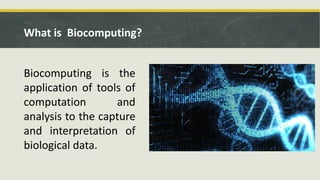
Biocomputing is the
application of tools of
computation and
analysis to the capture
and interpretation of
biological data.
What is Biocomputing?
CELL
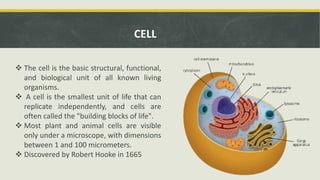
 The cell is the basic structural, functional,
and biological unit of all known living
organisms.
 A cell is the smallest unit of life that can
replicate independently, and cells are
often called the "building blocks of life".
 Most plant and animal cells are visible
only under a microscope, with dimensions
between 1 and 100 micrometers.
 Discovered by Robert Hooke in 1665
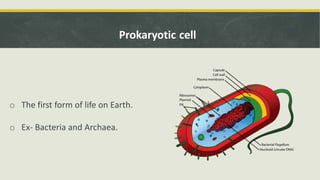
o The first form of life on Earth.
o Ex- Bacteria and Archaea.
Prokaryotic cell
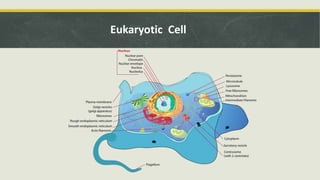
Eukaryotic Cell
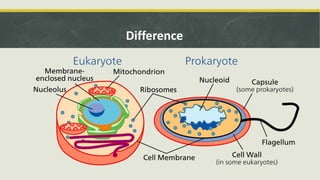
Difference
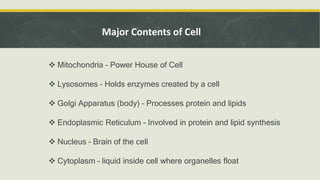
 Mitochondria – Power House of Cell
 Lysosomes – Holds enzymes created by a cell
 Golgi Apparatus (body) – Processes protein and lipids
 Endoplasmic Reticulum – Involved in protein and lipid synthesis
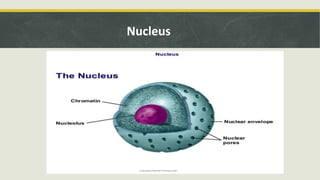
 Nucleus – Brain of the cell
 Cytoplasm – liquid inside cell where organelles float
Major Contents of Cell
Nucleus
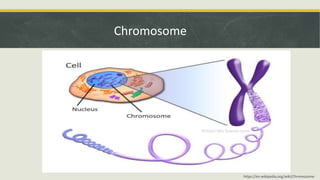
https://en.wikipedia.org/wiki/Chromosome
Chromosome
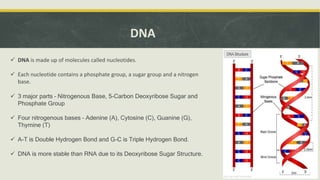
DNA
 DNA is made up of molecules called nucleotides.
 Each nucleotide contains a phosphate group, a sugar group and a nitrogen
base.
 3 major parts – Nitrogenous Base, 5-Carbon Deoxyribose Sugar and
Phosphate Group
 Four nitrogenous bases – Adenine (A), Cytosine (C), Guanine (G),
Thymine (T)
 A-T is Double Hydrogen Bond and G-C is Triple Hydrogen Bond.
 DNA is more stable than RNA due to its Deoxyribose Sugar Structure.
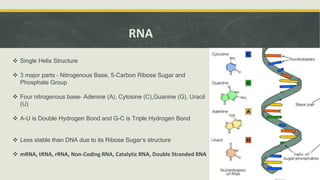
RNA
 Single Helix Structure
 3 major parts – Nitrogenous Base, 5-Carbon Ribose Sugar and
Phosphate Group
 Four nitrogenous base- Adenine (A), Cytosine (C),Guanine (G), Uracil
(U)
 A-U is Double Hydrogen Bond and G-C is Triple Hydrogen Bond
 Less stable than DNA due to its Ribose Sugar’s structure
 mRNA, tRNA, rRNA, Non-Coding RNA, Catalytic RNA, Double Stranded RNA
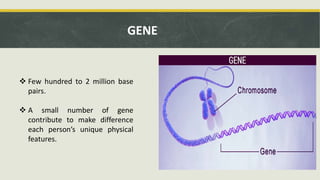
 Few hundred to 2 million base
pairs.
 A small number of gene
contribute to make difference
each person’s unique physical
features.
GENE
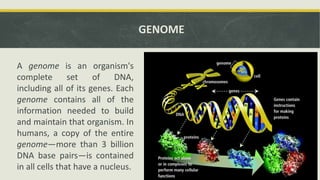
GENOME
A genome is an organism's
complete set of DNA,
including all of its genes. Each
genome contains all of the
information needed to build
and maintain that organism. In
humans, a copy of the entire
genome—more than 3 billion
DNA base pairs—is contained
in all cells that have a nucleus.
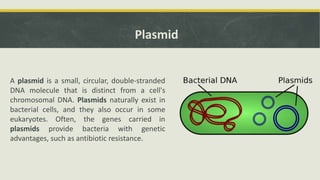
Plasmid
A plasmid is a small, circular, double-stranded
DNA molecule that is distinct from a cell's
chromosomal DNA. Plasmids naturally exist in
bacterial cells, and they also occur in some
eukaryotes. Often, the genes carried in
plasmids provide bacteria with genetic
advantages, such as antibiotic resistance.
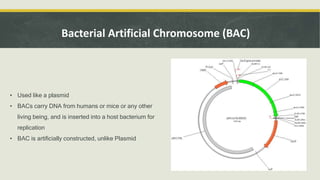
Bacterial Artificial Chromosome (BAC)
• Used like a plasmid
• BACs carry DNA from humans or mice or any other
living being, and is inserted into a host bacterium for
replication
• BAC is artificially constructed, unlike Plasmid
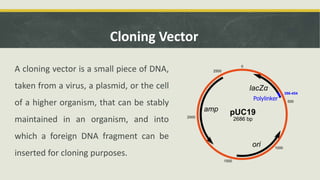
Cloning Vector
A cloning vector is a small piece of DNA,
taken from a virus, a plasmid, or the cell
of a higher organism, that can be stably
maintained in an organism, and into
which a foreign DNA fragment can be
inserted for cloning purposes.
PRESENT & FUTURE SCOPES
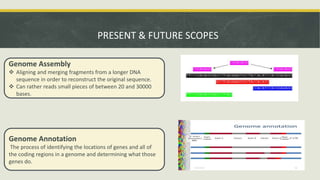
Genome Annotation
The process of identifying the locations of genes and all of
the coding regions in a genome and determining what those
genes do.
Genome Assembly
 Aligning and merging fragments from a longer DNA
sequence in order to reconstruct the original sequence.
 Can rather reads small pieces of between 20 and 30000
bases.
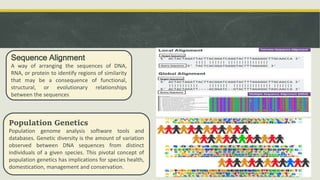
Sequence Alignment
A way of arranging the sequences of DNA,
RNA, or protein to identify regions of similarity
that may be a consequence of functional,
structural, or evolutionary relationships
between the sequences
Population Genetics
Population genome analysis software tools and
databases. Genetic diversity is the amount of variation
observed between DNA sequences from distinct
individuals of a given species. This pivotal concept of
population genetics has implications for species health,
domestication, management and conservation.
Others Application
Statistical Phylogenetics
Gene Expression Analysis
Evolution Phylogenetics Read Mapping
Structure Prediction (RNA, Protein)
Mapping
Computer Aided Drug (CAD) Design
Systems Biology
Any
Questio
Thank
You

Basic Biocomputing

  • 1.
  • 2.
    Biocomputing is the applicationof tools of computation and analysis to the capture and interpretation of biological data. What is Biocomputing?
  • 3.
    CELL  The cellis the basic structural, functional, and biological unit of all known living organisms.  A cell is the smallest unit of life that can replicate independently, and cells are often called the "building blocks of life".  Most plant and animal cells are visible only under a microscope, with dimensions between 1 and 100 micrometers.  Discovered by Robert Hooke in 1665
  • 4.
    o The firstform of life on Earth. o Ex- Bacteria and Archaea. Prokaryotic cell
  • 5.
  • 6.
  • 7.
     Mitochondria –Power House of Cell  Lysosomes – Holds enzymes created by a cell  Golgi Apparatus (body) – Processes protein and lipids  Endoplasmic Reticulum – Involved in protein and lipid synthesis  Nucleus – Brain of the cell  Cytoplasm – liquid inside cell where organelles float Major Contents of Cell
  • 8.
  • 9.
  • 10.
    DNA  DNA ismade up of molecules called nucleotides.  Each nucleotide contains a phosphate group, a sugar group and a nitrogen base.  3 major parts – Nitrogenous Base, 5-Carbon Deoxyribose Sugar and Phosphate Group  Four nitrogenous bases – Adenine (A), Cytosine (C), Guanine (G), Thymine (T)  A-T is Double Hydrogen Bond and G-C is Triple Hydrogen Bond.  DNA is more stable than RNA due to its Deoxyribose Sugar Structure.
  • 11.
    RNA  Single HelixStructure  3 major parts – Nitrogenous Base, 5-Carbon Ribose Sugar and Phosphate Group  Four nitrogenous base- Adenine (A), Cytosine (C),Guanine (G), Uracil (U)  A-U is Double Hydrogen Bond and G-C is Triple Hydrogen Bond  Less stable than DNA due to its Ribose Sugar’s structure  mRNA, tRNA, rRNA, Non-Coding RNA, Catalytic RNA, Double Stranded RNA
  • 12.
     Few hundredto 2 million base pairs.  A small number of gene contribute to make difference each person’s unique physical features. GENE
  • 13.
    GENOME A genome isan organism's complete set of DNA, including all of its genes. Each genome contains all of the information needed to build and maintain that organism. In humans, a copy of the entire genome—more than 3 billion DNA base pairs—is contained in all cells that have a nucleus.
  • 14.
    Plasmid A plasmid isa small, circular, double-stranded DNA molecule that is distinct from a cell's chromosomal DNA. Plasmids naturally exist in bacterial cells, and they also occur in some eukaryotes. Often, the genes carried in plasmids provide bacteria with genetic advantages, such as antibiotic resistance.
  • 15.
    Bacterial Artificial Chromosome(BAC) • Used like a plasmid • BACs carry DNA from humans or mice or any other living being, and is inserted into a host bacterium for replication • BAC is artificially constructed, unlike Plasmid
  • 16.
    Cloning Vector A cloningvector is a small piece of DNA, taken from a virus, a plasmid, or the cell of a higher organism, that can be stably maintained in an organism, and into which a foreign DNA fragment can be inserted for cloning purposes.
  • 17.
    PRESENT & FUTURESCOPES Genome Annotation The process of identifying the locations of genes and all of the coding regions in a genome and determining what those genes do. Genome Assembly  Aligning and merging fragments from a longer DNA sequence in order to reconstruct the original sequence.  Can rather reads small pieces of between 20 and 30000 bases.
  • 18.
    Sequence Alignment A wayof arranging the sequences of DNA, RNA, or protein to identify regions of similarity that may be a consequence of functional, structural, or evolutionary relationships between the sequences Population Genetics Population genome analysis software tools and databases. Genetic diversity is the amount of variation observed between DNA sequences from distinct individuals of a given species. This pivotal concept of population genetics has implications for species health, domestication, management and conservation.
  • 19.
    Others Application Statistical Phylogenetics GeneExpression Analysis Evolution Phylogenetics Read Mapping Structure Prediction (RNA, Protein) Mapping Computer Aided Drug (CAD) Design Systems Biology
  • 20.
  • 21.