Md.Tanvir Hossain
Department of CSE
Daffodil International University
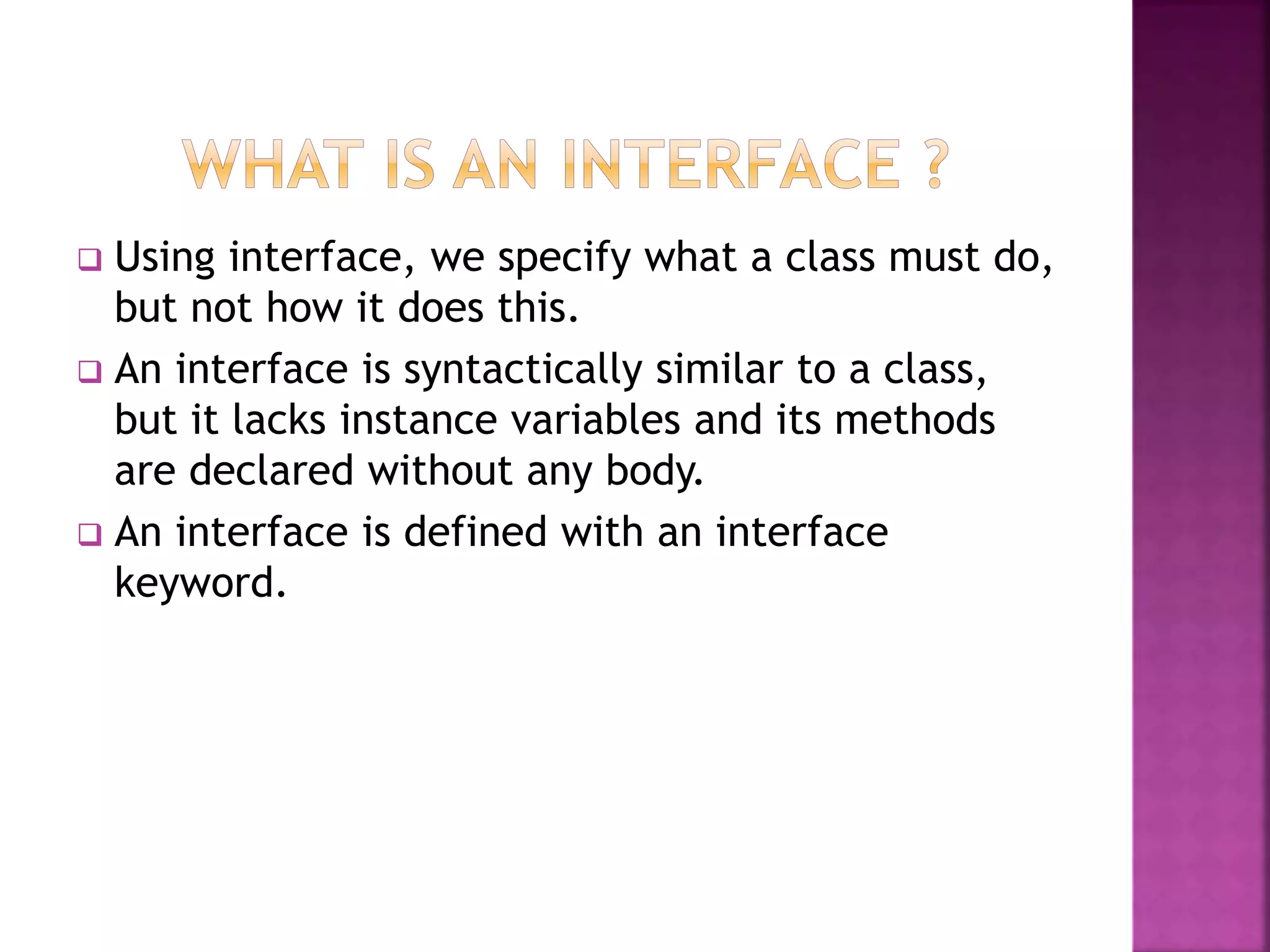
 Using interface, we specify what a class must do,
but not how it does this.
 An interface is syntactically similar to a class,
but it lacks instance variables and its methods
are declared without any body.
 An interface is defined with an interface
keyword.
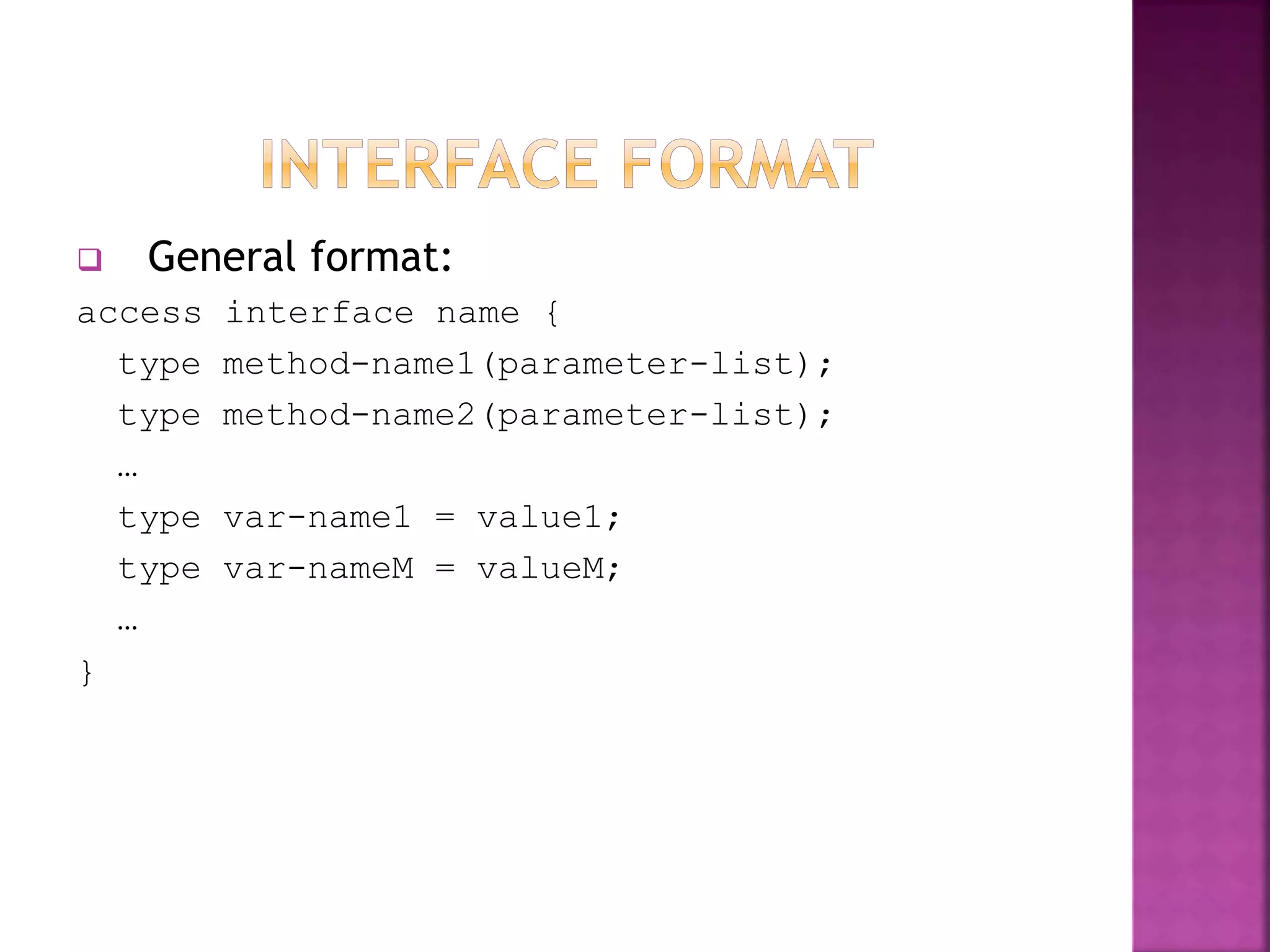
 General format:
access interface name {
type method-name1(parameter-list);
type method-name2(parameter-list);
…
type var-name1 = value1;
type var-nameM = valueM;
…
}
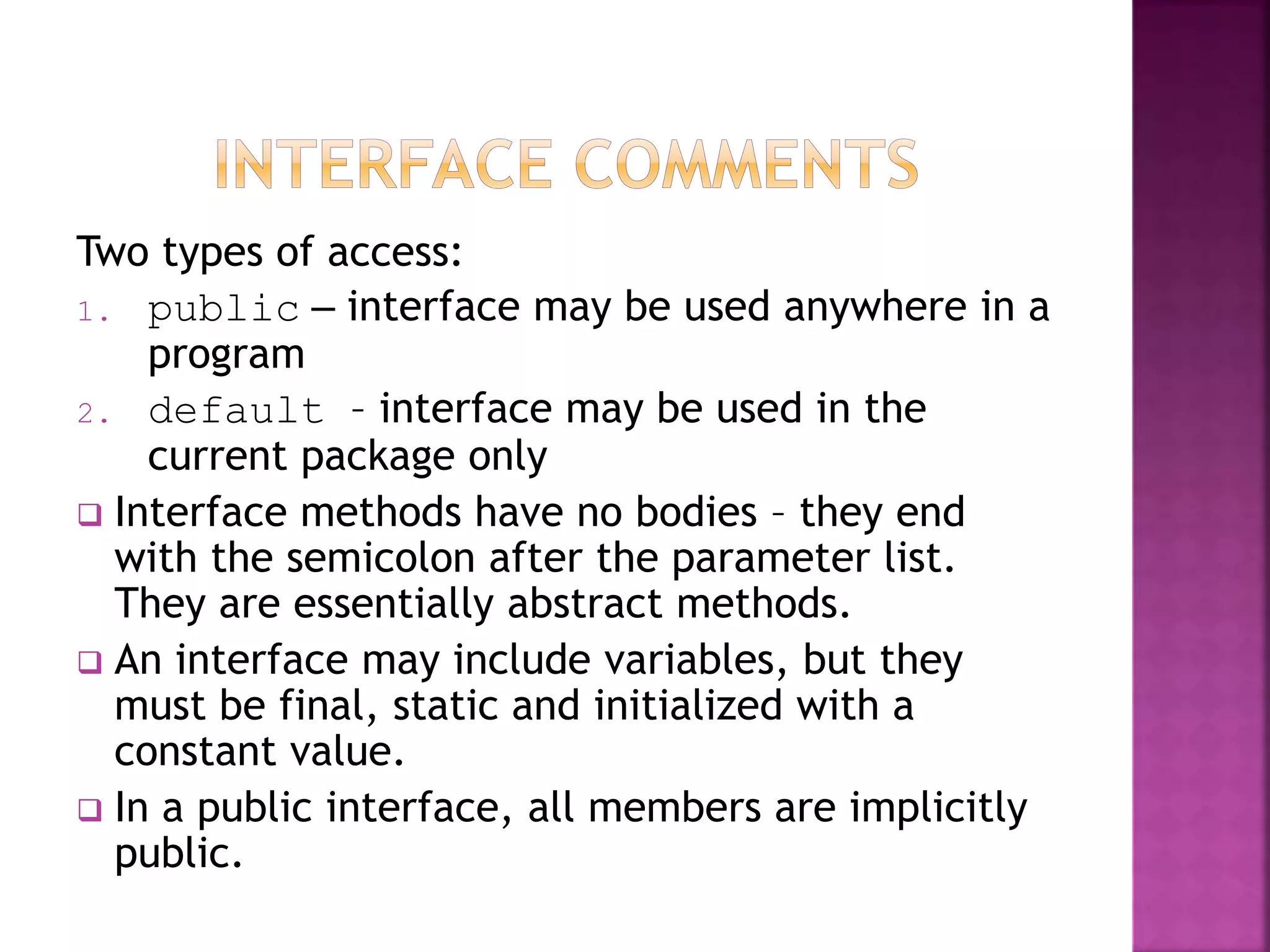
Two types of access:
1. public – interface may be used anywhere in a
program
2. default – interface may be used in the
current package only
 Interface methods have no bodies – they end
with the semicolon after the parameter list.
They are essentially abstract methods.
 An interface may include variables, but they
must be final, static and initialized with a
constant value.
 In a public interface, all members are implicitly
public.
 A class implements an interface if it provides
a complete set of methods defined by this
interface.
1. any number of classes may implement an
interface
2. one class may implement any number of
interfaces
 Each class is free to determine the details of
its implementation.
 Implementation relation is written with the
implements keyword.
 General format of a class that includes the
implements clause:
access class name
extends super-class
implements interface1,
interface2, …, interfaceN {
…
}
 Access is public or default.
 If a class implements several interfaces, they
are separated with a comma.
 If a class implements two interfaces that
declare the same method, the same method
will be used by the clients of either
interface.
 The methods that implement an interface
must be declared public.
 The type signature of the implementing
method must match exactly the type
signature specified in the interface
definition.
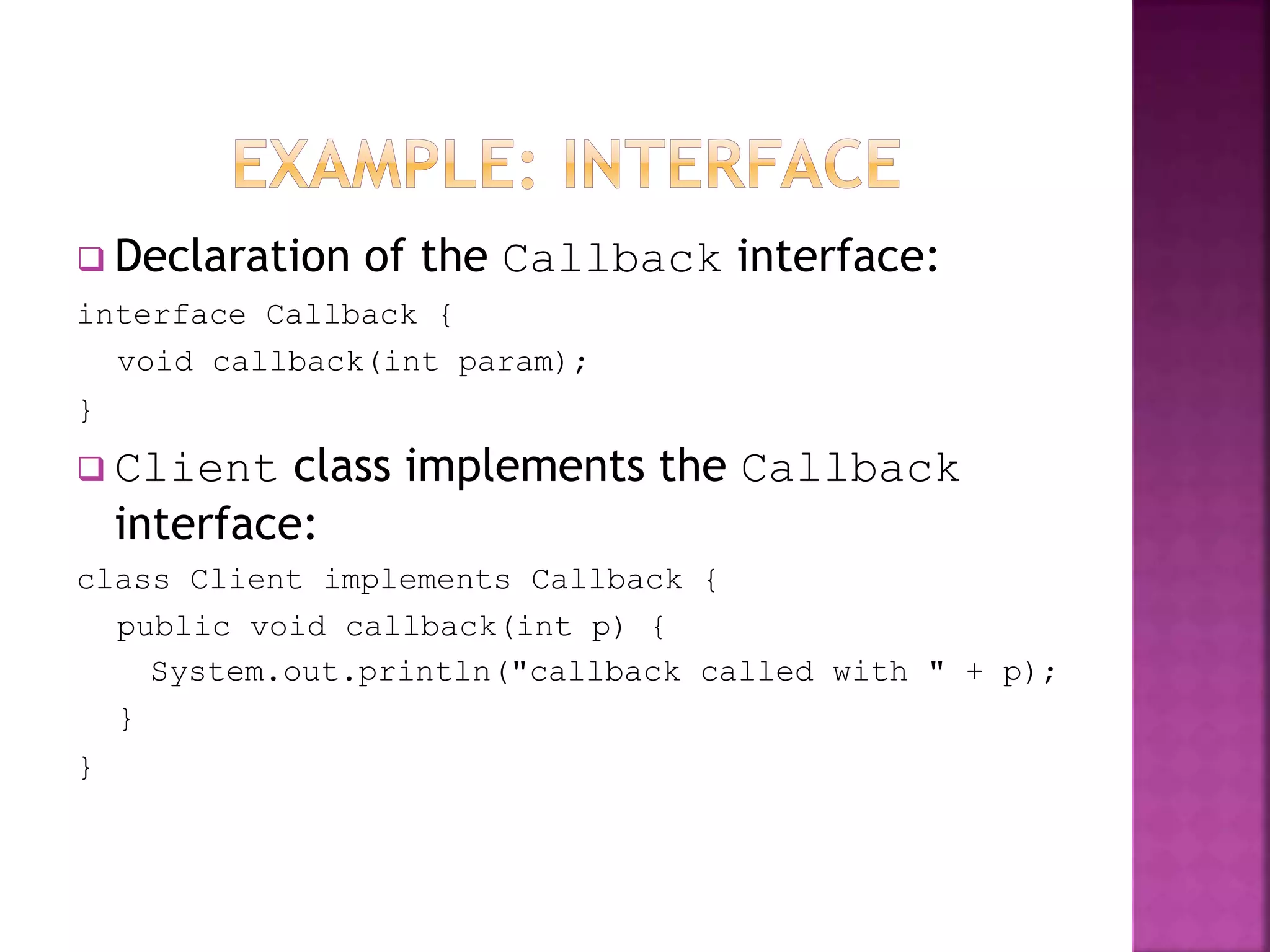
 Declaration of the Callback interface:
interface Callback {
void callback(int param);
}
 Client class implements the Callback
interface:
class Client implements Callback {
public void callback(int p) {
System.out.println("callback called with " + p);
}
}
 An implementing class may also declare its
own methods:
class Client implements Callback {
public void callback(int p) {
System.out.println("callback called with " +
p);
}
void nonIfaceMeth() {
System.out.println("Classes that implement “ +
“interfaces may also define ” +
“other members, too.");
}
}
 Variable may be declared with interface as
its type:
interface MyInterface { … }
…
MyInterface mi;
 The variable of an interface type may
reference an object of any class that
implements this interface.
class MyClass implements MyInterface { … }
MyInterface mi = new MyClass();
 Using the interface type variable, we can call any method
in the interface:
interface MyInterface {
void myMethod(…) ;
…
}
class MyClass implements MyInterface { … }
…
MyInterface mi = new MyClass();
…
mi.myMethod();
 The correct version of the method will be called based on
the actual instance of the interface being referred to.
 Declaration of the Callback interface:
interface Callback {
void callback(int param);
}
 Client class implements the Callback interface:
class Client implements Callback {
public void callback(int p) {
System.out.println("callback called with " +
p);
}
}
 TestIface declares the Callback
interface variable, initializes it with the new
Client object, and calls the callback
method through this variable:
class TestIface {
public static void main(String args[]) {
Callback c = new Client();
c.callback(42);
}
}
 Call through an interface variable is one of
the key features of interfaces:
1. the method to be executed is looked up
dynamically at run-time
2. the calling code can dispatch through an
interface without having to know anything
about the callee
 Allows classes to be created later than the
code that calls methods on them.
 Another implementation of the Callback
interface:
class AnotherClient implements Callback {
public void callback(int p) {
System.out.println("Another version of
callback");
System.out.println("p squared is " + (p*p));
}
}
 Callback variable c is assigned Client and
later AnotherClient objects and the
corresponding callback is invoked
depending on its value:
class TestIface2 {
public static void main(String args[]) {
Callback c = new Client();
c.callback(42);
AnotherClient ob = new AnotherClient();
c = ob;
c.callback(42);
}
}
 Normally, in order for a method to be called
from one class to another, both classes must
be present at compile time.
 This implies:
1. a static, non-extensible classing
environment
2. functionality gets pushed higher and higher
in the class hierarchy to make them
available to more sub-classes
 Interfaces support dynamic method binding.
 Interface disconnects the method definition
from the inheritance hierarchy:
1. interfaces are in a different hierarchy from
classes
2. it is possible for classes that are unrelated
in terms of the class hierarchy to
implement the same interface
 A class that claims to implement an interface
but does not implement all its methods must
be declared abstract.
 Incomplete class implements the
Callback interface but not its callback
method, so the class is declared abstract:
abstract class Incomplete implements Callback {
int a, b;
void show() {
System.out.println(a + " " + b);
}
}
 Many ways to implement a stack but one
interface:
interface IntStack {
void push(int item);
int pop();
}
 Lets look at two implementations of this
interface:
1. FixedStack – a fixed-length version of the
integer stack
2. DynStack – a dynamic-length version of the
integer stack
 A fixed-length stack implements the
IntStack interface with two private
variables, a constructor and two public
methods:
class FixedStack implements IntStack {
private int stck[];
private int tos;
FixedStack(int size) {
stck = new int[size]; tos = -1;
}
public void push(int item) {
if (tos==stck.length-1)
System.out.println("Stack is full.");
else
stck[++tos] = item;
}
public int pop() {
if (tos < 0) {
System.out.println("Stack underflow.");
return 0;
}
else return stck[tos--];
}
}
 A testing class creates two stacks:
class IFTest {
public static void main(String args[]) {
FixedStack mystack1 = new FixedStack(5);
FixedStack mystack2 = new FixedStack(8);
for (int i=0; i<5; i++) mystack1.push(i*i);
for (int i=0; i<8; i++) mystack2.push(i+i);
System.out.println("Stack in mystack1:");
for (int i=0; i<5; i++)
System.out.println(mystack1.pop());
System.out.println("Stack in mystack2:");
for (int i=0; i<8; i++)
System.out.println(mystack2.pop());
}
}
 Another implementation of an integer stack.
 A dynamic-length stack is first created with
an initial length. The stack is doubled in size
every time this initial length is exceeded.
class DynStack implements IntStack {
private int stck[];
private int tos;
DynStack(int size) {
stck = new int[size];
tos = -1;
}
 If stack if full, push() creates a new stack
with double the size of the old stack:
public void push(int item) {
if (tos==stck.length-1) {
int temp[] = new int[stck.length * 2];
for (int i=0; i<stck.length; i++)
temp[i] = stck[i];
stck = temp;
stck[++tos] = item;
}
else stck[++tos] = item;
}
 If the stack is empty, pop() returns the
zero value:
public int pop() {
if(tos < 0) {
System.out.println("Stack underflow.");
return 0;
}
else return stck[tos--];
}
}
 The testing class creates two dynamic-length
stacks:
class IFTest2 {
public static void main(String args[]) {
DynStack mystack1 = new DynStack(5);
DynStack mystack2 = new DynStack(8);
for (int i=0; i<12; i++) mystack1.push(i*i);
for (int i=0; i<20; i++) mystack2.push(i+i);
System.out.println("Stack in mystack1:");
for (int i=0; i<12; i++)
System.out.println(mystack1.pop());
System.out.println("Stack in mystack2:");
for (int i=0; i<20; i++)
System.out.println(mystack2.pop());
}
}
 Testing two stack implementations through
an interface variable.
 First, some numbers are pushed onto both
stacks:
class IFTest3 {
public static void main(String args[]) {
IntStack mystack;
DynStack ds = new DynStack(5);
FixedStack fs = new FixedStack(8);
mystack = ds;
for (int i=0; i<12; i++) mystack.push(i);
mystack = fs;
for (int i=0; i<8; i++) mystack.push(i);
 Then, those numbers are popped off:
mystack = ds;
System.out.println("Values in dynamic stack:");
for (int i=0; i<12; i++)
System.out.println(mystack.pop());
mystack = fs;
System.out.println("Values in fixed stack:");
for (int i=0; i<8; i++)
System.out.println(mystack.pop());
}
}
 Which stack implementation is the value of the
mystack variable, therefore which version of
push and pop are used, is determined at run-
time.
 Variables declared in an interface must be
constants.
 A technique to import shared constants into
multiple classes:
1. declare an interface with variables initialized to the
desired values
2. include that interface in a class through
implementation
 As no methods are included in the interface, the
class does not implement anything except
importing the variables as constants.
 An interface with constant values:
import java.util.Random;
interface SharedConstants {
int NO = 0;
int YES = 1;
int MAYBE = 2;
int LATER = 3;
int SOON = 4;
int NEVER = 5;
}
 Question implements SharedConstants,
including all its constants.
 Which constant is returned depends on the generated
random number:
class Question implements SharedConstants {
Random rand = new Random();
int ask() {
int prob = (int) (100 * rand.nextDouble());
if (prob < 30) return NO;
else if (prob < 60) return YES;
else if (prob < 75) return LATER;
else if (prob < 98) return SOON;
else return NEVER;
}
}
 AskMe includes all shared constants in the same way, using
them to display the result, depending on the value received:
class AskMe implements SharedConstants {
static void answer(int result) {
switch(result) {
case NO: System.out.println("No"); break;
case YES: System.out.println("Yes"); break;
case MAYBE: System.out.println("Maybe"); break;
case LATER: System.out.println("Later"); break;
case SOON: System.out.println("Soon"); break;
case NEVER: System.out.println("Never"); break;
}
}
 The testing function relies on the fact that
both ask and answer methods, defined in
different classes, rely on the same constants:
public static void main(String args[]) {
Question q = new Question();
answer(q.ask());
answer(q.ask());
answer(q.ask());
answer(q.ask());
}
}
 One interface may inherit another interface.
 The inheritance syntax is the same for classes
and interfaces.
interface MyInterface1 {
void myMethod1(…) ;
}
interface MyInterface2 extends MyInterface1 {
void myMethod2(…) ;
}
 When a class implements an interface that
inherits another interface, it must provide
implementations for all methods defined within
the interface inheritance chain.
 When a class implements an interface that
inherits another interface, it must provide
implementations for all inherited methods:
class MyClass implements MyInterface2 {
void myMethod1(…) { … }
…
}
 Consider interfaces A and B.
interface A {
void meth1();
void meth2();
}
B extends A:
interface B extends A {
void meth3();
}
 MyClass must implement all of A and B
methods:
class MyClass implements B {
public void meth1() {
System.out.println("Implement meth1().");
}
public void meth2() {
System.out.println("Implement meth2().");
}
public void meth3() {
System.out.println("Implement meth3().");
}
}
 Create a new MyClass object, then invoke
all interface methods on it:
class IFExtend {
public static void main(String arg[]) {
MyClass ob = new MyClass();
ob.meth1();
ob.meth2();
ob.meth3();
}
}
Java interface

Java interface

  • 1.
    Md.Tanvir Hossain Department ofCSE Daffodil International University
  • 2.
     Using interface,we specify what a class must do, but not how it does this.  An interface is syntactically similar to a class, but it lacks instance variables and its methods are declared without any body.  An interface is defined with an interface keyword.
  • 3.
     General format: accessinterface name { type method-name1(parameter-list); type method-name2(parameter-list); … type var-name1 = value1; type var-nameM = valueM; … }
  • 4.
    Two types ofaccess: 1. public – interface may be used anywhere in a program 2. default – interface may be used in the current package only  Interface methods have no bodies – they end with the semicolon after the parameter list. They are essentially abstract methods.  An interface may include variables, but they must be final, static and initialized with a constant value.  In a public interface, all members are implicitly public.
  • 5.
     A classimplements an interface if it provides a complete set of methods defined by this interface. 1. any number of classes may implement an interface 2. one class may implement any number of interfaces  Each class is free to determine the details of its implementation.  Implementation relation is written with the implements keyword.
  • 6.
     General formatof a class that includes the implements clause: access class name extends super-class implements interface1, interface2, …, interfaceN { … }  Access is public or default.
  • 7.
     If aclass implements several interfaces, they are separated with a comma.  If a class implements two interfaces that declare the same method, the same method will be used by the clients of either interface.
  • 8.
     The methodsthat implement an interface must be declared public.  The type signature of the implementing method must match exactly the type signature specified in the interface definition.
  • 9.
     Declaration ofthe Callback interface: interface Callback { void callback(int param); }  Client class implements the Callback interface: class Client implements Callback { public void callback(int p) { System.out.println("callback called with " + p); } }
  • 10.
     An implementingclass may also declare its own methods: class Client implements Callback { public void callback(int p) { System.out.println("callback called with " + p); } void nonIfaceMeth() { System.out.println("Classes that implement “ + “interfaces may also define ” + “other members, too."); } }
  • 11.
     Variable maybe declared with interface as its type: interface MyInterface { … } … MyInterface mi;  The variable of an interface type may reference an object of any class that implements this interface. class MyClass implements MyInterface { … } MyInterface mi = new MyClass();
  • 12.
     Using theinterface type variable, we can call any method in the interface: interface MyInterface { void myMethod(…) ; … } class MyClass implements MyInterface { … } … MyInterface mi = new MyClass(); … mi.myMethod();  The correct version of the method will be called based on the actual instance of the interface being referred to.
  • 13.
     Declaration ofthe Callback interface: interface Callback { void callback(int param); }  Client class implements the Callback interface: class Client implements Callback { public void callback(int p) { System.out.println("callback called with " + p); } }
  • 14.
     TestIface declaresthe Callback interface variable, initializes it with the new Client object, and calls the callback method through this variable: class TestIface { public static void main(String args[]) { Callback c = new Client(); c.callback(42); } }
  • 15.
     Call throughan interface variable is one of the key features of interfaces: 1. the method to be executed is looked up dynamically at run-time 2. the calling code can dispatch through an interface without having to know anything about the callee  Allows classes to be created later than the code that calls methods on them.
  • 16.
     Another implementationof the Callback interface: class AnotherClient implements Callback { public void callback(int p) { System.out.println("Another version of callback"); System.out.println("p squared is " + (p*p)); } }
  • 17.
     Callback variablec is assigned Client and later AnotherClient objects and the corresponding callback is invoked depending on its value: class TestIface2 { public static void main(String args[]) { Callback c = new Client(); c.callback(42); AnotherClient ob = new AnotherClient(); c = ob; c.callback(42); } }
  • 18.
     Normally, inorder for a method to be called from one class to another, both classes must be present at compile time.  This implies: 1. a static, non-extensible classing environment 2. functionality gets pushed higher and higher in the class hierarchy to make them available to more sub-classes
  • 19.
     Interfaces supportdynamic method binding.  Interface disconnects the method definition from the inheritance hierarchy: 1. interfaces are in a different hierarchy from classes 2. it is possible for classes that are unrelated in terms of the class hierarchy to implement the same interface
  • 20.
     A classthat claims to implement an interface but does not implement all its methods must be declared abstract.  Incomplete class implements the Callback interface but not its callback method, so the class is declared abstract: abstract class Incomplete implements Callback { int a, b; void show() { System.out.println(a + " " + b); } }
  • 21.
     Many waysto implement a stack but one interface: interface IntStack { void push(int item); int pop(); }  Lets look at two implementations of this interface: 1. FixedStack – a fixed-length version of the integer stack 2. DynStack – a dynamic-length version of the integer stack
  • 22.
     A fixed-lengthstack implements the IntStack interface with two private variables, a constructor and two public methods: class FixedStack implements IntStack { private int stck[]; private int tos; FixedStack(int size) { stck = new int[size]; tos = -1; }
  • 23.
    public void push(intitem) { if (tos==stck.length-1) System.out.println("Stack is full."); else stck[++tos] = item; } public int pop() { if (tos < 0) { System.out.println("Stack underflow."); return 0; } else return stck[tos--]; } }
  • 24.
     A testingclass creates two stacks: class IFTest { public static void main(String args[]) { FixedStack mystack1 = new FixedStack(5); FixedStack mystack2 = new FixedStack(8); for (int i=0; i<5; i++) mystack1.push(i*i); for (int i=0; i<8; i++) mystack2.push(i+i); System.out.println("Stack in mystack1:"); for (int i=0; i<5; i++) System.out.println(mystack1.pop()); System.out.println("Stack in mystack2:"); for (int i=0; i<8; i++) System.out.println(mystack2.pop()); } }
  • 25.
     Another implementationof an integer stack.  A dynamic-length stack is first created with an initial length. The stack is doubled in size every time this initial length is exceeded. class DynStack implements IntStack { private int stck[]; private int tos; DynStack(int size) { stck = new int[size]; tos = -1; }
  • 26.
     If stackif full, push() creates a new stack with double the size of the old stack: public void push(int item) { if (tos==stck.length-1) { int temp[] = new int[stck.length * 2]; for (int i=0; i<stck.length; i++) temp[i] = stck[i]; stck = temp; stck[++tos] = item; } else stck[++tos] = item; }
  • 27.
     If thestack is empty, pop() returns the zero value: public int pop() { if(tos < 0) { System.out.println("Stack underflow."); return 0; } else return stck[tos--]; } }
  • 28.
     The testingclass creates two dynamic-length stacks: class IFTest2 { public static void main(String args[]) { DynStack mystack1 = new DynStack(5); DynStack mystack2 = new DynStack(8); for (int i=0; i<12; i++) mystack1.push(i*i); for (int i=0; i<20; i++) mystack2.push(i+i); System.out.println("Stack in mystack1:"); for (int i=0; i<12; i++) System.out.println(mystack1.pop()); System.out.println("Stack in mystack2:"); for (int i=0; i<20; i++) System.out.println(mystack2.pop()); } }
  • 29.
     Testing twostack implementations through an interface variable.  First, some numbers are pushed onto both stacks: class IFTest3 { public static void main(String args[]) { IntStack mystack; DynStack ds = new DynStack(5); FixedStack fs = new FixedStack(8); mystack = ds; for (int i=0; i<12; i++) mystack.push(i); mystack = fs; for (int i=0; i<8; i++) mystack.push(i);
  • 30.
     Then, thosenumbers are popped off: mystack = ds; System.out.println("Values in dynamic stack:"); for (int i=0; i<12; i++) System.out.println(mystack.pop()); mystack = fs; System.out.println("Values in fixed stack:"); for (int i=0; i<8; i++) System.out.println(mystack.pop()); } }  Which stack implementation is the value of the mystack variable, therefore which version of push and pop are used, is determined at run- time.
  • 31.
     Variables declaredin an interface must be constants.  A technique to import shared constants into multiple classes: 1. declare an interface with variables initialized to the desired values 2. include that interface in a class through implementation  As no methods are included in the interface, the class does not implement anything except importing the variables as constants.
  • 32.
     An interfacewith constant values: import java.util.Random; interface SharedConstants { int NO = 0; int YES = 1; int MAYBE = 2; int LATER = 3; int SOON = 4; int NEVER = 5; }
  • 33.
     Question implementsSharedConstants, including all its constants.  Which constant is returned depends on the generated random number: class Question implements SharedConstants { Random rand = new Random(); int ask() { int prob = (int) (100 * rand.nextDouble()); if (prob < 30) return NO; else if (prob < 60) return YES; else if (prob < 75) return LATER; else if (prob < 98) return SOON; else return NEVER; } }
  • 34.
     AskMe includesall shared constants in the same way, using them to display the result, depending on the value received: class AskMe implements SharedConstants { static void answer(int result) { switch(result) { case NO: System.out.println("No"); break; case YES: System.out.println("Yes"); break; case MAYBE: System.out.println("Maybe"); break; case LATER: System.out.println("Later"); break; case SOON: System.out.println("Soon"); break; case NEVER: System.out.println("Never"); break; } }
  • 35.
     The testingfunction relies on the fact that both ask and answer methods, defined in different classes, rely on the same constants: public static void main(String args[]) { Question q = new Question(); answer(q.ask()); answer(q.ask()); answer(q.ask()); answer(q.ask()); } }
  • 36.
     One interfacemay inherit another interface.  The inheritance syntax is the same for classes and interfaces. interface MyInterface1 { void myMethod1(…) ; } interface MyInterface2 extends MyInterface1 { void myMethod2(…) ; }  When a class implements an interface that inherits another interface, it must provide implementations for all methods defined within the interface inheritance chain.
  • 37.
     When aclass implements an interface that inherits another interface, it must provide implementations for all inherited methods: class MyClass implements MyInterface2 { void myMethod1(…) { … } void myMethod1(…) { … } … }
  • 38.
     Consider interfacesA and B. interface A { void meth1(); void meth2(); } B extends A: interface B extends A { void meth3(); }
  • 39.
     MyClass mustimplement all of A and B methods: class MyClass implements B { public void meth1() { System.out.println("Implement meth1()."); } public void meth2() { System.out.println("Implement meth2()."); } public void meth3() { System.out.println("Implement meth3()."); } }
  • 40.
     Create anew MyClass object, then invoke all interface methods on it: class IFExtend { public static void main(String arg[]) { MyClass ob = new MyClass(); ob.meth1(); ob.meth2(); ob.meth3(); } }