Introduction
In our time, and for the foreseeable future, biology data is being collected at an
astounding rate. Whether the data is a new DNA sequence from an exotic animal or a
3D-structure of a novel protein, the information is invariably stored in a database—some
of which is accessible through the internet. In parallel, there has been a steady
development of software tools to analyze this data. For those who wish to perform
research in life sciences, it is essential to be aware of the databases and software
programs commonly used by scientists. The field that has emerged from this information
explosion is called bioinformatics.
Before we delve into bioinformatics let us review its formal definition. According to the
National Center for Biotechnology Information (NCBI), “bioinformatics is the research,
development or application of computational tools and approaches for expanding the use
of biological, medical, behavioral or health data, including those to acquire, store,
organize, archive, analyze or visualize such data”
(http://www.bisti.nih.gov/CompuBioDef.pdf). The origin of the term bioinformatics is
obscure. A Bioinformatics group was established at the University of Ultrecht in the late
1970s. Paulien Hogeweg published the first paper from this group on a program that
graphically represents the predictions of different models for simulating real systems.
Although she did not explicitly use the term bioinformatics in her paper, because of her
affiliation with the “Bioinformatics group”, it was the first time the term appeared in
print. Jean-Michel Claverie used the French word “bioinformatique” in the 1980s and
translated it to English during one of his lectures. In today’s usage, bioinformatics
overlaps with a number of other interdisciplinary subjects including, but not limited to,
systems biology, computational biology, and genomics. Although there is nothing in the
formal definition of bioinformatics that limits bioinformatics to molecular data, the
bioinformatics field expanded rapidly in this direction when the human genome sequence
was published in 2001. Much of what is considered bioinformatics is molecular and it is
from this perspective that this textbook is written.
In academia and in the workplace it is generally accepted that those who practice
bioinformatics can be placed in one of two camps: users and developers. Users utilize the
databases and software programs to answer biological problems. For example, a
researcher may want to know if a new drug might have toxic effects on the body. If it is
known precisely how the drug binds to its protein target, then one approach is to search
for similar regions on other potential protein targets. The programs and databases
required to identify similar regions are readily available through the internet. On the
other hand, developers create new programs and databases that add to the repertoire of
tools that increase our knowledge of molecular life sciences. For example, a group of
developers at NCBI created a software program called PSI-BLAST, which allows one to
mine databases for similar genes in widely different organisms. PSI-BLAST has been
extensively used to determine the function of newly discovered genes. This book will
cover areas essential for a user as well as a developer.
1
Another field highly related to bioinformatics is genomics, the study of whole genomes
from organisms. Bioinformatics tools are required for the scientific discoveries made in
genomics. We will devote three chapters to specialized topics within the genomics field:
Phylogenetics Analysis, Gene Expression Analysis and Comparing Genomes. Genomic
analysis is crucial because it is likely that the cost of sequencing the human genome will
fall to the point where it is affordable for most people to have their DNA sequenced. The
sequence will likely be available on a memory drive. If used properly, the sequence
could be used to head off diseases and maintain a healthy lifestyle. The future of
bioinformatics and its application to genomics will likely be surprising and exciting.
References
Altschul, S.F., Madden, T.L., Schäffer, A.A., Zhang, J., Zhang, Z., Miller, W. and
Lipman, D.J., 1997. Gapped BLAST and PSI-BLAST: a new generation of protein
database search programs. Nucleic Acids Research 25:3389-3402.
Claverie, J.-M. and Notredame, C., 2007. Bioinformatics for Dummies, 2nd
ed. Hoboken:
Wiley Publishing.
Hogeweg, P. and Hesper, B., 1978. Interactive instruction on population interactions.
Computers and Biology in Medicine 8:319-327.
2
Chapter 1—Review of Molecular Biology
In this chapter we review basic concepts in molecular biology necessary for
comprehending bioinformatics.
Genes and DNA
The genome is the DNA (deoxyribonucleic acid) that is found in an organism. Each cell
in the organism contains a complete genome. Part of the genome is devoted to making
proteins. The segments of genome that produce proteins are called genes. Each protein
has at least one function that it carries out for the cell, and ultimately, for the organism.
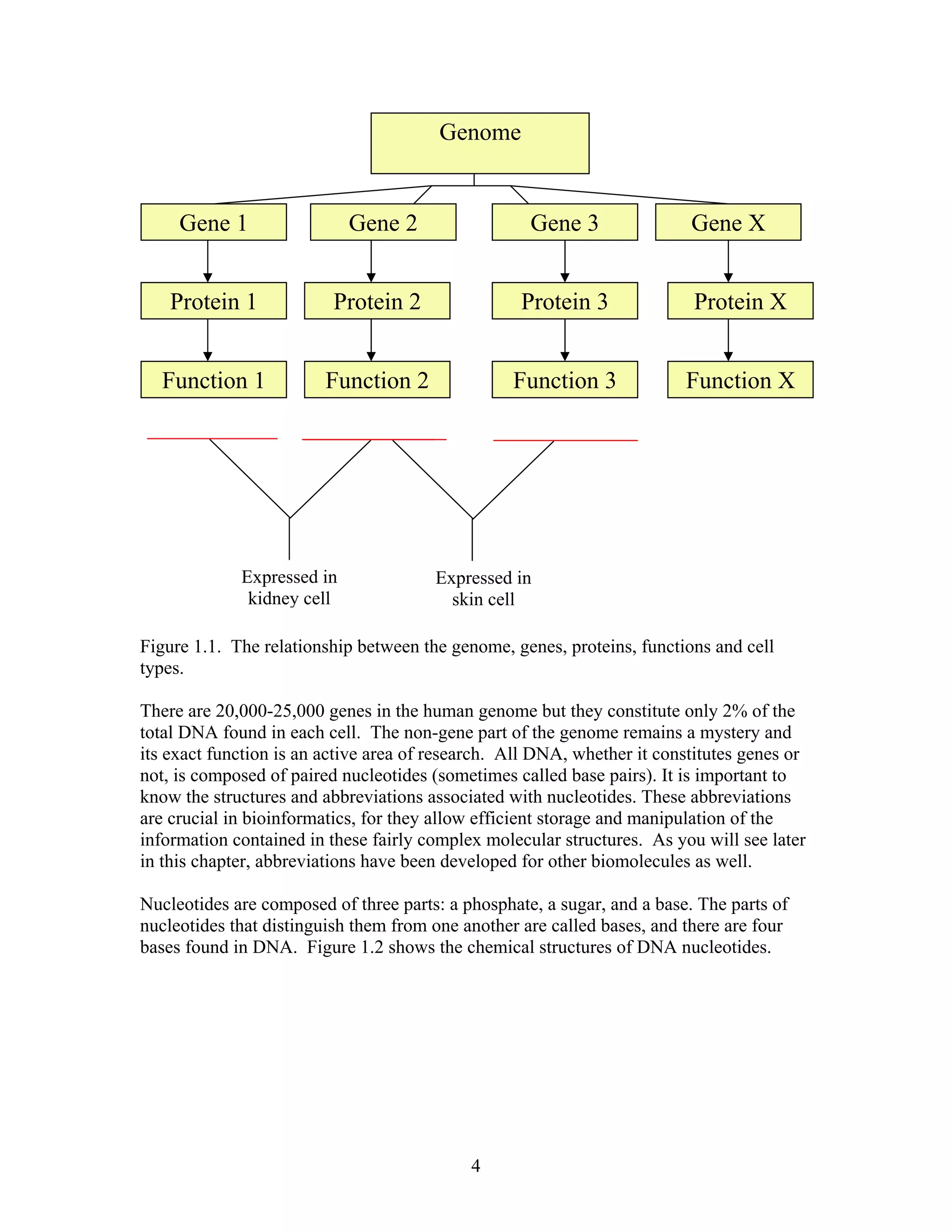
Figure 1.1 shows the hierarchy of genome, genes, proteins and functions. Proteins carry
out the many functions or tasks that collectively allow the organism to breath, eat, love
and think. A single function could be repairing damaged DNA or it could be a step in the
breakdown of glucose for the generation of energy. We are just beginning to appreciate
the fact that some proteins have more than one function, but we will not explore this
complexity further here. Note that although they have the same genome, not all cells
make the same proteins. These differences in protein production occur because different
cell types have different specialized functions, and it is the repertoire of proteins that
gives each cell its specialized function. There is a subset of proteins unique to every cell
type and there is a subset of proteins common to all cells. Proteins unique to a cell type
are called specialized proteins, and proteins common to all cells are called housekeeping
proteins. Figure 1.1 shows that a kidney cell produces protein 1 and protein 2 but not
protein 3. A skin cell produces protein 2 and protein 3 but not protein 1. Proteins 1 and 3
are therefore specialized proteins and protein 2 is a housekeeping protein.
3
Gene 1 Gene 3Gene 2
Protein 1 Protein 2 Protein 3
Function XFunction 3Function 2Function 1
Protein X
Gene X
Genome
Expressed in
kidney cell
Expressed in
skin cell
Figure 1.1. The relationship between the genome, genes, proteins, functions and cell
types.
There are 20,000-25,000 genes in the human genome but they constitute only 2% of the
total DNA found in each cell. The non-gene part of the genome remains a mystery and
its exact function is an active area of research. All DNA, whether it constitutes genes or
not, is composed of paired nucleotides (sometimes called base pairs). It is important to
know the structures and abbreviations associated with nucleotides. These abbreviations
are crucial in bioinformatics, for they allow efficient storage and manipulation of the
information contained in these fairly complex molecular structures. As you will see later
in this chapter, abbreviations have been developed for other biomolecules as well.
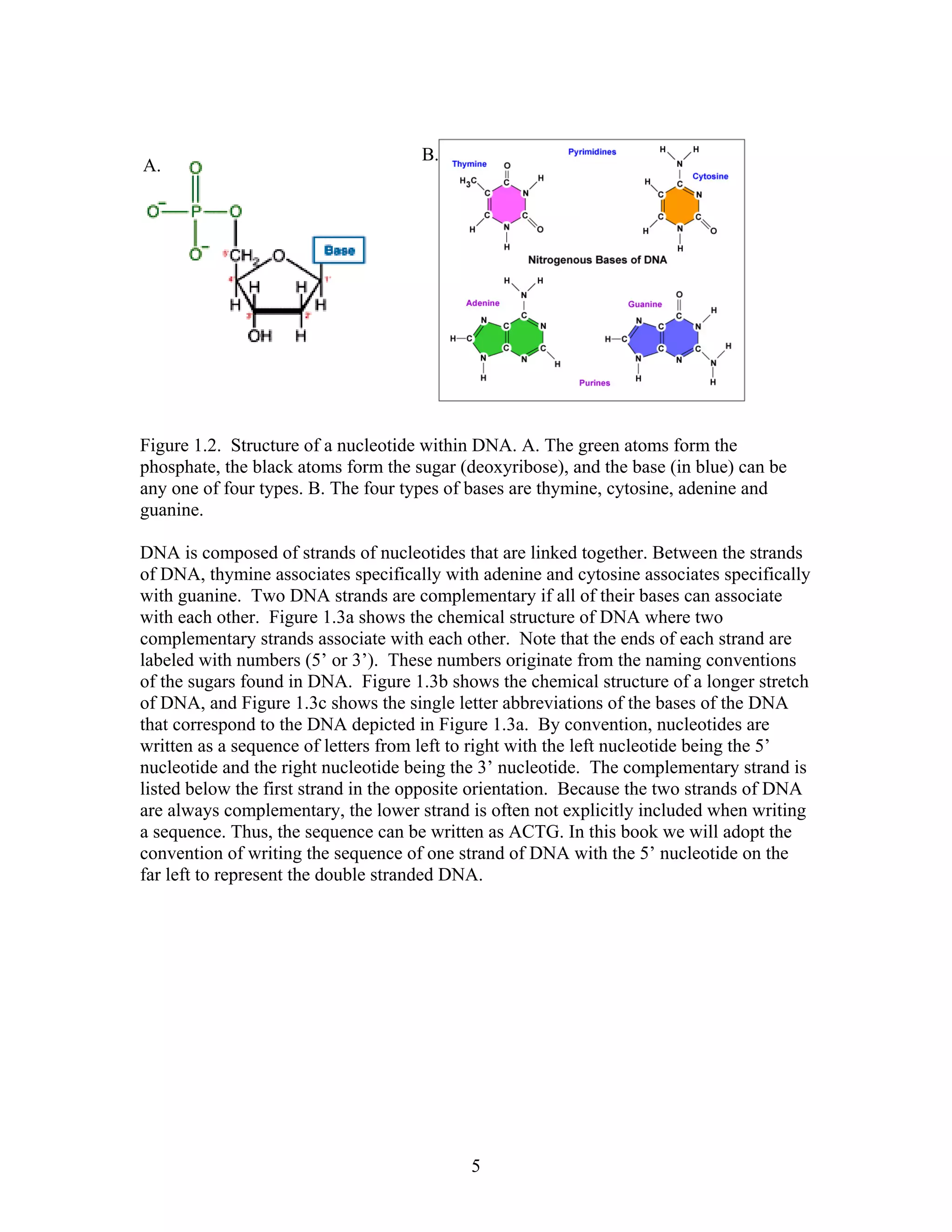
Nucleotides are composed of three parts: a phosphate, a sugar, and a base. The parts of
nucleotides that distinguish them from one another are called bases, and there are four
bases found in DNA. Figure 1.2 shows the chemical structures of DNA nucleotides.
4
B.
A.
Figure 1.2. Structure of a nucleotide within DNA. A. The green atoms form the
phosphate, the black atoms form the sugar (deoxyribose), and the base (in blue) can be
any one of four types. B. The four types of bases are thymine, cytosine, adenine and
guanine.
DNA is composed of strands of nucleotides that are linked together. Between the strands
of DNA, thymine associates specifically with adenine and cytosine associates specifically
with guanine. Two DNA strands are complementary if all of their bases can associate
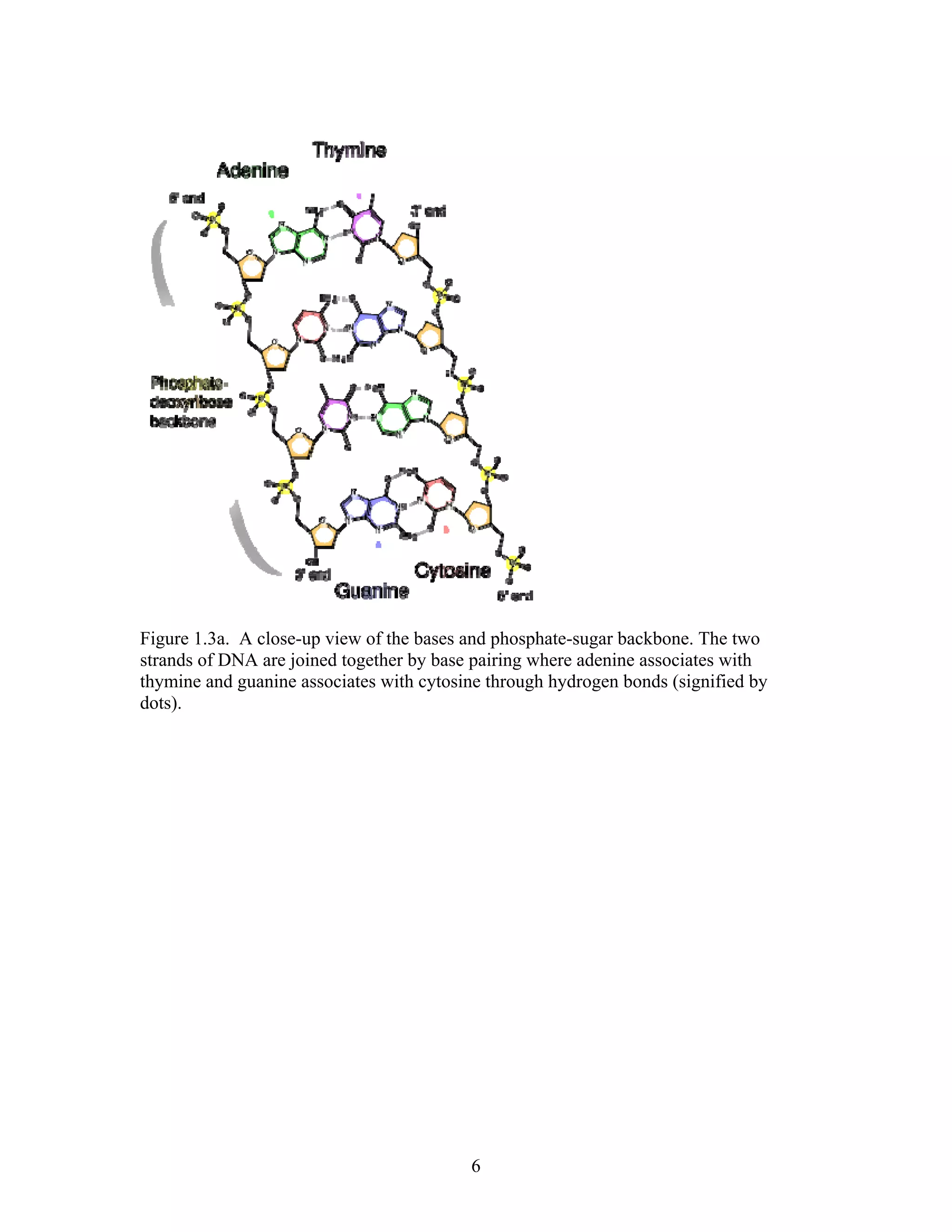
with each other. Figure 1.3a shows the chemical structure of DNA where two
complementary strands associate with each other. Note that the ends of each strand are
labeled with numbers (5’ or 3’). These numbers originate from the naming conventions
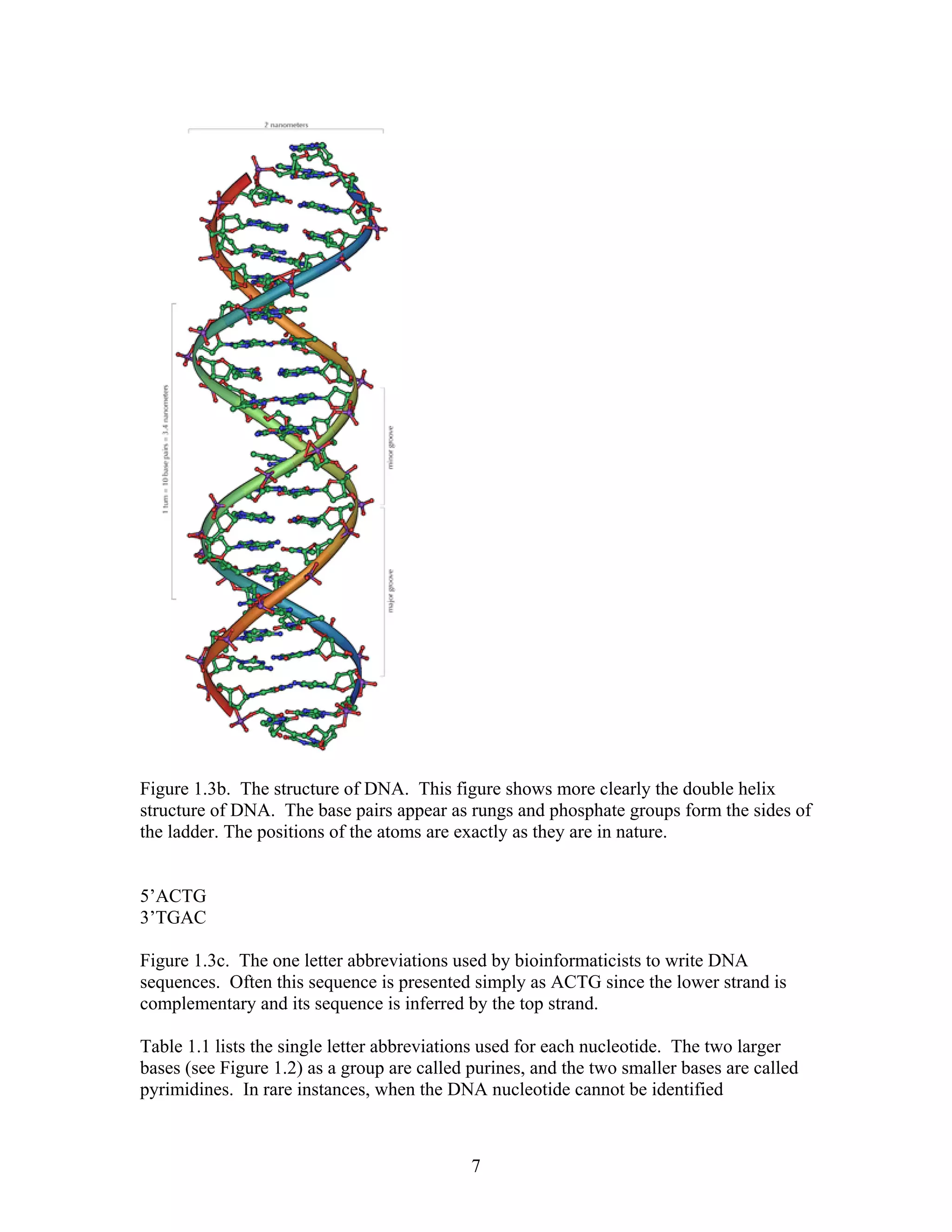
of the sugars found in DNA. Figure 1.3b shows the chemical structure of a longer stretch
of DNA, and Figure 1.3c shows the single letter abbreviations of the bases of the DNA
that correspond to the DNA depicted in Figure 1.3a. By convention, nucleotides are
written as a sequence of letters from left to right with the left nucleotide being the 5’
nucleotide and the right nucleotide being the 3’ nucleotide. The complementary strand is
listed below the first strand in the opposite orientation. Because the two strands of DNA
are always complementary, the lower strand is often not explicitly included when writing
a sequence. Thus, the sequence can be written as ACTG. In this book we will adopt the
convention of writing the sequence of one strand of DNA with the 5’ nucleotide on the
far left to represent the double stranded DNA.
5
Figure 1.3a. A close-up view of the bases and phosphate-sugar backbone. The two
strands of DNA are joined together by base pairing where adenine associates with
thymine and guanine associates with cytosine through hydrogen bonds (signified by
dots).
6
Figure 1.3b. The structure of DNA. This figure shows more clearly the double helix
structure of DNA. The base pairs appear as rungs and phosphate groups form the sides of
the ladder. The positions of the atoms are exactly as they are in nature.
5’ACTG
3’TGAC
Figure 1.3c. The one letter abbreviations used by bioinformaticists to write DNA
sequences. Often this sequence is presented simply as ACTG since the lower strand is
complementary and its sequence is inferred by the top strand.
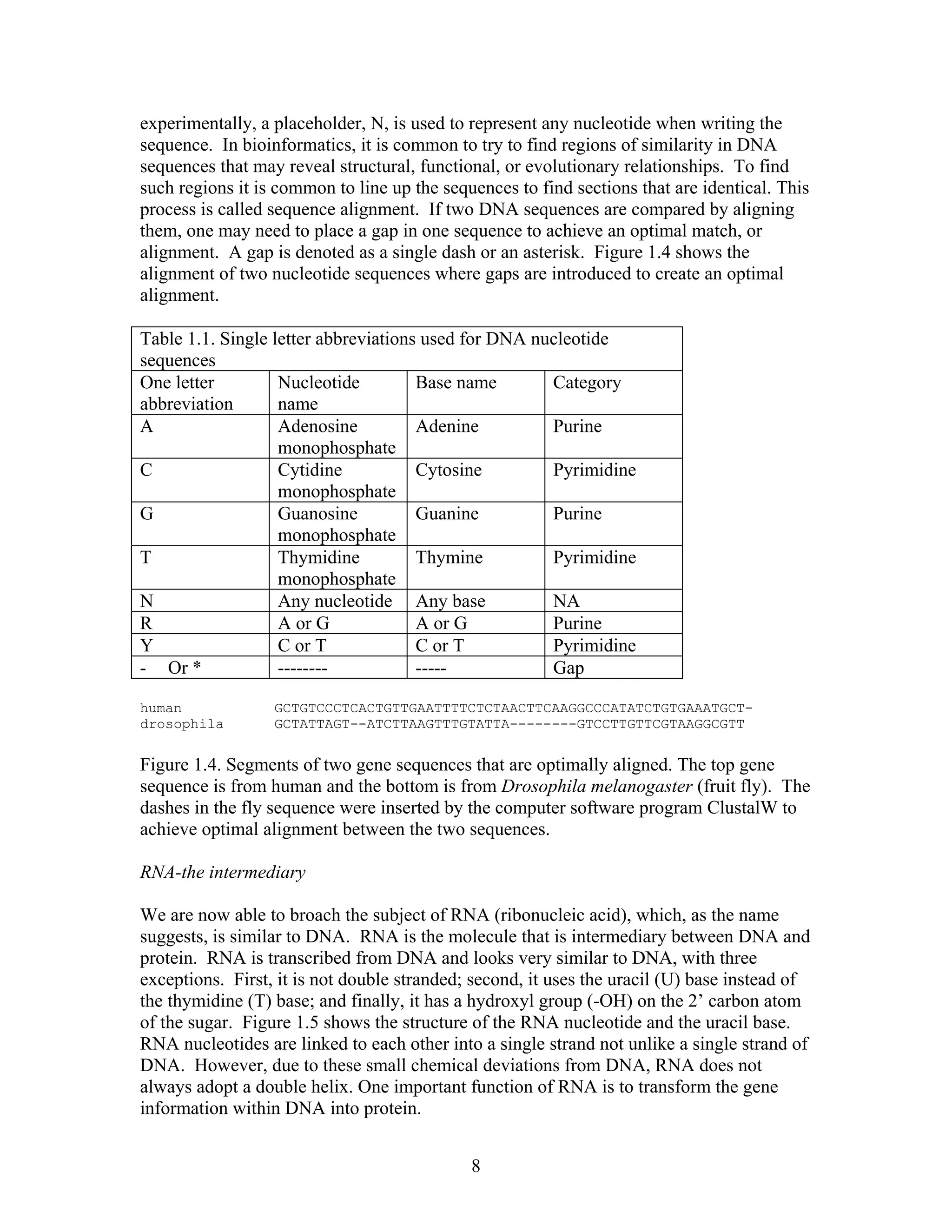
Table 1.1 lists the single letter abbreviations used for each nucleotide. The two larger
bases (see Figure 1.2) as a group are called purines, and the two smaller bases are called
pyrimidines. In rare instances, when the DNA nucleotide cannot be identified
7
experimentally, a placeholder, N, is used to represent any nucleotide when writing the
sequence. In bioinformatics, it is common to try to find regions of similarity in DNA
sequences that may reveal structural, functional, or evolutionary relationships. To find
such regions it is common to line up the sequences to find sections that are identical. This
process is called sequence alignment. If two DNA sequences are compared by aligning
them, one may need to place a gap in one sequence to achieve an optimal match, or
alignment. A gap is denoted as a single dash or an asterisk. Figure 1.4 shows the
alignment of two nucleotide sequences where gaps are introduced to create an optimal
alignment.
Table 1.1. Single letter abbreviations used for DNA nucleotide
sequences
One letter
abbreviation
Nucleotide
name
Base name Category
A Adenosine
monophosphate
Adenine Purine
C Cytidine
monophosphate
Cytosine Pyrimidine
G Guanosine
monophosphate
Guanine Purine
T Thymidine
monophosphate
Thymine Pyrimidine
N Any nucleotide Any base NA
R A or G A or G Purine
Y C or T C or T Pyrimidine
- Or * -------- ----- Gap
human GCTGTCCCTCACTGTTGAATTTTCTCTAACTTCAAGGCCCATATCTGTGAAATGCT-
drosophila GCTATTAGT--ATCTTAAGTTTGTATTA--------GTCCTTGTTCGTAAGGCGTT
Figure 1.4. Segments of two gene sequences that are optimally aligned. The top gene
sequence is from human and the bottom is from Drosophila melanogaster (fruit fly). The
dashes in the fly sequence were inserted by the computer software program ClustalW to
achieve optimal alignment between the two sequences.
RNA-the intermediary
We are now able to broach the subject of RNA (ribonucleic acid), which, as the name
suggests, is similar to DNA. RNA is the molecule that is intermediary between DNA and
protein. RNA is transcribed from DNA and looks very similar to DNA, with three
exceptions. First, it is not double stranded; second, it uses the uracil (U) base instead of
the thymidine (T) base; and finally, it has a hydroxyl group (-OH) on the 2’ carbon atom
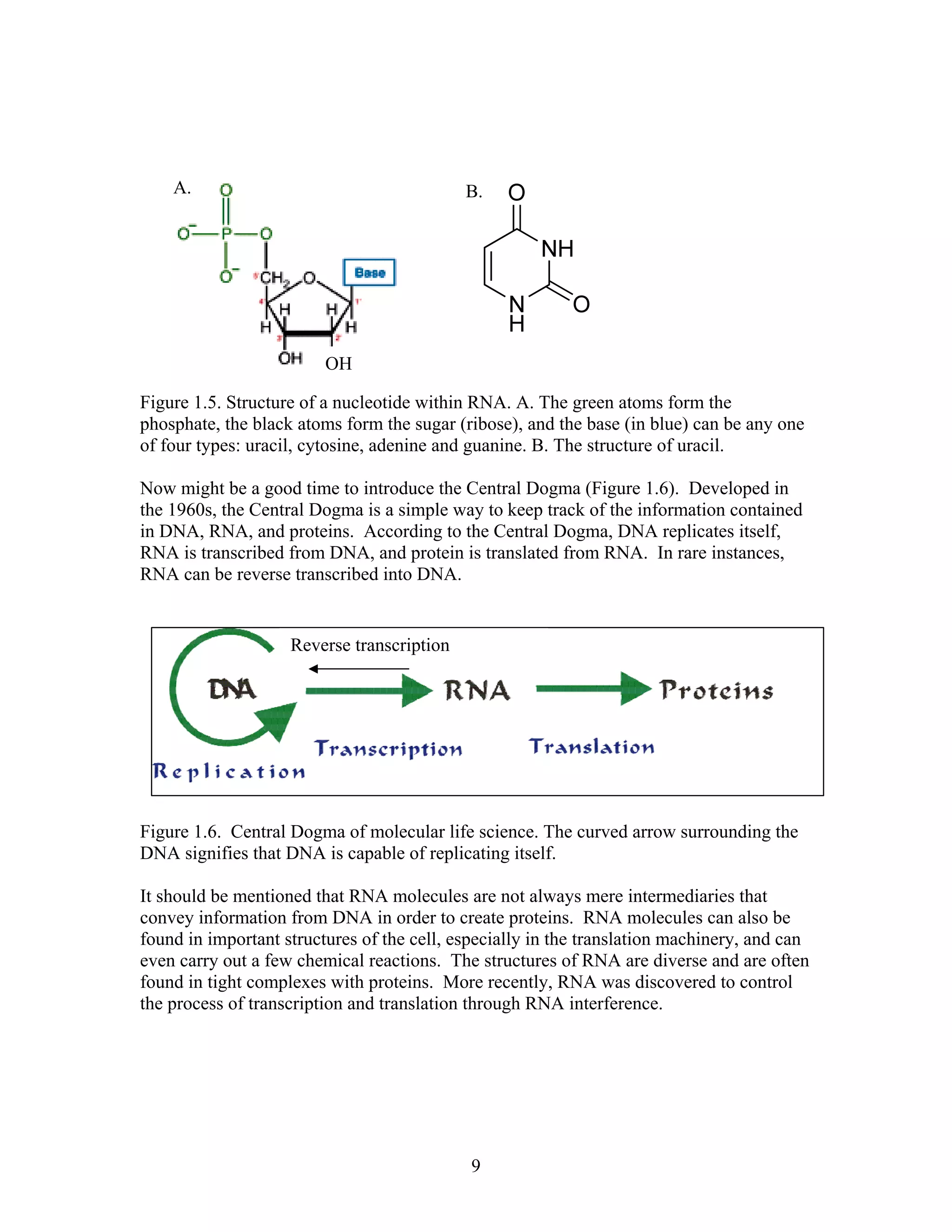
of the sugar. Figure 1.5 shows the structure of the RNA nucleotide and the uracil base.
RNA nucleotides are linked to each other into a single strand not unlike a single strand of
DNA. However, due to these small chemical deviations from DNA, RNA does not
always adopt a double helix. One important function of RNA is to transform the gene
information within DNA into protein.
8
Figure 1.5. Structure of a nucleotide within RNA. A. The green atoms form the
phosphate, the black atoms form the sugar (ribose), and the base (in blue) can be any one
of four types: uracil, cytosine, adenine and guanine. B. The structure of uracil.
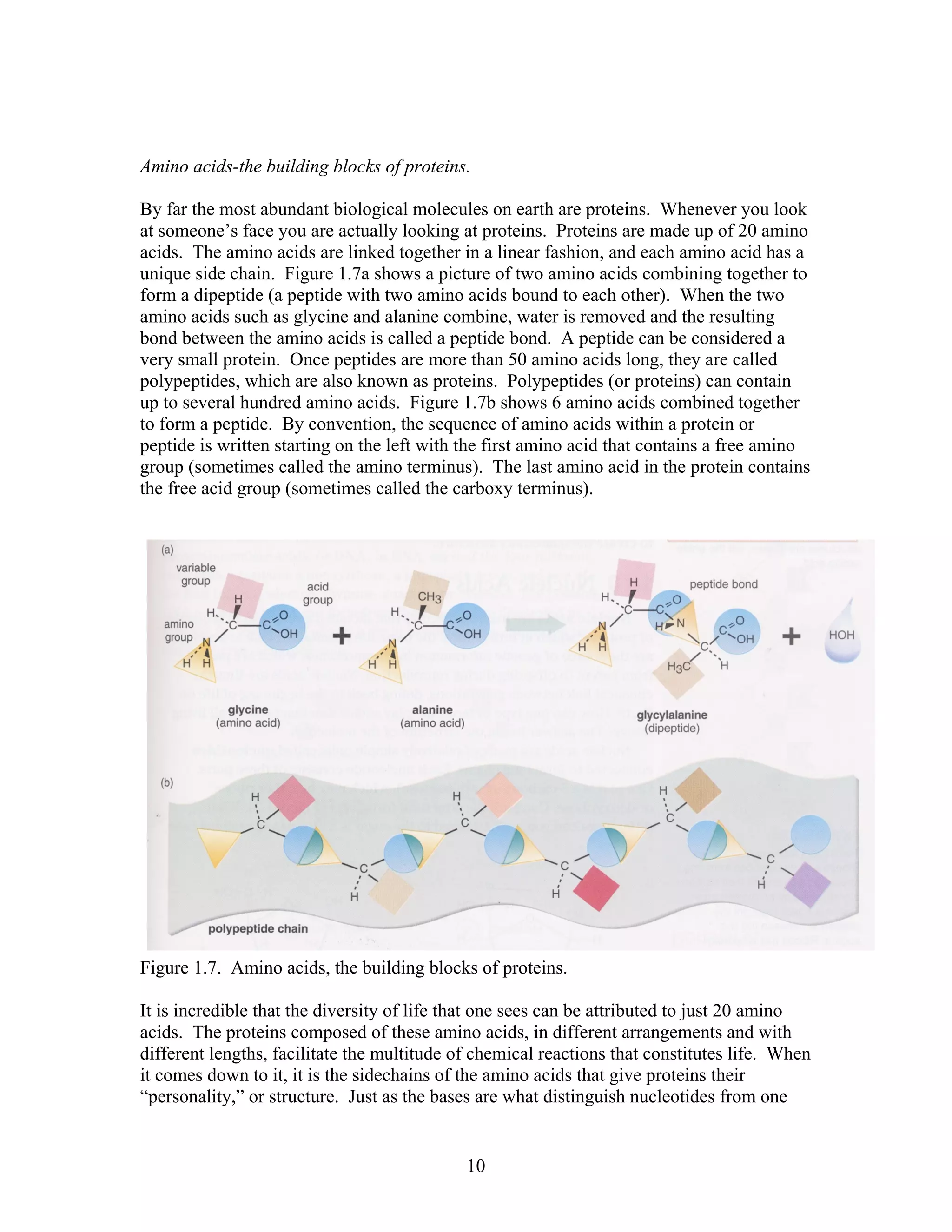
Now might be a good time to introduce the Central Dogma (Figure 1.6). Developed in
the 1960s, the Central Dogma is a simple way to keep track of the information contained
in DNA, RNA, and proteins. According to the Central Dogma, DNA replicates itself,
RNA is transcribed from DNA, and protein is translated from RNA. In rare instances,
RNA can be reverse transcribed into DNA.
Figure 1.6. Central Dogma of molecular life science. The curved arrow surrounding the
DNA signifies that DNA is capable of replicating itself.
It should be mentioned that RNA molecules are not always mere intermediaries that
convey information from DNA in order to create proteins. RNA molecules can also be
found in important structures of the cell, especially in the translation machinery, and can
even carry out a few chemical reactions. The structures of RNA are diverse and are often
found in tight complexes with proteins. More recently, RNA was discovered to control
the process of transcription and translation through RNA interference.
Reverse transcription
A. B.
OH
9
Amino acids-the building blocks of proteins.
By far the most abundant biological molecules on earth are proteins. Whenever you look
at someone’s face you are actually looking at proteins. Proteins are made up of 20 amino
acids. The amino acids are linked together in a linear fashion, and each amino acid has a
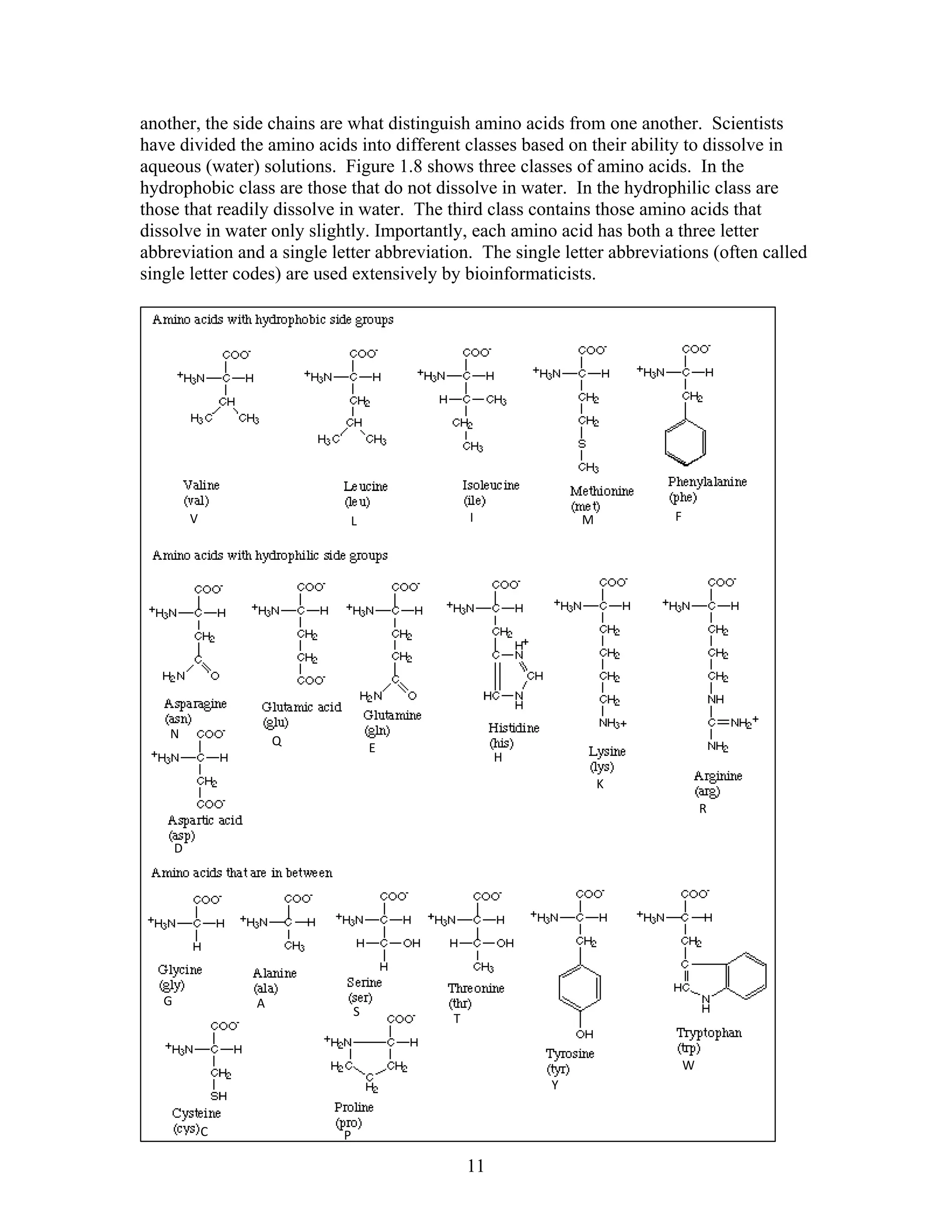
unique side chain. Figure 1.7a shows a picture of two amino acids combining together to
form a dipeptide (a peptide with two amino acids bound to each other). When the two
amino acids such as glycine and alanine combine, water is removed and the resulting
bond between the amino acids is called a peptide bond. A peptide can be considered a
very small protein. Once peptides are more than 50 amino acids long, they are called
polypeptides, which are also known as proteins. Polypeptides (or proteins) can contain
up to several hundred amino acids. Figure 1.7b shows 6 amino acids combined together
to form a peptide. By convention, the sequence of amino acids within a protein or
peptide is written starting on the left with the first amino acid that contains a free amino
group (sometimes called the amino terminus). The last amino acid in the protein contains
the free acid group (sometimes called the carboxy terminus).
Figure 1.7. Amino acids, the building blocks of proteins.
It is incredible that the diversity of life that one sees can be attributed to just 20 amino
acids. The proteins composed of these amino acids, in different arrangements and with
different lengths, facilitate the multitude of chemical reactions that constitutes life. When
it comes down to it, it is the sidechains of the amino acids that give proteins their
“personality,” or structure. Just as the bases are what distinguish nucleotides from one
10
another, the side chains are what distinguish amino acids from one another. Scientists
have divided the amino acids into different classes based on their ability to dissolve in
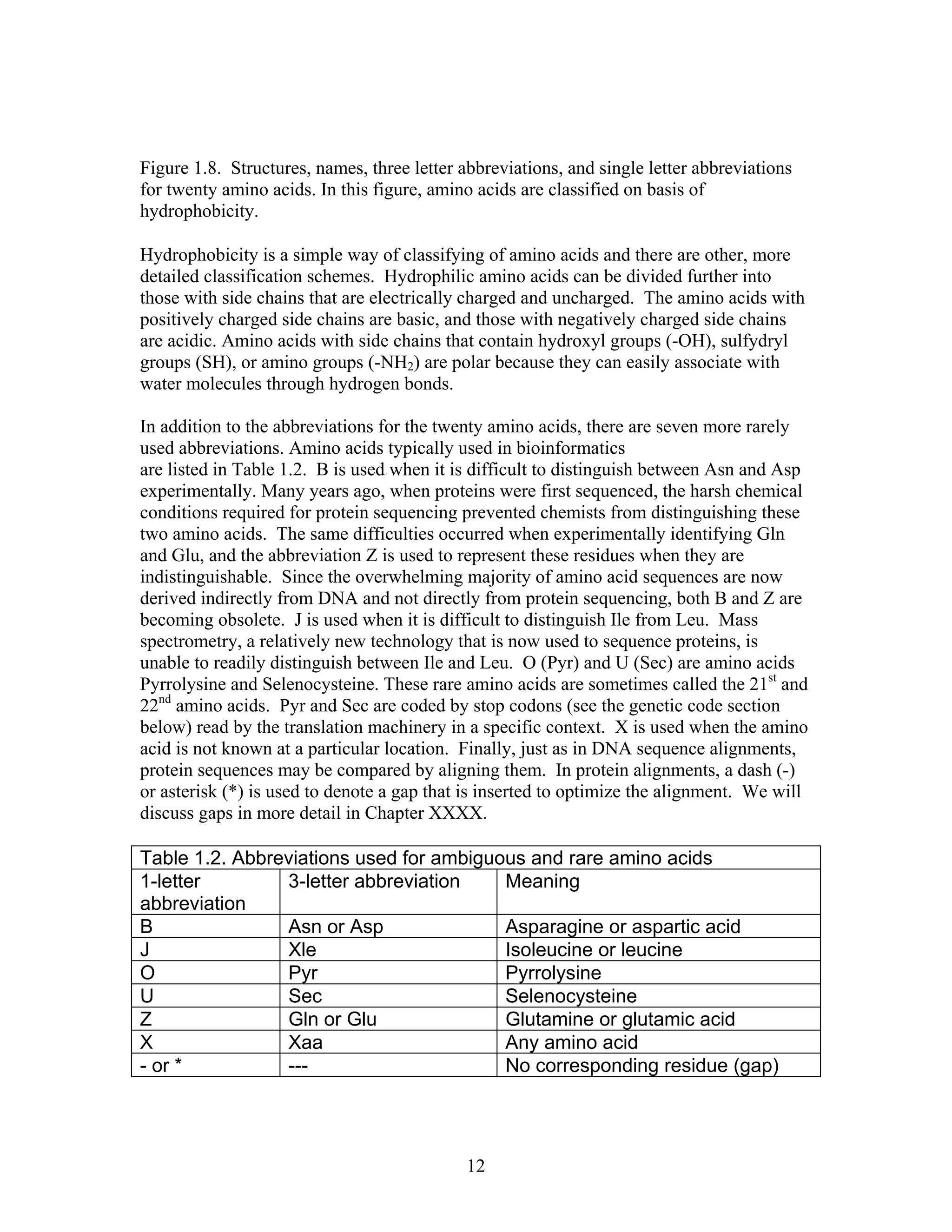
aqueous (water) solutions. Figure 1.8 shows three classes of amino acids. In the
hydrophobic class are those that do not dissolve in water. In the hydrophilic class are
those that readily dissolve in water. The third class contains those amino acids that
dissolve in water only slightly. Importantly, each amino acid has both a three letter
abbreviation and a single letter abbreviation. The single letter abbreviations (often called
single letter codes) are used extensively by bioinformaticists.
V  L  I M F 
N 
Q 
E 
H
K
R 
D 
G  A 
S 
T
Y
W 
C  P 
11
Figure 1.8. Structures, names, three letter abbreviations, and single letter abbreviations
for twenty amino acids. In this figure, amino acids are classified on basis of
hydrophobicity.
Hydrophobicity is a simple way of classifying of amino acids and there are other, more
detailed classification schemes. Hydrophilic amino acids can be divided further into
those with side chains that are electrically charged and uncharged. The amino acids with
positively charged side chains are basic, and those with negatively charged side chains
are acidic. Amino acids with side chains that contain hydroxyl groups (-OH), sulfydryl
groups (SH), or amino groups (-NH2) are polar because they can easily associate with
water molecules through hydrogen bonds.
In addition to the abbreviations for the twenty amino acids, there are seven more rarely
used abbreviations. Amino acids typically used in bioinformatics
are listed in Table 1.2. B is used when it is difficult to distinguish between Asn and Asp
experimentally. Many years ago, when proteins were first sequenced, the harsh chemical
conditions required for protein sequencing prevented chemists from distinguishing these
two amino acids. The same difficulties occurred when experimentally identifying Gln
and Glu, and the abbreviation Z is used to represent these residues when they are
indistinguishable. Since the overwhelming majority of amino acid sequences are now
derived indirectly from DNA and not directly from protein sequencing, both B and Z are
becoming obsolete. J is used when it is difficult to distinguish Ile from Leu. Mass
spectrometry, a relatively new technology that is now used to sequence proteins, is
unable to readily distinguish between Ile and Leu. O (Pyr) and U (Sec) are amino acids
Pyrrolysine and Selenocysteine. These rare amino acids are sometimes called the 21st
and
22nd
amino acids. Pyr and Sec are coded by stop codons (see the genetic code section
below) read by the translation machinery in a specific context. X is used when the amino
acid is not known at a particular location. Finally, just as in DNA sequence alignments,
protein sequences may be compared by aligning them. In protein alignments, a dash (-)
or asterisk (*) is used to denote a gap that is inserted to optimize the alignment. We will
discuss gaps in more detail in Chapter XXXX.
Table 1.2. Abbreviations used for ambiguous and rare amino acids
1-letter
abbreviation
3-letter abbreviation Meaning
B Asn or Asp Asparagine or aspartic acid
J Xle Isoleucine or leucine
O Pyr Pyrrolysine
U Sec Selenocysteine
Z Gln or Glu Glutamine or glutamic acid
X Xaa Any amino acid
- or * --- No corresponding residue (gap)
12
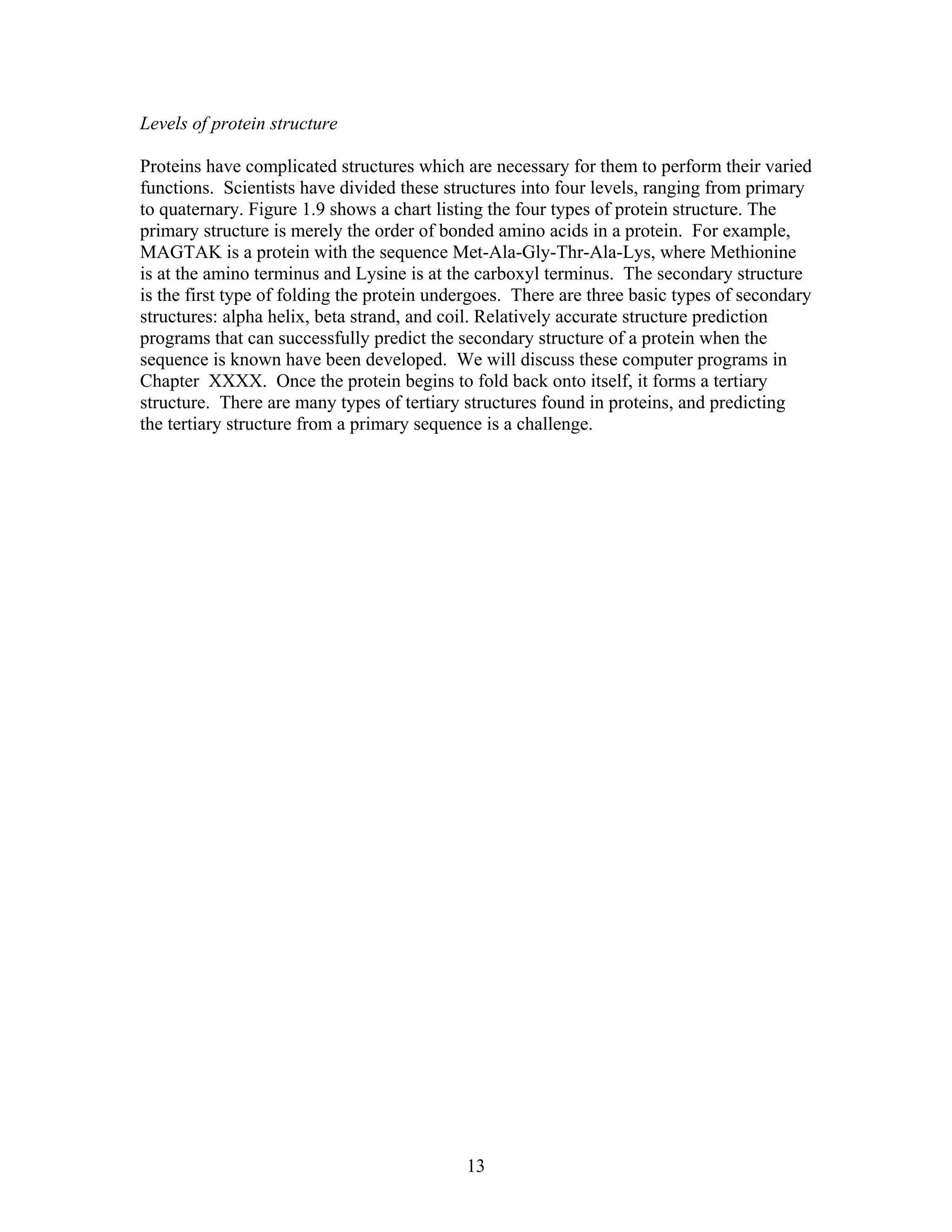
Levels of protein structure
Proteins have complicated structures which are necessary for them to perform their varied
functions. Scientists have divided these structures into four levels, ranging from primary
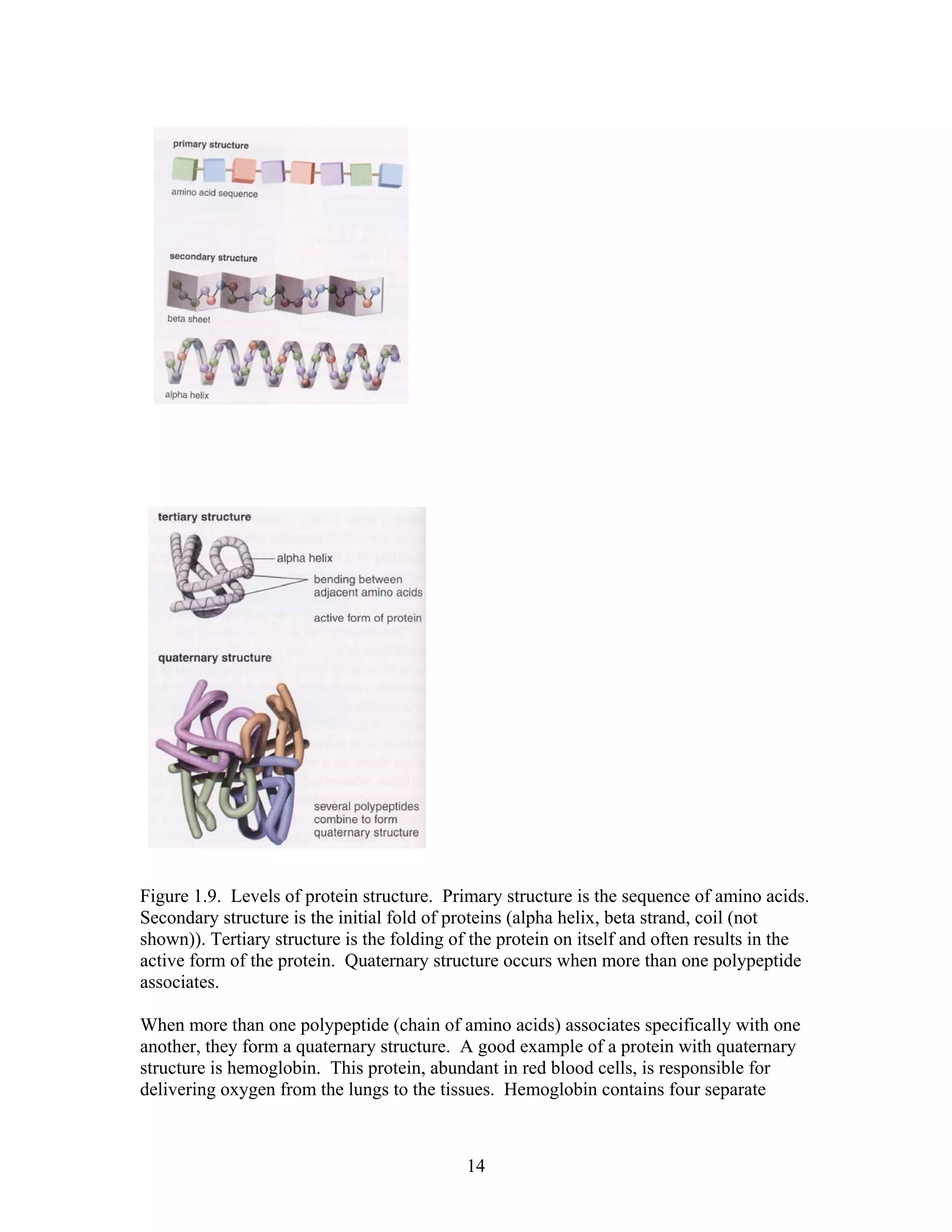
to quaternary. Figure 1.9 shows a chart listing the four types of protein structure. The
primary structure is merely the order of bonded amino acids in a protein. For example,
MAGTAK is a protein with the sequence Met-Ala-Gly-Thr-Ala-Lys, where Methionine
is at the amino terminus and Lysine is at the carboxyl terminus. The secondary structure
is the first type of folding the protein undergoes. There are three basic types of secondary
structures: alpha helix, beta strand, and coil. Relatively accurate structure prediction
programs that can successfully predict the secondary structure of a protein when the
sequence is known have been developed. We will discuss these computer programs in
Chapter XXXX. Once the protein begins to fold back onto itself, it forms a tertiary
structure. There are many types of tertiary structures found in proteins, and predicting
the tertiary structure from a primary sequence is a challenge.
13
Figure 1.9. Levels of protein structure. Primary structure is the sequence of amino acids.
Secondary structure is the initial fold of proteins (alpha helix, beta strand, coil (not
shown)). Tertiary structure is the folding of the protein on itself and often results in the
active form of the protein. Quaternary structure occurs when more than one polypeptide
associates.
When more than one polypeptide (chain of amino acids) associates specifically with one
another, they form a quaternary structure. A good example of a protein with quaternary
structure is hemoglobin. This protein, abundant in red blood cells, is responsible for
delivering oxygen from the lungs to the tissues. Hemoglobin contains four separate
14
polypeptides, and it was one of the first proteins whose structure was determined by X-
ray crystallography. Hemoglobin’s ability to pick up and deliver the right amount of
oxygen under different physiological circumstances depends on its quaternary structure.
Not all proteins form quaternary structures, because in many cases one chain is all that is
necessary for the protein to carry out its function.
The genetic code
We now come to a topic that integrates the relationship between DNA, RNA and protein-
-the genetic code. Cracking the genetic code was a breakthrough similar in magnitude to
finding the Rosetta stone more than two centuries ago. In 1798 Napoleon Bonaparte, a
general from France, conquered Egypt and established the Institut de l’Egypt in Cairo.
The Institut had several scientists available to catalog the antiquities that were being
unearthed by the French. In 1799, during the construction of Fort Julien in the city of
Rashid, an engineer discovered a stone with letters engraved on it. Scientists at the
Institut immediately knew that the stone was important. The engraving was dated to 196
BC. It describes repealing taxes and gives instructions for raising statues in temples. The
engraved decree, from the ruler Ptolomy V, was written in three languages: Hieroglyphic,
Demotic, and Greek. Over the next 25 years, through the principal efforts of Jean-
François Champollion, the Demotic and Hieroglyphic scripts were translated into French.
The Rosetta stone was incredibly important because it enabled archeologists to translate
other ancient Egyptian texts into French and English. In a sense, the Rosetta stone of
molecular life science is the genetic code.
The genetic code was discovered through the hard work and the brilliant experiments of
scientists in the 1960s. This code allows one to predict with nearly 100% accuracy the
amino acid sequence of the protein if the DNA sequence is known. Astonishingly, the
genetic code is universal -- all organisms use the same code (with few minor exceptions).
Thus, a DNA sequence that codes for insulin in humans can be used to produce human
insulin in a bacterium known as E. coli. Both humans and bacteria use the same code to
translate DNA sequences into amino acid sequences. Let us now turn our attention to the
details of the genetic code.
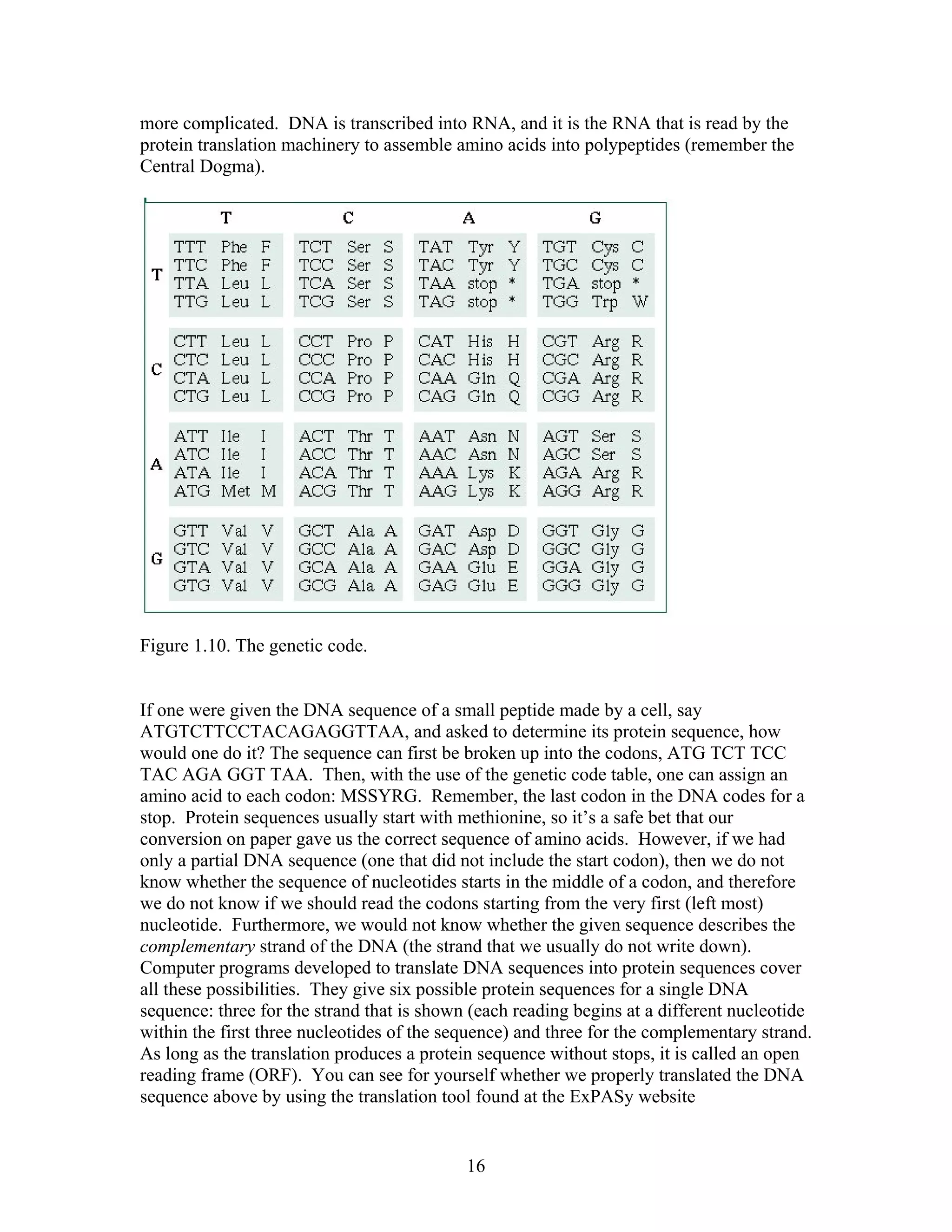
In the genetic code, three nucleotides in a row (called a codon) code for one amino acid.
Figure 1.10 shows a table depicting the genetic code. The nucleotides in the left column
represent the first nucleotides of the codons. The nucleotides in the top row represent the
second nucleotides of the codons. Each of the four DNA nucleotides completes each set
of codons displayed in Figure 1.10. For example, going from 5’ to 3’, the nucleotides
ATG code for methionine. Methionine is the first amino acid coded in a gene. This first
methionine is coded by the start codon. There are 64 codons in total. In many cases the
same amino acid is coded by more than one codon. This phenomenon is called
degeneracy. For example, serine is specified by 6 degenerate codons. Three codons,
called stop codons, code for a stop: TAA, TAG and TGA. They signal the cell to stop
assembling amino acids into the polypeptide chain. In DNA, the codon immediately
before the stop codon codes for the amino acid at the carboxyl terminus. Although one
can convert DNA codons directly into amino acids on paper, in the cell things are a bit
15
more complicated. DNA is transcribed into RNA, and it is the RNA that is read by the
protein translation machinery to assemble amino acids into polypeptides (remember the
Central Dogma).
Figure 1.10. The genetic code.
If one were given the DNA sequence of a small peptide made by a cell, say
ATGTCTTCCTACAGAGGTTAA, and asked to determine its protein sequence, how
would one do it? The sequence can first be broken up into the codons, ATG TCT TCC
TAC AGA GGT TAA. Then, with the use of the genetic code table, one can assign an
amino acid to each codon: MSSYRG. Remember, the last codon in the DNA codes for a
stop. Protein sequences usually start with methionine, so it’s a safe bet that our
conversion on paper gave us the correct sequence of amino acids. However, if we had
only a partial DNA sequence (one that did not include the start codon), then we do not
know whether the sequence of nucleotides starts in the middle of a codon, and therefore
we do not know if we should read the codons starting from the very first (left most)
nucleotide. Furthermore, we would not know whether the given sequence describes the
complementary strand of the DNA (the strand that we usually do not write down).
Computer programs developed to translate DNA sequences into protein sequences cover
all these possibilities. They give six possible protein sequences for a single DNA
sequence: three for the strand that is shown (each reading begins at a different nucleotide
within the first three nucleotides of the sequence) and three for the complementary strand.
As long as the translation produces a protein sequence without stops, it is called an open
reading frame (ORF). You can see for yourself whether we properly translated the DNA
sequence above by using the translation tool found at the ExPASy website
16
(http://www.expasy.ch/tools/dna.html). The translation tool will show all 6 possible
translations of the DNA sequence.
DNA alterations
Mutations are alterations in the DNA that produce a sequence that is different from
normal DNA. Mutations are rare and are detected in less than 1% of the organisms in a
species population. They can result from errors in DNA replication or from DNA
damage that has not been properly repaired by the cell. Mutations can cause disease,
especially if they occur within genes. If a mutation gives benefit to the organism, the
organism may thrive and reproduce and help the organism compete with others for
resources. This is called positive selection. On the other hand, if the mutation causes the
organism to be sickly, the mutation will not survive in the offspring. This is called
negative selection. Most mutations neither help nor harm the organism primarily because
they rarely occur in genes (remember only 2% of the human genome codes for genes).
Furthermore, even if mutations do occur in the genes, many do not alter the amino acid
sequence of proteins due to the degeneracy of the genetic code. Mutations that do not
alter the fitness of the organism are called neutral mutations.
The most devastating mutations are those in which one or more nucleotides are deleted
(called a deletion mutation) within a gene. These often cause a change in the amino acid
sequence. Fore example, if the sequence ATGTCTTCCTACAGAGGTTAA had a
deletion of the thirteenth nucleotide, A, the codons resulting from this deletion, ATG
TCT TCC TAC GAG GTT AA, would produce the amino acid sequence MSSYEV. This
sequence differs from the original sequence, MSSYRG and it does not have a proper stop
codon. When the deletion causes a change in the amino acid sequence after the deletion
point, it is called a frameshift because the protein translation machinery adds amino acids
to the growing polypeptide chain that were not originally intended for the protein. If the
protein is essential for life, the deletion mutation can be life threatening. Equally
devastating is an insertion mutation. Here, one or more nucleotides are inserted into the
gene causing a gross alteration in the protein sequence.
More subtle are point mutations. A point mutation occurs when one different nucleotide
is found in place of the normal nucleotide. In some cases the point mutation will cause
no change in the amino acid sequence. This lucky circumstance occurs when the point
mutation changes the codon into one that codes for the same amino acid. In this
situation, the mutation is called a neutral or silent mutation. For example, Ser is coded by
six codons so there is a good chance that a point mutation in a Ser codon will result in no
change in the amino acid. However, if the point mutation alters the codon so that it codes
for a different amino acid, the mutation is called a missense mutation. A change in one
amino acid out of an entire protein may not seem like a significant change, but, as we will
see in the next section, even a single amino acid change in a protein can have severe
consequences.
17
A case study: sickle cell anemia
We are now ready to apply the knowledge we have gained to study an important disease
that afflicts thousands of people, particularly those who live in the malaria belt in sub-
saharan Africa. The disease is sickle cell anemia. Patients with the disease exhibit a
number of symptoms including pain episodes, strokes, increased infections, leg ulcers,
bone damage, jaundice, early gallstones, lung blockage, kidney damage, loss of water in
urine, painful erections in men (priapism), blood blockage in spleen or liver, lower red
blood cell counts (anemia), and delayed growth. These symptoms can all be traced to the
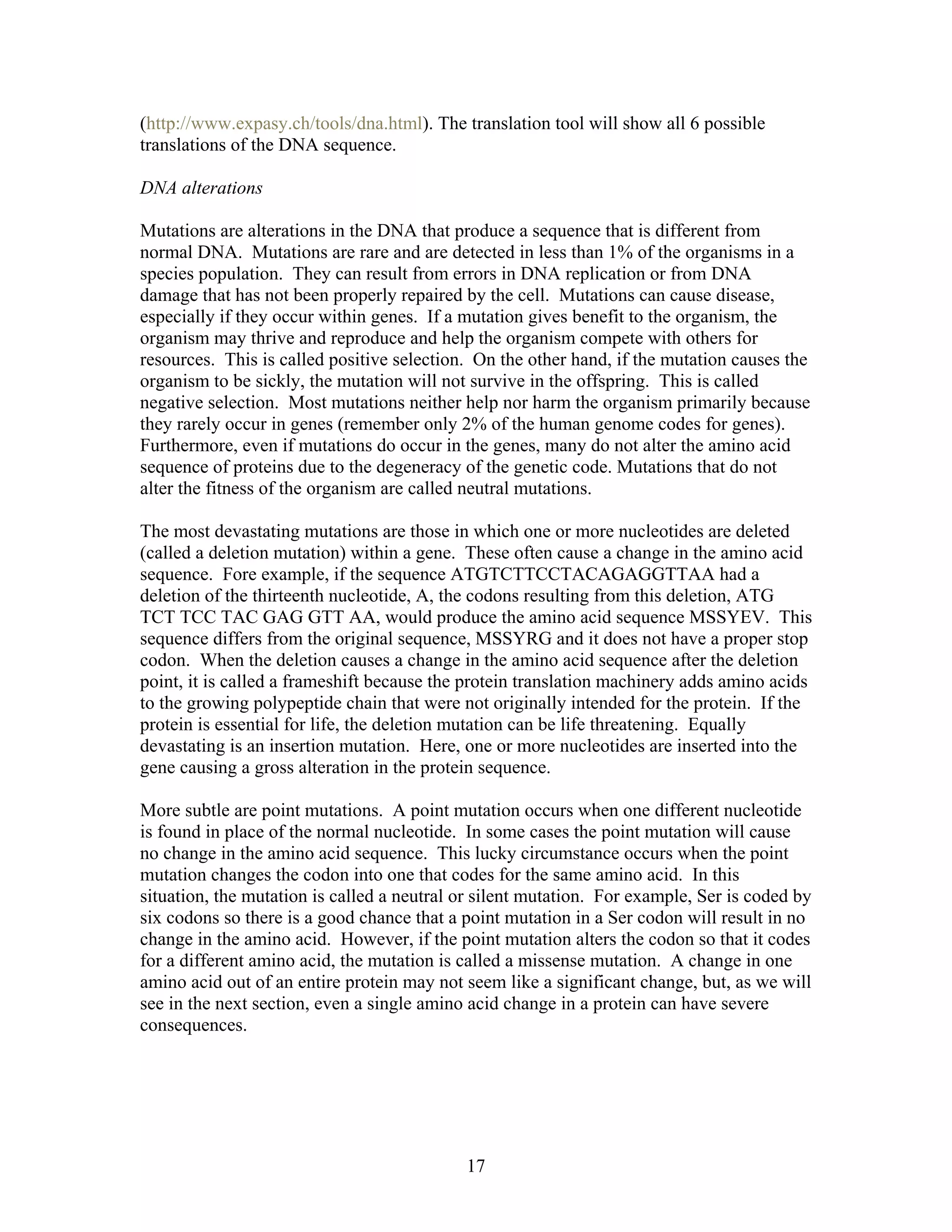
fact that tissues are not receiving enough oxygen. When viewed under the microscope,
the red blood normally appears discoid, similar to a hockey puck, except that the center is
concave. The sickle cell, on the other hand, is a red blood cell that is misshapen and
looks like a sickle (Figure 1.11). This shape elongates the cell so that it does not easily
pass through narrow capillaries. When blood flow is interrupted by sickle cells, tissues
become damaged due to lack of oxygen.
Figure 1.11. Sickle cell and its effect on blood flow. A. A comparison between the
normal red blood cell (left) and the sickle red blood cell (right). B. A small capillary
18
where normal red blood cells travel through. A sickle cell would have difficulty traveling
through this capillary.
Sickle cell anemia is a familial disease, so patients inherit the disease from their parents.
It is considered a recessive disorder because one must receive two mutated copies of the
DNA in order to display symptoms of the disease. It is possible to be a carrier of the
disease without showing symptoms. Carriers are heterozygous because they carry one
good copy of the gene and one bad (mutated) copy; they are said to have the sickle cell
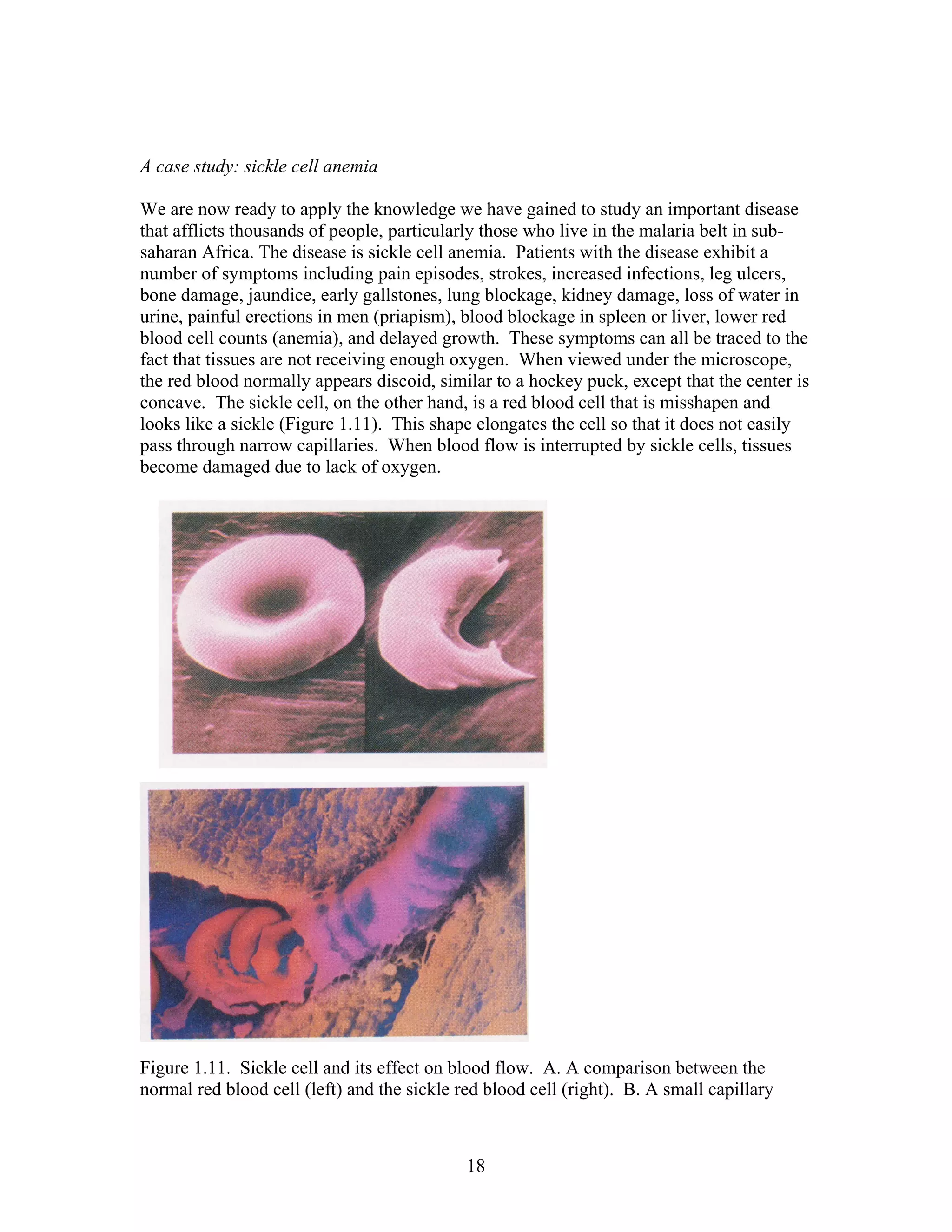
trait. A pedigree is a good way to keep track of the disease from generation to
generation. Figure 1.12 shows a pedigree in a sickle cell disease family. Here, the mother
(top left circle) and the father (top right square) both carry one normal copy (A) and one
mutant copy (S) of the gene that causes sickle cell anemia. The child will exhibit the
disease symptoms if s/he receives a mutant copy from each parent. For example, the son
on the right bottom row in the pedigree will have sickle cell anemia.
Figure 1.12. A pedigree that shows the inheritance pattern of sickle cell anemia. A is the
normal allele of the gene and S is the mutant allele. Both the mother (top left circle) and
father (top right square) exhibit the sickle cell trait. They are carriers for the disease.
One of the children (the male in the lower right) has sickle cell disease.
In 1949, Linus Pauling and his colleagues came up with an ingenious experiment to show
that sickle cell disease was caused by an amino acid change in the protein hemoglobin.
The experiment was to determine the electrical charge of hemoglobin from different
sources. He found that hemoglobin from sickle cell anemia patients was more positively
charged than hemoglobin from normal individuals. He suggested that this charge
difference was the reason why hemoglobin was abnormal in sickle cell patients and that
19
this charge difference could be due to a single amino acid change. Later, in 1956, Ingram
devised an experiment to visualize this difference more clearly.
To detect the charge difference, Ingram clipped hemoglobin into small pieces with an
enzyme called a protease. These peptide products of hemoglobin could be separated
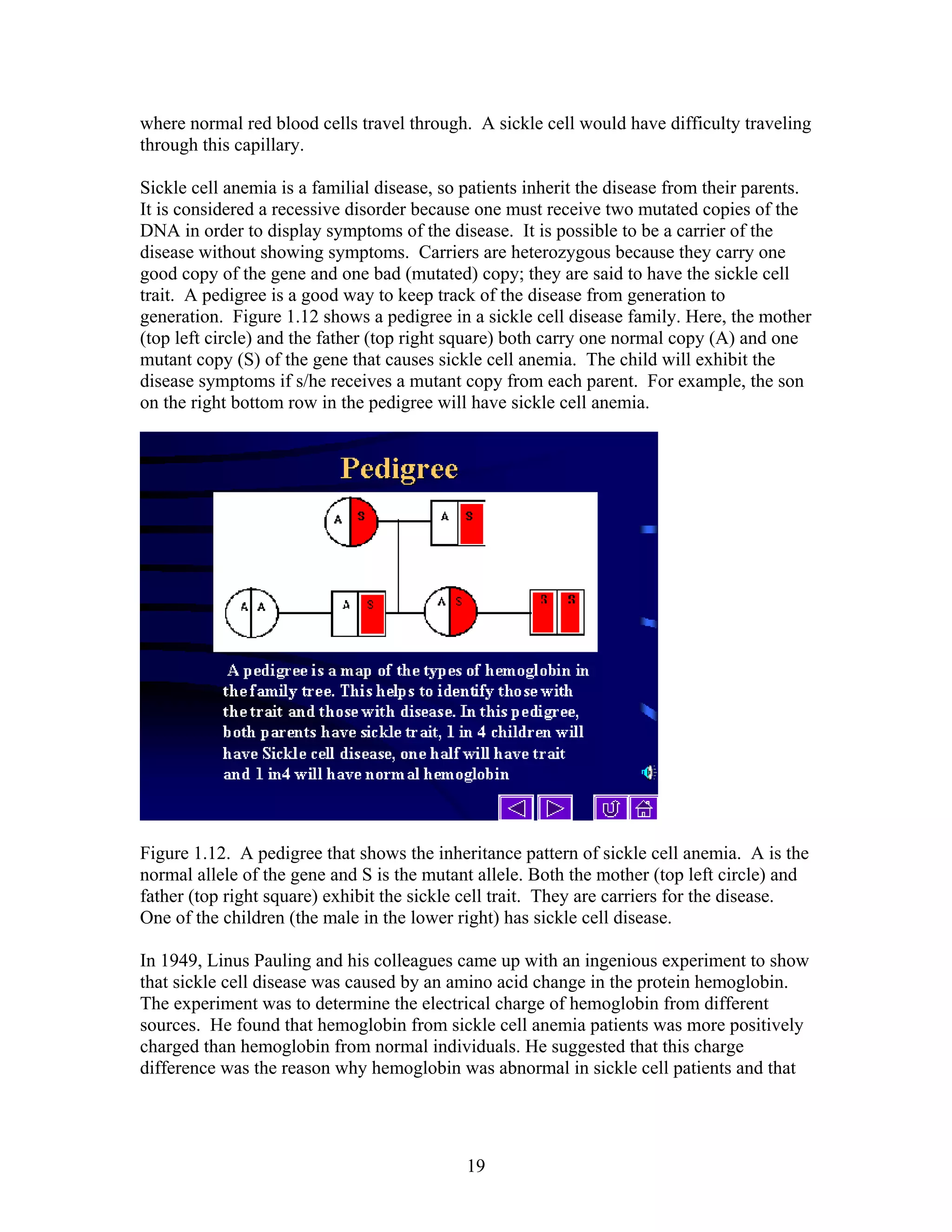
from each other by paper chromatography. In paper chromatography, a mixture of
peptides is placed in the lower right corner of the paper. Peptides are separated by net
charge in the X direction by applying a voltage across the paper. Once they are separated
by their charge, the peptides are separated by hydrophobicity in the Y direction by
allowing a solvent to run up the paper. As a result, each peptide migrates to a particular
position on the plate depending on its amino acid composition. Incredibly, Ingram found
that only one peptide from sickle cell hemoglobin migrated differently than that particular
peptide from normal hemoglobin. Figure 1.13 is an illustration of the peptide spots on
the paper. One year later it was found that the peptide from the normal individual had a
Glu and that this Glu was replaced by Val in the sickle cell hemoglobin. This change was
the result of a missense point mutation in the gene that expresses hemoglobin. This
stunning finding was the first demonstration of a single amino acid change causing a
disease and was thought by many to have ushered in the field of molecular diagnostics.
Figure 1.13. Paper chromatography separation of hemoglobin peptides. A. Peptides
from normal hemoglobin. B. Peptides from sickle cell hemoglobin. The peptide with
the stippled pattern has a different migration pattern on the two chromatography
plates. (Ingram, V.M., 1956, A specific chemical difference between globins of
normal and sickle-cell anæmia hæmoglobins. Nature 178:792-794.)
20
Introduction to p53
Sickle cell anemia was the first disease linked to an amino acid change, and therefore to a
mutation in DNA. This discovery led to the demonstration that other diseases were
caused by mutations in DNA. Another gene linked to disease is p53 (also known as
Tp53). Just a note about writing convention is needed. We will use italics to denote the
gene and normal font to denote the protein product of the gene. Tp53 is mutated in
approximately 50% of human cancer cells. It is known as a tumor suppressor gene
because it normally suppresses tumors. In cancer cells, one copy of the gene often
contains a point mutation which codes for a protein with a single amino acid substitution
(missense mutation). A second copy of the gene is completely deleted from the cells
(deletion mutation). Without any normal Tp53, cells grow uncontrollably.
One may ask what causes mutations? Environmental pollutants, carcinogens in
cigarettes, even diet can promote mutations. In rare cases, not unlike sickle cell anemia,
cancer is an inherited disease (see Box 1.1). In 1969 two physicians, Frederick Li and
Joseph Fraumeni Jr., described a rare cancer that seemed to run in families. The cancer
could be in any tissue but it was often a sarcoma, a cancer of the connective tissue. A
patient with Li-Fraumeni syndrome has an 80% chance of dying from cancer and often,
the cancer occurs before the patient is 20 years of age. Several years after the cancer was
first described, when it became clear that Tp53 was a tumor suppressor gene, normal
tissues from the patients with Li-Fraumeni syndrome were tested for mutations in Tp53.
Sure enough, every cell of the patients with this syndrome had one mutated copy of Tp53.
The second copy of p53 was normal. However, cancer tissues of these patients had two
mutated copies of Tp53-one a deletion and the other a missense mutation. These patients
are prone to cancers because all their cells start out with only one copy of normal Tp53.
21
22
Meanwhile, she is continuing to plan for her wedding on August 11. She said: “Before the diagnosis I was worrying about table
settings. Now I do not care. So long as everyone turns up and has a good time that is all that matters. I have to look at the bigger
picture now.”
Miss Crossland is now preparing for the prospect of chemotherapy. “I might get away with hormone therapy,” she said. “But if it does
have to be chemotherapy and I have my head shaved, then so be it.” Her syndrome will also have implications for any decision to
start a family.
“I was dreading telling my father, Leonard,” said Miss Crossland. “Of course, he had hoped that the day would never come. When it
did, he cried but he realises that technology has advanced dramatically since Mum died, and that unlike Mum I quickly identified a
lump and sought medical advice straight away.”
One of the symptoms of the disorder is that cancer can strike at a young age. Ms Crossland’s mother, Kathleen, died aged 28 and her
brother, David, died of leukaemia aged 2.
“I am not vain but I have always considered my breasts to be one of my best features. Mat reassured me, though. He said, ‘You are
much more to me than a pair of breasts’.” Li-Fraumeni, which is named after two American physicians, is an extremely rare inherited
predisposition to cancer.
Miss Crossland said: “I wandered around in a daze. I cried a lot until I got to the stage where I thought ‘yes, this is real, I have got to
deal with it’. Mat’s initial reaction was anger. He wanted someone to blame, but when he calmed down he said, ‘Right, we know what
it is, now how do we fix it?’.
She has undergone regular screenings since the age of 19 because of her family’s medical history but was devastated to notice an
incipient lump on her breast several months ago. This month she and her fiancé, Mat Swift, 27, were told that it was an aggressive
type of breast cancer.
Miss Crossland, 29, from Ashton-under-Lyne, Greater Manchester, says the radical surgery offers the best chance of breaking the
deadly cycle. Like other sufferers, she contracted a cancerous growth at an early age. She survived an adrenal tumour as a child and
had hoped that she was stronger than the syndrome that had blighted her family.
She has inherited a rare genetic disorder, Li-Fraumeni syndrome, which means that she is susceptible to the same kind of cancers
that claimed the lives of her mother and brother.
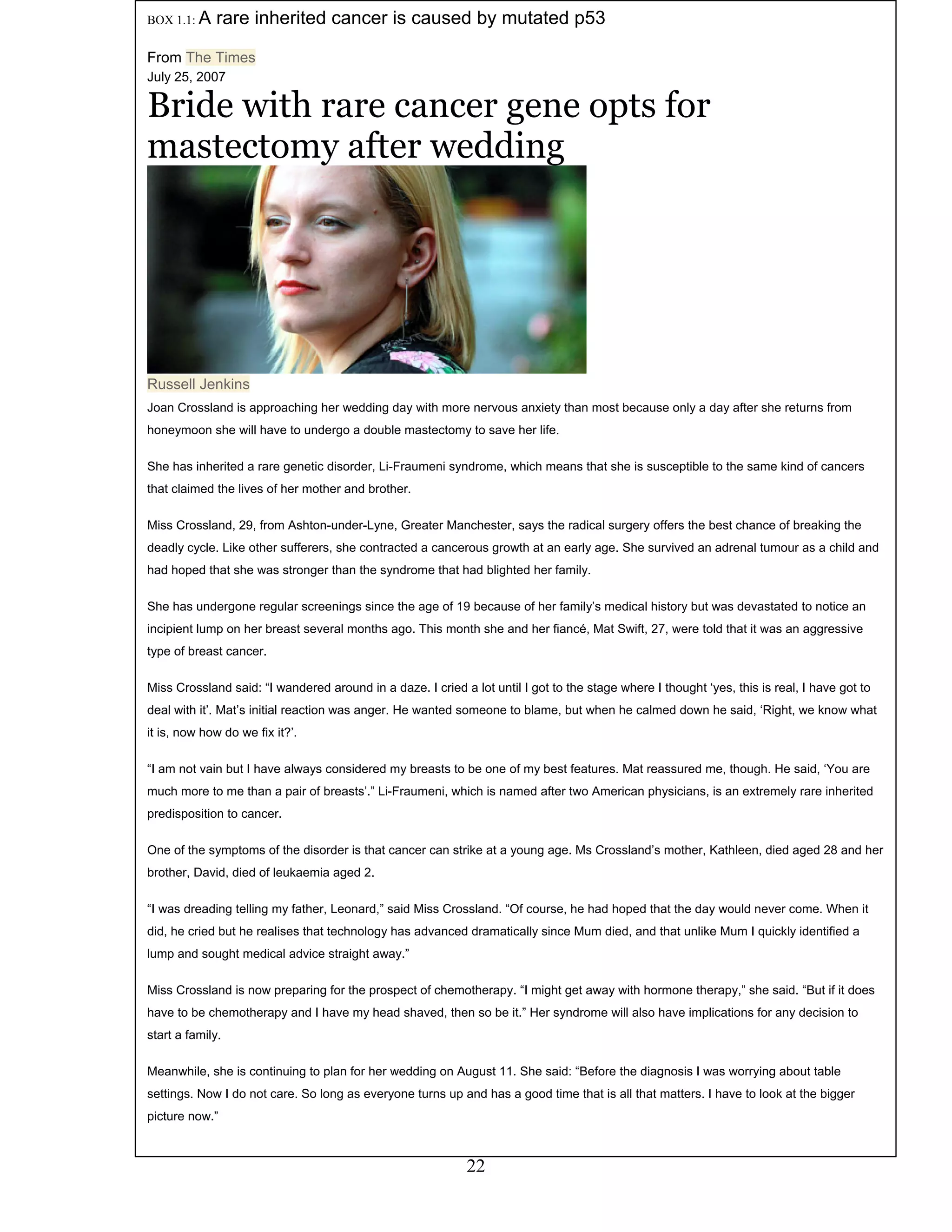
Joan Crossland is approaching her wedding day with more nervous anxiety than most because only a day after she returns from
honeymoon she will have to undergo a double mastectomy to save her life.
Russell Jenkins
July 25, 2007
Bride with rare cancer gene opts for
mastectomy after wedding
BOX 1.1: A rare inherited cancer is caused by mutated p53
From The Times
The protein product of the Tp53 gene was discovered in 1979 by two research groups.
One was headed by Arnold J. Levine and the other by David Lane. The discovery was
fascinating and illustrates how scientists used new methods to make seminal discoveries.
A virus, called Simian Vacuoling Virus 40 (SV40) was discovered in African Green
monkeys in 1960. When rodents were inoculated with SV40, the rodents contracted
cancers. Investigators wanted to uncover the cancer-causing agent in SV40. To do this,
they obtained proteins from the rodent cancers and created antibodies against these
proteins. The majority of the antibodies reacted against one protein coded by the SV40
virus DNA. That protein was Large T antigen—which is necessary for the virus to cause
cancer. A few of the antibodies recognized a second protein from the cancer cells. The
second protein was not encoded by the virus DNA but rather by the DNA of the rodent
cells. The second protein appeared to have a molecular weight of 53,000 daltons (or 53
kilodaltons) and it was clear that this protein formed a tight association with Large T
antigen. Because not much was known about the function of this protein, it was called
p53—for protein 53 kilodaltons (a kilodalton is the mass of approximately 9 amino
acids). Much later, it was discovered that Large T antigen caused cancer largely due to its
ability to associate with p53 and prevent p53 from performing its normal function. The
fascinating story of how p53 eventually became known as a central defender against
cancer will be explained serially in each chapter of this book.
Exercises
1. A good resource for information on disease-related molecules is the Online-Mendelian
Inheritance of Man (OMIM). OMIM is linked to the National Center for
Biotechnology Information (NCBI) website. To optimally use this website it is
important to become familiar with chromosomes. Chromosomes are large segments
of DNA bound to protein found in the nucleus of eukaryotic cells. For many
organisms, their genomes are distributed as chromosomes. Humans have 23
chromosomes. Each chromosome is divided into two major areas. The short arm (p-
arm) is located above the centromere and the long arm (q-arm) is located below the
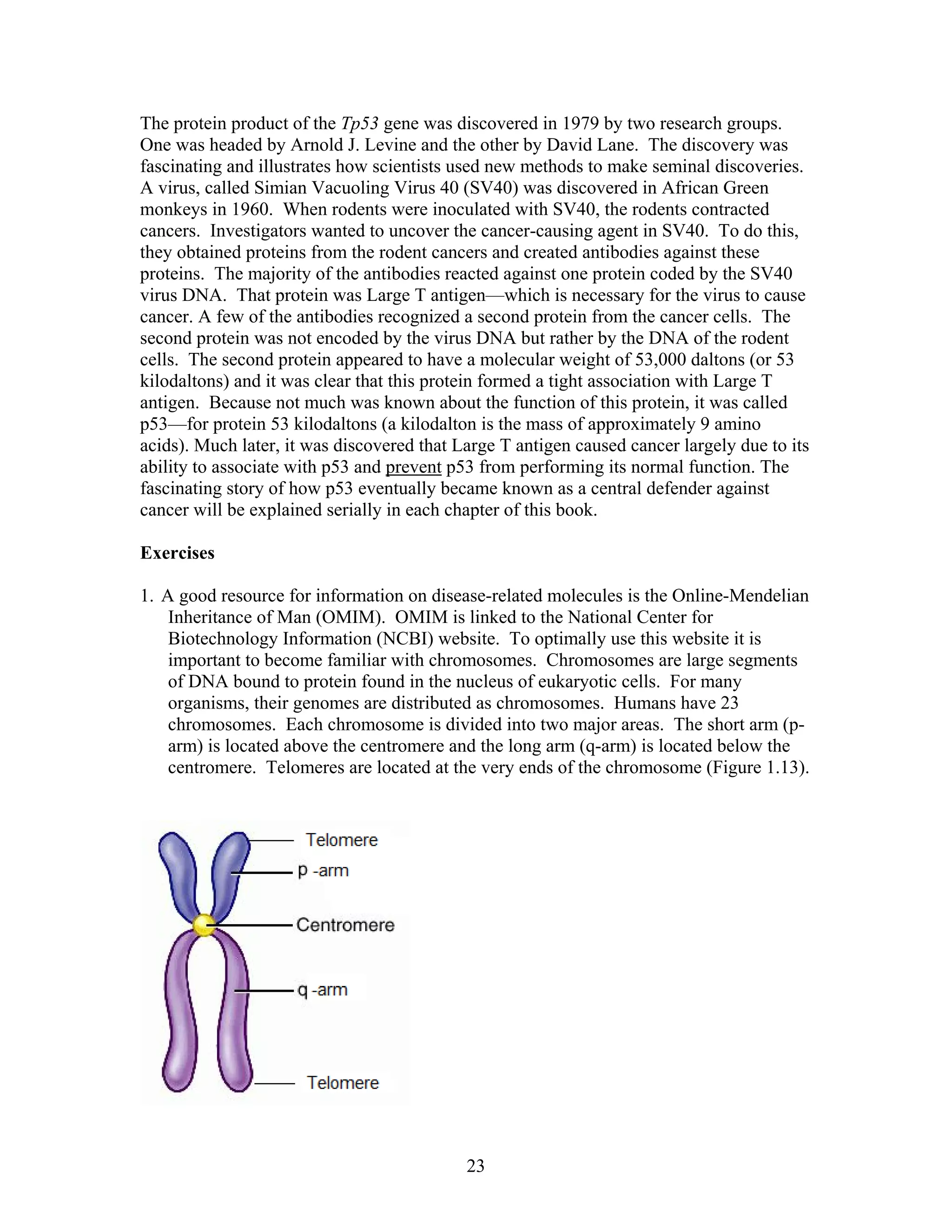
centromere. Telomeres are located at the very ends of the chromosome (Figure 1.13).
23
Figure 1.14. Human chromosome showing the centromere, telomeres, p-arm and q-arm.
To determine location of a gene on a chromosome it is important to note that
chromosomes can be stained with special dyes that create a series of bands on the
chromosomes. If a gene is located at 8q21.3, that would mean chromosome 8, q-arm,
band 21.3. The higher the band number the further away from the centromere the gene is
located.
a) Give the chromosomal location (in terms of banding position) of the gene that
causes sickle cell anemia.
b) Give the name of the gene that causes sickle cell anemia.
c) Find out the nucleotide change and amino acid change that leads to sickle cell
anemia (there may be more than one change that gives rise to the disease)
d) Explain the change in distribution of spots the peptide map (Figure 1.13) based
on properties of the side chain of the mutant amino acid in the disease.
e) If sickle cell anemia is so devastating, why has it lasted in the population for
such a long time? Give a molecular explanation.
2. One important exercise a bioinformaticist performs is to compare amino acid
sequences. One reason for comparison is to determine the parts that of the proteins that
are critical for function. For this exercise, perform a multiple sequence alignment of
three homologues of cytochrome C. The three homologues are from human, yeast and
dog and the accession numbers for these sequences are AAA35732, XP_532493, and
1YCC. The first two sequences can be found in the protein database at the NCBI. The
last sequence can be found in the structure database at NCBI. Print out your multiple
sequence alignment result and attach a short paragraph telling how this alignment gives
you a clue as to which parts of the cytochrome C protein you would hypothesize are most
important to its function (The function is the same in all 3 organisms). For those of you
unfamiliar with NCBI, here are specific instructions below
- Go to NCBI
- Select to search the protein database from the dropdown menu
- Enter the Accession Number and click GO
- Change the format to FASTA
- Copy the FASTA output into the ClustalW window
(http://www.ebi.ac.uk/Tools/clustalw/index.html). ClustalW is a software program
that optimally aligns amino acid sequences. Make sure the header (the line with the >
symbol) is relegated to just one line on top of the sequence within the window.
- Repeat for each FASTA output of the remaining two proteins.
- Once all three sequences are pasted into the ClustalW window click run.
24
25
References
Elgar, G., and Vavouri, T., 2008. Tuning in to the signals: noncoding sequence
conservation in vertebrate genomes. Trends in Genetics 24:344-352.
Fire, A.Z., 2007. Gene silencing by double stranded RNA. Cell Death and Differentiation
14:1998-2012.
Ingram, V.M., 1956. A specific chemical difference between globins of normal and
sickle-cell anaemia haemoglobins. Nature 178:792-794.
Ingram, V.M., 1957. Gene mutations in human haemoglobin: the chemical difference
between normal and sickle haemoglobin. Nature 180:326-328.
International Human Genome Sequencing Consortium, 2004. Finishing the euchromatic
sequence of the human genome. Nature 431:931-945.
Lane, D.P., and Crawford, L.V., 1979. T antigen is bound to a host protein in SV40-
transformed cells. Nature 278:261-263.
Li, F.P., and Fraumeni, J.F. Jr., 1969. Soft-tissue sarcomas, breast cancer and other
neoplasms: a familial syndrome? Annals of Internal Medicine 71:747-752.
Linzer, D.I., and Levine, A.J., 1979. Characterization of a 54K dalton cellular SV40
tumor antigen present in SV40-transformed cells and uninfected embryonal carcinoma
cells. Cell 17:43-52.
Pauling, L., Harvey, I., Singer, R.S., Wells, I., 1949. Sickle cell anemia, a molecular
disease. Science 110:543-548.
Chapter 2—Information organization and sequence databases
In this chapter we review the major public databases that are repositories for sequence
data. We describe in detail one of these databases, GenBank, the grandparent of all
nucleic acid databases. GenBank started in 1983 as a joint venture between Walter
Goad’s group at the Los Alamos National Laboratory and Baranek and Newman Inc
(Box 2.1) and is now the largest repository of nucleotide sequences. GenBank is the
oldest continuously running database containing nucleic acid sequence data. It accepts
DNA and RNA sequence data directly from scientists who are sequencing in their
laboratories. Most journals require researchers to deposit new sequence data into
GenBank prior to acceptance of manuscripts for publication. The data in GenBank has
been used as source material for several other databases. One of these is Reference
Sequence (RefSeq), a database that contains natural (wild-type) sequences—sequences
that exist naturally in organisms. Another database that gets information from GenBank
is Protein Knowledge Database (UniProtKB), a well-annotated database focused on the
protein products of the genes found in GenBank. We will take a tour of RefSeq and
UniProtKB to gain insight into some of the databases central to bioinformatics.
Public databases
GenBank is an archival database that contains nucleotide sequences from DNA and from
DNA that is copied from mRNA. The person who submits the sequences also annotates
the DNAs. Annotations describe the locations of the sequences within the genome and
the proteins coded by the sequences. GenBank is maintained by the National Center for
Biotechnology Information (NCBI). When a researcher performs an experiment and
obtains sequence information from a gene, the first act is to check to see if GenBank
contains an identical or similar sequence. If the sequence in GenBank is identical or
similar, then the researcher can obtain information from the GenBank record annotations
to give insight into the function of the newly sequenced gene (see Box 2.2). If the new
sequence is not identical to a sequence in GenBank, the researcher can submit it to
GenBank. Authors of submitted sequences have full authority over the content of the
records they create.
GenBank and other public nucleic acid databases are stored on servers located in three
cities: Bethesda in the United States, Hinxton in the United Kingdom, and Kyoto in
Japan. The server in the US is maintained by the National Center for Biotechnology
Information (NCBI), the server in the UK is maintained by the European Bioinformatics
Institute and the server in Japan is maintained by Genome Net. The NCBI is supported
by taxpayer money and is available to the public free of charge. When a DNA sequence
is submitted by researchers to one server, the data is shared with the other two servers
within one day. We will discuss the organizational structure of NCBI.
26
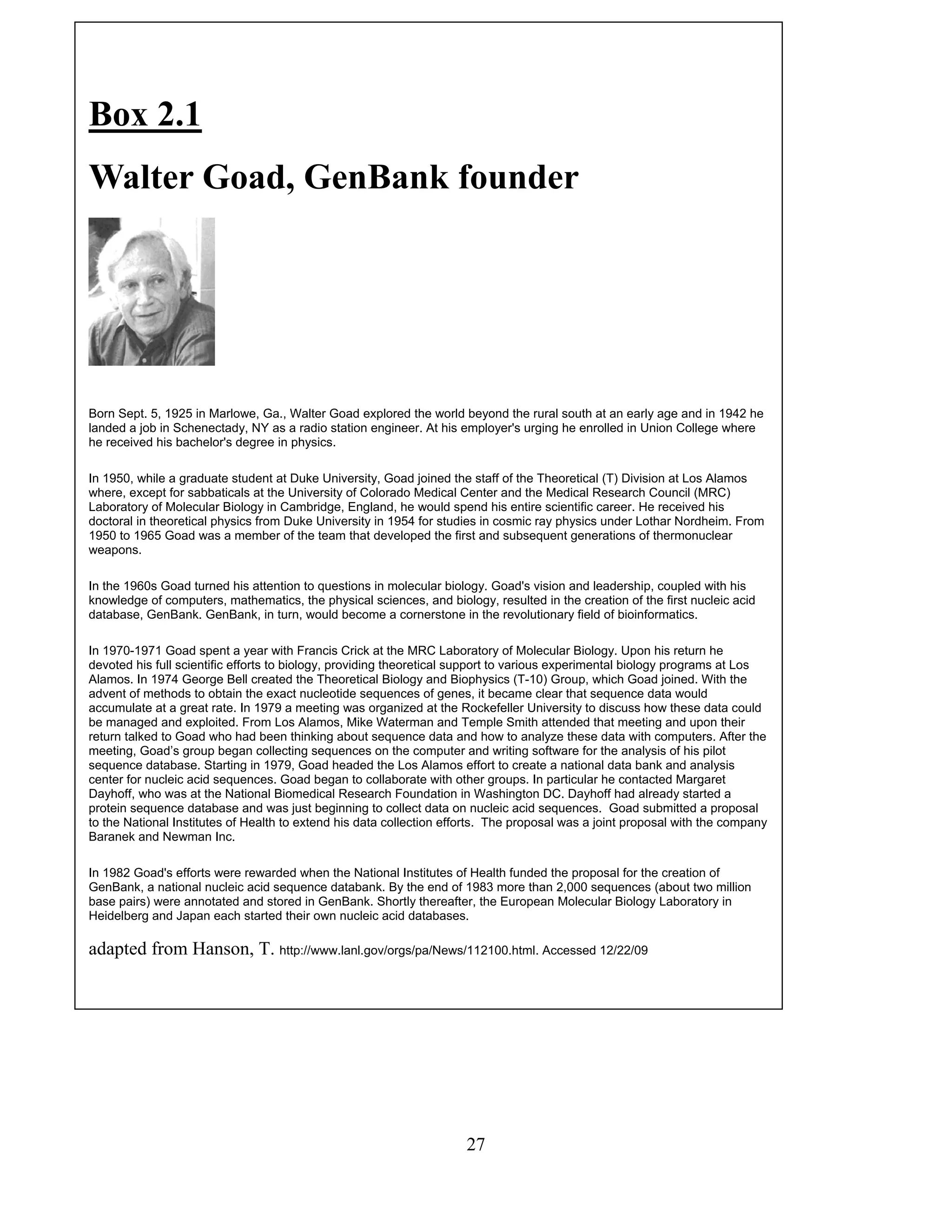
Box 2.1
Walter Goad, GenBank founder
Born Sept. 5, 1925 in Marlowe, Ga., Walter Goad explored the world beyond the rural south at an early age and in 1942 he
landed a job in Schenectady, NY as a radio station engineer. At his employer's urging he enrolled in Union College where
he received his bachelor's degree in physics.
In 1950, while a graduate student at Duke University, Goad joined the staff of the Theoretical (T) Division at Los Alamos
where, except for sabbaticals at the University of Colorado Medical Center and the Medical Research Council (MRC)
Laboratory of Molecular Biology in Cambridge, England, he would spend his entire scientific career. He received his
doctoral in theoretical physics from Duke University in 1954 for studies in cosmic ray physics under Lothar Nordheim. From
1950 to 1965 Goad was a member of the team that developed the first and subsequent generations of thermonuclear
weapons.
In the 1960s Goad turned his attention to questions in molecular biology. Goad's vision and leadership, coupled with his
knowledge of computers, mathematics, the physical sciences, and biology, resulted in the creation of the first nucleic acid
database, GenBank. GenBank, in turn, would become a cornerstone in the revolutionary field of bioinformatics.
In 1970-1971 Goad spent a year with Francis Crick at the MRC Laboratory of Molecular Biology. Upon his return he
devoted his full scientific efforts to biology, providing theoretical support to various experimental biology programs at Los
Alamos. In 1974 George Bell created the Theoretical Biology and Biophysics (T-10) Group, which Goad joined. With the
advent of methods to obtain the exact nucleotide sequences of genes, it became clear that sequence data would
accumulate at a great rate. In 1979 a meeting was organized at the Rockefeller University to discuss how these data could
be managed and exploited. From Los Alamos, Mike Waterman and Temple Smith attended that meeting and upon their
return talked to Goad who had been thinking about sequence data and how to analyze these data with computers. After the
meeting, Goad’s group began collecting sequences on the computer and writing software for the analysis of his pilot
sequence database. Starting in 1979, Goad headed the Los Alamos effort to create a national data bank and analysis
center for nucleic acid sequences. Goad began to collaborate with other groups. In particular he contacted Margaret
Dayhoff, who was at the National Biomedical Research Foundation in Washington DC. Dayhoff had already started a
protein sequence database and was just beginning to collect data on nucleic acid sequences. Goad submitted a proposal
to the National Institutes of Health to extend his data collection efforts. The proposal was a joint proposal with the company
Baranek and Newman Inc.
In 1982 Goad's efforts were rewarded when the National Institutes of Health funded the proposal for the creation of
GenBank, a national nucleic acid sequence databank. By the end of 1983 more than 2,000 sequences (about two million
base pairs) were annotated and stored in GenBank. Shortly thereafter, the European Molecular Biology Laboratory in
Heidelberg and Japan each started their own nucleic acid databases.
adapted from Hanson, T. http://www.lanl.gov/orgs/pa/News/112100.html. Accessed 12/22/09
27
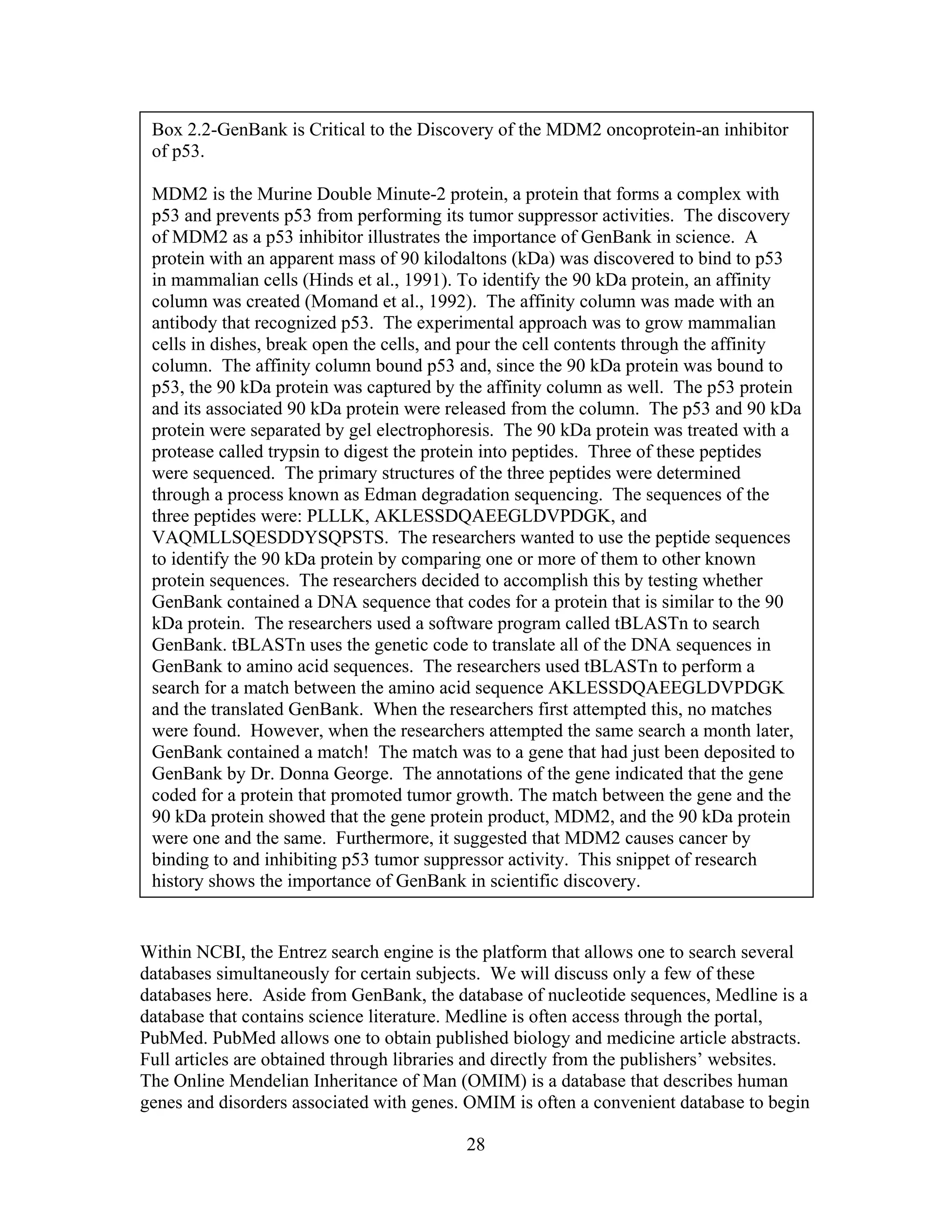
Box 2.2-GenBank is Critical to the Discovery of the MDM2 oncoprotein-an inhibitor
of p53.
MDM2 is the Murine Double Minute-2 protein, a protein that forms a complex with
p53 and prevents p53 from performing its tumor suppressor activities. The discovery
of MDM2 as a p53 inhibitor illustrates the importance of GenBank in science. A
protein with an apparent mass of 90 kilodaltons (kDa) was discovered to bind to p53
in mammalian cells (Hinds et al., 1991). To identify the 90 kDa protein, an affinity
column was created (Momand et al., 1992). The affinity column was made with an
antibody that recognized p53. The experimental approach was to grow mammalian
cells in dishes, break open the cells, and pour the cell contents through the affinity
column. The affinity column bound p53 and, since the 90 kDa protein was bound to
p53, the 90 kDa protein was captured by the affinity column as well. The p53 protein
and its associated 90 kDa protein were released from the column. The p53 and 90 kDa
protein were separated by gel electrophoresis. The 90 kDa protein was treated with a
protease called trypsin to digest the protein into peptides. Three of these peptides
were sequenced. The primary structures of the three peptides were determined
through a process known as Edman degradation sequencing. The sequences of the
three peptides were: PLLLK, AKLESSDQAEEGLDVPDGK, and
VAQMLLSQESDDYSQPSTS. The researchers wanted to use the peptide sequences
to identify the 90 kDa protein by comparing one or more of them to other known
protein sequences. The researchers decided to accomplish this by testing whether
GenBank contained a DNA sequence that codes for a protein that is similar to the 90
kDa protein. The researchers used a software program called tBLASTn to search
GenBank. tBLASTn uses the genetic code to translate all of the DNA sequences in
GenBank to amino acid sequences. The researchers used tBLASTn to perform a
search for a match between the amino acid sequence AKLESSDQAEEGLDVPDGK
and the translated GenBank. When the researchers first attempted this, no matches
were found. However, when the researchers attempted the same search a month later,
GenBank contained a match! The match was to a gene that had just been deposited to
GenBank by Dr. Donna George. The annotations of the gene indicated that the gene
coded for a protein that promoted tumor growth. The match between the gene and the
90 kDa protein showed that the gene protein product, MDM2, and the 90 kDa protein
were one and the same. Furthermore, it suggested that MDM2 causes cancer by
binding to and inhibiting p53 tumor suppressor activity. This snippet of research
history shows the importance of GenBank in scientific discovery.
Within NCBI, the Entrez search engine is the platform that allows one to search several
databases simultaneously for certain subjects. We will discuss only a few of these
databases here. Aside from GenBank, the database of nucleotide sequences, Medline is a
database that contains science literature. Medline is often access through the portal,
PubMed. PubMed allows one to obtain published biology and medicine article abstracts.
Full articles are obtained through libraries and directly from the publishers’ websites.
The Online Mendelian Inheritance of Man (OMIM) is a database that describes human
genes and disorders associated with genes. OMIM is often a convenient database to begin
28
searching for genes associated with human diseases. The Protein database contains
amino acid sequences and the Taxonomy database presents the organism names
associated with sequences in GenBank and Protein databases.
GenBank is an annotated collection of nucleotide sequences. Each record in the database
contains a single contiguous stretch of DNA or DNA obtained from RNA. The
sequences in GenBank that were obtained from RNA were experimentally copied from
RNA through a process known as reverse transcription. The product of reverse
transcription is copy DNA (cDNA). So it is actually cDNA that is experimentally
sequenced and submitted to GenBank, not the RNA sequence. GenBank records are
usually generated from direct electronic submissions from investigators responsible for
sequencing the DNA.
A GenBank record can be viewed in three sections. The first section is a header that
provides information about the entire record. The second section contains feature keys.
Feature keys are associated with descriptions that annotate segments of the sequence.
The third section is the nucleotide sequence. The sequence in the third section ends with
a “//” symbol, which denotes the end of the record. The nucleotide sequence is considered
the central element of the record. Because these records can be lengthy, we will break up
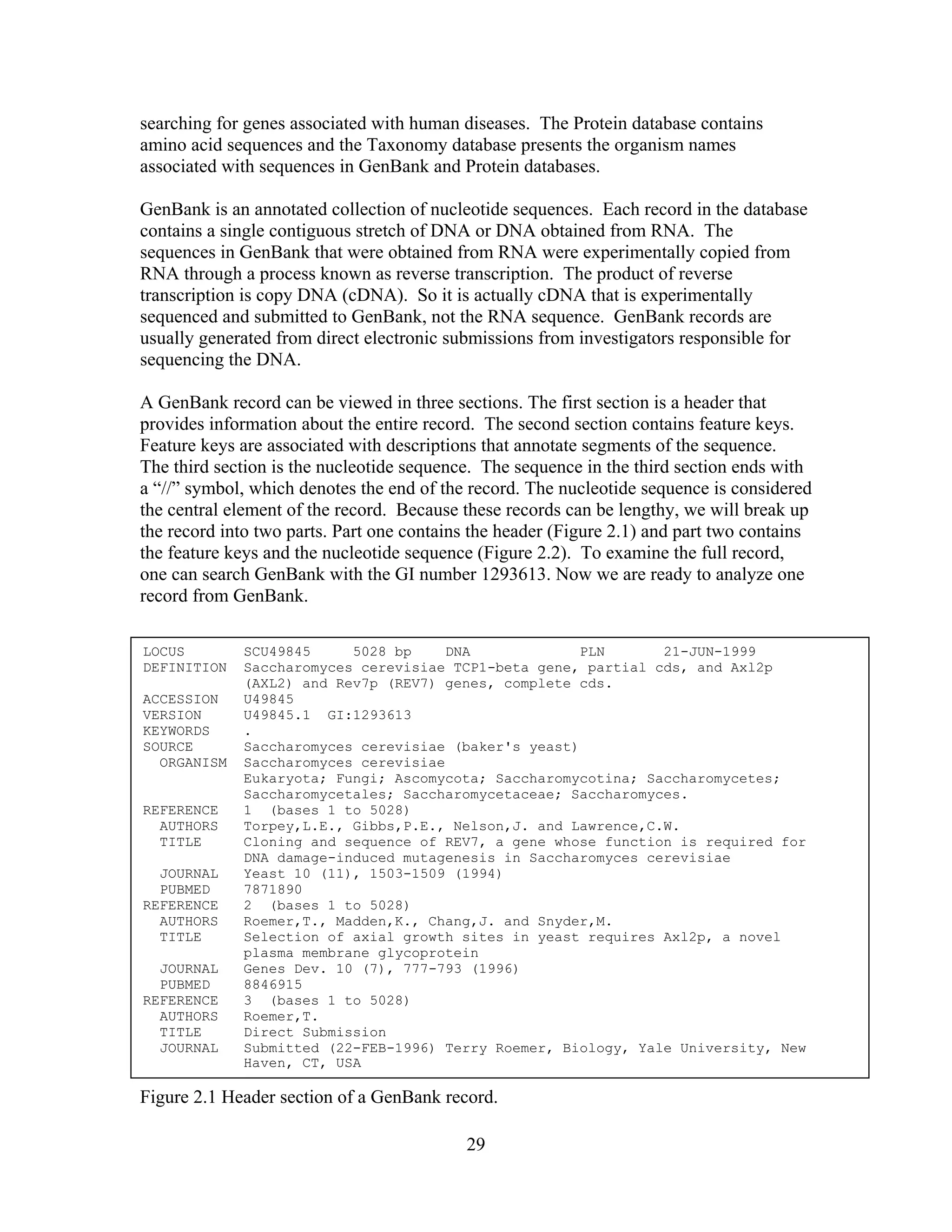
the record into two parts. Part one contains the header (Figure 2.1) and part two contains
the feature keys and the nucleotide sequence (Figure 2.2). To examine the full record,
one can search GenBank with the GI number 1293613. Now we are ready to analyze one
record from GenBank.
LOCUS SCU49845 5028 bp DNA PLN 21-JUN-1999
DEFINITION Saccharomyces cerevisiae TCP1-beta gene, partial cds, and Axl2p
(AXL2) and Rev7p (REV7) genes, complete cds.
ACCESSION U49845
VERSION U49845.1 GI:1293613
KEYWORDS .
SOURCE Saccharomyces cerevisiae (baker's yeast)
ORGANISM Saccharomyces cerevisiae
Eukaryota; Fungi; Ascomycota; Saccharomycotina; Saccharomycetes;
Saccharomycetales; Saccharomycetaceae; Saccharomyces.
REFERENCE 1 (bases 1 to 5028)
AUTHORS Torpey,L.E., Gibbs,P.E., Nelson,J. and Lawrence,C.W.
TITLE Cloning and sequence of REV7, a gene whose function is required for
DNA damage-induced mutagenesis in Saccharomyces cerevisiae
JOURNAL Yeast 10 (11), 1503-1509 (1994)
PUBMED 7871890
REFERENCE 2 (bases 1 to 5028)
AUTHORS Roemer,T., Madden,K., Chang,J. and Snyder,M.
TITLE Selection of axial growth sites in yeast requires Axl2p, a novel
plasma membrane glycoprotein
JOURNAL Genes Dev. 10 (7), 777-793 (1996)
PUBMED 8846915
REFERENCE 3 (bases 1 to 5028)
AUTHORS Roemer,T.
TITLE Direct Submission
JOURNAL Submitted (22-FEB-1996) Terry Roemer, Biology, Yale University, New
Haven, CT, USA
Figure 2.1 Header section of a GenBank record.
29
The header
The header contains fields that describe the entire GenBank record. As shown in Figure
2.1, these fields are located in a column on the left. On the top line, the first field we
encounter is Locus. The Locus is associated with a number SCU49845, the number of
base pairs (5028), the type of nucleic acid (DNA), the organism division (PLN—Plant,
Fungal and Algal), and the date of the last modification to the record (21-Jun-1999). The
type of nucleic acid is RNA if the RNA was converted to cDNA and deposited in
GenBank. The first two letters of the Locus are the first letters of the species and genus
respectively followed by the Accession number. The Accession number is a number
randomly assigned to the record. The field Definition describes the organism species
from which the DNA sequence was obtained and the known genes within the record.
Figure 2.1 the field Definition shows that the species is a yeast named Saccharomyces
cerevisiae and that the genes in this sequence are TCP1-beta, Ax12p and Rev7p. The
DNA in this record contains a partial cds of the TCP1-beta gene and the complete cds’s
of the other two genes. The letters cds refer to protein coding sequence. In other words,
the cds is the nucleotide sequence that codes for amino acids that constitute the protein
product. The Ax12p and Rev7p genes in this record are complete because the cds’s (from
the start to stop codons) are in the record. The TCP-1-beta gene is partial because its cds
is truncated. We will discuss the cds in more detail when we explore the features section.
The field below the Definition field is Accession. Accession refers to a unique identifying
number for this record that never changes. The field Version signifies whether there is
update to the record. The record in Figure 2.1 is version 1 because there is a “1” after the
decimal point (U49845.1). The field GI is the Gene Identifier. The GI number changes
whenever there is a new version. A new version is created when the nucleotide sequence
is found to contain a mistake. When the mistake is corrected, a new record is created to
replace the old record. The field Source describes the organism from which the DNA
was derived and the field Organism describes the taxonomy of the organism. The field
Reference lists the DNA segment that is described in a publication and the remainder of
the Reference field gives selected literature citations associated with the DNA segment.
The literature citations are listed beginning with the oldest citation and ending with the
most recent citation prior to submission of the sequence to GenBank.
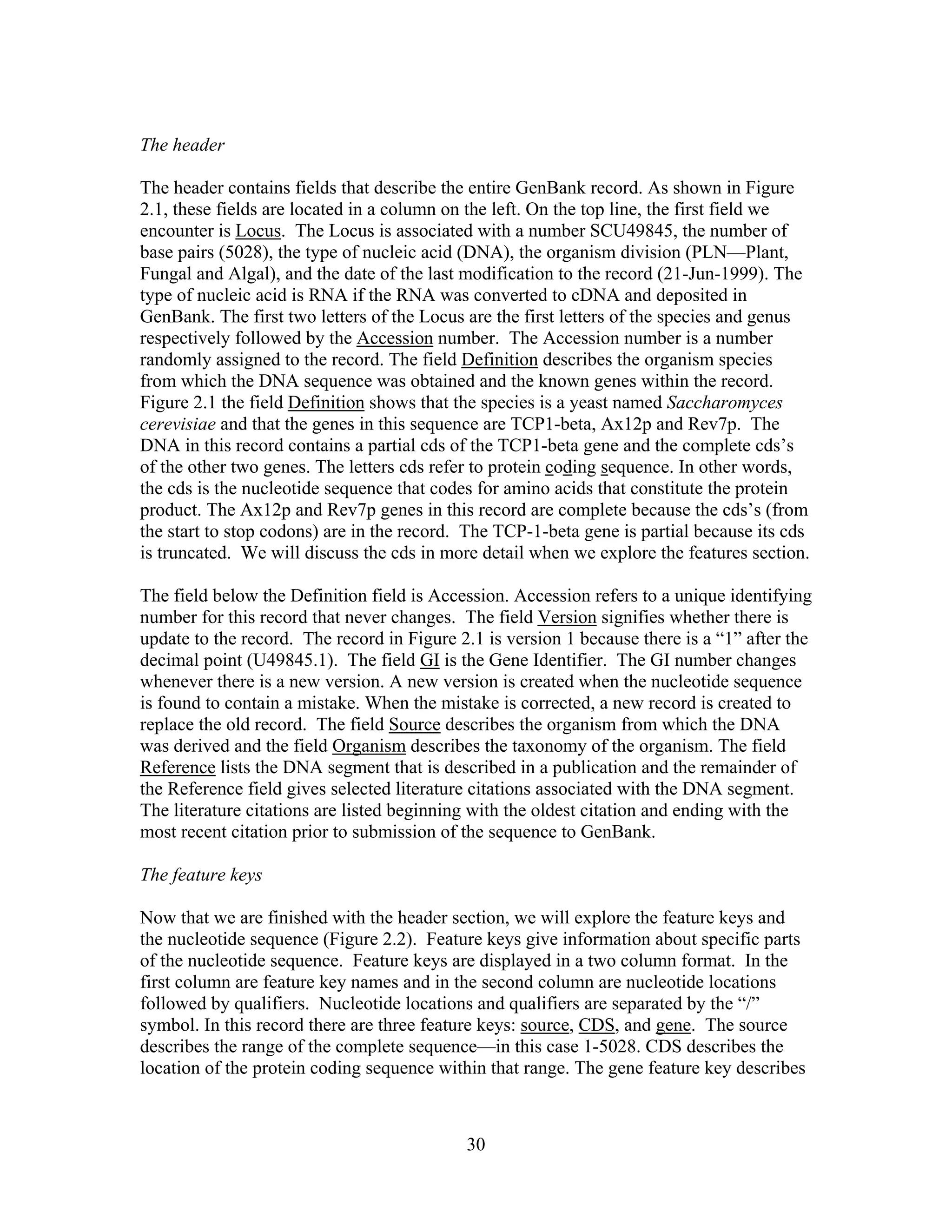
The feature keys
Now that we are finished with the header section, we will explore the feature keys and
the nucleotide sequence (Figure 2.2). Feature keys give information about specific parts
of the nucleotide sequence. Feature keys are displayed in a two column format. In the
first column are feature key names and in the second column are nucleotide locations
followed by qualifiers. Nucleotide locations and qualifiers are separated by the “/”
symbol. In this record there are three feature keys: source, CDS, and gene. The source
describes the range of the complete sequence—in this case 1-5028. CDS describes the
location of the protein coding sequence within that range. The gene feature key describes
30
the locations of complete genes. There may be more than one qualifier associated with a
particular location.
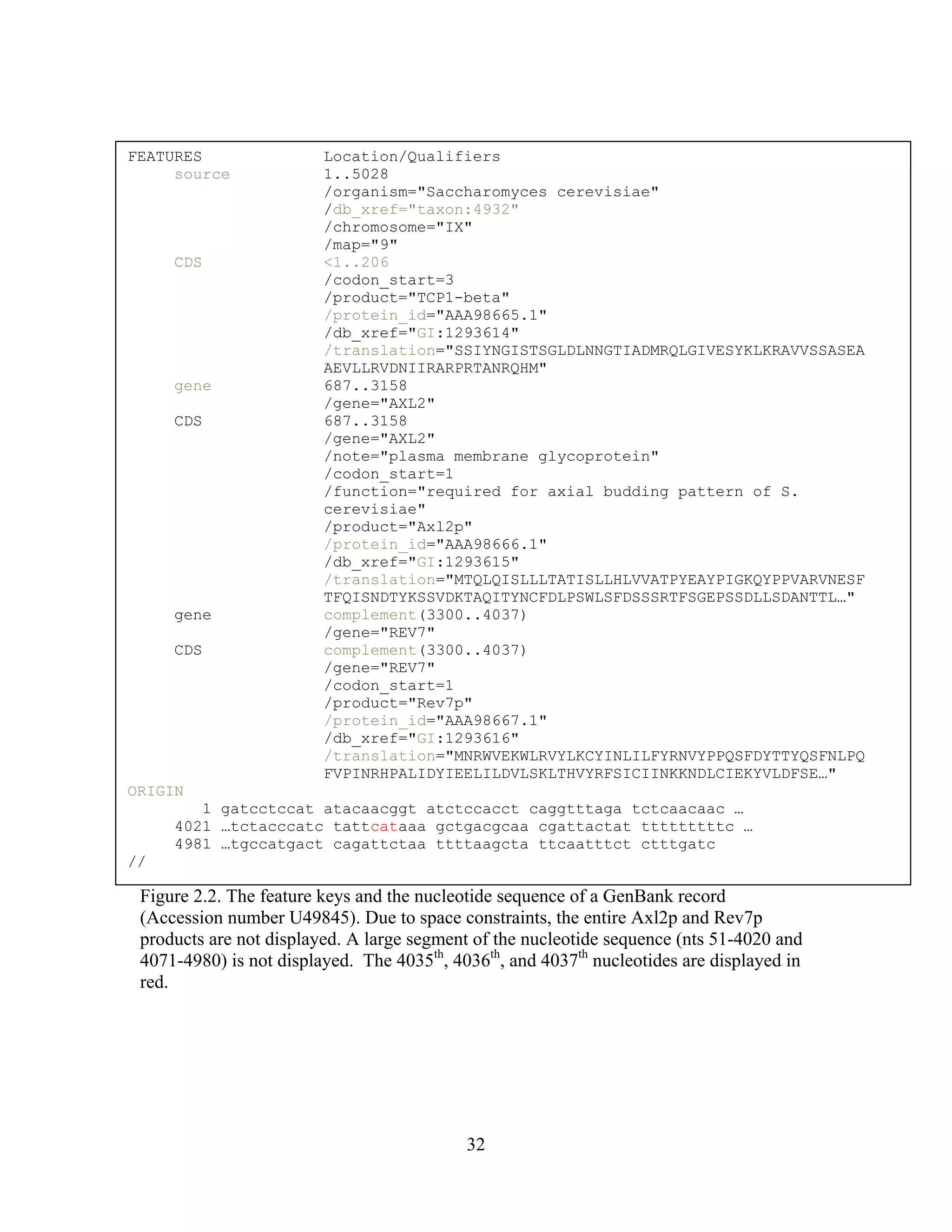
Let’s take a look at the qualifiers associated with the source feature key in Figure 2.2.
The first word is a category description of the qualifier. In this case, the qualifier is
organism. This is followed by an equal sign and then by the name of the qualifier in
quotes (=”Saccharomyces cerevisiae”). The only time the qualifier is not in quotes is
when it is a number. After the last quotation mark, other qualifiers may follow. Many
qualifiers are database cross references. In Figure 2.2, the second qualifier, db_xref,
directs one to the Taxonomy database entry number 4932.
A critical gene feature is the CDS, also known as the protein coding sequence. To have a
deeper understanding of the CDS it is necessary to understand gene structure. Gene
structure is the arrangement of DNA regions that are transcribed into RNA. Together,
these regions constitute the gene. For simple organisms, such as bacteria, the gene
structure is straightforward. It consists of three regions, the upstream untranslated region,
the CDS, and the downstream untranslated region (Fig. 2.3). The upstream DNA region
is closer to the 5’ phosphate end of the DNA and the downstream DNA region is closer to
the 3’ end (see Figure 1.3 in Chapter 1). The RNA that is transcribed includes the
upstream untranslated region. The start of the untranslated region marks the beginning of
the gene. As implied by its name, the untranslated region does not code for protein.
Only the CDS codes for protein and, in addition includes the stop codon. The gene,
therefore, is the DNA that codes for the entire RNA transcript from its 5’ end to its 3’
end. Even further upstream to the gene is the promoter, a region of DNA where the
enzyme that synthesizes RNA initially sits prior to transcription. Recall that the DNA is
double stranded. The DNA strand that is identical to the RNA sequence (with the
exception of T’s and U’s) is called the coding strand. The DNA strand that is
complementary to the coding strand is called the template strand. Sometimes the DNA
strand shown in the GenBank record is the coding strand and sometimes it is the
complementary strand. In bacteria, the CDS of the gene is contiguous. However, in
other organisms, the CDS may be interrupted by intron sequences, segments of RNA that
do not code for protein (see Reference Sequence section below).
31
Figure 2.2. The feature keys and the nucleotide sequence of a GenBank record
(Accession number U49845). Due to space constraints, the entire Axl2p and Rev7p
products are not displayed. A large segment of the nucleotide sequence (nts 51-4020 and
4071-4980) is not displayed. The 4035th
, 4036th
, and 4037th
nucleotides are displayed in
red.
FEATURES Location/Qualifiers
source 1..5028
/organism="Saccharomyces cerevisiae"
/db_xref="taxon:4932"
/chromosome="IX"
/map="9"
CDS <1..206
/codon_start=3
/product="TCP1-beta"
/protein_id="AAA98665.1"
/db_xref="GI:1293614"
/translation="SSIYNGISTSGLDLNNGTIADMRQLGIVESYKLKRAVVSSASEA
AEVLLRVDNIIRARPRTANRQHM"
gene 687..3158
/gene="AXL2"
CDS 687..3158
/gene="AXL2"
/note="plasma membrane glycoprotein"
/codon_start=1
/function="required for axial budding pattern of S.
cerevisiae"
/product="Axl2p"
/protein_id="AAA98666.1"
/db_xref="GI:1293615"
/translation="MTQLQISLLLTATISLLHLVVATPYEAYPIGKQYPPVARVNESF
TFQISNDTYKSSVDKTAQITYNCFDLPSWLSFDSSSRTFSGEPSSDLLSDANTTL…"
gene complement(3300..4037)
/gene="REV7"
CDS complement(3300..4037)
/gene="REV7"
/codon_start=1
/product="Rev7p"
/protein_id="AAA98667.1"
/db_xref="GI:1293616"
/translation="MNRWVEKWLRVYLKCYINLILFYRNVYPPQSFDYTTYQSFNLPQ
FVPINRHPALIDYIEELILDVLSKLTHVYRFSICIINKKNDLCIEKYVLDFSE…"
ORIGIN
1 gatcctccat atacaacggt atctccacct caggtttaga tctcaacaac …
4021 …tctacccatc tattcataaa gctgacgcaa cgattactat tttttttttc …
4981 …tgccatgact cagattctaa ttttaagcta ttcaatttct ctttgatc
//
32
Downstream (relative to CDS)
33
Transcription
5’
5’
3’
3’
Coding strand
Promoter
Template strand
Transcription
initiation site
Transcription
termination site
Protein Coding Sequence (CDS)
Upstream (relative to CDS)
DNA
5’ untranslated
region (5’UTR)
3’ untranslated
region (3’UTR)
RNA
Translation
Protein
Protein folding
Folded
protein
Start of gene End of gene
5’ 3’
Figure 2.3 Structure of a gene and its promoter with a single CDS. The promoter is
where the RNA polymerase binds to DNA. The RNA polymerase transcribes the DNA
into RNA. The CDS region of the DNA codes for protein. The CDS region within the
RNA is translated into protein which then folds into a distinctive tertiary structure.
Now we are in a position to discuss CDS in the GenBank record. The number range
listed in the second column refers to the range of nucleotide numbers within a stretch of
DNA that codes for the amino acid sequence plus the stop codon. The first three
nucleotides that start the CDS usually begin with ATG, which codes for the amino acid
Met. Sometimes the nucleotide sequence in the GenBank record is truncated so that a
complete protein sequence is not in the record. When the CDS is truncated, the
nucleotide number range will show a “<” symbol at the beginning or a “>” symbol at the
end. The “<” symbol at the beginning of the range indicates that the beginning of the
protein sequence coded by the CDS is not in the record.
In the example shown in Figure 2.2 the first CDS range is <1..206 which means that the
beginning of the sequence that codes for the protein is not in the record. If one scrolls
down a few lines to the qualifier translation one can see that the first amino acid is Ser
and not Met. This record does not contain coding information for the amino acids that
are upstream of Ser. Another qualifier associated with this CDS is “codon_start=3”.
This means that the first nucleotide in the Ser codon begins with the third nucleotide from
the left under the ORIGIN (tcc). The upstream segment of the gene is missing from this
record. The last nucleotide in the range, 206, is the last nucleotide in the stop codon. The
name of the gene product is TCP1-beta. Since this segment of DNA does not contain the
complete CDS of TCP1-beta, there is no gene feature key listed.
The next feature key shown in Figure 2.2 is gene. The gene is named “AXL2” and its
location is 687..3158, or bases 687-3158 of the record’s sequence. The complete CDS of
AXL2 is contained in the record. The next feature key is CDS. The CDS corresponds to
AXL2 and has the same nucleotide range as its corresponding gene. One might ask why
is the gene nucleotide range not wider than the CDS? Where are the untranslated
upstream and downstream regions? One must recall that GenBank records are annotated
by the investigators who submit the sequence. In this particular case, the investigator
may not have had knowledge of the extent of untranslated regions. When he submitted
this segment of the yeast genome he may have used software to translate the regions of
his DNA segment into protein and thus declared those regions to be the CDS regions.
Software tools for translation of DNA into protein are relatively reliable. However, it is
difficult to predict, using software tools, the extent of the upstream and downstream
untranslated regions. Without experimental data, the investigator may have annotated
this GenBank record to show that the CDS region and gene region are identical implying
that the CDS region is the minimum region that the gene could encompass.
To continue with our analysis of the AXL2 gene, note that there is no “<” or “>” symbol
in the location qualifier of the CDS. The translated gene product shows that the first
amino acid is Met—the usual starting amino acid for proteins so this CDS is complete.
Another gene in the record is “Rev7p”. Its nucleotide range is 3300..4037, but the word
34
“complement” appears just before the range. Complement signifies that the coding
strand of the DNA is located on the complementary strand (the strand opposite to the one
that is shown under the ORIGIN). Again the CDS and gene share the same nucleotide
range. Because the coding strand is on the complementary strand, the start codon ATG
(codes for Met) is on the complementary strand and in reverse orientation (3’GTA5’).
The sequence on the strand shown in red font in Figure 2.2 under the ORIGIN is CAT
which base pairs to 3’GTA5’. The three nucleotide sequence CAT and its complement
are shown in Figure 2.3. The 4035th
, 4036th
, and 4037th
bases in the sequence correspond
to c, a, t respectively, illustrated in Figure 2.4.
Figure 2.4. Small region of REV7 displayed strand with its complementary strand and
coded amino acid.
It should be noted that the translated sequences of Axl2p and Rev7p have been shortened
in Figure 2.2 to conserve space. The complete record in GenBank can be found in the
GenBank database by searching the nucleotide database with the accession number
U49845 at the NCBI website. The third and last section in this GenBank record is the
nucleotide sequence of the entire deposited DNA sequence located just below the
ORIGIN. The end of the record is marked with the // symbol.
The default display mode for GenBank is shown in Figure 2.2. This display is good for
ascertaining annotated information about the nucleotide sequence in the record.
However, this display mode is not useful if one needs to copy the sequence and paste it
into another program, such as Basic Local Alignment Search Tool (BLAST). If the
objective is to analyze the sequence with a software program such as BLAST one must
change the format to FASTA. In FASTA format, also known as Pearson format, a header
line is followed by the sequence. The header line is denoted by a “>” sign on the far left.
One can copy the FASTA output and paste it into the BLAST software program window
and run the program. Most sequence analysis programs accept FASTA formatted
sequences as input.
Limitations to GenBank
A limitation to GenBank is that there are many records with identical or almost identical
sequences. This redundancy makes it difficult for the user to decide which sequences are
wild-type (natural, non-mutated) sequences and which sequences may contain sequencing
errors or mutations. For example, there are at least 46 GenBank records that contain all or
part of the human p53 tumor suppressor gene. Because p53 sequences are often derived
from DNA in cancer tissue, the majority of these sequences contain mutations. If the
record is carefully annotated it will state that the DNA sequence contains a mutation and
describe the location of the mutation. On the other hand, it may be possible that the
5’cat3’←(displayed strand shown in Fig. 2.2)
3’gta5’←(complementary strand)
Met (Coded amino acid at beginning of sequence)
nt 4037nt 4035
35
record is not carefully annotated, or that the sequence was deposited before it was clear
whether it contained a mutation.
Another limitation to GenBank is that it is not immediately clear whether the gene
sequences in the record are complete. One might think the full-length gene is obtained
but in reality only the beginning (or end) segment of the gene may be in the record.
Rather than assume that the full-length sequence is present, it is prudent to carefully
scrutinize the annotations in the record. Reading the literature referenced in the
annotations will often reveal whether the entire sequence of the gene is contained within
the record. These limitations should not detract from the important impact GenBank
continues to make on bioinformatics. Other databases that use the data stored in
GenBank have become indispensible sources for researchers. One of them is Reference
Sequence (RefSeq).
Reference Sequence (RefSeq)
Since several versions of a gene may be submitted to GenBank, it became imperative to
develop a database that contains only wild-type sequences. The RefSeq database
contains only wild-type sequences of DNA, RNA, and proteins. The RefSeq database
information is derived from GenBank records and is deposited, annotated, updated, and
reviewed by the staff at the NCBI. Interestingly, more than one RefSeq record can be
generated from a single stretch of DNA. Each record in RefSeq represents a unique
naturally occurring molecule, whether it is DNA, RNA or protein. The RefSeq database
shows that more than one RNA molecule can be transcribed from a single DNA region.
To understand how more than one RNA molecule, or transcript, can be derived from one
DNA region, recall from Chapter 1 our discussion of the Central Dogma. RNA is
transcribed from DNA and RNA is translated into protein. In bacteria (more generally
known as prokaryotes), the RNA transcribed from DNA undergoes very few changes
prior to translation. This RNA is known as messenger RNA (mRNA). Organisms other
than bacteria, such as humans and plants, contain a structure inside their cells known as a
nucleus. The nucleus contains the DNA that codes for the vast majority of proteins inside
the cell. Organisms with nuclei in their cells are eukaryotes. In contrast to prokaryotes,
RNA initially transcribed from DNA in eukaryotic cells undergoes extensive processing
prior to translation. In eukaryotes, the RNA initially transcribed from DNA is called the
primary transcript. After processing, the RNA derived from the primary transcript is
called messenger RNA (mRNA).
What exactly is meant by processing of primary transcripts? In eukaryotes, segments of
nucleotides in the primary transcript are removed and the surviving segments are joined
together. The removal of nucleotides and rejoining of RNA segments is called splicing.
Exons are segments of DNA that are transcribed into the segments of a primary transcript
that survive the splicing process and end up in the mRNA. Introns are DNA segments
that are transcribed into the primary transcript, but are spliced out prior to the creation of
mRNA. Figure 2.5A shows how splicing of the primary transcript generates the mRNA.
Here, four exons in DNA give rise to mRNA that is transcribed into a single protein.
36
Genes from eukaryotes can contain several exons. For example, the Tp53 gene is
composed of 11 exons and 10 introns. Splicing gives rise to an mRNA that is
considerably shorter than the primary transcript. The Tp53 primary transcript is 19,144
bases in length. However, the Tp53 mRNA is only 2,586 bases in length.
Now we can address the question as to how more than one mRNA can be derived from a
single gene. One way that this occurs is through alternative splicing of the primary
transcript. In alternative splicing, the maturation process from primary transcript to
mRNA is not consistent. Along with the intron sequences, one or more exon sequences
may be removed from the primary transcript, giving rise to mRNAs called alternatively
spliced variants. These variants are usually translated into different proteins. Figure 2.5B
shows two alternatively spliced mRNA variants created from a primary transcript. Each
alternatively spliced mRNA variant derived from a single gene is assigned a unique
RefSeq record.
Another mechanism for producing different mRNAs from a single DNA segment is
through multiple transcription initiation sites. RNA polymerase, the enzyme that
transcribes the RNA from the DNA template, initiates transcription on a region of DNA
called the promoter. Usually the promoter is located upstream of the first exon (see Fig.
2.3). Sometimes a gene can have more than one promoter—one located in the usual
position and another located further downstream. Each promoter produces a unique
primary transcript that is processed into a unique mRNA that can code for a unique
protein. Human p53 has seven known transcript variants-some of which are produced
from alternative splicing, and some of which are produced from alternate transcription
initiation sites. The dominant mRNA variant is form 1, which codes for a protein of 393
amino acids. Interestingly, in a small study of 3,500 genes it was shown that 93% of the
genes produce more than one mRNA. RefSeq will undoubtedly expand and give data on
natural molecules to bioinformaticists.
37
1 2 3 4
Transcription
1 2 3 4
DNA
Primary
transcript
Splicing
mRNA
Translation
protein
Intron 1 Intron 2 Intron 3
Figure 2.5 A. Splicing of RNA primary transcript. The process of splicing is shown
beginning with transcription of a DNA gene into an RNA primary transcript. The gene
has four exons (colored rectangles) and three introns. The splicing pattern is indicated by
the blue lines connected to the primary transcript. After splicing, the intron sequences of
the primary transcript are removed and the mRNA is created. The mRNA is translated
into protein. Here, each exon contributes to the protein product.
38
Primary transcript1 2 3 4
Figure 2.5 B. Alternative splicing can give rise to two mRNAs. The path of splice form A
is shown in light blue lines above the primary transcript. The path of splice form B is
shown in light blue lines below the primary transcript. Splice form A mRNA is derived
from exon sequences 1, 2 and 4. Splice form B mRNA is derived from exon sequences 1,
3 and 4. Two protein isoforms are translated from two alternatively spliced mRNAs.
Primary and secondary databases
We have discussed GenBank and RefSeq databases. GenBank is an example of a
primary database (also known as archival database). The primary database contains
information submitted directly by the experimenter. RefSeq is an example of a secondary
database (also known as curated database). The secondary database contains information
derived from a primary database. Other examples of primary databases are EMBL, and
DDBJ—nucleotide sequence databases stored on the international bioinformatics servers
located in Bethesda, Hinxton, and Kyoto respectively. Another primary database is the
Protein Data Bank (PDB). It contains molecular structure data on proteins, DNA and
RNA. The data is the atom identity (carbon, nitrogen, etc.), its XYZ Cartesian
coordinates in space, and B-factor (uncertainty of atom position). Sequences of the
biomolecules are also stored in the PDB. Another primary database is ProSite. Each
record in ProSite contains a consensus pattern of amino acids sequences that form a
common three-dimensional structure. The consensus pattern can also constitute a site
where a post-translational modification can occur. This is called a functional site. s
39
These consensus patterns are stored in the ProSite database and are used to preliminarily
predict the structures and functional sites of new proteins. Ultimately, experiments in the
laboratory will confirm (or not confirm) the proteins’ predicted structures and functional
sites.
As mentioned previously, secondary databases derive information from primary
databases. Aside from RefSeq, the non-redundant nucleotide database (nr/nt) is an
important secondary database. In nr/nt, records, identical nucleotide sequences from
primary databases are merged into one record. The data in nr/nt is obtained from
GenBank, EMBL, DDBJ and PDB. Another example of a secondary database is UniProt
Knowledge Base (UniProtKB), which is not part of NCBI. The information in this
protein sequence database comes from the translated nucleotide databases of GenBank,
EMBL and DDBJ. Recall from Box 2.2 that the identity of the 90 kDa protein was
obtained by comparing the translated GenBank sequences to the 90 kDa peptides. If
UniProtKB had obtained the MDM2 gene sequence from GenBank, it would have
translated the MDM2 CDS into amino acid sequence. To identify the 90 kDa protein the
researchers could have used BLAST to search the UniProtKB database for amino acid
sequences similar to the peptides from p90.
The UniProt Knowledge Base database
As noted previously, one of the drawbacks of GenBank is that there is some redundancy
in the data. From the annotations it is sometimes difficult to determine if the record
contains a full-length sequence that is wild-type. RefSeq is a secondary database that
contains natural (wild-type) sequences of DNA, RNA and protein. Another database
devoted to storage of wild-type sequences is UniProtKB. UniProtKB (formerly Swiss-
Prot) was begun by Amos Bairoch at the University of Geneva. UniProtKB is database
kept current through human curators and the software program, TrEMBL. TrEMBL
translates new DNA sequences and annotates the translated sequence automatically. If
there are several records in GenBank for one gene, it may be prudent to also look at both
UniProtKB and RefSeq. Both databases contain information on natural proteins.
The Tp53 record in UniProtKB
The Tp53 record in UniProtKB is laid out in a style that is easy for the user to
understand. The p53 record, P04637, is divided into the following headings: names and
origin, protein attributes, general annotation (comments), ontologies, binary interactions,
alternative products, sequence annotation (features), sequences, references, web
resources, cross-references, entry information, and relevant documents. Protein attributes
include the number of amino acids, the completeness of the sequence, and evidence for
the existence of the protein. That evidence could be inferred from computer-generated
translation of the DNA or it could be based on experimental determination. In the case of
p53, there is direct evidence, beginning with its discovery in 1979, that the protein does
exist. The General annotation section gives a summary of the p53 gene and protein
functions. Ontologies describe biological processes associated with p53. For example, in
the disease ontology, the record includes the Li-Fraumeni syndrome (introduced in
40
Chapter 1). This is a rare familial disease in which a mutant form of p53 is passed from
parents to offspring. The outcome of the disease is usually a cancer contracted by the
time the patient reaches early adulthood (see Box 1.1, Chapter 1). Another heading of the
p53 UniProtKB record is titled binary interactions. Binary interactions refer to known
biological molecules that bind to p53 within the cell. The p53 record lists more than 55
other proteins that bind to p53 and gives links to the UniProtKB records of the binding
proteins. As expected, one the binding proteins is MDM2 (see Box 2.2).
The sequence annotation (features) section of the p53 UniProtKB record describes
information pertaining to specific segments of the protein sequence. One of the features
in the sequence annotation section is Region and the qualifier is DNA binding. The
amino acid sequence that corresponds to this region spans amino acids 102-292. This
region is critical for p53 function because p53 must bind to DNA in order to mediate its
tumor suppressor activity. P53 is a transcription factor. It binds to DNA and assists RNA
polymerase transcribe specific genes. P53 assists in the transcription of several genes,
including those that that repair damaged DNA, prevent cells from dividing and cause
programmed cell death. Interestingly, the vast majority of mutations in the p53 gene
found in human cancers are located in the region of p53 gene exons that code for the
DNA binding region. The mutations code for p53 proteins devoid of DNA binding
capability, thus knocking out p53’s important function as a tumor suppressor.
Summary
We began our journey into information organization with a discussion of GenBank, the
longest running molecular biology database. GenBank records are divided into three
sections: header, feature keys, and nucleotide sequence. While GenBank is a primary
database, another database, RefSeq, is a secondary database that derives its data from
GenBank. RefSeq stores sequence information of wild-type molecules. More than one
transcript can be derived from a single gene. Such variant transcripts are the products of
alternative splicing and multiple transcription start sites. There is a unique RefSeq record
for each RNA variant. Another secondary database is UniProtKB. UniProtKB is protein
centered and is rich with annotations that describe the functions of the protein.
41
Exercises
1) For this exercise you will need to access GenBank by going to the NCBI website and
use the dropdown window to search “nucleotide”. Note that the definition of the coding
strand is the strand of DNA within the gene that is identical to the genetic code (for
genetic code see Fig 1.10). On the other hand, the template strand is the strand that is
complementary to the coding strand.
a) Use the following accession number to access the nucleotide sequence in GenBank:
CU329670
b) Go to the FEATURES section of the record.
c) Link to the CDS to gain access to the first 5662 nucleotides of the sequence.
d) Name the protein product of the CDS.
e) Write the first four amino acids (starting from the N-terminus).
f) Write the nucleotide sequence of the coding strand that corresponds to these amino
acids.
g) Write the nucleotide sequence of the template strand that corresponds to these amino
acids.
h) Using the sequence shown in the record, give the nucleotide number range that
corresponds to these amino acids.
2) Genes in eukaryotes are often organized into exons and introns, which require splicing
to produce an mRNA that can be translated. This broken organization can make gene
identification difficult in eukaryotes-- particularly in higher eukaryotes with complex
gene organization. Prediction of many genes and their organization has been based on
similarity searches between genomic sequence and known protein amino acid sequences
and/or genomic sequence and the corresponding full-length cDNAs. cDNAs are reverse
transcribed mRNAs and therefore do not have intron sequences. Because of this, cDNAs
(i.e. copied DNA) can be considered mRNAs. A comparison of a genomic sequence
(with introns) to its corresponding cDNAs will reveal where the introns begin and end.
GenBank will contain the genomic sequence and the cDNA sequence. To find out the
structure of the gene (i.e. the arrangement of the exons and introns) we simply need to
perform a sequence comparison between the genomic sequence and the cDNA sequence.
Shown below is a genomic sequence from the species C. elegans. The Basic Local
Alignment Sequence Tool (BLAST) can be used to assess the gene structure
(arrangement of exons and introns) of a genomic sequence. BLAST can be used to
compare your DNA sequence with all DNA sequences in GenBank and other databases.
The top hit of the output will be a sequence comparison between your sequence (the
query sequence) and the most similar sequence in the database (subject sequence).
Subsequent hits will display sequence comparisons between the query sequence and
subject sequences that are increasingly less similar. If all hits have 100% identity, use the
hit with the most extensive percent coverage to report on. Use the nucleotide BLAST tool
and appropriate databases to construct a schematic diagram that shows the arrangement
42
of introns and exons in the genomic sequence. The species source of genomic sequence is
Caenorhabditis elegans.
ATTTTTAAAAATGTACAAAATCAAACGCCCTACAAATCATGTGTGTGAAGAAGAATAATAACTAACATAT
CTATTTATATTTACCGAATAAATATATATTCATCAATTAACCTGAAGAACAAACGAATTCGGCTACAGGC
GTCGATCAGTCTCGAATCTAGTAACAACAAGAGAGCAATACGAAAACCGGTAAATCAATAGGGGGAAGCG
AAACAGTAGGTACAAATTGGAGGGGAAGCACCAATACATTAGGTGGGGGGTACGACTTGAAAAATGAGCT
GATTTTCGAATAGTTAAAGCGATGATCGTGTCCGAAAAACAGTTCATTTTTCAAGACAACATTGAGACTG
GGAGTACGGGGAAGCTCATTTACGGTGAGAGGAATTGGTGAGATCTTTAGAATATGCTTAAGGAGTTGGG
GTGGCTGGAGAAGTTCCTGTAGCCTCCGTGCCGGGATTCGATGGAGAAGTCGTTGCGGCTGGTCCCTTTT
CCTTCACTGGTGCTGGATCCTTGGCTGGAAGACATATGCGTGGCTTGACAGTCGATGAGGTGCGAGCCGA
CGAGTCCTTGTGAACTTCGTATCTGGAAATATTTTACTTAGATAGCAAATACTAAAATTGTAAAATTACC
TCAAAATCTCAGTATCCGGAATGCTCAATTTCTGCTTCAAAACCTGTCCGATGCGAAGATTGACATCATC
GCGAGTAGCATCACGAGTCCACAAGGAAACCTTGTCACCCTTTTGACGAACATTCACGACAGCTCCGCAG
ATGTAGTCTCCGTACTCGTCGAATTGCTCTCCAACAATAGCCATCAACAGCTCCAACCAGTAGTGATCGA
GCAATTGCGTTCTTCTCTGAAGCTTCTATGATTCATTGAATAAAATATATTTCTCAAAACGTACTTGCTT
ATCGACAACAACCAACCAACGTCCACCTTGAACGTTGTTGACGTCCTCCCACATTGGCTTGATTCCTTCC
TTGAACAAGTAATAATCGGATCCCCAGTTCAATCCTCCGGCAGACTGAATGTGATTGTACAGCGACCAGA
AGTCCTCGACAGTGTCGAAAAGTGAAACCATCTGGAAAAAATCGATAAAAGACGTATTTAAAAATCTTCT
ACCTTCAGACAATCCTCCCATTCCTTGTTACGGTCAGCTTTCAAGTACCAGAGAGCCCAGCGATTCTGGA
GGGGGTGTCTGGTGAGAAGCTCTGGAGGAACTGAAGCATCGGACGCATTCACATCGCCGGAAGCTGACAA
TGCTTTGTTTTCCGCTACGGATGTGCTCATTTAGCTGAAAATAGGTAATATTATATACGATTAGAGCTCG
GAAAACGATAAAATAGAGAAGAGTATGAATTTGGTTCAAATAACTCGGATTTTATAGGAAATTTTGTTTT
ACTGCACATTTTCGGCTAGTTTCCAAGCTTTTTAGATTTTTCAAGTGTAATTGGTAACATCGGGCACAAT
AAATTGATATTAAAGCTTGGAAAACAATAA
In addition to the questions above, answer the following:
(a) Give the name and accession number of the mRNA of this gene.
(b) Give the name and accession number of the protein product.
(c) Note the numbering of the sequences in the alignments. Does the database genomic
sequence progress in the same direction as the database mRNA? In other words is it the
same orientation (see below):
1.................................114 = query
61...............................98 = subject
or opposite orientation (below):
1.................................114 = query
98...............................61 = subject
(d) Consider the alignment of the query sequence and the subject sequence. What does
the orientation of the sequences relative to each other tell you about the sequence that
was used as the query sequence?
(e) Give the amino acid sequences translated from each exon sequence of the primary
transcript.
(f) How many alternative splice variants are associated with this genomic sequence? List
their accession numbers.
43
44
3) Give the chromosome position numbers that denote the start and end of the TP53 gene.
The position number is the base number on chromosome 17. Calculate the length of the
primary transcript. Give the lengths, in base pairs, of each exon and intron that is used for
the transcription of TP53 into mRNA isoform a. Cite the sources you used to gather your
information.
References
Claverie, J-M and Notredame, C. 2007. Bioinformatics for Dummies, Wiley, Hoboken,
NJ.
Fakharzadeh, S.S., Trusko, S.P., and George, D.L. 1991. Tumorigenic potential
associated with enhanced expression of a gene that is amplified in a mouse tumor cell
line. EMBO J. 10, 1565-1569.
Gear, R., http://www.ncbi.nlm.nih.gov/Sitemap/samplerecord.html#LocusB Accessed
3/4/10.
Goad, W.B. 1983. GenBank. Los Alamos Science Fall, 53-61
Hanson, T. http://www.lanl.gov/orgs/pa/News/112100.html. Accessed 12/22/09
Hinds, P.W., Finlay, C.A., Quartin, R.S., Baker, S.J., Fearon, E.R., Vogelstein, B., and
Levine, A.J. 1990. Mutant p53 DNA clones from human colon carcinomas cooperate
with ras in transforming primary rat cells: a comparison of the “hot spot” mutant
phenotypes. Cell Growth Differ. 1, 571-580.
Lamb, P. and Crawford, L. 1986. Characterization of the human p53 gene. Mol. Cell Biol.
6, 1379-1385.
Momand, J., Zambetti, G.P., Olsen, D.C., George, D., and Levine, A.J. 1992. The mdm-2
oncogene product forms a complex with the p53 protein and inhibits p53-mediated
transactivation. Cell 69, 1237-1245.
Mortazavi, A., Williams, B.A., McCue, K., Schaeffer, L., and Wold, B. 2008. Mapping
and quantifying mammalian transcriptomes by RNA-Seq. Nat Methods. 5, 621-628.
Pevsner, J. 2009. Bioinformatics and Functional Genomics 2nd
Edition, Wiley-Liss,
Hoboken, NJ.
Chapter 3—Protein Diversity
A fundamental process that many bioinformatics software programs perform is sequence
alignment. We take it for granted that if we put a sequence into a query window in a
BLAST program and click the “BLAST” button, that we will retrieve sequences that are
similar to our query sequence. We also assume that the most similar sequence to our
query sequence will have high similarity scores. There are several questions this process
raises. First, what is the basis for scoring sequence alignments? Second, why are certain
regions in the sequence more similar to the subject sequence than others? Third, why
does BLAST perform “local sequence alignments” and not global sequence alignments?
Fourth, what is the difference between identity and similarity? Fifth, what specific types
of information do we get from sequence alignment? In this chapter we will answer these
questions.
DNA sequence alignments, RNA sequence alignments and protein sequence alignments
are routinely performed. However, we will limit our discussion to protein sequence
alignments. Proteins sequences are richer than nucleotide sequences because there are 20
possibilities at each amino acid position while there are only 4 possibilities at each
nucleotide position in DNA and RNA. Also, due to this richness, the variety of structures
that proteins can form is much higher than those of nucleotide sequences. Sequence
alignment is useful for inferring function, structure and evolutionary information.
Orthologs, Paralogs, and Homologs
Regions within two proteins that have similar sequences are called conserved regions.
These regions may be a functional part of the protein. For enzymes, conserved regions
may be the catalytic sites. For DNA binding proteins, conserved regions may be the part
of the proteins that bind to DNA. A separate consideration is that these regions may
preserve the structure or shape of the proteins. For example, a comparison of proteins
that have the same structures often show that the position of the cysteine is conserved.
Cysteines in the human serum albumin are located at the same positions in mouse serum
albumin. The cysteines at these positions are necessary for maintaining protein structure
because their side chains can bond to each to form disulfides. Structure and function are
related because, unless the protein adopts a specific structure, it will not be able to
perform its function. Lastly, sequences in two proteins may be similar because they were
derived from the same ancestor gene. The two proteins may not perform similar
functions but, due to their evolutionary history, they still have similar sequences.
To understand sequence comparisons we must define a few terms. Identity is a quantity
that describes how much two sequences are alike in strictest terms. A score of 1 can be
assigned to two amino acids that are identical and a score of 0 can be assigned when two
amino acids are not identical. When one compares the sequence ACDEF with AVDEF
one would say that the sequences share 80% identity. Similarity is a quantity that
describes how much two sequences are alike. A score of 1 could be assigned for two
amino acids that are identical (say leu and leu). For two amino acids with similar side
chains (say leu and ile), one may assign a similarity score between 0 and 1--perhaps 0.7.
45
For two amino acids with dissimilar side chains (say leu and tyr) one may give a score of
0. In the above examples of similarity we assigned scores in a somewhat arbitrary
fashion. We will discuss how sophisticated scoring systems have developed to quantify
similarity later in this chapter. Homologous is the conclusion drawn from data suggesting
that two genes came from a common ancestor. It is not a quantifiable term. Two genes
are either homologs or not. There are two basic types of homologs—orthologs and
paralogs. Orthologs are two genes from different species that share a common ancestor.
Paralogs are genes that were derived from a gene duplication event. Figure 3.1 shows a
diagram that depicts the difference between orthologs and paralogs.
Figure 3.1 Diagram showing the difference between orthologs and paralogs. Orthologs
can trace their origins back to a single gene. Thus A1 and A2 are orthologs to each other
and B1 and B2 are orthologs to each other. Paralogs trace their origins to a gene
duplication event. Thus A1 is paralogolous to B1 and B2. Adapted from Jensen, R.A.,
Orthologs and paralogs - we need to get it right. Genome Biology 2001,
2:interactions1002.1-1002.3
According to Figure 3.1 an ancestral gene gave rise to a gene duplication event that
resulted in two genes that independently evolved. The two genes, A and B, are related by
sequence but can diverge in both structure and function. Speciation, the forming of new
species, can put evolutionary pressure on genes to diverge depending on the
environments the species inhabit. The two living species may retain the duplicated genes
but they often perform different functions. Orthologs are gene products that are always
in different species and often perform the same functions. Paralogs usually exist in the
same genome and, in most cases, perform different functions. Examples of orthologs are
the Tp53 genes from humans and mice. The proteins from these genes share 84%
identity and carry out the same functions that lead to tumor suppression. Examples of
46
paralogs are the Tp53 and Tp63 genes. The human proteins coded by these genes share
42% identity and perform different functions. One should not come away from this
discussion with the impression that orthologs always share higher identity than paralogs.
Two orthologs from very divergent species can share a lower identity than two paralogs
in the same species.
An example of orthologs are mouse and crayfish trypsin. Trypsin is an enzyme found in
the digestive system that degrades proteins into peptides. The peptides will be further
degraded into amino acids for nutrition for the organism. Figure 3.2 shows an alignment
of mouse and crayfish trypsin enzymes. The alignment is annotated to highlight critical
regions. The disulfide bridges (formed between cysteines) show where cysteine side
chains form disulfide bonds with each other to stabilize the structure of the proteins.
Most of the cysteines are conserved between the two proteins. Furthermore, amino acids
that are part of the catalytic site (denoted with asterisks) are also conserved. These two
proteins are homologs (and orthologs) that share 45% overall identity.
*
TRYP_ASTFL 1 IVGGTDAVLGEFPYQLSFQETFLGFSFHFCGASIYNENYAITAGHCVYGD 50
||||........|||:| |...:||||.|:.|:.:.::|.||.
TRY2_MOUSE 1 IVGGYTCRESSVPYQVS-----LNAGYHFCGGSLINDQWVVSAAHCY--- 42
*
TRYP_ASTFL 51 DYENPSGLQIVAGELDMSVNEGSEQTITVSKIILHENFDYDLLDNDISLL 100
.|. :|:..||.:::|.||:||.:..:|||.|.|::...|||||.|:
TRY2_MOUSE 43 KYR----IQVRLGEHNINVLEGNEQFVDSAKIIRHPNYNSWTLDNDIMLI 88
TRYP_ASTFL 101 KLSGSLTFNNNVAPIALPAQGHTATGNVIVTGWGTT-SEGGNTPDVLQKV 149
||:..:|.|..||.:.||:....|....:::|||.| |.|.|.||:||.|
TRY2_MOUSE 89 KLASPVTLNARVASVPLPSSCAPAGTQCLISGWGNTLSNGVNNPDLLQCV 138
**
TRYP_ASTFL 150 TVPLVSDAECRDDYGADEIFDSMICAGVPEGGKDSCQGDSGGPLAASDTG 199
..|::..|:|...|..| |.::|||.|..||||||||||||||:..:..
TRY2_MOUSE 139 DAPVLPQADCEASYPGD-ITNNMICVGFLEGGKDSCQGDSGGPVVCNGE- 186
TRYP_ASTFL 200 STYLAGIVSWGYGCARPGYPGVYTEVSYHVDWIKANAV 237
|.||||||||||:|..|||||:|..:||||: |.:
TRY2_MOUSE 187 ---LQGIVSWGYGCAQPDAPGVYTKVCNYVDWIQ-NTIADN 223
Figure 3.2 Two trypsin orthologs showing conserved regions. Astacus fluviatilis
(crayfish) trypsin (Swiss Prot accession number P00765) and mouse trypsin (Swiss Prot
accession number P07146) were aligned with the Needleman-Wunsch global alignment
program (http://www.ebi.ac.uk/emboss/align/) using default parameters. Disulfide
bridges (▬▬▬) show connections between cysteines. Asterisks show amino acids
involved in catalysis. Note that amino acids near the N-terminus of the mouse trypsin
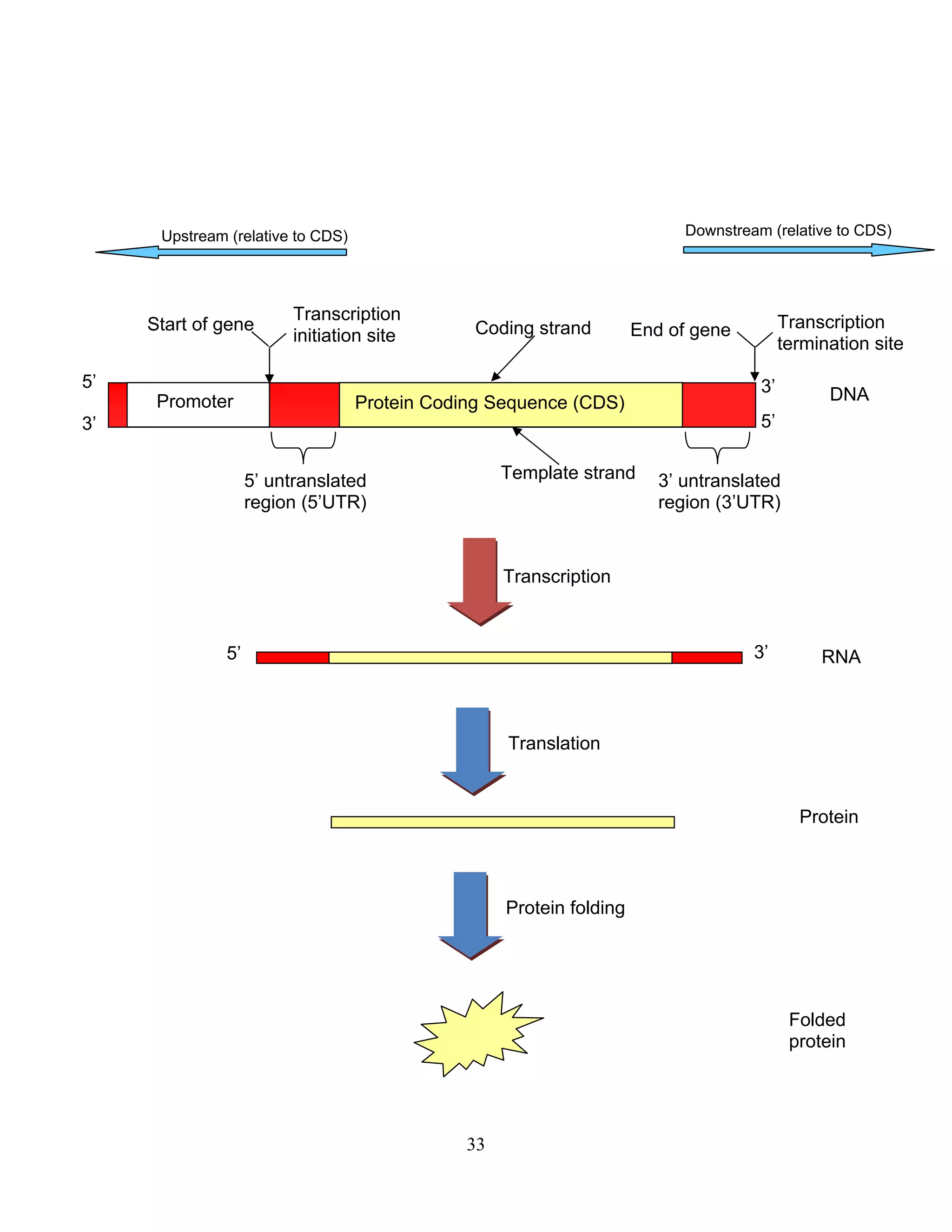
were removed to optimize alignment. Figure adapted from Baxis, Bioinformatics, 1999.
The two sequences share 45% overall identity across 237 amino acids.
47
The trypsins shown in Figure 3.2 are likely to be orthologs since they perform the same
function in two different species. The next example shows a sequence alignment
between two proteins that have different functions. They came from the same ancestor
gene but, likely through a gene duplication event, they diverged in function. One protein
is His4 and the other is His6. They perform different functions in the biosynthesis of
histidine. Both are from the bacteria strain Thermotoga maritima. Figure 3.3 shows a
sequence alignment of these two proteins. These proteins have retained some identical
amino acids due to the fact that they were derived from the same ancestor gene.
However, their functions have diverged. This is analogous to a railroad car that may
have been turned into a restaurant. The railroad car and the restaurant do not share the
same function but they retain the same shape.
HIS4_THEMA 1 ML---VVPAIDLFRGKVARMIKGRKENTIFYEKDPVELVEKLIEEGFTLI 47
|| ::..:|: |..|::||.....:....|||||.:...|.|...:
HIS6_THEMA 1 MLAKRIIACLDV---KDGRVVKGTNFENLRDSGDPVELGKFYSEIGIDEL 47
HIS4_THEMA 48 HVVDLSNAIENSGENLPVLEKLSEFAEHIQI----GGGIRSLDYAEKLRK 93
..:|::.::|.....|.::||: ||.|.| ||||...:.|.:|..
HIS6_THEMA 48 VFLDITASVEKRKTMLELVEKV---AEQIDIPFTVGGGIHDFETASELIL 94
HIS4_THEMA 94 LGYRRQIVSSKVLEDPSFLKSLRE----------IDVEPV---FSLDTRG 130
.|..:..:::..:|:||.:..:.: ||.:.| |.:.|..
HIS6_THEMA 95 RGADKVSINTAAVENPSLITQIAQTFGSQAVVVAIDAKRVDGEFMVFTYS 144
HIS4_THEMA 131 GR----VAFKGWLAEEEIDPVSLLKRLKEYGLEEIVHTEIEKDGTLQEHD 176
|: :..:.|:.|.| || |..||:.|.|::|||...:|
HIS6_THEMA 145 GKKNTGILLRDWVVEVE-------KR----GAGEILLTSIDRDGTKSGYD 183
HIS4_THEMA 177 FSLTKKIAIEAEVKVLAAGGISSENSLKTAQKVHTETNGLLKGVIVGRA- 225
..:.:.:.....:.::|:|| |.|:.......|.|.....|
HIS6_THEMA 184 TEMIRFVRPLTTLPIIASGG---------AGKMEHFLEAFLAGADAALAA 224
HIS4_THEMA 226 ----FLEGILTVEVMKRYAR 241
|.| :.|..:|.|.:
HIS6_THEMA 225 SVFHFRE--IDVRELKEYLKKHGVNVRLEGL 253
Figure 3.3 Two enzymes from the histidine biochemical pathway perform different
functions but retain significant sequence identity. His4 Swiss Prot accession number is
Q9X0C7 and the His6 Swiss Prot accession number is Q9X0C6. The overall identity is
66/253 * 100 or 26% identity. It is likely that the genes coding these enzymes are
paralogs.
The modular nature of proteins.
The sequences in Figures 3.2 and 3.3 were aligned from one end of their protein to the
other. Alignment over the entire length of the proteins is called global alignment and is
very effective for proteins that retained their entire sequence through evolution.
However, many aligned proteins will show only small segments that are conserved. For
these alignments it is best to consider only small regions of similarity. The best programs
for this type of alignment are called local alignment programs. The rationale for local
alignment stems from the idea that proteins from eukaryotes contain segments that
48
provide a specific function. These segments can be repeated in a single protein or can be
found in different proteins that may perform similar functions. Thus, in fact, proteins are
modular—one part of the protein can be removed and placed onto a second protein. The
second protein would then have an additional function. In this section, we will explore
the reasons for protein modularity.
Recall that genes from bacteria and eukaryotes differ in one important way. Genes from
bacteria contain all of the protein coding sequences in one segment of DNA. On the
other hand, genes from eukaryotes typically contain the protein coding sequences in more
than one separate segments of DNA. These separate segments are called exons. Proteins
from eukaryotic cells are usually derived from more than one exon. Exons are interesting
because there is a phenomenon called exon shuffling. Exon shuffling is where an exon
from one gene is inserted into another gene. By natural selection, the inserted exon
sequence may change and diverge from the original exon sequence. Sometimes exons
are duplicated within the same gene. If the two exons sequences mutate and evolve, they
may find themselves performing different functions. Exon shuffling can be intergenic or
intragenic. Intergenic shuffling means that the exon from one gene inserts itself into a
second gene. Intragenic shuffling means that the exon duplicates, but both remain in the
same gene.
Exon shuffling through transposons.
For illustrative purposes let’s explore one potential mechanism of exon shuffling. We
must say “potential” because no one has actually witnessed an exon shuffling event. This
mechanism involves transposons, which are pieces of DNA that can move from one
location to another in the genome. In fact, the majority of the DNA in the human genome
consists of transposons that do not code for proteins. Transposons can move by one of
two mechanisms: direct transfer or indirect transfer. Direct transfer occurs when one
piece of DNA is cut out of one part of the genome and pasted into another part of the
genome. For indirect transfer, a copy of a segment of the genome is made and inserted
into another section of the genome. Exon shuffling is mediated by this indirect transfer.
As shown in Figure 3.4, indirect transfer starts by inserting a transposable element, called
a Long Interspersed Nuclear Element (LINE element), into the intron of a gene. The
LINE element is transcribed into RNA. The RNA is reverse transcribed into cDNA and
the cDNA is then inserted into another part of the genome. These LINE elements belong
to a class of elements called retrotransposons. How can these retrotransposons shuffle
exons? They can shuffle exons by initially inserting themselves into intron DNA located
upstream of a functioning exon. LINE elements have their own transcription promoter.
When the LINE element is transcribed both the element and the exon are transcribed into
one long RNA. The RNA is reverse transcribed into cDNA by a reverse transcriptase and
the cDNA is inserted into a second gene. The recipient gene now has an extra exon that
is identical to the exon from the first gene. The extra exon has shuffled.
Since exons code for protein and exons can shuffle, exon shuffling may be the cause of
modular proteins. They are modular because segments of proteins are similar to
segments of other proteins. These sections are called motifs if they contain less than 40
49
amino acids. They are called domains in they contain more than 40 amino acids. A
motif or a domain can have an independent function that works without the rest of the
protein. Let’s take the example of the p53 tumor suppressor. The protein can be
separated into three independent domains. The entire protein has 393 amino acids and
the first 42 amino acids are required for activating transcription. This domain, called the
transactivation domain, interacts with transcription machinery associated with RNA
polymerase II so that RNA polymerase II is more likely to transcribe genes. Another
domain of p53 stretches from amino acid 100 to 300. This domain is called the DNA
binding domain. It is responsible for recognizing a set of 20 base pairs on the DNA and
binds to DNA only when those 20 base pairs are present. The third domain encompasses
amino acids 307-355. It is called the oligomerization domain. It is responsible for
creating the quaternary structure of p53. Like hemoglobin, p53 is tetramer. Four
identical p53 polypeptides bind to each other through the oligomerization domain. As a
tetramer, p53 is more efficient at binding to DNA than as a monomer. Because p53
functions can be separated into segments it is a modular protein. Thus, one domain of
p53 may be very similar to a domain of another protein but its other domains may not be
as similar. To be able to detect similarities between proteins, a prudent approach is
attempt to detect small regions of similarity rather than similarity along an entire length
of the protein. It is for this reason, that local sequence alignment programs were
developed. The most popular local alignment program is BLAST which stands for Basic
Local Alignment Sequence Tool.
50
Figure 3.4. Exon shuffling between genes can be mediated by transposable elements.
The LINE1 (L1) sequence family contains members that actively transpose in the human
genome. L1 elements have weak poly(A) signals and so transcription can continue past
such a signal until another nearby poly(A) signal is reached, as in the case of gene A at
top. The resulting RNA copy can contain a transcript not just of L1 sequences but also of
a downstream exon (in this case E3). The L1 reverse transcriptase complex can then act
on the extended poly (A) sequence to produce a cDNA copy that contains both L1 and E3
sequences. Subsequent transposition into a new chromosomal location may lead to
insertion of exon 3 into a different gene (gene B). LINE is long interspersed nuclear
element. See Moran et al. (1999).
51
52
Exercises
1. Obtain the human p63 protein sequence and the human p53 protein sequence. Use
Clustal W to align the two proteins. Which amino acid sequences within p53 are
conserved in p63? A second paralog of p53 is p73. Which amino acid sequences within
p53 are conserved in p63? Is there a particular domain of p53 that is retained in p63 and
p73?
References
http://www.library.csi.cuny.edu/~davis/Bio_327/lectures/Post_Tx_Processes/Exon_evol.
html
Moran, J.V., DeBerardinis, R.J. and Kazazian, H.H.Jr. (1999) Exon Shuffling by L1
Retrotransposition, Science 283, 1530-1534.
Altschul, S.F., Gish, W., Miller, W., Myers, E.W. and Lipman, D.J. (1990) Basic local
alignment search tool. J. Mol. Biol. 215, 403-410.
Baxenavis, A.D. and Ouellete, B.F.F. (2004) Bioinformatics: A practical guide to the
analysis of genes and proteins, 3rd
Ed., Wiley, NY.
Yang, A., Kaghad, M., Wang, Y., Gillett, E., Fleming, M.D., Dotsch, V., Andrews, N.C.,
Caput, D. and McKeon, F. (1998). p63, a p53 homolog at 3q27-29, encodes multiple
products with transactivating, death-inducing, and dominant-negative activities, Mol Cell
2, 305-316.
Yang, A., Kaghad, M., Caput, D. and McKeon, F. (2002). On the shoulders of giants:
p63, p73 and the rise of p53, Trends Genet 18, 90-95.
Chapter 4--Scoring Matrices
Often the best way to determine if two sequences are homologs is by the identity score. One
may aligned two sequences by eye and compute an identity score by considering the value (1 for
match and 0 for mismatch) for the aligned amino acids. If the identity score is high it is likely
that the two sequences are homologs. To create an identity scoring matrix values for pairs of
amino acids are placed into a 20 x 20 matrix. In the matrix, each column (j) is an amino acid and
each row (i) is an amino acid. There are 400 cells total. The cell that contains the values in the
scoring matrix is referred to as Mij. For each amino acid pair in the aligned sequences the
scoring matrix is consulted and the value in the corresponding cell is retrieved. The final score is
the sum of all values for the aligned amino acids. The percent identity is the final score divided
by the number of amino acids in the shortest sequence.
An identity scoring matrix works well for sequences from homologs that are obviously similar.
But what about sequences from homologs that evolved in such a way that there is very little
shared identity? Where, in fact, it is difficult to align the two sequences by eye? For such cases,
it is better to rely on a similarity score to accurately assess whether the two sequences are
homologs. The sequence comparison programs such as Needleman-Wunsch, BLAST, and
Smith-Waterman rely on similarity scoring matrices to optimally align sequences. Similarity
scores quantify how alike two amino acids are. For example, by comparing their side chains it is
easy to conclude that Asp and Glu are similar and Leu and Ile are similar. The question is how
to place a quantitative value on similarity. Producing a similarity scoring matrix requires a
rational scoring system based on science. One approach is to develop the scoring matrix on
natural selection.
Through natural selection, nature determines which amino acid substitutions are acceptable and
which amino acids are not acceptable in the organism. If the protein sequence with an amino
acid change survives and adds a positive function to the organism, then the mutation is
acceptable. Two popular scoring matrices utilize the natural selection approach but the matrices
differ in how they were derived. One is called the PAM scoring matrix and the other is the
BLOSUM scoring matrix. We will discuss how the PAM scoring matrix was created and then
briefly review the BLOSUM scoring matrix.
The accepted point mutation approach.
PAM is an acronym for point-accepted mutation but it is more accurate to describe this system as
an “accepted point mutation” scoring system. Accepted point mutation means that in sequences
that are very similar, say in a human globin and in a chimpanzee globin, the amino acid
differences at equivalent positions in the sequences has been accepted. The PAM scoring system
requires that we consider an evolutionary model that is based on the Markov chain theory of
Andrey Markov, a famous Russian mathematician who lived from 1856-1922. Three aspects of
the Markov chain theory are used: 1) neighbor independence; 2) position independence; and 3)
history independence. Neighbor independence means that one assumes that each amino acid
(actually the codon that codes for the amino acid) mutates randomly and independently from
amino acids nearby. Position independence assumes that the probability of mutating amino acid
j (Aj) to amino acid i (Ai) depends only on Aj and Ai. For example a mutation from C to S in
53
one part of the sequence has the same probability of occurrence as mutation from C to S in
another part of the sequence. Finally, historical independence means that mutation from one
amino acid to another only depends on the present state and not past states. For example, a series
of mutations may occur where C is mutated to S and then S is mutated to T. The probability of S
to T mutation does not depend on the fact that S was previously a C.
Development of the matrix of accepted point mutations.
PAM scoring matrices were developed by Margaret Dayhoff and her colleagues in 1978 (ref 1)
by comparing amino acid changes in closely related proteins and their inferred ancestor
sequences. Altogether Dayhoff recorded 1,572 changes. The first step to creating the PAM
scoring matrix is the development of the matrix of accepted point mutations. To show how the
matrix of accepted point mutations was created we will start with a simple example. Figure 4.1
shows a simplified phylogenetic tree that compares four short sequences. In the bottom line are
4 observed protein sequences from different species. At the two nodes above these sequences
are ancestral protein sequences that were inferred from the observed sequences. Amino acid
changes are noted in the figure. Changes used for the matrix of accepted point mutations were
counted between the known protein and the inferred ancestral sequence. On the left branch
amino acid A changes to D and on the right branch A changes to C.
In Figure 4.1b is a matrix of accepted point mutations based on the phylogenetic tree. In the
phylogenetic tree one compares the ancestral proteins to the observed proteins. Let’s concentrate
on the mutations affecting amino acid A. In the matrix, point mutations are presented as 1s in
positions MCA, MDA, MAC and MAD. The matrix shows the accepted point mutations compiled
for changes between related sequences. The matrix also shows the accepted point muations
compiled for changes between ancestral sequences.
However, Figure 4.1 is only a simplified example. In the matrix of accepted point mutations that
Dayhoff created, the numbers of point mutations from closely related sequences in 71
evolutionary trees were placed in one matrix. Only observed sequences that were less than 15%
different from one another were used. Observed sequences are those sequences derived from
living organisms. No more than 15 amino acid changes per 100 amino acids were used to
construct the matrix. The differences between observed sequences and inferred ancestral
sequences were even less than 15%. Dayhoff used very similar sequences because she could
infer the ancestral sequences easily. She did not want to create inaccurate ancestral sequences.
Figure 4.2 shows the numbers of accepted point mutations that Dayhoff and her colleagues
compiled. However, the numbers in Figure 4.2 were multiplied by 10 so that no fractional
numbers are displayed. The numbers in the cells are multiplied by 10 so that the tenth’s place is
now shifted to the one’s place. How can a fractional number be obtained in the first place? Well
when the ancestral sequences are ambiguous that Dayhoff allowed for more than one amino acid
to located at a position. When there is ambiguity, the change from the ancestral sequence to the
living sequence was counted as a fractional change. For example, if there were five possible
amino acids at a single position in the ancestral gene then each of the five amino acids would
contribute 0.2 to the original amino acid.
54
One of the drawbacks to Dayhoff’s approach is that some amino acid changes were never
observed. Of the 190 amino acid changes that were possible, 35 changes were never observed.
Dayhoff was forced to put zeros for these changes. An example on a change that was never
observed is Try (W) to Ala (A). Amino acids that changed rarely were Trp and Cys. Trp has a
unique side chain. The side chain of Cys is very reactive and is often used to maintain tertiary
and quaternary structure. For these reasons, one can imagine that changing Trp or Cys to any
other amino acid causes irreparable harm to the organism. Therefore, the organism dies rather
accept these mutations.
55
Replacement amino acid
Original amino acid
Figure 4.1 Building a matrix of accepted point mutations. A. Simplified phylogenetic tree with
four observed proteins shown on the bottom. The inferred ancestor sequences are shown at the
nodes and the amino acid exchanges are indicated. B. Matrix of accepted point mutations derived
from A. Adapted from Dayhoff et al., 1978.
56
A  ‐‐‐‐                                       
R  30  ‐‐‐‐                                     
N  109  17  ‐‐‐‐                                   
D  154  0  532  ‐‐‐‐                                 
C  33  10  0  0  ‐‐‐‐                               
Q  93  120  50  76  0  ‐‐‐‐                             
E  266  0  94  831  0  422 ‐‐‐‐                           
G  579  10  156  162  10  30 112 ‐‐‐‐                         
H  21  103  226  43  10  243 23 10 ‐‐‐‐                       
I  66  20  36  13  17  8 35 0 3 ‐‐‐‐                     
L  95  17  37  0  0  75 15 17 40 253 ‐‐‐‐                   
K  57  477  322  85  0  147 104 50 23 43 39 ‐‐‐‐                 
M  29  17  0  0  0  20 7 7 0 57 207 90 ‐‐‐‐               
F  20  7  7  0  0  0 0 17 20 90 167 0 17  ‐‐‐‐             
P  345  67  27  10  10  93 40 49 50 7 43 43 4  7 ‐‐‐‐           
S  772  137  432  98  117  47 86 450 26 20 32 168 20  40 269 ‐‐‐‐         
T  590  20  169  57  10  37 31 50 14 129 52 200 28  10 73 696 ‐‐‐‐       
W  0  27  3  0  0  0 0 0 3 0 13 0 0  10 0 17 0 ‐‐‐‐     
Y  20  3  36  0  30  0 10 0 40 13 23 10 0  260 0 22 23 6 ‐‐‐‐   
V  365  20  13  17  33  27 37 97 30 661 303 17 77  10 50 43 186 0 17 ‐‐‐‐ 
  A  R  N  D  C  Q E G H I L K M  F P S T W Y V
Figure 4.2 Numbers of accepted point mutations (multiplied by 10). A total of 1572 exchanges are shown. Positions with red dashes
are Mjj values. Modified from Dayhoff, 1978.
57
Relative mutability calculations
The matrix of accepted point mutations was one step in the development of the PAM scoring
matrix. Another step was to consider the probability that each amino acid will change in a given
small evolutionary interval. This change is called the relative mutability. The relative mutability
is calculated by tallying the number of changes an amino acid undergoes and dividing that
number by the frequency of the occurrence of the amino acid. Figure 4.3 illustrates how relative
mutability is calculated in a hypothetical case. Here B has a highest relative mutability and D
has the lowest.
Aligned sequences A D A
A D B
Amino acids A B D
Changes 1 1 0
Frequency of occurrences 3 1 2
Relative mutability 0.33 1 0
Figure 4.3 Simplified example to show how relative mutability is calculated. Need permission to
reproduce.
Since B occurs in position 3 one sequence and is replaced in the sequence relative mutability,
changes divided by occurrences, is 1 divided by 1. The relative mutability is 1.
Development of the Mutation Probability Matrix.
The next matrix that Dayhoff created is called the Mutation Probability Matrix (MPM). Here,
the probability of amino acid replacements are calculated over an evolutionary distance of 1
change for every 100 amino acids. There are two calculations required for the MPM both of
which we will carefully go over. One calculation is for the non-diagonal elements of the MPM
and the other is for the diagonal elements of the Matrix. The non-diagonal elements are all the
elements below the diagonal line elements shown in Figure 4.2. The diagonal elements are
shown as cells with red dashes. Remember Mij is the value for a particular cell in the matrix
where amino acid i replaces amino acid j. The non-diagonal elements have the values:
Mij = λmjAij/(ΣAij)
where
Aij is an element of the accepted point mutation matrix (see Fig. 4.2)
λ is the proportionality constant (to be discussed below)
mj is the relative mutability of the amino acids on the bottom row
58
Here is the second equation. This equation applies when the original amino acid and the
replacement amino acid are the same. The diagonal elements (all in cells with the location Mjj)
have the value:
Mjj = 1-λmj
The MPM is presented in Figure 4.4. Calculated Mij and Mjj values were multiplied by 10,000
in order to make the MPM easier to read. For each column, the sum of all elements is 10,000.
The probability of observing a change in a site containing alanine (the sum of all the elements
except Mjj) is proportional to the relative mutability of amino acid Mjj. The proportionality
constant λ was chosen so that the average mutation away from Mjj for all Mjjs is 1%. Let’s see
if that is true. If we were to add all of the Mjj’s and divide by 20, the calculated value is 9902.
If we divide 9902 by 10,000 we get 0.9902 or 99.02%. That means that the average mutation
away from Mjj is 100.00%- 99.02% or 0.98%. This is very close to 1%. Thus, there is an
average of approximately 1 mutation from the Mjj in every column of the MPM.
Figure 4.4. Mutational Probability Matrix (partial). This only shows 5 of the 20 amino acids in
the MPM. Numbers were multiplied by 10,000 to make it easier to read. The numbers for each
column adds up to 10,000. In the top row there are the replacement amino acids and on the left
column are the original amino acids. Mjj values shown are 9867, 9913, 9822, 9859 and 9973.
Determination of the normalized frequencies of amino acids.
We now introduce another term, fi, the normalized frequency of an amino acid, i, from the
accepted point mutation data. If all amino acids were represented equally in proteins fi would be
0.05 and the sum of all the normalized frequencies would be 20 x 0.05 which equals 1. But in
nature not all amino acids are represented equally in proteins. The amino acids Trp and Tyr
occurs infrequently and the amino acids Ser and Ala are common. Table 4.1 shows the
normalized frequencies of amino acids that were used.
59
Table 4.1 Normalized frequencies of amino acids (from Dayhoff’s data)1
Amino acid Normalized
Frequency
Amino acid Normalized
Frequency
G 0.089 R 0.041
A 0.087 N 0.040
L 0.085 F 0.040
K 0.081 Q 0.038
S 0.070 I 0.037
V 0.065 H 0.034
T 0.058 C 0.033
P 0.051 Y 0.030
E 0.050 M 0.015
D 0.047 W 0.010
1
From reference 1.
Gly was the most abundant in the data set that Dayhoff used and Trp was the least abundant. If
one were to sum up the fi’s the sum would be 1. To account for percent of amino acids that
differed in the Mutation Probability Matrix we need to perform a calculation. We need to
determine the number of amino acids that remain unchanged in a group of 100 amino acids.
That would be described by the next equation:
100 x ΣfiMii
Where fi = normalized frequency of amino acid i
Where Mii = Mjj
This value totals 99. Thus there is an average of 1 change for every 100 amino acids when one
uses the MPM presented in Figure 4.4. This is how this matrix got the name PAM1 Mutational
Probability Matrix (PAM1 MPM). The 1 change for every 100 amino acids could be called the
observed percent difference between two sequences in this Mutational Probability Matrix.
Conversion of the PAM1 Mutational Probability Matrix to the PAM1 Scoring Matrix.
The PAM1 MPM could be used as a scoring matrix for amino acid similarities but it does not
take into consideration the possibility that two amino acids could be aligned by chance. Because
Gly is much more abundant than Trp, the chance of Gly being the replacement amino acid is
much higher than Trp for any given position in the protein sequence. So we must take into
consideration the normalized frequency fi (from Table 4.1). Another problem with the PAM1
MPM is that the Mii values are much larger than the Mij values. It is reasonable then to take the
log of this number. The log will reduce the value discrepancy between Mii’s and Mij’s.
Dayhoff converted the PAM1 MPM into a PAM1 Log-odds Scoring Matrix. Here is the
equation:
Sij=10log10(Mij/fi) equation 4.1
60
Where Sij is the log-odds score for amino i replacing amino acid j. For a PAM1 scoring
matrix let’s take Gly replacing Ala as an example. From Figure 4.2 we obtain a value of 0.0021
for Mij. The fi of Gly is 0.089 (from Table 4.1). Thus, the Sij for this replacement is:
Sij=10log10(0.0021/0.089) = -16
A negative score shows very little similarity between two amino acids. Actually, it means that
the pair would be expected to occur 10-1.6
(i.e. 25/1000) as frequently in homologous sequences
as random chance would predict. In the PAM1 Scoring Matrix, negative values means that the
pair is expected to occur less frequently than random chance, zero means that the pair is expected
to occur the same as random chance, and positive means that the pair is expected to occur more
frequently than random chance. If one were to continue calculate the Sij’s of all of the values in
the PAM1 Mutation Probability Matrix one would find that all amino acid replacements would
give negative values. When amino acids are the same (i.e. where all of the Mjj values are high)
the Sij values are positive. The PAM1 Scoring Matrix is not much different than the identity
matrix discussed earlier in this chapter.
Conversion of the PAM1 Mutational Probability Matrix to other PAM scoring matrices.
The PAM1 Scoring Matrix is not practical for comparing sequences that are evolutionarily
distant. However, the PAM1 MPM can be converted to other Mutational Probability Matrices
where the observed percent differences in amino acids are greater. These Matrices can then be
converted to PAM scoring matrices and used to score sequences that have greater differences in
amino acids. This was a stroke of genius. Mathematically, when matrices are multiplied by
themselves the values on the diagonals (Mjj’s) become smaller and the Mij’s become larger.
Multiplication of the PAM1 Mutation Probability Matrix by itself gives an average of 2 amino
acid changes for every 100 amino acids in the protein, or 2%. One can continue to multiply the
PAM1 Mutation Probability Matrix by itself tens or hundreds of times. Each multiplication
results in a Probability Matrix in which the observed percent differences increases. After the
multiplication one can calculate the observed percent difference in the amino acids. For PAM1 it
is 1%, for PAM2 (where PAM2 = (PAM1)2
) it is 2%, and for PAM5 it is 5%. After PAM5 the
exponent does not equate to the observed percent differences. Table 4.1 shows a comparison
between percent amino acid differences and the exponent.
61
Table 4.2 Correspondence between Observed Percent Amino acid differences and PAMs
PAM Mutational Probability Matrices1
Observed percent amino acid differences2
1 1
5 5
11 10
17 15
30 25
56 40
80 50
112 60
159 70
246 80
1
Mutation Probability Matrices generated by the equation (PAM1 MPM)n
where n is the number
listed in the first column.
2
Observed percent amino acid differences were calculated by the following: 100(1 – ΣfiMii)
where fi is the normalized frequency of amino acid i and Mii is the mutational probability of
amino acid i not being replaced by another amino acid.
All of the Probability Matrices in Table 4.2 can be converted to log-odds matrices through the
equation 4.1. These are called PAM scoring matrices. For the scoring matrices, values from the
diagonal and Mij values below the diagonal are used in equation 4.1. A common PAM scoring
matrix used when determining whether two sequences are homologs is the PAM250 scoring
matrix. This matrix is shown in Figure 4.5.
Practical Uses for PAM Scoring Matrices
PAM scoring matrices are useful when comparing two sequences to determine if they are
homologous. One simply lines up two sequences and adds the scores at each position. For
example, when one compares AFRRTGN with AFLLTGN one can use the PAM250 scoring
matrix to come up with a similarity score of 15. The percent similarity is the number of pairs
with a positive score divided by the total number of pairs multiplied by 100. In our example, that
would be 5 divided by 7 multiplied by 100, 71%. One should attempt to match the scoring
matrix with the expected divergence of amino acids in the sequences searched. Thus, for
comparing chimpanzee proteins with human proteins one might use PAM5 because the
divergence between these organisms is about 5%. Usually, however, the percent divergence is
not known. When the percent divergence is not known it is useful to realize that it is difficult to
conclude if two sequences are homologous if the divergence is more than 80%. If one is
comparing two sequences that are extremely divergent the PAM250 scoring matrix is most
useful. Typically, PAM250 is the practical upper limit for determining whether two sequences
are homologous.
62
The PAM250 scoring matrix. The neutral score is zero. A score of -10 means that the
replacement would occur only 1/10th
as frequently in the two sequences as random chance would
predict. A score of +2 means that the replacement would occur 1.6 as frequently as random
chance would predict.
The BLOSUM Scoring Matrix
The PAM scoring matrices constituted the first system based on science to quantify similarity of
sequences. A newer scoring matrix using the same scientific basis as PAM is called the Gonnet
scoring matrices (reference 3). Gonnet used many more phylogenetic trees than Dayhoff did
which heavily influenced the normalized frequency values shown in Table 4.1. A different
scoring matrix created by the Henikoffs uses sequences aligned by computers and humans
(reference 4). It is called the BLOSUM matrix.
BLOSUM is an acronym for BLOCKs Substitution Matrix. BLOCKs are sequence alignments
which uses sequences from the Prosite database. The Prosite database contains sequences of
proteins that make up motifs found in proteins. Remember motifs are functional or structural
modules of proteins. Motifs perform distinct functions, such as binding to DNA or ATP. The
motifs are found in different proteins. The sequences that constitute the motifs are similar.
63
Henikoff added more protein sequences to these sequence alignments in an automated fashion.
In total, 2106 BLOCKs were created. An example of a BLOCK is shown in Figure 4.5
ID P53SUPPRESSR; BLOCK
AC PR00386F; distance from previous block=(35,50)
DE P53 tumour supressor signature
BL adapted; width=25; seqs=36; 99.5%=1314; strength=1403
O36006 ( 324) EYFTLKIRGRARFEMFQELNEALEL 27
P53_RABIT|Q95330 ( 324) EYFILKIRGRERFEMFRELNEALEL 29
P53_CERAE|P13481 ( 326) EYFTLQIRGRERFEMFRELNEALEL 17
P53_MACFA|P56423 ( 326) EYFTLQIRGRERFEMFRELNEALEL 17
P53_MACMU|P56424 ( 326) EYFTLQIRGRERFEMFRELNEALEL 17
P53_CANFA|Q29537 ( 314) EYFTLQIRGRERYEMFRNLNEALEL 28
P53_FELCA|P41685 ( 319) EYFTLQIRGRERFEMFRELNEALEL 17
P53_HUMAN|P04637 ( 326) EYFTLQIRGRERFEMFRELNEALEL 17
Q16848 ( 326) EYFTLQIRGRERFEMFRELNEALEL 17
P53_RAT|P10361 ( 324) EYFTLKIRGRERFEMFRELNEALEL 18
. . . .
. . . .
. . . .
. . . .
. . . .
Figure 4.5. BLOCK from the p53 tumor suppressor protein. ID is from PRINTS gc line, AC is from
PRINTS gx line, DE is from PRINTS gt line, BL is BLOCK information.
Each PRINTS motif is represented by one block. For each segment, the
sequence ID is followed by the position of the first residue in the
segment. Sequence weights are shown to the right of each segment. The
higher the weight (maximum 100) the more dissimilar the segment is from
other segments in the block. These weights were obtained using the
position-based method of S Henikoff & JG Henikoff (1994), JMB 243:574-578.
BLOCK was obtained from http://blocks.fhcrc.org/blocks-bin/getblock.pl?PR00386#PR00386A
There are different BLOSUM matrices which are numbered (for example BLOSUM10,
BLOSUM20, etc.). The number after the word BLOSUM refers to the percent amino acid
identity of the sequences from the BLOCKs used to create the matrix. The goal of Heinkoff was
to create matrices from amino acid sequences that were already divergent but known to perform
similar functions or structures. Let’s take a specific example. To create the BLOSUM 62 matrix
sequences were eliminated that were identical in more than 62% of their amino acid sequences in
the BLOCKs. Sequences were either removed from the BLOCK or replaced by a single
representative sequence.
With the modified BLOCKs the frequency of substitution for every amino acid in a column was
calculated. The amino acid frequency of each amino acid in all the sequences was also taken
into account (similar to normalized frequencies that Dayhoff used). From these frequencies, a
log-odds score was calculated and the results was a series of scoring matrices called the
BLOSUM scoring matrix series. One improvement over the PAM series is that the BLOSUM
scoring matrices (developed 13 years later after the PAM series) were derived from many more
sequence alignments than the PAM series.
64
65
References
1) Dayhoff, M.O., Schwartz, R.M., and Orcutt, B.C. A model of evolutionary change in
proteins. in Atlas of Protein Sequence and Structure. National Biomedical Research
Foundation, Washington, DC, Vol 5 Suppl. 3, pp. 345-352, 1978.
2) Pevsner, J. Bioinformatics and functional genomics. John Wiley and Sons, Hoboken,
2003.
3) http://www.inf.ethz.ch/personal/gonnet/papers/Distance/Distance.html
4) Henikoff and Henikoff (1992; PNAS 89:10915-10919).
Problems
1) What is the is the value for MW,W in the PAM250 Mutation Probability Matrix?
Chapter 5-Sequence Alignment
In this chapter we introduce the topic of sequence alignment. Sequence alignment is the process
by which two or more biological sequences are matched to show optimal similarity. We will
first discuss the sliding window concept. The sliding window can be used to accumulate
information about the properties of amino acids in a window of a specific length. The data
collected in the window is summed and plotted on a graph. The window then shifts to the right
and the process is repeated until the window reaches the end of the sequence to be studied. The
sliding window can be applied to a nucleotide or amino acid sequence. We will move from the
sliding window to the dot plot. The dot plot is an excellent visual technique for detecting
sequences that are homologous. We will discuss the Dotter Program. The Dotter Program uses a
scoring matrix, a sliding matrix, and a dot plot to denote amino acids that are similar between
two protein sequences. We will then delve into the nuts and bolts of sequence alignment
algorithms: the Needleman-Wunsch Global Alignment algorithm, the Smith-Waterman Global
Alignment algorithm and the Smith-Waterman Local Alignment algorithm. These alignment
algorithms provide one of the strongest foundations in bioinformatics.
Sliding Window
Some of the earliest bioinformatics computer programs employed the sliding window concept to
gather information. The Chou-Fasman program used rules obtained from protein structure data
to create a sliding window program that predicts protein secondary structure (1978). Kyte and
Doolittle used a sliding window program to predict membrane-spanning regions of
transmembrane proteins and amino acids located on the surfaces of proteins (1982). In
bioinformatics, the sliding window is defined as a segment that partitions information. The
information captured in the segment is quantified in some manner and then the window moves to
a new segment where it repeats the quantification. The window continues to move until all the
information has been analyzed. For example, say one wishes to determine the areas of a
nucleotide sequence that contain a high proportion of guanine (G) and cytosine (C). These GC-
rich areas have more hydrogen bonds than AT-rich areas. GC-rich areas in DNA strands are
relatively more difficult to break than strands containing AT-rich areas. Some GC rich areas in
genomes are modified by enzymes called methyltransferases that methylate cytosines. These
GC-rich areas, called GC islands in eukaryotes, are often found in promoters and their
methylation represses transcription. One can develop a simple sliding window program to easily
detect GC-rich areas in long stretches of DNA.
As a simple approach to determining GC-rich areas in long sequences a sliding window focuses
on a small part of the sequence. The percent GC within the window is calculated. That number
is plotted on a xy coordinate plane where x is the nucleotide sequence and y is the percent GC.
The window slides to the right one nucleotide and the process is repeated. The major difficulty
in extrapolating biologically useful information with sliding window programs is choosing the
size of the window to use. If one chooses a window too wide one may detect general trends in
the data set but miss important details. If one chooses a window that is too narrow detail is
obtained--but general trends may be missed. Let’s look at one sliding window program more
closely.
66
One famous sliding window program was used to analyze membrane-embedded proteins (Kyte
and Doolittle, 1982). The goal was to determine from sequence information the sections of the
protein imbedded in the membrane and the sections exposed to the cytoplasm or extracellular
milieu. The program could also be used to distinguish membrane proteins (with long stretches of
hydrophobic amino acids) from globular proteins (relatively short stretches of hydrophobic
amino acids). Program prediction of membrane-imbedded parts of the protein bacteriorhodopsin
together with biochemical analysis from previous studies helped Kyte and Doolittle predict the
bacteriorhodopsin structure. Later, when the structure of bacteriorhodopsin was solved, it was
found that their prediction was fairly accurate.
To create their sliding window program Kyte and Doolittle first created a hydropathy (sometimes
referred to as hydrophobicity) scale. The scale assigns the degrees to which amino acids are
hydrophobic (water hating). Table 1 shows the hydropathy scale. Two methods were used by
Kyte and Doolittle to create the scale. In the first method, amino acids in protein structures were
studied. If amino acid side chains were buried inside the proteins, the amino acids was
considered more hydrophobic. If side chains were exposed to solvent on the surface of the
proteins the amino acids were considered hydrophillic. For scale construction, Kyte and
Doolittle also used experimentally-determined free energies necessary for transferring amino
acids from the water phase to the vapor phase. This data, together with some intuition, was used
to create the hydropathy scale.
With the hydropathy scale in hand the program was created. A window length is chosen by the
user and an amino acid sequence is entered. The amino acid sequence is segmented by the
window and the hydropathy values from the scale are summed or averaged in the window. In the
plot, the first value is plotted above the amino acid located at the center of the window. The
window slides to the right, away from the amino terminus, and the exercise is repeated. Figure
5.1 shows a plot that predicts the hydrophobic regions of bacteriorhodopsin from its amino acid
sequence. In the plot are regions that are relatively more hydrophobic than others. Kyte and
Doolittle adjusted the window size so that it gave a plot with approximately 7 transmembrane
segments—consistent with experimental data. The window size they used was 7 amino acids.
Later, when the structure of bacteriorhodopsin was solved Kyte and Doolittle’s predictions of the
regions that transverse the membrane were largely borne out.
67
Table 1. Hydropathy values used for constructing the hydropathy plots of Kyte and Doolittle
(1982).
Amino Acid Hydrop. VALUE
A 1.8
C 2.5
D -3.5
E -3.5
F 2.8
G -0.4
H -3.2
I 4.5
K -3.9
L 3.8
M 1.9
N -3.5
P -1.6
Q -3.5
R -4.5
S -0.8
T -0.7
V 4.2
W -0.9
Y -1.3
5 7
Figure 5.1 Hydropathy plot. Kyte and Doolittle used a sliding window program (with a window
length of 7) to predict the membrane spanning regions of bacteriorhodopsin from its amino acid
1 2 3 4 6
68
sequence. J. Mol. Biol. 157:105-132 (1982). The seven known membrane-spanning regions were
placed on the plot by the authors of this manual to demonstrate how close the prediction matched
the known structure of the protein.
Dot plots
Dot plots are figures that show the portions of two sequences that are similar. With dot plots,
short sequences can be easily compared for identical amino acids. First one creates an m x n
matrix where m is the number of amino acids in the first sequence and n is the number of amino
acids in the second sequence. One places the first sequence above the top row and the second
sequence to the left of the first column. When the letters within the sequences match, an asterisk
is placed in the cell found at the intersection of the two letters. To simplify this exercise we will
use nucleotide sequences. In Figure 5.2a a dot plot of two short nucleotide sequences is shown.
The asterisks denoting identical nucleotides form a diagonal line that stretches from the upper
left corner to the lower right corner. The diagonal line of without breaks shows that the two
sequences are identical.
One challenge with dot plots is determining the background noise. A diagonal in a clear
background would give confidence that the two sequences are identical and that their alignment
is not random. However, Figure 5.2a shows that there are asterisks located in other locations in
the matrix. These stray asterisks constitute background noise. One can calculate the percent of
background noise as follows. The percent chance of a random match of two nucleotides is ¼ x
100 or 25% (where 4 is the number of nucleotides). This high percentage of background noise is
due to the fact that the window size is only 1. If the window size is increased to 3 the
background noise is reduced considerably (Figure 5.2b). Now we must have three cells that
match instead of one cell to make an asterisk assignment. The percent chance of random
background noise is ¼ x ¼ x ¼ x 100 or 1.56%.
*
*
*
*
*
*
*
*
**
*
*
A T G C C T A G
*
*
A
T
G
C
C
T
A
G
*
*
69
{
A T G C C T A G
A
T
G
C
C
T
A
G
*
*
*
*
*
*
The Dotter Program
The Dotter Program was first developed by Erik L.L. Sonnhammer and Richard Durbin
Gene 167:GC1-10 (1995). The Dotter Program incorporates concepts that we have learned up to
this point. It performs alignments between two sequences using dot plots (also known as dot
matrices). For amino acid sequences, similarity scores from either PAM or BLOSSUM scoring
matrices are used. Similarity scores are summed in a window specified by the user and a dot is
plotted in the matrix if the score is above a certain threshold. The higher the score, the darker the
dot. The user can control several parameters including the window size, the scoring matrix and
the cutoff score for registering a dot in the matrix.
Figure 5.3 shows a schematic diagram of two proteins with similar sequences. One protein is
tissue plasminogen activator. The other is coagulation factor XII. Both perform vital functions
in the blood. It is highly probable that they share the same ancestor protein. These two proteins
contain domains that are repeated within one protein or shared between the two proteins. F1 and
F2 are sequences commonly found in fibronectin, a protein that constitutes part of the
extracellular matrix. E is an epidermal growth factor domain. K is the Kringle domain. These
domains are located upstream of the catalytic domains of both proteins. The Dotter Program
creates a plot that shows the sequence similarities between the two proteins. Figure 5.3b shows
the dot plot derived from comparison of these two sequences.
On the x-axis is the Coagulation factor sequence and on the y-axis is the Tissue Plasminogen
Activator sequence. A careful examination of the dot plot shows several regions that are similar.
For example, the catalytic domains are very similar. The K domain of the Coagulation Factor is
70
similar to the two K domains within TPA. Figure 53b shows the dot plot output. Long lines
signify large areas of similarity. The darker the line, the higher the similarity. For instructional
purposes, the locations of the domains are also shown on the plot. Some domains are repeated.
For example, there are two K domains in TPA. Figure 5.3c shows the two K domains in TPA
are similar to the single K domain in Coagulation factor. Figure 5.3c also shows other domains
that share similarity between the two sequences.
71
72
Region of
similarity
Figure 5.3. Need legend.
73
The Needleman-Wunsch Global Alignment program.
The Needleman-Wunsch (N-W) Global Alignment program was developed to tackle the problem
of aligning two sequences (Needleman and Wunsch, 1970). The program finds the optimal
similarity between two sequences across their entire lengths. To achieve this alignment a scoring
scheme is required. For educational purposes we will use a simple scoring scheme. In this
scheme, a match will receive a score of 1, a mismatch will receive a score of 0, and a gap will
receive a score of 0. Let’s first attempt to align the hypothetical sequences
“ABCNJRQCLCRPM” (Sequence 1) and “AJCJNRCKCRBP” (Sequence 2) by eye. Figure 5.4
shows that there are two possible alignments—alignment A and alignment B. Both are equally
valid because both return a score of 8. We will demonstrate the algorithm employed by the N-M
program. The algorithm can be divided into three parts: initialization, matrix fill, and trace-back.
The algorithm that performs these functions is sometimes called dynamic programming.
Sequence 1 is placed above the top row of an m x n matrix and Sequence 2 is placed vertically,
parallel to the left column of the matrix. In the matrix, m denotes the number of columns and n
denotes the number of rows. The number of letters in Sequence 1 equals m and the number of
letters in Sequence 2 equals n.
Figure 5.4
Alignment A
Sequence 1: ABCNJ-RQCLCR-PM
Sequence 2: AJC-JNR-CKCRBP-
Score: 101010101011010
Total Score: 8
Alignment B
Sequence 1: ABC-NJRQCLCR-PM
Sequence 2: AJCJN-R-CKCRBP-
Score: 101010101011010
Total Score: 8
In the initialization step, ones are placed in cells where there is match between the amino acids in
the two sequences (Figure 5.5A). In the matrix fill step, scores are tabulated row by row starting
74
with the bottom row. Zeros are placed in the non-scored cells of the bottom row. At every
position where there is not a 1, a zero is placed. As shown in Figure 5.5B, in the second-to-the-
bottom row on the right, M x B will receive a zero because it is a mismatch. The next cell to the
left (P x B) will receive a score for the P x B added to the score of M x P. That would be 0 + 0.
From this cell proceeding to the left, the score of the amino acid match or mismatch is added to
the maximum score in the lowest row located in cells diagonally to the lower right in the row and
in the column. The cells located diagonally to the lower right in the row and column is called the
diagonal region. For example, in the second-to-the-bottom row, the mismatch score for R x B is
zero. The mismatch score is added to the highest score in diagonal region juxtaposed to R x B.
The highest score in the diagonal region is 1. Therefore, the total score in R x B is 0 + 1 which
equals 1. This scoring mechanism continues for each cell in the row. Notice that the B x B cell
receives a 2 due to the match score plus the 1 in the diagonal region.
In the third row-from-the-bottom, cells are scored in a mechanistically identical fashion as that
used in the row below it (Figure 5.5C). Let’s show a few examples. The R x R cell (nearest to
the right and bottom of the matrix) receives a total score of 2. How did it receive that score?
The match score is 1 and the maximum score in the diagonal region (shaded purple) is 1. The
maximum score in the diagonal region comes from the P x P score in the lowest row. Thus, the R
x R cell is scored as 1 + 1 = 2. The final matrix fill is shown in Figure 5.5D.
A B C N J R Q C L C R P M
A 1
J 1
C 1 1 1
J 1
N 1
R 1 1
C 1 1 1
K
C 1 1 1
R 1 1
B 1
P 1
Figure 5.5. A. Initialization. Scores for matches are placed in appropriate cells (i x j).
75
A B C N J R Q C L C R P M
A 1
J 1
C 1 1 1
J 1
N 1
R 1 1
C 1 1 1
K
C 1 1 1
R 1 1
B 1 2 1 1 1 1 1 1 1 1 1 0 0
P 0 0 0 0 0 0 0 0 0 0 0 1 0
Figure 5.5 B. Matrix fill of the bottom two rows. Empty cells in the bottom row are filled with
zeros. In the second to bottom row the score of the bottom row diagonally, is scanned for highest
score. This highest score is added to the i x j score in the cell of the second to the bottom row.
A B C N J R Q C L C R P M
A 1
J 1
C 1 1 1
J 1
N 1
R 1 1
C 1 1 1
K
C 1 1 1
R 2 1 1 1 1 2 1 1 1 1 2 0 0
B 1 2 1 1 1 1 1 1 1 1 1 0 0
P 0 0 0 0 0 0 0 0 0 0 0 1 0
Figure 5.5 C. Matrix fill of bottom three rows. There are three 2’s in the third to the last row.
Starting from the right, the R x R score is derived from the sum of the match score and the
highest score in the diagonal region (purple row and purple column). The next R x R score of 2 (
shown in read in the middle of the row) is derived from the sum of the match score and the
highest score in the diagonal region (the intersection of the row and column in the diagonal
region is marked by the green arrow). The A x R score of 2 (at the far left of the row) is derived
from the sum of a mismatch in A x R and the highest score in the diagonal region (the diagonal
region is denoted by the blue arrow).
76
A B C N J R Q C L C R P M
A 8 7 6 6 5 4 4 3 3 2 1 0 0
J 7 7 6 6 6 4 4 3 3 2 1 0 0
C 6 6 7 6 5 4 4 4 3 3 1 0 0
J 6 6 6 5 6 4 4 3 3 2 1 0 0
N 5 5 5 6 5 4 4 3 3 2 1 0 0
R 4 4 4 4 4 5 4 3 3 2 2 0 0
C 3 3 4 3 3 3 3 4 3 3 1 0 0
K 3 3 3 3 3 3 3 3 3 2 1 0 0
C 2 2 3 2 2 2 2 3 2 3 1 0 0
R 2 1 1 1 1 2 1 1 1 1 2 0 0
B 1 2 1 1 1 1 1 1 1 1 1 0 0
P 0 0 0 0 0 0 0 0 0 0 0 1 0
Figure 5D. Final matrix fill and trace-back of optimal path. The diagonal region juxtaposed to
the cell with highest score is shaded orange.
After the matrix is filled, the trace-back procedure is performed. This is shown in Figure 5D.
Beginning with the cell containing the highest score (8), the diagonal region is scanned for the
highest score. The highest score in the diagonal region is 7, located at J x B. An arrow is created
with the base at 8 pointing to 7. This process is repeated. The maximum score in the next
diagonal region is 7 located at C x C. An arrow is drawn starting at the 7 (from B x J) pointing
to the 7 located at C x C. The maximum score in the next diagonal region is 6, located at J x J
and N x N. Two arrows are drawn starting at C x C. One points to the 6 at J x J and the other
points to the 6 at N x N. The trace-back is repeated until the bottom row or the right column is
reached. Now we are ready to read the trace back and produce the alignment.
Alignments are produced by lining up amino acids in cells that have arrows pointing to them.
The trace-back path in Figure 5D bifurcates at C x C. That means we will have two alignments--
both with final scores of 8. If an arrow bypasses a column a gap is created in Sequence 1. If an
arrow bypasses a row a gap is created in Sequence 2. In Sequence 1 (horizontal sequence) amino
acid Q is bypassed. In the final alignments Q will not align with an amino acid from Sequence 2
and a gap is created opposite to Q. In Sequence 2 (vertical sequence) amino acid B is bypassed.
A gap will be created opposite to amino acid B. A revisit to Figure 5.4 shows two possible
alignments. Alignment A is derived from the bottom trace-back in Figure 5.5D. Alignment B is
derived from the top trace-back in Figure 5.5D. The score we obtained from both alignments is
8 (see Figure 5.4). The score is the same as that shown as the highest value in the m x n matrix
(see Figure 5.5D).
In the above example, a simplified scoring system was used for illustrative purposes. In practice,
scores are from a BLOSUM scoring matrix, PAM scoring matrix or some other scoring matrix is
used. Both scoring systems have gap penalties that vary depending on which scoring matrix is
used. Some programs allow the user to change the gap penalty from the default value.
Sometimes the gap penalty is divided into two. One is a gap opening penalty and the other is a
gap extension penalty. The first gap receives the gap opening penalty. If two successive gaps
are needed for optimal alignment, the second gap receives the gap extension penalty. Typically,
77
the gap opening penalty is higher than the gap extension penalty. The theory is that it would
require great evolutionary pressure to cause a one amino acid insertion or deletion. However,
once the “decision” has been made to create an insertion or deletion, the idea of adding more
amino acids to the insertion/deletion does not require more evolutionary pressure. Earlier in this
chapter we discussed scientific principles behind the derivation of the PAM and BLOSUM
scoring matrices. Generally there is less rigor in assigning values for gap opening and gap
extension penalties.
Aspects of the N-W Global Alignment system are used for multiple sequence alignment
programs. In multiple sequence alignment programs, many sequences are globally aligned
pairwise prior to compilation of the sequences. We will discuss multiple sequence alignment
programs in Chapter 6.
The Smith-Waterman Algorithm
The Smith-Waterman (S-W) algorithm can be used to find global or local alignments in
sequences (Smith and Waterman, 1981). Principles of the algorithm will be discussed here. We
will demonstrate how to use the S-W algorithm to perform a global alignment. This is useful
because we can compare the S-W algorithm to the N-W algorithm. Both algorithms give a high
score of 8 for sequences shown in Figure 5.4. Then we will use then use the S-W algorithm to
show how it can be used to detect local alignments.
Similar to the N-W algorithm, the S-W algorithm uses an initialization step, a matrix fill step,
and a trace-back step. When using the S-W algorithm let’s denote the number of letters in
sequence 1 as m and the number of letters in sequence 2 as n. A matrix is created with m + 1
columns and n + 1 rows. In the first step, zeros are placed in the m - 1 column and n - 1 row.
We define the location of a particular cell as minj. Next, a scoring system is created where Mi,j is
the maximum score in minj. The maximum score is always placed into each cell of the matrix.
The formal definition of Mi,j is:
Mi,,j = MAXIMUM [
Mi-1, j-1 + si,,j (match or mismatch value),
Mi, j-1 + w (gap in sequence #1),
Mi-1, j + w (gap in sequence #2)]
Where Mi-1, j-1 is the score in the cell diagonally juxtaposed to minj. The i-1, j-1 cell is up and to
the left of mi,nj.
Where si,j is the value for the match or mismatch in the minj.
Where Mi, j-1 is the score in the cell above minj.
Where w is the value for the gap penalty.
Where Mi-1, j is the score in the cell to the left of minj.
78
For our sequence alignment using the S-W algorithm, we will use the same scoring system we
used for the alignment example used with the N-W algorithm: a match is 1, a mismatch is 0, and
a gap is 0. It should be noted that the authors designed the S-W algorithm for local alignment
but we will first use the algorithm for global alignment. Then we will show how it can be used
for local alignment.
Figure 5.6A shows the first step in global alignment between and ABCNJRQCLCRPM” and
“AJCJNRCKCRBP using the S-W algorithm. In the first A x A cell, a 1 is given. This is due to
the Mi-1, j-1 + si,,j which is 0 + 1. Whenever the score in minj could be equally derived from Mi-1, j-
1, Mi, j-1 or Mi-1, j, it is always the Mi-1, j-1 value that is counted as the contributor to the score. We
will place a dotted circle over the arrow that that contributes to the score. The base of the arrow
denotes the direct predecessor cell.
A B C N J R Q C L C R P M
0 0 0 0 0 0 0 0 0 0 0 0 0 0
A 0 1
J 0
C 0
J 0
N 0
R 0
C 0
K 0
C 0
R 0
B 0
P 0
Figure 5.6B shows the scores for the second row and the second column and the direct
predecessors of these scores.
79
A B C N J R Q C L C R P M
0 0 0 0 0 0 0 0 0 0 0 0 0 0
A 0 1 1 1 1 1 1 1 1 1 1 1 1 1
J 0 1
C 0 1
J 0 1
N 0 1
R 0 1
C 0 1
K 0 1
C 0 1
R 0 1
B 0 1
P 0 1
Figure 5.6B Top two rows and left two columns filled using the S-W algorthim and the scoring
system described in the text.
A B C N J R Q C L C R P M
0 0 0 0 0 0 0 0 0 0 0 0 0 0
A 0 1 1 1 1 1 1 1 1 1 1 1 1 1
J 0 1 1 1 1 2 2 2 2 2 2 2 2 2
C 0 1 1 2 2 2 2 2 3 3 3 3 3 3
J 0 1 1 2 2 3 3 3 3 3 3 3 3 3
N 0 1 1 2 3 3 3 3 3 3 3 3 3 3
R 0 1 1 2 3 3 4 4 4 4 4 4 4 4
C 0 1 1 2 3 3 4 4 5 5 5 5 5 5
K 0 1 1 2 3 3 4 4 5 5 5 5 5 5
C 0 1 1 2 3 3 4 4 5 5 6 6 6 6
R 0 1 1 2 3 3 4 4 5 5 6 7 7 7
B 0 1 2 2 3 3 4 4 5 5 6 7 7 7
P 0 1 2 2 3 3 4 4 5 5 6 7 8 8
Figure 5.6 C. Here the remainder of the matrix is filled. Direct predecessors of the top three
rows and the left two columns are denoted by dotted circles.
After the matrix is filled the trace-back procedure ensues. We start with the score located in the
bottom right of the filled matrix. We end with the score located in the upper left of the filled
matrix. Then trace-back is conducted using the direct predecessors as guides. The trace-back is
shown in Figure 5.6D. The alignment is produced by locating the score in the bottom right of the
matrix. If the direct predecessor is a vertical arrow a gap is produced in sequence 1 (sequence
above top row). If the direct predecessor is a horizontal arrow then a gap is produced in
sequence 2 (sequence to the left of the first column). If the direct predecessor is a diagonal
arrow, a match (or mismatch) between the amino acids in sequence 1 and sequence 2 is
produced. Figure 5.6D shows the alignment between the two sequences. Using the S-W
alignment only one alignment is produced. The S-W derived alignment matches one of the two
alignments produced by the N-W method (See Figure 5.4). One might be concerned as to why
the S-W method only produces one of the two alignments. In practice, however, scores are
80
derived from BLOSUM matrices or PAM matrices and there is rarely a tie between two possible
alignments. We will now show how the S-W algorithm applies to a global sequence alignment
using the BLOSUM 62 scoring matrix.
A B C N J R Q C L C R P M
0 0 0 0 0 0 0 0 0 0 0 0 0 0
A 0 1 1 1 1 1 1 1 1 1 1 1 1 1
J 0 1 1 1 1 2 2 2 2 2 2 2 2 2
C 0 1 1 2 2 2 2 2 3 3 3 3 3 3
J 0 1 1 2 2 3 3 3 3 3 3 3 3 3
N 0 1 1 2 3 3 3 3 3 3 3 3 3 3
R 0 1 1 2 3 3 4 4 4 4 4 4 4 4
C 0 1 1 2 3 3 4 4 5 5 5 5 5 5
K 0 1 1 2 3 3 4 4 5 5 5 5 5 5
C 0 1 1 2 3 3 4 4 5 5 6 6 6 6
R 0 1 1 2 3 3 4 4 5 5 6 7 7 7
B 0 1 2 2 3 3 4 4 5 5 6 7 7 7
P 0 1 2 2 3 3 4 4 5 5 6 7 8 8
Sequence 1: ABCNJ-RQCLCR-PM
Sequence 2: AJC-JNR-CKCRBP-
Score : 8
Figure 5.6 D. Traceback from the lower right cell to the upper left cell produces an alignment of
the two sequences. The alignment score, with this simple scoring matrix is 8.
The BLOSUM 62 scoring matrix is shown in Figure 5.7. The asterisk gives the gap opening
penalty.
A B C D E F G H I K L M N P Q R S T V W X Y Z *
A 4 -2 0 -2 -1 -2 0 -2 -1 -1 -1 -1 -2 -1 -1 -1 1 0 0 -3 -1 -2 -1 -8
B -2 6 -3 6 2 -3 -1 -1 -3 -1 -4 -3 1 -1 0 -2 0 -1 -3 -4 -1 -3 2 -8
C 0 -3 9 -3 -4 -2 -3 -3 -1 -3 -1 -1 -3 -3 -3 -3 -1 -1 -1 -2 -1 -2 -4 -8
D -2 6 -3 6 2 -3 -1 -1 -3 -1 -4 -3 1 -1 0 -2 0 -1 -3 -4 -1 -3 2 -8
E -1 2 -4 2 5 -3 -2 0 -3 1 -3 -2 0 -1 2 0 0 -1 -2 -3 -1 -2 5 -8
F -2 -3 -2 -3 -3 6 -3 -1 0 -3 0 0 -3 -4 -3 -3 -2 -2 -1 1 -1 3 -3 -8
G 0 -1 -3 -1 -2 -3 6 -2 -4 -2 -4 -3 0 -2 -2 -2 0 -2 -3 -2 -1 -3 -2 -8
H -2 -1 -3 -1 0 -1 -2 8 -3 -1 -3 -2 1 -2 0 0 -1 -2 -3 -2 -1 2 0 -8
I -1 -3 -1 -3 -3 0 -4 -3 4 -3 2 1 -3 -3 -3 -3 -2 -1 3 -3 -1 -1 -3 -8
K -1 -1 -3 -1 1 -3 -2 -1 -3 5 -2 -1 0 -1 1 2 0 -1 -2 -3 -1 -2 1 -8
L -1 -4 -1 -4 -3 0 -4 -3 2 -2 4 2 -3 -3 -2 -2 -2 -1 1 -2 -1 -1 -3 -8
M -1 -3 -1 -3 -2 0 -3 -2 1 -1 2 5 -2 -2 0 -1 -1 -1 1 -1 -1 -1 -2 -8
N -2 1 -3 1 0 -3 0 1 -3 0 -3 -2 6 -2 0 0 1 0 -3 -4 -1 -2 0 -8
P -1 -1 -3 -1 -1 -4 -2 -2 -3 -1 -3 -2 -2 7 -1 -2 -1 -1 -2 -4 -1 -3 -1 -8
Q -1 0 -3 0 2 -3 -2 0 -3 1 -2 0 0 -1 5 1 0 -1 -2 -2 -1 -1 2 -8
R -1 -2 -3 -2 0 -3 -2 0 -3 2 -2 -1 0 -2 1 5 -1 -1 -3 -3 -1 -2 0 -8
S 1 0 -1 0 0 -2 0 -1 -2 0 -2 -1 1 -1 0 -1 4 1 -2 -3 -1 -2 0 -8
T 0 -1 -1 -1 -1 -2 -2 -2 -1 -1 -1 -1 0 -1 -1 -1 1 5 0 -2 -1 -2 -1 -8
V 0 -3 -1 -3 -2 -1 -3 -3 3 -2 1 1 -3 -2 -2 -3 -2 0 4 -3 -1 -1 -2 -8
W -3 -4 -2 -4 -3 1 -2 -2 -3 -3 -2 -1 -4 -4 -2 -3 -3 -2 -3 11 -1 2 -3 -8
X -1 -1 -1 -1 -1 -1 -1 -1 -1 -1 -1 -1 -1 -1 -1 -1 -1 -1 -1 -1 -1 -1 -1 -8
Y -2 -3 -2 -3 -2 3 -3 2 -1 -2 -1 -1 -2 -3 -1 -2 -2 -2 -1 2 -1 7 -2 -8
Z -1 2 -4 2 5 -3 -2 0 -3 1 -3 -2 0 -1 2 0 0 -1 -2 -3 -1 -2 5 -8
* -8 -8 -8 -8 -8 -8 -8 -8 -8 -8 -8 -8 -8 -8 -8 -8 -8 -8 -8 -8 -8 -8 -8 1
Figure 5.7.
81
BLOSUM 62 scoring matrix.
he two sequences to be globally aligned with the S-W algorithm are as follows:
equence 2: PPVQQDHT
cell locate at in c n b ee the wes ow a d the right-most column (score 18).
T
Sequence 1: APVEEDFI
S
The first step is to create a matrix with the two sequences that will be aligned. The first row and
first column is filled with zeros to match the alignment matrix (see below). The matrix can be
filled with values from the BLOSUM 62 scoring matrix (Figure 5.8A). The second step is to
create a second matrix (alignment matrix) that contains the scores after the S-W algorithm has
been applied (Figure 5.8B). Figure 5.8B shows the arrows that were created starting with the
d the terse tio etw n lo t r n
A P V E E D F I
0 0 0 0 0 0 0 0 0
P 0 -1 7 -2 -1 -1 -1 -4 -3
V 0 0 -2 4 -2 -2 -3 -1 3
Q 0 -1 -1 -2 2 2 0 -3 -3
D 0 -2 -1 -3 2 2 6 -3 -3
H 0 -2 -2 -3 0 0 -1 -1 -3
T 0 0 -1 0 -1 -1 -1 -2 -1
Figure 5.8A. Sequence 1 and sequence 2 matrix with scores from BLOSUM 62.
A P V E E D F I
0 0 0 0 0 0 0 0 0
P 0 -1 7 4 1 -1 -1 -4 -3
P 0 -1 6 5 3 0 -2 -5 -6
V 0 0 3 10 7 4 1 -2 -2
Q 0 -1 0 7 12 9 7 4 1
Q 0 -1 -2 4 9 14 11 8 5
D 0 -2 -2 1 6 11 20 17 14
H 0 -2 -4 -2 3 8 17 19 16
T 0 0 -3 -4 0 5 14 1816
Figure 5.8B. Alignment matrix between sequence 1 and sequence 2.
dding the values
for the match and mismatch amino acids from the BLOSUM 62 scoring matrix.
The bases of the arrows indicate the predecessor cells. The sequence alignment is printed as
follows and the similarity score is 18. The similarity score can be confirmed by a
Sequence 1: APVEEDFI
Sequence 2: PPVQQDHT
Similarity Score: 18
82
For local alignment, a modification of the S-W global alignment algorithm is used.
value),
p in sequence #2),
0]
ith
If
or
is placed in Sequence 2 (the sequence displayed next to the first column of the
atrix).
aterman local alignment algorithm will be used to compare the following
quences:
EE
equence 2: PAWHEAE
fault gap penalty.
Mi,,j = MAXIMUM [
Mi-1, j-1 + si,,j (match or mismatch
Mi, j-1 + w (gap in sequence #1),
Mi-1, j + w (ga
The modification is that no score in the alignment matrix will be less than zero. Once the
alignment matrix is filled, the algorithm searches each cell for the highest score. Starting w
the cell with highest score, the algorithm traces back until a cell with zero is reached. The
algorithm returns to the user the amino acids aligned in the traceback and the similarity score.
the traceback contains a vertical predecessor cell, a gap is placed in Sequence 1 (the sequence
displayed above the top row of the matrix). If the traceback contains a horizontal predecess
cell, a gap
m
The Smith-W
se
Sequence 1: HEAGAWGH
S
For this alignment, we will use the BLOSUM 45 scoring matrix (Figure 5.9) with one small
change. The change is that we will use a gap penalty of -8 instead of the -5 de
A B C D E F G H I K L M N P Q R S T V W X Y Z *
A 5 -1 -1 -2 -1 -2 0 -2 -1 -1 -1 -1 -1 -1 -1 -2 1 0 0 -2 0 -2 -1 -5
B -1 4 -2 5 1 -3 -1 0 -3 0 -3 -2 4 -2 0 -1 0 0 -3 -4 -1 -2 2 -5
C -1 -2 12 -3 -3 -2 -3 -3 -3 -3 -2 -2 -2 -4 -3 -3 -1 -1 -1 -5 -2 -3 -3 -5
D -2 5 -3 7 2 -4 -1 0 -4 0 -3 -3 2 -1 0 -1 0 -1 -3 -4 -1 -2 1 -5
E -1 1 -3 2 6 -3 -2 0 -3 1 -2 -2 0 0 2 0 0 -1 -3 -3 -1 -2 4 -5
F -2 -3 -2 -4 -3 8 -3 -2 0 -3 1 0 -2 -3 -4 -2 -2 -1 0 1 -1 3 -3 -5
G 0 -1 -3 -1 -2 -3 7 -2 -4 -2 -3 -2 0 -2 -2 -2 0 -2 -3 -2 -1 -3 -2 -5
H -2 0 -3 0 0 -2 -2 10 -3 -1 -2 0 1 -2 1 0 -1 -2 -3 -3 -1 2 0 -5
I -1 -3 -3 -4 -3 0 -4 -3 5 -3 2 2 -2 -2 -2 -3 -2 -1 3 -2 -1 0 -3 -5
K -1 0 -3 0 1 -3 -2 -1 -3 5 -3 -1 0 -1 1 3 -1 -1 -2 -2 -1 -1 1 -5
L -1 -3 -2 -3 -2 1 -3 -2 2 -3 5 2 -3 -3 -2 -2 -3 -1 1 -2 -1 0 -2 -5
M -1 -2 -2 -3 -2 0 -2 0 2 -1 2 6 -2 -2 0 -1 -2 -1 1 -2 -1 0 -1 -5
N -1 4 -2 2 0 -2 0 1 -2 0 -3 -2 6 -2 0 0 1 0 -3 -4 -1 -2 0 -5
P -1 -2 -4 -1 0 -3 -2 -2 -2 -1 -3 -2 -2 9 -1 -2 -1 -1 -3 -3 -1 -3 -1 -5
Q -1 0 -3 0 2 -4 -2 1 -2 1 -2 0 0 -1 6 1 0 -1 -3 -2 -1 -1 4 -5
R -2 -1 -3 -1 0 -2 -2 0 -3 3 -2 -1 0 -2 1 7 -1 -1 -2 -2 -1 -1 0 -5
S 1 0 -1 0 0 -2 0 -1 -2 -1 -3 -2 1 -1 0 -1 4 2 -1 -4 0 -2 0 -5
T 0 0 -1 -1 -1 -1 -2 -2 -1 -1 -1 -1 0 -1 -1 -1 2 5 0 -3 0 -1 -1 -5
V 0 -3 -1 -3 -3 0 -3 -3 3 -2 1 1 -3 -3 -3 -2 -1 0 5 -3 -1 -1 -3 -5
W -2 -4 -5 -4 -3 1 -2 -3 -2 -2 -2 -2 -4 -3 -2 -2 -4 -3 -3 15 -2 3 -2 -5
X 0 -1 -2 -1 -1 -1 -1 -1 -1 -1 -1 -1 -1 -1 -1 -1 0 0 -1 -2 -1 -1 -1 -5
83
Y -2 -2 -3 -2 -2 3 -3 2 0 -1 0 0 -2 -3 -1 -1 -2 -1 -1 3 -1 8 -2 -5
Z -1 2 -3 1 4 -3 -2 0 -3 1 -2 -1 0 -1 4 0 0 -1 -3 -2 -1 -2 4 -5
* -5 -5 -5 -5 -5 -5 -5 -5 -5 -5 -5 -5 -5 -5 -5 -5 -5 -5 -5 -5 -5 -5 -5 1
Figure 5.9 BLOSUM 45 scoring matrix.
equence 1 with Sequence 2 using the S-W algorithm
cal alignment algorithm (Figure 5.10).
H E A G A W G H E E
0 0 0 0 0 0 0 0 0 0
Next, we show the alignment matrix with S
lo
0
P 0 0 0 0 0 0 0 0 00 0
A 0 0 5 0 0 00 5 0 0 0
W 0 0 0 3 0 20 12 00 4 0
H 10 2 0 0 1 12 18 22 14 60
E 2 16 8 0 0 4 10 18 28 200
A 0 8 21 13 5 0 4 10 20 270
E 0 0 6 13 19 12 4 0 4 16 26
Figure 5.10. Smith-Waterman local alignment of two peptide sequences. A. The matrix is shown
with traceback. B. The outp
Seq. 1: A W G H E
Seq. 2: A W – H E
Score: 5 15 -8 10 6
Pecent similarity: 4/5 x 100 = 80%
Similarity score: 28
ut of the alignment program shows the local alignment, the similarity
nd the percent similarity.
e
ll with
indicates that W should be aligned with W. Predecessor traceback continues until the score in
a
Starting with the highest score, 28, we begin the local alignment at the C-terminus of the
sequence and perform traceback until the lowest score, 0 is attained. We start with the cell with
28. The diagonal direction of the arrow that points to score 28 guides indicates that E should be
aligned with E. The arrow also guides us to the next cell to consider. That is the cell with score
22. The diagonal direction of the arrow that points to score 22 guides indicates that H should be
aligned with H. The direct predecessor of score 22 is the cell with score 12. The cell with scor
12 has a horizontal arrow pointing to it. A horizontal arrow indicates that there is a gap in the
sequence next to the first column. The direct predecessor of the cell with score 12 is the ce
score 20. The cell with score 20 has a diagonal arrow pointing to it. The diagonal arrow
84
the cell is 0. There is no arrow pointing to the cell with score 0. Traceback stops at this point.
The cell with score zero is not part of the local alignment.
Figure 5.10b shows the local alignment of the two sequences. The similarity score is the highest
score in the matrix, 28. One could have also achieved this score by adding the scores manually
using BLOSUM45 as the guide. This alignment is shown in Figure 5.8b. The percent similarity
is calculated by adding the number of amino acid alignments with positive scores and dividing
that number by the total number of amino acids in the longest sequence of the alignment. After
that operation the number is multiplied by 100.
Exercises
1) Download the amino acid sequence of bacteriorhodopsin. Use Microsoft Excel to plot the
hydropathy of the protein as a function of sequence. Compare your plot to the plot in
Figure 5.1. If there are differences explain why they exist.
2) Download the Dotter Program or use an online version to perform the following
exercises.
A) Plot wild-type human p53 against itself. You will find one diagonal line.
In addition you will detect a series of faint shorter lines near the diagonal
at approximately amino acid number 72. What do the faint diagonal lines
signify? How does the program generate the lines?
B) Obtain five homologues of p53 from species that are evolutionarily distant
from human. Plot each of the homologues against human p53. Use the
cursor to find the starting amino acid and ending amino acid of the
domains that are similar in each plot. Always use the human p53 sequence
for reporting similar domains. Finally report the shortest domains that are
shared between human p53 and other species. These are the consensus
sequences. From the literature, describe the functions of the consensus
sequences.
C) Compare squid p53 with human p53. Change the scoring matrix from
default to BLOSUM 20. Is there a difference in the plot appearance?
Explain why. Change the scoring matrix to BLOSUM 90. Is there a
difference in the plot appearance? Explain why.
D) Compare human p53 with mouse p53. Change the window size. Is there a
difference in the plot? Explain why.
E) What does the GreyRamp tool do?
3) Using the Needleman-Wunsch method, perform a global alignment between ATATGC
and ATATGA. Show all possible alignments. Use the following payoff matrix. Match =
1, Mismatch = 0, Gap = 0. Report the alignment score.
4) Use the Smith-Waterman method to perform global alignment between ATATGC and
ATATGA. Use the following scoring system: Match = 1, Mismatch = 0, Gap = 0.
Report the alignment score.
5) Use the Smith Waterman method to perform global alignment between HEAGAWGHEE
and PAWHEAE. Use the BLOSUM 45 scoring matrix with a gap penalty of -8.
85
86
6) Use the Smith-Waterman method to perform local alignment between APVEEDFI and
PPVQQDHT. Use the BLOSUM 62 scoring matrix.
References
Needleman, S.B. and Wunsch, C.D. A general method applicable to the search for similarities in
the amino acid sequence of proteins. J. Mol. Biol. 48, 443-453 (1970).
Smith, T.F. and Waterman, M.S. Identification of Common Molecular Subsequences J. Mol.
Biol. 147, 195-197, 1981.
Chapter 6
Sequence Alignment with the Basic Local Alignment Search Tool
and Multiple Sequence Alignment
The Needleman-Wunsch and Smith-Waterman algorithms discussed in Chapter 5 were
useful for searching a small sequence database for sequences that are similar to a short
query. In the 1990’s, advances in DNA sequencing technology led to a significant
expansion of the number of sequences deposited in databases. This data explosion
required the development of “short cut” algorithms that could reduce the computing time
necessary to perform large database searches with long query sequences. The most
popular short cut algorithm is the Basic Local Alignment Search Tool (BLAST). First
published in 1990, BLAST captures database sequences that meet an alignment scoring
threshold for very short sequences within the query. Once the threshold is met, the
alignment between the query and the database sequence is extended until the score drops
below the threshold. Two significant advantages of BLAST over other sequence
alignment algorithms are its increased speed and its use of a statistical measurement, the
expect value, to assess the significance of the similarity score. BLAST uses the Smith-
Waterman algorithm to determine final similarity scores. Because BLAST is a widely
popular algorithm, we will delve into the details of how BLAST is constructed.
Another important technique crucial to many bioinformatics projects is alignment of
multiple sequences. Multiple sequence alignment is the alignment of three or more
protein or nucleic acid sequences. The rationale for creating multiple sequence
alignments is actually rooted in evolution. In a simplistic view, the evolutionary
relationship of organisms on the morphological level has its underpinnings in the
genomes. For example, humans look more similar to chimpanzees than to frogs, leading
one to expect that human and chimpanzee DNA would be more similar than human and
frog DNA. While this is certainly true, one will find quite a bit of variability in the
degree of similarity amongst different ortholog gene sets. A set of orthologs with low
variability likely possess more primitive functions than do a set of orthologs with high
variability. Even within a particular set of orthologs, certain regions within genes are
more conserved (i.e. more similar across orthologs) than others. In other words, these
conserved regions have not significantly changed over millions of years of evolution.
Regions are often conserved because they code for parts of proteins that create specific
structures necessary for protein function. Conserved regions often give insight into the
functions of proteins and these regions may be useful targets for drugs if the functions are
involved in human disease. These considerations have led to an effort to tease out
conserved regions within proteins, and multiple sequence alignment is the best way to
identify such regions. A multiple sequence alignment of p53 orthologs from vertebrates
shows that the region spanning amino acids 100 through 300 is clearly more conserved
than other regions of the protein. It turns out that this region is necessary for binding to
DNA, a function required for its tumor suppressor function. As mentioned in Chapter 2,
it is this DNA binding domain coded by the p53 gene that is often mutated in human
cancers. One popular multiple sequence alignment program is Cluster Analysis
Weighted (CLUSTALW). As a matter of fact, the paper describing CLUSTALW has
87
been cited over 31,000 times, making it one of the most cited papers in bioinformatics.
We will spend some time familiarizing ourselves with this classic bioinformatics
software program.
The BLAST algorithm
Often, the first analysis a scientist conducts with a newly sequenced gene is “to BLAST
it.” The gene’s coding sequence (CDS) is pasted into the query box in the software
program and the scientist performs a BLAST analysis against the “non-redundant
sequence database” first described in Chapter 1. The non-redundant (nr) protein
sequence database is a secondary database that contains all CDS regions translated from
GenBank plus protein sequences from protein databases. The nr protein sequence
database has been purged of duplicate sequences. Within a few minutes, the scientist
receives an output of records along with their sequence alignments with the query
sequence in ranked order. The top ranked records are very similar to the query sequence
and the bottom ranked records are much less similar to the query sequence. How does
BLAST perform this feat in just a few minutes? How do we know that the top ranked
aligned proteins are truly biologically related to the query sequence? Can BLAST be
used for other types of analyses? As we describe BLAST, these questions will be
answered.
The discussion of BLAST will be limited to protein sequences, but bear in mind, BLAST
can be used to perform database searches with nucleotide sequences as well. When the
BLAST algorithm compares a query sequence to database sequences, it generates high-
scoring segment pairs (HSPs).They are high-scoring because the alignment produces
similarity scores that are above an alignment threshold score preset by the BLAST
program or defined by the user. The “segment pair” refers to the two stretches of amino
acids that are aligned. The length of aligned sequences will be extended as long as the
extension improves the similarity score. Once the score is maximally improved in a local
area, the similarity score of the segment pair is reported to the user if it is above the
alignment threshold score, S. The significance of the HSP score for a segment pair is
computed by calculating its expect (E) value. The E value is a measure of the probability
that a HSP score could have been obtained by random chance. The lower the E value, the
lower the chance that the HSP score was obtained by random alignment.
There are three major steps in the BLAST algorithm: compiling a list of high-scoring
words (short sequences of defined length), scanning the database for hits, and extending
the hits. Figure 6.1 summarizes the three phases of the BLAST algorithm. In the word
compilation stage, each amino acid in the query sequence is taken in the context of its
next-door amino acids to create query words. In BLAST, query words with a length of
three amino acids are created from the query sequence. The length of the words can be
altered by the user if desired. There are n – w + 1 words in the query sequence, where n
= the length of the query sequence and w = length of the word. In a 10-amino acid query
there are 8 query words. In the query sequence RCPHHERCSD, these 8 query words are
RCP, CPH, PHH, HHE, HER, ERC, RCS, and CSD.
88
The three amino acid query words are compared to other three amino acid words in a
table containing all other possible words. That means the table contains 203
words or
8000 words.1
A score is obtained by comparing one query word with the words in the
table. A score for each match is obtained by consulting the BLOSUM62 score matrix
(see Chapter 4 for discussion of BLOSUM62 score matrix). If the score is above a
certain threshold (T), then that word and its associated score are placed into a list of
acceptable, or “neighborhood” words. These words are acceptable, because they
represent the query word plus conservatively substituted variations of the query words.
This list of acceptable words contains all high-scoring words associated with the query
words.
Phase 1: Compile a list of high-scoring words above threshold T.
Query sequence: human p53: . . . RCPHHERCSD. . .
Query words derived from query sequence: RCP, CPH, PHH, HHE, HER, ERC, RCS,
CSD
List of acceptable words above threshold T for the query word RCP:
Word Scores from BLOSUM62 score matrix Total score
RCP 5 + 9 + 7 21
KCP 2 + 9 + 7 18
QCP 1 + 9 + 7 17
ECP 0 + 9 + 7 16
. . .
. . .
Note: dotted line is threshold where T=17
Phase 2: Scan the database for short segments that match the list of acceptable words with
scores above or equal to threshold T.
Phase 3: Extend the hits and terminate when the tabulated score drops below the threshold
score.
Query EVVRRCPHHERCSD
EVVRRCPHHER S+
Sbjct EVVRRCPHHERSSE (Chinese hamster p53 O09185)
Note: exact matches are shown in the middle sequence. No character in the middle sequence
indicates that the amino acid pair has a non-positive score. A “+” in the middle sequence
indicates an amino acid pair with a positive similarity score. The sbjct sequence is the subject
sequence which was detected from the database as a hit.
Figure 6.1 Three phases of BLAST sequence alignment algorithm. Figure adapted from
Pevsner.
1
There are three positions in the word. At each position, there are 20 possible amino acids. That means
there will be 20 x 20 x 20 amino acid combinations, or 8000 combinations.
89
The sequence database is scanned to detect exact matches between the list of acceptable
words and words in the sequence database. If a three amino acid segment of the database
matches an acceptable word, then a “hit” is registered. Two non-overlapping “hits” must
be found within a certain distance of each other for the alignment to be considered further
(note that Figure 6.1 only shows one hit). At this point, the hit is extended in both
directions, and the alignment is scored as it is extended. As shown in Figure 6.2, the
extension continues as matches outweigh mismatches, and the cumulative score remains
above the word threshold, T. Another threshold, called the alignment score threshold, S
is preset by the BLAST program. If extension of the alignment gives a cumulative score
that is higher than S, the cumulative score will be reported to the user. Extending the
alignment too far will eventually result in too many mismatches and the insertion of gaps,
causing the cumulative score to fall precipitously. If the cumulative score drops
significantly relative to the maximum cumulative score, the extension will terminate.
This drop is called significant decay. The maximum cumulative score along with the
sequence alignment associated with that score is reported to the user as a high-scoring
segment pair (HSP).
90
Figure 6.2. The relationship between extension length and cumulative score. The
sequence alignment shows a portion of the BLAST output for the query sequence of
human p53 protein used to probe the Xenopus laevis (frog) protein sequence database.
The query sequence acceptable word RCP matches a record within the sequence
database, and a hit is generated. The hit is extended upstream and downstream of the
matched word. As the hit is extended, the scores of the word matches are summed.
When the summed or cumulative score surpasses the alignment score threshold, S, the hit
is reported to the user. If, upon further extension, the cumulative scores rapidly decreases
(significant decay), the extension terminates. The maximum cumulative score, its
associated sequence alignment and the record number of the subject sequence are
reported to the user.
How does BLAST account for gaps?
When conducting sequence alignments there will be situations when gaps must be
inserted into either the query or the subject sequence for optimal alignment. However, if
the gaps are too wide, BLAST will terminate extensions of hits due to significant decay.
To demonstrate how BLAST takes gaps into account when hits are extended, a dotplot is
useful. Recall the Dotter program discussed in Chapter 4. The Dotter program aligns two
sequences, one displayed horizontally on top of the dotplot and the other displayed
vertically on the left of the dotplot. The diagonals in the plot area represent matches
between the horizontal and vertical sequences. The dotplot format will be used as an aid
to visualize the steps of BLAST sequence alignment. The final step of BLAST alignment
is called local gapped alignment.
Figure 6.3a shows an empty dotplot, the query sequence on the vertical axis, and the
protein database to be searched on the horizontal axis. Consider that the individual
records in the database aresewn together to create one long unbroken chain of amino
acids. Figure 6.3b shows all four of the three-letter query words created from the first 6
amino acids of the query sequence. Two of the three letters in the query words overlap
each other. There are neighborhood words that are also used to find matches between the
query sequence and the database, but for simplicity, these neighborhood words are not
shown. Short diagonals displayed in the dotplot indicate the locations where hits are
created between the database and the query words. Figure 6.3c shows the extension and
termination of the hits. The diagonals extend because the scores remain above the
threshold score T. The termination occurs due to significant decay. If the end of one
diagonal is close to the beginning of a second diagonal it is reasonable to extend the
alignment to cover the two diagonals and fill in the junction between the two diagonals
with gaps. This is called a local gapped alignment.
Figure 6.3d demonstrates how BLAST creates local gapped alignments. Here, the blue
zones delineate areas where gaps can be used to join two diagonals. The gaps, depicted
as red squares, are shown in the figure. If two diagonals fall into a blue zone, the
sequence alignment can be extended with gaps to join the diagonals. The final gapped
alignments are rescored, using the Smith-Waterman algorithm. However, if two
91
diagonals are separated by a wide gap, the diagonals will not be joined. Instead, the two
diagonals will be reported to the user as separate alignments.
92
Figure. 6.3 The steps to a BLAST search. A. The query sequence is placed on the vertical
axis and the subject database sequences are placed on the horizontal axis. B. Overlapping
query words are created from the query sequence. When the query words match the
database sequence, the dotplot shows a diagonal corresponding to the location of the hit.
C. Hits are extended until the cumulative score undergoes significant decay. D. Two
diagonals that share a blue region may be joined by inserting gaps (red squares). This
produces longer sequence alignments. The joining of two diagonals is called local
gapped alignment.
How is the hit deemed to be statistically significant?
The BLAST score reported to the user is called the similarity score. The similarity score
is the maximum cumulative score above the alignment threshold. The similarity score
depends on the length of the aligned sequences, the number of gaps inserted by the
algorithm required to align the sequences, and the rarity of the amino acids that are
aligned (as defined by the BLOSUM score matrix). However, one must also take into
consideration the possibility that the query sequence aligns with a subject sequence by
chance. For example, if the query sequence has only three amino acids and the database
has 8000 letters, there is a high probability that 1 exact match will be due to chance. This
is called a false positive. A better way to determine if an alignment is statistically
significant is to determine the likelihood that the alignment could have been made by
chance. The lower this likelihood, the higher the probability that the alignment is
significant. BLAST uses the expect value, or E value, to measure the false positive rate.
The E value is the number of HSPs having a score equal or greater than value S by
chance alone. When the user sets the alignment score threshold prior to a BLAST run,
the user actually sets the E value threshold. From the chosen E value threshold, BLAST
will perform the calculation to set the alignment score threshold. The equation for E is
E = Kmne-λS
93
Where E = expect value
S = similarity score
m = length of query sequence
n = length of database
λ = a parameter that scales the scoring system
K = a scaling factor for the search space
An E value equal to 1 means that 1 sequence match with a score S or better could have
been obtained by chance. An E value closer to zero is desired because such a value
lowers the likelihood of obtaining the same score as the HSP by chance. This means the
match is more statistically (and biologically) significant. Because S is a mathematical
exponent, E is heavily dependent on S; the higher the score S, the lower the E value. E is
also dependent on query length (m) and database length (n), but less so. According to the
equation above, when either the query length or the database length increases, the E value
increases. However, one must take into account the effect of query length and database
length on S. A general rule of thumb is that a good alignment for proteins has an E value
less than 10-3
, and for nucleotides it should be less than 10-6
.
The database length can be manipulated by the user so that the smallest database can be
used for sequence alignment. This is desired because there is less likelihood of obtaining
a hit due to chance. For example, if the user is only interested in identifying a human
homolog, then it behooves the user to perform a BLAST search on a database restricted
to human proteins. Here is a thought problem: a particular homolog to a query resides in
two databases, UniProtKB and PDB. After performing BLAST against the UniProtKB
database one obtains an E value of 1 for an HSP with the homolog. After performing
BLAST against the PDB database one obtains an E value of 0.0625 for an HSP with the
same homolog. What is the relative length of the two databases? The UniProtKB
database is 16 times longer than the PDB because the ratio of the E values is 16. 2
Low complexity regions and masking
Analysis of the E values of the BLAST output is a robust method to measure the
significance of HSP scores. The BLAST user should also consider whether the query
sequence contains low-complexity regions. Low complexity regions are those that
contain repeated patterns of amino acids. If the query sequence has repeating amino
acids, there is a higher probability that it will produce a match with the database. There
are many proteins that contain repeats of single, double, or triple amino acids. If the
query contains repeats, it has a strong likelihood of generating a high similarity score
from the database sequence containing these repeats and one might obtain erroneous hits.
BLAST offers the user the option of excluding the low complexity regions. This
exclusion might be considered if the user believes that the low complexity region
2
Database length is defined by the sum of amino acids in all records. One could make an argument that
database length or database size is dictated by the number of records in the database. However, for our
purposes, unless explicitly stated otherwise, database length and database size will refer to the sum of the
lengths of amino acid sequences in the database.
94
contains a part of the protein that is not necessary for function. The problem of low
complexity regions is compounded when a nucleotide query is used against a nucleotide
sequence database. There are only 4 nucleotides, so there is a higher chance of finding
low complexity regions in DNA sequences. DNA sequences with known low
complexities include retrotransposons, ALU regions, microsatellites, centromeric
sequences, telomeric sequences and 5’ untranslated regions of expressed sequence tags
(ESTs). An example of a low complexity region in DNA is shown in Figure 6.4. A user
should consider using the low complexity filter if the query sequence has repeated amino
acids or nucleotides that are not essential for function or structure of the biological
molecule.
GGGTGCAGGAATTCGGCACGAGTCTCTCTCTCTCTCTCTCTCTCTCTCTCTCTCT
CTCTCTCTCTCTCTCTCTCTCTCTCTCTCTCTCTCTCTCTC
Figure 6.4. This is an example of a low complexity region in a cDNA sequence. GenBank
record T27311.
A strategy similar to low complexity filtering is masking. Masking is an option that
allows the BLAST user to exclude a region of a query sequence from contributing to the
alignment. When would one use masking? Masking is used when one wants to exclude
a region of a protein that is common to a wide variety of proteins. Some domains of
proteins are very common. For example, DNA binding proteins often contain zinc finger
domains. Performing a BLAST search with a query containing a zinc finger domain will
result in numerous hits of proteins with zinc finger domains. These proteins may not be
highly related to the query in any domain other than in the zinc finger. To exclude hits to
all zinc finger-containing proteins, the user can mask the zinc finger domain in the query.
That way, with masking, the hits will be due to sequence alignments with regions other
than zinc finger domains.
95
Box 6.1 
 
David Lipman, NCBI Director 
 
From the Partnership for Public Service  
Monday, February 9, 2009; 12:00 AM  
 
David Lipman of the National Institutes of Health is an Internet 
pioneer who has worked for more than a decade to make 
critical medical and scientific information available online for 
scientists, researchers and the general public. Now Lipman is 
pushing the digital boundaries even further, employing a 
Google‐‐style approach to make the voluminous government 
databases he helped create even more accessible and user‐
friendly. Lipman said the goal of his "Discovery Initiative" is not 
simply to provide researchers with more information on 
medical topics, but to "offer them links to the highest quality 
pieces of information so that they can perform at the highest 
level possible."  "It's like ads on Google ‐‐ if you like this article, 
you might want to read these four articles," said Lipman, the 
director of the National Center for Biotechnology Information (NCBI). Lipman envisioned, helped create and now 
oversees more than 40 publicly available online medical and scientific databases within NIH, although he gives much 
of the credit to his team. The databases, which are interconnected for maximum research capabilities, are used daily 
by more than two million people. Each week the equivalent of all the text content in the Library of Congress is 
downloaded from these databases. They include PubMed, an online service that allows the public to search abstracts 
from approximately 4,600 of the world's leading biomedical journals; PubMed Central, an archive of 1.7 million full‐
text journal articles from biomedical journals; GenBank, the world's largest genetic sequence data repository; and 
PubChem, a resource that connects chemical information with biological studies.  
     "His vision enabled NCBI to be one of the very best public resources available," said Richard J. Roberts, a molecular 
biologist and winner of the Nobel Prize for Medicine. "The current state of biological research would not be where it 
is if NCBI did not exist."  "He has truly done an extraordinary job at NCBI and continues to be imaginative and forward 
looking," said Roberts. The readily‐accessible NCBI databases are proving helpful both to researchers and to the 
general public in finding important medical information. Heather Joseph, executive director of the Scholarly 
Publishing and Academic Resources Coalition, said she never expected that, a decade after becoming familiar with 
Lipman's work through her job, she would use PubMed Central to help her own family.  
     In 2008, Joseph's five‐year‐old son Alex was diagnosed with Type 1 Diabetes. At night, Joseph would wake her 
crying son for his insulin shot, without which he could go into a coma ‐‐ or worse. "I just thought, there has to be a 
better way, but nothing was out there," Joseph said. "Then it hit me ‐‐ I went to PubMed Central and found an article 
about a brand‐new technology recently approved by the FDA that can monitor Alex's glucose through the night, 
which will really help our family." The expansion of online resources was significantly aided by Congress, which in 
2008 mandated that all taxpayer‐funded medical research and clinical trials be placed online. "If it weren't for 
Congress's mandate and NCBI's quickness in getting the information up, we wouldn't have found something that has 
profoundly helped my son," said Joseph. Lipman's work was not easy. He had to overcome some resistance within the 
government and scientific communities. With his team, he developed the necessary tools to allow storage, rapid 
searches and barrier‐free access to biomedical research reports. While Lipman's focus is on using technology to make 
the latest medical information available, he is working with journals across the country to preserve older research 
data. "What this has done is made good research from 50 years ago available online," Lipman said. As he looks back 
over his career, Lipman says he impressed by how much technology has influenced his profession and the positive 
role it plays in the medical community. "When I started my work, I never imagined that the comprehensive data that 
we have now would be so readily available. It's phenomenal," Lipman said.  


96


Usefulness of BLAST for bioinformatics
BLAST, when properly used, can be a quick way to obtain extensive knowledge of your
protein or gene of interest. BLAST comes in several forms that manipulate your query
sequence or the database to give the scientist several alignment options. Here is a list of
the common types of BLAST algorithms available:
blastp - compares an amino acid query sequence against a protein sequence database
blastn - compares a nucleotide query sequence against a nucleotide sequence database
blastx - compares a nucleotide query sequence translated in all six reading frames against
a protein sequence database
tblastn - compares a protein query sequence against a nucleotide sequence database
dynamically translated in all six reading frames
tblastx - compares the six-frame translations of a nucleotide query sequence against the
six-frame translations of a nucleotide sequence database.
psi-blast – compares a protein sequence to a protein database in a manner that allows
detection of evolutionarily distant homologs (see next section).
blast2 – compares two user-defined protein or nucleotide sequences.
Table 6.1 gives some useful tips for using BLAST to obtain information about your
query. While experimental approaches may also be used to answer many research
questions about your query sequence, in some instances bioinformatics provides the only
research tools for tackling a research question!
97
Table 6.1 Using BLAST to get quick answers to bioinformatics problems
Task BLAST method Traditional method
Predict protein
function (1)
Perform blastp with the protein sequence
query against a protein sequence database.
If a hit with a low E value over a large
proportion of the query is returned, then
the annotation of the subject sequence
reveals the function.
Perform wet-lab
experiments
Predict protein
function (2)
If the above method does not work,
perform tblastn with the protein sequence
query against a nucleotide sequences. This
function first translates all nucleotide
sequences into six reading frames. The
annotation of the nucleotide sequence
database is often more complete than the
protein databases.3
Perform wet-lab
experiments
Predict protein
structure
Use blastp with the protein sequence query
against Protein Data Bank. If a hit with a
low E value is returned, then the structures
of the proteins will be similar.
Run structure
prediction software,
perform X-ray
crystallography
experiment, or NMR
experiment.
Identify genes in
a newly
sequenced
genome
Divide genome nucleotide sequence into 2
to 5 kilobase segments. Paste one segment
at a time into query box in BLAST
program. Use blastx to align nucleotide
query against the non-redundant protein
sequence database.
Run gene-prediction
software, perform
microarray experiment
on organism’s RNA.
Identify distantly
related proteins
Use psi-blast (see next section). Finds
distantly related sequences. It replaces the
query sequence with a position-specific
score matrix after an initial blastp search.
Then it uses the matrix to find distantly
related sequences
No traditional method
Identify DNA
sequence (non-
protein)
Use blastn. Finds alignments between
nucleotide sequences.
Experimentally screen
genomic DNA library
with radiolabeled or
fluorescently labeled
probe.
3
This was the BLAST program used to identify MDM2 as an inhibitor of p53. See Chapter 2 Box 2.2 for
details.
98
Psi-BLAST
Because BLAST quickly returns sequence alignments to users, a method was conceived
to use BLAST to obtain sequence alignments to evolutionarily distant proteins. Psi-
BLAST (Position-Specific Iterated BLAST) is an algorithm that is used to identify distant
homologs of a protein that may not be detected using BLAST, due to the low sequence
identity between the query sequence and subject sequence. Psi-BLAST accomplishes this
by first performing a BLAST alignment search using the query protein sequence. This
first search is scored with a BLOSUM62 score matrix. The HSPs from the search are
used to create a multiple sequence alignment. The aligned sequences are used to create a
position-specific score matrix (PSSM). A PSSM is a score matrix that assigns a score
based on the position of the amino acid in the query. For example, if the majority of the
HSPs have a valine that aligns to the first position in the query, then a valine in position 1
is assigned a high score in the PSSM and scores assigned for other amino acids at
position 1 will be low. The PSSM covers all amino acids in the query. Figure 6.5 shows
a PSSM for a 20 amino acid query sequence.
The original query sequence is replaced by the newly generated PSSM. The PSSM is the
query profile used for a second BLAST search. The initial threshold for reporting a hit
with the BLOSUM62 matrix is E=1. In the second BLAST search, now using the PSSM,
the threshold is lowered to E = 0.001. The new hits from this second search will include
some distantly related sequences because the PSSM is the query profile. The Psi-BLAST
process can be repeated many times. Each iteration results in modification of the PSSM
and captures more distantly related sequences. After each iteration it is prudent to check
the database records of the top hits. The annotations in the records can provide structural
or functional information that may indicate whether the hit is related to the initial query.
In each iteration, Psi-BLAST allows the user to choose the hits to be used for the next
generation of PSSM.
BLAST has become a fixture in bioinformatics. As of this writing, the papers describing
BLAST and gapped BLAST/psi-BLAST have each been cited over 33,000 times. The
team that developed BLAST included molecular life scientists, computer scientists, and
mathematicians. This interdisciplinary team was led by David Lipman, who has headed
the National Center for Biotechnology Information since its inception in 1988. His
leadership not only led to the development of the BLAST programs, but also the
refinement of PubMed, an online digital library that makes scientific literature available
through the internet (Box 6.1). His pioneering efforts in bioinformatics have been
transformative to this rapidly developing field.
99
Figure 6.5. A position-specific score matrix (PSSM). The top row displays 20 naturally
occurring amino acids. The first vertical column shows the position number of the amino
acid in the query sequence. The second vertical column shows the query sequence. The
second row through the last row show the amino acid scores at each sequence position.
Note that Q in position 4 gets a score of 0, and a Q in position 14 gets a score of 7 (Q is
highly conserved at position 14, but not conserved at position 4).
Multiple Sequence Alignment
Multiple sequence alignment is the alignment of more than two protein or nucleic acid
sequences. For proteins, an alignment of protein homologs is useful because it allows the
user to easily visualize regions that are similar amongst the homologs. These similar
regions are called conserved regions and they are likely to maintain the same structure.
Since structure dictates function, the conserved regions are likely to be critical for protein
function.
There are practical reasons why one would align DNA sequences as well. Recall from
Chapter 2 that a region of a gene 5’ of the coding sequence contains the promoter.
Alignment of 5’ regions from ortholog genes will highlight areas within promoters that
are conserved. The conserved areas likely bind to the same transcription factors. The
100
DNA sequence specificities of transcription factors are largely known. Thus, multiple
sequence alignment gives the user insight into the potential transcription factors that
control the genes. In another example highlighting the importance of multiple sequence
alignment one may wish to design PCR primers that will amplify a gene from a novel
organism (whose genomic DNA has never been sequenced). Without knowing the
genome sequence, how does one design a PCR primer that will amplify the novel gene?
If homologs of the gene have been previously sequenced, one can perform a multiple
sequence alignment of the homologs. Multiple sequence alignment will reveal the
segments of the gene homologs that are conserved. DNA primers that match the
conserved regions can be synthesized and used for PCR amplification of the gene from
the novel organism. Using this PCR design strategy, a paralog of p53, called p63, was
identified in the squid, Euprymna scolopes. The p63 is expressed during development of
the organ that produces light in the squid. It is hypothesized that p63 removes unneeded
cells from this organ through programmed cell death.
CLUSTALW
A popular program used to align sequences is CLUSTALW. It employs three stages for
multiple sequence alignment: 1) Creation of pairwise alignments of every sequence to be
aligned; 2) Creation of a guide tree based on “distances” between each sequence; 3)
Alignment of sequences according to the guide tree. Let’s explore the details of how
CLUSTALW operates.
CLUSTALW is a progressive alignment program. The progressive alignment algorithm,
introduced by Feng and Doolittle in 1987, performs a pairwise global alignments of all
sequences given by the user. The pair that has the highest identity is aligned first. Then
other sequences, in the order of their identities, are progressively added to the first
aligned pair alignment. Feng and Doolittle also introduced the concept of “once a gap,
always a gap” into their algorithm. Gap treatment for multiple sequence alignment is
critical because introduction of gaps is almost always necessary for optimal alignment.
The key is to know where, within the sequence, is an appropriate place to put a gap.
Feng and Doolittle thought that gaps placed in similar sequences should not be altered
once additional less similar sequences are added to alignment. They reasoned that gaps
required for optimal alignment in similar proteins likely represent locations that are not
critical for function or structure. Natural selection has allowed amino acids to be inserted
into or deleted from those locations of the proteins. When more distantly related proteins
are aligned it is better to insert a gap in the sequence at this non-critical region rather than
into another region further upstream or downstream. CLUSTALW uses progressive
alignment and gap treatment in a fashion similar to the Feng and Doolittle algorithm.
In the first step, CLUSTALW performs a pairwise alignment of all sequences to be
aligned. Instead of using a score matrix, CLUSTALW calculates the percent identity
shared by pairs of sequences. The percent identities are then converted into difference
scores (D) using the following equation:
D = 1-(I)
101
where I is the number of identities in the pairwise global alignments divided by the total
number of amino acids in the shortest sequence. A larger D means a smaller percent
identity.
Figure 6.6 shows the difference scores for 7 globin sequences. This is called a 7 x 7
distance matrix. One can see from the distance matrix that Hba-Ho and Hba-Hu have the
highest percent identity of all the pairwise comparisons.
In the next stage of the CLUSTALW algorithm, the distance matrix is converted into a
guide tree that will be used to construct the multiple sequence alignment. The important
feature of a guide tree is that it reflects the relatedness of proteins through the order of
branching and the length of the branches. Trees may be unrooted or rooted.
Hbb-Hu 1 -
Hbb-Ho 2 .17 -
Hba-Hu 3 .59 .60 -
Hba-Ho 4 .59 .59 .13 -
Myg-Ph 5 .77 .77 .75 .75 -
Gib-Pe 6 .81 .82 .73 .74 .80 -
Lgb-Lu 7 .87 .86 .86 .88 .93 .90
1 2 3 4 5 6
Figure 6.6. Distance matrix of 7 globins. (From Thompson et al., 1994).
The distance matrix is converted into a guide tree by a two-step neighbor joining (NJ)
process. First, an unrooted Neighbor-Joining (NJ) tree is created. Each sequence starts
out distributed radially as if on spokes of a wheel. More similar sequences are joined to
become neighbors, until an unrooted tree is created (Figure 6.7). Low distance scores (D)
from Figure 6.6 are translated into joined branches of short lengths. The unrooted tree is
called a cluster, and, because a cluster is used for alignment, the term “Clustal” is
derived, for cluster alignment. In the unrooted NJ tree, branch lengths are proportional to
the estimated distance of each sequence from an “average sequence” of all 7 sequences.
102
 
Hba-Ho
Hba-Hu
Hbb-Ho
Hbb-Hu
Myg-Ph
Gib-Pe
Lgb-Lu
Figure 6.7 The unrooted NJ tree. From Thompson et al., 1994.
In the second step, the unrooted tree is converted into a rooted NJ tree. The root is
considered the ancestral sequence to the entire family of sequences to be aligned.
Calculation of branch lengths and nearest neighbors in a rooted tree is complex and
interested students are referred to another source for details on how to calculate these
lengths and nearest neighbors (Cristianini and Hahn (2007)). The “W” in CLUSTALW
stands for weight. A weight, or sequence weight, is calculated from the rooted tree for
each sequence to be aligned (Figure 6.8). The sequence that is more distant from other
sequences is given the highest weight. According to Figure 6.8, the most distant
sequence from all others is Lgb-Lu.
There are two purposes for the creation of the rooted NJ tree. First, the lengths of the
branches dictate the order of progressive alignment. Second, the lengths of the branches
and the number of branch points are used to calculate sequence weights. The sequence
weights are used to decide which sequences contribute more to driving the alignments.
Sequences that share a branch with other sequences share the weight derived on that
common branch. In the example shown in Figure 6.8, Lgb-Lu has a weight of 0.442,
which is equal to the distance from the tip of the branch to the root. Calculation of
sequence weights of other sequences is more involved. The sequence weight of Hbb-Hu
is calculated by adding the length of the branch leading to its tip that is not shared with
any other sequence (0.081) plus half the length of the branch shared with Hbb-Ho
(0.226/2) plus one fourth the length of the branch shared with Hbb-Ho, Hba-Hu, and
Hba-Ho (0.061/4) plus one fifth the length of the branch shared with Hbb-Ho, Hba-Hu,
Hba-Ho and Myg-Ph (0.015/5) plus one sixth the length of the branch shared with Hbb-
Ho, Hba-Hu, Hba-Ho, Myg-Ph and Gib-Pe (0.062/6). The sequence weight of Hbb-Hu is
0.223. In this manner, sequences that are very similar to other sequences (such as Hba-
Hu) are given low sequence weights and those that are more distant (such as Lgb-Lu) are
given high sequence weights. The rationale behind this is that those sequences that are
very similar should not be allowed to dominate the contribution to the alignments during
the progressive alignment.
103
Figure 6.8. Rooted NJ tree derived from the unrooted NJ tree. On the left, numbers on
each line represent distances between tree nodes. Letters A-E represent the sets of aligned
sequences from branches just to the right of the nodes. The sequences will be
progressively aligned by CLUSTALW. Numbers to the right of the named sequences are
sequence weights (Figure adapted from Thompson et al., 1994).
In the third step of the CLUSTALW algorithm, sequences and sets of aligned sequences
become progressively aligned. Initially, pairs of sequences will be aligned with each
other. Then, sets of aligned sequences will be aligned with each other or with individual
sequences. In Figure 6.8 the sets of aligned sequences are labeled with letters A through
E. A represents the aligned set of Hbb-Hu and Hbb-Ho. B represents the aligned set of
Hba-Hu and Hba-Ho. Other letter-assigned sets are depicted in Figure 6.8. After
sequence weights have been calculated, the next step is to align the sequences starting
from the tips of the tree towards the root. Sequences with the shortest branch lengths, or
highest similarity, are aligned first. Here is the order of alignment for the rooted NJ tree
in Figure 6.8:
1) Hba-Hu vs. Hba-Ho
2) Hbb-Hu vs. Hbb-Ho
3) A vs. B
4) Myg-Ph vs. C
5) Gib-Pe vs. D
6) Lgb-Lu vs. E
104
Just like the Smith-Waterman algorithm, the goal of CLUSTALW is to maximize the
alignment score. Scores come from two sources: BLOSUM score matrices and the
sequence weights (see Figure 6.8). We will step through the calculation of the score at a
single position that will be used to align two previously aligned sets (A vs. B). In
CLUSTALW, this calculation is repeated for all possible alignment position between A
and B.
Prior to the score calculation, the sequence weights are normalized by dividing each
sequence weight by the highest sequence weight, 0.442. Lgb-Lu has a normalized weight
of 1.000 and all other sequences have values less than 1.000. Sequence weights for the 7
sequences are shown in Table 6.2.
Table 6.2 Sequence weight calculations
Sequence number Sequence name
Raw sequence
weight
Normalized
sequence weight.
1 Hbb-Hu 0.223 0.506
2 Hbb-Ho 0.226 0.511
3 Hba-Hu 0.193 0.437
4 Hba-Ho 0.203 0.459
5 Myg-Ph 0.411 0.930
6 Gib-Pe 0.399 0.903
7 Lgb-Lu 0.442 1.000
The normalized sequence weight is used calculate the score derived from comparison of
position 7 from the 2-sequence set A to position 6 from the 2-sequence set B (Figure 6.9).
To calculate this score, the BLOSUM62 score matrix will be used. The scores from the
BLOSUM62 matrix are as follows:
M(t,v) = 0
M(t,i) = -1
M(l,v) = 1
M(l,i) = 2
Following the steps in Figure 6.9, calculation of the score for the comparison of A and B
at the outlined position is:
0 * 0.506*0.437 = 0
-1 * 0.506*0.459 = -.232
1 * 0.511 * 0.437 = .223
2 * 0.511 * 0.459 = .469
105
(0 + (-0.232) + 0.223 + 0.469)/4 = 0.460
Figure 6.9 Scoring during progressive alignment in CLUSTALW. Two sets of previously
optimally aligned sequences are shown. Sequence 1 and 2 comprise set A and sequence 3
and 4 comprise set B. They are truncated for illustration of scoring. Amino acids at
position 7 in set A will be scored against the amino acids at position 6 in set B. M(X,Y) is
the BLOSUM score matrix value for amino acids X and Y. Wn is the sequence weight
where n is the sequence number.
In a fashion similar to the Smith-Waterman global alignment algorithm, the calculated
score is added to the scores of predecessor cells to maximize the score in a cell of the
matrix (see Chapter 5). The procedure is repeated so that all possible amino acid
comparisons between A and B are made and the matrix is filled. Dynamic programming
traceback, starting with the maximum score at the lower right side of the filled matrix,
produces the best alignment.
For simplicity, in the example shown in Figure 6.9, the BLOSUM62 score matrix was
used to generate the scores, M(X,Y). In the CLUSTALW program, the score matrix used
depends on the distance scores. CLUSTALW switches score matrices as the alignments
proceed progressively from the least divergent sequences to the most divergent
sequences. The score matrix used depends on the rooted tree branch lengths, such as
those depicted in Figure 6.8. For sequences compared across short branch lengths, the
BLOSUM80 score matrix is used. For sequences compared across long branch lengths,
the BLOSUM30 score matrix is used. The distance ranges used with BLOSUM series is:
0—0.20: BLOSUM80, 0.20—0.40: BLOSUM62, 0.40—0.70: BLOSUM45, 0.70—1.00:
106
BLOSUM30. Recall from Chapter 5, that higher BLOSUM score matrices are used for
comparing sequences that are more identical (less distant).
Treatment of gaps
As described earlier, CLUSTALW has special rules for creating gaps. CLUSTALW
follows the “once a gap, always a gap” rule first described by Feng and Doolittle. In
addition to this rule, there are others that CLUSTALW follows. The developers of
CLUSTALW noticed that a score matrix gives a uniform negative score when a gap is
used to optimally align sequences. These are called gap opening penalties. Analysis of
structures of homologous proteins suggests that gap opening penalties should not be
uniform. Short stretches of 5 hydrophilic residues (D, E, G, K, N, Q, P, R or S) often
form a loop or random coil in protein structures. Protein structure analysis indicates that a
run of five of these amino acids are usually not essential for maintaining the overall
structure of the protein. So creating a gap in the alignment sequence within the
hydrophilic stretch, implying an insertion or deletion of amino acids in the protein, would
likely not disrupt the overall protein structure. CLUSTALW reduces the gap opening
penalty within a stretch of 5 hydrophilic amino acids. Another rule that CLUSTALW
applies is a specific gap weight for each amino acid. A gap weight is assigned to the
position immediately after each of the twenty amino acids. The gap weight is inversely
proportional to the frequency with which that amino acid is located upstream of a
position that must be gapped in order to align homologous proteins with solved
structures. For example, the gap weight of M is 1.29 and the gap weight of G is 0.61.
Given the choice between placing a gap after M or G, CLUSTALW will choose G.
Another rule that CLUSTALW follows is the rule of 8. The rule of 8 is applied because
alignments of homologous proteins with solved structures show that protein gaps for
optimal alignment are not more frequent than once every eight residues. Therefore,
penalties for gaps increase when required at a frequency of 8 or fewer amino acids to
achieve alignment. All of these rules help to make CLUSTALW a popular and effective
program for aligning multiple sequences.
Practical concerns when working with CLUSTALW
Because CLUSTALW uses progressive alignment, it is critical that closely related
sequences be included in the set of sequences to be aligned. The alignment of the closely
related sequences will set up the template for future alignments. It is best to choose
sequences that are related to each other over their entire lengths. If there are regions
known to be divergent (a particular domain perhaps) then one might want to remove
these from the sequences.
Homework
1) Locate the C-terminal region (approximately 215 residues) of human BRCA1
from the UniProtKB accession number P38398, isoform 1). Perform a PSI-
BLAST search of the nr protein database with this query sequence. Save your
search results. Now perform a second iteration. Compare your new search results.
107
Some sequence alignments from the second search have higher HSP scores than
the same sequence alignment obtained from the first search. Why? Alternatively,
some sequence alignments from the second search have lower HSP scores than
the same sequence alignments obtained from the first search. Why?
2) MDM2, an oncoprotein, is an inhibitor of p53 and is observed to be
overexpressed in about 7% of human cancers. In sarcomas, the frequency of
MDM2 overexpression is 20%. MDM2 belongs to a class of proteins known as
E3 ligases. MDM2 transfers the small protein ubiquitin onto p53, which tags p53
for destruction by the 26S proteasome. An analysis of the conserved regions of
MDM2 assists scientists to uncover regions that are critical to ubiquitin transfer
activity. Obtain the following protein sequences from any public database you
wish and align using CLUSTALW program. The protein sequences are: Human
MDM2, Chimpanzee MDM2, Murine MDM2, Xenopus MDM2 and Zebrafish
MDM2. Use the longest wild-type proteins sequences available for your
comparisons. Give amino acid ranges of two areas that are conserved amongst
these orthologs. Use the human MDM2 amino acid numbers to report on your
ranges. According to the alignment score table, which two sequence alignment
has the highest score? Perform CLUSTALW again using only Human MDM2 and
Zebrafish MDM2 sequences. Does the human/zebrafish alignment in this output,
differ from the human/zebrafish alignment obtained in the first output? Explain.
3) There exists a paralog of MDM2 named MDM4 (also known as MDMX). MDM4
is found to be overexpressed in nervous tissue cancers, breast cancers, and soft
tissue tumors at a frequency of 10-25%. Obtain the sequence of the human
paralog MDM4 and the mouse paralog MDM4 and perform multiple sequence
alignment together with the original five MDM2 sequences listed in problem 3.
Give amino acid ranges the domains (in human MDM2 amino acid numbers) that
are highly conserved within sequences of this entire homolog family.
4) The quagga was an African animal that is now extinct. It looked partly like a
donkey and partly like a zebra. In 1872, the last living quagga was photographed.
Mitochondrial DNA was obtained from a museum quagga specimen and
sequenced. Perform a BLAST search with of quagga (Equus burchellii quagga)
DNA query and find out if the quagga is more closely related to the donkey
(Equus asinus) or the zebra (Equus burchelli). Support your answer with data.
References
1) Altschul, S.F., Madden, T.L., Schäffer, A.A., Zhang, J., Zhang, Z., Miller, W.,
Lipman, D.J., 1997. Gapped BLAST and PSI-BLAST: a new generation of
protein database search programs. Nucleic Acids Res.25:3389-3402.
2) Altschul, S.F., Gish, W., Miller, W., Myers, E.W., Lipman, D.J., 1990. Basic
local alignment search tool. J. Mol. Biol.215: 403-410.
3) Cristianini, N. and Hahn, M.W., 2007.Introduction to computational genomics, a
computational approach. Cambridge University Press, Cambridge, UK.
108
109
4) Feng, D. and Doolittle, R.F., 1987. Progressive sequence alignment as a
prerequisite to correct phylogenetic trees. J. Mol. Evol.60:351-360.
5) Goodson, M.S., Crookes-Goodson, W.J., Kimbell, J.R., McFall-Ngai, M.J., 2006.,
Characterizationand role of p53 family members in the symbiont-induced
morphogenesis of theEuprymna scolopes light organ.Biol. Bull.211: 7-17.
6) Higgins, D.G. and Sharp, P.M., 1988. CLUSTAL: a package for performing
multiple sequence alignment on a microcomputer. Gene73: 237-244.
7) http://www.ncbi.nlm.nih.gov/Class/MLACourse/Modules/BLAST/slide_list.html
8) Karlin S. andAltschul S.F.,1993. Applications and statistics for multiple high-
scoring segments in molecular sequences.Proc Natl Acad Sci U S A.90:5873-
5877.
9) Saitou, N. and Nei, M., 1987.The neighbor-joining method: a new method for
reconstructing phylogenetic trees. Mol. Biol. Evol.4: 406-425.
10) Schuler, G.D., 2001. Sequence alignment and database searching. In A.D.
Baxevanis and B.F.F. Ouellette, Bioinformatics: a practical guide to the analysis
of genes and proteins 2nd
ed. pp. 187-214. John Wiley & Sons, New York, NY.
11) Tatusov, R.L., Altschul, S.F., Koonin, E.V., 1994. Detection of conserved
segments in proteins: iterative scanning of sequence databases with alignment
blocks.Proc. Natl. Acad. Sci. U S A.91:12091-12095.
12) Thompson, J.D., Higgins, D.G., Gibson, T.J., 1994. CLUSTAL W: improving the
sensitivity of progressive multiple sequence alignment through sequence
weighting, position-specific gap penalties and weight matrix choice. Nucleic
Acids Res. 22:4673-4680.
13) Zvelebil, M. and Baum, J.O., 2008. Understanding bioinformatics. Garland
Science, Taylor & Francis Group, New York, NY.
Chapter 7
Protein structure prediction
Introduction
Predicting protein structure has been a holy grail for scientists for many years. In theory,
one should be able to take any linear sequence of amino acids and predict how it will fold
in three dimensional space. In 1959, Christian Anfisen showed that proteins could be
denatured so as to lose tertiary and secondary structure (White and Anfinsen, 1959).
Then, once the denaturing conditions are removed, the proteins refold on their own. This
means that all of the instructions and energy needed for a protein to fold are coded by the
linear sequence of amino acids. If scientists achieve the goal of predicting the structures
of proteins, then creating designer drugs that bind to these proteins would be much easier.
At the moment, experimentally obtaining protein structures is a costly and laborious
process. Protein structure prediction has been aided by bioinformatics who created
programs that use data from solved protein structures to predict structures from new
sequences. This process is sometimes called homology modeling. Models of new
structures are built on the basis of known structures of homologs. The first popular
method that used data from experimentally solved protein structures was the Chou-
Fasman program. A newer homology modeling method is PSIPRED. The Chou-Fasman
and the PSIPRED methods predict secondary structures. Predicting tertiary structure is a
much more difficult task. Another method of predicting protein structure is called ab
initio—which does not assume any empirical knowledge of previous protein structures.
We will briefly discuss ab initio prediction and Chou-Fasman prediction. These topics
will be followed by an in-depth discussion of the homology-based prediction method,
PSIPRED.
Figure 7.1 illustrates the principal of protein folding. Recall that most proteins are
composed of either three or four orders of structure. The primary structure is merely the
sequence of the amino acids. The secondary structure is created by the initial folds that
the protein makes with itself. There are three principal secondary structures: alpha helix,
beta strand, and random coil. Random coil is a catchall term for any structure that is
neither alpha helix nor beta strand. Sometimes random coils are called turns which, as the
term suggests, are segments of protein that connect alpha helices and beta strands.
Tertiary structures are created from the interactions of secondary structures. In
quaternary structures, more than one polypeptide is observed in the final protein. In
Figure 7.1, the protein on the left illustrates one of several unfolded structure states.
When unfolded, the protein is flexible and assumes no one specific structure for a
significant length of time. On the right side in Figure 7.1 the same protein is folded into a
tertiary structure-which under physiological conditions-is maintained. Arrows symbolize
β-strands and corkscrews symbolize α-helices. Areas of the folded protein that are
neither β-strands nor α-helices are random coils and are depicted as threads. When
considered as separate entities, these three areas comprise secondary structures. Once
they fold upon themselves, as in Figure 7.1, the protein is said to be in a tertiary structure.
110
Figure 7.1. Protein folding. On the left is protein that is unfolded. Under physiological
conditions, the protein folds into a tertiary structure shown on the right.
Ab initio
Because proteins can spontaneously fold there must be a physical explanation for this
process. Ab initio methods for protein structure prediction rely exclusively on physical
laws to predict protein folding. Ab initio is Latin for “from the beginning.” Some
physical principles include allowable bond angles, bond distances, degree of atom
polarity, and pKa value. In practice, successful “ab initio”-dependent predictors still use
some empirical data (ie data from experimentally solved structures) so they are not
strictly ab initio methods. For example, some predictors use bond angles and bond
distances measured from existing structures rather than derived from physics calculations
(Moult, J., 1999). The difficulty with ab initio predictors is that an overwhelming
number of calculations are required for proper prediction of even simple small peptides.
At this point in time, ab initio methods for protein structure predictions are still
rudimentary. On the other hand, once structures were solved experimentally, researchers
began to use this experimental dataset to develop structure predictors. We call these
homology-based predictors.
Chou Fasman method
Chou and Fasman developed a program to predict secondary structures. From known
protein structures derived from X-ray analysis of protein crystals, they created an
algorithm for structure prediction. The program developed from this algorithm is a
sliding window program that begins at the N-terminus of the protein sequence and ends at
the C-terminus. Input is the primary structure and output is the secondary structure. As
the window slides, it predicts whether segments of the sequence will be α-helices, β-
strands, or turns. The algorithm consults a table of conformational parameters (derived
from known structures) for the twenty amino acids (Table 7.1).
111
Table 7.1 Conformational parameters for α-helical, β-strand, and turn amino acid (from
Chou and Fasman, 1978).
112
AA P(α) AA P(β) AA P(T) AA f(i) f(i+1) f(i+2) f(i+3)
Glu 1.51 Val 1.70 Asn 1.56 Ala 0.060 0.076 0.035 0.058
Met 1.45 Ile 1.60 Gly 1.56 Arg 0.070 0.106 0.099 0.085
Ala 1.42 Tyr 1.47 Pro 1.52 Asp 0.147 0.110 0.179 0.081
Leu 1.21 Phe 1.38 Asp 1.46 Asn 0.161 0.083 0.191 0.091
Lys 1.14 Trp 1.37 Ser 1.43 Cys 0.149 0.050 0.117 0.128
Phe 1.13 Leu 1.30 Cys 1.19 Glu 0.056 0.060 0.077 0.064
Gln 1.11 Cys 1.19 Tyr 1.14 Gln 0.074 0.098 0.037 0.098
Ile 1.08 Thr 1.19 Lys 1.01 Gly 0.102 0.085 0.190 0.152
Trp 1.08 Gln 1.10 Gln 0.98 His 0.140 0.047 0.093 0.054
Val 1.06 Met 1.05 Thr 0.96 Ile 0.043 0.034 0.013 0.056
Asp 1.01 Arg 0.93 Trp 0.96 Leu 0.061 0.025 0.036 0.070
His 1.00 Asn 0.89 Arg 0.95 Lys 0.055 0.115 0.072 0.095
Arg 0.98 His 0.87 His 0.95 Met 0.068 0.082 0.014 0.055
Thr 0.83 Ala 0.83 Glu 0.74 Phe 0.059 0.041 0.065 0.065
Ser 0.77 Gly 0.75 Ala 0.66 Pro 0.102 0.301 0.034 0.068
Cys 0.70 Ser 0.75 Met 0.60 Ser 0.120 0.139 0.125 0.106
Tyr 0.69 Lys 0.74 Phe 0.60 Thr 0.086 0.108 0.065 0.079
Asn 0.67 Pro 0.55 Leu 0.59 Trp 0.077 0.013 0.064 0.167
Gly 0.57 Asp 0.54 Val 0.50 Tyr 0.082 0.065 0.114 0.125
Pro 0.57 Glu 0.37 Ile 0.47 Val 0.062 0.048 0.028 0.053
Steps in the Chou-Fasman algorithm are as follows:
1. Assign all of the amino acids in the protein the appropriate set of parameters.
2. Scan through the protein and identify regions where 4 out of 6 contiguous amino
acids have P(α-helix) > 1.00. That region is declared an alpha-helix. Extend the
helix in both directions until a set of four contiguous amino acids that have an
average P(α-helix) < 1.00 is reached. That is declared the end of the helix. If the
segment defined by this procedure is longer than 5 amino acids and the average
P(α-helix) > P(β-strand) for that segment, the segment can be assigned a helix.
3. Repeat this procedure to locate all of the helical regions in the sequence.
4. Scan through the protein and identify a region where 3 out of 5 of the amino acids
have a value of P(β-strand) > 1.00. That region is declared as a β-strand. Extend
the strand in both directions until a set of four contiguous amino acids that have
an average P(β-strand) < 1.00 is reached. That is declared the end of the β-strand.
Any segment of the region located by this procedure is assigned a β-strand if the
average P(β-strand) > 1.05 and the average P(β-strand) > P(α-helix) for that
region.
5. Any region containing overlapping alpha-helical and beta-sheet assignments are
taken to be helical if the average P(α-helix) > P(β-strand) for that region. It is a β-
strand if the average P(β-strand) > P(α-helix) for that region.
6. To identify a turn at amino acid number i, calculate the following value
p(t) = f(i)f(i+1)f(i+2)f(i+3)
113
where the f(i+1) value for the i+1 amino acid is used, the f(i+2) value for the i+2 amino
acid is used and the f(i+3) value for the i+3 amino acid is used. If: (1) p(t) > 0.000075;
(2) the average value for P(T) > 1.00 in the tetrapeptide; and (3) the tetrapeptide obeys
the inequality P(α-helix) < P(T) > P(β-strand), then a turn is predicted at that location.
The percent accuracy of the Chou-Fasman algorithm is 60-65%.
PSIPRED
PSIPRED is a two-stage neural network that predicts protein secondary structure using a
a position specific scoring matrix produced by PSI-BLAST (see Chapter 5). A neural
network is a computer science term that describes a type of program modeled after
neurons in the human body. A neuron receives a signal (for example, heat sensation in
the hand) from the outside and transfers that information to a second neuron. The second
neuron carries the information to a third neuron and finally to a fourth neuron that gives
the output (for example, move the hand away from the heat). In this simple example,
there is an input neuron, two “hidden” neurons, and an output neuron in the network. In a
neural network one must imagine layers of neurons. So, in actuality, our example above
should be expanded to four layers of neurons rather than four individual neurons. In
neural networks, neurons can either inhibit or stimulate one another. These inhibitions
and stimulations are called “weightings” in computer science parlance. A high weight
means that the signal is amplified and low weight means that a signal should be
repressed. Figure 7.2 is a schematic that compares neural networks in human body to
neural networks in computers programs.
114
Figure 7.2 Neural network in the human body (A) and neural network in the computer
program (B). In the human body the dendrites of the input neurons receive signals at the
far left. The neurons that have red lines emanating from the bulb are inhibitory. The
neurons that have blue lines emanating from the bulb are stimulatory. There are two
columns of hidden layer neurons. These neurons collect the information from the input
neurons and integrate the signals. The hidden layers feed information to the output layer
(here, just one neuron). The output layer produces a response in the human depending on
the number of stimulatory and inhibitory messages it receives. In the computer program
with neural networks the information that reaches the input neurons is data associated
with amino sequence. In the above example, two hidden layers are used. The final output
for the sequence is helix (α-helix), sheet (β-strand), or coil (random coil).
In PSIPRED, a window of 15 amino acids of the target sequence is run through PSI-
BLAST through three iterations. The sequences used by PSI-BLAST for comparison to
the target sequence are in a databank that contains hundreds of thousands of sequences
that are non-redundant. The non-redundant databank was filtered to remove low
complexity regions, transmembrane segments, and regions likely to form coiled-coil
structures. The position specific scoring matrix produced by PSI-BLAST is retrieved
from the third iteration. The matrix contains 15 x 20 elements, 15 for each amino acid in
the target sequence and 20 elements for each score of the 20 amino acids in a single
position. These scores, which range from -8 to +8, are converted to a log odds score by
the following equation:
1/(1+e-x
) where x is the matrix score. The log odds scores range from 0-1.
The 300 elements produced by PSI-BLAST plus 15 more elements are used as inputs into
the network. The 15 additional elements register whether the one of the original 15
amino acids was a terminus (amino or carboxyl) of the protein chain. The 315 elements
were fed into a 75 unit hidden layer. The output layer had only 60 outputs representing
each amino acid within the 15 residue window converted into an output of α-helix, β-
strand, coil and terminus.
A second network was used to filter outputs from the first network. For the second
network, 60 inputs were fed to a hidden layer of 60 elements. The final output was 45
where α-helix, β-strand, or coil.
Neural network training
How were the weightings established? First, a set of amino acid sequences with known
secondary structure was obtained. Ninety percent of the sequences was used to “train”
the program and 10% percent was used to test the program. We will discuss the test later.
The sequences in the training set were chosen with care. The set contained a variety of
different folds and a minimum of duplicate structures. That ensures that the PSIPRED is
not biased toward predicting a particular structure. Sequences were fed into the neural
115
network and the output was analyzed. If the output was not correct, the weightings were
adjusted, ie there a great contribution by some hidden neurons over others. Then the
sequences were re-entered into the program. This process was repeated several times
until the program was able to predict the outcome with a high degree of accuracy. In
truth, the program automatically adjusts its weights and automatically reruns the
sequence data iteratively until the bioinformaticist halts the process. A key aspect of the
training process is not to “overtrain” the weightings. If the weightings are overtrained
then the program becomes very adept at correctly predicting the structure of the training
set sequences but not sequences that are not part of the training set. An overtrained
program becomes useless when it comes to predicting the outcome of new sequences. To
determine whether the program can correctly predict the secondary structures of other
sequences, the test data set was used. If the accuracy of the prediction of the test dataset
was equal to the accuracy of the training set then the program was not overtrained.
The outcome of the first network is sent to a second network to smooth the outcomes.
For example, if the sequence ACDEGHIK gives an outcome of all α-helical with the
exception of amino acid E, then the second network will smooth the data so that the
entire sequence is all α-helical. The PSIPRED program is able to predict secondary
structures with 75-80% accuracy. A typical output is shown in Figure 7.3
PSIPRED PREDICTION RESULTS
Key
Conf: Confidence (0=low, 9=high)
Pred: Predicted secondary structure (H=helix, E=strand, C=coil)
AA: Target sequence
Conf: 923788850068899998538983213555268822788714786424388875156215
Pred: CCEEEEEEEHHHHHHHHHHCCCCCCHHHHHHCCCCCEEEEECCCCCCHHHHHHHCCCCCC
AA: KDIQLLNVSYDPTRELYEQYNKAFSAHWKQETGDNVVIDQSHGSQGKQATSSVINGIEAD
10 20 30 40 50 60
Figure 7.3.
A key question that arises is “how accurate is PSIPRED in predicting secondary
structures?” To determine accuracy, a Q3 score is calculated. Sequences of structures
that were excluded from the training set were predicted by PSIPRED. At each position
the PSIPRED could give an outcome of α-helix, β-strand or coil. The Q3 score is simply
the number of correctly predicted amino acids divided by the total number of amino acids
multiplied by 100. A hypothetical example is shown below:
• Sequence: MEETHAPYRGVCNNM
• Actual Structure: CCCCCHHHHHHEEEE
• PSIPRED Predict.: CCCCCHHHHHHEEEH
Percent accuracy: 14/15 X 100 = 93%
Homework
116
117
1) Find the complete amino acid sequence of human p53 and perform a secondary
structure prediction with Psi-PRED, GOR, Chou-Fasman, or another secondary structure
prediction algorithm. Go to the Protein Data Bank and obtain the record for the p53
crystal structure (1TSR). There are three identical p53 polypeptides in the record named
A, B and C. Choose one of the polypeptides for this exercise. In the remarks section of
the record you will observe an assignment of secondary structure for the amino acids.
These will either be named "helix" or "sheet". For amino acids in the structure that were
not assigned to "helix" or "sheet" class assume that they adopt a "coil" structure. Create a
line graph that places the amino acid sequence in one row and the known secondary
structure from the PDB record that amino acid in the next row. Next, use the predicted
structure data from your structure prediction program. Create a third row on the line
graph that shows the predicted structure. The 1TSR file only contains the DNA binding
domain of p53 so you will only be able to cover about half of the protein. Calculate the
Q3 score.
2) Obtain structures of other portions of p53 where in the Protein Data Bank (in different
records) and fill in those regions in the second row that were not obtained in the 1TSR
record in problem 1. Calculate the overall Q3 score.
References
Moult, J., Predicting Protein Three-Dimensional Structure, Current Opinion in
Biotechnology 10, 583-588, 1999.
Chou, P.Y. and Fasman, G.D. Prediction of protein conformation. Annu. Rev. Biochem.
47, 251-276, 1978.
White, F.H. and Anfinsen, C.B. Some relationships of structure to function in
ribonuclease. Ann. N.Y. Acad. Sci. 81: 515-523, 1959.
Jones, D.T., Protein secondary structure prediction based on position-specific scoring
matrices, J. Mol. Biol. 292: 195-202, 1999.

Bioinformatics manual

  • 1.
    Introduction In our time,and for the foreseeable future, biology data is being collected at an astounding rate. Whether the data is a new DNA sequence from an exotic animal or a 3D-structure of a novel protein, the information is invariably stored in a database—some of which is accessible through the internet. In parallel, there has been a steady development of software tools to analyze this data. For those who wish to perform research in life sciences, it is essential to be aware of the databases and software programs commonly used by scientists. The field that has emerged from this information explosion is called bioinformatics. Before we delve into bioinformatics let us review its formal definition. According to the National Center for Biotechnology Information (NCBI), “bioinformatics is the research, development or application of computational tools and approaches for expanding the use of biological, medical, behavioral or health data, including those to acquire, store, organize, archive, analyze or visualize such data” (http://www.bisti.nih.gov/CompuBioDef.pdf). The origin of the term bioinformatics is obscure. A Bioinformatics group was established at the University of Ultrecht in the late 1970s. Paulien Hogeweg published the first paper from this group on a program that graphically represents the predictions of different models for simulating real systems. Although she did not explicitly use the term bioinformatics in her paper, because of her affiliation with the “Bioinformatics group”, it was the first time the term appeared in print. Jean-Michel Claverie used the French word “bioinformatique” in the 1980s and translated it to English during one of his lectures. In today’s usage, bioinformatics overlaps with a number of other interdisciplinary subjects including, but not limited to, systems biology, computational biology, and genomics. Although there is nothing in the formal definition of bioinformatics that limits bioinformatics to molecular data, the bioinformatics field expanded rapidly in this direction when the human genome sequence was published in 2001. Much of what is considered bioinformatics is molecular and it is from this perspective that this textbook is written. In academia and in the workplace it is generally accepted that those who practice bioinformatics can be placed in one of two camps: users and developers. Users utilize the databases and software programs to answer biological problems. For example, a researcher may want to know if a new drug might have toxic effects on the body. If it is known precisely how the drug binds to its protein target, then one approach is to search for similar regions on other potential protein targets. The programs and databases required to identify similar regions are readily available through the internet. On the other hand, developers create new programs and databases that add to the repertoire of tools that increase our knowledge of molecular life sciences. For example, a group of developers at NCBI created a software program called PSI-BLAST, which allows one to mine databases for similar genes in widely different organisms. PSI-BLAST has been extensively used to determine the function of newly discovered genes. This book will cover areas essential for a user as well as a developer. 1
  • 2.
    Another field highlyrelated to bioinformatics is genomics, the study of whole genomes from organisms. Bioinformatics tools are required for the scientific discoveries made in genomics. We will devote three chapters to specialized topics within the genomics field: Phylogenetics Analysis, Gene Expression Analysis and Comparing Genomes. Genomic analysis is crucial because it is likely that the cost of sequencing the human genome will fall to the point where it is affordable for most people to have their DNA sequenced. The sequence will likely be available on a memory drive. If used properly, the sequence could be used to head off diseases and maintain a healthy lifestyle. The future of bioinformatics and its application to genomics will likely be surprising and exciting. References Altschul, S.F., Madden, T.L., Schäffer, A.A., Zhang, J., Zhang, Z., Miller, W. and Lipman, D.J., 1997. Gapped BLAST and PSI-BLAST: a new generation of protein database search programs. Nucleic Acids Research 25:3389-3402. Claverie, J.-M. and Notredame, C., 2007. Bioinformatics for Dummies, 2nd ed. Hoboken: Wiley Publishing. Hogeweg, P. and Hesper, B., 1978. Interactive instruction on population interactions. Computers and Biology in Medicine 8:319-327. 2
  • 3.
    Chapter 1—Review ofMolecular Biology In this chapter we review basic concepts in molecular biology necessary for comprehending bioinformatics. Genes and DNA The genome is the DNA (deoxyribonucleic acid) that is found in an organism. Each cell in the organism contains a complete genome. Part of the genome is devoted to making proteins. The segments of genome that produce proteins are called genes. Each protein has at least one function that it carries out for the cell, and ultimately, for the organism. Figure 1.1 shows the hierarchy of genome, genes, proteins and functions. Proteins carry out the many functions or tasks that collectively allow the organism to breath, eat, love and think. A single function could be repairing damaged DNA or it could be a step in the breakdown of glucose for the generation of energy. We are just beginning to appreciate the fact that some proteins have more than one function, but we will not explore this complexity further here. Note that although they have the same genome, not all cells make the same proteins. These differences in protein production occur because different cell types have different specialized functions, and it is the repertoire of proteins that gives each cell its specialized function. There is a subset of proteins unique to every cell type and there is a subset of proteins common to all cells. Proteins unique to a cell type are called specialized proteins, and proteins common to all cells are called housekeeping proteins. Figure 1.1 shows that a kidney cell produces protein 1 and protein 2 but not protein 3. A skin cell produces protein 2 and protein 3 but not protein 1. Proteins 1 and 3 are therefore specialized proteins and protein 2 is a housekeeping protein. 3
  • 4.
    Gene 1 Gene3Gene 2 Protein 1 Protein 2 Protein 3 Function XFunction 3Function 2Function 1 Protein X Gene X Genome Expressed in kidney cell Expressed in skin cell Figure 1.1. The relationship between the genome, genes, proteins, functions and cell types. There are 20,000-25,000 genes in the human genome but they constitute only 2% of the total DNA found in each cell. The non-gene part of the genome remains a mystery and its exact function is an active area of research. All DNA, whether it constitutes genes or not, is composed of paired nucleotides (sometimes called base pairs). It is important to know the structures and abbreviations associated with nucleotides. These abbreviations are crucial in bioinformatics, for they allow efficient storage and manipulation of the information contained in these fairly complex molecular structures. As you will see later in this chapter, abbreviations have been developed for other biomolecules as well. Nucleotides are composed of three parts: a phosphate, a sugar, and a base. The parts of nucleotides that distinguish them from one another are called bases, and there are four bases found in DNA. Figure 1.2 shows the chemical structures of DNA nucleotides. 4
  • 5.
    B. A. Figure 1.2. Structureof a nucleotide within DNA. A. The green atoms form the phosphate, the black atoms form the sugar (deoxyribose), and the base (in blue) can be any one of four types. B. The four types of bases are thymine, cytosine, adenine and guanine. DNA is composed of strands of nucleotides that are linked together. Between the strands of DNA, thymine associates specifically with adenine and cytosine associates specifically with guanine. Two DNA strands are complementary if all of their bases can associate with each other. Figure 1.3a shows the chemical structure of DNA where two complementary strands associate with each other. Note that the ends of each strand are labeled with numbers (5’ or 3’). These numbers originate from the naming conventions of the sugars found in DNA. Figure 1.3b shows the chemical structure of a longer stretch of DNA, and Figure 1.3c shows the single letter abbreviations of the bases of the DNA that correspond to the DNA depicted in Figure 1.3a. By convention, nucleotides are written as a sequence of letters from left to right with the left nucleotide being the 5’ nucleotide and the right nucleotide being the 3’ nucleotide. The complementary strand is listed below the first strand in the opposite orientation. Because the two strands of DNA are always complementary, the lower strand is often not explicitly included when writing a sequence. Thus, the sequence can be written as ACTG. In this book we will adopt the convention of writing the sequence of one strand of DNA with the 5’ nucleotide on the far left to represent the double stranded DNA. 5
  • 6.
    Figure 1.3a. Aclose-up view of the bases and phosphate-sugar backbone. The two strands of DNA are joined together by base pairing where adenine associates with thymine and guanine associates with cytosine through hydrogen bonds (signified by dots). 6
  • 7.
    Figure 1.3b. Thestructure of DNA. This figure shows more clearly the double helix structure of DNA. The base pairs appear as rungs and phosphate groups form the sides of the ladder. The positions of the atoms are exactly as they are in nature. 5’ACTG 3’TGAC Figure 1.3c. The one letter abbreviations used by bioinformaticists to write DNA sequences. Often this sequence is presented simply as ACTG since the lower strand is complementary and its sequence is inferred by the top strand. Table 1.1 lists the single letter abbreviations used for each nucleotide. The two larger bases (see Figure 1.2) as a group are called purines, and the two smaller bases are called pyrimidines. In rare instances, when the DNA nucleotide cannot be identified 7
  • 8.
    experimentally, a placeholder,N, is used to represent any nucleotide when writing the sequence. In bioinformatics, it is common to try to find regions of similarity in DNA sequences that may reveal structural, functional, or evolutionary relationships. To find such regions it is common to line up the sequences to find sections that are identical. This process is called sequence alignment. If two DNA sequences are compared by aligning them, one may need to place a gap in one sequence to achieve an optimal match, or alignment. A gap is denoted as a single dash or an asterisk. Figure 1.4 shows the alignment of two nucleotide sequences where gaps are introduced to create an optimal alignment. Table 1.1. Single letter abbreviations used for DNA nucleotide sequences One letter abbreviation Nucleotide name Base name Category A Adenosine monophosphate Adenine Purine C Cytidine monophosphate Cytosine Pyrimidine G Guanosine monophosphate Guanine Purine T Thymidine monophosphate Thymine Pyrimidine N Any nucleotide Any base NA R A or G A or G Purine Y C or T C or T Pyrimidine - Or * -------- ----- Gap human GCTGTCCCTCACTGTTGAATTTTCTCTAACTTCAAGGCCCATATCTGTGAAATGCT- drosophila GCTATTAGT--ATCTTAAGTTTGTATTA--------GTCCTTGTTCGTAAGGCGTT Figure 1.4. Segments of two gene sequences that are optimally aligned. The top gene sequence is from human and the bottom is from Drosophila melanogaster (fruit fly). The dashes in the fly sequence were inserted by the computer software program ClustalW to achieve optimal alignment between the two sequences. RNA-the intermediary We are now able to broach the subject of RNA (ribonucleic acid), which, as the name suggests, is similar to DNA. RNA is the molecule that is intermediary between DNA and protein. RNA is transcribed from DNA and looks very similar to DNA, with three exceptions. First, it is not double stranded; second, it uses the uracil (U) base instead of the thymidine (T) base; and finally, it has a hydroxyl group (-OH) on the 2’ carbon atom of the sugar. Figure 1.5 shows the structure of the RNA nucleotide and the uracil base. RNA nucleotides are linked to each other into a single strand not unlike a single strand of DNA. However, due to these small chemical deviations from DNA, RNA does not always adopt a double helix. One important function of RNA is to transform the gene information within DNA into protein. 8
  • 9.
    Figure 1.5. Structureof a nucleotide within RNA. A. The green atoms form the phosphate, the black atoms form the sugar (ribose), and the base (in blue) can be any one of four types: uracil, cytosine, adenine and guanine. B. The structure of uracil. Now might be a good time to introduce the Central Dogma (Figure 1.6). Developed in the 1960s, the Central Dogma is a simple way to keep track of the information contained in DNA, RNA, and proteins. According to the Central Dogma, DNA replicates itself, RNA is transcribed from DNA, and protein is translated from RNA. In rare instances, RNA can be reverse transcribed into DNA. Figure 1.6. Central Dogma of molecular life science. The curved arrow surrounding the DNA signifies that DNA is capable of replicating itself. It should be mentioned that RNA molecules are not always mere intermediaries that convey information from DNA in order to create proteins. RNA molecules can also be found in important structures of the cell, especially in the translation machinery, and can even carry out a few chemical reactions. The structures of RNA are diverse and are often found in tight complexes with proteins. More recently, RNA was discovered to control the process of transcription and translation through RNA interference. Reverse transcription A. B. OH 9
  • 10.
    Amino acids-the buildingblocks of proteins. By far the most abundant biological molecules on earth are proteins. Whenever you look at someone’s face you are actually looking at proteins. Proteins are made up of 20 amino acids. The amino acids are linked together in a linear fashion, and each amino acid has a unique side chain. Figure 1.7a shows a picture of two amino acids combining together to form a dipeptide (a peptide with two amino acids bound to each other). When the two amino acids such as glycine and alanine combine, water is removed and the resulting bond between the amino acids is called a peptide bond. A peptide can be considered a very small protein. Once peptides are more than 50 amino acids long, they are called polypeptides, which are also known as proteins. Polypeptides (or proteins) can contain up to several hundred amino acids. Figure 1.7b shows 6 amino acids combined together to form a peptide. By convention, the sequence of amino acids within a protein or peptide is written starting on the left with the first amino acid that contains a free amino group (sometimes called the amino terminus). The last amino acid in the protein contains the free acid group (sometimes called the carboxy terminus). Figure 1.7. Amino acids, the building blocks of proteins. It is incredible that the diversity of life that one sees can be attributed to just 20 amino acids. The proteins composed of these amino acids, in different arrangements and with different lengths, facilitate the multitude of chemical reactions that constitutes life. When it comes down to it, it is the sidechains of the amino acids that give proteins their “personality,” or structure. Just as the bases are what distinguish nucleotides from one 10
  • 11.
    another, the sidechains are what distinguish amino acids from one another. Scientists have divided the amino acids into different classes based on their ability to dissolve in aqueous (water) solutions. Figure 1.8 shows three classes of amino acids. In the hydrophobic class are those that do not dissolve in water. In the hydrophilic class are those that readily dissolve in water. The third class contains those amino acids that dissolve in water only slightly. Importantly, each amino acid has both a three letter abbreviation and a single letter abbreviation. The single letter abbreviations (often called single letter codes) are used extensively by bioinformaticists. V  L  I M F  N  Q  E  H K R  D  G  A  S  T Y W  C  P  11
  • 12.
    Figure 1.8. Structures,names, three letter abbreviations, and single letter abbreviations for twenty amino acids. In this figure, amino acids are classified on basis of hydrophobicity. Hydrophobicity is a simple way of classifying of amino acids and there are other, more detailed classification schemes. Hydrophilic amino acids can be divided further into those with side chains that are electrically charged and uncharged. The amino acids with positively charged side chains are basic, and those with negatively charged side chains are acidic. Amino acids with side chains that contain hydroxyl groups (-OH), sulfydryl groups (SH), or amino groups (-NH2) are polar because they can easily associate with water molecules through hydrogen bonds. In addition to the abbreviations for the twenty amino acids, there are seven more rarely used abbreviations. Amino acids typically used in bioinformatics are listed in Table 1.2. B is used when it is difficult to distinguish between Asn and Asp experimentally. Many years ago, when proteins were first sequenced, the harsh chemical conditions required for protein sequencing prevented chemists from distinguishing these two amino acids. The same difficulties occurred when experimentally identifying Gln and Glu, and the abbreviation Z is used to represent these residues when they are indistinguishable. Since the overwhelming majority of amino acid sequences are now derived indirectly from DNA and not directly from protein sequencing, both B and Z are becoming obsolete. J is used when it is difficult to distinguish Ile from Leu. Mass spectrometry, a relatively new technology that is now used to sequence proteins, is unable to readily distinguish between Ile and Leu. O (Pyr) and U (Sec) are amino acids Pyrrolysine and Selenocysteine. These rare amino acids are sometimes called the 21st and 22nd amino acids. Pyr and Sec are coded by stop codons (see the genetic code section below) read by the translation machinery in a specific context. X is used when the amino acid is not known at a particular location. Finally, just as in DNA sequence alignments, protein sequences may be compared by aligning them. In protein alignments, a dash (-) or asterisk (*) is used to denote a gap that is inserted to optimize the alignment. We will discuss gaps in more detail in Chapter XXXX. Table 1.2. Abbreviations used for ambiguous and rare amino acids 1-letter abbreviation 3-letter abbreviation Meaning B Asn or Asp Asparagine or aspartic acid J Xle Isoleucine or leucine O Pyr Pyrrolysine U Sec Selenocysteine Z Gln or Glu Glutamine or glutamic acid X Xaa Any amino acid - or * --- No corresponding residue (gap) 12
  • 13.
    Levels of proteinstructure Proteins have complicated structures which are necessary for them to perform their varied functions. Scientists have divided these structures into four levels, ranging from primary to quaternary. Figure 1.9 shows a chart listing the four types of protein structure. The primary structure is merely the order of bonded amino acids in a protein. For example, MAGTAK is a protein with the sequence Met-Ala-Gly-Thr-Ala-Lys, where Methionine is at the amino terminus and Lysine is at the carboxyl terminus. The secondary structure is the first type of folding the protein undergoes. There are three basic types of secondary structures: alpha helix, beta strand, and coil. Relatively accurate structure prediction programs that can successfully predict the secondary structure of a protein when the sequence is known have been developed. We will discuss these computer programs in Chapter XXXX. Once the protein begins to fold back onto itself, it forms a tertiary structure. There are many types of tertiary structures found in proteins, and predicting the tertiary structure from a primary sequence is a challenge. 13
  • 14.
    Figure 1.9. Levelsof protein structure. Primary structure is the sequence of amino acids. Secondary structure is the initial fold of proteins (alpha helix, beta strand, coil (not shown)). Tertiary structure is the folding of the protein on itself and often results in the active form of the protein. Quaternary structure occurs when more than one polypeptide associates. When more than one polypeptide (chain of amino acids) associates specifically with one another, they form a quaternary structure. A good example of a protein with quaternary structure is hemoglobin. This protein, abundant in red blood cells, is responsible for delivering oxygen from the lungs to the tissues. Hemoglobin contains four separate 14
  • 15.
    polypeptides, and itwas one of the first proteins whose structure was determined by X- ray crystallography. Hemoglobin’s ability to pick up and deliver the right amount of oxygen under different physiological circumstances depends on its quaternary structure. Not all proteins form quaternary structures, because in many cases one chain is all that is necessary for the protein to carry out its function. The genetic code We now come to a topic that integrates the relationship between DNA, RNA and protein- -the genetic code. Cracking the genetic code was a breakthrough similar in magnitude to finding the Rosetta stone more than two centuries ago. In 1798 Napoleon Bonaparte, a general from France, conquered Egypt and established the Institut de l’Egypt in Cairo. The Institut had several scientists available to catalog the antiquities that were being unearthed by the French. In 1799, during the construction of Fort Julien in the city of Rashid, an engineer discovered a stone with letters engraved on it. Scientists at the Institut immediately knew that the stone was important. The engraving was dated to 196 BC. It describes repealing taxes and gives instructions for raising statues in temples. The engraved decree, from the ruler Ptolomy V, was written in three languages: Hieroglyphic, Demotic, and Greek. Over the next 25 years, through the principal efforts of Jean- François Champollion, the Demotic and Hieroglyphic scripts were translated into French. The Rosetta stone was incredibly important because it enabled archeologists to translate other ancient Egyptian texts into French and English. In a sense, the Rosetta stone of molecular life science is the genetic code. The genetic code was discovered through the hard work and the brilliant experiments of scientists in the 1960s. This code allows one to predict with nearly 100% accuracy the amino acid sequence of the protein if the DNA sequence is known. Astonishingly, the genetic code is universal -- all organisms use the same code (with few minor exceptions). Thus, a DNA sequence that codes for insulin in humans can be used to produce human insulin in a bacterium known as E. coli. Both humans and bacteria use the same code to translate DNA sequences into amino acid sequences. Let us now turn our attention to the details of the genetic code. In the genetic code, three nucleotides in a row (called a codon) code for one amino acid. Figure 1.10 shows a table depicting the genetic code. The nucleotides in the left column represent the first nucleotides of the codons. The nucleotides in the top row represent the second nucleotides of the codons. Each of the four DNA nucleotides completes each set of codons displayed in Figure 1.10. For example, going from 5’ to 3’, the nucleotides ATG code for methionine. Methionine is the first amino acid coded in a gene. This first methionine is coded by the start codon. There are 64 codons in total. In many cases the same amino acid is coded by more than one codon. This phenomenon is called degeneracy. For example, serine is specified by 6 degenerate codons. Three codons, called stop codons, code for a stop: TAA, TAG and TGA. They signal the cell to stop assembling amino acids into the polypeptide chain. In DNA, the codon immediately before the stop codon codes for the amino acid at the carboxyl terminus. Although one can convert DNA codons directly into amino acids on paper, in the cell things are a bit 15
  • 16.
    more complicated. DNAis transcribed into RNA, and it is the RNA that is read by the protein translation machinery to assemble amino acids into polypeptides (remember the Central Dogma). Figure 1.10. The genetic code. If one were given the DNA sequence of a small peptide made by a cell, say ATGTCTTCCTACAGAGGTTAA, and asked to determine its protein sequence, how would one do it? The sequence can first be broken up into the codons, ATG TCT TCC TAC AGA GGT TAA. Then, with the use of the genetic code table, one can assign an amino acid to each codon: MSSYRG. Remember, the last codon in the DNA codes for a stop. Protein sequences usually start with methionine, so it’s a safe bet that our conversion on paper gave us the correct sequence of amino acids. However, if we had only a partial DNA sequence (one that did not include the start codon), then we do not know whether the sequence of nucleotides starts in the middle of a codon, and therefore we do not know if we should read the codons starting from the very first (left most) nucleotide. Furthermore, we would not know whether the given sequence describes the complementary strand of the DNA (the strand that we usually do not write down). Computer programs developed to translate DNA sequences into protein sequences cover all these possibilities. They give six possible protein sequences for a single DNA sequence: three for the strand that is shown (each reading begins at a different nucleotide within the first three nucleotides of the sequence) and three for the complementary strand. As long as the translation produces a protein sequence without stops, it is called an open reading frame (ORF). You can see for yourself whether we properly translated the DNA sequence above by using the translation tool found at the ExPASy website 16
  • 17.
    (http://www.expasy.ch/tools/dna.html). The translationtool will show all 6 possible translations of the DNA sequence. DNA alterations Mutations are alterations in the DNA that produce a sequence that is different from normal DNA. Mutations are rare and are detected in less than 1% of the organisms in a species population. They can result from errors in DNA replication or from DNA damage that has not been properly repaired by the cell. Mutations can cause disease, especially if they occur within genes. If a mutation gives benefit to the organism, the organism may thrive and reproduce and help the organism compete with others for resources. This is called positive selection. On the other hand, if the mutation causes the organism to be sickly, the mutation will not survive in the offspring. This is called negative selection. Most mutations neither help nor harm the organism primarily because they rarely occur in genes (remember only 2% of the human genome codes for genes). Furthermore, even if mutations do occur in the genes, many do not alter the amino acid sequence of proteins due to the degeneracy of the genetic code. Mutations that do not alter the fitness of the organism are called neutral mutations. The most devastating mutations are those in which one or more nucleotides are deleted (called a deletion mutation) within a gene. These often cause a change in the amino acid sequence. Fore example, if the sequence ATGTCTTCCTACAGAGGTTAA had a deletion of the thirteenth nucleotide, A, the codons resulting from this deletion, ATG TCT TCC TAC GAG GTT AA, would produce the amino acid sequence MSSYEV. This sequence differs from the original sequence, MSSYRG and it does not have a proper stop codon. When the deletion causes a change in the amino acid sequence after the deletion point, it is called a frameshift because the protein translation machinery adds amino acids to the growing polypeptide chain that were not originally intended for the protein. If the protein is essential for life, the deletion mutation can be life threatening. Equally devastating is an insertion mutation. Here, one or more nucleotides are inserted into the gene causing a gross alteration in the protein sequence. More subtle are point mutations. A point mutation occurs when one different nucleotide is found in place of the normal nucleotide. In some cases the point mutation will cause no change in the amino acid sequence. This lucky circumstance occurs when the point mutation changes the codon into one that codes for the same amino acid. In this situation, the mutation is called a neutral or silent mutation. For example, Ser is coded by six codons so there is a good chance that a point mutation in a Ser codon will result in no change in the amino acid. However, if the point mutation alters the codon so that it codes for a different amino acid, the mutation is called a missense mutation. A change in one amino acid out of an entire protein may not seem like a significant change, but, as we will see in the next section, even a single amino acid change in a protein can have severe consequences. 17
  • 18.
    A case study:sickle cell anemia We are now ready to apply the knowledge we have gained to study an important disease that afflicts thousands of people, particularly those who live in the malaria belt in sub- saharan Africa. The disease is sickle cell anemia. Patients with the disease exhibit a number of symptoms including pain episodes, strokes, increased infections, leg ulcers, bone damage, jaundice, early gallstones, lung blockage, kidney damage, loss of water in urine, painful erections in men (priapism), blood blockage in spleen or liver, lower red blood cell counts (anemia), and delayed growth. These symptoms can all be traced to the fact that tissues are not receiving enough oxygen. When viewed under the microscope, the red blood normally appears discoid, similar to a hockey puck, except that the center is concave. The sickle cell, on the other hand, is a red blood cell that is misshapen and looks like a sickle (Figure 1.11). This shape elongates the cell so that it does not easily pass through narrow capillaries. When blood flow is interrupted by sickle cells, tissues become damaged due to lack of oxygen. Figure 1.11. Sickle cell and its effect on blood flow. A. A comparison between the normal red blood cell (left) and the sickle red blood cell (right). B. A small capillary 18
  • 19.
    where normal redblood cells travel through. A sickle cell would have difficulty traveling through this capillary. Sickle cell anemia is a familial disease, so patients inherit the disease from their parents. It is considered a recessive disorder because one must receive two mutated copies of the DNA in order to display symptoms of the disease. It is possible to be a carrier of the disease without showing symptoms. Carriers are heterozygous because they carry one good copy of the gene and one bad (mutated) copy; they are said to have the sickle cell trait. A pedigree is a good way to keep track of the disease from generation to generation. Figure 1.12 shows a pedigree in a sickle cell disease family. Here, the mother (top left circle) and the father (top right square) both carry one normal copy (A) and one mutant copy (S) of the gene that causes sickle cell anemia. The child will exhibit the disease symptoms if s/he receives a mutant copy from each parent. For example, the son on the right bottom row in the pedigree will have sickle cell anemia. Figure 1.12. A pedigree that shows the inheritance pattern of sickle cell anemia. A is the normal allele of the gene and S is the mutant allele. Both the mother (top left circle) and father (top right square) exhibit the sickle cell trait. They are carriers for the disease. One of the children (the male in the lower right) has sickle cell disease. In 1949, Linus Pauling and his colleagues came up with an ingenious experiment to show that sickle cell disease was caused by an amino acid change in the protein hemoglobin. The experiment was to determine the electrical charge of hemoglobin from different sources. He found that hemoglobin from sickle cell anemia patients was more positively charged than hemoglobin from normal individuals. He suggested that this charge difference was the reason why hemoglobin was abnormal in sickle cell patients and that 19
  • 20.
    this charge differencecould be due to a single amino acid change. Later, in 1956, Ingram devised an experiment to visualize this difference more clearly. To detect the charge difference, Ingram clipped hemoglobin into small pieces with an enzyme called a protease. These peptide products of hemoglobin could be separated from each other by paper chromatography. In paper chromatography, a mixture of peptides is placed in the lower right corner of the paper. Peptides are separated by net charge in the X direction by applying a voltage across the paper. Once they are separated by their charge, the peptides are separated by hydrophobicity in the Y direction by allowing a solvent to run up the paper. As a result, each peptide migrates to a particular position on the plate depending on its amino acid composition. Incredibly, Ingram found that only one peptide from sickle cell hemoglobin migrated differently than that particular peptide from normal hemoglobin. Figure 1.13 is an illustration of the peptide spots on the paper. One year later it was found that the peptide from the normal individual had a Glu and that this Glu was replaced by Val in the sickle cell hemoglobin. This change was the result of a missense point mutation in the gene that expresses hemoglobin. This stunning finding was the first demonstration of a single amino acid change causing a disease and was thought by many to have ushered in the field of molecular diagnostics. Figure 1.13. Paper chromatography separation of hemoglobin peptides. A. Peptides from normal hemoglobin. B. Peptides from sickle cell hemoglobin. The peptide with the stippled pattern has a different migration pattern on the two chromatography plates. (Ingram, V.M., 1956, A specific chemical difference between globins of normal and sickle-cell anæmia hæmoglobins. Nature 178:792-794.) 20
  • 21.
    Introduction to p53 Sicklecell anemia was the first disease linked to an amino acid change, and therefore to a mutation in DNA. This discovery led to the demonstration that other diseases were caused by mutations in DNA. Another gene linked to disease is p53 (also known as Tp53). Just a note about writing convention is needed. We will use italics to denote the gene and normal font to denote the protein product of the gene. Tp53 is mutated in approximately 50% of human cancer cells. It is known as a tumor suppressor gene because it normally suppresses tumors. In cancer cells, one copy of the gene often contains a point mutation which codes for a protein with a single amino acid substitution (missense mutation). A second copy of the gene is completely deleted from the cells (deletion mutation). Without any normal Tp53, cells grow uncontrollably. One may ask what causes mutations? Environmental pollutants, carcinogens in cigarettes, even diet can promote mutations. In rare cases, not unlike sickle cell anemia, cancer is an inherited disease (see Box 1.1). In 1969 two physicians, Frederick Li and Joseph Fraumeni Jr., described a rare cancer that seemed to run in families. The cancer could be in any tissue but it was often a sarcoma, a cancer of the connective tissue. A patient with Li-Fraumeni syndrome has an 80% chance of dying from cancer and often, the cancer occurs before the patient is 20 years of age. Several years after the cancer was first described, when it became clear that Tp53 was a tumor suppressor gene, normal tissues from the patients with Li-Fraumeni syndrome were tested for mutations in Tp53. Sure enough, every cell of the patients with this syndrome had one mutated copy of Tp53. The second copy of p53 was normal. However, cancer tissues of these patients had two mutated copies of Tp53-one a deletion and the other a missense mutation. These patients are prone to cancers because all their cells start out with only one copy of normal Tp53. 21
  • 22.
    22 Meanwhile, she iscontinuing to plan for her wedding on August 11. She said: “Before the diagnosis I was worrying about table settings. Now I do not care. So long as everyone turns up and has a good time that is all that matters. I have to look at the bigger picture now.” Miss Crossland is now preparing for the prospect of chemotherapy. “I might get away with hormone therapy,” she said. “But if it does have to be chemotherapy and I have my head shaved, then so be it.” Her syndrome will also have implications for any decision to start a family. “I was dreading telling my father, Leonard,” said Miss Crossland. “Of course, he had hoped that the day would never come. When it did, he cried but he realises that technology has advanced dramatically since Mum died, and that unlike Mum I quickly identified a lump and sought medical advice straight away.” One of the symptoms of the disorder is that cancer can strike at a young age. Ms Crossland’s mother, Kathleen, died aged 28 and her brother, David, died of leukaemia aged 2. “I am not vain but I have always considered my breasts to be one of my best features. Mat reassured me, though. He said, ‘You are much more to me than a pair of breasts’.” Li-Fraumeni, which is named after two American physicians, is an extremely rare inherited predisposition to cancer. Miss Crossland said: “I wandered around in a daze. I cried a lot until I got to the stage where I thought ‘yes, this is real, I have got to deal with it’. Mat’s initial reaction was anger. He wanted someone to blame, but when he calmed down he said, ‘Right, we know what it is, now how do we fix it?’. She has undergone regular screenings since the age of 19 because of her family’s medical history but was devastated to notice an incipient lump on her breast several months ago. This month she and her fiancé, Mat Swift, 27, were told that it was an aggressive type of breast cancer. Miss Crossland, 29, from Ashton-under-Lyne, Greater Manchester, says the radical surgery offers the best chance of breaking the deadly cycle. Like other sufferers, she contracted a cancerous growth at an early age. She survived an adrenal tumour as a child and had hoped that she was stronger than the syndrome that had blighted her family. She has inherited a rare genetic disorder, Li-Fraumeni syndrome, which means that she is susceptible to the same kind of cancers that claimed the lives of her mother and brother. Joan Crossland is approaching her wedding day with more nervous anxiety than most because only a day after she returns from honeymoon she will have to undergo a double mastectomy to save her life. Russell Jenkins July 25, 2007 Bride with rare cancer gene opts for mastectomy after wedding BOX 1.1: A rare inherited cancer is caused by mutated p53 From The Times
  • 23.
    The protein productof the Tp53 gene was discovered in 1979 by two research groups. One was headed by Arnold J. Levine and the other by David Lane. The discovery was fascinating and illustrates how scientists used new methods to make seminal discoveries. A virus, called Simian Vacuoling Virus 40 (SV40) was discovered in African Green monkeys in 1960. When rodents were inoculated with SV40, the rodents contracted cancers. Investigators wanted to uncover the cancer-causing agent in SV40. To do this, they obtained proteins from the rodent cancers and created antibodies against these proteins. The majority of the antibodies reacted against one protein coded by the SV40 virus DNA. That protein was Large T antigen—which is necessary for the virus to cause cancer. A few of the antibodies recognized a second protein from the cancer cells. The second protein was not encoded by the virus DNA but rather by the DNA of the rodent cells. The second protein appeared to have a molecular weight of 53,000 daltons (or 53 kilodaltons) and it was clear that this protein formed a tight association with Large T antigen. Because not much was known about the function of this protein, it was called p53—for protein 53 kilodaltons (a kilodalton is the mass of approximately 9 amino acids). Much later, it was discovered that Large T antigen caused cancer largely due to its ability to associate with p53 and prevent p53 from performing its normal function. The fascinating story of how p53 eventually became known as a central defender against cancer will be explained serially in each chapter of this book. Exercises 1. A good resource for information on disease-related molecules is the Online-Mendelian Inheritance of Man (OMIM). OMIM is linked to the National Center for Biotechnology Information (NCBI) website. To optimally use this website it is important to become familiar with chromosomes. Chromosomes are large segments of DNA bound to protein found in the nucleus of eukaryotic cells. For many organisms, their genomes are distributed as chromosomes. Humans have 23 chromosomes. Each chromosome is divided into two major areas. The short arm (p- arm) is located above the centromere and the long arm (q-arm) is located below the centromere. Telomeres are located at the very ends of the chromosome (Figure 1.13). 23
  • 24.
    Figure 1.14. Humanchromosome showing the centromere, telomeres, p-arm and q-arm. To determine location of a gene on a chromosome it is important to note that chromosomes can be stained with special dyes that create a series of bands on the chromosomes. If a gene is located at 8q21.3, that would mean chromosome 8, q-arm, band 21.3. The higher the band number the further away from the centromere the gene is located. a) Give the chromosomal location (in terms of banding position) of the gene that causes sickle cell anemia. b) Give the name of the gene that causes sickle cell anemia. c) Find out the nucleotide change and amino acid change that leads to sickle cell anemia (there may be more than one change that gives rise to the disease) d) Explain the change in distribution of spots the peptide map (Figure 1.13) based on properties of the side chain of the mutant amino acid in the disease. e) If sickle cell anemia is so devastating, why has it lasted in the population for such a long time? Give a molecular explanation. 2. One important exercise a bioinformaticist performs is to compare amino acid sequences. One reason for comparison is to determine the parts that of the proteins that are critical for function. For this exercise, perform a multiple sequence alignment of three homologues of cytochrome C. The three homologues are from human, yeast and dog and the accession numbers for these sequences are AAA35732, XP_532493, and 1YCC. The first two sequences can be found in the protein database at the NCBI. The last sequence can be found in the structure database at NCBI. Print out your multiple sequence alignment result and attach a short paragraph telling how this alignment gives you a clue as to which parts of the cytochrome C protein you would hypothesize are most important to its function (The function is the same in all 3 organisms). For those of you unfamiliar with NCBI, here are specific instructions below - Go to NCBI - Select to search the protein database from the dropdown menu - Enter the Accession Number and click GO - Change the format to FASTA - Copy the FASTA output into the ClustalW window (http://www.ebi.ac.uk/Tools/clustalw/index.html). ClustalW is a software program that optimally aligns amino acid sequences. Make sure the header (the line with the > symbol) is relegated to just one line on top of the sequence within the window. - Repeat for each FASTA output of the remaining two proteins. - Once all three sequences are pasted into the ClustalW window click run. 24
  • 25.
    25 References Elgar, G., andVavouri, T., 2008. Tuning in to the signals: noncoding sequence conservation in vertebrate genomes. Trends in Genetics 24:344-352. Fire, A.Z., 2007. Gene silencing by double stranded RNA. Cell Death and Differentiation 14:1998-2012. Ingram, V.M., 1956. A specific chemical difference between globins of normal and sickle-cell anaemia haemoglobins. Nature 178:792-794. Ingram, V.M., 1957. Gene mutations in human haemoglobin: the chemical difference between normal and sickle haemoglobin. Nature 180:326-328. International Human Genome Sequencing Consortium, 2004. Finishing the euchromatic sequence of the human genome. Nature 431:931-945. Lane, D.P., and Crawford, L.V., 1979. T antigen is bound to a host protein in SV40- transformed cells. Nature 278:261-263. Li, F.P., and Fraumeni, J.F. Jr., 1969. Soft-tissue sarcomas, breast cancer and other neoplasms: a familial syndrome? Annals of Internal Medicine 71:747-752. Linzer, D.I., and Levine, A.J., 1979. Characterization of a 54K dalton cellular SV40 tumor antigen present in SV40-transformed cells and uninfected embryonal carcinoma cells. Cell 17:43-52. Pauling, L., Harvey, I., Singer, R.S., Wells, I., 1949. Sickle cell anemia, a molecular disease. Science 110:543-548.
  • 26.
    Chapter 2—Information organizationand sequence databases In this chapter we review the major public databases that are repositories for sequence data. We describe in detail one of these databases, GenBank, the grandparent of all nucleic acid databases. GenBank started in 1983 as a joint venture between Walter Goad’s group at the Los Alamos National Laboratory and Baranek and Newman Inc (Box 2.1) and is now the largest repository of nucleotide sequences. GenBank is the oldest continuously running database containing nucleic acid sequence data. It accepts DNA and RNA sequence data directly from scientists who are sequencing in their laboratories. Most journals require researchers to deposit new sequence data into GenBank prior to acceptance of manuscripts for publication. The data in GenBank has been used as source material for several other databases. One of these is Reference Sequence (RefSeq), a database that contains natural (wild-type) sequences—sequences that exist naturally in organisms. Another database that gets information from GenBank is Protein Knowledge Database (UniProtKB), a well-annotated database focused on the protein products of the genes found in GenBank. We will take a tour of RefSeq and UniProtKB to gain insight into some of the databases central to bioinformatics. Public databases GenBank is an archival database that contains nucleotide sequences from DNA and from DNA that is copied from mRNA. The person who submits the sequences also annotates the DNAs. Annotations describe the locations of the sequences within the genome and the proteins coded by the sequences. GenBank is maintained by the National Center for Biotechnology Information (NCBI). When a researcher performs an experiment and obtains sequence information from a gene, the first act is to check to see if GenBank contains an identical or similar sequence. If the sequence in GenBank is identical or similar, then the researcher can obtain information from the GenBank record annotations to give insight into the function of the newly sequenced gene (see Box 2.2). If the new sequence is not identical to a sequence in GenBank, the researcher can submit it to GenBank. Authors of submitted sequences have full authority over the content of the records they create. GenBank and other public nucleic acid databases are stored on servers located in three cities: Bethesda in the United States, Hinxton in the United Kingdom, and Kyoto in Japan. The server in the US is maintained by the National Center for Biotechnology Information (NCBI), the server in the UK is maintained by the European Bioinformatics Institute and the server in Japan is maintained by Genome Net. The NCBI is supported by taxpayer money and is available to the public free of charge. When a DNA sequence is submitted by researchers to one server, the data is shared with the other two servers within one day. We will discuss the organizational structure of NCBI. 26
  • 27.
    Box 2.1 Walter Goad,GenBank founder Born Sept. 5, 1925 in Marlowe, Ga., Walter Goad explored the world beyond the rural south at an early age and in 1942 he landed a job in Schenectady, NY as a radio station engineer. At his employer's urging he enrolled in Union College where he received his bachelor's degree in physics. In 1950, while a graduate student at Duke University, Goad joined the staff of the Theoretical (T) Division at Los Alamos where, except for sabbaticals at the University of Colorado Medical Center and the Medical Research Council (MRC) Laboratory of Molecular Biology in Cambridge, England, he would spend his entire scientific career. He received his doctoral in theoretical physics from Duke University in 1954 for studies in cosmic ray physics under Lothar Nordheim. From 1950 to 1965 Goad was a member of the team that developed the first and subsequent generations of thermonuclear weapons. In the 1960s Goad turned his attention to questions in molecular biology. Goad's vision and leadership, coupled with his knowledge of computers, mathematics, the physical sciences, and biology, resulted in the creation of the first nucleic acid database, GenBank. GenBank, in turn, would become a cornerstone in the revolutionary field of bioinformatics. In 1970-1971 Goad spent a year with Francis Crick at the MRC Laboratory of Molecular Biology. Upon his return he devoted his full scientific efforts to biology, providing theoretical support to various experimental biology programs at Los Alamos. In 1974 George Bell created the Theoretical Biology and Biophysics (T-10) Group, which Goad joined. With the advent of methods to obtain the exact nucleotide sequences of genes, it became clear that sequence data would accumulate at a great rate. In 1979 a meeting was organized at the Rockefeller University to discuss how these data could be managed and exploited. From Los Alamos, Mike Waterman and Temple Smith attended that meeting and upon their return talked to Goad who had been thinking about sequence data and how to analyze these data with computers. After the meeting, Goad’s group began collecting sequences on the computer and writing software for the analysis of his pilot sequence database. Starting in 1979, Goad headed the Los Alamos effort to create a national data bank and analysis center for nucleic acid sequences. Goad began to collaborate with other groups. In particular he contacted Margaret Dayhoff, who was at the National Biomedical Research Foundation in Washington DC. Dayhoff had already started a protein sequence database and was just beginning to collect data on nucleic acid sequences. Goad submitted a proposal to the National Institutes of Health to extend his data collection efforts. The proposal was a joint proposal with the company Baranek and Newman Inc. In 1982 Goad's efforts were rewarded when the National Institutes of Health funded the proposal for the creation of GenBank, a national nucleic acid sequence databank. By the end of 1983 more than 2,000 sequences (about two million base pairs) were annotated and stored in GenBank. Shortly thereafter, the European Molecular Biology Laboratory in Heidelberg and Japan each started their own nucleic acid databases. adapted from Hanson, T. http://www.lanl.gov/orgs/pa/News/112100.html. Accessed 12/22/09 27
  • 28.
    Box 2.2-GenBank isCritical to the Discovery of the MDM2 oncoprotein-an inhibitor of p53. MDM2 is the Murine Double Minute-2 protein, a protein that forms a complex with p53 and prevents p53 from performing its tumor suppressor activities. The discovery of MDM2 as a p53 inhibitor illustrates the importance of GenBank in science. A protein with an apparent mass of 90 kilodaltons (kDa) was discovered to bind to p53 in mammalian cells (Hinds et al., 1991). To identify the 90 kDa protein, an affinity column was created (Momand et al., 1992). The affinity column was made with an antibody that recognized p53. The experimental approach was to grow mammalian cells in dishes, break open the cells, and pour the cell contents through the affinity column. The affinity column bound p53 and, since the 90 kDa protein was bound to p53, the 90 kDa protein was captured by the affinity column as well. The p53 protein and its associated 90 kDa protein were released from the column. The p53 and 90 kDa protein were separated by gel electrophoresis. The 90 kDa protein was treated with a protease called trypsin to digest the protein into peptides. Three of these peptides were sequenced. The primary structures of the three peptides were determined through a process known as Edman degradation sequencing. The sequences of the three peptides were: PLLLK, AKLESSDQAEEGLDVPDGK, and VAQMLLSQESDDYSQPSTS. The researchers wanted to use the peptide sequences to identify the 90 kDa protein by comparing one or more of them to other known protein sequences. The researchers decided to accomplish this by testing whether GenBank contained a DNA sequence that codes for a protein that is similar to the 90 kDa protein. The researchers used a software program called tBLASTn to search GenBank. tBLASTn uses the genetic code to translate all of the DNA sequences in GenBank to amino acid sequences. The researchers used tBLASTn to perform a search for a match between the amino acid sequence AKLESSDQAEEGLDVPDGK and the translated GenBank. When the researchers first attempted this, no matches were found. However, when the researchers attempted the same search a month later, GenBank contained a match! The match was to a gene that had just been deposited to GenBank by Dr. Donna George. The annotations of the gene indicated that the gene coded for a protein that promoted tumor growth. The match between the gene and the 90 kDa protein showed that the gene protein product, MDM2, and the 90 kDa protein were one and the same. Furthermore, it suggested that MDM2 causes cancer by binding to and inhibiting p53 tumor suppressor activity. This snippet of research history shows the importance of GenBank in scientific discovery. Within NCBI, the Entrez search engine is the platform that allows one to search several databases simultaneously for certain subjects. We will discuss only a few of these databases here. Aside from GenBank, the database of nucleotide sequences, Medline is a database that contains science literature. Medline is often access through the portal, PubMed. PubMed allows one to obtain published biology and medicine article abstracts. Full articles are obtained through libraries and directly from the publishers’ websites. The Online Mendelian Inheritance of Man (OMIM) is a database that describes human genes and disorders associated with genes. OMIM is often a convenient database to begin 28
  • 29.
    searching for genesassociated with human diseases. The Protein database contains amino acid sequences and the Taxonomy database presents the organism names associated with sequences in GenBank and Protein databases. GenBank is an annotated collection of nucleotide sequences. Each record in the database contains a single contiguous stretch of DNA or DNA obtained from RNA. The sequences in GenBank that were obtained from RNA were experimentally copied from RNA through a process known as reverse transcription. The product of reverse transcription is copy DNA (cDNA). So it is actually cDNA that is experimentally sequenced and submitted to GenBank, not the RNA sequence. GenBank records are usually generated from direct electronic submissions from investigators responsible for sequencing the DNA. A GenBank record can be viewed in three sections. The first section is a header that provides information about the entire record. The second section contains feature keys. Feature keys are associated with descriptions that annotate segments of the sequence. The third section is the nucleotide sequence. The sequence in the third section ends with a “//” symbol, which denotes the end of the record. The nucleotide sequence is considered the central element of the record. Because these records can be lengthy, we will break up the record into two parts. Part one contains the header (Figure 2.1) and part two contains the feature keys and the nucleotide sequence (Figure 2.2). To examine the full record, one can search GenBank with the GI number 1293613. Now we are ready to analyze one record from GenBank. LOCUS SCU49845 5028 bp DNA PLN 21-JUN-1999 DEFINITION Saccharomyces cerevisiae TCP1-beta gene, partial cds, and Axl2p (AXL2) and Rev7p (REV7) genes, complete cds. ACCESSION U49845 VERSION U49845.1 GI:1293613 KEYWORDS . SOURCE Saccharomyces cerevisiae (baker's yeast) ORGANISM Saccharomyces cerevisiae Eukaryota; Fungi; Ascomycota; Saccharomycotina; Saccharomycetes; Saccharomycetales; Saccharomycetaceae; Saccharomyces. REFERENCE 1 (bases 1 to 5028) AUTHORS Torpey,L.E., Gibbs,P.E., Nelson,J. and Lawrence,C.W. TITLE Cloning and sequence of REV7, a gene whose function is required for DNA damage-induced mutagenesis in Saccharomyces cerevisiae JOURNAL Yeast 10 (11), 1503-1509 (1994) PUBMED 7871890 REFERENCE 2 (bases 1 to 5028) AUTHORS Roemer,T., Madden,K., Chang,J. and Snyder,M. TITLE Selection of axial growth sites in yeast requires Axl2p, a novel plasma membrane glycoprotein JOURNAL Genes Dev. 10 (7), 777-793 (1996) PUBMED 8846915 REFERENCE 3 (bases 1 to 5028) AUTHORS Roemer,T. TITLE Direct Submission JOURNAL Submitted (22-FEB-1996) Terry Roemer, Biology, Yale University, New Haven, CT, USA Figure 2.1 Header section of a GenBank record. 29
  • 30.
    The header The headercontains fields that describe the entire GenBank record. As shown in Figure 2.1, these fields are located in a column on the left. On the top line, the first field we encounter is Locus. The Locus is associated with a number SCU49845, the number of base pairs (5028), the type of nucleic acid (DNA), the organism division (PLN—Plant, Fungal and Algal), and the date of the last modification to the record (21-Jun-1999). The type of nucleic acid is RNA if the RNA was converted to cDNA and deposited in GenBank. The first two letters of the Locus are the first letters of the species and genus respectively followed by the Accession number. The Accession number is a number randomly assigned to the record. The field Definition describes the organism species from which the DNA sequence was obtained and the known genes within the record. Figure 2.1 the field Definition shows that the species is a yeast named Saccharomyces cerevisiae and that the genes in this sequence are TCP1-beta, Ax12p and Rev7p. The DNA in this record contains a partial cds of the TCP1-beta gene and the complete cds’s of the other two genes. The letters cds refer to protein coding sequence. In other words, the cds is the nucleotide sequence that codes for amino acids that constitute the protein product. The Ax12p and Rev7p genes in this record are complete because the cds’s (from the start to stop codons) are in the record. The TCP-1-beta gene is partial because its cds is truncated. We will discuss the cds in more detail when we explore the features section. The field below the Definition field is Accession. Accession refers to a unique identifying number for this record that never changes. The field Version signifies whether there is update to the record. The record in Figure 2.1 is version 1 because there is a “1” after the decimal point (U49845.1). The field GI is the Gene Identifier. The GI number changes whenever there is a new version. A new version is created when the nucleotide sequence is found to contain a mistake. When the mistake is corrected, a new record is created to replace the old record. The field Source describes the organism from which the DNA was derived and the field Organism describes the taxonomy of the organism. The field Reference lists the DNA segment that is described in a publication and the remainder of the Reference field gives selected literature citations associated with the DNA segment. The literature citations are listed beginning with the oldest citation and ending with the most recent citation prior to submission of the sequence to GenBank. The feature keys Now that we are finished with the header section, we will explore the feature keys and the nucleotide sequence (Figure 2.2). Feature keys give information about specific parts of the nucleotide sequence. Feature keys are displayed in a two column format. In the first column are feature key names and in the second column are nucleotide locations followed by qualifiers. Nucleotide locations and qualifiers are separated by the “/” symbol. In this record there are three feature keys: source, CDS, and gene. The source describes the range of the complete sequence—in this case 1-5028. CDS describes the location of the protein coding sequence within that range. The gene feature key describes 30
  • 31.
    the locations ofcomplete genes. There may be more than one qualifier associated with a particular location. Let’s take a look at the qualifiers associated with the source feature key in Figure 2.2. The first word is a category description of the qualifier. In this case, the qualifier is organism. This is followed by an equal sign and then by the name of the qualifier in quotes (=”Saccharomyces cerevisiae”). The only time the qualifier is not in quotes is when it is a number. After the last quotation mark, other qualifiers may follow. Many qualifiers are database cross references. In Figure 2.2, the second qualifier, db_xref, directs one to the Taxonomy database entry number 4932. A critical gene feature is the CDS, also known as the protein coding sequence. To have a deeper understanding of the CDS it is necessary to understand gene structure. Gene structure is the arrangement of DNA regions that are transcribed into RNA. Together, these regions constitute the gene. For simple organisms, such as bacteria, the gene structure is straightforward. It consists of three regions, the upstream untranslated region, the CDS, and the downstream untranslated region (Fig. 2.3). The upstream DNA region is closer to the 5’ phosphate end of the DNA and the downstream DNA region is closer to the 3’ end (see Figure 1.3 in Chapter 1). The RNA that is transcribed includes the upstream untranslated region. The start of the untranslated region marks the beginning of the gene. As implied by its name, the untranslated region does not code for protein. Only the CDS codes for protein and, in addition includes the stop codon. The gene, therefore, is the DNA that codes for the entire RNA transcript from its 5’ end to its 3’ end. Even further upstream to the gene is the promoter, a region of DNA where the enzyme that synthesizes RNA initially sits prior to transcription. Recall that the DNA is double stranded. The DNA strand that is identical to the RNA sequence (with the exception of T’s and U’s) is called the coding strand. The DNA strand that is complementary to the coding strand is called the template strand. Sometimes the DNA strand shown in the GenBank record is the coding strand and sometimes it is the complementary strand. In bacteria, the CDS of the gene is contiguous. However, in other organisms, the CDS may be interrupted by intron sequences, segments of RNA that do not code for protein (see Reference Sequence section below). 31
  • 32.
    Figure 2.2. Thefeature keys and the nucleotide sequence of a GenBank record (Accession number U49845). Due to space constraints, the entire Axl2p and Rev7p products are not displayed. A large segment of the nucleotide sequence (nts 51-4020 and 4071-4980) is not displayed. The 4035th , 4036th , and 4037th nucleotides are displayed in red. FEATURES Location/Qualifiers source 1..5028 /organism="Saccharomyces cerevisiae" /db_xref="taxon:4932" /chromosome="IX" /map="9" CDS <1..206 /codon_start=3 /product="TCP1-beta" /protein_id="AAA98665.1" /db_xref="GI:1293614" /translation="SSIYNGISTSGLDLNNGTIADMRQLGIVESYKLKRAVVSSASEA AEVLLRVDNIIRARPRTANRQHM" gene 687..3158 /gene="AXL2" CDS 687..3158 /gene="AXL2" /note="plasma membrane glycoprotein" /codon_start=1 /function="required for axial budding pattern of S. cerevisiae" /product="Axl2p" /protein_id="AAA98666.1" /db_xref="GI:1293615" /translation="MTQLQISLLLTATISLLHLVVATPYEAYPIGKQYPPVARVNESF TFQISNDTYKSSVDKTAQITYNCFDLPSWLSFDSSSRTFSGEPSSDLLSDANTTL…" gene complement(3300..4037) /gene="REV7" CDS complement(3300..4037) /gene="REV7" /codon_start=1 /product="Rev7p" /protein_id="AAA98667.1" /db_xref="GI:1293616" /translation="MNRWVEKWLRVYLKCYINLILFYRNVYPPQSFDYTTYQSFNLPQ FVPINRHPALIDYIEELILDVLSKLTHVYRFSICIINKKNDLCIEKYVLDFSE…" ORIGIN 1 gatcctccat atacaacggt atctccacct caggtttaga tctcaacaac … 4021 …tctacccatc tattcataaa gctgacgcaa cgattactat tttttttttc … 4981 …tgccatgact cagattctaa ttttaagcta ttcaatttct ctttgatc // 32
  • 33.
    Downstream (relative toCDS) 33 Transcription 5’ 5’ 3’ 3’ Coding strand Promoter Template strand Transcription initiation site Transcription termination site Protein Coding Sequence (CDS) Upstream (relative to CDS) DNA 5’ untranslated region (5’UTR) 3’ untranslated region (3’UTR) RNA Translation Protein Protein folding Folded protein Start of gene End of gene 5’ 3’
  • 34.
    Figure 2.3 Structureof a gene and its promoter with a single CDS. The promoter is where the RNA polymerase binds to DNA. The RNA polymerase transcribes the DNA into RNA. The CDS region of the DNA codes for protein. The CDS region within the RNA is translated into protein which then folds into a distinctive tertiary structure. Now we are in a position to discuss CDS in the GenBank record. The number range listed in the second column refers to the range of nucleotide numbers within a stretch of DNA that codes for the amino acid sequence plus the stop codon. The first three nucleotides that start the CDS usually begin with ATG, which codes for the amino acid Met. Sometimes the nucleotide sequence in the GenBank record is truncated so that a complete protein sequence is not in the record. When the CDS is truncated, the nucleotide number range will show a “<” symbol at the beginning or a “>” symbol at the end. The “<” symbol at the beginning of the range indicates that the beginning of the protein sequence coded by the CDS is not in the record. In the example shown in Figure 2.2 the first CDS range is <1..206 which means that the beginning of the sequence that codes for the protein is not in the record. If one scrolls down a few lines to the qualifier translation one can see that the first amino acid is Ser and not Met. This record does not contain coding information for the amino acids that are upstream of Ser. Another qualifier associated with this CDS is “codon_start=3”. This means that the first nucleotide in the Ser codon begins with the third nucleotide from the left under the ORIGIN (tcc). The upstream segment of the gene is missing from this record. The last nucleotide in the range, 206, is the last nucleotide in the stop codon. The name of the gene product is TCP1-beta. Since this segment of DNA does not contain the complete CDS of TCP1-beta, there is no gene feature key listed. The next feature key shown in Figure 2.2 is gene. The gene is named “AXL2” and its location is 687..3158, or bases 687-3158 of the record’s sequence. The complete CDS of AXL2 is contained in the record. The next feature key is CDS. The CDS corresponds to AXL2 and has the same nucleotide range as its corresponding gene. One might ask why is the gene nucleotide range not wider than the CDS? Where are the untranslated upstream and downstream regions? One must recall that GenBank records are annotated by the investigators who submit the sequence. In this particular case, the investigator may not have had knowledge of the extent of untranslated regions. When he submitted this segment of the yeast genome he may have used software to translate the regions of his DNA segment into protein and thus declared those regions to be the CDS regions. Software tools for translation of DNA into protein are relatively reliable. However, it is difficult to predict, using software tools, the extent of the upstream and downstream untranslated regions. Without experimental data, the investigator may have annotated this GenBank record to show that the CDS region and gene region are identical implying that the CDS region is the minimum region that the gene could encompass. To continue with our analysis of the AXL2 gene, note that there is no “<” or “>” symbol in the location qualifier of the CDS. The translated gene product shows that the first amino acid is Met—the usual starting amino acid for proteins so this CDS is complete. Another gene in the record is “Rev7p”. Its nucleotide range is 3300..4037, but the word 34
  • 35.
    “complement” appears justbefore the range. Complement signifies that the coding strand of the DNA is located on the complementary strand (the strand opposite to the one that is shown under the ORIGIN). Again the CDS and gene share the same nucleotide range. Because the coding strand is on the complementary strand, the start codon ATG (codes for Met) is on the complementary strand and in reverse orientation (3’GTA5’). The sequence on the strand shown in red font in Figure 2.2 under the ORIGIN is CAT which base pairs to 3’GTA5’. The three nucleotide sequence CAT and its complement are shown in Figure 2.3. The 4035th , 4036th , and 4037th bases in the sequence correspond to c, a, t respectively, illustrated in Figure 2.4. Figure 2.4. Small region of REV7 displayed strand with its complementary strand and coded amino acid. It should be noted that the translated sequences of Axl2p and Rev7p have been shortened in Figure 2.2 to conserve space. The complete record in GenBank can be found in the GenBank database by searching the nucleotide database with the accession number U49845 at the NCBI website. The third and last section in this GenBank record is the nucleotide sequence of the entire deposited DNA sequence located just below the ORIGIN. The end of the record is marked with the // symbol. The default display mode for GenBank is shown in Figure 2.2. This display is good for ascertaining annotated information about the nucleotide sequence in the record. However, this display mode is not useful if one needs to copy the sequence and paste it into another program, such as Basic Local Alignment Search Tool (BLAST). If the objective is to analyze the sequence with a software program such as BLAST one must change the format to FASTA. In FASTA format, also known as Pearson format, a header line is followed by the sequence. The header line is denoted by a “>” sign on the far left. One can copy the FASTA output and paste it into the BLAST software program window and run the program. Most sequence analysis programs accept FASTA formatted sequences as input. Limitations to GenBank A limitation to GenBank is that there are many records with identical or almost identical sequences. This redundancy makes it difficult for the user to decide which sequences are wild-type (natural, non-mutated) sequences and which sequences may contain sequencing errors or mutations. For example, there are at least 46 GenBank records that contain all or part of the human p53 tumor suppressor gene. Because p53 sequences are often derived from DNA in cancer tissue, the majority of these sequences contain mutations. If the record is carefully annotated it will state that the DNA sequence contains a mutation and describe the location of the mutation. On the other hand, it may be possible that the 5’cat3’←(displayed strand shown in Fig. 2.2) 3’gta5’←(complementary strand) Met (Coded amino acid at beginning of sequence) nt 4037nt 4035 35
  • 36.
    record is notcarefully annotated, or that the sequence was deposited before it was clear whether it contained a mutation. Another limitation to GenBank is that it is not immediately clear whether the gene sequences in the record are complete. One might think the full-length gene is obtained but in reality only the beginning (or end) segment of the gene may be in the record. Rather than assume that the full-length sequence is present, it is prudent to carefully scrutinize the annotations in the record. Reading the literature referenced in the annotations will often reveal whether the entire sequence of the gene is contained within the record. These limitations should not detract from the important impact GenBank continues to make on bioinformatics. Other databases that use the data stored in GenBank have become indispensible sources for researchers. One of them is Reference Sequence (RefSeq). Reference Sequence (RefSeq) Since several versions of a gene may be submitted to GenBank, it became imperative to develop a database that contains only wild-type sequences. The RefSeq database contains only wild-type sequences of DNA, RNA, and proteins. The RefSeq database information is derived from GenBank records and is deposited, annotated, updated, and reviewed by the staff at the NCBI. Interestingly, more than one RefSeq record can be generated from a single stretch of DNA. Each record in RefSeq represents a unique naturally occurring molecule, whether it is DNA, RNA or protein. The RefSeq database shows that more than one RNA molecule can be transcribed from a single DNA region. To understand how more than one RNA molecule, or transcript, can be derived from one DNA region, recall from Chapter 1 our discussion of the Central Dogma. RNA is transcribed from DNA and RNA is translated into protein. In bacteria (more generally known as prokaryotes), the RNA transcribed from DNA undergoes very few changes prior to translation. This RNA is known as messenger RNA (mRNA). Organisms other than bacteria, such as humans and plants, contain a structure inside their cells known as a nucleus. The nucleus contains the DNA that codes for the vast majority of proteins inside the cell. Organisms with nuclei in their cells are eukaryotes. In contrast to prokaryotes, RNA initially transcribed from DNA in eukaryotic cells undergoes extensive processing prior to translation. In eukaryotes, the RNA initially transcribed from DNA is called the primary transcript. After processing, the RNA derived from the primary transcript is called messenger RNA (mRNA). What exactly is meant by processing of primary transcripts? In eukaryotes, segments of nucleotides in the primary transcript are removed and the surviving segments are joined together. The removal of nucleotides and rejoining of RNA segments is called splicing. Exons are segments of DNA that are transcribed into the segments of a primary transcript that survive the splicing process and end up in the mRNA. Introns are DNA segments that are transcribed into the primary transcript, but are spliced out prior to the creation of mRNA. Figure 2.5A shows how splicing of the primary transcript generates the mRNA. Here, four exons in DNA give rise to mRNA that is transcribed into a single protein. 36
  • 37.
    Genes from eukaryotescan contain several exons. For example, the Tp53 gene is composed of 11 exons and 10 introns. Splicing gives rise to an mRNA that is considerably shorter than the primary transcript. The Tp53 primary transcript is 19,144 bases in length. However, the Tp53 mRNA is only 2,586 bases in length. Now we can address the question as to how more than one mRNA can be derived from a single gene. One way that this occurs is through alternative splicing of the primary transcript. In alternative splicing, the maturation process from primary transcript to mRNA is not consistent. Along with the intron sequences, one or more exon sequences may be removed from the primary transcript, giving rise to mRNAs called alternatively spliced variants. These variants are usually translated into different proteins. Figure 2.5B shows two alternatively spliced mRNA variants created from a primary transcript. Each alternatively spliced mRNA variant derived from a single gene is assigned a unique RefSeq record. Another mechanism for producing different mRNAs from a single DNA segment is through multiple transcription initiation sites. RNA polymerase, the enzyme that transcribes the RNA from the DNA template, initiates transcription on a region of DNA called the promoter. Usually the promoter is located upstream of the first exon (see Fig. 2.3). Sometimes a gene can have more than one promoter—one located in the usual position and another located further downstream. Each promoter produces a unique primary transcript that is processed into a unique mRNA that can code for a unique protein. Human p53 has seven known transcript variants-some of which are produced from alternative splicing, and some of which are produced from alternate transcription initiation sites. The dominant mRNA variant is form 1, which codes for a protein of 393 amino acids. Interestingly, in a small study of 3,500 genes it was shown that 93% of the genes produce more than one mRNA. RefSeq will undoubtedly expand and give data on natural molecules to bioinformaticists. 37
  • 38.
    1 2 34 Transcription 1 2 3 4 DNA Primary transcript Splicing mRNA Translation protein Intron 1 Intron 2 Intron 3 Figure 2.5 A. Splicing of RNA primary transcript. The process of splicing is shown beginning with transcription of a DNA gene into an RNA primary transcript. The gene has four exons (colored rectangles) and three introns. The splicing pattern is indicated by the blue lines connected to the primary transcript. After splicing, the intron sequences of the primary transcript are removed and the mRNA is created. The mRNA is translated into protein. Here, each exon contributes to the protein product. 38
  • 39.
    Primary transcript1 23 4 Figure 2.5 B. Alternative splicing can give rise to two mRNAs. The path of splice form A is shown in light blue lines above the primary transcript. The path of splice form B is shown in light blue lines below the primary transcript. Splice form A mRNA is derived from exon sequences 1, 2 and 4. Splice form B mRNA is derived from exon sequences 1, 3 and 4. Two protein isoforms are translated from two alternatively spliced mRNAs. Primary and secondary databases We have discussed GenBank and RefSeq databases. GenBank is an example of a primary database (also known as archival database). The primary database contains information submitted directly by the experimenter. RefSeq is an example of a secondary database (also known as curated database). The secondary database contains information derived from a primary database. Other examples of primary databases are EMBL, and DDBJ—nucleotide sequence databases stored on the international bioinformatics servers located in Bethesda, Hinxton, and Kyoto respectively. Another primary database is the Protein Data Bank (PDB). It contains molecular structure data on proteins, DNA and RNA. The data is the atom identity (carbon, nitrogen, etc.), its XYZ Cartesian coordinates in space, and B-factor (uncertainty of atom position). Sequences of the biomolecules are also stored in the PDB. Another primary database is ProSite. Each record in ProSite contains a consensus pattern of amino acids sequences that form a common three-dimensional structure. The consensus pattern can also constitute a site where a post-translational modification can occur. This is called a functional site. s 39
  • 40.
    These consensus patternsare stored in the ProSite database and are used to preliminarily predict the structures and functional sites of new proteins. Ultimately, experiments in the laboratory will confirm (or not confirm) the proteins’ predicted structures and functional sites. As mentioned previously, secondary databases derive information from primary databases. Aside from RefSeq, the non-redundant nucleotide database (nr/nt) is an important secondary database. In nr/nt, records, identical nucleotide sequences from primary databases are merged into one record. The data in nr/nt is obtained from GenBank, EMBL, DDBJ and PDB. Another example of a secondary database is UniProt Knowledge Base (UniProtKB), which is not part of NCBI. The information in this protein sequence database comes from the translated nucleotide databases of GenBank, EMBL and DDBJ. Recall from Box 2.2 that the identity of the 90 kDa protein was obtained by comparing the translated GenBank sequences to the 90 kDa peptides. If UniProtKB had obtained the MDM2 gene sequence from GenBank, it would have translated the MDM2 CDS into amino acid sequence. To identify the 90 kDa protein the researchers could have used BLAST to search the UniProtKB database for amino acid sequences similar to the peptides from p90. The UniProt Knowledge Base database As noted previously, one of the drawbacks of GenBank is that there is some redundancy in the data. From the annotations it is sometimes difficult to determine if the record contains a full-length sequence that is wild-type. RefSeq is a secondary database that contains natural (wild-type) sequences of DNA, RNA and protein. Another database devoted to storage of wild-type sequences is UniProtKB. UniProtKB (formerly Swiss- Prot) was begun by Amos Bairoch at the University of Geneva. UniProtKB is database kept current through human curators and the software program, TrEMBL. TrEMBL translates new DNA sequences and annotates the translated sequence automatically. If there are several records in GenBank for one gene, it may be prudent to also look at both UniProtKB and RefSeq. Both databases contain information on natural proteins. The Tp53 record in UniProtKB The Tp53 record in UniProtKB is laid out in a style that is easy for the user to understand. The p53 record, P04637, is divided into the following headings: names and origin, protein attributes, general annotation (comments), ontologies, binary interactions, alternative products, sequence annotation (features), sequences, references, web resources, cross-references, entry information, and relevant documents. Protein attributes include the number of amino acids, the completeness of the sequence, and evidence for the existence of the protein. That evidence could be inferred from computer-generated translation of the DNA or it could be based on experimental determination. In the case of p53, there is direct evidence, beginning with its discovery in 1979, that the protein does exist. The General annotation section gives a summary of the p53 gene and protein functions. Ontologies describe biological processes associated with p53. For example, in the disease ontology, the record includes the Li-Fraumeni syndrome (introduced in 40
  • 41.
    Chapter 1). Thisis a rare familial disease in which a mutant form of p53 is passed from parents to offspring. The outcome of the disease is usually a cancer contracted by the time the patient reaches early adulthood (see Box 1.1, Chapter 1). Another heading of the p53 UniProtKB record is titled binary interactions. Binary interactions refer to known biological molecules that bind to p53 within the cell. The p53 record lists more than 55 other proteins that bind to p53 and gives links to the UniProtKB records of the binding proteins. As expected, one the binding proteins is MDM2 (see Box 2.2). The sequence annotation (features) section of the p53 UniProtKB record describes information pertaining to specific segments of the protein sequence. One of the features in the sequence annotation section is Region and the qualifier is DNA binding. The amino acid sequence that corresponds to this region spans amino acids 102-292. This region is critical for p53 function because p53 must bind to DNA in order to mediate its tumor suppressor activity. P53 is a transcription factor. It binds to DNA and assists RNA polymerase transcribe specific genes. P53 assists in the transcription of several genes, including those that that repair damaged DNA, prevent cells from dividing and cause programmed cell death. Interestingly, the vast majority of mutations in the p53 gene found in human cancers are located in the region of p53 gene exons that code for the DNA binding region. The mutations code for p53 proteins devoid of DNA binding capability, thus knocking out p53’s important function as a tumor suppressor. Summary We began our journey into information organization with a discussion of GenBank, the longest running molecular biology database. GenBank records are divided into three sections: header, feature keys, and nucleotide sequence. While GenBank is a primary database, another database, RefSeq, is a secondary database that derives its data from GenBank. RefSeq stores sequence information of wild-type molecules. More than one transcript can be derived from a single gene. Such variant transcripts are the products of alternative splicing and multiple transcription start sites. There is a unique RefSeq record for each RNA variant. Another secondary database is UniProtKB. UniProtKB is protein centered and is rich with annotations that describe the functions of the protein. 41
  • 42.
    Exercises 1) For thisexercise you will need to access GenBank by going to the NCBI website and use the dropdown window to search “nucleotide”. Note that the definition of the coding strand is the strand of DNA within the gene that is identical to the genetic code (for genetic code see Fig 1.10). On the other hand, the template strand is the strand that is complementary to the coding strand. a) Use the following accession number to access the nucleotide sequence in GenBank: CU329670 b) Go to the FEATURES section of the record. c) Link to the CDS to gain access to the first 5662 nucleotides of the sequence. d) Name the protein product of the CDS. e) Write the first four amino acids (starting from the N-terminus). f) Write the nucleotide sequence of the coding strand that corresponds to these amino acids. g) Write the nucleotide sequence of the template strand that corresponds to these amino acids. h) Using the sequence shown in the record, give the nucleotide number range that corresponds to these amino acids. 2) Genes in eukaryotes are often organized into exons and introns, which require splicing to produce an mRNA that can be translated. This broken organization can make gene identification difficult in eukaryotes-- particularly in higher eukaryotes with complex gene organization. Prediction of many genes and their organization has been based on similarity searches between genomic sequence and known protein amino acid sequences and/or genomic sequence and the corresponding full-length cDNAs. cDNAs are reverse transcribed mRNAs and therefore do not have intron sequences. Because of this, cDNAs (i.e. copied DNA) can be considered mRNAs. A comparison of a genomic sequence (with introns) to its corresponding cDNAs will reveal where the introns begin and end. GenBank will contain the genomic sequence and the cDNA sequence. To find out the structure of the gene (i.e. the arrangement of the exons and introns) we simply need to perform a sequence comparison between the genomic sequence and the cDNA sequence. Shown below is a genomic sequence from the species C. elegans. The Basic Local Alignment Sequence Tool (BLAST) can be used to assess the gene structure (arrangement of exons and introns) of a genomic sequence. BLAST can be used to compare your DNA sequence with all DNA sequences in GenBank and other databases. The top hit of the output will be a sequence comparison between your sequence (the query sequence) and the most similar sequence in the database (subject sequence). Subsequent hits will display sequence comparisons between the query sequence and subject sequences that are increasingly less similar. If all hits have 100% identity, use the hit with the most extensive percent coverage to report on. Use the nucleotide BLAST tool and appropriate databases to construct a schematic diagram that shows the arrangement 42
  • 43.
    of introns andexons in the genomic sequence. The species source of genomic sequence is Caenorhabditis elegans. ATTTTTAAAAATGTACAAAATCAAACGCCCTACAAATCATGTGTGTGAAGAAGAATAATAACTAACATAT CTATTTATATTTACCGAATAAATATATATTCATCAATTAACCTGAAGAACAAACGAATTCGGCTACAGGC GTCGATCAGTCTCGAATCTAGTAACAACAAGAGAGCAATACGAAAACCGGTAAATCAATAGGGGGAAGCG AAACAGTAGGTACAAATTGGAGGGGAAGCACCAATACATTAGGTGGGGGGTACGACTTGAAAAATGAGCT GATTTTCGAATAGTTAAAGCGATGATCGTGTCCGAAAAACAGTTCATTTTTCAAGACAACATTGAGACTG GGAGTACGGGGAAGCTCATTTACGGTGAGAGGAATTGGTGAGATCTTTAGAATATGCTTAAGGAGTTGGG GTGGCTGGAGAAGTTCCTGTAGCCTCCGTGCCGGGATTCGATGGAGAAGTCGTTGCGGCTGGTCCCTTTT CCTTCACTGGTGCTGGATCCTTGGCTGGAAGACATATGCGTGGCTTGACAGTCGATGAGGTGCGAGCCGA CGAGTCCTTGTGAACTTCGTATCTGGAAATATTTTACTTAGATAGCAAATACTAAAATTGTAAAATTACC TCAAAATCTCAGTATCCGGAATGCTCAATTTCTGCTTCAAAACCTGTCCGATGCGAAGATTGACATCATC GCGAGTAGCATCACGAGTCCACAAGGAAACCTTGTCACCCTTTTGACGAACATTCACGACAGCTCCGCAG ATGTAGTCTCCGTACTCGTCGAATTGCTCTCCAACAATAGCCATCAACAGCTCCAACCAGTAGTGATCGA GCAATTGCGTTCTTCTCTGAAGCTTCTATGATTCATTGAATAAAATATATTTCTCAAAACGTACTTGCTT ATCGACAACAACCAACCAACGTCCACCTTGAACGTTGTTGACGTCCTCCCACATTGGCTTGATTCCTTCC TTGAACAAGTAATAATCGGATCCCCAGTTCAATCCTCCGGCAGACTGAATGTGATTGTACAGCGACCAGA AGTCCTCGACAGTGTCGAAAAGTGAAACCATCTGGAAAAAATCGATAAAAGACGTATTTAAAAATCTTCT ACCTTCAGACAATCCTCCCATTCCTTGTTACGGTCAGCTTTCAAGTACCAGAGAGCCCAGCGATTCTGGA GGGGGTGTCTGGTGAGAAGCTCTGGAGGAACTGAAGCATCGGACGCATTCACATCGCCGGAAGCTGACAA TGCTTTGTTTTCCGCTACGGATGTGCTCATTTAGCTGAAAATAGGTAATATTATATACGATTAGAGCTCG GAAAACGATAAAATAGAGAAGAGTATGAATTTGGTTCAAATAACTCGGATTTTATAGGAAATTTTGTTTT ACTGCACATTTTCGGCTAGTTTCCAAGCTTTTTAGATTTTTCAAGTGTAATTGGTAACATCGGGCACAAT AAATTGATATTAAAGCTTGGAAAACAATAA In addition to the questions above, answer the following: (a) Give the name and accession number of the mRNA of this gene. (b) Give the name and accession number of the protein product. (c) Note the numbering of the sequences in the alignments. Does the database genomic sequence progress in the same direction as the database mRNA? In other words is it the same orientation (see below): 1.................................114 = query 61...............................98 = subject or opposite orientation (below): 1.................................114 = query 98...............................61 = subject (d) Consider the alignment of the query sequence and the subject sequence. What does the orientation of the sequences relative to each other tell you about the sequence that was used as the query sequence? (e) Give the amino acid sequences translated from each exon sequence of the primary transcript. (f) How many alternative splice variants are associated with this genomic sequence? List their accession numbers. 43
  • 44.
    44 3) Give thechromosome position numbers that denote the start and end of the TP53 gene. The position number is the base number on chromosome 17. Calculate the length of the primary transcript. Give the lengths, in base pairs, of each exon and intron that is used for the transcription of TP53 into mRNA isoform a. Cite the sources you used to gather your information. References Claverie, J-M and Notredame, C. 2007. Bioinformatics for Dummies, Wiley, Hoboken, NJ. Fakharzadeh, S.S., Trusko, S.P., and George, D.L. 1991. Tumorigenic potential associated with enhanced expression of a gene that is amplified in a mouse tumor cell line. EMBO J. 10, 1565-1569. Gear, R., http://www.ncbi.nlm.nih.gov/Sitemap/samplerecord.html#LocusB Accessed 3/4/10. Goad, W.B. 1983. GenBank. Los Alamos Science Fall, 53-61 Hanson, T. http://www.lanl.gov/orgs/pa/News/112100.html. Accessed 12/22/09 Hinds, P.W., Finlay, C.A., Quartin, R.S., Baker, S.J., Fearon, E.R., Vogelstein, B., and Levine, A.J. 1990. Mutant p53 DNA clones from human colon carcinomas cooperate with ras in transforming primary rat cells: a comparison of the “hot spot” mutant phenotypes. Cell Growth Differ. 1, 571-580. Lamb, P. and Crawford, L. 1986. Characterization of the human p53 gene. Mol. Cell Biol. 6, 1379-1385. Momand, J., Zambetti, G.P., Olsen, D.C., George, D., and Levine, A.J. 1992. The mdm-2 oncogene product forms a complex with the p53 protein and inhibits p53-mediated transactivation. Cell 69, 1237-1245. Mortazavi, A., Williams, B.A., McCue, K., Schaeffer, L., and Wold, B. 2008. Mapping and quantifying mammalian transcriptomes by RNA-Seq. Nat Methods. 5, 621-628. Pevsner, J. 2009. Bioinformatics and Functional Genomics 2nd Edition, Wiley-Liss, Hoboken, NJ.
  • 45.
    Chapter 3—Protein Diversity Afundamental process that many bioinformatics software programs perform is sequence alignment. We take it for granted that if we put a sequence into a query window in a BLAST program and click the “BLAST” button, that we will retrieve sequences that are similar to our query sequence. We also assume that the most similar sequence to our query sequence will have high similarity scores. There are several questions this process raises. First, what is the basis for scoring sequence alignments? Second, why are certain regions in the sequence more similar to the subject sequence than others? Third, why does BLAST perform “local sequence alignments” and not global sequence alignments? Fourth, what is the difference between identity and similarity? Fifth, what specific types of information do we get from sequence alignment? In this chapter we will answer these questions. DNA sequence alignments, RNA sequence alignments and protein sequence alignments are routinely performed. However, we will limit our discussion to protein sequence alignments. Proteins sequences are richer than nucleotide sequences because there are 20 possibilities at each amino acid position while there are only 4 possibilities at each nucleotide position in DNA and RNA. Also, due to this richness, the variety of structures that proteins can form is much higher than those of nucleotide sequences. Sequence alignment is useful for inferring function, structure and evolutionary information. Orthologs, Paralogs, and Homologs Regions within two proteins that have similar sequences are called conserved regions. These regions may be a functional part of the protein. For enzymes, conserved regions may be the catalytic sites. For DNA binding proteins, conserved regions may be the part of the proteins that bind to DNA. A separate consideration is that these regions may preserve the structure or shape of the proteins. For example, a comparison of proteins that have the same structures often show that the position of the cysteine is conserved. Cysteines in the human serum albumin are located at the same positions in mouse serum albumin. The cysteines at these positions are necessary for maintaining protein structure because their side chains can bond to each to form disulfides. Structure and function are related because, unless the protein adopts a specific structure, it will not be able to perform its function. Lastly, sequences in two proteins may be similar because they were derived from the same ancestor gene. The two proteins may not perform similar functions but, due to their evolutionary history, they still have similar sequences. To understand sequence comparisons we must define a few terms. Identity is a quantity that describes how much two sequences are alike in strictest terms. A score of 1 can be assigned to two amino acids that are identical and a score of 0 can be assigned when two amino acids are not identical. When one compares the sequence ACDEF with AVDEF one would say that the sequences share 80% identity. Similarity is a quantity that describes how much two sequences are alike. A score of 1 could be assigned for two amino acids that are identical (say leu and leu). For two amino acids with similar side chains (say leu and ile), one may assign a similarity score between 0 and 1--perhaps 0.7. 45
  • 46.
    For two aminoacids with dissimilar side chains (say leu and tyr) one may give a score of 0. In the above examples of similarity we assigned scores in a somewhat arbitrary fashion. We will discuss how sophisticated scoring systems have developed to quantify similarity later in this chapter. Homologous is the conclusion drawn from data suggesting that two genes came from a common ancestor. It is not a quantifiable term. Two genes are either homologs or not. There are two basic types of homologs—orthologs and paralogs. Orthologs are two genes from different species that share a common ancestor. Paralogs are genes that were derived from a gene duplication event. Figure 3.1 shows a diagram that depicts the difference between orthologs and paralogs. Figure 3.1 Diagram showing the difference between orthologs and paralogs. Orthologs can trace their origins back to a single gene. Thus A1 and A2 are orthologs to each other and B1 and B2 are orthologs to each other. Paralogs trace their origins to a gene duplication event. Thus A1 is paralogolous to B1 and B2. Adapted from Jensen, R.A., Orthologs and paralogs - we need to get it right. Genome Biology 2001, 2:interactions1002.1-1002.3 According to Figure 3.1 an ancestral gene gave rise to a gene duplication event that resulted in two genes that independently evolved. The two genes, A and B, are related by sequence but can diverge in both structure and function. Speciation, the forming of new species, can put evolutionary pressure on genes to diverge depending on the environments the species inhabit. The two living species may retain the duplicated genes but they often perform different functions. Orthologs are gene products that are always in different species and often perform the same functions. Paralogs usually exist in the same genome and, in most cases, perform different functions. Examples of orthologs are the Tp53 genes from humans and mice. The proteins from these genes share 84% identity and carry out the same functions that lead to tumor suppression. Examples of 46
  • 47.
    paralogs are theTp53 and Tp63 genes. The human proteins coded by these genes share 42% identity and perform different functions. One should not come away from this discussion with the impression that orthologs always share higher identity than paralogs. Two orthologs from very divergent species can share a lower identity than two paralogs in the same species. An example of orthologs are mouse and crayfish trypsin. Trypsin is an enzyme found in the digestive system that degrades proteins into peptides. The peptides will be further degraded into amino acids for nutrition for the organism. Figure 3.2 shows an alignment of mouse and crayfish trypsin enzymes. The alignment is annotated to highlight critical regions. The disulfide bridges (formed between cysteines) show where cysteine side chains form disulfide bonds with each other to stabilize the structure of the proteins. Most of the cysteines are conserved between the two proteins. Furthermore, amino acids that are part of the catalytic site (denoted with asterisks) are also conserved. These two proteins are homologs (and orthologs) that share 45% overall identity. * TRYP_ASTFL 1 IVGGTDAVLGEFPYQLSFQETFLGFSFHFCGASIYNENYAITAGHCVYGD 50 ||||........|||:| |...:||||.|:.|:.:.::|.||. TRY2_MOUSE 1 IVGGYTCRESSVPYQVS-----LNAGYHFCGGSLINDQWVVSAAHCY--- 42 * TRYP_ASTFL 51 DYENPSGLQIVAGELDMSVNEGSEQTITVSKIILHENFDYDLLDNDISLL 100 .|. :|:..||.:::|.||:||.:..:|||.|.|::...|||||.|: TRY2_MOUSE 43 KYR----IQVRLGEHNINVLEGNEQFVDSAKIIRHPNYNSWTLDNDIMLI 88 TRYP_ASTFL 101 KLSGSLTFNNNVAPIALPAQGHTATGNVIVTGWGTT-SEGGNTPDVLQKV 149 ||:..:|.|..||.:.||:....|....:::|||.| |.|.|.||:||.| TRY2_MOUSE 89 KLASPVTLNARVASVPLPSSCAPAGTQCLISGWGNTLSNGVNNPDLLQCV 138 ** TRYP_ASTFL 150 TVPLVSDAECRDDYGADEIFDSMICAGVPEGGKDSCQGDSGGPLAASDTG 199 ..|::..|:|...|..| |.::|||.|..||||||||||||||:..:.. TRY2_MOUSE 139 DAPVLPQADCEASYPGD-ITNNMICVGFLEGGKDSCQGDSGGPVVCNGE- 186 TRYP_ASTFL 200 STYLAGIVSWGYGCARPGYPGVYTEVSYHVDWIKANAV 237 |.||||||||||:|..|||||:|..:||||: |.: TRY2_MOUSE 187 ---LQGIVSWGYGCAQPDAPGVYTKVCNYVDWIQ-NTIADN 223 Figure 3.2 Two trypsin orthologs showing conserved regions. Astacus fluviatilis (crayfish) trypsin (Swiss Prot accession number P00765) and mouse trypsin (Swiss Prot accession number P07146) were aligned with the Needleman-Wunsch global alignment program (http://www.ebi.ac.uk/emboss/align/) using default parameters. Disulfide bridges (▬▬▬) show connections between cysteines. Asterisks show amino acids involved in catalysis. Note that amino acids near the N-terminus of the mouse trypsin were removed to optimize alignment. Figure adapted from Baxis, Bioinformatics, 1999. The two sequences share 45% overall identity across 237 amino acids. 47
  • 48.
    The trypsins shownin Figure 3.2 are likely to be orthologs since they perform the same function in two different species. The next example shows a sequence alignment between two proteins that have different functions. They came from the same ancestor gene but, likely through a gene duplication event, they diverged in function. One protein is His4 and the other is His6. They perform different functions in the biosynthesis of histidine. Both are from the bacteria strain Thermotoga maritima. Figure 3.3 shows a sequence alignment of these two proteins. These proteins have retained some identical amino acids due to the fact that they were derived from the same ancestor gene. However, their functions have diverged. This is analogous to a railroad car that may have been turned into a restaurant. The railroad car and the restaurant do not share the same function but they retain the same shape. HIS4_THEMA 1 ML---VVPAIDLFRGKVARMIKGRKENTIFYEKDPVELVEKLIEEGFTLI 47 || ::..:|: |..|::||.....:....|||||.:...|.|...: HIS6_THEMA 1 MLAKRIIACLDV---KDGRVVKGTNFENLRDSGDPVELGKFYSEIGIDEL 47 HIS4_THEMA 48 HVVDLSNAIENSGENLPVLEKLSEFAEHIQI----GGGIRSLDYAEKLRK 93 ..:|::.::|.....|.::||: ||.|.| ||||...:.|.:|.. HIS6_THEMA 48 VFLDITASVEKRKTMLELVEKV---AEQIDIPFTVGGGIHDFETASELIL 94 HIS4_THEMA 94 LGYRRQIVSSKVLEDPSFLKSLRE----------IDVEPV---FSLDTRG 130 .|..:..:::..:|:||.:..:.: ||.:.| |.:.|.. HIS6_THEMA 95 RGADKVSINTAAVENPSLITQIAQTFGSQAVVVAIDAKRVDGEFMVFTYS 144 HIS4_THEMA 131 GR----VAFKGWLAEEEIDPVSLLKRLKEYGLEEIVHTEIEKDGTLQEHD 176 |: :..:.|:.|.| || |..||:.|.|::|||...:| HIS6_THEMA 145 GKKNTGILLRDWVVEVE-------KR----GAGEILLTSIDRDGTKSGYD 183 HIS4_THEMA 177 FSLTKKIAIEAEVKVLAAGGISSENSLKTAQKVHTETNGLLKGVIVGRA- 225 ..:.:.:.....:.::|:|| |.|:.......|.|.....| HIS6_THEMA 184 TEMIRFVRPLTTLPIIASGG---------AGKMEHFLEAFLAGADAALAA 224 HIS4_THEMA 226 ----FLEGILTVEVMKRYAR 241 |.| :.|..:|.|.: HIS6_THEMA 225 SVFHFRE--IDVRELKEYLKKHGVNVRLEGL 253 Figure 3.3 Two enzymes from the histidine biochemical pathway perform different functions but retain significant sequence identity. His4 Swiss Prot accession number is Q9X0C7 and the His6 Swiss Prot accession number is Q9X0C6. The overall identity is 66/253 * 100 or 26% identity. It is likely that the genes coding these enzymes are paralogs. The modular nature of proteins. The sequences in Figures 3.2 and 3.3 were aligned from one end of their protein to the other. Alignment over the entire length of the proteins is called global alignment and is very effective for proteins that retained their entire sequence through evolution. However, many aligned proteins will show only small segments that are conserved. For these alignments it is best to consider only small regions of similarity. The best programs for this type of alignment are called local alignment programs. The rationale for local alignment stems from the idea that proteins from eukaryotes contain segments that 48
  • 49.
    provide a specificfunction. These segments can be repeated in a single protein or can be found in different proteins that may perform similar functions. Thus, in fact, proteins are modular—one part of the protein can be removed and placed onto a second protein. The second protein would then have an additional function. In this section, we will explore the reasons for protein modularity. Recall that genes from bacteria and eukaryotes differ in one important way. Genes from bacteria contain all of the protein coding sequences in one segment of DNA. On the other hand, genes from eukaryotes typically contain the protein coding sequences in more than one separate segments of DNA. These separate segments are called exons. Proteins from eukaryotic cells are usually derived from more than one exon. Exons are interesting because there is a phenomenon called exon shuffling. Exon shuffling is where an exon from one gene is inserted into another gene. By natural selection, the inserted exon sequence may change and diverge from the original exon sequence. Sometimes exons are duplicated within the same gene. If the two exons sequences mutate and evolve, they may find themselves performing different functions. Exon shuffling can be intergenic or intragenic. Intergenic shuffling means that the exon from one gene inserts itself into a second gene. Intragenic shuffling means that the exon duplicates, but both remain in the same gene. Exon shuffling through transposons. For illustrative purposes let’s explore one potential mechanism of exon shuffling. We must say “potential” because no one has actually witnessed an exon shuffling event. This mechanism involves transposons, which are pieces of DNA that can move from one location to another in the genome. In fact, the majority of the DNA in the human genome consists of transposons that do not code for proteins. Transposons can move by one of two mechanisms: direct transfer or indirect transfer. Direct transfer occurs when one piece of DNA is cut out of one part of the genome and pasted into another part of the genome. For indirect transfer, a copy of a segment of the genome is made and inserted into another section of the genome. Exon shuffling is mediated by this indirect transfer. As shown in Figure 3.4, indirect transfer starts by inserting a transposable element, called a Long Interspersed Nuclear Element (LINE element), into the intron of a gene. The LINE element is transcribed into RNA. The RNA is reverse transcribed into cDNA and the cDNA is then inserted into another part of the genome. These LINE elements belong to a class of elements called retrotransposons. How can these retrotransposons shuffle exons? They can shuffle exons by initially inserting themselves into intron DNA located upstream of a functioning exon. LINE elements have their own transcription promoter. When the LINE element is transcribed both the element and the exon are transcribed into one long RNA. The RNA is reverse transcribed into cDNA by a reverse transcriptase and the cDNA is inserted into a second gene. The recipient gene now has an extra exon that is identical to the exon from the first gene. The extra exon has shuffled. Since exons code for protein and exons can shuffle, exon shuffling may be the cause of modular proteins. They are modular because segments of proteins are similar to segments of other proteins. These sections are called motifs if they contain less than 40 49
  • 50.
    amino acids. Theyare called domains in they contain more than 40 amino acids. A motif or a domain can have an independent function that works without the rest of the protein. Let’s take the example of the p53 tumor suppressor. The protein can be separated into three independent domains. The entire protein has 393 amino acids and the first 42 amino acids are required for activating transcription. This domain, called the transactivation domain, interacts with transcription machinery associated with RNA polymerase II so that RNA polymerase II is more likely to transcribe genes. Another domain of p53 stretches from amino acid 100 to 300. This domain is called the DNA binding domain. It is responsible for recognizing a set of 20 base pairs on the DNA and binds to DNA only when those 20 base pairs are present. The third domain encompasses amino acids 307-355. It is called the oligomerization domain. It is responsible for creating the quaternary structure of p53. Like hemoglobin, p53 is tetramer. Four identical p53 polypeptides bind to each other through the oligomerization domain. As a tetramer, p53 is more efficient at binding to DNA than as a monomer. Because p53 functions can be separated into segments it is a modular protein. Thus, one domain of p53 may be very similar to a domain of another protein but its other domains may not be as similar. To be able to detect similarities between proteins, a prudent approach is attempt to detect small regions of similarity rather than similarity along an entire length of the protein. It is for this reason, that local sequence alignment programs were developed. The most popular local alignment program is BLAST which stands for Basic Local Alignment Sequence Tool. 50
  • 51.
    Figure 3.4. Exonshuffling between genes can be mediated by transposable elements. The LINE1 (L1) sequence family contains members that actively transpose in the human genome. L1 elements have weak poly(A) signals and so transcription can continue past such a signal until another nearby poly(A) signal is reached, as in the case of gene A at top. The resulting RNA copy can contain a transcript not just of L1 sequences but also of a downstream exon (in this case E3). The L1 reverse transcriptase complex can then act on the extended poly (A) sequence to produce a cDNA copy that contains both L1 and E3 sequences. Subsequent transposition into a new chromosomal location may lead to insertion of exon 3 into a different gene (gene B). LINE is long interspersed nuclear element. See Moran et al. (1999). 51
  • 52.
    52 Exercises 1. Obtain thehuman p63 protein sequence and the human p53 protein sequence. Use Clustal W to align the two proteins. Which amino acid sequences within p53 are conserved in p63? A second paralog of p53 is p73. Which amino acid sequences within p53 are conserved in p63? Is there a particular domain of p53 that is retained in p63 and p73? References http://www.library.csi.cuny.edu/~davis/Bio_327/lectures/Post_Tx_Processes/Exon_evol. html Moran, J.V., DeBerardinis, R.J. and Kazazian, H.H.Jr. (1999) Exon Shuffling by L1 Retrotransposition, Science 283, 1530-1534. Altschul, S.F., Gish, W., Miller, W., Myers, E.W. and Lipman, D.J. (1990) Basic local alignment search tool. J. Mol. Biol. 215, 403-410. Baxenavis, A.D. and Ouellete, B.F.F. (2004) Bioinformatics: A practical guide to the analysis of genes and proteins, 3rd Ed., Wiley, NY. Yang, A., Kaghad, M., Wang, Y., Gillett, E., Fleming, M.D., Dotsch, V., Andrews, N.C., Caput, D. and McKeon, F. (1998). p63, a p53 homolog at 3q27-29, encodes multiple products with transactivating, death-inducing, and dominant-negative activities, Mol Cell 2, 305-316. Yang, A., Kaghad, M., Caput, D. and McKeon, F. (2002). On the shoulders of giants: p63, p73 and the rise of p53, Trends Genet 18, 90-95.
  • 53.
    Chapter 4--Scoring Matrices Oftenthe best way to determine if two sequences are homologs is by the identity score. One may aligned two sequences by eye and compute an identity score by considering the value (1 for match and 0 for mismatch) for the aligned amino acids. If the identity score is high it is likely that the two sequences are homologs. To create an identity scoring matrix values for pairs of amino acids are placed into a 20 x 20 matrix. In the matrix, each column (j) is an amino acid and each row (i) is an amino acid. There are 400 cells total. The cell that contains the values in the scoring matrix is referred to as Mij. For each amino acid pair in the aligned sequences the scoring matrix is consulted and the value in the corresponding cell is retrieved. The final score is the sum of all values for the aligned amino acids. The percent identity is the final score divided by the number of amino acids in the shortest sequence. An identity scoring matrix works well for sequences from homologs that are obviously similar. But what about sequences from homologs that evolved in such a way that there is very little shared identity? Where, in fact, it is difficult to align the two sequences by eye? For such cases, it is better to rely on a similarity score to accurately assess whether the two sequences are homologs. The sequence comparison programs such as Needleman-Wunsch, BLAST, and Smith-Waterman rely on similarity scoring matrices to optimally align sequences. Similarity scores quantify how alike two amino acids are. For example, by comparing their side chains it is easy to conclude that Asp and Glu are similar and Leu and Ile are similar. The question is how to place a quantitative value on similarity. Producing a similarity scoring matrix requires a rational scoring system based on science. One approach is to develop the scoring matrix on natural selection. Through natural selection, nature determines which amino acid substitutions are acceptable and which amino acids are not acceptable in the organism. If the protein sequence with an amino acid change survives and adds a positive function to the organism, then the mutation is acceptable. Two popular scoring matrices utilize the natural selection approach but the matrices differ in how they were derived. One is called the PAM scoring matrix and the other is the BLOSUM scoring matrix. We will discuss how the PAM scoring matrix was created and then briefly review the BLOSUM scoring matrix. The accepted point mutation approach. PAM is an acronym for point-accepted mutation but it is more accurate to describe this system as an “accepted point mutation” scoring system. Accepted point mutation means that in sequences that are very similar, say in a human globin and in a chimpanzee globin, the amino acid differences at equivalent positions in the sequences has been accepted. The PAM scoring system requires that we consider an evolutionary model that is based on the Markov chain theory of Andrey Markov, a famous Russian mathematician who lived from 1856-1922. Three aspects of the Markov chain theory are used: 1) neighbor independence; 2) position independence; and 3) history independence. Neighbor independence means that one assumes that each amino acid (actually the codon that codes for the amino acid) mutates randomly and independently from amino acids nearby. Position independence assumes that the probability of mutating amino acid j (Aj) to amino acid i (Ai) depends only on Aj and Ai. For example a mutation from C to S in 53
  • 54.
    one part ofthe sequence has the same probability of occurrence as mutation from C to S in another part of the sequence. Finally, historical independence means that mutation from one amino acid to another only depends on the present state and not past states. For example, a series of mutations may occur where C is mutated to S and then S is mutated to T. The probability of S to T mutation does not depend on the fact that S was previously a C. Development of the matrix of accepted point mutations. PAM scoring matrices were developed by Margaret Dayhoff and her colleagues in 1978 (ref 1) by comparing amino acid changes in closely related proteins and their inferred ancestor sequences. Altogether Dayhoff recorded 1,572 changes. The first step to creating the PAM scoring matrix is the development of the matrix of accepted point mutations. To show how the matrix of accepted point mutations was created we will start with a simple example. Figure 4.1 shows a simplified phylogenetic tree that compares four short sequences. In the bottom line are 4 observed protein sequences from different species. At the two nodes above these sequences are ancestral protein sequences that were inferred from the observed sequences. Amino acid changes are noted in the figure. Changes used for the matrix of accepted point mutations were counted between the known protein and the inferred ancestral sequence. On the left branch amino acid A changes to D and on the right branch A changes to C. In Figure 4.1b is a matrix of accepted point mutations based on the phylogenetic tree. In the phylogenetic tree one compares the ancestral proteins to the observed proteins. Let’s concentrate on the mutations affecting amino acid A. In the matrix, point mutations are presented as 1s in positions MCA, MDA, MAC and MAD. The matrix shows the accepted point mutations compiled for changes between related sequences. The matrix also shows the accepted point muations compiled for changes between ancestral sequences. However, Figure 4.1 is only a simplified example. In the matrix of accepted point mutations that Dayhoff created, the numbers of point mutations from closely related sequences in 71 evolutionary trees were placed in one matrix. Only observed sequences that were less than 15% different from one another were used. Observed sequences are those sequences derived from living organisms. No more than 15 amino acid changes per 100 amino acids were used to construct the matrix. The differences between observed sequences and inferred ancestral sequences were even less than 15%. Dayhoff used very similar sequences because she could infer the ancestral sequences easily. She did not want to create inaccurate ancestral sequences. Figure 4.2 shows the numbers of accepted point mutations that Dayhoff and her colleagues compiled. However, the numbers in Figure 4.2 were multiplied by 10 so that no fractional numbers are displayed. The numbers in the cells are multiplied by 10 so that the tenth’s place is now shifted to the one’s place. How can a fractional number be obtained in the first place? Well when the ancestral sequences are ambiguous that Dayhoff allowed for more than one amino acid to located at a position. When there is ambiguity, the change from the ancestral sequence to the living sequence was counted as a fractional change. For example, if there were five possible amino acids at a single position in the ancestral gene then each of the five amino acids would contribute 0.2 to the original amino acid. 54
  • 55.
    One of thedrawbacks to Dayhoff’s approach is that some amino acid changes were never observed. Of the 190 amino acid changes that were possible, 35 changes were never observed. Dayhoff was forced to put zeros for these changes. An example on a change that was never observed is Try (W) to Ala (A). Amino acids that changed rarely were Trp and Cys. Trp has a unique side chain. The side chain of Cys is very reactive and is often used to maintain tertiary and quaternary structure. For these reasons, one can imagine that changing Trp or Cys to any other amino acid causes irreparable harm to the organism. Therefore, the organism dies rather accept these mutations. 55
  • 56.
    Replacement amino acid Originalamino acid Figure 4.1 Building a matrix of accepted point mutations. A. Simplified phylogenetic tree with four observed proteins shown on the bottom. The inferred ancestor sequences are shown at the nodes and the amino acid exchanges are indicated. B. Matrix of accepted point mutations derived from A. Adapted from Dayhoff et al., 1978. 56
  • 57.
    A  ‐‐‐‐                                       R  30  ‐‐‐‐                                      N  109  17  ‐‐‐‐                                    D  154  0  532  ‐‐‐‐                                  C  33  10  0  0  ‐‐‐‐                                Q  93  120  50  76  0  ‐‐‐‐                              E  266  0  94  831  0  422 ‐‐‐‐                            G  579  10  156  162  10  30 112 ‐‐‐‐                          H  21  103  226  43  10  243 23 10 ‐‐‐‐                        I  66  20  36  13  17  8 35 0 3 ‐‐‐‐                      L  95  17  37  0  0  75 15 17 40 253 ‐‐‐‐                    K  57  477  322  85  0  147 104 50 23 43 39 ‐‐‐‐                  M  29  17  0  0  0  20 7 7 0 57 207 90 ‐‐‐‐                F  20  7  7  0  0  0 0 17 20 90 167 0 17  ‐‐‐‐              P  345  67  27  10  10  93 40 49 50 7 43 43 4  7 ‐‐‐‐            S  772  137  432  98  117  47 86 450 26 20 32 168 20  40 269 ‐‐‐‐          T  590  20  169  57  10  37 31 50 14 129 52 200 28  10 73 696 ‐‐‐‐        W  0  27  3  0  0  0 0 0 3 0 13 0 0  10 0 17 0 ‐‐‐‐      Y  20  3  36  0  30  0 10 0 40 13 23 10 0  260 0 22 23 6 ‐‐‐‐    V  365  20  13  17  33  27 37 97 30 661 303 17 77  10 50 43 186 0 17 ‐‐‐‐    A  R  N  D  C  Q E G H I L K M  F P S T W Y V Figure 4.2 Numbers of accepted point mutations (multiplied by 10). A total of 1572 exchanges are shown. Positions with red dashes are Mjj values. Modified from Dayhoff, 1978. 57
  • 58.
    Relative mutability calculations Thematrix of accepted point mutations was one step in the development of the PAM scoring matrix. Another step was to consider the probability that each amino acid will change in a given small evolutionary interval. This change is called the relative mutability. The relative mutability is calculated by tallying the number of changes an amino acid undergoes and dividing that number by the frequency of the occurrence of the amino acid. Figure 4.3 illustrates how relative mutability is calculated in a hypothetical case. Here B has a highest relative mutability and D has the lowest. Aligned sequences A D A A D B Amino acids A B D Changes 1 1 0 Frequency of occurrences 3 1 2 Relative mutability 0.33 1 0 Figure 4.3 Simplified example to show how relative mutability is calculated. Need permission to reproduce. Since B occurs in position 3 one sequence and is replaced in the sequence relative mutability, changes divided by occurrences, is 1 divided by 1. The relative mutability is 1. Development of the Mutation Probability Matrix. The next matrix that Dayhoff created is called the Mutation Probability Matrix (MPM). Here, the probability of amino acid replacements are calculated over an evolutionary distance of 1 change for every 100 amino acids. There are two calculations required for the MPM both of which we will carefully go over. One calculation is for the non-diagonal elements of the MPM and the other is for the diagonal elements of the Matrix. The non-diagonal elements are all the elements below the diagonal line elements shown in Figure 4.2. The diagonal elements are shown as cells with red dashes. Remember Mij is the value for a particular cell in the matrix where amino acid i replaces amino acid j. The non-diagonal elements have the values: Mij = λmjAij/(ΣAij) where Aij is an element of the accepted point mutation matrix (see Fig. 4.2) λ is the proportionality constant (to be discussed below) mj is the relative mutability of the amino acids on the bottom row 58
  • 59.
    Here is thesecond equation. This equation applies when the original amino acid and the replacement amino acid are the same. The diagonal elements (all in cells with the location Mjj) have the value: Mjj = 1-λmj The MPM is presented in Figure 4.4. Calculated Mij and Mjj values were multiplied by 10,000 in order to make the MPM easier to read. For each column, the sum of all elements is 10,000. The probability of observing a change in a site containing alanine (the sum of all the elements except Mjj) is proportional to the relative mutability of amino acid Mjj. The proportionality constant λ was chosen so that the average mutation away from Mjj for all Mjjs is 1%. Let’s see if that is true. If we were to add all of the Mjj’s and divide by 20, the calculated value is 9902. If we divide 9902 by 10,000 we get 0.9902 or 99.02%. That means that the average mutation away from Mjj is 100.00%- 99.02% or 0.98%. This is very close to 1%. Thus, there is an average of approximately 1 mutation from the Mjj in every column of the MPM. Figure 4.4. Mutational Probability Matrix (partial). This only shows 5 of the 20 amino acids in the MPM. Numbers were multiplied by 10,000 to make it easier to read. The numbers for each column adds up to 10,000. In the top row there are the replacement amino acids and on the left column are the original amino acids. Mjj values shown are 9867, 9913, 9822, 9859 and 9973. Determination of the normalized frequencies of amino acids. We now introduce another term, fi, the normalized frequency of an amino acid, i, from the accepted point mutation data. If all amino acids were represented equally in proteins fi would be 0.05 and the sum of all the normalized frequencies would be 20 x 0.05 which equals 1. But in nature not all amino acids are represented equally in proteins. The amino acids Trp and Tyr occurs infrequently and the amino acids Ser and Ala are common. Table 4.1 shows the normalized frequencies of amino acids that were used. 59
  • 60.
    Table 4.1 Normalizedfrequencies of amino acids (from Dayhoff’s data)1 Amino acid Normalized Frequency Amino acid Normalized Frequency G 0.089 R 0.041 A 0.087 N 0.040 L 0.085 F 0.040 K 0.081 Q 0.038 S 0.070 I 0.037 V 0.065 H 0.034 T 0.058 C 0.033 P 0.051 Y 0.030 E 0.050 M 0.015 D 0.047 W 0.010 1 From reference 1. Gly was the most abundant in the data set that Dayhoff used and Trp was the least abundant. If one were to sum up the fi’s the sum would be 1. To account for percent of amino acids that differed in the Mutation Probability Matrix we need to perform a calculation. We need to determine the number of amino acids that remain unchanged in a group of 100 amino acids. That would be described by the next equation: 100 x ΣfiMii Where fi = normalized frequency of amino acid i Where Mii = Mjj This value totals 99. Thus there is an average of 1 change for every 100 amino acids when one uses the MPM presented in Figure 4.4. This is how this matrix got the name PAM1 Mutational Probability Matrix (PAM1 MPM). The 1 change for every 100 amino acids could be called the observed percent difference between two sequences in this Mutational Probability Matrix. Conversion of the PAM1 Mutational Probability Matrix to the PAM1 Scoring Matrix. The PAM1 MPM could be used as a scoring matrix for amino acid similarities but it does not take into consideration the possibility that two amino acids could be aligned by chance. Because Gly is much more abundant than Trp, the chance of Gly being the replacement amino acid is much higher than Trp for any given position in the protein sequence. So we must take into consideration the normalized frequency fi (from Table 4.1). Another problem with the PAM1 MPM is that the Mii values are much larger than the Mij values. It is reasonable then to take the log of this number. The log will reduce the value discrepancy between Mii’s and Mij’s. Dayhoff converted the PAM1 MPM into a PAM1 Log-odds Scoring Matrix. Here is the equation: Sij=10log10(Mij/fi) equation 4.1 60
  • 61.
    Where Sij isthe log-odds score for amino i replacing amino acid j. For a PAM1 scoring matrix let’s take Gly replacing Ala as an example. From Figure 4.2 we obtain a value of 0.0021 for Mij. The fi of Gly is 0.089 (from Table 4.1). Thus, the Sij for this replacement is: Sij=10log10(0.0021/0.089) = -16 A negative score shows very little similarity between two amino acids. Actually, it means that the pair would be expected to occur 10-1.6 (i.e. 25/1000) as frequently in homologous sequences as random chance would predict. In the PAM1 Scoring Matrix, negative values means that the pair is expected to occur less frequently than random chance, zero means that the pair is expected to occur the same as random chance, and positive means that the pair is expected to occur more frequently than random chance. If one were to continue calculate the Sij’s of all of the values in the PAM1 Mutation Probability Matrix one would find that all amino acid replacements would give negative values. When amino acids are the same (i.e. where all of the Mjj values are high) the Sij values are positive. The PAM1 Scoring Matrix is not much different than the identity matrix discussed earlier in this chapter. Conversion of the PAM1 Mutational Probability Matrix to other PAM scoring matrices. The PAM1 Scoring Matrix is not practical for comparing sequences that are evolutionarily distant. However, the PAM1 MPM can be converted to other Mutational Probability Matrices where the observed percent differences in amino acids are greater. These Matrices can then be converted to PAM scoring matrices and used to score sequences that have greater differences in amino acids. This was a stroke of genius. Mathematically, when matrices are multiplied by themselves the values on the diagonals (Mjj’s) become smaller and the Mij’s become larger. Multiplication of the PAM1 Mutation Probability Matrix by itself gives an average of 2 amino acid changes for every 100 amino acids in the protein, or 2%. One can continue to multiply the PAM1 Mutation Probability Matrix by itself tens or hundreds of times. Each multiplication results in a Probability Matrix in which the observed percent differences increases. After the multiplication one can calculate the observed percent difference in the amino acids. For PAM1 it is 1%, for PAM2 (where PAM2 = (PAM1)2 ) it is 2%, and for PAM5 it is 5%. After PAM5 the exponent does not equate to the observed percent differences. Table 4.1 shows a comparison between percent amino acid differences and the exponent. 61
  • 62.
    Table 4.2 Correspondencebetween Observed Percent Amino acid differences and PAMs PAM Mutational Probability Matrices1 Observed percent amino acid differences2 1 1 5 5 11 10 17 15 30 25 56 40 80 50 112 60 159 70 246 80 1 Mutation Probability Matrices generated by the equation (PAM1 MPM)n where n is the number listed in the first column. 2 Observed percent amino acid differences were calculated by the following: 100(1 – ΣfiMii) where fi is the normalized frequency of amino acid i and Mii is the mutational probability of amino acid i not being replaced by another amino acid. All of the Probability Matrices in Table 4.2 can be converted to log-odds matrices through the equation 4.1. These are called PAM scoring matrices. For the scoring matrices, values from the diagonal and Mij values below the diagonal are used in equation 4.1. A common PAM scoring matrix used when determining whether two sequences are homologs is the PAM250 scoring matrix. This matrix is shown in Figure 4.5. Practical Uses for PAM Scoring Matrices PAM scoring matrices are useful when comparing two sequences to determine if they are homologous. One simply lines up two sequences and adds the scores at each position. For example, when one compares AFRRTGN with AFLLTGN one can use the PAM250 scoring matrix to come up with a similarity score of 15. The percent similarity is the number of pairs with a positive score divided by the total number of pairs multiplied by 100. In our example, that would be 5 divided by 7 multiplied by 100, 71%. One should attempt to match the scoring matrix with the expected divergence of amino acids in the sequences searched. Thus, for comparing chimpanzee proteins with human proteins one might use PAM5 because the divergence between these organisms is about 5%. Usually, however, the percent divergence is not known. When the percent divergence is not known it is useful to realize that it is difficult to conclude if two sequences are homologous if the divergence is more than 80%. If one is comparing two sequences that are extremely divergent the PAM250 scoring matrix is most useful. Typically, PAM250 is the practical upper limit for determining whether two sequences are homologous. 62
  • 63.
    The PAM250 scoringmatrix. The neutral score is zero. A score of -10 means that the replacement would occur only 1/10th as frequently in the two sequences as random chance would predict. A score of +2 means that the replacement would occur 1.6 as frequently as random chance would predict. The BLOSUM Scoring Matrix The PAM scoring matrices constituted the first system based on science to quantify similarity of sequences. A newer scoring matrix using the same scientific basis as PAM is called the Gonnet scoring matrices (reference 3). Gonnet used many more phylogenetic trees than Dayhoff did which heavily influenced the normalized frequency values shown in Table 4.1. A different scoring matrix created by the Henikoffs uses sequences aligned by computers and humans (reference 4). It is called the BLOSUM matrix. BLOSUM is an acronym for BLOCKs Substitution Matrix. BLOCKs are sequence alignments which uses sequences from the Prosite database. The Prosite database contains sequences of proteins that make up motifs found in proteins. Remember motifs are functional or structural modules of proteins. Motifs perform distinct functions, such as binding to DNA or ATP. The motifs are found in different proteins. The sequences that constitute the motifs are similar. 63
  • 64.
    Henikoff added moreprotein sequences to these sequence alignments in an automated fashion. In total, 2106 BLOCKs were created. An example of a BLOCK is shown in Figure 4.5 ID P53SUPPRESSR; BLOCK AC PR00386F; distance from previous block=(35,50) DE P53 tumour supressor signature BL adapted; width=25; seqs=36; 99.5%=1314; strength=1403 O36006 ( 324) EYFTLKIRGRARFEMFQELNEALEL 27 P53_RABIT|Q95330 ( 324) EYFILKIRGRERFEMFRELNEALEL 29 P53_CERAE|P13481 ( 326) EYFTLQIRGRERFEMFRELNEALEL 17 P53_MACFA|P56423 ( 326) EYFTLQIRGRERFEMFRELNEALEL 17 P53_MACMU|P56424 ( 326) EYFTLQIRGRERFEMFRELNEALEL 17 P53_CANFA|Q29537 ( 314) EYFTLQIRGRERYEMFRNLNEALEL 28 P53_FELCA|P41685 ( 319) EYFTLQIRGRERFEMFRELNEALEL 17 P53_HUMAN|P04637 ( 326) EYFTLQIRGRERFEMFRELNEALEL 17 Q16848 ( 326) EYFTLQIRGRERFEMFRELNEALEL 17 P53_RAT|P10361 ( 324) EYFTLKIRGRERFEMFRELNEALEL 18 . . . . . . . . . . . . . . . . . . . . Figure 4.5. BLOCK from the p53 tumor suppressor protein. ID is from PRINTS gc line, AC is from PRINTS gx line, DE is from PRINTS gt line, BL is BLOCK information. Each PRINTS motif is represented by one block. For each segment, the sequence ID is followed by the position of the first residue in the segment. Sequence weights are shown to the right of each segment. The higher the weight (maximum 100) the more dissimilar the segment is from other segments in the block. These weights were obtained using the position-based method of S Henikoff & JG Henikoff (1994), JMB 243:574-578. BLOCK was obtained from http://blocks.fhcrc.org/blocks-bin/getblock.pl?PR00386#PR00386A There are different BLOSUM matrices which are numbered (for example BLOSUM10, BLOSUM20, etc.). The number after the word BLOSUM refers to the percent amino acid identity of the sequences from the BLOCKs used to create the matrix. The goal of Heinkoff was to create matrices from amino acid sequences that were already divergent but known to perform similar functions or structures. Let’s take a specific example. To create the BLOSUM 62 matrix sequences were eliminated that were identical in more than 62% of their amino acid sequences in the BLOCKs. Sequences were either removed from the BLOCK or replaced by a single representative sequence. With the modified BLOCKs the frequency of substitution for every amino acid in a column was calculated. The amino acid frequency of each amino acid in all the sequences was also taken into account (similar to normalized frequencies that Dayhoff used). From these frequencies, a log-odds score was calculated and the results was a series of scoring matrices called the BLOSUM scoring matrix series. One improvement over the PAM series is that the BLOSUM scoring matrices (developed 13 years later after the PAM series) were derived from many more sequence alignments than the PAM series. 64
  • 65.
    65 References 1) Dayhoff, M.O.,Schwartz, R.M., and Orcutt, B.C. A model of evolutionary change in proteins. in Atlas of Protein Sequence and Structure. National Biomedical Research Foundation, Washington, DC, Vol 5 Suppl. 3, pp. 345-352, 1978. 2) Pevsner, J. Bioinformatics and functional genomics. John Wiley and Sons, Hoboken, 2003. 3) http://www.inf.ethz.ch/personal/gonnet/papers/Distance/Distance.html 4) Henikoff and Henikoff (1992; PNAS 89:10915-10919). Problems 1) What is the is the value for MW,W in the PAM250 Mutation Probability Matrix?
  • 66.
    Chapter 5-Sequence Alignment Inthis chapter we introduce the topic of sequence alignment. Sequence alignment is the process by which two or more biological sequences are matched to show optimal similarity. We will first discuss the sliding window concept. The sliding window can be used to accumulate information about the properties of amino acids in a window of a specific length. The data collected in the window is summed and plotted on a graph. The window then shifts to the right and the process is repeated until the window reaches the end of the sequence to be studied. The sliding window can be applied to a nucleotide or amino acid sequence. We will move from the sliding window to the dot plot. The dot plot is an excellent visual technique for detecting sequences that are homologous. We will discuss the Dotter Program. The Dotter Program uses a scoring matrix, a sliding matrix, and a dot plot to denote amino acids that are similar between two protein sequences. We will then delve into the nuts and bolts of sequence alignment algorithms: the Needleman-Wunsch Global Alignment algorithm, the Smith-Waterman Global Alignment algorithm and the Smith-Waterman Local Alignment algorithm. These alignment algorithms provide one of the strongest foundations in bioinformatics. Sliding Window Some of the earliest bioinformatics computer programs employed the sliding window concept to gather information. The Chou-Fasman program used rules obtained from protein structure data to create a sliding window program that predicts protein secondary structure (1978). Kyte and Doolittle used a sliding window program to predict membrane-spanning regions of transmembrane proteins and amino acids located on the surfaces of proteins (1982). In bioinformatics, the sliding window is defined as a segment that partitions information. The information captured in the segment is quantified in some manner and then the window moves to a new segment where it repeats the quantification. The window continues to move until all the information has been analyzed. For example, say one wishes to determine the areas of a nucleotide sequence that contain a high proportion of guanine (G) and cytosine (C). These GC- rich areas have more hydrogen bonds than AT-rich areas. GC-rich areas in DNA strands are relatively more difficult to break than strands containing AT-rich areas. Some GC rich areas in genomes are modified by enzymes called methyltransferases that methylate cytosines. These GC-rich areas, called GC islands in eukaryotes, are often found in promoters and their methylation represses transcription. One can develop a simple sliding window program to easily detect GC-rich areas in long stretches of DNA. As a simple approach to determining GC-rich areas in long sequences a sliding window focuses on a small part of the sequence. The percent GC within the window is calculated. That number is plotted on a xy coordinate plane where x is the nucleotide sequence and y is the percent GC. The window slides to the right one nucleotide and the process is repeated. The major difficulty in extrapolating biologically useful information with sliding window programs is choosing the size of the window to use. If one chooses a window too wide one may detect general trends in the data set but miss important details. If one chooses a window that is too narrow detail is obtained--but general trends may be missed. Let’s look at one sliding window program more closely. 66
  • 67.
    One famous slidingwindow program was used to analyze membrane-embedded proteins (Kyte and Doolittle, 1982). The goal was to determine from sequence information the sections of the protein imbedded in the membrane and the sections exposed to the cytoplasm or extracellular milieu. The program could also be used to distinguish membrane proteins (with long stretches of hydrophobic amino acids) from globular proteins (relatively short stretches of hydrophobic amino acids). Program prediction of membrane-imbedded parts of the protein bacteriorhodopsin together with biochemical analysis from previous studies helped Kyte and Doolittle predict the bacteriorhodopsin structure. Later, when the structure of bacteriorhodopsin was solved, it was found that their prediction was fairly accurate. To create their sliding window program Kyte and Doolittle first created a hydropathy (sometimes referred to as hydrophobicity) scale. The scale assigns the degrees to which amino acids are hydrophobic (water hating). Table 1 shows the hydropathy scale. Two methods were used by Kyte and Doolittle to create the scale. In the first method, amino acids in protein structures were studied. If amino acid side chains were buried inside the proteins, the amino acids was considered more hydrophobic. If side chains were exposed to solvent on the surface of the proteins the amino acids were considered hydrophillic. For scale construction, Kyte and Doolittle also used experimentally-determined free energies necessary for transferring amino acids from the water phase to the vapor phase. This data, together with some intuition, was used to create the hydropathy scale. With the hydropathy scale in hand the program was created. A window length is chosen by the user and an amino acid sequence is entered. The amino acid sequence is segmented by the window and the hydropathy values from the scale are summed or averaged in the window. In the plot, the first value is plotted above the amino acid located at the center of the window. The window slides to the right, away from the amino terminus, and the exercise is repeated. Figure 5.1 shows a plot that predicts the hydrophobic regions of bacteriorhodopsin from its amino acid sequence. In the plot are regions that are relatively more hydrophobic than others. Kyte and Doolittle adjusted the window size so that it gave a plot with approximately 7 transmembrane segments—consistent with experimental data. The window size they used was 7 amino acids. Later, when the structure of bacteriorhodopsin was solved Kyte and Doolittle’s predictions of the regions that transverse the membrane were largely borne out. 67
  • 68.
    Table 1. Hydropathyvalues used for constructing the hydropathy plots of Kyte and Doolittle (1982). Amino Acid Hydrop. VALUE A 1.8 C 2.5 D -3.5 E -3.5 F 2.8 G -0.4 H -3.2 I 4.5 K -3.9 L 3.8 M 1.9 N -3.5 P -1.6 Q -3.5 R -4.5 S -0.8 T -0.7 V 4.2 W -0.9 Y -1.3 5 7 Figure 5.1 Hydropathy plot. Kyte and Doolittle used a sliding window program (with a window length of 7) to predict the membrane spanning regions of bacteriorhodopsin from its amino acid 1 2 3 4 6 68
  • 69.
    sequence. J. Mol.Biol. 157:105-132 (1982). The seven known membrane-spanning regions were placed on the plot by the authors of this manual to demonstrate how close the prediction matched the known structure of the protein. Dot plots Dot plots are figures that show the portions of two sequences that are similar. With dot plots, short sequences can be easily compared for identical amino acids. First one creates an m x n matrix where m is the number of amino acids in the first sequence and n is the number of amino acids in the second sequence. One places the first sequence above the top row and the second sequence to the left of the first column. When the letters within the sequences match, an asterisk is placed in the cell found at the intersection of the two letters. To simplify this exercise we will use nucleotide sequences. In Figure 5.2a a dot plot of two short nucleotide sequences is shown. The asterisks denoting identical nucleotides form a diagonal line that stretches from the upper left corner to the lower right corner. The diagonal line of without breaks shows that the two sequences are identical. One challenge with dot plots is determining the background noise. A diagonal in a clear background would give confidence that the two sequences are identical and that their alignment is not random. However, Figure 5.2a shows that there are asterisks located in other locations in the matrix. These stray asterisks constitute background noise. One can calculate the percent of background noise as follows. The percent chance of a random match of two nucleotides is ¼ x 100 or 25% (where 4 is the number of nucleotides). This high percentage of background noise is due to the fact that the window size is only 1. If the window size is increased to 3 the background noise is reduced considerably (Figure 5.2b). Now we must have three cells that match instead of one cell to make an asterisk assignment. The percent chance of random background noise is ¼ x ¼ x ¼ x 100 or 1.56%. * * * * * * * * ** * * A T G C C T A G * * A T G C C T A G * * 69
  • 70.
    { A T GC C T A G A T G C C T A G * * * * * * The Dotter Program The Dotter Program was first developed by Erik L.L. Sonnhammer and Richard Durbin Gene 167:GC1-10 (1995). The Dotter Program incorporates concepts that we have learned up to this point. It performs alignments between two sequences using dot plots (also known as dot matrices). For amino acid sequences, similarity scores from either PAM or BLOSSUM scoring matrices are used. Similarity scores are summed in a window specified by the user and a dot is plotted in the matrix if the score is above a certain threshold. The higher the score, the darker the dot. The user can control several parameters including the window size, the scoring matrix and the cutoff score for registering a dot in the matrix. Figure 5.3 shows a schematic diagram of two proteins with similar sequences. One protein is tissue plasminogen activator. The other is coagulation factor XII. Both perform vital functions in the blood. It is highly probable that they share the same ancestor protein. These two proteins contain domains that are repeated within one protein or shared between the two proteins. F1 and F2 are sequences commonly found in fibronectin, a protein that constitutes part of the extracellular matrix. E is an epidermal growth factor domain. K is the Kringle domain. These domains are located upstream of the catalytic domains of both proteins. The Dotter Program creates a plot that shows the sequence similarities between the two proteins. Figure 5.3b shows the dot plot derived from comparison of these two sequences. On the x-axis is the Coagulation factor sequence and on the y-axis is the Tissue Plasminogen Activator sequence. A careful examination of the dot plot shows several regions that are similar. For example, the catalytic domains are very similar. The K domain of the Coagulation Factor is 70
  • 71.
    similar to thetwo K domains within TPA. Figure 53b shows the dot plot output. Long lines signify large areas of similarity. The darker the line, the higher the similarity. For instructional purposes, the locations of the domains are also shown on the plot. Some domains are repeated. For example, there are two K domains in TPA. Figure 5.3c shows the two K domains in TPA are similar to the single K domain in Coagulation factor. Figure 5.3c also shows other domains that share similarity between the two sequences. 71
  • 72.
  • 73.
  • 74.
    The Needleman-Wunsch GlobalAlignment program. The Needleman-Wunsch (N-W) Global Alignment program was developed to tackle the problem of aligning two sequences (Needleman and Wunsch, 1970). The program finds the optimal similarity between two sequences across their entire lengths. To achieve this alignment a scoring scheme is required. For educational purposes we will use a simple scoring scheme. In this scheme, a match will receive a score of 1, a mismatch will receive a score of 0, and a gap will receive a score of 0. Let’s first attempt to align the hypothetical sequences “ABCNJRQCLCRPM” (Sequence 1) and “AJCJNRCKCRBP” (Sequence 2) by eye. Figure 5.4 shows that there are two possible alignments—alignment A and alignment B. Both are equally valid because both return a score of 8. We will demonstrate the algorithm employed by the N-M program. The algorithm can be divided into three parts: initialization, matrix fill, and trace-back. The algorithm that performs these functions is sometimes called dynamic programming. Sequence 1 is placed above the top row of an m x n matrix and Sequence 2 is placed vertically, parallel to the left column of the matrix. In the matrix, m denotes the number of columns and n denotes the number of rows. The number of letters in Sequence 1 equals m and the number of letters in Sequence 2 equals n. Figure 5.4 Alignment A Sequence 1: ABCNJ-RQCLCR-PM Sequence 2: AJC-JNR-CKCRBP- Score: 101010101011010 Total Score: 8 Alignment B Sequence 1: ABC-NJRQCLCR-PM Sequence 2: AJCJN-R-CKCRBP- Score: 101010101011010 Total Score: 8 In the initialization step, ones are placed in cells where there is match between the amino acids in the two sequences (Figure 5.5A). In the matrix fill step, scores are tabulated row by row starting 74
  • 75.
    with the bottomrow. Zeros are placed in the non-scored cells of the bottom row. At every position where there is not a 1, a zero is placed. As shown in Figure 5.5B, in the second-to-the- bottom row on the right, M x B will receive a zero because it is a mismatch. The next cell to the left (P x B) will receive a score for the P x B added to the score of M x P. That would be 0 + 0. From this cell proceeding to the left, the score of the amino acid match or mismatch is added to the maximum score in the lowest row located in cells diagonally to the lower right in the row and in the column. The cells located diagonally to the lower right in the row and column is called the diagonal region. For example, in the second-to-the-bottom row, the mismatch score for R x B is zero. The mismatch score is added to the highest score in diagonal region juxtaposed to R x B. The highest score in the diagonal region is 1. Therefore, the total score in R x B is 0 + 1 which equals 1. This scoring mechanism continues for each cell in the row. Notice that the B x B cell receives a 2 due to the match score plus the 1 in the diagonal region. In the third row-from-the-bottom, cells are scored in a mechanistically identical fashion as that used in the row below it (Figure 5.5C). Let’s show a few examples. The R x R cell (nearest to the right and bottom of the matrix) receives a total score of 2. How did it receive that score? The match score is 1 and the maximum score in the diagonal region (shaded purple) is 1. The maximum score in the diagonal region comes from the P x P score in the lowest row. Thus, the R x R cell is scored as 1 + 1 = 2. The final matrix fill is shown in Figure 5.5D. A B C N J R Q C L C R P M A 1 J 1 C 1 1 1 J 1 N 1 R 1 1 C 1 1 1 K C 1 1 1 R 1 1 B 1 P 1 Figure 5.5. A. Initialization. Scores for matches are placed in appropriate cells (i x j). 75
  • 76.
    A B CN J R Q C L C R P M A 1 J 1 C 1 1 1 J 1 N 1 R 1 1 C 1 1 1 K C 1 1 1 R 1 1 B 1 2 1 1 1 1 1 1 1 1 1 0 0 P 0 0 0 0 0 0 0 0 0 0 0 1 0 Figure 5.5 B. Matrix fill of the bottom two rows. Empty cells in the bottom row are filled with zeros. In the second to bottom row the score of the bottom row diagonally, is scanned for highest score. This highest score is added to the i x j score in the cell of the second to the bottom row. A B C N J R Q C L C R P M A 1 J 1 C 1 1 1 J 1 N 1 R 1 1 C 1 1 1 K C 1 1 1 R 2 1 1 1 1 2 1 1 1 1 2 0 0 B 1 2 1 1 1 1 1 1 1 1 1 0 0 P 0 0 0 0 0 0 0 0 0 0 0 1 0 Figure 5.5 C. Matrix fill of bottom three rows. There are three 2’s in the third to the last row. Starting from the right, the R x R score is derived from the sum of the match score and the highest score in the diagonal region (purple row and purple column). The next R x R score of 2 ( shown in read in the middle of the row) is derived from the sum of the match score and the highest score in the diagonal region (the intersection of the row and column in the diagonal region is marked by the green arrow). The A x R score of 2 (at the far left of the row) is derived from the sum of a mismatch in A x R and the highest score in the diagonal region (the diagonal region is denoted by the blue arrow). 76
  • 77.
    A B CN J R Q C L C R P M A 8 7 6 6 5 4 4 3 3 2 1 0 0 J 7 7 6 6 6 4 4 3 3 2 1 0 0 C 6 6 7 6 5 4 4 4 3 3 1 0 0 J 6 6 6 5 6 4 4 3 3 2 1 0 0 N 5 5 5 6 5 4 4 3 3 2 1 0 0 R 4 4 4 4 4 5 4 3 3 2 2 0 0 C 3 3 4 3 3 3 3 4 3 3 1 0 0 K 3 3 3 3 3 3 3 3 3 2 1 0 0 C 2 2 3 2 2 2 2 3 2 3 1 0 0 R 2 1 1 1 1 2 1 1 1 1 2 0 0 B 1 2 1 1 1 1 1 1 1 1 1 0 0 P 0 0 0 0 0 0 0 0 0 0 0 1 0 Figure 5D. Final matrix fill and trace-back of optimal path. The diagonal region juxtaposed to the cell with highest score is shaded orange. After the matrix is filled, the trace-back procedure is performed. This is shown in Figure 5D. Beginning with the cell containing the highest score (8), the diagonal region is scanned for the highest score. The highest score in the diagonal region is 7, located at J x B. An arrow is created with the base at 8 pointing to 7. This process is repeated. The maximum score in the next diagonal region is 7 located at C x C. An arrow is drawn starting at the 7 (from B x J) pointing to the 7 located at C x C. The maximum score in the next diagonal region is 6, located at J x J and N x N. Two arrows are drawn starting at C x C. One points to the 6 at J x J and the other points to the 6 at N x N. The trace-back is repeated until the bottom row or the right column is reached. Now we are ready to read the trace back and produce the alignment. Alignments are produced by lining up amino acids in cells that have arrows pointing to them. The trace-back path in Figure 5D bifurcates at C x C. That means we will have two alignments-- both with final scores of 8. If an arrow bypasses a column a gap is created in Sequence 1. If an arrow bypasses a row a gap is created in Sequence 2. In Sequence 1 (horizontal sequence) amino acid Q is bypassed. In the final alignments Q will not align with an amino acid from Sequence 2 and a gap is created opposite to Q. In Sequence 2 (vertical sequence) amino acid B is bypassed. A gap will be created opposite to amino acid B. A revisit to Figure 5.4 shows two possible alignments. Alignment A is derived from the bottom trace-back in Figure 5.5D. Alignment B is derived from the top trace-back in Figure 5.5D. The score we obtained from both alignments is 8 (see Figure 5.4). The score is the same as that shown as the highest value in the m x n matrix (see Figure 5.5D). In the above example, a simplified scoring system was used for illustrative purposes. In practice, scores are from a BLOSUM scoring matrix, PAM scoring matrix or some other scoring matrix is used. Both scoring systems have gap penalties that vary depending on which scoring matrix is used. Some programs allow the user to change the gap penalty from the default value. Sometimes the gap penalty is divided into two. One is a gap opening penalty and the other is a gap extension penalty. The first gap receives the gap opening penalty. If two successive gaps are needed for optimal alignment, the second gap receives the gap extension penalty. Typically, 77
  • 78.
    the gap openingpenalty is higher than the gap extension penalty. The theory is that it would require great evolutionary pressure to cause a one amino acid insertion or deletion. However, once the “decision” has been made to create an insertion or deletion, the idea of adding more amino acids to the insertion/deletion does not require more evolutionary pressure. Earlier in this chapter we discussed scientific principles behind the derivation of the PAM and BLOSUM scoring matrices. Generally there is less rigor in assigning values for gap opening and gap extension penalties. Aspects of the N-W Global Alignment system are used for multiple sequence alignment programs. In multiple sequence alignment programs, many sequences are globally aligned pairwise prior to compilation of the sequences. We will discuss multiple sequence alignment programs in Chapter 6. The Smith-Waterman Algorithm The Smith-Waterman (S-W) algorithm can be used to find global or local alignments in sequences (Smith and Waterman, 1981). Principles of the algorithm will be discussed here. We will demonstrate how to use the S-W algorithm to perform a global alignment. This is useful because we can compare the S-W algorithm to the N-W algorithm. Both algorithms give a high score of 8 for sequences shown in Figure 5.4. Then we will use then use the S-W algorithm to show how it can be used to detect local alignments. Similar to the N-W algorithm, the S-W algorithm uses an initialization step, a matrix fill step, and a trace-back step. When using the S-W algorithm let’s denote the number of letters in sequence 1 as m and the number of letters in sequence 2 as n. A matrix is created with m + 1 columns and n + 1 rows. In the first step, zeros are placed in the m - 1 column and n - 1 row. We define the location of a particular cell as minj. Next, a scoring system is created where Mi,j is the maximum score in minj. The maximum score is always placed into each cell of the matrix. The formal definition of Mi,j is: Mi,,j = MAXIMUM [ Mi-1, j-1 + si,,j (match or mismatch value), Mi, j-1 + w (gap in sequence #1), Mi-1, j + w (gap in sequence #2)] Where Mi-1, j-1 is the score in the cell diagonally juxtaposed to minj. The i-1, j-1 cell is up and to the left of mi,nj. Where si,j is the value for the match or mismatch in the minj. Where Mi, j-1 is the score in the cell above minj. Where w is the value for the gap penalty. Where Mi-1, j is the score in the cell to the left of minj. 78
  • 79.
    For our sequencealignment using the S-W algorithm, we will use the same scoring system we used for the alignment example used with the N-W algorithm: a match is 1, a mismatch is 0, and a gap is 0. It should be noted that the authors designed the S-W algorithm for local alignment but we will first use the algorithm for global alignment. Then we will show how it can be used for local alignment. Figure 5.6A shows the first step in global alignment between and ABCNJRQCLCRPM” and “AJCJNRCKCRBP using the S-W algorithm. In the first A x A cell, a 1 is given. This is due to the Mi-1, j-1 + si,,j which is 0 + 1. Whenever the score in minj could be equally derived from Mi-1, j- 1, Mi, j-1 or Mi-1, j, it is always the Mi-1, j-1 value that is counted as the contributor to the score. We will place a dotted circle over the arrow that that contributes to the score. The base of the arrow denotes the direct predecessor cell. A B C N J R Q C L C R P M 0 0 0 0 0 0 0 0 0 0 0 0 0 0 A 0 1 J 0 C 0 J 0 N 0 R 0 C 0 K 0 C 0 R 0 B 0 P 0 Figure 5.6B shows the scores for the second row and the second column and the direct predecessors of these scores. 79
  • 80.
    A B CN J R Q C L C R P M 0 0 0 0 0 0 0 0 0 0 0 0 0 0 A 0 1 1 1 1 1 1 1 1 1 1 1 1 1 J 0 1 C 0 1 J 0 1 N 0 1 R 0 1 C 0 1 K 0 1 C 0 1 R 0 1 B 0 1 P 0 1 Figure 5.6B Top two rows and left two columns filled using the S-W algorthim and the scoring system described in the text. A B C N J R Q C L C R P M 0 0 0 0 0 0 0 0 0 0 0 0 0 0 A 0 1 1 1 1 1 1 1 1 1 1 1 1 1 J 0 1 1 1 1 2 2 2 2 2 2 2 2 2 C 0 1 1 2 2 2 2 2 3 3 3 3 3 3 J 0 1 1 2 2 3 3 3 3 3 3 3 3 3 N 0 1 1 2 3 3 3 3 3 3 3 3 3 3 R 0 1 1 2 3 3 4 4 4 4 4 4 4 4 C 0 1 1 2 3 3 4 4 5 5 5 5 5 5 K 0 1 1 2 3 3 4 4 5 5 5 5 5 5 C 0 1 1 2 3 3 4 4 5 5 6 6 6 6 R 0 1 1 2 3 3 4 4 5 5 6 7 7 7 B 0 1 2 2 3 3 4 4 5 5 6 7 7 7 P 0 1 2 2 3 3 4 4 5 5 6 7 8 8 Figure 5.6 C. Here the remainder of the matrix is filled. Direct predecessors of the top three rows and the left two columns are denoted by dotted circles. After the matrix is filled the trace-back procedure ensues. We start with the score located in the bottom right of the filled matrix. We end with the score located in the upper left of the filled matrix. Then trace-back is conducted using the direct predecessors as guides. The trace-back is shown in Figure 5.6D. The alignment is produced by locating the score in the bottom right of the matrix. If the direct predecessor is a vertical arrow a gap is produced in sequence 1 (sequence above top row). If the direct predecessor is a horizontal arrow then a gap is produced in sequence 2 (sequence to the left of the first column). If the direct predecessor is a diagonal arrow, a match (or mismatch) between the amino acids in sequence 1 and sequence 2 is produced. Figure 5.6D shows the alignment between the two sequences. Using the S-W alignment only one alignment is produced. The S-W derived alignment matches one of the two alignments produced by the N-W method (See Figure 5.4). One might be concerned as to why the S-W method only produces one of the two alignments. In practice, however, scores are 80
  • 81.
    derived from BLOSUMmatrices or PAM matrices and there is rarely a tie between two possible alignments. We will now show how the S-W algorithm applies to a global sequence alignment using the BLOSUM 62 scoring matrix. A B C N J R Q C L C R P M 0 0 0 0 0 0 0 0 0 0 0 0 0 0 A 0 1 1 1 1 1 1 1 1 1 1 1 1 1 J 0 1 1 1 1 2 2 2 2 2 2 2 2 2 C 0 1 1 2 2 2 2 2 3 3 3 3 3 3 J 0 1 1 2 2 3 3 3 3 3 3 3 3 3 N 0 1 1 2 3 3 3 3 3 3 3 3 3 3 R 0 1 1 2 3 3 4 4 4 4 4 4 4 4 C 0 1 1 2 3 3 4 4 5 5 5 5 5 5 K 0 1 1 2 3 3 4 4 5 5 5 5 5 5 C 0 1 1 2 3 3 4 4 5 5 6 6 6 6 R 0 1 1 2 3 3 4 4 5 5 6 7 7 7 B 0 1 2 2 3 3 4 4 5 5 6 7 7 7 P 0 1 2 2 3 3 4 4 5 5 6 7 8 8 Sequence 1: ABCNJ-RQCLCR-PM Sequence 2: AJC-JNR-CKCRBP- Score : 8 Figure 5.6 D. Traceback from the lower right cell to the upper left cell produces an alignment of the two sequences. The alignment score, with this simple scoring matrix is 8. The BLOSUM 62 scoring matrix is shown in Figure 5.7. The asterisk gives the gap opening penalty. A B C D E F G H I K L M N P Q R S T V W X Y Z * A 4 -2 0 -2 -1 -2 0 -2 -1 -1 -1 -1 -2 -1 -1 -1 1 0 0 -3 -1 -2 -1 -8 B -2 6 -3 6 2 -3 -1 -1 -3 -1 -4 -3 1 -1 0 -2 0 -1 -3 -4 -1 -3 2 -8 C 0 -3 9 -3 -4 -2 -3 -3 -1 -3 -1 -1 -3 -3 -3 -3 -1 -1 -1 -2 -1 -2 -4 -8 D -2 6 -3 6 2 -3 -1 -1 -3 -1 -4 -3 1 -1 0 -2 0 -1 -3 -4 -1 -3 2 -8 E -1 2 -4 2 5 -3 -2 0 -3 1 -3 -2 0 -1 2 0 0 -1 -2 -3 -1 -2 5 -8 F -2 -3 -2 -3 -3 6 -3 -1 0 -3 0 0 -3 -4 -3 -3 -2 -2 -1 1 -1 3 -3 -8 G 0 -1 -3 -1 -2 -3 6 -2 -4 -2 -4 -3 0 -2 -2 -2 0 -2 -3 -2 -1 -3 -2 -8 H -2 -1 -3 -1 0 -1 -2 8 -3 -1 -3 -2 1 -2 0 0 -1 -2 -3 -2 -1 2 0 -8 I -1 -3 -1 -3 -3 0 -4 -3 4 -3 2 1 -3 -3 -3 -3 -2 -1 3 -3 -1 -1 -3 -8 K -1 -1 -3 -1 1 -3 -2 -1 -3 5 -2 -1 0 -1 1 2 0 -1 -2 -3 -1 -2 1 -8 L -1 -4 -1 -4 -3 0 -4 -3 2 -2 4 2 -3 -3 -2 -2 -2 -1 1 -2 -1 -1 -3 -8 M -1 -3 -1 -3 -2 0 -3 -2 1 -1 2 5 -2 -2 0 -1 -1 -1 1 -1 -1 -1 -2 -8 N -2 1 -3 1 0 -3 0 1 -3 0 -3 -2 6 -2 0 0 1 0 -3 -4 -1 -2 0 -8 P -1 -1 -3 -1 -1 -4 -2 -2 -3 -1 -3 -2 -2 7 -1 -2 -1 -1 -2 -4 -1 -3 -1 -8 Q -1 0 -3 0 2 -3 -2 0 -3 1 -2 0 0 -1 5 1 0 -1 -2 -2 -1 -1 2 -8 R -1 -2 -3 -2 0 -3 -2 0 -3 2 -2 -1 0 -2 1 5 -1 -1 -3 -3 -1 -2 0 -8 S 1 0 -1 0 0 -2 0 -1 -2 0 -2 -1 1 -1 0 -1 4 1 -2 -3 -1 -2 0 -8 T 0 -1 -1 -1 -1 -2 -2 -2 -1 -1 -1 -1 0 -1 -1 -1 1 5 0 -2 -1 -2 -1 -8 V 0 -3 -1 -3 -2 -1 -3 -3 3 -2 1 1 -3 -2 -2 -3 -2 0 4 -3 -1 -1 -2 -8 W -3 -4 -2 -4 -3 1 -2 -2 -3 -3 -2 -1 -4 -4 -2 -3 -3 -2 -3 11 -1 2 -3 -8 X -1 -1 -1 -1 -1 -1 -1 -1 -1 -1 -1 -1 -1 -1 -1 -1 -1 -1 -1 -1 -1 -1 -1 -8 Y -2 -3 -2 -3 -2 3 -3 2 -1 -2 -1 -1 -2 -3 -1 -2 -2 -2 -1 2 -1 7 -2 -8 Z -1 2 -4 2 5 -3 -2 0 -3 1 -3 -2 0 -1 2 0 0 -1 -2 -3 -1 -2 5 -8 * -8 -8 -8 -8 -8 -8 -8 -8 -8 -8 -8 -8 -8 -8 -8 -8 -8 -8 -8 -8 -8 -8 -8 1 Figure 5.7. 81
  • 82.
    BLOSUM 62 scoringmatrix. he two sequences to be globally aligned with the S-W algorithm are as follows: equence 2: PPVQQDHT cell locate at in c n b ee the wes ow a d the right-most column (score 18). T Sequence 1: APVEEDFI S The first step is to create a matrix with the two sequences that will be aligned. The first row and first column is filled with zeros to match the alignment matrix (see below). The matrix can be filled with values from the BLOSUM 62 scoring matrix (Figure 5.8A). The second step is to create a second matrix (alignment matrix) that contains the scores after the S-W algorithm has been applied (Figure 5.8B). Figure 5.8B shows the arrows that were created starting with the d the terse tio etw n lo t r n A P V E E D F I 0 0 0 0 0 0 0 0 0 P 0 -1 7 -2 -1 -1 -1 -4 -3 P 0 -1 7 -2 -1 -1 -1 -4 -3 V 0 0 -2 4 -2 -2 -3 -1 3 Q 0 -1 -1 -2 2 2 0 -3 -3 Q 0 -1 -1 -2 2 2 0 -3 -3 D 0 -2 -1 -3 2 2 6 -3 -3 H 0 -2 -2 -3 0 0 -1 -1 -3 T 0 0 -1 0 -1 -1 -1 -2 -1 Figure 5.8A. Sequence 1 and sequence 2 matrix with scores from BLOSUM 62. A P V E E D F I 0 0 0 0 0 0 0 0 0 P 0 -1 7 4 1 -1 -1 -4 -3 P 0 -1 6 5 3 0 -2 -5 -6 V 0 0 3 10 7 4 1 -2 -2 Q 0 -1 0 7 12 9 7 4 1 Q 0 -1 -2 4 9 14 11 8 5 D 0 -2 -2 1 6 11 20 17 14 H 0 -2 -4 -2 3 8 17 19 16 T 0 0 -3 -4 0 5 14 1816 Figure 5.8B. Alignment matrix between sequence 1 and sequence 2. dding the values for the match and mismatch amino acids from the BLOSUM 62 scoring matrix. The bases of the arrows indicate the predecessor cells. The sequence alignment is printed as follows and the similarity score is 18. The similarity score can be confirmed by a Sequence 1: APVEEDFI Sequence 2: PPVQQDHT Similarity Score: 18 82
  • 83.
    For local alignment,a modification of the S-W global alignment algorithm is used. value), p in sequence #2), 0] ith If or is placed in Sequence 2 (the sequence displayed next to the first column of the atrix). aterman local alignment algorithm will be used to compare the following quences: EE equence 2: PAWHEAE fault gap penalty. Mi,,j = MAXIMUM [ Mi-1, j-1 + si,,j (match or mismatch Mi, j-1 + w (gap in sequence #1), Mi-1, j + w (ga The modification is that no score in the alignment matrix will be less than zero. Once the alignment matrix is filled, the algorithm searches each cell for the highest score. Starting w the cell with highest score, the algorithm traces back until a cell with zero is reached. The algorithm returns to the user the amino acids aligned in the traceback and the similarity score. the traceback contains a vertical predecessor cell, a gap is placed in Sequence 1 (the sequence displayed above the top row of the matrix). If the traceback contains a horizontal predecess cell, a gap m The Smith-W se Sequence 1: HEAGAWGH S For this alignment, we will use the BLOSUM 45 scoring matrix (Figure 5.9) with one small change. The change is that we will use a gap penalty of -8 instead of the -5 de A B C D E F G H I K L M N P Q R S T V W X Y Z * A 5 -1 -1 -2 -1 -2 0 -2 -1 -1 -1 -1 -1 -1 -1 -2 1 0 0 -2 0 -2 -1 -5 B -1 4 -2 5 1 -3 -1 0 -3 0 -3 -2 4 -2 0 -1 0 0 -3 -4 -1 -2 2 -5 C -1 -2 12 -3 -3 -2 -3 -3 -3 -3 -2 -2 -2 -4 -3 -3 -1 -1 -1 -5 -2 -3 -3 -5 D -2 5 -3 7 2 -4 -1 0 -4 0 -3 -3 2 -1 0 -1 0 -1 -3 -4 -1 -2 1 -5 E -1 1 -3 2 6 -3 -2 0 -3 1 -2 -2 0 0 2 0 0 -1 -3 -3 -1 -2 4 -5 F -2 -3 -2 -4 -3 8 -3 -2 0 -3 1 0 -2 -3 -4 -2 -2 -1 0 1 -1 3 -3 -5 G 0 -1 -3 -1 -2 -3 7 -2 -4 -2 -3 -2 0 -2 -2 -2 0 -2 -3 -2 -1 -3 -2 -5 H -2 0 -3 0 0 -2 -2 10 -3 -1 -2 0 1 -2 1 0 -1 -2 -3 -3 -1 2 0 -5 I -1 -3 -3 -4 -3 0 -4 -3 5 -3 2 2 -2 -2 -2 -3 -2 -1 3 -2 -1 0 -3 -5 K -1 0 -3 0 1 -3 -2 -1 -3 5 -3 -1 0 -1 1 3 -1 -1 -2 -2 -1 -1 1 -5 L -1 -3 -2 -3 -2 1 -3 -2 2 -3 5 2 -3 -3 -2 -2 -3 -1 1 -2 -1 0 -2 -5 M -1 -2 -2 -3 -2 0 -2 0 2 -1 2 6 -2 -2 0 -1 -2 -1 1 -2 -1 0 -1 -5 N -1 4 -2 2 0 -2 0 1 -2 0 -3 -2 6 -2 0 0 1 0 -3 -4 -1 -2 0 -5 P -1 -2 -4 -1 0 -3 -2 -2 -2 -1 -3 -2 -2 9 -1 -2 -1 -1 -3 -3 -1 -3 -1 -5 Q -1 0 -3 0 2 -4 -2 1 -2 1 -2 0 0 -1 6 1 0 -1 -3 -2 -1 -1 4 -5 R -2 -1 -3 -1 0 -2 -2 0 -3 3 -2 -1 0 -2 1 7 -1 -1 -2 -2 -1 -1 0 -5 S 1 0 -1 0 0 -2 0 -1 -2 -1 -3 -2 1 -1 0 -1 4 2 -1 -4 0 -2 0 -5 T 0 0 -1 -1 -1 -1 -2 -2 -1 -1 -1 -1 0 -1 -1 -1 2 5 0 -3 0 -1 -1 -5 V 0 -3 -1 -3 -3 0 -3 -3 3 -2 1 1 -3 -3 -3 -2 -1 0 5 -3 -1 -1 -3 -5 W -2 -4 -5 -4 -3 1 -2 -3 -2 -2 -2 -2 -4 -3 -2 -2 -4 -3 -3 15 -2 3 -2 -5 X 0 -1 -2 -1 -1 -1 -1 -1 -1 -1 -1 -1 -1 -1 -1 -1 0 0 -1 -2 -1 -1 -1 -5 83 Y -2 -2 -3 -2 -2 3 -3 2 0 -1 0 0 -2 -3 -1 -1 -2 -1 -1 3 -1 8 -2 -5 Z -1 2 -3 1 4 -3 -2 0 -3 1 -2 -1 0 -1 4 0 0 -1 -3 -2 -1 -2 4 -5 * -5 -5 -5 -5 -5 -5 -5 -5 -5 -5 -5 -5 -5 -5 -5 -5 -5 -5 -5 -5 -5 -5 -5 1
  • 84.
    Figure 5.9 BLOSUM45 scoring matrix. equence 1 with Sequence 2 using the S-W algorithm cal alignment algorithm (Figure 5.10). H E A G A W G H E E 0 0 0 0 0 0 0 0 0 0 Next, we show the alignment matrix with S lo 0 P 0 0 0 0 0 0 0 0 00 0 A 0 0 5 0 0 00 5 0 0 0 W 0 0 0 3 0 20 12 00 4 0 H 10 2 0 0 1 12 18 22 14 60 E 2 16 8 0 0 4 10 18 28 200 A 0 8 21 13 5 0 4 10 20 270 E 0 0 6 13 19 12 4 0 4 16 26 Figure 5.10. Smith-Waterman local alignment of two peptide sequences. A. The matrix is shown with traceback. B. The outp Seq. 1: A W G H E Seq. 2: A W – H E Score: 5 15 -8 10 6 Pecent similarity: 4/5 x 100 = 80% Similarity score: 28 ut of the alignment program shows the local alignment, the similarity nd the percent similarity. e ll with indicates that W should be aligned with W. Predecessor traceback continues until the score in a Starting with the highest score, 28, we begin the local alignment at the C-terminus of the sequence and perform traceback until the lowest score, 0 is attained. We start with the cell with 28. The diagonal direction of the arrow that points to score 28 guides indicates that E should be aligned with E. The arrow also guides us to the next cell to consider. That is the cell with score 22. The diagonal direction of the arrow that points to score 22 guides indicates that H should be aligned with H. The direct predecessor of score 22 is the cell with score 12. The cell with scor 12 has a horizontal arrow pointing to it. A horizontal arrow indicates that there is a gap in the sequence next to the first column. The direct predecessor of the cell with score 12 is the ce score 20. The cell with score 20 has a diagonal arrow pointing to it. The diagonal arrow 84
  • 85.
    the cell is0. There is no arrow pointing to the cell with score 0. Traceback stops at this point. The cell with score zero is not part of the local alignment. Figure 5.10b shows the local alignment of the two sequences. The similarity score is the highest score in the matrix, 28. One could have also achieved this score by adding the scores manually using BLOSUM45 as the guide. This alignment is shown in Figure 5.8b. The percent similarity is calculated by adding the number of amino acid alignments with positive scores and dividing that number by the total number of amino acids in the longest sequence of the alignment. After that operation the number is multiplied by 100. Exercises 1) Download the amino acid sequence of bacteriorhodopsin. Use Microsoft Excel to plot the hydropathy of the protein as a function of sequence. Compare your plot to the plot in Figure 5.1. If there are differences explain why they exist. 2) Download the Dotter Program or use an online version to perform the following exercises. A) Plot wild-type human p53 against itself. You will find one diagonal line. In addition you will detect a series of faint shorter lines near the diagonal at approximately amino acid number 72. What do the faint diagonal lines signify? How does the program generate the lines? B) Obtain five homologues of p53 from species that are evolutionarily distant from human. Plot each of the homologues against human p53. Use the cursor to find the starting amino acid and ending amino acid of the domains that are similar in each plot. Always use the human p53 sequence for reporting similar domains. Finally report the shortest domains that are shared between human p53 and other species. These are the consensus sequences. From the literature, describe the functions of the consensus sequences. C) Compare squid p53 with human p53. Change the scoring matrix from default to BLOSUM 20. Is there a difference in the plot appearance? Explain why. Change the scoring matrix to BLOSUM 90. Is there a difference in the plot appearance? Explain why. D) Compare human p53 with mouse p53. Change the window size. Is there a difference in the plot? Explain why. E) What does the GreyRamp tool do? 3) Using the Needleman-Wunsch method, perform a global alignment between ATATGC and ATATGA. Show all possible alignments. Use the following payoff matrix. Match = 1, Mismatch = 0, Gap = 0. Report the alignment score. 4) Use the Smith-Waterman method to perform global alignment between ATATGC and ATATGA. Use the following scoring system: Match = 1, Mismatch = 0, Gap = 0. Report the alignment score. 5) Use the Smith Waterman method to perform global alignment between HEAGAWGHEE and PAWHEAE. Use the BLOSUM 45 scoring matrix with a gap penalty of -8. 85
  • 86.
    86 6) Use theSmith-Waterman method to perform local alignment between APVEEDFI and PPVQQDHT. Use the BLOSUM 62 scoring matrix. References Needleman, S.B. and Wunsch, C.D. A general method applicable to the search for similarities in the amino acid sequence of proteins. J. Mol. Biol. 48, 443-453 (1970). Smith, T.F. and Waterman, M.S. Identification of Common Molecular Subsequences J. Mol. Biol. 147, 195-197, 1981.
  • 87.
    Chapter 6 Sequence Alignmentwith the Basic Local Alignment Search Tool and Multiple Sequence Alignment The Needleman-Wunsch and Smith-Waterman algorithms discussed in Chapter 5 were useful for searching a small sequence database for sequences that are similar to a short query. In the 1990’s, advances in DNA sequencing technology led to a significant expansion of the number of sequences deposited in databases. This data explosion required the development of “short cut” algorithms that could reduce the computing time necessary to perform large database searches with long query sequences. The most popular short cut algorithm is the Basic Local Alignment Search Tool (BLAST). First published in 1990, BLAST captures database sequences that meet an alignment scoring threshold for very short sequences within the query. Once the threshold is met, the alignment between the query and the database sequence is extended until the score drops below the threshold. Two significant advantages of BLAST over other sequence alignment algorithms are its increased speed and its use of a statistical measurement, the expect value, to assess the significance of the similarity score. BLAST uses the Smith- Waterman algorithm to determine final similarity scores. Because BLAST is a widely popular algorithm, we will delve into the details of how BLAST is constructed. Another important technique crucial to many bioinformatics projects is alignment of multiple sequences. Multiple sequence alignment is the alignment of three or more protein or nucleic acid sequences. The rationale for creating multiple sequence alignments is actually rooted in evolution. In a simplistic view, the evolutionary relationship of organisms on the morphological level has its underpinnings in the genomes. For example, humans look more similar to chimpanzees than to frogs, leading one to expect that human and chimpanzee DNA would be more similar than human and frog DNA. While this is certainly true, one will find quite a bit of variability in the degree of similarity amongst different ortholog gene sets. A set of orthologs with low variability likely possess more primitive functions than do a set of orthologs with high variability. Even within a particular set of orthologs, certain regions within genes are more conserved (i.e. more similar across orthologs) than others. In other words, these conserved regions have not significantly changed over millions of years of evolution. Regions are often conserved because they code for parts of proteins that create specific structures necessary for protein function. Conserved regions often give insight into the functions of proteins and these regions may be useful targets for drugs if the functions are involved in human disease. These considerations have led to an effort to tease out conserved regions within proteins, and multiple sequence alignment is the best way to identify such regions. A multiple sequence alignment of p53 orthologs from vertebrates shows that the region spanning amino acids 100 through 300 is clearly more conserved than other regions of the protein. It turns out that this region is necessary for binding to DNA, a function required for its tumor suppressor function. As mentioned in Chapter 2, it is this DNA binding domain coded by the p53 gene that is often mutated in human cancers. One popular multiple sequence alignment program is Cluster Analysis Weighted (CLUSTALW). As a matter of fact, the paper describing CLUSTALW has 87
  • 88.
    been cited over31,000 times, making it one of the most cited papers in bioinformatics. We will spend some time familiarizing ourselves with this classic bioinformatics software program. The BLAST algorithm Often, the first analysis a scientist conducts with a newly sequenced gene is “to BLAST it.” The gene’s coding sequence (CDS) is pasted into the query box in the software program and the scientist performs a BLAST analysis against the “non-redundant sequence database” first described in Chapter 1. The non-redundant (nr) protein sequence database is a secondary database that contains all CDS regions translated from GenBank plus protein sequences from protein databases. The nr protein sequence database has been purged of duplicate sequences. Within a few minutes, the scientist receives an output of records along with their sequence alignments with the query sequence in ranked order. The top ranked records are very similar to the query sequence and the bottom ranked records are much less similar to the query sequence. How does BLAST perform this feat in just a few minutes? How do we know that the top ranked aligned proteins are truly biologically related to the query sequence? Can BLAST be used for other types of analyses? As we describe BLAST, these questions will be answered. The discussion of BLAST will be limited to protein sequences, but bear in mind, BLAST can be used to perform database searches with nucleotide sequences as well. When the BLAST algorithm compares a query sequence to database sequences, it generates high- scoring segment pairs (HSPs).They are high-scoring because the alignment produces similarity scores that are above an alignment threshold score preset by the BLAST program or defined by the user. The “segment pair” refers to the two stretches of amino acids that are aligned. The length of aligned sequences will be extended as long as the extension improves the similarity score. Once the score is maximally improved in a local area, the similarity score of the segment pair is reported to the user if it is above the alignment threshold score, S. The significance of the HSP score for a segment pair is computed by calculating its expect (E) value. The E value is a measure of the probability that a HSP score could have been obtained by random chance. The lower the E value, the lower the chance that the HSP score was obtained by random alignment. There are three major steps in the BLAST algorithm: compiling a list of high-scoring words (short sequences of defined length), scanning the database for hits, and extending the hits. Figure 6.1 summarizes the three phases of the BLAST algorithm. In the word compilation stage, each amino acid in the query sequence is taken in the context of its next-door amino acids to create query words. In BLAST, query words with a length of three amino acids are created from the query sequence. The length of the words can be altered by the user if desired. There are n – w + 1 words in the query sequence, where n = the length of the query sequence and w = length of the word. In a 10-amino acid query there are 8 query words. In the query sequence RCPHHERCSD, these 8 query words are RCP, CPH, PHH, HHE, HER, ERC, RCS, and CSD. 88
  • 89.
    The three aminoacid query words are compared to other three amino acid words in a table containing all other possible words. That means the table contains 203 words or 8000 words.1 A score is obtained by comparing one query word with the words in the table. A score for each match is obtained by consulting the BLOSUM62 score matrix (see Chapter 4 for discussion of BLOSUM62 score matrix). If the score is above a certain threshold (T), then that word and its associated score are placed into a list of acceptable, or “neighborhood” words. These words are acceptable, because they represent the query word plus conservatively substituted variations of the query words. This list of acceptable words contains all high-scoring words associated with the query words. Phase 1: Compile a list of high-scoring words above threshold T. Query sequence: human p53: . . . RCPHHERCSD. . . Query words derived from query sequence: RCP, CPH, PHH, HHE, HER, ERC, RCS, CSD List of acceptable words above threshold T for the query word RCP: Word Scores from BLOSUM62 score matrix Total score RCP 5 + 9 + 7 21 KCP 2 + 9 + 7 18 QCP 1 + 9 + 7 17 ECP 0 + 9 + 7 16 . . . . . . Note: dotted line is threshold where T=17 Phase 2: Scan the database for short segments that match the list of acceptable words with scores above or equal to threshold T. Phase 3: Extend the hits and terminate when the tabulated score drops below the threshold score. Query EVVRRCPHHERCSD EVVRRCPHHER S+ Sbjct EVVRRCPHHERSSE (Chinese hamster p53 O09185) Note: exact matches are shown in the middle sequence. No character in the middle sequence indicates that the amino acid pair has a non-positive score. A “+” in the middle sequence indicates an amino acid pair with a positive similarity score. The sbjct sequence is the subject sequence which was detected from the database as a hit. Figure 6.1 Three phases of BLAST sequence alignment algorithm. Figure adapted from Pevsner. 1 There are three positions in the word. At each position, there are 20 possible amino acids. That means there will be 20 x 20 x 20 amino acid combinations, or 8000 combinations. 89
  • 90.
    The sequence databaseis scanned to detect exact matches between the list of acceptable words and words in the sequence database. If a three amino acid segment of the database matches an acceptable word, then a “hit” is registered. Two non-overlapping “hits” must be found within a certain distance of each other for the alignment to be considered further (note that Figure 6.1 only shows one hit). At this point, the hit is extended in both directions, and the alignment is scored as it is extended. As shown in Figure 6.2, the extension continues as matches outweigh mismatches, and the cumulative score remains above the word threshold, T. Another threshold, called the alignment score threshold, S is preset by the BLAST program. If extension of the alignment gives a cumulative score that is higher than S, the cumulative score will be reported to the user. Extending the alignment too far will eventually result in too many mismatches and the insertion of gaps, causing the cumulative score to fall precipitously. If the cumulative score drops significantly relative to the maximum cumulative score, the extension will terminate. This drop is called significant decay. The maximum cumulative score along with the sequence alignment associated with that score is reported to the user as a high-scoring segment pair (HSP). 90
  • 91.
    Figure 6.2. Therelationship between extension length and cumulative score. The sequence alignment shows a portion of the BLAST output for the query sequence of human p53 protein used to probe the Xenopus laevis (frog) protein sequence database. The query sequence acceptable word RCP matches a record within the sequence database, and a hit is generated. The hit is extended upstream and downstream of the matched word. As the hit is extended, the scores of the word matches are summed. When the summed or cumulative score surpasses the alignment score threshold, S, the hit is reported to the user. If, upon further extension, the cumulative scores rapidly decreases (significant decay), the extension terminates. The maximum cumulative score, its associated sequence alignment and the record number of the subject sequence are reported to the user. How does BLAST account for gaps? When conducting sequence alignments there will be situations when gaps must be inserted into either the query or the subject sequence for optimal alignment. However, if the gaps are too wide, BLAST will terminate extensions of hits due to significant decay. To demonstrate how BLAST takes gaps into account when hits are extended, a dotplot is useful. Recall the Dotter program discussed in Chapter 4. The Dotter program aligns two sequences, one displayed horizontally on top of the dotplot and the other displayed vertically on the left of the dotplot. The diagonals in the plot area represent matches between the horizontal and vertical sequences. The dotplot format will be used as an aid to visualize the steps of BLAST sequence alignment. The final step of BLAST alignment is called local gapped alignment. Figure 6.3a shows an empty dotplot, the query sequence on the vertical axis, and the protein database to be searched on the horizontal axis. Consider that the individual records in the database aresewn together to create one long unbroken chain of amino acids. Figure 6.3b shows all four of the three-letter query words created from the first 6 amino acids of the query sequence. Two of the three letters in the query words overlap each other. There are neighborhood words that are also used to find matches between the query sequence and the database, but for simplicity, these neighborhood words are not shown. Short diagonals displayed in the dotplot indicate the locations where hits are created between the database and the query words. Figure 6.3c shows the extension and termination of the hits. The diagonals extend because the scores remain above the threshold score T. The termination occurs due to significant decay. If the end of one diagonal is close to the beginning of a second diagonal it is reasonable to extend the alignment to cover the two diagonals and fill in the junction between the two diagonals with gaps. This is called a local gapped alignment. Figure 6.3d demonstrates how BLAST creates local gapped alignments. Here, the blue zones delineate areas where gaps can be used to join two diagonals. The gaps, depicted as red squares, are shown in the figure. If two diagonals fall into a blue zone, the sequence alignment can be extended with gaps to join the diagonals. The final gapped alignments are rescored, using the Smith-Waterman algorithm. However, if two 91
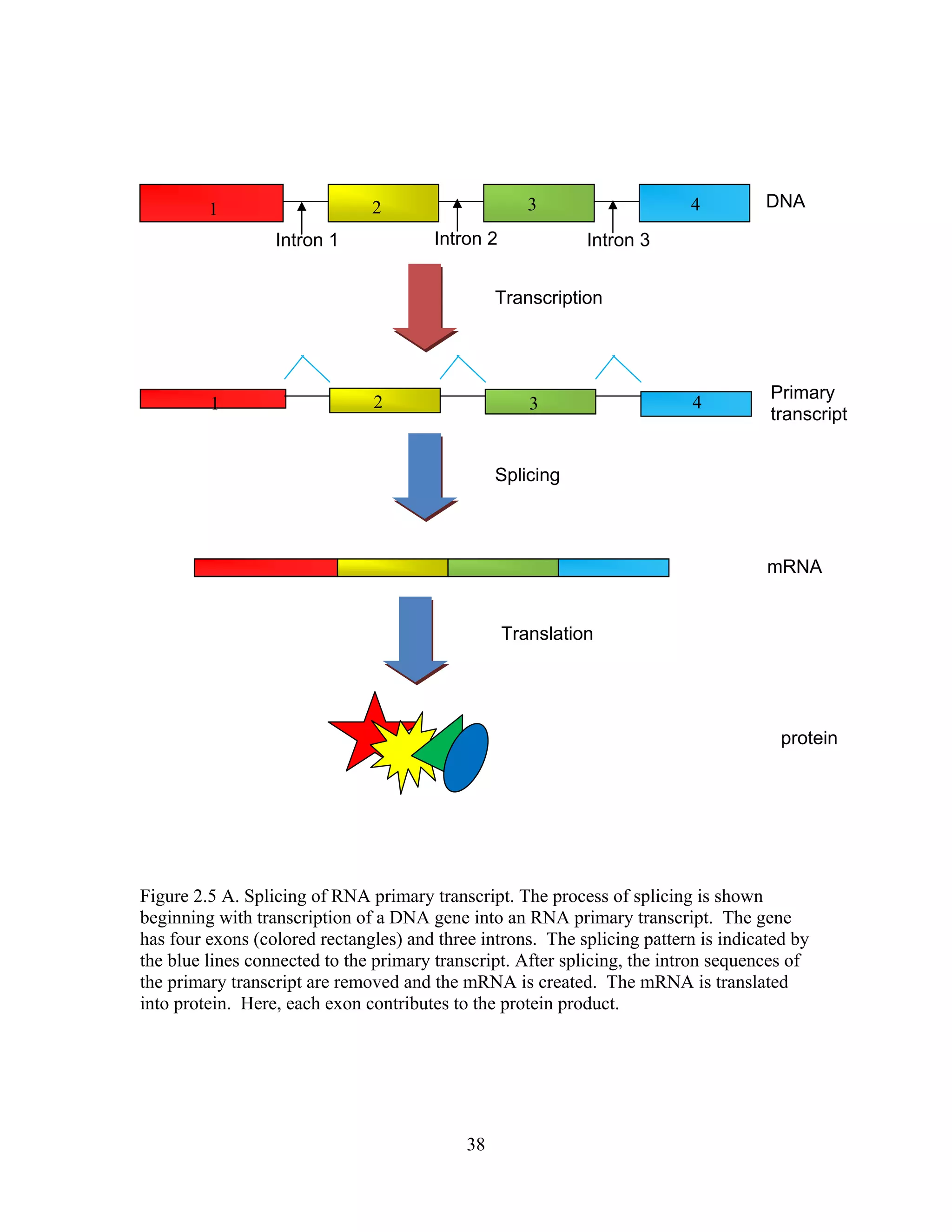
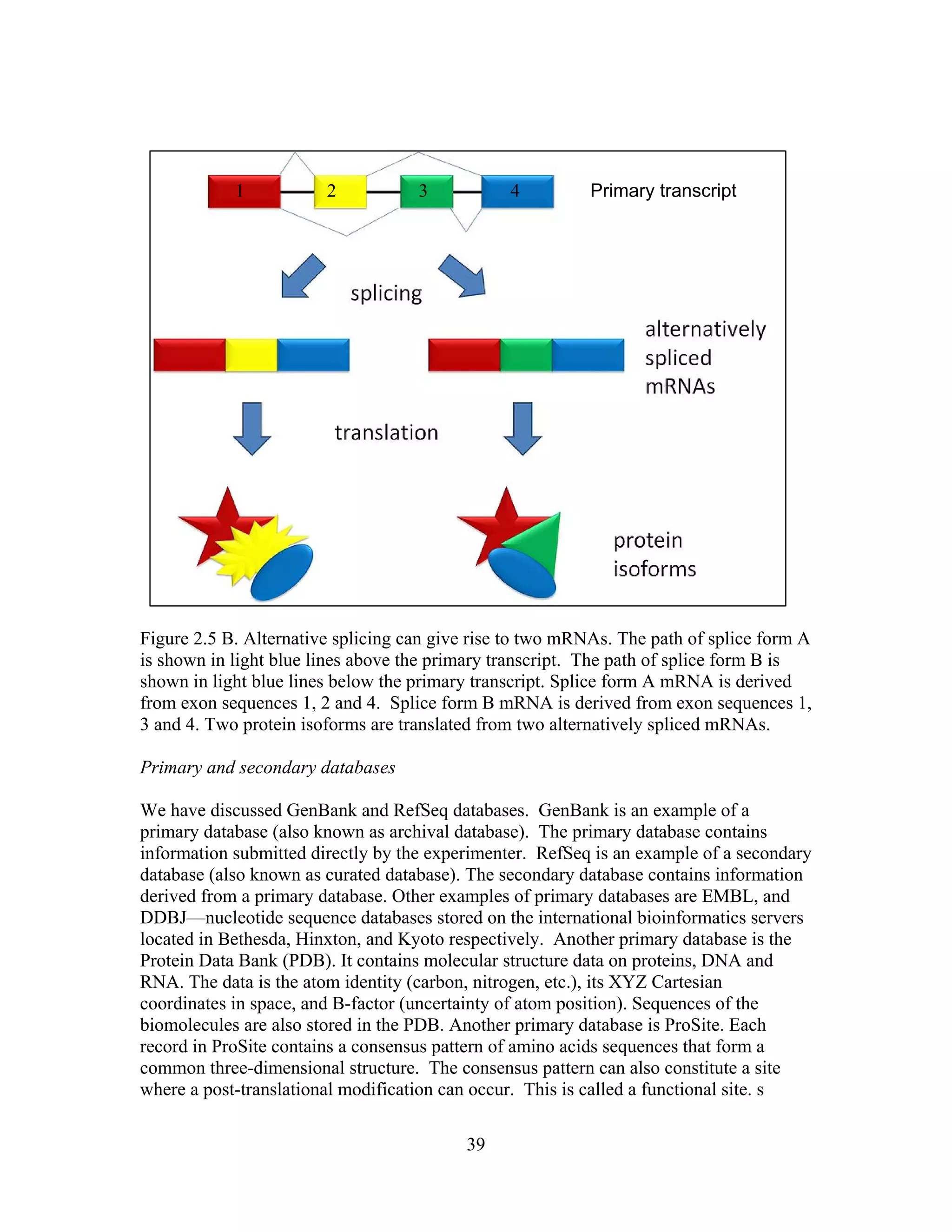
  • 92.
    diagonals are separatedby a wide gap, the diagonals will not be joined. Instead, the two diagonals will be reported to the user as separate alignments. 92
  • 93.
    Figure. 6.3 Thesteps to a BLAST search. A. The query sequence is placed on the vertical axis and the subject database sequences are placed on the horizontal axis. B. Overlapping query words are created from the query sequence. When the query words match the database sequence, the dotplot shows a diagonal corresponding to the location of the hit. C. Hits are extended until the cumulative score undergoes significant decay. D. Two diagonals that share a blue region may be joined by inserting gaps (red squares). This produces longer sequence alignments. The joining of two diagonals is called local gapped alignment. How is the hit deemed to be statistically significant? The BLAST score reported to the user is called the similarity score. The similarity score is the maximum cumulative score above the alignment threshold. The similarity score depends on the length of the aligned sequences, the number of gaps inserted by the algorithm required to align the sequences, and the rarity of the amino acids that are aligned (as defined by the BLOSUM score matrix). However, one must also take into consideration the possibility that the query sequence aligns with a subject sequence by chance. For example, if the query sequence has only three amino acids and the database has 8000 letters, there is a high probability that 1 exact match will be due to chance. This is called a false positive. A better way to determine if an alignment is statistically significant is to determine the likelihood that the alignment could have been made by chance. The lower this likelihood, the higher the probability that the alignment is significant. BLAST uses the expect value, or E value, to measure the false positive rate. The E value is the number of HSPs having a score equal or greater than value S by chance alone. When the user sets the alignment score threshold prior to a BLAST run, the user actually sets the E value threshold. From the chosen E value threshold, BLAST will perform the calculation to set the alignment score threshold. The equation for E is E = Kmne-λS 93
  • 94.
    Where E =expect value S = similarity score m = length of query sequence n = length of database λ = a parameter that scales the scoring system K = a scaling factor for the search space An E value equal to 1 means that 1 sequence match with a score S or better could have been obtained by chance. An E value closer to zero is desired because such a value lowers the likelihood of obtaining the same score as the HSP by chance. This means the match is more statistically (and biologically) significant. Because S is a mathematical exponent, E is heavily dependent on S; the higher the score S, the lower the E value. E is also dependent on query length (m) and database length (n), but less so. According to the equation above, when either the query length or the database length increases, the E value increases. However, one must take into account the effect of query length and database length on S. A general rule of thumb is that a good alignment for proteins has an E value less than 10-3 , and for nucleotides it should be less than 10-6 . The database length can be manipulated by the user so that the smallest database can be used for sequence alignment. This is desired because there is less likelihood of obtaining a hit due to chance. For example, if the user is only interested in identifying a human homolog, then it behooves the user to perform a BLAST search on a database restricted to human proteins. Here is a thought problem: a particular homolog to a query resides in two databases, UniProtKB and PDB. After performing BLAST against the UniProtKB database one obtains an E value of 1 for an HSP with the homolog. After performing BLAST against the PDB database one obtains an E value of 0.0625 for an HSP with the same homolog. What is the relative length of the two databases? The UniProtKB database is 16 times longer than the PDB because the ratio of the E values is 16. 2 Low complexity regions and masking Analysis of the E values of the BLAST output is a robust method to measure the significance of HSP scores. The BLAST user should also consider whether the query sequence contains low-complexity regions. Low complexity regions are those that contain repeated patterns of amino acids. If the query sequence has repeating amino acids, there is a higher probability that it will produce a match with the database. There are many proteins that contain repeats of single, double, or triple amino acids. If the query contains repeats, it has a strong likelihood of generating a high similarity score from the database sequence containing these repeats and one might obtain erroneous hits. BLAST offers the user the option of excluding the low complexity regions. This exclusion might be considered if the user believes that the low complexity region 2 Database length is defined by the sum of amino acids in all records. One could make an argument that database length or database size is dictated by the number of records in the database. However, for our purposes, unless explicitly stated otherwise, database length and database size will refer to the sum of the lengths of amino acid sequences in the database. 94
  • 95.
    contains a partof the protein that is not necessary for function. The problem of low complexity regions is compounded when a nucleotide query is used against a nucleotide sequence database. There are only 4 nucleotides, so there is a higher chance of finding low complexity regions in DNA sequences. DNA sequences with known low complexities include retrotransposons, ALU regions, microsatellites, centromeric sequences, telomeric sequences and 5’ untranslated regions of expressed sequence tags (ESTs). An example of a low complexity region in DNA is shown in Figure 6.4. A user should consider using the low complexity filter if the query sequence has repeated amino acids or nucleotides that are not essential for function or structure of the biological molecule. GGGTGCAGGAATTCGGCACGAGTCTCTCTCTCTCTCTCTCTCTCTCTCTCTCTCT CTCTCTCTCTCTCTCTCTCTCTCTCTCTCTCTCTCTCTCTC Figure 6.4. This is an example of a low complexity region in a cDNA sequence. GenBank record T27311. A strategy similar to low complexity filtering is masking. Masking is an option that allows the BLAST user to exclude a region of a query sequence from contributing to the alignment. When would one use masking? Masking is used when one wants to exclude a region of a protein that is common to a wide variety of proteins. Some domains of proteins are very common. For example, DNA binding proteins often contain zinc finger domains. Performing a BLAST search with a query containing a zinc finger domain will result in numerous hits of proteins with zinc finger domains. These proteins may not be highly related to the query in any domain other than in the zinc finger. To exclude hits to all zinc finger-containing proteins, the user can mask the zinc finger domain in the query. That way, with masking, the hits will be due to sequence alignments with regions other than zinc finger domains. 95
  • 96.
    Box 6.1    David Lipman, NCBI Director    From the Partnership for Public Service   Monday, February 9, 2009; 12:00 AM     David Lipman of the National Institutes of Health is an Internet  pioneer who has worked for more than a decade to make  critical medical and scientific information available online for  scientists, researchers and the general public. Now Lipman is  pushing the digital boundaries even further, employing a  Google‐‐style approach to make the voluminous government  databases he helped create even more accessible and user‐ friendly. Lipman said the goal of his "Discovery Initiative" is not  simply to provide researchers with more information on  medical topics, but to "offer them links to the highest quality  pieces of information so that they can perform at the highest  level possible."  "It's like ads on Google ‐‐ if you like this article,  you might want to read these four articles," said Lipman, the  director of the National Center for Biotechnology Information (NCBI). Lipman envisioned, helped create and now  oversees more than 40 publicly available online medical and scientific databases within NIH, although he gives much  of the credit to his team. The databases, which are interconnected for maximum research capabilities, are used daily  by more than two million people. Each week the equivalent of all the text content in the Library of Congress is  downloaded from these databases. They include PubMed, an online service that allows the public to search abstracts  from approximately 4,600 of the world's leading biomedical journals; PubMed Central, an archive of 1.7 million full‐ text journal articles from biomedical journals; GenBank, the world's largest genetic sequence data repository; and  PubChem, a resource that connects chemical information with biological studies.        "His vision enabled NCBI to be one of the very best public resources available," said Richard J. Roberts, a molecular  biologist and winner of the Nobel Prize for Medicine. "The current state of biological research would not be where it  is if NCBI did not exist."  "He has truly done an extraordinary job at NCBI and continues to be imaginative and forward  looking," said Roberts. The readily‐accessible NCBI databases are proving helpful both to researchers and to the  general public in finding important medical information. Heather Joseph, executive director of the Scholarly  Publishing and Academic Resources Coalition, said she never expected that, a decade after becoming familiar with  Lipman's work through her job, she would use PubMed Central to help her own family.        In 2008, Joseph's five‐year‐old son Alex was diagnosed with Type 1 Diabetes. At night, Joseph would wake her  crying son for his insulin shot, without which he could go into a coma ‐‐ or worse. "I just thought, there has to be a  better way, but nothing was out there," Joseph said. "Then it hit me ‐‐ I went to PubMed Central and found an article  about a brand‐new technology recently approved by the FDA that can monitor Alex's glucose through the night,  which will really help our family." The expansion of online resources was significantly aided by Congress, which in  2008 mandated that all taxpayer‐funded medical research and clinical trials be placed online. "If it weren't for  Congress's mandate and NCBI's quickness in getting the information up, we wouldn't have found something that has  profoundly helped my son," said Joseph. Lipman's work was not easy. He had to overcome some resistance within the  government and scientific communities. With his team, he developed the necessary tools to allow storage, rapid  searches and barrier‐free access to biomedical research reports. While Lipman's focus is on using technology to make  the latest medical information available, he is working with journals across the country to preserve older research  data. "What this has done is made good research from 50 years ago available online," Lipman said. As he looks back  over his career, Lipman says he impressed by how much technology has influenced his profession and the positive  role it plays in the medical community. "When I started my work, I never imagined that the comprehensive data that  we have now would be so readily available. It's phenomenal," Lipman said.                 96
  • 97.
          Usefulness of BLASTfor bioinformatics BLAST, when properly used, can be a quick way to obtain extensive knowledge of your protein or gene of interest. BLAST comes in several forms that manipulate your query sequence or the database to give the scientist several alignment options. Here is a list of the common types of BLAST algorithms available: blastp - compares an amino acid query sequence against a protein sequence database blastn - compares a nucleotide query sequence against a nucleotide sequence database blastx - compares a nucleotide query sequence translated in all six reading frames against a protein sequence database tblastn - compares a protein query sequence against a nucleotide sequence database dynamically translated in all six reading frames tblastx - compares the six-frame translations of a nucleotide query sequence against the six-frame translations of a nucleotide sequence database. psi-blast – compares a protein sequence to a protein database in a manner that allows detection of evolutionarily distant homologs (see next section). blast2 – compares two user-defined protein or nucleotide sequences. Table 6.1 gives some useful tips for using BLAST to obtain information about your query. While experimental approaches may also be used to answer many research questions about your query sequence, in some instances bioinformatics provides the only research tools for tackling a research question! 97
  • 98.
    Table 6.1 UsingBLAST to get quick answers to bioinformatics problems Task BLAST method Traditional method Predict protein function (1) Perform blastp with the protein sequence query against a protein sequence database. If a hit with a low E value over a large proportion of the query is returned, then the annotation of the subject sequence reveals the function. Perform wet-lab experiments Predict protein function (2) If the above method does not work, perform tblastn with the protein sequence query against a nucleotide sequences. This function first translates all nucleotide sequences into six reading frames. The annotation of the nucleotide sequence database is often more complete than the protein databases.3 Perform wet-lab experiments Predict protein structure Use blastp with the protein sequence query against Protein Data Bank. If a hit with a low E value is returned, then the structures of the proteins will be similar. Run structure prediction software, perform X-ray crystallography experiment, or NMR experiment. Identify genes in a newly sequenced genome Divide genome nucleotide sequence into 2 to 5 kilobase segments. Paste one segment at a time into query box in BLAST program. Use blastx to align nucleotide query against the non-redundant protein sequence database. Run gene-prediction software, perform microarray experiment on organism’s RNA. Identify distantly related proteins Use psi-blast (see next section). Finds distantly related sequences. It replaces the query sequence with a position-specific score matrix after an initial blastp search. Then it uses the matrix to find distantly related sequences No traditional method Identify DNA sequence (non- protein) Use blastn. Finds alignments between nucleotide sequences. Experimentally screen genomic DNA library with radiolabeled or fluorescently labeled probe. 3 This was the BLAST program used to identify MDM2 as an inhibitor of p53. See Chapter 2 Box 2.2 for details. 98
  • 99.
    Psi-BLAST Because BLAST quicklyreturns sequence alignments to users, a method was conceived to use BLAST to obtain sequence alignments to evolutionarily distant proteins. Psi- BLAST (Position-Specific Iterated BLAST) is an algorithm that is used to identify distant homologs of a protein that may not be detected using BLAST, due to the low sequence identity between the query sequence and subject sequence. Psi-BLAST accomplishes this by first performing a BLAST alignment search using the query protein sequence. This first search is scored with a BLOSUM62 score matrix. The HSPs from the search are used to create a multiple sequence alignment. The aligned sequences are used to create a position-specific score matrix (PSSM). A PSSM is a score matrix that assigns a score based on the position of the amino acid in the query. For example, if the majority of the HSPs have a valine that aligns to the first position in the query, then a valine in position 1 is assigned a high score in the PSSM and scores assigned for other amino acids at position 1 will be low. The PSSM covers all amino acids in the query. Figure 6.5 shows a PSSM for a 20 amino acid query sequence. The original query sequence is replaced by the newly generated PSSM. The PSSM is the query profile used for a second BLAST search. The initial threshold for reporting a hit with the BLOSUM62 matrix is E=1. In the second BLAST search, now using the PSSM, the threshold is lowered to E = 0.001. The new hits from this second search will include some distantly related sequences because the PSSM is the query profile. The Psi-BLAST process can be repeated many times. Each iteration results in modification of the PSSM and captures more distantly related sequences. After each iteration it is prudent to check the database records of the top hits. The annotations in the records can provide structural or functional information that may indicate whether the hit is related to the initial query. In each iteration, Psi-BLAST allows the user to choose the hits to be used for the next generation of PSSM. BLAST has become a fixture in bioinformatics. As of this writing, the papers describing BLAST and gapped BLAST/psi-BLAST have each been cited over 33,000 times. The team that developed BLAST included molecular life scientists, computer scientists, and mathematicians. This interdisciplinary team was led by David Lipman, who has headed the National Center for Biotechnology Information since its inception in 1988. His leadership not only led to the development of the BLAST programs, but also the refinement of PubMed, an online digital library that makes scientific literature available through the internet (Box 6.1). His pioneering efforts in bioinformatics have been transformative to this rapidly developing field. 99
  • 100.
    Figure 6.5. Aposition-specific score matrix (PSSM). The top row displays 20 naturally occurring amino acids. The first vertical column shows the position number of the amino acid in the query sequence. The second vertical column shows the query sequence. The second row through the last row show the amino acid scores at each sequence position. Note that Q in position 4 gets a score of 0, and a Q in position 14 gets a score of 7 (Q is highly conserved at position 14, but not conserved at position 4). Multiple Sequence Alignment Multiple sequence alignment is the alignment of more than two protein or nucleic acid sequences. For proteins, an alignment of protein homologs is useful because it allows the user to easily visualize regions that are similar amongst the homologs. These similar regions are called conserved regions and they are likely to maintain the same structure. Since structure dictates function, the conserved regions are likely to be critical for protein function. There are practical reasons why one would align DNA sequences as well. Recall from Chapter 2 that a region of a gene 5’ of the coding sequence contains the promoter. Alignment of 5’ regions from ortholog genes will highlight areas within promoters that are conserved. The conserved areas likely bind to the same transcription factors. The 100
  • 101.
    DNA sequence specificitiesof transcription factors are largely known. Thus, multiple sequence alignment gives the user insight into the potential transcription factors that control the genes. In another example highlighting the importance of multiple sequence alignment one may wish to design PCR primers that will amplify a gene from a novel organism (whose genomic DNA has never been sequenced). Without knowing the genome sequence, how does one design a PCR primer that will amplify the novel gene? If homologs of the gene have been previously sequenced, one can perform a multiple sequence alignment of the homologs. Multiple sequence alignment will reveal the segments of the gene homologs that are conserved. DNA primers that match the conserved regions can be synthesized and used for PCR amplification of the gene from the novel organism. Using this PCR design strategy, a paralog of p53, called p63, was identified in the squid, Euprymna scolopes. The p63 is expressed during development of the organ that produces light in the squid. It is hypothesized that p63 removes unneeded cells from this organ through programmed cell death. CLUSTALW A popular program used to align sequences is CLUSTALW. It employs three stages for multiple sequence alignment: 1) Creation of pairwise alignments of every sequence to be aligned; 2) Creation of a guide tree based on “distances” between each sequence; 3) Alignment of sequences according to the guide tree. Let’s explore the details of how CLUSTALW operates. CLUSTALW is a progressive alignment program. The progressive alignment algorithm, introduced by Feng and Doolittle in 1987, performs a pairwise global alignments of all sequences given by the user. The pair that has the highest identity is aligned first. Then other sequences, in the order of their identities, are progressively added to the first aligned pair alignment. Feng and Doolittle also introduced the concept of “once a gap, always a gap” into their algorithm. Gap treatment for multiple sequence alignment is critical because introduction of gaps is almost always necessary for optimal alignment. The key is to know where, within the sequence, is an appropriate place to put a gap. Feng and Doolittle thought that gaps placed in similar sequences should not be altered once additional less similar sequences are added to alignment. They reasoned that gaps required for optimal alignment in similar proteins likely represent locations that are not critical for function or structure. Natural selection has allowed amino acids to be inserted into or deleted from those locations of the proteins. When more distantly related proteins are aligned it is better to insert a gap in the sequence at this non-critical region rather than into another region further upstream or downstream. CLUSTALW uses progressive alignment and gap treatment in a fashion similar to the Feng and Doolittle algorithm. In the first step, CLUSTALW performs a pairwise alignment of all sequences to be aligned. Instead of using a score matrix, CLUSTALW calculates the percent identity shared by pairs of sequences. The percent identities are then converted into difference scores (D) using the following equation: D = 1-(I) 101
  • 102.
    where I isthe number of identities in the pairwise global alignments divided by the total number of amino acids in the shortest sequence. A larger D means a smaller percent identity. Figure 6.6 shows the difference scores for 7 globin sequences. This is called a 7 x 7 distance matrix. One can see from the distance matrix that Hba-Ho and Hba-Hu have the highest percent identity of all the pairwise comparisons. In the next stage of the CLUSTALW algorithm, the distance matrix is converted into a guide tree that will be used to construct the multiple sequence alignment. The important feature of a guide tree is that it reflects the relatedness of proteins through the order of branching and the length of the branches. Trees may be unrooted or rooted. Hbb-Hu 1 - Hbb-Ho 2 .17 - Hba-Hu 3 .59 .60 - Hba-Ho 4 .59 .59 .13 - Myg-Ph 5 .77 .77 .75 .75 - Gib-Pe 6 .81 .82 .73 .74 .80 - Lgb-Lu 7 .87 .86 .86 .88 .93 .90 1 2 3 4 5 6 Figure 6.6. Distance matrix of 7 globins. (From Thompson et al., 1994). The distance matrix is converted into a guide tree by a two-step neighbor joining (NJ) process. First, an unrooted Neighbor-Joining (NJ) tree is created. Each sequence starts out distributed radially as if on spokes of a wheel. More similar sequences are joined to become neighbors, until an unrooted tree is created (Figure 6.7). Low distance scores (D) from Figure 6.6 are translated into joined branches of short lengths. The unrooted tree is called a cluster, and, because a cluster is used for alignment, the term “Clustal” is derived, for cluster alignment. In the unrooted NJ tree, branch lengths are proportional to the estimated distance of each sequence from an “average sequence” of all 7 sequences. 102   Hba-Ho Hba-Hu Hbb-Ho Hbb-Hu Myg-Ph Gib-Pe Lgb-Lu Figure 6.7 The unrooted NJ tree. From Thompson et al., 1994.
  • 103.
    In the secondstep, the unrooted tree is converted into a rooted NJ tree. The root is considered the ancestral sequence to the entire family of sequences to be aligned. Calculation of branch lengths and nearest neighbors in a rooted tree is complex and interested students are referred to another source for details on how to calculate these lengths and nearest neighbors (Cristianini and Hahn (2007)). The “W” in CLUSTALW stands for weight. A weight, or sequence weight, is calculated from the rooted tree for each sequence to be aligned (Figure 6.8). The sequence that is more distant from other sequences is given the highest weight. According to Figure 6.8, the most distant sequence from all others is Lgb-Lu. There are two purposes for the creation of the rooted NJ tree. First, the lengths of the branches dictate the order of progressive alignment. Second, the lengths of the branches and the number of branch points are used to calculate sequence weights. The sequence weights are used to decide which sequences contribute more to driving the alignments. Sequences that share a branch with other sequences share the weight derived on that common branch. In the example shown in Figure 6.8, Lgb-Lu has a weight of 0.442, which is equal to the distance from the tip of the branch to the root. Calculation of sequence weights of other sequences is more involved. The sequence weight of Hbb-Hu is calculated by adding the length of the branch leading to its tip that is not shared with any other sequence (0.081) plus half the length of the branch shared with Hbb-Ho (0.226/2) plus one fourth the length of the branch shared with Hbb-Ho, Hba-Hu, and Hba-Ho (0.061/4) plus one fifth the length of the branch shared with Hbb-Ho, Hba-Hu, Hba-Ho and Myg-Ph (0.015/5) plus one sixth the length of the branch shared with Hbb- Ho, Hba-Hu, Hba-Ho, Myg-Ph and Gib-Pe (0.062/6). The sequence weight of Hbb-Hu is 0.223. In this manner, sequences that are very similar to other sequences (such as Hba- Hu) are given low sequence weights and those that are more distant (such as Lgb-Lu) are given high sequence weights. The rationale behind this is that those sequences that are very similar should not be allowed to dominate the contribution to the alignments during the progressive alignment. 103
  • 104.
    Figure 6.8. RootedNJ tree derived from the unrooted NJ tree. On the left, numbers on each line represent distances between tree nodes. Letters A-E represent the sets of aligned sequences from branches just to the right of the nodes. The sequences will be progressively aligned by CLUSTALW. Numbers to the right of the named sequences are sequence weights (Figure adapted from Thompson et al., 1994). In the third step of the CLUSTALW algorithm, sequences and sets of aligned sequences become progressively aligned. Initially, pairs of sequences will be aligned with each other. Then, sets of aligned sequences will be aligned with each other or with individual sequences. In Figure 6.8 the sets of aligned sequences are labeled with letters A through E. A represents the aligned set of Hbb-Hu and Hbb-Ho. B represents the aligned set of Hba-Hu and Hba-Ho. Other letter-assigned sets are depicted in Figure 6.8. After sequence weights have been calculated, the next step is to align the sequences starting from the tips of the tree towards the root. Sequences with the shortest branch lengths, or highest similarity, are aligned first. Here is the order of alignment for the rooted NJ tree in Figure 6.8: 1) Hba-Hu vs. Hba-Ho 2) Hbb-Hu vs. Hbb-Ho 3) A vs. B 4) Myg-Ph vs. C 5) Gib-Pe vs. D 6) Lgb-Lu vs. E 104
  • 105.
    Just like theSmith-Waterman algorithm, the goal of CLUSTALW is to maximize the alignment score. Scores come from two sources: BLOSUM score matrices and the sequence weights (see Figure 6.8). We will step through the calculation of the score at a single position that will be used to align two previously aligned sets (A vs. B). In CLUSTALW, this calculation is repeated for all possible alignment position between A and B. Prior to the score calculation, the sequence weights are normalized by dividing each sequence weight by the highest sequence weight, 0.442. Lgb-Lu has a normalized weight of 1.000 and all other sequences have values less than 1.000. Sequence weights for the 7 sequences are shown in Table 6.2. Table 6.2 Sequence weight calculations Sequence number Sequence name Raw sequence weight Normalized sequence weight. 1 Hbb-Hu 0.223 0.506 2 Hbb-Ho 0.226 0.511 3 Hba-Hu 0.193 0.437 4 Hba-Ho 0.203 0.459 5 Myg-Ph 0.411 0.930 6 Gib-Pe 0.399 0.903 7 Lgb-Lu 0.442 1.000 The normalized sequence weight is used calculate the score derived from comparison of position 7 from the 2-sequence set A to position 6 from the 2-sequence set B (Figure 6.9). To calculate this score, the BLOSUM62 score matrix will be used. The scores from the BLOSUM62 matrix are as follows: M(t,v) = 0 M(t,i) = -1 M(l,v) = 1 M(l,i) = 2 Following the steps in Figure 6.9, calculation of the score for the comparison of A and B at the outlined position is: 0 * 0.506*0.437 = 0 -1 * 0.506*0.459 = -.232 1 * 0.511 * 0.437 = .223 2 * 0.511 * 0.459 = .469 105
  • 106.
    (0 + (-0.232)+ 0.223 + 0.469)/4 = 0.460 Figure 6.9 Scoring during progressive alignment in CLUSTALW. Two sets of previously optimally aligned sequences are shown. Sequence 1 and 2 comprise set A and sequence 3 and 4 comprise set B. They are truncated for illustration of scoring. Amino acids at position 7 in set A will be scored against the amino acids at position 6 in set B. M(X,Y) is the BLOSUM score matrix value for amino acids X and Y. Wn is the sequence weight where n is the sequence number. In a fashion similar to the Smith-Waterman global alignment algorithm, the calculated score is added to the scores of predecessor cells to maximize the score in a cell of the matrix (see Chapter 5). The procedure is repeated so that all possible amino acid comparisons between A and B are made and the matrix is filled. Dynamic programming traceback, starting with the maximum score at the lower right side of the filled matrix, produces the best alignment. For simplicity, in the example shown in Figure 6.9, the BLOSUM62 score matrix was used to generate the scores, M(X,Y). In the CLUSTALW program, the score matrix used depends on the distance scores. CLUSTALW switches score matrices as the alignments proceed progressively from the least divergent sequences to the most divergent sequences. The score matrix used depends on the rooted tree branch lengths, such as those depicted in Figure 6.8. For sequences compared across short branch lengths, the BLOSUM80 score matrix is used. For sequences compared across long branch lengths, the BLOSUM30 score matrix is used. The distance ranges used with BLOSUM series is: 0—0.20: BLOSUM80, 0.20—0.40: BLOSUM62, 0.40—0.70: BLOSUM45, 0.70—1.00: 106
  • 107.
    BLOSUM30. Recall fromChapter 5, that higher BLOSUM score matrices are used for comparing sequences that are more identical (less distant). Treatment of gaps As described earlier, CLUSTALW has special rules for creating gaps. CLUSTALW follows the “once a gap, always a gap” rule first described by Feng and Doolittle. In addition to this rule, there are others that CLUSTALW follows. The developers of CLUSTALW noticed that a score matrix gives a uniform negative score when a gap is used to optimally align sequences. These are called gap opening penalties. Analysis of structures of homologous proteins suggests that gap opening penalties should not be uniform. Short stretches of 5 hydrophilic residues (D, E, G, K, N, Q, P, R or S) often form a loop or random coil in protein structures. Protein structure analysis indicates that a run of five of these amino acids are usually not essential for maintaining the overall structure of the protein. So creating a gap in the alignment sequence within the hydrophilic stretch, implying an insertion or deletion of amino acids in the protein, would likely not disrupt the overall protein structure. CLUSTALW reduces the gap opening penalty within a stretch of 5 hydrophilic amino acids. Another rule that CLUSTALW applies is a specific gap weight for each amino acid. A gap weight is assigned to the position immediately after each of the twenty amino acids. The gap weight is inversely proportional to the frequency with which that amino acid is located upstream of a position that must be gapped in order to align homologous proteins with solved structures. For example, the gap weight of M is 1.29 and the gap weight of G is 0.61. Given the choice between placing a gap after M or G, CLUSTALW will choose G. Another rule that CLUSTALW follows is the rule of 8. The rule of 8 is applied because alignments of homologous proteins with solved structures show that protein gaps for optimal alignment are not more frequent than once every eight residues. Therefore, penalties for gaps increase when required at a frequency of 8 or fewer amino acids to achieve alignment. All of these rules help to make CLUSTALW a popular and effective program for aligning multiple sequences. Practical concerns when working with CLUSTALW Because CLUSTALW uses progressive alignment, it is critical that closely related sequences be included in the set of sequences to be aligned. The alignment of the closely related sequences will set up the template for future alignments. It is best to choose sequences that are related to each other over their entire lengths. If there are regions known to be divergent (a particular domain perhaps) then one might want to remove these from the sequences. Homework 1) Locate the C-terminal region (approximately 215 residues) of human BRCA1 from the UniProtKB accession number P38398, isoform 1). Perform a PSI- BLAST search of the nr protein database with this query sequence. Save your search results. Now perform a second iteration. Compare your new search results. 107
  • 108.
    Some sequence alignmentsfrom the second search have higher HSP scores than the same sequence alignment obtained from the first search. Why? Alternatively, some sequence alignments from the second search have lower HSP scores than the same sequence alignments obtained from the first search. Why? 2) MDM2, an oncoprotein, is an inhibitor of p53 and is observed to be overexpressed in about 7% of human cancers. In sarcomas, the frequency of MDM2 overexpression is 20%. MDM2 belongs to a class of proteins known as E3 ligases. MDM2 transfers the small protein ubiquitin onto p53, which tags p53 for destruction by the 26S proteasome. An analysis of the conserved regions of MDM2 assists scientists to uncover regions that are critical to ubiquitin transfer activity. Obtain the following protein sequences from any public database you wish and align using CLUSTALW program. The protein sequences are: Human MDM2, Chimpanzee MDM2, Murine MDM2, Xenopus MDM2 and Zebrafish MDM2. Use the longest wild-type proteins sequences available for your comparisons. Give amino acid ranges of two areas that are conserved amongst these orthologs. Use the human MDM2 amino acid numbers to report on your ranges. According to the alignment score table, which two sequence alignment has the highest score? Perform CLUSTALW again using only Human MDM2 and Zebrafish MDM2 sequences. Does the human/zebrafish alignment in this output, differ from the human/zebrafish alignment obtained in the first output? Explain. 3) There exists a paralog of MDM2 named MDM4 (also known as MDMX). MDM4 is found to be overexpressed in nervous tissue cancers, breast cancers, and soft tissue tumors at a frequency of 10-25%. Obtain the sequence of the human paralog MDM4 and the mouse paralog MDM4 and perform multiple sequence alignment together with the original five MDM2 sequences listed in problem 3. Give amino acid ranges the domains (in human MDM2 amino acid numbers) that are highly conserved within sequences of this entire homolog family. 4) The quagga was an African animal that is now extinct. It looked partly like a donkey and partly like a zebra. In 1872, the last living quagga was photographed. Mitochondrial DNA was obtained from a museum quagga specimen and sequenced. Perform a BLAST search with of quagga (Equus burchellii quagga) DNA query and find out if the quagga is more closely related to the donkey (Equus asinus) or the zebra (Equus burchelli). Support your answer with data. References 1) Altschul, S.F., Madden, T.L., Schäffer, A.A., Zhang, J., Zhang, Z., Miller, W., Lipman, D.J., 1997. Gapped BLAST and PSI-BLAST: a new generation of protein database search programs. Nucleic Acids Res.25:3389-3402. 2) Altschul, S.F., Gish, W., Miller, W., Myers, E.W., Lipman, D.J., 1990. Basic local alignment search tool. J. Mol. Biol.215: 403-410. 3) Cristianini, N. and Hahn, M.W., 2007.Introduction to computational genomics, a computational approach. Cambridge University Press, Cambridge, UK. 108
  • 109.
    109 4) Feng, D.and Doolittle, R.F., 1987. Progressive sequence alignment as a prerequisite to correct phylogenetic trees. J. Mol. Evol.60:351-360. 5) Goodson, M.S., Crookes-Goodson, W.J., Kimbell, J.R., McFall-Ngai, M.J., 2006., Characterizationand role of p53 family members in the symbiont-induced morphogenesis of theEuprymna scolopes light organ.Biol. Bull.211: 7-17. 6) Higgins, D.G. and Sharp, P.M., 1988. CLUSTAL: a package for performing multiple sequence alignment on a microcomputer. Gene73: 237-244. 7) http://www.ncbi.nlm.nih.gov/Class/MLACourse/Modules/BLAST/slide_list.html 8) Karlin S. andAltschul S.F.,1993. Applications and statistics for multiple high- scoring segments in molecular sequences.Proc Natl Acad Sci U S A.90:5873- 5877. 9) Saitou, N. and Nei, M., 1987.The neighbor-joining method: a new method for reconstructing phylogenetic trees. Mol. Biol. Evol.4: 406-425. 10) Schuler, G.D., 2001. Sequence alignment and database searching. In A.D. Baxevanis and B.F.F. Ouellette, Bioinformatics: a practical guide to the analysis of genes and proteins 2nd ed. pp. 187-214. John Wiley & Sons, New York, NY. 11) Tatusov, R.L., Altschul, S.F., Koonin, E.V., 1994. Detection of conserved segments in proteins: iterative scanning of sequence databases with alignment blocks.Proc. Natl. Acad. Sci. U S A.91:12091-12095. 12) Thompson, J.D., Higgins, D.G., Gibson, T.J., 1994. CLUSTAL W: improving the sensitivity of progressive multiple sequence alignment through sequence weighting, position-specific gap penalties and weight matrix choice. Nucleic Acids Res. 22:4673-4680. 13) Zvelebil, M. and Baum, J.O., 2008. Understanding bioinformatics. Garland Science, Taylor & Francis Group, New York, NY.
  • 110.
    Chapter 7 Protein structureprediction Introduction Predicting protein structure has been a holy grail for scientists for many years. In theory, one should be able to take any linear sequence of amino acids and predict how it will fold in three dimensional space. In 1959, Christian Anfisen showed that proteins could be denatured so as to lose tertiary and secondary structure (White and Anfinsen, 1959). Then, once the denaturing conditions are removed, the proteins refold on their own. This means that all of the instructions and energy needed for a protein to fold are coded by the linear sequence of amino acids. If scientists achieve the goal of predicting the structures of proteins, then creating designer drugs that bind to these proteins would be much easier. At the moment, experimentally obtaining protein structures is a costly and laborious process. Protein structure prediction has been aided by bioinformatics who created programs that use data from solved protein structures to predict structures from new sequences. This process is sometimes called homology modeling. Models of new structures are built on the basis of known structures of homologs. The first popular method that used data from experimentally solved protein structures was the Chou- Fasman program. A newer homology modeling method is PSIPRED. The Chou-Fasman and the PSIPRED methods predict secondary structures. Predicting tertiary structure is a much more difficult task. Another method of predicting protein structure is called ab initio—which does not assume any empirical knowledge of previous protein structures. We will briefly discuss ab initio prediction and Chou-Fasman prediction. These topics will be followed by an in-depth discussion of the homology-based prediction method, PSIPRED. Figure 7.1 illustrates the principal of protein folding. Recall that most proteins are composed of either three or four orders of structure. The primary structure is merely the sequence of the amino acids. The secondary structure is created by the initial folds that the protein makes with itself. There are three principal secondary structures: alpha helix, beta strand, and random coil. Random coil is a catchall term for any structure that is neither alpha helix nor beta strand. Sometimes random coils are called turns which, as the term suggests, are segments of protein that connect alpha helices and beta strands. Tertiary structures are created from the interactions of secondary structures. In quaternary structures, more than one polypeptide is observed in the final protein. In Figure 7.1, the protein on the left illustrates one of several unfolded structure states. When unfolded, the protein is flexible and assumes no one specific structure for a significant length of time. On the right side in Figure 7.1 the same protein is folded into a tertiary structure-which under physiological conditions-is maintained. Arrows symbolize β-strands and corkscrews symbolize α-helices. Areas of the folded protein that are neither β-strands nor α-helices are random coils and are depicted as threads. When considered as separate entities, these three areas comprise secondary structures. Once they fold upon themselves, as in Figure 7.1, the protein is said to be in a tertiary structure. 110
  • 111.
    Figure 7.1. Proteinfolding. On the left is protein that is unfolded. Under physiological conditions, the protein folds into a tertiary structure shown on the right. Ab initio Because proteins can spontaneously fold there must be a physical explanation for this process. Ab initio methods for protein structure prediction rely exclusively on physical laws to predict protein folding. Ab initio is Latin for “from the beginning.” Some physical principles include allowable bond angles, bond distances, degree of atom polarity, and pKa value. In practice, successful “ab initio”-dependent predictors still use some empirical data (ie data from experimentally solved structures) so they are not strictly ab initio methods. For example, some predictors use bond angles and bond distances measured from existing structures rather than derived from physics calculations (Moult, J., 1999). The difficulty with ab initio predictors is that an overwhelming number of calculations are required for proper prediction of even simple small peptides. At this point in time, ab initio methods for protein structure predictions are still rudimentary. On the other hand, once structures were solved experimentally, researchers began to use this experimental dataset to develop structure predictors. We call these homology-based predictors. Chou Fasman method Chou and Fasman developed a program to predict secondary structures. From known protein structures derived from X-ray analysis of protein crystals, they created an algorithm for structure prediction. The program developed from this algorithm is a sliding window program that begins at the N-terminus of the protein sequence and ends at the C-terminus. Input is the primary structure and output is the secondary structure. As the window slides, it predicts whether segments of the sequence will be α-helices, β- strands, or turns. The algorithm consults a table of conformational parameters (derived from known structures) for the twenty amino acids (Table 7.1). 111
  • 112.
    Table 7.1 Conformationalparameters for α-helical, β-strand, and turn amino acid (from Chou and Fasman, 1978). 112
  • 113.
    AA P(α) AAP(β) AA P(T) AA f(i) f(i+1) f(i+2) f(i+3) Glu 1.51 Val 1.70 Asn 1.56 Ala 0.060 0.076 0.035 0.058 Met 1.45 Ile 1.60 Gly 1.56 Arg 0.070 0.106 0.099 0.085 Ala 1.42 Tyr 1.47 Pro 1.52 Asp 0.147 0.110 0.179 0.081 Leu 1.21 Phe 1.38 Asp 1.46 Asn 0.161 0.083 0.191 0.091 Lys 1.14 Trp 1.37 Ser 1.43 Cys 0.149 0.050 0.117 0.128 Phe 1.13 Leu 1.30 Cys 1.19 Glu 0.056 0.060 0.077 0.064 Gln 1.11 Cys 1.19 Tyr 1.14 Gln 0.074 0.098 0.037 0.098 Ile 1.08 Thr 1.19 Lys 1.01 Gly 0.102 0.085 0.190 0.152 Trp 1.08 Gln 1.10 Gln 0.98 His 0.140 0.047 0.093 0.054 Val 1.06 Met 1.05 Thr 0.96 Ile 0.043 0.034 0.013 0.056 Asp 1.01 Arg 0.93 Trp 0.96 Leu 0.061 0.025 0.036 0.070 His 1.00 Asn 0.89 Arg 0.95 Lys 0.055 0.115 0.072 0.095 Arg 0.98 His 0.87 His 0.95 Met 0.068 0.082 0.014 0.055 Thr 0.83 Ala 0.83 Glu 0.74 Phe 0.059 0.041 0.065 0.065 Ser 0.77 Gly 0.75 Ala 0.66 Pro 0.102 0.301 0.034 0.068 Cys 0.70 Ser 0.75 Met 0.60 Ser 0.120 0.139 0.125 0.106 Tyr 0.69 Lys 0.74 Phe 0.60 Thr 0.086 0.108 0.065 0.079 Asn 0.67 Pro 0.55 Leu 0.59 Trp 0.077 0.013 0.064 0.167 Gly 0.57 Asp 0.54 Val 0.50 Tyr 0.082 0.065 0.114 0.125 Pro 0.57 Glu 0.37 Ile 0.47 Val 0.062 0.048 0.028 0.053 Steps in the Chou-Fasman algorithm are as follows: 1. Assign all of the amino acids in the protein the appropriate set of parameters. 2. Scan through the protein and identify regions where 4 out of 6 contiguous amino acids have P(α-helix) > 1.00. That region is declared an alpha-helix. Extend the helix in both directions until a set of four contiguous amino acids that have an average P(α-helix) < 1.00 is reached. That is declared the end of the helix. If the segment defined by this procedure is longer than 5 amino acids and the average P(α-helix) > P(β-strand) for that segment, the segment can be assigned a helix. 3. Repeat this procedure to locate all of the helical regions in the sequence. 4. Scan through the protein and identify a region where 3 out of 5 of the amino acids have a value of P(β-strand) > 1.00. That region is declared as a β-strand. Extend the strand in both directions until a set of four contiguous amino acids that have an average P(β-strand) < 1.00 is reached. That is declared the end of the β-strand. Any segment of the region located by this procedure is assigned a β-strand if the average P(β-strand) > 1.05 and the average P(β-strand) > P(α-helix) for that region. 5. Any region containing overlapping alpha-helical and beta-sheet assignments are taken to be helical if the average P(α-helix) > P(β-strand) for that region. It is a β- strand if the average P(β-strand) > P(α-helix) for that region. 6. To identify a turn at amino acid number i, calculate the following value p(t) = f(i)f(i+1)f(i+2)f(i+3) 113
  • 114.
    where the f(i+1)value for the i+1 amino acid is used, the f(i+2) value for the i+2 amino acid is used and the f(i+3) value for the i+3 amino acid is used. If: (1) p(t) > 0.000075; (2) the average value for P(T) > 1.00 in the tetrapeptide; and (3) the tetrapeptide obeys the inequality P(α-helix) < P(T) > P(β-strand), then a turn is predicted at that location. The percent accuracy of the Chou-Fasman algorithm is 60-65%. PSIPRED PSIPRED is a two-stage neural network that predicts protein secondary structure using a a position specific scoring matrix produced by PSI-BLAST (see Chapter 5). A neural network is a computer science term that describes a type of program modeled after neurons in the human body. A neuron receives a signal (for example, heat sensation in the hand) from the outside and transfers that information to a second neuron. The second neuron carries the information to a third neuron and finally to a fourth neuron that gives the output (for example, move the hand away from the heat). In this simple example, there is an input neuron, two “hidden” neurons, and an output neuron in the network. In a neural network one must imagine layers of neurons. So, in actuality, our example above should be expanded to four layers of neurons rather than four individual neurons. In neural networks, neurons can either inhibit or stimulate one another. These inhibitions and stimulations are called “weightings” in computer science parlance. A high weight means that the signal is amplified and low weight means that a signal should be repressed. Figure 7.2 is a schematic that compares neural networks in human body to neural networks in computers programs. 114
  • 115.
    Figure 7.2 Neuralnetwork in the human body (A) and neural network in the computer program (B). In the human body the dendrites of the input neurons receive signals at the far left. The neurons that have red lines emanating from the bulb are inhibitory. The neurons that have blue lines emanating from the bulb are stimulatory. There are two columns of hidden layer neurons. These neurons collect the information from the input neurons and integrate the signals. The hidden layers feed information to the output layer (here, just one neuron). The output layer produces a response in the human depending on the number of stimulatory and inhibitory messages it receives. In the computer program with neural networks the information that reaches the input neurons is data associated with amino sequence. In the above example, two hidden layers are used. The final output for the sequence is helix (α-helix), sheet (β-strand), or coil (random coil). In PSIPRED, a window of 15 amino acids of the target sequence is run through PSI- BLAST through three iterations. The sequences used by PSI-BLAST for comparison to the target sequence are in a databank that contains hundreds of thousands of sequences that are non-redundant. The non-redundant databank was filtered to remove low complexity regions, transmembrane segments, and regions likely to form coiled-coil structures. The position specific scoring matrix produced by PSI-BLAST is retrieved from the third iteration. The matrix contains 15 x 20 elements, 15 for each amino acid in the target sequence and 20 elements for each score of the 20 amino acids in a single position. These scores, which range from -8 to +8, are converted to a log odds score by the following equation: 1/(1+e-x ) where x is the matrix score. The log odds scores range from 0-1. The 300 elements produced by PSI-BLAST plus 15 more elements are used as inputs into the network. The 15 additional elements register whether the one of the original 15 amino acids was a terminus (amino or carboxyl) of the protein chain. The 315 elements were fed into a 75 unit hidden layer. The output layer had only 60 outputs representing each amino acid within the 15 residue window converted into an output of α-helix, β- strand, coil and terminus. A second network was used to filter outputs from the first network. For the second network, 60 inputs were fed to a hidden layer of 60 elements. The final output was 45 where α-helix, β-strand, or coil. Neural network training How were the weightings established? First, a set of amino acid sequences with known secondary structure was obtained. Ninety percent of the sequences was used to “train” the program and 10% percent was used to test the program. We will discuss the test later. The sequences in the training set were chosen with care. The set contained a variety of different folds and a minimum of duplicate structures. That ensures that the PSIPRED is not biased toward predicting a particular structure. Sequences were fed into the neural 115
  • 116.
    network and theoutput was analyzed. If the output was not correct, the weightings were adjusted, ie there a great contribution by some hidden neurons over others. Then the sequences were re-entered into the program. This process was repeated several times until the program was able to predict the outcome with a high degree of accuracy. In truth, the program automatically adjusts its weights and automatically reruns the sequence data iteratively until the bioinformaticist halts the process. A key aspect of the training process is not to “overtrain” the weightings. If the weightings are overtrained then the program becomes very adept at correctly predicting the structure of the training set sequences but not sequences that are not part of the training set. An overtrained program becomes useless when it comes to predicting the outcome of new sequences. To determine whether the program can correctly predict the secondary structures of other sequences, the test data set was used. If the accuracy of the prediction of the test dataset was equal to the accuracy of the training set then the program was not overtrained. The outcome of the first network is sent to a second network to smooth the outcomes. For example, if the sequence ACDEGHIK gives an outcome of all α-helical with the exception of amino acid E, then the second network will smooth the data so that the entire sequence is all α-helical. The PSIPRED program is able to predict secondary structures with 75-80% accuracy. A typical output is shown in Figure 7.3 PSIPRED PREDICTION RESULTS Key Conf: Confidence (0=low, 9=high) Pred: Predicted secondary structure (H=helix, E=strand, C=coil) AA: Target sequence Conf: 923788850068899998538983213555268822788714786424388875156215 Pred: CCEEEEEEEHHHHHHHHHHCCCCCCHHHHHHCCCCCEEEEECCCCCCHHHHHHHCCCCCC AA: KDIQLLNVSYDPTRELYEQYNKAFSAHWKQETGDNVVIDQSHGSQGKQATSSVINGIEAD 10 20 30 40 50 60 Figure 7.3. A key question that arises is “how accurate is PSIPRED in predicting secondary structures?” To determine accuracy, a Q3 score is calculated. Sequences of structures that were excluded from the training set were predicted by PSIPRED. At each position the PSIPRED could give an outcome of α-helix, β-strand or coil. The Q3 score is simply the number of correctly predicted amino acids divided by the total number of amino acids multiplied by 100. A hypothetical example is shown below: • Sequence: MEETHAPYRGVCNNM • Actual Structure: CCCCCHHHHHHEEEE • PSIPRED Predict.: CCCCCHHHHHHEEEH Percent accuracy: 14/15 X 100 = 93% Homework 116
  • 117.
    117 1) Find thecomplete amino acid sequence of human p53 and perform a secondary structure prediction with Psi-PRED, GOR, Chou-Fasman, or another secondary structure prediction algorithm. Go to the Protein Data Bank and obtain the record for the p53 crystal structure (1TSR). There are three identical p53 polypeptides in the record named A, B and C. Choose one of the polypeptides for this exercise. In the remarks section of the record you will observe an assignment of secondary structure for the amino acids. These will either be named "helix" or "sheet". For amino acids in the structure that were not assigned to "helix" or "sheet" class assume that they adopt a "coil" structure. Create a line graph that places the amino acid sequence in one row and the known secondary structure from the PDB record that amino acid in the next row. Next, use the predicted structure data from your structure prediction program. Create a third row on the line graph that shows the predicted structure. The 1TSR file only contains the DNA binding domain of p53 so you will only be able to cover about half of the protein. Calculate the Q3 score. 2) Obtain structures of other portions of p53 where in the Protein Data Bank (in different records) and fill in those regions in the second row that were not obtained in the 1TSR record in problem 1. Calculate the overall Q3 score. References Moult, J., Predicting Protein Three-Dimensional Structure, Current Opinion in Biotechnology 10, 583-588, 1999. Chou, P.Y. and Fasman, G.D. Prediction of protein conformation. Annu. Rev. Biochem. 47, 251-276, 1978. White, F.H. and Anfinsen, C.B. Some relationships of structure to function in ribonuclease. Ann. N.Y. Acad. Sci. 81: 515-523, 1959. Jones, D.T., Protein secondary structure prediction based on position-specific scoring matrices, J. Mol. Biol. 292: 195-202, 1999.