By Andualem
objectives
 After the course you will be able to
• Define advanced cardiac life support
• Describe chain of survival
• Discus cardiac arrest algorisms
• Explain management of cardiac arrest
• Describe post cardiac arrest care
2
Basic ECG
What is an ECG?
The electrocardiography (ECG) is a surface representation of the
electrical events of the cardiac cycle.
Each event has a distinctive waveform, the study of which can lead to
greater insight into a patient’s cardiac pathophysiology.
The normal anatomy of the heart
The Normal Conduction System
 .
Impulse Conduction & the ECG
 Sinoatrial node
 AV node
 Bundle of His
 Bundle Branches
 Purkinje fibers
.
 .
Normal conduction system
ACLS(Advanced Cardiac Life Support)
 It is a set of clinical interventions for the urgent treatment of cardiac arrest and
other life-threatening medical emergencies, as well as the knowledge and skills to
deploy those interventions.
 It is Systematic approach to assessment and management of cardiopulmonary
emergencies
 Continuation of Basic Life Support(BLS)
 Resuscitation efforts aimed at restoring spontaneous circulation and retaining
intact neurologic function
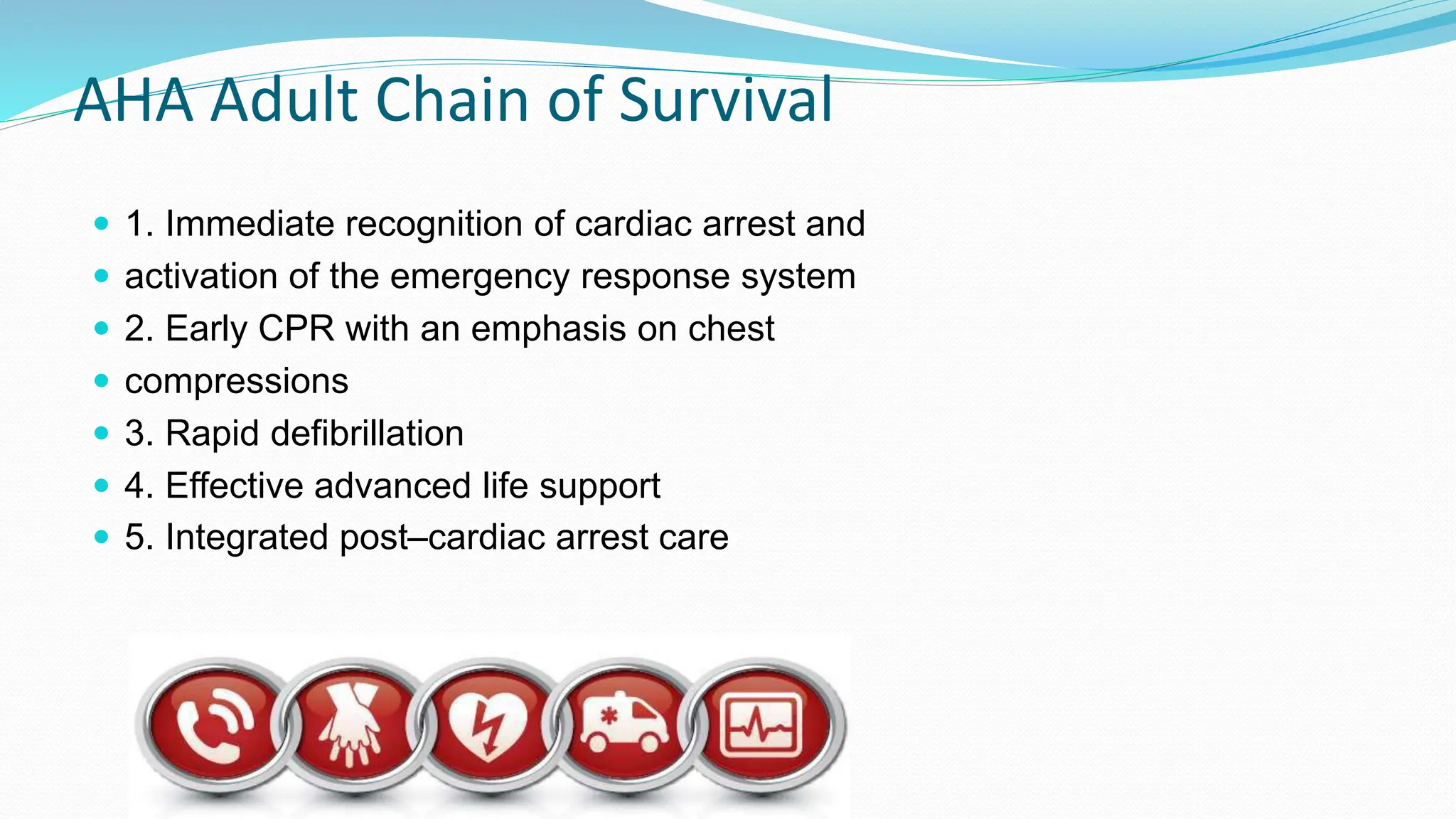
AHA Adult Chain of Survival
 1. Immediate recognition of cardiac arrest and
 activation of the emergency response system
 2. Early CPR with an emphasis on chest
 compressions
 3. Rapid defibrillation
 4. Effective advanced life support
 5. Integrated post–cardiac arrest care
COMPONENT OF BLS SEQUENCE AND HIGH
QUALITY CPR
 Scene safety:
 1. Make sure the environment is safe for rescuers and victim
 Recognition of cardiac arrest:
 1. Check for responsiveness
 2. No breathing or only gasping ( ie, no normal breathing)
 3. No definite pulse felt within 10 secs ( Carotid or femoral pulse)
 4. (Breathing and pulse check can be performed simultaneously within 10
secs)
Activation of emergency response system:
 If alone with no mobile phone, leave the victim to activate the emergency response
system and get the AED before beginning CPR
 Otherwise, send someone and begin CPR immediately; use the AED as soon as it is
available
WITNESSED VS UNWITNESSED
 • WITNESSED
 • IF ALONE
 • ACTIVATE EMS
 • THEN CPR
 • IF 2 RESCUERS
 • START CPR
 • SECOND ONE – ACTIVATE EMS
 • UNWITNESSED
 • START CPR
 • GIVE FOR 2 MINS
 • ACTIVATE EMS
.
 Chest compression-
 Adult- 30:2
 Children or infant- 30:2 if one rescuer
 15:2 if more than one rescuer
 Compression rate:
 100-120/ min
 Compression depth:
 Adult- at least 5 cm
 Children or infant- at least 1/3rd AP diameter of chest
.
 Hand placement:
 Adult - 2 hands on the lower half of the sternum
 Children – 1 or 2 hands on the lower half of the sternum
 Infants – 2 fingers or 2 thumb defending of the number of
 rescuers
 Chest recoil:
 allow full recoil of chest after each compression; do not
 lean on the chest after each compression.
 Minimizing interruption: Limit interruptions in chest compressions to less than 10
secs.
.
.
.
.
.
Defibrillation
 Know your AED
 Universal steps:
1. Power ON
2. Attach electrode pads
3. Analyze the rhythm
4. Shock (if advised)
20
Defibrillation
 Most frequent initial rhythm in witnessed sudden cardiac arrest is
ventricular fibrillation (VF) or pulseless ventricular tachycardia (VT)
which rapidly deteriorates into VF
 The only effective treatment for VF is electrical defibrillation
 Probability of successful defibrillation diminishes rapidly over time.
 VF rapidly converts to asystole if not treated
21
Early Defibrillation = Increased Survival
22
Rhythm Analysis
Lethal vs non-lethal?
Shockable vs. non-shockable? Too fast vs too slow?
Symptomatic vs. asymptomatic?
Lethal Rhythms
 Shockable (Defibrillation)
 Ventricular fibrillation(most frequent initial rhythm in witnessed sudden cardiac
arrest).
 Pulseless ventricular tachycardia
 Non-shockable
 Asystole
 Pulseless electrical activity(PEA)
24
Ventricular tachycardia
Ventricular fibrillation
.
Pulseless Electrical Activity(PEA)
Note that PEA can look like any rhythm(any organized activity) but no pulse
Asystole
.
.
Non-Lethal Rhythms
 Too fast (tachycardias)
• Sinus
• Supraventricular (including a-fib/flutter)
• Ventricular
 Too slow (bradycardias)
• Sinus
• Heart block (1°, 2°, 3° AV block)
32
Adult advanced cardiovascular life support Cardiac Arrest
Algorithm
Adult cardiac arrest
shout for help/activate emergency team
Second cycle
Third cycle
.
Asystole/PEA
simplified:
-CPR and check for
shockable rhythms
-Epinephrine every 3-
5 mins
-Search for reversible
causes
Give fluids!
Give oxygen!
Consider bicarb!
Consider calcium!
Consider warming!
Needle decompression!
Pericardiocentesis!
Consider antidotes!
Thrombolysis?
Fluids
Oxygen
Feel patient
Bilateral breath sounds
No JVD/unlikely hx
Cardiac arrest patient
Do routine ACLS
Bicarb? Calcium? Thrombolysis?
.
Adult Post–Cardiac Arrest Care Algorithm.
Cardiac Arrest in Pregnancy In-Hospital ACLS
Algorithm.
Pediatric Cardiac Arrest Algorithm.
THANK YOU
PEACE FOR ETHIOPIA
REFRENCES
 ACLS 2020
 ACLS 2015

Advanced Cardiac Life support ppt2021.pptx

  • 1.
  • 2.
    objectives  After thecourse you will be able to • Define advanced cardiac life support • Describe chain of survival • Discus cardiac arrest algorisms • Explain management of cardiac arrest • Describe post cardiac arrest care 2
  • 3.
    Basic ECG What isan ECG? The electrocardiography (ECG) is a surface representation of the electrical events of the cardiac cycle. Each event has a distinctive waveform, the study of which can lead to greater insight into a patient’s cardiac pathophysiology.
  • 4.
    The normal anatomyof the heart
  • 5.
  • 6.
    Impulse Conduction &the ECG  Sinoatrial node  AV node  Bundle of His  Bundle Branches  Purkinje fibers
  • 7.
  • 8.
    ACLS(Advanced Cardiac LifeSupport)  It is a set of clinical interventions for the urgent treatment of cardiac arrest and other life-threatening medical emergencies, as well as the knowledge and skills to deploy those interventions.  It is Systematic approach to assessment and management of cardiopulmonary emergencies  Continuation of Basic Life Support(BLS)  Resuscitation efforts aimed at restoring spontaneous circulation and retaining intact neurologic function
  • 9.
    AHA Adult Chainof Survival  1. Immediate recognition of cardiac arrest and  activation of the emergency response system  2. Early CPR with an emphasis on chest  compressions  3. Rapid defibrillation  4. Effective advanced life support  5. Integrated post–cardiac arrest care
  • 10.
    COMPONENT OF BLSSEQUENCE AND HIGH QUALITY CPR  Scene safety:  1. Make sure the environment is safe for rescuers and victim  Recognition of cardiac arrest:  1. Check for responsiveness  2. No breathing or only gasping ( ie, no normal breathing)  3. No definite pulse felt within 10 secs ( Carotid or femoral pulse)  4. (Breathing and pulse check can be performed simultaneously within 10 secs)
  • 11.
    Activation of emergencyresponse system:  If alone with no mobile phone, leave the victim to activate the emergency response system and get the AED before beginning CPR  Otherwise, send someone and begin CPR immediately; use the AED as soon as it is available
  • 12.
    WITNESSED VS UNWITNESSED • WITNESSED  • IF ALONE  • ACTIVATE EMS  • THEN CPR  • IF 2 RESCUERS  • START CPR  • SECOND ONE – ACTIVATE EMS  • UNWITNESSED  • START CPR  • GIVE FOR 2 MINS  • ACTIVATE EMS
  • 13.
    .  Chest compression- Adult- 30:2  Children or infant- 30:2 if one rescuer  15:2 if more than one rescuer  Compression rate:  100-120/ min  Compression depth:  Adult- at least 5 cm  Children or infant- at least 1/3rd AP diameter of chest
  • 14.
    .  Hand placement: Adult - 2 hands on the lower half of the sternum  Children – 1 or 2 hands on the lower half of the sternum  Infants – 2 fingers or 2 thumb defending of the number of  rescuers  Chest recoil:  allow full recoil of chest after each compression; do not  lean on the chest after each compression.  Minimizing interruption: Limit interruptions in chest compressions to less than 10 secs.
  • 15.
  • 16.
  • 17.
  • 18.
  • 19.
  • 20.
    Defibrillation  Know yourAED  Universal steps: 1. Power ON 2. Attach electrode pads 3. Analyze the rhythm 4. Shock (if advised) 20
  • 21.
    Defibrillation  Most frequentinitial rhythm in witnessed sudden cardiac arrest is ventricular fibrillation (VF) or pulseless ventricular tachycardia (VT) which rapidly deteriorates into VF  The only effective treatment for VF is electrical defibrillation  Probability of successful defibrillation diminishes rapidly over time.  VF rapidly converts to asystole if not treated 21
  • 22.
    Early Defibrillation =Increased Survival 22
  • 23.
    Rhythm Analysis Lethal vsnon-lethal? Shockable vs. non-shockable? Too fast vs too slow? Symptomatic vs. asymptomatic?
  • 24.
    Lethal Rhythms  Shockable(Defibrillation)  Ventricular fibrillation(most frequent initial rhythm in witnessed sudden cardiac arrest).  Pulseless ventricular tachycardia  Non-shockable  Asystole  Pulseless electrical activity(PEA) 24
  • 25.
  • 26.
  • 27.
  • 28.
    Pulseless Electrical Activity(PEA) Notethat PEA can look like any rhythm(any organized activity) but no pulse
  • 29.
  • 30.
  • 31.
  • 32.
    Non-Lethal Rhythms  Toofast (tachycardias) • Sinus • Supraventricular (including a-fib/flutter) • Ventricular  Too slow (bradycardias) • Sinus • Heart block (1°, 2°, 3° AV block) 32
  • 33.
    Adult advanced cardiovascularlife support Cardiac Arrest Algorithm
  • 34.
    Adult cardiac arrest shoutfor help/activate emergency team
  • 35.
  • 36.
    . Asystole/PEA simplified: -CPR and checkfor shockable rhythms -Epinephrine every 3- 5 mins -Search for reversible causes
  • 41.
    Give fluids! Give oxygen! Considerbicarb! Consider calcium! Consider warming! Needle decompression! Pericardiocentesis! Consider antidotes! Thrombolysis?
  • 42.
    Fluids Oxygen Feel patient Bilateral breathsounds No JVD/unlikely hx Cardiac arrest patient Do routine ACLS Bicarb? Calcium? Thrombolysis?
  • 43.
  • 44.
    Cardiac Arrest inPregnancy In-Hospital ACLS Algorithm.
  • 45.
  • 46.
  • 47.