Safe transfer of Patient
Mr. Nikhil D Tasgaonkar,
M.Sc. Paediatric Nursing
TRANSFER OF A PATIENT
 When a patient is ill, there are occasions when
they must be transported to another Health units
for continuation of care.
 This transport is referred to as a ‘patient transfer’,
since the patient along with their records are
transferred from one facility to another.
 A patient can be transferred for a variety of reasons
and the transfer can be for a short or long duration.
Why and where patient will be
transferred????????????
Approach to the patient transfer
 Communication
 Provision of elevators
 Proper documentation regarding client's
abilities, transfer needs, physical stability
and tendency if any, towards aggressive
acts.
 Nurse should be prepared with all aspect in case
of ill effects during transfer. (emergency
equipment's, drugs etc)
 Proper body mechanics to avoid injury
 Try to maintain eye contact with the client and
communicate while the transfer is in progress.
 The client should be transported the shortest
possible distance by the lifting device.
 Assure the path of the
transfer or lift is clear from
obstructions.
 If the weight of the person
is more than one-fourth of
nurse body weight, nurse
should get someone to
help.
 Also, get assistance if
lifting the person is
awkward.
 Proper handover
Transfers-Safety
 If a patient starts to fall – do not try to stop
the fall, instead assist the patient to the
floor while protecting the head from injury.
 Nursing assessment to be performed to
determine if patient have suffered any
injuries.
 Prevention of injury is the key to provide safety
 Nurse should be aware of the Client’s motor deficit ability
 to support their body weight
 to Use effective body mechanics
 Use effective lifting techniques.
 When in doubt regarding the patient's ability-
”GET ASSISTANCE!!!!!!!!!”
Proper Body Mechanics Safety Precautions
Proper Body Mechanics
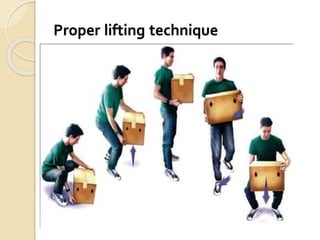
To lift large weights without injury
 Use legs and not back to lift
 Keep weight close to body
 Shifts center of gravity to Patient
Proper lifting technique
Body Mechanics Considerations
Guidelines for lifting and Carrying a patient
 Consider patients weight
 Know your limitations
 Lift without twisting
 Position feet one in front of the other
 Communicate with partner
 Keep back locked and don’t twist
 Flex at hips (not at waist)
 Bend at knees
 Keep elbows bent with arms close to
sides
 Don’t hyperextend your back
GENERAL MOVING AND/OR LIFTING PATIENT
RECOMMENDATIONS
 Identification tag
 Ensure the patient's privacy is
maintained
 Remove ornaments from hands
and wrists as this may cause skin
damage to the patient.
 Support/splint areas as needed
e.g. fractured limbs, cervical spine
etc.
 Ensure the patient's arms and
legs are in a suitable position.
 Ensure there is nothing
restrictive to the patient's
movement e.g. bed clothes.
 Ensure that tubes are free
moving e.g. urinary
catheters, IV drips, NG
tubes, drains etc.
 Lift, don't drag otherwise
patient may cause skin
tearing.
Patient Position
Patient with dyspnea or chest pain
 Position of comfort
 As long as hypotension doesn’t occur
Suspected spine injury
 Immobilized to long backboard
Shock
• Elevated legs”8-12 inches”
Pregnant Patient
 Left lateral recumbent
 Supine=Fetus on vena cava
Use of Wheelchairs
 Have the bed at the lowest level.
 Make sure the chair is locked when removing or seating the
person.
 Pull the wheelchair backwards up steps.
 Park the wheel chair with the person’s strongest side next to
the bed.
 Lock the wheelchair brakes and remove feet from foot rests.
 Swing or remove foot rests from wheelchair.
Safe transfer of patient