BASEL COMMITTEE &
BASEL NORMS
PRESENTED BY-
Yasha Singh
4113007007
HISTORY OF THE BASEL COMMITTEE
 The breakdown of the Bretton Woods system of managed
exchange rates in 1973 soon led to casualties.
 On 26 June 1974, West Germany's Federal Banking Supervisory Office
withdrew Bankhaus Herstatt's banking licence after finding that the
bank's foreign exchange exposures amounted to three times its capital.
 In October the same year, the Franklin National Bank of New
York also closed its doors after racking up huge foreign exchange
losses.
 Three months later, in response to these and other disruptions
in the international financial markets, the central bank
governors of the G10 countries established a Committee on
Banking Regulations and Supervisory Practices.
 Later renamed as the Basel Committee on Banking
Supervision.
 The Committee was designed as a forum for regular cooperation
between its member countries on banking supervisory matters.
 Its aim was and is to enhance financial stability by improving
supervisory know how and the quality of banking supervision
worldwide.
 The Committee seeks to achieve its aims –
 By setting minimum supervisory standards.
 By improving the effectiveness of techniques for supervising international
banking business.
 By exchanging information on national supervisory arrangements. And, to
engage with the challenges presented by diversified financial
conglomerates.
 The Committee also works with other standard-setting bodies,
including those of the securities and insurance industries.
 The Committee's decisions have no legal force.
 Rather, the Committee formulates supervisory standards and guidelines
and recommends statements of best practice in the expectation that
individual national authorities will implement them.
 In this way, the Committee encourages convergence towards
common standards and monitors their implementation, but
without attempting detailed harmonisation of member
countries' supervisory approaches.
 One important aim of the Committee's work was to close gaps
in international supervisory coverage so that-
 No foreign banking establishment would escape supervision.
 That supervision would be adequate and consistent across member
jurisdictions.
BASEL I: THE BASEL CAPITAL ACCORD
 Capital adequacy soon became the main focus of the
Committee's activities.
 In the early 1980s, the onset of the Latin American debt crisis
heightened the Committee's concerns that the capital ratios of
the main international banks were deteriorating at a time of
growing international risks.
 There was a strong recognition within the Committee of the
overriding need for –
 A multinational accord to strengthen the stability of the international
banking system and
 To remove a source of competitive inequality arising from differences
in national capital requirements.
 A capital measurement system commonly referred to as the
Basel Capital Accord (or the 1988 Accord) was approved by the
G10 Governors and released to banks in July 1988.
 The Accord called for-
 A minimum capital ratio of capital to risk-weighted assets of 8% to be
implemented by the end of 1992.
 Ultimately, this framework was introduced not only in member
countries but also in virtually all other countries with active
international banks.
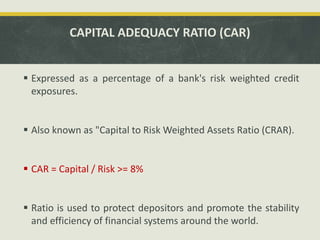
CAPITAL ADEQUACY RATIO (CAR)
 Expressed as a percentage of a bank's risk weighted credit
exposures.
 Also known as "Capital to Risk Weighted Assets Ratio (CRAR).
 CAR = Capital / Risk >= 8%
 Ratio is used to protect depositors and promote the stability
and efficiency of financial systems around the world.
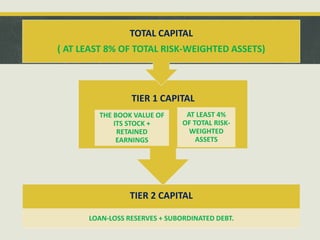
TIER 2 CAPITAL
LOAN-LOSS RESERVES + SUBORDINATED DEBT.
TIER 1 CAPITAL
THE BOOK VALUE OF
ITS STOCK +
RETAINED
EARNINGS
AT LEAST 4%
OF TOTAL RISK-
WEIGHTED
ASSETS
TOTAL CAPITAL
( AT LEAST 8% OF TOTAL RISK-WEIGHTED ASSETS)
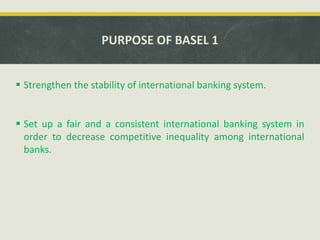
PURPOSE OF BASEL 1
 Strengthen the stability of international banking system.
 Set up a fair and a consistent international banking system in
order to decrease competitive inequality among international
banks.
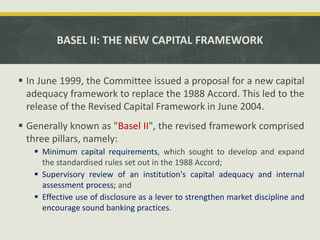
BASEL II: THE NEW CAPITAL FRAMEWORK
 In June 1999, the Committee issued a proposal for a new capital
adequacy framework to replace the 1988 Accord. This led to the
release of the Revised Capital Framework in June 2004.
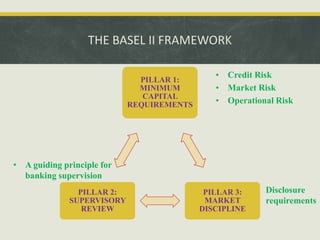
 Generally known as "Basel II", the revised framework comprised
three pillars, namely:
 Minimum capital requirements, which sought to develop and expand
the standardised rules set out in the 1988 Accord;
 Supervisory review of an institution's capital adequacy and internal
assessment process; and
 Effective use of disclosure as a lever to strengthen market discipline and
encourage sound banking practices.
THE BASEL II FRAMEWORK
PILLAR 1:
MINIMUM
CAPITAL
REQUIREMENTS
PILLAR 3:
MARKET
DISCIPLINE
PILLAR 2:
SUPERVISORY
REVIEW
• Credit Risk
• Market Risk
• Operational Risk
• A guiding principle for
banking supervision
Disclosure
requirements
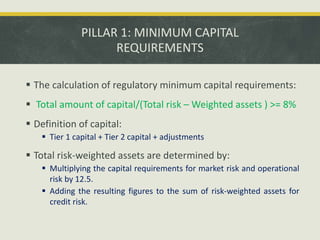
PILLAR 1: MINIMUM CAPITAL
REQUIREMENTS
 The calculation of regulatory minimum capital requirements:
 Total amount of capital/(Total risk – Weighted assets ) >= 8%
 Definition of capital:
 Tier 1 capital + Tier 2 capital + adjustments
 Total risk-weighted assets are determined by:
 Multiplying the capital requirements for market risk and operational
risk by 12.5.
 Adding the resulting figures to the sum of risk-weighted assets for
credit risk.
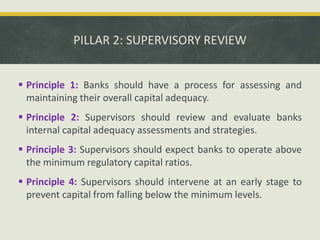
PILLAR 2: SUPERVISORY REVIEW
 Principle 1: Banks should have a process for assessing and
maintaining their overall capital adequacy.
 Principle 2: Supervisors should review and evaluate banks
internal capital adequacy assessments and strategies.
 Principle 3: Supervisors should expect banks to operate above
the minimum regulatory capital ratios.
 Principle 4: Supervisors should intervene at an early stage to
prevent capital from falling below the minimum levels.
PILLAR 3: MARKET DISCIPLINE
 The purpose of pillar three is to complement the pillar one
and pillar two.
 Develop a set of disclosure requirements to allow market
participants to assess information about a bank’s risk profile
and level of capitalization.
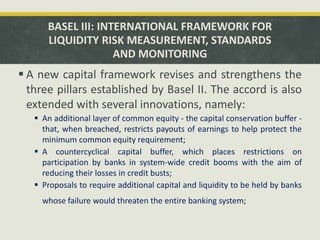
BASEL III: INTERNATIONAL FRAMEWORK FOR
LIQUIDITY RISK MEASUREMENT, STANDARDS
AND MONITORING
 A new capital framework revises and strengthens the
three pillars established by Basel II. The accord is also
extended with several innovations, namely:
 An additional layer of common equity - the capital conservation buffer -
that, when breached, restricts payouts of earnings to help protect the
minimum common equity requirement;
 A countercyclical capital buffer, which places restrictions on
participation by banks in system-wide credit booms with the aim of
reducing their losses in credit busts;
 Proposals to require additional capital and liquidity to be held by banks
whose failure would threaten the entire banking system;
 a leverage ratio - a minimum amount of loss-absorbing capital relative to
all of a bank's assets and off-balance-sheet exposures regardless of risk
weighting;
 liquidity requirements - a minimum liquidity ratio, intended to provide
enough cash to cover funding needs over a 30-day period of stress; and
a longer-term ratio intended to address maturity mismatches over the
entire balance sheet; and
 additional proposals for systemically important banks, including
requirements for augmented contingent capital and strengthened
arrangements for cross-border supervision and resolution.
SUGGESTED REQUIREMENTS
 The minimum common equity and Tier 1 requirements
increased from 2% and 4% levels to 3.5% and 4.5%,
respectively, at the beginning of 2013.
 The minimum common equity and Tier 1 requirements will be
4% and 5.5%, respectively, starting in 2014.
 The final requirements for common equity and Tier 1 capital
will be 4.5% and 6%, respectively, beginning in 2015.
 The 2.5% capital conservation buffer, which will comprise
common equity and is in addition to the 4.5% minimum
requirement, will be phased in progressively starting on 1
January 2016, and will become fully effective by 1 January
2019.
 The liquidity coverage ratio (LCR) will be phased in from 1
January 2015 .
 It will require banks to hold a buffer of high-quality liquid assets
sufficient to deal with the cash outflows encountered in an
acute short-term stress scenario as specified by supervisors.
 To ensure that banks can implement the LCR without disruption
to their financing activities, the minimum LCR requirement will
begin at 60% in 2015, rising in equal annual steps of 10
percentage points to reach 100% on 1 January 2019.
 The other minimum liquidity standard introduced by Basel III is
the net stable funding ratio. This requirement, which will be
introduced as a minimum standard by 1 January 2018, will
address funding mismatches and provide incentives for banks
to use stable sources to fund their activities.

Basel committee & basel norms

  • 1.
    BASEL COMMITTEE & BASELNORMS PRESENTED BY- Yasha Singh 4113007007
  • 2.
    HISTORY OF THEBASEL COMMITTEE  The breakdown of the Bretton Woods system of managed exchange rates in 1973 soon led to casualties.  On 26 June 1974, West Germany's Federal Banking Supervisory Office withdrew Bankhaus Herstatt's banking licence after finding that the bank's foreign exchange exposures amounted to three times its capital.  In October the same year, the Franklin National Bank of New York also closed its doors after racking up huge foreign exchange losses.
  • 3.
     Three monthslater, in response to these and other disruptions in the international financial markets, the central bank governors of the G10 countries established a Committee on Banking Regulations and Supervisory Practices.  Later renamed as the Basel Committee on Banking Supervision.  The Committee was designed as a forum for regular cooperation between its member countries on banking supervisory matters.  Its aim was and is to enhance financial stability by improving supervisory know how and the quality of banking supervision worldwide.
  • 4.
     The Committeeseeks to achieve its aims –  By setting minimum supervisory standards.  By improving the effectiveness of techniques for supervising international banking business.  By exchanging information on national supervisory arrangements. And, to engage with the challenges presented by diversified financial conglomerates.  The Committee also works with other standard-setting bodies, including those of the securities and insurance industries.  The Committee's decisions have no legal force.  Rather, the Committee formulates supervisory standards and guidelines and recommends statements of best practice in the expectation that individual national authorities will implement them.
  • 5.
     In thisway, the Committee encourages convergence towards common standards and monitors their implementation, but without attempting detailed harmonisation of member countries' supervisory approaches.  One important aim of the Committee's work was to close gaps in international supervisory coverage so that-  No foreign banking establishment would escape supervision.  That supervision would be adequate and consistent across member jurisdictions.
  • 6.
    BASEL I: THEBASEL CAPITAL ACCORD  Capital adequacy soon became the main focus of the Committee's activities.  In the early 1980s, the onset of the Latin American debt crisis heightened the Committee's concerns that the capital ratios of the main international banks were deteriorating at a time of growing international risks.  There was a strong recognition within the Committee of the overriding need for –  A multinational accord to strengthen the stability of the international banking system and  To remove a source of competitive inequality arising from differences in national capital requirements.
  • 7.
     A capitalmeasurement system commonly referred to as the Basel Capital Accord (or the 1988 Accord) was approved by the G10 Governors and released to banks in July 1988.  The Accord called for-  A minimum capital ratio of capital to risk-weighted assets of 8% to be implemented by the end of 1992.  Ultimately, this framework was introduced not only in member countries but also in virtually all other countries with active international banks.
  • 8.
    CAPITAL ADEQUACY RATIO(CAR)  Expressed as a percentage of a bank's risk weighted credit exposures.  Also known as "Capital to Risk Weighted Assets Ratio (CRAR).  CAR = Capital / Risk >= 8%  Ratio is used to protect depositors and promote the stability and efficiency of financial systems around the world.
  • 9.
    TIER 2 CAPITAL LOAN-LOSSRESERVES + SUBORDINATED DEBT. TIER 1 CAPITAL THE BOOK VALUE OF ITS STOCK + RETAINED EARNINGS AT LEAST 4% OF TOTAL RISK- WEIGHTED ASSETS TOTAL CAPITAL ( AT LEAST 8% OF TOTAL RISK-WEIGHTED ASSETS)
  • 10.
    PURPOSE OF BASEL1  Strengthen the stability of international banking system.  Set up a fair and a consistent international banking system in order to decrease competitive inequality among international banks.
  • 11.
    BASEL II: THENEW CAPITAL FRAMEWORK  In June 1999, the Committee issued a proposal for a new capital adequacy framework to replace the 1988 Accord. This led to the release of the Revised Capital Framework in June 2004.  Generally known as "Basel II", the revised framework comprised three pillars, namely:  Minimum capital requirements, which sought to develop and expand the standardised rules set out in the 1988 Accord;  Supervisory review of an institution's capital adequacy and internal assessment process; and  Effective use of disclosure as a lever to strengthen market discipline and encourage sound banking practices.
  • 12.
    THE BASEL IIFRAMEWORK PILLAR 1: MINIMUM CAPITAL REQUIREMENTS PILLAR 3: MARKET DISCIPLINE PILLAR 2: SUPERVISORY REVIEW • Credit Risk • Market Risk • Operational Risk • A guiding principle for banking supervision Disclosure requirements
  • 13.
    PILLAR 1: MINIMUMCAPITAL REQUIREMENTS  The calculation of regulatory minimum capital requirements:  Total amount of capital/(Total risk – Weighted assets ) >= 8%  Definition of capital:  Tier 1 capital + Tier 2 capital + adjustments  Total risk-weighted assets are determined by:  Multiplying the capital requirements for market risk and operational risk by 12.5.  Adding the resulting figures to the sum of risk-weighted assets for credit risk.
  • 14.
    PILLAR 2: SUPERVISORYREVIEW  Principle 1: Banks should have a process for assessing and maintaining their overall capital adequacy.  Principle 2: Supervisors should review and evaluate banks internal capital adequacy assessments and strategies.  Principle 3: Supervisors should expect banks to operate above the minimum regulatory capital ratios.  Principle 4: Supervisors should intervene at an early stage to prevent capital from falling below the minimum levels.
  • 15.
    PILLAR 3: MARKETDISCIPLINE  The purpose of pillar three is to complement the pillar one and pillar two.  Develop a set of disclosure requirements to allow market participants to assess information about a bank’s risk profile and level of capitalization.
  • 16.
    BASEL III: INTERNATIONALFRAMEWORK FOR LIQUIDITY RISK MEASUREMENT, STANDARDS AND MONITORING  A new capital framework revises and strengthens the three pillars established by Basel II. The accord is also extended with several innovations, namely:  An additional layer of common equity - the capital conservation buffer - that, when breached, restricts payouts of earnings to help protect the minimum common equity requirement;  A countercyclical capital buffer, which places restrictions on participation by banks in system-wide credit booms with the aim of reducing their losses in credit busts;  Proposals to require additional capital and liquidity to be held by banks whose failure would threaten the entire banking system;
  • 17.
     a leverageratio - a minimum amount of loss-absorbing capital relative to all of a bank's assets and off-balance-sheet exposures regardless of risk weighting;  liquidity requirements - a minimum liquidity ratio, intended to provide enough cash to cover funding needs over a 30-day period of stress; and a longer-term ratio intended to address maturity mismatches over the entire balance sheet; and  additional proposals for systemically important banks, including requirements for augmented contingent capital and strengthened arrangements for cross-border supervision and resolution.
  • 18.
    SUGGESTED REQUIREMENTS  Theminimum common equity and Tier 1 requirements increased from 2% and 4% levels to 3.5% and 4.5%, respectively, at the beginning of 2013.  The minimum common equity and Tier 1 requirements will be 4% and 5.5%, respectively, starting in 2014.  The final requirements for common equity and Tier 1 capital will be 4.5% and 6%, respectively, beginning in 2015.  The 2.5% capital conservation buffer, which will comprise common equity and is in addition to the 4.5% minimum requirement, will be phased in progressively starting on 1 January 2016, and will become fully effective by 1 January 2019.
  • 19.
     The liquiditycoverage ratio (LCR) will be phased in from 1 January 2015 .  It will require banks to hold a buffer of high-quality liquid assets sufficient to deal with the cash outflows encountered in an acute short-term stress scenario as specified by supervisors.  To ensure that banks can implement the LCR without disruption to their financing activities, the minimum LCR requirement will begin at 60% in 2015, rising in equal annual steps of 10 percentage points to reach 100% on 1 January 2019.
  • 20.
     The otherminimum liquidity standard introduced by Basel III is the net stable funding ratio. This requirement, which will be introduced as a minimum standard by 1 January 2018, will address funding mismatches and provide incentives for banks to use stable sources to fund their activities.