BASEL-ll
Introduction
• Basel II is a type of recommendations on banking laws
and regulations issued by the Basel Committee on
Banking Supervision that was initially published in June
2004.
• The objective of Basel II is to create an international
standard that banking regulators can use when creating
regulations about how much capital banks need to put
aside to guard against the types of financial and
operational risks banks face.
Why BASEL II
 Basel II much more risk sensitive, as it is aligning capital
requirements to risks of loss. Better risk management in a
bank means bank may be able to allocate less regulatory
capital.
 The objective of Basel II is to modernize existing capital
requirements framework to make it more comprehensive
and risk sensitive.
 The Basel II framework therefore designed to be more
sensitive to the real risks that firms face than BaselI.
 Apart from looking at financial figures, it also considers
operational risks, such as risk of systems breaking down
or people doing the wrong things, and also marketrisk.
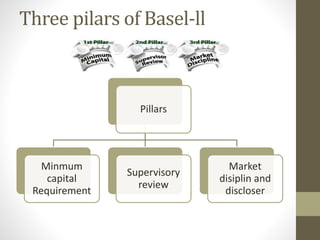
Three pilars of Basel-ll
Pillars
Minmum
capital
Requirement
Supervisory
review
Market
disiplin and
discloser
Pillar-I : Minimum Capital required
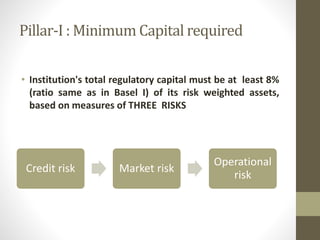
• Institution's total regulatory capital must be at least 8%
(ratio same as in Basel I) of its risk weighted assets,
based on measures of THREE RISKS
Credit risk Market risk
Operational
risk
Pillar-II Supervisory review.
 Covers Supervisory Review Process, describing principles for
effective supervision.
 Supervisors obliged to evaluate activities, corporate
governance, risk management and risk profiles of banks to
determine whether they have to change or to allocate more
capital for their risks (called Pillar 2capital)
 Deals with regulatory response to the first pillar, giving regulators
much improved 'tools' over those available to them under Basel I
Pillar-III Market supervisory
 Covers transparency and the obligation of banks to
disclose meaningful information to all stakeholders
 Clients and shareholders should have sufficient
understanding of activities of banks, and the way
they manage their risks.
Challenges with Indian Banking Industry..
1. Additional capital requirements.
2. Re-structuring the assets of some of the banks would be a
tedious process.
3. The new norms seem to favor the large banks that have
better risk management and measurement expertise.
Conclusion

Basel ll kanak binayakiya

  • 1.
  • 2.
    Introduction • Basel IIis a type of recommendations on banking laws and regulations issued by the Basel Committee on Banking Supervision that was initially published in June 2004. • The objective of Basel II is to create an international standard that banking regulators can use when creating regulations about how much capital banks need to put aside to guard against the types of financial and operational risks banks face.
  • 3.
    Why BASEL II Basel II much more risk sensitive, as it is aligning capital requirements to risks of loss. Better risk management in a bank means bank may be able to allocate less regulatory capital.  The objective of Basel II is to modernize existing capital requirements framework to make it more comprehensive and risk sensitive.  The Basel II framework therefore designed to be more sensitive to the real risks that firms face than BaselI.  Apart from looking at financial figures, it also considers operational risks, such as risk of systems breaking down or people doing the wrong things, and also marketrisk.
  • 4.
    Three pilars ofBasel-ll Pillars Minmum capital Requirement Supervisory review Market disiplin and discloser
  • 5.
    Pillar-I : MinimumCapital required • Institution's total regulatory capital must be at least 8% (ratio same as in Basel I) of its risk weighted assets, based on measures of THREE RISKS Credit risk Market risk Operational risk
  • 6.
    Pillar-II Supervisory review. Covers Supervisory Review Process, describing principles for effective supervision.  Supervisors obliged to evaluate activities, corporate governance, risk management and risk profiles of banks to determine whether they have to change or to allocate more capital for their risks (called Pillar 2capital)  Deals with regulatory response to the first pillar, giving regulators much improved 'tools' over those available to them under Basel I
  • 7.
    Pillar-III Market supervisory Covers transparency and the obligation of banks to disclose meaningful information to all stakeholders  Clients and shareholders should have sufficient understanding of activities of banks, and the way they manage their risks.
  • 8.
    Challenges with IndianBanking Industry.. 1. Additional capital requirements. 2. Re-structuring the assets of some of the banks would be a tedious process. 3. The new norms seem to favor the large banks that have better risk management and measurement expertise.
  • 9.