HSE LECTURE III (MAY 23, 2011) BASEL I and BASEL II (1).ppt
1.
BASEL I andBASEL II: HISTORY OF
AN EVOLUTION
Hasan Ersel
HSE
May 23, 2011
2.
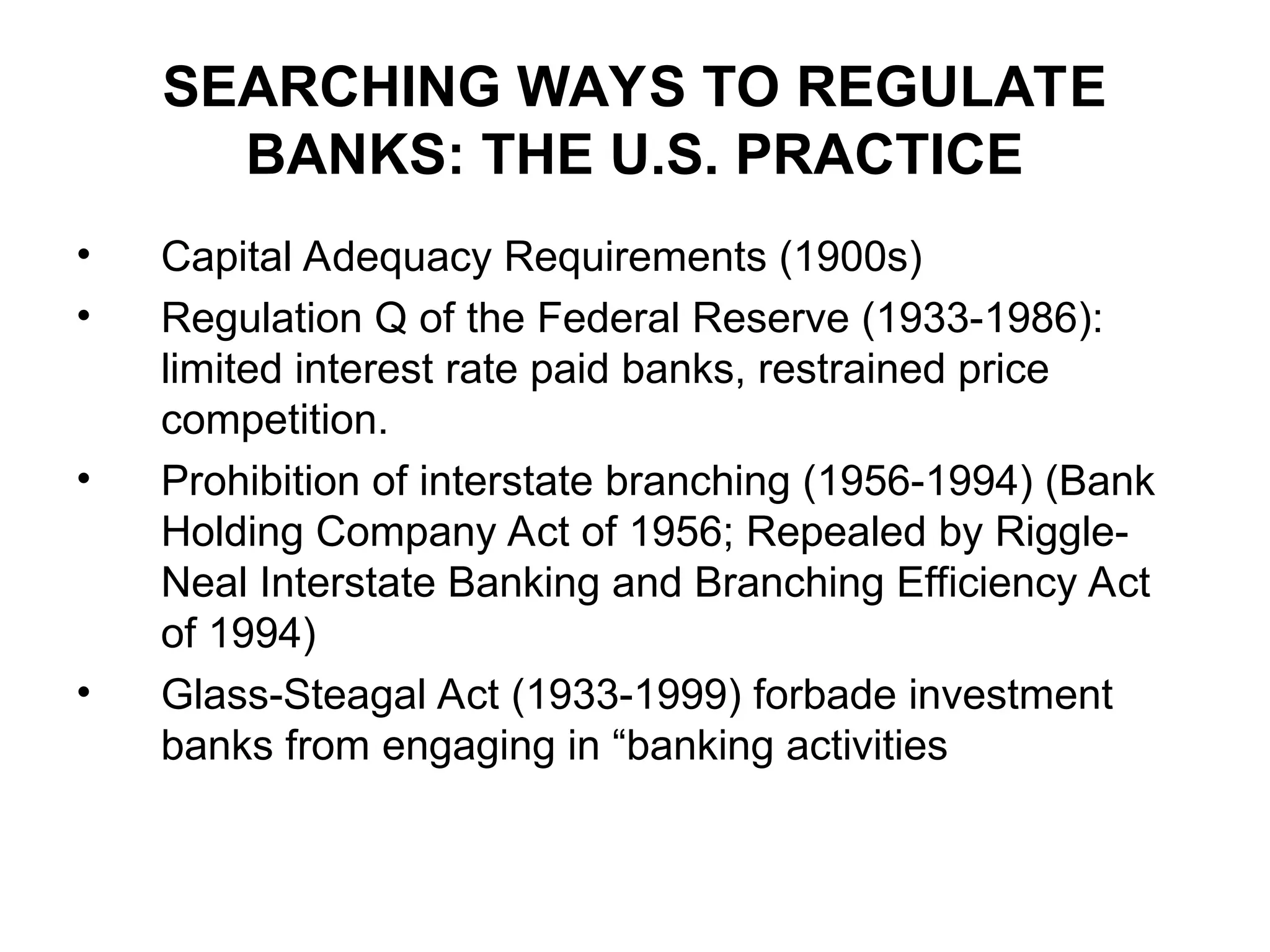
SEARCHING WAYS TOREGULATE
BANKS: THE U.S. PRACTICE
• Capital Adequacy Requirements (1900s)
• Regulation Q of the Federal Reserve (1933-1986):
limited interest rate paid banks, restrained price
competition.
• Prohibition of interstate branching (1956-1994) (Bank
Holding Company Act of 1956; Repealed by Riggle-
Neal Interstate Banking and Branching Efficiency Act
of 1994)
• Glass-Steagal Act (1933-1999) forbade investment
banks from engaging in “banking activities
3.
HISTORY OF CAPITALADEQUACY
RULES IN THE U.S.
• 1900-late 1930s: Capital to Deposit Ratio (The Office of
Comptroller of the Currency [OCC] adopted the 10%
minimum)
• Late 1930s: Capital to Total Assets (FDIC)
• II WW: No capital ratios (Banks were buying US
Government bonds)
• 1945-late 1970s: Capital to “Risk Assets” Ratio (FED
and FDIC), Capital to Total Assets Ratio (FDIC)
•
4.
BANK SAFETY ANDSOUNDNESS
• Capital adequacy requirements
• i) provide a buffer against bank losses
• ii) protects creditors in the event of bank fails
• iii) creates disincentive for excessive risk taking
5.
INTERNATIONAL REGULATION
• 1988Basel Accord (Basel-I)
• 1993 Proposal: Standard Model
• 1996 Modification: Internal Model
• New Basel Accord (Basel-II)
6.
THE FIRST BASELACCORD
The first Basel Accord (Basel-I) was completed
in 1988
7.
WHY BASEL-I WASNEEDED?
The reason was to create a level playing field for
“internationally active banks”
– Banks from different countries competing for the
same loans would have to set aside roughly the same
amount of capital on the loans
8.
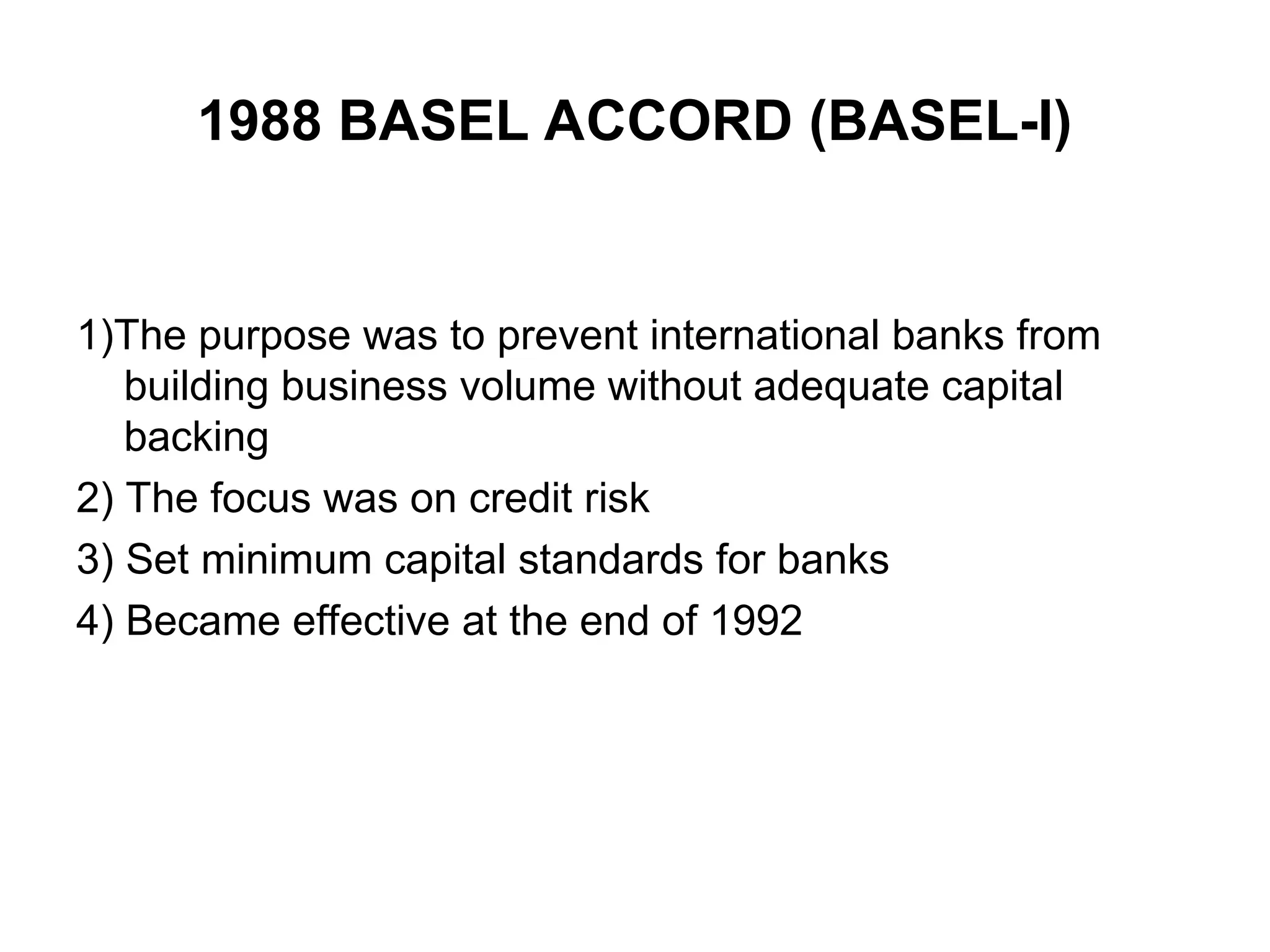
1988 BASEL ACCORD(BASEL-I)
1)The purpose was to prevent international banks from
building business volume without adequate capital
backing
2) The focus was on credit risk
3) Set minimum capital standards for banks
4) Became effective at the end of 1992
9.
A NEW CONCEPT:RISK BASED
CAPITAL
Basel-I was hailed for incorporating risk into the
calculation of capital requirements
10.
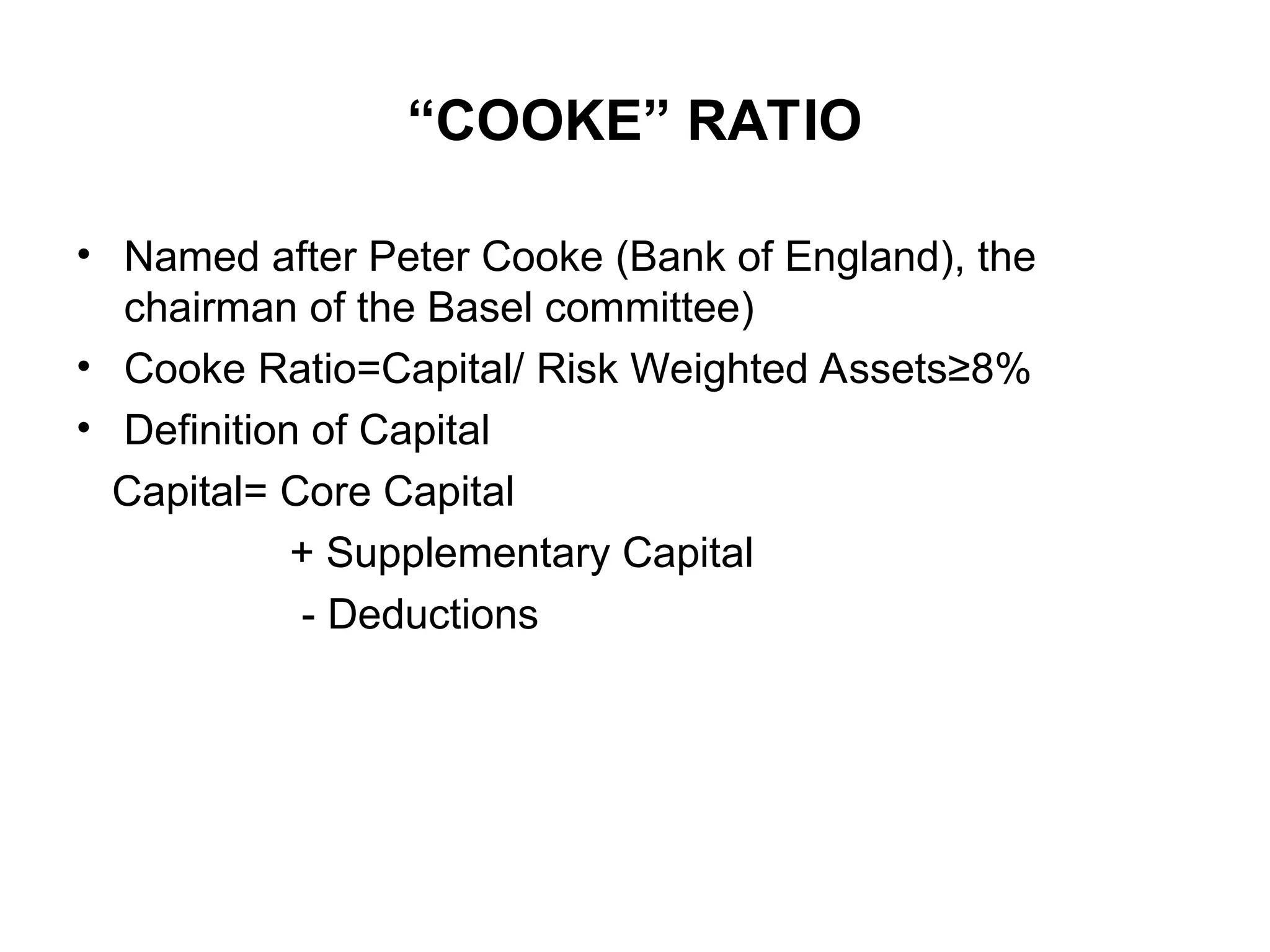
“COOKE” RATIO
• Namedafter Peter Cooke (Bank of England), the
chairman of the Basel committee)
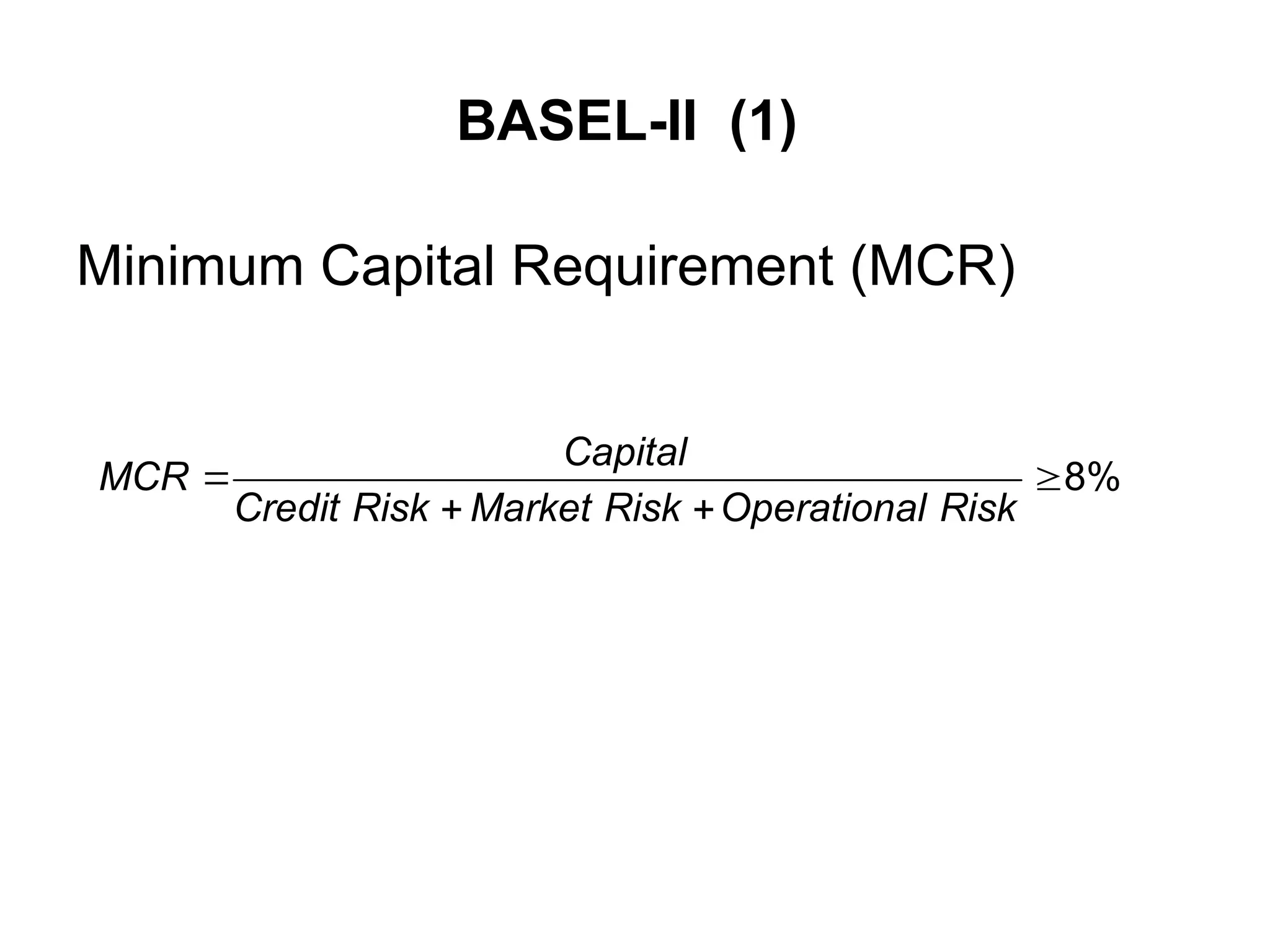
• Cooke Ratio=Capital/ Risk Weighted Assets≥8%
• Definition of Capital
Capital= Core Capital
+ Supplementary Capital
- Deductions
11.
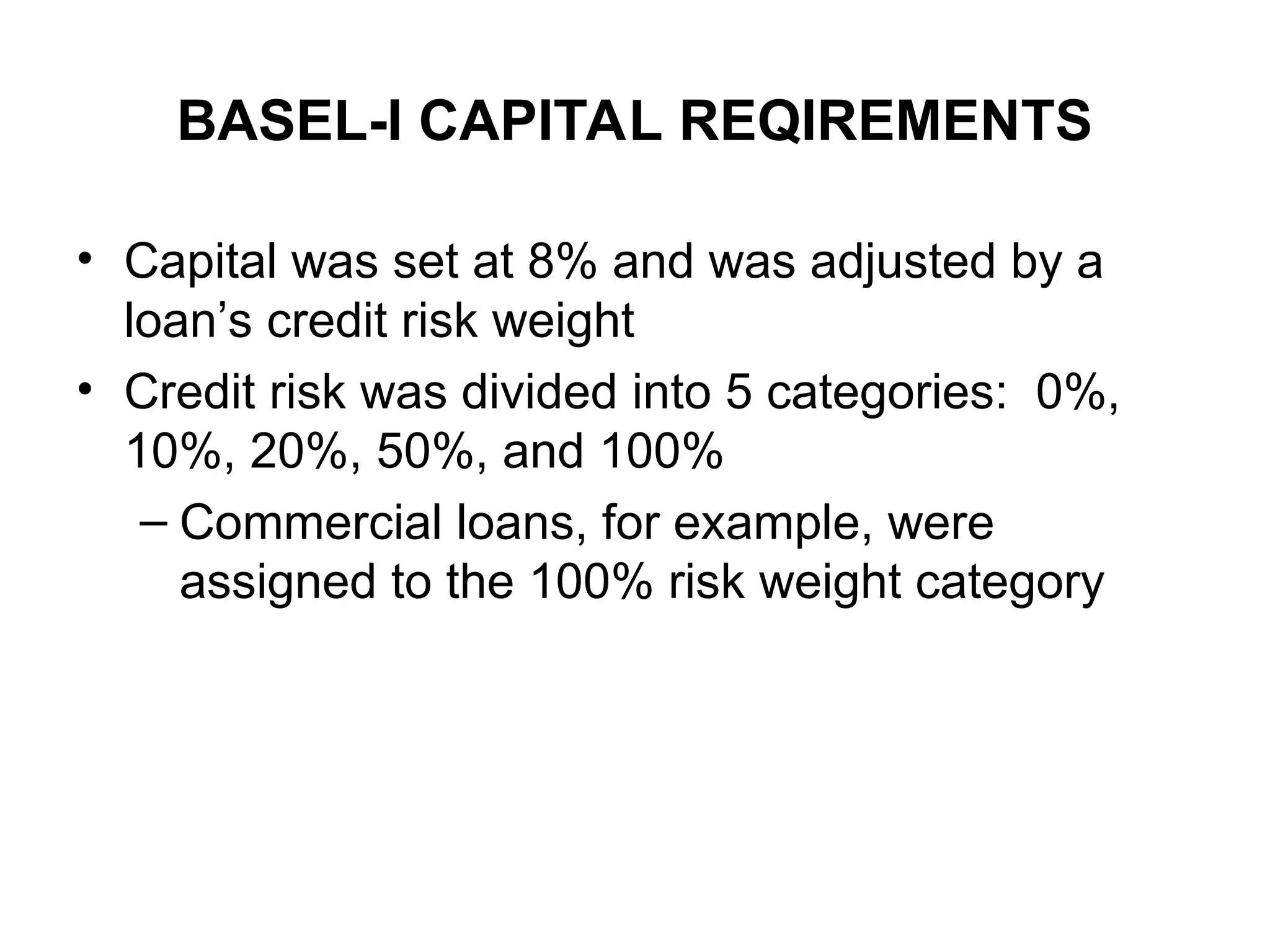
BASEL-I CAPITAL REQIREMENTS
•Capital was set at 8% and was adjusted by a
loan’s credit risk weight
• Credit risk was divided into 5 categories: 0%,
10%, 20%, 50%, and 100%
– Commercial loans, for example, were
assigned to the 100% risk weight category
12.
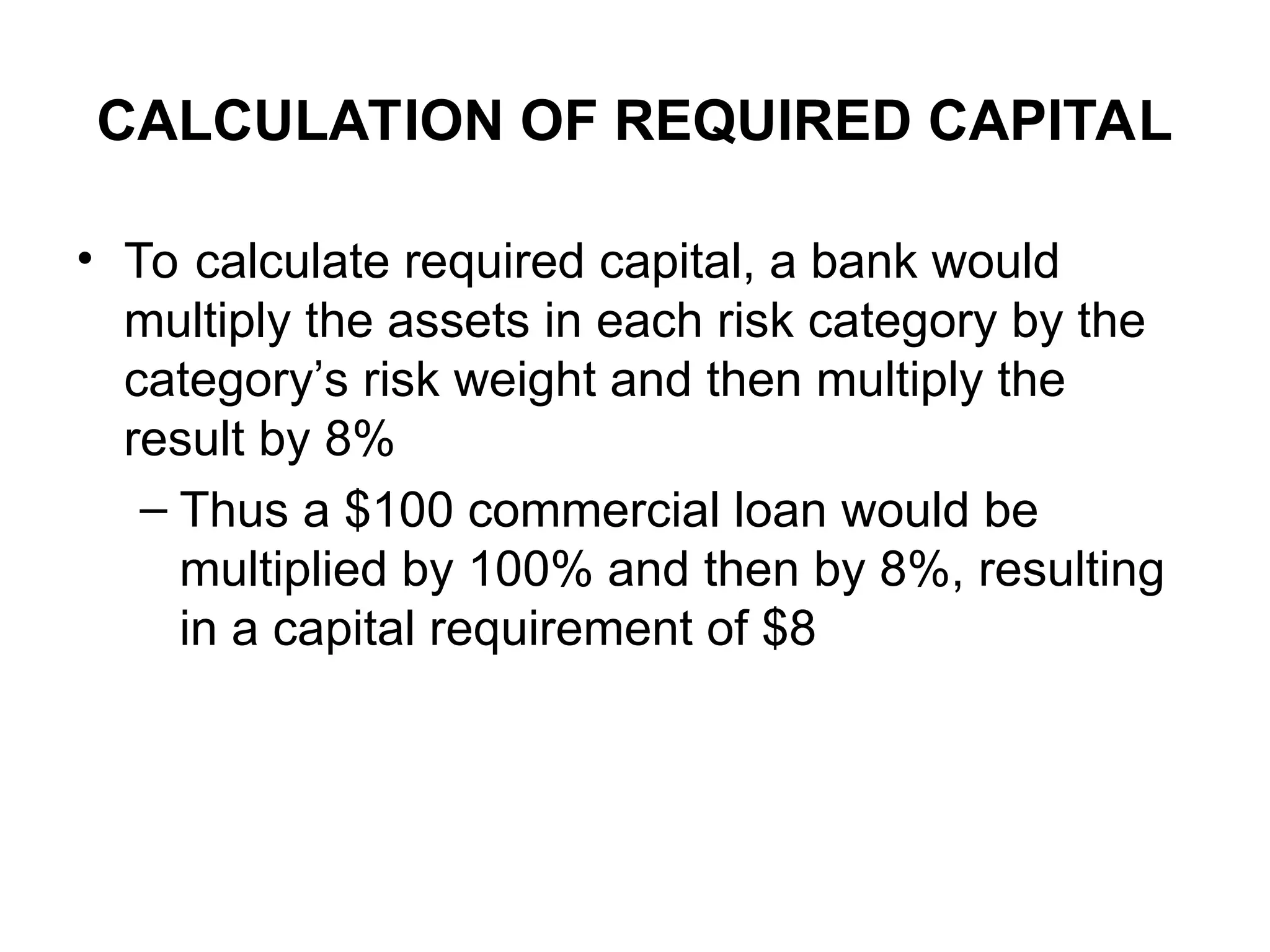
CALCULATION OF REQUIREDCAPITAL
• To calculate required capital, a bank would
multiply the assets in each risk category by the
category’s risk weight and then multiply the
result by 8%
– Thus a $100 commercial loan would be
multiplied by 100% and then by 8%, resulting
in a capital requirement of $8
13.
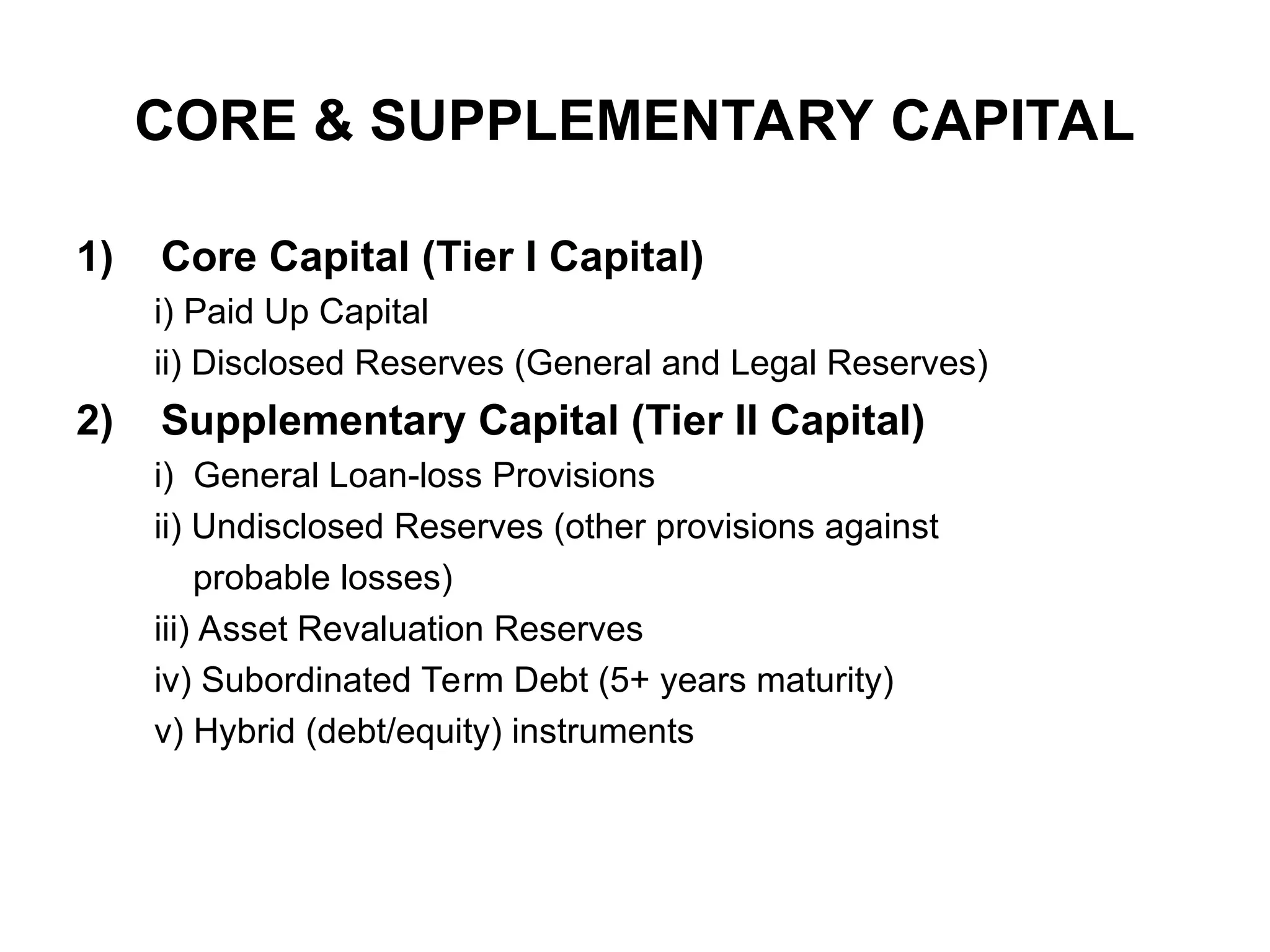
CORE & SUPPLEMENTARYCAPITAL
1) Core Capital (Tier I Capital)
i) Paid Up Capital
ii) Disclosed Reserves (General and Legal Reserves)
2) Supplementary Capital (Tier II Capital)
i) General Loan-loss Provisions
ii) Undisclosed Reserves (other provisions against
probable losses)
iii) Asset Revaluation Reserves
iv) Subordinated Term Debt (5+ years maturity)
v) Hybrid (debt/equity) instruments
14.
DEDUCTIONS FROM THECAPITAL
• Investments in unconsolidated banking and
financial subsidiary companies and investments
in the capital of other banks & financial
institutions
• Goodwill
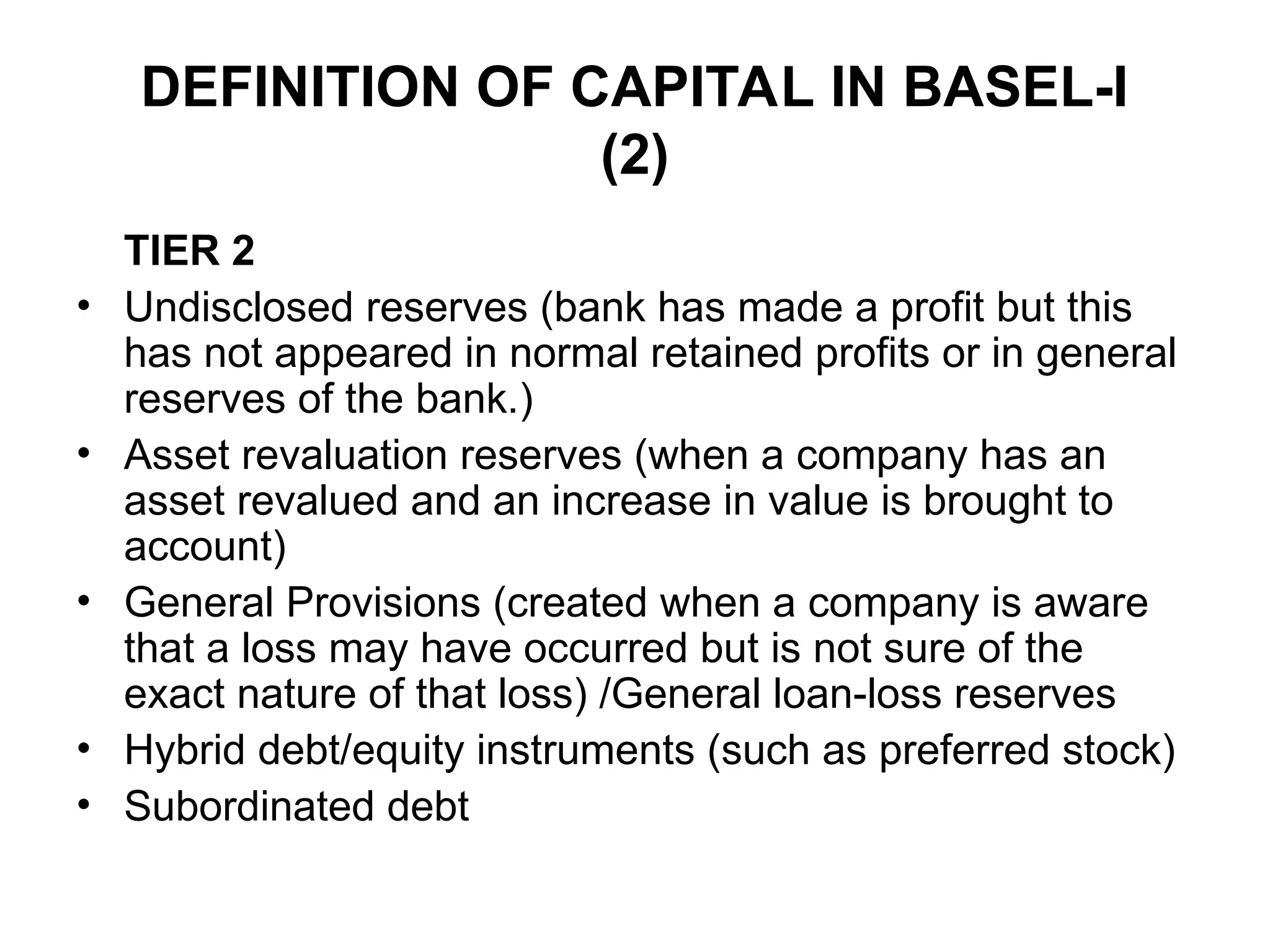
DEFINITION OF CAPITALIN BASEL-I
(2)
TIER 2
• Undisclosed reserves (bank has made a profit but this
has not appeared in normal retained profits or in general
reserves of the bank.)
• Asset revaluation reserves (when a company has an
asset revalued and an increase in value is brought to
account)
• General Provisions (created when a company is aware
that a loss may have occurred but is not sure of the
exact nature of that loss) /General loan-loss reserves
• Hybrid debt/equity instruments (such as preferred stock)
• Subordinated debt
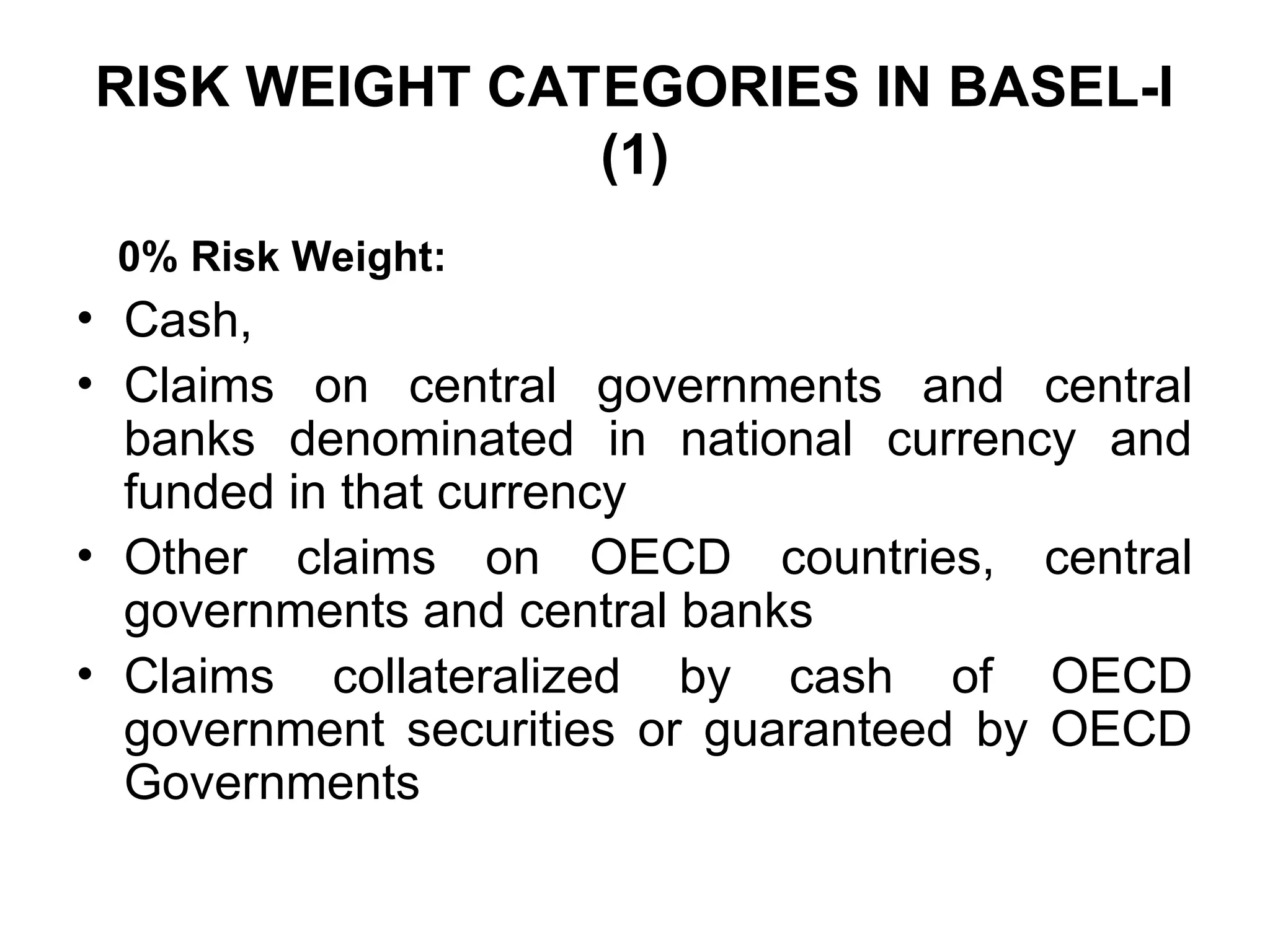
17.
RISK WEIGHT CATEGORIESIN BASEL-I
(1)
0% Risk Weight:
• Cash,
• Claims on central governments and central
banks denominated in national currency and
funded in that currency
• Other claims on OECD countries, central
governments and central banks
• Claims collateralized by cash of OECD
government securities or guaranteed by OECD
Governments
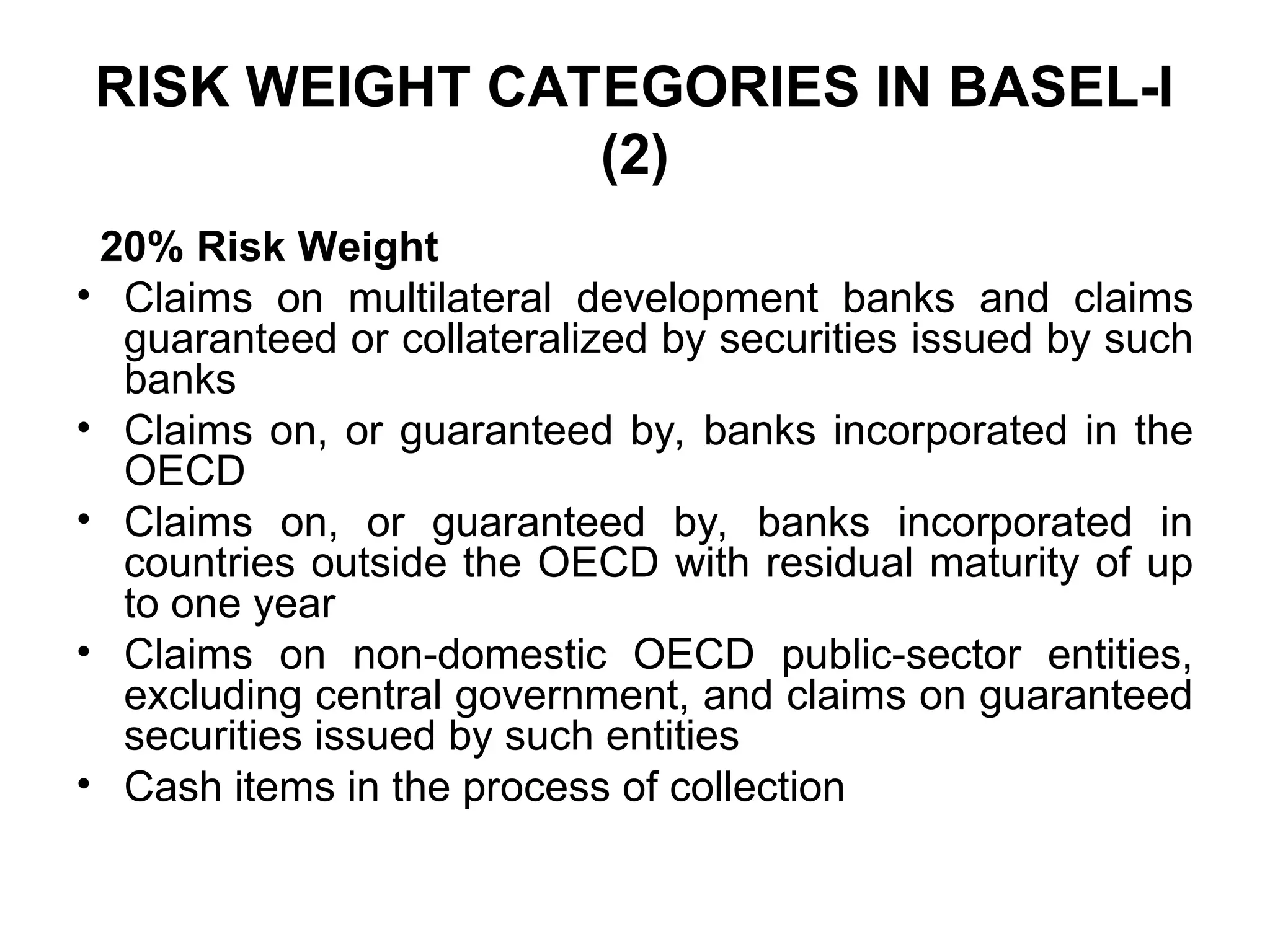
18.
RISK WEIGHT CATEGORIESIN BASEL-I
(2)
20% Risk Weight
• Claims on multilateral development banks and claims
guaranteed or collateralized by securities issued by such
banks
• Claims on, or guaranteed by, banks incorporated in the
OECD
• Claims on, or guaranteed by, banks incorporated in
countries outside the OECD with residual maturity of up
to one year
• Claims on non-domestic OECD public-sector entities,
excluding central government, and claims on guaranteed
securities issued by such entities
• Cash items in the process of collection
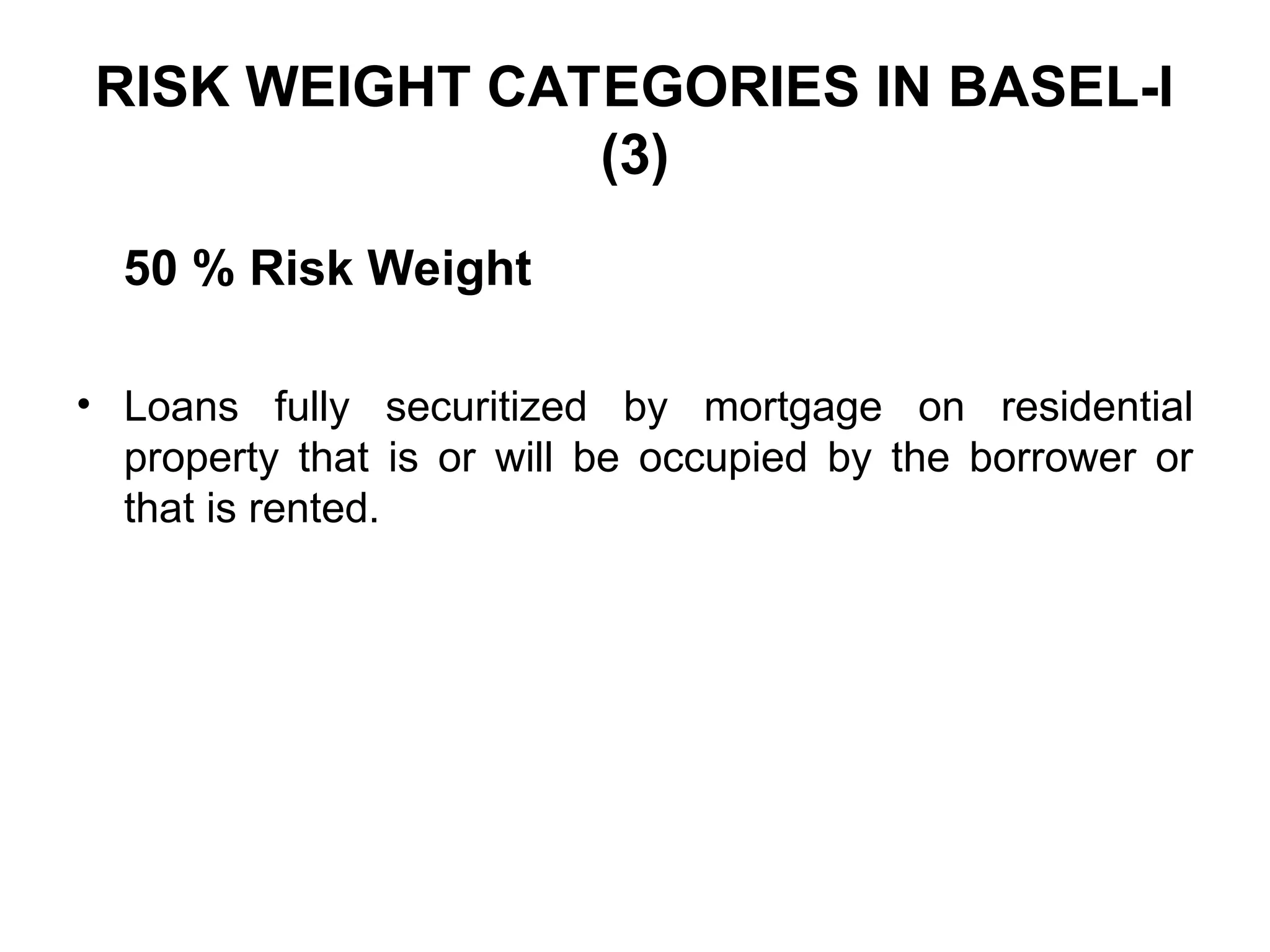
19.
RISK WEIGHT CATEGORIESIN BASEL-I
(3)
50 % Risk Weight
• Loans fully securitized by mortgage on residential
property that is or will be occupied by the borrower or
that is rented.
20.
RISK WEIGHT CATEGORIESIN BASEL-I
(4)
100% Risk Weight
• Claims on the private sector
• Claims on banks incorporated outside the OECD with
residual maturity of over one year
• Claims on central governments outside the OECD
(unless denominated and funded in national currency)
• Claims on commercial companies owned by the public
sector
• Premises, plant and equipment, and other fixed assets
• Real estate and other investments
• Capital instruments issued by other banks (unless
deducted from capital)
• All other assets
21.
RISK WEIGHT CATEGORIESIN BASEL-I
(5)
At National Discretion (0,10,20 or 50%)
• Claims on domestic public sector entities, excluding
central governments, and loans guaranteed by securities
issued by such entities
22.
CRITIQUE OF BASEL-I
Basel-Iaccord was criticized
i) for taking a too simplistic approach to setting
credit risk weights
and
ii) for ignoring other types of risk
23.
THE PROBLEM WITHTHE RISK
WEIGHTS
• Risk weights were based on what the parties to the
Accord negotiated rather than on the actual risk of each
asset
– Risk weights did not flow from any particular
insolvency probability standard, and were for the most
part, arbitrary.
24.
OPERATIONAL AND OTHERRISKS
• The requirements did not explicitly account for
operating and other forms of risk that may also
be important
– Except for trading account activities, the capital
standards did not account for hedging, diversification,
and differences in risk management techniques
25.
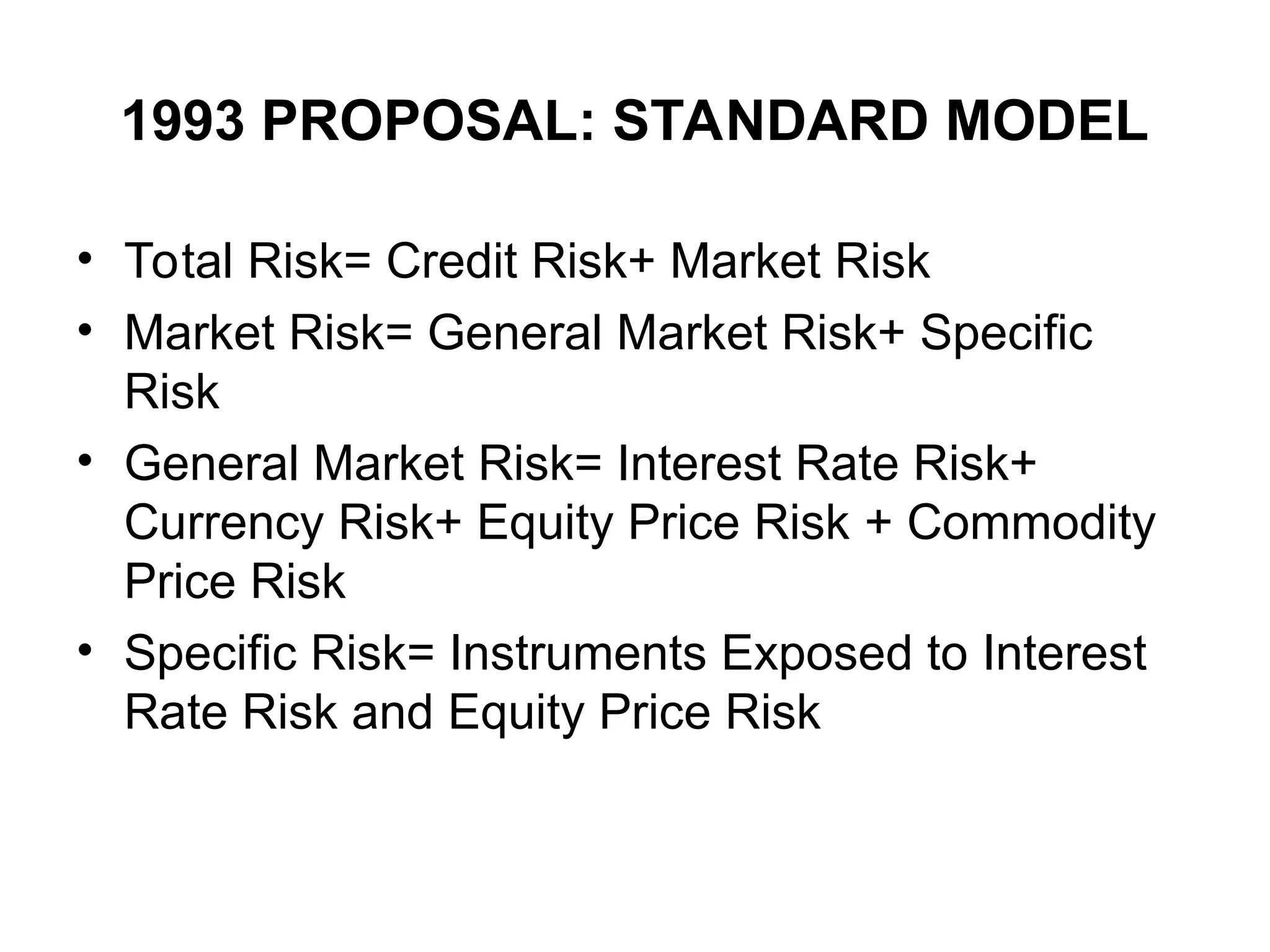
1993 PROPOSAL: STANDARDMODEL
• Total Risk= Credit Risk+ Market Risk
• Market Risk= General Market Risk+ Specific
Risk
• General Market Risk= Interest Rate Risk+
Currency Risk+ Equity Price Risk + Commodity
Price Risk
• Specific Risk= Instruments Exposed to Interest
Rate Risk and Equity Price Risk
26.
1996 MODIFICATION: INTERNALMODEL
• Internal Model → Value at Risk Methodology
• Tier III Capital (Only for Market Risk)
i) Long Term subordinated debt
ii) Option not to pay if minimum required capital
is <8%
27.
BANKS’ OWN CAPITALALLOCATION
MODELS
• Advances in technology and finance allowed
banks to develop their own capital allocation
(internal) models in the 1990s
• This resulted in more accurate calculations of
bank capital than possible under Basel-I
• These models allowed banks to align the
amount of risk they undertook on a loan with the
overall goals of the bank
28.
INTERNAL MODELS ANDBASEL I
• Internal models allow banks to more finely
differentiate risks of individual loans than is
possible under Basel-I
– Risk can be differentiated within loan categories and
between loan categories
– Allows the application of a “capital charge” to each
loan, rather than each category of loan
29.
VARIATION IN RISKQUALITY
• Banks discovered a wide variation in credit quality within
risk-weight categories
– Basel-I lumps all commercial loans into the 8% capital
category
– Internal models calculations can lead to capital
allocations on commercial loans that vary from 1% to
30%, depending on the loan’s estimated risk
30.
CAPITAL ARBITRAGE
• Ifa loan is calculated to have an internal capital
charge that is low compared to the 8% standard,
the bank has a strong incentive to undertake
regulatory capital arbitrage
• Securitization is the main means used especially
by U.S. banks to engage in regulatory capital
arbitrage
31.
EXAMPLES OF CAPITALARBITRAGE
• Assume a bank has a portfolio of commercial loans with the
following ratings and internally generated capital requirements
– AA-A: 3%-4% capital needed
– B+-B: 8% capital needed
– B- and below: 12%-16% capital needed
• Under Basel-I, the bank has to hold 8% risk-based capital
against all of these loans
• To ensure the profitability of the better quality loans, the bank
engages in capital arbitrage--it securitizes the loans so that
they are reclassified into a lower regulatory risk category with
a lower capital charge
• Lower quality loans with higher internal capital charges are
kept on the bank’s books because they require less risk-based
capital than the bank’s internal model indicates
32.
NEW APPRACH TORISK-BASED
CAPITAL
• By the late 1990s, growth in the use of regulatory capital
arbitrage led the Basel Committee to begin work on a
new capital regime (Basel-II)
• Effort focused on using banks’ internal rating models and
internal risk models
• June 1999: Committee issued a proposal for a new
capital adequacy framework to replace the 1998 Accord
BASEL-II
Basel-II consists ofthree pillars:
– Minimum capital requirements for credit risk, market
risk and operational risk—expanding the 1988 Accord
(Pillar I)
– Supervisory review of an institution’s capital adequacy
and internal assessment process (Pillar II)
– Effective use of market discipline as a lever to
strengthen disclosure and encourage safe and sound
banking practices (Pillar III)
35.
IMPLEMENTATION OF THEBASEL II
ACCORD
• Implementation of the Basel II Framework continues to
move forward around the globe. A significant number of
countries and banks already implemented the
standardized and foundation approaches as of the
beginning of 2007.
• In many other jurisdictions, the necessary infrastructure
(legislation, regulation, supervisory guidance, etc) to
implement the Framework is either in place or in
process, which will allow a growing number of countries
to proceed with implementation of Basel II’s advanced
approaches in 2008 and 2009.
• This progress is taking place in both Basel Committee
member and non-member countries.
BASEL-II (2)
PILLAR I:Minimum Capital Requirement
1) Capital Measurement: New Methods
2) Market Risk: In Line with 1993 & 1996
3) Operational Risk: Working on new methods
38.
BASEL-II (3)
Pillar Iis trying to achieve
– If the bank’s own internal calculations show that they
have extremely risky, loss-prone loans that generate
high internal capital charges, their formal risk-based
capital charges should also be high
– Likewise, lower risk loans should carry lower risk-
based capital charges
39.
BASEL-II (4)
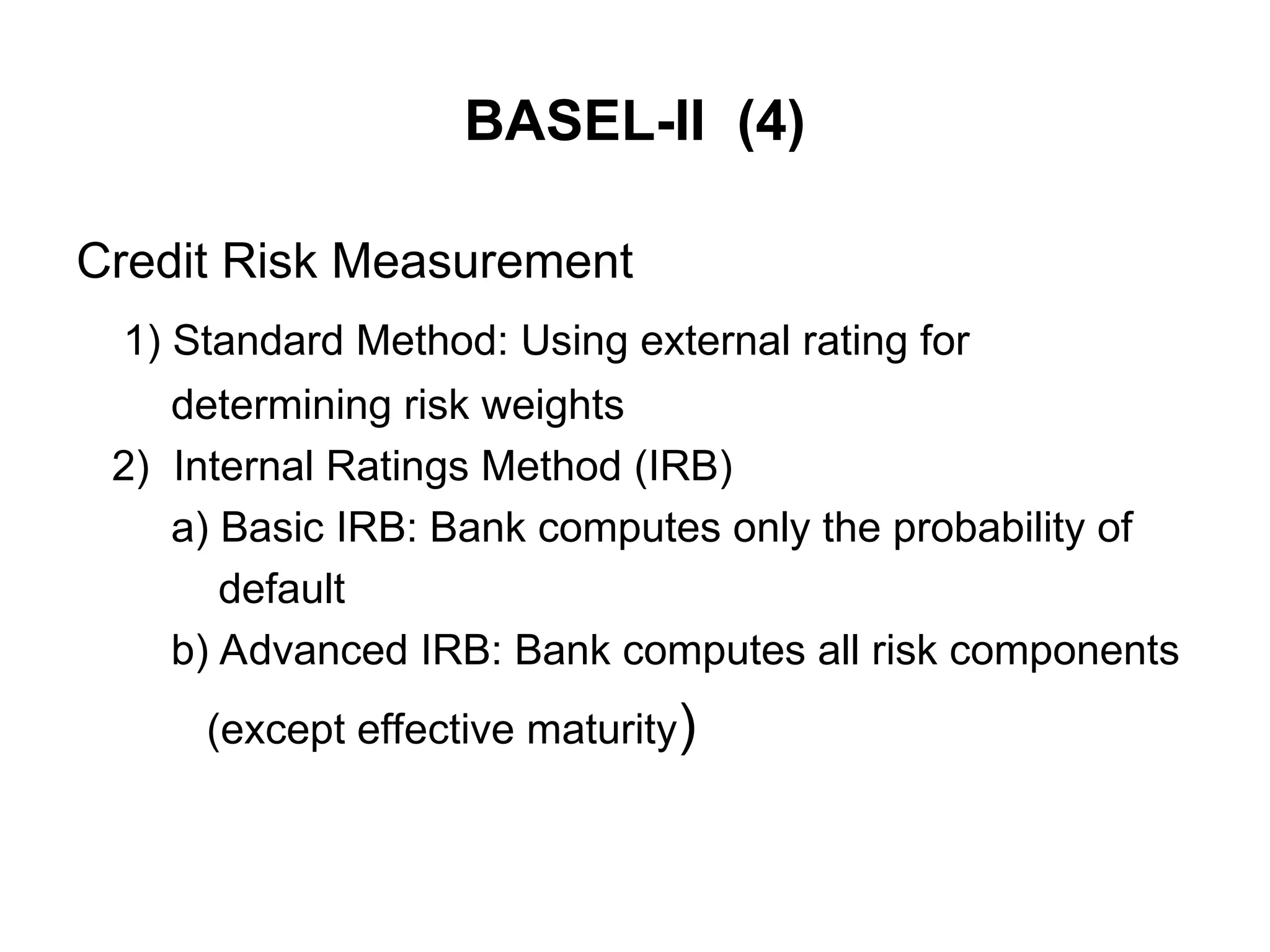
Credit RiskMeasurement
1) Standard Method: Using external rating for
determining risk weights
2) Internal Ratings Method (IRB)
a) Basic IRB: Bank computes only the probability of
default
b) Advanced IRB: Bank computes all risk components
(except effective maturity)
BASEL-II (6)
• PillarI also adds a new capital component for
operational risk
– Operational risk covers the risk of loss due to system
breakdowns, employee fraud or misconduct, errors in
models or natural or man-made catastrophes, among
others
42.
BASEL-II (7)
PILLAR 2:Supervisory Review Process
1) Banks are advised to develop an internal capital
assessment process and set targets for capital to
commensurate with the bank’s risk profile
2) Supervisory authority is responsible for evaluating how
well banks are assessing their capital adequacy
43.
BASEL-II (8)
PILLAR 3:Market Discipline
Aims to reinforce market discipline through enhanced
disclosure by banks. It is an indirect approach, that
assumes sufficient competition within the banking sector.
44.
ASSESSING BASEL-II
• Todetermine if the proposed rules are likely to
yield reasonable risk-based capital requirements
within and between countries for banks with
similar portfolios, four quantitative impact studies
(QIS) have been undertaken
45.
RESULTS OF QUANTITATIVEIMPACT
STUDIES (QIS)
• Results of the QIS studies have been troubling
– Wide swings in risk-based capital
requirements
– Some individual banks show unreasonably
large declines in required capital
• As a result, parts of the Basel II Accord have
been revised
46.
IMPLICATIONS OF BASEL-II(1)
• The practices in Basel II represent several important
departures from the traditional calculation of bank capital
– The very largest banks will operate under a system
that is different than that used by other banks
– The implications of this for long-term competition
between these banks is uncertain, but merits further
attention
47.
IMPLICATIONS OF BASEL-II(2)
• Basel II’s proposals rely on banks’ own internal risk
estimates to set capital requirements
– This represents a conceptual leap in determining
adequate regulatory capital
• For regulators, evaluating the integrity of bank models is
a significant step beyond the traditional supervisory
process
48.
IMPLICATIONS OF BASEL-II(3)
Despite Basel II’s quantitative basis, much will
still depend on the judgment
1) of banks in formulating their estimates
and
2) of supervisors in validating the
assumptions used by banks in their models
49.
PRO-CYCLICALITY OF THECAPITAL
ADEQUACY REQUIREMENT
• “In a downturn, when a bank’s capital base is likely
being eroded by loan losses, its existing (non-
defaulted) borrowers will be downgraded by the
relevant credit-risk models, forcing the bank to hold
more capital against its current loan portfolio. To the
extent that it is difficult or costly for the bank to raise
fresh external capital in bad times, it will be forced to
cut back on its lending activity, thereby contributing
to a worsening of the initial downturn.”
Kashyap & Stein (2004, p. 18)
Editor's Notes
#28 For instance, it may appear to be good business to originate risky loans with their accompanying high interest rates. However, if the internal models calculate that these loans default more and thus need more capital charged against them, the loans may not be as profitable as lower risk, lower earning loans that require far less capital.
For instance, it may appear to be good business to originate risky loans with their accompanying high interest rates. However, if the internal models calculate that these loans default more and thus need more capital charged against them, the loans may not be as profitable as lower risk, lower earning loans that require far less capital.
#30 At present, securitization is, without a doubt, the major regulatory capital arbitrage tool used by large U.S. banks
#31 As this form of regulatory capital arbitrage grew, it became obvious that a new approach to risk based capital was needed.
#41 Operational risk events can be quite expensive. Citibank and JP Morgan Chase suffered large losses from Enron and MCI, the Royal Bank of Scotland took a very large fraud loss at their American subsidiary All First Financial.
Operational risk events can be quite expensive. Citibank and JP Morgan Chase suffered large losses from Enron and MCI, the Royal Bank of Scotland took a very large fraud loss at their American subsidiary All First Financial.

![HISTORY OF CAPITAL ADEQUACY
RULES IN THE U.S.
• 1900-late 1930s: Capital to Deposit Ratio (The Office of
Comptroller of the Currency [OCC] adopted the 10%
minimum)
• Late 1930s: Capital to Total Assets (FDIC)
• II WW: No capital ratios (Banks were buying US
Government bonds)
• 1945-late 1970s: Capital to “Risk Assets” Ratio (FED
and FDIC), Capital to Total Assets Ratio (FDIC)
•](https://image.slidesharecdn.com/hselectureiiimay232011baseliandbaselii1-250328024527-5bcca56f/75/HSE-LECTURE-III-MAY-23-2011-BASEL-I-and-BASEL-II-1-ppt-3-2048.jpg)