BASEL
Committee
Prepared By :
Hozefa Shaiwala
Basel History…
 Basel Committee was constituted by the Central Bank

Governors of the G-10 countries.

 The Committee's Secretariat is located at the Bank for

International Settlements in Basel, Switzerland.

 Its objective is to enhance understanding of key supervisory

issues and quality improvement of banking supervision
worldwide.

 This committee is best known for its international standards

on capital adequacy; the core principles of banking
supervision and the concordat on cross-border banking
supervision.
HISTORY OF BASEL COMMITTIEES
 Basel I: the Basel Capital Accord, introduced in 1988 and focuses on


Capital adequacy of financial institutions.

 Basel II: the New Capital Framework, issued in 2004, focuses on following
three main pillars




Minimum capital Standard [Minimum CAR ]
Supervisory review and
[Review by central Bank RBI, on time to time]
Market discipline,
[Review by market, stake holders, customer, share holder, gvt etc]

 Basel III: Basel III released in December, 2010, (implementation till March 31, 2018)"Basel
III" is a comprehensive set of reform measures in,
 regulation,
 supervision &
 risk management of the banking sector.
Basel

I

Basel I is the round of deliberations by central

bankers from around the world, and in 1988, the
Basel committee (BCBS) in Basel, Switzerland,
published a set of minimal capital requirements
for banks.

It primarily focused on credit risk .
Basel I is now widely viewed as outmoded, and

a more comprehensive set of guidelines, known
as Basel II are in the process of implementation
by several countries.
Basel II
Basel II is a type of recommendations on banking

laws and regulations issued by the Basel
Committee on Banking Supervision that was
initially published in June 2004.

The objective of Basel II is to create an

international standard that banking regulators
can use when creating regulations about how
much capital banks need to put aside to guard
against the types of financial and operational
risks banks face.

Basel II includes recommendations on three main

areas: risks, supervisory review, and market
discipline.
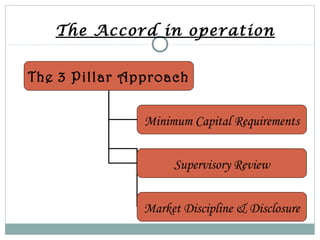
The Accord in operation
The 3 Pillar Approach
Minimum Capital Requirements
Supervisory Review
Market Discipline & Disclosure
The First Pillar..
The first pillar deals with maintenance of

regulatory capital calculated for three major
components of risk that a bank faces: credit risk,
operational risk and market risk. Other risks are
not considered fully quantifiable at this stage.
The Second Pillar..
The second pillar deals with the regulatory

response to the first pillar, giving regulators
much improved 'tools' over those available to
them under Basel I.

It also provides a framework for dealing with

all the other risks a bank may face, such as
systemic risk, pension risk, concentration risk,
strategic risk, reputation risk, liquidity risk
and legal risk, which the accord combines
under the title of residual risk. It gives bank a
power to review their risk management
system.
The Third Pillar..
The third pillar greatly increases the disclosures

that the bank must make. This is designed to
allow the market to have a better picture of the
overall risk position of the bank and to allow the
counterparties of the bank to price and deal
appropriately.
Basel I VS Basel II

Basel I is very simplistic in its approach

towards credit risks. It does not distinguish
between collateralized and non-collateralized
loans, while Basel II tries to ensure that the
anomalies existed in Basel I are corrected.
WHY BASEL-III ?
 Because of the global financial crisis which begin 2008 because of,



liquidity risk
Excess credit growth.

 Failures of Basel II being




Inability to strengthen financial stability
Insufficient capital reserve
Global financial crisis in spite of Basel I & Basel II

Responding to these risk factors, the Basel Committee did following major reforms in
BASEL-III:




Increase the quality and quantity capital
Introduce Leverage ratio
Improve liquidity rules
OBJECTIVES OF BASEL-III
 To improve quality of capital
 To improve liquidity of assets
 To bring further transparency and market discipline under Pillar III.
 To improve the banking sector's ability to deal with financial and economic stress,
 To Improving banking sector’s ability to absorb shocks (by creating capital buffer)
 To optimizing the leverage through Leverage Ratio
 To reduce risk spillover to the real economy
Three pillars of BASEL-II still standing
in BASEL-III
 Pillar-1: Capital Requirement:
Minimum capital required based on Risk Weighted Assets (RWAs).

 Pillar-2: Supervisory Review:
Whether Bank is maintaining proper capital or not, that aspect will be
reviewed time to time by central bank (RBI) in India

 Pillar-3: Market Discipline:
Pillar 3 is designed to increase the transparency in banking system
The Impact of Basel III
Impact on economy:
 IIF study:
(IIF) calculated that the economies of G3 (US, Euro Area and Japan) would be 3% smaller
after implementation of Basel-III till 2015.

 Basel Committee study:


0.2% Impact on GDP each year for 4 years



Global banks could have a gap of liquid assets of € 1,730 billion in four years



Global big banks could have a capital shortfall of € 577 billion to meet 7% common equity
norm



However, long term gains will be immense
Challenges with Indian Banking
Industry..
 With the feature of additional capital requirements, the overall

capital level of the banks will see an increase. But, the
banks that will not be able to make it as per the norms may be left
out of the global system.

 Another biggest challenge is re-structuring the assets of some

of the banks would be a tedious process.

 The new norms seem to favor the large banks that have

better risk management and measurement expertise, who
also have better capital adequacy ratios and geographically
diversified portfolios.
Implications..
 The Basel Committee on Banking Supervision is a Guideline for

Computing Capital for Incremental Risk.

 It is a new way of managing risk and asset-liability mismatches,

like asset securitization, which unlocks resources and spreads risk,
are likely to be increasingly used.

 The major challenge the country's financial system faces today is to

bring informal loans into the formal financial system. By
implementing Basel II norms, our formal banking system can learn
many lessons from money-lenders.
CONCLUSION

 Imposing economic loss and emotional pain on hundreds of millions and

billions of people because of the crisis which arise due to improper
regulation, deregulation, and lake of supervision,

 It is worthwhile to give up a little economic growth in the average year in

order to avoid these major impacts, 
Thank you

Basel committee

  • 1.
  • 2.
    Basel History…  BaselCommittee was constituted by the Central Bank Governors of the G-10 countries.  The Committee's Secretariat is located at the Bank for International Settlements in Basel, Switzerland.  Its objective is to enhance understanding of key supervisory issues and quality improvement of banking supervision worldwide.  This committee is best known for its international standards on capital adequacy; the core principles of banking supervision and the concordat on cross-border banking supervision.
  • 3.
    HISTORY OF BASELCOMMITTIEES  Basel I: the Basel Capital Accord, introduced in 1988 and focuses on  Capital adequacy of financial institutions.  Basel II: the New Capital Framework, issued in 2004, focuses on following three main pillars    Minimum capital Standard [Minimum CAR ] Supervisory review and [Review by central Bank RBI, on time to time] Market discipline, [Review by market, stake holders, customer, share holder, gvt etc]  Basel III: Basel III released in December, 2010, (implementation till March 31, 2018)"Basel III" is a comprehensive set of reform measures in,  regulation,  supervision &  risk management of the banking sector.
  • 4.
    Basel I Basel I isthe round of deliberations by central bankers from around the world, and in 1988, the Basel committee (BCBS) in Basel, Switzerland, published a set of minimal capital requirements for banks. It primarily focused on credit risk . Basel I is now widely viewed as outmoded, and a more comprehensive set of guidelines, known as Basel II are in the process of implementation by several countries.
  • 5.
    Basel II Basel IIis a type of recommendations on banking laws and regulations issued by the Basel Committee on Banking Supervision that was initially published in June 2004. The objective of Basel II is to create an international standard that banking regulators can use when creating regulations about how much capital banks need to put aside to guard against the types of financial and operational risks banks face. Basel II includes recommendations on three main areas: risks, supervisory review, and market discipline.
  • 6.
    The Accord inoperation The 3 Pillar Approach Minimum Capital Requirements Supervisory Review Market Discipline & Disclosure
  • 7.
    The First Pillar.. Thefirst pillar deals with maintenance of regulatory capital calculated for three major components of risk that a bank faces: credit risk, operational risk and market risk. Other risks are not considered fully quantifiable at this stage.
  • 8.
    The Second Pillar.. Thesecond pillar deals with the regulatory response to the first pillar, giving regulators much improved 'tools' over those available to them under Basel I. It also provides a framework for dealing with all the other risks a bank may face, such as systemic risk, pension risk, concentration risk, strategic risk, reputation risk, liquidity risk and legal risk, which the accord combines under the title of residual risk. It gives bank a power to review their risk management system.
  • 9.
    The Third Pillar.. Thethird pillar greatly increases the disclosures that the bank must make. This is designed to allow the market to have a better picture of the overall risk position of the bank and to allow the counterparties of the bank to price and deal appropriately.
  • 10.
    Basel I VSBasel II Basel I is very simplistic in its approach towards credit risks. It does not distinguish between collateralized and non-collateralized loans, while Basel II tries to ensure that the anomalies existed in Basel I are corrected.
  • 11.
    WHY BASEL-III ? Because of the global financial crisis which begin 2008 because of,   liquidity risk Excess credit growth.  Failures of Basel II being    Inability to strengthen financial stability Insufficient capital reserve Global financial crisis in spite of Basel I & Basel II Responding to these risk factors, the Basel Committee did following major reforms in BASEL-III:    Increase the quality and quantity capital Introduce Leverage ratio Improve liquidity rules
  • 12.
    OBJECTIVES OF BASEL-III To improve quality of capital  To improve liquidity of assets  To bring further transparency and market discipline under Pillar III.  To improve the banking sector's ability to deal with financial and economic stress,  To Improving banking sector’s ability to absorb shocks (by creating capital buffer)  To optimizing the leverage through Leverage Ratio  To reduce risk spillover to the real economy
  • 13.
    Three pillars ofBASEL-II still standing in BASEL-III  Pillar-1: Capital Requirement: Minimum capital required based on Risk Weighted Assets (RWAs).  Pillar-2: Supervisory Review: Whether Bank is maintaining proper capital or not, that aspect will be reviewed time to time by central bank (RBI) in India  Pillar-3: Market Discipline: Pillar 3 is designed to increase the transparency in banking system
  • 14.
    The Impact ofBasel III Impact on economy:  IIF study: (IIF) calculated that the economies of G3 (US, Euro Area and Japan) would be 3% smaller after implementation of Basel-III till 2015.  Basel Committee study:  0.2% Impact on GDP each year for 4 years  Global banks could have a gap of liquid assets of € 1,730 billion in four years  Global big banks could have a capital shortfall of € 577 billion to meet 7% common equity norm  However, long term gains will be immense
  • 15.
    Challenges with IndianBanking Industry..  With the feature of additional capital requirements, the overall capital level of the banks will see an increase. But, the banks that will not be able to make it as per the norms may be left out of the global system.  Another biggest challenge is re-structuring the assets of some of the banks would be a tedious process.  The new norms seem to favor the large banks that have better risk management and measurement expertise, who also have better capital adequacy ratios and geographically diversified portfolios.
  • 16.
    Implications..  The BaselCommittee on Banking Supervision is a Guideline for Computing Capital for Incremental Risk.  It is a new way of managing risk and asset-liability mismatches, like asset securitization, which unlocks resources and spreads risk, are likely to be increasingly used.  The major challenge the country's financial system faces today is to bring informal loans into the formal financial system. By implementing Basel II norms, our formal banking system can learn many lessons from money-lenders.
  • 17.
    CONCLUSION  Imposing economicloss and emotional pain on hundreds of millions and billions of people because of the crisis which arise due to improper regulation, deregulation, and lake of supervision,  It is worthwhile to give up a little economic growth in the average year in order to avoid these major impacts, 
  • 18.