BASEL (I,II, &III)
PRESENTED BY:
RUPESH NYAUPANE
MBA
• Prior to Basel (I)
Capital
• Capital Adequacy ------------- X 100
Assets
Basel (I) (After 1988)
Capital Fund
• Capital Adequacy ---------------- X 100
Risk Weighted Exposures
(Core + Supplementary)
• = --------------------- X 100
Risk Weight X (Assets + Off Balance Sheet Exposures)
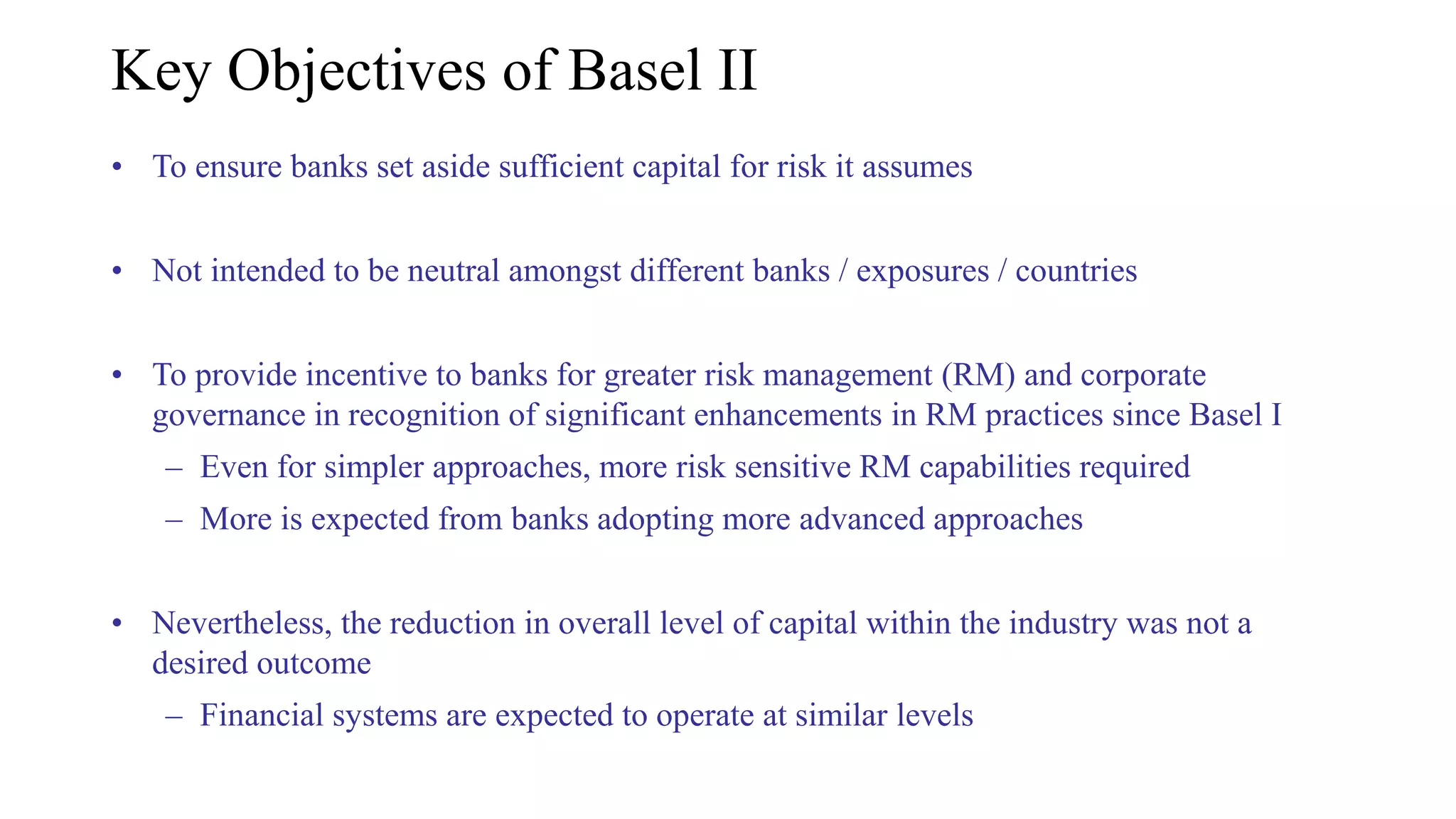
Key Objectives of Basel II
• To ensure banks set aside sufficient capital for risk it assumes
• Not intended to be neutral amongst different banks / exposures / countries
• To provide incentive to banks for greater risk management (RM) and corporate
governance in recognition of significant enhancements in RM practices since Basel I
– Even for simpler approaches, more risk sensitive RM capabilities required
– More is expected from banks adopting more advanced approaches
• Nevertheless, the reduction in overall level of capital within the industry was not a
desired outcome
– Financial systems are expected to operate at similar levels
Basel II Framework based on 3 Pillars
• Pillar 1 specifies how banks should determine the capital requirements
for the major risks that they face. Basel I only covers Pillar 1 which is
the capital measurement process
• Pillar 2 recognises that although banks are ultimately responsible for
managing their risks, supervisors can play a more active role in
assessing banks’ risk management practices
• Pillar 3 emphasises the role played by disclosure in ‘regulating’ bank’s
behaviour and promoting market discipline.
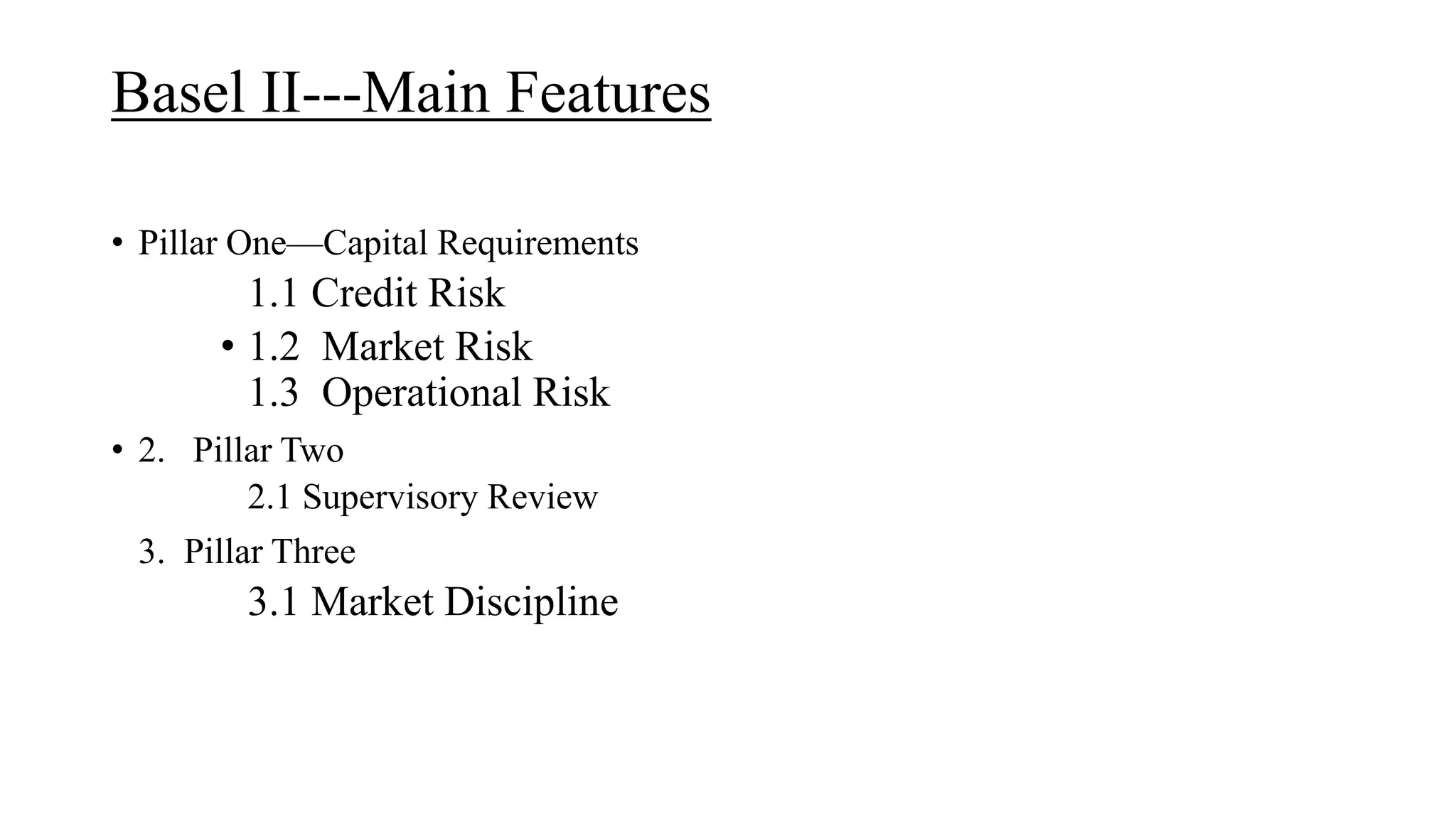
Basel II---Main Features
• Pillar One—Capital Requirements
1.1 Credit Risk
• 1.2 Market Risk
1.3 Operational Risk
• 2. Pillar Two
2.1 Supervisory Review
3. Pillar Three
3.1 Market Discipline
Basel iii MAIN FEATURES
• Better Capital Quality : One of the key elements of Basel 3 is the
introduction of much stricter definition of capital. Better quality capital
means the higher loss-absorbing capacity.
• Capital Conservation Buffer: Another key feature of Basel iii is that now
banks will be required to hold a capital conservation buffer of 2.5%. The
aim of asking to build conservation buffer is to ensure that banks maintain
a cushion of capital that can be used to absorb losses during periods of
financial and economic stress.
• Countercyclical Buffer: This is also one of the key elements of Basel
III. The countercyclical buffer has been introduced with the objective to
increase capital requirements in good times and decrease the same in bad
times.
Cont…
• Minimum Common Equity and Tier 1 Capital Requirements
: The minimum requirement for common equity, the highest form of
loss-absorbing capital, has been raised under Basel III from 2% to
4.5% of total risk-weighted assets.
• Leverage Ratio: A review of the financial crisis of 2008 has
indicted that the value of many assets fell quicker than assumed from
historical experience. Thus, now Basel III rules include a leverage
ratio to serve as a safety net. A leverage ratio is the relative amount of
capital to total assets (not risk-weighted).
• Liquidity Ratios: Under Basel III, a framework for liquidity risk
management will be created. A new Liquidity Coverage Ratio (LCR)
and Net Stable Funding Ratio (NSFR) are to be introduced in 2015
and 2018, respectively.
Cont…
• Systemically Important Financial Institutions (SIFI) : As part of
the macro-prudential framework, systemically important banks will be
expected to have loss-absorbing capability beyond the Basel III
requirements. Options for implementation include capital surcharges,
contingent capital and bail-in-debt.
For feedback: rupesh.nyaupane@apexcollege.edu.np

Basel

  • 1.
    BASEL (I,II, &III) PRESENTEDBY: RUPESH NYAUPANE MBA
  • 2.
    • Prior toBasel (I) Capital • Capital Adequacy ------------- X 100 Assets
  • 3.
    Basel (I) (After1988) Capital Fund • Capital Adequacy ---------------- X 100 Risk Weighted Exposures (Core + Supplementary) • = --------------------- X 100 Risk Weight X (Assets + Off Balance Sheet Exposures)
  • 4.
    Key Objectives ofBasel II • To ensure banks set aside sufficient capital for risk it assumes • Not intended to be neutral amongst different banks / exposures / countries • To provide incentive to banks for greater risk management (RM) and corporate governance in recognition of significant enhancements in RM practices since Basel I – Even for simpler approaches, more risk sensitive RM capabilities required – More is expected from banks adopting more advanced approaches • Nevertheless, the reduction in overall level of capital within the industry was not a desired outcome – Financial systems are expected to operate at similar levels
  • 5.
    Basel II Frameworkbased on 3 Pillars • Pillar 1 specifies how banks should determine the capital requirements for the major risks that they face. Basel I only covers Pillar 1 which is the capital measurement process • Pillar 2 recognises that although banks are ultimately responsible for managing their risks, supervisors can play a more active role in assessing banks’ risk management practices • Pillar 3 emphasises the role played by disclosure in ‘regulating’ bank’s behaviour and promoting market discipline.
  • 6.
    Basel II---Main Features •Pillar One—Capital Requirements 1.1 Credit Risk • 1.2 Market Risk 1.3 Operational Risk • 2. Pillar Two 2.1 Supervisory Review 3. Pillar Three 3.1 Market Discipline
  • 7.
    Basel iii MAINFEATURES • Better Capital Quality : One of the key elements of Basel 3 is the introduction of much stricter definition of capital. Better quality capital means the higher loss-absorbing capacity. • Capital Conservation Buffer: Another key feature of Basel iii is that now banks will be required to hold a capital conservation buffer of 2.5%. The aim of asking to build conservation buffer is to ensure that banks maintain a cushion of capital that can be used to absorb losses during periods of financial and economic stress. • Countercyclical Buffer: This is also one of the key elements of Basel III. The countercyclical buffer has been introduced with the objective to increase capital requirements in good times and decrease the same in bad times.
  • 8.
    Cont… • Minimum CommonEquity and Tier 1 Capital Requirements : The minimum requirement for common equity, the highest form of loss-absorbing capital, has been raised under Basel III from 2% to 4.5% of total risk-weighted assets. • Leverage Ratio: A review of the financial crisis of 2008 has indicted that the value of many assets fell quicker than assumed from historical experience. Thus, now Basel III rules include a leverage ratio to serve as a safety net. A leverage ratio is the relative amount of capital to total assets (not risk-weighted). • Liquidity Ratios: Under Basel III, a framework for liquidity risk management will be created. A new Liquidity Coverage Ratio (LCR) and Net Stable Funding Ratio (NSFR) are to be introduced in 2015 and 2018, respectively.
  • 9.
    Cont… • Systemically ImportantFinancial Institutions (SIFI) : As part of the macro-prudential framework, systemically important banks will be expected to have loss-absorbing capability beyond the Basel III requirements. Options for implementation include capital surcharges, contingent capital and bail-in-debt.
  • 10.