Presented By-
Yasha Singh
4113007007
1
How Do Exchanges Select
Stocks For Option Listing?
By - Stewart Mayhew and Vassil Mihov
Objective
2
 To identify the characteristics that made stocks
more likely to be selected for option listing.
 To examine how these characteristics changed
over time as the markets matured.
Data Set
3
 Observed listing decisions from 1973 to 1996.
 Data partitioned into four sub periods, defined by
regulatory changes in 1980,1985 and 1991.
Methodology
4
 Logit framework is used to measure the extend to
which the probability of option listing is related to
characteristics.
 Characteristics includes underlying stock’s volume,
volatility and market capitalization.
 For volume and volatility –
 long term components are included, measured over
250 trading days.
 Short term components over 30 trading days.
5
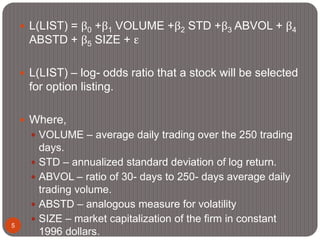
 L(LIST) = β0 +β1 VOLUME +β2 STD +β3 ABVOL + β4
ABSTD + β5 SIZE + ε
 L(LIST) – log- odds ratio that a stock will be selected
for option listing.
 Where,
 VOLUME – average daily trading over the 250 trading
days.
 STD – annualized standard deviation of log return.
 ABVOL – ratio of 30- days to 250- days average daily
trading volume.
 ABSTD – analogous measure for volatility
 SIZE – market capitalization of the firm in constant
1996 dollars.
Finding
6
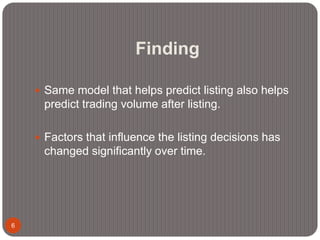
 Same model that helps predict listing also helps
predict trading volume after listing.
 Factors that influence the listing decisions has
changed significantly over time.
Conclusion
7
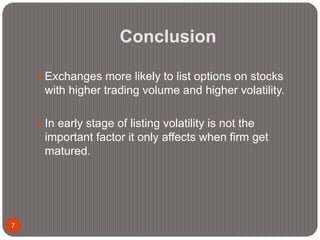
 Exchanges more likely to list options on stocks
with higher trading volume and higher volatility.
 In early stage of listing volatility is not the
important factor it only affects when firm get
matured.

How do exchanges select stocks for option listing

  • 1.
    Presented By- Yasha Singh 4113007007 1 HowDo Exchanges Select Stocks For Option Listing? By - Stewart Mayhew and Vassil Mihov
  • 2.
    Objective 2  To identifythe characteristics that made stocks more likely to be selected for option listing.  To examine how these characteristics changed over time as the markets matured.
  • 3.
    Data Set 3  Observedlisting decisions from 1973 to 1996.  Data partitioned into four sub periods, defined by regulatory changes in 1980,1985 and 1991.
  • 4.
    Methodology 4  Logit frameworkis used to measure the extend to which the probability of option listing is related to characteristics.  Characteristics includes underlying stock’s volume, volatility and market capitalization.  For volume and volatility –  long term components are included, measured over 250 trading days.  Short term components over 30 trading days.
  • 5.
    5  L(LIST) =β0 +β1 VOLUME +β2 STD +β3 ABVOL + β4 ABSTD + β5 SIZE + ε  L(LIST) – log- odds ratio that a stock will be selected for option listing.  Where,  VOLUME – average daily trading over the 250 trading days.  STD – annualized standard deviation of log return.  ABVOL – ratio of 30- days to 250- days average daily trading volume.  ABSTD – analogous measure for volatility  SIZE – market capitalization of the firm in constant 1996 dollars.
  • 6.
    Finding 6  Same modelthat helps predict listing also helps predict trading volume after listing.  Factors that influence the listing decisions has changed significantly over time.
  • 7.
    Conclusion 7  Exchanges morelikely to list options on stocks with higher trading volume and higher volatility.  In early stage of listing volatility is not the important factor it only affects when firm get matured.