Barrier Free Architecture In
Hospitals
OVERVIEW AND GENERAL
REQUIREMENTS
Accessibility of doctors' offices, clinics, and other health care
providers is essential in providing medical care to people with
disabilities. Due to barriers, individuals with disabilities are less
likely to get routine preventative medical care than people
without disabilities.
Medical care providers are required to provide disabled individuals:
• Full and equal access to their health care services and facilities
• Reasonable modifications to policies, practices, and procedures
when necessary to make health care services fully available
Universal Design Facts
Entrances
• All major entrances should use automatic doors that open when sensors detect someone
approaching. The doors open by sliding to the side, rather than opening outward, to allow
unobstructed access for people in wheelchairs and scooters.
• The grade of the slopes of ramps should be barely noticeable, making it easier for people in
wheelchairs to propel themselves up and down the ramps.
Hallways, Elevators and Wayfinding
• Handrails are abundant throughout areas
where patients travel.
• Braille alongside floor buttons and audio
announcements of the floor location to
accommodate people with visual disabilities.
• Primary overhead wayfinding signs should be
in English and local language and in high
contrast to enhance readability.
• Contrasting borders on the edges of hallway
carpeting and around patient and procedure
room doorways help patients with low vision
navigate more easily.
• Furnishings in public areas, along with other
features, accommodate bariatric or larger
patients.
Treatment and Services
• Patient treatment carts in the Emergency
Department are height-adjustable so they
can be lowered as needed to better
accommodate people in wheelchairs.
• New MRI machines can accommodate
patients with unique spinal curvatures.
• A wireless phone system allows doctors,
nurses and other hospital caregivers to
communicate directly via mobile phones,
reducing noise from overhead paging and
ringing telephones, which can cause
confusion in people with mental illness and
dementia.
• Patient registration counters and electronic
information signs are at a level that is
accessible for people in wheelchairs.
Universal Design Facts
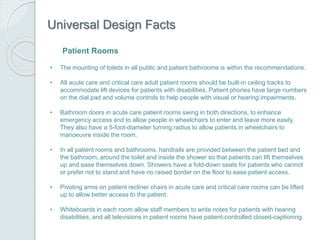
• The mounting of toilets in all public and patient bathrooms is within the recommendations.
• All acute care and critical care adult patient rooms should be built-in ceiling tracks to
accommodate lift devices for patients with disabilities. Patient phones have large numbers
on the dial pad and volume controls to help people with visual or hearing impairments.
• Bathroom doors in acute care patient rooms swing in both directions, to enhance
emergency access and to allow people in wheelchairs to enter and leave more easily.
They also have a 5-foot-diameter turning radius to allow patients in wheelchairs to
manoeuvre inside the room.
• In all patient rooms and bathrooms, handrails are provided between the patient bed and
the bathroom, around the toilet and inside the shower so that patients can lift themselves
up and ease themselves down. Showers have a fold-down seats for patients who cannot
or prefer not to stand and have no raised border on the floor to ease patient access.
• Pivoting arms on patient recliner chairs in acute care and critical care rooms can be lifted
up to allow better access to the patient.
• Whiteboards in each room allow staff members to write notes for patients with hearing
disabilities, and all televisions in patient rooms have patient-controlled closed-captioning.
Patient Rooms
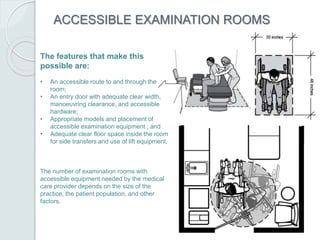
ACCESSIBLE EXAMINATION ROOMS
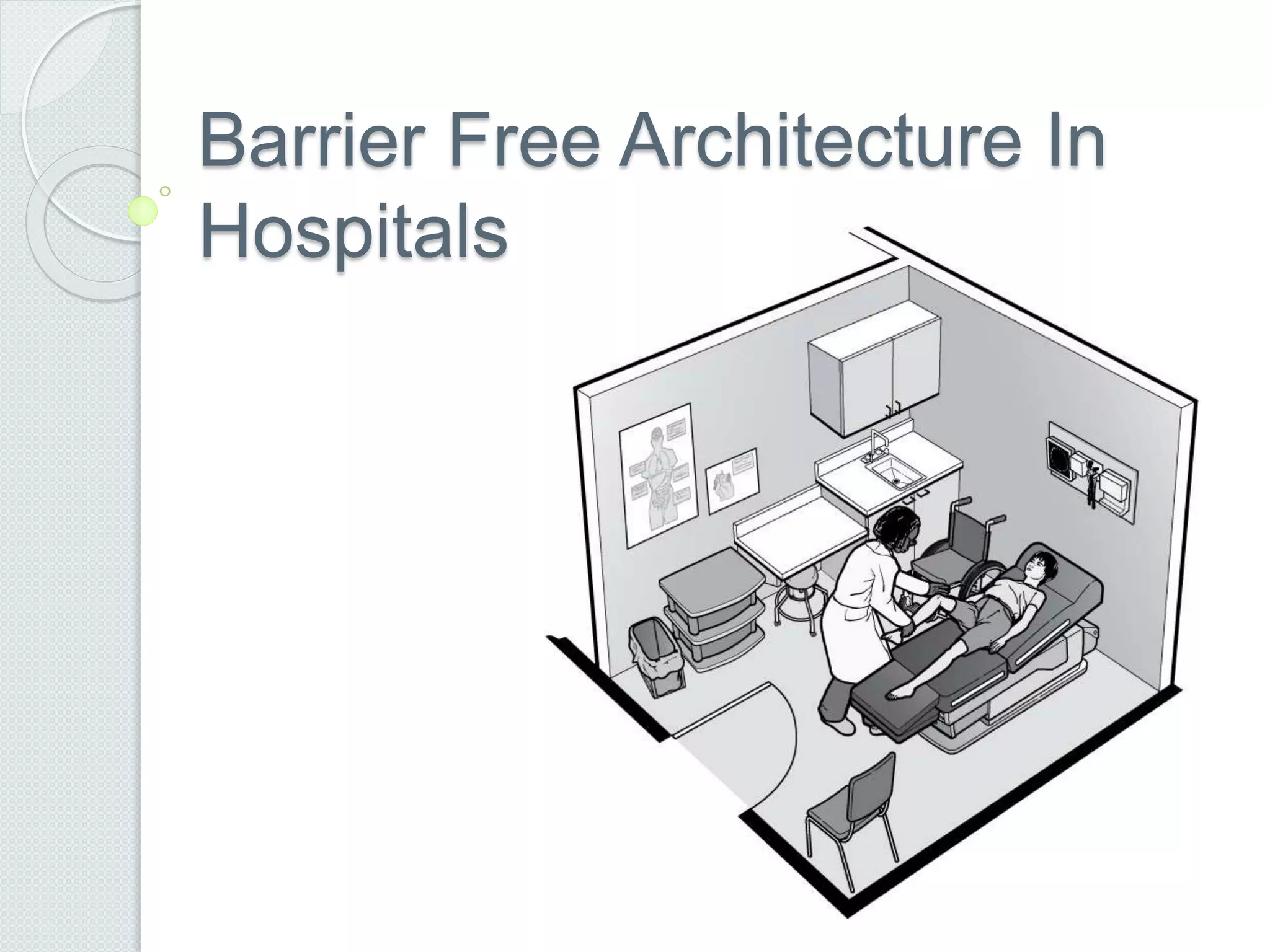
The features that make this
possible are:
• An accessible route to and through the
room;
• An entry door with adequate clear width,
manoeuvring clearance, and accessible
hardware;
• Appropriate models and placement of
accessible examination equipment ; and
• Adequate clear floor space inside the room
for side transfers and use of lift equipment.
The number of examination rooms with
accessible equipment needed by the medical
care provider depends on the size of the
practice, the patient population, and other
factors.
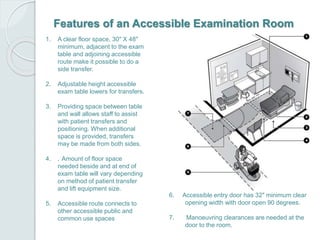
Features of an Accessible Examination Room
1. A clear floor space, 30" X 48"
minimum, adjacent to the exam
table and adjoining accessible
route make it possible to do a
side transfer.
2. Adjustable height accessible
exam table lowers for transfers.
3. Providing space between table
and wall allows staff to assist
with patient transfers and
positioning. When additional
space is provided, transfers
may be made from both sides.
4. . Amount of floor space
needed beside and at end of
exam table will vary depending
on method of patient transfer
and lift equipment size.
5. Accessible route connects to
other accessible public and
common use spaces
6. Accessible entry door has 32" minimum clear
opening width with door open 90 degrees.
7. Manoeuvring clearances are needed at the
door to the room.
ACCESSIBLE MEDICAL EQUIPMENT
Availability of accessible medical
equipment is an important part of
providing accessible medical care,
and doctors and other providers
must ensure that medical
equipment is not a barrier to
individuals with disabilities
the right solution or solutions for
providing accessible medical care
depends on existing equipment, the
space available both within the
examination room and for storage
of equipment, the size of the
practice and staff, and the patient
population. What is important is that
a person with a disability receives
medical services equal to those
received by a person without a
disability.
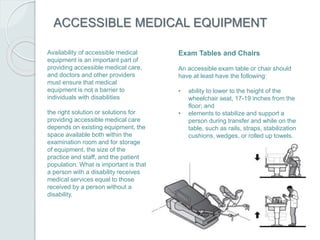
Exam Tables and Chairs
An accessible exam table or chair should
have at least have the following:
• ability to lower to the height of the
wheelchair seat, 17-19 inches from the
floor; and
• elements to stabilize and support a
person during transfer and while on the
table, such as rails, straps, stabilization
cushions, wedges, or rolled up towels.
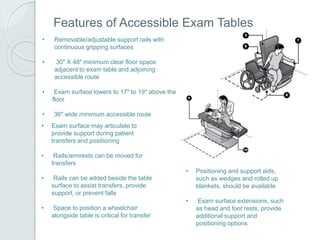
Features of Accessible Exam Tables
• Removable/adjustable support rails with
continuous gripping surfaces
• 30" X 48" minimum clear floor space
adjacent to exam table and adjoining
accessible route
• Exam surface lowers to 17" to 19" above the
floor
• 36" wide minimum accessible route
• Exam surface may articulate to
provide support during patient
transfers and positioning
• Rails/armrests can be moved for
transfers
• Rails can be added beside the table
surface to assist transfers, provide
support, or prevent falls
• Space to position a wheelchair
alongside table is critical for transfer
• Positioning and support aids,
such as wedges and rolled up
blankets, should be available
• Exam surface extensions, such
as head and foot rests, provide
additional support and
positioning options
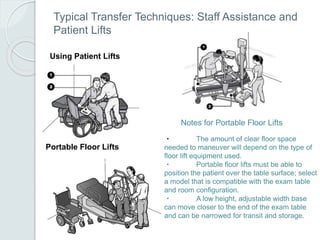
Typical Transfer Techniques: Staff Assistance and
Patient Lifts
Using Patient Lifts
Portable Floor Lifts
・ The amount of clear floor space
needed to maneuver will depend on the type of
floor lift equipment used.
・ Portable floor lifts must be able to
position the patient over the table surface; select
a model that is compatible with the exam table
and room configuration.
・ A low height, adjustable width base
can move closer to the end of the exam table
and can be narrowed for transit and storage.
Notes for Portable Floor Lifts
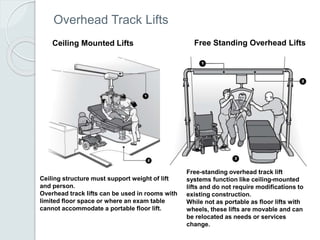
Overhead Track Lifts
Ceiling Mounted Lifts Free Standing Overhead Lifts
Ceiling structure must support weight of lift
and person.
Overhead track lifts can be used in rooms with
limited floor space or where an exam table
cannot accommodate a portable floor lift.
Free-standing overhead track lift
systems function like ceiling-mounted
lifts and do not require modifications to
existing construction.
While not as portable as floor lifts with
wheels, these lifts are movable and can
be relocated as needs or services
change.
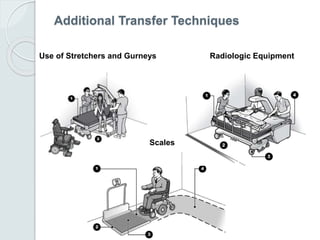
Additional Transfer Techniques
Scales
Use of Stretchers and Gurneys Radiologic Equipment

Barrier free architecture in hospitals

  • 1.
  • 2.
    OVERVIEW AND GENERAL REQUIREMENTS Accessibilityof doctors' offices, clinics, and other health care providers is essential in providing medical care to people with disabilities. Due to barriers, individuals with disabilities are less likely to get routine preventative medical care than people without disabilities. Medical care providers are required to provide disabled individuals: • Full and equal access to their health care services and facilities • Reasonable modifications to policies, practices, and procedures when necessary to make health care services fully available
  • 3.
    Universal Design Facts Entrances •All major entrances should use automatic doors that open when sensors detect someone approaching. The doors open by sliding to the side, rather than opening outward, to allow unobstructed access for people in wheelchairs and scooters. • The grade of the slopes of ramps should be barely noticeable, making it easier for people in wheelchairs to propel themselves up and down the ramps. Hallways, Elevators and Wayfinding • Handrails are abundant throughout areas where patients travel. • Braille alongside floor buttons and audio announcements of the floor location to accommodate people with visual disabilities. • Primary overhead wayfinding signs should be in English and local language and in high contrast to enhance readability. • Contrasting borders on the edges of hallway carpeting and around patient and procedure room doorways help patients with low vision navigate more easily. • Furnishings in public areas, along with other features, accommodate bariatric or larger patients. Treatment and Services • Patient treatment carts in the Emergency Department are height-adjustable so they can be lowered as needed to better accommodate people in wheelchairs. • New MRI machines can accommodate patients with unique spinal curvatures. • A wireless phone system allows doctors, nurses and other hospital caregivers to communicate directly via mobile phones, reducing noise from overhead paging and ringing telephones, which can cause confusion in people with mental illness and dementia. • Patient registration counters and electronic information signs are at a level that is accessible for people in wheelchairs.
  • 4.
    Universal Design Facts •The mounting of toilets in all public and patient bathrooms is within the recommendations. • All acute care and critical care adult patient rooms should be built-in ceiling tracks to accommodate lift devices for patients with disabilities. Patient phones have large numbers on the dial pad and volume controls to help people with visual or hearing impairments. • Bathroom doors in acute care patient rooms swing in both directions, to enhance emergency access and to allow people in wheelchairs to enter and leave more easily. They also have a 5-foot-diameter turning radius to allow patients in wheelchairs to manoeuvre inside the room. • In all patient rooms and bathrooms, handrails are provided between the patient bed and the bathroom, around the toilet and inside the shower so that patients can lift themselves up and ease themselves down. Showers have a fold-down seats for patients who cannot or prefer not to stand and have no raised border on the floor to ease patient access. • Pivoting arms on patient recliner chairs in acute care and critical care rooms can be lifted up to allow better access to the patient. • Whiteboards in each room allow staff members to write notes for patients with hearing disabilities, and all televisions in patient rooms have patient-controlled closed-captioning. Patient Rooms
  • 5.
    ACCESSIBLE EXAMINATION ROOMS Thefeatures that make this possible are: • An accessible route to and through the room; • An entry door with adequate clear width, manoeuvring clearance, and accessible hardware; • Appropriate models and placement of accessible examination equipment ; and • Adequate clear floor space inside the room for side transfers and use of lift equipment. The number of examination rooms with accessible equipment needed by the medical care provider depends on the size of the practice, the patient population, and other factors.
  • 6.
    Features of anAccessible Examination Room 1. A clear floor space, 30" X 48" minimum, adjacent to the exam table and adjoining accessible route make it possible to do a side transfer. 2. Adjustable height accessible exam table lowers for transfers. 3. Providing space between table and wall allows staff to assist with patient transfers and positioning. When additional space is provided, transfers may be made from both sides. 4. . Amount of floor space needed beside and at end of exam table will vary depending on method of patient transfer and lift equipment size. 5. Accessible route connects to other accessible public and common use spaces 6. Accessible entry door has 32" minimum clear opening width with door open 90 degrees. 7. Manoeuvring clearances are needed at the door to the room.
  • 7.
    ACCESSIBLE MEDICAL EQUIPMENT Availabilityof accessible medical equipment is an important part of providing accessible medical care, and doctors and other providers must ensure that medical equipment is not a barrier to individuals with disabilities the right solution or solutions for providing accessible medical care depends on existing equipment, the space available both within the examination room and for storage of equipment, the size of the practice and staff, and the patient population. What is important is that a person with a disability receives medical services equal to those received by a person without a disability. Exam Tables and Chairs An accessible exam table or chair should have at least have the following: • ability to lower to the height of the wheelchair seat, 17-19 inches from the floor; and • elements to stabilize and support a person during transfer and while on the table, such as rails, straps, stabilization cushions, wedges, or rolled up towels.
  • 8.
    Features of AccessibleExam Tables • Removable/adjustable support rails with continuous gripping surfaces • 30" X 48" minimum clear floor space adjacent to exam table and adjoining accessible route • Exam surface lowers to 17" to 19" above the floor • 36" wide minimum accessible route • Exam surface may articulate to provide support during patient transfers and positioning • Rails/armrests can be moved for transfers • Rails can be added beside the table surface to assist transfers, provide support, or prevent falls • Space to position a wheelchair alongside table is critical for transfer • Positioning and support aids, such as wedges and rolled up blankets, should be available • Exam surface extensions, such as head and foot rests, provide additional support and positioning options
  • 9.
    Typical Transfer Techniques:Staff Assistance and Patient Lifts Using Patient Lifts Portable Floor Lifts ・ The amount of clear floor space needed to maneuver will depend on the type of floor lift equipment used. ・ Portable floor lifts must be able to position the patient over the table surface; select a model that is compatible with the exam table and room configuration. ・ A low height, adjustable width base can move closer to the end of the exam table and can be narrowed for transit and storage. Notes for Portable Floor Lifts
  • 10.
    Overhead Track Lifts CeilingMounted Lifts Free Standing Overhead Lifts Ceiling structure must support weight of lift and person. Overhead track lifts can be used in rooms with limited floor space or where an exam table cannot accommodate a portable floor lift. Free-standing overhead track lift systems function like ceiling-mounted lifts and do not require modifications to existing construction. While not as portable as floor lifts with wheels, these lifts are movable and can be relocated as needs or services change.
  • 11.
    Additional Transfer Techniques Scales Useof Stretchers and Gurneys Radiologic Equipment