PLANNING AND LOCATING
SERVICE CORES
IN BUILDINGS
BUILDING SERVICES-2
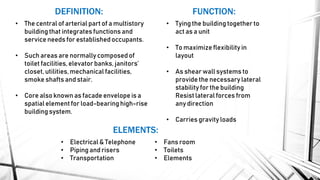
• The central of arterial part of a multistory
building that integrates functions and
service needs for establishedoccupants.
• Such areas are normally composed of
toilet facilities, elevator banks, janitors’
closet, utilities,mechanical facilities,
smoke shafts and stair.
• Core also known as facade envelope is a
spatial element for load-bearinghigh-rise
building system.
• Tying the building together to
act as a unit
• To maximize flexibility in
layout
• As shear wall systems to
provide the necessary lateral
stability for the building
Resist lateral forces from
any direction
• Carries gravity loads
FUNCTION:DEFINITION:
• Electrical & Telephone
• Piping and risers
• Transportation
ELEMENTS:
• Fans room
• Toilets
• Elements
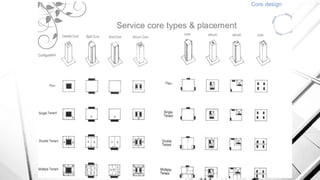
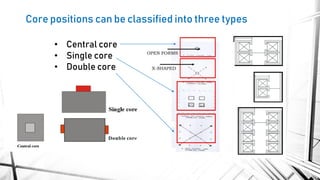
Core positions can be classified into three types
• Central core
• Single core
• Double core
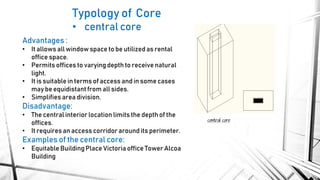
Advantages :
• It allows all window space to be utilized as rental
office space.
• Permits offices to varyingdepth to receive natural
light.
• It is suitable in terms of access and in some cases
may be equidistantfrom all sides.
• Simplifies area division.
Disadvantage:
• The central interior location limits the depth of the
offices.
• It requires an access corridor around its perimeter.
Examples of the central core:
• Equitable BuildingPlace Victoria office Tower Alcoa
Building
Typology of Core
• central core
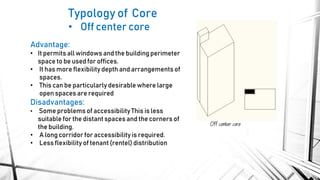
Typology of Core
• Off center core
Advantage:
• It permits all windows and the buildingperimeter
space to be used for offices.
• It has more flexibility depth and arrangementsof
spaces.
• This can be particularly desirable where large
open spaces are required
Disadvantages:
• Some problems of accessibilityThis is less
suitable for the distant spaces and the corners of
the building.
• A long corridor for accessibilityis required.
• Less flexibility of tenant (rentel) distribution
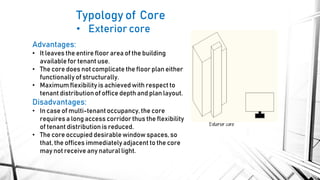
Typology of Core
• Exterior core
Advantages:
• It leaves the entire floor area of the building
available for tenant use.
• The core does not complicate the floor plan either
functionally of structurally.
• Maximum flexibility is achievedwith respect to
tenant distributionof office depth and plan layout.
Disadvantages:
• In case of multi-tenant occupancy, the core
requires a long access corridor thus the flexibility
of tenant distributionis reduced.
• The core occupied desirable window spaces, so
that, the offices immediatelyadjacent to the core
may not receive any natural light.
Typology of Core
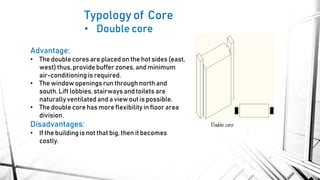
• Double core
Advantage:
• The double cores are placed on the hot sides (east,
west) thus, provide buffer zones, and minimum
air-conditioningis required.
• The window openings run through north and
south. Lift lobbies, stairways and toilets are
naturally ventilated and a view out is possible.
• The double core has more flexibility in floor area
division.
Disadvantages:
• If the buildingis not that big, then it becomes
costly.
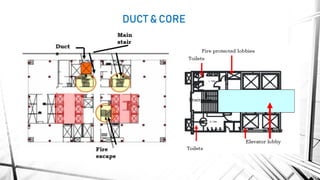
DUCT & CORE

Planning and locating service cores.

  • 1.
    PLANNING AND LOCATING SERVICECORES IN BUILDINGS BUILDING SERVICES-2
  • 2.
    • The centralof arterial part of a multistory building that integrates functions and service needs for establishedoccupants. • Such areas are normally composed of toilet facilities, elevator banks, janitors’ closet, utilities,mechanical facilities, smoke shafts and stair. • Core also known as facade envelope is a spatial element for load-bearinghigh-rise building system. • Tying the building together to act as a unit • To maximize flexibility in layout • As shear wall systems to provide the necessary lateral stability for the building Resist lateral forces from any direction • Carries gravity loads FUNCTION:DEFINITION: • Electrical & Telephone • Piping and risers • Transportation ELEMENTS: • Fans room • Toilets • Elements
  • 4.
    Core positions canbe classified into three types • Central core • Single core • Double core
  • 5.
    Advantages : • Itallows all window space to be utilized as rental office space. • Permits offices to varyingdepth to receive natural light. • It is suitable in terms of access and in some cases may be equidistantfrom all sides. • Simplifies area division. Disadvantage: • The central interior location limits the depth of the offices. • It requires an access corridor around its perimeter. Examples of the central core: • Equitable BuildingPlace Victoria office Tower Alcoa Building Typology of Core • central core
  • 6.
    Typology of Core •Off center core Advantage: • It permits all windows and the buildingperimeter space to be used for offices. • It has more flexibility depth and arrangementsof spaces. • This can be particularly desirable where large open spaces are required Disadvantages: • Some problems of accessibilityThis is less suitable for the distant spaces and the corners of the building. • A long corridor for accessibilityis required. • Less flexibility of tenant (rentel) distribution
  • 7.
    Typology of Core •Exterior core Advantages: • It leaves the entire floor area of the building available for tenant use. • The core does not complicate the floor plan either functionally of structurally. • Maximum flexibility is achievedwith respect to tenant distributionof office depth and plan layout. Disadvantages: • In case of multi-tenant occupancy, the core requires a long access corridor thus the flexibility of tenant distributionis reduced. • The core occupied desirable window spaces, so that, the offices immediatelyadjacent to the core may not receive any natural light.
  • 8.
    Typology of Core •Double core Advantage: • The double cores are placed on the hot sides (east, west) thus, provide buffer zones, and minimum air-conditioningis required. • The window openings run through north and south. Lift lobbies, stairways and toilets are naturally ventilated and a view out is possible. • The double core has more flexibility in floor area division. Disadvantages: • If the buildingis not that big, then it becomes costly.
  • 9.