Barrier free design
Air barrier
 Airflow carries moisture
that impacts a materials
long-term performance
(serviceability) and
structural integrity
(durability). Airflow also
affects building behaviour
in a fire (spread of smoke
and other toxic gases,
supply of oxygen), One of
the key strategies in the
control of airflow is the use
of air barriers.
Air barrier
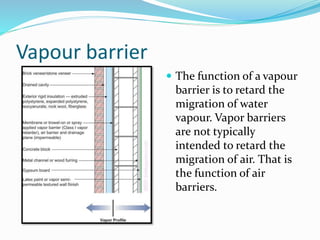
Vapour barrier
 The function of a vapour
barrier is to retard the
migration of water
vapour. Vapor barriers
are not typically
intended to retard the
migration of air. That is
the function of air
barriers.
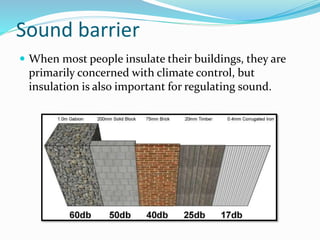
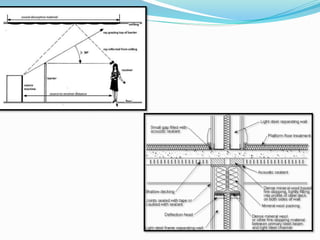
Sound barrier
 When most people insulate their buildings, they are
primarily concerned with climate control, but
insulation is also important for regulating sound.
Visual barriers
 Dividing the space
forms for multi purpose
functioning.
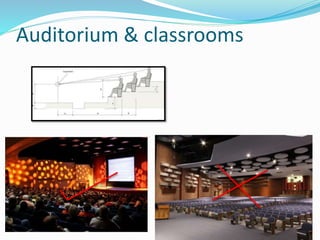
 Provide good viewing
angle from every seat
(as in theatres)
 Avoiding unnecessary
visual blockage
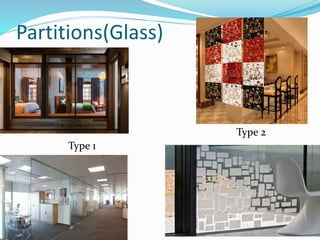
Partitions(Glass)
Type 2
Type 1
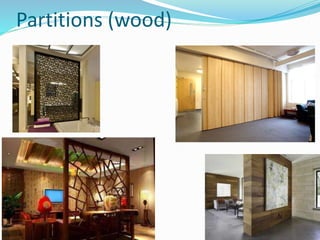
Partitions (wood)
Partitions (Vegetation)
Partitions (Water)
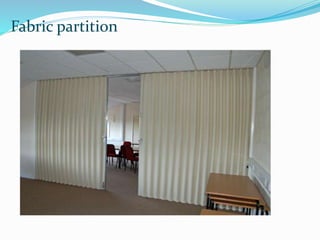
Fabric partition
Portable screening
Columns(Visual barrier)
Auditorium & classrooms
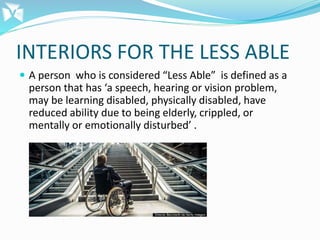
INTERIORS FOR THE LESS ABLE
 A person who is considered “Less Able” is defined as a
person that has ‘a speech, hearing or vision problem,
may be learning disabled, physically disabled, have
reduced ability due to being elderly, crippled, or
mentally or emotionally disturbed’ .
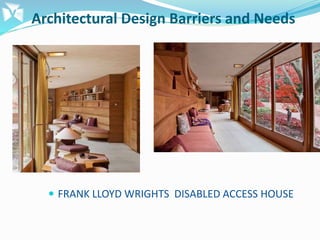
Architectural Design Barriers and Needs
 FRANK LLOYD WRIGHTS DISABLED ACCESS HOUSE
INTERIORS FOR THE LESS ABLE
 New and influential legislation arose in the
second half of the twentieth century with
the view to recognize the problem of
structural barriers in architectural and
interior designs.
 Modifications of public buildings such as
residential complexes, post offices, and
schools gradually became more and more
frequent. In 1969, the international symbol
of accessibility was adopted.
 In addition, the government assumed a
greater role in facilitating accessibility.
INTERIORS FOR THE LESS ABLE
It has been well
established that the home
is one of the fundamental
places that gives shape
and meaning to peoples’
everyday lives.
An important part of such
quality is physical design
and layout, and the
degree to which it
enables the ease of
peoples mobility and
movement around the
dwelling and the use of
different rooms and their
facilities.
Staircase
 Studies reveal that approximately 14% of falls take
place on stairs
 handrails for support next to stairs.
 Automatic carriers can be fixed to stairs
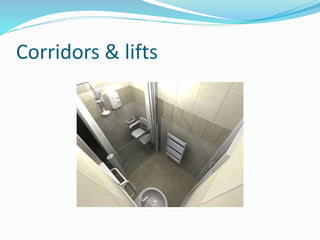
Corridors & lifts
Living
 Cushions on chairs and sofas
should be firm enough so
that a person would not sink
into the seat and would not
need to struggle to arise
from it.
Kitchen
 side-by-side refrigerator
and freezer for better
access for those in
wheelchairs.
 pullout shelves so that one
does not have to reach.
 lever-type faucets to make
handles less difficult to
turn.
 no wall fixtures that are
low enough for a person to
bump.
Ramp/elevators
ramps and/or elevators in multi-levelled buildings.
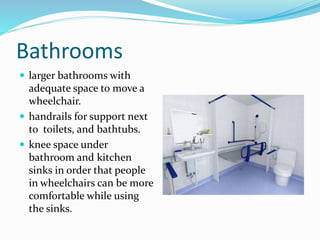
Bathrooms
 larger bathrooms with
adequate space to move a
wheelchair.
 handrails for support next
to toilets, and bathtubs.
 knee space under
bathroom and kitchen
sinks in order that people
in wheelchairs can be more
comfortable while using
the sinks.
Light
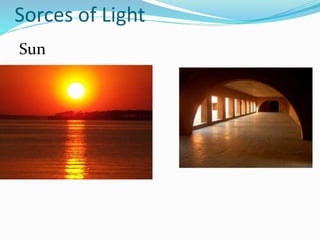
Sorces of Light
Sun
Candles Fire
Lighting in interiors
Types
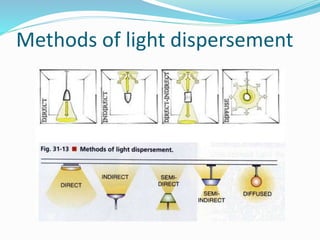
Methods of light dispersement
Types of ceiling fixtures
SKYLIGHT
 Skylights can help to bring natural
light into an otherwise dull, dark and
drab space. If you have a home that is
North or South facing, skylights can
do wonders for the sunlight that could
be flooding into your home
 Skylights don’t have to be just boring,
old rectangular punch-outs, either.
They can be circular, dome like, set at
an angle and so much more. Stained
and frosted glass options are available
for those without a, whole lot of
privacy even add an attractive visual
element to the ceiling.
SKYLIGHT
COURTYARD
Plant-filled courtyards
will bring natural light
into the building
A courtyard inside the
house can be a peaceful
relaxing area. They give you
the feel of the outdoors and
the privacy of your home.
the most common electric light source
was the incandescent lamp.
The connection to a light fitting is either
by screw thread or bayonet.
A large variety of shapes, sizes and power
is available, as well as different colour
ranges.
Incandescent lamp
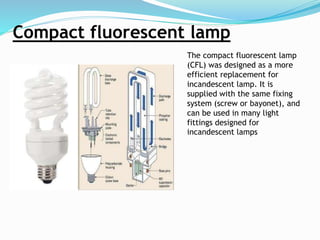
Compact fluorescent lamp
The compact fluorescent lamp
(CFL) was designed as a more
efficient replacement for
incandescent lamp. It is
supplied with the same fixing
system (screw or bayonet), and
can be used in many light
fittings designed for
incandescent lamps
The tube contains mercury vapour at low
pressure, and the inner wall of the glass is
coated with a phosphor that reacts to
ultra-violet radiation
They are a form of gas discharge lamp,
and are formed in a long thin glass
cylinder with contacts at either end that
secure them to the fitting (or luminaire)
and provide the electrical connection.
Fluorescent tubes are the main form of
lighting for offices and commercial
buildings
Fluorescent tube
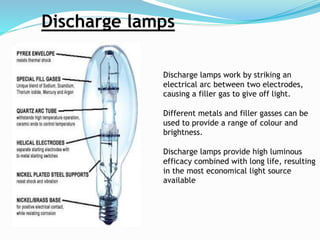
Discharge lamps work by striking an
electrical arc between two electrodes,
causing a filler gas to give off light.
Different metals and filler gasses can be
used to provide a range of colour and
brightness.
Discharge lamps provide high luminous
efficacy combined with long life, resulting
in the most economical light source
available
Discharge lamps
LEDs use semi-conductors to convert
electrical energy directly into light. They
are only recently becoming available as a
light source for lighting purposes, and are
highly efficient and long lasting.
LED torches are becoming very popular, as
they provide a far longer battery life than
other types of light source.
Light Emitting Diode (LED)
Flooring light
Led lighting
Laser lighting
Underwater lighting
Flood lights
Thank yuh  

Interiors

  • 1.
  • 2.
    Air barrier  Airflowcarries moisture that impacts a materials long-term performance (serviceability) and structural integrity (durability). Airflow also affects building behaviour in a fire (spread of smoke and other toxic gases, supply of oxygen), One of the key strategies in the control of airflow is the use of air barriers.
  • 3.
  • 4.
    Vapour barrier  Thefunction of a vapour barrier is to retard the migration of water vapour. Vapor barriers are not typically intended to retard the migration of air. That is the function of air barriers.
  • 5.
    Sound barrier  Whenmost people insulate their buildings, they are primarily concerned with climate control, but insulation is also important for regulating sound.
  • 7.
    Visual barriers  Dividingthe space forms for multi purpose functioning.  Provide good viewing angle from every seat (as in theatres)  Avoiding unnecessary visual blockage
  • 8.
  • 9.
  • 10.
  • 11.
  • 12.
  • 13.
  • 14.
  • 15.
  • 17.
    INTERIORS FOR THELESS ABLE  A person who is considered “Less Able” is defined as a person that has ‘a speech, hearing or vision problem, may be learning disabled, physically disabled, have reduced ability due to being elderly, crippled, or mentally or emotionally disturbed’ .
  • 18.
    Architectural Design Barriersand Needs  FRANK LLOYD WRIGHTS DISABLED ACCESS HOUSE
  • 19.
    INTERIORS FOR THELESS ABLE  New and influential legislation arose in the second half of the twentieth century with the view to recognize the problem of structural barriers in architectural and interior designs.  Modifications of public buildings such as residential complexes, post offices, and schools gradually became more and more frequent. In 1969, the international symbol of accessibility was adopted.  In addition, the government assumed a greater role in facilitating accessibility.
  • 20.
    INTERIORS FOR THELESS ABLE It has been well established that the home is one of the fundamental places that gives shape and meaning to peoples’ everyday lives. An important part of such quality is physical design and layout, and the degree to which it enables the ease of peoples mobility and movement around the dwelling and the use of different rooms and their facilities.
  • 21.
    Staircase  Studies revealthat approximately 14% of falls take place on stairs  handrails for support next to stairs.  Automatic carriers can be fixed to stairs
  • 22.
  • 23.
    Living  Cushions onchairs and sofas should be firm enough so that a person would not sink into the seat and would not need to struggle to arise from it.
  • 24.
    Kitchen  side-by-side refrigerator andfreezer for better access for those in wheelchairs.  pullout shelves so that one does not have to reach.  lever-type faucets to make handles less difficult to turn.  no wall fixtures that are low enough for a person to bump.
  • 25.
    Ramp/elevators ramps and/or elevatorsin multi-levelled buildings.
  • 26.
    Bathrooms  larger bathroomswith adequate space to move a wheelchair.  handrails for support next to toilets, and bathtubs.  knee space under bathroom and kitchen sinks in order that people in wheelchairs can be more comfortable while using the sinks.
  • 27.
  • 28.
  • 29.
  • 30.
  • 31.
  • 32.
    Methods of lightdispersement
  • 33.
  • 34.
    SKYLIGHT  Skylights canhelp to bring natural light into an otherwise dull, dark and drab space. If you have a home that is North or South facing, skylights can do wonders for the sunlight that could be flooding into your home  Skylights don’t have to be just boring, old rectangular punch-outs, either. They can be circular, dome like, set at an angle and so much more. Stained and frosted glass options are available for those without a, whole lot of privacy even add an attractive visual element to the ceiling.
  • 35.
  • 36.
    COURTYARD Plant-filled courtyards will bringnatural light into the building A courtyard inside the house can be a peaceful relaxing area. They give you the feel of the outdoors and the privacy of your home.
  • 38.
    the most commonelectric light source was the incandescent lamp. The connection to a light fitting is either by screw thread or bayonet. A large variety of shapes, sizes and power is available, as well as different colour ranges. Incandescent lamp
  • 39.
    Compact fluorescent lamp Thecompact fluorescent lamp (CFL) was designed as a more efficient replacement for incandescent lamp. It is supplied with the same fixing system (screw or bayonet), and can be used in many light fittings designed for incandescent lamps
  • 40.
    The tube containsmercury vapour at low pressure, and the inner wall of the glass is coated with a phosphor that reacts to ultra-violet radiation They are a form of gas discharge lamp, and are formed in a long thin glass cylinder with contacts at either end that secure them to the fitting (or luminaire) and provide the electrical connection. Fluorescent tubes are the main form of lighting for offices and commercial buildings Fluorescent tube
  • 41.
    Discharge lamps workby striking an electrical arc between two electrodes, causing a filler gas to give off light. Different metals and filler gasses can be used to provide a range of colour and brightness. Discharge lamps provide high luminous efficacy combined with long life, resulting in the most economical light source available Discharge lamps
  • 42.
    LEDs use semi-conductorsto convert electrical energy directly into light. They are only recently becoming available as a light source for lighting purposes, and are highly efficient and long lasting. LED torches are becoming very popular, as they provide a far longer battery life than other types of light source. Light Emitting Diode (LED)
  • 43.
  • 44.
  • 45.
  • 46.
  • 47.
  • 48.