Introduction to hospital design
Types of hospitals
According to speciality
General: (which is set up to deal with many kinds of disease and inj
normally has an emergency department to deal with immediate and
threats to health)
Specialized: (hospitals for dealing with specific medical needs such
psychiatric problems, certain disease categories such as cardiac, on
or orthopaedic problems)
Teaching: (combines assistance to patients with teaching to medica
and nurses and often linked to a medical school, nursing school or
According to size
Small (50 beds)
Medium (50-150 beds)
Large (150-600 beds)
Central (>600 beds)
According to health care level
Primary care hospitals: (health care that is provided at a basic level w
an initial approach to a doctor)
Secondary care hospitals: (service which is provided by medical speci
usually provided by cardiologists, urologists and dermatologists)
Tertiary care hospitals: (specialized consultative health care, usually
inpatients)
According to ownership
Government
Private
District hospitals
A district hospital typically is the major health care facility in its regi
numbers of beds for intensive care and long-term care.
Introduction to hospital design
Overview
Initially, Hospitals are the most complex of building types. Each
hospital is
comprised a wide range of services and functional units.These
include diagnostic
and treatment functions, such as clinical
laboratories,imaging,emergency rooms,
and surgery hospitality functions, such as food service and
housekeeping, and the fundamental inpatient care or bed-related
function.
Hospital design discipline is extremely important in founding and
building hospitals,
Hospitals must have specific attributes matching the international
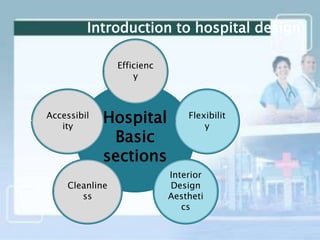
Hospital
Basic
sections
Flexibilit
y
Efficienc
y
Interior
Design
Aestheti
cs
Accessibil
ity
Cleanline
ss
Introduction to hospital design
Efficiency
 Minimizing distance of necessary travel between frequently used space
 Allow easy visual supervision of patients by limited staff.
 Provide sufficient no. of elevators, staircases etc.
 Include all needed spaces and sharing services, but no redundant ones
 Provide optimal, functional adjacencies, such as locating the surgical i
unit adjacent to the operating suite
Flexibility
 Follow modular concepts of space planning and layout as possible.
 Served by modular, easily accessed,and easily modified mechanical and
systems
 Open-ended design, with well-planned directions for future expansion;
positioning “soft spaces” such as administrative departments, adjacent
spaces” such as clinical laboratories.
Introduction to hospital design
Interior Design Aesthetics
 Every effort should be made to make the hospital stay as unthreatening,
comfortable and stress-free as possible.
 Usage of artwork.
 Using cheerful and varied colors for interior finishes and used linens.
 Provide views of the outdoors from every patient bed and elsewhere wherev
Cleanliness and easy maintaining
 Proper, durable finishes for each functional space.
 Careful detailing of such features as doorframes, casework and transitions t
dirt-catching and hard to clean crevices and joints.
 Adequate and appropriately located housekeeping services.
Accessibility
 All areas inside and outside the hospital should be designed to be easy to u
kind of patients with temporary or permanent handicaps.
 Ensuring grades are flat enough to allow easy movement and sidewalks and
corridors are wide enough for two wheelchairs or stretchers to pass easily.
Introduction to hospital design
Main entrance
 Main entrance should be clearly visible, identifiable and easily
accessible, preferably with a covered setting-down point from cars.
Reception:
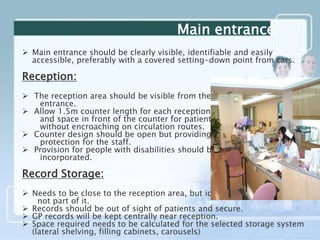
 The reception area should be visible from the main
entrance.
 Allow 1.5m counter length for each receptionist,
and space in front of the counter for patients to stand
without encroaching on circulation routes.
 Counter design should be open but providing some
protection for the staff.
 Provision for people with disabilities should be
incorporated.
Record Storage:
 Needs to be close to the reception area, but ideally
not part of it.
 Records should be out of sight of patients and secure.
 GP records will be kept centrally near reception.
 Space required needs to be calculated for the selected storage system
(lateral shelving, filling cabinets, carousels)
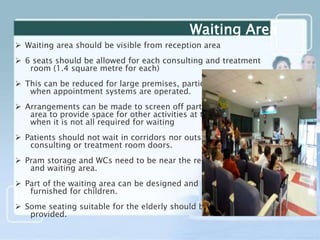
 Waiting area should be visible from reception area
 6 seats should be allowed for each consulting and treatment
room (1.4 square metre for each)
 This can be reduced for large premises, particularly
when appointment systems are operated.
 Arrangements can be made to screen off part of large
area to provide space for other activities at times
when it is not all required for waiting
 Patients should not wait in corridors nor outside
consulting or treatment room doors.
 Pram storage and WCs need to be near the reception
and waiting area.
 Part of the waiting area can be designed and
furnished for children.
 Some seating suitable for the elderly should be
provided.
Waiting Area
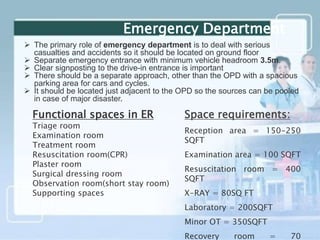
 The primary role of emergency department is to deal with serious
casualties and accidents so it should be located on ground floor
 Separate emergency entrance with minimum vehicle headroom 3.5m.
 Clear signposting to the drive-in entrance is important
 There should be a separate approach, other than the OPD with a spacious
parking area for cars and cycles.
 It should be located just adjacent to the OPD so the sources can be pooled
in case of major disaster.
Space requirements:
Reception area = 150-250
SQFT
Examination area = 100 SQFT
Resuscitation room = 400
SQFT
X-RAY = 80SQ FT
Laboratory = 200SQFT
Minor OT = 350SQFT
Recovery room = 70
Emergency Department
Functional spaces in ER
Triage room
Examination room
Treatment room
Resuscitation room(CPR)
Plaster room
Surgical dressing room
Observation room(short stay room)
Supporting spaces
Emergency Department
Public Sector Areas
• Entrance for patients arriving by ambulance , other modes of
transportation, or conveyances
• Entrance for walk-in patients
• Control station
• Public waiting space with appropriate public amenities
Treatment Facilities
• Patients' observation room
• Treatment cubicles
• Examination rooms
• Cast room
• Critical care rooms
Emergency Department
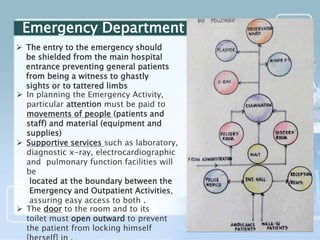
 The entry to the emergency should
be shielded from the main hospital
entrance preventing general patients
from being a witness to ghastly
sights or to tattered limbs
 In planning the Emergency Activity,
particular attention must be paid to
movements of people (patients and
staff) and material (equipment and
supplies)
 Supportive services such as laboratory,
diagnostic x-ray, electrocardiographic
and pulmonary function facilities will
be
located at the boundary between the
Emergency and Outpatient Activities,
assuring easy access to both .
 The door to the room and to its
toilet must open outward to prevent
the patient from locking himself
Emergency Department
Treatment cubicles have curtains for privacy, if necessary, and are equipped
to handle examinations and minor treatments . More severe injuries are
treated in critical care rooms which are of two sizes.
For a coronary patient, the emergency team may consist of a number of
specialists using numerous kinds of portable equipment: therefore, larger
space is required to accommodate both .
The cast room, used for closed reduction of fractures, is equipped similarly
to a treatment cubicle with the addition of a plaster sink and trap.
A blood bank should be accessible by the shortest route within the
emergency .
Emergency Department
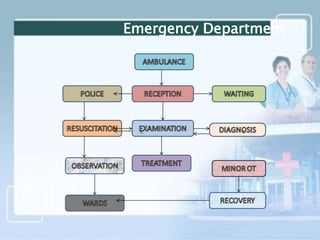
In particular there should be direct access – by separate entrance if
necessary – the x-ray department for speedy diagnosis. Alternatively
separate x-ray facilities can be provided.
Because of the urgent nature of high proportion of accident cases ,the
relationship with supporting department is crucial .
The door must allow passage of a patient on a stretcher who, after
treatment, may be immobilized by means of orthopedic accessories and
attachments to the stretcher . We have already mentioned that out-
patients should have access to the OPD directly through the Main
Entrance
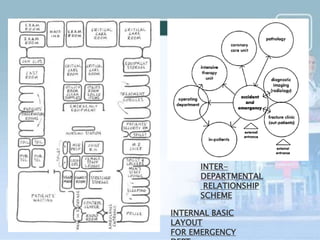
INTER-
DEPARTMENTAL
RELATIONSHIP
SCHEME
INTERNAL BASIC
LAYOUT
FOR EMERGENCY
PURPOSE: Patients who do not need overnight
hospitalization are admitted in the Outpatient
Department. Surgical, dental and nursing care is
provided to patients in Outpatient Department
ACCESS REQUIREMENTS: PEDESTRIAN AND
AMBULANCE ACCESS
LOCATION: MAIN RECEPTION AND WAITING
AREA USUALLY GROUND FLOOR BUT MAY BE
ON THE OTHER LEVELS.
RELATIONSHIP: FRACTURE CLINIC TO
ACCIDENT DEPARTMENT, CONVENIENT
ACCESS TO PHARMACY, GOOD ACCESS TO
MEDICAL RECORDS DEPTT. OFTEN ADJACENT.
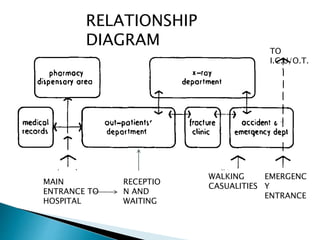
MAIN
ENTRANCE TO
HOSPITAL
WALKING
CASUALITIES
EMERGENC
Y
ENTRANCE
TO
I.C.U/O.T.
RELATIONSHIP
DIAGRAM
RECEPTIO
N AND
WAITING
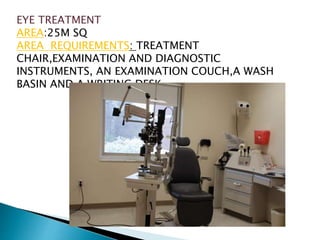
EYE TREATMENT
AREA:25M SQ
AREA REQUIREMENTS: TREATMENT
CHAIR,EXAMINATION AND DIAGNOSTIC
INSTRUMENTS, AN EXAMINATION COUCH,A WASH
BASIN AND A WRITING DESK.
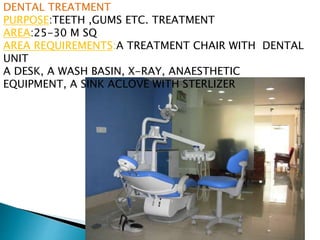
DENTAL TREATMENT
PURPOSE:TEETH ,GUMS ETC. TREATMENT
AREA:25-30 M SQ
AREA REQUIREMENTS:A TREATMENT CHAIR WITH DENTAL
UNIT
A DESK, A WASH BASIN, X-RAY, ANAESTHETIC
EQUIPMENT, A SINK ACLOVE WITH STERLIZER
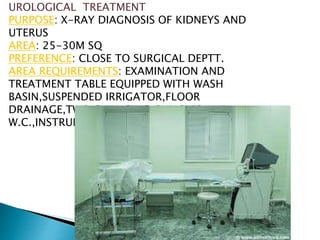
UROLOGICAL TREATMENT
PURPOSE: X-RAY DIAGNOSIS OF KIDNEYS AND
UTERUS
AREA: 25-30M SQ
PREFERENCE: CLOSE TO SURGICAL DEPTT.
AREA REQUIREMENTS: EXAMINATION AND
TREATMENT TABLE EQUIPPED WITH WASH
BASIN,SUSPENDED IRRIGATOR,FLOOR
DRAINAGE,TWO CHANGING CUBICLES AND
W.C.,INSTRUMENT ROOM(15 M SQ)
 SURGICAL DEPARTMENT
 FUNCTION AND LAYOUT
• SHOULD BE CLOSE TO THE INTENSIVE CARE DEPARTMENT , THE RECOVERY
ROOM AND THE CENTRAL STERILISATIONAREA
BECAUSE OF EXTENSIVE INTERACTION BETWEEN THESE DEPARTMENTS .
LOCATION
• BEST LOCATED CENTRALLY IN THE CORE AREA OF HOSPITAL WHERE THEY
ARE EASY TO REACH .
•THE RECEPTION AREA FOR EMERGENCY CASES MUST BE AS CLOSE AS
POSSIBLE TO THE SURGICAL AREA SINCE SUCH PATIENTS OFTEN NEED TO BE
MOVED INTO SURGERY IMMEDIATELY.
ORGANISATION OF THE SURGERY DEPARTMENT
• EVERY SURGICAL DEPARTMENT REQUIRES THE FOLLOWING
ROOMS:
I. OPERATING THEATRE 40-
48MSQ
II. ENTRY ROOM 15-
20MSQ
III. EXIT ROOM 15-
20MSQ
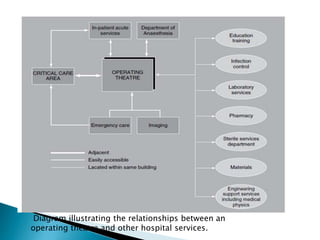
Diagram illustrating the relationships between an
operating theatre and other hospital services.
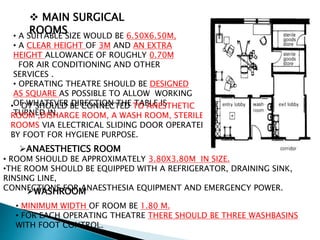
 MAIN SURGICAL
ROOMS• A SUITABLE SIZE WOULD BE 6.50X6.50M,
• A CLEAR HEIGHT OF 3M AND AN EXTRA
HEIGHT ALLOWANCE OF ROUGHLY 0.70M
FOR AIR CONDITIONING AND OTHER
SERVICES .
• OPERATING THEATRE SHOULD BE DESIGNED
AS SQUARE AS POSSIBLE TO ALLOW WORKING
OF WHATEVER DIRECTION THE TABLE IS
TURNED IN.
• OT SHOULD BE CONNECTED TO ANESTHETIC
ROOM ,DISHARGE ROOM, A WASH ROOM, STERILE
ROOMS VIA ELECTRICAL SLIDING DOOR OPERATED
BY FOOT FOR HYGIENE PURPOSE.
ANAESTHETICS ROOM
• ROOM SHOULD BE APPROXIMATELY 3.80X3.80M IN SIZE.
•THE ROOM SHOULD BE EQUIPPED WITH A REFRIGERATOR, DRAINING SINK,
RINSING LINE,
CONNECTIONS FOR ANAESTHESIA EQUIPMENT AND EMERGENCY POWER.WASHROOM
• MINIMUM WIDTH OF ROOM BE 1.80 M.
• FOR EACH OPERATING THEATRE THERE SHOULD BE THREE WASHBASINS
WITH FOOT CONTROL.
 STERILE GOODS ROOM
•THE SIZE OF THIS ROOM IS MORE FLEXIBLE BUT THERE MUST BE
SUFFICIENT SHELF AND CUPBOARD SPACE AND IT MUST BE ACCESSED
DIRECTLY FROM THE OPERATION THEATRE .
• ONE ROOM OF ROUGHLY 10MSQ IS REQUIRED PER OPERATION
THEATRE.
• A ROOM SIZE OF 20MSQ IS REQUIRED FOR EQIPMENT ROOM
SUBSTERILISATION ROOM
•IT CONTAINS A NON CLEAN AREA FOR NON STERILE MATERIAL AND A
CLEAN AREA FOR PREPARED STERILE ITEMS.
•IT CONTAINS A SINK, STORAGE SURFACE , WORK SURFACE AND STEAM
STERILISERS.AUXILIARY FUNCTIONS
•THE ROOMS FOR AUXILIARY FUNCTIONS DO NOT NEED TO BE IN THE
IMMEDIATE AREA OF THE OPERATING THEATRE,NURSES LOUNGE .
•THE DIMENSION OF THIS ROOM DEPENDS ON THE SIZE OF THE
SURGICAL DEPARTMENT.
• IT SHOULD BE ASSUMED THERE ARE EIGHT MEMBERS OF STAFF PER
SURGICAL TEAM(DOCTORS,THEATRE NURSES, ANAESTHESIA NURSES)
THE LOUNGE MUST OFFER SUFFICIENT SEATING ,CUPBOARDS,AND A
SINK.
NURSES WORKSTATIONS
• THESE SHOULD BE LOCATED CENTRALLY AND SHOULD HAVE
VISUAL CONNECTION WITH THE WORKING CORRIDOR.
PHARMACY
A 20MSQ PHARMACY CAN SUPPLY A COMBINATION OF ANAESTHETICS
AND SURGICAL MEDICATION AND OTHER MATERIALS.
CLEANING ROOM
A SIZE OF 5MSQ IS SUFFICIENT FOR CLEANING ROOMS . THEY SHOULD
BE CLOSE TO THE OPERATING THEATRE SINCE CLEANING AND
DISINFECTION ARE CARRIED OUT AFTER EACH OPERATION.
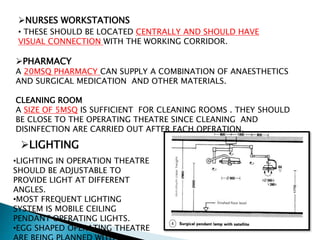
LIGHTING
•LIGHTING IN OPERATION THEATRE
SHOULD BE ADJUSTABLE TO
PROVIDE LIGHT AT DIFFERENT
ANGLES.
•MOST FREQUENT LIGHTING
SYSTEM IS MOBILE CEILING
PENDANT OPERATING LIGHTS.
•EGG SHAPED OPERATING THEATRE
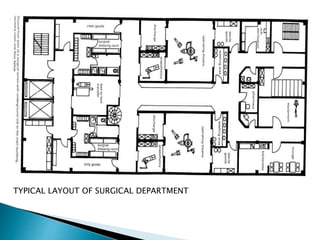
TYPICAL LAYOUT OF SURGICAL DEPARTMENT
INTENSIVE CARE AREA
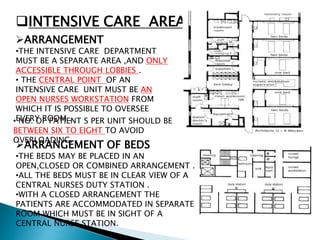
ARRANGEMENT
•THE INTENSIVE CARE DEPARTMENT
MUST BE A SEPARATE AREA ,AND ONLY
ACCESSIBLE THROUGH LOBBIES .
• THE CENTRAL POINT OF AN
INTENSIVE CARE UNIT MUST BE AN
OPEN NURSES WORKSTATION FROM
WHICH IT IS POSSIBLE TO OVERSEE
EVERY ROOM .• NO. OF PATIENT S PER UNIT SHOULD BE
BETWEEN SIX TO EIGHT TO AVOID
OVERLOADING.
ARRANGEMENT OF BEDS
•THE BEDS MAY BE PLACED IN AN
OPEN,CLOSED OR COMBINED ARRANGEMENT .
•ALL THE BEDS MUST BE IN CLEAR VIEW OF A
CENTRAL NURSES DUTY STATION .
•WITH A CLOSED ARRANGEMENT THE
PATIENTS ARE ACCOMMODATED IN SEPARATE
ROOM WHICH MUST BE IN SIGHT OF A
CENTRAL NURSE STATION.
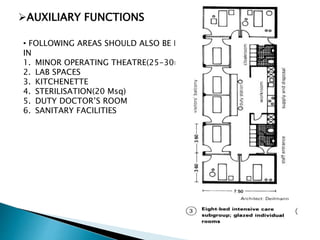
AUXILIARY FUNCTIONS
• FOLLOWING AREAS SHOULD ALSO BE PLANNED
IN
1. MINOR OPERATING THEATRE(25-30m SQ)
2. LAB SPACES
3. KITCHENETTE
4. STERILISATION(20 Msq)
5. DUTY DOCTOR’S ROOM
6. SANITARY FACILITIES
 CARE AREAS
 FUNCTION AND
STURUCTURE•THE INDIVIDUAL CARE AREAS IN A HOSPITAL ARE ATTACHED TO THE
SPECIFIC MEDICAL FACULTIES(SURGERY, MEDICAL, ACCIDENT, AND
EMERGENCY ETC)AND THEREFORE NEED TO BE PLANNED AS SEPARATE
UNITS .
• THEY CATER THE PATIENTS WHO STAY IN HOSPITAL FOR OBSERVATION
AND RECOVERY.
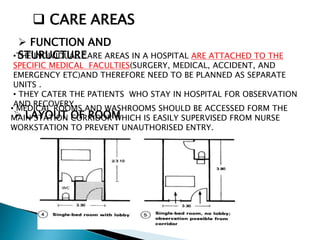
 LAYOUT OF ROOM
• MEDICAL ROOMS AND WASHROOMS SHOULD BE ACCESSED FORM THE
MAIN STATION CORRIDOR WHICH IS EASILY SUPERVISED FROM NURSE
WORKSTATION TO PREVENT UNAUTHORISED ENTRY.
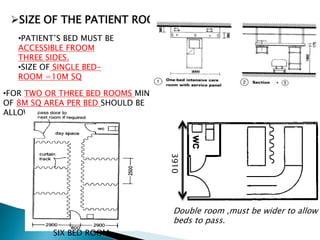
SIZE OF THE PATIENT ROOMS
•PATIENT’S BED MUST BE
ACCESSIBLE FROOM
THREE SIDES.
•SIZE OF SINGLE BED-
ROOM =10M SQ
•FOR TWO OR THREE BED ROOMS MIN
OF 8M SQ AREA PER BED SHOULD BE
ALLOWED.
3910
Double room ,must be wider to allow
beds to pass.
SIX BED ROOM
PATIENT
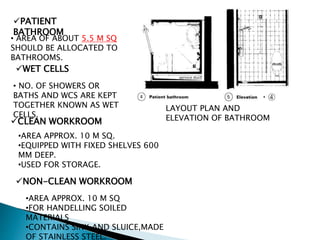
BATHROOM
• AREA OF ABOUT 5.5 M SQ
SHOULD BE ALLOCATED TO
BATHROOMS.
LAYOUT PLAN AND
ELEVATION OF BATHROOM
WET CELLS
• NO. OF SHOWERS OR
BATHS AND WCS ARE KEPT
TOGETHER KNOWN AS WET
CELLS.
CLEAN WORKROOM
•AREA APPROX. 10 M SQ.
•EQUIPPED WITH FIXED SHELVES 600
MM DEEP.
•USED FOR STORAGE.
NON-CLEAN WORKROOM
•AREA APPROX. 10 M SQ
•FOR HANDELLING SOILED
MATERIALS
•CONTAINS SINK AND SLUICE,MADE
OF STAINLESS STEEL.
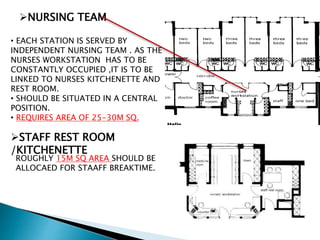
NURSING TEAM
• EACH STATION IS SERVED BY
INDEPENDENT NURSING TEAM . AS THE
NURSES WORKSTATION HAS TO BE
CONSTANTLY OCCUPIED ,IT IS TO BE
LINKED TO NURSES KITCHENETTE AND
REST ROOM.
• SHOULD BE SITUATED IN A CENTRAL
POSITION.
• REQUIRES AREA OF 25-30M SQ.
STAFF REST ROOM
/KITCHENETTE
ROUGHLY 15M SQ AREA SHOULD BE
ALLOCAED FOR STAAFF BREAKTIME.
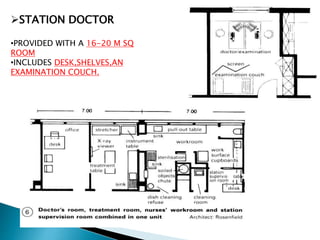
STATION DOCTOR
•PROVIDED WITH A 16-20 M SQ
ROOM
•INCLUDES DESK,SHELVES,AN
EXAMINATION COUCH.
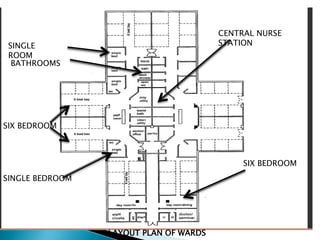
LAYOUT PLAN OF WARDS
CENTRAL NURSE
STATION
SIX BEDROOM
SIX BEDROOM
SINGLE BEDROOM
BATHROOMS
SINGLE
ROOM
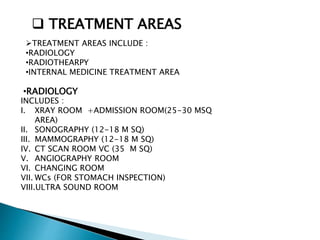
 TREATMENT AREAS
TREATMENT AREAS INCLUDE :
•RADIOLOGY
•RADIOTHEARPY
•INTERNAL MEDICINE TREATMENT AREA
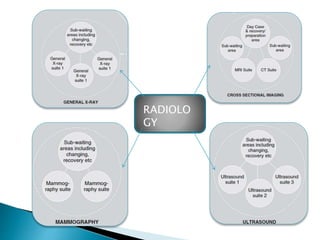
•RADIOLOGY
INCLUDES :
I. XRAY ROOM +ADMISSION ROOM(25-30 MSQ
AREA)
II. SONOGRAPHY (12-18 M SQ)
III. MAMMOGRAPHY (12-18 M SQ)
IV. CT SCAN ROOM VC (35 M SQ)
V. ANGIOGRAPHY ROOM
VI. CHANGING ROOM
VII. WCs (FOR STOMACH INSPECTION)
VIII.ULTRA SOUND ROOM
RADIOLO
GY
•RADIOTHERAPY
FUNCTION:
CONDITIONS DIGNOSED IN RADIO THERAPY DPT. ARE TREATED HERE
INCLUDES:
1. RECEPTION +WAITING AREA
2. DOCTORS ROOM (18 SQ M )
3. LOCALISATION ROOM (25 SQ M )
4. SERVICE ROOM
5. FILM DEVELOPING ROOM (10 SQ M)
6. STORE
7. TREATMENT ROOM(CHANGING ROOM) (15 SQ M)
8. LAB (15-18 SQ M )
•INTERNAL MEDICINE TREATMENT
AREA
COMPRISES OF:
1. EXAMINATION ROOM(25M.SQ)
2. SECRETARIAL/ADMN OFFICE 20 M SQ
3. SENIOR PHYSICIAN ROOM (15 M SQ)
4. CHEIF PHYSICIAN ROOM (20 M SQ)
5. STAFF STAND BYROOM
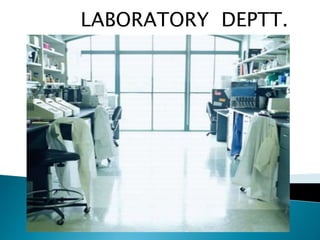
LABORATORY DEPTT.
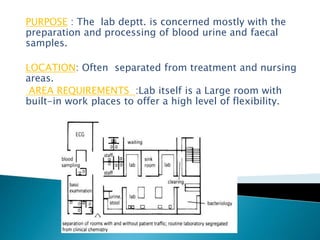
PURPOSE : The lab deptt. is concerned mostly with the
preparation and processing of blood urine and faecal
samples.
LOCATION: Often separated from treatment and nursing
areas.
AREA REQUIREMENTS :Lab itself is a Large room with
built-in work places to offer a high level of flexibility.
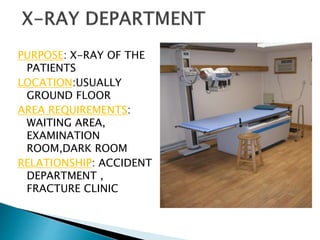
PURPOSE: X-RAY OF THE
PATIENTS
LOCATION:USUALLY
GROUND FLOOR
AREA REQUIREMENTS:
WAITING AREA,
EXAMINATION
ROOM,DARK ROOM
RELATIONSHIP: ACCIDENT
DEPARTMENT ,
FRACTURE CLINIC
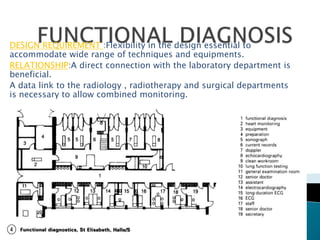
DESIGN REQUIREMENT :Flexibility in the design essential to
accommodate wide range of techniques and equipments.
RELATIONSHIP:A direct connection with the laboratory department is
beneficial.
A data link to the radiology , radiotherapy and surgical departments
is necessary to allow combined monitoring.
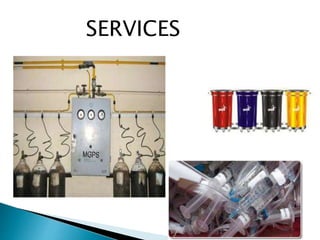
SERVICES
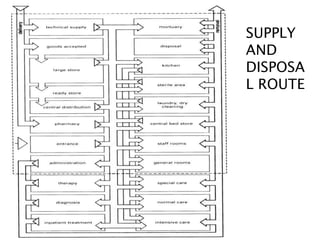
SUPPLY
AND
DISPOSA
L ROUTE
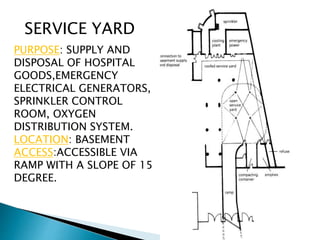
SERVICE YARD
PURPOSE: SUPPLY AND
DISPOSAL OF HOSPITAL
GOODS,EMERGENCY
ELECTRICAL GENERATORS,
SPRINKLER CONTROL
ROOM, OXYGEN
DISTRIBUTION SYSTEM.
LOCATION: BASEMENT
ACCESS:ACCESSIBLE VIA
RAMP WITH A SLOPE OF 15
DEGREE.
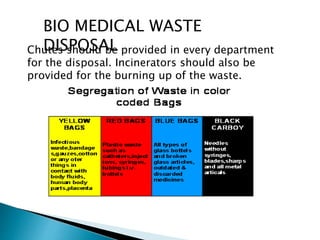
BIO MEDICAL WASTE
DISPOSALChutes should be provided in every department
for the disposal. Incinerators should also be
provided for the burning up of the waste.
STERLIZATION
•Surgical deptt and sterlisation unit should be
situated close together.
• the central store for drugs and instruments must
be closely linked to the central sterlisation unit.
DISPENSARY
•Consists of a work and dispensing room(25 m
sq) which is directly accessed from the main
circulation corridor.
• fitted out with the desk , washing facility,
sink , weighing station and lockable
cupboards.
•Adjoining are a dry store and medicine store
(15 m sq) , a cold store (10m sq) for
hazardous substances and a dressing
Parking can be provided in 3 ways
 Short term parking: should be such placed that they
can be used by visitors. Can be provided on the ground
floor.
 Long term parking: provided for people working in
offices and , can be provided in the basement or on the
roof top.
 Service core parking: provided for service traffic.
Should be provided on the backside of the building for
easy loading & unloading of goods.
Parking
Parking
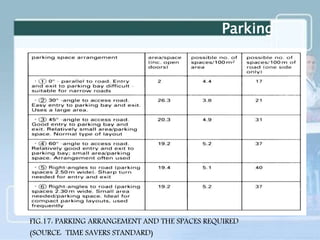
FIG.17: PARKING ARRANGEMENT AND THE SPACES REQUIRED
(SOURCE: TIME SAVERS STANDARD)
Parking
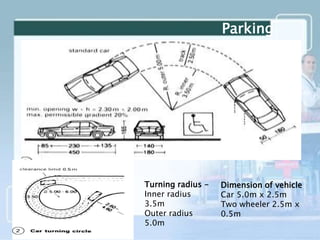
Turning radius -
Inner radius
3.5m
Outer radius
5.0m
Dimension of vehicle
Car 5.0m x 2.5m
Two wheeler 2.5m x
0.5m
Parking
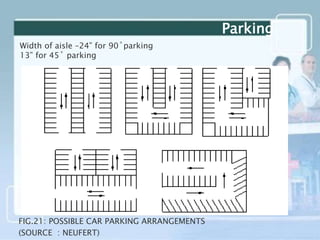
FIG.21: POSSIBLE CAR PARKING ARRANGEMENTS
(SOURCE : NEUFERT)
Width of aisle –24‟ for 90˚parking
13‟ for 45˚ parking
Parking
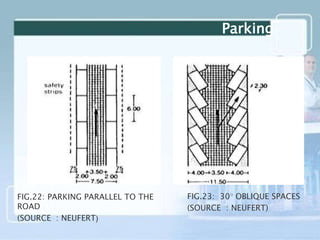
FIG.22: PARKING PARALLEL TO THE
ROAD
(SOURCE : NEUFERT)
FIG.23: 30° OBLIQUE SPACES
(SOURCE : NEUFERT)
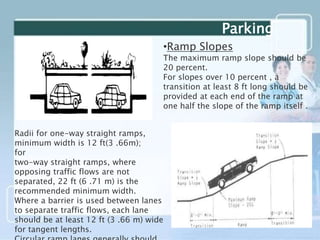
•Ramp Slopes
The maximum ramp slope should be
20 percent.
For slopes over 10 percent , a
transition at least 8 ft long should be
provided at each end of the ramp at
one half the slope of the ramp itself .
Radii for one-way straight ramps,
minimum width is 12 ft(3 .66m);
for
two-way straight ramps, where
opposing traffic flows are not
separated, 22 ft (6 .71 m) is the
recommended minimum width.
Where a barrier is used between lanes
to separate traffic flows, each lane
should be at least 12 ft (3 .66 m) wide
for tangent lengths.
Parking
•Pedestrian space serves two functions :
1. Movement & circulation
2. Relaxation areas.
•They must be busy & colorful, exciting & stimulating, must make
walking enjoyable.
•Trees, fountains, sculptures, murals, as well as architecture of
free standing structures are a vital part of the overall scheme
Ramps :
•A ramp when provided shall not have a slope greater than
1 : 12. Larger slopes shall be provided for special uses but
in no case greater than 1 : 8.
•Minimum clear width shall be 36” (3 feet). in the basement
using car parking shall be 6.0 mt.
• Handrails shall be provided on both sides of the ramp.
Ramps shall have level landings at bottom and top of each
ramp and each ramp run.
Circulation area
Pedestrian areas :
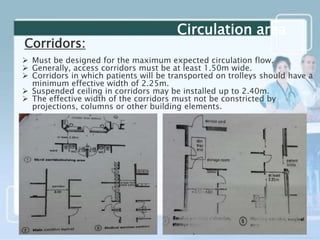
 Must be designed for the maximum expected circulation flow.
 Generally, access corridors must be at least 1.50m wide.
 Corridors in which patients will be transported on trolleys should have a
minimum effective width of 2.25m.
 Suspended ceiling in corridors may be installed up to 2.40m.
 The effective width of the corridors must not be constricted by
projections, columns or other building elements.
Circulation area
Corridors:
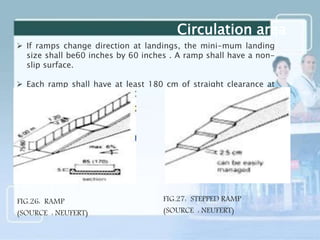
 If ramps change direction at landings, the mini-mum landing
size shall be60 inches by 60 inches . A ramp shall have a non-
slip surface.
 Each ramp shall have at least 180 cm of straight clearance at
the bottom
FIG.26: RAMP
(SOURCE : NEUFERT)
FIG.27: STEPPED RAMP
(SOURCE : NEUFERT)
Circulation area
Circulation area
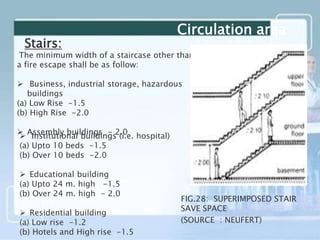
The minimum width of a staircase other than
a fire escape shall be as follow:
 Business, industrial storage, hazardous
buildings
(a) Low Rise -1.5
(b) High Rise -2.0
 Assembly buildings - 2.0 Institutional buildings (i.e. hospital)
(a) Upto 10 beds -1.5
(b) Over 10 beds -2.0
 Educational building
(a) Upto 24 m. high -1.5
(b) Over 24 m. high - 2.0
 Residential building
(a) Low rise -1.2
(b) Hotels and High rise -1.5
FIG.28: SUPERIMPOSED STAIR
SAVE SPACE
(SOURCE : NEUFERT)
Stairs:
 Step heights of 170mm are permissible
 Minimum required tread depth is 280mm.
 It is better to have a rise/tread depth ratio of 150:300mm
 Doors must not constrict the useful width of the landings and in
accordance with hospital regulations, doors to the staircases must open
in the direction of escape.
Circulation area
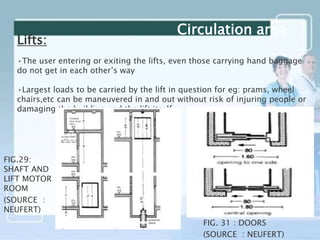
•The user entering or exiting the lifts, even those carrying hand baggage
do not get in each other’s way
•Largest loads to be carried by the lift in question for eg: prams, wheel
chairs,etc can be maneuvered in and out without risk of injuring people or
damaging the building and the lift itself
FIG.29:
SHAFT AND
LIFT MOTOR
ROOM
(SOURCE :
NEUFERT)
FIG. 31 : DOORS
(SOURCE : NEUFERT)
Circulation area
Lifts:
 Installed at an angle of 30 degrees
 Installations are generally 2 speed-with the higher speed
(120 fpm) utilized during rush hours and the lower (90 fpm) at off hours.
 Moving stairways are generally available in widths of 32” and 48”,
measured at hip level between the balustrades.40” can carry 2
persons/tread
 32” has a tread width of 24” and 48” width has 40” tread.
 All treads have a rise of 8” and 16” depth.
32” wide step-5, 000 passengers/hour, with a speed of 90 fpm, and 6,666
passengers/hour with a speed of 120 fpm.
 48” wide step-8, 000 passengers/hr with 90 fpm speed and
10,665 passengers/hr at a speed of 120 fpm.
Circulation area
Escalators:
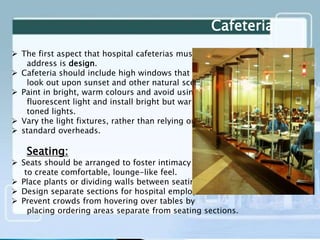
Cafeteria
 The first aspect that hospital cafeterias must
address is design.
 Cafeteria should include high windows that
look out upon sunset and other natural scenes.
 Paint in bright, warm colours and avoid using
fluorescent light and install bright but warmly
toned lights.
 Vary the light fixtures, rather than relying on
 standard overheads.
Seating:
 Seats should be arranged to foster intimacy and
to create comfortable, lounge-like feel.
 Place plants or dividing walls between seating areas.
 Design separate sections for hospital employees.
 Prevent crowds from hovering over tables by
placing ordering areas separate from seating sections.
CASE
STUDY
ESCORTS, FORTIS
AMRITSAR
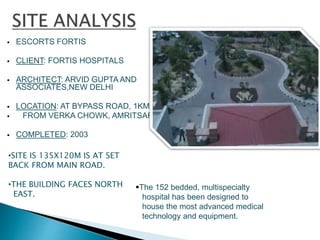
 ESCORTS FORTIS
 CLIENT: FORTIS HOSPITALS
 ARCHITECT: ARVID GUPTA AND
ASSOCIATES,NEW DELHI
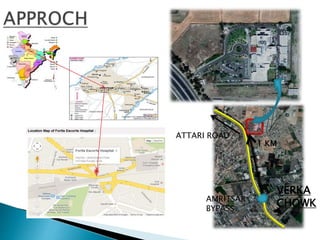
 LOCATION: AT BYPASS ROAD, 1KM
 FROM VERKA CHOWK, AMRITSAR
 COMPLETED: 2003
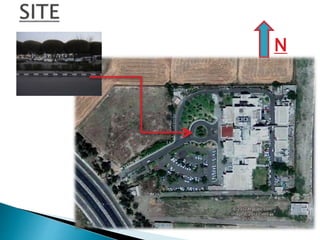
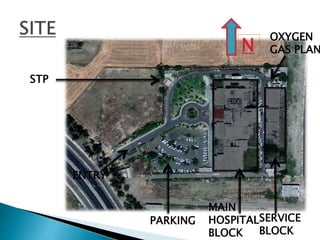
•SITE IS 135X120M IS AT SET
BACK FROM MAIN ROAD.
•THE BUILDING FACES NORTH
EAST.
The 152 bedded, multispecialty
hospital has been designed to
house the most advanced medical
technology and equipment.
1 KM
VERKA
CHOWKAMRITSAR
BYPASS
ATTARI ROAD
N
PARKING SERVICE
BLOCK
MAIN
HOSPITAL
BLOCK
OXYGEN
GAS PLAN
ENTRY
N
STP
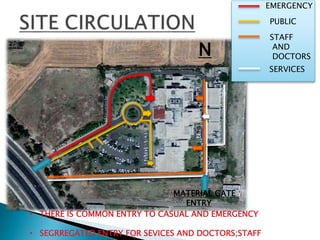
EMERGENCY
PUBLIC
STAFF
AND
DOCTORS
SERVICES
MATERIAL GATE
ENTRY
N
• THERE IS COMMON ENTRY TO CASUAL AND EMERGENCY
• SEGRREGATED ENTRY FOR SEVICES AND DOCTORS;STAFF
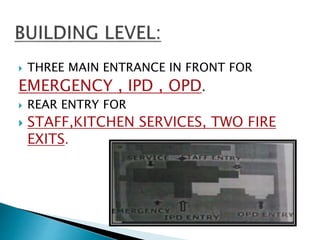
 THREE MAIN ENTRANCE IN FRONT FOR
EMERGENCY , IPD , OPD.
 REAR ENTRY FOR
 STAFF,KITCHEN SERVICES, TWO FIRE
EXITS.
 AT MACRO LEVEL SITE IS DIVIDED INTO THREE
ZONES:
 1.PARKING
 2.LANDSCAPING
 3.BUILDING BLOCK
 AT MICRO LEVEL:
 MAIN BUILDING BLOCK IS FURTHER ZONED IN:
 EMERGENCY ,IPD, OPD, SERVICE BLOCK.
 THE MAIN SPINAL CHORD OF HOSPITAL
CIRCULATION IS 2.1MTS WIDE CORRIDOR.
VERTICAL CIRCULATION:
•TWO STAIR CASE LOBBIES.
•ONE LIFE FOT IPD VISITORS.
•TWO BED LIFTS
•ONE STAFF LIFTS
•ALL STAIRCASES1.8 MTS WIDE,ENCLOSED IN WALL
PROVIDED WITH FIRE RESISTANT DOORS.
•NO RAMPS
•ONE DUMB WAITER FOR LINEN MOVEMENT B/W CSSD
AND LAUNDRY.
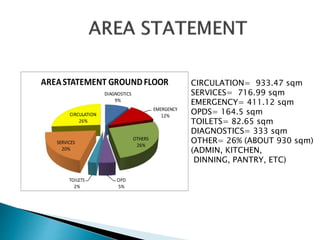
DIAGNOSTICS
9%
EMERGENCY
12%
OTHERS
26%
OPD
5%
TOILETS
2%
SERVICES
20%
CIRCULATION
26%
AREASTATEMENT GROUNDFLOOR CIRCULATION= 933.47 sqm
SERVICES= 716.99 sqm
EMERGENCY= 411.12 sqm
OPDS= 164.5 sqm
TOILETS= 82.65 sqm
DIAGNOSTICS= 333 sqm
OTHER= 26% (ABOUT 930 sqm)
(ADMIN, KITCHEN,
DINNING, PANTRY, ETC)
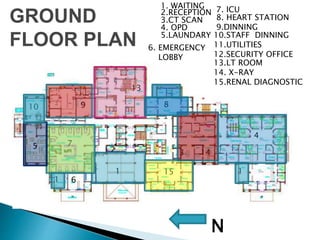
1
2 3
GROUND
FLOOR PLAN
4
1. WAITING
2.RECEPTION
3.CT SCAN
4. OPD
5 7
6
5.LAUNDARY
8. HEART STATION
9.DINNING
89
10.STAFF DINNING
11.UTILITIES
12.SECURITY OFFICE
10
14
13
1
1
15
13.LT ROOM
14. X-RAY
15.RENAL DIAGNOSTIC
6. EMERGENCY
LOBBY
7. ICU
N
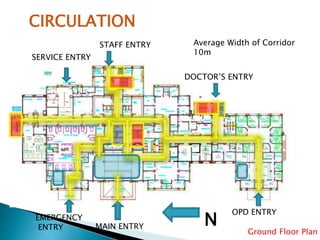
STAFF ENTRY
SERVICE ENTRY
DOCTOR’S ENTRY
MAIN ENTRY
EMERGENCY
ENTRY
OPD ENTRY
CIRCULATION
Average Width of Corridor
10m
Ground Floor Plan
N
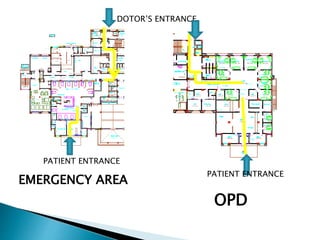
PATIENT ENTRANCE
DOTOR’S ENTRANCE
EMERGENCY AREA
PATIENT ENTRANCE
OPD
`
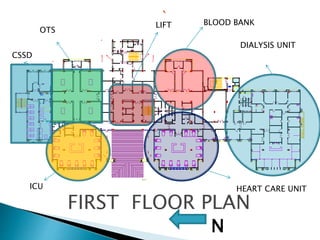
ICU
DIALYSIS UNIT
CSSD
OTS
LIFT
FIRST FLOOR PLAN
HEART CARE UNIT
BLOOD BANK
N
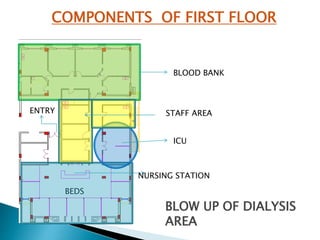
COMPONENTS OF FIRST FLOOR
NURSING STATION
BEDS
ENTRY
BLOOD BANK
ICU
STAFF AREA
BLOW UP OF DIALYSIS
AREA
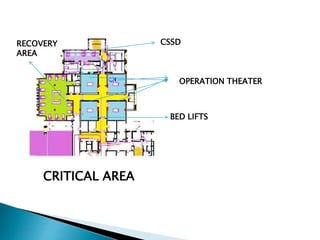
OPERATION THEATER
CSSDRECOVERY
AREA
BED LIFTS
CRITICAL AREA
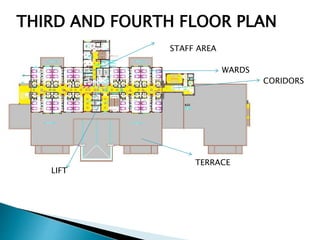
THIRD AND FOURTH FLOOR PLAN
STAFF AREA
WARDS
CORIDORS
TERRACE
LIFT
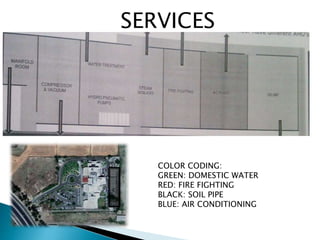
SERVICES
COLOR CODING:
GREEN: DOMESTIC WATER
RED: FIRE FIGHTING
BLACK: SOIL PIPE
BLUE: AIR CONDITIONING
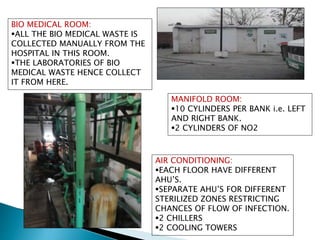
BIO MEDICAL ROOM:
ALL THE BIO MEDICAL WASTE IS
COLLECTED MANUALLY FROM THE
HOSPITAL IN THIS ROOM.
THE LABORATORIES OF BIO
MEDICAL WASTE HENCE COLLECT
IT FROM HERE.
AIR CONDITIONING:
EACH FLOOR HAVE DIFFERENT
AHU’S.
SEPARATE AHU’S FOR DIFFERENT
STERILIZED ZONES RESTRICTING
CHANCES OF FLOW OF INFECTION.
2 CHILLERS
2 COOLING TOWERS
MANIFOLD ROOM:
10 CYLINDERS PER BANK i.e. LEFT
AND RIGHT BANK.
2 CYLINDERS OF NO2
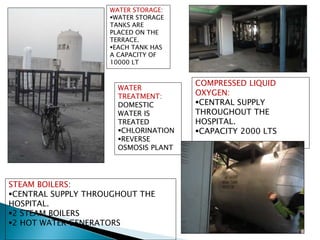
COMPRESSED LIQUID
OXYGEN:
CENTRAL SUPPLY
THROUGHOUT THE
HOSPITAL.
CAPACITY 2000 LTS
WATER STORAGE:
WATER STORAGE
TANKS ARE
PLACED ON THE
TERRACE.
EACH TANK HAS
A CAPACITY OF
10000 LT
WATER
TREATMENT:
DOMESTIC
WATER IS
TREATED
CHLORINATION
REVERSE
OSMOSIS PLANT
STEAM BOILERS:
CENTRAL SUPPLY THROUGHOUT THE
HOSPITAL.
2 STEAM BOILERS
2 HOT WATER GENERATORS
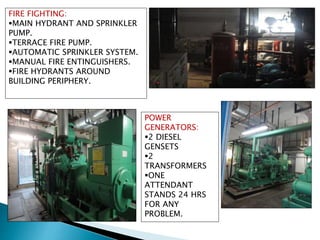
FIRE FIGHTING:
MAIN HYDRANT AND SPRINKLER
PUMP.
TERRACE FIRE PUMP.
AUTOMATIC SPRINKLER SYSTEM.
MANUAL FIRE ENTINGUISHERS.
FIRE HYDRANTS AROUND
BUILDING PERIPHERY.
POWER
GENERATORS:
2 DIESEL
GENSETS
2
TRANSFORMERS
ONE
ATTENDANT
STANDS 24 HRS
FOR ANY
PROBLEM.
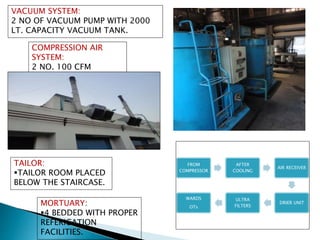
COMPRESSION AIR
SYSTEM:
2 NO. 100 CFM
VACUUM SYSTEM:
2 NO OF VACUUM PUMP WITH 2000
LT. CAPACITY VACUUM TANK.
FROM
COMPRESSOR
AFTER
COOLING
AIR RECEIVER
DRIER UNIT
ULTRA
FILTERS
WARDS
OTs
TAILOR:
TAILOR ROOM PLACED
BELOW THE STAIRCASE.
MORTUARY:
4 BEDDED WITH PROPER
REFERIGATION
FACILITIES.
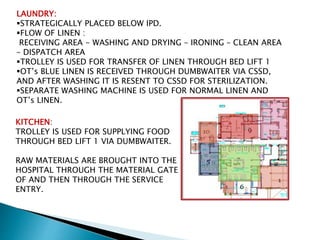
LAUNDRY:
STRATEGICALLY PLACED BELOW IPD.
FLOW OF LINEN :
RECEIVING AREA - WASHING AND DRYING – IRONING – CLEAN AREA
– DISPATCH AREA
TROLLEY IS USED FOR TRANSFER OF LINEN THROUGH BED LIFT 1
OT’s BLUE LINEN IS RECEIVED THROUGH DUMBWAITER VIA CSSD,
AND AFTER WASHING IT IS RESENT TO CSSD FOR STERILIZATION.
SEPARATE WASHING MACHINE IS USED FOR NORMAL LINEN AND
OT’s LINEN.
KITCHEN:
TROLLEY IS USED FOR SUPPLYING FOOD
THROUGH BED LIFT 1 VIA DUMBWAITER.
RAW MATERIALS ARE BROUGHT INTO THE
HOSPITAL THROUGH THE MATERIAL GATE
OF AND THEN THROUGH THE SERVICE
ENTRY.
 IT HAS A COLUMN BEAM STRUCTURE.
 MATERIAL USED :
 CORRIDORS : MARBLE UDAIPUR GREEN , JAISLMER YELLOW
 STAIRS : KOTA STONE, GROUND TO SECOND FLOOR –
UDAIPUR GREEN
 MAIN LOBBY : UDAIPUR GREEN , OMANI MALWA
 LIFT FASCIA : MAKRANA WHITE
 O.T : UDAIPUR GREEN , MARBLE WALLS UPTO 4’0” HEIGHT
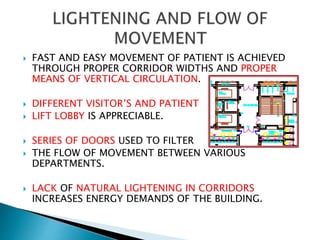
 FAST AND EASY MOVEMENT OF PATIENT IS ACHIEVED
THROUGH PROPER CORRIDOR WIDTHS AND PROPER
MEANS OF VERTICAL CIRCULATION.
 DIFFERENT VISITOR’S AND PATIENT
 LIFT LOBBY IS APPRECIABLE.
 SERIES OF DOORS USED TO FILTER
 THE FLOW OF MOVEMENT BETWEEN VARIOUS
DEPARTMENTS.
 LACK OF NATURAL LIGHTENING IN CORRIDORS
INCREASES ENERGY DEMANDS OF THE BUILDING.
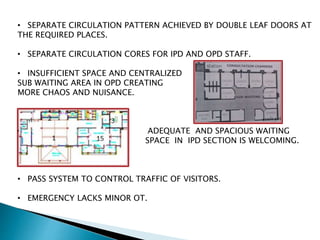
• SEPARATE CIRCULATION PATTERN ACHIEVED BY DOUBLE LEAF DOORS AT
THE REQUIRED PLACES.
• SEPARATE CIRCULATION CORES FOR IPD AND OPD STAFF.
• INSUFFICIENT SPACE AND CENTRALIZED
SUB WAITING AREA IN OPD CREATING
MORE CHAOS AND NUISANCE.
• ADEQUATE AND SPACIOUS WAITING
SPACE IN IPD SECTION IS WELCOMING.
• PASS SYSTEM TO CONTROL TRAFFIC OF VISITORS.
• EMERGENCY LACKS MINOR OT.
 SIMPLE FACADE WITH CUBICAL FORM OF
OUTLOOK.
 PLASTERED FINISH WITH 2 PROJECTING OUT
YELLOW SANDSTONE MASSING.
 HOIZONTAL AND VERTICAL BANDS OF SAME
ARE USED AS HIGHLIGHTERS IN ALL THREE
MAIN ENTRANCE.
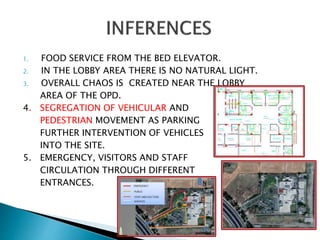
1. FOOD SERVICE FROM THE BED ELEVATOR.
2. IN THE LOBBY AREA THERE IS NO NATURAL LIGHT.
3. OVERALL CHAOS IS CREATED NEAR THE LOBBY
AREA OF THE OPD.
4. SEGREGATION OF VEHICULAR AND
PEDESTRIAN MOVEMENT AS PARKING
FURTHER INTERVENTION OF VEHICLES
INTO THE SITE.
5. EMERGENCY, VISITORS AND STAFF
CIRCULATION THROUGH DIFFERENT
ENTRANCES.
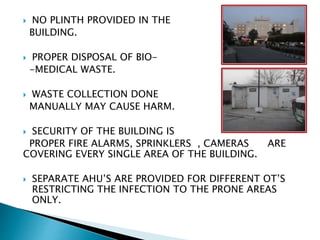
 NO PLINTH PROVIDED IN THE
BUILDING.
 PROPER DISPOSAL OF BIO-
-MEDICAL WASTE.
 WASTE COLLECTION DONE
MANUALLY MAY CAUSE HARM.
 SECURITY OF THE BUILDING IS
PROPER FIRE ALARMS, SPRINKLERS , CAMERAS ARE
COVERING EVERY SINGLE AREA OF THE BUILDING.
 SEPARATE AHU’S ARE PROVIDED FOR DIFFERENT OT’S
RESTRICTING THE INFECTION TO THE PRONE AREAS
ONLY.
THANK YOU :D

FORTIS HOSPITAL AMRITSAR CASE STUDY WITH LIBRARY STUDY

  • 2.
    Introduction to hospitaldesign Types of hospitals According to speciality General: (which is set up to deal with many kinds of disease and inj normally has an emergency department to deal with immediate and threats to health) Specialized: (hospitals for dealing with specific medical needs such psychiatric problems, certain disease categories such as cardiac, on or orthopaedic problems) Teaching: (combines assistance to patients with teaching to medica and nurses and often linked to a medical school, nursing school or According to size Small (50 beds) Medium (50-150 beds) Large (150-600 beds) Central (>600 beds)
  • 3.
    According to healthcare level Primary care hospitals: (health care that is provided at a basic level w an initial approach to a doctor) Secondary care hospitals: (service which is provided by medical speci usually provided by cardiologists, urologists and dermatologists) Tertiary care hospitals: (specialized consultative health care, usually inpatients) According to ownership Government Private District hospitals A district hospital typically is the major health care facility in its regi numbers of beds for intensive care and long-term care. Introduction to hospital design
  • 4.
    Introduction to hospitaldesign Overview Initially, Hospitals are the most complex of building types. Each hospital is comprised a wide range of services and functional units.These include diagnostic and treatment functions, such as clinical laboratories,imaging,emergency rooms, and surgery hospitality functions, such as food service and housekeeping, and the fundamental inpatient care or bed-related function. Hospital design discipline is extremely important in founding and building hospitals, Hospitals must have specific attributes matching the international
  • 5.
  • 6.
    Efficiency  Minimizing distanceof necessary travel between frequently used space  Allow easy visual supervision of patients by limited staff.  Provide sufficient no. of elevators, staircases etc.  Include all needed spaces and sharing services, but no redundant ones  Provide optimal, functional adjacencies, such as locating the surgical i unit adjacent to the operating suite Flexibility  Follow modular concepts of space planning and layout as possible.  Served by modular, easily accessed,and easily modified mechanical and systems  Open-ended design, with well-planned directions for future expansion; positioning “soft spaces” such as administrative departments, adjacent spaces” such as clinical laboratories. Introduction to hospital design
  • 7.
    Interior Design Aesthetics Every effort should be made to make the hospital stay as unthreatening, comfortable and stress-free as possible.  Usage of artwork.  Using cheerful and varied colors for interior finishes and used linens.  Provide views of the outdoors from every patient bed and elsewhere wherev Cleanliness and easy maintaining  Proper, durable finishes for each functional space.  Careful detailing of such features as doorframes, casework and transitions t dirt-catching and hard to clean crevices and joints.  Adequate and appropriately located housekeeping services. Accessibility  All areas inside and outside the hospital should be designed to be easy to u kind of patients with temporary or permanent handicaps.  Ensuring grades are flat enough to allow easy movement and sidewalks and corridors are wide enough for two wheelchairs or stretchers to pass easily. Introduction to hospital design
  • 8.
    Main entrance  Mainentrance should be clearly visible, identifiable and easily accessible, preferably with a covered setting-down point from cars. Reception:  The reception area should be visible from the main entrance.  Allow 1.5m counter length for each receptionist, and space in front of the counter for patients to stand without encroaching on circulation routes.  Counter design should be open but providing some protection for the staff.  Provision for people with disabilities should be incorporated. Record Storage:  Needs to be close to the reception area, but ideally not part of it.  Records should be out of sight of patients and secure.  GP records will be kept centrally near reception.  Space required needs to be calculated for the selected storage system (lateral shelving, filling cabinets, carousels)
  • 9.
     Waiting areashould be visible from reception area  6 seats should be allowed for each consulting and treatment room (1.4 square metre for each)  This can be reduced for large premises, particularly when appointment systems are operated.  Arrangements can be made to screen off part of large area to provide space for other activities at times when it is not all required for waiting  Patients should not wait in corridors nor outside consulting or treatment room doors.  Pram storage and WCs need to be near the reception and waiting area.  Part of the waiting area can be designed and furnished for children.  Some seating suitable for the elderly should be provided. Waiting Area
  • 10.
     The primaryrole of emergency department is to deal with serious casualties and accidents so it should be located on ground floor  Separate emergency entrance with minimum vehicle headroom 3.5m.  Clear signposting to the drive-in entrance is important  There should be a separate approach, other than the OPD with a spacious parking area for cars and cycles.  It should be located just adjacent to the OPD so the sources can be pooled in case of major disaster. Space requirements: Reception area = 150-250 SQFT Examination area = 100 SQFT Resuscitation room = 400 SQFT X-RAY = 80SQ FT Laboratory = 200SQFT Minor OT = 350SQFT Recovery room = 70 Emergency Department Functional spaces in ER Triage room Examination room Treatment room Resuscitation room(CPR) Plaster room Surgical dressing room Observation room(short stay room) Supporting spaces
  • 11.
  • 12.
    Public Sector Areas •Entrance for patients arriving by ambulance , other modes of transportation, or conveyances • Entrance for walk-in patients • Control station • Public waiting space with appropriate public amenities Treatment Facilities • Patients' observation room • Treatment cubicles • Examination rooms • Cast room • Critical care rooms Emergency Department
  • 13.
     The entryto the emergency should be shielded from the main hospital entrance preventing general patients from being a witness to ghastly sights or to tattered limbs  In planning the Emergency Activity, particular attention must be paid to movements of people (patients and staff) and material (equipment and supplies)  Supportive services such as laboratory, diagnostic x-ray, electrocardiographic and pulmonary function facilities will be located at the boundary between the Emergency and Outpatient Activities, assuring easy access to both .  The door to the room and to its toilet must open outward to prevent the patient from locking himself Emergency Department
  • 14.
    Treatment cubicles havecurtains for privacy, if necessary, and are equipped to handle examinations and minor treatments . More severe injuries are treated in critical care rooms which are of two sizes. For a coronary patient, the emergency team may consist of a number of specialists using numerous kinds of portable equipment: therefore, larger space is required to accommodate both . The cast room, used for closed reduction of fractures, is equipped similarly to a treatment cubicle with the addition of a plaster sink and trap. A blood bank should be accessible by the shortest route within the emergency . Emergency Department In particular there should be direct access – by separate entrance if necessary – the x-ray department for speedy diagnosis. Alternatively separate x-ray facilities can be provided. Because of the urgent nature of high proportion of accident cases ,the relationship with supporting department is crucial . The door must allow passage of a patient on a stretcher who, after treatment, may be immobilized by means of orthopedic accessories and attachments to the stretcher . We have already mentioned that out- patients should have access to the OPD directly through the Main Entrance
  • 15.
  • 17.
    PURPOSE: Patients whodo not need overnight hospitalization are admitted in the Outpatient Department. Surgical, dental and nursing care is provided to patients in Outpatient Department ACCESS REQUIREMENTS: PEDESTRIAN AND AMBULANCE ACCESS LOCATION: MAIN RECEPTION AND WAITING AREA USUALLY GROUND FLOOR BUT MAY BE ON THE OTHER LEVELS. RELATIONSHIP: FRACTURE CLINIC TO ACCIDENT DEPARTMENT, CONVENIENT ACCESS TO PHARMACY, GOOD ACCESS TO MEDICAL RECORDS DEPTT. OFTEN ADJACENT.
  • 18.
  • 19.
    EYE TREATMENT AREA:25M SQ AREAREQUIREMENTS: TREATMENT CHAIR,EXAMINATION AND DIAGNOSTIC INSTRUMENTS, AN EXAMINATION COUCH,A WASH BASIN AND A WRITING DESK.
  • 21.
    DENTAL TREATMENT PURPOSE:TEETH ,GUMSETC. TREATMENT AREA:25-30 M SQ AREA REQUIREMENTS:A TREATMENT CHAIR WITH DENTAL UNIT A DESK, A WASH BASIN, X-RAY, ANAESTHETIC EQUIPMENT, A SINK ACLOVE WITH STERLIZER
  • 22.
    UROLOGICAL TREATMENT PURPOSE: X-RAYDIAGNOSIS OF KIDNEYS AND UTERUS AREA: 25-30M SQ PREFERENCE: CLOSE TO SURGICAL DEPTT. AREA REQUIREMENTS: EXAMINATION AND TREATMENT TABLE EQUIPPED WITH WASH BASIN,SUSPENDED IRRIGATOR,FLOOR DRAINAGE,TWO CHANGING CUBICLES AND W.C.,INSTRUMENT ROOM(15 M SQ)
  • 23.
     SURGICAL DEPARTMENT FUNCTION AND LAYOUT • SHOULD BE CLOSE TO THE INTENSIVE CARE DEPARTMENT , THE RECOVERY ROOM AND THE CENTRAL STERILISATIONAREA BECAUSE OF EXTENSIVE INTERACTION BETWEEN THESE DEPARTMENTS . LOCATION • BEST LOCATED CENTRALLY IN THE CORE AREA OF HOSPITAL WHERE THEY ARE EASY TO REACH . •THE RECEPTION AREA FOR EMERGENCY CASES MUST BE AS CLOSE AS POSSIBLE TO THE SURGICAL AREA SINCE SUCH PATIENTS OFTEN NEED TO BE MOVED INTO SURGERY IMMEDIATELY. ORGANISATION OF THE SURGERY DEPARTMENT • EVERY SURGICAL DEPARTMENT REQUIRES THE FOLLOWING ROOMS: I. OPERATING THEATRE 40- 48MSQ II. ENTRY ROOM 15- 20MSQ III. EXIT ROOM 15- 20MSQ
  • 24.
    Diagram illustrating therelationships between an operating theatre and other hospital services.
  • 25.
     MAIN SURGICAL ROOMS•A SUITABLE SIZE WOULD BE 6.50X6.50M, • A CLEAR HEIGHT OF 3M AND AN EXTRA HEIGHT ALLOWANCE OF ROUGHLY 0.70M FOR AIR CONDITIONING AND OTHER SERVICES . • OPERATING THEATRE SHOULD BE DESIGNED AS SQUARE AS POSSIBLE TO ALLOW WORKING OF WHATEVER DIRECTION THE TABLE IS TURNED IN. • OT SHOULD BE CONNECTED TO ANESTHETIC ROOM ,DISHARGE ROOM, A WASH ROOM, STERILE ROOMS VIA ELECTRICAL SLIDING DOOR OPERATED BY FOOT FOR HYGIENE PURPOSE. ANAESTHETICS ROOM • ROOM SHOULD BE APPROXIMATELY 3.80X3.80M IN SIZE. •THE ROOM SHOULD BE EQUIPPED WITH A REFRIGERATOR, DRAINING SINK, RINSING LINE, CONNECTIONS FOR ANAESTHESIA EQUIPMENT AND EMERGENCY POWER.WASHROOM • MINIMUM WIDTH OF ROOM BE 1.80 M. • FOR EACH OPERATING THEATRE THERE SHOULD BE THREE WASHBASINS WITH FOOT CONTROL.
  • 26.
     STERILE GOODSROOM •THE SIZE OF THIS ROOM IS MORE FLEXIBLE BUT THERE MUST BE SUFFICIENT SHELF AND CUPBOARD SPACE AND IT MUST BE ACCESSED DIRECTLY FROM THE OPERATION THEATRE . • ONE ROOM OF ROUGHLY 10MSQ IS REQUIRED PER OPERATION THEATRE. • A ROOM SIZE OF 20MSQ IS REQUIRED FOR EQIPMENT ROOM SUBSTERILISATION ROOM •IT CONTAINS A NON CLEAN AREA FOR NON STERILE MATERIAL AND A CLEAN AREA FOR PREPARED STERILE ITEMS. •IT CONTAINS A SINK, STORAGE SURFACE , WORK SURFACE AND STEAM STERILISERS.AUXILIARY FUNCTIONS •THE ROOMS FOR AUXILIARY FUNCTIONS DO NOT NEED TO BE IN THE IMMEDIATE AREA OF THE OPERATING THEATRE,NURSES LOUNGE . •THE DIMENSION OF THIS ROOM DEPENDS ON THE SIZE OF THE SURGICAL DEPARTMENT. • IT SHOULD BE ASSUMED THERE ARE EIGHT MEMBERS OF STAFF PER SURGICAL TEAM(DOCTORS,THEATRE NURSES, ANAESTHESIA NURSES) THE LOUNGE MUST OFFER SUFFICIENT SEATING ,CUPBOARDS,AND A SINK.
  • 27.
    NURSES WORKSTATIONS • THESESHOULD BE LOCATED CENTRALLY AND SHOULD HAVE VISUAL CONNECTION WITH THE WORKING CORRIDOR. PHARMACY A 20MSQ PHARMACY CAN SUPPLY A COMBINATION OF ANAESTHETICS AND SURGICAL MEDICATION AND OTHER MATERIALS. CLEANING ROOM A SIZE OF 5MSQ IS SUFFICIENT FOR CLEANING ROOMS . THEY SHOULD BE CLOSE TO THE OPERATING THEATRE SINCE CLEANING AND DISINFECTION ARE CARRIED OUT AFTER EACH OPERATION. LIGHTING •LIGHTING IN OPERATION THEATRE SHOULD BE ADJUSTABLE TO PROVIDE LIGHT AT DIFFERENT ANGLES. •MOST FREQUENT LIGHTING SYSTEM IS MOBILE CEILING PENDANT OPERATING LIGHTS. •EGG SHAPED OPERATING THEATRE
  • 28.
    TYPICAL LAYOUT OFSURGICAL DEPARTMENT
  • 29.
    INTENSIVE CARE AREA ARRANGEMENT •THEINTENSIVE CARE DEPARTMENT MUST BE A SEPARATE AREA ,AND ONLY ACCESSIBLE THROUGH LOBBIES . • THE CENTRAL POINT OF AN INTENSIVE CARE UNIT MUST BE AN OPEN NURSES WORKSTATION FROM WHICH IT IS POSSIBLE TO OVERSEE EVERY ROOM .• NO. OF PATIENT S PER UNIT SHOULD BE BETWEEN SIX TO EIGHT TO AVOID OVERLOADING. ARRANGEMENT OF BEDS •THE BEDS MAY BE PLACED IN AN OPEN,CLOSED OR COMBINED ARRANGEMENT . •ALL THE BEDS MUST BE IN CLEAR VIEW OF A CENTRAL NURSES DUTY STATION . •WITH A CLOSED ARRANGEMENT THE PATIENTS ARE ACCOMMODATED IN SEPARATE ROOM WHICH MUST BE IN SIGHT OF A CENTRAL NURSE STATION.
  • 30.
    AUXILIARY FUNCTIONS • FOLLOWINGAREAS SHOULD ALSO BE PLANNED IN 1. MINOR OPERATING THEATRE(25-30m SQ) 2. LAB SPACES 3. KITCHENETTE 4. STERILISATION(20 Msq) 5. DUTY DOCTOR’S ROOM 6. SANITARY FACILITIES
  • 31.
     CARE AREAS FUNCTION AND STURUCTURE•THE INDIVIDUAL CARE AREAS IN A HOSPITAL ARE ATTACHED TO THE SPECIFIC MEDICAL FACULTIES(SURGERY, MEDICAL, ACCIDENT, AND EMERGENCY ETC)AND THEREFORE NEED TO BE PLANNED AS SEPARATE UNITS . • THEY CATER THE PATIENTS WHO STAY IN HOSPITAL FOR OBSERVATION AND RECOVERY.  LAYOUT OF ROOM • MEDICAL ROOMS AND WASHROOMS SHOULD BE ACCESSED FORM THE MAIN STATION CORRIDOR WHICH IS EASILY SUPERVISED FROM NURSE WORKSTATION TO PREVENT UNAUTHORISED ENTRY.
  • 32.
    SIZE OF THEPATIENT ROOMS •PATIENT’S BED MUST BE ACCESSIBLE FROOM THREE SIDES. •SIZE OF SINGLE BED- ROOM =10M SQ •FOR TWO OR THREE BED ROOMS MIN OF 8M SQ AREA PER BED SHOULD BE ALLOWED. 3910 Double room ,must be wider to allow beds to pass. SIX BED ROOM
  • 33.
    PATIENT BATHROOM • AREA OFABOUT 5.5 M SQ SHOULD BE ALLOCATED TO BATHROOMS. LAYOUT PLAN AND ELEVATION OF BATHROOM WET CELLS • NO. OF SHOWERS OR BATHS AND WCS ARE KEPT TOGETHER KNOWN AS WET CELLS. CLEAN WORKROOM •AREA APPROX. 10 M SQ. •EQUIPPED WITH FIXED SHELVES 600 MM DEEP. •USED FOR STORAGE. NON-CLEAN WORKROOM •AREA APPROX. 10 M SQ •FOR HANDELLING SOILED MATERIALS •CONTAINS SINK AND SLUICE,MADE OF STAINLESS STEEL.
  • 34.
    NURSING TEAM • EACHSTATION IS SERVED BY INDEPENDENT NURSING TEAM . AS THE NURSES WORKSTATION HAS TO BE CONSTANTLY OCCUPIED ,IT IS TO BE LINKED TO NURSES KITCHENETTE AND REST ROOM. • SHOULD BE SITUATED IN A CENTRAL POSITION. • REQUIRES AREA OF 25-30M SQ. STAFF REST ROOM /KITCHENETTE ROUGHLY 15M SQ AREA SHOULD BE ALLOCAED FOR STAAFF BREAKTIME.
  • 35.
    STATION DOCTOR •PROVIDED WITHA 16-20 M SQ ROOM •INCLUDES DESK,SHELVES,AN EXAMINATION COUCH.
  • 36.
    LAYOUT PLAN OFWARDS CENTRAL NURSE STATION SIX BEDROOM SIX BEDROOM SINGLE BEDROOM BATHROOMS SINGLE ROOM
  • 37.
     TREATMENT AREAS TREATMENTAREAS INCLUDE : •RADIOLOGY •RADIOTHEARPY •INTERNAL MEDICINE TREATMENT AREA •RADIOLOGY INCLUDES : I. XRAY ROOM +ADMISSION ROOM(25-30 MSQ AREA) II. SONOGRAPHY (12-18 M SQ) III. MAMMOGRAPHY (12-18 M SQ) IV. CT SCAN ROOM VC (35 M SQ) V. ANGIOGRAPHY ROOM VI. CHANGING ROOM VII. WCs (FOR STOMACH INSPECTION) VIII.ULTRA SOUND ROOM
  • 38.
  • 39.
    •RADIOTHERAPY FUNCTION: CONDITIONS DIGNOSED INRADIO THERAPY DPT. ARE TREATED HERE INCLUDES: 1. RECEPTION +WAITING AREA 2. DOCTORS ROOM (18 SQ M ) 3. LOCALISATION ROOM (25 SQ M ) 4. SERVICE ROOM 5. FILM DEVELOPING ROOM (10 SQ M) 6. STORE 7. TREATMENT ROOM(CHANGING ROOM) (15 SQ M) 8. LAB (15-18 SQ M ) •INTERNAL MEDICINE TREATMENT AREA COMPRISES OF: 1. EXAMINATION ROOM(25M.SQ) 2. SECRETARIAL/ADMN OFFICE 20 M SQ 3. SENIOR PHYSICIAN ROOM (15 M SQ) 4. CHEIF PHYSICIAN ROOM (20 M SQ) 5. STAFF STAND BYROOM
  • 40.
  • 41.
    PURPOSE : Thelab deptt. is concerned mostly with the preparation and processing of blood urine and faecal samples. LOCATION: Often separated from treatment and nursing areas. AREA REQUIREMENTS :Lab itself is a Large room with built-in work places to offer a high level of flexibility.
  • 42.
    PURPOSE: X-RAY OFTHE PATIENTS LOCATION:USUALLY GROUND FLOOR AREA REQUIREMENTS: WAITING AREA, EXAMINATION ROOM,DARK ROOM RELATIONSHIP: ACCIDENT DEPARTMENT , FRACTURE CLINIC
  • 43.
    DESIGN REQUIREMENT :Flexibilityin the design essential to accommodate wide range of techniques and equipments. RELATIONSHIP:A direct connection with the laboratory department is beneficial. A data link to the radiology , radiotherapy and surgical departments is necessary to allow combined monitoring.
  • 44.
  • 45.
  • 46.
    SERVICE YARD PURPOSE: SUPPLYAND DISPOSAL OF HOSPITAL GOODS,EMERGENCY ELECTRICAL GENERATORS, SPRINKLER CONTROL ROOM, OXYGEN DISTRIBUTION SYSTEM. LOCATION: BASEMENT ACCESS:ACCESSIBLE VIA RAMP WITH A SLOPE OF 15 DEGREE.
  • 47.
    BIO MEDICAL WASTE DISPOSALChutesshould be provided in every department for the disposal. Incinerators should also be provided for the burning up of the waste.
  • 50.
    STERLIZATION •Surgical deptt andsterlisation unit should be situated close together. • the central store for drugs and instruments must be closely linked to the central sterlisation unit. DISPENSARY •Consists of a work and dispensing room(25 m sq) which is directly accessed from the main circulation corridor. • fitted out with the desk , washing facility, sink , weighing station and lockable cupboards. •Adjoining are a dry store and medicine store (15 m sq) , a cold store (10m sq) for hazardous substances and a dressing
  • 51.
    Parking can beprovided in 3 ways  Short term parking: should be such placed that they can be used by visitors. Can be provided on the ground floor.  Long term parking: provided for people working in offices and , can be provided in the basement or on the roof top.  Service core parking: provided for service traffic. Should be provided on the backside of the building for easy loading & unloading of goods. Parking
  • 52.
    Parking FIG.17: PARKING ARRANGEMENTAND THE SPACES REQUIRED (SOURCE: TIME SAVERS STANDARD)
  • 53.
    Parking Turning radius - Innerradius 3.5m Outer radius 5.0m Dimension of vehicle Car 5.0m x 2.5m Two wheeler 2.5m x 0.5m
  • 54.
    Parking FIG.21: POSSIBLE CARPARKING ARRANGEMENTS (SOURCE : NEUFERT) Width of aisle –24‟ for 90˚parking 13‟ for 45˚ parking
  • 55.
    Parking FIG.22: PARKING PARALLELTO THE ROAD (SOURCE : NEUFERT) FIG.23: 30° OBLIQUE SPACES (SOURCE : NEUFERT)
  • 56.
    •Ramp Slopes The maximumramp slope should be 20 percent. For slopes over 10 percent , a transition at least 8 ft long should be provided at each end of the ramp at one half the slope of the ramp itself . Radii for one-way straight ramps, minimum width is 12 ft(3 .66m); for two-way straight ramps, where opposing traffic flows are not separated, 22 ft (6 .71 m) is the recommended minimum width. Where a barrier is used between lanes to separate traffic flows, each lane should be at least 12 ft (3 .66 m) wide for tangent lengths. Parking
  • 57.
    •Pedestrian space servestwo functions : 1. Movement & circulation 2. Relaxation areas. •They must be busy & colorful, exciting & stimulating, must make walking enjoyable. •Trees, fountains, sculptures, murals, as well as architecture of free standing structures are a vital part of the overall scheme Ramps : •A ramp when provided shall not have a slope greater than 1 : 12. Larger slopes shall be provided for special uses but in no case greater than 1 : 8. •Minimum clear width shall be 36” (3 feet). in the basement using car parking shall be 6.0 mt. • Handrails shall be provided on both sides of the ramp. Ramps shall have level landings at bottom and top of each ramp and each ramp run. Circulation area Pedestrian areas :
  • 58.
     Must bedesigned for the maximum expected circulation flow.  Generally, access corridors must be at least 1.50m wide.  Corridors in which patients will be transported on trolleys should have a minimum effective width of 2.25m.  Suspended ceiling in corridors may be installed up to 2.40m.  The effective width of the corridors must not be constricted by projections, columns or other building elements. Circulation area Corridors:
  • 59.
     If rampschange direction at landings, the mini-mum landing size shall be60 inches by 60 inches . A ramp shall have a non- slip surface.  Each ramp shall have at least 180 cm of straight clearance at the bottom FIG.26: RAMP (SOURCE : NEUFERT) FIG.27: STEPPED RAMP (SOURCE : NEUFERT) Circulation area
  • 60.
    Circulation area The minimumwidth of a staircase other than a fire escape shall be as follow:  Business, industrial storage, hazardous buildings (a) Low Rise -1.5 (b) High Rise -2.0  Assembly buildings - 2.0 Institutional buildings (i.e. hospital) (a) Upto 10 beds -1.5 (b) Over 10 beds -2.0  Educational building (a) Upto 24 m. high -1.5 (b) Over 24 m. high - 2.0  Residential building (a) Low rise -1.2 (b) Hotels and High rise -1.5 FIG.28: SUPERIMPOSED STAIR SAVE SPACE (SOURCE : NEUFERT) Stairs:
  • 61.
     Step heightsof 170mm are permissible  Minimum required tread depth is 280mm.  It is better to have a rise/tread depth ratio of 150:300mm  Doors must not constrict the useful width of the landings and in accordance with hospital regulations, doors to the staircases must open in the direction of escape. Circulation area
  • 62.
    •The user enteringor exiting the lifts, even those carrying hand baggage do not get in each other’s way •Largest loads to be carried by the lift in question for eg: prams, wheel chairs,etc can be maneuvered in and out without risk of injuring people or damaging the building and the lift itself FIG.29: SHAFT AND LIFT MOTOR ROOM (SOURCE : NEUFERT) FIG. 31 : DOORS (SOURCE : NEUFERT) Circulation area Lifts:
  • 63.
     Installed atan angle of 30 degrees  Installations are generally 2 speed-with the higher speed (120 fpm) utilized during rush hours and the lower (90 fpm) at off hours.  Moving stairways are generally available in widths of 32” and 48”, measured at hip level between the balustrades.40” can carry 2 persons/tread  32” has a tread width of 24” and 48” width has 40” tread.  All treads have a rise of 8” and 16” depth. 32” wide step-5, 000 passengers/hour, with a speed of 90 fpm, and 6,666 passengers/hour with a speed of 120 fpm.  48” wide step-8, 000 passengers/hr with 90 fpm speed and 10,665 passengers/hr at a speed of 120 fpm. Circulation area Escalators:
  • 64.
    Cafeteria  The firstaspect that hospital cafeterias must address is design.  Cafeteria should include high windows that look out upon sunset and other natural scenes.  Paint in bright, warm colours and avoid using fluorescent light and install bright but warmly toned lights.  Vary the light fixtures, rather than relying on  standard overheads. Seating:  Seats should be arranged to foster intimacy and to create comfortable, lounge-like feel.  Place plants or dividing walls between seating areas.  Design separate sections for hospital employees.  Prevent crowds from hovering over tables by placing ordering areas separate from seating sections.
  • 65.
  • 66.
     ESCORTS FORTIS CLIENT: FORTIS HOSPITALS  ARCHITECT: ARVID GUPTA AND ASSOCIATES,NEW DELHI  LOCATION: AT BYPASS ROAD, 1KM  FROM VERKA CHOWK, AMRITSAR  COMPLETED: 2003 •SITE IS 135X120M IS AT SET BACK FROM MAIN ROAD. •THE BUILDING FACES NORTH EAST. The 152 bedded, multispecialty hospital has been designed to house the most advanced medical technology and equipment.
  • 67.
  • 68.
  • 69.
  • 70.
    EMERGENCY PUBLIC STAFF AND DOCTORS SERVICES MATERIAL GATE ENTRY N • THEREIS COMMON ENTRY TO CASUAL AND EMERGENCY • SEGRREGATED ENTRY FOR SEVICES AND DOCTORS;STAFF
  • 71.
     THREE MAINENTRANCE IN FRONT FOR EMERGENCY , IPD , OPD.  REAR ENTRY FOR  STAFF,KITCHEN SERVICES, TWO FIRE EXITS.
  • 72.
     AT MACROLEVEL SITE IS DIVIDED INTO THREE ZONES:  1.PARKING  2.LANDSCAPING  3.BUILDING BLOCK  AT MICRO LEVEL:  MAIN BUILDING BLOCK IS FURTHER ZONED IN:  EMERGENCY ,IPD, OPD, SERVICE BLOCK.
  • 73.
     THE MAINSPINAL CHORD OF HOSPITAL CIRCULATION IS 2.1MTS WIDE CORRIDOR. VERTICAL CIRCULATION: •TWO STAIR CASE LOBBIES. •ONE LIFE FOT IPD VISITORS. •TWO BED LIFTS •ONE STAFF LIFTS •ALL STAIRCASES1.8 MTS WIDE,ENCLOSED IN WALL PROVIDED WITH FIRE RESISTANT DOORS. •NO RAMPS •ONE DUMB WAITER FOR LINEN MOVEMENT B/W CSSD AND LAUNDRY.
  • 74.
    DIAGNOSTICS 9% EMERGENCY 12% OTHERS 26% OPD 5% TOILETS 2% SERVICES 20% CIRCULATION 26% AREASTATEMENT GROUNDFLOOR CIRCULATION=933.47 sqm SERVICES= 716.99 sqm EMERGENCY= 411.12 sqm OPDS= 164.5 sqm TOILETS= 82.65 sqm DIAGNOSTICS= 333 sqm OTHER= 26% (ABOUT 930 sqm) (ADMIN, KITCHEN, DINNING, PANTRY, ETC)
  • 76.
    1 2 3 GROUND FLOOR PLAN 4 1.WAITING 2.RECEPTION 3.CT SCAN 4. OPD 5 7 6 5.LAUNDARY 8. HEART STATION 9.DINNING 89 10.STAFF DINNING 11.UTILITIES 12.SECURITY OFFICE 10 14 13 1 1 15 13.LT ROOM 14. X-RAY 15.RENAL DIAGNOSTIC 6. EMERGENCY LOBBY 7. ICU N
  • 77.
    STAFF ENTRY SERVICE ENTRY DOCTOR’SENTRY MAIN ENTRY EMERGENCY ENTRY OPD ENTRY CIRCULATION Average Width of Corridor 10m Ground Floor Plan N
  • 78.
  • 79.
    ` ICU DIALYSIS UNIT CSSD OTS LIFT FIRST FLOORPLAN HEART CARE UNIT BLOOD BANK N
  • 80.
    COMPONENTS OF FIRSTFLOOR NURSING STATION BEDS ENTRY BLOOD BANK ICU STAFF AREA BLOW UP OF DIALYSIS AREA
  • 81.
  • 82.
    THIRD AND FOURTHFLOOR PLAN STAFF AREA WARDS CORIDORS TERRACE LIFT
  • 83.
    SERVICES COLOR CODING: GREEN: DOMESTICWATER RED: FIRE FIGHTING BLACK: SOIL PIPE BLUE: AIR CONDITIONING
  • 84.
    BIO MEDICAL ROOM: ALLTHE BIO MEDICAL WASTE IS COLLECTED MANUALLY FROM THE HOSPITAL IN THIS ROOM. THE LABORATORIES OF BIO MEDICAL WASTE HENCE COLLECT IT FROM HERE. AIR CONDITIONING: EACH FLOOR HAVE DIFFERENT AHU’S. SEPARATE AHU’S FOR DIFFERENT STERILIZED ZONES RESTRICTING CHANCES OF FLOW OF INFECTION. 2 CHILLERS 2 COOLING TOWERS MANIFOLD ROOM: 10 CYLINDERS PER BANK i.e. LEFT AND RIGHT BANK. 2 CYLINDERS OF NO2
  • 85.
    COMPRESSED LIQUID OXYGEN: CENTRAL SUPPLY THROUGHOUTTHE HOSPITAL. CAPACITY 2000 LTS WATER STORAGE: WATER STORAGE TANKS ARE PLACED ON THE TERRACE. EACH TANK HAS A CAPACITY OF 10000 LT WATER TREATMENT: DOMESTIC WATER IS TREATED CHLORINATION REVERSE OSMOSIS PLANT STEAM BOILERS: CENTRAL SUPPLY THROUGHOUT THE HOSPITAL. 2 STEAM BOILERS 2 HOT WATER GENERATORS
  • 86.
    FIRE FIGHTING: MAIN HYDRANTAND SPRINKLER PUMP. TERRACE FIRE PUMP. AUTOMATIC SPRINKLER SYSTEM. MANUAL FIRE ENTINGUISHERS. FIRE HYDRANTS AROUND BUILDING PERIPHERY. POWER GENERATORS: 2 DIESEL GENSETS 2 TRANSFORMERS ONE ATTENDANT STANDS 24 HRS FOR ANY PROBLEM.
  • 87.
    COMPRESSION AIR SYSTEM: 2 NO.100 CFM VACUUM SYSTEM: 2 NO OF VACUUM PUMP WITH 2000 LT. CAPACITY VACUUM TANK. FROM COMPRESSOR AFTER COOLING AIR RECEIVER DRIER UNIT ULTRA FILTERS WARDS OTs TAILOR: TAILOR ROOM PLACED BELOW THE STAIRCASE. MORTUARY: 4 BEDDED WITH PROPER REFERIGATION FACILITIES.
  • 88.
    LAUNDRY: STRATEGICALLY PLACED BELOWIPD. FLOW OF LINEN : RECEIVING AREA - WASHING AND DRYING – IRONING – CLEAN AREA – DISPATCH AREA TROLLEY IS USED FOR TRANSFER OF LINEN THROUGH BED LIFT 1 OT’s BLUE LINEN IS RECEIVED THROUGH DUMBWAITER VIA CSSD, AND AFTER WASHING IT IS RESENT TO CSSD FOR STERILIZATION. SEPARATE WASHING MACHINE IS USED FOR NORMAL LINEN AND OT’s LINEN. KITCHEN: TROLLEY IS USED FOR SUPPLYING FOOD THROUGH BED LIFT 1 VIA DUMBWAITER. RAW MATERIALS ARE BROUGHT INTO THE HOSPITAL THROUGH THE MATERIAL GATE OF AND THEN THROUGH THE SERVICE ENTRY.
  • 89.
     IT HASA COLUMN BEAM STRUCTURE.  MATERIAL USED :  CORRIDORS : MARBLE UDAIPUR GREEN , JAISLMER YELLOW  STAIRS : KOTA STONE, GROUND TO SECOND FLOOR – UDAIPUR GREEN  MAIN LOBBY : UDAIPUR GREEN , OMANI MALWA  LIFT FASCIA : MAKRANA WHITE  O.T : UDAIPUR GREEN , MARBLE WALLS UPTO 4’0” HEIGHT
  • 90.
     FAST ANDEASY MOVEMENT OF PATIENT IS ACHIEVED THROUGH PROPER CORRIDOR WIDTHS AND PROPER MEANS OF VERTICAL CIRCULATION.  DIFFERENT VISITOR’S AND PATIENT  LIFT LOBBY IS APPRECIABLE.  SERIES OF DOORS USED TO FILTER  THE FLOW OF MOVEMENT BETWEEN VARIOUS DEPARTMENTS.  LACK OF NATURAL LIGHTENING IN CORRIDORS INCREASES ENERGY DEMANDS OF THE BUILDING.
  • 91.
    • SEPARATE CIRCULATIONPATTERN ACHIEVED BY DOUBLE LEAF DOORS AT THE REQUIRED PLACES. • SEPARATE CIRCULATION CORES FOR IPD AND OPD STAFF. • INSUFFICIENT SPACE AND CENTRALIZED SUB WAITING AREA IN OPD CREATING MORE CHAOS AND NUISANCE. • ADEQUATE AND SPACIOUS WAITING SPACE IN IPD SECTION IS WELCOMING. • PASS SYSTEM TO CONTROL TRAFFIC OF VISITORS. • EMERGENCY LACKS MINOR OT.
  • 92.
     SIMPLE FACADEWITH CUBICAL FORM OF OUTLOOK.  PLASTERED FINISH WITH 2 PROJECTING OUT YELLOW SANDSTONE MASSING.  HOIZONTAL AND VERTICAL BANDS OF SAME ARE USED AS HIGHLIGHTERS IN ALL THREE MAIN ENTRANCE.
  • 93.
    1. FOOD SERVICEFROM THE BED ELEVATOR. 2. IN THE LOBBY AREA THERE IS NO NATURAL LIGHT. 3. OVERALL CHAOS IS CREATED NEAR THE LOBBY AREA OF THE OPD. 4. SEGREGATION OF VEHICULAR AND PEDESTRIAN MOVEMENT AS PARKING FURTHER INTERVENTION OF VEHICLES INTO THE SITE. 5. EMERGENCY, VISITORS AND STAFF CIRCULATION THROUGH DIFFERENT ENTRANCES.
  • 94.
     NO PLINTHPROVIDED IN THE BUILDING.  PROPER DISPOSAL OF BIO- -MEDICAL WASTE.  WASTE COLLECTION DONE MANUALLY MAY CAUSE HARM.  SECURITY OF THE BUILDING IS PROPER FIRE ALARMS, SPRINKLERS , CAMERAS ARE COVERING EVERY SINGLE AREA OF THE BUILDING.  SEPARATE AHU’S ARE PROVIDED FOR DIFFERENT OT’S RESTRICTING THE INFECTION TO THE PRONE AREAS ONLY.
  • 95.

Editor's Notes