Barrier free environment in
health care buildings
Hrishikesh Ashtekar
Architect Urban designer
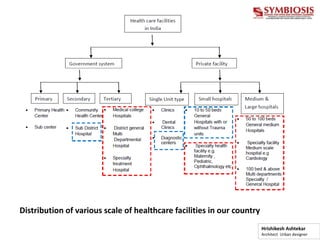
Distribution of various scale of healthcare facilities in our country
Hrishikesh Ashtekar
Architect Urban designer
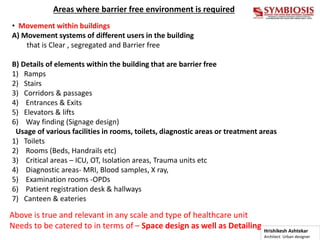
Areas where barrier free environment is required
• Movement within buildings
A) Movement systems of different users in the building
that is Clear , segregated and Barrier free
B) Details of elements within the building that are barrier free
1) Ramps
2) Stairs
3) Corridors & passages
4) Entrances & Exits
5) Elevators & lifts
6) Way finding (Signage design)
Usage of various facilities in rooms, toilets, diagnostic areas or treatment areas
1) Toilets
2) Rooms (Beds, Handrails etc)
3) Critical areas – ICU, OT, Isolation areas, Trauma units etc
4) Diagnostic areas- MRI, Blood samples, X ray,
5) Examination rooms -OPDs
6) Patient registration desk & hallways
7) Canteen & eateries
Above is true and relevant in any scale and type of healthcare unit
Needs to be catered to in terms of – Space design as well as Detailing Hrishikesh Ashtekar
Architect Urban designer
Various Movement systems based on users
Hrishikesh Ashtekar
Architect Urban designer
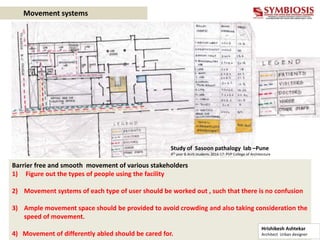
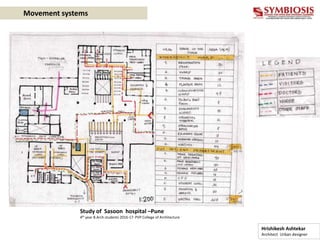
Movement systems
Barrier free and smooth movement of various stakeholders
1) Figure out the types of people using the facility
2) Movement systems of each type of user should be worked out , such that there is no confusion
3) Ample movement space should be provided to avoid crowding and also taking consideration the
speed of movement.
4) Movement of differently abled should be cared for.
Study of Sasoon pathalogy lab –Pune
4th year B.Arch students 2016-17- PVP College of Architecture
Hrishikesh Ashtekar
Architect Urban designer
Movement systems
Study of Sasoon hospital –Pune
4th year B.Arch students 2016-17- PVP College of Architecture
Hrishikesh Ashtekar
Architect Urban designer
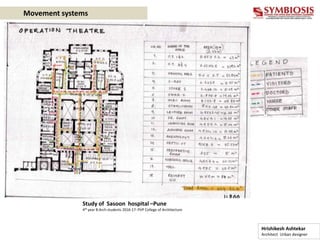
Movement systems
Study of Sasoon hospital –Pune
4th year B.Arch students 2016-17- PVP College of Architecture
Hrishikesh Ashtekar
Architect Urban designer
Movement systems
Study of Sasoon hospital –Pune
4th year B.Arch students 2016-17- PVP College of Architecture
Hrishikesh Ashtekar
Architect Urban designer
Various building elements that are barrier free
Hrishikesh Ashtekar
Architect Urban designer
The RPwD Act, 2016 was enacted on 28.12.2016 which came into force from 19.04.2017. The salient features of
the Act are:-
Responsibility has been cast upon the appropriate governments to take effective measures to ensure that the
persons with disabilities enjoy their rights equally with others.
Disability has been defined based on an evolving and dynamic concept.
The Act covers the following specified disabilities:-
1) Physical Disability
Loco motor Disability , Leprosy Cured Person , Cerebral Palsy , Dwarfism , Muscular Dystrophy
Acid Attack Victims
2) Visual Impairment
Blindness , Low Vission
3) Hearing Impairment
Deaf , Hard of Hearing, Speech and Language Disability, Intellectual Disability, Specific Learning
Disabilities, Autism Spectrum Disorder
4) Mental Behaviour (Mental Illness)
5) Disability caused due to-
Chronic Neurological Conditions such as-
Multiple Sclerosis , Parkinson’s Disease
Blood Disorder-
Haemophilia, Thalassemia, Sickle Cell Disease
6) Multiple Disabilities
http://disabilityaffairs.gov.in/content/page/acts.php
Hrishikesh Ashtekar
Architect Urban designer
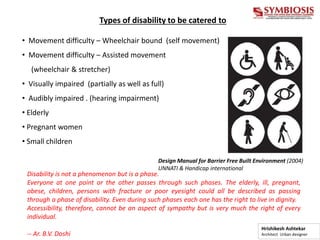
Types of disability to be catered to
• Movement difficulty – Wheelchair bound (self movement)
• Movement difficulty – Assisted movement
(wheelchair & stretcher)
• Visually impaired (partially as well as full)
• Audibly impaired . (hearing impairment)
• Elderly
• Pregnant women
• Small children
Disability is not a phenomenon but is a phase.
Everyone at one point or the other passes through such phases. The elderly, ill, pregnant,
obese, children, persons with fracture or poor eyesight could all be described as passing
through a phase of disability. Even during such phases each one has the right to live in dignity.
Accessibility, therefore, cannot be an aspect of sympathy but is very much the right of every
individual.
-- Ar. B.V. Doshi
Design Manual for Barrier Free Built Environment (2004)
UNNATI & Handicap international
Hrishikesh Ashtekar
Architect Urban designer
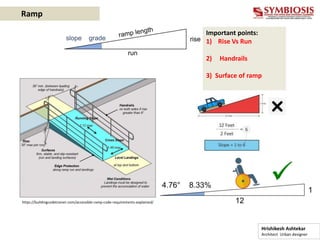
https://buildingcodetrainer.com/accessible-ramp-code-requirements-explained/
Important points:
1) Rise Vs Run
2) Handrails
3) Surface of ramp
Ramp
Hrishikesh Ashtekar
Architect Urban designer
Wheelchair/
Stretcher
/Goods
cart
Vehicles
Ramp
Hrishikesh Ashtekar
Architect Urban designer
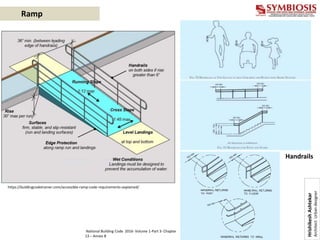
Handrails
https://buildingcodetrainer.com/accessible-ramp-code-requirements-explained/
Ramp
Hrishikesh
Ashtekar
Architect
Urban
designer
National Building Code 2016- Volume 1-Part 3- Chapter
13 – Annex B
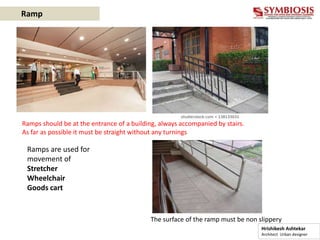
Ramps should be at the entrance of a building, always accompanied by stairs.
As far as possible it must be straight without any turnings
The surface of the ramp must be non slippery
Ramps are used for
movement of
Stretcher
Wheelchair
Goods cart
Ramp
Hrishikesh Ashtekar
Architect Urban designer
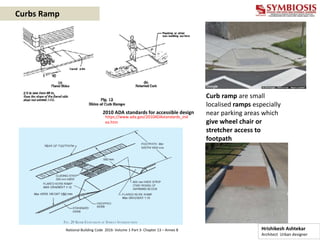
Curbs Ramp
Curb ramp are small
localised ramps especially
near parking areas which
give wheel chair or
stretcher access to
footpath
2010 ADA standards for accessible design
https://www.ada.gov/2010ADAstandards_ind
ex.htm
Hrishikesh Ashtekar
Architect Urban designer
National Building Code 2016- Volume 1-Part 3- Chapter 13 – Annex B
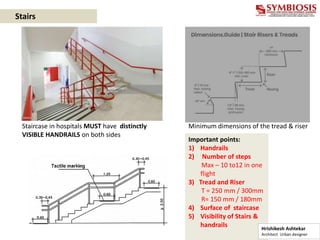
Staircase in hospitals MUST have distinctly
VISIBLE HANDRAILS on both sides
Minimum dimensions of the tread & riser
Important points:
1) Handrails
2) Number of steps
Max – 10 to12 in one
flight
3) Tread and Riser
T = 250 mm / 300mm
R= 150 mm / 180mm
4) Surface of staircase
5) Visibility of Stairs &
handrails
Stairs
Hrishikesh Ashtekar
Architect Urban designer
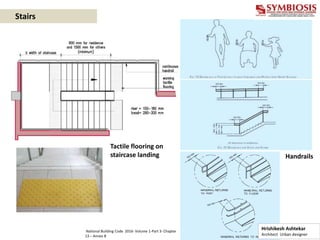
Stairs
Tactile flooring on
staircase landing Handrails
Hrishikesh Ashtekar
Architect Urban designer
National Building Code 2016- Volume 1-Part 3- Chapter
13 – Annex B
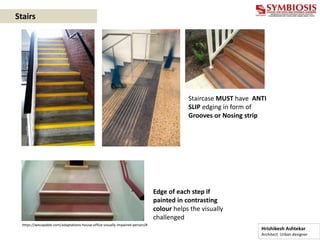
Staircase MUST have ANTI
SLIP edging in form of
Grooves or Nosing strip
Edge of each step if
painted in contrasting
colour helps the visually
challenged
https://wecapable.com/adaptations-house-office-visually-impaired-person/#
Stairs
Hrishikesh Ashtekar
Architect Urban designer
Lift & Elevators
Important points:
1) Level w.r.t floor level
2) Handle and grab bars
3) Location of panel &
call buttons
4) Ample space inside
https://www.un.org/esa/socdev/enable/designm/AD2-02.htm
Critical dimensions of lift
as per UN manual
Hrishikesh Ashtekar
Architect Urban designer
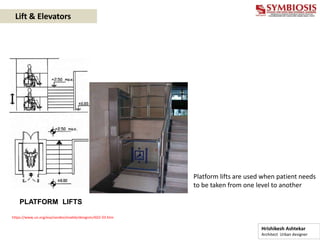
PLATFORM LIFTS
https://www.un.org/esa/socdev/enable/designm/AD2-03.htm
Lift & Elevators
Platform lifts are used when patient needs
to be taken from one level to another
Hrishikesh Ashtekar
Architect Urban designer
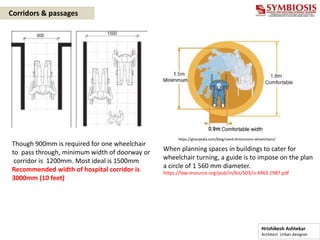
Though 900mm is required for one wheelchair
to pass through, minimum width of doorway or
corridor is 1200mm. Most ideal is 1500mm
Recommended width of hospital corridor is
3000mm (10 feet)
When planning spaces in buildings to cater for
wheelchair turning, a guide is to impose on the plan
a circle of 1 560 mm diameter.
https://law.resource.org/pub/in/bis/S03/is.4963.1987.pdf
https://gharpedia.com/blog/need-dimensions-wheelchairs/
Corridors & passages
Hrishikesh Ashtekar
Architect Urban designer
Clear dimension of 920mm is
required for any doorway for a
person with crutches or wheelchair
to pass.
In Public buildings , 1200 mm (4 feet)
or ideally 1500 mm (5 feet) for any
doorway is recommended.
Corridors & passages
Hrishikesh Ashtekar
Architect Urban designer
Corridors & passages
Important aspects:
• All areas of newly designed or newly constructed buildings and facilities (walks, halls, corridors,
aisles, skywalks, tunnels, and other spaces) required to be accessible by general public shall
be made barrier-free.
• Ground and floor surfaces along accessible routes (of corridors complying with the minimum
widths criteria) should have discernible colours and non slippery materials. Demarcation can
be made with textural differences.
Standard symbols for
people with
disabilities
https://www.un.org/esa/socdev/enable/designm/AD2-09.htm
Non slip surfaces for
Flooring : poly vinyl/
epoxy/ non slip
vitrified tiles
https://www.indiamart.com/proddetail/hospital-vinyl-
flooring-8878046530.html
Stair landing
Textured floor
surface for
Blind access Hrishikesh Ashtekar
Architect Urban designer
https://blindlowvision.org.nz/how-we-can-help/businesses-and-professionals/accessible-signage-and-buildings/
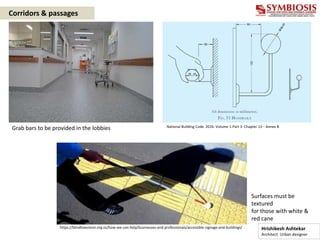
Grab bars to be provided in the lobbies
Surfaces must be
textured
for those with white &
red cane
Corridors & passages
Hrishikesh Ashtekar
Architect Urban designer
National Building Code 2016- Volume 1-Part 3- Chapter 13 – Annex B
Important points:
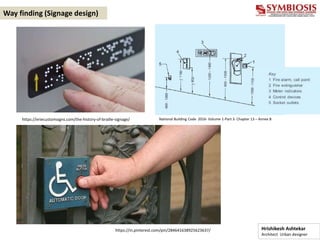
1) Too much variation in letter types to be
avoided. Contrast background should be
used for letters.
2) Standard & universally acceptable signages
to be used
3) Location of signage should be at level for
the wheelchair bound.
4) Light levels around signages should between
100 to 300 lux.
5) Braille signage to be of grade 2 type & letter
heights between 15 to 50mm should be
raised at least 15mm from its surface for
blind to read
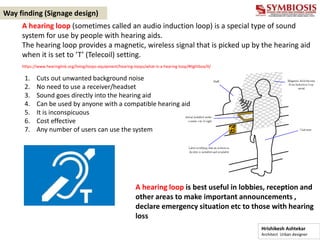
6) A hearing loop can be effective in public
areas for people using hearing aids
Way finding (Signage design)
Hrishikesh Ashtekar
Architect Urban designer
National Building Code 2016- Volume 1-
Part 3- Chapter 13 – Annex B
https://eriecustomsigns.com/the-history-of-braille-signage/
https://in.pinterest.com/pin/284641638925623637/
Way finding (Signage design)
Hrishikesh Ashtekar
Architect Urban designer
National Building Code 2016- Volume 1-Part 3- Chapter 13 – Annex B
A hearing loop (sometimes called an audio induction loop) is a special type of sound
system for use by people with hearing aids.
The hearing loop provides a magnetic, wireless signal that is picked up by the hearing aid
when it is set to ‘T’ (Telecoil) setting.
https://www.hearinglink.org/living/loops-equipment/hearing-loops/what-is-a-hearing-loop/#lightbox/0/
1. Cuts out unwanted background noise
2. No need to use a receiver/headset
3. Sound goes directly into the hearing aid
4. Can be used by anyone with a compatible hearing aid
5. It is inconspicuous
6. Cost effective
7. Any number of users can use the system
A hearing loop is best useful in lobbies, reception and
other areas to make important announcements ,
declare emergency situation etc to those with hearing
loss
Way finding (Signage design)
Hrishikesh Ashtekar
Architect Urban designer
Way finding (Signage design)
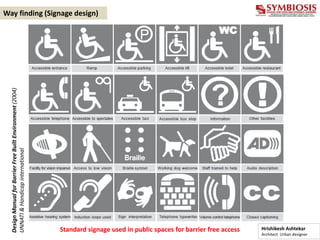
Standard signage used in public spaces for barrier free access
Design
Manual
for
Barrier
Free
Built
Environment
(2004)
UNNATI
&
Handicap
international
Hrishikesh Ashtekar
Architect Urban designer
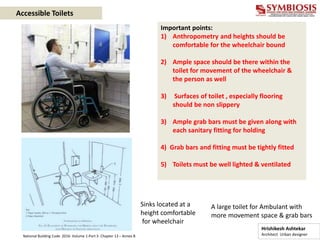
Important points:
1) Anthropometry and heights should be
comfortable for the wheelchair bound
2) Ample space should be there within the
toilet for movement of the wheelchair &
the person as well
3) Surfaces of toilet , especially flooring
should be non slippery
3) Ample grab bars must be given along with
each sanitary fitting for holding
4) Grab bars and fitting must be tightly fitted
5) Toilets must be well lighted & ventilated
Sinks located at a
height comfortable
for wheelchair
A large toilet for Ambulant with
more movement space & grab bars
Accessible Toilets
Hrishikesh Ashtekar
Architect Urban designer
National Building Code 2016- Volume 1-Part 3- Chapter 13 – Annex B
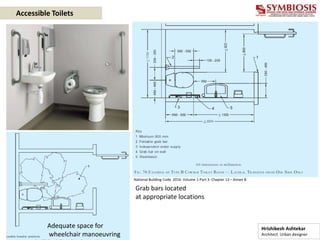
Grab bars located
at appropriate locations
Adequate space for
wheelchair manoeuvring
Accessible Toilets
Hrishikesh Ashtekar
Architect Urban designer
National Building Code 2016- Volume 1-Part 3- Chapter 13 – Annex B
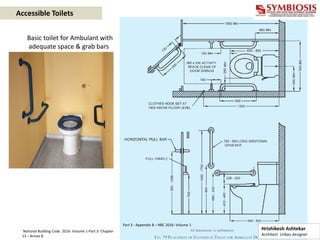
Part 3 - Appendix B – NBC 2016- Volume 1
Basic toilet for Ambulant with
adequate space & grab bars
Accessible Toilets
Hrishikesh Ashtekar
Architect Urban designer
National Building Code 2016- Volume 1-Part 3- Chapter
13 – Annex B
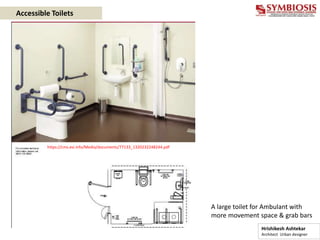
https://cms.esi.info/Media/documents/77133_1320232248244.pdf
A large toilet for Ambulant with
more movement space & grab bars
Accessible Toilets
Hrishikesh Ashtekar
Architect Urban designer
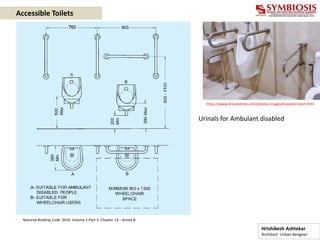
Accessible Toilets
https://www.dreamstime.com/photos-images/hospital-toilet.html
Urinals for Ambulant disabled
Hrishikesh Ashtekar
Architect Urban designer
National Building Code 2016- Volume 1-Part 3- Chapter 13 – Annex B
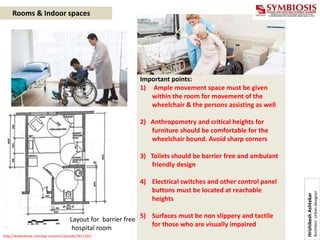
http://wabenbow.com/wp-content/uploads/2011/01/
Layout for barrier free
hospital room
Important points:
1) Ample movement space must be given
within the room for movement of the
wheelchair & the persons assisting as well
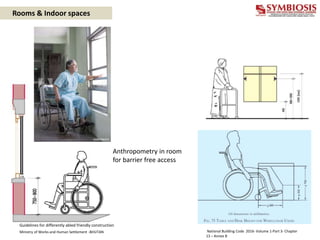
2) Anthropometry and critical heights for
furniture should be comfortable for the
wheelchair bound. Avoid sharp corners
3) Toilets should be barrier free and ambulant
friendly design
4) Electrical switches and other control panel
buttons must be located at reachable
heights
5) Surfaces must be non slippery and tactile
for those who are visually impaired
Rooms & Indoor spaces
Hrishikesh
Ashtekar
Architect
Urban
designer
Rooms & Indoor spaces
Anthropometry in room
for barrier free access
Guidelines for differently abled friendly construction
Ministry of Works and Human Settlement -BHUTAN National Building Code 2016- Volume 1-Part 3- Chapter
13 – Annex B
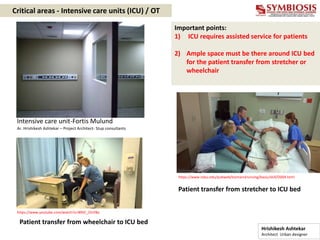
Critical areas - Intensive care units (ICU) / OT
Patient transfer from stretcher to ICU bed
Important points:
1) ICU requires assisted service for patients
2) Ample space must be there around ICU bed
for the patient transfer from stretcher or
wheelchair
Intensive care unit-Fortis Mulund
Ar. Hrishikesh Ashtekar – Project Architect- Stup consultants
https://www.ndsu.edu/pubweb/bismarcknursing/basic/skill/D004.html
https://www.youtube.com/watch?v=l89JC_OUY8o
Patient transfer from wheelchair to ICU bed
Hrishikesh Ashtekar
Architect Urban designer
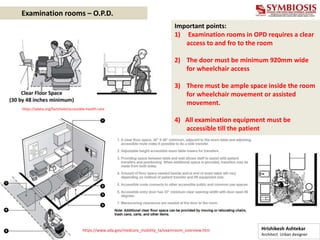
Important points:
1) Examination rooms in OPD requires a clear
access to and fro to the room
2) The door must be minimum 920mm wide
for wheelchair access
3) There must be ample space inside the room
for wheelchair movement or assisted
movement.
4) All examination equipment must be
accessible till the patient
https://www.ada.gov/medcare_mobility_ta/examroom_overview.htm
https://adata.org/factsheet/accessible-health-care
Examination rooms – O.P.D.
Hrishikesh Ashtekar
Architect Urban designer
Diagnostic areas
Part 3 - Appendix B – NBC 2016- Volume 1
Important points:
1) Door and corridor widths must be in
compliance to universal access
specifications
2) A ramp must be provided for wheel chair &
stretcher access
3) Surfaces & furniture heights must be such
that , it is comfortable to wheelchairs
4) Hearing loop must be installed in the
reception and other lobby areas
5) Tactile surfaces and adequate handrails
must be installed inside and outside of the
various diagnostic rooms.
6) Surfaces should be non slippery
7) Ample space must be there inside the
diagnostic areas for wheelchair or assisted
movement.
X Ray room with manoeuvring space
https://www.quickmedical.com/clinton/blood_dra
wing_chairs/wheelchair_station.html
Wheelchair blood draw station
Hrishikesh Ashtekar
Architect Urban designer
National Building Code 2016- Volume 1-Part 3- Chapter
13 – Annex B
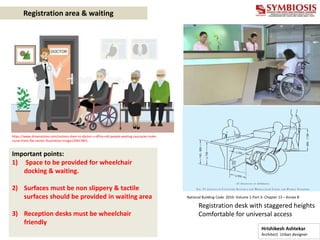
Registration area & waiting
Registration desk with staggered heights
Comfortable for universal access
https://www.dreamstime.com/cartoon-door-to-doctor-s-office-old-people-waiting-caucasian-male-
nurse-front-flat-vector-illustration-image129457801
Important points:
1) Space to be provided for wheelchair
docking & waiting.
2) Surfaces must be non slippery & tactile
surfaces should be provided in waiting area
3) Reception desks must be wheelchair
friendly
National Building Code 2016- Volume 1-Part 3- Chapter 13 – Annex B
Hrishikesh Ashtekar
Architect Urban designer
Canteen & eateries
Hrishikesh Ashtekar
Architect Urban designer
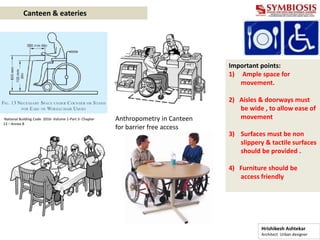
Important points:
1) Ample space for
movement.
2) Aisles & doorways must
be wide , to allow ease of
movement
3) Surfaces must be non
slippery & tactile surfaces
should be provided .
4) Furniture should be
access friendly
Anthropometry in Canteen
for barrier free access
National Building Code 2016- Volume 1-Part 3- Chapter
13 – Annex B
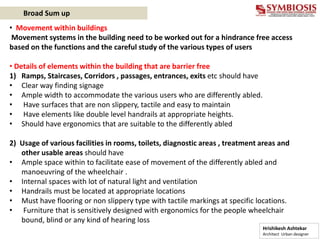
• Movement within buildings
Movement systems in the building need to be worked out for a hindrance free access
based on the functions and the careful study of the various types of users
• Details of elements within the building that are barrier free
1) Ramps, Staircases, Corridors , passages, entrances, exits etc should have
• Clear way finding signage
• Ample width to accommodate the various users who are differently abled.
• Have surfaces that are non slippery, tactile and easy to maintain
• Have elements like double level handrails at appropriate heights.
• Should have ergonomics that are suitable to the differently abled
2) Usage of various facilities in rooms, toilets, diagnostic areas , treatment areas and
other usable areas should have
• Ample space within to facilitate ease of movement of the differently abled and
manoeuvring of the wheelchair .
• Internal spaces with lot of natural light and ventilation
• Handrails must be located at appropriate locations
• Must have flooring or non slippery type with tactile markings at specific locations.
• Furniture that is sensitively designed with ergonomics for the people wheelchair
bound, blind or any kind of hearing loss
Hrishikesh Ashtekar
Architect Urban designer
Broad Sum up
1) National Building Code 2016- Volume 1-Part 3- Chapter 13 - REQUIREMENTS FOR
ACCESSIBILITY IN BUILT ENVIRONMENT FOR ELDERS AND PERSONS WITH DISABILITIES–
Annex B -ANTHROPOMETRICS AND REQUIREMENTS FOR ACCESSIBILITY IN BUILT-
ENVIRONMENT FOR ELDERS AND PERSONS WITH DISABILITIES
2)
Hrishikesh Ashtekar
Architect Urban designer
References
2010 ADA standards for accessible design - Americans with Disabilities Act of 1990
https://www.ada.gov/regs2010/2010ADAStandards/2010ADAstandards.htm
3) Design Manual for a Barrier Free Built Environment - UNNATI-Organisation for Development
Education and Handicap International (HI)
4) Guidelines and space standards for Barrier Free Built Environment for Disabled and Elderly Person
– CPWD 1998
5) Guidelines for differently abled friendly construction-Ministry of Works and Human Settlement
-BHUTAN
Thank you
Contact us
Call us on +91 - 9371045766
Email:
ashtekarhrishikesh@gmail.com
hrishikesh.ashtekar@pvpcoapune.edu.in
Hrishikesh Ashtekar
Architect Urbandesigner
Faculty at VIT’s PVP College of Architecture-Pune

Barrier free design.pptx

  • 1.
    Barrier free environmentin health care buildings Hrishikesh Ashtekar Architect Urban designer
  • 2.
    Distribution of variousscale of healthcare facilities in our country Hrishikesh Ashtekar Architect Urban designer
  • 3.
    Areas where barrierfree environment is required • Movement within buildings A) Movement systems of different users in the building that is Clear , segregated and Barrier free B) Details of elements within the building that are barrier free 1) Ramps 2) Stairs 3) Corridors & passages 4) Entrances & Exits 5) Elevators & lifts 6) Way finding (Signage design) Usage of various facilities in rooms, toilets, diagnostic areas or treatment areas 1) Toilets 2) Rooms (Beds, Handrails etc) 3) Critical areas – ICU, OT, Isolation areas, Trauma units etc 4) Diagnostic areas- MRI, Blood samples, X ray, 5) Examination rooms -OPDs 6) Patient registration desk & hallways 7) Canteen & eateries Above is true and relevant in any scale and type of healthcare unit Needs to be catered to in terms of – Space design as well as Detailing Hrishikesh Ashtekar Architect Urban designer
  • 4.
    Various Movement systemsbased on users Hrishikesh Ashtekar Architect Urban designer
  • 5.
    Movement systems Barrier freeand smooth movement of various stakeholders 1) Figure out the types of people using the facility 2) Movement systems of each type of user should be worked out , such that there is no confusion 3) Ample movement space should be provided to avoid crowding and also taking consideration the speed of movement. 4) Movement of differently abled should be cared for. Study of Sasoon pathalogy lab –Pune 4th year B.Arch students 2016-17- PVP College of Architecture Hrishikesh Ashtekar Architect Urban designer
  • 6.
    Movement systems Study ofSasoon hospital –Pune 4th year B.Arch students 2016-17- PVP College of Architecture Hrishikesh Ashtekar Architect Urban designer
  • 7.
    Movement systems Study ofSasoon hospital –Pune 4th year B.Arch students 2016-17- PVP College of Architecture Hrishikesh Ashtekar Architect Urban designer
  • 8.
    Movement systems Study ofSasoon hospital –Pune 4th year B.Arch students 2016-17- PVP College of Architecture Hrishikesh Ashtekar Architect Urban designer
  • 9.
    Various building elementsthat are barrier free Hrishikesh Ashtekar Architect Urban designer
  • 10.
    The RPwD Act,2016 was enacted on 28.12.2016 which came into force from 19.04.2017. The salient features of the Act are:- Responsibility has been cast upon the appropriate governments to take effective measures to ensure that the persons with disabilities enjoy their rights equally with others. Disability has been defined based on an evolving and dynamic concept. The Act covers the following specified disabilities:- 1) Physical Disability Loco motor Disability , Leprosy Cured Person , Cerebral Palsy , Dwarfism , Muscular Dystrophy Acid Attack Victims 2) Visual Impairment Blindness , Low Vission 3) Hearing Impairment Deaf , Hard of Hearing, Speech and Language Disability, Intellectual Disability, Specific Learning Disabilities, Autism Spectrum Disorder 4) Mental Behaviour (Mental Illness) 5) Disability caused due to- Chronic Neurological Conditions such as- Multiple Sclerosis , Parkinson’s Disease Blood Disorder- Haemophilia, Thalassemia, Sickle Cell Disease 6) Multiple Disabilities http://disabilityaffairs.gov.in/content/page/acts.php Hrishikesh Ashtekar Architect Urban designer
  • 11.
    Types of disabilityto be catered to • Movement difficulty – Wheelchair bound (self movement) • Movement difficulty – Assisted movement (wheelchair & stretcher) • Visually impaired (partially as well as full) • Audibly impaired . (hearing impairment) • Elderly • Pregnant women • Small children Disability is not a phenomenon but is a phase. Everyone at one point or the other passes through such phases. The elderly, ill, pregnant, obese, children, persons with fracture or poor eyesight could all be described as passing through a phase of disability. Even during such phases each one has the right to live in dignity. Accessibility, therefore, cannot be an aspect of sympathy but is very much the right of every individual. -- Ar. B.V. Doshi Design Manual for Barrier Free Built Environment (2004) UNNATI & Handicap international Hrishikesh Ashtekar Architect Urban designer
  • 12.
    https://buildingcodetrainer.com/accessible-ramp-code-requirements-explained/ Important points: 1) RiseVs Run 2) Handrails 3) Surface of ramp Ramp Hrishikesh Ashtekar Architect Urban designer
  • 13.
  • 14.
  • 15.
    Ramps should beat the entrance of a building, always accompanied by stairs. As far as possible it must be straight without any turnings The surface of the ramp must be non slippery Ramps are used for movement of Stretcher Wheelchair Goods cart Ramp Hrishikesh Ashtekar Architect Urban designer
  • 16.
    Curbs Ramp Curb rampare small localised ramps especially near parking areas which give wheel chair or stretcher access to footpath 2010 ADA standards for accessible design https://www.ada.gov/2010ADAstandards_ind ex.htm Hrishikesh Ashtekar Architect Urban designer National Building Code 2016- Volume 1-Part 3- Chapter 13 – Annex B
  • 17.
    Staircase in hospitalsMUST have distinctly VISIBLE HANDRAILS on both sides Minimum dimensions of the tread & riser Important points: 1) Handrails 2) Number of steps Max – 10 to12 in one flight 3) Tread and Riser T = 250 mm / 300mm R= 150 mm / 180mm 4) Surface of staircase 5) Visibility of Stairs & handrails Stairs Hrishikesh Ashtekar Architect Urban designer
  • 18.
    Stairs Tactile flooring on staircaselanding Handrails Hrishikesh Ashtekar Architect Urban designer National Building Code 2016- Volume 1-Part 3- Chapter 13 – Annex B
  • 19.
    Staircase MUST haveANTI SLIP edging in form of Grooves or Nosing strip Edge of each step if painted in contrasting colour helps the visually challenged https://wecapable.com/adaptations-house-office-visually-impaired-person/# Stairs Hrishikesh Ashtekar Architect Urban designer
  • 20.
    Lift & Elevators Importantpoints: 1) Level w.r.t floor level 2) Handle and grab bars 3) Location of panel & call buttons 4) Ample space inside https://www.un.org/esa/socdev/enable/designm/AD2-02.htm Critical dimensions of lift as per UN manual Hrishikesh Ashtekar Architect Urban designer
  • 21.
    PLATFORM LIFTS https://www.un.org/esa/socdev/enable/designm/AD2-03.htm Lift &Elevators Platform lifts are used when patient needs to be taken from one level to another Hrishikesh Ashtekar Architect Urban designer
  • 22.
    Though 900mm isrequired for one wheelchair to pass through, minimum width of doorway or corridor is 1200mm. Most ideal is 1500mm Recommended width of hospital corridor is 3000mm (10 feet) When planning spaces in buildings to cater for wheelchair turning, a guide is to impose on the plan a circle of 1 560 mm diameter. https://law.resource.org/pub/in/bis/S03/is.4963.1987.pdf https://gharpedia.com/blog/need-dimensions-wheelchairs/ Corridors & passages Hrishikesh Ashtekar Architect Urban designer
  • 23.
    Clear dimension of920mm is required for any doorway for a person with crutches or wheelchair to pass. In Public buildings , 1200 mm (4 feet) or ideally 1500 mm (5 feet) for any doorway is recommended. Corridors & passages Hrishikesh Ashtekar Architect Urban designer
  • 24.
    Corridors & passages Importantaspects: • All areas of newly designed or newly constructed buildings and facilities (walks, halls, corridors, aisles, skywalks, tunnels, and other spaces) required to be accessible by general public shall be made barrier-free. • Ground and floor surfaces along accessible routes (of corridors complying with the minimum widths criteria) should have discernible colours and non slippery materials. Demarcation can be made with textural differences. Standard symbols for people with disabilities https://www.un.org/esa/socdev/enable/designm/AD2-09.htm Non slip surfaces for Flooring : poly vinyl/ epoxy/ non slip vitrified tiles https://www.indiamart.com/proddetail/hospital-vinyl- flooring-8878046530.html Stair landing Textured floor surface for Blind access Hrishikesh Ashtekar Architect Urban designer
  • 25.
    https://blindlowvision.org.nz/how-we-can-help/businesses-and-professionals/accessible-signage-and-buildings/ Grab bars tobe provided in the lobbies Surfaces must be textured for those with white & red cane Corridors & passages Hrishikesh Ashtekar Architect Urban designer National Building Code 2016- Volume 1-Part 3- Chapter 13 – Annex B
  • 26.
    Important points: 1) Toomuch variation in letter types to be avoided. Contrast background should be used for letters. 2) Standard & universally acceptable signages to be used 3) Location of signage should be at level for the wheelchair bound. 4) Light levels around signages should between 100 to 300 lux. 5) Braille signage to be of grade 2 type & letter heights between 15 to 50mm should be raised at least 15mm from its surface for blind to read 6) A hearing loop can be effective in public areas for people using hearing aids Way finding (Signage design) Hrishikesh Ashtekar Architect Urban designer National Building Code 2016- Volume 1- Part 3- Chapter 13 – Annex B
  • 27.
    https://eriecustomsigns.com/the-history-of-braille-signage/ https://in.pinterest.com/pin/284641638925623637/ Way finding (Signagedesign) Hrishikesh Ashtekar Architect Urban designer National Building Code 2016- Volume 1-Part 3- Chapter 13 – Annex B
  • 28.
    A hearing loop(sometimes called an audio induction loop) is a special type of sound system for use by people with hearing aids. The hearing loop provides a magnetic, wireless signal that is picked up by the hearing aid when it is set to ‘T’ (Telecoil) setting. https://www.hearinglink.org/living/loops-equipment/hearing-loops/what-is-a-hearing-loop/#lightbox/0/ 1. Cuts out unwanted background noise 2. No need to use a receiver/headset 3. Sound goes directly into the hearing aid 4. Can be used by anyone with a compatible hearing aid 5. It is inconspicuous 6. Cost effective 7. Any number of users can use the system A hearing loop is best useful in lobbies, reception and other areas to make important announcements , declare emergency situation etc to those with hearing loss Way finding (Signage design) Hrishikesh Ashtekar Architect Urban designer
  • 29.
    Way finding (Signagedesign) Standard signage used in public spaces for barrier free access Design Manual for Barrier Free Built Environment (2004) UNNATI & Handicap international Hrishikesh Ashtekar Architect Urban designer
  • 30.
    Important points: 1) Anthropometryand heights should be comfortable for the wheelchair bound 2) Ample space should be there within the toilet for movement of the wheelchair & the person as well 3) Surfaces of toilet , especially flooring should be non slippery 3) Ample grab bars must be given along with each sanitary fitting for holding 4) Grab bars and fitting must be tightly fitted 5) Toilets must be well lighted & ventilated Sinks located at a height comfortable for wheelchair A large toilet for Ambulant with more movement space & grab bars Accessible Toilets Hrishikesh Ashtekar Architect Urban designer National Building Code 2016- Volume 1-Part 3- Chapter 13 – Annex B
  • 31.
    Grab bars located atappropriate locations Adequate space for wheelchair manoeuvring Accessible Toilets Hrishikesh Ashtekar Architect Urban designer National Building Code 2016- Volume 1-Part 3- Chapter 13 – Annex B
  • 32.
    Part 3 -Appendix B – NBC 2016- Volume 1 Basic toilet for Ambulant with adequate space & grab bars Accessible Toilets Hrishikesh Ashtekar Architect Urban designer National Building Code 2016- Volume 1-Part 3- Chapter 13 – Annex B
  • 33.
    https://cms.esi.info/Media/documents/77133_1320232248244.pdf A large toiletfor Ambulant with more movement space & grab bars Accessible Toilets Hrishikesh Ashtekar Architect Urban designer
  • 34.
    Accessible Toilets https://www.dreamstime.com/photos-images/hospital-toilet.html Urinals forAmbulant disabled Hrishikesh Ashtekar Architect Urban designer National Building Code 2016- Volume 1-Part 3- Chapter 13 – Annex B
  • 35.
    http://wabenbow.com/wp-content/uploads/2011/01/ Layout for barrierfree hospital room Important points: 1) Ample movement space must be given within the room for movement of the wheelchair & the persons assisting as well 2) Anthropometry and critical heights for furniture should be comfortable for the wheelchair bound. Avoid sharp corners 3) Toilets should be barrier free and ambulant friendly design 4) Electrical switches and other control panel buttons must be located at reachable heights 5) Surfaces must be non slippery and tactile for those who are visually impaired Rooms & Indoor spaces Hrishikesh Ashtekar Architect Urban designer
  • 36.
    Rooms & Indoorspaces Anthropometry in room for barrier free access Guidelines for differently abled friendly construction Ministry of Works and Human Settlement -BHUTAN National Building Code 2016- Volume 1-Part 3- Chapter 13 – Annex B
  • 37.
    Critical areas -Intensive care units (ICU) / OT Patient transfer from stretcher to ICU bed Important points: 1) ICU requires assisted service for patients 2) Ample space must be there around ICU bed for the patient transfer from stretcher or wheelchair Intensive care unit-Fortis Mulund Ar. Hrishikesh Ashtekar – Project Architect- Stup consultants https://www.ndsu.edu/pubweb/bismarcknursing/basic/skill/D004.html https://www.youtube.com/watch?v=l89JC_OUY8o Patient transfer from wheelchair to ICU bed Hrishikesh Ashtekar Architect Urban designer
  • 38.
    Important points: 1) Examinationrooms in OPD requires a clear access to and fro to the room 2) The door must be minimum 920mm wide for wheelchair access 3) There must be ample space inside the room for wheelchair movement or assisted movement. 4) All examination equipment must be accessible till the patient https://www.ada.gov/medcare_mobility_ta/examroom_overview.htm https://adata.org/factsheet/accessible-health-care Examination rooms – O.P.D. Hrishikesh Ashtekar Architect Urban designer
  • 39.
    Diagnostic areas Part 3- Appendix B – NBC 2016- Volume 1 Important points: 1) Door and corridor widths must be in compliance to universal access specifications 2) A ramp must be provided for wheel chair & stretcher access 3) Surfaces & furniture heights must be such that , it is comfortable to wheelchairs 4) Hearing loop must be installed in the reception and other lobby areas 5) Tactile surfaces and adequate handrails must be installed inside and outside of the various diagnostic rooms. 6) Surfaces should be non slippery 7) Ample space must be there inside the diagnostic areas for wheelchair or assisted movement. X Ray room with manoeuvring space https://www.quickmedical.com/clinton/blood_dra wing_chairs/wheelchair_station.html Wheelchair blood draw station Hrishikesh Ashtekar Architect Urban designer National Building Code 2016- Volume 1-Part 3- Chapter 13 – Annex B
  • 40.
    Registration area &waiting Registration desk with staggered heights Comfortable for universal access https://www.dreamstime.com/cartoon-door-to-doctor-s-office-old-people-waiting-caucasian-male- nurse-front-flat-vector-illustration-image129457801 Important points: 1) Space to be provided for wheelchair docking & waiting. 2) Surfaces must be non slippery & tactile surfaces should be provided in waiting area 3) Reception desks must be wheelchair friendly National Building Code 2016- Volume 1-Part 3- Chapter 13 – Annex B Hrishikesh Ashtekar Architect Urban designer
  • 41.
    Canteen & eateries HrishikeshAshtekar Architect Urban designer Important points: 1) Ample space for movement. 2) Aisles & doorways must be wide , to allow ease of movement 3) Surfaces must be non slippery & tactile surfaces should be provided . 4) Furniture should be access friendly Anthropometry in Canteen for barrier free access National Building Code 2016- Volume 1-Part 3- Chapter 13 – Annex B
  • 42.
    • Movement withinbuildings Movement systems in the building need to be worked out for a hindrance free access based on the functions and the careful study of the various types of users • Details of elements within the building that are barrier free 1) Ramps, Staircases, Corridors , passages, entrances, exits etc should have • Clear way finding signage • Ample width to accommodate the various users who are differently abled. • Have surfaces that are non slippery, tactile and easy to maintain • Have elements like double level handrails at appropriate heights. • Should have ergonomics that are suitable to the differently abled 2) Usage of various facilities in rooms, toilets, diagnostic areas , treatment areas and other usable areas should have • Ample space within to facilitate ease of movement of the differently abled and manoeuvring of the wheelchair . • Internal spaces with lot of natural light and ventilation • Handrails must be located at appropriate locations • Must have flooring or non slippery type with tactile markings at specific locations. • Furniture that is sensitively designed with ergonomics for the people wheelchair bound, blind or any kind of hearing loss Hrishikesh Ashtekar Architect Urban designer Broad Sum up
  • 43.
    1) National BuildingCode 2016- Volume 1-Part 3- Chapter 13 - REQUIREMENTS FOR ACCESSIBILITY IN BUILT ENVIRONMENT FOR ELDERS AND PERSONS WITH DISABILITIES– Annex B -ANTHROPOMETRICS AND REQUIREMENTS FOR ACCESSIBILITY IN BUILT- ENVIRONMENT FOR ELDERS AND PERSONS WITH DISABILITIES 2) Hrishikesh Ashtekar Architect Urban designer References 2010 ADA standards for accessible design - Americans with Disabilities Act of 1990 https://www.ada.gov/regs2010/2010ADAStandards/2010ADAstandards.htm 3) Design Manual for a Barrier Free Built Environment - UNNATI-Organisation for Development Education and Handicap International (HI) 4) Guidelines and space standards for Barrier Free Built Environment for Disabled and Elderly Person – CPWD 1998 5) Guidelines for differently abled friendly construction-Ministry of Works and Human Settlement -BHUTAN
  • 44.
    Thank you Contact us Callus on +91 - 9371045766 Email: ashtekarhrishikesh@gmail.com hrishikesh.ashtekar@pvpcoapune.edu.in Hrishikesh Ashtekar Architect Urbandesigner Faculty at VIT’s PVP College of Architecture-Pune