INTRODUCTION
TO HOSPITAL
PRESENTED BY:-
ALI AZHAR VI
SEM
AR-19-03
PRESENTED TO:-
SIR SAUD
KAMAL, MAAM
GOHAR MURAD
INTRODUCTION: -
•
•
A hospital may be defined as an institution that is built, staffed,
and equipped for the diagnosis of disease; for the treatment,
both medical and surgical, of the sick and the injured; and for
their housing during this process.
The modern hospital also often serves as a center
for investigation and for teaching.
HISTORY: -
•
•
•
As early as 4000 BCE, religions identified certain of their
deities with healing. The temples of Saturn, and later of
Asclepius in Asia Minor, were recognized as healing centers.
Brahmanic hospitals were established in Sri Lanka as early as
431 BCE, and King Ashoka established a chain of hospitals
in Hindustan about 230 BCE.
Around 100 BCE the Romans established hospitals for the
treatment of their sick and injured soldiers.
RUINS OF THE SANCTUARY OF ASCLEPIUS AT COS, GREECE
TYPES: -
Hospitals can be categorized on the basis of its functionality, size,
location and ownership :-
1.Functionality
Functionality refers to whether the hospitals are general-purpose, teaching hospitals, acute care facilities, long-term hospitals, community
hospitals, research hospitals or if they provide trauma care for patients.
It refers to how the hospitals themselves function within the communities they serve.
2.Size
There are three primary classifications when it comes to size:
Small hospitals: Fewer than 100 beds
Medium hospitals: 100 to 499 beds
Large hospitals: 500 or more beds
3.Location
Hospitals can also classify by their locations. Rural hospitals aid smaller communities and often have limited access to advanced equipment or
specialized procedures and techniques. Since they also face competition, urban hospitals serve larger metropolitan areas and must often offer a
wide degree of versatility when it comes to treatment options and patient experience.
4.Ownership
Knowing who owns the hospital will also tell a great deal about how the hospital will operate. Some hospitals are part of larger networks that
offer a streamlined approach to management. While some physicians feel this improves efficiency and patient experience, some feel it
removes the emphasis from the patient and makes treatment less personal.
COMPONENTS: -
Patient management
It is used to control patient flow.
Appointment module in hospital
management
It arranges the schedule of doctors due
to the patients’ application. It helps to
organize the availability of medical
specialists at any convenient time.
Facility management
It is responsible for tracking and
maintaining the room availability, the
occupancy status as well as various
kinds of administrative documentation.
Inventory management
It controls the amount of clinic
inventory.
Staff Management
It provides the human resources
administration.
Accounting
It organizes the financial affairs of both
customers and the medical institution.
Insurance services integration
It can record patients’ insurance details.
Medicine management
It contains the list of drugs that usually
used for the specific treatment.
Laboratory and tests management
It shows the test results of the particular
patient.
Reporting
Report management part stores the
already processed detailed
information.
Helpdesk & support
It specializes in handling different
issues, problems, and requests.
PLANNING CONSIDERATION: -
Following factors should be considered while planning a hospital building :-
1. Efficiency and Cost-Effectiveness
An efficient hospital layout should promote staff efficiency by minimizing distance of necessary travel between frequently
used spaces; allow visual supervision of patients; provide an efficient logistics system for supplies and food (and removal of
waste); make efficient use of multi-purpose spaces and consolidate spaces when possible.
2.Flexibility and Expandability
Medical needs and modes of treatment will continue to change. Therefore, hospitals should follow modular concepts of space
planning and layout; use generic room sizes and plans as much as possible; use modular, easily accessed, and easily
modified mechanical and electrical systems; and be open-ended, with well-planned directions for future expansion.
3.Therapeutic Environment
Patients and visitors should perceive a hospital as unthreatening, comfortable, and stress-free. The interior designer plays a major
role in this effort to create a therapeutic environment. This can be accomplished by using cheerful and varied colors and
textures, by allowing ample natural light wherever feasible, by providing views of the outdoors from every patient bed etc.
4. Cleanliness and Sanitation
Hospitals must be easy to clean and maintain. This is facilitated by appropriate, durable finishes for each functional space;
careful detailing of such features as doorframes, casework, and finish transitions to avoid dirt-catching and hard-to-clean
crevices and joints; and adequate and appropriately located housekeeping spaces.
5.Accessibility
All areas, both inside and out, should comply with all standards and minimum requirements of Americans with Disability Act,
and ensure grades are flat enough to allow easy movement and sidewalks and corridors are wide enough for two wheelchairs to
pass easily.
6.Security and Safety
Hospitals have several particular security concerns, such as protection of patients and staff, hospital property and assets
(including drugs), and also vulnerability to terrorism because of high visibility. Security and safety must be built into the design
with these things in mind.
7.Sustainability
Hospitals are large public buildings that have a significant impact on the environment and economy of the surrounding
community. They are heavy users of energy and water and produce large amounts of waste. Because of this, sustainable design
must be considered when designing and building hospitals.
PLANNING CONCEPTION : -
Following concepts should be considered while planning a hospital
building :-
1. LOCATION
•
•
•
•
The site should offer sufficient space for self-contained residential areas and hospital departments.
It should be a quiet location with no possibility of future intrusive development.
No loss of amenity should result from fog, wind, dust, smoke, odors or insects.
The land must not be contaminated and adequate open areas for later expansion must also be
planned.
2.ORIENTATION
The most suitable orientation for treatment and operating rooms is between N-W and N-E.
For nursing ward facades, S to S-E is favorable : pleasant morning sun, minimal heat build-up, little requirement for sun shading.
E and W facing rooms have comparatively deeper sun penetration, though less winter sun.
The orientation of wards with a short stay is not so important.
3.CONCEPT
• An existing hospital is to be expanded; the design includes 4 building phases.
• A large enclosed area containing a park will be created to allow windows to be opened without the need to tackle problems
of noise protection.
FORMS OF BUILDING : -
•
•
•
•
•
The form of a building is strongly influenced by the choice of access
and circulation routes.
The form can either be a spine form with a branching sections
(individual departments) or a radially outwards from a central
core. Consideration must be given to future expansion.
Self-contained circulation routes should be avoided.
An effective arrangement would be as follows :-
 Top floor with helipad, air-conditioning plant room, nursing school,
labs
 2/3 floor with wards;
 1 floor with surgical area, central sterilization, intensive care,
maternity, children’s hospital;
 Ground floor with entrance, radiology, medical services, ambulance,
entrance for bedridden patients, emergency ward, information,
administration, cafeteria.
 Basement with stores, physiotherapy, kitchen, heating and ventilation
plant room, radio-therapy, linear accelerator;
 Sub-basement with underground garage, electricity supply.
POSSIBLE ROOM SCHEDULE FOR A LARGE HOSPITAL: -
•
•
•
Room schedule must be drawn in order to
generate an appropriate structural grid and
ground plan.
The specifies of the room schedule must be
discussed with the users.
An overview of the size of the individual
operations centers can be obtained
using reference area values.
DESIGN CONSIDERATION: -
(Corridors, Doors, Stairs, Lifts)
1. CORRIDORS
:-
•
•
•
•
•
•
•
It must be designed for the max. expected circulation flow.
Generally, access corridors must be at least 1.5m wide.
Corridors in which patients will be transported on trolleys should have
a min. width of 2.25m
The suspended ceiling in corridors may be installed upto 2.40m.
Windows for lighting and ventilation should not be further than 25m apart.
The effective width of corridors must not be constricted by projections,
columns or other building elements.
Smoke doors must be installed in ward corridors in accordance with local
regulations
2. DOORS
:-
•
•
•
• The surface coating of doors must withstand the long-term action of
cleaning agents and disinfectants.
They must be designed to prevent the transmission of sound, odours and
draughts.
The clear height of doors depends on their types and function :
Normal doors with 2.10-2.20m of height; vehicle entrances, oversized
doors with 2.50m of height; transport entrances with 2.70-2.80m height
and min. height on approach roads should be at least 3.50m.
3. STAIRS :-
•
•
•
•
•
•
•
Stairs must have handrails on both side without projecting tips.
Winding staircases cannot be included as part of the regulatory staircase
provision.
The effective width of the stairs and landings in essential staircases must
be a min. of 1.50m and should not exceed 2.50m.
Doors to the staircase must open in the direction of escape.
Max. required riser is 170mm.
Min. required tread depth is 280mm.
Rise/tread ratio of 150:300mm is better.
4. LIFTS :-
•
•
•
•
• Separate lifts must be provided for some of the purpose from
transportation of people, medicines, laundry, meals and hospital bed
between floors for hygiene and aesthetic reasons.
At least 2 lifts must be provided for transporting beds in buildings in
which care, examination or treatment areas are accommodated on
upper floors.
The elevator cars of these lifts must be of a size that allows adequate room
for a bed and 2 accompanying people.
Lift shafts must be fire-resitant.
There should be a min. of 2 smaller lifts for portable equipment, staff and
visitors with 0.90X1.20m as clear dimension of lift car and 1.25X1.50m
as clear dimension of shaft.
RELATIONSHIP BETWEEN DIFFERENT DEPARTMENTS IN HOSPITAL: -
The above image shows the general hospital
relationships between the administration, ID, OPD,
diagnostic & treatment department, research &
teaching department and other services.
The above image shows the major clinical
relationships between different departments in a
large hospital.
HOSPITAL PLANNING : -
A hospital building consists of different department :
Emergency department, Surgery area, Imaging unit etc.
•
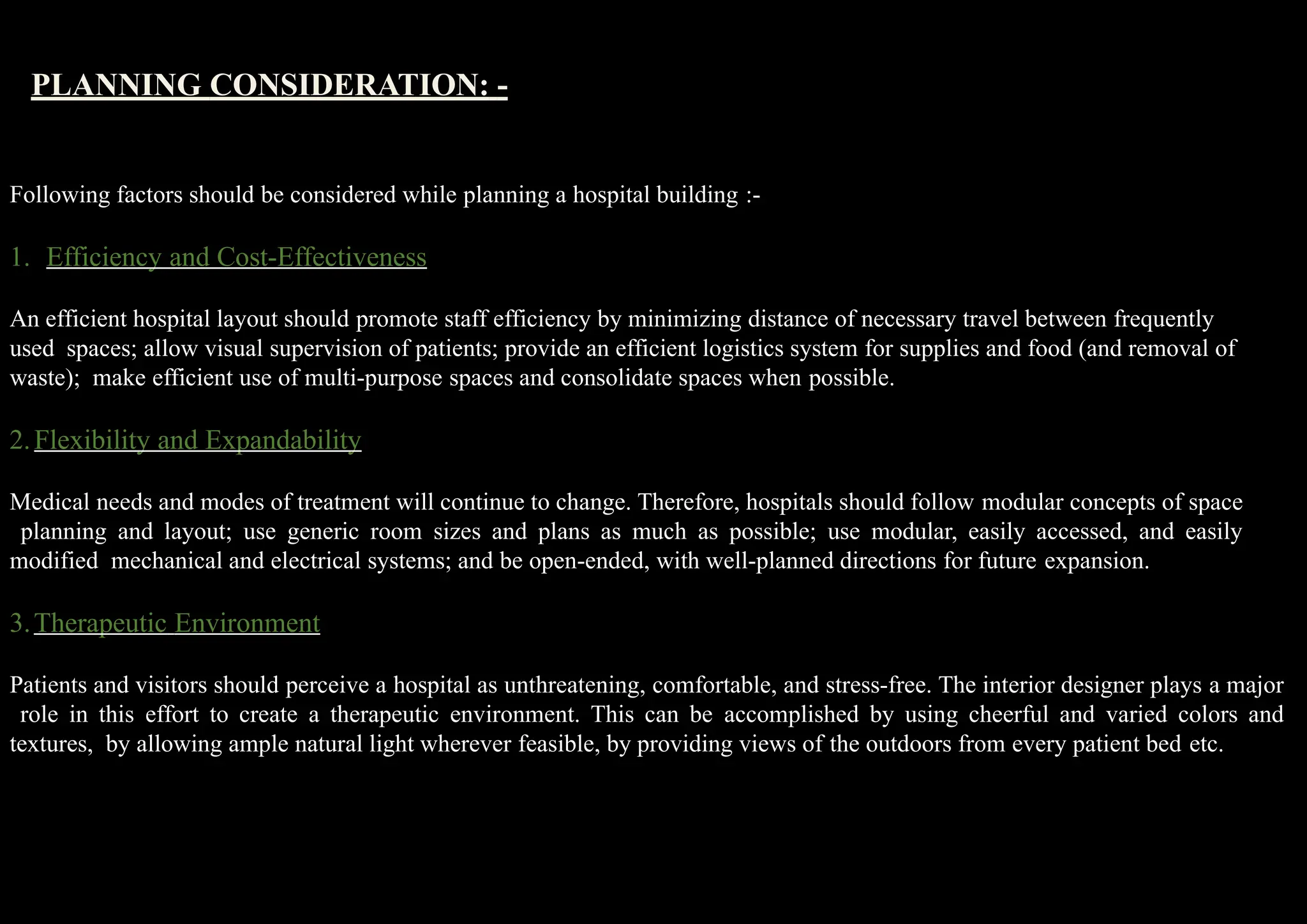
1. EMERGENCY DEPARTMENT :-
• The ED is One of the “Front Doors” to a Hospital.
• Many patients visit the ED first, and are oftentimes admitted
as inpatients.
The ED has two main entrances – one for walk-in patients, and
one for those brought in by ambulance.
• The ED has access to the surgery and imaging departments to
continue care for patients, and is a securable unit in the event
of a criminal event of major emergency.
•
•
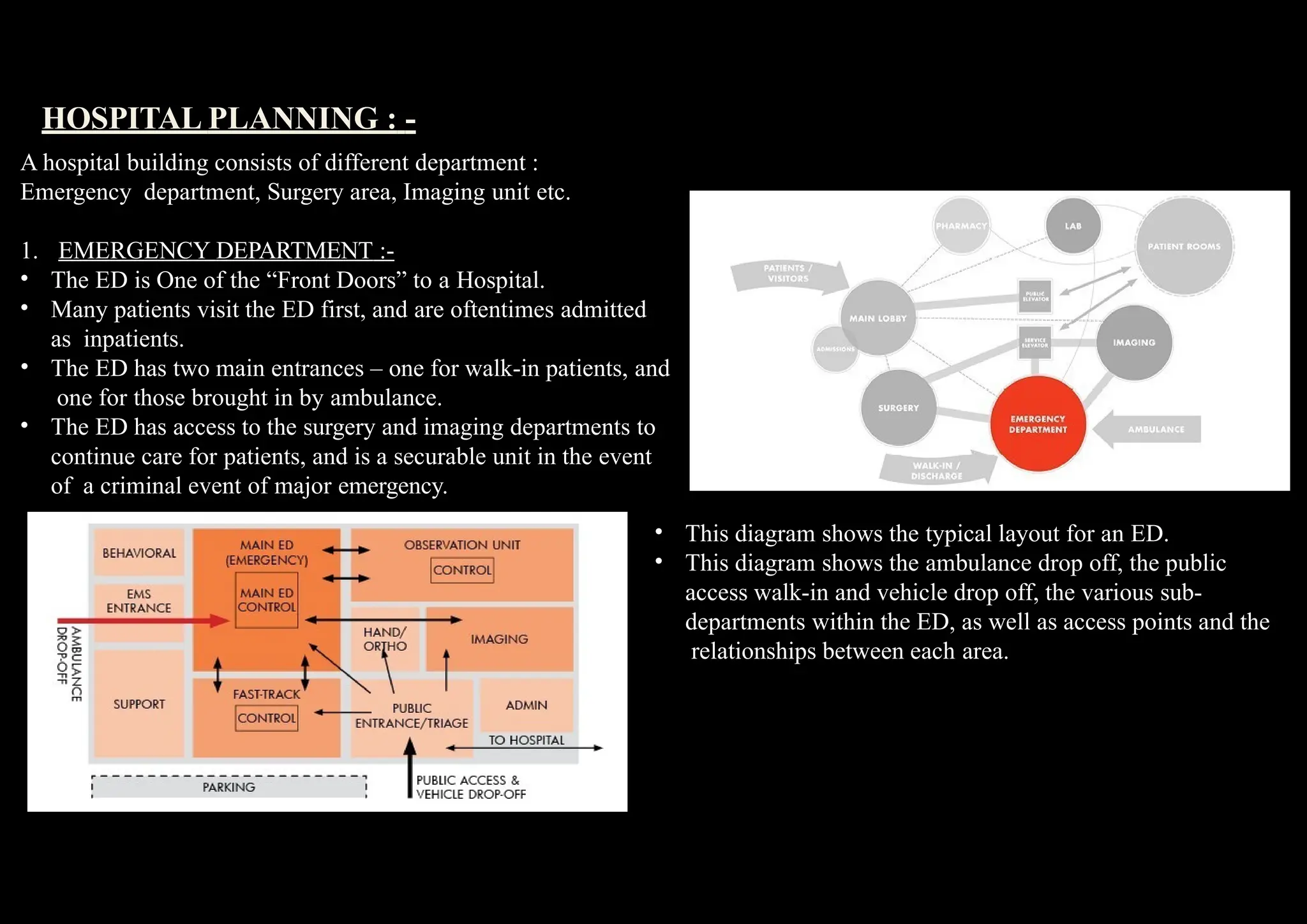
This diagram shows the typical layout for an ED.
This diagram shows the ambulance drop off, the public
access walk-in and vehicle drop off, the various sub-
departments within the ED, as well as access points and the
relationships between each area.
•
•
•
•
•
Each treatment room is split into 3 zones – the patient
zone is centrally located, with a family zone and
caregiver zone on each side.
This allows the family to be comfortable while they
support the patient, the staff to move with ease as they
treat the patient.
The caregiver zone is located toward the corridor so
staff do not have to move through family members.
The nurse’s station is typically centrally located to a
cluster of treatment rooms.
This allows for visual observation of patients and traffic
moving through the department.
•
•
•
•
•
Above picture shows the floor plan of the Van Wert
County Hospital’s ED Addition.
This shows the relationship between the ED and
the imaging and lab departments.
This is important because as patients leave the ED for
imaging, it should be close by.
With the imaging department close by, they’re easily
transported directly to where they need to be.
Likewise, the lab is nearby for staff to move quickly to
the ED to collect information from patients and gain
results in a timely manner.
2. SURGICAL DEPARTMENT :-
•
•
•
•
• For a typical surgery department, you’ll need access for both
inpatients and ambulatory outpatients.
It’s desirable to have a separate exit point for outpatients to
allow them more privacy as they leave post-procedure.
Key amenities that should be available to patients and
family in the surgery department include food service,
consultation rooms, restrooms, and the chapel, among other
spaces.
Departments should be located and designed to prevent non-
related public and staff foot traffic.
Additionally, space should be planned to allow for future
growth. •
•
•
•
There are 3 distinct zones: unrestricted, semi-restricted,
and restricted.
An unrestricted zone is a waiting room or reception area.
A semi-restricted zone includes the quarters that lead to the
restricted areas, as well as sterile storage, surgical prep sinks,
areas for processing surgical instruments, and storage for
surgical attire. Traffic in these areas is limited to staff and
patients in surgical attire.
The restricted zones are operating rooms, procedure rooms,
and if included the clean core, which is a centrally located
sterile zone located between surgical rooms. Surgical attire,
including masks, is required in a restricted zone.
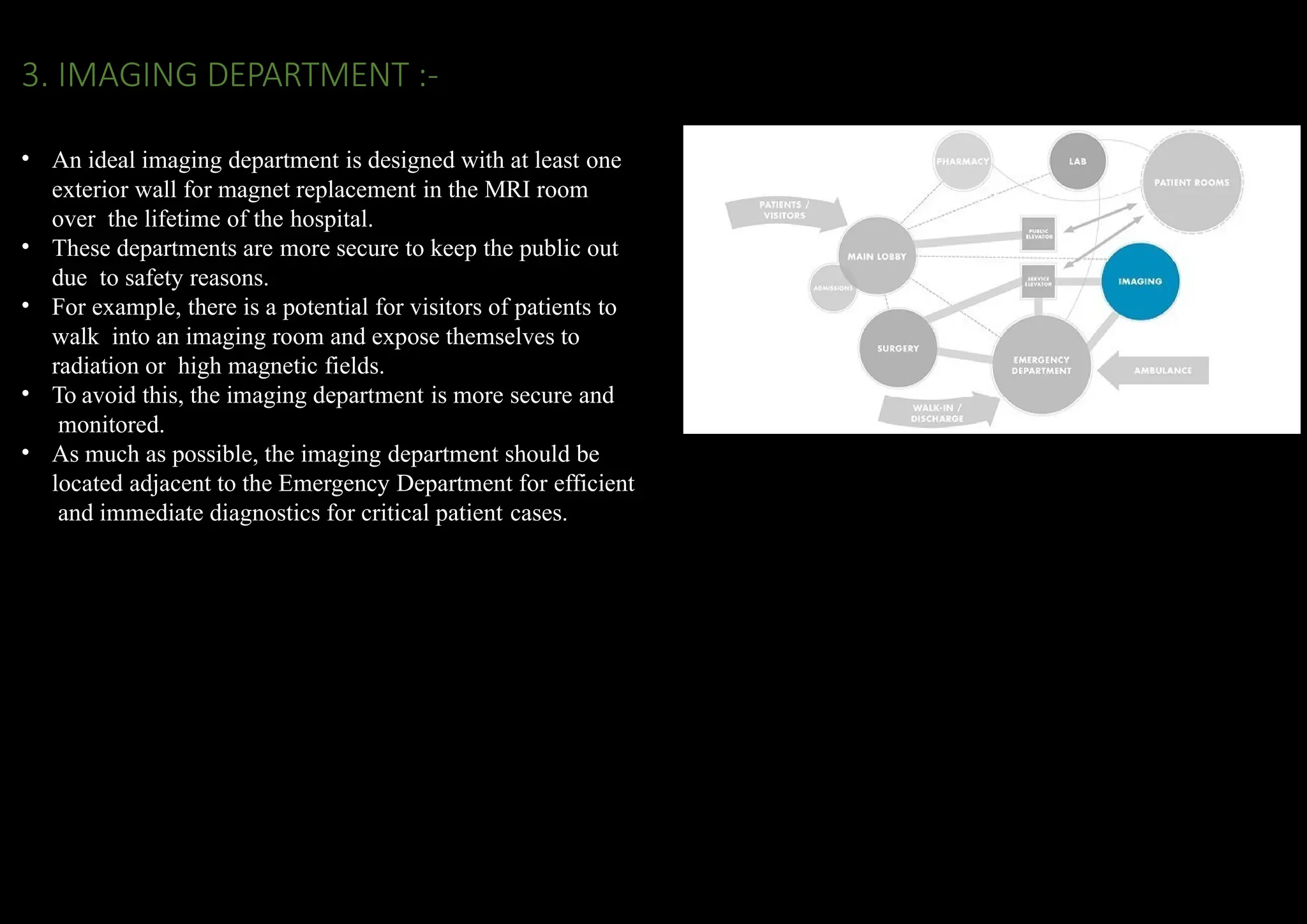
3. IMAGING DEPARTMENT :-
•
•
•
•
• An ideal imaging department is designed with at least one
exterior wall for magnet replacement in the MRI room
over the lifetime of the hospital.
These departments are more secure to keep the public out
due to safety reasons.
For example, there is a potential for visitors of patients to
walk into an imaging room and expose themselves to
radiation or high magnetic fields.
To avoid this, the imaging department is more secure and
monitored.
As much as possible, the imaging department should be
located adjacent to the Emergency Department for efficient
and immediate diagnostics for critical patient cases.
SURGICAL DEPARTMENT: -
FUNCTION AND LAYOUT ::
•
•
Should be located close to the intensive care department, the recovery room and the central sterilization
area. They are best located centrally in the core area of the hospital
ORGANISATION ::
• Every surgical department requires the following rooms:
OT (40-48sq.m.) entry room (15-20sq.m.) exit room (15-20sq.m.) washroom (12-15sq.m.) equipment room (10-15sq.m.)
• Essential to surgical department are a staff lobby, patient lobby, clean work corridor, an anaesthetic workroom, waste lobby,
supply lobby, standing area for 2 operating trolleys and recovery room.
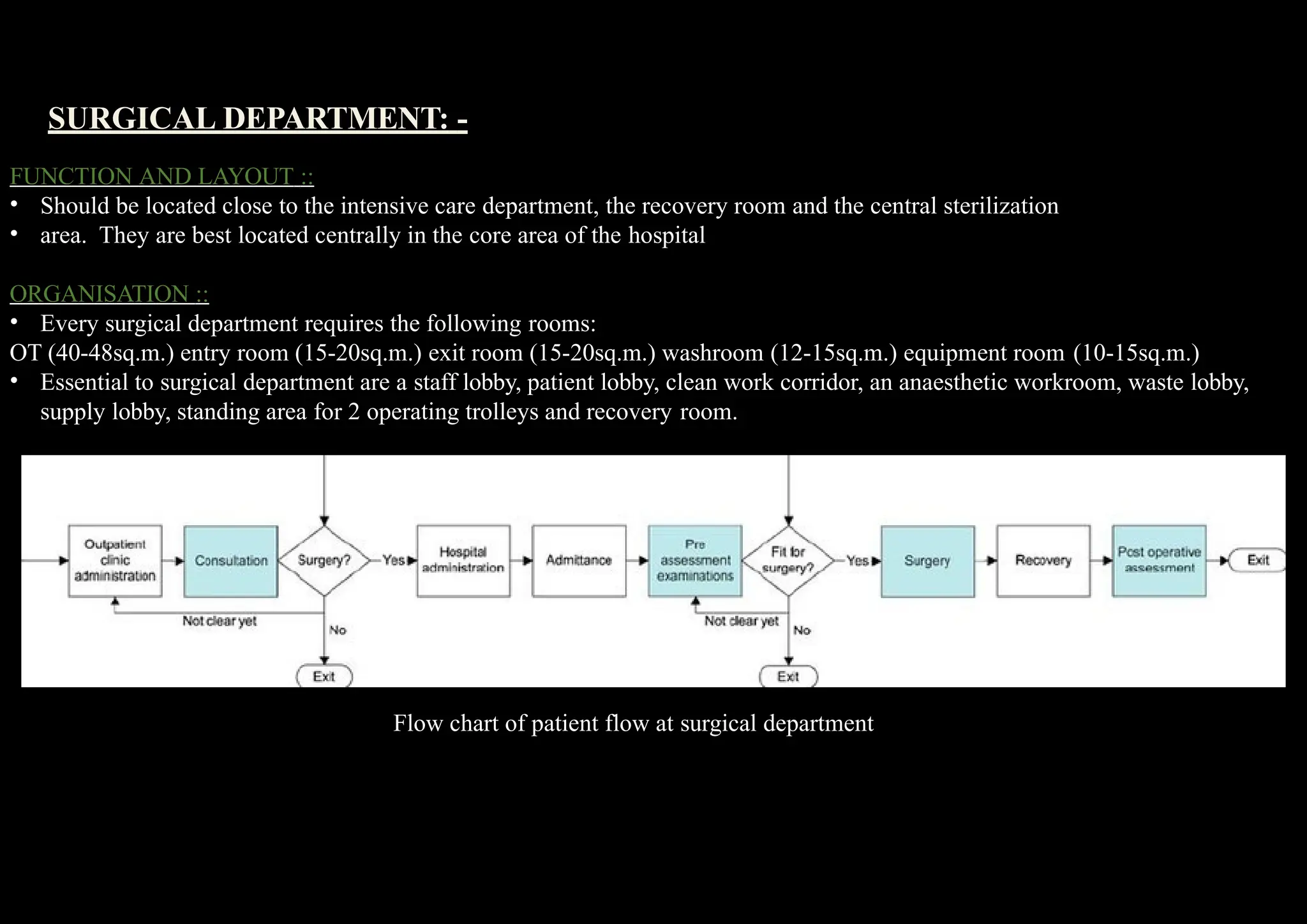
Flow chart of patient flow at surgical department
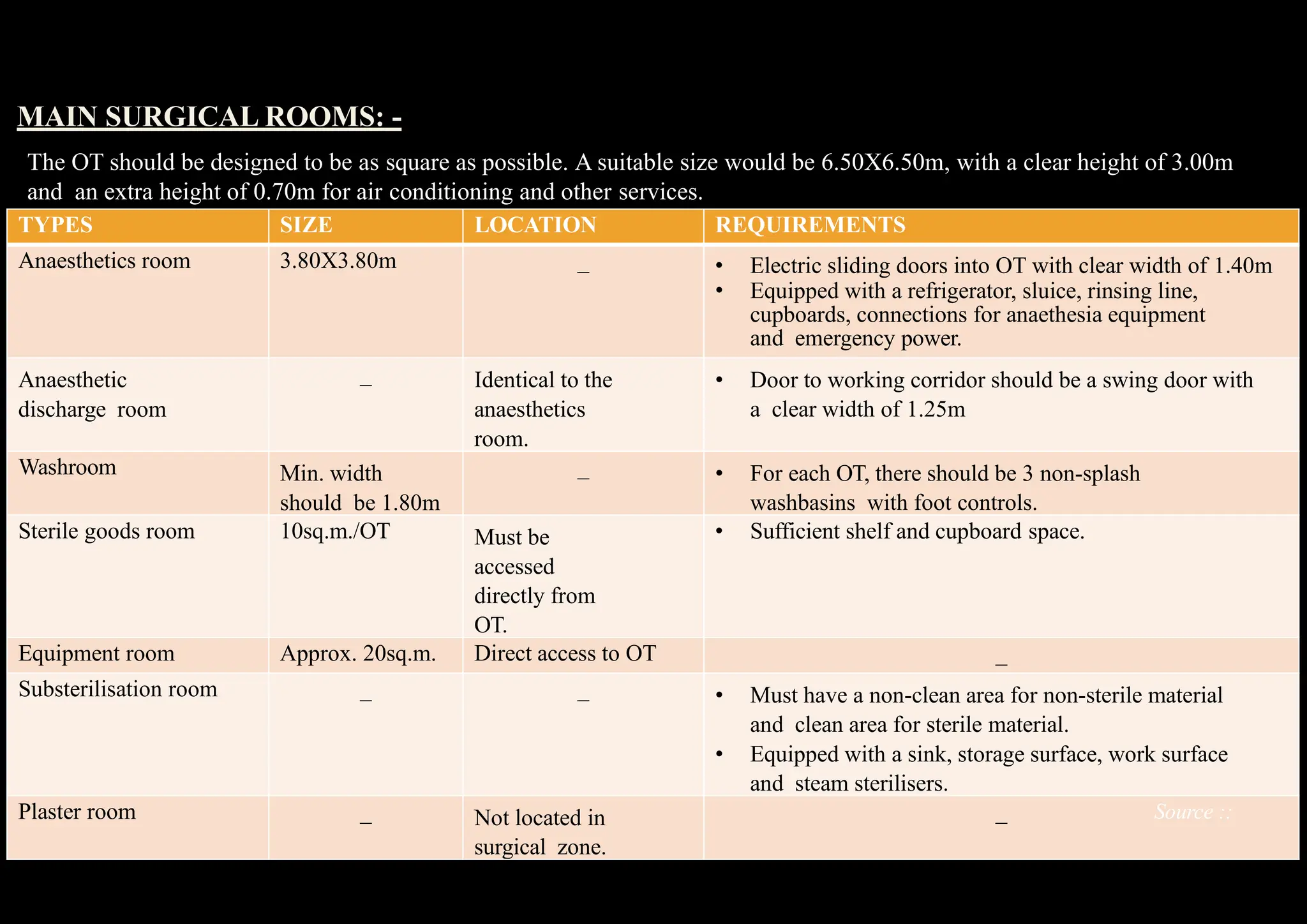
MAIN SURGICAL ROOMS: -
TYPES SIZE LOCATION REQUIREMENTS
Anaesthetics room 3.80X3.80m _ • Electric sliding doors into OT with clear width of 1.40m
• Equipped with a refrigerator, sluice, rinsing line,
cupboards, connections for anaethesia equipment
and emergency power.
Anaesthetic
discharge room
_ Identical to the
anaesthetics
room.
• Door to working corridor should be a swing door with
a clear width of 1.25m
Washroom Min. width
should be 1.80m
_ • For each OT, there should be 3 non-splash
washbasins with foot controls.
Sterile goods room 10sq.m./OT Must be
accessed
directly from
OT.
• Sufficient shelf and cupboard space.
Equipment room Approx. 20sq.m. Direct access to OT _
Substerilisation room _ _ • Must have a non-clean area for non-sterile material
and clean area for sterile material.
• Equipped with a sink, storage surface, work surface
and steam sterilisers.
Plaster room _ Not located in
surgical zone.
_
The OT should be designed to be as square as possible. A suitable size would be 6.50X6.50m, with a clear height of 3.00m
and an extra height of 0.70m for air conditioning and other services.
Source ::
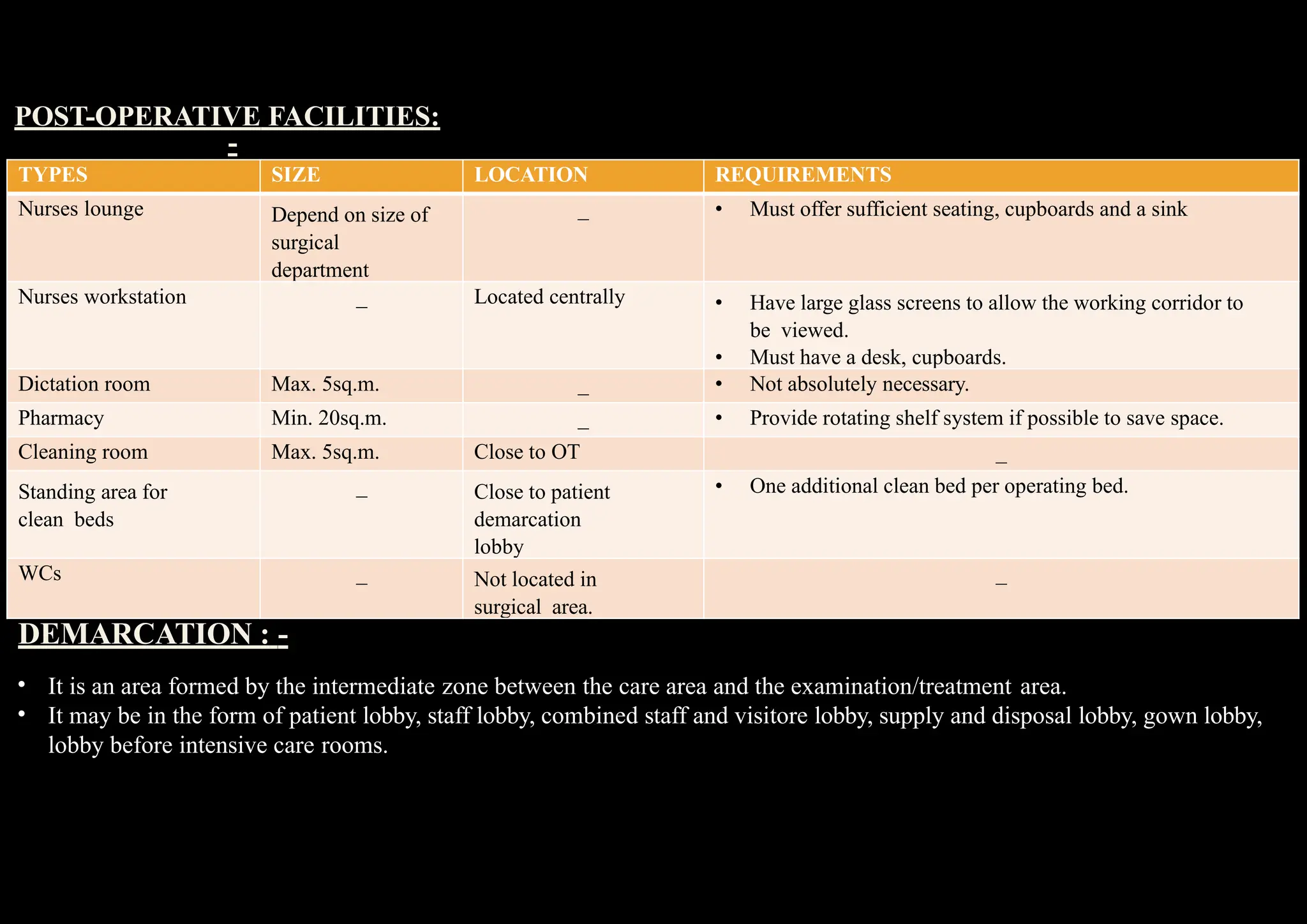
TYPES SIZE LOCATION REQUIREMENTS
Nurses lounge Depend on size of
surgical
department
_ • Must offer sufficient seating, cupboards and a sink
Nurses workstation _ Located centrally • Have large glass screens to allow the working corridor to
be viewed.
• Must have a desk, cupboards.
Dictation room Max. 5sq.m. _ • Not absolutely necessary.
Pharmacy Min. 20sq.m. _ • Provide rotating shelf system if possible to save space.
Cleaning room Max. 5sq.m. Close to OT _
Standing area for
clean beds
_ Close to patient
demarcation
lobby
• One additional clean bed per operating bed.
WCs _ Not located in
surgical area.
_
POST-OPERATIVE FACILITIES:
-
DEMARCATION : -
• It is an area formed by the intermediate zone between the care area and the examination/treatment area.
• It may be in the form of patient lobby, staff lobby, combined staff and visitore lobby, supply and disposal lobby, gown lobby,
lobby before intensive care rooms.
Demarcation through different types of lobbies
CARE AREA: -
1. Normal care units are used for general inpatient care with a short length of stay.
2. Intensive care groups for patient under constant observation and should be larger than normal care rooms.
3. Special care units for patients with special needs (newborn babies, people with infectious diseases etc. and length of stay
for patients is longer than average.
CARE DEPARTMENTS ::
•
• Each care area should contain no more than 16-24 beds and
fewer beds per care group in the intensive care and special care
areas
(6-12 beds)
Two workstations are often placed together and connected to a
large central nurses’ service area.
FUNCTION AND STRUCTURE ::
• Individual care area are attached to the specific medical faculties
and therefore need to be planned as separate units.
• Each station must have at least one assistant doctor’s room and
two doctors' room.
LAYOUT OF ROOMS ::
• Medical rooms and washrooms should be accessed from the main
station corridor and must be easily supervised from the glazed
nurses’ workstation.
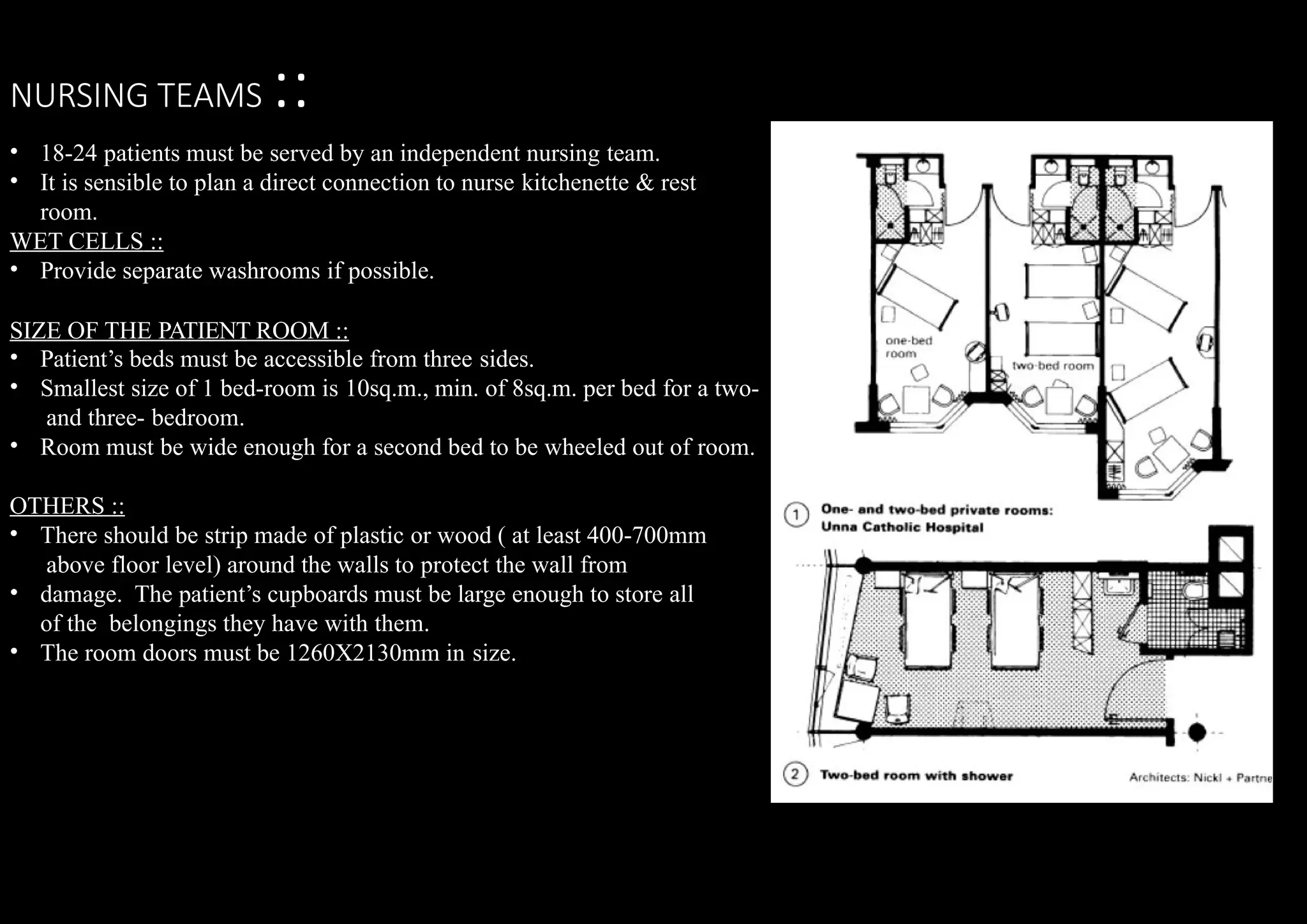
NURSING TEAMS ::
•
•
18-24 patients must be served by an independent nursing team.
It is sensible to plan a direct connection to nurse kitchenette & rest
room.
WET CELLS ::
• Provide separate washrooms if possible.
SIZE OF THE PATIENT ROOM ::
•
•
Patient’s beds must be accessible from three sides.
Smallest size of 1 bed-room is 10sq.m., min. of 8sq.m. per bed for a two-
and three- bedroom.
• Room must be wide enough for a second bed to be wheeled out of room.
OTHERS ::
•
•
• There should be strip made of plastic or wood ( at least 400-700mm
above floor level) around the walls to protect the wall from
damage. The patient’s cupboards must be large enough to store all
of the belongings they have with them.
The room doors must be 1260X2130mm in size.
TYPES SIZE LOCATION REQUIREMENTS
Non-clean workroom Approx. 10sq.m. _ • Contain a sink and sluice, preferably in stainless steel.
• Fully tiled walls are recommended.
Nurses work area About 25-30sq.m. Located centrally • Corridor wall must be glazed but fireproofed
Rest room/kitchenette Roughly 15sq.m. _ • Consider the inclusion of smoking area in larger hospitals.
Station doctor About 16-20sq.m. _ • Should be ample shelving and an examination couch
Clean workroom About 10sq.m. Close to OT • Equipped with fixed shelving (600mm deep) or a flexible storage
system
Patients’ bathroom Suitable for
wheelchair
users
_ • Equipped with a tub which is accessible from three sides to ease
the lifting of patients.
Plant room Approx. 8sq.m. _ • Equipped with a fuseboard.
Patients’ lounge Approx. 22-25sq.m. Serve as a general meeting
place for patients.
• Should emulate a domestic environment.
TREATMENT AREA: -
e
The treatment areas should face north and have central access.
OBSTETRICS ::
• It is essential to have a treatment room next to the delivery
rooms.
• It is also sensible to position this near to the surgery and intensiv
care departments.
ROOM PLANNING ::
•
• Among the central delivery rooms is an observation room
with large glass windows.
There should be a clean workroom (12sq.m.) a non-clean
workroom (12sq.m.) a treatment room (12sq.m.) a mid-wives
workstation (20sq.m.) a staff rest room (15sq.m.) and staff &
patient WCs.
INTERNAL MEDICINE TREATMENT AREA::
•
• This can encompass cardiology, angiology, pulmonology,
endocrinology and metabolism and gastroenterology.
The basic facilities comprise examination rooms (25sq.m.) a
secretarial/administration office (20sq.m.) between the senior
physician’s room (15-20sq.m.) and the chief physician’s
room (20-25sq.m.) an archive room and patient waiting
areas.
Source ::
RADIOLOGY ::
•
•
•
• It includes X-ray diagnosis, radiotherapy and nuclear medicine.
• It should always be close to the ambulance entrance.
• It is sensible to plan these areas on the ground or basement floor.
• The size of the rooms depends on their use and what they
contain: sonography, mammography and jaw X-ray requires
about 12- 18sq.m. whereas standard X-ray and admission rooms
need to be 20-30sq.m.
The access route for patients should be through two changing
cubicles, and a wide door (at least 1250mm) is necessary.
WCs should be installed in X-ray rooms.
The admission room for computertomography must be
about 35sq.m. in area.
RADIOTHERAPY ::
•
•
•
•
• Conditions diagnosed in the radiography department
(e.g. tumours) are treated in radiotherapy.
It comprises a reception and waiting area, doctors’ rooms (approx.
18sq.m.) a switch room (20sq.m.) a service room (20sq.m.), a
film developing room (10sq.m.) stores and a cleaners’ room.
Each treatment room requires a changing cubicle for
patients. The clear height of the radiation rooms must be
4.30m.
The thickness of walls constructed in concrete only should be
3.00m for treatment and examination rooms in the primary
radiation area and 1.50m for rooms in the secondary
radiation
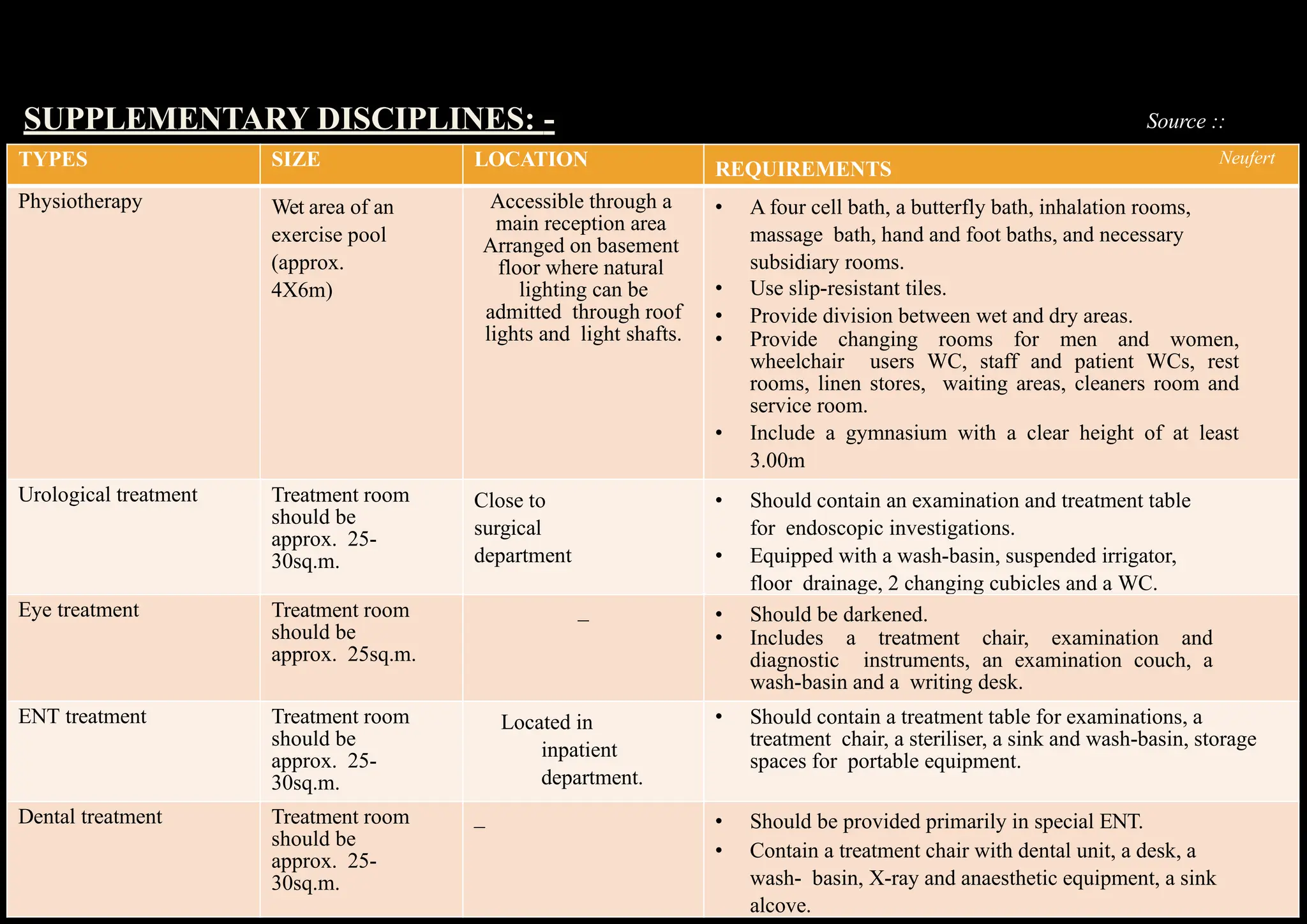
SUPPLEMENTARY DISCIPLINES: - Source ::
TYPES SIZE LOCATION REQUIREMENTS
Neufert
Physiotherapy Wet area of an
exercise pool
(approx.
4X6m)
Accessible through a
main reception area
Arranged on basement
floor where natural
lighting can be
admitted through roof
lights and light shafts.
• A four cell bath, a butterfly bath, inhalation rooms,
massage bath, hand and foot baths, and necessary
subsidiary rooms.
• Use slip-resistant tiles.
• Provide division between wet and dry areas.
• Provide changing rooms for men and women,
wheelchair users WC, staff and patient WCs, rest
rooms, linen stores, waiting areas, cleaners room and
service room.
• Include a gymnasium with a clear height of at least
3.00m
Urological treatment Treatment room
should be
approx. 25-
30sq.m.
Close to
surgical
department
• Should contain an examination and treatment table
for endoscopic investigations.
• Equipped with a wash-basin, suspended irrigator,
floor drainage, 2 changing cubicles and a WC.
Eye treatment Treatment room
should be
approx. 25sq.m.
_ • Should be darkened.
• Includes a treatment chair, examination and
diagnostic instruments, an examination couch, a
wash-basin and a writing desk.
ENT treatment Treatment room
should be
approx. 25-
30sq.m.
Located in
inpatient
department.
• Should contain a treatment table for examinations, a
treatment chair, a steriliser, a sink and wash-basin, storage
spaces for portable equipment.
Dental treatment Treatment room
should be
approx. 25-
30sq.m.
_ • Should be provided primarily in special ENT.
• Contain a treatment chair with dental unit, a desk, a
wash- basin, X-ray and anaesthetic equipment, a sink
alcove.
SUPPLIES AREA: -
CENTRAL SUPPLY ::
•
• The advantage of central supply/disposal level are uniform overall
management, common stock control and the utilization of same transport
system.
For hygiene, it is imp. to separate clean and non-clean goods.
STAFF ROOMS ::
• In supplies area, changing and washrooms, WCs, cleaning rooms, storage
rooms and rest rooms must be provided.
STERILISATION ::
• Central sterilization unit and surgical department should be located close
together.
• The central store for drugs and instruments must be closely linked to the
central sterilization unit.
DISPENSARY ::
•
•
This consists of a work and a dispensing room (25sq.m.).
Its is fitted out with a desk, washing facility, sink, weighing station and
lockable cupboards, dry store, a cold store, a dressing materials room and a
damp store.
Source ::
PHARMACY ::
•
•
• Following rooms are necessary : dispensary, materials room, drug store, lab, and an
issue desk.
The dispensary and lab should contain a prescription table, a work table, a packing
table, and a sink.
It should be close to lifts and the pneumatic tube dispatch system.
CENTRAL BED UNIT ::
• Every hospital should contain a bed unit in which the appropriate staff strip down,
clean, disinfect and make up the beds.
• For about 500 inpatients a bed unit for 70 beds should be provided.
LAUNDRY PROVISION ::
• The laundry hall should consists of a sorting and weighing area(15sq.m.) laundry
collection room, wet working area (50sq.m.) dry working area (60sq.m.) detergent
store (10sq.m.) sewing room (10sq.m.) and laundry store (15sq.m.)
MEAL PROVISION ::
•
•
•
Preparation of normal food and special diets takes place separately.
The clear height oh kitchen hall should be 4.00m and its size depends on
the requirement and no. of patients.
In the main kitchen area of 1sq.m. per person is needed. With min. of 60sq.m. for
special diet kitchen, 30sq.m. for vegetable clean area, 5sq.m. for waste disposal,
8sq.m. for daily supplies room, a cold store of 8sq.m. and storage space of 15-
20sq.m.
ELECTRICAL SYSTEMS ::
•
•
•
Provide sufficiently wide doors (at least 1.30 clear width)
Good ventilation must be provided.
Anti-vibration foundation should be underneath the
electrical units to reduce noise.
CENTRAL GAS SUPPLY ::
•
•
Initially, oxygen and nitrogen lines are supplied from steel cylinders but these are now replaced by ‘cold gasifiers’.
These must stand in open air at least 5m from buildings.
WORKSHOPS ::
• Connected to a good yard are metalwork and electrical workshops (40sq.m.) with a materials store, spare parts store (20sq.m.)
general store (60sq.m.) and standing area for transport equipment (15sq.m.)
• Water treatment plant for hospital and the sterilization must be separated.
COMMUNICATION CENTER ::
•
•
The nurse intercom system allows a voice link between individual nurses workrooms and the patients’
room. Patients’ room are to be equipped with telephone, telephone paging and television.
Source ::
GENERALAREAS : -
ADMINISTRATION ROOMS ::
•
•
• They should be connected by corridor to the entrance hall and be close
to the main circulation routes.
The following requirements are based on a 100-bed occupancy level: in
the administrative area, 7-12sq.m. per member of staff should be planned,
rooms for dealings with patients and relatives need to be connected to
reception, admissions and accounts (25sq.m.).
There should be at least two reception areas (5sq.m.) for demarcation
before the main reception, the cash-desk (12sq.m.) and accounts
(12sq.m.)
• Additional rooms needed include: an office for the administrative director
(20sq.m.), a secretarial room (10sq.m.) an administrators’ office
(15sq.m.) a nurses’ office (20sq.m.) a personnel office (25sq.m.) and
central archives (40sq.m.)
MAIN ENTRANCE ::
•
• The entrance hall, on the basis of the open-door principle, should
be designed as a waiting room for visitors.
The size of the hall depends on bed capacity and the expected number
of visitors.
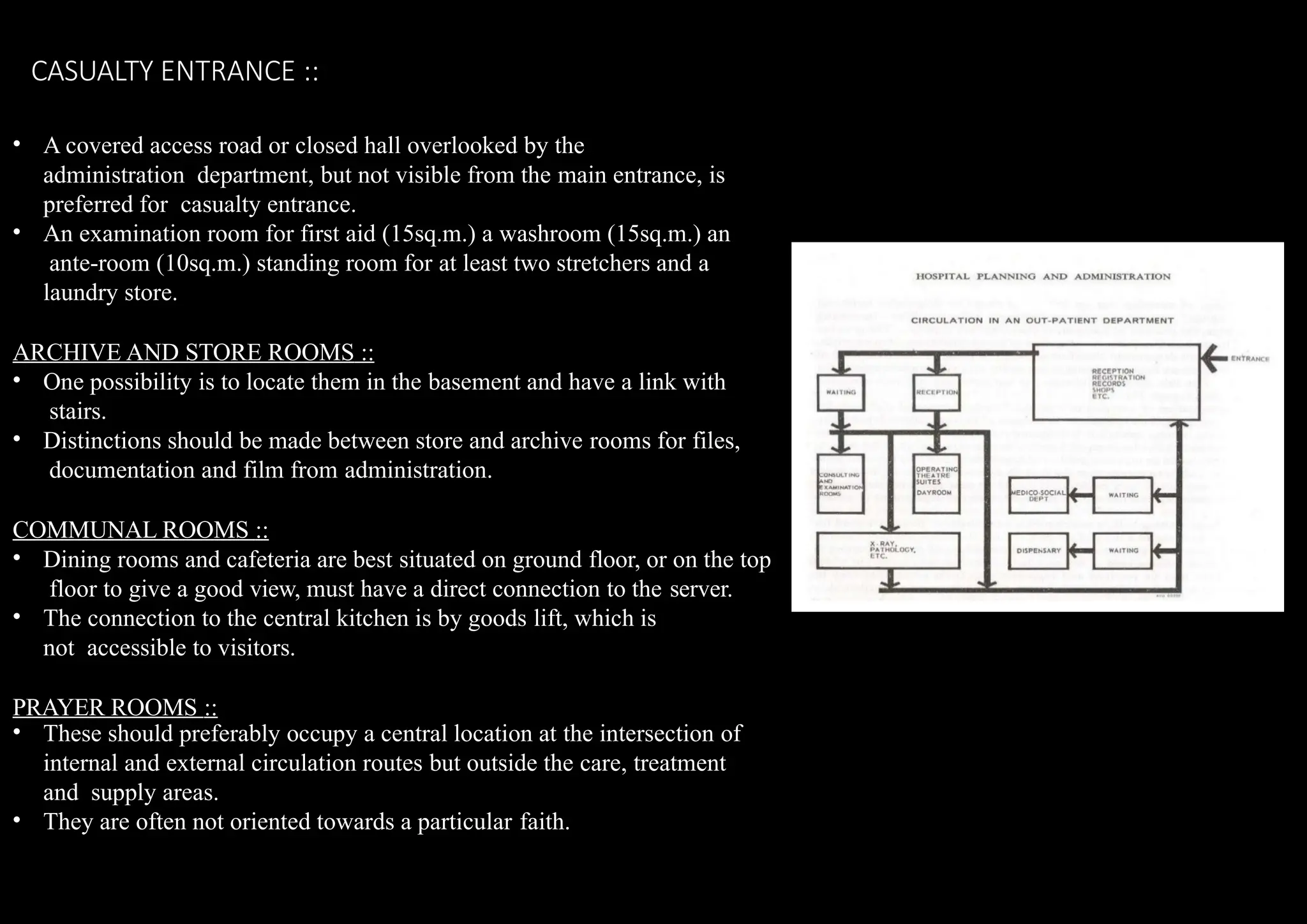
CASUALTY ENTRANCE ::
• A covered access road or closed hall overlooked by the
administration department, but not visible from the main entrance, is
preferred for casualty entrance.
• An examination room for first aid (15sq.m.) a washroom (15sq.m.) an
ante-room (10sq.m.) standing room for at least two stretchers and a
laundry store.
ARCHIVE AND STORE ROOMS ::
• One possibility is to locate them in the basement and have a link with
stairs.
• Distinctions should be made between store and archive rooms for files,
documentation and film from administration.
COMMUNAL ROOMS ::
• Dining rooms and cafeteria are best situated on ground floor, or on the top
floor to give a good view, must have a direct connection to the server.
• The connection to the central kitchen is by goods lift, which is
not accessible to visitors.
PRAYER ROOMS ::
• These should preferably occupy a central location at the intersection of
internal and external circulation routes but outside the care, treatment
and supply areas.
• They are often not oriented towards a particular faith.
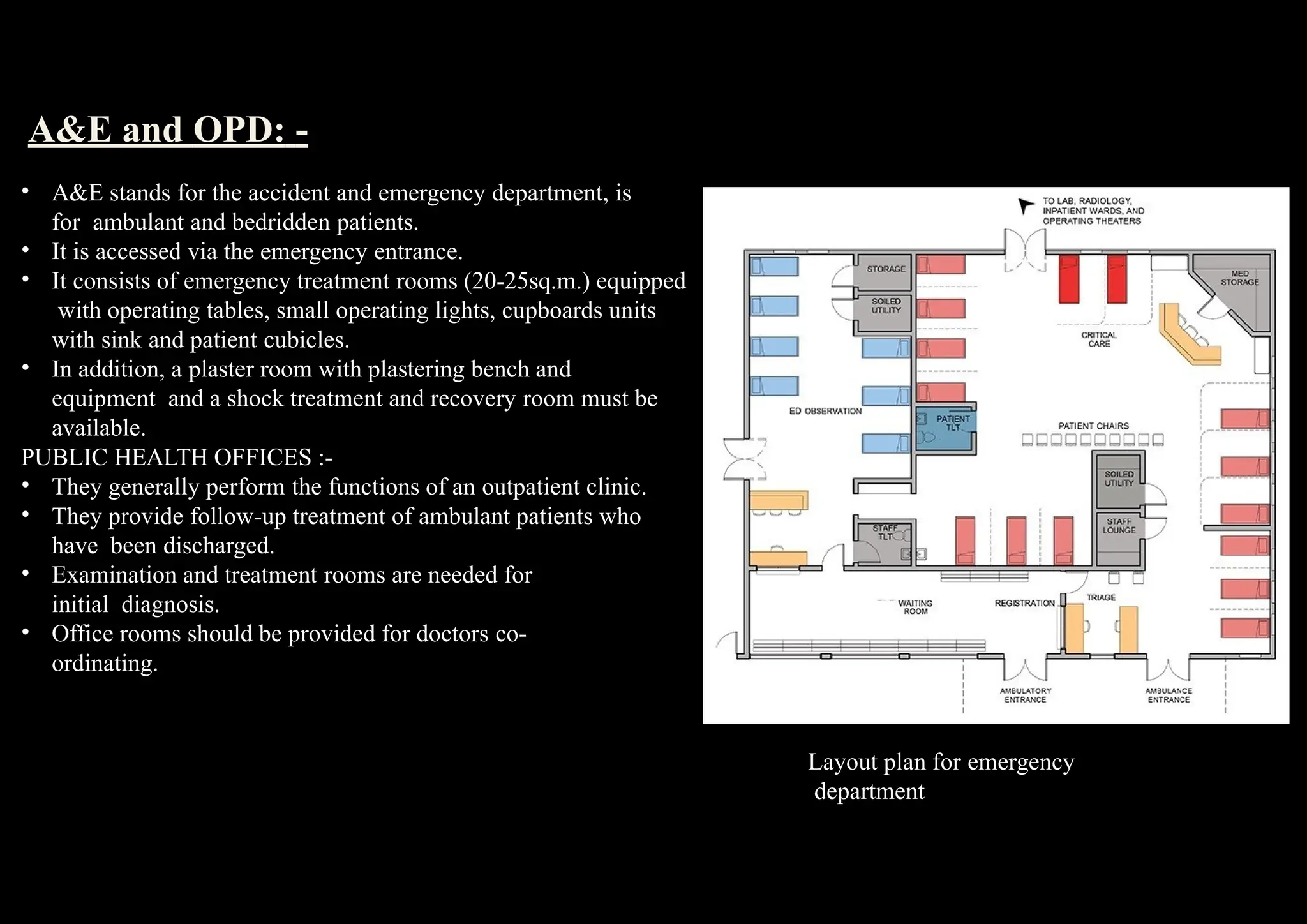
A&E and OPD: -
•
•
•
• A&E stands for the accident and emergency department, is
for ambulant and bedridden patients.
It is accessed via the emergency entrance.
It consists of emergency treatment rooms (20-25sq.m.) equipped
with operating tables, small operating lights, cupboards units
with sink and patient cubicles.
In addition, a plaster room with plastering bench and
equipment and a shock treatment and recovery room must be
available.
PUBLIC HEALTH OFFICES :-
•
•
•
•
They generally perform the functions of an outpatient clinic.
They provide follow-up treatment of ambulant patients who
have been discharged.
Examination and treatment rooms are needed for
initial diagnosis.
Office rooms should be provided for doctors co-
ordinating.
Layout plan for emergency
department
MATERNITY AND NEONATAL CARE: -
•
•
This department provides continual physical, medical,
psychological and social care for mothers and new babies.
The division of maternity care is the same as for normal
care: basic care, treatment care, patient care, administration
and supply.
FACILITIES AND SIZE OF CARE UNITS :-
•
•
•
•
•
•They are generally smaller than the units in normal care areas. It
is advisable to limit the size per care unit to 10-14 bed spaces. The
bed spacing must be increased to allow the space for a baby’s crib
next to the beds.
•The neonatal care units comprise : bed spaces for neonates,
undressing/dressing area, baby bathing, weighing point,
children’s nurse’s duty station and a trolley standing area.
•Following room are also to be included in an incidental
functional area: duty station for the ward sister, nurses’ lounge,
kitchenette, doctors’ office, examination and treatment room,
clean workroom, patient bathroom, day rooms for patient and
visitors, storage space for equipment and cleaning materials, staff
and visitors WCs.
MORTUARY, PATHOLOGY: -
SPECIAL HOSPITALS: -
•
•
•
•
The mortuary contains storage rooms and post-mortem rooms.
There must be a coffin store, refrigerated storage for corpses, an
area for laying out and undertakers and changing facilities for
pathologists.
It should be access by a short route to a group of lifts (to the
nursing stations)
Proper signage should be provided.
•
•
They require a far more space-intensive general arrangement which leaves the planner facing extra demands.
They cover medical disciplines such as specific surgical procedures, a range of therapies, psychiatry and
paediatrics.
All healthcare facilities shall be so designed, constructed, maintained and operated as to minimize the possibility of a Fire
emergency requiring the evacuation of occupants, as safety of hospital occupants cannot be assured adequately by depending
on evacuation alone. Hence measures shall be taken to limit the development and spread of a fire by providing appropriate
arrangements within the hospital through adequate staffing, careful development of operative and maintenance procedures
consisting of:
1. Design and Construction
2. Provision of Detection, Alarm and Fire Extinguishment
3. Fire Prevention
4. Planning and Training programs for Isolation of Fire
5. Transfer of occupants to a place of comparative safety or evacuation of the occupants to achieve ultimate safety.
EXPECTED LEVELS OF FIRE SAFETY IN HOSPITALS
1. Comparative Safety:
It is protection against heat and smoke within the hospital premises, where removal of the occupants outside the premises is
not feasible and/or possible. Comparative Safety may be achieved through:
•
•
•
•
Compartmentation
Fire Resistant wall integrated in the Flooring
Fire Resistant Door of approved rating
Pressurized Lobby, Corridor, Staircase
GUIDELINES FOR HOSPITAL DESIGN: -
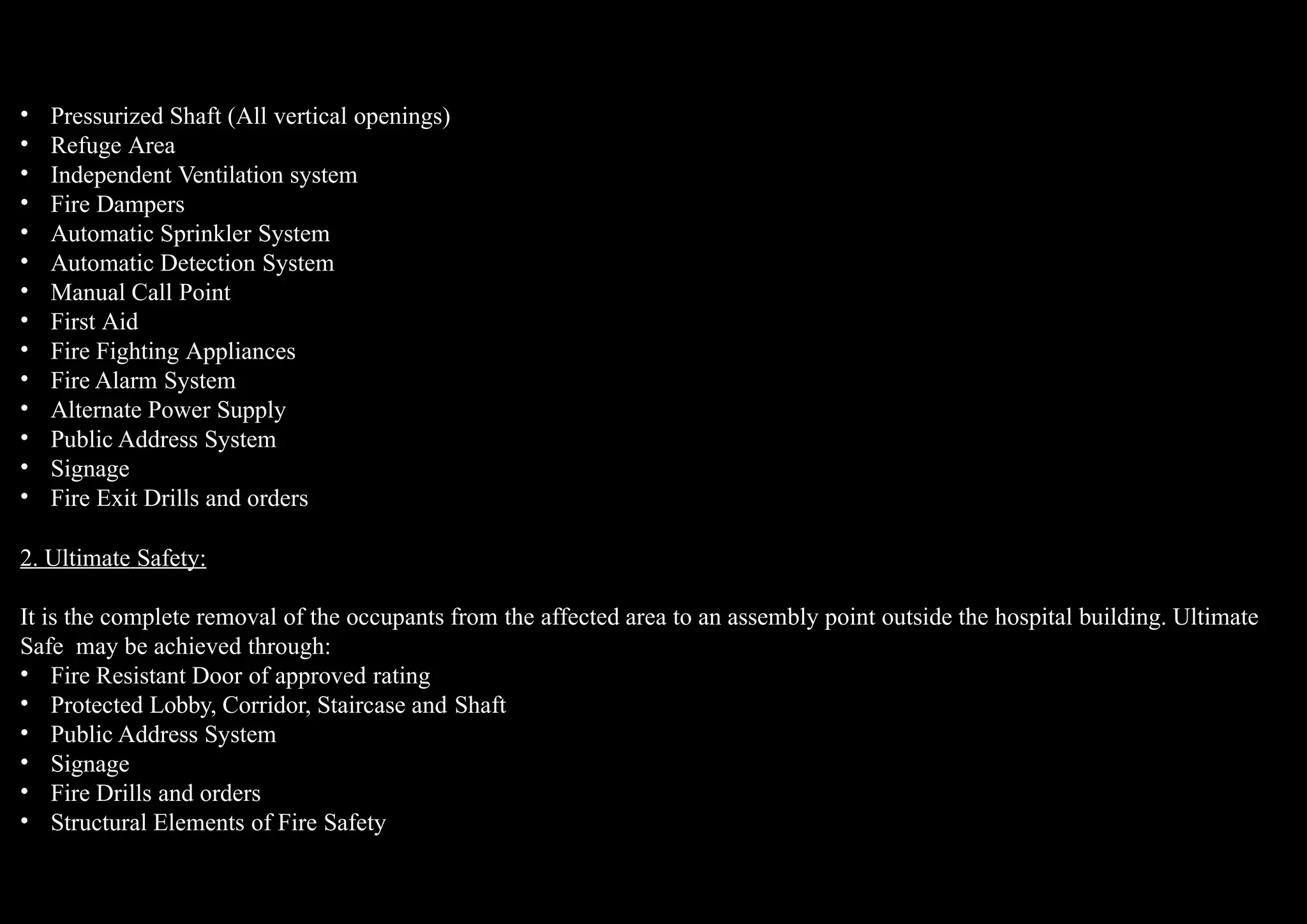
• Pressurized Shaft (All vertical openings)
• Refuge Area
• Independent Ventilation system
• Fire Dampers
• Automatic Sprinkler System
• Automatic Detection System
• Manual Call Point
• First Aid
• Fire Fighting Appliances
• Fire Alarm System
• Alternate Power Supply
• Public Address System
• Signage
• Fire Exit Drills and orders
2. Ultimate Safety:
It is the complete removal of the occupants from the affected area to an assembly point outside the hospital building. Ultimate
Safe may be achieved through:
• Fire Resistant Door of approved rating
• Protected Lobby, Corridor, Staircase and Shaft
• Public Address System
• Signage
• Fire Drills and orders
• Structural Elements of Fire Safety
OPEN SPACES
Hospitals shall make provisions for sufficient open space in and around the hospital building to facilitate the free movement of
patients and emergency/fire vehicles.
•
•
•
•
•
•
•
•
These open spaces shall be kept free of obstructions and shall be motor able.
Adequate passage way & ramp; clearance for fire fighting vehicles to enter the hospital premises shall be
provided. The width of such entrances shall be not be less than 4.5 mtrs with clear head room not less than 5 mtrs.
The width of the access road shall be a minimum of 6 mtrs.
A turning radius of 9 mtrs shall be provided for fire tender movement.
The open space around the building shall not be used for parking and/or any other
purpose. The Set back area shall be a minimum 4.5 mtrs.
The width of the main street on which the hospital building abuts shall not be less than 12 mtrs, when one end of that
street shall join another street, the street shall not be less than 12 mtr wide.
• The roads shall not be terminated in dead ends.
BASEMENTS
•
•
•
•
•
•
Basements shall be used only for parking vehicles and shall be protected with automatic sprinkler
systems. Each basement shall be separately ventilated.
Each vent shall have a cross-sectional area (aggregate) not less than 2.5% of the floor area spread evenly round the
perimeter of the basement.
A system of air inlets and smoke outlets shall be provided and clearly marked as “AIR INLET” and “SMOKE
OUTLET”. Clear headroom of minimum 2.4 mtrs shall be provided for the entire basement.
A minimum ceiling height of any basement shall be 0.9 mtrs and maximum 1.2 mtrs above the average surrounding
ground level.
•
•
•
•
Every storey used by inpatients for sleeping or treatment shall be divided into not less than two smoke compartments
Every storey having an occupant load 50 or more persons, regardless of use, shall be
divided into two smoke compartments.
The size of each smoke compartment shall not exceed 500 Sq Mtrs
RAMPS
• All ramps shall comply with the applicable requirements for stairways regarding enclosure, capacity and limiting
dimensions except in certain cases where steeper slopes may be permitted with inclination less than 1 in 8 ( under no
condition shall the slopes greater than 1 in 8 be used).
• Ramps shall be surfaced with approved non skid & ramp; non slippery material.
• Also, additional safeguards shall be provided as under:
1. The staircases shall be enclosed by walls having 02 hrs fire resistance
2.The external exit doors at ground floor shall open directly onto open spaces or a lobby and Fire & Smoke check doors shall
be provided.
4. Pressurization systems shall be incorporated in protected staircases where the floor area is more than 500 sq. mtr.
5. The pressurization system shall be interconnected with the automatic/manual fire alarm system for actuation.
NON-STRUCTURAL ELEMENTS OF FIRE SAFETY
AUTOMATIC SPRINKLER SYSTEM
•
• The entire building including the basements shall be fitted with sprinklers connected to a gong bell/fire detection
panel, which shall be located in the central control room.
The entire building including the basement shall be fitted with an Automatic Fire Detection and Alarm system comprising
of smoke detectors, and manual call points which shall be connected to the fire alarm panel in the central control room.
• The sprinkler, fire detection and alarm systems shall be provided with an alternative source of power supply.
• Initiation of required fire alarm system shall be by manual means or by means of any detection device.
• An internal audible alarm shall be incorporated.
• Pre-signal systems are prohibited.
• Corridors shall have an approved automatic detection system.
EMERGENCY AND ESCAPE LIGHTING
•
•
•
•
•
• Emergency lighting shall be powered from a source independent of the normal lighting system.
• Emergency lights shall clearly and unambiguously indicate the escape routes.
• Emergency lighting shall provide adequate illumination along escape routes to allow the safe movement of persons towards
and through the exits.
Emergency lighting shall be provided in a manner to ensure that fire alarm call points and fire fighting equipments
provided along the escape routes are readily located.
The horizontal luminance at floor level on the center line of an escape route shall be not less than 10 lux. Additionally, for
escape routes that are up to 2 mtrs in width, 50% of the route width shall be lit to a minimum of 5 lux.
The emergency lighting shall be activated within one second of the failure of the normal
lighting. The luminaries shall be mounted as low as possible but at least 2 mtrs above the floor
level.
Emergency lighting shall be designed to ensure that a fault or failure in any open luminaries does not further reduce
the effectiveness of the system.
• Emergency lighting luminaries and their fittings shall be of non flammable type.
• The emergency lighting system shall be capable of continuous operation for a minimum of 1 and a half hours (90
minutes).
Source :: https://hhbc.in/nbc-guidelines-for-hospital-
CASE STUDIES OF HOSPITAL
DESIGN PROJECT
1. PARS HOSPITAL , IRAN
2. Cleveland Clinic , Abu Dhabi
SUBMITTED TO : SIR AR SAUD KAMAL , MAAM
AR GOHAR MURAD
SUBMITTED BY : ALI AZHAR AR 19-03
SEMESTER VI
ARCH DESIGN IV
MCA , BZU
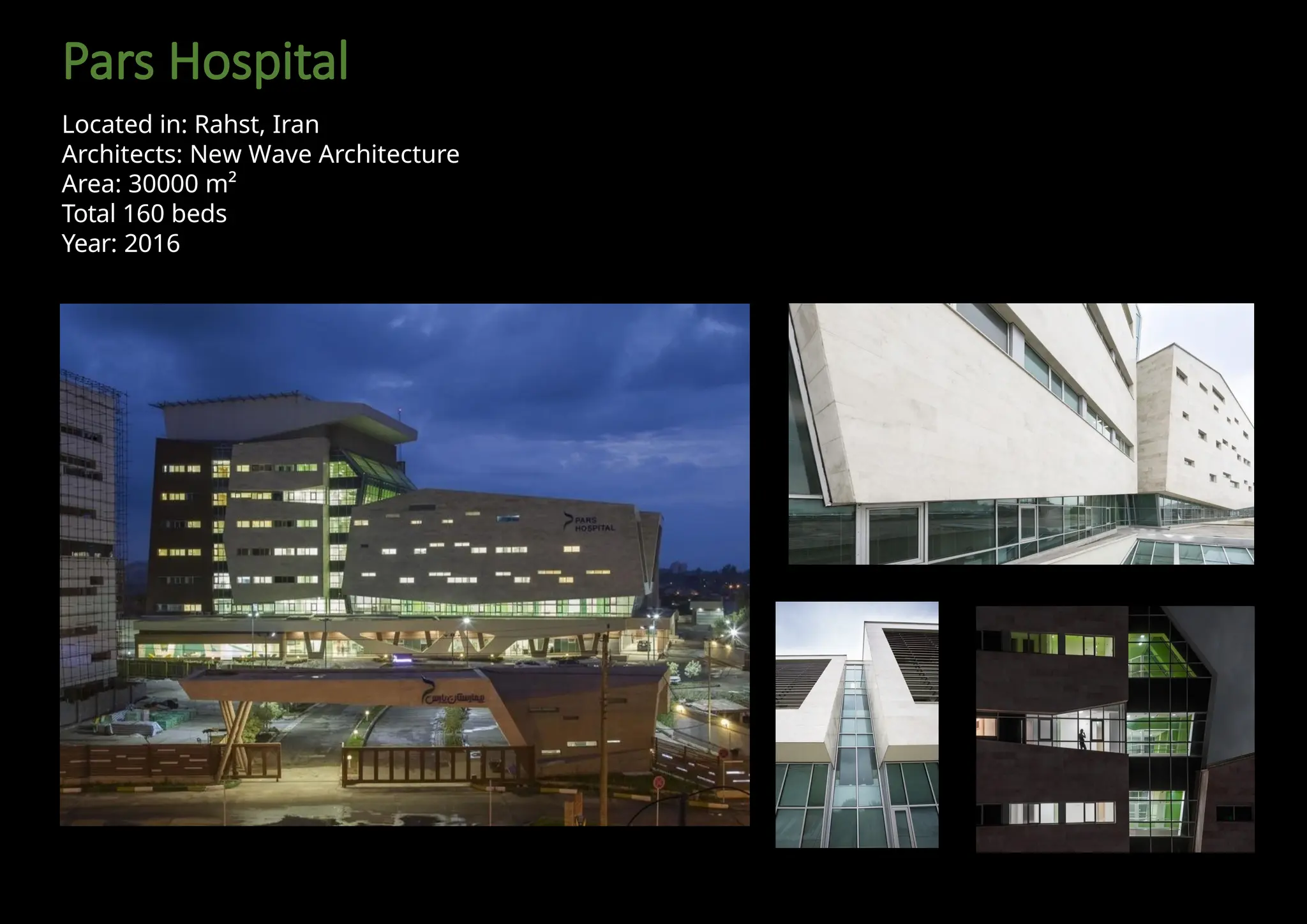
Pars Hospital
Located in: Rahst, Iran
Architects: New Wave Architecture
Area: 30000 m²
Total 160 beds
Year: 2016
INTRODUCTION
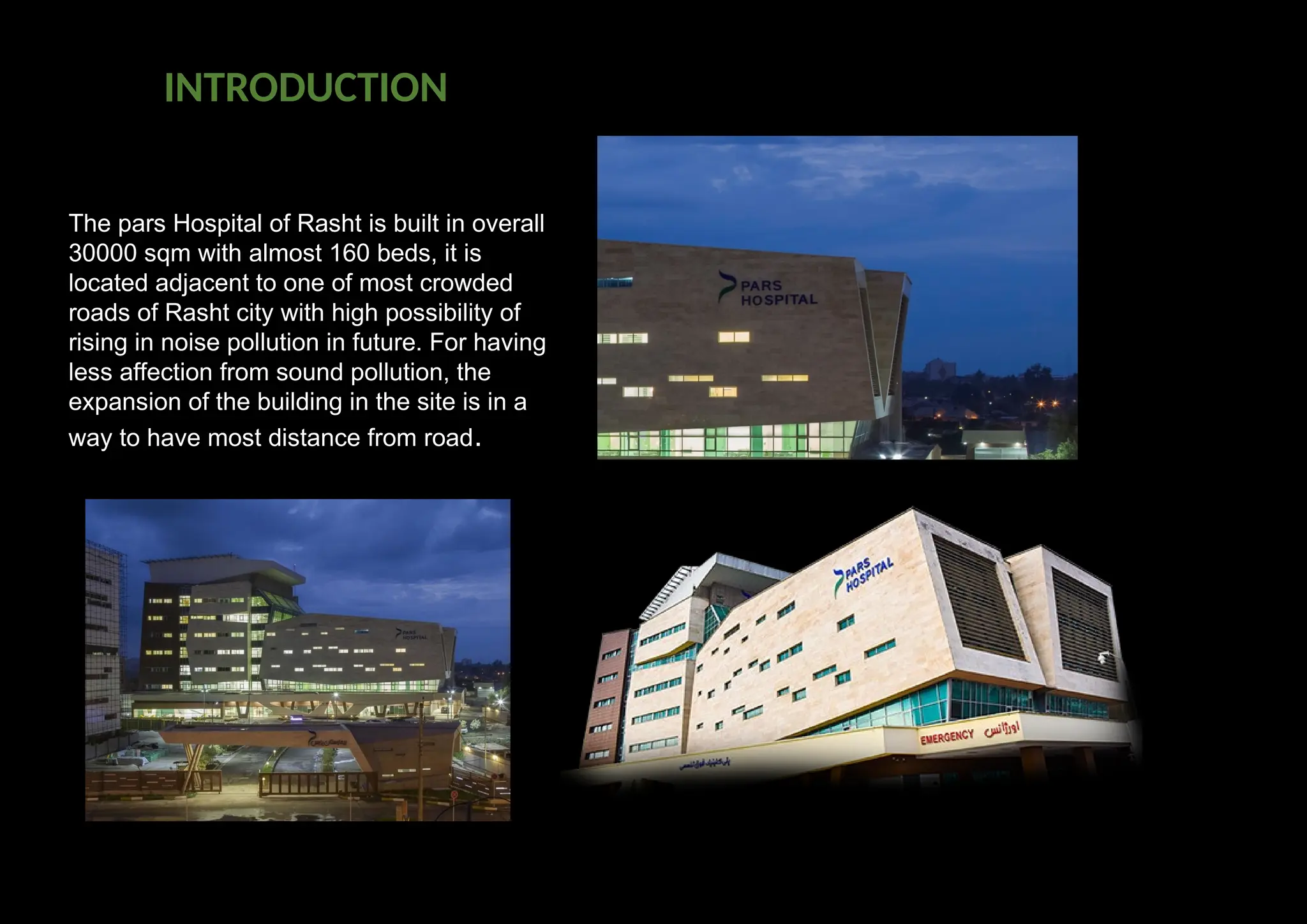
The pars Hospital of Rasht is built in overall
30000 sqm with almost 160 beds, it is
located adjacent to one of most crowded
roads of Rasht city with high possibility of
rising in noise pollution in future. For having
less affection from sound pollution, the
expansion of the building in the site is in a
way to have most distance from road.
PROJECT DETAILS
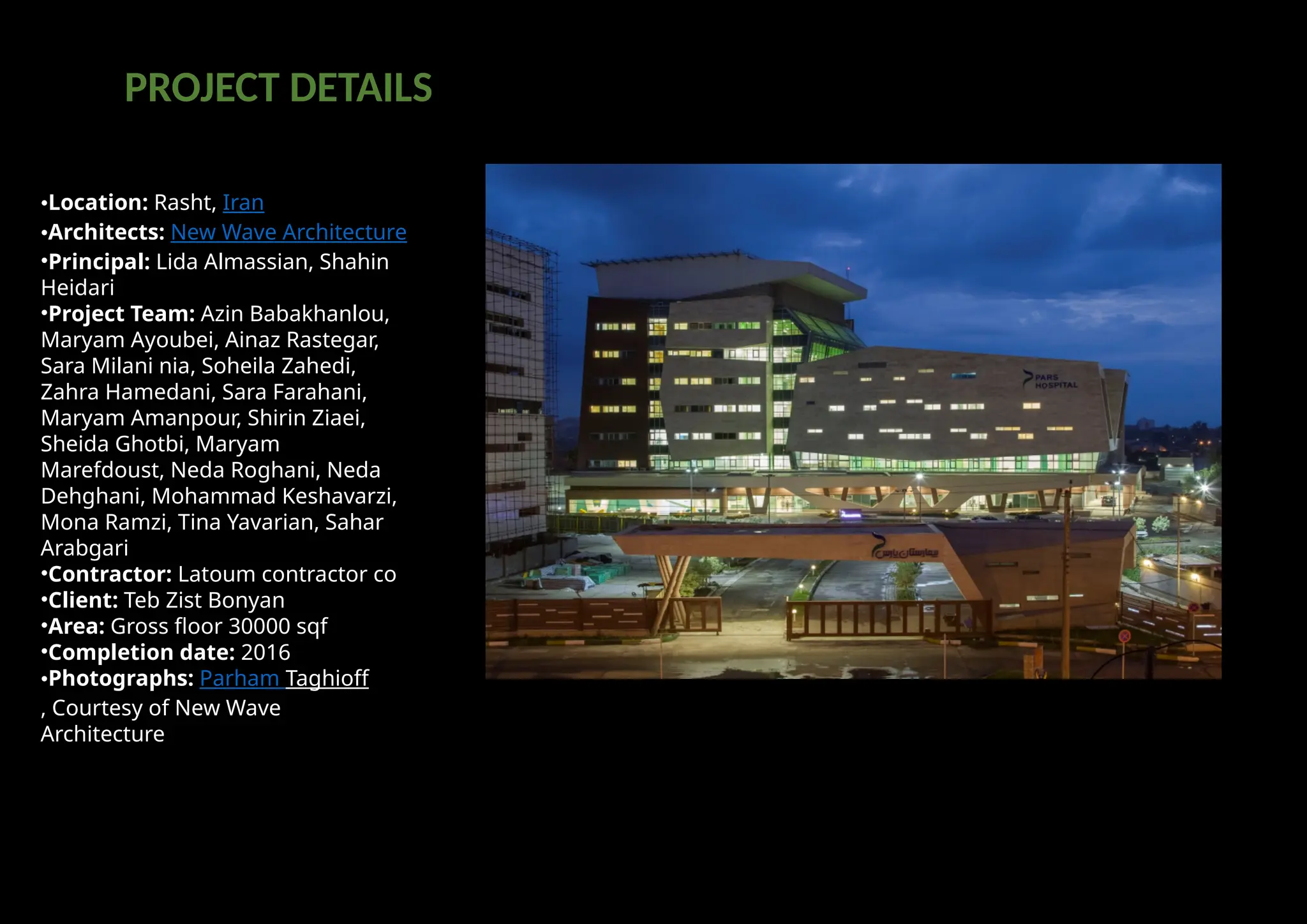
•Location: Rasht, Iran
•Architects: New Wave Architecture
•Principal: Lida Almassian, Shahin
Heidari
•Project Team: Azin Babakhanlou,
Maryam Ayoubei, Ainaz Rastegar,
Sara Milani nia, Soheila Zahedi,
Zahra Hamedani, Sara Farahani,
Maryam Amanpour, Shirin Ziaei,
Sheida Ghotbi, Maryam
Marefdoust, Neda Roghani, Neda
Dehghani, Mohammad Keshavarzi,
Mona Ramzi, Tina Yavarian, Sahar
Arabgari
•Contractor: Latoum contractor co
•Client: Teb Zist Bonyan
•Area: Gross floor 30000 sqf
•Completion date: 2016
•Photographs: Parham Taghioff
, Courtesy of New Wave
Architecture
• The concept of design in ground floor
coming from having wide space with
combination of diagnostic spaces,
emergency parts and Outpatient clinic
which are connected to other sections
vertically an horizontally through main
transparent Atrium, play vital role of
merging buildings sections into one
single entity and acting as organizer of
interior pedestrian path, provide
coherency, forming hierarchy between
public and private areas and creating
light space with efficient usage of
daylight and less using electrical energy.
CONCEPT
DESIGN
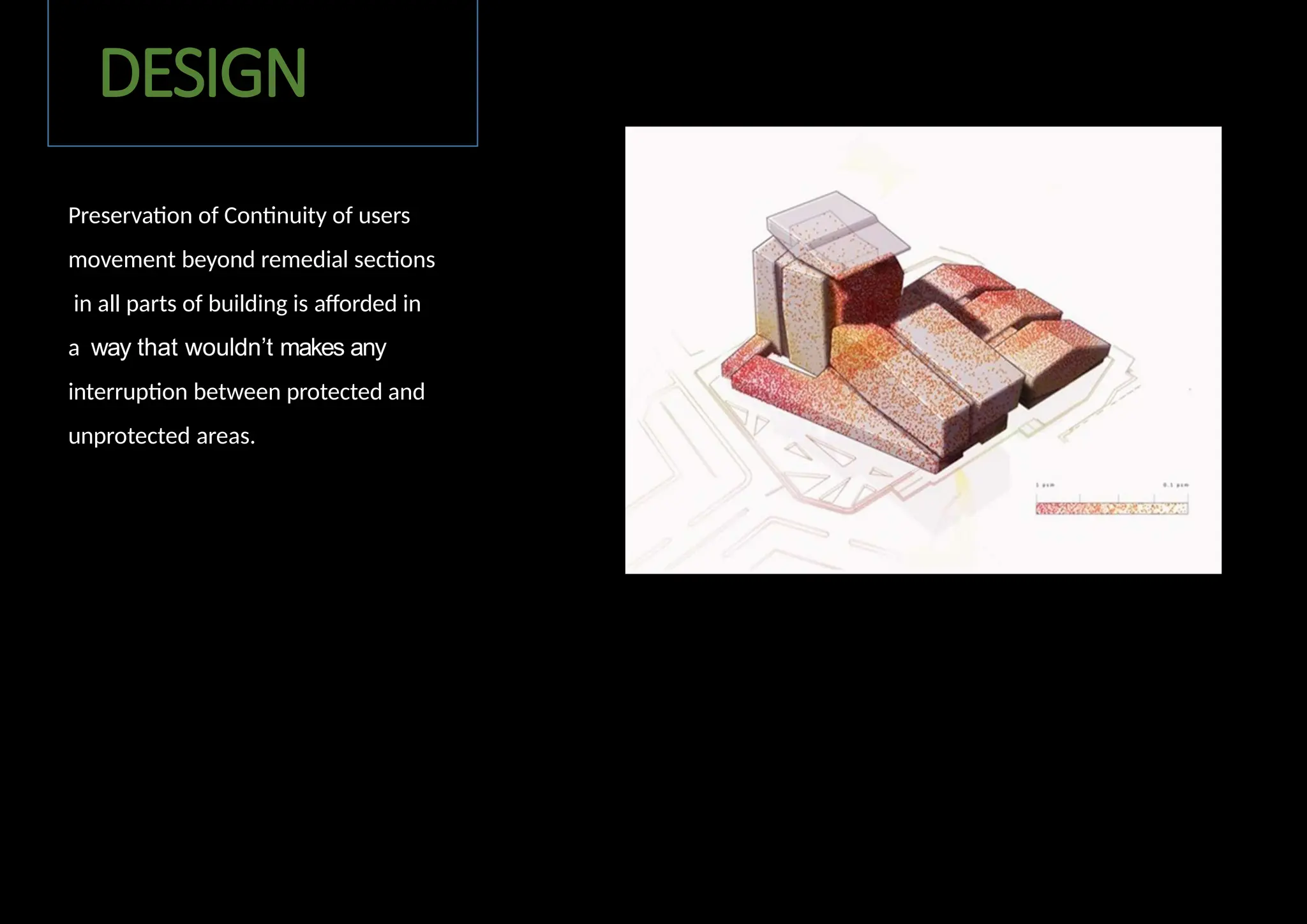
Preservation of Continuity of users
movement beyond remedial sections
in all parts of building is afforded in
a way that wouldn’t makes any
interruption between protected and
unprotected areas.
Main interior
route
Main interior route
Skyline city continuity
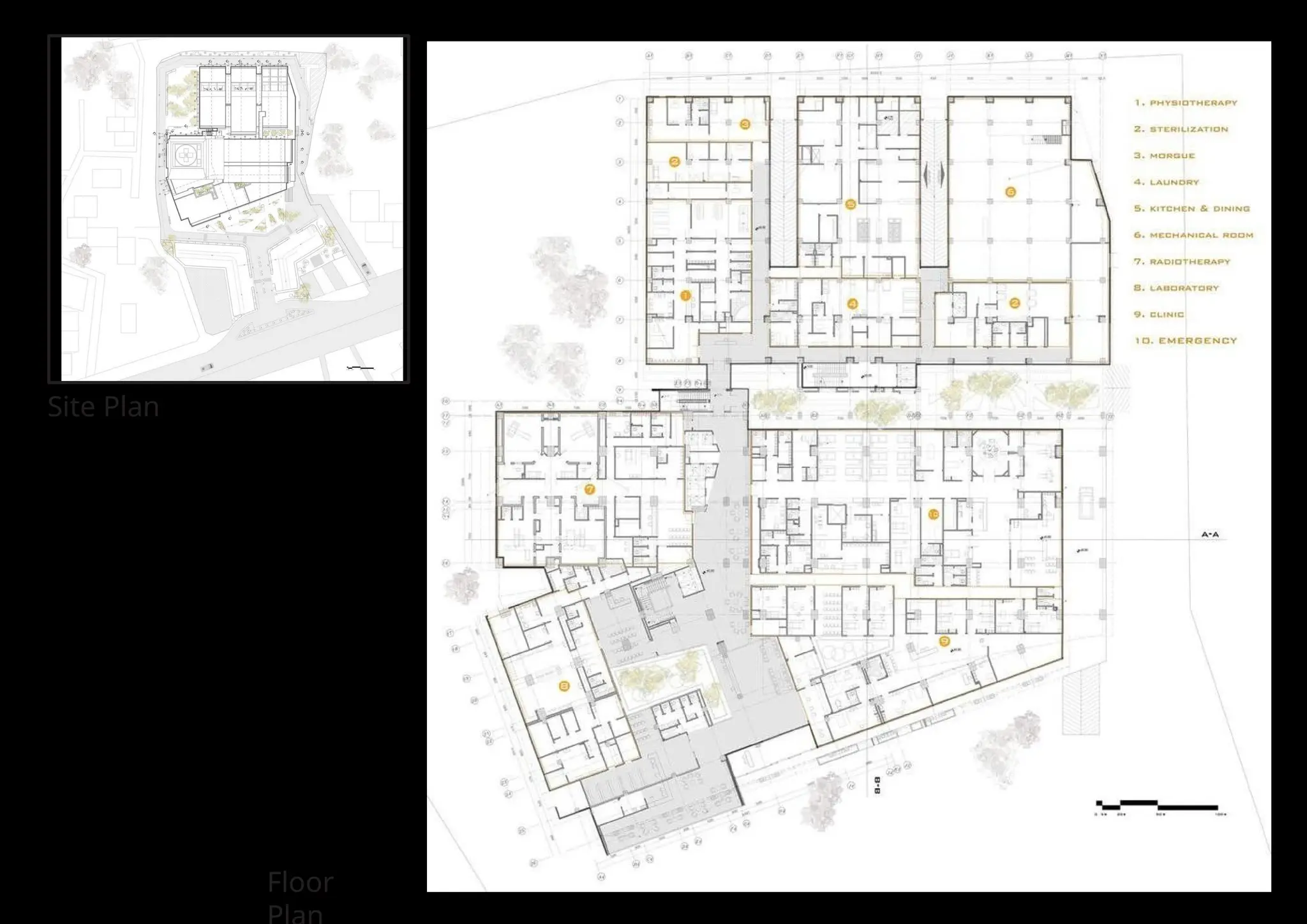
Site Plan
Floor
Floor
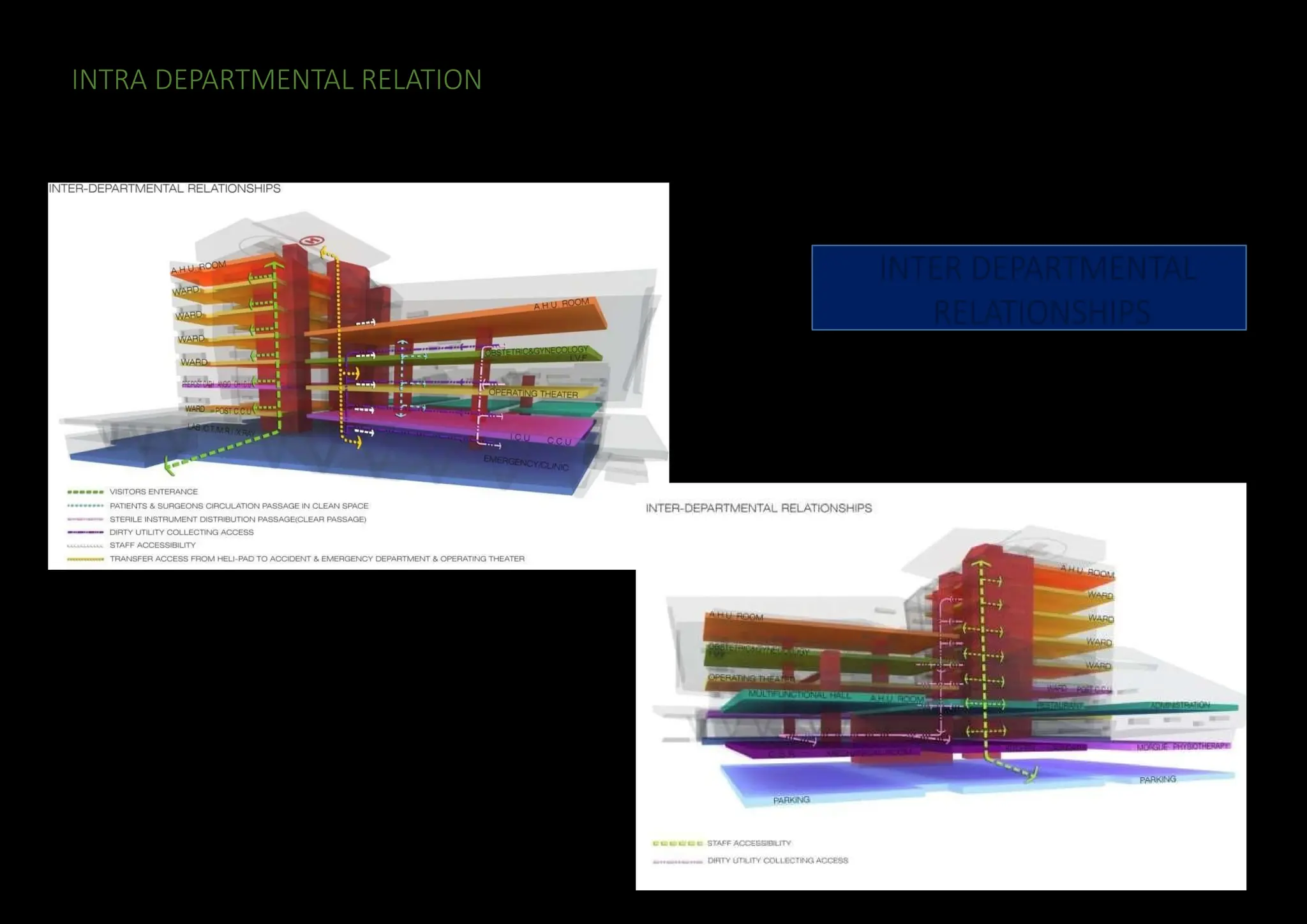
INTRA DEPARTMENTAL RELATION
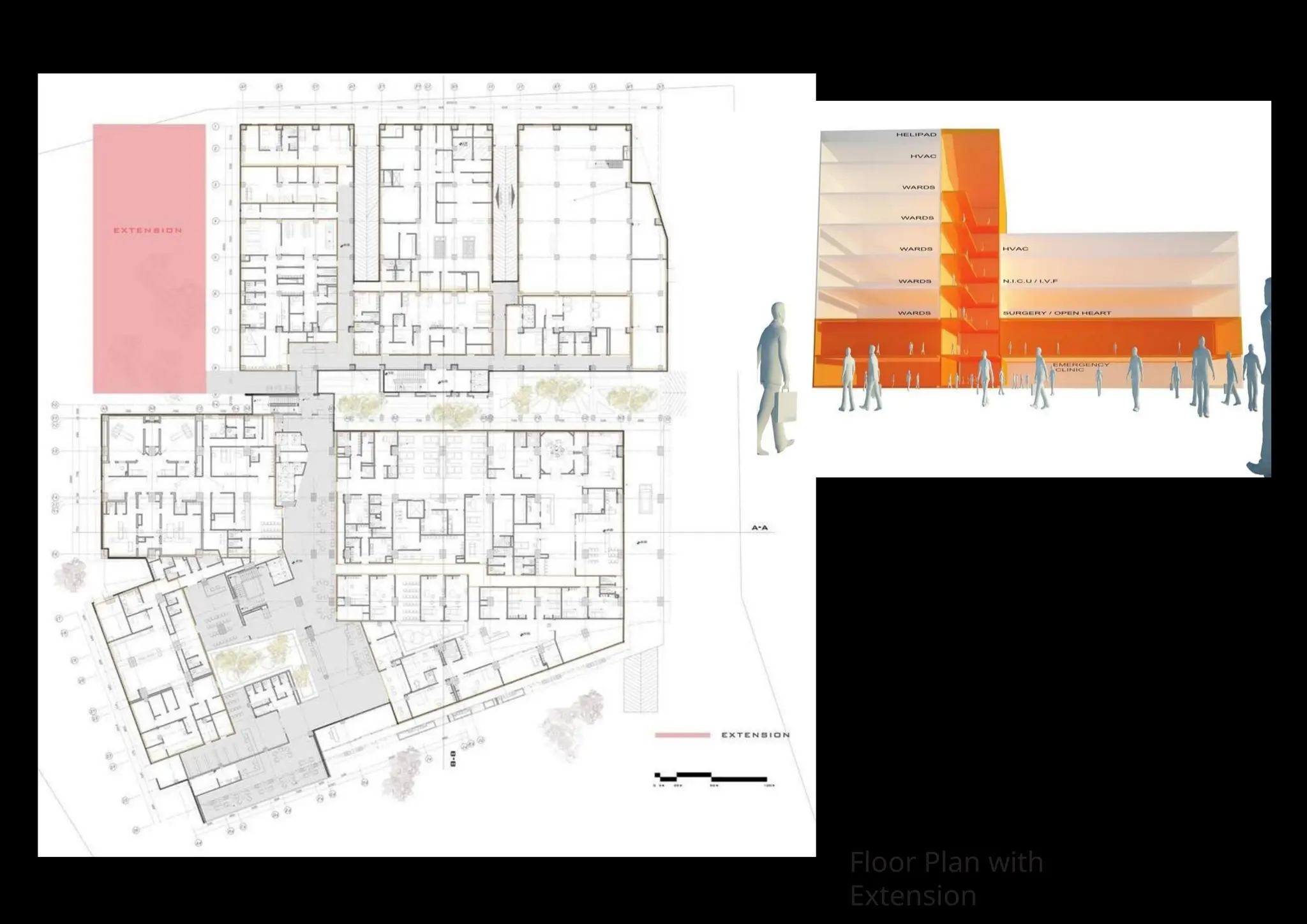
Floor Plan with
Extension
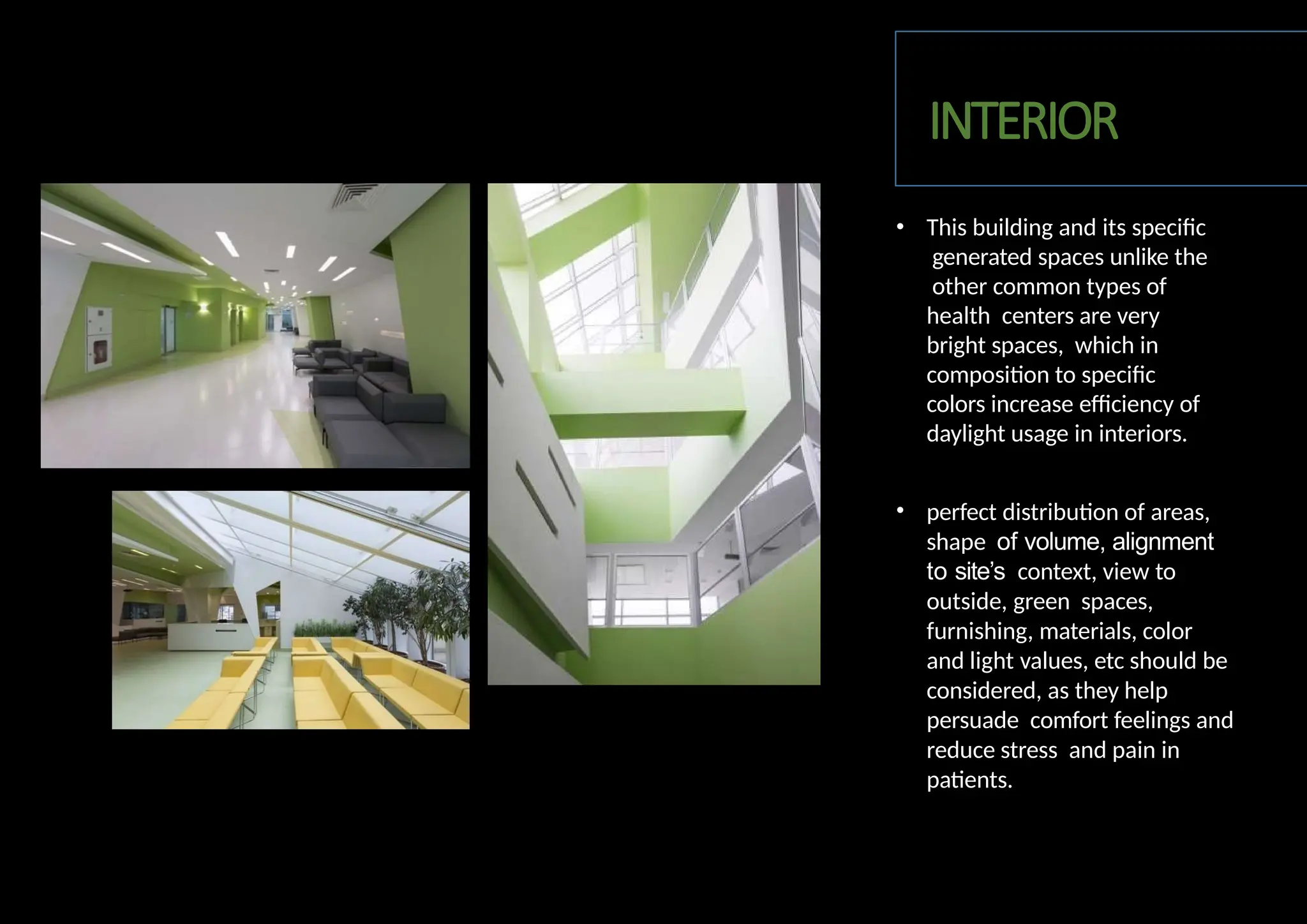
• This building and its specific
generated spaces unlike the
other common types of
health centers are very
bright spaces, which in
composition to specific
colors increase efficiency of
daylight usage in interiors.
• perfect distribution of areas,
shape of volume, alignment
to site’s context, view to
outside, green spaces,
furnishing, materials, color
and light values, etc should be
considered, as they help
persuade comfort feelings and
reduce stress and pain in
patients.
INTERIOR
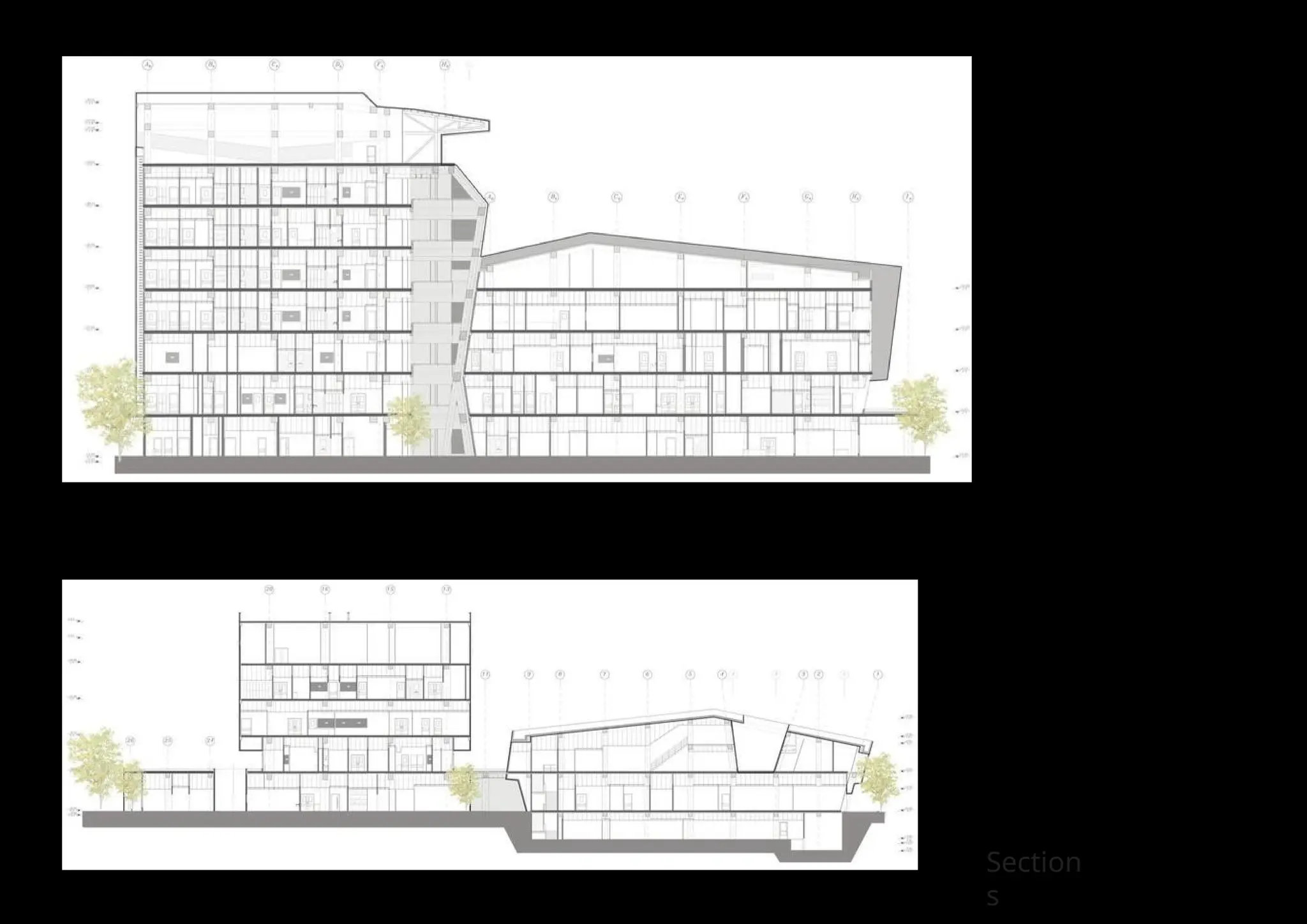
Section
s
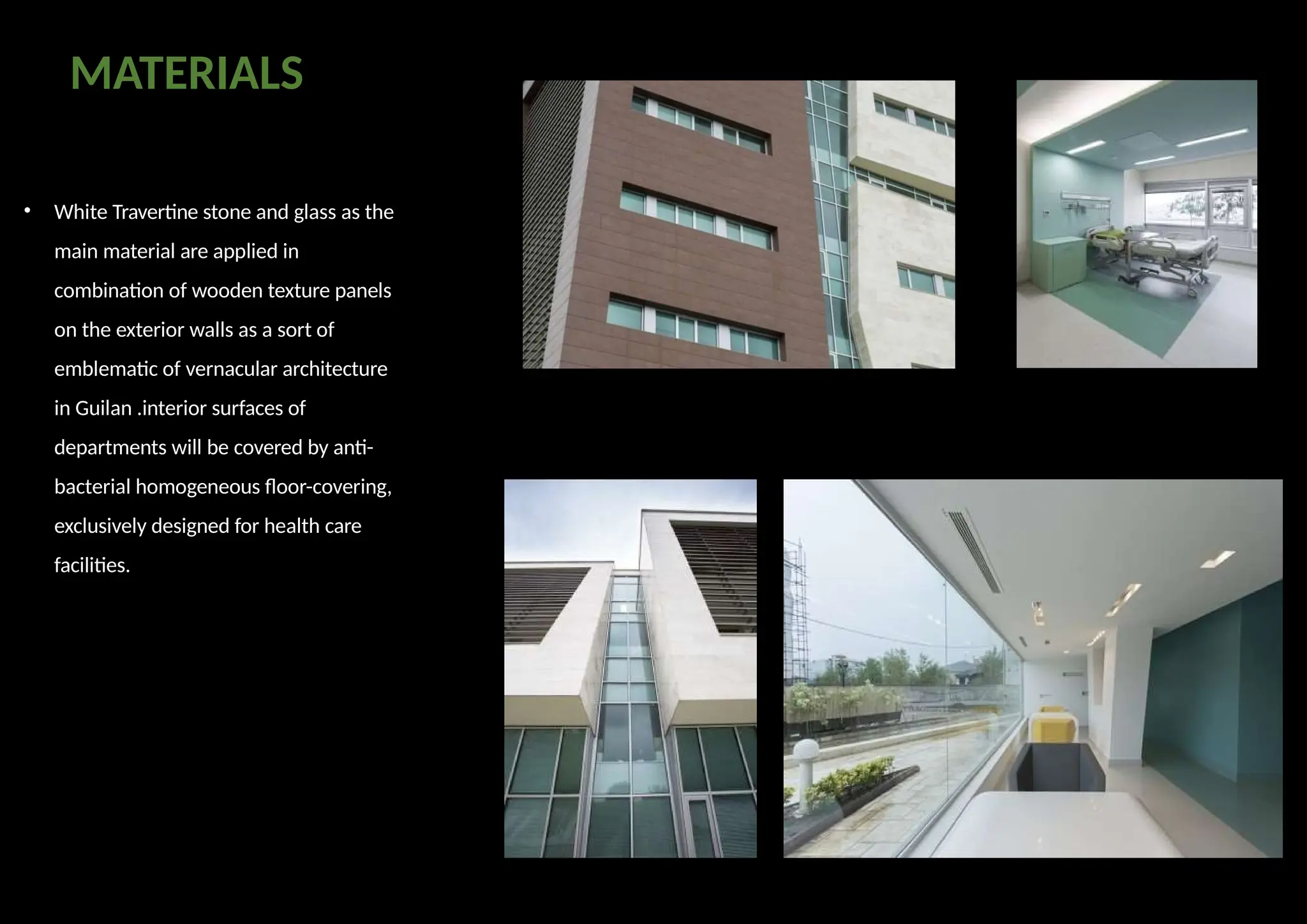
• White Travertine stone and glass as the
main material are applied in
combination of wooden texture panels
on the exterior walls as a sort of
emblematic of vernacular architecture
in Guilan .interior surfaces of
departments will be covered by anti-
bacterial homogeneous floor-covering,
exclusively designed for health care
facilities.
MATERIALS
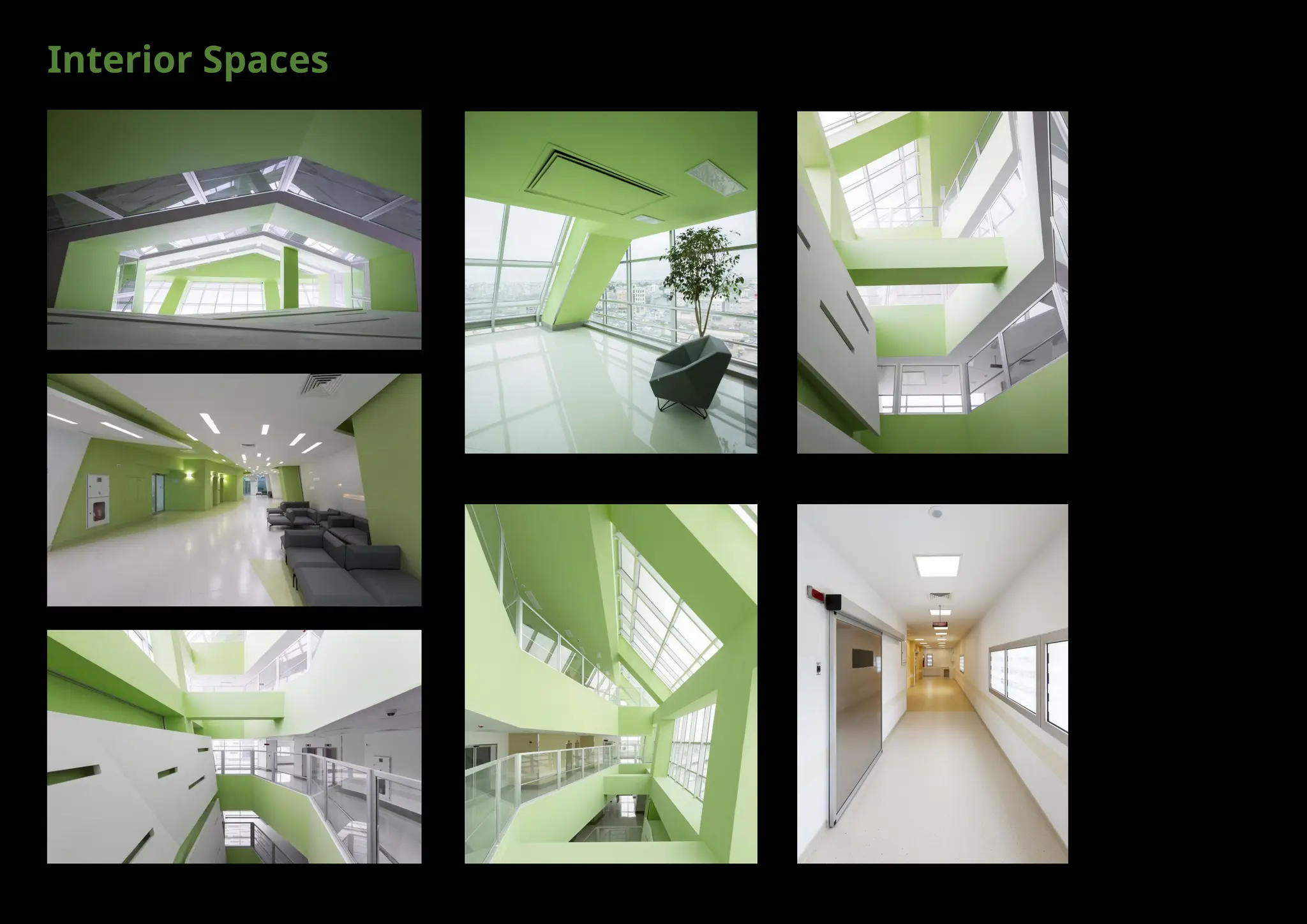
Interior Spaces
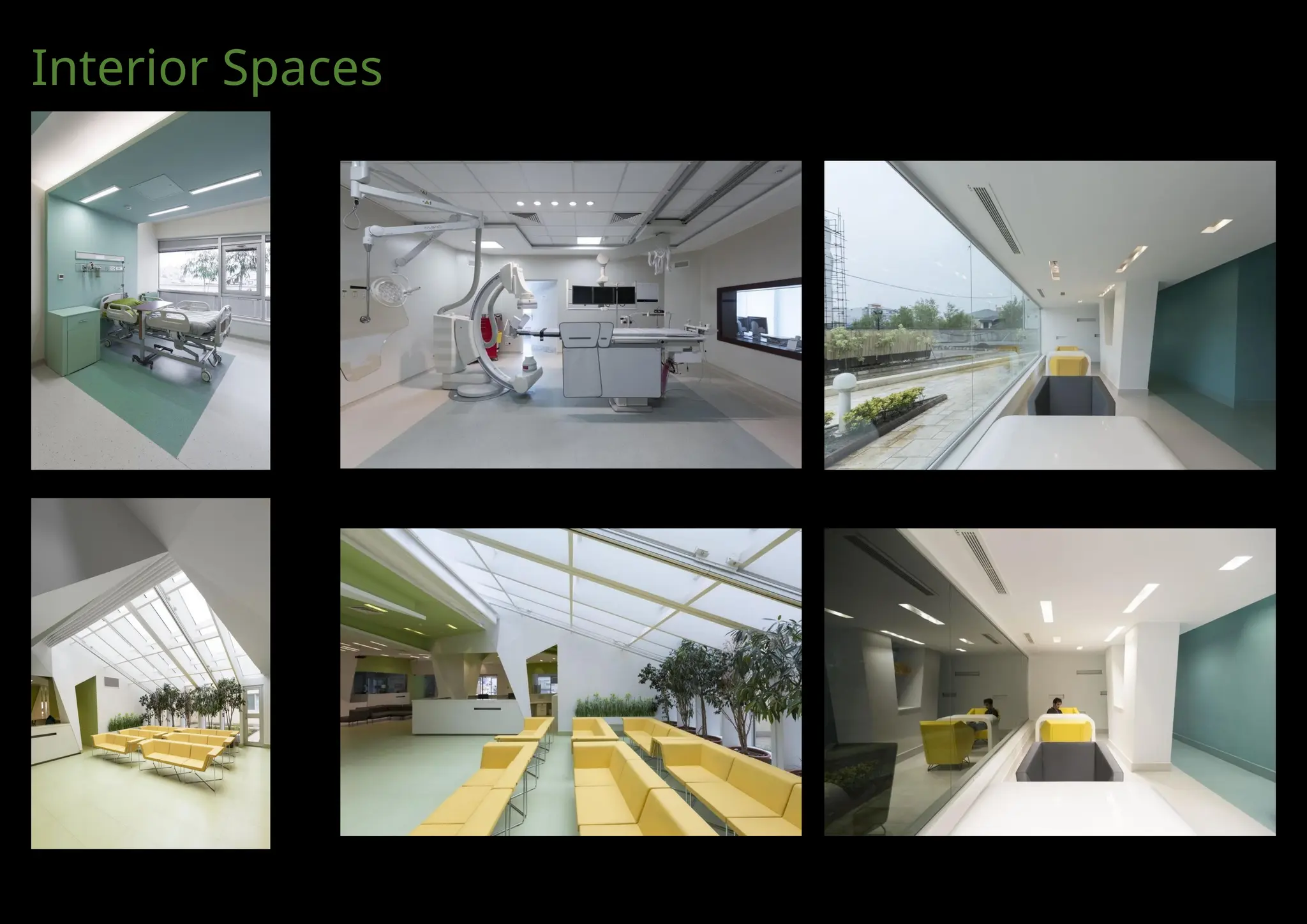
Interior Spaces
CASE STUDY -2
Cleveland Clinic Abu Dhabi
INTRODUCTION
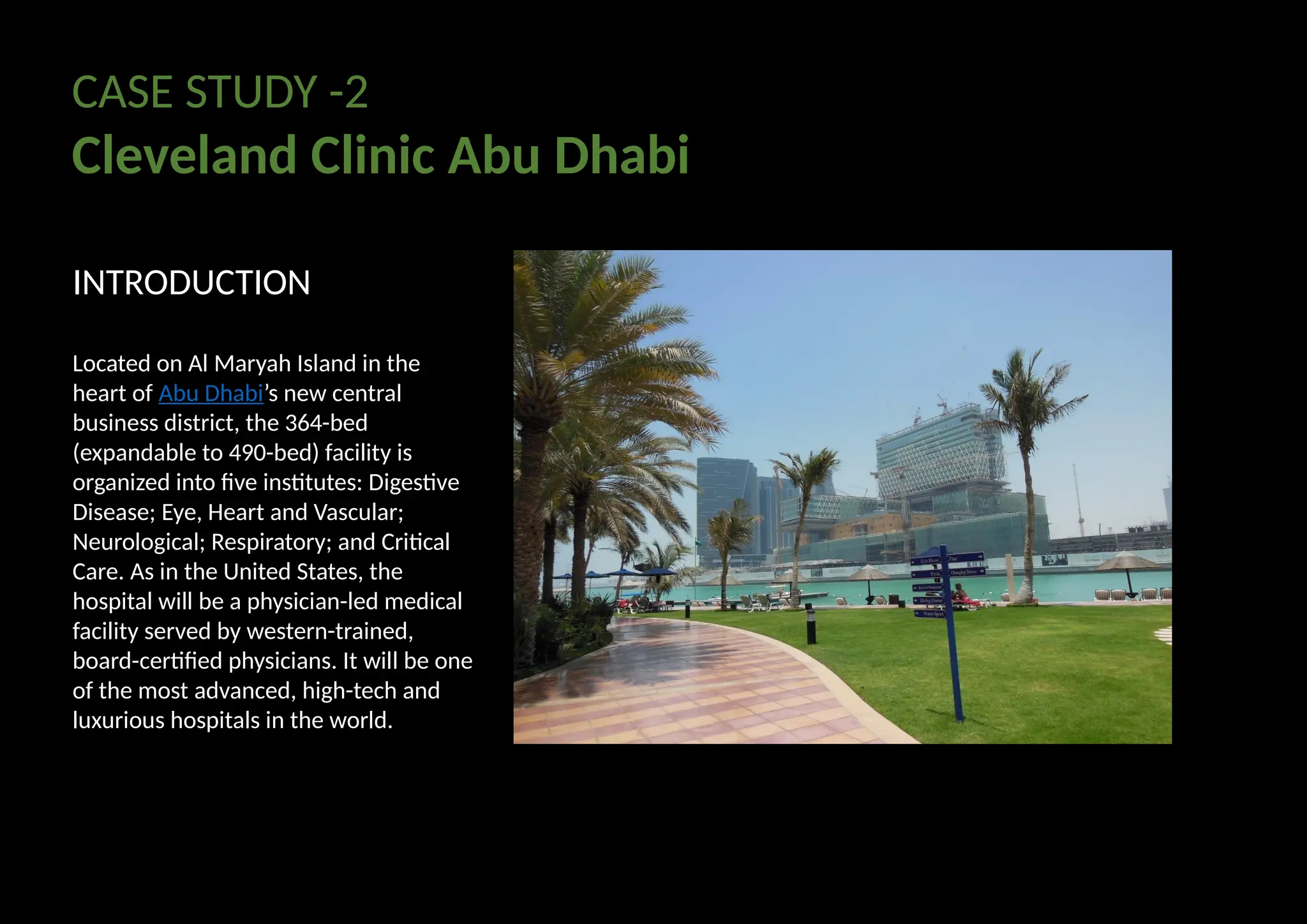
Located on Al Maryah Island in the
heart of Abu Dhabi’s new central
business district, the 364-bed
(expandable to 490-bed) facility is
organized into five institutes: Digestive
Disease; Eye, Heart and Vascular;
Neurological; Respiratory; and Critical
Care. As in the United States, the
hospital will be a physician-led medical
facility served by western-trained,
board-certified physicians. It will be one
of the most advanced, high-tech and
luxurious hospitals in the world.
HISTORIC BACKGROUND
In the 1970s, when the king of Saudi Arabia
needed a heart operation, he did what Middle
East royals had been doing for decades: He
traveled to the United States. After his successful
procedure at the Cleveland Clinic, more wealthy
patients from the region followed, culminating in
thousands receiving care at the hospital. But
starting in 2012, these patients will no longer
have to pull out a passport to get Western
medical treatment. The Cleveland Clinic joins
other major U.S. institutions, such as Johns
Hopkins and the Mayo Clinic, in bringing its brand
of medicine to the Middle East. When it opens in
2012, Cleveland Clinic Abu Dhabi will be a multi-
specialty hospital on a par, its owners hope, with
the world’s top medical institutions.
DESIGN
“The term ‘hospital of the future’ is used
quite often, but I can’t imagine another
facility that reflects that phrase more than
the Cleveland Clinic Abu Dhabi,” says
Mohammed Ayoub, lead HDR designer for
the project. “It’s a building that blends
cutting-edge technology, evidence-based
design, world-class care, and Arabic culture
with elegant architecture—creating a facility
that looks more like a seven-star hotel than a
hospital.”
DESIGN CONCEPT
The image of the campus, with its verdant
gardens, glowing double-skinned patient tower,
distinctive diamond-glazing, modern interiors
and colorful massing exemplifies the best of what
medical care can be. The design is overlaid with a
suite of cultural references that ground the
project firmly in Abu Dhabi. The color palette
represents surrounding natural elements, such as
the turquoise of the Gulf waters and the array of
neutrals of the desert, and interior patterns and
motifs reflect the local vernacular, as seen in
Arabesque patterned screen elements
throughout the building
To avoid the characteristic maze of
many hospitals, each healthcare
component is expressed in an individual
architecture form, arranged to express
the continuum of healthcare— the
Cleveland Clinic model. The blocks are
elegantly stacked around a central
reflecting pool; the entire design
literally and figuratively founded on
water, a universally recognized source
and symbol of serenity and healing.
This grouping of blocks creates
efficiencies for the staff and obvious
wayfinding for visitors, replacing
winding hallways with sleek glass
walkways that connect the inpatient
spaces with the 340-exam room
outpatient clinic, 210 faculty offices,
conference center, simulation center
and administrative building.
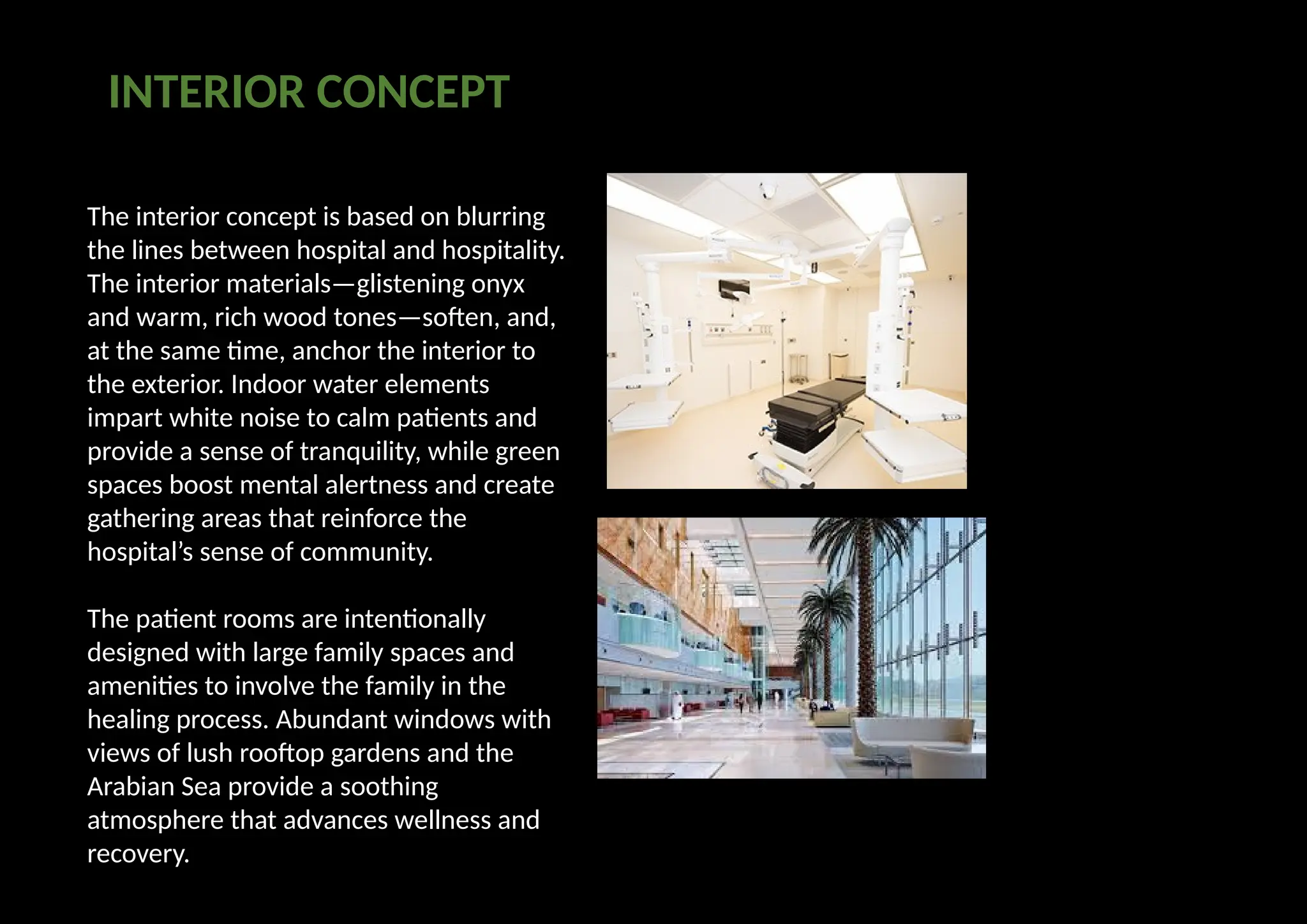
The interior concept is based on blurring
the lines between hospital and hospitality.
The interior materials—glistening onyx
and warm, rich wood tones—soften, and,
at the same time, anchor the interior to
the exterior. Indoor water elements
impart white noise to calm patients and
provide a sense of tranquility, while green
spaces boost mental alertness and create
gathering areas that reinforce the
hospital’s sense of community.
The patient rooms are intentionally
designed with large family spaces and
amenities to involve the family in the
healing process. Abundant windows with
views of lush rooftop gardens and the
Arabian Sea provide a soothing
atmosphere that advances wellness and
recovery.
INTERIOR CONCEPT
MATERIALS
HDR opted for primarily wood,
stone, and metal finishes. A
warmcolored onyx animates
both exterior and interior
surfaces. “The interior and
exterior designs were
considered together,” he
explained. Often in hospitals,
the level of interior beauty
diminishes with each
successive higher floor plate
PLAN
PLAN
The characteristic maze-like layout of other healthcare facilities was avoided by housing
each healthcare component in its own individual architectural form. The straightforward
stacking of the forms creates efficiencies for staff, intuitive wayfinding for visitors and an
architectural icon that can be seen for miles
THANK YOU

case studies with complete guide to design a hospital ptx

  • 1.
    INTRODUCTION TO HOSPITAL PRESENTED BY:- ALIAZHAR VI SEM AR-19-03 PRESENTED TO:- SIR SAUD KAMAL, MAAM GOHAR MURAD
  • 2.
    INTRODUCTION: - • • A hospitalmay be defined as an institution that is built, staffed, and equipped for the diagnosis of disease; for the treatment, both medical and surgical, of the sick and the injured; and for their housing during this process. The modern hospital also often serves as a center for investigation and for teaching. HISTORY: - • • • As early as 4000 BCE, religions identified certain of their deities with healing. The temples of Saturn, and later of Asclepius in Asia Minor, were recognized as healing centers. Brahmanic hospitals were established in Sri Lanka as early as 431 BCE, and King Ashoka established a chain of hospitals in Hindustan about 230 BCE. Around 100 BCE the Romans established hospitals for the treatment of their sick and injured soldiers. RUINS OF THE SANCTUARY OF ASCLEPIUS AT COS, GREECE
  • 3.
    TYPES: - Hospitals canbe categorized on the basis of its functionality, size, location and ownership :- 1.Functionality Functionality refers to whether the hospitals are general-purpose, teaching hospitals, acute care facilities, long-term hospitals, community hospitals, research hospitals or if they provide trauma care for patients. It refers to how the hospitals themselves function within the communities they serve. 2.Size There are three primary classifications when it comes to size: Small hospitals: Fewer than 100 beds Medium hospitals: 100 to 499 beds Large hospitals: 500 or more beds 3.Location Hospitals can also classify by their locations. Rural hospitals aid smaller communities and often have limited access to advanced equipment or specialized procedures and techniques. Since they also face competition, urban hospitals serve larger metropolitan areas and must often offer a wide degree of versatility when it comes to treatment options and patient experience. 4.Ownership Knowing who owns the hospital will also tell a great deal about how the hospital will operate. Some hospitals are part of larger networks that offer a streamlined approach to management. While some physicians feel this improves efficiency and patient experience, some feel it removes the emphasis from the patient and makes treatment less personal.
  • 4.
    COMPONENTS: - Patient management Itis used to control patient flow. Appointment module in hospital management It arranges the schedule of doctors due to the patients’ application. It helps to organize the availability of medical specialists at any convenient time. Facility management It is responsible for tracking and maintaining the room availability, the occupancy status as well as various kinds of administrative documentation. Inventory management It controls the amount of clinic inventory. Staff Management It provides the human resources administration. Accounting It organizes the financial affairs of both customers and the medical institution. Insurance services integration It can record patients’ insurance details. Medicine management It contains the list of drugs that usually used for the specific treatment. Laboratory and tests management It shows the test results of the particular patient. Reporting Report management part stores the already processed detailed information. Helpdesk & support It specializes in handling different issues, problems, and requests.
  • 5.
    PLANNING CONSIDERATION: - Followingfactors should be considered while planning a hospital building :- 1. Efficiency and Cost-Effectiveness An efficient hospital layout should promote staff efficiency by minimizing distance of necessary travel between frequently used spaces; allow visual supervision of patients; provide an efficient logistics system for supplies and food (and removal of waste); make efficient use of multi-purpose spaces and consolidate spaces when possible. 2.Flexibility and Expandability Medical needs and modes of treatment will continue to change. Therefore, hospitals should follow modular concepts of space planning and layout; use generic room sizes and plans as much as possible; use modular, easily accessed, and easily modified mechanical and electrical systems; and be open-ended, with well-planned directions for future expansion. 3.Therapeutic Environment Patients and visitors should perceive a hospital as unthreatening, comfortable, and stress-free. The interior designer plays a major role in this effort to create a therapeutic environment. This can be accomplished by using cheerful and varied colors and textures, by allowing ample natural light wherever feasible, by providing views of the outdoors from every patient bed etc.
  • 6.
    4. Cleanliness andSanitation Hospitals must be easy to clean and maintain. This is facilitated by appropriate, durable finishes for each functional space; careful detailing of such features as doorframes, casework, and finish transitions to avoid dirt-catching and hard-to-clean crevices and joints; and adequate and appropriately located housekeeping spaces. 5.Accessibility All areas, both inside and out, should comply with all standards and minimum requirements of Americans with Disability Act, and ensure grades are flat enough to allow easy movement and sidewalks and corridors are wide enough for two wheelchairs to pass easily. 6.Security and Safety Hospitals have several particular security concerns, such as protection of patients and staff, hospital property and assets (including drugs), and also vulnerability to terrorism because of high visibility. Security and safety must be built into the design with these things in mind. 7.Sustainability Hospitals are large public buildings that have a significant impact on the environment and economy of the surrounding community. They are heavy users of energy and water and produce large amounts of waste. Because of this, sustainable design must be considered when designing and building hospitals.
  • 7.
    PLANNING CONCEPTION :- Following concepts should be considered while planning a hospital building :- 1. LOCATION • • • • The site should offer sufficient space for self-contained residential areas and hospital departments. It should be a quiet location with no possibility of future intrusive development. No loss of amenity should result from fog, wind, dust, smoke, odors or insects. The land must not be contaminated and adequate open areas for later expansion must also be planned. 2.ORIENTATION The most suitable orientation for treatment and operating rooms is between N-W and N-E. For nursing ward facades, S to S-E is favorable : pleasant morning sun, minimal heat build-up, little requirement for sun shading. E and W facing rooms have comparatively deeper sun penetration, though less winter sun. The orientation of wards with a short stay is not so important. 3.CONCEPT • An existing hospital is to be expanded; the design includes 4 building phases. • A large enclosed area containing a park will be created to allow windows to be opened without the need to tackle problems of noise protection.
  • 8.
    FORMS OF BUILDING: - • • • • • The form of a building is strongly influenced by the choice of access and circulation routes. The form can either be a spine form with a branching sections (individual departments) or a radially outwards from a central core. Consideration must be given to future expansion. Self-contained circulation routes should be avoided. An effective arrangement would be as follows :-  Top floor with helipad, air-conditioning plant room, nursing school, labs  2/3 floor with wards;  1 floor with surgical area, central sterilization, intensive care, maternity, children’s hospital;  Ground floor with entrance, radiology, medical services, ambulance, entrance for bedridden patients, emergency ward, information, administration, cafeteria.  Basement with stores, physiotherapy, kitchen, heating and ventilation plant room, radio-therapy, linear accelerator;  Sub-basement with underground garage, electricity supply.
  • 9.
    POSSIBLE ROOM SCHEDULEFOR A LARGE HOSPITAL: - • • • Room schedule must be drawn in order to generate an appropriate structural grid and ground plan. The specifies of the room schedule must be discussed with the users. An overview of the size of the individual operations centers can be obtained using reference area values.
  • 10.
    DESIGN CONSIDERATION: - (Corridors,Doors, Stairs, Lifts) 1. CORRIDORS :- • • • • • • • It must be designed for the max. expected circulation flow. Generally, access corridors must be at least 1.5m wide. Corridors in which patients will be transported on trolleys should have a min. width of 2.25m The suspended ceiling in corridors may be installed upto 2.40m. Windows for lighting and ventilation should not be further than 25m apart. The effective width of corridors must not be constricted by projections, columns or other building elements. Smoke doors must be installed in ward corridors in accordance with local regulations 2. DOORS :- • • • • The surface coating of doors must withstand the long-term action of cleaning agents and disinfectants. They must be designed to prevent the transmission of sound, odours and draughts. The clear height of doors depends on their types and function : Normal doors with 2.10-2.20m of height; vehicle entrances, oversized doors with 2.50m of height; transport entrances with 2.70-2.80m height and min. height on approach roads should be at least 3.50m.
  • 11.
    3. STAIRS :- • • • • • • • Stairsmust have handrails on both side without projecting tips. Winding staircases cannot be included as part of the regulatory staircase provision. The effective width of the stairs and landings in essential staircases must be a min. of 1.50m and should not exceed 2.50m. Doors to the staircase must open in the direction of escape. Max. required riser is 170mm. Min. required tread depth is 280mm. Rise/tread ratio of 150:300mm is better. 4. LIFTS :- • • • • • Separate lifts must be provided for some of the purpose from transportation of people, medicines, laundry, meals and hospital bed between floors for hygiene and aesthetic reasons. At least 2 lifts must be provided for transporting beds in buildings in which care, examination or treatment areas are accommodated on upper floors. The elevator cars of these lifts must be of a size that allows adequate room for a bed and 2 accompanying people. Lift shafts must be fire-resitant. There should be a min. of 2 smaller lifts for portable equipment, staff and visitors with 0.90X1.20m as clear dimension of lift car and 1.25X1.50m as clear dimension of shaft.
  • 12.
    RELATIONSHIP BETWEEN DIFFERENTDEPARTMENTS IN HOSPITAL: - The above image shows the general hospital relationships between the administration, ID, OPD, diagnostic & treatment department, research & teaching department and other services. The above image shows the major clinical relationships between different departments in a large hospital.
  • 13.
    HOSPITAL PLANNING :- A hospital building consists of different department : Emergency department, Surgery area, Imaging unit etc. • 1. EMERGENCY DEPARTMENT :- • The ED is One of the “Front Doors” to a Hospital. • Many patients visit the ED first, and are oftentimes admitted as inpatients. The ED has two main entrances – one for walk-in patients, and one for those brought in by ambulance. • The ED has access to the surgery and imaging departments to continue care for patients, and is a securable unit in the event of a criminal event of major emergency. • • This diagram shows the typical layout for an ED. This diagram shows the ambulance drop off, the public access walk-in and vehicle drop off, the various sub- departments within the ED, as well as access points and the relationships between each area.
  • 14.
    • • • • • Each treatment roomis split into 3 zones – the patient zone is centrally located, with a family zone and caregiver zone on each side. This allows the family to be comfortable while they support the patient, the staff to move with ease as they treat the patient. The caregiver zone is located toward the corridor so staff do not have to move through family members. The nurse’s station is typically centrally located to a cluster of treatment rooms. This allows for visual observation of patients and traffic moving through the department. • • • • • Above picture shows the floor plan of the Van Wert County Hospital’s ED Addition. This shows the relationship between the ED and the imaging and lab departments. This is important because as patients leave the ED for imaging, it should be close by. With the imaging department close by, they’re easily transported directly to where they need to be. Likewise, the lab is nearby for staff to move quickly to the ED to collect information from patients and gain results in a timely manner.
  • 15.
    2. SURGICAL DEPARTMENT:- • • • • • For a typical surgery department, you’ll need access for both inpatients and ambulatory outpatients. It’s desirable to have a separate exit point for outpatients to allow them more privacy as they leave post-procedure. Key amenities that should be available to patients and family in the surgery department include food service, consultation rooms, restrooms, and the chapel, among other spaces. Departments should be located and designed to prevent non- related public and staff foot traffic. Additionally, space should be planned to allow for future growth. • • • • There are 3 distinct zones: unrestricted, semi-restricted, and restricted. An unrestricted zone is a waiting room or reception area. A semi-restricted zone includes the quarters that lead to the restricted areas, as well as sterile storage, surgical prep sinks, areas for processing surgical instruments, and storage for surgical attire. Traffic in these areas is limited to staff and patients in surgical attire. The restricted zones are operating rooms, procedure rooms, and if included the clean core, which is a centrally located sterile zone located between surgical rooms. Surgical attire, including masks, is required in a restricted zone.
  • 16.
    3. IMAGING DEPARTMENT:- • • • • • An ideal imaging department is designed with at least one exterior wall for magnet replacement in the MRI room over the lifetime of the hospital. These departments are more secure to keep the public out due to safety reasons. For example, there is a potential for visitors of patients to walk into an imaging room and expose themselves to radiation or high magnetic fields. To avoid this, the imaging department is more secure and monitored. As much as possible, the imaging department should be located adjacent to the Emergency Department for efficient and immediate diagnostics for critical patient cases.
  • 17.
    SURGICAL DEPARTMENT: - FUNCTIONAND LAYOUT :: • • Should be located close to the intensive care department, the recovery room and the central sterilization area. They are best located centrally in the core area of the hospital ORGANISATION :: • Every surgical department requires the following rooms: OT (40-48sq.m.) entry room (15-20sq.m.) exit room (15-20sq.m.) washroom (12-15sq.m.) equipment room (10-15sq.m.) • Essential to surgical department are a staff lobby, patient lobby, clean work corridor, an anaesthetic workroom, waste lobby, supply lobby, standing area for 2 operating trolleys and recovery room. Flow chart of patient flow at surgical department
  • 18.
    MAIN SURGICAL ROOMS:- TYPES SIZE LOCATION REQUIREMENTS Anaesthetics room 3.80X3.80m _ • Electric sliding doors into OT with clear width of 1.40m • Equipped with a refrigerator, sluice, rinsing line, cupboards, connections for anaethesia equipment and emergency power. Anaesthetic discharge room _ Identical to the anaesthetics room. • Door to working corridor should be a swing door with a clear width of 1.25m Washroom Min. width should be 1.80m _ • For each OT, there should be 3 non-splash washbasins with foot controls. Sterile goods room 10sq.m./OT Must be accessed directly from OT. • Sufficient shelf and cupboard space. Equipment room Approx. 20sq.m. Direct access to OT _ Substerilisation room _ _ • Must have a non-clean area for non-sterile material and clean area for sterile material. • Equipped with a sink, storage surface, work surface and steam sterilisers. Plaster room _ Not located in surgical zone. _ The OT should be designed to be as square as possible. A suitable size would be 6.50X6.50m, with a clear height of 3.00m and an extra height of 0.70m for air conditioning and other services. Source ::
  • 19.
    TYPES SIZE LOCATIONREQUIREMENTS Nurses lounge Depend on size of surgical department _ • Must offer sufficient seating, cupboards and a sink Nurses workstation _ Located centrally • Have large glass screens to allow the working corridor to be viewed. • Must have a desk, cupboards. Dictation room Max. 5sq.m. _ • Not absolutely necessary. Pharmacy Min. 20sq.m. _ • Provide rotating shelf system if possible to save space. Cleaning room Max. 5sq.m. Close to OT _ Standing area for clean beds _ Close to patient demarcation lobby • One additional clean bed per operating bed. WCs _ Not located in surgical area. _ POST-OPERATIVE FACILITIES: - DEMARCATION : - • It is an area formed by the intermediate zone between the care area and the examination/treatment area. • It may be in the form of patient lobby, staff lobby, combined staff and visitore lobby, supply and disposal lobby, gown lobby, lobby before intensive care rooms.
  • 20.
  • 21.
    CARE AREA: - 1.Normal care units are used for general inpatient care with a short length of stay. 2. Intensive care groups for patient under constant observation and should be larger than normal care rooms. 3. Special care units for patients with special needs (newborn babies, people with infectious diseases etc. and length of stay for patients is longer than average. CARE DEPARTMENTS :: • • Each care area should contain no more than 16-24 beds and fewer beds per care group in the intensive care and special care areas (6-12 beds) Two workstations are often placed together and connected to a large central nurses’ service area. FUNCTION AND STRUCTURE :: • Individual care area are attached to the specific medical faculties and therefore need to be planned as separate units. • Each station must have at least one assistant doctor’s room and two doctors' room. LAYOUT OF ROOMS :: • Medical rooms and washrooms should be accessed from the main station corridor and must be easily supervised from the glazed nurses’ workstation.
  • 22.
    NURSING TEAMS :: • • 18-24patients must be served by an independent nursing team. It is sensible to plan a direct connection to nurse kitchenette & rest room. WET CELLS :: • Provide separate washrooms if possible. SIZE OF THE PATIENT ROOM :: • • Patient’s beds must be accessible from three sides. Smallest size of 1 bed-room is 10sq.m., min. of 8sq.m. per bed for a two- and three- bedroom. • Room must be wide enough for a second bed to be wheeled out of room. OTHERS :: • • • There should be strip made of plastic or wood ( at least 400-700mm above floor level) around the walls to protect the wall from damage. The patient’s cupboards must be large enough to store all of the belongings they have with them. The room doors must be 1260X2130mm in size.
  • 23.
    TYPES SIZE LOCATIONREQUIREMENTS Non-clean workroom Approx. 10sq.m. _ • Contain a sink and sluice, preferably in stainless steel. • Fully tiled walls are recommended. Nurses work area About 25-30sq.m. Located centrally • Corridor wall must be glazed but fireproofed Rest room/kitchenette Roughly 15sq.m. _ • Consider the inclusion of smoking area in larger hospitals. Station doctor About 16-20sq.m. _ • Should be ample shelving and an examination couch Clean workroom About 10sq.m. Close to OT • Equipped with fixed shelving (600mm deep) or a flexible storage system Patients’ bathroom Suitable for wheelchair users _ • Equipped with a tub which is accessible from three sides to ease the lifting of patients. Plant room Approx. 8sq.m. _ • Equipped with a fuseboard. Patients’ lounge Approx. 22-25sq.m. Serve as a general meeting place for patients. • Should emulate a domestic environment.
  • 24.
    TREATMENT AREA: - e Thetreatment areas should face north and have central access. OBSTETRICS :: • It is essential to have a treatment room next to the delivery rooms. • It is also sensible to position this near to the surgery and intensiv care departments. ROOM PLANNING :: • • Among the central delivery rooms is an observation room with large glass windows. There should be a clean workroom (12sq.m.) a non-clean workroom (12sq.m.) a treatment room (12sq.m.) a mid-wives workstation (20sq.m.) a staff rest room (15sq.m.) and staff & patient WCs. INTERNAL MEDICINE TREATMENT AREA:: • • This can encompass cardiology, angiology, pulmonology, endocrinology and metabolism and gastroenterology. The basic facilities comprise examination rooms (25sq.m.) a secretarial/administration office (20sq.m.) between the senior physician’s room (15-20sq.m.) and the chief physician’s room (20-25sq.m.) an archive room and patient waiting areas. Source ::
  • 25.
    RADIOLOGY :: • • • • Itincludes X-ray diagnosis, radiotherapy and nuclear medicine. • It should always be close to the ambulance entrance. • It is sensible to plan these areas on the ground or basement floor. • The size of the rooms depends on their use and what they contain: sonography, mammography and jaw X-ray requires about 12- 18sq.m. whereas standard X-ray and admission rooms need to be 20-30sq.m. The access route for patients should be through two changing cubicles, and a wide door (at least 1250mm) is necessary. WCs should be installed in X-ray rooms. The admission room for computertomography must be about 35sq.m. in area. RADIOTHERAPY :: • • • • • Conditions diagnosed in the radiography department (e.g. tumours) are treated in radiotherapy. It comprises a reception and waiting area, doctors’ rooms (approx. 18sq.m.) a switch room (20sq.m.) a service room (20sq.m.), a film developing room (10sq.m.) stores and a cleaners’ room. Each treatment room requires a changing cubicle for patients. The clear height of the radiation rooms must be 4.30m. The thickness of walls constructed in concrete only should be 3.00m for treatment and examination rooms in the primary radiation area and 1.50m for rooms in the secondary radiation
  • 26.
    SUPPLEMENTARY DISCIPLINES: -Source :: TYPES SIZE LOCATION REQUIREMENTS Neufert Physiotherapy Wet area of an exercise pool (approx. 4X6m) Accessible through a main reception area Arranged on basement floor where natural lighting can be admitted through roof lights and light shafts. • A four cell bath, a butterfly bath, inhalation rooms, massage bath, hand and foot baths, and necessary subsidiary rooms. • Use slip-resistant tiles. • Provide division between wet and dry areas. • Provide changing rooms for men and women, wheelchair users WC, staff and patient WCs, rest rooms, linen stores, waiting areas, cleaners room and service room. • Include a gymnasium with a clear height of at least 3.00m Urological treatment Treatment room should be approx. 25- 30sq.m. Close to surgical department • Should contain an examination and treatment table for endoscopic investigations. • Equipped with a wash-basin, suspended irrigator, floor drainage, 2 changing cubicles and a WC. Eye treatment Treatment room should be approx. 25sq.m. _ • Should be darkened. • Includes a treatment chair, examination and diagnostic instruments, an examination couch, a wash-basin and a writing desk. ENT treatment Treatment room should be approx. 25- 30sq.m. Located in inpatient department. • Should contain a treatment table for examinations, a treatment chair, a steriliser, a sink and wash-basin, storage spaces for portable equipment. Dental treatment Treatment room should be approx. 25- 30sq.m. _ • Should be provided primarily in special ENT. • Contain a treatment chair with dental unit, a desk, a wash- basin, X-ray and anaesthetic equipment, a sink alcove.
  • 27.
    SUPPLIES AREA: - CENTRALSUPPLY :: • • The advantage of central supply/disposal level are uniform overall management, common stock control and the utilization of same transport system. For hygiene, it is imp. to separate clean and non-clean goods. STAFF ROOMS :: • In supplies area, changing and washrooms, WCs, cleaning rooms, storage rooms and rest rooms must be provided. STERILISATION :: • Central sterilization unit and surgical department should be located close together. • The central store for drugs and instruments must be closely linked to the central sterilization unit. DISPENSARY :: • • This consists of a work and a dispensing room (25sq.m.). Its is fitted out with a desk, washing facility, sink, weighing station and lockable cupboards, dry store, a cold store, a dressing materials room and a damp store. Source ::
  • 28.
    PHARMACY :: • • • Followingrooms are necessary : dispensary, materials room, drug store, lab, and an issue desk. The dispensary and lab should contain a prescription table, a work table, a packing table, and a sink. It should be close to lifts and the pneumatic tube dispatch system. CENTRAL BED UNIT :: • Every hospital should contain a bed unit in which the appropriate staff strip down, clean, disinfect and make up the beds. • For about 500 inpatients a bed unit for 70 beds should be provided. LAUNDRY PROVISION :: • The laundry hall should consists of a sorting and weighing area(15sq.m.) laundry collection room, wet working area (50sq.m.) dry working area (60sq.m.) detergent store (10sq.m.) sewing room (10sq.m.) and laundry store (15sq.m.) MEAL PROVISION :: • • • Preparation of normal food and special diets takes place separately. The clear height oh kitchen hall should be 4.00m and its size depends on the requirement and no. of patients. In the main kitchen area of 1sq.m. per person is needed. With min. of 60sq.m. for special diet kitchen, 30sq.m. for vegetable clean area, 5sq.m. for waste disposal, 8sq.m. for daily supplies room, a cold store of 8sq.m. and storage space of 15- 20sq.m.
  • 29.
    ELECTRICAL SYSTEMS :: • • • Providesufficiently wide doors (at least 1.30 clear width) Good ventilation must be provided. Anti-vibration foundation should be underneath the electrical units to reduce noise. CENTRAL GAS SUPPLY :: • • Initially, oxygen and nitrogen lines are supplied from steel cylinders but these are now replaced by ‘cold gasifiers’. These must stand in open air at least 5m from buildings. WORKSHOPS :: • Connected to a good yard are metalwork and electrical workshops (40sq.m.) with a materials store, spare parts store (20sq.m.) general store (60sq.m.) and standing area for transport equipment (15sq.m.) • Water treatment plant for hospital and the sterilization must be separated. COMMUNICATION CENTER :: • • The nurse intercom system allows a voice link between individual nurses workrooms and the patients’ room. Patients’ room are to be equipped with telephone, telephone paging and television. Source ::
  • 30.
    GENERALAREAS : - ADMINISTRATIONROOMS :: • • • They should be connected by corridor to the entrance hall and be close to the main circulation routes. The following requirements are based on a 100-bed occupancy level: in the administrative area, 7-12sq.m. per member of staff should be planned, rooms for dealings with patients and relatives need to be connected to reception, admissions and accounts (25sq.m.). There should be at least two reception areas (5sq.m.) for demarcation before the main reception, the cash-desk (12sq.m.) and accounts (12sq.m.) • Additional rooms needed include: an office for the administrative director (20sq.m.), a secretarial room (10sq.m.) an administrators’ office (15sq.m.) a nurses’ office (20sq.m.) a personnel office (25sq.m.) and central archives (40sq.m.) MAIN ENTRANCE :: • • The entrance hall, on the basis of the open-door principle, should be designed as a waiting room for visitors. The size of the hall depends on bed capacity and the expected number of visitors.
  • 31.
    CASUALTY ENTRANCE :: •A covered access road or closed hall overlooked by the administration department, but not visible from the main entrance, is preferred for casualty entrance. • An examination room for first aid (15sq.m.) a washroom (15sq.m.) an ante-room (10sq.m.) standing room for at least two stretchers and a laundry store. ARCHIVE AND STORE ROOMS :: • One possibility is to locate them in the basement and have a link with stairs. • Distinctions should be made between store and archive rooms for files, documentation and film from administration. COMMUNAL ROOMS :: • Dining rooms and cafeteria are best situated on ground floor, or on the top floor to give a good view, must have a direct connection to the server. • The connection to the central kitchen is by goods lift, which is not accessible to visitors. PRAYER ROOMS :: • These should preferably occupy a central location at the intersection of internal and external circulation routes but outside the care, treatment and supply areas. • They are often not oriented towards a particular faith.
  • 32.
    A&E and OPD:- • • • • A&E stands for the accident and emergency department, is for ambulant and bedridden patients. It is accessed via the emergency entrance. It consists of emergency treatment rooms (20-25sq.m.) equipped with operating tables, small operating lights, cupboards units with sink and patient cubicles. In addition, a plaster room with plastering bench and equipment and a shock treatment and recovery room must be available. PUBLIC HEALTH OFFICES :- • • • • They generally perform the functions of an outpatient clinic. They provide follow-up treatment of ambulant patients who have been discharged. Examination and treatment rooms are needed for initial diagnosis. Office rooms should be provided for doctors co- ordinating. Layout plan for emergency department
  • 33.
    MATERNITY AND NEONATALCARE: - • • This department provides continual physical, medical, psychological and social care for mothers and new babies. The division of maternity care is the same as for normal care: basic care, treatment care, patient care, administration and supply. FACILITIES AND SIZE OF CARE UNITS :- • • • • • •They are generally smaller than the units in normal care areas. It is advisable to limit the size per care unit to 10-14 bed spaces. The bed spacing must be increased to allow the space for a baby’s crib next to the beds. •The neonatal care units comprise : bed spaces for neonates, undressing/dressing area, baby bathing, weighing point, children’s nurse’s duty station and a trolley standing area. •Following room are also to be included in an incidental functional area: duty station for the ward sister, nurses’ lounge, kitchenette, doctors’ office, examination and treatment room, clean workroom, patient bathroom, day rooms for patient and visitors, storage space for equipment and cleaning materials, staff and visitors WCs.
  • 34.
    MORTUARY, PATHOLOGY: - SPECIALHOSPITALS: - • • • • The mortuary contains storage rooms and post-mortem rooms. There must be a coffin store, refrigerated storage for corpses, an area for laying out and undertakers and changing facilities for pathologists. It should be access by a short route to a group of lifts (to the nursing stations) Proper signage should be provided. • • They require a far more space-intensive general arrangement which leaves the planner facing extra demands. They cover medical disciplines such as specific surgical procedures, a range of therapies, psychiatry and paediatrics.
  • 35.
    All healthcare facilitiesshall be so designed, constructed, maintained and operated as to minimize the possibility of a Fire emergency requiring the evacuation of occupants, as safety of hospital occupants cannot be assured adequately by depending on evacuation alone. Hence measures shall be taken to limit the development and spread of a fire by providing appropriate arrangements within the hospital through adequate staffing, careful development of operative and maintenance procedures consisting of: 1. Design and Construction 2. Provision of Detection, Alarm and Fire Extinguishment 3. Fire Prevention 4. Planning and Training programs for Isolation of Fire 5. Transfer of occupants to a place of comparative safety or evacuation of the occupants to achieve ultimate safety. EXPECTED LEVELS OF FIRE SAFETY IN HOSPITALS 1. Comparative Safety: It is protection against heat and smoke within the hospital premises, where removal of the occupants outside the premises is not feasible and/or possible. Comparative Safety may be achieved through: • • • • Compartmentation Fire Resistant wall integrated in the Flooring Fire Resistant Door of approved rating Pressurized Lobby, Corridor, Staircase GUIDELINES FOR HOSPITAL DESIGN: -
  • 36.
    • Pressurized Shaft(All vertical openings) • Refuge Area • Independent Ventilation system • Fire Dampers • Automatic Sprinkler System • Automatic Detection System • Manual Call Point • First Aid • Fire Fighting Appliances • Fire Alarm System • Alternate Power Supply • Public Address System • Signage • Fire Exit Drills and orders 2. Ultimate Safety: It is the complete removal of the occupants from the affected area to an assembly point outside the hospital building. Ultimate Safe may be achieved through: • Fire Resistant Door of approved rating • Protected Lobby, Corridor, Staircase and Shaft • Public Address System • Signage • Fire Drills and orders • Structural Elements of Fire Safety
  • 37.
    OPEN SPACES Hospitals shallmake provisions for sufficient open space in and around the hospital building to facilitate the free movement of patients and emergency/fire vehicles. • • • • • • • • These open spaces shall be kept free of obstructions and shall be motor able. Adequate passage way & ramp; clearance for fire fighting vehicles to enter the hospital premises shall be provided. The width of such entrances shall be not be less than 4.5 mtrs with clear head room not less than 5 mtrs. The width of the access road shall be a minimum of 6 mtrs. A turning radius of 9 mtrs shall be provided for fire tender movement. The open space around the building shall not be used for parking and/or any other purpose. The Set back area shall be a minimum 4.5 mtrs. The width of the main street on which the hospital building abuts shall not be less than 12 mtrs, when one end of that street shall join another street, the street shall not be less than 12 mtr wide. • The roads shall not be terminated in dead ends. BASEMENTS • • • • • • Basements shall be used only for parking vehicles and shall be protected with automatic sprinkler systems. Each basement shall be separately ventilated. Each vent shall have a cross-sectional area (aggregate) not less than 2.5% of the floor area spread evenly round the perimeter of the basement. A system of air inlets and smoke outlets shall be provided and clearly marked as “AIR INLET” and “SMOKE OUTLET”. Clear headroom of minimum 2.4 mtrs shall be provided for the entire basement. A minimum ceiling height of any basement shall be 0.9 mtrs and maximum 1.2 mtrs above the average surrounding ground level.
  • 38.
    • • • • Every storey usedby inpatients for sleeping or treatment shall be divided into not less than two smoke compartments Every storey having an occupant load 50 or more persons, regardless of use, shall be divided into two smoke compartments. The size of each smoke compartment shall not exceed 500 Sq Mtrs RAMPS • All ramps shall comply with the applicable requirements for stairways regarding enclosure, capacity and limiting dimensions except in certain cases where steeper slopes may be permitted with inclination less than 1 in 8 ( under no condition shall the slopes greater than 1 in 8 be used). • Ramps shall be surfaced with approved non skid & ramp; non slippery material. • Also, additional safeguards shall be provided as under: 1. The staircases shall be enclosed by walls having 02 hrs fire resistance 2.The external exit doors at ground floor shall open directly onto open spaces or a lobby and Fire & Smoke check doors shall be provided. 4. Pressurization systems shall be incorporated in protected staircases where the floor area is more than 500 sq. mtr. 5. The pressurization system shall be interconnected with the automatic/manual fire alarm system for actuation. NON-STRUCTURAL ELEMENTS OF FIRE SAFETY AUTOMATIC SPRINKLER SYSTEM • • The entire building including the basements shall be fitted with sprinklers connected to a gong bell/fire detection panel, which shall be located in the central control room. The entire building including the basement shall be fitted with an Automatic Fire Detection and Alarm system comprising of smoke detectors, and manual call points which shall be connected to the fire alarm panel in the central control room.
  • 39.
    • The sprinkler,fire detection and alarm systems shall be provided with an alternative source of power supply. • Initiation of required fire alarm system shall be by manual means or by means of any detection device. • An internal audible alarm shall be incorporated. • Pre-signal systems are prohibited. • Corridors shall have an approved automatic detection system. EMERGENCY AND ESCAPE LIGHTING • • • • • • Emergency lighting shall be powered from a source independent of the normal lighting system. • Emergency lights shall clearly and unambiguously indicate the escape routes. • Emergency lighting shall provide adequate illumination along escape routes to allow the safe movement of persons towards and through the exits. Emergency lighting shall be provided in a manner to ensure that fire alarm call points and fire fighting equipments provided along the escape routes are readily located. The horizontal luminance at floor level on the center line of an escape route shall be not less than 10 lux. Additionally, for escape routes that are up to 2 mtrs in width, 50% of the route width shall be lit to a minimum of 5 lux. The emergency lighting shall be activated within one second of the failure of the normal lighting. The luminaries shall be mounted as low as possible but at least 2 mtrs above the floor level. Emergency lighting shall be designed to ensure that a fault or failure in any open luminaries does not further reduce the effectiveness of the system. • Emergency lighting luminaries and their fittings shall be of non flammable type. • The emergency lighting system shall be capable of continuous operation for a minimum of 1 and a half hours (90 minutes). Source :: https://hhbc.in/nbc-guidelines-for-hospital-
  • 40.
    CASE STUDIES OFHOSPITAL DESIGN PROJECT 1. PARS HOSPITAL , IRAN 2. Cleveland Clinic , Abu Dhabi SUBMITTED TO : SIR AR SAUD KAMAL , MAAM AR GOHAR MURAD SUBMITTED BY : ALI AZHAR AR 19-03 SEMESTER VI ARCH DESIGN IV MCA , BZU
  • 41.
    Pars Hospital Located in:Rahst, Iran Architects: New Wave Architecture Area: 30000 m² Total 160 beds Year: 2016
  • 42.
    INTRODUCTION The pars Hospitalof Rasht is built in overall 30000 sqm with almost 160 beds, it is located adjacent to one of most crowded roads of Rasht city with high possibility of rising in noise pollution in future. For having less affection from sound pollution, the expansion of the building in the site is in a way to have most distance from road.
  • 43.
    PROJECT DETAILS •Location: Rasht,Iran •Architects: New Wave Architecture •Principal: Lida Almassian, Shahin Heidari •Project Team: Azin Babakhanlou, Maryam Ayoubei, Ainaz Rastegar, Sara Milani nia, Soheila Zahedi, Zahra Hamedani, Sara Farahani, Maryam Amanpour, Shirin Ziaei, Sheida Ghotbi, Maryam Marefdoust, Neda Roghani, Neda Dehghani, Mohammad Keshavarzi, Mona Ramzi, Tina Yavarian, Sahar Arabgari •Contractor: Latoum contractor co •Client: Teb Zist Bonyan •Area: Gross floor 30000 sqf •Completion date: 2016 •Photographs: Parham Taghioff , Courtesy of New Wave Architecture
  • 44.
    • The conceptof design in ground floor coming from having wide space with combination of diagnostic spaces, emergency parts and Outpatient clinic which are connected to other sections vertically an horizontally through main transparent Atrium, play vital role of merging buildings sections into one single entity and acting as organizer of interior pedestrian path, provide coherency, forming hierarchy between public and private areas and creating light space with efficient usage of daylight and less using electrical energy. CONCEPT
  • 45.
    DESIGN Preservation of Continuityof users movement beyond remedial sections in all parts of building is afforded in a way that wouldn’t makes any interruption between protected and unprotected areas.
  • 46.
    Main interior route Main interiorroute Skyline city continuity
  • 47.
  • 48.
  • 49.
  • 50.
  • 51.
    • This buildingand its specific generated spaces unlike the other common types of health centers are very bright spaces, which in composition to specific colors increase efficiency of daylight usage in interiors. • perfect distribution of areas, shape of volume, alignment to site’s context, view to outside, green spaces, furnishing, materials, color and light values, etc should be considered, as they help persuade comfort feelings and reduce stress and pain in patients. INTERIOR
  • 52.
  • 53.
    • White Travertinestone and glass as the main material are applied in combination of wooden texture panels on the exterior walls as a sort of emblematic of vernacular architecture in Guilan .interior surfaces of departments will be covered by anti- bacterial homogeneous floor-covering, exclusively designed for health care facilities. MATERIALS
  • 54.
  • 55.
  • 56.
    CASE STUDY -2 ClevelandClinic Abu Dhabi INTRODUCTION Located on Al Maryah Island in the heart of Abu Dhabi’s new central business district, the 364-bed (expandable to 490-bed) facility is organized into five institutes: Digestive Disease; Eye, Heart and Vascular; Neurological; Respiratory; and Critical Care. As in the United States, the hospital will be a physician-led medical facility served by western-trained, board-certified physicians. It will be one of the most advanced, high-tech and luxurious hospitals in the world.
  • 57.
    HISTORIC BACKGROUND In the1970s, when the king of Saudi Arabia needed a heart operation, he did what Middle East royals had been doing for decades: He traveled to the United States. After his successful procedure at the Cleveland Clinic, more wealthy patients from the region followed, culminating in thousands receiving care at the hospital. But starting in 2012, these patients will no longer have to pull out a passport to get Western medical treatment. The Cleveland Clinic joins other major U.S. institutions, such as Johns Hopkins and the Mayo Clinic, in bringing its brand of medicine to the Middle East. When it opens in 2012, Cleveland Clinic Abu Dhabi will be a multi- specialty hospital on a par, its owners hope, with the world’s top medical institutions.
  • 58.
    DESIGN “The term ‘hospitalof the future’ is used quite often, but I can’t imagine another facility that reflects that phrase more than the Cleveland Clinic Abu Dhabi,” says Mohammed Ayoub, lead HDR designer for the project. “It’s a building that blends cutting-edge technology, evidence-based design, world-class care, and Arabic culture with elegant architecture—creating a facility that looks more like a seven-star hotel than a hospital.”
  • 59.
    DESIGN CONCEPT The imageof the campus, with its verdant gardens, glowing double-skinned patient tower, distinctive diamond-glazing, modern interiors and colorful massing exemplifies the best of what medical care can be. The design is overlaid with a suite of cultural references that ground the project firmly in Abu Dhabi. The color palette represents surrounding natural elements, such as the turquoise of the Gulf waters and the array of neutrals of the desert, and interior patterns and motifs reflect the local vernacular, as seen in Arabesque patterned screen elements throughout the building
  • 60.
    To avoid thecharacteristic maze of many hospitals, each healthcare component is expressed in an individual architecture form, arranged to express the continuum of healthcare— the Cleveland Clinic model. The blocks are elegantly stacked around a central reflecting pool; the entire design literally and figuratively founded on water, a universally recognized source and symbol of serenity and healing. This grouping of blocks creates efficiencies for the staff and obvious wayfinding for visitors, replacing winding hallways with sleek glass walkways that connect the inpatient spaces with the 340-exam room outpatient clinic, 210 faculty offices, conference center, simulation center and administrative building.
  • 61.
    The interior conceptis based on blurring the lines between hospital and hospitality. The interior materials—glistening onyx and warm, rich wood tones—soften, and, at the same time, anchor the interior to the exterior. Indoor water elements impart white noise to calm patients and provide a sense of tranquility, while green spaces boost mental alertness and create gathering areas that reinforce the hospital’s sense of community. The patient rooms are intentionally designed with large family spaces and amenities to involve the family in the healing process. Abundant windows with views of lush rooftop gardens and the Arabian Sea provide a soothing atmosphere that advances wellness and recovery. INTERIOR CONCEPT
  • 63.
    MATERIALS HDR opted forprimarily wood, stone, and metal finishes. A warmcolored onyx animates both exterior and interior surfaces. “The interior and exterior designs were considered together,” he explained. Often in hospitals, the level of interior beauty diminishes with each successive higher floor plate
  • 64.
  • 65.
    PLAN The characteristic maze-likelayout of other healthcare facilities was avoided by housing each healthcare component in its own individual architectural form. The straightforward stacking of the forms creates efficiencies for staff, intuitive wayfinding for visitors and an architectural icon that can be seen for miles
  • 66.