BARCODE
GUIDED BY:- MANASEE PANIGRAHY(LECT.)
SUBMITTED BY:-ABINASH RANASINGH
CONTENT
 WHAT IS BARCODE
 TYPES
 STRUCTURE
 HOW IT WORKS
 CHARACTERSTICS
 BARCODE TECHNOLOGY
 CONCLUSION
 REFERENCE
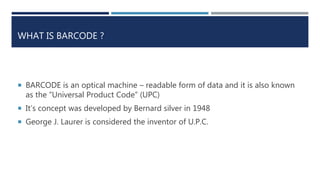
WHAT IS BARCODE ?
 BARCODE is an optical machine – readable form of data and it is also known
as the “Universal Product Code” (UPC)
 It’s concept was developed by Bernard silver in 1948
 George J. Laurer is considered the inventor of U.P.C.
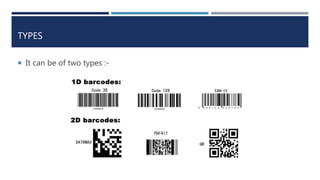
TYPES
 It can be of two types :-
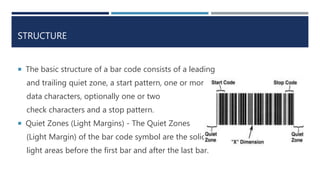
STRUCTURE
 The basic structure of a bar code consists of a leading
and trailing quiet zone, a start pattern, one or more
data characters, optionally one or two
check characters and a stop pattern.
 Quiet Zones (Light Margins) - The Quiet Zones
(Light Margin) of the bar code symbol are the solid,
light areas before the first bar and after the last bar.
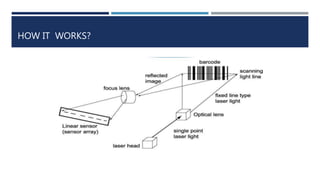
HOW IT WORKS?
CONTINUED…
 BARCODE uses the Binary System for coding & decoding.
 It has the series of bars & space representing alpha numeric information.
 Each bar represent ”1” and space represent “0”.
 A bar code reader decodes a bar code by scanning a light source across the
bar code and measuring the intensity of light reflected back by the white
spaces.
 The pattern of reflected light is detected with a photodiode and it is then
decoded back to the original data by inexpensive circuits.
PROPERTIES
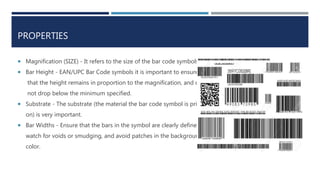
 Magnification (SIZE) - It refers to the size of the bar code symbols.
 Bar Height - EAN/UPC Bar Code symbols it is important to ensure
that the height remains in proportion to the magnification, and does
not drop below the minimum specified.
 Substrate - The substrate (the material the bar code symbol is printed
on) is very important.
 Bar Widths - Ensure that the bars in the symbol are clearly defined,
watch for voids or smudging, and avoid patches in the background
color.
BARCODE TECHNOLOGY
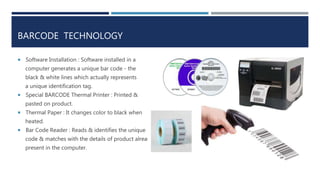
 Software Installation : Software installed in a
computer generates a unique bar code - the
black & white lines which actually represents
a unique identification tag.
 Special BARCODE Thermal Printer : Printed &
pasted on product.
 Thermal Paper : It changes color to black when
heated.
 Bar Code Reader : Reads & identifies the unique
code & matches with the details of product already
present in the computer.
CONCLUSION
1. Smart labels provide a built in back-up plan
2. Patient care will become more personalized
3. Compound management identification will speed up
4. Researchers will be able to locate samples in real time
5. Sample sizes will become smaller
6. Researchers will accelerate their impact
REFERENCE
 https://www.slideshare.net/MahendraSingh161/barcodes-64976311
 https://www.quora.com/What-is-a-barcode-How-is-it-used
 https://www.reddit.com/r/barcodes/
THANK YOU

Barcode

  • 1.
    BARCODE GUIDED BY:- MANASEEPANIGRAHY(LECT.) SUBMITTED BY:-ABINASH RANASINGH
  • 2.
    CONTENT  WHAT ISBARCODE  TYPES  STRUCTURE  HOW IT WORKS  CHARACTERSTICS  BARCODE TECHNOLOGY  CONCLUSION  REFERENCE
  • 3.
    WHAT IS BARCODE?  BARCODE is an optical machine – readable form of data and it is also known as the “Universal Product Code” (UPC)  It’s concept was developed by Bernard silver in 1948  George J. Laurer is considered the inventor of U.P.C.
  • 4.
    TYPES  It canbe of two types :-
  • 5.
    STRUCTURE  The basicstructure of a bar code consists of a leading and trailing quiet zone, a start pattern, one or more data characters, optionally one or two check characters and a stop pattern.  Quiet Zones (Light Margins) - The Quiet Zones (Light Margin) of the bar code symbol are the solid, light areas before the first bar and after the last bar.
  • 6.
  • 7.
    CONTINUED…  BARCODE usesthe Binary System for coding & decoding.  It has the series of bars & space representing alpha numeric information.  Each bar represent ”1” and space represent “0”.  A bar code reader decodes a bar code by scanning a light source across the bar code and measuring the intensity of light reflected back by the white spaces.  The pattern of reflected light is detected with a photodiode and it is then decoded back to the original data by inexpensive circuits.
  • 8.
    PROPERTIES  Magnification (SIZE)- It refers to the size of the bar code symbols.  Bar Height - EAN/UPC Bar Code symbols it is important to ensure that the height remains in proportion to the magnification, and does not drop below the minimum specified.  Substrate - The substrate (the material the bar code symbol is printed on) is very important.  Bar Widths - Ensure that the bars in the symbol are clearly defined, watch for voids or smudging, and avoid patches in the background color.
  • 9.
    BARCODE TECHNOLOGY  SoftwareInstallation : Software installed in a computer generates a unique bar code - the black & white lines which actually represents a unique identification tag.  Special BARCODE Thermal Printer : Printed & pasted on product.  Thermal Paper : It changes color to black when heated.  Bar Code Reader : Reads & identifies the unique code & matches with the details of product already present in the computer.
  • 10.
    CONCLUSION 1. Smart labelsprovide a built in back-up plan 2. Patient care will become more personalized 3. Compound management identification will speed up 4. Researchers will be able to locate samples in real time 5. Sample sizes will become smaller 6. Researchers will accelerate their impact
  • 11.
  • 12.