OLED
Organic Light Emitting Diode
GOVERNMENT POLYTECHNIC, BERHAMPUR
CONTENT
INTRODUCTION
ELECTROLUMINESCENCE
WHAT IS AN OLED?
HISTORY
FEATURES OF OLED
WORKING PRINCIPLE
OLED STRUCTURE
TYPES OF OLEDs.
ADVANTAGES OF OLED
DIS-ADVANTAGES OF OLED
APPLICATIONS OF OLED
CONCLUSION
INTRODUCTION
Organic light emitting diode.
Emerging technology for display services.
Main principle behind OLED technology is electroluminescence.
It offers lighter, brighter, thinner, high contrast & flexible displays.
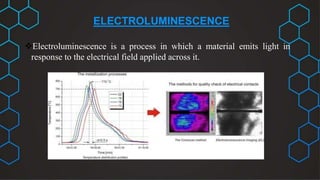
ELECTROLUMINESCENCE
Electroluminescence is a process in which a material emits light in
response to the electrical field applied across it.
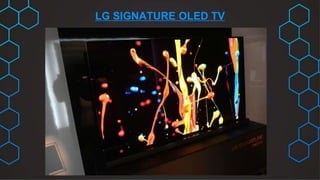
LG SIGNATURE OLED TV
WHAT IS AN OLED?
An OLED is any light emitting diode in which organic layers are
responsible for light emission.
OLEDs are solid state devices composed of thin films of organic
molecules that is 100 to 500 nanometers thick.
They doesn’t require any backlight, i.e. they are self-emitting.
They are made from carbon and hydrogen.
HISTORY
The first OLED device was developed by Eastman Kodak in 1987.
In 1996, Pioneer produced the world’s first commercial PMOLED.
In 2000, many companies like Motorola, LG etc developed various
displays.
In 2001, Sony developed world’s largest full color OLED.
In 2010 & 2011, many companies announced AMOLED displays.
FEATURES
Flexibility.
Emissive technology.
Light weight and thin.
Low power consumption.
High contrast, brighter and perfect display from all angles.
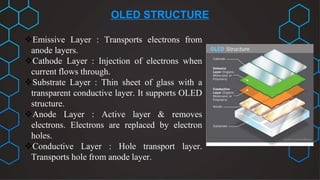
Emissive Layer : Transports electrons from
anode layers.
Cathode Layer : Injection of electrons when
current flows through.
Substrate Layer : Thin sheet of glass with a
transparent conductive layer. It supports OLED
structure.
Anode Layer : Active layer & removes
electrons. Electrons are replaced by electron
holes.
Conductive Layer : Hole transport layer.
Transports hole from anode layer.
OLED STRUCTURE
WORKING PRINCIPLE
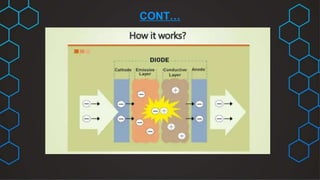
A voltage is applied across the anode and cathode.
Current flows from cathode to anode through the organic layers.
Electrons flow to emissive layer from the cathode.
Electrons are removed from conductive layer leaving holes.
Holes jump into emissive layer.
Electron and hole combines and light emits.
CONT…
CONT…
TYPES OF OLEDs
Passive matrix OLED
Active matrix OLED
Transparent OLED
Top-emitting OLED
Foldable OLED
White OLED
ADVANTAGES OF OLED
Very thin panel of approximately 1mm.
Low power consumption.
High brightness.
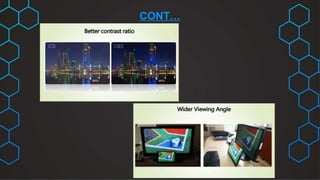
High contrast ratio of 10000:1
Wide viewing angle of 170 degree.
Foldable display panel.
Faster response time.
CONT…
DIS-ADVANTAGES OF OLED
Lifespan.
Expensive.
Susceptible to water.
Balancing color is not easy.
Overcome multi-billion dollar LCD market.
APPLICATIONS OF OLED
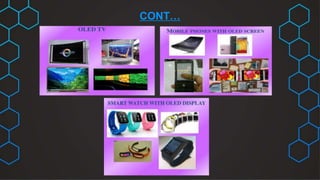
OLED TV.
Mobile phones with OLED screens.
Smart watch with OLED screens.
CONT…
CONCLUSION
Limited use caused by degradation of materials.
OLED will replace current LED and LCD technologies.
Expensive.
Flexibility and thinness will enable many applications.
REFERENCE
https://www.slideshare.net/kevinpatel10/oled-all-you-need-to-know
Whttps://studymafia.org/oled-technology-seminar-ppt-with-pdf-
report/
Any queries???
Thank You!!!
I hope that you all learned something from this
presentation.

OLED technology