Dr. K. Purna Nagasree
M.Pharm. (BITS, Pilani), Ph.D., PDF (DST, WOSA)
Associate Professor
VIGNAN INSTITUTE OF PHARMACEUTICAL TECHNOLOGY
(Approved by PCI, AICTE New Delhi and affiliated to JNTUK)
ANISO 9001:2015, ISO 14001:2015, OHSAS 18001:2007 Certified institution, beside VSEZ, Duvvada, Vishakapatnam-
530049, Andhra Pradesh, India
2021
Sedatives and Hypnotics
Anti Psychotics
Anti convulsants
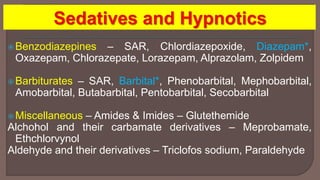
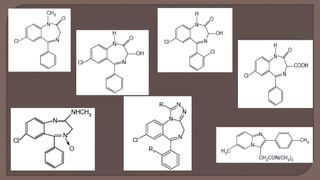
Benzodiazepines – SAR, Chlordiazepoxide, Diazepam*,
Oxazepam, Chlorazepate, Lorazepam, Alprazolam, Zolpidem
Barbiturates – SAR, Barbital*, Phenobarbital, Mephobarbital,
Amobarbital, Butabarbital, Pentobarbital, Secobarbital
Miscellaneous – Amides & Imides – Glutethemide
Alchohol and their carbamate derivatives – Meprobamate,
Ethchlorvynol
Aldehyde and their derivatives – Triclofos sodium, Paraldehyde
 Sedatives are central nervous system (CNS) depressant drugs
that reduce excitement, tension, and produce relaxation.
Hypnotics are drugs that depress the CNS and produce sleep
similar to that of natural sleep.
 Both sedative and hypnotic action may reside in the same drug.
 At lower dose - sedative, higher dose – hypnotic (Same drug)
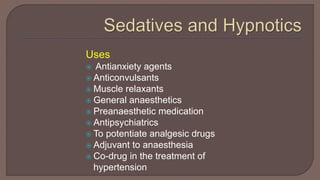
Uses
 Antianxiety agents
 Anticonvulsants
 Muscle relaxants
 General anaesthetics
 Preanaesthetic medication
 Antipsychiatrics
 To potentiate analgesic drugs
 Adjuvant to anaesthesia
 Co-drug in the treatment of
hypertension
 Classification based on their chemical structure
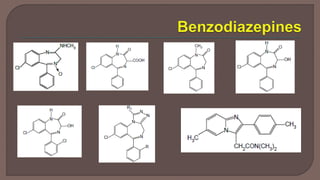
Benzodiazepines: Chlordiazepoxide, Diazepam*, Oxazepam,
Chlorazepate, Lorazepam, Alprazolam, Zolpidem
Barbiturates: Barbital*, Phenobarbital, Mephobarbital, Amobarbital,
Butabarbital, Pentobarbital, Secobarbital
Acyclic hypnotics containing nitrogen – Meprobamate
Cyclic hypnotics containing nitrogen
Alcohols and aldehydes – Ethchlorvynol, Paraldehyde
Glutethamide, Triclofos sodium
Acetylene derivatives
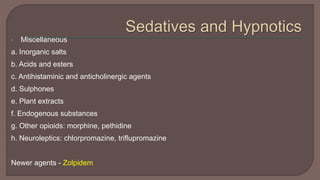
 Miscellaneous
a. Inorganic salts
b. Acids and esters
c. Antihistaminic and anticholinergic agents
d. Sulphones
e. Plant extracts
f. Endogenous substances
g. Other opioids: morphine, pethidine
h. Neuroleptics: chlorpromazine, triflupromazine
Newer agents - Zolpidem
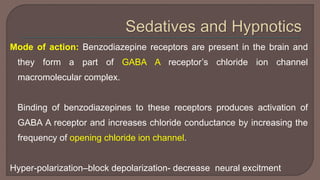
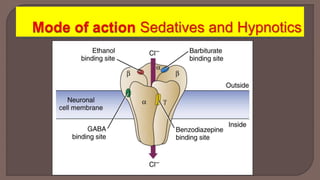
Mode of action: Benzodiazepine receptors are present in the brain and
they form a part of GABA A receptor’s chloride ion channel
macromolecular complex.
Binding of benzodiazepines to these receptors produces activation of
GABA A receptor and increases chloride conductance by increasing the
frequency of opening chloride ion channel.
Hyper-polarization–block depolarization- decrease neural excitment
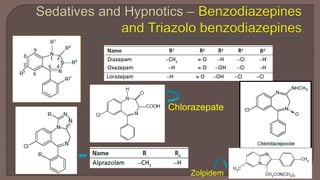
Chlorazepate
Zolpidem
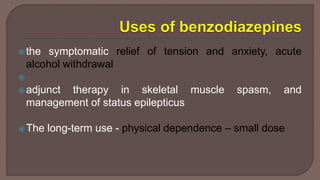
the symptomatic relief of tension and anxiety, acute
alcohol withdrawal

adjunct therapy in skeletal muscle spasm, and
management of status epilepticus
The long-term use - physical dependence – small dose
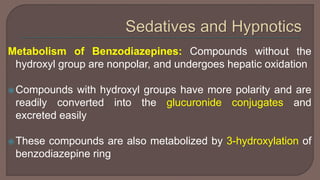
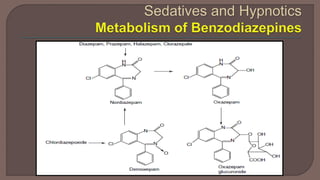
Metabolism of Benzodiazepines: Compounds without the
hydroxyl group are nonpolar, and undergoes hepatic oxidation
Compounds with hydroxyl groups have more polarity and are
readily converted into the glucuronide conjugates and
excreted easily
These compounds are also metabolized by 3-hydroxylation of
benzodiazepine ring
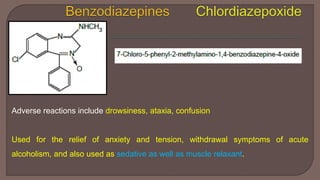
Adverse reactions include drowsiness, ataxia, confusion
Used for the relief of anxiety and tension, withdrawal symptoms of acute
alcoholism, and also used as sedative as well as muscle relaxant.
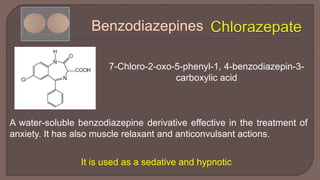
7-Chloro-2-oxo-5-phenyl-1, 4-benzodiazepin-3-
carboxylic acid
It is used as a sedative and hypnotic
Benzodiazepines
A water-soluble benzodiazepine derivative effective in the treatment of
anxiety. It has also muscle relaxant and anticonvulsant actions.
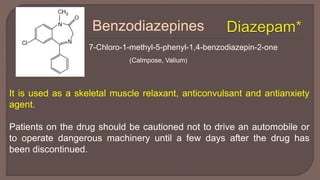
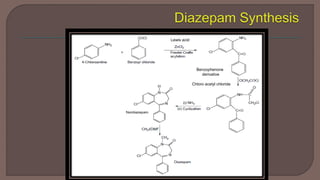
7-Chloro-1-methyl-5-phenyl-1,4-benzodiazepin-2-one
(Calmpose, Valium)
It is used as a skeletal muscle relaxant, anticonvulsant and antianxiety
agent.
Patients on the drug should be cautioned not to drive an automobile or
to operate dangerous machinery until a few days after the drug has
been discontinued.
Benzodiazepines
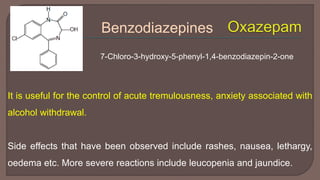
7-Chloro-3-hydroxy-5-phenyl-1,4-benzodiazepin-2-one
It is useful for the control of acute tremulousness, anxiety associated with
alcohol withdrawal.
Side effects that have been observed include rashes, nausea, lethargy,
oedema etc. More severe reactions include leucopenia and jaundice.
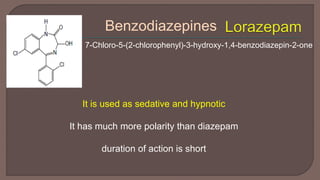
Benzodiazepines
7-Chloro-5-(2-chlorophenyl)-3-hydroxy-1,4-benzodiazepin-2-one
It is used as sedative and hypnotic
It has much more polarity than diazepam
duration of action is short
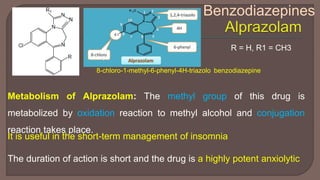
Benzodiazepines
R = H, R1 = CH3
Metabolism of Alprazolam: The methyl group of this drug is
metabolized by oxidation reaction to methyl alcohol and conjugation
reaction takes place.
It is useful in the short-term management of insomnia
The duration of action is short and the drug is a highly potent anxiolytic
Benzodiazepines
8-chloro-1-methyl-6-phenyl-4H-triazolo benzodiazepine
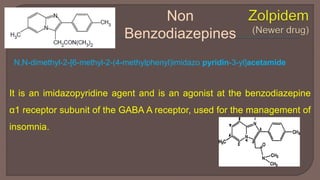
It is an imidazopyridine agent and is an agonist at the benzodiazepine
α1 receptor subunit of the GABA A receptor, used for the management of
insomnia.
Non
Benzodiazepines
N,N-dimethyl-2-[6-methyl-2-(4-methylphenyl)imidazo pyridin-3-yl]acetamide
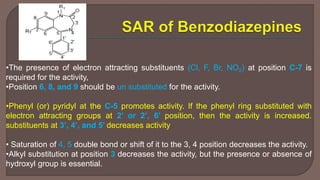
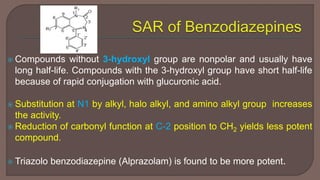
•The presence of electron attracting substituents (Cl, F, Br, NO2) at position C-7 is
required for the activity,
•Position 6, 8, and 9 should be un substituted for the activity.
•Phenyl (or) pyridyl at the C-5 promotes activity. If the phenyl ring substituted with
electron attracting groups at 2’ or 2’, 6’ position, then the activity is increased.
substituents at 3’, 4’, and 5’ decreases activity
• Saturation of 4, 5 double bond or shift of it to the 3, 4 position decreases the activity.
•Alkyl substitution at position 3 decreases the activity, but the presence or absence of
hydroxyl group is essential.
 Compounds without 3-hydroxyl group are nonpolar and usually have
long half-life. Compounds with the 3-hydroxyl group have short half-life
because of rapid conjugation with glucuronic acid.
 Substitution at N1 by alkyl, halo alkyl, and amino alkyl group increases
the activity.
 Reduction of carbonyl function at C-2 position to CH2 yields less potent
compound.
 Triazolo benzodiazepine (Alprazolam) is found to be more potent.
Lewis acide
Benzophenone
derivative
Chloro acetyl chloride
Mode of action: Barbiturates primarily act on GABA:
benzodiazepin receptor Cl– channel complex and
potentiate GABA ergic inhibitory action by increasing the
lifetime of Cl– channel opening induced by GABA.
Barbiturates do not bind to benzodiazepine receptor, but it
binds onto α and ß subunit
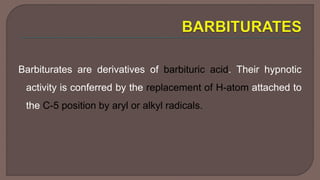
Barbiturates are derivatives of barbituric acid. Their hypnotic
activity is conferred by the replacement of H-atom attached to
the C-5 position by aryl or alkyl radicals.
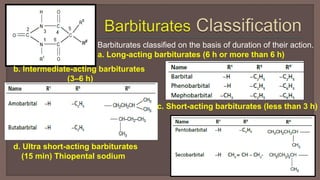
Barbiturates classified on the basis of duration of their action.
a. Long-acting barbiturates (6 h or more than 6 h)
b. Intermediate-acting barbiturates
(3–6 h)
c. Short-acting barbiturates (less than 3 h)
d. Ultra short-acting barbiturates
(15 min) Thiopental sodium
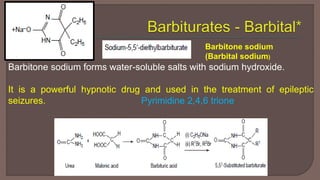
Barbitone sodium
(Barbital sodium)
Barbitone sodium forms water-soluble salts with sodium hydroxide.
It is a powerful hypnotic drug and used in the treatment of epileptic
seizures. Pyrimidine 2,4,6 trione
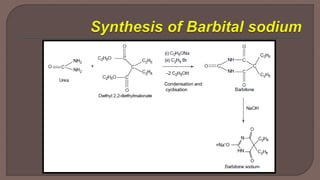
Condensation and
cyclisation
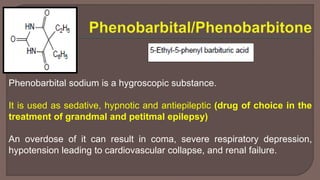
Phenobarbital sodium is a hygroscopic substance.
It is used as sedative, hypnotic and antiepileptic (drug of choice in the
treatment of grandmal and petitmal epilepsy)
An overdose of it can result in coma, severe respiratory depression,
hypotension leading to cardiovascular collapse, and renal failure.
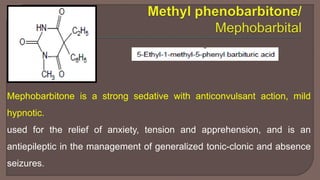
Mephobarbitone is a strong sedative with anticonvulsant action, mild
hypnotic.
used for the relief of anxiety, tension and apprehension, and is an
antiepileptic in the management of generalized tonic-clonic and absence
seizures.
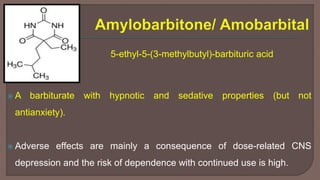
 A barbiturate with hypnotic and sedative properties (but not
antianxiety).
 Adverse effects are mainly a consequence of dose-related CNS
depression and the risk of dependence with continued use is high.
5-ethyl-5-(3-methylbutyl)-barbituric acid
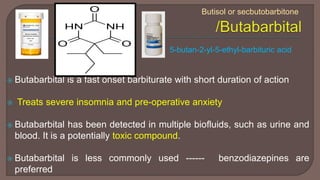
 Butabarbital is a fast onset barbiturate with short duration of action
 Treats severe insomnia and pre-operative anxiety
 Butabarbital has been detected in multiple biofluids, such as urine and
blood. It is a potentially toxic compound.
 Butabarbital is less commonly used ------ benzodiazepines are
preferred
5-butan-2-yl-5-ethyl-barbituric acid
Butisol or secbutobarbitone
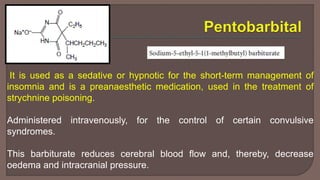
It is used as a sedative or hypnotic for the short-term management of
insomnia and is a preanaesthetic medication, used in the treatment of
strychnine poisoning.
Administered intravenously, for the control of certain convulsive
syndromes.
This barbiturate reduces cerebral blood flow and, thereby, decrease
oedema and intracranial pressure.
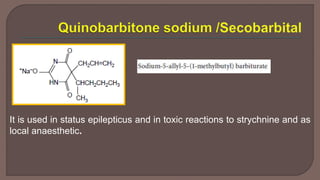
It is used in status epilepticus and in toxic reactions to strychnine and as
local anaesthetic.
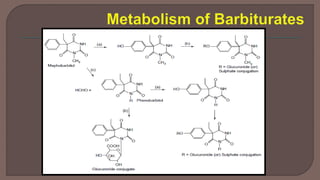
These drugs are metabolized in the liver and forms less lipophilic compounds.
These are mediated through glucuronide or sulphate conjugation.
1. Oxidation of a substituent at C-5 forms alcohols or phenols – glucuronide
2. It undergoes oxidative N-dealkylation at nitrogen.
3. Oxidative desulphation of 2-thio barbiturates yields more hydrophilic barbiturates,
which is excreted through urine.
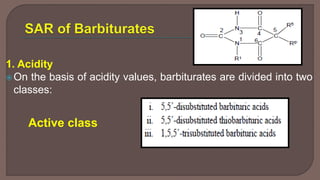
1. Acidity
On the basis of acidity values, barbiturates are divided into two
classes:
Active class
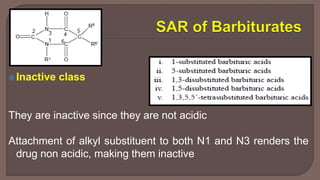
Inactive class
They are inactive since they are not acidic
Attachment of alkyl substituent to both N1 and N3 renders the
drug non acidic, making them inactive
2. Lipid water solubility
 lipid-water solubility or partition co-efficient is calculated to find out whether
the compound is active or not.
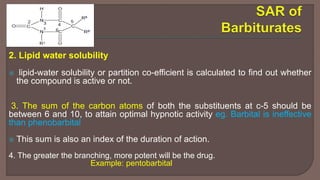
3. The sum of the carbon atoms of both the substituents at c-5 should be
between 6 and 10, to attain optimal hypnotic activity eg. Barbital is ineffective
than phenobarbital
 This sum is also an index of the duration of action.
4. The greater the branching, more potent will be the drug.
Example: pentobarbital
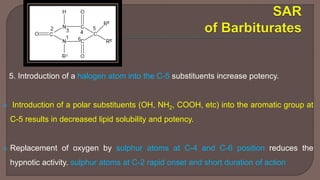
5. Introduction of a halogen atom into the C-5 substituents increase potency.
 Introduction of a polar substituents (OH, NH2, COOH, etc) into the aromatic group at
C-5 results in decreased lipid solubility and potency.
 Replacement of oxygen by sulphur atoms at C-4 and C-6 position reduces the
hypnotic activity. sulphur atoms at C-2 rapid onset and short duration of action
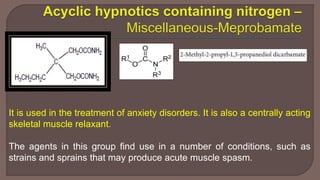
It is used in the treatment of anxiety disorders. It is also a centrally acting
skeletal muscle relaxant.
The agents in this group find use in a number of conditions, such as
strains and sprains that may produce acute muscle spasm.
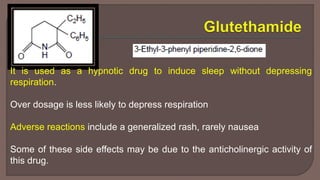
It is used as a hypnotic drug to induce sleep without depressing
respiration.
Over dosage is less likely to depress respiration
Adverse reactions include a generalized rash, rarely nausea
Some of these side effects may be due to the anticholinergic activity of
this drug.
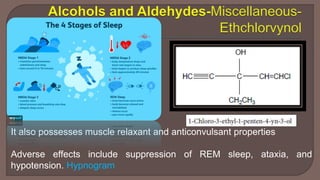
It also possesses muscle relaxant and anticonvulsant properties
Adverse effects include suppression of REM sleep, ataxia, and
hypotension. Hypnogram
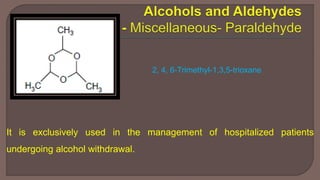
2, 4, 6-Trimethyl-1,3,5-trioxane
It is exclusively used in the management of hospitalized patients
undergoing alcohol withdrawal.
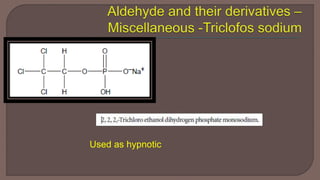
Used as hypnotic
Med chem hypnotics and sedatives