Personal Money Management
 Convenient way to pay bills
 Often safer than using cash
 Record keeping system to track expenses and
create budgets
 Access to other bank services such as direct
deposit, online banking, use of a debit card,
and 24/7 access to cash through ATMs
 Write checks carefully and keep accurate
records of checks written and deposits made.
 Verify the accuracy of the bank statement you
receive each month.
 Keep canceled checks among your permanent
records.
 Joint accounts
 Express accounts
 Basic accounts
 Interest bearing accounts
 Senior/Student accounts
 Opened by two or more people
 Any person who signs on the account has the
right to the entire amount deposited
 “Or” account – any authorized account holder
can write checks
 “And” account – requires signature of both
owners on checks
 For those who prefer to do things at an ATM or
computer
 Low minimum balance requirements
 Low or no monthly fees
 Must pay fees to visit a teller (Could be as high as
$3/visit)
 This type is good for those who have direct deposit or
use ATMs for withdrawals and transactions
 For those who have minimal banking needs
(perhaps pay a few bills or use debit card here
and there)
 May require direct deposit or minimum
balance to avoid “maintenance fees”
 You may be limited to the number of checks or
transactions each month; go over and you’ll
pay a “per item fee”
 A checking account in which you can earn interest
on the money in the account.
 Usually a minimum initial deposit to open the
account.
 Account balances must not fall below the
minimum balance set by the bank or you will have
to pay fees.
 Interest rates given are often very, very low (and
may not be worth the balance requirements).
 Banks will often provide special perks for
certain age people.
 These perks will vary from bank to bank, but
can include free ATM use, free checks,
discounts, etc.
• Check number
• ABA routing
number (fraction)
• Maker’s name and
address
• Date
• Payee
• Numeric amount
• Written amount
• Maker’s signature
• Routing number
• Account number
• Memo
 Check Number – used for easy identification;
top right hand corner of the check
 ABA Routing Number – fraction in the upper
right hand corner of check
 Used for internal transaction purposes
 “Old school” method – now just used as backup
option in case other routing number can’t be read or
is torn
 Date – fill in the date you write the check
 Usually towards the top, in the center of the check
 Postdating of checks is not recommended:
 Banks will not cash it before that date
 Bank may charge a fee for holding it
 Bank may not accept a check over six months old
 Payee – the person or company to whom the
check is made payable
 Numeric Amount – The amount of dollars and
cents being paid in figures.
 Write the amount neatly and clearly, close to
the dollar sign and make sure you insert a
decimal point between dollars and cents.
 Written Amount – The amount being paid in
words.
 Write the word “and” to separate dollars and
cents. This takes the place of the decimal point.
 Use a fraction for the amount in cents.
Example: 12/100
 Draw a line from the cents to the word
“dollars”
 Maker’s Signature – gives authorization for the written
check. Written in the lower right of a check.
 Routing Number – Bank identification number created
to help facilitate processing of checks. Located in the
lower left hand corner (the left-most number between
the colon symbols)
 Account Number – your personal checking account
number. (Lower left hand corner – the number on the
right)
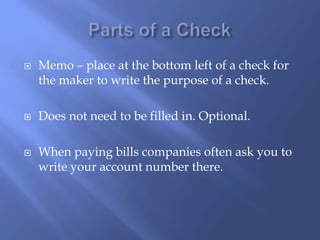
 Memo – place at the bottom left of a check for
the maker to write the purpose of a check.
 Does not need to be filled in. Optional.
 When paying bills companies often ask you to
write your account number there.
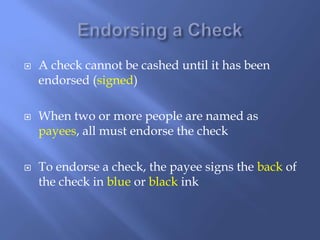
 A check cannot be cashed until it has been
endorsed (signed)
 When two or more people are named as
payees, all must endorse the check
 To endorse a check, the payee signs the back of
the check in blue or black ink
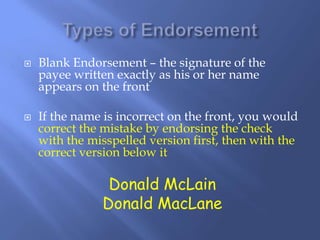
 Blank Endorsement – the signature of the
payee written exactly as his or her name
appears on the front
 If the name is incorrect on the front, you would
correct the mistake by endorsing the check
with the misspelled version first, then with the
correct version below it
Donald McLain
Donald MacLane
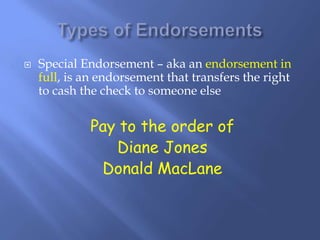
 Special Endorsement – aka an endorsement in
full, is an endorsement that transfers the right
to cash the check to someone else
Pay to the order of
Diane Jones
Donald MacLane
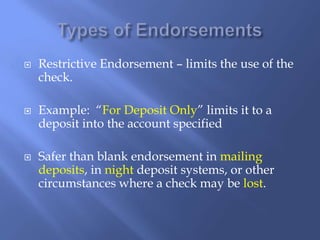
 Restrictive Endorsement – limits the use of the
check.
 Example: “For Deposit Only” limits it to a
deposit into the account specified
 Safer than blank endorsement in mailing
deposits, in night deposit systems, or other
circumstances where a check may be lost.
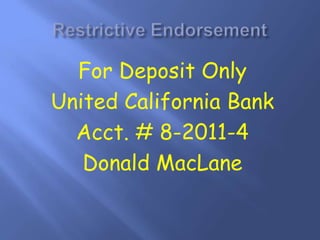
For Deposit Only
United California Bank
Acct. # 8-2011-4
Donald MacLane
 How would you write your check differently?

Checking accounts power point 3 14 12

  • 1.
  • 2.
     Convenient wayto pay bills  Often safer than using cash  Record keeping system to track expenses and create budgets  Access to other bank services such as direct deposit, online banking, use of a debit card, and 24/7 access to cash through ATMs
  • 3.
     Write checkscarefully and keep accurate records of checks written and deposits made.  Verify the accuracy of the bank statement you receive each month.  Keep canceled checks among your permanent records.
  • 4.
     Joint accounts Express accounts  Basic accounts  Interest bearing accounts  Senior/Student accounts
  • 5.
     Opened bytwo or more people  Any person who signs on the account has the right to the entire amount deposited  “Or” account – any authorized account holder can write checks  “And” account – requires signature of both owners on checks
  • 6.
     For thosewho prefer to do things at an ATM or computer  Low minimum balance requirements  Low or no monthly fees  Must pay fees to visit a teller (Could be as high as $3/visit)  This type is good for those who have direct deposit or use ATMs for withdrawals and transactions
  • 7.
     For thosewho have minimal banking needs (perhaps pay a few bills or use debit card here and there)  May require direct deposit or minimum balance to avoid “maintenance fees”  You may be limited to the number of checks or transactions each month; go over and you’ll pay a “per item fee”
  • 8.
     A checkingaccount in which you can earn interest on the money in the account.  Usually a minimum initial deposit to open the account.  Account balances must not fall below the minimum balance set by the bank or you will have to pay fees.  Interest rates given are often very, very low (and may not be worth the balance requirements).
  • 9.
     Banks willoften provide special perks for certain age people.  These perks will vary from bank to bank, but can include free ATM use, free checks, discounts, etc.
  • 10.
    • Check number •ABA routing number (fraction) • Maker’s name and address • Date • Payee • Numeric amount • Written amount • Maker’s signature • Routing number • Account number • Memo
  • 11.
     Check Number– used for easy identification; top right hand corner of the check  ABA Routing Number – fraction in the upper right hand corner of check  Used for internal transaction purposes  “Old school” method – now just used as backup option in case other routing number can’t be read or is torn
  • 12.
     Date –fill in the date you write the check  Usually towards the top, in the center of the check  Postdating of checks is not recommended:  Banks will not cash it before that date  Bank may charge a fee for holding it  Bank may not accept a check over six months old
  • 13.
     Payee –the person or company to whom the check is made payable  Numeric Amount – The amount of dollars and cents being paid in figures.  Write the amount neatly and clearly, close to the dollar sign and make sure you insert a decimal point between dollars and cents.
  • 14.
     Written Amount– The amount being paid in words.  Write the word “and” to separate dollars and cents. This takes the place of the decimal point.  Use a fraction for the amount in cents. Example: 12/100  Draw a line from the cents to the word “dollars”
  • 15.
     Maker’s Signature– gives authorization for the written check. Written in the lower right of a check.  Routing Number – Bank identification number created to help facilitate processing of checks. Located in the lower left hand corner (the left-most number between the colon symbols)  Account Number – your personal checking account number. (Lower left hand corner – the number on the right)
  • 16.
     Memo –place at the bottom left of a check for the maker to write the purpose of a check.  Does not need to be filled in. Optional.  When paying bills companies often ask you to write your account number there.
  • 17.
     A checkcannot be cashed until it has been endorsed (signed)  When two or more people are named as payees, all must endorse the check  To endorse a check, the payee signs the back of the check in blue or black ink
  • 18.
     Blank Endorsement– the signature of the payee written exactly as his or her name appears on the front  If the name is incorrect on the front, you would correct the mistake by endorsing the check with the misspelled version first, then with the correct version below it Donald McLain Donald MacLane
  • 19.
     Special Endorsement– aka an endorsement in full, is an endorsement that transfers the right to cash the check to someone else Pay to the order of Diane Jones Donald MacLane
  • 20.
     Restrictive Endorsement– limits the use of the check.  Example: “For Deposit Only” limits it to a deposit into the account specified  Safer than blank endorsement in mailing deposits, in night deposit systems, or other circumstances where a check may be lost.
  • 21.
    For Deposit Only UnitedCalifornia Bank Acct. # 8-2011-4 Donald MacLane
  • 22.
     How wouldyou write your check differently?
  • 23.
     How wouldyou write your check differently?