Savings & Checking AccountsChapter 3 Part 1Opening a Checking Account
Learn to open a bank checking account.Learn what is a signature card.Learn the benefits and fees of the account.Learn how to complete a deposit slip.Lesson Goals
Terms to knowSignature card – a form utilized by a bank to indicate the authorized signature(s) for them to accept on signed checks.Forged Signature – A name illegally signed to a check by someone else.Individual Account – an account having one owner authorized to sign a check.Joint Account – an account having a least 2 persons authorized to sign a check.
ABA Number –The bank Identification Number or Routing Number provided to the bank by the Federal Government.Account Number – the number assigned by the bank to your account. More Terms to know
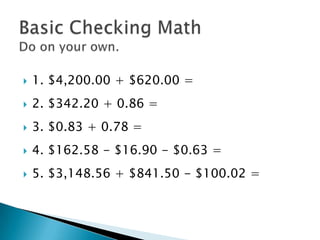
Basic Checking MathDo on your own.1. $4,200.00 + $620.00 = 2. $342.20 + 0.86 =3. $0.83 + 0.78 =4. $162.58 - $16.90 - $0.63 = 5. $3,148.56 + $841.50 - $100.02 =
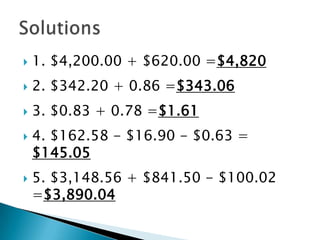
1. $4,200.00 + $620.00 =$4,820 2. $342.20 + 0.86 =$343.063. $0.83 + 0.78 =$1.614. $162.58 - $16.90 - $0.63 = $145.055. $3,148.56 + $841.50 - $100.02 =$3,890.04Solutions
Are my deposits safe?FDIC = The Federal Depository Insurance Corporation – Insures your deposits up to $250,000 in each institution.So if you have more than $250,000 in savings of checking move any amount over to another institution.Things to Know
Shop for the best checking features & services before opening an account such as:Minimum Balance RequirementsInterest RatesCheck Writing FeesOverdraft protectionAnnual FeeDebt card feesInternet accessChoosing Wisely
Complete the Signature CardSAMPLE Signature CardInclude:Your full nameAddressHome PhoneCell PhoneE-mailSignature (how you will sign your checks)Date
Sample Deposit SlipInsert the following information on to the slip:Bills = $121Coins = 15.75Check 1 = 37-502-------$23.37Check 2 = 14-208-------$114.76Check 3 = 17-73--------$264.88Check 4 = 21-706-------$9.52Check 5 = 12- 1430 -----$87.43Total – Bills, Coins & Checks = ?Complete the Deposit Slip
Savings & Checking AccountsChapter 3 Part 2Writing Checks
Learn to write checks.Learn to record checks in the check register.Learn the legal issues.Lesson Goals
Check – A legal tender document utilized by a bank depositor to pay for goods or services to a third party utilizing funds held by the bank on behalf of the depositor.Payee – the person or business to whom the check was written.Void – The method of canceling a check prior to its use or being settled by the depositors bank.Terms to Know
Postdate –A future date written on a check making the check payable (cashable) to a person or business on or after that future date.Check Register – A tracking document usually located in a check book to log the writing of checks and bank deposits into the affected account.Insufficient Funds- Writing a check with less funds in the depositor’s account than the amount of the check written.More Terms
Legal ConsequencesWriting a check while knowing there are not sufficient funds to cover the written check.If your checking account does not have overdraft protection your check may not be cashed.Consequences could include:Bank Fee - $15 to $50Returned Check Fee from the business - $25+Collections Fees - $100+Small Claims Court Fees – cost of suit plus 3 times the amount of the check and collections.Bank or pay garnishment.Criminal Action by the District Attorney
Sample Check RegisterSample RegisterComplete the sample Check Register.Enter an opening deposit of Sept. 15, 2009 in the amount of:	$300.00Enter interest received on Sept. 30, 2009 in the amount of: 		$3.56Enter a deposit with yesterday’s date in the amount of:			$154.00Enter the sample from the previous slide. “Southern California Edison in the amount of: 					$235.47What is the balance?	$222.09
Sample CheckComplete the check with the following data.Date – Today’s DatePayee – Southern California EdisonAmount - $235.47Sign Check – using same a on signature cardSample Check
Complete Checks 0002 – 0004 with the following information.0002 – Date – November 10, 2009, Payee – Wal-mart, Amount - $38.67, Memo – Shirt and Pants0003 – Date - November 15, 2009,Payee – Albertson’s, Amount – $25.16, Memo – Food0004 – Date – November 30, 2009, Payee – Toyota Credit – Amount - $225.76, - Memo – car paymentCheck Writing
Register EntriesComplete the check register with the following entries.Date – November 5, 2009, Description – ATM Withdrawal, Payment - $40.00Check #0002Date – November 12, 2009, Description – Debit Starbucks, Amount - $4.75Date – November 14, 2009, Description – Paycheck Amount – 154.00Check #0003Date – November 17, 2009, Description – Debit AM/PM gasoline , Amount - $45.00
More Check Register EntriesDate – November 20, 2009, Description – Allowance, Amount - $40.00Date – November 20, 2009, Description – Transfer to savings, Amount - $50.00Date – November 25, 2009, Description – Debit Edwards, Amount – $18.75Date – November 28, 2009, Description – Debit Panda Express, Amount – $6.37Check 0004Date – November 30, 2009, Description – Paycheck, Amount $154.00
Savings & Checking AccountsChapter 3 Part 3Savings Accounts & Other Bank Services
Learn the Types of Savings AccountsLearn how to Open a Savings AccountLearn about other services banks provide to their customers.Lesson Goals
Terms to KnowSavings Account = A bank account that pays interest.ATM = Automated Teller MachineETF = Electronic Transfer of FundsPIN = Personal Identification NumberService Charge = A fee charge by the bank generally for not maintaining the required minimum balance.Withdrawal = The removal of monies from an account.
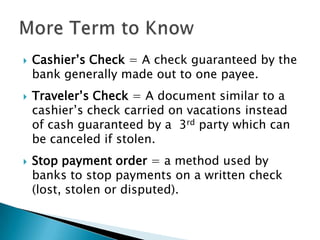
Cashier’s Check = A check guaranteed by the bank generally made out to one payee.Traveler’s Check = A document similar to a cashier’s check carried on vacations instead of cash guaranteed by a  3rd party which can be canceled if stolen.Stop payment order = a method used by banks to stop payments on a written check (lost, stolen or disputed).More Term to Know
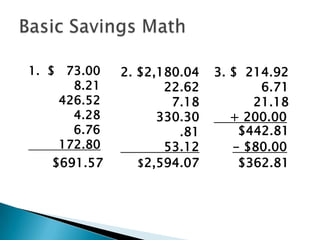
Basic Savings Math1.  $   73.00            8.21        426.52            4.28            6.76        172.802. $2,180.04           22.62             7.18         330.30               .81           53.123. $  214.92            6.71          21.18    + 200.00$442.81- $80.00$691.57$2,594.07$362.81
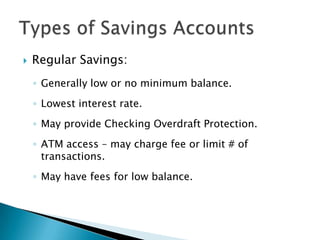
Regular Savings: Generally low or no minimum balance.Lowest interest rate.May provide Checking Overdraft Protection.ATM access – may charge fee or limit # of transactions.May have fees for low balance. Types of Savings Accounts
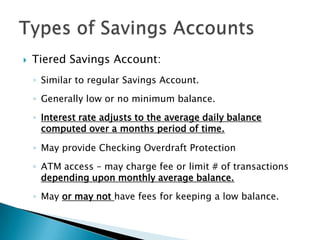
Tiered Savings Account:Similar to regular Savings Account.Generally low or no minimum balance.Interest rate adjusts to the average daily balance computed over a months period of time.May provide Checking Overdraft ProtectionATM access – may charge fee or limit # of transactions depending upon monthly average balance.May or may not have fees for keeping a low balance. Types of Savings Accounts
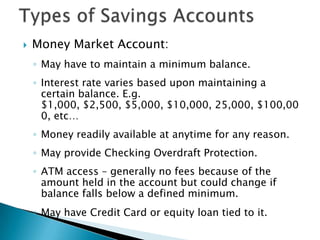
Types of Savings AccountsMoney Market Account:May have to maintain a minimum balance.Interest rate varies based upon maintaining a certain balance. E.g. $1,000, $2,500, $5,000, $10,000, 25,000, $100,000, etc…Money readily available at anytime for any reason.May provide Checking Overdraft Protection.ATM access – generally no fees because of the amount held in the account but could change if balance falls below a defined minimum.May have Credit Card or equity loan tied to it.
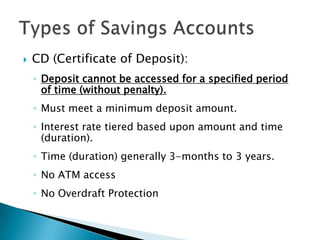
CD (Certificate of Deposit):Deposit cannot be accessed for a specified period of time (without penalty).Must meet a minimum deposit amount.Interest rate tiered based upon amount and time (duration).Time (duration) generally 3-months to 3 years.No ATM accessNo Overdraft ProtectionTypes of Savings Accounts
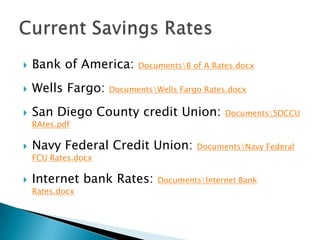
Bank of America: Documents\B of A Rates.docxWells Fargo: Documents\Wells Fargo Rates.docxSan Diego County credit Union: Documents\SDCCU RAtes.pdfNavy Federal Credit Union: Documents\Navy Federal FCU Rates.docxInternet bank Rates: Documents\Internet Bank Rates.docxCurrent Savings Rates
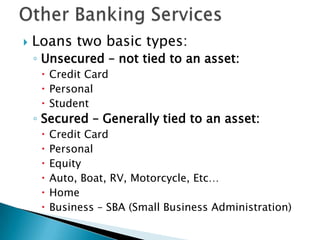
Other Banking ServicesLoans two basic types:Unsecured – not tied to an asset:Credit CardPersonalStudentSecured – Generally tied to an asset:Credit CardPersonalEquityAuto, Boat, RV, Motorcycle, Etc…HomeBusiness – SBA (Small Business Administration)
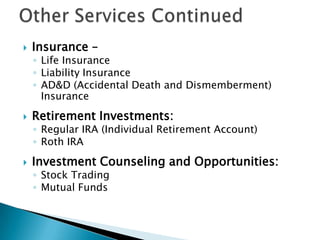
Other Services ContinuedInsurance –Life InsuranceLiability InsuranceAD&D (Accidental Death and Dismemberment) InsuranceRetirement Investments:Regular IRA (Individual Retirement Account)Roth IRAInvestment Counseling and Opportunities:Stock TradingMutual Funds
Savings & Checking AccountsChapter 3 Part 4Bank Statements
Learn How to Read a Bank StatementLearn How to Find which checks are outstanding.Learn how to reconcile the bank statement.Lesson Goals
Bank Statement – Detailed record of your accounts for a specified period of time from your bank.Bank Statement Reconciliation – The bringing of the banks records into agreement with your records.Reconciled – Means brought into agreement.Terms to Know
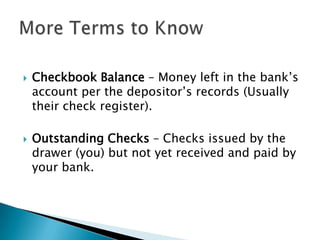
Checkbook Balance – Money left in the bank’s account per the depositor’s records (Usually their check register).Outstanding Checks – Checks issued by the drawer (you) but not yet received and paid by your bank.More Terms to Know
Bank StatementReconciliation WorksheetLet’s Reconcile
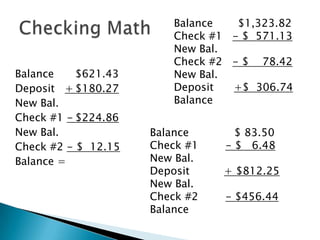
Balance	$621.43Deposit   +	$180.27New Bal.Check #1 -	$224.86New Bal.Check #2 - $  12.15Balance =Checking Math Balance  	$1,323.82Check #1   - $  571.13New Bal.Check #2   - $    78.42New Bal.Deposit      +$  306.74BalanceBalance	      $ 83.50Check #1        - $   6.48New Bal.Deposit	   + $812.25New Bal.Check #2        - $456.44Balance
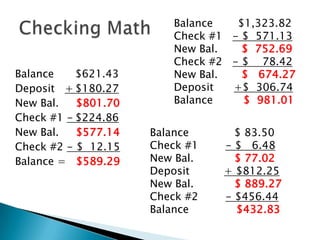
Checking Math Balance  	$1,323.82Check #1   - $  571.13New Bal.       $  752.69Check #2   - $    78.42New Bal.       $   674.27Deposit      +$  306.74Balance         $  981.01Balance	$621.43Deposit   +	$180.27New Bal.     $801.70Check #1 -	$224.86New Bal.     $577.14Check #2 - $  12.15Balance =   $589.29Balance	      $ 83.50Check #1        - $   6.48New Bal.            $ 77.02Deposit	   + $812.25New Bal.            $ 889.27Check #2        - $456.44Balance              $432.83

Lesson Plan 3 Savings & Checking Accounts

  • 1.
    Savings & CheckingAccountsChapter 3 Part 1Opening a Checking Account
  • 2.
    Learn to opena bank checking account.Learn what is a signature card.Learn the benefits and fees of the account.Learn how to complete a deposit slip.Lesson Goals
  • 3.
    Terms to knowSignaturecard – a form utilized by a bank to indicate the authorized signature(s) for them to accept on signed checks.Forged Signature – A name illegally signed to a check by someone else.Individual Account – an account having one owner authorized to sign a check.Joint Account – an account having a least 2 persons authorized to sign a check.
  • 4.
    ABA Number –Thebank Identification Number or Routing Number provided to the bank by the Federal Government.Account Number – the number assigned by the bank to your account. More Terms to know
  • 5.
    Basic Checking MathDoon your own.1. $4,200.00 + $620.00 = 2. $342.20 + 0.86 =3. $0.83 + 0.78 =4. $162.58 - $16.90 - $0.63 = 5. $3,148.56 + $841.50 - $100.02 =
  • 6.
    1. $4,200.00 +$620.00 =$4,820 2. $342.20 + 0.86 =$343.063. $0.83 + 0.78 =$1.614. $162.58 - $16.90 - $0.63 = $145.055. $3,148.56 + $841.50 - $100.02 =$3,890.04Solutions
  • 7.
    Are my depositssafe?FDIC = The Federal Depository Insurance Corporation – Insures your deposits up to $250,000 in each institution.So if you have more than $250,000 in savings of checking move any amount over to another institution.Things to Know
  • 8.
    Shop for thebest checking features & services before opening an account such as:Minimum Balance RequirementsInterest RatesCheck Writing FeesOverdraft protectionAnnual FeeDebt card feesInternet accessChoosing Wisely
  • 9.
    Complete the SignatureCardSAMPLE Signature CardInclude:Your full nameAddressHome PhoneCell PhoneE-mailSignature (how you will sign your checks)Date
  • 10.
    Sample Deposit SlipInsertthe following information on to the slip:Bills = $121Coins = 15.75Check 1 = 37-502-------$23.37Check 2 = 14-208-------$114.76Check 3 = 17-73--------$264.88Check 4 = 21-706-------$9.52Check 5 = 12- 1430 -----$87.43Total – Bills, Coins & Checks = ?Complete the Deposit Slip
  • 11.
    Savings & CheckingAccountsChapter 3 Part 2Writing Checks
  • 12.
    Learn to writechecks.Learn to record checks in the check register.Learn the legal issues.Lesson Goals
  • 13.
    Check – Alegal tender document utilized by a bank depositor to pay for goods or services to a third party utilizing funds held by the bank on behalf of the depositor.Payee – the person or business to whom the check was written.Void – The method of canceling a check prior to its use or being settled by the depositors bank.Terms to Know
  • 14.
    Postdate –A futuredate written on a check making the check payable (cashable) to a person or business on or after that future date.Check Register – A tracking document usually located in a check book to log the writing of checks and bank deposits into the affected account.Insufficient Funds- Writing a check with less funds in the depositor’s account than the amount of the check written.More Terms
  • 15.
    Legal ConsequencesWriting acheck while knowing there are not sufficient funds to cover the written check.If your checking account does not have overdraft protection your check may not be cashed.Consequences could include:Bank Fee - $15 to $50Returned Check Fee from the business - $25+Collections Fees - $100+Small Claims Court Fees – cost of suit plus 3 times the amount of the check and collections.Bank or pay garnishment.Criminal Action by the District Attorney
  • 16.
    Sample Check RegisterSampleRegisterComplete the sample Check Register.Enter an opening deposit of Sept. 15, 2009 in the amount of: $300.00Enter interest received on Sept. 30, 2009 in the amount of: $3.56Enter a deposit with yesterday’s date in the amount of: $154.00Enter the sample from the previous slide. “Southern California Edison in the amount of: $235.47What is the balance? $222.09
  • 17.
    Sample CheckComplete thecheck with the following data.Date – Today’s DatePayee – Southern California EdisonAmount - $235.47Sign Check – using same a on signature cardSample Check
  • 18.
    Complete Checks 0002– 0004 with the following information.0002 – Date – November 10, 2009, Payee – Wal-mart, Amount - $38.67, Memo – Shirt and Pants0003 – Date - November 15, 2009,Payee – Albertson’s, Amount – $25.16, Memo – Food0004 – Date – November 30, 2009, Payee – Toyota Credit – Amount - $225.76, - Memo – car paymentCheck Writing
  • 19.
    Register EntriesComplete thecheck register with the following entries.Date – November 5, 2009, Description – ATM Withdrawal, Payment - $40.00Check #0002Date – November 12, 2009, Description – Debit Starbucks, Amount - $4.75Date – November 14, 2009, Description – Paycheck Amount – 154.00Check #0003Date – November 17, 2009, Description – Debit AM/PM gasoline , Amount - $45.00
  • 20.
    More Check RegisterEntriesDate – November 20, 2009, Description – Allowance, Amount - $40.00Date – November 20, 2009, Description – Transfer to savings, Amount - $50.00Date – November 25, 2009, Description – Debit Edwards, Amount – $18.75Date – November 28, 2009, Description – Debit Panda Express, Amount – $6.37Check 0004Date – November 30, 2009, Description – Paycheck, Amount $154.00
  • 21.
    Savings & CheckingAccountsChapter 3 Part 3Savings Accounts & Other Bank Services
  • 22.
    Learn the Typesof Savings AccountsLearn how to Open a Savings AccountLearn about other services banks provide to their customers.Lesson Goals
  • 23.
    Terms to KnowSavingsAccount = A bank account that pays interest.ATM = Automated Teller MachineETF = Electronic Transfer of FundsPIN = Personal Identification NumberService Charge = A fee charge by the bank generally for not maintaining the required minimum balance.Withdrawal = The removal of monies from an account.
  • 24.
    Cashier’s Check =A check guaranteed by the bank generally made out to one payee.Traveler’s Check = A document similar to a cashier’s check carried on vacations instead of cash guaranteed by a 3rd party which can be canceled if stolen.Stop payment order = a method used by banks to stop payments on a written check (lost, stolen or disputed).More Term to Know
  • 25.
    Basic Savings Math1. $ 73.00 8.21 426.52 4.28 6.76 172.802. $2,180.04 22.62 7.18 330.30 .81 53.123. $ 214.92 6.71 21.18 + 200.00$442.81- $80.00$691.57$2,594.07$362.81
  • 26.
    Regular Savings: Generallylow or no minimum balance.Lowest interest rate.May provide Checking Overdraft Protection.ATM access – may charge fee or limit # of transactions.May have fees for low balance. Types of Savings Accounts
  • 27.
    Tiered Savings Account:Similarto regular Savings Account.Generally low or no minimum balance.Interest rate adjusts to the average daily balance computed over a months period of time.May provide Checking Overdraft ProtectionATM access – may charge fee or limit # of transactions depending upon monthly average balance.May or may not have fees for keeping a low balance. Types of Savings Accounts
  • 28.
    Types of SavingsAccountsMoney Market Account:May have to maintain a minimum balance.Interest rate varies based upon maintaining a certain balance. E.g. $1,000, $2,500, $5,000, $10,000, 25,000, $100,000, etc…Money readily available at anytime for any reason.May provide Checking Overdraft Protection.ATM access – generally no fees because of the amount held in the account but could change if balance falls below a defined minimum.May have Credit Card or equity loan tied to it.
  • 29.
    CD (Certificate ofDeposit):Deposit cannot be accessed for a specified period of time (without penalty).Must meet a minimum deposit amount.Interest rate tiered based upon amount and time (duration).Time (duration) generally 3-months to 3 years.No ATM accessNo Overdraft ProtectionTypes of Savings Accounts
  • 30.
    Bank of America:Documents\B of A Rates.docxWells Fargo: Documents\Wells Fargo Rates.docxSan Diego County credit Union: Documents\SDCCU RAtes.pdfNavy Federal Credit Union: Documents\Navy Federal FCU Rates.docxInternet bank Rates: Documents\Internet Bank Rates.docxCurrent Savings Rates
  • 31.
    Other Banking ServicesLoanstwo basic types:Unsecured – not tied to an asset:Credit CardPersonalStudentSecured – Generally tied to an asset:Credit CardPersonalEquityAuto, Boat, RV, Motorcycle, Etc…HomeBusiness – SBA (Small Business Administration)
  • 32.
    Other Services ContinuedInsurance–Life InsuranceLiability InsuranceAD&D (Accidental Death and Dismemberment) InsuranceRetirement Investments:Regular IRA (Individual Retirement Account)Roth IRAInvestment Counseling and Opportunities:Stock TradingMutual Funds
  • 33.
    Savings & CheckingAccountsChapter 3 Part 4Bank Statements
  • 34.
    Learn How toRead a Bank StatementLearn How to Find which checks are outstanding.Learn how to reconcile the bank statement.Lesson Goals
  • 35.
    Bank Statement –Detailed record of your accounts for a specified period of time from your bank.Bank Statement Reconciliation – The bringing of the banks records into agreement with your records.Reconciled – Means brought into agreement.Terms to Know
  • 36.
    Checkbook Balance –Money left in the bank’s account per the depositor’s records (Usually their check register).Outstanding Checks – Checks issued by the drawer (you) but not yet received and paid by your bank.More Terms to Know
  • 37.
  • 38.
    Balance $621.43Deposit + $180.27New Bal.Check #1 - $224.86New Bal.Check #2 - $ 12.15Balance =Checking Math Balance $1,323.82Check #1 - $ 571.13New Bal.Check #2 - $ 78.42New Bal.Deposit +$ 306.74BalanceBalance $ 83.50Check #1 - $ 6.48New Bal.Deposit + $812.25New Bal.Check #2 - $456.44Balance
  • 39.
    Checking Math Balance $1,323.82Check #1 - $ 571.13New Bal. $ 752.69Check #2 - $ 78.42New Bal. $ 674.27Deposit +$ 306.74Balance $ 981.01Balance $621.43Deposit + $180.27New Bal. $801.70Check #1 - $224.86New Bal. $577.14Check #2 - $ 12.15Balance = $589.29Balance $ 83.50Check #1 - $ 6.48New Bal. $ 77.02Deposit + $812.25New Bal. $ 889.27Check #2 - $456.44Balance $432.83