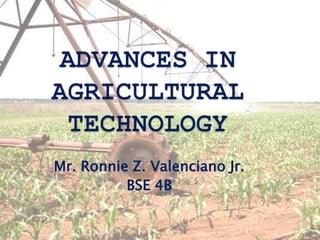

Mr. Ronnie Z. Valenciano Jr.
          BSE 4B
Objectives
• At the end of discussion students are expected
  to:
a. Determine the different agricultural
   technologies use this 21st century.
b. Analyze how they function as a technology.
c. Appreciate the utilization of technologies for
   agricultural purposes.
Overview
      The era of modernization is viewed in the
entire sectors especially in the agriculture sector.
Gone are the days when farmers meant a poor
man laboring hard to meet his needs. In the
modern times, farmers are equipped with
agriculture technology that is latest and trouble
free.
With the entry and increasing influence of
the science in the traditional farming, the
agriculture industry of the nation is celebrating
green revolution each moment.
       The new technologies have helped in
utilizing even the small land into loads of profit
making source.
       Farmers whether small or big are getting
more and more aware of the fact that
technology is very beneficial to them and the
future of the agriculture industry.
OPINION
PLEASE?
1. Combine Harvester
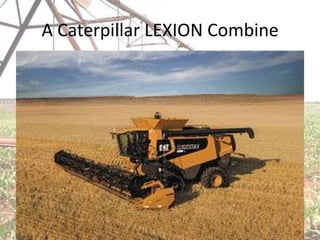
• The combine harvester, or simply combine, is a
  machine that combines the tasks of harvesting,
  threshing, and cleaning grain crops. The objective
  is the harvest of the crop; corn (maize), soybeans,
  flax (linseed), oats, wheat, or rye, among others.
  The waste straw left behind on the field is the
  remaining dried stems and leaves of the crop
  with limited nutrients which is either chopped
  and spread on the field or baled for feed and
  bedding for livestock.
A Caterpillar LEXION Combine
2. Agricultural robot Suit
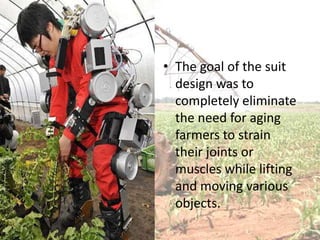
• The robot suit is designed specifically to help
  out with tough agricultural work like pulling
  radishes.

• The suit has eight motors fitted over the
  shoulders, elbows, back and knees to provide
  a power boost to the wearer. The current
  model weighs 55 pounds and uses 16 sensors
  to function.
• The goal of the suit
  design was to
  completely eliminate
  the need for aging
  farmers to strain
  their joints or
  muscles while lifting
  and moving various
  objects.
3. Cultivator
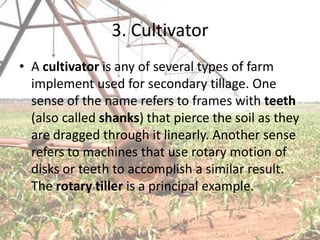
• A cultivator is any of several types of farm
  implement used for secondary tillage. One
  sense of the name refers to frames with teeth
  (also called shanks) that pierce the soil as they
  are dragged through it linearly. Another sense
  refers to machines that use rotary motion of
  disks or teeth to accomplish a similar result.
  The rotary tiller is a principal example.
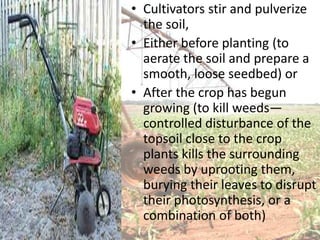
• Cultivators stir and pulverize
  the soil,
• Either before planting (to
  aerate the soil and prepare a
  smooth, loose seedbed) or
• After the crop has begun
  growing (to kill weeds—
  controlled disturbance of the
  topsoil close to the crop
  plants kills the surrounding
  weeds by uprooting them,
  burying their leaves to disrupt
  their photosynthesis, or a
  combination of both)
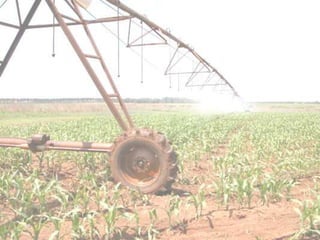
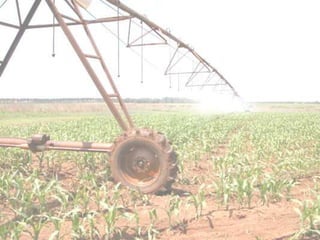
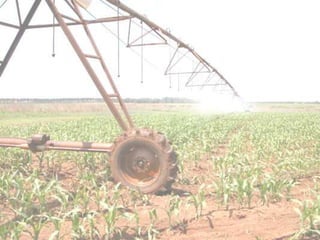
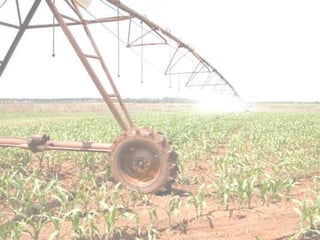
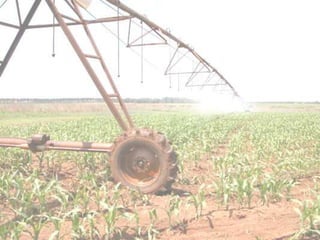
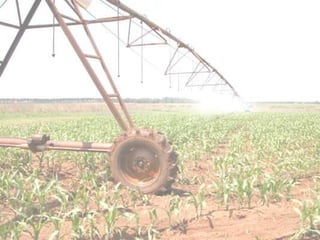
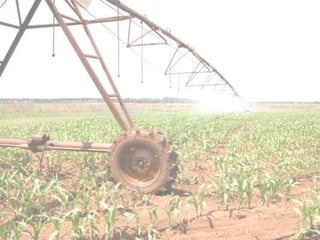
4. Pivot Irrigation System
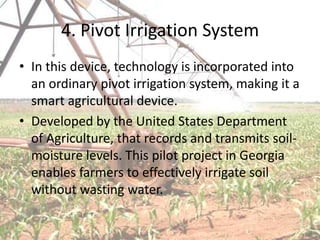
• In this device, technology is incorporated into
  an ordinary pivot irrigation system, making it a
  smart agricultural device.
• Developed by the United States Department
  of Agriculture, that records and transmits soil-
  moisture levels. This pilot project in Georgia
  enables farmers to effectively irrigate soil
  without wasting water.
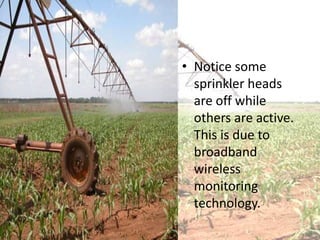
• Notice some
  sprinkler heads
  are off while
  others are active.
  This is due to
  broadband
  wireless
  monitoring
  technology.
5. Tillage system
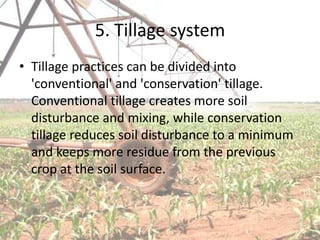
• Tillage practices can be divided into
  'conventional' and 'conservation' tillage.
  Conventional tillage creates more soil
  disturbance and mixing, while conservation
  tillage reduces soil disturbance to a minimum
  and keeps more residue from the previous
  crop at the soil surface.
A. Conventional Tillage
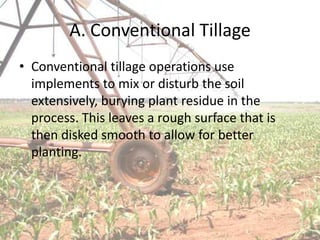
• Conventional tillage operations use
  implements to mix or disturb the soil
  extensively, burying plant residue in the
  process. This leaves a rough surface that is
  then disked smooth to allow for better
  planting.
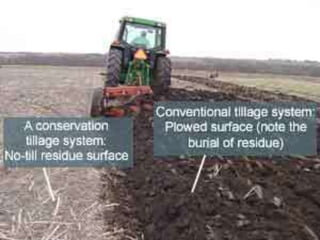
B. ConservationTillage
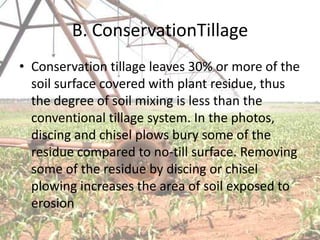
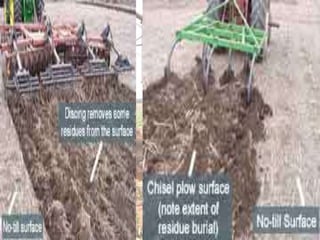
• Conservation tillage leaves 30% or more of the
  soil surface covered with plant residue, thus
  the degree of soil mixing is less than the
  conventional tillage system. In the photos,
  discing and chisel plows bury some of the
  residue compared to no-till surface. Removing
  some of the residue by discing or chisel
  plowing increases the area of soil exposed to
  erosion
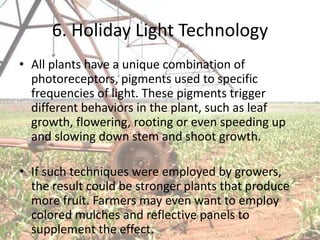
6. Holiday Light Technology
• All plants have a unique combination of
  photoreceptors, pigments used to specific
  frequencies of light. These pigments trigger
  different behaviors in the plant, such as leaf
  growth, flowering, rooting or even speeding up
  and slowing down stem and shoot growth.

• If such techniques were employed by growers,
  the result could be stronger plants that produce
  more fruit. Farmers may even want to employ
  colored mulches and reflective panels to
  supplement the effect.
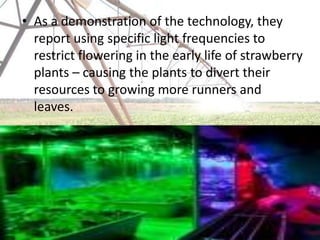
• As a demonstration of the technology, they
  report using specific light frequencies to
  restrict flowering in the early life of strawberry
  plants – causing the plants to divert their
  resources to growing more runners and
  leaves.
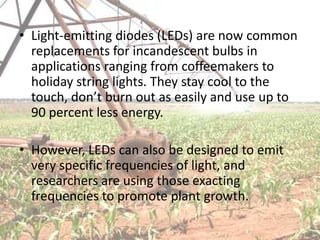
• Light-emitting diodes (LEDs) are now common
  replacements for incandescent bulbs in
  applications ranging from coffeemakers to
  holiday string lights. They stay cool to the
  touch, don’t burn out as easily and use up to
  90 percent less energy.

• However, LEDs can also be designed to emit
  very specific frequencies of light, and
  researchers are using those exacting
  frequencies to promote plant growth.
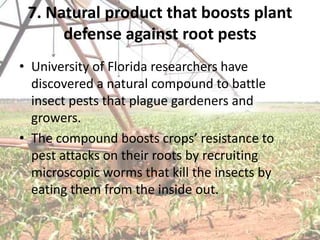
7. Natural product that boosts plant
      defense against root pests
• University of Florida researchers have
  discovered a natural compound to battle
  insect pests that plague gardeners and
  growers.
• The compound boosts crops’ resistance to
  pest attacks on their roots by recruiting
  microscopic worms that kill the insects by
  eating them from the inside out.
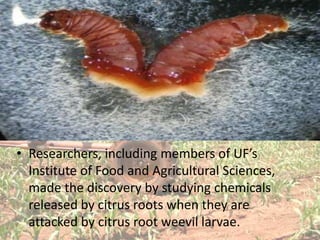
• Researchers, including members of UF’s
  Institute of Food and Agricultural Sciences,
  made the discovery by studying chemicals
  released by citrus roots when they are
  attacked by citrus root weevil larvae.
REFERENCE
• http://agro-tech.info/pivot-irrigation-
  system.html
• http://en.wikipedia.org/wiki/Cultivator
• http://pakagri.blogspot.com/2009_01_01_arc
  hive.html
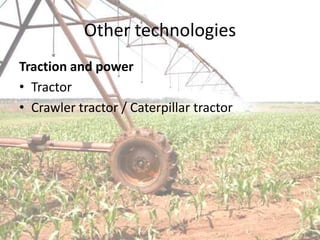
Other technologies
Traction and power
• Tractor
• Crawler tractor / Caterpillar tractor
Soil cultivation
• Cultivator
• Chisel plow
• Harrow
    – Spike harrow
    – Drag harrow
    – Disk harrow
•   Plow
•   Power tiller
•   Rotary tiller
•   Rototiller
•   Spading machine
•   Subsoiler
•   Walking tractor
Planting
• Broadcast seeder (or broadcast spreader or
  fertilizer spreader)
• Plastic mulch layer
• Potato planter
• Seed drill
• Air seeder
• Precision drill
• Transplanter
  – Rice transplanter
Fertilizing and pest control
• Fertilizer spreader (see broadcast seeder)
• Terragator
• Manure spreader
• Sprayer
Irrigation
• Center pivot irrigation
Harvesting / post-harvest
• beet harvester
• Bean harvester
• Combine harvester
Advances in agricultural technology

Advances in agricultural technology

  • 1.
    Mr. Ronnie Z.Valenciano Jr. BSE 4B
  • 2.
    Objectives • At theend of discussion students are expected to: a. Determine the different agricultural technologies use this 21st century. b. Analyze how they function as a technology. c. Appreciate the utilization of technologies for agricultural purposes.
  • 3.
    Overview The era of modernization is viewed in the entire sectors especially in the agriculture sector. Gone are the days when farmers meant a poor man laboring hard to meet his needs. In the modern times, farmers are equipped with agriculture technology that is latest and trouble free.
  • 4.
    With the entryand increasing influence of the science in the traditional farming, the agriculture industry of the nation is celebrating green revolution each moment. The new technologies have helped in utilizing even the small land into loads of profit making source. Farmers whether small or big are getting more and more aware of the fact that technology is very beneficial to them and the future of the agriculture industry.
  • 5.
  • 6.
    1. Combine Harvester •The combine harvester, or simply combine, is a machine that combines the tasks of harvesting, threshing, and cleaning grain crops. The objective is the harvest of the crop; corn (maize), soybeans, flax (linseed), oats, wheat, or rye, among others. The waste straw left behind on the field is the remaining dried stems and leaves of the crop with limited nutrients which is either chopped and spread on the field or baled for feed and bedding for livestock.
  • 7.
  • 8.
    2. Agricultural robotSuit • The robot suit is designed specifically to help out with tough agricultural work like pulling radishes. • The suit has eight motors fitted over the shoulders, elbows, back and knees to provide a power boost to the wearer. The current model weighs 55 pounds and uses 16 sensors to function.
  • 9.
    • The goalof the suit design was to completely eliminate the need for aging farmers to strain their joints or muscles while lifting and moving various objects.
  • 10.
    3. Cultivator • Acultivator is any of several types of farm implement used for secondary tillage. One sense of the name refers to frames with teeth (also called shanks) that pierce the soil as they are dragged through it linearly. Another sense refers to machines that use rotary motion of disks or teeth to accomplish a similar result. The rotary tiller is a principal example.
  • 11.
    • Cultivators stirand pulverize the soil, • Either before planting (to aerate the soil and prepare a smooth, loose seedbed) or • After the crop has begun growing (to kill weeds— controlled disturbance of the topsoil close to the crop plants kills the surrounding weeds by uprooting them, burying their leaves to disrupt their photosynthesis, or a combination of both)
  • 12.
    4. Pivot IrrigationSystem • In this device, technology is incorporated into an ordinary pivot irrigation system, making it a smart agricultural device. • Developed by the United States Department of Agriculture, that records and transmits soil- moisture levels. This pilot project in Georgia enables farmers to effectively irrigate soil without wasting water.
  • 13.
    • Notice some sprinkler heads are off while others are active. This is due to broadband wireless monitoring technology.
  • 14.
    5. Tillage system •Tillage practices can be divided into 'conventional' and 'conservation' tillage. Conventional tillage creates more soil disturbance and mixing, while conservation tillage reduces soil disturbance to a minimum and keeps more residue from the previous crop at the soil surface.
  • 15.
    A. Conventional Tillage •Conventional tillage operations use implements to mix or disturb the soil extensively, burying plant residue in the process. This leaves a rough surface that is then disked smooth to allow for better planting.
  • 16.
    B. ConservationTillage • Conservationtillage leaves 30% or more of the soil surface covered with plant residue, thus the degree of soil mixing is less than the conventional tillage system. In the photos, discing and chisel plows bury some of the residue compared to no-till surface. Removing some of the residue by discing or chisel plowing increases the area of soil exposed to erosion
  • 19.
    6. Holiday LightTechnology • All plants have a unique combination of photoreceptors, pigments used to specific frequencies of light. These pigments trigger different behaviors in the plant, such as leaf growth, flowering, rooting or even speeding up and slowing down stem and shoot growth. • If such techniques were employed by growers, the result could be stronger plants that produce more fruit. Farmers may even want to employ colored mulches and reflective panels to supplement the effect.
  • 20.
    • As ademonstration of the technology, they report using specific light frequencies to restrict flowering in the early life of strawberry plants – causing the plants to divert their resources to growing more runners and leaves.
  • 21.
    • Light-emitting diodes(LEDs) are now common replacements for incandescent bulbs in applications ranging from coffeemakers to holiday string lights. They stay cool to the touch, don’t burn out as easily and use up to 90 percent less energy. • However, LEDs can also be designed to emit very specific frequencies of light, and researchers are using those exacting frequencies to promote plant growth.
  • 22.
    7. Natural productthat boosts plant defense against root pests • University of Florida researchers have discovered a natural compound to battle insect pests that plague gardeners and growers. • The compound boosts crops’ resistance to pest attacks on their roots by recruiting microscopic worms that kill the insects by eating them from the inside out.
  • 23.
    • Researchers, includingmembers of UF’s Institute of Food and Agricultural Sciences, made the discovery by studying chemicals released by citrus roots when they are attacked by citrus root weevil larvae.
  • 24.
    REFERENCE • http://agro-tech.info/pivot-irrigation- system.html • http://en.wikipedia.org/wiki/Cultivator • http://pakagri.blogspot.com/2009_01_01_arc hive.html
  • 25.
    Other technologies Traction andpower • Tractor • Crawler tractor / Caterpillar tractor
  • 26.
    Soil cultivation • Cultivator •Chisel plow • Harrow – Spike harrow – Drag harrow – Disk harrow • Plow • Power tiller • Rotary tiller • Rototiller • Spading machine • Subsoiler • Walking tractor
  • 27.
    Planting • Broadcast seeder(or broadcast spreader or fertilizer spreader) • Plastic mulch layer • Potato planter • Seed drill • Air seeder • Precision drill • Transplanter – Rice transplanter
  • 28.
    Fertilizing and pestcontrol • Fertilizer spreader (see broadcast seeder) • Terragator • Manure spreader • Sprayer Irrigation • Center pivot irrigation
  • 29.
    Harvesting / post-harvest •beet harvester • Bean harvester • Combine harvester