DIET for  adolescents
India in transition India is undergoing rapid socio-economic, nutrition, &  health transition.  India in 2007 is a country of paradoxes.  Fast growing economy,  but  high poverty levels.   Self sufficient in food production, large food subsidy and  food  supplementation programmers But   under-nutrition levels in children continue to be very  high; higher than Sub-Saharan Africa  . Over-nutrition in children is rising  especially among affluent and urban children  You  are lucky-can choose your diet
Why should you care?  Physical Growth Body image  Brain Daily activities Sports performance  Prevention of diseases N utrition “ Happiness is nothing more than good health” -  Albert Schweitzer
Nutritional needs during adolescence are increased because of the increased growth rate and changes in body composition associated with puberty…
You gain 75% of adult height, 50% of adult weight  and 40% of adult bone mass during adolescence. Deposition of muscles in boys (50%) Deposition of fat in girls Preparation for future healthy mother and father  Healthy Diet
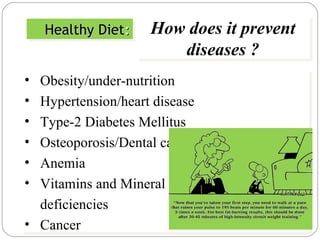
Healthy Diet : How does it prevent diseases ? Obesity/under-nutrition  Hypertension/heart disease  Type-2 Diabetes Mellitus Osteoporosis/Dental caries  Anemia  Vitamins and Mineral  deficiencies  Cancer
Healthy Diet: Actual need  varies with  physical activity Physically active people have higher energy needs If you have low physical activity then you can become  obese even with low intake. Therefore,  Energy intake should balance energy expenditure. Deciding the right amount
A Balanced diet helps improve your overall  health and well being A Balanced diet  can help you feel better    provide   you with more energy, help you stay fit and active and help you fight stress.       Balanced diet
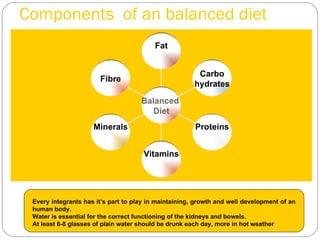
Components  of an balanced diet Every integrants has it’s part to play in maintaining, growth and well development of an human body.  Water is essential for the correct functioning of the kidneys and bowels.  At least 6-8 glasses of plain water should be drunk each day, more in hot weather Fibre Minerals Vitamins Proteins Carbo hydrates Fat Balanced  Diet
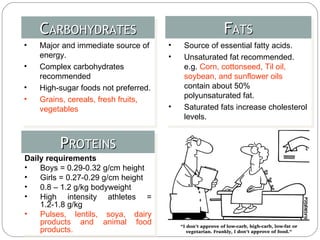
F ATS Source of essential fatty acids. Unsaturated fat recommended. e.g.  Corn, cottonseed, Til oil, soybean, and sunflower oils  contain about 50% polyunsaturated fat. Saturated fats increase cholesterol levels. C ARBOHYDRATES Major and immediate source of energy.  Complex carbohydrates recommended High-sugar foods not preferred. Grains, cereals, fresh fruits, vegetables P ROTEINS Daily requirements Boys = 0.29-0.32 g/cm height Girls = 0.27-0.29 g/cm height 0.8 – 1.2 g/kg bodyweight High intensity athletes = 1.2-1.8 g/kg  Pulses, lentils, soya, dairy products and animal food products.
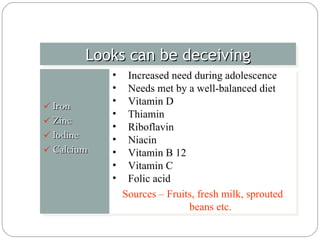
Iron  Zinc  Iodine  Calcium Looks can be deceiving Increased need during adolescence Needs met by a well-balanced diet Vitamin D  Thiamin Riboflavin Niacin Vitamin B 12 Vitamin C  Folic acid Sources – Fruits, fresh milk, sprouted beans etc.
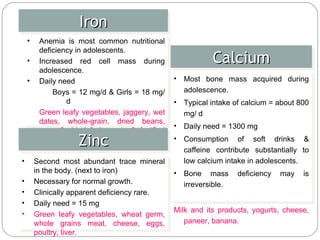
Iron Anemia is most common nutritional deficiency in adolescents. Increased red cell mass during adolescence. Daily need Boys = 12 mg/d & Girls = 18 mg/d Green leafy vegetables, jaggery, wet dates, whole-grain, dried beans, peas & dried fruits, nuts & fortified wheat products, eggs, red meat etc. Calcium Most bone mass acquired during adolescence. Typical intake of calcium = about 800 mg/ d Daily need = 1300 mg Consumption of soft drinks & caffeine contribute substantially to low calcium intake in adolescents. Bone mass deficiency may is irreversible. Milk and its products, yogurts, cheese, paneer, banana. Zinc Second most abundant trace mineral in the body. (next to iron) Necessary for normal growth. Clinically apparent deficiency rare. Daily need = 15 mg Green leafy vegetables, wheat germ, whole grains meat, cheese, eggs, poultry, liver.
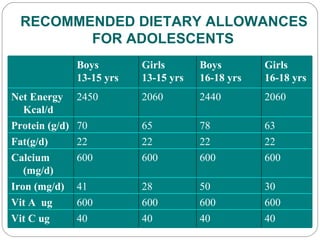
RECOMMENDED DIETARY ALLOWANCES FOR ADOLESCENTS     Boys  13-15 yrs Girls  13-15 yrs Boys  16-18 yrs Girls  16-18 yrs Net Energy Kcal/d 2450 2060 2440 2060 Protein (g/d) 70 65 78 63 Fat(g/d) 22 22 22 22 Calcium (mg/d) 600 600 600 600 Iron (mg/d) 41 28 50 30 Vit A  ug 600 600 600 600 Vit C ug 40 40 40 40
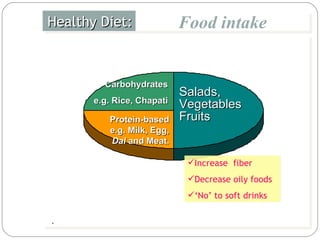
Salads, Vegetables Fruits Carbohydrates e.g. Rice, Chapati Protein-based e.g. Milk, Egg,  Dal  and Meat.  Increase  fiber Decrease oily foods ‘ No’ to soft drinks . Healthy Diet: Food intake
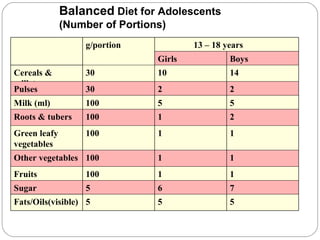
Balanced  Diet for Adolescents  (Number of Portions)   g/portion 13 – 18 years  Girls Boys Cereals & millets 30 10 14 Pulses 30 2 2 Milk (ml) 100 5 5 Roots & tubers 100 1 2 Green leafy vegetables 100 1 1 Other vegetables 100 1 1 Fruits 100 1 1 Sugar 5 6 7 Fats/Oils(visible) 5 5 5
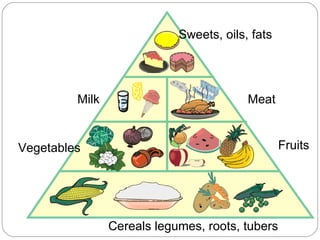
Vegetables Fruits Milk Meat Sweets, oils, fats Cereals legumes, roots, tubers
  Healthy Eating:A Guide for Teens Healthy eating is a way of balancing the food you eat to keep your body strong, energized, and well nourished.  When you eat well, you are taking good care of your body. 
Healthy eating is a great way to: Have energy all day long Get the vitamins and minerals your body needs Stay strong for sports or other activities Reach your maximum height (if you are still growing) Maintain a healthy weight Prevent unhealthy eating habits, like skipping meals and feeling overly hungry at the next meal
What is "healthy eating?" Aiming for regular meals and healthy snacks (when you are hungry or need extra energy) Eating foods from all of the food groups (grains, fruits, vegetables, proteins, dairy proteins, and healthy fats) each day to meet your nutritional needs Balancing nutrient-rich foods with moderate amounts of other foods, such as sweets or fast foods Eating when hungry and stopping when full
Tips for Healthy Eating Sugar - avoid getting too much. Learn about simple, healthy  ways to prepare foods. Be mindful when eating Avoid "diet thinking." Don't  skip  meals
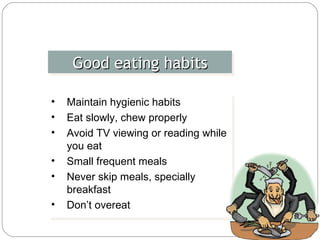
Good eating habits Maintain hygienic habits  Eat slowly, chew properly  Avoid TV viewing or reading while you eat Small frequent meals Never skip meals, specially breakfast  Don’t overeat
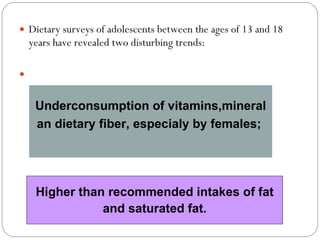
Dietary surveys of adolescents between the ages of 13 and 18 years have revealed two disturbing trends: Higher than recommended intakes of fat and saturated fat.  Underconsumption of vitamins,mineral an dietary fiber, especialy by females;
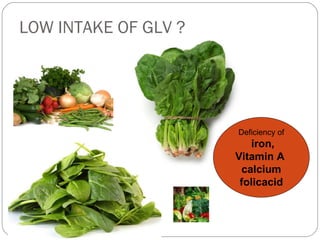
LOW INTAKE OF GLV ? Deficiency of iron, Vitamin A  calcium folicacid
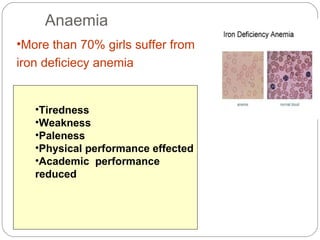
Tiredness Weakness Paleness Physical performance effected Academic  performance  reduced Anaemia More than 70% girls suffer from iron deficiecy anemia
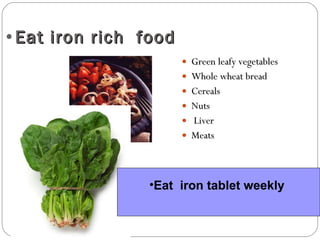
Eat iron rich  food Green leafy vegetables Whole wheat bread Cereals Nuts Liver Meats Eat  iron tablet weekly
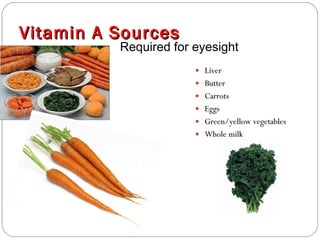
Vitamin A Sources Liver Butter Carrots Eggs Green/yellow vegetables Whole milk Required for eyesight
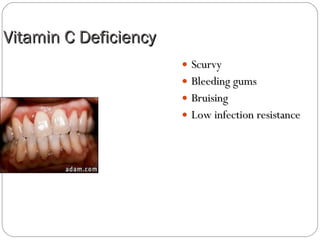
Vitamin C Deficiency Scurvy Bleeding gums Bruising Low infection resistance
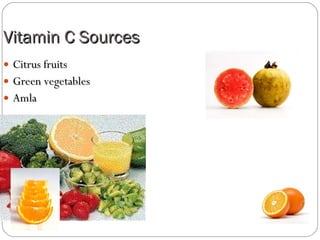
Vitamin C Sources Citrus fruits Green vegetables Amla
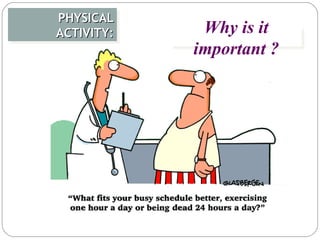
PHYSICAL ACTIVITY : Why is it important ?
P HYSICAL  A CTIVITY : Importance This includes : Cardio-respiratory i.e. Heart & Lung fitness  Muscle strength  Endurance & flexibility
P HYSICAL  A CTIVITY : Types of physical activity Daily Chores:   walking, climbing stairs, cycling, household activities, etc. Exercise:  planned & structured subset of leisure time physical activity undertaken for improving or maintaining physical fitness. 30-60 minutes every day
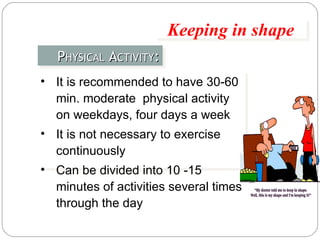
P HYSICAL  A CTIVITY : Keeping in shape It is recommended to have 30-60 min. moderate  physical activity on weekdays, four days a week  It is not necessary to exercise continuously  Can be divided into 10 -15 minutes of activities several times through the day
Nutrition & Exercise: Myths Girls don’t need muscle stretching exercises You can become obese if you leave exercise Expensive food and vitamins are needed for good health and machines for exercise Health drinks
Television and Obesity Excessive TV watching is associated with weight gain specially when associated with increased snacking with junk food and aerated drinks  TVsterol Combine TV watching with physical activity like  stationary bicycling, or spot jogging
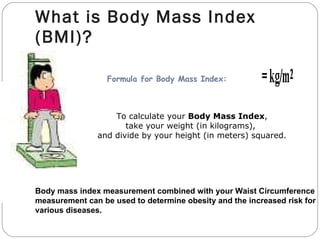
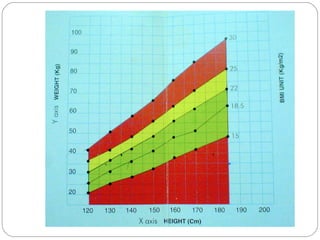
What is Body Mass Index (BMI)? Body mass index measurement combined with your Waist Circumference  measurement can be used to determine obesity and the increased risk for various diseases.   To calculate your  Body Mass Index , take your weight (in kilograms),   and divide by your height (in meters) squared.                     Formula for Body Mass Index:              
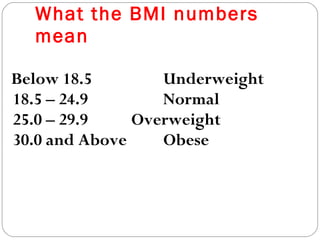
What the BMI numbers mean Below 18.5  Underweight 18.5 – 24.9  Normal 25.0 – 29.9  Overweight 30.0 and Above  Obese
 
Ways to Reach (and Maintain!) a Healthy Weight Diets aren't the way to go when it comes to losing weight. That's because they create temporary eating patterns — and, therefore, temporary results. Most dieters gain back any lost weight when they go back to their old eating habits.  Weight loss is most likely to be successful when people change their habits, replacing old, unhealthy ones with new, healthy behaviors.
Health care professionals generally agree that the most effective way to lose weight is to do it gradually. Exaggerated weight loss in a short period of time can be dangerous, and can often lead to a subsequent regaining of the weight, dubbed “yo-yo” dieting.
So how much should you lose, and how should you lose it? The general rule  is About one-half to one pound per week which promotes long-term loss of body fat. 
  Regular physical activity burns calories and builds muscle — both of which help you look and feel good and keep weight off.  If you want to burn more calories, increase the intensity of your workout and add some strength exercises to build muscle. The more muscle you have, the more calories you burn, even when you aren't exercising.  Here are 5 ways to make that happen :
2.Reduce screen time One reason people get less exercise these days is because of an increase in "screen time" — the amount of time spent watching TV, looking at the computer, or playing video games. Limit recreational screen time to less than 1 hour per day.
3.Watch out for portion distortion .  Serving sizes have increased over the past 10 years, and these extra calories contribute to obesity.  Another key factor in weight gain is that more people drink sugary beverages, such as sodas, juice drinks, and sports drinks. So choose smaller portions (or share restaurant portions) and go for water or low-fat milk instead of soda.
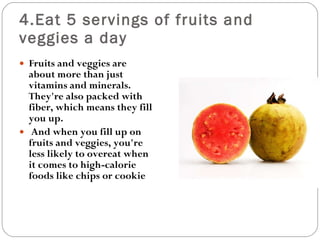
4.Eat 5 servings of fruits and veggies a day Fruits and veggies are about more than just vitamins and minerals. They're also packed with fiber, which means they fill you up. And when you fill up on fruits and veggies, you're less likely to overeat when it comes to high-calorie foods like chips or cookie
5.Don't skip breakfast.   Breakfast kick-starts your metabolism, burning calories from the get-go and giving you energy to do more during the day. People who skip breakfast often feel so hungry that they eat more later on. So they get more calories than they would have if they ate breakfast.
Breakfast: The most important meal Brain Food Improves performance in studies  Improves physical activities Does not contribute to overweight Keeps you healthy Skipping breakfast associated with obesity High sugar breakfast causes a high sugar level which dips fast making you more hungry and you eat more sugary food
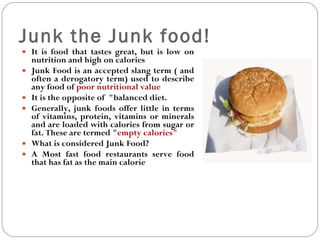
Junk the Junk food!  It is food that tastes great, but is low on nutrition and high on calories Junk Food is an accepted slang term ( and often a derogatory term) used to describe any food of  poor nutritional value It is the opposite of  "balanced diet. Generally, junk foods offer little in terms of vitamins, protein, vitamins or minerals and are loaded with calories from sugar or fat. These are termed " empty calories" What is considered Junk Food? A Most fast food restaurants serve food that has fat as the main calorie 
Why is Fast Food unhealthy ? High in calorie, fat, sodium and low in fiber which can cause  Obesity, Hypertension, Heart diseases, Diabetes, Cancer etc. Contains preservatives Choose low-calorie and low-fat meals, snacks and desserts Have low fat or skim milk drinks.
Food Nutrition in Snacks Snacks, like , Potato Chips, burger,french fries, and, are not a recommended food for any healthy eating plan or weight loss diet. Typically, they are heavily refined foods, high in calories, high in fat and sodium, with a very low nutritional value. A small serving can contain 100+ calories. Nutrients in Snacks Macronutrients in some foods include carbohydrate, fat and some protein. Energy in Snacks Vitamins in Snacks Snackfoods are not a recommended source of vitamins. Clearly, if you eat a lot of fast food everyday, your daily calorie intake will skyrocket
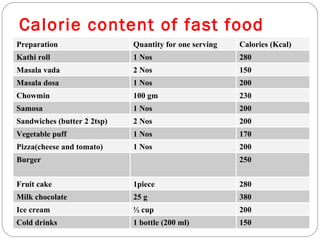
Calorie content of fast food Preparation  Quantity for one serving  Calories (Kcal) Kathi roll  1 Nos 280 Masala vada 2 Nos 150 Masala dosa 1 Nos 200 Chowmin  100 gm 230 Samosa 1 Nos 200 Sandwiches (butter 2 2tsp) 2 Nos 200 Vegetable puff 1 Nos 170 Pizza(cheese and tomato) 1 Nos 200 Burger 250 Fruit cake 1piece 280 Milk chocolate 25 g 380 Ice cream ½ cup 200 Cold drinks  1 bottle (200 ml) 150
You may have noticed that you feel hungry a lot. This is natural — during adolescence, a person's body demands more nutrients to grow. Snacks are a terrific way to satisfy that hunger and get all the vitamins and nutrients, your body needs. But you need to pay attention to what you eat. Stuffing your face with a large order of fries after class may give you a temporary boost, but a snack this high in fat and calories will only slow you down in the long run. To keep energy levels going — and avoid weight gain — steer clear of foods with lots of simple carbohydrates (sugars) like candy bars or soda. Look for foods that contain complex carbohydrates like whole-grain breads and cereals and combine them with protein-rich snacks   Why Healthy Snacking Is Good for You???
Do healthy snacks exist ? Yes, and in plenty. Snacks like fresh fruits, sprouted beans and nuts are nutritious and healthy.  Choose low-calorie and low-fat meals, snacks and desserts Have low fat or skim milk drinks.  Avoid energy dense snacks like burgers.
The Middle Path: Making Junk food healthy Replace the Cheese with  Paneer  or low-fat cheese  Add plenty of vegetables Replace frying with grilling or baking Replace white bread,  maida  noodles or  maida  pizza base with whole-grain wheat Have low-fat or skimmed milk based products
 
If I Eat Well at Home, What's Wrong With Splurging When I Eat Out? A slice of pizza once in a while won't do you any harm. What's important is a person's average food intake over a few days, not just in a single meal. So if you eat a less-than-healthy meal once in a while, try to balance it with healthier foods the rest of that day and week. But if pizza (or any fast food) is all you eat, that can lead to problems. The most obvious health threat of eating too much fast food is weight gain — or even obesity. But weight gain isn't the only problem. Too much fast food can drag a person's body down in other ways. Because the food we eat affects all aspects of how the body functions, eating the right (or wrong) foods can influence any number of things, including: mental functioning
energy emotional well-being strength weight future health Eating on the Go It's actually easier than you think to make good choices at a fast-food restaurant, the mall, or even the school cafeteria. Most cafeterias and fast-food places offer healthy choices that are also tasty, like grilled chicken or salads. Be mindful of portion sizes and high fat add-ons, like dressings, sauces or cheese. some pointe to remember that can help you make wise choices when eating out: Go for balance.  Choose meals that contain a balance of lean proteins (like fish, chicken, or beans if you're a vegetarian), fruits and vegetables (fries and potato chips don't qualify as veggies!), and whole-grains (like whole wheat bread).  Watch portion sizes. . Drink water or low-fat milk.  Regular sodas, juices, and energy drinks usually contain "empty" calories that you don't need
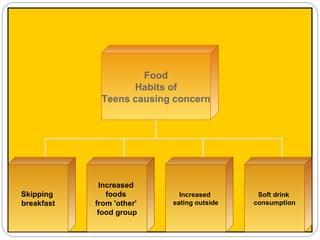
Food  Habits of Teens causing concern Skipping  breakfast Increased  foods  from 'other'  food group Increased  eating outside Soft drink  consumption
HYGEINE AND HEALTH
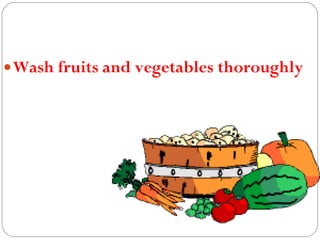
Wash fruits and vegetables thoroughly
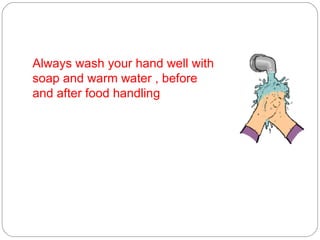
Always wash your hand well with  soap and warm water , before and after food handling
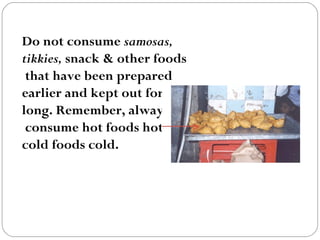
Do not consume  samosas,  tikkies,  snack & other foods that have been prepared  earlier and kept out for  long. Remember, always consume hot foods hot and cold foods cold.   
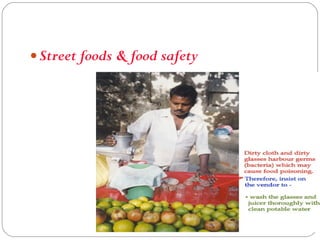
Street foods & food safety
Besides dangers of dust and foreign matter, uncovered food attract pests, particularly flies and cockroaches.
Key points Proper Nutrition & Regular Physical Activity are very important for Growth Prevention of illness Future health
Finally - To Stay Healthy Exercise Eat a Balanced diet Maintain a Healthy Lifestyle

Healthy diet for Adolescents

  • 1.
    DIET for adolescents
  • 2.
    India in transitionIndia is undergoing rapid socio-economic, nutrition, & health transition. India in 2007 is a country of paradoxes. Fast growing economy, but high poverty levels. Self sufficient in food production, large food subsidy and food supplementation programmers But under-nutrition levels in children continue to be very high; higher than Sub-Saharan Africa . Over-nutrition in children is rising especially among affluent and urban children You are lucky-can choose your diet
  • 3.
    Why should youcare? Physical Growth Body image Brain Daily activities Sports performance Prevention of diseases N utrition “ Happiness is nothing more than good health” - Albert Schweitzer
  • 4.
    Nutritional needs duringadolescence are increased because of the increased growth rate and changes in body composition associated with puberty…
  • 5.
    You gain 75%of adult height, 50% of adult weight and 40% of adult bone mass during adolescence. Deposition of muscles in boys (50%) Deposition of fat in girls Preparation for future healthy mother and father Healthy Diet
  • 6.
    Healthy Diet :How does it prevent diseases ? Obesity/under-nutrition Hypertension/heart disease Type-2 Diabetes Mellitus Osteoporosis/Dental caries Anemia Vitamins and Mineral deficiencies Cancer
  • 7.
    Healthy Diet: Actualneed varies with physical activity Physically active people have higher energy needs If you have low physical activity then you can become obese even with low intake. Therefore, Energy intake should balance energy expenditure. Deciding the right amount
  • 8.
    A Balanced diethelps improve your overall health and well being A Balanced diet can help you feel better   provide you with more energy, help you stay fit and active and help you fight stress.       Balanced diet
  • 9.
    Components ofan balanced diet Every integrants has it’s part to play in maintaining, growth and well development of an human body. Water is essential for the correct functioning of the kidneys and bowels. At least 6-8 glasses of plain water should be drunk each day, more in hot weather Fibre Minerals Vitamins Proteins Carbo hydrates Fat Balanced Diet
  • 10.
    F ATS Sourceof essential fatty acids. Unsaturated fat recommended. e.g. Corn, cottonseed, Til oil, soybean, and sunflower oils contain about 50% polyunsaturated fat. Saturated fats increase cholesterol levels. C ARBOHYDRATES Major and immediate source of energy. Complex carbohydrates recommended High-sugar foods not preferred. Grains, cereals, fresh fruits, vegetables P ROTEINS Daily requirements Boys = 0.29-0.32 g/cm height Girls = 0.27-0.29 g/cm height 0.8 – 1.2 g/kg bodyweight High intensity athletes = 1.2-1.8 g/kg Pulses, lentils, soya, dairy products and animal food products.
  • 11.
    Iron Zinc Iodine Calcium Looks can be deceiving Increased need during adolescence Needs met by a well-balanced diet Vitamin D Thiamin Riboflavin Niacin Vitamin B 12 Vitamin C Folic acid Sources – Fruits, fresh milk, sprouted beans etc.
  • 12.
    Iron Anemia ismost common nutritional deficiency in adolescents. Increased red cell mass during adolescence. Daily need Boys = 12 mg/d & Girls = 18 mg/d Green leafy vegetables, jaggery, wet dates, whole-grain, dried beans, peas & dried fruits, nuts & fortified wheat products, eggs, red meat etc. Calcium Most bone mass acquired during adolescence. Typical intake of calcium = about 800 mg/ d Daily need = 1300 mg Consumption of soft drinks & caffeine contribute substantially to low calcium intake in adolescents. Bone mass deficiency may is irreversible. Milk and its products, yogurts, cheese, paneer, banana. Zinc Second most abundant trace mineral in the body. (next to iron) Necessary for normal growth. Clinically apparent deficiency rare. Daily need = 15 mg Green leafy vegetables, wheat germ, whole grains meat, cheese, eggs, poultry, liver.
  • 13.
    RECOMMENDED DIETARY ALLOWANCESFOR ADOLESCENTS   Boys 13-15 yrs Girls 13-15 yrs Boys 16-18 yrs Girls 16-18 yrs Net Energy Kcal/d 2450 2060 2440 2060 Protein (g/d) 70 65 78 63 Fat(g/d) 22 22 22 22 Calcium (mg/d) 600 600 600 600 Iron (mg/d) 41 28 50 30 Vit A ug 600 600 600 600 Vit C ug 40 40 40 40
  • 14.
    Salads, Vegetables FruitsCarbohydrates e.g. Rice, Chapati Protein-based e.g. Milk, Egg, Dal and Meat. Increase fiber Decrease oily foods ‘ No’ to soft drinks . Healthy Diet: Food intake
  • 15.
    Balanced Dietfor Adolescents (Number of Portions)   g/portion 13 – 18 years Girls Boys Cereals & millets 30 10 14 Pulses 30 2 2 Milk (ml) 100 5 5 Roots & tubers 100 1 2 Green leafy vegetables 100 1 1 Other vegetables 100 1 1 Fruits 100 1 1 Sugar 5 6 7 Fats/Oils(visible) 5 5 5
  • 16.
    Vegetables Fruits MilkMeat Sweets, oils, fats Cereals legumes, roots, tubers
  • 17.
      Healthy Eating:AGuide for Teens Healthy eating is a way of balancing the food you eat to keep your body strong, energized, and well nourished. When you eat well, you are taking good care of your body. 
  • 18.
    Healthy eating isa great way to: Have energy all day long Get the vitamins and minerals your body needs Stay strong for sports or other activities Reach your maximum height (if you are still growing) Maintain a healthy weight Prevent unhealthy eating habits, like skipping meals and feeling overly hungry at the next meal
  • 19.
    What is "healthyeating?" Aiming for regular meals and healthy snacks (when you are hungry or need extra energy) Eating foods from all of the food groups (grains, fruits, vegetables, proteins, dairy proteins, and healthy fats) each day to meet your nutritional needs Balancing nutrient-rich foods with moderate amounts of other foods, such as sweets or fast foods Eating when hungry and stopping when full
  • 20.
    Tips for HealthyEating Sugar - avoid getting too much. Learn about simple, healthy ways to prepare foods. Be mindful when eating Avoid "diet thinking." Don't skip meals
  • 21.
    Good eating habitsMaintain hygienic habits Eat slowly, chew properly Avoid TV viewing or reading while you eat Small frequent meals Never skip meals, specially breakfast Don’t overeat
  • 22.
    Dietary surveys ofadolescents between the ages of 13 and 18 years have revealed two disturbing trends: Higher than recommended intakes of fat and saturated fat. Underconsumption of vitamins,mineral an dietary fiber, especialy by females;
  • 23.
    LOW INTAKE OFGLV ? Deficiency of iron, Vitamin A calcium folicacid
  • 24.
    Tiredness Weakness PalenessPhysical performance effected Academic performance reduced Anaemia More than 70% girls suffer from iron deficiecy anemia
  • 25.
    Eat iron rich food Green leafy vegetables Whole wheat bread Cereals Nuts Liver Meats Eat iron tablet weekly
  • 26.
    Vitamin A SourcesLiver Butter Carrots Eggs Green/yellow vegetables Whole milk Required for eyesight
  • 27.
    Vitamin C DeficiencyScurvy Bleeding gums Bruising Low infection resistance
  • 28.
    Vitamin C SourcesCitrus fruits Green vegetables Amla
  • 29.
    PHYSICAL ACTIVITY :Why is it important ?
  • 30.
    P HYSICAL A CTIVITY : Importance This includes : Cardio-respiratory i.e. Heart & Lung fitness Muscle strength Endurance & flexibility
  • 31.
    P HYSICAL A CTIVITY : Types of physical activity Daily Chores: walking, climbing stairs, cycling, household activities, etc. Exercise: planned & structured subset of leisure time physical activity undertaken for improving or maintaining physical fitness. 30-60 minutes every day
  • 32.
    P HYSICAL A CTIVITY : Keeping in shape It is recommended to have 30-60 min. moderate physical activity on weekdays, four days a week It is not necessary to exercise continuously Can be divided into 10 -15 minutes of activities several times through the day
  • 33.
    Nutrition & Exercise:Myths Girls don’t need muscle stretching exercises You can become obese if you leave exercise Expensive food and vitamins are needed for good health and machines for exercise Health drinks
  • 34.
    Television and ObesityExcessive TV watching is associated with weight gain specially when associated with increased snacking with junk food and aerated drinks TVsterol Combine TV watching with physical activity like stationary bicycling, or spot jogging
  • 35.
    What is BodyMass Index (BMI)? Body mass index measurement combined with your Waist Circumference measurement can be used to determine obesity and the increased risk for various diseases. To calculate your  Body Mass Index , take your weight (in kilograms),   and divide by your height (in meters) squared.                     Formula for Body Mass Index:              
  • 36.
    What the BMInumbers mean Below 18.5 Underweight 18.5 – 24.9 Normal 25.0 – 29.9 Overweight 30.0 and Above Obese
  • 37.
  • 38.
    Ways to Reach(and Maintain!) a Healthy Weight Diets aren't the way to go when it comes to losing weight. That's because they create temporary eating patterns — and, therefore, temporary results. Most dieters gain back any lost weight when they go back to their old eating habits. Weight loss is most likely to be successful when people change their habits, replacing old, unhealthy ones with new, healthy behaviors.
  • 39.
    Health care professionalsgenerally agree that the most effective way to lose weight is to do it gradually. Exaggerated weight loss in a short period of time can be dangerous, and can often lead to a subsequent regaining of the weight, dubbed “yo-yo” dieting.
  • 40.
    So how muchshould you lose, and how should you lose it? The general rule is About one-half to one pound per week which promotes long-term loss of body fat. 
  • 41.
      Regular physicalactivity burns calories and builds muscle — both of which help you look and feel good and keep weight off. If you want to burn more calories, increase the intensity of your workout and add some strength exercises to build muscle. The more muscle you have, the more calories you burn, even when you aren't exercising. Here are 5 ways to make that happen :
  • 42.
    2.Reduce screen timeOne reason people get less exercise these days is because of an increase in "screen time" — the amount of time spent watching TV, looking at the computer, or playing video games. Limit recreational screen time to less than 1 hour per day.
  • 43.
    3.Watch out forportion distortion .  Serving sizes have increased over the past 10 years, and these extra calories contribute to obesity. Another key factor in weight gain is that more people drink sugary beverages, such as sodas, juice drinks, and sports drinks. So choose smaller portions (or share restaurant portions) and go for water or low-fat milk instead of soda.
  • 44.
    4.Eat 5 servingsof fruits and veggies a day Fruits and veggies are about more than just vitamins and minerals. They're also packed with fiber, which means they fill you up. And when you fill up on fruits and veggies, you're less likely to overeat when it comes to high-calorie foods like chips or cookie
  • 45.
    5.Don't skip breakfast.  Breakfast kick-starts your metabolism, burning calories from the get-go and giving you energy to do more during the day. People who skip breakfast often feel so hungry that they eat more later on. So they get more calories than they would have if they ate breakfast.
  • 46.
    Breakfast: The mostimportant meal Brain Food Improves performance in studies Improves physical activities Does not contribute to overweight Keeps you healthy Skipping breakfast associated with obesity High sugar breakfast causes a high sugar level which dips fast making you more hungry and you eat more sugary food
  • 47.
    Junk the Junkfood! It is food that tastes great, but is low on nutrition and high on calories Junk Food is an accepted slang term ( and often a derogatory term) used to describe any food of poor nutritional value It is the opposite of "balanced diet. Generally, junk foods offer little in terms of vitamins, protein, vitamins or minerals and are loaded with calories from sugar or fat. These are termed " empty calories" What is considered Junk Food? A Most fast food restaurants serve food that has fat as the main calorie 
  • 48.
    Why is FastFood unhealthy ? High in calorie, fat, sodium and low in fiber which can cause Obesity, Hypertension, Heart diseases, Diabetes, Cancer etc. Contains preservatives Choose low-calorie and low-fat meals, snacks and desserts Have low fat or skim milk drinks.
  • 49.
    Food Nutrition inSnacks Snacks, like , Potato Chips, burger,french fries, and, are not a recommended food for any healthy eating plan or weight loss diet. Typically, they are heavily refined foods, high in calories, high in fat and sodium, with a very low nutritional value. A small serving can contain 100+ calories. Nutrients in Snacks Macronutrients in some foods include carbohydrate, fat and some protein. Energy in Snacks Vitamins in Snacks Snackfoods are not a recommended source of vitamins. Clearly, if you eat a lot of fast food everyday, your daily calorie intake will skyrocket
  • 50.
    Calorie content offast food Preparation Quantity for one serving Calories (Kcal) Kathi roll 1 Nos 280 Masala vada 2 Nos 150 Masala dosa 1 Nos 200 Chowmin 100 gm 230 Samosa 1 Nos 200 Sandwiches (butter 2 2tsp) 2 Nos 200 Vegetable puff 1 Nos 170 Pizza(cheese and tomato) 1 Nos 200 Burger 250 Fruit cake 1piece 280 Milk chocolate 25 g 380 Ice cream ½ cup 200 Cold drinks 1 bottle (200 ml) 150
  • 51.
    You may havenoticed that you feel hungry a lot. This is natural — during adolescence, a person's body demands more nutrients to grow. Snacks are a terrific way to satisfy that hunger and get all the vitamins and nutrients, your body needs. But you need to pay attention to what you eat. Stuffing your face with a large order of fries after class may give you a temporary boost, but a snack this high in fat and calories will only slow you down in the long run. To keep energy levels going — and avoid weight gain — steer clear of foods with lots of simple carbohydrates (sugars) like candy bars or soda. Look for foods that contain complex carbohydrates like whole-grain breads and cereals and combine them with protein-rich snacks Why Healthy Snacking Is Good for You???
  • 52.
    Do healthy snacksexist ? Yes, and in plenty. Snacks like fresh fruits, sprouted beans and nuts are nutritious and healthy. Choose low-calorie and low-fat meals, snacks and desserts Have low fat or skim milk drinks. Avoid energy dense snacks like burgers.
  • 53.
    The Middle Path:Making Junk food healthy Replace the Cheese with Paneer or low-fat cheese Add plenty of vegetables Replace frying with grilling or baking Replace white bread, maida noodles or maida pizza base with whole-grain wheat Have low-fat or skimmed milk based products
  • 54.
  • 55.
    If I EatWell at Home, What's Wrong With Splurging When I Eat Out? A slice of pizza once in a while won't do you any harm. What's important is a person's average food intake over a few days, not just in a single meal. So if you eat a less-than-healthy meal once in a while, try to balance it with healthier foods the rest of that day and week. But if pizza (or any fast food) is all you eat, that can lead to problems. The most obvious health threat of eating too much fast food is weight gain — or even obesity. But weight gain isn't the only problem. Too much fast food can drag a person's body down in other ways. Because the food we eat affects all aspects of how the body functions, eating the right (or wrong) foods can influence any number of things, including: mental functioning
  • 56.
    energy emotional well-beingstrength weight future health Eating on the Go It's actually easier than you think to make good choices at a fast-food restaurant, the mall, or even the school cafeteria. Most cafeterias and fast-food places offer healthy choices that are also tasty, like grilled chicken or salads. Be mindful of portion sizes and high fat add-ons, like dressings, sauces or cheese. some pointe to remember that can help you make wise choices when eating out: Go for balance.  Choose meals that contain a balance of lean proteins (like fish, chicken, or beans if you're a vegetarian), fruits and vegetables (fries and potato chips don't qualify as veggies!), and whole-grains (like whole wheat bread). Watch portion sizes. . Drink water or low-fat milk.  Regular sodas, juices, and energy drinks usually contain "empty" calories that you don't need
  • 57.
    Food Habitsof Teens causing concern Skipping breakfast Increased foods from 'other' food group Increased eating outside Soft drink consumption
  • 58.
  • 59.
    Wash fruits andvegetables thoroughly
  • 60.
    Always wash yourhand well with soap and warm water , before and after food handling
  • 61.
    Do not consume samosas, tikkies, snack & other foods that have been prepared earlier and kept out for long. Remember, always consume hot foods hot and cold foods cold.  
  • 62.
    Street foods &food safety
  • 63.
    Besides dangers ofdust and foreign matter, uncovered food attract pests, particularly flies and cockroaches.
  • 64.
    Key points ProperNutrition & Regular Physical Activity are very important for Growth Prevention of illness Future health
  • 65.
    Finally - ToStay Healthy Exercise Eat a Balanced diet Maintain a Healthy Lifestyle

Editor's Notes

  • #24 Deficiency of iron,vitamina calcium