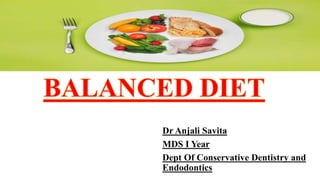
Dr Anjali Savita
MDS I Year
Dept Of Conservative Dentistry and
Endodontics
Contents
• Definition Of A Diet
• Definition Of A Balanced Diet
• Importance Of Balanced Diet
• Objectives Of Balanced Diet
• Basal Metabolism And Basal Metabolic Rate
• Components Of Balanced Diet
• RDA Of Nutrients
• Food Pyramid
• Studies Related To Balanced Diet
• Survey Results
• Conclusion
• References
INTRODUCTION
Diet
• Total oral intake of substance that provide nourishment and energy.
- Nizel (1989)
• It is referred to as food and drink regularly consumed.
(Oxford dental dictionary).
• Diet is defined as types and amount of food eaten daily by an
individual. (FDI 1994)
BALANCED DIET
• “It is one which contains varieties of foods in such quantities and proportion
that the need for energy, amino acid, vitamins, fats, carbohydrate and other
nutrients which is adequately met for maintaining health, vitality and general
well being and also makes provision for a short duration of leanness.”
(Chauliac, 1984)
• Balanced diet achieved by eating variety of food.
• There is no single food with correct amount of all essential nutrients.
• Eating a balanced diet requires a certain amount of knowledge and planning
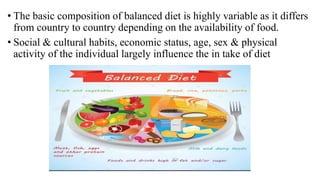
• The basic composition of balanced diet is highly variable as it differs
from country to country depending on the availability of food.
• Social & cultural habits, economic status, age, sex & physical
activity of the individual largely influence the in take of diet
Importance of Balanced Diet
• It is essential for a healthy body and a healthy mind. You are what you
consume!
• A balanced diet is important to maintain health and a sensible body weight.
No single food will provide all nutrients.
• Improper Diet may result in
-Failure to flourish
-Poor growth
-Poor development
-Poor physical and mental health
-Infections disease
• But even if you take over diet it may leads
-Weight gain
-Insulin resistance
-Diabetes
-Obesity
-Heart conditions
-Many other diet related diseases
• The USDA reports that four of the top 10 leading causes of death in the world are
directly influenced by diet.
• These are:
-Heart disease
-Cancer
-Stroke
-Diabetes
The objectives of a balanced and healthy diet
• To achieve a healthy weight and energy balance.
• Elimination of trans fatty acids and saturated fats. Consumption of
unsaturated fatty acids.
• Intake of simple sugar should be limited.
• Include a high amount of vegetables, fruits, nuts, legumes and whole grains.
• Intake iodized salt and limit consumption of sodium.
• Essential amino acids and proteins should form a major part of diet.
• Avoid consumption of food substances containing artificial preservatives and
carcinogens.
• Limit intake of caffeine and alcohol.
• Inclusion of vitamins, minerals and fibers in diet.
• Consume plenty of water
BASAL METABOLISM
It is the minimum amount of energy needed to regulate and maintain
the involuntary essential life process, such as breathing, circulation of
the blood, cellular activity, keeping muscles in good tone and
maintaining body temperature.
BASAL METABOLIC RATE
It is defined as the number of kilocalories expended by the organism
per square meter of body surface per hour. (kcal/m2/hour)
MEN: 1600-1800 kcal/day WOMEN: 1200-1450 kcal/day
RDA OF NUTRIENTS
• The RDA represents the establishment of a nutritional norm for planning and
assessing dietary intake, and are the levels of intake of essential nutrients
considered to be adequate to meet the known needs of practically all healthy
people.
• First Recommended Dietary Allowances (RDAs) were developed by the United
States government in the early 1940s. Other countries have similar
recommendations. Recently, US and Canadian scientists pooled their resources
to modify developed a more detailed set of nutrition recommendations
collectively called the Dietary Reference Intakes or DRI.
Components of Balanced Diet
• Major Nutrients
- Carbohydrates
- Proteins
- Fats/Lipids
- Fibers
• Micro Nutrients
-Vitamins
- Macrominerals
- Water
• Trace Nutrients
- Microminerals
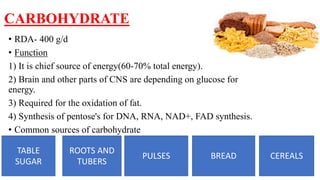
CARBOHYDRATE
• RDA- 400 g/d
• Function
1) It is chief source of energy(60-70% total energy).
2) Brain and other parts of CNS are depending on glucose for
energy.
3) Required for the oxidation of fat.
4) Synthesis of pentose's for DNA, RNA, NAD+, FAD synthesis.
• Common sources of carbohydrate
TABLE
SUGAR
ROOTS AND
TUBERS
PULSES BREAD CEREALS
Deficiency Disorder
• Acidosis
• Ketosis
• Hypoglycaemia
• Fatigue & decreased energy levels
• Unhealthy weight loss
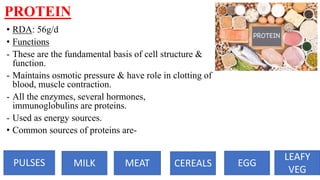
PROTEIN
• RDA: 56g/d
• Functions
- These are the fundamental basis of cell structure &
function.
- Maintains osmotic pressure & have role in clotting of
blood, muscle contraction.
- All the enzymes, several hormones,
immunoglobulins are proteins.
- Used as energy sources.
• Common sources of proteins are-
PULSES MILK MEAT CEREALS EGG
LEAFY
VEG
Deficiency Disorders
1. Kwashiorkor
2. Marasmus
3. Nutritional dwarfing
4. Under weight child
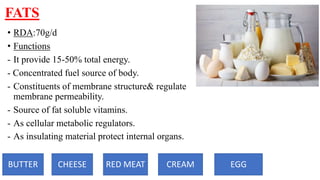
FATS
• RDA:70g/d
• Functions
- It provide 15-50% total energy.
- Concentrated fuel source of body.
- Constituents of membrane structure& regulate
membrane permeability.
- Source of fat soluble vitamins.
- As cellular metabolic regulators.
- As insulating material protect internal organs.
BUTTER CHEESE RED MEAT CREAM EGG
DEFICIENCY DISORDERS
- Cognitive decline
- Wolman’s disease
- Eczema of skin in infants
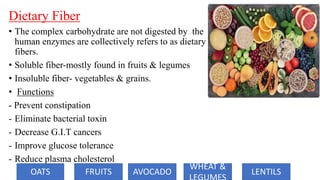
Dietary Fiber
• The complex carbohydrate are not digested by the
human enzymes are collectively refers to as dietary
fibers.
• Soluble fiber-mostly found in fruits & legumes
• Insoluble fiber- vegetables & grains.
• Functions
- Prevent constipation
- Eliminate bacterial toxin
- Decrease G.I.T cancers
- Improve glucose tolerance
- Reduce plasma cholesterol
OATS FRUITS AVOCADO
WHEAT &
LENTILS
DEFICIENCY DISORDERS
• Constipation
• High blood pressure
• Diabetes
• Cardiovascular diseases
• Obesity
• Cancer
MACROMINERALS
• Minerals are inorganic substances needed in small amounts by all cells
for normal functioning.
1) Calcium
2) Sodium
3) Potassium
4) Copper
5) Iodine
6) Iron
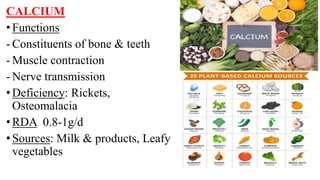
CALCIUM
•Functions
- Constituents of bone & teeth
- Muscle contraction
- Nerve transmission
•Deficiency: Rickets,
Osteomalacia
•RDA 0.8-1g/d
•Sources: Milk & products, Leafy
vegetables
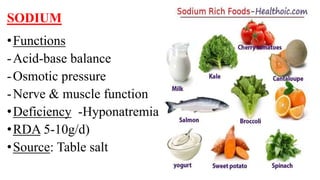
SODIUM
•Functions
-Acid-base balance
-Osmotic pressure
-Nerve & muscle function
•Deficiency -Hyponatremia
•RDA 5-10g/d)
•Source: Table salt
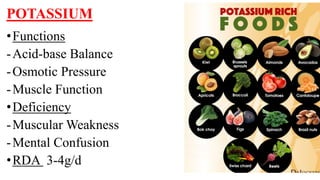
POTASSIUM
•Functions
-Acid-base Balance
-Osmotic Pressure
-Muscle Function
•Deficiency
-Muscular Weakness
-Mental Confusion
•RDA 3-4g/d
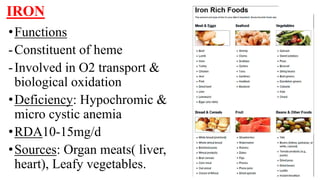
IRON
•Functions
-Constituent of heme
-Involved in O2 transport &
biological oxidation
•Deficiency: Hypochromic &
micro cystic anemia
•RDA10-15mg/d
•Sources: Organ meats( liver,
heart), Leafy vegetables.
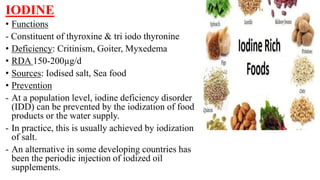
IODINE
• Functions
- Constituent of thyroxine & tri iodo thyronine
• Deficiency: Critinism, Goiter, Myxedema
• RDA 150-200µg/d
• Sources: Iodised salt, Sea food
• Prevention
- At a population level, iodine deficiency disorder
(IDD) can be prevented by the iodization of food
products or the water supply.
- In practice, this is usually achieved by iodization
of salt.
- An alternative in some developing countries has
been the periodic injection of iodized oil
supplements.
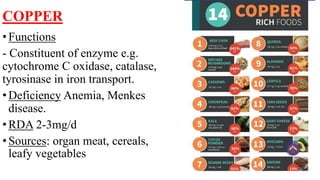
COPPER
•Functions
- Constituent of enzyme e.g.
cytochrome C oxidase, catalase,
tyrosinase in iron transport.
•Deficiency Anemia, Menkes
disease.
•RDA 2-3mg/d
•Sources: organ meat, cereals,
leafy vegetables
VITAMINS
•Chemical compounds
required in very small
quantities which are
essential for normal and
health metabolism.
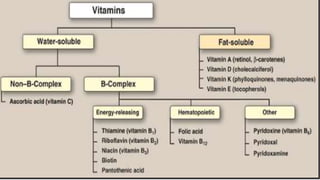
•According to the solubility
1. Water soluble
2. Fat soluble
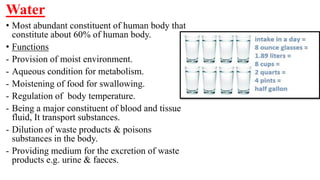
Water
• Most abundant constituent of human body that
constitute about 60% of human body.
• Functions
- Provision of moist environment.
- Aqueous condition for metabolism.
- Moistening of food for swallowing.
- Regulation of body temperature.
- Being a major constituent of blood and tissue
fluid, It transport substances.
- Dilution of waste products & poisons
substances in the body.
- Providing medium for the excretion of waste
products e.g. urine & faeces.
MICROMINERALS
• ZINC
• SELENIUM
• MANGANESE
• FLOURIDE
• CHROMIUM
• MOLYBDENAM
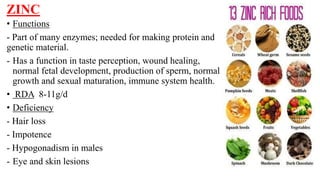
ZINC
• Functions
- Part of many enzymes; needed for making protein and
genetic material.
- Has a function in taste perception, wound healing,
normal fetal development, production of sperm, normal
growth and sexual maturation, immune system health.
• RDA 8-11g/d
• Deficiency
- Hair loss
- Impotence
- Hypogonadism in males
- Eye and skin lesions
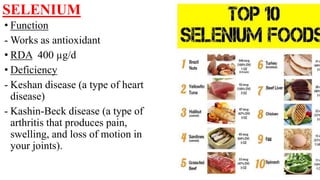
SELENIUM
• Function
- Works as antioxidant
• RDA 400 µg/d
• Deficiency
- Keshan disease (a type of heart
disease)
- Kashin-Beck disease (a type of
arthritis that produces pain,
swelling, and loss of motion in
your joints).
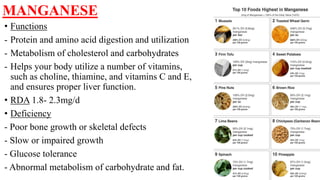
MANGANESE
• Functions
- Protein and amino acid digestion and utilization
- Metabolism of cholesterol and carbohydrates
- Helps your body utilize a number of vitamins,
such as choline, thiamine, and vitamins C and E,
and ensures proper liver function.
• RDA 1.8- 2.3mg/d
• Deficiency
- Poor bone growth or skeletal defects
- Slow or impaired growth
- Glucose tolerance
- Abnormal metabolism of carbohydrate and fat.
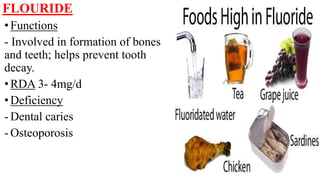
FLOURIDE
•Functions
- Involved in formation of bones
and teeth; helps prevent tooth
decay.
•RDA 3- 4mg/d
•Deficiency
- Dental caries
- Osteoporosis
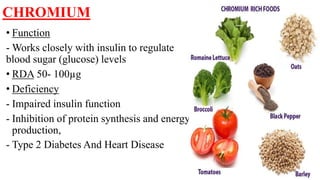
CHROMIUM
• Function
- Works closely with insulin to regulate
blood sugar (glucose) levels
• RDA 50- 100µg
• Deficiency
- Impaired insulin function
- Inhibition of protein synthesis and energy
production,
- Type 2 Diabetes And Heart Disease
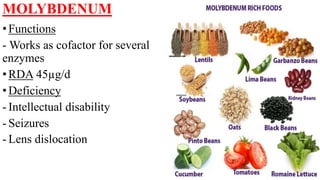
MOLYBDENUM
•Functions
- Works as cofactor for several
enzymes
•RDA 45µg/d
•Deficiency
- Intellectual disability
- Seizures
- Lens dislocation
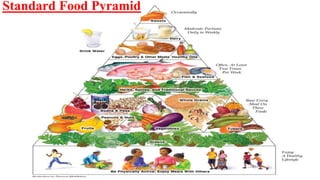
FOOD PYRAMID
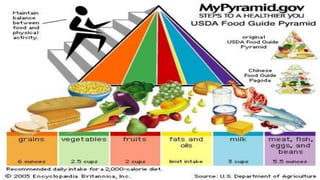
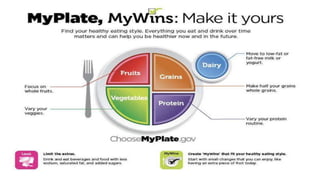
• A food pyramid or diet pyramid is a triangular diagram representing the optimal
number of servings to be eaten each day from each of the basic food groups.[1] The
first pyramid was published in Sweden in 1974. The 1992 pyramid introduced by
the United States Department of Agriculture (USDA) was called the "Food Guide
Pyramid" or "Eating Right Pyramid“ or “ Standard Food Pyramid”. It was updated in
2005 to "MyPyramid", and then it was replaced by "MyPlate" in 2011.
• Foods that contain the same type of nutrients are grouped together on each of the
shelves of the Food Pyramid.
• This gives you a choice of different foods from which to choose a healthy diet.
Following the Food Pyramid as a guide will help you get the right balance of
nutritious foods within your calorie range.
• Studies show that we take in too many calories from foods and drinks high in fat,
sugar and salt, on the top shelf of the Food Pyramid. They provide very little of the
essential vitamins and minerals your body needs. Limiting these is essential for
healthy eating.
Standard Food Pyramid
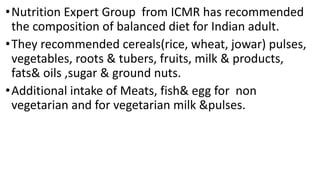
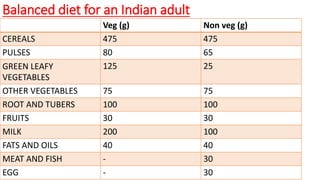
•Nutrition Expert Group from ICMR has recommended
the composition of balanced diet for Indian adult.
•They recommended cereals(rice, wheat, jowar) pulses,
vegetables, roots & tubers, fruits, milk & products,
fats& oils ,sugar & ground nuts.
•Additional intake of Meats, fish& egg for non
vegetarian and for vegetarian milk &pulses.
Balanced diet for an Indian adult
Veg (g) Non veg (g)
CEREALS 475 475
PULSES 80 65
GREEN LEAFY
VEGETABLES
125 25
OTHER VEGETABLES 75 75
ROOT AND TUBERS 100 100
FRUITS 30 30
MILK 200 100
FATS AND OILS 40 40
MEAT AND FISH - 30
EGG - 30
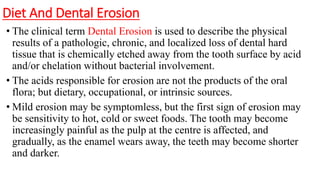
Diet And Dental Erosion
• The clinical term Dental Erosion is used to describe the physical
results of a pathologic, chronic, and localized loss of dental hard
tissue that is chemically etched away from the tooth surface by acid
and/or chelation without bacterial involvement.
• The acids responsible for erosion are not the products of the oral
flora; but dietary, occupational, or intrinsic sources.
• Mild erosion may be symptomless, but the first sign of erosion may
be sensitivity to hot, cold or sweet foods. The tooth may become
increasingly painful as the pulp at the centre is affected, and
gradually, as the enamel wears away, the teeth may become shorter
and darker.
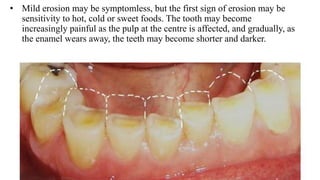
• Mild erosion may be symptomless, but the first sign of erosion may be
sensitivity to hot, cold or sweet foods. The tooth may become
increasingly painful as the pulp at the centre is affected, and gradually, as
the enamel wears away, the teeth may become shorter and darker.
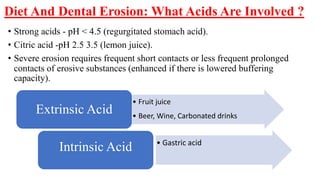
Diet And Dental Erosion: What Acids Are Involved ?
• Strong acids - pH < 4.5 (regurgitated stomach acid).
• Citric acid -pH 2.5 3.5 (lemon juice).
• Severe erosion requires frequent short contacts or less frequent prolonged
contacts of erosive substances (enhanced if there is lowered buffering
capacity).
• Fruit juice
• Beer, Wine, Carbonated drinks
Extrinsic Acid
• Gastric acid
Intrinsic Acid
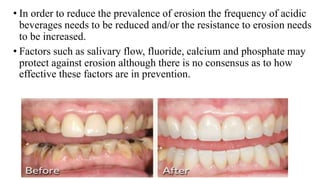
Dental Erosion And Its Management
• Erosion appears to be an increasing problem in industrialised
countries and is related to extrinsic and intrinsic acids.
• Increases levels of erosion observed in industrialised Countries are
thought to be due to increased consumption of acidic beverages (i.e.
soft drinks and fruit juices).
• Fruit juices are more erosive than whole fruits and consumption of
the former has increased markedly over recent years in
industrialised countries.
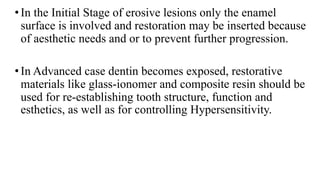
• In order to reduce the prevalence of erosion the frequency of acidic
beverages needs to be reduced and/or the resistance to erosion needs
to be increased.
• Factors such as salivary flow, fluoride, calcium and phosphate may
protect against erosion although there is no consensus as to how
effective these factors are in prevention.
•In the Initial Stage of erosive lesions only the enamel
surface is involved and restoration may be inserted because
of aesthetic needs and or to prevent further progression.
•In Advanced case dentin becomes exposed, restorative
materials like glass-ionomer and composite resin should be
used for re-establishing tooth structure, function and
esthetics, as well as for controlling Hypersensitivity.
STUDIES
Purnita Goyel (2013)
“Comparative evaluation of erosive potential of different beverages on enamel and
tooth coloured restorative materials: An in vitro study”
It was concluded that that erosion of enamel was significantly higher than tooth-
colored restorative materials. The erosive potential of orange juice was highest
followed by tomato soup and apple juice.
Deshpande (2004)
“Dental erosion in children: An increasing clinical problem”
It was concluded that out of 100 children examined, percentage of children with
dental erosion for 5 years age group was found to be 28.57% while for the age
group of 6 years 30.70%. The increase of higher percentage that is 30.70% was
seen due to the exposure of carbonated drinks or soft drinks.
Thomas (2014)
“Further observations on the influence of citrus fruit juices on human teeth. ”
showed that dental students who consumed either grapefruit juice, orange juice
or cola daily for 6 weeks had signs of erosion on their labial incisors and that this
was greatest with grapefruit juice.
 Jarvinen (1991)
“Risk factors in dental erosion. ”
in a case–control study, found that the dietary practices associated with erosion
were consumption of citrus fruits twice or more per day, consumption of soft
drinks once per day and consumption of vinegar or sports drinks more than once
a week.
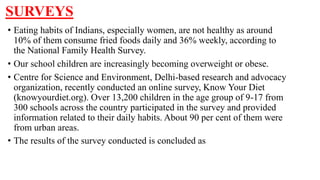
SURVEYS
• Eating habits of Indians, especially women, are not healthy as around
10% of them consume fried foods daily and 36% weekly, according to
the National Family Health Survey.
• Our school children are increasingly becoming overweight or obese.
• Centre for Science and Environment, Delhi-based research and advocacy
organization, recently conducted an online survey, Know Your Diet
(knowyourdiet.org). Over 13,200 children in the age group of 9-17 from
300 schools across the country participated in the survey and provided
information related to their daily habits. About 90 per cent of them were
from urban areas.
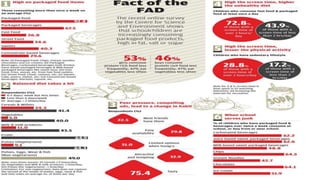
• The results of the survey conducted is concluded as
The recently released National Family Health Survey (NFHS-4) 2015-
16 by the health ministry revealed
Conclusion
• Knowledge about Nutrition, Dietary Guidelines, Food Guides, role of diet in
dental caries /erosion, counselling and motivation techniques is thus important
in the prevention /management of dental caries and erosion and other oral
conditions.
• Diet is related to general health as well as oral health. Dentists need to
understand the impact of nutrition on oral health to provide patients with
appropriate advice.
“The food you eat can be either safest and
most powerful form of your medicine, or
the slowest form of poison”.
“So be selective while eating”.
“Thank you”
REFERENCES
• Goyel P, Singh MG, Bansal R. Comparative evaluation of erosive potential of
different beverages on enamel and tooth colored restorative materials: An in
vitro study . Journal of Pediatric Dentistry;2013:1:58-62.
• Despande S, Hugar S M. Dental erosion in children: An increasing clinical
problem. Journal of Indian Society of Pediatric and Preventive
Dentistry;2004:22(3):118-127
• Thomas AK. Further observations on the influence of citrus fruit juices on
human teeth. New York State Dental Journal 1957; 23: 424–30.
• Jarvinen VK, Rytomaa I, Heinonen OP. Risk factors in dental erosion. Journal
of Dental Research.1991; 70: 942–7.
• U.Sathyanarayana. Textbook of biochemistry
• Ross and Wilson. Textbook of biochemistry.
• www.healthline.com
• emedicine.mediscape.com
• MN Chatterjea, Rana Shinde. Textbook Of Medical Biochemistry
• Ten Cate JM, ImfeldT. Dental erosion, summary. Eur J Oral Sci1996;104:241
• AttinT, Wegehaupt F, Gries D, WiegandA. The potential of deciduous and
permanent bovine enamel as substitute for deciduous and permanent human
enamel: Erosion- abrasion experiments. J Dent 2007;35:773-7.

Balanced diet

  • 1.
    Dr Anjali Savita MDSI Year Dept Of Conservative Dentistry and Endodontics
  • 2.
    Contents • Definition OfA Diet • Definition Of A Balanced Diet • Importance Of Balanced Diet • Objectives Of Balanced Diet • Basal Metabolism And Basal Metabolic Rate • Components Of Balanced Diet • RDA Of Nutrients • Food Pyramid • Studies Related To Balanced Diet • Survey Results • Conclusion • References
  • 3.
    INTRODUCTION Diet • Total oralintake of substance that provide nourishment and energy. - Nizel (1989) • It is referred to as food and drink regularly consumed. (Oxford dental dictionary). • Diet is defined as types and amount of food eaten daily by an individual. (FDI 1994)
  • 4.
    BALANCED DIET • “Itis one which contains varieties of foods in such quantities and proportion that the need for energy, amino acid, vitamins, fats, carbohydrate and other nutrients which is adequately met for maintaining health, vitality and general well being and also makes provision for a short duration of leanness.” (Chauliac, 1984) • Balanced diet achieved by eating variety of food. • There is no single food with correct amount of all essential nutrients. • Eating a balanced diet requires a certain amount of knowledge and planning
  • 5.
    • The basiccomposition of balanced diet is highly variable as it differs from country to country depending on the availability of food. • Social & cultural habits, economic status, age, sex & physical activity of the individual largely influence the in take of diet
  • 6.
    Importance of BalancedDiet • It is essential for a healthy body and a healthy mind. You are what you consume! • A balanced diet is important to maintain health and a sensible body weight. No single food will provide all nutrients. • Improper Diet may result in -Failure to flourish -Poor growth -Poor development -Poor physical and mental health -Infections disease
  • 7.
    • But evenif you take over diet it may leads -Weight gain -Insulin resistance -Diabetes -Obesity -Heart conditions -Many other diet related diseases • The USDA reports that four of the top 10 leading causes of death in the world are directly influenced by diet. • These are: -Heart disease -Cancer -Stroke -Diabetes
  • 8.
    The objectives ofa balanced and healthy diet • To achieve a healthy weight and energy balance. • Elimination of trans fatty acids and saturated fats. Consumption of unsaturated fatty acids. • Intake of simple sugar should be limited. • Include a high amount of vegetables, fruits, nuts, legumes and whole grains. • Intake iodized salt and limit consumption of sodium. • Essential amino acids and proteins should form a major part of diet. • Avoid consumption of food substances containing artificial preservatives and carcinogens. • Limit intake of caffeine and alcohol. • Inclusion of vitamins, minerals and fibers in diet. • Consume plenty of water
  • 9.
    BASAL METABOLISM It isthe minimum amount of energy needed to regulate and maintain the involuntary essential life process, such as breathing, circulation of the blood, cellular activity, keeping muscles in good tone and maintaining body temperature. BASAL METABOLIC RATE It is defined as the number of kilocalories expended by the organism per square meter of body surface per hour. (kcal/m2/hour) MEN: 1600-1800 kcal/day WOMEN: 1200-1450 kcal/day
  • 10.
    RDA OF NUTRIENTS •The RDA represents the establishment of a nutritional norm for planning and assessing dietary intake, and are the levels of intake of essential nutrients considered to be adequate to meet the known needs of practically all healthy people. • First Recommended Dietary Allowances (RDAs) were developed by the United States government in the early 1940s. Other countries have similar recommendations. Recently, US and Canadian scientists pooled their resources to modify developed a more detailed set of nutrition recommendations collectively called the Dietary Reference Intakes or DRI.
  • 11.
    Components of BalancedDiet • Major Nutrients - Carbohydrates - Proteins - Fats/Lipids - Fibers • Micro Nutrients -Vitamins - Macrominerals - Water • Trace Nutrients - Microminerals
  • 12.
    CARBOHYDRATE • RDA- 400g/d • Function 1) It is chief source of energy(60-70% total energy). 2) Brain and other parts of CNS are depending on glucose for energy. 3) Required for the oxidation of fat. 4) Synthesis of pentose's for DNA, RNA, NAD+, FAD synthesis. • Common sources of carbohydrate TABLE SUGAR ROOTS AND TUBERS PULSES BREAD CEREALS
  • 13.
    Deficiency Disorder • Acidosis •Ketosis • Hypoglycaemia • Fatigue & decreased energy levels • Unhealthy weight loss
  • 14.
    PROTEIN • RDA: 56g/d •Functions - These are the fundamental basis of cell structure & function. - Maintains osmotic pressure & have role in clotting of blood, muscle contraction. - All the enzymes, several hormones, immunoglobulins are proteins. - Used as energy sources. • Common sources of proteins are- PULSES MILK MEAT CEREALS EGG LEAFY VEG
  • 15.
    Deficiency Disorders 1. Kwashiorkor 2.Marasmus 3. Nutritional dwarfing 4. Under weight child
  • 16.
    FATS • RDA:70g/d • Functions -It provide 15-50% total energy. - Concentrated fuel source of body. - Constituents of membrane structure& regulate membrane permeability. - Source of fat soluble vitamins. - As cellular metabolic regulators. - As insulating material protect internal organs. BUTTER CHEESE RED MEAT CREAM EGG
  • 17.
    DEFICIENCY DISORDERS - Cognitivedecline - Wolman’s disease - Eczema of skin in infants
  • 18.
    Dietary Fiber • Thecomplex carbohydrate are not digested by the human enzymes are collectively refers to as dietary fibers. • Soluble fiber-mostly found in fruits & legumes • Insoluble fiber- vegetables & grains. • Functions - Prevent constipation - Eliminate bacterial toxin - Decrease G.I.T cancers - Improve glucose tolerance - Reduce plasma cholesterol OATS FRUITS AVOCADO WHEAT & LENTILS
  • 19.
    DEFICIENCY DISORDERS • Constipation •High blood pressure • Diabetes • Cardiovascular diseases • Obesity • Cancer
  • 20.
    MACROMINERALS • Minerals areinorganic substances needed in small amounts by all cells for normal functioning. 1) Calcium 2) Sodium 3) Potassium 4) Copper 5) Iodine 6) Iron
  • 21.
    CALCIUM •Functions - Constituents ofbone & teeth - Muscle contraction - Nerve transmission •Deficiency: Rickets, Osteomalacia •RDA 0.8-1g/d •Sources: Milk & products, Leafy vegetables
  • 22.
    SODIUM •Functions -Acid-base balance -Osmotic pressure -Nerve& muscle function •Deficiency -Hyponatremia •RDA 5-10g/d) •Source: Table salt
  • 23.
    POTASSIUM •Functions -Acid-base Balance -Osmotic Pressure -MuscleFunction •Deficiency -Muscular Weakness -Mental Confusion •RDA 3-4g/d
  • 24.
    IRON •Functions -Constituent of heme -Involvedin O2 transport & biological oxidation •Deficiency: Hypochromic & micro cystic anemia •RDA10-15mg/d •Sources: Organ meats( liver, heart), Leafy vegetables.
  • 25.
    IODINE • Functions - Constituentof thyroxine & tri iodo thyronine • Deficiency: Critinism, Goiter, Myxedema • RDA 150-200µg/d • Sources: Iodised salt, Sea food • Prevention - At a population level, iodine deficiency disorder (IDD) can be prevented by the iodization of food products or the water supply. - In practice, this is usually achieved by iodization of salt. - An alternative in some developing countries has been the periodic injection of iodized oil supplements.
  • 26.
    COPPER •Functions - Constituent ofenzyme e.g. cytochrome C oxidase, catalase, tyrosinase in iron transport. •Deficiency Anemia, Menkes disease. •RDA 2-3mg/d •Sources: organ meat, cereals, leafy vegetables
  • 27.
    VITAMINS •Chemical compounds required invery small quantities which are essential for normal and health metabolism. •According to the solubility 1. Water soluble 2. Fat soluble
  • 29.
    Water • Most abundantconstituent of human body that constitute about 60% of human body. • Functions - Provision of moist environment. - Aqueous condition for metabolism. - Moistening of food for swallowing. - Regulation of body temperature. - Being a major constituent of blood and tissue fluid, It transport substances. - Dilution of waste products & poisons substances in the body. - Providing medium for the excretion of waste products e.g. urine & faeces.
  • 30.
    MICROMINERALS • ZINC • SELENIUM •MANGANESE • FLOURIDE • CHROMIUM • MOLYBDENAM
  • 31.
    ZINC • Functions - Partof many enzymes; needed for making protein and genetic material. - Has a function in taste perception, wound healing, normal fetal development, production of sperm, normal growth and sexual maturation, immune system health. • RDA 8-11g/d • Deficiency - Hair loss - Impotence - Hypogonadism in males - Eye and skin lesions
  • 32.
    SELENIUM • Function - Worksas antioxidant • RDA 400 µg/d • Deficiency - Keshan disease (a type of heart disease) - Kashin-Beck disease (a type of arthritis that produces pain, swelling, and loss of motion in your joints).
  • 33.
    MANGANESE • Functions - Proteinand amino acid digestion and utilization - Metabolism of cholesterol and carbohydrates - Helps your body utilize a number of vitamins, such as choline, thiamine, and vitamins C and E, and ensures proper liver function. • RDA 1.8- 2.3mg/d • Deficiency - Poor bone growth or skeletal defects - Slow or impaired growth - Glucose tolerance - Abnormal metabolism of carbohydrate and fat.
  • 34.
    FLOURIDE •Functions - Involved information of bones and teeth; helps prevent tooth decay. •RDA 3- 4mg/d •Deficiency - Dental caries - Osteoporosis
  • 35.
    CHROMIUM • Function - Worksclosely with insulin to regulate blood sugar (glucose) levels • RDA 50- 100µg • Deficiency - Impaired insulin function - Inhibition of protein synthesis and energy production, - Type 2 Diabetes And Heart Disease
  • 36.
    MOLYBDENUM •Functions - Works ascofactor for several enzymes •RDA 45µg/d •Deficiency - Intellectual disability - Seizures - Lens dislocation
  • 37.
    FOOD PYRAMID • Afood pyramid or diet pyramid is a triangular diagram representing the optimal number of servings to be eaten each day from each of the basic food groups.[1] The first pyramid was published in Sweden in 1974. The 1992 pyramid introduced by the United States Department of Agriculture (USDA) was called the "Food Guide Pyramid" or "Eating Right Pyramid“ or “ Standard Food Pyramid”. It was updated in 2005 to "MyPyramid", and then it was replaced by "MyPlate" in 2011. • Foods that contain the same type of nutrients are grouped together on each of the shelves of the Food Pyramid. • This gives you a choice of different foods from which to choose a healthy diet. Following the Food Pyramid as a guide will help you get the right balance of nutritious foods within your calorie range. • Studies show that we take in too many calories from foods and drinks high in fat, sugar and salt, on the top shelf of the Food Pyramid. They provide very little of the essential vitamins and minerals your body needs. Limiting these is essential for healthy eating.
  • 38.
  • 41.
    •Nutrition Expert Groupfrom ICMR has recommended the composition of balanced diet for Indian adult. •They recommended cereals(rice, wheat, jowar) pulses, vegetables, roots & tubers, fruits, milk & products, fats& oils ,sugar & ground nuts. •Additional intake of Meats, fish& egg for non vegetarian and for vegetarian milk &pulses.
  • 42.
    Balanced diet foran Indian adult Veg (g) Non veg (g) CEREALS 475 475 PULSES 80 65 GREEN LEAFY VEGETABLES 125 25 OTHER VEGETABLES 75 75 ROOT AND TUBERS 100 100 FRUITS 30 30 MILK 200 100 FATS AND OILS 40 40 MEAT AND FISH - 30 EGG - 30
  • 43.
    Diet And DentalErosion • The clinical term Dental Erosion is used to describe the physical results of a pathologic, chronic, and localized loss of dental hard tissue that is chemically etched away from the tooth surface by acid and/or chelation without bacterial involvement. • The acids responsible for erosion are not the products of the oral flora; but dietary, occupational, or intrinsic sources. • Mild erosion may be symptomless, but the first sign of erosion may be sensitivity to hot, cold or sweet foods. The tooth may become increasingly painful as the pulp at the centre is affected, and gradually, as the enamel wears away, the teeth may become shorter and darker.
  • 44.
    • Mild erosionmay be symptomless, but the first sign of erosion may be sensitivity to hot, cold or sweet foods. The tooth may become increasingly painful as the pulp at the centre is affected, and gradually, as the enamel wears away, the teeth may become shorter and darker.
  • 45.
    Diet And DentalErosion: What Acids Are Involved ? • Strong acids - pH < 4.5 (regurgitated stomach acid). • Citric acid -pH 2.5 3.5 (lemon juice). • Severe erosion requires frequent short contacts or less frequent prolonged contacts of erosive substances (enhanced if there is lowered buffering capacity). • Fruit juice • Beer, Wine, Carbonated drinks Extrinsic Acid • Gastric acid Intrinsic Acid
  • 46.
    Dental Erosion AndIts Management • Erosion appears to be an increasing problem in industrialised countries and is related to extrinsic and intrinsic acids. • Increases levels of erosion observed in industrialised Countries are thought to be due to increased consumption of acidic beverages (i.e. soft drinks and fruit juices). • Fruit juices are more erosive than whole fruits and consumption of the former has increased markedly over recent years in industrialised countries.
  • 47.
    • In orderto reduce the prevalence of erosion the frequency of acidic beverages needs to be reduced and/or the resistance to erosion needs to be increased. • Factors such as salivary flow, fluoride, calcium and phosphate may protect against erosion although there is no consensus as to how effective these factors are in prevention.
  • 48.
    •In the InitialStage of erosive lesions only the enamel surface is involved and restoration may be inserted because of aesthetic needs and or to prevent further progression. •In Advanced case dentin becomes exposed, restorative materials like glass-ionomer and composite resin should be used for re-establishing tooth structure, function and esthetics, as well as for controlling Hypersensitivity.
  • 49.
    STUDIES Purnita Goyel (2013) “Comparativeevaluation of erosive potential of different beverages on enamel and tooth coloured restorative materials: An in vitro study” It was concluded that that erosion of enamel was significantly higher than tooth- colored restorative materials. The erosive potential of orange juice was highest followed by tomato soup and apple juice. Deshpande (2004) “Dental erosion in children: An increasing clinical problem” It was concluded that out of 100 children examined, percentage of children with dental erosion for 5 years age group was found to be 28.57% while for the age group of 6 years 30.70%. The increase of higher percentage that is 30.70% was seen due to the exposure of carbonated drinks or soft drinks.
  • 50.
    Thomas (2014) “Further observationson the influence of citrus fruit juices on human teeth. ” showed that dental students who consumed either grapefruit juice, orange juice or cola daily for 6 weeks had signs of erosion on their labial incisors and that this was greatest with grapefruit juice.  Jarvinen (1991) “Risk factors in dental erosion. ” in a case–control study, found that the dietary practices associated with erosion were consumption of citrus fruits twice or more per day, consumption of soft drinks once per day and consumption of vinegar or sports drinks more than once a week.
  • 51.
    SURVEYS • Eating habitsof Indians, especially women, are not healthy as around 10% of them consume fried foods daily and 36% weekly, according to the National Family Health Survey. • Our school children are increasingly becoming overweight or obese. • Centre for Science and Environment, Delhi-based research and advocacy organization, recently conducted an online survey, Know Your Diet (knowyourdiet.org). Over 13,200 children in the age group of 9-17 from 300 schools across the country participated in the survey and provided information related to their daily habits. About 90 per cent of them were from urban areas. • The results of the survey conducted is concluded as
  • 53.
    The recently releasedNational Family Health Survey (NFHS-4) 2015- 16 by the health ministry revealed
  • 54.
    Conclusion • Knowledge aboutNutrition, Dietary Guidelines, Food Guides, role of diet in dental caries /erosion, counselling and motivation techniques is thus important in the prevention /management of dental caries and erosion and other oral conditions. • Diet is related to general health as well as oral health. Dentists need to understand the impact of nutrition on oral health to provide patients with appropriate advice.
  • 55.
    “The food youeat can be either safest and most powerful form of your medicine, or the slowest form of poison”. “So be selective while eating”. “Thank you”
  • 56.
    REFERENCES • Goyel P,Singh MG, Bansal R. Comparative evaluation of erosive potential of different beverages on enamel and tooth colored restorative materials: An in vitro study . Journal of Pediatric Dentistry;2013:1:58-62. • Despande S, Hugar S M. Dental erosion in children: An increasing clinical problem. Journal of Indian Society of Pediatric and Preventive Dentistry;2004:22(3):118-127 • Thomas AK. Further observations on the influence of citrus fruit juices on human teeth. New York State Dental Journal 1957; 23: 424–30. • Jarvinen VK, Rytomaa I, Heinonen OP. Risk factors in dental erosion. Journal of Dental Research.1991; 70: 942–7. • U.Sathyanarayana. Textbook of biochemistry • Ross and Wilson. Textbook of biochemistry. • www.healthline.com • emedicine.mediscape.com
  • 57.
    • MN Chatterjea,Rana Shinde. Textbook Of Medical Biochemistry • Ten Cate JM, ImfeldT. Dental erosion, summary. Eur J Oral Sci1996;104:241 • AttinT, Wegehaupt F, Gries D, WiegandA. The potential of deciduous and permanent bovine enamel as substitute for deciduous and permanent human enamel: Erosion- abrasion experiments. J Dent 2007;35:773-7.