Bagging - Boosting
and Stacking
By Akshay Krishna
• Understand the concept of ensemble learning and its purpose of
combining multiple models to improve accuracy and performance.
• Learn about the three main ensemble techniques: bagging,
boosting, and stacking.
• Understand the differences in the working principles and
applications of bagging, boosting, and stacking.
Learning Objectives
◦ Ensemble learning in machine learning combines multiple individual models to
create a stronger, more accurate predictive model.
◦ By leveraging the diverse strengths of different models, ensemble learning aims
to mitigate errors, enhance performance, and increase the overall robustness of
predictions, leading to improved results across various tasks in machine learning
and data analysis.
What is Ensemble Learning ?
What is Bagging?
◦ Bagging is an ensemble learning technique designed to improve the accuracy
and stability of machine learning algorithms.
It involves the following steps:
1.Data Sampling: Creating multiple subsets of the training dataset using
bootstrap sampling (random sampling with replacement).
2.Model Training: training a separate model on each subset of the data.
3.Aggregation: Combining the predictions from all individual models (averaged
for regression or majority voting for classification) to produce the final output.
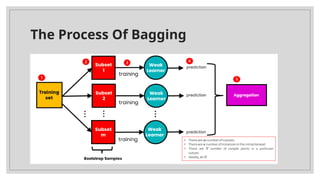
The Process Of Bagging
The Steps of Bagging
1.We have an initial training dataset containing n-number of instances.
2.We create a m-number of subsets of data from the training set. We take a subset of
N sample points from the initial dataset for each subset. Each subset is taken with
replacement. This means that a specific data point can be sampled more than once.
3.For each subset of data, we train the corresponding weak learners independently.
These models are homogeneous, meaning that they are of the same type.
4.Each model makes a prediction.
5.Aggregating the predictions into a single prediction. For this, using either max
voting or averaging.
Key Benefits:
• Reduces Variance: By averaging multiple predictions, bagging reduces the
variance of the model and helps prevent overfitting.
• Improves Accuracy: Combining multiple models usually leads to better
performance than individual models.
◦ Example of Bagging Algorithms:
• Random Forests (an extension of bagging applied to decision trees)
Bootstrapping and Aggregating
Bootstrapping
◦ Involves resampling subsets of data with replacement from an initial dataset. In other
words, the initial dataset provides subsets of data. Creating these subsets, bootstrapped
datasets or simply bootstraps, by resampling ‘with replacement,’ which means an
individual data point can be sampled multiple times. Each bootstrap dataset trains a weak
learner.
Aggregating
◦ Individual weak learners train independently from each other. Each learner makes
independent predictions. The system aggregates the results of those predictions to get
the overall prediction. The predictions are aggregated using either max voting or
averaging.
What is Boosting?
Boosting is another ensemble learning
technique that focuses on creating a
strong model by combining several
weak models.
It involves the following steps:
1.Sequential Training: Training models
sequentially, each one trying to
correct the errors made by the
previous models.
2.Weight Adjustment: Each instance in
the training set is weighted. Initially,
all instances have equal weights. After
each model is trained, the weights of
misclassified instances are increased
so that the next model focuses more
on difficult cases.
3.Model Combination: Combining the
predictions from all models to
produce the final output, typically by
weighted voting or weighted
averaging.
The Process Of Boosting
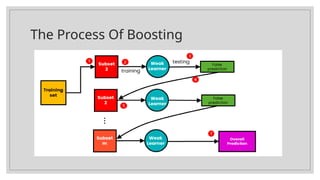
Boosting works with the following steps:
• We sample m-number of subsets from
an initial training dataset.
• Using the first subset, we train the
first weak learner.
• We test the trained weak learner using
the training data. As a result of the
testing, some data points will be
incorrectly predicted.
• Each data point with the wrong
prediction is sent into the second
subset of data, and this subset is
updated.
• Using this updated subset, we train
and test the second weak learner.
• We continue with the next subset until
reaching the total number of subsets.
• We now have the total prediction. The
overall prediction has already been
aggregated at each step, so there is
no need to calculate it.
Key Benefits:
• Reduces Bias: By focusing on hard-to-classify instances, boosting reduces bias and improves the
overall model accuracy.
• Produces Strong Predictors: Combining weak learners leads to a strong predictive model.
◦ Example of Boosting Algorithms:
• AdaBoost, Gradient Boosting Machines (GBM), XG Boost, LightGBM
Difference Between Bagging and
Boosting
◦ Bagging trains each base model independently and in parallel, using bootstrap sampling to
create multiple subsets of the training data. The final prediction is then made by averaging the
predictions of all base models. Bagging focuses on reducing variance(how much a model's
predictions change when trained on different subsets of data) and overfitting by creating
diverse models.
◦ In contrast, boosting trains models sequentially, with each subsequent model focusing on
correcting the errors made by the previous ones. Boosting adjusts the weights of training
instances to prioritize difficult-to-classify instances, thus reducing bias and improving predictive
accuracy. The final prediction combines the outputs of all models, usually through weighted
voting or averaging.
◦ Additionally, while bagging is relatively simple and easy to parallelize, boosting is more complex
due to its sequential nature and may be more prone to overfitting if not properly controlled.
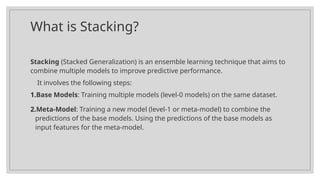
What is Stacking?
Stacking (Stacked Generalization) is an ensemble learning technique that aims to
combine multiple models to improve predictive performance.
It involves the following steps:
1.Base Models: Training multiple models (level-0 models) on the same dataset.
2.Meta-Model: Training a new model (level-1 or meta-model) to combine the
predictions of the base models. Using the predictions of the base models as
input features for the meta-model.
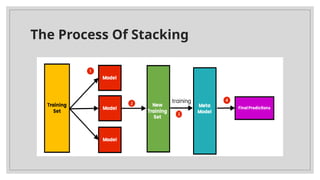
The Process Of Stacking
The Steps Of Stacking
• We use initial training data to train m-number of algorithms.
• Using the output of each algorithm, we create a new training set.
• Using the new training set, we create a meta-model algorithm.
• Using the results of the meta-model, we make the final prediction. Combining
the result using weighted averaging.
Improving Model Accuracy with Stacking
◦ We use stacking to improve the prediction accuracy of strong learners. Stacking aims to create a
single robust model from multiple heterogeneous strong learners.
◦ Stacking differs from bagging and boosting in machine learning in that:
◦ It combines strong learners
◦ It combines heterogeneous models
◦ It consists of creating a Metamodel.
◦ Individual heterogeneous models are trained using an initial dataset. These models make
predictions and form a single new dataset using those predictions. Using this new data set to train
the metamodel, which makes the final prediction. Combining the prediction using weighted
averaging.
◦ Because stacking combines strong learners, it can combine bagged or boosted models.
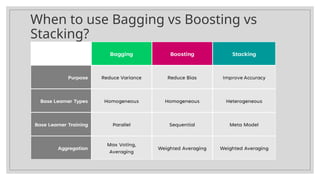
When to use Bagging vs Boosting vs
Stacking?
Bagging - Boosting-and-Stacking-ensemble.pptx

Bagging - Boosting-and-Stacking-ensemble.pptx

  • 1.
    Bagging - Boosting andStacking By Akshay Krishna
  • 2.
    • Understand theconcept of ensemble learning and its purpose of combining multiple models to improve accuracy and performance. • Learn about the three main ensemble techniques: bagging, boosting, and stacking. • Understand the differences in the working principles and applications of bagging, boosting, and stacking. Learning Objectives
  • 3.
    ◦ Ensemble learningin machine learning combines multiple individual models to create a stronger, more accurate predictive model. ◦ By leveraging the diverse strengths of different models, ensemble learning aims to mitigate errors, enhance performance, and increase the overall robustness of predictions, leading to improved results across various tasks in machine learning and data analysis. What is Ensemble Learning ?
  • 4.
    What is Bagging? ◦Bagging is an ensemble learning technique designed to improve the accuracy and stability of machine learning algorithms. It involves the following steps: 1.Data Sampling: Creating multiple subsets of the training dataset using bootstrap sampling (random sampling with replacement). 2.Model Training: training a separate model on each subset of the data. 3.Aggregation: Combining the predictions from all individual models (averaged for regression or majority voting for classification) to produce the final output.
  • 5.
  • 6.
    The Steps ofBagging 1.We have an initial training dataset containing n-number of instances. 2.We create a m-number of subsets of data from the training set. We take a subset of N sample points from the initial dataset for each subset. Each subset is taken with replacement. This means that a specific data point can be sampled more than once. 3.For each subset of data, we train the corresponding weak learners independently. These models are homogeneous, meaning that they are of the same type. 4.Each model makes a prediction. 5.Aggregating the predictions into a single prediction. For this, using either max voting or averaging.
  • 7.
    Key Benefits: • ReducesVariance: By averaging multiple predictions, bagging reduces the variance of the model and helps prevent overfitting. • Improves Accuracy: Combining multiple models usually leads to better performance than individual models. ◦ Example of Bagging Algorithms: • Random Forests (an extension of bagging applied to decision trees)
  • 8.
    Bootstrapping and Aggregating Bootstrapping ◦Involves resampling subsets of data with replacement from an initial dataset. In other words, the initial dataset provides subsets of data. Creating these subsets, bootstrapped datasets or simply bootstraps, by resampling ‘with replacement,’ which means an individual data point can be sampled multiple times. Each bootstrap dataset trains a weak learner. Aggregating ◦ Individual weak learners train independently from each other. Each learner makes independent predictions. The system aggregates the results of those predictions to get the overall prediction. The predictions are aggregated using either max voting or averaging.
  • 9.
    What is Boosting? Boostingis another ensemble learning technique that focuses on creating a strong model by combining several weak models. It involves the following steps: 1.Sequential Training: Training models sequentially, each one trying to correct the errors made by the previous models. 2.Weight Adjustment: Each instance in the training set is weighted. Initially, all instances have equal weights. After each model is trained, the weights of misclassified instances are increased so that the next model focuses more on difficult cases. 3.Model Combination: Combining the predictions from all models to produce the final output, typically by weighted voting or weighted averaging.
  • 10.
  • 11.
    Boosting works withthe following steps: • We sample m-number of subsets from an initial training dataset. • Using the first subset, we train the first weak learner. • We test the trained weak learner using the training data. As a result of the testing, some data points will be incorrectly predicted. • Each data point with the wrong prediction is sent into the second subset of data, and this subset is updated. • Using this updated subset, we train and test the second weak learner. • We continue with the next subset until reaching the total number of subsets. • We now have the total prediction. The overall prediction has already been aggregated at each step, so there is no need to calculate it.
  • 12.
    Key Benefits: • ReducesBias: By focusing on hard-to-classify instances, boosting reduces bias and improves the overall model accuracy. • Produces Strong Predictors: Combining weak learners leads to a strong predictive model. ◦ Example of Boosting Algorithms: • AdaBoost, Gradient Boosting Machines (GBM), XG Boost, LightGBM
  • 13.
    Difference Between Baggingand Boosting ◦ Bagging trains each base model independently and in parallel, using bootstrap sampling to create multiple subsets of the training data. The final prediction is then made by averaging the predictions of all base models. Bagging focuses on reducing variance(how much a model's predictions change when trained on different subsets of data) and overfitting by creating diverse models. ◦ In contrast, boosting trains models sequentially, with each subsequent model focusing on correcting the errors made by the previous ones. Boosting adjusts the weights of training instances to prioritize difficult-to-classify instances, thus reducing bias and improving predictive accuracy. The final prediction combines the outputs of all models, usually through weighted voting or averaging. ◦ Additionally, while bagging is relatively simple and easy to parallelize, boosting is more complex due to its sequential nature and may be more prone to overfitting if not properly controlled.
  • 14.
    What is Stacking? Stacking(Stacked Generalization) is an ensemble learning technique that aims to combine multiple models to improve predictive performance. It involves the following steps: 1.Base Models: Training multiple models (level-0 models) on the same dataset. 2.Meta-Model: Training a new model (level-1 or meta-model) to combine the predictions of the base models. Using the predictions of the base models as input features for the meta-model.
  • 15.
  • 16.
    The Steps OfStacking • We use initial training data to train m-number of algorithms. • Using the output of each algorithm, we create a new training set. • Using the new training set, we create a meta-model algorithm. • Using the results of the meta-model, we make the final prediction. Combining the result using weighted averaging.
  • 17.
    Improving Model Accuracywith Stacking ◦ We use stacking to improve the prediction accuracy of strong learners. Stacking aims to create a single robust model from multiple heterogeneous strong learners. ◦ Stacking differs from bagging and boosting in machine learning in that: ◦ It combines strong learners ◦ It combines heterogeneous models ◦ It consists of creating a Metamodel. ◦ Individual heterogeneous models are trained using an initial dataset. These models make predictions and form a single new dataset using those predictions. Using this new data set to train the metamodel, which makes the final prediction. Combining the prediction using weighted averaging. ◦ Because stacking combines strong learners, it can combine bagged or boosted models.
  • 18.
    When to useBagging vs Boosting vs Stacking?