An Introduction to theAn Introduction to the
Artificial Immune SystemsArtificial Immune Systems
ICANNGA 2001ICANNGA 2001
Prague, 22-25th April, 2001Prague, 22-25th April, 2001
Leandro Nunes de Castro
lnunes@dca.fee.unicamp.br
http://www.dca.fee.unicamp.br/~lnunes
State University of Campinas - UNICAMP/Brazil
Financial Support: FAPESP - 98/11333-9
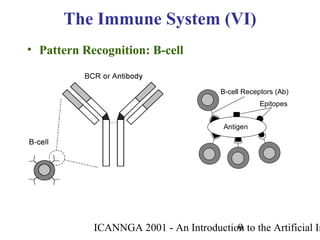
ICANNGA 2001 - An Introduction to the Artificial Im2
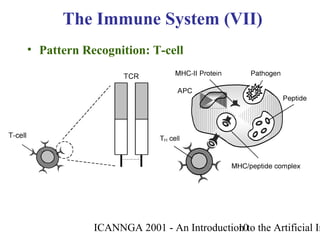
• Part I
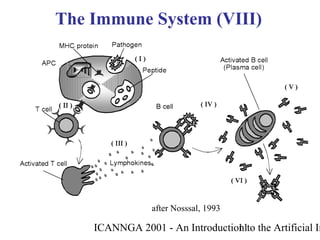
– Introduction to the Immune System
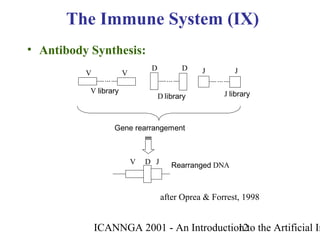
• Part II
– Artificial Immune Systems (AIS)
• Part III
– Examples of AIS and Applications
– Discussion and Future Trends
Presentation Topics
ICANNGA 2001 - An Introduction to the Artificial Im3
— Part I —
• Introduction to the Immune System
– Fundamentals and Main Components
– Anatomy
– Innate Immune System
– Adaptive Immune System
– Pattern Recognition in the Immune System
– A General Overview of the Immune Defenses
– Clonal Selection and Affinity Maturation
– Self/Nonself Discrimination
– Immune Network Theory
ICANNGA 2001 - An Introduction to the Artificial Im4
The Immune System (I)
• Fundamentals:
– Immunology is the study of the defense mechanisms
that confer resistance against diseases (Klein, 1990)
– The immune system (IS) is the one responsible to
protect us against the attack from external
microorganisms (Tizard, 1995)
– Several defense mechanisms in different levels; some
are redundant
– The IS presents learning and memory
– Microorganisms that might cause diseases (pathogen):
viruses, funguses, bacteria and parasites
– Antigen: any molecule that can stimulate the IS
ICANNGA 2001 - An Introduction to the Artificial Im5
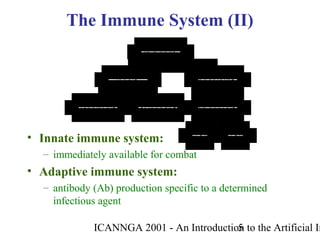
• Innate immune system:
– immediately available for combat
• Adaptive immune system:
– antibody (Ab) production specific to a determined
infectious agent
The Immune System (II)
G r a n u lo c y t e s M a c r o p h a g e s
I n n a t e
B - c e lls T - c e lls
L y m p h o c y t e s
A d a p t a t iv e
I m m u n it y
ICANNGA 2001 - An Introduction to the Artificial Im6
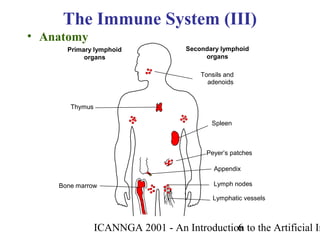
• Anatomy
The Immune System (III)
Lymphatic vessels
Lymph nodes
Thymus
Spleen
Tonsils and
adenoids
Bone marrow
Appendix
Peyer’s patches
Primary lymphoid
organs
Secondary lymphoid
organs
ICANNGA 2001 - An Introduction to the Artificial Im7
• All living beings present a type of defense
mechanism
• Innate Immune System
– first line of defense
– controls bacterial infections
– regulates the adaptive immunity
– important for self/nonself discrimination
– composed mainly of phagocytes and the complement
system
The Immune System (IV)
ICANNGA 2001 - An Introduction to the Artificial Im8
• The Adaptive Immune System
– the vertebrates have an anticipatory immune system
– the lymphocytes carry antigen receptors on their
surfaces. These receptors are specific to a given antigen
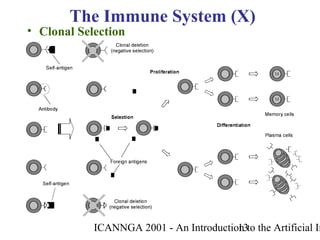
– Clonal selection: B-cells that recognize antigens are
stimulated, proliferate (clone) and differentiate into
memory and plasma cells
– confer resistance against future infections
– is capable of fine-tuning the cell receptors of the
selected cells to the selective antigens
The Immune System (V)
ICANNGA 2001 - An Introduction to the Artificial Im9
• Pattern Recognition: B-cell
The Immune System (VI)
Epitopes
B-cell Receptors (Ab)
Antigen
• Pattern Recognition: B-cell
ICANNGA 2001 - An Introduction to the Artificial Im10
• Pattern Recognition: T-cell
The Immune System (VII)
ICANNGA 2001 - An Introduction to the Artificial Im11
The Immune System (VIII)
after Nosssal, 1993
ICANNGA 2001 - An Introduction to the Artificial Im12
• Antibody Synthesis:
The Immune System (IX)
... ... ...
V V
V library
D D
D library
J J
J library
Gene rearrangement
V D J Rearranged DNA
after Oprea & Forrest, 1998
ICANNGA 2001 - An Introduction to the Artificial Im13
• Clonal Selection
The Immune System (X)
ICANNGA 2001 - An Introduction to the Artificial Im14
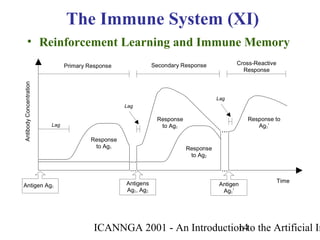
• Reinforcement Learning and Immune Memory
The Immune System (XI)
Antigen Ag1
Antigens
Ag1, Ag2
Primary Response Secondary Response
Lag
Response
to Ag1
AntibodyConcentration
Time
Lag
Response
to Ag2
Response
to Ag1
...
...
Cross-Reactive
Response
...
...
Antigen
Ag1’
Response to
Ag1’
Lag
ICANNGA 2001 - An Introduction to the Artificial Im15
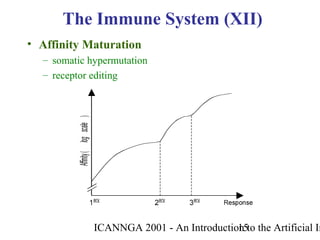
• Affinity Maturation
– somatic hypermutation
– receptor editing
The Immune System (XII)
ICANNGA 2001 - An Introduction to the Artificial Im16
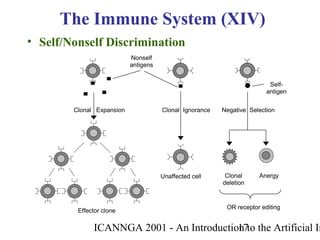
• Self/Nonself Discrimination
– repertoire completeness
– co-stimulation
– tolerance
• Positive selection
– B- and T-cells are selected as immunocompetent
cells
– Recognition of self-MHC molecules
• Negative selection
– Tolerance of self: those cells that recognize the
self are eliminated from the repertoire
The Immune System (XIII)
ICANNGA 2001 - An Introduction to the Artificial Im17
• Self/Nonself Discrimination
The Immune System (XIV)
Clonal
deletion
AnergyUnaffected cell
Clonal Expansion Negative SelectionClonal Ignorance
Effector clone
Self-
antigen
OR receptor editing
Nonself
antigens
ICANNGA 2001 - An Introduction to the Artificial Im18
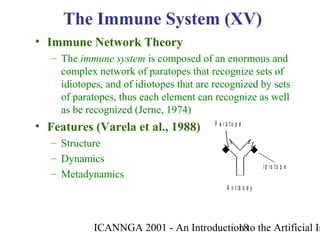
• Immune Network Theory
– The immune system is composed of an enormous and
complex network of paratopes that recognize sets of
idiotopes, and of idiotopes that are recognized by sets
of paratopes, thus each element can recognize as well
as be recognized (Jerne, 1974)
• Features (Varela et al., 1988)
– Structure
– Dynamics
– Metadynamics
The Immune System (XV)
ICANNGA 2001 - An Introduction to the Artificial Im19
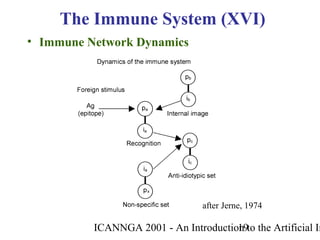
• Immune Network Dynamics
The Immune System (XVI)
after Jerne, 1974
ICANNGA 2001 - An Introduction to the Artificial Im20
• Pathogen, Antigen, Antibody
• Lymphocytes: B- and T-cells
• Affinity
• 1ary
, 2ary
and cross-reactive response
• Learning and memory
– increase in clone size and affinity maturation
• Self/Nonself Discrimination
• Immune Network Theory
The Immune System
— Summary —
ICANNGA 2001 - An Introduction to the Artificial Im21
• Artificial Immune Systems (AIS)
– Remarkable Immune Properties
– Concepts, Scope and Applications
– History of the AIS
– The Shape-Space Formalism
– Representations and Affinities
– Algorithms and Processes
– A Discrete Immune Network Model
– Guidelines to Design an AIS
— Part II —
ICANNGA 2001 - An Introduction to the Artificial Im22
• Remarkable Immune Properties
– uniqueness
– diversity
– robustness
– autonomy
– multilayered
– self/nonself discrimination
– distributivity
– reinforcement learning and memory
– predator-prey behavior
– noise tolerance (imperfect recognition)
Artificial Immune Systems (I)
ICANNGA 2001 - An Introduction to the Artificial Im23
• Concepts
– Artificial immune systems are data manipulation,
classification, reasoning and representation
methodologies, that follow a plausible biological
paradigm: the human immune system (Starlab)
– An artificial immune system is a computational system
based upon metaphors of the natural immune system
(Timmis, 2000)
– The artificial immune systems are composed of
intelligent methodologies, inspired by the natural
immune system, for the solution of real-world problems
(Dasgupta, 1998)
Artificial Immune Systems (II)
ICANNGA 2001 - An Introduction to the Artificial Im24
Artificial Immune Systems (III)
• Scope (Dasgupta, 1998):
– Computational methods inspired by immune principles;
– Multi-agent systems based on immunology;
– Self-organized systems based on immunology;
– Immunity-based systems for the development of
collective behavior;
– Search and optimization methods based on
immunology;
– Immune approaches for artificial life;
– Immune approaches for the security of information
systems;
– Immune metaphors for machine-learning.
ICANNGA 2001 - An Introduction to the Artificial Im25
• Applications
– Pattern recognition;
– Function approximation;
– Optimization;
– Data analysis and clustering;
– Machine learning;
– Associative memories;
– Diversity generation and maintenance;
– Evolutionary computation and programming;
– Fault and anomaly detection;
– Control and scheduling;
– Computer and network security;
– Generation of emergent behaviors.
Artificial Immune Systems (IV)
ICANNGA 2001 - An Introduction to the Artificial Im26
Artificial Immune Systems (V)
ICANNGA 2001 - An Introduction to the Artificial Im27
• How do we mathematically represent immune
cells and molecules?
• How do we quantify their interactions or
recognition?
• Shape-Space Formalism (Perelson & Oster, 1979)
– Quantitative description of the interactions between cells
and molecules
• Shape-Space (S) Concepts
– generalized shape
– recognition through regions of complementarity
– recognition region
– affinity threshold
Artificial Immune Systems (VI)
ICANNGA 2001 - An Introduction to the Artificial Im28
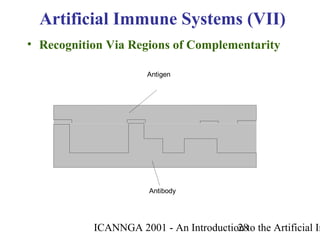
• Recognition Via Regions of Complementarity
Antibody
Antigen
Artificial Immune Systems (VII)
ICANNGA 2001 - An Introduction to the Artificial Im29
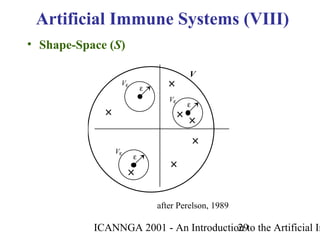
• Shape-Space (S)
Artificial Immune Systems (VIII)
ε
Vε
ε
Vε
ε
Vε
V
×
×
×
×
×
×
×
after Perelson, 1989
ICANNGA 2001 - An Introduction to the Artificial Im30
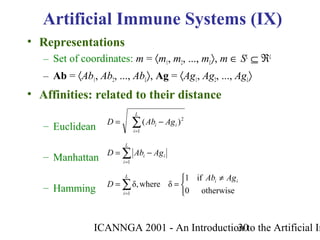
• Representations
– Set of coordinates: m = 〈m1, m2, ..., mL〉, m ∈ SL
⊆ ℜL
– Ab = 〈Ab1, Ab2, ..., AbL〉, Ag = 〈Ag1, Ag2, ..., AgL〉
• Affinities: related to their distance
– Euclidean
– Manhattan
– Hamming
Artificial Immune Systems (IX)
∑=
−=
L
i
ii AgAbD
1
2
)(
∑=
−=
L
i
ii AgAbD
1
∑= 

 ≠
==
L
i
ii AgAb
D
1 otherwise0
if1
δwhereδ,
ICANNGA 2001 - An Introduction to the Artificial Im31
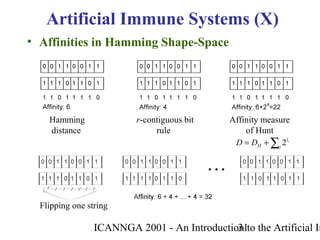
• Affinities in Hamming Shape-Space
Artificial Immune Systems (X)
Hamming r-contiguous bit Affinity measure
distance rule of Hunt
∑+= i
l
H
i
DD 2
Flipping one string
ICANNGA 2001 - An Introduction to the Artificial Im32
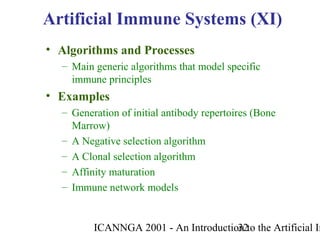
• Algorithms and Processes
– Main generic algorithms that model specific
immune principles
• Examples
– Generation of initial antibody repertoires (Bone
Marrow)
– A Negative selection algorithm
– A Clonal selection algorithm
– Affinity maturation
– Immune network models
Artificial Immune Systems (XI)
ICANNGA 2001 - An Introduction to the Artificial Im33
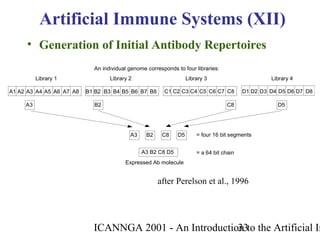
• Generation of Initial Antibody Repertoires
Artificial Immune Systems (XII)
An individual genome corresponds to four libraries:
Library 1 Library 2 Library 3 Library 4
A1 A2 A3 A4 A5 A6 A7 A8
A3 D5C8B2
A3 D5C8B2
A3 B2 C8 D5
= four 16 bit segments
= a 64 bit chain
Expressed Ab molecule
B1 B2 B3 B4 B5 B6 B7 B8 C1 C2 C3 C4 C5 C6 C7 C8 D1 D2 D3 D4 D5 D6 D7 D8
after Perelson et al., 1996
ICANNGA 2001 - An Introduction to the Artificial Im34
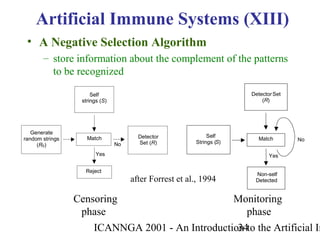
• A Negative Selection Algorithm
– store information about the complement of the patterns
to be recognized
Artificial Immune Systems (XIII)
Self
strings (S)
Generate
random strings
(R0)
Match Detector
Set (R)
Reject
No
Yes
No
Yes
DetectorSet
(R)
Self
Strings (S)
Match
Non-self
Detected
Censoring Monitoring
phase phase
after Forrest et al., 1994
ICANNGA 2001 - An Introduction to the Artificial Im35
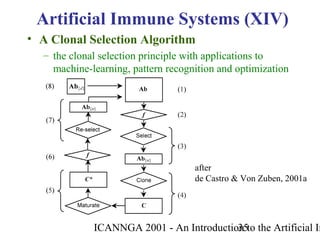
• A Clonal Selection Algorithm
– the clonal selection principle with applications to
machine-learning, pattern recognition and optimization
Artificial Immune Systems (XIV)
after
de Castro & Von Zuben, 2001a
ICANNGA 2001 - An Introduction to the Artificial Im36
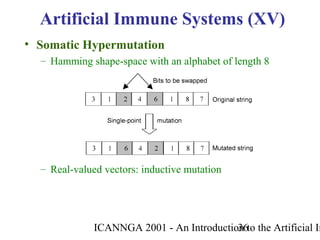
• Somatic Hypermutation
– Hamming shape-space with an alphabet of length 8
– Real-valued vectors: inductive mutation
Artificial Immune Systems (XV)
ICANNGA 2001 - An Introduction to the Artificial Im37
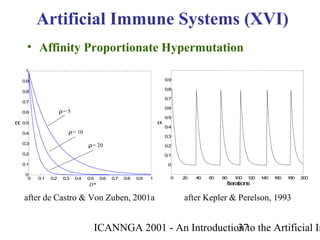
• Affinity Proportionate Hypermutation
0 0.1 0.2 0.3 0.4 0.5 0.6 0.7 0.8 0.9 1
0
0.1
0.2
0.3
0.4
0.5
0.6
0.7
0.8
0.9
1
D*
α
ρ= 5
ρ= 10
ρ= 20
Artificial Immune Systems (XVI)
0 20 40 60 80 100 120 140 160 180 200
0
0.1
0.2
0.3
0.4
0.5
0.6
0.7
0.8
0.9
α
Iterations
after de Castro & Von Zuben, 2001a after Kepler & Perelson, 1993
ICANNGA 2001 - An Introduction to the Artificial Im38
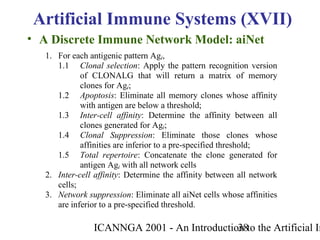
• A Discrete Immune Network Model: aiNet
Artificial Immune Systems (XVII)
1. For each antigenic pattern Agi,
1.1 Clonal selection: Apply the pattern recognition version
of CLONALG that will return a matrix of memory
clones for Agi;
1.2 Apoptosis: Eliminate all memory clones whose affinity
with antigen are below a threshold;
1.3 Inter-cell affinity: Determine the affinity between all
clones generated for Agi;
1.4 Clonal Suppression: Eliminate those clones whose
affinities are inferior to a pre-specified threshold;
1.5 Total repertoire: Concatenate the clone generated for
antigen Agi with all network cells
2. Inter-cell affinity: Determine the affinity between all network
cells;
3. Network suppression: Eliminate all aiNet cells whose affinities
are inferior to a pre-specified threshold.
ICANNGA 2001 - An Introduction to the Artificial Im39
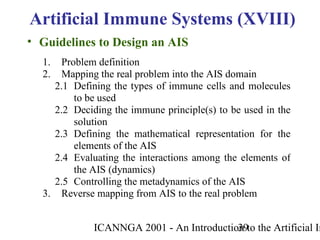
• Guidelines to Design an AIS
Artificial Immune Systems (XVIII)
1. Problem definition
2. Mapping the real problem into the AIS domain
2.1 Defining the types of immune cells and molecules
to be used
2.2 Deciding the immune principle(s) to be used in the
solution
2.3 Defining the mathematical representation for the
elements of the AIS
2.4 Evaluating the interactions among the elements of
the AIS (dynamics)
2.5 Controlling the metadynamics of the AIS
3. Reverse mapping from AIS to the real problem
ICANNGA 2001 - An Introduction to the Artificial Im40
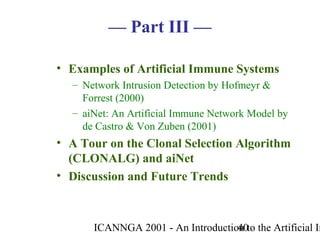
• Examples of Artificial Immune Systems
– Network Intrusion Detection by Hofmeyr &
Forrest (2000)
– aiNet: An Artificial Immune Network Model by
de Castro & Von Zuben (2001)
• A Tour on the Clonal Selection Algorithm
(CLONALG) and aiNet
• Discussion and Future Trends
— Part III —
ICANNGA 2001 - An Introduction to the Artificial Im41
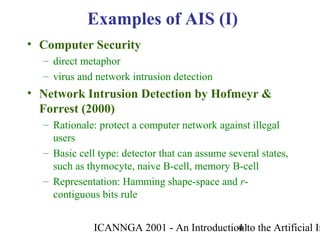
• Computer Security
– direct metaphor
– virus and network intrusion detection
• Network Intrusion Detection by Hofmeyr &
Forrest (2000)
– Rationale: protect a computer network against illegal
users
– Basic cell type: detector that can assume several states,
such as thymocyte, naive B-cell, memory B-cell
– Representation: Hamming shape-space and r-
contiguous bits rule
Examples of AIS (I)
ICANNGA 2001 - An Introduction to the Artificial Im42
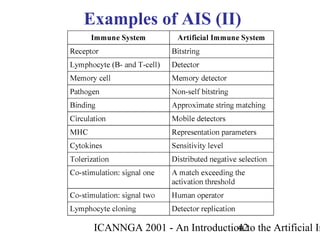
Examples of AIS (II)
ICANNGA 2001 - An Introduction to the Artificial Im43
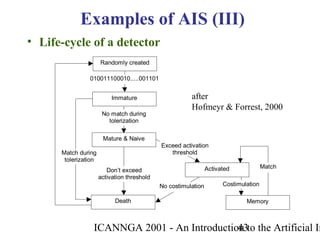
• Life-cycle of a detector
Examples of AIS (III)
Randomly created
Immature
Mature & Naive
Death
Activated
Memory
No match during
tolerization
010011100010.....001101
Exceed activation
threshold
Don’t exceed
activation threshold
No costimulation Costimulation
tolerization
Match
Match during
tolerization
after
Hofmeyr & Forrest, 2000
ICANNGA 2001 - An Introduction to the Artificial Im44
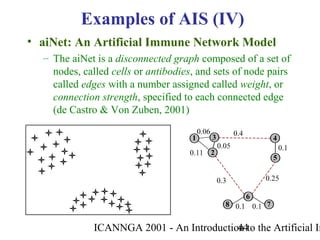
• aiNet: An Artificial Immune Network Model
– The aiNet is a disconnected graph composed of a set of
nodes, called cells or antibodies, and sets of node pairs
called edges with a number assigned called weight, or
connection strength, specified to each connected edge
(de Castro & Von Zuben, 2001)
Examples of AIS (IV)
ICANNGA 2001 - An Introduction to the Artificial Im45
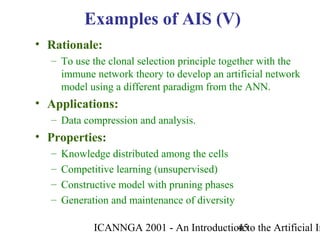
Examples of AIS (V)
• Rationale:
– To use the clonal selection principle together with the
immune network theory to develop an artificial network
model using a different paradigm from the ANN.
• Applications:
– Data compression and analysis.
• Properties:
– Knowledge distributed among the cells
– Competitive learning (unsupervised)
– Constructive model with pruning phases
– Generation and maintenance of diversity
A TOUR ONA TOUR ON
CLONALG AND aiNet . . .CLONALG AND aiNet . . .
ICANNGA 2001 - An Introduction to the Artificial Im47
Discussion
• Growing interest for the AIS
• Biologically Motivated Computing
– utility and extension of biology
– improved comprehension of natural phenomena
• Example-based learning, where different
pattern categories are represented by
adaptive memories of the system
• Strongly related to other intelligent
approaches, like ANN, EC, FS, DNA
Computing, etc.
ICANNGA 2001 - An Introduction to the Artificial Im48
• The proposal of a general framework
in which to design AIS
• Relate AIS with ANN, EC, FS, etc.
– Similarities and differences
– Equivalencies
• Applications
– Optimization
– Data Analysis
– Machine-Learning
– Pattern Recognition
• Hybrid algorithms
Future Trends
ICANNGA 2001 - An Introduction to the Artificial Im49
• Dasgupta, D. (Ed.) (1998), Artificial Immune Systems and Their
Applications, Springer-Verlag.
• De Castro, L. N., & Von Zuben, F. J., (2001a), “Learning and
Optimization Using the Clonal Selection Principle”, submitted to the
IEEE Transaction on Evolutionary Computation (Special Issue on AIS).
• De Castro, L. N. & Von Zuben, F. J. (2001), "aiNet: An Artificial
Immune Network for Data Analysis", Book Chapter in Data Mining: A
Heuristic Approach, Hussein A. Abbass, Ruhul A. Sarker, and Charles S.
Newton (Eds.), Idea Group Publishing, USA.
• Forrest, S., A. Perelson, Allen, L. & Cherukuri, R. (1994), “Self-Nonself
Discrimination in a Computer”, Proc. of the IEEE Symposium on
Research in Security and Privacy, pp. 202-212.
• Hofmeyr S. A. & Forrest, S. (2000), “Architecture for an Artificial
Immune System”, Evolutionary Computation, 7(1), pp. 45-68.
• Jerne, N. K. (1974a), “Towards a Network Theory of the Immune
System”, Ann. Immunol. (Inst. Pasteur) 125C, pp. 373-389.
• Kepler, T. B. & Perelson, A. S. (1993a), “Somatic Hypermutation in B
Cells: An Optimal Control Treatment”, J. theor. Biol., 164, pp. 37-64.
• Klein, J. (1990), Immunology, Blackwell Scientific Publications.
References (I)
ICANNGA 2001 - An Introduction to the Artificial Im50
References (II)
• Nossal, G. J. V. (1993a), “Life, Death and the Immune System”, Scientific
American, 269(3), pp. 21-30.
• Oprea, M. & Forrest, S. (1998), “Simulated Evolution of Antibody Gene
Libraries Under Pathogen Selection”, Proc. of the IEEE SMC’98.
• Perelson, A. S. (1989), “Immune Network Theory”, Imm. Rev., 110, pp. 5-36.
• Perelson, A. S. & Oster, G. F. (1979), “Theoretical Studies of Clonal Selection:
Minimal Antibody Repertoire Size and Reliability of Self-Nonself
Discrimination”, J. theor.Biol., 81, pp. 645-670.
• Perelson, A. S., Hightower, R. & Forrest, S. (1996), “Evolution and Somatic
Learning in V-Region Genes”, Research in Immunology, 147, pp. 202-208.
• Starlab, URL: http://www.starlab.org/genes/ais/
• Timmis, J. (2000), Artificial Immune Systems: A Novel Data Analysis Technique
Inspired by the Immune Network Theory, Ph.D. Dissertation, Department of
Computer Science, University of Whales, September.
• Tizard, I. R. (1995), Immunology An Introduction, Saunders College Publishing,
4th
Ed.
• Varela, F. J., Coutinho, A. Dupire, E. & Vaz, N. N. (1988), “Cognitive Networks:
Immune, Neural and Otherwise”, Theoretical Immunology, Part II, A. S. Perelson
(Ed.), pp. 359-375.
http://www.dca.fee.unicamp.br/~lnunes
or
lnunes@dca.fee.unicamp.br
Further Information:

2001: An Introduction to Artificial Immune Systems

  • 1.
    An Introduction totheAn Introduction to the Artificial Immune SystemsArtificial Immune Systems ICANNGA 2001ICANNGA 2001 Prague, 22-25th April, 2001Prague, 22-25th April, 2001 Leandro Nunes de Castro lnunes@dca.fee.unicamp.br http://www.dca.fee.unicamp.br/~lnunes State University of Campinas - UNICAMP/Brazil Financial Support: FAPESP - 98/11333-9
  • 2.
    ICANNGA 2001 -An Introduction to the Artificial Im2 • Part I – Introduction to the Immune System • Part II – Artificial Immune Systems (AIS) • Part III – Examples of AIS and Applications – Discussion and Future Trends Presentation Topics
  • 3.
    ICANNGA 2001 -An Introduction to the Artificial Im3 — Part I — • Introduction to the Immune System – Fundamentals and Main Components – Anatomy – Innate Immune System – Adaptive Immune System – Pattern Recognition in the Immune System – A General Overview of the Immune Defenses – Clonal Selection and Affinity Maturation – Self/Nonself Discrimination – Immune Network Theory
  • 4.
    ICANNGA 2001 -An Introduction to the Artificial Im4 The Immune System (I) • Fundamentals: – Immunology is the study of the defense mechanisms that confer resistance against diseases (Klein, 1990) – The immune system (IS) is the one responsible to protect us against the attack from external microorganisms (Tizard, 1995) – Several defense mechanisms in different levels; some are redundant – The IS presents learning and memory – Microorganisms that might cause diseases (pathogen): viruses, funguses, bacteria and parasites – Antigen: any molecule that can stimulate the IS
  • 5.
    ICANNGA 2001 -An Introduction to the Artificial Im5 • Innate immune system: – immediately available for combat • Adaptive immune system: – antibody (Ab) production specific to a determined infectious agent The Immune System (II) G r a n u lo c y t e s M a c r o p h a g e s I n n a t e B - c e lls T - c e lls L y m p h o c y t e s A d a p t a t iv e I m m u n it y
  • 6.
    ICANNGA 2001 -An Introduction to the Artificial Im6 • Anatomy The Immune System (III) Lymphatic vessels Lymph nodes Thymus Spleen Tonsils and adenoids Bone marrow Appendix Peyer’s patches Primary lymphoid organs Secondary lymphoid organs
  • 7.
    ICANNGA 2001 -An Introduction to the Artificial Im7 • All living beings present a type of defense mechanism • Innate Immune System – first line of defense – controls bacterial infections – regulates the adaptive immunity – important for self/nonself discrimination – composed mainly of phagocytes and the complement system The Immune System (IV)
  • 8.
    ICANNGA 2001 -An Introduction to the Artificial Im8 • The Adaptive Immune System – the vertebrates have an anticipatory immune system – the lymphocytes carry antigen receptors on their surfaces. These receptors are specific to a given antigen – Clonal selection: B-cells that recognize antigens are stimulated, proliferate (clone) and differentiate into memory and plasma cells – confer resistance against future infections – is capable of fine-tuning the cell receptors of the selected cells to the selective antigens The Immune System (V)
  • 9.
    ICANNGA 2001 -An Introduction to the Artificial Im9 • Pattern Recognition: B-cell The Immune System (VI) Epitopes B-cell Receptors (Ab) Antigen • Pattern Recognition: B-cell
  • 10.
    ICANNGA 2001 -An Introduction to the Artificial Im10 • Pattern Recognition: T-cell The Immune System (VII)
  • 11.
    ICANNGA 2001 -An Introduction to the Artificial Im11 The Immune System (VIII) after Nosssal, 1993
  • 12.
    ICANNGA 2001 -An Introduction to the Artificial Im12 • Antibody Synthesis: The Immune System (IX) ... ... ... V V V library D D D library J J J library Gene rearrangement V D J Rearranged DNA after Oprea & Forrest, 1998
  • 13.
    ICANNGA 2001 -An Introduction to the Artificial Im13 • Clonal Selection The Immune System (X)
  • 14.
    ICANNGA 2001 -An Introduction to the Artificial Im14 • Reinforcement Learning and Immune Memory The Immune System (XI) Antigen Ag1 Antigens Ag1, Ag2 Primary Response Secondary Response Lag Response to Ag1 AntibodyConcentration Time Lag Response to Ag2 Response to Ag1 ... ... Cross-Reactive Response ... ... Antigen Ag1’ Response to Ag1’ Lag
  • 15.
    ICANNGA 2001 -An Introduction to the Artificial Im15 • Affinity Maturation – somatic hypermutation – receptor editing The Immune System (XII)
  • 16.
    ICANNGA 2001 -An Introduction to the Artificial Im16 • Self/Nonself Discrimination – repertoire completeness – co-stimulation – tolerance • Positive selection – B- and T-cells are selected as immunocompetent cells – Recognition of self-MHC molecules • Negative selection – Tolerance of self: those cells that recognize the self are eliminated from the repertoire The Immune System (XIII)
  • 17.
    ICANNGA 2001 -An Introduction to the Artificial Im17 • Self/Nonself Discrimination The Immune System (XIV) Clonal deletion AnergyUnaffected cell Clonal Expansion Negative SelectionClonal Ignorance Effector clone Self- antigen OR receptor editing Nonself antigens
  • 18.
    ICANNGA 2001 -An Introduction to the Artificial Im18 • Immune Network Theory – The immune system is composed of an enormous and complex network of paratopes that recognize sets of idiotopes, and of idiotopes that are recognized by sets of paratopes, thus each element can recognize as well as be recognized (Jerne, 1974) • Features (Varela et al., 1988) – Structure – Dynamics – Metadynamics The Immune System (XV)
  • 19.
    ICANNGA 2001 -An Introduction to the Artificial Im19 • Immune Network Dynamics The Immune System (XVI) after Jerne, 1974
  • 20.
    ICANNGA 2001 -An Introduction to the Artificial Im20 • Pathogen, Antigen, Antibody • Lymphocytes: B- and T-cells • Affinity • 1ary , 2ary and cross-reactive response • Learning and memory – increase in clone size and affinity maturation • Self/Nonself Discrimination • Immune Network Theory The Immune System — Summary —
  • 21.
    ICANNGA 2001 -An Introduction to the Artificial Im21 • Artificial Immune Systems (AIS) – Remarkable Immune Properties – Concepts, Scope and Applications – History of the AIS – The Shape-Space Formalism – Representations and Affinities – Algorithms and Processes – A Discrete Immune Network Model – Guidelines to Design an AIS — Part II —
  • 22.
    ICANNGA 2001 -An Introduction to the Artificial Im22 • Remarkable Immune Properties – uniqueness – diversity – robustness – autonomy – multilayered – self/nonself discrimination – distributivity – reinforcement learning and memory – predator-prey behavior – noise tolerance (imperfect recognition) Artificial Immune Systems (I)
  • 23.
    ICANNGA 2001 -An Introduction to the Artificial Im23 • Concepts – Artificial immune systems are data manipulation, classification, reasoning and representation methodologies, that follow a plausible biological paradigm: the human immune system (Starlab) – An artificial immune system is a computational system based upon metaphors of the natural immune system (Timmis, 2000) – The artificial immune systems are composed of intelligent methodologies, inspired by the natural immune system, for the solution of real-world problems (Dasgupta, 1998) Artificial Immune Systems (II)
  • 24.
    ICANNGA 2001 -An Introduction to the Artificial Im24 Artificial Immune Systems (III) • Scope (Dasgupta, 1998): – Computational methods inspired by immune principles; – Multi-agent systems based on immunology; – Self-organized systems based on immunology; – Immunity-based systems for the development of collective behavior; – Search and optimization methods based on immunology; – Immune approaches for artificial life; – Immune approaches for the security of information systems; – Immune metaphors for machine-learning.
  • 25.
    ICANNGA 2001 -An Introduction to the Artificial Im25 • Applications – Pattern recognition; – Function approximation; – Optimization; – Data analysis and clustering; – Machine learning; – Associative memories; – Diversity generation and maintenance; – Evolutionary computation and programming; – Fault and anomaly detection; – Control and scheduling; – Computer and network security; – Generation of emergent behaviors. Artificial Immune Systems (IV)
  • 26.
    ICANNGA 2001 -An Introduction to the Artificial Im26 Artificial Immune Systems (V)
  • 27.
    ICANNGA 2001 -An Introduction to the Artificial Im27 • How do we mathematically represent immune cells and molecules? • How do we quantify their interactions or recognition? • Shape-Space Formalism (Perelson & Oster, 1979) – Quantitative description of the interactions between cells and molecules • Shape-Space (S) Concepts – generalized shape – recognition through regions of complementarity – recognition region – affinity threshold Artificial Immune Systems (VI)
  • 28.
    ICANNGA 2001 -An Introduction to the Artificial Im28 • Recognition Via Regions of Complementarity Antibody Antigen Artificial Immune Systems (VII)
  • 29.
    ICANNGA 2001 -An Introduction to the Artificial Im29 • Shape-Space (S) Artificial Immune Systems (VIII) ε Vε ε Vε ε Vε V × × × × × × × after Perelson, 1989
  • 30.
    ICANNGA 2001 -An Introduction to the Artificial Im30 • Representations – Set of coordinates: m = 〈m1, m2, ..., mL〉, m ∈ SL ⊆ ℜL – Ab = 〈Ab1, Ab2, ..., AbL〉, Ag = 〈Ag1, Ag2, ..., AgL〉 • Affinities: related to their distance – Euclidean – Manhattan – Hamming Artificial Immune Systems (IX) ∑= −= L i ii AgAbD 1 2 )( ∑= −= L i ii AgAbD 1 ∑=    ≠ == L i ii AgAb D 1 otherwise0 if1 δwhereδ,
  • 31.
    ICANNGA 2001 -An Introduction to the Artificial Im31 • Affinities in Hamming Shape-Space Artificial Immune Systems (X) Hamming r-contiguous bit Affinity measure distance rule of Hunt ∑+= i l H i DD 2 Flipping one string
  • 32.
    ICANNGA 2001 -An Introduction to the Artificial Im32 • Algorithms and Processes – Main generic algorithms that model specific immune principles • Examples – Generation of initial antibody repertoires (Bone Marrow) – A Negative selection algorithm – A Clonal selection algorithm – Affinity maturation – Immune network models Artificial Immune Systems (XI)
  • 33.
    ICANNGA 2001 -An Introduction to the Artificial Im33 • Generation of Initial Antibody Repertoires Artificial Immune Systems (XII) An individual genome corresponds to four libraries: Library 1 Library 2 Library 3 Library 4 A1 A2 A3 A4 A5 A6 A7 A8 A3 D5C8B2 A3 D5C8B2 A3 B2 C8 D5 = four 16 bit segments = a 64 bit chain Expressed Ab molecule B1 B2 B3 B4 B5 B6 B7 B8 C1 C2 C3 C4 C5 C6 C7 C8 D1 D2 D3 D4 D5 D6 D7 D8 after Perelson et al., 1996
  • 34.
    ICANNGA 2001 -An Introduction to the Artificial Im34 • A Negative Selection Algorithm – store information about the complement of the patterns to be recognized Artificial Immune Systems (XIII) Self strings (S) Generate random strings (R0) Match Detector Set (R) Reject No Yes No Yes DetectorSet (R) Self Strings (S) Match Non-self Detected Censoring Monitoring phase phase after Forrest et al., 1994
  • 35.
    ICANNGA 2001 -An Introduction to the Artificial Im35 • A Clonal Selection Algorithm – the clonal selection principle with applications to machine-learning, pattern recognition and optimization Artificial Immune Systems (XIV) after de Castro & Von Zuben, 2001a
  • 36.
    ICANNGA 2001 -An Introduction to the Artificial Im36 • Somatic Hypermutation – Hamming shape-space with an alphabet of length 8 – Real-valued vectors: inductive mutation Artificial Immune Systems (XV)
  • 37.
    ICANNGA 2001 -An Introduction to the Artificial Im37 • Affinity Proportionate Hypermutation 0 0.1 0.2 0.3 0.4 0.5 0.6 0.7 0.8 0.9 1 0 0.1 0.2 0.3 0.4 0.5 0.6 0.7 0.8 0.9 1 D* α ρ= 5 ρ= 10 ρ= 20 Artificial Immune Systems (XVI) 0 20 40 60 80 100 120 140 160 180 200 0 0.1 0.2 0.3 0.4 0.5 0.6 0.7 0.8 0.9 α Iterations after de Castro & Von Zuben, 2001a after Kepler & Perelson, 1993
  • 38.
    ICANNGA 2001 -An Introduction to the Artificial Im38 • A Discrete Immune Network Model: aiNet Artificial Immune Systems (XVII) 1. For each antigenic pattern Agi, 1.1 Clonal selection: Apply the pattern recognition version of CLONALG that will return a matrix of memory clones for Agi; 1.2 Apoptosis: Eliminate all memory clones whose affinity with antigen are below a threshold; 1.3 Inter-cell affinity: Determine the affinity between all clones generated for Agi; 1.4 Clonal Suppression: Eliminate those clones whose affinities are inferior to a pre-specified threshold; 1.5 Total repertoire: Concatenate the clone generated for antigen Agi with all network cells 2. Inter-cell affinity: Determine the affinity between all network cells; 3. Network suppression: Eliminate all aiNet cells whose affinities are inferior to a pre-specified threshold.
  • 39.
    ICANNGA 2001 -An Introduction to the Artificial Im39 • Guidelines to Design an AIS Artificial Immune Systems (XVIII) 1. Problem definition 2. Mapping the real problem into the AIS domain 2.1 Defining the types of immune cells and molecules to be used 2.2 Deciding the immune principle(s) to be used in the solution 2.3 Defining the mathematical representation for the elements of the AIS 2.4 Evaluating the interactions among the elements of the AIS (dynamics) 2.5 Controlling the metadynamics of the AIS 3. Reverse mapping from AIS to the real problem
  • 40.
    ICANNGA 2001 -An Introduction to the Artificial Im40 • Examples of Artificial Immune Systems – Network Intrusion Detection by Hofmeyr & Forrest (2000) – aiNet: An Artificial Immune Network Model by de Castro & Von Zuben (2001) • A Tour on the Clonal Selection Algorithm (CLONALG) and aiNet • Discussion and Future Trends — Part III —
  • 41.
    ICANNGA 2001 -An Introduction to the Artificial Im41 • Computer Security – direct metaphor – virus and network intrusion detection • Network Intrusion Detection by Hofmeyr & Forrest (2000) – Rationale: protect a computer network against illegal users – Basic cell type: detector that can assume several states, such as thymocyte, naive B-cell, memory B-cell – Representation: Hamming shape-space and r- contiguous bits rule Examples of AIS (I)
  • 42.
    ICANNGA 2001 -An Introduction to the Artificial Im42 Examples of AIS (II)
  • 43.
    ICANNGA 2001 -An Introduction to the Artificial Im43 • Life-cycle of a detector Examples of AIS (III) Randomly created Immature Mature & Naive Death Activated Memory No match during tolerization 010011100010.....001101 Exceed activation threshold Don’t exceed activation threshold No costimulation Costimulation tolerization Match Match during tolerization after Hofmeyr & Forrest, 2000
  • 44.
    ICANNGA 2001 -An Introduction to the Artificial Im44 • aiNet: An Artificial Immune Network Model – The aiNet is a disconnected graph composed of a set of nodes, called cells or antibodies, and sets of node pairs called edges with a number assigned called weight, or connection strength, specified to each connected edge (de Castro & Von Zuben, 2001) Examples of AIS (IV)
  • 45.
    ICANNGA 2001 -An Introduction to the Artificial Im45 Examples of AIS (V) • Rationale: – To use the clonal selection principle together with the immune network theory to develop an artificial network model using a different paradigm from the ANN. • Applications: – Data compression and analysis. • Properties: – Knowledge distributed among the cells – Competitive learning (unsupervised) – Constructive model with pruning phases – Generation and maintenance of diversity
  • 46.
    A TOUR ONATOUR ON CLONALG AND aiNet . . .CLONALG AND aiNet . . .
  • 47.
    ICANNGA 2001 -An Introduction to the Artificial Im47 Discussion • Growing interest for the AIS • Biologically Motivated Computing – utility and extension of biology – improved comprehension of natural phenomena • Example-based learning, where different pattern categories are represented by adaptive memories of the system • Strongly related to other intelligent approaches, like ANN, EC, FS, DNA Computing, etc.
  • 48.
    ICANNGA 2001 -An Introduction to the Artificial Im48 • The proposal of a general framework in which to design AIS • Relate AIS with ANN, EC, FS, etc. – Similarities and differences – Equivalencies • Applications – Optimization – Data Analysis – Machine-Learning – Pattern Recognition • Hybrid algorithms Future Trends
  • 49.
    ICANNGA 2001 -An Introduction to the Artificial Im49 • Dasgupta, D. (Ed.) (1998), Artificial Immune Systems and Their Applications, Springer-Verlag. • De Castro, L. N., & Von Zuben, F. J., (2001a), “Learning and Optimization Using the Clonal Selection Principle”, submitted to the IEEE Transaction on Evolutionary Computation (Special Issue on AIS). • De Castro, L. N. & Von Zuben, F. J. (2001), "aiNet: An Artificial Immune Network for Data Analysis", Book Chapter in Data Mining: A Heuristic Approach, Hussein A. Abbass, Ruhul A. Sarker, and Charles S. Newton (Eds.), Idea Group Publishing, USA. • Forrest, S., A. Perelson, Allen, L. & Cherukuri, R. (1994), “Self-Nonself Discrimination in a Computer”, Proc. of the IEEE Symposium on Research in Security and Privacy, pp. 202-212. • Hofmeyr S. A. & Forrest, S. (2000), “Architecture for an Artificial Immune System”, Evolutionary Computation, 7(1), pp. 45-68. • Jerne, N. K. (1974a), “Towards a Network Theory of the Immune System”, Ann. Immunol. (Inst. Pasteur) 125C, pp. 373-389. • Kepler, T. B. & Perelson, A. S. (1993a), “Somatic Hypermutation in B Cells: An Optimal Control Treatment”, J. theor. Biol., 164, pp. 37-64. • Klein, J. (1990), Immunology, Blackwell Scientific Publications. References (I)
  • 50.
    ICANNGA 2001 -An Introduction to the Artificial Im50 References (II) • Nossal, G. J. V. (1993a), “Life, Death and the Immune System”, Scientific American, 269(3), pp. 21-30. • Oprea, M. & Forrest, S. (1998), “Simulated Evolution of Antibody Gene Libraries Under Pathogen Selection”, Proc. of the IEEE SMC’98. • Perelson, A. S. (1989), “Immune Network Theory”, Imm. Rev., 110, pp. 5-36. • Perelson, A. S. & Oster, G. F. (1979), “Theoretical Studies of Clonal Selection: Minimal Antibody Repertoire Size and Reliability of Self-Nonself Discrimination”, J. theor.Biol., 81, pp. 645-670. • Perelson, A. S., Hightower, R. & Forrest, S. (1996), “Evolution and Somatic Learning in V-Region Genes”, Research in Immunology, 147, pp. 202-208. • Starlab, URL: http://www.starlab.org/genes/ais/ • Timmis, J. (2000), Artificial Immune Systems: A Novel Data Analysis Technique Inspired by the Immune Network Theory, Ph.D. Dissertation, Department of Computer Science, University of Whales, September. • Tizard, I. R. (1995), Immunology An Introduction, Saunders College Publishing, 4th Ed. • Varela, F. J., Coutinho, A. Dupire, E. & Vaz, N. N. (1988), “Cognitive Networks: Immune, Neural and Otherwise”, Theoretical Immunology, Part II, A. S. Perelson (Ed.), pp. 359-375.
  • 51.