Growth curves of
micro-organisms
 Bacteria divide by Binary Fission.
 This is a form of asexual reproduction.
 Under ideal conditions it can take place
every 20 minutes!
 In this way huge numbers of bacteria can
be produced very rapidly.
• Because of this we use a special scale
called the logarithmic scale to represent their
numbers.
• In a logarithmic scale each division
represents a unit increase in the value of x in
the term 10x.
 Thus:
100 = 0
101 = 10
102 = 100
103 = 1000
104 = 10,000
105 = 100,000 etc
0 1 10 100 1,000 10,000 100,000 1,000,000
Logarithmic scale
Growth curve for BacteriaLogarithmicScale
Time
Lag phase Log Phase Stationary
Phase
Death
Phase
NumberofBacteria
The Lag Phase
•After inoculation there is normally a brief
period of adaptation by the cells to the
new conditions.
•Bacteria are producing the enzymes
necessary to digest the nutrients.
•The rate of growth begins to increase
towards the end of this phase.
The Log (Logarithmic / Exponential)
phase
• There is a rapid period of growth during this
phase due to the fact that:
• Bacteria have developed the necessary
enzymes and there are plenty of nutrients.
• There are few waste products being
produced.
• The rate of cell division is currently at its
maximum with the number of bacteria
doubling as often as every 20 minutes.
Limitation of log or exponential phase
 Exhaustion of nutrition
 Accumulation of toxic metabolites end
products
 Rise in cell density
 Change in PH
[Log phase is the time when cells are most
active metabolically and is preferred for
industrial purpose]
The Stationary Phase
• The rate of growth levels stop during this
period.
• This is because:
• The nutrients are becoming used up.
• The amount of waste produced by the
bacteria themselves is increasing.
• The rate at which new cells are produced
is equal to the rate at which other cells
are dying.
The Death (Decline) Phase
During this phase more bacteria are
dying than are being produced. This is
because:
• Very few nutrients are left.
• Many bacteria are poisoned by the
waste produced by such large numbers
•Finally, after certain time period all the
cells die and culture becomes sterile.
Association of Growth and Cell Changes
 Lag Phase- maximum cell size towards
end of phage
 Log Phase- cells are smaller and stain
uniformly
 Stationary Phase- cells are Gram variable
and irregular staining due to presence of
intracellular granules, Sporulation occurs
 Decline Phase- involution forms are
common
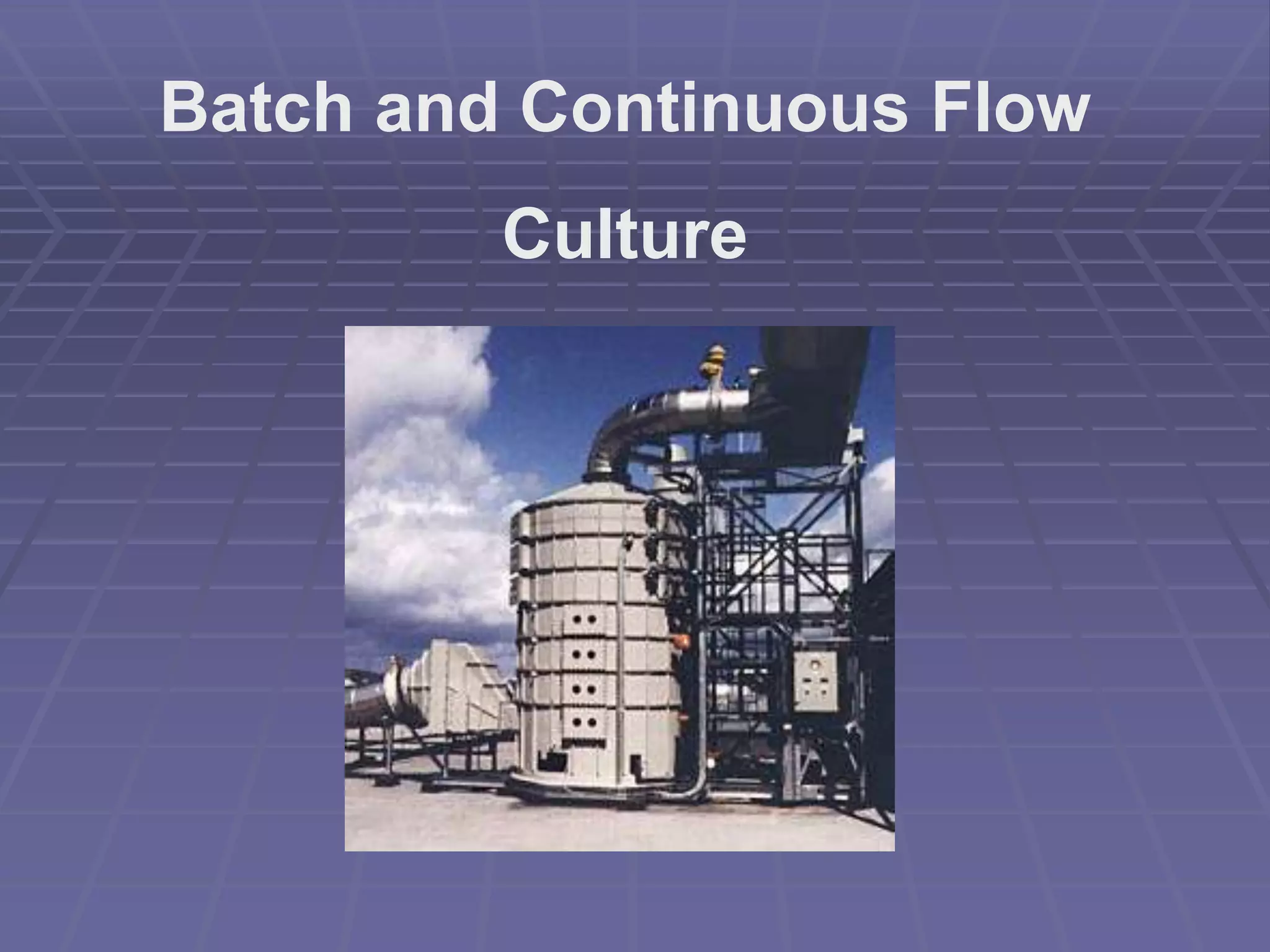
Batch and Continuous Flow
Culture
A bioreactor is a vessel in which
biological reactions take place
Food processing
• Modern bio-processing methods involve
the use of bacteria (and other organisms)
to produce a wide range of products.
• These include dairy products e.g. yoghurts
and cheeses, artificial sweeteners,
flavourings, vitamins and alcohol products
such as wines and beers.
Food processing
 There are two main methods of food
processing:
 Batch culture
 Continuous culture
Batch Culture
 In batch food processing a fixed amount of
sterile nutrient is added to the micro-organisms
in the bioreactor.
 The micro-organisms go through the stages of a
typical growth curve
 i.e. The Lag, Log, Stationary and Death stages
 Although the reaction may be stopped before
the death stage as very little product will be
formed at this stage.
Time (days)
Lag phase
Log Phase Stationary
Phase
Death
Phase
NumberofBacteria
In Batch Processing most of the product is formed
during the stages highlighted below
• At the end of production the bioreactor is
cleared out. The product is separated from
the rest of the solution and is purified.
 The bioreactor is cleaned and re-sterilised.
 The process can then be repeated.
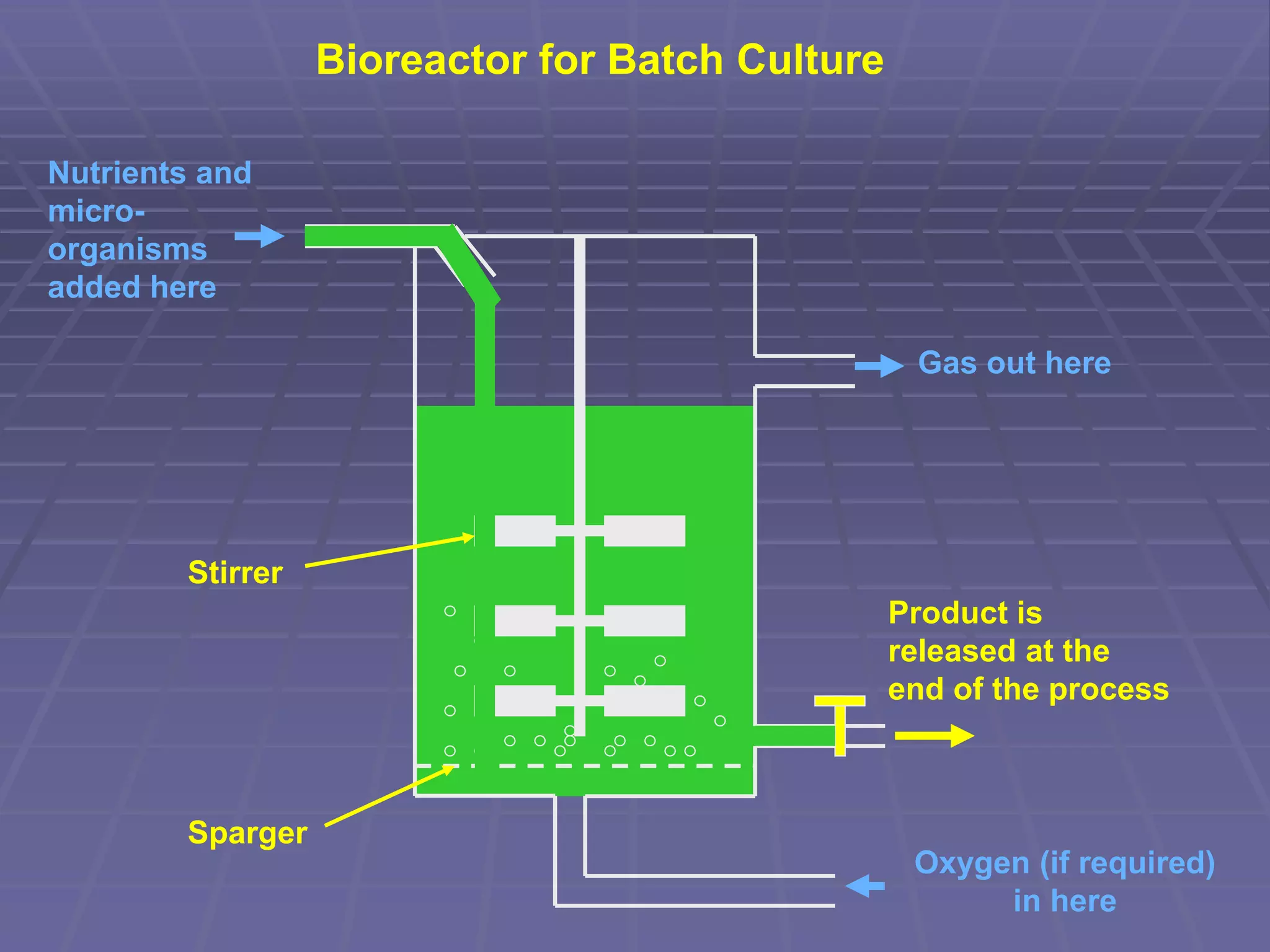
Nutrients and
micro-
organisms
added here
Gas out here
Oxygen (if required)
in here
Stirrer
Sparger
Bioreactor for Batch Culture
Product is
released at the
end of the process
Continuous Culture
 In continuous culture nutrients are continuously
fed into the bioreactor.
 At the same time the culture medium (containing
some micro-organisms) is continually withdrawn.
• In this method of food processing micro-
organisms are maintained in the Log phase of
growth and the process can continue
uninterrupted for weeks, even months.
Continuous flow food processing
• In continuous flow bioreactors factors such
as temperature, pH, rate of stirring,
concentration of nutrients, oxygen and
waste products are constantly monitored
in order to maintain growth in the Log
phase and therefore produce the
maximum yield.
Time (months)
Lag phase Log Phase
NumberofBacteria
In Continuous culture most of the product is formed
during the stage highlighted below
Nutrients fed in
continuously Gas out here
Oxygen
in here
Stirrer
Sparger
Product (and
culture medium)
flows out
continuously
Bioreactor for Continuous Culture
Product

Growth curves

  • 1.
  • 2.
     Bacteria divideby Binary Fission.  This is a form of asexual reproduction.  Under ideal conditions it can take place every 20 minutes!  In this way huge numbers of bacteria can be produced very rapidly.
  • 3.
    • Because ofthis we use a special scale called the logarithmic scale to represent their numbers. • In a logarithmic scale each division represents a unit increase in the value of x in the term 10x.
  • 4.
     Thus: 100 =0 101 = 10 102 = 100 103 = 1000 104 = 10,000 105 = 100,000 etc 0 1 10 100 1,000 10,000 100,000 1,000,000 Logarithmic scale
  • 5.
    Growth curve forBacteriaLogarithmicScale Time Lag phase Log Phase Stationary Phase Death Phase NumberofBacteria
  • 6.
    The Lag Phase •Afterinoculation there is normally a brief period of adaptation by the cells to the new conditions. •Bacteria are producing the enzymes necessary to digest the nutrients. •The rate of growth begins to increase towards the end of this phase.
  • 7.
    The Log (Logarithmic/ Exponential) phase • There is a rapid period of growth during this phase due to the fact that: • Bacteria have developed the necessary enzymes and there are plenty of nutrients. • There are few waste products being produced. • The rate of cell division is currently at its maximum with the number of bacteria doubling as often as every 20 minutes.
  • 8.
    Limitation of logor exponential phase  Exhaustion of nutrition  Accumulation of toxic metabolites end products  Rise in cell density  Change in PH [Log phase is the time when cells are most active metabolically and is preferred for industrial purpose]
  • 9.
    The Stationary Phase •The rate of growth levels stop during this period. • This is because: • The nutrients are becoming used up. • The amount of waste produced by the bacteria themselves is increasing. • The rate at which new cells are produced is equal to the rate at which other cells are dying.
  • 10.
    The Death (Decline)Phase During this phase more bacteria are dying than are being produced. This is because: • Very few nutrients are left. • Many bacteria are poisoned by the waste produced by such large numbers •Finally, after certain time period all the cells die and culture becomes sterile.
  • 11.
    Association of Growthand Cell Changes  Lag Phase- maximum cell size towards end of phage  Log Phase- cells are smaller and stain uniformly  Stationary Phase- cells are Gram variable and irregular staining due to presence of intracellular granules, Sporulation occurs  Decline Phase- involution forms are common
  • 12.
  • 13.
    A bioreactor isa vessel in which biological reactions take place
  • 14.
    Food processing • Modernbio-processing methods involve the use of bacteria (and other organisms) to produce a wide range of products. • These include dairy products e.g. yoghurts and cheeses, artificial sweeteners, flavourings, vitamins and alcohol products such as wines and beers.
  • 15.
    Food processing  Thereare two main methods of food processing:  Batch culture  Continuous culture
  • 16.
    Batch Culture  Inbatch food processing a fixed amount of sterile nutrient is added to the micro-organisms in the bioreactor.  The micro-organisms go through the stages of a typical growth curve  i.e. The Lag, Log, Stationary and Death stages  Although the reaction may be stopped before the death stage as very little product will be formed at this stage.
  • 17.
    Time (days) Lag phase LogPhase Stationary Phase Death Phase NumberofBacteria In Batch Processing most of the product is formed during the stages highlighted below
  • 18.
    • At theend of production the bioreactor is cleared out. The product is separated from the rest of the solution and is purified.  The bioreactor is cleaned and re-sterilised.  The process can then be repeated.
  • 19.
    Nutrients and micro- organisms added here Gasout here Oxygen (if required) in here Stirrer Sparger Bioreactor for Batch Culture Product is released at the end of the process
  • 20.
    Continuous Culture  Incontinuous culture nutrients are continuously fed into the bioreactor.  At the same time the culture medium (containing some micro-organisms) is continually withdrawn. • In this method of food processing micro- organisms are maintained in the Log phase of growth and the process can continue uninterrupted for weeks, even months.
  • 21.
    Continuous flow foodprocessing • In continuous flow bioreactors factors such as temperature, pH, rate of stirring, concentration of nutrients, oxygen and waste products are constantly monitored in order to maintain growth in the Log phase and therefore produce the maximum yield.
  • 22.
    Time (months) Lag phaseLog Phase NumberofBacteria In Continuous culture most of the product is formed during the stage highlighted below
  • 23.
    Nutrients fed in continuouslyGas out here Oxygen in here Stirrer Sparger Product (and culture medium) flows out continuously Bioreactor for Continuous Culture Product