Reproduction in bacteria
• Bacteria may either be in an active growing stage (vegetative
stage) or in the form of resting cells.
• Actively growing bacterial cells may increase in numbers in
several different ways, most commonly they multiplied by
splitting cross walls i.e. by transvers fission.
• All true bacteria reproduce by this method, an asexual
process known as ‘binary fission’.
• This method of multiplication is so common and
characteristic of the bacteria that they have been given the
name of Schizomycetes.
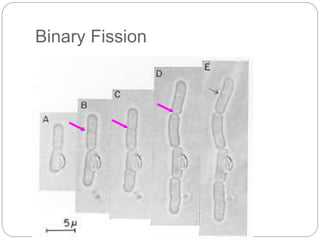
1. Binary fission: This is the most common type of
asexual reproduction in actively growing bacteria and
occurs during favorable conditions. On this basis,
bacteria were once called ‘Fission fungi’
(Shizomycetes).
• In this process, the cytoplasm and the nucleoid divide
equally into two without mitosis, and the two
daughter cells formed are identical to each other;
hence the name binary fission.
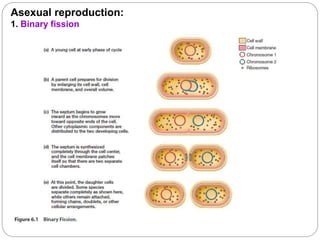
• The whole process of binary fission involves two
steps—Genome replication and Septum formation.
Both the events occur simultaneously and are
triggered by a mesosome (if present).
a. Genome/DNA replication: Binary fission
begins with DNA replication. DNA replication
starts from an origin of replication, which opens
up into a bubble. The replication bubble separates
the two DNA strands, each strand acts as a
template for synthesis of a daughter strand. The
DNA replication is bidirectional, starting from the
point of origin and resulting in the formation of
two circular daughter DNA molecules. In each
daughter DNA molecule, one strand is derived
from the parental DNA molecule while another
strand is a new one. This is semi-conservative
mode of DNA replication.
b. Septum formation/cell division: A peripheral
ring of plasma membrane invaginates and grows
centripetally to form a double-membranous
septum. Wall material is deposited between the
two membranes of the septum. This separates the
parent cell into two nearly equal daughter cells,
each having its own nucleoid. Under optimal
conditions of nutrition, water and temperature, the
process of binary fission is very quick and the
division may be completed in about 20-30 minutes.
Thus, in 24 hrs, a very large number of bacteria
may be produced.
Asexual reproduction:
1. Binary fission
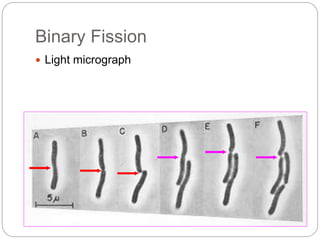
Binary Fission
 Light micrograph
Binary Fission
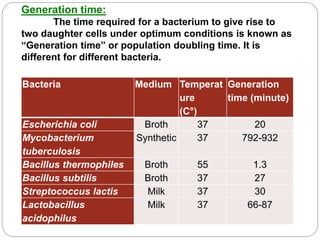
Generation time:
The time required for a bacterium to give rise to
two daughter cells under optimum conditions is known as
“Generation time” or population doubling time. It is
different for different bacteria.
Bacteria Medium Temperat
ure
(C°)
Generation
time (minute)
Escherichia coli Broth 37 20
Mycobacterium
tuberculosis
Synthetic 37 792-932
Bacillus thermophiles Broth 55 1.3
Bacillus subtilis Broth 37 27
Streptococcus lactis Milk 37 30
Lactobacillus
acidophilus
Milk 37 66-87
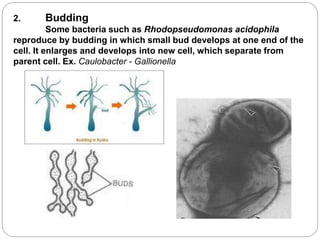
2. Budding
Some bacteria such as Rhodopseudomonas acidophila
reproduce by budding in which small bud develops at one end of the
cell. It enlarges and develops into new cell, which separate from
parent cell. Ex. Caulobacter - Gallionella
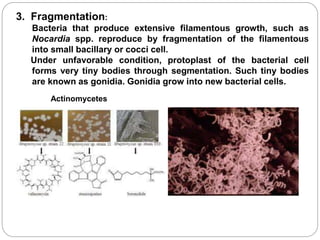
3. Fragmentation:
Bacteria that produce extensive filamentous growth, such as
Nocardia spp. reproduce by fragmentation of the filamentous
into small bacillary or cocci cell.
Under unfavorable condition, protoplast of the bacterial cell
forms very tiny bodies through segmentation. Such tiny bodies
are known as gonidia. Gonidia grow into new bacterial cells.
Actinomycetes
 Growth -Growth is the orderly increase in all of the
components of an organism.
 In the laboratory, under favorable conditions, a growing
bacterial population doubles at regular intervals. Growth of
bacteria occurs by geometric progression: 1, 2, 4, 8, etc. or 20,
21, 22, 23.........2n (where n = the number of generations). This is
called exponential growth which is observed during Log
Phase. In reality, exponential growth is only part of the
bacterial life cycle, and not representative of the normal pattern
of growth of bacteria in Nature.
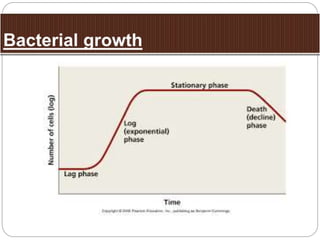
 When a fresh medium is inoculated with a given number of
cells, and the population growth is monitored over a period of
time, plotting the data will yield a typical bacterial growth
curve.
 GROWTH RATE- Growth rate is the change in cell number or
mass per unit time. It is expressed as ‘R’ which is the reciprocal
of generation time ‘g’. It can be defined as the slope of the line
when log of cells versus time is plotted (R = 1/g). Microbes
generally respond linearly to a limiting nutrient concentration in
the medium, which forms the principle for microbiological
assays.
 Generation Time- generation time is the time interval required
for the cells (or population) to divide.
 G (generation time) = (time, in minutes or hours)/n(number of
generations)
G = t/n
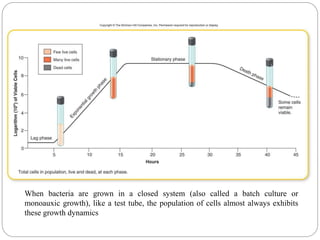
When bacteria are grown in a closed system (also called a batch culture or
monoauxic growth), like a test tube, the population of cells almost always exhibits
these growth dynamics
 It represents a period of active growth during which
bacteria prepare for reproduction, synthesizing DNA,
various inducible enzymes, and other
macromolecules needed for cell division.
 Therefore, during this phase, there may be increase
in size (volumt increase in cell number
 The lag phase may last for an hour or more, and near
the end of this phase some cells may double or triple
in size.
 The lag phase is necessary before the initiation of cell
division due to variety of reasons.
 If the cells are taken from an old culture or from a
refrigerated culture, it might be possible that the cells
may be old and depleted of ATP, essential cofactors
and ribosomes.
 If the medium is different from the one in which the microbial
population was growing previously, new enzymes would be
needed by the cells to use new nutrients in the medium.
 However, these deficiencies are fulfilled by the cells during
lag phase, t is, therefore, the lag phase is generally longer if
the cells are taken from an old or refrigerated culture.
 In contrast, if the cells are taken from young, vigorously
growing culture microbial population) and inoculated to a
fresh medium of the identical composition, the lag phase may
be short or even absent.
 If the inoculum is taken from a log phase, the lag phase may
not occur but if the same is derived from a stationary phase,
the lag phase will usually appear. This is due to the reason
that the old -ells get depleted of some cellular constituents
and essential enzymes, and thus require some time to re-
establish their synthesis.
 Bacterial cells prepared for cell division during lag
phase now enter into the log phase or
exponential growth_phase during which the
cells divide at a naximal rate and their generation
time reaches a minimum and remains constant.
 The growth in this phase is quite balanced (i.e.
all cellular constituents are synthesized at
constant rates relative to each other) hence, the
most uniform in terms of chemical and
physiological properties, the log phase cultures
are usually used in biochemical and physiological
studies.
 Since the generation time is constant, a
logarithmic plot of growth during log phase
produces an almost a straight line.
 This phase is called log phase because the
logarithm of the bacterial mass increases
linearly with time, and exponential growth
phase because the number of cells increases
as an exponential function of 2n (i.e. 2 22, 23,
24, 25 and so on).
 The log phase also represents the time when
bacterial cells are most active metabolically,
and in industrial production, this is the period
of peak activity and efficiency.
 Since the bacteria are growing in a constant volume of
medium of batch culture, and no fresh nutrients are
added, the growth of bacterial population eventually
ceases and the growth curve becomes horizontal.
 Such a phase of growth in bacteria is attained at a
population level of around 109 cells per ml.
 The ceasation of growth may be because of the
exhaustion of available nutrients or by the accumulation
of inhibitory end products of metabolism.
 The ceasation of growth may also be due to O2
availability particularly in case of aerobes. Oxygen is not
very soluble and may be depleted so quickly that only
cells on the surface of the culture may find necessary
oxygen concentration for adequate growth.
 Sooner or later, the bacterial cells start dying
and the number of such cells balances the
number of new born cells, and the bacterial
population stabilizes.
 This state of growth, during which the total
number of viable cells remains constant
because of no further net increase in cell
number and the growth rate is exactly equal to
the death rate, is called stationary phase.
 The conversion between the log or
exponential and stationary phases involves a
period of unbalanced growth during which the
various cellular components synthesized at
unequal rates. Consequently, cells in the
 After a while, the number of dying cells begins
to exceed the number of newborn cells and
thus the number of viable bacterial cells
present in a batch mlture starts declining.
 Decline phase, also called the death phase,
sets in due to further iccumulation of inhibitory
metabolic products and depletion of essential
nutrients. The death rate increases and the
number of viable cells decreases
exponentially. Finally all the cells die ranging
from as to months.
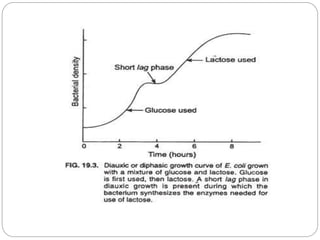
 Diauxic growth
 Diauxic growth or diauxie is any cell growth characterized
by cellular growth in two phases, and can be illustrated with
a diauxic growth curve. Diauxic growth, meaning double
growth, is caused by the presence of two sugars on a culture
growth media, one of which is easier for the target bacterium
to metabolize. The preferred sugar is consumed first, which
leads to rapid growth, followed by a lag phase.[1]During the
lag phase the cellular machinery used to metabolize the
second sugar is activated and subsequently the second sugar
is metabolized.
 This can also occur when the bacterium in a closed batch
culture consumes most of its nutrients and is entering the
stationary phase when new nutrients are suddenly added to
the growth media. The bacterium enters a lag phase where it
tries to ingest the food. Once the food starts being utilized, it
enters a new log phase showing a second peak on the growth
curve.
 A simple example involves the bacterium Escherichia coli (E.
coli), the best understood bacterium. The bacterium is grown
on a growth media containing two types of sugars, one of
which is easier to metabolize than the other (for
example glucose and lactose). First, the bacterium will
metabolize all the glucose, and grow at a higher speed.
Eventually, when all the glucose has been consumed, the
bacterium will begin the process of expressing the genes to
metabolize the lactose. This will only occur when all glucose
in the media has been consumed. For these
reasons, diauxic growth occurs in multiple phases.
 The first phase is the fast growth phase, since the bacterium
is consuming (in the case of the above example) exclusively
glucose, and is capable of rapid growth. The second phase is
a lag phase while the genes used in lactose metabolism are
expressed and observable cell growth stops. This is followed
by another growth phase which is slower than the first
because of the use of lactose as the primary energy source.
Diauxic Growth
 Growth on two carbon sources
 Mixed sugars
 Each sugar used separately
 Glucose ALWAYS used first
 Second sugar ONLY used when glucose GONE
Diauxic Growth: 2 carbon sources
Time (hr)
Growth [Sugar]
Glucose
Arabinose
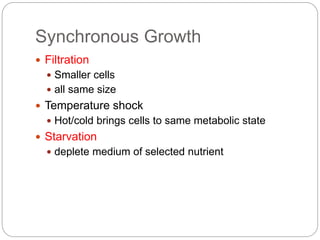
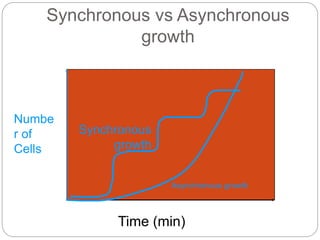
 Synchronous growth
 A synchronous or synchronized culture is a microbiological
culture or a cell culture that contains cells that are all in the
same growth stage.
 Since numerous factors influence the cell cycle, some of
them stochastic (random), normal, non-synchronous cultures
have cells in all stages of the cell cycle. Obtaining a culture
with a unified cell-cycle stage is very useful for biological
research. Since cells are too small for certain research
techniques, a synchronous culture can be treated as a single
cell; the number of cells in the culture can be easily
estimated, and quantitative experimental results can simply
be divided in the number of cells to obtain values that apply to
a single cell. Synchronous cultures have been extensively
used to address questions regarding cell cycle and growth,
and the effects of various factors on these.
 Synchronous cultures can be obtained in several ways:
 External conditions can be changed, so as to arrest growth of all cells
in the culture, and then changed again to resume growth. The newly
growing cells are now all starting to grow at the same stage, and they
are synchronized. For example, for photosynthetic cells light can be
eliminated for several hours and then re-introduced. Another method
is to eliminate an essential nutrient from the growth medium and later
to re-introduce it.
 Cell growth can also be arrested using chemical growth inhibitors.
After growth has completely stopped for all cells, the inhibitor can be
easily removed from the culture and the cells then begin to grow
synchronously. Nocodazole, for example, is often used in biological
research for this purpose.
 Cells in different growth stages have different physical properties.
Cells in a culture can thus be physically separated based on
their density or size, for instance. This can be achieved
using centrifugation (for density) or filtration (for size).
 In the Helmstetter-Cummings technique, a bacterial culture is filtered
through a membrane. Most bacteria pass through, but some remain
bound to the membrane. Fresh medium is then applied to the
membrane and the bound bacteria start to grow. Newborn bacteria
Synchronous Growth
 Filtration
 Smaller cells
 all same size
 Temperature shock
 Hot/cold brings cells to same metabolic state
 Starvation
 deplete medium of selected nutrient
Synchronous vs Asynchronous
growth
Time (min)
Numbe
r of
Cells
Asynchronous growth
Synchronous
growth
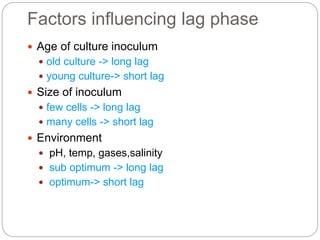
Factors influencing lag phase
 Age of culture inoculum
 old culture -> long lag
 young culture-> short lag
 Size of inoculum
 few cells -> long lag
 many cells -> short lag
 Environment
 pH, temp, gases,salinity
 sub optimum -> long lag
 optimum-> short lag
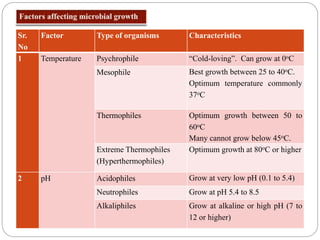
Sr.
No
Factor Type of organisms Characteristics
1 Temperature Psychrophile “Cold-loving”. Can grow at 0oC
Mesophile Best growth between 25 to 40oC.
Optimum temperature commonly
37oC
Thermophiles Optimum growth between 50 to
60oC
Many cannot grow below 45oC.
Extreme Thermophiles
(Hyperthermophiles)
Optimum growth at 80oC or higher
2 pH Acidophiles Grow at very low pH (0.1 to 5.4)
Neutrophiles Grow at pH 5.4 to 8.5
Alkaliphiles Grow at alkaline or high pH (7 to
12 or higher)
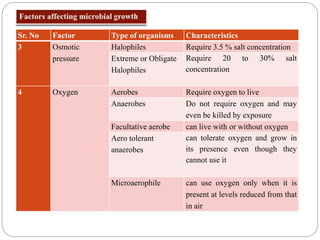
Sr. No Factor Type of organisms Characteristics
3 Osmotic
pressure
Halophiles Require 3.5 % salt concentration
Extreme or Obligate
Halophiles
Require 20 to 30% salt
concentration
4 Oxygen Aerobes Require oxygen to live
Anaerobes Do not require oxygen and may
even be killed by exposure
Facultative aerobe can live with or without oxygen
Aero tolerant
anaerobes
can tolerate oxygen and grow in
its presence even though they
cannot use it
Microaerophile can use oxygen only when it is
present at levels reduced from that
in air

Lecture-6 Reproduction in bacteria.ppt

  • 1.
  • 2.
    Reproduction in bacteria •Bacteria may either be in an active growing stage (vegetative stage) or in the form of resting cells. • Actively growing bacterial cells may increase in numbers in several different ways, most commonly they multiplied by splitting cross walls i.e. by transvers fission. • All true bacteria reproduce by this method, an asexual process known as ‘binary fission’. • This method of multiplication is so common and characteristic of the bacteria that they have been given the name of Schizomycetes.
  • 3.
    1. Binary fission:This is the most common type of asexual reproduction in actively growing bacteria and occurs during favorable conditions. On this basis, bacteria were once called ‘Fission fungi’ (Shizomycetes). • In this process, the cytoplasm and the nucleoid divide equally into two without mitosis, and the two daughter cells formed are identical to each other; hence the name binary fission. • The whole process of binary fission involves two steps—Genome replication and Septum formation. Both the events occur simultaneously and are triggered by a mesosome (if present).
  • 4.
    a. Genome/DNA replication:Binary fission begins with DNA replication. DNA replication starts from an origin of replication, which opens up into a bubble. The replication bubble separates the two DNA strands, each strand acts as a template for synthesis of a daughter strand. The DNA replication is bidirectional, starting from the point of origin and resulting in the formation of two circular daughter DNA molecules. In each daughter DNA molecule, one strand is derived from the parental DNA molecule while another strand is a new one. This is semi-conservative mode of DNA replication.
  • 5.
    b. Septum formation/celldivision: A peripheral ring of plasma membrane invaginates and grows centripetally to form a double-membranous septum. Wall material is deposited between the two membranes of the septum. This separates the parent cell into two nearly equal daughter cells, each having its own nucleoid. Under optimal conditions of nutrition, water and temperature, the process of binary fission is very quick and the division may be completed in about 20-30 minutes. Thus, in 24 hrs, a very large number of bacteria may be produced.
  • 6.
  • 7.
  • 8.
  • 9.
    Generation time: The timerequired for a bacterium to give rise to two daughter cells under optimum conditions is known as “Generation time” or population doubling time. It is different for different bacteria. Bacteria Medium Temperat ure (C°) Generation time (minute) Escherichia coli Broth 37 20 Mycobacterium tuberculosis Synthetic 37 792-932 Bacillus thermophiles Broth 55 1.3 Bacillus subtilis Broth 37 27 Streptococcus lactis Milk 37 30 Lactobacillus acidophilus Milk 37 66-87
  • 10.
    2. Budding Some bacteriasuch as Rhodopseudomonas acidophila reproduce by budding in which small bud develops at one end of the cell. It enlarges and develops into new cell, which separate from parent cell. Ex. Caulobacter - Gallionella
  • 11.
    3. Fragmentation: Bacteria thatproduce extensive filamentous growth, such as Nocardia spp. reproduce by fragmentation of the filamentous into small bacillary or cocci cell. Under unfavorable condition, protoplast of the bacterial cell forms very tiny bodies through segmentation. Such tiny bodies are known as gonidia. Gonidia grow into new bacterial cells. Actinomycetes
  • 13.
     Growth -Growthis the orderly increase in all of the components of an organism.  In the laboratory, under favorable conditions, a growing bacterial population doubles at regular intervals. Growth of bacteria occurs by geometric progression: 1, 2, 4, 8, etc. or 20, 21, 22, 23.........2n (where n = the number of generations). This is called exponential growth which is observed during Log Phase. In reality, exponential growth is only part of the bacterial life cycle, and not representative of the normal pattern of growth of bacteria in Nature.  When a fresh medium is inoculated with a given number of cells, and the population growth is monitored over a period of time, plotting the data will yield a typical bacterial growth curve.
  • 14.
     GROWTH RATE-Growth rate is the change in cell number or mass per unit time. It is expressed as ‘R’ which is the reciprocal of generation time ‘g’. It can be defined as the slope of the line when log of cells versus time is plotted (R = 1/g). Microbes generally respond linearly to a limiting nutrient concentration in the medium, which forms the principle for microbiological assays.  Generation Time- generation time is the time interval required for the cells (or population) to divide.  G (generation time) = (time, in minutes or hours)/n(number of generations) G = t/n
  • 15.
    When bacteria aregrown in a closed system (also called a batch culture or monoauxic growth), like a test tube, the population of cells almost always exhibits these growth dynamics
  • 16.
     It representsa period of active growth during which bacteria prepare for reproduction, synthesizing DNA, various inducible enzymes, and other macromolecules needed for cell division.  Therefore, during this phase, there may be increase in size (volumt increase in cell number  The lag phase may last for an hour or more, and near the end of this phase some cells may double or triple in size.  The lag phase is necessary before the initiation of cell division due to variety of reasons.  If the cells are taken from an old culture or from a refrigerated culture, it might be possible that the cells may be old and depleted of ATP, essential cofactors and ribosomes.
  • 17.
     If themedium is different from the one in which the microbial population was growing previously, new enzymes would be needed by the cells to use new nutrients in the medium.  However, these deficiencies are fulfilled by the cells during lag phase, t is, therefore, the lag phase is generally longer if the cells are taken from an old or refrigerated culture.  In contrast, if the cells are taken from young, vigorously growing culture microbial population) and inoculated to a fresh medium of the identical composition, the lag phase may be short or even absent.  If the inoculum is taken from a log phase, the lag phase may not occur but if the same is derived from a stationary phase, the lag phase will usually appear. This is due to the reason that the old -ells get depleted of some cellular constituents and essential enzymes, and thus require some time to re- establish their synthesis.
  • 18.
     Bacterial cellsprepared for cell division during lag phase now enter into the log phase or exponential growth_phase during which the cells divide at a naximal rate and their generation time reaches a minimum and remains constant.  The growth in this phase is quite balanced (i.e. all cellular constituents are synthesized at constant rates relative to each other) hence, the most uniform in terms of chemical and physiological properties, the log phase cultures are usually used in biochemical and physiological studies.
  • 19.
     Since thegeneration time is constant, a logarithmic plot of growth during log phase produces an almost a straight line.  This phase is called log phase because the logarithm of the bacterial mass increases linearly with time, and exponential growth phase because the number of cells increases as an exponential function of 2n (i.e. 2 22, 23, 24, 25 and so on).  The log phase also represents the time when bacterial cells are most active metabolically, and in industrial production, this is the period of peak activity and efficiency.
  • 20.
     Since thebacteria are growing in a constant volume of medium of batch culture, and no fresh nutrients are added, the growth of bacterial population eventually ceases and the growth curve becomes horizontal.  Such a phase of growth in bacteria is attained at a population level of around 109 cells per ml.  The ceasation of growth may be because of the exhaustion of available nutrients or by the accumulation of inhibitory end products of metabolism.  The ceasation of growth may also be due to O2 availability particularly in case of aerobes. Oxygen is not very soluble and may be depleted so quickly that only cells on the surface of the culture may find necessary oxygen concentration for adequate growth.
  • 21.
     Sooner orlater, the bacterial cells start dying and the number of such cells balances the number of new born cells, and the bacterial population stabilizes.  This state of growth, during which the total number of viable cells remains constant because of no further net increase in cell number and the growth rate is exactly equal to the death rate, is called stationary phase.  The conversion between the log or exponential and stationary phases involves a period of unbalanced growth during which the various cellular components synthesized at unequal rates. Consequently, cells in the
  • 22.
     After awhile, the number of dying cells begins to exceed the number of newborn cells and thus the number of viable bacterial cells present in a batch mlture starts declining.  Decline phase, also called the death phase, sets in due to further iccumulation of inhibitory metabolic products and depletion of essential nutrients. The death rate increases and the number of viable cells decreases exponentially. Finally all the cells die ranging from as to months.
  • 23.
     Diauxic growth Diauxic growth or diauxie is any cell growth characterized by cellular growth in two phases, and can be illustrated with a diauxic growth curve. Diauxic growth, meaning double growth, is caused by the presence of two sugars on a culture growth media, one of which is easier for the target bacterium to metabolize. The preferred sugar is consumed first, which leads to rapid growth, followed by a lag phase.[1]During the lag phase the cellular machinery used to metabolize the second sugar is activated and subsequently the second sugar is metabolized.  This can also occur when the bacterium in a closed batch culture consumes most of its nutrients and is entering the stationary phase when new nutrients are suddenly added to the growth media. The bacterium enters a lag phase where it tries to ingest the food. Once the food starts being utilized, it enters a new log phase showing a second peak on the growth curve.
  • 25.
     A simpleexample involves the bacterium Escherichia coli (E. coli), the best understood bacterium. The bacterium is grown on a growth media containing two types of sugars, one of which is easier to metabolize than the other (for example glucose and lactose). First, the bacterium will metabolize all the glucose, and grow at a higher speed. Eventually, when all the glucose has been consumed, the bacterium will begin the process of expressing the genes to metabolize the lactose. This will only occur when all glucose in the media has been consumed. For these reasons, diauxic growth occurs in multiple phases.  The first phase is the fast growth phase, since the bacterium is consuming (in the case of the above example) exclusively glucose, and is capable of rapid growth. The second phase is a lag phase while the genes used in lactose metabolism are expressed and observable cell growth stops. This is followed by another growth phase which is slower than the first because of the use of lactose as the primary energy source.
  • 26.
    Diauxic Growth  Growthon two carbon sources  Mixed sugars  Each sugar used separately  Glucose ALWAYS used first  Second sugar ONLY used when glucose GONE
  • 27.
    Diauxic Growth: 2carbon sources Time (hr) Growth [Sugar] Glucose Arabinose
  • 28.
     Synchronous growth A synchronous or synchronized culture is a microbiological culture or a cell culture that contains cells that are all in the same growth stage.  Since numerous factors influence the cell cycle, some of them stochastic (random), normal, non-synchronous cultures have cells in all stages of the cell cycle. Obtaining a culture with a unified cell-cycle stage is very useful for biological research. Since cells are too small for certain research techniques, a synchronous culture can be treated as a single cell; the number of cells in the culture can be easily estimated, and quantitative experimental results can simply be divided in the number of cells to obtain values that apply to a single cell. Synchronous cultures have been extensively used to address questions regarding cell cycle and growth, and the effects of various factors on these.  Synchronous cultures can be obtained in several ways:
  • 29.
     External conditionscan be changed, so as to arrest growth of all cells in the culture, and then changed again to resume growth. The newly growing cells are now all starting to grow at the same stage, and they are synchronized. For example, for photosynthetic cells light can be eliminated for several hours and then re-introduced. Another method is to eliminate an essential nutrient from the growth medium and later to re-introduce it.  Cell growth can also be arrested using chemical growth inhibitors. After growth has completely stopped for all cells, the inhibitor can be easily removed from the culture and the cells then begin to grow synchronously. Nocodazole, for example, is often used in biological research for this purpose.  Cells in different growth stages have different physical properties. Cells in a culture can thus be physically separated based on their density or size, for instance. This can be achieved using centrifugation (for density) or filtration (for size).  In the Helmstetter-Cummings technique, a bacterial culture is filtered through a membrane. Most bacteria pass through, but some remain bound to the membrane. Fresh medium is then applied to the membrane and the bound bacteria start to grow. Newborn bacteria
  • 30.
    Synchronous Growth  Filtration Smaller cells  all same size  Temperature shock  Hot/cold brings cells to same metabolic state  Starvation  deplete medium of selected nutrient
  • 31.
    Synchronous vs Asynchronous growth Time(min) Numbe r of Cells Asynchronous growth Synchronous growth
  • 32.
    Factors influencing lagphase  Age of culture inoculum  old culture -> long lag  young culture-> short lag  Size of inoculum  few cells -> long lag  many cells -> short lag  Environment  pH, temp, gases,salinity  sub optimum -> long lag  optimum-> short lag
  • 33.
    Sr. No Factor Type oforganisms Characteristics 1 Temperature Psychrophile “Cold-loving”. Can grow at 0oC Mesophile Best growth between 25 to 40oC. Optimum temperature commonly 37oC Thermophiles Optimum growth between 50 to 60oC Many cannot grow below 45oC. Extreme Thermophiles (Hyperthermophiles) Optimum growth at 80oC or higher 2 pH Acidophiles Grow at very low pH (0.1 to 5.4) Neutrophiles Grow at pH 5.4 to 8.5 Alkaliphiles Grow at alkaline or high pH (7 to 12 or higher)
  • 34.
    Sr. No FactorType of organisms Characteristics 3 Osmotic pressure Halophiles Require 3.5 % salt concentration Extreme or Obligate Halophiles Require 20 to 30% salt concentration 4 Oxygen Aerobes Require oxygen to live Anaerobes Do not require oxygen and may even be killed by exposure Facultative aerobe can live with or without oxygen Aero tolerant anaerobes can tolerate oxygen and grow in its presence even though they cannot use it Microaerophile can use oxygen only when it is present at levels reduced from that in air