Introduction
to
Bacterial Endotoxins Test
Bio Solutions
Bacterial Endotoxins Test (BET)
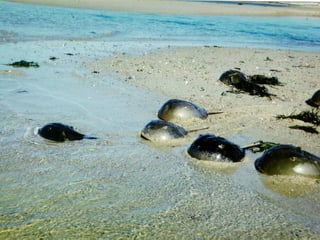
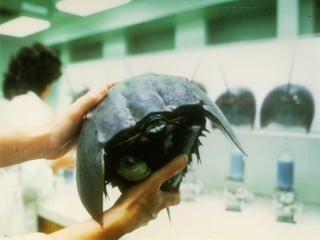
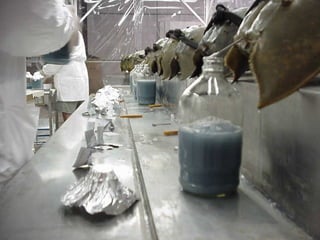
LAL – Limulus Amebocyte Lysate
(Limulus polyphemus)
TAL – Tachypleus Amebocyte Lysate (USP 29
only)
(Tachypleus tridentatus, Tachypleus gigas)
CAL – Carcinoscropius Amebocyte Lysate
(Carcinoscropius rotundicauda)
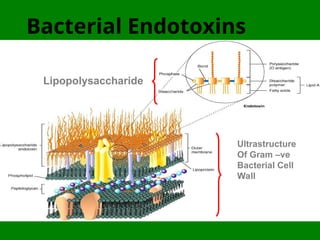
Bacterial Endotoxins
Ultrastructure
Of Gram –ve
Bacterial Cell
Wall
Lipopolysaccharide
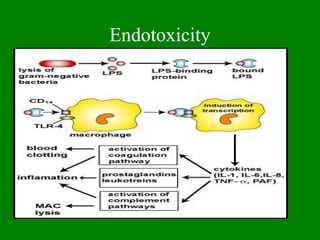
Endotoxicity
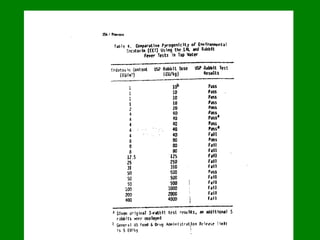
Rabbit Pyrogen test
From 1940’s Rabbit Pyrogen test was
method of choice for detection of pyrogen.
This Rabbit pyrogen test was incorporated
into USP XII in 1942.
Accidental Discovery Of LAL
• Dr. Frederick Bang
• Dr.Jack Levin
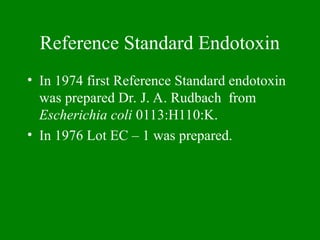
Reference Standard Endotoxin
• In 1974 first Reference Standard endotoxin
was prepared Dr. J. A. Rudbach from
Escherichia coli 0113:H110:K.
• In 1976 Lot EC – 1 was prepared.
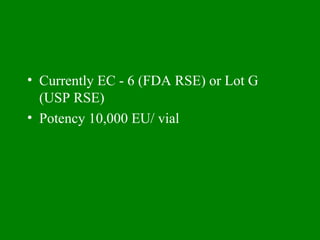
• Currently EC - 6 (FDA RSE) or Lot G
(USP RSE)
• Potency 10,000 EU/ vial
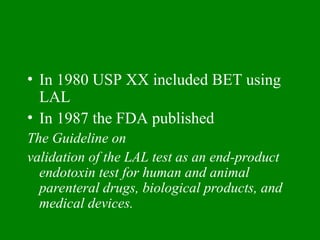
• In 1980 USP XX included BET using
LAL
• In 1987 the FDA published
The Guideline on
validation of the LAL test as an end-product
endotoxin test for human and animal
parenteral drugs, biological products, and
medical devices.
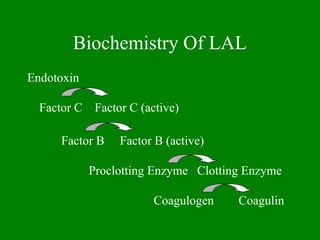
Biochemistry Of LAL
Endotoxin
Factor C Factor C (active)
Factor B Factor B (active)
Proclotting Enzyme Clotting Enzyme
Coagulogen Coagulin
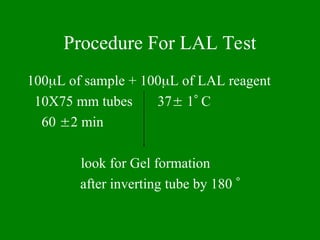
Procedure For LAL Test
100L of sample + 100L of LAL reagent
10X75 mm tubes 37 1 C
60 2 min
look for Gel formation
after inverting tube by 180 
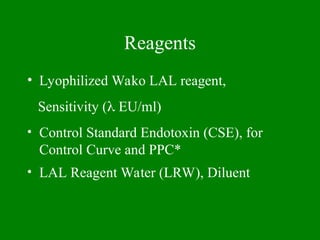
Reagents
• Lyophilized Wako LAL reagent,
Sensitivity ( EU/ml)
• Control Standard Endotoxin (CSE), for
Control Curve and PPC*
• LAL Reagent Water (LRW), Diluent
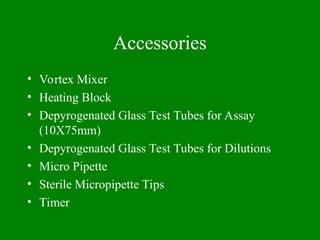
Accessories
• Vortex Mixer
• Heating Block
• Depyrogenated Glass Test Tubes for Assay
(10X75mm)
• Depyrogenated Glass Test Tubes for Dilutions
• Micro Pipette
• Sterile Micropipette Tips
• Timer
Initial Quality Control
• Analyst Qualification
• Verification of Testing accessories
• Verification of label claim sensitivity
As per USP :
• New Batch of LAL Reagent
• Any Change in Experimental Conditions
• Four Standards Concentrations in
Quadruplicates with Negative Controls
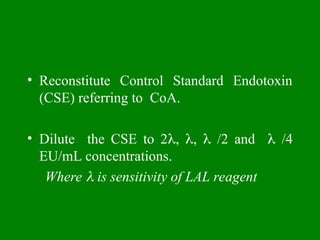
• Reconstitute Control Standard Endotoxin
(CSE) referring to CoA.
• Dilute the CSE to 2, ,  /2 and  /4
EU/mL concentrations.
Where  is sensitivity of LAL reagent
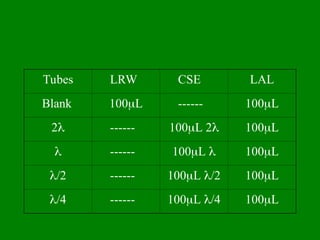
Tubes LRW CSE LAL
Blank 100L ------ 100L
2 ------ 100L 2 100L
 ------ 100L  100L
/2 ------ 100L /2 100L
/4 ------ 100L /4 100L
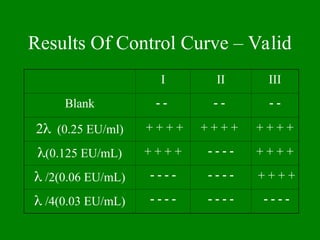
Results Of Control Curve – Valid
I II III
Blank      
2 (0.25 EU/ml) + + + + + + + + + + + +
(0.125 EU/mL) + + + +     + + + +
 /2(0.06 EU/mL)         + + + +
 /4(0.03 EU/mL)            
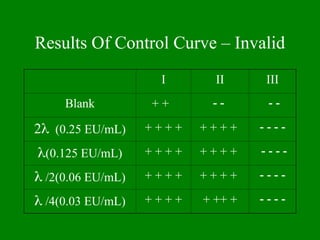
Results Of Control Curve – Invalid
I II III
Blank + +    
2 (0.25 EU/mL) + + + + + + + +    
(0.125 EU/mL) + + + + + + + +    
 /2(0.06 EU/mL) + + + + + + + +    
 /4(0.03 EU/mL) + + + + + ++ +    
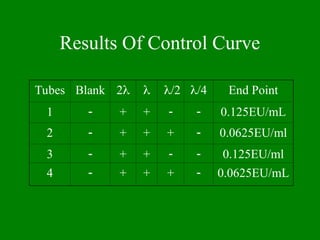
Results Of Control Curve
Tubes Blank 2  /2 /4 End Point
1  + +   0.125EU/mL
2  + + +  0.0625EU/ml
3  + +   0.125EU/ml
4  + + +  0.0625EU/mL
Calculation Of Geometric Mean
• Formula :
GM end point Concentration = antilog(e/ƒ)
Where,
e = Sum of log of Endpoint Concentrations
ƒ = Number of Replicates
• Calculation :
GM = log (0.125) + log (0.125) + log (0.0625) + log (0.0625)
4
= Anti[(-0.9030) + (-0.9030) + (-1.2041)+ (-1.2041)]
4
= Antilog [(-1.0536)]
= 0.0883 EU/mL
• Label Sensitivity is Confirmed if GM endpoint is between 2 and /2
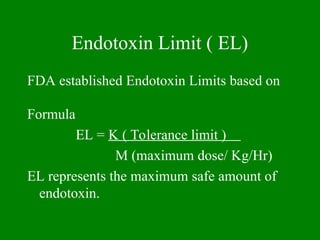
Endotoxin Limit ( EL)
FDA established Endotoxin Limits based on
Formula
EL = K ( Tolerance limit )
M (maximum dose/ Kg/Hr)
EL represents the maximum safe amount of
endotoxin.
Endotoxin Limit ( EL)
• K = 5 EU/Kg Body weight for parenteral
drugs except those administered
intrathecally.
0.2 EU/kg for intrathecal drugs
Endotoxin Limit ( EL)
M = Maximum dose administered to a
patient per kg Body weight, per hour
(no heroic dose).
Endotoxin Limit ( EL)
• The limit formula for radio pharmaceuticals is
175/V except for intrathecally administered
products. 14/V for intrathecal drugs.
V equals the maximum recommended dose, in mL,
at the expiration date or time.
• For drugs administered on a per Square Meter of
Body Surface:
2.5 EU/ [ ( dose * 1.8 sq.. m.)/ 70 Kg]
Product Testing
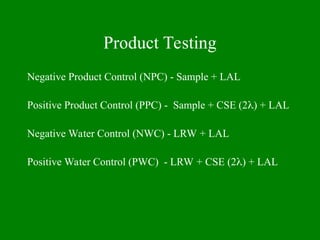
Negative Product Control (NPC) - Sample + LAL
Positive Product Control (PPC) - Sample + CSE (2) + LAL
Negative Water Control (NWC) - LRW + LAL
Positive Water Control (PWC) - LRW + CSE (2) + LAL
Interference
Significant difference between the end points
of positive water control and positive
product control using standard endotoxin.
Interference
• Sub optimal pH concentration
• Endotoxin modification
• Container effects
• Unbalanced cation levels
• Protein or Enzyme modification
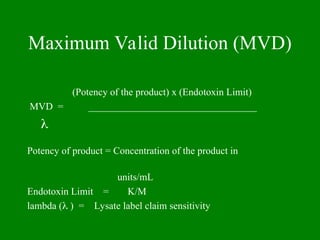
Maximum Valid Dilution (MVD)
(Potency of the product) x (Endotoxin Limit)
MVD = __________________________________

Potency of product = Concentration of the product in
units/mL
Endotoxin Limit = K/M
lambda ( ) = Lysate label claim sensitivity
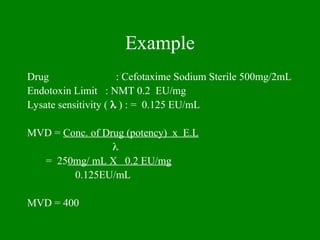
Example
Drug : Cefotaxime Sodium Sterile 500mg/2mL
Endotoxin Limit : NMT 0.2 EU/mg
Lysate sensitivity (  ) : = 0.125 EU/mL
MVD = Conc. of Drug (potency) x E.L

= 250mg/ mL X 0.2 EU/mg
0.125EU/mL
MVD = 400
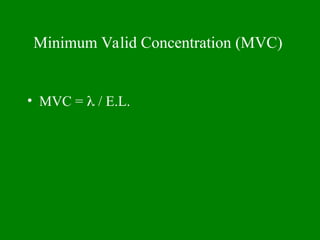
Minimum Valid Concentration (MVC)
• MVC =  / E.L.
Example
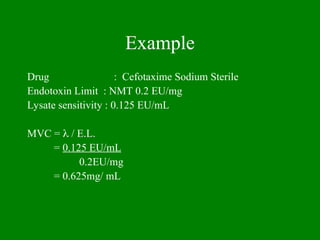
Drug : Cefotaxime Sodium Sterile
Endotoxin Limit : NMT 0.2 EU/mg
Lysate sensitivity : 0.125 EU/mL
MVC =  / E.L.
= 0.125 EU/mL
0.2EU/mg
= 0.625mg/ mL
Product Validation
• The validation for LAL compatibility of a
drug product is a test condition where an
endotoxin standard is detected with the
same efficiency in a test sample as it is in
LRW.
Product Validation
Phase I: Preliminary Screening
Determines the Non Interfering Dilution /
Concentration of the product which is used
for actual validation.
Phase II: Product Validation
Phase I: Preliminary Screening
• Prepare dilutions of product up to MVD such as,
MVD / 16, MVD / 8, MVD / 4, MVD / 2, MVD
• Run NPC AND PPC
• Least DILUTION / highest CONC. of product for
which PPC is Positive and NPC is Negative is the
Non Interfering Dilution (NID)/ Non Interfering
Concentration (NIC).
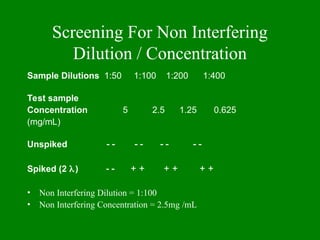
Screening For Non Interfering
Dilution / Concentration
Sample Dilutions 1:50 1:100 1:200 1:400
Test sample
Concentration 5 2.5 1.25 0.625
(mg/mL)
Unspiked        
Spiked (2 )   + + + + + +
• Non Interfering Dilution = 1:100
• Non Interfering Concentration = 2.5mg /mL
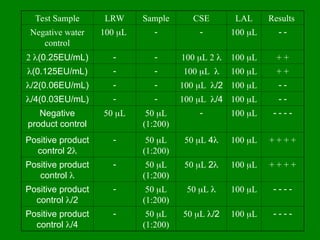
Test Sample LRW Sample CSE LAL Results
Negative water
control
100 L   100 L  
2 (0.25EU/mL)   100 L 2  100 L + +
(0.125EU/mL)   100 L  100 L + +
/2(0.06EU/mL)   100 L /2 100 L  
/4(0.03EU/mL)   100 L /4 100 L  
Negative
product control
50 L 50 L
(1:200)
 100 L    
Positive product
control 2
 50 L
(1:200)
50 L 4 100 L + + + +
Positive product
control 
 50 L
(1:200)
50 L 2 100 L + + + +
Positive product
control /2
 50 L
(1:200)
50 L  100 L    
Positive product
control /4
 50 L
(1:200)
50 L /2 100 L    
Geometric Mean Calculation
GM end point Concentration = antilog(e/ƒ)
GM in Water = log (0.125) + log (0.125) + log (0.125) + log( 0.125)
4
= Anti[(-0.9030) + (-0.9030) +(-0.9030) + (-0.9030)]
4
= Antilog [(-0.9030)]
= 0.125 EU/mL
GM in Product = log (0.125) + log (0.125) + log (0.125) + log( 0.125)
4
= Anti[(-0.9030) + (-0.9030) +(-0.9030) + (-0.9030)]
4
= Antilog [(-0.9030)]
= 0.125 EU/mL
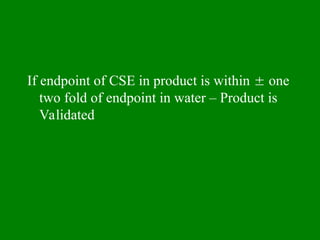
If endpoint of CSE in product is within  one
two fold of endpoint in water – Product is
Validated
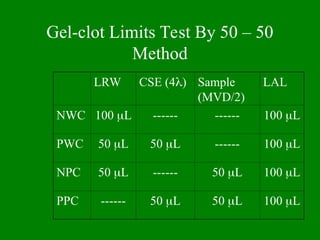
Gel-clot Limits Test By 50 – 50
Method
LRW CSE (4) Sample
(MVD/2)
LAL
NWC 100 L ------ ------ 100 L
PWC 50 L 50 L ------ 100 L
NPC 50 L ------ 50 L 100 L
PPC ------ 50 L 50 L 100 L
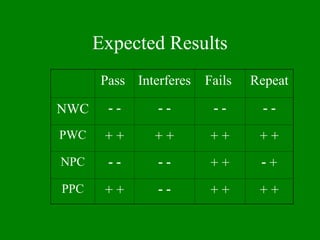
Expected Results
Pass Interferes Fails Repeat
NWC        
PWC + + + + + + + +
NPC     + +  +
PPC + +   + + + +
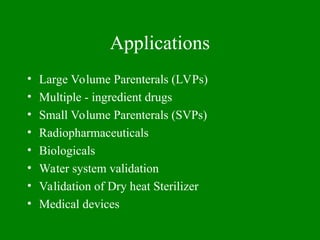
Applications
• Large Volume Parenterals (LVPs)
• Multiple - ingredient drugs
• Small Volume Parenterals (SVPs)
• Radiopharmaceuticals
• Biologicals
• Water system validation
• Validation of Dry heat Sterilizer
• Medical devices

Bacterial Endotoxin Testing_Basic_Presentation.ppt

  • 1.
  • 2.
    Bacterial Endotoxins Test(BET) LAL – Limulus Amebocyte Lysate (Limulus polyphemus) TAL – Tachypleus Amebocyte Lysate (USP 29 only) (Tachypleus tridentatus, Tachypleus gigas) CAL – Carcinoscropius Amebocyte Lysate (Carcinoscropius rotundicauda)
  • 7.
    Bacterial Endotoxins Ultrastructure Of Gram–ve Bacterial Cell Wall Lipopolysaccharide
  • 8.
  • 9.
    Rabbit Pyrogen test From1940’s Rabbit Pyrogen test was method of choice for detection of pyrogen. This Rabbit pyrogen test was incorporated into USP XII in 1942.
  • 10.
    Accidental Discovery OfLAL • Dr. Frederick Bang • Dr.Jack Levin
  • 12.
    Reference Standard Endotoxin •In 1974 first Reference Standard endotoxin was prepared Dr. J. A. Rudbach from Escherichia coli 0113:H110:K. • In 1976 Lot EC – 1 was prepared.
  • 13.
    • Currently EC- 6 (FDA RSE) or Lot G (USP RSE) • Potency 10,000 EU/ vial
  • 14.
    • In 1980USP XX included BET using LAL • In 1987 the FDA published The Guideline on validation of the LAL test as an end-product endotoxin test for human and animal parenteral drugs, biological products, and medical devices.
  • 15.
    Biochemistry Of LAL Endotoxin FactorC Factor C (active) Factor B Factor B (active) Proclotting Enzyme Clotting Enzyme Coagulogen Coagulin
  • 16.
    Procedure For LALTest 100L of sample + 100L of LAL reagent 10X75 mm tubes 37 1 C 60 2 min look for Gel formation after inverting tube by 180 
  • 17.
    Reagents • Lyophilized WakoLAL reagent, Sensitivity ( EU/ml) • Control Standard Endotoxin (CSE), for Control Curve and PPC* • LAL Reagent Water (LRW), Diluent
  • 18.
    Accessories • Vortex Mixer •Heating Block • Depyrogenated Glass Test Tubes for Assay (10X75mm) • Depyrogenated Glass Test Tubes for Dilutions • Micro Pipette • Sterile Micropipette Tips • Timer
  • 19.
    Initial Quality Control •Analyst Qualification • Verification of Testing accessories • Verification of label claim sensitivity
  • 20.
    As per USP: • New Batch of LAL Reagent • Any Change in Experimental Conditions • Four Standards Concentrations in Quadruplicates with Negative Controls
  • 21.
    • Reconstitute ControlStandard Endotoxin (CSE) referring to CoA. • Dilute the CSE to 2, ,  /2 and  /4 EU/mL concentrations. Where  is sensitivity of LAL reagent
  • 22.
    Tubes LRW CSELAL Blank 100L ------ 100L 2 ------ 100L 2 100L  ------ 100L  100L /2 ------ 100L /2 100L /4 ------ 100L /4 100L
  • 23.
    Results Of ControlCurve – Valid I II III Blank       2 (0.25 EU/ml) + + + + + + + + + + + + (0.125 EU/mL) + + + +     + + + +  /2(0.06 EU/mL)         + + + +  /4(0.03 EU/mL)            
  • 24.
    Results Of ControlCurve – Invalid I II III Blank + +     2 (0.25 EU/mL) + + + + + + + +     (0.125 EU/mL) + + + + + + + +      /2(0.06 EU/mL) + + + + + + + +      /4(0.03 EU/mL) + + + + + ++ +    
  • 25.
    Results Of ControlCurve Tubes Blank 2  /2 /4 End Point 1  + +   0.125EU/mL 2  + + +  0.0625EU/ml 3  + +   0.125EU/ml 4  + + +  0.0625EU/mL
  • 26.
    Calculation Of GeometricMean • Formula : GM end point Concentration = antilog(e/ƒ) Where, e = Sum of log of Endpoint Concentrations ƒ = Number of Replicates • Calculation : GM = log (0.125) + log (0.125) + log (0.0625) + log (0.0625) 4 = Anti[(-0.9030) + (-0.9030) + (-1.2041)+ (-1.2041)] 4 = Antilog [(-1.0536)] = 0.0883 EU/mL • Label Sensitivity is Confirmed if GM endpoint is between 2 and /2
  • 27.
    Endotoxin Limit (EL) FDA established Endotoxin Limits based on Formula EL = K ( Tolerance limit ) M (maximum dose/ Kg/Hr) EL represents the maximum safe amount of endotoxin.
  • 28.
    Endotoxin Limit (EL) • K = 5 EU/Kg Body weight for parenteral drugs except those administered intrathecally. 0.2 EU/kg for intrathecal drugs
  • 29.
    Endotoxin Limit (EL) M = Maximum dose administered to a patient per kg Body weight, per hour (no heroic dose).
  • 30.
    Endotoxin Limit (EL) • The limit formula for radio pharmaceuticals is 175/V except for intrathecally administered products. 14/V for intrathecal drugs. V equals the maximum recommended dose, in mL, at the expiration date or time. • For drugs administered on a per Square Meter of Body Surface: 2.5 EU/ [ ( dose * 1.8 sq.. m.)/ 70 Kg]
  • 31.
    Product Testing Negative ProductControl (NPC) - Sample + LAL Positive Product Control (PPC) - Sample + CSE (2) + LAL Negative Water Control (NWC) - LRW + LAL Positive Water Control (PWC) - LRW + CSE (2) + LAL
  • 32.
    Interference Significant difference betweenthe end points of positive water control and positive product control using standard endotoxin.
  • 33.
    Interference • Sub optimalpH concentration • Endotoxin modification • Container effects • Unbalanced cation levels • Protein or Enzyme modification
  • 34.
    Maximum Valid Dilution(MVD) (Potency of the product) x (Endotoxin Limit) MVD = __________________________________  Potency of product = Concentration of the product in units/mL Endotoxin Limit = K/M lambda ( ) = Lysate label claim sensitivity
  • 35.
    Example Drug : CefotaximeSodium Sterile 500mg/2mL Endotoxin Limit : NMT 0.2 EU/mg Lysate sensitivity (  ) : = 0.125 EU/mL MVD = Conc. of Drug (potency) x E.L  = 250mg/ mL X 0.2 EU/mg 0.125EU/mL MVD = 400
  • 36.
    Minimum Valid Concentration(MVC) • MVC =  / E.L.
  • 37.
    Example Drug : CefotaximeSodium Sterile Endotoxin Limit : NMT 0.2 EU/mg Lysate sensitivity : 0.125 EU/mL MVC =  / E.L. = 0.125 EU/mL 0.2EU/mg = 0.625mg/ mL
  • 38.
    Product Validation • Thevalidation for LAL compatibility of a drug product is a test condition where an endotoxin standard is detected with the same efficiency in a test sample as it is in LRW.
  • 39.
    Product Validation Phase I:Preliminary Screening Determines the Non Interfering Dilution / Concentration of the product which is used for actual validation. Phase II: Product Validation
  • 40.
    Phase I: PreliminaryScreening • Prepare dilutions of product up to MVD such as, MVD / 16, MVD / 8, MVD / 4, MVD / 2, MVD • Run NPC AND PPC • Least DILUTION / highest CONC. of product for which PPC is Positive and NPC is Negative is the Non Interfering Dilution (NID)/ Non Interfering Concentration (NIC).
  • 41.
    Screening For NonInterfering Dilution / Concentration Sample Dilutions 1:50 1:100 1:200 1:400 Test sample Concentration 5 2.5 1.25 0.625 (mg/mL) Unspiked         Spiked (2 )   + + + + + + • Non Interfering Dilution = 1:100 • Non Interfering Concentration = 2.5mg /mL
  • 42.
    Test Sample LRWSample CSE LAL Results Negative water control 100 L   100 L   2 (0.25EU/mL)   100 L 2  100 L + + (0.125EU/mL)   100 L  100 L + + /2(0.06EU/mL)   100 L /2 100 L   /4(0.03EU/mL)   100 L /4 100 L   Negative product control 50 L 50 L (1:200)  100 L     Positive product control 2  50 L (1:200) 50 L 4 100 L + + + + Positive product control   50 L (1:200) 50 L 2 100 L + + + + Positive product control /2  50 L (1:200) 50 L  100 L     Positive product control /4  50 L (1:200) 50 L /2 100 L    
  • 43.
    Geometric Mean Calculation GMend point Concentration = antilog(e/ƒ) GM in Water = log (0.125) + log (0.125) + log (0.125) + log( 0.125) 4 = Anti[(-0.9030) + (-0.9030) +(-0.9030) + (-0.9030)] 4 = Antilog [(-0.9030)] = 0.125 EU/mL GM in Product = log (0.125) + log (0.125) + log (0.125) + log( 0.125) 4 = Anti[(-0.9030) + (-0.9030) +(-0.9030) + (-0.9030)] 4 = Antilog [(-0.9030)] = 0.125 EU/mL
  • 44.
    If endpoint ofCSE in product is within  one two fold of endpoint in water – Product is Validated
  • 45.
    Gel-clot Limits TestBy 50 – 50 Method LRW CSE (4) Sample (MVD/2) LAL NWC 100 L ------ ------ 100 L PWC 50 L 50 L ------ 100 L NPC 50 L ------ 50 L 100 L PPC ------ 50 L 50 L 100 L
  • 46.
    Expected Results Pass InterferesFails Repeat NWC         PWC + + + + + + + + NPC     + +  + PPC + +   + + + +
  • 47.
    Applications • Large VolumeParenterals (LVPs) • Multiple - ingredient drugs • Small Volume Parenterals (SVPs) • Radiopharmaceuticals • Biologicals • Water system validation • Validation of Dry heat Sterilizer • Medical devices