PRODUCTION OF BACTERIAL
CELLULOSE
PRESENTED BY:
RONIT VERMA
VAISHALI MISHRA
GULABSHA SIDDIQU
INTRODUCTION
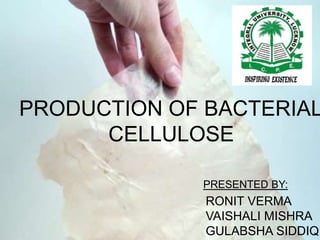
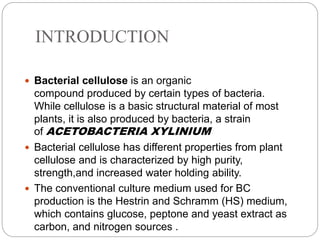
 Bacterial cellulose is an organic
compound produced by certain types of bacteria.
While cellulose is a basic structural material of most
plants, it is also produced by bacteria, a strain
of ACETOBACTERIA XYLINIUM
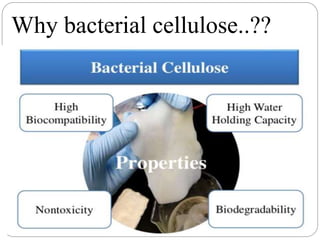
 Bacterial cellulose has different properties from plant
cellulose and is characterized by high purity,
strength,and increased water holding ability.
 The conventional culture medium used for BC
production is the Hestrin and Schramm (HS) medium,
which contains glucose, peptone and yeast extract as
carbon, and nitrogen sources .
The use of additives into the growth medium, including organic
acids, carbohydrates, and ethanol has been reported to improve
BC production .
A recent work on BC production by Acetobacter xylinium using
HS modified medium in the presence of ethanol and acetic acid
revealed an improvement in BC yield up to 279%
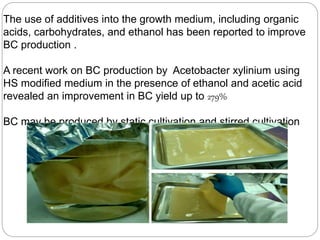
BC may be produced by static cultivation and stirred cultivation
Why bacterial cellulose..??
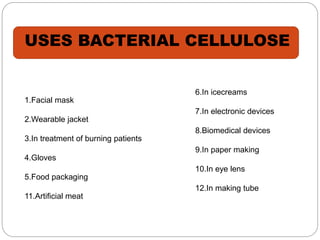
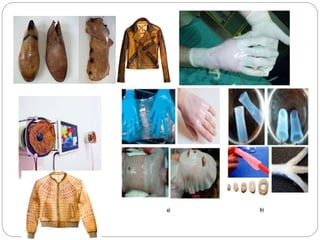
1.Facial mask
2.Wearable jacket
3.In treatment of burning patients
4.Gloves
5.Food packaging
11.Artificial meat
6.In icecreams
7.In electronic devices
8.Biomedical devices
9.In paper making
10.In eye lens
12.In making tube
USES BACTERIAL CELLULOSE
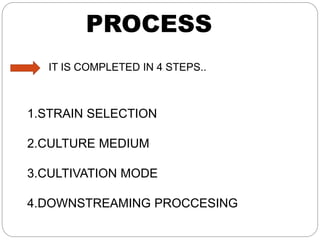
PROCESS
IT IS COMPLETED IN 4 STEPS..
1.STRAIN SELECTION
2.CULTURE MEDIUM
3.CULTIVATION MODE
4.DOWNSTREAMING PROCCESING
STRAIN SELECTION
BC can be produced from the various
species . However, the major
producers of BC belong to
the Acetobacter genus which is widely
used for BC production mainly due to
its capacity to metabolize a wide range
of carbon/nitrogen sources
CULTURE MEDIUM
BC production requires a glucose-rich culture medium with
other nutrients sources, resulting in high production costs.
The conventional culture medium used for BC production is
the Hestrin and Schramm (HS) medium, which contains
glucose, peptone and yeast extract as carbon, and nitrogen
sources.
We are using molasses from sugar industries which is cheap
carbon source for production of BCand HS modified
medium in the presence of ethanol and acetic acid.
Temperature required for the growth of BC is between 20
CULTIVATION
STATIC CULTIVATION
Static cultivation is a simple and widely used method of BC
production. The culture medium (usually placed into
shallow trays) is inoculated, which results in the formation
of the BC pellicle, which floats due to the entrapped
CO2 bubbles generated by the bacteria. The cultivation
usually requires 5–20 days, until the BC sheet nearly fills
the tray, since the BC production depends on the area of
the air/liquid interface.
Recently, bioreactors that produce BC in a higher yield
under nearly static conditions have been developed to
AGITATED CULTIVATION
In agitated cultivation, oxygen is continuously mixed into
the medium, so the BC is produced with enhanced yield
compared with static culture, which contributes to cost
reduction.
The agitated fermentation process may lead to several
forms of cellulose, from fibrous suspension to spheres and
pellets .The shape and size depending on the applied
rotational speed.
Although the BC yield in agitated culture is usually
considered to be higher than in static culture
Stirred-tank bioreactors have been frequently used to
produce BC in fibrous form. Stirred-tank bioreactors have
been frequently used to produce BC in fibrous form.
However, the crystallinity, elastic modulus, and degree of
An alternative type of fermentation reactor is
Airlift bioreactor, in which oxygen is
continuously transferred from the bottom of the
reactor to the culture medium, providing a
suitable oxygen supply . The process is more
energy efficient and involves less shear stress
when compared to stirred-tank reactors
A Modified airlift bioreactor with a series of net
plates, in order to produce BC in pellicular form.
The resulting membranes presented higher
water-holding capacity than that of BC
produced by static cultivation.
DOWNSTREAMING PROCESS
The downstream processing involves two steps:
1. The separation of the BC produced from the culture
medium
2. The purification of the biopolymer.
The BC can be removed from the culture medium
applying simple procedures, in spite ofthe cultivation
system used. For the agitated cultivation the BC can be
removed by filtration or centrifugation, and for static
cultures the BC film produced in the liquid-air interface
can be simply harvested.
The most widely used procedure for BC purification is
the alkali treatment with NaOH or KOH
The downstream processing of BC can
also include a drying step. There are
different methods of drying the BC
including drying at room temperature,
oven drying, freeze drying, and
supercritical drying. The drying process of
BC changes its characteristics and
properties, thus it should be chosen
according to the final application of the
material.
It is important to note that the downstream
processing for BC is usually easier and
Source:-
1.
https://www.sciencedirect.com
2. https://www.mdpi.com
3.https://www.frontiersin.org

Bacterial Cellulose presentation

  • 1.
    PRODUCTION OF BACTERIAL CELLULOSE PRESENTEDBY: RONIT VERMA VAISHALI MISHRA GULABSHA SIDDIQU
  • 2.
    INTRODUCTION  Bacterial celluloseis an organic compound produced by certain types of bacteria. While cellulose is a basic structural material of most plants, it is also produced by bacteria, a strain of ACETOBACTERIA XYLINIUM  Bacterial cellulose has different properties from plant cellulose and is characterized by high purity, strength,and increased water holding ability.  The conventional culture medium used for BC production is the Hestrin and Schramm (HS) medium, which contains glucose, peptone and yeast extract as carbon, and nitrogen sources .
  • 3.
    The use ofadditives into the growth medium, including organic acids, carbohydrates, and ethanol has been reported to improve BC production . A recent work on BC production by Acetobacter xylinium using HS modified medium in the presence of ethanol and acetic acid revealed an improvement in BC yield up to 279% BC may be produced by static cultivation and stirred cultivation
  • 4.
  • 5.
    1.Facial mask 2.Wearable jacket 3.Intreatment of burning patients 4.Gloves 5.Food packaging 11.Artificial meat 6.In icecreams 7.In electronic devices 8.Biomedical devices 9.In paper making 10.In eye lens 12.In making tube USES BACTERIAL CELLULOSE
  • 7.
    PROCESS IT IS COMPLETEDIN 4 STEPS.. 1.STRAIN SELECTION 2.CULTURE MEDIUM 3.CULTIVATION MODE 4.DOWNSTREAMING PROCCESING
  • 8.
    STRAIN SELECTION BC canbe produced from the various species . However, the major producers of BC belong to the Acetobacter genus which is widely used for BC production mainly due to its capacity to metabolize a wide range of carbon/nitrogen sources
  • 9.
    CULTURE MEDIUM BC productionrequires a glucose-rich culture medium with other nutrients sources, resulting in high production costs. The conventional culture medium used for BC production is the Hestrin and Schramm (HS) medium, which contains glucose, peptone and yeast extract as carbon, and nitrogen sources. We are using molasses from sugar industries which is cheap carbon source for production of BCand HS modified medium in the presence of ethanol and acetic acid. Temperature required for the growth of BC is between 20
  • 10.
    CULTIVATION STATIC CULTIVATION Static cultivationis a simple and widely used method of BC production. The culture medium (usually placed into shallow trays) is inoculated, which results in the formation of the BC pellicle, which floats due to the entrapped CO2 bubbles generated by the bacteria. The cultivation usually requires 5–20 days, until the BC sheet nearly fills the tray, since the BC production depends on the area of the air/liquid interface. Recently, bioreactors that produce BC in a higher yield under nearly static conditions have been developed to
  • 11.
    AGITATED CULTIVATION In agitatedcultivation, oxygen is continuously mixed into the medium, so the BC is produced with enhanced yield compared with static culture, which contributes to cost reduction. The agitated fermentation process may lead to several forms of cellulose, from fibrous suspension to spheres and pellets .The shape and size depending on the applied rotational speed. Although the BC yield in agitated culture is usually considered to be higher than in static culture Stirred-tank bioreactors have been frequently used to produce BC in fibrous form. Stirred-tank bioreactors have been frequently used to produce BC in fibrous form. However, the crystallinity, elastic modulus, and degree of
  • 12.
    An alternative typeof fermentation reactor is Airlift bioreactor, in which oxygen is continuously transferred from the bottom of the reactor to the culture medium, providing a suitable oxygen supply . The process is more energy efficient and involves less shear stress when compared to stirred-tank reactors A Modified airlift bioreactor with a series of net plates, in order to produce BC in pellicular form. The resulting membranes presented higher water-holding capacity than that of BC produced by static cultivation.
  • 13.
    DOWNSTREAMING PROCESS The downstreamprocessing involves two steps: 1. The separation of the BC produced from the culture medium 2. The purification of the biopolymer. The BC can be removed from the culture medium applying simple procedures, in spite ofthe cultivation system used. For the agitated cultivation the BC can be removed by filtration or centrifugation, and for static cultures the BC film produced in the liquid-air interface can be simply harvested. The most widely used procedure for BC purification is the alkali treatment with NaOH or KOH
  • 14.
    The downstream processingof BC can also include a drying step. There are different methods of drying the BC including drying at room temperature, oven drying, freeze drying, and supercritical drying. The drying process of BC changes its characteristics and properties, thus it should be chosen according to the final application of the material. It is important to note that the downstream processing for BC is usually easier and
  • 15.