Production and applications
Adefarati Oloruntoba Prof. Chang Samuel Hsu
Florida State University, USACUPB, China
CHINA UNIVERSITY OF PETROLEUM BEIJING. CHINA
COLLEGE OF CHEMICAL ENGINEERING
Contents
Future Prospects of Xanthan Gum4
Xanthan gum biopolymer1
Xanthan Gum Production2
Xanthan Gum Applications3
Reference
Xanthan gum biopolymer1
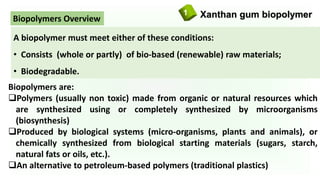
Biopolymers are:
Polymers (usually non toxic) made from organic or natural resources which
are synthesized using or completely synthesized by microorganisms
(biosynthesis)
Produced by biological systems (micro-organisms, plants and animals), or
chemically synthesized from biological starting materials (sugars, starch,
natural fats or oils, etc.).
An alternative to petroleum-based polymers (traditional plastics)
A biopolymer must meet either of these conditions:
• Consists (whole or partly) of bio-based (renewable) raw materials;
• Biodegradable.
Biopolymers Overview
Xanthan gum biopolymer1
Biopolymers structures
Biopolymers Overview
Chitosan (biopolymer)[1]
[2]
Xanthan gum biopolymer1
Eco-bacterial polymer granules as biomaterials [2]
Xanthan gum biopolymer1
Enhanced biopolymers
and biopolymer
synthesis as a target
for drug discovery [2]
Xanthan gum biopolymer1
Xanthan gum is a natural polysaccharide and
an industrial biopolymer.
Polysaccharide B-1459/ NRRL B-1459
Discovered in the 1950s at the Northern
Regional Research Laboratories (NRRL) of the
United States Department of Agriculture by
Allene Rosalind Jeanes.
FDA (Fed. Reg. 345376) approval in 1969 as a
nontoxic and safe polymer as thickener and
stabilizer in many food products
Xanthan gum is produced by
Gram negative bacteria of the
genus Xanthomonas
Different strains are:
X. arboricola, X. axonopodis,
X. campestris, X. citri, X. fragaria,
X. gummisudans, X. juglandis,
X. phaseoli, X. vasculorium,
X. campestris
Xanthan gum biopolymer1
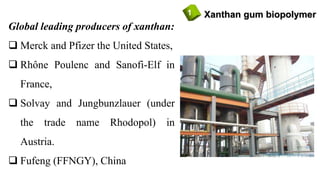
Global leading producers of xanthan:
 Merck and Pfizer the United States,
 Rhône Poulenc and Sanofi-Elf in
France,
 Solvay and Jungbunzlauer (under
the trade name Rhodopol) in
Austria.
 Fufeng (FFNGY), China
Xanthan gum biopolymer1
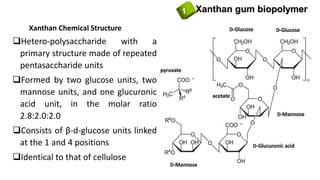
Xanthan Chemical Structure
Hetero-polysaccharide with a
primary structure made of repeated
pentasaccharide units
Formed by two glucose units, two
mannose units, and one glucuronic
acid unit, in the molar ratio
2.8:2.0:2.0
Consists of β-d-glucose units linked
at the 1 and 4 positions
Identical to that of cellulose
Xanthan gum biopolymer1
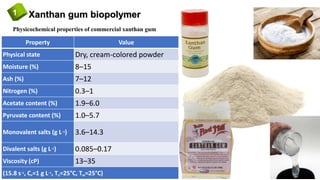
Property Value
Physical state Dry, cream-colored powder
Moisture (%) 8–15
Ash (%) 7–12
Nitrogen (%) 0.3–1
Acetate content (%) 1.9–6.0
Pyruvate content (%) 1.0–5.7
Monovalent salts (g L−1) 3.6–14.3
Divalent salts (g L−1) 0.085–0.17
Viscosity (cP) 13–35
(15.8 s−1, CP=1 g L−1, TD=25°C, TM=25°C)
Physicochemical properties of commercial xanthan gum
Xanthan gum biopolymer1
Properties of commercial xanthan gum
Forms a high viscous solution even at
low concentrations makes it an
effective gelling agent/stabilizer.
Excellent hydrocolloids that thicken or
stabilize the emulsion, foams, and
suspensions
Stable at various temperature and pH.
Stabilizes oil-in-water emulsion and is
compatible with all the ingredients
such as salt, metallic cations,
surfactants, or bioactive compounds
that are present in skin-care products.
Xanthan Gum Production2
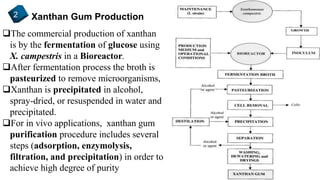
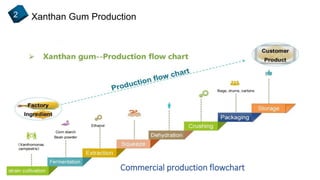
The commercial production of xanthan
is by the fermentation of glucose using
X. campestris in a Bioreactor.
After fermentation process the broth is
pasteurized to remove microorganisms,
Xanthan is precipitated in alcohol,
spray-dried, or resuspended in water and
precipitated.
For in vivo applications, xanthan gum
purification procedure includes several
steps (adsorption, enzymolysis,
filtration, and precipitation) in order to
achieve high degree of purity
Xanthan Gum Production2
Xanthomonas cells
occur as single straight
rods, 0.4–0.7μm wide
and 0.7–1.8 μm long.
 The cells are motile,
Gram-negative, and
they have a single polar
flagellum (1.7–3 μm
long)
Bacteria D-Glucose
D-
Mannose
D-Glucuronic
acid
Pyruvate Acetate
X. campestris 30.1 27.3 14.9 7.1 6.5
X. fragaria 1822 24.6 26.1 14.0 4.9 5.5
X.
gummisudans 21
82
34.8 30.7 16.5 4.7 10.0
X. juglandis 411 33.2 30.2 16.8 6.9 6.4
X. phaseoli 1128 30.9 28.6 15.3 1.8 6.4
X.
vasculorum 702
34.9 30.2 17.9 6.6 6.3
Microorganism
Mean %composition of polysaccharides by Xanthomonas
bacteria [3]
Xanthan Gum Production2
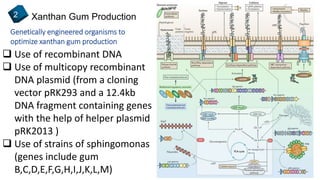
Genetically engineered organisms to
optimize xanthan gum production
 Use of recombinant DNA
 Use of multicopy recombinant
DNA plasmid (from a cloning
vector pRK293 and a 12.4kb
DNA fragment containing genes
with the help of helper plasmid
pRK2013 )
 Use of strains of sphingomonas
(genes include gum
B,C,D,E,F,G,H,I,J,K,L,M)
Xanthan Gum Production2
Genetic engineered
Xanthan bacteria
pathway[4]
Xanthan Gum Production2
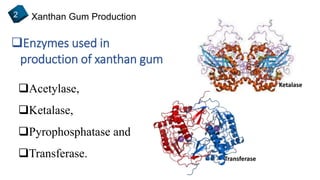
Acetylase,
Ketalase,
Pyrophosphatase and
Transferase.
Enzymes used in
production of xanthan gum
Transferase
Ketalase
Xanthan Gum Production2
Growth medium/nutrient[5]
S/NO Medium Ranged used (g.l-1) S/NO Medium Ranged used (g.l-1)
1 Glucose 10-42 13 CaCO3 0.020-20
2 Saccharose 1.125-50 14 CaCl2.2H2O 0.002
3 CH4N2O 0.10 15 Malt extract 3
4 Citric acid 2.0-2.1 16 Yeast extract 3-10
5 NH4NO3 0.217-1.144 17 Peptone 0.34
6 KH2PO4 1.0-5.0 18 Tryptone 10
7 MgSO4.7H2O 0.25-20 19 Soybean flour 15
8 NH4Cl 1.94 20 HCl 0.13-0.16
9 H3BO3 0.006 21 MgCl2 0.507
10 Na2HPO4 0.089 22 ZnO 0.006
11 ZnSO4 0.002 23 (NH4)2HPO4 0.217-1.5
12 FeCl3.6H2O 0.0042-0.024 24 MgSO4.7H2O 0.25-0.3
Xanthan Gum Production2
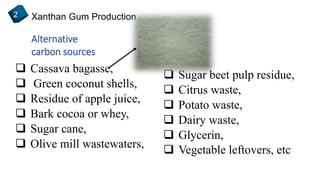
Alternative
carbon sources
 Cassava bagasse,
 Green coconut shells,
 Residue of apple juice,
 Bark cocoa or whey,
 Sugar cane,
 Olive mill wastewaters,
 Sugar beet pulp residue,
 Citrus waste,
 Potato waste,
 Dairy waste,
 Glycerin,
 Vegetable leftovers, etc
Xanthan Gum Production2
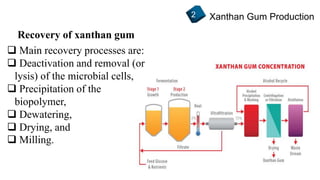
Recovery of xanthan gum
 Main recovery processes are:
 Deactivation and removal (or
lysis) of the microbial cells,
 Precipitation of the
biopolymer,
 Dewatering,
 Drying, and
 Milling.
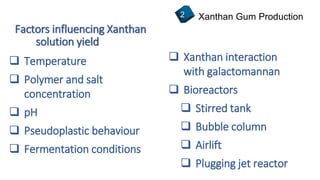
Factors influencing Xanthan
Xanthan Gum Production2
 Temperature
 Polymer and salt
concentration
 pH
 Pseudoplastic behaviour
 Fermentation conditions
 Xanthan interaction
with galactomannan
 Bioreactors
 Stirred tank
 Bubble column
 Airlift
 Plugging jet reactor
solution yield
Xanthan Gum Production2
Commercial production flowchart
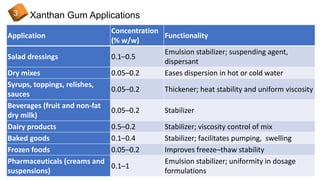
Xanthan Gum Applications3
Application
Concentration
(% w/w)
Functionality
Salad dressings 0.1–0.5
Emulsion stabilizer; suspending agent,
dispersant
Dry mixes 0.05–0.2 Eases dispersion in hot or cold water
Syrups, toppings, relishes,
sauces
0.05–0.2 Thickener; heat stability and uniform viscosity
Beverages (fruit and non-fat
dry milk)
0.05–0.2 Stabilizer
Dairy products 0.5–0.2 Stabilizer; viscosity control of mix
Baked goods 0.1–0.4 Stabilizer; facilitates pumping, swelling
Frozen foods 0.05–0.2 Improves freeze–thaw stability
Pharmaceuticals (creams and
suspensions)
0.1–1
Emulsion stabilizer; uniformity in dosage
formulations
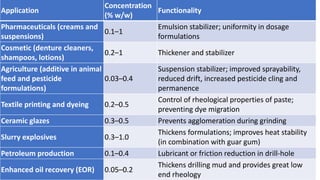
Application
Concentration
(% w/w)
Functionality
Pharmaceuticals (creams and
suspensions)
0.1–1
Emulsion stabilizer; uniformity in dosage
formulations
Cosmetic (denture cleaners,
shampoos, lotions)
0.2–1 Thickener and stabilizer
Agriculture (additive in animal
feed and pesticide
formulations)
0.03–0.4
Suspension stabilizer; improved sprayability,
reduced drift, increased pesticide cling and
permanence
Textile printing and dyeing 0.2–0.5
Control of rheological properties of paste;
preventing dye migration
Ceramic glazes 0.3–0.5 Prevents agglomeration during grinding
Slurry explosives 0.3–1.0
Thickens formulations; improves heat stability
(in combination with guar gum)
Petroleum production 0.1–0.4 Lubricant or friction reduction in drill-hole
Enhanced oil recovery (EOR) 0.05–0.2
Thickens drilling mud and provides great low
end rheology
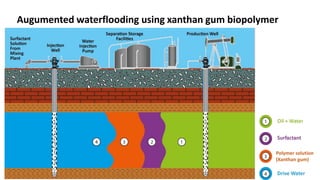
Polymer solution
(Xanthan gum)
Augumented waterflooding using xanthan gum biopolymer
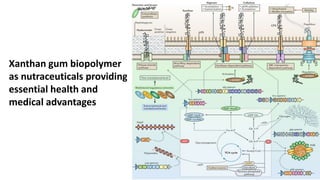
Xanthan gum biopolymer
as nutraceuticals providing
essential health and
medical advantages
Future Prospects of
Xanthan Gum
4
Modeling of fermentation behavior
Improvement in EOR efficiency
(increase performance of drilling fluids)
As a viable dry soil improvement material
Production of xanthan based aerogels
 Production of xanthan nanocrystals
Reference4
1. Smith, A. M., Moxon, S., & Morris, G. A. (2016). Biopolymers as wound healing materials.
In Wound Healing Biomaterials(pp. 261-287). Woodhead Publishing.
2. Runnels, C., Lanier, K. A., Williams, J. K., Bowman, J. C., Petrov, A. S., & Williams, L. D. (2017).
The Origins and Essential Nature of Biopolymers. Retrieved online at:, https://ww2. chemistry.
gatech. edu./Blw26/course.../runnels_manuscript_v17_ldw.. Samarasinghe, S., Easteal, A.,
Edmonds, (2008).
3. Miranda, A. L., Costa, S. S., de Jesus Assis, D., Andrade, B. B., de Souza, C. O., Oliveira, M. B. P.
P., ... & Druzian, J. I. (2018). Investigation of cellular fatty acid composition of Xanthomonas
spp. as chemical markers of productivity and quality of xanthan gum. Carbohydrate
polymers, 192, 291-298.
4. Boulanger, A., Zischek, C., Lautier, M., Jamet, S., Rival, P., Carrère, S., ... & Lauber, E. (2014).
The plant pathogen Xanthomonas campestris pv. campestris exploits N-acetylglucosamine
during infection. MBio, 5(5) , e01527-14.
5. Lopes, B.M., Lessa, V.L, Silva, B.M., & La Cerda, L.G. (2015). Xanthan gum: properties,
production conditions, quality and economic perspectives. Journal of Food Nutrition
Research 54, no. 3, pp 185-194
4

Xanthan Gum Biopolymer

  • 1.
    Production and applications AdefaratiOloruntoba Prof. Chang Samuel Hsu Florida State University, USACUPB, China CHINA UNIVERSITY OF PETROLEUM BEIJING. CHINA COLLEGE OF CHEMICAL ENGINEERING
  • 2.
    Contents Future Prospects ofXanthan Gum4 Xanthan gum biopolymer1 Xanthan Gum Production2 Xanthan Gum Applications3 Reference
  • 3.
    Xanthan gum biopolymer1 Biopolymersare: Polymers (usually non toxic) made from organic or natural resources which are synthesized using or completely synthesized by microorganisms (biosynthesis) Produced by biological systems (micro-organisms, plants and animals), or chemically synthesized from biological starting materials (sugars, starch, natural fats or oils, etc.). An alternative to petroleum-based polymers (traditional plastics) A biopolymer must meet either of these conditions: • Consists (whole or partly) of bio-based (renewable) raw materials; • Biodegradable. Biopolymers Overview
  • 4.
    Xanthan gum biopolymer1 Biopolymersstructures Biopolymers Overview Chitosan (biopolymer)[1] [2]
  • 5.
    Xanthan gum biopolymer1 Eco-bacterialpolymer granules as biomaterials [2]
  • 6.
    Xanthan gum biopolymer1 Enhancedbiopolymers and biopolymer synthesis as a target for drug discovery [2]
  • 7.
    Xanthan gum biopolymer1 Xanthangum is a natural polysaccharide and an industrial biopolymer. Polysaccharide B-1459/ NRRL B-1459 Discovered in the 1950s at the Northern Regional Research Laboratories (NRRL) of the United States Department of Agriculture by Allene Rosalind Jeanes. FDA (Fed. Reg. 345376) approval in 1969 as a nontoxic and safe polymer as thickener and stabilizer in many food products Xanthan gum is produced by Gram negative bacteria of the genus Xanthomonas Different strains are: X. arboricola, X. axonopodis, X. campestris, X. citri, X. fragaria, X. gummisudans, X. juglandis, X. phaseoli, X. vasculorium, X. campestris
  • 8.
    Xanthan gum biopolymer1 Globalleading producers of xanthan:  Merck and Pfizer the United States,  Rhône Poulenc and Sanofi-Elf in France,  Solvay and Jungbunzlauer (under the trade name Rhodopol) in Austria.  Fufeng (FFNGY), China
  • 9.
    Xanthan gum biopolymer1 XanthanChemical Structure Hetero-polysaccharide with a primary structure made of repeated pentasaccharide units Formed by two glucose units, two mannose units, and one glucuronic acid unit, in the molar ratio 2.8:2.0:2.0 Consists of β-d-glucose units linked at the 1 and 4 positions Identical to that of cellulose
  • 10.
    Xanthan gum biopolymer1 PropertyValue Physical state Dry, cream-colored powder Moisture (%) 8–15 Ash (%) 7–12 Nitrogen (%) 0.3–1 Acetate content (%) 1.9–6.0 Pyruvate content (%) 1.0–5.7 Monovalent salts (g L−1) 3.6–14.3 Divalent salts (g L−1) 0.085–0.17 Viscosity (cP) 13–35 (15.8 s−1, CP=1 g L−1, TD=25°C, TM=25°C) Physicochemical properties of commercial xanthan gum
  • 11.
    Xanthan gum biopolymer1 Propertiesof commercial xanthan gum Forms a high viscous solution even at low concentrations makes it an effective gelling agent/stabilizer. Excellent hydrocolloids that thicken or stabilize the emulsion, foams, and suspensions Stable at various temperature and pH. Stabilizes oil-in-water emulsion and is compatible with all the ingredients such as salt, metallic cations, surfactants, or bioactive compounds that are present in skin-care products.
  • 12.
    Xanthan Gum Production2 Thecommercial production of xanthan is by the fermentation of glucose using X. campestris in a Bioreactor. After fermentation process the broth is pasteurized to remove microorganisms, Xanthan is precipitated in alcohol, spray-dried, or resuspended in water and precipitated. For in vivo applications, xanthan gum purification procedure includes several steps (adsorption, enzymolysis, filtration, and precipitation) in order to achieve high degree of purity
  • 13.
    Xanthan Gum Production2 Xanthomonascells occur as single straight rods, 0.4–0.7μm wide and 0.7–1.8 μm long.  The cells are motile, Gram-negative, and they have a single polar flagellum (1.7–3 μm long) Bacteria D-Glucose D- Mannose D-Glucuronic acid Pyruvate Acetate X. campestris 30.1 27.3 14.9 7.1 6.5 X. fragaria 1822 24.6 26.1 14.0 4.9 5.5 X. gummisudans 21 82 34.8 30.7 16.5 4.7 10.0 X. juglandis 411 33.2 30.2 16.8 6.9 6.4 X. phaseoli 1128 30.9 28.6 15.3 1.8 6.4 X. vasculorum 702 34.9 30.2 17.9 6.6 6.3 Microorganism Mean %composition of polysaccharides by Xanthomonas bacteria [3]
  • 14.
    Xanthan Gum Production2 Geneticallyengineered organisms to optimize xanthan gum production  Use of recombinant DNA  Use of multicopy recombinant DNA plasmid (from a cloning vector pRK293 and a 12.4kb DNA fragment containing genes with the help of helper plasmid pRK2013 )  Use of strains of sphingomonas (genes include gum B,C,D,E,F,G,H,I,J,K,L,M)
  • 15.
    Xanthan Gum Production2 Geneticengineered Xanthan bacteria pathway[4]
  • 16.
    Xanthan Gum Production2 Acetylase, Ketalase, Pyrophosphataseand Transferase. Enzymes used in production of xanthan gum Transferase Ketalase
  • 17.
    Xanthan Gum Production2 Growthmedium/nutrient[5] S/NO Medium Ranged used (g.l-1) S/NO Medium Ranged used (g.l-1) 1 Glucose 10-42 13 CaCO3 0.020-20 2 Saccharose 1.125-50 14 CaCl2.2H2O 0.002 3 CH4N2O 0.10 15 Malt extract 3 4 Citric acid 2.0-2.1 16 Yeast extract 3-10 5 NH4NO3 0.217-1.144 17 Peptone 0.34 6 KH2PO4 1.0-5.0 18 Tryptone 10 7 MgSO4.7H2O 0.25-20 19 Soybean flour 15 8 NH4Cl 1.94 20 HCl 0.13-0.16 9 H3BO3 0.006 21 MgCl2 0.507 10 Na2HPO4 0.089 22 ZnO 0.006 11 ZnSO4 0.002 23 (NH4)2HPO4 0.217-1.5 12 FeCl3.6H2O 0.0042-0.024 24 MgSO4.7H2O 0.25-0.3
  • 18.
    Xanthan Gum Production2 Alternative carbonsources  Cassava bagasse,  Green coconut shells,  Residue of apple juice,  Bark cocoa or whey,  Sugar cane,  Olive mill wastewaters,  Sugar beet pulp residue,  Citrus waste,  Potato waste,  Dairy waste,  Glycerin,  Vegetable leftovers, etc
  • 19.
    Xanthan Gum Production2 Recoveryof xanthan gum  Main recovery processes are:  Deactivation and removal (or lysis) of the microbial cells,  Precipitation of the biopolymer,  Dewatering,  Drying, and  Milling.
  • 20.
    Factors influencing Xanthan XanthanGum Production2  Temperature  Polymer and salt concentration  pH  Pseudoplastic behaviour  Fermentation conditions  Xanthan interaction with galactomannan  Bioreactors  Stirred tank  Bubble column  Airlift  Plugging jet reactor solution yield
  • 21.
  • 22.
    Xanthan Gum Applications3 Application Concentration (%w/w) Functionality Salad dressings 0.1–0.5 Emulsion stabilizer; suspending agent, dispersant Dry mixes 0.05–0.2 Eases dispersion in hot or cold water Syrups, toppings, relishes, sauces 0.05–0.2 Thickener; heat stability and uniform viscosity Beverages (fruit and non-fat dry milk) 0.05–0.2 Stabilizer Dairy products 0.5–0.2 Stabilizer; viscosity control of mix Baked goods 0.1–0.4 Stabilizer; facilitates pumping, swelling Frozen foods 0.05–0.2 Improves freeze–thaw stability Pharmaceuticals (creams and suspensions) 0.1–1 Emulsion stabilizer; uniformity in dosage formulations
  • 23.
    Application Concentration (% w/w) Functionality Pharmaceuticals (creamsand suspensions) 0.1–1 Emulsion stabilizer; uniformity in dosage formulations Cosmetic (denture cleaners, shampoos, lotions) 0.2–1 Thickener and stabilizer Agriculture (additive in animal feed and pesticide formulations) 0.03–0.4 Suspension stabilizer; improved sprayability, reduced drift, increased pesticide cling and permanence Textile printing and dyeing 0.2–0.5 Control of rheological properties of paste; preventing dye migration Ceramic glazes 0.3–0.5 Prevents agglomeration during grinding Slurry explosives 0.3–1.0 Thickens formulations; improves heat stability (in combination with guar gum) Petroleum production 0.1–0.4 Lubricant or friction reduction in drill-hole Enhanced oil recovery (EOR) 0.05–0.2 Thickens drilling mud and provides great low end rheology
  • 24.
    Polymer solution (Xanthan gum) Augumentedwaterflooding using xanthan gum biopolymer
  • 25.
    Xanthan gum biopolymer asnutraceuticals providing essential health and medical advantages
  • 26.
    Future Prospects of XanthanGum 4 Modeling of fermentation behavior Improvement in EOR efficiency (increase performance of drilling fluids) As a viable dry soil improvement material Production of xanthan based aerogels  Production of xanthan nanocrystals
  • 27.
    Reference4 1. Smith, A.M., Moxon, S., & Morris, G. A. (2016). Biopolymers as wound healing materials. In Wound Healing Biomaterials(pp. 261-287). Woodhead Publishing. 2. Runnels, C., Lanier, K. A., Williams, J. K., Bowman, J. C., Petrov, A. S., & Williams, L. D. (2017). The Origins and Essential Nature of Biopolymers. Retrieved online at:, https://ww2. chemistry. gatech. edu./Blw26/course.../runnels_manuscript_v17_ldw.. Samarasinghe, S., Easteal, A., Edmonds, (2008). 3. Miranda, A. L., Costa, S. S., de Jesus Assis, D., Andrade, B. B., de Souza, C. O., Oliveira, M. B. P. P., ... & Druzian, J. I. (2018). Investigation of cellular fatty acid composition of Xanthomonas spp. as chemical markers of productivity and quality of xanthan gum. Carbohydrate polymers, 192, 291-298. 4. Boulanger, A., Zischek, C., Lautier, M., Jamet, S., Rival, P., Carrère, S., ... & Lauber, E. (2014). The plant pathogen Xanthomonas campestris pv. campestris exploits N-acetylglucosamine during infection. MBio, 5(5) , e01527-14. 5. Lopes, B.M., Lessa, V.L, Silva, B.M., & La Cerda, L.G. (2015). Xanthan gum: properties, production conditions, quality and economic perspectives. Journal of Food Nutrition Research 54, no. 3, pp 185-194
  • 28.