SRI PARAMAKALYANI COLLEGE
(REACCREDITED WITH B GRADE WITH A CGPA OF 2.71 IN THE II CYCLE BY NACC
AFFILIATED TO MANONMANIAM SUNDARANAR UNIVERSITY,THIRUNELVELI)
ALWARKURICHI -627 412 TAMILNADU INDIA.
POST GRADUATE& RESEARCHCENTER– DEPARTMENTOF MICROBIOLOGY
(GOVERMENTAIDED)
I SEM - CORE –MICROBIAL PHYSIOLOGY
UNIT – V
BATCH CULTURE
SUBMITTED TO
THE GUIDE
DR.S.VISWANATHAN,PH.D
HEAD OF THE DEPARTMENT
SRI PARAMAKALYANI COLLEGE
ALWARKURICHI.
SUBMITTED BY
PETCHIAMMAL.G
REG.NO : 20211231516118
I M.SC, MICROBIOLOGY
DATE: 10.12.2021
BATCH CULTURE
Synopsis
INTRODUCTION
BATCH CULTURE
FERMENTOR
MODE OF OPERATION
GROWTH ASSESSMENT
INDUSTRIAL USES
ANTIBIOTIC PRODUCTION
APPLICATION
Microbial growth is defined as the increase in quantity of cellular constituents
and structure and is followed by increase in size or number of cells.
 The division of micro organism in to two daughter cells.
The time of interval required for the division of microbial cell is called
generation time.
The population growth is studied by analyzing othe growth curve of microbial
culture in different systems.
These are different systems or mode of microbial culture.
 Batch Culture
 Fed - Batch Culture
 Continuous Culture
INTRODUCTION
Batch Culture is a technique,it is used to grow microorganisms or
cells.
The population of micro organisms are grown in a tube or flask of
liquid medium .
 large-scale closed system.
A limited supply of nutrients for growth is provided under
Physiological conditions.
Examples: Nutrient type, pH , Temperature, Aeration,etc.
 Here no nutrients are added to the system and no metabolic
waste products are removed.
BATCH CULTURE
 When nutrients are added to the system, the cells initially divide by binary
fission and the cell number increase for a period of time.
 Once the nutrients are over in the medium the growth eventually stops and
certain metabolic waste products are accumulated in the medium .
 A culture of microorganisms produced by inoculating a closed vessel
containing a single batch of medium is called a batch culture.
 Because no fresh medium is provided during incubation, nutrient
concentration decreases and concentration of waste products increases.
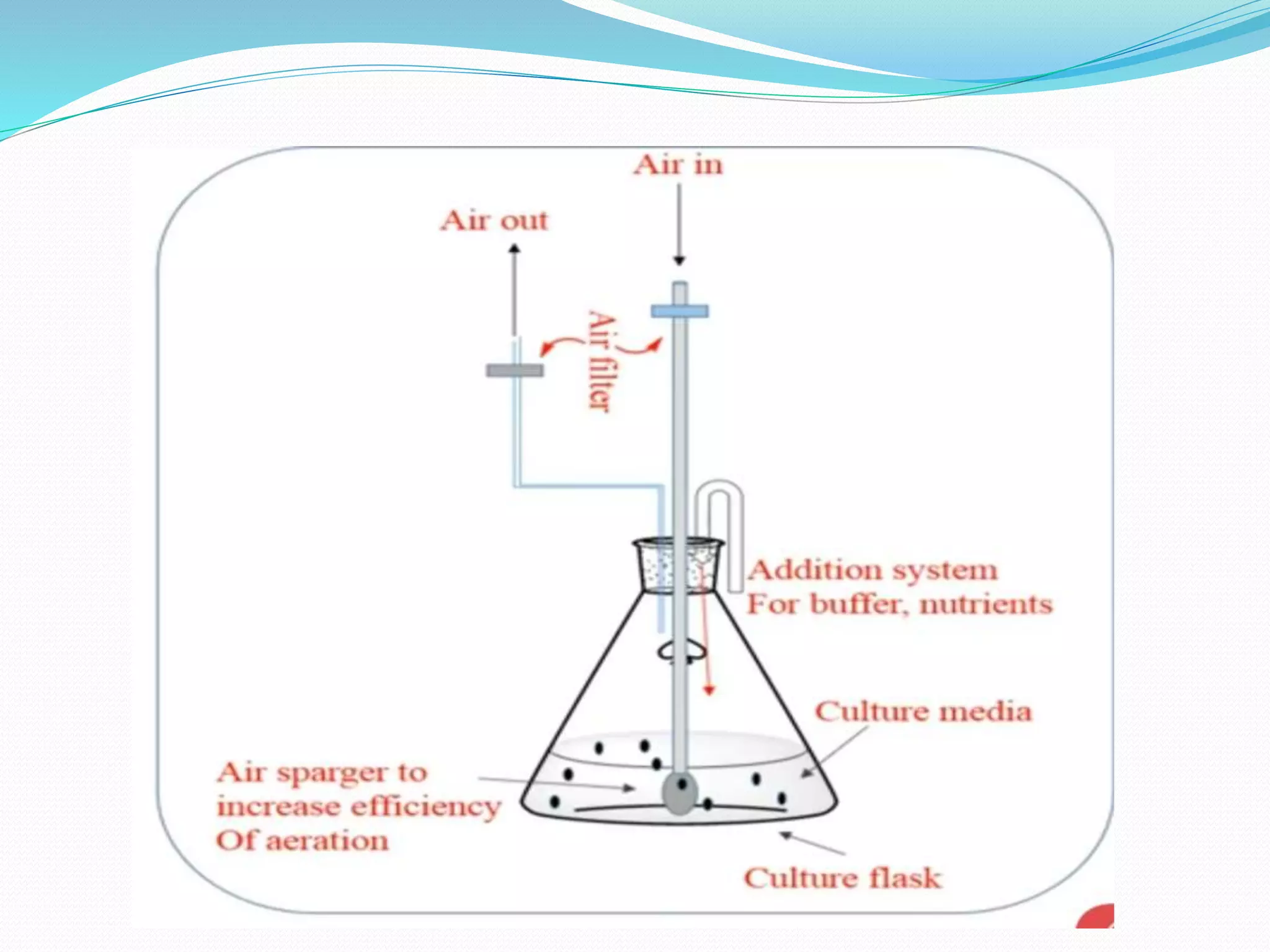
• A fermentor (or fermenter) is a vessel for the growth of microorganisms which,
while not permitting contamination, enables the provision of conditions
necessary for the maximal production of the desired products.
• In other words, the fermentor ideally should make it possible to provide the
organism growing within it with optimal pH, temperature,oxygen, and other
environmental conditions.
• In the chemical industry, vessels in which reactions take place are called
reactors.
• Fermentors are therefore also known as bioreactors.
FERMENTOR
• Bioreactor is a device or system in which a chemical process is carried
out that supports to maintain a biologically active environment inside
that vessel which involves organisms or
biochemically active substances derived from specific organisms.
• This process may either be aerobic or anaerobic.
• These bioreactors are commonly cylindrical in shape ranging in size
from litres to cubic metres and are often made up of stainless steel
material.
NUTRIENS REQUIREMENTS:
BATCH PROCESSING
• Micro organism is inoculated in to a fixed volume of medium.
• As the growth take place, the nutrient are consumed and the products of
growth may be of two types.
a. Biomass
b. Metabolites
• The nutrient environment in the fermentator is continuously
changed.
• This change in the environment in the fermentator will enforce
change in the metabolism of cells.
• This also result in the cessation of cell multiplication.
• Cessation of growth is due to the scarcity of nutrients and accumulation of
metabolities.
• Once the microbes are reached the stationary phase they start to accumulate
the metabolities.
• Metabolities are extracted from the fermentor by downstream process.
• After the fermentation is over ,the residues are taken out from the fermentation
tank,and the vessel is then cleaned and sterilized before next batch
fermentation.
• Thus in the batch fermentation, the large scale production is done as separate
Batches.
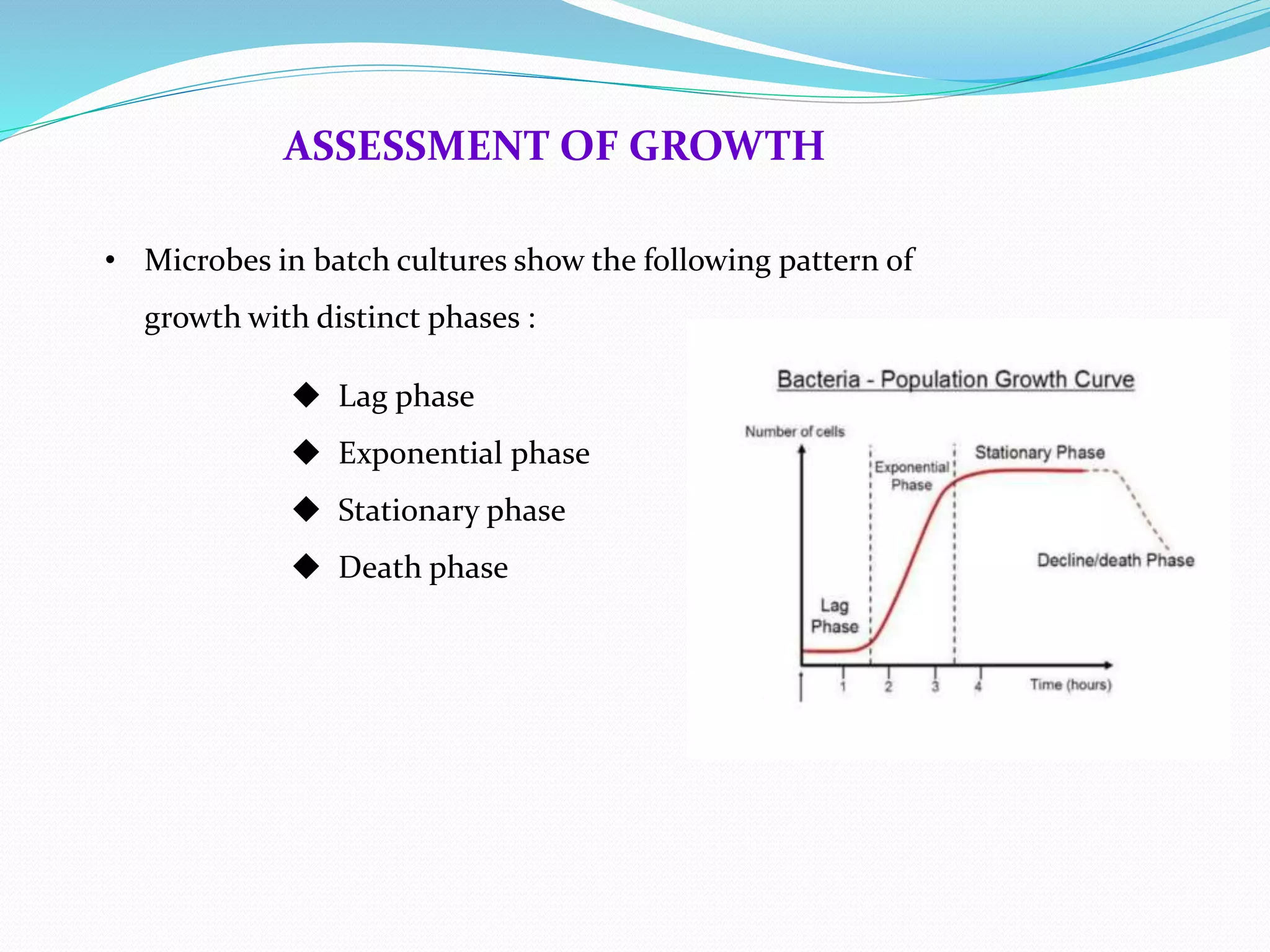
• Microbes in batch cultures show the following pattern of
growth with distinct phases :
 Lag phase
 Exponential phase
 Stationary phase
 Death phase
ASSESSMENT OF GROWTH
I. Initial phase
II. microbial population remains constant as there is no growth.
III. However it is the period of intense metabolic activity.
LAG PHASE
EXPONENTIAL PHASE
I. Primary metabolites are produced during the log or exponential
phase with their formation decreasing when growth ceases.
II. For example, Saccharomyces cerevisiae produces ethanol as a
primary metabolite.
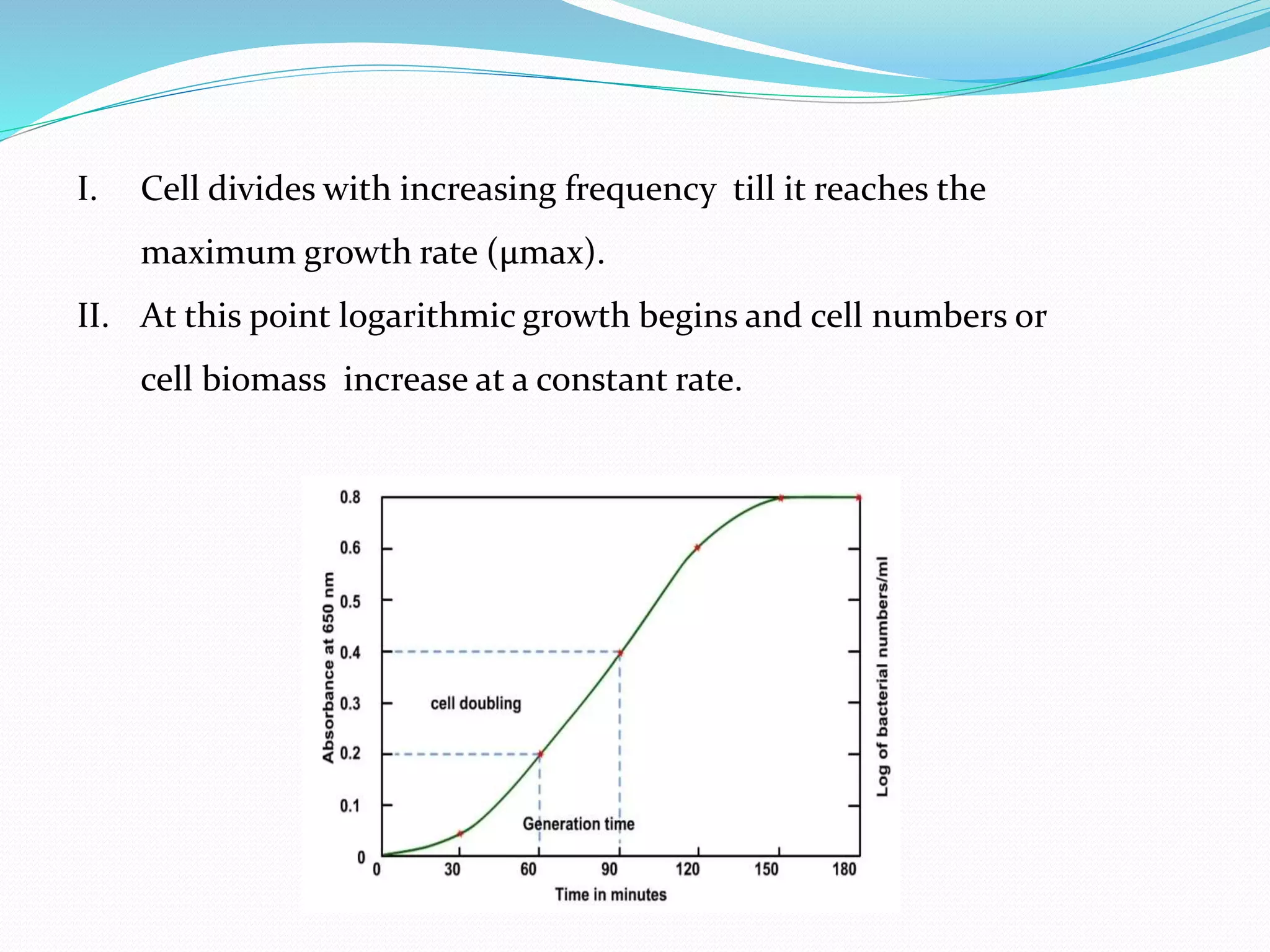
I. Cell divides with increasing frequency till it reaches the
maximum growth rate (μmax).
II. At this point logarithmic growth begins and cell numbers or
cell biomass increase at a constant rate.
• When growing exponentially by binary fission, the
increase in a bacterial population is by geometric
progression.
•
• If we start with one cell, when it divides, there are 2
cells in the first generation, 4 cells in the second
generation, 8 cells in the third generation, and so on.
•
• The generation time is the time interval required for
the cells (or population) to divide.
The generation time/ Doubling time :
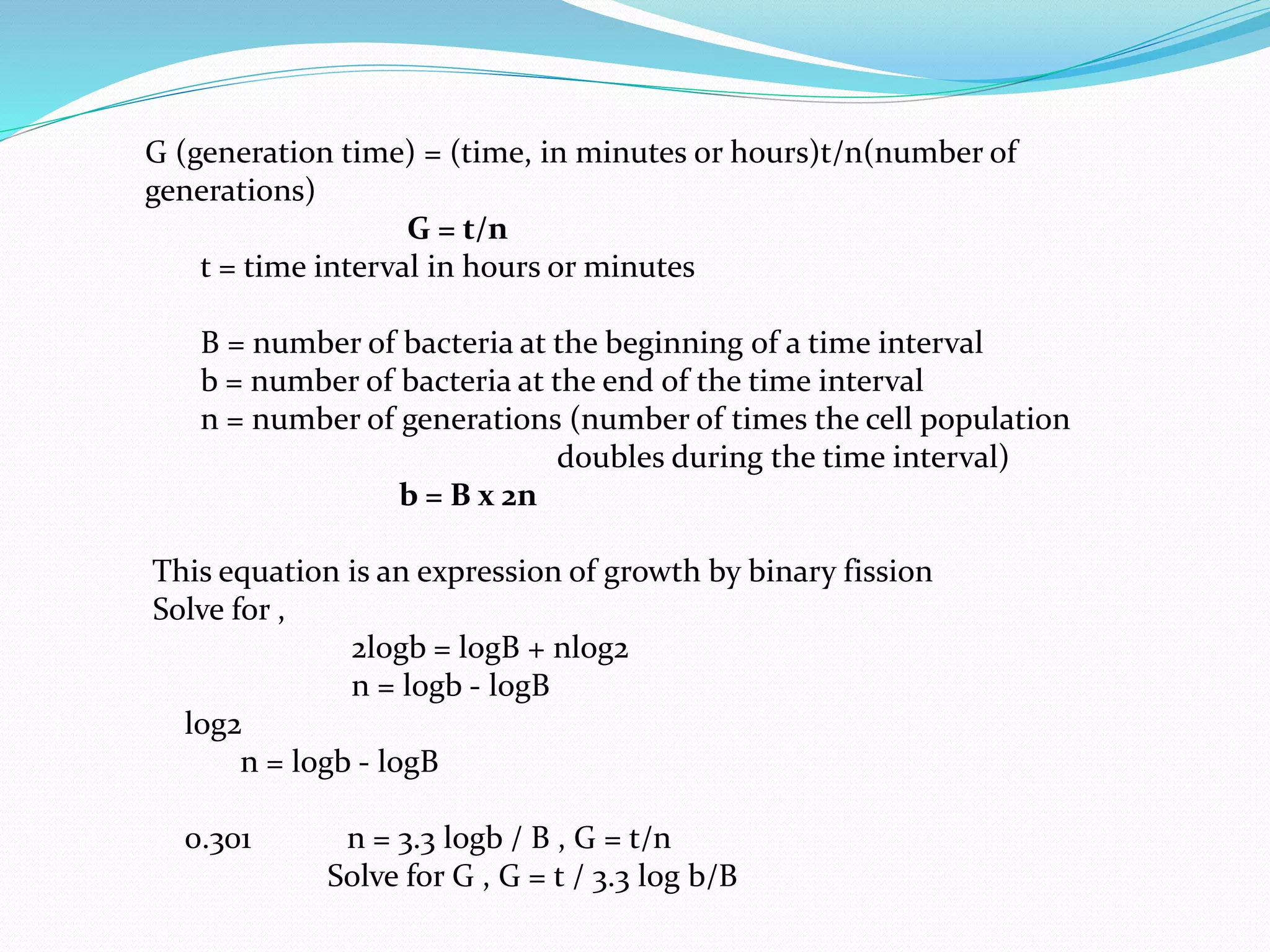
G (generation time) = (time, in minutes or hours)t/n(number of
generations)
G = t/n
t = time interval in hours or minutes
B = number of bacteria at the beginning of a time interval
b = number of bacteria at the end of the time interval
n = number of generations (number of times the cell population
doubles during the time interval)
b = B x 2n
This equation is an expression of growth by binary fission
Solve for ,
2logb = logB + nlog2
n = logb - logB
log2
n = logb - logB
0.301 n = 3.3 logb / B , G = t/n
Solve for G , G = t / 3.3 log b/B
I. The specific growth rate of the microorganism continues decelerating until
the substrate is completely depleted.
II. Overall growth rate has declined to zero and there is no net change in cell
numbers/ biomass ie. rate of cell division equals rate of cell death.
III. Microorganisms are still metabolically active, metabolizing intracellular
storage compounds, utilizing nutrients released from lysed cells and in
certain cases produce secondary metabolites.
STATIONARY PHASE
I. Cells die at constant rate and often undergo lysis.
DEATH PHASE
DOWN STREAM PROCESSING
INDUSTRIAL USES
ANTIBIOTIC PRODUCTION
PRODUCTION OF PENICILLIN
CLINICAL USES OF PENICILLIN
APPLICATION
• It is beneficial for the construction of biomass (Baker’s yeasts).
• Production of primary metabolites (lactic acid, citric acid, acetic acid, or
ethanol production).
• In food industries, organic acids are used as preservatives or acidifiers(lactic
acids, citric acids, and acetic acids),
• Acoholic beverages (wine, beer, and distilled spirits i.e. brandy, whisky, and
rum), and
• sweeteners (e.g., aspartate) or amino acids used as flavoring agents (e.g.,
monosodium glutamate)are the various product manufactured by batch
cultivation.
BIBLIOGRAPHY
• https://courses.lumenlearning.com/boundless-
microbiology/chapter/microbial-culture-methods/
• https://www.sciencedirect.com/topics/engineering/batch-culture
• AUTHOR NAME : Nduka okafor, BOOK NAME : "Modern industrial
Microbiology and biotechnology" .EDITION :1st Edition, PUBLICATION :
science publisher .,PAGE NUMBER : 184 - 206 .
• AUTHOR NAME : A.H . PATEL ,BOOK NAME : Industrial Microbiology ,
EDITION : 1st Edition , PUBLICATION : published by Macimillan India Lmd. ,
PAGE NUMBER :69 -76 .
• https://www.encyclopedia.com/science/dictionaries-thesauruses-
pictures-and-press-releases/batch-culture
• Creative Ability
• Communication skills
• Learning some innovative skills
• Increase Confidence level
• Personal development
• Time management
Some skills gained by seminar Asessment
THANKYOU
TO:
THE RESPECTED CHAIRMAN ,
THE RESPECTED SECRETORY
 MANAGEMENT COMITEE ,
THE RESPECTED PRINCIPAL OF SRI PARAMAKALYANI
COLLEGE ,
THE HEAD DEPARTMENT OF MICROBIOLOGY ,
THE RESPECTED STAFF MEMBERS – DEPARTMENT OF
MICROBIOLOGY .

MICROBIAL GROWTH ( BATCH CULTURE).pptx

  • 1.
    SRI PARAMAKALYANI COLLEGE (REACCREDITEDWITH B GRADE WITH A CGPA OF 2.71 IN THE II CYCLE BY NACC AFFILIATED TO MANONMANIAM SUNDARANAR UNIVERSITY,THIRUNELVELI) ALWARKURICHI -627 412 TAMILNADU INDIA. POST GRADUATE& RESEARCHCENTER– DEPARTMENTOF MICROBIOLOGY (GOVERMENTAIDED) I SEM - CORE –MICROBIAL PHYSIOLOGY UNIT – V BATCH CULTURE SUBMITTED TO THE GUIDE DR.S.VISWANATHAN,PH.D HEAD OF THE DEPARTMENT SRI PARAMAKALYANI COLLEGE ALWARKURICHI. SUBMITTED BY PETCHIAMMAL.G REG.NO : 20211231516118 I M.SC, MICROBIOLOGY DATE: 10.12.2021
  • 2.
    BATCH CULTURE Synopsis INTRODUCTION BATCH CULTURE FERMENTOR MODEOF OPERATION GROWTH ASSESSMENT INDUSTRIAL USES ANTIBIOTIC PRODUCTION APPLICATION
  • 3.
    Microbial growth isdefined as the increase in quantity of cellular constituents and structure and is followed by increase in size or number of cells.  The division of micro organism in to two daughter cells. The time of interval required for the division of microbial cell is called generation time. The population growth is studied by analyzing othe growth curve of microbial culture in different systems. These are different systems or mode of microbial culture.  Batch Culture  Fed - Batch Culture  Continuous Culture INTRODUCTION
  • 5.
    Batch Culture isa technique,it is used to grow microorganisms or cells. The population of micro organisms are grown in a tube or flask of liquid medium .  large-scale closed system. A limited supply of nutrients for growth is provided under Physiological conditions. Examples: Nutrient type, pH , Temperature, Aeration,etc.  Here no nutrients are added to the system and no metabolic waste products are removed. BATCH CULTURE
  • 7.
     When nutrientsare added to the system, the cells initially divide by binary fission and the cell number increase for a period of time.  Once the nutrients are over in the medium the growth eventually stops and certain metabolic waste products are accumulated in the medium .  A culture of microorganisms produced by inoculating a closed vessel containing a single batch of medium is called a batch culture.  Because no fresh medium is provided during incubation, nutrient concentration decreases and concentration of waste products increases.
  • 8.
    • A fermentor(or fermenter) is a vessel for the growth of microorganisms which, while not permitting contamination, enables the provision of conditions necessary for the maximal production of the desired products. • In other words, the fermentor ideally should make it possible to provide the organism growing within it with optimal pH, temperature,oxygen, and other environmental conditions. • In the chemical industry, vessels in which reactions take place are called reactors. • Fermentors are therefore also known as bioreactors. FERMENTOR
  • 9.
    • Bioreactor isa device or system in which a chemical process is carried out that supports to maintain a biologically active environment inside that vessel which involves organisms or biochemically active substances derived from specific organisms. • This process may either be aerobic or anaerobic. • These bioreactors are commonly cylindrical in shape ranging in size from litres to cubic metres and are often made up of stainless steel material.
  • 11.
  • 12.
    BATCH PROCESSING • Microorganism is inoculated in to a fixed volume of medium. • As the growth take place, the nutrient are consumed and the products of growth may be of two types. a. Biomass b. Metabolites • The nutrient environment in the fermentator is continuously changed. • This change in the environment in the fermentator will enforce change in the metabolism of cells.
  • 14.
    • This alsoresult in the cessation of cell multiplication. • Cessation of growth is due to the scarcity of nutrients and accumulation of metabolities. • Once the microbes are reached the stationary phase they start to accumulate the metabolities. • Metabolities are extracted from the fermentor by downstream process. • After the fermentation is over ,the residues are taken out from the fermentation tank,and the vessel is then cleaned and sterilized before next batch fermentation. • Thus in the batch fermentation, the large scale production is done as separate Batches.
  • 15.
    • Microbes inbatch cultures show the following pattern of growth with distinct phases :  Lag phase  Exponential phase  Stationary phase  Death phase ASSESSMENT OF GROWTH
  • 16.
    I. Initial phase II.microbial population remains constant as there is no growth. III. However it is the period of intense metabolic activity. LAG PHASE EXPONENTIAL PHASE I. Primary metabolites are produced during the log or exponential phase with their formation decreasing when growth ceases. II. For example, Saccharomyces cerevisiae produces ethanol as a primary metabolite.
  • 17.
    I. Cell divideswith increasing frequency till it reaches the maximum growth rate (μmax). II. At this point logarithmic growth begins and cell numbers or cell biomass increase at a constant rate.
  • 18.
    • When growingexponentially by binary fission, the increase in a bacterial population is by geometric progression. • • If we start with one cell, when it divides, there are 2 cells in the first generation, 4 cells in the second generation, 8 cells in the third generation, and so on. • • The generation time is the time interval required for the cells (or population) to divide. The generation time/ Doubling time :
  • 19.
    G (generation time)= (time, in minutes or hours)t/n(number of generations) G = t/n t = time interval in hours or minutes B = number of bacteria at the beginning of a time interval b = number of bacteria at the end of the time interval n = number of generations (number of times the cell population doubles during the time interval) b = B x 2n This equation is an expression of growth by binary fission Solve for , 2logb = logB + nlog2 n = logb - logB log2 n = logb - logB 0.301 n = 3.3 logb / B , G = t/n Solve for G , G = t / 3.3 log b/B
  • 20.
    I. The specificgrowth rate of the microorganism continues decelerating until the substrate is completely depleted. II. Overall growth rate has declined to zero and there is no net change in cell numbers/ biomass ie. rate of cell division equals rate of cell death. III. Microorganisms are still metabolically active, metabolizing intracellular storage compounds, utilizing nutrients released from lysed cells and in certain cases produce secondary metabolites. STATIONARY PHASE I. Cells die at constant rate and often undergo lysis. DEATH PHASE
  • 21.
  • 22.
  • 23.
  • 24.
  • 25.
    CLINICAL USES OFPENICILLIN
  • 26.
    APPLICATION • It isbeneficial for the construction of biomass (Baker’s yeasts). • Production of primary metabolites (lactic acid, citric acid, acetic acid, or ethanol production). • In food industries, organic acids are used as preservatives or acidifiers(lactic acids, citric acids, and acetic acids), • Acoholic beverages (wine, beer, and distilled spirits i.e. brandy, whisky, and rum), and • sweeteners (e.g., aspartate) or amino acids used as flavoring agents (e.g., monosodium glutamate)are the various product manufactured by batch cultivation.
  • 27.
    BIBLIOGRAPHY • https://courses.lumenlearning.com/boundless- microbiology/chapter/microbial-culture-methods/ • https://www.sciencedirect.com/topics/engineering/batch-culture •AUTHOR NAME : Nduka okafor, BOOK NAME : "Modern industrial Microbiology and biotechnology" .EDITION :1st Edition, PUBLICATION : science publisher .,PAGE NUMBER : 184 - 206 . • AUTHOR NAME : A.H . PATEL ,BOOK NAME : Industrial Microbiology , EDITION : 1st Edition , PUBLICATION : published by Macimillan India Lmd. , PAGE NUMBER :69 -76 . • https://www.encyclopedia.com/science/dictionaries-thesauruses- pictures-and-press-releases/batch-culture
  • 28.
    • Creative Ability •Communication skills • Learning some innovative skills • Increase Confidence level • Personal development • Time management Some skills gained by seminar Asessment
  • 31.
    THANKYOU TO: THE RESPECTED CHAIRMAN, THE RESPECTED SECRETORY  MANAGEMENT COMITEE , THE RESPECTED PRINCIPAL OF SRI PARAMAKALYANI COLLEGE , THE HEAD DEPARTMENT OF MICROBIOLOGY , THE RESPECTED STAFF MEMBERS – DEPARTMENT OF MICROBIOLOGY .