PRODUCTION OF VITAMIN-C BY METABOLLIC
ENGINEERING
By:
Chaitanya.V
MICROBIAL BIOTECHNOLOGY
CONTENTS
• Introduction
• L-Ascorbic acid manufactured by Metabollic Engineering
a) Reichstein-Grussner synthesis.
b) Two-step fermentation process
c) Mixed fermentation process
• References
Introduction
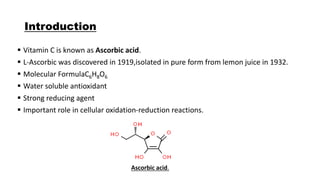
 Vitamin C is known as Ascorbic acid.
 L-Ascorbic was discovered in 1919,isolated in pure form from lemon juice in 1932.
 Molecular FormulaC6H8O6
 Water soluble antioxidant
 Strong reducing agent
 Important role in cellular oxidation-reduction reactions.
Ascorbic acid.
 Dietary Sources orange, kiwi, lemon, guava, grapefruit, and vegetables such
as broccoli, cauliflower, Brussel sprouts and capsicums.
 The current recommended dietary allowance (RDA) 60 mg/day.
 Deficiency Scurvy (bleeding gums, rashes or red spots,muscle weakness,
swollen gums, or weight loss)
 Most mammals can synthesize vitamin C from glucose in their liver, except for
some species, such as humans(Lacks L-gulonolactone oxidase).
 L-Ascorbic acid manufactured by Metabollic Engineering
a) Reichstein-Grussner synthesis.
b) Two-step fermentation process
c) Mixed fermentation process
Reichstein-Grussner synthesis.
 Microorganism Acetobacter xylinum or A.
suboxydans (sorbitol dehydrogenase).
 DAKS: Diacetone Ketogulonic acid,is formed by
oxidize.
 Submerged bioreactor fermentation process is
ideal for this reaction.
 Duration 24 hours
 temperature 30-35°C.
 This process is not eco-friendly:
1. Requires high pressure and temperature.
2. Acetone is toxic substance
Glucose
hydrogenation
Sorbitol
Sorbose
acetone
Diacetone L
Sorbose
DAKS
L-Ascorbic acid
Two-step fermentation process
Sorbitol
Sorbitol
dehydrogenase
Sorbose
Chemical
oxidation
KLG
Raw ascorbic
Acid
treatment
Purified
ascorbic acid
 Microorganisms Ketogulonicigenium ,Gluconobacter
oxydans
 2-Keto L-gluconic acid is the precursor.
 Two-step fermentation process. Many efforts, such as strains
improvements, metabolic regulation and fermentation
process optimization, have been made to improve the
fermentation efficiency for KLG production
 Anti-foaming agents are used.
 Facilitate the settling of debris, Off flavors
 Vitamin C production due to low cost and high product
quality.
Mixed fermentation process
• A mixed fermentation consisting of Ketogulonicigenium vulgare and Bacillus
endophyticus.
• B. endophyticus accelerated the growth and caused excessive accumulation of
reactive oxygen species in K. vulgare , resulting in oxidative stress.
• The fermentation product from the mixed culture broth in the D-Sorbitol-
containing medium was identified as 2-Keto-L-gulonic acid by HPLC.
• K. vulgare significantly enhance cell growth and 2-KLG production.
• Bacillus endophyticus provide necessary nutrients.
REFERENCES
 Industrial microbiology
-A.H.patel
 Article: Production of Important Organic Acids by Fermentation
 Research gate: Industrial Fermentation of Vitamin C
 https://doi.org/10.1080/13102818.2018.1447854
 https://doi.org/10.1080/13102818.2015.1063970
 https://www.nih.gov/
THANK YOU