MICROBIAL
CULTIVATION
PRESENTATION BY
G. Mohana Priya
S. Nandhini
G. Nantha kumar
7 April 2020 Biochemical Engineering 1
What is cultivation?
• Cultivation is the process of propagating organisms by providing the
proper environmental conditions.
• An understanding of these conditions enables us to characterize
isolates and differentiate between different types of bacteria.
• Parasites, bacteria and viruses all generally require cultivation for
detailed study.
• i.e., the process of growing microorganisms in culture by taking
bacteria from the infection site (in vivo or environment) and grow
them in artificial environment in the laboratory (in vitro).
7 April 2020 Biochemical Engineering 2
What is microbial cultivation?
• Bacteria may require adequate nutrition, temperature,
oxygen, optimum pH for growth and multiplication.
• Suitable artificial media containing sources of carbon,
oxygen, nitrogen, hydrogen, phosphorous, and other elements
such as sodium, potassium, magnesium, iron and growth
factor (vitamins) in very small amounts have been used for
cultivation of microorganisms.
7 April 2020 Biochemical Engineering 3
Growth requirements for microorganisms
• A characteristic of microorganisms is their ability to grow and
form a population of organisms. One of the results of
microbial metabolism is an increase in the size of the cell.
The many requirements for successful growth include those
both chemical and physical.
7 April 2020 Biochemical Engineering 4
Chemical requirements:
• In order to grow successfully, microorganisms must have a
supply of water as well as numerous other substances
including mineral elements, growth factors, and gas, such as
oxygen.
• Virtually all chemical substances in microorganisms contain
carbon in some form, whether they be proteins, fats,
carbohydrates, or lipids.
7 April 2020 Biochemical Engineering 5
• Both chemoautotrophic and photoautotrophic
microorganisms obtain their energy and produce their
nutrients from simple inorganic compounds such as carbon
dioxide.
• Chemoautotrophs do so through chemical reactions, while
photoautotrophs use photosynthesis.
7 April 2020 Biochemical Engineering 6
Oxygen:
• The presence or absence of molecular oxygen (O2) is a significant
factor for microbial growth and survival.
Aerobe:
• Obligate aerobe - oxygen is an absolute requirement for their energy-
yielding properties E.g. Mycobacterium tuberculosis.
• Microaerophile - bacteria species are microaerophilic, meaning that
they grow in low concentrations of oxygen E.g. Helicobacter pylori.
7 April 2020 Biochemical Engineering 7
Anaerobe:
Certain microorganisms grow in oxygen-free environments
and are described as anaerobic.
Facultative anaerobe - These species grow in either the
presence or absence of oxygen E.g. Staphylococcus aureus.
Aerotolerant anaerobe - E.g. Lactobacillus acidophilus.
Obligate anaerobe - E.g. Clostridium difficile
7 April 2020 Biochemical Engineering 8
• Other chemical requirements for microbial growth include
such trace elements as iron, copper, and zinc. These elements
often are used for the synthesis of enzymes.
• Organic growth factors such as vitamins may also be required
by certain bacteria.
• Amino acids, purines, and pyrimidines should also be
available.
7 April 2020 Biochemical Engineering 9
Physical requirements:
• Certain physical conditions affect the type and amount of
microbial growth.
Temperature:
For many bacteria both extremely high and extremely low
temperatures can be quite harmful, the former due to protein
denaturation, the latter due to intracellular ice crystal formation
upon freezing.
7 April 2020 Biochemical Engineering 10
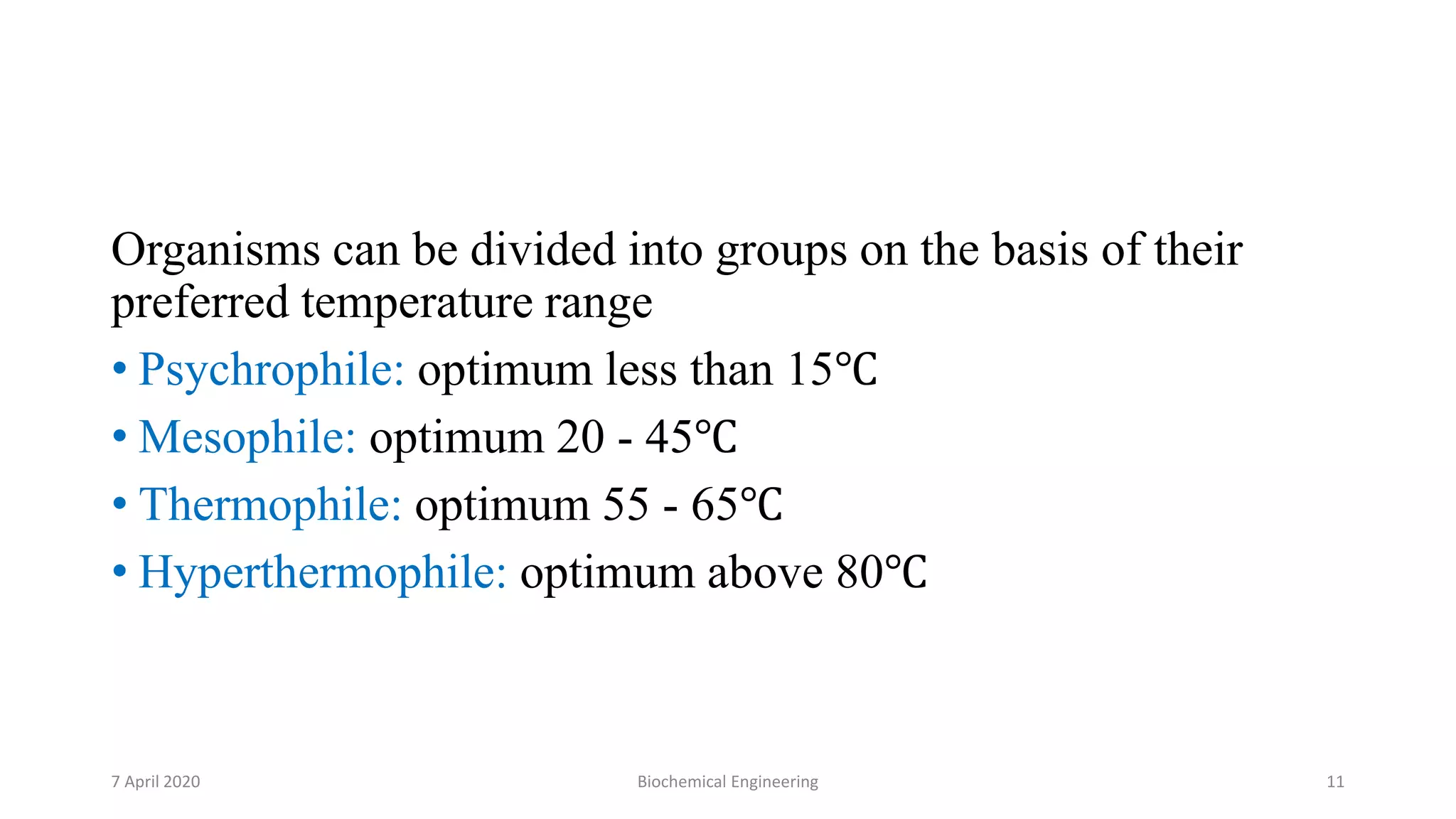
Organisms can be divided into groups on the basis of their
preferred temperature range
• Psychrophile: optimum less than 15℃
• Mesophile: optimum 20 - 45℃
• Thermophile: optimum 55 - 65℃
• Hyperthermophile: optimum above 80℃
7 April 2020 Biochemical Engineering 11
pH:
• Another physical requirement is the extent of acidity or
alkalinity, referred to as the pH of a solution
• pH measures how acidic or basic a solution is, and microbes
may grow in either acidic, basic, or neutral pH conditions.
7 April 2020 Biochemical Engineering 12
• An organisms that grows in acidic (low pH of 2 or below) conditions
is called an acidophile. E.g. Helicobacter pylori
• An organisms that grows in basic (high pH of usually 8.5 – 11)
conditions is called an alkaliphile. E.g. Bacillus halodurans
• An organisms that grows in neutral pH (between 6.5 – 7.5) conditions
is called a neutrophile. E.g. E.coli or streptococcus pyogenes and the
protozoa Naegleria fowleri
Most microbes grow in neutral pH conditions of around pH 7.0, but a
number of bacteria can grow in acidic or basic conditions.
7 April 2020 Biochemical Engineering 13
Osmotic pressure:
Osmotic pressure is the minimum pressure which needs to be
applied to a solution to prevent the inward flow of water
across a SPM.
Types of solution:
• Hypotonic
• Isotonic
• Hypertonic
7 April 2020 Biochemical Engineering 14
Classification of bacteria according to osmotic pressure:
Osmotolerant:
• Are those microorganisms which can grow at relatively high salt
concentration.
e.g. Staphylococcus sp, etc.,
Halophiles:
• Grow in the presence of salt at concentration above 0.2 to 0.6
e.g. Halobacterium halobium
7 April 2020 Biochemical Engineering 15
Classification of bacteria on the basis of hydrostatic
pressure:
• Barotolerant: Does not get affected by increased pressure.
• Barophiles/ Piezophiles: Bacteria which grow at moderately
high hydrostatic pressures.
e.g. Halomonas salaria, Xenophyophores, etc.,
7 April 2020 Biochemical Engineering 16
Methods of culturing microorganisms:
• 5 Basic techniques: to manipulate, grow, examine and characterize
microorganisms.
• Inoculation
• Incubation
• Isolation
• Inspection
• Identification
7 April 2020 Biochemical Engineering 17
Types of culture:
• Pure culture:
A container of medium that grows only a single known species or type of
microorganisms.
• Most frequently used for laboratory study because it allows the systematic
examination and control of one microorganism by itself.
Mixed culture:
• A container that holds two or more identified, easily differentiated species
of microorganisms.
Contaminated culture:
• Was once pure or mixed but has since had contaminants introduced into it
like weeds into a garden
7 April 2020 Biochemical Engineering 18
• When microorganisms are cultivated in the laboratory, a
growth environment called a medium is used.
• Microorganisms growing in or on such a medium form a
culture.
7 April 2020 Biochemical Engineering 19
General microbial media:
• For the cultivation of bacteria, a commonly used medium is
nutrient broth, a liquid containing proteins, salts, and growth
enhancers that will support many bacteria.
• To solidify the medium, an agent such as agar is added.
Agar:
Agar is a polysaccharide that adds no nutrients to a medium,
but merely solidifies it. The medium that results is nutrient
agar.
7 April 2020 Biochemical Engineering 20
• Many media for microorganisms are complex, reflecting the
growth requirements of the microorganisms.
• For instance, most fungi require extra carbohydrate and an
acidic environment for optimal growth. The medium employed
for these organisms is potato dextrose agar, also known as
Sabouraud dextrose agar.
• For protozoa, liquid media are generally required,
• And for rickettsiae and viruses, living tissue cells must be
provided for best cultivation.
7 April 2020 Biochemical Engineering 21
• For anaerobic microorganisms, the atmosphere must be
oxygen free. To eliminate the oxygen, the culture media can
be placed within containers where carbon dioxide and
hydrogen gas are generated and oxygen is removed from the
atmosphere.
7 April 2020 Biochemical Engineering 22
Media are classified based on
• Chemical constituents
• Physical nature
• Function
7 April 2020 Biochemical Engineering 23
1. Chemical constituents:
• Defined media: all components and constituents are known.
• Complex media: contain some ingredients that are of
unknown composition and / or concentration.
7 April 2020 Biochemical Engineering 24
2. Physical nature:
Based on the physical state
• Liquid medium e.g. Fluid Thioglycolate medium.
• Solid medium (1.5% (w/v) agar) e.g. Nutrient agar.
• Semi-solid medium (0.6-1.0%(w/v) agar) e.g. Nutrient broth.
7 April 2020 Biochemical Engineering 25
3. Media function:
• Supportive – supports many organisms e.g. tryptone soy agar
• Enriched – general purpose media enriched with blood or other special
nutrients to support the growth of fastidious bacteria e.g. Blood agar.
• Selection – allows growth for particular microorganisms while
inhibiting the growth of others
e.g. MacConkey agar – selects for enterics (i.e. bile salts)
• Differential – distinguished on different groups of microorganisms
based on their biological characteristics
e.g. blood agar: haemolytic versus non-haemolytic bacteria.
MacConkey agar: lactose fermenter versus non fermenter
7 April 2020 Biochemical Engineering 26
Isolation methods:
• Streak plate method.
• Loop dilution or pour plate.
7 April 2020 Biochemical Engineering 27
Streak plate method:
• A sample of mixed bacteria is streaked several times along one edge of
a Petri dish containing a medium such as nutrient agar.
• A loop is flamed and then touched to the first area to retrieve a sample
of bacteria.
• This sample is then streaked several times in the second area of the
medium. The loop is then reflamed, touched to the second area, and
streaked once again in the third area.
• The process can be repeated in a fourth and fifth area if desired.
During incubation, the bacteria will multiply rapidly and form colonies
7 April 2020 Biochemical Engineering 28
Pour plate method:
• In this method, a sample of bacteria is diluted in several tubes
of melted medium such as nutrient agar.
• After dilution, the melted agar is poured into separate Petri
dishes and allowed to harden.
• Since the bacteria have been diluted in the various tubes, the
plates will contain various dilutions of bacteria, and where the
bacteria are most diluted, they will form isolated colonies
7 April 2020 Biochemical Engineering 29
Picture courtesy:
https://www.cliffsnotes.com/assets/8348.jpg
7 April 2020 Biochemical Engineering 30
Microbial reproduction and growth:
Reproduction patterns:
• During their growth cycles, microorganisms undergo reproduction
many times, causing the numbers in the population to increase
dramatically.
• In fungi, unicellular algae, and protozoa, reproduction involves a
duplication of the nucleus through the asexual process of mitosis and a
splitting of the cell in cytokinesis.
7 April 2020 Biochemical Engineering 31
• Bacteria reproduce by the asexual process of binary fission.
• In this process, the chromosomal DNA duplicates, after which the
bacterial membrane and cell wall grow inward to meet one another
and divide the cell in two. The two cells separate and the process is
complete.
• One of the remarkable attributes of bacteria is the relatively short
generation time, the time required for a microbial population to
double in numbers.
• The generation time varies among bacteria and often ranges
between 30 minutes and three hours. Certain bacteria have very brief
generation times.
• Escherichia coli, for example, has a generation time of about 20
minutes when it is dividing under optimal conditions.
7 April 2020 Biochemical Engineering 32
Growth curve:
• The growth of a bacterial population can be expressed in
various phases of a growth curve.
• Four phases of growth are recognized in the growth curve.
7 April 2020 Biochemical Engineering 33
Picture courtesy:
https://www.cliffsnotes.com/assets/8349.jpg
7 April 2020 Biochemical Engineering 34
• Lag phase: The population remains at the same number as the bacteria
become accustomed to their new environment. Metabolic activity is
taking place, and new cells are being produced to offset those that are
dying.
• Log phase: Bacterial growth occurs at its optimal level and the
population doubles rapidly. This phase is represented by a straight line,
and the population is at its metabolic peak
• Stationary phase: The reproduction of bacterial cells is offset by their
death, and the population reaches a plateau. The reasons for bacterial
death include the accumulation of waste, the lack of nutrients, and the
unfavorable environmental conditions that may have developed.
• Death phase: The bacteria die off rapidly, the curve turns downward,
and the last cell in the population soon dies.
7 April 2020 Biochemical Engineering 35
Microbial measurements:
In order to measure the number of bacteria in a population,
various methods are available.
Plate count method
Direct microscopic counts
Turbidity methods
BOD( Biochemical oxygen demand)
7 April 2020 Biochemical Engineering 36
Plate count method:
• A sample of bacteria is diluted in saline solution, distilled water, or
other holding fluid.
• Samples of the dilutions are then placed in Petri dishes with a growth
medium and set aside to incubate.
• Following incubation, the count of colonies is taken and multiplied by
the dilution factor represented by that plate.
• Generally, plates with between 30 and 300 colonies are selected for
determining the final count, which is expressed as the number of
bacteria per original ml of sample.
7 April 2020 Biochemical Engineering 37
Direct microscopic count:
• A specially designed counting chamber called a Petroff-
Hausser counter is used.
• A measured sample of the bacterial suspension is placed on
the counter, and the actual number of organisms is counted in
one section of the chamber.
• Multiplying by an established reference figure gives a
number of bacteria in the entire chamber and in the sample
counted.
• The disadvantage of this method is that both live and dead
bacteria are counted.
7 April 2020 Biochemical Engineering 38
Turbidity method:
• This can also be used to assess bacterial growth.
• As bacteria multiply in liquid media, they make the media
cloudy.
• Placing the culture tube in a beam of light and noting the
amount of light transmitted gives an idea of the turbidity of
the culture and the relative number of bacteria it contains.
7 April 2020 Biochemical Engineering 39
BOD:
• The dry weight of a culture can also be used to determine
microbial numbers.
• The liquid culture is dried out, and the amount of microbial
mass is weighed on a scale.
• It is also possible to measure the oxygen uptake of a culture of
bacteria. If more oxygen is used by culture A than by culture B
and all other things are equal, then it may be deduced that
more microorganisms are present in culture A.
• A variation of this method called the biochemical oxygen
demand (BOD) is used to measure the extent of contamination
in a water sample.
7 April 2020 Biochemical Engineering 40
Reference:
• https://www.cliffsnotes.com/study-guides/biology/microbiology/microbial-cultivation-and-growth/growth-
requirements-for-microorganisms
• https://www.youtube.com/watch?v=2E4hNyHK3zM
• https://www.scribd.com/doc/17691787/Cultivation-of-Microorganisms
7 April 2020 Biochemical Engineering 41
7 April 2020 Biochemical Engineering 42

Microbial cultivation

  • 1.
    MICROBIAL CULTIVATION PRESENTATION BY G. MohanaPriya S. Nandhini G. Nantha kumar 7 April 2020 Biochemical Engineering 1
  • 2.
    What is cultivation? •Cultivation is the process of propagating organisms by providing the proper environmental conditions. • An understanding of these conditions enables us to characterize isolates and differentiate between different types of bacteria. • Parasites, bacteria and viruses all generally require cultivation for detailed study. • i.e., the process of growing microorganisms in culture by taking bacteria from the infection site (in vivo or environment) and grow them in artificial environment in the laboratory (in vitro). 7 April 2020 Biochemical Engineering 2
  • 3.
    What is microbialcultivation? • Bacteria may require adequate nutrition, temperature, oxygen, optimum pH for growth and multiplication. • Suitable artificial media containing sources of carbon, oxygen, nitrogen, hydrogen, phosphorous, and other elements such as sodium, potassium, magnesium, iron and growth factor (vitamins) in very small amounts have been used for cultivation of microorganisms. 7 April 2020 Biochemical Engineering 3
  • 4.
    Growth requirements formicroorganisms • A characteristic of microorganisms is their ability to grow and form a population of organisms. One of the results of microbial metabolism is an increase in the size of the cell. The many requirements for successful growth include those both chemical and physical. 7 April 2020 Biochemical Engineering 4
  • 5.
    Chemical requirements: • Inorder to grow successfully, microorganisms must have a supply of water as well as numerous other substances including mineral elements, growth factors, and gas, such as oxygen. • Virtually all chemical substances in microorganisms contain carbon in some form, whether they be proteins, fats, carbohydrates, or lipids. 7 April 2020 Biochemical Engineering 5
  • 6.
    • Both chemoautotrophicand photoautotrophic microorganisms obtain their energy and produce their nutrients from simple inorganic compounds such as carbon dioxide. • Chemoautotrophs do so through chemical reactions, while photoautotrophs use photosynthesis. 7 April 2020 Biochemical Engineering 6
  • 7.
    Oxygen: • The presenceor absence of molecular oxygen (O2) is a significant factor for microbial growth and survival. Aerobe: • Obligate aerobe - oxygen is an absolute requirement for their energy- yielding properties E.g. Mycobacterium tuberculosis. • Microaerophile - bacteria species are microaerophilic, meaning that they grow in low concentrations of oxygen E.g. Helicobacter pylori. 7 April 2020 Biochemical Engineering 7
  • 8.
    Anaerobe: Certain microorganisms growin oxygen-free environments and are described as anaerobic. Facultative anaerobe - These species grow in either the presence or absence of oxygen E.g. Staphylococcus aureus. Aerotolerant anaerobe - E.g. Lactobacillus acidophilus. Obligate anaerobe - E.g. Clostridium difficile 7 April 2020 Biochemical Engineering 8
  • 9.
    • Other chemicalrequirements for microbial growth include such trace elements as iron, copper, and zinc. These elements often are used for the synthesis of enzymes. • Organic growth factors such as vitamins may also be required by certain bacteria. • Amino acids, purines, and pyrimidines should also be available. 7 April 2020 Biochemical Engineering 9
  • 10.
    Physical requirements: • Certainphysical conditions affect the type and amount of microbial growth. Temperature: For many bacteria both extremely high and extremely low temperatures can be quite harmful, the former due to protein denaturation, the latter due to intracellular ice crystal formation upon freezing. 7 April 2020 Biochemical Engineering 10
  • 11.
    Organisms can bedivided into groups on the basis of their preferred temperature range • Psychrophile: optimum less than 15℃ • Mesophile: optimum 20 - 45℃ • Thermophile: optimum 55 - 65℃ • Hyperthermophile: optimum above 80℃ 7 April 2020 Biochemical Engineering 11
  • 12.
    pH: • Another physicalrequirement is the extent of acidity or alkalinity, referred to as the pH of a solution • pH measures how acidic or basic a solution is, and microbes may grow in either acidic, basic, or neutral pH conditions. 7 April 2020 Biochemical Engineering 12
  • 13.
    • An organismsthat grows in acidic (low pH of 2 or below) conditions is called an acidophile. E.g. Helicobacter pylori • An organisms that grows in basic (high pH of usually 8.5 – 11) conditions is called an alkaliphile. E.g. Bacillus halodurans • An organisms that grows in neutral pH (between 6.5 – 7.5) conditions is called a neutrophile. E.g. E.coli or streptococcus pyogenes and the protozoa Naegleria fowleri Most microbes grow in neutral pH conditions of around pH 7.0, but a number of bacteria can grow in acidic or basic conditions. 7 April 2020 Biochemical Engineering 13
  • 14.
    Osmotic pressure: Osmotic pressureis the minimum pressure which needs to be applied to a solution to prevent the inward flow of water across a SPM. Types of solution: • Hypotonic • Isotonic • Hypertonic 7 April 2020 Biochemical Engineering 14
  • 15.
    Classification of bacteriaaccording to osmotic pressure: Osmotolerant: • Are those microorganisms which can grow at relatively high salt concentration. e.g. Staphylococcus sp, etc., Halophiles: • Grow in the presence of salt at concentration above 0.2 to 0.6 e.g. Halobacterium halobium 7 April 2020 Biochemical Engineering 15
  • 16.
    Classification of bacteriaon the basis of hydrostatic pressure: • Barotolerant: Does not get affected by increased pressure. • Barophiles/ Piezophiles: Bacteria which grow at moderately high hydrostatic pressures. e.g. Halomonas salaria, Xenophyophores, etc., 7 April 2020 Biochemical Engineering 16
  • 17.
    Methods of culturingmicroorganisms: • 5 Basic techniques: to manipulate, grow, examine and characterize microorganisms. • Inoculation • Incubation • Isolation • Inspection • Identification 7 April 2020 Biochemical Engineering 17
  • 18.
    Types of culture: •Pure culture: A container of medium that grows only a single known species or type of microorganisms. • Most frequently used for laboratory study because it allows the systematic examination and control of one microorganism by itself. Mixed culture: • A container that holds two or more identified, easily differentiated species of microorganisms. Contaminated culture: • Was once pure or mixed but has since had contaminants introduced into it like weeds into a garden 7 April 2020 Biochemical Engineering 18
  • 19.
    • When microorganismsare cultivated in the laboratory, a growth environment called a medium is used. • Microorganisms growing in or on such a medium form a culture. 7 April 2020 Biochemical Engineering 19
  • 20.
    General microbial media: •For the cultivation of bacteria, a commonly used medium is nutrient broth, a liquid containing proteins, salts, and growth enhancers that will support many bacteria. • To solidify the medium, an agent such as agar is added. Agar: Agar is a polysaccharide that adds no nutrients to a medium, but merely solidifies it. The medium that results is nutrient agar. 7 April 2020 Biochemical Engineering 20
  • 21.
    • Many mediafor microorganisms are complex, reflecting the growth requirements of the microorganisms. • For instance, most fungi require extra carbohydrate and an acidic environment for optimal growth. The medium employed for these organisms is potato dextrose agar, also known as Sabouraud dextrose agar. • For protozoa, liquid media are generally required, • And for rickettsiae and viruses, living tissue cells must be provided for best cultivation. 7 April 2020 Biochemical Engineering 21
  • 22.
    • For anaerobicmicroorganisms, the atmosphere must be oxygen free. To eliminate the oxygen, the culture media can be placed within containers where carbon dioxide and hydrogen gas are generated and oxygen is removed from the atmosphere. 7 April 2020 Biochemical Engineering 22
  • 23.
    Media are classifiedbased on • Chemical constituents • Physical nature • Function 7 April 2020 Biochemical Engineering 23
  • 24.
    1. Chemical constituents: •Defined media: all components and constituents are known. • Complex media: contain some ingredients that are of unknown composition and / or concentration. 7 April 2020 Biochemical Engineering 24
  • 25.
    2. Physical nature: Basedon the physical state • Liquid medium e.g. Fluid Thioglycolate medium. • Solid medium (1.5% (w/v) agar) e.g. Nutrient agar. • Semi-solid medium (0.6-1.0%(w/v) agar) e.g. Nutrient broth. 7 April 2020 Biochemical Engineering 25
  • 26.
    3. Media function: •Supportive – supports many organisms e.g. tryptone soy agar • Enriched – general purpose media enriched with blood or other special nutrients to support the growth of fastidious bacteria e.g. Blood agar. • Selection – allows growth for particular microorganisms while inhibiting the growth of others e.g. MacConkey agar – selects for enterics (i.e. bile salts) • Differential – distinguished on different groups of microorganisms based on their biological characteristics e.g. blood agar: haemolytic versus non-haemolytic bacteria. MacConkey agar: lactose fermenter versus non fermenter 7 April 2020 Biochemical Engineering 26
  • 27.
    Isolation methods: • Streakplate method. • Loop dilution or pour plate. 7 April 2020 Biochemical Engineering 27
  • 28.
    Streak plate method: •A sample of mixed bacteria is streaked several times along one edge of a Petri dish containing a medium such as nutrient agar. • A loop is flamed and then touched to the first area to retrieve a sample of bacteria. • This sample is then streaked several times in the second area of the medium. The loop is then reflamed, touched to the second area, and streaked once again in the third area. • The process can be repeated in a fourth and fifth area if desired. During incubation, the bacteria will multiply rapidly and form colonies 7 April 2020 Biochemical Engineering 28
  • 29.
    Pour plate method: •In this method, a sample of bacteria is diluted in several tubes of melted medium such as nutrient agar. • After dilution, the melted agar is poured into separate Petri dishes and allowed to harden. • Since the bacteria have been diluted in the various tubes, the plates will contain various dilutions of bacteria, and where the bacteria are most diluted, they will form isolated colonies 7 April 2020 Biochemical Engineering 29
  • 30.
  • 31.
    Microbial reproduction andgrowth: Reproduction patterns: • During their growth cycles, microorganisms undergo reproduction many times, causing the numbers in the population to increase dramatically. • In fungi, unicellular algae, and protozoa, reproduction involves a duplication of the nucleus through the asexual process of mitosis and a splitting of the cell in cytokinesis. 7 April 2020 Biochemical Engineering 31
  • 32.
    • Bacteria reproduceby the asexual process of binary fission. • In this process, the chromosomal DNA duplicates, after which the bacterial membrane and cell wall grow inward to meet one another and divide the cell in two. The two cells separate and the process is complete. • One of the remarkable attributes of bacteria is the relatively short generation time, the time required for a microbial population to double in numbers. • The generation time varies among bacteria and often ranges between 30 minutes and three hours. Certain bacteria have very brief generation times. • Escherichia coli, for example, has a generation time of about 20 minutes when it is dividing under optimal conditions. 7 April 2020 Biochemical Engineering 32
  • 33.
    Growth curve: • Thegrowth of a bacterial population can be expressed in various phases of a growth curve. • Four phases of growth are recognized in the growth curve. 7 April 2020 Biochemical Engineering 33
  • 34.
  • 35.
    • Lag phase:The population remains at the same number as the bacteria become accustomed to their new environment. Metabolic activity is taking place, and new cells are being produced to offset those that are dying. • Log phase: Bacterial growth occurs at its optimal level and the population doubles rapidly. This phase is represented by a straight line, and the population is at its metabolic peak • Stationary phase: The reproduction of bacterial cells is offset by their death, and the population reaches a plateau. The reasons for bacterial death include the accumulation of waste, the lack of nutrients, and the unfavorable environmental conditions that may have developed. • Death phase: The bacteria die off rapidly, the curve turns downward, and the last cell in the population soon dies. 7 April 2020 Biochemical Engineering 35
  • 36.
    Microbial measurements: In orderto measure the number of bacteria in a population, various methods are available. Plate count method Direct microscopic counts Turbidity methods BOD( Biochemical oxygen demand) 7 April 2020 Biochemical Engineering 36
  • 37.
    Plate count method: •A sample of bacteria is diluted in saline solution, distilled water, or other holding fluid. • Samples of the dilutions are then placed in Petri dishes with a growth medium and set aside to incubate. • Following incubation, the count of colonies is taken and multiplied by the dilution factor represented by that plate. • Generally, plates with between 30 and 300 colonies are selected for determining the final count, which is expressed as the number of bacteria per original ml of sample. 7 April 2020 Biochemical Engineering 37
  • 38.
    Direct microscopic count: •A specially designed counting chamber called a Petroff- Hausser counter is used. • A measured sample of the bacterial suspension is placed on the counter, and the actual number of organisms is counted in one section of the chamber. • Multiplying by an established reference figure gives a number of bacteria in the entire chamber and in the sample counted. • The disadvantage of this method is that both live and dead bacteria are counted. 7 April 2020 Biochemical Engineering 38
  • 39.
    Turbidity method: • Thiscan also be used to assess bacterial growth. • As bacteria multiply in liquid media, they make the media cloudy. • Placing the culture tube in a beam of light and noting the amount of light transmitted gives an idea of the turbidity of the culture and the relative number of bacteria it contains. 7 April 2020 Biochemical Engineering 39
  • 40.
    BOD: • The dryweight of a culture can also be used to determine microbial numbers. • The liquid culture is dried out, and the amount of microbial mass is weighed on a scale. • It is also possible to measure the oxygen uptake of a culture of bacteria. If more oxygen is used by culture A than by culture B and all other things are equal, then it may be deduced that more microorganisms are present in culture A. • A variation of this method called the biochemical oxygen demand (BOD) is used to measure the extent of contamination in a water sample. 7 April 2020 Biochemical Engineering 40
  • 41.
  • 42.
    7 April 2020Biochemical Engineering 42