Effective Lesson Planning and Design
Terry L. Lockhart
EDU 650
Dr. Rich Newman
November 9, 2015
Part one: Effective
Lesson Design &
Backward Design.
Part two: Compare & contrast
Backwards Design & the
Traditional Model.
Part three: Backward
Design Activity.
Table of Content
Part one: Effective Lesson Design & Backward Design
1. The most important elements of effective lesson design.
2. Why are good learning objectives critical to planning
effective instruction.
3. Provide an example of a good learning objectives aligned
with the common core state standards.
4. What are some common pitfalls in planning effective
lessons? How can we avoid these pitfalls?
Part one: Effective Lesson Design & Backward Design
5. Common pitfalls in planning effective lessons/ ways to
improve pitfalls.
6. The meaning of backward designs.
7. How does the Common Core State Standards play a role in
designing effective instruction (Newman, 2013).
What are the most important elements of
effective lesson design?
 Research
 Gather knowledge from different sources.
 Ask other teachers questions.
 Talk to colleagues or experienced teachers.
 Use the power of the internet to connect with other
teachers.
 Read up on how to effectively plan lessons (Newman,
2013).
Why are good learning objectives critical to planning
effective instruction?
They can help develop conceptual understanding for
cognition (Newman, 2013).
Example of good learning objectives
Student in Introductory Psychology will apply the four steps of
the scientific method to determine if parapsychology
constitutes a science (Newman, 2013). This is a good example
because it challenge students to use a higher level of
thinking.
Common Pitfalls in Planning Effective
Lessons
1. Rather than focusing on solid planning, teachers focus their
energies on developing activities that hands on without being
mind on.
2. They focus on covering the entire book without a clear
purpose (Newman, 2013).
How can we avoid these common pitfalls?
Think about what they want their students to learn at the end of
the lesson.
What does backwards design mean?
To begin with the end in mind means to start with a clear
understanding of you destination. In the Backwards Design each
lesson begins with a goal that both teachers and students can use
to judge their achievement during the class period (Jones,
Vermette, & Jones, 2009).
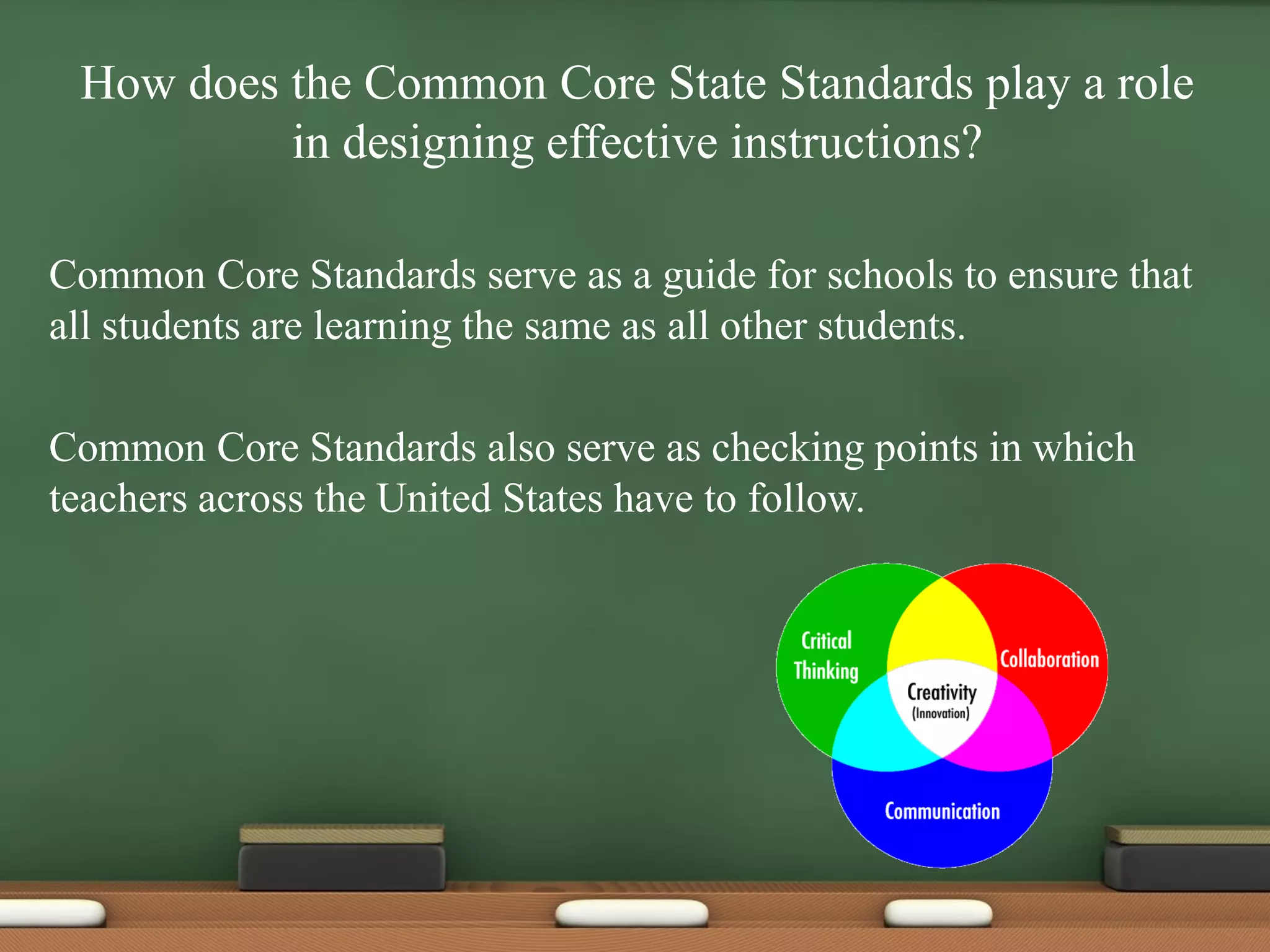
How does the Common Core State Standards play a role
in designing effective instructions?
Common Core Standards serve as a guide for schools to ensure that
all students are learning the same as all other students.
Common Core Standards also serve as checking points in which
teachers across the United States have to follow.
Backward Design Model
Begins with the end in mind.
Develop an assessment to
determine student success
for outcome.
Develop learning experiences
and activities for students to
engage in.
Assess results using
assessments developed in step
two. Hands on experience.
Traditional Model
Begins with inputs. Develop
learning experiences and
activities for students to
engage in.
Give an assessment from
textbook or other resource.
Choose new topic to cover.
The assessment is the last part
of lesson plan.
• Assessment did drive the activity.
Part two: Backwards Design / Traditional Model
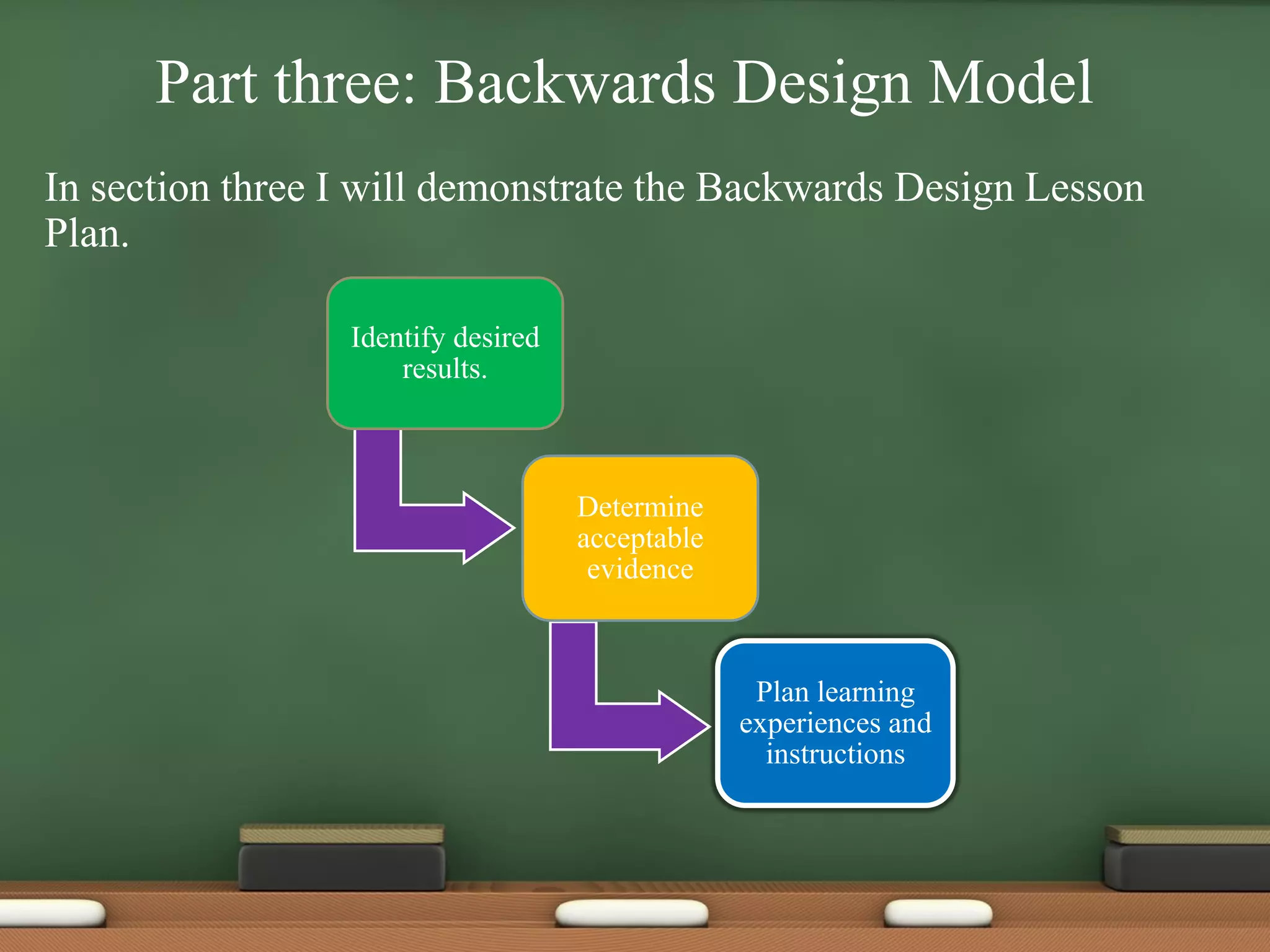
In section three I will demonstrate the Backwards Design Lesson
Plan.
Identify desired
results.
Determine
acceptable
evidence
Plan learning
experiences and
instructions
Part three: Backwards Design Model
Understanding
the goals.
• In this lesson,
students will be able
to identify the
events that lead to
WWII.
Student objective
• Students will be able
to list all parties
involved in WW II.
• Discuss the end
results.
Essential Question
• What role did the
USA play in WW II.
• What other countries
were involved and
why.
State content Standard: Students will research in depth the key events of
World War II . Student will identify events that lead to World War II.
Identify Desired Results
Performance Task Student debates & group discussion
& assessments
Other Evidence
quizzes, journals, DVDs
Teacher will observe students &
provide feedback as they work.
Assessment of student work.
Assess students through
conversations & questions
Determine acceptable evidence
World War II DVD
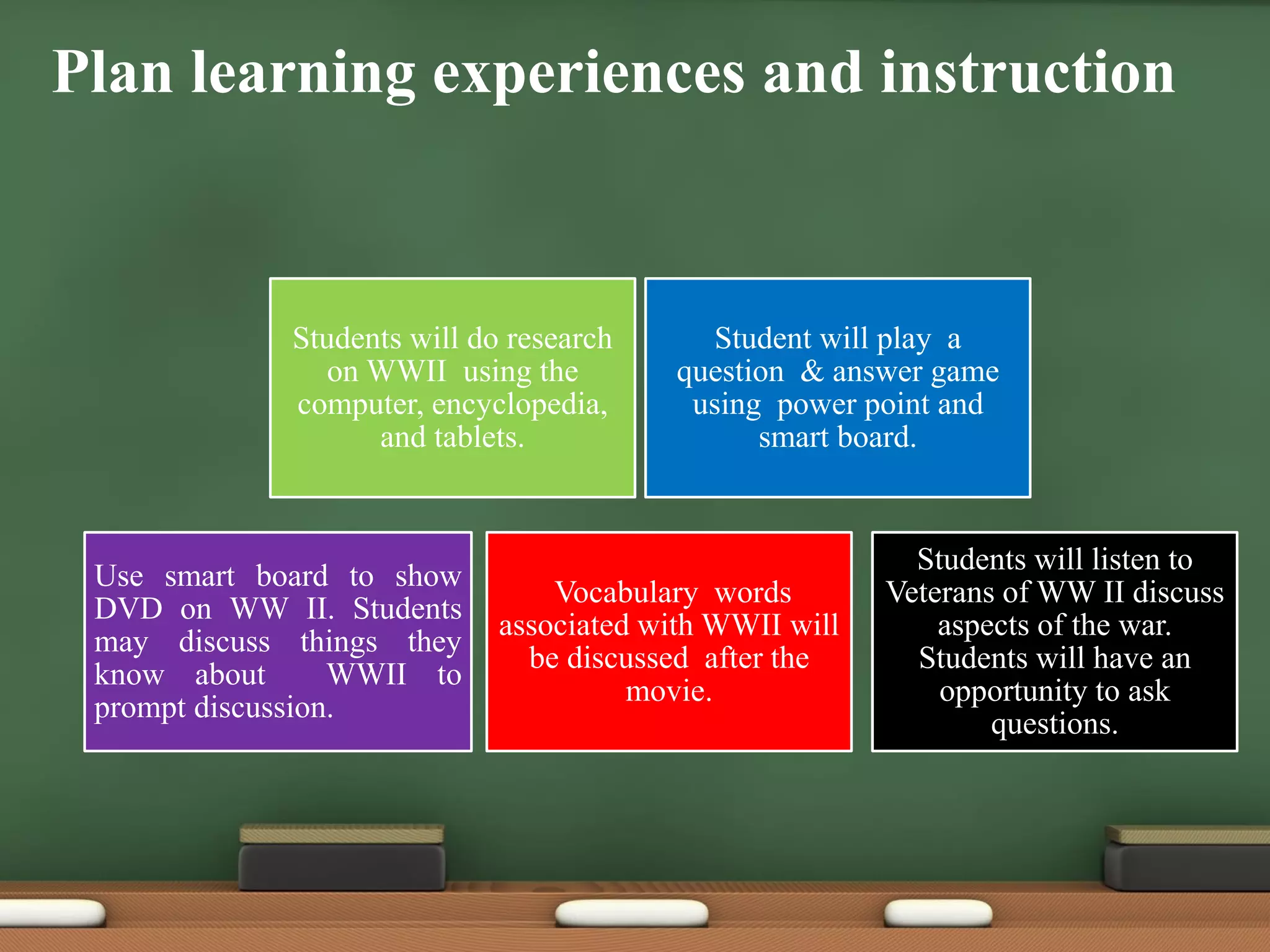
Plan learning experiences and instruction
Use smart board to show
DVD on WW II. Students
may discuss things they
know about WWII to
prompt discussion.
Vocabulary words
associated with WWII will
be discussed after the
movie.
Students will do research
on WWII using the
computer, encyclopedia,
and tablets.
Student will play a
question & answer game
using power point and
smart board.
Students will listen to
Veterans of WW II discuss
aspects of the war.
Students will have an
opportunity to ask
questions.
References
Newman, R. (2013). Teaching and Learning in the 21st Century: Connecting the
Dots. San Diego, CA: Bridgepoint Education, Inc.
Jones, K. A., Vermette, P. J., & Jones, J. L. (2009). AN INTEGRATION OF
"BACKWARDS PLANNING" UNIT DESIGN WITH THE "TWO-STEP"
LESSON PLANNING FRAMEWORK. Education, 130(2), 357-360.

Effective lesson planning and design(2) 11 9-15

  • 1.
    Effective Lesson Planningand Design Terry L. Lockhart EDU 650 Dr. Rich Newman November 9, 2015
  • 2.
    Part one: Effective LessonDesign & Backward Design. Part two: Compare & contrast Backwards Design & the Traditional Model. Part three: Backward Design Activity. Table of Content
  • 3.
    Part one: EffectiveLesson Design & Backward Design 1. The most important elements of effective lesson design. 2. Why are good learning objectives critical to planning effective instruction. 3. Provide an example of a good learning objectives aligned with the common core state standards. 4. What are some common pitfalls in planning effective lessons? How can we avoid these pitfalls?
  • 4.
    Part one: EffectiveLesson Design & Backward Design 5. Common pitfalls in planning effective lessons/ ways to improve pitfalls. 6. The meaning of backward designs. 7. How does the Common Core State Standards play a role in designing effective instruction (Newman, 2013).
  • 5.
    What are themost important elements of effective lesson design?  Research  Gather knowledge from different sources.  Ask other teachers questions.  Talk to colleagues or experienced teachers.  Use the power of the internet to connect with other teachers.  Read up on how to effectively plan lessons (Newman, 2013).
  • 6.
    Why are goodlearning objectives critical to planning effective instruction? They can help develop conceptual understanding for cognition (Newman, 2013).
  • 7.
    Example of goodlearning objectives Student in Introductory Psychology will apply the four steps of the scientific method to determine if parapsychology constitutes a science (Newman, 2013). This is a good example because it challenge students to use a higher level of thinking.
  • 8.
    Common Pitfalls inPlanning Effective Lessons 1. Rather than focusing on solid planning, teachers focus their energies on developing activities that hands on without being mind on. 2. They focus on covering the entire book without a clear purpose (Newman, 2013).
  • 9.
    How can weavoid these common pitfalls? Think about what they want their students to learn at the end of the lesson.
  • 10.
    What does backwardsdesign mean? To begin with the end in mind means to start with a clear understanding of you destination. In the Backwards Design each lesson begins with a goal that both teachers and students can use to judge their achievement during the class period (Jones, Vermette, & Jones, 2009).
  • 11.
    How does theCommon Core State Standards play a role in designing effective instructions? Common Core Standards serve as a guide for schools to ensure that all students are learning the same as all other students. Common Core Standards also serve as checking points in which teachers across the United States have to follow.
  • 12.
    Backward Design Model Beginswith the end in mind. Develop an assessment to determine student success for outcome. Develop learning experiences and activities for students to engage in. Assess results using assessments developed in step two. Hands on experience. Traditional Model Begins with inputs. Develop learning experiences and activities for students to engage in. Give an assessment from textbook or other resource. Choose new topic to cover. The assessment is the last part of lesson plan. • Assessment did drive the activity. Part two: Backwards Design / Traditional Model
  • 13.
    In section threeI will demonstrate the Backwards Design Lesson Plan. Identify desired results. Determine acceptable evidence Plan learning experiences and instructions Part three: Backwards Design Model
  • 14.
    Understanding the goals. • Inthis lesson, students will be able to identify the events that lead to WWII. Student objective • Students will be able to list all parties involved in WW II. • Discuss the end results. Essential Question • What role did the USA play in WW II. • What other countries were involved and why. State content Standard: Students will research in depth the key events of World War II . Student will identify events that lead to World War II. Identify Desired Results
  • 15.
    Performance Task Studentdebates & group discussion & assessments Other Evidence quizzes, journals, DVDs Teacher will observe students & provide feedback as they work. Assessment of student work. Assess students through conversations & questions Determine acceptable evidence
  • 16.
  • 17.
    Plan learning experiencesand instruction Use smart board to show DVD on WW II. Students may discuss things they know about WWII to prompt discussion. Vocabulary words associated with WWII will be discussed after the movie. Students will do research on WWII using the computer, encyclopedia, and tablets. Student will play a question & answer game using power point and smart board. Students will listen to Veterans of WW II discuss aspects of the war. Students will have an opportunity to ask questions.
  • 18.
    References Newman, R. (2013).Teaching and Learning in the 21st Century: Connecting the Dots. San Diego, CA: Bridgepoint Education, Inc. Jones, K. A., Vermette, P. J., & Jones, J. L. (2009). AN INTEGRATION OF "BACKWARDS PLANNING" UNIT DESIGN WITH THE "TWO-STEP" LESSON PLANNING FRAMEWORK. Education, 130(2), 357-360.